Search Results: "ag"

4 July 2012

Christian Perrier: DebConf running: take 2

Second day in managua, second day running. Today, after breakfast, so at about 7h45, I went out running with Gaudenz Steinlin. The goal was to go to laguna de Tiscapa, a lagoon of volcanic origin, in the middle of the city of Managua. The laguna is not really far away from the place we're staying at (about 2.5km). However, as usual here, the only way to get there is along the streets. Noisy streets. Often smelly streets. But that's the only way. For instance, it took Gaudenz several minutes before he could manage to cross the "Pista Beljamin Zelodon", a quite busy highway. The lagoon per se is really nice, particularly the view from the Sandino monument where you can see the Peninsula de Chiltepe. However, apart from that, it was sometimes a quite boring run because of the traffic, noise, etc. But I enjoyed again having a good run with Gaudenz. We'll do this again, but in another place..:-) GPS trace for that run is here.

Johannes Schauer: enumerating elementary circuits of a directed_graph

For my GSoC project this year I need to be able to enumerate all elementary circuits of a directed graph. My code is written in Ocaml but neither the ocamlgraph library nor graph libraries for other languages seem to implement a well tested algorithm for this task. In lack of such a well tested solution to the problem, I decided to implement a couple of different algorithms. Since it is unlikely that different algorithms yield the same wrong result, I can be certain enough that each individual algorithm is working correctly in case they all agree on a single solution. As a result I wrote a testsuite, containing an unholy mixture of Python, Ocaml, D and Java code which implements algorithms by D. B. Johnson, R. Tarjan, K. A. Hawick and H. A. James.

Algorithm by R. Tarjan The earliest algorithm that I included was published by R. Tarjan in 1973.
Enumeration of the elementary circuits of a directed graph
R. Tarjan, SIAM Journal on Computing, 2 (1973), pp. 211-216
http://dx.doi.org/10.1137/0202017
I implemented the pseudocode given in the paper using Python. The git repository can be found here: https://github.com/josch/cycles_tarjan

Algorithm by D. B. Johnson The algorithm by D. B. Johnson from 1975 improves on Tarjan's algorithm by its complexity.
Finding all the elementary circuits of a directed graph.
D. B. Johnson, SIAM Journal on Computing 4, no. 1, 77-84, 1975.
http://dx.doi.org/10.1137/0204007
In the worst case, Tarjan's algorithm has a time complexity of O(n e(c+1)) whereas Johnson's algorithm supposedly manages to stay in O((n+e)(c+1)) where n is the number of vertices, e is the number of edges and c is the number of cycles in the graph. I found two implementations of Johnson's algorithm. One was done by Frank Meyer and can be downloaded as a zip archive. The other was done by Pietro Abate and the code can be found in a blog entry which also points to a git repository. The implementation by Frank Meyer seemed to work flawlessly. I only had to add code so that a graph could be given via commandline. The git repository of my additions can be found here: https://github.com/josch/cycles_johnson_meyer Pietro Abate implemented an iterative and a functional version of Johnson's algorithm. It turned out that both yielded incorrect results as some cycles were missing from the output. A fixed version can be found in this git repository: https://github.com/josch/cycles_johnson_abate

Algorithm by K. A. Hawick and H. A. James The algorithm by K. A. Hawick and H. A. James from 2008 improves further on Johnson's algorithm and does away with its limitations.
Enumerating Circuits and Loops in Graphs with Self-Arcs and Multiple-Arcs.
Hawick and H.A. James, In Proceedings of FCS. 2008, 14-20
www.massey.ac.nz/~kahawick/cstn/013/cstn-013.pdf
In contrast to Johnson's algorithm, the algorithm by K. A. Hawick and H. A. James is able to handle graphs containing edges that start and end at the same vertex as well as multiple edges connecting the same two vertices. I do not need this functionality but add the code as additional verification. The paper posts extensive code snippets written in the D programming language. A full, working version with all pieces connected together can be found here: https://github.com/josch/cycles_hawick_james The algorithm was verified using example output given in the paper. The project README states how to reproduce it.

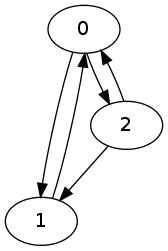
Input format All four codebases have been modified to produce executables that take the same commandline arguments which describes the graphs to investigate. The first argument is the number of vertices of the graph. Subsequent arguments are ordered pairs of comma separated vertices that make up the directed edges of the graph. Lets look at the following graph as an example: cycle example The DOT source for this graph is:
digraph G  
  0;
  1;
  2;
  0 -> 1;
  0 -> 2;
  1 -> 0;
  2 -> 0;
  2 -> 1;
   
To generate the list of elementary circuits using Tarjan's algorithm for the graph above, use:
$ python cycles.py 3 0,1 0,2 1,0 2,0 2,1
0 1
0 2
0 2 1
The commandline arguments are the exact same for the other three methods and yield the same result in the same order. If the DOT graph is in a format as simple as above, the following sed construct can be used to generate the commandline argument that represents the graph:
$ echo  sed -n -e '/^\s*[0-9]\+;$/p' graph.dot   wc -l   sed -n -e 's/^\s*\([0-9]\) -> \([0-9]\);$/\1,\2/p' graph.dot 

Testsuite As all four codebases take the same input format and have the same output format, it is now trivial to write a testsuite that compares the individual output of each algorithm for the same input and checks for differences. The code of the testsuite is available via this git repository: https://github.com/josch/cycle_test The other four repositories exist as submodules of the testsuite repository.
$ git clone git://github.com/josch/cycle_test.git
$ cd cycle_test
$ git submodule update --init
A testrun is done via calling:
$ ./test.sh 11
The argument to the shell script is an integer denoting the maximum number N of vertices for which graphs will be generated. The script will compile the Ocaml, Java and D sourcecode of the submodules as well as an ocaml script called rand_graph.ml which generates random graphs from v = 1..N vertices where N is given as a commandline argument. For each number of vertices n, e = 1..M number of edges are chosen where M is maximum number of edges given the number of vertices. For every combination of number of vertices v and number of edges e, a graph is randomly generated using Pack.Digraph.Rand.graph from the ocamlgraph library. Each of those generated graphs is checked for cycles and written to a file graph-v-e.dot if the graph contains a cycle. test.sh then loops over all generated dot files. It uses the above sed expression to convert each dot file to a commandline argument for each of the algorithms. The outputs of each algorithm are then compared with each other and only if they do not differ, does the loop continue. Otherwise the script returns with an exit code. The tested algorithms are the Python implementation of Tarjan's algorithm, the iterative and functional Ocaml implementation as well as the Java implementation of Johnson's algorithm and the D implementation of the algorithm by Hawick and James.

Future developments Running the testsuite with a maximum of 12 vertices takes about 33 minutes on a 2.53GHz Core2Duo and produces graphs with as much as 1.1 million cycles. It seems that all five implementations agree on the output for all 504 generated graphs that were used as input. If there should be another implementation of an algorithm that enumerates all elementary circuits of a directed graph, I would like to add it. There are some more papers that I would like to read but I lack access to epubs.siam.org and ieeexplore.ieee.org and would have to buy them. Benchmarks seem a bit pointless as not only the algorithms are very different from each other (and there are many ways to tweak each of them) but also the programming languages differ. Though for the curious kind, it follows the time each algorithm takes to enumerate all cycles for all generated graphs up to 11 vertices.
algorithmtime (s)
Johnson, Abate, Ocaml, iterative137
Johnson, Abate, Ocaml, functional139
Tarjan, Python153
Hawick, D175
Johnson, Meyer, Java357
The iterative Ocaml code performs as well as the functional one. In practice, the iterative code should probably be preferred as the functional code is not tail recursive. On the other hand it is also unlikely that cycles ever grow big enough to make a difference in the used stack space. The Python implementation executes surprisingly fast, given that Tarjan's algorithm is supposedly inferior to Johnson's and given that Python is interpreted but the Python implementation is also the most simple one with the least amount of required datastructures. The D code potentially suffers from the bigger datastructures and other bookkeeping that is required to support multi and self arcs. The java code implements a whole graph library which might explain some of its slowness.

Michael Banck: 4 Jul 2012

Update on computational chemistry packages in Debian

For many years, me and the Debichem team maintained two computational chemistry packages, first MPQC and later PSI3. In recent years however, two respected quantum chemistry codes have been open sourced and are now available in Debian: ACESIII and NWChem. Make no mistake, those are not recently started codes or some Ph.D.'s pet-project but state-of-the-art projects targeted at massively parallel supercomputers and developed at the University of Florida's Quantum Chemistry Project (QTP) in the case of ACESIII and at Pacific Northwest National Laboratory (PNNL) for NWChem.

While ACESIII has a somewhat narrow focus on Coupled-Cluster (unfortunately, the current version does not yet implement analytic gradients for the "golden standard" CCSD(T) method) and Multi-Body Perturbation Theory methods, NWChem is a very versatile package supporting a variety of molecular quantum chemistry methods (including Density Functional Theory (DFT)), as well as periodic plane-wave electronic structure and (ab-initio and classical) molecular dynamics. At this point, NWChem probably covers 90% of all use cases for routine computational chemistry compared to the popular non-free codes Gaussian and GAMESS, while likely exhibiting superior parallel scaling at least compared to Gaussian.

Over the last year, I have packaged and integrated NWChem and ACESIII for Debian, and they are now both in testing. Furthermore, I have recently overhauled the packaging of MPQC and enabled parallel execution via MPI. Further, both MPQC and PSI will see updated versions (MPQC3 and PSI4) in the near future with significant increased functionality, including some unique (at least among open source codes) features like Symmetry-Adapted Perturbation Theory (SAPT) for PSI4 and general explicitly correlated corrections ([2]f12) for MPQC3. Unfortunately, they both did not get released in time for the wheezy freeze.

On the periodic/plane-wave front, I have also packaged and uploaded Quantum ESPRESSO (formerly PwSCF), a set of plane-wave programs, and I have been working with lafur Jens Sigur sson to get the latest Abinit release packaged. The nanoscale-physics team is also targeting further periodic ab-initio packages like BigDFT and Octopus, but those as well did not land in time for the freeze.

Finally, I also packaged and uploaded CP2K, a well-engineered and versatile periodic plane-wave/pseudo-potential code which focuses on state-of-the-art ab-initio Molecular Dynamics (AIMD) using Density Functional Theory. Some of the authors have recently published a paper reporting linear scaling benchmark calculations on a system with a million atoms using almost 50,000 CPU cores.

All of the above mentioned packages are included either in the molecular ab-initio or the periodic ab-initio Debichem tasks.

Michal Čihař: Weblate 1.1

Pretty much on schedule, Weblate 1.1 has been released today. It comes with translation updates, bug fixes, improvements in working with Git repositories and brings support for offloading indexing. Full list of changes for 1.1: You can find more information about Weblate on it's website, the code is hosted on Github. If you are curious how it looks, you can try it out on demo server. You can login there with demo account using demo password or register your own user. Ready to run appliances can be found in SUSE Studio Gallery. Weblate is also being used https://l10n.cihar.com/ as official translating service for phpMyAdmin, Gammu, Weblate itself and others. If you are free software project which would like to use Weblate, I'm happy to help you with set up or even host Weblate for you (this will be decided case by case as my hosting space is limited). Update: Weblate appliace has now also been updated to 1.1.

Filed under: English Phpmyadmin Suse Weblate 0 comments Flattr this!

Stefano Zacchiroli: bits from the DPL for June 2012

Monthly DPL bits, fresh from the oven^W^W^W hot from DebConf12, and just posted to d-d-a.
Howdy from DebConf12. It's hot, but it's also time to bother you again with a (not so) brief DPL activity report, this time for June 2012. Time-based freeze: DONE, short freeze: TODO Two highlights for this month. First, you've probably noticed Wheezy is now frozen, YAY. This is huge achievement for the release, but also for the project. It's the first time we do a time-based freeze, and it took some quite heated discussion at the beginning of the release cycle to decide to do this. And we did it properly: respecting the planned month and narrowing down the period later. This exercise has hopefully helped both DDs in their package planning and our upstreams in targeting Wheezy with stable releases of their software. Kudos to the release team for their coordination work! Now we've the second part still TODO: releasing Wheezy, without RC bugs, with a freeze period as short as possible. See the beginning of my last "bits from the DPL" mail for my usual song and dance :-P on how to deliver that, together. DebConf12 A lot of us will attend DebConf12. Enjoy it! ... and take the chance to both have fun and make great plans for Debian's future. But remember that "if it didn't happen on a mailing list, it didn't happen". Not all of us will be lucky enough to attend DebConf (in person or remotely). Make sure that those who don't can take part in your team decisions and get informed of what is going to happen here. Politics Zack's spring tour I spent a significant part of June doing Debian talks ins some sort of "spring tour" between Italy and France. In particular: Many thanks to the organizers of these events for inviting and sponsoring me (as well as other Debian people, in the ESRF case) and for their interest in Debian. Sprints Assets Discussions Some relevant discussions for project evolution has been going on in June and I took part into them. You might want to have a look at them: Misc Cheers.
PS the boring day-to-day activity log for June is available at master:/srv/leader/news/bits-from-the-DPL.txt.201206

Dirk Eddelbuettel: RcppBDT 0.2.0

A new release of the RcppBDT package appeared on CRAN earlier today. RcppBDT uses Rcpp, and in particular the nifty Rcpp modules feature of wrapping C++ code for R just by declaring the (class or function) interfaces. It uses this to bring in some useful functions from Boost Date.Time to R so that one can do things like
R> library(RcppBDT)
R> sapply(2012:2016, function(year)
+         format(getNthDayOfWeek(first, Mon, Sep, year)))
[1] "2012-09-03" "2013-09-02" "2014-09-01" "2015-09-07" "2016-09-05"
R> 
to compute the next five Labor Day dates in the US, given the year and the first Monday of September requirement. More examples are e.g. on the earlier blog post announcing version 0.1.0. Changes are mostly internal. R 2.15.1 brough a better / easier way to load such 'modules' into R, and Rcpp 0.9.13 allows us to use this. So RcppBDT continues to be useful as an example package for Rcpp modules. I also streamlines the interface a little: identifiers are now directly accessible in the package's NAMESPACE rather than just via the an instantiated object. I also added a NEWS file, using the .Rd format so that we can import the marked-up text:
News for Package RcppBDT Changes in version 0.2.0 (2012-07-02)
  • The core module, which wraps what in C++ is boost::gregorian::date, is now exposed as an Rcpp module bdtDate. As all example and demos operated off a (package-global) variable 'bdt', no user visible change was needed outside of the code instantiating at package load.
  • Updated package instantiation to the new facilities offered by the current versions R 2.15.1 and Rcpp 0.9.13 which make Rcpp module initialization easier and more streamlined.
Changes in version 0.1.0 (2011-01-17)
  • First CRAN upload (and see ChangeLog for more granular details) bug fix in svm cross validation
Courtesy of CRANberries, there is also a diffstat report for 0.2.0 relative to 0.1.0. As always, feedback is welcome and the rcpp-devel mailing list off the R-Forge page for Rcpp is the best place to start a discussion.

3 July 2012

Miriam Ruiz: Scratch in Debian

Scratch has finally reached Debian repositories. Scratch is a programming learning environment created by the Lifelong Kindergarten Group at the MIT Media Lab designed to be accessible by young learners (over 8 years old). Scratch makes it easy to create your own interactive stories, animations, games, music, and art through a visual interface based on blocks. Thus, beginners can get results without having to learn to write syntactically correct code first. It is powerful enough to have even been adopted as an entry-level computer language in computer science programs at different universities. Scratch makes use of pieces of code embedded in different blocks that are shaped like puzzle pieces. That way, programming consists on putting different blocks together, which gives immediate visual feedback to the programmer about the correctness of the syntax: If the pieces fit together, then the expression is valid. Scratch programming system is so nice and easy that has been the inspiration of other systems such as MIT App Inventor or Google Blocky.

Scratch animations consist of sprites that are animated by dragging the corresponent blocks into the Scripts area of the Scratch interface. Multiple sprites can be created and interact with one another. Each of the sprites can have different looks (called costumes in Scratch). You can use built-in sprites, load them from files, or draw your own using a drawing tool integrated in the environment. Scratch itself is coded in Squeak, a Smalltalk implementation derived from Smalltalk-80. The Scratch 1.4 source went GPLv2 on March, but there were some incompatibilites with the Squeak Virtual Machine currently in Wheezy that had to be resolved first. Luckily we were able to solve them, with the help of the Scratch and the Squeak guys, so I m happy to say that Scrach is finally available from Debian repositories. Note: If any Scratch derivatives (such as BYOB or Panther) also need to be ported to the current version of Squeak, they should have a look at the comments in the Scratch ITP, and especially to the script uploaded by Bert Freudenberg, that replaces 90 indexed primitive declarations (removed in later versions of Squeak VM) with their named counterpart. Note 2: This wouldn t have been possible without all the great work and effort made by Amos Blanton and many others. Lots of thanks!

Petter Reinholdtsen: Can Zimbra be told to send autoreplies to the From: address?

In the NUUG FiksGataMi project (Norwegian version of FixMyStreet from mySociety), we have discovered a problem with the municipalities using Zimbra. When FiksGataMi send a problem report to the government, the email From: address is set to the address of the person reporting the problem, while envelope sender is set to the FiksGataMi contact address. The intention is to make sure the municipality send any replies to the person reporting the problem, while any email delivery problems are sent to us in NUUG. This work well in most cases, but not for Karm y municipality using Zimbra. Karm y is using the vacation message function in Zimbra to send an automatic reply to report that the message has been received, and this message is sent to the envelope sender and not the address in the From: header. This causes the automatic message from Karm y to go to NUUGs request-tracker instance instead of to the person reporting the problem. We can not really change the envelope sender address, as this would make it impossible for us to discover when there are problems with the MTAs receiving problem reports. We have been in contact with the people at Karm y municipality, and they are willing to adjust Zimbra if something can be changed there to get a better behaviour. The default behaviour of Zimbra is as far as I can tell according to the specification in RFC 3834, which recommend that vacation messages are sent to the envelope sender and not to the From: address. But I wonder if it is possible to adjust or configure Zimbra to behave differently. Anyone know? Please let us know at fiksgatami (at) nuug.no.

Christian Perrier: DebConf running: take 1

One part of my yearly activity at DebConf is exploring the conference neighbourhood for good running spots. So, the first one this year has been an up and down run on "Camino Las Viudas", heading south from Managua. The path is easy to find: when exiting from Hotel Seminole, turn right in the street, cross the large boulevard on continue staright ahead for how many kilometers as you want. It climbs up in the hills all along, so that's quite a though one with about 5% slope all along. I stopped in the middle of nothing, just because I didn't want to run for more than one hour. I'll have to come back and see where this road goes. It seems to be climbing continuously..:-) So, one of my forthcoming plans is going to *the end* of this road, just to see what's there. From OpenStreetMap, it seems to end up in the hills. The run trace can be seen there.

Ryan Kavanagh: Fixing mutt header cache

Every now and then I have to kill mutt, which if done at the wrong time, can leave the header cache in an open state. Then attempting to restart mutt will cause it to hang at the "Selecting INBOX" stage. If mutt is compiled with support for the Tokyo Cabinet header cache backend (as it appears to be in Debian), a quick fix for this issue is to repair the header cache database using the Tokyo Cabinet utility tcbmgr from the tokyocabinet-bin package. Simply running tcbmgr optimize -nl ~/.mutt/cache/headers does the trick, and is much nicer of a fix than deleting the header cache.

Dirk Eddelbuettel: RcppArmadillo 0.3.2.3

Conrad releaser version 3.2.3 of Armadillo a few days ago, and the corresponding RcppArmadillo package 0.3.2.3 is now CRAN. (For these keeping score 3.2.1 never was a full release, and 3.2.2 containing fixes for a build issue that did not affect the R package build so we skipped it.) The short NEWS entry follows below. This version fixes some issues related to g++ 4.7; however the current Debian testing version of g++-4.7.1 required that I rolled back three header files to the version from the previous release. Conrad has been in contact with the gcc upstream maintainers and a fix may appear in time for g++-4.7.2. This release also contains a new introductory pdf vignette based on a paper Conrad and I just submitted. It introduces Armadillo to R programmers and demonstrates with a simple Kalman filtering example how the code can be written in the same concise matrix-oriented style, yet runs orders of magnitude faster.
0.3.2.3  2012-07-01
    o   Upgraded to Armadillo release 3.2.3 
          * minor correction for declaration of fixed size vectors and
            matrices
    o   Reverted three header files  Mat,Row,Col _bones.hpp back to previous
        release due to compilation failures under g++-4.7
    o   Added new vignette 'RcppArmadillo-intro' based on a just-submitted
        introductory paper (by Eddelbuettel and Sanderson) about RcppArmadillo 
    o   Change from release 3.2.2 which we skipped as it did not really affect
        builds under R:
          * minor fix for compiling without debugging enabled (aka release
            mode)
          * better detection of ATLAS during installation on Fedora and Red
            Hat systems
    o   Small enhancement to fastLm 
Courtesy of CRANberries, there is also a diffstat report for 0.3.2.3 relative to 0.3.2.0 As always, more detailed information is on the RcppArmadillo page. Questions, comments etc should go to the rcpp-devel mailing list off the R-Forge page.

2 July 2012

Matthew Garrett: Fun with firmware ABI confusion

I spent a bunch of the past week trying to figure out why my UEFI bootloader code was crashing in bizarre ways. It turns out to be a known issue that various people have hit in the past. After a lot of staring (and swearing) I finally got to the point where I could run a debugger against a running UEFI binary under qemu and found that I was entering a function with valid arguments but executing it with invalid ones. After spending a while crying on IRC people suggested that maybe the red zone was getting corrupted, and it turned out that this was the problem.

The red zone is part of the AMD64 System V ABI and consists of 128 bytes at the bottom of the stack frame. This region is guaranteed to be left untouched by any interrupt or signal handlers, so it's available for functions to use as scratch space. For the code in question, gcc was copying the registers onto the stack before executing the function. Something then trod on those registers. This also explained why I wasn't seeing the problem when I added debug print statements - signal and interrupt handlers won't touch it, but other functions might, so it tends to only be used by functions that don't call any other functions. Adding a print statement meant that the compiler left the red zone alone.

But why was it getting corrupted? UEFI uses the Microsoft AMD64 ABI rather than the System V one, and the Microsoft ABI doesn't define a red zone. UEFI executables built on Linux tend to use System V because that means we can link in static libraries built for Linux, rather than needing an entirely separate toolchain and libraries to build UEFI executables. The problem arises when we run one of these executables and there's a UEFI interrupt handler still running. Take an interrupt, Microsoft ABI interrupt handler gets called and the red zone gets overwritten.

There's a simple fix - we can just tell gcc not to assume that the red zone is there by passing -mno-red-zone. I did that and suddenly everything was stable. Frustrating, but at least it works now.

comment count unavailable comments

Christian Perrier: Bug #680000

Jan Dejemyr reported Debian bug #680000 on Monday July 2nd, against update-manager-core. Bug #670000 was reported as of April 22nd: 2 months and 10 days for 10,000 bugs. About a constant bug report rate (2 months and 7 days last time). How will the wheezy freeze affect this? We'll see in two months!

Dominique Dumont: Kerberos configuration editor looking for a maintainer

Hello A while ago, Peter Knowles wrote a configuration model for Kerberos. Unfortunately, his priorities shifted before he completed this work. He was kind enough to send me the prototype in hope someone could take over. Although I do not know Kerberos, I believe the model is rather complete. Just click on the image below to judge for yourself: Class diagram of Kerberos configuration model This work was released under a LGPL-2+ license. There are some tasks left to get a Kerberos configuration editor. These are mentioned in config-model-kerberos readme file. To look at the code, just clone config-model-kerberos with
git://github.com/dod38fr/config-model-kerberos.git
If you need more information on Config::Model, see: If you are interested in adopting Kerberos model, please keep us informed on config-model-users at lists.sourceforge.net. This will avoid duplicated work. On my side, I ll gladly answer questions related to Config::Model to help you get started. All the best
Tagged: Config::Model, Kerberos, Perl

Mehdi Dogguy: Adding useful links on bugreports pages

I'm a heavy user of Debian's Bug Tracking System (especially during this period of the year ;)) and I quite like it. And as a Debian developer, I have to check multiple sources when looking at some source package. Namely, I mainly check the following sources:
All this is great since you can move from the first one to the second one (and vice-versa) just by clicking with your mouse. It becomes less handy when you are looking at any bug report. In fact, the BTS doesn't link back to the previously mentioned services [1]. So, you have to copy/paste the name of the package or start a new tab and write down the address of the desired service. All this is not very nice for a lazy person like me :)

A few days ago, I remembered that I was already using GreaseMonkey and thought : "Hey, it would be nice to hack quickly something using GM to add the missing links". After a few tests, I've come up with a (very simple, yet extremely useful to me) user script that I called Debian BTS extra links [2]. It adds what I've been missing for years. If you are lazy and don't want to install right now, you can check the following pages to see what it adds:
The userscript will add links to PTS, Buildd status pages and Popcon near every pkgreport.cgi?src= link. Simple and useful. I hope you'll enjoy it as much as I do.

Of course, I've submitted a bug (#679282) against the pseudo package bugs.debian.org kindly asking its maintainer to add a link to (for now) the PTS. But I know that they are busy so I'm not expecting a result soon. Fow now, my simple and dumb userscript WFM.

[1] This is partly true since it links back to the PTS on main pages (pages that list all bug reports of a given set of packages).

[2] Only tested with a recent Iceweasel (from experimental) and Chromium (from unstable).

P.S.: If you do wonder, #4300 is the least bug number known to the BTS. Well, or at least, the result of running ls -1 /srv/bugs.debian.org/spool/archive/00/ sort -h head -n1 on bugs.debian.org.

Stefano Zacchiroli: DebConf no sporran 12

It's that time of the year again. No, not only the Debian biyearly freeze that has just happened, again (YAY!). It's DebConf time again. Yesterday night I arrived in Managua, Nicaragua, for DebConf12. I'm still jetlagged a bit, but the first impression is great. And that impression is also very green, shockingly green. The city is gorgeous: full of trees and plants (well, at least compared to my metropolitan European standards), and the campus of Universidad Centroamericana where the conference is hosted is even more so. Also, it's a great pleasure to have DebConf in an university campus where students are still swarming. My only reason for sadness thus far. While I did bring my traditional Debian kilt at DebConf, I discovered this morning that I forgot my sporran at home :-(
So if you don't see me wearing my kilt at this DebConf often, that's why

Wouter Verhelst: Compilers should not segfault.

Ever. (this service message brought to you by the society for reimplementing what used to be a bad idea in another language)

Michal Čihař: Surprising uses of Weblate

When I wrote Weblate I expected that major use cases will be free software projects, which will use it for public translating service. At least this was my intention for it. But I seem to be wrong, at least for now. Most of people who contact me regarding Weblate are doing private installations and I already know few places where it was massively used. Unfortunately most of them rejected to be publicly mentioned, so I can't tell you the names. But they do exist :-). Anyway I hope for some free software projects to adopt Weblate as well, otherwise I should have written it as commercial software :-)

Filed under: English Weblate 6 comments Flattr this!

Raphaël Hertzog: My Debian Activities in June 2012

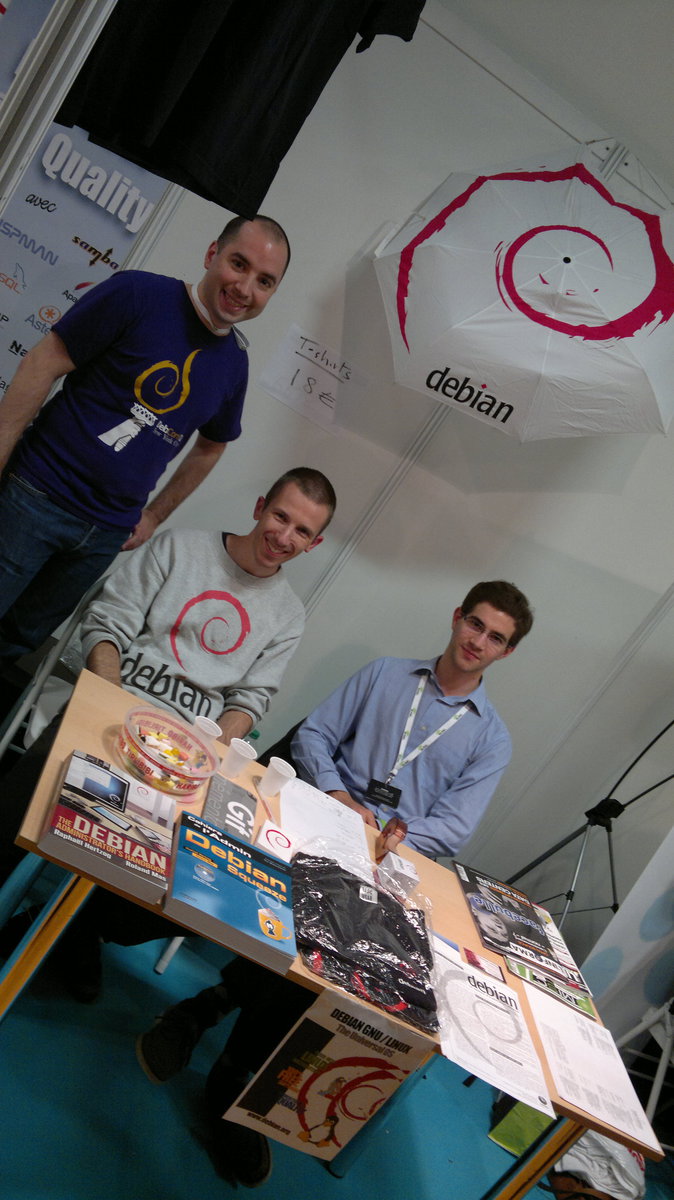
This is my monthly summary of my Debian related activities. If you re among the people who made a donation to support my work (168.12 , thanks everybody!), then you can learn how I spent your money. Otherwise it s just an interesting status update on my various projects. Dpkg This month, I resumed my work on dpkg. I concentrated my efforts on some polishing of the 3.0 (quilt) format. With the latest version (1.16.6 which was uploaded to unstable shortly before the freeze), dpkg-source restores the source tree in a clean state after a failed patch application (#652970), doesn t overwrite the patch header from the pre-existing automatic patch, updates automatically debian/source/include-binaries during dpkg-source commit, and supports a new no-unapply-patches option for those who dislike the auto-unapplication at the end of the process when the patches were not applied at the start. I wanted to go further and offer a new feature that could insert the automatic patch at the bottom of the quilt series but I have been short on time to complete this feature. I just managed to factorize all the quilt handling in a dedicated Perl module (Dpkg::Source::Quilt) to have cleaner code in the module handling the source format (Dpkg::Source::Package::V3::quilt). For those who wonder, this feature is meant primarily for the X Strike Force team which maintains packages in Git and are doings lots of upstream cherry-picks (to fix regressions, etc.). But they also use quilt on top of that tree to keep some lasting Debian specific changes. With the 1.0 format, the automatic diff is a bit messy but at least it gets smaller automatically when a new upstream release gets out, there s nothing to clean out. I d like them to be able to use 3.0 (quilt) while keeping their workflow. I m leaning towards allowing --auto-commit=first:cherry-picks that would name the automatic patch cherry-picks and put it in the first position in the quilt series. (Opinions welcome on that feature, BTW) Packaging There s been quite some packaging in this last month before the freeze: While doing all this packaging work, I found 2 possible improvements that I filed as bug reports: Debian France Booth at Solutions Linux From June 19th to June 21th, I manned the Debian France booth at Solutions Linux together with Carl Chenet, Tanguy Ortolo and other members of the association. We answered lots of questions, sold all t-shirts and umbrellas that Carl imported from Germany and Switzerland (we really need to get our own merchandising stuff produced in France!), got people to join the association. We also presented a printed copy of the Debian Administrator s Handbook and of the corresponding French book. You can see Carl, me and Tanguy on this picture (click on it to see a bigger picture, thanks to S bastien Dubois of Evolix for this one!):
I know lots of people are preparing for Debconf but I decided to not attend this year, the price of the air plane ticket was a bit too hefty for me and it was also in partial conflict with our family vacations. I thought about attending the Libre Software Meeting instead but alas I won t go there either (but Roland Mas will be there!), I have too much work to complete before my own vacation in 2 weeks. Thanks See you next month for a new summary of my activities.

2 comments Liked this article? Click here. My blog is Flattr-enabled.

Thibaut Girka: apt-get install gcc-4.7-arm-linux-gnueabihf

Hi! As you may know, I'm working on multiarch cross-toolchains as part of the Google summer of Code (see my previous post for details), and although there is still a lot to do, the project is doing fairly well, and a cross-gcc is already installable and working. I'll proceed with detailed instructions on how to install the cross-compiler, along with some explanations on multiarch itself, and how to build cross-toolchains from source. Prerequisites First, you need specific versions apt (>= 0.9.6) and dpkg (>= 1.16.5).
This is because the cross-toolchains packages I'm working on depend on specific cross-arch dependencies, such as libc6:armhf. Support for such dependencies has been added in the aforementioned versions of apt and dpkg. This means you should be running unstable, or at least use dpkg from unstable. Adding a foreign architecture Adding a foreign architecture is straightforward, but I've seen users do overcomplicated, or just plain wrong things. So, let's do this step by step (well, there are only two of them), with some explanations.
  1. Tell dpkg to handle an additional architecture by typing dpkg --add-architecture armhf. There isn't much to say. It will only add an architecture to the list of architectures dpkg would accept to handle.
  2. Update APT's database. You need to run apt-get update after adding or removing an architecture to get package lists for all wanted architectures and rebuild APT's database, including the implicit cross-arch dependencies/conflicts brought by multiarch.
And that's it for the common case. Now, a word on architecture restrictions: a common misconception about multiarch seems to be that you have to tell APT which architectures you want from the mirrors by modifying your sources.list file(s). This is not true, as, by default, APT gets the list of accepted architectures from dpkg, and gets the correct package lists from the mirrors configured in the sources.list. You only need to use arch restrictions ( deb [arch=arch1,arch2,...] ... ) when you want to get packages from a mirror only for a subset of your accepted architectures. This is very unlikely, and in the general you do not need to modify your sources.list, at all. Getting the cross-compilers from my repository I provide compiled versions of gcc-4.7-arm-linux-gnueabihf for i386 and amd64 in my repository. If you have followed the previous paragraphs, nothing should be easier than adding a deb http://emdebian.org/~thibg/repo/ sid main line to your sources.list and doing the following:
# apt-get update
[...]
# apt-get --no-install-recommends install gcc-4.7-arm-linux-gnueabihf
Reading package lists... Done
Building dependency tree       
Reading state information... Done
The following extra packages will be installed:
  binutils-arm-linux-gnueabihf cpp-4.7-arm-linux-gnueabihf gcc-4.7-arm-linux-gnueabihf-base gcc-4.7-base:armhf libc6:armhf libgcc1:armhf
  libgmp10 libgomp1:armhf libmpc2 libmpfr4
Suggested packages:
  binutils-doc gcc-4.7-locales libmudflap0-4.7-dev:armhf gcc-4.7-doc libgcc1-dbg:armhf libgomp1-dbg:armhf libitm1-dbg:armhf
  libquadmath-dbg:armhf libmudflap0-dbg:armhf binutils-gold glibc-doc:armhf locales:armhf
Recommended packages:
  libc6-dev:armhf
The following NEW packages will be installed:
  binutils-arm-linux-gnueabihf cpp-4.7-arm-linux-gnueabihf gcc-4.7-arm-linux-gnueabihf gcc-4.7-arm-linux-gnueabihf-base gcc-4.7-base:armhf
  libc6:armhf libgcc1:armhf libgmp10 libgomp1:armhf libmpc2 libmpfr4
0 upgraded, 11 newly installed, 0 to remove and 0 not upgraded.
Need to get 23.5 MB of archives.
After this operation, 57.2 MB of additional disk space will be used.
Do you want to continue [Y/n]?
I've disabled the recommends since, libc6-dev:armhf would recommend gcc:armhf itself, which is not co-installable with your native gcc if you have it installed. Building the cross-toolchain yourselves If you don't trust the repository above, or simply want to rebuild the toolchain yourself, it is rather simple: get my gcc-4.7 patches and:
$ apt-get source binutils
$ cd binutils-*/
$ TARGET=arm-linux-gnueabihf dpkg-buildpackage -uc -us -b
$ cd ../
# dpkg -i binutils*arm-linux-gnueabihf*.deb
$ apt-get source gcc-4.7
$ cd gcc-4.7/
$ for patch in path/to/the/patches/*.patch; do patch -p1 < $patch ; done
$ GCC_TARGET=armhf debian/rules control
$ GCC_TARGET=armhf dpkg-buildpackage -uc -us -b
Using the cross-compiler It's easy, but there is a trick, and dpkg-buildpackage -aarmhf won't work out of the box yet, as gcc-4.7-arm-linux-gnueabihf provides the arm-linux-gnueabihf-gcc-4.7 executable, but no arm-linux-gnueabihf-gcc symlink. So, for the moment:
$ cat > test.c << __EOF__
#include <stdio.h>
int main(void)
 
  printf("Hello world\\n");
  return 0;
 
__EOF__
$ arm-linux-gnueabihf-gcc-4.7 test.c
$ qemu-arm ./a.out 
Hello world
Conclusion The toolchain is not complete yet (there is some more work to do on binutils and libstdc++, and equivalents to the gcc , cpp , and build-essential packages to provide), but it should still be useful to cross-compile C programs. Multi-arch cross-toolchains for wheezy can definitely be hosted at emdebian, and I hope to clean up the build process so that it could get included in the archive for wheezy+1.

Next.

Previous.