Search Results: "tats"

19 January 2008

Jacobo Tarrío Barreiro: Flags and languages

Many languages are spoken in more than one country, and many countries have more than one language. When you forget this you do stuff like language selection menus that use flags to represent languages. This is problematic for several reasons, starting with having to ask yourself what flag you are going to use to represent English, and how to deal with the angry letters you’ll receive when you use the national flag to represent a regional language. So, using flags to represent languages is definitely discouraged. This said, have a look at this small piece of the KDE l10n stats page: Galician language with flag of Greenland The funny thing is that the flag you see next to Galician is the flag of Greenland. And Galician is not spoken at all in Greenland! So, what happened? Why did they use so wrong a flag? The problem is that the ISO 639-1 code for the Galician language is gl , which is the same as the ISO 3166-1 code for Greenland. So, when choosing the flag for Galician they confused the language code with the country code and selected the flag for gl : that is, for Greenland. (I’m surprised that they used the Ukrainian flag ( ua ) for the Ukrainian language ( uk ), and not the Union Flag. Perhaps that would have been too obvious an error :) – although I have been told by email that the ISO 3166-1 code for the UK is GB , not UK ) So, my takeaway message is: don’t use flags to represent languages and if you do, make sure you use a flag of a place where the language is actually spoken!

18 January 2008

Lior Kaplan: Pidgin blist.xml error message


When I opened pidgin today, I got an error message regarding my buddy list file. Since the program couldn’t use the current list, it has loaded an old file with about half my buddies. Pidgin blist.xml error message The problem with this error message, is that it doesn’t give you any clue to the root cause of the error. This of course makes it harder for me to fix the problem and get on with using the program. I’ve opened the file with vi, and it generally seemed OK with the all the major starting/ending XML tags. So I opened it with Firefox, to see if it parses the XML, and only then I could see the real problem:
XML Parsing Error: reference to invalid character number
Location: file:///home/kaplan/.purple/blist.xml~
Line Number 416, Column 47:
Looks like one of my buddies has a weird Unicode character in his nickname, which wasn’t correctly escaped by pidgin when it had been written to the XML file. Removing the problematic character fixed the problem and pidgin started with my full buddy list. For me, as a technical person, seeing a problem with a XML file, usually raises the flag regarding parsing errors. I don’t expect common users to have this information. But giving a more informative error message could help such a user to get help and directions to the solution in forums or IRC. So to all the programmers reading this, I’d like to ask you to try and give a clue to the problem in your error messages. It can simplify usres’ life…

17 January 2008

Lior Kaplan: Why does Oracle s applications needs xscreensaver in order to run ?


Working with some of Oracle’s products, made me wonder about their installation requirements as appears in the documentation. Let start with Oracle Database 10g Release 2. The installation guide for linux x86 says under “Checking the Software Requirements” it needs the following RPMs for RHEL 4.0:
  • binutils
  • compat-db
  • compat-libstdc++-296
  • control-center
  • gcc
  • gcc-c++
  • glibc
  • glibc-common
  • gnome-libs
  • libstdc++
  • libstdc++-devel
  • make
  • pdksh
  • sysstat
  • xscreensaver
  • setarch
Most of them are valid requirements when needing to compile C/C++ code (as it may be done inside the database). But why do I need to install gnome’s libraries, gnome’s control-center and xscreensaver? I fail to see how are these 3 are related to running a database. It is reasonable to require these packages for running a graphical installation, but that’s not a runtime requirement! I even tested that with checking the database opened files while it’s been running. I really don’t want to have these packages installed on servers unless I must, as I believe server should contain the minimal software required on top of the distribution default installation. Another funny (and weird) fact is that for SELS 9.0 there isn’t any requirement for gnome’s control-center. For RHEL 3.0 there aren’t any requirements for the 3 packages… Mentioning optional requirements are probably the best why to solve this, unless there’s some real requirement that eludes me. John Smiley’s “Installing Oracle Database 10g Release 2 on Linux x86″ has this for openmotif21 which is mentioned as needed only for Oracle demos. The same happens for Oracle Enterprise Manager in installation guide for linux x86 10g Release 2 (10.2), but this time the package requirements for RHEL 3.0 and SELS 9.0 don’t mention any of the 3 packages, whilst they are required for RHEL 4.0. Very weird. The status for Oracle Application Server 10g Release 3 is similar. I would be happy if someone could shed some light on the issue.

16 January 2008

Michal Čihař: One year under my reign

One year ago, I took over Gammu maintenance. I think it time to summarize a bit what happened during that year. There were definitely good and bad releases in that time (especially strictness introduced to SMS parser in 1.13.0 took quite a lot of releases to fix various bugs), but generally I things Gammu is moving in a good way. What I would definitely call positive: There are also some bad things: Some statistics of last year (based on Ohloh):
ValueDec 2006Dec 2007Difference
Code Lines90,540101,687+12%
Comment Lines9,20415,336+67%
Comment Ratio9.2%13.0%+30%
All these changes were made in approximate 1200 commits. I hope next year will not be worse :-).

Lior Kaplan: Who moved my PEs (or why does pvmove sucks on linux) ?


Yesterday I wanted to extend an existing LVM VG with some central storage disks. In the process, I notice the VG is built upon local & external disk, which isn’t according to my standards. So I decided to extend the VG with the external disks, and then use pvmove command to move all the PE from the internal disk before reducing the VG. The problem is, that on RHEL 4.4, the pvmove command hangs during it’s work, never returns to the prompt, and locks all the other LVM commands. Seems that for little amounts of PEs the command works, but for 10G disks it hangs. As nothing else helped, I was forced to hard boot the server using to power button. Running the command in single user also doesn’t effect the result, although non other user/services are running. RHEL 4.4 has LVM2 version 2.02.06, RHEL 4.5 has version 2.02.21 and RHEL 4.6 has version 2.02.27. Reading upstream’s changelog seems there isn’t any change regarding pvmove, although it’s still worth testing if upgrade helps. Version 2.02.29 has “Refactor pvmove allocation code” in its changelog, but it will take time before this version will be officially available for RHEL (fedora 8 only has 2.02.28). Hoepfully it will solve the problem, as my HP-UX colleagues are laughing on my expense… And that I have to invest more time in mimicking pvmove work manually.

loldebian - Can I has a RC bug?: Why be an average guy any longer

13 January 2008

Julian Andres Klode: A small benchmark: Bazaar, Git, Mercurial


I just performed some benchmark on Bazaar, Git and Mercurial. This is a very small benchmark, I may publish a more detailed one in a few weeks. vcs-performance.pdf Some notes:
  1. The unit in the first chart is seconds
  2. I haven’t run git-gc before taking the directory sizes. Running git-gc saves about 1083 kilobytes
  3. This PDF file is licensed under the MIT License, see http://opensource.org/licenses/mit-license.php

Julian Andres Klode: Neil: It s not HP s fault - HP rocks!


Neil, you have problems with your HP laptop. But this is not HP’s fault. The laptop you bought has been designed for use with windows only, like all (?) other HP laptops for home users. Most (all?) HPs Business products are fully Linux compatible and come with pre-installed FreeDOS. A few months ago, I bought an HP Compaq 6720s (GR 644ET), installed Ubuntu 7.10 64-bit on it, and everything worked out of the box (except eth0, due to problems in Ubuntu’s kernel). I have absolutely no problems with my laptop, even the built-in card reader works out of the box. BTW, HP has sponsored several Developer machines (including Gluck) and was one of the sponsors of the debconf7. Maybe the following page at the Ubuntu wiki helps you with your laptop: https://wiki.ubuntu.com/hp_dv6000_series_(dv6116eu) The next time you buy an HP laptop, buy one of their business laptops and make sure that a version with pre-installed FreeDOS is available.

11 January 2008

Felipe Augusto van de Wiel: 11 Jan 2008

Bits from the Debian i18n meeting (Extremadura 2007)
From December 12th to December 15th, Junta de Extremadura hosted another one of the Debian Meetings; five i18n guys shared ideas, food, buses and fun with the Debian KDE maintainers. We would like to thank Extremadura for hosting us during the Hispalinux Meeting 2007, the event was held at Universad de Derecho (Law University) in Caceres, Spain.

These are the minutes, results and notes from our work, it is a brief description but hopefully complete of what we have done and what is still missing/pending.

Thanks to Cesar (cek) we had the chance to work on churro (i18n.debian.net) locally; the server is still running a 2.4 kernel because of some "tick" problems with 2.6 series, the last one tried was 2.6.21 and we should try newer ones, in order to support upgrades and not get stuck with 2.4, we hope Cesar will find time to test new Debian kernels.

First, let me introduce everybody to the services, robots and resources being hosted by i18n.d.n:

  • MoinMoin wiki for local and simple reference documentation, it contains all the links to the below resources. (http://i18n.debian.net/wiki/)
  • Pootle experimental server
  • dl10n scripts, aka dl10n robots (codename Lion), these scripts are responsible for the status of pseudo URLs used by some translation teams, by the Project Smith and by the NMU Priority List for i18n NMU Campaign
  • Synchronization of the i18n material used by the Debian website to generate translation statistics about PO and PO-debconf
  • Generation of Compendium PO files per-language
  • Different types of statistics
  • Other non user-visible services like a full source mirror for stable, testing, unstable and experimental, used by the scripts and robots.
  • DDTP, Debian Descriptions Translation Project
  • DDTSS, The Debian Distributed Translation Server Satellite, a web front-end for DDTP, now integrated to DDTP to use the Database back-end instead of the e-mail interface.


And, at some point, we found important to state clear the acronyms and names used in related DDTP projects/tools:
  • DDTS, Debian Description Translation Server, this is the main "back-end" used in DDTP, it tends to be the interface between translator tools (present and future ones) and the database;
  • ddt.cgi is a CGI interface that is able to provide info for specific packages or translations, including diffs, related packages and active/inactive descriptions.
  • DDTC which is the old (and still functional) command line client for DDTP.


We took the chance to organize a few things on churro, old accounts were cleaned out and removed, we moved from /org to /srv and got more GBs of space to the "playground". Old files were also removed and some are schedule to deletion on early 2008. With the reallocation of /org we also find some more space to /home and /var, we reorganize some of the links on the web space (specially to remove services from people's accounts), and we changed the mirror script to also synchronize the Packages and Contents files.

Grisu and Martijn worked mainly on DDTP and DDTSS integration. DDTSS now provides statistics for stable, testing and unstable, we are also working with Debian Med to provide support and infrastructure to a specific audience, like packages related to Medicine. The conversion to talk directly with DDTP/DDTS database also provided:

  • Fetching new translations is almost instantaneous and marks translation as requested (avoiding duplicated works via the e-mail interface).
  • After sufficient reviews occurred, the upload is instant
  • Committed DDTS / DDTSS / DDTP website generation into SVN
    • Added READMEs for the above directories


DDTSS now announces the user using authentication because of its integration with the Database backend used by DDTP. Quick trivia: DDTP is now a compound of 25 languages occupying 18 GBytes.

A few days before the meeting we had the offer to use "AUTOBYHAND" to upload a package with the Translation-* files. The package is now called 'ddtp-translations' and we worked during the meeting to create scripts to build the package and to test it on the archive side. This approach allow Debian i18n Team to upload new translations and remove old ones (or inactive ones) without bother FTP Master Team. Special thanks to Anthony Town, he has been working with us to prove tips, fixes and info on how to produce the package and the scripts. The code is available in the debian-l10n SVN under pkg-ddtp-translations:
http://svn.debian.org/viewsvn/debian-l10n/pkg-ddtp-translations

In our case, "BYHAND" processing consists of a simple tarball of the main,contrib,non-free /i18n/Translation-*, we decide to work on a set of scripts to make it easier to create new packages (ddtp-translations) in a consistent way and keeping debian/changelog up-to-date. We also made some suggestions to the script what will run on the archive side to check the tarball structure, base on the examples of debian-maintainers and debtags (tags-override).

One of our initial targets for the meeting with regards to Pootle and Debian was to try big PO files per language, fortunately, Nicolas and Friedel were able to increase Pootle performance enough to get a few languages from DDTP loaded in Pootle. Using the upstream Pootle-diet branch, which uses a database back-end for the generation of statistics, the time to browse the DDTP POs of a language (~20.000 files) went down to a dozen of seconds.

Speaking about Pootle, Friedel gave us a good picture of what is coming next in terms of Pootle's development. There are improvements planned in the areas of permissions and rights delegation, as well as file management (for projects and templates). Improved management of terminology projects is also planned.

Improvements in the QA capabilities of the translate toolkit and Pootle are planned to help with the "false positives" of the pofilter checks. Better reuse of existing translations will become possible by using better translation memory techniques. There is also work planned on formats and converters involving, for example, XLIFF, TMX, TRADOS and WordFast.

Another pending task for quite a while was the CVS migration to SVN, it is now done, with a new layout. Commits to the CVS were disabled and every single script or resource depending on CVS should be changed to use SVN. For now, we are publishing (via HTTP) the status files generated by the pseudo-urls robots until we can fix the scripts to re-enable the commit of the files. You can find them here: http://i18n.debian.net/debian-l10n/status/

We are pretty happy with the changes and results of the work during those days, but we still have some items pending on our TODO list:

  • More advertisement and usage information about PO Compendiums
    There are two use cases are identified:
    • Filling new PO files.
    • QA work to find inconsistent translations.
    Maybe Eddy would love to do that? :-)
  • Extend the duration of the statistics history. (Nekral)
  • Debian packages of the services running on churro
    • DDTP (Grisu)
    • DDTSS (Martijn)
    • dl10n (Nekral)
  • DDTP: add some scripts to handle packages with version in the description (e.g. kernel and kernel modules) (Martijn)
  • DDTP: Standard generation of the translation tarballs (faw)
  • DDTP: document the bracketed stats on the main page (faw)
  • DDTC: should be updated to match the current features. Documentation to ease integration with procmail. (Nekral - low priority)
  • Implement mail service for translation teams with their own robots (e.g. Dutch) (faw)
  • Collect data from http://www.debian.org/devel/website/stats/ (Nekral)
  • http://www.debian.org/intl/l10n/po/,
    http://www.debian.org/intl/l10n/po-debconf/
    are built based on the churro material. It would make more sense to build these statistics on churro (Nekral)
    • We could "fork" the page and add some fancy new features on these pages (Nekral)
    • Add information from the coordination page to indicate that a translation is ongoing. (Nekral)
  • Pootle: missing review indication. Hard with PO back-end. (Friedel)


There are a couple more reports to be sent but they are more focused on i18n specific questions, tools and plans for 2008. So, probably those will be sent only to debian-i18n mail list. If you are interested, please, stay tuned. :-)
Posted on d-d-a: http://lists.debian.org/debian-devel-announce/2008/01/msg00002.html
And a big thanks to Nicolas François (aka nekral), he helped me a lot making notes, preparing the text and reviewing it; and was patient enough to wait for the report while I was solving some personal problems.

8 January 2008

Stefano Zacchiroli: crappy hardware and debctrl stats

debian/control field stats moved i.e.: crappy hardware and the virtual hosting panacea sockmel.bononia.it is a machine hosted in a galaxy far far away from me (Rome, about 400 km from Bologna). It is also a machine whose hardware is getting worst each passing day. Hence, it is an unreliable machine. That's why I've just moved the Homepage and Vcs-XXX field statistics to upsilon.cc, which at least is a virtual hosting where other people is dealing for me with crappy hardware. It's also a personal domain of mine, which will stay with me even if I will change again location. Here are the new stat URLs: The links to them I was aware of have already been fixed, let me know if you are aware of others. Uff ...

6 January 2008

Christian Perrier: Number of bugs reported in Debian per year

This week-end, among other things, I played a little to get the number of bugs reported overs years in the Debian BTS. Here are the results:
2007: 53337
2006: 59665
2005: 57436
2004: 62327
2003: 50836
2002: 47618
2001: 46289
2000: 27181
1999: 22448
1998: 15002
1997:  9987
1996:  4205
1995: 2158
First bug for each year:
2008: 458489 Petter Reinholdtsen -> sysqrd Closed (in unstable)
2007: 405152 Martin-Eric Racine -> myspell-lv Closed
2006: 345487 Erich Schubert -> lintian Opened
2005: 288051 Nick Sillik -> gstreamer-misc Closed
2004: 225724 Peter van Rossum -> mldonkey-server Closed
2003: 174888 Chris Garguzi -> hotkeys Closed
2002: 127270 root@ttimo.net ->libapache-mod-auth-pam Closed
2001: 80981  William Steve Applegate -> php4 Closed
2000: 53800  Hamish Moffatt -> sattrack Closed
1999: 31352  Richard Stallman -> dselect Opened LOOK THIS ONE
1998: 16350  Joey Hess -> xbase-clients Closed
1997:  6363  Andreas Jellinghaus -> mgetty-fax Closed
1996:  2158  Ian Jackson -> ncurses3.0 Closed
1995:   563  Ian Jackson -> tar Closed
A few interesting things there: Anyone feeling like doing the same for Launchpad? And, for those who wonder, I of course did all this by hand. No fancy automated script, just my hands and some (little) hammering of the BTS.

5 January 2008

Lior Kaplan: usertag support for mass-bug script


While working on mass bug filling in Debconf, I noticed problems with specifying user & usertags in mass-bug’s templates. Which resulted with some manual work to tag all the reported bugs after getting the bugs’ numbers. Thanks to Mohammed Adn ne Trojette, it seems to be resolved:
* mass-bug: add –user and –usertags options to avoid their wrapping. (Closes: #429479)
So I guess that’s a small improvement for the QA people… Enjoy.

3 January 2008

Stefano Zacchiroli: happy newS year

happy newS year So this was Christmas, new year, et al. Too bad Murphy struck again on the first day of my (theoretical) vacation, delivering me a nice flu (not yet completely absorbed). Nevertheless I managed to do something funny in the last few days: ... now back to that paper introduction due for December 26th :-/

1 January 2008

Lior Kaplan: Responsible Behavior


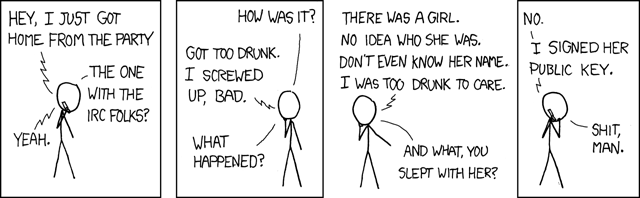
For all those DDs who love to drink: (click to enlarge) By xkcd, A webcomic of romance, sarcasm, math, and language.

Julian Andres Klode: Bye, 2007 - Welcome 2008!


April 2007, I joined the Fellowship of the Free Software Foundation Europe. I also became involved in the development of Debian GNU/Linux with my first package, aufs, sponsored by Daniel Baumann. This was the starting point for my Debian stuff. Now I maintain 6 packages in Debian. One of the most interesting packages is gnome-app-install, which will be part of the gnome-desktop task (already added to tasksel’s list). Users will be able to install applications easily. It also activates the automatic codec installation, so users will be able to play most multimedia files easily. 30th December, I finally got assigned my AM, Martin Zobel-Helas (zobel), and I’m happy to be able to continue the NM process now. On the Ubuntu side, some things have happened, too. I merged several new versions of dir2ogg and a new aufs version, and became an Ubuntu Member on the 29th November. In 2008, I plan to complete the New Maintainer process and become an Ubuntu MOTU. I will continue my packaging stuff, and will merge new features from Debian to Ubuntu and from Ubuntu to Debian. A happy new year to everyone and sorry for blogging this such late.

29 December 2007

Lior Kaplan: Getting motivation from other people work and cooperation


Recently, I found it hard to contribute to open source in general and Debian in particular. There are several reasons for that: beginning with less free time to contribute and continuing with feeling my contribution becomes more and more routine and thus less interesting / challenging. Yesterday I found the time and motivation to upload fixes to 6 of my packages. I thought it might be interesting to share the reasons for this motivation burst, as it can demonstrate how each of us can affect others. The final trigger was seeing (= getting svn diffs) Baruch Even working on the libhdate package (which is co-maintained as part of debian-hebrew). Prior to that I had people showing interest in my packages, helping with solving bugs, sending patches and even one guy becoming a co-maintainer of a package of mine. Oddly, most of them are ubuntu users. I’m not looking for others to do my work or do it for me, but getting help is always fun and motivating. Also, working with other people creates commitment as they wait for something you should do, or waiting for you to use what they’ve done. For me this starts a positive snow ball which ends with better packages for me and happier people after receiving credit for their work (usually a changelog entry and a thank you mail). So go on, and inspire people (:

28 December 2007

Lior Kaplan: conffiles, newer packages and purging


Earlier this month Kumar Appaiah opened a bug against the culmus package as part of the stable -> unstable piuparts upgrade tests. First, I’m proud in Debian to have these tests. Thanks for the people involved with running them, parsing the log files and reporting the bugs. I really feel the lake of such checks in commercial distributions I work with. After finding the time to get to the bottom of the bug, and talking with Kumar, it seems most of the bugs found in the test are similar. I think this might indicate something wrong in a more basic level of the package handling. The source of these bugs is how to handle files which were conffile in version x, but aren’t included in version x+1 (as a regular file). In the common situation, the conffiles are removed only during the purge process and not during upgrade or removal. But if a conffile doesn’t exist in the x+1 package, no one will “own” it after the upgrade, and no will purge it in due time. This is why changing conffiles can result in extra files on our system, which is the problem discovered by the recent piuparts test. One solution will be that each package maintainer will add the necessary code to the maintainer scripts to remove the file on upgrade. A second solution is to decide the wanted behavior in such a case and to have dpkg handle it for all packages. The behavior can be to remove the old conffile during the upgrade (postinst script) or to dynamically add it to the list of files owned by the package. Although technically possible, I’m not sure if the second method is “legal” with the debian policy. I thought it would be better to hear others’ opinions before submitting a wishlist bug about this.

21 December 2007

Lior Kaplan: Thinking of another triage for openoffice bugs


With the release of version 2.3.1 and upload to unstable, I started to wonder if it’s time for another bug triage for openoffice.org package. The last triage targeted bugs older than version 2.0.0, but now I’d like to target versions 2.0.0 to 2.2.1 (which is in testing right now). Preferably getting answers for 2.3.1 in unstable. Another goal for the triage is to add up-to-date version info to the bug reports, as I think it makes the maintainers’ life a bit easier. The actual question is whether to start now or to wait for version 2.3.1 to enter testing. The problem is that I don’t know when would this happen. It took a “while” for 2.2.1 to do so.

20 December 2007

Stefano Zacchiroli: pts face lifted

PTS face lift(ed!) Ok, by now you've probably all already noticed, but I've finally committed the changes to the PTS package pages which implement a new layout and CSS. Thanks to Dan Callahan, Enrico Tassi and madcoder for their help with the CSS and to all who gave feedback (sorry, if it wasn't possible to satisfy all look and feel requests at the same time). There are still some minor, freshly introduced, glitches to fix (see for example 457168 and 457169), but I'm kinda tired to play with CSS and I'll give up for a while. But patches are always welcome!, I'll do my best to apply them timely. While I was at it, I've also fixed some other minor nuisances, such as the svnbuildstat link which is now shown only if the package is actually indexed by svnbuildstat. Thanks to Gon ri for having made available the info. PS totally unrelated, but thanks to Lucas now the homepage and vcs stats page sport wonderful graphs!

13 December 2007

Stefano Zacchiroli: stats graph needed

Graphs wanted for Homepage and Vcs-XXX field stats I've recently set up a couple of stats page for some fields usage in Debian packages: one for the Homepage field, one for the Vcs-XXX fields. As Raphael observes, those stats need percentage and graphs, and even Lucas asked me about that back in Extremadura, also providing a sample gnuplot script. These days my time is quite lacking, and I'm also missing the time to put its sample script to work :-( So I've made available the source code which is generating the two stats above (see the "source code ... is available" notice at the bottom of the pages). Patches are welcome for generating percentages and graphs, thanks in advance :-)

Next.

Previous.