Search Results: "rra"

16 February 2013

Paul Tagliamonte: My #dplgame 4

In no particular order, here are my 4 picks for the DPL thunderdome: I hope they all run. Really.

14 February 2013

Ian Campbell: FOSDEM 2013

So as previously mentioned I gave a talk at FOSDEM this year on the future of paravirtualisation under Xen. I thought the talk was reasonably well attended despite being at six o'clock in the evening. In the end I underran my half hour slot but fortunately people had plenty of interesting questions! I've posted my slides on my xenbits space. I spent a fair chunk of the rest of the time on the Xen.org booth, which is hard work but it is always nice to speak to users and other developers. I also managed to catch up with various friends from other projects and managed to meet a few folks who I've only ever met in email before. I didn't get to see as many talks as I wanted (for example I missed pretty much all of the ARM track :-() due to clashes with my stints on the booth, my own talk, and talks clashing with each other. Still it was all in all a worthwhile, hopefully I'll be able to make it again next year! Next up: LinaroConnect in Hong Kong!

Robert Collins: Time to revise the subunit protocol

Subunit is seven and a half years old now Conrad Parker and I first sketched it up at a CodeCon camping and coding, a brilliant combination in mid 2005.
revno: 1
committer: Robert Collins <robertc@robertcollins.net>
timestamp: Sat 2005-08-27 15:01:20 +1000
message:  design up a protocol with kfish
It has proved remarkably resilient as a protocol the basic nature hasn t changed at all, even though we ve added tags, timestamps, support for attachments of arbitrary size. However a growing number of irritations have been building up with it. I think it is time to design another iteration of the protocol, one that will retain the positive qualities of the current protocol, while helping it become suitable for the next 7 years. Ideally we can keep compatibility and make it possible for a single stream to be represented in any format. Existing design The existing design is a mostly human readable line orientated protocol that can be sniffed out from the regular output of make or other build systems. Binary attachments are done using HTTP chunking, and the parser has to maintain state about the current test, tags, timing data and test progression [a simple stack of progress counters]. How to arrange subunit output is undefined, how to select tests to run is undefined. This makes writing a parser quite easy, and the tagging and timestamp facility allow multiplexing streams from two or more concurrent test runs into one with good fidelity but also requires that state be buffered until the end of a test, as two tests cannot be executing at once. Dealing with debuggers The initial protocol was intended to support dropping into a debugger just pass each line read through to stdout, and connect stdin to the test process, and voila, you have a working debugger connection. This works, but the current line based parsers make using it tedious the line buffered nature of it makes feedback on what has been typed fiddly, and stdout tends to be buffered, leading to an inability to see print statements and the like. All in-principle fixable, right ? When running two or more test processes, which test process should stdin be connected to? What if two or more drop into a debugger at once? What is being typed to which process is more luck than anything else. We ve added some idioms in testrepository that control test execution by a similar but different format one test per line to list tests, and have runners permit listing and selecting by a list. This works well, but the inconsistency with subunit itself is a little annoying you need two parsers, and two output formats. Good points The current protocol is extremely easy to implement for emitters, and the arbitrary attachments and tagging features have worked extremely well. There is a comprehensive Python parser which maps everything into Python unittest API calls (an extended version of the standard, with good backwards compatibility). Pain points The debugging support was a total failure, and the way the parser depraminates it s toys when a test process corrupts an outcome line is extremely frustrating. (other tests execute but the parser sees them as non-subunit chatter and passes the lines on through stdout). Dealing with concurrency The original design didn t cater for concurrency. There are three concurrency issues the corruption issue (see below for more detail) and multiplexing. Consider two levels of nested concurrency: A supervisor process such as testrepository starts 2 (or more but 2 is sufficient to reason about the issue) subsidiary worker processes (I1 and I2), each of which starts 2 subsidiary processes of their own (W1, W2, W3, W4). Each of the 4 leaf processes is outputting subunit which gets multiplexed in the 2 intermediary processes, and then again in the supervisor. Why would there be two layers? A concrete example is using testrepository to coordinate test runs on multiple machines at once, with each machine running a local testrepository to broker tests amongst the local CPUs. This could be done with 4 separate ssh sessions and no intermediaries, but that only removes a fraction of the issues. What issues? Well, consider some stdout chatter that W1 outputs. That will get passed to I1 and from there to the supervisor and captured. But there is nothing marking the chatter as belonging to W1: there is no way to tell where it came from. If W1 happened to fail, and there was a diagnostic message printed, we ve lost information. Or at best muddled it all up. Secondly, buffering imagine that a test on W1 hangs. I1 will know that W1 is running a test, but has no way to tell the supervisor (and thus the user) that this is the case, without writing to stdout [and causing a *lot* of noise if that happens a lot]. We could have I1 write to stdout only if W1 s test is taking more than 5 seconds or something but this is a workaround for a limitation of the protocol. Adding to the confusion, the clock on W1 and W3 may be very skewed, so timestamps for everything have to be carefully synchronised by the multiplexer. Thirdly, scheduling if W1/W2 are on a faster machine than W3/W4 then a partition of equal-timed tests onto each machine will lead one idle before the other finishes. It would be nice to be able to pass tests to run to the faster machine when it goes idle, rather than having to start a new runner each time. Lastly, what to do when W1 and W2 both wait for user input on stdin (e.g. passphrases, debugger input, $other). Naively connecting stdin to all processes doesn t work well. A GUI supervisor could connect a separate fd to each of I1 and I2, but that doesn t help when it is W1 and W2 reading from stdin. So additional requirement over baseline subunit:
  1. make it possible for stdout and stderr output to be captured from W1 and routed through I1 to the supervisor without losing its origin. It might be chatter from a noisy test, or it might be build output. Either way, the user probably will benefit if we can capture it and show it to them later when they review the test run. The supervisor should probably show it immediately as well the protocol doesn t need to care about that, just make it possible.
  2. make it possible to pass information about tests that have not completed through one subunit stream while they are still incomplete.
  3. make it possible (but optional) to pass tests to run to a running process that accepts subunit.
  4. make it possible to route stdin to a specific currently process like W1. This and point 3 suggest that we need a bidirectional protocol rather than the solely unidirectional protocol we have today. I don t know of a reliable portable way to tell when some process is seeking such input, so that will be up to the user I think. (e.g. printing (pdb) to stdout might be a sufficiently good indicator.)
Dealing with corruption Consider the following subunit fragment:
test: foo
starting serversuccess:foo
This is a classic example of corruption: the test foo started a server and helpfully wrote to stdout explaining that it did that, but missed the newline. As a result the success message for the test wasn t printed on a line of its own, and the subunit parser will believe that foo never completed. Every subsequent test is then ignored. This is usually easy to identify and fix, but its a head-scratcher when it happens. Another way it can happen is when a build tool like make runs tests in parallel, and they output subunit onto the same stdout file handle. A third way is when a build tool like make runs two separate test scripts serially, and the first one starts a test but errors hard and doesn t finish it. That looks like:
test: foo
test: bar
success: bar
One way that this sort of corruption can be mitigated is to put subunit on it s own file descriptor, but this has several caveats: it is harder to tunnel through things like ssh and it doesn t solve the failing test script case. I think it is unreasonable to require a protocol where arbitrary interleaving of bytes between different test runner streams will work so the make -j2 case can be ignored at the wire level though we should create a simple way to safely mux the output from such tests when the execute. The root of the issue is that a dropped update leaves bad state in the parser and it never recovers. So some way to recover, or less state to carry in the parser, would neatly solve things. I favour reducing parser state as that should shift stateful complexity onto end nodes / complex processors, rather than being carried by every node in the transmission path. Dependencies Various suggestions have been made JSON, Protobufs, etc A key design goal of the first subunit was a low barrier to entry. We keep that by being backward compatible, but being easy to work with for the new revision is also a worthy goal. High level proposal A packetised length prefixed binary protocol, with each packet containing a small signature, length, routing code, a binary timestamp in UTC, a set of UTF8 tags (active only, no negative tags), a content tag one of (estimate + number, stdin, stdout, stderr, test- + test id), test status (one of exists/inprogress/xfail/xsuccess/success/fail/skip), an attachment name, mime type, a last-block marker and a block of bytes. The content tags: Test status values are pretty ordinary. Exists is used to indicate a test that can be run when listing tests, and inprogress is used to report a test that has started but not necessarily completed. Attachment names must be unique per routing code + testid. So how does this line up? Interleaving and recovery We could dispense with interleaving and say the streams are wholly binary, or we can say that packets can start either after a \n or directly after another packet. If we say that binary-only is the approach to take, it would be possible to write a filter that would apply the newline heuristic (or even look for packet headers at every byte offset. I think mandating adjacent to a packet or after \n is a small concession to make and will avoid tools like testrepository forcing users to always configure a heuristic filter. Non-subunit content can be wrapped in subunit for forwarding (the I1 in W1->I1->Supervisor chain would do the wrapping). This won t eliminate corruption but it will localise it and permit the stream to recover: the test that was corrupted will show up as incomplete, or with incomplete attachment data. listing Test listing would emit many small non-timestamped packets. It may be useful to have a wrapper packet for bulk amounts of fine grained data like listing is, or for multiplexers with many input streams that will often have multiple data packets available to write at once. Selecting tests to run Same as for listing while passing regexes down to the test runner to select groups of tests is a valid use case, thats not something subunit needs to worry about : if the selection is not the result of the supervisor selecting by test id, then it is known at the start of the test run and can just be a command line parameter to the backend : subunit is relevant for passing instructions to a runner mid-execution. Because the supervisor cannot just hand out some tests and wait for the thing it ran to report that it can accept incremental tests on stdin, supervisor processes will need to be informed about that out of band. Debugging Debugging is straight forward . The parser can read the first 4 or so bytes of a packet one at a time to determine if it is a packet or a line of stdout/stderr, and then either read to end of line, or the binary length of the packet. So, we combine a few things; non-subunit output should be wrapped and presented to the user. Subunit that is being multiplexed and forwarded should prepend a routing code to the packet (e.g. I1 would append 1 or 2 to select which of W1/W2 the content came from, and then forward the packet. S would append 1 or 2 to indicate I1/I2 the routing code is a path through the tree of forwarding processes). The UI the user is using needs to supply some means to switch where stdin is attached. And stdin input should be routed via stdin packets. When there is no routing code left, the packet should be entirely unwrapped and presented as raw bytes to the process in question. Multiplexing Very straight forward unwrap the outer layer of the packet, add or adjust the routing code, serialise a header + adjusted length + rest of packet as-is. No buffering is needed, so the supervisor can show in-progress tests (and how long they have been running for). Parsing / representation in Python or other languages The parser should be very simple to write. Once parsed, this will be fundamentally different to the existing Python TestCase->TestResult API that is in used today. However it should be easy to write two adapters: old-style <-> this new-style. old-style -> new-style is useful for running existing tests suites and generating subunit, because thats way the subunit generation is transparent. new-style->old-style is useful for using existing test reporting facilities (such as junitxml or html TestResult objects) with subunit streams. Importantly though, a new TestResult style that supports the features of this protocol would enable some useful features for regular Python test suites: The API might be something like:
class StreamingResult(object):
    def startTestRun(self):
        pass
    def stopTestRun(self):
        pass
    def estimate(self, count, route_code=None):
        pass
    def stdin(self, bytes, route_code=None):
        pass
    def stdout(self, bytes, route_code=None):
        pass
    def test(self, test_id, status, attachment_name=None, attachment_mime=None, attachment_eof=None, attachment_bytes=None):
        pass
This would support just-in-time debugging by wiring up pdb to the stdin/stdout handlers of the result object, rather than actual stdin/stdout of the process a simple matter once written. Alternatively, the test runner could replace sys.stdin/stdout etc with thunk file-like objects, which might be a good idea anyway to capture spurious output happening during a test run. That would permit pdb to Just Work (even if the test process is internally running concurrent tests.. until it has two pdb objects running concurrently :) Generation new streams Should be very easy in anything except shell. For shell, we can have a command line tool that when invoked outputs a subunit stream for one instruction. E.g. test foo completed + some attachments or test foo starting .

13 February 2013

Jonathan Wiltshire: X-RaceProtection: yes

From time to time it occurs that two people answer a mail in the same way where one would do closing an unblock request, for example. When this almost happened on debian-release the other day I amused myself by dreaming up an SMTP header that would prevent such embarrassment. I wasn t being serious in the slightest, but nevertheless X-RaceProtection was born (and it turns out at least one resident of a certain IRC channel thought I was).
X-RaceProtection can be a message identifier or the simple value yes and is intended to prevent duplicate replies to, for example, mailing lists. When set as a mail ID, list software should silently drop the message being delivered if the identified message has already received a reply that is, another message quoting that ID in In-Reply-To. If X-RaceProtection is simply yes , the mail ID of In-Reply-To for the message being delivered is used, providing a shortcut.
This means you can set X-RaceProtection when replying to a mail where there is a chance of collision. If someone beat you to it, there is no embarrassment at your mail arriving with a later timestamp. If someone fancies implementing this for smartlist/debbugs, please be my guest!
X-RaceProtection: yes is a post from: jwiltshire.org.uk Flattr

7 February 2013

Joey Hess: Sydney nostalgia

Sydney opera house viewed from a ferry Last Saturday, when the bus from Canberra pulled into Sydney's central station, I found myself feeling curiously nostalgic for this city, and particularly this bustling and somewhat seedy[1] neighborhood of Haymarket and Redfern. glowing angels in Kimber lane I only spent 5 days in Sydney, but living in a shared house there, walking up to Central every day, and returning to the outskirts of the Haymarket every evening to slurp noodles or other asian food, I got into a routine. And got a sense of the place that goes perhaps a bit beyond the tourist sights. Manly beach panorama Perhaps if I'd had more time I would have found a decent coffee shop that had both free wifi and abundant seating. They seem scarce in Sydney. I instead often got on the ferry to Manly when I wanted some sit down and code time. Cliffside Protect Our Water Dragons sign
One time when I was exploring the headlands above Manly beach, I noticed this sign.
Then I ran into this guy. Click him for an amusing video.
lizard Anyway, Sydney is on my very short list of cities I'd actually enjoy spending some more time in some day, along with San Francisco, Vancouver, Oslo, and London.
[1] Depending on what's inside all the "VIP lounges" and "Thai massage parlours" on every corner that I did not explore, perhaps thoroughly seedy?

Craig Sanders: Dead Can Dance

I saw Dead Can Dance at the Palais in St Kilda last night their first tour back in Australia in over 20 years. I ve wanted to see them perform live since I first discovered their music in the dim dark past bought the tickets as soon as the tour was announced last year and have been waiting impatiently ever since. The first act was percussionist David Kuckhermann who played solo and then joined DCD for the main act. He mostly played the handpan, which looks a lot like an upside-down wok with dimples on it. His tambourine solo was oustanding. Overall, a great start to the evening. I hadn t heard of him before, but I think I ll be ordering some of his CDs. Lisa Gerrard s voice was, as always, trance-inducingly sublime and Brendan Perry with a fine voice of his own really shines in a live performance. Definitely not a disappointment around three hours of amazing performance, old favourites and new, and the discovery (for me) of a new performer. If I have one (minor) complaint, it s that the volume was a little too loud, causing occasional distortion and difficulty distinguishing the lyrics on some of Brendan Perry s singing. Lisa Gerrard sings without words glossolalia and much higher than Perry so wasn t affected as much. If you haven t heard DCD or Lisa Gerrard s solo albums before, do so you re in for a treat labelled as world fusion , they re impossible to describe accurately while they started out as Dark Wave or as-goth-as-it-gets in the early 80s, they play across many genres and have strong influences from Middle Eastern, Mediaeval, world music, ambient, and more, they re in a genre of their own. You can t even say they re a bit like so-and-so because they aren t. Dead Can Dance is a post from: Errata

6 February 2013

Dirk Eddelbuettel: A book about Rcpp

Some little birds had already been whispering about it, but I didn't want to jinx it and told myself I would wait with an announcement until the booksellers have (at least) placeholder pages. And as I learned from Duncan Murdoch via email earlier today, at least Chapters/Indigo had a page up, presumably scraped from the publisher page, so here it goes:
I have in fact handed a complete draft of my book about Seamless R and C++ Integration with Rcpp to Springer a few weeks ago. With a bit of luck on the production side, we could be seeing physical copies by May of a new title in their popular UseR! Series series.
And to the slowly growing new Rcpp site, I have added a a formal page about the Rcpp book where one can find information about it, including a link to the Springer page, links to a few bookseller's pages --- as well as a few wonderfully flattering endorsements. Eventually, errata and other support material should be available via this page too. Can't wait til I hold a physical copy in hand...

5 February 2013

Michael Stapelberg: RC bugs

I recently worked on the following RC bugs: It is getting hard to find RC bugs to work on. If you have access to ia64 hardware, have a look at #694971 Epiphany browser crashes within JSC::JSArray::increaseVectorLength() or #697172 sporadic crashes of epiphany browser due to a thread-unsafe favicon database. Both have patches available that just need to be tested.

DebConf team: DebConf13 venue and dates (Posted by Moray Allan, Didier Raboud and the DebConf team)

This post is a quick status update on DebConf13, for those who aren t following the debconf-team mailing list. As you may know, this year s DebConf will be held at Le Camp, in Vaumarcus, Switzerland. Our concept for this DebConf is to hold it in a natural environment, away from distractions. We hope you will enjoy spending time together with other Debian collaborators in this beautiful part of Switzerland, on the shore of Lake Neuch tel. Dates DebConf13 will take place from Sunday 11. August 2013 to Sunday 18. August 2013. (We will use Saturday 10. August 2013 to prepare the venue for the conference.) You may notice that the dates don t cover two weeks like in the last few years (there is no separate DebCamp week). For budget reasons, current plans are to merge the two weeks activities into an 8 day period. If you think that s a pity, it s not too late to change it just join the fundraising team and start working quickly! Travel If you want to start arranging your travel to attend DebConf, some initial travel suggestions may be useful: The DebConf13 map shows the venue and the bus line (with some stops). Registration We expect to open registration around the start of March. Currently we are still evaluating some possible new conference management systems, which we hope might avoid the frustrations some attendees have had in the past with Pentabarf. Help welcome As always, the DebConf team is looking for volunteers. Some jobs need technical skills (e.g. testing conference management system setups, working on the website), but many DebConf tasks are about working to deadlines on non-technical issues (e.g. fundraising, budgeting, talk scheduling). You can see more information about some of the jobs to be done on the DebConf wiki. Please do think about getting involved and sharing your ideas with us, to help us make DebConf an even more useful event for Debian in the future. We look forward to welcoming you to Vaumarcus!

Wouter Verhelst: Video at FOSDEM 2013

For the second year in a row, I've led the team that organized video at FOSDEM. This year, most things went pretty smoothly; more so than last year. We definitely learned from some of our mistakes, and although I can't say that everything went better than it did last year, after having done a first look at things I can certainly say that overall, the result is better now than it was last year. Our setup was very similar to what it was last year. However, there were some key differences: Unfortunately, that didn't mean all was well. The internal server would transcode the DV stream into WebM, which was then sent on to the Flumotion platform where it was going to be transcoded to Ogg Theora, before being streamed in both formats. Due to an issue which we could not track down (possibly something incorrect in my configuration), the transcoding into Ogg Theora did not work smoothly, and even had the unwanted effect of disrupting the WebM streaming. Since this made it difficult to debug without disrupting service, eventually we decided to give up on Ogg Theora and only provide WebM streams; I considered that to be a better solution than no streaming at all. In addition, apparently in the year since FOSDEM 2012, libav and gstreamer have changed significantly enough that the scripts that I used then had to be somewhat revisited in order to be able to transcode the existing recordings into WebM ready for video.fosdem.org. Oh well, I had to add in normalisation anyway; only it would've been nice if I didn't have to revisit it from scratch. Meh. At any rate, our streams seem to have been very popular. Some statistics:
Saturday

Sunday

Served traffic by country (over the whole weekend)
Served sessions by country (over the whole weekend)
As you can see from these graphs, watching the streams from Belgium seems to be happening fairly often; I suspect much of that is people at the conference watching a stream in a different room. Additionally, we peaked at 212 viewers, which is slightly more than the peak of 206 that we had last year. The final conclusion we can take home from these statistics is that the most popular talk on Saturday (at least according to people watching the streams) was the eudev one in the cross-distro room (with 68 viewers); on sunday, the talks in Janson were all fairly equally popular. The peak of 102 viewers was reached around 15:45. Overall, I'm quite happy with the result. Yesterday, Thomas Eug ne of NamurLUG (who used to do video for several years before I took over last year) helped me do the first review. What's left now is to do some transcoding and uploading; this will happen over the next few days and weeks.

Joey Hess: LCA2013 wrapup

After 27 hours of travel, I'm finally back from my first Linux.conf.au. This was a great conference! Some of my favorite highlights:
My git-annex talk went ok, despite technical problems with the video output, which the video team did a great job of working around. The first demo went well, and the Q&A was excellent. The demo of the git-annex assistant webapp was marred by, apparently, a bad build of the webapp -- which I ironically used rather than my usual development build because I assumed it'd be less likely to fail. At least I may have a way to reproduce that hang somewhat reliably now, so I can get on with debugging it. I will be redoing a demo of the webapp as a screencast.
Here are some of the best talks I attended. (I have quite a lot more queued up to watch still, and had to cut several due to space.) Click titles for videos, or browse all the videos.

3 February 2013

Gregor Herrmann: RC bugs 2013/05

this week's report comes live from FOSDEM; which doesn't mean I've been doing any RC bug work here, I've looked at all the mentioned bugs below earlier this week. & as you can see, most was just a bit triaging

1 February 2013

James Bromberger: LCA 2013

LCA Past Organisers

Previous core organisers of Linux.conf.au, taken at Mt Stromolo Observatory during LCA 2013 (pic by Josh Stewart); except one of these people organised CALU, and another hasn t organised one at all!

Thanks to all the people at LCA2013 in Canberra; it was a blast! So good to see old friends and chat freely on what s hot and happening. Radia (known for STP, TRILL), Sir Tim (the web) and old friend Bdale (Debian, SPI, Freedom Box) were inspiring. As was Robert Llewellyn (Kryten, Red Dwarf), who was a complete pleasure he wandered back and talked for a while with the volunteer video crew. Hats off to Pia for organising the TBL tour, to Mary Gardner for being awarded the Rusty Wrench, and to the team from PLUG (Euan, Jason, Leon, Luke) who stepped up to help with the video team and to Paul who graciously accepted the help. Next up LCA2014 Perth! Y all come back now.. it s been a decade.

27 January 2013

Ben Hutchings: Call for testing: SAS driver update for Debian 6.0 'squeeze'

The next point update for Debian 6.0 should include many fixes and improvements to the Linux kernel. Version 2.6.32-47, currently available in the 'squeeze-proposed-updates' suite, includes updates to the following SAS drivers, adding support for new hardware: Note that the binary package names don't change; they are still linux-image-2.6.32-5-flavour. If you are using any of the above SAS controllers, whether or not it is already supported by Debian 6.0.6, please consider testing this kernel version. If it works, please follow up to the bug reports listed above. If you find any regressions, please report bugs against the new package version.

25 January 2013

Craig Small: Off to LCA2013

While I ve been involve in Linux and Debian for many (15 or more) years, I ve only ever been to one major Linux thing in all that time and that was manning some stall for Debian about 10 years ago. Well, let s call it two because next week I m off to the Linux.conf.au 2013 conference. I can t get too terribly excited about the location because its Canberra, yep my (now) home town and about 4 blocks from my workplace; so no exotic locales for me! I m hoping to catch up with some Debian folk while the conference is on. There is at the very least a keysigning party where there are some others from Debian on Wednesday. PS WordPress update broke the visual editing, I hope it looks ok.

Johannes Schauer: Bootstrappable Debian - New Milestone

This post is about the port bootstrap build ordering tool (naming suggestions welcome) which was started as a Debian Google Summer of Code project in 2012 and continued to be developed afterwards. Sources are available through gitorious. In the end of November 2012, I managed to put down an approximation algorithm to the feedback arc set problem which allowed to break the dependency graph into a directed acyclic graph with only few removed build dependencies. I wrote about this effort on our mailinglist but didnt mention it here because it was still too much of a proof-of-concept. Later, in January 2013, I mentioned the result of this algorithm in an email wookey and me wrote to debian-devel mailinglist. Many things happened since November 2012:
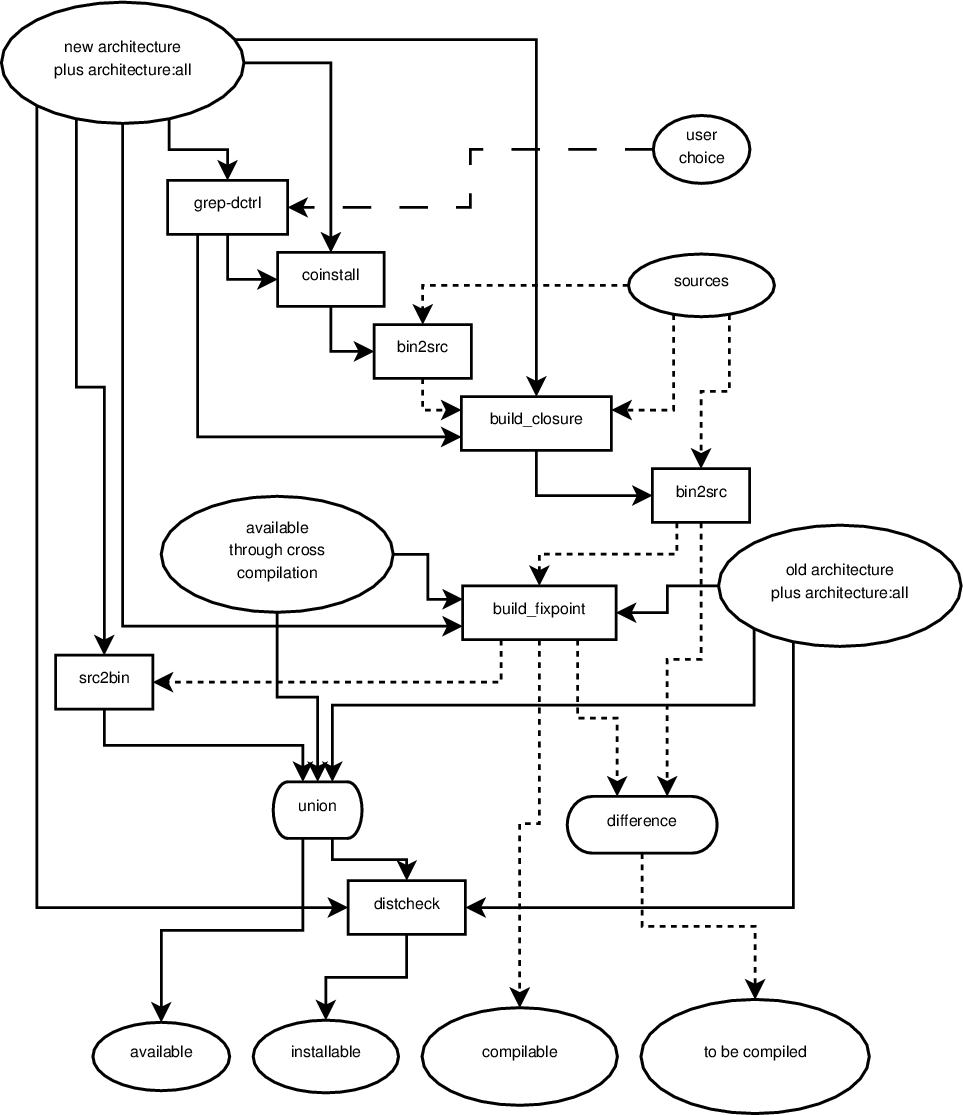
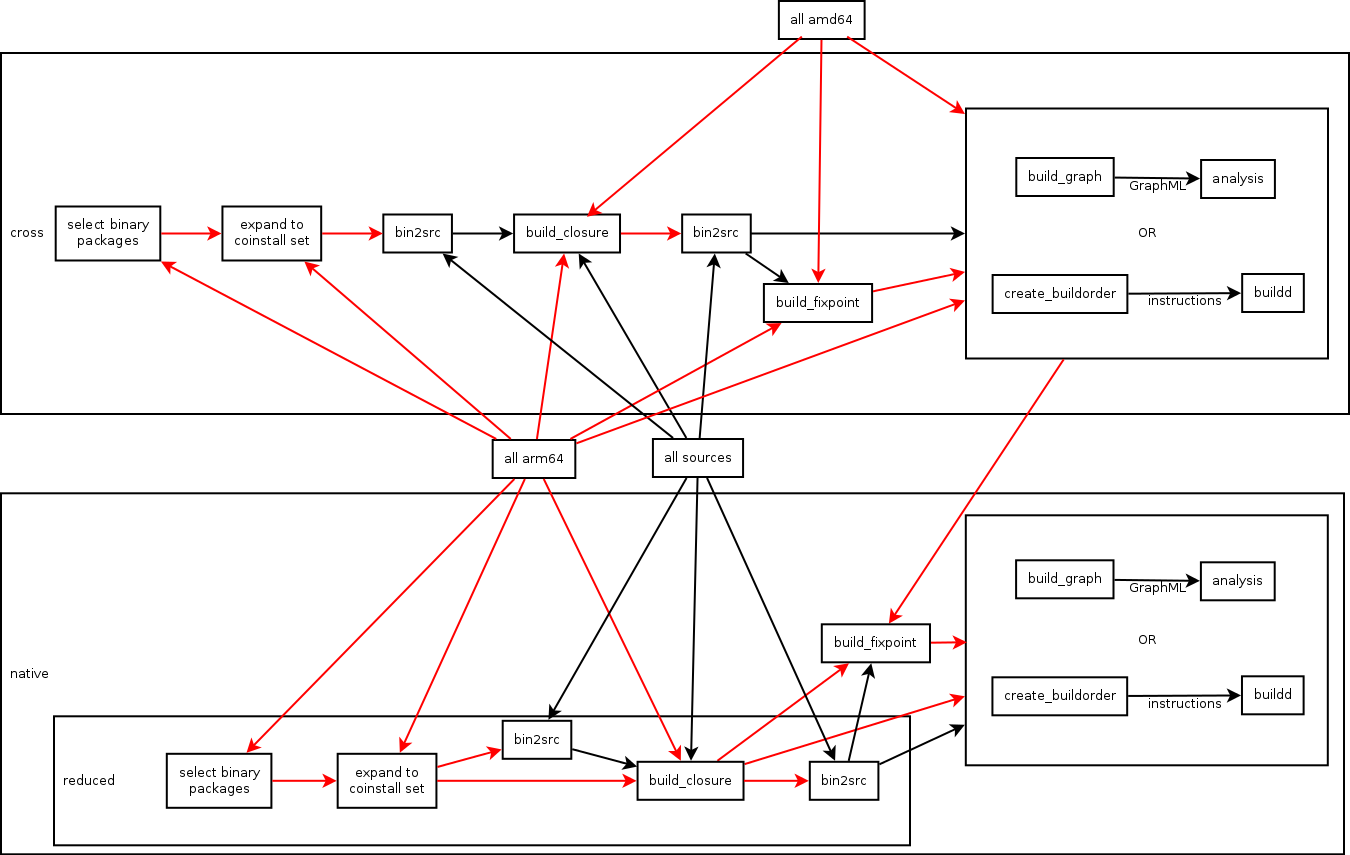
Processing pipeline instead of monolithic tools The tools I developed so far tried to accomplish everything by themselves, reusing functionality implemented in a central library. Therefor, if one wanted to try out even trivial new things, it mostly meant to hack some OCaml code. Pietro Abate suggested to instead develop smaller tools which could work independently of each other, would only execute one algorithm each and could easily be connected together in different ways to achieve different effects. This switch is now done and all functionality from the old tools is moved into a new toolset. The exchange format between the tools is either plain text files in deb822 control format (Packages/Sources files) or a dependency graph. The dependency graph is currently marshalled by OCaml but future versions should work with just passing a GraphML (an XML graph format) representation around. This new way of doing things seems close to the UNIX philosophy (each program does one thing well, data is stored as text, every program is a filter). For example the deb822 control output can easily be manipulated using grep-dctrl(1) and there exist many tools which can read, analyze and manipulate GraphML. It is a big improvement over the old, monolithic tools which did not allow to manipulate any intermediate result by external, existing tools. Currently, a shell script (native.sh) will execute all tools in a meaningful order, connecting them together correctly. The same tools will be used for a future cross.sh but they will be connected differently. I wrote about a first proposal of what the individual tools should do and how they should be connected in this email from which I also linked a confusing overview of the pipeline. This overview has recently been improved to be even more confusing and the current version of the lower half (the native part) now looks like this: native reduced Solid arrows represent a flow of binary packages, dottend arrows represent a flow of source packages, ovals represent a set of packages, boxes with rounded corners represent set operations, rectangular boxes represent filters. There is only one input to a filter, which is the arrow connected to the top of the box. Outgoing arrows from the bottom represent the filtered input. Ingoing arrows to either side are arguments to the filter and control how the filter behaves depending on the algorithm. I will explain this better once the pipeline proved to be less in flux. The pipeline is currently executed like this by native.sh.
Two new ways to break dependency cycles have been discovered So far, we knew of three ways to formally break dependency cycles:
  • remove build dependencies through build profiles
  • find out that the build dependency is only used to build arch:all packages and therefor put it into Build-Depends-Indep
  • cross compile some source packages
Two new methods can be added to the above:

Dependency graph definition changed Back in September when I was visiting irill, Pietro found a flaw in how the dependency graph used to be generated. He supplied a new definition of the dependency graph which does away with the problem he found. After fixing some small issues with his code, I changed all the existing algorithms to use the new graph definition. The old graph is as of today removed from the repository. Thanks to Pietro for supplying the new graph definition - I must still admit that my OCaml foo is not strong enough to have come up with his code.

Added complexity for profile built source packages As mentioned in the introduction, wookey and me addressed the debian-devel list with a proposal on necessary changes for an automated bootstrapping of Debian. During the discussiong, two important things came up which are to be considered by the dependency graph algorithms:
  • profile built source packages may not create all binary packages
  • profile built source packages may need additional build dependencies
Both things make it necessary to alter the dependency graph during the generation of a feedback arc set and feedback vertex set beyond the simple removal of edges. Luckily, the developed approximation algorithms can be extended to support such changes in the graph.

Different feedback arc set algorithms The initially developed feedback arc set algorithm is well suited to discover build dependency edges which should be dropped. It performs far worse when creating the final build order because it only considers edges by itself and not how many edges of a source package can be dropped by profile building it. The adjusted algorithm for generating a build order is more of a feedback vertex set algorithm because instead of greedily finding the edge with most cycles through it, it greedily finds the source package which would break most cycles if it was profile built.

Generating a build order with less profile built source packages After implementing all the features above I now feel more confident to publish the current status of the tools to a wider audience. The following test shows a run of the aforementioned ./native.sh shell script. Its final output is a list of source packages which have to be profile built and a build order. Using the resulting build order, starting from a minimal build system (essential:yes, build-essential and debhelper), all source packages will be compiled which are needed to compile all binary packages in the system. The result will therefor be a list of source and binary packages which fulfill the following property:
  • all binary packages can be built from the available source packages
  • all source packages can be built with the available binary packages
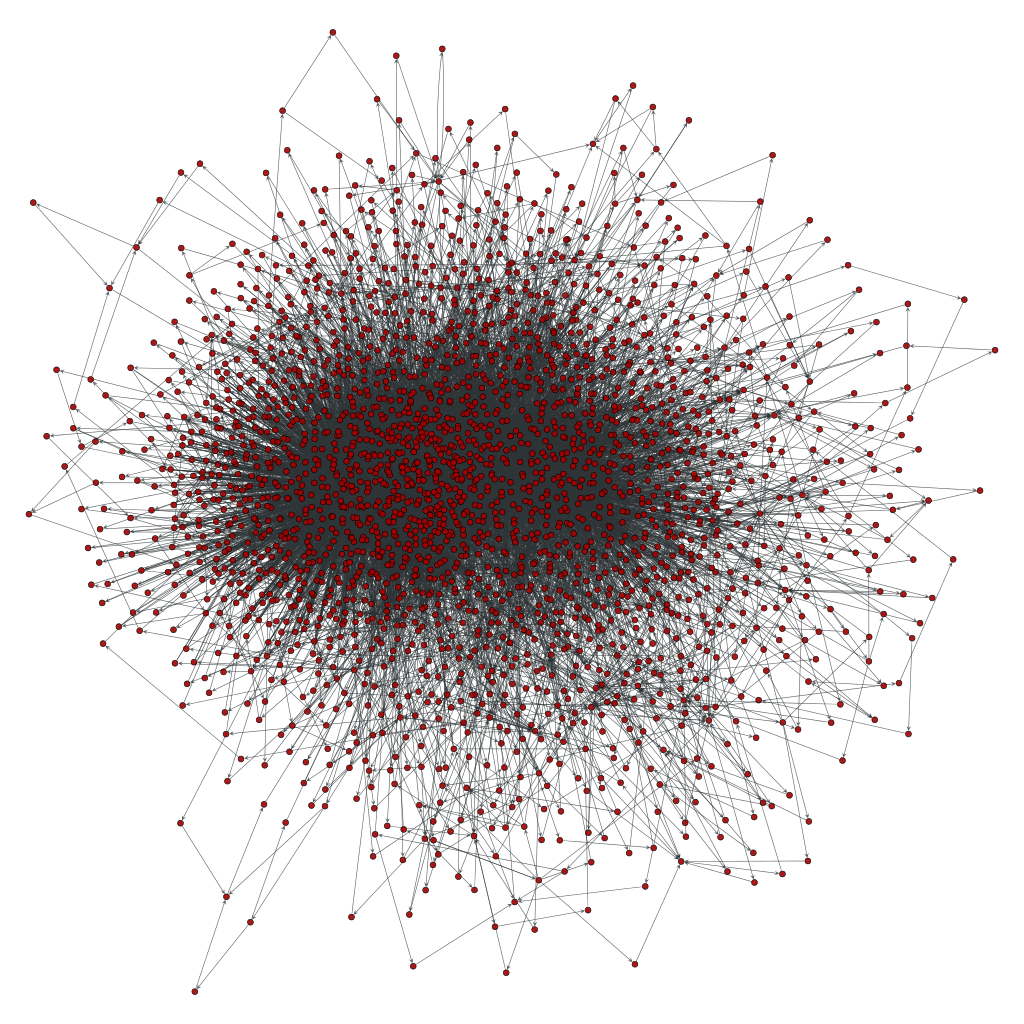
I called this a "reduceded distribution" in earlier posts. The interesting property of this specific selection is, that it contains the biggest problem set of Debian when bootstrapping it: a 900 to 1000 nodes big strongly connected component. Here is a visualization of the problem: hideous mess Source packages do not yet come with build profiles and the cross build situation can not yet be analyzed, so the following assumptions were made: The last point is about 14 build dependencies which were decided to be broken by the feedback arc set algorithm but for which other data sources did not indicate that they are actually breakable. Those 14 are dynamically generated by native.sh. If above assumptions should not be too far from the actual situation, then not more than 73 source packages have to be modified to bootstrap a reduced distribution. This reduced distribution even includes dependency-wise "big" packages like webkit, metacity, iceweasel, network-manager, tracker, gnome-panel, evolution-data-server, kde-runtime, libav and nautilus. By changing one line in native.sh one could easily develop a build order which generates gnome-desktop or really any given (meta-)package selection. All of native.sh takes only 80 seconds to execute on my system (Core i5, 2.5 GHz, singlethreaded). Here is the final build order which creates 2044 binary packages from 613 source packages.
  1. nspr, libio-pty-perl, libmcrypt, unzip, libdbi-perl, cdparanoia, libelf, c-ares, liblocale-gettext-perl, libibverbs, numactl, ilmbase, tbb, check, libogg, libatomic-ops, libnl($), orc($), libaio, tcl8.4, kmod, libgsm, lame, opencore-amr, tcl8.5, exuberant-ctags, mhash, libtext-iconv-perl, libutempter, pciutils, gperf, hspell, recode, tcp-wrappers, fdupes, chrpath, libbsd, zip, procps, wireless-tools, cpufrequtils, ed, libjpeg8, hesiod, pax, less, dietlibc, netkit-telnet, psmisc, docbook-to-man, libhtml-parser-perl, libonig, opensp($), libterm-size-perl, linux86, libxmltok, db-defaults, java-common, sharutils, libgpg-error, hardening-wrapper, cvsps, p11-kit, libyaml, diffstat, m4
  2. openexr, enca, help2man, speex, libvorbis, libid3tag, patch, openjade1.3, openjade, expat, fakeroot, libgcrypt11($), ustr, sysvinit, netcat, libirman, html2text, libmad, pth, clucene-core, libdaemon($), texinfo, popt, net-tools, tar, libsigsegv, gmp, patchutils($), dirac, cunit, bridge-utils, expect, libgc, nettle, elfutils, jade, bison
  3. sed, indent, findutils, fastjar, cpio, chicken, bzip2, aspell, realpath, dctrl-tools, rsync, ctdb, pkg-config($), libarchive, gpgme1.0, exempi, pump, re2c, klibc, gzip, gawk, flex-old, original-awk, mawk, libtasn1-3($), flex($), libtool
  4. libcap2, mksh, readline6, libcdio, libpipeline, libcroco, schroedinger, desktop-file-utils, eina, fribidi, libusb, binfmt-support, silgraphite2.0, atk1.0($), perl, gnutls26($), netcat-openbsd, ossp-uuid, gsl, libnfnetlink, sg3-utils, jbigkit, lua5.1, unixodbc, sqlite, wayland, radvd, open-iscsi, libpcap, linux-atm, gdbm, id3lib3.8.3, vo-aacenc, vo-amrwbenc, fam, faad2, hunspell, dpkg, tslib, libart-lgpl, libidl, dh-exec, giflib, openslp-dfsg, ppl($), xutils-dev, blcr, bc, time, libdatrie, libpthread-stubs, guile-1.8, libev, attr, libsigc++-2.0, pixman, libpng, libssh2, sqlite3, acpica-unix, acl, a52dec
  5. json-c, cloog-ppl, libverto, glibmm2.4, rtmpdump, libdbd-sqlite3-perl, nss, freetds, slang2, libpciaccess, iptables, e2fsprogs, libnetfilter-conntrack, bash, libthai, python2.6($), libice($), libpaper, libfontenc($), libxau, libxdmcp($), openldap($), cyrus-sasl2($), openssl, python2.7($)
  6. psutils, libevent, stunnel4, libnet-ssleay-perl, libffi, readline5, file, libvoikko, gamin, libieee1284, build-essential, libcap-ng($), lcms($), keyutils, libxml2, libxml++2.6, gcc-4.6($), binutils, dbus($), libsm($), libxslt, doxygen($)
  7. liblqr, rarian, xmlto, policykit-1($), libxml-parser-perl, tdb, devscripts, eet, libasyncns, libusbx, icu, linux, libmng, shadow, xmlstarlet, tidy, gavl, flac, dbus-glib($), libxcb, apr, krb5, alsa-lib
  8. usbutils, enchant, neon27, uw-imap, libsndfile, yasm, xcb-util, gconf($), shared-mime-info($), audiofile, ijs($), jbig2dec, libx11($)
  9. esound, freetype, libxkbfile, xvidcore, xcb-util-image, udev($), libxfixes, libxext($), libxt, libxrender
  10. tk8.4, startup-notification, libatasmart, fontconfig, libxp, libdmx, libvdpau, libdrm, libxres, directfb, libxv, libxxf86dga, libxxf86vm, pcsc-lite, libxss, libxcomposite, libxcursor, libxdamage, libxi($), libxinerama, libxrandr, libxmu($), libxpm, libxfont($)
  11. xfonts-utils, libxvmc, xauth, libxtst($), libxaw($)
  12. pmake, corosync, x11-xserver-utils, x11-xkb-utils, coreutils, xft, nas, cairo
  13. libedit, cairomm, tk8.5, openais, pango1.0($)
  14. ocaml, blt, ruby1.8, firebird2.5, heimdal, lvm2($)
  15. cvs($), python-stdlib-extensions, parted, llvm-2.9, ruby1.9.1, findlib, qt4-x11($)
  16. xen, mesa, audit($), avahi($)
  17. x11-utils, xorg-server, freeglut, libva
  18. jasper, tiff3, python3.2($)
  19. openjpeg, qt-assistant-compat, v4l-utils, qca2, jinja2, markupsafe, lcms2, sip4, imlib2, netpbm-free, cracklib2, cups($), postgresql-9.1
  20. py3cairo, pycairo, pam, libgnomecups, gobject-introspection($)
  21. gdk-pixbuf, libgnomeprint, gnome-menus, gsettings-desktop-schemas, pangomm, consolekit, vala-0.16($), colord($), atkmm1.6
  22. libgee, gtk+3.0($), gtk+2.0($)
  23. gtkmm2.4, poppler($), openssh, libglade2, libiodbc2, gcr($), libwmf, systemd($), gcj-4.7, java-atk-wrapper($)
  24. torque, ecj($), vala-0.14, gnome-keyring($), gcc-defaults, gnome-vfs($)
  25. libidn, libgnome-keyring($), openmpi
  26. mpi-defaults, dnsmasq, wget, lynx-cur, ghostscript, curl
  27. fftw3, gnupg, libquvi, xmlrpc-c, raptor, liboauth, groff, fftw, boost1.49, apt
  28. boost-defaults, libsamplerate, cmake, python-apt
  29. qjson, qtzeitgeist, libssh, qimageblitz, pkg-kde-tools, libical, dwarves-dfsg, automoc, attica, yajl, source-highlight, pygobject, pygobject-2, mysql-5.5($)
  30. libdbd-mysql-perl, polkit-qt-1, libdbusmenu-qt, raptor2, dbus-python, apr-util
  31. rasqal, serf, subversion($), apache2
  32. git, redland
  33. xz-utils, util-linux, rpm, man-db, make-dfsg, libvisual, cryptsetup, libgd2, gstreamer0.10
  34. mscgen, texlive-bin
  35. dvipng, luatex
  36. libconfig, transfig, augeas, blas, libcaca, autogen, libdbi, linuxdoc-tools, gdb, gpm
  37. ncurses, python-numpy($), rrdtool, w3m, iproute, gcc-4.7, libtheora($), gcc-4.4
  38. libraw1394, base-passwd, lm-sensors, netcf, eglibc, gst-plugins-base0.10
  39. libiec61883, qtwebkit, libvirt, libdc1394-22, net-snmp, jack-audio-connection-kit($), bluez
  40. redhat-cluster, gvfs($), pulseaudio($)
  41. phonon, libsdl1.2, openjdk-6($)
  42. phonon-backend-gstreamer($), gettext, libbluray, db, swi-prolog, qdbm, swig2.0($)
  43. highlight, libselinux, talloc, libhdate, libftdi, libplist, python-qt4, libprelude, libsemanage, php5
  44. samba, usbmuxd, libvpx, lirc, bsdmainutils, libiptcdata, libgtop2, libgsf, telepathy-glib, libwnck3, libnotify, libunique3, gnome-desktop3, gmime, glib2.0, json-glib, libgnomecanvas, libcanberra, orbit2, udisks, d-conf, libgusb
  45. libgnomeprintui, libimobiledevice, nautilus($), libbonobo, librsvg
  46. evas, wxwidgets2.8, upower, gnome-disk-utility, libgnome
  47. ecore, libbonoboui
  48. libgnomeui
  49. graphviz
  50. exiv2, libexif, lapack, soprano, libnl3, dbus-c++
  51. atlas, libffado, graphicsmagick, libgphoto2, network-manager
  52. pygtk, jackd2, sane-backends, djvulibre
  53. libav($), gpac($), ntrack, python-imaging, imagemagick, dia
  54. x264($), matplotlib, iceweasel
  55. strigi, opencv, libproxy($), ffms2
  56. kde4libs, frei0r, glib-networking
  57. kde-baseapps, kate, libsoup2.4
  58. geoclue, kde-runtime, totem-pl-parser, libgweather, librest, libgdata
  59. webkit
  60. zenity, gnome-online-accounts
  61. metacity, evolution-data-server
  62. gnome-panel
  63. tracker
The final recompilation of profile built source packages is omitted. Source packages marked with a ($) are selected to be profile built. All source packages listed in the same line can be built in parallel as they do not depend upon each other. This order looks convincing as it first compiles a multitude of source packages which have no or only few build dependencies lacking. Later steps allow fewer source packages to be compiled in parallel. The amount of needed build dependencies is highest in the source packages that are built last.

24 January 2013

Benjamin Mako Hill: Aaron Swartz

I moved to Boston in 2005 at the same time that Aaron Swartz did and we were introduced by a mutual friend. Aaron was one of my first friends in Boston and we became close. When Aaron moved to San Francisco, I moved into his apartment in Somerville where he kept a room for a year or so. Mika and I still live there. His old posters remain on our walls and his old books remain on our shelves. Aaron s brothers Ben and Noah both lived with us and remain close friends. I have spent hours (days?) reading and thinking about Aaron over the last two weeks. It has been disorienting but beautiful to read the descriptions of, and commentaries on, Aaron s life. Although I suspect I may never feel ready, there are several things I want to say about Aaron s death, about Aaron s work, and about what Aaron means to me. 1. Aaron s Death The reaction to Aaron s death has been overwhelming and inspirational. At some point in the near future I plan to join some of the important campaigns already being waged in his name. There are many attempts to understand why Aaron died and many attempts to prevent it from happening to others in the future. Unfortunately, I am familiar with the process of soul-searching and second-guessing that happens when a friend commits suicide. I m sure that every one of his friends has asked themselves, as I have, What could I have done differently? I don t know the answer, but I do know this: Aaron was facing the real risk of losing half his life to prison. But even if one believed that he was only facing the likely loss of ten percent or even one percent of his life I wish that we all, and I wish that I in particular, had reacted with the passion, time, anger, activity, and volume proportional to how we have reacted in the last two weeks when he lost the whole thing. 2. Aaron s Work Of course, Aaron and I worked on related projects and I followed his work. And despite all the incredible things that have been said about Aaron, I feel that Aaron s work was more focused, more ambitious, more transformative, more innovative, and more reckless (in a positive sense) than the outpour online suggests. Although discussion of Aaron has focused his successes, achievements, and victories, the work that inspired me most was not the projects that were most popular or successful. Much of Aaron s work was deeply, and as it turned out overly, ambitious. His best projects were self-conscious attempts to transform knowledge production, organization, and dissemination. Although he moved from project to project, his work was consistently focused on bringing semantic-web concepts and technologies to peer production, to the movement for free culture, and to progressive political activism and on the meta-politics necessary to remove barriers to this work. For example, Aaron created an online collaborative encyclopedia project called the TheInfoNetwork (TIN) several years before Wikipedia was started. I talked to Aaron at length about that project for a research project I am working on. Aaron s work was years ahead of its time; in 2000, TIN embraced more of the Wikimedia Foundation s current goals and principles than Wikipedia did when it was launched. While Wikipedia sought to create a free reference work online, Aaron s effort sought to find out what a reference work online could look like. It turned out to be too ambitious, perhaps, but it taught many, including myself, an enormous amount in that process. When I met Aaron, he was in the process starting a company, Infogami, that was trying to chase many of TIN s goals. Infogami was conceived of as a wiki aware of the structure of data. The model was both simple and profound. Years later, Wikimedia Deutschland s WikiData project is beginning to bring some of these ideas to the mainstream. Infogami merged with Reddit as equal halves of a company with a shared technological foundation based on some of Aaron s other work. But when Reddit took off, Infogami was rarely mentioned, even by Aaron. I think that is too bad. Reddit got traction because it made the most popular stuff more visible; Reddit is popular, fundamentally, because popular things are popular. But popular is not necessary positive. For that reason, Reddit never struck me as either surprising or transformative. But what started as Aaron s half the company, on the other hand, aimed to create a powerful form of democratized information production and dissemination. And although Infogami didn t take off, the ideas and code behind the project found life at the heart of Open Library and will continue to influence and inspire countless other projects. I believe that Infogami s lessons and legacy will undergird a generation of transformative peer production technologies in a way that the Reddit website important as it is will not. 3. What Aaron Means to Me A lot of what has been written about Aaron speaks to his intelligence, his curiosity, his generosity, his ethics and his drive. Although I recognize all these qualities in the Aaron I knew, I ve felt alienated by how abstract some of the discussion of Aaron has been my memories are of particularities.
I remember the time Aaron was hospitalized and I spent two hours on the phone going through my bookshelves arguing with him about the virtues of the books in my library as we tried to decide which books I would bring him. I remember Aaron confronting Peter Singer intellectual founder of the modern animal rights movement at the Boston Vegetarian Food Festival to ask if humans had a moral obligation to stop animals from killing each other. I lurked behind, embarrassed about the question but curious to hear the answer. (Singer sighed and said yes sort of and complemented Aaron on the enormous Marxist commentary he was carrying.) I remember 1-800-INTERNET.com. I remember talking with Aaron about whether being wealthy could be ethical. I argued it could not but Aaron argued uncharacteristically I thought that it could. Aaron told Mika she should slap him if he ever became wealthy. The very next day, it was announced that his company had been acquired and that Aaron was a millionaire. I remember the standing bets I had with Aaron and how he would email me every time news reports favored his claims (but never when they did not). And I remember that I won t hear from him again.
Aaron was a friend and inspiration. I miss him deeply and I am very sad.

22 January 2013

Russ Allbery: Review: Fantasy & Science Fiction, March/April 2011

Review: Fantasy & Science Fiction, March/April 2011
Editor: Gordon van Gelder
Issue: Volume 120, No. 3 & 4
ISSN: 1095-8258
Pages: 258
Charles de Lint's book review column sticks with the sorts of things he normally reviews: urban and contemporary fantasy and young adult. Predictably, I didn't find that much of interest. But I was happy to see that not all the reviews were positive, and he talked some about how a few books didn't work. I do prefer seeing a mix of positive and negative (or at least critical) reviews. James Sallis's review column focuses entirely on Henry Kuttner and C.L. Moore (by way of reviewing a collection). I'm always happy to see this sort of review. But between that and de Lint's normal subject matter, this issue of F&SF was left without any current science fiction reviews, which was disappointing. Lucius Shepard's movie review column features stunning amounts of whining, even by Shepard's standards. The topic du jour is how indie films aren't indie enough, mixed with large amounts of cane-shaking and decrying of all popular art. I find it entertaining that the F&SF film review column regularly contains exactly the sort of analysis that one expects from literary gatekeepers who are reviewing science fiction and fantasy. Perhaps David Langford should consider adding an "As We See Others" feature to Ansible cataloging the things genre fiction fans say about popular movies. "Scatter My Ashes" by Albert E. Cowdrey: The protagonist of this story is an itinerant author who has been contracted to write a family history (for $100K, which I suspect is a bit of tongue-in-cheek wish fulfillment) and has promptly tumbled into bed with his employer. But he is somewhat serious about the writing as well, and is poking around in family archives and asking relatives about past details. There is a murder (maybe) in the family history, not to mention some supernatural connections. Those familiar with Cowdrey's writing will recognize the mix of historical drama, investigation, and the supernatural. Puzzles are, of course, untangled, not without a bit of physical danger. Experienced fantasy readers will probably guess at some of the explanation long before the protagonist does. Like most Cowdrey, it's reliably entertaining, but I found it a bit thin. (6) "A Pocketful of Faces" by Paul Di Filippo: Here's a bit of science fiction, and another mystery, this time following the basic model of a police procedural. The police in this case are enforcing laws around acceptable use of "faces" in a future world where one can clone someone's appearance from their DNA and then mount it on a programmable android. As you might expect from that setup, the possibilities are lurid, occasionally disgusting, and inclined to give the police nightmares. After some scene-setting, the story kicks in with the discovery of the face of a dead woman who, at least on the surface, no one should have any motive to clone. There were a few elements of the story that were a bit too disgusting for me, but the basic mystery plot was satisfying. I thought the ending was a let-down, however. Di Filippo tries to complicate the story and, I thought, went just a little too far, leaving motives and intent more confusing than illuminating. (6) "The Paper Menagerie" by Ken Liu: Back to fantasy, this time using a small bit of magic to illustrate the emotional conflicts and difficulties of allegiance for second-generation immigrants. Jack is the son of an American farther and a Chinese mother who was a mail-order bride. He's young at the start of the story and struggling with the embarassment and humiliation that he feels at his mother's history and the difficulties he has blending in with other kids, leading to the sort of breathtaking cruelty that comes so easily from teenagers who are too self-focused and haven't yet developed adult empathy. I found this very hard to read. The magic is beautiful, personal, and very badly damaged by the cruelty in ways that can never really be fixed. It's a sharp reminder of the importance of being open-hearted, but it's also a devastating reminder that the lesson is normally learned too late. Not the story to read if you're prone to worrying about how you might have hurt other people. (6) "The Evening and the Morning" by Sheila Finch: This long novella is about a third of the issue and is, for once, straight science fiction, a somewhat rare beast in F&SF these days. It's set in the far future, among humans who are members of the Guild of Xenolinguists and among aliens called the Venatixi, and it's about an expedition back to the long-abandoned planet of Earth. I had a lot of suspension of disbelief problems with the setup here. While Earth has mostly dropped out of memory, there's a startling lack of curiosity about its current condition among the humans. Finch plays some with transportation systems and leaves humanity largely dependent on other races to explain the failure to return to Earth, but I never quite bought it. It was necessary to set up the plot, which is an exploration story with touches of first contact set on an Earth that's become alien to the characters, but it seemed remarkably artificial to me. But, putting that aside, I did get pulled into the story. Its emotional focus is one of decline and senescence, a growing sense of futility, that's halted by exploration, mystery, and analysis. The question of what's happened on Earth is inherently interesting and engaging, and the slow movement of the story provides opportunities to build up to some eerie moments. The problem, continuing a theme for this issue, is the ending. Some of the reader's questions are answered, but most of the answers are old, well-worn paths in science fiction. The emotional arc of the story is decidedly unsatisfying, at least to me. I think I see what Finch was trying to do: there's an attempted undermining of the normal conclusion of this sort of investigation to make a broader point about how to stay engaged in the world. But it lacked triumph and catharsis for me, partly because the revelations that we get are too pedestrian for the build-up they received. It's still an interesting story, but I don't think it entirely worked. (6) "Night Gauntlet" by Walter C. DeBill, Jr., et al.: The full list of authors for this story (Walter C. DeBill, Jr., Richard Gavin, Robert M. Price, W.H. Pugmire, Jeffrey Thomas, and Don Webb) provides one with the first clue that it's gone off the rails. Collaborative storytelling, where each author tries to riff off the work of the previous author while spinning the story in a different direction, is something that I think works much better orally, particularly if you can watch facial expressions while the authors try to stump each other. In written form, it's a recipe for a poorly-told story. That's indeed what we get here. The setup is typical Cthulhu mythos stuff: a strange scientist obsessed with conspiracy theories goes insane, leaving behind an office with a map of linkages between apparently unrelated places. The characters in the story also start going insane for similar reasons, leading up to a typical confrontation with things man was not meant to know, or at least pay attention to. If you like that sort of thing, you may like this story better than I did, but I thought it was shallow and predictable. (3) "Happy Ending 2.0" by James Patrick Kelly: More fantasy, this time of the time travel variety. (I call it fantasy since there's no scientific explanation for the time travel and it plays a pure fantasy role in the story.) That's about as much as I can say without giving away the plot entirely (it's rather short). I can see what Kelly was going for, and I think he was largely successful, but I'm not sure how to react to it. The story felt like it reinforced some rather uncomfortable stereotypes about romantic relationships, and the so-called happy ending struck me as the sort of situation that was going to turn very nasty and very uncomfortable about five or ten pages past where Kelly ended the story. (5) "The Second Kalandar's Tale" by Francis Marion Soty: The main question I have about this story is one that I can't answer without doing more research than I feel like doing right now: how much of this is original to Soty and how much if it is straight from Burton's translation of One Thousand and One Nights. Burton is credited for the story, so I suspect quite a lot of this is from the original. Whether one would be better off just reading the original, or if Soty's retelling adds anything substantial, are good questions that I don't have the background to answer. Taken as a stand-alone story, it's not a bad one. It's a twisting magical adventure involving a djinn, a captive woman, some rather predictable fighting over the woman, and then a subsequent adventure involving physical transformation and a magical battle reminiscent of T.H. White. (Although I have quite likely reversed the order of inspiration if as much of this is straight from Burton as I suspect.) Gender roles, however, are kind of appalling, despite the presence of a stunningly powerful princess, due to the amount of self-sacrifice expected from every woman in the story. Personally, I don't think any of the men in the story are worth anywhere near the amount of loyalty and bravery that the women show. Still, it was reasonably entertaining throughout, in exactly the way that I would expect a One Thousand and One Nights tale to be. Whether there's any point in reading it instead of the original is a question I'll leave to others. (7) "Bodyguard" by Karl Bunker: This is probably the best science fiction of the issue. The first person protagonist is an explorer living with an alien race, partly in order to flee the post-singularity world of uploaded minds and apparent stagnation that Earth has become. It's a personal story that uses his analysis of alien mindsets (and his interaction with his assigned alien bodyguard) to flesh out his own desires, emotional background, and reactions to the world. There are some neat linguistic bits here that I quite enjoyed, although I wish they'd been developed at even more length. (The alien language is more realistic than it might sound; there are some human languages that construct sentences in a vaguely similar way.) It's a sad, elegiac story, but it grew on me. (7) "Botanical Exercises for Curious Girls" by Kali Wallace: One has to count this story as science fiction as well, although for me it had a fantasy tone because the scientific world seems to play by fantasy rules from the perspective of the protagonist. Unpacking that perspective is part of the enjoyment of the story. At the start, she seems to be a disabled girl who is being cared for by a strange succession of nurses who vary by the time of day, but as the story progresses, it becomes clear that something much stranger is going on. There are moments that capture a sense of wonder, reinforced by the persistantly curious and happy narrative voice, but both are undercut by a pervasive sense of danger and dread. This is a light story written about rather dark actions. My biggest complaint with the story is that it doesn't so much end as wander off into the sunset. It set up conflict within a claustrophobic frame, so I can understand the thematic intent of breaking free of that frame, but in the process I felt like the story walked away from all of the questions and structure that it created and ended in a place that felt less alive with potential than formless and oddly pointless. I think I wanted it to stay involved and engaged with the environment it had created. (6) "Ping" by Dixon Wragg: I probably should just skip this, since despite the table of contents billing and the full title introduction, it's not a story. It's a two-line joke. But it's such a bad two-line joke that I had to complain about it. I have no idea why F&SF bothered to reprint it. (1) "The Ifs of Time" by James Stoddard: This certainly fits with the Arabian Nights story in this issue. The timekeeper of a vast and rambling castle (think Gormenghast taken to the extreme) wanders into a story-telling session in a distant part of the castle. The reader gets to listen to four (fairly good) short stories about time, knowledge, and memory, told in four very different genres. All of this does relate to why the timekeeper is there, and the frame story is resolved by the end, but the embedded stories are the best part; each of them is interesting in a different way, and none of them outlast their welcome. This was probably the strongest story of this issue. (7) Rating: 6 out of 10

20 January 2013

Russ Allbery: Review: How I Proposed to My Wife

Review: How I Proposed to My Wife, by John Scalzi
Publisher: Subterranean
Copyright: 2007
ISBN: 1-59606-480-3
Format: Kindle
Pages: 25
How I Proposed to My Wife: An Alien Sex Story is really a novelette, which I would normally give a paragraph review in a larger collection. But it was independently published and is independently purchasable, so it gets its own page. I read this as part of the Subterranean Scalzi Super Bundle, which collects a bunch of Scalzi's independently-published short fiction. It was originally a chapbook that accompanied Subterranean #4. Those familiar with Scalzi's other work should expect something more like Agent to the Stars than the Old Man's War series. The first-person protagonist is a new writer for New World Man think the sort of glossy magazine you see in supermarket racks. Every issue, they do an alien story; this issue, they decide to do an article on alien courtship and, of course, assign the new writer to it. Most of the story is a mildly entertaining series of arranged dates in which Charlie has somewhat awkward conversations with various aliens about how their date protocols work, and then ends up in situations that are sexual to the aliens but mostly just bizarre and embarassing. If you've read any other Scalzi humor, you know what to expect: good-natured, light, mild parody with a touch of slapstick. There is, of course, a twist that gets the story to the point foreshadowed in the title. I didn't find it particularly believable, but you don't read this story for its complex and realistic world-building. The ending joke, which is back onto the firmer ground of purely human romantic conventions, is probably the funniest moment in the story. If you like Scalzi's humor, you probably won't regret spending the $1 that the story currently costs on Amazon. (You can also still get it on a shareware basis direct from Scalzi, but given that the minimum useful donation is 30 cents, it's probably easier to just buy from Amazon unless you don't want Amazon's format or DRM.) On the other hand, you probably also won't regret forgetting this story exists and going on with the rest of your life. Rating: 6 out of 10

19 January 2013

Russ Allbery: distribrc 1.0

I was just talking to my dad about this script the other day, so now seems like as good of a time as any to finally stick it up with my other publicly released small scripts. distribrc is a little Perl script I wrote a long time back that copies all my dot-files (everything from .Xresources and .screenrc to more obscure stuff like .gitconfig and .perlcriticrc) to all of my accounts. It supports a simple configuration file that specifies locations to copy files to, commands to do the copying, and which set of files to copy to each host, so it's survived my transition from Kerberos rcp to GSS-API authenticated ssh without needing a single change. In fact, when I went to tweak the documentation for this public release, I discovered that it was at version 0.7 and the last commit was in May of 1997. So this is a script that I've been using, probably at least once a month, without a single change, for more than 15 years. I suppose you could call that stable. It at least seemed to warrant a 1.0 version number. The Perl coding style is kind of awful, but hey. At some point I'll probably go through my various scripts and update coding style, and maybe figure out some test suite mechanism, but in the meantime someone else may find it useful. More thorough measures, like using Git to track one's home directory, are probably better, but this script has the advantage of being quite simple and making it very easy to customize exactly what you want to send to each host. You can get it from my miscellaneous scripts page.

Next.

Previous.