Search Results: "nic"

4 October 2022

Dima Kogan: mrcal 2.2 released

Today I released mrcal 2.2 (the release notes are available here). This release contains lots of medium-important internal improvements, and is a result of The biggest single new feature in this release is the interactive graphical tool for examining dense stereo results: accessed via mrcal-stereo --viz stereo. The next pressing thing is improved documentation. The tour of mrcal is still a good overview of some of the functionality that makes mrcal unique and far better than traditional calibration tools. But it doesn't do a good job of demonstrating how you would actually use mrcal to diagnose and handle common calibration issues. I need to gather some releasable representative data, and write docs around that. Then I'm going to start finishing the big new features in the roadmap (these are all already functional, but need polish):

3 October 2022

Shirish Agarwal: Death Certificate, Legal Heir, Succession Certificate, and Indian Bureaucracy.

Death Certificate After waiting for almost two, two, and a half months, I finally got mum s death certificate last week. A part of me was saddened as it felt like I was nailing her or putting nails to the coffin or whatever it is, (even though I m an Agarwal) I just felt sad and awful. I was told just get a death certificate and your problems will be over. Some people wanted me to give some amount under the table or something which I didn t want to party of and because of that perhaps it took a month, month and a half more as I came to know later that it had been issued almost a month and a half back. The inflation over the last 8 years of the present Govt. has made the corrupt even more corrupt, all the while projecting and telling others that the others are corrupt. There had been also a few politicians who were caught red-handed but then pieces of evidence & witnesses vanish overnight. I don t really wanna go in that direction as it would make for an unpleasant reading with no solutions at all unless the present Central Govt. goes out.

Intestate and Will I came to know the word Intestate. This was a new word/term for me. A lookup told me that intestate means a person dying without putting a will. That legal term comes from U.K. law. I had read a long long time back that almost all our laws have and were made or taken from U.K. law. IIRC, massive sections of the CRPC Act even today have that colonial legacy. While in its (BJP) manifesto that had been shared with the public at the time of the election, they had shared that they will remove a whole swathe of laws that don t make sense in today s environment. But when hard and good questions were asked, they trimmed a few, modified a few, and left most of them as it is. Sadly, most of the laws that they did modify increased Government control over people instead of decreasing, It s been 8 years and yet we still don t have a Privacy law. They had made something but it was too vague and would have invited suits from day 1 so pretty much on backburner :(. A good insight into what I mean is an article in the Hindu I read a few days back. Once you read that article, I am sure you will have as many questions as I have but sadly no answers. Law is not supposed to be partisan but today it is. I could cite examples from both the U.S. and UK courts about progressive judgments or the way they go about it, but then again when our people think they know better  But this again does not help me apart from setting some kind of background of where we are.) I have on this blog also shared how Africans have been setting new records in transparency and they did it almost 5 years back. For those new to the blog, African countries have been now broadcasting proceedings of their SC for almost 5 years now. I noticed it when privacy law was being debated and a few handles that I follow on Twitter and elsewhere had gone and given their submission in their SC. It was fascinating to not only hear but also read about the case from multiple viewpoints. And just to remind people, I am sharing all of this from Pune, Maharashtra which is the second-biggest city in Maharashtra that has something like six million people and probably a million or more transitory students, and casual laborers but then again that doesn t help me other than providing a kind of context to what I m sharing.. Now a couple of years back or more I had asked mum to make a will. If she wanted to bequeath something to somebody else she could do that, had shared about that. There was some article in Indian Express or elsewhere that told people what they should be doing, especially if they had cost the barrier of age 60. Now for reasons best known to her, she refused and now I have to figure out what is the right way to go about doing things.

Twitter Experiences Now before Twitter, a few people had been asking me about having a legal heir certificate, while others are asking about a succession certificate and some claim a Death Certificate is enough. Now I asked the same question on Twitter hoping at the max of 5-10 responses but was overwhelmed by the response. I got something like 50-60 odd replies. Probably, one of the better responses was given by Dr. Paras Jain who shared the following

Answer is qualified Movable assets nothing required Bank LIC flat with society nomination done nothing required except death certificate. However, each will insist on a notarized indemnity bond If the nomination is not done. Depends on whims & fancy of each mind legal heir certificate,+ all Dr. Paras Jain. (cleared up the grammar a little, otherwise, views are of Dr. Paras.) What was interesting for me is that most people just didn t give me advice, many of them also shared their own experiences or what they did or went through. I was surprised to learn e.g. that a succession certificate can take up to 6 months or more. Part of me isn t surprised to learn that as do know we have a huge pendency of cases in High Courts, District Courts leading all the way to the Supreme Court. India Today shared a brief article sharing the same and similar issues. Such delays have become far too common now

Supertech Demolition and Others Over the last couple of months, a number of high-profile demolitions have taken place and in most cases, the loss has been of homebuyers. See for e.g. the case of Supertech. A much more detailed article was penned by Moneylife. There were a few Muslims whose homes were demolished just a couple of months back that were being celebrated, but now just 2-3 days back a politician by the name of Shrikant Tyagi, a BJP leader, his flat was partly demolished and there was a lot of hue and cry. Although we shouldn t be discussing on the basis of religion but legality, somehow the idea has been put that there are two kinds of laws, one for the majority, the other for the minority. And this has been going on for the last 8 odd years, hence you see different reactions to the same incidents instead of similar reactions. In all the cases, no strictures are passed either against the Municipality or against lenders. The most obvious question, let s say for argument s sake, I was a homeowner in Supertech. I bought a flat for say 10 lakhs in 2012. According to the courts, today I am supposed to get 22 lakhs at 12% simple interest for 10 years. Let s say even if the builder was in a position and does honor the order, the homeowner will not get a house in the same area as the circle rate would probably have quadrupled by then at the very least. The circle rate alone might be the above amount. The reason is very simple, a builder buys land on the cheap when there is no development around. His/her/their whole idea is once development happens due to other builders also building flats, the whole area gets developed and they are able to sell the flats at a premium. Even Circle rates get affected as the builder pays below the table and asks the officers of the municipal authority to hike the circle rate every few months. Again, wouldn t go into much depth as the whole thing is rotten to the core. There are many such projects. I have shared Krishnaraj Rao s videos on this blog a few times. I am sure there are a few good men like him. At the end, sadly this is where we are  P.S. I haven t shared any book reviews this week as this post itself has become too long. I probably may blog about a couple of books in the next couple of days, till later.

Paul Wise: FLOSS Activities September 2022

Focus This month I didn't have any particular focus. I just worked on issues in my info bubble.

Changes

Issues

Review

Administration
  • Debian QA services: deploy changes
  • Debian wiki: approve accounts

Communication
  • Respond to queries from Debian users and contributors on the mailing lists and IRC

Sponsors All work was done on a volunteer basis.

1 October 2022

Junichi Uekawa: I've sent a kernel patch.

I've sent a kernel patch. It's been 4 years since my last upstream kernel patch it seems. Time flies.

30 September 2022

Utkarsh Gupta: FOSS Activites in September 2022

Here s my (thirty-sixth) monthly but brief update about the activities I ve done in the F/L/OSS world.

Debian
This was my 45th month of actively contributing to Debian. I became a DM in late March 2019 and a DD on Christmas 19! \o/ There s a bunch of things I do, both, technical and non-technical. Here are the things I did this month:

Debian Uploads
  • rails (2:6.1.6.1+dfsg-2) - Add patch to allow Symbols in YAML columns, fixes #1018934.
  • rails (2:6.1.6.1+dfsg-3) - Add patch to remove active_record.yaml initializers.
  • rails (2:6.1.6.1+dfsg-4) - Add patch to allow Date, Time, ActiveSupport::HashWithIndifferentAccess in YAML columns.
  • ruby-arbre (1.4.0-2) - Add patch to use selector to detect authenticity token input.
  • ruby-net-http-digest-auth (1.4.1-1) - New upstream version, v1.4.1 to fix the FTBFS w/ rails.
  • rails (2:6.1.7+dfsg-1) - New upstream version, v6.1.7+dfsg.
  • redmine (5.0.2-1) - New upstream version, v5.0.2 + fixes for #1017525, #1019607, #1019238, and #1014813.
  • redmine (5.0.2-2) - Add patch to relax pg s version for autopkgtest.
  • ruby-json-jwt (1.14.0-2) - No-change rebuild for unstable to fix #1011682.
  • libexporter-tiny-perl (1.004002-1) - New upstream version, v1.004002.

Other $things:
  • Sponsored php-nikic-fast-route/1.3.0-4~bpo11+1 for William.
  • Being an AM for Arun Kumar, process #1024.
  • Sponsoring stuff for non-DDs.
  • Mentoring for newcomers.
  • Moderation of -project mailing list.

Ubuntu
This was my 20th month of actively contributing to Ubuntu. Now that I joined Canonical to work on Ubuntu full-time, there s a bunch of things I do! \o/ I mostly worked on different things, I guess. I was too lazy to maintain a list of things I worked on so there s no concrete list atm. Maybe I ll get back to this section later or will start to list stuff from the fall, as I was doing before. :D

Debian (E)LTS
Debian Long Term Support (LTS) is a project to extend the lifetime of all Debian stable releases to (at least) 5 years. Debian LTS is not handled by the Debian security team, but by a separate group of volunteers and companies interested in making it a success. And Debian Extended LTS (ELTS) is its sister project, extending support to the Jessie release (+2 years after LTS support). This was my thirty-sixth month as a Debian LTS and twenty-seventh month as a Debian ELTS paid contributor.
I worked for 38.00 hours for LTS and 27.00 hours for ELTS.

LTS CVE Fixes and Announcements:
  • Rolled out announcement for src:flac.
  • Rolled out announcement for src:ruby-rack.
  • Issued DLA 3128-1, fixing CVE-2020-7677, for node-thenify.
    For Debian 10 buster, these problems have been fixed in version 3.3.0-1+deb10u1.
  • Issued DLA 3129-1, fixing CVE-2019-17545 and CVE-2021-45943, for gdal.
    For Debian 10 buster, these problems have been fixed in version 2.4.0+dfsg-1+deb10u1.
  • Looked at src:mbedtls which has about 18 CVEs opened in buster (including no-dsa).
    Also, spoke to the maintainer - they said they d be uncomfortable doing or reviewing the backport (although they initially said they d be happy to help).
  • Fixed src:rails regression via 2:6.1.6.1+dfsg-2, 2:6.1.6.1+dfsg-3, and 2:6.1.6.1+dfsg-4 for sid.
    CVE-2022-32224 broke the entire world. :)
  • Helped Abhijith figure out the regression fix for CVE-2022-32224.
    Also got that verified by the people who reported regression, Raphael, Sven, and Jude. The whole thread is on debian-lts@.

ELTS CVE Fixes and Announcements:
  • Rolled out announcemnet for src:ruby-tzinfo.
  • Rolled out announcemnet for src:grubt.
  • Issued ELA 682-1, fixing CVE-2022-31676, for open-vm-tools.
    For Debian 9 stretch, these problems have been fixed in version 2:10.1.5-5055683-4+deb9u3.
  • Issued ELA 691-1, fixing CVE-2020-21365, for wkhtmltopdf.
    For Debian 8 jessie, these problems have been fixed in version 0.12.1-2+deb8u1.
    For Debian 9 stretch, these problems have been fixed in version 0.12.3.2-3+deb9u1.
  • Issued ELA 692-1, fixing CVE-2022-37452, for exim4.
    For Debian 8 jessie, these problems have been fixed in version 4.84.2-2+deb8u9.
    For Debian 9 stretch, these problems have been fixed in version 4.89-2+deb9u9.
  • Started to look at src:tiff again. Has a lot of open issues. Haven t claimed the package officially yet, though. :)

Other (E)LTS Work:
  • Triaged rails, node-thenify, exim4, wkhtmltopdf, gdal, and mbedtls.
  • Marked CVE-2019-25050/gdal as not-affected for buster.
  • Marked CVE-2022-37451/exim4 as not-affected for stretch and jessie; following buster and bullseye.
  • Helped and assisted new contributors joining Freexian (LTS/ELTS).
  • Answered questions (& discussions) on IRC (#debian-lts and #debian-elts) and Matrix.
  • Participated and helped fellow members with their queries via private mail and chat.
  • General and other discussions on LTS private and public mailing list.
  • Attended the monthly public meeting held on #debian-lts on September 29th.

Until next time.
:wq for today.

29 September 2022

Antoine Beaupr : Detecting manual (and optimizing large) package installs in Puppet

Well this is a mouthful. I recently worked on a neat hack called puppet-package-check. It is designed to warn about manually installed packages, to make sure "everything is in Puppet". But it turns out it can (probably?) dramatically decrease the bootstrap time of Puppet bootstrap when it needs to install a large number of packages.

Detecting manual packages On a cleanly filed workstation, it looks like this:
root@emma:/home/anarcat/bin# ./puppet-package-check -v
listing puppet packages...
listing apt packages...
loading apt cache...
0 unmanaged packages found
A messy workstation will look like this:
root@curie:/home/anarcat/bin# ./puppet-package-check -v
listing puppet packages...
listing apt packages...
loading apt cache...
288 unmanaged packages found
apparmor-utils beignet-opencl-icd bridge-utils clustershell cups-pk-helper davfs2 dconf-cli dconf-editor dconf-gsettings-backend ddccontrol ddrescueview debmake debootstrap decopy dict-devil dict-freedict-eng-fra dict-freedict-eng-spa dict-freedict-fra-eng dict-freedict-spa-eng diffoscope dnsdiag dropbear-initramfs ebtables efibootmgr elpa-lua-mode entr eog evince figlet file file-roller fio flac flex font-manager fonts-cantarell fonts-inconsolata fonts-ipafont-gothic fonts-ipafont-mincho fonts-liberation fonts-monoid fonts-monoid-tight fonts-noto fonts-powerline fonts-symbola freeipmi freetype2-demos ftp fwupd-amd64-signed gallery-dl gcc-arm-linux-gnueabihf gcolor3 gcp gdisk gdm3 gdu gedit gedit-plugins gettext-base git-debrebase gnome-boxes gnote gnupg2 golang-any golang-docker-credential-helpers golang-golang-x-tools grub-efi-amd64-signed gsettings-desktop-schemas gsfonts gstreamer1.0-libav gstreamer1.0-plugins-base gstreamer1.0-plugins-good gstreamer1.0-plugins-ugly gstreamer1.0-pulseaudio gtypist gvfs-backends hackrf hashcat html2text httpie httping hugo humanfriendly iamerican-huge ibus ibus-gtk3 ibus-libpinyin ibus-pinyin im-config imediff img2pdf imv initramfs-tools input-utils installation-birthday internetarchive ipmitool iptables iptraf-ng jackd2 jupyter jupyter-nbextension-jupyter-js-widgets jupyter-qtconsole k3b kbtin kdialog keditbookmarks keepassxc kexec-tools keyboard-configuration kfind konsole krb5-locales kwin-x11 leiningen lightdm lintian linux-image-amd64 linux-perf lmodern lsb-base lvm2 lynx lz4json magic-wormhole mailscripts mailutils manuskript mat2 mate-notification-daemon mate-themes mime-support mktorrent mp3splt mpdris2 msitools mtp-tools mtree-netbsd mupdf nautilus nautilus-sendto ncal nd ndisc6 neomutt net-tools nethogs nghttp2-client nocache npm2deb ntfs-3g ntpdate nvme-cli nwipe obs-studio okular-extra-backends openstack-clients openstack-pkg-tools paprefs pass-extension-audit pcmanfm pdf-presenter-console pdf2svg percol pipenv playerctl plymouth plymouth-themes popularity-contest progress prometheus-node-exporter psensor pubpaste pulseaudio python3-ldap qjackctl qpdfview qrencode r-cran-ggplot2 r-cran-reshape2 rake restic rhash rpl rpm2cpio rs ruby ruby-dev ruby-feedparser ruby-magic ruby-mocha ruby-ronn rygel-playbin rygel-tracker s-tui sanoid saytime scrcpy scrcpy-server screenfetch scrot sdate sddm seahorse shim-signed sigil smartmontools smem smplayer sng sound-juicer sound-theme-freedesktop spectre-meltdown-checker sq ssh-audit sshuttle stress-ng strongswan strongswan-swanctl syncthing system-config-printer system-config-printer-common system-config-printer-udev systemd-bootchart systemd-container tardiff task-desktop task-english task-ssh-server tasksel tellico texinfo texlive-fonts-extra texlive-lang-cyrillic texlive-lang-french texlive-lang-german texlive-lang-italian texlive-xetex tftp-hpa thunar-archive-plugin tidy tikzit tint2 tintin++ tipa tpm2-tools traceroute tree trocla ucf udisks2 unifont unrar-free upower usbguard uuid-runtime vagrant-cachier vagrant-libvirt virt-manager vmtouch vorbis-tools w3m wamerican wamerican-huge wfrench whipper whohas wireshark xapian-tools xclip xdg-user-dirs-gtk xlax xmlto xsensors xserver-xorg xsltproc xxd xz-utils yubioath-desktop zathura zathura-pdf-poppler zenity zfs-dkms zfs-initramfs zfsutils-linux zip zlib1g zlib1g-dev
157 old: apparmor-utils clustershell davfs2 dconf-cli dconf-editor ddccontrol ddrescueview decopy dnsdiag ebtables efibootmgr elpa-lua-mode entr figlet file-roller fio flac flex font-manager freetype2-demos ftp gallery-dl gcc-arm-linux-gnueabihf gcolor3 gcp gdu gedit git-debrebase gnote golang-docker-credential-helpers golang-golang-x-tools gtypist hackrf hashcat html2text httpie httping hugo humanfriendly iamerican-huge ibus ibus-pinyin imediff input-utils internetarchive ipmitool iptraf-ng jackd2 jupyter-qtconsole k3b kbtin kdialog keditbookmarks keepassxc kexec-tools kfind konsole leiningen lightdm lynx lz4json magic-wormhole manuskript mat2 mate-notification-daemon mktorrent mp3splt msitools mtp-tools mtree-netbsd nautilus nautilus-sendto nd ndisc6 neomutt net-tools nethogs nghttp2-client nocache ntpdate nwipe obs-studio openstack-pkg-tools paprefs pass-extension-audit pcmanfm pdf-presenter-console pdf2svg percol pipenv playerctl qjackctl qpdfview qrencode r-cran-ggplot2 r-cran-reshape2 rake restic rhash rpl rpm2cpio rs ruby-feedparser ruby-magic ruby-mocha ruby-ronn s-tui saytime scrcpy screenfetch scrot sdate seahorse shim-signed sigil smem smplayer sng sound-juicer spectre-meltdown-checker sq ssh-audit sshuttle stress-ng system-config-printer system-config-printer-common tardiff tasksel tellico texlive-lang-cyrillic texlive-lang-french tftp-hpa tikzit tint2 tintin++ tpm2-tools traceroute tree unrar-free vagrant-cachier vagrant-libvirt vmtouch vorbis-tools w3m wamerican wamerican-huge wfrench whipper whohas xdg-user-dirs-gtk xlax xmlto xsensors xxd yubioath-desktop zenity zip
131 new: beignet-opencl-icd bridge-utils cups-pk-helper dconf-gsettings-backend debmake debootstrap dict-devil dict-freedict-eng-fra dict-freedict-eng-spa dict-freedict-fra-eng dict-freedict-spa-eng diffoscope dropbear-initramfs eog evince file fonts-cantarell fonts-inconsolata fonts-ipafont-gothic fonts-ipafont-mincho fonts-liberation fonts-monoid fonts-monoid-tight fonts-noto fonts-powerline fonts-symbola freeipmi fwupd-amd64-signed gdisk gdm3 gedit-plugins gettext-base gnome-boxes gnupg2 golang-any grub-efi-amd64-signed gsettings-desktop-schemas gsfonts gstreamer1.0-libav gstreamer1.0-plugins-base gstreamer1.0-plugins-good gstreamer1.0-plugins-ugly gstreamer1.0-pulseaudio gvfs-backends ibus-gtk3 ibus-libpinyin im-config img2pdf imv initramfs-tools installation-birthday iptables jupyter jupyter-nbextension-jupyter-js-widgets keyboard-configuration krb5-locales kwin-x11 lintian linux-image-amd64 linux-perf lmodern lsb-base lvm2 mailscripts mailutils mate-themes mime-support mpdris2 mupdf ncal npm2deb ntfs-3g nvme-cli okular-extra-backends openstack-clients plymouth plymouth-themes popularity-contest progress prometheus-node-exporter psensor pubpaste pulseaudio python3-ldap ruby ruby-dev rygel-playbin rygel-tracker sanoid scrcpy-server sddm smartmontools sound-theme-freedesktop strongswan strongswan-swanctl syncthing system-config-printer-udev systemd-bootchart systemd-container task-desktop task-english task-ssh-server texinfo texlive-fonts-extra texlive-lang-german texlive-lang-italian texlive-xetex thunar-archive-plugin tidy tipa trocla ucf udisks2 unifont upower usbguard uuid-runtime virt-manager wireshark xapian-tools xclip xserver-xorg xsltproc xz-utils zathura zathura-pdf-poppler zfs-dkms zfs-initramfs zfsutils-linux zlib1g zlib1g-dev
Yuck! That's a lot of shit to go through. Notice how the packages get sorted between "old" and "new" packages. This is because popcon is used as a tool to mark which packages are "old". If you have unmanaged packages, the "old" ones are likely things that you can uninstall, for example. If you don't have popcon installed, you'll also get this warning:
popcon stats not available: [Errno 2] No such file or directory: '/var/log/popularity-contest'
The error can otherwise be safely ignored, but you won't get "help" prioritizing the packages to add to your manifests. Note that the tool ignores packages that were "marked" (see apt-mark(8)) as automatically installed. This implies that you might have to do a little bit of cleanup the first time you run this, as Debian doesn't necessarily mark all of those packages correctly on first install. For example, here's how it looks like on a clean install, after Puppet ran:
root@angela:/home/anarcat# ./bin/puppet-package-check -v
listing puppet packages...
listing apt packages...
loading apt cache...
127 unmanaged packages found
ca-certificates console-setup cryptsetup-initramfs dbus file gcc-12-base gettext-base grub-common grub-efi-amd64 i3lock initramfs-tools iw keyboard-configuration krb5-locales laptop-detect libacl1 libapparmor1 libapt-pkg6.0 libargon2-1 libattr1 libaudit-common libaudit1 libblkid1 libbpf0 libbsd0 libbz2-1.0 libc6 libcap-ng0 libcap2 libcap2-bin libcom-err2 libcrypt1 libcryptsetup12 libdb5.3 libdebconfclient0 libdevmapper1.02.1 libedit2 libelf1 libext2fs2 libfdisk1 libffi8 libgcc-s1 libgcrypt20 libgmp10 libgnutls30 libgpg-error0 libgssapi-krb5-2 libhogweed6 libidn2-0 libip4tc2 libiw30 libjansson4 libjson-c5 libk5crypto3 libkeyutils1 libkmod2 libkrb5-3 libkrb5support0 liblocale-gettext-perl liblockfile-bin liblz4-1 liblzma5 libmd0 libmnl0 libmount1 libncurses6 libncursesw6 libnettle8 libnewt0.52 libnftables1 libnftnl11 libnl-3-200 libnl-genl-3-200 libnl-route-3-200 libnss-systemd libp11-kit0 libpam-systemd libpam0g libpcre2-8-0 libpcre3 libpcsclite1 libpopt0 libprocps8 libreadline8 libselinux1 libsemanage-common libsemanage2 libsepol2 libslang2 libsmartcols1 libss2 libssl1.1 libssl3 libstdc++6 libsystemd-shared libsystemd0 libtasn1-6 libtext-charwidth-perl libtext-iconv-perl libtext-wrapi18n-perl libtinfo6 libtirpc-common libtirpc3 libudev1 libunistring2 libuuid1 libxtables12 libxxhash0 libzstd1 linux-image-amd64 logsave lsb-base lvm2 media-types mlocate ncurses-term pass-extension-otp puppet python3-reportbug shim-signed tasksel ucf usr-is-merged util-linux-extra wpasupplicant xorg zlib1g
popcon stats not available: [Errno 2] No such file or directory: '/var/log/popularity-contest'
Normally, there should be unmanaged packages here. But because of the way Debian is installed, a lot of libraries and some core packages are marked as manually installed, and are of course not managed through Puppet. There are two solutions to this problem:
  • really manage everything in Puppet (argh)
  • mark packages as automatically installed
I typically chose the second path and mark a ton of stuff as automatic. Then either they will be auto-removed, or will stop being listed. In the above scenario, one could mark all libraries as automatically installed with:
apt-mark auto $(./bin/puppet-package-check   grep -o 'lib[^ ]*')
... but if you trust that most of that stuff is actually garbage that you don't really want installed anyways, you could just mark it all as automatically installed:
apt-mark auto $(./bin/puppet-package-check)
In my case, that ended up keeping basically all libraries (because of course they're installed for some reason) and auto-removing this:
dh-dkms discover-data dkms libdiscover2 libjsoncpp25 libssl1.1 linux-headers-amd64 mlocate pass-extension-otp pass-otp plocate x11-apps x11-session-utils xinit xorg
You'll notice xorg in there: yep, that's bad. Not what I wanted. But for some reason, on other workstations, I did not actually have xorg installed. Turns out having xserver-xorg is enough, and that one has dependencies. So now I guess I just learned to stop worrying and live without X(org).

Optimizing large package installs But that, of course, is not all. Why make things simple when you can have an unreadable title that is trying to be both syntactically correct and click-baity enough to flatter my vain ego? Right. One of the challenges in bootstrapping Puppet with large package lists is that it's slow. Puppet lists packages as individual resources and will basically run apt install $PKG on every package in the manifest, one at a time. While the overhead of apt is generally small, when you add things like apt-listbugs, apt-listchanges, needrestart, triggers and so on, it can take forever setting up a new host. So for initial installs, it can actually makes sense to skip the queue and just install everything in one big batch. And because the above tool inspects the packages installed by Puppet, you can run it against a catalog and have a full lists of all the packages Puppet would install, even before I even had Puppet running. So when reinstalling my laptop, I basically did this:
apt install puppet-agent/experimental
puppet agent --test --noop
apt install $(./puppet-package-check --debug \
    2>&1   grep ^puppet\ packages 
      sed 's/puppet packages://;s/ /\n/g'
      grep -v -e onionshare -e golint -e git-sizer -e github-backup -e hledger -e xsane -e audacity -e chirp -e elpa-flycheck -e elpa-lsp-ui -e yubikey-manager -e git-annex -e hopenpgp-tools -e puppet
) puppet-agent/experimental
That massive grep was because there are currently a lot of packages missing from bookworm. Those are all packages that I have in my catalog but that still haven't made it to bookworm. Sad, I know. I eventually worked around that by adding bullseye sources so that the Puppet manifest actually ran. The point here is that this improves the Puppet run time a lot. All packages get installed at once, and you get a nice progress bar. Then you actually run Puppet to deploy configurations and all the other goodies:
puppet agent --test
I wish I could tell you how much faster that ran. I don't know, and I will not go through a full reinstall just to please your curiosity. The only hard number I have is that it installed 444 packages (which exploded in 10,191 packages with dependencies) in a mere 10 minutes. That might also be with the packages already downloaded. In any case, I have that gut feeling it's faster, so you'll have to just trust my gut. It is, after all, much more important than you might think.

Similar work The blueprint system is something similar to this:
It figures out what you ve done manually, stores it locally in a Git repository, generates code that s able to recreate your efforts, and helps you deploy those changes to production
That tool has unfortunately been abandoned for a decade at this point. Also note that the AutoRemove::RecommendsImportant and AutoRemove::SuggestsImportant are relevant here. If it is set to true (the default), a package will not be removed if it is (respectively) a Recommends or Suggests of another package (as opposed to the normal Depends). In other words, if you want to also auto-remove packages that are only Suggests, you would, for example, add this to apt.conf:
AutoRemove::SuggestsImportant false;
Paul Wise has tried to make the Debian installer and debootstrap properly mark packages as automatically installed in the past, but his bug reports were rejected. The other suggestions in this section are also from Paul, thanks!

Russell Coker: Links September 2022

Tony Kern wrote an insightful document about the crash of a B-52 at Fairchild air base in 1994 as a case study of failed leadership [1]. Cory Doctorow wrote an insightful medium article We Should Not Endure a King describing the case for anti-trust laws [2]. We need them badly. Insightful Guardian article about the way reasonable responses to the bad situations people are in are diagnosed as mental health problems [3]. Providing better mental healthcare is good, but the government should also work on poverty etc. Cory Doctorow wrote an insightful Locus article about some of the issues that have to be dealt with in applying anti-trust legislation to tech companies [4]. We really need this to be done. Ars Technica has an interesting article about Stable Diffusion, an open source ML system for generating images [5], the results that it can produce are very impressive. One interesting thing is that the license has a set of conditions for usage which precludes exploiting or harming minors or generating false information [6]. This means it will need to go in the non-free section of Debian at best. Dan Wang wrote an interesting article on optimism as human capital [7] which covers the reasons that people feel inspired to create things.

25 September 2022

Shirish Agarwal: Rama II, Arthur C. Clarke, Aliens

Rama II This would be more of a short post about the current book I am reading. Now people who have seen Arrival would probably be more at home. People who have also seen Avatar would also be familiar to the theme or concept I am sharing about. Now before I go into detail, it seems that Arthur C. Clarke wanted to use a powerful god or mythological character for the name and that is somehow the RAMA series started. Now the first book in the series explores an extraterrestrial spaceship that earth people see/connect with. The spaceship is going somewhere and is doing an Earth flyby so humans don t have much time to explore the spaceship and it is difficult to figure out how the spaceship worked. The spaceship is around 40 km. long. They don t meet any living Ramans but mostly automated systems and something called biots. As I m still reading it, I can t really say what happens next. Although in Rama or Rama I, the powers that be want to destroy it while in the end last they don t. Whether they could have destroyed it or not would be whole another argument. What people need to realize is that the book is a giant What IF scenario.

Aliens If there were any intelligent life in the Universe, I don t think they will take the pain of visiting Earth. And the reasons are far more mundane than anything else. Look at how we treat each other. One of the largest democracies on Earth, The U.S. has been so divided. While the progressives have made some good policies, the Republicans are into political stunts, consider the political stunt of sending Refugees to Martha s Vineyard. The ex-president also made a statement that he can declassify anything just by thinking about it. Now understand this, a refugee is a legal migrant whose papers would be looked into by the American Govt. and till the time he/she/their application is approved or declined they can work, have a house, or do whatever to support themselves. There is a huge difference between having refugee status and being an undocumented migrant. And it isn t as if the Republicans don t know this, they did it because they thought they will be able to get away with it. Both the above episodes don t throw us in a good light. If we treat others like the above, how can we expect to be treated? And refugees always have a hard time, not just in the U.S, , the UK you name it. The UK just some months ago announced a controversial deal where they will send Refugees to Rwanda while their refugee application is accepted or denied, most of them would be denied. The Indian Government is more of the same. A friend, a casual acquaintance Nishant Shah shared the same issues as I had shared a few weeks back even though he s an NRI. So, it seems we are incapable of helping ourselves as well as helping others. On top of it, we have the temerity of using the word alien for them. Now, just for a moment, imagine you are an intelligent life form. An intelligent life-form that could coax energy from the stars, why would you come to Earth, where the people at large have already destroyed more than half of the atmosphere and still arguing about it with the other half. On top of it, we see a list of authoritarian figures like Putin, Xi Jinping whose whole idea is to hold on to power for as long as they can, damn the consequences. Mr. Modi is no different, he is the dumbest of the lot and that s saying something. Most of the projects made by him are in disarray, Pune Metro, my city giving an example. And this is when Pune was the first applicant to apply for a Metro. Just like the UK, India too has tanked the economy under his guidance. Every time they come closer to target dates, the targets are put far into the future, for e.g. now they have said 2040 for a good economy. And just like in other countries, he has some following even though he has a record of failure in every sector of the economy, education, and defense, the list is endless. There isn t a single accomplishment by him other than screwing with other religions. Most of my countrymen also don t really care or have a bother to see how the economy grows and how exports play a crucial part otherwise they would be more alert. Also, just like the UK, India too gave tax cuts to the wealthy, most people don t understand how economies function and the PM doesn t care. The media too is subservient and because nobody asks the questions, nobody seems to be accountable :(.

Religion There is another aspect that also has been to the fore, just like in medieval times, I see a great fervor for religion happening here, especially since the pandemic and people are much more insecure than ever before. Before, I used to think that insecurity and religious appeal only happen in the uneducated, and I was wrong. I have friends who are highly educated and yet still are blinded by religion. In many such cases or situations, I find their faith to be a sham. If you have faith, then there shouldn t be any room for doubt or insecurity. And if you are not in doubt or insecure, you won t need to talk about your religion. The difference between the two is that a person is satiated himself/herself/themselves with thirst and hunger. That person would be in a relaxed mode while the other person would continue to create drama as there is no peace in their heart. Another fact is none of the major religions, whether it is Christianity, Islam, Buddhism or even Hinduism has allowed for the existence of extraterrestrials. We have already labeled them as aliens even before meeting them & just our imagination. And more often than not, we end up killing them. There are and have been scores of movies that have explored the idea. Independence day, Aliens, Arrival, the list goes on and on. And because our religions have never thought about the idea of ET s and how they will affect us, if ET s do come, all the religions and religious practices would panic and die. That is the possibility why even the 1947 Roswell Incident has been covered up . If the above was not enough, the bombing of Hiroshima and Nagasaki by the Americans would always be a black mark against humanity. From the alien perspective, if you look at the technology that they have vis-a-vis what we have, they will probably think of us as spoilt babies and they wouldn t be wrong. Spoilt babies with nuclear weapons are not exactly a healthy mix

Earth To add to our fragile ego, we didn t even leave earth even though we have made sure we exploit it as much as we can. We even made the anthropocentric or homocentric view that makes man the apex animal and to top it we have this weird idea that extraterrestrials come here or will invade for water. A species that knows how to get energy out of stars but cannot make a little of H2O. The idea belies logic and again has been done to death. Why we as humans are so insecure even though we have been given so much I fail to understand. I have shared on numerous times the Kardeshev Scale on this blog itself. The above are some of the reasons why Arthur C. Clarke s works are so controversial and this is when I haven t even read the whole book. It forces us to ask questions that we normally would never think about. And I have to repeat that when these books were published for the first time, they were new ideas. All the movies, from Stanley Kubrick s 2001: Space Odyssey, Aliens, Arrival, and Avatar, somewhere or the other reference some aspect of this work. It is highly possible that I may read and re-read the book couple of times before beginning the next one. There is also quite a bit of human drama, but then that is to be expected. I have to admit I did have some nice dreams after reading just the first few pages, imagining being given the opportunity to experience an Extraterrestrial spaceship that is beyond our wildest dreams. While the Governments may try to cover up or something, the ones who get to experience that spacecraft would be unimaginable. And if they were able to share the pictures or a Livestream, it would be nothing short of amazing. For those who want to, there is a lot going on with the New James Webb Telescope. I am sure it would give rise to more questions than answers.

22 September 2022

Jonathan Dowland: Nine Inch Nails, Cornwall, June

In June I travelled to see Nine Inch Nails perform two nights at the Eden Project in Cornwall. It'd been eight years since I last saw them live and when they announced the Eden shows, I thought it might be the only chance I'd get to see them for a long time. I committed, and sods law, a week or so later they announced a handful of single-night UK club shows. On the other hand, on previous tours where they'd typically book two club nights in each city, I've attended one night and always felt I should have done both, so this time I was making that happen. Newquay
approach by air approach by air
Towan Beach (I think) Towan Beach (I think)
For personal reasons it's been a difficult year so it was nice to treat myself to a mini holiday. I stayed in Newquay, a seaside town with many similarities to the North East coast, as well as many differences. It's much bigger, and although we have a thriving surfing community in Tynemouth, Newquay have it on another level. They also have a lot more tourism, which is a double-edged sword: in Newquay, besides surfing, there was not a lot to do. There's a lot of tourist tat shops, and bars and cafes (som very nice ones), but no book shops, no record shops, very few of the quaint, unique boutique places we enjoy up here and possibly take for granted. If you want tie-dyed t-shirts though, you're sorted. Nine Inch Nails have a long-established, independently fan-run forum called Echoing The Sound. There is now also an official Discord server. I asked on both whether anyone was around in Newquay and wanted to meet up: not many people were! But I did meet a new friend, James, for a quiet drink. He was due to share a taxi with Sarah, who was flying in but her flight was delayed and she had to figure out another route. Eden Project
the Eden Project the Eden Project
The Eden Project, the venue itself, is a fascinating place. I didn't realise until I'd planned most of my time there that the gig tickets granted you free entry into the Project on the day of the gig as well as the day after. It was quite tricky to get from Newquay to the Eden project, I would have been better off staying in St Austell itself perhaps, so I didn't take advantage of this, but I did have a couple of hours total to explore a little bit at the venue before the gig on each night. Friday 17th (sunny) Once I got to the venue I managed to meet up with several names from ETS and the Discord: James, Sarah (who managed to re-arrange flights), Pete and his wife (sorry I missed your name), Via Tenebrosa (she of crab hat fame), Dave (DaveDiablo), Elliot and his sister and finally James (sheapdean), someone who I've been talking to online for over a decade and finally met in person (and who taped both shows). I also tried to meet up with a friend from the Debian UK community (hi Lief) but I couldn't find him! Support for Friday was Nitzer Ebb, who I wasn't familiar with before. There were two men on stage, one operating instruments, the other singing. It was a tough time to warm up the crowd, the venue was still very empty and it was very bright and sunny, but I enjoyed what I was hearing. They're definitely on my list. I later learned that the band's regular singer (Doug McCarthy) was unable to make it, and so the guy I was watching (Bon Harris) was standing in for full vocal duties. This made the performance (and their subsequent one at Hellfest the week after) all the more impressive.
pic of the band
Via (with crab hat), Sarah, me (behind). pic by kraw Via (with crab hat), Sarah, me (behind). pic by kraw
(Day) and night one, Thursday, was very hot and sunny and the band seemed a little uncomfortable exposed on stage with little cover. Trent commented as such at least once. The setlist was eclectic: and I finally heard some of my white whale songs. Highlights for me were The Perfect Drug, which was unplayed from 1997-2018 and has now become a staple, and the second ever performance of Everything, the first being a few days earlier. Also notable was three cuts in a row from the last LP, Bad Witch, Heresy and Love Is Not Enough. Saturday 18th (rain)
with Elliot, before with Elliot, before
Day/night 2, Friday, was rainy all day. Support was Yves Tumor, who were an interesting clash of styles: a Prince/Bowie-esque inspired lead clashing with a rock-out lead guitarist styling himself similarly to Brian May. I managed to find Sarah, Elliot (new gig best-buddy), Via and James (sheapdean) again. Pete was at this gig too, but opted to take a more relaxed position than the rail this time. I also spent a lot of time talking to a Canadian guy on a press pass (both nights) that I'm ashamed to have forgotten his name. The dank weather had Nine Inch Nails in their element. I think night one had the more interesting setlist, but night two had the best performance, hands down. Highlights for me were mostly a string of heavier songs (in rough order of scarcity, from common to rarely played): wish, burn, letting you, reptile, every day is exactly the same, the line begins to blur, and finally, happiness in slavery, the first UK performance since 1994. This was a crushing set. A girl in front of me was really suffering with the cold and rain after waiting at the venue all day to get a position on the rail. I thought she was going to pass out. A roadie with NIN noticed, and came over and gave her his jacket. He said if she waited to the end of the show and returned his jacket he'd give her a setlist, and true to his word, he did. This was a really nice thing to happen and really gave the impression that the folks who work on these shows are caring people.
Yep I was this close Yep I was this close
A fuckin' rainbow! Photo by "Lazereth of Nazereth"
Afterwards Afterwards
Night two did have some gentler songs and moments to remember: a re-arranged Sanctified (which ended a nineteen-year hiatus in 2013) And All That Could Have Been (recorded 2002, first played 2018), La Mer, during which the rain broke and we were presented with a beautiful pink-hued rainbow. They then segued into Less Than, providing the comic moment of the night when Trent noticed the rainbow mid-song; now a meme that will go down in NIN fan history. Wrap-up This was a blow-out, once in a lifetime trip to go and see a band who are at the top of their career in terms of performance. One problem I've had with NIN gigs in the past is suffering gig flashback to them when I go to other (inferior) gigs afterwards, and I'm pretty sure I will have this problem again. Doing both nights was worth it, the two experiences were very different and each had its own unique moments. The venue was incredible, and Cornwall is (modulo tourist trap stuff) beautiful.

20 September 2022

Simon Josefsson: Privilege separation of GSS-API credentials for Apache

To protect web resources with Kerberos you may use Apache HTTPD with mod_auth_gssapi however, all web scripts (e.g., PHP) run under Apache will have access to the Kerberos long-term symmetric secret credential (keytab). If someone can get it, they can impersonate your server, which is bad. The gssproxy project makes it possible to introduce privilege separation to reduce the attack surface. There is a tutorial for RPM-based distributions (Fedora, RHEL, AlmaLinux, etc), but I wanted to get this to work on a DPKG-based distribution (Debian, Ubuntu, Trisquel, PureOS, etc) and found it worthwhile to document the process. I m using Ubuntu 22.04 below, but have tested it on Debian 11 as well. I have adopted the gssproxy package in Debian, and testing this setup is part of the scripted autopkgtest/debci regression testing. First install the required packages:
root@foo:~# apt-get update
root@foo:~# apt-get install -y apache2 libapache2-mod-auth-gssapi gssproxy curl
This should give you a working and running web server. Verify it is operational under the proper hostname, I ll use foo.sjd.se in this writeup.
root@foo:~# curl --head http://foo.sjd.se/
HTTP/1.1 200 OK
The next step is to create a keytab containing the Kerberos V5 secrets for your host, the exact steps depends on your environment (usually kadmin ktadd or ipa-getkeytab), but use the string HTTP/foo.sjd.se and then confirm using something like the following.
root@foo:~# ls -la /etc/gssproxy/httpd.keytab
-rw------- 1 root root 176 Sep 18 06:44 /etc/gssproxy/httpd.keytab
root@foo:~# klist -k /etc/gssproxy/httpd.keytab -e
Keytab name: FILE:/etc/gssproxy/httpd.keytab
KVNO Principal
---- --------------------------------------------------------------------------
   2 HTTP/foo.sjd.se@GSSPROXY.EXAMPLE.ORG (aes256-cts-hmac-sha1-96) 
   2 HTTP/foo.sjd.se@GSSPROXY.EXAMPLE.ORG (aes128-cts-hmac-sha1-96) 
root@foo:~# 
The file should be owned by root and not be in the default /etc/krb5.keytab location, so Apache s libapache2-mod-auth-gssapi will have to use gssproxy to use it.

Then configure gssproxy to find the credential and use it with Apache.
root@foo:~# cat<<EOF > /etc/gssproxy/80-httpd.conf
[service/HTTP]
mechs = krb5
cred_store = keytab:/etc/gssproxy/httpd.keytab
cred_store = ccache:/var/lib/gssproxy/clients/krb5cc_%U
euid = www-data
process = /usr/sbin/apache2
EOF
For debugging, it may be useful to enable more gssproxy logging:
root@foo:~# cat<<EOF > /etc/gssproxy/gssproxy.conf
[gssproxy]
debug_level = 1
EOF
root@foo:~#
Restart gssproxy so it finds the new configuration, and monitor syslog as follows:
root@foo:~# tail -F /var/log/syslog &
root@foo:~# systemctl restart gssproxy
You should see something like this in the log file:
Sep 18 07:03:15 foo gssproxy[4076]: [2022/09/18 05:03:15]: Exiting after receiving a signal
Sep 18 07:03:15 foo systemd[1]: Stopping GSSAPI Proxy Daemon
Sep 18 07:03:15 foo systemd[1]: gssproxy.service: Deactivated successfully.
Sep 18 07:03:15 foo systemd[1]: Stopped GSSAPI Proxy Daemon.
Sep 18 07:03:15 foo gssproxy[4092]: [2022/09/18 05:03:15]: Debug Enabled (level: 1)
Sep 18 07:03:15 foo systemd[1]: Starting GSSAPI Proxy Daemon
Sep 18 07:03:15 foo gssproxy[4093]: [2022/09/18 05:03:15]: Kernel doesn't support GSS-Proxy (can't open /proc/net/rpc/use-gss-proxy: 2 (No such file or directory))
Sep 18 07:03:15 foo gssproxy[4093]: [2022/09/18 05:03:15]: Problem with kernel communication! NFS server will not work
Sep 18 07:03:15 foo systemd[1]: Started GSSAPI Proxy Daemon.
Sep 18 07:03:15 foo gssproxy[4093]: [2022/09/18 05:03:15]: Initialization complete.
The NFS-related errors is due to a default gssproxy configuration file, it is harmless and if you don t use NFS with GSS-API you can silence it like this:
root@foo:~# rm /etc/gssproxy/24-nfs-server.conf
root@foo:~# systemctl try-reload-or-restart gssproxy
The log should now indicate that it loaded the keytab:
Sep 18 07:18:59 foo systemd[1]: Reloading GSSAPI Proxy Daemon 
Sep 18 07:18:59 foo gssproxy[4182]: [2022/09/18 05:18:59]: Received SIGHUP; re-reading config.
Sep 18 07:18:59 foo gssproxy[4182]: [2022/09/18 05:18:59]: Service: HTTP, Keytab: /etc/gssproxy/httpd.keytab, Enctype: 18
Sep 18 07:18:59 foo gssproxy[4182]: [2022/09/18 05:18:59]: New config loaded successfully.
Sep 18 07:18:59 foo systemd[1]: Reloaded GSSAPI Proxy Daemon.
To instruct Apache or actually, the MIT Kerberos V5 GSS-API library used by mod_auth_gssap loaded by Apache to use gssproxy instead of using /etc/krb5.keytab as usual, Apache needs to be started in an environment that has GSS_USE_PROXY=1 set. The background is covered by the gssproxy-mech(8) man page and explained by the gssproxy README.

When systemd is used the following can be used to set the environment variable, note the final command to reload systemd.
root@foo:~# mkdir -p /etc/systemd/system/apache2.service.d
root@foo:~# cat<<EOF > /etc/systemd/system/apache2.service.d/gssproxy.conf
[Service]
Environment=GSS_USE_PROXY=1
EOF
root@foo:~# systemctl daemon-reload
The next step is to configure a GSS-API protected Apache resource:
root@foo:~# cat<<EOF > /etc/apache2/conf-available/private.conf
<Location /private>
  AuthType GSSAPI
  AuthName "GSSAPI Login"
  Require valid-user
</Location>
Enable the configuration and restart Apache the suggested use of reload is not sufficient, because then it won t be restarted with the newly introduced GSS_USE_PROXY variable. This just applies to the first time, after the first restart you may use reload again.
root@foo:~# a2enconf private
Enabling conf private.
To activate the new configuration, you need to run:
systemctl reload apache2
root@foo:~# systemctl restart apache2
When you have debug messages enabled, the log may look like this:
Sep 18 07:32:23 foo systemd[1]: Stopping The Apache HTTP Server 
Sep 18 07:32:23 foo gssproxy[4182]: [2022/09/18 05:32:23]: Client [2022/09/18 05:32:23]: (/usr/sbin/apache2) [2022/09/18 05:32:23]: connected (fd = 10)[2022/09/18 05:32:23]: (pid = 4651) (uid = 0) (gid = 0)[2022/09/18 05:32:23]:
Sep 18 07:32:23 foo gssproxy[4182]: message repeated 4 times: [ [2022/09/18 05:32:23]: Client [2022/09/18 05:32:23]: (/usr/sbin/apache2) [2022/09/18 05:32:23]: connected (fd = 10)[2022/09/18 05:32:23]: (pid = 4651) (uid = 0) (gid = 0)[2022/09/18 05:32:23]:]
Sep 18 07:32:23 foo systemd[1]: apache2.service: Deactivated successfully.
Sep 18 07:32:23 foo systemd[1]: Stopped The Apache HTTP Server.
Sep 18 07:32:23 foo systemd[1]: Starting The Apache HTTP Server
Sep 18 07:32:23 foo gssproxy[4182]: [2022/09/18 05:32:23]: Client [2022/09/18 05:32:23]: (/usr/sbin/apache2) [2022/09/18 05:32:23]: connected (fd = 10)[2022/09/18 05:32:23]: (pid = 4657) (uid = 0) (gid = 0)[2022/09/18 05:32:23]:
root@foo:~# Sep 18 07:32:23 foo gssproxy[4182]: message repeated 8 times: [ [2022/09/18 05:32:23]: Client [2022/09/18 05:32:23]: (/usr/sbin/apache2) [2022/09/18 05:32:23]: connected (fd = 10)[2022/09/18 05:32:23]: (pid = 4657) (uid = 0) (gid = 0)[2022/09/18 05:32:23]:]
Sep 18 07:32:23 foo systemd[1]: Started The Apache HTTP Server.
Finally, set up a dummy test page on the server:
root@foo:~# echo OK > /var/www/html/private
To verify that the server is working properly you may acquire tickets locally and then use curl to retrieve the GSS-API protected resource. The "--negotiate" enables SPNEGO and "--user :" asks curl to use username from the environment.
root@foo:~# klist
Ticket cache: FILE:/tmp/krb5cc_0
Default principal: jas@GSSPROXY.EXAMPLE.ORG
Valid starting Expires Service principal
09/18/22 07:40:37 09/19/22 07:40:37 krbtgt/GSSPROXY.EXAMPLE.ORG@GSSPROXY.EXAMPLE.ORG
root@foo:~# curl --negotiate --user : http://foo.sjd.se/private
OK
root@foo:~#
The log should contain something like this:
Sep 18 07:56:00 foo gssproxy[4872]: [2022/09/18 05:56:00]: Client [2022/09/18 05:56:00]: (/usr/sbin/apache2) [2022/09/18 05:56:00]: connected (fd = 10)[2022/09/18 05:56:00]: (pid = 5042) (uid = 33) (gid = 33)[2022/09/18 05:56:00]:
Sep 18 07:56:00 foo gssproxy[4872]: [CID 10][2022/09/18 05:56:00]: gp_rpc_execute: executing 6 (GSSX_ACQUIRE_CRED) for service "HTTP", euid: 33,socket: (null)
Sep 18 07:56:00 foo gssproxy[4872]: [CID 10][2022/09/18 05:56:00]: gp_rpc_execute: executing 1 (GSSX_INDICATE_MECHS) for service "HTTP", euid: 33,socket: (null)
Sep 18 07:56:00 foo gssproxy[4872]: [CID 10][2022/09/18 05:56:00]: gp_rpc_execute: executing 6 (GSSX_ACQUIRE_CRED) for service "HTTP", euid: 33,socket: (null)
Sep 18 07:56:00 foo gssproxy[4872]: [CID 10][2022/09/18 05:56:00]: gp_rpc_execute: executing 9 (GSSX_ACCEPT_SEC_CONTEXT) for service "HTTP", euid: 33,socket: (null)
The Apache log will look like this, notice the authenticated username shown.
127.0.0.1 - jas@GSSPROXY.EXAMPLE.ORG [18/Sep/2022:07:56:00 +0200] "GET /private HTTP/1.1" 200 481 "-" "curl/7.81.0"
Congratulations, and happy hacking!

Matthew Garrett: Handling WebAuthn over remote SSH connections

Being able to SSH into remote machines and do work there is great. Using hardware security tokens for 2FA is also great. But trying to use them both at the same time doesn't work super well, because if you hit a WebAuthn request on the remote machine it doesn't matter how much you mash your token - it's not going to work.

But could it?

The SSH agent protocol abstracts key management out of SSH itself and into a separate process. When you run "ssh-add .ssh/id_rsa", that key is being loaded into the SSH agent. When SSH wants to use that key to authenticate to a remote system, it asks the SSH agent to perform the cryptographic signatures on its behalf. SSH also supports forwarding the SSH agent protocol over SSH itself, so if you SSH into a remote system then remote clients can also access your keys - this allows you to bounce through one remote system into another without having to copy your keys to those remote systems.

More recently, SSH gained the ability to store SSH keys on hardware tokens such as Yubikeys. If configured appropriately, this means that even if you forward your agent to a remote site, that site can't do anything with your keys unless you physically touch the token. But out of the box, this is only useful for SSH keys - you can't do anything else with this support.

Well, that's what I thought, at least. And then I looked at the code and realised that SSH is communicating with the security tokens using the same library that a browser would, except it ensures that any signature request starts with the string "ssh:" (which a genuine WebAuthn request never will). This constraint can actually be disabled by passing -O no-restrict-websafe to ssh-agent, except that was broken until this weekend. But let's assume there's a glorious future where that patch gets backported everywhere, and see what we can do with it.

First we need to load the key into the security token. For this I ended up hacking up the Go SSH agent support. Annoyingly it doesn't seem to be possible to make calls to the agent without going via one of the exported methods here, so I don't think this logic can be implemented without modifying the agent module itself. But this is basically as simple as adding another key message type that looks something like:
type ecdsaSkKeyMsg struct  
       Type        string  sshtype:"17 25" 
       Curve       string
       PubKeyBytes []byte
       RpId        string
       Flags       uint8
       KeyHandle   []byte
       Reserved    []byte
       Comments    string
       Constraints []byte  ssh:"rest" 
 
Where Type is ssh.KeyAlgoSKECDSA256, Curve is "nistp256", RpId is the identity of the relying party (eg, "webauthn.io"), Flags is 0x1 if you want the user to have to touch the key, KeyHandle is the hardware token's representation of the key (basically an opaque blob that's sufficient for the token to regenerate the keypair - this is generally stored by the remote site and handed back to you when it wants you to authenticate). The other fields can be ignored, other than PubKeyBytes, which is supposed to be the public half of the keypair.

This causes an obvious problem. We have an opaque blob that represents a keypair. We don't have the public key. And OpenSSH verifies that PubKeyByes is a legitimate ecdsa public key before it'll load the key. Fortunately it only verifies that it's a legitimate ecdsa public key, and does nothing to verify that it's related to the private key in any way. So, just generate a new ECDSA key (ecdsa.GenerateKey(elliptic.P256(), rand.Reader)) and marshal it ( elliptic.Marshal(ecKey.Curve, ecKey.X, ecKey.Y)) and we're good. Pass that struct to ssh.Marshal() and then make an agent call.

Now you can use the standard agent interfaces to trigger a signature event. You want to pass the raw challenge (not the hash of the challenge!) - the SSH code will do the hashing itself. If you're using agent forwarding this will be forwarded from the remote system to your local one, and your security token should start blinking - touch it and you'll get back an ssh.Signature blob. ssh.Unmarshal() the Blob member to a struct like
type ecSig struct  
        R *big.Int
        S *big.Int
 
and then ssh.Unmarshal the Rest member to
type authData struct  
        Flags    uint8
        SigCount uint32
 
The signature needs to be converted back to a DER-encoded ASN.1 structure (eg,
var b cryptobyte.Builder
b.AddASN1(asn1.SEQUENCE, func(b *cryptobyte.Builder)  
        b.AddASN1BigInt(ecSig.R)
        b.AddASN1BigInt(ecSig.S)
 )
signatureDER, _ := b.Bytes()
, and then you need to construct the Authenticator Data structure. For this, take the RpId used earlier and generate the sha256. Append the one byte Flags variable, and then convert SigCount to big endian and append those 4 bytes. You should now have a 37 byte structure. This needs to be CBOR encoded (I used github.com/fxamacker/cbor and just called cbor.Marshal(data, cbor.EncOptions )).

Now base64 encode the sha256 of the challenge data, the DER-encoded signature and the CBOR-encoded authenticator data and you've got everything you need to provide to the remote site to satisfy the challenge.

There are alternative approaches - you can use USB/IP to forward the hardware token directly to the remote system. But that means you can't use it locally, so it's less than ideal. Or you could implement a proxy that communicates with the key locally and have that tunneled through to the remote host, but at that point you're just reinventing ssh-agent.

And you should bear in mind that the default behaviour of blocking this sort of request is for a good reason! If someone is able to compromise a remote system that you're SSHed into, they can potentially trick you into hitting the key to sign a request they've made on behalf of an arbitrary site. Obviously they could do the same without any of this if they've compromised your local system, but there is some additional risk to this. It would be nice to have sensible MAC policies that default-denied access to the SSH agent socket and only allowed trustworthy binaries to do so, or maybe have some sort of reasonable flatpak-style portal to gate access. For my threat model I think it's a worthwhile security tradeoff, but you should evaluate that carefully yourself.

Anyway. Now to figure out whether there's a reasonable way to get browsers to work with this.

comment count unavailable comments

19 September 2022

Antoine Beaupr : Looking at Wayland terminal emulators

Back in 2018, I made a two part series about terminal emulators that was actually pretty painful to write. So I'm not going to retry this here, not at all. Especially since I'm not submitting this to the excellent LWN editors so I can get away with not being very good at writing. Phew. Still, it seems my future self will thank me for collecting my thoughts on the terminal emulators I have found out about since I wrote that article. Back then, Wayland was not quite at the level where it is now, being the default in Fedora (2016), Debian (2019), RedHat (2019), and Ubuntu (2021). Also, a bunch of folks thought they would solve everything by using OpenGL for rendering. Let's see how things stack up.

Recap In the previous article, I touched on those projects:
Terminal Changes since review
Alacritty releases! scrollback, better latency, URL launcher, clipboard support, still not in Debian, but close
GNOME Terminal not much? couldn't find a changelog
Konsole outdated changelog, color, image previews, clickable files, multi-input, SSH plugin, sixel images
mlterm long changelog but: supports console mode (like GNU screen?!), Wayland support through libvte, sixel graphics, zmodem, mosh (!)
pterm changes: Wayland support
st unparseable changelog, suggests scroll(1) or scrollback.patch for scrollback now
Terminator moved to GitHub, Python 3 support, not being dead
urxvt no significant changes, a single release, still in CVS!
Xfce Terminal hard to parse changelog, presumably some improvements to paste safety?
xterm notoriously hard to parse changelog, improvements to paste safety (disallowedPasteControls), fonts, clipboard improvements?
After writing those articles, bizarrely, I was still using rxvt even though it did not come up as shiny as I would have liked. The colors problems were especially irritating. I briefly played around with Konsole and xterm, and eventually switched to XTerm as my default x-terminal-emulator "alternative" in my Debian system, while writing this. I quickly noticed why I had stopped using it: clickable links are a huge limitation. I ended up adding keybindings to open URLs in a command. There's another keybinding to dump the history into a command. Neither are as satisfactory as just clicking a damn link.

Requirements Figuring out my requirements is actually a pretty hard thing to do. In my last reviews, I just tried a bunch of stuff and collected everything, but a lot of things (like tab support) I don't actually care about. So here's a set of things I actually do care about:
  • latency
  • resource usage
  • proper clipboard support, that is:
    • mouse selection and middle button uses PRIMARY
    • control-shift-c and control-shift-v for CLIPBOARD
  • true color support
  • no known security issues
  • active project
  • paste protection
  • clickable URLs
  • scrollback
  • font resize
  • non-destructive text-wrapping (ie. resizing a window doesn't drop scrollback history)
  • proper unicode support (at least latin-1, ideally "everything")
  • good emoji support (at least showing them, ideally "nicely"), which involves font fallback
Latency is particularly something I wonder about in Wayland. Kitty seem to have been pretty dilligent at doing latency tests, claiming 35ms with a hardware-based latency tester and 7ms with typometer, but it's unclear how those would come up in Wayland because, as far as I know, typometer does not support Wayland.

Candidates Those are the projects I am considering.
  • darktile - GPU rendering, Unicode support, themable, ligatures (optional), Sixel, window transparency, clickable URLs, true color support, not in Debian
  • foot - Wayland only, daemon-mode, sixel images, scrollback search, true color, font resize, URLs not clickable, but keyboard-driven selection, proper clipboard support, in Debian
  • havoc - minimal, scrollback, configurable keybindings, not in Debian
  • sakura - libvte, Wayland support, tabs, no menu bar, original libvte gangster, dynamic font size, probably supports Wayland, in Debian
  • termonad - Haskell? in Debian
  • wez - Rust, Wayland, multiplexer, ligatures, scrollback search, clipboard support, bracketed paste, panes, tabs, serial port support, Sixel, Kitty, iTerm graphics, built-in SSH client (!?), not in Debian
  • XTerm - status quo, no Wayland port obviously
  • zutty: OpenGL rendering, true color, clipboard support, small codebase, no Wayland support, crashes on bremner's, in Debian

Candidates not considered

Alacritty I would really, really like to use Alacritty, but it's still not packaged in Debian, and they haven't fully addressed the latency issues although, to be fair, maybe it's just an impossible task. Once it's packaged in Debian, maybe I'll reconsider.

Kitty Kitty is a "fast, feature-rich, GPU based", with ligatures, emojis, hyperlinks, pluggable, scriptable, tabs, layouts, history, file transfer over SSH, its own graphics system, and probably much more I'm forgetting. It's packaged in Debian. So I immediately got two people commenting (on IRC) that they use Kitty and are pretty happy with it. I've been hesitant in directly talking about Kitty publicly, but since it's likely there will be a pile-up of similar comments, I'll just say why it's not the first in my list, even if it might, considering it's packaged in Debian and otherwise checks all the boxes. I don't trust the Kitty code. Kitty was written by the same author as Calibre, which has a horrible security history and generally really messy source code. I have tried to do LTS work on Calibre, and have mostly given up on the idea of making that program secure in any way. See calibre for the details on that. Now it's possible Kitty is different: it's quite likely the author has gotten some experience writing (and maintaining for so long!) Calibre over the years. But I would be more optimistic if the author's reaction to the security issues were more open and proactive. I've also seen the same reaction play out on Kitty's side of things. As anyone who worked on writing or playing with non-XTerm terminal emulators, it's quite a struggle to make something (bug-for-bug) compatible with everything out there. And Kitty is in that uncomfortable place right now where it diverges from the canon and needs its own entry in the ncurses database. I don't remember the specifics, but the author also managed to get into fights with those people as well, which I don't feel is reassuring for the project going forward. If security and compatibility wasn't such big of a deal for me, I wouldn't mind so much, but I'll need a lot of convincing before I consider Kitty more seriously at this point.

Next steps It seems like Arch Linux defaults to foot in Sway, and I keep seeing it everywhere, so it is probably my next thing to try, if/when I switch to Wayland. One major problem with foot is that it's yet another terminfo entry. They did make it into ncurses (patch 2021-07-31) but only after Debian bullseye stable was released. So expect some weird compatibility issues when connecting to any other system that is older or the same as stable (!). One question mark with all Wayland terminals, and Foot in particular, is how much latency they introduce in the rendering pipeline. The foot performance and benchmarks look excellent, but do not include latency benchmarks.

No conclusion So I guess that's all I've got so far, I may try alacritty if it hits Debian, or foot if I switch to Wayland, but for now I'm hacking in xterm still. Happy to hear ideas in the comments. Stay tuned for more happy days.

Matthew Garrett: Bring Your Own Disaster

After my last post, someone suggested that having employers be able to restrict keys to machines they control is a bad thing. So here's why I think Bring Your Own Device (BYOD) scenarios are bad not only for employers, but also for users.

There's obvious mutual appeal to having developers use their own hardware rather than rely on employer-provided hardware. The user gets to use hardware they're familiar with, and which matches their ergonomic desires. The employer gets to save on the money required to buy new hardware for the employee. From this perspective, there's a clear win-win outcome.

But once you start thinking about security, it gets more complicated. If I, as an employer, want to ensure that any systems that can access my resources meet a certain security baseline (eg, I don't want my developers using unpatched Windows ME), I need some of my own software installed on there. And that software doesn't magically go away when the user is doing their own thing. If a user lends their machine to their partner, is the partner fully informed about what level of access I have? Are they going to feel that their privacy has been violated if they find out afterwards?

But it's not just about monitoring. If an employee's machine is compromised and the compromise is detected, what happens next? If the employer owns the system then it's easy - you pick up the device for forensic analysis and give the employee a new machine to use while that's going on. If the employee owns the system, they're probably not going to be super enthusiastic about handing over a machine that also contains a bunch of their personal data. In much of the world the law is probably on their side, and even if it isn't then telling the employee that they have a choice between handing over their laptop or getting fired probably isn't going to end well.

But obviously this is all predicated on the idea that an employer needs visibility into what's happening on systems that have access to their systems, or which are used to develop code that they'll be deploying. And I think it's fair to say that not everyone needs that! But if you hold any sort of personal data (including passwords) for any external users, I really do think you need to protect against compromised employee machines, and that does mean having some degree of insight into what's happening on those machines. If you don't want to deal with the complicated consequences of allowing employees to use their own hardware, it's rational to ensure that only employer-owned hardware can be used.

But what about the employers that don't currently need that? If there's no plausible future where you'll host user data, or where you'll sell products to others who'll host user data, then sure! But if that might happen in future (even if it doesn't right now), what's your transition plan? How are you going to deal with employees who are happily using their personal systems right now? At what point are you going to buy new laptops for everyone? BYOD might work for you now, but will it always?

And if your employer insists on employees using their own hardware, those employees should ask what happens in the event of a security breach. Whose responsibility is it to ensure that hardware is kept up to date? Is there an expectation that security can insist on the hardware being handed over for investigation? What information about the employee's use of their own hardware is going to be logged, who has access to those logs, and how long are those logs going to be kept for? If those questions can't be answered in a reasonable way, it's a huge red flag. You shouldn't have to give up your privacy and (potentially) your hardware for a job.

Using technical mechanisms to ensure that employees only use employer-provided hardware is understandably icky, but it's something that allows employers to impose appropriate security policies without violating employee privacy.

comment count unavailable comments

15 September 2022

Joachim Breitner: rec-def: Dominators case study

More ICFP-inspired experiments using the rec-def library: In Norman Ramsey s very nice talk about his Functional Pearl Beyond Relooper: Recursive Translation of Unstructured Control Flow to Structured Control Flow , he had the following slide showing the equation for the dominators of a node in a graph:
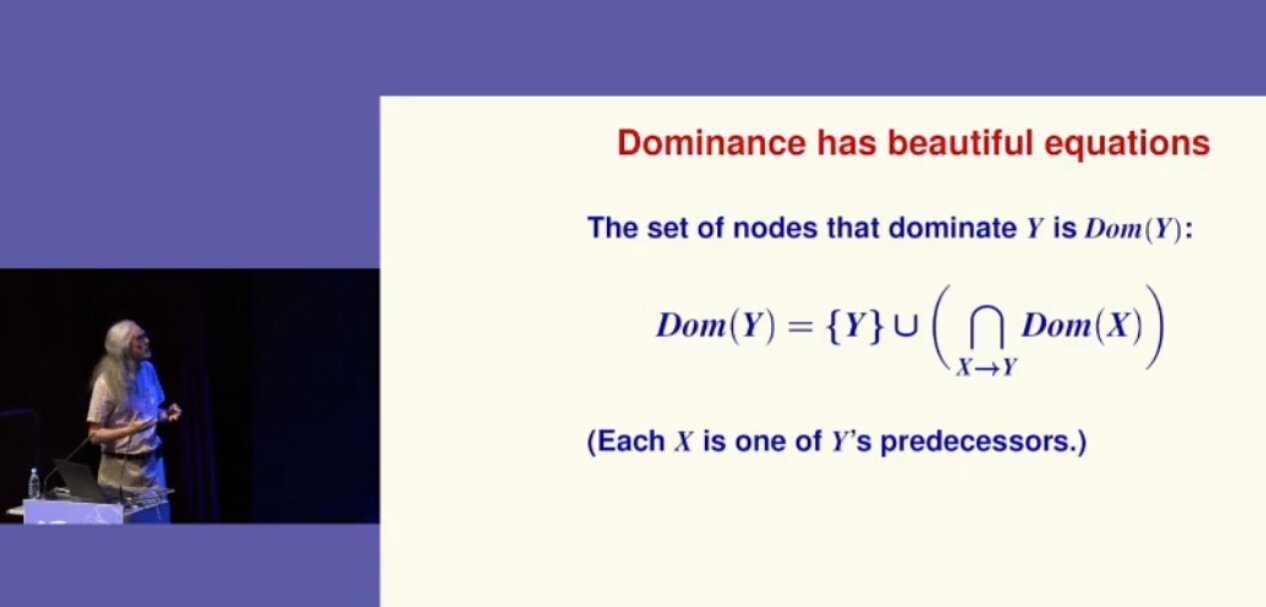
Norman Ramsey shows a formula Norman Ramsey shows a formula
He said it s ICFP and I wanted to say the dominance relation has a beautiful set of equations you can read all these algorithms how to compute this, but the concept is simple . This made me wonder: If the concept is simple and this formula is beautiful shouldn t this be sufficient for the Haskell programmer to obtain the dominator relation, without reading all those algorithms? Before we start, we have to clarify the formula a bit: If a node is an entry node (no predecessors) then the big intersection is over the empty set, and that is not a well-defined concept. For these nodes, we need that big intersection to return the empty set, as entry nodes are not dominated by any other node. (Let s assume that the entry nodes are exactly those with no predecessors.) Let s try, first using plain Haskell data structures. We begin by implementing this big intersection operator on Data.Set, and also a function to find the predecessors of a node in a graph: Now we can write down the formula that Norman gave, quite elegantly: Does this work? It seems it does: But not surprising if you have read my previous blog posts it falls over once we have recursion: So let us reimplement it with Data.Recursive.Set. The hope is that we can simply replace the operations, and that now it can suddenly handle cyclic graphs as well. Let s see: It does! Well, it does return a result but it looks strange. Clearly node 3 and 4 are also dominated by 1, but the result does not reflect that. But the result is a solution to Norman s equation. Was the equation wrong? No, but we failed to notice that the desired solution is the largest, not the smallest. And Data.Recursive.Set calculates, as documented, the least fixed point. What now? Until the library has code for RDualSet a, we can work around this by using the dual formula to calculate the non-dominators. To do this, we
  • use union instead of intersection
  • delete instead of insert,
  • S.empty, use the set of all nodes (which requires some extra plumbing)
  • subtract the result from the set of all nodes to get the dominators
and thus the code turns into:
And with this, now we do get the correct result:
ghci> domintors3 [(1,2),(1,3),(2,4),(3,4),(4,3)]
fromList [(1,[1]),(2,[1,2]),(3,[1,3]),(4,[1,4])]
We worked a little bit on how to express the beautiful formula to Haskell, but at no point did we have to think about how to solve it. To me, this is the essence of declarative programming.

14 September 2022

Joachim Breitner: rec-def: Program analysis case study

At this week s International Conference on Functional Programming I showed my rec-def Haskell library to a few people. As this crowd appreciates writing compilers, and example from the realm of program analysis is quite compelling.

To Throw or not to throw Here is our little toy language to analyze: It has variables, lambdas and applications, non-recursive (lazy) let bindings and, so that we have something to analyze, a way to throw and to catch exceptions: Given such an expression, we would like to know whether it might throw an exception. Such an analysis is easy to write: We traverse the syntax tree, remembering in the env which of the variables may throw an exception: The most interesting case is the one for Let, where we extend the environment env with the information about the additional variable env_bind, which is calculated from analyzing the right-hand side e1. So far so good:
ghci> someVal = Lam "y" (Var "y")
ghci> canThrow1 $ Throw
True
ghci> canThrow1 $ Let "x" Throw someVal
False
ghci> canThrow1 $ Let "x" Throw (App (Var "x") someVal)
True

Let it rec To spice things up, let us add a recursive let to the language: How can we support this new constructor in canThrow1? Let use naively follow the pattern used for Let: Calculate the analysis information for the variables in env_bind, extend the environment with that, and pass it down: Note that, crucially, we use env', and not just env, when analyzing the right-hand sides. It has to be that way, as all the variables are in scope in all the right-hand sides. In a strict language, such a mutually recursive definition, where env_bind uses env' which uses env_bind is basically unthinkable. But in a lazy language like Haskell, it might just work. Unfortunately, it works only as long as the recursive bindings are not actually recursive, or if they are recursive, they are not used:
ghci> canThrow1 $ LetRec [("x", Throw)] (Var "x")
True
ghci> canThrow1 $ LetRec [("x", App (Var "y") someVal), ("y", Throw)] (Var "x")
True
ghci> canThrow1 $ LetRec [("x", App (Var "x") someVal), ("y", Throw)] (Var "y")
True
But with genuine recursion, it does not work, and simply goes into a recursive cycle:
ghci> canThrow1 $ LetRec [("x", App (Var "x") someVal), ("y", Throw)] (Var "x")
^CInterrupted.
That is disappointing! Do we really have to toss that code and somehow do an explicit fixed-point calculation here? Obscuring our nice declarative code? And possibly having to repeat work (such as traversing the syntax tree) many times that we should only have to do once?

rec-def to the rescue Not with rec-def! Using RBool from Data.Recursive.Bool instead of Bool, we can write the exact same code, as follows: And it works!
ghci> canThrow2 $ LetRec [("x", App (Var "x") someVal), ("y", Throw)] (Var "x")
False
ghci> canThrow2 $ LetRec [("x", App (Var "x") Throw), ("y", Throw)] (Var "x")
True
I find this much more pleasing than the explicit naive fix-pointing you might do otherwise, where you stabilize the result at each LetRec independently: Not only is all that extra work hidden from the programmer, but now also a single traversal of the syntax tree creates, thanks to the laziness, a graph of RBool values, which are then solved under the hood .

The issue with x=x There is one downside worth mentioning: canThrow2 fails to produce a result in case we hit x=x:
ghci> canThrow2 $ LetRec [("x", Var "x")] (Var "x")
^CInterrupted.
This is, after all the syntax tree has been processed and all the map lookups have been resolved, equivalent to
ghci> let x = x in RB.get (x :: RBool)
^CInterrupted.
which also does not work. The rec-def machinery can only kick in if at least one of its function is used on any such cycle, even if it is just a form of identity (which I ~ought to add to the library~ since have added to the library):
ghci> idR x = RB.false   x
ghci> let x = idR x in getR (x :: R Bool)
False
And indeed, if I insert a call to idR in the line then our analyzer will no longer stumble over these nasty recursive equations:
ghci> canThrow2 $ LetRec [("x", Var "x")] (Var "x")
False
It is a bit disappointing to have to do that, but I do not see a better way yet. I guess the def-rec library expects the programmer to have a similar level of sophistication as other tie-the-know tricks with laziness (where you also have to ensure that your definitions are productive and that the sharing is not accidentally lost).

10 September 2022

Junichi Uekawa: Tried implementing FUSE cpiofs.

Tried implementing FUSE cpiofs. I thought it might be fun to implement a file system that can mount initrd file systems. I've implemented symlinks and regular files handling and then I realized that it is kind of annoying that I need to implement hard links. cpiofs

Joachim Breitner: rec-def: Behind the scenes

A week ago I wrote about the rec-def Haskell library, which allows you to write more recursive definitions, such as in this small example:
let s1 = RS.insert 23 s2
    s2 = RS.insert 42 s1
in RS.get s1
This will not loop (as it would if you d just used Data.Set), but rather correctly return the set S.fromList [23,42]. See the previous blog post for more examples and discussion of the user-facing side of this. For quick reference, these are the types of the functions involved here: The type of s1 and s2 above is not Set Int, but rather RSet Int, and in this post I ll explain how RSet works internally.

Propagators, in general The conceptual model behind an recursive equation like above is
  • There are a multiple cells that can hold values of an underlying type (here Set)
  • These cells have relations that explain how the values in the cells should relate to each other
  • After registering all the relations, some form of solving happens.
  • If the solving succeeds, we can read off the values from the cells, and they should satisfy the registered relation.
This is sometimes called a propagator network, and is a quite general model that can support different kind of relations (e.g. equalities, inequalities, functions), there can be various solving strategies (iterative fixed-points, algebraic solution, unification, etc.) and information can flow on along the edges (and hyper-edges) possibly in multiple directions. For our purposes, we only care about propagator networks where all relations are functional, so they have a single output cell that is declared to be a function of multiple (possibly zero) input cells, without affecting these input cells. Furthermore, every cell is the output of exactly one such relation.

IO-infested propagator interfaces This suggests that an implementation of such a propagator network could provide an interface with the following three operations:
  • Functions to declare cells
  • Functions to declare relations
  • Functions to read values off cells
This is clearly an imperative interface, so we ll see monads, and we ll simply use IO. So concretely for our small example above, we might expect
There is no need for an explicit solve function: solving can happen when declareInsert or getCell is called as a User I do not care about that. You might be curious about the implementation of newCell, declareInsert and getCell, but I have to disappoint you: This is not the topic of this article. Instead, I want to discuss how to turn this IO-infested interface into the pure interface seen above?

Pure, but too strict Obviously, we have to get rid of the IO somehow, and have to use unsafePerformIO :: IO a -> a somehow. This dangerous function creates a pure-looking value that, when used the first time, will run the IO-action and turn into that action s result. So maybe we can simply write the following: Indeed, the types line up, but if we try to use that code, nothing will happen. Our insert is too strict to be used recursively: It requires the value of c2 (as it is passed to declareInsert, which we assume to be strict in its arguments) before it can return c1, so the recursive example at the top of this post will not make any progress.

Pure, lazy, but forgetful To work around this, maybe it suffices if we do not run declareInsert right away, but just remember that we have to do it eventually? So let s introduce a new data type for RSet a that contains not just the cell (Cell a), but also an action that we still have to run before getting a value: This is better: insert is now lazy in its arguments (for this it is crucial to pattern-match on RSet only inside the todo code, not in the pattern of insert!) This means that our recursive code above does not get stuck right away.

Pure, lazy, but runs in circles But it is still pretty bad: Note that we do not run get s2 in the example above, so that cell s todo, which would declareInsert 42, will never run. This cannot work! We have to (eventually) run the declaration code from all involved cells before we can use getCell! We can try to run the todo action of all the dependencies as part of a cell s todo action: Now we certainly won t forget to run the second cell s todo action, so that is good. But that cell s todo action will run the first cell s todo action, and that again the second cell s, and so on.

Pure, lazy, terminating, but not thread safe This is silly: We only need (and should!) run that code once! So let s keep track of whether we ran it already: Ah, much better: It works! Our call to get c1 will trigger the first cell s todo action, which will mark it as done before calling the second cell s todo action. When that now invokes the first cell s todo action, it is already marked done and we break the cycle, and by the time we reach getCell, all relations have been correctly registered. In a single-threaded world, this would be all good and fine, but we have to worry about multiple threads running get concurrently, on the same or on different cells. In fact, because we use unsafePerformIO, we have to worry about this even when the program is not using threads. And the above code has problems. Imagine a second call to get c1 while the first one has already marked it as done, but has not finished processing all the dependencies yet: It will call getCell before all relations are registered, which is bad.

Recursive do-once IO actions Making this thread-safe seems to be possible, but would clutter both the code and this blog post. So let s hide that problem behind a nice and clean interface. Maybe there will be a separate blog post about its implementation (let me know if you are curious), or you can inspect the code in System.IO.RecThunk module yourself). The interface is simply
data Thunk
thunk :: IO [Thunk] -> IO Thunk
force :: Thunk -> IO ()
and the idea is that thunk act will defer the action act until the thunk is passed to force for the first time, and force will not return until the action has been performed (possibly waiting if another thread is doing that at the moment), and also until the actions of all the thunks returned by act have performed, recursively, without running into cycles. We can use this in our definition of RSet and get to the final, working solution: This snippet captures the essential ideas behind rec-def:
  • Use laziness to allow recursive definition to describe the propagator graph naturally
  • Use a form of explicit thunk to register the propagator graph relations at the right time (not too early/strict, not too late)

And that s all? The actual implementation in rec-def has a few more moving parts. In particular, it tries to support different value types (not just sets), possibly with different implementations, and even mixing them (e.g. in member :: Ord a => a -> RSet a -> RBool), so the generic code is in Data.Propagator.Purify, and supports various propagators underneath. The type RSet is then just a newtype around that, defined in Data.Recursive.Internal to maintain the safety of the abstraction, I went back and forth on a few variants of the design here, including one where there was a generic R type constructor (R (Set a), R Bool etc.), but then monomorphic interface seems simpler.

Does it really work? The big remaining question is certainly: Is this really safe and pure? Does it still behave like Haskell? The answer to these questions certainly depends on the underlying propagator implementation. But it also depends on what we actually mean by safe and pure ? For example, do we expect the Static Argument Transformation be semantics preserving? Or is it allowed to turn undefined values into defined ones (as it does here)? I am unsure myself yet, so I ll defer this discussion to a separate blog post, after I hopefully had good discussions about this here at ICFP 2022 in Ljubljana. If you are around and want to discuss, please hit me up!

9 September 2022

Reproducible Builds: Reproducible Builds in August 2022

Welcome to the August 2022 report from the Reproducible Builds project! In these reports we outline the most important things that we have been up to over the past month. As a quick recap, whilst anyone may inspect the source code of free software for malicious flaws, almost all software is distributed to end users as pre-compiled binaries. The motivation behind the reproducible builds effort is to ensure no flaws have been introduced during this compilation process by promising identical results are always generated from a given source, thus allowing multiple third-parties to come to a consensus on whether a build was compromised. As ever, if you are interested in contributing to the project, please visit our Contribute page on our website.

Community news As announced last month, registration is currently open for our in-person summit this year which is due to be held between November 1st November 3rd. The event will take place in Venice (Italy). Very soon we intend to pick a venue reachable via the train station and an international airport. However, the precise venue will depend on the number of attendees. Please see the announcement email for information about how to register.
The US National Security Agency (NSA), Cybersecurity and Infrastructure Security Agency (CISA) and the Office of the Director of National Intelligence (ODNI) have released a document called Securing the Software Supply Chain: Recommended Practices Guide for Developers (PDF) as part of their Enduring Security Framework (ESF) work. The document expressly recommends having reproducible builds as part of advanced recommended mitigations, along with hermetic builds. Page 31 (page 35 in the PDF) says:
Reproducible builds provide additional protection and validation against attempts to compromise build systems. They ensure the binary products of each build system match: i.e., they are built from the same source, regardless of variable metadata such as the order of input files, timestamps, locales, and paths. Reproducible builds are those where re-running the build steps with identical input artifacts results in bit-for-bit identical output. Builds that cannot meet this must provide a justification why the build cannot be made reproducible.
The full press release is available online.
On our mailing list this month, Marc Prud hommeaux posted a feature request for diffoscope which additionally outlines a project called The App Fair, an autonomous distribution network of free and open-source macOS and iOS applications, where validated apps are then signed and submitted for publication .
Author/blogger Cory Doctorow posted published a provocative blog post this month titled Your computer is tormented by a wicked god . Touching on Ken Thompson s famous talk, Reflections on Trusting Trust , the early goals of Secure Computing and UEFI firmware interfaces:
This is the core of a two-decade-old debate among security people, and it s one that the benevolent God faction has consistently had the upper hand in. They re the curated computing advocates who insist that preventing you from choosing an alternative app store or side-loading a program is for your own good because if it s possible for you to override the manufacturer s wishes, then malicious software may impersonate you to do so, or you might be tricked into doing so. [..] This benevolent dictatorship model only works so long as the dictator is both perfectly benevolent and perfectly competent. We know the dictators aren t always benevolent. [ ] But even if you trust a dictator s benevolence, you can t trust in their perfection. Everyone makes mistakes. Benevolent dictator computing works well, but fails badly. Designing a computer that intentionally can t be fully controlled by its owner is a nightmare, because that is a computer that, once compromised, can attack its owner with impunity.

Lastly, Chengyu HAN updated the Reproducible Builds website to correct an incorrect Git command. [ ]

Debian In Debian this month, the essential and required package sets became 100% reproducible in Debian bookworm on the amd64 and arm64 architectures. These two subsets of the full Debian archive refer to Debian package priority levels as described in the 2.5 Priorities section of the Debian Policy there is no canonical minimal installation package set in Debian due to its diverse methods of installation. As it happens, these package sets are not reproducible on the i386 architecture because the ncurses package on that architecture is not yet reproducible, and the sed package currently fails to build from source on armhf too. The full list of reproducible packages within these package sets can be viewed within our QA system, such as on the page of required packages in amd64 and the list of essential packages on arm64, both for Debian bullseye.
It recently has become very easy to install reproducible Debian Docker containers using podman on Debian bullseye:
$ sudo apt install podman
$ podman run --rm -it debian:bullseye bash
The (pre-built) image used is itself built using debuerrotype, as explained on docker.debian.net. This page also details how to build the image yourself and what checksums are expected if you do so.
Related to this, it has also become straightforward to reproducibly bootstrap Debian using mmdebstrap, a replacement for the usual debootstrap tool to create Debian root filesystems:
$ SOURCE_DATE_EPOCH=$(date --utc --date=2022-08-29 +%s) mmdebstrap unstable > unstable.tar
This works for (at least) Debian unstable, bullseye and bookworm, and is tested automatically by a number of QA jobs set up by Holger Levsen (unstable, bookworm and bullseye)
Work has also taken place to ensure that the canonical debootstrap and cdebootstrap tools are also capable of bootstrapping Debian reproducibly, although it currently requires a few extra steps:
  1. Clamping the modification time of files that are newer than $SOURCE_DATE_EPOCH to be not greater than SOURCE_DATE_EPOCH.
  2. Deleting a few files. For debootstrap, this requires the deletion of /etc/machine-id, /var/cache/ldconfig/aux-cache, /var/log/dpkg.log, /var/log/alternatives.log and /var/log/bootstrap.log, and for cdebootstrap we also need to delete the /var/log/apt/history.log and /var/log/apt/term.log files as well.
This process works at least for unstable, bullseye and bookworm and is now being tested automatically by a number of QA jobs setup by Holger Levsen [ ][ ][ ][ ][ ][ ]. As part of this work, Holger filed two bugs to request a better initialisation of the /etc/machine-id file in both debootstrap [ ] and cdebootstrap [ ].
Elsewhere in Debian, 131 reviews of Debian packages were added, 20 were updated and 27 were removed this month, adding to our extensive knowledge about identified issues. Chris Lamb added a number of issue types, including: randomness_in_browserify_output [ ], haskell_abi_hash_differences [ ], nondeterministic_ids_in_html_output_generated_by_python_sphinx_panels [ ]. Lastly, Mattia Rizzolo removed the deterministic flag from the captures_kernel_variant flag [ ].

Other distributions Vagrant Cascadian posted an update of the status of Reproducible Builds in GNU Guix, writing that:
Ignoring the pesky unknown packages, it is more like ~93% reproducible and ~7% unreproducible... that feels a bit better to me! These numbers wander around over time, mostly due to packages moving back into an "unknown" state while the build farms catch up with each other... although the above numbers seem to have been pretty consistent over the last few days.
The post itself contains a lot more details, including a brief discussion of tooling. Elsewhere in GNU Guix, however, Vagrant updated a number of packages such as itpp [ ], perl-class-methodmaker [ ], libnet [ ], directfb [ ] and mm-common [ ], as well as updated the version of reprotest to 0.7.21 [ ]. In openSUSE, Bernhard M. Wiedemann published his usual openSUSE monthly report.

diffoscope diffoscope is our in-depth and content-aware diff utility. Not only can it locate and diagnose reproducibility issues, it can provide human-readable diffs from many kinds of binary formats. This month, Chris Lamb prepared and uploaded versions 220 and 221 to Debian, as well as made the following changes:
  • Update external_tools.py to reflect changes to xxd and the vim-common package. [ ]
  • Depend on the dedicated xxd package now, not the vim-common package. [ ]
  • Don t crash if we can open a PDF file using the PyPDF library, but cannot subsequently parse the annotations within. [ ]
In addition, Vagrant Cascadian updated diffoscope in GNU Guix, first to to version 220 [ ] and later to 221 [ ].

Community news The Reproducible Builds project aims to fix as many currently-unreproducible packages as possible as well as to send all of our patches upstream wherever appropriate. This month we created a number of patches, including:

Testing framework The Reproducible Builds project runs a significant testing framework at tests.reproducible-builds.org, to check packages and other artifacts for reproducibility. This month, Holger Levsen made the following changes:
  • Debian-related changes:
    • Temporarily add Debian unstable deb-src lines to enable test builds a Non-maintainer Upload (NMU) campaign targeting 708 sources without .buildinfo files found in Debian unstable, including 475 in bookworm. [ ][ ]
    • Correctly deal with the Debian Edu packages not being installable. [ ]
    • Finally, stop scheduling stretch. [ ]
    • Make sure all Ubuntu nodes have the linux-image-generic kernel package installed. [ ]
  • Health checks & view:
    • Detect SSH login problems. [ ]
    • Only report the first uninstallable package set. [ ]
    • Show new bootstrap jobs. [ ] and debian-live jobs. [ ] in the job health view.
    • Fix regular expression to detect various zombie jobs. [ ]
  • New jobs:
    • Add a new job to test reproducibility of mmdebstrap bootstrapping tool. [ ][ ][ ][ ]
    • Run our new mmdebstrap job remotely [ ][ ]
    • Improve the output of the mmdebstrap job. [ ][ ][ ]
    • Adjust the mmdebstrap script to additionally support debootstrap as well. [ ][ ][ ]
    • Work around mmdebstrap and debootstrap keeping logfiles within their artifacts. [ ][ ][ ]
    • Add support for testing cdebootstrap too and add such a job for unstable. [ ][ ][ ]
    • Use a reproducible value for SOURCE_DATE_EPOCH for all our new bootstrap jobs. [ ]
  • Misc changes:
    • Send the create_meta_pkg_sets notification to #debian-reproducible-changes instead of #debian-reproducible. [ ]
In addition, Roland Clobus re-enabled the tests for live-build images [ ] and added a feature where the build would retry instead of give up when the archive was synced whilst building an ISO [ ], and Vagrant Cascadian added logging to report the current target of the /bin/sh symlink [ ].

Contact As ever, if you are interested in contributing to the Reproducible Builds project, please visit our Contribute page on our website. However, you can get in touch with us via:

8 September 2022

Antoine Beaupr : Complaint about Canada's phone cartel

I have just filed a complaint with the CRTC about my phone provider's outrageous fees. This is a copy of the complaint.
I am traveling to Europe, specifically to Ireland, for a 6 days for a work meeting. I thought I could use my phone there. So I looked at my phone provider's services in Europe, and found the "Fido roaming" services: https://www.fido.ca/mobility/roaming The fees, at the time of writing, at fifteen (15!) dollars PER DAY to get access to my regular phone service (not unlimited!!). If I do not use that "roaming" service, the fees are: That is absolutely outrageous. Any random phone plan in Europe will be cheaper than this, by at least one order of magnitude. Just to take any example: https://www.tescomobile.ie/sim-only-plans.aspx Those fine folks offer a one-time, prepaid plan for 15 for 28 days which includes: I think it's absolutely scandalous that telecommunications providers in Canada can charge so much money, especially since the most prohibitive fee (the "non-prepaid" plans) are automatically charged if I happen to forget to remove my sim card or put my phone in "airplane mode". As advised, I have called customer service at Fido for advice on how to handle this situation. They have confirmed those are the only plans available for travelers and could not accommodate me otherwise. I have notified them I was in the process of filing this complaint. I believe that Canada has become the technological dunce of the world, and I blame the CRTC for its lack of regulation in that matter. You should not allow those companies to grow into such a cartel that they can do such price-fixing as they wish. I haven't investigated Fido's competitors, but I will bet at least one of my hats that they do not offer better service. I attach a screenshot of the Fido page showing those outrageous fees.
I have no illusions about this having any effect. I thought of filing such a complain after the Rogers outage as well, but felt I had less of a standing there because I wasn't affected that much (e.g. I didn't have a life-threatening situation myself). This, however, was ridiculous and frustrating enough to trigger this outrage. We'll see how it goes...
"We will respond to you within 10 working days."

Response from CRTC They did respond within 10 days. Here is the full response:
Dear Antoine Beaupr : Thank you for contacting us about your mobile telephone international roaming service plan rates concern with Fido Solutions Inc. (Fido). In Canada, mobile telephone service is offered on a competitive basis. Therefore, the Canadian Radio-television and Telecommunications Commission (CRTC) is not involved in Fido's terms of service (including international roaming service plan rates), billing and marketing practices, quality of service issues and customer relations. If you haven't already done so, we encourage you to escalate your concern to a manager if you believe the answer you have received from Fido's customer service is not satisfactory. Based on the information that you have provided, this may also appear to be a Competition Bureau matter. The Competition Bureau is responsible for administering and enforcing the Competition Act, and deals with issues such as false or misleading representations, deceptive marketing practices and collusion. You can reach the Competition Bureau by calling 1-800-348-5358 (toll-free), by TTY (for deaf and hard of hearing people) by calling 1-866-694-8389 (toll-free). For more contact information, please visit http://www.competitionbureau.gc.ca/eic/site/cb-bc.nsf/eng/00157.html When consumers are not satisfied with the service they are offered, we encourage them to compare the products and services of other providers in their area and look for a company that can better match their needs. The following tool helps to show choices of providers in your area: https://crtc.gc.ca/eng/comm/fourprov.htm Thank you for sharing your concern with us.
In other words, complain with Fido, or change providers. Don't complain to us, we don't manage the telcos, they self-regulate. Great job, CRTC. This is going great. This is exactly why we're one of the most expensive countries on the planet for cell phone service.

Live chat with Fido Interestingly, the day after I received that response from the CRTC, I received this email from Fido, while traveling:
Date: Tue, 13 Sep 2022 10:10:00 -0400 From: Fido DONOTREPLY@fido.ca To: REDACTED Subject: Courriel d avis d itin rance Fido Roaming Welcome Confirmation Fido Date : 13 septembre 2022
Num ro de compte : [redacted] Bonjour
Antoine Beaupr ! Nous vous crivons pour vous indiquer qu au moins un utilisateur inscrit votre compte s est r cemment connect un r seau en itin rance.
Vous trouverez ci-dessous le message texte de bienvenue en itin rance envoy l utilisateur (ou aux utilisateurs), qui contenait les tarifs d itin rance
applicables. Message texte de bienvenue en itin rance Destinataire : REDACTED Date et heure : 2022-09-13 / 10:10:00
Allo, ici Fido : Bienvenue destination! Vous tes inscrit Fido Nomade alors utilisez vos donn es, parlez et textez comme vous le faites la
maison. Depuis le 1 mars 2022 le tarif cette destination pour 15 $/jour (+ taxes) et valide tous les jours jusqu' 23 h 59 HE, peu importe le fuseau
horaire dans lequel vous vous trouvez. Bon voyage! Des questions? Consultez fido.ca/m/itinerance ou composez +15149333436 (sans frais). Besoin d aide?
  • PLANIFIEZ UN VOYAGE AVEC Fido NomadeMC
    D couvrez nos options d itin rance et restez en contact l tranger sans vous soucier de votre
    facture.
D tails
  • G rez votre compte
    G rez vos produits et services Fido la maison ou sur la route gr ce Mon
    Compte.
D tails Ce courriel est produit automatiquement; veuillez ne pas y r pondre. Ce courriel (et toute pi ce jointe) est confidentiel. Si vous n tes pas le destinataire,
veuillez supprimer le pr sent message et en d truire toute copie. FIDO SOLUTIONS 800, RUE DE LA GAUCHETI RE OUEST
BUREAU 4000 MONTR AL (QU BEC) H5A 1K3
Fido
I found that message utterly confusing (and yes, I can read french). Basically, it says that some user (presumably me!) connected to the network with roaming. I did just disabled airplane mode on my phone to debug a Syncthing bug but had not enabled roaming. So this message seemed to say that I would be charged 15$ (per DAY!) for roaming from now on. Confused, I tried their live chat to try to clarify things, worried I would get charged even more for calling tech support on *611. This is a transcript of the chat:
F: Hi! What are we doing today? Type in your question or choose from the options below: * Track my Equipment Order * View Bill Online * Payment Options * iPhone 14 Pre-Order A: i received a message about roaming while abroad but i did not enable roaming on my phone, will i be charged anyways? F: I think I know what you re asking for. Select the topic that best matches your request or try rephrasing your question. A: no F: Thank you, this will help us to improve! Would you like to chat with a specialist? Chat with a specialist I'll get a specialist to help you with this. It appears that you're not signed in. Your session may have timed out. To save time and identify your account details, please sign in to My Account.
  • Sign in
  • I'm not able to sign in
Have any questions specific to your Fido account? To service you faster, please identify yourself by completing the form below. A: Personal info Form submitted F: Thank you! I'll connect you with the next available specialist. Your chat is being transferred to a Live Chat agent. Thanks for your patience. We are here to assist you and we kindly ask that our team members be treated with respect and dignity. Please note that abuse directed towards any Consumer Care Specialist will not be tolerated and will result in the termination of your conversation with us. All of our agents are with other customers at the moment. Your chat is in a priority sequence and someone will be with you as soon as possible. Thanks! Thanks for continuing to hold. An agent will be with you as soon as possible. Thank you for your continued patience. We re getting more Live Chat requests than usual so it s taking longer to answer. Your chat is still in a priority sequence and will be answered as soon as an agent becomes available. Thank you so much for your patience we're sorry for the wait. Your chat is still in a priority sequence and will be answered as soon as possible. Hi, I'm [REDACTED] from Fido in [REDACTED]. May I have your name please? A: hi i am antoine, nice to meet you sorry to use the live chat, but it's not clear to me i can safely use my phone to call support, because i am in ireland and i'm worried i'll get charged for the call F: Thank You Antoine , I see you waited to speak with me today, thank you for your patience.Apart from having to wait, how are you today? A: i am good thank you
[... delay ...]
A: should i restate my question? F: Yes please what is the concern you have? A: i have received an email from fido saying i someone used my phone for roaming it's in french (which is fine), but that's the gist of it i am traveling to ireland for a week i do not want to use fido's services here... i have set the phon eto airplane mode for most of my time here F: The SMS just says what will be the charges if you used any services. A: but today i have mistakenly turned that off and did not turn on roaming well it's not a SMS, it's an email F: Yes take out the sim and keep it safe.Turun off or On for roaming you cant do it as it is part of plan. A: wat F: if you used any service you will be charged if you not used any service you will not be charged. A: you are saying i need to physically take the SIM out of the phone? i guess i will have a fun conversation with your management once i return from this trip not that i can do that now, given that, you know, i nee dto take the sim out of this phone fun times F: Yes that is better as most of the customer end up using some kind of service and get charged for roaming. A: well that is completely outrageous roaming is off on the phone i shouldn't get charged for roaming, since roaming is off on the phone i also don't get why i cannot be clearly told whether i will be charged or not the message i have received says i will be charged if i use the service and you seem to say i could accidentally do that easily can you tell me if i have indeed used service sthat will incur an extra charge? are incoming text messages free? F: I understand but it is on you if you used some data SMS or voice mail you can get charged as you used some services.And we cant check anything for now you have to wait for next bill. and incoming SMS are free rest all service comes under roaming. That is the reason I suggested take out the sim from phone and keep it safe or always keep the phone or airplane mode. A: okay can you confirm whether or not i can call fido by voice for support? i mean for free F: So use your Fido sim and call on +1-514-925-4590 on this number it will be free from out side Canada from Fido sim. A: that is quite counter-intuitive, but i guess i will trust you on that thank you, i think that will be all F: Perfect, Again, my name is [REDACTED] and it s been my pleasure to help you today. Thank you for being a part of the Fido family and have a great day! A: you too
So, in other words:
  1. they can't tell me if I've actually been roaming
  2. they can't tell me how much it's going to cost me
  3. I should remove the SIM card from my phone (!?) or turn on airplane mode, but the former is safer
  4. I can call Fido support, but not on the usual *611, and instead on that long-distance-looking phone number, and yes, that means turning off airplane mode and putting the SIM card in, which contradicts step 3
Also notice how the phone number from the live chat (+1-514-925-4590) is different than the one provided in the email (15149333436). So who knows what would have happened if I would have called the latter. The former is mentioned in their contact page. I guess the next step is to call Fido over the phone and talk to a manager, which is what the CRTC told me to do in the first place... I ended up talking with a manager (another 1h phone call) and they confirmed there is no other package available at Fido for this. At best they can provide me with a credit if I mistakenly use the roaming by accident to refund me, but that's it. The manager also confirmed that I cannot know if I have actually used any data before reading the bill, which is issued on the 15th of every month, but only available... three days later, at which point I'll be back home anyways. Fantastic.

6 September 2022

Louis-Philippe V ronneau: Montreal's Debian & Stuff - August 2022

Our local Debian user group gathered on Sunday August 28th1 at the very hackish Foulab for the August 2022 edition of our "Debian & Stuff" meetings. As always, the event was a success and we had lots of fun. Nine people showed up, including some new faces and people I hadn't seen in a while: On my side, although I was badly sleep-deprived 2, I still managed to be somewhat productive! One of the WiFi Access Points we use in our 4-apartment LAN had been boot-looping for a few weeks, after a failed sysupgrade to the latest version of OpenWRT. lavamind and I suspect the flash got corrupted in a way or another during the upgrade process... Lucky for us, this model has a serial port and runs U-Boot. After a bit of tinkering, some electrical tape and two different serial adapters3, we managed to identify the pin layout and got a shell on the machine. The device has a reset button, but since the kernel panic was happening too soon in the boot process, we weren't able to get into OpenWRT's failsafe mode this way. The WiFi AP being flashed via a serial-to-USB adapter Once we had serial access, wiping the flash and re-installing OpenWRT fixed our problem. A quick ansible-playbook run later, the device was back to being usable and configured :) I was too tired to keep track of what others did, but I took some nice pictures of the pizza we got, and of this nice blow-up Tux wearing a Foulab t-shirt. Enjoy! A blow-up Tux wearing a Foulab t-shirt One of the pizzas we ordered As always, thanks to the Debian project for granting us a budget to rent the venue and to buy some food.
  1. Please excuse the late blog post, it's Harvest Season here and I've been quite busy.
  2. A bad case of wry neck kept me from sleeping properly for a while in August.
  3. As it turns out, serial connections work better when you use the right pins for TX and RX!

Next.

Previous.