Search Results: "jam"

30 September 2006

Zak B. Elep: More on being 0 16

Its the close of September. And just a week ago I turned 16: in hex, that is. Although I do distinctly remember how I wished coming back to being a 16-decimal-year-old then… So, how does it feel being one? I’ve barely begun to feel it. There has been a lot of distractions to keep me from contemplating too much about $age: That’s just the tip of the iceberg. Moving back to Manila again has its own issues; I still have to look for a better place to stay (not that I’m complaining about my Tita’s place in Malate, but hey, we’re already overcrowded… I suppose I’ll get my own flat once I think I can stay out beyond the 3 months,) and I have to get better internet connectivity (all the better for my chroots to keep updated, and finally get back on the Debian/Ubuntu packaging scene.) I also have to find some time to get a passport, a haircut, some nice pair of sneakers, and a Wii. I’ve yet to know what this being 0×16 business is all about, but this I have to say: Thanks $DEITY for all the fish.

29 September 2006

Benjamin Mako Hill: iPain

On Wednesday, I walked into a tree branch. In what is apparently not an unusual turn of events, I ended up with a corneal abrasion (i.e., a laceration on my eyeball). It has hurt my ability to do work because it hurts intensely when I try to, well, look at things. My friend asked me what kind of tree it was. Interestingly, while my eyes (or my right eye at the very least) was open when I ran into the tree, I don't recall getting a good look at it.

27 September 2006

Benjamin Mako Hill: Who Gets to Define Freedom?

Recently, I had an opportunity to publicly discuss my projects around definitions of freedom for creative work with Lawrence Lessig at a workshop at Wizards of OS. In particular, we talked about my article Toward a Standard of Freedom in which I advance a call for a list of essential freedoms, a definition of free culture or content, and a goal around which a social movement for free creative works can be based. At WOS, Lessig and I agreed that its likely that, eventually, some standard (or standards) of freedom will take hold. Like me, Lessig seems to think that this is a good thing. We both agree that there will be, and should be, competing definitions of freedom, competing social movements, and a long conversation about what essential freedom really to creative works is before we get there. Our most fundamental differences seem to stem from a disagreement about who gets to define freedom or, perhaps more precisely, who the communities of producers should listen to in order to find out what essential freedoms in the domain of different types of creative works are. Lessig is extremely reticent to make any claims about what essential freedoms might be: he does not want to speak for creative communities that he does not intimately understand. While he seems to be suspect of any project making normative claims in this regard, he disagrees most strongly with projects like mine that offer definitions of free content and expressions that are intended to be applied broadly and outside of the explicit domain of the definition's initiators recognized experience (in our case, online encyclopedias and software). Lessig explained that he trusts musicians -- and in particular, Gilberto Gil, the progenitor of the CC Sampling license -- when it comes to defining essential freedoms for music. Similarly, he trusts programmers -- and in particular, Richard Stallman -- when it comes to defining essential freedom for software. Since Richard and I are less accomplished, less well known, and less experienced musicians, Lessig feels most comfortable erring in favor of Gil where there's a disagreement between us about the scope of essential freedom for music. While his is a convincing argument, I disagree with Lessig's position for a series of reasons I'll try to discuss here. First, it is important to remember that Gilberto Gil does not represent all musicians. There are many artists and musicians who support my definition. There are many (and probably more if the CC license usage statistics are any indication) who support Gil's lower base-line. It's worth remembering that, even though we disagree, both Gil and I are offering controversial and extreme positions. Today, most creators think that giving away their work at no cost, even non-commercially and barring derivatives, is crazy. To illustrate why this is not a problem, we can look again to free software. In the free software community, we see that Richard Stallman does not speak for the programming community at large when it comes to defining essential freedoms to code. In the mid-eighties, Stallman spoke for himself and a tiny handful of like-minded others. Today he speaks for many more but it's still a tiny fraction of all programmers. It's hard to remember when you're down in the trenches but the idea that software should be free remains a marginal and kooky idea to this day. Due to the hard work of the free software movement, many people have adopted Stallman's definition of essential freedom for software and many more will. But it is not mainstream and it didn't get here by being so. Setting an ethical standard and a goal for a social movement should not be about being popular. It should be about describing an ideal. It should be about standing up to injustice. It should be about answering the question, "what sort of world do I want to live in?" Not only is this process not a popularity contest, it will, in all likelihood, stand to make one very unpopular. Being respected or seen as an expert within a field will help with the adoption of one's ideal. Programmers trusted Richards Stallman because he'd written large parts of the very popular programming tools like GNU Emacs and GCC. However, it wasn't from his experience in programming that this insight into the importance of software freedom stemmed. It was from his desire to be a good, ethical, neighbor and member of a technical community. To this day, most great programmers continue to disagree with Richard. Second, I'm interested not only in talking about the ability of authors to choose how their works are used but in the rights of readers. You don't need to have a platinum album under your belt to have an informed and important opinion about how music should be heard, experienced and distributed. Lessig's current push for a "Read-Write Culture" is very fixated on creators and re-mixers. That's only one important piece of the community that frames and deals with this problem. Third, while I agree with Lessig that discussions around definitions of free culture must happen separately in each separate artist community, I see several compelling reasons why a single definition of freedom may be a very good idea both tactically and philosophically. For example, it provides a common rallying cry around which different creative groups can collaborate and it mirrors the common treatment of different types of works in current IP systems. More importantly, there are fundamental similarities between information goods and the way they are created, distributed, and consumed on computers and in digital networks. I've highlighted this before in quoting Eben Moglen on the ethics of creating artificial scarcity in goods with zero marginal cost. As a final note, it's worth stating that one doesn't need to feel that all works should be free to support a definition of freedom. Richard Stallman provides a great example of this. Stallman doesn't think that works of opinion or works that are designed primarily to entertain need to be free. However, he does believe that the term "free" should refer to a fixed set of freedoms so that he can take such a position. Without a definition of "free," a position on what should or should not be "free" is impossible. I believe that freedom to distribute and produce information goods like art and content and software are embedded in a set of freedoms and rights for both the producers and consumers. I think that to some degree (and quite probably a less extensive degree), Lessig agrees with this. Unlike Lessig, I don't believe that one needs extensive expertise in the creation of a particular type of creative good to make true statements about what is ethical or unethical in the production, distribution, and control of it. To use admittedly extreme analogies, you don't need to be a slave owner (or slave for that matter) to say that slavery is wrong. You don't need to be a farmer to make arguments against or in favor of vegetarianism or in favor of free range animals. I don't believe you have to be a technologist to claim that certain freedoms to technology are essential. I don't believe that you need to be an musician (successful or not) to make claims about essential rights to music. I welcomed the conversations and challenges that Lessig offered and it was encouraging to see agreement on the process of discussion and debate going forward. After the workshop, Lessig suggested that we continue the conversation. I look forward to doing just this in other venues and in other ways.

25 September 2006

Benjamin Mako Hill: Wizards of OS Wrap-up

My joint workshop with Lawrence Lessig at Wizards of OS went, in my opinion, extremely well. The worst hitch was an unfortunate series of events that conspired to keep Vera Franz from attending and moderating the session as planned. Paul Keller, who was supposed to participate in the panel, graciously (and capably) moderated in her place. The panel allowed Lessig and I to talk openly and publicly about about our disagreements for the first time while also highlighting the many places where we speak with one voice. The conversation managed to be both positive and productive without papering over issues. I usually like to post talk notes and slides after each speaking engagement. However, our WOS meeting was a "workshop" so I have nothing prepared to present here. I have, however, seen two write-ups in the press: If someone has a recording, tell me how I might get a copy. One small note: I am quoted in IP watch as saying that most CC works are under the most restrictive licenses and that there has been no shift toward less restrictive licenses with time. Mia Garlick has pointed out that the latest license usage statistics, based on admittedly imprecise linkback data, show a several percentage point decrease in the usage of licenses that block commercial use and derivatives -- when expressed as a fraction of the total number of works under CC licenses. The restrictive licenses are still the most popular but it was incorrect to say that there is no evidence of any progress whatsoever toward more free licenses. Tomorrow, I will post a summary and response to one of the points that Lessig and I talked most about.

24 September 2006

Benjamin Mako Hill: PyBlosxom and Comment Spam

Over the past few months, I've dealt with something of a blog spam nightmare on Copyrighteous: my blog running the PyBlosxom weblog software. Wiser and less stubborn individuals might given up on either PyBlosxom or the ability to receive public comments. However, I find PyBlosxom unique in its flexibility and great ReStructured Text support and am always frustrated with others' blogs that don't accept comments. At the end of the day, I couldn't bring myself to part with either. Historically, my blogspam protection has been to use a simple weak CAPTCHA and to have my blog software email me each time a comment is successfully submitted so that I can (with a built-in macro in mutt) delete each spam comment that slips in. This has worked well for the last couple years. This summer, Mika pointed out that my blog was full of Chinese link spam that I had not noticed or been notified about. Around the same time, I realized that my website had been dealt a massive spam penalty by Google and was basically not showing up in any search results. I have spent a significant amount of time over the last month repairing the damage and working to prevent it from reoccuring. I'm documenting this process here in the hopes that it might save other time and energy. Upon reflection, the situation could have been prevented the in three relatively easy ways -- all of which I have now implemented.
  • Had the PyBlosxom comment.py plugin's mail function been working properly, I would have known that I was being spammed.
  • Had PyBlosxom been configured to only make blog entries (and not comments) indexable by search engines, Google and others never would have seen the link spam.
  • Had I installed a stronger CAPTCHA, I might have blocked the spam from being submitted in the first place (although at the expense of the participation in comments by visually impaired users).
A month or so, hours of work, and a Google reinclusion request later, my website is beginning to show up in search entries again. Hopefully this message will help save others from a similar fate. Fixing PyBlosxom's Comment Notification The most critical problem was a bug in PyBlosxom's contributed comment.py plugin and its comment notification system. In short, the email based comment notification system failed silently if the body of the email -- which included the full text of the comment -- included any non-ASCII UTF-8 encoded text. I've filed a bug against PyBlosxom and included a patch that fixes this issue. However, since this is a rather critical problem and because PyBlosxom releases tend to be few and far between, it might be worth patching your system now. My patch is against version 1.3 but can easily be modified and applied to version 1.2. Hiding Comments from Search Engines The major reason that the successful spam became a problem was that it triggered Google's abuse detector, resulted in a spam penalty, and made all of the (non-spam) material on my website more difficult for others to find. A simple way to prevent this is to hide all comments from the search engines. I've done this by creating a new PyBlosxom flavor that shows comments (and allows them to be input) which is not indexed by search Engines and to remove comments altogether from the default indexable flavors. To do this, I removed all of the comment-* templates from html flavor and created a new flavor called comment.flav that included the comment templates. I also had to make the comment submit action point to the new flavor and to change the "Comments: N" link to point instead to .comment flavor rather than the .html. The rest of the template is simply symbolic links to the the HTML template. The next step is to ensure that the comment flavor is not indexed by search engines. I found two ways of doing this and did both. The first was to add a "no index" meta tag to the header of each .comment page. It looked like this:
<meta name="robots" content="noindex, nofollow">
This is necessary because the robots.txt standard, the normal way to tell search engines not to index a page, does not support wildcards. Luckily, Google (and others I imagine) do support an extension to Robots.txt that allows you to use wildcards. To take advantage of this, I created a robots.txt for mako.cc that blocks indexing all of the comment flavor. The following robot.txt did the trick for me:
User-agent: Googlebot
Disallow: /copyrighteous/*.comment$
An Improved CAPTCHA Ultimately, the best solution would be to keep the spam from showing up on the blog at all. The only decent PyBlosxom CAPTCHA is the "nospam" plugin by Steven Armstrong. It is a simple image-based CAPTCHA and I was running it when I was spammed. It uses PIL but generates purely number-based strings and does some minimum obfuscation. Basically, spambots were able to break the CAPTCHA and toward the end, I was receiving thousands of pieces of a blog spam a day. I've incorporated the PIL image generation code from Mediawiki's ConfirmEdit/FancyCaptcha extension into nospam.py with this patch which I have also sent to Steven Armstrong -- nospam.py's original author. It's much stronger. Apologies, of course, go to all of my vision impaired users. Image-based CAPTCHAs really are evil. In this situation though with many thousands of attempts of a day, the alternative is that I will turn off comments altogether -- the standard (and poor) lesser of two evils argument. Ultimately, I will write a python implementation of a new strong text-based CAPTCHA I've invented that uses commonsense knowledge and pulls off some cool data acquisition in the process. I presented this project at the Wikimania Hacking Days and at a Media Lab open house for AAAI 2006 where I got universally positive and useful feedback. CAPTCHA inventor and recent genius-grantee Luis von Ahn seemed to like the idea too. I'll write more about this on another day though.

22 September 2006

Scott James Remnant: Upstart can now replace sysvinit

Today I reached another milestone in the development of upstart, the packages in universe can now replace the existing sysvinit package. Before trying this, make sure your installation is up to date as we’ve had to split out some parts of sysvinit into a new sysvutils package. If you’re up to date, and want to try it out, install the upstart and upstart-compat-sysv packages from universe. Note that the first reboot after you’ve installed the packages (from sysvinit to upstart) will be a little tricky … use reboot -f. If your system boots and shuts down normally, everything’s working just fine. Note that both will be somewhat more quiet than you’re used to, unless you have usplash running. Throughout the rest of this entry, I’ll try to answer some of the questions and comments that I’ve received since the last post. Events As I talked about previously, upstart is an event-based init daemon. Events are the primary force for having your services and tasks started and stopped at the appropriate time and in the appropriate order. So what are events and where do they come from? (Note that this part is under development, so may change in later releases). Events are just simple strings that may be sent by any process when something it is tracking the state of changes. They have no state or longevity, and if, when queued, they do not cause any job state changes, then they have no effect unless they are sent again. Jobs can list which events cause them to be started if they are not already running and which events cause them to be stopped if they are running. Multiple start and stop events may be listed, in which case the first to occur changes the job until the next one occurs. upstart itself generates the following system events: The shutdown tool included in the package also causes one of the following events to be sent once the “shutdown” event has been handled: Jobs also generate events whenever they change state, this is the primary source of events for ordering: And as mentioned, any other process on the system may send events through the control socket or just by using initctl trigger EVENT. For now this is just the event string, however it’s intended that the event may include other details including environment variables and even file descriptors. Typical example To clarify how it all hangs together, here’s an example (using fictional names) of how the tasks and events can be arranged to provide race-free mounting of filesystems. By breaking this job into these small tasks, we can see how the pieces fit together. Because everything is now done on events, there are no race conditions; we know that any filesystem listed in /etc/fstab will be checked and mounted. The only reason they wouldn’t be is if there’s an error of some kind, and that means you have larger problems anyway and the system administrator would have a shell to fix it. Of course, the moment they finish checking the filesystem and mount it, the boot process would carry on. There’s no reason that any of these events need to be generated by the upstart daemon itself, it can receive them from any other daemon on the system such as udev, acpid, etc. This keeps the focus of the init daemon narrow. A large part of the future development will be working out exactly what kinds of events we want init itself to generate, what kinds we want to come from elsewhere, and what the contents of an event can be. Getting Involved If you want to get involved with trying to nudge the direction of upstart development, you can join the upstart-devel mailing list at http://lists.netsplit.com/ Or if you just want to grab the source code, tarballs are published at http://people.ubuntu.com/\scott/software/upstart/ and the bzr archive is at http://bazaar.launchpad.net/\keybuk/upstart/main

Scott James Remnant: Upstart in Universe

upstart is a replacement for the init daemon, the process spawned by the kernel that is responsible for starting, supervising and stopping all other processes on the system. The existing daemon is based on the one found in UNIX System V, and is thus known as sysvinit. It separates jobs into different “run levels” and can either run a job when particular run levels are entered (e.g. /etc/init.d/rc 2) or continually during a particular run level (e.g. /sbin/getty). The /etc/init.d/rc script is also based on the System V one (and is in the sysv-rc package), it simply executes the stop then start scripts found in /etc/rcN.d (where N is the run level) in numerical order. Why change it? Running a fixed set of scripts, one after the other, in a particular order has served us reasonably well until now. However as Linux has got better and better at dealing with modern computing (arguably Linux’s removable device support is better than Windows’ now) this approach has begun to have problems. The old approach works as long as you can guarantee when in the boot sequence things are available, so you can place your init script after that point and know that it will work. Typical ordering requirements are: This worked ten years ago, why doesn’t it work now? The simple answer is that our computer has become far more flexible: We’ve been able to hack the existing system to make much of this possible, however the result is chock-full of race conditions and bugs. It was time to design a new system that can cope with all of these things without any problems. What we needed was an init system that could dynamically order the start up sequence based on the configuration and hardware found as it went along. Design of upstart upstart is an event-based init daemon; events generated by the system cause jobs to be started and running jobs to be stopped. Events can include things such as: In fact, any process on the system may send events to the init daemon over its control socket (subject to security restrictions, of course) so there is no limit. Each job has a life-cycle which is shown in the graph below: The two states shown in red (“waiting” and “running”) are rest states, normally we expect the job to remain in these states until an event comes in, at which point we need to take actual to get the job into the next state. The other states are temporary states; these allow a job to run shell script to prepare for the job itself to be run (“starting”) and clean up afterwards (“stopping”). For services that should be respawned if they terminate before an event that stops them is received, they may run shell script before the process is started again (“respawning”). Jobs leave a state because the process associated with them terminates (or gets killed) and move to the next appropriate state, following the green arrow if the job is to be started or the red arrow if it is to be stopped. When a script returns a non-zero exit status, or is killed, the job will always be stoped. When the main process terminates and the job should not be respawned, the job will also always be stopped. As already covered, events generated by the init daemon or received from other processes cause jobs to be started or stopped; also manual requests to start or stop a job may be received. The communication between the init daemon and other processes is bi-directional, so the status of jobs may be queries and even changes of state to all jobs be received. How does it differ from launchd? launchd is the replacement init system used in MacOS X developed as an “Open Source” project by Apple. For much of its life so far, the licence has actually been entirely non-free and thus it has only become recently interesting with the licence change. Much of the goal of both systems appears initially to be the same; they both start jobs based on system events, however the launchd system severly limits the events to only the following: Therefore it does not actually allow us to directly solve the problems we currently have; we couldn’t mount filesystems once the “filesystem checked” event has been recived, we couldn’t check filesystems when the block device is added and we certainly couldn’t start daemons once the complete filesystem (as described by /etc/fstab) is available and writable. The launchd model expects the job to “sit and wait” if it is unable to start, rather than provide a mechanism for the job to only be started when it doesn’t need to wait. Jobs that need /usr to be mounted would need to spin in a loop waiting for /usr to be available before continuing (or use a file in a tmpfs to indicate it’s available, and use that modification as the event). This is not especially surprising given that Apple have a high degree of control over both their hardware and the actual underlying operating system; they don’t need to deal with the wide array of different configurations that we have in the Linux world. Had the licence been sufficiently free at the point we began development of our own system, we would probably have extended launchd rather than implement our own. At the point Apple changed the licence, our own system was already more suitable for our purposes. How does it differ from initng? Initng by Jimmy Wennlund is another replacement init daemon intended to replace the sysvinit system used by Linux. It is a dependency-based system, where upstart is an event-based system. The notion of a dependency-based system is interesting to talk about at this point. Jobs declare dependencies on other jobs that need to happen before the job itself can be started. Starting the job causes its dependencies to be started first, and their dependencies, and so on. When jobs are stopped, if running jobs have no dependencies, they themselves can be stopped. It’s a neat solution to the problem of ordering a fixed boot sequence and the problem of keeping the number of running processes to a minimum needed. However this means that you need to have goals in mind when you boot the system, you need to have decided that you want gdm to be started in order for it, and its dependencies, to be started. Initng uses run levels to ensure this happens, where a run level is a list of goal jobs that should be running in that run level. It’s also not clear how the dependencies interact with the different types of job, a dependency on Apache would need the daemon to be running where a dependency on “checkroot” would need the script to have finished running. Upstart handles this by using different events (“apache running” vs. “checkroot stopping”). Again while interesting, Initng does not solve the problems that we wanted to solve. It can reorder a fixed set of jobs, but cannot dynamically determine the set of jobs needed for that particular boot. A typical example would be that if the only dependency on the job that configures networking is the mount network filesystems job, then should that job fail or notbe a goal (e.g. because there are no network filesystems to be mounted) the result is that network devices themselves will not be configured. You could make everything a goal, and just use the dependencies to determine the order, however this is less efficient than just ordering the existing sysv-rc scripts (which can be done at install time). Another example is that often you simply don’t know whether something is a dependency or not without reading other configuration, for example the mount network filesystems may be a dependency of everything under /usr or may just be a dependency of anything allowing the user to login if it just mounts /home. The difference in model can be summed up as “initng starts with a list of goals and works out how to get there, upstart starts with nothing and finds out where it gets to.” How does it differ from Solaris SMF? SMF is another approach to replacing init developed by Sun for the Solaris operating system. Like initng it’s a dependency-based system, so see above for the differences between those systems and upstart. SMF’s main focus is serive management; making sure that once services are running, they stay running, and allowing the system administrator to query and modify the states of jobs on the system. Upstart provides the same set of functionality in this regard, services are respawned when they fail and system administrators can at any time query the state of running services and adjust the state to their liking. Will it replace cron, inetd, etc? The goal of upstart is to replace those daemons, so that there is only one place (/etc/event.d) where system administrators need to configure when and how jobs should be run. In fact, the goal is that upstart should also replace the “run event scripts” functionality of any daemon on the system. Daemons such as acpid, apmd and Network Manager would send events to init instead of running scripts themselves with their own perculiar configuration and semantics. A system administrator who only wanted a particular daemon to be run while the computer was on AC power would simply need to edit /etc/event.d/daemon and change “on startup” to “on ac power”. What about compatibility? There’s a lot of systems administrators out there who have learned how Linux works already and will not want to learn again immediately, there’s also a large number of books that cover the existing software and won’t cover upstart for at least a couple of years. For this reason, compatibility is very important. upstart will continue to run the existing scripts for the forseeable future so that packages will not need to be updated until the author wants. Compatibility command-line tools that behave like their existing equivalents will also be implemented, a system administrator would never need to know that crontab -e is actually changing upstart jobs. Does it use D-BUS?
“To D-BUS people, every problem seems like a D-BUS problem.” —Erik Troan
The UNIX philosophy is that something should do just one job, and do it very well. upstart’s one job is starting, supervising and stopping other jobs; D-BUS’s one job is passing messages between other jobs. D-BUS does provide a mechanism for services to be activated when the first message is sent to them, thereby starting other jobs. Some people have taken this idea and extended it to suggest that all a replacement init system need do is register jobs with D-BUS and turn booting into a simple matter of message parsing. This seems wrong to me, D-BUS would need to be extended to supervise these services, provide means for them to be restarted and stopped; as well as deal with being process #1 which means cleaning up after children whose parent’s have died, etc. It seems far simpler to arrange for D-BUS to send an event to init when it needs a service to be started, and focus on being a very good message passing system. The IPC mechanism used by upstart is not currently D-BUS because of various problems, however it’s always been expected that even if init itself doesn’t communicate with D-BUS directly, there would be a D-BUS proxy that would ensure messages about all init jobs and events would be given to D-BUS and D-BUS clients could send messages to init to query and change the state of jobs. What is the implementation plan? Because this is process #1 we are changing, we want to make sure that we get it right. Therefore instead of releasing a fully-featured daemon and configuration to the world, we’re developing it in the following stages:
  1. Principal development; at the end of this stage the daemon has been implemented and can manage jobs as described.
  2. Replacement of /sbin/init while running the existing sysv-rc scripts. This is the shake-down test of the daemon, can it perform the same job as the existing sysvinit daemon without any regressions?
  3. /etc/rcS.d scripts replaced by upstart jobs. These consitute the majority of tasks for booting the system into at least single-user mode, and contain many of the current ordering problems and race conditions. If the daemon solves the problems here, it will be a success.
  4. Other daemon’s scripts replaced by upstart jobs on a package-by-package basis; this will be an ongoing effort during which upstart will continue running the existing sysv-rc scripts as well as its own jobs. During this time the event system may be tweaked to ensure it truly solves the problems we need.
  5. Replcement of cron, atd, anacron and inetd. This will happen alongside the above and result in a single place to configure system jobs.
  6. Modification of other daemons and processes to send events to init instead of trying to run things themselves.
The current plan is that we will be at least part of the way into stage #3 by the time edgy is released, with that release shipping with upstart as the init daemon and the most critical rcS scripts being run by it to correct the major problems For edgy+1 we hope to have completed stage #5 and be at least part of the way into the implementation of stage #6. From the start of development of edgy+2, no new packages will be accepted unless they provide upstart jobs instead of init scripts and init scripts will be considered deprecated. What state is it in now? The init daemon has been written and is able to manage jobs as described above, receiving events on the control socket to start and stop them. This has now been uploaded to the Ubuntu universe component in the upstart package for testing before it becomes the init daemon. We welcome any experienced users who want to help test this; install the package and follow the instructions in /usr/share/doc/upstart/README.Debian to add a boot option that will use upstart instead of init. If your system boots and shut downs normally (other than a slightly more verbose boot without usplash running) then it is working correctly. Other types of events will be added as required during development and testing. Currently only a basic client tool (initctl) has been written, compatibility tools such as shutdown will be written over the next week or two before it replaces our sysvinit package.
Scott James Remnant: Having Left Debian

It’s been over a year now since my last proper upload to Debian, and nine months since I announced my intent to put aside working on Debian for a while. With Matthew Garrett’s resignation from Debian, several people have compared it to my own “resignation” from Debian. It has got my thinking about whether I currently intend to ever end my “Sabbatical” and return as an active Debian Developer. I think that the end of my love-affair with Debian started at Debconf last year where several developers treated those of us who also worked on Ubuntu quite rudely. Someone was attacked for wearing an Ubuntu t-shirt at the conference, while someone else was applauded for wearing a “Fuck Ubuntu” t-shirt. That’s where I realised that maybe I didn’t have as much in common with these people as I thought I did. I still don’t understand why Debian singles Ubuntu out for this kind of treatment, we’re still the only derviative distribution that makes all of our patches to Debian available, yet Ubuntu is claimed to not do anything at all. Another example is that Ubuntu is being asked to change the Maintainer field of every package, something no other derivative is being asked to do or has ever been asked to do. Martin Krafft has had some interesting things to say about this strange relationship in the past. If that was the start of my falling out with Debian, I think that Debian considering removing documentation and firmware from the distribution, especially the documentation, was another point I started wondering whether I shared anything in common with the project anymore. Call me strange, but I think that one of the fundamental purposes of a Linux distribution is to be useful to its users. If nobody can use the distribution because it doesn’t support their hardware, and even if it did, all the documentation has been stripped out; I started to wonder what it’s aims are. It became increasingly apparent that the only users Debian was considering a priority were its own developer. And the third thing is simply a matter of Fun. Fun for me, at the moment at least, has been to build a system that fits together extremely nicely with each component doing the right thing. For Ubuntu this has meant being a driving force for it being Linux 2.6 only, with reliance on udev for hardware, etc. Upstart is just a continuation of these goals, getting a system which all “just works”, even if it means throwing out a few things people were previously fond of. All of these things would have been impossible to do in Debian itself. Getting upstart installable required changes to twelve different packages, including sysvinit itself; at a worst case, this would have required the agreement of twelve different maintainers in Debian. It’s often exhausting just persuading one of the reason for the change, persuading a dozen would have been a herculian effort. Perhaps Matthew is right, what Debian lacks is a single leadership. There’s nobody in Debian I could have gone to for approval over the changes I wanted to make, whose decision developers cannot overrule. Ubuntu has such people (the Technical Board and sabdfl), which gives the project an obvious direction instead of a couple of hundred people all pulling in different directions. In a way, I don’t feel that I’ve left Debian. I feel like I was happily going along, only to realise the mob had gone in a different direction and with no easy way of rejoining the group.

Scott James Remnant: Parallel Peer Programming

Here at Canonical Towers we have several staff who worship at the altar of Extreme Programming, and as such many of the methodologies and rituals prescribed by that religion find their way into our day-to-day working practices. A few of these came together in an interesting way a few weeks ago, and it was suggested by a cow-orker that I blog about it so he could give the URL to people. The first ritual is that of the sprint, I don’t think this is orthodox XP but rather something inspired from it that we picked up from the Python community. With all of the Canonical developers scattered across the globe mostly working from their own homes, it’s become a useful tool; particularly for the Launchpad team. The basic idea for those that haven’t heard of it is simple, and perhaps obvious; you get a selection of the team together in one place, sit them around the same table with particular goals to complete. In effect it’s highly compressed facetime and high bandwidth interaction to nail those tasks that need it, before you head off again and work at a more sedate pace. The second is directly from XP doctrine and is that peculiar observance known as pair programming, something that is often coupled with sprints. For anybody who hasn’t encountered this before, it’s something I’ve always found rather odd. You get two programmers together, both itching to code, and you take one of them’s laptop away; and you don’t just force them to fight over the keyboard either, the laptop-less soul isn’t allowed to touch it. The theory here is that it frees the deprived individual of the hassle of coding and allows them to direct the programmer in ways that may not be immediately obbious, or alternately think about the next bit of work that needs doing. Another interesting side-effect is it can be an interesting way to learn code you’ve not worked with before, if you’re the one doing the coding and you’re being guided what to do by a sage who already knows it. I have a funny story here, so I’m going to digress from the main stream for a moment to tell it. A few months ago I was working in the London office, Mark had been up all night coding and had then given me responsibility to get his changes landed onto the Launchpad mainline. I’m not that hot on quite a bit of Launchpad, and fade to utterly clueless the nearer the code gets to the web application itself; and when trying to merge the two there were conflicts which I needed Mark’s help to resolve. Now as anybody who’s met Mark knows, he’s a pretty good example of a Type-A personality, yet he suggested that we do a spot of pair programming to get the code in and I’d be the one with the laptop as it’d help me get to grips with the affected parts. This hilighted something I’ve always seen as a problem with pair programming, dealing with it when the a person with the keyboard has a totally different way of working to you. In particular, I’m an emacs user, whereas Mark is a die-hard vim user; but also right down to the working directory I would work from, how I test results, etc. When you’re the one without the laptop, this can be quite infuriating, as you know exactly how to solve a problem and the idiot with the keyboard is dithering about doing things you don’t understand just to get there. If you’re a Type-A personality, you generally snatch the laptop away at this point and do it yourself; or at least you would, if you could drive the strange editor the other person uses. I swear Mark was sulking as he gave the laptop back and let me do it. Anyway, there is some relevance to that and we’ll come to it in a moment. The third and final methodology is the concept of unit tests and more specifically test driven development. For anyone who hasn’t come across this before, I highly recommend it; I was suspicious too when Robert Collins took it upon himself to teach me the true way, but now I’m sold. Simply the idea is that if you have any code that doesn’t have another piece of code in a test suite that checks that it’s working correctly, that code is broken. More particularly unit testing involves checking just one feature or requirement at a time, and stacking them together to test all of the code paths. I’ve actually found that this improves the APIs I design, as I write the code in small blocks and functions to make them easier to test. Test driven development takes it even further, you write the unit tests first, before you write the code they’re supposed to test; usually one or two at a time. Obviously these tests will fail at first, it’s then your job to write as little code as possible to make them pass. If your code isn’t right, you add a unit test that will fail, and modify the code to make it pass. This really comes into its own when you’re fixing bugs later, once you’ve identified the bug you write a test case or two that cause the problem; these will of course fail. You can then modify the code to make them pass, and at the same time be sure you’ve not broken other functionality because of the existing test suite. I’ve also found it really useful for particularly complicated or tricky pieces of code, especially those intricate algorithms that do particularly heavy lifting. So onto the event itself, this was a sprint in our London office to indoctrinate Gustavo Niemeyer with the various projects he’d be working on. The goal for this sprint was decided to start the conversion of HCT to Bazaar-NG, and to do this Gustavo and I would pair program. Now my last experience of pair programming had been that story with Mark (see, it had some relevance) and I knew I’d be just as bad if I wasn’t allowed to have the keyboard. I was also acutely aware that if Gustavo was just sitting by and watching, he wouldn’t get much benefit from it either, so he needed to be actively involved in the coding so he could learn the things he’d be working on. I came to what I thought was a pretty neat, and obvious, solution to these problems. We set up my laptop with the code we’d be working on, and on my display were two side-by-side terminals both running screen sessions. Gustavo then set up two same-sized terminals on his, ssh’d into my laptop from both of them and joined the screen sessions. In the left-hand one he ran vi, and in the right-hand one I ran emacs. Thus we both had keyboards, and both had editors, yet could see each other working and even steal the keyboard without danger of violence. We didn’t just sit side-by-side and code on different things though, that’s not pair programming and is just ordinary programming with a bit of a voyeuristic twist. What we did was: in my terminal I started writing the test cases for the code we needed, it was Gustavo’s job to write the code that would make them pass. We actually added a third terminal in which we could run the test cases themselves; so I could run them when I’d added something that would fail, and Gustavo could run them when he thought he’d made them pass again. This turned out to be a rather fun way to work, and at one point I was almost able to try and convince myself that the code was writing itself to pass the test cases I was writing. It also got me thinking that it’d be really neat to use genetic algorithms to breed code to pass test cases.

19 September 2006

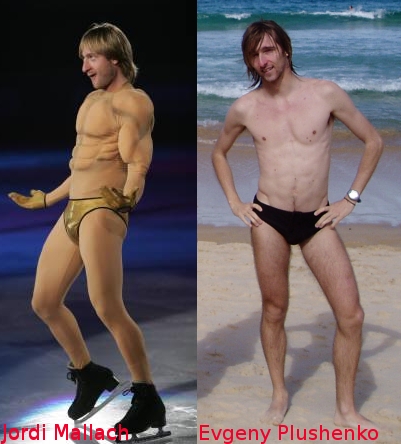
Benjamin Mako Hill: Jordi's Secret Life Uncovered

Could Debian developer and Catalan free software translator Jordi Mallach be living a secret life as champion Russian figure-skater Evgeny Plushenko? Recent photographic evidence uncovered by Mika seems to support such a theory. Decide for yourself:
/copyrighteous/images/jordi_evgeny-lookalike.jpg

Jos Parrella: BSP Venezuela: Afterparty

Last saturday around 2100 (UTC-0400) some people started joining the #debian-ve IRC channel at OFTC, in order to participate on the very first Venezuelan Bugsquashing Party. We had a lot of people interested not only in squashing but also developing for Debian and other topics. Some DD’s were around, specially An bal Monsalve Salazar (anibal) who has been very helpful on testing and uploading packages. Both me and Jos Luis Rivas (ghostbar) made a couple of NMU’s (in his case, xfe and divine; in mine, sdr and orca), fixing six RC bugs. Jos Luis is like 17 or 18 years old and has proven to be a very energetic Debian collaborator. Other maintainers from Debian Venezuela (actually, we’re eleven persons as of last week) were around but couldn’t make a NMU at the time of the event. Others weren’t even present. It was a very small BSP indeed, but we learned lots of things and hopefully our work will help improving the quality in Debian a little bit. It also settles our desires as a group to improve our knowledge and work together to improve the Project without disrupting the overall ecosystem. By the way, the Venezuelan Debconf is definitely going to happen between October 17th. and 21st. Hopefully we’ll have Benjamin Mako Hill, Enrico Zini, Alvaro Lopez Ortega (OMG! Cherokee!) and Randal Schwartz sharing a nice time with people from all parts of Venezuela and the rest of South America. Some local Debian maintainers will set up some nice workshops and demonstrations, ranging from Xen and LTSP in Debian to QA and the local GNU/Linux distribution projects. This local Debconf is part of a larger event, the World Forum on Free Knowledge, which some people at Debian Venezuela help to make. Returning to the BSP topic, I was looking out at a couple of bugs out there, but I lack the hardware and the experience to handle them. One of this is #333915 and other orca bugs, and other one is #385078 regarding a Debconf script in xserver-xorg. The morning before the BTS I was testing the MBONE tools with a friend of mine, and we were quite unhappy by the fact that sdr was almost unusable (passing the mouse cursor over some buttons resulted in annoying notices). So, if you use sdr, please test the last NMU I sent, which fixes two bugs. Just for reference, the webpage where I keep my Debian-related work is here. The case where I learned most was #386938, regarding xserver’s FTBFS in s390. Events like BSP are a great way to motivate people to participate in the Project: while trying to learn anything about this bug I ended reading documentation from IBM, asking advice from someone with an S/390, sending a couple of emails to debian-s390@lists.d.o, browsing at a DD patch in upstream, looking at buildd logs, searching the Web for opcodes lists… usually trying to explain how all this pieces join in a sane way (most times; well, some times, well, seldomly) is quite difficult for someone who tries to promote Debian, but technical events like the BSP provide a really accurate way to see how things work in and around Debian.

18 September 2006

Uwe Hermann: Manipulating PDFs from the command line - joining, merging, rotating [Update]

One of the single most useful packages when it comes to PDFs in Linux is pdfjam. From the website: The installation is easy as always: apt-get install pdfjam PDF is not exactly the most easily editable format out there, but these tools can save you lots of time and trouble. Just recently I needed to merge two PDFs into one (and I didn't have any source format of the files). A simple pdfjoin foo1.pdf foo2.pdf --outfile bar.pdf does the job in a few seconds. Equally useful when you need to print huge documents is pdfnup --nup 2x2 foo.pdf, which sticks four PDF pages into one (thus drastically reducing the amount of pages you have to print)... Update 2006-09-20: As was noted by several people, pdftk is very cool, too. It can do some other things such as split PDFs, encrypt/decrypt them, manipulate metadata and more...

17 September 2006

Joey Hess: ryhthm and roots

One of the best part of Rhythm and Roots is that all of downtown Bristol is open, and accessible on a whim. This is the only time of year I can go into the Cameo and enjoy the balcony of this rundown ex-theater turned Christian radio station, with no worse effects than listening to a little Gospel music. The gorgeous Paramount is open to explore (and leech off its wifi), and so many stores up and down have musicians in them providing an excuse to go in and look around without feeling any commercial pressure. It's also nice to walk down the middle of the state line on State St. My other favorite thing is the jam sessions that spring up here and there later in the day with so many bands in one place. Passing a bassist and fiddler on the sidewalk, or six-seven people from two or three bands sitting off playing quietly for themselves and a small, happy audience. As for the actual performances, this year I most enjoyed the Cajun/jazz/swing/innovative mix of The Red Stick Ramblers. It was good to see the divineMAGees in person, but the outdoor sound system wasn't good enough for their sound and I missed the indoor gig. I also appreciated nice bluegrass from Chatham Cty. Line, and old-timey Piedmont music of the Carolina Chocolate Drops. And bits and peices from a dozen or so other bands.

16 September 2006

Benjamin Seidenberg: The Debian Community

One thing that has always appealed to me about Debian is the strength of the community behind it. A somewhat recent incident has reminded me of how strong this community really is. When several members of the Debian community became concerned about a situation in the life of another member, they immediately tried to contact that member, and that member’s friends and family to insure that person would be ok. Phone calls were made halfway across the world in the middle of the night (in various timezones) to insure the well-being of a member of our community. It is a strong reminder that even though the Debian community may have vigorous arguements about technical and social issues, we still take care of our own.

15 September 2006

Benjamin Mako Hill: Wizards of OS 4

I'm in Berlin for just over 48 hours to give a workshop at Wizards of OS 4. The workshop is Free Content Licensing: Success, Challenges and the Way Forward and will be a conversation between myself, Lawrence Lessig, and Paul Keller from Waag Society and Creative Commons Netherlands. When I first published Toward a Standard of Freedom (my first article that was critical of Creative Commons) a couple years ago, I received an email from someone at Creative Commons within two hours of posting the note. The email pointed out that I had incorrectly licensed my work as the CC license I applied to my essay had the old mailing address for CC. I thanked the mail's author for pointing out my mistake but asked if, perhaps, she or someone else at CC had anything to say about the content of the article itself which was, after all, about her organization's work. I never received a reply. To date, I have not been able to engage in meaningful public discussion of my criticism of CC with CC, although I have tried several times. I'm thrilled that Volker Grassmuck and the Wizards of OS organizers have been able to put together this opportunity to start what I hope will be a longer conversation with people at CC about some of what some of us perceive as tactical shortcomings of the CC approach. It can only make our movements stronger.

13 September 2006

Joachim Breitner: My Name is j a m

A lot of people outside Germany, including here in Ghana, can't pronounce my name right (whereas right is what I'm used to...). So I looked through the German wikipedia and tried to figure out how to write my name in the IPA. The result is:
j a m
If you don't have unicode available, this will probably look strange to you. All these sounds have strange names, here they are:And yes, it is the same letter as in Te , but not the same pronounciation, which is t x. Update: I had to convert my serendipity blog to UTF8 to make this entry right. Did so by mysqladmin dump'ing the whole database and running it through iconv, and then re-inputting it. Sorry to any planets that had a broken entry for a while. Maybe this update paragraph makes these planets update the entry :-)Update 2: As I'm already showing of with unicode characters: The name Joachim is derived from Jehoiakim (Jojakim in German), which is Hebrew and looks like this:

12 September 2006

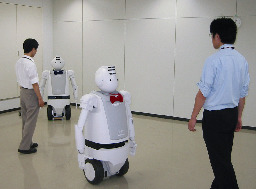
Benjamin Mako Hill: It may someday become useful...

/copyrighteous/images/crowd_robot.jpg
My philosopher Mika says:
These are robots that can walk through crowds without bumping into people. I almost feel that humans need to develop that skill rather than robots. But nonetheless, it may someday become useful to have such robots.

11 September 2006

Ross Burton: Python Decorators

Decorators in Python are just fantastic. Here are a few I've used in Postr. Update: the wonderful James Hensbridge expanded the decorators, so I've updated this post.
def threaded(f):
    def wrapper(*args, **kwargs):
        t = threading.Thread(target=f, args=args, kwargs=kwargs)
        t.setDaemon(True)
        t.start()
    wrapper.__name__ = f.__name__
    return wrapper
This decorator (stolen from O'Reilly) calls the method in a new thread, so execution returns straight away. I use this for long-running tasks that cannot be handled in an asynchronous manner (such as the photo uploading in Postr, which currently uses urllib). The main thread returns straight away so the interface doesn't block, and the uploads continue in the background. Of course this new thread cannot just call GTK+ methods, as GTK+ itself isn't threadsafe. So, I have another decorator that causes a method to be always executed in the main loop by scheduling an idle handler that calls it.
def as_idle(f):
    def wrapper(*args, **kwargs):
        event = threading.Event()
        ret = []
        def task():
            ret.append(f(*args, **kwargs))
            event.set()
            return False
        gobject.idle_add(task)
        event.wait()
        return ret[0]
    wrapper.__name__ = f.__name__
    return wrapper
Erich Schubert requested return values, so James added those too. The calling function will block until the idle handler has called the decorated function. I've split the decorators out into a separate file in Postr, so you can view the latest version online. Magic stuff!

4 September 2006

Benjamin Mako Hill: Planet Debian Upgrade

I've upgraded Planet (the software that runs Planet Debian) to version 2.0. It's been a while since I touched the planet software so many issues that had annoyed users of planet should now be remedied by this upgrade. I think people will very happy with the upgrade. In the process, I really screwed up planet for the moment. New posts from the last day or so may not be showing up. Other people may appear to have flooded planet when in fact they've done nothing at all. This is not their fault but I've had a hard time going through and picking up the pieces left by the upgrade. Please just bear with me. If you notice a little bit of funkiness in Planet Debian in the next day or so, please wait a day or two (or a post or two) before contacting me to debug the problem. Thanks for your patience everyone. If you have questions, don't hesitate to get in contact with me.

Branden Robinson: Destination: Oldenburg, Mission: Security, Java, and a bit of odd old hardware

On Friday afternoon I'll be arriving in Oldenburg, Germany, for the eleventh annual Linux developers' conference. Historically, this conference has had a strong focus on non-x86 ports of the Linux kernel, boot loader development, the GNU toolchain, and so forth. At long last, it looks like this may be my opportunity to get my Macintosh Quadra 840AV out of mothballs and back into commission, thanks to Wouter Verhelst. I should be able to fit it into my luggage if I don't bring many clothes... :-) This year, however, in addition to that, a couple of mini-conferences are being piggybacked onto the Oldenburg meeting. These include the GNU Classpath and Debian Java DevJam and the Debian Security Summit. The Java programming language is a divisive issue in the Free Software community, and has a degree of controversy that sets it apart from the usual language wars. The dominant factor in this controversy stems from what Richard Stallman refers to as the Java trap; with the specifications controlled, and the reference implementation kept unavailable on DFSG-free terms by, an industry consortium dominated by large corporations, a Free Software hacker might fear that using Java will consign them to either having to compromise their principles by using non-free class libraries (for example), or being doomed to chase the taillights of standards that could conceivably be tailored to disadvantage competitors. (Java is not alone in this respect; many people fear that Microsoft's .NET, despite being openly standardized through ISO/IEC, will in actuality be completely controlled by Microsoft.) Despite this peril, Java is attractive to GNU/Linux-using organizations. The Free Standards Group, developers of the Linux Standard Base, has received inquiries about a Free Java standard and implementation from organizations already committed to GNU/Linux. In my job, I've encountered an interest in Java from several customers and prospects. Intriguingly, these institutions are, by and large, very much aware of the Java Trap. They like the language, and are not strong advocates of Free Software, but they too are worried about vendor lock-in. They've seen the success of community-driven development as GNU/Linux moves from strength to strength, claiming territory formerly held by Microsoft and proprietary versions of Unix. Even if I can't persuade a customer to adopt a Free Java stack, I can exhort them to only code against Java standards that have seen a free implementation. That way, their development bets are hedged against any "madman theory" of the controlling vendor. Furthermore, this way they only code to standards that are seeing independent implementations, and they leave their engineers free to switch between varieties of development kit. Engineers like flexibility because it enables them to work more efficiently; sales people, marketing personnel, and strategists like efficient engineers because they make a firm more nimble. That's where the GNU Classpath and Debian Java DevJam comes in. Free Software Java enthusiasts want to see their implementations fully mature, and are working hard to make it so. The Free Software community has the opportunity to make its Java implementation not just an available alternative, but a compelling alternative to the proprietary ones on technical as well as licensing grounds. The recent release of GNU Classpath 0.18 shows just how vigorously this opportunity is being seized. Having mature software is only half the battle, however; that software has to be coherently put together and easy for the user and developer to manipulate. For many of these folks, it's not enough just to have good, Free Java virtual machines (like Kaffe and SableVM), class libraries (GNU Classpath), compilers and interpreters (gcj and gij, respectively, from the GNU Compiler Collection), and application servers (Jakarta Tomcat, JBoss, and JOnAS, among others). They also want these technologies to be mutually integrated and easy to install and use. Good software and good packaging complement each other to drive adoption of the technology, and that's what the DevJam is all about. I'm glad to see that representatives of Debian's Java packaging team will be joining not just upstream authors, but their counterparts at Fedora, Ubuntu, and Gentoo in furtherance of this goal. I've approved a budget of EUR 2000, which Petter Reinholdtsen will administrate, to support the expenses of Debian's participation in the DevJam. We've received 1500 USD in sponsorship of this event from a corporate sponsor that chooses to remain anonymous. The other mini-conference I'll be attending is the Debian Security Summit. We're bringing together the heads of our Stable Security and Testing Security teams — the two Joeys, Joey Schulze and Joey Hess, as well as a bevy of other security-minded people, with the goal of revitalizing and streamlining our security processes. Several members of the Stable Security Team have gone dormant over the past several months (or longer), leaving an increasingly small number people to handle, as of Sarge's release, not one but two stable releases. This is because we do not terminate security support for our previous stable release (in this case, Woody), until some time has passed. We've had other challenges on the security front. We had what amounted to a security support hiatus for about three weeks in June, which caused much consternation. More recently, klecker.debian.org, which provides the security.debian.org has suffered some occasional availability problems, and it hasn't always been clear what's caused them. It's my understanding that we have new hardware in place that can serve in a backup, supplemental, or failover capacity. The general feeling at DebConf 5 was that our security apparatus was in need of attention to make sure it keep pace with the demands being placed on it. I've been in fruitful contact with Joey Schulze, Steve Kemp, and others over the past several weeks, and I look forward to a productive few days.

Next.

Previous.