Search Results: "edd"

25 November 2015

Ben Armstrong: Debian Live After Debian Live

Get involved After this happened, my next step was to get re-involved in Debian Live to help it carry on after the loss of Daniel. Here s a quick update on some team progress, notes that could help people building Stretch images right now, and what to expect next. Team progress Test build notes Test boot notes Coming soon See the TODO in the wiki. We re knocking these off steadily. It will be faster with more people helping (hint, hint). facebooktwittergoogle_plusredditpinterestlinkedinmail

23 November 2015

Riku Voipio: Using ser2net for serial access.

Is your table a mess of wires? Do you have multiple devices connected via serial and can't remember which is /dev/ttyUSBX is connected to what board? Unless you are a embedded developer, you are unlikely to deal with serial much anymore - In that case you can just jump to the next post in your news feed. Introducting ser2netUsually people start with minicom for serial access. There are better tools - picocom, screen, etc. But to easily map multiple serial ports, use ser2net. Ser2net makes serial ports available over telnet. Persistent usb device names and ser2netTo remember which usb-serial adapter is connected to what, we use the /dev/serial tree created by udev, in /etc/ser2net.conf:

# arndale
7004:telnet:0:'/dev/serial/by-path/pci-0000:00:1d.0-usb-0:1.8.1:1.0-port0':115200 8DATABITS NONE 1STOPBIT
# cubox
7005:telnet:0:/dev/serial/by-id/usb-Prolific_Technology_Inc._USB-Serial_Controller_D-if00-port0:115200 8DATABITS NONE 1STOPBIT
# sonic-screwdriver
7006:telnet:0:/dev/serial/by-id/usb-FTDI_FT230X_96Boards_Console_DAZ0KA02-if00-port0:115200 8DATABITS NONE 1STOPBIT
The by-path syntax is needed, if you have many identical usb-to-serial adapters. In that case a Patch from BTS is needed to support quoting in serial path. Ser2net doesn't seems very actively maintained upstream - a sure sign that project is stagnant is a homepage still at sourceforge.net... This patch among other interesting features can be also be found in various ser2net forks in github. Setting easy to remember names Finally, unless you want to memorize the port numbers, set TCP port to name mappings in /etc/services:

# Local services
arndale 7004/tcp
cubox 7005/tcp
sonic-screwdriver 7006/tcp
Now finally:
telnet localhost sonic-screwdriver
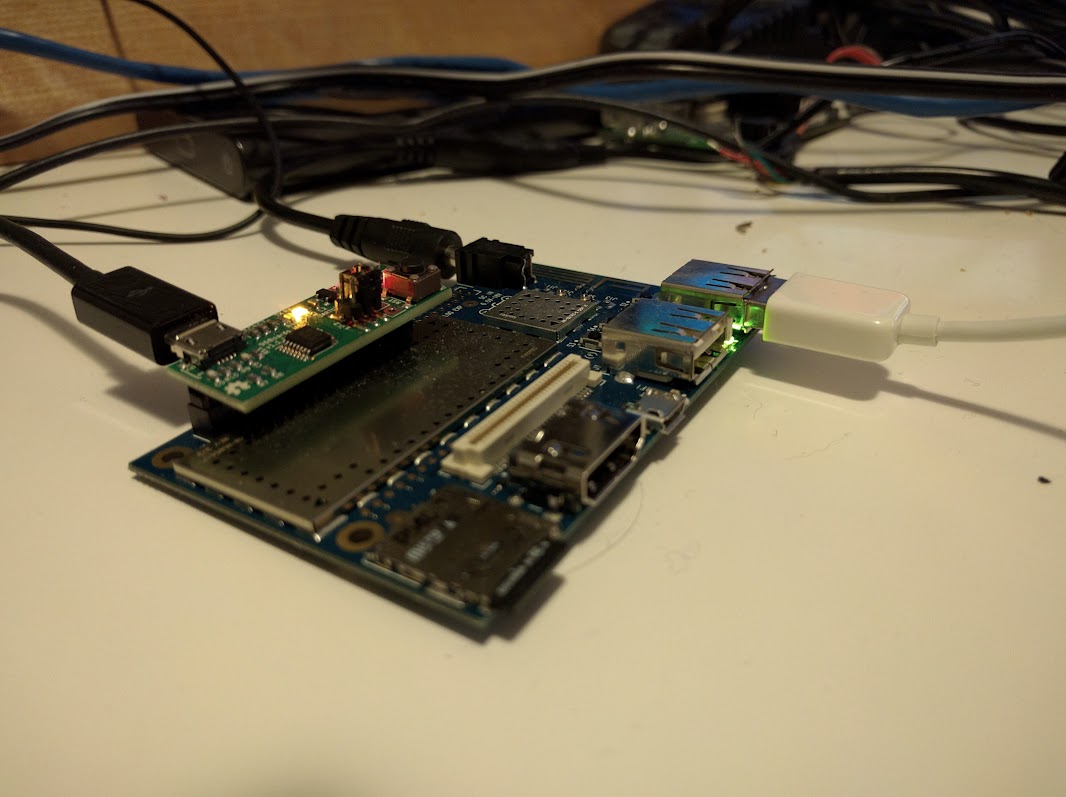
^Mandatory picture of serial port connection in action

Lunar: Reproducible builds: week 30 in Stretch cycle

What happened in the reproducible builds effort this week: Toolchain fixes Mattia Rizzolo uploaded a version of perl to the reproducible repository including the patch written by Niko Tyni to add support for SOURCE_DATE_EPOCH in Pod::Man. Dhole sent an updated version of his patch adding support for SOURCE_DATE_EPOCH in GCC to the upstream mailing list. Several comments have been made in response which have been quickly addressed by Dhole. Dhole also forwarded his patch adding support for SOURCE_DATE_EPOCH in libxslt upstream. Packages fixed The following packages have become reproducible due to changes in their build dependencies: antlr3/3.5.2-3, clusterssh, cme, libdatetime-set-perl, libgraphviz-perl, liblingua-translit-perl, libparse-cpan-packages-perl, libsgmls-perl, license-reconcile, maven-bundle-plugin/2.4.0-2, siggen, stunnel4, systemd, x11proto-kb. The following packages became reproducible after getting fixed: Some uploads fixed some reproducibility issues, but not all of them: reproducible.debian.net Vagrant Cascadian has set up a new armhf node using a Raspberry Pi 2. It should soon be added to the Jenkins infrastructure. diffoscope development diffoscope version 42 was release on November 20th. It adds a missing dependency on python3-pkg-resources and to prevent similar regression another autopkgtest to ensure that the command line is functional when Recommends are not installed. Two more encoding related problems have been fixed (#804061, #805418). A missing Build-Depends has also been added on binutils-multiarch to make the test suite pass on architectures other than amd64. Package reviews 180 reviews have been removed, 268 added and 59 updated this week. 70 new fail to build from source bugs have been reported by Chris West, Chris Lamb and Niko Tyni. New issue this week: randomness_in_ocaml_preprocessed_files. Misc. Jim MacArthur started to work on a system to rebuild and compare packages built on reproducible.debian.net using .buildinfo and snapshot.debian.org. On December 1-3rd 2015, a meeting of about 40 participants from 18 different free software projects will be held in Athens, Greece with the intent of improving the collaboration between projects, helping new efforts to be started, and brainstorming on end-user aspects of reproducible builds.

17 November 2015

Dirk Eddelbuettel: RcppAnnoy 0.0.7

A new version of RcppAnnoy, our Rcpp-based R integration of the nifty Annoy library by Erik, is now on CRAN. Annoy is a small, fast, and lightweight C++ template header library for approximate nearest neighbours. This release mostly just catches up with the Annoy release 1.6.2 of last Friday. No new features were added on our side. Courtesy of CRANberries, there is also a diffstat report for this release.

This post by Dirk Eddelbuettel originated on his Thinking inside the box blog. Please report excessive re-aggregation in third-party for-profit settings.

16 November 2015

Dirk Eddelbuettel: Rcpp 0.12.2: More refinements

The second update in the 0.12.* series of Rcpp is now on the CRAN network for GNU R. As usual, I will also push a Debian package. This follows the 0.12.0 release from late July which started to add some serious new features, and builds upon the 0.12.1 release in September. It also marks the sixth release this year where we managed to keep a steady bi-montly release frequency. Rcpp has become the most popular way of enhancing GNU R with C or C++ code. As of today, 512 packages on CRAN depend on Rcpp for making analytical code go faster and further. That is up by more than fifty package from the last release in September (and we recently blogged about crossing 500 dependents). This release once again features pull requests from two new contributors with Nathan Russell and Tianqi Chen joining in. As shown below, other recent contributors (such as such as Dan) are keeping at it too. Keep'em coming! Luke Tierney also email about a code smell he spotted and which we took care of. A big Thank You! to everybody helping with code, bug reports or documentation. See below for a detailed list of changes extracted from the NEWS file.
Changes in Rcpp version 0.12.2 (2015-11-14)
  • Changes in Rcpp API:
    • Correct return type in product of matrix dimensions (PR #374 by Florian)
    • Before creating a single String object from a SEXP, ensure that it is from a vector of length one (PR #376 by Dirk, fixing #375).
    • No longer use STRING_ELT as a left-hand side, thanks to a heads-up by Luke Tierney (PR #378 by Dirk, fixing #377).
    • Rcpp Module objects are now checked more carefully (PR #381 by Tianqi, fixing #380)
    • An overflow in Matrix column indexing was corrected (PR #390 by Qiang, fixing a bug reported by Allessandro on the list)
    • Nullable types can now be assigned R_NilValue in function signatures. (PR #395 by Dan, fixing issue #394)
    • operator<<() now always shows decimal points (PR #396 by Dan)
    • Matrix classes now have a transpose() function (PR #397 by Dirk fixing #383)
    • operator<<() for complex types was added (PRs #398 by Qiang and #399 by Dirk, fixing #187)
  • Changes in Rcpp Attributes:
    • Enable export of C++ interface for functions that return void.
  • Changes in Rcpp Sugar:
    • Added new Sugar function cummin(), cummax(), cumprod() (PR #389 by Nathan Russell fixing #388)
    • Enabled sugar math operations for subsets; e.g. x[y] + x[z]. (PR #393 by Kevin and Qiang, implementing #392)
  • Changes in Rcpp Documentation:
    • The NEWS file now links to GitHub issue tickets and pull requests.
    • The Rcpp.bib file with bibliographic references was updated.
Thanks to CRANberries, you can also look at a diff to the previous release As always, even fuller details are on the Rcpp Changelog page and the Rcpp page which also leads to the downloads page, the browseable doxygen docs and zip files of doxygen output for the standard formats. A local directory has source and documentation too. Questions, comments etc should go to the rcpp-devel mailing list off the R-Forge page.

This post by Dirk Eddelbuettel originated on his Thinking inside the box blog. Please report excessive re-aggregation in third-party for-profit settings.

13 November 2015

John Goerzen: Memories of a printer

I have a friend who hates printers. I ll call him Mark , because that, incidentally, is his name. His hatred for printers is partly my fault, but that is, ahem, a story for another time that involves him returning from a battle with a printer with a combination of weld dust, toner, and a deep scowl on his face. I also tend to hate printers. Driver issues, crinkled paper, toner spilling all over the place . everybody hates printers. But there is exactly one printer that I have never hated. It s almost 20 years old, and has some stories to tell. Nearly 20 years ago, I was about to move out of my parents house, and I needed a printer. I bought a LaserJet 6MP. This printer ought to have been made by Nokia. It s still running fine, 18 years later. It turned out to be one of the best investments in computing equipment I ve ever made. Its operating costs, by now, are cheaper than just about any printer you can buy today less than one cent per page. It has been supported by every major operating system for years. PostScript was important, because back then running Ghostscript to convert to PCL was both slow and a little error-prone. PostScript meant I didn t need a finicky lpr/lprng driver on my Linux workstation to print. It just printed. (Hat tip to anyone else that remembers the trial and error of constructing an /etc/printcap that would print both ASCII and PostScript files correctly!) Out of this printer have come plane and train tickets, taking me across the country to visit family and across the world to visit friends. It s printed resumes and recipes, music and university papers. I even printed wedding invitations and envelopes on them two years ago, painstakingly typeset in LaTeX and TeXmacs. I remember standing at the printer in the basement one evening, feeding envelope after envelope into the manual feed slot. (OK, so it did choke on a couple of envelopes, but overall it all worked great.) The problem, though, is that it needs a parallel port. I haven t had a PC with one of those in a long while. A few years ago, in a moment of foresight, I bought a little converter box that has an Ethernet port and a parallel port, with the idea that it would be pay for itself by letting me not maintain some old PC just to print. Well, it did, but now the converter box is dying! And they don t make them anymore. So I finally threw in the towel and bought a new LaserJet. It cost a third of what the 6MP did, has a copier, scanner, prints in color, does duplexing, has wifi and, yes, still supports PostScript strangely enough, a deciding factor in going with HP over Brother once again. (The other was image quality) We shall see if I am still using it when I m 50.

9 November 2015

Ben Armstrong: The passing of Debian Live

Debian Live has passed on. And it has done so in not happy circumstances. (You can search the list archives for more if you are confused.) I have reposted here my response to this one thread because it s all I really want to say, after all of the years of working with the team. I d like to add as a postscript, that while the focus of this article was to remain positive in the face of Daniel s announcement of the closure of his project, that event has left a lot of users confused about the status of live support in Debian going forward. Read my posts here and here addressing that confusion.
On 09/11/15 12:47 PM, Daniel Baumann wrote:
> So long, and thanks for all the fish[7].
>
> Daniel
>
> [7] http://live.debian.net/project/downstream/ Enough bitter words have been said. I don t want to add any more. So: I m proud. Indeed, that long list of downstreams does speak to the impact you ve had in inspiring and equipping people to make their own live images. I m proud to have been a small part of this project. I m thankful. I m thankful that I was able to, through this project, contribute to something for a while that had a positive impact on many people, and made Debian more awesome. I remember the good times. I remember fondly the good times we had in the project s heyday. I certainly found your enthusiasm and vision for the project, Daniel, personally inspiring. It motivated me to contribute. Debconf10 was a highlight among those experiences, but also I had many good times and made many friendships online, too. I m sad. I m sad, because although I made some attempts to liaise between Debian Live and the CD and Installer teams, I don t feel I did an effective job there, and that contributed to the situation we now find ourselves in. If I did you or the project injury in trying to fulfill that role, please forgive me. I m hopeful. I m hopeful that whichever way we all go from here, that the bitterness will not be forever. That we ll heal. That we ll have learned. That we ll move on to accomplish new things, bigger and better things. Thank you, Daniel. Thank you, Debian Live team. Ben
facebooktwittergoogle_plusredditpinterestlinkedinmail

31 October 2015

Dirk Eddelbuettel: RcppArmadillo 0.6.200.2.0

armadillo image Yet another monthly upstream Armadillo update gets us the first changes to the new the 6.* series. This was preceded by two uploads of test released to GitHub-only. These two were tested both against all reverse-dependencies as usual. A matching upload to Debian will follow shortly. Armadillo is a powerful and expressive C++ template library for linear algebra aiming towards a good balance between speed and ease of use with a syntax deliberately close to a Matlab. This release is fairly straightforward with few changes:
Changes in RcppArmadillo version 0.6.200.2.0 (2015-10-31)
  • Upgraded to Armadillo 6.200.0 ("Midnight Blue Deluxe")
    • expanded diagmat() to handle non-square matrices and arbitrary diagonals
    • expanded trace() to handle non-square matrices
Courtesy of CRANberries, there is also a diffstat report for the most recent CRAN release. As always, more detailed information is on the RcppArmadillo page. Questions, comments etc should go to the rcpp-devel mailing list off the R-Forge page.

This post by Dirk Eddelbuettel originated on his Thinking inside the box blog. Please report excessive re-aggregation in third-party for-profit settings.

30 October 2015

Dirk Eddelbuettel: littler 0.3.0 -- on CRAN !!

max-heap image A new major release of littler is now available. And for the first time in the nine years since 2006 when Jeff started the effort (which I joined not long after) we are now a CRAN package. This required a rewrite of the build system, foregoing the calls to aclocal, autoheader, automake and leaving just a simpler autoconf layer creating a configure script and a simple src/Makevars.in. Not only does R provide such a robust and well-understood build system (which I got to understand reasonably well given all my R packages, but being on CRAN and leveraging its mechanism for installation and upgrades is clearly worth the change. There may be a moment or two of transition. While we can create a binary in an R package, we cannot (generally) copy to /usr/bin or /usr/local/bin as part of the build process (for lack of write-rights to those directories). So if you do not have r in the $PATH and load the package, it makes a suggestion (which needs a linebreak which I added here):
R> library(littler)
The littler package provides 'r' as a binary.
You could link to the 'r' binary installed in
'/usr/local/lib/R/site-library/littler/bin/r' from
'/usr/local/bin' in order to use 'r' for scripting.
R> 
Similarly, you could copy (or softlink) r to ~/bin if that is in your $PATH. The Debian (and Ubuntu) packages will continue to provide /usr/bin/r as before. Note thah these packages will now be called r-cran-littler to match all other CRAN packages. The NEWS file entry is below.
Changes in littler version 0.3.0 (2015-10-29)
  • Changes in build system
    • First CRAN Release as R package following nine years of source releases
    • Script configure, src/Makevars.in and remainder of build system rewritten to take advantage of the R package build infrastructure
    • Reproducible builds are better supported as the (changing) compilation timestamps etc are only inserted for 'verbose builds' directly off the git repo, but not for Debian (or CRAN) builds off the release tarballs
  • Changes in littler functionality
    • Also source $R_HOME/etc/Rprofile.site and ~/.Rprofile if present
  • Changes in littler documentation
    • Added new vignette with examples
Full details for the littler release are provided as usual at the ChangeLog page. The code is available via the GitHub repo, from tarballs off my littler page and the local directory here -- and now of course all from its CRAN page and via install.packages("littler"). A fresh package has gone to the incoming queue at Debian where it will a few days as the binary packages was renamed from littler to r-cran-littler matching all other CRAN packages. Michael Rutter will probably have new Ubuntu binaries at CRAN once the source package gets into Debian proper. Comments and suggestions are welcome at the GitHub repo.

This post by Dirk Eddelbuettel originated on his Thinking inside the box blog. Please report excessive re-aggregation in third-party for-profit settings.

29 October 2015

Daniel Pocock: Lumicall rapid provisioning, Opus support and other enhancements

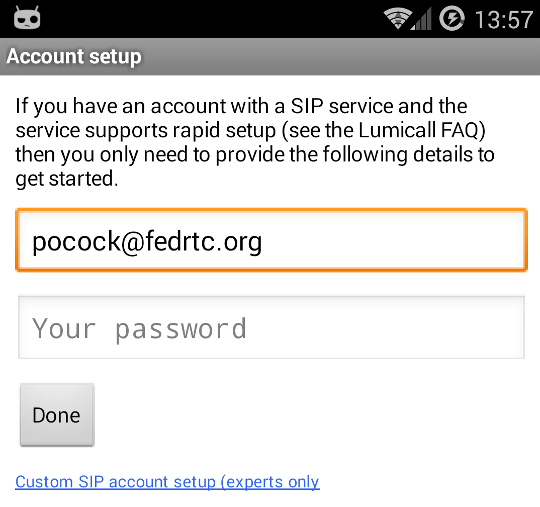
Thanks to feedback from many people at DebConf15, Lumicall has had a range of improvements over the last couple of months and it is now easier to use and more reliable than ever. Rapid provisioning for Debian.org, FedRTC.org and other SIP accounts 1. Setup your SIP password in the Debian LDAP or the FedRTC account setup (using Fedora OpenID) or any other SIP service that supports rapid provisioning (see the FAQ). 2. Install the Lumicall app from F-Droid, Google Play or by direct download. 3. When the app starts the first time, you can verify your phone number (so other users can call you using the number they know) or just click the "Manual account setup" link underneath the verification button. If you do verify your number, the "Add account" link is also available in the menu from the main screen. Test calls If a friend installs Lumicall too and you dial their number, the Lumicall popup should appear and give you the option to make the call over SIP. You can also make test calls using this link for a recorded announcement. Many other improvements
  • Support for the OPUS codec, which brings us one step closer to direct WebRTC interoperability
  • Fixing a bug in ice4j that caused NAT traversal to fail intermittently
  • Tweaks to make it more tolerant of IPv6 networks
  • The rapid account setup form (described above) for existing SIP accounts
  • Conversion to the Gradle build system (for Android Studio)
  • Breaking out embedded library code from the Lumicall repository into standalone projects so they can be maintained independently
  • Use of the compatibility library to display the ActionBar, consistent with the current design guidelines, while still maintaining compatibility with older devices
  • Use of Spongy Castle instead of Bouncy Castle crypto library for more consistent behavior across different Android devices
Share your experiences with Lumicall All feedback is welcome. If you can come in person to the workshop in Manchester (2 November) or the mini-DebConf in Cambridge (I'll be there Saturday, 7 November) then we can look at any problems in person and access logs with the Android tools if necessary. Discussion is also welcome on the Lumicall users mailing list or the Free RTC mailing list.

27 October 2015

Dirk Eddelbuettel: Rcpp now used by over 500 CRAN packages

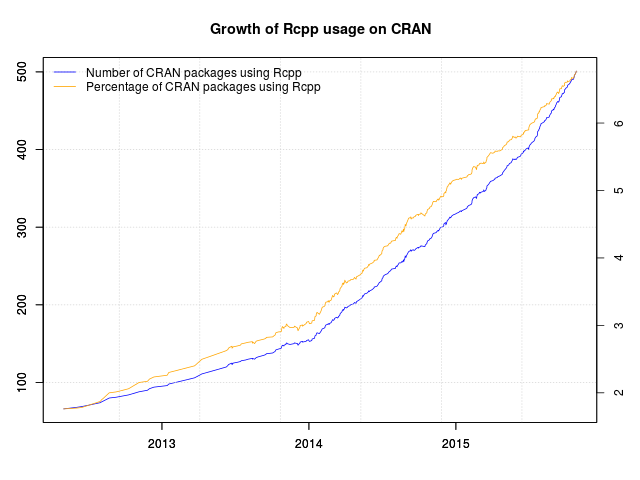
500 Rcpp packages This morning, Rcpp reached another round milestone: 501 packages on CRAN now depend on it (as measured by Depends, Imports and LinkingTo declarations, and even excluding one or two packages with an accidental declaration that do not use it). The graph is on the left depicts the growth of Rcpp usage over time. And there are a full seventy more on BioConductor in its development branch (but BioConductor is not included in the chart). Rcpp cleared 300 packages less than a year ago. It passed 400 packages in June when I only tweeted about it this June (while traveling for Rcpp training at U Zuerich, the R Summit at CBS, and the fabulous useR! 2015 at U Aalborg; so no blog post). The first and less detailed part uses manually saved entries, the second half of the data set was generated semi-automatically via a short script appending updates to a small file-based backend. A list of user package is kept on this page. Also displayed in the graph is the relative proportion of CRAN packages using Rcpp. The four per-cent hurdle was cleared just before useR! 2014 where I showed a similar graph (as two distinct graphs) in my invited talk. We passed five percent in December of last year, six percent this July and now stand at 6.77 percent, or about one in fourteen R packages. 500 user packages is very humbling, a staggering number and a big responsibility. We will out best try to keep Rcpp as performant and reliable as it has been so that the next set of packages can rely on it---just like these 500 do. So with that a very big Thank You! to all users and contributors of Rcpp for help, suggestions, bug reports, documentation or, of course, code.

This post by Dirk Eddelbuettel originated on his Thinking inside the box blog. Please report excessive re-aggregation in third-party for-profit settings.

24 October 2015

Dirk Eddelbuettel: rfoaas 0.1.8

A new release rfoaas is now on CRAN following up on the recent upstream release 0.1.8 of FOAAS. The rfoaas package provides an interface for R to the most excellent FOAAS service--which provides a modern, scalable and RESTful web service for the frequent need to tell someone to f$#@ off. Release 0.1.8 brings over a handfull new access points relative to the previous release 0.1.6: bday(), family_(), shutup(), zayn(), dalton(), dosomething(), retard(), and thumbs(). One of these may make a fine addition for beloved post-test comments in testthat:
R> library(rfoaas)
R> dosomething("Fix", "function", "testthat")
[1] "Fix the fucking function! - testthat"
R>
We did not make a release following version 0.1.7 of FOAAS: my testing revealed somewhat less consistent results for the language / i18n filter added in 0.1.6. So I filed issue ticket #95, but as it still lingers unanswered, I consider this feature to be unsupported for now; the tests for the language filter were disabled for now as well. As usual, CRANberries provides a diff to the previous CRAN release. Questions, comments etc should go to the GitHub issue tracker.

This post by Dirk Eddelbuettel originated on his Thinking inside the box blog. Please report excessive re-aggregation in third-party for-profit settings.

23 October 2015

Clint Adams: Beware of typhoons or tsunamis

The 12 member nations of the Trans-Pacific Partnership pact have agreed to prohibit demands that companies reveal software source code*, a step that appears aimed at curbing efforts by China to gain access to this sensitive information, The Yomiuri Shimbun has learned. Source code is the confidential information for software and is a blueprint embedded in many commonly used products, such as vehicles, mobile phones and home appliances. Source code is usually tightly guarded because it conatins commands that make using the software easier. China requires foreign companies operating there to hand over source code, a move that has sparked sharp criticism from many countries. Observers believe the decision by TPP participants to ban demands to reveal this code is intended to restrain China's move. The TPP's electronic commerce chapter in principle prohibits the 12 member nations from demanding access to source code for mass-produced software. According to the Economy, Trade and Industry Ministry, the Japan-Mongolia economic partnership agreement signed in February contains a stipulation banning demands for such information, but there are very few other examples around the world. Japan, the United States and other nations that are home to many information technology companies want to make the stipulation effectively a global standard, and they are considering whether to incorporate such a condition in economic partnership agreements that will be inked in the future. Source code is an important corporate secret for development firms. *Source code A software program written in a language a computer understands. As well as containing expert details about the unique functions of the product, the software is essential for fixing glitches and making improvements. Hackers have attempted to access source code because gaining this information would make it easier to create viruses that could exploit any software defects. In the software business, it is rarely made public, as it is considered a corporate secret.

22 October 2015

Russ Allbery: Review: What If?

Review: What If?, by Randall Munroe
Publisher: Houghton Mifflin Harcourt
Copyright: 2014
ISBN: 0-544-27299-4
Format: Hardcover
Pages: 295
This is another one of those reviews that's somewhat pointless to write, at least beyond telling people who for some strange reason aren't xkcd readers that this is a thing that exists in the world. What If? is a collection of essays from that feature on the xkcd web site and new essays in the same vein. (Over half are new to this collection.) If you've read them, you know what to expect; if you haven't, and have any liking at all for odd scientific facts or stick figures, you're in for a treat. So, short review: The subtitle is Serious Scientific Answers to Absurd Hypothetical Questions, and it's exactly what it says on the tin, except that "serious" includes a healthy dose of trademark xkcd humor. Go read what-if.xkcd.com for numerous samples of Munroe's essay style. If you like what you see, this is a whole book of that: a nice, high-quality hardcover (at least the edition I bought), featuring the same mix of text and cartoon commentary, and with new (and in some cases somewhat longer) material. You probably now have all the information necessary to make a purchasing decision. If you need more motivation, particularly to buy a physical copy, the inside of the dust jacket of the hardcover is a detailed, labeled map of the world after a drain in the Marianas Trench has emptied most of the oceans onto Mars. And the book inside the dust jacket is embossed with what happens after the dinosaur on the cover is lowered into, or at least towards, the Great Pit of Carkoon. This made me particularly happy, since too often hardcovers inside the dust jacket look just like every other hardcover except for the spine lettering. Very few of them have embossed Star Wars references. Personally, I think that's a great reason to buy the hardcover even if, like me, you've been following What If? on the web religiously since it started. But of course the real draw is the new material. There's enough of it that I won't try any sort of comprehensive list, but rest assured that it's of equal or better quality than the web-published essays we know and love. My favorite of the new pieces is the answer to the question "what would happen if you made a periodic table out of cube-shaped bricks, where each brick was made of the corresponding element?" As with so many What If? questions, it starts with killing everyone in the vicinity, and then things get weird. Another nice touch in this collection is what I'd call "rejected questions": questions that people submitted but that didn't inspire an essay. Most of these (I wish all) get a single cartoon of reaction to the question itself, which include some of the funniest (and most touching) panels in the book. Ebook formatting has gotten much better, so there's some hope that at least some platforms could do justice to this book with its embedded cartoons. Putting the footnotes properly at the bottom of each page (thank you!) might be a challenge, though. Writing mixed with art is one of the things I think benefits greatly from a physical copy, and the hardcover is a satisfying and beautiful artifact. (I see there's also an audio book, but I'm sure how well that could work; so much of the joy of What If? is the illustrations, and I'm dubious that one could adequately describe them.) Prior web readers will be relieved to know that the mouse-over text is preserved as italic captions under the cartoons, although sadly most cartoons are missing captions. (As I recall, that's also the case for the early web What If? essays, but later essays have mouse-over text for nearly every cartoon.) Anyway, this is a thing that exists. If you follow xkcd, you probably knew that already, given that the book was published last year and I only now got around to reading it. (My current backlog is... impressive.) If you were not previously aware of What If? or of xkcd itself, now you are, and I envy you the joy of discovery. A short bit of reading will tell you for certain whether this is something you want to purchase. If your relationship to physics is at all similar to mine, I suspect the answer will be yes. A small personal note: I just now realized how much the style of What If? resembles the mixed text and illustrations of One Two Three... Infinity. Given how foundational that book was to my love of obscure physics facts, my love of What If? is even less surprising. Rating: 10 out of 10

20 October 2015

Dirk Eddelbuettel: Rblpapi 0.3.1

The first update to the Rblpapi package since the initial CRAN upload in August is now available. Rblpapi connects R to the Bloomberg system, giving access to a truly vast array of time series data and custom calculations. This release brings a new beqs() functions to access the results from Bloomberg EQS queries, improves the build system a correct a bug in the retrieval of multiple tick series. The changes are detailed below.
Changes in Rblpapi version 0.3.1 (2015-10-19)
  • Added beqs() to run Bloomberg Equity Screen Search, based on initial PR #79 by Rademeyer Vermaak, reworked in PRs #83 and #84 by Dirk; closes tickets #63 and #80.
  • Bloomberg header and library files are now cached locally instead of being re-downloaded for every build (PR #78 by Dirk addressing issue #65).
  • For multiple ticks, time-stamps are unique-yfied before merging (PR #77 by Dirk addressing issue #76).
  • A compiler warning under new g++ versions is now suppressed (PR #69 by John, fixing #68).
Courtesy of CRANberries, there is also a diffstat report for the this release. As always, more detailed information is on the Rblpapi. Questions, comments etc should go to the issue tickets system at the GitHub repo.

This post by Dirk Eddelbuettel originated on his Thinking inside the box blog. Please report excessive re-aggregation in third-party for-profit settings.

16 October 2015

Dirk Eddelbuettel: R / Finance 2016 Call for Papers

Earlier today, Josh sent the text below in this message to the R-SIG-Finance list as the very first heads-up concerning the 2016 edition of our successful R/Finance series. We are once again very excited about our conference, thrilled about upcoming keynotes (some of which are confirmed and some of which are in the works), and hope that many R / Finance users will not only join us in Chicago in May 2016 -- but also submit an exciting proposal. So read on below, and see you in Chicago in May!
Call for Papers R/Finance 2016: Applied Finance with R
May 20 and 21, 2016
University of Illinois at Chicago, IL, USA The eight annual R/Finance conference for applied finance using R will be held on May 20 and 21, 2016, in Chicago, IL, USA at the University of Illinois at Chicago. The conference will cover topics including portfolio management, time series analysis, advanced risk tools, high-performance computing, market microstructure, and econometrics. All will be discussed within the context of using R as a primary tool for financial risk management, portfolio construction, and trading. Over the past seven years, R/Finance has included attendees from around the world. It has featured presentations from prominent academics and practitioners, and we anticipate another exciting line-up for 2016. We invite you to submit complete papers in pdf format for consideration. We will also consider one-page abstracts (in txt or pdf format) although more complete papers are preferred. We welcome submissions for both full talks and abbreviated "lightning talks." Both academic and practitioner proposals related to R are encouraged. All slides will be made publicly available at conference time. Presenters are strongly encouraged to provide working R code to accompany the slides. Data sets should also be made public for the purposes of reproducibility (though we realize this may be limited due to contracts with data vendors). Preference may be given to presenters who have released R packages. The conference will award two (or more) $1000 prizes for best papers. A submission must be a full paper to be eligible for a best paper award. Extended abstracts, even if a full paper is provided by conference time, are not eligible for a best paper award. Financial assistance for travel and accommodation may be available to presenters, however requests must be made at the time of submission. Assistance will be granted at the discretion of the conference committee. Please make your submission online at this link. The submission deadline is January 29, 2016. Submitters will be notified via email by February 29, 2016 of acceptance, presentation length, and financial assistance (if requested). Additional details will be announced via the R/Finance conference website as they become available. Information on previous years' presenters and their presentations are also at the conference website. For the program committee:
Gib Bassett, Peter Carl, Dirk Eddelbuettel, Brian Peterson,
Dale Rosenthal, Jeffrey Ryan, Joshua Ulrich

12 October 2015

Ben Armstrong: Learning Nova Scotia Plants with Anki Flashcards

plants_of_nova_scotiaOne of the greatest pleasures of walking and hiking is to appreciate all of the many living things encountered along the way. A big part of that appreciation for me is to be able to identify individual species and learn the relationships among them. To that end, I would like to introduce a flashcard deck I created, based on the glossary of the excellent, and also free, Nova Scotia Plants, by Marian C. Munro, Ruth E. Newell, and Nicholas M. Hill, so that I could more effectively use the book as an amateur student of our local flora. Creating the Nova Scotia Plants glossary for Anki I authored the deck on Debian, using the free software utility pdftotext (from poppler-utils), the small shell script below to produce a rough draft, and a text editor to clean up any errors, inconsistencies, and artefacts caused by the conversion process, such as descriptions which wrapped to a second line.
#!/bin/sh
pdftotext -f 40 -l 55 \
  'Print Nova Scotia Plants complete manuscript.pdf' \
  glossary_raw.txt
egrep -v '^[ixvl]+$' glossary_raw.txt   \
  grep -P '^\f?[ a-z]+'   \
  sed -re 's/^\f?([^ ]+)( [- ]+ ? [- ]+ )( ?(.+))/\1\t\4/' \
  > glossary_import.txt
Nova Scotia Plants The Anki flashcard deck is intended as a companion for studying Nova Scotia Plants, linked above, and available either as a single PDF file, or multiple, smaller PDFs per section or family. This ebook has been a constant companion to me on my tablet during my walks and to study in quiet moments of the day. It has enriched my enjoyment of nature in Nova Scotia immeasurably. I am indebted to the authors for the years of work they put into it, and for making it available to the public for free. I hope you get as much out of it as I have. Anki for devices One of the criteria I used in selecting Anki as my flashcard software is that it is available for Debian, but also should work on my devices. I use the free software, AnkiDroid, on my Android phone and tablet, available both in F-Droid and the Google Play store. I understand there is also AnkiMobile for iOS, but that is not free. Feedback Please take the time to give me feedback. I spent an afternoon and a morning putting these materials together to share, and am eager to hear if my work has benefited you. Let me know if you have any suggestions for improvements, and don t forget to leave a review at ankiweb.net. facebooktwittergoogle_plusredditpinterestlinkedinmail

Dirk Eddelbuettel: Seinfeld streak at GitHub: Round Two

So one year ago, I posted a reference to the Seinfeld Streak as used in an even earlier post of regular updates to to the Rcpp Gallery:
This is sometimes called Jerry Seinfeld's secret to productivity: Just keep at it. Don't break the streak.
Now it is one year later and it seems I just doubled up with a second year of GitHub streaking
github activity october 2014 to october 2015
Maybe someone should send help.

This post by Dirk Eddelbuettel originated on his Thinking inside the box blog. Please report excessive re-aggregation in third-party for-profit settings.

11 October 2015

Ben Armstrong: Colours of Autumn 2015, Bluff Trail

My friend Ross Mayhew and I enjoyed a perfect Autumn afternoon yesterday, full of colours on the Bluff Trail. Not all of these photos do justice to the splendour and intricate detail I had hoped to capture, but I hope you enjoy them all the same. Click the photo to start the slideshow.
Late afternoon at the top of Pot Lake loopLate afternoon at the top of Pot Lake loop
On my way to hike, the Canada holly hints of things to come Canada holly berries bright red and close to the branch (vs. dusky red false holly berries on long stems) Unsure which fern this is. Ross says Christmas, but the leaf margins aren t serrated, but smooth. Sheltered by this mossy stump, a pretty mushroom Moss found climbing up a rotted stump, peculiar in that it has flat, fern-like fronds Ross and I spent a while examining this peculiar flat-fronded moss The reds of the huckleberries and maples were striking A tiny fern by a trickle of water across the path A familiar view overlooking Cranberry Lake, now in its fall splendour Brilliant Canada holly berries along the bog at our hike s end
facebooktwittergoogle_plusredditpinterestlinkedinmail

7 October 2015

Dirk Eddelbuettel: RcppRedis 0.1.6

An incremental RcppRedis release arrived on CRAN yesterday. Russell Pierce contributed four new function for pushing and popping to/from lists, and added authentication support. I added a simple ping command as well.
Changes in version 0.1.6 (2015-10-05)
  • Added support (including new unit tests) for lpop, rpop, lpush, rpush as well as auth via augmented constructor (all thanks to PRs #11 and #13 by Russell Pierce)
  • Added ping command and unit test
Courtesy of CRANberries, there is also a diffstat report for the most recent release. More information is on the RcppRedis page.

This post by Dirk Eddelbuettel originated on his Thinking inside the box blog. Please report excessive re-aggregation in third-party for-profit settings.

Next.

Previous.