Search Results: "don"

29 June 2023

C.J. Collier: Converting a windows install to a libvirt VM

Reduce the size of your c: partition to the smallest it can be and then turn off windows with the understanding that you will never boot this system on the iron ever again.
Boot into a netinst installer image (no GUI). hold alt and press left arrow a few times until you get to a prompt to press enter. Press enter. In this example /dev/sda is your windows disk which contains the c: partition
and /dev/disk/by-id/usb0 is the USB-3 attached SATA controller that you have your SSD attached to (please find an example attached). This SSD should be equal to or larger than the windows disk for best compatability. A photo of a USB-3 attached SATA controller To find the literal path names of your detected drives you can run fdisk -l. Pay attention to the names of the partitions and the sizes of the drives to help determine which is which. Once you have a shell in the netinst installer, you should maybe be able to run a command like the following. This will duplicate the disk located at if (in file) to the disk located at of (out file) while showing progress as the status.
dd if=/dev/sda of=/dev/disk/by-id/usb0 status=progress
If you confirm that dd is available on the netinst image and the previous command runs successfully, test that your windows partition is visible in the new disk s partition table. The start block of the windows partition on each should match, as should the partition size.
fdisk -l /dev/disk/by-id/usb0
fdisk -l /dev/sda
If the output from the first is the same as the output from the second, then you are probably safe to proceed. Once you confirm that you have made and tested a full copy of the blocks from your windows drive saved on your usb disk, nuke your windows partition table from orbit.
dd if=/dev/zero of=/dev/sda bs=1M count=42
You can press alt-f1 to return to the Debian installer now. Follow the instructions to install Debian. Don t forget to remove all attached USB drives. Once you install Debian, press ctrl-alt-f3 to get a root shell. Add your user to the sudoers group:
# adduser cjac sudoers
log out
# exit
log in as your user and confirm that you have sudo
$ sudo ls
Don t forget to read the spider man advice enter your password you ll need to install virt-manager. I think this should help:
$ sudo apt-get install virt-manager libvirt-daemon-driver-qemu qemu-system-x86
insert the USB drive. You can now create a qcow2 file for your virtual machine.
$ sudo qemu-img convert -O qcow2 \
/dev/disk/by-id/usb0 \
/var/lib/libvirt/images/windows.qcow2
I personally create a volume group called /dev/vg00 for the stuff I want to run raw and instead of converting to qcow2 like all of the other users do, I instead write it to a new logical volume.
sudo lvcreate /dev/vg00 -n windows -L 42G # or however large your drive was
sudo dd if=/dev/disk/by-id/usb0 of=/dev/vg00/windows status=progress
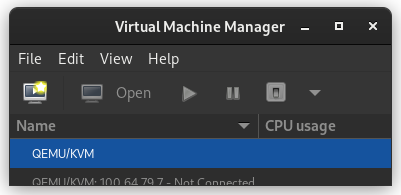
Now that you ve got the qcow2 file created, press alt-left until you return to your GDM session. The apt-get install command above installed virt-manager, so log in to your system if you haven t already and open up gnome-terminal by pressing the windows key or moving your mouse/gesture to the top left of your screen. Type in gnome-terminal and either press enter or click/tap on the icon. I like to run this full screen so that I feel like I m in a space ship. If you like to feel like you re in a spaceship, too, press F11. You can start virt-manager from this shell or you can press the windows key and type in virt-manager and press enter. You ll want the shell to run commands such as virsh console windows or virsh list When virt-manager starts, right click on QEMU/KVM and select New.
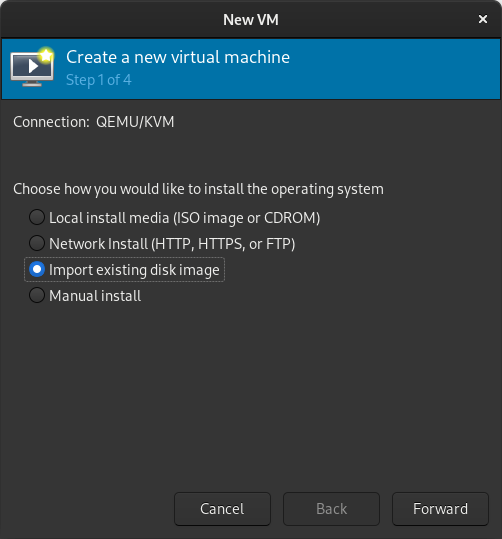
In the New VM window, select Import existing disk image
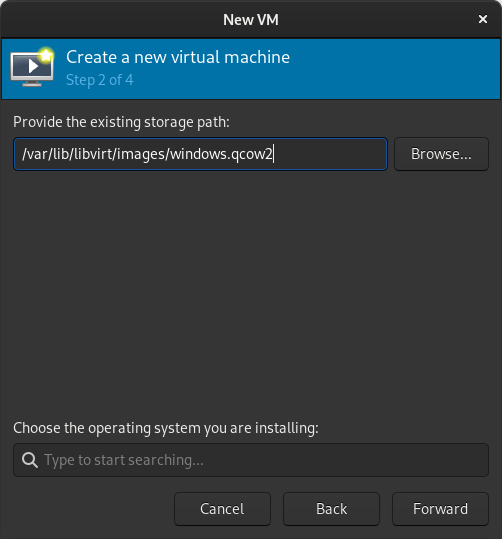
When prompted for the path to the image, use the one we created with sudo qemu-img convert above.
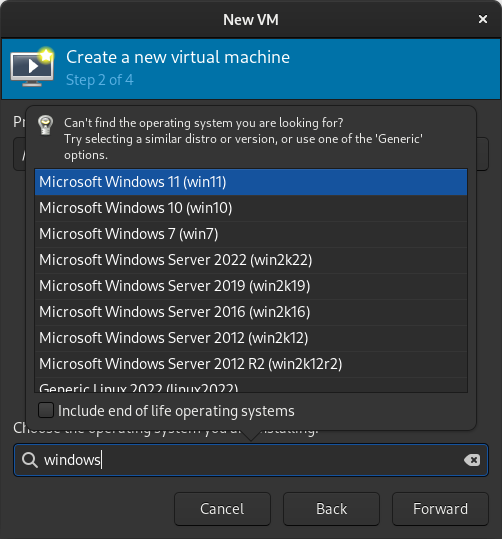
Select the version of Windows you want.
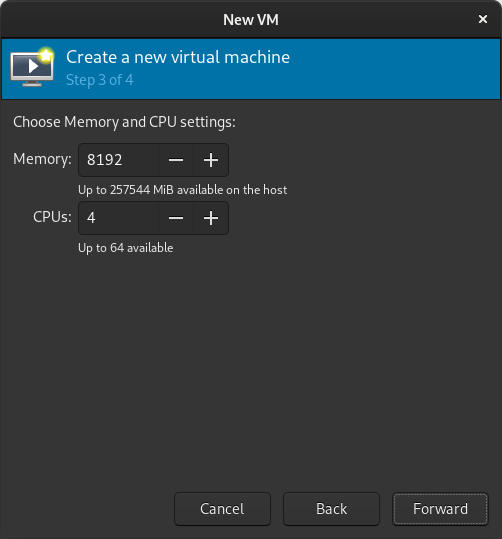
Select memory and CPUs to allocate to the VM.
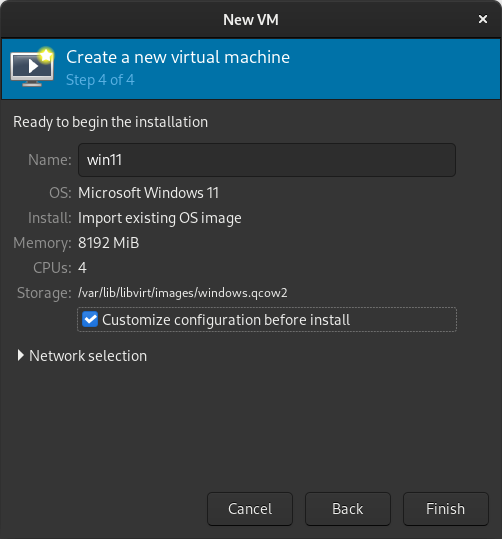
Tick the Customize configuration before install box
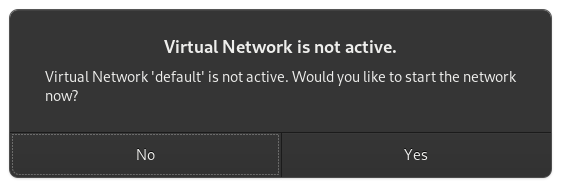
If you re prompted to enable the default network, do so now.
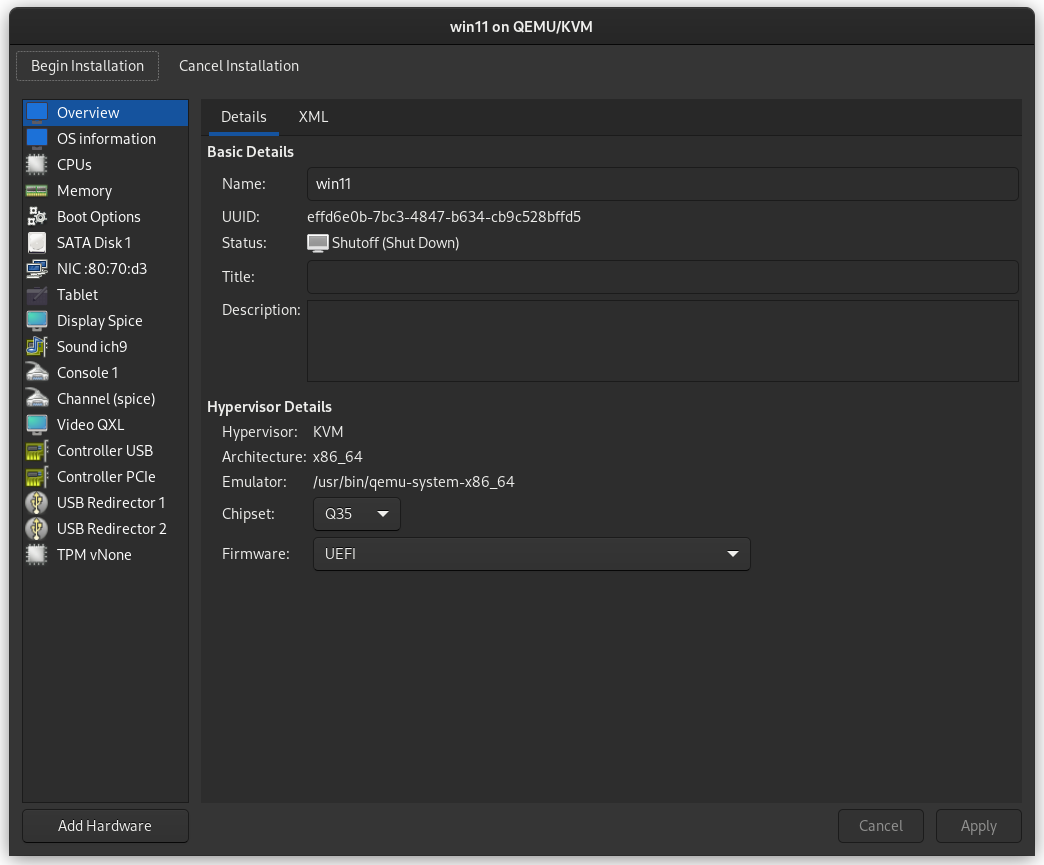
The default hardware layout should probably suffice. Get it as close to the underlying hardware as it is convenient to do. But Windows is pretty lenient these days about virtualizing licensed windows instances so long as they re not running in more than one place at a time. Good luck! Leave comments if you have questions.

Antoine Beaupr : Using signal-cli to cancel your Signal account

For obscure reasons, I have found myself with a phone number registered with Signal but without any device associated with it. This is the I lost my phone section in Signal support, which rather unhelpfully tell you that, literally:
Until you have access to your phone number, there is nothing that can be done with Signal.
To be fair, I guess that sort of makes sense: Signal relies heavily on phone numbers for identity. It's how you register to the service and how you recover after losing your phone number. If you have your PIN ready, you don't even change safety numbers! But my case is different: this phone number was a test number, associated with my tablet, because you can't link multiple Android device to the same phone number. And now that I brilliantly bricked that tablet, I just need to tell people to stop trying to contact me over that thing (which wasn't really working in the first place anyway because I wasn't using the tablet that much, but I digress). So. What do you do? You could follow the above "lost my phone" guide and get a new Android or iOS phone to register on Signal again, but that's pretty dumb: I don't want another phone, I already have one. Lo and behold, signal-cli to the rescue!

Disclaimer: no warranty or liability Before following this guide, make sure you remember the license of this website, which specifically has a Section 5 Disclaimer of Warranties and Limitation of Liability. If you follow this guide literally, you might actually get into trouble. You have been warned. All Cats Are Beautiful.

Installing in Docker Because signal-cli is not packaged in Debian (but really should be), I need to bend over backwards to install it. The installation instructions suggest building from source (what is this, GentooBSD?) or installing binary files (what is this, Debiandows?), that's all so last millennium. I want something fresh and fancy, so I went with the extremely legit Docker registry ran by the not-shady-at-all gitlab.com/packaging group which is suspiciously not owned by any GitLab.com person I know of. This is surely perfectly safe.
(Insert long digression on supply chain security here and how Podman is so much superior to Docker. Feel free to dive deep into how RedHat sold out to the nazis or how this is just me ranting about something I don't understand, again. I'm not going to do all the work for you.)
Anyway. The magic command is:
mkdir .config/signal-cli
podman pull registry.gitlab.com/packaging/signal-cli/signal-cli-jre:latest
# lightly hit computer with magic supply chain verification wand
alias signal-cli="podman run --rm --publish 7583:7583 --volume .config/signal-cli:/var/lib/signal-cli --tmpfs /tmp:exec   registry.gitlab.com/packaging/signal-cli/signal-cli-jre:latest --config /var/lib/signal-cli"
At this point, you have a signal-cli alias that should more or less behave as per upstream documentation. Note that it sets up a network service on port 7583 which is unnecessary because you likely won't be using signal-cli's "daemon mode" here, this is a one-shot thing. But I'll probably be reusing those instructions later on, so I figured it might be a safe addition. Besides, it's what the instructions told me to do so I'm blindly slamming my head in the bash pipe, as trained. Also, you're going to have the signal-cli configuration persist in ~/.config/signal-cli there. Again, totally unnecessary.

Re-registering the number Back to our original plan of canceling our Signal account. The next step is, of course, to register with Signal.
Yes, this is a little counter-intuitive and you'd think there would be a "I want off this boat" button on https://signal.org that would do this for you, but hey, I guess that's only reserved for elite hackers who want to screw people over, I mean close their accounts. Mere mortals don't get access to such beauties. Update: a friend reminded me there used to be such a page at https://signal.org/signal/unregister/ but it's mysteriously gone from the web, but still available on the wayback machine although surely that doesn't work anymore. Untested.
To register an account with signal-cli, you first need to pass a CAPTCHA. Those are the funky images generated by deep neural networks that try to fool humans into thinking other neural networks can't break them, and generally annoy the hell out of people. This will generate a URL that looks like:
signalcaptcha://signal-hcaptcha.$UUID.registration.$THIRTYTWOKILOBYTESOFGARBAGE
Yes, it's a very long URL. Yes, you need the entire thing. The URL is hidden behind the Open Signal link, you can right-click on the link to copy it or, if you want to feel like it's 1988 again, use view-source: or butterflies or something. You will also need the phone number you want to unregister here, obviously. We're going to take a not quite random phone number as an example, +18002677468.
Don't do this at home kids! Use the actual number and don't copy-paste examples from random websites!
So the actual command you need to run now is:
signal-cli -a +18002677468 register --captcha signalcaptcha://signal-hcaptcha.$UUID.registration.$THIRTYTWOKILOBYTESOFGARBAGE
To confirm the registration, Signal will send a text message (SMS) to that phone number with a verification code. (Fun fact: it's actually Twilio relaying that message for Signal and that is... not great.) If you don't have access to SMS on that number, you can try again with the --voice option, which will do the same thing with a actual phone call. I wish it would say "Ok boomer" when it calls, but it doesn't. If you don't have access to either, you're screwed. You may be able to port your phone number to another provider to gain control of the phone number again that said, but at that point it's a whole different ball game. With any luck now you've received the verification code. You use it with:
signal-cli -a +18002677468 verify 131213
If you want to make sure this worked, you can try writing to another not random number at all, it should Just Work:
signal-cli -a +18002677468 send -mtest +18005778477
This is almost without any warning on the other end too, which says something amazing about Signal's usability and something horrible about its security.

Unregistering the number Now we get to the final conclusion, the climax. Can you feel it? I'll try to refrain from further rants, I promise. It's pretty simple and fast, just call:
signal-cli -a +18002677468 unregister
That's it! Your peers will now see an "Invite to Signal" button instead of a text field to send a text message.

Cleanup Optionally, cleanup the mess you left on this computer:
rm -r ~/.config/signal-cli
podman image rm registry.gitlab.com/packaging/signal-cli/signal-cli-jre

Russ Allbery: Review: Semiosis

Review: Semiosis, by Sue Burke
Series: Semiosis #1
Publisher: Tor
Copyright: February 2018
ISBN: 0-7653-9137-6
Format: Kindle
Pages: 333
Semiosis is a first-contact science fiction novel and the first half of a duology. It was Sue Burke's first novel. In the 2060s, with the Earth plagued by environmental issues, a group of utopians decided to found a colony on another planet. Their goal is to live in harmony with an unspoiled nature. They wrote a suitably high-minded founding document, the Constitution of the Commonwealth of Pax, and set out in cold sleep on an interstellar voyage. 158 years later, they awoke in orbit around a planet with a highly-developed ecology, which they named Pax. Two pods and several colonists were lost on landing, but the rest remained determined to follow through with their plan. Not that they had many alternatives. Pax does not have cities or technological mammalian life, just as they hoped. It does, however, have intelligent life. This novel struggled to win me over for reasons that aren't the fault of Burke's writing. The first is that it is divided into seven parts, each telling the story of a different generation. Intellectually, I like this technique for telling an anthropological story that follows a human society over time. But emotionally, I am a character reader first and foremost, and I struggle with books where I can't follow the same character throughout. It makes the novel feel more like a fix-up of short stories, and I'm not much of a short story reader. Second, this is one of those stories where a human colony loses access to its technology and falls back to a primitive lifestyle. This is a concept I find viscerally unpleasant and very difficult to read about. I don't mind reading stories that start at the lower technological level and rediscover lost technology, but the process of going backwards, losing knowledge, surrounded by breaking technology that can never be repaired, is disturbing at a level that throws me out of the story. It doesn't help that the original colonists chose to embrace that reversion. Some of this wasn't intentional some vital equipment was destroyed when they landed but a lot of it was the plan from the start. They are the type of fanatics who embrace a one-way trip and cannibalizing the equipment used to make it in order to show their devotion to the cause. I spent the first part of the book thinking the founding colonists were unbelievably foolish, but then they started enforcing an even more restrictive way of life on their children and that tipped me over into considering them immoral. This was the sort of political movement that purged all religion and political philosophy other than their one true way so that they could raise "uncorrupted" children. Burke does recognize how deeply abusive this is. The second part of the book, which focuses on the children of the initial colonists, was both my favorite section and had my favorite protagonist, precisely because someone put words to the criticisms that I'd been thinking since the start of the book. The book started off on a bad foot with me, but if it had kept up the momentum of political revolution and rethinking provided by the second part, it might have won me over. That leads to the third problem, though, which is the first contact part of the story. (If you've heard anything about this series, you probably know what the alien intelligence is, and even if not you can probably guess, but I'll avoid spoilers anyway.) This is another case where the idea is great, but I often don't get along with it as a reader. I'm a starships and AIs and space habitats sort of SF reader by preference and tend to struggle with biological SF, even though I think it's great more of it is being written. In this case, mind-altering chemicals enter the picture early in the story, and while this makes perfect sense given the world-building, this is another one of my visceral dislikes. A closely related problem is that the primary alien character is, by human standards, a narcissistic asshole. This is for very good story and world-building reasons. I bought the explanation that Burke offers, I like the way this shows how there's no reason to believe humans have a superior form of intelligence, and I think Burke's speculations on the nature of that alien intelligence are fascinating. There are a lot of good reasons to think that alien morality would be wildly different from human morality. But, well, I'm still a human reading this book and I detested the alien, which is kind of a problem given how significant of a character it is. That's a lot baggage for a story to overcome. It says something about how well-thought-out the world-building is that it kept my attention anyway. Burke uses the generational structure very effectively. Events, preferences, or even whims early in the novel turn into rituals or traditions. Early characters take on outsized roles in history. The humans stick with the rather absurd constitution of Pax, but do so in a way that feels true to how humans reinterpret and stretch and layer meaning on top of wholly inadequate documents written in complete ignorance of the challenges that later generations will encounter. I would have been happier without the misery and sickness and messy physicality of this abusive colonization project, but watching generations of humans patch together a mostly functioning society was intellectually satisfying. The alien interactions were also solid, with the caveat that it's probably impossible to avoid a lot of anthropomorphizing. If I were going to sum up the theme of the novel in a sentence, it's that even humans who think they want to live in harmony with nature are carrying more arrogance about what that harmony would look like than they realize. In most respects the human colonists stumbled across the best-case scenario for them on this world, and it was still harder than anything they had imagined. Unfortunately, I thought the tail end of the book had the weakest plot. It fell back on a story that could have happened in a lot of first-contact novels, rather than the highly original negotiation over ecological niches that happened in the first half of the book. Out of eight viewpoint characters in this book, I only liked one of them (Sylvia). Tatiana and Lucille were okay, and I might have warmed to them if they'd had more time in the spotlight, but I felt like they kept making bad decisions. That's the main reason why I can't really recommend it; I read for characters, I didn't really like the characters, and it's hard for a book to recover from that. It made the story feel chilly and distant, more of an intellectual exercise than the sort of engrossing emotional experience I prefer. But, that said, this is solid SF speculation. If your preferred balance of ideas and characters is tilted more towards ideas than mine, and particularly if you like interesting aliens and don't mind the loss of technology setting, this may well be to your liking. Even with all of my complaints, I'm curious enough about the world that I am tempted to read the sequel, since its plot appears to involve more of the kind of SF elements I like. Followed by Interference. Content warning: Rape, and a whole lot of illness and death. Rating: 6 out of 10

27 June 2023

Russell Coker: Running a ChatGPT Type System

Alpaca I ve just done some experiments running ChatGPT type programs. The first one I tried was Alpaca [1] (because I saw an alphabetical list of such systems). Here s the 4GB data file [2]. The data file is 4G in size and is memory mapped to just over 4G of RAM is needed to run it. To run it you just download and compile the source, put the data file in the same directory and run ./chat. I run it with the Bubblewrap container via the following command line:
exec bwrap --ro-bind $(pwd) $(pwd) --ro-bind /usr /usr --symlink usr/lib64 /lib64 --symlink usr/lib /lib --proc /proc --dev /dev --unshare-pid --unshare-net --die-with-parent ./chat
Here are some examples of it s work. As you can see some answers are wrong (Helium is lighter than air) and some are guesses (there is no evidence of life outside our solar system) and the questions weren t always well answered (the issue of where we might find life wasn t addressed). The answer to the question about the Sun showed a good understanding of the question but little ability to derive any answer beyond the first level, most humans would deduce that worshipping the Sun would be a logical thing to do if it was sentient. Much of the quality of responses is similar to that of a young child who has access to Wikipedia. > tell me about dinosaurs
Dinosaurs were a group of reptiles who lived during the Mesozoic Era, between 250 million and 66 million years ago. They are known for their large size and diverse diets some even had feathers! Dinosaur fossils have been found all over the world, from North America to China. Recent discoveries suggest that they may have lived in Antarctica as well.
> are hydrogen or helium balloons better?
Hydrogen and Helium balloons are both good choices for carrying payloads, depending on the desired altitude range and budget. Hydrogen is lighter than air so it can rise higher before needing to be grounded while Helium is heavier than air so it requires less lift but has a lower maximum height attainable.
> is a 486 a good cpu?
Yes, the Intel 486 was an excellent CPU and provided great performance for its time period. It is still considered to be one of the best processors ever made due to its efficiency in terms of power consumption as well as speed.
> where will we find life outside the Earth?
Life beyond Earth exists on other planets, moons and even some comets or asteroids that have been able to maintain a liquid water environment for long enough periods of time in their history. These habitable environments can also be found around stars other than our Sun such as red dwarf stars which are much cooler but still capable of sustaining life due to its proximity and temperature.
> how do I write a good blog post?
Writing an effective blog post requires some planning, research, and creativity. Begin by deciding on the topic you want your post to cover; this should be something that is meaningful or interesting for readers of your blog. Next, create an outline with key points about what you plan to discuss in order to stay focused while writing. Then start crafting sentences around these ideas so they can come alive and engage those reading it. Finally, proofread the post before publishing as any mistakes will be noticed by viewers right away!
> if the sun was a sentient being how would that change life on earth?
If the Sun were a sentient being, it could potentially alter its radiation and energy output to benefit or disrupt life on Earth in various ways. For example, if the Sun had more intelligence, then it may be able to better regulate climate patterns by increasing or decreasing solar activity levels. Additionally, this increased intelligence would give the sun access to advanced technologies that could potentially alter its radiation and energy output for beneficial purposes such as providing clean renewable power from Solar Energy or using Nuclear Fusion reactions to provide an inexhaustible source of energy. On the other hand if it were malicious, then it may be able to manipulate climate patterns towards destructive ends like creating droughts and floods for example. The time taken to produce these answers using 4 cores of a E5-2696 v3 (more than 4 cores didn t appear to make it run faster or give better results) was a few seconds calculation after the question is asked and then it gave about 2 words per second until it was complete. Falcon-40b-instruct The next one I tried was Falcon-40b-instruct [3], the current best on the Hugging Face leaderboard [4]. It has a 90G set of data files. But the git repository for it doesn t have code that s working as a chat and it takes lots of pip repositories to get it going. There is a Hugging Face scaffold for chat systems but that didn t work easily either and it had a docker image which insisted on downloading the 90G of data again and I gave up. I guess Falcon is not for people who have little Python experience. Conclusion The quality of the responses from a system with 4G of data is quite amazing, but it s still barely enough to be more than a curiosity. It s a long way from the quality of ChatGPT [5] or the phind.com service described as The AI search engine for developers [6]. I have found phind.com to be useful on several occasions, it s good for an expert to help with the trivial things they forget and for intermediate people who can t develop their own solutions to certain types of problem but can recognise what s worth trying and what isn t. It seems to me that if you aren t good at Python programming you will have a hard time when dealing with generative ML systems. Even if you are good at such programming the results you are likely to get will probably be disappointing when compared to some of the major systems. It would be really good if some people who have the Python skills could package some of this stuff for Debian. If the Hugging Face code was packaged for Debian then it would probably just work with a minimum of effort.

Wouter Verhelst: The future of the eID on RHEL

Since before I got involved in the eID back in 2014, we have provided official packages of the eID for Red Hat Enterprise Linux. Since RHEL itself requires a license, we did this, first, by using buildbot and mock on a Fedora VM to set up a CentOS chroot in which to build the RPM package. Later this was migrated to using GitLab CI and to using docker rather than VMs, in an effort to save some resources. Even later still, when Red Hat made CentOS no longer be a downstream of RHEL, we migrated from building in a CentOS chroot to building in a Rocky chroot, so that we could continue providing RHEL-compatible packages. Now, as it seems that Red Hat is determined to make that impossible too, I investigated switching to actually building inside a RHEL chroot rather than a derivative one. Let's just say that might be a challenge...
[root@b09b7eb7821d ~]# mock --dnf --isolation=simple --verbose -r rhel-9-x86_64 --rebuild eid-mw-5.1.11-0.v5.1.11.fc38.src.rpm --resultdir /root --define "revision v5.1.11"
ERROR: /etc/pki/entitlement is not a directory is subscription-manager installed?
Okay, so let's fix that.
[root@b09b7eb7821d ~]# dnf install -y subscription-manager
(...)
Complete!
[root@b09b7eb7821d ~]# mock --dnf --isolation=simple --verbose -r rhel-9-x86_64 --rebuild eid-mw-5.1.11-0.v5.1.11.fc38.src.rpm --resultdir /root --define "revision v5.1.11"
ERROR: No key found in /etc/pki/entitlement directory.  It means this machine is not subscribed.  Please use 
  1. subscription-manager register
  2. subscription-manager list --all --available (available pool IDs)
  3. subscription-manager attach --pool <POOL_ID>
If you don't have Red Hat subscription yet, consider getting subscription:
  https://access.redhat.com/solutions/253273
You can have a free developer subscription:
  https://developers.redhat.com/faq/
Okay... let's fix that too, then.
[root@b09b7eb7821d ~]# subscription-manager register
subscription-manager is disabled when running inside a container. Please refer to your host system for subscription management.
Wut.
[root@b09b7eb7821d ~]# exit
wouter@pc220518:~$ apt-cache search subscription-manager
wouter@pc220518:~$
As I thought, yes. Having to reinstall the docker host machine with Fedora just so I can build Red Hat chroots seems like a somewhat excessive requirement, which I don't think we'll be doing that any time soon. We'll see what the future brings, I guess.

26 June 2023

Lukas M rdian: Netplan 0.106.1 stable release

We are happy to announce that Netplan 0.106.1 is available for download on Ubuntu Mantic Minotaur and Debian testing. This release includes some improvements in our documentation and CI infrastructure and a number of bug fixes.

What s new in Netplan 0.106.1?

Documentation

Infrastructure
  • canonical/setup-lxd GitHub action. The autopkgtest environment creation was standardized to use Canonical s setup-lxd action.
  • Snapd integrations tests with spread. A new test set for the Snapd integration with Netplan was introduced using the spread tool.
  • DBus. A number of DBus integration tests were added to the Debian package.

New features
  • Keyfile parser improvements. Our Network Manager keyfile parser (the capability of loading Network Manager configuration to Netplan YAML) was expanded to support all the types of tunnels supported by Netplan.

Misc
  • Ubuntu s Code of Conduct 2.0 was added to the code repository.
  • We added a new bash autocompletion script with all the Netplan s subcommands.
  • The new release package was synchronized with Debian.

Bug fixes
  • Keyfile parser. This release contains a couple of important fixes for the NetworkManager integration stability: 1) adding WPA enterprise connections is now working fine and new test cases were added to the package; 2) a WireGuard peer with allowed IPs that don t include the network prefix are now accepted.
  • Netplan parser. A number of memory leaks and stability issues were fixed.
  • DBus. An issue related to how directory paths are built in the Netplan DBus service was causing issues in the Snapd integration and was fixed.
For the complete list of changes please consult the debian/changelog file in https://launchpad.net/ubuntu/+source/netplan.io/+changelog

25 June 2023

Jonathan McDowell: Figuring out the right card for foreign currency transactions

While travel these days is much reduced I still end up in Dublin regularly enough (though less so now I m not working directly with folk there), and have the occasional US trip. Given that I live and work in the UK, and thus get paid in GBP ( ), this leads to the question of what to do about USD ($) and EUR ( ) transaction. USD turns out to be easy; I still have a US account from when I lived there and keeping it active has, so far, not proved to be a problem. EUR is tricker. In an ideal world I d find a fee-free account that would allow normal Eurozone transfers and provide me with a suitable debit + credit card for use while travelling. I ve found options with a fee, but I don t have enough Euro transactions to make it worthwhile. A friend pointed me at the HSBC Global Money debit card, which claims no fees for currency conversions from and competitive rates. As I already have an account with HSBC it was easy to sign up to try it out. And, having recently been on trip to CenterParcs, I had the perfect opportunity to compare it to my (and my wife s) existing cards to see how the rates played out. In particular I ve always meant to figure out if the cards that don t charge a loading rate end up with the same exchange rate as the cards that do have a separate per transaction charge. So, armed with the HSBC Global Money card, a Monzo debit card, a Nationwide debit card, and a co-operative debit card, we engage on a week of eating out in the interests of data! The results will probably shock no one who s properly looked into this themselves. All the cards were on the VISA network, they all ended up at around 1 1.15. According to Xe that was roughly the mid-market rate for the week I was away, so it seems like trusting VISA to do the currency conversion is a reasonable thing to do. The problem comes with the range of charges:
Card Exchange rate Charge %
Co-Op 1.15 2.65%
HSBC 1.15 0.00%
Monzo 1.15 0.00%
Nationwide 1.15 2.99%
This matches what Nationwide claims for its foreign transaction fees, though Co-Op claims 2.75% and the numbers looked more like 2.65% on the small transactions we incurred. So, the HSBC Global Money card is definitely a decent option. However Monzo is just a good, and has the advantage that it s a normal current account rather than something slightly different you have to funnel money into. Both are let down by the fact you need to use an app to check your balance etc - Monzo seems to only have extremely basic web access to any of their accounts and HSBC don t expose the Global Money account at all via web banking, only the phone app. Finally, what I really want is to be able to do this with a credit card, especially for things like online purchases or staying at hotels. My current credit card suffers from a per-transaction charge, but while looking up the Nationwide debit charge %age to confirm it matched what I saw I discovered that Nationwide credit cards do not charge a fee. So I think I ll be investigating that for my next trip.

24 June 2023

Steve Kemp: Simple REPL for CP/M, in Z80 assembly

So my previous post documented a couple of simple "scripting languages" for small computers, allowing basic operations in a compact/terse fashion. I mentioned that I might be tempted to write something similar for CP/M, in Z80 assembly, and the result is here: To sum up it allows running programs like this:
0m 16k rP _ _ 
C3 03 EA 00 00 C3 06 DC 00 00 00 00 00 00 00 00
Numbers automatically get saved to the A-register, the accumulator. In addition to that there are three dedicated registers: So the program above: TLDR: Dump the first sixteen bytes of RAM, at address 0x0000, to the console. Though this program allows delays, RAM read/write, I/O port input and output, as well as loops it's both kinda fun, and kinda pointless. I guess you could spend hours flashing lights and having other similar fun. But only if you're like me! All told the code compiles down to about 800 bytes and uses less than ten bytes of RAM to store register-state. It could be smaller with some effort, but it was written a bit adhoc and I think I'm probably done now.

22 June 2023

Russell Coker: Cheap Peripherals for Work

A problem with a lot of the purchase of peripherals is that they don t match the needs of the users and often get thrown away long before they wear out. At many companies when a new employee starts they are given a laptop (expensive corporate asset), a cheap headset for video calls, and optionally a keyboard and mouse for people who don t like the laptop keyboard and/or touchpad. When an employee leaves the company their laptop can be assigned to someone else if it isn t too old. Headsets and mice often show signs of wear if they have been used for a year or two and while keyboards often have a long service life they will be dirty after a couple of years and they are cheap to replace. So every time someone leaves and returns all company hardware there will be a headset and mouse owned by the company that ends up as e-waste and sometimes a keyboard too. Often people leave and just keep the headset, mouse, and keyboard expecting that no-one at their former employer will demand them back this is a reward for dishonesty. Buying the keyboards, mice, and headsets in bulk allegedly makes it easy to support them, but supporting such devices isn t difficult and the IT staff end up fielding complaints because the devices they issue don t match the preferences of the workers. These devices have the worst ratio of value to complaints of anything a typical company supports. I believe that the best solution to all these problems is to not buy those items for employees but to instead give them a sum of money sufficient to buy cheap items in each category (EG $60 for keyboard, mouse, and headset) and let them buy whichever they choose. If they want something more expensive (Bose headset, split keyboard, or gamer mouse) them they can spend their own money to do so (and claim a tax deduction). Then when people leave the company they can take those items with them and save the company the expense of waste disposal while also not rewarding dishonesty. An additional benefit for the company is that it can reduce the issues of complying with disability legislation, anyone who already owns such hardware can just keep the money. The current situation is bad for morale, a waste of time for IT workers, and contributes to the waste problem.

Russ Allbery: Review: Furious Heaven

Review: Furious Heaven, by Kate Elliott
Series: Sun Chronicles #2
Publisher: Tor
Copyright: 2023
ISBN: 1-250-86701-0
Format: Kindle
Pages: 725
Furious Heaven is the middle book of a trilogy and a direct sequel to Unconquerable Sun. Don't start here. I also had some trouble remembering what happened in the previous book (grumble recaps mutter), and there are a lot of threads, so I would try to minimize the time between books unless you have a good memory for plot details. This is installment two of gender-swapped Alexander the Great in space. When we last left Sun and her Companions, Elliott had established the major players in this interstellar balance of power and set off some opening skirmishes, but the real battles were yet to come. Sun was trying to build her reputation and power base while carefully staying on the good side of Queen-Marshal Eirene, her mother and the person credited with saving the Republic of Chaonia from foreign dominance. The best parts of the first book weren't Sun herself but wily Persephone, one of her Companions, whose viewpoint chapters told a more human-level story of finding her place inside a close-knit pre-existing friendship group. Furious Heaven turns that all on its head. The details are spoilers (insofar as a plot closely tracking the life of Alexander the Great can contain spoilers), but the best parts of the second book are the chapters about or around Sun. What I find most impressive about this series so far is Elliott's ability to write Sun as charismatic in a way that I can believe as a reader. That was hit and miss at the start of the series, got better towards the end of Unconquerable Sun, and was wholly effective here. From me, that's high but perhaps unreliable praise; I typically find people others describe as charismatic to be some combination of disturbing, uncomfortable, dangerous, or obviously fake. This is a rare case of intentionally-written fictional charisma that worked for me. Elliott does not do this by toning down Sun's ambition. Sun, even more than her mother, is explicitly trying to gather power and bend the universe (and the people in it) to her will. She treats people as resources, even those she's the closest to, and she's ruthless in pursuit of her goals. But she's also honorable, straightforward, and generous to the people around her. She doesn't lie about her intentions; she follows a strict moral code of her own, keeps her friends' secrets, listens sincerely to their advice, and has the sort of battlefield charisma where she refuses to ask anyone else to take risks she personally wouldn't take. And her use of symbolism and spectacle isn't just superficial; she finds the points of connection between the symbols and her values so that she can sincerely believe in what she's doing. I am fascinated by how Elliott shapes the story around her charisma. Writing an Alexander analogue is difficult; one has to write a tactical genius with the kind of magnetic attraction that enabled him to lead an army across the known world, and make this believable to the reader. Elliott gives Sun good propaganda outlets and makes her astonishingly decisive (and, of course, uses the power of the author to ensure those decisions are good ones), but she also shows how Sun is constantly absorbing information and updating her assumptions to lay the groundwork for those split-second decisions. Sun uses her Companions like a foundation and a recovery platform, leaning on them and relying on them to gather her breath and flesh out her understanding, and then leaping from them towards her next goal. Elliott writes her as thinking just a tiny bit faster than the reader, taking actions I was starting to expect but slightly before I had put together my expectation. It's a subtle but difficult tightrope to walk as the writer, and it was incredibly effective for me. The downside of Furious Heaven is that, despite kicking the action into a much higher gear, this book sprawls. There are five viewpoint characters (Persephone and the Phene Empire character Apama from the first book, plus two new ones), as well as a few interlude chapters from yet more viewpoints. Apama's thread, which felt like a minor subplot of the first book, starts paying off in this book by showing the internal political details of Sun's enemy. That already means the reader has to track two largely separate and important stories. Add on a Persephone side plot about her family and a new plot thread about other political factions and it's a bit too much. Elliott does a good job avoiding reader confusion, but she still loses narrative momentum and reader interest due to the sheer scope. Persephone's thread in particular was a bit disappointing after being the highlight of the previous book. She spends a lot of her emotional energy on tedious and annoying sniping at Jade, which accomplishes little other than making them both seem immature and out of step with the significance of what's going on elsewhere. This is also a middle book of a trilogy, and it shows. It provides a satisfying increase in intensity and gets the true plot of the trilogy well underway, but nothing is resolved and a lot of new questions and plot threads are raised. I had similar problems with Cold Fire, the middle book of the other Kate Elliott trilogy I've read, and this book is 200 pages longer. Elliott loves world-building and huge, complex plots; I have a soft spot for them too, but they mean the story is full of stuff, and it's hard to maintain the same level of reader interest across all the complications and viewpoints. That said, I truly love the world-building. Elliott gives her world historical layers, with multiple levels of lost technology, lost history, and fallen empires, and backs it up with enough set pieces and fragments of invented history that I was enthralled. There are at least five major factions with different histories, cultures, and approaches to technology, and although they all share a history, they interpret that history in fascinatingly different ways. This world feels both lived in and full of important mysteries. Elliott also has a knack for backing the ambitions of her characters with symbolism that defines the shape of that ambition. The title comes from a (translated) verse of an in-universe song called the Hymn of Leaving, which is sung at funerals and is about the flight on generation ships from the now-lost Celestial Empire, the founding myth of this region of space:
Crossing the ocean of stars we leave our home behind us.
We are the spears cast at the furious heaven
And we will burn one by one into ashes
As with the last sparks we vanish.
This memory we carry to our own death which awaits us
And from which none of us will return.
Do not forget. Goodbye forever.
This is not great poetry, but it explains so much about the psychology of the characters. Sun repeatedly describes herself and her allies as spears cast at the furious heaven. Her mother's life mission was to make Chaonia a respected independent power. Hers is much more than that, reaching back into myth for stories of impossible leaps into space, burning brightly against the hostile power of the universe itself. A question about a series like this is why one should want to read about a gender-swapped Alexander the Great in space, rather than just reading about Alexander himself. One good (and sufficient) answer is that both the gender swap and the space parts are inherently interesting. But the other place that Elliott uses the science fiction background is to give Sun motives beyond sheer personal ambition. At a critical moment in the story, just like Alexander, Sun takes a detour to consult an Oracle. Because this is a science fiction novel, it's a great SF set piece involving a mysterious AI. But also because this is a science fiction story, Sun doesn't only ask about her personal ambitions. I won't spoil the exact questions; I think the moment is better not knowing what she'll ask. But they're science fiction questions, reader questions, the kinds of things Elliott has been building curiosity about for a book and a half by the time we reach that scene. Half the fun of reading a good epic space opera is learning the mysteries hidden in the layers of world-building. Aligning the goals of the protagonist with the goals of the reader is a simple storytelling trick, but oh, so effective. Structurally, this is not that great of a book. There's a lot of build-up and only some payoff, and there were several bits I found grating. But I am thoroughly invested in this universe now. The third book can't come soon enough. Followed by Lady Chaos, which is still being written at the time of this review. Rating: 7 out of 10

18 June 2023

Louis-Philippe V ronneau: Solo V2: nice but flawed

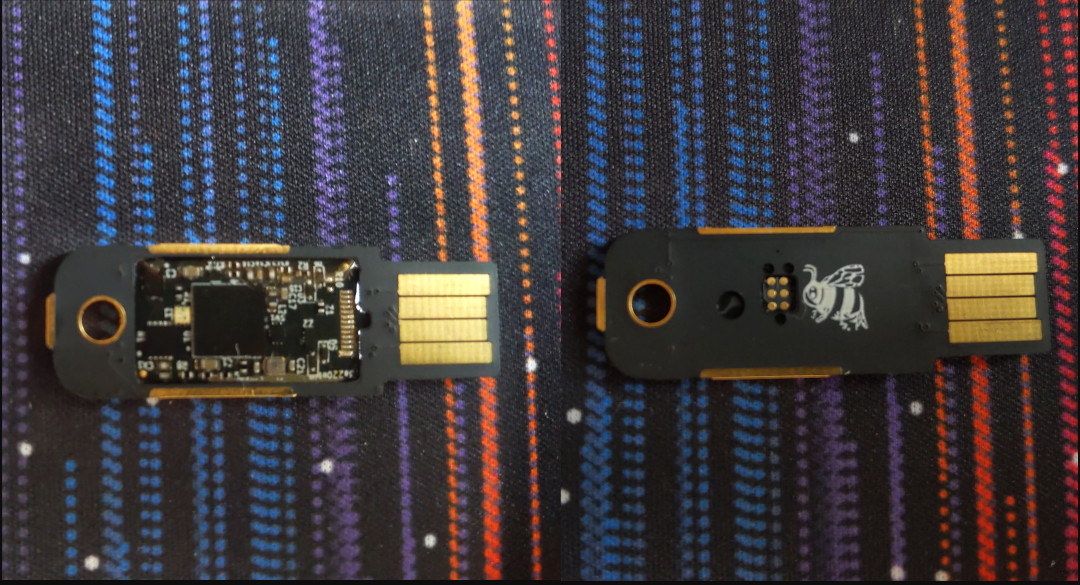
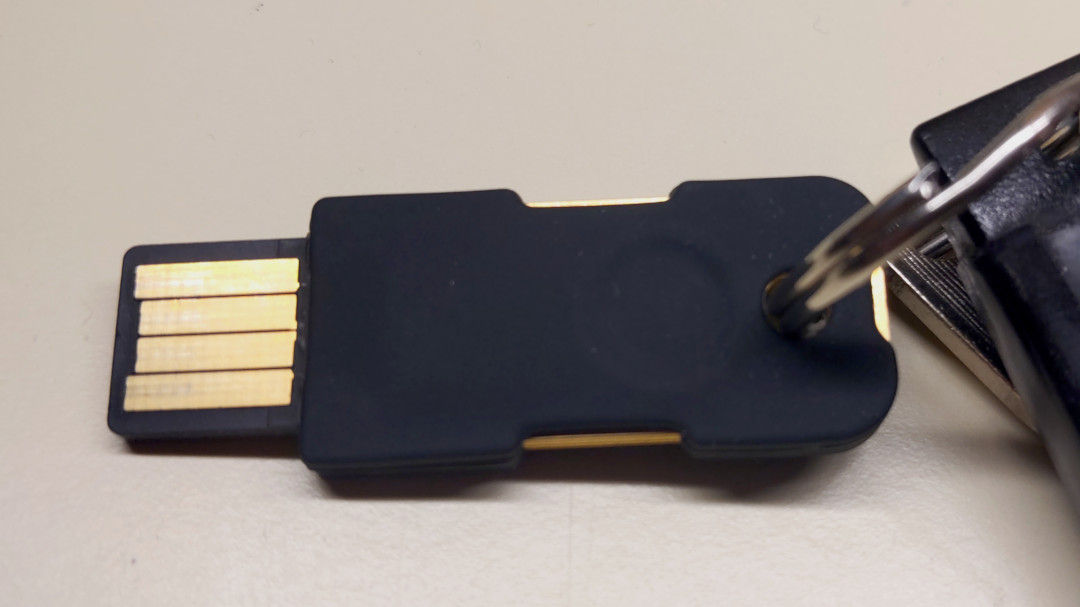
EDIT: One of my 2 keys has died. There are what seems like golden bubbles under the epoxy, over one of the chips and those were not there before. I've emailed SoloKeys and I'm waiting for a reply, but for now, I've stopped using the Solo V2 altogether :( I recently received the two Solo V2 hardware tokens I ordered as part of their crowdfunding campaign, back in March 2022. It did take them longer than advertised to ship me the tokens, but that's hardly unexpected from such small-scale, crowdfunded undertaking. I'm mostly happy about my purchase and I'm glad to get rid of the aging Tomu boards I was using as U2F tokens1. Still, beware: I am not sure it's a product I would recommend if what you want is simply something that works. If you do not care about open-source hardware, the Solo V2 is not for you. The Good A side-by-side view of the Solo V2's top and back sides I first want to mention I find the Solo V2 gorgeous. I really like the black and gold color scheme of the USB-A model (which is reversible!) and it seems like a well built and solid device. I'm not afraid to have it on my keyring and I fully expect it to last a long time. An animation of the build process, showing how the PCB is assembled and then slotted into the shell I'm also very impressed by the modular design: the PCB sits inside a shell, which decouples the logic from the USB interface and lets them manufacture a single board for both the USB-C and USB-A models. The clear epoxy layer on top of the PCB module also looks very nice in my opinion. A picture of the Solo V2 with its silicone case on my keyring, showing the 3 capacitive buttons I'm also very happy the Solo V2 has capacitive touch buttons instead of physical "clicky" buttons, as it means the device has no moving parts. The token has three buttons (the gold metal strips): one on each side of the device and a third one near the keyhole. As far as I've seen, the FIDO2 functions seem to work well via the USB interface and do not require any configuration on a Debian 12 machine. I've already migrated to the Solo V2 for web-based 2FA and I am in the process of migrating to an SSH ed25519-sk key. Here is a guide I recommend if you plan on setting those up with a Solo V2. The Bad and the Ugly Sadly, the Solo V2 is far from being a perfect project. First of all, since the crowdfunding campaign is still being fulfilled, it is not currently commercially available. Chances are you won't be able to buy one directly before at least Q4 2023. I've also hit what seems to be a pretty big firmware bug, or at least, one that affects my use case quite a bit. Invoking gpg crashes the Solo V2 completely if you also have scdaemon installed. Since scdaemon is necessary to use gpg with an OpenPGP smartcard, this means you cannot issue any gpg commands (like signing a git commit...) while the Solo V2 is plugged in. Any gpg commands that queries scdaemon, such as gpg --edit-card or gpg --sign foo.txt times out after about 20 seconds and leaves the token unresponsive to both touch and CLI commands. The way to "fix" this issue is to make sure scdaemon does not interact with the Solo V2 anymore, using the reader-port argument:
  1. Plug both your Solo V2 and your OpenPGP smartcard
  2. To get a list of the tokens scdaemon sees, run the following command: $ echo scd getinfo reader_list gpg-connect-agent --decode awk '/^D/ print $2 '
  3. Identify your OpenPGP smartcard. For example, my Nitrokey Start is listed as 20A0:4211:FSIJ-1.2.15-43211613:0
  4. Create a file in ~/.gnupg/scdaemon.conf with the following line reader-port $YOUR_TOKEN_ID. For example, in my case I have: reader-port 20A0:4211:FSIJ-1.2.15-43211613:0
  5. Reload scdaemon: $ gpgconf --reload scdaemon
Although this is clearly a firmware bug2, I do believe GnuPG is also partly to blame here. Let's just say I was not very surprised to have to battle scdaemon again, as I've had previous issues with it. Which leads me to my biggest gripe so far: it seems SoloKeys (the company) isn't really fixing firmware issues anymore and doesn't seems to care. The last firmware release is about a year old. Although people are experiencing serious bugs, there is no official way to report them, which leads to issues being seemingly ignored. For example, the NFC feature is apparently killing keys (!!!), but no one from the company seems to have acknowledged the issue. The same goes for my GnuPG bug, which was flagged in September 2022. For a project that mainly differentiates itself from its (superior) competition by being "Open", it's not a very good look... Although SoloKeys is still an unprofitable open source side business of its creators 3, this kind of attitude certainly doesn't help foster trust. Conclusion If you want to have a nice, durable FIDO2 token, I would suggest you get one of the many models Yubico offers. They are similarly priced, are readily commercially available, are part of a nice and maintained software ecosystem and have more features than the Solo V2 (OpenPGP support being the one I miss the most). Yubikeys are the practical option. What they are not is open-source hardware, whereas the Solo V2 is. As bunnie very well explained on his blog in 2019, it does not mean the later is inherently more trustable than the former, but it does make the Solo V2 the ideological option. Knowledge is power and it should be free. As such, tread carefully with SoloKeys, but don't dismiss them altogether: the Solo V2 is certainly functioning well enough for me.

  1. Although U2F is still part of the FIDO2 specification, the Tomus predate this standard and were thus not fully compliant with FIDO2. So long and thanks for all the fish little boards, you've served me well!
  2. It appears the Solo V2 shares its firmware with the Nitrokey 3, which had a similar issue a while back.
  3. This is a direct quote from one of the Solo V2 firmware maintainers.

17 June 2023

John Goerzen: Using dar for Data Archiving

This is the third post in a series about data archiving to removable media (optical discs and hard drives). In the first, I explained the difference between backing up and archiving, established goals for the project, and said I d evaluate git-annex and dar. The second post evaluated git-annex, and now it s time to look at dar. The series will conclude with a post comparing git-annex with dar. What is dar? I could open with the same thing I did with git-annex, just changing the name of the program: [dar] is a fantastic and versatile program that does well, it s one of those things that can do so much that it s a bit hard to describe. It is, fundamentally, an archiver like tar or zip (makes one file representing a bunch of other files), but it goes far beyond that. dar s homepage lays out a comprehensive list of features, which I will try to summarize here. So to tie this together for this project, I will set up a 400MB slice size (to mimic what I did with git-annex), and see how dar saves the data and restores it. Isolated cataloges aren t strictly necessary for this, but by using them (and/or dar_manager), we can build up a database of files and locations and thus directly compare dar to git-annex location tracking. Walkthrough: Creating the first archive As with the git-annex walkthrough, I ll set some variables to make it easy to remember: OK, we can run the backup immediately. No special setup is needed. dar supports both short-form (single-character) parameters and long-form ones. Since the parameters probably aren t familiar to everyone, I will use the long-form ones in these examples. Here s how we create our initial full backup. I ll explain the parameters below:
$ dar \
--verbose \
--create $DRIVE/bak1 \
--on-fly-isolate $CATDIR/bak1 \
--slice 400M \
--min-digits 2 \
--pause \
--fs-root $SOURCEDIR
Let s look at each of these parameters: This same command could have been written with short options as:
$ dar -v -c $DRIVE/bak1 -@ $CATDIR/bak1 -s 400M -9 2 -p -R $SOURCEDIR
What does it look like while running? Here s an excerpt:
...
Adding file to archive: /acrypt/no-backup/jgoerzen/testdata/[redacted]
Finished writing to file 1, ready to continue ? [return = YES Esc = NO]
...
Writing down archive contents...
Closing the escape layer...
Writing down the first archive terminator...
Writing down archive trailer...
Writing down the second archive terminator...
Closing archive low layer...
Archive is closed.
--------------------------------------------
581 inode(s) saved
including 0 hard link(s) treated
0 inode(s) changed at the moment of the backup and could not be saved properly
0 byte(s) have been wasted in the archive to resave changing files
0 inode(s) with only metadata changed
0 inode(s) not saved (no inode/file change)
0 inode(s) failed to be saved (filesystem error)
0 inode(s) ignored (excluded by filters)
0 inode(s) recorded as deleted from reference backup
--------------------------------------------
Total number of inode(s) considered: 581
--------------------------------------------
EA saved for 0 inode(s)
FSA saved for 581 inode(s)
--------------------------------------------
Making room in memory (releasing memory used by archive of reference)...
Now performing on-fly isolation...
...
That was easy! Let s look at the contents of the backup directory:
$ ls -lh $DRIVE
total 3.7G
-rw-r--r-- 1 jgoerzen jgoerzen 400M Jun 16 19:27 bak1.01.dar
-rw-r--r-- 1 jgoerzen jgoerzen 400M Jun 16 19:27 bak1.02.dar
-rw-r--r-- 1 jgoerzen jgoerzen 400M Jun 16 19:27 bak1.03.dar
-rw-r--r-- 1 jgoerzen jgoerzen 400M Jun 16 19:27 bak1.04.dar
-rw-r--r-- 1 jgoerzen jgoerzen 400M Jun 16 19:28 bak1.05.dar
-rw-r--r-- 1 jgoerzen jgoerzen 400M Jun 16 19:28 bak1.06.dar
-rw-r--r-- 1 jgoerzen jgoerzen 400M Jun 16 19:28 bak1.07.dar
-rw-r--r-- 1 jgoerzen jgoerzen 400M Jun 16 19:28 bak1.08.dar
-rw-r--r-- 1 jgoerzen jgoerzen 400M Jun 16 19:29 bak1.09.dar
-rw-r--r-- 1 jgoerzen jgoerzen 156M Jun 16 19:33 bak1.10.dar
And the isolated catalog:
$ ls -lh $CATDIR
total 37K
-rw-r--r-- 1 jgoerzen jgoerzen 35K Jun 16 19:33 bak1.1.dar
The isolated catalog is stored compressed automatically. Well this was easy. With one command, we archived the entire data set, split into 400MB chunks, and wrote out the catalog data. Walkthrough: Inspecting the saved archive Can dar tell us which slice contains a given file? Sure:
$ dar --list $DRIVE/bak1 --list-format=slicing less
Slice(s) [Data ][D][ EA ][FSA][Compr][S] Permission Filemane
--------+--------------------------------+----------+-----------------------------
...
1 [Saved][ ] [-L-][ 0%][X] -rwxr--r-- [redacted]
1-2 [Saved][ ] [-L-][ 0%][X] -rwxr--r-- [redacted]
2 [Saved][ ] [-L-][ 0%][X] -rwxr--r-- [redacted]
...
This illustrates the transition from slice 1 to slice 2. The first file was stored entirely in slice 1; the second stored partially in slice 1 and partially in slice 2, and third solely in slice 2. We can get other kinds of information as well.
$ dar --list $DRIVE/bak1 less
[Data ][D][ EA ][FSA][Compr][S] Permission User Group Size Date filename
--------------------------------+------------+-------+-------+---------+-------------------------------+------------
[Saved][ ] [-L-][ 0%][X] -rwxr--r-- jgoerzen jgoerzen 24 Mio Mon Mar 5 07:58:09 2018 [redacted]
[Saved][ ] [-L-][ 0%][X] -rwxr--r-- jgoerzen jgoerzen 16 Mio Mon Mar 5 07:58:09 2018 [redacted]
[Saved][ ] [-L-][ 0%][X] -rwxr--r-- jgoerzen jgoerzen 22 Mio Mon Mar 5 07:58:09 2018 [redacted]
These are the same files I was looking at before. Here we see they are 24MB, 16MB, and 22MB in size, and some additional metadata. Even more is available in the XML list format. Walkthrough: updates As with git-annex, I ve made some changes in the source directory: moved a file, added another, and deleted one. Let s create an incremental backup now:
$ dar \
--verbose \
--create $DRIVE/bak2 \
--on-fly-isolate $CATDIR/bak2 \
--ref $CATDIR/bak1 \
--slice 400M \
--min-digits 2 \
--pause \
--fs-root $SOURCEDIR
This command is very similar to the earlier one. Instead of writing an archive and catalog named bak1, we write one named bak2. What s new here is --ref $CATDIR/bak1. That says, make an incremental based on an archive of reference. All that is needed from that archive of reference is the detached catalog. --ref $DRIVE/bak1 would have worked equally well here. Here s what I did to the $SOURCEDIR: Let s see if dar s command output matches this:
...
Adding file to archive: /acrypt/no-backup/jgoerzen/testdata/file01-unchanged
Saving Filesystem Specific Attributes for /acrypt/no-backup/jgoerzen/testdata/file01-unchanged
Adding file to archive: /acrypt/no-backup/jgoerzen/testdata/cp
Saving Filesystem Specific Attributes for /acrypt/no-backup/jgoerzen/testdata/cp
Adding folder to archive: [redacted]
Saving Filesystem Specific Attributes for [redacted]
Adding reference to files that have been destroyed since reference backup...
...
--------------------------------------------
3 inode(s) saved
including 0 hard link(s) treated
0 inode(s) changed at the moment of the backup and could not be saved properly
0 byte(s) have been wasted in the archive to resave changing files
0 inode(s) with only metadata changed
578 inode(s) not saved (no inode/file change)
0 inode(s) failed to be saved (filesystem error)
0 inode(s) ignored (excluded by filters)
2 inode(s) recorded as deleted from reference backup
--------------------------------------------
Total number of inode(s) considered: 583
--------------------------------------------
EA saved for 0 inode(s)
FSA saved for 3 inode(s)
--------------------------------------------
...
Yes, it does. The rename is recorded as a deletion and an addition, since dar doesn t directly track renames. So the rename plus the deletion account for the two deletions. The rename plus the addition of cp count as 2 of the 3 inodes saved; the third is the modified directory from which files were deleted and moved out. Let s see the files that were created:
$ ls -lh $DRIVE/bak2*
-rw-r--r-- 1 jgoerzen jgoerzen 18M Jun 16 19:52 /acrypt/no-backup/jgoerzen/dar-testing/drive/bak2.01.dar
$ ls -lh $CATDIR/bak2*
-rw-r--r-- 1 jgoerzen jgoerzen 22K Jun 16 19:52 /acrypt/no-backup/jgoerzen/dar-testing/cat/bak2.1.dar
What does list look like now?
Slice(s) [Data ][D][ EA ][FSA][Compr][S] Permission Filemane
--------+--------------------------------+----------+-----------------------------
[ ][ ] [---][-----][X] -rwxr--r-- [redacted]
1 [Saved][ ] [-L-][ 0%][X] -rwxr--r-- file01-unchanged
...
[--- REMOVED ENTRY ----][redacted]
[--- REMOVED ENTRY ----][redacted]
Here I show an example of:
  1. A file that was not changed from the initial backup. Its presence was simply noted, but because we re doing an incremental, the data wasn t saved.
  2. A file that is saved in this incremental, on slice 1.
  3. The two deleted files
Walkthrough: dar_manager As we ve seen above, the two archives (or their detached catalog) give us a complete picture of what files were present at the time of the creation of each archive, and what files were stored in a given archive. We can certainly continue working in that way. We can also use dar_manager to build a comprehensive database of these archives, to be able to find what media is necessary to restore each given file. Or, with dar_manager s when parameter, we can restore files as of a particular date. Let s try it out. First, we create our database:
$ dar_manager --create $DARDB
$ dar_manager --base $DARDB --add $DRIVE/bak1
Auto detecting min-digits to be 2
$ dar_manager --base $DARDB --add $DRIVE/bak2
Auto detecting min-digits to be 2
Here we created the database, and added our two catalogs to it. (Again, we could have as easily used $CATDIR/bak1; either the archive or its isolated catalog will work here.) It s important to add the catalogs in order. Let s do some quick experimentation with dar_manager:
$ dar_manager -v --base $DARDB --list
Decompressing and loading database to memory...
dar path :
dar options :
database version : 6
compression used : gzip
compression level: 9 archive # path basename
------------+--------------+---------------
1 /acrypt/no-backup/jgoerzen/dar-testing/drive bak1
2 /acrypt/no-backup/jgoerzen/dar-testing/drive bak2
$ dar_manager --base $DARDB --stat
archive # most recent/total data most recent/total EA
--------------+-------------------------+-----------------------
1 580/581 0/0
2 3/3 0/0
The list option shows the correlation between dar_manager archive number (1, 2) with filenames (bak1, bak2). It is coincidence here that 1/bak1 and 2/bak2 correlate; that s not necessarily the case. Most dar_manager commands operate on archive number, while dar commands operate on archive path/basename. Now let s see just what files are saved in archive , the incremental:
$ dar_manager --base $DARDB --used 2
[ Saved ][ ] [redacted]
[ Saved ][ ] file01-unchanged
[ Saved ][ ] cp
Now we can also where a file is stored. Here s one that was saved in the full backup and unmodified in the incremental:
$ dar_manager --base $DARDB --file [redacted]
1 Fri Jun 16 19:15:12 2023 saved absent
2 Fri Jun 16 19:15:12 2023 present absent
(The absent at the end refers to extended attributes that the file didn t have) Similarly, for files that were added or removed, they ll be listed only at the appropriate place. Walkthrough: Restoration I m not going to repeat the author s full restoration with dar page, but here are some quick examples. A simple way of doing everything is using incrementals for the whole series. To do that, you d have bak1 be full, bak2 based on bak1, bak3 based on bak2, bak4 based on bak3, etc. To restore from such a series, you have two options: If you get fancy for instance, bak2 is based on bak1, bak3 on bak2, bak4 on bak1 then you would want to use dar_manager to ensure a consistent restore is completed. Either way, the process is nearly identical. Also, I figure, to make things easy, you can save a copy of the entire set of isolated catalogs before you finalize each disc/drive. They re so small, and this would let someone with just the most recent disc build a dar_manager database without having to go through all the other discs. Anyhow, let s do a restore using just dar. I ll make a $RESTOREDIR and do it that way.
$ dar \
--verbose \
--extract $DRIVE/bak1 \
--fs-root $RESTOREDIR \
--no-warn \
--execute "echo Ready for slice %n. Press Enter; read foo"
This execute lets us see how dar works; this is an illustration of the power it has (above pause); it s a snippet interpreted by /bin/sh with %n being one of the dar placeholders. If memory serves, it s not strictly necessary, as dar will prompt you for slices it needs if they re not mounted. Anyhow, you ll see it first reading the last slice, which contains the catalog, then reading from the beginning. Here we go:
Auto detecting min-digits to be 2
Opening archive bak1 ...
Opening the archive using the multi-slice abstraction layer...
Ready for slice 10. Press Enter
...
Loading catalogue into memory...
Locating archive contents...
Reading archive contents...
File ownership will not be restored du to the lack of privilege, you can disable this message by asking not to restore file ownership [return = YES Esc = NO]
Continuing...
Restoring file's data: [redacted]
Restoring file's FSA: [redacted]
Ready for slice 1. Press Enter
...
Ready for slice 2. Press Enter
...
--------------------------------------------
581 inode(s) restored
including 0 hard link(s)
0 inode(s) not restored (not saved in archive)
0 inode(s) not restored (overwriting policy decision)
0 inode(s) ignored (excluded by filters)
0 inode(s) failed to restore (filesystem error)
0 inode(s) deleted
--------------------------------------------
Total number of inode(s) considered: 581
--------------------------------------------
EA restored for 0 inode(s)
FSA restored for 0 inode(s)
--------------------------------------------
The warning is because I m not doing the extraction as root, which limits dar s ability to fully restore ownership data. OK, now the incremental:
$ dar \
--verbose \
--extract $DRIVE/bak2 \
--fs-root $RESTOREDIR \
--no-warn \
--execute "echo Ready for slice %n. Press Enter; read foo"
...
Ready for slice 1. Press Enter
...
Restoring file's data: /acrypt/no-backup/jgoerzen/dar-testing/restore/file01-unchanged
Restoring file's FSA: /acrypt/no-backup/jgoerzen/dar-testing/restore/file01-unchanged
Restoring file's data: /acrypt/no-backup/jgoerzen/dar-testing/restore/cp
Restoring file's FSA: /acrypt/no-backup/jgoerzen/dar-testing/restore/cp
Restoring file's data: /acrypt/no-backup/jgoerzen/dar-testing/restore/[redacted directory]
Removing file (reason is file recorded as removed in archive): [redacted file]
This all looks right! Now how about we compare the restore to the original source directory?
$ diff -durN $SOURCEDIR $RESTOREDIR
No changes perfect. We could instead do this restore via a single dar_manager command, though annoyingly, we d have to pass all top-level files/directories to dar_manager restore. But still, it s one command, and basically automates and optimizes the dar restores shown above. Conclusions Dar makes it extremely easy to just Do The Right Thing when making archives. One command makes a backup. It saves things in simple files. You can make an isolated catalog if you want, and it too is saved in a simple file. You can query what is in the files and where. You can restore from all or part of the files. You can simply play the backups forward, in order, to achieve a full and consistent restore. Or you can load data about them into dar_manager for an optimized restore. A bit of scripting will be necessary to make incrementals; finding the most recent backup or catalog. If backup files are named with care for instance, by date then this should be a pretty easy task. I haven t touched on resiliency yet. dar comes with tools for recovering archives that have had portions corrupted or lost. It can also rebuild the catalog if it is corrupted or lost. It adds tape marks (or escape sequences ) to the archive along with the data stream. So every entry in the catalog is actually stored in the archive twice: once alongside the file data, and once at the end in the collected catalog. This allows dar to scan a corrupted file for the tape marks and reconstruct whatever is still intact, even if the catalog is lost. dar also integrates with tools like sha256sum and par2 to simplify archive integrity testing and restoration. This balances against the need to use a tool (dar, optionally with a GUI frontend) to restore files. I ll discuss that more in the next post.

16 June 2023

John Goerzen: Using git-annex for Data Archiving

In my recent post about data archiving to removable media, I laid out the difference between backing up and archiving, and also said I d evaluate git-annex and dar. This post evaluates git-annex. The next will look at dar, and then I ll make a comparison post. What is git-annex? git-annex is a fantastic and versatile program that does well, it s one of those things that can do so much that it s a bit hard to describe. Its homepage says:
git-annex allows managing large files with git, without storing the file contents in git. It can sync, backup, and archive your data, offline and online. Checksums and encryption keep your data safe and secure. Bring the power and distributed nature of git to bear on your large files with git-annex.
I think the particularly interesting features of git-annex aren t actually included in that list. Among the features of git-annex that make it shine for this purpose, its location tracking is key. git-annex can know exactly which device has which file at which version at all times. Combined with its preferred content settings, this lets you very easily say things like: git-annex can be set to allow a configurable amount of free space to remain on a device, and it will fill it up with whatever copies are necessary up until it hits that limit. Very convenient! git-annex will store files in a folder structure that mirrors the origin folder structure, in plain files just as they were. This maximizes the ability for a future person to access the content, since it is all viewable without any special tool at all. Of course, for things like optical media, git-annex will essentially be creating what amounts to incrementals. To obtain a consistent copy of the original tree, you would still need to use git-annex to process (export) the archives. git-annex challenges In my prior post, I related some challenges with git-annex. The biggest of them quite poor performance of the directory special remote when dealing with many files has been resolved by Joey, git-annex s author! That dramatically improves the git-annex use scenario here! The fixing commit is in the source tree but not yet in a release. git-annex no doubt may still have performance challenges with repositories in the 100,000+-range, but in that order of magnitude it now looks usable. I m not sure about 1,000,000-file repositories (I haven t tested); there is a page about scalability. A few other more minor challenges remain: I worked around the timestamp issue by using the mtree-netbsd package in Debian. mtree writes out a summary of files and metadata in a tree, and can restore them. To save: mtree -c -R nlink,uid,gid,mode -p /PATH/TO/REPO -X <(echo './.git') > /tmp/spec And, after restoration, the timestamps can be applied with: mtree -t -U -e < /tmp/spec Walkthrough: initial setup To use git-annex in this way, we have to do some setup. My general approach is this: Let's get started! I've set all these shell variables appropriately for this example, and REPONAME to "testdata". We'll begin by setting up the metadata-only tracking repo.
$ REPONAME=testdata
$ mkdir "$METAREPO"
$ cd "$METAREPO"
$ git init
$ git config annex.thin true
There is a sort of complicated topic of how git-annex stores files in a repo, which varies depending on whether the data for the file is present in a given repo, and whether the file is locked or unlocked. Basically, the options I use here cause git-annex to mostly use hard links instead of symlinks or pointer files, for maximum compatibility with non-POSIX filesystems such as NTFS and UDF, which might be used on these devices. thin is part of that. Let's continue:
$ git annex init 'local hub'
init local hub ok
(recording state in git...)
$ git annex wanted . "include=* and exclude=$REPONAME/*"
wanted . ok
(recording state in git...)
In a bit, we are going to import the source data under the directory named $REPONAME (here, testdata). The wanted command says: in this repository (represented by the bare dot), the files we want are matched by the rule that says eveyrthing except what's under $REPONAME. In other words, we don't want to make an unnecessary copy here. Because I expect to use an mtree file as documented above, and it is not under $REPONAME/, it will be included. Let's just add it and tweak some things.
$ touch mtree
$ git annex add mtree
add mtree
ok
(recording state in git...)
$ git annex sync
git-annex sync will change default behavior to operate on --content in a future version of git-annex. Recommend you explicitly use --no-content (or -g) to prepare for that change. (Or you can configure annex.synccontent)
commit
[main (root-commit) 6044742] git-annex in local hub
1 file changed, 1 insertion(+)
create mode 120000 mtree
ok
$ ls -l
total 9
lrwxrwxrwx 1 jgoerzen jgoerzen 178 Jun 15 22:31 mtree -> .git/annex/objects/pX/ZJ/...
OK! We've added a file, and it got transformed into a symlink. That's the thing I said we were going to avoid, so:
git annex adjust --unlock-present
adjust
Switched to branch 'adjusted/main(unlockpresent)'
ok
$ ls -l
total 1
-rw-r--r-- 2 jgoerzen jgoerzen 0 Jun 15 22:31 mtree
You'll notice it transformed into a hard link (nlinks=2) file. Great! Now let's import the source data. For that, we'll use the directory special remote.
$ git annex initremote source type=directory directory=$SOURCEDIR importtree=yes \
encryption=none
initremote source ok
(recording state in git...)
$ git annex enableremote source directory=$SOURCEDIR
enableremote source ok
(recording state in git...)
$ git config remote.source.annex-readonly true
$ git config annex.securehashesonly true
$ git config annex.genmetadata true
$ git config annex.diskreserve 100M
$ git config remote.source.annex-tracking-branch main:$REPONAME
OK, so here we created a new remote named "source". We enabled it, and set some configuration. Most notably, that last line causes files from "source" to be imported under $REPONAME/ as we wanted earlier. Now we're ready to scan the source.
$ git annex sync
At this point, you'll see git-annex computing a hash for every file in the source directory. I can verify with du that my metadata-only repo only uses 14MB of disk space, while my source is around 4GB. Now we can see what git-annex thinks about file locations:
$ git-annex whereis less
whereis mtree (1 copy)
8aed01c5-da30-46c0-8357-1e8a94f67ed6 -- local hub [here]
ok
whereis testdata/[redacted] (0 copies)
The following untrusted locations may also have copies:
9e48387e-b096-400a-8555-a3caf5b70a64 -- [source]
failed
... many more lines ...
So remember we said we wanted mtree, but nothing under testdata, under this repo? That's exactly what we got. git-annex knows that the files under testdata can be found under the "source" special remote, but aren't in any git-annex repo -- yet. Now we'll start adding them. Walkthrough: removable drives I've set up two 500MB filesystems to represent removable drives. We'll see how git-annex works with them.
$ cd $DRIVE01
$ df -h .
Filesystem Size Used Avail Use% Mounted on
acrypt/no-backup/annexdrive01 500M 1.0M 499M 1% /acrypt/no-backup/annexdrive01
$ git clone $METAREPO
Cloning into 'testdata'...
done.
$ cd $REPONAME
$ git config annex.thin true
$ git annex init "test drive #1"
$ git annex adjust --hide-missing --unlock
adjust
Switched to branch 'adjusted/main(hidemissing-unlocked)'
ok
$ git annex sync
OK, that's the initial setup. Now let's enable the source remote and configure it the same way we did before:
$ git annex enableremote source directory=$SOURCEDIR
enableremote source ok
(recording state in git...)
$ git config remote.source.annex-readonly true
$ git config remote.source.annex-tracking-branch main:$REPONAME
$ git config annex.securehashesonly true
$ git config annex.genmetadata true
$ git config annex.diskreserve 100M
Now, we'll add the drive to a group called "driveset01" and configure what we want on it:
$ git annex group . driveset01
$ git annex wanted . '(not copies=driveset01:1)'
What this does is say: first of all, this drive is in a group named driveset01. Then, this drive wants any files for which there isn't already at least one copy in driveset01. Now let's load up some files!
$ git annex sync --content
As the messages fly by from here, you'll see it mentioning that it got mtree, and then various files from "source" -- until, that is, the filesystem had less than 100MB free, at which point it complained of no space for the rest. Exactly like we wanted! Now, we need to teach $METAREPO about $DRIVE01.
$ cd $METAREPO
$ git remote add drive01 $DRIVE01/$REPONAME
$ git annex sync drive01
git-annex sync will change default behavior to operate on --content in a future version of git-annex. Recommend you explicitly use --no-content (or -g) to prepare for that change. (Or you can configure annex.synccontent)
commit
On branch adjusted/main(unlockpresent)
nothing to commit, working tree clean
ok
merge synced/main (Merging into main...)
Updating d1d9e53..817befc
Fast-forward
(Merging into adjusted branch...)
Updating 7ccc20b..861aa60
Fast-forward
ok
pull drive01
remote: Enumerating objects: 214, done.
remote: Counting objects: 100% (214/214), done.
remote: Compressing objects: 100% (95/95), done.
remote: Total 110 (delta 6), reused 0 (delta 0), pack-reused 0
Receiving objects: 100% (110/110), 13.01 KiB 1.44 MiB/s, done.
Resolving deltas: 100% (6/6), completed with 6 local objects.
From /acrypt/no-backup/annexdrive01/testdata
* [new branch] adjusted/main(hidemissing-unlocked) -> drive01/adjusted/main(hidemissing-unlocked)
* [new branch] adjusted/main(unlockpresent) -> drive01/adjusted/main(unlockpresent)
* [new branch] git-annex -> drive01/git-annex
* [new branch] main -> drive01/main
* [new branch] synced/main -> drive01/synced/main
ok
OK! This step is important, because drive01 and drive02 (which we'll set up shortly) won't necessarily be able to reach each other directly, due to not being plugged in simultaneously. Our $METAREPO, however, will know all about where every file is, so that the "wanted" settings can be correctly resolved. Let's see what things look like now:
$ git annex whereis less
whereis mtree (2 copies)
8aed01c5-da30-46c0-8357-1e8a94f67ed6 -- local hub [here]
b46fc85c-c68e-4093-a66e-19dc99a7d5e7 -- test drive #1 [drive01]
ok
whereis testdata/[redacted] (1 copy)
b46fc85c-c68e-4093-a66e-19dc99a7d5e7 -- test drive #1 [drive01]
The following untrusted locations may also have copies:
9e48387e-b096-400a-8555-a3caf5b70a64 -- [source]
ok
If I scroll down a bit, I'll see the files past the 400MB mark that didn't make it onto drive01. Let's add another example drive! Walkthrough: Adding a second drive The steps for $DRIVE02 are the same as we did before, just with drive02 instead of drive01, so I'll omit listing it all a second time. Now look at this excerpt from whereis:
whereis testdata/[redacted] (1 copy)
b46fc85c-c68e-4093-a66e-19dc99a7d5e7 -- test drive #1 [drive01]
The following untrusted locations may also have copies:
9e48387e-b096-400a-8555-a3caf5b70a64 -- [source]
ok
whereis testdata/[redacted] (1 copy)
c4540343-e3b5-4148-af46-3f612adda506 -- test drive #2 [drive02]
The following untrusted locations may also have copies:
9e48387e-b096-400a-8555-a3caf5b70a64 -- [source]
ok
Look at that! Some files on drive01, some on drive02, some neither place. Perfect! Walkthrough: Updates So I've made some changes in the source directory: moved a file, added another, and deleted one. All of these were copied to drive01 above. How do we handle this? First, we update the metadata repo:
$ cd $METAREPO
$ git annex sync
$ git annex dropunused all
OK, this has scanned $SOURCEDIR and noted changes. Let's see what whereis says:
$ git annex whereis less
...
whereis testdata/cp (0 copies)
The following untrusted locations may also have copies:
9e48387e-b096-400a-8555-a3caf5b70a64 -- [source]
failed
whereis testdata/file01-unchanged (1 copy)
b46fc85c-c68e-4093-a66e-19dc99a7d5e7 -- test drive #1 [drive01]
The following untrusted locations may also have copies:
9e48387e-b096-400a-8555-a3caf5b70a64 -- [source]
ok
So this looks right. The file I added was a copy of /bin/cp. I moved another file to one named file01-unchanged. Notice that it realized this was a rename and that the data still exists on drive01. Well, let's update drive01.
$ cd $DRIVE01/$REPONAME
$ git annex sync --content
Looking at the testdata/ directory now, I see that file01-unchanged has been renamed, the deleted file is gone, but cp isn't yet here -- probably due to space issues; as it's new, it's undefined whether it or some other file would fill up free space. Let's work along a few more commands.
$ git annex get --auto
$ git annex drop --auto
$ git annex dropunused all
And now, let's make sure metarepo is updated with its state.
$ cd $METAREPO
$ git annex sync
We could do the same for drive02. This is how we would proceed with every update. Walkthrough: Restoration Now, we have bare files at reasonable locations in drive01 and drive02. But, to generate a consistent restore, we need to be able to actually do an export. Otherwise, we may have files with old names, duplicate files, etc. Let's assume that we lost our source and metadata repos and have to restore from scratch. We'll make a new $RESTOREDIR. We'll begin with drive01 since we used it most recently.
$ mv $METAREPO $METAREPO.disabled
$ mv $SOURCEDIR $SOURCEDIR.disabled
$ git clone $DRIVE01/$REPONAME $RESTOREDIR
$ cd $RESTOREDIR
$ git config annex.thin true
$ git annex init "restore"
$ git annex adjust --hide-missing --unlock
Now, we need to connect the drive01 and pull the files from it.
$ git remote add drive01 $DRIVE01/$REPONAME
$ git annex sync --content
Now, repeat with drive02:
$ git remote add drive02 $DRIVE02/$REPONAME
$ git annex sync --content
Now we've got all our content back! Here's what whereis looks like:
whereis testdata/file01-unchanged (3 copies)
3d663d0f-1a69-4943-8eb1-f4fe22dc4349 -- restore [here]
9e48387e-b096-400a-8555-a3caf5b70a64 -- source
b46fc85c-c68e-4093-a66e-19dc99a7d5e7 -- test drive #1 [origin]
ok
...
I was a little surprised that drive01 didn't seem to know what was on drive02. Perhaps that could have been remedied by adding more remotes there? I'm not entirely sure; I'd thought would have been able to do that automatically. Conclusions I think I have demonstrated two things: First, git-annex is indeed an extremely powerful tool. I have only scratched the surface here. The location tracking is a neat feature, and being able to just access the data as plain files if all else fails is nice for future users. Secondly, it is also a complex tool and difficult to get right for this purpose (I think much easier for some other purposes). For someone that doesn't live and breathe git-annex, it can be hard to get right. In fact, I'm not entirely sure I got it right here. Why didn't drive02 know what files were on drive01 and vice-versa? I don't know, and that reflects some kind of misunderstanding on my part about how metadata is synced; perhaps more care needs to be taken in restore, or done in a different order, than I proposed. I initially tried to do a restore by using git annex export to a directory special remote with exporttree=yes, but I couldn't ever get it to actually do anything, and I don't know why. These two cut against each other. On the one hand, the raw accessibility of the data to someone with no computer skills is unmatched. On the other hand, I'm not certain I have the skill to always prepare the discs properly, or to do a proper consistent restore.

Valhalla's Things: Shawl Calculations

Posted on June 16, 2023
Update 2023-06-17: I had missed an N in the formulas, they have been updated, and since I was editing this I ve added the haskell bit. I ve just realized that I m not anywhere close to finishing the shawl I m knitting, so I ve done the perfectly logical and rational thing and started a new one. This one is using some yarn from the stash, so its size is limited by the available yarn, and I wanted to estimate how long it may be, so I weighted the ball of yarn at the beginning and then again after knitting 10 and 20 rows. It s a top-down crescent, with 6 increases every two rows (but these calculations should work for any uniform top-down shawl with a regular number of increases), so each block of 10 rows should use an approximately fixed weight of yarn more than the previous block of 10 rows. So, let w0 be the weight of the first block of rows, wr the (average) difference between two consecutive blocks and wT the total weight of the shawl. Then the weight used by block i should be wi = w0 + wr i and the total weight of the shawl should be:
$$w_T = \sum_ i=0 ^ N w_i = N w_0 + w_r \frac N ( N + 1) 2 $$
where N is the number of blocks in the whole shawl. This gives:
N2 + (1 + 2 w0/wr) N 2 * wT/wr = 0
and the only positive solution will be:
$$N = - 1/2 - w_0/w_r + \sqrt(1/4 + w_0^2/w_r^2 - w_0/w_r + 2 w_T/w_r)$$
or, in a few lines of python that can be easily copypasted (changing the values in ws and w_T, of course):
import math
import statistics
w_T = 200
ws = [2, 4, 6]
w_r = statistics.mean(map(lambda x: x[0] - x[1], zip(ws[1:], ws)))
-1/2 - ws[0] / w_r + math.sqrt(1/4 + ws[0]**2 / w_r**2 - ws[0]/w_r + 2 * w_T / w_r)
Or, in Haskell:
let ws = [2, 4, 6]
let w_T = 200
let w_0 = head ws
let w_r = ( sum (map (\(x,y) -> y-x) (zip ws (drop 1 ws))) ) / (fromIntegral (length ws - 1))
-1/2 - w_0 / w_r + sqrt (1/4 + (w_0/w_r)**2 - w_0/w_r + 2 * w_T / w_r)
Which right now (using the actual measured values) tells me I will have about 135 rows in my shawl, but I d really want to do a few more blocks of 10 rows and have more datapoints before I trust the numbers I ve put in. Which means that this shawl will also take forever.

Valhalla's Things: Shawl Calculations

Posted on June 16, 2023
I ve just realized that I m not anywhere close to finishing the shawl I m knitting, so I ve done the perfectly logical and rational thing and started a new one. This one is using some yarn from the stash, so its size is limited by the available yarn, and I wanted to estimate how long it may be, so I weighted the ball of yarn at the beginning and then again after knitting 10 and 20 rows. It s a top-down crescent, with 6 increases every two rows (but these calculations should work for any uniform top-down shawl with a regular number of increases), so each block of 10 rows should use an aproximately fixed weight of yarn more than the previous block of 10 rows. So, let w0 be the weight of the first block of rows, wr the (average) difference between two consecutive blocks and wT the total weight of the shawl. Then the weight used by block i should be wi = w0 + wr i and the total weight of the shawl should be:
$$w_T = \sum_ i=0 ^ N w_i = w_0 + w_r \frac N ( N + 1) 2 $$
where N is the number of blocks in the whole shawl. This gives:
N2 + N + 2/Wr (w0 wT)
and the only positive solution will be:
$$N = \frac -1 - \sqrt(1 - \frac 8 w_r (w_0 - w_T)) 2 $$
or, in a few lines of python that can be easily copypasted (changing the values in ws and w_T, of course):
import math
import statistics
w_T = 200
ws = [2, 4, 6]
w_r = statistics.mean(map(lambda x: x[0] - x[1], zip(ws[1:], ws)))
(-1 + math.sqrt(1 - 8 / w_r * (ws[0] - w_T))) / 2
Which right now (using the actual measured values) tells me I will have about 140 rows in my shawl, but I d really want to do a few more blocks of 10 rows and have more datapoints before I trust the numbers I ve put in. Which means that this shawl will also take forever.

15 June 2023

Shirish Agarwal: Ayisha, Manju Warrier, Debutsav, Books

Ayisha After a long time I saw a movie that I enjoyed wholeheartedly. And it unexpectedly touched my heart. The name of the movie is Ayisha. The first frame of the movie itself sets the pace where we see Ayisha (Manju Warrier) who decides to help out a gang as lot of women were being hassled. So she agrees to hoodwink cops and help launder some money. Then she is shown to work as a maid for an elite Arab family. To portray a Muslim character in these polarized times really shows guts especially when the othering of the Muslim has been happening 24 7. In fact, just few days back I was shocked to learn that Muslim homes were being marked as Jews homes had been marked in the 1930 s. Not just homes but also businesses too. And after few days in a total hypocritical fashion one of the judges says that you cannot push people to buy or not buy from a shop. This is after systemically doing the whole hate campaign for almost 2 weeks. What value the judge s statements are after 2 weeks ??? The poison has already seeped in  But I m drifting from the topic/movie.

The real fun of the movie is the beautiful relationship that happens between Ayisha and Mama, she is the biggest maternal figure in the house and in fact, her command is what goes in the house. The house or palace which is the perfect description is shown as being opulent but not as rich as both Mama and Ayisha are, spiritually and emotionally both giving and sharing of each other. Almost a mother daughter relationship, although with others she is shown as having a bit of an iron hand. Halfway through the movie we come to know that Ayisha was also a dramatist and an actress having worked in early Malayalam movies. I do not want to go through all the ups and downs as that is the beauty of the movie and it needs to be seen for that aspect. I am always sort of in two worlds where should I promote a book or series or movie or not because most of the time it is the unexpected that works. When we have expectation it doesn t. Avatar, the Way of the Water is an exception, not many movies I can recall like that where I had expectations and still the movie surpassed it. So maybe go with no expectations at all

Manju Warrier Manju Warrier should actually be called Manju Warrior as she chose to be with the survivor rather than the sexism that is prevalent in the Malayalam film industry which actually is more or less a mirror of Bollywood and society as whole. These three links should give enough background knowledge as to what has been happening although I m sure my Malayalam friends would more than add to that knowledge whatever may be missing. In quite a few movies, the women are making inroads without significant male strength. Especially Manju s movies have no male lead for the last few movies. Whether that is deliberate part on Manju or an obstacle being put in front of her. Anyone knows that having a male lead and a female lead enriches the value of a movie quite a bit. This doesn t mean one is better than the other but having both enriches the end product, as simple as that. This is sadly not happening. Having POSH training and having an ICC is something that each organization should look forward for. It s kind of mandatory need of hour, especially when we have young people all around us. I am hopeful that people who are from Kerala would shed some more background light on what has been happening.

Books I haven t yet submitted an application for Debconf. But my idea is irrespective of whether or not I m there, I do hope we can have a library where people can donate books and people can take away books as well. A kind of circular marketplace/library where just somebody notes what books are available. Even if 100 odd people are coming to Debconf that easily means 100 books of various languages. That in itself would be interesting and to see what people are reading, wanting to discuss etc. We could even have readings. IIRC, in 2016 we had a children s area, maybe we could do some readings from some books to children which fuels their imagination. Even people like me who are deaf would be willing to look at excerpts and be charmed by them. For instance, in all my forays of fantasy literature except for Babylon Steel I haven t read one book that has a female lead character and I have read probably around 100 odd fantasy books till date. Not a lot but still to my mind, is a big gap as far as literature is concerned. How would more women write fantasy if they don t have heroes to look forward to :(. Or maybe I may be missing some authors and characters that others know and I do not. Do others feel the same or this question hasn t even been asked ??? Dunno. Please let me know.

Debutsav So apparently Debutsav is happening 2 days from now. While I did come to know about it few days back I had to think whether I want to apply for this or apply for Debconf as I physically, emotionally can t do justice to both even though they are a few months apart. I wish all the best for the attendees as well as presenters sharing all the projects and hopefully somebody shares at least some of the projects that are presented there so we may know what new projects or softwares to follow or whatever. Till later.

Jonathan Dowland: containers as first-class network citizens

I've moved to having containers be first-class citizens on my home network, so any local machine (laptop, phone,tablet) can communicate directly with them all, but they're not (by default) exposed to the wider Internet. Here's why, and how. After I moved containers from docker to Podman and systemd, it became much more convenient to run web apps on my home server, but the default approach to networking (each container gets an address on a private network between the host server and containers) meant tedious work (maintaining and reconfiguring a HTTP reverse proxy) to make them reachable by other devices. A more attractive arrangement would be if each container received an IP from the range used by my home LAN, and were automatically addressable from any device on it. To make the containers first-class citizens on my home LAN, first I needed to configure a Linux network bridge and attach the host machine's interface to it (I've done that many times before); then define a new Podman network, of type "bridge". podman-network-create (1) serves as reference, but the blog post Exposing Podman containers fully on the network is an easier read (skip past the macvlan bit). I've opted to choose IP addresses for each container by hand. The Podman network is narrowly defined to a range of IPs that are within the subnet that my ISP-provided router uses, but outside the range of IPs that it allocates. When I start up a container by hand for the first time, I choose a free IP from the sub-range by hand and add a line to /etc/avahi/hosts on the parent machine, e.g.

192.168.1.33 octoprint.local
I then start the container specifying that address, e.g.
podman run --rm -d --name octoprint \
        ...
        --network bridge_local --ip 192.168.1.33 \
        octoprint/octoprint
I can now access that container from any device in my house (laptop, phone, tablet...) via octoprint.local. What's next Although it's not a huge burden, it would be nice to not need to statically define the addresses in /etc/avahi/hosts (perhaps via "IPAM"). I've also been looking at WireGuard (which should be the subject of a future blog post) and combining this with that would be worthwhile.

14 June 2023

Jonathan Carter: CLUG Talk: Running Debian on a 100Gbps router

Last night I attended the first local Linux User Group talk since before the pandemic (possibly even long before the pandemic!) Topic: How and why Atomic Access runs Debian on a 100Gbps router Speaker: Joe Botha This is the first time CLUG used Woodstock Brewery as a venue. It s great, because now we can have snacks and beer during the talks :)

Joe has worked in the internet space for quite some time, and co-founded companies like Teraco, Frogfoot, Amobia, Octotel and Atomic Access. Through all of these he s done interesting and noteworthy work, which I ve only seen some glimpses of before in the few moments we ve interacted at CLUG events. It was nice seeing a lot more detail of a project that I wouldn t even know about if he didn t give this talk. It doesn t seem that anyone else is running Debian on big switches for commercial ISPs. He goes through these great lengths to run Debian so that he can have a decent set of tools and familiar commands on the switch, as apposed to the (my word here) crappy tooling that you would get on the brand name switches.
By total coincidence, David Plonka happened to be at the brewery too, he s a network expert who works at Akamai. He didn t know this talk was taking place, so this was a fun happenstance, he had some good inputs during the talk too. He also bought everyone a round of beer, thanks David! I asked Joe for his slides and I ll share them here when I get them. Unfortunately we don t have video for this talk, but I asked Joe to consider coming to DebConf23, I think this topic would be really interesting to the wider Debian crowd. By the way, both registration and the call for proposals are now officially open for DebConf23, it s taking place in September in Kochi, India this year. Updates (2023-06-07): Joe provided slides for his talk, you can get them here. He also provided some links:

Russell Coker: Do Not Use

When I connect my Desklab USB-C monitor [1] (which has been vastly underused for the last 3 years) into a Linux system the display type is listed as DO NOT USE RTK . One of the more informative discussions of this was on Linux Mint forums [2] which revealed that it s a mapping for an code that shouldn t be used. So it s not saying don t use this monitor it s saying don t use this code . So the Desklab people when they implemented a display with an RTK chipset should have changed the ID field from RTK to something representing their use. On Debian the file /usr/share/hwdata/pnp.ids has the IDs and you can grep for RTK in that. Also for programmers, please use more descriptive strings than do not use , when I was trying to find this on Debian code search [3] it turned up hundreds of pages of results which was more than a human can read through. If the text had been something that would make sense to a user such as OEM please replace with company name it would have made it very clear to me (and all the other people searching for this) what it meant and the fact that Desklab had stuffed up. So instead of wondering about this for years before eventually finding the right Google search to find the answer I could have worked it out immediately if the text had been clearer.

13 June 2023

Matt Brown: Ventilation Monitoring Market Research

Over the last month I ve performed some market research to better understand the potential for co2mon.nz and to help me decide whether the product I ve built has a fit with the market or not. The key conclusions I ve drawn from this work are: Keep reading to hear more about the results that lead to those conclusions.

Survey The first piece of research I undertook was a survey covering three topics: views on indoor air quality, how respondents currently monitor indoor air quality and the desired features, including price, for a CO2 monitor. The survey was distributed to my extended personal network via social media, email and word of mouth. I offered respondents the opportunity to win a year of free monitoring as an incentive and received just under 70 responses overall - the lucky winner of that prize was Sam H of Auckland whose shiny new CO2 monitor will be in the mail shortly.

Views on indoor air quality
  • Nearly all respondents strongly agreed that clean, fresh indoor air is important for avoiding sickness and enabling our best work, learning and general cognitive performance, with not a single negative response.
  • 25% of respondents indicated they did not have a good understanding of the quality of the indoor air they were breathing versus 43% who indicated they had a good understanding of their indoor air quality.
  • Nearly 70% of respondents agreed (and greater than 40% strongly agreed) that real-time monitoring is beneficial and worth investing time and money in providing, with a similar distribution of responses agreeing it should be required in all shared indoor spaces.

Current ventilation monitoring approaches
  • For the home setting, using our senses was the most common method of understanding air quality, and only 6% of respondents were unhappy with their ability to monitor ventilation at home.
  • At work, trusting the owner of the building to monitor ventilation was the most common method, although using our senses and some personally collected data also featured for 20% of respondents. While the majority of respondents saw some room for improvement here, less than 20% of respondents were unsatisfied with the ability to monitor ventilation at work.
  • In shared public spaces using our senses and trusting the owner were equally popular with very little use of any data reported. The majority of respondents (40%) were unsatisfied with this situation with 34% seeing some room for improvement and very few being satisfied overall.

CO2 monitoring product features
  • A screen and WiFi were both strongly supported features with less than 10% of respondents seeing them as irrelevant and a large majority of answers skewing towards essential.
  • Coloured lights providing a quick indication were not viewed as important by 13% of respondents and while the majority of answers were towards essential there was also a large (22%) set of respondents who were indifferent to this feature.
  • The ability to access measurements and reports via a web interface was very mixed. Around 20% of respondents reported the feature as irrelevant, 20% essential with the majority seeing it as useful but mot essential.
  • Almost all respondents strongly indicated that additional air quality metrics beyond CO2 were important to collect.
  • Respondents mostly indicated the proposed prices are too high (64%), with essentially no responses suggesting they were too low and the balance (43%) in the middle. Only 5% of respondents indicated a preference for a rental option over a straight purchase.

Advertising In parallel with the survey, I worked with my cousin who runs a marketing agency, The Asset, to place some Facebook ads aiming to systematically evaluate what combination of images and text would draw the best response. It s been an interesting process - despite working for Google for 15 years, I know relatively little about the day to day practice of online advertising! I think we re about 50% of the way through that process of systematically building a funnel of traffic, it s been a steep learning curve and its clear there s significantly more thought and time that would need to be invested into this were it to be the primary driver of sales for a business. It s interested to see how what resonates or doesn t resonate with the audience is often completely different to what I expect, confirming the importance of having a process to evaluate and tweak how the advertising runs. After just under 2 weeks of advertising with a daily budget in the $20 - $30 range, my ads have had just under 17k impressions by 10k distinct people resulting in 76 visits to the co2mon.nz website, and zero sales. The ads themselves received 233 clicks, so there s clearly a lot of room for further improvement and revision of the ad text itself to present a more compelling message. Unfortunately the most common response and feedback to the ads themselves has been comments arguing that CO2 is wonderful, climate change is invented and all our problems would be solved if we had more CO2 everywhere. Tedious to deal with, but also useful reminder about awareness and interest in the problem to contrast with the results from the survey of my extended personal network!

Feedback from other conversations In addition to the survey and advertising I ve had conversations with some local air conditioning and ventilation businesses as well as a commercial building management firm - all providing similar feedback to the results from the survey - acknowledgement that air quality is important and relatively immaturely measured currently, but low urgency or pain to change or remedy that situation. Another interesting point that s come up in conversations with various small business owners is what to do if or when the monitoring shows a ventilation problem? The obvious answer of opening the windows more does not seem to be particularly well received. Without a compelling solution to offer to the potential problem that the monitoring might reveal I often sense a reluctance from people to invest too much time and money in something which may create a problem in a space they don t currently see as urgent.

Conclusions The responses are interesting and surprising to me a in a few ways (no interest in rental, favouring web interface over app), but at the end of the day lead to the two conclusions described above: Air quality is acknowledged as important, but monitoring it is not an urgent or pressing problem for most people. At home and work the majority of people are OK with relying on their senses or trusting someone else to maintain ventilation. They wouldn t object to improvements, but the feedback is that ventilation monitoring is not a problem people are actively looking to solve. The number of people who do see this as an urgent enough problem to invest money into solving is low - even within the biased sample of my extended network. There is a stronger set of evidence for the problem being seen as more urgent by the users of shared public spaces - but I ve not been able to find any evidence that the owners and managers of those spaces feel the same urgency or duty of care towards their users to invest in this space. Most of the opportunity is in the hardware rather than the software service. This signal comes through in the feedback on the pricing (preferring outright purchase vs rental), but it s also been directly expressed in the free-form comments and other conversations I ve had and the the relative importance given to the physical product features over the web/app interfaces in the survey results.

Wrap Up I m glad I finally spent the time doing this research, particularly the survey, these are good lessons to learn, even if I should have taken the time to learn them a year ago - so I can write that reminder (do your research before building a product) down as a key outcome of this process too! Stay tuned for more details on the other work I ve been doing recently on the hardware side of co2mon.nz and what these results mean for my overall plans. As always, I d love to hear from you if these results give you ideas or questions you d like to discuss.

Next.

Previous.