Search Results: "bab"

1 April 2017

Antoine Beaupr : My free software activities, February and March 2017

Looking into self-financing Before I begin, I should mention that I started tracking my time working on free software more systematically. I spend a lot of time on the computer, as regular readers of this blog might remember so I wanted to know exactly how much time was paid vs free work. I was already using org-mode's time clock system to keep track of my work hours, so I just extended this to my regular free software contributions, which also helps in writing those reports. It turns out that over 60% of my computer time is spent working on free software. That's huge! I was expecting something more along the range of 20 to 40% of my time. So I started thinking about ways of financing this work. I created a Patreon page but I'm hesitant into launching such a campaign: the only thing worse than "no patreon page" is "a patreon page with failed goals and no one financing it". So before starting such an effort, I'd like to get a feeling of what other people's experience with it are. I know that joeyh is close to achieving his goals, but I can't compare with the guy that invented git-annex or debhelper, so I'm concerned I wouldn't be able to raise the same level of funding. So any advice you have, feel free to contact me in private or in the comments. If you would be ready to fund my work, I'd love to know about it, obviously, but I guess I wouldn't get real numbers until I actually open up such a page... Now, onto the regular report.

Wallabako I spent a good chunk of time completing most of the things I had in mind for Wallabako, which I mentioned quickly in the previous report. Wallabako is now much easier to installed, with clearer instructions, an easier to use configuration file, more reliable synchronization and read status propagation. As usual the Wallabako README file has all the details. I've also looked at better integration with Koreader, the free software e-reader that forms the basis of the okreader free software distribution which has been able to port Debian to the Kobo e-readers, a project I am really excited about. This project has the potential of supporting Kobo readers beyond the lifetime that upstream grants it and removes a lot of proprietary software and spyware that ships with the Kobo readers. So I have made a few contributions to okreader and also on koreader, the ebook reader okreader is based on.

Stressant I rewrote stressant, my simple burn-in and stress-testing tool. After struggling in turn with Debirf, live-build, vmdebootstrap and even FAI, I just figured maybe it wasn't the best idea to try and reinvent that particular wheel: instead of reinventing how to build yet another Debian system build tool, maybe I should just reuse what's already there. It turns out there's a well known, succesful and fairly complete recovery system called Grml. It is a Debian Derivative, so all I needed to do was to stop procrastinating and actually write the actual stressant tool instead of just creating a distribution with a bunch of random tools shipped in. This allowed me to focus on which tools were the best to stress test different components. This selection ended up being: fio can also be used to overwrite disk drives with the proper options (--overwrite and --size=100%), although grml also ships with nwipe for wiping old spinning disks and hdparm to do a secure erase of SSD disks (whatever that's worth). Stressant still needs to be shipped with grml for this transition to be complete. In the meantime, I was able to configure the excellent public Gitlab CI service to provide ISO images with Stressant built-in as a stopgap measure. I also need to figure out a way to automate starting stressant from a boot menu to automate deployments on a larger scale, although because I have little need for the feature at this moment in time, this will likely wait for a sponsor to show up for this to be implemented. Still, stressant has useful features like the capability of sending logs by email using a fresh new implementation of the Python SMTPHandler (BufferedSMTPHandler) which waits for logging to complete before sending a single email. Another interesting piece of code in there is the NegateAction argparse handler that enables the use of "toggle flags" (e.g. --flag / --no-flag). I'm so happy with the code that I figure I could just share it here directly:
class NegateAction(argparse.Action):
    '''add a toggle flag to argparse

    this is similar to 'store_true' or 'store_false', but allows
    arguments prefixed with --no to disable the default. the default
    is set depending on the first argument - if it starts with the
    negative form (define by default as '--no'), the default is False,
    otherwise True.
    '''
    negative = '--no'
    def __init__(self, option_strings, *args, **kwargs):
        '''set default depending on the first argument'''
        default = not option_strings[0].startswith(self.negative)
        super(NegateAction, self).__init__(option_strings, *args,
                                           default=default, nargs=0, **kwargs)
    def __call__(self, parser, ns, values, option):
        '''set the truth value depending on whether
        it starts with the negative form'''
        setattr(ns, self.dest, not option.startswith(self.negative))
Short and sweet. I wonder why stuff like this is not in the standard library yet - maybe just because no one bothered yet? It'd be great to get feedback of more experienced Pythonistas on this one. I hope that my work on Stressant is complete. I get zero funding for this work, and have little use for it myself: I manage only a few machines and such a tool really shines when you regularly put new hardware online, which is (fortunately?) not my case anymore. I'd be happy, of course, to accompany organisations and people that wish to further develop and use such a tool. A short demo of stressant as well as detailed description of how it works is of course available in its README file.

Standard third party repositories After looking at improvements for the grml repository instructions, I realized there was no real "best practices" document on how to configure an Apt repository. Sure, there are tools like reprepro and others, but those hardly qualify as policy: they are very flexible and there are lots of ways to create insecure repositories or curl sh style instructions, which we of course generally want to avoid. While the larger problem of Unstrusted Debian packages remain generally unsolved (e.g. when you install any .deb file, it can get root on your system), it seemed to me one critical part of this problem was how to add a random third-party repository to your machine while limiting, as much as possible, what possible attackers could do with such a repository. In other words, to solve the more general problem of insecure .deb files, we also need to solve the distribution problem, otherwise fixing the .deb files themselves will be useless. This lead to the creation of standardized repository instructions that define:
  1. how to distribute the repository's public signing key (ie. over HTTPS)
  2. how to name suites and components (e.g. use stable and main unless you have a good reason, and explain yourself)
  3. recommend a healthy does of apt preferences pinning
  4. how to distribute keys (e.g. with a derive-archive-keyring package)
I've seen so many third party repositories get this wrong. For example, a lot of repositories recommend this type of command to intialize the OpenPGP trust path:
curl http://example.com/key.asc   apt-key add -
This has the following problems:
  • the key is transfered in plaintext and can easily be manipulated by an active attacker (e.g. a router on your path to the server or a neighbor in a Wifi cafe)
  • the key is added to the main trust root, which allows the key to authentify as the real Debian archive, therefore giving it all rights over all packages
  • since it's part of the global archive, it's difficult for a package to remove/add the key when a key rollover is necessary (and repositories generally don't provide a deriv-archive-keyring to do that process anyways)
An example of this are the Docker install instructions that, at least, manage to do this over HTTPS. Some other repositories don't even bother teaching people about the proper way of adding those keys. We settled for:
wget -O /usr/share/keyrings/deriv-archive-keyring.gpg https://deriv.example.net/debian/deriv-archive-keyring.gpg
That location was explicitly chosen to be out of the main trust directory, so that it needs to be explicitly added to the sources.list as well:
deb [signed-by=/usr/share/keyrings/deriv-archive-keyring.gpg] https://deriv.example.net/debian/ stable main
Similarly, we highly recommend users setup "apt pinning" to restrict what a given repository can do. Since pinning is so confusing, most people don't actually bother even configuring it and I have yet to see a single repo advise its users to configure those preferences, which are essential to limit what a repository can do. To keep configuration simple, we recommend this:
Package: *
Pin: origin deriv.example.net
Pin-Priority: 100
Obviously, for a single-package repository, the actual package name should be listed, e.g.:
Package: foo
Pin: origin deriv.example.net
Pin-Priority: 100
And the priority should probably be set to 1 unless you want to allow automatic upgrades. It is my hope that this design will get more traction in the years to come and become a de-facto standard that will be a key part in safely adding third party repositories. There is obviously much more work to be done to improve security when installing untrusted .deb files, and I encourage Debian developers to consider contributing to the UntrustedDebs discussions and particularly to the Teams/Dpkg/Spec/DeclarativePackaging work.

Signal R&D I spent a significant amount of time this month struggling with the Signal project on my phone. I'm still ambivalent on Signal: it's a centralized designed, too dependent on phone numbers, but I must admit they get a lot of things right and it's the only free-software platform that allows for easy-to-use, multi-platform videoconferencing that my family can use. I've been following Signal for a while: up until now, I had been using the LibreSignal rebuild of the official client, as it is distributed on a F-Droid repository. Because I try to avoid Google (proprietary) software on my phone, it's basically the only way I could even install Signal. Unfortunately, the repository is out of date and introduces another point of trust in the distribution model: now you not only need to trust the Signal authors to do the right thing, you also need to trust that F-Droid repo not to inject nasty code on your phone. I've therefore started a discussion about how Signal could be distributed outside of the Google Play Store. I'd like to think it's one of the things that led the Signal people to distribute an official copy of Signal outside of the playstore. After much struggling, I was able to upgrade to this official client and will be able to upgrade easily by just downloading the APK. (Do note that I ended up reinstalling and re-registering Signal, which unfortunately changed my secret keys.) I do hope Signal enters F-Droid one day, but it could take a while because it still doesn't work without Google services and barely works with MicroG, the free software alternative to the Google services clients. Moxie also set a list of requirements like crash reporting and statistics that need to be implemented on F-Droid's side before he agrees to the deployment, so this could take a while. I've also participated in the, ahem, discussion on the JWZ blog regarding a supposed vulnerability in Signal where it would leak previously unknown phone numbers to third parties. I reviewed the way the phone number is uploaded and, while it's possible to create a rainbow table of phone numbers (which are hashed with a truncated SHA-1 checksum), I couldn't verify the claims of other participants in the thread. For me, Signal still does the right thing with contacts, although I do question the way "read status" notifications get transmitted, but that belong in another bug report / blog post.

Debian Long Term Support (LTS) It's been more than a year working on Debian LTS, started by Raphael Hertzog at Freexian. I didn't work much in February so I had a lot of hours to catchup with, and was unfortunately unable to do so, partly because I was busy with other projects, and partly because my colleagues are doing a great job at resolving the most important issues. So one my concerns this month was finding work. It seemed that all the hard packages were either taken (e.g. my usual favorites, tiff and imagemagick, we done by others) or just too challenging (e.g. I don't feel quite comfortable tackling the LTS branch of the Linux kernel yet). I spent quite a bit of time trying to figure out what was wrong with pcre3, only to realise the "32" in the report was not about the architecture, but about the character width. Because of thise, I marked 4 CVEs (CVE-2017-7186, CVE-2017-7244, CVE-2017-7245, CVE-2017-7246) as "not-affected", since the 32-bith character support wasn't enabled in wheezy (or jessie, for that matter). I still spent some time trying to reproduce the issues, which require a compiler with an AddressSanitizer, something that was introduced in both Clang and GCC after Wheezy was released, which makes reproducing this fairly complicated... This allowed me to experiment more with Vagrant, however, and I have provided the Debian cloud team with a 32-bit Vagrant box that was merged in shortly after, although it doesn't show up yet in the official list of Debian images. Then I looked at the apparmor situation (CVE-2017-6507), Debian bug #858768). That was one tricky bug as well, since it's not a security issue in apparmor per se, but more an issue with things that assume a certain behavior from apparmor. I have concluded that Wheezy was not affected because there are no assumptions of proper isolation there - which are provided only starting from LXC 1.0 - and Docker is not in Wheezy. I also couldn't reproduce the issue on Jessie, but, as it turns out, the issue was sysvinit-specific, which is why I couldn't reproduce it under the default systemd configuration shipped with Jessie. I also looked at the various binutils security issues: as I reported on the mailing list, I didn't see anything serious enough in there to warrant a a security release and followed the lead of both the stable and Red Hat security teams by marking this "no-dsa". I similiarly reviewed the mp3splt security issues (specifically CVE-2017-5666) and was fairly puzzled by that issue, which seems to be triggered only the same address sanitization extensions than PCRE, although there was some pretty wild interplay with debugging flags in there. All in all, it seems we can't reproduce that issue in wheezy, but I do not feel confident enough in the results to push that issue aside for now. I finally uploaded the pending graphicsmagick issue (DLA-547-2), a regression update to fix a crash that was introduced in the previous release (DLA-547-1, mistakenly named DLA-574-1). Hopefully that release should clear up some of the confusion and fix the regression. I also released DLA-879-1 for the CVE-2017-6369 in firebird2.5 which was an interesting experiment: I couldn't reproduce the issue in a local VM. After following the Ubuntu setup tutorial, as I wasn't too familiar with the Firebird database until now (hint: the default username and password is sysdba/masterkey), I ended up assuming we were vulnerable and just backporting the patch after seeing the jessie folks push out a release just in case. I also looked at updating the ca-certificates package to deal with the pending WoSign/Startcom removal: I made an explicit list of the CAs that need to be removed after reviewing the Mozilla list. I also sent a patch for an unrelated issue where ca-certificates is writing to /usr/local (!!) in Debian bug #843722. I have also done some "meta" work in starting a discussion about fixing the missing DLA links in the tracker, as you will notice all of the above links lead to nowhere. Thanks to pabs, there are now some links but unfortunately there are about 500 DLAs missing from the website. We also discussed ways to Debian bug #859123, something which is currently a manual process. This is now in the hands of the excellent webmaster team. I have also filed a few missing security bugs (Debian bug #859135, Debian bug #859136), partly because I wanted to help the security team. But it turned out that I felt the script needed some improvements, so I submitted a patch to improve the script so it is easier to run.
Other projects As usual, there's the usual mixed bags of chaos: More stuff on Github...

David Kalnischkies: Winning the Google Open Source Lottery

I don't know about you, but I frequently get mails announcing that I was picked as the lucky winner of a lottery, compensation program or simply as "business associate". Obvious Spam of course, that never happens in reality. Just like my personal "favorite" at the moment: Mails notifying me of inheritance from a previously (more or less) unknown relative. Its just that this is what has happend basically a few weeks ago in reality to me (over the phone through) and I am still dealing with the bureaucracy required of teaching the legal system that I have absolutely no intention of becoming the legal successor of someone I haven't seen in 20 years, regardless of how close the family relation is on paper but that might be the topic of another day. On the 1st March a mail titled "Google Open Source Peer Bonus Program" looked at first as if it would fall into this lottery spam class. It didn't exactly help that the mail was multipart HTML and text, but the text really only the text, not mentioning the embedded links used in the HTML part. It even included a prominent and obvious red flag: "Please fill out the form". 20% Bayes score didn't come from nothing. Still, for better or worse the words "Open Source" made it unlikely to be spam similar to how the word PGP indicates authenticity. So it happened, another spam message became true for me. I wonder which one will be next You have probably figured out by now that I didn't know that program before. Kinda embarrassing for a previous Google Summer of Code student (GSoC is run by the same office), but the idea behind it is simple: Google employees can nominate contributors to open source stuff for a small monetary "thank you!" gift card. Earlier this week winners for this round were announced 52 contributors including yours truly. You might be surprised, but the rational given behind my name is APT (I got a private mail with the full rational from my "patron", just in case you wonder if at least I would know more). It is funny how a guy who was taken aback by the prospect of needing a package manager like YaST to use Linux contributed just months later the first patch to apt and has roughly 8 years later amassed more than 2400 commits. It's birthday season in my family with e.g. mine just a few days ago, so its seems natural that apt has its own birthday today just as if it would be part of my family: 19th years this little bundle of bugs joy is now! In more sober moments I wonder sometimes how apt and I would have turned out if we hadn't meet. Would apt have met someone else? Would I? Given that I am still the newest team member and only recently joined Debian as DD at all APT has some strange ways of showing that it loves you: It e.g. helps users compose mails which end in a dilemma to give a recent example. Perhaps you need to be a special kind of crazy1 to consider this good, but as I see it apt has a big enough userbase that regardless of what your patch is doing, someone will like it. That drastically increases the chances that someone will also like it enough to say so in public offsetting complains from all those who don't like the (effects of the) patch which are omnipresent. And twice in a blue moon some of those will even step forward and thank you explicitly. Not that it would be necessary, but it is nice anyhow. So, thanks for the love supercow, Google & apt users! Or in other words: APT might very well be one of the most friendly (package manager related) project to contribute to as the language-specific managers have smaller userbases and hence a smaller chance of having someone liking your work (in public) so contribute a patch or two and be loved, too! Disclaimer: I get no bonus for posting this nor are any other strings attached. Birthdays are just a good time to reflect. In terms of what I do with my new found riches (in case I really receive them I haven't yet so that could still be an elaborate scam ): APT is a very humble program, but even it is thinking about moving away from a dev-box with less than 4 GB of RAM and no SSD, so it is happily accepting the gift and expects me to upgrade sooner now. What kind of precedence this sets for the two decades milestone next year? If APT isn't obsolete by then We will see.

  1. which even ended up topping Hacker News around New Year's Eve who would have thought that apt and reproducibility bugs are top news ;)

Mike Hommey: Progress on git-cinnabar memory usage

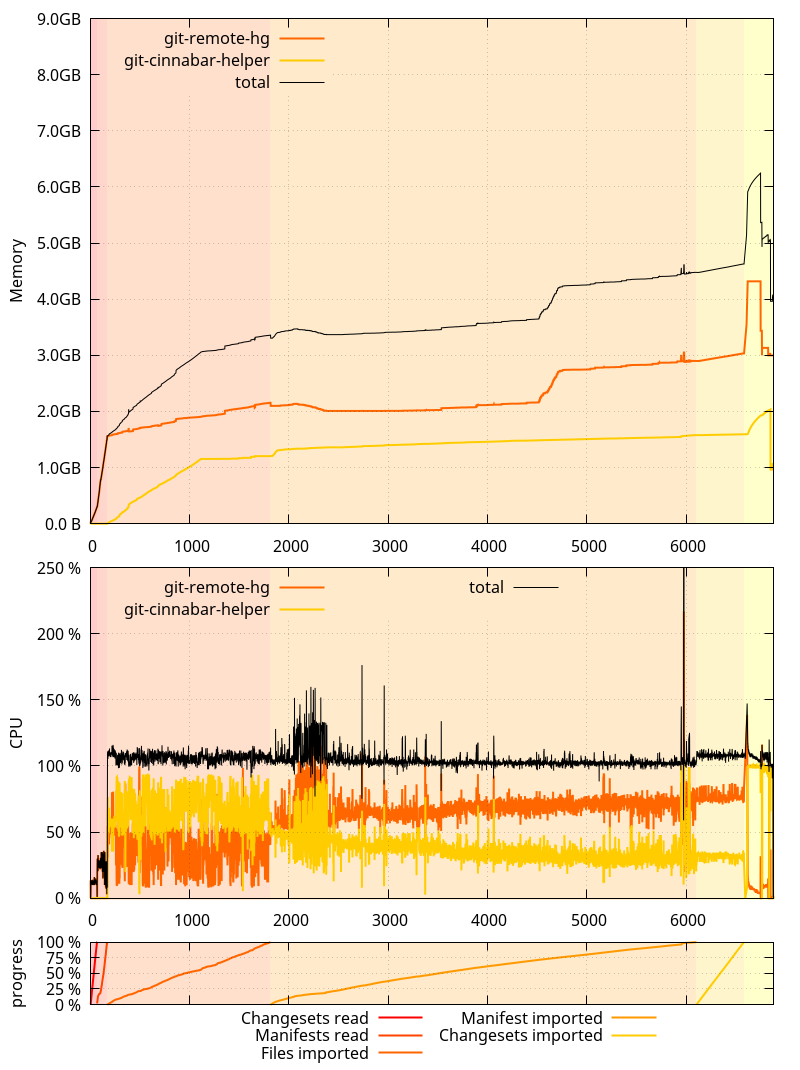
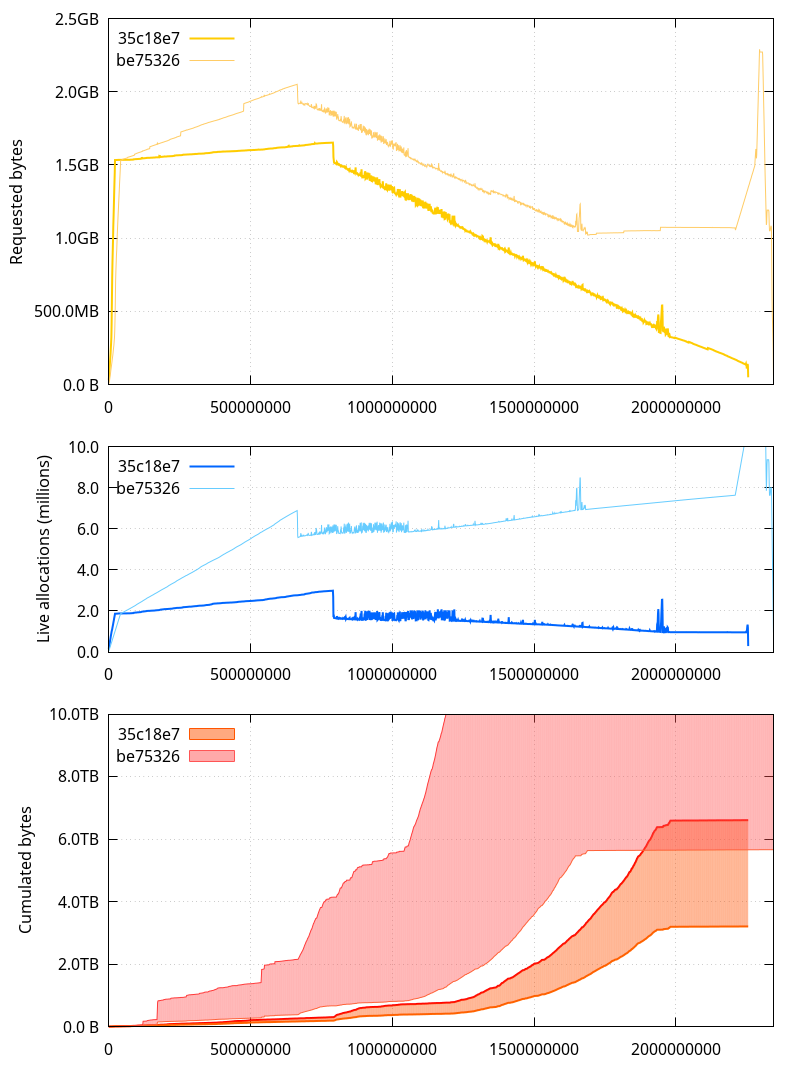
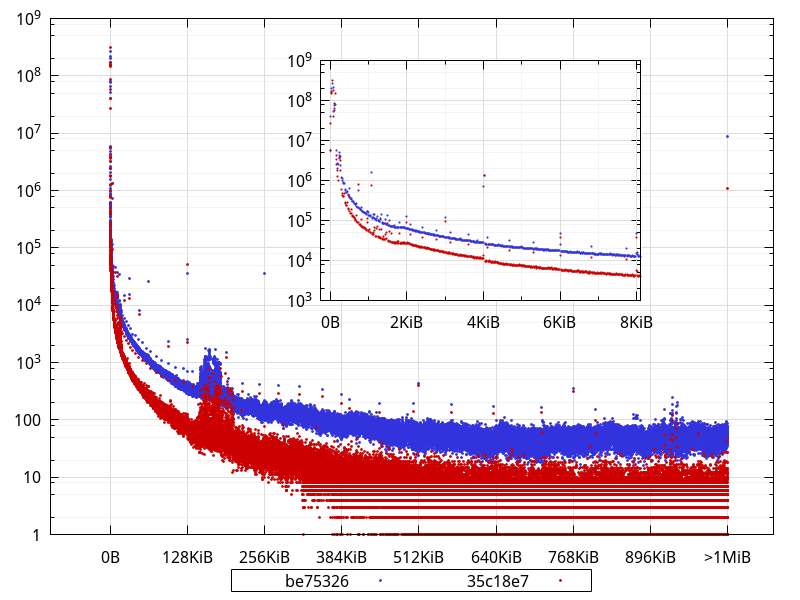
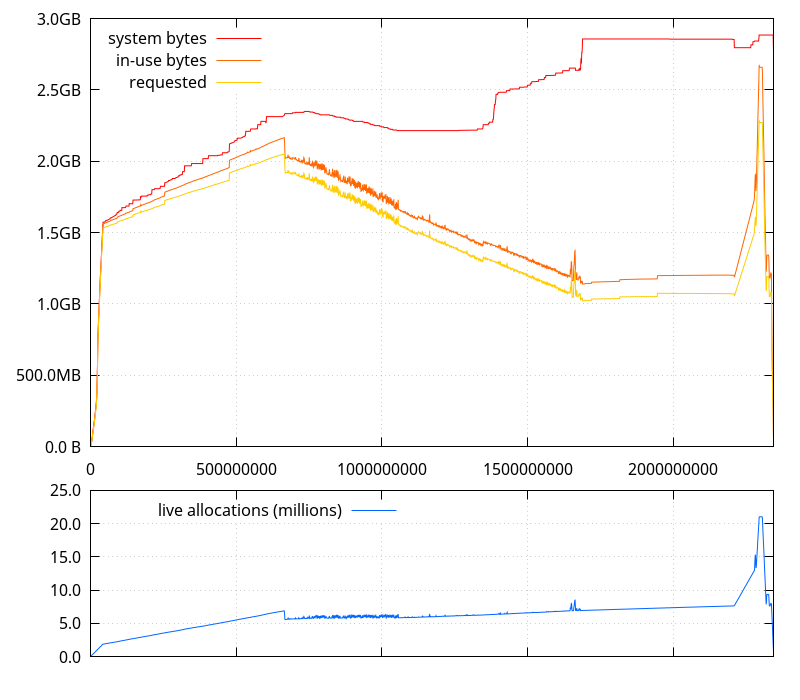
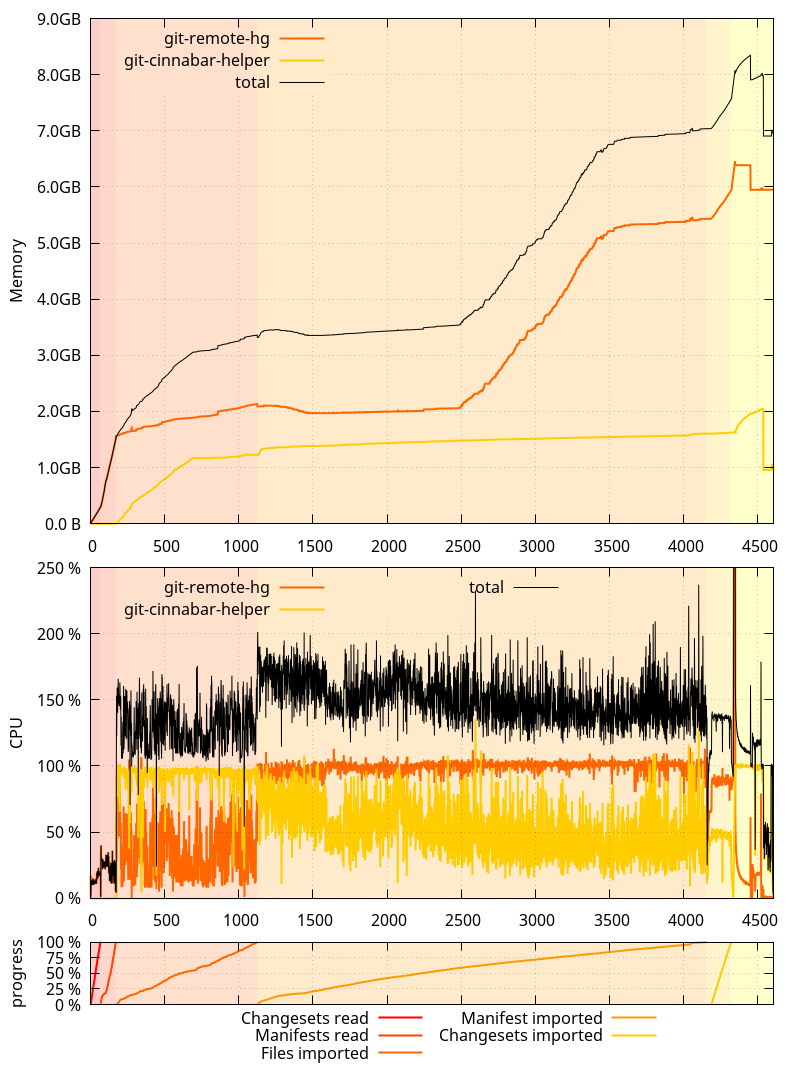
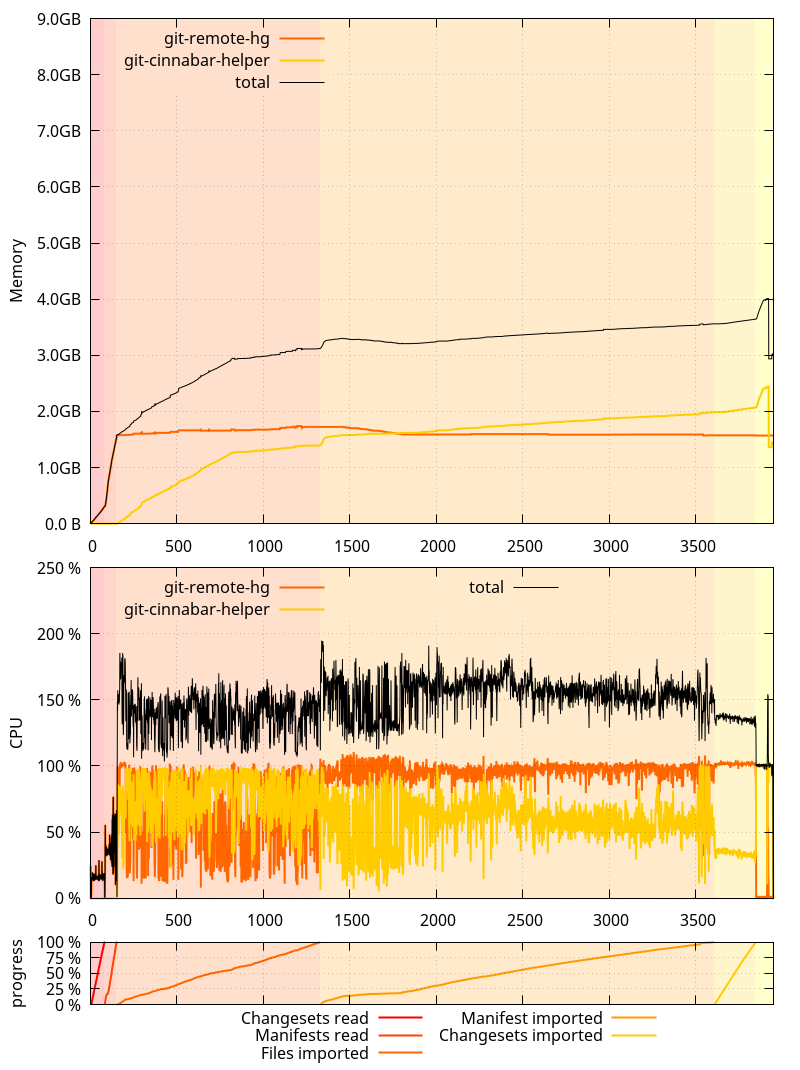
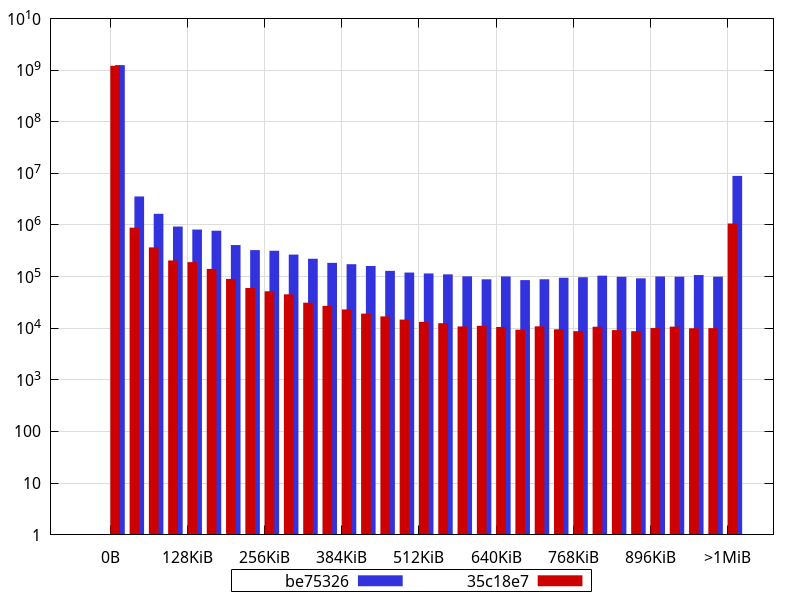
This all started when I figured out that git-cinnabar was using crazy amounts of memory when cloning mozilla-central. That pointed to memory allocation patterns that triggered a suboptimal behavior in the glibc memory allocator, and, while overall, git-cinnabar wasn t really abusing memory all things considered, it happened to be realloc()ating way too much. It also turned out that recent changes on the master branch had made most uses of fast-import synchronous, making the whole process significantly slower. This is where we started from on 0.4.0: And on the master branch as of be75326: An interesting thing to note here is that the glibc allocator runaway memory use was, this time, more pronounced on 0.4.0 than on master. It was the opposite originally, but as I mentioned in the past ASLR is making it not happen exactly the same way each time. While I m here, one thing I failed to mention in the previous posts is that all these measurements were done by cloning a local mercurial clone of mozilla-central, served from localhost via HTTP to eliminate the download time from hg.mozilla.org. And while mozilla-central itself has received new changesets since the first post, the local clone has not been updated, such that all subsequent clone tests I did were cloning the exact same repository under the exact same circumstances. After last blog post, I focused on the low hanging fruits identified so far: And this is how things now look on the master branch as of 35c18e7: So where does that put us? On a more granular level: What this means is that there s still room for improvement. But at this point, I d rather focus on other things. Logging all the memory allocations with the python allocator disabled still resulted in a 6.5GB compressed log file, containing 2.6 billion calls to malloc, calloc, free and realloc (down from 2.7 billions in be75326). The number of allocator calls done by the git-remote-hg process is down to 2.25 billions (from 2.34 billion in be75326). Surprisingly, while more things were moved to the helper, it still made less allocations than in be75326: 345 millions, down from 363 millions. Presumably, this is because the number of commands processed by the fast-import code was reduced. Let s now take a look at the various metrics we analyzed previously (the horizontal axis represents the number of allocator calls that happened before the measurement): A few observations to make here: [*] The upper bound is the sum of all sizes ever given to malloc, calloc, realloc etc. and the lower bound is the same, but removing the size of allocations passed as input to realloc (in practical words, this pretends reallocs never happened and that the final size for a given reallocated pointer is the one that counts) So presumably, some of the changes led to more short-lived allocations. Considering python uses its own allocator for sizes smaller than 512 bytes, it s probably not so much of a problem. But let s look at the distribution of buffer sizes (including all sizes given to realloc). (Bucket size is 16 bytes) What is not completely obvious from the logarithmic scale is that, in fact, 98.4% of the allocations are less than 512 bytes with the current master (35c18e7), and they were 95.5% with be75326. Interestingly, though, in absolute numbers, there are less allocations smaller than 512 bytes in current master than in be75326 (1,194,268,071 vs 1,214,784,494). This suggests the extra allocations that happen during some phases are larger than that. There are clearly less allocations across the board (apart from very few exceptions), and close to an order of magnitude less allocations larger than 1MiB. In fact, widening the bucket size to 32KiB shows an order of magnitude difference (or close) for most buckets: An interesting thing to note is how some sizes are largely overrepresented in the data with buckets of 16 bytes, like 768, 1104, 2048, 4128, with other smaller bumps for e.g. 2144, 2464, 2832, 3232, 3696, 4208, 4786, 5424, 6144, 6992, 7920 While some of those are powers of 2, most aren t, and some of them may actually represent objects sized with a power of 2, but that have an extra PyObject overhead. While looking at allocation stats, I got to wonder what the lifetimes of those allocations looked like. So I scanned the allocator logs and measured the distance between when an allocation is made and when it is freed, ignoring reallocs. To give a few examples of what I mean, the following allocation for p gets a lifetime of 0:
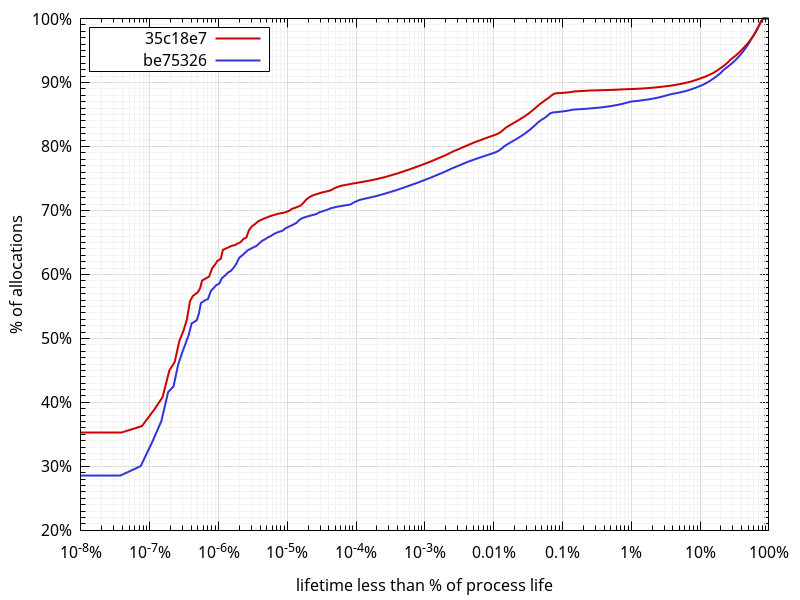
void *p = malloc(42);
free(p);
The following a lifetime of 1:
void *p = malloc(42);
void *other = malloc(42);
free(p);
And the following a lifetime of 1 as well:
void *p = malloc(42);
p = realloc(p, 84);
free(p);
(that is, it is not counted as two malloc/free pairs) The further away the free is from the corresponding malloc, the larger the lifetime. And the largest the lifetime can ever be is the total number of allocator function calls minus two, in the hypothetical case the very first allocation is freed as the very last (minus two because we defined the lifetime as the distance). What comes out of this data: All in all, what the data shows is that we re definitely in a better place now than we used to be a few days ago, and that there is still work to do on the memory front, but: So at this point, I won t look any deeper into the memory usage of the git-remote-hg python process, and will instead focus on the planned metadata storage changes. They will allow to share the metadata more easily (allowing faster and more straightforward gecko-dev graft), and will allow to import manifests earlier, which, as mentioned already, will help reduce memory use, but, more importantly, will allow to do more actual work while downloading the data. On slow networks, this is crucial to make clones and pulls faster.

Paul Wise: FLOSS Activities March 2017

Changes

Issues

Review

Administration
  • Debian systems: apply a patch to userdir-ldap, ask a local admin to reset a dead powerpc buildd, remove dead SH4 porterboxen from LDAP, fix perms on www.d.o OC static mirror, report false positives in an an automated abuse report, redirect 1 student to FAQs/support/DebianEdu, redirect 1 event organiser to partners/trademark/merchandise/DPL, redirect 1 guest account seeker to NM, redirect 1 @debian.org desirer to NM, redirect 1 email bounce to a changes@db.d.o user, redirect 2 people to the listmasters, redirect 1 person to Debian Pure Blends, redirect 1 user to a service admin and redirect 2 users to support
  • Debian packages site: deploy my ports/cruft changes
  • Debian wiki: poke at HP page history and advise a contributor, whitelist 13 email address, whitelist 1 domain, check out history of a banned IP, direct 1 hoster to DebConf17 sponsors team, direct 1 user to OpenStack packaging, direct 1 user to InstallingDebianOn and h-node.org, direct 2 users to different ways to help Debian and direct 1 emeritus DD on repository wiki page reorganisation
  • Debian QA: fix an issue with the PTS news, remove some debugging cruft I left behind, fix the usertags on a QA bug and deploy some code fixes
  • Debian mentors: security upgrades and service restarts
  • Openmoko: security upgrades and reboots

Communication

Sponsors The valgrind backport, samba and libthrift-perl bug reports were sponsored by my employer. All other work was done on a volunteer basis.

31 March 2017

Enrico Zini: Raspberry Pi as a Hi-Fi component

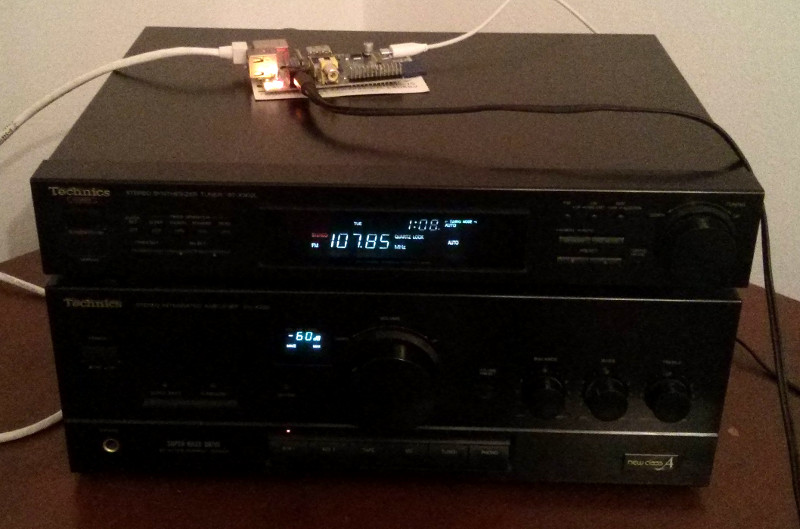
I have a 25 years old Technics hifi system that still works fine, and I gave it a new life by replacing the CD player and cassette player modules with a Raspberry Pi. Technics hifi with a Raspberry Pi attached Connection Each component of the hifi has a mains input and a mains plug that is used to power the next component. The element where the main power lead goes in is the radio component, which has a remote control receiver, a watch and a timer, and will power on the rest of the system when turned on by its power button, the remote control, or the alarm function. I disconnected the cassette and cd player modules, and plugged the Raspberry Pi phone charger/power supply in the free plug behind the amplifier module, at the end of the (now very short) power lead chain. I also connected the audio output of the Raspberry Pi to the CD input of my stereo. The advantage of CD over AUX is that the remote control buttons for switching audio sources don't cover the AUX inputs. With alsamixer I adjusted the output volume to match that of the radio component, so that I can switch between the two without surprising jumps in volume. I used alsactl store to save the mixer levels. Now when I turn the hifi on I also turn the Raspberry Pi on, and when I turn the hifi off, I also cut power from the Raspberry Pi. Operating system Operating system install instructions:
  1. I downloaded a Raspbian Jessie Lite image
  2. I put it on an SD card
  3. I created an empty ssh file on the boot partition
  4. I put the SD card on the Raspberry Pi and turned on the stereo.
  5. ssh pi@raspberrypi password raspberry
  6. sudo raspi-config to change the hostname, the password, and to enlarge the root partition to include all the rest of the space available in the SD card.
Music Player Daemon This is the set up of the music player part, with mpd.
apt install mpd
The configuration file is /etc/mpd.conf. The changes I made are: Make mpd accessible from my local network:
bind_to_address         "any"
Make mpd discoverable:
zeroconf_enabled                "yes"
zeroconf_name                   "stereo"
Allow anyone who visits me to control the playlist, and only me to run admin functions:
password                        "SECRET@read,add,control,admin"
default_permissions             "read,add,control"
At my first try, mpd hung when changing songs. I had to disable dmix by uncommenting the device option in the audio_output configuration. use_mmap is cargo-culted from the archlinux wiki.
audio_output  
        type            "alsa"
        name            "My ALSA Device"
        device          "hw:0,0"        # optional
        use_mmap        "yes"
 
If at some point I'll decide to use other audio software on the system, I'll probably want to play via pulseaudio. Sending music to the stereo I made a little script to sync the music directory on my laptop with /var/lib/mpd/music:
#!/bin/sh
rsync -avz --filter=". sync-stereo.filter" --copy-links --prune-empty-dirs --delete ./ pi@stereo:/var/lib/mpd/music
ssh pi@stereo "chmod u=rwX,go=rX -R /var/lib/mpd/music"
It uses this sync-stereo.filter rules file for rsync:
hide /_archive
include */
include **.mp3
hide *
mpd clients mpc
$ mpc -h stereo status
UltraCat - Unexpected Little Happenings
[playing] #15/22   0:03/4:06 (1%)
volume: 80%   repeat: off   random: on    single: off   consume: off
M.A.L.P. On my phone I installed M.A.L.P. and now I have a remote control for mpd. In its settings, I made a profile for home where I just had to set the hostname for the stereo and the admin password. Cantata On my laptop I installed cantata, set the hostname and password in the preferences, and had the client ready. Profit! Now I can take the remote control of my hi-fi, turn it on, and after a while mpd will resume playing the song that was playing when I last shut it down. I also have realtime player status on my phone and on my laptop, and can control music from either at any time. Friends who visit me can do that as well. Everything was rather straightforward, well documented and easy to replicate. The hardware is cheap and very easy to come by.

30 March 2017

Michal Čihař: Tests coverage from Windows builds revisited

Few months ago, I've written about getting coverage information from many platforms into one report. That approach worked, but I've always felt guilty for pushing almost thousand of files to Codecov. This week I finally found time to revisit this and make it work better and faster. Actually just uploading these files took about 30 minutes. Together with slow tests execution (which took about 30 minutes as well), we were reaching AppVeyor build time limits and builds did timeout quite often, what is not really nice result. I've started with rewriting the wrapper used to execute OpenCppCoverage. I've originally used Python for that, which is nice, but I thought the overhead must be noticeable. As it is not possible to execute Python script directly from CTest, it was wrapped in simple bat file, adding another overhead. Reimplementing this in C showed that there is indeed overhead, but this is not going to save more time than few minutes. Next obvious step was to look at uploading coverage files as this is really something what should be fast and not take such enormous time. When writing the original post, I've already tried to merge coverage data using OpenCppCoverage, but that showed to be too slow to make it actually work (the testsuite didn't complete in given 60 minutes). I was also looking at existing solutions to merge Cobertura XML files, but I've found nothing working reasonably fast. The problem is that all of these always merge two files at one step, making merging thousand files really slow job as you're constantly generating, parsing and processing the resulting xml file for 1000 times. Also these solutions are probably more generic that what I needed. In the end these files are just simple XML and merging them should not be hard. I was able to quickly write Python script to merge them. It does not support all of the Cobertura attributes, it just merges line based coverage (as this is the only thing which OpenCppCoverage generates), but works pretty fast and reliable. Overall the build time went down from 60 minutes to 35 minutes and I don't see much space to improve besides improving OpenCppCoverage speed, what is really out of scope for me. Actually older version (0.9.5.3) performs way faster than current one (0.9.6), which is 2-3 times slower.

Filed under: Debian English Gammu 0 comments

Shirish Agarwal: The tale of the dancing girl #nsfw

Demonstration of a Lapdance - Wikipedia

Demonstration of a Lapdance Wikipedia

The post will be adult/mature in nature. So those below 18 please excuse. The post is about an anecdote almost 20 years to date, The result its being posted is I had a dinner with a friend to whom I shared this and he thought it would be nice if I shared this hence sharing it. The conversation was about being young and foolish in which I shared the anecdote. The blog post was supposed to be about Aadhar which shocked me both in the way no political discourse happened and the way the public as well as public policy was gamed but that would have to wait for another day. History I left college in 1995. The anecdote/incident probably happened couple of years earlier so probably 1992-1993. At that time, I was in my teens and as a typical teenager I made few friends. One of those friends, who would remain nameless as since we drifted apart, and as I have not take permission from him, taking his name would not be a good idea. Anyway, this gentleman, let s call him Mr. X as an example. Couple of months before, he had bought an open jeep, similar but very different from the jeep being shown below. Open Jeep had become a fashion statement few months back (in those days) as a Salman khan starred movie had that and anybody who had money wanted one just like that.
Illustration of an open jeep, sadly its a military one - wikipedia

Illustration of an open jeep, sadly its a military one wikipedia

Those days we didn t have cell-phones and I had given my land-line phone number to very few friends as in those days, as the land-lines were a finicky instrument. One fine morning, I get a call from my friend telling he is going to come near my place and I should meet him at some xyz place and we would go for a picnic for the whole day and it is possible that we might return next day. As it was holidays and only a fool would throw away a chance to have a ride in open air jeep, I immediately agreed. I shared that my friends had organized a picnic and giving another friend s number (who didn t know anything) got permission and went to meet Mr. X. This was very early morning, around 0600 hrs. . After meeting him, he told that we would be going to Mumbai, take some more friends from there and then move on. In those days, a railway ticket from Shivaji Nagar to V.T. (now C.S.T.) costed INR 30/- . I had been to Mumbai few times before for various technical conferences and knew few cheap places to eat, I knew that going via train, we could go and come back spending at the most INR 150/- and still have some change left-over (today s meal at a roadside/street vendor easily passes that mark). The Journey I shared with him that it will be costly and I don t have any money to cover the fuel expenses and he said he would shoulder the expenses, he just wanted my company for the road. Those days, it was the scenic Old Mumbai-Pune highway and we took plenty of stops to admire that ghats (hills and valleys together). That journey must have taken around 7-8 hours while today by new Expressway, you could do the same thing by 2.5/3 hours. Anyhow, we reached to some swanky hotel in South Mumbai. South Mumbai was not the financial powerhouse that it today is, there was mix of very old buildings and new buildings like the swanky hotel that we had checked in. I have no memory nor any idea whether it was 1 class, 3 class or 5 class and could have cared less as had been tired from the journey. We checked in, I had a long warm water bath and then slept in the king-size bed with curtains drawn. Evening came and we took the jeep and picked up 2-3 of his friends who were from my age or a year or two older and we went to Nariman Point. Seeing the Queen s necklace from Nariman Point at night is a sight in itself. Keeping with the innocence, I was under the impression that we had arrived at our destination, at this our host, Mr. X and his Bombaiya friends had a quiet laugh saying its a young night still. We must have whiled away couple of hours, having chai and throwing rocks in the sea. The Meeting After a while, Mr. X took us to another swanky place. My eyes were out of my sockets as this seemed to be as elitist a place as could be. I saw many White European women in various stages of undress pole-dancing and lap-dancing. I had recently (in those days) come to know the term but was under the impression that it was something that happened in Europe and States only. I had no idea that lap-dancing was older than my birth as according to Wikipedia. So looking back now, I am not surprised that in two decades the concept crossed the oceans. Again, Mr. X being the host, agreed to bear all the costs and all of us had food, drink and a lap-dance from any of the dancers on the floor. As I was young and probably shy (still am) I asked Mr. X s help to pick a girl/woman for me. The woman whom he picked was auburn-aired, was either my age or a year or two older/younger to me. What proceeded next was about 20-30 minutes of totally sexualized erotic experience. While he and all his friends picked girls to go all the way, I was hesitant to let loose. Maybe it was due to my lack of courage or inexperience, maybe it was not in my city so couldn t predict the outcome, maybe was just afraid that reality might mar fantasy, I dunno till date. Although we kissed and necked a lot, I guess that should count for something. The conversation After all my friends had gone to the various rooms, sometime after I excused myself, went to the loo myself, peed a bit, splashed cold water on self, came out and had couple of glasses of water and came back to my seat. The lady came back and I shared that I was not interested in going further and while she was beautiful, I just didn t have the guts. I did ask her if she would give me company though for sometime as I didn t know anyone else at that place. Our conversation was more about her than me as I had more or less an average life upto that moment. There were only three unorthodox things that I had done before meeting her. I had drunk wines of different types, smoked weed and had a Magic Mushrooms experience the year before with another group of friends I had made there. Goa in those days was simply magical in those days but that probably would need its story/own blog post. When I enquired about her, she shared she was from Russia and she rattled off more than half a dozen places around the world where she had been to and this was her second or third stint in Mumbai and she wasn t at all unhappy about the lifestyle and choices she was leading. I had no answer for her as a young penniless college-going student. Her self-confidence and the way she carried herself was impressive, with or without clothes. During course of the conversation she shared a couple of contacts from whom I could get better weed at slightly higher price if I were in Goa. Few months later, those contacts turned out to be true. After sometime, we took all the women and ourselves, around 8-9 people in his jeep (how he negotiated that is beyond me) went to a hygienic Pani puri and Bhel (puffed rice mixed with variety of spices typically tomato, potato, coriander chutney as well as Tamarind Chutney among other things) place and moved them to tears (the spices in bhel and Pani puri did it for them) and this was when we had explicitly asked the bhel-wala guy to make it extremely mild with just a hint of spice in it. Anyways, sometime later, we dropped them at the same place, dropped his friends and came back to the hotel we booked and got drunk again. After-effects Few years later, it came in the newspapers/media that while India had broken out of financial isolation just few years back (1991) and were profiting from it, many countries of the former USSR were going the other way around and hence there was huge human trafficking and immigration that had taken place. This was in-line with what the lady/woman/Miss X had shared with me. The latest trigger The latest trigger happened couple of months back where I learnt of a hero flight attendant saving a girl from human-trafficking. Till date, I am unsure whether she was doing it willingly or putting a brave smile in front of me, because even if she had confided me in any way, I probably would have been too powerless to help her in any-way. I just don t know. Foolishness thy name While my friend took advantage of my innocence and introduced me to a world which otherwise I would probably not know exists, it could have easily have gone some other way as well. While I m still unsure of the choices I made, I was and am happy that I was able to strike a conversation with her and attempt to reach the person therein. Was it the truth or an elaborate fabricated lie to protect myself and herself, this I will never know. Oppression I understand the fact that as a customer or somebody who is taking part in either of those performances or experiences it isn t easy in any way to know/say that whether the performer is doing it wilfully or not as the experiences are in tightly controlled settings.
Filed under: Miscellenous Tagged: #anecdote, #confusion, #elitist, #growing up, #lap dance, #NSFW, #Open Jeep, Mumbai

29 March 2017

Lars Wirzenius: A tiny PC as a router

We needed a router and wifi access point in the office, and simultaneously both I and my co-worker Ivan needed such a thing at our respective homes. After some discussion, and after reading articles in Ars Technica about building PCs to act as routers, we decided to do just that. We got some hardware:
Component Model Cost
Barebone Qotom Q190G4, VGA, 2x USB 2.0, 134x126x36mm, fanless 130
CPU Intel J1900, 2-2.4GHz quad-core -
NIC Intel WG82583, 4x 10/100/1000 -
Memory Crucial CT102464BF160B, 8GB DDR3L-1600 SODIMM 1.35V CL11 40
SSD Kingston SSDNow mS200, 60GB mSATA 42
WLAN AzureWave AW-NU706H, Ralink RT3070L, 300M 802.11b/g/n, half mPCIe 17
mPCIe adapter Half to full mPCIe adapter 3
Antennas 2x 2.4/5GHz 6dBi, RP-SMA, U.FL Cables 7
These were bought at various online shops, including AliExpress and verkkokauppa.com. After assembling the hardware, we installed Debian on them: There's a lot of limitations and problems: If you'd like to use the images and Ansible playbooks, please do. We'd be happy to get feedback, bug reports, and patches. Send them to me (liw@liw.fi) or my ticketing system (bugs@liw.fi).

28 March 2017

Keith Packard: DRM-lease

DRM display resource leasing (kernel side) So, you've got a fine head-mounted display and want to explore the delights of virtual reality. Right now, on Linux, that means getting the window system to cooperate because the window system is the DRM master and holds sole access to all display resources. So, you plug in your device, play with RandR to get it displaying bits from the window system and then carefully configure your VR application to use the whole monitor area and hope that the desktop will actually grant you the boon of page flipping so that you will get reasonable performance and maybe not even experience tearing. Results so far have been mixed, and depend on a lot of pieces working in ways that aren't exactly how they were designed to work. We could just hack up the window system(s) and try to let applications reserve the HMD monitors and somehow removing them from the normal display area so that other applications don't randomly pop up in the middle of the screen. That would probably work, and would take advantage of much of the existing window system infrastructure for setting video modes and performing page flips. However, we've got a pretty spiffy standard API in the kernel for both of those, and getting the window system entirely out of the way seems like something worth trying. I spent a few hours in Hobart chatting with Dave Airlie during LCA and discussed how this might actually work. Goals
  1. Use KMS interfaces directly from the VR application to drive presentation to the HMD.
  2. Make sure the window system clients never see the HMD as a connected monitor.
  3. Maybe let logind (or other service) manage the KMS resources and hand them out to the window system and VR applications.
Limitations
  1. Don't make KMS resources appear and disappear. It turns out applications get confused when the set of available CRTCs, connectors and encoders changes at runtime.
An Outline for Multiple DRM masters By the end of our meeting in Hobart, Dave had sketched out a fairly simple set of ideas with me. We'd add support in the kernel to create additional DRM masters. Then, we'd make it possible to 'hide' enough state about the various DRM resources so that each DRM master would automagically use disjoint subsets of resources. In particular, we would.
  1. Pretend that connectors were always disconnected
  2. Mask off crtc and encoder bits so that some of them just didn't seem very useful.
  3. Block access to resources controlled by other DRM masters, just in case someone tried to do the wrong thing.
Refinement with Eric over Swedish Pancakes A couple of weeks ago, Eric Anholt and I had breakfast at the original pancake house and chatted a bit about this stuff. He suggested that the right interface for controlling these new DRM masters was through the existing DRM master interface, and that we could add new ioctls that the current DRM master could invoke to create and manage them. Leasing as a Model I spent some time just thinking about how this might work and came up with a pretty simple metaphor for these new DRM masters. The original DRM master on each VT "owns" the output resources and has final say over their use. However, a DRM master can create another DRM master and "lease" resources it has control over to the new DRM master. Once leased, resources cannot be controlled by the owner unless the owner cancels the lease, or the new DRM master is closed. Here's some terminology:
DRM Master
Any DRM file which can perform mode setting.
Owner
The original DRM Master, created by opening /dev/dri/card*
Lessor
A DRM master which has leased out resources to one or more other DRM masters.
Lessee
A DRM master which controls resources leased from another DRM master. Each Lessee leases resources from a single Lessor.
Lessee ID
An integer which uniquely identifies a lessee within the tree of DRM masters descending from a single Owner.
Lease
The contract between the Lessor and Lessee which identifies which resources which may be controlled by the Lessee. All of the resources must be owned by or leased to the Lessor.
With Eric's input, the interface to create a lease was pretty simple to write down:
int drmModeCreateLease(int fd,
               const uint32_t *objects,
               int num_objects,
               int flags,
               uint32_t *lessee_id);
Given an FD to a DRM master, and a list of objects to lease, a new DRM master FD is returned that holds a lease to those objects. 'flags' can be any combination of O_CLOEXEC and O_NONBLOCK for the newly minted file descriptor. Of course, the owner might want to take some resources back, or even grant new resources to the lessee. So, I added an interface that rewrites the terms of the lease with a new set of objects:
int drmModeChangeLease(int fd,
               uint32_t lessee_id,
               const uint32_t *objects,
               int num_objects);
Note that nothing here makes any promises about the state of the objects across changes in the lease status; the lessor and lessee are expected to perform whatever modesetting is required for the objects to be useful to them. Window System Integration There are two ways to integrate DRM leases into the window system environment:
  1. Have logind "lease" most resources to the window system. When a HMD is connected, it would lease out suitable resources to the VR environment.
  2. Have the window system "own" all of the resources and then add window system interfaces to create new DRM masters leased from its DRM master.
I'll probably go ahead and do 2. in X and see what that looks like. One trick with any of this will be to hide HMDs from any RandR clients listening in on the window system. You probably don't want the window system to tell the desktop that a new monitor has been connected, have it start reconfiguring things, and then have your VR application create a new DRM master, making the HMD appear to have disconnected to the window system and have that go reconfigure things all over again. I'm not sure how this might work, but perhaps having the VR application register something like a passive grab on hot plug events might make sense? Essentially, you want it to hear about monitor connect events, go look to see if the new monitor is one it wants, and if not, release that to other X clients for their use. This can be done in stages, with the ability to create a new DRM master over X done first, and then cleaning up the hotplug stuff later on. Current Status I hacked up the kernel to support the drmModeCreateLease API, and then hacked up kmscube to run two threads with different sets of KMS resources. That ran for nearly a minute before crashing and requiring a reboot. I think there may be some locking issues with page flips from two threads to the same device. I think I also made the wrong decision about how to handle lessors closing down. I tried to let the lessors get deleted and then 'orphan' the lessees. I've rewritten that so that lessees hold a reference on their lessor, keeping the lessor in place until the lessee shuts down. I've also written the kernel parts of the drmModeChangeLease support. Questions

Sylvain Beucler: Practical basics of reproducible builds 2

Let's review what we learned so far: We stopped when compiling a PE .exe produced a varying output.
It turns out that PE carries a build date timestamp. The spec says that bound DLLs timestamps are refered to in the "Delay-Load Directory Table". Maybe that's also the date Windows displays when a system-wide DLL is about to be replaced, too.
Build timestamps looks unused in .exe files though. Anyway, Stephen Kitt pointed out (thanks!) that Debian's MinGW linker binutils-mingw-w64 has an upstream-pending patch that sets the timestamp to SOURCE_DATE_EPOCH if set. Alternatively, one can pass -Wl,--no-insert-timestamp to set it to 0 (though see caveats below):
$ i686-w64-mingw32.static-gcc -Wl,--no-insert-timestamp hello.c -o hello.exe 
$ md5sum hello.exe 
298f98d74e6e913628a8b74514eddcb2  hello.exe
$ /opt/mxe/usr/bin/i686-w64-mingw32.static-gcc -Wl,--no-insert-timestamp hello.c -o hello.exe 
$ md5sum hello.exe 
298f98d74e6e913628a8b74514eddcb2  hello.exe
If we don't care about debug symbols, unlike with ELF, stripped PE binaries look stable too!
$ cd repro/
$ i686-w64-mingw32.static-gcc hello.c -o hello.exe && i686-w64-mingw32.static-strip hello.exe
$ md5sum hello.exe 
6e07736bf8a59e5397c16e799699168d  hello.exe
$ i686-w64-mingw32.static-gcc hello.c -o hello.exe && i686-w64-mingw32.static-strip hello.exe
$ md5sum hello.exe 
6e07736bf8a59e5397c16e799699168d  hello.exe
$ cd ..
$ cp -a repro repro2/
$ cd repro2/
$ i686-w64-mingw32.static-gcc hello.c -o hello.exe && i686-w64-mingw32.static-strip hello.exe
$ md5sum hello.exe 
6e07736bf8a59e5397c16e799699168d  hello.exe
Now that we have the main executable covered, what about the dependencies?
Let's see how well MXE compiles SDL2:
$ cd /opt/mxe/
$ cp -a ./usr/i686-w64-mingw32.static/lib/libSDL2.a /tmp
$ rm -rf * && git checkout .
$ make sdl2
$ md5sum ./usr/i686-w64-mingw32.static/lib/libSDL2.a /tmp/libSDL2.a 
68909ab13181b1283bd1970a56d41482  ./usr/i686-w64-mingw32.static/lib/libSDL2.a
68909ab13181b1283bd1970a56d41482  /tmp/libSDL2.a
Neat - what about another build directory?
$ cd /usr/srx/mxe
$ make sdl2
$ md5sum usr/i686-w64-mingw32.static/lib/libSDL2.a /tmp/libSDL2.a 
c6c368323927e2ae7adab7ee2a7223e9  usr/i686-w64-mingw32.static/lib/libSDL2.a
68909ab13181b1283bd1970a56d41482  /tmp/libSDL2.a
$ ls -l ./usr/i686-w64-mingw32.static/lib/libSDL2.a /tmp/libSDL2.a 
-rw-r--r-- 1 me me 5861536 mars  23 21:04 /tmp/libSDL2.a
-rw-r--r-- 1 me me 5862488 mars  25 19:46 ./usr/i686-w64-mingw32.static/lib/libSDL2.a
Well that was expected.
But what about the filesystem order?
With such an automated build, could potential variations in the order of files go undetected?
Would the output be different on another filesystem format (ext4 vs. btrfs...)? It was a good opportunity to test the disorderfs fuse-based tool.
And while I'm at it, check if reprotest is easy enough to use (the manpage is scary).
Let's redo our basic tests with it - basic usage is actually very simple:
$ apt-get install reprotest disorderfs faketime
$ reprotest 'make hello' 'hello'
...
will vary: environment
will vary: fileordering
will vary: home
will vary: kernel
will vary: locales
will vary: exec_path
will vary: time
will vary: timezone
will vary: umask
...
--- /tmp/tmpk5uipdle/control_artifact/
+++ /tmp/tmpk5uipdle/experiment_artifact/
    --- /tmp/tmpk5uipdle/control_artifact/hello
  +++ /tmp/tmpk5uipdle/experiment_artifact/hello
  stat  
    @@ -1,8 +1,8 @@
     
       Size: 8632       Blocks: 24         IO Block: 4096   regular file
     Links: 1
    -Access: (0755/-rwxr-xr-x)  Uid: ( 1000/      me)   Gid: ( 1000/      me)
    +Access: (0775/-rwxrwxr-x)  Uid: ( 1000/      me)   Gid: ( 1000/      me)
     
     Modify: 1970-01-01 00:00:00.000000000 +0000
     
      Birth: -
# => OK except for permissions
$ reprotest 'make hello && chmod 755 hello' 'hello'
=======================
Reproduction successful
=======================
No differences in hello
c8f63b73265e69ab3b9d44dcee0ef1d2815cdf71df3c59635a2770e21cf462ec  hello
$ reprotest 'make hello CFLAGS="-g -O2"' 'hello'
# => lots of differences, as expected
Now let's apply to the MXE build.
We keep the same build path, and also avoid using linux32 (because MXE would then recompile all the host compiler tools for 32-bit):
$ reprotest --dont-vary build_path,kernel 'touch src/sdl2.mk && make sdl2 && cp -a usr/i686-w64-mingw32.static/lib/libSDL2.a .' 'libSDL2.a'
=======================
Reproduction successful
=======================
No differences in libSDL2.a
d9a39785fbeee5a3ac278be489ac7bf3b99b5f1f7f3e27ebf3f8c60fe25086b5  libSDL2.a
That checks!
What about a full MXE environment?
$ reprotest --dont-vary build_path,kernel 'make clean && make sdl2 sdl2_gfx sdl2_image sdl2_mixer sdl2_ttf libzip gettext nsis' 'usr'
# => changes in installation dates
# => timestamps in .exe files (dbus, ...)
# => libicu doesn't look reproducible (derb.exe, genbrk.exe, genccode.exe...)
# => apparently ar timestamp variations in libaclui
Most libraries look reproducible enough.
ar differences may go away at FreeDink link time since I'm aiming at a static build. Let's try! First let's see how FreeDink behaves with stable dependencies.
We can compile with -Wl,--no-insert-timestamp and strip the binaries in a first step.
There are various issues (timestamps, permissions) but first let's check the executables themselves:
$ cd freedink/
$ reprotest --dont-vary build_path 'mkdir cross-woe-32/ && cd cross-woe-32/ && export PATH=/opt/mxe/usr/bin:$PATH && LDFLAGS='-Wl,--no-insert-timestamp' ../configure --host=i686-w64-mingw32.static --enable-static && make -j$(nproc) && make install-strip DESTDIR=$(pwd)/destdir' 'cross-woe-32/destdir/usr/local/bin'
# => executables are identical!
# Same again, just to make sure
$ reprotest --dont-vary build_path 'mkdir cross-woe-32/ && cd cross-woe-32/ && export PATH=/opt/mxe/usr/bin:$PATH && LDFLAGS='-Wl,--no-insert-timestamp' ../configure --host=i686-w64-mingw32.static --enable-static && make -j$(nproc) && make install-strip DESTDIR=$(pwd)/destdir' 'cross-woe-32/destdir/usr/local/bin'
    --- /tmp/tmp2yw0sn4_/control_artifact/bin/freedink.exe
  +++ /tmp/tmp2yw0sn4_/experiment_artifact/bin/freedink.exe
    @@ -2,20 +2,20 @@
     00000010: b800 0000 0000 0000 4000 0000 0000 0000  ........@.......
     00000020: 0000 0000 0000 0000 0000 0000 0000 0000  ................
     00000030: 0000 0000 0000 0000 0000 0000 8000 0000  ................
     00000040: 0e1f ba0e 00b4 09cd 21b8 014c cd21 5468  ........!..L.!Th
     00000050: 6973 2070 726f 6772 616d 2063 616e 6e6f  is program canno
     00000060: 7420 6265 2072 756e 2069 6e20 444f 5320  t be run in DOS 
     00000070: 6d6f 6465 2e0d 0d0a 2400 0000 0000 0000  mode....$.......
    -00000080: 5045 0000 4c01 0a00 e534 0735 0000 0000  PE..L....4.5....
    +00000080: 5045 0000 4c01 0a00 0000 0000 0000 0000  PE..L...........
     00000090: 0000 0000 e000 0e03 0b01 0219 00f2 3400  ..............4.
     000000a0: 0022 4e00 0050 3b00 c014 0000 0010 0000  ."N..P;.........
     000000b0: 0010 3500 0000 4000 0010 0000 0002 0000  ..5...@.........
     000000c0: 0400 0000 0100 0000 0400 0000 0000 0000  ................
    -000000d0: 00e0 8900 0004 0000 7662 4e00 0200 0000  ........vbN.....
    +000000d0: 00e0 8900 0004 0000 89f8 4e00 0200 0000  ..........N.....
     000000e0: 0000 2000 0010 0000 0000 1000 0010 0000  .. .............
     000000f0: 0000 0000 1000 0000 00a0 8700 b552 0000  .............R..
     00000100: 0000 8800 d02d 0000 0050 8800 5006 0000  .....-...P..P...
     00000110: 0000 0000 0000 0000 0000 0000 0000 0000  ................
     00000120: 0060 8800 4477 0100 0000 0000 0000 0000  . ..Dw..........
     00000130: 0000 0000 0000 0000 0000 0000 0000 0000  ................
     00000140: 0440 8800 1800 0000 0000 0000 0000 0000  .@..............
  stat  
      @@ -1,8 +1,8 @@
       
         Size: 5121536       Blocks: 10008      IO Block: 4096   regular file
       Links: 1
       Access: (0755/-rwxr-xr-x)  Uid: ( 1000/      me)   Gid: ( 1000/      me)
       
      -Modify: 2017-03-26 01:26:35.233841833 +0000
      +Modify: 2017-03-26 01:27:01.829592505 +0000
       
        Birth: -
Gah...
AFAIU there is something random in the linking phase, and sometimes the timestamp is removed, sometimes it's not.
Not very easy to track but I believe I reproduced it with the "hello" example:
# With MXE:
$ reprotest 'i686-w64-mingw32.static-gcc hello.c -I /opt/mxe/usr/i686-w64-mingw32.static/include -I/opt/mxe/usr/i686-w64-mingw32.static/include/SDL2 -L/opt/mxe/usr/i686-w64-mingw32.static/lib -lmingw32 -Dmain=SDL_main -lSDL2main -lSDL2 -lSDL2main -Wl,--no-insert-timestamp -luser32 -lgdi32 -lwinmm -limm32 -lole32 -loleaut32 -lshell32 -lversion -o hello && chmod 700 hello' 'hello'
# => different
# => maybe because it imports the build timestamp from -lSDL2main
# With Debian's MinGW (but without SOURCE_DATE_EPOCH):
$ reprotest 'i686-w64-mingw32-gcc hello.c -I /opt/mxe/usr/i686-w64-mingw32.static/include -I/opt/mxe/usr/i686-w64-mingw32.static/include/SDL2 -L/opt/mxe/usr/i686-w64-mingw32.static/lib -lmingw32 -Dmain=SDL_main -lSDL2main -lSDL2 -lSDL2main -Wl,--no-insert-timestamp -luser32 -lgdi32 -lwinmm -limm32 -lole32 -loleaut32 -lshell32 -lversion -o hello && chmod 700 hello' 'hello'
=======================
Reproduction successful
=======================
No differences in hello
0b2d99dc51e2ad68ad040d90405ed953a006c6e58599beb304f0c2164c7b83a2  hello
# Let's remove -Dmain=SDL_main and let our main() have precedence over the one in -lSDL2main:
$ reprotest 'i686-w64-mingw32.static-gcc hello.c -I /opt/mxe/usr/i686-w64-mingw32.static/include -I/opt/mxe/usr/i686-w64-mingw32.static/include/SDL2 -L/opt/mxe/usr/i686-w64-mingw32.static/lib -lmingw32 -lSDL2main -lSDL2 -lSDL2main -Wl,--no-insert-timestamp -luser32 -lgdi32 -lwinmm -limm32 -lole32 -loleaut32 -lshell32 -lversion -o hello && chmod 700 hello' 'hello'
=======================
Reproduction successful
=======================
No differences in hello
6c05f75eec1904d58be222cc83055d078b4c3be8b7f185c7d3a08b9a83a2ef8d  hello
$ LANG=C i686-w64-mingw32.static-ld --version  # MXE
GNU ld (GNU Binutils) 2.25.1
Copyright (C) 2014 Free Software Foundation, Inc.
$ LANG=C i686-w64-mingw32-ld --version  # Debian
GNU ld (GNU Binutils) 2.27.90.20161231
Copyright (C) 2016 Free Software Foundation, Inc.
It looks like there is a random behavior in binutils 2.25, coupled with SDL2's wrapping of my main(). So FreeDink is nearly reproducible, except for this build timestamp issue that pops up in all kind of situations. In the worse case I can zero it out, or patch MXE's binutils until they upgrade. More importantly, what if I recompile FreeDink and the dependencies twice?
$ (cd /opt/mxe/ && make clean && make sdl2 sdl2_gfx sdl2_image sdl2_mixer sdl2_ttf glm libzip gettext nsis)
$ (mkdir cross-woe-32/ && cd cross-woe-32/ \
  && export PATH=/opt/mxe/usr/bin:$PATH \
  && LDFLAGS="-Wl,--no-insert-timestamp" ../configure --host=i686-w64-mingw32.static --enable-static \
  && make V=1 -j$(nproc) \
  && make install-strip DESTDIR=$(pwd)/destdir)
$ mv cross-woe-32/ cross-woe-32-1/
# Same again...
$ mv cross-woe-32/ cross-woe-32-2/
$ diff -ru cross-woe-32-1/destdir/ cross-woe-32-2/destdir/
[nothing]
Yay!
I could not reproduce the build timestamp issue in the stripped binaries, though it was still varying in the unstripped src/freedinkedit.exe.
I mentioned there was other changes noticed by diffoscope. That one is interesting.
Could be ignored, but we want to generate an identical binary package/archive too, right?
That's where archive meta-data matters.
make INSTALL="$(which install) install -p" could help for static files, but not generated ones.
The doc suggests clamping all files to SOURCE_DATE_EPOCH - i.e. all generated files will have their date set at that timestamp:
$ export SOURCE_DATE_EPOCH=$(date +%s) \
  && reprotest --dont-vary build_path \
  'make ... && find destdir/ -newermt "@$ SOURCE_DATE_EPOCH " -print0   xargs -0r touch --no-dereference --date="@$ SOURCE_DATE_EPOCH "' 'cross-woe-32/destdir/'
Caused by varying umask.
I attempted to mitigate the issue by playing with make install MKDIR_P="mkdir -p -m 755" (1).
However even mkdir -p -m ... does not set permissions for intermediate directories.
Maybe it's better to set and record the umask...
So, aside from minor issues such as BuildIDs and build timestamps, the toolchain is pretty stable as of now.
The issue is more about fixing and recording the build environment.
Which is probably the next challenge :)

23 March 2017

Simon McVittie: GTK hackfest 2017: D-Bus communication with containers

At the GTK hackfest in London (which accidentally became mostly a Flatpak hackfest) I've mainly been looking into how to make D-Bus work better for app container technologies like Flatpak and Snap. The initial motivating use cases are: At the moment, Flatpak runs a D-Bus proxy for each app instance that has access to D-Bus, connects to the appropriate bus on the app's behalf, and passes messages through. That proxy is in a container similar to the actual app instance, but not actually the same container; it is trusted to not pass messages through that it shouldn't pass through. The app-identification mechanism works in practice, but is Flatpak-specific, and has a known race condition due to process ID reuse and limitations in the metadata that the Linux kernel maintains for AF_UNIX sockets. In practice the use of X11 rather than Wayland in current systems is a much larger loophole in the container than this race condition, but we want to do better in future. Meanwhile, Snap does its sandboxing with AppArmor, on kernels where it is enabled both at compile-time (Ubuntu, openSUSE, Debian, Debian derivatives like Tails) and at runtime (Ubuntu, openSUSE and Tails, but not Debian by default). Ubuntu's kernel has extra AppArmor features that haven't yet gone upstream, some of which provide reliable app identification via LSM labels, which dbus-daemon can learn by querying its AF_UNIX socket. However, other kernels like the ones in openSUSE and Debian don't have those. The access-control (AppArmor mediation) is implemented in upstream dbus-daemon, but again doesn't work portably, and is not sufficiently fine-grained or flexible to do some of the things we'll likely want to do, particularly in dconf. After a lot of discussion with dconf maintainer Allison Lortie and Flatpak maintainer Alexander Larsson, I think I have a plan for fixing this. This is all subject to change: see fd.o #100344 for the latest ideas. Identity model Each user (uid) has some uncontained processes, plus 0 or more containers. The uncontained processes include dbus-daemon itself, desktop environment components such as gnome-session and gnome-shell, the container managers like Flatpak and Snap, and so on. They have the user's full privileges, and in particular they are allowed to do privileged things on the user's session bus (like running dbus-monitor), and act with the user's full privileges on the system bus. In generic information security jargon, they are the trusted computing base; in AppArmor jargon, they are unconfined. The containers are Flatpak apps, or Snap apps, or other app-container technologies like Firejail and AppImage (if they adopt this mechanism, which I hope they will), or even a mixture (different app-container technologies can coexist on a single system). They are containers (or container instances) and not "apps", because in principle, you could install com.example.MyApp 1.0, run it, and while it's still running, upgrade to com.example.MyApp 2.0 and run that; you'd have two containers for the same app, perhaps with different permissions. Each container has an container type, which is a reversed DNS name like org.flatpak or io.snapcraft representing the container technology, and an app identifier, an arbitrary non-empty string whose meaning is defined by the container technology. For Flatpak, that string would be another reversed DNS name like com.example.MyGreatApp; for Snap, as far as I can tell it would look like example-my-great-app. The container technology can also put arbitrary metadata on the D-Bus representation of a container, again defined and namespaced by the container technology. For instance, Flatpak would use some serialization of the same fields that go in the Flatpak metadata file at the moment. Finally, the container has an opaque container identifier identifying a particular container instance. For example, launching com.example.MyApp twice (maybe different versions or with different command-line options to flatpak run) might result in two containers with different privileges, so they need to have different container identifiers. Contained server sockets App-container managers like Flatpak and Snap would create an AF_UNIX socket inside the container, bind() it to an address that will be made available to the contained processes, and listen(), but not accept() any new connections. Instead, they would fd-pass the new socket to the dbus-daemon by calling a new method, and the dbus-daemon would proceed to accept() connections after the app-container manager has signalled that it has called both bind() and listen(). (See fd.o #100344 for full details.) Processes inside the container must not be allowed to contact the AF_UNIX socket used by the wider, uncontained system - if they could, the dbus-daemon wouldn't be able to distinguish between them and uncontained processes and we'd be back where we started. Instead, they should have the new socket bind-mounted into their container's XDG_RUNTIME_DIR and connect to that, or have the new socket set as their DBUS_SESSION_BUS_ADDRESS and be prevented from connecting to the uncontained socket in some other way. Those familiar with the kdbus proposals a while ago might recognise this as being quite similar to kdbus' concept of endpoints, and I'm considering reusing that name. Along with the socket, the container manager would pass in the container's identity and metadata, and the method would return a unique, opaque identifier for this particular container instance. The basic fields (container technology, technology-specific app ID, container ID) should probably be added to the result of GetConnectionCredentials(), and there should be a new API call to get all of those plus the arbitrary technology-specific metadata. When a process from a container connects to the contained server socket, every message that it sends should also have the container instance ID in a new header field. This is OK even though dbus-daemon does not (in general) forbid sender-specified future header fields, because any dbus-daemon that supported this new feature would guarantee to set that header field correctly, the existing Flatpak D-Bus proxy already filters out unknown header fields, and adding this header field is only ever a reduction in privilege. The reasoning for using the sender's container instance ID (as opposed to the sender's unique name) is for services like dconf to be able to treat multiple unique bus names as belonging to the same equivalence class of contained processes: instead of having to look up the container metadata once per unique name, dconf can look it up once per container instance the first time it sees a new identifier in a header field. For the second and subsequent unique names in the container, dconf can know that the container metadata and permissions are identical to the one it already saw. Access control In principle, we could have the new identification feature without adding any new access control, by keeping Flatpak's proxies. However, in the short term that would mean we'd be adding new API to set up a socket for a container without any access control, and having to keep the proxies anyway, which doesn't seem great; in the longer term, I think we'd find ourselves adding a second new API to set up a socket for a container with new access control. So we might as well bite the bullet and go for the version with access control immediately. In principle, we could also avoid the need for new access control by ensuring that each service that will serve contained clients does its own. However, that makes it really hard to send broadcasts and not have them unintentionally leak information to contained clients - we would need to do something more like kdbus' approach to multicast, where services know who has subscribed to their multicast signals, and that is just not how dbus-daemon works at the moment. If we're going to have access control for broadcasts, it might as well also cover unicast. The plan is that messages from containers to the outside world will be mediated by a new access control mechanism, in parallel with dbus-daemon's current support for firewall-style rules in the XML bus configuration, AppArmor mediation, and SELinux mediation. A message would only be allowed through if the XML configuration, the new container access control mechanism, and the LSM (if any) all agree it should be allowed. By default, processes in a container can send broadcast signals, and send method calls and unicast signals to other processes in the same container. They can also receive method calls from outside the container (so that interfaces like org.freedesktop.Application can work), and send exactly one reply to each of those method calls. They cannot own bus names, communicate with other containers, or send file descriptors (which reduces the scope for denial of service). Obviously, that's not going to be enough for a lot of contained apps, so we need a way to add more access. I'm intending this to be purely additive (start by denying everything except what is always allowed, then add new rules), not a mixture of adding and removing access like the current XML policy language. There are two ways we've identified for rules to be added: Initially, many contained apps would work in the first way (and in particular sockets=session-bus would add a rule that allows almost everything), while over time we'll probably want to head towards recommending more use of the second. Related topics Access control on the system bus We talked about the possibility of using a very similar ruleset to control access to the system bus, as an alternative to the XML rules found in /etc/dbus-1/system.d and /usr/share/dbus-1/system.d. We didn't really come to a conclusion here. Allison had the useful insight that the XML rules are acting like a firewall: they're something that is placed in front of potentially-broken services, and not part of the services themselves (which, as with firewalls like ufw, makes it seem rather odd when the services themselves install rules). D-Bus system services already have total control over what requests they will accept from D-Bus peers, and if they rely on the XML rules to mediate that access, they're essentially rejecting that responsibility and hoping the dbus-daemon will protect them. The D-Bus maintainers would much prefer it if system services took responsibility for their own access control (with or without using polkit), because fundamentally the system service is always going to understand its domain and its intended security model better than the dbus-daemon can. Analogously, when a network service listens on all addresses and accepts requests from elsewhere on the LAN, we sometimes work around that by protecting it with a firewall, but the optimal resolution is to get that network service fixed to do proper authentication and access control instead. For system services, we continue to recommend essentially this "firewall" configuration, filling in the $ variables as appropriate:
<busconfig>
    <policy user="$ the daemon uid under which the service runs ">
        <allow own="$ the service's bus name "/>
    </policy>
    <policy context="default">
        <allow send_destination="$ the service's bus name "/>
    </policy>
</busconfig>
We discussed the possibility of moving towards a model where the daemon uid to be allowed is written in the .service file, together with an opt-in to "modern D-Bus access control" that makes the "firewall" unnecessary; after some flag day when all significant system services follow that pattern, dbus-daemon would even have the option of no longer applying the "firewall" (moving to an allow-by-default model) and just refusing to activate system services that have not opted in to being safe to use without it. However, the "firewall" also protects system bus clients, and services like Avahi that are not bus-activatable, against unintended access, which is harder to solve via that approach; so this is going to take more thought. For system services' clients that follow the "agent" pattern (BlueZ, polkit, NetworkManager, Geoclue), the correct "firewall" configuration is more complicated. At some point I'll try to write up a best-practice for these. New header fields for the system bus At the moment, it's harder than it needs to be to provide non-trivial access control on the system bus, because on receiving a method call, a service has to remember what was in the method call, then call GetConnectionCredentials() to find out who sent it, then only process the actual request when it has the information necessary to do access control. Allison and I had hoped to resolve this by adding new D-Bus message header fields with the user ID, the LSM label, and other interesting facts for access control. These could be "opt-in" to avoid increasing message sizes for no reason: in particular, it is not typically useful for session services to receive the user ID, because only one user ID is allowed to connect to the session bus anyway. Unfortunately, the dbus-daemon currently lets unknown fields through without modification. With hindsight this seems an unwise design choice, because header fields are a finite resource (there are 255 possible header fields) and are defined by the D-Bus Specification. The only field that can currently be trusted is the sender's unique name, because the dbus-daemon sets that field, overwriting the value in the original message (if any). To make it safe to rely on the new fields, we would have to make the dbus-daemon filter out all unknown header fields, and introduce a mechanism for the service to check (during connection to the bus) whether the dbus-daemon is sufficiently new that it does so. If connected to an older dbus-daemon, the service would not be able to rely on the new fields being true, so it would have to ignore the new fields and treat them as unset. The specification is sufficiently vague that making new dbus-daemons filter out unknown header fields is a valid change (it just says that "Header fields with an unknown or unexpected field code must be ignored", without specifying who must ignore them, so having the dbus-daemon delete those fields seems spec-compliant). This all seemed fine when we discussed it in person; but GDBus already has accessors for arbitrary header fields by numeric ID, and I'm concerned that this might mean it's too easy for a system service to be accidentally insecure: It would be natural (but wrong!) for an implementor to assume that if g_message_get_header (message, G_DBUS_MESSAGE_HEADER_FIELD_SENDER_UID) returned non-NULL, then that was guaranteed to be the correct, valid sender uid. As a result, fd.o #100317 might have to be abandoned. I think more thought is needed on that one. Unrelated topics As happens at any good meeting, we took the opportunity of high-bandwidth discussion to cover many useful things and several useless ones. Other discussions that I got into during the hackfest included, in no particular order: More notes are available from the GNOME wiki. Acknowledgements The GTK hackfest was organised by GNOME and hosted by Red Hat and Endless. My attendance was sponsored by Collabora. Thanks to all the sponsors and organisers, and the developers and organisations who attended.

Mike Hommey: Analyzing git-cinnabar memory use

In previous post, I was looking at the allocations git-cinnabar makes. While I had the data, I figured I d also look how the memory use correlates with expectations based on repository data, to put things in perspective. As a reminder, this is what the allocations look like (horizontal axis being the number of allocator function calls): There are 7 different phases happening during a git clone using git-cinnabar, most of which can easily be identified on the graph above: Overall, except for the stupid spike during the final phase, the manifest DAG and the glibc allocator runaway memory use described in previous posts, there is nothing terribly bad with the git-cinnabar memory usage, all things considered. Mozilla-central is just big. The spike is already half addressed, and work is under way for the glibc allocator runaway memory use. The manifest DAG, interestingly, is actually mostly useless. It s only used to track the heads of the DAG, and it s very much possible to track heads of a DAG without actually storing the entire DAG. In fact, that s what git-cinnabar already does for changeset heads so we would only need to do the same for manifest heads. One could argue that the 1.4GB of raw RevChunk data we re keeping in memory for later user could be kept on disk instead. I haven t done this so far because I didn t want to have to handle temporary files (and answer questions like where to put them? , what if there isn t enough disk space there? , what if disk access is slow? , etc.). But the majority of this data is from manifests. I m already planning changes in how git-cinnabar stores manifests data that will actually allow to import them directly, instead of keeping them in memory until files are imported. This would instantly remove 1.18GB of memory usage. The downside, however, is that this would be more CPU intensive: Importing changesets will require creating the corresponding git trees, and getting the stored manifest data. I think it s worth, though. Finally, one thing that isn t obvious here, but that was found while analyzing why RSS would be going up despite memory usage going down, is that git-cinnabar is doing way too many reallocations and substring allocations. So let s look at two metrics that hopefully will highlight the problem: Assuming all the requested memory is filled at some point, the former gives us an upper bound to the amount of memory that is ever filled or copied (the amount that would be filled if no realloc was ever in-place), while the the latter gives us a lower bound (the amount that would be filled or copied if all reallocs were in-place). Ideally, we d want the upper and lower bounds to be close to each other (indicating few realloc calls), and the total amount at the end of the process to be as close as possible to the amount of data we re handling (which we ve seen is around 3TB). and this is clearly bad. Like, really bad. But we already knew that from the previous post, although it s nice to put numbers on it. The lower bound is about twice the amount of data we re handling, and the upper bound is more than 10 times that amount. Clearly, we can do better. We ll see how things evolve after the necessary code changes happen. Stay tuned.
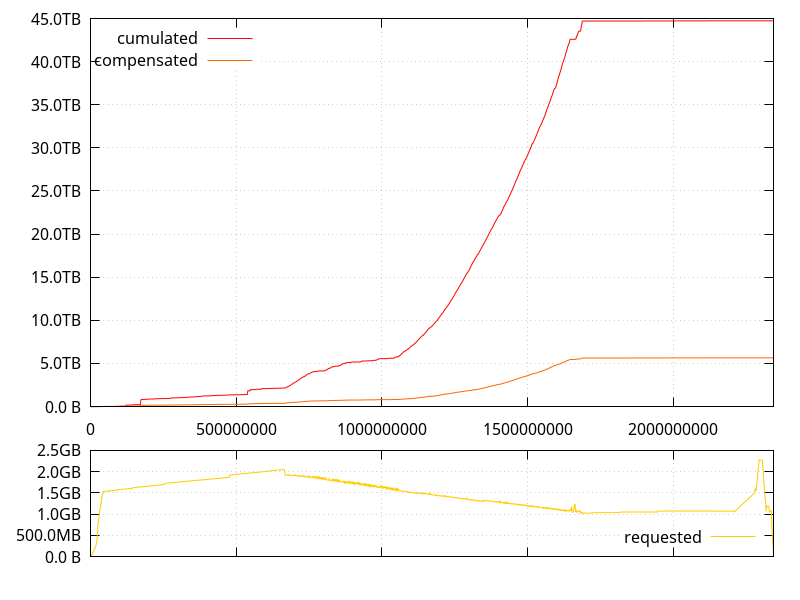

22 March 2017

Clint Adams: Then Moises claimed that T.G.I. Friday's was acceptable

It s really sad listening to a friend talk about how he doesn t care for his wife and doesn t find her attractive anymore, he whined, while at the same time talking about the kid she is pregnant with obviously they haven t had sex in awhile and how though he only wants one kid, she wants multiple so they will probably have more. He said he couldn t afford to have a divorce. He literally said that one morning, watching her get dressed he laughed and told her, Your boobs look weird. She didn t like that. I reminded him that they will continue to age. That didn t make him feel good. He said that he realized before getting married that he thought he was a good person, but now he s realizing he s a bad person. He said he was a misogynist. I said, Worse, you re the type of misogynist who pretends to be a feminist. He agreed. He lived in Park Slope, but he moved once they became pregnant. Good luck finding a kid-friendly restaurant, she said.
Posted on 2017-03-22
Tags: umismu

21 March 2017

Matthew Garrett: Announcing the Shim review process

Shim has been hugely successful, to the point of being used by the majority of significant Linux distributions and many other third party products (even, apparently, Solaris). The aim was to ensure that it would remain possible to install free operating systems on UEFI Secure Boot platforms while still allowing machine owners to replace their bootloaders and kernels, and it's achieved this goal.

However, a legitimate criticism has been that there's very little transparency in Microsoft's signing process. Some people have waited for significant periods of time before being receiving a response. A large part of this is simply that demand has been greater than expected, and Microsoft aren't in the best position to review code that they didn't write in the first place.

To that end, we're adopting a new model. A mailing list has been created at shim-review@lists.freedesktop.org, and members of this list will review submissions and provide a recommendation to Microsoft on whether these should be signed or not. The current set of expectations around binaries to be signed documented here and the current process here - it is expected that this will evolve slightly as we get used to the process, and we'll provide a more formal set of documentation once things have settled down.

This is a new initiative and one that will probably take a little while to get working smoothly, but we hope it'll make it much easier to get signed releases of Shim out without compromising security in the process.

comment count unavailable comments

Tanguy Ortolo: Bad support of ZIP archives with extra fields

For sharing multiple files, it is often convenient to pack them into an archive, and the most widely supported format to do so is probably ZIP. Under *nix, you can archive a directory with Info-ZIP:
% zip -r something.zip something/
(When you have several files, it is recommended to archive them in a directory, to avoid cluttering the directory where people will extract them.)Unsupported ZIP archive Unfortunately, while we would expect ZIP files to be widely supported, I found out that this is not always the case, and I had many recipients failing to open them under operating systems such as iOS. Avoid extra fields That issue seems to be linked to the usage of extra file attributes, that are enabled by default, in order to store Unix file metadata. The field designed to store such extra attributes was designed from the beginning so each implementation can take into account attributes it supports and ignore any other ones, but some buggy ZIP implementation appear not to function at all with them. Therefore, unless you actually need to preserve Unix file metadata, you should avoid using extra fields. With Info-ZIP, you would have to add the option -X:
% zip -rX something.zip something/

20 March 2017

Shirish Agarwal: Tale of two countries, India and Canada

Apologies the first blog post got sent out by mistake. Weather comparisons between the two countries Last year, I had come to know that this year s debconf is happening in Canada, a cold country. Hence, few weeks/month back, I started trying to find information online when I stumbled across few discussion boards where people were discussing about Innerwear and Outerwear and I couldn t understand what that was all about. Then somehow stumbled across this Video, which is of a game called the Long Dark and just seeing couple of episodes it became pretty clear to me why the people there were obsessing with getting the right clothes and everything about it. Couple of Debconf people were talking about the weather in Montreal, and surprise, surprise it was snowing there, in fact supposed to be near the storm of the century. Was amazed to see that they have a website to track how much snow has been lifted. If we compare that to Pune, India weather-wise we are polar opposites. There used to be a time, when I was very young, maybe 5 yrs. old that once the weather went above 30 degree celsius, rains would fall, but now its gonna touch 40 degrees soon. And April and May, the two hottest months are yet to come. China Gate Before I venture further, I was gifted the book China Gate written by an author named William Arnold. When I read the cover and the back cover, it seemed the story was set between China and Taiwan, later when I started reading it, it shares history of Taiwan going back 200 or so odd years. This became relevant as next year s Debconf, Debconf 2018 will be in Taiwan, yes in Asia very much near to India. I am ashamed to say that except for the Tiananmen Square Massacre and the Chinese High-Speed Rail there wasn t much that I knew. According to the book, and I m paraphrasing here the gist I got was that for a long time, the Americans promised Taiwan it will be an Independent country forever, but due to budgetary and other political constraints, the United States took the same stand as China from 1979. Interestingly, now it seems Mr. Trump wants to again recognize Taiwan as a separate entity from China itself but as is with Mr. Trump you can t be sure of why he does, what he does. Is it just a manoeuvrer designed to out-smart the chinese and have a trade war or something else, only time will tell. One thing which hasn t been shared in the book but came to know via web is that Taiwan calls itself Republic of China . If Taiwan wants to be independent then why the name Republic of China ? Doesn t that strengthen China s claim that Taiwan is an integral part of China. I don t understand it. The book does seduce you into thinking that the events are happening in real-time, as in happening now. That s enough OT for now. null Population Density As well in the game and whatever I could find on the web, Canada seems to be on the lower side as far as population is concerned. IIRC, few years back, Canadians invited Indian farmers and gave them large land-holdings for over 100 years on some small pittance. While the link I have shared is from 2006, I read it online and in newspapers even as late as in 2013/2014. The point being there seems to be lot of open spaces in Canada, whereas in India we fight for even one inch literally, due to overpopulation. This sharing reminded me of Mark of Gideon . While I was young, I didn t understand the political meaning of it and still struggle to understand about whom the show was talking about. Was it India, Africa or some other continent they were talking about ? This also becomes obvious when you figure out the surface area of the two countries. When I had started to learn about Canada, I had no idea, nor a clue that Canada is three times the size of India. And this is when I know India is a large country. but seeing that Canada is thrice larger just boggled my mind. As a typical urbanite, would probably become mad if in a rural area in Canada. Montreal, however seems to be something like Gwalior or Bangalore before IT stormed in, seems to be a place where people can work, play and have quite a few gardens as well. Rail This is one thing that is similar in both the great countries. India has Indian Railways and while the Canadians have their own mountain railway called viarail. India chugs on its 68k kilometre network, Canada is at fourth position with 52k network. With thrice the land size, it should have been somewhere where Russia is or even better than them. It would be interesting if a Canadian/s comment about their railway network and why it is so bad in terms of reach. As far as food is concerned, somebody shared this Also, have no idea if Canadian trains are as entertaining as Indian ones, in terms of diverse group of people as well as variety of food to eat as also shared a bit in the video. I am not aware whether Via Rail is the only network operator and there are other network operators unlike Indian Railways which has monopoly on most of the operations. Countries which have first past the post system - Wikipedia Business houses, Political Families This is again something that is similar in both the countries, it seems (from afar) that its only few business houses and more importantly political families which have governed for years. From what little I could understand, both India and Canada have first past the post system which as shared by its critics is unfair to new and small parties. It would be interesting to see if Canada does a re-think. For India, it would need a massive public education outreach policy and implementation. We just had elections in 5 states of India with U.P. (with respect to area-size and population density) and from the last several years, the EVM s (Electronic Voting Machines) tries to make sure that nobody could know which area which party got the most votes. This is to make sure the winning party is not able to take revenge on people or areas which did not vote for them. Instead you have general region counting of votes with probably even the Election Commission not knowing which EVM went to what area and what results are there in sort of double-blind methodology. As far as Business houses are concerned, I am guessing it s the same world-over, only certain people hold the wealth while majority of us are in hard-working, non-wealthy status. Northern Lights - Aurora Borealis Northern Lights, Aurora Borealis Apart from all the social activities that Montreal is famous for, somebody told/shared with me that it is possible to see the Northern Lights, Aurora Borealis can be seen in Canada. I dunno how true or not it is, while probably in Montreal it isn t possible to see due to light pollution, but maybe around 40-50 kms. from the city ? Can people see it from Canada ? IF yes, how far would you have to go ? Are there any companies or people who take people to see the Northern Lights. While I still have to apply for bursary, and if that gets ok, then try getting the visa, but if that goes through, apart from debconf and social activities happening in and around Montreal, Museums, Music etc. , this would be something I would like to experience if it s possible. While I certainly would have to be prepared for the cold that would be, if it s possible, no offence to debconf or anybody else but it probably would be the highlight of the entire trip if its possible. This should be called/labelled as the greatest show on earth TM.
Filed under: Miscellenous Tagged: # Population Density, #Area size, #Aurora Borealis, #Canada, #Trains, DebConf, India, politics

Shirish Agarwal: Canada and India, similarities and differences.

Weather comparisons between the two countries Few days/weeks back, I had come to know that Canada, where this year s debconf is happening is cold country. I started trying to find information online when I stumbled across few boards where people were discussing about innerwear and outerwear and I couldn t understand what that was all about. Then somehow stumbled across this game, it s called the Long Dark and just seeing couple of episodes it became pretty clear to me why the people there were obsessing with getting the right clothes and everything about it. Couple of Debconf people were talking about weather in Montreal, and surprise, surprise it was snowing there, in fact supposed to be near the storm of the century. Was amazed to see that they have a website to track how much snow has been lifted. If we compare that to Pune, India weather-wise we are polar opposites. There used to be a time, when I was very young, maybe 5 yrs. old that once the weather went above 30 degree celcius, rains would fall, but now its gonna touch 40 degrees soon. And April and May, the two hottest months are yet to come. China Gate Before I venture further, I was gifted the book China Gate written by an author named William Arnold. When I read the cover and the backcover, it seemed the story was set between China and Taiwan, later when I started reading it, it shares history of Taiwan going back 200 or so odd years. This became relevant as next year s Debconf, Debconf 2018 will be in Taiwan, yes in Asia very much near to India. I am ashamed to say that except for the Tiananmen Square Massacre and the Chinese High-Speed Rail there wasn t much that I knew. According to the book, and I m paraphrasing here the gist I got was that for a long time, the Americans promised Taiwan it will be an Independent country forever, but due to budgetary and other political constraints, the United States took the same stand as China from 1979 and now it seems Mr. Trump wants to again recognize Taiwan as a separate entity from China itself. One thing which hasn t been shared in the book but came to know via web is that Taiwan calls itself Republic of China . If Taiwan wants to be independent then why the name Republic of China ? Doesn t that strengthen China s claim that Taiwan is an integral part of China. I don t understand it. The book does seduce you into thinking that the events are happening in real-time, as in happening now. That s enough OT for now. null Population Density As well in the game and whatever I could find on the web, Canada seems to be on the lower side as far as population is concerned. IIRC, few years back, Canadians invited Indian farmers and gave them large land-holdings for over 100 years on some small pittance. While the link I have shared is from 2006, I read it online and in newspapers even as late as in 2013/2014. The point being there seems to be lot of open spaces in Canada, whereas in India we fight for even one inch literally, due to overpopulation. This sharing reminded me of Mark of Gideon . While I was young, I didn t understand the political meaning of it and still struggle to understand about whom the show was talking about. Was it India, Africa or some other continent they were talking about ? This also becomes obvious when you figure out the surface area of the two countries. When I had started to learn about Canada, I had no idea, nor a clue that Canada is three times the size of India. And this is when I know India is a large country. but seeing that Canada is thrice larger just boggled my mind. As a typical urbanite, would probably become mad if in a rural area in Canada. Montreal, however seems to be something like Gwalior or Bangalore before IT stormed in, seems to be a place where people can work, play and have quite a few gardens as well. Rail This is one thing that is similar in both the great countries. India has Indian Railways and while the Canadians have their own mountain railway called viarail. India chugs on its 68k kilometre network, Canada is at fourth position with 52k network. With thrice the land size, it should have been somewhere where Russia is or even better than them. It would be interesting if Canadians comment about their railway network and why it is so bad in terms of reach. Business houses, Political Families This is again something that is similar in both the countries, it seems (from afar) that its only few business houses and more importantly political families which have governed for years.
Filed under: Miscellenous

19 March 2017

Clint Adams: Measure once, devein twice

Ophira lived in a wee house in University Square, Tampa. It had one floor, three bedrooms, two baths, a handful of family members, a couple pets, some plants, and an occasional staring contest. Mauricio lived in Lowry Park North, but Ophira wasn t allowed to go there because Mauricio was afraid that someone would tell his girlfriend. Ophira didn t like Mauricio s girlfriend and Mauricio s girlfriend did not like Ophira. Mauricio did not bring his girlfriend along when he and Ophira went to St. Pete Beach. They frolicked in the ocean water, and attempted to have sex. Mauricio and Ophira were big fans of science, so Somewhat quickly they concluded that it is impossible to have sex underwater, and absconded to Ophira s car to have sex therein. I hate Mauricio s girlfriend, Ophira told Amit on the telephone. She s not even pretty. Hey, listen, said Amit. I m going to a wedding on Captiva. Oh, my family used to go to Captiva every year. There s bioluminescent algae and little crabs and stuff. Yeah? Do you want to come along? You could pick me up at the airport. Why would I want to go to a wedding? Well, it s on the beach and they re going to have a bouncy castle. A bouncy castle Are you serious? Yes. Well, okay. Amit prepared to go to the wedding and Ophira became terse then unresponsive. After he landed at RSW, he called Ophira, but instead of answering the phone she startled and fell out of her chair. Amit arranged for other transportation toward the Sanibel Causeway. Ophira bit her nails for a few hours, then went to her car and drove to Cape Coral. Ophira cruised around Cape Coral for a while, until she spotted a teenager cleaning a minivan. She parked her car and approached him. Whatcha doing? asked Ophira, pretending to chew on imaginary gum. The youth slid the minivan door open. I m cleaning, he said hesitantly. Didn t your parents teach you not to talk to strangers? I could do all kinds of horrible things to you. They conversed for a bit. She recounted a story of her personal hero, a twelve-year-old girl who seduced and manipulated older men into ruin. She rehashed the mysteries of Mauricio s girlfriend. She waxed poetic on her love of bouncy castles. The youth listened, hypnotized. What s your name, kid? Ophira yawned. Arjun, he replied. How old are you? Arjun thought about it. 15, he said. Hmm, Ophira stroked her chin. Can you sneak me into your room so that your parents never find out about it? Arjun s eyes went wide. MEANWHILE, on Captiva Island, Amit had learned that even though the Tenderly had multiple indoor jacuzzis, General Fitzpatrick and Mrs. Fitzpatrick had decided it prudent to have sex in the hot tub on the deck; that the execution of this plan had somehow necessitated a lengthy cleaning process before the hot tub could be used again; that that s why workmen were cleaning the hot tub; and that the Fitzpatrick children had gotten General Fitzpatrick and Mrs. Fitzpatrick to agree to not do that again, with an added suggestion that they not be seen doing anything else naked in public. A girl walked up to Amit. Hey, I heard you lost your plus-one. Are you here alone? What a loser! she giggled nervously, then stared. Leave me alone, Darlene, sighed Amit. Darlene s face reddened as she spun on her heels and stormed over to Lisette. Oh my god, did you see that? I practically threw myself at him and he was abusive toward me. He probably has all the classic signs of being an abuser. Did you hear about that girl he dated in Ohio? I bet I know why that ended. Oh really? said Lisette distractedly, looking Amit up and down. So he s single now? Darlene glared at Lisette as Amit wandered back outside to stare at the hot tub. Hey kid, said Ophira, bring me some snacks. I don t bring food into my room, said Arjun. It attracts pests. Is that what your parents told you? scoffed Ophira. Don t be such a wuss. Three minutes later, Ophira was finishing a bag of paprika puffs. These are great, Arjun! Where do you get these? My cousin sends them from Europe, he explained. Now get me a diet soda. Amit strolled along the beach, then yelped. What s biting my legs? he cried out. Those are sand fleas, said Nessarose. What are sand fleas? asked Amit incredulously. Nessarose rolled her eyes. Stop being a baby and have a drink. After the sun went down, Amit began to notice the crabs, and this made him drink more. When everyone was soused, General Fitzpatrick announced that they were going for a swim in the Gulf, in direct contravention of safety guidelines. Most of the guests were wise enough to refuse, but an eightsome swam out, occasionally stopping to slap the algae, but continuing until they reached the sandbar that General Fitzpatrick correctly claimed was there. Then screams echoed through the night as all the jellyfish attacked everyone invading their sandbar. The crestfallen swimming party eventually made it back to shore. Pee on the jellyfish sting, commanded Nessarose. It s the best cure. No! shouted General Fitzpatrick s daughter. Urine makes it worse. Things quickly escalated from Nessarose and General Fitzpatrick s daughter screaming at each other to the beach dividing into three factions: those siding with Nessarose, those siding with General Fitzpatrick s daughter, and those who had no idea what was going on. General Fitzpatrick had no interest in any of this, and went straight to bed. It s getting late, kid, said Ophira. I m taking your bed. What? squeaked Arjun. Look, said Ophira, your bed is small and there isn t room for both of us. You may sleep on the floor if you re quiet and don t bother me. What? squeaked Arjun. Are you deaf, kid? Ophira grunted and then went to bed. Arjun blinked in confusion, then tried to fall asleep on the floor, without much success. Ophira got up in the morning and said, Before I go, I want to teach you a valuable lesson. What? groaned Arjun, getting to his feet. You should be careful talking to strangers. Now, I told you that I could do horrible things to you, so this is not my fault; it s yours, she announced, then sucker-punched him in the gut. Ophira climbed out the window as Arjun doubled over. As the ceremony began, only a small minority of the wedding party was visibly suffering from jellyfish stings, which may or may not have helped with ignoring the sand fleas. The ceremony ended shortly thereafter, and now that marriage had been accomplished, everyone turned their attention to food and drink and swimming less irresponsibly than the night before. Guests that needed to return home sooner departed in waves and Amit started to appreciate the more peaceful environment. He heard the deck door slide open behind him and turned his attention away from the hot tub. Hey, mofo, Ophira shouted as strode stylishly out onto the deck. Where s this bouncy castle? Amit blinked in surprise. That was yesterday. You missed it. Oh, she frowned. So I met this South Slav guy with a really sexy forehead, and I need some advice. I don t know if I should call him or wait. Amit pointed to the hot tub and told her the story of General Fitzpatrick and Mrs. Fitzpatrick and the hot tub. What? said Ophira. How could they have sex underwater? What do you mean? asked Amit. Well, it s impossible, she replied.
Posted on 2017-03-19
Tags: mintings

18 March 2017

Vincent Sanders: A rose by any other name would smell as sweet

Often I end up dealing with code that works but might not be of the highest quality. While quality is subjective I like to use the idea of "code smell" to convey what I mean, these are a list of indicators that, in total, help to identify code that might benefit from some improvement.

Such smells may include:
I am most certainly not alone in using this approach and Fowler et al have covered this subject in the literature much better than I can here. One point I will raise though is some programmers dismiss code that exhibits these traits as "legacy" and immediately suggest a fresh implementation. There are varying opinions on when a rewrite is the appropriate solution from never to always but in my experience making the old working code smell nice is almost always less effort and risk than a re-write.
TestsWhen I come across smelly code, and I decide it is worthwhile improving it, I often discover the biggest smell is lack of test coverage. Now do remember this is just one code smell and on its own might not be indicative, my experience is smelly code seldom has effective test coverage while fresh code often does.

Test coverage is generally understood to be the percentage of source code lines and decision paths used when instrumented code is exercised by a set of tests. Like many metrics developer tools produce, "coverage percentage" is often misused by managers as a proxy for code quality. Both Fowler and Marick have written about this but sufficient to say that for a developer test coverage is a useful tool but should not be misapplied.

Although refactoring without tests is possible the chances for unintended consequences are proportionally higher. I often approach such a refactor by enumerating all the callers and constructing a description of the used interface beforehand and check that that interface is not broken by the refactor. At which point is is probably worth writing a unit test to automate the checks.

Because of this I have changed my approach to such refactoring to start by ensuring there is at least basic API code coverage. This may not yield the fashionable 85% coverage target but is useful and may be extended later if desired.

It is widely known and equally widely ignored that for maximum effectiveness unit tests must be run frequently and developers take action to rectify failures promptly. A test that is not being run or acted upon is a waste of resources both to implement and maintain which might be better spent elsewhere.

For projects I contribute to frequently I try to ensure that the CI system is running the coverage target, and hence the unit tests, which automatically ensures any test breaking changes will be highlighted promptly. I believe the slight extra overhead of executing the instrumented tests is repaid by having the coverage metrics available to the developers to aid in spotting areas with inadequate tests.
ExampleA short example will help illustrate my point. When a web browser receives an object over HTTP the server can supply a MIME type in a content-type header that helps the browser interpret the resource. However this meta-data is often problematic (sorry that should read "a misleading lie") so the actual content must be examined to get a better answer for the user. This is known as mime sniffing and of course there is a living specification.

The source code that provides this API (Linked to it rather than included for brevity) has a few smells:
While some of these are obvious the non-use of the global string table and the API complexity needed detailed knowledge of the codebase, just to highlight how subjective the sniff test can be. There is also one huge air freshener in all of this which definitely comes from experience and that is the modules author. Their name at the top of this would ordinarily be cause for me to move on, but I needed an example!

First thing to check is the API use

$ git grep -i -e mimesniff_compute_effective_type --or -e mimesniff_init --or -e mimesniff_fini
content/hlcache.c: error = mimesniff_compute_effective_type(handle, NULL, 0,
content/hlcache.c: error = mimesniff_compute_effective_type(handle,
content/mimesniff.c:nserror mimesniff_init(void)
content/mimesniff.c:void mimesniff_fini(void)
content/mimesniff.c:nserror mimesniff_compute_effective_type(llcache_handle *handle,
content/mimesniff.h:nserror mimesniff_compute_effective_type(struct llcache_handle *handle,
content/mimesniff.h:nserror mimesniff_init(void);
content/mimesniff.h:void mimesniff_fini(void);
desktop/netsurf.c: ret = mimesniff_init();
desktop/netsurf.c: mimesniff_fini();

This immediately shows me that this API is used in only a very small area, this is often not the case but the general approach still applies.

After a little investigation the usage is effectively that the mimesniff_init API must be called before the mimesniff_compute_effective_type API and the mimesniff_fini releases the initialised resources.

A simple test case was added to cover the API, this exercised the behaviour both when the init was called before the computation and not. Also some simple tests for a limited number of well behaved inputs.

By changing to using the global string table the initialisation and finalisation API can be removed altogether along with a large amount of global context and pre-processor macros. This single change removes a lot of smell from the module and raises test coverage both because the global string table already has good coverage and because there are now many fewer lines and conditionals to check in the mimesniff module.

I stopped the refactor at this point but were this more than an example I probably would have:
ConclusionThe approach examined here reduce the smell of code in an incremental, testable way to improve the codebase going forward. This is mainly necessary on larger complex codebases where technical debt and bit-rot are real issues that can quickly overwhelm a codebase if not kept in check.

This technique is subjective but helps a programmer to quantify and examine a piece of code in a structured fashion. However it is only a tool and should not be over applied nor used as a metric to proxy for code quality.

17 March 2017

Shirish Agarwal: Science Day at GMRT, Khodad 2017

The whole team posing at the end of day 2 The above picture is the blend of the two communities from foss community and mozilla India. And unless you were there you wouldn t know who is from which community which is what FOSS is all about. But as always I m getting a bit ahead of myself. Akshat, who works at NCRA as a programmer, the standing guy on the left shared with me in January this year that this year too, we should have two stalls, foss community and mozilla India stalls next to each other. While we had the banners, we were missing stickers and flyers. Funds were and are always an issue and this year too, it would have been emptier if we didn t get some money saved from last year minidebconf 2016 that we had in Mumbai. Our major expenses included printing stickers, stationery and flyers which came to around INR 5000/- and couple of LCD TV monitors which came for around INR 2k/- as rent. All the labour was voluntary in nature, but both me and Akshat easily spending upto 100 hours before the event. Next year, we want to raise to around INR 10-15k so we can buy 1 or 2 LCD monitors and we don t have to think for funds for next couple of years. How will we do that I have no idea atm. Printing leaflets Me and Akshat did all the printing and stationery runs and hence had not been using my lappy for about 3-4 days. Come to the evening before the event and the laptop would not start. Coincidentally, or not few months or even last at last year s Debconf people had commented on IBM/Lenovo s obsession with proprietary power cords and adaptors. I hadn t given it much thought but when I got no power even after putting it on AC power for 3-4 hours, I looked up on the web and saw that the power cord and power adaptors were all different even in T440 and even that under existing models. In fact I couldn t find mine hence sharing it via pictures below. thinkpad power cord male thinkpad power adaptor female I knew/suspected that thinkpads would be rare where I was going, it would be rarer still to find the exact power cord and I was unsure whether it was the power cord at fault or adaptor or whatever goes for SMPS in laptop or memory or motherboard/CPU itself. I did look up the documentation at support.lenovo.com and was surprised at the extensive documentation that Lenovo has for remote troubleshooting. I did the usual take out the battery, put it back in, twiddle with the little hole in the bottom of the laptop, trying to switch on without the battery on AC mains, trying to switch on with battery power only but nothing worked. Couple of hours had gone by and with a resigned thought went to bed, convincing myself that anyways it s good I am not taking the lappy as it is extra-dusty there and who needs a dead laptop anyways. Update After the event was over, I did contact Lenovo support and within a week, with one visit from a service engineer, he was able to identify that it was a faulty cable which was at fault and not the the other things which I was afraid of. Another week gone by and lenovo replaced the cable. Going by service standards that I have seen of other companies, Lenovo deserves a gold star here for the prompt service they provided. I probably would end up subscribing to their extended 2-year warranty service when my existing 3 year warranty is about to be over. Next day, woke up early morning, two students from COEP hostel were volunteering and we made our way to NCRA, Pune University Campus. Ironically, though we were under the impression that we would be the late arrivals, it turned out we were the early birds. 5-10 minutes passed by and soon enough we were joined by Aniket and we played catch-up for a while. We hadn t met each other for a while so it was good to catch-up. Then slowly other people starting coming in and around 07:10-07:15 we started for GMRT, Khodad. Now I had been curious as had been hearing for years that the Pune-Nashik NH-50 highway would be concreted and widened to six-lane highways but the experience was below par. Came back and realized the proposal has now been pushed back to 2020. From the mozilla team, only Aniket was with us, the rest of the group was coming straight from Nashik. Interestingly, all the six people who came, came on bikes which depending upon how you look at it was either brave or stupid. Travelling on bikes on Indian highways you either have to be brave or stupid or both, we have more than enough accidents due to quality of road construction, road design, lane-changing drivers and many other issues. This is probably not the place for it hence will use some other blog post to rant about that. We reached around 10:00 hrs. IST and hung around till lunch as Akshat had all the marketing material, monitors etc. The only thing we had were couple of lappies and couple of SBC s, an RPI 3 and a BBB. Aarti Kashyap sharing something about SBC Our find for the event was Aarti Kashyap who you can see above. She is a third-year student at COEP and one of the rare people who chose to interact with hardware rather than software. From last several years, we had been trying, successfully and unsuccessfully to get more Indian women and girls interested into technology. It is a vicious circle as till a girl/woman doesn t volunteer we are unable to share our knowledge to the extent we can which leads them to not have much interest in FOSS or even technology in general. While there are groups are djangogirls, Pyladies and railgirls and even Outreachy which tries to motivate getting girls into computing but it s a long road ahead. We are short of both funds and ideas as to how to motivate more girls to get into computing and then to get into playing with hardware. I don t know where to start and end for whoever wants to play with hardware. From SBC s, routers to blade servers the sky is the limit. Again this probably isn t the place for it, hence probably we can chew it on more at some other blog post. This year, we had a lowish turnout due to the fact that the 12th board exams 1st paper was on the day we had opened. So instead of 20-25k, we probably had 5-7k fewer people pass through. There were two-three things that we were showing, we were showing Debian on one of the systems, we were showing the output from the SBC s on the other monitor but the glare kept hitting the monitors. While the organizers had done exemplary work over last year. They had taped the carpets on the ground so there was hardly any dust moving around. However, I wished the organizers had taken the pains to have two cloth roofs over our head instead of just one, the other roof head could be say 2 feet up, this would have done two things a. It probably would have cooled the place a bit more as b. We could get diffused sunlight which would have lessened the glare and reflection the LCD s kept throwing back. At times we also got people to come to our side as can be seen in Aarti s photo as can be seen above. If these improvements can be made for next year, this would result in everybody in our Pandal would benefit, not just us and mozilla. This would be benefiting around 10-15 organizations which were within the same temporary structure. Of course, it depends very much on the budget they are able to have and people who are executing, we can just advise. The other thing which had been missing last year and this year is writing about Single Board Computers in Marathi. If we are to promote them as something to replace a computer or something for a younger brother/sister to learn computing upon at a lower cost, we need leaflets written in their language to be more effective. And this needs to be in the language and mannerisms that people in that region understand. India, as probably people might have experienced is a dialect-prone country. Which means every 2-5 kms, the way the language is spoken is different from anywhere else. The Marathi spoken by somebody who has lived in Ravivar Peth for his whole life and a person who has lived in say Kothrud are different. The same goes from any place and this place, Khodad, Narayangaon would have its own dialect, its own mini-codespeak. Just to share, we did have one in English but it would have been a vast improvement if we could do it in the local language. Maybe we can discuss about this and ask for help from people. Outside, Looking in Mozillians helping FOSS community and vice-versa What had been interesting about the whole journey were the new people who were bringing all their passion and creativity to the fore. From the mozilla community, we had Akshay who is supposed to be a wizard on graphics, animation, editing anything to do with the visual medium. He shared some of the work he had done and also shared a bit about how blender works with people who wanted to learn about that. Mayur, whom you see in the picture pointing out something about FOSS and this was the culture that we strove to have. I know and love and hate the browser but haven t been able to fathom the recklessness that Mozilla has been doing the last few years, which has just been having one mis-adventure after another. For instance, mozstumbler was an effort which I thought would go places. From what little I understood, it served/serves as a user-friendly interface to a potential user while still sharing all the data with OSM . They (Mozilla) seems/seemed to have a fatalistic take as it provided initial funding but then never fully committing to the project. Later, at night we had the whole free software and open-source sharings where I tried to emphasize that without free software, the term open-source would not have come into existence. We talked and talked and somewhere around 02:00 I slept, the next day was an extension of the first day itself where we ribbed each other good-naturedly and still shared whatever we could share with each other. I do hope that we continue this tradition for great many years to come and engage with more and more people every passing year.
Filed under: Miscellenous Tagged: #budget, #COEP< #volunteering, #debian, #Events, #Expenses, #mozstumbler, #printing, #SBC's, #Science Day 2017, #thinkpad cable issue, FOSS, mozilla

Next.

Previous.