Search Results: "az"

27 November 2015

Gergely Nagy: Feeding Emacs

For the past fifteen years, I have been tweaking my ~/.emacs continously, most recently by switching to Spacemacs. With that switch done, I started to migrate a few more things to Emacs, an Atom/RSS reader being one that's been in the queue for years - ever since Google Reader shut down. Since March 2013, I have been a Feedly user, but I wanted to migrate to something better for a long time. I wanted to use Free Software, for one.I saw a mention of Elfeed somewhere a little while ago, and in the past few days, I decided to give it a go. The results are pretty amazing.blah

26 November 2015

Tiago Bortoletto Vaz: Birthday as in the good old days

This year I've got zero happy birthday spam message from phone, post, email, and from random people on that Internet social thing. In these days, that's a WOW, yes it is. On the other hand, full of love and simple celebrations together with local ones. A few emails and phone calls from close friends/family who are physically distant. I'm happier than ever with my last years' choices of caring about my privacy, not spending time with fake relationships and keeping myself an unimportant one for the $SYSTEM. That means a lot for me.

23 November 2015

Riku Voipio: Using ser2net for serial access.

Is your table a mess of wires? Do you have multiple devices connected via serial and can't remember which is /dev/ttyUSBX is connected to what board? Unless you are a embedded developer, you are unlikely to deal with serial much anymore - In that case you can just jump to the next post in your news feed. Introducting ser2netUsually people start with minicom for serial access. There are better tools - picocom, screen, etc. But to easily map multiple serial ports, use ser2net. Ser2net makes serial ports available over telnet. Persistent usb device names and ser2netTo remember which usb-serial adapter is connected to what, we use the /dev/serial tree created by udev, in /etc/ser2net.conf:

# arndale
7004:telnet:0:'/dev/serial/by-path/pci-0000:00:1d.0-usb-0:1.8.1:1.0-port0':115200 8DATABITS NONE 1STOPBIT
# cubox
7005:telnet:0:/dev/serial/by-id/usb-Prolific_Technology_Inc._USB-Serial_Controller_D-if00-port0:115200 8DATABITS NONE 1STOPBIT
# sonic-screwdriver
7006:telnet:0:/dev/serial/by-id/usb-FTDI_FT230X_96Boards_Console_DAZ0KA02-if00-port0:115200 8DATABITS NONE 1STOPBIT
The by-path syntax is needed, if you have many identical usb-to-serial adapters. In that case a Patch from BTS is needed to support quoting in serial path. Ser2net doesn't seems very actively maintained upstream - a sure sign that project is stagnant is a homepage still at sourceforge.net... This patch among other interesting features can be also be found in various ser2net forks in github. Setting easy to remember names Finally, unless you want to memorize the port numbers, set TCP port to name mappings in /etc/services:

# Local services
arndale 7004/tcp
cubox 7005/tcp
sonic-screwdriver 7006/tcp
Now finally:
telnet localhost sonic-screwdriver
^Mandatory picture of serial port connection in action

Thomas Goirand: OpenStack Liberty and Debian

Long over due post It s been a long time I haven t written here. And lots of things happened in the OpenStack planet. As a full time employee with the mission to package OpenStack in Debian, it feels like it is kind of my duty to tell everyone about what s going on. Liberty is out, uploaded to Debian Since my last post, OpenStack Liberty, the 12th release of OpenStack, was released. In late August, Debian was the first platform which included Liberty, as I proudly outran both RDO and Canonical. So I was the first to make the announcement that Liberty passed most of the Tempest tests with the beta 3 release of Liberty (the Beta 3 is always kind of the first pre-release, as this is when feature freeze happens). Though I never made the announcement that Liberty final was uploaded to Debian, it was done just a single day after the official release. Before the release, all of Liberty was living in Debian Experimental. Following the upload of the final packages in Experimental, I uploaded all of it to Sid. This represented 102 packages, so it took me about 3 days to do it all. Tokyo summit I had the pleasure to be in Tokyo for the Mitaka summit. I was very pleased with the cross-project sessions during the first day. Lots of these sessions were very interesting for me. In fact, I wish I could have attended them all, but of course, I can t split myself in 3 to follow all of the 3 tracks. Then there was the 2 sessions about Debian packaging on upstream OpenStack infra. The goal is to setup the OpenStack upstream infrastructure to allow packaging using Gerrit, and gating each git commit using the usual tools: building the package and checking there s no FTBFS, running checks like lintian, piuparts and such. I knew already the overview of what was needed to make it happen. What I didn t know was the implementation details, which I hoped we could figure out during the 1:30 slot. Unfortunately, this didn t happen as I expected, and we discussed more general things than I wished. I was told that just reading the docs from the infra team was enough, but in reality, it was not. What currently needs to happen is building a Debian based image, using disk-image-builder, which would include the usual tools to build packages: git-buildpackage, sbuild, and so on. I m still stuck at this stage, which would be trivial if I knew a bit more about how upstream infra works, since I already know how to setup all of that on a local machine. I ve been told by Monty Tailor that he would help. Though he s always a very busy man, and to date, he still didn t find enough time to give me a hand. Nobody replied to my request for help in the openstack-dev list either. Hopefully, with a bit of insistence, someone will help. Keystone migration to Testing (aka: Debian Stretch) blocked by python-repoze.who Absolutely all of OpenStack Liberty, as of today, has migrated to Stretch. All? No. Keystone is blocked by a chain of dependency. Keystone depends on python-pysaml2, itself blocked by python-repoze.who. The later, I upgraded it to version 2.2. Though python-repoze.what depends on version <= 1.9, which is blocking the migration. Since python-repoze.who-plugins, python-repoze.what and python-repoze.what-plugins aren t used by any package anymore, I asked for them to be removed from Debian (see #805407). Until this request is processed by the FTP masters, Keystone, which is the most important piece of OpenStack (it does the authentication) will be blocked for migration to Stretch. New OpenStack server packages available On my presentation at Debconf 15, I quickly introduced new services which were released upstream. I have since packaged them all: Congress, unfortunately, was not accepted to Sid yet, because of some licensing issues, especially with the doc of python-pulp. I will correct this (remove the non-free files) and reattempt an upload. I hope to make them all available in jessie-backports (see below). For the previous release of OpenStack (ie: Kilo), I skipped the uploads of services which I thought were not really critical (like Ironic, Designate and more). But from the feedback of users, they would really like to have them all available. So this time, I will upload them all to the official jessie-backports repository. Keystone v3 support For those who don t know about it, Keystone API v3 means that, on top of the users and tenant, there s a new entity called a domain . All of the Liberty is now coming with Keystone v3 support. This includes the automated Keystone catalog registration done using debconf for all *-api packages. As much as I could tell by running tempest on my CI, everything still works pretty well. In fact, Liberty is, to my experience, the first release of OpenStack to support Keystone API v3. Uploading Liberty to jessie-backports I have rebuilt all of Liberty for jessie-backports on my laptop using sbuild. This is more than 150 packages (166 packages currently). It took me about 3 days to rebuild them all, including unit tests run at build time. As soon as #805407 is closed by the FTP masters, all what s remaining will be available in Stretch (mostly Keystone), and the upload will be possible. As there will be a lot of NEW packages (from the point of view of backports), I do expect that the approval will take some time. Also, I have to warn the original maintainers of the packages that I don t maintain (for example, those maintained within the DPMT), that because of the big number of packages, I will not be able to process the usual communication to tell that I m uploading to backports. However, here s the list of package. If you see one that you maintain, and that you wish to upload the backport by yourself, please let me know. Here s the list of packages, hopefully, exhaustive, that I will upload to jessie-backports, and that I don t maintain myself: alabaster contextlib2 kazoo python-cachetools python-cffi python-cliff python-crank python-ddt python-docker python-eventlet python-git python-gitdb python-hypothesis python-ldap3 python-mock python-mysqldb python-pathlib python-repoze.who python-setuptools python-smmap python-unicodecsv python-urllib3 requests routes ryu sphinx sqlalchemy turbogears2 unittest2 zzzeeksphinx. More than ever, I wish I could just upload these to a PPA^W Bikeshed, to minimize the disruption for both the backports FTP masters, other maintainers, and our OpenStack users. Hopefully, Bikesheds will be available soon. I am sorry to give that much approval work to the backports FTP masters, however, using the latest stable system with the latest release, is what most OpenStack users really want to do. All other major distributions have specific repositories too (ie: RDO for CentOS / Red Hat, and cloud archive for Ubuntu), and stable-backports is currently the only place where I can upload support for the Stable release. Debian listed as supported distribution on openstack.org Good news! If you go at http://www.openstack.org/marketplace/distros/ you will see a list of supported distributions. I am proud to be able to tell that, after 6 months of lobbying from my side, Debian is also listed there. The process of having Debian there included talking with folks from the OpenStack foundation, and having Bdale to sign an agreement so that the Debian logo could be reproduced on openstack.org. Thanks to Bdale Garbee, Neil McGovern, Jonathan Brice, and Danny Carreno, without who this wouldn t have happen.

20 November 2015

Daniel Pocock: Databases of Muslims and homosexuals?

One US presidential candidate has said a lot recently, but the comments about making a database of Muslims may qualify as the most extreme. Of course, if he really wanted to, somebody with this mindset could find all the Muslims anyway. A quick and easy solution would involve tracing all the mobile phone signals around mosques on a Friday. Mr would-be President could compel Facebook and other social networks to disclose lists of users who identify as Muslim. Databases are a dangerous side-effect of gay marriage In 2014 there was significant discussion about Brendan Eich's donation to the campaign against gay marriage. One fact that never ranked very highly in the debate at the time is that not all gay people actually support gay marriage. Even where these marriages are permitted, not everybody who can marry now is choosing to do so. The reasons for this are varied, but one key point that has often been missed is that there are two routes to marriage equality: one involves permitting gay couples to visit the register office and fill in a form just as other couples do. The other route to equality is to remove all the legal artifacts around marriage altogether. When the government does issue a marriage certificate, it is not long before other organizations start asking for confirmation of the marriage. Everybody from banks to letting agents and Facebook wants to know about it. Many companies outsource that data into cloud CRM systems such as Salesforce. Before you know it, there are numerous databases that somebody could mine to make a list of confirmed homosexuals. Of course, if everybody in the world was going to live happily ever after none of this would be a problem. But the reality is different. While discrimination: either against Muslims or homosexuals - is prohibited and can even lead to criminal sanctions in some countries, this attitude is not shared globally. Once gay people have their marriage status documented in the frequent flyer or hotel loyalty program, or in the public part of their Facebook profile, there are various countries where they are going to be at much higher risk of prosecution/persecution. The equality to marry in the US or UK may mean they have less equality when choosing travel destinations. Those places are not as obscure as you might think: even in Australia, regarded as a civilized and laid-back western democracy, the state of Tasmania fought tooth-and-nail to retain the criminalization of virtually all homosexual conduct until 1997 when the combined actions of the federal government and high court compelled the state to reform. Despite the changes, people with some of the most offensive attitudes are able to achieve and retain a position of significant authority. The same Australian senator who infamously linked gay marriage with bestiality has successfully used his position to set up a Senate inquiry as a platform for conspiracy theories linking Halal certification with terrorism. There are many ways a database can fall into the wrong hands Ironically, one of the most valuable lessons about the risk of registering Muslims and homosexuals was an injustice against the very same tea-party supporters a certain presidential candidate is trying to woo. In 2013, it was revealed IRS employees had started applying a different process to discriminate against groups with Tea party in their name. It is not hard to imagine other types of rogue or misinformed behavior by people in positions of authority when they are presented with information that they don't actually need about somebody's religion or sexuality. Beyond this type of rogue behavior by individual officials and departments, there is also the more sinister proposition that somebody truly unpleasant is elected into power and can immediately use things like a Muslim database, surveillance data or the marriage database for a program of systematic discrimination. France had a close shave with this scenario in the 2002 presidential election when
Jean-Marie Le Pen, who has at least six convictions for racism or inciting racial hatred made it to the final round in a two-candidate run-off with Jacques Chirac. The best data security The best way to be safe- wherever you go, both now and in the future - is not to have data about yourself on any database. When filling out forms, think need-to-know. If some company doesn't really need your personal mobile number, your date of birth, your religion or your marriage status, don't give it to them.

16 November 2015

Norbert Preining: Movies: Monuments Men and Interstellar

Over the rainy weekend we watched two movies: Monuments Men (in Japanese it is called Michelangelo Project!) and Interstellar. Both blockbuster movies from the usual American companies, they are light-years away when it comes to quality. The Monuments Men are boring, without a story, without depth, historically inaccurate, a complete failure. Interstellar, although a long movie, keeps you frozen in the seat while being as scientific as possible and starts your brain working heavily. monuments-men-interstellar My personal verdict: 3 rotten eggs (because Rotten Tomatoes are not stinky enough) for the Monuments Men, and 4 stars for Interstellar. Story First for the plot of the two movies: The Monuments Men is loosely based on a true story about rescuing pieces of art at the end of the second world war, before the Nazis destroy them or the Russian take them away. A group of art experts is sent into Europe and manages to find several hiding places of art taken by the Nazis. Interstellar is set in near future where the conditions on the earth are deteriorating to a degree that human life seems to be soon impossible. Some years before the movie plays a group of astronauts were sent through a wormhole into a different galaxy to search for new inhabitable planets. Now it is time to check out these planets, and try to establish colonies there. Cooper, a retired NASA officer and pilot, now working as farmer, and his daughter are guided by some mysterious way to a secret NASA facility. Cooper is drafted for being a pilot on the reconnaissance mission, and leaves earth and our galaxy through the same wormhole. (Not telling more!) Monuments Men Looking at the cast of Monuments Men (George Clooney, Matt Damon, Bill Murray, John Goodman, Jean Dujardin, Bob Balaban, Hugh Bonneville, and Cate Blanchett) one would expect a great movie but from the very first to the very last scene, it is a slowly meandering shallow flow of sticked together scenes without much coherence. Tension is generated only through unrelated events (stepping onto a landmine, patting a horse), but never developed properly. Dialogs are shallow and boring with one exception: When Frank Stokes (George Clooney) meets the one German and inquires general about the art, predicting his future being hanged. Historically, the movie is as inaccurate as it can be despite Clooney stating that 80 percent of the story is still completely true and accurate, and almost all of the scenes happened . That contrasts starkly with the verdict of Nigel Pollard (Swansea University): There s a kernel of history there, but The Monuments Men plays fast and loose with it in ways that are probably necessary to make the story work as a film, but the viewer ends up with a fairly confused notion of what the organisation was, and what it achieved. The movie leaves a bitter aftertaste, hailing of American heroism paired with the usual stereotypes (French amour, German retarded, Russian ignorance, etc). Together with the half baked dialogues it feels like a permanent coitus interruptus. Interstellar Interstellar cannot serve with a similar cast, but still a few known people (Matthew McConaughey, Anne Hathaway, and Michael Caine!). But I believe this is actually a sign of quality. Well balancing scientific accuracy and the requirements for blockbusters, the movie successfully spans the bridge between complicated science, in particular general gravity, and entertainment. While not going so far to call the move edutainment (like both the old and new Cosmos), it is surprising how much of hard science is packed into this movie. This is mostly thanks to the theoretical physicist Kip Thorne acting as scientific consultant for the movie, but also due to the director Christopher Nolan being serious about it and studying relativity at Caltech. Of course, scientific accuracy has limits nobody knows what happens if one crosses the event horizon of a black hole, and even the existence of wormholes is purely theoretical by now. Still, throughout the movie it follows the two requirements laid out by Kip Thorne: First, that nothing would violate established physical laws. Second, that all the wild speculations would spring from science and not from the fertile mind of a screenwriter. I think the biggest compliment was that, despite the length, despite a long day out (see next blog), despite the rather unfamiliar topic, my wife, who is normally not interested in space movies and that kind, didn t fall asleep throughout the movie, and I had to stop several times to explain details of the theory of gravity and astronomy. So in some sense it was perfect edutainment!

15 November 2015

Carl Chenet: Retweet 0.5 : only retweet some tweets

Retweet 0.5 is now available ! The main new feature is: Retweet now lets you define a list of hashtags that, if they appear in the text of the tweet, this tweet is not retweeted.

You only need this line in your retweet.ini configuration file:

do_not_retweet_hashes=dnr,donotretweet,noretweet,

Have a look at the official documentation to read how it extensively works.

Retweet 0.5 is available on the PyPI repository and is already in the official Debian unstable repository. Proposed Debian Logo Retweet is in production already for Le Journal Du hacker , a French FOSS community website to share and relay news and LinuxJobs.fr , a job board for the French-speaking FOSS community.

logo-journal-du-hacker

linuxjobs-horizontale What about you? does Retweet allow you to develop your Twitter account? Let your comments in this article.

13 November 2015

Francois Marier: How Tracking Protection works in Firefox

Firefox 42, which was released last week, introduced a new feature in its Private Browsing mode: tracking protection. If you are interested in how this list is put together and then used in Firefox, this post is for you.

Safe Browsing lists There are many possible ways to download URL lists to the browser and check against that list before loading anything. One of those is already implemented as part of our malware and phishing protection. It uses the Safe Browsing v2.2 protocol. In a nutshell, the way that this works is that each URL on the block list is hashed (using SHA-256) and then that list of hashes is downloaded by Firefox and stored into a data structure on disk:
  • ~/.cache/mozilla/firefox/XXXX/safebrowsing/mozstd-track* on Linux
  • ~/Library/Caches/Firefox/Profiles/XXXX/safebrowsing/mozstd-track* on Mac
  • C:\Users\XXXX\AppData\Local\mozilla\firefox\profiles\XXXX\safebrowsing\mozstd-track* on Windows
This sbdbdump script can be used to extract the hashes contained in these files and will output something like this:
$ ~/sbdbdump/dump.py -v .
- Reading sbstore: mozstd-track-digest256
[mozstd-track-digest256] magic 1231AF3B Version 3 NumAddChunk: 1 NumSubChunk: 0 NumAddPrefix: 0 NumSubPrefix: 0 NumAddComplete: 1696 NumSubComplete: 0
[mozstd-track-digest256] AddChunks: 1445465225
[mozstd-track-digest256] SubChunks:
...
[mozstd-track-digest256] addComplete[chunk:1445465225] e48768b0ce59561e5bc141a52061dd45524e75b66cad7d59dd92e4307625bdc5
...
[mozstd-track-digest256] MD5: 81a8becb0903de19351427b24921a772
The name of the blocklist being dumped here (mozstd-track-digest256) is set in the urlclassifier.trackingTable preference which you can find in about:config. The most important part of the output shown above is the addComplete line which contains a hash that we will see again in a later section.

List lookups Once it's time to load a resource, Firefox hashes the URL, as well as a few variations of it, and then looks for it in the local lists. If there's no match, then the load proceeds. If there's a match, then we do an additional check against a pairwise allowlist. The pairwise allowlist (hardcoded in the urlclassifier.trackingWhitelistTable pref) is designed to encode what we call "entity relationships". The list groups related domains together for the purpose of checking whether a load is first or third party (e.g. twitter.com and twimg.com both belong to the same entity). Entries on this list (named mozstd-trackwhite-digest256) look like this:
twitter.com/?resource=twimg.com
which translates to "if you're on the twitter.com site, then don't block resources from twimg.com. If there's a match on the second list, we don't block the load. It's only when we get a match on the first list and not the second one that we go ahead and cancel the network load. If you visit our test page, you will see tracking protection in action with a shield icon in the URL bar. Opening the developer tool console will expose the URL of the resource that was blocked:
The resource at "https://trackertest.org/tracker.js" was blocked because tracking protection is enabled.

Creating the lists The blocklist is created by Disconnect according to their definition of tracking. The Disconnect list is on their Github page, but the copy we use in Firefox is the copy we have in our own repository. Similarly the Disconnect entity list is from here but our copy is in our repository. Should you wish to be notified of any changes to the lists, you can simply subscribe to this Atom feed. To convert this JSON-formatted list into the binary format needed by the Safe Browsing code, we run a custom list generation script whenever the list changes on GitHub. If you run that script locally using the same configuration as our server stack, you can see the conversion from the original list to the binary hashes. Here's a sample entry from the mozstd-track-digest256.log file:
[m] twimg.com >> twimg.com/
[canonicalized] twimg.com/
[hash] e48768b0ce59561e5bc141a52061dd45524e75b66cad7d59dd92e4307625bdc5
and one from mozstd-trackwhite-digest256.log:
[entity] Twitter >> (canonicalized) twitter.com/?resource=twimg.com, hash a8e9e3456f46dbe49551c7da3860f64393d8f9d96f42b5ae86927722467577df
This in combination with the sbdbdump script mentioned earlier, will allow you to audit the contents of the local lists.

Serving the lists The way that the binary lists are served to Firefox is through a custom server component written by Mozilla: shavar. Every hour, Firefox requests updates from shavar.services.mozilla.com. If new data is available, then the whole list is downloaded again. Otherwise, all it receives in return is an empty 204 response. Should you want to play with it and run your own server, follow the installation instructions and then go into about:config to change these preferences to point to your own instance:
browser.trackingprotection.gethashURL
browser.trackingprotection.updateURL
Note that on Firefox 43 and later, these prefs have been renamed to:
browser.safebrowsing.provider.mozilla.gethashURL
browser.safebrowsing.provider.mozilla.updateURL

Learn more If you want to learn more about how tracking protection works in Firefox, you can find all of the technical details on the Mozilla wiki or you can ask questions on our mailing list. Thanks to Tanvi Vyas for reviewing a draft of this post.

12 November 2015

Carl Chenet: db2twitter 0.2 released

db2twitter 0.2 was just released! If you missed my last post about it, db2twitter automatically extracts fields from your database, use them to feed a template of tweet and send the tweet. db2twitter is developed by and run for LinuxJobs.fr, the job board of th french-speaking Free Software and Opensource community. banner-linuxjobs-small The main new feature allows to send tweets only during authorized days/hours with the following content in your db2twitter.ini file :
[timer]
days=mon-fri,
hours=0-11,14-17,
Given the fact db2twitter will mostly be launched via cron, it allows sending tweets detected since the last db2twitter run during user-defined hours. And that s cool! db2twitter is coded in Python 3.4, uses SQlAlchemy (see supported database types) and Tweepy. The official documentation is available on readthedocs.

10 November 2015

John Goerzen: Wow. I did that!

It s now official: I m a pilot. This has been one of the most challenging, and also most rewarding, journeys I ve been on. It had its moments of struggle, moments of joy, moments of poetry. I wrote about the poetry of flying at night recently. Here is the story of my first landing on a grass runway, a few months ago. Grass
Where the air is so pure, the zephyrs so free,
The breezes so balmy and light,
That I would not exchange my home on the range
For all of the cities so bright. John A. Lomax
We are used to seeing planes in these massive palaces of infrastructure we call airports. We have huge parking garages, giant terminals, security lines hundreds of people deep, baggage carts, jetways, video screens, restaurants, and miles and miles of concrete. But most of the world s airports are not like that. A pilot of a small plane gets to see the big airports, sure, but we also get to use the smaller airports hidden in plain sight to most. Have you ever taken off from a strip of grass? As I told my flight instructor when I tried it for the first time, I know this will work, but somehow I will still be amazed if it actually does. I took off from a strip of grass not long ago. The airport there had one paved runway, and the rest were grass. Short runways, narrow runways, grass runways. No lights. No paint. No signs. No trucks, no jetways, nothing massive. In fact, no people. Just a mowed path and a couple of yellow or white markers. I taxied down the grass runway, being careful to never let the plane s wheels stop moving lest the nose gear get stuck in a pothole. I felt all the bumps in the ground as we moved. End of runway. Turn the plane around. A little bit of flap for more lift, full throttle, mind the centerline imaginary centerline, this time. It starts picking up speed, slower than usual, bump bump bump. Those buildings at the end of the runway are staring me down. More speed, and suddenly the runway feels smooth; it has enough lift to keep from falling into every bump. Then we lift off just a touch; I carefully keep the plane down until we pick up enough speed to ascend farther, then up we go. I keep a watchful eye on those buildings straight ahead and that water tower just slightly off to the one side. We climb over a lake as I watch that water tower pass safely below and to the side of the plane. It had worked, and I had a smile of amazement. With a half mile of grass, you really can go anywhere. Many times I had driven within half a mile of that runway, but never seen it. Never wondered where people go after using it. Never realizing that, although it s a 45-minute drive from my house, it s really pretty close. Never understanding that where people go after taking off from that runway is everywhere .

Norbert Preining: Music check: Google versus Apple Is that all? You can do better, Google!

Ok, I have been an iPhone user since I moved to Japan and got my first smart-phone ever. First a 3s, then a 4s, then a 5s that I dropped into the toilet, so I switched the SIM back into the 4s to have a working phone. Furthermore, I am a heavy music listener and used iTunes Radio for 3 months. Since I am planning to change phones to an Android phone (being fed up with Apple s super-closed environment), I tried out Google Music Plus for about 3 months, too. Here is my verict Google Music is a big pain, far from iTunes in comfort and user friendliness. music-check-google-vs-apple My move to Android is not very much in danger. General description of the service In principle, iTunes Radio and Google Music Subscription do the same things: There are slight differences, that often create confusion, especially with Apple s services: If you are only signed in, you can listen to music stations and can skip some music (limited), but you cannot listen to arbitrary songs from the whole Apple Music library. Then there is another service from Apple, called iTunes Match, that only allows you to upload your music library to the cloud, but other than that again only listening to normal radio stations. Google Music is much simpler, there are only two options: By default it is free to have your music (up to 25000 songs) in the cloud, but if you want to listen to radio stations or any other music in the Google music store, you need a subscription. Prizes and features overview:
Apple Google
No subscription iTunes Match iTunes Radio No subscription With subscription
Prize 0 25$/year 10$/month 0 10$/month
(early access 8$)
Cloud space 0 100000 25000
Extra service Radio stations Radio stations Radio/all music Nothing Radio/all music
Music on the go the application Let us first consider the applications provided to listen to music on your smart phone: Apple Music can of course only be used on Apple devices, and uses the built-in Music application. Start up time is about a few seconds after a cold boot (all on my 4s), and music streaming starts with hardly any delay. Responsiveness is good, and the user interface is clear and easy. Google s application is available on iOS and Android. I have tested the latest version on iOS, but it is a pain in the butt: Managing your library Here iTunes is the way to go, bit of a pain when using Linux, but there are other reasons I have a Windows installation in parallel, so I don t mind to boot now and then into Windows. iTunes gives you very powerful tools to change all kind of data. Google gives you a few options: Use your iTunes library in this case all your playlists and ratings (but see later) are also uploaded. I am not sure what happens if I retag a song in iTunes, or change anything else in there. I guess the song will not be re-uploaded, but who knows for sure. Furthermore, you can edit your library via the web interface, but this is rather poor. Searching your library Over times your library grows and there are hundreds if not thousands of artists. So you want to search them. The natural way would be to scroll to the first letter of the artist you are searching, and then look it up. Well, that works perfectly in both Apple s and Google s application unless you are having artists written in some strange script like Japanese or Korean. iTunes allows you to set a field called something like Artist name for sorting , which allows me to put for example or into the artist field, and into the sort field Tomokawa Kazuki and Kim Doo Soo . This way I find the artists in the correct place. Google on the other hand uses simple Unicode order sorting how could you do that? This is simply plain wrong, and everyone should know that by now. Japanese people will never be able to find anything in their list. And in contrast to Goole Contacts Google Music does not support phonetic name fields (similar to the order sort artist) for artists. What I had to do now is to rename all the artists to include first the phonetic name, followed by the proper name, like in Tomokawa Kazuki ( ) . Something I strongly detest! Radio stations I might have a slightly peculiar music taste, but the radio stations mixed by Google are simply a pain. The reason is easy to explain: I live in Japan, and so what Google does is mixing about 80% of J-Pop into the radio, all those happy yodeling girlies I really dislike (see my Anti J-Pop campaign for alternatives yes, they do exist also in Japan!). iTunes radio is here more relaxed it seems. I appreciate Google s trial to cater to local (dis)taste, but besides voting down each and every song I hear I don t see any other option. And honestly, I cannot go through all this voting down without dying from pain inflicted by J-Pop. Other than this, the two radio stations are probably more or less the same but as I said, due to the local colorit it is hard to compare. Rating Ohhh, what a dire point. So there you have you well curated iTunes library with 5-star ratings. I used the ratings in a way that those songs I like get 1 star, those I even like more get 2 stars, and my absolute favorites got 5 stars. I didn t do any negative ratings. iTunes/iOS Music app allows you to easily adjust rating, and they are synced between devices. All as you would expect. Now for Google they did have a 5-star rating system at some time, but:
Thank you for your feedback. We ve decided to remove the 5-star Rating lab. This decision wasn t made lightly, but Thumbs Up/Down is integral for the future vision for Play Music and will be a central design point for our future releases. Please note that we ll continue to store your ratings that you ve set via the star lab or via iTunes, and we ll translate them to thumbs up/down (1-2 stars = thumbs down, 4-5 stars = thumbs up).
Here we go with the move to a new design they threw away the 5-star system, without any reason but integral for future vision rubbish sales speak. Besides being a very very poor rating system to have only an up and down (good-bad-don t care), the translation from my rating system to the thumbs up-down is just plain wrong. <rant>
Why on earth is the current movement to reduce functionality and rob users of control? Gnome 3 is the prime example of how we stupiditize users by taken any freedom from them in the name of simple design. Google now does the same. I am so sick of getting patronized this way, so Gnome3 was completely banished from my computer and replaced by Cinnamon, which uses the same (good) underlying technique, but takes users seriously!
</rant> Overall verdict As much as I would like to see Google Music a valid alternative to iTunes, by now it makes the impression of a quickly hacked together rotten piece of code that tries to get a share of the market without providing equivalent service. Google is using its market presence and convenience to convert people, not features and quality. I can only hope that this changes in the future. That still leaves me with the question move to Android or remain with iOS

4 November 2015

Mario Lang: Blind through the night

"Graz nightlife as seen from the perspective of a blind couple" has just been uploaded to YouTube. This is a collection of many short clips I made while going to tekno and DnB parties. In case you don't know already, me and my girlfriend are both legally blind.

Craig Sanders: Part-time sysadmin work in Melbourne?

I m looking for a part-time Systems Administration role in Melbourne, either in a senior capacity or happy to assist an existing sysadmin or development team. I m mostly recovered from a long illness and want to get back to work, on a part-time basis (up to 3 days per week). Preferably in the City or Inner North near public transport. I can commute further if there is scope for telecommuting once I know your systems and people, and trust has been established. If you have a suitable position available or know of someone who does, please contact me by email. Why hire me? Pros: Cons: Full CV available on request. I m in the top few percent on ServerFault and Unix & Linux StackExchange sites if you want to get a preview of my problem-solving and technical communication skills, see my profile at: http://unix.stackexchange.com/users/7696/cas?tab=profile CV Summary: Systems Administrator and Programmer with extensive exposure to a wide variety of hardware and software systems. Excellent fault-diagnosis, problem-solving and system design skills. Strong technical/user support background. Ability to communicate technical concepts clearly to non-IT people. Significant IT Management and supervisory experience. Particular Skills Part-time sysadmin work in Melbourne? is a post from: Errata

3 November 2015

Norbert Preining: Two videos that make you happy

Sometimes one feels down and troubled, and instead of a helping hand, watching videos that cheer you up can get you a long way. Two of my favorite videos are one of the crazy Korean drummer Kwon Soon Keun (search on youtube), and the election campaign video of Iceland s Best party, founded by the musician and comedian J n Gnarr, which won the election of the Reykjav k City Council in 2010. Both pieces always make me laugh out loud, even after having seen them many times. Kwon Soon Keun
Besti flokkurinn
Let me know what you are watching/listening when you need a cheer-up!

Petter Reinholdtsen: Is Pentagon deciding the Norwegian negotiating position on Internet governance?

In Norway, all government offices are required by law to keep a list of every document or letter arriving and leaving their offices. Internal notes should also be documented. The document list (called a mail journal - "postjournal" in Norwegian) is public information and thanks to the Norwegian Freedom of Information Act (Offentleglova) the mail journal is available for everyone. Most offices even publish the mail journal on their web pages, as PDFs or tables in web pages. The state-level offices even have a shared web based search service (called Offentlig Elektronisk Postjournal - OEP) to make it possible to search the entries in the list. Not all journal entries show up on OEP, and the search service is hard to use, but OEP does make it easier to find at least some interesting journal entries . In 2012 I came across a document in the mail journal for the Norwegian Ministry of Transport and Communications on OEP that piqued my interest. The title of the document was "Internet Governance and how it affects national security" (Norwegian: "Internet Governance og p virkning p nasjonal sikkerhet"). The document date was 2012-05-22, and it was said to be sent from the "Permanent Mission of Norway to the United Nations". I asked for a copy, but my request was rejected with a reference to a legal clause said to authorize them to reject it (offentleglova 20, letter c) and an explanation that the document was exempt because of foreign policy interests as it contained information related to the Norwegian negotiating position, negotiating strategies or similar. I was told the information in the document related to the ongoing negotiation in the International Telecommunications Union (ITU). The explanation made sense to me in early January 2013, as a ITU conference in Dubay discussing Internet Governance (World Conference on International Telecommunications - WCIT-12) had just ended, reportedly in chaos when USA walked out of the negotiations and 25 countries including Norway refused to sign the new treaty. It seemed reasonable to believe talks were still going on a few weeks later. Norway was represented at the ITU meeting by two authorities, the Norwegian Communications Authority and the Ministry of Transport and Communications. This might be the reason the letter was sent to the ministry. As I was unable to find the document in the mail journal of any Norwegian UN mission, I asked the ministry who had sent the document to the ministry, and was told that it was the Deputy Permanent Representative with the Permanent Mission of Norway in Geneva. Three years later, I was still curious about the content of that document, and again asked for a copy, believing the negotiation was over now. This time I asked both the Ministry of Transport and Communications as the receiver and asked the Permanent Mission of Norway in Geneva as the sender for a copy, to see if they both agreed that it should be withheld from the public. The ministry upheld its rejection quoting the same law reference as before, while the permanent mission rejected it quoting a different clause (offentleglova 20 letter b), claiming that they were required to keep the content of the document from the public because it contained information given to Norway with the expressed or implied expectation that the information should not be made public. I asked the permanent mission for an explanation, and was told that the document contained an account from a meeting held in the Pentagon for a limited group of NATO nations where the organiser of the meeting did not intend the content of the meeting to be publicly known. They explained that giving me a copy might cause Norway to not get access to similar information in the future and thus hurt the future foreign interests of Norway. They also explained that the Permanent Mission of Norway in Geneva was not the author of the document, they only got a copy of it, and because of this had not listed it in their mail journal. Armed with this knowledge I asked the Ministry to reconsider and asked who was the author of the document, now realising that it was not same as the "sender" according to Ministry of Transport and Communications. The ministry upheld its rejection but told me the name of the author of the document. According to a government report the author was with the Permanent Mission of Norway in New York a bit more than a year later (2014-09-22), so I guessed that might be the office responsible for writing and sending the report initially and asked them for a copy but I was obviously wrong as I was told that the document was unknown to them and that the author did not work there when the document was written. Next, I asked the Permanent Mission of Norway in Geneva and the Foreign Ministry to reconsider and at least tell me who sent the document to Deputy Permanent Representative with the Permanent Mission of Norway in Geneva. The Foreign Ministry also upheld its rejection, but told me that the person sending the document to Permanent Mission of Norway in Geneva was the defence attach with the Norwegian Embassy in Washington. I do not know if this is the same person as the author of the document. If I understand the situation correctly, someone capable of inviting selected NATO nations to a meeting in Pentagon organised a meeting where someone representing the Norwegian defence attach in Washington attended, and the account from this meeting is interpreted by the Ministry of Transport and Communications to expose Norways negotiating position, negotiating strategies and similar regarding the ITU negotiations on Internet Governance. It is truly amazing what can be derived from mere meta-data. I wonder which NATO countries besides Norway attended this meeting? And what exactly was said and done at the meeting? Anyone know?

2 November 2015

Pau Garcia i Quiles: FOSDEM Desktops DevRoom 2016 Call for Participation

FOSDEM is one of the largest gatherings of Free Software contributors in the world and happens each February in Brussels (Belgium, Europe). One of the tracks will be the Desktops DevRoom (formerly known as CrossDesktop DevRoom ), which will host Desktop-related talks. We are now inviting proposals for talks about Free/Libre/Open-source Software on the topics of Desktop development, Desktop applications and interoperability amongst Desktop Environments. This is a unique opportunity to show novel ideas and developments to a wide technical audience. Topics accepted include, but are not limited to: Talks can be very specific, such as the advantages/disadvantages of development with Qt on Wayland over X11/Mir; or as general as predictions for the fusion of Desktop and web in 5 years time. Topics that are of interest to the users and developers of all desktop environments are especially welcome. The FOSDEM 2015 schedule might give you some inspiration. Submissions Please include the following information when submitting a proposal: How to submit All submissions are made in the Pentabarf event planning tool: https://penta.fosdem.org/submission/FOSDEM16 When submitting your talk, make sure to select the Desktops devroom as the Track . Otherwise your talk will not be even considered for any devroom. If you already have a Pentabarf account from a previous year, even if your talk was not accepted, please reuse it. Create an account if, and only if, you don t have one from a previous year. If you have any issues with Pentabarf, please contact pgquiles at elpauer dot org. Deadline The deadline for submissions is December 6th 2015. FOSDEM will be held on the weekend of January 30th and 31st 2015 and the Desktops DevRoom will take place on Sunday, January 31st 2015. We will contact every submitter with a yes or no before December 18th 2015. Recording permission The talks in the Desktops devroom will be audio and video recorded, and possibly streamed live too. By submitting a proposal you consent to be recorded and agree to license the content of your talk under a Creative Commons (CC-BY) license. If you want us to stop the recording in the Q & A part (should you have one), please tell us. We can do that but only for the Q & A part. More information The official communication channel for the Desktops DevRoom is its mailing list desktops-devroom@lists.fosdem.org. Use this page to manage your subscription: https://lists.fosdem.org/listinfo/desktops-devroom Organization The Desktops DevRoom 2016 is managed by a team representing the most notable open desktops: If you want to join the team, please contact pgquiles at elpauer dot org

1 November 2015

Steinar H. Gunderson: YUV color primaries

Attention: If these two videos don't both look identical (save for rounding errors) to each other and to this slide, it has broken understanding of YUV color primaries, and will render lots of perfectly normal video subtly off in color, one way or the other. Remux in MP4 instead of MPEG-TS here, for easier testing in browsers etc.: First, second. Chrome passes with perfect marks, Iceweasel segfaults on both (GStreamer's quality or lack thereof continues to amaze me). MPlayer and VLC both get one of them wrong (although VLC gets it more right if you use its screenshot function to save a PNG to disk, so check what's actually on the screen); ffmpeg with PNG output gets it right but ffplay doesn't. Edit to add: The point is the stable picture, not the flickering in the first few frames, of course. The video was encoded quite hastily.

31 October 2015

Petter Reinholdtsen: New book, "Fri kultur" by @lessig, a Norwegian Bokm l translation of "Free Culture" from 2004

People keep asking me where to get the various forms of the book I published last week, the Norwegian Bokm l edition of Lawrence Lessigs book Free Culture. It was published on paper via lulu.com, and is also available in PDF, ePub and MOBI format. I currently sell the paper edition for self cost from lulu.com, but might extend the distribution to book stores like Amazon and Barnes & Noble later. This will double the price and force me to make a profit from selling the book. Anyway, here are links to get the book in different formats: Note that the MOBI version have problems with the table of content, at least with the viewers I have been able to test. And the ePub file have several problems according to epubcheck, but seem to display fine in the viewers I have tested. All the files needed to create the book in various forms are available from the github project page. The project got press coverage from the Norwegian IT news site digi.no. Check out the article "Vil pne politikernes yne for Creative Commons". I've blogged about the project as it moved along. The blogs document the translation progress and insights I had along the way.

28 October 2015

Martin-&#201;ric Racine: xf86-video-geode: Last call, dernier s vice

I guess that the time has finally come to admit that, as far as upstream development is concerned, the Geode X.Org driver is reaching retirement age:

While there have indeed been recent contributions by a number of developers to keep it compilable against recent X releases, the Geode driver has accumulated too much cruft from the Cyrix and NSC days, and it hasn't seen any active contribution from AMD in a long time. Besides, nowadays, Xserver pretty much assumes that its runs on an X driver that leverages its matching kernel driver and thus won't require root priviledges to launch. This isn't the case with the Geode driver, since it directly probes FBDEV and MSR, both of which reside in /dev and require root priviledges to access.
On Debian, as a stopgap measure, the package now Recommends a legacy wrapper that enforces operation as root. Meanwhile, other distributions are mercilessly droping all X drivers that don't leverage KMS. Basically, unless a miracle happens really quick, Geode will soon become unusable on X.
Back when AMD was still involved, a concensus had been reached that, since the Geode series doesn't offer any sort of advanced graphic capabilities, the most sensible option would indeed be to make a KMS driver and let Xserver use its generic modeline driver on top of that, then drop the Geode X driver entirely. Amazingly enough, someone did start working on a KMS driver for Geode LX, but it never made it as far as the Linux kernel tree (additionally, Gitorious seems to be down, but I have a copy of the driver's Git tree on hand, if anyone is interested). While I'll still be accepting and merging patches to the Geode X driver, our best long-term option would be to finalize the KMS driver and have it merged into Linux ASAP.

John Goerzen: The Train to Galesburg

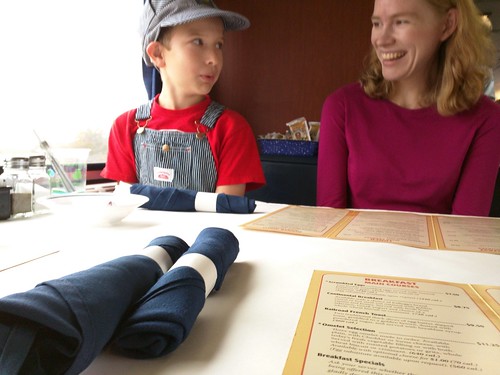
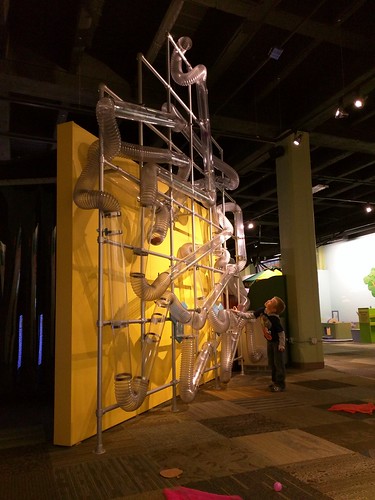
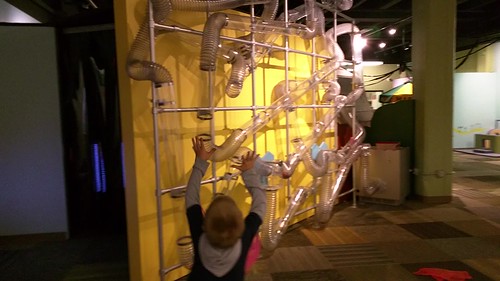
Sometimes, children are so excited you just can t resist. Jacob and Oliver have been begging for a train trip for awhile now, so Laura and I took advantage of a day off school to take them to the little town of Galesburg, IL for a couple days. Galesburg is a special memory for me; nearly 5 years ago, it was the first time Jacob and I took an Amtrak trip somewhere, just the two of us. And, separately, Laura s first-ever train trip had been to Galesburg to visit friends. There was excitement in the air. I was asked to supply a bedtime story about trains I did. On the way to the train station in the middle of the night there was excited jabbering about trains. Even when I woke them up, they lept out of bed and raced downstairs, saying, Dad, why aren t you ready yet? As the train was passing through here at around 4:45AM, and we left home with some time to spare, we did our usual train trip thing of stopping at the one place open at such a time: Druber s Donuts. IMG_20151023_040731 Much as Laura and I might have enjoyed some sleep once we got on the train, Jacob and Oliver weren t having it. Way too much excitement was in the air. Jacob had his face pressed against the window much of the time, while Oliver was busy making snake trains from colored clay complete with eyes. IMG_20151023_062304 The boys were dressed up in their train hats and engineer overalls, and Jacob kept musing about what would happen if somebody got confused and thought that he was the real engineer. When an Amtrak employee played along with that later, he was quite thrilled! We were late enough into Galesburg that we ate lunch in the dining car. A second meal there what fun! Here they are anxiously awaiting the announcement that the noon reservations could make their way to the dining car. Oh, and jockeying for position to see who would be first and get to do the all-important job of pushing the button to open the doors between train cars. IMG_20151023_120143 Even waiting for your food can be fun. IMG_20151023_120728 Upon arriving, we certainly couldn t leave the train station until our train did, even though it was raining. IMG_20151023_145755 Right next to the train station is the Discovery Depot Children s Museum. It was a perfect way to spend a few hours. Jacob really enjoyed the building wall, where you can assemble systems that use gravity (really a kinetic/potential energy experiment wall) to funnel rubber balls all over the place. He sticks out his tongue when he s really thinking. Fun to watch. IMG_20151023_153113 Meanwhile, Oliver had a great time with the air-powered tube system, complete with several valves that can launch things through a complicated maze of transparent tubes. IMG_20151024_150309 VID_20151024_150159 They both enjoyed pretending I was injured and giving me rides in the ambulance. I was diagnosed with all sorts of maladies a broken leg, broken nose. One time Jacob held up the pretend stethoscope to me, and I said ribbit. He said, Dad, you ve got a bad case of frog! You will be in the hospital 190 days! Later I would make up things like I think my gezotnix is all froibled and I was ordered to never leave the ambulance again. He told the story of this several times. After the museum closed, we ate supper. Keep in mind the boys had been up since the middle of the night without sleeping and were still doing quite well! They did start to look a bit drowsy I thought Oliver was about to fall asleep, but then their food came. And at the hotel, they were perfectly happy to invent games involving jumping off the bed. Saturday, we rode over to Peck Park. We had heard about this park from members of our church in Kansas, but oddly even the taxi drivers hadn t ever heard of it. It s well known as a good place to watch trains, as it has two active lines that cross each other at a rail bridge. And sure enough, in only a little while, we took in several trains. IMG_20151024_110035 VID_20151024_110229 The rest of that morning, we explored Galesburg. We visited an antique mall and museum, saw the square downtown, and checked out a few of the shops my favorite was the Stray Cat, featuring sort of a storefront version of Etsy with people selling art from recycled objects. But that wasn t really the boys thing, so we drifted out of there on our way to lunch at Baked, where we had some delicious deep-dish pizza. After that, we still had some time to kill before getting back on the train. We discussed our options. And what do you know we ended up back at the children s museum. We stopped at a bakery to get the fixins for a light supper on the train, and ate a nice meal in the dining car once we got on. Then, this time, they actually slept. Before long, it was 3AM again and time to get back off the train. Oliver was zonked out sleepy. Somehow I managed to get his coat and backpack on him despite him being totally limp, and carried him downstairs to get off the train. Pretty soon we walked to our car and drove home. We tucked them in, and then finally tucked ourselves in. Sometimes being really tired is well worth it.

Next.

Previous.