Search Results: "tar"

14 November 2007

MJ Ray: Enterprise Week 2007: Tuesday, non-existant events

I was in Bristol for other reasons again yesterday (as I was last Tuesday too), so I popped along to the advertised Trade Fair at City of Bristol College - or at least I tried to. If it was running, it wasn't an open door event, apparently. I left the business department some info on Cooperatives-UK and -SW anyway. I'm a bit disappointed with Enterprise Week so far. It clashes with at least two other government-sponsored "Week" campaigns (one of them is Get Safe Online week, which I'll write more about next week) and only business networking groups seem to be pushing it heavily here. I'm reconsidering whether I'm going to go to events on Thursday or Friday as I'd intended. The Social Enterprise People: Opposites Attract is running at Ely tomorrow (Thursday) but I'm a little hazy on when it starts and finishes. Other than that, I've not had any responses to asking what events are happening. Is England not very enterprising in 2007?

Michael Janssen: On happiness

I was viewing one of my most favorite speakers today, Lawrence Lessig, talk about copyright, giving a speech that is very similar to one that I have heard a few times online, but Lessig presents it so well that I end up watching it over and over again. This particular speech was given at TED. The nice thing about coming across a TED talk is that it is almost always enlightening in some way. Lessig's speech is enlightening enough, and it reminded me that I should watch something of his since he has switched to fighting corruption instead of copyright.

Another nice thing about the TED talks is that they are all sitting on the same site - so they are all interlinked with similar topics and they also include the new videos which are being posted fairly often. Sometimes I don't have time to watch more than one talk, but today I was blessed with a surfeit of time, so I clicked on another link which interested me. This talk was from Dan Gilbert and was coarsely about happiness, and more importantly synthetic happiness and how our brains work. It started with talk about the foundation of our evolved brains, of which the most important fact was considered the Impact Bias. Gilbert talked about the Impact bias as a primary result of the evolution of the mind from earlier man to modern man - it is the ability of our mind to predict the future without actually trying it. It is the reason why you have an aversion to a food that you haven't even eaten or don't think you will like a movie that isn't even released, or the opposite. I believe that the impact bias is very important to the psychology of human beings - while it may not actually be very important to the state of the world that you eat a pastrami sandwich today instead of a salad, it must mean something to you, or your life will end up seeming meaningless and insignificant. Gilbert focuses on the impact bias in the dual - that choices that we are given to make ourselves will eventually have an effect on our overall happiness. The experiments explained in the video show that, if a choice has been made, the user is more likely to be happy with that choice later, especially if the choice is an irreversible decision. In the talk he talks about simulated happiness and actual happiness, and that the mind is incredible at simulating happiness when placed in a situation where it did not come out for the better - some famous examples include people who are in jail for long times feeling that they are better for their incarceration after being released (or even while incarcerated). One important part which I think wasn't really touched upon by Gilbert was the fact that while the mind can produce synthetic happiness, in the long run the difference between synthetic and "real" happiness is actually rather small - over the long run all the happiness produced tends to even out, and the mind doesn't distinguish about really being happy or not. For a third point, it is a very interesting conclusion (and probably a significant jump) that most people strive to be happy overall, and most people succeed. This means that even though there are people in many different levels of happiness from an outside perspective, it is worthless to look at someone who is rich and happy and someone who is poor and happy and say that one must be happier than the other because they have more of the "real" and less of the synthetic happiness. Happiness is not a zero-sum game - everyone can be happy all of the time, and noone loses out. This may be an interesting ideal to reach for and may seem impossible to achieve considering all of the hate and rage which exists in the world today, but I believe that it is even possible yet - especially considering this "Happiness Bias" which seems to exist within everyone.

Clint Adams: Sad pandas

I'm not a fan of Fryderyk Franciszek Chopin, but this morning I was thinking that if I had to do the soundtrack for Light by M. John Harrison (and let us hope that they do not make it into a movie, because they would probably remove the brother, sister, and Tom Bombadil; make Ender's daemon a polar bear, and replace any subversive elements with a 25-minute tap-dancing rendition of Hamlet, without even bothering to cast Christopher Walken or Christian Bale; I mean, seriously ), I would include 2 Nocturnes No. 8 in D-flat major, Op. 27: II. There are people in this world who believe that mediocrity is a sin, and that it is incumbent upon them to push and prod others into realizing their full potential, that potency above all else which will transform one from an unremarkable nobody into someone quite remarkable, for no higher purpose than the remarkability itself. There are other people who believe that these people are overbearing authoritarian morons guilty of child abuse and worse, that being normal and average is fine and dandy, and that whiling one's days away without ever accomplishing anything is perfectly acceptable, since it won't make a lick of difference when one is rotting in the ground. Then there are people who are themselves motivated to do things like spend 16 hours a day playing Wii Boxing, becoming the best in the world, and achieving remarkability for nothing more than an ego boost, only to be attacked by the first two groups of people for having priorities completely out of wack. A long time ago, a bunch of possibly crazy people sang Free to Be You and Me in my general direction, while cavorting and being otherwise scarily insane all around me. They did not explicitly instruct me to be myself , and if they had, I was far too young to know to distrust them. Somewhere by a weeping willow near Charles's special homo friend who was mistaken for Charlie Chaplin in the redneck bar, a bent-out-of-shape mechanical arm smolders in a chemical fire, and the guy with the red leather topcoat doesn't care one whit.

Petr Rockai: looking back

Looking Back The past year has very much changed my life. A long time ago (around the beginning of this year) I have written that I have met Lucy. That happened over a year ago. In fact, it is just few weeks since it was a year. Lucy wrote me a beautiful letter at that time, picturing some of the moments in our life. I am very grateful for that letter. I am also much happier ever since I met her. Of course, there were problems (and there are problems)… None the less, life is fairly easy, and I am staggering on the path to becoming a better person. Lucy is a great help in that respect. Many things have straightened out over that year. A few got a little more wrinkled, but often due to smiles and seldom due to frowns. I have also mostly fixed the long-standing issue of a place to sleep and live in Brno, having recently moved in. I now live near the school (~15 minute walk, maybe less when in a little hurry), more or less in the city centre, with great connectivity to most of the places I need to visit. The previous place is just too remote for me. The new one is also a better building, or so I think, not a concrete-and-iron from-a-single-template building so typical of the socialist era, but solid brick building with high ceilings and thick walls. And it gives a much homelier feeling too. And what am I doing lately? Well, day job and school (both study and TA and research) take a fair amount of time, the rest I divide among Lucy, friends, learning to play the recorder, reading, writing and the many other things I (try to) do. I have even started to practice embouchure and breathing with an oboe (double) reed (and also with Lucy’s instrument). The idea is that i have the intention to get a bassoon (which is a double-reed as well) and start to learn and practice. And I also hope, that the practice from oboe will give me a head start to that. Maybe even that I could play both. I know that I won’t ever become a very good player, but I want to at least try. And I want to have some fun with it, too (it is great to be able to play an instrument, however impractical the woodwinds are, e.g. compared to guitar, which is probably much more social… one day, I may learn that too, though; wink). I still believe that with enough determination, i could become a semi-decent amateur. Call me foolish if you like, that is how I am. I have also considered blogging technicalities, and I probably will, if i find the time for that. It may also help me sorting things out. Probably need to consult the various people I work with, what they think about that, though.

13 November 2007

Russell Coker: More About Living in Hotels

In the past I have spent about 18 months living in hotels with a couple of months of breaks in between. I have previously written about it in terms of living in London hotels [1], but I have been asked for more generic advice. Firstly the amount of possessions that you may have when living in hotels is seriously limited. For ease of travel you want to restrict yourself to one suitcase for checked luggage and one for carry-on luggage. Hotels often have short-term storage space for possessions of guests, so having a second suitcase of items that are not worth stealing (clothes and books) may be an option. But consumer electronics devices other than a single laptop computer are not an option. I read an interesting blog post on ZenHabits.net titled Minimalist Fun: The 100 Things Challenge [2] which advocates counting and limiting the number of possessions you own. When living in hotels if I considered my books as one collection and my clothes as another (having never been interested in trendy clothes they count as utilitarian items for work or leisure not objects that I seek to own) and as my mobile phone was a tool for work and my computer gear was strictly limited to items that were needed for work (and thus “tools”) my only possessions were a digital camera and some bottles of liquor! The lack of ability to accumulate possessions may be considered as an advantage or a disadvantage depending on what your aims are. If you are moving to another country for work there are three ways of doing it. The easiest is to be a permanent employee of a company that assigns you to work there - in which case they will probably pay to transport your stuff when you buy or rent a house. If you are a looking for new employment (either contract or permanent) in another country then you can either find the work before moving or after arriving there. Finding work before arriving in the country is difficult and generally only works for short-term contracts. So it’s most likely that you will either be looking for work immediately after arriving or after a short contract. In either case having better mobility increases your employment options - why restrict yourself to one city or region when you can choose from all jobs in an entire country or (in the case of the EU) half of a continent! The career benefits of being able to accept any job anywhere in the world at short notice are significant! There are situations where an employer will pay hotel bills. One example was when I was working for a London based company and they assigned us to work at the other side of London. My colleagues complained and the company paid for hotel bills for everyone Sunday night to Thursday night inclusive as well as an extra hour of pay per day as compensation for the inconvenience. For me of course one hotel was as good as another so it just meant that my employer was covering 5/7 of my living expenses. Then I had a meeting with the hotel manager and pointed out that having me check out every Friday would be bad for them as the hotel was mostly empty on the weekend and suggested that they make me a deal for the other two days - I ended up paying something like one night of hotel fees per week! If I had rented an apartment I would have still been paying the full rent (which while less than 30 days hotel fees per month would have been considerably more than 4 or 5 days of hotel fees per month). If you live in a hotel then there is always some sort of deal that can be arranged. Apart from certain busy days (such as around the Christmas and new-year time) they always want long-term guests and will be willing to reduce the price, give free dinner or drinks from the bar, etc. The cost of living in a hotel at times such as Christmas may be as much as five times the regular rate. That is a further incentive to visit friends or relatives at Christmas. If you can’t visit your family (which may be difficult if they live on the other side of the world) then finding a friend who has a spare room might be an option.

Lucas Nussbaum: SC07, MIT Fab labs, and empowering people

This morning’s SuperComputing’07 keynote was a talk by Neil Gershenfeld, director of the Center for Bits and Atoms at the MIT. He mentioned the MIT Fab Labs, a project to bring “Personal Fabrication” to people around the around. At our own level, that’s something I find very exciting with Free Software: it empowers people to do things with their computers that they couldn’t do if they were using proprietary software, simply because proprietary software is built to fit most people’s needs, not very specific goals some people could have. (and this is similar to the Long Tail stuff, in some ways) Also, if you are at SC07 and reading this, feel free to ping me! I haven’t seen a lot of Debian/Ubuntuers here, even if the Free/Proprietary software ratio is very high.

Ross Burton: Poky on Android

God, Richard is such a hero. The day after Android is released, he has Poky building and booting on their emulator. There are a number of caveats, such as starting DBus causes their emulator to crash, but it is the first step towards being able to boot Poky on any future Android phones. Android in Poky Full-size images and more available on Richard's blog. Note that the non-existent theming is due to the XSettings not being set, because DBus won't start. NP: Tiger, My Friend, Psapp

Adrian von Bidder: Layer Cake

Recently spent three days playing poker, watching movies and drinking beer (we call that military service in Switzerland.) Layer Cake: Fun, somewhere in the vicinity of Betelgeuse^W Pulp Fiction or Lock, Stock and Two Smoking Barrels (Hmm. Why am I not surprised that Matthew Vaughn was also involved in the latter? I need to pay more attention to the names of directors and producers.) Also watched Meaning of Life one more time, no comment needed, I guess. Started watching Man on Fire (2004, by Tony Scott) but went to bed before the action really started, so I can't comment on it. Discussed modern (fast-paced, nervous etc.) moviemaking which reminded me that I should mention (Russian Ark) as a counter-example: the whole movie is one single 90 min long steadicam shot.

Russell Coker: Restorecon Equivalent for Unix Permissions

SE Linux has a utility named restorecon to set (or reset) the security context. This is useful for many reasons, corrupted filesystems, users removing files or changing the context in inappropriate ways, and for re-creating files from tar files or backup programs that don’t restore SE Linux contexts. It can also be used to report the files that have different contexts to that which would be set by restorecon to verify the contexts of files. Restorecon determines the context from two sources of data, one is the policy that came with the system (including any policy modules from other sources which were loaded) and the other is the local file contexts that were created by semanage. It’s a pity that there doesn’t seem to be an equivalent program for Unix permissions. rpm has a -V option to verify the files from a package and dpkg doesn’t seem to have an option to perform a similar operation (/var/lib/dpkg/info/* doesn’t seem to have the necessary data). But even on an RPM based system this isn’t possible because there is no way to add local files into the list. I would like to be able to specify that an RPM system should have root:root as the owner and permission mode 0755 for all files matching /usr/local/bin/* and use a single command to check the RPM database as well as this extra data for the permissions of all files. Does anyone know of any work in this area? I’m going to file Debian and Fedora bug reports about this, but I would appreciate any comments first. Update: Here is an example of how this feature works in rpm:
# rpm -Vv nash
…….. /sbin/nash
…….. d /usr/share/man/man8/nash.8.gz
# chmod 700 /sbin/nash
# rpm -Vv nash
.M…… /sbin/nash
…….. d /usr/share/man/man8/nash.8.gz The “M” character indicates that the permission mode of the file does not match the RPM. There is no way to automatically correct it (AFAIK) but at least we know that something changed. With Debian AFAIK it’s only possible to verify file checksums not the permission.

12 November 2007

Steve Kemp: At first I was afraid

BlueTooth I've just ordered a bluetooth adapter with the intention that my desktop machine will automatically screensaver & lock when I leave my desk. This looks trivial. As does setting my gaim status automatically. The challenge is to send a message to my work chatroom, via jabber, when the same thing happens. I think this should be straightfoward via xmpp but we shall see. I guess run-parts invoked upon /etc/presence/present & /etc/presece/absent or similar. Guitar Amps I have a "rare" (read limited edition) Marshall Jubilee Mini-Stack I'm trying to sell. From 198x. But I have no idea what the current price should be .. My google-fu is weak this week, or I'd know. The biggest issue is that I've found listings which just say "Call for price". Or expired Ebay auctions. I guess there can't be too many around so the price should be "high". But at the same time there can't be a huge market for them, so the price should be "low"... Complicating that is the fact that the buyer would have to be extremely local - as shipping isn't a realistic option. The cab + 2xspeaker combo is >1m high. Now what are the chances that somebody reading this would know how much one "should" cost..? ho hum. Still life is good, and that is the main thing.

Sune Vuorela: Debianized splashscreens

Disclaimer: splashscreens should be avoided and programs should start faster. Some programs are just too slow so a splash screen is needed. Wouldn’t it be cool if all programs that showed splashscreens actually showed a splash matching the same theme as your desktop environment and your display manager? This might going to happen. Besides OOo, amarok and the gimp, which other programs uses splash screens? And where do they store their splash screens? Artists: This is also your clue to consider it. I don’t have much artist skills, but I have some ideas for the implementation. To show off something, I can start here: debianized logout of kde The plan is of course to make it as easy as apt-get install debianized-splashscreens to get debianized splash screens - and apt-get remove to get the original splash screens back. Oh - and of course easily to change for derivatives who wants some other styling.
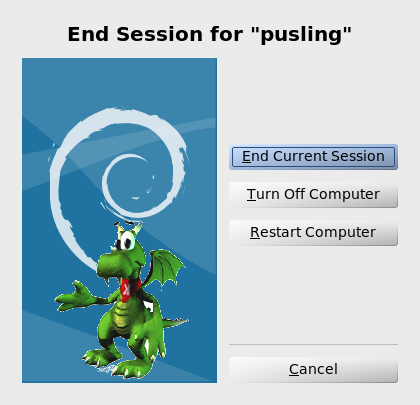
Benjamin Mako Hill: Code of Conduct

The Ubuntu Code of Conduct is probably the most widely read document I've written. Agreement to it is prerequisite to participation in the Ubuntu community in all official and many unofficial capacities. It is has successfully set a positive tone and helped turn Ubuntu into what is probably the most friendly and civil free software project I've worked in. Over time, quite a few free software projects have copied or adapted the CoC. Tired of giving folks permission, the project went ahead and licensed the CoC under the Creative Commons Attribution-Sharealike license to explicitly allow reuse as long as attribution to the Ubuntu project is given and derivatives are similarly modifiable. In a recent development, it was adapted by the Fort Erie, Ontario town council for use government interactions of their business improvement areas! It's amazing to see the document gain so much traction! Unfortunately, the person who repurposed the CoC did not attribute the document correctly and was publicly accused of plagiarism by another council member! Ubuntu is happy to have Fort Erie, and anyone else, use or adapt the CoC. Folks should just take care to be honest about where it came from and maintain the BY-SA license.

Theodore Ts'o: I love it when things Just Work

I am currently in the Hilton Portland & Executive Tower hotel, and since I fly entirely too much, I got upgraded into a room which contains a printer. Thinking that I would try using it, I hooked it up to my laptop (running Ubuntu Gutsy), selected System->Administration->Printing on the desktop, and then clicked on New Printer. To my astonishment, when the dialog box came up, the system had already autodetected the fact that I had an HP OfficeJet KX60xi printer connected to the parallel port, had recommended which driver I should use, and a few “next” and “continue” clicks later, the printer was installed, and 15 seconds later I was able to print to it. Users of MacOS systems are probably used to such things, but this was faster and easier than what Windows asks of users who want to install a new printer. Coming from a Unix background, I would have been quite pleased if I was able to set up the printer after manually select the printer type and driver from a dialog box. Simply not having to su to root, edit some config files, and then restart some daemons, would be a major advance. But this completely exceeded my expectations. Well done to everyone in the CUPS and GNOME community who worked to make this possible!

David Welton: The Economist on Business Books

Kicking ass in an unflat world is The Economist's take on recent efforts in the world of business books. As the creator of Squeezed Books, their opinion was of interest to me. As is often the case, they don't disappoint, with lines like
Things to bear in mind as you do, he says, include the need for your company to have purpose, to seek out ideas from the fringes, and to embrace the democratising power of the internet none of which will be news to anyone who has been in business for more than a few minutes.
What really caught me eye, though, was this:
There is also growing demand from overloaded executives for shorter books. So in January Harvard will launch a new hardback series, Memo to the CEO , covering subjects such as lessons from private equity and the future of strategy. Each book will be about 100 pages long and will cost $20. In a similar vein, Harvard has adopted the approach taken by iTunes to pop albums, and has started to sell individual chapters of books online an idea that has been a hit with academics in particular.
A lot of good business books take a sensible central idea, and then proceed to fluff it up to a length where it can be published as a book. Often, this makes for a good read, as the anecdotes and case studies and whatnot are interesting, but for those in a hurry, or simply wanting to know what the basic point of the book is about, it's just padding. So, it looks as if the idea behind Squeezed Books is a good one, now I just need to get better at attracting more people to contribute summaries, and discuss the books on the site. One thing I've done to that end is stipulate that the summaries are available, unless otherwise noted, under a creative commons license.

Erich Schubert: Memory died

Yesterday, my laptop locked up hard. So hard, it wouldn't turn on afterwards, but flash an error code. Unfortunately, Dell hides the relevant information very well - it took me some time to find in the forums that the error code means bad memory.After removing the memory module from slot B, I could turn my computer back on again. So either the module is dead or the mainboard part related to it.I bought my laptop second-hand in the US last year, and warranty probably is just over. Still I wanted to make sure that this isn't covered by warranty anymore, so I tried contacting Dell support.What a pain. No reply yet to my mail inquiry; and the "support chat" doesn't work right. Their support agent always asks for my phone number (WTF?) and then after some minutes says he's going to disconnect because I don't reply.I wonder if they ever tested their support chat with Gecko-based browsers.0 out of 5 stars for Dell support so far. Important information is inaccessible and the support doesn't reply in either email nor chat. It's not even giving bad replies.

Daniel Leidert: GNU make vs. BSD make - a practical problem experience

I’m currently evaluating Olivier Sessinks jailkit to maintain a small cvsd CHROOT with an included SSH server. The cvsd-buildroot command e.g. doesn’t handle the libpam-modules dependency in the CHROOT. So I tried to update the Debian packaging files included in the jailkit source. During this work I found some issues with the build environment - e.g. no DESTDIR support and some other stuff (another user already complained, that there might be problems with the SUID installation part for jk_chrootsh, jk_uchroot and jk_procmailwrapper of the Makefiles). So I began to check and “fix” the Makefiles and the configure script and then sent everything to Olivier. I did not only add the DESTDIR variables. I also made use of built-in rules, common variables (also for implicit rules), … and such stuff to make the Makefiles shorter and easier to maintain. My fault: I tested everything with GNU make. Now Olivier complained, that BSDs make doesn’t work anymore. So we began a short hack session to check for the problems. My first issue: I had to find some BSD make to test it myself. I found it in the freebsd5-buildutils, that contains the freebsd-make command. Then we began to check for incompatibilities and that’s the result:
  1. ifdef statements differ in syntax
    • GNU make uses ifdef VAR
    • BSD make uses .ifdef VAR
    solution: We replaced the statement with a construct similar to AM_CONDITIONAL. But we do not use this macro, because it would need to be shipped in aclocal.m4, which is currently not necessary. The code simply sets a variable foo_TRUE to ‘# ‘, if the condition is wrong, or the variable is left empty, if the condition is true:
    if test "x$my_condition" != "xno" ; then
        AC_SUBST([foo_TRUE], [])
    else
        AC_SUBST([foo_TRUE], [# ])
    fi
    FILES = bar
    @foo_TRUE@FILES += foo
  2. prerequisite variables differ in syntax
    • GNU make uses $<, $^, $@, …
    • BSD make uses $ .IMPSRC , $ .ALLSRC , $ .TARGET , … (note, that both *SRC variables hold a list of source files)
    Unfortunately both make implementations doesn’t seem to share a variable for the list of prerequisites. So the only solution is to list all prerequisites in the rule again. A variable would be much more comfortable. Maybe one could write a function, that first tests $ .IMPSRC and falls back to $^. Maybe that’s an alternative, but it’s IMHO not a very good solution. We’ve chosen to write down all prerequisites in a rule instead of using a variable. This is a little bit “harder” to maintain, but it works.
  3. built-in rules are not shared and do not use the same variables
    • GNU make ships built-in rules to build objects from sources and link them; rules consider CPPFLAGS
    • BSD make ships built-in rules to build objects from sources, but there are no rules to link them; rules do not consider CPPFLAGS
    In the case of GNU make, one can simply write:
    myprog: foo.o bar.o
    and GNU make will automatically create foo.o from foo.c (.c.o:, ditto for bar.o) and at least link myprog (.o:). But BSD make will only create the object files. There is no final link-step. So we had to include the rule to link the program in the Makefile.
Finally we got it and it looks good now. I/We learned a lot of new things (I learnd a lot about BSD make) ;), but it took us 1-2 hours to understand and fix the problems. Here a list of URLs, that might give some more information about the programs, their syntax and limitations:

Raphael Geissert: what happens when you mass bug fill?


Sometimes you hit the number :)
(that means: still 50k bugs left for bug #500000)
Noticed that thanks to Christian Perrier who blogged about bug #450000.

11 November 2007

Daniel Burrows: ANNOUNCE: cwidget

I've just uploaded the first release of libcwidget to Alioth and NEW. libcwidget is a high-level C++ library for developing user interfaces that run in a terminal using curses as the display and input layer. It uses widget abstractions similar (but of course not identical) to those found in GTK+ and Qt, with signals and slots provided by libsigc++.

Background

Back when I started writing aptitude, I had one general goal:

Just because it runs in a terminal doesn't mean it has to suck.


I tried to apply this in the user interface, but I also applied it internally. The curses programs I looked at before writing aptitude all had very ad-hoc UIs. In many cases the code was structured with each "view" that appeared mapped to a custom C function call; if the author was feeling ambitious, similar-looking screens might be abstracted into a single function call, but the basic structure of the interface still reflected the call graph of the program.

aptitude had a primitive interface abstraction layer from the get-go; over the years, I borrowed ideas from GTK+ and restructured this layer into a full widget set. libcwidget is this code, disentangled from the guts of aptitude and slightly cleaned up. Because of its history, it is missing widgets that aptitude doesn't need (like a multi-line text editor), but it provides an extensible base that you can build upon.

Getting cwidget

The cwidget library is available (both as source and as an i386 .deb) from the cwidget Alioth releases page. There is also API documentation automatically generated from the upstream repository, which, while it is woefully incomplete, should provide some information: I've tried to write Doxygen tags into most of the code I've added in the last 4 years or so.

The upstream code repository is in git (because what fun is a new project if you don't learn a new VCS?) and available here. To retrieve a copy of the repository for yourself, run this command:

git clone git://git.debian.org/git/cwidget/head cwidget

Rob Bradford: Yes, no, maybe? Ja, nein, vielleicht?

My friend Martin has started a blog on usability, Yes, No, Cancel? (or in German, Ja, Nein, Abbrechen). He appears to have stalled after a good start so perhaps this mention will get him going again. He offers usability consulting through his company, Ept Computing. Martin Kleppmann
Martin, an early victim of the new camera

Ross Burton: Daily Mail Smack Down

There are many reasons to love the blog Five Chinese Crackers, and printing the letter sent to The Daily Mail from the author of an immigration report which was drastically misrepresented certainly is one of them:
Unfortunately, your piece is a mixture of ignorance, misinterpretation and speculation. I couldn't care less about your intellectual capacity to absorb the data, but you have included my name in an article that conveys a false impression of what the study was about.
In other news, today I discovered that the epitome of British retailing, Marks and Spencer, was co-founded by a foreigner! Michael Marks was born in Belarus, and came to England to avoid the persecution of Jews. The warehouse in Leeds where they started up has a blue plaque commemorating the event. What would the Express or Mail say to this?

Next.

Previous.

