Search Results: "ed"

6 March 2013

Keith Packard: composite-swap

Composite and Swap Getting it Right Where the author tries to make sure DRI3000 is going to do what we want now and in the future DRI3000 The basic DRI3000 plan seems pretty straightforward:
  1. Have applications allocate buffers full of new window contents, attach pixmap IDs to those buffers and pass them to the X server to get them onto the screen.
  2. Provide a mechanism to let applications know when those pixmaps are idle so that they can reuse them instead of creating new ones for every frame.
  3. Finally, allow the actual presentation of the contents to be scheduled for a suitable time in the future, generally synchronized with the monitor. Let the client know when this has happened in case they want to synchronize themselves to vblank.
The DRI3 extension provides a way to associate pixmap IDs and buffers, and given the MIT-SHM prototype I ve already implemented, I think we can safely mark this part as demonstrably implementable. That leaves us with a smaller problem, that of taking pixmap contents and presenting them on the screen at a suitable time and telling applications about the progress of that activity. In the absence of compositing, I m pretty sure the initial Swap extension design would do this job just fine, and should resolve some of the known DRI2 limitations related to buffer management. And, I think that goal is sufficient motivation to go and implement that. However, I wanted to write up some further ideas to see if the DRI3000 plan can be made to do precisely what we want in a composited world. The Composited Goal To make sure we re all on the same page, here s what I expect from the Swap extension in a composited world:
  1. Application calls Swap with new window pixmap
  2. Compositor hears about the new pixmap and uses that to construct a new screen pixmap
  3. Compositor calls Swap with new screen pixmap
  4. Vertical retrace happens, executing the pending swap operation
  5. Compositor hears about the swap completion for the screen
  6. Application hears about the swap completion for its window
In particular, applications should not hear that their swap operations are complete until the contents appear on the screen. This allows for applications to throttle themselves to the screen rate, either doing double or triple buffering as they choose. I didn t add steps here indicating buffers going idle or being allocated, because I think that should all happen behind the scenes from the application s perspective. Many applications won t care about the swap completion notification either, but some will and so that needs to be visible. Redirected Swaps? Owen Taylor suggested that one way of getting the compositor involved would be to have it somehow redirect Swap operations, much like we do with window management operations today. I think that idea may be a good direction to try:
  1. Application calls Swap with new window pixmap
  2. Swap is redirected to compositor, passing along the new window pixmap
  3. Compositor constructs a new screen pixmap using the new window pixmap
  4. Compositor calls Swap on the screen and the window, passing the new screen pixmap and the new window pixmap. When the screen update occurs, the screen and the window both receive swap completion events.
This has the added benefit that the X server knows when the compositor is expecting window pixmaps to change like this the compositor has to explicitly request Swap redirection. Window Pixmap Names and GEM Buffer Handles One issue that swapping window pixmaps around like this brings up is how to manage existing names for the window pixmap. Right now, applications expect that window pixmaps will only change when the window is resized. If the Swap extension is going to actually replace the window pixmap when running with a suitable compositor, then we need to figure out what the old names will reference. Are there non-compositor applications using NameWindowPixmap that matter to us? How about non-compositor applications using TextureFromPixmap to get a GEM handle for a window pixmap? For now, I m very tempted to just break stuff and see who complains, but knowing what we re breaking might be nice beforehand. Idling Pixmaps When an application is done drawing to a window pixmap and has passed it off to the X server for presentation, we d like for that pixmap to be automatically marked as discardable as soon as possible. This way, when memory is tight, the kernel can come steal those pages for something critical. Of course, applications may not want to let the server mark the pixmap as idle after being used, so a flag to the Swap call would be needed. Ideally, the pixmap would become idle immediately after the pixmap contents have been extracted. In the absence of a compositor, that would probably be when the Swap operation completes. With a compositor running, we d need explicit instruction from the compositor telling us that the window pixmap was now idle :
 
    SwapIdle
    drawable: Drawable
    pixmap: Pixmap
       
 
Furthermore, the application needs to know that the pixmap is in fact idle. I think that we ll need a synchronous X request that marks a buffer as no longer idle and have that return whether the buffer was discarded while idle. It doesn t seem sufficient to use events here as the application will need to completely reconstruct the pixmap contents in this case. This reply could also contain information about precisely what contents the pixmap does contain.
 
    SwapReuse
    drawable: Drawable
    pixmap: Pixmap
       
    valid: BOOL
    swap-hi: CARD32
    swap-lo: CARD32
 
Pixmap Lifetimes and Triple Buffered Applications If we redirect the Swap operation and send the original application window pixmap ID to the compositor, what happens when the application frees that pixmap before the compositor gets around to using the contents? Surely the Compositor must handle such cases, and not just crash. However, I m fine with requiring that the application not free the pixmap until told by the compositor.

Raphael Geissert: A bashism a week: returning

Inspired by Thorsten Glaser's comment about where you can break from, this "bashism a week" is about a behaviour not implemented by bash.

return is a special built-in utility, and it should only be used on functions and scripts executed by the dot utility. That's what the POSIX:2001 specification requires.

If you return from any other scope, for example by accidentally calling it from a script that was not sourced but executed directly, the bash shell won't forgive you: it does not abort the execution of commands. This can lead to undesired behaviour.

A wide variety of shell interpreters silently handle such calls to return as if exit had been called.

An easy way to avoid such undesired behaviours is to follow the best practice of setting the e option, i.e.
set -e
. With that option set at the moment of calling return outside of the allowed scopes, bash will abort the execution, as desired.

The POSIX specification does not guarantee the above behaviour either as the result in such cases is "unspecified", however.

5 March 2013

Michal Čihař: phpMyAdmin translations status

Next round of phpMyAdmin 4.0 translation status report is coming. So let's look at which translations are at 100% right now (some changes this week due to new strings to translate): Almost complete: As you can see, there is still lot of languages missing, this might be your opportunity to contribute to phpMyAdmin. Also you are welcome to translate phpMyAdmin 4.0 using translation server. If your language is already fully translated and you want to help as well, you can translate our documentation as well.

Filed under: English Phpmyadmin 0 comments Flattr this!

Debian Med: Debian Med sprint report (by Andreas Tille)

This is the report about my work at Debian Med sprint ten days ago in Sch nberger Strand. If you are interested in Sprints in general you might be interested in work item 2. below.
  1. Wrote draft article for Indian health care magazin. If you might like to proofread the article I'd be very happy (it is not yet to late for changes.) There is also a PDF version.
  2. I have given a short talk proving the importance of sprints. The slides are basically graphs and I try to prove that sprints are a really good idea. The background knowledge is that the Debian Med team is doing sprints since 2011 and looking at all graphs you can see that this has a really positive effect. Thanks to Debian and its sponsors for supporting this kind of sprints.
  3. Packaging
    • Worked with T. Travis on flexbar and uploaded the package to new queue
    • Worked with Ch. Gille on strap-base and uploaded the package to new queue
    • Discussed strategy how to strip glam2 source from meme upstream with T. Booth. Meme upstream agreed to keep the original license of Glam2 and backport the changes from Meme source archive
    • Discussed igv packaging issues with O. Sallou who updated the package and documented some issues about its dependency goby
    • Worked together with I. Maintz on cellprofiler
    • Worked together with I. Maintz on a couple of R packages which are mostly predependencies but also one Debian Med primary target (r-cran-boolnet) was uploaded to new
  4. Discussing / chatting
    • Some chat with Ch. Steigies (Debian Games, Debian m68k, Debian Science)
    • Discussion with M. Banck about DebiChem
  5. Little bit of MoM mentoring
  6. Maintain Debian Med tasks files about newly commited packages of other sprint participants
  7. General infrastucture issues
    • Issues with machine-readable files importer into UDD
    • Try to revive PET data in UDD
    • Work on installation of future blends.debian.net host (install needed packages, create UDD clone)
Thanks to all participants of the sprint and specifically to Steffen M ller who took over the work of organising. It was fun to meet you all and I'm even looking right now forward to the next sprint hopefully beeing able to continue the graphing of positive results of sprints in our team metrics.
We had some nice food, not so nice weather and from my perspective the only drawback was that at home there would have been perfect conditions for skiing ... but finally there are preferences. ;-)
See you at next sprint!

Tanguy Ortolo: Suspend your computer from a non-mainstream desktop environment

Battery icon UPower for regular users Major desktop environments usually provide a user-friendly menu to suspend your computer. Internally, if seems to use something called UPower, which uses something called PolicyKit, which in turn may or may not use another piece called ConsoleKit (do not ask me what all these pieces are and how they relate to each other, I do not know and I do not want to know). For the regular user, the result is the following: when they click on that button, it suspends their computer.UPower for command line users However, if you are using a more unusual desktop environment, for instance a simple, light window manager, you will not have such a button. And no, UPower does not provide a simple command line tool to suspend your computer (they probably consider that command line is out of fashion ). Well, in case you need it, here is a way to suspend your computer from a command line or whatever: just alias it or bind it to a key shortcut. It uses some dark DBus magic:
$ dbus-send --system --print-reply --dest='org.freedesktop.UPower' \
    /org/freedesktop/UPower org.freedesktop.UPower.Suspend
If you prefer to hibernate your computer, that is, to suspend it, not to RAM but to disk:
$ dbus-send --system --print-reply --dest='org.freedesktop.UPower' \
    /org/freedesktop/UPower org.freedesktop.UPower.Hibernate
As you can see, for some reason it requires some duplication of information: the name org.freedesktop.UPower appears three times in that command line: in the destination , object path and interface member , whatever that could mean. Again, do not ask me why, I know nothing about that and I do not want to. Notes
  1. Actually, UPower does provide a command line tool called upower, but the only thing it does (monitoring power sources) is not really useful for that matter.

Martin Pitt: Automatically generating documentation from GIR files

Many libraries build a GObject introspection repository (*.gir) these days which allows the library to be used from many scripting (Python, JavaScript, Perl, etc.) and other (e. g. Vala) languages without the need for manually writing bindings for each of those. One issue that I hear surprisingly often is there is zero documentation for those bindings . Tools for building documentation out of a .gir have existed for a long time already, just far too many people seem to not know about them. For example, to build Yelp XML documentation out of the libnotify bindings for Python:
  $ g-ir-doc-tool --language=Python -o /tmp/notify-doc /usr/share/gir-1.0/Notify-0.7.gir
Then you can call yelp /tmp/notify-doc to browse the documentation. You can of course also use the standard Mallard tools to convert them to HTML for sticking them on a website:
  $ cd /tmp/notify-doc
  $ yelp-build html .
Admittedly they are far from pretty, and there are still lots of refinements that should be done for the documentation itself (like adding language specific examples) and also for the generated result (prettification, dynamic search, and what not), but it s certainly far from nothign , and a good start. If you are interested in working on this, please show up in #introspection or discuss it on bugzilla, desktop-devel-list@, or the library specific lists/bug trackers.

Lisandro Damián Nicanor Pérez Meyer: My Debian freeze experience (so far)

This is the first freeze in which I'm involved with upload rights. And it turned out to be a quite interesting ride so far, so I thought it would be nice to write about it.

As some of you may know, I'm a part of the Qt/KDE team. Before the freeze I was mostly involved in leaf packages, with some patch here or there, nothing fancy. And then the freeze came...

Bugs in Qt

...and bugs appeared in Qt. But they didn't get solved, even if the patches were there. Due to personal reasons, the manpower in Qt/KDE land decreased below normal levels (which were already low).

I took the time to review them, apply them in a local branch, build and test the fixes. I did a Qt upload before, but it was a team-consented one. This time there was not much reaction in our IRC channel as it used to be, so I was doubting if going ahead or not. I asked Ana, my great friend and former sponsor, for an opinion on the subject, and she gave me a really important advice: the patches were looking good and there is one really big true: if something get's broken, it can be fixed with a later upload.

You might be asking yourself why I was that afraid of doing the upload. Well, when one maintains such a medular package for many users one has to be careful And I also got used that those "big ones" like Qt where normally handled by hand skilled people. Do not take me wrong here, it's not that those people where keeping them for themselves, it's knowing that one does not has the same skills nor experience as them.

But again, no one was able to upload and I had the chance and will to do another upload if needed, so off it went. That was Qt 4:4.8.2-2.

Then new experiences followed: asking a buildd maintainer for a giveback, asking the Release Team for an unblock (more on this later), etc. While sponsoring me, Ana gave me another excellent advice which I always keep in my mind:

You can't know **everything** about Debian.

And that also includes a not so technical skill: communicating with other teams. But finally we got this new version of Qt in testing. Cool :-)

Of course, new bugs appeared, and my lack of skills (and sometimes, time) where replaced by team work: Pino looking at patches and Sune contacting upstream. The eleven uploads that followed are a nice example of team work, even if I was the one who signed and did the uploads. Whoever uses Qt must know that these wonderful people (including those who are not so active nowadays like Modestas or Fathi) have done lots to bring the better to their users.Thank you guys!

Be careful, they might bite you back!

Coming back to the non-technical skills, sometimes you have to communicate with other teams in Debian. And each team is (naturally) a separate world: possibly different people, different goals, etc. Of course, we share the goal to make Debian the best experience we can, but we do not necessarily agree on the paths to achieve so.

During the freeze, there is a team that gets lots of pressure, and not by chance: the Release Team. They handle a very important task, which is to ride the freeze to get to a release. OK, that's what everyone knows. Now, one thing is knowing that and another is really understanding what does that means.

Of course I was in the first group. From the outside, communicating with the RT was a kind of "special art", and not an easy one. I have even been advised to not ask for more than one or two unblocks per weekend, as they might "bite me back". So I put on my flamesuit on and... launched reportbug release.debian.org.

Now I'm really happy to say that my experience was far from what I described above. And yes, I had the chance to even disagree on some stuff. But remember: non-technical skills, a.k.a. social skills. Once I started to know what was going on inside the RT (joining #debian-release was a big help for that) I learnt some nice tips to approach them. Please allow me to list some of them:

  • Remember: you are the maintainer of the package, they are like gatekeepers that are there to help us coordinate to do a release. But they don't maintain the code, you do that. So try to be verbose when needed, explain the changes and don't forget a nice diff. They need to understand what is going on: they can't read your mind.
  • They are human beings too: not everyday might be their best day (the same goes for you too!). And they are under the pressure of a release. Be patient, that finally pays off.
  • Does your changes seem not so clear? try to improve them.
  • The package has a lot of changes but you really feel they are needed? Try to explain that as good as you can.
  • Try to put yourself in their position: do we really want this? If in doubt, there is a nice way to know what they think: a pre-approval bug.
I want to make a stop in this last point. A pre-approval bug it's an unblock bug in which you edit the subject to add "pre-approval" in it. Easy, isn't it? It gives you the opportunity to know what the RT thinks before doing the upload. In other words: it gives you the chance to communicate and do things in the best possible way for all the parts involved.

I've have also seen pre-approval bugs that were really not needed. But to learn where the threshold of what can be directly uploaded and what deserves a pre-approval bug is you need to know the guidelines the RT gives you. Do you still have doubts? fire a pre-approval bug and try to be clear.

Of course, this are all fruits of my experience with the RT during this time. If the RT thinks different from what I'm writing here, please stand up: we are hear to listen to you and learn :-)

As a side note, I think I should file a wishlist bug to include the pre-approval bug option in reportbug. Yes, I'm lazy :-)

Summing up

Overall this was a very nice and positive experience. We are not done yet. Are we really done at some point? Let's hope not, because this is where the fun comes from :-)

Russell Coker: Kogan Mobile

Kogan Mobile is the newest virtual telco in Australia [1]. They resell Telstra 3G (not NextG or LTE) and while their coverage isn t as good as the full Telstra service it s more than adequate for my needs as they provide 3G coverage to 97% of the population and 2G+3G coverage to 98.5%. Their coverage is probably a lot better than Three who had the worst record of network coverage in Australia yet managed to always provide coverage where I wanted it I was a happy Three customer for more than 6 years. Kogan s main selling point is that they offer unlimited calls to Australian mobile phones and land-lines and unlimited SMS for a pre-paid fee of only $300 per annum ($25 per month on average). My parents have been getting unpleasantly large phone bills which have considerably more than $25 of calls to mobile phones every month so an obvious solution for them is to sign up for a Kogan mobile phone and use it for all such calls. There are other ways my parents could save money on calls (such as VOIP) but a mobile phone is easiest and offers other benefits such as running Android apps (when compared to using a non-smart phone). 6G of Data! Kogan also offers 6G of data per month, the down-side to this is that they bill in 1MB increments per session . I was worried that this might be per TCP connection or something else silly but I decided to sign my parents up for it as they aren t going to use a lot of data (they claim that they don t want to use the Internet on their phone but I know better). I ve done some tests on the SIM I got for my parents. For testing purposes I installed the Kogan SIM in my wife s new Nexus 4 and had it provide Wifi net access to my phone while we were playing Ingress. So far after 2 days which involved a reasonable amount of Ingress (I reached level 7) as well as all the usual stuff that happens in the background for two phones (checking email, news, weather, etc) Kogan considers that 177MB have been used out of the 6144MB for the month, which means that even with what is an unusual amount of traffic for us the account in question still isn t going to use half the quota for the month. Now that 10 days have elapsed with less intense usage Kogan considers that a total of 1373MB have been used.
days received sent Kogan
2 127.24 41.54 177
10 959.39 299.6 1373
Kogan also don t seem to mention whether they bill for transmitted data. I used the 3G Watchdog app to measure the amount data transferred, the above table has the amounts of data that 3G Watchdog considers were sent and received along with the amount that is listed by the Kogan Android app. My past experience with 3G Watchdog and Virgin Mobile is that it s usually quite accurate but has been over-reporting the data transfers recently (I think that Virgin is only billing me for downloads while 3G Watchdog counts uploads). So the relatively small difference between the 3G Watchdog report and what Kogan thinks I ve done means that either rounding the session up to the nearest meg doesn t make any significant difference (which would imply that a session can be a long time) or that Kogan isn t counting uploaded data and the session rounding up only adds about 40% to the total recorded transfer. My current plan with Virgin Mobile gives me 1.5G per month of quota, so as long as Kogan s rounding doesn t increase the recorded data transfer by a factor of 4 I will still be able to transfer more data with Kogan while paying less. One disadvantage of using Kogan is that I might have to tweak programs like my email program to poll less frequently to avoid excessive session charges (a program polling every 5 minutes would use up the 6G quota in 21 days if each poll counted as a session) although current tests indicate that this won t be necessary. But the up-side is that there are no extra fees with Kogan, they merely restrict data access for my use and that of most people I know it s better to have data access cut off than to receive a large bill. The Kogan Android App Kogan has an Android app that will give the status of your account and allow you to change the plan etc. This is quite nice but one major disadvantage is that it s also a sales app for the Kogan online store. This is bad for the user as some aspects of what I consider the core functionality are limited (for example there s no way to force a poll of the data usage count or determine how current the data is). But there s an obvious advantage to Kogan in providing a way to sell their goods that is going to be used by every customer of Kogan Mobile. The sales part of the app isn t very functional IMHO, it doesn t seem to have basic functionality such as sorting a list of items by price. Benefits of Kogan 6G of data is a lot! $300 per annum is quite cheap, anyone who makes any serious use of phones will be paying more than that in Australia. Lack of extra fees means that there is little need to restrict net access. I can risk getting cut off near the end of the month but I can t risk the potential for hundreds of dollars in excess fees. The Kogan app shows me the data used so I will probably uninstall 3G Watchdog, having one less program running is a good thing. You get a free SIM (value $5) when you buy a phone from Kogan. Disadvantages of Kogan They are new to the Telco business and admit that their customer service is lacking due to unexpected demand. If you order a SIM now they state that it will arrive in April. Apparently they are deliberately delaying orders because they can t cope with demand. The included call quota doesn t include international calls. While unlimited free calls in Australia is great if you make many international calls then this could end up costing you more. Other mobile telcos such as Lebara offer good deals for International calls, it could be an option to use a Lebara SIM with an old non-smart phone while using Kogan for your smart phone. I am concerned about the lack of detail about how data is accounted. If the definition of a session changes then 6G could turn out not to be enough. As Kogan is reselling a Telstra service it is possible that Telstra could change the deal without Kogan being able to stop them. Conclusion I will move my phone and my wife s phone to Kogan ASAP. My general idea is to sign us up for Kogan about 2 weeks apart, so if one phone runs out of the 6G data quota then the other phone can be used as a Wifi access point for 2 weeks. If the phones don t both have their quota end at the same time then there is less chance of both phones running out during a high traffic month.

4 March 2013

Bastian Blank: Using SECCOMP to filter sync operations

Linux includes a syscall filter since a long time. It was restricted to a pre-defined set of syscalls. Since some versions Linux got a more generic filter. Linux can use a BPF-filter to define actions for syscalls. This allows a fine granular specification on which syscalls to act. Also it supports different outcomes assigned to the filter. This filter can be used to filter out sync operations. Debian already got a tool to do this called eatmydata. It is pretty limited as it uses a shared library to drop the library functions. It needs to be available at all times, or it will not do anything. I wrote a small tool that asks the kernel to filter out sync operations for all children. It sets a filter with all currently supported sync-like operations and makes them return success. However it can't filter the O_SYNC-flag from the open-syscall, so it just makes it return an error. It executes the command given on the command-line after that. This is just a proof of concept, but lets see.
/*
 * Copyright (C) 2013 Bastian Blank <waldi@debian.org>
 *
 * Redistribution and use in source and binary forms, with or without
 * modification, are permitted provided that the following conditions are met:
 *
 * 1. Redistributions of source code must retain the above copyright notice, this
 *    list of conditions and the following disclaimer.
 * 2. Redistributions in binary form must reproduce the above copyright notice,
 *    this list of conditions and the following disclaimer in the documentation
 *    and/or other materials provided with the distribution.
 *
 * THIS SOFTWARE IS PROVIDED BY THE COPYRIGHT HOLDERS AND CONTRIBUTORS "AS IS" AND
 * ANY EXPRESS OR IMPLIED WARRANTIES, INCLUDING, BUT NOT LIMITED TO, THE IMPLIED
 * WARRANTIES OF MERCHANTABILITY AND FITNESS FOR A PARTICULAR PURPOSE ARE
 * DISCLAIMED. IN NO EVENT SHALL THE COPYRIGHT OWNER OR CONTRIBUTORS BE LIABLE FOR
 * ANY DIRECT, INDIRECT, INCIDENTAL, SPECIAL, EXEMPLARY, OR CONSEQUENTIAL DAMAGES
 * (INCLUDING, BUT NOT LIMITED TO, PROCUREMENT OF SUBSTITUTE GOODS OR SERVICES;
 * LOSS OF USE, DATA, OR PROFITS; OR BUSINESS INTERRUPTION) HOWEVER CAUSED AND
 * ON ANY THEORY OF LIABILITY, WHETHER IN CONTRACT, STRICT LIABILITY, OR TORT
 * (INCLUDING NEGLIGENCE OR OTHERWISE) ARISING IN ANY WAY OUT OF THE USE OF THIS
 * SOFTWARE, EVEN IF ADVISED OF THE POSSIBILITY OF SUCH DAMAGE.
 */
#define _GNU_SOURCE 1
#include <errno.h>
#include <fcntl.h>
#include <seccomp.h>
#include <stdio.h>
#include <stdlib.h>
#include <string.h>
#include <unistd.h>
#define filter_rule_add(action, syscall, count, ...) \
  if (seccomp_rule_add(filter, action, syscall, count, ##__VA_ARGS__)) abort();
static int filter_init(void)
 
  scmp_filter_ctx filter;
  if (!(filter = seccomp_init(SCMP_ACT_ALLOW))) abort();
  if (seccomp_attr_set(filter, SCMP_FLTATR_CTL_NNP, 1)) abort();
  filter_rule_add(SCMP_ACT_ERRNO(EINVAL), SCMP_SYS(open), 1, SCMP_A1(SCMP_CMP_MASKED_EQ, O_SYNC, O_SYNC));
  filter_rule_add(SCMP_ACT_ERRNO(0), SCMP_SYS(fsync), 0);
  filter_rule_add(SCMP_ACT_ERRNO(0), SCMP_SYS(fdatasync), 0);
  filter_rule_add(SCMP_ACT_ERRNO(0), SCMP_SYS(msync), 0);
  filter_rule_add(SCMP_ACT_ERRNO(0), SCMP_SYS(sync), 0);
  filter_rule_add(SCMP_ACT_ERRNO(0), SCMP_SYS(syncfs), 0);
  filter_rule_add(SCMP_ACT_ERRNO(0), SCMP_SYS(sync_file_range), 0);
  return seccomp_load(filter);
 
int main(__attribute__((unused)) int argc, char *argv[])
 
  if (argc <= 1)
   
    fprintf(stderr, "usage: %s COMMAND [ARG]...\n", argv[0]);
    return 2;
   
  if (filter_init())
   
    fprintf(stderr, "%s: can't initialize seccomp filter\n", argv[0]);
    return 1;
   
  execvp(argv[1], &argv[1]);
  if (errno == ENOENT)
   
    fprintf(stderr, "%s: command not found: %s\n", argv[0], argv[1]);
    return 127;
   
  fprintf(stderr, "%s: failed to execute: %s: %s\n", argv[0], argv[1], strerror(errno));
  return 1;
 

Michal &#268;iha&#345;: Nice OpenStreetMap project

For quite some time, I'm contributing to OpenStreetMap. Mostly covering areas where I live or I know well, but sometime I randomly update areas where I travel as well. The one important bit was always missing for me - nice frontend to render many of hidden features. Now this space seems to be slowly filled in by map1.eu. This quite new project (first announcement has been two weeks ago) renders quite nice maps for Europe. The map is primarily intended for hiking or cycling, so it includes things like hiking routes or cycle routes. In Czech republic we have quite great maps on mapy.cz, but I don't know anything what covers whole Europe. The project still has some issues, but is progressing nicely as you can see in today's announcement of 0.2 release (in Czech). Of course you can help, either by code or by money, which is needed to run rendering servers.

Filed under: English Maps 0 comments Flattr this!

Lucas Nussbaum: Debian is (still) changing

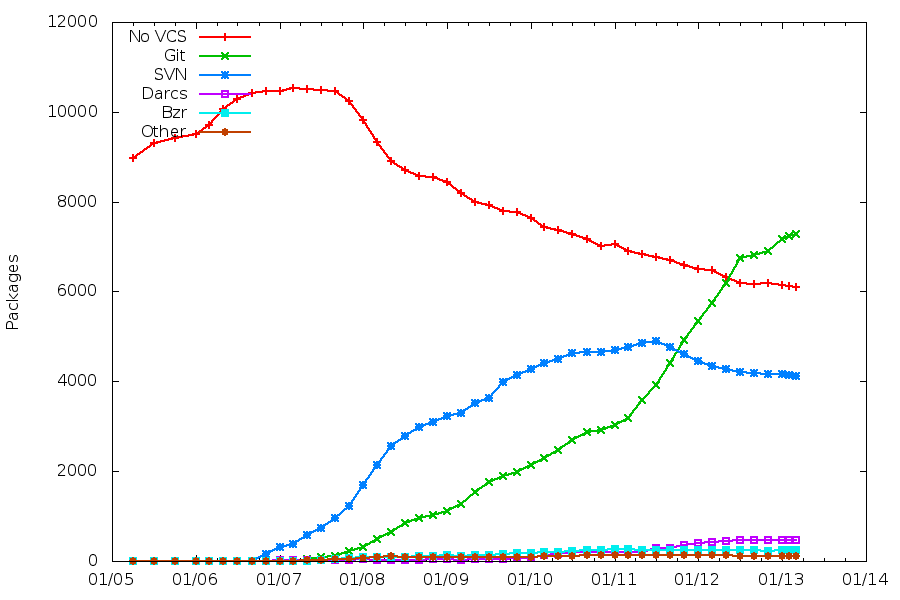
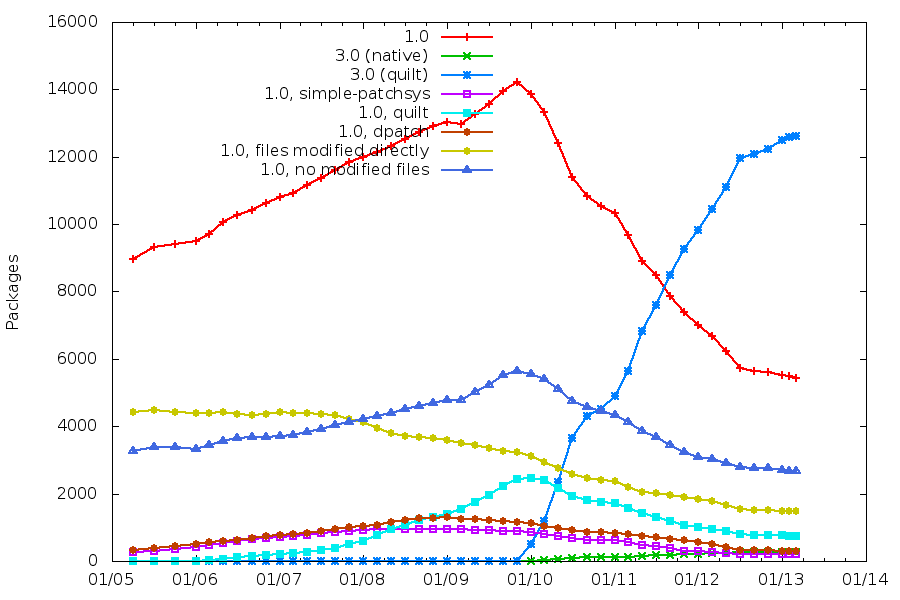
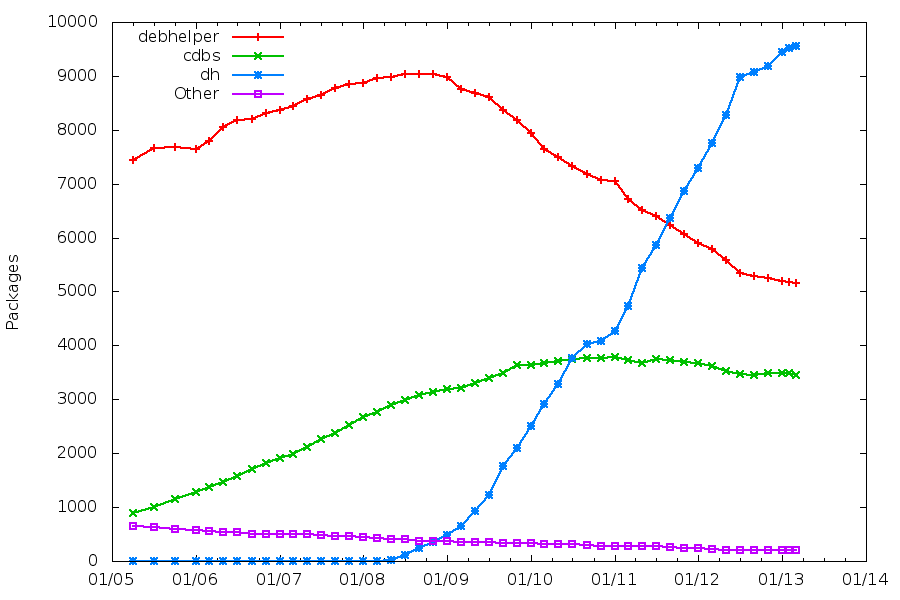
(Looking for those graphs online, I realized that I never properly published them, besides that old post) I ve been playing with snapshot.d.o, which is a fantastic resource if you want to look at Debian from an historical perspective (well, since 2005 at least). Team maintenance comaint
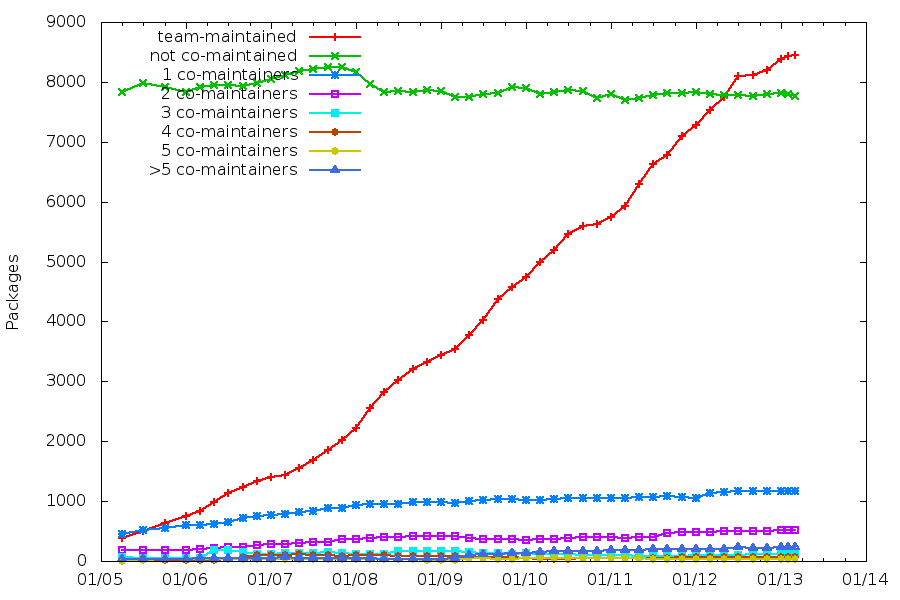
We now have more team-maintained packages than packages maintained by someone alone. Interestingly, the small, ad-hoc group of developers model does not really take off. Maintenance using a VCS vcs A large majority of our packages are maintained in a VCS repository, with Git being the clear winner now. Possible goal for Jessie: standardize on a Git workflow, since every team tends to design its own? Packaging helpers helpers Again, we have a clear winner here, with dh. It s interesting to note that, while dh was designed as a CDBS killer, it kind-of fails in that role. Possible goal for Jessie: deprecate at least pure-debhelper packaging? Patch systems and packaging formats formats-patches Again, clear winner with 3.0 (quilt). The (dirty) scripts that generate those graphs are available in Git (but you need to connect to stabile to execute them, and it s rather time consuming hours/days).
Julien Danjou: Ceilometer bug squash day #2

The Ceilometer team is pleased to announce that tomorrow Tuesday 5th March 2013 will be the second bug squash day for Ceilometer. We wrote an extensive page about how you can contribute to Ceilometer, from updating the documentation, to fixing bugs. There's a lot you can do. We've good support for Ceilometer built into Devstack, so installing a development platform is really easy. The main goal for this bug day will be to put Ceilometer in the best possible shape before the grizzly-rc1 release arrives (14th March 2013). This version of Ceilometer should be the last one before the final Grizzly release, so it's a pretty important one. We'll be hanging out on the #openstack-metering IRC channel on Freenode, as usual, so feel free to come by and join us!

Robert Collins: subunit version 2 progress

Subunit V2 is coming along very well. Current status: Remaining things to do:

Eddy Petri&#537;or: So, I did the responsible thing and fixed appdirs

In my previous post I expressed my frustration at the way a perfectly nice and fine idea, a portable way to get the standard configuration and data directory/files, was broken for Linux and BSD, because the authors of appdirs thought the XDG standard was "subject to some interpretation".

Although I said I decided not to use appdirs, I realised that wouldn't help anyone, so I fixed the code.

During the coding phase I discovered that the authors of appdirs broke the XDG standard even more, this time, ignoring XDG_DATA_DIRS, and talking about XDG_CONFIG_DIRS. When I found this I became convinced the *nix part of the implementation was subject to continuous irony, since the comment in this newly found breakage said "Perhaps should *use* that envvar", referring to XDG_CONFIG_DIRS, but writing later in code:

/etc/xdg/<appname>

Sweet, isn't it?

If you want a fixed version, you can grab it from my repository, on the linux-fixes branch:

https://github.com/eddyp/appdirs/tree/linux-fixes

3 March 2013

Philipp Kern: git-annex: encrypted remotes

Due to the data loss I blogged about, I had to reverse engineer the encryption used by git-annex for its encrypted special remotes. The file system on which the content lived has a bullet hole of 8 GB in it, which was helpfully discarded by pvmove. It's pretty unhappy about that fact, parts of the git repository are unusable and directories cannot be accessed anymore. git-annex cannot possibly run anymore.

However, I was still able to access the git-annex branch within said git repository (using porcelain). This branch contains a file called remote.log which contains the keys of the special remotes. There's one per remote, encrypted to a GPG key of your choice and all files within that remote are encrypted with the same symmetric key.

One small detail stopped me from getting the decryption right the first time, though. It seems that git-annex uses randomness generated by GPG and armored into base64. In my na vet I spotted the base64 and decoded it. Instead it's used verbatim: the first 256 bytes as HMAC key (which reduces randomness to 192 bytes) and the remaining bytes for the symmetric key used by GPG (which will do another key derivation for CAST5 with it). A bug about that just hit the git-annex wiki.

With that knowledge in mind I wrote a little tool that's able to generate encrypted content keys from the plain ones used in the symlinks. That helps you to locate the file in the encrypted remote. Fetch it and then use the tool to decrypt the file in question with the right key.

The lesson: Really backup the git repository used with git-annex and especially remote.log. I'm now missing most of the metadata but for some more important files it's luckily still present. Recovery of the file content does not depend on it if you can deduce the filename from the content. If you have many little files it might be a bit futile without it, though.

Gregor Herrmann: RC bugs 2013/09

hey, the amount of RC bugs (affecting wheezy) is dropping significantly, mostly thanks to the work of the release team, if I'm seeing this correctly.
here are my small contributions for the last week:

Lucas Nussbaum: DPL game

When Francesca started her DPL game, I too started think about possible candidates. Here is my shortlist of dream candidates: Seriously, if you are a DD, you have the right to run. There s no need for someone to nominate you. If you think that you could possibly say something interesting during the discussion period, and can spare the time to participate in the -vote@ discussions, please run. DPL campaigns used to be a great time where Debian visions, goals, politics and random stuff were discussed. The more candidates, the more interesting campaigns (8 candidates in 2007!). Also, there are already two three other candidates, so even if you don t want the job, it s not that risky. (Initially, I thought about nominating everyone, but security-wise, it might not be such a great idea.)

Gregor Herrmann: DPL game

when francesca started her DPL game, I also started thinking about people I'd like to encourage to stand as a DPL candidate. unfortunately my initial "short list" contained 18 names, which doesn't fit the game's rules very well. after waiting a bit, 9 of them were mentioned by others already, so I can leave them out here (which also means no public hug, sorry, please complain to the inventor of the game!). from the remaining 9, I've now chosen my Fantastic Four (in alphabtic order of first names): in my opinion, the DPL task is mostly about managing, & those four people are in my experience all very good at organising projects & dealing with people, & are therefore well suited for this task. let's see if they feel motivated to take on the challenge! (the nomination period has already started, so don't hestitate!)

Steve Kemp: Testing the blog feed

My previous entry, about templating, didn't make it into Planet Debian. This entry is just a test to see if it is my fault.

Petter Reinholdtsen: Frikanalen - Complete TV station organised using the web

Do you want to set up your own TV station, schedule videos and broadcast them on the air? Using free software? With video on demand support using free and open standards? Included a web based video stream as well? And administrate it all in your web browser from anywhere in the world? A few years now the Norwegian public access TV-channel Frikanalen have been building a system to do just this. The source code for the solution is licensed using the GNU LGPL, and available from github. The idea is simple. You upload a video file over the web, and attach meta information to the file. You select a time slot in the program schedule, and when the time come it is played on the air and in the web stream. It is also made available in a video on demand solution for anyone to see it also outside its scheduled time. All you need to run a TV station - using your web browser. There are several parts to this web based solution. I'll mention the three most important ones. The first part is the database of videos and the schedule. This is written in Django and include a REST API. The current database is SQLite, but the plan is to migrate it to PostgreSQL. At the moment this system can be tested on beta.frikanalen.tv. The second part is the video playout, taking the schedule information from the database and providing a video stream to broadcast. This is done using CasparCG from SVT and Media Lovin' Toolkit. Video signal distribution is handled using Open Broadcast Encoder. The third part is the converter, handling the transformation of uploaded video files to a format useful for broadcasting, streaming and video on demand. It is still very much work in progress, so it is not yet decided what it will end up using. Note that the source of the latter two parts are not yet pushed to github. The lead author want to clean them up a bit more first. The development is coordinated on the #frikanalen IRC channel (irc.freenode.net), and discussed on the frikanalen mailing list. The lead developer is Benjamin Bruheim (phed on IRC). Anyone is welcome to participate in the development.

Next.

Previous.