Search Results: "ag"

25 July 2012

Diego Escalante Urrelo: A Coru a, d a uno

You can follow the latest GUADEC updates from @guadec and @diegoe.

Isa, Alejo, Laura, and Germ n stealing a mug.

GUADEC just started. Or at least, the arrangements for GUADEC.

The local team is hard at work at the GUADEC HQ of the Facultade de Inform tica, they are really working really hard to make sure that there is a proper wired network setup (yes, you read that right!), a great video setup to record all the talks and publish them as soon as possible and setting up the final details of rooms, info desk, accommodation

If you are staying at the Rialta, you can take the hourly bus to the Facultade (just ask the driver). The bus departs from the frontis of Block 3. Ask the driver to let you know when to get off the bus. He is aware of GUADEC so your gringo-spanish should suffice.

We will be holding a pre-registration party tonight at 21:00 (9pm) just outside the Rialta cafeteria. If you are already here drop by for the Queimada by Alejo, our galician wizard.

Vincent Sanders: Travels with Mr. Brown

My return from Debconf12 has been tinged with a little wistfulness, I had a great time but wish I could have spent a little more time there to justify the seventeen hours travel each way. I took a lot of pictures which gave me a good record of my trip.

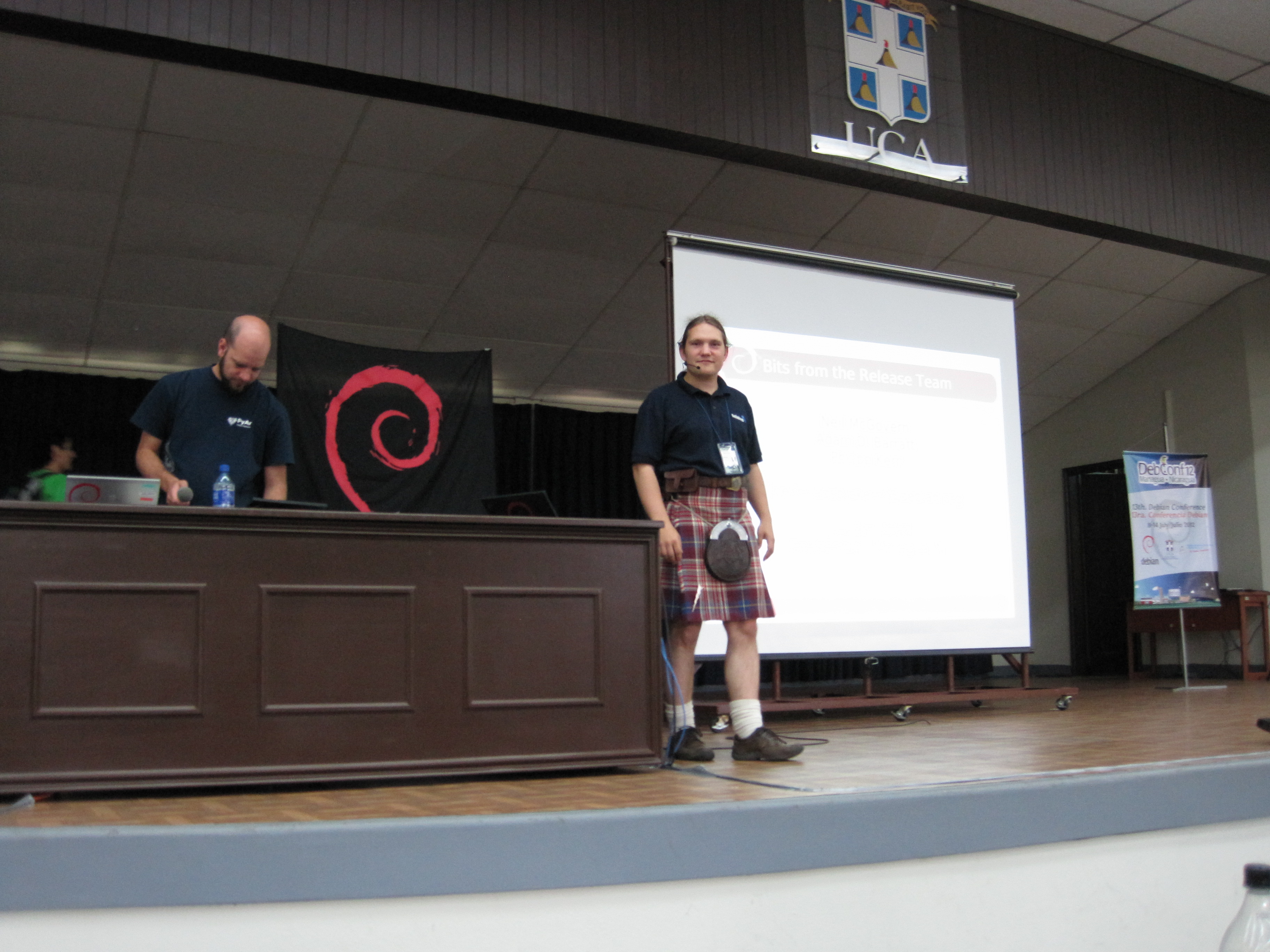
The talks, BOF and discussions were, as usual, very useful. The release team explaining what needed to be done for Wheezy was both informative and amusing.

The numerous BOF from Steve Mcintyre were a great source of discussion and ideas and appear to have generated progress on some quite contentious issues.

I especially enjoyed the Sylvestre Ledru talk on building the archive with clang and how this might be another useful tool in finding bugs.

Hideki Yamane gave a really useful talk "Let's shrink Debian package archive!" He gave a practical explanation on how Debian could benefit from using xz compression, where it is not appropriate and had a selection of real numbers to help the discussion. Given this was Hideki first talk at a Debconf I must congratulate him on doing an excellent job.

There were many other talks which I have not singled out here but that says nothing about their quality or usefulness, more about why I should blog immediately after an event and not leave it a week. Though the video team have managed to capture many of the talks so you can go and watch them too.

The event was well organised and the accommodation was pleasant, if a little crowded with three to a room. The hotel had a pool which was the centre for evening activities most days, though I did miss Neil McGovern (one of my room mates) unintentionally swimming in his kilt.
The lunch and dinner catering was outdoors which was novel. The food was generally good if a little limited for those of us with less straightforward dietary requirements.

Some of us did venture out to have dinner at the continental hotel on one evening for a change of scene.
There was of course the obligatory conference meal by the lakeside and an awesome day trip where I saw a mangrove swamp and (fortunately) no salt water crocodiles.
All in all I had a fabulous and productive time. I would like to thank Collabora for travel sponsorship to the event and to Neil who was a great travelling companion.

Dirk Eddelbuettel: RcppClassic 0.9.2

Similar to yesterday's post about RcppGSL, we have another pure maintenance release to announce, this time of RcppClassic, the package supporting the deprecated older classic Rcpp API defined in the earlier 2005 to 2006 releases, is now on CRAN. There is no new code, as the only changes were made to accomodate CRAN Policy updates. Courtesy of CRANberries, here is a link to the changes relative to the previous release 0.9.1. Questions, comments etc should go to the rcpp-devel mailing list off the R-Forge page.

Vincent Sanders: A sad state of affairs

Surprisingly my previous post on my Debconf trip has gathered more queries over its title than anything else.

Mostly my blog titles are, if I can manage it, relevant quotes or book titles. For the last post I used the title of a collection of Mark Twain scripts surrounding his trip through Nicaragua in 1866.

I have not been able to read the publication myself beyond the quoted excerpts in more modern articles because, somehow, almost 150 years after the words were written the only access to these words is to buy a very expensive and rare 1940 publication.

This appears to stem from the fact the original Clements scripts were simply not published before 1940 and hence appear to gain copyright from that date (IANAL I might be wrong here is the source I used) and thanks to the US government effectively making copyrighted works published after 1922 be "protected" forever I may never read it at all.

Rather sad really, but if you do have a copy I could borrow...oh no that is probably illegal too? better just let the words fade to dust eh?

24 July 2012

Gunnar Wolf: Ten theses in favor of free download of cultural goods on the Internet (by Enrique G. Gallegos)

This is one of the days where reading my everyday newspaper was worth more than just getting bitter at the news. I found this text in La Jornada, my usual newspaper. I liked it very much, and decided to translate it for a wider audience. Of course, if you can read Spanish, do yourself a favor and go to the original. It is not that the text is so easy to translate. And, after all, I'm not a native English writer. I'm trying to do a literal translation, even when disagreeing with the author. Ten theses in favor of free download of cultural goods on the Internet Enrique G. Gallegos Poet and philosopher. Currently a researcher in Universidad Aut noma Metropolitana-C
  1. Historical legacy. Criticists who promote the persecution of piracy and free downloads of cultural works from the Internet argue that the patrimonial rights have been wronged; they start off suposing that a cultural work is formed from a historical void, as if there was a "nothing" to begin with, and then a "something" appeared. Nothing more fallacious: All cultural products has its precedents, and thanks to these it generates part of its best forces.
  2. Opening towards the future. Human beings are projected into the future. As the main philosophies of the 20th century have explored, one of the singular characteristics of mankind is the ability to think and imagine the future. Products of culture are the best ways to think and project society, politics, love, hope, needs, failures A song, a poem, an essay, can trigger imaginary worlds with a transformative potential. To deny this to humanity with "patrimonial damage" as an argument is to mutilate man's temporal nature.
  3. Recognition of the present. Cultural works generate moments of reflection, criticism and pleasure; they can trigger actions demanding commitment, solidarity and strong indignation against injustice. If every cultural work is adscribed in some way to a historic tradition, and if cultural products anre necessary to imagine other possible worlds and open our future, it's not less true that they also allow us to recognize our present by making us more sensitive to others' ideas, sensations and emotions. Without culture, there is no present nor others' presence.
  4. Divulgation of the cultural heritage. If culture is "heritage of mankind", it should be also spread by any possible way. But not just spread, but actively sought for the biggest number of people to be able to effectively have access to it. In a potentially interconnected world, Internet is the most adequate world for it (despite its limitations). Therefore, penalizing free downloads means avoiding spreading it and restricting access to those groups who don't have enough economic resources.
  5. Preserving cultural heritage. If we agree that cultural works are heritage of mankind, we need to take every action needed to preserve them. But preserving culture does not only mean keeping the products in museums, galleries or never-polluted drawers; it rather means to keep them in the collective memory and in the flow of constant interpretations and appropiations. Said in other words, the genuine way to preserve culture is to allow universal access to cultural goods. That's why, holding that free copies and downloads of books, music, videos, etc. over the Internet are harmful, is an incompatible argument with the obligation to preserve cultural heritage.
  6. They are not goods. Cultural works are material and spiritual manifestations of mankind, concretions of its historicity; they are, also, expressions of emotions, ideas and projections of other lives and other worlds. That's why they cannot be equated to goods or inserted in patrimonialist logic. The market might want to cheat by giving a certain price to a painting by Orozco or auctioning a Baudelaire manuscript, but it will never be able to aprehend their true meaning as cultural works. And it's not that culture is not faluable, but taht its estimation criteria do not follow the rules of market, but those of the imponderable and unlimited.
  7. Price disproportion. Assuming we accept the possibility that intermediaries charge for the services they perform, the value of a book, record or movie should never exceed the daily wage of a worker or employee. But this ellection would only be one more option within the effective possibility that people opt to download or freely copy the cultural work. The final decision as to which media to go to should be a sovereign resolution of the culture-interested person.
  8. The principle of the most benefit. Even when copies and free downloads over Internet could generate a patrimonial "wrong" to third parties, the cultural benefit obtained by it will always be greater in as much that it carries out intensely the principle to foster, spread and access the cultural heritage of mankind. To think otherwise is to privilege the few over the many.
  9. The real evil is elsewhere. Murder, women- and children-trade, poverty and misery are the real evils that ache mankind. According to the United Nations, in 2010 there were 468 thousand murders in the world; the estimation is that 3500 million people live in poverty; in their 2009 inform, the UN found over 2400 victims of "people trade", kidnapped as sex slaves; in some regions in Africa, close to 30% of children suffer acute malnutrition and six people (between children and adults) die every day from hunger. That's why pretending that free download of cultural works is an evil is clearly a tricky and deceptive speech
  10. Against the intermediary-salesman. Culture does not need intermedieries that reduce cultural works to goods. Culture is too important to leavie it in the hands of salespeople that simplistly equate cultural goods with cakes. An intermediary of this kind will never understand the difference between a work of art and a disposable razor blade. What the world needs is more support from the government from every country to artists, creators and poets, as well as ensuring the conditions for the absolute mobility freedom for cultural works.

Michal Čihař: Weblate hacking #2

Second day of Hackweek VIII is over and there has been again great progress on Weblate. I've started with improving documentation. Most of improvements were possible by using djangodocs extension for Sphinx, which allows better documenting of Django admin commands and settings. Then I've focused on handling languages as there were some things which I did not like. Most importantly, Weblate will now try to use existing languages even if used code does not 100% match (eg. cs_CZ and cs-CZ are treated equal). Also with help of locale aliases, some specific variants won't be created and generic one used instead (eg. cs_CZ will use cs, as these are actually same). If there will be need to differentiate them, you still can create language manually and Weblate will use matched one. Last thing is translation locking - translator can now lock translation for exclusive use and nobody else will be able to work on that. This will help in situations where more people started to work on same translation and basically duplicated the effort. There are 3 open issues targeted for 1.2 release, but I'm not sure if some of these are good ideas, let's keep the decision for next days.

Filed under: English Suse Weblate 0 comments Flattr this!

Martin Pitt: PyGObject hackfest @ GUADEC: Agenda

I started to collect some easy PyGObject bugs which are appropriate for the PyGObject hackfest at GUADEC on July 30th. These are bugs which do not need a lot of previous knowlege and are excellent starters for new contributors, such as adding overrides, fixing build system issues, etc. I also created an initial idea pool/agenda/coordination page, where participants can add or signup for things to work on. Feel free to add your own topics! I m really looking forward to GUADEC and the hackfest, see you there! GUADEC 2012

Sylvestre Ledru: News on Debian & clang

A couple week ago, during the last debconf (Debian Conference) in Managua/Nicaragua, I presented the latest developments about the inclusion of clang in the Debian architecture. To sum up (details are available in the slides and the video), the rebuild of the Debian archive with Clang 3.1 increased the number of failures from 8.8 to 12.1%. The main reason is that further checks have been added to clang. With Paul Tagliamonte as co-mentor and Alexander Pashaliyski as a GSoC student, we made great progress in bringing Clang as A new compiler in the Debian infrastructure. The various feedbacks that I had during Debconf were pretty good. It interests many people for reasons like Quality Assurance (more checks), performances, hackability or to decorrelate Debian and GCC. Build Debian with another compiler - Slides
Build Debian with another compiler - Video A nice resume of my talk has been made by Michael Larabel on Phoronix:
Decoupling GCC From Debian By Using LLVM/Clang

Wouter Verhelst: DebConf 12 is over :(

As I write this, DebConf12 has actually been over for more than a week. Usually during DebConf, I'm a more proficient blogger than during other times of the year, since I'm not doing as much work that I have to remain quiet about at that time, which simply means I have more to blog about. Unfortunately, however, this year the server on which this blog runs managed to become unavailable on the second day of DebCamp, an issue that I could only fix once I was back in Belgium, which meant I haven't been able to blog as much as I would've wanted to. Anyway, all I can say is that both DebConf and DebCamp have been a huge success for me again, this year. I'd started the second rewrite of ipcfg a few weeks before DebCamp, and spent most of DebCamp whipping the basic framework into shape. It's nowhere near ready yet, but I'm confident it'll get further this time than it did before. During DebConf, I was also responsible for doing the group photo. I'd done that (together with Andrew McMillan) during DebConf8 before (if you look closely, you'll see me pressing the remote which actually triggers that picture), and I still like that picture. This time around, we didn't have a beach nearby (at least not as nearby as during DebConf8), so we had to do things slightly differently. Rather than doing one large picture, I took several pictures and used Hugin to stitch them together. Unfortunately however, some things did go wrong with the group photo. For starters, the weather wasn't very helpful, in that I noticed it was about to rain. As such, the main bunch of pictures were taken slightly before the announced time of 14:30, which meant that some people had missed it. To make matters worse, I had rushed to the group and handed the camera to someone else, so that I could gimp myself onto the picture too; but that meant that some people who were arriving as these pictures were being taken thought they were on the picture, when they really weren't. I've fixed most of these by just gimping them into the picture as well, but I might've missed some of them. If you're one of them, talk to me! Preferably now. If you're not one of them (or even if you are), hold off on doing things like printing it in large format or some such. I'll re-upload improved versions onto the same location once they're ready.

Sylvestre Ledru: News on Debian & clang

A couple week ago, during the last debconf (Debian Conference) in Managua/Nicaragua, I presented the latest developments about the inclusion of clang in the Debian architecture. To sum up (details are available in the slides and the video), the rebuild of the Debian archive with Clang 3.1 increased the number of failures from 8.8 to 12.1%. The main reason is that further checks have been added to clang. With Paul Tagliamonte as co-mentor and Alexander Pashaliyski as a GSoC student, we made great progress in bringing Clang as A new compiler in the Debian infrastructure. The various feedback that I had during Debconf were pretty good. It interests many people for reasons like Quality Assurance (more checks), performances, hackability or to decorrelate Debian and GCC. Build Debian with another compiler - Slides
Build Debian with another compiler - Video A nice resume of my talk has been made by Michael Larabel on Phoronix:
Decoupling GCC From Debian By Using LLVM/Clang

Dirk Eddelbuettel: RcppGSL 0.2.0

Earlier today, a minor update / maintenance release of RcppGSL---our interface package between R and the GNU GSL using our Rcpp package for seamless R and C++ integration---arrived on on CRAN. It contains a number of minor changes to accomodate changes in the CRAN Policies, as well as a few extension to the main example fastLm, a faster replacement for the standard lm function. The summary methods now provide more information, and we added a number of new regression tests. The NEWS file entry follows below:
Changes in version 0.2.0 (2012-07-22)
  • summary() for fastLm() now displays more information
  • fastLmPure() now uses same argument order as R's lm.fit()
  • Added more unit tests for fastLm() and related functions
  • Export and document S3 methods in NAMESPACE and manual page as such
  • Vignettes have been moved to the vignettes/ directory
  • Main vignette renamed to RcppGSL-intro.pdf to use a filename different from the package reference manual
  • NEWS file converted to .Rd format
  • inline support function no longer uses assignInNamespace
And courtesy of CRANberries, a summary of the changes to the previous release 0.1.1 is available too. More information is on the RcppGSL page. Questions, comments etc should go to the rcpp-devel mailing list off the R-Forge page.

23 July 2012

Jon Dowland: 6music

I recently discovered the excellent BBC 6 Music: a digital-only radio station so good I'm almost convinced to buy a DAB radio for this one station alone. In particular, Stuart Maconie and Mark Radcliffe, former Radio 2 exiles, hold an excellent afternoon slot. Stuart Maconie's late-night "Freak Zone" often has some really interesting stuff on it worth listening to, for example an entire episode dedicated to Brian Eno's "Obscure Records" label. Ubuweb recently put up the entire catalogue, by the way. @WhatsOn6Music is a twitter bot I follow which tweets songs as they are played. This works because most of the BBC's DJ consoles are wired up to last.fm. In recent times this bot has been broken a lot, so I got tired of it and made my own: @6musicbot. This one is powered by IFTTT so should not be plagued by whatever keeps breaking the other one: although it's also only as good as the last.fm feed powering it. Let me know if you find it useful, interesting or have any other feedback.

Michal Čihař: Weblate hacking #1

The first day of Hackweek VIII is about to end for me and it's time to share some of the results. As planned, I've started hacking on Weblate. The most prominent feature from today are email notifications. You can now monitor the translation in various ways - be informed about new strings to translate, new contributor, added suggestion or simply watch all translations. Another bigger change is rearranging of main page, which now provides instant access to per language stats, which were quite hidden before. Rest of time was spent on adding some sort of spam protection (need to deploy this to demo to see how successful it is) and one more promoting widget (88x31 pixels). There are 6 open issues targeted for 1.2 release, so there is still something to do in next days :-).

Filed under: English Suse Weblate 0 comments Flattr this!

Tollef Fog Heen: Automating managing your on-call support rotation using google docs

At work, we have a rotation of who is on call at a given time. We have few calls, but they do happen and so it's important to ensure both that a person is available, but also that they're aware they are on call (so they don't stray too far from their phone or a computer). In the grand tradition of abusing spreadsheets, we are using google docs for the roster. It's basically just two columns, one with date and one with user name. Since the volume is so low, people tend to be on call for about a week at a time, 24 hours a day. Up until now, we've just had a pretty old and dumb phone that people have carried around, but that's not really swish, so I have implemented a small system which grabs the current data, looks up the support person in LDAP and sends SMSes when people go on and off duty as well as reminding the person who's on duty once a day. If you're interested, you can look at the (slightly redacted) script.

C.J. Adams-Collier: You might on occasion confuse us with professionals

If we keep this up, you might. image

Enrico Zini: Evolution's old odd mail folders to mbox

Evolution's old odd mail folders to mbox Something wrong happened in my dad's Evolution. It just would get stuck checking mail forever, with no useful diagnostic that I could find. Fun. Not. Anyway, I solved by resetting everything to factory defaults, moving away all gconf entries and .evolution/ files. Then it started to work again, of course then I needed to reconfigure it from scratch. It turned out however that some old mail was only archived locally, and in a kind of weird format that looks like this:
$ ls -la Enrico/
total 336
drwx------ 2 enrico enrico   4096 Jul 23 03:05 .
drwxr-xr-x 7 enrico enrico   4096 Jul 23 03:12 ..
-rw------- 1 enrico enrico   3230 Dec  4  2010 113.HEADER
-rw------- 1 enrico enrico  14521 Dec  4  2010 113.TEXT
-rw------- 1 enrico enrico   3209 Oct 22  2010 134.HEADER
-rw------- 1 enrico enrico   2937 Oct 22  2010 134.TEXT
-rw------- 1 enrico enrico   3116 Jun 27  2011 15.
-rw------- 1 enrico enrico   3678 Jun 27  2011 168.
-rw------- 1 enrico enrico     73 Apr 27  2009 22.1.MIME
-rw------- 1 enrico enrico   3199 Apr 27  2009 22.2
-rw------- 1 enrico enrico     88 Apr 27  2009 22.2.MIME
[...]
I couldn't even find the name of that mail folder layout, let alone conversion tools. So I had to sit down and waste my sunday break writing software to convert that to a mbox file. Here's the tool, may it save you the awful time I had today: http://anonscm.debian.org/gitweb/?p=users/enrico/evo2mbox.git Note: feel free to fork it, or send patches, but don't bother with feature requests. Evolution isn't and won't be a personal interest of mine. Anything that makes an afternoon at my parents more tiresome than a whole busy month of paid work, doesn't deserve to be. Luckily they now seem to have changed the local folder format to Maildir.

22 July 2012

Steve Kemp: Another day, another upgrade

Tonight I upgraded my personal machine to run the recently released 3.5[.0] kernel. On my personal machine(s) I'm usually loathe to change a running kernel, but this one was a good step forward because it allows me to experiment with seccomp filters. I've tested the trivial "no new privileges" pctl and I followed along with the nice seccomp tutorial which gave me simple working code which I married to my javascript interpreter. On top of that I upgraded node.js, which meant I had to clean up a little depreciated code in my node reverse proxy - which is the public face of the websites I run upon my box. (The proxy tunnels to about 10 different thttpd instances, each running upon 127.0.0.1:xx). Happily however my weekend was not full of code, it was brightened by the opportunity to take pictures of Aurora and her long hair - more to come as I've still got about 350 images to wade through.. ObQuote: "Don't you think I make a remarkable queen? " - St. Trinian's (2007)

Evgeni Golov: RC bugs 2012/29

RCBW report for 2012/29 (16.7.-22.7.) The motto for this week was:
shut up and take my patches!
(Don t take it personally, it s just a meme :P)

Sylvestre Ledru: Who is in control of LLVM/Clang ?

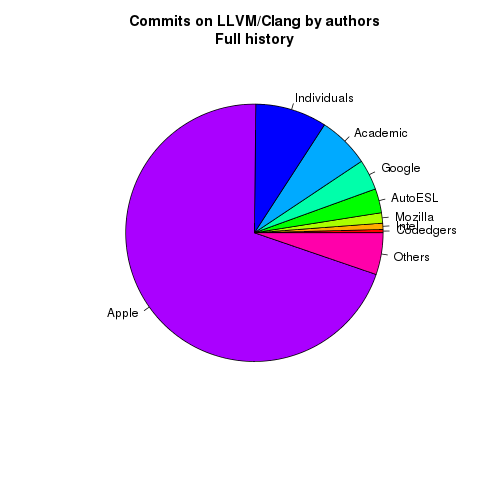
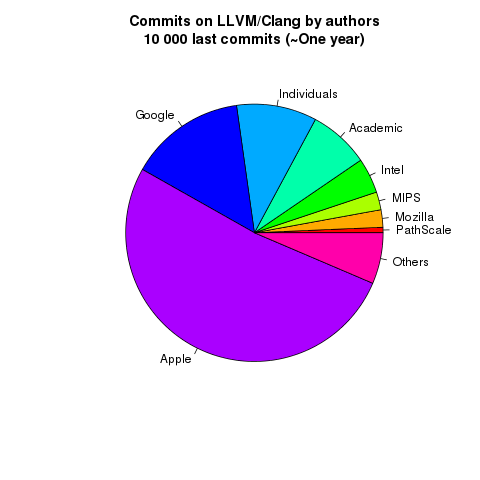
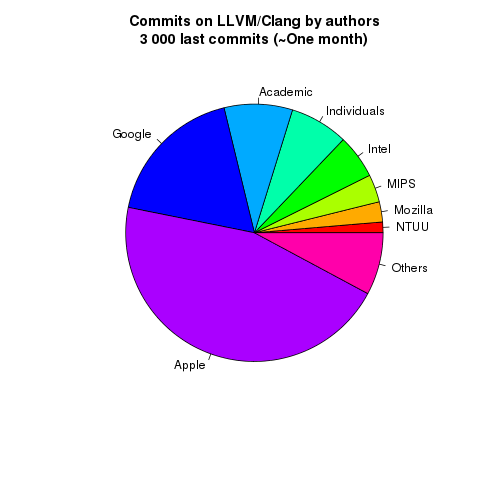
During my various chats and presentations on LLVM/Clang, one of the common criticism on LLVM/Clang is about the Apple's (supposed?) control on the platform. Even if I am not concerned by this concern, here are some statistics about the development. Basically, I used the git history to build a list of all the author. If domain names were clear (ex: @google.com, @apple.com, etc), I used them for the paternity of the commit. If there were not clear (ex: @gmail.com, @me.com), I dig on the web to find the employer (Linkedin was my friend). Of course, identifying individuals are pretty tough. Their percentages can be considered as a minimal figure. Full history 10 000 commits (about a year)
3 000 commits (~a month)
To sum up, we can easily see that the percentage of contributions of Apple is decreasing over the time.
However, we all know that the number of commits is not the best metric to measure the control of one on a project. Source: Processed data (please contact me in case of mistake)

Mark Brown: Regulator updates in 3.5

There s been a bit of an increase in the amount of core work in version 3.5, regmap has enabled a lot of code to be factored out of drivers and into the core so drivers only need to provide data. This makes things a lot simpler to implement and review, it s hoped that it will also allow some framework enhancements for bulk operations in future.

Next.

Previous.