Search Results: "tb"

26 September 2017

Reproducible builds folks: Reproducible Builds: Weekly report #126

Here's what happened in the Reproducible Builds effort between Sunday September 17th and Saturday September 23rd 2017: Media coverage Reproducible work in other packages Packages reviewed and fixed, and bugs filed Reviews of unreproducible packages 1 package reviews was added, 49 have been updated and 54 have been removed in this week, adding to our knowledge about identified issues. One issue type was updated: Weekly QA work During our reproducibility testing, FTBFS bugs have been detected and reported by: diffoscope development Version 87 was uploaded to unstable by Mattia Rizzolo. It included contributions from: strip-nondeterminism development reprotest development Version 0.7 was uploaded to unstable by Ximin Luo: tests.reproducible-builds.org Vagrant Cascadian and Holger Levsen: Holger Levsen: Misc. This week's edition was written by Bernhard M. Wiedemann, Chris Lamb, Vagrant Cascadian & reviewed by a bunch of Reproducible Builds folks on IRC & the mailing lists.

Russ Allbery: Review: Artemis Fowl

Review: Artemis Fowl, by Eoin Colfer
Series: Artemis Fowl #1
Publisher: Disney-Hyperion
Copyright: 2001
ISBN: 1-4231-2452-9
Format: Kindle
Pages: 281
Artemis Fowl is the heir to the Fowl criminal empire and a child prodigy. He's also one of the few humans to know of the existence of fairies, who are still present in the world, hiding from humans and living by their own rules. As the book opens, he's in search of those rules: a copy of the book that governs the lives of fairies. With that knowledge, he should be able to pull off a heist worthy of his family's legacy. Captain Holly Short is a leprechaun... or, more correctly, a LEPrecon. She's one of the fairy police officers that investigate threats to the fairies who are hiding in a vast underground civilization. The fairies have magic, but they also have advanced (and miniaturized) technology, maintained in large part by a grumpy and egotistical centaur (named Foaly, because it's that sort of book). She's also the fairy unlucky enough to be captured by Artemis's formidable personal bodyguard their first attempt to kidnap a hostage for their ransom demands. This is the first book of a long series of young adult novels that has also spawned graphic novels and a movie currently in production. It has that lean and clear feeling of the younger side of young adult writing: larger-than-life characters who are distinctive and easy to remember, a short introductory setup that dives directly into the main plot, and a story that neatly pulls together every element raised in the story. The world-building is its strongest point, particularly the mix of tongue-in-cheek technology ships that ride magma plumes, mechanical wings, and helmet-mounted lights to blind trolls and science-tinged magic that the fairies build their police and army on. Fairies are far beyond humans in capability, and can be deadly and ruthless, but they have to follow a tightly constrained set of rules that are often not convenient. Sadly, the characters don't live up to the world-building. I did enjoy a few of them, particularly Artemis's loyal bodyguards and the dwarf Mulch Diggums. But Holly, despite being likable, is a bit of a blank slate: the empathetic, overworked trooper who is mostly indistinguishable from other characters in similar stories. The gruff captain, the sarcastic technician Foaly, and the various other LEP agents all felt like they were taken straight from central casting. And then there's Artemis himself. Artemis is the protagonist of the story, in that he's the one who initiates all of the action and the one who has the most interesting motivations. The story is about him, as the third-person narrator in the introduction makes clear. He's trying very hard to be a criminal genius with the deductive abilities of Sherlock Holmes and the speaking style of a Bond villain, but he's also twelve, his father has disappeared, and his mother is going slowly insane. I picked this book up on the recommendation of another reader who found that contrast compelling. Unfortunately, I thought Artemis was just an abusive jerk. Yes, yes, family tragedy, yes, he's trapped in his conception of himself, but he's arrogant, utterly uncaring about how his actions affect other people, and dismissive and cruel even to his bodyguards (who are much better friends than he deserves). I think liking this book requires liking Artemis at least well enough to consider him an anti-hero, and I can squint and see that appeal if you have that reaction. But I just wanted him to lose. Not in the "you will be slowly redeemed over the course of a long series" way, but in the "you are a horrible person and I hope you get what's coming to you" way. The humor of the fairy parts of the book was undermined too much by the fact that many of them would like to kill Artemis for real, and I mostly wanted them to succeed. This may or may not have to do with my low tolerance for egotistical smart-asses who order other people to do things that they refuse to explain. Without some appreciation for Artemis, this is a story with some neat world-building, a fairly generic protagonist in Holly, and a plot in which the bad guys win. To make matters worse, I thought the supposedly bright note at the end of the story was just creepy, as was everything else involving Artemis's mother. The review I read was of the first three books, so it's entirely possible that this series gets better as it goes along, but there wasn't enough I enjoyed in the first book for me to keep reading. Followed by Artemis Fowl: The Arctic Incident. Rating: 5 out of 10

24 September 2017

Iain R. Learmonth: Free Software Efforts (2017W38)

Here s my weekly report for week 38 of 2017. This week has not been a great week as I saw my primary development machine die in a spectacular reboot loop. Thanks to the wonderful community around Debian and free software (that if you re reading this, you re probably part of), I should be back up to speed soon. A replacement workstation is currently moving towards me and I ve received a number of smaller donations that will go towards video converters and upgrades to get me back to full productivity.

Debian I ve prepared and tested backports for 3 packages in the tasktools packaging team: tasksh, bugwarrior and powerline-taskwarrior. Unfortunately I am not currently in the backports ACLs and so I can t upload these but I m hoping this to be resolved soon. Once these are uploaded, the latest upstream release for all packages in the tasktools team will be available either in the stable suite or in the stable backports suite. In preparation for the shutdown of Alioth mailing lists, I ve set up a new mailing list for the tasktools team and have already updated the maintainer fields for all the team s packages in git. I ve subscribed the old mailing list s user to the new mailing list in DDPO so there will still be a comprehensive view there during the migration. I am currently in the process of reaching out to the admins of git.tasktools.org with a view to moving our git repositories there. I ve also continued to review the scapy package and have closed a couple more bugs that were already fixed in the latest upstream release but had been missed in the changelog. Bugs closed (fixed/wontfix): #774962, #850570

Tor Project I ve deployed a small fix to an update from last week where the platform field on Atlas had been pulled across to the left column. It has now been returned to the right hand column and is not pushed down the page by long family lists. I ve been thinking about the merge of Compass functionality into a future Atlas and this is being tracked in #23517. Tor Project has approved expenses (flights and hotel) for me to attend an in-person meeting of the Metrics Team. This meeting will occur in Berlin on the 28th September and I will write up a report detailing outcomes relevant to my work after the meeting. I have spent some time this week preparing for this meeting. Bugs closed (fixed/wontfix): #22146, #22297, #23511

Sustainability I believe it is important to be clear not only about the work I have already completed but also about the sustainability of this work into the future. I plan to include a short report on the current sustainability of my work in each weekly report. The loss of my primary development machine was a setback, however, I have been donated a new workstation which should hopefully arrive soon. The hard drives in my NAS can now also be replaced as I have budget available for this now. I do not see any hardware failures being imminent at this time, however should they occur I would not have budget to replace hardware, I only have funds to replace the hardware that has already failed.

23 September 2017

Russell Coker: Converting Mbox to Maildir

MBox is the original and ancient format for storing mail on Unix systems, it consists of a single file per user under /var/spool/mail that has messages concatenated. Obviously performance is very poor when deleting messages from a large mail store as the entire file has to be rewritten. Maildir was invented for Qmail by Dan Bernstein and has a single message per file giving fast deletes among other performance benefits. An ongoing issue over the last 20 years has been converting Mbox systems to Maildir. The various ways of getting IMAP to work with Mbox only made this more complex. The Dovecot Wiki has a good page about converting Mbox to Maildir [1]. If you want to keep the same message UIDs and the same path separation characters then it will be a complex task. But if you just want to copy a small number of Mbox accounts to an existing server then it s a bit simpler. Dovecot has a mb2md.pl script to convert folders [2].
cd /var/spool/mail
mkdir -p /mailstore/example.com
for U in * ; do
  ~/mb2md.pl -s $(pwd)/$U -d /mailstore/example.com/$U
done
To convert the inboxes shell code like the above is needed. If the users don t have IMAP folders (EG they are just POP users or use local Unix MUAs) then that s all you need to do.
cd /home
for DIR in */mail ; do
  U=$(echo $DIR  cut -f1 -d/)
  cd /home/$DIR
  for FOLDER in * ; do
    ~/mb2md.pl -s $(pwd)/$FOLDER -d /mailstore/example.com/$U/.$FOLDER
  done
  cp .subscriptions /mailstore/example.com/$U/ subscriptions
done
Some shell code like the above will convert the IMAP folders to Maildir format. The end result is that the users will have to download all the mail again as their MUA will think that every message had been deleted and replaced. But as all servers with significant amounts of mail or important mail were probably converted to Maildir a decade ago this shouldn t be a problem.

16 September 2017

Dirk Eddelbuettel: pinp 0.0.1: pinp is not PNAS

A brandnew and very exciting (to us, at least) package called pinp just arrived on CRAN, following a somewhat unnecessarily long passage out of incoming. It is based on the PNAS LaTeX Style offered by the Proceeding of the National Academy of Sciences of the United States of America, or PNAS for short. And there is already a Markdown version in the wonderful rticles packages. But James Balamuta and I thought we could do one better when we were looking to typeset our recent PeerJ Prepint as an attractive looking vignette for use within the Rcpp package. And so we did by changing a few things (font, color, use of natbib and Chicago.bst for references, removal of a bunch of extra PNAS-specific formalities from the frontpage) and customized a number of other things for easier use by vignettes directly from the YAML header (draft mode watermark, doi or url for packages, easier author naming in footer, bibtex file and more). We are quite pleased with the result which seems ready for the next Rcpp release---see e.g., these two teasers:
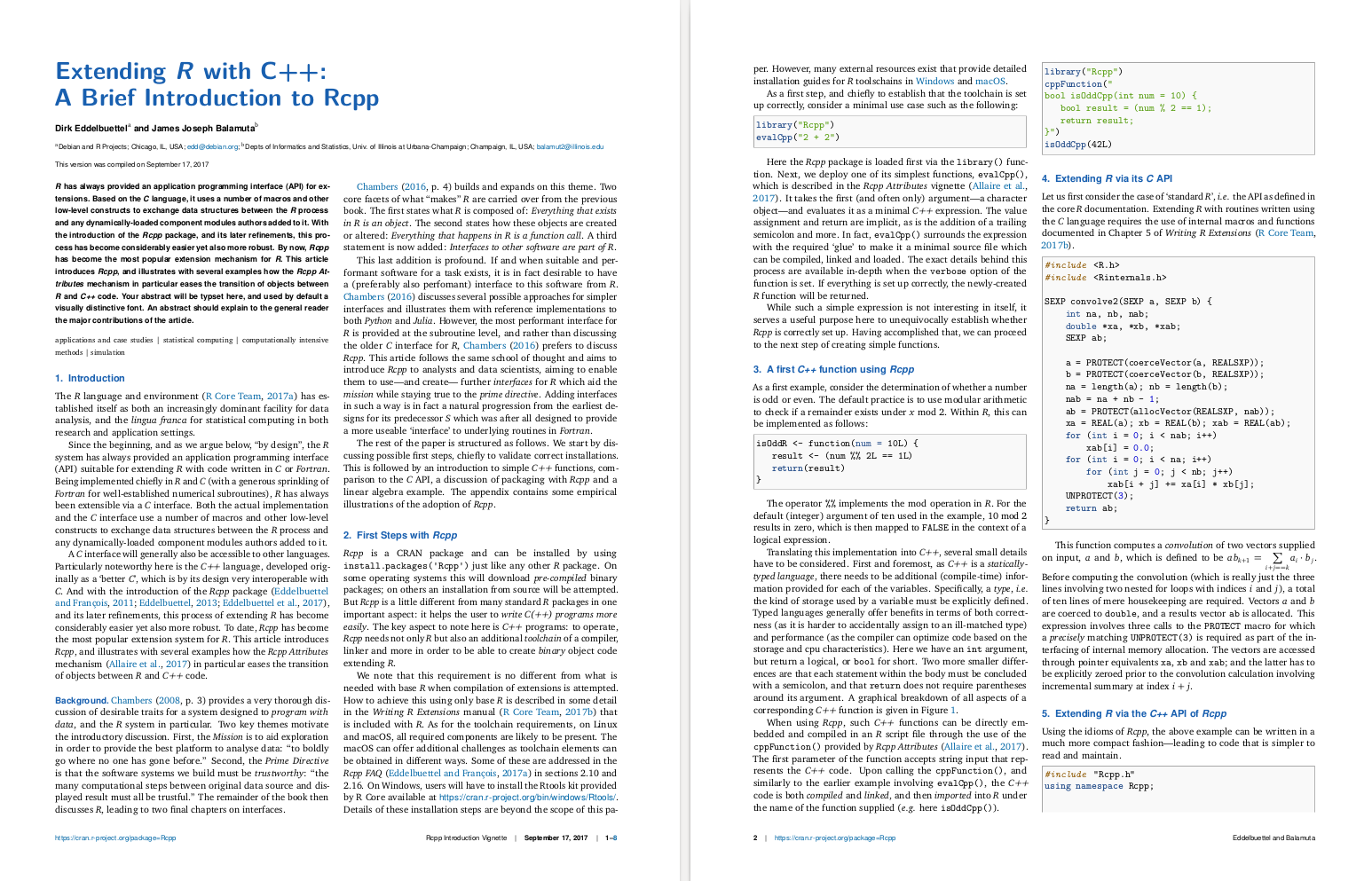
and
and the pinp package page or the GitHub repo have the full (four double-)pages of what turned a more dull looking 27 page manuscript into eight crisp two-column pages. We have few more things planned (i.e., switching to single column mode, turning on linenumbers at least in one-column mode). For questions or comments use the issue tracker off the GitHub repo.

This post by Dirk Eddelbuettel originated on his Thinking inside the box blog. Please report excessive re-aggregation in third-party for-profit settings.

13 September 2017

Vincent Bernat: Route-based IPsec VPN on Linux with strongSwan

A common way to establish an IPsec tunnel on Linux is to use an IKE daemon, like the one from the strongSwan project, with a minimal configuration1:
conn V2-1
  left        = 2001:db8:1::1
  leftsubnet  = 2001:db8:a1::/64
  right       = 2001:db8:2::1
  rightsubnet = 2001:db8:a2::/64
  authby      = psk
  auto        = route
The same configuration can be used on both sides. Each side will figure out if it is left or right . The IPsec site-to-site tunnel endpoints are 2001:db8: 1::1 and 2001:db8: 2::1. The protected subnets are 2001:db8: a1::/64 and 2001:db8: a2::/64. As a result, strongSwan configures the following policies in the kernel:
$ ip xfrm policy
src 2001:db8:a1::/64 dst 2001:db8:a2::/64
        dir out priority 399999 ptype main
        tmpl src 2001:db8:1::1 dst 2001:db8:2::1
                proto esp reqid 4 mode tunnel
src 2001:db8:a2::/64 dst 2001:db8:a1::/64
        dir fwd priority 399999 ptype main
        tmpl src 2001:db8:2::1 dst 2001:db8:1::1
                proto esp reqid 4 mode tunnel
src 2001:db8:a2::/64 dst 2001:db8:a1::/64
        dir in priority 399999 ptype main
        tmpl src 2001:db8:2::1 dst 2001:db8:1::1
                proto esp reqid 4 mode tunnel
[ ]
This kind of IPsec tunnel is a policy-based VPN: encapsulation and decapsulation are governed by these policies. Each of them contains the following elements: When a matching policy is found, the kernel will look for a corresponding security association (using reqid and the endpoint source and destination addresses):
$ ip xfrm state
src 2001:db8:1::1 dst 2001:db8:2::1
        proto esp spi 0xc1890b6e reqid 4 mode tunnel
        replay-window 0 flag af-unspec
        auth-trunc hmac(sha256) 0x5b68[ ]8ba2904 128
        enc cbc(aes) 0x8e0e377ad8fd91e8553648340ff0fa06
        anti-replay context: seq 0x0, oseq 0x0, bitmap 0x00000000
[ ]
If no security association is found, the packet is put on hold and the IKE daemon is asked to negotiate an appropriate one. Otherwise, the packet is encapsulated. The receiving end identifies the appropriate security association using the SPI in the header. Two security associations are needed to establish a bidirectionnal tunnel:
$ tcpdump -pni eth0 -c2 -s0 esp
13:07:30.871150 IP6 2001:db8:1::1 > 2001:db8:2::1: ESP(spi=0xc1890b6e,seq=0x222)
13:07:30.872297 IP6 2001:db8:2::1 > 2001:db8:1::1: ESP(spi=0xcf2426b6,seq=0x204)
All IPsec implementations are compatible with policy-based VPNs. However, some configurations are difficult to implement. For example, consider the following proposition for redundant site-to-site VPNs: Redundant VPNs between 3 sites A possible configuration between V1-1 and V2-1 could be:
conn V1-1-to-V2-1
  left        = 2001:db8:1::1
  leftsubnet  = 2001:db8:a1::/64,2001:db8:a6::cc:1/128,2001:db8:a6::cc:5/128
  right       = 2001:db8:2::1
  rightsubnet = 2001:db8:a2::/64,2001:db8:a6::/64,2001:db8:a8::/64
  authby      = psk
  keyexchange = ikev2
  auto        = route
Each time a subnet is modified on one site, the configurations need to be updated on all sites. Moreover, overlapping subnets (2001:db8: a6::/64 on one side and 2001:db8: a6::cc:1/128 at the other) can also be problematic. The alternative is to use route-based VPNs: any packet traversing a pseudo-interface will be encapsulated using a security policy bound to the interface. This brings two features:
  1. Routing daemons can be used to distribute routes to be protected by the VPN. This decreases the administrative burden when many subnets are present on each side.
  2. Encapsulation and decapsulation can be executed in a different routing instance or namespace. This enables a clean separation between a private routing instance (where VPN users are) and a public routing instance (where VPN endpoints are).

Route-based VPN on Juniper Before looking at how to achieve that on Linux, let s have a look at the way it works with a JunOS-based platform (like a Juniper vSRX). This platform as long-standing history of supporting route-based VPNs (a feature already present in the Netscreen ISG platform). Let s assume we want to configure the IPsec VPN from V3-2 to V1-1. First, we need to configure the tunnel interface and bind it to the private routing instance containing only internal routes (with IPv4, they would have been RFC 1918 routes):
interfaces  
    st0  
        unit 1  
            family inet6  
                address 2001:db8:ff::7/127;


routing-instances  
    private  
        instance-type virtual-router;
        interface st0.1;
     
 
The second step is to configure the VPN:
security  
    /* Phase 1 configuration */
    ike  
        proposal IKE-P1  
            authentication-method pre-shared-keys;
            dh-group group20;
            encryption-algorithm aes-256-gcm;
         
        policy IKE-V1-1  
            mode main;
            proposals IKE-P1;
            pre-shared-key ascii-text "d8bdRxaY22oH1j89Z2nATeYyrXfP9ga6xC5mi0RG1uc";
         
        gateway GW-V1-1  
            ike-policy IKE-V1-1;
            address 2001:db8:1::1;
            external-interface lo0.1;
            general-ikeid;
            version v2-only;
         
     
    /* Phase 2 configuration */
    ipsec  
        proposal ESP-P2  
            protocol esp;
            encryption-algorithm aes-256-gcm;
         
        policy IPSEC-V1-1  
            perfect-forward-secrecy keys group20;
            proposals ESP-P2;
         
        vpn VPN-V1-1  
            bind-interface st0.1;
            df-bit copy;
            ike  
                gateway GW-V1-1;
                ipsec-policy IPSEC-V1-1;
             
            establish-tunnels on-traffic;


We get a route-based VPN because we bind the st0.1 interface to the VPN-V1-1 VPN. Once the VPN is up, any packet entering st0.1 will be encapsulated and sent to the 2001:db8: 1::1 endpoint. The last step is to configure BGP in the private routing instance to exchange routes with the remote site:
routing-instances  
    private  
        routing-options  
            router-id 1.0.3.2;
            maximum-paths 16;
         
        protocols  
            bgp  
                preference 140;
                log-updown;
                group v4-VPN  
                    type external;
                    local-as 65003;
                    hold-time 6;
                    neighbor 2001:db8:ff::6 peer-as 65001;
                    multipath;
                    export [ NEXT-HOP-SELF OUR-ROUTES NOTHING ];


The export filter OUR-ROUTES needs to select the routes to be advertised to the other peers. For example:
policy-options  
    policy-statement OUR-ROUTES  
        term 10  
            from  
                protocol ospf3;
                route-type internal;
             
            then  
                metric 0;
                accept;


The configuration needs to be repeated for the other peers. The complete version is available on GitHub. Once the BGP sessions are up, we start learning routes from the other sites. For example, here is the route for 2001:db8: a1::/64:
> show route 2001:db8:a1::/64 protocol bgp table private.inet6.0 best-path
private.inet6.0: 15 destinations, 19 routes (15 active, 0 holddown, 0 hidden)
+ = Active Route, - = Last Active, * = Both
2001:db8:a1::/64   *[BGP/140] 01:12:32, localpref 100, from 2001:db8:ff::6
                      AS path: 65001 I, validation-state: unverified
                      to 2001:db8:ff::6 via st0.1
                    > to 2001:db8:ff::14 via st0.2
It was learnt both from V1-1 (through st0.1) and V1-2 (through st0.2). The route is part of the private routing instance but encapsulated packets are sent/received in the public routing instance. No route-leaking is needed for this configuration. The VPN cannot be used as a gateway from internal hosts to external hosts (or vice-versa). This could also have been done with JunOS security policies (stateful firewall rules) but doing the separation with routing instances also ensure routes from different domains are not mixed and a simple policy misconfiguration won t lead to a disaster.

Route-based VPN on Linux Starting from Linux 3.15, a similar configuration is possible with the help of a virtual tunnel interface3. First, we create the private namespace:
# ip netns add private
# ip netns exec private sysctl -qw net.ipv6.conf.all.forwarding=1
Any private interface needs to be moved to this namespace (no IP is configured as we can use IPv6 link-local addresses):
# ip link set netns private dev eth1
# ip link set netns private dev eth2
# ip netns exec private ip link set up dev eth1
# ip netns exec private ip link set up dev eth2
Then, we create vti6, a tunnel interface (similar to st0.1 in the JunOS example):
# ip tunnel add vti6 \
   mode vti6 \
   local 2001:db8:1::1 \
   remote 2001:db8:3::2 \
   key 6
# ip link set netns private dev vti6
# ip netns exec private ip addr add 2001:db8:ff::6/127 dev vti6
# ip netns exec private sysctl -qw net.ipv4.conf.vti6.disable_policy=1
# ip netns exec private sysctl -qw net.ipv4.conf.vti6.disable_xfrm=1
# ip netns exec private ip link set vti6 mtu 1500
# ip netns exec private ip link set vti6 up
The tunnel interface is created in the initial namespace and moved to the private one. It will remember its original namespace where it will process encapsulated packets. Any packet entering the interface will temporarily get a firewall mark of 6 that will be used only to match the appropriate IPsec policy4 below. The kernel sets a low MTU on the interface to handle any possible combination of ciphers and protocols. We set it to 1500 and let PMTUD do its work. We can then configure strongSwan5:
conn V3-2
  left        = 2001:db8:1::1
  leftsubnet  = ::/0
  right       = 2001:db8:3::2
  rightsubnet = ::/0
  authby      = psk
  mark        = 6
  auto        = route
  keyexchange = ikev2
  keyingtries = %forever
  ike         = aes256gcm16-prfsha384-ecp384!
  esp         = aes256gcm16-prfsha384-ecp384!
  mobike      = no
The IKE daemon configures the following policies in the kernel:
$ ip xfrm policy
src ::/0 dst ::/0
        dir out priority 399999 ptype main
        mark 0x6/0xffffffff
        tmpl src 2001:db8:1::1 dst 2001:db8:3::2
                proto esp reqid 1 mode tunnel
src ::/0 dst ::/0
        dir fwd priority 399999 ptype main
        mark 0x6/0xffffffff
        tmpl src 2001:db8:3::2 dst 2001:db8:1::1
                proto esp reqid 1 mode tunnel
src ::/0 dst ::/0
        dir in priority 399999 ptype main
        mark 0x6/0xffffffff
        tmpl src 2001:db8:3::2 dst 2001:db8:1::1
                proto esp reqid 1 mode tunnel
[ ]
Those policies are used for any source or destination as long as the firewall mark is equal to 6, which matches the mark configured for the tunnel interface. The last step is to configure BGP to exchange routes. We can use BIRD for this:
router id 1.0.1.1;
protocol device  
   scan time 10;
 
protocol kernel  
   persist;
   learn;
   import all;
   export all;
   merge paths yes;
 
protocol bgp IBGP_V3_2  
   local 2001:db8:ff::6 as 65001;
   neighbor 2001:db8:ff::7 as 65003;
   import all;
   export where ifname ~ "eth*";
   preference 160;
   hold time 6;
 
Once BIRD is started in the private namespace, we can check routes are learned correctly:
$ ip netns exec private ip -6 route show 2001:db8:a3::/64
2001:db8:a3::/64 proto bird metric 1024
        nexthop via 2001:db8:ff::5  dev vti5 weight 1
        nexthop via 2001:db8:ff::7  dev vti6 weight 1
The above route was learnt from both V3-1 (through vti5) and V3-2 (through vti6). Like for the JunOS version, there is no route-leaking between the private namespace and the initial one. The VPN cannot be used as a gateway between the two namespaces, only for encapsulation. This also prevent a misconfiguration (for example, IKE daemon not running) from allowing packets to leave the private network. As a bonus, unencrypted traffic can be observed with tcpdump on the tunnel interface:
$ ip netns exec private tcpdump -pni vti6 icmp6
tcpdump: verbose output suppressed, use -v or -vv for full protocol decode
listening on vti6, link-type LINUX_SLL (Linux cooked), capture size 262144 bytes
20:51:15.258708 IP6 2001:db8:a1::1 > 2001:db8:a3::1: ICMP6, echo request, seq 69
20:51:15.260874 IP6 2001:db8:a3::1 > 2001:db8:a1::1: ICMP6, echo reply, seq 69
You can find all the configuration files for this example on GitHub. The documentation of strongSwan also features a page about route-based VPNs.

  1. Everything in this post should work with Libreswan.
  2. fwd is for incoming packets on non-local addresses. It only makes sense in transport mode and is a Linux-only particularity.
  3. Virtual tunnel interfaces (VTI) were introduced in Linux 3.6 (for IPv4) and Linux 3.12 (for IPv6). Appropriate namespace support was added in 3.15. KLIPS, an alternative out-of-tree stack available since Linux 2.2, also features tunnel interfaces.
  4. The mark is set right before doing a policy lookup and restored after that. Consequently, it doesn t affect other possible uses (filtering, routing). However, as Netfilter can also set a mark, one should be careful for conflicts.
  5. The ciphers used here are the strongest ones currently possible while keeping compatibility with JunOS. The documentation for strongSwan contains a complete list of supported algorithms as well as security recommendations to choose them.

Reproducible builds folks: Reproducible Builds: Weekly report #124

Here's what happened in the Reproducible Builds effort between Sunday September 3 and Saturday September 9 2017: Media coverage GSoC and Outreachy updates Debian will participate in this year's Outreachy initiative and the Reproducible Builds is soliciting mentors and students to join this round. For more background please see the following mailing list posts: 1, 2 & 3. Reproduciblity work in Debian In addition, the following NMUs were accepted: Reproduciblity work in other projects Patches sent upstream: Packages reviewed and fixed, and bugs filed Reviews of unreproducible packages 3 package reviews have been added, 2 have been updated and 2 have been removed in this week, adding to our knowledge about identified issues. Weekly QA work During our reproducibility testing, FTBFS bugs have been detected and reported by: diffoscope development Development continued in git, including the following contributions: Mattia Rizzolo also uploaded the version 86 released last week to stretch-backports. reprotest development tests.reproducible-builds.org Misc. This week's edition was written by Bernhard M. Wiedemann, Chris Lamb, Holger Levsen, Mattia Rizzolo & reviewed by a bunch of Reproducible Builds folks on IRC & the mailing lists.

11 September 2017

Steinar H. Gunderson: rANS encoding of signed coefficients

I'm currently trying to make sense of some still image coding (more details to come at a much later stage!), and for a variety of reasons, I've chosen to use rANS as the entropy coder. However, there's an interesting little detail that I haven't actually seen covered anywhere; maybe it's just because I've missed something, or maybe because it's too blindingly obvious, but I thought I would document what I ended up with anyway. (I had hoped for something even more elegant, but I guess the obvious would have to do.) For those that don't know rANS coding, let me try to handwave it as much as possible. Your state is typically a single word (in my case, a 32-bit word), which is refilled from the input stream as needed. The encoder and decoder works in reverse order; let's just talk about the decoder. Basically it works by looking at the lowest 12 (or whatever) bits of the decoder state, mapping each of those 2^12 slots to a decoded symbol. More common symbols are given more slots, proportionally to the frequency. Let me just write a tiny, tiny example with 2 bits and three symbols instead, giving four slots:
Lowest bits Symbol
00 0
01 0
10 1
11 2
Note that the zero coefficient here maps to one out of two slots (ie., a range); you don't choose which one yourself, the encoder stashes some information in there (which is used to recover the next control word once you know which symbol there is). Now for the actual problem: When storing DCT coefficients, we typically want to also store a sign (ie., not just 1 or 2, but also -1/+1 and -2/+2). The statistical distribution is symmetrical, so the sign bit is incompressible (except that of course there's no sign bit needed for 0). We could have done this by introducing new symbols -1 and -2 in addition to our three other ones, but this means we'll need more bits of precision, and accordingly larger look-up tables (which is negative for performance). So let's find something better. We could also simply store it separately somehow; if the coefficient is non-zero, store the bits in some separate repository. Perhaps more elegantly, you can encode a second symbol in the rANS stream with probability 1/2, but this is more expensive computationally. But both of these have the problem that they're divergent in terms of control flow; nonzero coefficients potentially need to do a lot of extra computation and even loads. This isn't nice for SIMD, and it's not nice for GPU. It's generally not really nice. The solution I ended up with was simulating a larger table with a smaller one. Simply rotate the table so that the zero symbol has the top slots instead of the bottom slots, and then replicate the rest of the table. For instance, take this new table:
Lowest bits Symbol
000 1
001 2
010 0
011 0
100 0
101 0
110 -1
111 -2
(The observant reader will note that this doesn't describe the exact same distribution as last time zero has twice the relative frequency as in the other table but ignore that for the time being.) In this case, the bottom half of the table doesn't actually need to be stored! We know that if the three bottom bits are >= 110 (6 in decimal), we have a negative value, can subtract 6, and then continue decoding. If we are go past the end of our 2-bit table despite that, we know we are decoding a zero coefficient (which doesn't have a sign), so we can just clamp the read; or for a GPU, reads out-of-bounds on a texture will typically return 0 anyway. So it all works nicely, and the divergent I/O is gone. If this pickled your interest, you probably want to read up on rANS in general; Fabian Giesen (aka ryg) has some notes that work as a good starting point, but beware; some of this is pretty confusing. :-)

10 September 2017

Adnan Hodzic: Secure traffic to ZNC on Synology with Let s Encrypt

I ve been using IRC since late 1990 s, and I continue to do so to this day due to it (still) being one of the driving development forces in various open source communities. Especially in Linux development and some of my acquintances I can only get in touch with via IRC :) My Setup On my Synology NAS I run ZNC (IRC bouncer/proxy) to which I connect using various IRC clients (irssi/XChat Azure/AndChat) from various platforms (Linux/Mac/Android). In this case ZNC serves as a gateway and no matter which device/client I connect from, I m always connected to same IRC servers/chat rooms/settings when I left off. This is all fine and dandy, but connecting from external networks to ZNC means you will hand in your ZNC credentials in plain text. Which is a problem for me, even thought we re only talking about IRC bouncer/proxy. With that said, how do we encrypt external traffic to our ZNC? HowTo: Chat securely with ZNC on Synology using Let s Encrypt SSL certificate For reference or more thorough explanation of some of the steps/topics please refer to: Secure (HTTPS) public access to Synology NAS using Let s Encrypt (free) SSL certificate

Requirements:

1: DNS setup Create A record for sub/domain you d like to use to connect to your ZNC and point it to your Synology NAS external (WAN) IP. For your reference, subdomain I ll use is: irc.hodzic.org 2: Create Let s Encrypt certificate
DSM: Control Panel > Security > Certificates > Add
Followed by:
Add a new certificate > Get a certificate from Let's Encrypt
Followed by adding domain name A record was created for in Step 1, i.e: Get a certificate from Let's Encrypt for irc.hodzic.org After certificate is created, don t forget to configure newly created certificate to point to correct domain name, i.e: Configure Let's Encrypt Certificate 3: Install ZNC In case you already have ZNC installed, I suggest you remove it and do a clean install. Mainly due to some problems with package in past, where ZNC wouldn t start automatically on boot which lead to creating projects like: synology-znc-autostart. In latest version, all of these problems have been fixed and couple of new features have been added. ZNC can be installed using Synology s Package Center, if community package sources are enabled. Which can simply be done by adding new package sources:
Name: SynoCommunity
Location: http://packages.synocommunity.com
Enable Community package sources in Synology Package Center To successfuly authenticate newly added source, under General tab, Trust Level should be set to Any publisher As part of installation process, ZNC config will be run with most sane/useful options and admin user will be created allowing you access to ZNC webadmin. 4: Secure access to ZNC webadmin Now we want to bind our sub/domain created in Step 1 to ZNC webadmin, and secure external access to it. This can be done by creating a reverse proxy. As part of this, you need to know which port has been allocated for SSL in ZNC Webadmin, i.e: ZNC Webadmin > Global settings - Listen Ports In this case, we can see it s 8251. Reverse Proxy can be created in:
DSM: Control Panel > Application Portal > Reverse Proxy > Create
Where sub/domain created in Step 1 needs to be point to ZNC SSL port on localhost, i.e: Reverse proxy: irc.hodzic.org setup ZNC Webadmin is now available via HTTPS on external network for the sub/domain you setup as part of Step 1, or in my case: ZNC webadmin (HTTPS) As part of this step, in ZNC webadmin I d advise you to create IRC servers and chatrooms you would like to connect to later. Step 5: Create .pem file from LetsEncrpyt certificate for ZNC to use On Synology, Let s Encrypt certificates are stored and located on:
/usr/syno/etc/certificate/_archive/
In case you have multiple certificates, based on date your certificate was created, you can determine in which directory is your newly generated certificated stored, i.e:
drwx------ 2 root root 4096 Sep 10 12:57 JeRh3Y
Once it s determined which certifiate is the one we want use, generate .pem by running following: sudo cat /usr/syno/etc/certificate/_archive/JeRh3Y/ privkey,cert,chain .pem > /usr/local/znc/var/znc.pem After this restart ZNC: sudo /var/packages/znc/scripts/start-stop-status stop && sudo /var/packages/znc/scripts/start-stop-status start 6: Configure IRC client In this example I ll use XChat Azure on MacOS, and same procedure should be identical for HexChat/XChat clients on any other platform. Altough all information is picked up from ZNC itself, user details will need to be filled in. In my setup I automatically connect to freenode and oftc networks, so I created two for local network and two for external network usage, later is the one we re concentrating on. On General tab of our newly created server, hostname for our server should be the sub/domain we ve setup as part of Step 1 , and port number should be the one we defined in Step 4 , SSL checkbox must be checked. Xchat Azure: Network list - General tab On Connecting tab Server password field needs to be filled in following format:
johndoe/freenode:password
Where, johndoe is ZNC username. freenode is ZNC network name, and password is ZNC password. Xchat Azure: Network list - Connecting tab freenode in this case must first be created as part of ZNC webadmin configuration, mentioned in step 4 . Same case is for oftc network configuration. As part of establishing the connection, information about our Let s Encrypt certificate will be displayed, after which connection will be established and you ll be automatically logged into all chatrooms. Happy hacking!

Joachim Breitner: Less parentheses

Yesterday, at the Haskell Implementers Workshop 2017 in Oxford, I gave a lightning talk titled syntactic musings , where I presented three possibly useful syntactic features that one might want to add to a language like Haskell. The talked caused quite some heated discussions, and since the Internet likes heated discussion, I will happily share these ideas with you

Context aka. Sections This is probably the most relevant of the three proposals. Consider a bunch of related functions, say analyseExpr and analyseAlt, like these:
analyseExpr :: Expr -> Expr
analyseExpr (Var v) = change v
analyseExpr (App e1 e2) =
  App (analyseExpr e1) (analyseExpr e2)
analyseExpr (Lam v e) = Lam v (analyseExpr flag e)
analyseExpr (Case scrut alts) =
  Case (analyseExpr scrut) (analyseAlt <$> alts)
analyseAlt :: Alt -> Alt
analyseAlt (dc, pats, e) = (dc, pats, analyseExpr e)
You have written them, but now you notice that you need to make them configurable, e.g. to do different things in the Var case. You thus add a parameter to all these functions, and hence an argument to every call:
type Flag = Bool
analyseExpr :: Flag -> Expr -> Expr
analyseExpr flag (Var v) = if flag then change1 v else change2 v
analyseExpr flag (App e1 e2) =
  App (analyseExpr flag e1) (analyseExpr flag e2)
analyseExpr flag (Lam v e) = Lam v (analyseExpr (not flag) e)
analyseExpr flag (Case scrut alts) =
  Case (analyseExpr flag scrut) (analyseAlt flag <$> alts)
analyseAlt :: Flag -> Alt -> Alt
analyseAlt flag (dc, pats, e) = (dc, pats, analyseExpr flag e)
I find this code problematic. The intention was: flag is a parameter that an external caller can use to change the behaviour of this code, but when reading and reasoning about this code, flag should be considered constant. But this intention is neither easily visible nor enforced. And in fact, in the above code, flag does change , as analyseExpr passes something else in the Lam case. The idiom is indistinguishable from the environment idiom, where a locally changing environment (such as variables in scope ) is passed around. So we are facing exactly the same problem as when reasoning about a loop in an imperative program with mutable variables. And we (pure functional programmers) should know better: We cherish immutability! We want to bind our variables once and have them scope over everything we need to scope over! The solution I d like to see in Haskell is common in other languages (Gallina, Idris, Agda, Isar), and this is what it would look like here:
type Flag = Bool
section (flag :: Flag) where
  analyseExpr :: Expr -> Expr
  analyseExpr (Var v) = if flag then change1 v else change2v 
  analyseExpr (App e1 e2) =
    App (analyseExpr e1) (analyseExpr e2)
  analyseExpr (Lam v e) = Lam v (analyseExpr e)
  analyseExpr (Case scrut alts) =
    Case (analyseExpr scrut) (analyseAlt <$> alts)
  analyseAlt :: Alt -> Alt
  analyseAlt (dc, pats, e) = (dc, pats, analyseExpr e)
Now the intention is clear: Within a clearly marked block, flag is fixed and when reasoning about this code I do not have to worry that it might change. Either all variables will be passed to change1, or all to change2. An important distinction! Therefore, inside the section, the type of analyseExpr does not mention Flag, whereas outside its type is Flag -> Expr -> Expr. This is a bit unusual, but not completely: You see precisely the same effect in a class declaration, where the type signature of the methods do not mention the class constraint, but outside the declaration they do. Note that idioms like implicit parameters or the Reader monad do not give the guarantee that the parameter is (locally) constant. More details can be found in the GHC proposal that I prepared, and I invite you to raise concern or voice support there. Curiously, this problem must have bothered me for longer than I remember: I discovered that seven years ago, I wrote a Template Haskell based implementation of this idea in the seal-module package!

Less parentheses 1: Bulleted argument lists The next two proposals are all about removing parentheses. I believe that Haskell s tendency to express complex code with no or few parentheses is one of its big strengths, as it makes it easier to visualy parse programs. A common idiom is to use the $ operator to separate a function from a complex argument without parentheses, but it does not help when there are multiple complex arguments. For that case I propose to steal an idea from the surprisingly successful markup language markdown, and use bulleted lists to indicate multiple arguments:
foo :: Baz
foo = bracket
          some complicated code
          that is evaluated first
          other complicated code for later
          even more complicated code
I find this very easy to visually parse and navigate. It is actually possible to do this now, if one defines ( ) = id with infixl 0 . A dedicated syntax extension (-XArgumentBullets) is preferable:
  • It only really adds readability if the bullets are nicely vertically aligned, which the compiler should enforce.
  • I would like to use $ inside these complex arguments, and multiple operators of precedence 0 do not mix. (infixl -1 would help).
  • It should be possible to nest these, and distinguish different nesting levers based on their indentation.

Less parentheses 1: Whitespace precedence The final proposal is the most daring. I am convinced that it improves readability and should be considered when creating a new language. As for Haskell, I am at the moment not proposing this as a language extension (but could be convinced to do so if there is enough positive feedback). Consider this definition of append:
(++) :: [a] -> [a] -> [a]
[]     ++ ys = ys
(x:xs) ++ ys = x : (xs++ys)
Imagine you were explaining the last line to someone orally. How would you speak it? One common way to do so is to not read the parentheses out aloud, but rather speak parenthesised expression more quickly and add pauses otherwise. We can do the same in syntax!
(++) :: [a] -> [a] -> [a]
[]   ++ ys = ys
x:xs ++ ys = x : xs++ys
The rule is simple: A sequence of tokens without any space is implicitly parenthesised. The reaction I got in Oxford was horror and disgust. And that is understandable we are very used to ignore spacing when parsing expressions (unless it is indentation, of course. Then we are no longer horrified, as our non-Haskell colleagues are when they see our code). But I am convinced that once you let the rule sink in, you will have no problem parsing such code with ease, and soon even with greater ease than the parenthesised version. It is a very natural thing to look at the general structure, identify compact chunks of characters , mentally group them, and then go and separately parse the internals of the chunks and how the chunks relate to each other. More natural than first scanning everything for ( and ), matching them up, building a mental tree, and then digging deeper. Incidentally, there was a non-programmer present during my presentation, and while she did not openly contradict the dismissive groan of the audience, I later learned that she found this variant quite obvious to understand and more easily to read than the parenthesised code. Some FAQs about this:
  • What about an operator with space on one side but not on the other? I d simply forbid that, and hence enforce readable code.
  • Do operator sections still require parenthesis? Yes, I d say so.
  • Does this overrule operator precedence? Yes! a * b+c == a * (b+c).
  • What is a token? Good question, and I am not not decided. In particular: Is a parenthesised expression a single token? If so, then (Succ a)+b * c parses as ((Succ a)+b) * c, otherwise it should probably simply be illegal.
  • Can we extend this so that one space binds tighter than two spaces, and so on? Yes we can, but really, we should not.
  • This is incompatible with Agda s syntax! Indeed it is, and I really like Agda s mixfix syntax. Can t have everything.
  • Has this been done before? I have not seen it in any language, but Lewis Wall has blogged this idea before.
Well, let me know what you think!

9 September 2017

Russell Coker: Observing Reliability

Last year I wrote about how great my latest Thinkpad is [1] in response to a discussion about whether a Thinkpad is still the Rolls Royce of laptops. It was a few months after writing that post that I realised that I omitted an important point. After I had that laptop for about a year the DVD drive broke and made annoying clicking sounds all the time in addition to not working. I removed the DVD drive and the result was that the laptop was lighter and used less power without missing any feature that I desired. As I had installed Debian on that laptop by copying the hard drive from my previous laptop I had never used the DVD drive for any purpose. After a while I got used to my laptop being like that and the gaping hole in the side of the laptop where the DVD drive used to be didn t even register to me. I would prefer it if Lenovo sold Thinkpads in the T series without DVD drives, but it seems that only the laptops with tiny screens are designed to lack DVD drives. For my use of laptops this doesn t change the conclusion of my previous post. Now the T420 has been in service for almost 4 years which makes the cost of ownership about $75 per year. $1.50 per week as a tax deductible business expense is very cheap for such a nice laptop. About a year ago I installed a SSD in that laptop, it cost me about $250 from memory and made it significantly faster while also reducing heat problems. The depreciation on the SSD about doubles the cost of ownership of the laptop, but it s still cheaper than a mobile phone and thus not in the category of things that are expected to last for a long time while also giving longer service than phones usually do. One thing that s interesting to consider is the fact that I forgot about the broken DVD drive when writing about this. I guess every review has an unspoken caveat of this works well for me but might suck badly for your use case . But I wonder how many other things that are noteworthy I m forgetting to put in reviews because they just don t impact my use. I don t think that I am unusual in this regard, so reading multiple reviews is the sensible thing to do.

7 September 2017

Gunnar Wolf: It was thirty years ago today... (and a bit more): My first ever public speech!

I came across a folder with the most unexpected treasure trove: The text for my first ever public speech! (and some related materials)
In 1985, being nine years old, I went to the IDESE school, to learn Logo. I found my diploma over ten years ago and blogged about it in this same space. Of course, I don't expect any of you to remember what I wrote twelve years ago about a (then) twenty years old piece of paper! I add to this very old stuff about Gunnar the four pages describing my game, Evitamono ("Avoid the monkey", approximately). I still remember the game quite vividly, including traumatic issues which were quite common back then; I wrote that the sprites were accidentally deleted twice and the game once . I remember several of my peers telling about such experiences. Well, that is good if you account for the second system syndrome! I also found the amazing course material for how to program sound and graphics in the C64 BASIC. That was a course taken by ten year old kids. Kids that understood that you had to write [255,129,165,244,219,165,0,102] (see pages 3-5) into a memory location starting at 53248 to redefine a character so it looked as the graphic element you wanted. Of course, it was done with a set of POKEs, as everything in C64. Or that you could program sound by setting the seven SID registers for each of the three voices containing low frequency, high frequency, low pulse, high pulse, wave control, wave length, wave amplitude in memory locations 54272 through 54292... And so on and on and on... And as a proof that I did take the course: ...I don't think I could make most of my current BSc students make sense out of what is in the manual. But, being a kid in the 1980s, that was the only way to get a computer to do what you wanted. Yay for primitivity! :-D
AttachmentSize
Speech for "Evitamono"1.29 MB
Coursee material for sound and graphics programming in C64 BASIC15.82 MB
Proof that I was there!4.86 MB

Reproducible builds folks: Reproducible Builds: Weekly report #123

Here's what happened in the Reproducible Builds effort between Sunday August 27 and Saturday September 2 2017: Talks and presentations Holger Levsen talked about our progress and our still-far goals at BornHack 2017 (Video). Toolchain development and fixes The Debian FTP archive will now reject changelogs where different entries have the same timestamps. UDD now uses reproducible-tracker.json (~25MB) which ignores our tests for Debian unstable, instead of our full set of results in reproducible.json. Our tests for Debian unstable uses a stricter definition of "reproducible" than what was recently added to Debian policy, and these stricter tests are currently more unreliable. Packages reviewed and fixed, and bugs filed Patches sent upstream: Debian bugs filed: Debian packages NMU-uploaded: Reviews of unreproducible packages 25 package reviews have been added, 50 have been updated and 86 have been removed in this week, adding to our knowledge about identified issues. Weekly QA work During our reproducibility testing, FTBFS bugs have been detected and reported by: diffoscope development Version 86 was uploaded to unstable by Mattia Rizzolo. It included previous weeks' contributions from: reprotest development Development continued in git with contributions from: Misc. This week's edition was written by Ximin Luo, Chris Lamb, Bernhard M. Wiedemann and Holger Levsen & reviewed by a bunch of Reproducible Builds folks on IRC & the mailing lists.

5 September 2017

Chris Lamb: Ask the dumb questions

In the same way it vital to ask the "smart questions", it is equally important to ask the dumb ones. Whilst your milieu might be say comparing and contrasting the finer details of commission structures between bond brokers, if you aren't quite sure of the topic learn to be bold and confident enough to boldly ask: I'm sorry, but what actually is a bond? Don't consider this to be an all-or-nothing affair. After all, you might have at least some idea about what a bond is. Rather, adjust your tolerance to also ask for clarification when you are merely slightly unsure or merely slightly uncertain about a concept, term or reference.
So why do this? Most obviously, you are learning something and expanding your knowledge about the world, but a clarification can avoid problems later if you were mistaken in your assumptions. Not only that, asking "can you explain that?" or admitting "I don't follow " is not only being honest with yourself, the vulnerability you show when admitting one's ignorance opens yourself to others leading to closer friendships and working relationships. We clearly have a tendency to want to come across as knowledgable or perhaps more honestly we don't want to appear dumb or uninformed as it will bruise our ego. But the precise opposite is true: nodding and muddling your way through conversations you only partly understand is unlikely to cultivate true feelings of self-respect and a healthy self-esteem. Since adopting this approach I have found I've rarely derailed the conversation. In fact, speaking up not only encourages and flatters others that you care about their subject, it has invariably lead to related matters which are not only more inclusive but actually novel and interesting to all present.
So push through the voice in your head and be that elephant in the room. After all, you might not the only person thinking it. If it helps, try reframing it to yourself as helping others You'll be finding it effortless soon enough. Indeed, asking the dumb question is actually a positive feedback loop where each question you pose helps you make others in the future. Excellence is not an act, but a habit.

2 September 2017

Daniel Silverstone: F/LOSS activity, August 2017

Shockingly enough, my focus started out on Gitano once more. We managed a 1.1 release of Gitano during the Debian conference's "camp" which occurs in the week before the conference. This was a joint effort of myself, Richard Maw, and Richard Ipsum. I have to take my hat off to Richard Maw, because without his dedication to features, 1.1 would lack some stuff which Richard Ipsum proposed around ruleset support for basic readers/writers and frankly 1.1 would be a weaker release without it. Because of the debconf situation, we didn't have a Gitano developer day which, while sad, didn't slow us down much...

Not Gitano Of course, not everything I did in August was Gitano related. In fact once I had completed the 1.1 release and uploaded everything to Debian I decided that I was going to take a break from Gitano until the next developer day. (In fact there's even some patch series still unread on the mailing list which I will get to when I start the developer day.) I have long been interested in STM32 microcontrollers, using them in a variety of projects including the Entropy Key which some of you may remember. Jorge Aparicio was working on Cortex-M3 support (among other microcontrollers) in Rust and he then extended that to include a realtime framework called RTFM and from there I got interested in what I might be able to do with Rust on STM32. I noticed that there weren't any pure Rust implementations of the USB device stack which would be necessary in order to make a device, programmed in Rust, appear on a USB port for a computer to control/use. This tweaked my interest. As many of my readers are aware, I am very bad at doing things without some external motivation. As such, I then immediately offered to give a talk at a conference which should be happening in November, just so that I'd be forced to get on with learning and implementing the stack. I have been chronicling my work in this blog, and you're encouraged to go back and read them if you have similar interests. I'm sure that as my work progresses, I'll be doing more and more of that and less of Gitano, for at least the next two months. To bring that into context as F/LOSS work, I did end up submitting some patches to Jorge's STM32F103xx repository to support a couple more clock configuration entries so that USB and ADCs can be set up cleanly. So at least there's that.

1 September 2017

Russ Allbery: Review: Regeneration

Review: Regeneration, by Julie E. Czerneda
Series: Species Imperative #3
Publisher: DAW
Copyright: 2006
ISBN: 0-7564-0345-6
Format: Hardcover
Pages: 543
This is the third book of the Species Imperative trilogy, and this is the type of trilogy that's telling a single story in three books. You don't want to read this out of order, and I'll have to be cautious about aspects of the plot to not spoil the earlier books. Mac is still recovering from the effects of the first two books of the series, but she's primarily worried about a deeply injured friend. Worse, that friend is struggling to explain or process what's happened, and the gaps in her memory and her very ability to explain may point at frightening, lingering risks to humanity. As much as she wants to, Mac can't give her friend all of her focus, since she's also integral to the team trying to understand the broader implications of the events of Migration. Worse, some of the non-human species have their own contrary interpretations that, if acted on, Mac believes would be desperately risky for humanity and all the other species reachable through the transects. That set of competing priorities and motivations eventually sort themselves out into a tense and rewarding multi-species story, but they get off to an awkward start. The first 150 pages of Regeneration are long on worry, uncertainty, dread, and cryptic conversations, and short on enjoyable reading. Czerneda's recaps of the previous books are appreciated, but they weren't very smoothly integrated into the story. (I renew my occasional request for series authors to include a simple plot summary of the previous books as a prefix, without trying to weave it into the fiction.) I was looking forward to this book after the excellent previous volumes, but struggled to get into the story. That does change. It takes a bit too long, with a bit too much nameless dread, a bit too much of an irritating subplot between Fourteen and Oversight that I didn't think added anything to the book, and not enough of Mac barreling forward doing sensible things. But once Mac gets back into space, with a destination and a job and a collection of suspicious (or arrogant) humans and almost-incomprehensible aliens to juggle, Czerneda hits her stride. Czerneda doesn't entirely avoid Planet of the Hats problems with her aliens, but I think she does better than most of science fiction. Alien species in this series do tend to be a bit all of a type, and Mac does figure them out by drawing conclusions from biology, but those conclusions are unobvious and based on Mac's mix of biological and human social intuition. They refreshingly aren't as simple as biology completely shaping culture. (Czerneda's touch is more subtle than James White's Sector General, for example.) And Mac has a practical, determined, and selfless approach that's deeply likable and admirable. It's fun as a reader to watch her win people over by just being competent, thoughtful, observant, and unrelentingly ethical. But the best part of this book, by far, are the Sinzi. They first appeared in the second book, Migration, and seemed to follow the common SF trope of a wise elder alien race that can bring some order to the universe and that humanity can learn from. They, or more precisely the one Sinzi who appeared in Migration, was very good at that role. But Czerneda had something far more interesting planned, and in Regeneration they become truly alien in their own right, with their own nearly incomprehensible way of viewing the universe. There are so many ways that this twist can go wrong, and Czerneda avoids all of them. She doesn't undermine their gravitas, nor does she elevate them to the level of Arisians or other semi-angelic wise mentors of other series. Czerneda makes them different in profound ways that are both advantage and disadvantage, pulls that difference into the plot as a complicating element, and has Mac stumble yet again into a role that is accidentally far more influential than she intends. Mac is the perfect character to do that to: she has just the right mix of embarrassment, ethics, seat-of-the-pants blunt negotiation skills, and a strong moral compass. Given a lever and a place to stand, one can believe that Mac can move the world, and the Sinzi are an absolutely fascinating lever. There are also three separate, highly differentiated Sinzi in this story, with different goals, life experience, personalities, and levels of gravitas. Czerneda's aliens are good in general, but her focus is usually more on biology than individual differentiation. The Sinzi here combine the best of both types of character building. I think the ending of Regeneration didn't entirely work. After all the intense effort the characters put into understanding the complexity of the universe over the course of the series, the denouement has a mopping-up feel and a moral clarity that felt a bit too easy. But the climax has everything I was hoping for, there's a lot more of Mac being Mac, and I loved every moment of the Sinzi twist. Now I want a whole new series exploring the implications of the Sinzi's view of the universe on the whole history of galactic politics that sat underneath this story. But I'll settle for moments of revelation that sent shivers down my spine. This is a bit of an uneven book that falls short of its potential, but I'll remember it for a long time. Add it on to a deeply rewarding series, and I will recommend the whole package unreservedly. The Species Imperative is excellent science fiction that should be better-known than it is. I still think the romance subplot was unfortunate, and occasionally the aliens get too cartoony (Fourteen, in particular, goes a bit too far in that direction), but Czerneda never lingers too long on those elements. And the whole work is some of the best writing about working scientific research and small-group politics that I've read. Highly recommended, but read the whole series in order. Rating: 9 out of 10

31 August 2017

Chris Lamb: Free software activities in August 2017

Here is my monthly update covering what I have been doing in the free software world in August 2017 (previous month):
Reproducible builds

Whilst anyone can inspect the source code of free software for malicious flaws, most software is distributed pre-compiled to end users. The motivation behind the Reproducible Builds effort is to allow verification that no flaws have been introduced either maliciously or accidentally during this compilation process by promising identical results are always generated from a given source, thus allowing multiple third-parties to come to a consensus on whether a build was compromised. I have generously been awarded a grant from the Core Infrastructure Initiative to fund my work in this area. This month I:
  • Presented a status update at Debconf17 in Montr al, Canada alongside Holger Levsen, Maria Glukhova, Steven Chamberlain, Vagrant Cascadian, Valerie Young and Ximin Luo.
  • I worked on the following issues upstream:
    • glib2.0: Please make the output of gio-querymodules reproducible. (...)
    • gcab: Please make the output reproducible. (...)
    • gtk+2.0: Please make the immodules.cache files reproducible. (...)
    • desktop-file-utils: Please make the output reproducible. (...)
  • Within Debian:
  • Categorised a large number of packages and issues in the Reproducible Builds "notes" repository.
  • Worked on publishing our weekly reports. (#118, #119, #120, #121 & #122)

I also made the following changes to our tooling:
diffoscope

diffoscope is our in-depth and content-aware diff utility that can locate and diagnose reproducibility issues.

  • Use name attribute over path to avoid leaking comparison full path in output. (commit)
  • Add missing skip_unless_module_exists import. (commit)
  • Tidy diffoscope.progress and the XML comparator (commit, commit)

disorderfs

disorderfs is our FUSE-based filesystem that deliberately introduces non-determinism into directory system calls in order to flush out reproducibility issues.

  • Add a simple autopkgtest smoke test. (commit)


Debian
Patches contributed
  • openssh: Quote the IP address in ssh-keygen -f suggestions. (#872643)
  • libgfshare:
    • SIGSEGV if /dev/urandom is not accessible. (#873047)
    • Add bindnow hardening. (#872740)
    • Support nodoc build profile. (#872739)
  • devscripts:
  • memcached: Add hardening to systemd .service file. (#871610)
  • googler: Tidy long and short package descriptions. (#872461)
  • gnome-split: Homepage points to domain-parked website. (#873037)

Uploads
  • python-django 1:1.11.4-1 New upstream release.
  • redis:
    • 4:4.0.1-3 Drop yet more non-deterministic tests.
    • 4:4.0.1-4 Tighten systemd/seccomp hardening.
    • 4:4.0.1-5 Drop even more tests with timing issues.
    • 4:4.0.1-6 Don't install completions to /usr/share/bash-completion/completions/debian/bash_completion/.
    • 4:4.0.1-7 Don't let sentinel integration tests fail the build as they use too many timers to be meaningful. (#872075)
  • python-gflags 1.5.1-3 If SOURCE_DATE_EPOCH is set, either use that as a source of current dates or the UTC-version of the file's modification time (#836004), don't call update-alternatives --remove in postrm. update debian/watch/Homepage & refresh/tidy the packaging.
  • bfs 1.1.1-1 New upstream release, tidy autopkgtest & patches, organising the latter with Pq-Topic.
  • python-daiquiri 1.2.2-1 New upstream release, tidy autopkgtests & update travis.yml from travis.debian.net.
  • aptfs 2:0.10-2 Add upstream signing key, refer to /usr/share/common-licenses/GPL-3 in debian/copyright & tidy autopkgtests.
  • adminer 4.3.1-2 Add a simple autopkgtest & don't install the Selenium-based tests in the binary package.
  • zoneminder (1.30.4+dfsg-2) Prevent build failures with GCC 7 (#853717) & correct example /etc/fstab entries in README.Debian (#858673).

Finally, I reviewed and sponsored uploads of astral, inflection, more-itertools, trollius-redis & wolfssl.

Debian LTS

This month I have been paid to work 18 hours on Debian Long Term Support (LTS). In that time I did the following:
  • "Frontdesk" duties, triaging CVEs, etc.
  • Issued DLA 1049-1 for libsndfile preventing a remote denial of service attack.
  • Issued DLA 1052-1 against subversion to correct an arbitrary code execution vulnerability.
  • Issued DLA 1054-1 for the libgxps XML Paper Specification library to prevent a remote denial of service attack.
  • Issued DLA 1056-1 for cvs to prevent a command injection vulnerability.
  • Issued DLA 1059-1 for the strongswan VPN software to close a denial of service attack.

Debian bugs filed
  • wget: Please hash the hostname in ~/.wget-hsts files. (#870813)
  • debian-policy: Clarify whether mailing lists in Maintainers/Uploaders may be moderated. (#871534)
  • git-buildpackage: "pq export" discards text within square brackets. (#872354)
  • qa.debian.org: Escape HTML in debcheck before outputting. (#872646)
  • pristine-tar: Enable multithreaded compression in pristine-xz. (#873229)
  • tryton-meta: Please combine tryton-modules-* into a single source package with multiple binaries. (#873042)
  • azure-cli:
  • fwupd-tests: Don't ship test files to generic /usr/share/installed-tests dir. (#872458)
  • libvorbis: Maintainer fields points to a moderated mailing list. (#871258)
  • rmlint-gui: Ship a rmlint-gui binary. (#872162)
  • template-glib: debian/copyright references online source without quotation. (#873619)

FTP Team

As a Debian FTP assistant I ACCEPTed 147 packages: abiword, adacgi, adasockets, ahven, animal-sniffer, astral, astroidmail, at-at-clojure, audacious, backdoor-factory, bdfproxy, binutils, blag-fortune, bluez-qt, cheshire-clojure, core-match-clojure, core-memoize-clojure, cypari2, data-priority-map-clojure, debian-edu, debian-multimedia, deepin-gettext-tools, dehydrated-hook-ddns-tsig, diceware, dtksettings, emacs-ivy, farbfeld, gcc-7-cross-ports, git-lfs, glewlwyd, gnome-recipes, gnome-shell-extension-tilix-dropdown, gnupg2, golang-github-aliyun-aliyun-oss-go-sdk, golang-github-approvals-go-approval-tests, golang-github-cheekybits-is, golang-github-chzyer-readline, golang-github-denverdino-aliyungo, golang-github-glendc-gopher-json, golang-github-gophercloud-gophercloud, golang-github-hashicorp-go-rootcerts, golang-github-matryer-try, golang-github-opentracing-contrib-go-stdlib, golang-github-opentracing-opentracing-go, golang-github-tdewolff-buffer, golang-github-tdewolff-minify, golang-github-tdewolff-parse, golang-github-tdewolff-strconv, golang-github-tdewolff-test, golang-gopkg-go-playground-validator.v8, gprbuild, gsl, gtts, hunspell-dz, hyperlink, importmagic, inflection, insighttoolkit4, isa-support, jaraco.itertools, java-classpath-clojure, java-jmx-clojure, jellyfish1, lazymap-clojure, libblockdev, libbytesize, libconfig-zomg-perl, libdazzle, libglvnd, libjs-emojify, libjwt, libmysofa, libundead, linux, lua-mode, math-combinatorics-clojure, math-numeric-tower-clojure, mediagoblin, medley-clojure, more-itertools, mozjs52, openssh-ssh1, org-mode, oysttyer, pcscada, pgsphere, poppler, puppetdb, py3status, pycryptodome, pysha3, python-cliapp, python-coloredlogs, python-consul, python-deprecation, python-django-celery-results, python-dropbox, python-fswrap, python-hbmqtt, python-intbitset, python-meshio, python-parameterized, python-pgpy, python-py-zipkin, python-pymeasure, python-thriftpy, python-tinyrpc, python-udatetime, python-wither, python-xapp, pythonqt, r-cran-bit, r-cran-bit64, r-cran-blob, r-cran-lmertest, r-cran-quantmod, r-cran-ttr, racket-mode, restorecond, rss-bridge, ruby-declarative, ruby-declarative-option, ruby-errbase, ruby-google-api-client, ruby-rash-alt, ruby-representable, ruby-test-xml, ruby-uber, sambamba, semodule-utils, shimdandy, sjacket-clojure, soapysdr, stencil-clojure, swath, template-glib, tools-analyzer-jvm-clojure, tools-namespace-clojure, uim, util-linux, vim-airline, vim-airline-themes, volume-key, wget2, xchat, xfce4-eyes-plugin & xorg-gtest. I additionally filed 6 RC bugs against packages that had incomplete debian/copyright files against: gnome-recipes, golang-1.9, libdazzle, poppler, python-py-zipkin & template-glib.

30 August 2017

Daniel Silverstone: STM32 USB and Rust - Packet Memory Area

In this, our next exciting installment of STM32 and Rust for USB device drivers, we're going to look at what the STM32 calls the 'packet memory area'. If you've been reading along with the course, including reading up on the datasheet content then you'll be aware that as well as the STM32's normal SRAM, there's a 512 byte SRAM dedicated to the USB peripheral. This SRAM is called the 'packet memory area' and is shared between the main bus and the USB peripheral core. Its purpose is, simply, to store packets in transit. Both those IN to the host (so stored queued for transmission) or OUT from the host (so stored, queued for the application to extract and consume). It's time to actually put hand to keyboard on some Rust code, and the PMA is the perfect starting point, since it involves two basic structures. Packets are the obvious first structure, and they are contiguous sets of bytes which for the purpose of our work we shall assume are one to sixty-four bytes long. The second is what the STM32 datasheet refers to as the BTABLE or Buffer Descriptor Table. Let's consider the BTABLE first.

The Buffer Descriptor Table The BTABLE is arranged in quads of 16bit words. For "normal" endpoints this is a pair of descriptors, each consisting of two words, one for transmission, and one for reception. The STM32 also has a concept of double buffered endpoints, but we're not going to consider those in our proof-of-concept work. The STM32 allows for up to eight endpoints (EP0 through EP7) in internal register naming, though they support endpoints numbered from zero to fifteen in the sense of the endpoint address numbering. As such there're eight descriptors each four 16bit words long (eight bytes) making for a buffer descriptor table which is 64 bytes in size at most.
Buffer Descriptor Table
Byte offset in PMA Field name Description
(EPn * 8) + 0 USB_ADDRn_TX The address (inside the PMA) of the TX buffer for EPn
(EPn * 8) + 2 USB_COUNTn_TX The number of bytes present in the TX buffer for EPn
(EPn * 8) + 4 USB_ADDRn_RX The address (inside the PMA) of the RX buffer for EPn
(EPn * 8) + 6 USB_COUNTn_RX The number of bytes of space available for the RX buffer for EPn (and once received, the number of bytes received)
The TX entries are trivial to comprehend. To transmit a packet, part of the process involves writing the packet into the PMA, putting the address into the appropriate USB_ADDRn_TX entry, and the length into the corresponding USB_COUNTn_TX entry, before marking the endpoint as ready to transmit. To receive a packet though is slightly more complex. The application must allocate some space in the PMA, setting the address into the USB_ADDRn_RX entry of the BTABLE before filling out the top half of the USB_COUNTn_RX entry. For ease of bit sizing, the STM32 only supports space allocations of two to sixty-two bytes in steps of two bytes at a time, or thirty-two to five-hundred-twelve bytes in steps of thirty-two bytes at a time. Once the packet is received, the USB peripheral will fill out the lower bits of the USB_COUNTn_RX entry with the actual number of bytes filled out in the buffer.

Packets themselves Since packets are, typically, a maximum of 64 bytes long (for USB 2.0) and are simply sequences of bytes with no useful structure to them (as far as the USB peripheral itself is concerned) the PMA simply requires that they be present and contiguous in PMA memory space. Addresses of packets are relative to the base of the PMA and are byte-addressed, however they cannot start on an odd byte, so essentially they are 16bit addressed. Since the BTABLE can be anywhere within the PMA, as can the packets, the application will have to do some memory management (either statically, or dynamically) to manage the packets in the PMA.

Accessing the PMA The PMA is accessed in 16bit word sections. It's not possible to access single bytes of the PMA, nor is it conveniently structured as far as the CPU is concerned. Instead the PMA's 16bit words are spread on 32bit word boundaries as far as the CPU knows. This is done for convenience and simplicity of hardware, but it means that we need to ensure our library code knows how to deal with this. First up, to convert an address in the PMA into something which the CPU can use we need to know where in the CPU's address space the PMA is. Fortunately this is fixed at 0x4000_6000. Secondly we need to know what address in the PMA we wish to access, so we can determine which 16bit word that is, and thus what the address is as far as the CPU is concerned. If we assume we only ever want to access 16bit entries, we can just multiply the PMA offset by two before adding it to the PMA base address. So, to access the 16bit word at byte-offset 8 in the PMA, we'd look for the 16bit word at 0x4000_6000 + (0x08 * 2) => 0x4000_6010.

Bundling the PMA into something we can use I said we'd do some Rust, and so we shall
    // Thanks to the work by Jorge Aparicio, we have a convenient wrapper
    // for peripherals which means we can declare a PMA peripheral:
    pub const PMA: Peripheral<PMA> = unsafe   Peripheral::new(0x4000_6000)  ;
    // The PMA struct type which the peripheral will return a ref to
    pub struct PMA  
        pma_area: PMA_Area,
     
    // And the way we turn that ref into something we can put a useful impl on
    impl Deref for PMA  
        type Target = PMA_Area;
        fn deref(&self) -> &PMA_Area  
            &self.pma_area
         
     
    // This is the actual representation of the peripheral, we use the C repr
    // in order to ensure it ends up packed nicely together
    #[repr(C)]
    pub struct PMA_Area  
        // The PMA consists of 256 u16 words separated by u16 gaps, so lets
        // represent that as 512 u16 words which we'll only use every other of.
        words: [VolatileCell<u16>; 512],
     
That block of code gives us three important things. Firstly a peripheral object which we will be able to (later) manage nicely as part of the set of peripherals which RTFM will look after for us. Secondly we get a convenient packed array of u16s which will be considered volatile (the compiler won't optimise around the ordering of writes etc). Finally we get a struct on which we can hang an implementation to give our PMA more complex functionality. A useful first pair of functions would be to simply let us get and put u16s in and out of that word array, since we're only using every other word
    impl PMA_Area  
        pub fn get_u16(&self, offset: usize) -> u16  
            assert!((offset & 0x01) == 0);
            self.words[offset].get()
         
        pub fn set_u16(&self, offset: usize, val: u16)  
            assert!((offset & 0x01) == 0);
            self.words[offset].set(val);
         
     
These two functions take an offset in the PMA and return the u16 word at that offset. They only work on u16 boundaries and as such they assert that the bottom bit of the offset is unset. In a release build, that will go away, but during debugging this might be essential. Since we're only using 16bit boundaries, this means that the first word in the PMA will be at offset zero, and the second at offset two, then four, then six, etc. Since we allocated our words array to expect to use every other entry, this automatically converts into the addresses we desire. If we pop (and please don't worry about the unsafe stuff for now):
    unsafe   (&*usb::pma::PMA.get()).set_u16(4, 64);  
into our main function somewhere, and then build and objdump our test binary we can see the following set of instructions added:
 80001e4:   f246 0008   movw    r0, #24584  ; 0x6008
 80001e8:   2140        movs    r1, #64 ; 0x40
 80001ea:   f2c4 0000   movt    r0, #16384  ; 0x4000
 80001ee:   8001        strh    r1, [r0, #0]
This boils down to a u16 write of 0x0040 (64) to the address 0x4006008 which is the third 32 bit word in the CPU's view of the PMA memory space (where offset 4 is the third 16bit word) which is exactly what we'd expect to see. We can, from here, build up some functions for manipulating a BTABLE, though the most useful ones for us to take a look at are the RX counter functions:
    pub fn get_rxcount(&self, ep: usize) -> u16  
        self.get_u16(BTABLE + (ep * 8) + 6) & 0x3ff
     
    pub fn set_rxcount(&self, ep: usize, val: u16)  
        assert!(val <= 1024);
        let rval: u16 =  
            if val > 62  
                assert!((val & 0x1f) == 0);
                (((val >> 5) - 1) << 10)   0x8000
              else  
                assert!((val & 1) == 0);
                (val >> 1) << 10
             
         ;
        self.set_u16(BTABLE + (ep * 8) + 6, rval)
     
The getter is fairly clean and clear, we need the BTABLE base in the PMA, add the address of the USB_COUNTn_RX entry to that, retrieve the u16 and then mask off the bottom ten bits since that's the size of the relevant field. The setter is a little more complex, since it has to deal with the two possible cases, this isn't pretty and we might be able to write some better peripheral structs in the future, but for now, if the length we're setting is 62 or less, and is divisible by two, then we put a zero in the top bit, and the number of 2-byte lumps in at bits 14:10, and if it's 64 or more, we mask off the bottom to check it's divisible by 32, and then put the count (minus one) of those blocks in, instead, and set the top bit to mark it as such. Fortunately, when we set constants, Rust's compiler manages to optimise all this very quickly. For a BTABLE at the bottom of the PMA, and an initialisation statement of:
    unsafe   (&*usb::pma::PMA.get()).set_rxcount(1, 64);  
then we end up with the simple instruction sequence:
80001e4:    f246 001c   movw    r0, #24604  ; 0x601c
80001e8:    f44f 4104   mov.w   r1, #33792  ; 0x8400
80001ec:    f2c4 0000   movt    r0, #16384  ; 0x4000
80001f0:    8001        strh    r1, [r0, #0]
We can decompose that into a C like *((u16*)0x4000601c) = 0x8400 and from there we can see that it's writing to the u16 at 0x1c bytes into the CPU's view of the PMA, which is 14 bytes into the PMA itself. Since we know we set the BTABLE at the start of the PMA, it's 14 bytes into the BTABLE which is firmly in the EP1 entries. Specifically it's USB_COUNT1_RX which is what we were hoping for. To confirm this, check out page 651 of the datasheet. The value set was 0x8400 which we can decompose into 0x8000 and 0x0400. The first is the top bit and tells us that BL_SIZE is one, and thus the blocks are 32 bytes long. Next the 0x4000 if we shift it right ten places, we get the value 2 for the field NUM_BLOCK and multiplying 2 by 32 we get the 64 bytes we asked it to set as the size of the RX buffer. It has done exactly what we hoped it would, but the compiler managed to optimise it into a single 16 bit store of a constant value to a constant location. Nice and efficient. Finally, let's look at what happens if we want to write a packet into the PMA. For now, let's assume packets come as slices of u16s because that'll make our life a little simpler:
    pub fn write_buffer(&self, base: usize, buf: &[u16])  
        for (ofs, v) in buf.iter().enumerate()  
            self.set_u16(base + (ofs * 2), *v);
         
     
Yes, even though we're deep in no_std territory, we can still get an iterator over the slice, and enumerate it, getting a nice iterator of (index, value) though in this case, the value is a ref to the content of the slice, so we end up with *v to deref it. I am sure I could get that automatically happening but for now it's there. Amazingly, despite using iterators, enumerators, high level for loops, function calls, etc, if we pop:
    unsafe   (&*usb::pma::PMA.get()).write_buffer(0, &[0x1000, 0x2000, 0x3000]);  
into our main function and compile it, we end up with the instruction sequence:
80001e4:    f246 0000   movw    r0, #24576  ; 0x6000
80001e8:    f44f 5180   mov.w   r1, #4096   ; 0x1000
80001ec:    f2c4 0000   movt    r0, #16384  ; 0x4000
80001f0:    8001        strh    r1, [r0, #0]
80001f2:    f44f 5100   mov.w   r1, #8192   ; 0x2000
80001f6:    8081        strh    r1, [r0, #4]
80001f8:    f44f 5140   mov.w   r1, #12288  ; 0x3000
80001fc:    8101        strh    r1, [r0, #8]
which, as you can see, ends up being three sequential halfword stores directly to the right locations in the CPU's view of the PMA. You have to love seriously aggressive compile-time optimisation :-) Hopefully, by next time, we'll have layered some more pleasant routines on our PMA code, and begun a foray into the setup necessary before we can begin handling interrupts and start turning up on a USB port.

29 August 2017

Reproducible builds folks: Reproducible Builds: Weekly report #122

Here's what happened in the Reproducible Builds effort between Sunday August 20 and Saturday August 26 2017: Debian development Packages reviewed and fixed, and bugs filed Forwarded upstream: Accepted repoducibility NMUs in Debian: Other issues: Reviews of unreproducible packages 16 package reviews have been added, 38 have been updated and 48 have been removed in this week, adding to our knowledge about identified issues. 2 issue types have been updated: Weekly QA work During our reproducibility testing, FTBFS bugs have been detected and reported by: diffoscope development disorderfs development Version 0.5.2-1 was uploaded to unstable by Ximin Luo. It included contributions from: reprotest development Misc. This week's edition was written in alphabetical order by Bernhard M. Wiedemann, Chris Lamb, Mattia Rizzolo & reviewed by a bunch of Reproducible Builds folks on IRC & the mailing lists.

25 August 2017

Reproducible builds folks: Reproducible Builds: Weekly report #121

Here's what happened in the Reproducible Builds effort between Sunday August 13 and Saturday August 19 2017: Reproducible Builds finally mandated by Debian Policy "Packages should build reproducibly" was merged into Debian policy! The added text is as follows and has been included into debian-policy 4.1.0.0:
Reproducibility
---------------
Packages should build reproducibly, which for the purposes of this
document [#]_ means that given
- a version of a source package unpacked at a given path;
- a set of versions of installed build dependencies;
- a set of environment variable values;
- a build architecture; and
- a host architecture,
repeatedly building the source package for the build architecture on
any machine of the host architecture with those versions of the build
dependencies installed and exactly those environment variable values
set will produce bit-for-bit identical binary packages.
It is recommended that packages produce bit-for-bit identical binaries
even if most environment variables and build paths are varied.  It is
intended for this stricter standard to replace the above when it is
easier for packages to meet it.
.. [#]
   This is Debian's precisification of the  reproducible-builds.org
   definition  _.
Reproducible work in other projects Bernhard M. Wiedemann's reproducibleopensuse scripts now work on Debian buster on the openSUSE Build Service with the latest versions of osc and obs-build. Toolchain development and fixes #872514 was opened on devscripts by Chris Lamb to add a reproducible-check program to report on the reproducibility status of installed packages. Packages reviewed and fixed, and bugs filed Upstream reports: Debian reports: Debian non-maintainer uploads: Reviews of unreproducible packages 47 package reviews have been added, 58 have been updated and 39 have been removed in this week, adding to our knowledge about identified issues. 4 issue types have been updated: Weekly QA work During our reproducibility testing, FTBFS bugs have been detected and reported by: diffoscope development Development continued in git, including the following contributions: disorderfs development Development continued in git, including the following contributions: reprotest development Development continued in git, including the following contributions: tests.reproducible-builds.org Mattia fixed the script which creates the HTML representation of our database scheme to not append .html twice to the filename. Misc. This week's edition was written by Ximin Luo, Chris Lamb and Holger Levsen & reviewed by a bunch of Reproducible Builds folks on IRC & the mailing lists.

Next.

Previous.