Search Results: "sf"

25 March 2017

Russ Allbery: Spring haul

Work has been hellishly busy lately, so that's pretty much all I've been doing. The major project I'm working on should be basically done in the next couple of weeks, though (fingers crossed), so maybe I'll be able to surface a bit more after that. In the meantime, I'm still acquiring books I don't have time to read, since that's my life. In this case, two great Humble Book Bundles were too good of a bargain to pass up. There are a bunch of books in here that I already own in paperback (and hence showed up in previous haul posts), but I'm running low on shelf room, so some of those paper copies may go to the used bookstore to make more space. Kelley Armstrong Lost Souls (sff)
Clive Barker Tortured Souls (horror)
Jim Butcher Working for Bigfoot (sff collection)
Octavia E. Butler Parable of the Sower (sff)
Octavia E. Butler Parable of the Talents (sff)
Octavia E. Butler Unexpected Stories (sff collection)
Octavia E. Butler Wild Seed (sff)
Jacqueline Carey One Hundred Ablutions (sff)
Richard Chizmar A Long December (sff collection)
Jo Clayton Skeen's Leap (sff)
Kate Elliot Jaran (sff)
Harlan Ellison Can & Can'tankerous (sff collection)
Diana Pharoh Francis Path of Fate (sff)
Mira Grant Final Girls (sff)
Elizabeth Hand Black Light (sff)
Elizabeth Hand Saffron & Brimstone (sff collection)
Elizabeth Hand Wylding Hall (sff)
Kevin Hearne The Purloined Poodle (sff)
Nalo Hopkinson Skin Folk (sff)
Katherine Kurtz Camber of Culdi (sff)
Katherine Kurtz Lammas Night (sff)
Joe R. Lansdale Fender Lizards (mainstream)
Robert McCammon The Border (sff)
Robin McKinley Beauty (sff)
Robin McKinley The Hero and the Crown (sff)
Robin McKinley Sunshine (sff)
Tim Powers Down and Out in Purgatory (sff)
Cherie Priest Jacaranda (sff)
Alastair Reynolds Deep Navigation (sff collection)
Pamela Sargent The Shore of Women (sff)
John Scalzi Miniatures (sff collection)
Lewis Shiner Glimpses (sff)
Angie Thomas The Hate U Give (mainstream)
Catherynne M. Valente The Bread We Eat in Dreams (sff collection)
Connie Willis The Winds of Marble Arch (sff collection)
M.K. Wren Sword of the Lamb (sff)
M.K. Wren Shadow of the Swan (sff)
M.K. Wren House of the Wolf (sff)
Jane Yolen Sister Light, Sister Dark (sff)

24 March 2017

Gunnar Wolf: Dear lazyweb: How would you visualize..?

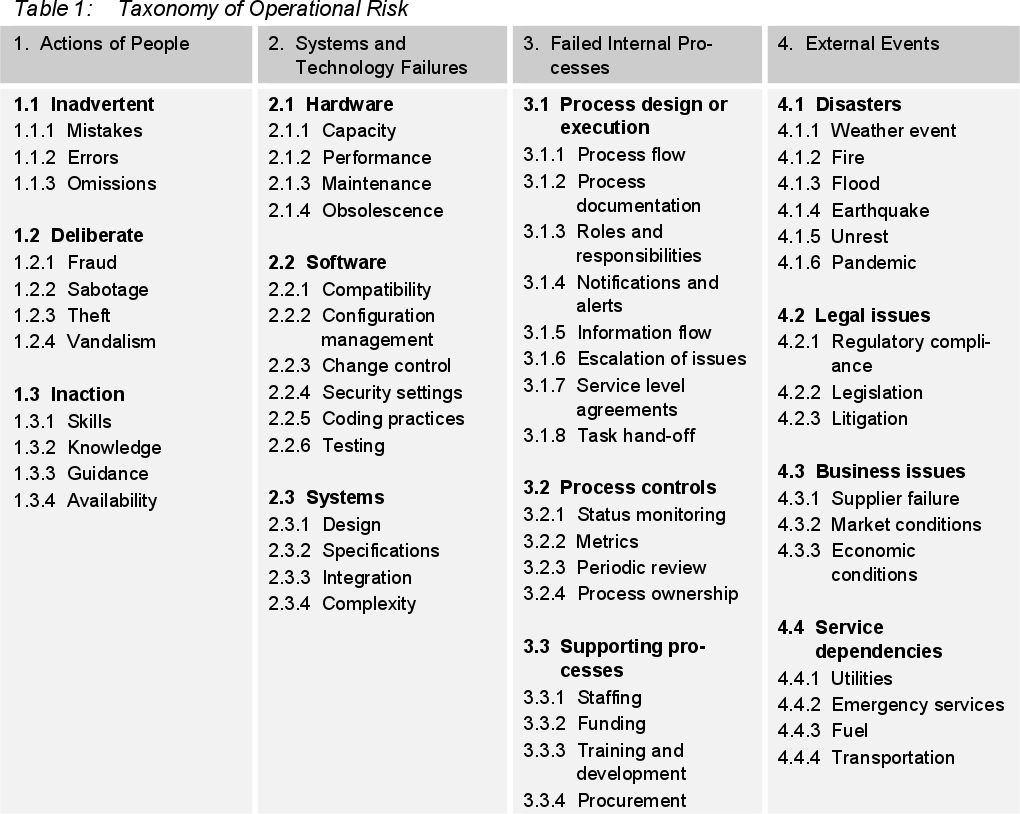
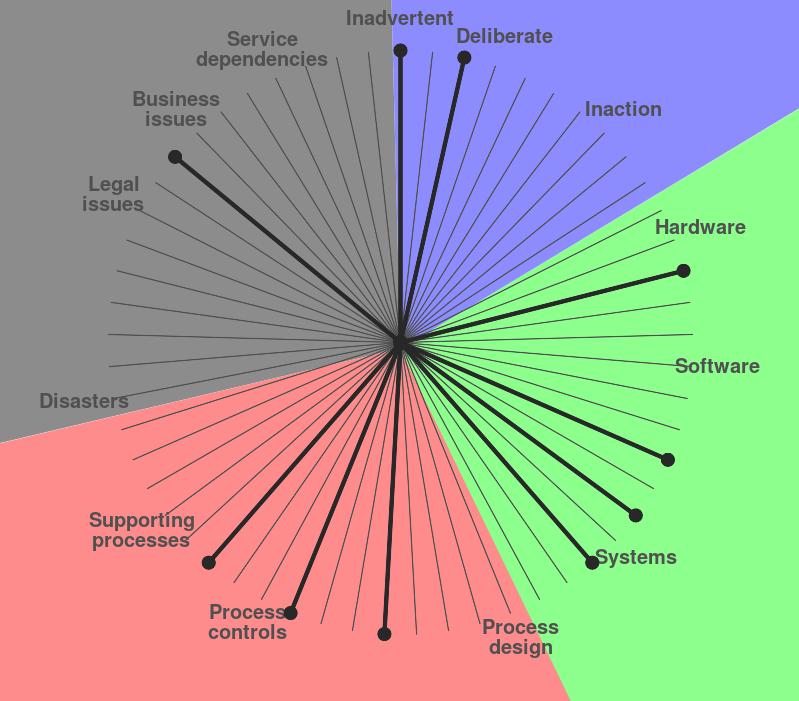
Dear lazyweb, I am trying to get a good way to present the categorization of several cases studied with a fitting graph. I am rating several vulnerabilities / failures according to James Cebula et. al.'s paper, A taxonomy of Operational Cyber Security Risks; this is a somewhat deep taxonomy, with 57 end items, but organized in a three levels deep hierarchy. Copying a table from the cited paper (click to display it full-sized): My categorization is binary: I care only whether it falls within a given category or not. My first stab at this was to represent each case using a star or radar graph. As an example: As you can see, to a "bare" star graph, I added a background color for each top-level category (blue for actions of people, green for systems and technology failures), red for failed internal processes and gray for external events), and printed out only the labels for the second level categories; for an accurate reading of the graphs, you have to refer to the table and count bars. And, yes, according to the Engineering Statistics Handbook:
Star plots are helpful for small-to-moderate-sized multivariate data sets. Their primary weakness is that their effectiveness is limited to data sets with less than a few hundred points. After that, they tend to be overwhelming.
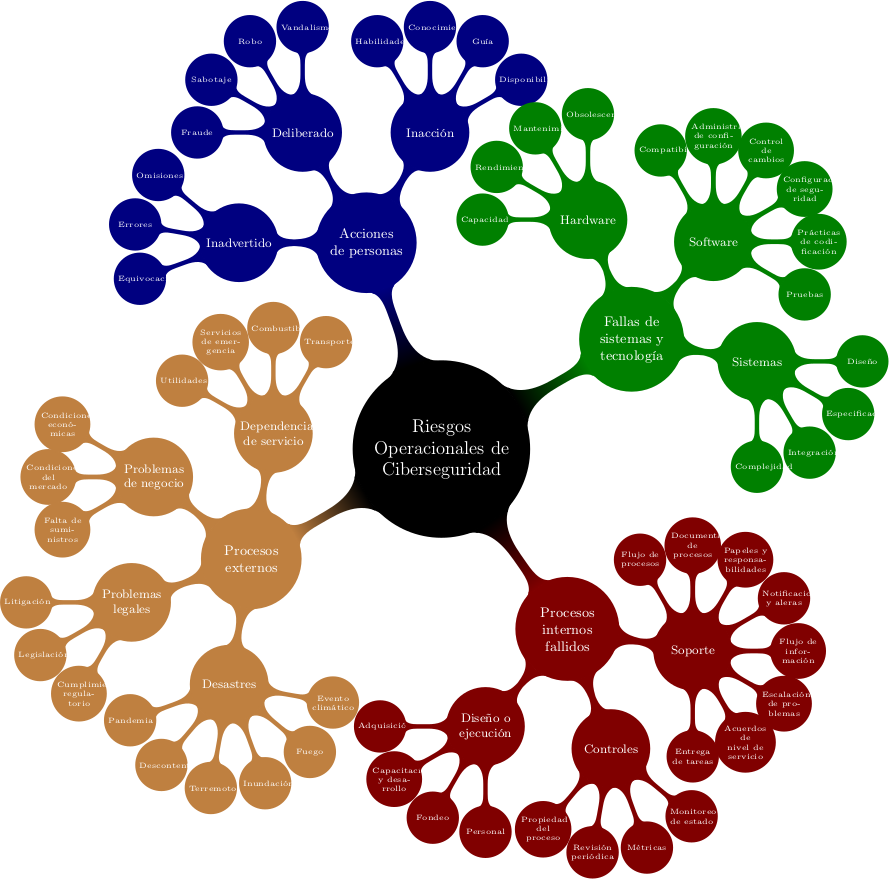
I strongly agree with the above statement And stating that "a few hundred points" can be understood is even an overstatement. 50 points are just too much. Now, trying to increase usability for this graph, I came across the Sunburst diagram. One of the proponents for this diagram, John Stasko, has written quite a bit about it. Now... How to create my beautiful Sunburst diagram? That's a tougher one. Even though the page I linked to in the (great!) Data visualization catalogue presents even some free-as-in-software tools to do this... They are Javascript projects that will render their beautiful plots (even including an animation)... To the browser. I need them for a static (i.e. to be printed) document. Yes, I can screenshot and all, but I want them to be automatically generated, so I can review and regenerate them all automatically. Oh, I could just write JSON and use SaaS sites such as Aculocity to do the heavy-lifting, but if you know me, you will understand why I don't want to. So... I set out to find a Gunnar-approved way to display the information I need. Now, as the Protovis documentation says, an icicle is simply a sunburst transformed from polar to cartesian coordinates... But I came to a similar conclusion: The tools I found are not what I need. OK, but an icicle graph seems much simpler to produce I fired up my Emacs, and started writing using Ruby, RMagick and RVG... I decided to try a different way. This is my result so far: So... What do you think? Does this look right to you? Clearer than the previous one? Worst? Do you have any idea on how I could make this better? Oh... You want to tell me there is something odd about it? Well, yes, of course! I still need to tweak it quite a bit. Would you believe me if I told you this is not really a left-to-right icicle graph, but rather a strangely formatted Graphviz non-directed graph using the dot formatter? I can assure you you don't want to look at my Graphviz sources... But in case you insist... Take them and laugh. Or cry. Of course, this file comes from a hand-crafted template, but has some autogenerated bits to it. I have still to tweak it quite a bit to correct several of its usability shortcomings, but at least it looks somewhat like what I want to achieve. Anyway, I started out by making a "dear lazyweb" question. So, here it goes: Do you think I'm using the right visualization for my data? Do you have any better suggestions, either of a graph or of a graph-generating tool? Thanks! [update] Thanks for the first pointer, Lazyweb! I found a beautiful solution; we will see if it is what I need or not (it is too space-greedy to be readable... But I will check it out more thoroughly). It lays out much better than anything I can spew out by myself Writing it as a mindmap using TikZ directly from within LaTeX, I get the following result:

Sylvain Beucler: Practical basics of reproducible builds

As GNU FreeDink upstream, I'd very much like to offer pre-built binaries: one (1) official, tested, current, distro-agnostic version of the game with its dependencies.
I'm actually already doing that for the Windows version.
One issue though: people have to trust me -- and my computer's integrity.
Reproducible builds could address that.
My release process is tightly controlled, but is my project reproducible? If not, what do I need? Let's check! I quickly see that documentation is getting better, namely https://reproducible-builds.org/ :)
(The first docs I read on reproducibility looked more like a crazed date-o-phobic rant than actual solution - plus now we have SOURCE_DATE_EPOCH implemented in gcc ;)) However I was left unsatisfied by the very high-level viewpoint and the lack of concrete examples.
The document points to various issues but is very vague about what tools are impacted. So let's do some tests!
Let's start with a trivial program:
$ cat > hello.c
#include <stdio.h>
int main(void)  
    printf("Hello, world!\n");
 
OK, first does GCC compile this reproducibly?
I'm not sure because I heard of randomness in identifiers and such in the compilation process...
$ gcc-5 hello.c -o hello-5
$ md5sum hello-5
a00416d7392442321bad4afc5a461321  hello-5
$ gcc-5 hello.c -o hello-5
$ md5sum hello-5
a00416d7392442321bad4afc5a461321  hello-5
Cool, ELF compiler output is stable through time!
Now do 2 versions of GCC compile a hello world identically?
$ gcc-6 hello.c -o hello-6
$ md5sum hello-6
f7f52c2f5f82fe2a95061a771a6c5acd  hello-6
$ hexcompare hello-5 hello-6
[lots of red]
...
Well let's not get our hopes too high ;)
Trivial build options change?
$ gcc-6 hello.c -lc -o hello-6
$ gcc-6 -lc hello.c -o hello-6b
$ md5sum hello-6 hello-6b
f7f52c2f5f82fe2a95061a771a6c5acd  hello-6
f73ee6d8c3789fd8f899f5762025420e  hello-6b
$ hexcompare hello-6 hello-6b
[lots of red]
...
OK, let's be very careful with build options then. What about 2 different build paths?
$ cd ..
$ cp -a repro/ repro2/
$ cd repro2/
$ gcc-6 hello.c -o hello-6
$ md5sum hello-6
f7f52c2f5f82fe2a95061a771a6c5acd  hello-6
Basic compilation is stable across directories.
Now I tried recompiling identically FreeDink on 2 different git clones.
Disappointment:
$ md5sum freedink/native/src/freedink freedink2/native/src/freedink
839ccd9180c72343e23e5d9e2e65e237  freedink/native/src/freedink
6d5dc6aab321fab01b424ac44c568dcf  freedink2/native/src/freedink
$ hexcompare freedink2/native/src/freedink freedink/native/src/freedink
[lots of red]
Hmm, what about stripped versions?
$ strip freedink/native/src/freedink freedink2/native/src/freedink
$ md5sum freedink/native/src/freedink freedink2/native/src/freedink
415e96bb54456f3f2a759f404f18c711  freedink/native/src/freedink
e0702d798807c83d21f728106c9261ad  freedink2/native/src/freedink
$ hexcompare freedink/native/src/freedink freedink2/native/src/freedink
[1 single red spot]
OK, what's happening? diffoscope to the rescue:
$ diffoscope freedink/native/src/freedink freedink2/native/src/freedink
--- freedink/native/src/freedink
+++ freedink2/native/src/freedink
  readelf --wide --notes  
  @@ -3,8 +3,8 @@
     Owner                 Data size  Description
     GNU                  0x00000010  NT_GNU_ABI_TAG (ABI version tag)
       OS: Linux, ABI: 2.6.32
   
   Displaying notes found in: .note.gnu.build-id
     Owner                 Data size  Description
     GNU                  0x00000014  NT_GNU_BUILD_ID (unique build ID bitstring)
  -    Build ID: a689574d69072bb64b28ffb82547e126284713fa
  +    Build ID: d7be191a61e84648a58c18e9c108b3f3ce500302
What on earth is Build ID and how it is computed?
After much digging, I find it's a 2008 plan with application in selecting matching detached debugging symbols.
https://fedoraproject.org/wiki/RolandMcGrath/BuildID is the most detailed overview/rationale I found.
It is supposed to be computed from parts of the binary. It's actually pretty resistant to changes, e.g. I could add the missing "return 0;" in my hello source and get the exact same Build ID!
On the other hand my FreeDink binaries do match except for the Build ID so there must be a catch. Let's try our basic example with default ./configure CFLAGS:
$ (cd repro/ && gcc -g -O2 hello.c -o hello)
$ (cd repro/ && gcc -g -O2 hello.c -o hello-b)
$ md5sum repro/hello repro/hello-b
6b2cd79947d7c5ed2e505ddfce167116  repro/hello
6b2cd79947d7c5ed2e505ddfce167116  repro/hello-b
# => OK for now
$ (cd repro2/ && gcc -g -O2 hello.c -o hello)
$ md5sum repro2/hello
20b4d09d94de5840400be05bc76e4172  repro2/hello
$ strip repro/hello repro2/hello
$ diffoscope repro/hello repro2/hello
--- repro/hello
+++ repro2/hello2
  readelf --wide --notes  
  @@ -3,8 +3,8 @@
     Owner                 Data size  Description
     GNU                  0x00000010  NT_GNU_ABI_TAG (ABI version tag)
       OS: Linux, ABI: 2.6.32
   
   Displaying notes found in: .note.gnu.build-id
     Owner                 Data size  Description
     GNU                  0x00000014  NT_GNU_BUILD_ID (unique build ID bitstring)
  -    Build ID: 462a3c613537bb57f20bd3ccbe6b7f6d2bdc72ba
  +    Build ID: b4b448cf93e7b541ad995075d2b688ef296bd88b
# => issue reproduced with -g -O2 and different build directories
$ (cd repro/ && gcc -O2 hello.c -o hello)
$ (cd repro2/ && gcc -O2 hello.c -o hello)
$ md5sum repro/hello repro2/hello
1571d45eb5807f7a074210be17caa87b  repro/hello
1571d45eb5807f7a074210be17caa87b  repro2/hello
# => culprit is not -O2, so culprit is -g
Bummer. So the build ID must be computed also from the debug symbols, even if I strip them afterwards :(
OK, so when https://reproducible-builds.org/docs/build-path/ says "Some tools will record the path of the source files in their output", that means the compiler, and more importantly the stripped executable. Conclusion: apparently to achieve reproducible builds I need identical full build paths and to keep track of them. What about Windows/MinGW btw?
$ /opt/mxe/usr/bin/i686-w64-mingw32.static-gcc hello.c -o hello.exe
$ md5sum hello.exe 
e0fa685f6866029b8e03f9f2837dc263  hello.exe
$ /opt/mxe/usr/bin/i686-w64-mingw32.static-gcc hello.c -o hello.exe
$ md5sum hello.exe 
df7566c0ac93ea4a0b53f4af83d7fbc9  hello.exe
$ /opt/mxe/usr/bin/i686-w64-mingw32.static-gcc hello.c -o hello.exe
$ md5sum hello.exe 
bbf4ab22cbe2df1ddc21d6203e506eb5  hello.exe
PE compiler output is not stable through time.
(any clue?) OK, there's still a long road ahead of us...
There are lots of other questions.
Is autoconf output reproducible?
Does it actually matter if autoconf is reproducible if upstream is providing a pre-generated ./configure?
If not what about all the documentation on making tarballs reproducible, along with the strip-nondeterminism tool?
Where do we draw the line between build and build environment?
What are the legal issues of distributing a docker-based build environment without every single matching distro source packages? That was my modest contribution to practical reproducible builds documentation for developers, I'd very much like to hear about more of it.
Who knows, maybe in the near future we'll get reproducible official builds for Eclipse, ZAP, JetBrains, Krita, Android SDK/NDK... :)

23 March 2017

Mike Hommey: Analyzing git-cinnabar memory use

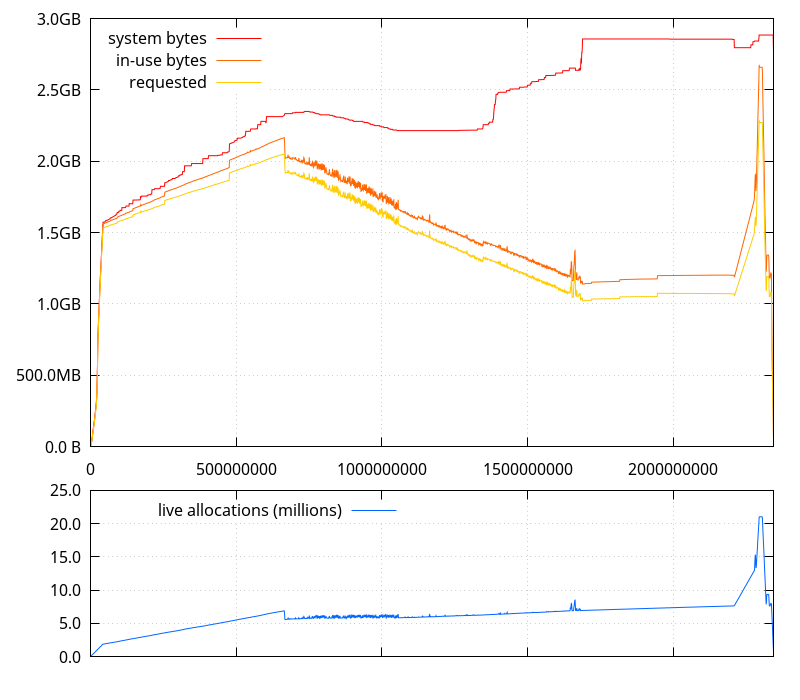
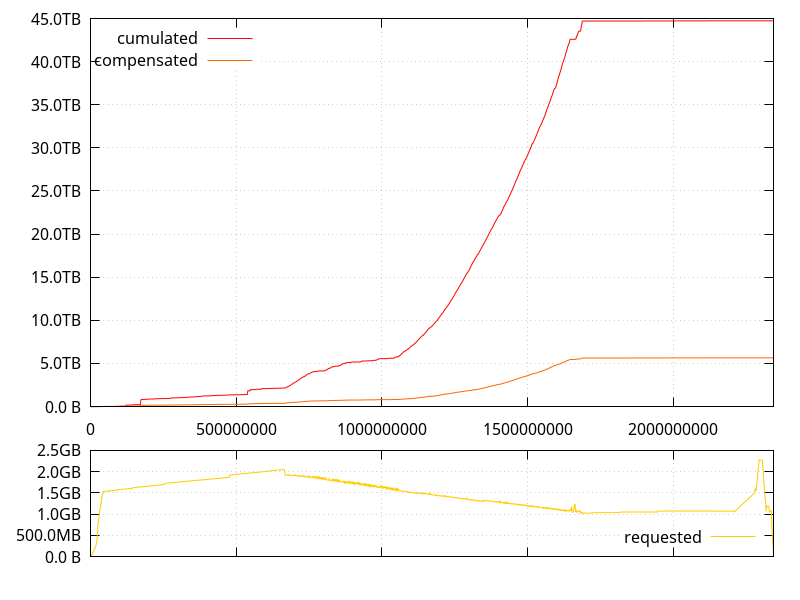
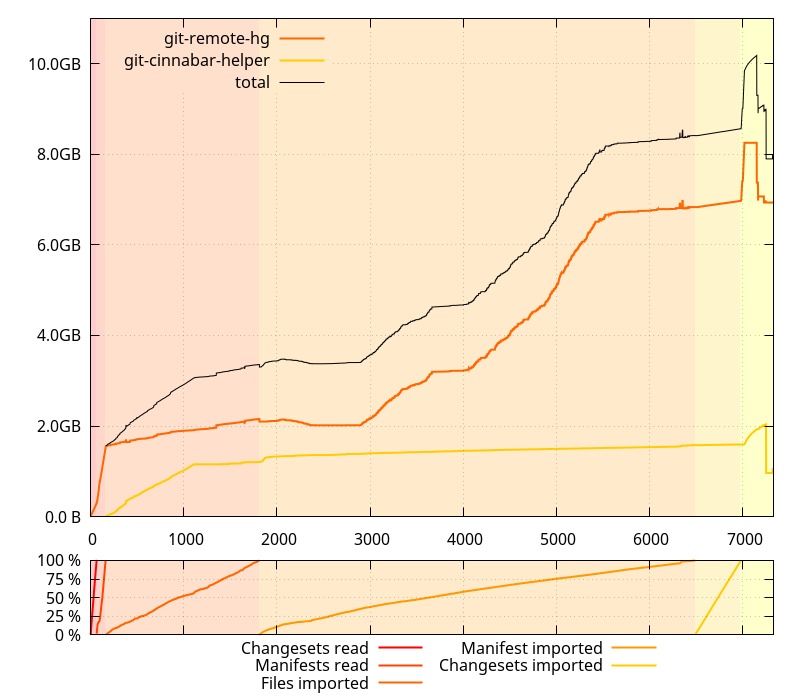
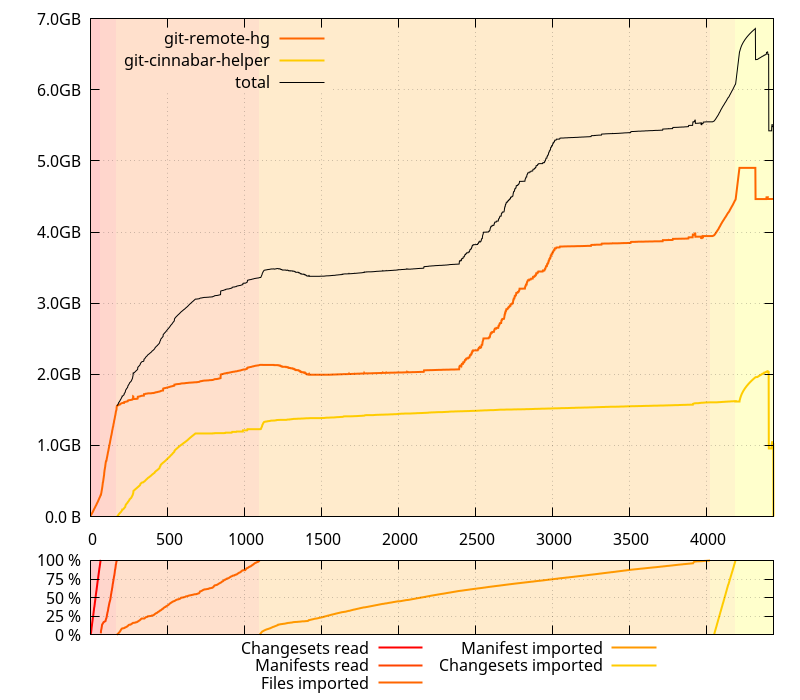
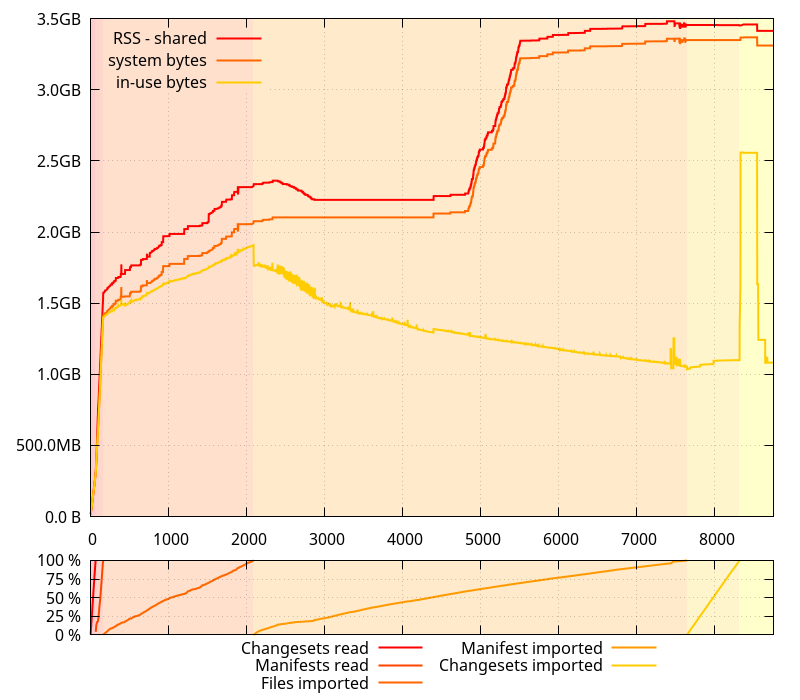
In previous post, I was looking at the allocations git-cinnabar makes. While I had the data, I figured I d also look how the memory use correlates with expectations based on repository data, to put things in perspective. As a reminder, this is what the allocations look like (horizontal axis being the number of allocator function calls): There are 7 different phases happening during a git clone using git-cinnabar, most of which can easily be identified on the graph above: Overall, except for the stupid spike during the final phase, the manifest DAG and the glibc allocator runaway memory use described in previous posts, there is nothing terribly bad with the git-cinnabar memory usage, all things considered. Mozilla-central is just big. The spike is already half addressed, and work is under way for the glibc allocator runaway memory use. The manifest DAG, interestingly, is actually mostly useless. It s only used to track the heads of the DAG, and it s very much possible to track heads of a DAG without actually storing the entire DAG. In fact, that s what git-cinnabar already does for changeset heads so we would only need to do the same for manifest heads. One could argue that the 1.4GB of raw RevChunk data we re keeping in memory for later user could be kept on disk instead. I haven t done this so far because I didn t want to have to handle temporary files (and answer questions like where to put them? , what if there isn t enough disk space there? , what if disk access is slow? , etc.). But the majority of this data is from manifests. I m already planning changes in how git-cinnabar stores manifests data that will actually allow to import them directly, instead of keeping them in memory until files are imported. This would instantly remove 1.18GB of memory usage. The downside, however, is that this would be more CPU intensive: Importing changesets will require creating the corresponding git trees, and getting the stored manifest data. I think it s worth, though. Finally, one thing that isn t obvious here, but that was found while analyzing why RSS would be going up despite memory usage going down, is that git-cinnabar is doing way too many reallocations and substring allocations. So let s look at two metrics that hopefully will highlight the problem: Assuming all the requested memory is filled at some point, the former gives us an upper bound to the amount of memory that is ever filled or copied (the amount that would be filled if no realloc was ever in-place), while the the latter gives us a lower bound (the amount that would be filled or copied if all reallocs were in-place). Ideally, we d want the upper and lower bounds to be close to each other (indicating few realloc calls), and the total amount at the end of the process to be as close as possible to the amount of data we re handling (which we ve seen is around 3TB). and this is clearly bad. Like, really bad. But we already knew that from the previous post, although it s nice to put numbers on it. The lower bound is about twice the amount of data we re handling, and the upper bound is more than 10 times that amount. Clearly, we can do better. We ll see how things evolve after the necessary code changes happen. Stay tuned.

22 March 2017

Dirk Eddelbuettel: Suggests != Depends

A number of packages on CRAN use Suggests: casually. They list other packages as "not required" in Suggests: -- as opposed to absolutely required via Imports: or the older Depends: -- yet do not test for their use in either examples or, more commonly, unit tests. So e.g. the unit tests are bound to fail because, well, Suggests != Depends. This has been accomodated for many years by all parties involved by treating Suggests as a Depends and installing unconditionally. As I understand it, CRAN appears to flip a switch to automatically install all Suggests from major repositories glossing over what I consider to be a packaging shortcoming. (As an aside, treatment of Additonal_repositories: is indeed optional; Brooke Anderson and I have a fine paper under review on this) I spend a fair amount of time with reverse dependency ("revdep") checks of packages I maintain, and I will no longer accomodate these packages. These revdep checks take long enough as it is, so I will now blacklist these packages that are guaranteed to fail when their "optional" dependencies are not present. Writing R Extensions says in Section 1.1.3
All packages that are needed10 to successfully run R CMD check on the package must be listed in one of Depends or Suggests or Imports . Packages used to run examples or tests conditionally (e.g. via if(require(pkgname))) should be listed in Suggests or Enhances . (This allows checkers to ensure that all the packages needed for a complete check are installed.) In particular, packages providing only data for examples or vignettes should be listed in Suggests rather than Depends in order to make lean installations possible. [...] It used to be common practice to use require calls for packages listed in Suggests in functions which used their functionality, but nowadays it is better to access such functionality via :: calls.
and continues in Section 1.1.3.1
Note that someone wanting to run the examples/tests/vignettes may not have a suggested package available (and it may not even be possible to install it for that platform). The recommendation used to be to make their use conditional via if(require("pkgname"))): this is fine if that conditioning is done in examples/tests/vignettes.
I will now exercise my option to use 'lean installations' as discussed here. If you want your package included in tests I run, please make sure it tests successfully when only its required packages are present.

21 March 2017

Matthew Garrett: Announcing the Shim review process

Shim has been hugely successful, to the point of being used by the majority of significant Linux distributions and many other third party products (even, apparently, Solaris). The aim was to ensure that it would remain possible to install free operating systems on UEFI Secure Boot platforms while still allowing machine owners to replace their bootloaders and kernels, and it's achieved this goal.

However, a legitimate criticism has been that there's very little transparency in Microsoft's signing process. Some people have waited for significant periods of time before being receiving a response. A large part of this is simply that demand has been greater than expected, and Microsoft aren't in the best position to review code that they didn't write in the first place.

To that end, we're adopting a new model. A mailing list has been created at shim-review@lists.freedesktop.org, and members of this list will review submissions and provide a recommendation to Microsoft on whether these should be signed or not. The current set of expectations around binaries to be signed documented here and the current process here - it is expected that this will evolve slightly as we get used to the process, and we'll provide a more formal set of documentation once things have settled down.

This is a new initiative and one that will probably take a little while to get working smoothly, but we hope it'll make it much easier to get signed releases of Shim out without compromising security in the process.

comment count unavailable comments

Reproducible builds folks: Reproducible Builds: week 99 in Stretch cycle

Here's what happened in the Reproducible Builds effort between Sunday March 12 and Saturday March 18 2017: Upcoming events Reproducible Builds Hackathon Hamburg 2017 The Reproducible Builds Hamburg Hackathon 2017, or RB-HH-2017 for short is a 3 day hacking event taking place May 5th-7th in the CCC Hamburg Hackerspace located inside Frappant, as collective art space located in a historical monument in Hamburg, Germany. The aim of the hackathon is to spent some days working on Reproducible Builds in every distribution and project. The event is open to anybody interested on working on Reproducible Builds issues, with or without prior experience! Accomodation is available and travel sponsorship may be available by agreement. Please register your interest as soon as possible. Reproducible Builds Summit Berlin 2016 This is just a quick note, that all the pads we've written during the Berlin summit in December 2016 are now online (thanks to Holger), nicely complementing the report by Aspiration Tech. Request For Comments for new specification: BUILD_PATH_PREFIX_MAP Ximin Luo posted a draft version of our BUILD_PATH_PREFIX_MAP specification for passing build-time paths between high-level and low-level build tools. This is meant to help eliminate irreproducibility caused by different paths being used at build time. At the time of writing, this affects an estimated 15-20% of 25000 Debian packages. This is a continuation of an older proposal SOURCE_PREFIX_MAP, which has been updated based on feedback on our patches from GCC upstream, attendees of our Berlin 2016 summit, and participants on our mailing list. Thanks to everyone that contributed! The specification also contains runnable source code examples and test cases; see our git repo. Please comment on this draft ASAP - we plan to release version 1.0 of this in a few weeks. Toolchain changes Packages reviewed and fixed, and bugs filed Chris Lamb: Reviews of unreproducible packages 5 package reviews have been added, 274 have been updated and 800 have been removed in this week, adding to our knowledge about identified issues. 1 issue type has been added: Weekly QA work During our reproducibility testing, FTBFS bugs have been detected and reported by: diffoscope development diffoscope 79 and 80 were uploaded to experimental by Chris Lamb. It included contributions from: Chris Lamb: Maria Glukhova: strip-nondeterminism development strip-nondeterminism 0.032-1 was uploaded to unstable by Chris Lamb. It included contributions from: Chris Lamb: tests.reproducible-builds.org Misc. This week's edition was written by Ximin Luo, Holger Levsen and Chris Lamb & reviewed by a bunch of Reproducible Builds folks on IRC & the mailing lists.

17 March 2017

Shirish Agarwal: Science Day at GMRT, Khodad 2017

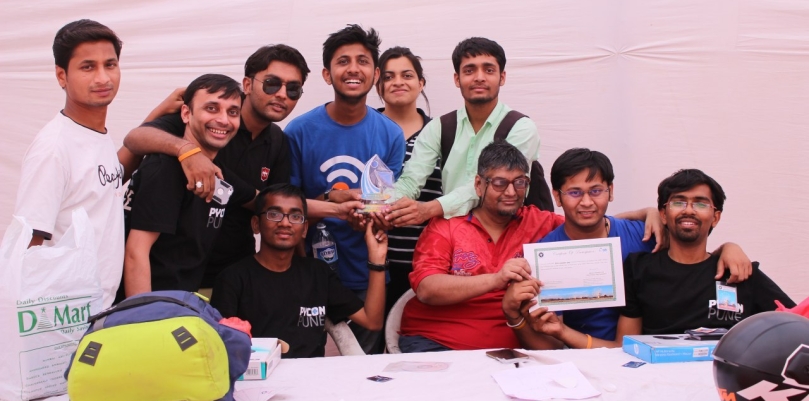
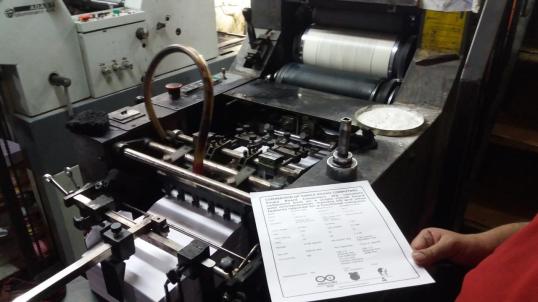
The whole team posing at the end of day 2 The above picture is the blend of the two communities from foss community and mozilla India. And unless you were there you wouldn t know who is from which community which is what FOSS is all about. But as always I m getting a bit ahead of myself. Akshat, who works at NCRA as a programmer, the standing guy on the left shared with me in January this year that this year too, we should have two stalls, foss community and mozilla India stalls next to each other. While we had the banners, we were missing stickers and flyers. Funds were and are always an issue and this year too, it would have been emptier if we didn t get some money saved from last year minidebconf 2016 that we had in Mumbai. Our major expenses included printing stickers, stationery and flyers which came to around INR 5000/- and couple of LCD TV monitors which came for around INR 2k/- as rent. All the labour was voluntary in nature, but both me and Akshat easily spending upto 100 hours before the event. Next year, we want to raise to around INR 10-15k so we can buy 1 or 2 LCD monitors and we don t have to think for funds for next couple of years. How will we do that I have no idea atm. Printing leaflets Me and Akshat did all the printing and stationery runs and hence had not been using my lappy for about 3-4 days. Come to the evening before the event and the laptop would not start. Coincidentally, or not few months or even last at last year s Debconf people had commented on IBM/Lenovo s obsession with proprietary power cords and adaptors. I hadn t given it much thought but when I got no power even after putting it on AC power for 3-4 hours, I looked up on the web and saw that the power cord and power adaptors were all different even in T440 and even that under existing models. In fact I couldn t find mine hence sharing it via pictures below. thinkpad power cord male thinkpad power adaptor female I knew/suspected that thinkpads would be rare where I was going, it would be rarer still to find the exact power cord and I was unsure whether it was the power cord at fault or adaptor or whatever goes for SMPS in laptop or memory or motherboard/CPU itself. I did look up the documentation at support.lenovo.com and was surprised at the extensive documentation that Lenovo has for remote troubleshooting. I did the usual take out the battery, put it back in, twiddle with the little hole in the bottom of the laptop, trying to switch on without the battery on AC mains, trying to switch on with battery power only but nothing worked. Couple of hours had gone by and with a resigned thought went to bed, convincing myself that anyways it s good I am not taking the lappy as it is extra-dusty there and who needs a dead laptop anyways. Update After the event was over, I did contact Lenovo support and within a week, with one visit from a service engineer, he was able to identify that it was a faulty cable which was at fault and not the the other things which I was afraid of. Another week gone by and lenovo replaced the cable. Going by service standards that I have seen of other companies, Lenovo deserves a gold star here for the prompt service they provided. I probably would end up subscribing to their extended 2-year warranty service when my existing 3 year warranty is about to be over. Next day, woke up early morning, two students from COEP hostel were volunteering and we made our way to NCRA, Pune University Campus. Ironically, though we were under the impression that we would be the late arrivals, it turned out we were the early birds. 5-10 minutes passed by and soon enough we were joined by Aniket and we played catch-up for a while. We hadn t met each other for a while so it was good to catch-up. Then slowly other people starting coming in and around 07:10-07:15 we started for GMRT, Khodad. Now I had been curious as had been hearing for years that the Pune-Nashik NH-50 highway would be concreted and widened to six-lane highways but the experience was below par. Came back and realized the proposal has now been pushed back to 2020. From the mozilla team, only Aniket was with us, the rest of the group was coming straight from Nashik. Interestingly, all the six people who came, came on bikes which depending upon how you look at it was either brave or stupid. Travelling on bikes on Indian highways you either have to be brave or stupid or both, we have more than enough accidents due to quality of road construction, road design, lane-changing drivers and many other issues. This is probably not the place for it hence will use some other blog post to rant about that. We reached around 10:00 hrs. IST and hung around till lunch as Akshat had all the marketing material, monitors etc. The only thing we had were couple of lappies and couple of SBC s, an RPI 3 and a BBB. Aarti Kashyap sharing something about SBC Our find for the event was Aarti Kashyap who you can see above. She is a third-year student at COEP and one of the rare people who chose to interact with hardware rather than software. From last several years, we had been trying, successfully and unsuccessfully to get more Indian women and girls interested into technology. It is a vicious circle as till a girl/woman doesn t volunteer we are unable to share our knowledge to the extent we can which leads them to not have much interest in FOSS or even technology in general. While there are groups are djangogirls, Pyladies and railgirls and even Outreachy which tries to motivate getting girls into computing but it s a long road ahead. We are short of both funds and ideas as to how to motivate more girls to get into computing and then to get into playing with hardware. I don t know where to start and end for whoever wants to play with hardware. From SBC s, routers to blade servers the sky is the limit. Again this probably isn t the place for it, hence probably we can chew it on more at some other blog post. This year, we had a lowish turnout due to the fact that the 12th board exams 1st paper was on the day we had opened. So instead of 20-25k, we probably had 5-7k fewer people pass through. There were two-three things that we were showing, we were showing Debian on one of the systems, we were showing the output from the SBC s on the other monitor but the glare kept hitting the monitors. While the organizers had done exemplary work over last year. They had taped the carpets on the ground so there was hardly any dust moving around. However, I wished the organizers had taken the pains to have two cloth roofs over our head instead of just one, the other roof head could be say 2 feet up, this would have done two things a. It probably would have cooled the place a bit more as b. We could get diffused sunlight which would have lessened the glare and reflection the LCD s kept throwing back. At times we also got people to come to our side as can be seen in Aarti s photo as can be seen above. If these improvements can be made for next year, this would result in everybody in our Pandal would benefit, not just us and mozilla. This would be benefiting around 10-15 organizations which were within the same temporary structure. Of course, it depends very much on the budget they are able to have and people who are executing, we can just advise. The other thing which had been missing last year and this year is writing about Single Board Computers in Marathi. If we are to promote them as something to replace a computer or something for a younger brother/sister to learn computing upon at a lower cost, we need leaflets written in their language to be more effective. And this needs to be in the language and mannerisms that people in that region understand. India, as probably people might have experienced is a dialect-prone country. Which means every 2-5 kms, the way the language is spoken is different from anywhere else. The Marathi spoken by somebody who has lived in Ravivar Peth for his whole life and a person who has lived in say Kothrud are different. The same goes from any place and this place, Khodad, Narayangaon would have its own dialect, its own mini-codespeak. Just to share, we did have one in English but it would have been a vast improvement if we could do it in the local language. Maybe we can discuss about this and ask for help from people. Outside, Looking in Mozillians helping FOSS community and vice-versa What had been interesting about the whole journey were the new people who were bringing all their passion and creativity to the fore. From the mozilla community, we had Akshay who is supposed to be a wizard on graphics, animation, editing anything to do with the visual medium. He shared some of the work he had done and also shared a bit about how blender works with people who wanted to learn about that. Mayur, whom you see in the picture pointing out something about FOSS and this was the culture that we strove to have. I know and love and hate the browser but haven t been able to fathom the recklessness that Mozilla has been doing the last few years, which has just been having one mis-adventure after another. For instance, mozstumbler was an effort which I thought would go places. From what little I understood, it served/serves as a user-friendly interface to a potential user while still sharing all the data with OSM . They (Mozilla) seems/seemed to have a fatalistic take as it provided initial funding but then never fully committing to the project. Later, at night we had the whole free software and open-source sharings where I tried to emphasize that without free software, the term open-source would not have come into existence. We talked and talked and somewhere around 02:00 I slept, the next day was an extension of the first day itself where we ribbed each other good-naturedly and still shared whatever we could share with each other. I do hope that we continue this tradition for great many years to come and engage with more and more people every passing year.
Filed under: Miscellenous Tagged: #budget, #COEP< #volunteering, #debian, #Events, #Expenses, #mozstumbler, #printing, #SBC's, #Science Day 2017, #thinkpad cable issue, FOSS, mozilla

16 March 2017

Thorsten Glaser: Updates to the last two posts

Someone from the FSF s licencing department posted an official-looking thing saying they don t believe GitHub s new ToS to be problematic with copyleft. Well, my lawyer (not my personal one, nor for The MirOS Project, but related to another association, informally) does agree with my reading of the new ToS, and I can point out at least a clause in the GPLv1 (I really don t have time right now) which says contrary (but does this mean the FSF generally waives the restrictions of the GPL for anything on GitHub?). I ll eMail GitHub Legal directly and will try to continue getting this fixed (as soon as I have enough time for it) as I ll otherwise be forced to force GitHub to remove stuff from me (but with someone else as original author) under GPL, such as tinyirc and e3. My dbconfig-common Debian packaging example got a rather hefty upgrade because dbconfig-common (unlike any other DB schema framework I know of) doesn t apply the upgrades on a fresh install (and doesn t automatically put the upgrades into a transaction either) but only upgrades between Debian package versions (which can be funny with backports, but AFAICT that part is handled correctly). I now append the upgrades to the initial-version-as-seen-in-the-source to generate the initial-version-as-shipped-in-the-binary-package (optionally, only if it s named .in) removing all transaction stuff from the upgrade files and wrapping the whole shit in BEGIN; and COMMIT; after merging. (This should at least not break n n-PostgreSQL databases and well, database-like-ish things I cannot test for obvious (SQLite is illegal, at least in Germany, but potentially worldwide, and then PostgreSQL is the only remaining Open Source database left ;) reasons.) Update: Yes, this does mean that maintainers of databases and webservers should send me patches to make this work with not-PostgreSQL (new install/name.in, upgrade files) and not-Apache-2.2/2.4 (new debian/*/*.conf snippets) to make this packaging example even more generally usable. Natureshadow already forked this and made a Python/Flask package from it, so I ll prod him to provide a similarily versatile hello-python-world example package.

Rapha&#235;l Hertzog: Freexian s report about Debian Long Term Support, February 2017

A Debian LTS logoLike each month, here comes a report about the work of paid contributors to Debian LTS. Individual reports In January, about 154 work hours have been dispatched among 13 paid contributors. Their reports are available: Evolution of the situation The number of sponsored hours increased slightly thanks to Bearstech and LiHAS joining us. The security tracker currently lists 45 packages with a known CVE and the dla-needed.txt file 39. The number of open issues continued its slight increase, this time it could be explained by the fact that many contributors did not spend all the hours allocated (for various reasons). There s nothing worrisome at this point. Thanks to our sponsors New sponsors are in bold.

No comment Liked this article? Click here. My blog is Flattr-enabled.

15 March 2017

Michal &#268;iha&#345;: Life of free software project

During last week I've noticed several interesting posts about challenges being free software maintainer. After being active in open source for 16 years I can share much of the feelings I've read and I can also share my dealings with the things. First of all let me link some of the other posts on the topic: I guess everybody involved in in some popular free software project knows it - there is much more work to be done than people behind the project can handle. It really doesn't matter it those are bug reports, support requests, new features or technical debt, it's simply too much of that. If you are the only one behind the project it can feel even more pressing. There can be several approaches how to deal with that, but you have to choose what you prefer and what is going to work for you and your project. I've used all of the below mentioned approaches on some of the projects, but I don't think there is a silver bullet. Finding more people Obviously if you can not cope with the work, let's find more people to do the work. Unfortunately it's not that easy. Sometimes people come by, contribute few patches, but it's not that easy to turn them into regular contributor. You should encourage them to stay and to care about the part of the project they have touched. You can try to attract completely new contributors through programs as Google Summer of Code (GSoC) or Outreachy, but that has it's own challenges as well. With phpMyAdmin we're participating regularly in GSoC (we've only missed last year as we were not chosen by Google that year) and it indeed helps to bring new people on the board. Many of them even stay around your project (currently 3 of 5 phpMyAdmin team members are former GSoC students). But I think this approach really works only for bigger organizations. You can also motivate people by money. It's way which is not really much used on free software projects, partly because lack of funding (I'll get to that later) and partly because it doesn't necessarily bring long time contributors, just cash hunters. I've been using Bountysource for some of my projects (Weblate and Gammu) and so far it mostly works other way around - if somebody posts bounty on the issue, it means it's quite important for him to get that fixed, so I use that as indication for myself. On attracting new developers it never really worked well, even when I've tried to post bounties to some easy to fix issues, where newbies could learn our code base and get paid for that. These issues stayed opened for months and in the end I've fixed them myself because they annoyed me. Don't care too much I think this is most important aspect - you simply can never fix all the problems. Let's face it and work according to that. There can be various levels of don't caring. I find it always better to try to encourage people to fix their problem, but you can't expect big success rate in that, so you might find it not worth of the time. What I currently do: If you still can't handle that, you should consider abandoning the project as well. Does it bring something to you other than frustration of not completed work? I know it can be hard decision, in the end it is your child, but sometimes it's the best think you can do. Get paid to do the work Are you doing your fulltime job and then work on free software on nights or weekends? It can probably work for some time, but unless you find some way to make these two match, you will lack free time to relax and spend with friends or family. There are several options to make these work together. You can find job where doing free software will be natural part of it. This worked for me pretty well at SUSE, but I'm sure there are more companies where it will work. It can happen that the job will not cover all your free software activities, but this still helps. You can also make your project to become your employer. This can be sometimes challenging to make volunteers and paid contractors to work on one project, but I think this can be handled. Such setup currently works currently quite well for phpMyAdmin (we will announce second contractor soon) and works quite well for me with Weblate as well. Funding free software projects Once your project is well funded, you can fix many problems by money. You can pay yourself to do the work, hire additional developers, get better infrastructure or travel to conferences to spread word about it. But the question is how to get to the point of being well funded. There are several crowdfunding platforms which can help you with that (Liberapay, Bountysource salt, Gratipay or Snowdrift to mention some). You can also administer the funding yourself or using some legal entity such as Software Freedom Conservancy which handles this for phpMyAdmin. But the most important thing is to persuade people and companies to give back. You know there are lot of companies relying on your project, but how to make them fund the project? I really don't know, I still struggle with this as I don't want to be too pushy in asking for money, but I'd really like to see them to give back. What kind of works is giving your sponsors logo / link placement on your website. If your website is well ranked, you can expect to get quite a lot of SEO sponsors and the question is where to draw a line what you still find acceptable. Obviously the most willing to pay companies will have nothing to do with what you do and they just want to get the link. The industry you can expect is porn, gambling, binary options and various MFA sites. You will get some legitimate sponsors related to your project as well. We felt we've gone too far with phpMyAdmin last year and we've stricten the rules recently, but the outcome is still not visible on our website (as we've just limited new sponsors, but existing contracts will be honored). Another option is to monetize your project more directly. You can offer consulting services or provide it as a service (this is what I currently do with Weblate). It really depends on the product if you can build customer base on that or not, but certainly this is not something what would work well for all projects. Thanks for reading this and I hope it's not too chaotic, as I've moved parts there and back while writing and I'm afraid it got too long in the end.

Filed under: Debian English Gammu phpMyAdmin SUSE Weblate 0 comments

14 March 2017

Reproducible builds folks: Reproducible Builds: week 98 in Stretch cycle

Here's what happened in the Reproducible Builds effort between Sunday March 5 and Saturday March 11 2017: Upcoming events Reproducible Builds Hackathon Hamburg The Reproducible Builds Hamburg Hackathon 2017, or RB-HH-2017 for short, is a 3 day hacking event taking place in the CCC Hamburg Hackerspace located inside the Frappant, which is collective art space located in a historical monument in Hamburg, Germany. The aim of the hackathon is to spent some days working on Reproducible Builds in every distribution and project. The event is open to anybody interested on working on Reproducible Builds issues in any distro or project, with or without prio experience! Packages filed Chris Lamb: Toolchain development Reviews of unreproducible packages 39 package reviews have been added, 7 have been updated and 9 have been removed in this week, adding to our knowledge about identified issues. 2 issue types have been added: Weekly QA work During our reproducibility testing, FTBFS bugs have been detected and reported by: buildinfo.debian.net development reproducible-website development tests.reproducible-builds.org Misc. This week's edition was written by Chris Lamb, Holger Levsen, Vagrant Cascadian & reviewed by a bunch of Reproducible Builds folks on IRC & the mailing lists.

12 March 2017

Mike Hommey: When the memory allocator works against you

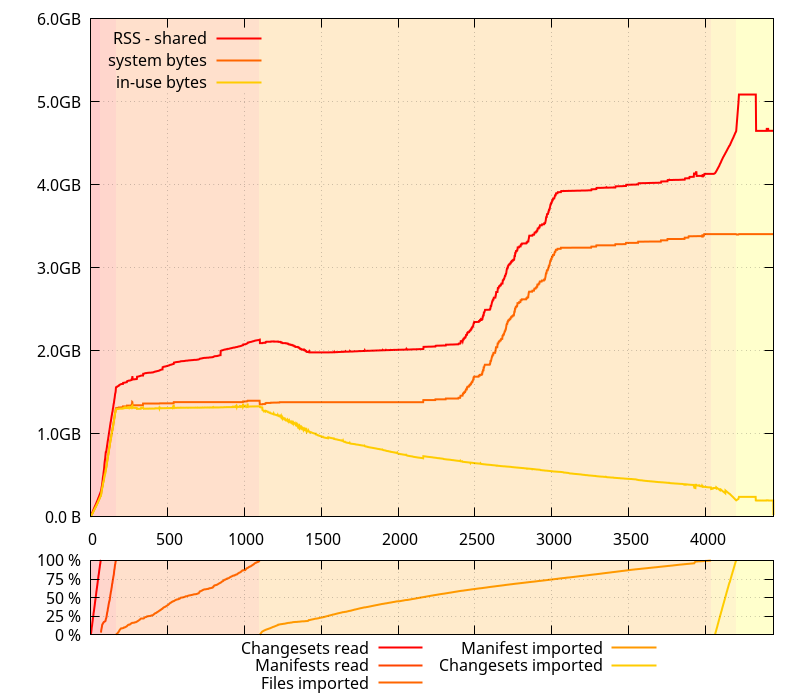
Cloning mozilla-central with git-cinnabar requires a lot of memory. Actually too much memory to fit in a 32-bits address space. I hadn t optimized for memory use in the first place. For instance, git-cinnabar keeps sha-1s in memory as hex values (40 bytes) rather than raw values (20 bytes). When I wrote the initial prototype, it didn t matter that much, and while close(ish) to the tipping point, it didn t require more than 2GB of memory at the time. Time passed, and mozilla-central grew. I suspect the recent addition of several thousands of commits and files has made things worse. In order to come up with a plan to make things better (short or longer term), I needed data. So I added some basic memory resource tracking, and collected data while cloning mozilla-central. I must admit, I was not ready for what I witnessed. Follow me for a tale of frustrations (plural). I was expecting things to have gotten worse on the master branch (which I used for the data collection) because I am in the middle of some refactoring and did many changes that I was suspecting might have affected memory usage. I wasn t, however, expecting to see the clone command using 10GB(!) memory at peak usage across all processes. (Note, those memory sizes are RSS, minus shared ) It also was taking an unexpected long time, but then, I hadn t cloned a large repository like mozilla-central from scratch in a while, so I wasn t sure if it was just related to its recent growth in size or otherwise. So I collected data on 0.4.0 as well. Less time spent, less memory usage ok. There s definitely something wrong on master. But wait a minute, that slope from ~2GB to ~4GB on the git-remote-hg process doesn t actually make any kind of sense. I mean, I d understand it if it were starting and finishing with the Import manifest phase, but it starts in the middle of it, and ends long before it finishes. WTH? First things first, since RSS can be a variety of things, I checked /proc/$pid/smaps and confirmed that most of it was, indeed, the heap. That s the point where you reach for Google, type something like python memory profile and find various tools. One from the results that I remembered having used in the past is guppy s heapy. Armed with pdb, I broke execution in the middle of the slope, and tried to get memory stats with heapy. SIGSEGV. Ouch. Let s try something else. I reached out to objgraph and pympler. SIGSEGV. Ouch again. Tried working around the crashes for a while (too long while, retrospectively, hindsight is 20/20), and was somehow successful at avoiding them by peaking at a smaller set of objects. But whatever I did, despite being attached to a process that had 2.6GB RSS, I wasn t able to find more than 1.3GB of data. This wasn t adding up. It surely didn t help that getting to that point took close to an hour each time. Retrospectively, I wish I had investigated using something like Checkpoint/Restore in Userspace. Anyways, after a while, I decided that I really wanted to try to see the whole picture, not smaller peaks here and there that might be missing something. So I resolved myself to look at the SIGSEGV I was getting when using pympler, collecting a core dump when it happened. Guess what? The Debian python-dbg package does not contain the debug symbols for the python package. The core dump was useless. Since I was expecting I d have to fix something in python, I just downloaded its source and built it. Ran the command again, waited, and finally got a backtrace. First Google hit for the crashing function? The exact (unfixed) crash reported on the python bug tracker. No patch. Crashing code is doing:
((f)->f_builtins != (f)->f_tstate->interp->builtins)
And (f)->f_tstate is NULL. Classic NULL deref. Added a guard (assessing it wouldn t break anything). Ran the command again. Waited. Again. SIGSEGV. Facedesk. Another crash on the same line. Did I really use the patched python? Yes. But this time (f)->f_tstate->interp is NULL. Sigh. Same player, shoot again. Finally, no crash but still stuck on only 1.3GB accounted for. Ok, I know not all python memory profiling tools are entirely reliable, let s try heapy again. SIGSEGV. Sigh. No debug info on the heapy module, where the crash happens. Sigh. Rebuild the module with debug info, try again. The backtrace looks like heapy is recursing a lot. Look at %rsp, compare with the address space from /proc/$pid/maps. Confirmed. A stack overflow. Let s do ugly things and increase the stack size in brutal ways. Woohoo! Now heapy tells me there s even less memory used than the 1.3GB I found so far. Like, half less. Yeah, right. I m not clear on how I got there, but that s when I found gdb-heap, a tool from Red Hat s David Malcolm, and the associated talk Dude, where s my RAM? A deep dive into how Python uses memory (slides). With a gdb attached, I would finally be able to rip python s guts out and find where all the memory went. Or so I thought. The gdb-heap tool only found about 600MB. About as much as heapy did, for that matter, but it could be coincidental. Oh. Kay. I don t remember exactly what went through my mind then, but, since I was attached to a running process with gdb, I typed the following on the gdb prompt:
gdb> call malloc_stats()
And that s when the truth was finally unvealed: the memory allocator was just acting up the whole time. The ouput was something like:
Arena 0:
system bytes    =  some number above (but close to) 2GB
in use bytes    =  some number above (but close to) 600MB
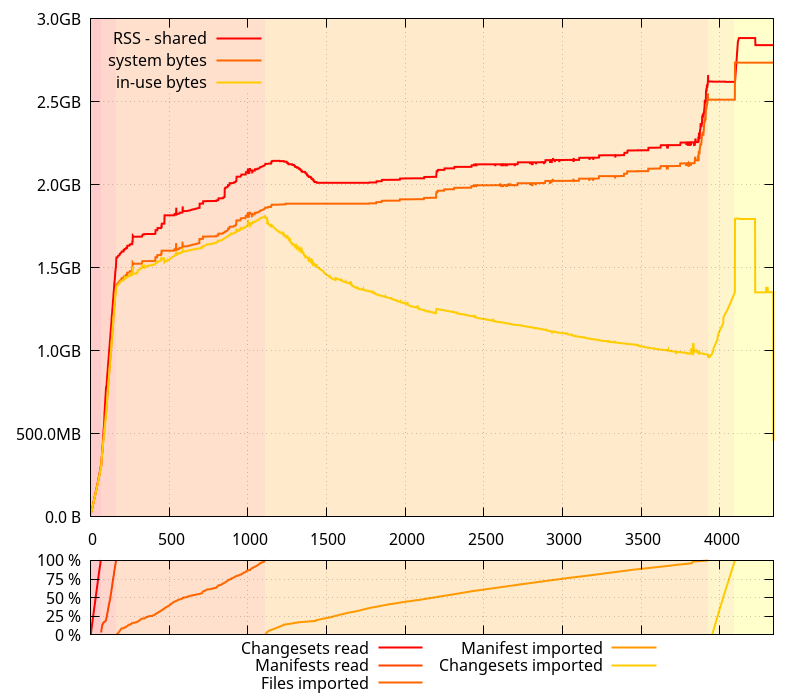
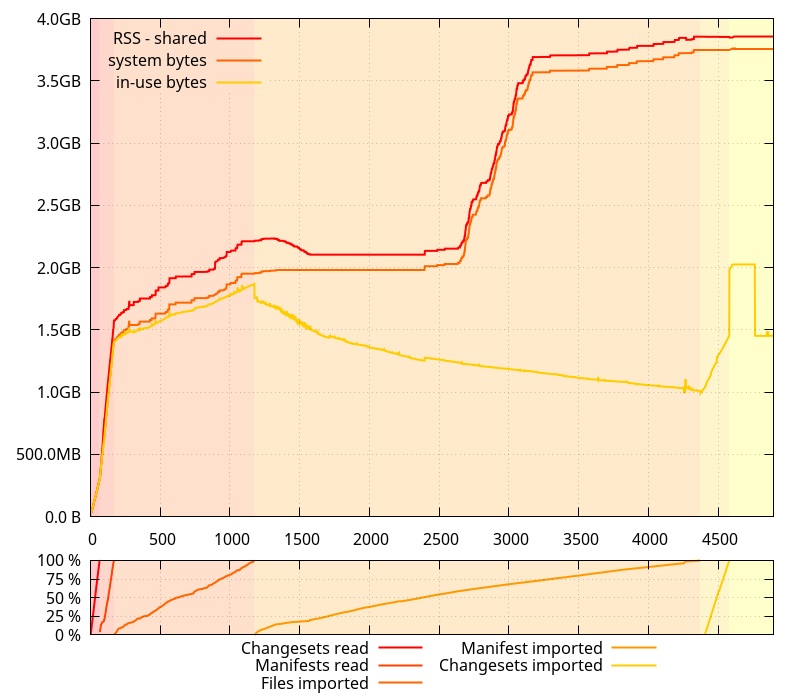
Yes, the glibc allocator was just telling it had allocated 600MB of memory, but was holding onto 2GB. I must have found a really bad allocation pattern that causes massive fragmentation. One thing that David Malcolm s talk taught me, though, is that python uses its own allocator for small sizes, so the glibc allocator doesn t know about them. And, roughly, adding the difference between RSS and what glibc said it was holding to to the use bytes it reported somehow matches the 1.3GB I had found so far. So it was time to see how those things evolved in time, during the entire clone process. I grabbed some new data, tracking the evolution of system bytes and in use bytes . There are two things of note on this data: In fact, the latter is exactly how git-cinnabar is supposed to work: It reads changesets and manifests chunks, and holds onto them while importing files. Then it throws away those manifests and changesets chunks one by one while it imports them. There is, however, some extra bookkeeping that requires some additional memory, but it s expected to be less memory consuming than keeping all the changesets and manifests chunks in memory. At this point, I thought a possible explanation is that since both python and glibc are mmap()ing their own arenas, they might be intertwined in a way that makes things not go well with the allocation pattern happening during the Import manifest phase (which, in fact, allocates and frees increasingly large buffers for each manifest, as manifests grow in size in the mozilla-central history). To put the theory at work, I patched the python interpreter again, making it use malloc() instead of mmap() for its arenas. Aha! I thought. That definitely looks much better. Less gap between what glibc says it requested from the system and the RSS size. And, more importantly, no runaway increase of memory usage in the middle of nowhere. I was preparing myself to write a post about how mixing allocators could have unintended consequences. As a comparison point, I went ahead and ran another test, with the python allocator entirely disabled, this time. Heh. It turns out glibc was acting up all alone. So much for my (plausible) theory. (I still think mixing allocators can have unintended consequences.) (Note, however, that the reason why the python allocator exists is valid: without it, the overall clone took almost 10 more minutes) And since I had been getting all this data with 0.4.0, I gathered new data without the python allocator with the master branch. This paints a rather different picture than the original data on that branch, with much less memory use regression than one would think. In fact, there isn t much difference, except for the spike at the end, which got worse, and some of the noise during the Import manifests phase that got bigger, implying larger amounts of temporary memory used. The latter may contribute to the allocation patterns that throw glibc s memory allocator off. It turns out tracking memory usage in python 2.7 is rather painful, and not all the tools paint a complete picture of it. I hear python 3.x is somewhat better in that regard, and I hope it s true, but at the moment, I m stuck with 2.7. The most reliable tool I ve used here, it turns out, is pympler. Or rebuilding the python interpreter without its allocator, and asking the system allocator what is allocated. With all this data, I now have some defined problems to tackle, some easy (the spike at the end of the clone), and some less easy (working around glibc allocator s behavior). I have a few hunches as to what kind of allocations are causing the runaway increase of RSS. Coincidentally, I m half-way through a refactor of the code dealing with manifests, and it should help dealing with the issue. But that will be the subject of a subsequent post.

Steve Kemp: How I started programming

I've written parts of this story in the past, but never in one place and never in much detail. So why not now? In 1982 my family moved house, so one morning I went to school and at lunch-time I had to walk home to a completely different house. We moved sometime towards the end of the year, and ended up spending lots of money replacing the windows of the new place. For people in York I was born in Farrar Street, Y010 3BY, and we moved to a place on Thief Lane, YO1 3HS. Being named as it was I "ironically" stole at least two street-signs and hung them on my bedroom wall. I suspect my parents were disappointed. Anyway the net result of this relocation, and the extra repairs meant that my sisters and I had a joint Christmas present that year, a ZX Spectrum 48k. I tried to find pictures of what we received but unfortunately the web doesn't remember the precise bundle. All together though we received: I know we also received Horace and the Spiders, and I have vague memories of some other things being included, including a Space Invaders clone. No doubt my parents bought them separately. Highlights of my Spectrum-gaming memories include R-Type, Strider, and the various "Dizzy" games. Some of the latter I remember very fondly. Unfortunately this Christmas was pretty underwhelming. We unpacked the machine, we cabled it up to the family TV-set - we only had the one, after all - and then proceeded to be very disappointed when nothing we did resulted in a successful game! It turns out our cassette-deck was not good enough. Being back in the 80s the shops were closed over Christmas, and my memory is that it was around January before we received a working tape-player/recorder, such that we could load games. Happily the computer came with manuals. I read one, skipping words and terms I didn't understand. I then read the other, which was the spiral-bound orange book. It contained enough examples and decent wording that I learned to write code in BASIC. Not bad for an 11/12 year old. Later I discovered that my local library contained "computer books". These were colourful books that promised "The Mystery of Silver Mounter", or "Write your own ADVENTURE PROGRAMS". But were largely dry books that contained nothing but multi-page listings of BASIC programs to type in. Often with adjustments that had to be made for your own computer-flavour (BASIC varying between different systems).
If you want to recapture the magic scroll to the foot of this Osbourne page and you can download them!
Later I taught myself Z80 Assembly Language, partly via the Spectrum manual and partly via such books as these two (which I still own 30ish years later): Pretty much the only reason I continued down this path is because I wanted infinite/extra lives in the few games I owned. (Which were largely pirated via the schoolboy network of parents with cassette-copiers.) Eventually I got some of my l33t POKES printed in magazines, and received free badges from the magazines of the day such as Your Sinclair & Sinclair User. For example I was "Hacker of the Month" in the Your Sinclair issue 67 , Page 32, apparently because I "asked so nicely in my letter". Terrible scan is terrible: Anyway that takes me from 1980ish to 1984. The only computer I ever touched was a Spectrum. Friends had other things, and there were Sega consoles, but I have no memories of them. Suffice it to say that later when I first saw a PC (complete with Hercules graphics, hard drives, and similar sourcery, running GEM IIRC) I was pleased that Intel assembly was "similar" to Z80 assembly - and now I know the reason why. Some time in the future I might document how I got my first computer job. It is hillarious. As was my naivete.

10 March 2017

Reproducible builds folks: Reproducible Builds: week 97 in Stretch cycle

Here's what happened in the Reproducible Builds effort between Sunday February 26 and Saturday March 4 2017: Upcoming Events Ed Maste will present Reproducible Builds in FreeBSD at AsiaBSDCon 2017. Ximin Luo will present Reproducible builds, its uses and the future at Open Source Days in Copenhagen on March 18. Holger Levsen will give a talk at the German Unix User Group's "Fr hjahrsfachgespr ch" in Darmstadt, Germany, about Reproducible Builds everywhere on March 23. Verifying Software Freedom with Reproducible Builds will be presented by Vagrant Cascadian at Libreplanet2017 in Boston, March 25th-26th. Media coverage Aspiration Tech published a very detailed report on our Reproducible Builds World Summit 2016 in Berlin. Reproducible work in other projects Duncan published a very thorough post on the Rust Programming Language Forum about reproducible builds in the Rust compiler and toolchain. In particular, he produced a table recording the reproducibility of different build products under different individual variations, totalling 187 build+variation combinations. Packages reviewed and fixed, and bugs filed Chris Lamb: Dhole: Reviews of unreproducible packages 60 package reviews have been added, 8 have been updated and 13 have been removed in this week, adding to our knowledge about identified issues. 1 issue type has been added: Weekly QA work During our reproducibility testing, FTBFS bugs have been detected and reported by: diffoscope development diffoscope 78 was uploaded to unstable and jessie-backports by Mattia Rizzolo. It included contributions from: In addition, the following changes were made on the experimental branch: reproducible-website development tests.reproducible-builds.org Misc. This week's edition was written by Ximin Luo, Chris Lamb, Holger Levsen & reviewed by a bunch of Reproducible Builds folks on IRC & the mailing lists.

7 March 2017

Daniel Stender: Remotely deploy a WSGI application (as a Debian package) with Ansible

This is a mini workshop as an introduction into using Ansible for the administration of Debian systems. As an example it s shown how this configuration management tool can be used to remotely set up a simple WSGI application running on an Apache web server on a Debian installation to make it available on the net. The application which is used as an example is httpbin by Runscope. This is an useful HTTP request service for the development of web software or any other purposes which features a number of specific endpoints that can be used for different testing matters. For example, the address http://<address>/user-agent of httpbin returns the user agent identification of the client program which has been used to query it (that s taken from the header of the request). There are official instances of this request server running on the net, like the one at http://httpbin.org/. WSGI is a widespread standard for programming web application in Python, and httpbin is implemented in Python using the Flask web framework. The basis of the workshop is a simple base installation of an up-to-date Debian 8 Jessie on a demonstration host, and the latest official release of that is 8.7. As a first step, the installation has to be switched over to the testing branch of Debian, because the Debian packages of httpbin are comparatively new and are going to be introduced into the stable branch of the archive the first time with the upcoming major release number 9 Stretch . After that, the Apache packages which are needed to make it available (apache2 and libapache2-mod-wsgi other web servers of course could be used instead), and which are not part of a base installation, are installed from the archive. The web server then gets launched remotely, and the httpbin package will be also pulled and the service is going to be integrated into Apache to run on that. To achieve that, two configuration files must be deployed on the target system, and a few additional operations are needed to get everything working together. Every step is preconfigured within Ansible so that the whole process could be launched by a single command on the control node, and could be run on a single or a number of comparable target machines automatically and reproducibly. If a server is needed for trying this workshop out, straightforward cloud server instances are available on the net for example at DigitalOcean, but let me underline this there are other cloud providers which offer the same things, too! If it s needed for experiments or other purposes only for a limited time, low priced droplets are available here which are billed by the hour. After being registered, the machine(s) which is/are wanted could be set up easily over the web interface (choose Debian 8.7 as OS), but there are also command line clients available like doctl (which is not yet available as a Debian package). For the convenient use of a droplet the user should generate a SSH key pair on the local machine, first:
$ ssh-keygen -t rsa -b 4096 -C "john@doe.com" -f ~/.ssh/mykey
The public part of the key ~/.ssh/mykey.pub then can be uploaded into the user account before the droplet is going to be created, it then could be integrated automatically. There is a good introduction on the whole process available in the excellent tutorial series serversforhackers.com, here. Ansible then can use the SSH keypair to login into a droplet without the need to type in the password every time. On a cloud server like this carrying a Debian base system, the examples in this workshop can be tried well. Ansible works client-less and doesn t need to be installed on the remote system but only on the control node, however a Python 2.7 interpreter is needed there (the base system of DigitalOcean includes that). For that Ansible can do anything on them, remote servers which are going to be controlled must be added to /etc/ansible/hosts. This is a configuration file in the INI format for DNS names and IP addresses. For a flexible organisation of the server inventory it s possible to group hosts here, IP ranges could be given, and optional variables can be used among other useful things (the default file contains a couple of examples). One or a couple of servers (in Ansible they are called hosts ) on which something particular is going to be happening (like httpbin is going to be installed) could be added like this (the group name is arbitrary):
[httpbin]
192.0.2.0
Whether Ansible could communicate with the hosts in the group and actually can operate on them can be verified by just pinging them like this:
$ ansible httpbin -m ping -u root --private-key=~/.ssh/mykey
192.0.2.0   SUCCESS =>  
    "changed": false, 
    "ping": "pong"
 
The command succeeded well, so it appears there isn t no significant problem regarding this machine. The return value changed:false indicates that there haven t been any changes on that host as a result of the execution of this command. Next to ping there are several other modules which could be used with the command line tool ansible the same way, and these modules are actually something like the core components of Ansible. The module shell for example can be used to execute shell commands on the remote machine like uname to get some system information returned from the server:
$ ansible httpbin -m shell -a "uname -a" -u root --private-key=~/.ssh/mykey
192.0.2.0   SUCCESS   rc=0 >>
Linux debian-512mb-fra1-01 3.16.0-4-amd64 #1 SMP Debian 3.16.36-1+deb8u2 (2016-10-19) x86_64 GNU/Linux
In the same way, the module apt could be used to remotely install packages. But with that there s no major advantage over other software products that offer a similar functionality, and using those modules on the command line is just the basics of Ansible usage. Playbooks in Ansible are YAML scripts for the manipulation of the registered hosts in /etc/ansible/hosts. Different tasks can be defined here for successive processing, like a simple playbook for changing the package source from stable to testing for example goes like this:
---
 - hosts: httpbin
   tasks:
   - name: remove "jessie" package source
     apt_repository: repo='deb http://mirrors.digitalocean.com/debian jessie main' state=absent
   - name: add "testing" package source
     apt_repository: repo='deb http://httpredir.debian.org/debian testing main contrib non-free' state=present
   - name: upgrade packages
     apt: update_cache=yes upgrade=dist
First, like used with the CLI tool ansible above, the targeted host group httpbin is chosen. The default user root and the SSH key could be fixed here, too, to spare the need to give them on the command line. Then there are three tasks defined to get worked down consecutively: With the module apt_repository the preset package source jessie is removed from /etc/apt/sources.list. Then, a new package source for the testing archive gets added to /etc/apt/sources.list.d/ by using the same module (by the way, mirrors.digitalocean.org also provides testing, though, and that might be faster). After that, the apt module is used to upgrade the package inventory (it performs apt-get dist-upgrade), after an update of the package cache has taken place (by running apt-get update) A playbook like this (the filename is arbitrary, but commonly carries the suffix .yml) can be run by the CLI tool ansible-playbook, like this:
$ ansible-playbook httpbin.yml -u root --private-key=~/.ssh/mykey
Ansible then works down the individual plays of the tasks on the remote server(s) top-down, and due to a high speed net connection and SSD block device hardware the change of the system to being a Debian Testing base installation only takes around a minute to complete in the cloud. While working, Ansible puts out status reports for the individual operations. If certain changes on the base system have been taken place already like when a playbook is run through one more time, the modules of course sense that and return just the information that the system haven t been changed because it s already there what have been wanted to change to. Beyond the basic playbook which is shown here there are more advanced features like register and when available to bind the execution of a play to the error-free result of a previous one. The apt module then can be used in the playbook to install the three needed binary packages one after another:
   - name: install apache2
     apt: pkg=apache2 state=present
   - name: install mod_wsgi
     apt: pkg=libapache2-mod-wsgi state=present
   - name: install httpbin
     apt: pkg=python-httpbin state=present
The Debian packages are configured in a way that the Apache web server is running immediately after installation, and the Apache module mod_wsgi is automatically integrated. If that would be otherwise desired, there are Ansible modules available for operating on Apache which can reverse this if that is wanted. By the way, after the package have been installed the httpbin server can be launched with python -m httpbin.core, but this runs only a mini web server which is not suitable for productive use. To get httpbin running on the Apache web server two configuration files are needed. They could be set up in the project directory on the control node and then uploaded onto the remote machine with another Ansible module. The file httpbin.wsgi (the name is again arbitrary) contains only a single line which is the starter for the WSGI application to run:
from httpbin import app as application
The module copy can be used to deploy that script on the host, while the target folder /var/www/httpbin must be set up before that by the module file. In addition to that, a separate user account like httpbin (the name is also arbitrary but picked up in the other config file) is needed to run it, and the module user can set this up. The demonstrational playbook continues, and the plays which are performing these three operations are going like this:
   - name: mkdir /var/www/httpbin
     file: path=/var/www/httpbin state=directory
   - name: set up user "httpbin"
     user: name=httpbin
   - name: copy WSGI starter
     copy: src=httpbin.wsgi dest=/var/www/httpbin/httpbin.wsgi owner=httpbin group=httpbin mode=0644 
Another configuration script httpbin.conf is needed for Apache on the remote server to include the WSGI application httpbin running as a virtual host. It goes like this:
<VirtualHost *>
 WSGIDaemonProcess httpbin user=httpbin group=httpbin threads=5
 WSGIScriptAlias / /var/www/httpbin/httpbin.wsgi
 <Directory /var/www/httpbin>
  WSGIProcessGroup httpbin
  WSGIApplicationGroup % GLOBAL 
  Order allow,deny
  Allow from all
 </Directory>
</VirtualHost>
This file needs to be copied into the folder /etc/apache2/sites-available on the host, which already exists when the apache2 package is installed. The remaining operations which are missing to get anything running together are: The default welcome screen of Apache blocks anything else and should be disabled by Apache s CLI tool a2dissite. And after that, the new virtual host needs to be activated with the complementary tool a2ensite both could be run remotely by the module command. Then the Apache server on the remote machine must be restarted to read in the new configuration. You ve guessed it already, that s all easy to perform with Ansible:
   - name: deploy configuration script
     copy: src=httpbin.conf dest=/etc/apache2/sites-available owner=root group=root mode=0644
   - name: deactivate default welcome screen
     command: a2dissite 000-default.conf
     
   - name: activate httpbin virtual host
     command: a2ensite httpbin.conf
   - name: restart Apache
     service: name=apache2 state=restarted 
That s it. After this playbook has been performed by Ansible on a (or several) freshly set up remote Debian base installation completely, then the httpbin request server is available running on the Apache web server and could be queried from anywhere by a web browser, or for example by curl:
$ curl http://192.0.2.0/user-agent
 
  "user-agent": "curl/7.50.1"
 
With the broad set of Ansible modules and the playbooks a lot of tasks can be accomplished like the example problem which has been explained here. But the range of functions of Ansible however is still even more comprehensive, but to discuss that would have blown the frame of this blog post. For example the playbooks offer more advanced features like event handler which can be used for recurring operations like the restart of Apache in more extensive projects. And beyond playbooks, templates could be set up in the roles which can behave differently on selected machine groups Ansible uses Jinja2 as template engine for that. And the scope of functions of the basic modules could be expanded by employing external tools. To drop a word on why it could be useful in certain situations to run own instances of the httpbin request server instead of using the official ones which are provided on the net by Runscope: Like some people would prefer to run a private instance for example in the local network instead of querying the one on the internet. Or for some development reasons a couple or even a large number of identical instances might be needed Ansible is ideal for setting them up automatically. Anyway, the Javascript bindings to the tracking services like Google Analytics in httpbin/templates/trackingscripts.html are patched out in the Debian package. That could be another reason to prefer to set up an own instance on a Debian server.

5 March 2017

Shirish Agarwal: To say or not to say

Voltaire For people who are visually differently-abled, the above reads To learn who rules over you, simply find out who you are not allowed to criticize Voltaire wrote this either in late 16th century or early 17th century and those words were as apt in those times, as it is in these turbulent times as well. Update 05/03 According to @bla these words are attributable to a neo-nazi and apparently a child abuser. While I don t know the context in which it was shared, it describes the environment in which we are perfectly. Please see his comment for a link and better understanding. The below topic requires a bit of maturity, so if you are easily offended, feel free not to read further. While this week-end I was supposed to share about the recent Science Day celebrations that we did last week Science Day celebrations at GMRT Would explore it probably next week. This week the attempt is to share thoughts which had been simmering at the back of my mind for more than 2 weeks or more and whose answers are not clear to me. My buttons were pressed when Martin f. Kraft shared about a CoC violation and the steps taken therein. While it is easy to say with 20:20 hind-sight to say that the gentleman acted foolishly, I don t really know the circumstances to pass the judgement so quickly. In reality, while I didn t understand the joke in itself, I have to share some background by way of anecdotes as to why it isn t so easy for me to give a judgement call. a. I don t know the topics chosen by stand-up comedians in other countries, in India, most of the stand-up acts are either about dating or sex or somewhere in-between, which is lovingly given the name Leela (dance of life) in Indian mythology. I have been to several such acts over the years at different events, different occasions and 99.99% of the time I would see them dealing with pedophilia, necrophilia and all sorts of deviants in sexuality and people laughing wildly, but couple of times when the comedian shared the term sex with people, educated, probably more than a few world-travelled middle to higher-middle class people were shocked into silence. I had seen this not in once but 2-3 times in different environments and was left wondering just couple of years back Is sex such a bad word that people get easily shocked ? Then how is it that we have 1.25 billion + people in India. There had to be some people having sex. I don t think that all 1.25 billion people are test-tube babies. b. This actually was what lead to my quandary last year when my sharing of My Experience with Debian which I had carefully prepared for newbies, seeing seasoned debian people, I knew my lame observations wouldn t cut ice with them and hence had to share my actual story which involved a bit of porn. I was in two minds whether or not to say it till my eyes caught a t-shirt on which it was said We make porn or something to that effect. That helped me share my point. c. Which brings me to another point, it seems it is becoming increasingly difficult to talk about anything either before apologizing to everyone and not really knowing who will take offence at what and what the repercussions might be. In local sharings, I always start with a blanket apology that if I say something that offends you, please let me know afterwards so I can work on it. As the term goes You can t please everyone and that is what happens. Somebody sooner or later would take offence at something and re-interpret it in ways which I had not thought of. Charlie Chaplin - King of self-deprecating humor From the little sharings and interactions I have been part of, I find people take offence at the most innocuous things. For instance, one of the easy routes of not offending anyone is to use self-deprecating humour (or so I thought) either of my race, caste, class or even my issues with weight and each of the above would offend somebody. Charlie Chaplin didn t have those problems. If somebody is from my caste, I m portraying the caste in a certain light, a certain slant. If I m talking about weight issues, then anybody who is like me (fat) feels that the world is laughing at them rather than at me or they will be discriminated against. While I find the last point a bit valid, it leaves with me no tools and no humour. I neither have the observational powers or the skills that Kapil Sharma has and have to be me. While I have no clue what to do next, I feel the need to also share why humour is important in any sharing.- a. Break When any speaker uses humour, the idea is to take a break from a serious topic. It helps to break the monotony of the talk especially if the topic is full of jargon talk and new concepts. A small comedic relief brings the attendees attention back to the topic as it tends to wander in a long monotonous talk. b. Bridge Some of the better speakers use one or more humourous anecdote to explain and/or bridge the chasm between two different concepts. Some are able to produce humour on the fly while others like me have to rely on tried and tested methods. There is one another thing as well, humour is seems to be a mixture of social, cultural and political context and its very easy to have it back-fired upon you. For instance, I attempted humour on refugees, probably not the best topic to try humour in the current political climate, and predictably, it didn t go down well. I had to share and explain about Robin Williams slightly dark yet humorous tale in Moscow on the Hudson The film provides comedy and pathos in equal measure. You are left identifying with Vladimir Ivanoff (Robin Williams character) especially in the last scene where he learns of his grand-mother dying and he remembers her and his motherland, Russia and plays a piece on his saxophone as a tribute both to his grand-mother and the motherland. Apparently, in the height of the cold war, if a Russian defected to United States (land of Satan and other such terms used) you couldn t return to Russia. The movie, seen some years back left a deep impact on me. For all the shortcomings and ills that India has, even if I could, would and could I be happy anywhere else ? The answers are not so easy. With most NRI s (Non-Resident Indians) who emigrated for good did it not so much for themselves but for their children. So the children would hopefully have a better upbringing, better facilities, better opportunities than they would have got here. I talked to more than a few NRI s and while most of them give standardized answers, talking awhile and couple of beers or their favourite alcohol later, you come across deeply conflicted human beings whose heart is in India and their job, profession and money interests compel them to be in the country where they are serving. And Indian movies further don t make it easy for the Indian populace when trying to integrate into a new place. Some of the biggest hits of yesteryear s were about having the distinct Indian culture in their new country while the message of most countries is integration. I know of friends who are living in Germany who have to struggle through their German in order to be counted as a citizen, the same I guess is true of other countries as well, not just the language but the customs as well. They also probably struggle with learning more than one language and having an amalgamation of values which somehow they and their children have to make sense of. I was mildly shocked last week to learn that Mishi Choudary had to train people in the U.S. to differentiate between Afghan turban styles of wearing and the Punjabi style of wearing the turban. A simple search on Afghani turban and Punjabi turban reveals that there are a lot of differences between the two cultures. In fact, the way they talk, the way they walk, there are lots that differentiate the two cultures. The second shocking video was of an African-American man racially abusing an Indian-American girl. At first, I didn t believe it till I saw the video on facebook. My point through all that is it seems humour, that clean, simple exercise which brings a smile to you and uplifts the spirit doesn t seem to be as easy as it once was. Comments, suggestions, criticisms all are welcome.
Filed under: Miscellenous Tagged: #Elusive, #Fear, #hind-sight, #Humour, #immigrant, #integration, #Mishi Choudary, #refugee, #Robin Williams, #self-deprecating, #SFLC, #two-minds

2 March 2017

Antoine Beaupr : A short history of password hashers

These are notes from my research that led to the publication of the password hashers article. This article is more technical than the previous ones and compares the various cryptographic primitives and algorithms used in the various software I have reviewed. The criteria for inclusion on this list is fairly vague: I mostly included a password hasher if it was significantly different from the previous implementations in some way, and I have included all the major ones I could find as well.

The first password hashers Nic Wolff claims to be the first to have written such a program, all the way back in 2003. Back then the hashing algorithm was MD5, although Wolff has now updated the algorithm to use SHA-1 and still maintains his webpage for public use. Another ancient but unrelated implementation, is the Standford University Applied Cryptography's pwdhash software. That implementation was published in 2004 and unfortunately, that implementation was not updated and still uses MD5 as an hashing algorithm, but at least it uses HMAC to generate tokens, which makes the use of rainbow tables impractical. Those implementations are the simplest password hashers: the inputs are simply the site URL and a password. So the algorithms are, basically, for Wolff's:
token = base64(SHA1(password + domain))
And for Standford's PwdHash:
token = base64(HMAC(MD5, password, domain)))

SuperGenPass Another unrelated implementation that is still around is supergenpass is a bookmarklet that was created around 2007, originally using MD5 as well but now supports SHA512 now although still limited to 24 characters like MD5 (which needlessly limits the entropy of the resulting password) and still defaults MD5 with not enough rounds (10, when key derivation recommendations are more generally around 10 000, so that it's slower to bruteforce). Note that Chris Zarate, the supergenpass author, actually credits Nic Wolff as the inspiration for his implementation. Supergenpass is still in active development and is available for the browser (as a bookmarklet) or mobile (as an webpage). Supergenpass allows you to modify the password length, but also add an extra profile secret which adds to the password and generates a personalized identicon presumably to prevent phishing but it also introduces the interesting protection, the profile-specific secret only found later in Password Hasher Plus. So the Supergenpass algorithm looks something like this:
token = base64(SHA512(password + profileSecret + ":" + domain, rounds))

The Wijjo Password Hasher Another popular implementation is the Wijjo Password Hasher, created around 2006. It was probably the first shipped as a browser extension which greatly improved the security of the product as users didn't have to continually download the software on the fly. Wijjo's algorithm also improved on the above algorithms, as it uses HMAC-SHA1 instead of plain SHA-1 or HMAC-MD5, which makes it harder to recover the plaintext. Password Hasher allows you to set different password policies (use digits, punctuation, mixed case, special characters and password length) and saves the site names it uses for future reference. It also happens that the Wijjo Password Hasher, in turn, took its inspiration on different project, hashapass.com, created in 2006 and also based on HMAC-SHA-1. Indeed, hashapass "can easily be generated on almost any modern Unix-like system using the following command line pattern":
echo -n parameter \
  openssl dgst -sha1 -binary -hmac password \
  openssl enc -base64 \
  cut -c 1-8
So the algorithm here is obviously:
token = base64(HMAC(SHA1, password, domain + ":" + counter)))[:8]
... although in the case of Password Hasher, there is a special routine that takes the token and inserts random characters in locations determined by the sum of the values of the characters in the token.

Password Hasher Plus Years later, in 2010, Eric Woodruff ported the Wijjo Password Hasher to Chrome and called it Password Hasher Plus. Like the original Password Hasher, the "plus" version also keeps those settings in the extension and uses HMAC-SHA-1 to generate the password, as it is designed to be backwards-compatible with the Wijjo Password Hasher. Woodruff did add one interesting feature: a profile-specific secret key that gets mixed in to create the security token, like what SuperGenPass does now. Stealing the master password is therefore not enough to generate tokens anymore. This solves one security concern with Password Hasher: an hostile page could watch your keystrokes and steal your master password and use it to derive passwords on other sites. Having a profile-specific secret key, not accessible to the site's Javascript works around that issue, but typing the master password directly in the password field, while convenient, is just a bad idea, period. The final algorithm looks something like:
token = base64(HMAC(SHA1, password, base64(HMAC(SHA1, profileSecret, domain + ":" + counter))))
Honestly, that seems rather strange, but it's what I read from the source code, which is available only after decompressing the extension nowadays. I would have expected the simplest version:
token = base64(HMAC(SHA1, HMAC(SHA1, profileSecret, password), domain + ":" + counter))
The idea here would be "hide" the master password from bruteforce attacks as soon as possible... But maybe this is all equivalent. Regardless, Password Hasher Plus then takes the token and applies the same special character insertion routine as the Password Hasher.

LessPass Last year, Guillaume Vincent a french self-described "humanist and scuba diving fan" released the lesspass extension for Chrome, Firefox and Android. Lesspass introduces several interesting features. It is probably the first to include a commandline version. It also uses a more robust key derivation algorithm (PBKDF2) and takes into account the username on the site, allowing multi account support. The original release (version 1) used only 8192 rounds which is now considered too low. In the bug report it was interesting to note that LessPass couldn't do the usual practice of running the key derivation for 1 second to determine the number of rounds needed as the results need to be deterministic. At first glance, the LessPass source code seems clear and easy to read which is always a good sign, but of course, the devil is in the details. One key feature that is missing from Password Hasher Plus is the profile-specific seed, although it should be impossible, for a hostile web page to steal keystrokes from a browser extension, as far as I know. The algorithm then gets a little more interesting:
entropy = PBKDF2(SHA256, masterPassword, domain + username + counter, rounds, length)
where
    rounds=10000
    length=32
entropy is then used to pick characters to match the chosen profile. Regarding code readability, I got quickly confused by the PBKDF2 implementation: SubtleCrypto.ImportKey() doesn't seem to support PBKDF2 in the API, yet it's how it is used there... Is it just something to extract key material? We see later what looks like a more standard AES-based PBKDF2 implementation, but this code looks just strange to me. It could be me unfamilarity with newer Javascript coding patterns, however. There is also a lesspass-specific character picking routing that is also not base64, and different from the original Password Hasher algorithm.

Master Password A review of password hashers would hardly be complete without mentioning the Master Password and its elaborate algorithm. While the applications surrounding the project are not as refined (there is no web browser plugin and the web interface can't be easily turned into a bookmarklet), the algorithm has been well developed. Of all the password managers reviewed here, Master Password uses one of the strongest key derivation algorithms out there, scrypt:
key = scrypt( password, salt, cost, size, parallelization, length )
where
salt = "com.lyndir.masterpassword" + len(username) + name
cost = 32768
size = 8
parallelization = 2
length = 64
entropy = hmac-sha256(key, "com.lyndir.masterpassword" + len(domain) + domain + counter )
Master Password the uses one of 6 sets of "templates" specially crafted to be "easy for a user to read from a screen and type using a keyboard or smartphone" and "compatible with most site's password policies", our "transferable" criteria defined in the first passwords article. For example, the default template mixes vowels, consonants, numbers and symbols, but carefully avoiding possibly visibly similar characters like O and 0 or i and 1 (although it does mix 1 and l, oddly enough). The main strength of Master Password seems to be the clear definition of its algorithm (although Hashpass.com does give out OpenSSL commandline examples...), which led to its reuse in another application called freepass. The Master Password app also doubles as a stateful password manager...

Other implementations I have also considered including easypasswords, which uses PBKDF2-HMAC-SHA1, in my list of recommendations. I discovered only recently that the author wrote a detailed review of many more password hashers and scores them according to their relative strength. In the end, I ended up covering more LessPass since the design is very similar and LessPass does seem a bit more usable. Covering LessPass also allowed me to show the contrast and issues regarding the algorithm changes, for example. It is also interesting to note that the EasyPasswords author has criticized the Master Password algorithm quite severely:
[...] scrypt isn t being applied correctly. The initial scrypt hash calculation only depends on the username and master password. The resulting key is combined with the site name via SHA-256 hashing then. This means that a website only needs to break the SHA-256 hashing and deduce the intermediate key as long as the username doesn t change this key can be used to generate passwords for other websites. This makes breaking scrypt unnecessary[...]
During a discussion with the Master Password author, he outlined that "there is nothing "easy" about brute-force deriving a 64-byte key through a SHA-256 algorithm." SHA-256 is used in the last stage because it is "extremely fast". scrypt is used as a key derivation algorithm to generate a large secret and is "intentionnally slow": "we don't want it to be easy to reverse the master password from a site password". "But it' unnecessary for the second phase because the input to the second phase is so large. A master password is tiny, there are only a few thousand or million possibilities to try. A master key is 8^64, the search space is huge. Reversing that doesn't need to be made slower. And it's nice for the password generation to be fast after the key has been prepared in-memory so we can display site passwords easily on a mobile app instead of having to lock the UI a few seconds for every password." Finally, I considered covering Blum's Mental Hash (also covered here and elsewhere). This consists of an algorithm that can basically be ran by the human brain directly. It's not for the faint of heart, however: if I understand it correctly, it will require remembering a password that is basically a string of 26 digits, plus compute modulo arithmetics on the outputs. Needless to say, most people don't do modulo arithmetics every day...

1 March 2017

Paul Wise: FLOSS Activities February 2017

Changes

Issues

Review

Administration
  • Debian: do the samhain dance, ask for new local contacts at one site, ask local admins to reset one machine, powercycle 2 dead machines, redirect 1 user to the support channels, redirect 1 user to a service admin, redirect 1 spam reporter to the right mechanisms, investigate mail logs for a missing bug report, ping bugs-search.d.o service admin about moving off glinka and remove data, poke cdimage-search.d.o service admin about moving off glinka, update a cron job on denis.d.o for the rename of letsencrypt.sh to dehydrated, debug planet.d.o issue and remove stray cron job lock file, check if ftp is used on a couple of security.d.o mirrors, discuss storage upgrade for LeaseWeb for snapshot.d.o/deriv.d.n/etc, investigate SSD SMART error and ignore the unknown attribute, ask 9 users to restart their processes, investigate apt-get update failure in nagios, swapoff/swapon a swap file to drain it, restart/disable some failed services, help restore the backup server, debug stretch /dev/log issue,
  • Debian QA: deploy merged PTS/tracker patches,
  • Debian wiki: answer 1 IP-blocked VPN user, pinged 1 user on IRC about their bouncing mail, disabled 4 accounts due to bouncing mail, redirect 1 person to documentation/lists, whitelist 5 email addresses, forward 1 password reset token, killed 1 spammer account, reverted 1 spammer edit,
  • Debian mentors: security upgrades, check which email a user signed up with
  • Openmoko: security upgrades, daemon restarts, reboot

Debian derivatives
  • Turned off the census cron job because it ran out of disk space
  • Update Armbian sources.list
  • Ping siduction folks about updating their sources.list
  • Start a discussion about DebConf17
  • Notify the derivatives based on jessie or older that stretch is frozen
  • Invite Rebellin Linux (again)

Sponsors The libesedb Debian backport was sponsored by my employer. All other work was done on a volunteer basis.

Thorsten Glaser: New GitHub Terms of Service r e q u i r e removing many Open Source works from it

Please use the correct (perma)link to bookmark this article, not the page listing all wlog entries of the last decade. Thank you.</update> Some updates inline and at the bottom. The new Terms of Service of GitHub became effective today, which is quite problematic there was a review phase, but my reviews pointing out the problems were not answered, and, while the language is somewhat changed from the draft, they became effective immediately. Now, the new ToS are not so bad that one immediately must stop using their service for disagreement, but it s important that certain content may no longer legally be pushed to GitHub. I ll try to explain which is affected, and why. I m mostly working my way backwards through section D, as that s where the problems I identified lie, and because this is from easier to harder. Note that using a private repository does not help, as the same terms apply. Anything requiring attribution (e.g. CC-BY, but also BSD, ) Section D.7 requires the person uploading content to waive any and all attribution rights. Ostensibly to allow basic functions like search to work , which I can even believe, but, for a work the uploader did not create completely by themselves, they can t grant this licence. The CC licences are notably bad because they don t permit sublicencing, but even so, anything requiring attribution can, in almost all cases, not written or otherwise, created or uploaded by our Users . This is fact, and the exceptions are few. Anything putting conditions on the right to use, display and perform the work and, worse, reproduce (all Copyleft) Section D.5 requires the uploader to grant all other GitHub users Note that section D.4 is similar, but granting the licence to GitHub (and their successors); while this is worded much more friendly than in the draft, this fact only makes it harder to see if it affects works in a similar way. But that doesn t matter since D.5 is clear enough. (This doesn t mean it s not a problem, just that I don t want to go there and analyse D.4 as D.5 points out the same problems but is easier.) This means that any and all content under copyleft licences is also no longer welcome on GitHub. Anything requiring integrity of the author s source (e.g. LPPL) Some licences are famous for requiring people to keep the original intact while permitting patches to be piled on top; this is actually permissible for Open Source, even though annoying, and the most common LaTeX licence is rather close to that. Section D.3 says any (partial) content can be removed though keeping a PKZIP archive of the original is a likely workaround. Affected licences Anything copyleft (GPL, AGPL, LGPL, CC-*-SA) or requiring attribution (CC-BY-*, but also 4-clause BSD, Apache 2 with NOTICE text file, ) are affected. BSD-style licences without advertising clause (MIT/Expat, MirOS, etc.) are probably not affected if GitHub doesn t go too far and dissociates excerpts from their context and legal info, but then nobody would be able to distribute it, so that d be useless. But what if I just fork something under such a licence? Only continuing to use GitHub constitutes accepting the new terms. This means that repositories from people who last used GitHub before March 2017 are excluded. Even then, the new terms likely only apply to content uploaded in March 2017 or later (note that git commit dates are unreliable, you have to actually check whether the contribution dates March 2017 or later). And then, most people are likely unaware of the new terms. If they upload content they themselves don t have the appropriate rights (waivers to attribution and copyleft/share-alike clauses), it s plain illegal and also makes your upload of them or a derivate thereof no more legal. Granted, people who, in full knowledge of the new ToS, share any User-Generated Content with GitHub on or after 1 March, 2017, and actually have the appropriate rights to do that, can do that; and if you encounter such a repository, you can fork, modify and upload that iff you also waive attribution and copyleft/share-alike rights for your portion of the upload. But especially in the beginning these will be few and far between (even more so taking into account that GitHub is, legally spoken, a mess, and they don t even care about hosting only OSS / Free works). Conclusion (Fazit) I ll be starting to remove any such content of mine, such as the source code mirrors of jupp, which is under the GNU GPLv1, now and will be requesting people who forked such repositories on GitHub to also remove them. This is not something I like to do but something I am required to do in order to comply with the licence granted to me by my upstream. Anything you ve found contributed by me in the meantime is up for review; ping me if I forgot something. (mksh is likely safe, even if I hereby remind you that the attribution requirement of the BSD-style licences still applies outside of GitHub.) (Pet peeve: why can t I adopt a licence with British spelling? They seem to require oversea barbarian spelling.) The others Atlassian Bitbucket has similar terms (even worse actually; I looked at them to see whether I could mirror mksh there, and turns out, I can t if I don t want to lose most of what few rights I retain when publishing under a permissive licence). Gitlab seems to not have such, but requires you to indemnify them YMMV. I think I ll self-host the removed content. And now? I m in contact with someone from GitHub Legal (not explicitly in the official capacity though) and will try to explain the sheer magnitude of the problem and ways to solve this (leaving the technical issues to technical solutions and requiring legal solutions only where strictly necessary), but for now, the ToS are enacted (another point of my criticism of this move) and thus, the aforementioned works must go off GitHub right now. That s not to say they may not come back later once this all has been addressed, if it will be addressed to allow that. The new ToS do have some good; for example, the old ToS said you allow every GitHub user to fork your repositories without ever specifying what that means. It s just that the people over at GitHub need to understand that, both legally and technically , any and all OSS licences grant enough to run a hosting platform already , and separate explicit grants are only needed if a repository contains content not under an OSI/OKFN/Copyfree/FSF/DFSG-free licence. I have been told that these are important issues and been thanked for my feedback; we ll see what comes from this. maybe with a little more effort on the coders side All licences on one of those lists or conformant to the DFSG, OSD or OKD should do . e.g. when displaying search results, add a note this is an excerpt, click HERE to get to the original work in its context, with licence and attribution where HERE is a backlink to the file in the repository It is understood those organisations never un-approve any licence that rightfully conforms to those definitions (also in cases like a grant saying just use any OSS licence which is occasionally used) Update: In the meantime, joeyh has written not one but two insightful articles (although I disagree in some details; the new licence is only to GitHub users (D.5) and GitHub (D.4) and only within their system, so, while uploaders would violate the ToS (they cannot grant the licence) and (probably) the upstream-granted copyleft licence, this would not mean that everyone else wasn t bound by the copyleft licence in, well, enough cases to count (yes it s possible to construct situations in which this hurts the copyleft fraction, but no, they re nowhere near 100%).

Next.

Previous.