Search Results: "rra"

27 March 2013

Bits from Debian: Debian Project Leader elections 2013: interview with Moray Allan

We have asked Moray Allan, one of the three candidates for DPL elections 2013, to tell our readers about himself and his ideas for the Debian Project. You can also read the interviews to the other two candidates: Lucas Nussbaum and Gergely Nagy.
Please tell us a little about yourself. I'm Moray Allan, from Edinburgh in Scotland. I'm 32. After working in academic research for a few years, I'm now working freelance on a wide mixture of topics, with recent projects in Indonesia, Romania and Kuwait. When I'm not working, I'm likely to be found walking through a city or the countryside, or otherwise relaxing at home reading a novel in French or Spanish. What do you do in Debian and how did you started contributing? In recent years, most of my Debian time was taken up organising the annual Debian conferences. But I still have a load of packages, mostly connected to an upstream Linux-on-handheld-computers project I was working on before I joined Debian to create packages for it. Why did you decide to run as DPL? I've been involved in Debian for about 10 years now, including working for the last few years in DebConf in a way similar to how the DPL acts within overall Debian. Previously I'd ruled out running due to lack of time, but currently I'm in a more flexible work situation. It seems the right time to put myself forward, and see if the ideas in my platform interest project members. Three keywords to summarise your platform. Transparency, communication, openness. (Three ways I'd like us to think about teams in Debian.) What are the biggest challenges that you envision for Debian in the future? I think the biggest challenges are for free software in general.
End-users are moving to more closed hardware -- will our software be able to run on the phones and tablets people are shifting towards? At the same time, end-users and server users are moving to "the cloud", and often depending more heavily on non-free infrastructure outside their own control. What are, in your opinion, the areas of the project more in need of technical and/or social improvements? In my platform I give a few ideas about teams and delegations, coordination and mediation, and both internal and external communication, including more organised fundraising. These are areas where I think relatively simple changes can give big benefits. Why should people vote for you? I have proven leadership experience within Debian, as I've been working on coordination and mediation tasks for some years already. At the same time, I do regular packaging work, and work in other parts of Debian like the press and publicity teams, so I'm in touch with the experience of normal Debian contributors. People should vote for me if they support my platform, which is about coordination-level changes that I would have no mandate or authority to push through unless I am elected. Name three tools you couldn't stay without. APT, emacs, ssh. What keep you motivated to work in Debian? I've used Debian on all my computers for a long time, and by now working on the distribution myself feels a natural part of that.
Fortunately I'm constantly positively surprised by Debian and by the Debian community. Are there any other fields where you call yourself a geek, besides computers? Certainly history (such as the eastern Mediterranean region in late antiquity), languages (including dead ones) and music (especially Josquin to Monteverdi).

Bits from Debian: Debian Project Leader elections 2013: interview with Lucas Nussbaum

We have asked Lucas Nussbaum, one of the three candidates for DPL elections 2013, to tell our readers about himself and his ideas for the Debian Project. You can also read the interviews to the other two candidates: Gergely Nagy and Moray Allan.
Please tell us a little about yourself. Hi! I'm a 31 years old french computer geek. In my day job, I'm an assistant professor (Ma tre de Conf rences) of Computer Science at Universit de Lorraine. What do you do in Debian and how did you started contributing? Like many, I started contributing to Debian by creating and maintaining packages for my own software, in the Ruby team. Then, I discovered that, even if it's not so obvious from the outside, there are a lot of areas in Debian that could use more contributors. So I just started to contribute to more and more things. There's a list of things I did in Debian in my platform. What I have been doing recently is: Why did you decide to run as DPL? Two main reasons: Three keywords to summarise your platform. (re-)make Debian the center of the Free Software ecosystem; foster innovation inside Debian; reduce barriers to contributions What are the biggest challenges that you envision for Debian in the future? I often have the impression that the project is losing momentum, positive energy, and slowing down. It feels like we are living on the benefits of the past. A lot of very cool things happen in the Debian ecosystem, but very often outside the Debian project (in derivative distributions). Debian should aim at reinforcing its position in the center of the Free Software ecosystem: it should be the main active intermediary between upstream projects and final users. To achieve that, we need to reinforce the visibility and the impact of Debian. This is extremely important because the values we fight for as a project are often neglected by our derivatives. What are, in your opinion, the areas of the project more in need of technical and/or social improvements? Fostering innovation inside Debian: we should be more welcoming towards innovation and experiments inside the project. Often, we merely tolerate them, and bureaucracy makes them hard and slow to conduct. As a result, people tends to innovate outside the Debian project. Making it easier to contribute to Debian: we compete with more and more projects to attract contributors. While we are already quite good at welcoming new contributors with good documentation and mentoring (much better than people usually think), there's still a lot of room for improvement. Why should people vote for you? A great thing in Debian's voting system is that you don't vote "for" or "against" a specific candidate. Instead, due to our use of the Condorcet method, you rank candidates (and also indicate those who you consider suitable for the role by ranking a virtual "None of the above" candidate). Why am I a good candidate? My previous contributions to Debian show that I have a pretty good understanding of the inner workings of the project, and that I have a track record of managing projects successfully inside Debian. I think that those are two required qualities for a DPL. Name three tools you couldn't stay without. vim, mutt, ssh. What keep you motivated to work in Debian? Debian is a fantastic project from a technical point of view (focus on technical excellence, lots of interesting challenges), but also from a social point of view: the Debian community is a great community where I have lots of good friends. Also, what's great when you contribute to Debian is that your work has a real impact, and that you see people using stuff you worked on everywhere. Are there any other fields where you call yourself a geek, besides computers? I'm not sure this really qualifies as "besides computers", but I've gotten very interested in the OpenStreetMap project lately. I very much enjoy exploring unmapped areas on a mountain bike. It feels like being Christopher Columbus or Marco Polo, but 20 minutes from home. ;) The OpenStreetMap and Debian projects also share many values, such as a great attention to quality and details.

Benjamin Mako Hill: The Institute for Cultural Diplomacy and Wikipedia

A month ago, Mark Donfried from the Institute for Cultural Diplomacy (ICD) an organization dedicated to promoting open dialogue sent me this letter threatening me with legal action because of contributions I ve made to Wikipedia. Yesterday, he sent me this followup threat. According to the letters, Donfried has threatened me with legal action because I participated in a discussion on Wikipedia that resulted in his organization s article being deleted. It is not anything I wrote in any Wikipedia article that made Donfried so upset although Donfried is also unhappy about at least one off-hand comment I made during the deletion discussion on a now-deleted Wikipedia process page. Donfried is unhappy that my actions, in small part, have resulted in his organization not having an article in Wikipedia. He is able to threaten me personally because unlike many people I edit Wikipedia using my real, full, name. Donfried s letter is the latest step in a saga that has been ongoing since last June. It has been a frustrating learning experience for me that has made me worried about Wikipedia, its processes, and its future. In Wikipedia, debates can be won by stamina. If you care more and argue longer, you will tend to get your way. The result, very often, is that individuals and organizations with a very strong interest in having Wikipedia say a particular thing tend to win out over other editors who just want the encyclopedia to be solid, neutral, and reliable. These less-committed editors simply have less at stake and their attention is more distributed. The ICD is a non-profit organization based in Berlin. According to its own website, a large part of the organization s activities are based around arranging conferences. Its goals peace, cultural interchange, human rights are admirable and close to my heart. Its advisors and affiliates are impressive. I had never heard of the ICD before their founder, Mark Donfried, emailed me in April 2012 asking me to give a keynote address at their conference on The 2012 International Symposium on Cultural Diplomacy & Human Rights. I replied, interested, but puzzled because my own research seems very far afield of both cultural diplomacy (which I had never heard of) and human rights. I replied saying:
What would you like me to talk about I ask because I don t consider myself an expert in (or even particularly knowledgeable about) cultural diplomacy. Did someone else refer you to me?
Donfried replied with a long message seemingly copy and pasted thanking me for considering attending and asking me for details of my talk. I replied again repeating text from my previous email and asking why he was interested in me. Donfried suggested a phone call to talk about details. But by this point, I had looked around the web for information about the ICD and had decided to decline the invitation. Among things I found was a blog post by my friend James Grimmelmann that suggests that, at least in his case, the ICD had a history of sending unsolicited email and an apparently inability to take folks off their email lists even after repeated requests. I also read the Wikipedia article about the ICD. Although the Wikipedia article was long and detailed, it sent off some internal Wikipedian-alarm-bells for me. The page read, to me, like an advertisement or something written by the organization being described; it simply did not read to me like an encyclopedia article written by a neutral third-party. I looked through the history of the article and found that the article had been created by a user called Icd_berlin who had made no other substantive edits to the encyclopedia. Upon further examination, I found that almost all other significant content contributions were from a series of anonymous editors with IP addresses associated with Berlin. I also found that a couple edits had removed criticism when it had been added to the article. The criticism was removed by an anonymous editor from Berlin. Criticisms on the article included links to a website called Inside the ICD which was a website that mostly consisted of comments by anonymous people claiming to be former interns of the ICD complaining about the working conditions at the organization. There were also many very positive descriptions of work at the ICD. A wide array of pseudonymous users on the site accused the negative commenters of being liars and detractors and the positive commenters of being ICD insiders. I also found that there had been evidence on Wikipedia also removed without discussion by an anonymous IP from Berlin of an effort launched by the youth wing of ver.di one of the largest trade unions in Germany to campaign for good internships at the ICD. Although details of the original campaign have been removed from ver.di s website, the campaigned ended after coming to an agreement with the ICD that made explicit a set of expectations and created an Intern Council. Although the article about ICD on Wikipedia had many citations, many were to the ICD s own website. Most of the rest were to articles that only tangentially mentioned the ICD. Many were about people with ICD connections but did not mention the ICD at all. As Wikipedia editor, I was worried that Wikipedia s policies on conflict of interest, advertising, neutrality, and notability were not being served by the article in its state. But as someone with no real experience or knowledge of the ICD, I wasn t sure what to do. I posted a request for help on Wikipedia asking for others to get involved and offer their opinions. It turns out, there were several editors who had tried to improve the article in the past and had been met by pro-ICD editors reverting their changes. Eventually, those editors lost patience or simply moved on to other topics. By raising the issue again, I kicked off a round of discussion about the article. At the termination of that discussion, the article was proposed for deletion under Wikipedia s Articles for Deletion policy. A new Wikipedia editor began working enthusiastically to keep the article by adding links and by arguing that the article should stay. The new user edited the Wikipedia article about me to accuse me of slander and defamation although they removed that claim after I tried to explain that I was only trying to help. I spent quite a bit of time trying to rewrite and improve the article during the deletion discussion and I went link by link through the many dozens of citations. During the deletion discussion, Mark Donfried contacted me over email and explained that his representatives had told him that I was working against the ICD in Wikipedia. He suggested that we meet. We had a tentative plan to meet in Berlin on an afternoon last July but, in the end, I was too busy trying to submit my thesis proposal and neither of us followed up to confirm a particular time within the time window we had set. I have still never met him. My feeling, toward the end of the deletion discussion on Wikipedia, was mostly exasperation. Somewhat reluctantly, I voted to delete the article saying:
Delete This AFD is a complete mess for all the reasons that the article itself is. Basically: there are a small number of people who seem to have a very strong interest in the Institute for Cultural Diplomacy having an article in Wikipedia and, from what I can tell, very little else. Hessin fahem, like all the major contributors to the page, joined Wikipedia in order to participate in this issue. This article has serious problems. I have posted a detailed list of my problems on the article talk page: primary sources, conflict of interest for nearly all substantive contributions and reading like an advert are the biggest issues. My efforts to list these problems were reverted without discussion by an anonymous editor from Berlin. I have seen no evidence that the Institute for Cultural Diplomacy satisfies WP:ORG but I agree that it is possible that it does. I strongly agree with Arxiloxos that articles should always be fixed, and not deleted, if they are fixable. But I also know that Wikipedia does not deserve this article, that I don t know to fix it, and that despite my efforts to address these issues (and I ll keep trying), the old patterns of editing have continued and the article is only getting worse. This ICD seems almost entirely based around a model that involves organizing conferences and then calling and emailing to recruit speakers and attendees. A large number of people will visit this Wikipedia article to find out more about the organization before deciding to pay for a conference or to join to do an internship. What Wikipedia shows to them reads like an advert, links almost exclusively to of pages on the organizations websites and seems very likely to have been written by the organization itself. We are doing an enormous disservice to our readers by keeping this page in its current form. If somebody wants to make a serious effort to improve the article, I will help and will happily reconsider my !vote. But after quite a bit of time trying to raise interest and to get this fixed, I m skeptical this can be addressed and my decision reflects this fact. mako 05:18, 12 June 2012 (UTC)
I concluded that although the organization might be notable according to Wikipedia s policies and although the Wikipedia article about it might be fixable, the pattern of editing gave me no faith that it could be fixed until something changed. When the article was deleted, things became quiet. Several months later a new article was created again, by an anonymous user with no other edit history. Although people tend to look closely at previously deleted new pages, this page was created under a different name: The Institute of Cultural Diplomacy and was not noticed. Deleted Wikipedia articles are only supposed to be recreated after they go through a process called deletion review. Because the article was recreated out of this process, I nominated it for what is called speedy deletion under a policy specifically dealing with recreated articles. It was deleted again. Once again, things were quiet. In January, it seems, the Inside the ICD website was threatened with a lawsuit by the ICD and the maintainers of the site took it down with the following message:
Apparently, the ICD is considering filing a lawsuit against this blog and it will now be taken down. We completely forgot about this blog. Let s hope no one is being sued. Farewell.
On February 25, the Wikipedia article on ICD was recreated once again out of process and by a user with almost no previous edit history. The next day, I received an email from Mark Donfried. In the message, Donfried said:
Please note that the ICD is completely in favor of fostering open dialogue and discussions, even critical ones, however some of your activities are raising serious questions about the motives behind your actions and some even seem to be motives of sabotage, since they resulted in ICD not having any Wikipedia page at all. We are deeply concerned regarding these actions of yours, which are causing us considerable damages. As the person who initiated these actions with Wikipedia and member of the board of Wikipedia [1], we would therefore request your answer regarding our questions below within the next 10 days (by March 6th). If we do not receive your response we will unfortunately have to consider taking further legal actions with these regards against you and other anonymous editors.
I responded to Donfried to say that I did not think it was prudent to speak with him while he was threatening me. Meanwhile, other Wikipedia editors nominated the ICD article for deletion once again and unanimously decided to delete it. And although I did not participate in the discussion, Donfried emailed again with more threats of legal action hours after the ICD article was deleted:
[A]s the case of the ICD and its presentation on the Wikipedia has seriously worsened in recent days, we see no alternative but to forward this case (including all relevant visible and anonymous contributors) to our legal representatives in both USA and Europe/Germany as well as to the authorities and other corresponded organizations in order to find a remedy to this case.
Donfried has made it very clear that his organization really wants a Wikipedia article and that they believe they are being damaged without one. But the fact that he wants one doesn t mean that Wikipedia s policies mean he should have one. Anonymous editors in Berlin and in unknown locations have made it clear that they really want a Wikipedia article about the ICD that does not include criticism. Not only do Wikipedia s policies and principles not guarantee them this, Wikipedia might be hurt as a project when this happens. The ICD claims to want to foster open dialogue and criticism. I think they sound like a pretty nice group working toward issues I care about personally. I wish them success. But there seems to be a disconnect between their goals and the actions of both their leader and proponents. Because I used my real name and was skeptical about the organization on discussion pages on Wikipedia, I was tracked down and threatened. Donfried insinuated that I was motivated to sabotage his organization and threatened legal action if I do not answer his questions. The timing of his first letter the day after the ICD page was recreated means that I was unwilling to act on my commitment to Wikipedia and its policies. I have no problem with the ICD and I deeply regret being dragged into this whole mess simply because I wanted to improve Wikipedia. That said, Donfried s threat has scared me off from attempts to improve the ICD articles. I suspect I will not edit ICD pages in Wikipedia in the future. The saddest part for me is that I recognize that what is in effect bullying is working. There are currently Wikipedia articles about the ICD in many languages. For several years, ICD has had an article on English Wikipedia. For almost all of that period, that article has consisted entirely of universally positive text, without criticism, and has been written almost entirely by anonymous editors who have only contributed to articles related to the ICD. In terms of the ICD and its article on Wikipedia, I still have hope. I encourage Donfried and his representatives to create accounts on Wikipedia with their full names just like I have. I encourage them to engage in open dialogue in public on the wiki. I encourage them go through deletion review, make any conflicts of interest they have unambiguously clear, and to work with demonstrably non-conflicted editors on Wikipedia to establish notability under Wikipedia s policies. The result still can be an awesome, neutral, article about their organization. I have offered both advice on how to do this and help in that process in the past. I have faith this can happen and I will be thrilled when it does. But the general case still worries me deeply. If I can be scared off by threats like these, anybody can. After all, I have friends at the Wikimedia Foundation, a position at Harvard Law School, and am close friends with many of the world s greatest lawyer-experts on both wikis and cyberlaw. And even I am intimidated into not improving the encyclopedia. I am concerned by what I believe is the more common case where those with skin in the game will fight harder and longer than a random Wikipedian. The fact that it s usually not me on the end of the threat gives me lots of reasons to worry about Wikipedia at a time when its importance and readership continues to grow as its editor-base remains stagnant.
[1] It s a minor mistake but worth pointing out that I am not on the board of Wikipedia ; I am on its advisory board which carries no power or responsbility within the organization. Sometimes, the foundation asks for my advice and I happily give it.

23 March 2013

Dominique Dumont: Next version of Config::Model will use asynchronous check

Hello To check the validity of Debian dependencies in Debian package, Config::Model queries a remote web server to get the list of package version known to Debian. The first version of this check did sequential requests: when the cache was not very fresh, I had to wait more than 60s before getting results for complex package like padre. That was very frustrating (but less frustrating than checking package names manually) For the following version, I addedhacked AnyEvent in Dpkg model to run parrallel queries. This went much faster but gaves weird results: before getting a response from Debian server, the packages were flagged as unknown. To get consistent results, running twice cme check dpkg was required. So, at new year, I ve decided to bite the bullet and implement correctly value checks with asynchronous queries to remote server. This new feature is now ready and will be delivered in Config::Model 2.030. cme will now return consistent results. This new release is mostly backward compatible. You may notice some quirks with some other modules based on Config::Model: These quirks will disappear once these modules are updated. This should not be long since all the updates are ready in github. All the best
Tagged: Config::Model, debian, dpkg, Perl

16 March 2013

Lucas Nussbaum: Ideas from the -vote@ DPL election discussions

After one week of campaign on -vote@, many subjects have been mentioned already. I m trying here to list the concrete, actionable ideas I found interesting (does not necessarily mean that I agree with all of them) and that may be worth further discussion at a less busy time. There s obviously some amount of subjectivity in such a list, and I m also slightly biased ;) . Feel free to point to missing ideas or references (when an idea appeared in several emails, I ve generally tried to use the first reference). On the campaign itself, and having general discussions inside Debian: On getting new users and contributors to Debian: Infrastructure, processes, releases: Relationships with upstreams/downstreams: This list could be moved to wiki.d.o if others find sufficiently useful to help maintaining it.

Russ Allbery: rra-c-util 4.8

This package is my collection of random utility functions, sort of like my version of Gnulib. (At some point, I do want to retire the bits that just duplicate Gnulib, which is less and less of it, and figure out how to properly use Gnulib for my packages as well.) The big changes in this package put the name somewhat to lie: I finally took the time to write some comprehensive infrastructure for integrating Perl tests. This is primarily in the form of three new modules and a bunch of tests that use them. The modules are Test::RRA, which provides some general facilities for handling maintainer-only tests and skipping tests when prerequisites are missing; Test::RRA::Config, which reads configuration from a separate file and allows me to use the same code verbatim in multiple packges; and Test::RRA::Automake, which provides a bunch of useful functions for intergrating tests written in Perl into packages that use Automake. Some of the test scripts were in the previous version, but they've now been overhauled to use the new modules, which makes them much simpler and more robust. But I also added a new perl/t directory, which holds all the test scripts that I use for Perl module testing, either standalone or embedded in a larger package. There are a variety of other changes, but they're minor or internal. It is worth noting, though, that all the code in rra-c-util now passes clang --analyze with clang 3.0. You can get the latest version from the rra-c-util distribution page.

14 March 2013

Joerg Jaspert: zsh config - and prompt

As most people that are using that funny grey on black thing with the blinking white box AKA a commandline, I do have a heavily configured shell. zsh in my case. Some while ago my old configuration for it started to annoy me and so I set out to redo it. With the basic requirement to be flexible and able to adjust to various zsh versions (back as far as Lenny). I ve set out and looked how others do it and took the (I hope) best bits and put them together in a way I like it. Maybe others want to pick from me, so here I describe a little, maybe someone is interested First - the config is completly inside .zsh. The only thing directly in my $HOME is a symlink from $HOME/.zshenv to $HOME/.zsh/zshenv.home. All in one place, nicer this way. The zshenv just sets ZDOTDIR, so zsh then uses the .zsh itself. Next I am using modules . Well, actually everything is splitted out in small(er) files, so its way easier to maintain. And to overwrite stuff wherever I need to. So my .zshrc just loads those module files - and then goes and checks if it finds the same file inside a series of subdirectories. Those subdirectories are based on the hostname, the kernel name, the username, the domain name and the name of the distribution of the system. And a number of combinations of those. That system allows me, for example, to have a set of aliases defined only on Debian systems (like those to do with apt-get & co). Or define some extra variables if I login to the host franck, domain debian.org. Or whatever more. I m also on the way of doing something similar for all my dotfiles. While I was working at that I finally got fed up with the fact that my prompt, which is based on Phil! s wasn t doing what I wanted it on various of the hosts I access. Thankfully someone pointed me at a change to the grml zsh config: Frank Terbeck rewrote their prompt to make use of the zstyle system. Now that got me going, I like the idea of having the whole prompt easily configurable and changeable. My prompt always has shown slight differences depending on where the shell runs, which meant I had to carefully craft PS1 for every such change, and when one changes something one had to check all the places to adjust them too. No longer. I took Franks work and extended it for me. I wanted to still have a design matching my old prompt (minus colors, I changed color themes anyways), but with full flexibility the zstyle system can offer here. Now I am at a point where As an example, on the ftp-master host my prompt, while otherwise being the same as everywhere else, contains one extra item - displaying the current status of the archive (dinstall). If you want to try it, the setup file is available, but note that I don t give any warranty. :) Works for me . I load it in my Prompts module, while having the prompt setup file in my function path. The 4 commented lines, my testcase, are a nice example of a custom token, though a real life one, the setup for the ftp-master prompt with the one extra item can be found over here. Comments? Bugfixes? Enhancements? Update: Got asked for an example how to use my prompt to fake another. So here is what you need to do to use my prompt setup to imitate the prompt clint, as delivered with zsh:
autoload promptinit && promptinit
zstyle ':prompt:ganneff' vcs_info true
# Alternatively you can set whatever you like it to be.
zstyle ':prompt:ganneff' set_vcs_info_defaults true
zstyle ':prompt:ganneff' colors true
## no right prompt
zstyle ':prompt:ganneff:right:setup' use-rprompt false
## color of brackets depending on variable
zstyle ':prompt:ganneff:*:items:openbracket' pre '$ $ SSH_CLIENT+"$ PR_YELLOW " :-"$ PR_RED " '
zstyle ':prompt:ganneff:*:items:openbracket' post '$ PR_NO_COLOR '
zstyle ':prompt:ganneff:*:items:closebracket' pre '$ $ SSH_CLIENT+"$ PR_YELLOW " :-"$ PR_RED " '
zstyle ':prompt:ganneff:*:items:closebracket' post '$ PR_NO_COLOR '
zstyle ':prompt:ganneff:*:items:openanglebracket' pre '$ $ SSH_CLIENT+"$ PR_YELLOW " :-"$ PR_RED " '
zstyle ':prompt:ganneff:*:items:openanglebracket' post '$ PR_NO_COLOR '
zstyle ':prompt:ganneff:*:items:closeanglebracket' pre '$ $ SSH_CLIENT+"$ PR_YELLOW " :-"$ PR_RED " '
zstyle ':prompt:ganneff:*:items:closeanglebracket' post '$ PR_NO_COLOR '
## extra date format, and its color
zstyle ':prompt:ganneff:*:items:date' token '%D %a %y/%m/%d %R %Z '
zstyle ':prompt:ganneff:*:items:date' pre '$ PR_CYAN '
## pts. %l instead of %y, also color again
zstyle ':prompt:ganneff:*:items:pts' token '%l'
zstyle ':prompt:ganneff:*:items:pts' pre '$ PR_GREEN '
zstyle ':prompt:ganneff:*:items:pts' post '$ PR_NO_COLOR '
## host ends with :
zstyle ':prompt:ganneff:*:items:host' token '%m:'
## and a different style for the rc level
zstyle ':prompt:ganneff:*:items:rc' token '%(?..[%?%1v] )'
zstyle ':prompt:ganneff:*:items:rc' pre ''
## change color for other parts that differ to my default
zstyle ':prompt:ganneff:*:items:user' pre '$ PR_GREEN '
zstyle ':prompt:ganneff:*:items:host' pre '$ PR_GREEN '
zstyle ':prompt:ganneff:*:items:at' pre '$ PR_GREEN '
zstyle ':prompt:ganneff:*:items:path' pre '$ PR_GREEN '
zstyle ':prompt:ganneff:*:items:history' pre ''
## Show the shell level in a different way
zstyle ':prompt:ganneff:*:items:shell-level' pre ''
zstyle ':prompt:ganneff:*:items:shell-level' token 'zsh%(2L./$SHLVL.) '
## And history is just a bold number. Lazy here, not using pre and post
zstyle ':prompt:ganneff:*:items:history' token '%B%h%b '
## And the last part in prompt, a # or % depending on privileges
## Using standard zsh tokens for bold
zstyle ':prompt:ganneff:*:items:privileges' pre '%B'
zstyle ':prompt:ganneff:*:items:privileges' post '%b'
## Now there are two parts not defined by default, so lets create them
## Both are simple existing variables, no need for extra precmd functions
## system info
zstyle ':prompt:ganneff:extra:ostype' pre '$ PR_CYAN '
zstyle ':prompt:ganneff:extra:ostype' post '$ PR_NO_COLOR '
zstyle ':prompt:ganneff:extra:ostype' token "$ MACHTYPE /$ OSTYPE /$(uname -r)"
## zsh version
zstyle ':prompt:ganneff:extra:zshvers' pre '$ PR_CYAN '
zstyle ':prompt:ganneff:extra:zshvers' post '$ PR_NO_COLOR '
zstyle ':prompt:ganneff:extra:zshvers' token "$ ZSH_VERSION "
zstyle ':prompt:ganneff:left:full:setup' items \
    openbracket date closebracket openbracket pts closebracket openbracket ostype closebracket \
    openbracket zshvers closebracket newline openanglebracket user at host \
    path closeanglebracket newline \
    shell-level space history rc space vcs privileges space
prompt ganneff
And if you now tell me Uh, thats so much more than just saying /prompt clint/ , then you are right. But then: This way is flexible. As I wrote above, my prompt on the ftpmaster host is different. Actually, my prompt on all machines inside the domain debian.org differs, by having
zstyle ':prompt:ganneff:*:items:host' pre '$ PR_YELLOW '
in the Prompts definition for domain:debian.org. And thats enough to show me im on a .debian.org machine by a yellow hostname, instead of my default red. On the ftpmaster host I have the additional few lines: # Want one more piece in my prompt here, dinstall status zstyle :prompt:ganneff:left:full:setup items \ ulcorner line openparentheses user at host pts closeparentheses line history \ line dinstall line shell-level line flexline openparentheses path closeparentheses line urcorner newline \ llcorner line rc openparentheses time closeparentheses line vcs line change-root pipe space
zstyle ':prompt:ganneff:extra:dinstall' pre '$ PR_CYAN '
zstyle ':prompt:ganneff:extra:dinstall' post '$ PR_NO_COLOR '
zstyle ':prompt:ganneff:extra:dinstall' token '$DINSTALL'
zstyle ':prompt:ganneff:extra:dinstall' precmd jj_update_dinstall
zmodload zsh/mapfile
jj_update_dinstall ()  
    DINSTALL="$ $ (z)$ (f)mapfile[/srv/ftp.debian.org/web/dinstall.status] [2] [3,99] "
 
And woo, thats simple. I think. (There ought to be a way to just easily add the item at a defined place in the items zstyle, but meh, too lazy to look).

Wouter Verhelst: LOADays 2013

I just received confirmation that my talk proposal for LOADays 2013 has been accepted. That means that for the fourth time in a row, I'll be speaking at LOADays. This time around, the talk will be about NBD: what is it, what does it, what can you do with it. I didn't consider that as an interesting subject at first; but after discussing the matter with someone else around the time I had to submit a proposal, he suggested I'd think about it... which made sense. So, all I have left to do now is to actually come up with an interesting talk. I'm sure that can be arranged.

13 March 2013

Lars Wirzenius: cliapp 1.20130313 released (Python command line utility framework)

I've just released, to code.liw.fi, version 1.20130313 of cliapp, my Python framework for Unix-like command line programs. It contains the typical stuff such programs need to do, such as parsing the command line for options, and iterating over input files. Version 1.20130313 Bug fixes:

9 March 2013

Francesca Ciceri: Female participation in Debian (reloaded)

This dent by M nica Ram rez Arceda finally gave me the energy to update the statistics about female participation in Debian, first published by Margarita Manterola back in 2010. So, here the new graph updated to February 2013. Female participation in Debian graph The necessary caveat is that is not easy (at least for me) to tell the gender just based on first names, so the actual numbers may be higher. In addition, you should be warned that there are some contributions not easily traceable: it's the case of translators, graphic artists and documentation writers, as well as event organizers. For instance, Beatrice Torracca doesn't appear in these stats, and she is the co-coordinator of the Italian translation team and a long term Debian (and free software in general) contributor. There was a proposal to better track non packaging contributors, but no news on that front yet (at least that I'm aware of). Sources: You can find the data used as well as the updated graph here. TODO:

7 March 2013

Vincent Sanders: Man cannot discover new oceans unless he has the courage to lose sight of the shore

Continuing with my whirlwind introduction to NetSurf Development now is the time to start examining the code, how its arranged and how to interact with the existing developers.

The way the NetSurf source is structured is around the idea of the frontends each being a native browser. While this implies that there are nine separate browsers that happen to share a common code base the separation is not quite that well defined.

Each frontend provides the OS entry point (the main() function in a c program) and calls out to standard browser initialisation entry function netsurf_init() and then starts running the browsers main dispatch loop with netsurf_main_loop() when that exits the frontend cleans up with netsurf_exit().

The frontends provide a large selection of functions which are called from the core code. These routines run from running the event scheduler through to rendering graphics and text.
Finding your way aroundThe browsers directory layout is fairly shallow consisting of some Makefiles, the nine frontend directories and eleven others.

The Makefiles are GNU make and represent a pretty straightforward linear build system. We do not use recursive make or autotools. There are plans to use the core buildsystem that all the other components use.

The frontend directories contain the code for the frontend and the makefile fragments to build them which are included by the top level Makefile.

In addition there is:
desktop
This contains the non frontend specific code that actually behaves like a browser. For example desktop/netsurf.c contains the three primary functions we outlined in the introduction. You will also find much of the function and data structures interfaces the frontend must provide. It is unlikely someone new to the project will need to change anything in here (there be dragons) but is an important set of routines.
utils
Here you will find the utility and compatibility interfaces, things like url handling, logging, user messages, base64 handling. These are utility interfaces that do not justify splitting out their functionality to a separate library but are useful everywhere. Changing an interface in here would likely result in a major refactor.
For example one quirk is the logging macro was created before varadic C preprocessor macros were universal so it must be called as LOG(("hello %s world", world_type)) e.g. with double brackets. Fixing this and perhaps improving the logging functionality would be "nice" but the changes would be massive and potentially conflict with ongoing work.
content
This contains all the core code to handle contents i.e. html, css, javascript, images. The handling includes retrieval of the resources from URI , correct caching of the received objects and managing the objects state. It should be explicitly stated that the content handlers are separate and use this core functionality. The actual content handlers to deal with object contents such as the routines to decode image files or render html are elsewhere.
image
This is where the content handlers for the various image types are kept. The majority of these image types (jpeg, png, webp, gif, bmp) use a standard library to perform the actual decode (libjpeg, libpng etc.). One special feature used by most image handlers is that of a decoded image cache which is distinct and separate from the content cache.
The decoded image cache manages decoding of the source images (the jpegs and pngs) into frontend specific "render" bitmaps. For example the gtk frontend keeps the decoded images as a cairo surface ready for immediate plotting.
The cache uses a demand based (when the browser actually displays the image) just in time strategy which has been carefully balanced, with real world input, to reduce the overhead of unnecessary image decoding and processing against memory usage for the render bitmaps.
css
The css content handlers provide for the processing of css source text and use the NetSurf libcss library to process into a bytecode suitable for applying style selection at render time.
javascript
The javascript handlers (strictly speaking this should be named the "script" directory as all types of script are handled here) provide basic functionality to bind a javascript engine to the rest of the browser, principally the Document Object Model (DOM) accessed with libdom. The only engine that currently has bindings is Spidermonkey from the Mozilla foundation.
render
This is the heart of the browser containing the content handler for html (and plain text). This handler deals with:
  • Acquiring the html.
  • Running the base parser as data arrives which generates the DOM and hence DOM events from which additional resource (stylesheets etc.) fetches are started.
  • Deal with script loading
  • Constructing the box model used for layout
  • Performing the Layout and rendering of the document.
Because this module has so many jobs to do it has inevitably become very complex and involved, it is also the principle area of core development . Currently NetSurf lacks a dynamic renderer so changes made by scripts post document load event are not visible. This also has the side effect that the render is only started after the DOM has finished construction and all the resources on a page have completed their fetch which can lead to undesirable display latency.
Docs
Documentation about building and using NetSurf. If anyone wants a place to start improving NetSurf, this is it, it is very incomplete. It must be noted this is not where dynamically generated documentation is found. For the current Doxygen output the best place to look is the most recent build on the Continuous Integration system.
resources
These are runtime resources which are common to all frontends. To be strictly correct they may be the sources which get converted into runtime resources e.g. The FatMessages file which is teh message text for all frontends in all languages, this gets processed at build time into separate files ready.
!NetSurf
This is another resources directory and technically the resources for the riscos frontend. The naming and reliance on this directory are historical. To allow the RISC OS frontend to be run directly from the source directory and an inability of RISC OS to process symbolic links most common runtime resources end up in here and linked to from elsewhere.
test
These are some basic canned test programs and files, principally to test elements of the utils and perform specific exercise of various javascript components.
Getting started
Once a developer has a checked out working build environment and can run the executable for their chosen frontend (and maybe done some web browsing :-) it is time to look at contributing.

If a developer does not have a feature or bug in mind when they begin the best way to get started is often to go bug hunting. The NetSurf bugtacker has lots to choose from unfortunately. Do remember to talk to us (IRC is the best bet if you are bug hunting) about what you are up to but do not be impatient. Some of those bugs are dirty great Shelob types and are not being fixed because even the core developers are stumped!

When first getting going I cannot recommend reading the code enough, this seems to be a skill that many inexperienced open source developers have yet to acquire, especially if they are from a predominately proprietary development background. One wonderful feature of open source software is you get to see all of it, all the elegant nice code and all the "what the hell were they thinking" code too.

One important point is to use your tools well the source is in git, if you learn how to use git well you will gain a skill that is readily portable, not just for NetSurf. And not just revision control tools, learn to use your debugger well and tools like valgrind. Those skills will replay the time spent learning them themselves many times over.

When using git one thing to remember is commit early and often, it does not matter if you have lots of junk commits and dead ends, once you have something viable you can use
git rebase --interactive
and rewrite it all into a single sensible set of commits. Also please do remember to develop on a branch, or if you did not
git pull --rebase
is your friend to avoid unnecessary merges.
Playing nicely with othersThe NetSurf community is a small band of unpaid volunteers. On average we manage to collectively put in, perhaps, ten hours a week with the occasional developer weekend where we often manage over twenty hours each.

The result is that developer time is exceptionally valuable, add in a mature codebase with its fair share of technical debt and you get a group who, when they get to work on NetSurf, are incredibly busy. To be fair we are just like every other small open source project in that respect.

What this means to a new contributor is that they should try and do their homework before asking the obvious questions. The documentation is there for a reason and in spite of its obvious shortcomings please read it!

When asking questions it should be noted that currently the majority of active contributors are in the Europe so if you visit the IRC channel or post questions to lists the time difference is something to keep in mind.

I carefully said contributor above and not developer, users trying the CI builds and reporting results are welcome...as long as they report useful bugs to the bug tracker. Simon Tatham has produced an excellent resource on this subject.

Also we are always happy to receive translations to new languages (diff against the FatMessages file would be outstandingly useful but anything is welcome), artwork, documentation. Just recall what I mentioned about busy developers. Surest way to get us to see something is the development mailing list, you will probably get a reply, though I will not promise how fast!

Some of the more common mistakes when interacting with the community are:
In conclusion
Hopefully this has been of some use although I had hoped to cover more and provide deeper insights and advice on the codebase but there is only so much generalisation to be done before it is just easier for the developer to go read the code for themselves.

I look forward to lots of new contributions :-) though I fear this may all end up as more of a crib sheet for next time we do GSOC, time will tell.

4 March 2013

Bastian Blank: Using SECCOMP to filter sync operations

Linux includes a syscall filter since a long time. It was restricted to a pre-defined set of syscalls. Since some versions Linux got a more generic filter. Linux can use a BPF-filter to define actions for syscalls. This allows a fine granular specification on which syscalls to act. Also it supports different outcomes assigned to the filter. This filter can be used to filter out sync operations. Debian already got a tool to do this called eatmydata. It is pretty limited as it uses a shared library to drop the library functions. It needs to be available at all times, or it will not do anything. I wrote a small tool that asks the kernel to filter out sync operations for all children. It sets a filter with all currently supported sync-like operations and makes them return success. However it can't filter the O_SYNC-flag from the open-syscall, so it just makes it return an error. It executes the command given on the command-line after that. This is just a proof of concept, but lets see.
/*
 * Copyright (C) 2013 Bastian Blank <waldi@debian.org>
 *
 * Redistribution and use in source and binary forms, with or without
 * modification, are permitted provided that the following conditions are met:
 *
 * 1. Redistributions of source code must retain the above copyright notice, this
 *    list of conditions and the following disclaimer.
 * 2. Redistributions in binary form must reproduce the above copyright notice,
 *    this list of conditions and the following disclaimer in the documentation
 *    and/or other materials provided with the distribution.
 *
 * THIS SOFTWARE IS PROVIDED BY THE COPYRIGHT HOLDERS AND CONTRIBUTORS "AS IS" AND
 * ANY EXPRESS OR IMPLIED WARRANTIES, INCLUDING, BUT NOT LIMITED TO, THE IMPLIED
 * WARRANTIES OF MERCHANTABILITY AND FITNESS FOR A PARTICULAR PURPOSE ARE
 * DISCLAIMED. IN NO EVENT SHALL THE COPYRIGHT OWNER OR CONTRIBUTORS BE LIABLE FOR
 * ANY DIRECT, INDIRECT, INCIDENTAL, SPECIAL, EXEMPLARY, OR CONSEQUENTIAL DAMAGES
 * (INCLUDING, BUT NOT LIMITED TO, PROCUREMENT OF SUBSTITUTE GOODS OR SERVICES;
 * LOSS OF USE, DATA, OR PROFITS; OR BUSINESS INTERRUPTION) HOWEVER CAUSED AND
 * ON ANY THEORY OF LIABILITY, WHETHER IN CONTRACT, STRICT LIABILITY, OR TORT
 * (INCLUDING NEGLIGENCE OR OTHERWISE) ARISING IN ANY WAY OUT OF THE USE OF THIS
 * SOFTWARE, EVEN IF ADVISED OF THE POSSIBILITY OF SUCH DAMAGE.
 */
#define _GNU_SOURCE 1
#include <errno.h>
#include <fcntl.h>
#include <seccomp.h>
#include <stdio.h>
#include <stdlib.h>
#include <string.h>
#include <unistd.h>
#define filter_rule_add(action, syscall, count, ...) \
  if (seccomp_rule_add(filter, action, syscall, count, ##__VA_ARGS__)) abort();
static int filter_init(void)
 
  scmp_filter_ctx filter;
  if (!(filter = seccomp_init(SCMP_ACT_ALLOW))) abort();
  if (seccomp_attr_set(filter, SCMP_FLTATR_CTL_NNP, 1)) abort();
  filter_rule_add(SCMP_ACT_ERRNO(EINVAL), SCMP_SYS(open), 1, SCMP_A1(SCMP_CMP_MASKED_EQ, O_SYNC, O_SYNC));
  filter_rule_add(SCMP_ACT_ERRNO(0), SCMP_SYS(fsync), 0);
  filter_rule_add(SCMP_ACT_ERRNO(0), SCMP_SYS(fdatasync), 0);
  filter_rule_add(SCMP_ACT_ERRNO(0), SCMP_SYS(msync), 0);
  filter_rule_add(SCMP_ACT_ERRNO(0), SCMP_SYS(sync), 0);
  filter_rule_add(SCMP_ACT_ERRNO(0), SCMP_SYS(syncfs), 0);
  filter_rule_add(SCMP_ACT_ERRNO(0), SCMP_SYS(sync_file_range), 0);
  return seccomp_load(filter);
 
int main(__attribute__((unused)) int argc, char *argv[])
 
  if (argc <= 1)
   
    fprintf(stderr, "usage: %s COMMAND [ARG]...\n", argv[0]);
    return 2;
   
  if (filter_init())
   
    fprintf(stderr, "%s: can't initialize seccomp filter\n", argv[0]);
    return 1;
   
  execvp(argv[1], &argv[1]);
  if (errno == ENOENT)
   
    fprintf(stderr, "%s: command not found: %s\n", argv[0], argv[1]);
    return 127;
   
  fprintf(stderr, "%s: failed to execute: %s: %s\n", argv[0], argv[1], strerror(errno));
  return 1;
 

1 March 2013

Ritesh Raj Sarraf: I am so indebted to the community

As someone who learned computers on his own, I always acknowledged the value that the Free Software movement has brought. The accessibility of these topics, which are only supposed to be part of text books and schools, is available for anyone and everyone who has the resource and passion to do it. But this past week, 2 things made me pretty impressed with the maturity and quality of work that we do.

rrs@zan:/media$ sudo lvextend -r -v -L 100G /dev/BackupDisk/DATA

Finding volume group BackupDisk
Executing: fsadm --verbose check /dev/BackupDisk/DATA
fsadm: "ext4" filesystem found on "/dev/mapper/BackupDisk-DATA"
fsadm: Skipping filesystem check for device "/dev/mapper/BackupDisk-DATA" as the filesystem is mounted on /media/DATA
fsadm failed: 3
Archiving volume group "BackupDisk" metadata (seqno 7).
Extending logical volume DATA to 100.00 GiB
Found volume group "BackupDisk"
Loading BackupDisk-DATA table (254:2)
Suspending BackupDisk-DATA (254:2) with device flush
Found volume group "BackupDisk"
Resuming BackupDisk-DATA (254:2)
Creating volume group backup "/etc/lvm/backup/BackupDisk" (seqno 8).
Logical volume DATA successfully resized
Executing: fsadm --verbose resize /dev/BackupDisk/DATA 104857600K
fsadm: "ext4" filesystem found on "/dev/mapper/BackupDisk-DATA"
fsadm: Device "/dev/mapper/BackupDisk-DATA" size is 107374182400 bytes
fsadm: Parsing tune2fs -l "/dev/mapper/BackupDisk-DATA"
fsadm: Resizing filesystem on device "/dev/mapper/BackupDisk-DATA" to 107374182400 bytes (13107200 -> 26214400 blocks of 4096 bytes)
fsadm: Executing resize2fs /dev/mapper/BackupDisk-DATA 26214400
resize2fs 1.42.5 (29-Jul-2012)
Filesystem at /dev/mapper/BackupDisk-DATA is mounted on /media/DATA; on-line resizing required
old_desc_blocks = 4, new_desc_blocks = 7
The filesystem on /dev/mapper/BackupDisk-DATA is now 26214400 blocks long.
I didn't have much hope that this extend operation would succeed. But it did. When I initiated this operation, in the background, I had the backups being synced parallely (which actually made me resize my volume. :-)
The other item which made me happy yesterday was Audacity. Once upon a time, when I needed to split a music file to cut a ringtone out of it, I'd go looking for software that could do it. Then I would hope that one of those software vendors have a fully working version and not a demo with just 5 seconds clipping. Cowon was one media player I can recollect I've used to split audio files.
But in this case, I had a different requirement. I needed to increase the dB of my ringtone file so that it sounded really a ringtone (Example: Bourne Ultimatum OST). Audacity, not only did it do the job, it did it for me in just 3-5 minutes. And all with just button clicks. For a n00b with no experience in that domain, I was really impressed.

27 February 2013

Raphael Geissert: A bashism a week: appending

The very well known appending operator += is a bashism commonly found in the wild. Even though it can be used for things such as adding to integers (when the variable is declared as such) or appending to arrays, it is usually used for appending to a string variable.

As I previously blogged about it, the appending operator bashism is only useful when programming for the bash shell.

Whenever you want to append a string to a variable, repeating the name of the variable is the portable way. I.e.
foo=foo
foo="$ foo bar"
# Instead of foo+=" bar", which is a bashism

See? Replacing the += operator is not rocket science.

Note: One should be aware that makefiles do have a += operator which is safe to use when appending to a make variable. But don't let this "exception" fool you: code in configure.ac and similar files is executed by the shell interpreter. So don't use the appending operator there.

25 February 2013

Russ Allbery: Review: The Hare with Amber Eyes

Review: The Hare with Amber Eyes, by Edmund de Waal
Publisher: Farrar, Straus and Giroux
Copyright: 2010
ISBN: 0-374-10597-9
Format: Kindle
Pages: 351
A netsuke ( ) is a miniature sculpture, often made from ivory or boxwood, generally rounded and no larger than a matchbox. They were a part of Japanese clothing starting from the 17th century: traditional garments had no pockets, but people needed a way to carry small objects around with them, so they wore pouches or small boxes attached to a cord. The cord could then be passed under the sash of the garment and be held in place there by a netsuke attached to the end of the cord, since the netsuke was too large to slip under the sash. The hare with amber eyes is one of 264 netsuke. It, and all the rest, belonged to Edmund de Waal's uncle Iggie. They sat in a vitrine in his home in Japan, where de Waal went for a two-year scholarship and was working on a book on japonisme: the passionate and creative Western misunderstanding of Japan. When Iggie later died in 1991, de Waal inherited the collection. This book is his attempt to tell their history. The Hare with Amber Eyes falls into the genre of family memoir or biography, but it's one told from an unusual angle. Edmund de Waal is a potter by profession: an artist who creates physical objects that then pass from his studio out into the world. The physicality of the netsuke their occupation of time and space and their passsage through the world fascinates him, and he tries to express that fascination to the reader and uses it as a focal point for the memoir. He tells, here, the story of his own family, but he does so via the netsuke, following them from their purchase in Paris in 1871 through one branch of the family and then another until they reach Iggie and, finally, him. Along the way, he tries to put them into context. At first, the context is primarily artistic, and the early parts of this book are something of a tour of late 19th century artistic culture in Paris. But, as the story continues, the connection becomes more emotional and the context becomes more complicated. Anyone who is a fan of the TV program Antiques Roadshow or any similar effort to trace the history of specific objects will see the immediate appeal in this presentation. Antiques are fascinating in their mute path through lives and history; attempting to reconstruct the rooms they've sat in and the conversations they've witnessed is something I've always found intriguing. But it's also very difficult to do. Most of our objects, and most owners of objects, simply don't have that sort of documentation. I was wondering, at the start of this book, how de Waal was going to manage to construct his history. The answer is that his family is, or at least was, famous enough to have letters, papers, and history in libraries throughout Europe. That's what makes the parts of the book before Iggie's living memory possible. It's a bit disappointing, if unsurprising; de Waal doesn't have any special technique to find hidden history, and most objects could never have this sort of history written about them. The first owner of the netsuke in his family is Charles Ephrussi, a critic, historian, and art historian who was a patron of the Impressionists and who was important enough in Parisian art culture that he is the inspiration of a character in Marcel Proust's Remembrance of Things Past. This means that quite a lot of this book is about people who moved through social circles and lived in ways that I find quite foreign, which made it hard to invest too much in the first part of the book. The Ephrussi family was originally from Odessa and made a fortune as grain merchants some time prior to the start of the history, and by the time de Waal opens their story, they have vast inherited wealth. There is no sign in the book that Charles needs to work in any way. The first part of the book paints a picture of the culture of art patronage partly via descriptions of Charles's rooms and personal collection, to which the netsuke were added during the surge in interest in Japanese art in Europe produced by the opening of Japan during the Meiji period. It's interesting, but for me in a distant and intellectual way. (People with a deeper interest in Impressionist art or other late 19th century art may have a different reaction.) De Waal writes at length at the start of this book about avoiding sentimentality and trying to take an honest and immersive look at the history of the netsuke. The emotional intensity that he brings to this goal seemed a bit odd, since little in the early part of the book seems to tempt towards sentimentality. But then the Dreyfus Affair enters Charles's story, followed by his gift of the vitrine and the netsuke to a cousin in Austria as a marriage gift, and I started to realize the implications of following a possession of a prominent Jewish family in Europe during the first half of the twentieth century. This is the sort of non-fiction book that you can spoil, so I won't give a detailed description of the rest of the book. But there is a specific event in the history of the netsuke that de Waal tells that would be the story most people would start with, and I now understand the sentimentality that de Waal was trying to avoid. It's a great story, but one of the things I like about this book is that de Waal puts it into a broader context and complicates the story. He includes the long periods of time when the netsuke were mostly ignored, he ties them into the history of western obsession with (and exploitation of) Japanese art, and he shows how the sturdy nature of the netsuke, meant for physical handling rather than display, led to them creating the emotional connection that made them important to the family. It's a book that deals with anti-Semitism with accuracy and specifics without being either lurid or overwhelming. It's a book that traces a line through one of the most overwritten and well-trod areas of history and manages to stay on its own path. It's a book that made me angry, and made me cry, and then made me step back and think about those emotions in a broader context and think about the benefits of leaving those emotions behind. I've never read a book quite like this before. It's slow in places (particularly if one is not very interested in art history), utterly compelling in others, and carefully avoids any simple themes or grand stories. It's entangled with some of the darkest events of recent history, but de Waal stays tightly focused on the family through the lens of the netsuke, which is valuable for keeping the story from drifting into well-worn and less unique material. I was not as completely taken by this book as the review that got me to buy it (it's an excellent review, better than this one). But I'm glad that I read it, and I feel like I now know more about the world. Rating: 7 out of 10

23 February 2013

Russell Coker: Serious Begging

This evening I was driving through one of the inner suburbs of Melbourne when a man flagged me down. He said that his mother was dying and he needed a taxi ride to some hospital far away and needed to borrow $200. He was saying something about his phone, I wasn t sure if he was planning to give me his phone number so I could call him to ask for repayment or offering his phone as collateral on the loan (incidentally a well known scam is to offer a stolen phone as collateral for a loan, it s a way of selling a locked phone that doesn t have cables). I ve encountered many beggars over the years, but he was by far the most serious about it he demonstrated the level of desperation that I ve only previously seen documented in history books and reports from travelers who visited developing countries. I will never know if his mother was dying, there are lots of other reasons why someone might urgently need cash (most of which won t get much sympathy). I gave him $20 as a gift. If his story was legitimate then I gave him 10% of what he needed so he only had to find another 9 people willing to do the same. If he was lying then I can afford to lose $20. In any case I definitely wasn t going to do what he asked and withdraw hundreds of dollars from an ATM for him. Also regardless of whether he was telling the truth I didn t want to have him repay me, if he s telling the truth then I m happy to give money to him and if he s not then I m better off avoiding him in future. If I had $50 I would probably have given it to him, but $200 is too much. As I drove off I looked in my rear-vision mirror and saw him running between cars on the road trying to flag someone else down. Running through moving traffic on a Saturday night is another indication of how serious he was, generally someone who s in a good state of mind and wants a long and healthy life won t do that.

21 February 2013

Joey Hess: Kickstarter rewards wrap-up

I finished delivering all my Kickstarter rewards at the end of the year. This is an overview of how that went, both financially and in general.
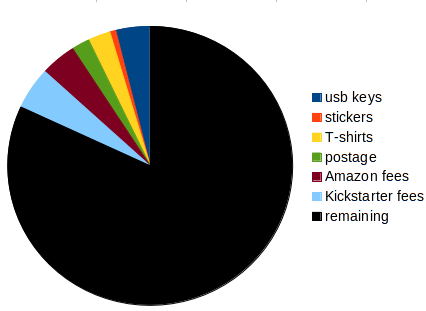
my Kickstarter pie (not including taxes)
While the Kickstarter was under way, several friends warned me that I might end up spending a lot of the money for rewards, or even shipping, and come out a loser. It's happened to some people, but I avoided it. Most of the pie went to its intended purpose.
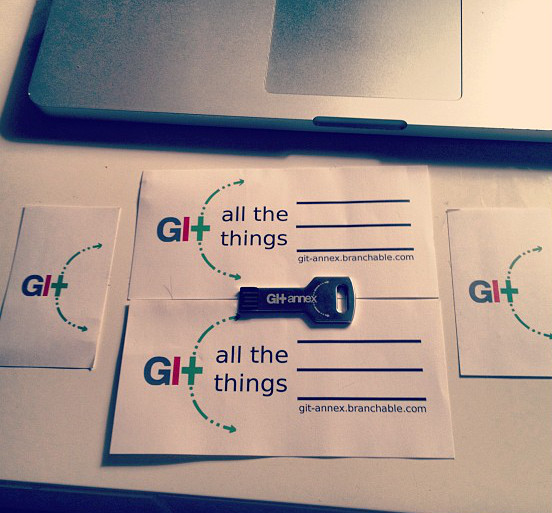
USB key arrives in Amsterdam
I kept shipping cost low by shipping everything by US postal service, including Air Mail for international shipping. This was particularly important for the stickers (which cost $1.05 to ship internationally). But I also shipped USB keys in regular mail envelopes, protected by bubble wrap, which worked very well and avoided the bother of shipping packages. The USPS will be annoyed at you for a rigid letter and add a non-machinable surcharge, but it's still a nice savings.
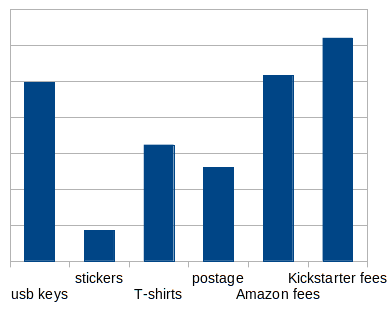
expenses
I spent more on rewards than on transaction fees, but the fees are still pretty large. Being dinged a second time by Amazon is the worst part. I have not been able to work out exactly what formula Kickstarter uses to determine its fee per pledge. It does not seem to be a simple percentage of the pledge. For example, they seem to have charged $0.25 per $10 pledge, but $25 for a $500 pledge. I wanted to solve this, but I'd have to match up all the pledges and fees manually to do it.
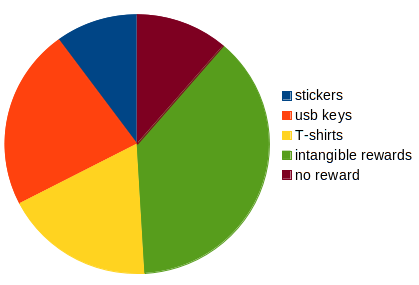
gross income by reward type
This chart is slightly innacurrate, because it puts any money pledged, beyond the amount needed to get a reward, into the "intangibles" category, despite the reward being probably responsible for that money being pledged. (The intangibles also includes people who did not ask for a reward, and several categories of rewards not involving shipping matter around.) But, the surprise for me is how large a peice the T-shirts are responsible for. It was my least favorite reward, and a low volume one, but I made out pretty well on it. However, I'd still try to avoid putting T-shirts on Kickstarter again. It's hard to do a good design (I didn't, really); they're expensive, and were by far the most annoying thing to ship. Also, I was not happy with the countries Cafe Press sourced their shirts from; I've been to Honduras and talked with people who have relatives in las machinas.
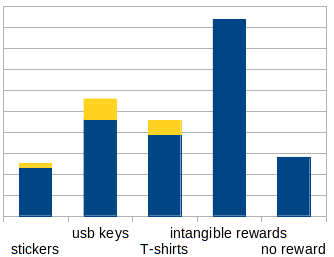
gross and net income by reward type (excluding shipping)
In contrast, the stickers had an amazing margin; they're so inexpensive to print that I printed up two kinds and included multiple with every other reward I mailed. I still have hundreds left over, too.. All the online print shops I tried have very annoying interfaces to upload artwork though. I had to do quite a bit of math to render TIFF files with appropriate DPI and margins. The USB keys were my favorite reward. I got them from USB Memory Direct, who gave me quite a nice deal. I was very happy that I was able to send them a SVG file of my artwork, so I didn't need to worry about lacking resolution for the laser engraving. And it came out looking great. The best part was when their sales guy Mike actually did a minor alteration of the artwork, to better fit on the key, when I, being overloaded with Kickstarter stuff asked him too. A bit above and beyond. There was an issue with their Chinese manufacturer's quality control of the 16 gb drives, but they were willing to send me replacement for all the ones I found problems with.
All told I spent probably 3 full days stuffing and shipping envelopes, and probably spent a week working on Kickstarter reward fullfillment. As work-related overhead goes, that's not bad. Maybe someone considering a Kickstarter will find this information useful somehow. Oh well, back to work. :)

18 February 2013

Aigars Mahinovs: Istabai.lv installation

So, the price of heating my apartment has gone up significantly since last year and a lot of people have noticed the same trend. As a geek, I want not just any solutions, but geekiest solutions possible to that enter a Smart Home system. The heating in my apartment is separated from all other apartments with a separate heat meter that measures both heating water flow and the temperature difference on the incoming and outgoing pipes, so if I reduce the heating consumption I will immediately see that in lower heating bills. This particular smart home system is very simple and made in Latvia and also relatively cheap, so I decided to give this a try. The start was very simple I filled out a form on their home page and got a call the next day to verify the specifics. They already knew my building and had experience installing there, so they offered me two options: I could have two thermal sensors and a radiator controller on each of the 3 radiators in my apartment or (seeing how my apartment is relatively small and well ventilated thus reducing the efficiency of per-room control) one thermal sensor and one radiator controller installed on a new valve that they would build into the heating pipe just outside my apartment. I chose the second option as that was cheaper, simpler and involved less installation for me. Also they offered a nice discount. A plumber of my building installed the valve at some point during the day, I did not even have to be there or arrange anything special, it was all included in the main bill. Then the next day a friendly guy came by to my office and gave me three very cute boxes. The packaging was very, very Apple-like. The three devices were named mother , spy and puller basically that is a base station, a temperature sensor and a radiator regulator a wireless stepper motor. The installation was straight forward I connected the base station (something very similar to this thin in size and looks) to Ethernet and power, went to the web address specified on the sticker on the base station, completed a registration process there, entered a code from the base of the base station into the website and it just found it. After that I pressed a button on the temperature sensor (a Zippo lighter sized box with a built-in Li-Ion battery rechargeable via microUSB once a year or so) and put that on a shelf. I secured it with some double-sided tape after the cat got to it once and played some hockey while I was away. The temperature sensor immediately showed up in the Web UI and I could assign it to a room. The regulator installation was the most complex bit, but it was trivial as well all I had to do was insert some AA batteries (helpfully included in the box, should last a couple years by their estimates), then go outside to the newly installed inlet valve, put this thing on, screw the thread with my hands and then push and hold a button for 10 seconds. After that the controller came to life, connected with the base station and started spinning the valve, testing its operational range I presume. The range is very good you can see 13% signal in the screenshots that is across the whole of the apartment, trough 3 solid walls and another 5 meters out in the hallway inside another wall. As soon as that was done, the Web UI showed the controller and asked my to assign it to a room. So now I have 1 room defined with 1 temperature sensor and one controller. That is all that is needed. Temperature From the charts I have already found out that at current inside/outside temperatures my apartment cools down at around 0.3 degrees C per hour and with current radiator settings it heats up by around 1 degree C per hour. I should turn the radiators up a bit thus increasing the rate at which the system is able to heat things up. Also I should try to re-inspect all possible cold spots to see why the cooldown speed is so high. I expected it to be lower. At least now I have real data to compare things. Temperature chart At this point you can either fire up your web browser or a Android/iOS client on you mobile device to monitor and control the temperature of the apartment. But that was not enough for me I opted for the PRO upgrade which includes the ability to program a weekly cycle of desired temperatures. The programming is limited and thus simple to do there are three temperature modes: day, night and eco. The idea is that you have the night mode every night, then at some time during the day, you have the day mode (to wake up), then you switch to eco mode (when noone is home) and then in the evening you go back to day mode and later to night mode. There are separate sliders for each day of the week and temperature settings for each of the modes for every programmed room. Time zones Temperatures in zones Devices Total investment so far 210 Ls (or around 3 months worth of just heating bills). The experience of other users tells of 30-50% heating bill reduction, so this should pay for itself in 2-3 years. In addition I get a more stable and predictable temperature at home and some more geeky stuff to brag about yay! These guys have their work cut out for them I have no idea how/of they do international orders, I would definately like to see more information in the web site about how my system is working (more temperature history, valve state history, wireless signal and battery history, mobile apps are a bit wonky it feels like the mobile app does not respect the temperature set over the web and tries to reassert itself when opened and it often shows out-of-date temperature data with no indication that it is out-of-date + the mobile apps are missing charts. All in all this is a great start: easy, quite cheap and stylish home heating automation. Good work! P.S. I am pretty sure they use Linux, but it is so packaged, that there is basically no way to confirm or deny that. P.P.S. Also check out this overnight chart, there is definitely some mode switch anticipation going on :)
Overnight temperatures

17 February 2013

Cyril Brulebois: First release candidate

After a release cycle longer than between each beta (which is slightly sad, but I can t spend all my time on Debian), here comes the first release candidate of the Debian Installer for Wheezy. The Debian Installer 7.0 RC1 announce on the website has links to relevant bug reports in the Debian BTS, and the errata page lists things you probably want to know about (including gotchas with grub-install we ve been having for a while, now diagnosed, and hopefully fixed for the next release candidate). According to Arwen s sleepy attitude, it s officially time for a nap! Sleepy Arwen

16 February 2013

Ingo Juergensmann: Status of m68k port

Just another short status update on the m68k port and the autobuilders. According to Buildd.Net we have currently 6425 packages installed:
wanna-build statistics - Sat Feb 16 22:52:37 CET 2013
----------------------------------------------------- Distribution unstable:
---------------------
Installed : 6425 (buildd_m68k-ara5: 1011, buildd_m68k-arrakis: 86,
buildd_m68k-elgar: 217, buildd_m68k-kullervo: 52,
buildd_m68k-vivaldi: 123, tg: 3234, unknown: 1701,
wouter: 1)
Needs-Build : 1375
Building : 35 (buildd_m68k-ara5: 1, buildd_m68k-arrakis: 1,
buildd_m68k-elgar: 1, buildd_m68k-kullervo: 1,
buildd_m68k-vivaldi: 1, tg: 30)
Built : 3 (buildd_m68k-arrakis: 3)
Uploaded : 14 (tg: 14)
Failed : 80 (buildd_m68k-ara5: 31, tg: 49)
Dep-Wait : 3 (tg: 3)
Reupload-Wait : 0
Install-Wait : 0
Failed-Removed : 0
Dep-Wait-Removed: 0
BD-Uninstallable: 1750
Auto-Not-For-Us : 187
Not-For-Us : 21
total : 9978 64.39% (6425) up-to-date, 64.53% (6439) including uploaded
13.78% (1375) need building
0.35% ( 35) currently building
0.03% ( 3) already built, but not uploaded
0.83% ( 83) failed/dep-wait
0.00% ( 0) old failed/dep-wait
17.54% (1750) not installable, because of missing build-dep
1.87% (187) need porting or cause the buildd serious grief (Auto)
0.21% ( 21) need porting or cause the buildd serious grief
Considering from where we came we're doing well. Especially given the fact that still some buildds are not working properly because of the missing SCSI driver for NCR53C9XF (espfast) chips. Having that driver working would result in 4 additional buildds and at least one that is currently using slower IDE interface. Oh, even Kullervo is working again! Now it just needs to get relocated to the datacenter again... :-)
Kategorie:

Next.

Previous.