Search Results: "pm"

18 April 2017

Norbert Preining: Gaming: Firewatch

A nice little game, Firewatch, puts you into a fire watch tower in Wyoming, with only a walkie-talkie connecting him to his supervisor Delilah. A so called first person mystery adventure with very nice graphics and great atmosphere.
Starting with your trip to the watch tower, the game sends the player into a series of missions , during which more and more clues about a mystery disappearance are revealed. The game development is rather straight forward, one has hardly any choices, and it is practically impossible to miss something or fail in some way.
The big plus of the game is the great atmosphere, the funny dialogues with Delilah, the story that pulls you into the game, and the development of the character(s). The tower, the cave, all the places one visits are delicately designed with lots of personality, making this a very human like game.
What is weak is the finish. During the game I was always thinking about whether I should tell Delilah everything, or keep some things secret. But in the end nothing matters, all ends with a simple escape in the helicopter and without any tying up the loose ends. Somehow a pity for such a beautiful game to leave the player somehow unsatisfied at the end.
But although the finish wasn t that good, I still enjoyed it more than I expected. Due to the simple flow it wont keep you busy for many hours, but as a short break a few evenings (for me), it was a nice break from all the riddle games I love so much.

17 April 2017

Russell Coker: More KVM Modules Configuration

Last year I blogged about blacklisting a video driver so that KVM virtual machines didn t go into graphics mode [1]. Now I ve been working on some other things to make virtual machines run better. I use the same initramfs for the physical hardware as for the virtual machines. So I need to remove modules that are needed for booting the physical hardware from the VMs as well as other modules that get dragged in by systemd and other things. One significant saving from this is that I use BTRFS for the physical machine and the BTRFS driver takes 1M of RAM! The first thing I did to reduce the number of modules was to edit /etc/initramfs-tools/initramfs.conf and change MODULES=most to MODULES=dep . This significantly reduced the number of modules loaded and also stopped the initramfs from probing for a non-existant floppy drive which added about 20 seconds to the boot. Note that this will result in your initramfs not supporting different hardware. So if you plan to take a hard drive out of your desktop PC and install it in another PC this could be bad for you, but for servers it s OK as that sort of upgrade is uncommon for servers and only done with some planning (such as creating an initramfs just for the migration). I put the following rmmod commands in /etc/rc.local to remove modules that are automatically loaded:
rmmod btrfs
rmmod evdev
rmmod lrw
rmmod glue_helper
rmmod ablk_helper
rmmod aes_x86_64
rmmod ecb
rmmod xor
rmmod raid6_pq
rmmod cryptd
rmmod gf128mul
rmmod ata_generic
rmmod ata_piix
rmmod i2c_piix4
rmmod libata
rmmod scsi_mod In /etc/modprobe.d/blacklist.conf I have the following lines to stop drivers being loaded. The first line is to stop the video mode being set and the rest are just to save space. One thing that inspired me to do this is that the parallel port driver gave a kernel error when it loaded and tried to access non-existant hardware.
blacklist bochs_drm
blacklist joydev
blacklist ppdev
blacklist sg
blacklist psmouse
blacklist pcspkr
blacklist sr_mod
blacklist acpi_cpufreq
blacklist cdrom
blacklist tpm
blacklist tpm_tis
blacklist floppy
blacklist parport_pc
blacklist serio_raw
blacklist button On the physical machine I have the following in /etc/modprobe.d/blacklist.conf. Most of this is to prevent loading of filesystem drivers when making an initramfs. I do this because I know there s never going to be any need for CDs, parallel devices, graphics, or strange block devices in a server room. I wouldn t do any of this for a desktop workstation or laptop.
blacklist ppdev
blacklist parport_pc
blacklist cdrom
blacklist sr_mod
blacklist nouveau blacklist ufs
blacklist qnx4
blacklist hfsplus
blacklist hfs
blacklist minix
blacklist ntfs
blacklist jfs
blacklist xfs

16 April 2017

Antoine Beaupr : Montreal Bug Squashing Party report

Un sommaire de cet article est galement traduit vers le fran ais, merci!
Last friday, a group of Debian users, developers and enthusiasts met at Koumbit.org offices for a bug squashing party. We were about a dozen people of various levels: developers, hackers and users. I gave a quick overview of Debian packaging using my quick development guide, which proved to be pretty useful. I made a deb.li link (https://deb.li/quickdev) for people to be able to easily find the guide on their computers. Then I started going through a list of different programs used to do Debian packaging, to try and see the level of the people attending: So mostly skilled Debian users (they know apt-get source) but not used to packaging (they don't know about dpkg-buildpackage). So I went through the list again and explained how they all fit together and could be used to work on Debian packages in the context of a Debian release bug squashing party. This was the fastest crash course in Debian packaging I have ever given (and probably the first too) - going through those tools in about 30 minutes. I was happy to have the guide that people could refer to later in the back. The first question after the presentation was "how do we find bugs"? which led me to add links to the UDD bugs page and release-critical bugs page. I also explained the key links on top of the UDD page to find specific sets of bugs, and explained the useful "patch" filter that allows to select bugs with our without patch. I guess that maybe half of the people were able to learn new, or improve their skills to make significant contributions or test actual patches. Other learned how to hunt and triage bugs in the BTS. Update: sorry for the wording: all contributions were really useful, thanks and apologies to bug hunters!! I myself learned how to use sbuild thanks to the excellent sbuild wiki page which I improved upon. A friend was able to pick up sbuild very quickly and use it to build a package for stretch, which I find encouraging: my first experience with pbuilder was definitely not as good. I have therefore starting the process of switching my build chroots to sbuild, which didn't go so well on Jessie because I use a backported kernel, and had to use the backported sbuild as well. That required a lot of poking around, so I ended up just using pbuilder for now, but I will definitely switch on my home machine, and I updated the sbuild wiki page to give out more explanations on how to setup pbuilder. We worked on a bunch of bugs, and learned how to tag them as part of the BSP, which was documented in the BSP wiki page. It seems we have worked on about 11 different bugs which is a better average than the last BSP that I organized, so I'm pretty happy with that. More importantly, we got Debian people together to meet and talk, over delicious pizza, thanks to a sponsorship granted by the DPL. Some people got involved in the next DebConf which is also great. On top of fixing bugs and getting people involved in Debian, my third goal was to have fun, and fun we certainly had. I didn't work on as many bugs as I expected myself, achieving only one upload in the end, but since I was answering so many questions left and right, I felt useful and that is certainly gratifying. Organization was simple enough: just get a place, send invites and get food, and the rest is just sharing knowledge and answering questions. Thanks everyone for coming, and let's do this again soon!

15 April 2017

Dirk Eddelbuettel: #5: Easy package information

Welcome to the fifth post in the recklessly rambling R rants series, or R4 for short. The third post showed an easy way to follow R development by monitoring (curated) changes on the NEWS file for the development version r-devel. As a concrete example, I mentioned that it has shown a nice new function (tools::CRAN_package_db()) coming up in R 3.4.0. Today we will build on that. Consider the following short snippet:
library(data.table)
getPkgInfo <- function()  
    if (exists("tools::CRAN_package_db"))  
        dat <- tools::CRAN_package_db()
      else  
        tf <- tempfile()
        download.file("https://cloud.r-project.org/src/contrib/PACKAGES.rds", tf, quiet=TRUE)
        dat <- readRDS(tf)              # r-devel can now readRDS off a URL too
     
    dat <- as.data.frame(dat)
    setDT(dat)
    dat
 
It defines a simple function getPkgInfo() as a wrapper around said new function from R 3.4.0, ie tools::CRAN_package_db(), and a fallback alternative using a tempfile (in the automagically cleaned R temp directory) and an explicit download and read of the underlying RDS file. As an aside, just this week the r-devel NEWS told us that such readRDS() operations can now read directly from URL connection. Very nice---as RDS is a fantastic file format when you are working in R. Anyway, back to the RDS file! The snippet above returns a data.table object with as many rows as there are packages on CRAN, and basically all their (parsed !!) DESCRIPTION info and then some. A gold mine! Consider this to see how many package have a dependency (in the sense of Depends, Imports or LinkingTo, but not Suggests because Suggests != Depends) on Rcpp:
R> dat <- getPkgInfo()
R> rcppRevDepInd <- as.integer(tools::dependsOnPkgs("Rcpp", recursive=FALSE, installed=dat))
R> length(rcppRevDepInd)
[1] 998
R>
So exciting---we will hit 1000 within days! But let's do some more analysis:
R> dat[ rcppRevDepInd, RcppRevDep := TRUE]  # set to TRUE for given set
R> dat[ RcppRevDep==TRUE, 1:2]
           Package Version
  1:      ABCoptim  0.14.0
  2: AbsFilterGSEA     1.5
  3:           acc   1.3.3
  4: accelerometry   2.2.5
  5:      acebayes   1.3.4
 ---                      
994:        yakmoR   0.1.1
995:  yCrypticRNAs  0.99.2
996:         yuima   1.5.9
997:           zic     0.9
998:       ziphsmm   1.0.4
R>
Here we index the reverse dependency using the vector we had just computed, and then that new variable to subset the data.table object. Given the aforementioned parsed information from all the DESCRIPTION files, we can learn more:
R> ## likely false entries
R> dat[ RcppRevDep==TRUE, ][NeedsCompilation!="yes", c(1:2,4)]
            Package Version                                                                         Depends
 1:         baitmet   1.0.0                                                           Rcpp, erah (>= 1.0.5)
 2:           bea.R   1.0.1                                                        R (>= 3.2.1), data.table
 3:            brms   1.6.0                     R (>= 3.2.0), Rcpp (>= 0.12.0), ggplot2 (>= 2.0.0), methods
 4: classifierplots   1.3.3                             R (>= 3.1), ggplot2 (>= 2.2), data.table (>= 1.10),
 5:           ctsem   2.3.1                                           R (>= 3.2.0), OpenMx (>= 2.3.0), Rcpp
 6:        DeLorean   1.2.4                                                  R (>= 3.0.2), Rcpp (>= 0.12.0)
 7:            erah   1.0.5                                                               R (>= 2.10), Rcpp
 8:             GxM     1.1                                                                              NA
 9:             hmi   0.6.3                                                                    R (>= 3.0.0)
10:        humarray     1.1 R (>= 3.2), NCmisc (>= 1.1.4), IRanges (>= 1.22.10),\nGenomicRanges (>= 1.16.4)
11:         iNextPD   0.3.2                                                                    R (>= 3.1.2)
12:          joinXL   1.0.1                                                                    R (>= 3.3.1)
13:            mafs   0.0.2                                                                              NA
14:            mlxR   3.1.0                                                           R (>= 3.0.1), ggplot2
15:    RmixmodCombi     1.0              R(>= 3.0.2), Rmixmod(>= 2.0.1), Rcpp(>= 0.8.0), methods,\ngraphics
16:             rrr   1.0.0                                                                    R (>= 3.2.0)
17:        UncerIn2     2.0                          R (>= 3.0.0), sp, RandomFields, automap, fields, gstat
R> 
There are a full seventeen packages which claim to depend on Rcpp while not having any compiled code of their own. That is likely false---but I keep them in my counts, however relunctantly. A CRAN-declared Depends: is a Depends:, after all. Another nice thing to look at is the total number of package that declare that they need compilation:
R> ## number of packages with compiled code
R> dat[ , .(N=.N), by=NeedsCompilation]
   NeedsCompilation    N
1:               no 7625
2:              yes 2832
3:               No    1
R>
Isn't that awesome? It is 2832 out of (currently) 10458, or about 27.1%. Just over one in four. Now the 998 for Rcpp look even better as they are about 35% of all such packages. In order words, a little over one third of all packages with compiled code (which may be legacy C, Fortran or C++) use Rcpp. Wow. Before closing, one shoutout to Dirk Schumacher whose thankr which I made the center of the last post is now on CRAN. As a mighty fine and slim micropackage without external dependencies. Neat.

This post by Dirk Eddelbuettel originated on his Thinking inside the box blog. Please report excessive re-aggregation in third-party for-profit settings.

13 April 2017

Antoine Beaupr : New approaches to network fast paths

With the speed of network hardware now reaching 100 Gbps and distributed denial-of-service (DDoS) attacks going in the Tbps range, Linux kernel developers are scrambling to optimize key network paths in the kernel to keep up. Many efforts are actually geared toward getting traffic out of the costly Linux TCP stack. We have already covered the XDP (eXpress Data Path) patch set, but two new ideas surfaced during the Netconf and Netdev conferences held in Toronto and Montreal in early April 2017. One is a patch set called af_packet, which aims at extracting raw packets from the kernel as fast as possible; the other is the idea of implementing in-kernel layer-7 proxying. There are also user-space network stacks like Netmap, DPDK, or Snabb (which we previously covered). This article aims at clarifying what all those components do and to provide a short status update for the tools we have already covered. We will focus on in-kernel solutions for now. Indeed, user-space tools have a fundamental limitation: if they need to re-inject packets onto the network, they must again pay the expensive cost of crossing the kernel barrier. User-space performance is effectively bounded by that fundamental design. So we'll focus on kernel solutions here. We will start from the lowest part of the stack, the af_packet patch set, and work our way up the stack all the way up to layer-7 and in-kernel proxying.

af_packet v4 John Fastabend presented a new version of a patch set that was first published in January regarding the af_packet protocol family, which is currently used by tcpdump to extract packets from network interfaces. The goal of this change is to allow zero-copy transfers between user-space applications and the NIC (network interface card) transmit and receive ring buffers. Such optimizations are useful for telecommunications companies, which may use it for deep packet inspection or running exotic protocols in user space. Another use case is running a high-performance intrusion detection system that needs to watch large traffic streams in realtime to catch certain types of attacks. Fastabend presented his work during the Netdev network-performance workshop, but also brought the patch set up for discussion during Netconf. There, he said he could achieve line-rate extraction (and injection) of packets, with packet rates as high as 30Mpps. This performance gain is possible because user-space pages are directly DMA-mapped to the NIC, which is also a security concern. The other downside of this approach is that a complete pair of ring buffers needs to be dedicated for this purpose; whereas before packets were copied to user space, now they are memory-mapped, so the user-space side needs to process those packets quickly otherwise they are simply dropped. Furthermore, it's an "all or nothing" approach; while NIC-level classifiers could be used to steer part of the traffic to a specific queue, once traffic hits that queue, it is only accessible through the af_packet interface and not the rest of the regular stack. If done correctly, however, this could actually improve the way user-space stacks access those packets, providing projects like DPDK a safer way to share pages with the NIC, because it is well defined and kernel-controlled. According to Jesper Dangaard Brouer (during review of this article):
This proposal will be a safer way to share raw packet data between user space and kernel space than what DPDK is doing, [by providing] a cleaner separation as we keep driver code in the kernel where it belongs.
During the Netdev network-performance workshop, Fastabend asked if there was a better data structure to use for such a purpose. The goal here is to provide a consistent interface to user space regardless of the driver or hardware used to extract packets from the wire. af_packet currently defines its own packet format that abstracts away the NIC-specific details, but there are other possible formats. For example, someone in the audience proposed the virtio packet format. Alexei Starovoitov rejected this idea because af_packet is a kernel-specific facility while virtio has its own separate specification with its own requirements. The next step for af_packet is the posting of the new "v4" patch set, although Miller warned that this wouldn't get merged until proper XDP support lands in the Intel drivers. The concern, of course, is that the kernel would have multiple incomplete bypass solutions available at once. Hopefully, Fastabend will present the (by then) merged patch set at the next Netdev conference in November.

XDP updates Higher up in the networking stack sits XDP. The af_packet feature differs from XDP in that it does not perform any sort of analysis or mangling of packets; its objective is purely to get the data into and out of the kernel as fast as possible, completely bypassing the regular kernel networking stack. XDP also sits before the networking stack except that, according to Brouer, it is "focused on cooperating with the existing network stack infrastructure, and on use-cases where the packet doesn't necessarily need to leave kernel space (like routing and bridging, or skipping complex code-paths)." XDP has evolved quite a bit since we last covered it in LWN. It seems that most of the controversy surrounding the introduction of XDP in the Linux kernel has died down in public discussions, under the leadership of David Miller, who heralded XDP as the right solution for a long-term architecture in the kernel. He presented XDP as a fast, flexible, and safe solution. Indeed, one of the controversies surrounding XDP was the question of the inherent security challenges with introducing user-provided programs directly into the Linux kernel to mangle packets at such a low level. Miller argued that whatever protections are expected for user-space programs also apply to XDP programs, comparing the virtual memory protections to the eBPF (extended BPF) verifier applied to XDP programs. Those programs are actually eBPF that have an interesting set of restrictions:
  • they have a limited size
  • they cannot jump backward (and thus cannot loop), so they execute in predictable time
  • they do only static allocation, so they are also limited in memory
XDP is not a one-size-fits-all solution: netfilter, the TC traffic shaper, and other normal Linux utilities still have their place. There is, however, a clear use case for a solution like XDP in the kernel. For example, Facebook and Cloudflare have both started testing XDP and, in Facebook's case, deploying XDP in production. Martin Kafai Lau, from Facebook, presented the tool set the company is using to construct a DDoS-resilience solution and a level-4 load balancer (L4LB), which got a ten-times performance improvement over the previous IPVS-based solution. Facebook rolled out its own user-space solution called "Droplet" to detect hostile traffic and deploy blocking rules in the form of eBPF programs loaded in XDP. Lau demonstrated the way Facebook deploys a three-part chained eBPF program: the first part allows debugging and dumping of packets, the second is Droplet itself, which drops undesirable traffic, and the last segment is the load balancer, which mangles the packets to tweak their destination according to internal rules. Droplet can drop DDoS attacks at line rate while keeping the architecture flexible, which were two key design requirements. Gilberto Bertin, from Cloudflare, presented a similar approach: Cloudflare has a tool that processes sFlow data generated from iptables in order to generate cBPF (classic BPF) mitigation rules that are then deployed on edge routers. Those rules are created with a tool called bpfgen, part of Cloudflare's BSD-licensed bpftools suite. For example, it could create a cBPF bytecode blob that would match DNS queries to any example.com domain with something like:
    bpfgen dns *.example.com
Originally, Cloudflare would deploy those rules to plain iptables firewalls with the xt_bpf module, but this led to performance issues. It then deployed a proprietary user-space solution based on Solarflare hardware, but this has the performance limitations of user-space applications getting packets back onto the wire involves the cost of re-injecting packets back into the kernel. This is why Cloudflare is experimenting with XDP, which was partly developed in response to the company's problems, to deploy those BPF programs. A concern that Bertin identified was the lack of visibility into dropped packets. Cloudflare currently samples some of the dropped traffic to analyze attacks; this is not currently possible with XDP unless you pass the packets down the stack, which is expensive. Miller agreed that the lack of monitoring for XDP programs is a large issue that needs to be resolved, and suggested creating a way to mark packets for extraction to allow analysis. Cloudflare is currently in a testing phase with XDP and it is unclear if its whole XDP tool chain will be publicly available. While those two companies are starting to use XDP as-is, there is more work needed to complete the XDP project. As mentioned above and in our previous coverage, massive statistics extraction is still limited in the Linux kernel and introspection is difficult. Furthermore, while the existing actions (XDP_DROP and XDP_TX, see the documentation for more information) are well implemented and used, another action may be introduced, called XDP_REDIRECT, which would allow redirecting packets to different network interfaces. Such an action could also be used to accelerate bridges as packets could be "switched" based on the MAC address table. XDP also requires network driver support, which is currently limited. For example, the Intel drivers still do not support XDP, although that should come pretty soon. Miller, in his Netdev keynote, focused on XDP and presented it as the standard solution that is safe, fast, and usable. He identified the next steps of XDP development to be the addition of debugging mechanisms, better sampling tools for statistics and analysis, and user-space consistency. Miller foresees a future for XDP similar to the popularization of the Arduino chips: a simple set of tools that anyone, not just developers, can use. He gave the example of an Arduino tutorial that he followed where he could just look up a part number and get easy-to-use instructions on how to program it. Similar components should be available for XDP. For this purpose, the conference saw the creation of a new mailing list called xdp-newbies where people can learn how to create XDP build environments and how to write XDP programs.

In-kernel layer-7 proxying The third approach that struck me as innovative is the idea of doing layer-7 (application) proxying directly in the kernel. This comes from the idea that, traditionally, we build firewalls to segregate traffic and apply controls, but as most services move to HTTP, those policies become ineffective. Thomas Graf, presented this idea during Netconf using a Star Wars allegory: what if the Death Star were a server with an API? You would have endpoints like /dock or /comms that would allow you to dock a ship or communicate with the Death Star. Those API endpoints should obviously be public, but then there is this /exhaust-port endpoint that should never be publicly available. In order for a firewall to protect such a system, it must be able to inspect traffic at a higher level than the traditional address-port pairs. Graf presented a design where the kernel would create an in-kernel socket that would negotiate TCP connections on behalf of user space and then be able to apply arbitrary eBPF rules in the kernel. Graf's design of in-kernel proxying In this scenario, instead of doing the traditional transfer from Netfilter's TPROXY to user space, the kernel directly decapsulates the HTTP traffic and passes it to BPF rules that can make decisions without doing expensive context switches or memory copies in the case of simply wanting to refuse traffic (e.g. issue an HTTP 403 error). This, of course, requires the inclusion of kTLS to process HTTPS connections. HTTP2 support may also prove problematic, as it multiplexes connections and is harder to decapsulate. This design was described as a "pure pre-accept() hook". Starovoitov also compared the design to the kernel connection multiplexer (KCM). Tom Herbert, KCM's author, agreed that it could be extended to support this, but would require some extensions in user space to provide an interface between regular socket-based applications and the KCM layer. In any case, if the application does TLS (and lots of them do), kTLS gets tricky because it breaks the end-to-end nature of TLS, in effect becoming a man in the middle between the client and the application. Eric Dumazet argued that HA-Proxy already does things like this: it uses splice() to avoid copying too much data around, but it still does a context switch to hand over processing to user space, something that could be fixed in the general case. Another similar project that was presented at Netdev is the Tempesta firewall and reverse-proxy. The speaker, Alex Krizhanovsky, explained the Tempesta developers have taken one person month to port the mbed TLS stack to the Linux kernel to allow an in-kernel TLS handshake. Tempesta also implements rate limiting, cookies, and JavaScript challenges to mitigate DDoS attacks. The argument behind the project is that "it's easier to move TLS to the kernel than it is to move the TCP/IP stack to user space". Graf explained that he is familiar with Krizhanovsky's work and he is hoping to collaborate. In effect, the design Graf is working on would serve as a foundation for Krizhanovsky's in-kernel HTTP server (kHTTP). In a private email, Graf explained that:
The main differences in the implementation are currently that we foresee to use BPF for protocol parsing to avoid having to implement every single application protocol natively in the kernel. Tempesta likely sees this less of an issue as they are probably only targeting HTTP/1.1 and HTTP/2 and to some [extent] JavaScript.
Neither project is really ready for production yet. There didn't seem to be any significant pushback from key network developers against the idea, which surprised some people, so it is likely we will see more and more layer-7 intelligence move into the kernel sooner rather than later.

Conclusion All of this work aims at replacing a rag-tag bunch of proprietary solutions that recently came up to bypass the Linux kernel TCP/IP stack and improve performance for firewalls, proxies, and other key edge network elements. The idea is that, unless the kernel improves its performance, or at least provides a way to bypass its more complex code paths, people will work around it. With this set of solutions in place, engineers will now be able to use standard APIs to hook high-performance systems into the Linux kernel.
The author would like to thank the Netdev and Netconf organizers for travel assistance, Thomas Graf for a review of the in-kernel proxying section of this article, and Jesper Dangaard Brouer for review of the af_packet and XDP sections. Note: this article first appeared in the Linux Weekly News.

Michal &#268;iha&#345;: Weblate 2.13.1

Weblate 2.13.1 has been released quickly after 2.13. It fixes few minor issues and possible upgrade problem. Full list of changes: If you are upgrading from older version, please follow our upgrading instructions. You can find more information about Weblate on https://weblate.org, the code is hosted on Github. If you are curious how it looks, you can try it out on demo server. You can login there with demo account using demo password or register your own user. Weblate is also being used on https://hosted.weblate.org/ as official translating service for phpMyAdmin, OsmAnd, Aptoide, FreedomBox, Weblate itself and many other projects. Should you be looking for hosting of translations for your project, I'm happy to host them for you or help with setting it up on your infrastructure. Further development of Weblate would not be possible without people providing donations, thanks to everybody who have helped so far! The roadmap for next release is just being prepared, you can influence this by expressing support for individual issues either by comments or by providing bounty for them.

Filed under: Debian English SUSE Weblate 0 comments

12 April 2017

Michal &#268;iha&#345;: Weblate 2.13

Weblate 2.13 has been released today pretty much on the schedule. The most important change being more fine grained access control and some smaller UI improvements. There are other new features and bug fixes as well. Full list of changes: If you are upgrading from older version, please follow our upgrading instructions. You can find more information about Weblate on https://weblate.org, the code is hosted on Github. If you are curious how it looks, you can try it out on demo server. You can login there with demo account using demo password or register your own user. Weblate is also being used on https://hosted.weblate.org/ as official translating service for phpMyAdmin, OsmAnd, Aptoide, FreedomBox, Weblate itself and many other projects. Should you be looking for hosting of translations for your project, I'm happy to host them for you or help with setting it up on your infrastructure. Further development of Weblate would not be possible without people providing donations, thanks to everybody who have helped so far! The roadmap for next release is just being prepared, you can influence this by expressing support for individual issues either by comments or by providing bounty for them.

Filed under: Debian English Gammu phpMyAdmin SUSE Weblate 0 comments

11 April 2017

Joey Hess: starting debug-me and a new devblog

I've started building debug-me. It's my birthday, and building a new program is kind of my birthday gift to myself, because I love starting a new program and seeing where it goes. (Also, my Patreon backers wanted me to get on with building debug-me.) I also have a new devblog! Up until now, I've had a devblog that only covered work on git-annex. That one continues, but the new devblog is for development journaling for any project I'm working on. http://joeyh.name/devblog/

Riku Voipio: Deploying OBS

Open Build Service from SuSE is web service building deb/rpm packages. It has recently been added to Debian, so finally there is relatively easy way to set up PPA style repositories in Debian. Relative as in "there is a learning curve, but nowhere near the complexity of replicating Debian's internal infrastructure". OBS will give you both repositories and build infrastructure with a clickety web UI and command line client (osc) to manage. See Hectors blog for quickstart instructions. Things to learned while setting up OBSMe coming from Debian background, and OBS coming from SuSE/RPM world, there are some quirks that can take by surprise. Well done packagingUsually web services are a tough fit for Distros. The cascade of weird dependencies and build systems where the only practical way to build an "open source" web service is by replicating the upstream CI scripts. Not in case of OBS. Being done by distro people shows. OBS does automatic rebuilds of reverse dependenciesAka automatic binNMUs when you update a library. This however means you need lots of build power around. OBS has it's own dependency resolver on the server that recalculate what packages need rebuilding when - workers just get a list of packages to install for build-depends. This a major divergence from Debian, where sbuild handles dependencies client side. The OBS dependency handler doesn't handle virtual packages* / alternative build-deps like Debian - you may have to add a specific "Prefer: foo-dev" into the OBS project config to solve alternative choices. OBS server and worker do http requests in both directionsOn startup workers connect to OBS server, open a TCP port and wait requests coming OBS. Having connections both directions is a bit of hassle firewall-wise. On the bright side, no need to setup uploads via FTP here.. Signing repositories is complicatedWith Debian 9.0 making signed repositories pretty much mandatory, OBS makes signing rather complicated. obs-signd isn't included in Debian, since it depends on gnupg patch that hasn't been upstreamed. Fortunately I found a workaround. OBS signs release files with /usr/bin/sign -d /path/to/release. Where replacing the obs-signd provided sign command your own script is easy ;) Git integration is rather bolted-on than integratedOBS provides a method to integrate with git using services. - There is no clickety UI to link to git repo, instead you make an xml file called _service with osc. There is no way to have debian/ tree in git. The upstream community is friendlyIncluding the happiest thanks from an upstream I've seen recently. SummaryAll in all rather satisfied with OBS. If you have a home-grown jenkins etc based solution for building DEB/RPM packages, you should definitely consider OBS. For simpler uses, no need to install OBS yourself, openSUSE public OBS will happily build Debian packages for you. *How useful are virtual packages anymore? "foo-defaults" packages seem to be the go-to solution for most real usecases anyways.

Reproducible builds folks: Reproducible Builds: week 102 in Stretch cycle

Here's what happened in the Reproducible Builds effort between Sunday April 2 and Saturday April 8 2017: Media coverage Toolchain development and fixes Reviews of unreproducible packages 27 package reviews have been added, 14 have been updated and 17 have been removed in this week, adding to our knowledge about identified issues. Weekly QA work During our reproducibility testing, FTBFS bugs have been detected and reported by: tests.reproducible-builds.org Misc. This week's edition was written by Chris Lamb, Vagrant Cascadian & reviewed by a bunch of Reproducible Builds folks on IRC & the mailing lists.

10 April 2017

Daniel Pocock: If Alan Turing was born today, would he be a Muslim?

Alan Turing's name and his work are well known to anybody with a theoretical grounding in computer science. Turing developed his theories well before anybody invented file sharing, overclocking or mass surveillance. In fact, Turing was largely working in the absence of any computers at all: the transistor was only invented in 1947 and the microchip, the critical innovation that has made computing both affordable and portable, only came in 1960, four years after Turing's death. To this day, the Turing Test remains a well known challenge in the field of Artificial Intelligence. The most prestigious prize in computing, the A.M. Turing Award from the ACM, equivalent to the Nobel Prize in other fields of endeavour, is named in Turing's honour. (This year's award is another British scientist, Sir Tim Berners-Lee, inventor of the World Wide Web).
Potentially far more people know of Alan Turing for his groundbreaking work at Bletchley Park and the impact it had on cracking the Nazi's Enigma machines during World War 2, giving the allies an advantage against Hitler. While in his lifetime, Turing exposed the secret communications of the Nazis, in his death, he exposed something manifestly repugnant about his own society. Turing's challenges with his sexuality (or Britain's challenge with it) are just as well documented as his greatest scientific achievements. The 2014 movie The Imitation Game tells Turing's story, bringing together the themes from his professional and personal life. Had Turing chosen to flee British persecution by going abroad, he would be a refugee in the same sense as any person who crossed the seas to reach Europe today to avoid persecution elsewhere. Please prove me wrong In March, I blogged about the problem of racism that plagues Britain today. While some may have felt the tone of the blog was quite strong, I was in no way pleased to find my position affirmed by the events that occurred in the two days after the blog appeared. Two days and two more human beings (both immigrants and both refugees) subjected to abhorrent and unnecessary acts of abuse in Great Britain. Both cases appear to be fuelled directly by the evil that has been oozing out of number 10 Downing Street since they decided to have a referendum on "Brexit". What stands out about these latest crimes is not that they occurred (this type of thing has been going on for months now) but certain contrasts between their circumstances and to a lesser extent, the fact they occurred immediately after Theresa May formalized Britain's departure from the EU. One of the victims was almost beaten to death by a street gang, while the other was abused by men wearing uniforms. One was only a child, while the other is a mature adult who has been in the UK almost three decades, completely assimilated into British life, working and paying taxes. Both were doing nothing out of the ordinary at the time the abuse occurred: one had engaged in a conversation at a bus stop, the other was on a routine visit to a Government office. There is no evidence that either of them had done anything to provoke or invite the abhorrent treatment meted out to them by the followers of Theresa May and Nigel Farage. The first victim, on 30 March, was Stojan Jankovic, a refugee from Yugoslavia who has been in the UK for 26 years. He had a routine meeting at an immigration department office where he was ambushed, thrown in the back of a van and sent to rot in a prison cell by Theresa May's gestapo. On Friday, 31 March, it was Reker Ahmed, a 17 year old Kurdish-Iranian beaten to the brink of death by a crowd in south London. One of the more remarkable facts to emerge about these two cases is that while Stojan Jankovic was basically locked up for no reason at all, the street thugs who the police apprehended for the assault on Ahmed were kept in a cell for less than 48 hours and released again on bail. While the harmless and innocent Jankovic was eventually released after a massive public outcry, he spent more time locked up than that gang of violent criminals who beat Reker Ahmed. In other words, Theresa May and Nigel Farage's Britain has more concern for the liberty of violent criminals than somebody like Jankovic who has been working and paying taxes in the UK since before any of those street thugs were born. A deeper insight into Turing's fate With gay marriage having been legal in the UK for a number of years now, the rainbow flag flying at the Tate and Sir Elton John achieving a knighthood, it becomes difficult for people to relate to the world in which Turing and many other victims were collectively classified by their sexuality, systematically persecuted by the state and ultimately died far sooner than they should have. (Turing was only 41 when he died). In fact, the cruel and brutal forces that ripped Turing apart (and countless other victims too) haven't dissipated at all, they have simply shifted their target. The slanderous comments insinuating that immigrants "steal" jobs or that Islam is about terrorism are eerily reminiscent of suggestions that gay men abduct young boys or work as Soviet spies. None of these lies has any basis in fact, but repeat them often enough in certain types of newspaper and these ideas spread like weeds. In an ironic twist, Turing's groundbreaking work at Bletchley Park was founded on the contributions of Polish mathematicians, their own country having been the first casualty to Hitler, they were also both immigrants and refugees in Britain. Today, under the Theresa May/Nigel Farage leadership, Polish citizens have been subjected to regular vilification by the media and some have even been killed in the street. It is said that a picture is worth a thousand words. When you compare these two pieces of propaganda: a 1963 article in the Sunday Mirror advising people "How to spot a possible homo" and a UK Government billboard encouraging people to be on the lookout for people who look different, could you imagine the same type of small-minded and power-hungry tyrants crafting them, singling out a minority so as to keep the public's attention in the wrong place?
Many people have noticed that these latest UK Government posters portray foreigners, Muslims and basically anybody who is not white using a range of characteristics found in anti-semetic propaganda from the Third Reich: Do the people who create such propaganda appear to have any concern whatsoever for the people they hurt? How would Alan Turing have felt when he encountered propaganda like that from the Sunday Mirror? Do posters like these encourage us to judge people by their gifts in science, the arts or sporting prowess or do they encourage us to lump them all together based on their physical appearance? It is a basic expectation of scientific methodology that when you repeat the same experiment, you should get the same result. What type of experiment are Theresa May and Nigel Farage conducting and what type of result would you expect? Playing ping-pong with children If anybody has any doubt that this evil comes from the top, take a moment to contemplate the 3,000 children who were baited with the promise of resettlement from the Calais "jungle" camp into the UK under the Dubs amendment. When French authorities closed the "jungle" in 2016, the children were lured out of the camp and left with nowhere to go as Theresa May and French authorities played ping-pong with them. Given that the UK parliament had already agreed they should be accepted, was there any reason for Theresa May to dig her heels in and make these children suffer? Or was she just trying to prove her credentials as somebody who can bastardize migrants just the way Nigel Farage would do it? How do British politicians really view migrants? Parliamentarian Keith Vaz, former chair of the Home Affairs Select Committee (responsible for security, crime, prostitution and similar things) was exposed with young men from eastern Europe, encouraging them to take drugs before he ordered them "Take your shirt off. I'm going to attack you.". How many British MP's see foreigners this way? Next time you are groped at an airport security checkpoint, remember it was people like Keith Vaz and his committee who oversee those abuses, writing among other things that "The wider introduction of full-body scanners is a welcome development". No need to "take your shirt off" when these machines can look through it as easily as they can look through your children's underwear. According to the World Health Organization, HIV/AIDS kills as many people as the September 11 attacks every single day. Keith Vaz apparently had no concern for the possibility he might spread this disease any further: the media reported he doesn't use any protection in his extra-marital relationships. While Britain's new management continue to round up foreigners like Stojan Jankovic who have done nothing wrong, they chose not to prosecute Keith Vaz for his antics with drugs and prostitution. Who is Britain's next Alan Turing? Britain's next Alan Turing may not be a homosexual. He or she may have been a child turned away by Theresa May's spat with the French at Calais, a migrant bundled into a deportation van by the gestapo (who are just following orders) or perhaps somebody of Muslim appearance who is set upon by thugs in the street who have been energized by Nigel Farage. If you still have any uncertainty about what Brexit really means, this is it. A country that denies itself the opportunity to be great by subjecting itself to be ruled under the "divide and conquer" mantra of the colonial era. Throughout the centuries, Britain has produced some of the most brilliant scientists of their time. Newton, Darwin and Hawking are just some of those who are even more prominent than Turing, household names around the world. One can only wonder what the history books will have to say about Theresa May and Nigel Farage however. Next time you see a British policeman accosting a Muslim, whether it is at an airport, in a shopping centre, keeping Manchester United souvenirs or simply taking a photograph, spare a thought for Alan Turing and the era when homosexuals were their target of choice.

9 April 2017

Michael Stapelberg: manpages.debian.org: what s new since the launch?

On 2017-01-18, I announced that https://manpages.debian.org had been modernized. Let me catch you up on a few things which happened in the meantime: The list above is not complete, but rather a selection of things I found worth pointing out to the larger public. There are still a few things I plan to work on soon, so stay tuned :).

7 April 2017

Dirk Eddelbuettel: #3: Follow R-devel

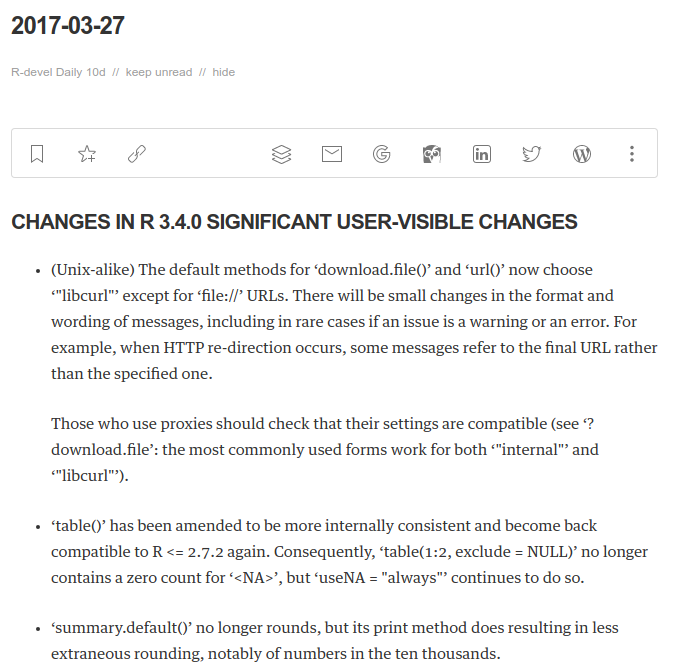
Welcome to the third post in the rarely relevant R recommendation series, or R4 for short. Today will be brief, but of some importance. In order to know where R is going next, few places provide a better vantage point than the actual ongoing development. A few years ago, I mentioned to Duncan Murdoch how straightforward the setup of my CRANberries feed (and site) was. After all, static blog compilers converting textual input to html, rss feed and whatnot have been around for fifteen years (though they keep getting reinvented). He took this to heart and built the (not too pretty) R-devel daily site (which also uses a fancy diff tool as it shows changes in NEWS) as well as a more general description of all available sub-feeds. I follow this mostly through blog aggregations -- Google Reader in its day, now Feedly. A screenshot is below just to show that it doesn't have to be ugly just because it is on them intertubes:
This shows a particularly useful day when R-devel folded into the new branch for what will be the R 3.4.0 release come April 21. The list of upcoming changes is truly impressive and quite comprehensive -- and the package registration helper, focus of posts #1 and #2 here, is but one of these many changes. One function I learned about that day is tools::CRAN_package_db(), a helper to get a single (large) data.frame with all package DESCRIPTION information. Very handy. Others may have noticed that CRAN repos now have a new top-level file PACKAGES.rds and this function does indeed just fetch it--which you could do with a similar one-liner in R-release as well. Still very handy. But do read about changes in R-devel and hence upcoming changes in R 3.4.0. Lots of good things coming our way.

This post by Dirk Eddelbuettel originated on his Thinking inside the box blog. Please report excessive re-aggregation in third-party for-profit settings.

6 April 2017

Reproducible builds folks: Reproducible Builds: week 101 in Stretch cycle

Here's what happened in the Reproducible Builds effort between Sunday March 26 and Saturday April 1 2017: Media coverage Sylvain Beucler wrote a follow-up post Practical basics of reproducible builds 2, which like last weeks article is about his experiences making software build reproducibly. Reproducible work in other projects Colin Watson started writing a patch to make launchpad store .buildinfo files. (It's not yet deployed.) Toolchain development and fixes Ximin Luo continued to work on BUILD_PATH_PREFIX_MAP patches for GCC 6 and dpkg. Packages reviewed and fixed, and bugs filed Chris Lamb: Mattia Rizzolo: Reviews of unreproducible packages 49 package reviews have been added, 25 have been updated and 42 have been removed in this week, adding to our knowledge about identified issues. 1 issue type has been updated: Weekly QA work During our reproducibility testing, FTBFS bugs have been detected and reported by: diffoscope development diffoscope 81 was uploaded to experimental by Chris Lamb. It included contributions from: reprotest development reprotest development continued in git, including contributions from: buildinfo.debian.net development buildinfo.debian.net development continued in git, including contributions from: reproducible-website development Holger switched reproducible-builds.org and www.reproducible-builds.org to letsencrypt certificates. Misc. This week's edition was written by Ximin Luo and Holger Levsen & reviewed by a bunch of Reproducible Builds folks on IRC & the mailing lists.

31 March 2017

Ross Gammon: Resurrecting my old Drupal Site

As I have previously blogged, I recently managed to resurrect my old Drupal site that ran in the Amazon AWS cloud, and get it working again on a new host. I have just written up a summary of how I battled through the process, which can be found here. Unfortunately, I took a long time to write it up. So it is not as detailed as I originally intended. But if like me you run a Drupal site, or you did and it is also broken, then feel free to follow the link for a read. It may at least give some ideas to follow up. I made heavy use of DrupalVM. If you are just starting out with a Drupal website, and you have more than FTP access to your hosting, I recommend using DrupalVM (which is built with Vagrant & Ansible) for local development and testing.

29 March 2017

Daniel Pocock: Brexit: If it looks like racism, if it smells like racism and if it feels like racism, who else but a politician could argue it isn't?

Since the EU referendum got under way in the UK, it has become almost an everyday occurence to turn on the TV and hear some politician explaining "I don't mean to sound racist, but..." (example) Of course, if you didn't mean to sound racist, you wouldn't sound racist in the first place, now would you? The reality is, whether you like politics or not, political leaders have a significant impact on society and the massive rise in UK hate crimes, including deaths of Polish workers, is a direct reflection of the leadership (or profound lack of it) coming down from Westminster. Maybe you don't mean to sound racist, but if this is the impact your words are having, maybe it's time to shut up? Choosing your referendum Why choose to have a referendum on immigration issues and not on any number of other significant topics? Why not have a referendum on nuking Mr Putin to punish him for what looks like an act of terrorism against the Malaysian Airlines flight MH17? Why not have a referendum on cutting taxes or raising speed limits, turning British motorways into freeways or an autobahn? Why choose to keep those issues in the hands of the Government, but invite the man-in-a-white-van from middle England to regurgitate Nigel Farage's fears and anxieties about migrants onto a ballot paper? Even if David Cameron sincerely hoped and believed that the referendum would turn out otherwise, surely he must have contemplated that he was playing Russian Roulette with the future of millions of innocent people? Let's start at the top For those who are fortunate enough to live in parts of the world where the press provides little exposure to the antics of British royalty, an interesting fact you may have missed is that the Queen's husband, Prince Philip, Duke of Edinburgh is actually a foreigner. He was born in Greece and has Danish and German ancestry. Migration (in both directions) is right at the heart of the UK's identity. Queen and Prince Philip Home office minister Amber Rudd recently suggested British firms should publish details about how many foreign people they employ and in which positions. She argued this is necessary to help boost funding for training local people. If that is such a brilliant idea, why hasn't it worked for the Premier League? It is a matter of public knowledge how many foreigners play football in England's most prestigious division, so why hasn't this caused local clubs to boost training budgets for local recruits? After all, when you consider that England hasn't won a World Cup since 1966, what have they got to lose? Kevin Pietersen All this racism, it's just not cricket. Or is it? One of the most remarkable cricketers to play for England in recent times, Kevin Pietersen, dubbed "the most complete batsman in cricket" by The Times and "England's greatest modern batsman" by the Guardian, was born in South Africa. In the five years he was contracted to the Hampshire county team, he only played one match, because he was too busy representing England abroad. His highest position was nothing less than becoming England's team captain. Are the British superior to every other European citizen? One of the implications of the rhetoric coming out of London these days is that the British are superior to their neighbours, entitled to have their cake and eat it too, making foreigners queue up at Paris' Gare du Nord to board the Eurostar while British travelers should be able to walk or drive into European countries unchallenged. This superiority complex is not uniquely British, you can observe similar delusions are rampant in many of the places where I've lived, including Australia, Switzerland and France. America's Donald Trump has taken this style of politics to a new level. Look in the mirror Theresa May: after British 10-year old schoolboys Robert Thompson and Jon Venables abducted, tortured, murdered and mutilated 2 year old James Bulger in 1993, why not have all British schoolchildren fingerprinted and added to the police DNA database? Why should "security" only apply based on the country where people are born, their religion or skin colour? Jon Venables and Robert Thompson In fact, after Brexit, people like Venables and Thompson will remain in Britain while a Dutch woman, educated at Cambridge and with two British children will not. If that isn't racism, what is? Running foreigner's off the roads Theresa May has only been Prime Minister for less than a year but she has a history of bullying and abusing foreigners in her previous role in the Home Office. One example of this was a policy of removing driving licenses from foreigners, which has caused administrative chaos and even taken away the licenses of many people who technically should not have been subject to these regulations anyway. Shouldn't the DVLA (Britain's office for driving licenses) simply focus on the competence of somebody to drive a vehicle? Bringing all these other factors into licensing creates a hostile environment full of mistakes and inconvenience at best and opportunities for low-level officials to engage in arbitrary acts of racism and discrimination. Of course, when you are taking your country on the road to nowhere, who needs a driving license anyway? Run off the road What does "maximum control" over other human beings mean to you? The new British PM has said she wants "maximum control" over immigrants. What exactly does "maximum control" mean? Donald Trump appears to be promising "maximum control" over Muslims, Hitler sought "maximum control" over the Jews, hasn't the whole point of the EU been to avoid similar situations from ever arising again? This talk of "maximum control" in British politics has grown like a weed out of the UKIP. One of their senior figures has been linked to kidnappings and extortion, which reveals a lot about the character of the people who want to devise and administer these policies. Similar people in Australia aspire to jobs in the immigration department where they can extort money out of people for getting them pushed up the queue. It is no surprise that the first member of Australia's parliament ever sent to jail was put there for obtaining bribes and sexual favours from immigrants. When Nigel Farage talks about copying the Australian immigration system, he is talking about creating jobs like these for his mates. Even if "maximum control" is important, who really believes that a bunch of bullies in Westminster should have the power to exercise that control? Is May saying that British bosses are no longer competent to make their own decisions about who to employ or that British citizens are not reliable enough to make their own decisions about who they marry and they need a helping hand from paper-pushers in the immigration department? maximum control over Jewish people Echoes of the Third Reich Most people associate acts of mass murder with the Germans who lived in the time of Adolf Hitler. These are the stories told over and and over again in movies, books and the press. Look more closely, however, and it appears that the vast majority of Germans were not in immediate contact with the gas chambers. Even Gobels' secretary writes that she was completely oblivious to it all. Many people were simply small cogs in a big bad machine. The clues were there, but many of them couldn't see the big picture. Even if they did get a whiff of it, many chose not to ask questions, to carry on with their comfortable lives. Today, with mass media and the Internet, it is a lot easier for people to discover the truth if they look, but many are still reluctant to do so. Consider, for example, the fingerprint scanners installed in British post offices and police stations to fingerprint foreigners and criminals (as if they have something in common). If all the post office staff refused to engage in racist conduct the fingerprint scanners would be put out of service. Nonetheless, these people carry on, just doing their job, just following orders. It was through many small abuses like this, rather than mass murder on every street corner, that Hitler motivated an entire nation to serve his evil purposes. Technology like this is introduced in small steps: first it was used for serious criminals, then anybody accused of a crime, then people from Africa and next it appears they will try and apply it to all EU citizens remaining in the UK. How will a British man married to a French woman explain to their children that mummy has to be fingerprinted by the border guard each time they return from vacation? The Nazis pioneered biometric technology with the tracking numbers branded onto Jews. While today's technology is electronic and digital, isn't it performing the same function? There is no middle ground between "soft" and "hard" brexit An important point for British citizens and foreigners in the UK to consider today is that there is no compromise between a "soft" Brexit and a "hard" Brexit. It is one or the other. Anything less (for example, a deal that is "better" for British companies and worse for EU citizens) would imply that the British are a superior species and it is impossible to imagine the EU putting their stamp on such a deal. Anybody from the EU who is trying to make a life in the UK now is playing a game of Russian Roulette - sure, everything might be fine if it morphs into "soft" Brexit, but if Theresa May has her way, at some point in your life, maybe 20 years down the track, you could be rounded up by the gestapo and thrown behind bars for a parking violation. There has already been a five-fold increase in the detention of EU citizens in British concentration camps and they are using grandmothers from Asian countries to refine their tactics for the efficient removal of EU citizens. One can only wonder what type of monsters Theresa May has been employing to run such inhumane operations. This is not politics Edmund Burke's quote "The only thing necessary for the triumph of evil is for good men to do nothing" comes to mind on a day like today. Too many people think it is just politics and they can go on with their lives and ignore it. Barely half the British population voted in the referendum. This is about human beings treating each other with dignity and respect. Anything less is abhorrent and may well come back to bite.


Michal &#268;iha&#345;: Gammu 1.38.2

Yesterday Gammu 1.38.2 has been released. This is bugfix release fixing for example USSD or MMS decoding in some situations. The Windows binaries are available as well. These are built using AppVeyor and will help bring Windows users back to latest versions. Full list of changes and new features can be found on Gammu 1.38.2 release page. Would you like to see more features in Gammu? You an support further Gammu development at Bountysource salt or by direct donation.

Filed under: Debian English Gammu 0 comments

28 March 2017

Reproducible builds folks: Reproducible Builds: week 100 in Stretch cycle

Welcome to the 100th issue of this weekly news! We hope you have been enjoying our posts and would love to receive some feedback via our mailing list! Anyway, here's what happened in the Reproducible Builds effort between Sunday March 19 and Saturday March 25 2017: Reproducible Builds Hackathon Hamburg 2017 The Reproducible Builds Hamburg Hackathon 2017 (or RB-HH-2017 for short) is a 3-day hacking event taking place May 5th-7th in the CCC Hamburg Hackerspace inside Frappant, as collective art space located witin a historical monument in Hamburg, Germany. The event is open to everyone and we still have some free seats. If you wish to attend, please register your interest as soon as possible. Media coverage Packages reviewed and fixed, and bugs filed Chris Lamb: Reviews of unreproducible packages 30 package reviews have been added, 13 have been updated and 2 have been removed in this week, adding to our knowledge about identified issues. Weekly QA work During our reproducibility testing, FTBFS bugs have been detected and reported by: diffoscope development buildinfo.debian.net development Misc. This week's edition was written by Chris Lamb & Holger Levsen & reviewed by a bunch of Reproducible Builds folks on IRC & the mailing lists.

Axel Beckert: Maintaining Debian Packages of Perl Modules with dh-dist-zilla

Maintaining Debian packages of Perl modules usually can be done with the common git-buildpackage (aka gbp) workflow with its three git branches master (or debian), upstream and pristine-tar: This also works more or less fine for Perl modules, where the Debian package maintainer is also the upstream developer. In that case mostly the upstream branch is used (and then maybe called master while the Debian packaging branch is then called debian). But the files needed for a proper so called CPAN distribution of a Perl module often contain redundant information (version numbers, required modules, etc.) which needs to be maintained. And for that, many people prefer Don t Repeat Yourself (DRY) as a principle. Dist::Zilla One nice and common tool for that is Dist::Zilla or short dzil. It generates most redundant but required data out of a central source, e.g. Dist::Zilla s dist.ini or the contained .pm files, etc. dzil build creates tar ball which contains all files necessary by CPAN. But now we have a dilemma: Debian expects those generated files inside the upstream branch while the files are only generated from other files in that branch. There are multiple solutions, but all of them involve committing generated files to the git repository: librun-parts-perl aka Run::Parts (a Perl wrapper around and a pure-perl implementation of Debian s run-parts tool) was initially maintained in the latter way. But especially in cases where we just need a Perl module packaged as .deb without uploading it to CPAN (e.g. project-internal modules), this is a tedious workflow and overkill. It would be much nicer if debhelper would just call dzil to generate all the stuff it needs to build the package. dh-dist-zilla Well, you can do that now, at least with Debian Jessie. This is what dh-dist-zilla does: It is a debhelper sequence plugin which calls dzil build and dzil clean in the right moment and takes care that all dh_auto_* commands look in the directory with the generated files instead of the rather clean project root directory. To use dh-dist-zilla, you just need to add a build-dependency on it and the Dist::Zilla plugins you use, and add --with dist-zilla to your minimal dh-style debian/rules file:
#!/usr/bin/make -f
%:
	dh $@ --with dist-zilla
That s it. With regards to workflow and git branches, you may still want to use separate branches for upstream work and debian work, and you may want to continue to use pristine-tar, but you don t have to commit generated files to git anymore and you can maintain a clean master branch with nearly no redundancy. And if you need to generate to final upstream tar ball for you debian package, just call dh get-orig-source or maybe easier to use with tab completion dh_dist_zilla_origtar. This is how the librun-parts-perl package is maintained nowadays. There s otherwise not much difference to the old, classically maintained versions. More DRY Next step in the DRY evolution is to reduce redundancies between upstream (Dist::Zilla based) packaging and the Debian packaging. There are a few tools available, partially brand new, partially not yet packaged: I wouldn t be surprised if there s more to come in this area. P.S.: I actually started this blog posting in September 2014 and never finished it until now. Had to kick out some already outdated again stuff, but also could add some more recent things.

25 March 2017

Urvika Gola: Speaking at FOSSASIA 17 Seasons of Debian : Summer of Code & Winter of Outreachy

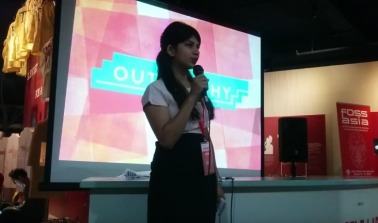
I got an amazing chance to speak at FOSSASIA 2017 held at Singapore on Seasons of Debian Summer of Code and Winter of Outreachy . I gave a combined talk with my co-speaker Pranav Jain, who contributed to Debian through GSoC. We talked about two major open source initiatives Outreachy and Google Summer of Code and the work we did on a common project Lumicall under Debian. WhatsApp Image 2017-03-23 at 11.32.33 PM The excitement started even before the first day! On 16th March, there was a speakers meetup at Microsoft office in Singapore. There, I got the chance to connect with other speakers and learn about their work The meetup was concluded by Microsoft Office tour! As a student it was very exciting to see first hand the office of a company that I had only dreamt of being at. On 17th March, i.e the first day of the three days long conference, I met Hong Phuc Dang, Founder of FOSSASIA. She is very kind and just talking to her just made me cheerful!
Meeting so many great developers from different organizations was exciting. On 18th March, was the day of our talk! I was a bit nervous to speak in front of amazing developers but, that s how you grow  Our talk was preceded by a lovely introduction by Mario Behling. WhatsApp Image 2017-03-25 at 2.32.01 PM.jpeg I talked about how Outreachy Programme has made a significant impact in increasing the participation of women in Open Source, with one such woman being me I also talked about Android Programming concepts which I used in while adding new features into Lumicall. Pranav talked about Debian Organization and how to get started with GSoC by sharing his journey! After our talk, students approached us asking questions about how to participate in Outreachy and GsOC. I felt that a lot more students were receptive to knowing about this new opportunity. Our own talk was part of the mini DebConf track. Under this track, there were two other amazing sessions namely, Debian The best Linux distribution and Open Build Service in Debian . The variety of experiences I gained from FOSSASIA was very diverse. I learned how to speak at a huge platform, learned from other interesting talks, share ideas with smart developers and saw an exciting venue and wonderful city! I would not be able to experience this without the continuous support of Debian and Outreachy !
Next.

Previous.