Reproducible Builds: Reproducible Builds in December 2023
 Welcome to the December 2023 report from the Reproducible Builds project! In these reports we outline the most important things that we have been up to over the past month. As a rather rapid recap, whilst anyone may inspect the source code of free software for malicious flaws, almost all software is distributed to end users as pre-compiled binaries (more).
Reproducible Builds: Increasing the Integrity of Software Supply Chains awarded IEEE Software Best Paper award
 In February 2022, we announced in these reports that a paper written by Chris Lamb and Stefano Zacchiroli was now available in the March/April 2022 issue of IEEE Software. Titled Reproducible Builds: Increasing the Integrity of Software Supply Chains (PDF).
This month, however, IEEE Software announced that this paper has won their Best Paper award for 2022.
Reproducibility to affect package migration policy in Debian
 In a post summarising the activities of the Debian Release Team at a recent in-person Debian event in Cambridge, UK, Paul Gevers announced a change to the way packages are migrated into the staging area for the next stable Debian release based on its reproducibility status:
The folks from the Reproducibility Project have come a long way since they started working on it 10 years ago, and we believe it s time for the next step in Debian. Several weeks ago, we enabled a migration policy in our migration software that checks for regression in reproducibility. At this moment, that is presented as just for info, but we intend to change that to delays in the not so distant future. We eventually want all packages to be reproducible. To stimulate maintainers to make their packages reproducible now, we ll soon start to apply a bounty [speedup] for reproducible builds, like we ve done with passing autopkgtests for years. We ll reduce the bounty for successful autopkgtests at that moment in time.
Speranza: Usable, privacy-friendly software signing
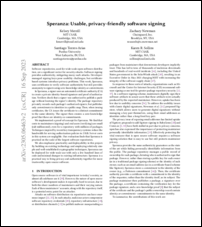 Kelsey Merrill, Karen Sollins, Santiago Torres-Arias and Zachary Newman have developed a new system called Speranza, which is aimed at reassuring software consumers that the product they are getting has not been tampered with and is coming directly from a source they trust. A write-up on TechXplore.com goes into some more details:
What we have done, explains Sollins, is to develop, prove correct, and demonstrate the viability of an approach that allows the [software] maintainers to remain anonymous. Preserving anonymity is obviously important, given that almost everyone software developers included value their confidentiality. This new approach, Sollins adds, simultaneously allows [software] users to have confidence that the maintainers are, in fact, legitimate maintainers and, furthermore, that the code being downloaded is, in fact, the correct code of that maintainer. [ ]
The corresponding paper is published on the arXiv preprint server in various formats, and the announcement has also been covered in MIT News.
Nondeterministic Git bundles
 Paul Baecher published an interesting blog post on Reproducible git bundles. For those who are not familiar with them, Git bundles are used for the offline transfer of Git objects without an active server sitting on the other side of a network connection. Anyway, Paul wrote about writing a backup system for his entire system, but:
I noticed that a small but fixed subset of [Git] repositories are getting backed up despite having no changes made. That is odd because I would think that repeated bundling of the same repository state should create the exact same bundle. However [it] turns out that for some, repositories bundling is nondeterministic.
Paul goes on to to describe his solution, which involves forcing git to be single threaded makes the output deterministic . The article was also discussed on Hacker News.
Output from libxlst now deterministic
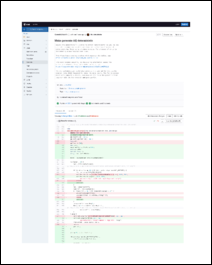 libxslt is the XSLT C library developed for the GNOME project, where XSLT itself is an XML language to define transformations for XML files. This month, it was revealed that the result of the
generate-id() XSLT function is now deterministic across multiple transformations, fixing many issues with reproducible builds. As the Git commit by Nick Wellnhofer describes:
Rework the generate-id() function to return deterministic values. We use
a simple incrementing counter and store ids in the 'psvi' member of
nodes which was freed up by previous commits. The presence of an id is
indicated by a new "source node" flag.
This fixes long-standing problems with reproducible builds, see
https://bugzilla.gnome.org/show_bug.cgi?id=751621
This also hardens security, as the old implementation leaked the
difference between a heap and a global pointer, see
https://bugs.chromium.org/p/chromium/issues/detail?id=1356211
The old implementation could also generate the same id for dynamically
created nodes which happened to reuse the same memory. Ids for namespace
nodes were completely broken. They now use the id of the parent element
together with the hex-encoded namespace prefix.
Community updates
 There were made a number of improvements to our website, including Chris Lamb fixing the
generate-draft script to not blow up if the input files have been corrupted today or even in the past [ ], Holger Levsen updated the Hamburg 2023 summit to add a link to farewell post [ ] & to add a picture of a Post-It note. [ ], and Pol Dellaiera updated the paragraph about tar and the --clamp-mtime flag [ ].
On our mailing list this month, Bernhard M. Wiedemann posted an interesting summary on some of the reasons why packages are still not reproducible in 2023.
 diffoscope is our in-depth and content-aware diff utility that can locate and diagnose reproducibility issues. This month, Chris Lamb made a number of changes, including processing
objdump symbol comment filter inputs as Python byte (and not str) instances [ ] and Vagrant Cascadian extended diffoscope support for GNU Guix [ ] and updated the version in that distribution to version 253 [ ].
Challenges of Producing Software Bill Of Materials for Java
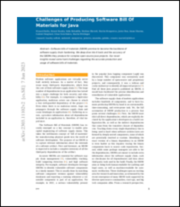 Musard Balliu, Benoit Baudry, Sofia Bobadilla, Mathias Ekstedt, Martin Monperrus, Javier Ron, Aman Sharma, Gabriel Skoglund, C sar Soto-Valero and Martin Wittlinger (!) of the KTH Royal Institute of Technology in Sweden, have published an article in which they:
deep-dive into 6 tools and the accuracy of the SBOMs they produce for complex open-source Java projects. Our novel insights reveal some hard challenges regarding the accurate production and usage of software bills of materials.
The paper is available on arXiv.
Debian Non-Maintainer campaign
 As mentioned in previous reports, the Reproducible Builds team within Debian has been organising a series of online and offline sprints in order to clear the huge backlog of reproducible builds patches submitted by performing so-called NMUs (Non-Maintainer Uploads).
During December, Vagrant Cascadian performed a number of such uploads, including:
crack [ ] (#1021521 & #1021522)dustmite [ ] (#1020878 & #1020879)edid-decode [ ] (#1020877)gentoo [ ] (#1024284)haskell98-report [ ] (#1024007)infinipath-psm [ ] (#990862)lcm [ ] (#1024286)libapache-mod-evasive [ ] (#1020800)libccrtp [ ] (#860470)libinput [ ] (#995809)lirc [ ] (#979019, #979023 & #979024)mm-common [ ] (#977177)mpl-sphinx-theme [ ] (#1005826)psi [ ] (#1017473)python-parse-type [ ] (#1002671)ruby-tioga [ ] (#1005727)ucspi-proxy [ ] (#1024125)ypserv [ ] (#983138)
In addition, Holger Levsen performed three no-source-change NMUs in order to address the last packages without .buildinfo files in Debian trixie, specifically lorene (0.0.0~cvs20161116+dfsg-1.1), maria (1.3.5-4.2) and ruby-rinku (1.7.3-2.1).
Reproducibility testing framework
 The Reproducible Builds project operates a comprehensive testing framework (available at tests.reproducible-builds.org) in order to check packages and other artifacts for reproducibility. In December, a number of changes were made by Holger Levsen:
-
Debian-related changes:
- Fix matching packages for the [R programming language](https://en.wikipedia.org/wiki/R_(programming_language). [ ][ ][ ]
- Add a Certbot configuration for the Nginx web server. [ ]
- Enable debugging for the
create-meta-pkgs tool. [ ][ ]
-
Arch Linux-related changes
-
Misc changes:
- Install the
python3-setuptools and swig packages, which are now needed to build OpenWrt. [ ]
- Install
pkg-config needed to build Coreboot artifacts. [ ]
- Detect failures due to an issue where the
fakeroot tool is implicitly required but not automatically installed. [ ]
- Detect failures due to rename of the
vmlinuz file. [ ]
- Improve the grammar of an error message. [ ]
- Document that
freebsd-jenkins.debian.net has been updated to FreeBSD 14.0. [ ]
In addition, node maintenance was performed by Holger Levsen [ ] and Vagrant Cascadian [ ].
Upstream patches
The Reproducible Builds project detects, dissects and attempts to fix as many currently-unreproducible packages as possible. We endeavour to send all of our patches upstream where appropriate. This month, we wrote a large number of such patches, including:
-
Bernhard M. Wiedemann:
apr (hostname issue)dune (parallelism)epy (time-based .pyc issue)fpc (Year 2038)gap (date)gh (FTBFS in 2024)kubernetes (fixed random build path)libgda (date)libguestfs (tar)metamail (date)mpi-selector (date)neovim (randomness in Lua)nml (time-based .pyc)pommed (parallelism)procmail (benchmarking)pysnmp (FTBFS in 2038)python-efl (drop Sphinx doctrees)python-pyface (time)python-pytest-salt-factories (time-based .pyc issue)python-quimb (fails to build on single-CPU systems)python-rdflib (random)python-yarl (random path)qt6-webengine (parallelism issue in documentation)texlive (Gzip modification time issue)waf (time-based .pyc)warewulf (CPIO modification time and inode issue)xemacs (toolchain hostname)
-
Chris Lamb:
- #1057710 filed against
python-aiostream.
- #1057721 filed against
openpyxl.
- #1058681 filed against
python-multipletau.
- #1059013 filed against
wxmplot.
- #1059014 filed against
stunnel4.
-
James Addison:
- #1059592 & #1059631 filed against
qttools-opensource-src.
If you are interested in contributing to the Reproducible Builds project, please visit our Contribute page on our website. However, you can get in touch with us via:
-
IRC:
#reproducible-builds on irc.oftc.net.
-
Mailing list:
rb-general@lists.reproducible-builds.org
-
Mastodon: @reproducible_builds
-
Twitter: @ReproBuilds
In a post summarising the activities of the Debian Release Team at a recent in-person Debian event in Cambridge, UK, Paul Gevers announced a change to the way packages are migrated into the staging area for the next stable Debian release based on its reproducibility status:
The folks from the Reproducibility Project have come a long way since they started working on it 10 years ago, and we believe it s time for the next step in Debian. Several weeks ago, we enabled a migration policy in our migration software that checks for regression in reproducibility. At this moment, that is presented as just for info, but we intend to change that to delays in the not so distant future. We eventually want all packages to be reproducible. To stimulate maintainers to make their packages reproducible now, we ll soon start to apply a bounty [speedup] for reproducible builds, like we ve done with passing autopkgtests for years. We ll reduce the bounty for successful autopkgtests at that moment in time.
Speranza: Usable, privacy-friendly software signing
Kelsey Merrill, Karen Sollins, Santiago Torres-Arias and Zachary Newman have developed a new system called Speranza, which is aimed at reassuring software consumers that the product they are getting has not been tampered with and is coming directly from a source they trust. A write-up on TechXplore.com goes into some more details:
What we have done, explains Sollins, is to develop, prove correct, and demonstrate the viability of an approach that allows the [software] maintainers to remain anonymous. Preserving anonymity is obviously important, given that almost everyone software developers included value their confidentiality. This new approach, Sollins adds, simultaneously allows [software] users to have confidence that the maintainers are, in fact, legitimate maintainers and, furthermore, that the code being downloaded is, in fact, the correct code of that maintainer. [ ]
The corresponding paper is published on the arXiv preprint server in various formats, and the announcement has also been covered in MIT News.
Nondeterministic Git bundles
Paul Baecher published an interesting blog post on Reproducible git bundles. For those who are not familiar with them, Git bundles are used for the offline transfer of Git objects without an active server sitting on the other side of a network connection. Anyway, Paul wrote about writing a backup system for his entire system, but:
I noticed that a small but fixed subset of [Git] repositories are getting backed up despite having no changes made. That is odd because I would think that repeated bundling of the same repository state should create the exact same bundle. However [it] turns out that for some, repositories bundling is nondeterministic.
Paul goes on to to describe his solution, which involves forcing git to be single threaded makes the output deterministic . The article was also discussed on Hacker News.
Output from libxlst now deterministic
libxslt is the XSLT C library developed for the GNOME project, where XSLT itself is an XML language to define transformations for XML files. This month, it was revealed that the result of the generate-id() XSLT function is now deterministic across multiple transformations, fixing many issues with reproducible builds. As the Git commit by Nick Wellnhofer describes:
Rework the generate-id() function to return deterministic values. We use
a simple incrementing counter and store ids in the 'psvi' member of
nodes which was freed up by previous commits. The presence of an id is
indicated by a new "source node" flag.
This fixes long-standing problems with reproducible builds, see
https://bugzilla.gnome.org/show_bug.cgi?id=751621
This also hardens security, as the old implementation leaked the
difference between a heap and a global pointer, see
https://bugs.chromium.org/p/chromium/issues/detail?id=1356211
The old implementation could also generate the same id for dynamically
created nodes which happened to reuse the same memory. Ids for namespace
nodes were completely broken. They now use the id of the parent element
together with the hex-encoded namespace prefix.
Community updates
There were made a number of improvements to our website, including Chris Lamb fixing the generate-draft script to not blow up if the input files have been corrupted today or even in the past [ ], Holger Levsen updated the Hamburg 2023 summit to add a link to farewell post [ ] & to add a picture of a Post-It note. [ ], and Pol Dellaiera updated the paragraph about tar and the --clamp-mtime flag [ ].
On our mailing list this month, Bernhard M. Wiedemann posted an interesting summary on some of the reasons why packages are still not reproducible in 2023.
diffoscope is our in-depth and content-aware diff utility that can locate and diagnose reproducibility issues. This month, Chris Lamb made a number of changes, including processing objdump symbol comment filter inputs as Python byte (and not str) instances [ ] and Vagrant Cascadian extended diffoscope support for GNU Guix [ ] and updated the version in that distribution to version 253 [ ].
Challenges of Producing Software Bill Of Materials for Java
Musard Balliu, Benoit Baudry, Sofia Bobadilla, Mathias Ekstedt, Martin Monperrus, Javier Ron, Aman Sharma, Gabriel Skoglund, C sar Soto-Valero and Martin Wittlinger (!) of the KTH Royal Institute of Technology in Sweden, have published an article in which they:
deep-dive into 6 tools and the accuracy of the SBOMs they produce for complex open-source Java projects. Our novel insights reveal some hard challenges regarding the accurate production and usage of software bills of materials.
The paper is available on arXiv.
Debian Non-Maintainer campaign
As mentioned in previous reports, the Reproducible Builds team within Debian has been organising a series of online and offline sprints in order to clear the huge backlog of reproducible builds patches submitted by performing so-called NMUs (Non-Maintainer Uploads).
During December, Vagrant Cascadian performed a number of such uploads, including:
crack [ ] (#1021521 & #1021522)dustmite [ ] (#1020878 & #1020879)edid-decode [ ] (#1020877)gentoo [ ] (#1024284)haskell98-report [ ] (#1024007)infinipath-psm [ ] (#990862)lcm [ ] (#1024286)libapache-mod-evasive [ ] (#1020800)libccrtp [ ] (#860470)libinput [ ] (#995809)lirc [ ] (#979019, #979023 & #979024)mm-common [ ] (#977177)mpl-sphinx-theme [ ] (#1005826)psi [ ] (#1017473)python-parse-type [ ] (#1002671)ruby-tioga [ ] (#1005727)ucspi-proxy [ ] (#1024125)ypserv [ ] (#983138)
In addition, Holger Levsen performed three no-source-change NMUs in order to address the last packages without .buildinfo files in Debian trixie, specifically lorene (0.0.0~cvs20161116+dfsg-1.1), maria (1.3.5-4.2) and ruby-rinku (1.7.3-2.1).
Reproducibility testing framework
The Reproducible Builds project operates a comprehensive testing framework (available at tests.reproducible-builds.org) in order to check packages and other artifacts for reproducibility. In December, a number of changes were made by Holger Levsen:
-
Debian-related changes:
- Fix matching packages for the [R programming language](https://en.wikipedia.org/wiki/R_(programming_language). [ ][ ][ ]
- Add a Certbot configuration for the Nginx web server. [ ]
- Enable debugging for the
create-meta-pkgs tool. [ ][ ]
-
Arch Linux-related changes
-
Misc changes:
- Install the
python3-setuptools and swig packages, which are now needed to build OpenWrt. [ ]
- Install
pkg-config needed to build Coreboot artifacts. [ ]
- Detect failures due to an issue where the
fakeroot tool is implicitly required but not automatically installed. [ ]
- Detect failures due to rename of the
vmlinuz file. [ ]
- Improve the grammar of an error message. [ ]
- Document that
freebsd-jenkins.debian.net has been updated to FreeBSD 14.0. [ ]
In addition, node maintenance was performed by Holger Levsen [ ] and Vagrant Cascadian [ ].
Upstream patches
The Reproducible Builds project detects, dissects and attempts to fix as many currently-unreproducible packages as possible. We endeavour to send all of our patches upstream where appropriate. This month, we wrote a large number of such patches, including:
-
Bernhard M. Wiedemann:
apr (hostname issue)dune (parallelism)epy (time-based .pyc issue)fpc (Year 2038)gap (date)gh (FTBFS in 2024)kubernetes (fixed random build path)libgda (date)libguestfs (tar)metamail (date)mpi-selector (date)neovim (randomness in Lua)nml (time-based .pyc)pommed (parallelism)procmail (benchmarking)pysnmp (FTBFS in 2038)python-efl (drop Sphinx doctrees)python-pyface (time)python-pytest-salt-factories (time-based .pyc issue)python-quimb (fails to build on single-CPU systems)python-rdflib (random)python-yarl (random path)qt6-webengine (parallelism issue in documentation)texlive (Gzip modification time issue)waf (time-based .pyc)warewulf (CPIO modification time and inode issue)xemacs (toolchain hostname)
-
Chris Lamb:
- #1057710 filed against
python-aiostream.
- #1057721 filed against
openpyxl.
- #1058681 filed against
python-multipletau.
- #1059013 filed against
wxmplot.
- #1059014 filed against
stunnel4.
-
James Addison:
- #1059592 & #1059631 filed against
qttools-opensource-src.
If you are interested in contributing to the Reproducible Builds project, please visit our Contribute page on our website. However, you can get in touch with us via:
-
IRC:
#reproducible-builds on irc.oftc.net.
-
Mailing list:
rb-general@lists.reproducible-builds.org
-
Mastodon: @reproducible_builds
-
Twitter: @ReproBuilds
Paul Baecher published an interesting blog post on Reproducible git bundles. For those who are not familiar with them, Git bundles are used for the offline transfer of Git objects without an active server sitting on the other side of a network connection. Anyway, Paul wrote about writing a backup system for his entire system, but:
I noticed that a small but fixed subset of [Git] repositories are getting backed up despite having no changes made. That is odd because I would think that repeated bundling of the same repository state should create the exact same bundle. However [it] turns out that for some, repositories bundling is nondeterministic.Paul goes on to to describe his solution, which involves forcing git to be single threaded makes the output deterministic . The article was also discussed on Hacker News.
Output from libxlst now deterministic
libxslt is the XSLT C library developed for the GNOME project, where XSLT itself is an XML language to define transformations for XML files. This month, it was revealed that the result of the generate-id() XSLT function is now deterministic across multiple transformations, fixing many issues with reproducible builds. As the Git commit by Nick Wellnhofer describes:
Rework the generate-id() function to return deterministic values. We use
a simple incrementing counter and store ids in the 'psvi' member of
nodes which was freed up by previous commits. The presence of an id is
indicated by a new "source node" flag.
This fixes long-standing problems with reproducible builds, see
https://bugzilla.gnome.org/show_bug.cgi?id=751621
This also hardens security, as the old implementation leaked the
difference between a heap and a global pointer, see
https://bugs.chromium.org/p/chromium/issues/detail?id=1356211
The old implementation could also generate the same id for dynamically
created nodes which happened to reuse the same memory. Ids for namespace
nodes were completely broken. They now use the id of the parent element
together with the hex-encoded namespace prefix.
Community updates
There were made a number of improvements to our website, including Chris Lamb fixing the generate-draft script to not blow up if the input files have been corrupted today or even in the past [ ], Holger Levsen updated the Hamburg 2023 summit to add a link to farewell post [ ] & to add a picture of a Post-It note. [ ], and Pol Dellaiera updated the paragraph about tar and the --clamp-mtime flag [ ].
On our mailing list this month, Bernhard M. Wiedemann posted an interesting summary on some of the reasons why packages are still not reproducible in 2023.
diffoscope is our in-depth and content-aware diff utility that can locate and diagnose reproducibility issues. This month, Chris Lamb made a number of changes, including processing objdump symbol comment filter inputs as Python byte (and not str) instances [ ] and Vagrant Cascadian extended diffoscope support for GNU Guix [ ] and updated the version in that distribution to version 253 [ ].
Challenges of Producing Software Bill Of Materials for Java
Musard Balliu, Benoit Baudry, Sofia Bobadilla, Mathias Ekstedt, Martin Monperrus, Javier Ron, Aman Sharma, Gabriel Skoglund, C sar Soto-Valero and Martin Wittlinger (!) of the KTH Royal Institute of Technology in Sweden, have published an article in which they:
deep-dive into 6 tools and the accuracy of the SBOMs they produce for complex open-source Java projects. Our novel insights reveal some hard challenges regarding the accurate production and usage of software bills of materials.
The paper is available on arXiv.
Debian Non-Maintainer campaign
As mentioned in previous reports, the Reproducible Builds team within Debian has been organising a series of online and offline sprints in order to clear the huge backlog of reproducible builds patches submitted by performing so-called NMUs (Non-Maintainer Uploads).
During December, Vagrant Cascadian performed a number of such uploads, including:
crack [ ] (#1021521 & #1021522)dustmite [ ] (#1020878 & #1020879)edid-decode [ ] (#1020877)gentoo [ ] (#1024284)haskell98-report [ ] (#1024007)infinipath-psm [ ] (#990862)lcm [ ] (#1024286)libapache-mod-evasive [ ] (#1020800)libccrtp [ ] (#860470)libinput [ ] (#995809)lirc [ ] (#979019, #979023 & #979024)mm-common [ ] (#977177)mpl-sphinx-theme [ ] (#1005826)psi [ ] (#1017473)python-parse-type [ ] (#1002671)ruby-tioga [ ] (#1005727)ucspi-proxy [ ] (#1024125)ypserv [ ] (#983138)
In addition, Holger Levsen performed three no-source-change NMUs in order to address the last packages without .buildinfo files in Debian trixie, specifically lorene (0.0.0~cvs20161116+dfsg-1.1), maria (1.3.5-4.2) and ruby-rinku (1.7.3-2.1).
Reproducibility testing framework
The Reproducible Builds project operates a comprehensive testing framework (available at tests.reproducible-builds.org) in order to check packages and other artifacts for reproducibility. In December, a number of changes were made by Holger Levsen:
-
Debian-related changes:
- Fix matching packages for the [R programming language](https://en.wikipedia.org/wiki/R_(programming_language). [ ][ ][ ]
- Add a Certbot configuration for the Nginx web server. [ ]
- Enable debugging for the
create-meta-pkgs tool. [ ][ ]
-
Arch Linux-related changes
-
Misc changes:
- Install the
python3-setuptools and swig packages, which are now needed to build OpenWrt. [ ]
- Install
pkg-config needed to build Coreboot artifacts. [ ]
- Detect failures due to an issue where the
fakeroot tool is implicitly required but not automatically installed. [ ]
- Detect failures due to rename of the
vmlinuz file. [ ]
- Improve the grammar of an error message. [ ]
- Document that
freebsd-jenkins.debian.net has been updated to FreeBSD 14.0. [ ]
In addition, node maintenance was performed by Holger Levsen [ ] and Vagrant Cascadian [ ].
Upstream patches
The Reproducible Builds project detects, dissects and attempts to fix as many currently-unreproducible packages as possible. We endeavour to send all of our patches upstream where appropriate. This month, we wrote a large number of such patches, including:
-
Bernhard M. Wiedemann:
apr (hostname issue)dune (parallelism)epy (time-based .pyc issue)fpc (Year 2038)gap (date)gh (FTBFS in 2024)kubernetes (fixed random build path)libgda (date)libguestfs (tar)metamail (date)mpi-selector (date)neovim (randomness in Lua)nml (time-based .pyc)pommed (parallelism)procmail (benchmarking)pysnmp (FTBFS in 2038)python-efl (drop Sphinx doctrees)python-pyface (time)python-pytest-salt-factories (time-based .pyc issue)python-quimb (fails to build on single-CPU systems)python-rdflib (random)python-yarl (random path)qt6-webengine (parallelism issue in documentation)texlive (Gzip modification time issue)waf (time-based .pyc)warewulf (CPIO modification time and inode issue)xemacs (toolchain hostname)
-
Chris Lamb:
- #1057710 filed against
python-aiostream.
- #1057721 filed against
openpyxl.
- #1058681 filed against
python-multipletau.
- #1059013 filed against
wxmplot.
- #1059014 filed against
stunnel4.
-
James Addison:
- #1059592 & #1059631 filed against
qttools-opensource-src.
If you are interested in contributing to the Reproducible Builds project, please visit our Contribute page on our website. However, you can get in touch with us via:
-
IRC:
#reproducible-builds on irc.oftc.net.
-
Mailing list:
rb-general@lists.reproducible-builds.org
-
Mastodon: @reproducible_builds
-
Twitter: @ReproBuilds
Rework the generate-id() function to return deterministic values. We use
a simple incrementing counter and store ids in the 'psvi' member of
nodes which was freed up by previous commits. The presence of an id is
indicated by a new "source node" flag.
This fixes long-standing problems with reproducible builds, see
https://bugzilla.gnome.org/show_bug.cgi?id=751621
This also hardens security, as the old implementation leaked the
difference between a heap and a global pointer, see
https://bugs.chromium.org/p/chromium/issues/detail?id=1356211
The old implementation could also generate the same id for dynamically
created nodes which happened to reuse the same memory. Ids for namespace
nodes were completely broken. They now use the id of the parent element
together with the hex-encoded namespace prefix.
generate-draft script to not blow up if the input files have been corrupted today or even in the past [ ], Holger Levsen updated the Hamburg 2023 summit to add a link to farewell post [ ] & to add a picture of a Post-It note. [ ], and Pol Dellaiera updated the paragraph about tar and the --clamp-mtime flag [ ].
On our mailing list this month, Bernhard M. Wiedemann posted an interesting summary on some of the reasons why packages are still not reproducible in 2023.
diffoscope is our in-depth and content-aware diff utility that can locate and diagnose reproducibility issues. This month, Chris Lamb made a number of changes, including processing objdump symbol comment filter inputs as Python byte (and not str) instances [ ] and Vagrant Cascadian extended diffoscope support for GNU Guix [ ] and updated the version in that distribution to version 253 [ ].
Challenges of Producing Software Bill Of Materials for Java
Musard Balliu, Benoit Baudry, Sofia Bobadilla, Mathias Ekstedt, Martin Monperrus, Javier Ron, Aman Sharma, Gabriel Skoglund, C sar Soto-Valero and Martin Wittlinger (!) of the KTH Royal Institute of Technology in Sweden, have published an article in which they:
deep-dive into 6 tools and the accuracy of the SBOMs they produce for complex open-source Java projects. Our novel insights reveal some hard challenges regarding the accurate production and usage of software bills of materials.
The paper is available on arXiv.
Debian Non-Maintainer campaign
As mentioned in previous reports, the Reproducible Builds team within Debian has been organising a series of online and offline sprints in order to clear the huge backlog of reproducible builds patches submitted by performing so-called NMUs (Non-Maintainer Uploads).
During December, Vagrant Cascadian performed a number of such uploads, including:
crack [ ] (#1021521 & #1021522)dustmite [ ] (#1020878 & #1020879)edid-decode [ ] (#1020877)gentoo [ ] (#1024284)haskell98-report [ ] (#1024007)infinipath-psm [ ] (#990862)lcm [ ] (#1024286)libapache-mod-evasive [ ] (#1020800)libccrtp [ ] (#860470)libinput [ ] (#995809)lirc [ ] (#979019, #979023 & #979024)mm-common [ ] (#977177)mpl-sphinx-theme [ ] (#1005826)psi [ ] (#1017473)python-parse-type [ ] (#1002671)ruby-tioga [ ] (#1005727)ucspi-proxy [ ] (#1024125)ypserv [ ] (#983138)
In addition, Holger Levsen performed three no-source-change NMUs in order to address the last packages without .buildinfo files in Debian trixie, specifically lorene (0.0.0~cvs20161116+dfsg-1.1), maria (1.3.5-4.2) and ruby-rinku (1.7.3-2.1).
Reproducibility testing framework
The Reproducible Builds project operates a comprehensive testing framework (available at tests.reproducible-builds.org) in order to check packages and other artifacts for reproducibility. In December, a number of changes were made by Holger Levsen:
-
Debian-related changes:
- Fix matching packages for the [R programming language](https://en.wikipedia.org/wiki/R_(programming_language). [ ][ ][ ]
- Add a Certbot configuration for the Nginx web server. [ ]
- Enable debugging for the
create-meta-pkgs tool. [ ][ ]
-
Arch Linux-related changes
-
Misc changes:
- Install the
python3-setuptools and swig packages, which are now needed to build OpenWrt. [ ]
- Install
pkg-config needed to build Coreboot artifacts. [ ]
- Detect failures due to an issue where the
fakeroot tool is implicitly required but not automatically installed. [ ]
- Detect failures due to rename of the
vmlinuz file. [ ]
- Improve the grammar of an error message. [ ]
- Document that
freebsd-jenkins.debian.net has been updated to FreeBSD 14.0. [ ]
In addition, node maintenance was performed by Holger Levsen [ ] and Vagrant Cascadian [ ].
Upstream patches
The Reproducible Builds project detects, dissects and attempts to fix as many currently-unreproducible packages as possible. We endeavour to send all of our patches upstream where appropriate. This month, we wrote a large number of such patches, including:
-
Bernhard M. Wiedemann:
apr (hostname issue)dune (parallelism)epy (time-based .pyc issue)fpc (Year 2038)gap (date)gh (FTBFS in 2024)kubernetes (fixed random build path)libgda (date)libguestfs (tar)metamail (date)mpi-selector (date)neovim (randomness in Lua)nml (time-based .pyc)pommed (parallelism)procmail (benchmarking)pysnmp (FTBFS in 2038)python-efl (drop Sphinx doctrees)python-pyface (time)python-pytest-salt-factories (time-based .pyc issue)python-quimb (fails to build on single-CPU systems)python-rdflib (random)python-yarl (random path)qt6-webengine (parallelism issue in documentation)texlive (Gzip modification time issue)waf (time-based .pyc)warewulf (CPIO modification time and inode issue)xemacs (toolchain hostname)
-
Chris Lamb:
- #1057710 filed against
python-aiostream.
- #1057721 filed against
openpyxl.
- #1058681 filed against
python-multipletau.
- #1059013 filed against
wxmplot.
- #1059014 filed against
stunnel4.
-
James Addison:
- #1059592 & #1059631 filed against
qttools-opensource-src.
If you are interested in contributing to the Reproducible Builds project, please visit our Contribute page on our website. However, you can get in touch with us via:
-
IRC:
#reproducible-builds on irc.oftc.net.
-
Mailing list:
rb-general@lists.reproducible-builds.org
-
Mastodon: @reproducible_builds
-
Twitter: @ReproBuilds
As mentioned in previous reports, the Reproducible Builds team within Debian has been organising a series of online and offline sprints in order to clear the huge backlog of reproducible builds patches submitted by performing so-called NMUs (Non-Maintainer Uploads).
During December, Vagrant Cascadian performed a number of such uploads, including:
crack[ ] (#1021521 & #1021522)dustmite[ ] (#1020878 & #1020879)edid-decode[ ] (#1020877)gentoo[ ] (#1024284)haskell98-report[ ] (#1024007)infinipath-psm[ ] (#990862)lcm[ ] (#1024286)libapache-mod-evasive[ ] (#1020800)libccrtp[ ] (#860470)libinput[ ] (#995809)lirc[ ] (#979019, #979023 & #979024)mm-common[ ] (#977177)mpl-sphinx-theme[ ] (#1005826)psi[ ] (#1017473)python-parse-type[ ] (#1002671)ruby-tioga[ ] (#1005727)ucspi-proxy[ ] (#1024125)ypserv[ ] (#983138)
.buildinfo files in Debian trixie, specifically lorene (0.0.0~cvs20161116+dfsg-1.1), maria (1.3.5-4.2) and ruby-rinku (1.7.3-2.1).
Reproducibility testing framework
The Reproducible Builds project operates a comprehensive testing framework (available at tests.reproducible-builds.org) in order to check packages and other artifacts for reproducibility. In December, a number of changes were made by Holger Levsen:
-
Debian-related changes:
- Fix matching packages for the [R programming language](https://en.wikipedia.org/wiki/R_(programming_language). [ ][ ][ ]
- Add a Certbot configuration for the Nginx web server. [ ]
- Enable debugging for the
create-meta-pkgs tool. [ ][ ]
-
Arch Linux-related changes
-
Misc changes:
- Install the
python3-setuptools and swig packages, which are now needed to build OpenWrt. [ ]
- Install
pkg-config needed to build Coreboot artifacts. [ ]
- Detect failures due to an issue where the
fakeroot tool is implicitly required but not automatically installed. [ ]
- Detect failures due to rename of the
vmlinuz file. [ ]
- Improve the grammar of an error message. [ ]
- Document that
freebsd-jenkins.debian.net has been updated to FreeBSD 14.0. [ ]
In addition, node maintenance was performed by Holger Levsen [ ] and Vagrant Cascadian [ ].
Upstream patches
The Reproducible Builds project detects, dissects and attempts to fix as many currently-unreproducible packages as possible. We endeavour to send all of our patches upstream where appropriate. This month, we wrote a large number of such patches, including:
-
Bernhard M. Wiedemann:
apr (hostname issue)dune (parallelism)epy (time-based .pyc issue)fpc (Year 2038)gap (date)gh (FTBFS in 2024)kubernetes (fixed random build path)libgda (date)libguestfs (tar)metamail (date)mpi-selector (date)neovim (randomness in Lua)nml (time-based .pyc)pommed (parallelism)procmail (benchmarking)pysnmp (FTBFS in 2038)python-efl (drop Sphinx doctrees)python-pyface (time)python-pytest-salt-factories (time-based .pyc issue)python-quimb (fails to build on single-CPU systems)python-rdflib (random)python-yarl (random path)qt6-webengine (parallelism issue in documentation)texlive (Gzip modification time issue)waf (time-based .pyc)warewulf (CPIO modification time and inode issue)xemacs (toolchain hostname)
-
Chris Lamb:
- #1057710 filed against
python-aiostream.
- #1057721 filed against
openpyxl.
- #1058681 filed against
python-multipletau.
- #1059013 filed against
wxmplot.
- #1059014 filed against
stunnel4.
-
James Addison:
- #1059592 & #1059631 filed against
qttools-opensource-src.
If you are interested in contributing to the Reproducible Builds project, please visit our Contribute page on our website. However, you can get in touch with us via:
-
IRC:
#reproducible-builds on irc.oftc.net.
-
Mailing list:
rb-general@lists.reproducible-builds.org
-
Mastodon: @reproducible_builds
-
Twitter: @ReproBuilds
- Fix matching packages for the [R programming language](https://en.wikipedia.org/wiki/R_(programming_language). [ ][ ][ ]
- Add a Certbot configuration for the Nginx web server. [ ]
- Enable debugging for the
create-meta-pkgstool. [ ][ ]
- Install the
python3-setuptoolsandswigpackages, which are now needed to build OpenWrt. [ ] - Install
pkg-configneeded to build Coreboot artifacts. [ ] - Detect failures due to an issue where the
fakeroottool is implicitly required but not automatically installed. [ ] - Detect failures due to rename of the
vmlinuzfile. [ ] - Improve the grammar of an error message. [ ]
- Document that
freebsd-jenkins.debian.nethas been updated to FreeBSD 14.0. [ ]
-
Bernhard M. Wiedemann:
apr(hostname issue)dune(parallelism)epy(time-based.pycissue)fpc(Year 2038)gap(date)gh(FTBFS in 2024)kubernetes(fixed random build path)libgda(date)libguestfs(tar)metamail(date)mpi-selector(date)neovim(randomness in Lua)nml(time-based.pyc)pommed(parallelism)procmail(benchmarking)pysnmp(FTBFS in 2038)python-efl(drop Sphinx doctrees)python-pyface(time)python-pytest-salt-factories(time-based.pycissue)python-quimb(fails to build on single-CPU systems)python-rdflib(random)python-yarl(random path)qt6-webengine(parallelism issue in documentation)texlive(Gzip modification time issue)waf(time-based.pyc)warewulf(CPIO modification time and inode issue)xemacs(toolchain hostname)
-
Chris Lamb:
- #1057710 filed against
python-aiostream. - #1057721 filed against
openpyxl. - #1058681 filed against
python-multipletau. - #1059013 filed against
wxmplot. - #1059014 filed against
stunnel4.
- #1057710 filed against
-
James Addison:
- #1059592 & #1059631 filed against
qttools-opensource-src.
- #1059592 & #1059631 filed against
If you are interested in contributing to the Reproducible Builds project, please visit our Contribute page on our website. However, you can get in touch with us via:
-
IRC:
#reproducible-buildsonirc.oftc.net. -
Mailing list:
rb-general@lists.reproducible-builds.org - Mastodon: @reproducible_builds
- Twitter: @ReproBuilds
 I think while developing Wayland-as-an-ecosystem we are now entrenched into narrow concepts of how a desktop should work. While discussing Wayland protocol additions, a lot of concepts clash, people from different desktops with different design philosophies debate the merits of those over and over again never reaching any conclusion (just as you will never get an answer out of humans whether sushi or pizza is the clearly superior food, or whether CSD or SSD is better). Some people want to use Wayland as a vehicle to force applications to submit to their desktop s design philosophies, others prefer the smallest and leanest protocol possible, other developers want the most elegant behavior possible. To be clear, I think those are all very valid approaches.
But this also creates problems: By switching to Wayland compositors, we are already forcing a lot of porting work onto toolkit developers and application developers. This is annoying, but just work that has to be done. It becomes frustrating though if Wayland provides toolkits with absolutely no way to reach their goal in any reasonable way. For Nate s Photoshop analogy: Of course Linux does not break Photoshop, it is Adobe s responsibility to port it. But what if Linux was missing a crucial syscall that Photoshop needed for proper functionality and Adobe couldn t port it without that? In that case it becomes much less clear on who is to blame for Photoshop not being available.
A lot of Wayland protocol work is focused on the environment and design, while applications and work to port them often is considered less. I think this happens because the overlap between application developers and developers of the desktop environments is not necessarily large, and the overlap with people willing to engage with Wayland upstream is even smaller. The combination of Windows developers porting apps to Linux and having involvement with toolkits or Wayland is pretty much nonexistent. So they have less of a voice.
 I will also bring my two protocol MRs to their conclusion for sure, because as application developers we need clarity on what the platform (either all desktops or even just a few) supports and will or will not support in future. And the only way to get something good done is by contribution and friendly discussion.




 The Rcpp Core Team is once again thrilled to announce a new release
1.0.12 of the




































































 This year was hard from a personal and work point of view, which impacted the amount of Free Software bits I ended up doing - even when I had the time I often wasn t in the right head space to make progress on things. However writing this annual recap up has been a useful exercise, as I achieved more than I realised. For previous years see
 CW for body size change mentions
I needed a corset, badly.
Years ago I had a chance to have my measurements taken by a former
professional corset maker and then a lesson in how to draft an underbust
corset, and that lead to me learning how nice wearing a well-fitted
corset feels.
Later I tried to extend that pattern up for a midbust corset, with
success.
And then my body changed suddenly, and I was no longer able to wear
either of those, and after a while I started missing them.
Since my body was still changing (if no longer drastically so), and I
didn t want to use expensive materials for something that had a risk of
not fitting after too little time, I decided to start by making myself a
summer lightweight corset in aida cloth and plastic boning (for which I
had already bought materials). It fitted, but not as well as the first
two ones, and I ve worn it quite a bit.
I still wanted back the feeling of wearing a comfy, heavy contraption of
coutil and steel, however.
After a lot of procrastination I redrafted a new pattern, scrapped
everything, tried again, had my measurements taken by a dressmaker
[#dressmaker], put them in the draft, cut a first mock-up in cheap
cotton, fixed the position of a seam, did a second mock-up in denim
[#jeans] from an old pair of jeans, and then cut into the cheap
herringbone coutil I was planning to use.
And that s when I went to see which one of the busks in my stash would
work, and realized that I had used a wrong vertical measurement and the
front of the corset was way too long for a midbust corset.
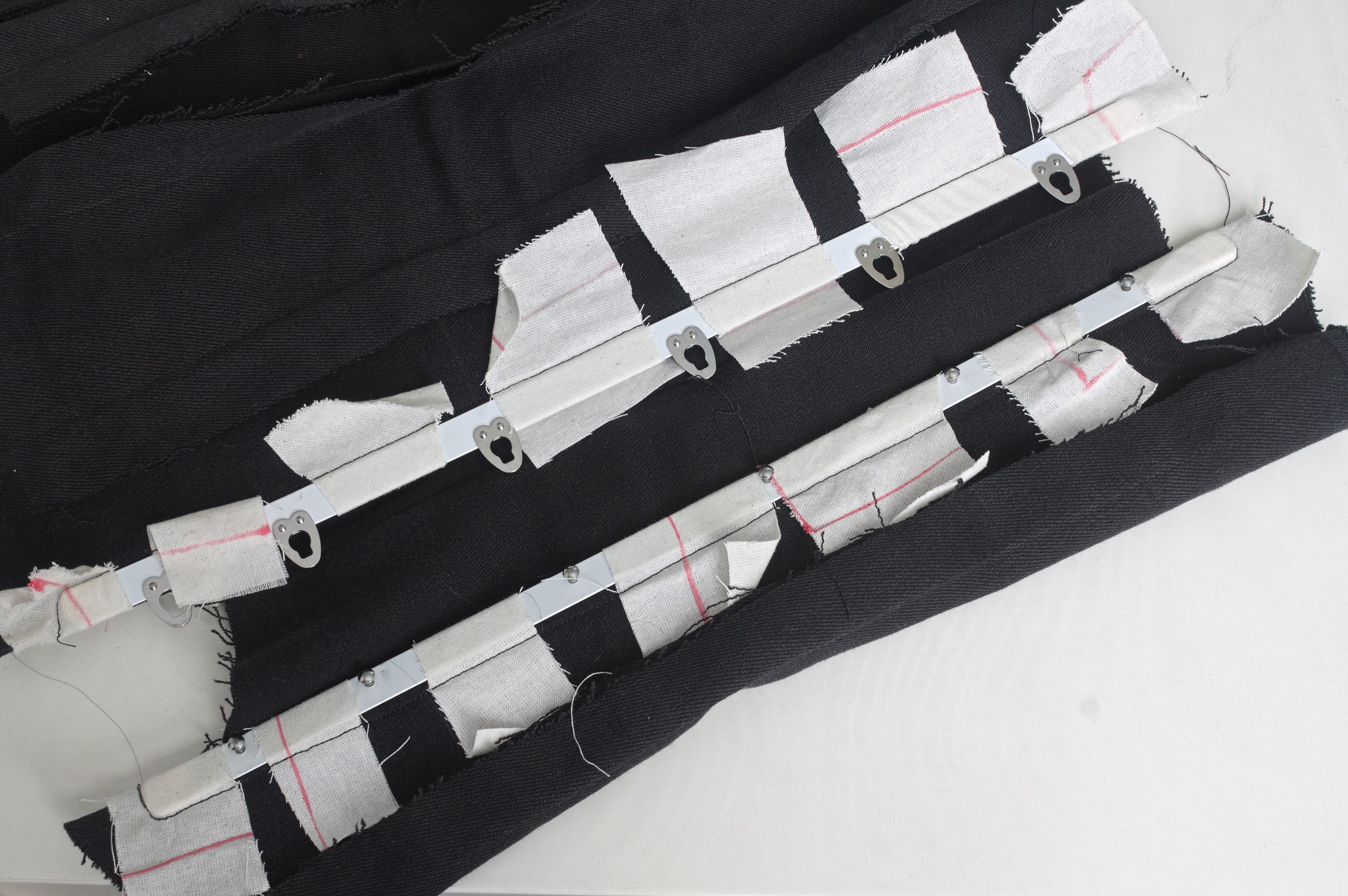 Luckily I also had a few longer busks, I basted one to the denim mock up
and tried to wear it for a few hours, to see if it was too long to be
comfortable. It was just a bit, on the bottom, which could be easily
fixed with the Power Tools
 I could have been a bit more precise with the binding, as it doesn t
align precisely at the front edge, but then again, it s underwear,
nobody other than me and everybody who reads this post is going to see
it and I was in a hurry to see it finished. I will be more careful with
the next one.
 I also think that I haven t been careful enough when pressing the seams
and applying the tape, and I ve lost about a cm of width per part, so
I m using a lacing gap that is a bit wider than I planned for, but that
may change as the corset gets worn, and is still within tolerance.
Also, on the morning after I had finished the corset I woke up and
realized that I had forgotten to add garter tabs at the bottom edge.
I don t know whether I will ever use them, but I wanted the option, so
maybe I ll try to add them later on, especially if I can do it without
undoing the binding.
The next step would have been flossing, which I proceeded to postpone
until I ve worn the corset for a while: not because there is any reason
for it, but because I still don t know how I want to do it :)
What was left was finishing and uploading the


 Now copy the ISO image to the newly created instance and extract
its data:
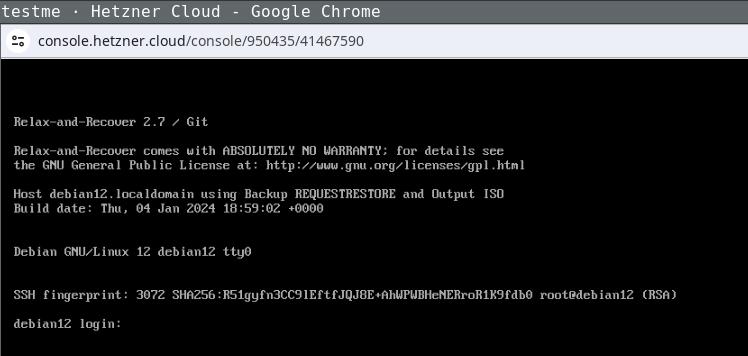 Login the recovery console (root without password) and fix its default route to
make it reachable:
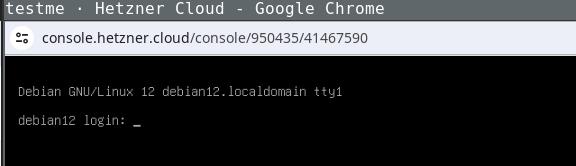 Being able to use this procedure for complete disaster recovery within Hetzner
cloud VPS (using off-site backups) gives me a better feeling, too.
 For the purposes of what I m trying to fix, there are two paths that matter.
 Libraries are collections of code that are intended to be usable by multiple consumers (if you're interested in the etymology, watch
 Today, the animation figure Mickey Mouse finally was released from
the corporate copyright prison, as the 1928 movie