Scarlett Gately Moore: KDE Snap updates, Kubuntu Beta testing, Life updates!

 We are pleased to announce that Viridien
has committed to sponsor DebConf25 as a
Platinum Sponsor.
Viridien is an advanced technology, digital
and Earth data company that pushes the boundaries of science for a more
prosperous and sustainable future.
Viridien has been using Debian-based systems to power most of its HPC
infrastructure and its cloud platform since 2009 and currently employs two
active Debian Project Members.
As a Platinum Sponsor, Viridien is contributing to the Debian annual
Developers' conference, directly supporting the progress of Debian and Free
Software. Viridien contributes to strengthen the community that collaborates
on the Debian project from all around the world throughout all of the year.
Thank you very much, Viridien, for your support of DebConf25!
Become a sponsor too!
DebConf25 will take place from 14 to 20
July 2025 in Brest, France, and will be preceded by DebCamp, from 7 to 13
July 2025.
DebConf25 is accepting sponsors! Interested companies and organizations may
contact the DebConf team through
sponsors@debconf.org, and visit the DebConf25
website at
https://debconf25.debconf.org/sponsors /become-a-sponsor/.
 A new minor release 0.2.5 of our RcppRedis
package arrived on CRAN today.
RcppRedis
is one of several packages connecting R to the fabulous Redis in-memory datastructure store (and
much more). RcppRedis
does not pretend to be feature complete, but it may do some things
faster than the other interfaces, and also offers an optional coupling
with MessagePack binary
(de)serialization via RcppMsgPack. The
package has been deployed in production as a risk / monitoring tool on
a trading floor for several years. It also supports pub/sub
dissemination of streaming market data as per this
earlier example.
Given the changes around Redis, it is
worth stressing that the package works just as well with valkey and uses only hiredis which remains proper
open source.
This update is again somewhat mechanical as a few maintenance things
bubbled up in since the last release in the summer of 2023. As with
other packages, continuous integration was updated a few times as were
URLs and badges, and we update the use of our RApiSerialize.
And, just as we did today and yesterday with littler,
RQuantLib
and RDieHarder,
this addresses a nag from CRAN
about implicit
bash dependency in configure.ac
(which we fixed in January as for the other packages but are under
deadline now). Last but not least the newly-added extension of
forbidden symbols in static libraries revealed that yes indeed I had
forgotten to set -DNDEBUG when building the embedded hiredis in fallback mode and
I now also converted its four uses of sprintf to
snprintf so we are clean there too.
The detailed changes list follows.
Courtesy of my CRANberries, there is also a diffstat report for this this release. More information is on the RcppRedis page and at the repository and its issue tracker.Changes in version 0.2.5 (2025-03-26)
- The continuous integration setup was updated several times
- Badges and URLs in README.md have been updated
- An updated interface from RApiSerialize is now used, and a versioned dependency on version 0.1.4 or later has been added
- The DESCRIPTION file now uses Authors@R
- Two possible bashisms have been converted in
configure.ac- The (fallback if needed) build of
libhiredis.anow sets-DNDEBUG, four uses ofsprintfconverted tosnprintf
This post by Dirk Eddelbuettel originated on his Thinking inside the box blog. If you like this or other open-source work I do, you can sponsor me at GitHub.
An new version 0.2.7 of the random-number generator tester RDieHarder
(based on the DieHarder
suite developed / maintained by Robert Brown with contributions by David
Bauer and myself along with other contributors) is now on CRAN.
This release contains only internal maintenance changes: continuous
integration was updated as was a badge URL, and a bashism issue in
configure.ac was addressed (months ago) but as CRAN now sends NOTEs it triggered
this update (just like littler
and RQuantLib
yesterday).
Thanks to CRANberries, you
can also look at the most recent diff
to the previous release.
If you like this or other open-source work I do, you can now sponsor me at
GitHub.
This post by Dirk Eddelbuettel originated on his Thinking inside the box blog. Please report excessive re-aggregation in third-party for-profit settings.
A third release of the crc32c package
is now on CRAN. The package
bring the Google library
crc32c to R and offers
cyclical checksums with parity in hardware-accelerated form on (recent
enough) intel cpus as well as on arm64.
This release is one hundred percent maintenance. Brian Ripley reached
out as he already tests the (still very much unreleased)
cmake 4.0.0 release, currently at rc5. And that version is
now picky about minimum cmake version statements
in CMakeLists.txt. As we copied the upstream one here, with its setting
of the jurassic 3.1 version, our build conked out. A simple switch to
3.5..4.0, declaring a from .. to scheme with a minimally
supported version (here 3.5, released in 2016) up to a tested version
works. No other changes, really, besides an earlier helping hand from Jeroen concerning cross-compilation
support he needed or encountered (and that happened right after the
0.0.2 release).
The NEWS entry for this (as well the initial release) follows.
My CRANberries service provides a comparison to the previous release. The code is available via the GitHub repo, and of course also from its CRAN page and viaChanges in version 0.0.3 (2025-03-25)
- Support cross-compilation by setting CC and CXX in Makevars.in (Jeroen Ooms in #1)
- Support pre-release 4.0.0 of
cmakeby moving the minimum stated version from 3.1 to 3.5 per CRAN request, also sent PR upstream
install.packages("crc32c"). Comments
and suggestions are welcome at the GitHub repo.
This post by Dirk Eddelbuettel originated on his Thinking inside the box blog. If you like this or other open-source work I do, you can sponsor me at GitHub.
 The twentysecond release of littler as a
CRAN package
landed on CRAN just now, following in the now nineteen year history (!!)
as a (initially non-CRAN) package started by Jeff in 2006, and joined
by me a few weeks later.
littler
is the first command-line interface for R as it predates
Rscript. It allows for piping as well for shebang
scripting via #!, uses command-line arguments more
consistently and still starts
faster. It also always loaded the methods package which
Rscript only began to do in recent years.
littler
lives on Linux and Unix, has its difficulties on macOS due to
some-braindeadedness there (who ever thought case-insensitive
filesystems as a default were a good idea?) and simply does not exist on
Windows (yet the build system could be extended see RInside for
an existence proof, and volunteers are welcome!). See the FAQ
vignette on how to add it to your PATH. A few examples
are highlighted at the Github repo:, as well
as in the examples
vignette.
This release, the first is almost exactly one year, brings
enhancements to six scripts as well as three new ones. The new ones
crup.r offers CRan UPloads from the command-line,
deadliners.r lists CRAN package by CRAN deadline, and
wb.r uploads to win-builder (replacing an older shell
script of mine). Among the updated ones, kitten.r now
creates more complete DESCRIPTION files in the packages it makes, and
several scripts support additional options. A number of changes were
made to packaging as well, some of which were contributed by Jon and Michael which is of course
always greatly appreciated. The trigger for the release was, just like
for RQuantLib
earlier today, a CRAN nag
on bashisms half of which actually false here it was in a comment
only. Oh well.
The full change description follows.
My CRANberries service provides a comparison to the previous release. Full details for the littler release are provided as usual at the ChangeLog page, and also on the package docs website. The code is available via the GitHub repo, from tarballs and now of course also from its CRAN page and viaChanges in littler version 0.3.21 (2025-03-24)
- Changes in examples scripts
- Usage text for
ciw.ris improved, new options were added (Dirk)- The noble release is supported by
r2u.r(Dirk)- The
installRub.rscript has additional options (Dirk)- The
ttlt.rscript has a newload_packageargument (Dirk)- A new script
deadliners.rshowing CRAN packages 'under deadline' has been added, and then refined (Dirk)- The
kitten.rscript can now use whoami and argumentgithubuseron the different*kittenhelpers it calls (Dirk)- A new script
wb.rcan upload to win-builder (Dirk)- A new script
crup.rcan upload a CRAN submission (Dirk)- In
rcc.r, the return from rcmdcheck is now explicitly printed (Dirk)- In
r2u.rthedry-runoption is passed to the build command (Dirk)- Changes in package
- Regular updates to badges, continuous integration, DESCRIPTION and
configure.ac(Dirk)- Errant
osVersionreturn value are handled more robustly (Michael Chirico in #121)- The current run-time path is available via variable
LITTLER_SCRIPT_PATH(Jon Clayden in #122)- The cleanup script remove macOS debug symbols (Jon Clayden in #123)
install.packages("littler"). Binary packages are
available directly in Debian as
well as (in a day or two) Ubuntu binaries at
CRAN thanks to the tireless Michael Rutter. Comments and suggestions
are welcome at the GitHub repo.
This post by Dirk Eddelbuettel originated on his Thinking inside the box blog. If you like this or other open-source work I do, you can sponsor me at GitHub.
A new minor release 0.4.25 of RQuantLib
arrived on CRAN this morning,
and has just now been uploaded to Debian too.
QuantLib is a rather
comprehensice free/open-source library for quantitative
finance. RQuantLib
connects (some parts of) it to the R environment and language, and has
been part of CRAN for nearly
twenty-two years (!!) as it was one of the first packages I uploaded to
CRAN.
This release of RQuantLib
is tickled by a request to remove bashisms in shell scripts, or, as in
my case here, configure.ac where I used the non-portable
form of string comparison. That has of course been there for umpteen
years and not bitten anyone as the default shell for most is in fact
bash but the change has the right idea. And is of course
now mandatory affecting quite a few packages is I
tooted yesterday. It also contains an improvement to the macOS 14
build kindly contributed by Jeroen.
One more note, though: This may however be the last release I make with Windows support. CRAN now also checks for forbidden symbols (such asChanges in RQuantLib version 0.4.25 (2025-03-24)
- Support macOS 14 with a new compiler flag (Jeroen in #190)
- Correct two bashisms in
configure.ac
assert or
(s)printf or ) in static libraries, and this release
tickled one such warning from the Windows side (which only uses static
libraries). I have no desire to get involved in also maintaing QuantLib
(no R here) for Windows and may simply turn the package back to
OS_type: unix to avoid the hassle. To avoid that, it would
be fabulous if someone relying on RQuantLib on Windows could step up and
lend a hand looking after that library build.
Courtesy of my CRANberries, there
is also a diffstat
report for the this release. As always, more detailed information is
on the RQuantLib
page. Questions, comments etc should go to the rquantlib-devel mailing list.
Issue tickets can be filed at the GitHub repo.
If you like this or other open-source work I do, you can now sponsor me at
GitHub.
This post by Dirk Eddelbuettel originated on his Thinking inside the box blog. Please report excessive re-aggregation in third-party for-profit settings.

 Are you a student aspiring to participate in the Google Summer of Code 2025? Would you like to improve the continuous integration pipeline used at salsa.debian.org, the Debian GitLab instance, to help improve the quality of tens of thousands of software packages in Debian?
This summer 2025, I and Emmanuel Arias will be participating as mentors in the GSoC program. We are available to mentor students who propose and develop improvements to the Salsa CI pipeline, as we are members of the Debian team that maintains it.
A post by Santiago Ruano Rinc n in the GitLab blog explains what Salsa CI is and its short history since inception in 2018. At the time of the article in fall 2023 there were 9000+ source packages in Debian using Salsa CI. Now in 2025 there are over 27,000 source packages in Debian using it, and since summer 2024 some Ubuntu developers have started using it for enhanced quality assurance of packaging changes before uploading new package revisions to Ubuntu. Personally, I have been using Salsa CI since its inception, and contributing as a team member since 2019. See my blog post about GitLab CI for MariaDB in Debian for a description of an advanced and extensive use case.
Helping Salsa CI is a great way to make a global impact, as it will help avoid regressions and improve the quality of Debian packages. The benefits reach far beyond just Debian, as it will also help hundreds of Debian derivatives, such as Ubuntu, Linux Mint, Tails, Purism PureOS, Pop!_OS, Zorin OS, Raspberry Pi OS, a large portion of Docker containers, and even the Windows Subsystem for Linux.
 I am told, by friends who have spent time at Google, about the reason Google Reader finally disappeared. Apparently it had become a 20% Project for those who still cared about it internally, and there was some major change happening to one of it upstream dependencies that was either going to cause a significant amount of work rearchitecting Reader to cope, or create additional ongoing maintenance burden. It was no longer viable to support it as a side project, so it had to go. This was a consequence of an internal culture at Google where service owners are able to make changes that can break downstream users, and the downstream users are the ones who have to adapt.
My experience at Meta goes the other way. If you own a service or other dependency and you want to make a change that will break things for the users, it s on you to do the migration, or at the very least provide significant assistance to those who own the code. You don t just get to drop your new release and expect others to clean up; doing that tends to lead to changes being reverted. The culture flows the other way; if you break it, you fix it (nothing is someone else s problem).
There are pluses and minuses to both approaches. Users having to drive the changes to things they own stops them from blocking progress. Service/code owners having to drive the changes avoids the situation where a wildly used component drops a new release that causes a lot of high priority work for folk in order to adapt.
I started thinking about this in the context of Debian a while back, and a few incidents since have resulted in my feeling that we re closer to the Google model than the Meta model. Anyone can upload a new version of their package to unstable, and that might end up breaking all the users of it. It s not quite as extreme as rolling out a new service, because it s unstable that gets affected (the clue is in the name, I really wish more people would realise that), but it can still result in release critical bugs for lots other Debian contributors.
A good example of this are toolchain changes. Major updates to GCC and friends regularly result in FTBFS issues in lots of packages. Now in this instance the maintainer is usually diligent about a heads up before the default changes, but it s still a whole bunch of work for other maintainers to adapt (see the list of FTBFS bugs for GCC 15 for instance - these are important, but not serious yet). Worse is when a dependency changes and hasn t managed to catch everyone who might be affected, so by the time it s discovered it s release critical, because at least one package no longer builds in unstable.
Commercial organisations try to avoid this with a decent CI/CD setup that either vendors all dependencies, or tracks changes to them and tries rebuilds before allowing things to land. This is one of the instances where a monorepo can really shine; if everything you need is in there, it s easier to track the interconnections between different components. Debian doesn t have a CI/CD system that runs for every upload, allowing us to track exact causes of regressions. Instead we have Lucas, who does a tremendous job of running archive wide rebuilds to make sure we can still build everything. Unfortunately that means I am often unfairly grumpy at him; my heart sinks when I see a bug come in with his name attached, because it often means one of my packages has a new RC bug where I m going to have to figure out what changed elsewhere to cause it. However he s just (very usefully) surfacing an issue someone else created, rather than actually being the cause of the problem.
I don t know if I have a point to this post. I think it s probably that I wish folk in Free Software would try and be mindful of the incompatible changes they might introducing, and the toil they create for other volunteer developers, often not directly visible to the person making the change. The approach done by the Debian toolchain maintainers strikes me as a good balance; they do a bunch of work up front to try and flag all the places that might need to make changes, far enough in advance of the breaking change actually landing. However they don t then allow a tardy developer to block progress.
The following contributors got their Debian Developer accounts in the last two
months:
git-archive tarball. My solution to this was to make use of the export-subst feature of the .gitattributes file. I store the file .tarball-version-git in git containing the magic cookie like this:
$Format:%(describe)$git-archive will replace with a useful version identifier on export, see the libtasn1 patch to achieve this. To make use of this information, the git-version-gen script was enhanced to read this information, see the gnulib patch. This is invoked by ./configure to figure out which version number the package is for.
./bootstrap, however there are two problems with this. The first one is that there is no strong authentication or versioning information on this data, the tools just download and place whatever wget downloaded into your source tree (printf-style injection attack anyone?). We could improve this (e.g., publish GnuPG signed translations messages with clear versioning), however I did not work on that further. The reason is that I want to support offline builds of packages. Downloading random things from the Internet during builds does not work when building a Debian package, for example. The translation project could solve this by making a monthly tarball with their translations available, for distributors to pick up and provide as a separate package that could be used as a build dependency. However that is not how these tools and projects are designed. Instead I reverted back to storing translations in git, something that I did for most projects back when I was using CVS 20 years ago. Hooking this into ./bootstrap and gettext workflow can be tricky (ideas for improvement most welcome!), but I used a simple approach to store all directly downloaded po/*.po files directly as po/*.po.in and make the ./bootstrap tool move them in place, see the libidn2 commit followed by the actual make update-po commit with all the translations where one essential step is:
# Prime po/*.po from fall-back copy stored in git.
for poin in po/*.po.in; do
    po=$(echo $poin   sed 's/.in//')
    test -f $po   cp -v $poin $po
done
ls po/*.po sed 's .*/ ; s \.po$ ' > po/LINGUAS*.m4 macros from the GNU Autoconf Archive. However I m not confident that the solution for all vendor files must be the same. For translation files and for Autoconf Archive macros, I have decided to put these files into git and merge them manually occasionally. For gnulib files, in some projects like OATH Toolkit I also store all gnulib files in git which effectively resolve this concern. (Incidentally, the reason for doing so was originally that running ./bootstrap took forever since there is five gnulib instances used, which is no longer the case since gnulib-tool was rewritten in Python.) For most projects, however, I rely on ./bootstrap to fetch a gnulib git clone when building. I like this model, however it doesn t work offline. One way to resolve this is to make the gnulib git repository available for offline use, and I ve made some effort to make this happen via a Gnulib Git Bundle and have explained how to implement this approach for Debian packaging. I don t think that is sufficient as a generic solution though, it is mostly applicable to building old releases that uses old gnulib files. It won t work when building from CI/CD pipelines, for example, where I have settled to use a crude way of fetching and unpacking a particular gnulib snapshot, see this Libntlm patch. This is much faster than working with git submodules and cloning gnulib during ./bootstrap. Essentially this is doing:
GNULIB_REVISION=$(. bootstrap.conf >&2; echo $GNULIB_REVISION)
wget -nv https://gitlab.com/libidn/gnulib-mirror/-/archive/$GNULIB_REVISION/gnulib-mirror-$GNULIB_REVISION.tar.gz
gzip -cd gnulib-mirror-$GNULIB_REVISION.tar.gz   tar xf -
rm -fv gnulib-mirror-$GNULIB_REVISION.tar.gz
export GNULIB_SRCDIR=$PWD/gnulib-mirror-$GNULIB_REVISION
./bootstrap --no-git
./configure
makegit-archive style tarball works, you are likely to regress at some point. Use CI/CD techniques to continuously test that a minimal git-archive tarball leads to a usable build.
git-archive tarball and users should be able to build your project from it.
I recommend naming these archives as PROJECT-vX.Y.Z-src.tar.gz replacing PROJECT with your project name and X.Y.Z with your version number. The archive should have only one sub-directory named PROJECT-vX.Y.Z/ containing all the source-code files. This differentiate it against traditional PROJECT-X.Y.Z.tar.gz tarballs in that it embeds the git tag (which typically starts with v) and contains a wildcard-friendly -src substring. Alas there is no consistency around this naming pattern, and GitLab, GitHub, Codeberg etc all seem to use their own slightly incompatible variant.
Let s go on to see what is needed to achieve reproducible make dist source tarballs. This is the release artifact that most users use, and they often contain lots of generated files and vendor files. These files are included to make it easy to build for the user. What are the challenges to make these reproducible?
*.po translation files and Texinfo manuals. For translation files, I have resolved this by making sure the files use a predictable POT-Creation-Date timestamp, and I set it to the modification timestamps of the NEWS file in the repository (which I set to the git commit of the latest commit elsewhere) like this:
dist-hook: po-CreationDate-to-mtime-NEWS
.PHONY: po-CreationDate-to-mtime-NEWS
po-CreationDate-to-mtime-NEWS: mtime-NEWS-to-git-HEAD
  $(AM_V_GEN)for p in $(distdir)/po/*.po $(distdir)/po/$(PACKAGE).pot; do \
    if test -f "$$p"; then \
      $(SED) -e 's,POT-Creation-Date: .*\\n",POT-Creation-Date: '"$$(env LC_ALL=C TZ=UTC0 stat --format=%y $(srcdir)/NEWS   cut -c1-16,31-)"'\\n",' < $$p > $$p.tmp && \
      if cmp $$p $$p.tmp > /dev/null; then \
        rm -f $$p.tmp; \
      else \
        mv $$p.tmp $$p; \
      fi \
    fi \
donedist-hook: mtime-NEWS-to-git-HEAD
.PHONY: mtime-NEWS-to-git-HEAD
mtime-NEWS-to-git-HEAD:
$(AM_V_GEN)if test -e $(srcdir)/.git \
&& command -v git > /dev/null; then \
touch -m -t "$$(git log -1 --format=%cd \
--date=format-local:%Y%m%d%H%M.%S)" $(srcdir)/NEWS; \
fi./configure time, because the doc/version.texi file is generated on first build before running make dist and for some reason the file is not rebuilt at release time. The Automake texinfo integration is a bit inflexible about providing hooks to extend the dependency tracking.
The method to address these differences isn t really important, and they change over time depending on preferences. What is important is that the differences are eliminated.
make dist source archives from a minimal git-archive source archive. However for other projects I ve settled with a middle ground. I realized that for git describe to produce reproducible outputs, the shallow clone needs to include the last release tag. So it felt acceptable to assume that the clone is not minimal, but instead has some but not all of the history. I settled with the following recipe to produce ChangeLog's covering all changes since the last release.
dist-hook: gen-ChangeLog
.PHONY: gen-ChangeLog
gen-ChangeLog:
  $(AM_V_GEN)if test -e $(srcdir)/.git; then			\
    LC_ALL=en_US.UTF-8 TZ=UTC0					\
    $(top_srcdir)/build-aux/gitlog-to-changelog			\
       --srcdir=$(srcdir) --					\
       v$(PREV_VERSION)~.. > $(distdir)/cl-t &&			\
         printf '\n\nSee the source repo for older entries\n'	\
         >> $(distdir)/cl-t &&					\
         rm -f $(distdir)/ChangeLog &&				\
         mv $(distdir)/cl-t $(distdir)/ChangeLog;  		\
fiChangeLog files within make dist archives. Before we have stable and secure archival of git repositories widely implemented, I can see some utility of this in case we lose all copies of the upstream git repositories. I can sympathize with the concept of ChangeLog files died when we started to generate them from git logs: the files no longer serve any purpose, and we can ask people to go look at the git log instead of reading these generated non-source files.
guix gime-machine) that have bootstrappable properties for additional confidence. However I had two difficult problems here. The first one was that I needed Guix container images that were usable in GitLab CI/CD Pipelines, and this side-tracked me for a while. The second one delayed my effort for many months, and I was inclined to give up. Libidn distribute a C# implementation. Some of the C# source code files included in the release tarball are generated. By what? You guess it, by a C# program, with the source code included in the distribution. This means nobody could reproduce the source tarball of Libidn without trusting someone elses C# compiler binaries, which were built from binaries of earlier releases, chaining back into something that nobody ever attempts to build any more and likely fail to build due to bit-rot. I had two basic choices, either remove the C# implementation from Libidn (which may be a good idea for other reasons, since the C and C# are unrelated implementations) or build the source tarball on some binary-only distribution like Trisquel. Neither felt appealing to me, but a late christmas gift of a reproducible Mono came to Guix that resolve this.
grep to remove some timestamps, however with compression this is no longer possible and actually the grep command I used resulted in a 0-byte output file. So my embedded binaries in git was no longer reproducible. I first set out to fix this by post-processing things properly, however I then realized that the *.fig file is not really easy to work with in a modern world. I wanted to create an image from some text-file description of the image. Eventually, via the Guix manual on guix graph, I came to re-discover the graphviz language and tool called dot (hello 1993!). All well then? Oh no, the PDF output embeds timestamps. Binary editing of PDF s no longer work through simple grep, remember? I was back where I started, and after some (soul- and web-) searching I discovered that Ghostscript (hello 1988!) pdfmarks could be used to modify things here. Cooperating with automake s texinfo rules related to make dist proved once again a worthy challenge, and eventually I ended up with a Makefile.am snippet to build images that could be condensed into:
info_TEXINFOS = libidn.texi
libidn_TEXINFOS += libidn-components.png
imagesdir = $(infodir)
images_DATA = libidn-components.png
EXTRA_DIST += components.dot
DISTCLEANFILES = \
  libidn-components.eps libidn-components.png libidn-components.pdf
libidn-components.eps: $(srcdir)/components.dot
  $(AM_V_GEN)$(DOT) -Nfontsize=9 -Teps < $< > $@.tmp
  $(AM_V_at)! grep %%CreationDate $@.tmp
  $(AM_V_at)mv $@.tmp $@
libidn-components.pdf: $(srcdir)/components.dot
  $(AM_V_GEN)$(DOT) -Nfontsize=9 -Tpdf < $< > $@.tmp
# A simple sed on CreationDate is no longer possible due to compression.
# 'exiftool -CreateDate' is alternative to 'gs', but adds ~4kb to file.
# Ghostscript add <1kb.  Why can't 'dot' avoid setting CreationDate?
  $(AM_V_at)printf '[ /ModDate ()\n  /CreationDate ()\n  /DOCINFO pdfmark\n' > pdfmarks
  $(AM_V_at)$(GS) -q -dBATCH -dNOPAUSE -sDEVICE=pdfwrite -sOutputFile=$@.tmp2 $@.tmp pdfmarks
  $(AM_V_at)rm -f $@.tmp pdfmarks
  $(AM_V_at)mv $@.tmp2 $@
libidn-components.png: $(srcdir)/components.dot
  $(AM_V_GEN)$(DOT) -Nfontsize=9 -Tpng < $< > $@.tmp
  $(AM_V_at)mv $@.tmp $@
pdf-recursive: libidn-components.pdf
dvi-recursive: libidn-components.eps
ps-recursive: libidn-components.eps
info-recursive: $(top_srcdir)/.version libidn-components.pngexiftool -CreateDate as an alternative to GhostScript, but using it to remove the timestamp added ~4kb to the file size and naturally I was appalled by this ignorance of impending doom.
0-compare:
  image: alpine:latest
  stage: repro
  needs: [ B-AlmaLinux8, B-AlmaLinux9, B-RockyLinux8, B-RockyLinux9, B-Trisquel11, B-Ubuntu2204, B-PureOS10, B-Debian11, B-Devuan5, B-Debian12, B-gcc, B-clang, B-Guix, R-Guix, R-Debian12, R-Ubuntu2404, S-Trisquel10, S-Ubuntu2004 ]
  script:
  - cd out
  - sha256sum */*.tar.* */*/*.tar.*   sort   grep    -- -src.tar.
  - sha256sum */*.tar.* */*/*.tar.*   sort   grep -v -- -src.tar.
  - sha256sum */*.tar.* */*/*.tar.*   sort   uniq -c -w64   sort -rn
  - sha256sum */*.tar.* */*/*.tar.*   grep    -- -src.tar.   sort   uniq -c -w64   grep -v '^      1 '
  - sha256sum */*.tar.* */*/*.tar.*   grep -v -- -src.tar.   sort   uniq -c -w64   grep -v '^      1 '
# Confirm modern git-archive tarball reproducibility
  - cmp b-almalinux8/src/*.tar.gz b-almalinux9/src/*.tar.gz
  - cmp b-almalinux8/src/*.tar.gz b-rockylinux8/src/*.tar.gz
  - cmp b-almalinux8/src/*.tar.gz b-rockylinux9/src/*.tar.gz
  - cmp b-almalinux8/src/*.tar.gz b-debian12/src/*.tar.gz
  - cmp b-almalinux8/src/*.tar.gz b-devuan5/src/*.tar.gz
  - cmp b-almalinux8/src/*.tar.gz r-guix/src/*.tar.gz
  - cmp b-almalinux8/src/*.tar.gz r-debian12/src/*.tar.gz
  - cmp b-almalinux8/src/*.tar.gz r-ubuntu2404/src/*v2.*.tar.gz
# Confirm old git-archive (export-subst but long git describe) tarball reproducibility
  - cmp b-trisquel11/src/*.tar.gz b-ubuntu2204/src/*.tar.gz
# Confirm really old git-archive (no export-subst) tarball reproducibility
  - cmp b-debian11/src/*.tar.gz b-pureos10/src/*.tar.gz
# Confirm 'make dist' generated tarball reproducibility
  - cmp b-almalinux8/*.tar.gz b-rockylinux8/*.tar.gz
  - cmp b-almalinux9/*.tar.gz b-rockylinux9/*.tar.gz
  - cmp b-pureos10/*.tar.gz b-debian11/*.tar.gz
  - cmp b-devuan5/*.tar.gz b-debian12/*.tar.gz
  - cmp b-trisquel11/*.tar.gz b-ubuntu2204/*.tar.gz
  - cmp b-guix/*.tar.gz r-guix/*.tar.gz
# Confirm 'make dist' from git-archive tarball reproducibility
- cmp s-trisquel10/*.tar.gz s-ubuntu2004/*.tar.gz$ sha256sum */*.tar.* */*/*.tar.* sort grep -v -- -src.tar.
368488b6cc8697a0a937b9eb307a014396dd17d3feba3881e6911d549732a293 b-trisquel11/libidn2-2.3.8.tar.gz
368488b6cc8697a0a937b9eb307a014396dd17d3feba3881e6911d549732a293 b-ubuntu2204/libidn2-2.3.8.tar.gz
59db2d045fdc5639c98592d236403daa24d33d7c8db0986686b2a3056dfe0ded b-debian11/libidn2-2.3.8.tar.gz
59db2d045fdc5639c98592d236403daa24d33d7c8db0986686b2a3056dfe0ded b-pureos10/libidn2-2.3.8.tar.gz
5bd521d5ecd75f4b0ab0fc6d95d444944ef44a84cad859c9fb01363d3ce48bb8 s-trisquel10/libidn2-2.3.8.tar.gz
5bd521d5ecd75f4b0ab0fc6d95d444944ef44a84cad859c9fb01363d3ce48bb8 s-ubuntu2004/libidn2-2.3.8.tar.gz
7f1dcdea3772a34b7a9f22d6ae6361cdcbe5513e3b6485d40100b8565c9b961a b-almalinux8/libidn2-2.3.8.tar.gz
7f1dcdea3772a34b7a9f22d6ae6361cdcbe5513e3b6485d40100b8565c9b961a b-rockylinux8/libidn2-2.3.8.tar.gz
8031278157ce43b5813f36cf8dd6baf0d9a7f88324ced796765dcd5cd96ccc06 b-clang/libidn2-2.3.8.tar.gz
8031278157ce43b5813f36cf8dd6baf0d9a7f88324ced796765dcd5cd96ccc06 b-debian12/libidn2-2.3.8.tar.gz
8031278157ce43b5813f36cf8dd6baf0d9a7f88324ced796765dcd5cd96ccc06 b-devuan5/libidn2-2.3.8.tar.gz
8031278157ce43b5813f36cf8dd6baf0d9a7f88324ced796765dcd5cd96ccc06 b-gcc/libidn2-2.3.8.tar.gz
8031278157ce43b5813f36cf8dd6baf0d9a7f88324ced796765dcd5cd96ccc06 r-debian12/libidn2-2.3.8.tar.gz
acf5cbb295e0693e4394a56c71600421059f9c9bf45ccf8a7e305c995630b32b r-ubuntu2404/libidn2-2.3.8.tar.gz
cbdb75c38100e9267670b916f41878b6dbc35f9c6cbe60d50f458b40df64fcf1 b-almalinux9/libidn2-2.3.8.tar.gz
cbdb75c38100e9267670b916f41878b6dbc35f9c6cbe60d50f458b40df64fcf1 b-rockylinux9/libidn2-2.3.8.tar.gz
f557911bf6171621e1f72ff35f5b1825bb35b52ed45325dcdee931e5d3c0787a b-guix/libidn2-2.3.8.tar.gz
f557911bf6171621e1f72ff35f5b1825bb35b52ed45325dcdee931e5d3c0787a r-guix/libidn2-2.3.8.tar.gzTZ=UTC0 helps) related to these goals, but my hope is that this discussion of solutions will inspire you to implement these concepts for your software project too. Please share your thoughts and additional insights in a comment below. Enjoy Happy Hacking in the course of practicing this!
.gitlab-ci.yml file no longer works in GitLab CI:
build-container-image:
  stage: build
  image: debian:testing
  before_script:
    - apt-get update
    - apt-get install -y buildah ca-certificates
  script:
    - buildah build -t $CI_REGISTRY_IMAGE .
buildah build ... fails with this error message:
STEP 2/3: RUN  apt-get update
internal:0:0-0: Error: Could not process rule: No such file or directory
internal:0:0-0: Error: Could not process rule: No such file or directory
error running container: did not get container start message from parent: EOF
Error: building at STEP "RUN apt-get update": setup network: netavark: nftables error: nft did not return successfully while applying ruleset
NETAVARK_FW. The .gitlab-ci.yml file
above becomes:
build-container-image:
  stage: build
  image: debian:testing
  variables:
    # Cf. https://discussion.fedoraproject.org/t/125528/7
    NETAVARK_FW: iptables
  before_script:
    - apt-get update
    - apt-get install -y buildah ca-certificates
  script:
    - buildah build -t $CI_REGISTRY_IMAGE .
 A new release 0.1.7 of RcppZiggurat
is now on the CRAN network for
R. This marks the first release
in four and a half years.
The RcppZiggurat
package updates the code for the Ziggurat
generator by Marsaglia and
others which provides very fast draws from a Normal distribution. The
package provides a simple C++ wrapper class for the generator improving
on the very basic macros, and permits comparison among several existing
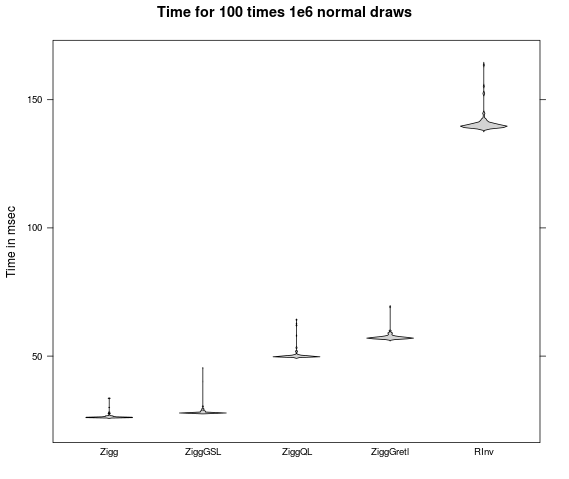
Ziggurat implementations. This can be seen in the figure where Ziggurat
from this package dominates accessing the implementations from the GSL, QuantLib and Gretl all of which are still
way faster than the default Normal generator in R (which is of course of
higher code complexity).
This release brings a number of changes. Notably, based on the work
we did with the new package zigg (more on
that in a second), we now also expose the Exponential generator, and the
underlying Uniform generator. Otherwise many aspects of the package have
been refreshed: updated builds, updated links, updated CI processes,
more use of DOIs and more. The other big news is zigg which
should now be the preference for deployment of Ziggurat due
to its much lighter-weight and zero-dependency setup.
The
NEWS file entry below lists all changes.
Courtesy of my CRANberries, there is a diffstat report relative to previous release. More detailed information is on the Rcppziggurat page or the GitHub repository.Changes in version 0.1.7 (2025-03-22)
- The CI setup was updated to use
run.shfrom r-ci (Dirk).- The windows build was updated to GSL 2.7, and UCRT support was added (Jeroen in #16).
- Manual pages now use JSS DOIs for references per CRAN request
- README.md links and badges have been updated
- Continuous integration actions have been updated several times
- The DESCRIPTION file now uses Authors@R as mandated
- Use of multiple cores is eased via a new helper function reflecting option
mc.coreor architecture defaults, used in tests- An inline function has been added to avoid a compiler nag
- Support for exponential RNG draws
zrexphas been added, the internal uniform generator is now also exposed viazruni- The vignette bibliography has been updated, and switched to DOIs
- New package zigg is now mentioned in DESCRIPTION and vignette
This post by Dirk Eddelbuettel originated on his Thinking inside the box blog. If you like this or other open-source work I do, you can sponsor me at GitHub.
 The Open Source Initiative has two classes of board seats: Affiliate seats, and Individual Member seats. In the upcoming election, each affiliate can nominate a candidate, and each affiliate can cast a vote for the Affiliate candidates, but there's only 1 Affiliate seat available. I initially expressed interest in being nominated as an Affiliate candidate via Debian. But since Bradley Kuhn is also running for an Affiliate seat with a similar platform to me, especially with regards to the OSAID, I decided to run as part of an aligned "ticket" as an Individual Member to avoid contention for the 1 Affiliate seat.Bradley and I discussed running on a similar ticket around 8/9pm Pacific, and I submitted my candidacy around 9pm PT on 17 February. I was dismayed when I received the following mail from Nick Vidal:
Dear Luke,Nowhere on the "OSI s board of directors in 2025: details about the elections" page do they list a timezone for closure of nominations; they simply list Monday 17 February. The OSI's contact address is in California, so it seems arbitrary and capricious to retroactively define all of these processes as being governed by UTC.I was not able to participate in the "potential board director" info sessions accordingly, but people who attended heard that the importance of accommodating differing TZ's was discussed during the info session, and that OSI representatives mentioned they try to accommodate TZ's of everyone. This seems in sharp contrast with the above policy. I urge the OSI to reconsider this policy and allow me to stand for an Individual seat in the current cycle. Upd, N.B.: to people writing about this, I use they/them pronouns
Thank you for your interest in the OSI Board of Directors election. Unfortunately, we are unable to accept your application as it was submitted after the official deadline of Monday Feb 17 at 11:59 pm UTC. To ensure a fair process, we must adhere to the deadline for all candidates.
We appreciate your enthusiasm and encourage you to stay engaged with OSI s mission. We hope you ll consider applying in the future or contributing in other meaningful ways.
Best regards,
OSI Election Teams
puppet apply).
Thankfully, my colleague groente did amazing work to refactor our
Postfix configuration in Puppet at Tor, and that gave me the
motivation to reproduce the setup in the lab. So I have finally
Puppetized part of my mail setup at home. That used to be hand-crafted
experimental stuff documented in a couple of pages in this wiki, but
is now being deployed by Puppet.
It's not complete yet: spam filtering (including DKIM checks and
graylisting) are not implemented yet, but that's the next step,
presumably to do during the next outage. The setup should be
deployable with puppet apply, however, and I have refined that
mechanism a little bit, with the run script.
Heck, it's not even deployed yet. But the hard part / grunt work is
done.
290. This version includes the following changes:
[ Chris Lamb ]
* Also consider .aar files as APK files for the sake of not falling back to a
  binary diff. (Closes: #1099632)
* Ensure all calls to out_check_output in the ELF comparator have the
  potential CalledProcessError exception caught. (Re: #398)
* Ensure a potential CalledProcessError is caught in the OpenSSL comparator
  as well.
* Update copyright years.
[ Eli Schwartz ]
* Drop deprecated and no longer functional "setup.py test" command.
291. This version includes the following changes:
[ Chris Lamb ]
* Make two required adjustments for the new version of the src:file package:
  - file(1) version 5.46 now emits "XHTML document" for .xhtml files, such as
    those found nested within our .epub tests. Therefore, match this string
    when detecting XML files. This was causing an FTBFS due to inconsistent
    indentation in diffoscope's output.
  - Require the new, upcoming, version of file(1) for a quine-related
    testcase after adjusting the expected output. Previous versions of
    file(1) had a duplicated "last modified, last modified" string for some
    Zip archives that has now been removed.
* Add a missing subprocess import.
* Bump Standards-Version to 4.7.2.
 dmidecode grep -A8 ^System Information
tells me that the Manufacturer is HP and Product Name is OMEN Transcend Gaming Laptop 14-fb0xxx
I m provisioning a new piece of hardware for my eng consultant and it s proving more difficult than I expected. I must admit guilt for some of this difficulty. Instead of installing using the debian installer on my keychain, I dd d the pv block device of the 16 inch 2023 version onto the partition set aside from it. I then rebooted into rescue mode and cleaned up the grub config, corrected the EFI boot partition s path in /etc/fstab, ran the grub installer from the rescue menu, and rebooted.
On the initial boot of the system, X or Wayland or whatever is supposed to be talking to this vast array of GPU hardware in this device, it s unable to do more than create a black screen on vt1. It s easy enough to switch to vt2 and get a shell on the installed system. So I m doing that and investigating what s changed in Trixie. It seems like it s pretty significant. Did they just throw out Keith Packard s and Behdad Esfahbod s work on font rendering? I don t understand what s happening in this effort to abstract to a simpler interface. I ll probably end up reading more about it.
In an effort to have Debian re-configure the system for Desktop use, I have uninstalled as many packages as I could find that were in the display and human interface category, or were firmware/drivers for devices not present in this Laptop s SoC. Some commands I used to clear these packages and re-install connamon follow:
dpkg -S /etc/X11
dpkg -S /usr/lib/firmware
apt-get purge $(dpkg -l   grep -i \
  -e gnome -e gtk -e x11-common -e xfonts- -e libvdpau -e dbus-user-session -e gpg-agent \
  -e bluez -e colord -e cups -e fonts -e drm -e xf86 -e mesa -e nouveau -e cinnamon \
  -e avahi -e gdk -e pixel -e desktop -e libreoffice -e x11 -e wayland -e xorg \
  -e firmware-nvidia-graphics -e firmware-amd-graphics -e firmware-mediatek -e firmware-realtek \
    awk ' print $2 ')
apt-get autoremove
apt-get purge $(dpkg -l   grep '^r'   awk ' print $2 ')
tasksel install cinnamon-desktop
And then I rebooted. When it came back up, I was greeted with a login prompt, and Trixie looks to be fully functional on this device, including the attached wifi radio, tethering to my android, and the thunderbolt-attached Marvell SFP+ enclosure.
I m also installing libvirt and fetched the DVD iso material for Debian, Ubuntu and Rocky in case we have a need of building VMs during the development process. These are the platforms that I target at work with gcp Dataproc, so I m pretty good at performing maintenance operation on them at this point.
Next.