Search Results: "edd"

5 January 2016

Benjamin Mako Hill: Celebrate Aaron Swartz in Seattle (or Atlanta, Chicago, Dallas, NYC, SF)

I m organizing an event at the University of Washington in Seattle that involves a reading, the screening of a documentary film, and a Q&A about Aaron Swartz. The event coincides with the third anniversary of Aaron s death and the release of a new book of Swartz s writing that I contributed to. aaronsw-tiob_bwcstw The event is free and open the public and details are below:

WHEN: Wednesday, January 13 at 6:30-9:30 p.m.

WHERE: Communications Building (CMU) 120, University of Washington

We invite you to celebrate the life and activism efforts of Aaron Swartz, hosted by UW Communication professor Benjamin Mako Hill. The event is next week and will consist of a short book reading, a screening of a documentary about Aaron s life, and a Q&A with Mako who knew Aaron well details are below. No RSVP required; we hope you can join us.

Aaron Swartz was a programming prodigy, entrepreneur, and information activist who contributed to the core Internet protocol RSS and co-founded Reddit, among other groundbreaking work. However, it was his efforts in social justice and political organizing combined with his aggressive approach to promoting increased access to information that entangled him in a two-year legal nightmare that ended with the taking of his own life at the age of 26.

January 11, 2016 marks the third anniversary of his death. Join us two days later for a reading from a new posthumous collection of Swartz s writing published by New Press, a showing of The Internet s Own Boy (a documentary about his life), and a Q&A with UW Communication professor Benjamin Mako Hill a former roommate and friend of Swartz and a contributor to and co-editor of the first section of the new book. If you re not in Seattle, there are events with similar programs being organized in Atlanta, Chicago, Dallas, New York, and San Francisco. All of these other events will be on Monday January 11 and registration is required for all of them. I will be speaking at the event in San Francisco.

3 January 2016

Lunar: Reproducible builds: week 35 in Stretch cycle

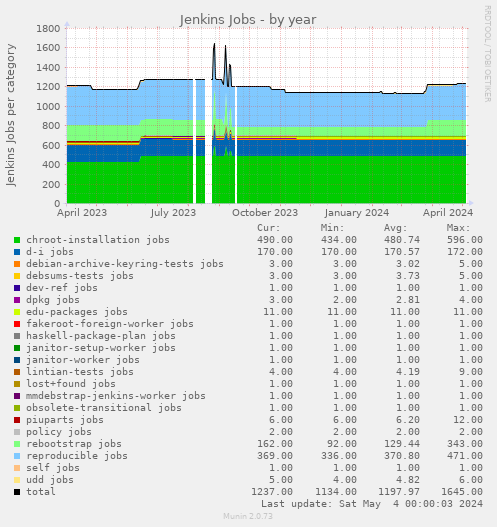
What happened in the reproducible builds effort between December 20th to December 26th: Toolchain fixes Mattia Rizzolo rebased our experimental versions of debhelper (twice!) and dpkg on top of the latest releases. Reiner Herrmann submited a patch for mozilla-devscripts to sort the file list in generated preferences.js files. To be able to lift the restriction that packages must be built in the same path, translation support for the __FILE__ C pre-processor macro would also be required. Joerg Sonnenberger submitted a patch back in 2010 that would still be useful today. Chris Lamb started work on providing a deterministic mode for debootstrap. Packages fixed The following packages have become reproducible due to changes in their build dependencies: bouncycastle, cairo-dock-plug-ins, darktable, gshare, libgpod, pafy, ruby-redis-namespace, ruby-rouge, sparkleshare. The following packages became reproducible after getting fixed: Some uploads fixed some reproducibility issues, but not all of them: Patches submitted which have not made their way to the archive yet: reproducible.debian.net Statistics for package sets are now visible for the armhf architecture. (h01ger) The second build now has a longer timeout (18 hours) than the first build (12 hours). This should prevent wasting resources when a machine is loaded. (h01ger) Builds of Arch Linux packages are now done using a tmpfs. (h01ger) 200 GiB have been added to jenkins.debian.net (thanks to ProfitBricks!) to make room for new jobs. The current count is at 962 and growing! diffoscope development Aside from some minor bugs that have been fixed, a one-line change made huge memory (and time) savings as the output of transformation tool is now streamed line by line instead of loaded entirely in memory at once. disorderfs development Andrew Ayer released disorderfs version 0.4.2-1 on December 22th. It fixes a memory corruption error when processing command line arguments that could cause command line options to be ignored. Documentation update Many small improvements for the documentation on reproducible-builds.org sent by Georg Koppen were merged. Package reviews 666 (!) reviews have been removed, 189 added and 162 updated in the previous week. 151 new fail to build from source reports have been made by Chris West, Chris Lamb, Mattia Rizzolo, and Niko Tyni. New issues identified: unsorted_filelist_in_xul_ext_preferences, nondeterminstic_output_generated_by_moarvm. Misc. Steven Chamberlain drew our attention to one analysis of the Juniper ScreenOS Authentication Backdoor: Whilst this may have been added in source code, it was well-disguised in the disassembly and just 7 instructions long. I thought this was a good example of the current state-of-the-art, and why we'd like our binaries and eventually, installer and VM images reproducible IMHO. Joanna Rutkowska has mentioned possible ways for Qubes to become reproducible on their development mailing-list.

2 January 2016

Daniel Pocock: The great life of Ian Murdock and police brutality in context

Tributes: (You can Follow or Tweet about this blog on Twitter) Over the last week, people have been saying a lot about the wonderful life of Ian Murdock and his contributions to Debian and the world of free software. According to one news site, a San Francisco police officer, Grace Gatpandan, has been doing the opposite, starting a PR spin operation, leaking snippets of information about what may have happened during Ian's final 24 hours. Sadly, these things are now starting to be regurgitated without proper scrutiny by the mainstream press (note the erroneous reference to SFGate with link to SFBay.ca, this is British tabloid media at its best). The report talks about somebody (no suggestion that it was even Ian) "trying to break into a residence". Let's translate that from the spin-doctor-speak back to English: it is the silly season, when many people have a couple of extra drinks and do silly things like losing their keys. "a residence", or just their own home perhaps? Maybe some AirBNB guest arriving late to the irritation of annoyed neighbours? Doesn't the choice of words make the motive sound so much more sinister? Nobody knows the full story and nobody knows if this was Ian, so snippets of information like this are inappropriate, especially when somebody is deceased. Did they really mean to leave people with the impression that one of the greatest visionaries of the Linux world was also a cat burglar? That somebody who spent his life giving selflessly and generously for the benefit of the whole world (his legacy is far greater than Steve Jobs, as Debian comes with no strings attached) spends the Christmas weekend taking things from other people's houses in the dark of the night? The report doesn't mention any evidence of a break-in or any charges for breaking-in. If having a few drinks and losing your keys in December is such a sorry state to be in, many of us could potentially be framed in the same terms at some point in our lives. That is one of the reasons I feel so compelled to write this: somebody else could be going through exactly the same experience at the moment you are reading this. Any of us could end up facing an assault as unpleasant as the tweets imply at some point in the future. At least I can console myself that as a privileged white male, the risk to myself is much lower than for those with mental illness, the homeless, transgender, Muslim or black people but as the tweets suggest, it could be any of us. The story reports that officers didn't actually come across Ian breaking in to anything, they encountered him at a nearby street corner. If he had weapons or drugs or he was known to police that would have almost certainly been emphasized. Is it right to rush in and deprive somebody of their liberties without first giving them an opportunity to identify themselves and possibly confirm if they had a reason to be there? The report goes on, "he was belligerent", "he became violent", "banging his head" all by himself. How often do you see intelligent and successful people like Ian Murdock spontaneously harming themselves in that way? Can you find anything like that in any of the 4,390 Ian Murdock videos on YouTube? How much more frequently do you see reports that somebody "banged their head", all by themselves of course, during some encounter with law enforcement? Do police never make mistakes like other human beings? If any person was genuinely trying to spontaneously inflict a head injury on himself, as the police have suggested, why wouldn't the police leave them in the hospital or other suitable care? Do they really think that when people are displaying signs of self-harm, rounding them up and taking them to jail will be in their best interests? Now, I'm not suggesting this started out with some sort of conspiracy. Police may have been at the end of a long shift (and it is a disgrace that many US police are not paid for their overtime) or just had a rough experience with somebody far more sinister. On the other hand, there may have been a mistake, gaps in police training or an inappropriate use of a procedure that is not always justified, like a strip search, that causes profound suffering for many victims. A select number of US police forces have been shamed around the world for a series of incidents of extreme violence in recent times, including the death of Michael Brown in Ferguson, shooting Walter Scott in the back, death of Freddie Gray in Baltimore and the attempts of Chicago's police to run an on-shore version of Guantanamo Bay. Beyond those highly violent incidents, the world has also seen the abuse of Ahmed Mohamed, the Muslim schoolboy arrested for his interest in electronics and in 2013, the suicide of Aaron Swartz which appears to be a direct consequence of the "Justice" department's obsession with him. What have the police learned from all this bad publicity? Are they changing their methods, or just hiring more spin doctors? If that is their response, then doesn't it leave them with a cruel advantage over those people who were deceased? Isn't it standard practice for some police to simply round up anybody who is a bit lost and write up a charge sheet for resisting arrest or assaulting an officer as insurance against questions about their own excessive use of force? When British police executed Jean Charles de Menezes on a crowded tube train and realized they had just done something incredibly outrageous, their PR office went to great lengths to try and protect their image, even photoshopping images of Menezes to make him look more like some other suspect in a wanted poster. To this day, they continue to refer to Menezes as a victim of the terrorists, could they be any more arrogant? While nobody believes the police woke up that morning thinking "let's kill some random guy on the tube", it is clear they made a mistake and like many people (not just police), they immediately prioritized protecting their reputation over protecting the truth. Nobody else knows exactly what Ian was doing and exactly what the police did to him. We may never know. However, any disparaging or irrelevant comments from the police should be viewed with some caution. The horrors of incarceration It would be hard for any of us to understand everything that an innocent person goes through when detained by the police. The recently released movie about The Stanford Prison Experiment may be an interesting place to start, a German version produced in 2001, Das Experiment, is also very highly respected. The United States has the largest prison population in the world and the second-highest per-capita incarceration rate. Many, including some on death row, are actually innocent, in the wrong place at the wrong time, without the funds to hire an attorney. The system, and the police and prison officers who operate it, treat these people as packages on a conveyor belt, without even the most basic human dignity. Whether their encounter lasts for just a few hours or decades, is it any surprise that something dies inside them when they discover this cruel side of American society? Worldwide, there is an increasing trend to make incarceration as degrading as possible. People may be innocent until proven guilty, but this hasn't stopped police in the UK from locking up and strip-searching over 4,500 children in a five year period, would these children go away feeling any different than if they had an encounter with Jimmy Saville or Rolf Harris? One can only wonder what they do to adults. What all this boils down to is that people shouldn't really be incarcerated unless it is clear the danger they pose to society is greater than the danger they may face in a prison. What can people do for Ian and for justice? Now that these unfortunate smears have appeared, it would be great to try and fill the Internet with stories of the great things Ian has done for the world. Write whatever you feel about Ian's work and your own experience of Debian. While the circumstances of the final tweets from his Twitter account are confusing, the tweets appear to be consistent with many other complaints about US law enforcement. Are there positive things that people can do in their community to help reduce the harm? Sending books to prisoners (the UK tried to ban this) can make a difference. Treat them like humans, even if the system doesn't. Recording incidents of police activities can also make a huge difference, such as the video of the shooting of Walter Scott or the UK police making a brutal unprovoked attack on a newspaper vendor. Don't just walk past a situation and assume everything is under control. People making recordings may find themselves in danger, it is recommended to use software that automatically duplicates each recording, preferably to the cloud, so that if the police ask you to delete such evidence, you can let them watch you delete it and still have a copy. Can anybody think of awards that Ian Murdock should be nominated for, either in free software, computing or engineering in general? Some, like the prestigious Queen Elizabeth Prize for Engineering can't be awarded posthumously but others may be within reach. Come and share your ideas on the debian-project mailing list, there are already some here. Best of all, Ian didn't just build software, he built an organization, Debian. Debian's principles have helped to unite many people from otherwise different backgrounds and carry on those principles even when Ian is no longer among us. Find out more, install it on your computer or even look for ways to participate in the project.

30 December 2015

Bits from Debian: Debian mourns the passing of Ian Murdock

Ian Murdock With a heavy heart Debian mourns the passing of Ian Murdock, stalwart proponent of Free Open Source Software, Father, Son, and the 'ian' in Debian. Ian started the Debian project in August of 1993, releasing the first versions of Debian later that same year. Debian would go on to become the world's Universal Operating System, running on everything from embedded devices to the space station. Ian's sharp focus was on creating a Distribution and community culture that did the right thing, be it ethically, or technically. Releases went out when they were ready, and the project's staunch stance on Software Freedom are the gold standards in the Free and Open Source world. Ian's devotion to the right thing guided his work, both in Debian and in the subsequent years, always working towards the best possible future. Ian's dream has lived on, the Debian community remains incredibly active, with thousands of developers working untold hours to bring the world a reliable and secure operating system. The thoughts of the Debian Community are with Ian's family in this hard time. His family has asked for privacy during this difficult time and we very much wish to respect that. Within our Debian and the larger Linux community condolences may be sent to in-memoriam-ian@debian.org where they will be kept and archived.

28 December 2015

Dirk Eddelbuettel: BH 1.60.0-1

A new release of BH is now on CRAN. BH provides a large part of the Boost C++ libraries as a set of template headers for use by R, possibly with Rcpp as well as other packages. This release both upgrades the version of Boost to the recently-released upstream version Boost 1.60.0 and also adds Boost Phoenix. A brief summary of changes from the NEWS file is below.
Changes in version 1.60.0-1 (2015-12-24)
  • Upgraded to Boost 1.60 installed directly from upstream source
  • Added Boost phoenix as discussed in GH ticket #19
Courtesy of CRANberries, there is also a diffstat report for the most recent release. Comments and suggestions are welcome via the mailing list or the issue tracker at the GitHubGitHub repo.

Edited on 2015-12-30: Typo in titled corrected, it is BH 1.60.0-1

This post by Dirk Eddelbuettel originated on his Thinking inside the box blog. Please report excessive re-aggregation in third-party for-profit settings.

26 December 2015

Russ Allbery: Review: The Steerswoman

Review: The Steerswoman, by Rosemary Kirstein
Series: Steerswomen #1
Publisher: Del Rey
Copyright: 1989, 2003
Printing: 2003
ISBN: 0-345-46105-3
Format: Trade paperback
Pages: 264
I read this novel as part of The Steerswoman's Road omnibus, which is the edition reflected in the metadata (except for the page count, which is just this novel). Rowan is a steerswoman, a member of an order of traveling scholars in a world of generally medieval customs. This is a world of small villages and town blacksmiths, of swords, sailing ships, and lots of walking. Steerswomen (the order does include some men, but only rarely; the gender balance is left delightfully unexplained and unremarked) mostly travel routes through the Inner Lands until they decide to retire and do research and study. Sometimes, though, they get on the trail of something unexplained, and are driven to explain it. That's the case for Rowan at the start of this book: she's run across several peculiar flat jewels. No one seems to know what they are, their pattern of distribution is odd, and they're discovered in some decidedly strange places, such as embedded deep in a tree. It's a puzzle, and Rowan is determined to understand it. The Steerswoman opens with Rowan investigating a jewel owned by an innkeeper, and a chance meeting in his inn with an Outskirter who wears a whole belt of the same jewels. The Outskirters are nomadic tribes from the far west known for their prickly attitude, their ability in warfare, and their occasional raids. Those who live in the Inner Lands consider them barbarians. But Bel is curious, thoughtful, and happy to tell Rowan of the origin of her belt: her father found a huge number of the jewels embedded in the side of a cliff, far into the Outskirts. Rowan is immediately tempted to go there, but she has to report to the Archives first. Much to her surprise, Bel asks to accompany her. And then wizards start trying to kill them. The steerswomen are Kirstein's best bit of world-building and the anchor around which the rest of the story is told. Steerswomen have to answer all questions they're asked, truthfully. In return, they can ask a question of anyone and have to be answered truthfully. If anyone refuses to answer, or tells a deliberate lie, they're placed under the steerswomen's ban, and no steerswoman will answer their questions. This is woven deep into the culture of the Inner Lands... except for the wizards, who refuse to explain what they're doing or how to anyone, are under the ban, and don't care. They protect cities from dragons, build magical lighting, and occasionally start wars with other wizards in which numerous people die. They're effectively the rulers of this world insofar as it has rulers, and they're apparently quite interested in Rowan's search for these unexplained jewels. Rowan is a wonderful character. At the start of the book, she's the only steerswoman that the reader knows, so much of her early behavior is also world-building, showing us steerswomen. But as the story develops, we meet other steerswomen and Rowan develops into her own character: innocent in a way, but determined, ethical, and with a very deep store of self-knowledge and inner contemplation. I found the middle part of the book somewhat frustrating for the same reasons Rowan did. The ending lets her shine, in her own way, and it's deeply satisfying. The Steerswoman does pick up a third character along the way, a young boy named Will who hopes to become a wizard's apprentice, and to whom I never warmed. Part of the problem was structural: he's very suspicious of characters that the reader knows are entirely honorable. This is a difficult tone to pull off without irritating me, and Kirstein doesn't quite manage. She also shifts the story to the Will's perspective from time to time, and I never found his viewpoint very interesting. I warmed to him a bit by the climax, but I still don't think he added much to the story. Bel, though... Bel competes with Rowan as best character of this book. The other characters all have roles to play: Rowan is the steerswoman, integral to the world-building, and Will exemplifies another corner of the analytical process so central to this book and represents the appeal of the wizards. But Bel is just herself: irreverent, curious, loyal, dangerous, decisive, and adventurous. Rowan is the heart of the book and the primary protagonist, but I think Bel is its soul. I haven't said too much about the themes of this book, intentionally. Kirstein is doing something very interesting and subtle with the reader's expectations of a medieval world with wizards, and I think it's better experienced without spoilers. But it's also a character-driven story, a story of unlikely friendship between two very different women, and a story about the value of being true to yourself even when it's exceptionally dangerous. Rowan delighted me immediately, Bel grew on me over the course of the story, and the rough patches in the middle of the book faded in comparison to an excellent ending. Unfortunately, this is only part of a story. There is a climax, and we do know what the jewels are by the end of the book. But the journey has raised many more questions, most of which are not solved. The world has become far more complicated. Rowan has a lot left to learn and investigate. I recommend the omnibus, or getting the ebooks from Amazon where you can quickly get more, because you'll probably want to immediately start the second book. Followed by The Outskirter's Secret. Rating: 8 out of 10

19 December 2015

Dirk Eddelbuettel: RcppTOML 0.0.5

After a short hiatus, a new version of the (wonderfully useful, if I dare say so ;-) RcppTOML package is now on CRAN. RcppTOML lets R read the (absolutely awesome) TOML configuration file format--which is simply fabulous as it emphasizes strong readability for humans while at the same time supporting strong typing as well as immediate and clear error reports. At work, we're all fans now. The new version on CRAN mostly updates to an updated version of the underlying cpptoml library by Chase. Nothing much changed on the R side. Courtesy of CRANberries, there is a diffstat report for this release More information and examples are on the RcppTOML page.

This post by Dirk Eddelbuettel originated on his Thinking inside the box blog. Please report excessive re-aggregation in third-party for-profit settings.

18 December 2015

Carl Chenet: My Free activities in November 2015

Personal projects: Debian : Others: That s all folks! See you next month!

17 December 2015

Dirk Eddelbuettel: RcppArmadillo 0.6.400.2.2

armadillo image And yet another updated of Armadillo by Conrad bringing us to 6.400.2. I folded that yesterday into RcppArmadillo 0.6.400.2.2; and this is now on CRAN and Debian. There was even an interim-CRAN-only release 0.6.300.2.2 with a refinement for tests of imcompleye LAPACK libraries---which we encounter whenver R is build with its own (partial) copy of LAPACK as on Windows, and on bigger computers whenver this was chosen over the default of system LAPACK. Armadillo is a powerful and expressive C++ template library for linear algebra aiming towards a good balance between speed and ease of use with a syntax deliberately close to a Matlab. This release brings the following changes:
Changes in RcppArmadillo version 0.6.400.2.0 (2015-12-15)
  • Upgraded to Armadillo 6.400.2 ("Flying Spaghetti Monster Deluxe")
    • expanded each_col(), each_row() and each_slice() to handle C++11 lambda functions
    • added ind2sub() and sub2ind()
    • fixes for corner cases in gmm_diag class
Changes in RcppArmadillo version 0.6.300.2.2 (2015-12-12)
  • Upgraded to Armadillo 6.300.3-test ("Flying Spaghetti Monster")
    • Additional test in auxlib_meat.hpp for limited LAPACK
  • Updated test and #define for limited LAPACK version R might be built with on Unix-alike systems
Courtesy of CRANberries, there is also a diffstat report for the most recent CRAN release. As always, more detailed information is on the RcppArmadillo page. Questions, comments etc should go to the rcpp-devel mailing list off the R-Forge page.

This post by Dirk Eddelbuettel originated on his Thinking inside the box blog. Please report excessive re-aggregation in third-party for-profit settings.

10 December 2015

Eddy Petrișor: HOWTO: Setting and inserting/using MS Word 2013 document properties in the body of the document

I wrote this so I won't forget it and for others to find, if confronted with the same issue.
I hate Microsoft Office in all its incarnations, but I have to use it at work for various stuff. One of them is maintaining some technical documentation. we now use Office 365 and Office 2013.

Since MS Office Word 2013 is not a technical documentation program, some of the support for it is clunky. For things such as version numbers or others strings that might repeat throughout the document, (advanced) document properties is a way to go.

To set them select File > Info > Properties > Advanced Properties > Custom then fill in the 'Name:', 'Type:' and 'Value:', then press Add, then OK.

Once the properties are set, it can be inserted in the document by selecting its name in the 'Property:' list from the menu: INSERT > Quick Parts > Field... > Categories:Document Information > DocProperty.

After updating the value of any property (from the Advanced Properties dialog), to update all the places where the properties were used in the document, press Ctrl+A then right click > Update Filed > Update entire table > OK.

And, yes, 'Update entire table' will update the values, although it's name is stupid.

8 December 2015

Dirk Eddelbuettel: Rblpapi 0.3.2

The second update to the Rblpapi package (since the initial CRAN upload in August) is now available. Rblpapi connects R to the Bloomberg system, giving access to a truly vast array of time series data and custom calculations. This release brings a new subscribe() function for real-time data, written by Whit. Don't get too excited because R's single-threadedness places some limits of the usefulness of this--but it is still tremendously valuable for checking other data sources etc pp. Also included in this release are a ton of bug fixes, many contributed by Rademeyer -- see below for more details.
Changes in Rblpapi version 0.3.2 (2015-12-07)
  • A new subscribe() function supports live data subscription for a set of tickers and fields (#88).
  • In the beqs() example the correct date format is used (PR #85 by Rademeyer).
  • Both getTicks() and getBars() now check the start and end times for proper Datetime class.
  • The getBars() function now also return the value traded (request of #89).
  • An error in the documentation for bdh was corrected (PR #93 by Rademeyer closing #85).
  • The beqs() function is now more robust with respect to empty return columns (PR #100 by Rademeyer fixing ticket #99).
  • The getBars() function now uses a single (named) vector options to pass optional values to the underlying function (PR #105 updating PR #48 and fixing #47).
  • When R is built with libcurl support, it used to download the build-time library and headers; otherwise curl is used. This avoids an issue on OS X where curl is insufficient.
Courtesy of CRANberries, there is also a diffstat report for the this release. As always, more detailed information is on the Rblpapi page. Questions, comments etc should go to the issue tickets system at the GitHub repo.

This post by Dirk Eddelbuettel originated on his Thinking inside the box blog. Please report excessive re-aggregation in third-party for-profit settings.

4 December 2015

Dirk Eddelbuettel: RcppArmadillo 0.6.200.3.0

armadillo image The regular monthly upstream Armadillo update gave us the second update in the 6.* series: version 6.300.2. This was rolled into RcppArmadillo 0.6.300.2 which was once again tested against all reverse-dependencies before being sent to CRAN and Debian where the new packages arrived yesterday. Besides the changes by Conrad, this version of RcppArmadillo also contains a really nice pull request by Nathan Russell which adds input conversion support for Armadillo Cube types, templated to all common inputs, and along with proper unit tests. Thanks! Armadillo is a powerful and expressive C++ template library for linear algebra aiming towards a good balance between speed and ease of use with a syntax deliberately close to a Matlab. This release brings the following changes:
Changes in RcppArmadillo version 0.6.300.2.0 (2015-12-03)
  • Upgraded to Armadillo 6.300.2 ("Flying Spaghetti Monster")
    • expanded solve() to find approximate solutions for rank-deficient systems
    • faster handling of non-contiguous submatrix views in compound expressions
    • added .for_each() to Mat, Row, Col, Cube and field classes
    • added rcond() for estimating the reciprocal condition number
    • fixes for spsolve(), eigs_sym(), eigs_gen(), svds()
  • Added support for Cube types via as<> converters (PR #64 by Nathan Russell, fixing #63 and #42)
Courtesy of CRANberries, there is also a diffstat report for the most recent CRAN release. As always, more detailed information is on the RcppArmadillo page. Questions, comments etc should go to the rcpp-devel mailing list off the R-Forge page.

This post by Dirk Eddelbuettel originated on his Thinking inside the box blog. Please report excessive re-aggregation in third-party for-profit settings.

Dirk Eddelbuettel: RQuantLib 0.4.2: Now with intra-day times

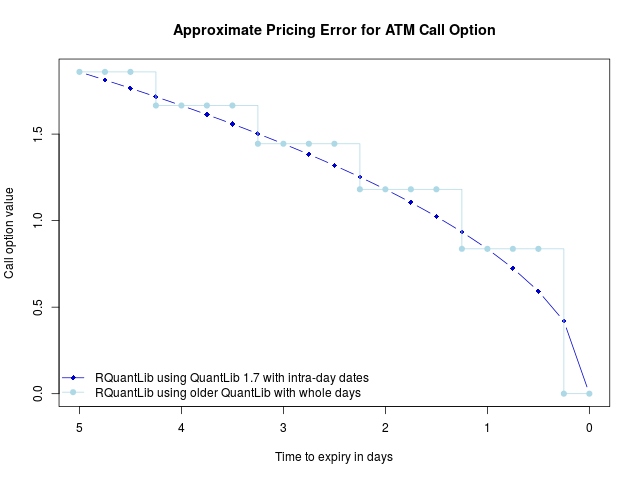
A new minor release of RQuantLib was released onto CRAN and into Debian. It takes advantages of some changes from last week's QuantLib release 1.7. 500 Rcpp packages Particularly noteworthy is the addition of support for intra-daily times in QuantLib based on work by Klaus Spanderen. If QuantLib was configured with the -enable-intraday option, we use the higher granularity of the time representation in all option pricers and implied volatility calculations. The impact of this feature is illustrated in the graph below. The graph shows the valuation of a Call option, European expiry, struck at the money with sensible short rate, dividend yield and volatility. We vary the time to expiry from five days to zero in steps of a quarter day. In darker blue is the correct valuation declining in parabolic shape. In lighter blue is what we get with QuantLib up to release 1.6, or newer releases configured without intra-day time support: an ugly step function that is off, and increasingly so we approach the expiration. Which leads to an appeal: a volunteer is needed to update the QuantLib 1.7 build for Windows. Jeroen tried, but ran into a snag and out of time. If you can help, please get in touch to Jeroen and myself. We suspect that the largest part of RQuantLib users relies on the prebuilt binaries from CRAN, and it would nice to have these updated to the current version of QuantLib. The full changes are detailed below.
Changes in RQuantLib version 0.4.2 (2015-12-03)
  • Changes in RQuantLib code:
    • Intra-day times are now available if QuantLib 1.7 or later is used, and has been configured with --enable-intraday
    • New helper functions getQuantLibVersion() and getQuantLibCapabilties()
    • New package startup code detects and warns about outdated QuantLib versions, or missing intra-day capability, unless not interactive.
    • The missing Monthly parameter has been added to matchFrequency (fixing issue ticket #19)
Courtesy of CRANberries, there is also a diffstat report for the this release. As always, more detailed information is on the RQuantLib page. Questions, comments etc should go to the rquantlib-devel mailing list off the R-Forge page. Issue tickets can be filed at the GitHub repo.

This post by Dirk Eddelbuettel originated on his Thinking inside the box blog. Please report excessive re-aggregation in third-party for-profit settings.

3 December 2015

Dirk Eddelbuettel: RcppCCTZ 0.0.2 -- now with Solaris support

Following on yesterday's announcement of RcppCCTZ, what is the only thing better than another date, time, or timezones library package? One that works on Solaris too :) Bradley White from CCTZ upstream spotted the failed compilation on the machine in Oxford and suggested a quick fix. Jeroen quickly tested what I had put into a branch, and there we have it: version 0.0.2 which now builds everywhere. Changes (for both releases) are summarized here:
Changes in version 0.0.2 (2015-12-02)
  • Additional #ifdef statements suggested by Bradley White in CCTZ ticket #5 permitting compilation on Solaris with thanks to Jeroen for testing our branch.
Changes in version 0.0.1 (2015-12-01)
  • Initial CRAN upload.
  • Package is functional and provides examples.
We now also have a diff to the previous version thanks to CRANberries. More details, issue tickets etc at the GitHub repository.

This post by Dirk Eddelbuettel originated on his Thinking inside the box blog. Please report excessive re-aggregation in third-party for-profit settings.

2 December 2015

Dirk Eddelbuettel: RcppCCTZ 0.0.1

A new package! A couple of weeks ago folks at Google released CCTZ: a C++ library for translating between absolute and civil times using the rules of a time zone. It requires only a proper C++11 compiler and the standard IANA time zone data base which standard Unix, Linux, OS X, ... computers tend to have in /usr/share/zoneinfo. And as the world needs nothing more than additional date, time, or timezones libraries, I started to quickly create a basic R wrapper package. This stalled as the original version of CCTZ used an __int128 for extended precision. That is not only not portable, but also prohibits compilation on baby computers still running a 32 OS (such as my trusted X1 laptop merrily plugging along with 4 gb of ram under Linux). Hence I filed an issue ticket which, lo and behold, got resolved two days ago. And so now we have a shiny new RcppCCTZ package on CRAN in a very basic version 0.0.1. It happily runs all the original examples from CCTZ as e.g. this one:
// from examples/hello.cc
//
// [[Rcpp::export]]
int helloMoon()  
    cctz::TimeZone syd;
    if (!cctz::LoadTimeZone("Australia/Sydney", &syd)) return -1;
    // Neil Armstrong first walks on the moon
    const auto tp1 = cctz::MakeTime(1969, 7, 21, 12, 56, 0, syd);
    const std::string s = cctz::Format("%F %T %z", tp1, syd);
    Rcpp::Rcout << s << "\n";
    cctz::TimeZone nyc;
    cctz::LoadTimeZone("America/New_York", &nyc);
    const auto tp2 = cctz::MakeTime(1969, 7, 20, 22, 56, 0, nyc);
    return tp2 == tp1 ? 0 : 1;
 
which results in
R> library(RcppCCTZ)
R> helloMoon()
1969-07-21 12:56:00 +1000
[1] 0
R>
indicating that the two civil times in fact correspond to the same absolute times when Armstrong walked on the moon. If you want to learn more about CCTZ, there was a corresponding talk CppCon (Youtube, Slides). I hope this provides a starting point for some new interesting computation on time from R. Collaboration welcome via the RcppCCTZ GitHub repo.

This post by Dirk Eddelbuettel originated on his Thinking inside the box blog. Please report excessive re-aggregation in third-party for-profit settings.

1 December 2015

Rapha&#235;l Hertzog: My Free Software Activities in November 2015

My monthly report covers a large part of what I have been doing in the free software world. I write it for my donators (thanks to them!) but also for the wider Debian community because it can give ideas to newcomers and it s one of the best ways to find volunteers to work with me on projects that matter to me. Debian LTS This month I have been paid to work 21.25 hours on Debian LTS. During this time I worked on the following things: The Debian Administrator s Handbook Now that the English version has been finalized for Debian 8 Jessie (I uploaded the package to Debian Unstable), I concentrated my efforts on the French version. The book has been fully translated and we re now finalizing the print version that Eyrolles will again edit. Paris Open Source Summit On November 18th and 19th, I was in Paris for the Paris Open Source Summit. I helped to hold a booth for Debian France during two days (with the help of Fran ois-R gis and several others).
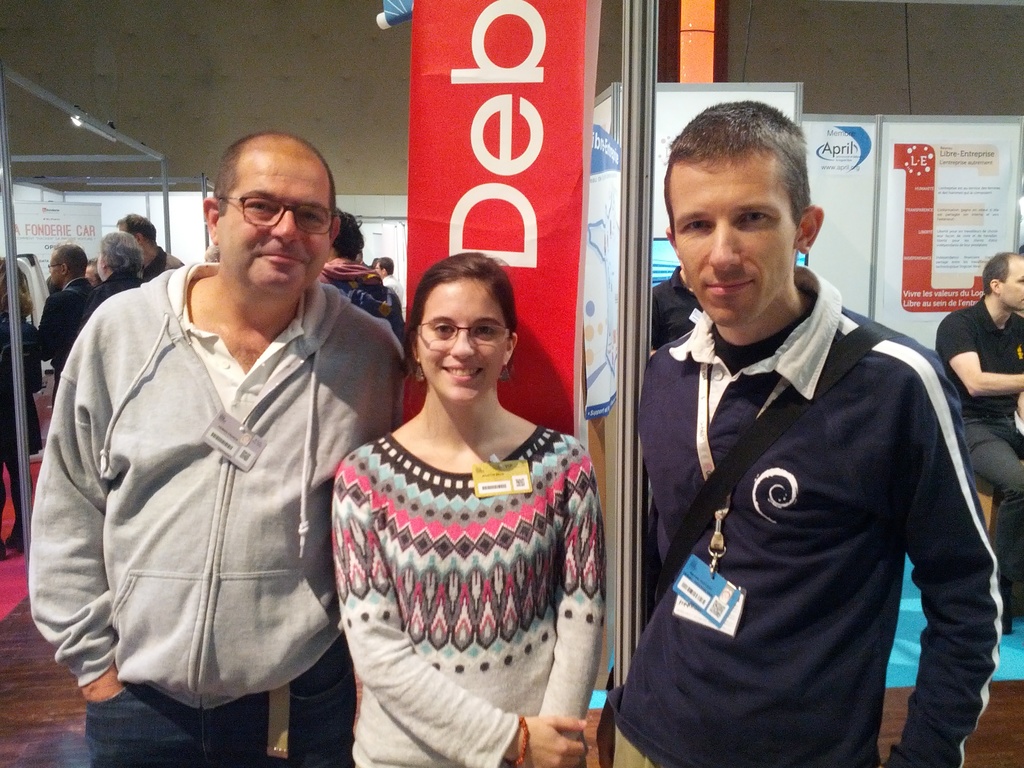
Fran ois Vuillemin, Juliette Belin and Rapha l HertzogFran ois-R gis Vuillemin, Juliette Belin and Rapha l Hertzog
On the booth, we had the visit of Juliette Belin who created the theme and the artwork of Debian 8 Jessie. We lacked goodies but we organized a lottery to win 12 copies of my French book. Debian packaging work Django. After two weeks of preparation for revers dependencies, I uploaded Django 1.8 to unstable and raised the severity of remaining bugs. Later I uploaded a new upstream point release (1.8.6). I also handled a release critical bug first by opening a ticket upstream and then by writing a patch and submitting it upstream. I uploaded 1.8.7-2 to Debian with my patch. I also submittted another small fix which has been rejected because the manual page is generated via Sphinx and I thus had to file a bug against Sphinx (which I did). A work-around has been found in the mean time. apt-xapian-index NMU. A long time ago, I filed a release critical bug against that package (#793681) but the maintainer did not handle it. Fortunately Sven Joachim prepared an NMU and I just uploaded his work. This resulted in another problem due bash-completion changes that Sven promptly fixed and I uploaded a second NMU a few days later. Gnome-shell-timer. I forwarded #805347 to gnome-shell-timer issue #29 but gnome-shell-timer is abandoned upstream. On a suggestion of Paul Wise, I tried to get this nice extension integrated into gnome-shell-extensions but the request has been turned down. Is there anyone with javascript skills who would like to adopt this project as an upstream developer? It s a low maintenance project with a decent and loyal user base. Misc. I fixed bug #804763 in zim which was the result of a bad Debian-specific patch.
I sponsored pylint-plugin-utils_0.2.3-2.dsc for Joseph Herlant to fix a release critical bug. I filed 806237 against lintian. I filed more tickets upstream, related to my Kali packaging work: one against sddm, one against john Other Debian-related work Distro-Tracker. I finally merged the work of Orestis Ioannou on bug #756766 which added the possibility to browse old news of each package. Debian Installer. I implemented two small features that we wanted in Kali: I fixed #647405 to have a way to disable deb-src lines in generated sources.list files. I also filed #805291 to see how to allow kernel command line preseeding to override initrd preseeding the fix is trivial and it works in Kali. I just have to commit it in Debian, I was hoping to get an ack from someone in charge before doing it. Thanks See you next month for a new summary of my activities.

No comment Liked this article? Click here. My blog is Flattr-enabled.

John Goerzen: Where does a person have online discussions anymore?

Back in the day, way back in the day perhaps, there were interesting places to hang out online. FidoNet provided some discussion groups some local, some more national or international. Then there was Usenet, with the same but on a more grand scale. There were things I liked about both of them. They fostered long-form, and long-term, discussion. Replies could be thoughtful, and a person could think about it for a day before replying. Socially, you would actually get to know the people in the communities you participated in. There would be regulars, and on FidoNet at least, you might bump into them in different groups or even in real life. There was a sense of community. Moreover, there was a slight barrier to entry and that was, perhaps, a good thing; there were quite a lot of really interesting people and not so many people that just wanted answers to homework questions. Technologically, you got to bring your own client. They were also decentralized, without any one single point of failure, and could be downloaded and used offline. You needed very little in terms of Internet connection. They both had some downsides; Usenet, in particular, often lacked effective moderation. Not everyone wrote thoughtful posts. Is there anything like it these days? I ve sometimes heard people suggest Reddit. It shares some of those aspects, and even has some clients capable of offline operation. However, what it doesn t really have is long-form discussion. I often find that if I am 6 hours late to a thread, nobody will bother to read my reply because it s off their radar already. This happens so often that I rarely bother to participate anymore; I am not going to sit at reddit hitting refresh all day long. There are a few web forums, but they suffer from all sorts of myriad problems; no cohesive community, the hot topic vanishing issue of Reddit, the single point of failure, etc. For awhile, Google+ looked like it might head this way. But I don t think it really has. I still feel as if there is a vacuum out there. Any thoughts?

30 November 2015

Lunar: Reproducible builds: week 31 in Stretch cycle

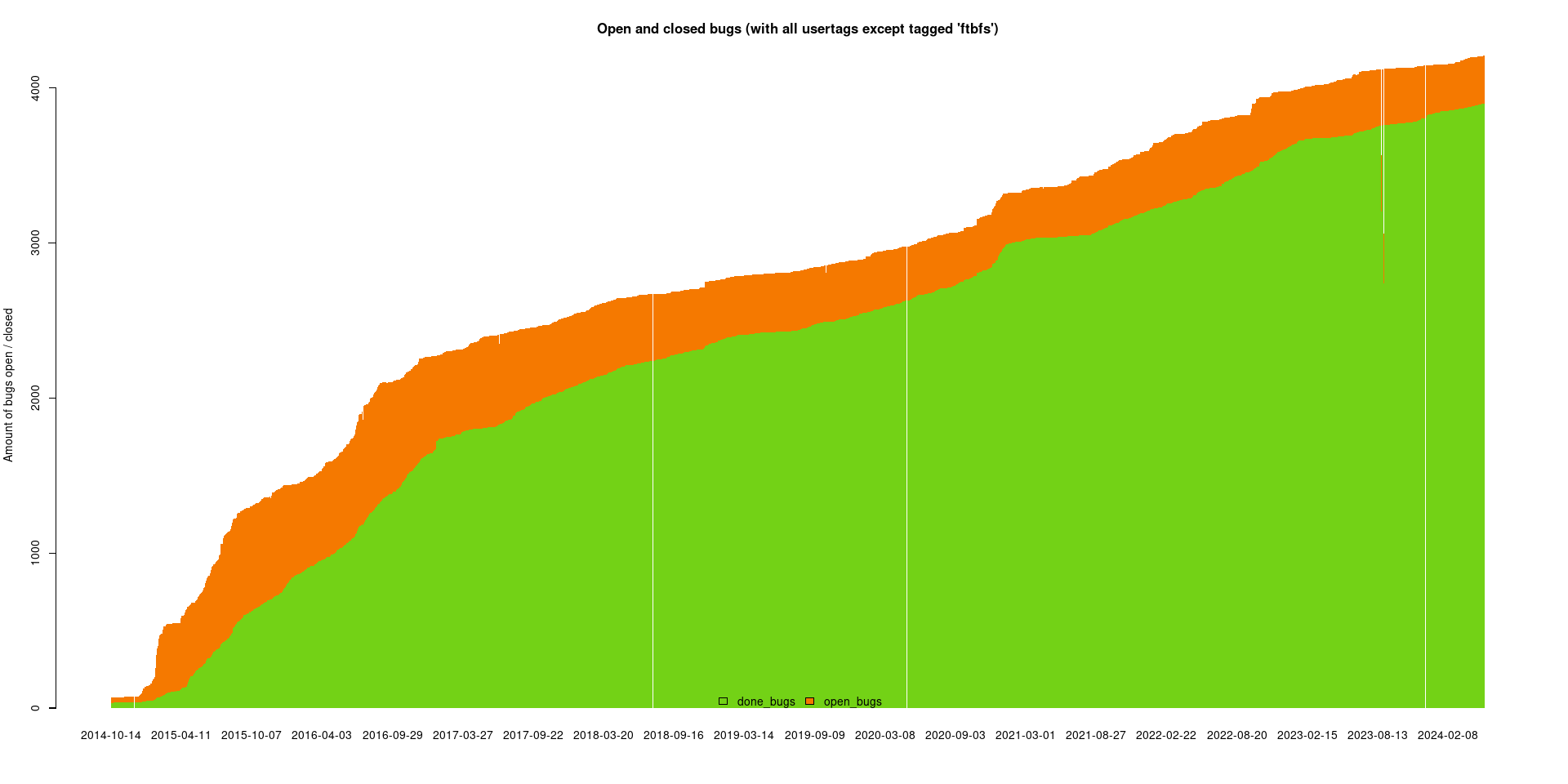
What happened in the reproducible builds effort this week: Toolchain fixes Reiner Herrmann submitted a patch against debhelper to make dh_installinit source files in a stable order. Chris Lamb found how to make cython output deterministic by ordering the keys used to traverse a dict. Reiner Herrmann proposed a patch for pyside-tools to remove the timestamps embedded by rcc in the generated Python code. Mattia Rizzolo rebased our custom version of debhelper on version 9.20151126. As no objections have been made so far, Mattia Rizzolo has filled #805872 asking -Wdate-time to be turned on by default in dpkg-buildflag. Guillem has since sent a final warning before proceeding as such in the next dpkg upload. Russ Allbery added support for SOURCE_DATE_EPOCH in podlators 4.00 which Niko Tyni intend to backport to Perl 5.22. Packages fixed The following packages have become reproducible due to changes in their build dependencies: fontforge, golang-github-tinylib-msgp, libpango-perl, libparanamer-java, libxaw, sqljet, stringtemplate4, uzbl, zope-mysqlda. The following packages became reproducible after getting fixed: Some uploads fixed some reproducibility issues, but not all of them: Patches submitted which have not made their way to the archive yet: Lunar reported two issues making xz-utils unreproducible (#806328, #806331). reproducible.debian.net A seventh armhf build node has been added (resulting of two more armhf build jobs). Thanks to Vagrant Cascadian for putting this Raspberry Pi 2B to help. (h01ger) jenkins.debian.net has been made more robust against network and proxy failures. (h01ger) A new 100 GB partition has been set up on reproducible.debian.net to prevent disk space issues. Thanks to ProfitBricks for its continuous support to our continuous test system. (h01ger) New graphs showing usertagged bugs have been added on the dashboard to measure the progress without FTBFS issues. Please note that comparing the two graphs might be misleading as more than 1300 FTBFS bugs have been inventoried. (h01ger) Package reviews 78 reviews have been removed, 116 added and 49 updated this week. 25 new FTBFS have been filed by Chris West, Chris Lamb and Santiago Vila. New issues identified this week: timestamps_in_documentation_generated_with_libwibble, copyright_year_in_documentation_generated_by_sphinx, timestamps_in_documentation_generated_by_glib_genpod, random_order_of_tmpfiles_in_postinst, random_order_in_cython_output, timestamps_in_python_code_generated_by_pyside. Reiner Herrmann and Lunar improved the prebuilder script: the script can now be called through a symlink, run parallel builds, calls diffoscope by its new name and ensure to install its recommends, and save the text output aside the HTML one. Reiner also added a script to lookup the last update of notes for a given package. Misc. Santiago Villa has been recently working on making sure that Arch:all packages were properly buildable by running dpkg-buildpackage -A. This uncovered a question that is probably not currently addressed by the policy: on which architectures should architecture-independent be buildable?

Chris Lamb: Free software activities in November 2015

Here is my monthly update covering a large part of what I have been doing in the free software world (previously):
Debian
  • Presented at MiniDebConf Cambridge 2015 on the current status of Debian's Reproducible Builds effort.
  • Contributed initial Debian support to Red Hat Product Security's repository of certificates shipped by various vendors and Open Source Projects. (#1)
  • Wrote a proof-of-concept version of Guix's challenge command to determine if an installed binary package is reproducible or not. (code)
  • Started initial work on a b2evolution package.
  • Arranged logistics for the Reproducible Builds summit in Athens.
My work in the Reproducible Builds project was also covered in more depth in Lunar's weekly reports (#27, #28, #29, #30).
LTS

This month I have been paid to work 13 hours on Debian Long Term Support (LTS). In that time I did the following:
  • Issued DLA 349-1 for python-django correcting an potential settings leak.
  • Issued DLA 351-1 for redmine fixing a data disclosure vulnerability.
  • Worked on multiple iterations of a fix for CVE-2011-5325 in busybox, not yet complete in order to additionally cover hardlinks.
  • Frontdesk duties.

Uploads
  • redis Addressing CVE-2015-8080, a buffer-overflow security issue.
  • python-django Uploading the latest RC release to experimental.
  • strip-nondeterminism Disable stripping Mono binaries as it is was too aggressive preventing some package installs.
  • gunicorn Correct Python interpreter path references in gunicorn3-debian.
  • python-redis New upstream release.
  • ispell-lt Making the build reproducible.


29 November 2015

Dirk Eddelbuettel: gtrends 1.3.0 now on CRAN: Google Trends in R

Sometime earlier last year, I started to help Philippe Massicotte with his gtrendsR package---which was then still "hiding" in relatively obscurity on BitBucket. I was able to assist with a few things related to internal data handling as well as package setup and package builds--but the package is really largely Philippe's. But then we both got busy, and it wasn't until this summer at the excellent useR! 2015 conference that we met and concluded that we really should finish the package. And we both remained busy... Lo and behold, following a recent transfer to this GitHub repository, we finalised a number of outstanding issues. And Philippe was even kind enough to label me a co-author. And now the package is on CRAN as of yesterday. So install.packages("gtrendsR") away and enjoy! Here is a quiick demo:
## load the package, and if options() are set appropriately, connect
## alternatively, also run   gconnect("someuser", "somepassword")
library(gtrendsR)
## using the default connection, run a query for three terms
res <- gtrends(c("nhl", "nba", "nfl"))
## plot (in default mode) as time series
plot(res)
## plot via googeVis to browser
## highlighting regions (probably countries) and cities
plot(res, type = "region")
plot(res, type = "cities")
The time series (default) plot for this query came out as follows a couple of days ago:
Example of gtrendsR query and plot
One really nice feature of the package is the rather rich data structure. The result set for the query above is actually stored in the package and can be accessed. It contains a number of components:
R> data(sport_trend)
R> names(sport_trend)
[1] "query"     "meta"      "trend"     "regions"   "topmetros"
[6] "cities"    "searches"  "rising"    "headers"  
R>
So not only can one look at trends, but also at regions, metropolitan areas, and cities --- even plot this easily via package googleVis which is accessed via options in the default plot method. Furthermore, related searches and rising queries may give leads to dynamics within the search. Please use the standard GitHub issue system for bug reports, suggestions and alike.

This post by Dirk Eddelbuettel originated on his Thinking inside the box blog. Please report excessive re-aggregation in third-party for-profit settings.

Next.

Previous.