Search Results: "az"

26 December 2015

Russ Allbery: Review: The Steerswoman

Review: The Steerswoman, by Rosemary Kirstein
Series: Steerswomen #1
Publisher: Del Rey
Copyright: 1989, 2003
Printing: 2003
ISBN: 0-345-46105-3
Format: Trade paperback
Pages: 264
I read this novel as part of The Steerswoman's Road omnibus, which is the edition reflected in the metadata (except for the page count, which is just this novel). Rowan is a steerswoman, a member of an order of traveling scholars in a world of generally medieval customs. This is a world of small villages and town blacksmiths, of swords, sailing ships, and lots of walking. Steerswomen (the order does include some men, but only rarely; the gender balance is left delightfully unexplained and unremarked) mostly travel routes through the Inner Lands until they decide to retire and do research and study. Sometimes, though, they get on the trail of something unexplained, and are driven to explain it. That's the case for Rowan at the start of this book: she's run across several peculiar flat jewels. No one seems to know what they are, their pattern of distribution is odd, and they're discovered in some decidedly strange places, such as embedded deep in a tree. It's a puzzle, and Rowan is determined to understand it. The Steerswoman opens with Rowan investigating a jewel owned by an innkeeper, and a chance meeting in his inn with an Outskirter who wears a whole belt of the same jewels. The Outskirters are nomadic tribes from the far west known for their prickly attitude, their ability in warfare, and their occasional raids. Those who live in the Inner Lands consider them barbarians. But Bel is curious, thoughtful, and happy to tell Rowan of the origin of her belt: her father found a huge number of the jewels embedded in the side of a cliff, far into the Outskirts. Rowan is immediately tempted to go there, but she has to report to the Archives first. Much to her surprise, Bel asks to accompany her. And then wizards start trying to kill them. The steerswomen are Kirstein's best bit of world-building and the anchor around which the rest of the story is told. Steerswomen have to answer all questions they're asked, truthfully. In return, they can ask a question of anyone and have to be answered truthfully. If anyone refuses to answer, or tells a deliberate lie, they're placed under the steerswomen's ban, and no steerswoman will answer their questions. This is woven deep into the culture of the Inner Lands... except for the wizards, who refuse to explain what they're doing or how to anyone, are under the ban, and don't care. They protect cities from dragons, build magical lighting, and occasionally start wars with other wizards in which numerous people die. They're effectively the rulers of this world insofar as it has rulers, and they're apparently quite interested in Rowan's search for these unexplained jewels. Rowan is a wonderful character. At the start of the book, she's the only steerswoman that the reader knows, so much of her early behavior is also world-building, showing us steerswomen. But as the story develops, we meet other steerswomen and Rowan develops into her own character: innocent in a way, but determined, ethical, and with a very deep store of self-knowledge and inner contemplation. I found the middle part of the book somewhat frustrating for the same reasons Rowan did. The ending lets her shine, in her own way, and it's deeply satisfying. The Steerswoman does pick up a third character along the way, a young boy named Will who hopes to become a wizard's apprentice, and to whom I never warmed. Part of the problem was structural: he's very suspicious of characters that the reader knows are entirely honorable. This is a difficult tone to pull off without irritating me, and Kirstein doesn't quite manage. She also shifts the story to the Will's perspective from time to time, and I never found his viewpoint very interesting. I warmed to him a bit by the climax, but I still don't think he added much to the story. Bel, though... Bel competes with Rowan as best character of this book. The other characters all have roles to play: Rowan is the steerswoman, integral to the world-building, and Will exemplifies another corner of the analytical process so central to this book and represents the appeal of the wizards. But Bel is just herself: irreverent, curious, loyal, dangerous, decisive, and adventurous. Rowan is the heart of the book and the primary protagonist, but I think Bel is its soul. I haven't said too much about the themes of this book, intentionally. Kirstein is doing something very interesting and subtle with the reader's expectations of a medieval world with wizards, and I think it's better experienced without spoilers. But it's also a character-driven story, a story of unlikely friendship between two very different women, and a story about the value of being true to yourself even when it's exceptionally dangerous. Rowan delighted me immediately, Bel grew on me over the course of the story, and the rough patches in the middle of the book faded in comparison to an excellent ending. Unfortunately, this is only part of a story. There is a climax, and we do know what the jewels are by the end of the book. But the journey has raised many more questions, most of which are not solved. The world has become far more complicated. Rowan has a lot left to learn and investigate. I recommend the omnibus, or getting the ebooks from Amazon where you can quickly get more, because you'll probably want to immediately start the second book. Followed by The Outskirter's Secret. Rating: 8 out of 10

21 December 2015

Diego Escalante Urrelo: Stallman on happiness and perseverance

What does happiness signify to you, I asked him, if it isn t based on wealth and comfort? Happiness for me is a combination of feeling good about myself and having love, he said. And to feel good about myself, I have to do things that convince me I deserve it. ( ) The point is, even though it s sad to see people being foolish, there s no use giving up. Nothing good can come of giving up. That just means you lose completely, right away.
Richard Stallman on the 30th anniversary of the GNU Manifesto. It s amazing to think that a broken printer lead to the creation of the Free Software movement which, many years later, would give me a professional career, an education, and incredible friends around the world. Which reminds me I still keep the sticker Richard personally handed at the end of his first talk in Per , back in August 2003:
DSCF9847-web

GNU & Linux: the dynamic duo.

Bonus: Enjoy The Free Software Song by The GNU/Stallmans.

20 December 2015

Iain R. Learmonth: A Week of Debian

For the last week I have been stuck in England. For the vast majority of that time, I've had nothing to do except work on Debian and this blog post documents some of the things I worked on. Obviously spending a whole week on Debian, there's going to be some packaging involved. The following packages got new versions in unstable this last week: Packaging updates were one of the simpler tasks tackled this week though. I spent a lot of time this week on Debian Live along with others in the #debian-live IRC channel. Over the last week we achieved a number of things, possibly the most important being that all the generic live support packages (i.e. live-boot, live-config and live-tools) have now been converted into native packages, have their VCS repositories hosted on Alioth and have seen a good number of patches merged from the BTS and from the old patch system. All future patches will be managed via the BTS for Debian Live, as with other Debian projects. We've also put effort into getting documentation online again now that the live.debian.net server has been turned off and we now have the live-build documentation and the live-wrapper documentation hosted on the project's Alioth webspace. The live-wrapper user documentation was mostly written this week so may not be amazing. On the smaller task list for Debian Live, the KGB bots are now present in the channel and reporting on git commits, a number of the more popular URLs from live.debian.net are now being redirected to their new locations (although we've had to recover these URLs from web.archive.org, the list of redirections is certainly not complete) and we've made updates to the wiki pages about how to contribute to the project. Unfortunately, no one has stepped forwards as a new lead for live-build and so this package has been orphaned. This does not necessarily mean that the package will be removed from Debian any time soon, just that it does not currently have a maintainer. If you're interested in taking over maintainence of live-build, see #808048. For testing the core live support packages, new live images for stretch have been built using live-wrapper and are available here. There are known issues with the syslinux configuration and these are not isohybrid images. My other major project this week has been my efforts to form a Debian Metadata team. The Debian Metadata team would produce the frameworks and run the services that make data about Debian available in a number of formats to make the data as accessible as possible and to encourage its use both within Debian and in external projects. Currently this includes two experimental services: rdf.debian.net and map.debian.net. We're don't plan to duplicate any of the work done by UDD, but make the data aggregated in UDD more accessible to users and developers. This means publishing that data in JSON/JSONP, KML, RDF, iCalendar and any other format that makes sense. There may be instances where it makes sense to augment the published data with live data, for example mirror availability should probably be live and not just a recent snapshot. If you're interested in participating in the Debian Metadata team, you can register your interested on bug #808049. This is not a complete summary of all my activities over the last week, but for those interested, it should give you an idea of what I've been up to. Finally, for those of you that have been waiting for my write-up on the airgapped GnuPG master key, I decided in the end that my blog was not the right place for this. You can find the guide in two parts: key generation and key export to the YubiKey. I've tried to keep these guides as generic as possible while still being as useful as possible. While writing these up on the wiki, I've also created pages for OpenPGP and GnuPG and I've almost entirely rewritten the DebianKeyring wiki page. I discovered this awesome guide to OpenPGP concepts which I would recommend to anyone that is new to OpenPGP.

Iustin Pop: Nikkor 200-500mm f5.6E ED VR tests

So, lately I've been on a telephoto lens learning curve; after the 300mm prime, I said to test a zoom lens. As I found the prime reasonably easy to adapt to (compared to shorter focal length lenses), I thought that a zoom (heavier, bigger) will be the same. Oh, I was wrong. My keeper rate for the first outdoors test was quite bad around 50% only, which (when talking only about focus/sharpness) is much below my standards. I started easy; some close or medium range shots, nothing special: Usual flower picture Lonely snag But then, moving to further distances, things became less straightforward. Shooting two pictures each time meant that usually one of them was sharp, but the other not. I got really confused at this step; the shutter speed was 1/2000s and I also had VR on; either VR was unneeded (i.e. contributing blur instead of helping) or something else was going on. After much head scratching, I think it's a combination of the following factors: So, for such style of shooting, I need to train more both photographic technique and arm strength at the gym In the meantime, it is possible to get such shots reasonably sharp, for example this picture of the (start of the) Alps taken from what is technically still Z rich city: The Alps  viewed from Z rich! I'm happy with the detail (at this distance), however I was not able to correct the colour due to the haze between me and the mountains; note that the trees on the bottom of the distance were not near me, but on the next or after-next hill. This picture confirms that with more practice things will get better. Coming back to shorter distances, and shorter focal lengths, things are looking better. We were passing somewhat near some people playing with RC-controlled planes not near enough to hear them, but near enough to see the plane quickly flying. Switched camera quickly to AF-C and Dynamic-21 focus, and - to my surprise - I was able to capture four good pictures, two so-so and four more clearly out of focus. But, for such a heavy length, hand-held and on the short notice, I was happy; the first picture is one of the so-so ones, but I kept it as I like the way the propeller is seen. All pictures at 290mm plus some cropping, 1/1250s, ISO between 900 and 1800, f/5.6 (i.e wide open): RC plane: continous focus tests RC plane #2 RC plane #3: good results! RC plane #4 RC plane #5: landing? From this exercise, the conclusion is that the lens is OK-ish for tracking, although the not-so good keeper rate tells me that I need to be careful; I'll have to see how a subject moving not left-right, but instead approaching or moving away from the camera would be tracked. But enough pictures of small planes. At 500mm, but still somewhat close, trees: Trees @ 500mm At this step I'm starting to wonder if stopping down a bit would help with the sharpness; I'll have to test that in the future. Walking some more, finally a bird in flight; one of the hopes when I took the camera/lens out was that I'll see some birds, but this was the first. 500mm, heavily cropped, but quite good result for myself (same autofocus settings as before): Bird in flight @ 500mm Bird in flight: difficult light The only problem here is, as always with crows (I think these are crows), is the black bird against the light-blue sky (not even strong blue), which means the picture has a high dynamic range; recovering the shadows on the bird is difficult. But in any case, it's clear the lens can deliver, if the photographer is good. Next, a helicopter was gracious enough to pass by (pretty close): Helicopter: close shot Two minutes later, it was quite far, but since it was going in the direction of the Alps, it gave the opportunity for a nice shot: Helicopter: flying towards the Alps This picture is less sharp, but still I like it due to composition; not successful on small screens though, only if you see it full screen. Light is very difficult though and about 10 seconds earlier would have been even better (more separation between the helicopter and the mountain). And since we're talking about planes, let's see a plane at 500m, directly overhead, and quite high: High-flying plane This picture (@500mm, cropped, 1/2000s) has the most detail of a plane flying high enough to have trails (not sure how to estimate, but at least 5km, maybe more around 7-8 I'd say) that I ever took. So yes, the lens can deliver, but it's not easy. This shot, being shot more or less straight up, had the least distance through low-altitude atmosphere, so it has less problems compared to the mountains pictures. It's still not really sharp (lens wide open), but the amount of detail I'm sold :) And to finish on a more close note: Hunting!! A long focal length lens allows one to get "close" without getting close, which means animals are not disturbed. The first picture with the cat (not shown) had the cat less alert; ears not fully up, although eyes were still seeking; this picture shows it fully alert and concentrated, like it was a wild cat hunting for its survival, and not a city cat, out just for fun. So, summary: All the best to everybody for the coming holidays, and thanks for reading.

19 December 2015

James McCoy: EINVAL woes with SG_IO

Dear lazyweb, TL;DR version Why does ioctl(fd, SG_IO, &sg_io_hdr) return EINVAL, but an immediate retry after reopening the /dev/sdX fd succeeds? I'm not sure if reopening the fd is relevant, but the code only holds the fd open long enough to do perform the ioctl. The frequency of EINVAL seems to increase in correlation with the number of IO threads, where none are seen with a single IO thread. Background At work, I've been adding Linux support to an internal Windows tool we use to perform data integrity testing of block storage devices. It's a heavily multi-threaded program: The user has the ability to use either SCSI pass-thru or read/write file to perform reads/writes to the LUN, as well as various other purely SCSI pass-thru commands. The IO portion of the code can be boiled down to basically the following pseudo code:
start IO thread  
    If SCSI pass-thru or command which requires SCSI pass-thru
        build sg_io_hdr_t struct
        open /dev/disk/by-path/  (O_RDWR   O_NONBLOCK)
        issue ioctl(fd, SG_IO, &sg_io_hdr)
        close fd
        return massaged ioctl status and scsi_status
     else
        open /dev/disk/by-path/  (O_RDWR   O_NONBLOCK)
        seek to LBA
        issue write/read
        close fd
        return massaged write/read status 
wait for IO thread completion  
check status and potentially retry operation
Problem As the number of target LUNs or IO threads scale, we're seeing increasing amounts of EINVAL errors when we issue the SG_IO ioctl. According to the sg documentation, there are only a couple situations where EINVAL should be seen: I wouldn't have been surprised to get EDOM (exceeding SG_MAX_QUEUE), but I'm at a loss as to where/why EINVAL is coming from. Granted, I'm opening an sd device instead of an sg device, so the error may be coming from a different layer in the stack. If you have any ideas, please let me know.

18 December 2015

Joachim Breitner: A multitude of early Christmas presents

Today was a nice day with a surprising number of early Christmas presents:

15 December 2015

Chris Lamb: Peake Nationalism

Timothy Peake boarded the International Space Station a few hours ago becoming the United Kingdom's first official astronaut. It has become headline news, dominating the day's news cycle. But whilst Peake left our pale blue dot with only the humble honorific "Mister", he has subsequently been awarded the dubious appellation of "British Astronaut". Now, I'm no open-borders pan-nationalist and nor do I in any wish to detract or denigrate Peake's accomplishments indeed, it is only out of a genuine respect of "our Tim's" achievements that I pen this in the first place but are we still clinging to the idea that an extraordinary effort by a co-member of our species requires a nationalistic qualifier? How much do we really have in common with our "fellow countrymen"? This is, after all, the International Space Station, to which Peake was elevated from Kazakhstan on the back of a Russian rocket, in order that he may peacefully collaborate with an American, a Ukrainian, etc. I encountered the rebuttal that support of this nature is inspirational and incentive to others, but is it really motivating to know that if you toil to achieve greatness in this life then your accomplishments will be cheaply co-opted by mediocrities who only share the same colour passport as you? In this sense, isn't national pride really a form of national insecurity? A "Briton" in space: if space travel can teach us anything, it's that broadcasting the specific patch of ground you were born in is an outdated, tribalistic contrivance and should be assigned to the dustbin of history.

13 December 2015

Gregor Herrmann: RC bugs 2015/38-50

it looks like this autumn was not my best blogging time: this is the first posting in 3 months. anyway, I wanted to give a quick overview about my work on RC bugs. again nothing exciting, mostly just trying to fix the ones popping up in the pkg-perl team.

11 December 2015

Antonio Terceiro: Bits from the Debian Continuous Integration project

It s been almost 2 years since the Debian Continuous Integration project has been launched, and it has proven to be a useful resource for the development of Debian. I have previously made a an introductory post, and this this is an update on the latest developments. Infrastructure upgrade Back in early 2014 when Debian CI was launched, there were less than 200 source packages with declared test suite metadata, and using a single worker machine polling the archive for updates and running tests sequentially in an infinite loop ( the simplest thing that could possibly work ) was OK-ish. Then our community started an incredible, slow and persistent effort to prepare source packages for automated testing, and we now have almost 5,000 of them. The original, over-simplistic design had to be replaced. The effort of transforming debci in a distributed system was started by Martin Pitt, who did an huge amount of work. In the latest months I was able to complete that work, to a point where I am confident in letting it run (mostly) unatended. We also had lots of contributions to the web UI from Brandon Fairchild, who was a GSOC intern in 2014, and continues to contribute to this date. All this work culminated in the migration from a single-worker model to a master/workers setup, currently with 10 worker nodes. On busy periods all of those worker nodes will go on for days with full utilization, but even then the turnaround between package upload and a test run is now a lot faster than it used to. Debian members can inspect the resource usage on those systems, as well as the length of the processing queue, by browsing to the corresponding munin instance (requires authentication via a SSL client certificated issued by sso.debian.org). The system is currenly being hosted on a Amazon EC2 account sponsored by Amazon. The setup is fully automated and reproducible. It is not fully (or at all) documented yet, but those interested should feel free to get in touch on IRC (OFTC, #debci) Testing backend changed from schroot to lxc Together with the infrastructure updates, we also switched to using lxc instead of schroot as backend. Most test suites should not be affected by this, but the default lxc settings might cause some very specific issues in a few packages. See for example #806542 ( liblinux-prctl-perl: autopkgtest failures: seccomp, capbset ) Adding support for KVM is also in the plans, and we will get to that at some point. Learn more If you want to learn more on how you can add tests for your package, a good first start is the debci online documentation (which is also available locally if you install debci ). You might also be interested in watching the live tutorial (WebM, 469 MB!) that has been presented at Debconf 15 earlier this year, full of tips and real examples from the archive. It would be awesome if someone wanted to transcribe that into a text tutorial ;-) How to get involved There are a few ways you can contribute: autodep8. if you are knowledgeable on a subset of packages that are very similar and can have their tests executed in a similar way, such as $Language libraries , you might consider writing a test metadata generator so that each package does not need to declare a debian/tests/control file explicitly, requiring only The Testsuite: header in debian/control. Ruby and Perl are already covered, and there is initial support for NodeJS. Adding support for new types of packages is very easy. See the source repository. If you manage to add support for your favorite language, please get in touch so we can discuss whitelisting the relavant packages in ci.debian.net so that they will get their tests executed even before being uploaded with the proper Testsuite: control field. autopkgtest. autopkgtest is responsible for actually running your tests, and you can use it to reproduce test runs locally. debci. debci is the system running in ci.debian.net (version 1.0, currently in testing, is exactly what is running up there, minus a version number and a changelog entry). It can also be used to have private clones of ci.debian.net, e.g. for derivatives or internal Debian-related development. See for example the Ubuntu autopkgtest site. Getting in touch For maintainer queries and general discussion: For the development of debci/autopkgtest/autodep8

Lunar: Reproducible builds: week 32 in Stretch cycle

The first reproducible world summit was held in Athens, Greece, from December 1st-3rd with the support of the Linux Foundation, the Open Tech Fund, and Google. Faidon Liambotis has been an amazing help to sort out all local details. People at ImpactHub Athens have been perfect hosts. North of Athens from the Acropolis with ImpactHub in the center Nearly 40 participants from 14 different free software project had very busy days sharing knowledge, building understanding, and producing actual patches. Anyone interested in cross project discussions should join the rb-general mailing-list. What follows focuses mostly on what happened for Debian this previous week. A more detailed report about the summit will follow soon. You can also read the ones from Joachim Breitner from Debian, Clemens Lang from MacPorts, Georg Koppen from Tor, Dhiru Kholia from Fedora, and Ludovic Court s wrote one for Guix and for the GNU project. The Acropolis from  Infrastructure Several discussions at the meeting helped refine a shared understanding of what kind of information should be recorded on a build, and how they could be used. Daniel Kahn Gillmor sent a detailed update on how .buildinfo files should become part of the Debian archive. Some key changes compared to what we had in mind at DebConf15: Hopefully, ftpmasters will be able to comment on the updated proposal soon. Packages fixed The following packages have become reproducible due to changes in their build dependencies: fades, triplane, caml-crush, globus-authz. The following packages became reproducible after getting fixed: Some uploads fixed some reproducibility issues, but not all of them: Patches submitted which have not made their way to the archive yet: akira sent proposals on how to make bash reproducible. Alexander Couzens submitted a patch upstream to add support for SOURCE_DATE_EPOCH in grub image generator (#787795). reproducible.debian.net An issue with some armhf build nodes was tracked down to a bad interaction between uname26 personality and new glibc (Vagrant Cascadian). A Debian package was created for koji, the RPM building and tracking system used by Fedora amongst others. It is currently waiting for review in the NEW queue. (Ximin Luo, Marek Marczykowski-G recki) diffoscope development diffoscope now has a dedicated mailing list to better accommodate its growing user and developer base. Going through diffoscope's guts together enabled several new contributors. Baptiste Daroussin, Ed Maste, Clemens Lang, Mike McQuaid, Joachim Breitner all contributed their first patches to improve portability or add new features. Regular contributors Chris Lamb, Reiner Herrmann, and Levente Polyak also submitted improvements. diffoscope hacking session in Athens The next release should support more operating systems, filesystem image comparison via libguestfs, HTML reports with on-demand loading, and parallel processing for the most noticeable improvements. Package reviews 27 reviews have been removed, 17 added and 14 updated in the previous week. Chris Lamb and Val Lorentz filed 4 new FTBFS reports. Misc. Baptiste Daroussin has started to implement support for SOURCE_DATE_EPOCH in FreeBSD in libpkg and the ports tree. Thanks Joachim Breitner and h01ger for the pictures.

10 December 2015

Dmitry Shachnev: Magic infinite sequences for Python

Today I have released a small module for Python 3 that implements cached lazy infinite sequences. Here are some examples that demonstrate what this module can do:
>>> InfSequence(5, 6, ...)
<InfSequence: 5 6 7 8 9 10 ...>
>>> InfSequence.geometric_progression(9)
<InfSequence: 1 9 81 729 6561 59049 ...>
>>> InfSequence.cycle('foo', 'bar')
<InfSequence: 'foo' 'bar' 'foo' 'bar' 'foo' 'bar' ...>
>>> InfSequence.fibonacci()
<InfSequence: 0 1 1 2 3 5 ...>
Slicing works:
>>> InfSequence(5, 6, ...)[5:]
<InfSequence: 10 11 12 13 14 15 ...>
>>> InfSequence(5, 6, ...)[5::2]
<InfSequence: 10 12 14 16 18 20 ...>
A somewhat reverse operation:
>>> (2, 3, 4) + InfSequence(5, 6, ...)
<InfSequence: 2 3 4 5 6 7 ...>
Various arithmetic operations are supported:
>>> InfSequence(1, 2, ...) ** 2
<InfSequence: 1 4 9 16 25 36 ...>
>>> InfSequence(3, 5, ...) - InfSequence(1, 2, ...)
<InfSequence: 2 3 4 5 6 7 ...>
>>> InfSequence(1, 2, ...).partial_sum(10)
55
More magic methods:
>>> InfSequence(1, 2, ...).accumulate()
<InfSequence: 1 3 6 10 15 21 ...>
>>> InfSequence(0, 2, ...) @ InfSequence(1)
<InfSequence: 1 4 9 16 25 36 ...>
For the complete API overview, please look at the documentation. You can install the module from PyPI. It is licensed under 3-clause BSD license. The source code is available on GitHub.

James McCoy: filtering-packaging-mails

I had been meaning to post about filtering package related emails for awhile now. Initially, it was going to be to spread the word about the under documented List-ID headers, which are useful when you don't have the ability to filter on arbitrary headers. The recent transition of such mails from the PTS to Debian's instance of Distro Tracker reminded me about this, and some info on how to transition current filtering may be useful for more than just me. Old PTS emails Mails sent via the PTS contained a few headers to aid filtering. There were various old keywords, but here are some of the ones I found useful:
bts
Normal bug tracking traffic
bts-control
Notifications from control@bugs.debian.org
buildd
Build failures
contact
Mails to $srcpackage@packages.debian.org
cvs
Version control notifications
upload-binary
Binary package uploads
upload-source
Source package uploads
New Distro Tracker emails The mails sent by Distro Tracker have a different set of headers. The set of new keywords are almost the same, but a few changes have been made.

8 December 2015

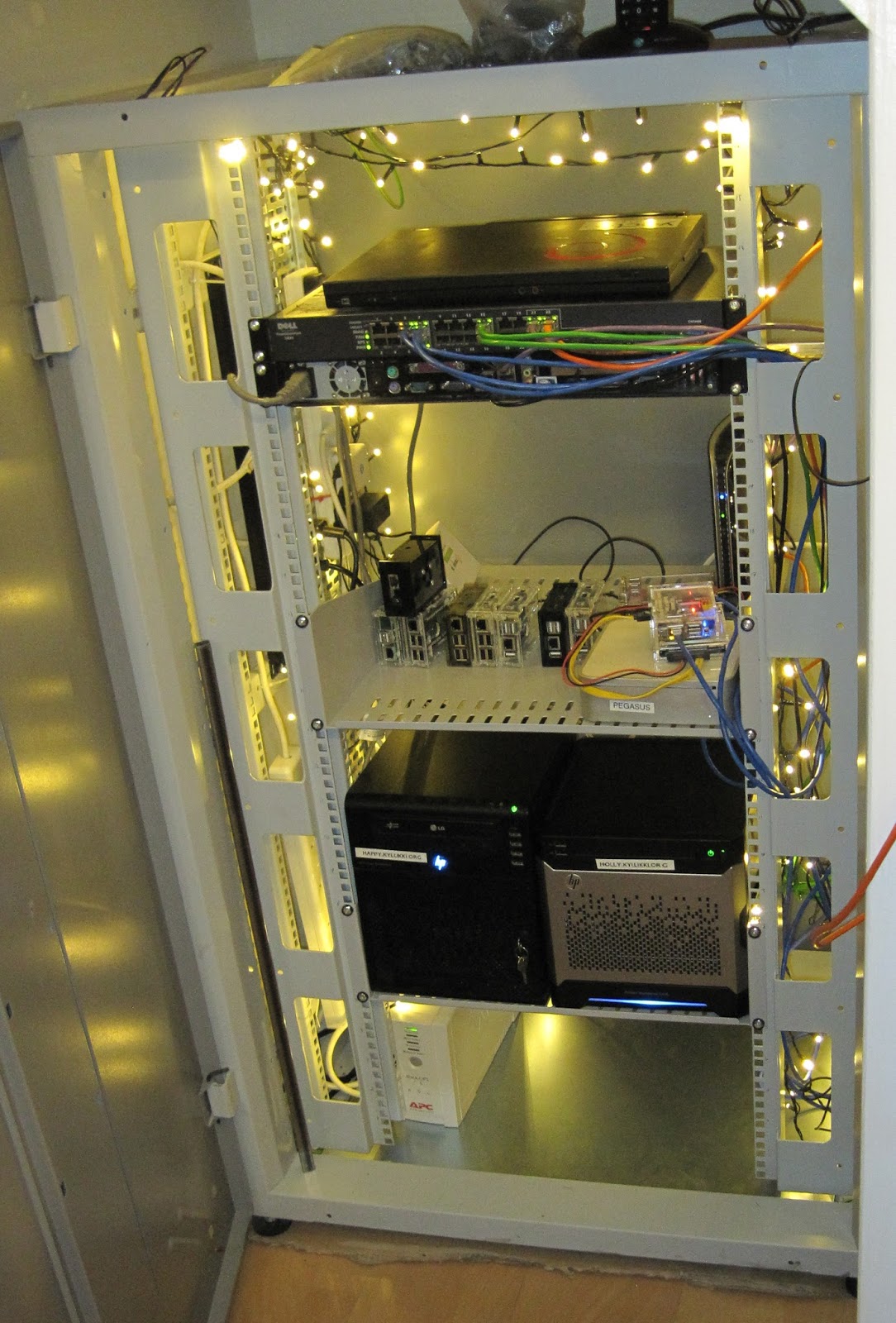
Vincent Sanders: I said it was wired like a Christmas tree

I have recently acquired a 27U high 19 inch rack in which I hope to consolidate all the computing systems in my home that do not interact well with humans.

My main issue is that modern systems are just plain noisy, often with multiple small fans whining away. I have worked to reduce this noise by using quieter components as replacements but in the end it is simply better to be able to put these systems in a box out of the way.

The rack was generously given to me by Andy Simpkins and aside from being a little dirty having been stored for some time was in excellent condition. While the proverbs "never look a gift horse in the mouth" and "beggars cannot be choosers" are very firmly at the front of my mind there were a few minor obstacles to overcome to make it fit in its new role with a very small budget.

The new home for the rack was to be a space under the stairs where, after careful measurement, I determined it would just fit. After an hour or two attempting to manoeuvre a very heavy chunk of steel into place I determined it was simply not possible while it was assembled. So I ended up disassembling and rebuilding the whole rack in a confined space.

The rack is 800mm wide IMRAK 1400 rather than the more common 600mm width which means it employs "cable reducing channels" to allow the mounting of standard width rack units. Most racks these days come with four posts in the corners to allow for longer kit to be supported front and back. This particular rack was not fitted with the rear posts and a brief call to the supplier indicated that any spares from them would be eyewateringly expensive (almost twice the cost of purchasing a new rack from a different supplier) so I had to get creative.

Shelves that did not require the rear rails were relatively straightforward and I bought two 500mm deep cantilever type from Orion (I have no affiliation with them beyond being a satisfied customer).

I took a trip to the local hardware store and purchased some angle brackets and 16mm steel square tube. From this I made support rails which means the racked kit has support to its rear rather than relying solely on being supported by its rack ears.

The next problem was the huge hole in the bottom of the rack where I was hoping to put the UPS and power switching. This hole is intended for use with raised flooring where cables enter from below, when not required it is filled in with a "bottom gland plate". Once again the correct spares for the unit were not within my budget.

Around a year ago I built several systems for open source projects from parts generously donated by Mythic Beasts (yes I did recycle servers used to build a fort). I still had some leftover casework from one of those servers so ten minutes with an angle grinder and a drill and I made myself a suitable plate.

The final problem I faced is that it is pretty dark under the stairs and while putting kit in the rack I could not see what I was doing. After some brief Googling I decided that all real rack lighting solutions were pretty expensive and not terribly effective.

At this point I was interrupted by my youngest son trying to assemble the Christmas tree and the traditional "none of the lights work" so we went off to the local supermarket to buy some bulbs. Instead we bought a 240 LED string for 10 (15usd) in the vague hope that next year they will not be broken.

I immediately had a light bulb moment and thought how a large number of efficient LED bulbs at a low price would be ideal for lighting a rack. So my rack is indeed both wired like and as a Christmas tree!

Now I just have to finish putting all the systems in there and I will be able to call the project a success.

4 December 2015

Ritesh Raj Sarraf: Freedom, Privacy and Our Choices

When I bought my Lenovo Yoga 2 13, I had great plans. I wanted a device, that I could use both, as a laptop, and also as a tablet. The path hasn't been easy. But then, no path in Free Software against Freedom and Privacy has been easy. The choice is left to us, the users. I had been a long time KDE User. With KDE's decision to have different UIs for different form factors (plasma active, plasma netbook, plasma desktop), it was now time to try something different. I had 2 choices to explore: Unity and GNOME. But given that Unity is not feasible in Debian, the obvious first option to explore was GNOME. And I guess my timing was perfect. I started with 3.14 which showed great promises about touch support, followed by 3.16 and now 3.18. There's still a long way to go, but GNOME definitely is in the right direction and improves impressively with each release. I would like to thank the Debian GNOME Team. You guys just are amazing. The pace at which the packages are prepared and pushed, it is a tough job. So, thank you. Now that I use GNOME, I also follow some GNOME development, file bugs and read User Feedback. While (many of) the design decisions that GNOME makes today is in line with what I desire, there are other users who aren't happy. Many don't like the new UI design GNOME is heading to, i.e. the fusion of the UI such that it is usable on both form factors: Desktop and Tablet. People find the Toolbars bloated. GNOME developer Allan Day has a good blog post showing the facts. But I think there's the other aspect which needs to be emphasized. By improving the same tools, the GNOME devs are making them capable to be used both, on Laptops and Tablets. This is important to me as a user. I still have the freedom of the tools I use.. And those tools don't sniff. By using the same tools in both modes, I also can reliably build a workflow. I remember when I was moving from IceDove to Evolution. It was painful, but once done, I now have an email client I can still use with basic touch workflow. If you take current GNOME out of the picture, what would a user do. Live with a Laptop and a Tablet, 2 separate device. The laptop running Debian and the Tablet ??? In the direction GNOME is in, it allows me to be liberated for both the use cases. My most valuable assets: data and time, both are efficient in use. And not to forget the reason for this blog entry: Freedom and Privacy. Sure you can choose not to buy/use a tablet at all, and live in a world 10yrs behind. By improving the same tools for both use cases, GNOME is also ensuring that they don't throw away learnings from the past. Today Gtk is touch ready and the same libs also are running when on Laptop. A feature addition/enhancement gets leveraged by both. The Search Bar addition into File Dialog is available both, in Laptop and Tablet mode. And the list could go on.... On the other hand, I'm not sure what the KDE User Experience is today. But if I have to log out of my plasma desktop session, to use in Tablet Mode (plasma active), that workflow is already a broken one. I do miss the flexibility KDE used to provide, where in a substantial part of the user flow could be heavily customized. This is one gripe I have with the GNOME Project in general. They just don't balance things at all. Elegance is not about cutting out features. There are simple things you'll miss in GNOME if you come from KDE. Like Ctrl+R in Kwrite. You can't do that in GEdit. Today, with companies like Google, who are developing tools that are cross-platform, stand as good examples as to what GNOME/KDE should do. Don't bloat the UI, but then again don't strip it off either. The Chromium Browser's UI is a great example. The Chromium UI Devs are pretty strict on what new visible field can be added. But under one Wrench button, they provide a world for everyone to be happy. Power Users can run through the option available, and Super Power Users can use things like chrome://settings and chrome://flags I the new world today, where without a proprietary stack running on your mobil device, it is literally useless; Efforts like that of from the GNOME Project, gives some hope.

Categories:

Keywords:

Like:

2 December 2015

Colin Watson: SSH SHA-2 support in Twisted

Launchpad operates a few SSH endpoints: bazaar.launchpad.net and git.launchpad.net for code hosting, and upload.ubuntu.com and ppa.launchpad.net for uploading packages. None of these are straightforward OpenSSH servers, because they don t give ordinary shell access and they authenticate against users SSH keys recorded in Launchpad; both of these are much easier to do with SSH server code that we can use in library form as part of another service. We use Twisted for several other tasks where we need event-based networking code, and its conch package is a good fit for this. Of course, this means that it s important that conch keeps up to date with the cryptographic state of the art in other SSH implementations, and this hasn t always been the case. OpenSSH 7.0 dropped support for some old algorithms, including disabling the 1024-bit diffie-hellman-group1-sha1 key exchange method at run-time. Unfortunately, this also happened to be the only key exchange method that Launchpad s SSH endpoints supported (conch supported the slightly better diffie-hellman-group-exchange-sha1 method as well, but that was disabled in Launchpad due to a missing piece of configuration). SHA-2 support was clearly called for, and the fact that we had to get this sorted out in conch first meant that everything took a bit longer than we d hoped. In Twisted 15.5, we contributed support for several conch improvements: Between them and with some adjustments to the lazr.sshserver package we use to glue all this together to add support for DH group exchange, these are enough to allow us not to rely on SHA-1 at all, and these improvements have now been rolled out to all four endpoints listed above. I ve thus also uploaded OpenSSH 7.1 packages to Debian unstable. If you also run a Twisted-based SSH server, upgrade it now! Otherwise it will be harder for users of recent OpenSSH client versions to use your server, and for good reason.

Norbert Preining: SJW attitude in science

Recently, Eric Raymond, famous for is The Cathedral and the Bazaar , stepped forward to speak out against mixing social agenda, like equal treatment for everyone outside the white straight group, with meritocracy, the evaluation of one solely based on his/her contribution. And without fail, the SJW side of the Internet didn t take much time to munch down on Raymond like hungry wolves in a long winter: Coraline Ada Ehmke (should that recall Ada Lovelace?), Tim Chevalier, Matthew Garret, just to name a few. rastafari2 The arguments are quite easy to summarize: The meritocracy party proposes that One s contribution should only be evaluated based on the content and the quality , while the SJW party asserts that in case the submitter as from a minority group, in particular everyone outside the white straight group, the contribution has to be accepted with higher probability (or without discussion) to ensure equality. (Added here for clarification: A SJW is someone who puts the agenda of anti-genderization and anti-biasization (nice word) above all other objectives, often by quoting scientific results on existing and not deniable bias) Well, I am a scientist, and I can tell you just one thing: I simply don t give a shit for whether someone is white, black, red, green, red, straight, gay, a Rastafari or Pastafari (well, to be honest, I really give an extra 3 plus points to Pastafari!), really, I check their proofs. And if they are rubbish, they are rubbish. If they are ok, they are ok. Let us for a moment assume that the world of research would work the same way as the proposed world of Ehmke, Chevalier, Garret, and all the other SJW: A lesbian female black is submitting an article to a scientific journal (first of all, as a referee I wouldn t even know about her sexual interest, nor her color, nor her background in most of the cases), and the honest referee reports would dare to reject the paper due to technical and methodological insufficiencies. A very common case. Now, the average SJW (including the above named, according to their blog posts) would require us to be open and, well, publish a rubbish paper just because it is written by an non-white-non-male author. What should I say well stupidity seemingly does not have a limit. Hopefully software projects around the world do not fall into this stupid trap, and continue evaluating contributions solely on their actual merit. This is all I am asking for, quite in contrast to the SJW groupies. And this is also what Raymond is asking for so I have not the slightest idea why anyone around this planet sees a need to step up and become noisy.

30 November 2015

Chris Lamb: Free software activities in November 2015

Here is my monthly update covering a large part of what I have been doing in the free software world (previously):
Debian
  • Presented at MiniDebConf Cambridge 2015 on the current status of Debian's Reproducible Builds effort.
  • Contributed initial Debian support to Red Hat Product Security's repository of certificates shipped by various vendors and Open Source Projects. (#1)
  • Wrote a proof-of-concept version of Guix's challenge command to determine if an installed binary package is reproducible or not. (code)
  • Started initial work on a b2evolution package.
  • Arranged logistics for the Reproducible Builds summit in Athens.
My work in the Reproducible Builds project was also covered in more depth in Lunar's weekly reports (#27, #28, #29, #30).
LTS

This month I have been paid to work 13 hours on Debian Long Term Support (LTS). In that time I did the following:
  • Issued DLA 349-1 for python-django correcting an potential settings leak.
  • Issued DLA 351-1 for redmine fixing a data disclosure vulnerability.
  • Worked on multiple iterations of a fix for CVE-2011-5325 in busybox, not yet complete in order to additionally cover hardlinks.
  • Frontdesk duties.

Uploads
  • redis Addressing CVE-2015-8080, a buffer-overflow security issue.
  • python-django Uploading the latest RC release to experimental.
  • strip-nondeterminism Disable stripping Mono binaries as it is was too aggressive preventing some package installs.
  • gunicorn Correct Python interpreter path references in gunicorn3-debian.
  • python-redis New upstream release.
  • ispell-lt Making the build reproducible.


Pablo Lorenzzoni: Duas dicas para acelerar o APT

s vezes voc s quer um pouco mais de velocidade nos downloads do APT e n o tem muito como modificar muito a instala o do cliente. Duas dicas simples podem ganhar minutos preciosos: Coloque em algum dos /etc/apt.conf.d (sugiro criar o /etc/apt.conf.d/71parallel) a seguinte linha:

Acquire::Queue-Mode "host";
Isso faz com que o modo de queue do APT seja orientado ao host e n o ao tipo de URL. Dependendo dos seus sources, isso acelera mais do que o modo access padr o. A segunda dica um hack que encontrei h algum tempo em um blog que faz o download pr vio das URLs que ser o utilizadas na opera o do APT para o /var/cache/apt/archives usando xargs:
#!/bin/bash
NBATCH=3
NPARALLEL=5
(apt-get -y --print-uris $@ egrep -o -e "http://[^\']+" xargs -r -l$ NBATCH -P$ NPARALLEL wget -nv -P "/var/cache/apt/archives/") && apt-get $@
Ajuste os par metros NBATCH e NPARALLEL e boa sorte.

29 November 2015

Matthew Garrett: What is hacker culture?

Eric Raymond, author of The Cathedral and the Bazaar (an important work describing the effectiveness of open collaboration and development), recently wrote a piece calling for "Social Justice Warriors" to be ejected from the hacker community. The primary thrust of his argument is that by calling for a removal of the "cult of meritocracy", these SJWs are attacking the central aspect of hacker culture - that the quality of code is all that matters.

This argument is simply wrong.

Eric's been involved in software development for a long time. In that time he's seen a number of significant changes. We've gone from computers being the playthings of the privileged few to being nearly ubiquitous. We've moved from the internet being something you found in universities to something you carry around in your pocket. You can now own a computer whose CPU executes only free software from the moment you press the power button. And, as Eric wrote almost 20 years ago, we've identified that the "Bazaar" model of open collaborative development works better than the "Cathedral" model of closed centralised development.

These are huge shifts in how computers are used, how available they are, how important they are in people's lives, and, as a consequence, how we develop software. It's not a surprise that the rise of Linux and the victory of the bazaar model coincided with internet access becoming more widely available. As the potential pool of developers grew larger, development methods had to be altered. It was no longer possible to insist that somebody spend a significant period of time winning the trust of the core developers before being permitted to give feedback on code. Communities had to change in order to accept these offers of work, and the communities were better for that change.

The increasing ubiquity of computing has had another outcome. People are much more aware of the role of computing in their lives. They are more likely to understand how proprietary software can restrict them, how not having the freedom to share software can impair people's lives, how not being able to involve themselves in software development means software doesn't meet their needs. The largest triumph of free software has not been amongst people from a traditional software development background - it's been the fact that we've grown our communities to include people from a huge number of different walks of life. Free software has helped bring computing to under-served populations all over the world. It's aided circumvention of censorship. It's inspired people who would never have considered software development as something they could be involved in to develop entire careers in the field. We will not win because we are better developers. We will win because our software meets the needs of many more people, needs the proprietary software industry either can not or will not satisfy. We will win because our software is shaped not only by people who have a university degree and a six figure salary in San Francisco, but because our contributors include people whose native language is spoken by so few people that proprietary operating system vendors won't support it, people who live in a heavily censored regime and rely on free software for free communication, people who rely on free software because they can't otherwise afford the tools they would need to participate in development.

In other words, we will win because free software is accessible to more of society than proprietary software. And for that to be true, it must be possible for our communities to be accessible to anybody who can contribute, regardless of their background.

Up until this point, I don't think I've made any controversial claims. In fact, I suspect that Eric would agree. He would argue that because hacker culture defines itself through the quality of contributions, the background of the contributor is irrelevant. On the internet, nobody knows that you're contributing from a basement in an active warzone, or from a refuge shelter after escaping an abusive relationship, or with the aid of assistive technology. If you can write the code, you can participate.

Of course, this kind of viewpoint is overly naive. Humans are wonderful at noticing indications of "otherness". Eric even wrote about his struggle to stop having a viscerally negative reaction to people of a particular race. This happened within the past few years, so before then we can assume that he was less aware of the issue. If Eric received a patch from someone whose name indicated membership of this group, would there have been part of his subconscious that reacted negatively? Would he have rationalised this into a more critical analysis of the patch, increasing the probability of rejection? We don't know, and it's unlikely that Eric does either.

Hacker culture has long been concerned with good design, and a core concept of good design is that code should fail safe - ie, if something unexpected happens or an assumption turns out to be untrue, the desirable outcome is the one that does least harm. A command that fails to receive a filename as an argument shouldn't assume that it should modify all files. A network transfer that fails a checksum shouldn't be permitted to overwrite the existing data. An authentication server that receives an unexpected error shouldn't default to granting access. And a development process that may be subject to unconscious bias should have processes in place that make it less likely that said bias will result in the rejection of useful contributions.

When people criticise meritocracy, they're not criticising the concept of treating contributions based on their merit. They're criticising the idea that humans are sufficiently self-aware that they will be able to identify and reject every subconscious prejudice that will affect their treatment of others. It's not a criticism of a desirable goal, it's a criticism of a flawed implementation. There's evidence that organisations that claim to embody meritocratic principles are more likely to reward men than women even when everything else is equal. The "cult of meritocracy" isn't the belief that meritocracy is a good thing, it's the belief that a project founded on meritocracy will automatically be free of bias.

Projects like the Contributor Covenant that Eric finds so objectionable exist to help create processes that (at least partially) compensate for our flaws. Review of our processes to determine whether we're making poor social decisions is just as important as review of our code to determine whether we're making poor technical decisions. Just as the bazaar overtook the cathedral by making it easier for developers to be involved, inclusive communities will overtake "pure meritocracies" because, in the long run, these communities will produce better output - not just in terms of the quality of the code, but also in terms of the ability of the project to meet the needs of a wider range of people.

The fight between the cathedral and the bazaar came from people who were outside the cathedral. Those fighting against the assumption that meritocracies work may be outside what Eric considers to be hacker culture, but they're already part of our communities, already making contributions to our projects, already bringing free software to more people than ever before. This time it's Eric building a cathedral and decrying the decadent hordes in their bazaar, Eric who's failed to notice the shift in the culture that surrounds him. And, like those who continued building their cathedrals in the 90s, it's Eric who's now irrelevant to hacker culture.

(Edited to add: for two quite different perspectives on why Eric's wrong, see Tim's and Coraline's posts)

comment count unavailable comments

Next.

Previous.