Search Results: "ah"

10 April 2015

Andrew Shadura: Kallithea 0.2 released

This post is almost a carbon copy of the Kallithea 0.2 release notes. Kallithea project have just released Kallithea 0.2. Kallithea is a Python-based GPLv3 source code management software for web-based hosting of Mercurial and Git repositories. This release brings many changes since 0.1. Notably, pull requests system have been improved, making contributing changes more robust. The visual appearance has also been refined: modern font-based symbolic icons from FontAwesome and GitHub Octicons have replaced the previously used bitmap icons, and revision graphs are now drawn with HiDPI display support. Kallithea now supports Mercurial 3.3 and Dulwich 0.9.9. Several fixes in the database code boosted performance significantly. We have also updated our Javascript libraries: jQuery, CodeMirror and Mergely. Javascript and CSS code have been cleaned up, with less and less code depending on Yahoo UI library. Since 0.1 we have discovered two security issues, so all users are strongly recommended to upgrade. For more details on these issues, please see our Security Notices page For more information, see https://kallithea-scm.org/ or http://docs.kallithea-scm.org/. The summary of the changes since 0.1 release is below. Bug fixes: Features and improvements: Changes (might influence workflows): Cleanup:

9 April 2015

Daniel Pocock: Never fly Etihad again?

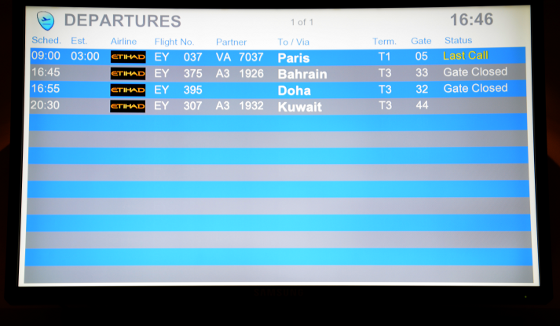
This is the first time we've flown out to Australia with Etihad and it may also be the last. We were due to fly back into Europe at CDG and head down to Lyon for the mini-DebConf this weekend. departure board, 18 hour delay for Paris Lets look at how our Etihad experience has worked out: 21:00 UTC Tuesday - waking up on Wednesday morning in Melbourne (UTC+10) 13:00 UTC Wednesday - leaving Melbourne about 11pm Wednesday night, a 12-13 hour flight to Abu Dhabi. We had heard about the air traffic control strikes in France (where we are going) and asked the airline if we should fly and they told us everything would be OK. 02:30 UTC Thursday - touchdown in Abu Dhabi, 6:30 am local time. Go to the transfer counter to ask for our boarding passes to CDG. At this stage, we were told that the connecting flight to CDG had been delayed 20 hours due to French strikes. As we are trying to reach Lyon for the mini-DebConf this weekend, we asked if we could leave Abu Dhabi on a 09:00 flight to Geneva. The Etihad staff told us to contact our travel agent (the flight was booked through Expedia) and for the next hour everybody's time was wasted making calls to Expedia who kept telling us to speak to Etihad. Whenever the Etihad customer service staff tried to speak to Expedia, the Expedia call center would hang up. Eventually, the Etihad staff told us that the deadline for putting us on the Geneva flight had passed and we would be stuck in Abu Dhabi for at least 20 hours. For flights to and from Europe, airlines have a responsibility to arrange hotels for passengers if there is a lengthy delay. If the airline is at fault, they must also pay some extra cash compensation but for a strike situation that is not applicable. Etihad has repeatedly fobbed us off. Initially we were given vouchers for Burger King or a pizza slice and told to hang around the transfer counter. By about 12:00 UTC (4pm local time, nine hours of waiting around the transfer counter) there was still no solution. One passenger was so upset that the airport security were called to speak to him and he was taken away. The airline staff kept giving excuses. Some passengers had been sent to a hotel but others left behind. I asked them again about our hotel and they kept trying to fob me off. Faced with the possibility that I would miss two nights of sleep and eight hours time difference coming into Europe, I continued asking the Etihad staff to own up to their responsibilities and they eventually offered us access to their airport lounge. We discovered some other passengers in the lounge too, including the passenger who had earlier been escorted away by security. This is unlike anything we've experienced with any other airline. At every opportunity (the check-in at Melbourne, or when the Geneva flight was boarding), the airline has failed to make arrangements that would have avoided cost and inconvenience. Assuming the flight goes ahead with a 20 hour delay, we will arrive in CDG some time Friday morning and not really sleep in a proper bed again until Friday night, about 70 hours after getting up in Melbourne on Wednesday morning. Thanks Etihad, you are a waking nightmare. The airline has been evasive about how they will deal with our onward travel from CDG to Lyon. We had booked a TGV train ticket already but it is not valid after such a long delay and it seems quite possible that trains will be busier than usual thanks to the air traffic control strike. So we don't even know if we will be loitering around a Paris airport or railway station for hours on Friday and nobody from the airline or Expedia really seems to care. Conclusion The only conclusion I can reach from this experience is that Etihad can't be trusted, certainly not for long journies such as Australia to Europe. Having flown through Singapore, Kuala Lumpur and Hong Kong, I know that air passengers have plenty of options available and there are many airlines that do go the extra mile to look after passengers especially on such long journeys. The airline missed opportunities to re-route us at every opportunity. It looks like they help some passengers (like those who did get to hotels) but leave many others high and dry just to stay within their budget.

7 April 2015

Thorsten Glaser: exciting news, or so

I implemented <? support (including <?php ) script embedding support for *.inc in MirWebseite today; the specific syntax was explicitely requested by Natureshadow. Ugh. My own hacking activities are progressing, even if slowly. I do some other interesting, funny, social, beneficial, etc. stuff in between, though. I ll even have to get some of my DD buddies to sponsor me some QA uploads of packages I formerly maintained, whereever changes are queued up such as better old-format repo compatibility in cvs(GNU) Though some of the stuff I do at work is currently done only there sorry. Also: prepare to be fully enlightened about just what evil (nice picture) Docker is. I especially liked the comparison of containers to a herd of cattle, mere numbers, replaceable, whereas VMs are cats, each with their individual name, lovely petted each day, etc. ObHint: Some may have noticed I do have a Twitter account now. I do not really use it much. I got it because I wanted to rant at someone who only gave Twitter as means to contact them (a European company running a lottery for USA citizens only). But I found one nice thing: @HourlyCats (though @FacesPics and @BahnAnsagen are funny too, and the Postillon anyway). The internet is there for cat content, anyway.
Ahem. Do not contact me there, use IRC, more specifically, the Freenode network, and possibly memoserv to mirabilos instead, I can t fit things into 140 chars, that s just ridiculous. Also, don t follow me. It may contain rants, it s NSFW, and I m not censoring there. As I said: I do not use it. So should you. (But kudos for having a mostly functional fallback site (the mobile one), which even works in PocketIE (Windows Mobile) and Opera 9, though not so much lynx(1) ) odc (from #!/bin/mksh on IRC) is hacking support to use mksh instead of GNU bash for bootstrapping pkgsrc (e.g. on Solaris). Nice! Good luck! propos mksh(1), dear Debian armel and armhf buildd maintainer colleagues, pretty please with strawberries and chocolate ice on top (I just had that on waffles at my favourite ice salon, so I may be biased), do like s390x and update your chroots and wanna-build give-back mksh, as we requested, so the privacy fix makes it into jessie. Thanks in advance! Oh, and Y_Plentyn and I both have been putting more and updated packages into my APT repository. XTaran held a talk at CLT 2015 mentioning it maybe I should write up some docs about how to use it for which purposes (e.g. how to avoid systemd but not get the other packages from it, or how to use it with systemd (trivial but has to be stated, it s freedom of choice after all), etc.)? Besides decent fanfiction (the stories in the Uzumaki Naruto universe seem, on average, to be much longer than those in the Harry Potter one), the weather is becoming good, so I ve already been enjoying going out for some geocaching and will have the bike fixed at the shop RSN (it suffers a bit each winter, as it stands outside, since our basement is mouldy, which is worse than a bit of rust IMHO) to get more activity in. Also planning to head to the GPS Maze in Mainz and, besides what time FrOSCon (including preparation) allows, heading to DebConf for a while. mirabilos  Waypoints

6 April 2015

Daniel Pocock: Dandenongs

The final part of our latest Australia trip took us to the Dandenong Ranges. To borrow a term from the Germans and Swiss, Mount Dandenong could be considered Melbourne's Hausberg or local mountain. On the south side of the mountain, tourists and children are impressed by the Puffing Billy railway at Belgrave: Keen runners can race the train in about May each year in a 13km course through the mountains. You need to stay at least thirty seconds ahead of the train to avoid being stuck at the level crossings. My own fastest time was about two minutes faster than the train. Leaving Belgrave, there is a short but steep drive up to the Mount Dandenong summit following the road towards Monbulk and Olinda. From the top, you can view the whole city, Port Philip Bay and various other mountain ranges in other directions:

5 April 2015

Ingo Juergensmann: It has been 30 years now...

Sometimes you happen to realize how old you are when listening to the radio where they announce hits from your days of youth as "oldies". Or when todays youth asking you what a music casette or a 5.25" floppy disk is. You're even older than that when you still know 8" disks. We have one of those on our pin board. Or you may realize your age when your favorite computer of your youth will celebrate its 30th anniversary this year! In 1985 the Amiga was introduced to the public - and 30 years later Amigas around the world are still running! Some are still operated under AmigaOS, some are running maybe NetBSD, but some are running the Debian m68k port - even though the port was expelled from Debian years ago! But some people still take care of this port and it is keeping up with building packages, although mostly due to emulators doing the most work. But anyway, the Amiga is turning 30 this year! And what a great machine this was! It brought multitasking, colorful graphics and multi-channel audio to the masses. It was years ahead of its competitors, but it was doomed to fail because of management failures by the producing company Commodore, which went bankrupt in 1994. The "30th Anniversary Event" will take place on July 25th at the Computer History Museum in Mountain View, California, USA - if the kickstarting the event will be successful during the next two weeks. So, when you earned your first merits in computing on an Amiga as well, you might want to give your Amiga history another kickstart! Not the Kickstart floppy as the A1000 needed to boot up, but fundraising the event on kickstart.org! I think this event is not only important to old Amiga users from the good old days, but for the rememberance of computing history in general. Without doubt the Amiga set new standards in computer history and is an important part of industrial heritage.
Kategorie:

3 April 2015

Thorsten Alteholz: My Debian Activities in March 2015

FTP assistant Recently the NEW queue grew due to lots of uploads of new KDE software and several smaller node-packages. The KDE-stuff will be processed one after another, but the node-stuff seems to be rather strange. After the last discussion I was told that all those small packages can be accumulated into bigger chunks. I hope this discussion doesn t need to be repeated again Anyway, this month I marked 117 packages for accept and rejected 51 packages. Squeeze LTS This was my ninth month that I did some work for the Squeeze LTS initiative, started by Raphael Hertzog at Freexian. This month I got assigned a workload of 15.25h and I spent these hours to upload new versions of: Finally I was also able to upload the binutils package. Up to now, I got no complaints that something is not working anymore, so yeah, I seem to make it. The next big adventure will be a new upload of PHP. I already started with some patches, but it is still a good piece of work. I also uploaded update for DLA 164-1] unace security update, [DLA 168-1] konversation security update and [DLA 172-1] libextlib-ruby security update although no LTS sponsor indicated any interest. Other packages This month the severity of one bug in greylistd had been raised from normal to severe and such I had to upload a new version. Thanks to Andreas Beckmann for raising and for providing a patch. I also uploaded a new version of dict-elements and closed a bug related to reproducible builds. As I am the maintainer of libkeepalive, I got an email from Andreas Florath. He wanted to persuade me to create a package for his library libdontdie, which is rather similar to libkeepalive but has some improvements. As I promised to do some more packaging work, he didn t have to argue much and voila, there now is a new package libdontdie available. As the cooperation with him is really pleasant, I also created a package for his other project: pipexec. Donations Thanks alot to all donors, this month I got 30 in total. I really appreciate this and hope that everybody is pleased with my commitment. Don t hesitate to make suggestions for improvements.

31 March 2015

Laura Arjona: Upgrading my home server (HP Microserver N54L G7) to Debian Jessie

Note: this is a long overdue post. I upgraded some months ago but I promised myself to blog about my selfhosting adventures, so here you are.
You may know the story TL;DR After searching a bit for information about my problem and not finding anything helpful, I began to think that maybe upgrading to Jessie could fix it (recent versions of kernel and cryptsetup ). And the Jessie freeze was almost there, and I also thought that trying to make my MediaGoblin work in Jessie now that I still didn t upload lots of content, would be a nice idea And, I wanted to feel the adventure! Whatever. I decided to upgrade to Jessie. This is the glory of free software at home : you only waste your time (and probably not, because you can learn something, at least, what not to do). Upgrading my system to Jessie, and making it boot! I changed sources.list, updated, did a safe-upgrade, and then upgrade. Then reboot and the system didn t boot. What happened? I m not sure, everything looked ok during the upgrade But now, my system even was not asking for the passphrase to unlock the encrypted disk. It was trying to access the physical volume group as if it was in an unencrypted disk, and so, failing. The boot process left me in a initramfs console in which I didn t know what to do. I asked help from @luisgf, the system administrator of mipump.es (a Pump.io public server) and mijabber.es (an XMPP public server). We met via XMPP and with my thinking aloud and his patient listening and advice, we solved the problem, as you will see: I tried to boot my rescue system (a complete system installed in different partitions in a different disk) and it booted. I tried then to manually unencrypt the encrypted disk (cryptsetup luksopen /dev/xxx), and it worked, and I could list the volume group and the volumes, and activate them, and mount the partitions. Yay! my (few) data was safe. I rebooted and in the initramfs console I tried to do the same, but cryptsetup was not present in my initramfs. Then I tried to boot in the old Wheezy kernel: it didn t asked for the passphrase to unencrypt the disk, but in that initramfs console, cryptsetup was working well. So after manually unencrypt the system, activate the volumes and mount the partitions, I could exit the console and the system was booting #oleole! So, how to tell the boot process to ask for the encryption password? Maybe reinstalling the kernel was enough I tried to reinstall the 3.16 kernel package. It (re)generated /boot/initrd.img-3.16.0-4-amd64 and then I restarted the system, and the problem was solved. It seems that the first time, the kernel didn t generate the initrd image correctly, and I didn t notice about that. Well, problem solved. My system was booting again! No other boot problems and Jessie seemed to run perfectly. Thanks @luisgf for your help! In addition to that, since then, my password has been accepted in every reboot, so it seems that the original problem is also gone. A note on systemd After all the noise of last months, I was a bit afraid that any of the different services that run on my system would not start with the migration to systemd.
I had no special tweaks, just two handmade init scripts (for MediaGoblin, and for NoIP), but I didn t write them myself (I just searched about systemd init scripts for the corresponding services), so if it was any problem there I was not sure that I could solve it. However, everything worked fine after the migration. Thanks Debian hackers to make this transition as smooth as possible! Reinstalling MediaGoblin My MediaGoblin was not working, and I was not sure why. Maybe it was just that I need to tune nginx or whatever, after the upgrade But I was not going to spend time trying to know what part of the stack was the culprit, and my MediaGoblin sites were almost empty So I decided to follow again the documentation and reinstall (maybe update would be enough, who knows). I reused the Debian user(s), the PostgreSQL users and databases, and the .ini files and nginx configuration files. So it was quick, and it worked. Updating Jessie I have updated my Jessie system several times since then (kernel updates, OpenSSL, PostgreSQL, and other security updates and RC bugs fixes, with the corresponding reboots or service restarts) and I didn t experience the cryptsetup problem again. The system is working perfectly. I m very happy. Using dropbear to remotely provide the cryptsetup password The last thing I made in my home server was setting up dropbear so I can remotely provide the encryption password, and then, remotely reboot my system. I followed this guide and it worked like a charm. Some small annoyances and TODO list
[  0.203617] [Firmware Bug]: ACPI: BIOS _OSI(Linux) query ignored
[  0.214828] ACPI: Dynamic OEM Table Load:
[  0.214841] ACPI: OEMN 0xFFFF880074642000 000624 (v01 AMD  NAHP  00000001 INTL 20051117)
[  0.226879] \_SB_:_OSC evaluation returned wrong type
[  0.226883] _OSC request data:1 1f 
[  0.227055] ACPI: Interpreter enabled
[  0.227062] ACPI Exception: AE_NOT_FOUND, While evaluating Sleep State [\_S1_] (20140424/hwxface-580)
[  0.227067] ACPI Exception: AE_NOT_FOUND, While evaluating Sleep State [\_S2_] (20140424/hwxface-580)
[  0.227070] ACPI Exception: AE_NOT_FOUND, While evaluating Sleep State [\_S3_] (20140424/hwxface-580)
[  0.227083] ACPI: (supports S0 S4 S5)
[  0.227085] ACPI: Using IOAPIC for interrupt routing
[  0.227298] HEST: Table parsing has been initialized.
[  0.227301] PCI: Using host bridge windows from ACPI; if necessary, use "pci=nocrs" and report a bug
And this one
[  1.635130] ERST: Failed to get Error Log Address Range.
[  1.645802] [Firmware Warn]: GHES: Poll interval is 0 for generic hardware error source: 1, disabled.
[  1.645894] GHES: APEI firmware first mode is enabled by WHEA _OSC.
And this one, about the 250GB disk (it came with the server, it s not in the RAID):
[    3.320913] ata6: SATA link up 3.0 Gbps (SStatus 123 SControl 300)
[    3.321551] ata6.00: failed to enable AA (error_mask=0x1)
[    3.321593] ata6.00: ATA-8: VB0250EAVER, HPG9, max UDMA/100
[    3.321595] ata6.00: 488397168 sectors, multi 0: LBA48 NCQ (depth 31/32)
[    3.322453] ata6.00: failed to enable AA (error_mask=0x1)
[    3.322502] ata6.00: configured for UDMA/100
A note about RAID Some people commented about the benefits of the software RAID (mainly, not to depend on a particular, proprietary firmware, what happens if my motherboard dies and I cannot find a compatible replacement?). Currenty I have a RAID 1 (mirror) using the capabilities of the motherboard. The problem is that, frankly, I am not sure about how to migrate the current setup (BIOS RAID + cryptsetup + LVM + partitions) to the new setup (software RAID + cryptsetup + LVM + partitions, or better other order?). As you see, lots of things to read/think/try I hope I can find time for my home server more often! Comments? You can comment on this pump.io thread.
Filed under: My experiences and opinion Tagged: Debian, encryption, English, Free Software, libre software, MediaGoblin, Moving into free software, N54L, selfhosting, sysadmin

Jonathan McDowell: Shipping my belongings across the globe

I previously wrote about tracking a ship around the world, but never followed up with the practical details involved with shipping my life from the San Francisco Bay Area back to Belfast. So here they are, in the hope they provide a useful data point for anyone considering a similar move. Firstly, move out. I was in a one bedroom apartment in Fremont, CA. At the time I was leaving the US I didn t have anywhere for my belongs to go - the hope was I d be back in the Bay Area, but there was a reasonable chance I was going to end up in Belfast or somewhere in England. So on January 24th 2014 I had my all of my belongings moved out and put into storage, pending some information about where I might be longer term. When I say all of my belongings I mean that; I took 2 suitcases and everything else went into storage. That means all the furniture for probably a 2 bed apartment (I d moved out of somewhere a bit larger) - the US doesn t really seem to go in for the concept of a furnished lease the same way as the UK does. I had deliberately picked a moving company that could handle the move out, the storage and the (potential) shipping. They handed off to a 3rd party for the far end bit, but that was to be expected. Having only one contact to deal with throughout the process really helped. Fast forward 8 months and on September 21st I contacted my storage company to ask about getting some sort of rough shipping quote and timescales to Belfast. The estimate came back as around a 4-6 week shipping time, which was a lot faster than I was expecting. However it turned out this was the slow option. On October 27th (delay largely due to waiting for confirmation of when I d definitely have keys on the new place) I gave the go ahead. Container pickup (I ended up with exclusive use of a 20ft container - not quite full, but not worth part shipment) from the storage location was originally due on November 7th. Various delays at the Port of Oakland meant this didn t happen until November 17th. It then sat in Oakland until December 2nd. At that point the ETA into Southampton was January 8th. Various other delays, including a week off the coast of LA (yay West Coast Port Backups) meant that the ship finally arrived in Southampton on January 13th. It then had to get to Belfast and clear customs. On January 22nd 2015, 2 days shy of a year since I d seen them, my belongings and I were reunited. So, on the face of it, the actual time on the ship was only slightly over 6 weeks, but all of the extra bits meant that the total time from Ship it to I have it was nearly 3 months. Which to be honest is more like what I was expecting. The lesson: don t forget to factor in delays at every stage. The relocation cost in the region of US$8000. It was more than I d expected, but far cheaper than the cost of buying all my furniture again (plus the fact there were various things I couldn t easily replace that were in storage). That cost didn t cover the initial move into storage or the storage fees - it covered taking things out, packing them up for shipment and everything after that. Including delivery to a (UK) 3rd floor apartment at the far end and insurance. It s important to note that I d included this detail before shipment - the quote specifically mentioned it, which was useful when the local end tried to levy an additional charge for the 3rd floor aspect. They were fine once I showed them the quote as including that detail. Getting an entire apartment worth of things I hadn t seen in so long really did feel a bit like a second Christmas. I d forgotten a lot of the things I had, and it was lovely to basically get a home in a container delivered.

29 March 2015

Zlatan Todori : Its all about fun

The percentage that women in Debian occupy as DDs is ~2%. Yes, just ~2% ladies that are DDs! So that means ~98% of DDs are gentelmen. some picture with rage meme I know there are more of ladies in Debian, so I firstly urge you, for love of Debian, to apply if you are contributing to this project, love its community and want to see Debian taking over the universe (okay, it seems that we conquered outer space so we need a help on Earth). So why is the number this low? Well maybe it's too precious to us currently inside that we want to prevent it being spoiled from outside. Also there seems to be not that much of younger DDs. Why is that important - well, young people like to do it and not to think about it. Many time they just break it, but many time they also do a breakthrough. Why is difference important and why should we embrace it? It's very important because it breaks a monopoly on view and behavior. It brings views not just from a larger number of people, but also from people from different backgrounds, and in constructive conversation it can put even more pluses on current workflow or it can counter it with good arguments. In a project of its size and worldwide geolocation of its developers, this is true for Debian more then any other projects I know. We need more women so we can balance our inner workings and have a better understanding of humanity and how is it moving, what and why does it need and where is it steering. That way we can produce a community which will improve quality of OS that we produce - because of sheer number of different people working on the same thing bringing to it its own personal touch. So, ladies and youth all over the world, unite and join in Debian because without diversity Debian can't grow beyond its current size. Also, no, Debian is not about code only, it needs painters, musicians, people that want to talk about Debian, people that share love and happiness, people that want to build better communities, UI/UX designers, makers, people who know how to repair a bike, athletes, homebrew beer producers, lawyers (just while world gets rid of laws, then we don't need you), actors, writters... Why, well because world and communities are made up from all that diversity and that's what makes it a better and not a monotone place. But I just use Debian. Well, do you feel love towards Debian and its work? Would you like to feel more as integral part of community? If the answer is big fat YES, then you should be a DD too. Every person that feels it's part of Debians philosophy about freedom and behaving in good manner should join Debian. Every person that feels touched and enhanced by Debian's work should become part of community and share its experience how Debian touched their soul, impacted their life. If you love Debian, you should be free to contribute to it in whatever manner and you should be free to express your love towards it. If you think lintian is sexy, or shebang is a good friends of yours, or you enjoy talking to MadameZou about Debian and zombies (yeah, we do have all kinds of here), or you like Krita, or you hate the look of default XFCE theme, or you can prove that you a more crazy developer then paultag - just hop into community and try to integrate in it. You will meet great folks, have a lot of conversation about wine and cheese, play some dangerous card games and even learn about things like bokononism (yeah I am looking at you dkg!). Now for the current Debian community - what the hell is packaging and non-packaging Debian Developer? Are one better then others? Do others stink? They don't know to hug? WHAT? Yes I know that inexperienced person shouldn't have a permission to access Debian packaging infrastructure, but I have the feeling that even that person knows that. Every person should have a place in Debian and acknowledge other fields. So yes, software developers need access to Debian packaging infrastructure, painters don't. I think we can agree on this. So lets abolish the stupid term and remove the difference in our community. Lets embrace the difference, because if someone writes a good poem about Debian heroism I could like it more then flashplugin-nonfree! Yep, I made that comparison on purpose so you can give a thought about it. Debian has excellent community regarding operating system that it's producing. And it's not going away, not at least anytime soon. But it will not go forward if we don't give additional push as human beings, as people who care about their fellow Debianites. And we do care, I know that, we just need to push it more public. We don't hide bugs, we for sure shouldn't hide features. It will probably bring bad seeds too, but we have mechanisms and will to counter that. If we, on average 10 bad seeds, get some crazy good hacker or crazy lovely positive person like this lady, we will be on right path. Debian is a better place, it should lead in effort to bring more people into FLOSS world and it should allow people to bring more of diversity into Debian. draw a picture where it says next year 3 dpl candidates should be only women and at least one of them not involved in packaging

27 March 2015

Olivier Berger: New short paper : Designing a virtual laboratory for a relational database MOOC with Vagrant, Debian, etc.

Here s a short preview of our latest accepted paper (to appear at CSEDU 2015), about the construction of VMs for the Relational Database MOOC using Vagrant, Debian, PostgreSQL (previous post), etc. :

Designing a virtual laboratory for a relational database MOOC Olivier Berger, J Paul Gibson, Claire Lecocq and Christian Bac Keywords: Remote Learning, Virtualization, Open Education Resources, MOOC, Vagrant Abstract: Technical advances in machine and system virtualization are creating opportunities for remote learning to provide significantly better support for active education approaches. Students now, in general, have personal computers that are powerful enough to support virtualization of operating systems and networks. As a conse- quence, it is now possible to provide remote learners with a common, standard, virtual laboratory and learning environment, independent of the different types of physical machines on which they work. This greatly enhances the opportunity for producing re-usable teaching materials that are actually re-used. However, configuring and installing such virtual laboratories is technically challenging for teachers and students. We report on our experience of building a virtual machine (VM) laboratory for a MOOC on relational databases. The architecture of our virtual machine is described in detail, and we evaluate the benefits of using the Vagrant tool for building and delivering the VM. TOC :
  • Introduction
    • A brief history of distance learning
    • Virtualization : the challenges
    • The design problem
  • The virtualization requirements
    • Scenario-based requirements
    • Related work on requirements
    • Scalability of existing approaches
  • The MOOC laboratory
    • Exercises and lab tools
    • From requirements to design
  • Making the VM as a Vagrant box
    • Portability issues
    • Delivery through Internet
    • Security
    • Availability of the box sources
  • Validation
    • Reliability Issues with VirtualBox
    • Student feedback and evaluation
  • Future work
    • Laboratory monitoring
    • More modular VMs
  • Conclusions
Bibliography
  • Alario-Hoyos et al., 2014
    Alario-Hoyos, C., P rez-Sanagust n, M., Kloos, C. D., and Mu oz Merino, P. J. (2014).
    Recommendations for the design and deployment of MOOCs: Insights about the MOOC digital education of the future deployed in Mir adaX.
    In Proceedings of the Second International Conference on Technological Ecosystems for Enhancing Multiculturality, TEEM 14, pages 403-408, New York, NY, USA. ACM.
  • Armbrust et al., 2010
    Armbrust, M., Fox, A., Griffith, R., Joseph, A. D., Katz, R., Konwinski, A., Lee, G., Patterson, D., Rabkin, A., Stoica, I., and Zaharia, M. (2010).
    A view of cloud computing.
    Commun. ACM, 53:50-58.
  • Billingsley and Steel, 2014
    Billingsley, W. and Steel, J. R. (2014).
    Towards a supercollaborative software engineering MOOC.
    In Companion Proceedings of the 36th International Conference on Software Engineering, pages 283-286. ACM.
  • Brown and Duguid, 1996
    Brown, J. S. and Duguid, P. (1996).
    Universities in the digital age.
    Change: The Magazine of Higher Learning, 28(4):11-19.
  • Bullers et al., 2006
    Bullers, Jr., W. I., Burd, S., and Seazzu, A. F. (2006).
    Virtual machines an idea whose time has returned: Application to network, security, and database courses.
    SIGCSE Bull., 38(1):102-106.
  • Chen and Noble, 2001
    Chen, P. M. and Noble, B. D. (2001).
    When virtual is better than real [operating system relocation to virtual machines].
    In Hot Topics in Operating Systems, 2001. Proceedings of the Eighth Workshop on, pages 133-138. IEEE.
  • Cooper, 2005
    Cooper, M. (2005).
    Remote laboratories in teaching and learning-issues impinging on widespread adoption in science and engineering education.
    International Journal of Online Engineering (iJOE), 1(1).
  • Cormier, 2014
    Cormier, D. (2014).
    Rhizo14-the MOOC that community built.
    INNOQUAL-International Journal for Innovation and Quality in Learning, 2(3).
  • Dougiamas and Taylor, 2003
    Dougiamas, M. and Taylor, P. (2003).
    Moodle: Using learning communities to create an open source course management system.
    In World conference on educational multimedia, hypermedia and telecommunications, pages 171-178.
  • Gomes and Bogosyan, 2009
    Gomes, L. and Bogosyan, S. (2009).
    Current trends in remote laboratories.
    Industrial Electronics, IEEE Transactions on, 56(12):4744-4756.
  • Hashimoto, 2013
    Hashimoto, M. (2013).
    Vagrant: Up and Running.
    O Reilly Media, Inc.
  • Jones and Winne, 2012
    Jones, M. and Winne, P. H. (2012).
    Adaptive Learning Environments: Foundations and Frontiers.
    Springer Publishing Company, Incorporated, 1st edition.
  • Lowe, 2014
    Lowe, D. (2014).
    MOOLs: Massive open online laboratories: An analysis of scale and feasibility.
    In Remote Engineering and Virtual Instrumentation (REV), 2014 11th International Conference on, pages 1-6. IEEE.
  • Ma and Nickerson, 2006
    Ma, J. and Nickerson, J. V. (2006).
    Hands-on, simulated, and remote laboratories: A comparative literature review.
    ACM Computing Surveys (CSUR), 38(3):7.
  • Pearson, 2013
    Pearson, S. (2013).
    Privacy, security and trust in cloud computing.
    In Privacy and Security for Cloud Computing, pages 3-42. Springer.
  • Prince, 2004
    Prince, M. (2004).
    Does active learning work? A review of the research.
    Journal of engineering education, 93(3):223-231.
  • Romero-Zaldivar et al., 2012
    Romero-Zaldivar, V.-A., Pardo, A., Burgos, D., and Delgado Kloos, C. (2012).
    Monitoring student progress using virtual appliances: A case study.
    Computers & Education, 58(4):1058-1067.
  • Sumner, 2000
    Sumner, J. (2000).
    Serving the system: A critical history of distance education.
    Open learning, 15(3):267-285.
  • Watson, 2008
    Watson, J. (2008).
    Virtualbox: Bits and bytes masquerading as machines.
    Linux J., 2008(166).
  • Winckles et al., 2011
    Winckles, A., Spasova, K., and Rowsell, T. (2011).
    Remote laboratories and reusable learning objects in a distance learning context.
    Networks, 14:43-55.
  • Yeung et al., 2010
    Yeung, H., Lowe, D. B., and Murray, S. (2010).
    Interoperability of remote laboratories systems.
    iJOE, 6(S1):71-80.

24 March 2015

Russ Allbery: Review: Fukushima

Review: Fukushima, by David Lochbaum, et al.
Author: David Lochbaum
Author: Edwin Lyman
Author: Susan Q. Stranahan
Author: Union of Concerned Scientists
Publisher: The New Press
Copyright: 2014
ISBN: 1-59558-927-9
Format: Kindle
Pages: 320
This is a very interesting book, and I can recommend it, but there are two things you should be aware of up-front. The packaging does not necessarily make clear what expectations you should have of it going in. First, the subtitle (The Story of a Nuclear Disaster) should have appended to it And Its Implications for US Nuclear Power Policy. This book is very concerned with the impact of the Fukushima disaster on US policy and nuclear regulation, to the point where I think more than half of the book is about US agencies, nuclear regulatory history, and US reaction. There's nothing wrong with that, of course: the US should take a hard look at its own nuclear energy policy given the events at Fukushima, and it's a worthy topic for a book. But if you go into this book expecting a broader perspective, you will be disappointed. For example, I think the fact that France has a lot of nuclear power was mentioned maybe twice in the whole book, and French reaction was never discussed at all. There is a very detailed examination of exactly what happened at Fukushima (more on that in a moment), but most of the policy implications are examined purely from a US perspective. Even Japanese nuclear policy gets somewhat short shrift. Second, note that the fourth listed co-author is the Union of Concerned Scientists. For those not familiar with US environmental groups, the UCS has a reputation as an anti-nuclear advocacy organization. I don't think that's entirely fair; I think the UCS's position on nuclear power is better summarized as holding that it is theoretically possible to run a nuclear power plant safely, but the actual US nuclear power industry is not very close to that standard, and it would require much tighter regulation and more investment in safety systems to reach that standard. But be aware that the authors of this book have a clear position on the adequacy of current nuclear power safety standards, namely that they aren't. And they don't try to conceal that position in this book. Personally, I prefer authors to be open about their perspective in books like this, but your mileage may vary. There, disclaimers out of the way. I bought this book for a specific reason: I had followed some of the news coverage at the time of the earthquake and tsunami, and then (like many people, I suspect) lost track of the final outcome as the story fell out of the news and I started ignoring people who didn't understand how large the Pacific Ocean is. Now that we've had the benefit of several years of analysis and thoughtful reconstruction of events, I wanted to know what had actually happened. I'm happy to say that this book delivers quite well on that front. Roughly the first half of the book is a detailed blow-by-blow description of exactly what happened at Fukushima, at least as well as we've been able to reconstruct, told as an engrossing and dramatic narrative. There may be a little too much interleaving of reactions within the US government, which I suspect will particularly annoy non-US readers, but the level of factual detail is excellent, clear, and well-explained. What I wasn't expecting, but was pleasantly surprised by, is that it's also a great story. There's tension, conflict, heroism, hard choices, and moral quandries, and the authors do a great job conveying factual information while still giving the reader the sense of being in the middle of the unfolding drama. They resist the urge to disclose all the results of later analysis in the middle of the story, which may provide a slightly less clear view of the disaster, but which makes the telling far more compelling. I usually read non-fiction more slowly than fiction, but Fukushima dragged me in. I found myself grabbing moments to read just another few pages. Unfortunately, this is only about half the book. The other half is a mix of other things that won't have as broad of appeal: an analysis of the challenges of US nuclear regulation, a history of the US nuclear power industry, and a presentation of the authors' opinions about the best path forward for regulation of nuclear power in the US. Since I'm a US citizen and resident with an interest in both nuclear power and regulation of nuclear power in my country, I found this interesting, if not as engrossing as the rest of the book. But it felt a bit oddly tacked on, and I think it's a stretch to say that it's part of the story of Fukushima. The authors try to draw that link by presenting the Japanese nuclear power industry as heavily influenced by their US counterparts, and their regulatory problems as similar to the problems in the US, but there is nowhere near enough detail about Japanese regulatory practices here to support that conclusion. I think the largest weakness, and the most obvious gap, in this book is the lack of detailed analysis of the history and players in the Japanese nuclear regulatory environment. This is an odd miss. If one is concerned about regulatory inadequacy, Japanese government policy is far more obviously part of the story of Fukushima than US policy. I can only speculate that the authors had inside sources for the US policy discussions but not for the Japanese policy discussions (and, sadly, fall back on painting with a rather broad brush and making unsupported generalizations about Japanese regulatory approaches in a few spots). The result feels like two partly-unrelated books stacked and partly shuffled together. So, there are parts of Fukushima that are rather disappointing, particularly for non-US readers. But I still recommend it as a great detailed history of the actual incident and a summary of what we now think happened. That summary is unfortunately sketchy and still very unclear, but I don't think that's the fault of the authors. The inside of a nuclear power plant during a meltdown is a very difficult environment to measure or analyze, and there's a lot of data that we will probably never have. Some details may never be known. But what we do know, and how that knowledge unfolded, is told very well. This is the only book-length treatment on Fukushima I've read, so I can't compare it against other books on the same topic. But it satisfied my curiousity nicely. If you have a similar curiosity, I recommend this book to your attention, although be aware of its approach and its US-centric analysis going in so that you're not surprised by a mismatch of expectations. Rating: 8 out of 10

23 March 2015

Jonathan Dowland: Linux music players, 2015 edition

Now I'm back to Linux on the Desktop for my dayjob, I was slightly nervous about checking out the state of the art for Linux music players; an area I've never felt the Linux desktop was very strong on. However for the time being I've largely side-stepped the issue by listening to BBC 6 Music for most of the day. For better or worse, I scrobble, and somebody has written a neat web app for scrobbling along to radio stations. When I want to listen to something different for a change, I've been trying out a trial of Google Play Music, for which somebody has written a Chrome extension to scrobble. On the rare occasions I listen to local music, I'm using VLC. Google Play Music seems pretty good, but I'm not getting a lot from my trial because 6 Music is generally fantastic. Scrobbling 6 Music has revealed a bit of a disconnect for how I use last.fm, and how website thinks you should use it. Within a day or two, my "music compability" with 6 Music was (predictably) "SUPER". Looking at my "Top artists", right near the top are 6 Music's current playlist favourites Courtney Barnett and Nadine Shah, who I can (at least) recall the songs that have been played; just below them are Young Fathers, who I cannot. A little lower are Hot Chip and Slaves: both artists who have current singles out which I enjoyed for a while, but the relentless BBC playlist policy is overdoing them and I'm inclined to switch over when they come on now. If I listen to a whole album in a given week, then the artist will likely (and rightly) be sat at the top of "last 7 days"; if I don't, then it could be something I can't even remember listening to.

22 March 2015

Rhonda D'Vine: Yasmo

Friday the 13th was my day. In so many different ways. I received a package which was addressed to Rhonda D'Vine with a special hoodie in it. The person at the post office desk asked me whether it was for my partner, my response was a (cowardly) "no, it's my pseudonym" but that settled any further questions and I got my package. Later I received an email which made me hyper happy (but which I can't share right now, potentially later). In the evening there was the WortMacht FemSlam (WordMight FemSlam) poetry slam to which the host asked me to attend just the day before. I was hyper nervous about it. The room was fully packed, there were even quite some people who didn't have a place to sit and were standing at the side. I presented Mermaids because I wasn't able to write anything new on the topic. One would think I am attached enough to the poem by now to not be nervous about it, but it was the environment that made my legs shake like hell while presenting. Gladly I hope it wasn't possible to see it enough under my skirt, but given that it was the first time that I presented it in my home town instead of the "anonymous" internet made me extra anxious. In the end I ended up in place 5 of 7 attendees, which I consider a success given that it was the only text presented in English and not in typical poetry slam style.

(Small addition to the last part: I've been yesterday to the Free Hugs Vienna event at the Schloss Sch nbrunn, and one of the people I hugged told me I know you, I've seen you at the FemSlam!. That was extra sweet. :)) I'm happy that I was notified about the FemSlam on such short notice, it was a great experience. So today's entry goes out to the host of that event. This is about Yasmo. One can just be envious about what she already accomplished in her still young life. And she is definitely someone to watch out for in the years to come. I have to excuse to my readers who don't understand German yet again, but I'll get back to something English next time, I promise. :) Like always, enjoy!

/music permanent link Comments: 0 Flattr this

Lars Wirzenius: Obnam 1.9 released (backup software)

I have just released version 1.9 of Obnam, my backup program. See the website at http://obnam.org for details. The new version is available from git (see http://git.liw.fi) and as Debian packages from http://code.liw.fi/debian. Due to the freeze of Debian for the jessie release, I've not uploaded this version to Debian yet (not experimental and not backports). This is the first Obnam release since May 13, 2014, 313 days ago. That's a long time. I make no excuses: Obnam is a hobby project, which I work on when I have the time and energy. The past year has been very /interesting/ year for me, in all sorts of stressful ways: I've changed jobs, moved to another country, and dealt with the loss of a close relative. Because of this, I've not been able to spend as much time on Obnam as I'd like. The NEWS file extract below gives the highlights of what has happened to Obnam during this time. There's been a lot of things, actually. My plans for Obnam next are mainly centered around performance. This will require developing a new repository format, to allow things that are not possible with the current format. For example, the current format stores each data chunk in its own file in the repository, and that is quite wasteful when live data files (and therefore their chunks) are quite small. As preparation for this work, the silly-looking "simple" format has been added, mostly to make sure the internal code infrastructure is ready to support multiple repository formats in the same Obnam version. Those interested in discussing ways to make Obnam fast should join the obnam-dev mailing list. Version 1.9, released 2015-03-22 New features: Minor changes: Bug fixes:

20 March 2015

Noah Meyerhans: Building OpenWRT with Docker

I've run OpenWRT on my home router for a long time, and these days I maintain a couple of packages for the project. In order to make most efficient use of the hardware resources on my router, I run a custom build of the OpenWRT firmware with some default features removed and others added. For example, I install bind and ipsec-tools, while I disable the web UI in order to save space. There are quite a few packages required for the OpenWRT build process. I don't necessarily want all of these packages installed on my main machine, nor do I want to maintain a VM for the build environment. So I investigated using Docker for this. Starting from a base jessie image, which I created using the Docker debootstrap wrapper, the first step was to construct a Dockerfile containing instructions on how to set up the build environment and create a non-root user to perform the build:
FROM jessie:latest
MAINTAINER Noah Meyerhans <frodo@morgul.net>
RUN DEBIAN_FRONTEND=noninteractive apt-get update && apt-get -y install \
asciidoc bash bc binutils bzip2 fastjar flex git-core g++ gcc
util-linux gawk libgtk2.0-dev intltool jikespg zlib1g-dev make \
genisoimage libncurses5-dev libssl-dev patch perl-modules \
python2.7-dev rsync ruby sdcc unzip wget gettext xsltproc \
libboost1.55-dev libxml-parser-perl libusb-dev bin86 bcc sharutils \
subversion
RUN adduser --disabled-password --uid 1000 --gecos "Docker Builder,,," builder
And we generate a docker image based on this Dockerfile per the docker build documentation. At this point, we've got a basic image that does what we want. To initialize the build environment (download package sources, etc), I might run: docker run -v ~/src/openwrt:/src/openwrt -u builder -t -i jessie/openwrt sh -c "cd /src/openwrt/openwrt && scripts/feeds update -a" Or configure the system: docker run -v ~/src/openwrt:/src/openwrt -u builder -t -i jessie/openwrt make -C /src/openwrt/openwrt menuconfig And finally, build the OpenWRT image itself: docker run -v ~/src/openwrt:/src/openwrt -u builder -t -i jessie/openwrt make -C /src/openwrt/openwrt -j3 The -v ~/src/openwrt:/src/openwrt flags tell docker to bind mount my ~/src/openwrt directory (which I'd previously cloned using git) to /src/openwrt inside the running container. Without this, one might be tempted to clone the git repo directly into the container at runtime, but the changes to non-bind-mount filesystems are lost when the container terminates. This could be suitable for an autobuild environment, in which the sources are cloned at the start of the build and any generated artifacts are archived externally at the end, but it isn't suitable for a dev environment where I might be making and testing small changes at a relatively high frequency. The -u builder flags tell docker to run the given commands as the builder user inside the container. Recall that builder was created with UID 1000 in the Dockerfile. Since I'm storing the source and artifacts in a bind-mounted directory, all saved files will be created with this UID. Since UID 1000 happens to be my UID on my laptop, this is fine. Any files created by builder inside the container will be owned by me outside the container. However, this container should not have to rely on a user with a given UID running it! I'm not sure what the right way to approach this problem is within Docker. It may be that someone using my image should create their own derivative image that creates a user with the appropriate UID (creation of this derivative image is a cheap operation in Docker). Alternatively, whatever Docker init system is used could start as root, add a new user with a specific UID, and execute the build commands as that new user. Neither of these seems as clean as it could be, though. In general, Docker seems quite useful for such a build environment. It's easy to set up, and it makes it very easy to generate and share a common collection of packages and configuration. Because images are self-contained, I can reclaim a bunch of disk space by simple executing "docker rmi".

16 March 2015

Daniel Kahn Gillmor: Bootable grub USB stick (EFI and BIOS for Intel)

I'm using grub version 2.02~beta2-2. I want to make a USB stick that's capable of booting Intel architecture EFI machines, both 64-bit (x86_64) and 32-bit (ia32). I'm starting from a USB stick which is attached to a running debian system as /dev/sdX. I have nothing that i care about on that USB stick, and all data on it will be destroyed by this process. I'm also going to try to make it bootable for traditional Intel BIOS machines, since that seems handy.I'm documenting what I did here, in case it's useful to other people. Set up the USB stick's partition table:
parted /dev/sdX -- mktable gpt
parted /dev/sdX -- mkpart biosgrub fat32 1MiB 4MiB
parted /dev/sdX -- mkpart efi fat32 4MiB -1
parted /dev/sdX -- set 1 bios_grub on
parted /dev/sdX -- set 2 esp on
After this, my 1GiB USB stick looks like:
0 root@foo:~# parted /dev/sdX -- print
Model:  USB FLASH DRIVE (scsi)
Disk /dev/sdX: 1032MB
Sector size (logical/physical): 512B/512B
Partition Table: gpt
Disk Flags: 
Number  Start   End     Size    File system  Name      Flags
 1      1049kB  4194kB  3146kB  fat32        biosgrub  bios_grub
 2      4194kB  1031MB  1027MB               efi       boot, esp
0 root@foo:~# 
make a filesystem and mount it temporarily at /mnt:
mkfs -t vfat -n GRUB /dev/sdX2
mount /dev/sdX2 /mnt
ensure we have the binaries needed, and add three grub targets for the different platforms:
apt install grub-efi-ia32-bin grub-efi-amd64-bin grub-pc-bin grub2-common
grub-install --removable --no-nvram --no-uefi-secure-boot \
     --efi-directory=/mnt --boot-directory=/mnt \
     --target=i386-efi
grub-install --removable --no-nvram --no-uefi-secure-boot \
     --efi-directory=/mnt --boot-directory=/mnt \
     --target=x86_64-efi
grub-install --removable --boot-directory=/mnt \
     --target=i386-pc /dev/sdX
At this point, you should add anything else you want to /mnt here! For example: And don't forget to cleanup:
umount /mnt
sync
Tags: bios, efi, grub, tip

15 March 2015

Dimitri John Ledkov: My IDE needs a makeover

Current SetupI am a Linux Distribution Engineer and work on arbitrary open source projects. Mostly I'm patching/packaging existing things, and sometimes start fresh projects.

My "IDE", or rather I shall say "toolbox" is rather sparse:

  • GNOME Terminal
  • Google Chrome
  • GNU Emacs
  • GCC toolcahin with GDB
  • Python3 - iPython, iPdb, pyflakes
  • git, GNU bazaar
There are a few things that annoy me, and should be done better these days.

Documentation
I lookup documentation mostly with Google Chrome. This includes the texinfo renderings of the docs. There are a few reasons for that. First of all my developer machine is not polluted with all the dev packages under the sun, instead I compile practically everything in a chroot. And most of the time chroots have much newer versions of everything (from gcc & automake, to boost and whatever other dependencies are in use). However I would like to have easy generic lookup builtin for common things that I lookup in the references and which have not changed for a long time:
  • gcc builtins & defines
  • glibc functions
  • automake/autoconf functions definitions
Given that my preferred editor is Emacs, it should be natural to use info' mode to look things up. However, the rendering there is archaic and is really hard to read. At least when visiting the HTML renderings, the function names are in bold and stand out from the rest of the description.

Ideally I would have unified place to lookup docs, instead of using Google Chrome and navigating: gnu.org, gnome.org, readthedocs.org, freedesktop.org.

Project Management
I really hate "traditional" IDEs that create and pollute the working directories with random extra files. My project management tool is VCS, thus .git should be automatically recognized as a "project". I should be able to navigate repository files, have them scanned for tab-completion and jumping to symbols and the like. At the moment, I exit the editor and use git grep to find things and open those files in the editor again. I don't use any tagging systems at the moment, ideally git repository would be scanned and Exuberant Tags (this seems to be the latest hotness in tagging space) stored inside the .git directory automatically.

"SDK" aware aka chroot support
The IDE should be aware of chroots, how to compile things in a chroot and ideally how to compile packages with sbuild, mock or obs build (these are apt, yum and zypper preferred solutions for package compilation). Most importantly to use those chroots to tag includes headers for tab completion.

Shell
Gnome Terminal is good enough for my needs. I do have a problem of too many terminal windows... I have tried Terminator (a tiling single-window / multiple-tabs terminal). However during development the things I use shell for, should be part of the IDE directly: changing projects, opening/closing/navigating/creating files, invoking build, invoking debug, "refactoring" (sed). I think I do want to try out a pull-down terminal for temporal look-ups together with a tiling "main" terminal. Or ideally ditch it all together. Emacs does provide multiple terminals, but when I did that I ended up with "inception" -> launching an instance of emacs, inside the terminal, inside emacs...

Conclusion
If anybody has tips or suggestions do share. I will investigate and experiment with all of the above, and see if I can experiment and find new cool things that work better than my current setup.


13 March 2015

Dirk Eddelbuettel: Why Drat? A Guest Post by Steven Pav

Editorial Note: The following post was kindly contributed by Steven Pav.

Why Drat? After playing around with drat for a few days now, my impressions of it are best captured by Dirk's quote:
It just works.

Demo To get some idea of what I mean by this, suppose you are a happy consumer of R packages, but want access to, say, the latest, greatest releases of my distribution package, sadist. You can simply add the following to your .Rprofile file:
drat::add("shabbychef")
After this, you instantly have access to new releases in the github/shabbychef drat store via the package tools you already know and tolerate. You can use
install.package('sadists')
to install the sadists package from the drat store, for example. Similarly, if you issue
update.packages(ask=FALSE)
all the drat stores you have added will be checked for package updates, along with their dependencies which may well come from other repositories including CRAN.

Use cases The most obvious use cases are:
  1. Micro releases. For package authors, this provides a means to get feedback from the early adopters, but also allows one to push small changes and bug fixes without burning through your CRAN karma (if you have any left). My personal drat store tends to be a few minor releases ahead of my CRAN releases.
  2. Local repositories. In my professional life, I write and maintain proprietary packages. Pushing package updates used to involve saving the package .tar.gz to a NAS, then calling something like R CMD INSTALL package_name_0.3.1.9001.tar.gz. This is not something I wanted to ask of my colleagues. With drat, they can instead add the following stanza to .Rprofile: drat:::addRepo('localRepo','file:///mnt/NAS/r/local/drat'), and then rely on update.packages to do the rest.
I suspect that in the future, drat might be (ab)used in the following ways:
  1. Rolling your own vanilla CRAN mirror, though I suspect there are better existing ways to accomplish this.
  2. Patching CRAN. Suppose you found a bug in a package on CRAN (inconceivable!). As it stands now, you email the maintainer, and wait for a fix. Maybe the patch is trivial, but suppose it is never delivered. Now, you can simply make the patch yourself, pick a higher revision number, and stash it in your drat store. The only downside is that eventually the package maintainer might bump their revision number without pushing a fix, and you are stuck in an arms race of version numbers.
  3. Forgoing CRAN altogether. While some package maintainers might find this attractive, I think I would prefer a single huge repository, warts and all, to a landscape of a million microrepos. Perhaps some enterprising group will set up a CRAN-like drat store on github, and accept packages by pull request (whether github CDN can or will support the traffic that CRAN does is another matter), but this seems a bit too futuristic for me now.

My wish list In exchange for writing this blog post, I get to lobby Dirk for some features in drat:
  1. I shudder at the thought of hundreds of tiny drat stores. Perhaps there should be a way to aggregate addRepo commands in some way. This would allow curators to publish their suggested lists of repos.
  2. Drat stores are served in the gh-pages branch of a github repo. I wish there were some way to keep the index.html file in that directory reflect the packages present in the sources. Maybe this could be achieved with some canonical RMarkdown code that most people use.

This post by Dirk Eddelbuettel originated on his Thinking inside the box blog. Please report excessive re-aggregation in third-party for-profit settings.

12 March 2015

Erich Schubert: The sad state of sysadmin in the age of containers

System administration is in a sad state. It in a mess.
I'm not complaining about old-school sysadmins. They know how to keep systems running, manage update and upgrade paths.
This rant is about containers, prebuilt VMs, and the incredible mess they cause because their concept lacks notions of "trust" and "upgrades".
Consider for example Hadoop. Nobody seems to know how to build Hadoop from scratch. It's an incredible mess of dependencies, version requirements and build tools.
None of these "fancy" tools still builds by a traditional make command. Every tool has to come up with their own, incomptaible, and non-portable "method of the day" of building.
And since nobody is still able to compile things from scratch, everybody just downloads precompiled binaries from random websites. Often without any authentication or signature.
NSA and virus heaven. You don't need to exploit any security hole anymore. Just make an "app" or "VM" or "Docker" image, and have people load your malicious binary to their network.
The Hadoop Wiki Page of Debian is a typical example. Essentially, people have given up in 2010 to be able build Hadoop from source for Debian and offer nice packages.
To build Apache Bigtop, you apparently first have to install puppet3. Let it download magic data from the internet. Then it tries to run sudo puppet to enable the NSA backdoors (for example, it will download and install an outdated precompiled JDK, because it considers you too stupid to install Java.) And then hope the gradle build doesn't throw a 200 line useless backtrace.
I am not joking. It will try to execute commands such as e.g.
/bin/bash -c "wget http://www.scala-lang.org/files/archive/scala-2.10.3.deb ; dpkg -x ./scala-2.10.3.deb /"
Note that it doesn't even install the package properly, but extracts it to your root directory. The download does not check any signature, not even SSL certificates. (Source: Bigtop puppet manifests)
Even if your build would work, it will involve Maven downloading unsigned binary code from the internet, and use that for building.
Instead of writing clean, modular architecture, everything these days morphs into a huge mess of interlocked dependencies. Last I checked, the Hadoop classpath was already over 100 jars. I bet it is now 150, without even using any of the HBaseGiraphFlumeCrunchPigHiveMahoutSolrSparkElasticsearch (or any other of the Apache chaos) mess yet.
Stack is the new term for "I have no idea what I'm actually using".
Maven, ivy and sbt are the go-to tools for having your system download unsigned binary data from the internet and run it on your computer.
And with containers, this mess gets even worse.
Ever tried to security update a container?
Essentially, the Docker approach boils down to downloading an unsigned binary, running it, and hoping it doesn't contain any backdoor into your companies network.
Feels like downloading Windows shareware in the 90s to me.
When will the first docker image appear which contains the Ask toolbar? The first internet worm spreading via flawed docker images?

Back then, years ago, Linux distributions were trying to provide you with a safe operating system. With signed packages, built from a web of trust. Some even work on reproducible builds.
But then, everything got Windows-ized. "Apps" were the rage, which you download and run, without being concerned about security, or the ability to upgrade the application to the next version. Because "you only live once".
Update: it was pointed out that this started way before Docker: Docker is the new 'curl sudo bash' . That's right, but it's now pretty much mainstream to download and run untrusted software in your "datacenter". That is bad, really bad. Before, admins would try hard to prevent security holes, now they call themselves "devops" and happily introduce them to the network themselves!

9 March 2015

Enrico Zini: free-as-in-facebook

Free as in Facebook Yesterday we were in an airport. We tried to connect to the airport "free" wifi. It had a captive portal that asked for a lot of personal information before one could maybe get on the internet, and we gave up. Bologna Airport, no matter what they do to pretend that they like you, it's always clear that they don't. I looked at the captive portal screen and I said: ah yes, "free" wifi. Free as in Facebook . We figured that we had an expression that will want to be reused.

Next.

Previous.