Search Results: "zack"

21 July 2011

Stefano Zacchiroli: DebConf Bof HOWTO - redux

At last DebConf, with the help of Gregor, I've tried to summarize some BoF organization best practices in a sort of HOWTO. As promised, although with 1 year of delay, we have just moved the DebConf BoF HOWTO to a more stable place on the DebConf wiki. In doing so, we have also integrated some of the feedback received last year. If you've proposed a BoF at DebConf11, please take a minute to have a look at it and let us know your comments. As usual, your feedback and contributions to improve the text are more than welcome!

Stefano Zacchiroli: Test Driven Development in Debian

... or TDDD and DEP8 context As a nice byproduct of the huge "rolling" discussion we had back in April/May, various people have brainstormed about applying Test-Driven Development (TDD) techniques to Debian development. Here is a brief summary of some opinions on the matter: ... and hey, they've also coined the cool TDDD acronym, which I hereby took the freedom to re-target to Test-Driven Development in Debian. Having a cool acronym, we are already half-way to actually having the process up and running *g*. more testing I believe Debian needs more testing and I've been advocating for that since quite a while e.g. at DebConf10, as one of the main goals we should pursue in the near future. Of course advocating alone is not enough in Debian to make things happen and that is probably why this goal has been (thus far) less successful that others we have put forward, such as welcoming non-packaging contributors as Debian Project members. There are important reasons for increasing testing in Debian. quality assurance Quality Assurance has always been, and still is, one of the distinctive traits of Debian. I often say that Debian has a widespread culture of technical excellence and that is visible in several places: the Debian Policy process, lintian, piuparts, periodic full archive rebuilds, the EDOS/Mancoosi QA tools, the cultural fact that maintainers tend to know a lot about the software they're packaging rather than only about packaging, the we release when it's ready mantra, etc. But caring about quality is not a boolean, it's rather something that should be continuously cherished, refining quality requirements over time. By simply maintaining the status quo in its QA tools and processes, Debian won't remain for long a distribution who could claim to care about package quality. Others will catch up and are in fact already doing that. In particular, we surely have room for improvements in our quality tools and processes for: reducing inertia Inertia is a recurring topic among Debian lovers (and haters). It is often argued how difficult it is to make changes in Debian, both small and large, due to several (alleged) hindrances such as the size of the archive, the number of ports, the number of maintainers that should agree before proceeding with a cross-package change, etc. It's undeniable that the more code/ports/diversity you have, the more difficult is to apply "global" changes. But at least for what concerns the archive size, I believe that for the most part it's just FUD: simply debunking the self-inflicted culture about how "dangerous" doing NMUs is might go and has already gone, imho a long way to fight inertia. Adding per-package and integration tests will make us go another long way in reducing inertia when it comes to performing archive-wide changes. Indeed if a package you are not entirely familiar with has extensive test suites, and if they still pass after your changes, you can be more confident in your changes. The barrier to contribution, possibly via NMU, gets reduced as a result. And if your change will turn out to be bad but still not spot by the test suites, then you can NMU (or otherwise contribute) again to extend the test suite and make the life easier for future contributors to that package. It smells a lot like an useful virtuous cycle to me. autopkgtest / DEP8 how you can help Of all the above, the topic that intrigues me the most is as-installed package testing. Work on that front has been started a few years ago by Ian Jackson when he was working for Canonical. The status quo is embodied by the autopkgtest package. At present, the package contains of various tools and the following two specs:
  1. README.package-tests provides a standard format to declare per-package tests using the new debian/tests/control file. Tests come as executable files which will be run by the adt-run tool in a testbed where the package(s) to be tested is already installed. This part of the specs has been reified as DEP8 which I'm (supposedly) co-driving with Iustin Pop and Ian (for well-deserved credits).
  2. README.virtualisation-sever describes the interface among the test runner and the testbed. A nice separation is provided among the runner and the testbed, enabling different testbed environments with a varying degree of isolation: you can have a "null" testbed which runs tests on your real machines (needless to say, this is highly discouraged, but is provided by the adt-virt-null tool), a chroot testbed (adt-chroot), or a XEN/LVM based testbed (adt-virt-xenlvm).
The specs allow for several runtime testing scenarios and look quite flexible. The tools on the other hand suffer a bit of bitrot, which is unsurprisingly given they haven't been used much for several years. At the very minimum the following Python development tasks are in need of some love: If you are both interested in TDDD and grok Python, the above and many others tasks might whet your appetite. If this is the case don't hesitate to contact me, I'll be happy to provide some guidance.
Note: this post is the basis for the TDDD BoF that I will co-host with Tom Marble at DebConf11. If you plan to come, we will appreciate your thoughts on this matter as well as your help in getting the autopkgtest toolchain up and running again.

18 July 2011

Stefano Zacchiroli: arrived at debconf11

debconf riding is again After ~1650 km of motorbike riding from Paris, yesterday evening I've arrived at DebConf11, after having shared the part of the trip from Geneva to Banja Luka with my good friend gismo. DebConf11 motorbike trip DebConf11 motorbike trip DebConf11 motorbike trip DebConf11 motorbike trip DebConf11 motorbike trip The venue looks great. It's full of nice spots for impromptu chats, beers, and the like, which I love. I had a good lengthy recovery sleep and I'm ready for the usual DebConf fun to begin. Plan for today is simple: dismantle DPL backlog accumulated during the trip and in the frantic 10-15 days before it. If you are at the conference and willing to discuss, chat, or simply share a beer: do not hesitate! For something less informal, Neil is also organizing an in person "ask the leader" session here; feel free to propose questions to him and make me have a hard time answering them. See you around.

9 July 2011

Stefano Zacchiroli: debconf11 video hardware

And Now For Something Completely Different There are those weird coincidences that flock together and have the power of subverting initial expectations. Something like that has happened to me this week, when I've ended up spending a considerable amount of my IRILL work time (you know, something like 1000% of it) as a Debian Video Team volunteer. Mean as I am, I'm not going to explain the concatenation of coincidences. Suffices to say that most of the video hardware meant to be used at DebConf11 ended up being in my IRILL office. Of course all of it for about 200 kg and 2000 liters was in need of some inventory, packing, and shipment love. Together with Holger, Mehdi, and Etci we have tamed all of it. The following box miscellanea will therefore soon be on its way to Banja Luka:
DebConf11 video hardware
As an undesirable side effect, I had to join Bdale's knows more about ATA than he'd like to -club.
Holger opted not to join the club and I really can't blame him.

30 June 2011

Mike (stew) O'Connor: Trademarks and free software do not mix

Today I was made aware of bug #607839, and it makes me sad. I think its a great example about how trademarks and free software do not coexist well together. This bug started out as a question of the copyright license of a file, but quickly turned into a discussion about the GNOME [0] trademark, and the GNOME Foundation Trademark Usage Guidelines for Third Parties I believe that the GNOME project would be standing on solid legal ground if they wanted to actually try to aggressively protect their trademark. It is easy for me to find hundreds of places we use their mark in ways that are expressly forbidden by their trademark license. Here are some examples:
grep -i "gnome's" /var/lib/dpkg/available  # many package descriptions invalidly using a possessive
grep -i "gnome[^ ]" /var/lib/dpkg/availabe # returns nothing, trademark symbol is required
Probably to be in strict compliance, we would need to allow uppercase letters in package names. (I doubt this would happen, especially not for a reason like this). I am sure that a lawyer would tell us that the safest legal place for Debian would be to abandon all use of their marks. This would unfortunately be a herculean effort on Debian's part; we'd have to rename tons of packages, create and maintain tons of patches, create new logos, etc. And, I believe it would have the unfortunate side-effect of having a negative impact on both projects from a publicity standpoint. As with the firefox/iceweasel situation, the company trying to protect its trademark looks like a bully, and Debian looks like out-of-touch zealots. From the tone of the conversation in the bug report, I do not believe that this is something that the GNOME Foundation would force on us, and I certainly don't believe it would be an outcome they would hope for. They could give us written permission to use their marks in the ways we are already using them, however, lots of people would point at DFSG#8, and this would fail the 'tentacles of evil' test. (We are, of course, already under the grasp of these tentacles, as their current trademark license is subject to change) Better for us would be if they modified their trademark license agreement in order to allow our current usages of their mark. I feel that this quite unlikely to happen. It would certainly weaken their hold on the mark. Trying to apply the DFSG in these situations also doesn't work as well as it should. The DFSG is written with copyrights in mind and not patents and trademarks. This feels to me similar to situations we have with patent encumbered software which is under a perfectly free license. We can distribute the software without fear of a claim that we are violating copyrights, but the software is still not perfectly free since as I user, my rights to use and distribute the software might be severely limited from a legal standpoint. Also by Debian choosing to distribute software which has these kinds of potential problems, we might be putting a legal liability on members of the project and people that run mirrors for us. Of course, to add to the conflict I feel, Debian has its own trademarks, which it is poor at enforcing. On one hand, its bad for all the reasons that this situation is bad. On the other hand I sometimes wish that Debian did a better job of protecting its own trademark. It's clear from how many people show up in #debian expecting support for linuxmint or aptosid claiming "linux mint debian edition IS Debian, it says so on linuxmint.org" that we have allowed our mark to be diluted. NOTE: I became aware of this bug because of Zack CCing the FTP team. I serve on this team as an assistant, however, My comments here come from me personally without any discussion with other members of FTP team and should not be taken as any kind of offical word from the FTP team. [0] I suddently feel compelled to mention that The GNOME name is a registered trademark of GNOME Foundation in the United States or other countries.

29 June 2011

Stefano Zacchiroli: debian society track at debconf

Debian/Society at DebConf11 For DebConf11 which, needless to say, I'll be attending I've accepted to coordinate the Debian/Society track, together with dkg. As it's Daniel who has done most of the work up to now, let me pretend I'm catching up with a brief but very important call for papers. The idea of the Debian/Society track is to collect talks and other events that explore two society-related aspects of Debian:
  1. Debian is a society in itself. It is a society formed by a group of people that are connected by relationships, share a (virtual) territory, and are subject to various kinds of self-imposed rules (technical, political, etc.)
  2. Debian relates with larger human societies and has an impact on them, mainly but not only through the Free Software artifacts that Debian produces and distributes.
Several talks and events that have already been submitted to DebConf11 do a very good job at presenting one or both of the above aspects. But we are looking for a few more. In particular, we would like to receive submissions of events about: If you think you can host the event we are looking for, just head to penta and submit your event providing all associated information (event kind, title, abstract, etc.). Please e-mail me or dkg when you've done so. We're way past the general event submission deadline, but if your proposal is just what we need to fill out the track, we can lobby the Talks Team for its acceptance (we can't guarantee acceptance, though). Daniel Kahn Gillmor
Stefano Zacchiroli

28 June 2011

Stefano Zacchiroli: new job

LDAP's "Country" entry reads "France" The correlation among quiet times for a blog and quiet times in its owner's life is often negative. My past two months are no exception. Beside my regular Debian activities, I've used a good chunk of my day time to (try) settle down and stop wandering around Europe, one temporary academic position after another. In the end, it has turned out very well. Starting September 1st, I'll be joinining the PPS laboratory as a Ma tre de Conf rences, a tenured academic position roughly equivalent to US' Associate Professor (at least according to Wikipedia; see the high quality references that tenured people resort to use?). More specifically, I'll continue to work in the context of IRILL (Research and Innovation on Free Software), an exciting new entity that I've helped bootstraping over the past couple of years. Thanks to IRILL and to his director Roberto Di Cosmo, I've been able not only to pursue quite some research on FOSS distros, but I've also been supported (rather than discriminated) in my Debian activities, including acting as DPL around the world. Last but not least, within IRILL I have also been able to offer support to several Free Software communities such as: Debian itself (hosting Sprints and sponsoring DebConf hardware), GNU, OSI, OCaml, Darcs, and many others. I realize how lucky I've been ending up in a place like IRILL and I'm glad to know I'll be around here for quite some time. The main change I'll expect to happen from September on is that I'll get back to do some teaching, trading-off time from research activities. I've been teaching only on and off since I've moved to France in 2008 and I miss that quite a bit. It looks like that next year I'll be teaching various classes on FOSS-related (or at the very least UNIX-y) topics. Time looks scarce, but who knows, maybe I'll also find a way to mix-in the nice packaging tutorial that Lucas has recently put together. Wish me luck!

20 June 2011

Pietro Abate: mpm : putting all the pieces together

Recently, all relevant packages needed to run mpm (the mancoosi package manager) landed in debian (thanks ralf and zack !). Now it should be a tad easier to run mpm and to play with it. The code of mpm is available on the mancoosi svn repository (user/pass : mancoosi/mancoosi) . To run it, you also need to install python-apt. These are all cudf solvers you can use as mpm backends. They use different solving techniques and were implemented for the MISC competition : In addition, you need the CUDF solver integration for APT / MPM , that is the component in charge of translating the apt/mpm installation problem to cudf and to provide a solution back to apt/mpm The last (optional) component is the dudf-save that allows you to report an installation problem back to us . mancoosi contest (dudfsave) is avalaible for download at http://mancoosi.debian.net/ the mpm command line is still not very user friendly, but since it is not meant to be used by final users or production systems, I think I'll not spend too much time to add all bells and whistles. enjoy.

17 June 2011

Nathan Handler: Google Summer of Code Update #4

Since Matt is going to be busy the next few weeks moving and traveling, he arranged for Stefano Zacchiroli to fill in for him temporarily as my mentor. I must say, I am quite lucky to have the chance to have both Matt and Stefano as mentors this summer. Yesterday, I had my first call with Stefano. I started by filling him in on the current status of the project. We discussed how the dashboard is going to be based on tasks rather than bug . He reminded me that we want to make sure all useful information makes its way back to the BTS (ideally in an automated or) in a fast and easy way. Most of the information that will be stored in the dashboard probably won t be that useful to the package maintainers. However, there will be a column for DEX members to add notes about tasks. This column could potentially contain some useful information. That is one reason that the dashboard will parse this column for bug numbers and then display extended information about the bug. Hopefully, this will encourage DEX members to send information to the BTS when relevant. Having the bug numbers will also allow us to automate sending information from the DEX dashboard to the BTS if we choose to. I also spent some time this week working on a script to generate some graphs. These graphs will allow us to track the number of remaining tasks in a project vs. time. Stefano mentioned possibly borrowing some code from the Ubuntu burndown charts, but right now, I think the Ubuntu charts might be a bit more complicated than what we need. We can always decide to borrow some features/code down the road if necessary. It is also just about time for me to prepare my second formal report for the Summer of Code. I will use that to showcase the current status of the code and make it available for people to test and review.

8 June 2011

Matt Zimmerman: DEX finishes first batch of derivative patches for Debian

It s been a few months since Zack and I announced the DEX project, which aims to improve the Debian ecosystem by working jointly with derivative distributions. Our first milestone The goal of our first project, nicknamed ancient-patches, was to clear out an old batch of a few hundred Ubuntu patches whose status was unclear. We couldn t tell which ones had been merged into Debian, which were waiting in the BTS, and which had yet to be submitted to Debian. All of them were several years old. I m pleased to announce that this project is now complete. Thanks to help from David Paleino, Colin Watson, Nathan Handler and Steve Langasek, we were able to clear over 95% of the patches in a matter of days. These were the easy ones: patches which were obsolete, or had already been applied. We discussed the remainder, and resolved all of the patches whose status was still unclear. This left the harder ones: patches stalled in the BTS, and patches where there was no consensus about what to do with them. One of the stalled patches was merged into Debian via an NMU, eliminating the delta between Debian and Ubuntu. Another had been submitted to Debian by a third party, but was no longer shipping in Ubuntu, so we considered it obsolete for purposes of this project. This has left only two patches out of the original list of 277. Both of them are filed in the BTS and have been discussed with the relevant maintainer team. One of them is expected to be obsoleted when a new upstream version is packaged, which implements similar functionality. The other is being discussed with the upstream developers, but there is no conclusion yet about whether it can be merged upstream or in Debian. Conclusions Although we weren t quite able to clear the whole list, we still consider the project to be a success because: What s next In the most recent DEX update on debian-derivatives, I highlighted a few important events for DEX: We re looking forward to seeing DEX develop further. If you d like to get involved, come and join us on the debian-derivatives mailing list or IRC (#debian-derivatives on freenodeOFTC). Matt Zimmerman and Stefano Zacchiroli

16 May 2011

Stefano Zacchiroli: debconf newbies again

Bug: never been to DebConf. Fix: DebConf newbies. Last year we have funded the DebConf newbies initiative to encourage Debian contributors who have never attended DebConf, to actually do so. There are plenty of reasons for doing that; as I wrote back then: My personal belief is that attending DebConf increases the enthusiasm of attendees and ultimately will make them better Debian citizens. It surely happened to me years ago: in the beginning of my Debian membership (as DD, since DMs did not exist back then) I just cared about my pet packages. It was only after meeting the Debian crowd in person at a FOSS event (LinuxTag 2004, IIRC) that I got really enthusiastic about Debian, gradually increasing my involvement in the project. I've never regretted it. This year, we are doing DebConf newbies again (see also Ganneff's blog post on the topic, for extra goodies). Deadline for applying (via newbies@debconf.org) is June 18th, although you should better register before May 19th to the conference proper to get sponsored accomodation.
Update: fix deadline date

13 May 2011

Pietro Abate: Eating you own dog food - mpm

After a bit of work, today I decided to start using mpm, the mancoosi package manager, to upgrade my laptop. My first use of it on a production system - until now I run all my experiments in throw-away virtual machines - and it works ! Not rocket science here. During the last month David Kalnischkies (of APT fame) visited our offices in Paris and together with zack worked out a communication protocol between apt-get and the mancoosi cudf solvers (EDSP). I guess somebody is going to announce all details about this endeavor soon. This cooperation enabled us to advance in the integration of apt-get and the mancoosi technology. Reusing the same protocol and backend I developed to translate the apt problem to cudf (and to call a suitable solver), I've re-wrote large part of mpm and added the possibility to generate the installation plan before calling dpkg and really installing the selected packages. Below notice the intermediate calls as Inject Model , Simulate, Compare Models . These are at the moment stubs that are going to call the simulation framework developed at mancoosi. The food :
abate@zed.fr:~/Projects/git-svn-repos/mpm$sudo ./mpm.py -c mpm.conf update
Reading package lists... Done
Building dependency tree
Reading state information... Done
Inject Model ...


abate@zed.fr:~/Projects/git-svn-repos/mpm$sudo ./mpm.py -c mpm.conf upgrade
Reading package lists... Done
Building dependency tree
Reading state information... Done
The following new packages will be installed:
libtracker-client-0.8-0 libnet-ip-perl libio-socket-ssl-perl libasyncns0 libapr1
5 to install
Simulate
Proceed ? yes/[no]
yes
Reading package fields... Done
Reading package status... Done
Retrieving bug reports... Done
Parsing Found/Fixed information... Done
Reading changelogs... Done
apt-listchanges: Mailing root: apt-listchanges: changelogs for zed
Reading package fields... Done
Reading package status... Done
Retrieving bug reports... Done
Parsing Found/Fixed information... Done
Reading changelogs... Done
apt-listchanges: Mailing root: apt-listchanges: changelogs for zed
(Reading database ... 179534 files and directories currently installed.)
Preparing to replace libapr1 1.4.2-8 (using .../libapr1_1.4.4-1_amd64.deb) ...
Unpacking replacement libapr1 ...
Preparing to replace libasyncns0 0.8-1 (using .../libasyncns0_0.8-2_amd64.deb) ...
Unpacking replacement libasyncns0 ...
Preparing to replace libio-socket-ssl-perl 1.40-1 (using .../libio-socket-ssl-perl_1.43-1_all.deb) ...
Unpacking replacement libio-socket-ssl-perl ...
Preparing to replace libnet-ip-perl 1.25-2 (using .../libnet-ip-perl_1.25-3_all.deb) ...
Unpacking replacement libnet-ip-perl ...
Preparing to replace libtracker-client-0.8-0 0.8.17-2 (using .../libtracker-client-0.8-0_0.8.18-1_amd64.deb) ...
Unpacking replacement libtracker-client-0.8-0 ...
Processing triggers for man-db ...
Setting up libapr1 (1.4.4-1) ...
Setting up libasyncns0 (0.8-2) ...
Setting up libio-socket-ssl-perl (1.43-1) ...
Setting up libnet-ip-perl (1.25-3) ...
Setting up libtracker-client-0.8-0 (0.8.18-1) ...
localepurge: Disk space freed in /usr/share/locale: 0 KiB
localepurge: Disk space freed in /usr/share/man: 0 KiB
localepurge: Disk space freed in /usr/share/gnome/help: 0 KiB
localepurge: Disk space freed in /usr/share/omf: 0 KiB

Total disk space freed by localepurge: 0 KiB

localepurge: Disk space freed in /usr/share/locale: 0 KiB
localepurge: Disk space freed in /usr/share/man: 0 KiB
localepurge: Disk space freed in /usr/share/gnome/help: 0 KiB
localepurge: Disk space freed in /usr/share/omf: 0 KiB

Total disk space freed by localepurge: 0 KiB

Inject Model ...
Compare Models ...
abate@zed.fr:~/Projects/git-svn-repos/mpm$
Reg the installation plan, this is an xml file that will be passed to a simulator developed by the university of L'Aquila to make sure that the installation script (well, a model of them), will not cause any problem during the installation. The format is a very simple xml file as follows :
<selectionStates>
<selectionState type="Install">
<param name="package" value="libapr1" />
<param name="version" value="1.4.4-1" />
<param name="architecture" value="amd64" />
</selectionState>
<selectionState type="Install">
<param name="package" value="libasyncns0" />
<param name="version" value="0.8-2" />
<param name="architecture" value="amd64" />
</selectionState>
<selectionState type="Install">
<param name="package" value="libio-socket-ssl-perl" />
<param name="version" value="1.43-1" />
<param name="architecture" value="all" />
</selectionState>
[...]
Soon APT will ship a patch to use the very same infrastructure of mpm (yeii !!!). This will on one hand make mpm useless as package manager on its own. It is a simple hack in python and I never tough to compete with its big brothers. On the other hand I think it will stand as a nice workbench to experiment with new ideas, to prototype new features and to make it easier for poeple that are not c++ experts to play with the APT library (thanks to python-apt) in a semi structured environment. The code is in the mancoosi svn if you want to have a look.

Pietro Abate: Eating my own dog food - mpm

After a bit of work, today I decided to start using mpm, the mancoosi package manager, to upgrade my laptop. My first use of it on a production system - until now I run all my experiments in throw-away virtual machines - and it works ! Not rocket science here. During the last month David Kalnischkies (of APT fame) visited our offices in Paris and together with zack worked out a communication protocol between apt-get and the mancoosi cudf solvers (EDSP). I guess somebody is going to announce all details about this endeavor soon. This cooperation enabled us to advance in the integration of apt-get and the mancoosi technology. Reusing the same protocol, and backend I developed to translate the apt problem to cudf (and to call a suitable solver), I've re-wrote large part of mpm and added the possibility to generate the installation plan before calling dpkg and really installing the selected packages. Below notice the intermediate calls as Inject Model , Simulate, Compare Models . These are at the moment stubs that are going to call the simulation framework developed at mancoosi. The food :
abate@zed.fr:~/Projects/git-svn-repos/mpm$sudo ./mpm.py -c mpm.conf update
Reading package lists... Done
Building dependency tree
Reading state information... Done
Inject Model ...


abate@zed.fr:~/Projects/git-svn-repos/mpm$sudo ./mpm.py -c mpm.conf upgrade
Reading package lists... Done
Building dependency tree
Reading state information... Done
The following new packages will be installed:
libtracker-client-0.8-0 libnet-ip-perl libio-socket-ssl-perl libasyncns0 libapr1
5 to install
Simulate
Proceed ? yes/[no]
yes
Reading package fields... Done
Reading package status... Done
Retrieving bug reports... Done
Parsing Found/Fixed information... Done
Reading changelogs... Done
apt-listchanges: Mailing root: apt-listchanges: changelogs for zed
Reading package fields... Done
Reading package status... Done
Retrieving bug reports... Done
Parsing Found/Fixed information... Done
Reading changelogs... Done
apt-listchanges: Mailing root: apt-listchanges: changelogs for zed
(Reading database ... 179534 files and directories currently installed.)
Preparing to replace libapr1 1.4.2-8 (using .../libapr1_1.4.4-1_amd64.deb) ...
Unpacking replacement libapr1 ...
Preparing to replace libasyncns0 0.8-1 (using .../libasyncns0_0.8-2_amd64.deb) ...
Unpacking replacement libasyncns0 ...
Preparing to replace libio-socket-ssl-perl 1.40-1 (using .../libio-socket-ssl-perl_1.43-1_all.deb) ...
Unpacking replacement libio-socket-ssl-perl ...
Preparing to replace libnet-ip-perl 1.25-2 (using .../libnet-ip-perl_1.25-3_all.deb) ...
Unpacking replacement libnet-ip-perl ...
Preparing to replace libtracker-client-0.8-0 0.8.17-2 (using .../libtracker-client-0.8-0_0.8.18-1_amd64.deb) ...
Unpacking replacement libtracker-client-0.8-0 ...
Processing triggers for man-db ...
Setting up libapr1 (1.4.4-1) ...
Setting up libasyncns0 (0.8-2) ...
Setting up libio-socket-ssl-perl (1.43-1) ...
Setting up libnet-ip-perl (1.25-3) ...
Setting up libtracker-client-0.8-0 (0.8.18-1) ...
localepurge: Disk space freed in /usr/share/locale: 0 KiB
localepurge: Disk space freed in /usr/share/man: 0 KiB
localepurge: Disk space freed in /usr/share/gnome/help: 0 KiB
localepurge: Disk space freed in /usr/share/omf: 0 KiB

Total disk space freed by localepurge: 0 KiB

localepurge: Disk space freed in /usr/share/locale: 0 KiB
localepurge: Disk space freed in /usr/share/man: 0 KiB
localepurge: Disk space freed in /usr/share/gnome/help: 0 KiB
localepurge: Disk space freed in /usr/share/omf: 0 KiB

Total disk space freed by localepurge: 0 KiB

Inject Model ...
Compare Models ...
abate@zed.fr:~/Projects/git-svn-repos/mpm$
Reg the installation plan, this is an xml file that will be passed to a simulator developed by the university of L'Aquila to make sure that the installation script (well, a model of them), will not cause any problem during the installation. The format is a very simple xml file as follows :
<selectionStates>
<selectionState type="Install">
<param name="package" value="libapr1" />
<param name="version" value="1.4.4-1" />
<param name="architecture" value="amd64" />
</selectionState>
<selectionState type="Install">
<param name="package" value="libasyncns0" />
<param name="version" value="0.8-2" />
<param name="architecture" value="amd64" />
</selectionState>
<selectionState type="Install">
<param name="package" value="libio-socket-ssl-perl" />
<param name="version" value="1.43-1" />
<param name="architecture" value="all" />
</selectionState>
[...]
Soon APT will ship a patch to use the very same infrastructure of mpm (yeii !!!). This will on one hand make mpm useless as package manager on its own. It is a simple hack in python and I never tough to compete with its big brothers. On the other hand I think it will stand as a nice workbench to experiment with new ideas, to prototype new features and to make it easier for poeple that are not c++ experts to play with the APT library (thanks to python-apt) in a semi structured environment. The code is in the mancoosi svn if you want to have a look.

9 May 2011

Rapha&#235;l Hertzog: Solutions Linux this week, DebConf this summer

As announced on my French blog, I m attending Solutions Linux this week (10-12 May). I ll be on the Debian booth with a few other members of Debian France. If you re in Paris during those days, make sure to come by. I ll be pleased to meet you, and we ll be a bunch of Debian contributors ready to answer your questions. And if you feel like it, feel free to stop for a few hours and give us some help at the booth. It tends to be crowded and we re never enough to answer the questions. As usual, I ll come with a copy of the book Cahier de l Admin Debian (the one that I want to translate into English) to show, and I ll be glad to dedicate the book to whoever brings his copy with him/her. While speaking of conferences, this summer I m going to Banja Luka for DebConf 2011. I ve bought my plane tickets and I ll be there the whole week (24-31 july). Joining a DebConf is a completely different experience. DebConf is made by Debian people for Debian people. It s an opportunity to meet many of the people that you mainly know over IRC/email. And you don t need to be a hardcore Debian contributor to join. In fact, it s a great experience for anyone who just started contributing to Debian. Read this email of Asheesh Laroia as a proof. Note that the sponsored registration period has been extended up to the 17th of May. Register now! I m looking forward to DebConf11. On request of Stefano, I registered a Debian Rolling Bof. It will be a good occasion to see how far we are and to discuss future plans.

No comment Liked this article? Click here. My blog is Flattr-enabled.

8 May 2011

Stefano Zacchiroli: debconf11 and you

DebConf11 program, the FOSS way
I'm going to DebConf11 and, once more, I'm thrilled at idea of living for about 2 weeks immersed in a very very very, very Debian-ic life. DebConf10, DebConf edition of last year, has been for me one of the most intense DebConfs ever, it would be hard to match it. But one of the nice things about DebConf, no matter the edition, is that it's very "open source" and do-ocratic in they way it is organized: everyone could contribute into making it even better than the previous edition. For one thing, there is no "event organizer" company behind DebConf. Rather, most of the hard work that goes into making a DebConf possible is done by the DebConf team, a volunteer team formed by a mixture of Debian contributors, local team members, and DebConf enthusiasts. But while they take care of most of the work and hence deserve the thanks of all DebConf attendees for that they do not account for all that makes a DebConf a great DebConf. For instance, having a great program is up to DebConf participants and the event proposals they submit: talks, BoF, panel discussions, film projections, contests, you name it. Today, in deadline frenzy mode (read on), I've submitted for review the following events for DebConf11: That's it from me, how about you?
Are you going to DebConf and willing to attend a conference with a great program? Great, then start submitting a great event yourself! Anything you are working on in Debian or you are excited about qualifies. And don't worry if you've never attended DebConf either, video archives from past DebConfs can give you more than a feeling of typical DebConf events. While the first deadline for events submission expires today, submissions will be open all the way to the end of the conference, but you should better hurry up as the early birds get the best scheduling slots (and missing the deadline, you'll miss the round of the review for the main program ... but you still have a few hours left :)). Good luck and see you in Banja Luka.

28 April 2011

Jan Hauke Rahm: Save the environment and come to LinuxTag 2011 in Berlin

It s the time of the year again. LinuxTag is right up and, of course, Debian is part of it. But, it wouldn t be us if we didn t have any problems at all. Well, the situation isn t real bad but could deserve some improvement. Improvement about what, you ask? Isn t that obvious? It s man power that we need (women shall feel included :)). Now, LinuxTag 2011 is going to happen, with or without you, on May 11th to 14th. Needless to say that you ll be missing quite a lot if you don t attend. I mean, even Zack will be there. And so will I (most probably at least). And even more Who s willing to miss that, really? So, pack your stuff, get a train ticket or your car or your friend s car or the car of a friend of your friend who knows a friend who doesn t know you but still wants to give you his car which you don t even need since you already have the car of that friend of your friend and now you have two cars and can even bring another bunch of fellas who probably own cars themselves and now you re thinking about the environment because of all the cars that will come to Berlin and because of that you suddenly buy a train ticket and leave all three cars at home and in the end only one thing counts: you ll be there. Oh, and before you drive off to your local train station, please put your name into our neat little list so we can count on you as booth staff that s because we need man power in case you missed that section or somehow forgot it while thinking about that guy who is the friend of your friend that owns a car but rather comes by train as it saves the environment.

5 April 2011

Stefano Zacchiroli: apply for GSoC at Debian

3 days left! I recurrently got asked not only how to contribute to Debian, but more importantly how to get involved, i.e. become part of the project and stay around for a while. In case you're a student excited about Free Software and Debian, there are only 3 days left (deadline April 8th) for applying to the Google Summer of Code program and work with Debian this summer. According to my past experience as GSoC mentor and admin, the program offers a wonderful opportunity to become part of a Free Software project like Debian. Think twice before missing it! The proposed idea list contains several projects that might have a significant impact on Debian. The list includes a pet peeve of mine (developer package repositories) and many many more. If you are a student, I suggest you to read a recent blog post by Ana that contains a nice overview of some project ideas, as well as info for applying.

3 April 2011

Christian Perrier: [life] [running] Last week before Paris marathon

So, the last countdown to Paris marathon started today for me. One week left. Nearly last run before it, today, with a quiet 12.5km trail at marathon speed. The point was testing my legs one week after the Eco-Trail 55km run. I'm balanced. Things seem to be OK but running 42km two weeks after such a hard trail is really like jumping in unknown water. I feel a small pain in my right leg. Not something really worrying, just not perfect at all. The hard choice is the starting pace. I'll probably be as careful as possible, with something like 5'25"/km, which should end up in 3h48'. If things are OK at half-marathon distance (OK being "perfect"), then I'll try to speed up slightly to 5'20", trying to hit the 3h45' mark. This one is probably the very best I can do. If things aren't OK, then I'll probably slow down from km 15, or even before, and try to keep up with 5'40" and stay below 4h. Marathon start is 8h45 in Champs-Elys es. Eh, maybe Zack and Ralf will show up in Bastille neighbourhood, between km 23 and 24, as they did last year. I should be there between 10h50 and 11h05 (watch the red cap!). Now.....just rest, drink, eat pasta and sleep!

1 April 2011

Alexander Reichle-Schmehl: The Canterbury Distribution

I'm sure you already heard the news about the new joined Canterbury Distribution, and are eager about details. While our teams are struggling to integrate all the existing infrastructure, it's my pleasure to announce that the first pieces of the collaboration are already available for our users. As a first measurement, a common Canterbury Package Manager, called cant will be made available in all distributions. It is already available for the distribution formerly known as Archlinux, and with the next mirror push will also be available for those used to run Debian. You'll be pleased to know, that the command line syntax isn't much of a change, you can still run cant search, cant install or cant remove, but future version will also introduce all the features known from the other distributions. Stay tuned for further updates of Canterbury Linux!
Stefano Zacchiroli: formerly known as

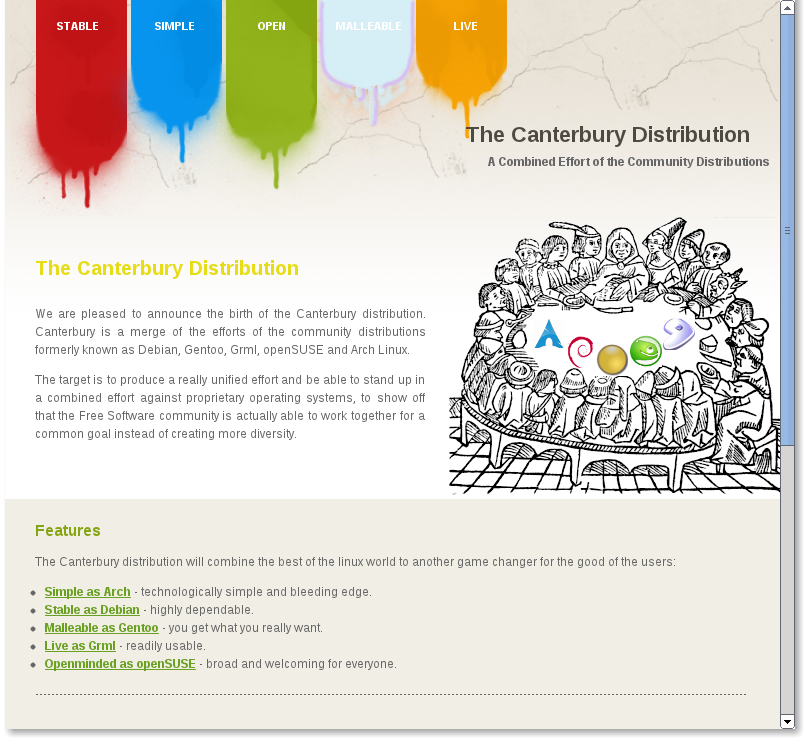
pushing cross-distro collaboration to the next level In case you've missed the announcement, today it's a memorable day for Free Software. Please join the following distributions in welcoming Canterbury, the next generation community distribution: canterbury splash page
Kudos to the, yet unnamed, representatives of the above derivatives who have come up with and coordinated this initiative.

Next.

Previous.