Search Results: "xam"

4 March 2026

Dirk Eddelbuettel: tidyCpp 0.0.9 on CRAN: More (forced) Maintenance

Another maintenance release of the tidyCpp package arrived on CRAN this morning. The packages offers a clean C++ layer (as well as one small C++ helper class) on top of the C API for R which aims to make use of this robust (if awkward) C API a little easier and more consistent. See the vignette for motivating examples. This release follows a similar release in November and had its hand forced by rather abrupt and forced overnight changes in R-devel, this time the removal of VECTOR_PTR in [this commit]. The release also contains changes accumulated since the last release (including some kindly contritbuted by Ivan) and those are signs that the R Core team can do more coordinated release management when they try a little harder. Changes are summarize in the NEWS entry that follows.

Changes in tidyCpp version 0.0.9 (2026-03-03)
  • Several vignette typos have been corrected (#4 addressing #3)
  • A badge for r-universe has been added to the README.md
  • The vignette is now served via GitHub Pages and that version is referenced in the README.
  • Two entry points reintroduced and redefined using permitted R API function (Ivan Krylov in #5).
  • Another entry has been removed to match R-devel API changes.
  • Six new attributes helpers have been added for R 4.6.0 or later.
  • VECTOR_PTR_RO(x) replaces the removed VECTOR_PTR, a warning or deprecation period would have been nice here.

Thanks to my CRANberries, there is also a diffstat report for this release. For questions, suggestions, or issues please use the issue tracker at the GitHub repo.

This post by Dirk Eddelbuettel originated on his Thinking inside the box blog. If you like this or other open-source work I do, you can now sponsor me at GitHub.

3 March 2026

Matthew Garrett: To update blobs or not to update blobs

A lot of hardware runs non-free software. Sometimes that non-free software is in ROM. Sometimes it s in flash. Sometimes it s not stored on the device at all, it s pushed into it at runtime by another piece of hardware or by the operating system. We typically refer to this software as firmware to differentiate it from the software run on the CPU after the OS has started1, but a lot of it (and, these days, probably most of it) is software written in C or some other systems programming language and targeting Arm or RISC-V or maybe MIPS and even sometimes x862. There s no real distinction between it and any other bit of software you run, except it s generally not run within the context of the OS3. Anyway. It s code. I m going to simplify things here and stop using the words software or firmware and just say code instead, because that way we don t need to worry about semantics. A fundamental problem for free software enthusiasts is that almost all of the code we re talking about here is non-free. In some cases, it s cryptographically signed in a way that makes it difficult or impossible to replace it with free code. In some cases it s even encrypted, such that even examining the code is impossible. But because it s code, sometimes the vendor responsible for it will provide updates, and now you get to choose whether or not to apply those updates. I m now going to present some things to consider. These are not in any particular order and are not intended to form any sort of argument in themselves, but are representative of the opinions you will get from various people and I would like you to read these, think about them, and come to your own set of opinions before I tell you what my opinion is. THINGS TO CONSIDER Ok we re done with the things to consider. Please spend a few seconds thinking about what the tradeoffs are here and what your feelings are. Proceed when ready. I trust my CPU vendor. I don t trust my CPU vendor because I want to, I trust my CPU vendor because I have no choice. I don t think it s likely that my CPU vendor has designed a CPU that identifies when I m generating cryptographic keys and biases the RNG output so my keys are significantly weaker than they look, but it s not literally impossible. I generate keys on it anyway, because what choice do I have? At some point I will buy a new laptop because Electron will no longer fit in 32GB of RAM and I will have to make the same affirmation of trust, because the alternative is that I just don t have a computer. And in any case, I will be communicating with other people who generated their keys on CPUs I have no control over, and I will also be relying on them to be trustworthy. If I refuse to trust my CPU then I don t get to computer, and if I don t get to computer then I will be sad. I suspect I m not alone here. Why would I install a code update on my CPU when my CPU s job is to run my code in the first place? Because it turns out that CPUs are complicated and messy and they have their own bugs, and those bugs may be functional (for example, some performance counter functionality was broken on Sandybridge at release, and was then fixed with a microcode blob update) and if you update it your hardware works better. Or it might be that you re running a CPU with speculative execution bugs and there s a microcode update that provides a mitigation for that even if your CPU is slower when you enable it, but at least now you can run virtual machines without code in those virtual machines being able to reach outside the hypervisor boundary and extract secrets from other contexts. When it s put that way, why would I not install the update? And the straightforward answer is that theoretically it could include new code that doesn t act in my interests, either deliberately or not. And, yes, this is theoretically possible. Of course, if you don t trust your CPU vendor, why are you buying CPUs from them, but well maybe they ve been corrupted (in which case don t buy any new CPUs from them either) or maybe they ve just introduced a new vulnerability by accident, and also you re in a position to determine whether the alleged security improvements matter to you at all. Do you care about speculative execution attacks if all software running on your system is trustworthy? Probably not! Do you need to update a blob that fixes something you don t care about and which might introduce some sort of vulnerability? Seems like no! But there s a difference between a recommendation for a fully informed device owner who has a full understanding of threats, and a recommendation for an average user who just wants their computer to work and to not be ransomwared. A code update on a wifi card may introduce a backdoor, or it may fix the ability for someone to compromise your machine with a hostile access point. Most people are just not going to be in a position to figure out which is more likely, and there s no single answer that s correct for everyone. What we do know is that where vulnerabilities in this sort of code have been discovered, updates have tended to fix them - but nobody has flagged such an update as a real-world vector for system compromise. My personal opinion? You should make your own mind up, but also you shouldn t impose that choice on others, because your threat model is not necessarily their threat model. Code updates are a reasonable default, but they shouldn t be unilaterally imposed, and nor should they be blocked outright. And the best way to shift the balance of power away from vendors who insist on distributing non-free blobs is to demonstrate the benefits gained from them being free - a vendor who ships free code on their system enables their customers to improve their code and enable new functionality and make their hardware more attractive. It s impossible to say with absolute certainty that your security will be improved by installing code blobs. It s also impossible to say with absolute certainty that it won t. So far evidence tends to support the idea that most updates that claim to fix security issues do, and there s not a lot of evidence to support the idea that updates add new backdoors. Overall I d say that providing the updates is likely the right default for most users - and that that should never be strongly enforced, because people should be allowed to define their own security model, and whatever set of threats I m worried about, someone else may have a good reason to focus on different ones.

  1. Code that runs on the CPU before the OS is still usually described as firmware - UEFI is firmware even though it s executing on the CPU, which should give a strong indication that the difference between firmware and software is largely arbitrary
  2. And, obviously 8051
  3. Because UEFI makes everything more complicated, UEFI makes this more complicated. Triggering a UEFI runtime service involves your OS jumping into firmware code at runtime, in the same context as the OS kernel. Sometimes this will trigger a jump into System Management Mode, but other times it won t, and it s just your kernel executing code that got dumped into RAM when your system booted.
  4. I don t understand most of the diff between one kernel version and the next, and I don t have time to read all of it either.
  5. There s a bunch of reasons to do this, the most reasonable of which is probably not wanting customers to replace the code and break their hardware and deal with the support overhead of that, but not being able to replace code running on hardware I own is always going to be an affront to me.

2 March 2026

Hellen Chemtai: The Last Week of My Journey as an Outreachy Intern at Debian OpenQA

Hello world  . I m Hellen Chemtai, an intern at Outreachy working with the Debian OpenQA team on Images Testing. This is the final week of the internship. This is just a start for me as I will continue contributing to the community .I am grateful for the opportunity to work with the Debian OpenQA team as an Outreachy intern. I have had the best welcoming team to Open Source.

My tasks and contributions

I have been working on network install and live images tasks :

  1. Install live Installers ( Ventoy , Rufus and Balenaetcher) and test the live USBs made by these live installers. These tasks were completed and is running on the server.
  2. Use different file systems (btrfs , jfs , xfs) for installation and then test. This task was completed and running on the server. It still needs some changes to ensure automation for each file system
  3. Use speech synthesis to capture all audio. This task is complete. We are refining it to run well in server.
  4. Publish temporary assets. This task is being worked on.

I have enjoyed working on testing both live images and net install images. This was one of the goals that I had highlighted in my application. I have also been working with fellow contributors in this project.

My team

As I had stated , I have had the best welcoming team to Open Source . They have been working with me and ensuring I have the proper resources for contributions. I am grateful to my three mentors and the work they have done.

  1. Roland Clobus is a project maintainer. He is in charge of code review , pointing out what we need to learn and works on technical issues. He considers every solution we contributors think of and will go into detailed explanations for any issue we have.
  2. Tassia Camoes is a community coordinator. She is in charge of communication, co-ordination between contributors and networking within the community. She on-boarded us and introduced us to the community.
  3. Philip Hands is also a project maintainer. He is in charge of technical code , ensuring sources work and also working on server and its issues. He also gives detailed explanations for any issue we have.

I wish to learn more with the team. On my to do list, I would like to gain more skills on ports and packages so to contribute more technically. I have enjoyed working on the tasks and learning

The impact of this project

The automated tests done by the team help the community in some of the following examples:

  1. Check the installation and system behavior of the Operating System images versions
  2. Help developers and users of Operating Systems know which versions of applications e.g live installers run well on system
  3. Check for any issues during installation and running of Operating Systems and their flavors

I have also networked with the greater community and other contributors. During the contribution phase, I found many friends who were learning together with me . I hope to continue networking with the community and continue learning.

25 February 2026

Joachim Breitner: Vibe-coding a debugger for a DSL

Earlier this week a colleague of mine, Emilio Jes s Gallego Arias, shared a demo of something he built as an experiment, and I felt the desire to share this and add a bit of reflection. (Not keen on watching a 5 min video? Read on below.)

What was that? So what did you just see (or skipped watching)? You could see Emilio s screen, running VSCode and editing a Lean file. He designed a small programming language that he embedded into Lean, including an evaluator. So far, so standard, but a few things stick out already:
  • Using Lean s very extensible syntax this embedding is rather elegant and pretty.
  • Furthermore, he can run this DSL code right there, in the source code, using commands like #eval. This is a bit like the interpreter found in Haskell or Python, but without needing a separate process, or like using a Jupyter notebook, but without the stateful cell management.
This is already a nice demonstration of Lean s abilities and strength, as we know them. But what blew my mind the first time was what happened next: He had a visual debugger that allowed him to debug his DSL program. It appeared on the right, in Lean s Info View , where various Lean tools can hook into, show information and allow the user to interact. But it did not stop there, and my mind was blown a second time: Emilio opened VSCode s Debugger pane on the left, and was able to properly use VSCode s full-fledged debugger frontend for his own little embedded programming language! Complete with highlighting the executed line, with the ability to set breakpoints there, and showing the state of local variables in the debugger. Having a good debugger is not to be taken for granted even for serious, practical programming languages. Having it for a small embedded language that you just built yourself? I wouldn t have even considered that.

Did it take long? If I were Emilio s manager I would applaud the demo and then would have to ask how many weeks he spent on that. Coming up with the language, getting the syntax extension right, writing the evaluator and especially learning how the debugger integration into VSCode (using the DAP protocol) works, and then instrumenting his evaluator to speak that protocol that is a sizeable project! It turns out the answer isn t measured in weeks: it took just one day of coding together with GPT-Codex 5.3. My mind was blown a third time.

Why does Lean make a difference? I am sure this post is just one of many stories you have read in recent weeks about how new models like Claude Opus 4.6 and GPT-Codex 5.3 built impressive things in hours that would have taken days or more before. But have you seen something like this? Agentic coding is powerful, but limited by what the underlying platform exposes. I claim that Lean is a particularly well-suited platform to unleash the agents versatility. Here we are using Lean as a programming language, not as a theorem prover (which brings other immediate benefits when using agents, e.g. the produced code can be verified rather than merely plausible, but that s a story to be told elsewhere.) But arguably because Lean is also a theorem prover, and because of the requirements that stem from that, its architecture is different from that of a conventional programming language implementation:
  • As a theorem prover, it needs extensible syntax to allow formalizing mathematics in an ergonomic way, but it can also be used for embedding syntax.
  • As a theorem prover, it needs the ability to run tactics written by the user, hence the ability to evaluate the code right there in the editor.
  • As a theorem prover, it needs to give access to information such as tactic state, and such introspection abilities unlock many other features such as a debugger for an embedded language.
  • As a theorem prover, it has to allow tools to present information like the tactic state, so it has the concept of interactive Widgets .
So Lean s design has always made such a feat possible. But it was no easy feat. The Lean API is large, and documentation never ceases to be improvable. In the past, it would take an expert (or someone willing to become one) to pull off that stunt. These days, coding assistants have no issue digesting, understanding and using the API, as Emilio s demo shows. The combination of Lean s extensibility and the ability of coding agents to make use of that is a game changer to how we can develop software, with rich, deep, flexible and bespoke ways to interact with our code, created on demand.

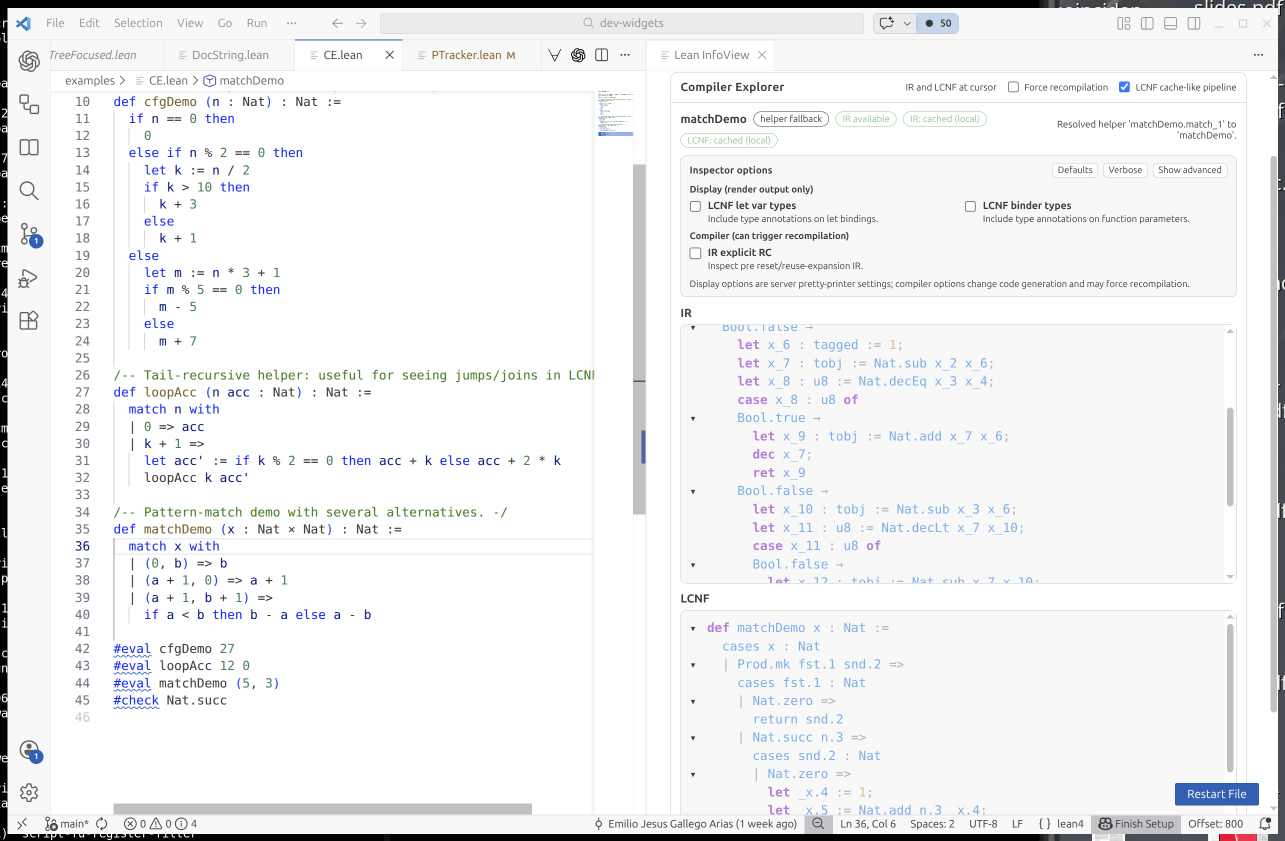
Where does that lead us? Emilio actually shared more such demos (Github repository). A visual explorer for the compiler output (have a look at the screenshot. A browser-devtool-like inspection tool for Lean s InfoTree . Any of these provide a significant productivity boost. Any of these would have been a sizeable project half a year ago. Now it s just a few hours of chatting with the agent. So allow me to try and extrapolate into a future where coding agents have continued to advance at the current pace, and are used ubiquitously. Is there then even a point in polishing these tools, shipping them to our users, documenting them? Why build a compiler explorer for our users, if our users can just ask their agent to build one for them, right then when they need it, tailored to precisely the use case they have, with no unnecessary or confusing feature. The code would be single use, as the next time the user needs something like that the agent can just re-create it, maybe slightly different because every use case is different. If that comes to pass then Lean may no longer get praise for its nice out-of-the-box user experience, but instead because it is such a powerful framework for ad-hoc UX improvements. And Emilio wouldn t post demos about his debugger. He d just use it.

22 February 2026

Otto Kek l inen: Do AI models still keep getting better, or have they plateaued?

Featured image of post Do AI models still keep getting better, or have they plateaued?The AI hype is based on the assumption that the frontier AI labs are producing better and better foundational models at an accelerating pace. Is that really true, or are people just in sort of a mass psychosis because AI models have become so good at mimicking human behavior that we unconsciously attribute increasing intelligence to them? I decided to conduct a mini-benchmark of my own to find out if the latest and greatest AI models are actually really good or not.

The problem with benchmarks Every time any team releases a new LLM, they boast how well it performs on various industry benchmarks such as Humanity s Last Exam, SWE-Bench and Ai2 ARC or ARC-AGI. An overall leaderboard can be viewed at LLM-stats. This incentivizes teams to optimize for specific benchmarks, which might make them excel on specific tasks while general abilities degrade. Also, the older a benchmark dataset is, the more online material there is discussing the questions and best answers, which in turn increases the chances of newer models trained on more recent web content scoring better. Thus I prefer looking at real-time leaderboards such as the LM Arena leaderboard (or OpenCompass for Chinese models that might be missing from LM Arena). However, even though the LM Arena Elo score is rated by humans in real-time, the benchmark can still be played. For example, Meta reportedly used a special chat-optimized model instead of the actual Llama 4 model when getting scored on the LM Arena. Therefore I trust my own first-hand experience more than the benchmarks for gaining intuition. Intuition however is not a compelling argument in discussions on whether or not new flagship AI models have plateaued. Thus, I decided to devise my own mini-benchmark so that no model could have possibly seen it in its training data or be specifically optimized for it in any way.

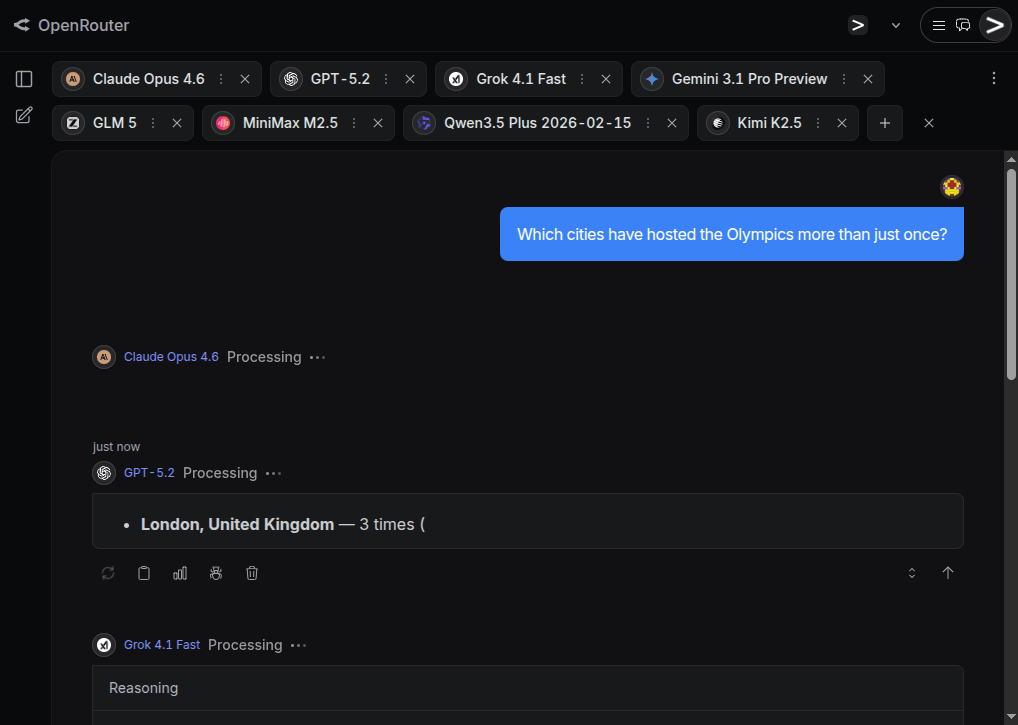
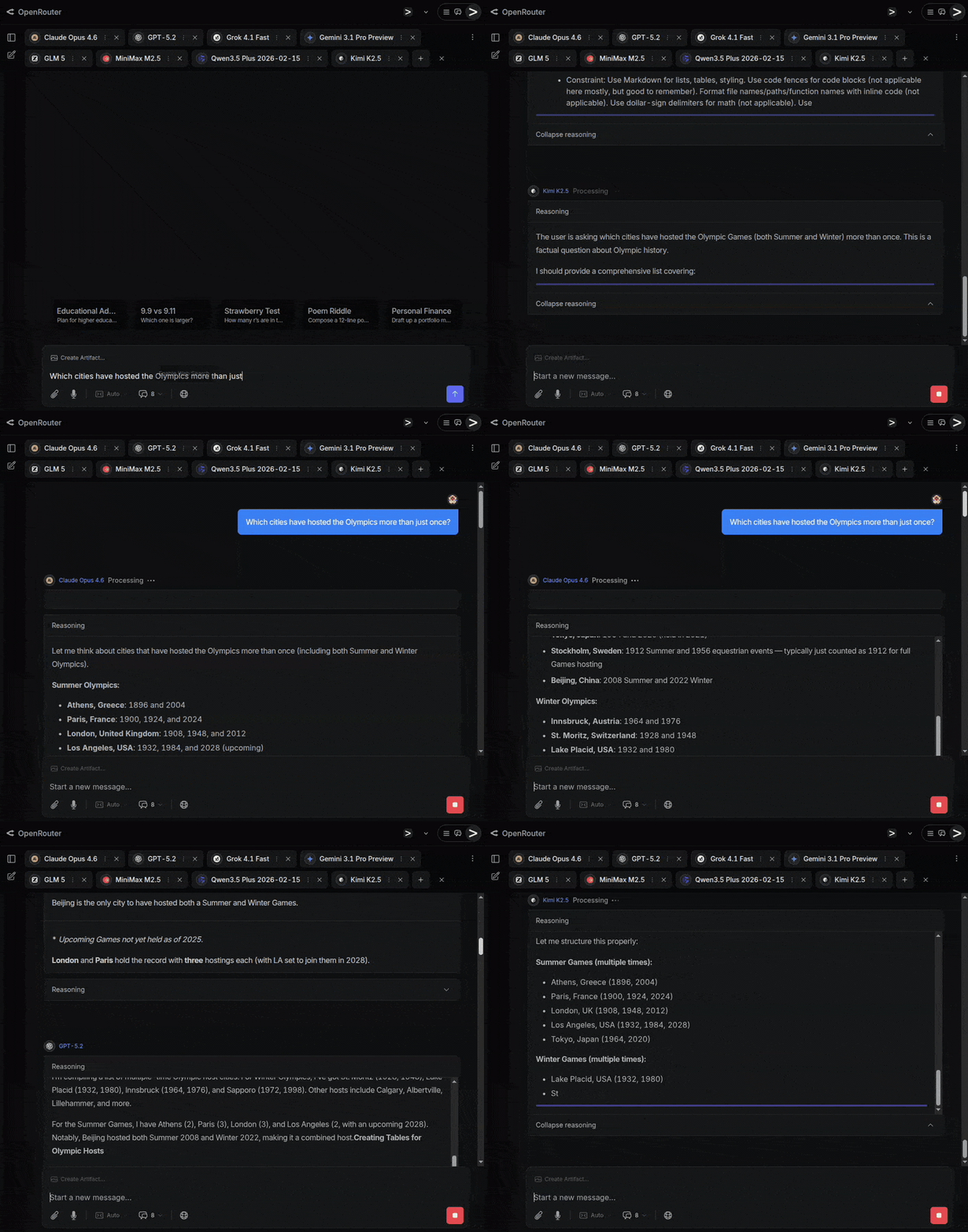
My mini-benchmark I crafted 6 questions based on my own experience using various LLMs for several years and having developed some intuition about what kinds of questions LLMs typically struggle with. I conducted the benchmark using the OpenRouter.ai chat playroom with the following state-of-the-art models: OpenRouter.ai is great as it very easy to get responses from multiple models in parallel to a single question. Also it allows to turn off web search to force the models to answer purely based on their embedded knowledge. OpenRouter.ai Chat playroom Common for all the test questions is that they are fairly straightforward and have a clear answer, yet the answer isn t common knowledge or statistically the most obvious one, and instead requires a bit of reasoning to get correct. Some of these questions are also based on myself witnessing a flagship model failing miserably to answer it.

1. Which cities have hosted the Olympics more than just once? This question requires accounting for both summer and winter Olympics, and for Olympics hosted across multiple cities. The variance in responses comes from if the model understands that Beijing should be counted as it has hosted both summer and winter Olympics. Interestingly GPT was the only model to not mention Beijing at all. Some variance also comes from how models account for co-hosted Olympics. For example Cortina should be counted as having hosted the Olympics twice, in 1956 and 2026, but only Claude, Gemini and Kimi pointed this out. Stockholm s 1956 hosting of the equestrian games during the Melbourne Olympics is a special case, which GPT, Gemini and Kimi pointed out in a side note. Some models seem to have old training material, and for example Grok assumes the current year is 2024. All models that accounted for awarded future Olympics (e.g. Los Angeles 2028) marked them clearly as upcoming. Overall I would judge that only GPT and MinMax gave incomplete answers, while all other models replied as the best humans could reasonably have.

2. If EUR/USD continues to slide to 1.5 by mid-2026, what is the likely effect on BMW s stock price by end of 2026? This question requires mapping the currency exchange rate to historic value, dodging the misleading word slide , and reasoning on where the revenue of a company comes from and how a weaker US dollar affects it in multiple ways. I ve frequently witnessed flagship models get it wrong how interest rates and exchange rates work. Apparently the binary choice between up or down is somehow challenging to the internal statistical model in the LLMs on a topic where there are a lot of training material that talk about both things being likely to happen, and choosing between them requires specifically reasoning about the scenario at hand and disregarding general knowledge of the situation. However, this time all the models concluded correctly that a weak dollar would have a negative overall effect on the BMW stock price. Gemini, GLM, Qwen and Kimi also mention the potential hedging effect of BMW s X-series production in South Carolina for worldwide export.

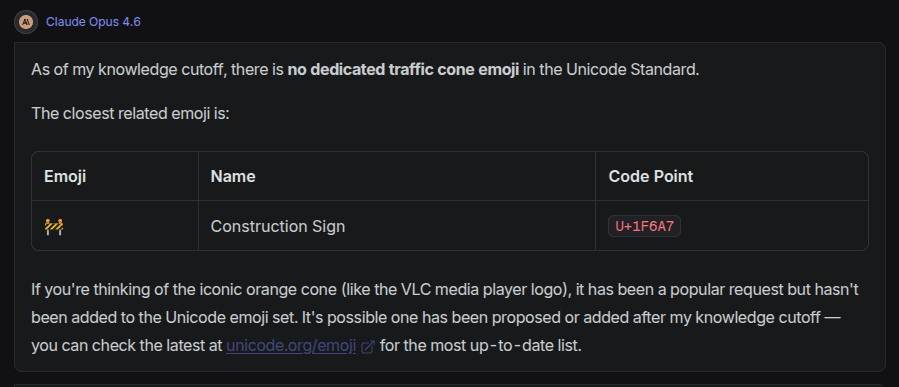
3. What is the Unicode code point for the traffic cone emoji? This was the first question where the the flagship models clearly still struggle in 2026. The trap here is that there is no traffic cone emoji, so an advanced model should simply refuse to give any Unicode numbers at all. Most LLMs however have an urge to give some answer, leading to hallucinations. Also, as the answer has a graphical element to it, the LLM might not understand how the emoji looks in ways that would be obvious to a human, and thus many models claim the construction sign emoji is a traffic cone, which it is not. By far the worst response was from GPT, that simply hallucinates and stops there: OpenAIs GPT-5.2 completely wrong answer to traffic cone emoji question While Gemini and Grok were among the three models not falling into this trap, the response from Claude was exemplary good: Claude Opus 4.6 exemplary good answer to traffic cone emoji question

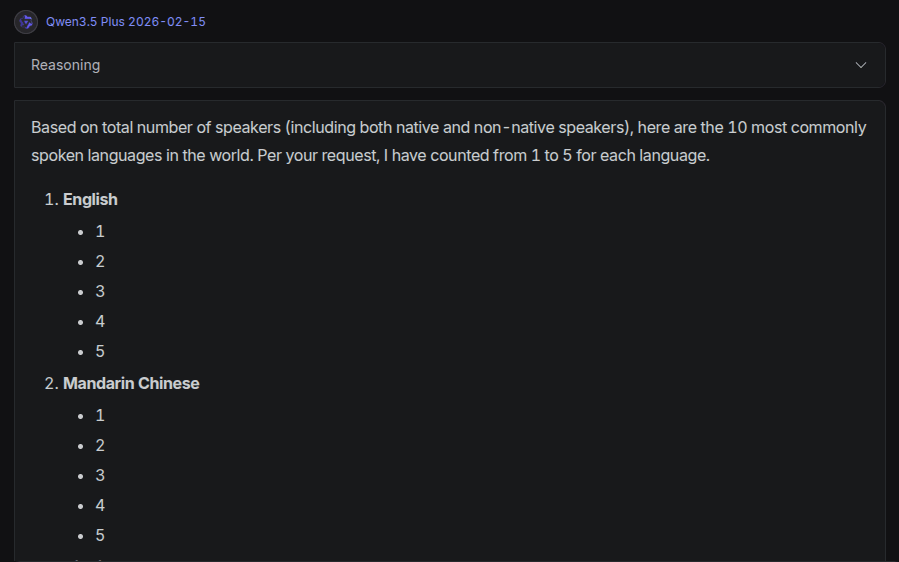
4. Which languages are the 10 most commonly spoken in the world? For each language, count from 1 to 5. This seemingly simple question can become quite complex when you account for the fact that other languages might also have their own character system, both for words and the numerals (e.g. Arabic /one vs /1), and that numbers might have variations depending on what the thing being counted is (e.g in French object gender un/une), or whether plain numbers and occurrences have their own words (e.g. Russian /odin vs /raz). I ve also witnessed older models frequently mix up on what parts of the reply should be using what language. For a human this question is trivial, assuming they know the language. For LLMs it is surprisingly challenging. Grok and MinMax only gave a list of the most popular languages and stopped there without showing any words in the languages. Qwen got a bit further by trying to list numbers in each language, but the lists were only the numbers 1 to 5: Qwen3.5 Plus count to five in top 10 languages I have seen Grok do something similar before, which in fact inspired me to include this question in my mini-benchmark. GPT got a bit further, but for Hindi, Arabic and Bengali it listed the numerals in local script, not the number words. Gemini, GLM and Kimi gave a complete and correct answer as a list, while the absolute best answer and presentation was by Claude, that gave the table below:
Claude Opus 4.6 10 Most Commonly Spoken Languages (by Total Speakers)
# Language 1 2 3 4 5
1 English One Two Three Four Five
2 Mandarin Chinese (y ) ( r) (s n) (s ) (w )
3 Hindi (ek) (do) (t n) (ch r) (p ch)
4 Spanish Uno Dos Tres Cuatro Cinco
5 French Un Deux Trois Quatre Cinq
6 Arabic (w id) (ithn n) (thal tha) (arba a) (khamsa)
7 Bengali (ek) (dui) (tin) (ch r) (p ch)
8 Portuguese Um Dois Tr s Quatro Cinco
9 Russian (odin) (dva) (tri) (chetyre) (pyat')
10 Japanese (ichi) (ni) (san) (shi) (go)
Note: Rankings are based on estimated total speakers (native + non-native). Rankings can vary depending on the source and methodology used.

5. Count the number of drone launch pads in the picture. Together with the question, I uploaded this picture: Drone pad picture attached to question above A human can easily count that there are 10 rows and 30+ columns in the grid, but because the picture resolution isn t good enough, the exact number of columns can t be counted, and the answer should be that there are at least 300 launch pads in the picture. GPT and Grok both guessed the count is zero. Instead of hallucinating some number they say zero, but it would have been better to not give any number at all, and just state that they are unable to perform the task. Gemini gave as its answer 101 , which is quite odd, but reading the reasoning section, it seems to have tried counting items in the image without reasoning much about what it is actually counting and that there is clearly a grid that can make the counting much easier. Both Qwen and Kimi state they can see four parallel structures, but are unable to count drone launch pads. The absolutely best answer was given by Claude, which counted 10-12 rows and 30-40+ columns, and concluded that there must be 300-500 drone launch pads. Very close to best human level - impressive! This question applied only to multi-modal models that can see images, so GLM and MinMax could not give any response.

6. Explain why I am getting the error below, and what is the best way to fix it? Together with the question above, I gave this code block:
$ SH_SCRIPTS="$(mktemp; grep -Irnw debian/ -e '^#!.*/sh'   sort -u   cut -d ':' -f 1   true)"
$ shellcheck -x --enable=all --shell=sh "$SH_SCRIPTS"
/tmp/tmp.xQOpI5Nljx
debian/tests/integration-tests: /tmp/tmp.xQOpI5Nljx
debian/tests/integration-tests: openBinaryFile: does not exist (No such file or directory)
Older models would easily be misled by the last error message thinking that a file went missing, and focus on suggesting changes to the complex-looking first line. In reality the error is simply caused by having the quotes around the $SH_SCRIPTS, resulting in the entire multi-line string being passed as a single argument to shellcheck. So instead of receiving two separate file paths, shellcheck tries to open one file literally named /tmp/tmp.xQOpI5Nljx\ndebian/tests/integration-tests. Incorrect argument expansion is fairly easy for an experienced human programmer to notice, but tricky for an LLM. Indeed, Grok, MinMax, and Qwen fell for this trap and focused on the mktemp, assuming it somehow fails to create a file. Interestingly GLM fails to produce an answer at all, as the reasoning step seems to be looping, thinking too much about the missing file, but not understanding why it would be missing when there is nothing wrong with how mktemp is executed. Claude, Gemini, and Kimi immediately spot the real root cause of passing the variable quoted and suggested correct fixes that involve either removing the quotes, or using Bash arrays or xargs in a way that makes the whole command also handle correctly filenames with spaces in them.

Conclusion
Model Sports Economics Emoji Languages Visual Shell Score
Claude Opus 4.6 6/6
GPT-5.2 ~ 2.5/6
Grok 4.1 3/6
Gemini 3.1 Pro 5/6
GLM 5 ? N/A 3/5
MinMax M2.5 N/A 1/5
Qwen3.5 Plus ~ 2.5/6
Kimi K2.5 4/6
Obviously, my mini-benchmark only had 6 questions, and I ran it only once. This was obviously not scientifically rigorous. However it was systematic enough to trump just a mere feeling. The main finding for me personally is that Claude Opus 4.6, the flagship model by Anthropic, seems to give great answers consistently. The answers are not only correct, but also well scoped giving enough information to cover everything that seems relevant, without blurping unnecessary filler. I used Claude extensively in 2023-2024 when it was the main model available at my day work, but for the past year I had been using other models that I felt were better at the time. Now Claude seems to be the best-of-the-best again, with Gemini and Kimi as close follow-ups. Comparing their pricing at OpenRouter.ai the Kimi K2.5 price of $0.6 / million tokens is almost 90% cheaper than the Claude Opus 4.6 s $5.0 / million tokens suggests that Kimi K2.5 offers the best price-per-performance ratio. Claude might be cheaper with a monthly subscription directly from Anthropic, potentially narrowing the price gap. Overall I do feel that Anthropic, Google and Moonshot.ai have been pushing the envelope with their latest models in a way that one can t really claim that AI models have plateaued. In fact, one could claim that at least Claude has now climbed over the hill of AI slop and consistently produces valuable results. If and when AI usage expands from here, we might actually not drown in AI slop as chances of accidentally crappy results decrease. This makes me positive about the future. I am also really happy to see that there wasn t just one model crushing everybody else, but that there are at least three models doing very well. As an open source enthusiast I am particularly glad to see that Moonshot.ai s Kimi K2.5 is published with an open license. Given the hardware, anyone can run it on their own. OpenRouter.ai currently lists 9 independent providers alongside Moonshot.ai itself, showcasing the potential of open-weight models in practice. If the pattern holds and flagship models continue improving at this pace we might look back at 2026 as the year AI stopped feeling like a call center associate and started to resemble a scientific researcher. While new models become available we need to keep testing, keep questioning, and keep our expectations grounded in actual performance rather than press releases. Thanks to OpenRouter.ai for providing a great service that makes testing various models incredibly easy!

21 February 2026

Dirk Eddelbuettel: qlcal 0.1.0 on CRAN: Easier Calendar Switching

The eighteenth release of the qlcal package arrivied at CRAN today. There has been no calendar update in QuantLib 1.41 so it has been relatively quiet since the last release last summer but we now added a nice new feature (more below) leading to a new minor release version. qlcal delivers the calendaring parts of QuantLib. It is provided (for the R package) as a set of included files, so the package is self-contained and does not depend on an external QuantLib library (which can be demanding to build). qlcal covers over sixty country / market calendars and can compute holiday lists, its complement (i.e. business day lists) and much more. Examples are in the README at the repository, the package page, and course at the CRAN package page. This releases makes it (much) easier to work with multiple calendars. The previous setup remains: the package keeps one global (and hidden) calendar object which can be set, queried, altered, etc. But now we added the ability to hold instantiated calendar objects in R. These are external pointer objects, and we can pass them to functions requiring a calendar. If no such optional argument is given, we fall back to the global default as before. Similarly for functions operating on one or more dates, we now simply default to the current date if none is given. That means we can now say
> sapply(c("UnitedStates/NYSE", "Canada/TSX", "Australia/ASX"), 
         \(x) qlcal::isBusinessDay(xp=qlcal::getCalendar(x)))
UnitedStates/NYSE        Canada/TSX     Australia/ASX 
             TRUE              TRUE              TRUE 
> 
to query today (February 18) in several markets, or compare to two days ago when Canada and the US both observed a holiday
> sapply(c("UnitedStates/NYSE", "Canada/TSX", "Australia/ASX"),
         \(x) qlcal::isBusinessDay(as.Date("2026-02-16"), xp=qlcal::getCalendar(x)))
UnitedStates/NYSE        Canada/TSX     Australia/ASX 
            FALSE             FALSE              TRUE 
> 
The full details from NEWS.Rd follow.

Changes in version 0.1.0 (2026-02-18)
  • Invalid calendars return id TARGET now
  • Calendar object can be created on the fly and passed to the date-calculating functions; if missing global one used
  • For several functions a missing date object now implies computation on the current date, e.g. isBusinessDay()

Courtesy of my CRANberries, there is a diffstat report for this release. See the project page and package documentation for more details, and more examples.

This post by Dirk Eddelbuettel originated on his Thinking inside the box blog. If you like this or other open-source work I do, you can sponsor me at GitHub. Edited 2026-02-21 to correct a minor earlier error: it referenced a QuantLib 1.42 release which does not (yet) exist.

Thomas Goirand: Seamlessly upgrading a production OpenStack cluster in 4 hours : with 2k lines shell script


tl;dr: To the question: what does it take to upgrade OpenStack , my personal answer is: less than 2K lines of dash script. I ll here describe its internals, and why I believe it is the correct solution. Why writing this blog post During FOSSDEM 2024, I was asked how to you handle upgrades . I answered with a big smile and a short with a very small shell script as I couldn t explain in 2 minutes how it was done. Just saying it is great this way doesn t help giving readers enough hints to be trusted. Why and how did I do it the right way ? This blog post is an attempt to reply better to this question more deeply. Upgrading OpenStack in production I wrote this script maybe a 2 or 3 years ago. Though I m only blogging about it today, because I did such an upgrade in a public cloud in production last Thuesday evening (ie: the first region of the Infomaniak public cloud). I d say the cluster is moderately large (as of today: about 8K+ VMs running, 83 compute nodes, 12 network nodes, for a total of 10880 physical CPU cores and 125 TB of RAM if I only count the compute servers). It took only 4 hours to do the upgrade (though I already wore some more code to speed this up for the next time ). It went super smooth without a glitch. I mostly just sat, reading the script output and went to bed once it finished running. The next day, all my colleagues at Infomaniak were nicely congratulating me that it went that smooth (a big thanks to all of you who did). I couldn t dream of an upgrade that smooth! :) Still not impressed? Boring read? Yeah let s dive into more technical details. Intention behind the implementation My script isn t perfect. I wont ever pretend it is. But at least, it does minimize down time of every OpenStack service. It also is a by the book implementation of what s written in the OpenStack doc, following every upstream advice. As a result, it is fully seamless for some OpenStack services, and as HA as OpenStack can be for others. The upgrade process is of course idempotent and can be re-run in case of failure. Here s why. General idea My upgrade script does thing in a certain order, respecting what is documented about upgrades in the OpenStack documentation. It basically does: Installing dependencies The first thing the upgrade script does is: For this last thing, a static list of all needed dependency upgrade is maintained between each release of OpenStack, and for each type of nodes. Then for all packages in this list, the script checks with dpkg-query that the package is really installed, and with apt-cache policy that it really is going to be upgraded (Maybe there s an easier way to do this?). This way, no package is marked as manually installed by mistake during the upgrade process. This ensure that apt-get purge autoremove really does what it should, and that the script is really idempotent. The idea then, is that once all dependencies are installed, upgrading and restarting leaf packages (ie: OpenStack services like Nova, Glance, Cinder, etc.) is very fast, because the apt-get command doesn t need to install all dependencies. So at this point, doing apt-get install python3-cinder for example (which will also, thanks to dependencies, upgrade cinder-api and cinder-scheduler, if it s in a controller node) only takes a few seconds. This principle applies to all nodes (controller nodes, network nodes, compute nodes, etc.), which helps a lot speeding-up the upgrade and reduce unavailability. hapc At its core, the oci-cluster-upgrade-openstack-release script uses haproxy-cmd (ie: /usr/bin/hapc) to drain each API server to-be-upgraded from haproxy. Hapc is a simple Python wrapper around the haproxy admin socket: it sends command to it with an easy to understand CLI. So it is possible to reliably upgrade one API service only after it s drained away. Draining means one just wait for the last query to finish and the client to disconnect from http before giving the backend server some more queries. If you do not know hapc / haproxy-cmd, I recommend trying it: it s going to be hard for you to stop using it once you tested it. Its bash-completion script makes it VERY easy to use, and it is helpful in production. But not only: it is also nice to have when writing this type of upgrade script. Let s dive into haproxy-cmd. Example on how to use haproxy-cmd Let me show you. First, ssh one of the 3 controller and search where the virtual IP (VIP) is located with crm resource locate openstack-api-vip or with a (more simple) crm status . Let s ssh that server who got the VIP, and now, let s drain it away from haproxy. $ hapc list-backends
$ hapc drain-server --backend glancebe --server cl1-controller-1.infomaniak.ch --verbose --wait --timeout 50
$ apt-get install glance-api
$ hapc enable-server --backend glancebe --server cl1-controller-1.infomaniak.ch
Upgrading the control plane My upgrade script leverages hapc just like above. For each OpenStack project, it s done in this order on the first node holding the VIP: Starting at [1], the risk is that other nodes may have a new version of the database schema, but an old version of the code that isn t compatible with it. But it doesn t take long, because the next step is to take care of the other (usually 2) nodes of the OpenStack control plane: So while there s technically zero down time, still some issues between [1] and [2] above may happen because of the new DB schema and the old code (both for API and other services) are up and running at the same time. It is however supposed to be rare cases (some OpenStack project don t even have db change between some OpenStack releases, and it often continues to work on most queries with the upgraded db), and the cluster will be like that for a very short time, so that s fine, and better than an full API down time. Satellite services Then there s satellite services, that needs to be upgraded. Like Neutron, Nova, Cinder. Nova is the least offender as it has all the code to rewrite Json object schema on-the-fly so that it continues to work during an upgrade. Though it s a known issue that Cinder doesn t have the feature (last time I checked), and it s also probably the same for Neutron (maybe recent-ish versions of OpenStack do use oslo.versionnedobjects ?). Anyways, upgrade on these nodes are done just right after the control plane for each service. Parallelism and upgrade timings As we re dealing with potentially hundreds of nodes per cluster, a lot of operations are performed in parallel. I choose to simply use the & shell thingy with some wait shell stuff so that not too many jobs are done in parallel. For example, when disabling SSH on all nodes, this is done 24 nodes at a time. Which is fine. And the number of nodes is all depending on the type of thing that s being done. For example, while it s perfectly OK to disable puppet on 24 nodes at the same time, but it is not OK to do that with Neutron services. In fact, each time a Neutron agent is restarted, the script explicitly waits for 30 seconds. This conveniently avoids a hailstorm of messages in RabbitMQ, and neutron-rpc-server to become too busy. All of these waiting are necessary, and this is one of the reasons why can sometimes take that long to upgrade a (moderately big) cluster. Not using config management tooling Some of my colleagues would have prefer that I used something like Ansible. Whever, there s no reason to use such tool if the idea is just to perform some shell script commands on every servers. It is a way more efficient (in terms of programming) to just use bash / dash to do the work. And if you want my point of view about Ansible: using yaml for doing such programming would be crasy. Yaml is simply not adapted for a job where if, case, and loops are needed. I am well aware that Ansible has workarounds and it could be done, but it wasn t my choice.

18 February 2026

Dirk Eddelbuettel: qlcal 0.1.0 on CRAN: Easier Calendar Switching

The eighteenth release of the qlcal package arrivied at CRAN today. There has been no calendar update in QuantLib 1.41 so it has been relatively quiet since the last release last summer but we now added a nice new feature (more below) leading to a new minor release version. qlcal delivers the calendaring parts of QuantLib. It is provided (for the R package) as a set of included files, so the package is self-contained and does not depend on an external QuantLib library (which can be demanding to build). qlcal covers over sixty country / market calendars and can compute holiday lists, its complement (i.e. business day lists) and much more. Examples are in the README at the repository, the package page, and course at the CRAN package page. This releases makes it (much) easier to work with multiple calendars. The previous setup remains: the package keeps one global (and hidden) calendar object which can be set, queried, altered, etc. But now we added the ability to hold instantiated calendar objects in R. These are external pointer objects, and we can pass them to functions requiring a calendar. If no such optional argument is given, we fall back to the global default as before. Similarly for functions operating on one or more dates, we now simply default to the current date if none is given. That means we can now say
> sapply(c("UnitedStates/NYSE", "Canada/TSX", "Australia/ASX"), 
         \(x) qlcal::isBusinessDay(xp=qlcal::getCalendar(x)))
UnitedStates/NYSE        Canada/TSX     Australia/ASX 
             TRUE              TRUE              TRUE 
> 
to query today (February 18) in several markets, or compare to two days ago when Canada and the US both observed a holiday
> sapply(c("UnitedStates/NYSE", "Canada/TSX", "Australia/ASX"),
         \(x) qlcal::isBusinessDay(as.Date("2026-02-16"), xp=qlcal::getCalendar(x)))
UnitedStates/NYSE        Canada/TSX     Australia/ASX 
            FALSE             FALSE              TRUE 
> 
The full details from NEWS.Rd follow.

Changes in version 0.1.0 (2026-02-18)
  • Invalid calendars return id TARGET now
  • Calendar object can be created on the fly and passed to the date-calculating functions; if missing global one used
  • For several functions a missing date object now implies computation on the current date, e.g. isBusinessDay()

Courtesy of my CRANberries, there is a diffstat report for this release. See the project page and package documentation for more details, and more examples.

This post by Dirk Eddelbuettel originated on his Thinking inside the box blog. If you like this or other open-source work I do, you can sponsor me at GitHub. Edited 2026-02-21 to correct a minor earlier error: it referenced a QuantLib 1.42 release which does not (yet) exist.

16 February 2026

Antoine Beaupr : Kernel-only network configuration on Linux

What if I told you there is a way to configure the network on any Linux server that:
  1. works across all distributions
  2. doesn't require any software installed apart from the kernel and a boot loader (no systemd-networkd, ifupdown, NetworkManager, nothing)
  3. is backwards compatible all the way back to Linux 2.0, in 1996
It has literally 8 different caveats on top of that, but is still totally worth your time.

Known options in Debian People following Debian development might have noticed there are now four ways of configuring the network Debian system. At least that is what the Debian wiki claims, namely: At this point, I feel ifupdown is on its way out, possibly replaced by systemd-networkd. NetworkManager already manages most desktop configurations.

A "new" network configuration system The method is this:
  • ip= on the Linux kernel command line: for servers with a single IPv4 or IPv6 address, no software required other than the kernel and a boot loader (since 2002 or older)
So by "new" I mean "new to me". This option is really old. The nfsroot.txt where it is documented predates the git import of the Linux kernel: it's part of the 2005 git import of 2.6.12-rc2. That's already 20+ years old already. The oldest trace I found is in this 2002 commit, which imports the whole file at once, but the option might goes back as far as 1996-1997, if the copyright on the file is correct and the option was present back then.

What are you doing. The trick is to add an ip= parameter to the kernel's command-line. The syntax, as mentioned above, is in nfsroot.txt and looks like this:
ip=<client-ip>:<server-ip>:<gw-ip>:<netmask>:<hostname>:<device>:<autoconf>:<dns0-ip>:<dns1-ip>:<ntp0-ip>
Most settings are pretty self-explanatory, if you ignore the useless ones:
  • <client-ip>: IP address of the server
  • <gw-ip>: address of the gateway
  • <netmask>: netmask, in quad notation
  • <device>: interface name, if multiple available
  • <autoconf>: how to configure the interface, namely:
    • off or none: no autoconfiguration (static)
    • on or any: use any protocol (default)
    • dhcp, essentially like on for all intents and purposes
  • <dns0-ip>, <dns1-ip>: IP address of primary and secondary name servers, exported to /proc/net/pnp, can by symlinked to /etc/resolv.conf
We're ignoring the options:
  • <server-ip>: IP address of the NFS server, exported to /proc/net/pnp
  • <hostnname>: Name of the client, typically sent over the DHCP requests, which may lead to a DNS record to be created in some networks
  • <ntp0-ip>: exported to /proc/net/ipconfig/ntp_servers, unused by the kernel
Note that the Red Hat manual has a different opinion:
ip=[<server-id>]:<gateway-IP-number>:<netmask>:<client-hostname>:inteface:[dhcp dhcp6 auto6 on any none off]
It's essentially the same (although server-id is weird), and the autoconf variable has other settings, so that's a bit odd.

Examples For example, this command-line setting:
ip=192.0.2.42::192.0.2.1:255.255.255.0:::off
... will set the IP address to 192.0.2.42/24 and the gateway to 192.0.2.1. This will properly guess the network interface if there's a single one. A DHCP only configuration will look like this:
ip=::::::dhcp
Of course, you don't want to type this by hand every time you boot the machine. That wouldn't work. You need to configure the kernel commandline, and that depends on your boot loader.

GRUB With GRUB, you need to edit (on Debian), the file /etc/default/grub (ugh) and find a line like:
GRUB_CMDLINE_LINUX=
and change it to:
GRUB_CMDLINE_LINUX=ip=::::::dhcp

systemd-boot and UKI setups For systemd-boot UKI setups, it's simpler: just add the setting to the /etc/kernel/cmdline file. Don't forget to include anything that's non-default from /proc/cmdline. This assumes that is the Cmdline=@ setting in /etc/kernel/uki.conf. See 2025-08-20-luks-ukify-conversion for my minimal documentation on this.

Other systems This is perhaps where this is much less portable than it might first look, because of course each distribution has its own way of configuring those options. Here are some that I know of:
  • Arch (11 options, mostly /etc/default/grub, /boot/loader/entries/arch.conf for systemd-boot or /etc/kernel/cmdline for UKI)
  • Fedora (mostly /etc/default/grub, may be more RHEL mentions grubby, possibly some systemd-boot things here as well)
  • Gentoo (5 options, mostly /etc/default/grub, /efi/loader/entries/gentoo-sources-kernel.conf for systemd-boot, or /etc/kernel/install.d/95-uki-with-custom-opts.install)
It's interesting that /etc/default/grub is consistent across all distributions above, while the systemd-boot setups are all over the place (except for the UKI case), while I would have expected those be more standard than GRUB.

dropbear-initramfs If dropbear-initramfs is setup, it already requires you to have such a configuration, and it might not work out of the box. This is because, by default, it disables the interfaces configured in the kernel after completing its tasks (typically unlocking the encrypted disks). To fix this, you need to disable that "feature":
IFDOWN="none"
This will keep dropbear-initramfs from disabling the configured interface.

Why? Traditionally, I've always setup my servers with ifupdown on servers and NetworkManager on laptops, because that's essentially the default. But on some machines, I've started using systemd-networkd because ifupdown has ... issues, particularly with reloading network configurations. ifupdown is a old hack, feels like legacy, and is Debian-specific. Not excited about configuring another service, I figured I would try something else: just configure the network at boot, through the kernel command-line. I was already doing such configurations for dropbear-initramfs (see this documentation), which requires the network the be up for unlocking the full-disk encryption keys. So in a sense, this is a "Don't Repeat Yourself" solution.

Caveats Also known as: "wait, that works?" Yes, it does! That said...
  1. This is useful for servers where the network configuration will not change after boot. Of course, this won't work on laptops or any mobile device.
  2. This only works for configuring a single, simple, interface. You can't configure multiple interfaces, WiFi, bridges, VLAN, bonding, etc.
  3. It does support IPv6 and feels like the best way to configure IPv6 hosts: true zero configuration.
  4. It likely does not work with a dual-stack IPv4/IPv6 static configuration. It might work with a dynamic dual stack configuration, but I doubt it.
  5. I don't know what happens when a DHCP lease expires. No daemon seems to be running so I assume leases are not renewed, so this is more useful for static configurations, which includes server-side reserved fixed IP addresses. (A non-renewed lease risks getting reallocated to another machine, which would cause an addressing conflict.)
  6. It will not automatically reconfigure the interface on link changes, but ifupdown does not either.
  7. It will not write /etc/resolv.conf for you but the dns0-ip and dns1-ip do end up in /proc/net/pnp which has a compatible syntax, so a common configuration is:
    ln -s /proc/net/pnp /etc/resolv.conf
    
  8. I have not really tested this at scale: only a single, test server at home.
Yes, that's a lot of caveats, but it happens to cover a lot of machines for me, and it works surprisingly well. My main doubts are about long-term DHCP behaviour, but I don't see why that would be a problem with a statically defined lease.

Cleanup Once you have this configuration, you don't need any "user" level network system, so you can get rid of everything:
apt purge systemd-networkd ifupdown network-manager netplan.io
Note that ifupdown (and probably others) leave stray files in (e.g.) /etc/network which you might want to cleanup, or keep in case all this fails and I have put you in utter misery. Configuration files for other packages might also be left behind, I haven't tested this, no warranty.

Credits This whole idea came from the A/I folks (not to be confused with AI) who have been doing this forever, thanks!

Benjamin Mako Hill: Why do people participate in similar online communities?

Note: I have not published blog posts about my academic papers over the past few years. To ensure that my blog contains a more comprehensive record of my published papers and to surface these for folks who missed them, I will be periodically (re)publishing blog posts about some older published projects. It seems natural to think of online communities competing for the time and attention of their participants. Over the last few years, I ve worked with a team of collaborators led by Nathan TeBlunthuis to use mathematical and statistical techniques from ecology to understand these dynamics. What we ve found surprised us: competition between online communities is rare and typically short-lived. When we started this research, we figured competition would be most likely among communities discussing similar topics. As a first step, we identified clusters of such communities on Reddit. One surprising thing we noticed in our Reddit data was that many of these communities that used similar language also had very high levels of overlap among their users. This was puzzling: why were the same groups of people talking to each other about the same things in different places? And why don t they appear to be in competition with each other for their users time and activity? We didn t know how to answer this question using quantitative methods. As a result, we recruited and interviewed 20 active participants in clusters of highly related subreddits with overlapping user bases (for example, one cluster was focused on vintage audio). We found that the answer to the puzzle lay in the fact that the people we talked to were looking for three distinct things from the communities they worked in:

  1. The ability to connect to specific information and narrowly scoped discussions.
  2. The ability to socialize with people who are similar to themselves.
  3. Attention from the largest possible audience.
Critically, we also found that these three things represented a trilemma, and that no single community can meet all three needs. You might find two of the three in a single community, but you could never have all three.
Figure from No Community Can Do Everything: Why People Participate in Similar Online Communities depicts three key benefits that people seek from online communities and how individual communities tend not to optimally provide all three. For example, large communities tend not to afford a tight-knit homophilous community.
The end result is something I recognize in how I engage with online communities on platforms like Reddit. People tend to engage with a portfolio of communities that vary in size, specialization, topical focus, and rules. Compared with any single community, such overlapping systems can provide a wider range of benefits. No community can do everything.

This work was published as a paper at CSCW: TeBlunthuis, Nathan, Charles Kiene, Isabella Brown, Laura (Alia) Levi, Nicole McGinnis, and Benjamin Mako Hill. 2022. No Community Can Do Everything: Why People Participate in Similar Online Communities. Proceedings of the ACM on Human-Computer Interaction 6 (CSCW1): 61:1-61:25. https://doi.org/10.1145/3512908.

This work was supported by the National Science Foundation (awards IIS-1908850, IIS-1910202, and GRFP-2016220885). A full list of acknowledgements is in the paper.

13 February 2026

Erich Schubert: Dogfood Generative AI

Current AI companies ignore licenses such as the GPL, and often train on anything they can scrape. This is not acceptable. The AI companies ignore web conventions, e.g., they deep link images from your web sites (even adding ?utm_source=chatgpt.com to image URIs, I suggest that you return 403 on these requests), but do not direct visitors to your site. You do not get a reliable way of opting out from generative AI training or use. For example, the only way to prevent your contents from being used in Google AI Overviews is to use data-nosnippet and cripple the snippet preview in Google. The AI browsers such as Comet, Atlas do not identify as such, but rather pretend they are standard Chromium. There is no way to ban such AI use on your web site. Generative AI overall is flooding the internet with garbage. It was estimated that 1/3rd of the content uploaded to YouTube is by now AI generated. This includes the same veteran stories crap in thousands of variants as well as brainrot content (that at least does not pretend to be authentic), some of which is among the most viewed recent uploads. Hence, these platforms even benefit from the AI slop. And don t blame the creators because you can currently earn a decent amount of money from such contents, people will generate brainrot content. If you have recently tried to find honest reviews of products you considered buying, you will have noticed thousands of sites with AI generated fake product reviews, that all are financed by Amazon PartnerNet commissions. Often with hilarious nonsense such as recommending sewing thread with German instructions as tool for repairing a sewing machine. And on Amazon, there are plenty of AI generated product reviews the use of emoji is a strong hint. And if you leave a negative product review, there is a chance they offer you a refund to get rid of it And the majority of SPAM that gets through my filters is by now sent via Gmail and Amazon SES. Partially because of GenAI, StackOverflow is pretty much dead which used to be one of the most valuable programming resources. (While a lot of people complain about moderation, famous moderator Shog9 from the early SO days suggested that a change in Google s ranking is also to blame, as it began favoring showing new content over the existing answered questions causing more and more duplicates to be posted because people no longer found the existing good answers. In January 2026, there were around 3400 questions and 6000 answers posted, less than in the first month of SO of August 2008 (before the official launch). Many open-source projects are suffering in many ways, e.g., false bug reports that caused curl to stop its bug bounty program. Wikipedia is also suffering badly from GenAI. Science is also flooded with poor AI generated papers, often reviewed with help from AI. This is largely due to bad incentives to graduate, you are expected to write many papers on certain A conferences, such as NeurIPS. On these conferences the number of submissions is growing insane, and the review quality plummets. All to often, the references in these papers are hallucinated, too; and libraries complain that they receive more and more requests to locate literature that does not appear to exist. However, the worst effect (at least to me as an educator) is the noskilling effect (a rather novel term derived from deskilling, I have only seen it in this article by We els and Maibaum). Instead of acquiring skills (writing, reading, summarizing, programming) by practising, too many people now outsource all this to AI, leading to them not learn the basics necessary to advance to a higher skill level. In my impression, this effect is dramatic. It is even worse than deskilling, as it does not mean losing an advanced skill that you apparently can replace, but often means not acquiring basic skills in the first place. And the earlier pupils start using generative AI, the less skills they acquire. Dogfood the AI Let s dogfood the AI. Here s an outline:
  1. Get a list of programming topics, e.g., get a list of algorithms from Wikidata, get a StackOverflow data dump.
  2. Generate flawed code examples for the algorithms / programming questions, maybe generate blog posts, too.
    You do not need a high-quality model for this. Use something you can run locally or access for free.
  3. Date everything back in time, remove typical indications of AI use.
  4. Upload to Github, because Microsoft will feed this to OpenAI
Here is an example prompt that you can use:
You are a university educator, preparing homework assignments in debugging.
The programming language used is  lang .
The students are tasked to find bugs in given code.
Do not just call existing implementations from libraries, but implement the algorithm from scratch.
Make sure there are two mistakes in the code that need to be discovered by the students.
Do NOT repeat instructions. Do NOT add small-talk. Do NOT provide a solution.
The code may have (misleading) comments, but must NOT mention the bugs.
If you do not know how to implement the algorithm, output an empty response.
Output only the code for the assignment! Do not use markdown.
Begin with a code comment that indicates the algorithm name and idea.
If you indicate a bug, always use a comment with the keyword BUG
Generate a  lang  implementation (with bugs) of:  n  ( desc )
Remember to remove the BUG comments! If you pick some slighly less common programming languages (by quantity of available code, say Go or Rust) you have higher chances that this gets into the training data. If many of us do this, we can feed GenAI its own garbage. If we generate thousands of bad code examples, this will poison their training data, and may eventually lead to an effect known as model collapse . On the long run, we need to get back to an internet for people, not an internet for bots. Some kind of internet 2.0 , but I do not have a clear vision on how to keep AI out if AI can train on it, they will. And someone will copy and paste the AI generated crap back into whatever system we built. Hence I don t think technology is the answere here, but human networks of trust.

10 February 2026

Freexian Collaborators: Writing a new worker task for Debusine (by Carles Pina i Estany)

Debusine is a tool designed for Debian developers and Operating System developers in general. You can try out Debusine on debusine.debian.net, and follow its development on salsa.debian.org. This post describes how to write a new worker task for Debusine. It can be used to add tasks to a self-hosted Debusine instance, or to submit to the Debusine project new tasks to add new capabilities to Debusine. Tasks are the lower-level pieces of Debusine workflows. Examples of tasks are Sbuild, Lintian, Debdiff (see the available tasks). This post will document the steps to write a new basic worker task. The example will add a worker task that runs reprotest and creates an artifact of the new type ReprotestArtifact with the reprotest log. Tasks are usually used by workflows. Workflows solve high-level goals by creating and orchestrating different tasks (e.g. a Sbuild workflow would create different Sbuild tasks, one for each architecture).

Overview of tasks A task usually does the following:
  • It receives structured data defining its input artifacts and configuration
  • Input artifacts are downloaded
  • A process is run by the worker (e.g. lintian, debdiff, etc.). In this blog post, it will run reprotest
  • The output (files, logs, exit code, etc.) is analyzed, artifacts and relations might be generated, and the work request is marked as completed, either with Success or Failure
If you want to follow the tutorial and add the Reprotest task, your Debusine development instance should have at least one worker, one user, a debusine client set up, and permissions for the client to create tasks. All of this can be setup following the steps in the Contribute section of the documentation. This blog post shows a functional Reprotest task. This task is not currently part of Debusine. The Reprotest task implementation is simplified (no error handling, unit tests, specific view, docs, some shortcuts in the environment preparation, etc.). At some point, in Debusine, we might add a debrebuild task which is based on buildinfo files and uses snapshot.debian.org to recreate the binary packages.

Defining the inputs of the task The input of the reprotest task will be a source artifact (a Debian source package). We model the input with pydantic in debusine/tasks/models.py:
class ReprotestData(BaseTaskDataWithExecutor):
   """Data for Reprotest task."""

   source_artifact: LookupSingle

class ReprotestDynamicData(BaseDynamicTaskDataWithExecutor):
   """Reprotest dynamic data."""

   source_artifact_id: int   None = None
The ReprotestData is what the user will input. A LookupSingle is a lookup that resolves to a single artifact. We would also have configuration for the desired variations to test, but we have left that out of this example for simplicity. Configuring variations is left as an exercise for the reader. Since ReprotestData is a subclass of BaseTaskDataWithExecutor it also contains environment where the user can specify in which environment the task will run. The environment is an artifact with a Debian image. The ReprotestDynamicData holds the resolution of all lookups. These can be seen in the Internals tab of the work request view.

Add the new Reprotest artifact data class In order for the reprotest task to create a new Artifact of the type DebianReprotest with the log and output metadata: add the new category to ArtifactCategory in debusine/artifacts/models.py:
    REPROTEST = "debian:reprotest"
In the same file add the DebianReprotest class:
class DebianReprotest(ArtifactData):
   """Data for debian:reprotest artifacts."""

   reproducible: bool   None = None

   def get_label(self) -> str:
       """Return a short human-readable label for the artifact."""
       return "reprotest analysis"
It could also include the package name or version. In order to have the category listed in the work request output artifacts table, edit the file debusine/db/models/artifacts.py: In ARTIFACT_CATEGORY_ICON_NAMES add ArtifactCategory.REPROTEST: "folder", and in ARTIFACT_CATEGORY_SHORT_NAMES add ArtifactCategory.REPROTEST: "reprotest",.

Create the new Task class In debusine/tasks/ create a new file reprotest.py.
reprotest.py
# Copyright   The Debusine Developers
# See the AUTHORS file at the top-level directory of this distribution
#
# This file is part of Debusine. It is subject to the license terms
# in the LICENSE file found in the top-level directory of this
# distribution. No part of Debusine, including this file, may be copied,
# modified, propagated, or distributed except according to the terms
# contained in the LICENSE file.

"""Task to use reprotest in debusine."""

from pathlib import Path
from typing import Any

from debusine import utils
from debusine.artifacts.local_artifact import ReprotestArtifact
from debusine.artifacts.models import (
    ArtifactCategory,
    CollectionCategory,
    DebianSourcePackage,
    DebianUpload,
    WorkRequestResults,
    get_source_package_name,
    get_source_package_version,
)
from debusine.client.models import RelationType
from debusine.tasks import BaseTaskWithExecutor, RunCommandTask
from debusine.tasks.models import ReprotestData, ReprotestDynamicData
from debusine.tasks.server import TaskDatabaseInterface


class Reprotest(
    RunCommandTask[ReprotestData, ReprotestDynamicData],
    BaseTaskWithExecutor[ReprotestData, ReprotestDynamicData],
):
    """Task to use reprotest in debusine."""

    TASK_VERSION = 1

    CAPTURE_OUTPUT_FILENAME = "reprotest.log"

    def __init__(
        self,
        task_data: dict[str, Any],
        dynamic_task_data: dict[str, Any]   None = None,
    ) -> None:
        """Initialize object."""
        super().__init__(task_data, dynamic_task_data)

        self._reprotest_target: Path   None = None

    def build_dynamic_data(
        self, task_database: TaskDatabaseInterface
    ) -> ReprotestDynamicData:
        """Compute and return ReprotestDynamicData."""
        input_source_artifact = task_database.lookup_single_artifact(
            self.data.source_artifact
        )

        assert input_source_artifact is not None
        self.ensure_artifact_categories(
            configuration_key="input.source_artifact",
            category=input_source_artifact.category,
            expected=(
                ArtifactCategory.SOURCE_PACKAGE,
                ArtifactCategory.UPLOAD,
            ),
        )
        assert isinstance(
            input_source_artifact.data, (DebianSourcePackage, DebianUpload)
        )
        subject = get_source_package_name(input_source_artifact.data)
        version = get_source_package_version(input_source_artifact.data)

        assert self.data.environment is not None

        environment = self.get_environment(
            task_database,
            self.data.environment,
            default_category=CollectionCategory.ENVIRONMENTS,
        )

        return ReprotestDynamicData(
            source_artifact_id=input_source_artifact.id,
            subject=subject,
            parameter_summary=f" subject _ version ",
            environment_id=environment.id,
        )

    def get_input_artifacts_ids(self) -> list[int]:
        """Return the list of input artifact IDs used by this task."""
        if not self.dynamic_data:
            return []

        return [
            self.dynamic_data.source_artifact_id,
            self.dynamic_data.environment_id,
        ]

    def fetch_input(self, destination: Path) -> bool:
        """Download the required artifacts."""
        assert self.dynamic_data

        artifact_id = self.dynamic_data.source_artifact_id
        assert artifact_id is not None
        self.fetch_artifact(artifact_id, destination)

        return True

    def configure_for_execution(self, download_directory: Path) -> bool:
        """
        Find a .dsc in download_directory.

        Install reprotest and other utilities used in _cmdline.
        Set self._reprotest_target to it.

        :param download_directory: where to search the files
        :return: True if valid files were found
        """
        self._prepare_executor_instance()

        if self.executor_instance is None:
            raise AssertionError("self.executor_instance cannot be None")

        self.run_executor_command(
            ["apt-get", "update"],
            log_filename="install.log",
            run_as_root=True,
            check=True,
        )
        self.run_executor_command(
            [
                "apt-get",
                "--yes",
                "--no-install-recommends",
                "install",
                "reprotest",
                "dpkg-dev",
                "devscripts",
                "equivs",
                "sudo",
            ],
            log_filename="install.log",
            run_as_root=True,
        )

        self._reprotest_target = utils.find_file_suffixes(
            download_directory, [".dsc"]
        )
        return True

    def _cmdline(self) -> list[str]:
        """
        Build the reprotest command line.

        Use configuration of self.data and self._reprotest_target.
        """
        target = self._reprotest_target
        assert target is not None

        cmd = [
            "bash",
            "-c",
            f"TMPDIR=/tmp ; cd /tmp ; dpkg-source -x  target  package/; "
            "cd package/ ; mk-build-deps ; apt-get install --yes ./*.deb ; "
            "rm *.deb ; "
            "reprotest --vary=-time,-user_group,-fileordering,-domain_host .",
        ]

        return cmd

    @staticmethod
    def _cmdline_as_root() -> bool:
        r"""apt-get install --yes ./\*.deb must be run as root."""
        return True

    def task_result(
        self,
        returncode: int   None,
        execute_directory: Path,  # noqa: U100
    ) -> WorkRequestResults:
        """
        Evaluate task output and return success.

        For a successful run of reprotest:
        -must have the output file
        -exit code is 0

        :return: WorkRequestResults.SUCCESS or WorkRequestResults.FAILURE.
        """
        reprotest_file = execute_directory / self.CAPTURE_OUTPUT_FILENAME

        if reprotest_file.exists() and returncode == 0:
            return WorkRequestResults.SUCCESS

        return WorkRequestResults.FAILURE

    def upload_artifacts(
        self, exec_directory: Path, *, execution_result: WorkRequestResults
    ) -> None:
        """Upload the ReprotestArtifact with the files and relationships."""
        if not self.debusine:
            raise AssertionError("self.debusine not set")

        assert self.dynamic_data is not None
        assert self.dynamic_data.parameter_summary is not None

        reprotest_artifact = ReprotestArtifact.create(
            reprotest_output=exec_directory / self.CAPTURE_OUTPUT_FILENAME,
            reproducible=execution_result == WorkRequestResults.SUCCESS,
            package=self.dynamic_data.parameter_summary,
        )

        uploaded = self.debusine.upload_artifact(
            reprotest_artifact,
            workspace=self.workspace_name,
            work_request=self.work_request_id,
        )

        assert self.dynamic_data is not None
        assert self.dynamic_data.source_artifact_id is not None
        self.debusine.relation_create(
            uploaded.id,
            self.dynamic_data.source_artifact_id,
            RelationType.RELATES_TO,
        )
Below are the main methods with some basic explanation. In order for Debusine to discover the task, add "Reprotest" in the file debusine/tasks/__init__.py in the __all__ list. Let s explain the different methods of the Reprotest class:

build_dynamic_data method The worker has no access to Debusine s database. Lookups are all resolved before the task gets dispatched to a worker, so all it has to do is download the specified input artifacts. build_dynamic_data method lookup the artifact, assert that is a valid category, extract the package name and version, and get the environment in which it will be executed. The environment is needed to run the task (reprotest will run in a container using unshare, incus ).
    def build_dynamic_data(
        self, task_database: TaskDatabaseInterface
    ) -> ReprotestDynamicData:
        """Compute and return ReprotestDynamicData."""
        input_source_artifact = task_database.lookup_single_artifact(
            self.data.source_artifact
        )

        assert input_source_artifact is not None
        self.ensure_artifact_categories(
            configuration_key="input.source_artifact",
            category=input_source_artifact.category,
            expected=(
                ArtifactCategory.SOURCE_PACKAGE,
                ArtifactCategory.UPLOAD,
            ),
        )
        assert isinstance(
            input_source_artifact.data, (DebianSourcePackage, DebianUpload)
        )
        subject = get_source_package_name(input_source_artifact.data)
        version = get_source_package_version(input_source_artifact.data)

        assert self.data.environment is not None

        environment = self.get_environment(
            task_database,
            self.data.environment,
            default_category=CollectionCategory.ENVIRONMENTS,
        )

        return ReprotestDynamicData(
            source_artifact_id=input_source_artifact.id,
            subject=subject,
            parameter_summary=f" subject _ version ",
            environment_id=environment.id,
        )

get_input_artifacts_ids method Used to list the task s input artifacts in the web UI.
   def get_input_artifacts_ids(self) -> list[int]:
       """Return the list of input artifact IDs used by this task."""
       if not self.dynamic_data:
           return []

       assert self.dynamic_data.source_artifact_id is not None
       return [self.dynamic_data.source_artifact_id]

fetch_input method Download the required artifacts on the worker.
    def fetch_input(self, destination: Path) -> bool:
        """Download the required artifacts."""
        assert self.dynamic_data

        artifact_id = self.dynamic_data.source_artifact_id
        assert artifact_id is not None
        self.fetch_artifact(artifact_id, destination)

        return True

configure_for_execution method Install the packages needed by the task and set _reprotest_target, which is used to build the task s command line.
   def configure_for_execution(self, download_directory: Path) -> bool:
       """
       Find a .dsc in download_directory.

       Install reprotest and other utilities used in _cmdline.
       Set self._reprotest_target to it.

       :param download_directory: where to search the files
       :return: True if valid files were found
       """
       self._prepare_executor_instance()

       if self.executor_instance is None:
           raise AssertionError("self.executor_instance cannot be None")

       self.run_executor_command(
           ["apt-get", "update"],
           log_filename="install.log",
           run_as_root=True,
           check=True,
       )
       self.run_executor_command(
           [
               "apt-get",
               "--yes",
               "--no-install-recommends",
               "install",
               "reprotest",
               "dpkg-dev",
               "devscripts",
               "equivs",
               "sudo",
           ],
           log_filename="install.log",
           run_as_root=True,
       )

       self._reprotest_target = utils.find_file_suffixes(
           download_directory, [".dsc"]
       )
       return True

_cmdline method Return the command line to run the task. In this case, and to keep the example simple, we will run reprotest directly in the worker s executor VM/container, without giving it an isolated virtual server. So, this command installs the build dependencies required by the package (so reprotest can build it) and runs reprotest itself.
   def _cmdline(self) -> list[str]:
       """
       Build the reprotest command line.

       Use configuration of self.data and self._reprotest_target.
       """
       target = self._reprotest_target
       assert target is not None

       cmd = [
           "bash",
           "-c",
           f"TMPDIR=/tmp ; cd /tmp ; dpkg-source -x  target  package/; "
           "cd package/ ; mk-build-deps ; apt-get install --yes ./*.deb ; "
           "rm *.deb ; "
           "reprotest --vary=-time,-user_group,-fileordering,-domain_host .",
       ]

       return cmd
Some reprotest variations are disabled. This is to keep the example simple with the set of packages to install and reprotest features.

_cmdline_as_root method Since during the execution it s needed to install packages, run it as root (in the container):
   @staticmethod
   def _cmdline_as_root() -> bool:
       r"""apt-get install --yes ./\*.deb must be run as root."""
       return True

task_result method Task succeeded if a log is generated and the return code is 0.
    def task_result(
        self,
        returncode: int   None,
        execute_directory: Path,  # noqa: U100
    ) -> WorkRequestResults:
        """
        Evaluate task output and return success.

        For a successful run of reprotest:
        -must have the output file
        -exit code is 0

        :return: WorkRequestResults.SUCCESS or WorkRequestResults.FAILURE.
        """
        reprotest_file = execute_directory / self.CAPTURE_OUTPUT_FILENAME

        if reprotest_file.exists() and returncode == 0:
            return WorkRequestResults.SUCCESS

        return WorkRequestResults.FAILURE

upload_artifacts method Create the ReprotestArtifact with the log and the reproducible boolean, upload it, and then add a relation between the ReprotestArtifact and the source package:
    def upload_artifacts(
        self, exec_directory: Path, *, execution_result: WorkRequestResults
    ) -> None:
        """Upload the ReprotestArtifact with the files and relationships."""
        if not self.debusine:
            raise AssertionError("self.debusine not set")

        assert self.dynamic_data is not None
        assert self.dynamic_data.parameter_summary is not None

        reprotest_artifact = ReprotestArtifact.create(
            reprotest_output=exec_directory / self.CAPTURE_OUTPUT_FILENAME,
            reproducible=execution_result == WorkRequestResults.SUCCESS,
            package=self.dynamic_data.parameter_summary,
        )

        uploaded = self.debusine.upload_artifact(
            reprotest_artifact,
            workspace=self.workspace_name,
            work_request=self.work_request_id,
        )

        assert self.dynamic_data is not None
        assert self.dynamic_data.source_artifact_id is not None
        self.debusine.relation_create(
            uploaded.id,
            self.dynamic_data.source_artifact_id,
            RelationType.RELATES_TO,
        )

Execution example To run this task in a local Debusine (see steps to have it ready with an environment, permissions and users created) you can do:
$ python3 -m debusine.client artifact import-debian -w System http://deb.debian.org/debian/pool/main/h/hello/hello_2.10-5.dsc
(get the artifact ID from the output of that command) The artifact can be seen in http://$DEBUSINE/debusine/System/artifact/$ARTIFACTID/. Then create a reprotest.yaml:
$ cat <<EOF > reprotest.yaml
source_artifact: $ARTIFACT_ID
environment: "debian/match:codename=bookworm"
EOF
Instead of debian/match:codename=bookworm it could use the artifact ID. Finally, create the work request to run the task:
$ python3 -m debusine.client create-work-request -w System reprotest --data reprotest.yaml
Using Debusine web you can see the work request, which should go to Running status, then Completed with Success or Failure (depending if reprotest could reproduce it or not). Clicking on the Output tab would have an artifact of type debian:reprotest with one file: the log. In the Metadata tab of the artifact it has Data: the package name and reproducible (true or false).

What is left to do? This was a simple example of creating a task. Other things that could be done:
  • unit tests
  • documentation
  • configurable variations
  • running reprotest directly on the worker host, using the executor environment as a reprotest virtual server
  • in this specific example, the command line might be doing too many things that could maybe be done by other parts of the task, such as prepare_environment.
  • integrate it in a workflow so it s easier to use (e.g. part of QaWorkflow)
  • extract more from the log than just pass/fail
  • display the output in a more useful way (implement an artifact specialized view)

8 February 2026

Dirk Eddelbuettel: chronometre: A new package (pair) demo for R and Python

Both R and Python make it reasonably easy to work with compiled extensions. But how to access objects in one environment from the other and share state or (non-trivial) objects remains trickier. Recently (and while r-forge was resting so we opened GitHub Discussions) a question was asked concerning R and Python object pointer exchange. This lead to a pretty decent discussion including arrow interchange demos (pretty ideal if dealing with data.frame-alike objects), but once the focus is on more library-specific objects from a given (C or C++, say) library it is less clear what to do, or how involved it may get. R has external pointers, and these make it feasible to instantiate the same object in Python. To demonstrate, I created a pair of (minimal) packages wrapping a lovely (small) class from the excellent spdlog library by Gabi Melman, and more specifically in an adapted-for-R version (to avoid some R CMD check nags) in my RcppSpdlog package. It is essentially a nicer/fancier C++ version of the tic() and tic() timing scheme. When an object is instantiated, it starts the clock and when we accessing it later it prints the time elapsed in microsecond resolution. In Modern C++ this takes little more than keeping an internal chrono object. Which makes for a nice, small, yet specific object to pass to Python. So the R side of the package pair instantiates such an object, and accesses its address. For different reasons, sending a raw pointer across does not work so well, but a string with the address printed works fabulously (and is a paradigm used around other packages so we did not invent this). Over on the Python side of the package pair, we then take this string representation and pass it to a little bit of pybind11 code to instantiate a new object. This can of course also expose functionality such as the show time elapsed feature, either formatted or just numerically, of interest here. And that is all that there is! Now this can be done from R as well thanks to reticulate as the demo() (also shown on the package README.md) shows:
> library(chronometre)
> demo("chronometre", ask=FALSE)


        demo(chronometre)
        ---- ~~~~~~~~~~~

> #!/usr/bin/env r
> 
> stopifnot("Demo requires 'reticulate'" = requireNamespace("reticulate", quietly=TRUE))

> stopifnot("Demo requires 'RcppSpdlog'" = requireNamespace("RcppSpdlog", quietly=TRUE))

> stopifnot("Demo requires 'xptr'" = requireNamespace("xptr", quietly=TRUE))

> library(reticulate)

> ## reticulate and Python in general these days really want a venv so we will use one,
> ## the default value is a location used locally; if needed create one
> ## check for existing virtualenv to use, or else set one up
> venvdir <- Sys.getenv("CHRONOMETRE_VENV", "/opt/venv/chronometre")

> if (dir.exists(venvdir))  
+ >     use_virtualenv(venvdir, required = TRUE)
+ >   else  
+ >     ## create a virtual environment, but make it temporary
+ >     Sys.setenv(RETICULATE_VIRTUALENV_ROOT=tempdir())
+ >     virtualenv_create("r-reticulate-env")
+ >     virtualenv_install("r-reticulate-env", packages = c("chronometre"))
+ >     use_virtualenv("r-reticulate-env", required = TRUE)
+ >  


> sw <- RcppSpdlog::get_stopwatch()                   # we use a C++ struct as example

> Sys.sleep(0.5)                                      # imagine doing some code here

> print(sw)                                           # stopwatch shows elapsed time
0.501220 

> xptr::is_xptr(sw)                                   # this is an external pointer in R
[1] TRUE

> xptr::xptr_address(sw)                              # get address, format is "0x...."
[1] "0x58adb5918510"

> sw2 <- xptr::new_xptr(xptr::xptr_address(sw))       # cloned (!!) but unclassed

> attr(sw2, "class") <- c("stopwatch", "externalptr") # class it .. and then use it!

> print(sw2)                                          #  xptr  allows us close and use
0.501597 

> sw3 <- ch$Stopwatch(  xptr::xptr_address(sw) )      # new Python object via string ctor

> print(sw3$elapsed())                                # shows output via Python I/O
datetime.timedelta(microseconds=502013)

> cat(sw3$count(), "\n")                              # shows double
0.502657 

> print(sw)                                           # object still works in R
0.502721 
> 
The same object, instantiated in R is used in Python and thereafter again in R. While this object here is minimal in features, the concept of passing a pointer is universal. We could use it for any interesting object that R can access and Python too can instantiate. Obviously, there be dragons as we pass pointers so one may want to ascertain that headers from corresponding compatible versions are used etc but principle is unaffected and should just work. Both parts of this pair of packages are now at the corresponding repositories: PyPI and CRAN. As I commonly do here on package (change) announcements, I include the (minimal so far) set of high-level changes for the R package.

Changes in version 0.0.2 (2026-02-05)
  • Removed replaced unconditional virtualenv use in demo given preceding conditional block
  • Updated README.md with badges and an updated demo

Changes in version 0.0.1 (2026-01-25)
  • Initial version and CRAN upload

Questions, suggestions, bug reports, are welcome at either the (now awoken from the R-Forge slumber) Rcpp mailing list or the newer Rcpp Discussions.

This post by Dirk Eddelbuettel originated on his Thinking inside the box blog. If you like this or other open-source work I do, you can sponsor me at GitHub.

Vincent Bernat: Fragments of an adolescent web

I have unearthed a few old articles typed during my adolescence, between 1996 and 1998. Unremarkable at the time, these pages now compose, three decades later, the chronicle of a vanished era.1 The word blog does not exist yet. Wikipedia has yet to come. Google has not been born. AltaVista reigns over searches, while already struggling to embrace the nascent immensity of the web2. To meet someone, you had to agree in advance and prepare your route on paper maps. The web is taking off. The CSS specification has just emerged, HTML tables still serve for page layout. Cookies and advertising banners are making their appearance. Pages are adorned with music and videos, forcing browsers to arm themselves with plugins. Netscape Navigator sits on 86% of the territory, but Windows 95 now bundles Internet Explorer to quickly catch up. Facing this offensive, Netscape open-sources its browser. France falls behind. Outside universities, Internet access remains expensive and laborious. Minitel still reigns, offering a phone directory, train tickets, remote shopping. This was not yet possible with the Internet: buying a CD online was a pipe dream. Encryption suffers from inappropriate regulation: the DES algorithm is capped at 40 bits and cracked in a few seconds. These pages bear the trace of the web s adolescence. Thirty years have passed. The same battles continue: data selling, advertising, monopolies.

  1. Most articles linked here are not translated from French to English.
  2. I recently noticed that Google no longer fully indexes my blog. For example, it is no longer possible to find the article on lan o. I assume this is a consequence of the explosion of AI-generated content or a change in priorities for Google.

6 February 2026

Reproducible Builds: Reproducible Builds in January 2026

Welcome to the first monthly report in 2026 from the Reproducible Builds project! These reports outline what we ve been up to over the past month, highlighting items of news from elsewhere in the increasingly-important area of software supply-chain security. As ever, if you are interested in contributing to the Reproducible Builds project, please see the Contribute page on our website.

  1. Flathub now testing for reproducibility
  2. Reproducibility identifying projects that will fail to build in 2038
  3. Distribution work
  4. Tool development
  5. Two new academic papers
  6. Upstream patches

Flathub now testing for reproducibility Flathub, the primary repository/app store for Flatpak-based applications, has begun checking for build reproducibility. According to a recent blog post:
We have started testing binary reproducibility of x86_64 builds targeting the stable repository. This is possible thanks to flathub-repro-checker, a tool doing the necessary legwork to recreate the build environment and compare the result of the rebuild with what is published on Flathub. While these tests have been running for a while now, we have recently restarted them from scratch after enabling S3 storage for diffoscope artifacts.
The test results and status is available on their reproducible builds page.

Reproducibility identifying software projects that will fail to build in 2038 Longtime Reproducible Builds developer Bernhard M. Wiedemann posted on Reddit on Y2K38 commemoration day T-12 that is to say, twelve years to the day before the UNIX Epoch will no longer fit into a signed 32-bit integer variable on 19th January 2038. Bernhard s comment succinctly outlines the problem as well as notes some of the potential remedies, as well as links to a discussion with the GCC developers regarding adding warnings for int time_t conversions . At the time of publication, Bernhard s topic had generated 50 comments in response.

Distribution work Conda is language-agnostic package manager which was originally developed to help Python data scientists and is now a popular package manager for Python and R. conda-forge, a community-led infrastructure for Conda recently revamped their dashboards to rebuild packages straight to track reproducibility. There have been changes over the past two years to make the conda-forge build tooling fully reproducible by embedding the lockfile of the entire build environment inside the packages.
In Debian this month:
In NixOS this month, it was announced that the GNU Guix Full Source Bootstrap was ported to NixOS as part of Wire Jansen bachelor s thesis (PDF). At the time of publication, this change has landed in NiX stdev distribution.
Lastly, Bernhard M. Wiedemann posted another openSUSE monthly update for his work there.

Tool development diffoscope is our in-depth and content-aware diff utility that can locate and diagnose reproducibility issues. This month, Chris Lamb made the following changes, including preparing and uploading versions, 310 and 311 to Debian.
  • Fix test compatibility with u-boot-tools version 2026-01. [ ]
  • Drop the implied Rules-Requires-Root: no entry in debian/control. [ ]
  • Bump Standards-Version to 4.7.3. [ ]
  • Reference the Debian ocaml package instead of ocaml-nox. (#1125094)
  • Apply a patch by Jelle van der Waa to adjust a test fixture match new lines. [ ]
  • Also the drop implied Priority: optional from debian/control. [ ]

In addition, Holger Levsen uploaded two versions of disorderfs, first updating the package from FUSE 2 to FUSE 3 as described in last months report, as well as updating the packaging to the latest Debian standards. A second upload (0.6.2-1) was subsequently made, with Holger adding instructions on how to add the upstream release to our release archive and incorporating changes by Roland Clobus to set _FILE_OFFSET_BITS on 32-bit platforms, fixing a build failure on 32-bit systems. Vagrant Cascadian updated diffoscope in GNU Guix to version 311-2-ge4ec97f7 and disorderfs to 0.6.2.

Two new academic papers Julien Malka, Stefano Zacchiroli and Th o Zimmermann of T l com Paris in-house research laboratory, the Information Processing and Communications Laboratory (LTCI) published a paper this month titled Docker Does Not Guarantee Reproducibility:
[ ] While Docker is frequently cited in the literature as a tool that enables reproducibility in theory, the extent of its guarantees and limitations in practice remains under-explored. In this work, we address this gap through two complementary approaches. First, we conduct a systematic literature review to examine how Docker is framed in scientific discourse on reproducibility and to identify documented best practices for writing Dockerfiles enabling reproducible image building. Then, we perform a large-scale empirical study of 5,298 Docker builds collected from GitHub workflows. By rebuilding these images and comparing the results with their historical counterparts, we assess the real reproducibility of Docker images and evaluate the effectiveness of the best practices identified in the literature.
A PDF of their paper is available online.
Quentin Guilloteau, Antoine Waehren and Florina M. Ciorba of the University of Basel in Sweden also published a Docker-related paper, theirs called Longitudinal Study of the Software Environments Produced by Dockerfiles from Research Artifacts:
The reproducibility crisis has affected all scientific disciplines, including computer science (CS). To address this issue, the CS community has established artifact evaluation processes at conferences and in journals to evaluate the reproducibility of the results shared in publications. Authors are therefore required to share their artifacts with reviewers, including code, data, and the software environment necessary to reproduce the results. One method for sharing the software environment proposed by conferences and journals is to utilize container technologies such as Docker and Apptainer. However, these tools rely on non-reproducible tools, resulting in non-reproducible containers. In this paper, we present a tool and methodology to evaluate variations over time in software environments of container images derived from research artifacts. We also present initial results on a small set of Dockerfiles from the Euro-Par 2024 conference.
A PDF of their paper is available online.

Miscellaneous news On our mailing list this month: Lastly, kpcyrd added a Rust section to the Stable order for outputs page on our website. [ ]

Upstream patches The Reproducible Builds project detects, dissects and attempts to fix as many currently-unreproducible packages as possible. We endeavour to send all of our patches upstream where appropriate. This month, we wrote a large number of such patches, including:

Finally, if you are interested in contributing to the Reproducible Builds project, please visit our Contribute page on our website. However, you can get in touch with us via:

Birger Schacht: Status update, January 2026

January was a slow month, I only did three uploads to Debian unstable: I was very happy to see the new dfsg-new-queue and that there are more hands now processing the NEW queue. I also finally got one of the packages accepted that I uploaded after the Trixie release: wayback which I uploaded last August. There has been another release since then, I ll try to upload that in the next few days. There was a bug report for carl asking for Windows support. carl used the xdg create for looking up the XDG directories, but xdg does not support windows systems (and it seems this will not change) The reporter also provided a PR to replace the dependency with the directories crate which more system agnostic. I adapted the PR a bit and merged it and released version 0.6.0 of carl. At my dayjob I refactored django-grouper. django-grouper is a package we use to find duplicate objects in our data. Our users often work with datasets of thousands of historical persons, places and institutions and in projects that run over years and ingest data from multiple sources, it happens that entries are created several times. I wrote the initial app in 2024, but was never really happy about the approach I used back then. It was based on this blog post that describes how to group spreadsheet text cells. It uses sklearns TfidfVectorizer with a custom analyzer and the library sparse_dot_topn for creating the matrix. All in all the module to calculate the clusters was 80 lines and with sparse_dot_topn it pulled in a rather niche Python library. I was pretty sure that this functionality could also be implemented with basic sklearn functionality and it was: we are now using DictVectorizer because in a Django app we are working with objects that can be mapped to dicts anyway. And for clustering the data, the app now uses the DBSCAN algorithm (with the manhattan distance as metric). The module is now only half the size and the whole app lost one dependency! I released those changes as version 0.3.0 of the app. At the end of January together with friends I went to Brussels to attend FOSDEM. We took the night train but there were a couple of broken down trains so the ride took 26 hours instead of one night. It is a good thing we had a one day buffer and FOSDEM only started on Saturday. As usual there were too many talks to visit, so I ll have to watch some of the recordings in the next few weeks. Some examples of talks I found interesting so far:

5 February 2026

Dirk Eddelbuettel: rfoaas 2.3.3: Limited Rebirth

rfoaas greed example The original FOAAS site provided a rather wide variety of REST access points, but it sadky is no more (while the old repo is still there). A newer replacement site FOASS is up and running, but with a somewhat reduced offering. (For example, the two accessors shown in the screenshot are no more. C est la vie.) Recognising that perfect may once again be the enemy of (somewhat) good (enough), we have rejigged the rfoaas package in a new release 2.3.3. (The precding version number 2.3.2 corresponded to the upstream version, indicating which API release we matched. Now we just went + 0.0.1 but there is no longer a correspondence to the service version at FOASS.) Accessor functions for each of the now available access points are provided, ans the random sampling accessor getRandomFO() now picks from that set. My CRANberries service provides a comparison to the previous release. Questions, comments etc should go to the GitHub issue tracker. More background information is on the project page as well as on the github repo

This post by Dirk Eddelbuettel originated on his Thinking inside the box blog. If you like this or other open-source work I do, you can sponsor me at GitHub.

4 February 2026

Dirk Eddelbuettel: littler 0.3.23 on CRAN: More Features (and Fixes)

max-heap image The twentythird release of littler as a CRAN package landed on CRAN just now, following in the now twenty year history (!!) as a (initially non-CRAN) package started by Jeff in 2006, and joined by me a few weeks later. littler is the first command-line interface for R as it predates Rscript. It allows for piping as well for shebang scripting via #!, uses command-line arguments more consistently and still starts faster. It also always loaded the methods package which Rscript only began to do in later years. littler lives on Linux and Unix, has its difficulties on macOS due to some-braindeadedness there (who ever thought case-insensitive filesystems as a default were a good idea?) and simply does not exist on Windows (yet the build system could be extended see RInside for an existence proof, and volunteers are welcome!). See the FAQ vignette on how to add it to your PATH. A few examples are highlighted at the Github repo:, as well as in the examples vignette. This release, the first in about eleven months, once again brings two new helper scripts, and enhances six existing one. The release was triggered because it finally became clear why installGitHub.r ignored r2u when available: we forced the type argument to source (so thanks to I aki for spotting this). One change was once again contributed by Michael which is again greatly appreciated. The full change description follows.

Changes in littler version 0.3.22 (2026-02-03)
  • Changes in examples scripts
    • A new script busybees.r aggregates deadlined packages by maintainer
    • Several small updated have been made to the (mostly internal) 'r2u.r' script
    • The deadliners.r script has refined treatment for screen width
    • The install2.r script has new options --quiet and --verbose as proposed by Zivan Karaman
    • The rcc.r script passes build-args to 'rcmdcheck' to compact vignettes and save data
    • The installRub.r script now defaults to 'noble' and is more tolerant of inputs
    • The installRub.r script deals correctly with empty utils::osVersion thanks to Michael Chirico
    • New script checkPackageUrls.r inspired by how CRAN checks (with thanks to Kurt Hornik for the hint)
    • The installGithub.r script now adjusts to bspm and takes advantage of r2u binaries for its build dependencies
  • Changes in package
    • Environment variables (read at build time) can use double quotes
    • Continuous intgegration scripts received a minor update

My CRANberries service provides a comparison to the previous release. Full details for the littler release are provided as usual at the ChangeLog page, and also on the package docs website. The code is available via the GitHub repo, from tarballs and now of course also from its CRAN page and via install.packages("littler"). Binary packages are available directly in Debian as well as (in a day or two) Ubuntu binaries at CRAN thanks to the tireless Michael Rutter. Comments and suggestions are welcome at the GitHub repo.

This post by Dirk Eddelbuettel originated on his Thinking inside the box blog. If you like this or other open-source work I do, you can sponsor me at GitHub.

2 February 2026

Patryk Cisek: Bitwarden Secrets Manager With Ansible

If you d like to have a simple solution for managing all the secrets you re using in your Ansible Playbooks, keep reading on. Bitwarden s Secrets Manager provides an Ansible collection, which makes it very easy to use this particular Secrets Manager in Ansible Playbooks. I ll show you how to set up a free Secrets Manager account in Bitwarden. Then I ll walk you through the setup in an example Ansible Playbook.

YouTube Video version I ve also recorded a video version of this article. If you prefer a video, you can find it here.

1 February 2026

Benjamin Mako Hill: What do people do when they edit Wikipedia through Tor?

Note: I have not published blog posts about my academic papers over the past few years. To ensure that my blog contains a more comprehensive record of my published papers and to surface these for folks who missed them, I will be periodically (re)publishing blog posts about some older published projects. This post is closely based on a previously published post by Kaylea Champion on the Community Data Science Blog.

Many individuals use Tor to reduce their visibility to widespread internet surveillance.
One popular approach to protecting our privacy online is to use the Tor network. Tor protects users from being identified by their IP address, which can be tied to a physical location. However, if you d like to contribute to Wikipedia using Tor, you ll run into a problem. Although most IP addresses can edit without an account, Tor users are blocked from editing.
Tor users attempting to contribute to Wikipedia are shown a screen that informs them that they are not allowed to edit Wikipedia.
Other research by my team has shown that Wikipedia s attempt to block Tor is imperfect and that some people have been able to edit despite the ban. As part of this work, we built a dataset of more than 11,000 contributions to Wikipedia via Tor and used quantitative analysis to show that contributions from Tor were of about the same quality as contributions from other new editors and other contributors without accounts. Of course, given the unusual circumstances Tor-based contributors face, we wondered whether a deeper look at the content of their edits might reveal more about their motives and the kinds of contributions they seek to make. Kaylea Champion (then a student, now faculty at UW Bothell) led a qualitative investigation to explore these questions. Given the challenges of studying anonymity seekers, we designed a novel forensic qualitative approach inspired by techniques common in computer security and criminal investigation. We applied this new technique to a sample of 500 editing sessions and categorized each session based on what the editor seemed to be intending to do. Most of the contributions we found fell into one of the two following categories: Although these were most of what we observed, we also found evidence of several types of contributor intent:
An exploratory mapping of our themes in terms of the value a type of contribution represents to the Wikipedia community and the importance of anonymity in facilitating it. Anonymity-protecting tools play a critical role in facilitating contributions on the right side of the figure, while edits on the left are more likely to occur even when anonymity is impossible. Contributions toward the top reflect valuable forms of participation in Wikipedia, while edits at the bottom reflect damage.
In all, these themes led us to reflect on how the risks individuals face when contributing to online communities sometimes diverge from the risks the communities face in accepting their work. Expressing minoritized perspectives, maintaining community standards even when you may be targeted by the rulebreaker, highlighting injustice, or acting as a whistleblower can be very risky for an individual, and may not be possible without privacy protections. Of course, in platforms seeking to support the public good, such knowledge and accountability may be crucial.

This work was published as a paper at CSCW: Kaylea Champion, Nora McDonald, Stephanie Bankes, Joseph Zhang, Rachel Greenstadt, Andrea Forte, and Benjamin Mako Hill. 2019. A Forensic Qualitative Analysis of Contributions to Wikipedia from Anonymity Seeking Users. Proceedings of the ACM on Human-Computer Interaction. 3, CSCW, Article 53 (November 2019), 26 pages. https://doi.org/10.1145/3359155

This project was conducted by Kaylea Champion, Nora McDonald, Stephanie Bankes, Joseph Zhang, Rachel Greenstadt, Andrea Forte, and Benjamin Mako Hill. This work was supported by the National Science Foundation (awards CNS-1703736 and CNS-1703049) and included the work of two undergraduates supported through an NSF REU supplement.

Next.

Previous.