
Search Results: "weasel"

26 February 2011

Raphaël Hertzog: February 2011 wrap up

February has been again a busy month for me. Here s a quick summary of what I did: Multi-Arch work I have spent many days implementing and refining dpkg s Multi-Arch support with Guillem Jover (dpkg co-maintainer) and Steve Langasek (beta-tester of my code ;-) ). Early testers can try what s in my latest pu/multiarch/snapshot/* branch in my personal git repository. A Debian DVD shop I m always exploring new options to fund my Debian work (besides direct donations) and this month with the Debian Squeeze release I saw an opportunity in selling Debian DVD. Nobody provides DVD with included firmwares and quite a few people would like to avoid the SpaceFun theme. So I built unofficial Debian DVDs that integrate firmware and that install a system with the old theme (MoreBlue Orbit). Click here to learn more about my unofficial DVDs. On my blog In my People behind Debian series, I interviewed Mike Hommey (Iceweasel maintainer) and Maximiliam Attems (member of the kernel team). I started a Debian Cleanup Tip series and already published 4 installments: For contributors, I wrote two articles: the first gives a set of (suggested) best practices for sponsoring Debian packages and adapted my article as a patch for the Developers Reference. In the second article, I shared some personal advice for people who are considering participating on Debian mailing list: 7 mistakes to avoid when participating to Debian mailing lists.
Click here to subscribe to my free newsletter and get my monthly analysis on what s going on in Debian and Ubuntu. Or just follow along via the RSS feed, Identi.ca, Twitter or Facebook.

No comment Liked this article? Click here. My blog is Flattr-enabled.

9 February 2011

MJ Ray: SPI February 2011

The regular monthly board of SPI (Software in the Public Interest, the contributor-run non-profit which supports debian, drupal and many other projects not beginning with the letter d) is on IRC this evening at 20:30 UTC in #spi on irc.oftc.net. If you need an Internet Relay Chat client, check what s available in your package manager, or you could do worse than adding Chatzilla to Iceweasel or Firefox. The agenda has been posted and the reports really ought to be included by the time this blog post appears. Come along and see FOSS project support infrastructure do its thing, then maybe chat a bit afterwards.

7 February 2011

Mike Hommey: Yet another clarification about Iceweasel

I m glad that 5 years after the facts, people are still not getting them straight. The Firefox logo was not under a free copyright license. Therefore, Debian was using the Firefox name with the earth logo (without the fox), which was and still is under a free copyright license. Then Mozilla didn t want the Firefox name associated to an icon that is not the Firefox icon, for trademark reasons. Fair enough. Although at the time Debian had concerns with the trademark policy, there was no point arguing over it, since Debian was not going to use the logo under a non-free copyright license anyway. Now, it happens that the logo has turned to a free copyright license. Request for a trademark license was filed a few weeks after we found out about the good news, and we are still waiting for an agreement draft from Mozilla to hopefully go forward. It is still not certain that this will actually lead to Debian shipping something called Firefox some day, but things are progressing, even if at a rather slow pace, and I have good hope (discussions are promising). By the way, thank you for the nice words, Daniel.

3 February 2011

Raphaël Hertzog: People behind Debian: Mike Hommey, Firefox/Iceweasel maintainer

Mike Hommey, our Iceweasel maintainer

For as long as I have known Mike, he s been maintaining one of the largest (and most widely used) package: Iceweasel, Debian s default web browser. It s effectively Mozilla s Firefox although it has been renamed to avoid some rules enforced by Mozilla s trademark policy. But we might see Firefox back in Debian read on to know Mike s plans. His story is also very interesting in that he went from simple user to Iceweasel maintainer, and now he s working for Mozilla Corporation. But you already knew that contributing to free software is a good way to grow skills and gain experience that are valuable on the job market, right? ;-) My questions are in bold, the rest is by Mike. Who are you? I am Mike Hommey. I am French, even if my name doesn t sound so. I have been a GNU/Linux user since 1995, using Debian since 1999, and started packaging in 2003. After a long time in the NM queue, I became a DD in 2005. The main reason I started being actively involved is quite selfish: I wanted some things done, and I just did them. My first packages were extensions for the Mozilla Suite, the old one that directly inherited from Netscape Communicator. Later on, I wanted some of these extensions to work with the new kid on the block: Phoenix; or maybe it was already Firebird. By then, integrating extensions was a hassle, and the mozilla-browser maintainer had come up with a script that would make it easier for extension packages. So I ported that script for use with Phoenix/Firebird and sent it to the BTS. Then Phoenix/Firebird became Firefox, and it grew a real extension manager. Except that is was entirely not suited for extensions installed by the packaging system. So I made it work better. And made a few more changes to make Firefox work better. All through patches or NMUs. Then I became co-maintainer, then Firefox couldn t keep its name and became Iceweasel, and, fast-forward until today, I m now taking care of Iceweasel/Xulrunner and Iceape in stable, unstable, experimental and an external repository. This 8 years-long story (wow, I hadn t even realized it had been that long until I wrote it) tells you something: newcomers shouldn t be afraid to stick their hands anywhere, even in big packages. I was only a Mozilla and Phoenix end-user when I started. Apart from Mozilla-related packaging, I also happen to (co-)maintain some other packages in Debian, most notably webkit, though I haven t been very active in the pkg-webkit team recently. There are several reasons for that, the main one being that there are other team members getting the job done. And I can t say that much about the pkg-mozilla team, since there are effectively no other team members. What s your biggest achievement within Debian? I am quite proud that Squeeze will be the first Debian release where Iceweasel works on all supported architectures. Previously, we only knew the package compiled on all these architectures. Starting with Squeeze, we know it passes several of the test suites coming with the source code. This ensures most of the browser is functional. It was actually far from being the case before, as it appeared when the test suites were first enabled. I think it is very important to have properly working packages on all our supported architectures. The current evolution of hardware shows how important it still is. Who would have thought a few years back that we would see ARM or MIPS based netbooks today ? What are your plans for Debian Wheezy? For Debian Wheezy, I would like to improve Iceweasel/Icedove/Iceape integration with the packaging system. Something that would allow to use the apt database to find extensions or plugins, on top of the current behaviour. I also want to improve desktop integration, most notably for KDE. Another thing I d like to see happen is to package google breakpad independently (its source code is currently embedded in chromium and iceweasel, though not built, as far as I know), and have our Mozilla products builds be able to send their crash reports upstream. It is very important that upstream gets direct visibility over what crashes on GNU/Linux systems. It helps making them aware of issues that would otherwise probably remain unnoticed, as there are much more users using distributions packages than upstream tarballs. And not all Debian users report crashes to the BTS. I know at least Fedora and SuSE are already doing it. More importantly, I want to avoid the sad situation we got with Squeeze, where we re going to release a 18 months old Iceweasel. We got there for a combination of reasons, one being that I was preparing for a freeze in December 2009 and focusing on getting 3.5 in shape instead of the then upcoming 3.6. The result was that we didn t get 3.6 packages before upstream released 3.6.3 in April 2010. By then it was too late, considering the uncertainty of the release schedule, to update reverse dependencies and get 3.6 ready for Squeeze. Things are different for 4.0. I m already getting ahead of things, and while reverse dependencies haven t been taken care of, all beta releases have been made available through http://mozilla.debian.net/, usually within hours after upstream release (sometimes even a few hours before official announcement, but always after availability on ftp.mozilla.org). A great share of our patches were also pushed upstream. Several things made that possible: There will be a couple major upstream releases until Wheezy comes along, and I want to make them available early in unstable, even if that means breaking reverse dependencies until they are fixed. Finally, I would like to get other people involved, starting with the Icedove maintainer. Volunteers are very much welcome, for any kind of involvement: bug triaging, documentation (which we are deeply lacking), testing, code People interested can contact the pkg-mozilla team list. As the Debian packaging gets less time consuming, I should be able to spend more time mentoring, which should help. If you could spend all your time on Debian, what would you work on? I actually have been working almost full time on Debian for a few months during a more-or-less purposeful unemployment period. That s when I attempted to add an alert popup when Iceweasel or extensions are upgraded (which was eventually removed because not working very effectively). That s when I worked on Iceweasel 3.6 and the first 4.0 betas. That s when I pushed more than 70 patches upstream, and got upstream commit access. I know for a fact that keeping up with upstream and answering bug reports is already time consuming, and time comes in finite quantity. Working full time on Debian allows to do more than that, as I ve been able to experience first hand. Unfortunately, that doesn t help pay the bills, so it would be best if time could be shared with other persons. Like, actual members in the pkg-mozilla team. ;) Anyways, if I were to work full time on Debian again, I d like to do more than packaging, and help improve some of our infrastructure, most notably the buildd network, to grow some automated way to get packages built on all or some of our architectures. Call that PPA if you want, though I don t think we need something exactly like PPA. We sure do have porter boxes, but there is a huge overhead to get packages built there: you need to first try, then see you lack build dependencies, then wait for admins to install them, then come back and launch your build, and finally come back again much later to see how it went. And that s when it goes smoothly. Repeat for each architecture. It s already cumbersome when it s a small package, so imagine when it s Iceweasel. I d like to be able to push a (signed) .dsc somewhere, say I want it built on that and that architecture, and get binary packages and logs back. It could then be up to developers to distribute them, or not. Sometimes, you re just interested in test suite results. Another related wish would be a way to access build trees of failed builds, possibly on the buildd where it failed. What s the biggest problem of Debian? Lack of contributors, lack of contributors, and lack of contributors. It can sound weird to say that in a community of 1000+ people. But the sad reality is that we ve seen, repeatedly, calls for help in various places from various understaffed teams (most often of effectively one member) for years. So there is obviously a problem getting people to invest time in these teams either on the long term, or at all. I know this is not a very significant metric, but it already should say a lot: I wouldn t be surprised if more than 2/3 of the number of source lines of code in Debian come from less than 5% of the number of packages in the archive, and see less than 5% of the DD/DM population involved. If someone feels like doing the actual math, I m curious to know how far I m from reality, and in what direction. We also lack manpower to be able to make our release development smoother. In a perfect world where manpower is not a scarce resource, we should work on $release+1 when $release is being frozen. Said otherwise, we should have been able to start working on Wheezy in August 2010, or even earlier. You ve been working for Mozilla Corporation for a few months. How does the work look like and what are you working on? I am actually not working full time for MoCo; I am only contracting for 4 days a week. That was a request I made to keep having enough spare time for Debian or other activities. I am working from home, and am pretty much free about when I work, as long as I work long enough. I take advantage of this freedom and the saved commuting time to live a healthier life by doing some sports in the daytime (which also happens to be cheaper). I mostly work with Taras Glek and other people on various aspects of Firefox startup performance. This involves pretty interesting low-level stuff, in which I actually got involved before being contracted. This work has nothing to do with packaging Iceweasel, though I can have a few opportunities to do things somehow related. You told in your blog that you were discussing with Mozilla how Debian could use the Firefox trademark. Can you tell us a bit about the progress you made? I have got an informal approval of the patches we are applying to the Iceweasel 4.0 beta packages. There are a few concerns about using the system cairo library, and the embedded copy of libpng needs to be used to have support for the animated PNGs that are used in the user interface and that are required in Firefox feature-set. Other than that, there are pretty much no objection on the technical side. We managed to get to some common ground as to how to manage stable updates and more generally, changes to our packages, but I m still waiting for an actual agreement draft. While I, as the maintainer, am fine with the way it should look according to my discussions with the people involved at Mozilla, I ll seek review from my fellow Debian Developers when I ll have something to show. I haven t decided yet how this will reflect on the Debian packages, though. For example, would Iceweasel stay? But I do hope Wheezy will get Firefox back. Is there someone in Debian that you admire for their contributions? Not someone, but all past, present and future release team members. This is a team that receives a lot of critics (and I indirectly gave one a few paragraphs ago), yet manages to keep doing an amazing job and its members are very committed to their task. I admire their dedication.
Thank you to Mike for the time spent answering my questions. I hope you enjoyed reading his answers as I did. Subscribe to my newsletter to get my monthly summary of the Debian/Ubuntu news and to not miss further interviews. You can also follow along on Identi.ca, Twitter and Facebook.

8 comments Liked this article? Click here. My blog is Flattr-enabled.

15 January 2011

Nikita Youshchenko: Fixing printing from iceweasel / firefox on Samsung CLP-315

I have a Samsung CLP-315 printer. It works will with CUPS and foo2qpdl driver. Just ignore all the anti-distro junk written at driver s homepage, run aptitude install foo2zjs, and enjoy working printer on consistent system. But since the beginning there was a strange problem printing worked from everywhere, but not from iceweasel. If tried to print from the browser, error page was printed instead. So had to print to a pdf file, open it in kpdf, and print from there. Working but annoying. At last decided to do something with this. A quick search shows that problem is known, is not new, and as such has little chance to be quickly resolved. But then I found this hint. I immediately checked paper size in iceweasel s print dialog and yes, it was Letter! But the setting was greyed out, so unchangeable I ve tried to play with about:config (searching for print there), then tried to remove all printer setup from prefs.js no result, still Letter without option to change. But a web search helped again. Someone pointed that iceweasel has a separate menu item for page setup, at File::Page setup! That is where paper size has to be configured, tab within print dialog does not work! Mozilla people are wonderful UI designers. Many thanks to them for months of non-working printing. I ve told myself zillion of times that I should perform active steps to get rid of bugs on computers I use search the web for solutions, report bugs, fix code myself if nothing helps. That s the very point of using free software, after all. But still laziness lack of free time random real-life issues make me not to do so too often. So also many thanks to myself for months of non-working printing. But now printing from browser works, and that s good news :) . Update: full thanks above should be directed to, in order: And real thanks to the person (link above) for the hint about page size in applications that are unable to print :)
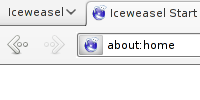
Mike Hommey: Replacing the Iceweasel button with an icon

Recent Iceweasel betas allows to replace the menu bar with a Iceweasel button. This is not enabled by default, but right-clicking on the menu bar allows to disable the menu bar, which enables the Iceweasel button.
The button is not exactly very appealing, and takes quite a lot of horizontal space on the tab bar. But with a few lines of CSS, this can fortunately be changed. Edit the chrome/userChrome.css file under your user profile, and add the following lines:
#appmenu-toolbar-button  
  list-style-image: url("chrome://branding/content/icon16.png");
 
#appmenu-toolbar-button > .toolbarbutton-text,
#appmenu-toolbar-button > .toolbarbutton-menu-dropmarker  
  display: none !important;
 
This what Iceweasel looks like, then:

14 January 2011

Mike Hommey: Changes to the Debian Mozilla team APT archive

I made some changes as to how packages from the Debian Mozilla team that can t yet be distributed in the Debian archives are distributed to users. Please update your APT sources and now use the following for 4.0 beta packages:
deb http://mozilla.debian.net/ experimental iceweasel-4.0
You ll also need the experimental repository in your sources, but the overall installation is much easier now:
# apt-get install -t experimental iceweasel
This should work for squeeze and unstable users. I also added Iceweasel 3.6 backports for Debian Lenny users. For these, add the following APT source:
deb http://mozilla.debian.net/ lenny-backports iceweasel-3.6
You ll also need the lenny-backports repository in your sources. As for the experimental packages above, installation should be as easy as:
# apt-get install -t lenny-backports iceweasel
If your APT complains about the archive key, please check the instructions to add the key to your APT keyring.

22 December 2010

Petter Reinholdtsen: How to test if a laptop is working with Linux

The last few days I have spent at work here at the University of oslo testing if the new batch of computers will work with Linux. Every year for the last few years the university have organized shared bid of a few thousand computers, and this year HP won the bid. Two different desktops and five different laptops are on the list this year. We in the UNIX group want to know which one of these computers work well with RHEL and Ubuntu, the two Linux distributions we currently handle at the university. My test method is simple, and I share it here to get feedback and perhaps inspire others to test hardware as well. To test, I PXE install the OS version of choice, and log in as my normal user and run a few applications and plug in selected pieces of hardware. When something fail, I make a note about this in the test matrix and move on. If I have some spare time I try to report the bug to the OS vendor, but as I only have the machines for a short time, I rarely have the time to do this for all the problems I find. Anyway, to get to the point of this post. Here is the simple tests I perform on a new model. By now I suspect you are really curious what the test results are for the HP machines I am testing. I'm not done yet, so I will report the test results later. For now I can report that HP 8100 Elite work fine, and hibernation fail with HP EliteBook 8440p on Ubuntu Lucid, and audio fail on RHEL6. Ubuntu Maverik worked with 8440p. As you can see, I have most machines left to test. One interesting observation is that Ubuntu Lucid has almost twice the framerate than RHEL6 with glxgears. No idea why.

24 November 2010

Tim Retout: The Archers website

For those who are not aware, The Archers is a soap opera about rural life, broadcast on BBC Radio 4. Its website has recently been revamped. Unfortunately, I appear to be served the mobile version when I visit the front page (in all of Chromium, Iceweasel and Epiphany on Debian - admittedly not the most mainstream of browsers). BBC Mobile is doing some over-zealous useragent sniffing, it seems. Also amusing: there's a "Who's Who" database of Archers characters, and several of them share the birthday "1st Jan 1970". There was I thinking that Harry Mason and Fallon Rogers had a 15 year age gap... but no. This will be as a result of the underlying database storing values in Unix time, and having a default value of "0". An explanation of Unix time popped up in an episode of The Infinite Monkey Cage the other week, which was nice to hear.

22 November 2010

Debian News: Brief Updates: Firebird 3, Iceweasel 4.0 beta, google code-in and DPL interview

12 November 2010

Steve McIntyre: Using pulseaudio in a chroot

(Mainly for my own information, so I can find this again later!) I'm running Debian Squeeze on my Lenovo Thinkpad X200 laptop, using the amd64 version so that I can make the most of the 64-bit CPU. However, I also need a range of 32-bit apps too for now, typically proprietary rubbish like the Flash plug-in for Firefox^WIceweasel. So I set up a 32-bit chroot with a small Debian installation in there too. (Roll on multi-arch!) That's been working ok for a while, except that I couldn't get working audio in my browser. I didn't really pay much attention to that until recently: I wanted to watch some videos on YouTube and the sound mattered! After some digging, it became clear that Iceweasel inside the chroot just wasn't talking to the currently-running pulseaudio server outside the chroot. I had installed all the required libs in the chroot too, but still no joy. After some searching (thanks to the folks on the Archlinux wiki for this!) I've now been able to configure my chroot correctly. 2 bits needed: 1. Configure alsa in the chroot to use pulse by default by creating/editing /etc/asound.conf:
pcm.pulse  
    type pulse
 
ctl.pulse  
    type pulse
 
pcm.!default  
    type pulse
 
ctl.!default  
    type pulse
 
2. The dbus machine ID in the chroot needs to be the same as that of the main host, which it wasn't for me. That caused audio apps to report "connection refused" when I tested them. The machine ID is stored in /var/lib/dbus/machine-id. Either copy that file from the host system into the chroot, or add /var/lib/dbus as a bind-mount along with the usual suspects like /home and /tmp. Job done, I can watch movie trailers etc. with sound in my browser. Yay! :-)

9 November 2010

Julien Valroff: I am a Debian Developer!

A few months after starting the NM process, I have just been accepted as a Debian Developer. My account name is simply: julien I have been a Debian user for about 10 years now, and have begun contributing to Debian in 2005. I have then been accepted as a Debian Maintainer in 2007. This post is mainly to thank: Also thanks to all people who have already sent their congratulations, it makes me very proud!

22 October 2010

Sandro Tosi: URL shortcuts in Chromium

If you like the Firefox feature to create special bookmarks that are actual templates for specific urls, well, here's how I got the same for Chromium.

That's actually how WordReference is suggesting, so it's defining new search engines: right click on the URL bar, Edit seach engine, and then Add; now you can define what you like, f.e. :


and so now typing "pts package<package>" in the URL bar you'll get to the package PTS page.</package>

That's one of the core points I had to get fixed in order to migrate from FF to chromium, one step closer then.

19 October 2010

Mike Hommey: Huge rotational disk(s) + dpkg = disaster

Since a few versions now, dpkg has been made safer in that it makes sure everything is written to disk after unpacking a package. It does so with sync(), which means all kernel buffer caches are being flushed. Between every package install. All kernel buffer caches. Imagine what it does when you have two 2TB hard drives (though they are far from being full). Update: The use of btrfs might not be helping either. I have 2 concurrent pbuilder instances that have been installing iceweasel build dependencies for more than 40 minutes, and still not finished yet. I don t expect the builds themselves, including test suites, to take more than 20 minutes on that machine I should really start using eatmydata Update: with eatmydata, the package installation is almost instantaneous Update 2: It might just be btrfs. And the best part yet is that since sync() is global, even when running pbuilder over, say, tmpfs, it doesn t change a damn thing.

16 October 2010

Bastian Venthur: Introducing python-popcon

Python-popcon is a small Python library which allows to query Debian s popcon database. The usage is very trivial:
>>> import popcon
>>> popcon.package('python-popcon')
'python-popcon': 2 >>> popcon.package('icedove', 'iceweasel')
'icedove': 12140, 'iceweasel': 45666
>>> popcon.package('foobarbaz')

You can call the package method with an arbitrary number of package names and it will return a dictionary with package name : popcon value mappings for all packages found. If a package is not found in the popcon database it will not be in the resulting dictionary or if it was the only package in the method call, the method will return an empty dictionary. The popcon value is the number of installations according to Debian s Popularity Contest service. There is also a second method which gives some more information
>>> popcon.package_raw('icedove', 'iceweasel')
'icedove': [8065, 2195, 1879, 1], iceweasel : [27857, 10681, 7120, 8]
It returns a list of [vote, old, recent, no-files] for the given package. How does it work? Upon a query, popcon downloads http://popcon.debian.org/all-popcon-results.txt.gz, extracts and parses the file and returns the desired information. Since downloading and extraction this file is expensive, it saves the file and tries to re-use it is not older than 7 days. So while the first call of one of the above methods can take a few seconds, the result will appear almost instantaneously for the next week until the cache file expired. That s it, no rocket science but a convenient way to get popcon information from within python. The package python-popcon is available in Debian/Sid for a few days.

21 September 2010

Daniel Kahn Gillmor: hotmail thinks powerpc means mobile

Apparently, live.com thinks that any browser coming from a ppc architecture is a mobile device. This sucks for the users of the hundreds of thousands of powerpc desktops still in service. I don't use hotmail myself, but i do support people who use it. I set one of my clients up with debian squeeze on their PPC machine because all the proprietary vendors have basically given up on that architecture -- debian represents the best way to get modern tools on these machines (and other machines too, but that's a different argument). However, this client couldn't get to their hotmail account, despite using the latest version of iceweasel (3.5.12). They were directed to a crippled interface that didn't include the ability to attach files, and was a gross waste of the desktop screen space. It appears to be the "mobile" version of live.com's services. However, the same version of iceweasel on an i686 test machine could access the standard version of hotmail with no trouble. My friend jeremyb helpfully suggested fiddling with the User Agent string exported by the browser. Some experimentation shows that the presence of the string "ppc" within any parenthetical expression in the UA makes live.com show the crappy interface. You can try it yourself (if you have a hotmail account) on your x86 or amd64 machine by adding (ppc) to the default valule of general.useragent.extra.firefoxComment in about:config. Stupid stupid stupid. I'd like to have fixed this by overriding the browser's reported architecture (or simply by removing it -- why does a web server need to know the hardware architecture of my client?). But there doesn't appear to be a way to do that with the way that mozilla constructs the UA. Instead, i needed to add a new string key named general.useragent.override which is not exposed by default in about:config. This raises some questions: Any ideas?Tags: browser, hotmail, powerpc, ppc, useragent, wtf

15 September 2010

Christoph Berg: Firefox: HeaderControl

I'm a fan of LC_MESSAGES=de_DE and localized web pages -- almost. Unfortunately, the wording of many translations in Debian often drives me nuts. This applies mostly to web pages and package descriptions. Apologies to all hard-working translators -- the percentage of good translations does not outweigh the "wtf" cases for me. Still, I didn't want to switch to English for all the web. Rhonda pointed me to a Firefox ^W Iceweasel plugin: HeaderControl. Now *.debian.org is English for me (reading the constitution in German doesn't solve DAM problems anyway). Yay!

13 September 2010

Eddy Petri&#537;or: Fixing a bookmark corruption in Iceweasel/Firefox

At some point in the past my bookmarks broke in such a way that I wasn't able anymore to alter in any way the bookmarks, deletions, additions, reorganisation, nothing worked.


Way before this event I set up a git repo in my .mozilla directory and committed everything in the directory (except obvious cache files and such) in the repo. I didn't make a cronjob with this since I didn't thought of a proper way to make sure the browser wasn't started (the data might have been inconsistent at commit time), and, since most of the time I have the browser started, it seemed rather useless to try to automate for a very, very small window of time when the browser data would be in a consistent state. As a consequence, I did occasional manual commits in the git repo.

When the bookmarks issue appeared I realised that my last git commit was so old that it didn't made any sense to try to restore since I would have had lost bookmarks, passwords and plugins. So I made a checkpoint commit os the broken profile and resorted to all sorts of manual attempts at fixing the issue, but all my efforts of playing with the bookmarks.* files proved to be useless.

I concluded that icewesel/firefox 3.5.x was using some other mechanism and decided to dig into the issue at some latter time when time allowed me to analyse and fix it. Today was that day.

I began by creating a backup for the bookmarks via the Bookmarks Manager export function. After a hickup, it managed to save a proper bookmarks.html file. I tried to import that file, but the breakage remained.

Then I decided I should prepare for the worst, installed an addon which allowed me to save all stored passwords and created a new account (started firefox from the command line with 'firefox -ProfileManager') with the intention to transplant files from the old files into the new one. Short after that I realised that it would be smarter to commit the new profile, too, import the bookmarks from the backup file and replace the touched files back into the old profile.

After the import and closing the browser, git informed me that the modified files were:
XPC.mfasl
XUL.mfasl
cookies.sqlite
localstore.rdf
places.sqlite
pluginreg.dat
urlclassifier3.sqlite


At this point the modification of the binary .mfasl files looked very ugly to me, but I had a hunch that the only relevant file to my problem was the places.sqlite file and I went on to check the contents of the file with sqlitebrowser. After inspecting also the urlclassifier3.sqlite file (whose contents were unreadable), I decided to give it a try at simply placing the places.sqlite file in the old profile and see if the problem would be fixed that way. After all, I had the whole profile's state in git so any breakage could have been undone easily.

I started firefox using the old profile and the problem was fixed. Yay!

Now I have my bookmarks back and a suggestion for the mozilla people: please don't keep useless files like bookmarks.html in the profile once they become outdated, they are misleading.

P.S.: I still have to think of a way to make automated sane commits. Maybe I'll try to make an iceweasel/firefox addon. This could be a nice idea since I could learn something new, too.

29 August 2010

Steve Kemp: Proxies and Robots

I don't like repeating myself, but I'm very tempted to past my mini-review of the Roomba Vacuum Cleaner robot into this blog. Instead I will practise restraint and summerise: 250. Worth. Every. Penny. In more Debian-friendly news I've been fighting HTTP proxies today. I've noticed a lot of visitors to the various websites I host are logged as 127.0.0.1 - which is an irritation. My personal machine looks like this:
Internet -> Apache listening on *:80 -> thttpd on 127.0.0.1:xxxx
(This has been documented previously - primarily it is a security restriction. It means I can run per-UID web-servers.) I had previous added a patch to thttpd to honour the X-Forwarded-For: header - so that it would receive the correct remote address passed on from Apache. However the fact that so many visitors are logged as coming from 127.0.0.1 meant it wasn't working 100% correctly, and I wanted to understand why. Today I used ngrep to capture the incoming headers and the source of the problem became apparent:
skx:~# ngrep  -d lo  X-For ' port 1007'
..
T 127.0.0.1:41886 -> 127.0.0.1:1007 [AP]
  GET /about/ HTTP/1.1..Host: images.steve.org.uk..If-Modified-Since: Mon, 07
   Jun 2010 15:24:33 GMT..User-Agent: Mozilla/5.0 (X11; U; Linux x86_64; en-U
  S; rv:1.9.1.10) Gecko/20100701 Iceweasel/3.5.10 (like Firefox/3.5.10)..Acce
  pt: text/html,application/xhtml+xml,application/xml;q=0.9,*/*;q=0.8..Accept
  -Language: en-us,en;q=0.5..Accept-Encoding: gzip,deflate..Accept-Charset: I
  SO-8859-1,utf-8;q=0.7,*;q=0.7..Referer: http://images.steve.org.uk/2009/11/
  20/img_0471.html..X-Forwarded-For: 127.0.0.1, 11.22.33.123..Cache-Control:
  max-age=0..X-Forwarded-Host: images.steve.org.uk..X-Forwarded-Server: image
  s.steve.org.uk..Connection: Keep-Alive....
I bolded the important input; just in case that didn't jump out it was:
X-Forwarded-For: 127.0.0.1, 11.22.33.123
My patch to thttpd was making it read the first address, rather than the second - which meant that requests were being logged as coming from 127.0.0.1 and avoiding my efforts to track sources. Now I understand the problem - The X-Forwarded-Host header is being tweaked by a proxy server, such as Squid, upstream of my server. For the moment I've updated the thttpd patch to read:
        else if ( strncasecmp( buf, "X-Forwarded-For:", 16 ) == 0 )
            char *tmp = NULL;
            /* Jump to the header-value  */
            cp = &buf[16];
            cp += strspn( cp, " \t" );
            /*
             * If the first change is a 127.0.0.1, then we'll
             * jump over it.  Cope with Squid, et al.
             */
            if (  ( tmp = strstr( cp, "127.0.0.1, " ) ) != NULL )
              cp = tmp + strlen( "127.0.0.1, " );
            /* Parse the IP */
           inet_aton( cp, &(hc->client_addr.sa_in.sin_addr) );
         
That's not perfect, but the alternative would be: Or something equally hacky and security-by-obscurity-alike. Really I just want a simple way of always getting the correct remote IP. Shouldn't be so hard, should it? *pout*. ObQuote: "You don't mess with fate, Peanut. People die when they are meant to die. There's no discussion. There's no negotiation. When life's done, it's done." - Dead Like Me.

7 August 2010

Petter Reinholdtsen: Autodetecting Client setup for roaming workstations in Debian Edu

A few days ago, I tried to install a Roaming workation profile from Debian Edu/Squeeze while on the university network here at the University of Oslo, and noticed how much had to change to get it operational using the university infrastructure. It was fairly easy, but it occured to me that Debian Edu would improve a lot if I could get the client to connect without any changes at all, and thus let the client configure itself during installation and first boot to use the infrastructure around it. Now I am a huge step further along that road. With our current squeeze-test packages, I can select the roaming workstation profile and get a working laptop connecting to the university LDAP server for user and group and our active directory servers for Kerberos authentication. All this without any configuration at all during installation. My users home directory got a bookmark in the KDE menu to mount it via SMB, with the correct URL. In short, openldap and sssd is correctly configured. In addition to this, the client look for http://wpad/wpad.dat to configure a web proxy, and when it fail to find it no proxy settings are stored in /etc/environment and /etc/apt/apt.conf. Iceweasel and KDE is configured to look for the same wpad configuration and also do not use a proxy when at the university network. If the machine is moved to a network with such wpad setup, it would automatically use it when DHCP gave it a IP address. The LDAP server is located using DNS, by first looking for the DNS entry ldap.$domain. If this do not exist, it look for the _ldap._tcp.$domain SRV records and use the first one as the LDAP server. Next, it connects to the LDAP server and search all namingContexts entries for posixAccount or posixGroup objects, and pick the first one as the LDAP base. For Kerberos, a similar algorithm is used to locate the LDAP server, and the realm is the uppercase version of $domain. So, what is not working, you might ask. SMB mounting my home directory do not work. No idea why, but suspected the incorrect Kerberos settings in /etc/krb5.conf and /etc/samba/smb.conf might be the cause. These are not properly configured during installation, and had to be hand-edited to get the correct Kerberos realm and server, but SMB mounting still do not work. :( With this automatic configuration in place, I expect a Debian Edu roaming profile installation would be able to automatically detect and connect to any site using LDAP and Kerberos for NSS directory and PAM authentication. It should also work out of the box in a Active Directory environment providing posixAccount and posixGroup objects with UID and GID values. If you want to help out with implementing these things for Debian Edu, please contact us on debian-edu@lists.debian.org.

Next.

Previous.