Search Results: "uli"

13 August 2024

Jonathan Dowland: ouch

Pain (The Soft Moon Remix) by Boy Harsher 1 In mid-June I picked up an unknown infection in my left ankle which turned out to be antibiotic resistant. The infection caused cellulitis. After five weeks of trial and error and treatment, the infection is beaten but I am still recovering from the cellulitis. I don t know how long it will take to be fully recovered, nor how long before I can be useful again: I m currently off work (and thus off my open source and other commitments too). Hopefully soon! That s why I ve been quiet.

  1. RIP Jose Luis Vasquez

12 August 2024

Freexian Collaborators: Monthly report about Debian Long Term Support, July 2024 (by Roberto C. S nchez)

Like each month, have a look at the work funded by Freexian s Debian LTS offering.

Debian LTS contributors In July, 13 contributors have been paid to work on Debian LTS, their reports are available:
  • Bastien Roucari s did 20.0h (out of 20.0h assigned).
  • Chris Lamb did 18.0h (out of 18.0h assigned).
  • Daniel Leidert did 5.0h (out of 4.0h assigned and 6.0h from previous period), thus carrying over 5.0h to the next month.
  • Guilhem Moulin did 8.75h (out of 4.5h assigned and 15.5h from previous period), thus carrying over 11.25h to the next month.
  • Lee Garrett did 51.5h (out of 10.5h assigned and 43.0h from previous period), thus carrying over 2.0h to the next month.
  • Lucas Kanashiro did 5.0h (out of 5.0h assigned and 15.0h from previous period), thus carrying over 15.0h to the next month.
  • Markus Koschany did 40.0h (out of 40.0h assigned).
  • Ola Lundqvist did 4.0h (out of 10.0h assigned and 14.0h from previous period), thus carrying over 20.0h to the next month.
  • Roberto C. S nchez did 5.0h (out of 5.25h assigned and 6.75h from previous period), thus carrying over 7.0h to the next month.
  • Santiago Ruano Rinc n did 6.0h (out of 16.0h assigned), thus carrying over 10.0h to the next month.
  • Sean Whitton did 2.25h (out of 6.0h assigned), thus carrying over 3.75h to the next month.
  • Sylvain Beucler did 39.5h (out of 2.5h assigned and 51.0h from previous period), thus carrying over 14.0h to the next month.
  • Thorsten Alteholz did 11.0h (out of 11.0h assigned).

Evolution of the situation In July, we have released 1 DLA. August will be the month that Debian 11 makes the transition to LTS. Our contributors have already been hard at work with preparatorty tasks and also with making contributions to packages in Debian 11 in close collaboration with the Debian security team and package maintainers. As a result, users and sponsors should not observe any especially notable differences as the transition occurs. While only one DLA was released in July (as a result of the transitional state of Debian 11 bullseye ), there were some notable highlights. LTS contributor Guilhem Moulin prepared an update of libvirt for Debian 11 (in collaboration with the Old-Stable Release Managers and the Debian Security Team) to fix a number of outstanding CVEs which did not rise to the level of a DSA by the Debian Security Team. The update prepared by Guilhem will be included in Debian 11 as part of the final point release at the end of August, one of the final transition steps by the Release Managers as Debian 11 moves entirely to the LTS Team s responsibility. Notable work was also undertaken by contributors Lee Garrett (fixes on the ansible test suite and a bullseye update), Lucas Kanashiro (Rust toolchain, utilized by the clamav, firefox-esr, and thunderbird packages), and Sylvain Beucler (fixes on the ruby2.5/2.7 test suites and CI infrastructure), which will help improve the quality of updates produced during the next LTS cycle. June was the final month of LTS for Debian 10 (as announced on the debian-lts-announce mailing list). No additional Debian 10 security updates will be made available on security.debian.org. However, Freexian and its team of paid Debian contributors will continue to maintain Debian 10 going forward for customers of the Extended LTS offer. Subscribe right away if you still have Debian 10 systems which must be kept secure (and which cannot yet be upgraded).

Thanks to our sponsors Sponsors that joined recently are in bold.

8 August 2024

Jonathan Carter: DebConf24 Busan, South Korea

I m finishing typing up this blog entry hours before my last 13 hour leg back home, after I spent 2 weeks in Busan, South Korea for DebCamp24 and DebCamp24. I had a rough year and decided to take it easy this DebConf. So this is the first DebConf in a long time where I didn t give any talks. I mostly caught up on a bit of packaging, worked on DebConf video stuff, attended a few BoFs and talked to people. Overall it was a very good DebConf, which also turned out to be more productive than I expeced it would. In the welcome session on the first day of DebConf, Nicolas Dandrimont mentioned that a benefit of DebConf is that it provides a sort of caffeine for your Debian motivation. I could certainly feel that affect swell as the days went past, and it s nice to be excited about some ideas again that would otherwise be fading.

Recovering DPL It s a bit of a gear shift being DPL for 4 years, and DebConf Committee for nearly 5 years before that, and then being at DebConf while some issue arise (as it always does during a conference). At first I jump into high alert mode, but then I have to remind myself it s not your problem anymore and let others deal with it. It was nice spending a little in-person time with Andreas Tille, our new DPL, we did some more handover and discussed some current issues. I still have a few dozen emails in my DPL inbox that I need to collate and forward to Andreas, I hope to finish all that up by the end of August. During the Bits from the DPL talk, the usual question came up whether Andreas will consider running for DPL again, to which he just responded in a slide Maybe . I think it s a good idea for a DPL to do at least two terms if it all works out for everyone, since it takes a while to get up to speed on everything. Also, having been DPL for four years, I have a lot to say about it, and I think there s a lot we can fix in the role, or at least discuss it. If I had the bandwidth for it I would have scheduled a BoF for it, but I ll very likely do that for the next DebConf instead!

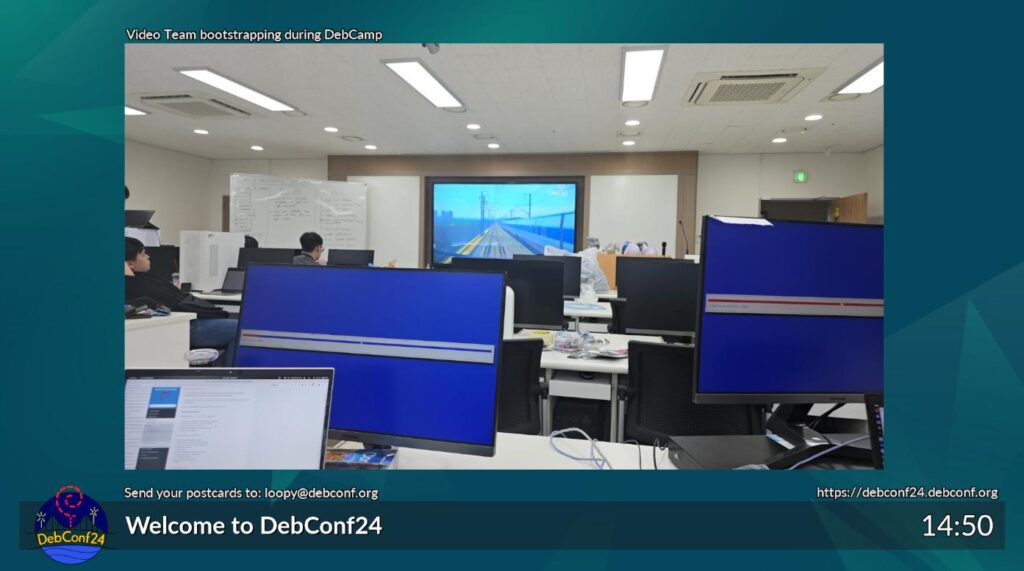
Video team I set up the standby loop for the video streaming setup. We call it loopy, it s a bunch of OBS scenes that provide announcements, shows sponsors, the schedule and some social content. I wrote about it back in 2020, but it s evolved quite a bit since then, so I m probably due to write another blog post with a bunch of updates on it. I hope to organise a video team sprint in Cape Town in the first half of next year, so I ll summarize everything before then.

It would ve been great if we could have some displays in social areas that could show talks, the loop and other content, but we were just too pressed for time for that. This year s DebConf had a very compressed timeline, and there was just too much that had to be done and that had to be figured out on the last minute. This put quite a lot of strain on the organisers, but I was glad to see how, for the most part, most attendees were very sympathetic to some rough edges (but I digress ). I added more of the OBS machine setup to the videoteam s ansible repository, so as of now it just needs an ansible setup and the OBS data and it s good to go. The loopy data is already in the videoteam git repository, so I could probably just add a git pull and create some symlinks in ansible and then that machine can be installed from 0% to 100% by just installing via debian-installer with our ansible hooks. This DebConf I volunteered quite a bit for actual video roles during the conference, something I didn t have much time for in recent DebConfs, and it s been fun, especially in a session or two where nearly none of the other volunteers showed up. Sometimes chaos is just fun :-)
Baekyongee is the university mascot, who s visible throughout the university. So of course we included this four legged whale creature on the loop too!

Packaging I was hoping to do more packaging during DebCamp, but at least it was a non-zero amount:
  • Uploaded gdisk 1.0.10-2 to unstable (previously tested effects of adding dh-sequence-movetousr) (Closes: #1073679).
  • Worked a bit on bcachefs-tools (updating git to 1.9.4), but has a build failure that I need to look into (we might need a newer bindgen) update: I m probably going to ROM this package soon, it doesn t seem suitable for packaging in Debian.
  • Calamares: Tested a fix for encrypted installs, and uploaded it.
  • Calamares: Uploaded (3.3.8-1) to backports (at the time of writing it s still in backports-NEW).
  • Backport obs-gradient-source for bookworm.
  • Did some initial packaging on Cambalache, I ll upload to unstable once wlroots (0.18) hits unstable.
  • Pixelorama 1.0 I did some initial packaging for Pixelorama back when we did the MiniDebConf Gaming Edition, but it had a few stoppers back then. Version 1.0 seems to fix all of that, but it depends on Godot 4.2 and we re still on the 3 series in Debian, so I ll upload this once Godot 4.2 hits at least experimental. Godot software/games is otherwise quite easy to run, it s basically just source code / data that is installed and then run via godot-runner (godot3-runner package in Debian).

BoFs Python Team BoF Link to the etherpad / pad archive link and video can be found on the talk page: https://debconf24.debconf.org/talks/31-python-bof/ The session ended up being extended to a second part, since all the issues didn t fit into the first session. I was distracted by too many thing during the Python 3.12 transition (to the point where I thought that 3.11 was still new in Debian), so it was very useful listening to the retrospective of that transition. There was a discussion whether Python 3.13 could still make it to testing in time for freeze, and it seems that there is consensus that it can, although, likely with new experimental features like disabling the global interpreter lock and the just in time compiler disabled. I learned for the first time about the dead batteries project, PEP-0594, which removes ancient modules that have mostly been superseded, from the Python standard library. There was some talk about the process for changing team policy, and a policy discussion on whether we should require autopkgtests as a SHOULD or a MUST for migration to testing. As with many things, the devil is in the details and in my opinion you could go either way and achieve a similar result (the original MUST proposal allowed exceptions which imho made it the same as the SHOULD proposal). There s an idea to do some ongoing remote sprints, like having co-ordinated days for bug squashing / working on stuff together. This is a nice idea and probably a good way to energise the team and also to gain some interest from potential newcomers. Louis-Philipe V ronneau was added as a new team admin and there was some discussion on various Sphinx issues and which Lintian tags might be needed for Python 3.13. If you want to know more, you probably have to watch the videos / read the notes :)
    Debian.net BoF Link to the etherpad / pad archive link can be found on the talk page: https://debconf24.debconf.org/talks/37-debiannet-team-bof Debian Developers can set up services on subdomains on debian.net, but a big problem we ve had before was that developers were on their own for hosting those services. This meant that they either hosted it on their DSL/fiber connection at home, paid for the hosting themselves, or hosted it at different services which became an accounting nightmare to claim back the used funds. So, a few of us started the debian.net hosting project (sometimes we just call it debian.net, this is probably a bit of a bug) so that Debian has accounts with cloud providers, and as admins we can create instances there that gets billed directly to Debian. We had an initial rush of services, but requests have slowed down since (not really a bad thing, we don t want lots of spurious requests). Last year we did a census, to check which of the instances were still used, whether they received system updates and to ask whether they are performing backups. It went well and some issues were found along the way, so we ll be doing that again. We also gained two potential volunteers to help run things, which is great. Debian Social BoF Link to the etherpad / pad archive link can be found on the talk page: https://debconf24.debconf.org/talks/34-debiansocial-bof We discussed the services we run, you can view the current state of things at: https://wiki.debian.org/Teams/DebianSocial Pleroma has shown some cracks over the last year or so, and there are some forks that seem promising. At the same time, it might be worth while considering Mastodon too. So we ll do some comparison of features and maintenance and find a way forward. At the time when Pleroma was installed, it was way ahead in terms of moderation features. Pixelfed is doing well and chugging along nicely, we should probably promote it more. Peertube is working well, although we learned that we still don t have all the recent DebConf videos on there. A bunch of other issues should be fixed once we move it to a new machine that we plan to set up. We re removing writefreely and plume. Nice concepts, but it didn t get much traction yet, and no one who signed up for these actually used it, which is fine, some experimentation with services is good and sometimes they prove to be very popular and other times not. The WordPress multisite instance has some mild use, otherwise haven t had any issues. Matrix ended up to be much, much bigger than we thought, both in usage and in its requirements. It s very stateful and remembers discussions for as long as you let it, so it s Postgres database is continuously expanding, this will also be a lot easier to manage once we have this on the new host. Jitsi is also quite popular, but it could probably be on jitsi.debian.net instead (we created this on debian.social during the initial height of COVID-19 where we didn t have the debian.net hosting yet), although in practice it doesn t really matter where it lives. Most of our current challenges will be solved by moving everything to a new big machine that has a few public IPs available for some VMs, so we ll be doing that shortly. Debian Foundation Discussion BoF This was some brainstorming about the future structure of Debian, and what steps might be needed to get there. It s way too big a problem to take on in a BoF, but we made some progress in figuring out some smaller pieces of the larger puzzle. The DPL is going to get in touch with some legal advisors and our trusted organisations so that we can aim to formalise our relationships a bit more by the time it s DebConf again. I also introduced my intention to join the Debian Partners delegation. When I was DPL, I enjoyed talking with external organisations who wanted to help Debian, but helping external organisations help Debian turned out to be too much additional load on the usual DPL roles, so I m pursuing this with the Debian Partners team, more on that some other time. This session wasn t recorded, but if you feel like you missed something, don t worry, all intentions will be communicated and discussed with project members before anything moves forward. There was a strong agreement in the room though that we should push forward on this, and not reach another DebConf where we didn t make progress on formalising Debian s structure more.

    Social Conference Dinner
    Conference Dinner Photo from Santiago
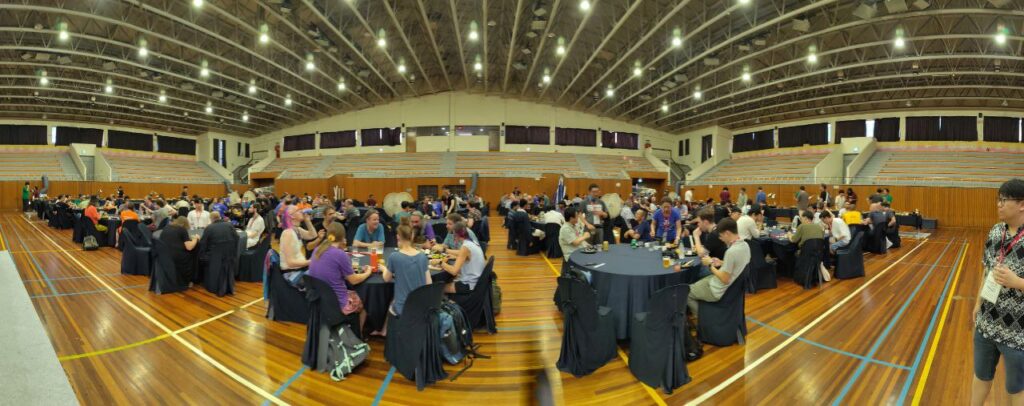
    The conference dinner took place in the university gymnasium. I hope not many people do sports there in the summer, because it got HOT. There was also some interesting observations on the thermodynamics of the attempted cooling solutions, which was amusing. On the plus side, the food was great, the company was good, and the speeches were kept to a minimum, so it was a great conference dinner, even though it was probably cut a bit short due to the heat. Cheese and Wine Cheese and Wine happened on 1 August, which happens to be the date I became a DD at DebConf17 in Montr al seven years before, so this was a nice accidental celebration of my Debiversary :) Since I m running out of time, I ll add some more photos to this post some time after publishing it :P Group Photo As per DebConf tradition, Aigars took the group photo. You can find the high resolution version on Debian s GitLab instance.
    Debian annual conference Debconf 24, Busan, South Korea
    Photography: Aigars Mahinovs aigarius@debian.org
    License: CC-BYv3+ or GPLv2+
    Talking Ah yes, talking to people is a big part of DebConf, but I didn t keep track of it very well.
    • I mostly listened to Alper a bit about his ideas for his talk about debian installer.
    • I talked to Rhonda a bit about ActivityPub and MQTT and whether they could be useful for publicising Debian activity.
    • Listened to Gunnar and Julian have a discussion about GPG and APT which was interesting.
    • I learned that you can learn Hangul, the Korean alphabet, in about an hour or so (I wish I knew that in all my years of playing StarCraft II).
    • We had the usual continuous keysigning party. Besides it s intended function, this is always a good ice breaker and a way to for shy people to meet other shy people.
    • and many other fly-by discussions.

    Stuff that didn t happen this DebConf
    • loo.py A simple Python script that could eventually replace the obs-advanced-scene-switcher sequencer in OBS. It would also be extremely useful if we d ever replace OBS for loopy. I was hoping to have some time to hack on this, and try to recreate the current loopy in loo.py, but didn t have the time.
    • toetally This year videoteam had to scramble to get a bunch of resistors to assemble some tally light. Even when assembled, they were a bit troublesome. It would ve been nice to hack on toetally and get something ready for testing, but it mostly relies on having something like a rasbperry pi zero with an attached screen in order to work on further. I ll try to have something ready for the next mini conf though.
    • extrepo on debian live I think we should have extrepo installed by default on desktop systems, I meant to start a discussion on this, but perhaps it s just time I go ahead and do it and announce it.
    • Live stream to peertube server It would ve been nice to live stream DebConf to PeerTube, but the dependency tree to get this going got a bit too huge. Following our plans discussed in the Debian Social BoF, we should have this safely ready before the next MiniDebConf and should be able to test it there.
    • Desktop Egg there was this idea to get a stand-in theme for Debian testing/unstable until the artwork for the next release is finalized (Debian bug: #1038660), I have an idea that I meant to implement months ago, but too many things got in the way. It s based on Juliette Taka s Homeworld theme, and basically transforms the homeworld into an egg. Get it? Something that hasn t hatched yet? I also only recently noticed that we never used the actual homeworld graphics (featuring the world image) in the final bullseye release. lol.
    So, another DebConf and another new plush animal. Last but not least, thanks to PKNU for being such a generous and fantastic host to us! See you again at DebConf25 in Brest, France next year!

      7 August 2024

      Jamie McClelland: Who ate my RAM?

      One of our newest servers, with a hefty 256GB of RAM, recently began killing processes via the oomkiller. According to free, only half of the RAM was in use (125GB). About 4GB was free, with the remainer used by the file cache. I m used to seeing unexpected free RAM numbers like this and have been assured that the kernel is simply not wasting RAM. If it s not needed, use it to cache files to save on disk I/O. That make sense. However why is the oomkiller being called instead of flushing the file cache? I came up with all kinds of amazing and wrong theories: maybe the RAM is fragmented (is that even a thing?!?), maybe there is a spike in RAM and the kernel can t flush the cache quickly enough (I really don t think that s a thing). Maybe our kvm-manager has a weird bug (nope, but that didn t stop me from opening a spurious bug report). I learned lots of cool things, like the oomkiller report includes a table of the memory in use by each process (via the rss column) - and you have to muliply that number by 4096 because it s in 4K pages. That s how I discovered that the oomkiller was killing off processes with only half the memory in use. I also learned that lsof sometimes lists the same open file multiple times, which made me think a bunch of files were being opened repeatedly causing a memory problem, but really it amounted to nothing. That last thing I learned, courtesy of an askubuntu post is that the /dev filesystem is allocated by default exactly half the RAM on the system. What a coincidence! That is exactly how much RAM is useable on the server. And, on the server in question, that filesystem is full. What?!? Normally, that filesystem should be using 0 bytes because it s not a real filesystem. But in our case a process created a 127GB file there - it was only stopped because the file system filled up.

      22 July 2024

      Martin-Éric Racine: dhcpcd replacing dhclient for Trixie... or perhaps networkd?

      My work on overhauling dhcpcd as the prime replacement for ISC's discontinued DHCP client is done. The package has achieved stability, both upstream and at Debian. The only remaining points are bug #1038882 to swap the Priorities of isc-dhcp-client and dhcpcd-base in the repository's override, and swaping ifupdown's search order to put dhcpcd first. Meanwhile, ifupdown's de-facto maintainer prompted me to sollicit opinions on which of the 4 ifupdown implementations should ship with a minimal installation for Trixie. This, in turn, re-opened the debate of what should be Debian's default network configuation framework (see the thread starting with this post). networkd Given how most Debian ports (except for Hurd) ship with systemd, which includes a disabled networkd by standard, many people in the thread feel that this should become the default network configuration tool for minimal installations. As it happens, most of my hosts fit that scenario, so I figured that I would give another go at testing networkd on one host. I used the following minimalistic /etc/systemd/network/dhcp.network:
      [Match]
      Name=en* wl*
      [Network]
      DHCP=yes
      
      This correctly configured IPv4 via DHCP, with the small caveat that it doesn't update /etc/resolv.conf without installing resolvconf or systemd-resolved. However, networkd's default IPv6 settings really are not suitable for public consumption. The key issues (see Bug #1076432):
      1. Temporary addresses are not enabled by default. Worse, the setting is ignored if it was enabled by sysctl during bootup. This is a major privacy issue. Adding IPv6PrivacyExtensions=yes to the above exposed another issue: instead of using the fe80 address generated by the kernel, networkd adds a new one.
      2. Networkd uses EUI64 addresses by default. This is another major privacy issue, since EUI64 addresses are forensically traceable to the interface's MAC address. Worse, the setting is ignored if stable-privacy was enabled by sysctl during bootup. To top it all, networkd does stable-privacy using systemd's time-proven brain-dead approach of reinventing the wheel: instead of merely setting the kernel's address generation mode to 3 and letting it configure the secret address, it expects the secret address to be spelled out in the systemd unit.
      Conclusion: networkd works well enough for someone configuring an IPv4-only network from 20 years ago, but is utterly inadequate for IPv6 or dual-stack installations, doubly so on a software distribution that claims to care about privacy and network security.

      12 July 2024

      Freexian Collaborators: Monthly report about Debian Long Term Support, June 2024 (by Roberto C. S nchez)

      Like each month, have a look at the work funded by Freexian s Debian LTS offering.

      Debian LTS contributors In June, 18 contributors have been paid to work on Debian LTS, their reports are available:
      • Adrian Bunk did 47.0h (out of 74.25h assigned and 11.75h from previous period), thus carrying over 39.0h to the next month.
      • Arturo Borrero Gonzalez did 6.0h (out of 6.0h assigned).
      • Bastien Roucari s did 20.0h (out of 20.0h assigned).
      • Ben Hutchings did 15.5h (out of 16.0h assigned and 8.0h from previous period), thus carrying over 8.5h to the next month.
      • Chris Lamb did 18.0h (out of 18.0h assigned).
      • Daniel Leidert did 4.0h (out of 8.0h assigned and 2.0h from previous period), thus carrying over 6.0h to the next month.
      • Emilio Pozuelo Monfort did 23.25h (out of 49.5h assigned and 10.5h from previous period), thus carrying over 36.75h to the next month.
      • Guilhem Moulin did 4.5h (out of 13.0h assigned and 7.0h from previous period), thus carrying over 15.5h to the next month.
      • Lee Garrett did 17.0h (out of 25.0h assigned and 35.0h from previous period), thus carrying over 43.0h to the next month.
      • Lucas Kanashiro did 5.0h (out of 10.0h assigned and 10.0h from previous period), thus carrying over 15.0h to the next month.
      • Markus Koschany did 40.0h (out of 40.0h assigned).
      • Ola Lundqvist did 10.0h (out of 6.5h assigned and 17.5h from previous period), thus carrying over 14.0h to the next month.
      • Roberto C. S nchez did 5.25h (out of 7.75h assigned and 4.25h from previous period), thus carrying over 6.75h to the next month.
      • Santiago Ruano Rinc n did 22.5h (out of 14.5h assigned and 8.0h from previous period).
      • Sean Whitton did 6.5h (out of 6.0h assigned and 0.5h from previous period).
      • Stefano Rivera did 0.5h (out of 0.0h assigned and 10.0h from previous period), thus carrying over 9.5h to the next month.
      • Sylvain Beucler did 9.0h (out of 24.5h assigned and 35.5h from previous period), thus carrying over 51.0h to the next month.
      • Thorsten Alteholz did 14.0h (out of 14.0h assigned).

      Evolution of the situation In June, we have released 31 DLAs. Notable security updates in June included:
      • git: multiple vulnerabilities, which may result in privilege escalation, denial of service, and arbitrary code execution
      • sendmail: SMTP smuggling allowed remote attackers bypass SPF protection checks
      • cups: arbitrary remote code execution
      Looking further afield to the broader Debian ecosystem, LTS contributor Bastien Roucari s also patched sendmail in Debian 12 (bookworm) and 11 (bullseye) in order to fix the previously mentioned SMTP smuggling vulnerability. Furthermore, LTS contributor Thorsten Alteholz provided fixes for the cups packages in Debian 12 (bookworm) and 11 (bullseye) in order to fix the aforementioned arbitrary remote code execution vulnerability. Additionally, LTS contributor Ben Hutchings has commenced work on an updated backport of Linux kernel 6.1 to Debian 11 (bullseye), in preparation for bullseye transitioning to the responsibility of the LTS (and the associated closure of the bullseye-backports repository). LTS Lucas Kanashiro also began the preparatory work of backporting parts of the rust/cargo toolchain to Debian 11 (bullseye) in order to make future updates of the clamav virus scanner possible. June was the final month of LTS for Debian 10 (as announced on the debian-lts-announce mailing list). No additional Debian 10 security updates will be made available on security.debian.org. However, Freexian and its team of paid Debian contributors will continue to maintain Debian 10 going forward for the customers of the Extended LTS offer. Subscribe right away if you sill have Debian 10 which must be kept secure (and which cannot yet be upgraded).

      Thanks to our sponsors Sponsors that joined recently are in bold.

      8 July 2024

      Russ Allbery: rra-c-util 11.0.0

      rra-c-util is my collection of utility and test functions that I keep synchronized between my packages. The big change in this release is that I've switched to semantic versions, which I plan to do for all of my packages, and I've started using scriv to manage a Markdown change log. We've been using scriv for a while at work, so I have finally gotten on board the change log fragment train rather than assuming linear commits. This release also raises the minimum Perl version for all of the Perl support code to 5.12 so that I can use semantic versions for all modules, and updates the perltidy configuration with lots of improvements from Julien LIE. There are also the normal variaty of bug fixes and more minor improvements. You can get the latest version from the rra-c-util distribution page.

      29 June 2024

      Russ Allbery: Review: Bitter Angels

      Review: Bitter Angels, by C.L. Anderson
      Publisher: Ballantine Books
      Copyright: 2009
      ISBN: 0-553-59217-3
      Format: Mass market
      Pages: 438
      Bitter Angels is a stand-alone science fiction novel. It won the Philip K. Dick award for best SF original paperback in 2010. C.L. Anderson is a pen name for Sarah Zettel. Terese was a Guardian, one of the agents of the Pax Solaris who find ways to keep the peace in troubled systems and high-stress situations with the help of an implanted Companion, an assistant AI. Forty years ago, on one of those missions, she was captured and her Companion was forcibly removed. She was rescued by her friend and mentor and retired afterwards, starting a new life and a new family, trying to leave the memories behind. Now, the woman who rescued her is dead. She was murdered on duty in the Erasmus system, a corporate hellhole that appears to be on the verge of exploding into a political hot spot. Bianca's last instructions asked for Terese to replace her. Terese's family is furious at her for even considering returning to the Guardians, but she can't say no. Duty, and Bianca's dying request, call too strongly. Amerand is Security on Dazzle, one of the Erasmus stations. He is one of the refugees from Oblivion, the station that the First Bloods who rule the system let die. He keeps his head above water and tries to protect his father and find his mother without doing anything that the ever-present Clerks might find concerning. Keeping an eye on newly-arriving Solaris saints is a typical assignment, since the First Bloods don't trust the meddling do-gooders. But something is not quite right, and a cryptic warning from his Clerk makes him even more suspicious. This is the second book by Sarah Zettel that I've read, and both of them have been tense, claustrophobic thrillers set in a world with harsh social inequality and little space for the characters to maneuver. In this case, the structure of her future universe reminded me a bit of Iain M. Banks's Culture, but with less advanced technology and only humans. The Pax Solaris has eliminated war within its borders and greatly extended lifespans. That peace is maintained by Guardians, who play a role similar to Special Circumstances but a bit more idealist and less lethal. They show up where there are problems and meddle, manipulating and pushing to try to defuse the problems before they reach the Pax Solaris. Like a Culture novel, nearly all of the action takes place outside the Pax Solaris in the Erasmus system. Erasmus is a corporate colony that has turned into a cross between a hereditary dictatorship and the Corporate Rim from Martha Wells's Murderbot series. Debt slavery is ubiquitous, economic inequality is inconceivably vast, and the Clerks are everywhere. Erasmus natives like Amerand have very little leeway and even fewer options. Survival is a matter of not drawing the attention of the wrong people. Terese and her fellow Guardians are appalled, but also keenly aware that destabilizing the local politics may make the situation even worse and get a lot of people killed. Bitter Angels is structured like a mystery: who killed Bianca, and what was her plan when she was killed? Unlike a lot of books of this type, the villains are not idiots and their plan is both satisfyingly complex and still depressingly relevant. I don't think I'm giving anything away by saying that I have read recent news articles about people with very similar plans, albeit involving less science-fiction technology. Anderson starts with a tense situation and increases the pressure relentlessly, leaving the heroes one step behind the villains for almost the entire novel. It is not happy or optimistic reading at times, the book is quite dark but it certainly was engrossing. The one world-building quibble that I had is that the Erasmus system is portrayed partly as a hydraulic empire, and while this is arguably feasible given that spaceship travel is strictly controlled, it seemed like a weird choice given the prevalence of water on the nearby moons. Water smuggling plays a significant role in the plot, and I wasn't entirely convinced of the politics and logistics behind it. If this sort of thing bugs you, there are some pieces that may require suspension of disbelief. Bitter Angels is the sort of tense thriller where catastrophe is barely avoided and the cost of victory is too high, so you will want to be in the mood for that before you dive in. But if that's what you're looking for, I thought Anderson delivered a complex and satisfying story. Content warning: major character suicide. Rating: 7 out of 10

      25 June 2024

      Russ Allbery: INN 2.7.2

      This is a bug fix and minor feature release over INN 2.7.1, and the upgrade should be painless. You can download the new release from ISC or my personal INN pages. The latter also has links to the full changelog and the other INN documentation. For the full list of changes, see the INN 2.7.2 NEWS file. As always, thanks to Julien LIE for preparing this release and doing most of the maintenance work on INN!

      21 June 2024

      Bits from Debian: Recherche d'un th me pour Trixie, la prochaine version de Debian

      Chaque dition de Debian b n ficie d'un nouveau th me brillant visible sur l' cran d'amor age, l' cran de connexion et, de la fa on la plus vidente, sur le fond d' cran. Debian pr voit de publier Trixie, sa prochaine version, durant l'ann e venir. Et, comme toujours, nous avons besoin de vous pour cr er son th me ! Vous avez l'occasion de concevoir un th me qui inspirera des milliers de personnes quand ils travaillent sur leur machine Debian. Pour disposer des d tails les plus r cents, veuillez vous r f rer la page du wiki. Nous voudrions profiter de cette occasion pour remercier Juliette Taka Belin pour avoir cr le th me Emerald pour Bookworm. La date limite pour les propositions est le 19 septembre 2024. Le th me est habituellement choisi en se basant sur ce qui para t le plus : Si vous souhaitez disposer plus d'informations, veuillez utiliser la liste de diffusion Debian Desktop.

      Bits from Debian: Looking for the artwork for Trixie the next Debian release

      Each release of Debian has a shiny new theme, which is visible on the boot screen, the login screen and, most prominently, on the desktop wallpaper. Debian plans to release Trixie, the next release, next year. As ever, we need your help in creating its theme! You have the opportunity to design a theme that will inspire thousands of people while working in their Debian systems. For the most up to date details, please refer to the wiki. We would also like to take this opportunity to thank Juliette Taka Belin for doing the Emerald theme for bookworm. The deadlines for submissions is: 2024-09-19 The artwork is usually picked based on which themes look the most: If you'd like more information or details, please post to the Debian Desktop mailing list.

      12 June 2024

      Freexian Collaborators: Monthly report about Debian Long Term Support, May 2024 (by Roberto C. S nchez)

      Like each month, have a look at the work funded by Freexian s Debian LTS offering.

      Debian LTS contributors In May, 17 contributors have been paid to work on Debian LTS, their reports are available:
      • Adrian Bunk did 34.25h (out of 24.0h assigned and 22.0h from previous period), thus carrying over 11.75h to the next month.
      • Bastien Roucari s did 20.0h (out of 20.0h assigned).
      • Ben Hutchings did 16.0h (out of 24.0h assigned), thus carrying over 8.0h to the next month.
      • Chris Lamb did 18.0h (out of 18.0h assigned).
      • Daniel Leidert did 8.0h (out of 10.0h assigned), thus carrying over 2.0h to the next month.
      • Emilio Pozuelo Monfort did 35.5h (out of 46.0h assigned), thus carrying over 10.5h to the next month.
      • Guilhem Moulin did 13.0h (out of 14.75h assigned and 5.25h from previous period), thus carrying over 7.0h to the next month.
      • Lee Garrett did 11.0h (out of 37.25h assigned and 8.75h from previous period), thus carrying over 35.0h to the next month.
      • Lucas Kanashiro did 10.0h (out of 20.0h assigned), thus carrying over 10.0h to the next month.
      • Markus Koschany did 40.0h (out of 40.0h assigned).
      • Ola Lundqvist did 6.5h (out of 22.5h assigned and 1.5h from previous period), thus carrying over 17.5h to the next month.
      • Roberto C. S nchez did 7.75h (out of 11.0h assigned and 1.0h from previous period), thus carrying over 4.25h to the next month.
      • Santiago Ruano Rinc n did 8.0h (out of 16.0h assigned), thus carrying over 8.0h to the next month.
      • Sean Whitton did 5.5h (out of 5.5h assigned and 0.5h from previous period), thus carrying over 0.5h to the next month.
      • Sylvain Beucler did 10.5h (out of 0.75h assigned and 45.25h from previous period), thus carrying over 35.5h to the next month.
      • Thorsten Alteholz did 14.0h (out of 14.0h assigned).
      • Tobias Frost did 7.75h (out of 10.0h assigned and 2.0h from previous period), thus carrying over 4.25h to the next month.

      Evolution of the situation In May, we have released 20 DLAs. Notable security updates in May included:
      • apache2: multiple vulnerabilities which may result in HTTP response splitting, denial of service, or authorization bypass (by Bastien Roucari s, in collaboration with apache2 maintainer Yadd)
      • bind9: two vulnerabilities, called KeyTrap and NSEC3, which may result in denial of service (by Santiago Ruano Rinc n)
      • python-pymysql: potential SQL injection attack (by Chris Lamb)
      The aforementioned apache2 was prepared by its Debian maintainer Yadd. This update also involved work on the package test suite in buster, which contributor Bastien Roucari s then forwarded to the apache2 package in unstable. More importantly, a regression in fossil was reported, and Bastien prepared a fix for it. Bastien coordinated the upload of both packages to minimize the introduction of regressions. Contributor Daniel Leidert also prepared an upload of runc to Debian 11 in order fix a number of CVEs still affecting that package. Finally, contributor Thorsten Alteholz prepared uploads for qtbase-opensource-src, libjwt, and libmicrohttpd in Debian 11. Note that Debian 11 will pass into the LTS phase of support in August and these updates will improve the state and long-term supportability of Debian 11. Debian 10 is presently in its final month of LTS support (as announced on the debian-lts-announce mailing list, support will end on June 30th), after which no new security updates will be made available on security.debian.org. However, Freexian and its team of paid Debian contributors will continue to maintain Debian 10 going forward for the customers of the Extended LTS offer. Subscribe right away if you sill have Debian 10 which must be kept secure (and which cannot yet be upgraded).

      Thanks to our sponsors Sponsors that joined recently are in bold.

      7 June 2024

      Freexian Collaborators: Debian Contributions: DebConf Bursaries, /usr-move, sbuild, and more! (by Stefano Rivera)

      Contributing to Debian is part of Freexian s mission. This article covers the latest achievements of Freexian and their collaborators. All of this is made possible by organizations subscribing to our Long Term Support contracts and consulting services.

      DebConf Bursary updates, by Utkarsh Gupta Utkarsh is the bursaries team lead for DebConf 24. Bursary requests are dispatched to a team of volunteers to review. The results are collated, adjusted and merged to produce priority lists of requests to fund. Utkarsh raised the team, coordinated the review, and issued bursaries to attendees.

      /usr-move, by Helmut Grohne More and more, the /usr-move transition is being carried out by multiple contributors and many performed around a hundred of the requested uploads. Of these, Helmut contributed five patches and two uploads. As a result, there are less than 350 packages left to be converted, and all of the non-trivial cases have patches. We started with three times that number. Thanks to everyone involved for supporting this effort. For people interested in background information of this transition, Helmut gave a presentation at MiniDebConf Berlin 2024 (slides).

      sbuild, by Helmut Grohne While unshare mode of sbuild has existed for quite a while, it is now getting significant use in Debian, and new problems are popping up. Helmut looked into an apparmor-related failure and provided a diagnosis. While relevant code would detect the chroot nature of a schroot backend and skip apparmor tests, the unshare environment would be just good enough to run and fail the test. As sbuild exposes fewer special kernel filesystems, the tests will be skipped again. Another problem popped up when gobject-introspection added a dependency on the host architecture Python interpreter in a cross build environment. sbuild would prefer installing (and failing) a host architecture Python to installing the qemu alternative. Attempts to fix this would result in systemd killing sbuild. ischroot as used by libc6.postinst would not classify the unshare environment as a chroot. Therefore libc6.postinst would run telinit which would kill the build process. This is a complex interaction problem that shall eventually be solved by providing triggers from libc6 to be implemented by affected init systems.

      Salsa CI updates, by Santiago Ruano Rinc n Several issues arose about Salsa CI last month, and it is probably worth mentioning part of the challenges of defining its framework in YAML. With the upcoming end-of-support of Debian 10 buster as LTS, armel was removed from deb.debian.org, making the jobs that build images for buster/armel to fail. While the removal of buster/armel from the repositories is a natural change, it put some light on the flaws in the Salsa CI design regarding the support of the different Debian releases. Currently, the images are defined like these (from .images-debian.yml):
      .all-supported-releases: &all-supported-releases
        - stretch
        - stretch-backports
        - buster
        - bullseye
        - bullseye-backports
        - bookworm
        - bookworm-backports
        - trixie
        - sid
        - experimental
      
      And from them, different images are built according to the different jobs and how they are supported, for example:
      images-prod-arm:
        stage: build
        extends: .build_template
        tags:
          - $SALSA_CI_ARM_RUNNER_TAG
        parallel:
          matrix:
            # Base image, all releases, all arches
            - IMAGE_NAME: base
              ARCH:
                - arm32v5
                - arm32v7
                - arm64v8
              RELEASE: *all-supported-releases
      
      The removal of buster/armel could be easily reflected as:
      images-prod-arm:
        stage: build
        extends: .build_template
        tags:
          - $SALSA_CI_ARM_RUNNER_TAG
        parallel:
          matrix:
            # Base image, fully supported releases, all arches
            - IMAGE_NAME: base
              ARCH:
                - arm32v5
                - arm32v7
                - arm64v8
              RELEASE:
                - stretch
                - buster
                - bullseye
                - bullseye-backports
                - bookworm
                - bookworm-backports
                - trixie
                - sid
                - experimental
            # buster only supports armhf and arm64
            - IMAGE_NAME: base
              ARCH:
                - arm32v7
                - arm64v8
              RELEASE: buster
      
      Evidently, this increases duplication of the release support data, which is of course not optimal and it is error prone when changing the data about supported releases. A better approach would be to have two different YAML lists, such as:
      # releases that have partial support. E.g.: buster is transitioning to
      # Debian LTS, and buster armel is no longer found in deb.debian.org
      .old-releases: &old-releases
        - stretch
        - buster
      
      .currently-supported-releases: &currently-supported-releases
        - bullseye
        - bullseye-backports
        - bookworm
        - bookworm-backports
        - trixie
        - sid
        - experimental
      
      and then a unified list:
      .all-supported-releases: &all-supported-releases
        - *old-releases
        - *currently-supported-releases
      
      that could be used in the matrix of the jobs that build all the images available in the pipeline container registry. However, due to limitations in GitLab, it is not possible to expand the variables or mapping values in a parallel:matrix context. At least not in an elegant fashion. This is the kind of issue that recently arose and that Santiago is currently working to solve, in the simplest possible way. Astute readers would notice that stretch is listed in the fully supported releases. And there is no problem with stretch, because it is built from archive.debian.org. Otto actually has tried to fix the broken image build job doing the same, but it is still incorrect, because the security repository is not (yet) available in archive.debian.org. Additionally, Santiago has also worked on other merge requests, such as:
      1. support branch/tags as target head in the test projects,
      2. build autopkgtest image on top of stable
      3. Add .yamllint and make it happy in the autopkgtest-lxc project
      4. enable FF_SCRIPT_SECTIONS to log multiline commands, among others.

      Archiving DebConf Websites, by Stefano Rivera DebConf, the annual Debian conference, has its own new website every year. These are typically complex dynamic web applications (featuring registration, call for papers, scheduling, etc.) Once the conference is over, there is no need to keep maintaining these applications, so we archive the sites off as static HTML, and serve them from Debian s static CDN. Stefano archived the websites for the last two DebConfs. The schedule system behind DebConf 14 and 15 s websites was a derivative of Canonical s summit system. This was only used for a couple of years before migrating to wafer, the current system. Archiving summit content has been on the nice to have list for years, but nobody has ever tackled it. The machine that served the sites went away a couple of years ago. After much digging, a backup of the database was found, and Stefano got this code running on an ancient Python 2.7. Recently Stefano put this all together and hooked in an archive export to finally get this content preserved.

      Python 3.x and pypy3 security bug triage, by Stefano Rivera Stefano Rivera triaged all the open security bugs against the Python 3.x and PyPy3 packages for Debian s stable and LTS releases. Several had been fixed but this wasn t recorded in the security tracker.

      Linux livepatching support for Debian, by Santiago Ruano Rinc n In collaboration with Emmanuel Arias, Santiago filed ITP bug #1070494. As stated in the bug, more than an Intent to Package, it is an Intent to Design and Implement live patching support for the Linux kernel in Debian. For now, Emmanuel and Santiago have done exploratory work and they are working to understand the different possibilities to implement livepatching. One possible direction is to rely on kpatch, and the other is to package the modules using regular packaging tools. Also, it is needed to evaluate if it is possible to rely on distributing the modules via packages, or instead as a service, as it is done by some commercial distributions.

      Miscellaneous contributions
      • Thorsten Alteholz uploaded cups-bjnp to improve packaging.
      • Colin Watson tracked down a baffling CI issue in openssh to unblock several merge requests, removed the user_readenv=1 option from its PAM configuration, and started on the first stage of his plan to split out GSS-API key exchange support to separate packages.
      • Colin did his usual routine work on the Python team, upgrading 26 packages to new upstream versions, and cherry-picking an upstream PR to fix a pytest 8 incompatibility in ipywidgets.
      • Colin NMUed a couple of packages to reduce the need for explicit overrides in Packages-arch-specific, and removed some other obsolete entries from there.
      • Emilio managed various library transitions, and helped finish a few of the remaining t64 transitions.
      • Helmut sent a patch for enabling piuparts to work as a regular user building on earlier work.
      • Helmut sent patches for 7 cross build failures, 6 other debian bugs and fixed an infrastructure problem in crossqa.debian.net.
      • Nicholas worked on a sponsored package upload, and discovered the blhc tool for diagnosing build hardening.
      • Stefano Rivera started and completed the re2 transition. The release team suggested moving to a virtual package scheme that includes the absl ABI (as re2 now depends on it). Adopted this.
      • Stefano continued to work on DebConf 24 planning.
      • Santiago continued to work on DebConf24 Content tasks as well as Debconf25 organisation.

      4 June 2024

      Dirk Eddelbuettel: ulid 0.4.0 on CRAN: Extended to Milliseconds

      A new version of the ulid package is now on CRAN. The packages provides universally (unique) lexicographically (sortable) identifiers see the spec at GitHub for details on those which offer sorting which uuids lack. The R package provides access via the standard C++ library, had been put together by Bob Rudis and is now maintained by me. Mark Heckmann noticed that a ulid round trip of generating and unmarshalling swallowed subsecond informationm and posted on a well-known site I no longer go to. Duncan Murdoch was kind enough to open an issue to make me aware, and in it included the nice minimally complete verifiable example by Mark. It turns out that this issue was known, documented upstream in two issues and fixed in fork by the authors of those issues, Chris Bove. It replaces time_t as the value of record (constrained at the second resolution) with a proper std::chrono object which offers milliseconds (and much more, yay Modern C++). So I switched the two main files of library to his, and updated the wrapper code to interface from POSIXct to std::chrono object. And with that we are in business. The original example of five ulids create 100 millisecond part, then unmarshalled and here printed as a data.table as data.frame by default truncates to seconds:
      > library(ulid)
      > gen_ulid <- \(sleep) replicate(5,  Sys.sleep(sleep); generate() )
      > u <- gen_ulid(.1)
      > df <- unmarshal(u)
      > data.table::data.table(df)
                              ts              rnd
                          <POSc>           <char>
      1: 2024-05-30 16:38:28.588 CSQAJBPNX75R0G5A
      2: 2024-05-30 16:38:28.688 XZX0TREDHD6PC1YR
      3: 2024-05-30 16:38:28.789 0YK9GKZVTED27QMK
      4: 2024-05-30 16:38:28.890 SC3M3G6KGPH7S50S
      5: 2024-05-30 16:38:28.990 TSKCBWJ3TEKCPBY0
      >
      We updated the documentation accordingly, and added some new tests as well. The NEWS entry for this release follows.

      Changes in version 0.4.0 (2024-06-03)
      • Switch two functions to fork by Chris Bove using std::chrono instead of time_t for consistent millisecond resolution (#3 fixing #2)
      • Updated documentation showing consistent millisecond functionality
      • Added unit tests for millisecond functionality

      Courtesy of my CRANberries, there is also a diffstat report for this release. If you like this or other open-source work I do, you can sponsor me at GitHub.

      This post by Dirk Eddelbuettel originated on his Thinking inside the box blog. Please report excessive re-aggregation in third-party for-profit settings.

      24 May 2024

      Julian Andres Klode: Observations in Debian dependency solving

      In my previous blog, I explored The New APT 3.0 solver. Since then I have been at work in the test suite making tests pass and fixing some bugs. You see for all intents and purposes, the new solver is a very stupid naive DPLL SAT solver (it just so happens we don t actually have any pure literals in there). We can control it in a bunch of ways:
      1. We can mark packages as install or reject
      2. We can order actions/clauses. When backtracking the action that came later will be the first we try to backtrack on
      3. We can order the choices of a dependency - we try them left to right.
      This is about all that we really want to do, we can t go if we reach a conflict, say oh but this conflict was introduced by that upgrade, and it seems more important, so let s not backtrack on the upgrade request but on this dependency instead. . This forces us to think about lowering the dependency problem into this form, such that not only do we get formally correct solutions, but also semantically correct ones. This is nice because we can apply a systematic way to approach the issue rather than introducing ad-hoc rules in the old solver which had a which of these packages should I flip the opposite way to break the conflict kind of thinking. Now our test suite has a whole bunch of these semantics encoded in it, and I m going to share some problems and ideas for how to solve them. I can t wait to fix these and the error reporting and then turn it on in Ubuntu and later Debian (the defaults change is a post-trixie change, let s be honest).

      apt upgrade is hard The apt upgrade commands implements a safe version of dist-upgrade that essentially calculates the dist-upgrade, and then undoes anything that would cause a package to be removed, but it (unlike its apt-get counterpart) allows the solver to install new packages. Now, consider the following package is installed:
      X Depends: A (= 1)   B
      
      An upgrade from A=1 to A=2 is available. What should happen? The classic solver would choose to remove X in a dist-upgrade, and then upgrade A, so it s answer is quite clear: Keep back the upgrade of A. The new solver however sees two possible solutions:
      1. Install B to satisfy X Depends A (= 1) B.
      2. Keep back the upgrade of A
      Which one does it pick? This depends on the order in which it sees the upgrade action for A and the dependency, as it will backjump chronologically. So
      1. If it gets to the dependency first, it marks A=1 for install to satisfy A (= 1). Then it gets to the upgrade request, which is just A Depends A (= 2) A (= 1) and sees it is satisfied already and is content.
      2. If it gets to the upgrade request first, it marks A=2 for install to satisfy A (= 2). Then later it gets to X Depends: A (= 1) B, sees that A (= 1) is not satisfiable, and picks B.
      We have two ways to approach this issue:
      1. We always order upgrade requests last, so they will be kept back in case of conflicting dependencies
      2. We require that, for apt upgrade a currently satisfied dependency must be satisfied by currently installed packages, hence eliminating B as a choice.

      Recommends are hard too See if you have a X Recommends: A (= 1) and a new version of A, A (= 2), the solver currently will silently break the Recommends in some cases. But let s explore what the behavior of a X Recommends: A (= 1) in combination with an available upgrade of A (= 2) should be. We could say the rule should be:
      • An upgrade should keep back A instead of breaking the Recommends
      • A dist-upgrade should either keep back A or remove X (if it is obsolete)
      This essentially leaves us the same choices as for the previous problem, but with an interesting twist. We can change the ordering (and we already did), but we could also introduce a new rule, promotions :
      A Recommends in an installed package, or an upgrade to that installed package, where the Recommends existed in the installed version, that is currently satisfied, must continue to be satisfied, that is, it effectively is promoted to a Depends.
      This neatly solves the problem for us. We will never break Recommends that are satisfied. Likewise, we already have a Recommends demotion rule:
      A Recommends in an installed package, or an upgrade to that installed package, where the Recommends existed in the installed version, that is currently unsatisfied, will not be further evaluated (it is treated like a Suggests is in the default configuration).
      Whether we should be allowed to break Suggests with our decisions or not (the old autoremover did not, for instance) is a different decision. Should we promote currently satisified Suggests to Depends as well? Should we follow currently satisified Suggests so the solver sees them and doesn t autoremove them, but treat them as optional?

      tightening of versioned dependencies Another case of versioned dependencies with alternatives that has complex behavior is something like
      X Depends: A (>= 2)   B
      X Recommends: A (>= 2)   B
      
      In both cases, installing X should upgrade an A < 2 in favour of installing B. But a naive SAT solver might not. If your request to keep A installed is encoded as A (= 1) A (= 2), then it first picks A (= 1). When it sees the Depends/Recommends it will switch to B. We can solve this again as in the previous example by ordering the keep A installed requests after any dependencies. Notably, we will enqueue the common dependencies of all A versions first before selecting a version of A, so something may select a version for us.

      version narrowing instead of version choosing A different approach to dealing with the issue of version selection is to not select a version until the very last moment. So instead of selecting a version to satisfy A (>= 2) we instead translate
      Depends: A (>= 2)
      
      into two rules:
      1. The package selection rule:
         Depends: A
        
        This ensures that any version of A is installed (i.e. it adds a version choice clause, A (= 1) A (= 2) in an example with two versions for A.
      2. The version narrowing rule:
         Conflicts: A (<< 2)
        
        This outright would reject a choice of A (= 1).
      So now we have 3 kinds of clauses:
      1. package selection
      2. version narrowing
      3. version selection
      If we process them in that order, we should surely be able to find the solution that best matches the semantics of our Debian dependency model, i.e. selecting earlier choices in a dependency before later choices in the face of version restrictions. This still leaves one issue: What if our maintainer did not use Depends: A (>= 2) B but e.g. Depends: A (= 3) B A (= 2). He d expect us to fall back to B if A (= 3) is not installable, and not to B. But we d like to enqueue A and reject all choices other than 3 and 2. I think it s fair to say: Don t do that, then here.

      Implementing strict pinning correctly APT knows a single candidate version per package, this makes the solver relatively deterministic: It will only ever pick the candidate, or an installed version. This also happens to significantly reduce the search space which is good - less backtracking. An uptodate system will only ever have one version per package that can be installed, so we never actually have to choose versions. But of course, APT allows you to specify a non-candidate version of a package to install, for example:
      apt install foo/oracular-proposed
      
      The way this works is that the core component of the previous solver, which is the pkgDepCache maintains what essentially amounts to an overlay of the policy that you could see with apt-cache policy. The solver currently however validates allowed version choices against the policy directly, and hence finds these versions are not allowed and craps out. This is an interesting problem because the solver should not be dependent on the pkgDepCache as the pkgDepCache initialization (Building dependency tree...) accounts for about half of the runtime of APT (until the Y/n prompt) and I d really like to get rid of it. But currently the frontend does go via the pkgDepCache. It marks the packages in there, building up what you could call a transaction, and then we translate it to the new solver, and once it is done, it translates the result back into the pkgDepCache. The current implementation of allowed version is implemented by reducing the search space, i.e. every dependency, we outright ignore any non-allowed versions. So if you have a version 3 of A that is ignored a Depends: A would be translated into A (= 2) A (= 1). However this has two disadvantages. (1) It means if we show you why A could not be installed, you don t even see A (= 3) in the list of choices and (2) you would need to keep the pkgDepCache around for the temporary overrides. So instead of actually enforcing the allowed version rule by filtering, a more reasonable model is that we apply the allowed version rule by just marking every other version as not allowed when discovering the package in the from depcache translation layer. This doesn t really increase the search space either but it solves both our problem of making overrides work and giving you a reasonable error message that lists all versions of A.

      pulling up common dependencies to minimize backtracking cost One of the common issues we have is that when we have a dependency group
       A   B   C   D 
      
      we try them in order, and if one fails, we undo everything it did, and move on to the next one. However, this isn t perhaps the best choice of operation. I explained before that one thing we do is queue the common dependencies of a package (i.e. dependencies shared in all versions) when marking a package for install, but we don t do this here: We have already lowered the representation of the dependency group into a list of versions, so we d need to extract the package back out of it. This can of course be done, but there may be a more interesting solution to the problem, in that we simply enqueue all the common dependencies. That is, we add n backtracking levels for n possible solutions:
      1. We enqueue the common dependencies of all possible solutions deps(A)&deps(B)&deps(C)&deps(D)
      2. We decide (adding a decision level) not to install D right now and enqueue deps(A)&deps(B)&deps(C)
      3. We decide (adding a decision level) not to install C right now and enqueue deps(A)&deps(B)
      4. We decide (adding a decision level) not to install B right now and enqueue A
      Now if we need to backtrack from our choice of A we hopefully still have a lot of common dependencies queued that we do not need to redo. While we have more backtracking levels, each backtracking level would be significantly cheaper, especially if you have cheap backtracking (which admittedly we do not have, yet anyway). The caveat though is: It may be pretty expensive to find the common dependencies. We need to iterate over all dependency groups of A and see if they are in B, C, and D, so we have a complexity of roughly #A * (#B+#C+#D) Each dependency group we need to check i.e. is X Y in B meanwhile has linear cost: We need to compare the memory content of two pointer arrays containing the list of possible versions that solve the dependency group. This means that X Y and Y X are different dependencies of course, but that is to be expected they are. But any dependency of the same order will have the same memory layout. So really the cost is roughly N^4. This isn t nice. You can apply various heuristics here on how to improve that, or you can even apply binary logic:
      1. Enqueue common dependencies of A B C D
      2. Move into the left half, enqueue of A B
      3. Again divide and conquer and select A.
      This has a significant advantage in long lists of choices, and also in the common case, where the first solution should be the right one. Or again, if you enqueue the package and a version restriction instead, you already get the common dependencies enqueued for the chosen package at least.

      Freexian Collaborators: Discover release 0.3.0 of the debusine software factory (by Colin Watson)

      Debusine is a Free Software project developed by Freexian to manage scheduling and distribution of Debian-related tasks to a network of worker machines. It was started some time back, but its development pace has recently increased significantly thanks to funding from the Sovereign Tech Fund. You can read more about it in its documentation. For more background, Enrico Zini and Carles Pina i Estany gave a talk on Debusine in November 2023 at the mini-DebConf in Cambridge. We described the work from our first funded milestone in a post to debian-devel-announce in March. We ve recently finished work on our second funded milestone, culminating in releasing version 0.3.0 to unstable. Our focus on this milestone was on new building blocks to allow us to automatically orchestrate QA tasks in bulk. Full details are in our release history document. As usual, debusine.debian.net is up to date with our latest work.

      Collections In the previous milestone, debusine could store artifacts and run tasks against those artifacts. However, on its own this required the user to do a lot of manual work, because the only way to refer to an artifact was by its ID. We now have the concept of a collection, which can store references to other artifacts (or indeed to other collections) with some attached metadata. These are structured by category, so for example a debian:suite collection contains references to source and binary package artifacts with their names, versions, and architectures as metadata. This allows us to look up artifacts using a simple query language instead of just by ID. At the moment, the main visible effect of this is that our Getting started with debusine tutorial no longer needs users of debusine.debian.net to create their own build environments before being able to submit other work requests: they can refer to existing environments using something like debian/match:codename=trixie:variant=sbuild instead. We also have a basic user interface allowing you to browse existing collections, accessible via the relevant workspace (such as the default System workspace).

      Workflows We ve always known that individual tasks were just a starting point: real-world requirements often involve chaining many tasks together, as many Debian developers already do using the Salsa CI pipeline. debusine intends to approach a similar problem from a different angle, defining common workflows that can be applied at the scale of a whole distribution without being tightly coupled to where each package s code is hosted. In time we intend to define a way for users to specify their own workflows, but rather than getting too bogged down in this we started by building a couple of predefined workflows into debusine. The update_environments workflow is used to create multiple build environments in bulk, while the sbuild workflow builds a source package for all the architectures that it supports and for which debusine has workers. (debusine.debian.net currently has amd64 and arm64 workers, supporting the amd64, arm64, armel, armhf, and i386 architectures between them.) Upcoming work will build on this by adding more workflows that chain tasks together in various ways, such as workflows that build a package and run QA tasks on the results, or a workflow that builds a package and uploads the result to an upload queue.

      Next steps Our next planned milestone involves expanding debusine s capability as a build daemon. For that, we already know that there are a number of specific extra workflow steps we need to add, and we ve reached out to some members of Debian s buildd team to ask for feedback on what they consider necessary. We hope to be able to replace some of Freexian s own build infrastructure with debusine in the near future.

      14 May 2024

      Evgeni Golov: Using Packit to build RPMs for projects that depend on or vendor your code

      I am a huge fan of Packit as it allows us to provide RPMs to our users and testers directly from a pull-request, thus massively tightening the feedback loop and involving people who otherwise might not be able to apply the changes (for whatever reason) and "quickly test" something out. It's also a great way to validate that a change actually builds in a production environment, where no unnecessary development and test dependencies are installed. You can also run tests of the built packages on Testing Farm and automate pushing releases into Fedora/CentOS Stream, but this is neither a (plain) Packit advertisement post, nor is that functionality that I can talk about with a certain level of experience. Adam recently asked why we don't have Packit builds for our our Puppet modules and my first answer was: "well, puppet-* doesn't produce a thing we ship directly, so nobody dared to do it". My second answer was that I had blogged how to test a Puppet module PR with Packit, but I totally agree that the process was a tad cumbersome and could be improved. Now some madman did it and we all get to hear his story! ;-) What is the problem anyway? The Foreman Installer is a bit of Ruby code1 that provides a CLI to puppet apply based on a set of Puppet modules. As the Puppet modules can also be used outside the installer and have their own lifecycle, they live in separate git repositories and their releases get uploaded to the Puppet Forge. Users however do not want to (and should not have to) install the modules themselves. So we have to ship the modules inside the foreman-installer package. Packaging 25 modules for two packaging systems (we support Enterprise Linux and Debian/Ubuntu) seems like a lot of work. Especially if you consider that the main foreman-installer package would need to be rebuilt after each module change as it contains generated files based on the modules which are too expensive to generate at runtime. So we can ship the modules inside the foreman-installer source release, thus vendoring those modules into the installer release. To do so we use librarian-puppet with a Puppetfile and either a Puppetfile.lock for stable releases or by letting librarian-puppet fetch latest for nightly snapshots. This works beautifully for changes that land in the development and release branches of our repositories - regardless if it's foreman-installer.git or any of the puppet-*.git ones. It also works nicely for pull-requests against foreman-installer.git. But because the puppet-* repositories do not map to packages, we assumed it wouldn't work well for pull-requests against those. How can we solve this? Well, the "obvious" solution is to build the foreman-installer package via Packit also for pull-requests against the puppet-* repositories. However, as usual, the devil is in the details. Packit by default clones the repository of the pull-request and tries to create a source tarball from that using git archive. As this might be too simple for many projects, one can define a custom create-archive action that runs after the pull-request has been cloned and produces the tarball instead. We already use that in the Packit configuration for foreman-installer to run the pkg:generate_source rake target which executes librarian-puppet for us. But now the pull-request is against one of the Puppet modules, so Packit will clone that, not the installer. We gotta clone foreman-installer on our own. And then point librarian-puppet at the pull-request. Fun. Cloning is relatively simple, call git clone -- sorry Packit/Copr infrastructure. But the Puppet module pull-request? One can use :git => 'https://git.example.com/repo.git' in the Puppetfile to fetch a git repository. In fact, that's what we already do for our nightly snapshots. It also supports :ref => 'some_branch_or_tag_name', if the remote HEAD is not what you want. My brain first went "I know this! GitHub has this magic refs/pull/1/head and refs/pull/1/merge refs you can checkout to get the contents of the pull-request without bothering to add a remote for the source of the pull-request". Well, this requires to know the ID of the pull-request and Packit does not expose that in the environment variables available during create-archive. Wait, but we already have a checkout. Can we just say :git => '../.git'? Cloning a .git folder is totally possible after all.
      [Librarian]     --> fatal: repository '../.git' does not exist
      Could not checkout ../.git: fatal: repository '../.git' does not exist
      
      Seems librarian disagrees. Damn. (Yes, I checked, the path exists.) does it maybe just not like relative paths?! Yepp, using an absolute path absolutely works! For some reason it ends up checking out the default HEAD of the "real" (GitHub) remote, not of ../. Luckily this can be fixed by explicitly passing :ref => 'origin/HEAD', which resolves to the branch Packit created for the pull-request. Now we just need to put all of that together and remember to execute all commands from inside the foreman-installer checkout as that is where all our vendoring recipes etc live. Putting it all together Let's look at the diff between the packit.yaml for foreman-installer and the one I've proposed for puppet-pulpcore:
      --- a/foreman-installer/.packit.yaml    2024-05-14 21:45:26.545260798 +0200
      +++ b/puppet-pulpcore/.packit.yaml  2024-05-14 21:44:47.834162418 +0200
      @@ -18,13 +18,15 @@
       actions:
         post-upstream-clone:
           - "wget https://raw.githubusercontent.com/theforeman/foreman-packaging/rpm/develop/packages/foreman/foreman-installer/foreman-installer.spec -O foreman-installer.spec"
      +    - "git clone https://github.com/theforeman/foreman-installer"
      +    - "sed -i '/theforeman.pulpcore/ s@:git.*@:git => \"# __dir__ /../.git\", :ref => \"origin/HEAD\"@' foreman-installer/Puppetfile"
         get-current-version:
      -    - "sed 's/-develop//' VERSION"
      +    - "sed 's/-develop//' foreman-installer/VERSION"
         create-archive:
      -    - bundle config set --local path vendor/bundle
      -    - bundle config set --local without development:test
      -    - bundle install
      -    - bundle exec rake pkg:generate_source
      +    - bash -c "cd foreman-installer && bundle config set --local path vendor/bundle"
      +    - bash -c "cd foreman-installer && bundle config set --local without development:test"
      +    - bash -c "cd foreman-installer && bundle install"
      +    - bash -c "cd foreman-installer && bundle exec rake pkg:generate_source"
      
      1. It clones foreman-installer (in post-upstream-clone, as that felt more natural after some thinking)
      2. It adjusts the Puppetfile to use # __dir__ /../.git as the Git repository, abusing the fact that a Puppetfile is really just a Ruby script (sorry Ben!) and knows the __dir__ it lives in
      3. It fetches the version from the foreman-installer checkout, so it's sort-of reasonable
      4. It performs all building inside the foreman-installer checkout
      Can this be used in other scenarios? I hope so! Vendoring is not unheard of. And testing your "consumers" (dependents? naming is hard) is good style anyway!

      1. three Ruby modules in a trench coat, so to say

      Julian Andres Klode: The new APT 3.0 solver

      APT 2.9.3 introduces the first iteration of the new solver codenamed solver3, and now available with the solver 3.0 option. The new solver works fundamentally different from the old one.

      How does it work? Solver3 is a fully backtracking dependency solving algorithm that defers choices to as late as possible. It starts with an empty set of packages, then adds the manually installed packages, and then installs packages automatically as necessary to satisfy the dependencies. Deferring the choices is implemented multiple ways: First, all install requests recursively mark dependencies with a single solution for install, and any packages that are being rejected due to conflicts or user requests will cause their reverse dependencies to be transitively marked as rejected, provided their or group cannot be solved by a different package. Second, any dependency with more than one choice is pushed to a priority queue that is ordered by the number of possible solutions, such that we resolve a b before a b c. Not just by the number of solutions, though. One important point to note is that optional dependencies, that is, Recommends, are always sorting after mandatory dependencies. Do note on that: Recommended packages do not nest in backtracking - dependencies of a Recommended package themselves are not optional, so they will have to be resolved before the next Recommended package is seen in the queue. Another important step in deferring choices is extracting the common dependencies of a package across its version and then installing them before we even decide which of its versions we want to install - one of the dependencies might cycle back to a specific version after all. Decisions about package levels are recorded at a certain decision level, if we reach a conflict we backtrack to the previous decision level, mark the decision we made (install X) in the inverse (DO NOT INSTALL X), reset all the state all decisions made at the higher level, and restore any dependencies that are no longer resolved to the work queue.

      Comparison to SAT solver design. If you have studied SAT solver design, you ll find that essentially this is a DPLL solver without pure literal elimination. A pure literal eliminitation phase would not work for a package manager: First negative pure literals (packages that everything conflicts with) do not exist, and positive pure literals (packages nothing conflicts with) we do not want to mark for install - we want to install as little as possible (well subject, to policy). As part of the solving phase, we also construct an implication graph, albeit a partial one: The first package installing another package is marked as the reason (A -> B), the same thing for conflicts (not A -> not B). Once we have added the ability to have multiple parents in the implication graph, it stands to reason that we can also implement the much more advanced method of conflict-driven clause learning; where we do not jump back to the previous decision level but exactly to the decision level that caused the conflict. This would massively speed up backtracking.

      What changes can you expect in behavior? The most striking difference to the classic APT solver is that solver3 always keeps manually installed packages around, it never offers to remove them. We will relax that in a future iteration so that it can replace packages with new ones, that is, if your package is no longer available in the repository (obsolete), but there is one that Conflicts+Replaces+Provides it, solver3 will be allowed to install that and remove the other. Implementing that policy is rather trivial: We just need to queue obsolete replacement as a dependency to solve, rather than mark the obsolete package for install. Another critical difference is the change in the autoremove behavior: The new solver currently only knows the strongest dependency chain to each package, and hence it will not keep around any packages that are only reachable via weaker chains. A common example is when gcc-<version> packages accumulate on your system over the years. They all have Provides: c-compiler and the libtool Depends: gcc c-compiler is enough to keep them around.

      New features The new option --no-strict-pinning instructs the solver to consider all versions of a package and not just the candidate version. For example, you could use apt install foo=2.0 --no-strict-pinning to install version 2.0 of foo and upgrade - or downgrade - packages as needed to satisfy foo=2.0 dependencies. This mostly comes in handy in use cases involving Debian experimental or the Ubuntu proposed pockets, where you want to install a package from there, but try to satisfy from the normal release as much as possible. The implication graph building allows us to implement an apt why command, that while not as nicely detailed as aptitude, at least tells you the exact reason why a package is installed. It will only show the strongest dependency chain at first of course, since that is what we record.

      What is left to do? At the moment, error information is not stored across backtracking in any way, but we generally will want to show you the first conflict we reach as it is the most natural one; or all conflicts. Currently you get the last conflict which may not be particularly useful. Likewise, errors currently are just rendered as implication graphs of the form [not] A -> [not] B -> ..., and we need to put in some work to present those nicely. The test suite is not passing yet, I haven t really started working on it. A challenge is that most packages in the test suite are manually installed as they are mocked, and the solver now doesn t remove those. We plan to implement the replacement logic such that foo can be replaced by foo2 Conflicts/Replaces/Provides foo without needing to be automatically installed. Improving the backtracking to be non-chronological conflict-driven clause learning would vastly enhance our backtracking performance. Not that it seems to be an issue right now in my limited testing (mostly noble 64-bit-time_t upgrades). A lot of that complexity you have normally is not there because the manually installed packages and resulting unit propagation (single-solution Depends/Reverse-Depends for Conflicts) already ground us fairly far in what changes we can actually make. Once all the stuff has landed, we need to start rolling it out and gather feedback. On Ubuntu I d like automated feedback on regressions (running solver3 in parallel, checking if result is worse and then submitting an error to the error tracker), on Debian this could just be a role email address to send solver dumps to. At the same time, we can also incrementally start rolling this out. Like phased updates in Ubuntu, we can also roll out the new solver as the default to 10%, 20%, 50% of users before going to the full 100%. This will allow us to capture regressions early and fix them.

      Freexian Collaborators: Monthly report about Debian Long Term Support, April 2024 (by Roberto C. S nchez)

      Like each month, have a look at the work funded by Freexian s Debian LTS offering.

      Debian LTS contributors In April, 19 contributors have been paid to work on Debian LTS, their reports are available:
      • Abhijith PA did 0.5h (out of 0.0h assigned and 14.0h from previous period), thus carrying over 13.5h to the next month.
      • Adrian Bunk did 35.75h (out of 17.25h assigned and 40.5h from previous period), thus carrying over 22.0h to the next month.
      • Bastien Roucari s did 25.0h (out of 25.0h assigned).
      • Ben Hutchings did 24.0h (out of 9.0h assigned and 15.0h from previous period).
      • Chris Lamb did 18.0h (out of 18.0h assigned).
      • Daniel Leidert did 10.0h (out of 10.0h assigned).
      • Emilio Pozuelo Monfort did 46.0h (out of 12.0h assigned and 34.0h from previous period).
      • Guilhem Moulin did 14.75h (out of 20.0h assigned), thus carrying over 5.25h to the next month.
      • Lee Garrett did 51.25h (out of 0.0h assigned and 60.0h from previous period), thus carrying over 8.75h to the next month.
      • Markus Koschany did 40.0h (out of 40.0h assigned).
      • Ola Lundqvist did 22.5h (out of 19.5h assigned and 4.5h from previous period), thus carrying over 1.5h to the next month.
      • Roberto C. S nchez did 11.0h (out of 9.25h assigned and 2.75h from previous period), thus carrying over 1.0h to the next month.
      • Santiago Ruano Rinc n did 20.0h (out of 20.0h assigned).
      • Sean Whitton did 9.5h (out of 4.5h assigned and 5.5h from previous period), thus carrying over 0.5h to the next month.
      • Stefano Rivera did 1.5h (out of 0.0h assigned and 10.0h from previous period), thus carrying over 8.5h to the next month.
      • Sylvain Beucler did 12.5h (out of 22.75h assigned and 35.0h from previous period), thus carrying over 45.25h to the next month.
      • Thorsten Alteholz did 14.0h (out of 14.0h assigned).
      • Tobias Frost did 10.0h (out of 12.0h assigned), thus carrying over 2.0h to the next month.
      • Utkarsh Gupta did 3.25h (out of 28.5h assigned and 29.25h from previous period), thus carrying over 54.5h to the next month.

      Evolution of the situation In April, we have released 28 DLAs. During the month of April, there was one particularly notable security update made in LTS. Guilhem Moulin prepared DLA-3782-1 for util-linux (part of the set of base packages and containing a number of important system utilities) in order to address a possible information disclosure vulnerability. Additionally, several contributors prepared updates for oldstable (bullseye), stable (bookworm), and unstable (sid), including:
      • ruby-rack: prepared for oldstable, stable, and unstable by Adrian Bunk
      • wpa: prepared for oldstable, stable, and unstable by Bastien Roucari s
      • zookeeper: prepared for stable by Bastien Roucari s
      • libjson-smart: prepared for unstable by Bastien Roucari s
      • ansible: prepared for stable and unstable, including autopkgtest fixes to increase future supportability, by Lee Garrett
      • wordpress: prepared for oldstable and stable by Markus Koschany
      • emacs and org-mode: prepared for oldstable and stable by Sean Whitton
      • qtbase-opensource-src: prepared for oldstable and stable by Thorsten Alteholz
      • libjwt: prepared for oldstable by Thorsten Alteholz
      • libmicrohttpd: prepared for oldstable by Thorsten Alteholz
      These fixes were in addition to corresponding updates in LTS. Another item to highlight in this month s report is an update to the distro-info-data database by Stefano Rivera. This update ensures that Debian buster systems have the latest available information concerning the end-of-life dates and other related information for all releases of Debian and Ubuntu. As announced on the debian-lts-announce mailing list, it is worth to point out that we are getting close to the end of support of Debian 10 as LTS. After June 30th, no new security updates will be made available on security.debian.org. However, Freexian and its team of paid Debian contributors will continue to maintain Debian 10 going forward for the customers of the Extended LTS offer. If you still have Debian 10 servers to keep secure, it s time to subscribe!

      Thanks to our sponsors Sponsors that joined recently are in bold.

      Next.

      Previous.