Search Results: "tg"

19 November 2024

Melissa Wen: Display/KMS Meeting at XDC 2024: Detailed Report

XDC 2024 in Montreal was another fantastic gathering for the Linux Graphics community. It was again a great time to immerse in the world of graphics development, engage in stimulating conversations, and learn from inspiring developers. Many Igalia colleagues and I participated in the conference again, delivering multiple talks about our work on the Linux Graphics stack and also organizing the Display/KMS meeting. This blog post is a detailed report on the Display/KMS meeting held during this XDC edition. Short on Time?
  1. Catch the lightning talk summarizing the meeting here (you can even speed up 2x):
  1. For a quick written summary, scroll down to the TL;DR section.

TL;DR This meeting took 3 hours and tackled a variety of topics related to DRM/KMS (Linux/DRM Kernel Modesetting):
  • Sharing Drivers Between V4L2 and KMS: Brainstorming solutions for using a single driver for devices used in both camera capture and display pipelines.
  • Real-Time Scheduling: Addressing issues with non-blocking page flips encountering sigkills under real-time scheduling.
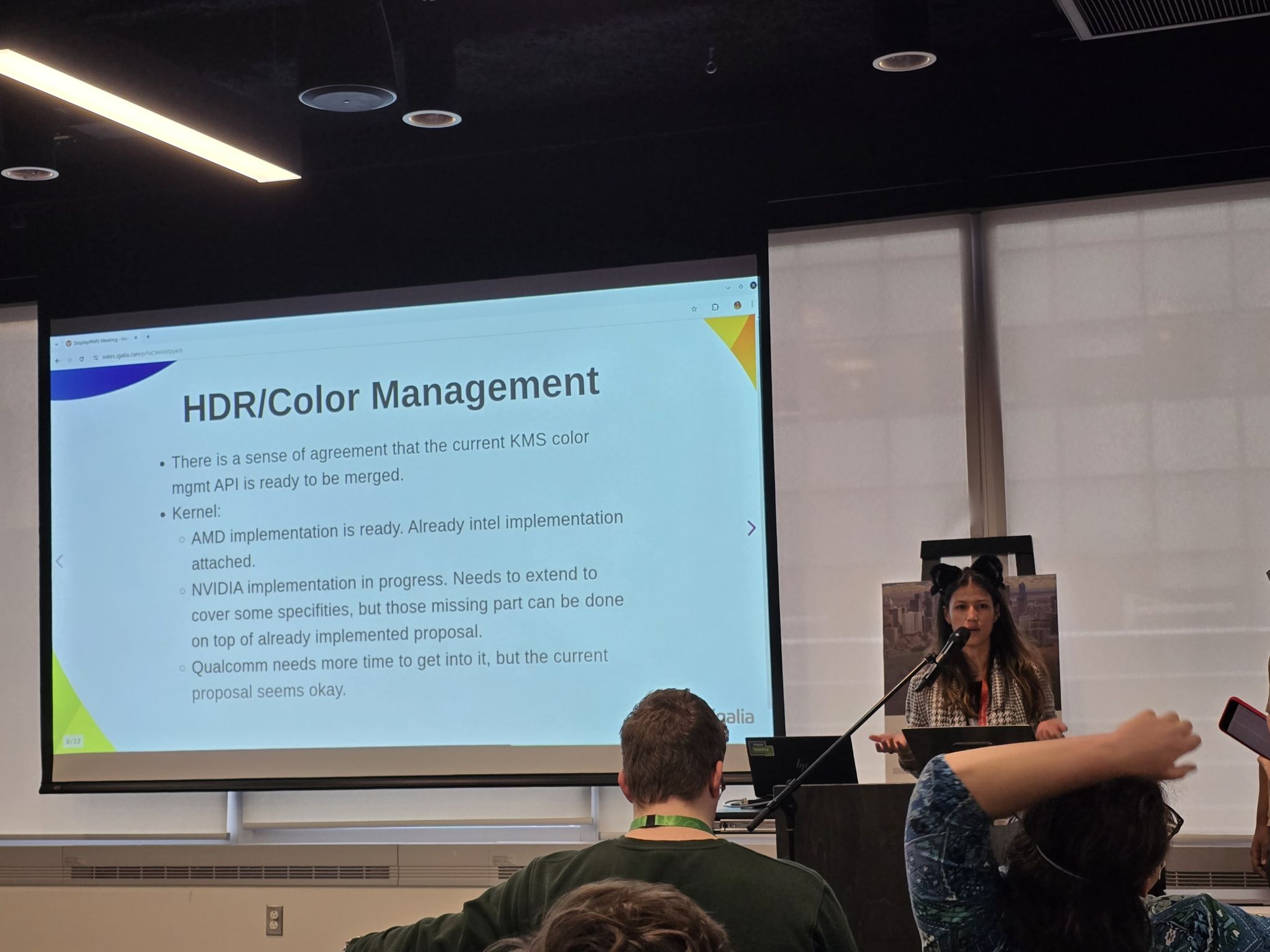
  • HDR/Color Management: Agreement on merging the current proposal, with NVIDIA implementing its special cases on VKMS and adding missing parts on top of Harry Wentland s (AMD) changes.
  • Display Mux: Collaborative design discussions focusing on compositor control and cross-sync considerations.
  • Better Commit Failure Feedback: Exploring ways to equip compositors with more detailed information for failure analysis.

Bringing together Linux display developers in the XDC 2024 While I didn t present a talk this year, I co-organized a Display/KMS meeting (with Rodrigo Siqueira of AMD) to build upon the momentum from the 2024 Linux Display Next hackfest. The meeting was attended by around 30 people in person and 4 remote participants. Speakers: Melissa Wen (Igalia) and Rodrigo Siqueira (AMD) Link: https://indico.freedesktop.org/event/6/contributions/383/ Topics: Similar to the hackfest, the meeting agenda was built over the first two days of the conference and mixed talks follow-up with new ideas and ongoing community efforts. The final agenda covered five topics in the scheduled order:
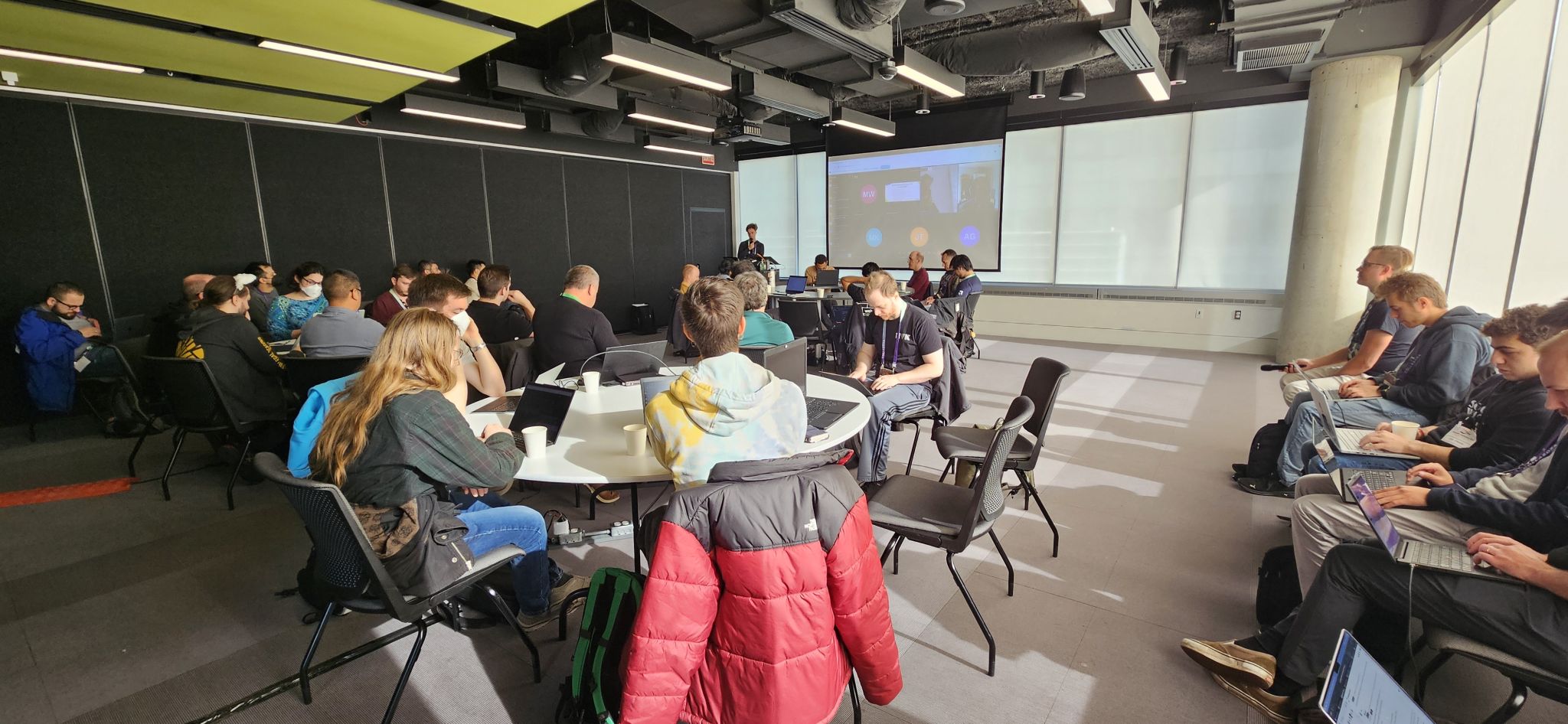
  1. How to share drivers between V4L2 and DRM for bridge-like components (new topic);
  2. Real-time Scheduling (problems encountered after the Display Next hackfest);
  3. HDR/Color Management (ofc);
  4. Display Mux (from Display hackfest and XDC 2024 talk, bringing AMD and NVIDIA together);
  5. (Better) Commit Failure Feedback (continuing the last minute topic of the Display Next hackfest).

Unpacking the Topics Similar to the hackfest, the meeting agenda evolved over the conference. During the 3 hours of meeting, I coordinated the room and discussion rounds, and Rodrigo Siqueira took notes and also contacted key developers to provide a detailed report of the many topics discussed. From his notes, let s dive into the key discussions!
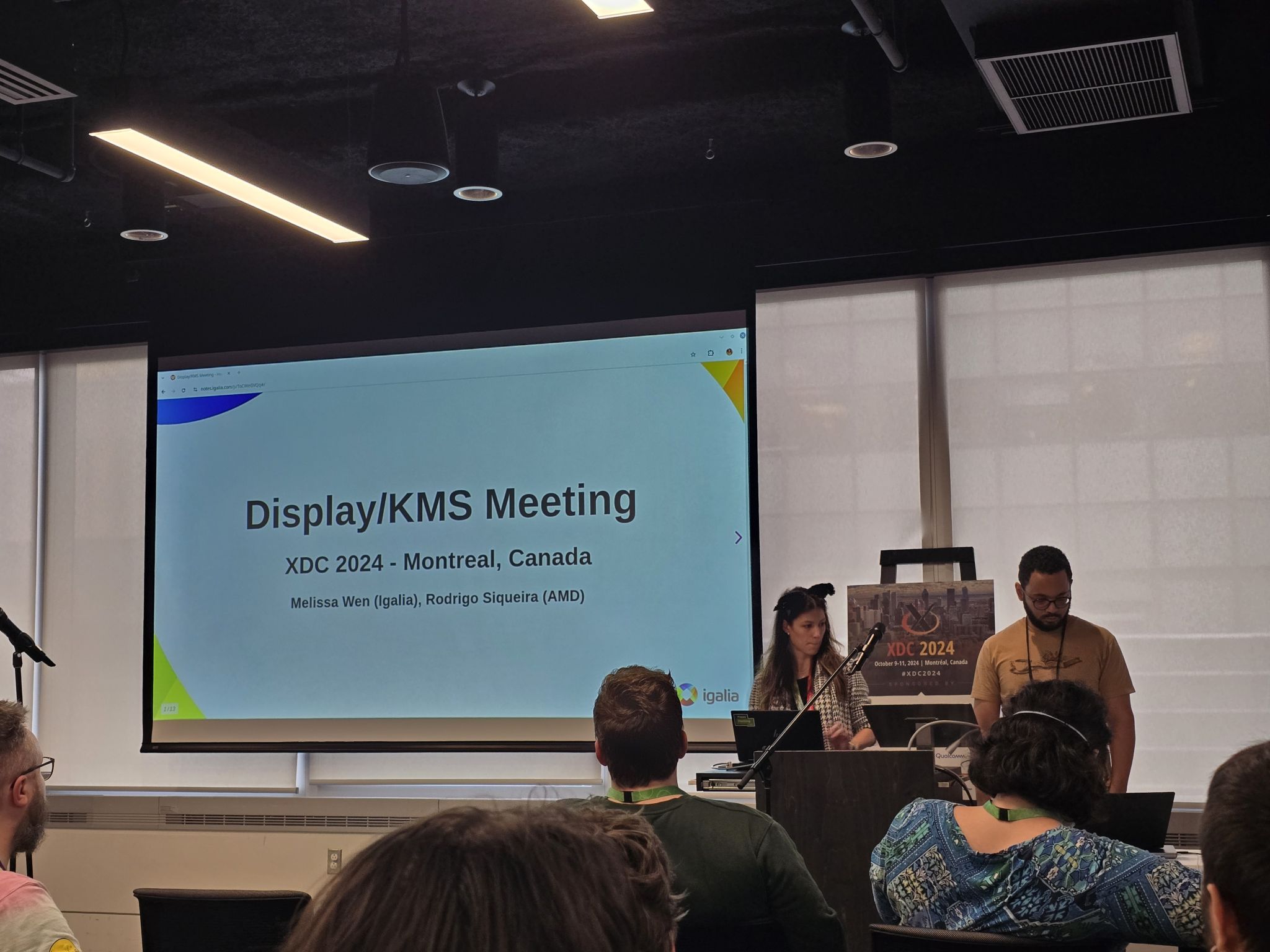
How to share drivers between V4L2 and KMS for bridge-like components. Led by Laurent Pinchart, we delved into the challenge of creating a unified driver for hardware devices (like scalers) that are used in both camera capture pipelines and display pipelines.
  • Problem Statement: How can we design a single kernel driver to handle devices that serve dual purposes in both V4L2 and DRM subsystems?
  • Potential Solutions:
    1. Multiple Compatible Strings: We could assign different compatible strings to the device tree node based on its usage in either the camera or display pipeline. However, this approach might raise concerns from device tree maintainers as it could be seen as a layer violation.
    2. Separate Abstractions: A single driver could expose the device to both DRM and V4L2 through separate abstractions: drm-bridge for DRM and V4L2 subdev for video. While simple, this approach requires maintaining two different abstractions for the same underlying device.
    3. Unified Kernel Abstraction: We could create a new, unified kernel abstraction that combines the best aspects of drm-bridge and V4L2 subdev. This approach offers a more elegant solution but requires significant design effort and potential migration challenges for existing hardware.

Real-Time Scheduling Challenges We have discussed real-time scheduling during this year Linux Display Next hackfest and, during the XDC 2024, Jonas Adahl brought up issues uncovered while progressing on this front.
  • Context: Non-blocking page-flips can, on rare occasions, take a long time and, for that reason, get a sigkill if the thread doing the atomic commit is a real-time schedule.
  • Action items:
    • Explore alternative backtraces during the busy wait (e.g., ftrace).
    • Investigate the maximum thread time in busy wait to reproduce issues faced by compositors. Tools like RTKit (mutter) can be used for better control (Michel D nzer can help with this setup).

HDR/Color Management This is a well-known topic with ongoing effort on all layers of the Linux Display stack and has been discussed online and in-person in conferences and meetings over the last years. Here s a breakdown of the key points raised at this meeting:
  • Talk: Color operations for Linux color pipeline on AMD devices: In the previous day, Alex Hung (AMD) presented the implementation of this API on AMD display driver.
  • NVIDIA Integration: While they agree with the overall proposal, NVIDIA needs to add some missing parts. Importantly, they will implement these on top of Harry Wentland s (AMD) proposal. Their specific requirements will be implemented on VKMS (Virtual Kernel Mode Setting driver) for further discussion. This VKMS implementation can benefit compositor developers by providing insights into NVIDIA s specific needs.
  • Other vendors: There is a version of the KMS API applied on Intel color pipeline. Apart from that, other vendors appear to be comfortable with the current proposal but lacks the bandwidth to implement it right now.
  • Upstream Patches: The relevant upstream patches were can be found here. [As humorously notes, this series is eagerly awaiting your Acked-by (approval)]
  • Compositor Side: The compositor developers have also made significant progress.
    • KDE has already implemented and validated the API through an experimental implementation in Kwin.
    • Gamescope currently uses a driver-specific implementation but has a draft that utilizes the generic version. However, some work is still required to fully transition away from the driver-specific approach. AP: work on porting gamescope to KMS generic API
    • Weston has also begun exploring implementation, and we might see something from them by the end of the year.
  • Kernel and Testing: The kernel API proposal is well-refined and meets the DRM subsystem requirements. Thanks to Harry Wentland effort, we already have the API attached to two hardware vendors and IGT tests, and, thanks to Xaver Hugl, a compositor implementation in place.
Finally, there was a strong sense of agreement that the current proposal for HDR/Color Management is ready to be merged. In simpler terms, everything seems to be working well on the technical side - all signs point to merging and shipping the DRM/KMS plane color management API!
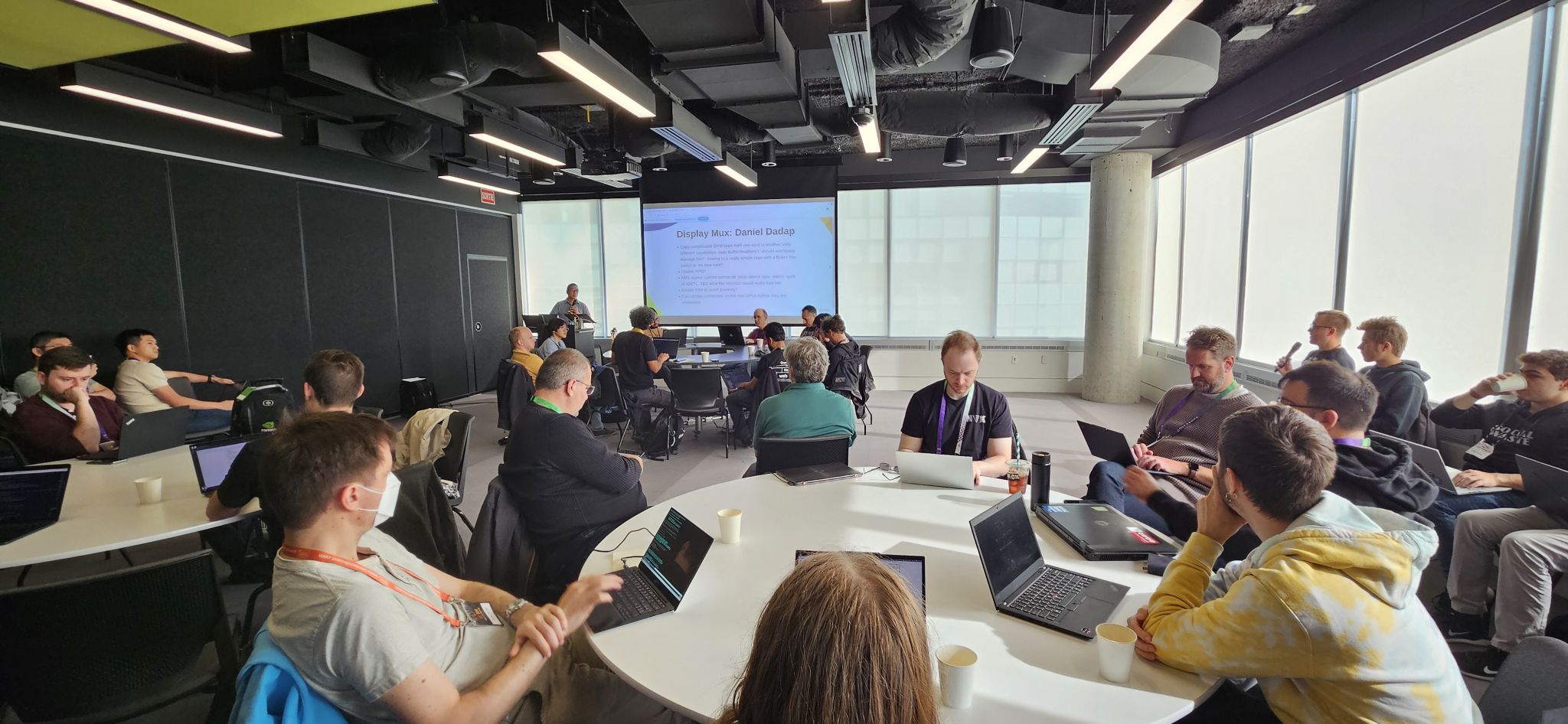
Display Mux During the meeting, Daniel Dadap led a brainstorming session on the design of the display mux switching sequence, in which the compositor would arm the switch via sysfs, then send a modeset to the outgoing driver, followed by a modeset to the incoming driver.
  • Context:
  • Key Considerations:
    • HPD Handling: There was a general consensus that disabling HPD can be part of the sequence for internal panels and we don t need to focus on it here.
    • Cross-Sync: Ensuring synchronization between the compositor and the drivers is crucial. The compositor should act as the drm-master to coordinate the entire sequence, but how can this be ensured?
    • Future-Proofing: The design should not assume the presence of a mux. In future scenarios, direct sharing over DP might be possible.
  • Action points:
    • Sharing DP AUX: Explore the idea of sharing DP AUX and its implications.
    • Backlight: The backlight definition represents a problem in the mux switch context, so we should explore some of the current specs available for that.
Towards Better Commit Failure Feedback In the last part of the meeting, Xaver Hugl asked for better commit failure feedback.
  • Problem description: Compositors currently face challenges in collecting detailed information from the kernel about commit failures. This lack of granular data hinders their ability to understand and address the root causes of these failures.
To address this issue, we discussed several potential improvements:
  • Direct Kernel Log Access: One idea is to directly load relevant kernel logs into the compositor. This would provide more detailed information about the failure and potentially aid in debugging.
  • Finer-Grained Failure Reporting: We also explored the possibility of separating atomic failures into more specific categories. Not all failures are critical, and understanding the nature of the failure can help compositors take appropriate action.
  • Enhanced Logging: Currently, the dmesg log doesn t provide enough information for user-space validation. Raising the log level to capture more detailed information during failures could be a viable solution.
By implementing these improvements, we aim to equip compositors with the necessary tools to better understand and resolve commit failures, leading to a more robust and stable display system.

A Big Thank You! Huge thanks to Rodrigo Siqueira for these detailed meeting notes. Also, Laurent Pinchart, Jonas Adahl, Daniel Dadap, Xaver Hugl, and Harry Wentland for bringing up interesting topics and leading discussions. Finally, thanks to all the participants who enriched the discussions with their experience, ideas, and inputs, especially Alex Goins, Antonino Maniscalco, Austin Shafer, Daniel Stone, Demi Obenour, Jessica Zhang, Joan Torres, Leo Li, Liviu Dudau, Mario Limonciello, Michel D nzer, Rob Clark, Simon Ser and Teddy Li. This collaborative effort will undoubtedly contribute to the continued development of the Linux display stack. Stay tuned for future updates!

12 November 2024

Paul Tagliamonte: Complex for Whom?

In basically every engineering organization I ve ever regarded as particularly high functioning, I ve sat through one specific recurring conversation which is not a conversation about complexity . Things are good or bad because they are or aren t complex, architectures needs to be redone because it s too complex some refactor of whatever it is won t work because it s too complex. You may have even been a part of some of these conversations or even been the one advocating for simple light-weight solutions. I ve done it. Many times. Rarely, if ever, do we talk about complexity within its rightful context complexity for whom. Is a solution complex because it s complex for the end user? Is it complex if it s complex for an API consumer? Is it complex if it s complex for the person maintaining the API service? Is it complex if it s complex for someone outside the team maintaining it to understand? Complexity within a problem domain I ve come to believe, is fairly zero-sum there s a fixed amount of complexity in the problem to be solved, and you can choose to either solve it, or leave it for those downstream of you to solve that problem on their own. That being said, while I believe there is a lower bound in complexity to contend with for a problem, I do not believe there is an upper bound to the complexity of solutions possible. It is always possible, and in fact, very likely that teams create problems for themselves while trying to solve a problem. The rest of this post is talking to the lower bound. When getting feedback on an early draft of this blog post, I ve been informed that Fred Brooks coined a term for what I call lower bound complexity Essential Complexity , in the paper No Silver Bullet Essence and Accident in Software Engineering , which is a better term and can be used interchangeably.

Complexity Culture In a large enough organization, where the team is high functioning enough to have and maintain trust amongst peers, members of the team will specialize. People will begin to engage with subsets of the work to be done, and begin to have their efficacy measured against that part of the organization s problems. Incentives shift, and over time it becomes increasingly likely that two engineers may have two very different priorities when working on the same system together. Someone accountable for uptime and tasked with responding to outages will begin to resist changes. Someone accountable for rapidly delivering features will resist gates between them and their users. Companies (either wittingly or unwittingly) will deal with this by tasking engineers with both production (feature development) and operational tasks (maintenance), so the difference in incentives isn t usually as bad as it could be. When we get a bunch of folks from far-flung corners of an organization in a room, fire up a slide deck and throw up some aspirational to-be architecture diagram in order to get a sign-off to solve some problem (be it someone needs a credible promotion packet, new feature needs to get delivered, or the system has begun to fail and needs fixing), the initial reaction will, more often than I d like, start to devolve into a discussion of how this is going to introduce a bunch of complexity, going to be hard to maintain, why can t you make it less complex? Right around here is when I start to try and contextualize the conversation happening around me understand what complexity is that being discussed, and understand who is taking on that burden. Think about who should be owning that problem, and work through the tradeoffs involved. Is it best solved here, or left to consumers (be them other systems, developers, or users). Should something become an API call s optional param, taking on all the edge-cases and on, or should users have to implement the logic using the data you return (leaving everyone else to take on all the edge-cases and maintenance)? Should you process the data, or require the user to preprocess it for you? Frequently it s right to make an active and explicit decision to simplify and leave problems to be solved downstream, since they may not actually need to be solved or perhaps you expect consumers will want to own the specifics of how the problem is solved, in which case you leave lots of documentation and examples. Many other times, especially when it s something downstream consumers are likely to hit, it s best solved internal to the system, since the only thing that can come of leaving it unsolved are bugs, frustration and half-correct solutions. This is a grey-space of tradeoffs, not a clear decision tree. No one wants the software manifestation of a katamari ball or a junk drawer, nor does anyone want a half-baked service unable to handle the simplest use-case.

Head-in-sand as a Service Popoffs about how complex something is, are, to a first approximation, best understood as meaning complicated for the person making comments . A lot of the #thoughtleadership believe that an AWS hosted EKS k8s cluster running images built by CI talking to an AWS hosted PostgreSQL RDS is not complex. They re right. Mostly right. This is less complex less complex for them. It s not, however, without complexity and its own tradeoffs it s just complexity that they do not have to deal with. Now they don t have to maintain machines that have pesky operating systems or hard drive failures. They don t have to deal with updating the version of k8s, nor ensuring the backups work. No one has to push some artifact to prod manually. Deployments happen unattended. You click a button and get a cluster. On the other hand, developers outside the ops function need to deal with troubleshooting CI, debugging access control rules encoded in turing complete YAML, permissions issues inside the cluster due to whatever the fuck a service mesh is, everyone needs to learn how to use some k8s tools they only actually use during a bad day, likely while doing some x.509 troubleshooting to connect to the cluster (an internal only endpoint; just port forward it) not to mention all sorts of rules to route packets to their project (a single repo s binary being run in 3 containers on a single vm host). Beyond that, there s the invisible complexity complexity on the interior of a service you depend on. I think about the dozens of teams maintaining the EKS service (which is either run on EC2 instances, or alternately, EC2 instances in a trench coat, moustache and even more shell scripts), the RDS service (also EC2 and shell scripts, but this time accounting for redundancy, backups, availability zones), scores of hypervisors pulled off the shelf (xen, kvm) smashed together with the ones built in-house (firecracker, nitro, etc) running on hardware that has to be refreshed and maintained continuously. Every request processed by network ACL rules, AWS IAM rules, security group rules, using IP space announced to the internet wired through IXPs directly into ISPs. I don t even want to begin to think about the complexity inherent in how those switches are designed. Shitloads of complexity to solve problems you may or may not have, or even know you had. What s more complex? An app running in an in-house 4u server racked in the office s telco closet in the back running off the office Verizon line, or an app running four hypervisors deep in an AWS datacenter? Which is more complex to you? What about to your organization? In total? Which is more prone to failure? Which is more secure? Is the complexity good or bad? What type of Complexity can you manage effectively? Which threaten the system? Which threaten your users?

COMPLEXIVIBES This extends beyond Engineering. Decisions regarding what tools are we able to use be them existing contracts with cloud providers, CIO mandated SaaS products, a list of the only permissible open source projects will incur costs in terms of expressed complexity . Pinning open source projects to a fixed set makes SBOM production less complex . Using only one SaaS provider s product suite (even if its terrible, because it has all the types of tools you need) makes accreditation less complex . If all you have is a contract with Pauly T s lowest price technically acceptable artisinal cloudary and haberdashery, the way you pay for your compute is less complex for the CIO shop, though you will find yourself building your own hosted database template, mechanism to spin up a k8s cluster, and all the operational and technical burden that comes with it. Or you won t and make it everyone else s problem in the organization. Nothing you can do will solve for the fact that you must now deal with this problem somewhere because it was less complicated for the business to put the workloads on the existing contract with a cut-rate vendor. Suddenly, the decision to reduce complexity because of an existing contract vehicle has resulted in a huge amount of technical risk and maintenance burden being onboarded. Complexity you would otherwise externalize has now been taken on internally. With a large enough organizations (specifically, in this case, i m talking about you, bureaucracies), this is largely ignored or accepted as normal since the personnel cost is understood to be free to everyone involved. Doing it this way is more expensive, more work, less reliable and less maintainable, and yet, somehow, is, in a lot of ways, less complex to the organization. It s particularly bad with bureaucracies, since screwing up a contract will get you into much more trouble than delivering a broken product, leaving basically no reason for anyone to care to fix this. I can t shake the feeling that for every story of technical mandates gone awry, somewhere just out of sight there s a decisionmaker optimizing for what they believe to be the least amount of complexity least hassle, fewest unique cases, most consistency as they can. They freely offload complexity from their accreditation and risk acceptance functions through mandates. They will never have to deal with it. That does not change the fact that someone does.

TC;DR (TOO COMPLEX; DIDN T REVIEW) We wish to rid ourselves of systemic Complexity after all, complexity is bad, simplicity is good. Removing upper-bound own-goal complexity ( accidental complexity in Brooks s terms) is important, but once you hit the lower bound complexity, the tradeoffs become zero-sum. Removing complexity from one part of the system means that somewhere else maybe outside your organization or in a non-engineering function must grow it back. Sometimes, the opposite is the case, such as when a previously manual business processes is automated. Maybe that s a good idea. Maybe it s not. All I know is that what doesn t help the situation is conflating complexity with everything we don t like legacy code, maintenance burden or toil, cost, delivery velocity.
  • Complexity is not the same as proclivity to failure. The most reliable systems I ve interacted with are unimaginably complex, with layers of internal protection to prevent complete failure. This has its own set of costs which other people have written about extensively.
  • Complexity is not cost. Sometimes the cost of taking all the complexity in-house is less, for whatever value of cost you choose to use.
  • Complexity is not absolute. Something simple from one perspective may be wildly complex from another. The impulse to burn down complex sections of code is helpful to have generally, but sometimes things are complicated for a reason, even if that reason exists outside your codebase or organization.
  • Complexity is not something you can remove without introducing complexity elsewhere. Just as not making a decision is a decision itself; choosing to require someone else to deal with a problem rather than dealing with it internally is a choice that needs to be considered in its full context.
Next time you re sitting through a discussion and someone starts to talk about all the complexity about to be introduced, I want to pop up in the back of your head, politely asking what does complex mean in this context? Is it lower bound complexity? Is this complexity desirable? Is what they re saying mean something along the lines of I don t understand the problems being solved, or does it mean something along the lines of this problem should be solved elsewhere? Do they believe this will result in more work for them in a way that you don t see? Should this not solved at all by changing the bounds of what we should accept or redefine the understood limits of this system? Is the perceived complexity a result of a decision elsewhere? Who s taking this complexity on, or more to the point, is failing to address complexity required by the problem leaving it to others? Does it impact others? How specifically? What are you not seeing? What can change? What should change?

11 November 2024

Vincent Bernat: Customize Caddy's plugins with Nix

Caddy is an open-source web server written in Go. It handles TLS certificates automatically and comes with a simple configuration syntax. Users can extend its functionality through plugins1 to add features like rate limiting, caching, and Docker integration. While Caddy is available in Nixpkgs, adding extra plugins is not simple.2 The compilation process needs Internet access, which Nix denies during build to ensure reproducibility. When trying to build the following derivation using xcaddy, a tool for building Caddy with plugins, it fails with this error: dial tcp: lookup proxy.golang.org on [::1]:53: connection refused.
  pkgs  :
pkgs.stdenv.mkDerivation  
  name = "caddy-with-xcaddy";
  nativeBuildInputs = with pkgs; [ go xcaddy cacert ];
  unpackPhase = "true";
  buildPhase =
    ''
      xcaddy build --with github.com/caddy-dns/powerdns@v1.0.1
    '';
  installPhase = ''
    mkdir -p $out/bin
    cp caddy $out/bin
  '';
 
Fixed-output derivations are an exception to this rule and get network access during build. They need to specify their output hash. For example, the fetchurl function produces a fixed-output derivation:
  stdenv, fetchurl  :
stdenv.mkDerivation rec  
  pname = "hello";
  version = "2.12.1";
  src = fetchurl  
    url = "mirror://gnu/hello/hello-$ version .tar.gz";
    hash = "sha256-jZkUKv2SV28wsM18tCqNxoCZmLxdYH2Idh9RLibH2yA=";
   ;
 
To create a fixed-output derivation, you need to set the outputHash attribute. The example below shows how to output Caddy s source code, with some plugin enabled, as a fixed-output derivation using xcaddy and go mod vendor.
pkgs.stdenvNoCC.mkDerivation rec  
  pname = "caddy-src-with-xcaddy";
  version = "2.8.4";
  nativeBuildInputs = with pkgs; [ go xcaddy cacert ];
  unpackPhase = "true";
  buildPhase =
    ''
      export GOCACHE=$TMPDIR/go-cache
      export GOPATH="$TMPDIR/go"
      XCADDY_SKIP_BUILD=1 TMPDIR="$PWD" \
        xcaddy build v$ version  --with github.com/caddy-dns/powerdns@v1.0.1
      (cd buildenv* && go mod vendor)
    '';
  installPhase = ''
    mv buildenv* $out
  '';
  outputHash = "sha256-F/jqR4iEsklJFycTjSaW8B/V3iTGqqGOzwYBUXxRKrc=";
  outputHashAlgo = "sha256";
  outputHashMode = "recursive";
 
With a fixed-output derivation, it is up to us to ensure the output is always the same: You can use this derivation to override the src attribute in pkgs.caddy:
pkgs.caddy.overrideAttrs (prev:  
  src = pkgs.stdenvNoCC.mkDerivation   /* ... */  ;
  vendorHash = null;
  subPackages = [ "." ];
 );
Check out the complete example in the GitHub repository. To integrate into a Flake, add github:vincentbernat/caddy-nix as an overlay:
 
  inputs =  
    nixpkgs.url = "nixpkgs";
    flake-utils.url = "github:numtide/flake-utils";
    caddy.url = "github:vincentbernat/caddy-nix";
   ;
  outputs =   self, nixpkgs, flake-utils, caddy  :
    flake-utils.lib.eachDefaultSystem (system:
      let
        pkgs = import nixpkgs  
          inherit system;
          overlays = [ caddy.overlays.default ];
         ;
      in
       
        packages =  
          default = pkgs.caddy.withPlugins  
            plugins = [ "github.com/caddy-dns/powerdns@v1.0.1" ];
            hash = "sha256-F/jqR4iEsklJFycTjSaW8B/V3iTGqqGOzwYBUXxRKrc=";
           ;
         ;
       );
 

Update (2024-11) This flake won t work with Nixpkgs 24.05 or older because it relies on this commit to properly override the vendorHash attribute.


  1. This article uses the term plugins, though Caddy documentation also refers to them as modules since they are implemented as Go modules.
  2. This is a feature request since quite some time. A proposed solution has been rejected. The one described in this article is a bit different and I have proposed it in another pull request.
  3. This is not perfect: if the source code produced by xcaddy changes, the hash would change and the build would fail.

8 November 2024

Freexian Collaborators: Debian Contributions: October s report (by Anupa Ann Joseph)

Debian Contributions: 2024-10 Contributing to Debian is part of Freexian s mission. This article covers the latest achievements of Freexian and their collaborators. All of this is made possible by organizations subscribing to our Long Term Support contracts and consulting services.

rebootstrap, by Helmut Grohne After significant changes earlier this year, the state of architecture cross bootstrap is normalizing again. More and more architectures manage to complete rebootstrap testing successfully again. Here are two examples of what kind of issues the bootstrap testing identifies. At some point, libpng1.6 would fail to cross build on musl architectures whereas it would succeed on other ones failing to locate zlib. Adding --debug-find to the cmake invocation eventually revealed that it would fail to search in /usr/lib/<triplet>, which is the default library path. This turned out to be a bug in cmake assuming that all linux systems use glibc. libpng1.6 also gained a baseline violation for powerpc and ppc64 by enabling the use of AltiVec there. The newt package would fail to cross build for many 32-bit architectures whereas it would succeed for armel and armhf due to -Wincompatible-pointer-types. It turns out that this flag was turned into -Werror and it was compiling with a warning earlier. The actual problem is a difference in signedness between wchar_t and FriBidChar (aka uint32_t) and actually affects native building on i386.

Miscellaneous contributions
  • Helmut sent 35 patches for cross build failures.
  • Stefano Rivera uploaded the Python 3.13.0 final release.
  • Stefano continued to rebuild Python packages with C extensions using Python 3.13, to catch compatibility issues before the 3.13-add transition starts.
  • Stefano uploaded new versions of a handful of Python packages, including: dh-python, objgraph, python-mitogen, python-truststore, and python-virtualenv.
  • Stefano packaged a new release of mkdocs-macros-plugin, which required packaging a new Python package for Debian, python-super-collections (now in NEW review).
  • Stefano helped the mini-DebConf Online Brazil get video infrastructure up and running for the event. Unfortunately, Debian s online-DebConf setup has bitrotted over the last couple of years, and it eventually required new temporary Jitsi and Jibri instances.
  • Colin Watson fixed a number of autopkgtest failures to get ansible back into testing.
  • Colin fixed an ssh client failure in certain cases when using GSS-API key exchange, and added an integration test to ensure this doesn t regress in future.
  • Colin worked on the Python 3.13 transition, fixing problems related to it in 15 packages. This included upstream work in a number of packages (postgresfixture, python-asyncssh, python-wadllib).
  • Colin upgraded 41 Python packages to new upstream versions.
  • Carles improved po-debconf-manager: now it can create merge requests to Salsa automatically (created 17, new batch coming this month), imported almost all the packages with debconf translation templates whose VCS is Salsa (currently 449 imported), added statistics per package and language, improved command line interface options. Performed user support fixing different issues. Also prepared an abstract for the talk at MiniDebConf Toulouse.
  • Santiago Ruano Rinc n continued the organization work for the DebConf 25 conference, to be held in Brest, France. Part of the work relates to the initial edits of the sponsoring brochure. Thanks to Benjamin Somers who finalized the French and English versions.
  • Rapha l forwarded a couple of zim and hamster bugs to the upstream developers, and tried to diagnose a delayed startup of gdm on his laptop (cf #1085633).
  • On behalf of the Debian Publicity Team, Anupa interviewed 7 women from the Debian community, old and new contributors. The interview was published in Bits from Debian.

1 November 2024

Colin Watson: Free software activity in October 2024

Almost all of my Debian contributions this month were sponsored by Freexian. You can also support my work directly via Liberapay. Ansible I noticed that Ansible had fallen out of Debian testing due to autopkgtest failures. This seemed like a problem worth fixing: in common with many other people, we use Ansible for configuration management at Freexian, and it probably wouldn t make our sysadmins too happy if they upgraded to trixie after its release and found that Ansible was gone. The problems here were really just slogging through test failures in both the ansible-core and ansible packages, but their test suites are large and take a while to run so this took some time. I was able to contribute a few small fixes to various upstreams in the process: This should now get back into testing tomorrow. OpenSSH Martin- ric Racine reported that ssh-audit didn t list the ext-info-s feature as being available in Debian s OpenSSH 9.2 packaging in bookworm, contrary to what OpenSSH upstream said on their specifications page at the time. I spent some time looking into this and realized that upstream was mistakenly saying that implementations of ext-info-c and ext-info-s were added at the same time, while in fact ext-info-s was added rather later. ssh-audit now has clearer output, and the OpenSSH maintainers have corrected their specifications page. I looked into a report of an ssh failure in certain cases when using GSS-API key exchange (which is a Debian patch). Once again, having integration tests was a huge win here: the affected scenario is quite a fiddly one, but I was able to set it up in the test, and thereby make sure it doesn t regress in future. It still took me a couple of hours to get all the details right, but in the past this sort of thing took me much longer with a much lower degree of confidence that the fix was correct. On upstream s advice, I cherry-picked some key exchange fixes needed for big-endian architectures. Python team I packaged python-evalidate, needed for a new upstream version of buildbot. The Python 3.13 transition rolls on. I fixed problems related to it in htmlmin, humanfriendly, postgresfixture (contributed upstream), pylint, python-asyncssh (contributed upstream), python-oauthlib, python3-simpletal, quodlibet, zope.exceptions, and zope.interface. A trickier Python 3.13 issue involved the cgi module. Years ago I ported zope.publisher to the multipart module because cgi.FieldStorage was broken in some situations, and as a result I got a recommendation into Python s dead batteries PEP 594. Unfortunately there turns out to be a name conflict between multipart and python-multipart on PyPI; python-multipart upstream has been working to disentangle this, though we still need to work out what to do in Debian. All the same, I needed to fix python-wadllib and multipart seemed like the best fit; I contributed a port upstream and temporarily copied multipart into Debian s python-wadllib source package to allow its tests to pass. I ll come back and fix this properly once we sort out the multipart vs. python-multipart packaging. tzdata moved some timezone definitions to tzdata-legacy, which has broken a number of packages. I added tzdata-legacy build-dependencies to alembic and python-icalendar to deal with this in those packages, though there are still some other instances of this left. I tracked down an nltk regression that caused build failures in many other packages. I fixed Rust crate versioning issues in pydantic-core, python-bcrypt, and python-maturin (mostly fixed by Peter Michael Green and Jelmer Vernoo , but it needed a little extra work). I fixed other build failures in entrypoints, mayavi2, python-pyvmomi (mostly fixed by Alexandre Detiste, but it needed a little extra work), and python-testing.postgresql (ditto). I fixed python3-simpletal to tolerate future versions of dh-python that will drop their dependency on python3-setuptools. I fixed broken symlinks in python-treq. I removed (build-)depends on python3-pkg-resources from alembic, autopep8, buildbot, celery, flufl.enum, flufl.lock, python-public, python-wadllib (contributed upstream), pyvisa, routes, vulture, and zodbpickle (contributed upstream). I upgraded astroid, asyncpg (fixing a Python 3.13 failure and a build failure), buildbot (noticing an upstream test bug in the process), dnsdiag, frozenlist, netmiko (fixing a Python 3.13 failure), psycopg3, pydantic-settings, pylint, python-asyncssh, python-bleach, python-btrees, python-cytoolz, python-django-pgtrigger, python-django-test-migrations, python-gssapi, python-icalendar, python-json-log-formatter, python-pgbouncer, python-pkginfo, python-plumbum, python-stdlib-list, python-tokenize-rt, python-treq (fixing a Python 3.13 failure), python-typeguard, python-webargs (fixing a build failure), pyupgrade, pyvisa, pyvisa-py (fixing a Python 3.13 failure), toolz, twisted, vulture, waitress (fixing CVE-2024-49768 and CVE-2024-49769), wtf-peewee, wtforms, zodbpickle, zope.exceptions, zope.interface, zope.proxy, zope.security, and zope.testrunner to new upstream versions. I tried to fix a regression in python-scruffy, but I need testing feedback. I requested removal of python-testing.mysqld.

26 October 2024

Russell Coker: The CUPS Vulnerability

The Announcement Late last month there was an announcement of a severity 9.9 vulnerability allowing remote code execution that affects all GNU/Linux systems (plus others) [1]. For something to affect all Linux systems that would have to be either a kernel issue or a sshd issue. The announcement included complaints about the lack of response of vendors and And YES: I LOVE hyping the sh1t out of this stuff because apparently sensationalism is the only language that forces these people to fix . He seems to have a different experience to me of reporting bugs, I have had plenty of success getting bugs fixed without hyping them. I just report the bug, wait a while, and it gets fixed. I have reported potential security bugs without even bothering to try and prove that they were exploitable (any situation where you can make a program crash is potentially exploitable), I just report it and it gets fixed. I was very dubious about his ability to determine how serious a bug is and to accurately report it so this wasn t a situation where I was waiting for it to be disclosed to discover if it affected me. I was quite confident that my systems wouldn t be at any risk. Analysis Not All Linux Systems Run CUPS When it was published my opinion was proven to be correct, it turned out to be a series of CUPS bugs [2]. To describe that as all GNU/Linux systems (plus others) seems like a vast overstatement, maybe a good thing to say if you want to be a TikTok influencer but not if you want to be known for computer security work. For the Debian distribution the cups-browsed package (which seems to be the main exploitable one) is recommended by cups-daemon, as I have my Debian systems configured to not install recommended packages by default that means that it wasn t installed on any of my systems. Also the vast majority of my systems don t do printing and therefore don t have any part of CUPS installed. CUPS vs NAT The next issue is that in Australia most home ISPs don t have IPv6 enabled and CUPS doesn t do the things needed to allow receiving connections from the outside world via NAT with IPv4. If inbound port 631 is blocked on both TCP and USP as is the default on Australian home Internet or if there is a correctly configured firewall in place then the network is safe from attack. There is a feature called uPnP port forwarding [3] to allow server programs to ask a router to send inbound connections to them, this is apparently usually turned off by default in router configuration. If it is enabled then there are Debian packages of software to manage this, the miniupnpc package has the client (which can request NAT changes on the router) [4]. That package is not installed on any of my systems and for my home network I don t use a router that runs uPnP. The only program I knowingly run that uses uPnP is Warzone2100 and as I don t play network games that doesn t happen. Also as an aside in version 4.4.2-1 of warzone2100 in Debian and Ubuntu I made it use Bubblewrap to run the game in a container. So a Remote Code Execution bug in Warzone 2100 won t be an immediate win for an attacker (exploits via X11 or Wayland are another issue). MAC Systems Debian has had AppArmor enabled by default since Buster was released in 2019 [5]. There are claims that AppArmor will stop this exploit from doing anything bad. To check SE Linux access I first use the semanage fcontext command to check the context of the binary, cupsd_exec_t means that the daemon runs as cupsd_t. Then I checked what file access is granted with the sesearch program, mostly just access to temporary files, cupsd config files, the faillog, the Kerberos cache files (not used on the Kerberos client systems I run), Samba run files (might be a possibility of exploiting something there), and the security_t used for interfacing with kernel security infrastructure. I then checked the access to the security class and found that it is permitted to check contexts and access-vectors not access that can be harmful. The next test was to use sesearch to discover what capabilities are granted, which unfortunately includes the sys_admin capability, that is a capability that allows many sysadmin tasks that could be harmful (I just checked the Fedora source and Fedora 42 has the same access). Whether the sys_admin capability can be used to do bad things with the limited access cupsd_t has to device nodes etc is not clear. But this access is undesirable. So the SE Linux policy in Debian and Fedora will stop cupsd_t from writing SETUID programs that can be used by random users for root access and stop it from writing to /etc/shadow etc. But the sys_admin capability might allow it to do hostile things and I have already uploaded a changed policy to Debian/Unstable to remove that. The sys_rawio capability also looked concerning but it s apparently needed to probe for USB printers and as the domain has no access to block devices it is otherwise harmless. Below are the commands I used to discover what the policy allows and the output from them.
# semanage fcontext -l grep bin/cups-browsed
/usr/bin/cups-browsed                              regular file       system_u:object_r:cupsd_exec_t:s0 
# sesearch -A -s cupsd_t -c file -p write
allow cupsd_t cupsd_interface_t:file   append create execute execute_no_trans getattr ioctl link lock map open read rename setattr unlink write  ;
allow cupsd_t cupsd_lock_t:file   append create getattr ioctl link lock open read rename setattr unlink write  ;
allow cupsd_t cupsd_log_t:file   append create getattr ioctl link lock open read rename setattr unlink write  ;
allow cupsd_t cupsd_runtime_t:file   append create getattr ioctl link lock open read rename setattr unlink write  ;
allow cupsd_t cupsd_rw_etc_t:file   append create getattr ioctl link lock open read rename setattr unlink write  ;
allow cupsd_t cupsd_t:file   append create getattr ioctl link lock open read rename setattr unlink write  ;
allow cupsd_t cupsd_tmp_t:file   append create getattr ioctl link lock open read rename setattr unlink write  ;
allow cupsd_t faillog_t:file   append getattr ioctl lock open read write  ;
allow cupsd_t init_tmpfs_t:file   append getattr ioctl lock read write  ;
allow cupsd_t krb5_host_rcache_t:file   append create getattr ioctl link lock open read rename setattr unlink write  ; [ allow_kerberos ]:True
allow cupsd_t print_spool_t:file   append create getattr ioctl link lock open read relabelfrom relabelto rename setattr unlink write  ;
allow cupsd_t samba_var_t:file   append getattr ioctl lock open read write  ;
allow cupsd_t security_t:file   append getattr ioctl lock open read write  ;
allow cupsd_t security_t:file   append getattr ioctl lock open read write  ; [ allow_kerberos ]:True
allow cupsd_t usbfs_t:file   append getattr ioctl lock open read write  ;
# sesearch -A -s cupsd_t -c security
allow cupsd_t security_t:security check_context; [ allow_kerberos ]:True
allow cupsd_t security_t:security   check_context compute_av  ;
# sesearch -A -s cupsd_t -c capability
allow cupsd_t cupsd_t:capability net_bind_service; [ allow_ypbind ]:True
allow cupsd_t cupsd_t:capability   audit_write chown dac_override dac_read_search fowner fsetid ipc_lock kill net_bind_service setgid setuid sys_admin sys_rawio sys_resource sys_tty_config  ;
# sesearch -A -s cupsd_t -c capability2
allow cupsd_t cupsd_t:capability2   block_suspend wake_alarm  ;
# sesearch -A -s cupsd_t -c blk_file
Conclusion This is an example of how not to handle security issues. Some degree of promotion is acceptable but this is very excessive and will result in people not taking security announcements seriously in future. I wonder if this is even a good career move by the researcher in question, will enough people believe that they actually did something good in this that it outweighs the number of people who think it s misleading at best?

24 October 2024

Emmanuel Kasper: back to blogging and running a feed reader as a containerized systemd service

After reading about Jonathan McDowell feed reader install and the back to blogging initiative, I decided to install a feed reader to follow all those nice blog posts. With a feed reader you can compose your own feed of news based on blog posts, websites, mastodon toots. And then you are independant from ad oriented ranking algorithms of social networks. Since Jonathan used FreshRSS as a feed reader, I started with the same software. On a quick glance on its github page, it sounded like a good project:
  • active contributions
  • different channels for stable and latest version of the software
  • container images pointing to the stable release
  • support multiple databases for storage, including PostgreSQL
  • correct documentation mentioning security caveats
I prefer to do the container image installation using podman since:
  • upgrades from FreshRSS are easy to do and can be done separately from operating system upgrades
  • I do not mess my based operating system with php (subjective) and in case of a compromized freshrss, the freshrss/apache install would be still restrained to its own Linux namespaces, separated from the rest of the system.
Podman is image compatible with Docker as they both implement the OCI runtime specification, and have a nearly identical command line interface. This installation will be done on a Debian server, but should work too on any Linux distribution. Initial setup
  • start a container image based on the start command provided by the FreshRSS project. The podman command line is nearly identical to the docker command line, excepts that podman expects the fully qualified domain name associated with the container image, and I chose to run the freshrss container on the localhost interface only. I also use a defined version tag, because using the latest tag makes it complicated to track which exact ersion I have installed.
# podman pull docker.io/freshrss/freshrss:1.20.1
# podman run --detach --restart unless-stopped --log-opt max-size=10m \
  --publish 127.0.0.1:8081:80 \
  --env TZ=Europe/Paris \
  --env 'CRON_MIN=1,31' \
  --volume freshrss_data:/var/www/FreshRSS/data \
  --volume freshrss_extensions:/var/www/FreshRSS/extensions \
  --name freshrss \
  docker.io/freshrss/freshrss:1.20.1
  • verify where the podman volumes have been created. This is where the user data of freshrss will be stored.
# podman volume ls
# podman volume inspect freshrss_data
  • now that freshrss is installed, you can start its configuration wizard at localhost:8081. You should keep the default sqlite choice
  • finally after running the wizard, you can login again and add some feeds
  • verify that your config has been stored outside the container, and inside the volume (so that it will not be erased in case of upgrages)
# ls -l /var/lib/containers/storage/volumes/freshrss_data/_data/users/
  • verify the state of sqlite database
echo '.tables'  sqlite3  /var/lib/containers/storage/volumes/freshrss_data/_data/users/<your freshrss user>/db.sqlite 
category  entry     entrytag  entrytmp  feed      tag
Going with FreshRSS in Production Podman has this very nice feature that it can generate a systemd unit from a running container, and use systemd to start a container on boot. This is in contrary to docker where the docker daemon does the stop/start of containers on boot. I prefer the systemd approach as it treats containers the same way as other system services. Once the freshrss container is running we can generate a systemd unit of it with:
# podman generate systemd --new --name freshrss   tee /etc/systemd/system/container-freshrss.service
Let s stop the container we started previously, and use systemd to manage it:
# podman stop freshrss
# systemctl enable --now container-freshrss.service
We can verify that we have a listening socket on the localhost interface, on the source port 8081
# systemctl status container-freshrss.service
  ...
# ss --listening --numeric --process '( sport = 8081 )'
Netid         State           Recv-Q          Send-Q                   Local Address:Port                   Peer Address:Port         Process         
tcp           LISTEN          0               4096                         127.0.0.1:8081                        0.0.0.0:*             users:(("conmon",pid=4464,fd=5))
Nota Bene: conmon (8) is the process managing the network namespace in which fresh-rss is running, hence it is displayed as the process owning the listening socket Exposing FreshRSS to the external world We have now a running service, but we need to make it reachable from the internet. The simplest, classical way, is to create a subdomain and a VirtualHost configured as a reverse proxy to access the service at 127.0.0.1:8081. Fortunately the FreshRSS authors have documented this setup in https://github.com/FreshRSS/FreshRSS/tree/edge/Docker#alternative-reverse-proxy-using-apache and those steps are no different from a standard application behind a web reverse proxy. Upgrading freshrss container to a newer version A documentation showing how to install a piece of software is nothing when it does not show how to upgrade that said software. Installing is easy, upgrading is where the challenge is. Fortunately to the good stateless design of freshrss (everything is in the sqlite database, which is backed by a non-epheremal volume in our setup), switchting versions is a peace of cake.
# podman pull docker.io/freshrss/freshrss:1.20.2
# systemctl stop container-freshrss.service
# sed -i 's,docker.io/freshrss/freshrss:1.20.1,docker.io/freshrss/freshrss:1.20.2,' /etc/systemd/system/container-freshrss.service
# systemctl daemon-reload
# systemctl start container-freshrss.service
If you need to rollback, you just need to revert version numbers in the instruction above. Enjoy your own reader feed ! I will add the following feeds of blogs I like, let us see if I follow them better with a feed reader !

21 October 2024

Sahil Dhiman: Free Software Mirrors in India

Last Updated on 15/11/2024. List of public mirrors in India. Location discovered basis personal knowledge, traces or GeoIP. Mirrors which aren t accessible outside their own ASN are excluded.

North India

East India

South India

West India

CDN (or behind one) Many thanks to Shrirang and Saswata for tips and corrections. Let me know if I m missing someone or something is amiss.

14 October 2024

Scarlett Gately Moore: Kubuntu 24.10 Released, KDE Snaps at 24.08.2, and I lived to tell you about it!

Happy 28th birthday KDE!Happy 28th Birthday KDE!
Sorry my blog updates have been MIA. Let me tell you a story As some of you know, 3 months ago I was in a no fault car accident. Thankfully, the only injury was I ended up with a broken arm. ER sends me home in a sling and tells me it was a clean break and it will mend itself in no time. After a week of excruciating pain I went to my follow up doctor appointment, and with my x-rays in hand, the doc tells me it was far from a clean break and needs surgery. So after a week of my shattered bone scraping my nerves and causing pain I have never felt before, I finally go in for surgery! They put in a metal plate with screws to hold the bone in place so it can properly heal. The nerve pain was gone, so I thought I was on the mend. Some time goes by and the swelling still has not subsided, the doctors are not as concerned about this as I am, so I carry on until it becomes really inflamed and developed fever blisters. After no success in reaching the doctors office my husband borrows the neighbors car and rushes me to the ER. Good thing too, I had an infection. So after a 5 day stay in the hospital, they sent us home loaded with antibiotics and trained my husband in wound packing. We did everything right, kept the place immaculate, followed orders with the wound care, took my antibiotics, yet when they ran out there was still no sign of relief, or healing. Went to doctors and they gave me another month supply of antibiotics. Two days after my final dose my arm becomes inflamed again and with extra spectacular levels of pain to go with it. I call the doctor office They said to come in on my appointment day ( 4 days away ). I asked, You aren t concerned with this inflammation? , to which they replied, No. . Ok, maybe I am over reacting and it s all in my head, I can power through 4 more days. The following morning my husband observed fever blisters and the wound site was clearly not right, so once again off we go to the ER. Well thankfully we did. I was in Sepsis and could have died After deliberating with the doctor on the course of action for treatment, the doctor accepted our plea to remove the plate, rather than tighten screws and have me drive 100 miles to hospital everyday for iv antibiotics (Umm I don t have a car!?) So after another 4 day stay I am released into the world, alive and well. I am happy to report, the swelling is almost gone, the pain is minimal, and I am finally healing nicely. I am still in a sling and I have to be super careful and my arm was not fully knitted. So with that I am bummed to say, no traveling for me, no Ubuntu Summit  I still need help with that car, if it weren t for our neighbor, this story would have ended much differently. https://gofund.me/00942f47 Despite my tragic few months for my right arm, my left arm has been quite busy. Thankfully I am a lefty! On to my work progress report. Kubuntu:
With Plasma 6! A big thank you to the Debian KDE/QT team and Rik Mills, could not have done it without you!
KDE Snaps: All release service snaps are done! Save a few problematic ones still WIP.. I have released 24.08.2 which you can find here: https://snapcraft.io/publisher/kde I completed the qt6 and KDE frameworks 6 content packs for core24 Snapcraft: I have a PR in for kde-neon-6 extension core24 support. That s all for now. Thanks for stopping by!

10 October 2024

Freexian Collaborators: Debian Contributions: Packaging Pydantic v2, Reworking of glib2.0 for cross bootstrap, Python archive rebuilds and more! (by Anupa Ann Joseph)

Debian Contributions: 2024-09 Contributing to Debian is part of Freexian s mission. This article covers the latest achievements of Freexian and their collaborators. All of this is made possible by organizations subscribing to our Long Term Support contracts and consulting services.

Pydantic v2, by Colin Watson Pydantic is a useful library for validating data in Python using type hints: Freexian uses it in a number of projects, including Debusine. Its Debian packaging had been stalled at 1.10.17 in testing for some time, partly due to needing to make sure everything else could cope with the breaking changes introduced in 2.x, but mostly due to needing to sort out packaging of its new Rust dependencies. Several other people (notably Alexandre Detiste, Andreas Tille, Drew Parsons, and Timo R hling) had made some good progress on this, but nobody had quite got it over the line and it seemed a bit stuck. Colin upgraded a few Rust libraries to new upstream versions, packaged rust-jiter, and chased various failures in other packages. This eventually allowed getting current versions of both pydantic-core and pydantic into testing. It should now be much easier for us to stay up to date routinely.

Reworking of glib2.0 for cross bootstrap, by Helmut Grohne Simon McVittie (not affiliated with Freexian) earlier restructured the libglib2.0-dev such that it would absorb more functionality and in particular provide tools for working with .gir files. Those tools practically require being run for their host architecture (practically this means running under qemu-user) which is at odds with the requirements of architecture cross bootstrap. The qemu requirement was expressed in package dependencies and also made people unhappy attempting to use libglib2.0-dev for i386 on amd64 without resorting to qemu. The use of qemu in architecture bootstrap is particularly problematic as it tends to not be ready at the time bootstrapping is needed. As a result, Simon proposed and implemented the introduction of a libgio-2.0-dev package providing a subset of libglib2.0-dev that does not require qemu. Packages should continue to use libglib2.0-dev in their Build-Depends unless involved in architecture bootstrap. Helmut reviewed and tested the implementation and integrated the necessary changes into rebootstrap. He also prepared a patch for libverto to use the new package and proposed adding forward compatibility to glib2.0. Helmut continued working on adding cross-exe-wrapper to architecture-properties and implemented autopkgtests later improved by Simon. The cross-exe-wrapper package now provides a generic mechanism to a program on a different architecture by using qemu when needed only. For instance, a dependency on cross-exe-wrapper:i386 provides a i686-linux-gnu-cross-exe-wrapper program that can be used to wrap an ELF executable for the i386 architecture. When installed on amd64 or i386 it will skip installing or running qemu, but for other architectures qemu will be used automatically. This facility can be used to support cross building with targeted use of qemu in cases where running host code is unavoidable as is the case for GObject introspection. This concludes the joint work with Simon and Niels Thykier on glib2.0 and architecture-properties resolving known architecture bootstrap regressions arising from the glib2.0 refactoring earlier this year.

Analyzing binary package metadata, by Helmut Grohne As Guillem Jover (not affiliated with Freexian) continues to work on adding metadata tracking to dpkg, the question arises how this affects existing packages. The dedup.debian.net infrastructure provides an easy playground to answer such questions, so Helmut gathered file metadata from all binary packages in unstable and performed an explorative analysis. Some results include: Guillem also performed a cursory analysis and reported other problem categories such as mismatching directory permissions for directories installed by multiple packages and thus gained a better understanding of what consistency checks dpkg can enforce.

Python archive rebuilds, by Stefano Rivera Last month Stefano started to write some tooling to do large-scale rebuilds in debusine, starting with finding packages that had already started to fail to build from source (FTBFS) due to the removal of setup.py test. This month, Stefano did some more rebuilds, starting with experimental versions of dh-python. During the Python 3.12 transition, we had added a dependency on python3-setuptools to dh-python, to ease the transition. Python 3.12 removed distutils from the stdlib, but many packages were expecting it to still be available. Setuptools contains a version of distutils, and dh-python was a convenient place to depend on setuptools for most package builds. This dependency was never meant to be permanent. A rebuild without it resulted in mass-filing about 340 bugs (and around 80 more by mistake). A new feature in Python 3.12, was to have unittest s test runner exit with a non-zero return code, if no tests were run. We added this feature, to be able to detect tests that are not being discovered, by mistake. We are ignoring this failure, as we wouldn t want to suddenly cause hundreds of packages to fail to build, if they have no tests. Stefano did a rebuild to see how many packages were affected, and found that around 1000 were. The Debian Python community has not come to a conclusion on how to move forward with this. As soon as Python 3.13 release candidate 2 was available, Stefano did a rebuild of the Python packages in the archive against it. This was a more complex rebuild than the others, as it had to be done in stages. Many packages need other Python packages at build time, typically to run tests. So transitions like this involve some manual bootstrapping, followed by several rounds of builds. Not all packages could be tested, as not all their dependencies support 3.13 yet. The result was around 100 bugs in packages that need work to support Python 3.13. Many other packages will need additional work to properly support Python 3.13, but being able to build (and run tests) is an important first step.

Miscellaneous contributions
  • Carles prepared the update of python-pyaarlo package to a new upstream release.
  • Carles worked on updating python-ring-doorbell to a new upstream release. Unfinished, pending to package a new dependency python3-firebase-messaging RFP #1082958 and its dependency python3-http-ece RFP #1083020.
  • Carles improved po-debconf-manager. Main new feature is that it can open Salsa merge requests. Aiming for a lightning talk in MiniDebConf Toulouse (November) to be functional end to end and get feedback from the wider public for this proof of concept.
  • Carles helped one translator to use po-debconf-manager (added compatibility for bullseye, fixed other issues) and reviewed 17 package templates.
  • Colin upgraded the OpenSSH packaging to 9.9p1.
  • Colin upgraded the various YubiHSM packages to new upstream versions, enabled more tests, fixed yubihsm-shell build failures on some 32-bit architectures, made yubihsm-shell build reproducibly, and fixed yubihsm-connector to apply udev rules to existing devices when the package is installed. As usual, bookworm-backports is up to date with all these changes.
  • Colin fixed quite a bit of fallout from setuptools 72.0.0 removing setup.py test, backported a large upstream patch set to make buildbot work with SQLAlchemy 2.0, and upgraded 25 other Python packages to new upstream versions.
  • Enrico worked with Jakob Haufe to get him up to speed for managing sso.debian.org
  • Rapha l did remove spam entries in the list of teams on tracker.debian.org (see #1080446), and he applied a few external contributions, fixing a rendering issue and replacing the DDPO link with a more useful alternative. He also gave feedback on a couple of merge requests that required more work. As part of the analysis of the underlying problem, he suggested to the ftpmasters (via #1083068) to auto-reject packages having the too-many-contacts lintian error, and he raised the severity of #1076048 to serious to actually have that 4 year old bug fixed.
  • Rapha l uploaded zim and hamster-time-tracker to fix issues with Python 3.12 getting rid of setuptools. He also uploaded a new gnome-shell-extension-hamster to cope with the upcoming transition to GNOME 47.
  • Helmut sent seven patches and sponsored one upload for cross build failures.
  • Helmut uploaded a Nagios/Icinga plugin check-smart-attributes for monitoring the health of physical disks.
  • Helmut collaborated on sbuild reviewing and improving a MR for refactoring the unshare backend.
  • Helmut sent a patch fixing coinstallability of gcc-defaults.
  • Helmut continued to monitor the evolution of the /usr-move. With more and more key packages such as libvirt or fuse3 fixed. We re moving into the boring long-tail of the transition.
  • Helmut proposed updating the meson buildsystem in debhelper to use env2mfile.
  • Helmut continued to update patches maintained in rebootstrap. Due to the work on glib2.0 above, rebootstrap moves a lot further, but still fails for any architecture.
  • Santiago reviewed some Merge Request in Salsa CI, such as: !478, proposed by Otto to extend the information about how to use additional runners in the pipeline and !518, proposed by Ahmed to add support for Ubuntu images, that will help to test how some debian packages, including the complex MariaDB are built on Ubuntu. Santiago also prepared !545, which will make the reprotest job more consistent with the result seen on reproducible-builds.
  • Santiago worked on different tasks related to DebConf 25. Especially he drafted the fundraising brochure (which is almost ready).
  • Thorsten Alteholz uploaded package libcupsfilter to fix the autopkgtest and a dependency problem of this package. After package splix was abandoned by upstream and OpenPrinting.org adopted its maintenance, Thorsten uploaded their first release.
  • Anupa published posts on the Debian Administrators group in LinkedIn and moderated the group, one of the tasks of the Debian Publicity Team.
  • Anupa helped organize DebUtsav 2024. It had over 100 attendees with hand-on sessions on making initial contributions to Linux Kernel, Debian packaging, submitting documentation to Debian wiki and assisting Debian Installations.

25 September 2024

Russell Coker: The PiKVM

Hardware I have just setup a PiKVM, here s the Amazon link for the KVM hardware (case and Pi hat etc) and here s an Amazon link for a Pi4 to match. The PiKVM web site has good documentation [1] and they have a YouTube channel with videos showing how to assemble the devices [2]. It s really convenient being able to change the playback speed from low speeds like 1/4 original speed) to double speed when watching such a video. One thing to note is that there are some revisions to the hardware that aren t covered in the videos, the device I received had some improvements that made it easier to assemble which weren t in the video. When you buy the device and Pi you need to also get a SD card of at least 4G in size, a CR1220 battery for real-time clock, and a USB-2/3 to USB-C cable for keyboard/mouse MUST NOT BE USB-C to USB-C! When I first tried using it I used a USB-C to USB-C cable for keyboard and mouse and it didn t work for reasons I don t understand (I welcome comments with theories about this). You also need a micro-HDMI to HDMI cable to get video output if you want to set it up without having to find the IP address and ssh to it. The system has a bright OLED display to show the IP address and some other information which is very handy. The hardware is easy enough for a 12yo to setup. The construction of the parts are solid and well engineered with everything fitting together nicely. It has a PCI/PCIe slot adaptor for controlling power and sending LED status over the connection which I didn t test. I definitely recommend this. Software This is the download link for the RaspberryPi images for the PiKVM [3]. The v3 image matches the hardware from the Amazon link I provided. The default username/password is root/root. Connect it to a HDMI monitor and USB keyboard to change the password etc. If you control the DHCP server you can find the IP address it s using and ssh to it to change the password (it is configured to allow ssh as root with password authentication). If you get the kit to assemble it (as opposed to buying a completed unit already assembled) then you need to run the following commands as root to enable the OLED display. This means that after assembling it you can t get the IP address without plugging in a monitor with a micro-HDMI to HDMI cable or having access to the DHCP server logs.
rw
systemctl enable --now kvmd-oled kvmd-oled-reboot kvmd-oled-shutdown
systemctl enable --now kvmd-fan
ro
The default webadmin username/password is admin/admin. To change the passwords run the following commands:
rw
kvmd-htpasswd set admin
passwd root
ro
It is configured to have the root filesystem mounted read-only which is something I thought had gone out of fashion decades ago. I don t think that modern versions of the Ext3/4 drivers are going to corrupt your filesystem if you have it mounted read-write when you reboot. By default it uses a self-signed SSL certificate so with a Chrome based browser you get an error when you connect where you have to select advanced and then tell it to proceed regardless. I presume you could use the DNS method of Certbot authentication to get a SSL certificate to use on an internal view of your DNS to make it work normally with SSL. The web based software has all the features you expect from a KVM. It shows the screen in any resolution up to 1920*1080 and proxies keyboard and mouse. Strangely lsusb on the machine being managed only reports a single USB device entry for it which covers both keyboard and mouse. Managing Computers For a tower PC disconnect any regular monitor(s) and connect a HDMI port to the HDMI input on the KVM. Connect a regular USB port (not USB-C) to the OTG port on the KVM, then it should all just work. For a laptop connect the HDMI port to the HDMI input on the KVM. Connect a regular USB port (not USB-C) to the OTG port on the KVM. Then boot it up and press Fn-F8 for Dell, Fn-F7 for Lenovo or whatever the vendor code is to switch display output to HDMI during the BIOS initialisation, then Linux will follow the BIOS and send all output to the HDMI port for the early stages of booting. Apparently Lenovo systems have the Fn key mapped in the BIOS so an external keyboard could be used to switch between display outputs, but the PiKVM software doesn t appear to support that. For other systems (probably including the Dell laptops that interest me) the Fn key apparently can t be simulated externally. So for using this to work on laptops in another city I need to have someone local press Fn-F8 at the right time to allow me to change BIOS settings. It is possible to configure the Linux kernel to mirror display to external HDMI and an internal laptop screen. But this doesn t seem useful to me as the use cases for this device don t require that. If you are using it for a server that doesn t have iDRAC/ILO or other management hardware there will be no other monitor and all the output will go through the only connected HDMI device. My main use for it in the near future will be for supporting remote laptops, when Linux has a problem on boot as an easier option than talking someone through Linux commands and for such use it will be a temporary thing and not something that is desired all the time. For the gdm3 login program you can copy the .config/monitors.xml file from a GNOME user session to the gdm home directory to keep the monitor settings. This configuration option is decent for the case where a fixed set of monitors are used but not so great if your requirement is display a login screen on anything that s available . Is there an xdm type program in Debian/Ubuntu that supports this by default or with easy reconfiguration? Conclusion The PiKVM is a well engineered and designed product that does what s expected at a low price. There are lots of minor issues with using it which aren t the fault of the developers but are due to historical decisions in the design of BIOS and Linux software. We need to change the Linux software in question and lobby hardware vendors for BIOS improvements. The feature for connecting to an ATX PSU was unexpected and could be really handy for some people, it s not something I have an immediate use for but is something I could possibly use in future. I like the way they shipped the hardware for it as part of the package giving the user choices about how they use it, many vendors would make it an optional extra that costs another $100. This gives the PiKVM more functionality than many devices that are much more expensive. The web UI wasn t as user friendly as it might have been, but it s a lot better than iDRAC so I don t have a serious complaint about it. It would be nice if there was an option for creating macros for keyboard scancodes so I could try and emulate the Fn options and keys for volume control on systems that support it.

21 September 2024

Gunnar Wolf: 50 years of queries

This post is a review for Computing Reviews for 50 years of queries , a article published in Communications of the ACM
The relational model is probably the one innovation that brought computers to the mainstream for business users. This article by Donald Chamberlin, creator of one of the first query languages (that evolved into the ubiquitous SQL), presents its history as a commemoration of the 50th anniversary of his publication of said query language. The article begins by giving background on information processing before the advent of today s database management systems: with systems storing and processing information based on sequential-only magnetic tapes in the 1950s, adopting a record-based, fixed-format filing system was far from natural. The late 1960s and early 1970s saw many fundamental advances, among which one of the best known is E. F. Codd s relational model. The first five pages (out of 12) present the evolution of the data management community up to the 1974 SIGFIDET conference. This conference was so important in the eyes of the author that, in his words, it is the event that starts the clock on 50 years of relational databases. The second part of the article tells about the growth of the structured English query language (SEQUEL) eventually renamed SQL including the importance of its standardization and its presence in commercial products as the dominant database language since the late 1970s. Chamberlin presents short histories of the various implementations, many of which remain dominant names today, that is, Oracle, Informix, and DB2. Entering the 1990s, open-source communities introduced MySQL, PostgreSQL, and SQLite. The final part of the article presents controversies and criticisms related to SQL and the relational database model as a whole. Chamberlin presents the main points of controversy throughout the years: 1) the SQL language lacks orthogonality; 2) SQL tables, unlike formal relations, might contain null values; and 3) SQL tables, unlike formal relations, may contain duplicate rows. He explains the issues and tradeoffs that guided the language design as it unfolded. Finally, a section presents several points that explain how SQL and the relational model have remained, for 50 years, a winning concept, as well as some thoughts regarding the NoSQL movement that gained traction in the 2010s. This article is written with clear language and structure, making it easy and pleasant to read. It does not drive a technical point, but instead is a recap on half a century of developments in one of the fields most important to the commercial development of computing, written by one of the greatest authorities on the topic.

10 September 2024

Freexian Collaborators: Debian Contributions: Python 3 patches, OpenSSH GSS-API split, rebootstrap, salsa CI, etc. (by Anupa Ann Joseph)

Debian Contributions: 2024-08 Contributing to Debian is part of Freexian s mission. This article covers the latest achievements of Freexian and their collaborators. All of this is made possible by organizations subscribing to our Long Term Support contracts and consulting services.

Debian Python 3 patch review, by Stefano Rivera Last month, at DebConf, Stefano reviewed the current patch set of Debian s cPython packages with Matthias Klose, the primary maintainer until now. As a result of that review, Stefano re-reviewed the patchset, updating descriptions, etc. A few patches were able to be dropped, and a few others were forwarded upstream. One finds all sorts of skeletons doing reviews like this. One of the patches had been inactive (fortunately, because it was buggy) since the day it was applied, 13 years ago. One is a cleanup that probably only fixes a bug on HPUX, and is a result of copying code from xfree86 into Python 25 years ago. It was fixed in xfree86 a year later. Others support just Debian-specific functionality and probably never seemed worth forwarding. Or good cleanup that only really applies to Debian. A trivial new patch would allow Debian to multiarch co-install Python stable ABI dynamic extensions (like we can with regular dynamic extensions). Performance concerns are stalling it in review, at the moment.

DebConf 24 Organization, by Stefano Rivera Stefano helped organize DebConf 24, which concluded in early August. The event is run by a large entirely volunteer team. The work involved in making this happen is far too varied to describe here. While Freexian provides funding for 20% of collaborator time to spend on Debian-related work, it only covers a small fraction of contributions to time-intensive tasks like this. Since the end of the event, Stefano has been doing some work on the conference finances, and initiated the reimbursement process for travel bursaries.

Archive rebuilds on Debusine, by Stefano Rivera The recent setuptools 73 upload to Debian unstable removed the test subcommand, breaking many packages that were using python3 setup.py test in their Debian packaging. Stefano did a partial archive-rebuild using debusine.debian.net to find the regressions and file bugs. Debusine will be a powerful tool to do QA work like this for Debian in the future, but it doesn t have all the features needed to coordinate rebuild-testing, yet. They are planned to be fleshed out in the next year. In the meantime, Debusine has the building blocks to work through a queue of package building tasks and store the results, it just needs to be driven from outside the system. So, Stefano started working on a set of tools using the Debusine client API to perform archive rebuilds, found and tagged existing bugs, and filed many more.

OpenSSH GSS-API split, by Colin Watson Colin landed the first stage of the planned split of GSS-API authentication and key exchange support in Debian s OpenSSH packaging. In order to allow for smooth upgrades, the second stage will have to wait until after the Debian 13 (trixie) release; but once that s done, as upstream puts it, this substantially reduces the amount of pre-authentication attack surface exposed on your users sshd by default .

OpenSSL vs. cryptography, by Colin Watson Colin facilitated a discussion between Debian s OpenSSL team and the upstream maintainers of Python cryptography about a new incompatibility between Debian s OpenSSL packaging and cryptography s handling of OpenSSL s legacy provider, which was causing a number of build and test failures. While the issue remains open, the Debian OpenSSL maintainers have effectively reverted the change now, so it s no longer a pressing problem.

/usr-move, by Helmut Grohne There are less than 40 source packages left to move files to /usr, so what we re left with is the long tail of the transition. Rather than fix all of them, Helmut started a discussion on removing packages from unstable and filed a first batch. As libvirt is being restructured in experimental, we re handling the fallout in collaboration with its maintainer Andrea Bolognani. Since base-files validates the aliasing symlinks before upgrading, it was discovered that systemd has its own ideas with no solution as of yet. Helmut also proposed that dash checks for ineffective diversions of /bin/sh and that lintian warns about aliased files.

rebootstrap by Helmut Grohne Bootstrapping Debian for a new or existing CPU architecture still is a quite manual process. The rebootstrap project attempts to automate part of the early stage, but it still is very sensitive to changes in unstable. We had a number of fairly intrusive changes this year already. August included a little more fallout from the earlier gcc-for-host work where the C++ include search path would end up being wrong in the generated cross toolchain. A number of packages such as util-linux (twice), libxml2, libcap-ng or systemd had their stage profiles broken. e2fsprogs gained a cycle with libarchive-dev due to having gained support for creating an ext4 filesystem from a tar archive. The restructuring of glib2.0 remains an unsolved problem for now, but libxt and cdebconf should be buildable without glib2.0.

Salsa CI, by Santiago Ruano Rinc n Santiago completed the initial RISC-V support (!523) in the Salsa CI s pipeline. The main work started in July, but it was required to take into account some comments in the review (thanks to Ahmed!) and some final details in [!534]. riscv64 is the most recently supported port in Debian, which will be part of trixie. As its name suggests, the new build-riscv64 job makes it possible to test that a package successfully builds in the riscv64 architecture. The RISC-V runner (salsaci riscv64 runner 01) runs in a couple of machines generously provided by lab.rvperf.org. Debian Developers interested in running this job in their projects should enable the runner (salsaci riscv64 runner 01) in Settings / CI / Runners, and follow the instructions available at https://salsa.debian.org/salsa-ci-team/pipeline/#build-job-on-risc-v. Santiago also took part in discussions about how to optimize the build jobs and reviewed !537 to make the build-source job to only satisfy the Build-Depends and Build-Conflicts fields by Andrea Pappacoda. Thanks a lot to him!

Miscellaneous contributions
  • Stefano submitted patches for BeautifulSoup to support the latest soupsieve and lxml.
  • Stefano uploaded pypy3 7.3.17, upgrading the cPython compatibility from 3.9 to 3.10. Then ran into a GCC-14-related regression, which had to be ignored for now as it s proving hard to fix.
  • Colin released libpipeline 1.5.8 and man-db 2.13.0; the latter included foundations allowing adding an autopkgtest for man-db.
  • Colin upgraded 19 Python packages to new upstream versions (fixing 5 CVEs), fixed several other build failures, fixed a Python 3.12 compatibility issue in zope.security, and made python-nacl build reproducibly.
  • Colin tracked down test failures in python-asyncssh and Ruby resulting from certain odd /etc/hosts configurations.
  • Carles upgraded the packages python-ring-doorbell and simplemonitor to new upstream versions.
  • Carles started discussions and implementation of a tool (still in early days) named po-debconf-manager : a way for translators and reviewers to collaborate using git as a backend instead of mailing list; and submit the translations using salsa MR. More information next month.
  • Carles (dog-fooding po-debconf-manager ) reviewed debconf templates translated by a collaborator.
  • Carles reviewed and submitted the translation of apt .
  • Helmut sent 19 patches for improving cross building.
  • Helmut implemented the cross-exe-wrapper proposed by Simon McVittie for use with glib2.0.
  • Helmut detailed what it takes to make Perl s ExtUtils::PkgConfig suitable for cross building.
  • Helmut made the deletion of the root password work in debvm in all situations and implemented a test case using expect.
  • Anupa attended Debian Publicity team meeting and is moderating and posting on Debian Administrators LinkedIn group.
  • Thorsten uploaded package gutenprint to fix a FTBFS with gcc14 and package ipp-usb to fix a /usr-merge issue.
  • Santiago updated bzip2 to fix a long-standing bug that requested to include a pkg-config file. An important impact of this change is that it makes it possible to use Rust bindings for libbz2 by Sequoia, an implementation of OpenPGP.

4 September 2024

Reproducible Builds: Reproducible Builds in August 2024

Welcome to the August 2024 report from the Reproducible Builds project! Our reports attempt to outline what we ve been up to over the past month, highlighting news items from elsewhere in tech where they are related. As ever, if you are interested in contributing to the project, please visit our Contribute page on our website. Table of contents:
  1. LWN: The history, status, and plans for reproducible builds
  2. Intermediate Autotools build artifacts removed from PostgreSQL distribution tarballs
  3. Distribution news
  4. Mailing list news
  5. diffoscope
  6. Website updates
  7. Upstream patches
  8. Reproducibility testing framework

LWN: The history, status, and plans for reproducible builds The free software newspaper of record, Linux Weekly News, published an in-depth article based on Holger Levsen s talk, Reproducible Builds: The First Eleven Years which was presented at the recent DebConf24 conference in Busan, South Korea. Titled The history, status, and plans for reproducible builds and written by Jake Edge, LWN s article not only summarises Holger s talk and clarifies its message but it links to external information as well. Holger s original talk can also be watched on the DebConf24 webpage (direct .webm link and his HTML slides are available also). There are also a significant number of comments on LWN s page as well. Holger Levsen also headed a scheduled discussion session at DebConf24 on Preserving *other* build artifacts addressing a topic where a number of Debian packages are (or would like to) produce results that are neither the .deb files, the build logs nor the logs of CI tests. This is an issue for reproducible builds as this 4th type of build artifact are typically shipped within the binary .deb packages, and are invariably non-deterministic; thus making the .deb files unreproducible. (A direct .webm link and HTML slides are available).

Intermediate Autotools build artifacts removed from PostgreSQL distribution tarballs Peter Eisentraut wrote a detailed blog post on the subject of The new PostgreSQL 17 make dist . Like many projects, the PostgreSQL database has previously pre-built parts of its GNU Autotools build system: the reason for this is a mix of convenience and traditional practice . Peter astutely notes that this arrangement in the build system is quite tricky as:
You need to carefully maintain the different states of clean source code , partially built source code , and fully built source code , and the commands to transition between them.
However, Peter goes on to mention that:
a lot more attention is nowadays paid to the software supply chain. There are security and legal reasons for this. When users install software, they want to know where it came from, and they want to be sure that they got the right thing, not some fake version or some version of dubious legal provenance.
And cites the XZ Utils backdoor as a reason to care about transparent and reproducible ways of distributing and communicating a source tarball and provenance. Because of this, intermediate build artifacts are now henceforth essentially disallowed from PostgreSQL distribution tarballs.

Distribution news In Debian this month, 30 reviews of Debian packages were added, 17 were updated and 10 were removed this month adding to our knowledge about identified issues. One issue type was added by Chris Lamb, too. [ ] In addition, an issue was filed to update the Salsa CI pipeline (used by 1,000s of Debian packages) to no longer test for reproducibility with reprotest s build_path variation. Holger Levsen provided a rationale for this change in the issue, which has already been made to the tests being performed by tests.reproducible-builds.org.
In Arch Linux this month, Jelle van der Waa published a short blog post on the topic of Investigating creating reproducible images with mkosi, motivated by the desire to make it possible for anyone to re-recreate the official Arch cloud image bit-by-bit identical on their own machine as per [the] reproducible builds definition. In addition, Jelle filed a patch for pacman, the Arch Linux package manager, to respect the SOURCE_DATE_EPOCH environment variable when installing a package.
In openSUSE news, Bernhard M. Wiedemann published another report for that distribution.
In Android news, the IzzyOnDroid project added 49 new rebuilder recipes and now features 256 total reproducible applications representing 21% of the total offerings in the repository. IzzyOnDroid is an F-Droid style repository for Android apps[:] applications in this repository are official binaries built by the original application developers, taken from their resp. repositories (mostly GitHub).

Mailing list news From our mailing list this month:
  • Bernhard M. Wiedemann posted a brief message to the list with some helpful information regarding nondeterminism within Rust binaries, positing the use of the codegen-units = 16 default and resulting in a bug being filed in the Rust issue tracker. [ ]
  • Bernhard also wrote to the list, following up to a thread in November 2023, on attempts to make the LibreOffice suite of office applications build reproducibly. In the thread from this month, Bernhard could announce that the four patches previously mentioned have landed in LibreOffice upstream.
  • Fay Stegerman linked the mailing list to a thread she made on the Signal issue tracker regarding whether device-specific binaries [can] ever be considered meaningfully reproducible . In particular: the whole part about allow[ing] multiple third parties to come to a consensus on a correct result breaks down completely when correct is device-specific and not something everyone can agree on. [ ]
  • Developer kpcyrd posted an update for source code indexing project, whatsrc.org. Announcing that it now importing packages from live-bootstrap ( a usable Linux system [that is] created with only human-auditable, and wherever possible, human-written, source code ) into its database of provenance data.
  • Lastly, Mechtilde Stehmann posted an update to an earlier thread about how Java builds are not reproducible on the armhf architecture, enquiring how they might gain temporary access to such a machine in order to perform some deeper testing. [ ]

diffoscope diffoscope is our in-depth and content-aware diff utility that can locate and diagnose reproducibility issues. This month, Chris Lamb released versions 274, 275, 276 and 277, uploaded these to Debian, and made the following changes as well:
  • New features:
    • Strip ANSI escapes usually colour codes from the output of the Procyon Java decompiler. [ ]
    • Factor out a method for stripping ANSI escapes. [ ]
    • Append output from dumppdf(1) in more cases, avoiding situations where we fallback to a binary diff. [ ]
    • Add support for versions of Perl s IO::Compress::Zip version 2.212. [ ]
  • Bug fixes:
    • Also catch RuntimeError exceptions when importing the PyPDF library so that it, or, crucially, its transitive dependencies, cannot not cause diffoscope to traceback at runtime and build time. [ ]
    • Do not call marshal.load( ) of precompiled Python bytecode as it, alas, inherently unsafe. Replace for now with a brief summary of the code section of .pyc. [ ][ ]
    • Don t include excessive debug output when calling dumppdf(1). [ ]
  • Testsuite-related changes:
    • Don t bother to check version number in test_python.py: the fixture for this test is fixed. [ ][ ]
    • Update test_zip text fixtures and definitions to support new changes to the Perl IO::Compress library. [ ]
In addition, Mattia Rizzolo updated the available architectures for a number of test dependencies [ ] and Sergei Trofimovich fixed an issue to avoid diffoscope crashing when hashing directory symlinks [ ] and Vagrant Cascadian proposed GNU Guix updates for diffoscope versions 275 and 276 and 277.

Website updates There were a rather substantial number of improvements made to our website this month, including:
  • Alba Herrerias:
    • Substantially extend the guidance on the Contribute page. [ ]
  • Chris Lamb:
    • Set the future: true configuration value so we render all files and documents in the website, regardless of whether they have a date property in the future. After all, we don t re-generate the website on a timer, and have other ways of making unpublished, draft posts. [ ][ ]
  • Fay Stegerman:
  • hulkoba:
  • kpcyrd:
  • Mattia Rizzolo:
  • Pol Dellaiera:

Upstream patches The Reproducible Builds project detects, dissects and attempts to fix as many currently-unreproducible packages as possible. We endeavour to send all of our patches upstream where appropriate. This month, we wrote a large number of such patches, including:

Reproducibility testing framework The Reproducible Builds project operates a comprehensive testing framework running primarily at tests.reproducible-builds.org in order to check packages and other artifacts for reproducibility. In August, a number of changes were made by Holger Levsen, including:
  • Temporarily install the openssl-provider-legacy package for the Debian unstable environments for running diffoscope due to Debian bug #1078944. [ ][ ][ ][ ]
  • Mark Debian armhf architecture nodes as being down due to proxy down. [ ][ ]
  • Detect proxy failures. [ ][ ][ ]
  • Run the index-buildinfo for the builtin-pho script with the -q switch. [ ]
  • Disable all Arch Linux reproducible jobs. [ ]
In addition, Mattia Rizzolo updated the website configuration to install the ruby-jekyll-sitemap package as it is now used in the website [ ], Roland Clobus updated the script to build Debian live images to treat openQA issues as warnings [ ], and Vagrant Cascadian marked the cbxi4b node as down [ ].

If you are interested in contributing to the Reproducible Builds project, please visit our Contribute page on our website. However, you can get in touch with us via:

12 August 2024

Scarlett Gately Moore: KDE, Kubuntu, Debian Qt6 updates plus Kubuntu Noble .1 updates.

Another loss last week of a friend. I am staying strong and working through it. A big thank you to all of you that have donated to my car fund, I still have a long way to go. I am not above getting a cheap old car, but we live in sand dunes so it must be a cheap old car with 4 4 to get to my property. A vehicle is necessary as we are 50 miles away from staples such as food and water. We also have 2 funerals to attend. Please consider a donation if my work is useful to you. https://gofund.me/1e784e74 All of my work is currently unpaid work, as I am between contracts. Thank you for your consideration. Now onto the good stuff, last weeks work. It was another very busy week with Qt6 packaging in Debian/Kubuntu and KDE snaps. I also have many SRUs for Kubuntu Noble .1 release that needs their verification done. Kubuntu: Debian: Starting the salvage process for kdsoap which is blocking a long line of packages, notably kio-extras. KDE Snaps: Please note: Please help test the edge snaps so I can promote them to stable. WIP Snaps or MR s made Thanks for stopping by.

8 August 2024

Jonathan Carter: DebConf24 Busan, South Korea

I m finishing typing up this blog entry hours before my last 13 hour leg back home, after I spent 2 weeks in Busan, South Korea for DebCamp24 and DebCamp24. I had a rough year and decided to take it easy this DebConf. So this is the first DebConf in a long time where I didn t give any talks. I mostly caught up on a bit of packaging, worked on DebConf video stuff, attended a few BoFs and talked to people. Overall it was a very good DebConf, which also turned out to be more productive than I expeced it would. In the welcome session on the first day of DebConf, Nicolas Dandrimont mentioned that a benefit of DebConf is that it provides a sort of caffeine for your Debian motivation. I could certainly feel that affect swell as the days went past, and it s nice to be excited about some ideas again that would otherwise be fading.
Recovering DPL It s a bit of a gear shift being DPL for 4 years, and DebConf Committee for nearly 5 years before that, and then being at DebConf while some issue arise (as it always does during a conference). At first I jump into high alert mode, but then I have to remind myself it s not your problem anymore and let others deal with it. It was nice spending a little in-person time with Andreas Tille, our new DPL, we did some more handover and discussed some current issues. I still have a few dozen emails in my DPL inbox that I need to collate and forward to Andreas, I hope to finish all that up by the end of August. During the Bits from the DPL talk, the usual question came up whether Andreas will consider running for DPL again, to which he just responded in a slide Maybe . I think it s a good idea for a DPL to do at least two terms if it all works out for everyone, since it takes a while to get up to speed on everything. Also, having been DPL for four years, I have a lot to say about it, and I think there s a lot we can fix in the role, or at least discuss it. If I had the bandwidth for it I would have scheduled a BoF for it, but I ll very likely do that for the next DebConf instead!

Video team I set up the standby loop for the video streaming setup. We call it loopy, it s a bunch of OBS scenes that provide announcements, shows sponsors, the schedule and some social content. I wrote about it back in 2020, but it s evolved quite a bit since then, so I m probably due to write another blog post with a bunch of updates on it. I hope to organise a video team sprint in Cape Town in the first half of next year, so I ll summarize everything before then.

It would ve been great if we could have some displays in social areas that could show talks, the loop and other content, but we were just too pressed for time for that. This year s DebConf had a very compressed timeline, and there was just too much that had to be done and that had to be figured out on the last minute. This put quite a lot of strain on the organisers, but I was glad to see how, for the most part, most attendees were very sympathetic to some rough edges (but I digress ). I added more of the OBS machine setup to the videoteam s ansible repository, so as of now it just needs an ansible setup and the OBS data and it s good to go. The loopy data is already in the videoteam git repository, so I could probably just add a git pull and create some symlinks in ansible and then that machine can be installed from 0% to 100% by just installing via debian-installer with our ansible hooks. This DebConf I volunteered quite a bit for actual video roles during the conference, something I didn t have much time for in recent DebConfs, and it s been fun, especially in a session or two where nearly none of the other volunteers showed up. Sometimes chaos is just fun :-)
Baekyongee is the university mascot, who s visible throughout the university. So of course we included this four legged whale creature on the loop too!

Packaging I was hoping to do more packaging during DebCamp, but at least it was a non-zero amount:
  • Uploaded gdisk 1.0.10-2 to unstable (previously tested effects of adding dh-sequence-movetousr) (Closes: #1073679).
  • Worked a bit on bcachefs-tools (updating git to 1.9.4), but has a build failure that I need to look into (we might need a newer bindgen) update: I m probably going to ROM this package soon, it doesn t seem suitable for packaging in Debian.
  • Calamares: Tested a fix for encrypted installs, and uploaded it.
  • Calamares: Uploaded (3.3.8-1) to backports (at the time of writing it s still in backports-NEW).
  • Backport obs-gradient-source for bookworm.
  • Did some initial packaging on Cambalache, I ll upload to unstable once wlroots (0.18) hits unstable.
  • Pixelorama 1.0 I did some initial packaging for Pixelorama back when we did the MiniDebConf Gaming Edition, but it had a few stoppers back then. Version 1.0 seems to fix all of that, but it depends on Godot 4.2 and we re still on the 3 series in Debian, so I ll upload this once Godot 4.2 hits at least experimental. Godot software/games is otherwise quite easy to run, it s basically just source code / data that is installed and then run via godot-runner (godot3-runner package in Debian).

BoFs Python Team BoF Link to the etherpad / pad archive link and video can be found on the talk page: https://debconf24.debconf.org/talks/31-python-bof/ The session ended up being extended to a second part, since all the issues didn t fit into the first session. I was distracted by too many thing during the Python 3.12 transition (to the point where I thought that 3.11 was still new in Debian), so it was very useful listening to the retrospective of that transition. There was a discussion whether Python 3.13 could still make it to testing in time for freeze, and it seems that there is consensus that it can, although, likely with new experimental features like disabling the global interpreter lock and the just in time compiler disabled. I learned for the first time about the dead batteries project, PEP-0594, which removes ancient modules that have mostly been superseded, from the Python standard library. There was some talk about the process for changing team policy, and a policy discussion on whether we should require autopkgtests as a SHOULD or a MUST for migration to testing. As with many things, the devil is in the details and in my opinion you could go either way and achieve a similar result (the original MUST proposal allowed exceptions which imho made it the same as the SHOULD proposal). There s an idea to do some ongoing remote sprints, like having co-ordinated days for bug squashing / working on stuff together. This is a nice idea and probably a good way to energise the team and also to gain some interest from potential newcomers. Louis-Philipe V ronneau was added as a new team admin and there was some discussion on various Sphinx issues and which Lintian tags might be needed for Python 3.13. If you want to know more, you probably have to watch the videos / read the notes :)
    Debian.net BoF Link to the etherpad / pad archive link can be found on the talk page: https://debconf24.debconf.org/talks/37-debiannet-team-bof Debian Developers can set up services on subdomains on debian.net, but a big problem we ve had before was that developers were on their own for hosting those services. This meant that they either hosted it on their DSL/fiber connection at home, paid for the hosting themselves, or hosted it at different services which became an accounting nightmare to claim back the used funds. So, a few of us started the debian.net hosting project (sometimes we just call it debian.net, this is probably a bit of a bug) so that Debian has accounts with cloud providers, and as admins we can create instances there that gets billed directly to Debian. We had an initial rush of services, but requests have slowed down since (not really a bad thing, we don t want lots of spurious requests). Last year we did a census, to check which of the instances were still used, whether they received system updates and to ask whether they are performing backups. It went well and some issues were found along the way, so we ll be doing that again. We also gained two potential volunteers to help run things, which is great. Debian Social BoF Link to the etherpad / pad archive link can be found on the talk page: https://debconf24.debconf.org/talks/34-debiansocial-bof We discussed the services we run, you can view the current state of things at: https://wiki.debian.org/Teams/DebianSocial Pleroma has shown some cracks over the last year or so, and there are some forks that seem promising. At the same time, it might be worth while considering Mastodon too. So we ll do some comparison of features and maintenance and find a way forward. At the time when Pleroma was installed, it was way ahead in terms of moderation features. Pixelfed is doing well and chugging along nicely, we should probably promote it more. Peertube is working well, although we learned that we still don t have all the recent DebConf videos on there. A bunch of other issues should be fixed once we move it to a new machine that we plan to set up. We re removing writefreely and plume. Nice concepts, but it didn t get much traction yet, and no one who signed up for these actually used it, which is fine, some experimentation with services is good and sometimes they prove to be very popular and other times not. The WordPress multisite instance has some mild use, otherwise haven t had any issues. Matrix ended up to be much, much bigger than we thought, both in usage and in its requirements. It s very stateful and remembers discussions for as long as you let it, so it s Postgres database is continuously expanding, this will also be a lot easier to manage once we have this on the new host. Jitsi is also quite popular, but it could probably be on jitsi.debian.net instead (we created this on debian.social during the initial height of COVID-19 where we didn t have the debian.net hosting yet), although in practice it doesn t really matter where it lives. Most of our current challenges will be solved by moving everything to a new big machine that has a few public IPs available for some VMs, so we ll be doing that shortly. Debian Foundation Discussion BoF This was some brainstorming about the future structure of Debian, and what steps might be needed to get there. It s way too big a problem to take on in a BoF, but we made some progress in figuring out some smaller pieces of the larger puzzle. The DPL is going to get in touch with some legal advisors and our trusted organisations so that we can aim to formalise our relationships a bit more by the time it s DebConf again. I also introduced my intention to join the Debian Partners delegation. When I was DPL, I enjoyed talking with external organisations who wanted to help Debian, but helping external organisations help Debian turned out to be too much additional load on the usual DPL roles, so I m pursuing this with the Debian Partners team, more on that some other time. This session wasn t recorded, but if you feel like you missed something, don t worry, all intentions will be communicated and discussed with project members before anything moves forward. There was a strong agreement in the room though that we should push forward on this, and not reach another DebConf where we didn t make progress on formalising Debian s structure more.

    Social Conference Dinner
    Conference Dinner Photo from Santiago
    The conference dinner took place in the university gymnasium. I hope not many people do sports there in the summer, because it got HOT. There was also some interesting observations on the thermodynamics of the attempted cooling solutions, which was amusing. On the plus side, the food was great, the company was good, and the speeches were kept to a minimum, so it was a great conference dinner, even though it was probably cut a bit short due to the heat. Cheese and Wine Cheese and Wine happened on 1 August, which happens to be the date I became a DD at DebConf17 in Montr al seven years before, so this was a nice accidental celebration of my Debiversary :) Since I m running out of time, I ll add some more photos to this post some time after publishing it :P Group Photo As per DebConf tradition, Aigars took the group photo. You can find the high resolution version on Debian s GitLab instance.
    Debian annual conference Debconf 24, Busan, South Korea
    Photography: Aigars Mahinovs aigarius@debian.org
    License: CC-BYv3+ or GPLv2+
    Talking Ah yes, talking to people is a big part of DebConf, but I didn t keep track of it very well.
    • I mostly listened to Alper a bit about his ideas for his talk about debian installer.
    • I talked to Rhonda a bit about ActivityPub and MQTT and whether they could be useful for publicising Debian activity.
    • Listened to Gunnar and Julian have a discussion about GPG and APT which was interesting.
    • I learned that you can learn Hangul, the Korean alphabet, in about an hour or so (I wish I knew that in all my years of playing StarCraft II).
    • We had the usual continuous keysigning party. Besides it s intended function, this is always a good ice breaker and a way to for shy people to meet other shy people.
    • and many other fly-by discussions.

    Stuff that didn t happen this DebConf
    • loo.py A simple Python script that could eventually replace the obs-advanced-scene-switcher sequencer in OBS. It would also be extremely useful if we d ever replace OBS for loopy. I was hoping to have some time to hack on this, and try to recreate the current loopy in loo.py, but didn t have the time.
    • toetally This year videoteam had to scramble to get a bunch of resistors to assemble some tally light. Even when assembled, they were a bit troublesome. It would ve been nice to hack on toetally and get something ready for testing, but it mostly relies on having something like a rasbperry pi zero with an attached screen in order to work on further. I ll try to have something ready for the next mini conf though.
    • extrepo on debian live I think we should have extrepo installed by default on desktop systems, I meant to start a discussion on this, but perhaps it s just time I go ahead and do it and announce it.
    • Live stream to peertube server It would ve been nice to live stream DebConf to PeerTube, but the dependency tree to get this going got a bit too huge. Following our plans discussed in the Debian Social BoF, we should have this safely ready before the next MiniDebConf and should be able to test it there.
    • Desktop Egg there was this idea to get a stand-in theme for Debian testing/unstable until the artwork for the next release is finalized (Debian bug: #1038660), I have an idea that I meant to implement months ago, but too many things got in the way. It s based on Juliette Taka s Homeworld theme, and basically transforms the homeworld into an egg. Get it? Something that hasn t hatched yet? I also only recently noticed that we never used the actual homeworld graphics (featuring the world image) in the final bullseye release. lol.
    So, another DebConf and another new plush animal. Last but not least, thanks to PKNU for being such a generous and fantastic host to us! See you again at DebConf25 in Brest, France next year!

      Guilherme Puida Moreira: DebConf 24

      I attended my first DebConf this year! It was held in Busan, South Korea, and the whole experience was a blast. It was really fun meeting new people, and I m looking forward to DebConf 25 in Brest! Here is a list of some of the things I did (and that I can remember) during DebCamp/DebConf:

      4 August 2024

      Scarlett Gately Moore: KDE, Kubuntu, Debian: Weekly progress report Qt6 updates.

      Thankfully no tragedies to report this week! I thank each and everyone of you that has donated to my car fund. I still have a ways to go and could use some more help so that we can go to the funeral. https://gofund.me/033eb25d I am between contracts and work packages, so all of my work is currently for free. Thanks for your consideration. Another very busy week getting qt6 updates in Debian, Kubuntu, and KDE snaps. Kubuntu: Debian: KDE Snaps: Updated QT to 6.7.2 which required a rebuild of all our snaps. Also found an issue with mismatched ffmpeg libraries, we have to bundle them for now until versioning issues are resolved. Made new theme snaps for KDE breeze: gtk-theme-breeze, icon-theme-breeze so if you use the plasma theme breeze please install these and run
      for PLUG in $(snap connections   grep gtk-common-themes:icon-themes   awk ' print $2 '); do sudo snap connect $ PLUG  icon-theme-breeze:icon-themes; done
      for PLUG in $(snap connections   grep gtk-common-themes:gtk-3-themes   awk ' print $2 '); do sudo snap connect $ PLUG  gtk-theme-breeze:gtk-3-themes; done
      for PLUG in $(snap connections   grep gtk-common-themes:gtk-2-themes   awk ' print $2 '); do sudo snap connect $ PLUG  gtk-theme-breeze:gtk-2-themes; done
      This should resolve most theming issues. We are still waiting for kdeglobals to be merged in snapd to fix colorscheme issues, it is set for next release. I am still working on qt6 themes and working out how to implement them in snaps as they are more complex than gtk themes with shared libraries and file structures. Please note: Please help test the edge snaps so I can promote them to stable. WIP Snaps or MR s made

      28 July 2024

      Vincent Bernat: Crafting endless AS paths in BGP

      Combining BGP confederations and AS override can potentially create a BGP routing loop, resulting in an indefinitely expanding AS path. BGP confederation is a technique used to reduce the number of iBGP sessions and improve scalability in large autonomous systems (AS). It divides an AS into sub-ASes. Most eBGP rules apply between sub-ASes, except that next-hop, MED, and local preferences remain unchanged. The AS path length ignores contributions from confederation sub-ASes. BGP confederation is rarely used and BGP route reflection is typically preferred for scaling. AS override is a feature that allows a router to replace the ASN of a neighbor in the AS path of outgoing BGP routes with its own. It s useful when two distinct autonomous systems share the same ASN. However, it interferes with BGP s loop prevention mechanism and should be used cautiously. A safer alternative is the allowas-in directive.1 In the example below, we have four routers in a single confederation, each in its own sub-AS. R0 originates the 2001:db8::1/128 prefix. R1, R2, and R3 forward this prefix to the next router in the loop.
      BGP routing loop involving 4 routers: R0 originates a prefix, R1, R2, R3 make it loop using next-hop-self and as-override
      BGP routing loop using a confederation
      The router configurations are available in a Git repository. They are running Cisco IOS XR. R2 uses the following configuration for BGP:
      router bgp 64502
       bgp confederation peers
        64500
        64501
        64503
       !
       bgp confederation identifier 64496
       bgp router-id 1.0.0.2
       address-family ipv6 unicast
       !
       neighbor 2001:db8::2:0
        remote-as 64501
        description R1
        address-family ipv6 unicast
        !
       !
       neighbor 2001:db8::3:1
        remote-as 64503
        advertisement-interval 0
        description R3
        address-family ipv6 unicast
         next-hop-self
         as-override
        !
       !
      !
      
      The session with R3 uses both as-override and next-hop-self directives. The latter is only necessary to make the announced prefix valid, as there is no IGP in this example.2 Here s the sequence of events leading to an infinite AS path:
      1. R0 sends the prefix to R1 with AS path (64500).3
      2. R1 selects it as the best path, forwarding it to R2 with AS path (64501 64500).
      3. R2 selects it as the best path, forwarding it to R3 with AS path (64500 64501 64502).
      4. R3 selects it as the best path. It would forward it to R1 with AS path (64503 64502 64501 64500), but due to AS override, it substitutes R1 s ASN with its own, forwarding it with AS path (64503 64502 64503 64500).
      5. R1 accepts the prefix, as its own ASN is not in the AS path. It compares this new prefix with the one from R0. Both (64500) and (64503 64502 64503 64500) have the same length because confederation sub-ASes don t contribute to AS path length. The first tie-breaker is the router ID. R0 s router ID (1.0.0.4) is higher than R3 s (1.0.0.3). The new prefix becomes the best path and is forwarded to R2 with AS path (64501 64503 64501 64503 64500).
      6. R2 receives the new prefix, replacing the old one. It selects it as the best path and forwards it to R3 with AS path (64502 64501 64502 64501 64502 64500).
      7. R3 receives the new prefix, replacing the old one. It selects it as the best path and forwards it to R0 with AS path (64503 64502 64503 64502 64503 64502 64500).
      8. R1 receives the new prefix, replacing the old one. Again, it competes with the prefix from R0, and again the new prefix wins due to the lower router ID. The prefix is forwarded to R2 with AS path (64501 64503 64501 64503 64501 64503 64501 64500).
      A few iterations later, R1 views the looping prefix as follows:4
      RP/0/RP0/CPU0:R1#show bgp ipv6 u 2001:db8::1/128 bestpath-compare
      BGP routing table entry for 2001:db8::1/128
      Last Modified: Jul 28 10:23:05.560 for 00:00:00
      Paths: (2 available, best #2)
        Path #1: Received by speaker 0
        Not advertised to any peer
        (64500)
          2001:db8::1:0 from 2001:db8::1:0 (1.0.0.4), if-handle 0x00000000
            Origin IGP, metric 0, localpref 100, valid, confed-external
            Received Path ID 0, Local Path ID 0, version 0
            Higher router ID than best path (path #2)
        Path #2: Received by speaker 0
        Advertised IPv6 Unicast paths to peers (in unique update groups):
          2001:db8::2:1
        (64503 64502 64503 64502 64503 64502 64503 64502 64503 64502 64503 64502 64503 64502 64503 64502 64503 64502 64503 64502 64503 64502 64503 64502 64503 64502 64503 64502 64503 64502 64503 64502 64503 64502 64503 64502 64503 64502 64503 64502 64503 64502 64503 64502 64503 64502 64503 64502 64503 64502 64503 64502 64503 64502 64503 64502 64503 64502 64503 64502 64503 64502 64503 64502 64503 64502 64503 64502 64503 64502 64503 64502 64503 64502 64503 64502 64503 64502 64503 64502 64503 64502 64503 64502 64503 64502 64503 64502 64503 64502 64503 64502 64503 64502 64503 64502 64503 64502 64503 64502 64503 64502 64500)
          2001:db8::4:0 from 2001:db8::4:0 (1.0.0.3), if-handle 0x00000000
            Origin IGP, metric 0, localpref 100, valid, confed-external, best, group-best
            Received Path ID 0, Local Path ID 1, version 37
            best of AS 64503, Overall best
      
      There s no upper bound for an AS path, but BGP messages have size limits (4096 bytes per RFC 4271 or 65535 bytes per RFC 8654). At some point, BGP updates can t be generated. On Cisco IOS XR, the BGP process crashes well before reaching this limit.5
      The main lessons from this tale are:

      1. When using BGP confederations with Cisco IOS XR, use allowconfedas-in instead. It s available since IOS XR 7.11.
      2. Using BGP confederations is already inadvisable. If you don t use the same IGP for all sub-ASes, you re inviting trouble! However, the scenario described here is also possible with an IGP.
      3. When an AS path segment is composed of ASNs from a confederation, it is displayed between parentheses.
      4. By default, IOS XR paces eBGP updates. This is controlled by the advertisement-interval directive. Its default value is 30 seconds for eBGP peers (even in the same confederation). R1 and R2 set this value to 0, while R3 sets it to 2 seconds. This gives some time to watch the AS path grow.
      5. This is CSCwk15887. It only happens when using as-override on an AS path with a too long AS_CONFED_SEQUENCE. This should be fixed around 24.3.1.

      Scarlett Gately Moore: KDE Snaps, Kubuntu, Debian updates and Oh no, not again..

      This week our family suffered another loss with my brother in-law. We will miss him dearly. On our way down to Phoenix to console our nephew that just lost his dad our car blew up. Last week we were in a roll over accident that totaled our truck and left me with a broken arm. We are now in great need of a new vehicle. Please consider donating to this fund: https://gofund.me/033eb25d . Kubuntu is out of money and I am between work packages with the project . We are 50 miles away from the closest town for supplies, essentials such as water requires a vehicle. I have had bad years before ( covid ) in which I lost my beloved job at Blue Systems. I made a vow to myself to never let my personal life affect my work again. I have so far kept that promise to myself and without further ado I present to you my work. Kubuntu: Debian: KDE Snaps: Please note: for the most part the Qt6 snaps are in edge except the few in the project that are heavily tested. Please help test the edge snaps so I can promote them. WIP Snaps or MR s made Please note that 95% of the snaps are free-time work. The project covers 5. I am going as fast as I can between Kubuntu/Debian and the project commitments. Not to mention I have only one arm! My GSOC student is also helping which you can read all about here: https://soumyadghosh.github.io/website/interns/gsoc-2024/gsoc-week-3-week-7/ There is still much work to do in Kubuntu to be Plasma 6 ready for Oracular and they are out of funds. I will still continue my work regardless, but please consider donating until we can procure a consistent flow of funding : https://kubuntu.org/donate/ Thank you for reading and have a blessed day!

      Next.

      Previous.