Search Results: "sysv"

14 September 2012

Christian Perrier: Two more languages reach 100% translation for po-debconf in wheezy (fr,pt)

I recently blogged about 3 languages reaching 100% translation for debconf templates in wheezy. Today, two more languages joined the club: French and Portuguese. We're still on our way to get seven or even eight complete translations in wheezy. Czech is now only missing "linux-latest" and Spanish waits for sysvinit (which I just NMU'ed) and nova (unfortunately an error in former translation was unnoticed and I discovered it quite late). David Pr vot is still trying to get Danish complete, by doing many fast update rounds and NMUs. I hope he succeeds in this.

14 August 2012

Philipp Kern: Debian s390x installation now working

With a current daily build of debian-installer you should now be able to install a VM with Debian s390x. I'm told that even installation within hercules works again. d-i's beta 1 for wheezy has a broken busybox and is hence unusable. But there were more issues:
The resulting installation even boots. But it shares some problems with squeeze's s390 port:
Tip of the day: If you see funny characters in x3270, then you maybe selected the wrong EBCDIC code page. If you use Linux you want to select CP1047 instead of the default CP037 in Options Character Set ( Euro). That's the target of the in-kernel ASCII to EBCDIC converter.

12 July 2012

Ritesh Raj Sarraf: Reporting bugs with Apport

So yet another bug reporting tool. :-)When I prepared Apport for Debian, I wasn't sure how it will look going forward. If you look at the current one lying in experimental, it just detects your crashes and pops up in your systray. It doesn't have the mechanism to interact with BTS.So, like the title of this post says, this is the first worthy feature for Apport in the context of Debian.Apport Detail ReportNothing special here. You would have seen a similar window before if you have installed apport. What changes with this release is, that now, when you check the Send an error report to help fix this problem, it will really file a bug report on the BTS.Here's what the emailed bug report will look like:
Package: leafnode
Version: 2.0.0.alpha20090406a-1
=============================
ProblemType: Crash
Architecture: amd64
Date: Tue Jul  3 00:08:02 2012
Dependencies:
 adduser 3.113+nmu3
 base-passwd 3.5.24
 cron 3.0pl1-123
 debconf 1.5.44
 debianutils 4.3.1
 dpkg 1.16.4.3
 gcc-4.7-base 4.7.1-2
 libbz2-1.0 1.0.6-3
 libc-bin 2.13-33
 libc6 2.13-33
 libclass-isa-perl 0.36-3
 libdb5.1 5.1.29-4
 libfile-copy-recursive-perl 0.38-1
 libgcc1 1:4.7.1-2
 libgdbm3 1.8.3-11
 liblzma5 5.1.1alpha+20120614-1
 libpam-modules 1.1.3-7.1
 libpam-modules-bin 1.1.3-7.1
 libpam-runtime 1.1.3-7.1
 libpam0g 1.1.3-7.1
 libpcre3 1:8.30-5
 libpopt0 1.16-7
 libselinux1 2.1.9-5
 libsemanage-common 2.1.6-6
 libsemanage1 2.1.6-6
 libsepol1 2.1.4-3
 libswitch-perl 2.16-2
 libustr-1.0-1 1.0.4-3
 libwrap0 7.6.q-23
 logrotate 3.8.1-4
 lsb-base 4.1+Debian7 [modified: lib/lsb/init-functions]
 multiarch-support 2.13-33
 netbase 5.0
 openbsd-inetd 0.20091229-2
 passwd 1:4.1.5.1-1
 perl 5.14.2-12
 perl-base 5.14.2-12
 perl-modules 5.14.2-12
 sensible-utils 0.0.7
 tar 1.26-4
 tcpd 7.6.q-23
 update-inetd 4.43
 zlib1g 1:1.2.7.dfsg-13
Disassembly:
 => 0x7f8e69738475 <*__GI_raise+53>:	cmp    $0xfffffffffffff000,%rax
    0x7f8e6973847b <*__GI_raise+59>:	ja     0x7f8e69738492 <*__GI_raise+82>
    0x7f8e6973847d <*__GI_raise+61>:	repz retq 
    0x7f8e6973847f <*__GI_raise+63>:	nop
    0x7f8e69738480 <*__GI_raise+64>:	test   %eax,%eax
    0x7f8e69738482 <*__GI_raise+66>:	jg     0x7f8e69738465 <*__GI_raise+37>
    0x7f8e69738484 <*__GI_raise+68>:	test   $0x7fffffff,%eax
    0x7f8e69738489 <*__GI_raise+73>:	jne    0x7f8e697384a2 <*__GI_raise+98>
    0x7f8e6973848b <*__GI_raise+75>:	mov    %esi,%eax
    0x7f8e6973848d <*__GI_raise+77>:	nopl   (%rax)
    0x7f8e69738490 <*__GI_raise+80>:	jmp    0x7f8e69738465 <*__GI_raise+37>
    0x7f8e69738492 <*__GI_raise+82>:	mov    0x34e97f(%rip),%rdx        # 0x7f8e69a86e18
    0x7f8e69738499 <*__GI_raise+89>:	neg    %eax
    0x7f8e6973849b <*__GI_raise+91>:	mov    %eax,%fs:(%rdx)
    0x7f8e6973849e <*__GI_raise+94>:	or     $0xffffffff,%eax
    0x7f8e697384a1 <*__GI_raise+97>:	retq
DistroRelease: Debian 7.0
ExecutablePath: /usr/sbin/fetchnews
ExecutableTimestamp: 1265584779
Package: leafnode 2.0.0.alpha20090406a-1
PackageArchitecture: amd64
ProcCmdline: /usr/sbin/fetchnews
ProcCwd: /
ProcEnviron:
 LANGUAGE=en_US:en
 LC_TIME=en_IN.UTF-8
 LC_MONETARY=en_IN.UTF-8
 PATH=(custom, no user)
 LC_ADDRESS=en_IN.UTF-8
 LANG=en_US.UTF-8
 LC_TELEPHONE=en_IN.UTF-8
 LC_NAME=en_IN.UTF-8
 SHELL=/bin/sh
 LC_MEASUREMENT=en_IN.UTF-8
 LC_NUMERIC=en_IN.UTF-8
 LC_PAPER=en_IN.UTF-8
ProcMaps:
 00400000-00421000 r-xp 00000000 08:06 4464934                            /usr/sbin/fetchnews
 00621000-00622000 rw-p 00021000 08:06 4464934                            /usr/sbin/fetchnews
 00622000-00623000 rw-p 00000000 00:00 0 
 00be4000-00c05000 rw-p 00000000 00:00 0                                  [heap]
 7f8e68edc000-7f8e68eef000 r-xp 00000000 08:06 1179776                    /lib/x86_64-linux-gnu/libresolv-2.13.so
 7f8e68eef000-7f8e690ee000 ---p 00013000 08:06 1179776                    /lib/x86_64-linux-gnu/libresolv-2.13.so
 7f8e690ee000-7f8e690ef000 r--p 00012000 08:06 1179776                    /lib/x86_64-linux-gnu/libresolv-2.13.so
 7f8e690ef000-7f8e690f0000 rw-p 00013000 08:06 1179776                    /lib/x86_64-linux-gnu/libresolv-2.13.so
 7f8e690f0000-7f8e690f2000 rw-p 00000000 00:00 0 
 7f8e690f2000-7f8e690f7000 r-xp 00000000 08:06 1180036                    /lib/x86_64-linux-gnu/libnss_dns-2.13.so
 7f8e690f7000-7f8e692f6000 ---p 00005000 08:06 1180036                    /lib/x86_64-linux-gnu/libnss_dns-2.13.so
 7f8e692f6000-7f8e692f7000 r--p 00004000 08:06 1180036                    /lib/x86_64-linux-gnu/libnss_dns-2.13.so
 7f8e692f7000-7f8e692f8000 rw-p 00005000 08:06 1180036                    /lib/x86_64-linux-gnu/libnss_dns-2.13.so
 7f8e692f8000-7f8e692fa000 r-xp 00000000 08:06 1183392                    /lib/libnss_mdns4_minimal.so.2
 7f8e692fa000-7f8e694f9000 ---p 00002000 08:06 1183392                    /lib/libnss_mdns4_minimal.so.2
 7f8e694f9000-7f8e694fa000 rw-p 00001000 08:06 1183392                    /lib/libnss_mdns4_minimal.so.2
 7f8e694fa000-7f8e69505000 r-xp 00000000 08:06 1180055                    /lib/x86_64-linux-gnu/libnss_files-2.13.so
 7f8e69505000-7f8e69704000 ---p 0000b000 08:06 1180055                    /lib/x86_64-linux-gnu/libnss_files-2.13.so
 7f8e69704000-7f8e69705000 r--p 0000a000 08:06 1180055                    /lib/x86_64-linux-gnu/libnss_files-2.13.so
 7f8e69705000-7f8e69706000 rw-p 0000b000 08:06 1180055                    /lib/x86_64-linux-gnu/libnss_files-2.13.so
 7f8e69706000-7f8e69883000 r-xp 00000000 08:06 1179700                    /lib/x86_64-linux-gnu/libc-2.13.so
 7f8e69883000-7f8e69a83000 ---p 0017d000 08:06 1179700                    /lib/x86_64-linux-gnu/libc-2.13.so
 7f8e69a83000-7f8e69a87000 r--p 0017d000 08:06 1179700                    /lib/x86_64-linux-gnu/libc-2.13.so
 7f8e69a87000-7f8e69a88000 rw-p 00181000 08:06 1179700                    /lib/x86_64-linux-gnu/libc-2.13.so
 7f8e69a88000-7f8e69a8d000 rw-p 00000000 00:00 0 
 7f8e69a8d000-7f8e69a95000 r-xp 00000000 08:06 1180031                    /lib/x86_64-linux-gnu/libcrypt-2.13.so
 7f8e69a95000-7f8e69c94000 ---p 00008000 08:06 1180031                    /lib/x86_64-linux-gnu/libcrypt-2.13.so
 7f8e69c94000-7f8e69c95000 r--p 00007000 08:06 1180031                    /lib/x86_64-linux-gnu/libcrypt-2.13.so
 7f8e69c95000-7f8e69c96000 rw-p 00008000 08:06 1180031                    /lib/x86_64-linux-gnu/libcrypt-2.13.so
 7f8e69c96000-7f8e69cc4000 rw-p 00000000 00:00 0 
 7f8e69cc4000-7f8e69cc6000 r-xp 00000000 08:06 1180047                    /lib/x86_64-linux-gnu/libdl-2.13.so
 7f8e69cc6000-7f8e69ec6000 ---p 00002000 08:06 1180047                    /lib/x86_64-linux-gnu/libdl-2.13.so
 7f8e69ec6000-7f8e69ec7000 r--p 00002000 08:06 1180047                    /lib/x86_64-linux-gnu/libdl-2.13.so
 7f8e69ec7000-7f8e69ec8000 rw-p 00003000 08:06 1180047                    /lib/x86_64-linux-gnu/libdl-2.13.so
 7f8e69ec8000-7f8e69ed5000 r-xp 00000000 08:06 1179893                    /lib/x86_64-linux-gnu/libpam.so.0.83.0
 7f8e69ed5000-7f8e6a0d4000 ---p 0000d000 08:06 1179893                    /lib/x86_64-linux-gnu/libpam.so.0.83.0
 7f8e6a0d4000-7f8e6a0d5000 r--p 0000c000 08:06 1179893                    /lib/x86_64-linux-gnu/libpam.so.0.83.0
 7f8e6a0d5000-7f8e6a0d6000 rw-p 0000d000 08:06 1179893                    /lib/x86_64-linux-gnu/libpam.so.0.83.0
 7f8e6a0d6000-7f8e6a112000 r-xp 00000000 08:06 1182916                    /lib/x86_64-linux-gnu/libpcre.so.3.13.1
 7f8e6a112000-7f8e6a312000 ---p 0003c000 08:06 1182916                    /lib/x86_64-linux-gnu/libpcre.so.3.13.1
 7f8e6a312000-7f8e6a313000 rw-p 0003c000 08:06 1182916                    /lib/x86_64-linux-gnu/libpcre.so.3.13.1
 7f8e6a313000-7f8e6a333000 r-xp 00000000 08:06 1180134                    /lib/x86_64-linux-gnu/ld-2.13.so
 7f8e6a503000-7f8e6a507000 rw-p 00000000 00:00 0 
 7f8e6a530000-7f8e6a532000 rw-p 00000000 00:00 0 
 7f8e6a532000-7f8e6a533000 r--p 0001f000 08:06 1180134                    /lib/x86_64-linux-gnu/ld-2.13.so
 7f8e6a533000-7f8e6a534000 rw-p 00020000 08:06 1180134                    /lib/x86_64-linux-gnu/ld-2.13.so
 7f8e6a534000-7f8e6a535000 rw-p 00000000 00:00 0 
 7fffbc06e000-7fffbc08f000 rw-p 00000000 00:00 0                          [stack]
 7fffbc1ff000-7fffbc200000 r-xp 00000000 00:00 0                          [vdso]
 ffffffffff600000-ffffffffff601000 r-xp 00000000 00:00 0                  [vsyscall]
ProcStatus:
 Name:	fetchnews
 State:	S (sleeping)
 Tgid:	6872
 Pid:	6872
 PPid:	6871
 TracerPid:	0
 Uid:	9	9	9	9
 Gid:	9	9	9	9
 FDSize:	64
 Groups:	9 
 VmPeak:	   21440 kB
 VmSize:	   21276 kB
 VmLck:	       0 kB
 VmPin:	       0 kB
 VmHWM:	     984 kB
 VmRSS:	     984 kB
 VmData:	     380 kB
 VmStk:	     136 kB
 VmExe:	     132 kB
 VmLib:	    2132 kB
 VmPTE:	      64 kB
 VmSwap:	       0 kB
 Threads:	1
 SigQ:	0/23227
 SigPnd:	0000000000000000
 ShdPnd:	0000000000000000
 SigBlk:	0000000000000000
 SigIgn:	0000000000000000
 SigCgt:	0000000000000000
 CapInh:	0000000000000000
 CapPrm:	0000000000000000
 CapEff:	0000000000000000
 CapBnd:	ffffffffffffffff
 Cpus_allowed:	f
 Cpus_allowed_list:	0-3
 Mems_allowed:	00000000,00000001
 Mems_allowed_list:	0
 voluntary_ctxt_switches:	6
 nonvoluntary_ctxt_switches:	1
Registers:
 rax            0x0	0
 rbx            0x0	0
 rcx            0xffffffffffffffff	-1
 rdx            0x6	6
 rsi            0x1ad8	6872
 rdi            0x1ad8	6872
 rbp            0x0	0x0
 rsp            0x7fffbc08d4f8	0x7fffbc08d4f8
 r8             0x7f8e6a504700	140249645729536
 r9             0x6d6f642064656966	7885631562835126630
 r10            0x8	8
 r11            0x246	582
 r12            0x0	0
 r13            0x7fffbc08d920	140736348084512
 r14            0x0	0
 r15            0x0	0
 rip            0x7f8e69738475	0x7f8e69738475 <*__GI_raise+53>
 eflags         0x246	[ PF ZF IF ]
 cs             0x33	51
 ss             0x2b	43
 ds             0x0	0
 es             0x0	0
 fs             0x0	0
 gs             0x0	0
Signal: 6
SourcePackage: leafnode
Stacktrace:
 #0  0x00007f8e69738475 in *__GI_raise (sig=<optimized out>) at ../nptl/sysdeps/unix/sysv/linux/raise.c:64
         pid = <optimized out>
         selftid = <optimized out>
 #1  0x00007f8e6973b6f0 in *__GI_abort () at abort.c:92
         act =  __sigaction_handler =  sa_handler = 0x7f8e69850d3d, sa_sigaction = 0x7f8e69850d3d , sa_mask =  __val =  140736348083740, 140249634747968, 0, 0, 140736348084512, 140249631083424, 140249645738440, 0, 4294967295, 206158430232, 1, 6427272, 0, 0, 0, 0 , sa_flags = 1781664242, sa_restorer = 0x1 
         sigs =  __val =  32, 0 <repeats 15 times> 
 #2  0x0000000000416292 in ?? ()
 No symbol table info available.
 #3  0x0000000000411c80 in ?? ()
 No symbol table info available.
 #4  0x0000000000406952 in ?? ()
 No symbol table info available.
 #5  0x00007f8e69724ead in __libc_start_main (main=<optimized out>, argc=<optimized out>, ubp_av=<optimized out>, init=<optimized out>, fini=<optimized out>, rtld_fini=<optimized out>, stack_end=0x7fffbc08d918) at libc-start.c:228
         result = <optimized out>
         unwind_buf =  cancel_jmp_buf =  jmp_buf =  0, 498162418289285118, 4206480, 140736348084512, 0, 0, -498021567843461122, -435434157313288194 , mask_was_saved = 0 , priv =  pad =  0x0, 0x0, 0x418360, 0x7fffbc08d928 , data =  prev = 0x0, cleanup = 0x0, canceltype = 4293472 
         not_first_call = <optimized out>
 #6  0x0000000000402fb9 in ?? ()
 No symbol table info available.
 #7  0x00007fffbc08d918 in ?? ()
 No symbol table info available.
 #8  0x000000000000001c in ?? ()
 No symbol table info available.
 #9  0x0000000000000001 in ?? ()
 No symbol table info available.
 #10 0x00007fffbc08ee96 in ?? ()
 No symbol table info available.
 #11 0x0000000000000000 in ?? ()
 No symbol table info available.
StacktraceTop:
 ?? ()
 ?? ()
 ?? ()
 __libc_start_main (main=<optimized out>, argc=<optimized out>, ubp_av=<optimized out>, init=<optimized out>, fini=<optimized out>, rtld_fini=<optimized out>, stack_end=0x7fffbc08d918) at libc-start.c:228
 ?? ()
ThreadStacktrace:
 .
 Thread 1 (LWP 6872):
 #0  0x00007f8e69738475 in *__GI_raise (sig=<optimized out>) at ../nptl/sysdeps/unix/sysv/linux/raise.c:64
         pid = <optimized out>
         selftid = <optimized out>
 #1  0x00007f8e6973b6f0 in *__GI_abort () at abort.c:92
         act =  __sigaction_handler =  sa_handler = 0x7f8e69850d3d, sa_sigaction = 0x7f8e69850d3d , sa_mask =  __val =  140736348083740, 140249634747968, 0, 0, 140736348084512, 140249631083424, 140249645738440, 0, 4294967295, 206158430232, 1, 6427272, 0, 0, 0, 0 , sa_flags = 1781664242, sa_restorer = 0x1 
         sigs =  __val =  32, 0 <repeats 15 times> 
 #2  0x0000000000416292 in ?? ()
 No symbol table info available.
 #3  0x0000000000411c80 in ?? ()
 No symbol table info available.
 #4  0x0000000000406952 in ?? ()
 No symbol table info available.
 #5  0x00007f8e69724ead in __libc_start_main (main=<optimized out>, argc=<optimized out>, ubp_av=<optimized out>, init=<optimized out>, fini=<optimized out>, rtld_fini=<optimized out>, stack_end=0x7fffbc08d918) at libc-start.c:228
         result = <optimized out>
         unwind_buf =  cancel_jmp_buf =  jmp_buf =  0, 498162418289285118, 4206480, 140736348084512, 0, 0, -498021567843461122, -435434157313288194 , mask_was_saved = 0 , priv =  pad =  0x0, 0x0, 0x418360, 0x7fffbc08d928 , data =  prev = 0x0, cleanup = 0x0, canceltype = 4293472 
         not_first_call = <optimized out>
 #6  0x0000000000402fb9 in ?? ()
 No symbol table info available.
 #7  0x00007fffbc08d918 in ?? ()
 No symbol table info available.
 #8  0x000000000000001c in ?? ()
 No symbol table info available.
 #9  0x0000000000000001 in ?? ()
 No symbol table info available.
 #10 0x00007fffbc08ee96 in ?? ()
 No symbol table info available.
 #11 0x0000000000000000 in ?? ()
 No symbol table info available.
Title: fetchnews crashed with SIGABRT in __libc_start_main()
Uname: Linux 3.4-trunk-amd64 x86_64
UserGroups: 
The first 2 lines should be enough for the BTS server to file the bug report to the correct package and against the correct version.If you paid attention in the screen shot and the email report, you will notice that the email report does not include the CoreDump section. This was knocked off intentionally as we currently might not need it. If there is a need, the data is always available on the user's apport database, and the dev/user and seek it on a need basis. But in case, if a day comes when we really want it, that too is possible. The same email report will have the CoreDump seciton with a section like the following:
CoreDump: base64 
H4sICAAAAAAC/0NvcmVEdW1wAOx9C0AU1f7/7LLAggirouF7VDQ0xcVXWGqLoq4Kur6KMmV5CoqwwqJYVquggYqhlVm3B3mt7OWlbnXtZeubHtfobc9Lb6xUemiU5f7PmfkcmBl3VMzbvff3Px89fPb7nfOeM2fOOfOdMzeNT5pgNBgEBpMwRmiRBMEmnA6bEC8MbfYvI6eN4BePBfvX0zQC6Q9RJyULY6NKpuGC6A8rO56uE07wH44lI7YynINlc6cmnFE3n1L5nNB7j+Ssv8lPelbDaeEkuBCu8ag6HENjz9PCmZTh6sNz/aanVz4PS6+V4aoQTohQhxM1rK2XGoQTI/yn5xD814sX4VyacGerFxbOObh15atj6Z17OKl89Qjn0Qkn6pSvEeGqB59z+YKU4aqmtS6fQgDS0wlXo5NPC8I5HK07DyyczdW68yCy9FytK58V4Zw64eou8l8+G8JZy/2Xj51Abfmaw21Th7Np+LTrD+Fc21p5/SGcRxPOoX8dye0T4ep00vPotU92Hh5u3Xln4Wwvt6587A7jaGU4C8I5X/afz3qd/pqFs73WuutWZOm91rr20hzuu9aVz4pwru9adz3YEM6jE65Op3wOdh6OtO68s3C2tgtaVT4nS+/cw0nlc7H61AnnDfBfPg/Cie0WnOv5C1KFi2tdPqsQzqoTTtAZ91SzcI4Frepf6tlIbeaCc71PyyECcXxm686fBeGsrQwnIpytleGsCFcX9IJPVT6jmrXnwRHM2q863NnOn5MNbJ0+irOFo2EcBjn8uGkzxgvN/ZuMID8t7lAXQXiPuHfhLjTE983qMmswAVVmhpydm5UpZhYsEiaq254PCFLkW8nfQF9cViT1HUM18Te9LefjEhahJv6zgV3DtI7LMaJhdSzMwMFo+cIIgdPWbXaWOyMnP2tpEbwPLi4qHFyUnps/uPmI+EfqOhBD/SBF3nq19J1S+VmT8Z389iVVm8CBdhAzwQHNl 7xNNReLV6SpPH/NUzH0OWZNHkPAVYPl+Npo9GEaua1GDtfIF2ni7wz+5QP5fOOOIXxxTJYjWPgP/bfLQHSLRkUd3hTgv749PWm7FP7r0FcDP15U/cmO9fL4jLFNgzkaiBr4zwWL//QaYtey3vH/NtBrxEbbBHFJk6bOTuFt4v9cmwj4N/vn4ODg4ODg4ODg4OD4/wE3aZ7/G/H8n60B2aDfFmVs9kOf/5vJ325CV2n+HSgol59tKvYiasZmxRzNJCeIhG0q7gY1Y4OCA1UlsKl4b5hRxWxhu2Vdmq0Dp6vYi8UxS5SgCmdEuBiEi4F

Now, Is this going to be useful? Will we get flooded with bug reports?
 
Usefulness: I think this will uncover many bugs that might be getting unnoticed today. Take this example itself. This bug was detect against the leafnode package's fetchnews binary. That binary does a quiet job in the background, fetching news. I never was aware that it had been crashing. As a system-wide monitoring tool, apport was able to detect, trap and inform the user of the crash. So I think this will be useful and improve the overall quality.
Abuse/Flood: This is something I can't predict. Perhaps it will bring in challenges if people just blindly click on the Send Report button. One option can be to have the "Send Report" checkbox unchecked by default. That'll hopefully lower down the possibilities.
 
What do you think? Let me know your comments.
This change will soon be pushed to apport in experimental. Hopefully this weekend.
 
I want to wrap up this post with a Thank You note to Martin Pitt and his team who created Apport, and with such simplicity. It took me 30 lines of code to adapt it to Debian. My intent with Apport is to keep the changes to the minimum so that we can always leverage new features and fixes that Apport brings in. So, as far as I'll try, there will be no drift from its original shape.
Categories:
Keywords:

27 April 2012

Ana Beatriz Guerrero Lopez: Debian in the Google Summer of Code 2012

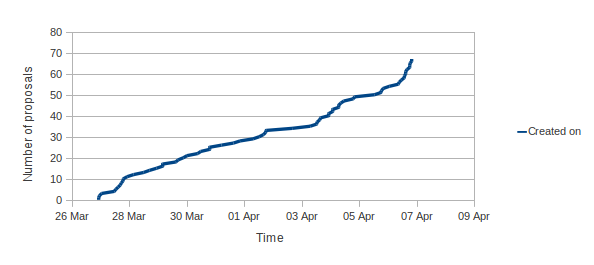
This year our efforts have paid off and despite there being more mentoring organizations than there were in 2011 (175 in 2011 and 180 in 2012), this year in Debian we got 81 submissions versus 43 submissions in 2011.
You can see here the graphs of applications against time from this year: 2012 The result is this year we ll have 15 students in Debian versus 9 students last year! Without further ado, here is the list of projects and student who will be working with us this summer: If you want to know more about these projects, follow the links and ask the students (and mentors)!

25 April 2012

Vincent Bernat: XBMC Eden on Debian Wheezy

I bought some HTPC a few years ago to run XBMC, a neat media center solution. At the time, to avoid any problems, I installed it on top of a minimal Ubuntu Lucid installation with the official packages from the team XBMC. Recently, XBMC Eden has been released and XBMC has landed into Debian unstable. It was a good occasion to make the switch. Unofficial XBMC logo for Eden TL;DR: Installing XBMC on Debian Wheezy is quite easy: it almost works out of the box. The big difficulty is the configuration of the remote control: either it works as you expect or you will have to scratch your head over the pile of layers needed to work with a remote control. The configuration of my HTPC is as follows:

Installation

Installing Debian Wheezy Installing Debian Wheezy2 is pretty easy. Nowadays, getting a bootable USB key from a netinst image of Debian Installer for Wheezy is simplified:
$ sudo dd if=debian-testing-i386-netinst.iso \
>         of=/dev/disk/by-id/usb...
The installation was smooth with the exception of GRUB which was unable to install itself on the disk. This is a known bug when dealing with LVM and it comes with a simple workaround. I hope it will be corrected in time for Wheezy release. While this has little to do with the installation of XBMC, I wanted to test systemd which may become the default init in Debian (at least in Debian GNU/Linux). From README.Debian:
systemd can be installed alongside sysvinit and will not change the behaviour of the system out of the box. This is intentional. To test systemd, add init=/bin/systemd to the kernel command line and then rebooting, or install the systemd-sysv package.
The final system boots in about 15 seconds.

Configuring X Because video decoding in nouveau driver is still a work in progress, the use of the proprietary NVIDIA drivers is mandatory to be able to watch high resolution videos. Therefore, /etc/apt/sources.list should be completed with contrib and non-free repository. Then, you can install the appropriate packages: xserver-xorg-video-nvidia, nvidia-vdpau-driver and xserver-xorg. Here is my /etc/X11/xorg.conf.d/nvidia.conf:
Section "Device"
    Identifier     "NVidia ION"
    Driver         "nvidia"
    VendorName     "NVIDIA Corporation"
    Option         "HWCursor" "False"
    Option         "NoFlip" "False"
    Option         "FlatPanelProperties" "Scaling = Native"
    Option         "DynamicTwinView" "False"
    Option         "ConnectedMonitor" "DFP-1"
    Option         "CustomEDID" "DFP-1:/etc/X11/edid.bin"
    Option         "NoLogo" "True"
EndSection
Section "Extensions"
    Option "Composite" "false"
EndSection
The CustomEDID option allows the driver to get an appropriate EDID even when the AV receiver is off. You can get yours, free of charge, with get-edid from read-edid package.

Installing XBMC Thanks to the work of Andr s Mej a, XBMC is now available in Debian Wheezy. To install it, just type aptitude install xbmc. I have dropped the following xbmc.service in /etc/systemd/system directory:
[Unit]
Description = XBMC media center
After = syslog.target
[Service]
User = xbmc
Group = xbmc
Type = simple
ExecStart = /usr/bin/xinit /usr/bin/xbmc-standalone -- :0
Restart = on-failure
[Install]
WantedBy = multi-user.target
Enable this service on boot with systemctl enable xbmc.service. You need to allow xbmc user to run X. The simplest way is to run dpkg-reconfigure -plow x11-common and to allow anybody to run X. sudo may be an alternative.

Configuration

Sound While I wanted to use PulseAudio, I want the AV receiver to be able to upmix stereo streams itself. With PulseAudio, it would always receive a 6-channel signal. Therefore, I directly use ALSA. First, unmute the appropriate outputs:
$ amixer scontrols   grep IEC958
Simple mixer control 'IEC958',0
Simple mixer control 'IEC958 Default PCM',0
Simple mixer control 'IEC958',1
$ amixer sset 'IEC958',0 unmute
$ amixer sset 'IEC958 Default PCM',0 unmute
$ amixer sset 'IEC958',1 unmute
$ sudo systemctl stop alsa-utils.service
The order of channels is incorrect. With the following /etc/asound.conf, we declare a new output, hdmi2, with a different mapping:
pcm.hdmi2  
  type asym
  playback.pcm  
    type plug
    slave.pcm "remap-surround51"
   
 
pcm.!remap-surround51  
  type route
  slave.pcm "hdmi"
  ttable  
    0.0= 1
    1.1= 1
    2.4= 1
    3.5= 1
    4.2= 1
    5.3= 1
   
 
In XBMC, this output should be used instead of the default one. hdmi should still be used for passthrough. To check if each speaker is mapped correctly, one can use speaker-test -D hdmi2 -c 6.

LCD display The LCD display integrated into the SoundGraph iMON is supported by the imon kernel module and the lcdproc package. I have only modified a few lines of /etc/LCDd.conf to make it work:
[server]
Driver=imonlcd
ServerScreen=off
[imonlcd]
Protocol=1
OnExit=2
Contrast=400

Remote control This is the most difficult part. I have a Logitech Harmony remote which is a great universal remote. Its support in Linux is acceptable: you can configure through Logitech website and use congruity to push the new configuration.

Remote controls and Linux Before Linux 2.6.36, most remote controls would need LIRC to work:
  • The driver receives the signal from the IR receiver and make it available through /dev/lirc.
  • lircd, with the help of a configuration file describing the protocol used by the remote control, will read the signal and turn it into the appropriate LIRC code.
  • XBMC connects to lircd and receives incoming LIRC codes. It will translate them to an XBMC command. This translation is specified in Lircmap.xml.
  • XBMC maps each command to an action (like Play, Fullscreen, ) using a keymap. This keymap can handle commands received by a remote control, but also by a keyboard, a mouse or a joystick.
Since Linux 2.6.36, remote controls will be mapped as a generic input device (just like a keyboard):
  • The driver receives the signal from the IR receiver.
  • The signal will be handled by a decoder. The configuration of this decoder is done in userland by ir-keytable. The decoder will turn the signal into the appropriate event (usually, some keypress).
  • X will listen to those events and turn them into X key events.
  • XBMC will receive them and use the appropriate keymap to turn them into actions.
And to add more complexity to the mix, in this last case, you can still use LIRC: lircd will listen to events generated by the kernel and turn them into LIRC codes. This can be very confusing. Moreover, the SoundGraph iMON IR receiver accepts two IR protocols: the iMON protocol and the RC-6 one. The Linux driver accepts both of them but uses the first one by default. The RC-6 protocol is the protocol used by many MCE remote controls. I hope you are still with me here.

The easy way To get a reasonable configuration out of the box, here is how to configure each layer:
Logitech Harmony remote
Configure it as a Microsoft branded Media Center PC: Windows Media Center SE.
iMON IR receiver
It must use RC-6 protocol. See below for more details.
LIRC
In /etc/lirc/hardware.conf, put DEVICE=/dev/input/by-id/usb-15c2_0038-event-if00 and DRIVER=devinput. In /etc/lirc/lircd.conf, just put include "/usr/share/lirc/remotes/devinput/lircd.conf.devinput".
XBMC
With the previous bits done, it should just work out of the box.
To switch to RC-6 protocol, install the ir-keytable package and use the following commands:
$ sudo modprobe rc-imon-mce
$ sudo ir-keytable -s rc0 -p rc-6 -c -w /lib/udev/rc_keymaps/imon_mce
Read imon_mce table
Old keytable cleared
Wrote 77 keycode(s) to driver
Protocols changed to RC-6
To make the change permanent, add the rc-imon-mce module to /etc/modules and create /etc/udev/rules.d/90-imon.rules with the following content:
# Override the keytable for iMON
ACTION=="add change", SUBSYSTEM=="rc", DRV_NAME="imon", \
   RUN+="/usr/bin/ir-keytable -s $name -p rc-6 -c -w /lib/udev/rc_keymaps/imon_mce"

The hard way Now, you may want to bind custom actions to some (physical or virtual) buttons. Basically, you are left with two solutions:
  1. Start from the basic configuration with LIRC and add more buttons at each levels (there are five of them!).
  2. Remove LIRC and start with the Logitech Harmony acting as a Microsoft MCE keyboard.
The first option can be quite difficult. You need to find an unused code for the Logitech Harmony. You can try to make it learn a new code if you have some RC-6 remote control. Then, you need to ensure that this code will be present in the keytable used by ir-keytable. If not, you need to add it. That s not easy since you need a to enable some debug stuff in the kernel to find the appropriate scancode. After that, the code needs to be translated in lircd.conf. You will then have to translate it again in Lircmap.xml. At least, you need to add it to a keymap in XBMC. The other way is not ideal but seems less cumbersome. The first step is to configure the Logitech Harmony as a Microsoft MCE keyboard: it has a lot of available keys. Because of the lack of multimedia keys, let s match the keyboard configuration of XBMC:
Button Command Button Command
Channel Down PageDown Stop X
Channel Up PageUp Skip back Comma
Prev Backspace Skip forward .
Up DirectionUp Play P
Down DirectionDown Rewind R
Left DirectionLeft Fast forward F
Right DirectionRight Star Delete
OK Enter Pound W
Menu C Red F1
Exit Esc Green F2
Guide Tab Yellow F3
Info I Blue F4
Unfortunately, the keytables provided with ir-keytable are not complete enough. I have built a more complete table3. With this table and the bindings described above, most functions will work out of the box without LIRC. Additional keys can be configured in a dedicated keymap4. Here is an excerpt of mine:
<keymap>
 <global>
  <keyboard>
    <end>XBMC.ShutDown()</end>
    <f1>XBMC.ActivateWindow(MusicLibrary)</f1>
    <f2>XBMC.ActivateWindow(Videos,TvShowTitles)</f2>
    <f3>XBMC.ActivateWindow(Videos,MovieTitles)</f3>
    <f4>XBMC.ActivateWindow(Weather)</f4>
  </keyboard>
 </global>
 <FullscreenVideo>
  <keyboard>
   <opensquarebracket>SubtitleDelayMinus</opensquarebracket>
   <closesquarebracket>SubtitleDelayPlus</closesquarebracket>
   <f6>xbmc.runscript(script.xbmc.subtitles)</f6>
  </keyboard>
 </FullscreenVideo>
</keymap>

FTP Instead of using SSH, I prefer to drop new files with anonymous FTP. vsftpd fits this purpose. Here is my configuration file:
listen=YES
xferlog_enable=YES
use_localtime=YES
setproctitle_enable=YES
secure_chroot_dir=/var/run/vsftpd/empty
nopriv_user=ftp
ftpd_banner=XBMC
hide_ids=YES
ftp_username=xbmc
anon_umask=022
anon_root=/home/xbmc/media
anonymous_enable=YES
write_enable=YES
anon_upload_enable=YES
anon_world_readable_only=YES
It is currently not compatible with systemd (see bug #670308). I have removed the symlink in /etc/rc2.d and I have used the following unit file:
[Unit]
Description=Vsftpd ftp daemon
After=syslog.target network.target
[Service]
Type=simple
ExecStart=/usr/sbin/vsftpd /etc/vsftpd.conf
ExecReload=/bin/kill -HUP $MAINPID
ExecStartPre=-/bin/mkdir -p /var/run/vsftpd/empty
[Install]
WantedBy=multi-user.target

Miscellaneous
  1. In /etc/default/grub, reduce TIMEOUT to 0 to shorten the boot time.
  2. Enabling dirty regions can help speed up XBMC.
  3. aptitude install upower pm-utils to be able to shutdown/suspend from XBMC. Since XBMC was configured to be started outside any session, you need to explicitely give the appropriate rights by creating the following /var/lib/polkit-1/localauthority/50-local.d/xbmc.pkla:
    [Actions for xbmc user]
    Identity=unix-user:xbmc
    Action=org.freedesktop.upower.*;org.freedesktop.consolekit.system.*
    ResultAny=yes
    ResultInactive=yes
    ResultActive=yes
    

  1. The readibility of the LCD screen is very bad. You should look at the VFD version. The IR receiver reception is poor. The provided remote control is a joke.
  2. Debian Wheezy is not yet released. If you are unfamiliar with Debian, it may be cumbersome to maintain it until the freeze happens in a few months.
  3. Some keys are missing from the provided table. For example, there is no exclamation mark. While there is a scan code for such a key in RC-6 protocol, there is no appropriate key code to translate to: on a QWERTY keyboard, the exclamation mark is on the same key as the number 1. It is possible to map it to some other key code, but the mapping would have been difficult to use.
  4. For example, in ~/.xbmc/userdata/keymaps/harmony.xml.

18 February 2012

Mike Hommey: How to waste a lot of space without knowing

const char *foo = "foo";
This was recently mentioned on bugzilla, and the problem is usually underestimated, so I thought I would give some details about what is wrong with the code above. The first common mistake here is to believe foo is a constant. It is a pointer to a constant. In practical ELF terms, this means the pointer lives in the .data section, and the string constant in .rodata. The following code defines a constant pointer to a constant:
const char * const foo = "foo";
The above code will put both the pointer and the string constant in .rodata. But keeping a constant pointer to a constant string is pointless. In the above examples, the string itself is 4 bytes (3 characters and a zero termination). On 32-bits architectures, a pointer is 4 bytes, so storing the pointer and the string takes 8 bytes. A 100% overhead. On 64-bits architectures, a pointer is 8 bytes, putting the total weight at 12 bytes, a 200% overhead. The overhead is always the same size, though, so the longer the string, the smaller the overhead, relatively to the string size. But there is another, not well known, hidden overhead: relocations. When loading a library in memory, its base address varies depending on how many other libraries were loaded beforehand, or depending on the use of address space layout randomization (ASLR). This also applies to programs built as position independent executables (PIE). For pointers embedded in the library or program image to point to the appropriate place, they need to be adjusted to the base address where the program or library is loaded. This process is called relocation. The relocation process requires information which is stored in .rel.* or .rela.* ELF sections. Each pointer needs one relocation. The relocation overhead varies depending on the relocation type and the architecture. REL relocations use 2 words, and RELA relocations use 3 words, where a word is 4 bytes on 32-bits architectures and 8 bytes on 64-bits architectures. On x86 and ARM, to mention the most popular 32-bits architectures nowadays, REL relocations are used, which makes a relocation weigh 8 bytes. This puts the pointer overhead for our example string to 12 bytes, or 300% of the string size. On x86-64, RELA relocations are used, making a relocation weigh 24 bytes! This puts the pointer overhead for our example string to 32 bytes, or 800% of the string size! Another hidden cost of using a pointer to a constant is that every time it is used in the code, there will be pointer dereference. A function as simple as
int bar() return foo;
weighs one instruction more when foo is defined const char *. On x86, that instruction weighs 2 bytes. On x86-64, 3 bytes. On ARM, 4 bytes (or 2 in Thumb). That weight can vary depending on the additional instructions required, but you get the idea: using a pointer to a constant also adds overhead to the code, both in time and space. Also, if the string is defined as a constant instead of being used as a literal in the code, chances are it s used several times, multiplying the number of such instructions. Update: Note that in the case of const char * const, the compiler will optimize these instruction and avoid reading the pointer, since it s never going to change. The symbol for foo is also exported, making it available from other libraries or programs, which might not be required, but also adds its own overhead: an entry in the symbols table (5 words), an entry in the string table for the symbol name (strlen("foo") + 1) and an entry in the symbols hash chain table (4 bytes if only one type of hash table (sysv or GNU) is present, 8 if both are present), and possibly an entry in the symbols hash bucket table, depending on the other exported symbols (4 or 8 bytes, as chain table). It can also affect the size of the bloom filter table in the GNU symbol hash table. So here we are, with a seemingly tiny 3 character string possibly taking 64 bytes or more! Now imagine what happens when you have an array of such tiny strings. This also doesn t only apply to strings, it applies to any kind of global pointer to constants. In conclusion, using a definition like
const char *foo = "foo";
is almost never what you want. Instead, you want to use one of the following forms:

27 January 2012

Rapha&#235;l Hertzog: People Behind Debian: Josselin Mouette, founder of the Debian GNOME team

Josselin Mouette is one the leaders of the pkg-gnome team, he takes sound technical decisions and doesn t fear writing code to work-around upstream issues. He deserves kudos for the work he has put into packaging GNOME over the years. He can also be very sarcastic (sometimes he even enjoys participating to flamewars on debian lists), and there are quite a few topics where we have long agreed to disagree. But this kind of diversity is also what makes Debian a so interesting place Read on to learn more about the pkg-gnome team, its plans for Wheezy, Josselin s opinion on the GNOME 3 switch, and much more. Raphael: Who are you? Josselin: I am a 31 years old Linux systems engineer. I started in life with physics, which I studied at the ENS Lyon. I started a thesis on experimental and numerical models for optoelectronics, but when it became clear that research was not for me, I abandoned it and accepted a job at the CEA, which holds the largest computing center in Europe. Working on these machines has been the most awesome job ever (except for it being near Paris). After that I worked a bit on system monitoring technologies. I am married, currently living in Lyon, and working for EDF (the French historical electricity company) on scientific workstations using Debian. EDF is using Debian on more than a thousand workstations and holds the fastest Debian supercomputer in the world (200 Tflops), which makes it another obvious place for Debian developers. Raphael: How did you start contributing to Debian? Josselin: I discovered Debian in 1999 while studying at the ENS, which is one of the biggest nests of Debian developers while being a small place, it is producing almost one Debian developer per year on average. After wondering for a while what it could be useful for, hacking on a slink snapshot made me think that it was for, well, everything except for gaming. Later, in 2002, when I was working on optoelectronics computing codes, I started to package them for Debian in order to make them easier to install, for us as well as other labs over the world. I started the NM process, and it was going smoothly but also going to take time. However, at that moment, the frozen-bubble game went out and made quite some buzz. Since I knew a guy who knew the game s developer, he asked me to package it. The package found 3 sponsors in a very short time and was fast-tracked into the archive at a speed that was unseen before. After which the NM process was completed very quickly. At that time, I was a heavy WindowMaker user, but I didn t like the direction the project was taking (actually, I wonder if there was one). GNOME was starting to become attractive, but its packaging in Debian was very ineffective, with many inconsistent packages maintained by people who didn t ever talk to each other some of them didn t speak English, and some of them didn t talk at all. Together with awesome people, among which Jordi Mallach, Gustavo Noronha Silva, JHM Dassen, Ross Burton and S bastien Bacher, we started the GNOME team in 2003, introducing consistent packaging practices, and initiating synchronized uploads. Releasing a completely integrated GNOME 2.8 in sarge was a considerable achievement; proving (together with the Perl team) that a team was the best way to maintain large package sets changed the way people work on Debian.
Proving [ ] that a team was the best way to maintain large package sets changed the way people work on Debian.
Raphael: You re one of the most active contributors of the team which is packaging GNOME for Debian. What would you suggest to a new contributor who would like to help the team? Josselin: There are several ways to contact the team, but the recommended one has always been IRC. We hang on #debian-gnome on the OFTC network, so just come around and ask for us. The real question is what you want to do in the team. Of course, most new volunteers want to help packaging the latest and greatest version of GNOME into unstable as soon as possible, but unless they already have Debian background, this is not the easiest task. Since there are already people working on this, the big packages are usually waiting on dependencies. I used to direct newcomers towards bug triage, but it is a tedious task and I m now convinced that our huge bug backlog will never be dealt with. The most useful thing to do for newcomers now is probably to find a GNOME or GNOME-related package that needs improvement or is lagging behind, and simply try to work on it. You can also come and fix the bugs you find annoying. Find a patch on the GNOME bugzilla, or cook it yourself, propose it, and if it s worthy enough you ll soon get commit access.
Our huge bug backlog will never be dealt with.
At this point I feel worth mentioning that if no one answers in 10 minutes, it doesn t mean that no one will answer in 2 hours, so please stay on the channel after asking. Raphael: There s been some controversy about GNOME 3 and the direction that the project is taking. What s your personal stance on GNOME 3? And what s the position of the pkg-gnome team? Josselin: The controversy is not new to GNOME 3, but the large-scale changes made with it have put it more prominently. The criticism usually boils down to a few categories:
  1. General lack of configurability
  2. Strange design decisions
  3. Red Hat centric development
  4. Hardware requirements
  5. Change resistance
The lack of configuration options has been an ongoing criticism since GNOME 2.0 has decided to rip off most of them. Of course, when the control center was redesigned again for 3.0, there was a surge of horrified exclamations from people who missed their favorite buttons. On this topic, I fully concur with GNOME developers. The configuration option that is useful for you is not necessarily useful for someone else. Of course, sometimes developers go a bit too far, but the general direction is right. At work, we found that only a minority of users actually configure anything on their desktops: they just want something that works to launch their applications. Apple and Google have sold millions of devices by making them the simplest possible and without any configuration. Design decisions are, on the contrary, individual decisions, and each of them, while having reasons behind it, can be questioned. I remember seeing a lot of complaints when the OK and Cancel buttons were reversed in dialog boxes, something that nobody questions anymore. GNOME Shell is full of such changes; some are easy to get accustomed with, some others just make eyebrows raise. The most obvious example is the user menu in GNOME 3.2, which contains an entry to configure your Google account, but no entry to shutdown the computer. Both decisions were taken independently, each of them with (good or bad) reasons, but the result is simply ridiculous. The default configuration in Debian will contain an extension to make it a bit better, but on the whole we don t intend to diverge from the upstream design, on which a lot of good work has been done.
On the whole we don t intend to diverge from the upstream design, on which a lot of good work has been done.
Point 3 is more complex. Red Hat being the company spending the most on GNOME, it is obvious that their employees work on making things work for their distribution. An example is the recurring discussions about relying on system services that are currently only implemented by systemd. Since there is a lot of (mostly unjustified) resistance against systemd in Debian, and since it won t work on kFreeBSD anyway, someone needs to develop an alternative implementation of these services for upstart and sysvinit. Everything is in place for someone else to do the job but it has to be done, and this can be frustrating. Especially since it can also be hard to integrate changes needed for other distributions . Hardware requirements are mostly a consequence of the previous criticism: there s hardware that most distributions just don t want to bother supporting. We ve seen it in squeeze with the introduction of a hard dependency on PulseAudio. The Debian GNOME team (together with the Gentoo maintainers) made this dependency optional, carrying heavy patches, in order to cover the cases where it does not work. Now that it has gained more maturity, making this effort obsolete, the new tendency is to require 3D acceleration. For various reasons, it is not available to everyone . On this matter, the position of the Debian GNOME team has always been to support as much different configurations as possible with reasonable effort. Thanks to efforts from the incredible Vincent Untz, upstream supports a so-called fallback mode , which is the GNOME panel from 2.x with a lot of its bugs fixed. We intend to support this mode for as long as reasonably possible in Debian, possibly even after upstream ends up dropping it. However, other applications are going to require 3D because GStreamer is moving to clutter too, affecting video playback performance on non-accelerated systems . For epiphany this is not a problem; only embedded video will be affected. But for totem, this is a major issue; because of that we will probably keep totem 3.0 in wheezy. Finally, there is a natural human tendency to dislike change (I have it too), and it applies a lot to desktop users habits. Needless to say a change of such a scale as introducing GNOME Shell can trigger reactions. However, I don t think it is reasonable, because of this resistance, to keep gnome-panel 2.x in Debian. This would be a lot of work on obsolete technology, and would prevent the upcoming removal of a lot of deprecated libraries. This time is much better spent improving gnome-panel 3.x in Debian and keeping the fallback mode great. One of the change that was made in Debian was to make it easier to find, being available as GNOME Classic directly from the login manager, instead of having to find it in an obscure configuration panel. In all cases, I would recommend to actually try GNOME Shell for a few hours before ditching it. I had never been accustomed to a new environment as quickly ever before.
In all cases, I would recommend to actually try GNOME Shell for a few hours before ditching it.
Having seen several of my GDM patches reverted without a warning, I know we are not finished with carrying patches in Debian packages.
Scientific workstations are a non-trivial example, since there is a measurable effect of using 3D in the window manager on heavy 3D applications.
On the other hand, on accelerated systems, this feature should end up improving performance a lot. Raphael: What are your plans for Debian Wheezy? Josselin: The first goal of the GNOME team is, of course, to provide again a great desktop environment to work on. For wheezy it will probably be based on GNOME 3.4. There also needs to be some work on package management interfaces. Upstream bases everything on PackageKit, but it is not as featureful as the aptdaemon Ubuntu technology. If I have time, I would also like to improve HTTP proxy support, since currently it is based on a stack of terrible hacks. Raphael: If you could spend all your time on Debian, what would you work on? Josselin: Obviously I would like to make GNOME in Debian even better. That would imply working on underneath dependencies (what we now like to call plumbing) to make sure everything is working great. This would also imply working more as GNOME upstream to make it more suitable for our needs. I would also work on large-scale improvements on the distribution, like conditional recommends which I d love to see implemented , or automatic build-dependency generation. I would also work on the installer to make it better for desktops machines. The idea is to automatically install language packs, or glues between two packages when both packages are installed. Raphael: What s the biggest problem of Debian? Josselin: The obvious answer is the same as the one most people you interviewed before gave: not enough members in core teams. A lot of developers join Debian to work on a small number of pet packages, and don t necessarily want to be involved with existing teams. It is probably still not obvious enough that the primary way to start contributing to Debian is to join an existing team. But if there is one thing that is preventing Debian from gaining more momentum now, it is a completely different one: the too short support timeframe. 3 years is really not enough for corporate users. One year to migrate from one version to another is too short, and it is not possible to skip a release. It is definitely possible to change that with reasonable effort: the long-term support after 3 years doesn t have to cover the same perimeter as the short-term one. For example, we could upgrade the kernel to the version in the current stable release, and stop fixing all non-remote security holes. The important thing is to cover the most basic needs: companies are ready to take the risk of having less support if it allows skipping a version, but not the risk of having no support at all. And even more important is to say that you do something. Red Hat says they support a release for 10 years, but of course after 5 years the supported perimeter is extremely small.
3 years [of support] is really not enough for corporate users.
Long-term support will not magically fix all problems in Debian, but it will bring more corporate users into the picture. And with corporate users come paid Debian developers, who can work on critical pieces of the system. Debian was built on the synergy between individuals and companies, and in recent years perhaps as a reaction against what happened with Ubuntu we ve kind of forgot the latter. A lot of individuals have joined the project, and they are actively working, for example, on shortening the release cycle, which goes against the interest of professionals. We should embrace again such users and developers, and that means adapting to the current needs of larger entities. Raphael: You re the maintainer of python-support, a packaging helper that was competing with python-central. Both helpers are now deprecated in favor of dh_python2. Does this mean that the situation of Python in Debian is now sane? Or are there remaining problems? Josselin: dh_python2 (and the Python3 version, dh_python3) has a sane enough design. It fixes a lot of issues in python-central and also python-support, at the expense of somehow reduced functionality for developers. However, just like the previous tools, it merely works around design mistakes in the Python interpreter. For example it is not possible to split binary modules, pure-Python modules and byte-compiled modules in different directory trees, like Perl does although PEP 3147 introduces a way to do so. There is still no sane and standardized way to deal with module versions. There is no difference made between the module (which is a part of language semantics) and the file containing it (an information which depends on the implementation). Developers heavily rely on introspection features and make assumptions based on the implementation, that make it impossible to work around problems with module files. Such problems are not restricted to Python. Those who fought against Ruby gems could tell even worse stories. While introducing GObject introspection packages in Debian (they can be used in JavaScript and Python to provide modules based on GObject libraries), I was pleased to see a clear distinction between file and module, but I was again struck by the fact you are not forced to declare API versions in your Python/JS code. In all cases, there is no reliable way to detect runtime dependencies in a given Python or JavaScript file, which leaves the maintainer to declare them by hand, and of course, often be wrong about them. Add to that the fact that most errors cannot be detected before runtime. For all these reasons, and while still being fond of Python for scripts and prototyping, I ve become really skeptical of using purely interpreted languages to write real applications. Some GNOME developers are moving away from Python and JavaScript, mostly towards Vala; I can only approve of that move and hope the same happens to other projects. Raphael: Is there someone in Debian that you admire for their contributions? Of course there is the never-sleeping, never-stopping, Michael Biebl who can upload a whole GNOME release in a single week-end. But there are a lot of awesome people who make Debian something that simply works. I could talk about Cyril Brulebois from the X strike force, Julien Cristau from the release team, Sjoerd Simons for his sound advice and work on plumbing, Luca Falavigna who is so fast at processing NEW, to quote only a few of those I work with frequently. And of course, Jordi and Sam for their humor.
Thank you to Josselin for the time spent answering my questions. I hope you enjoyed reading his answers as I did. Note that you can find older interviews on http://wiki.debian.org/PeopleBehindDebian.

Subscribe to my newsletter to get my monthly summary of the Debian/Ubuntu news and to not miss further interviews. You can also follow along on Identi.ca, Google+, Twitter and Facebook .

8 comments Liked this article? Click here. My blog is Flattr-enabled.

13 December 2011

Rapha&#235;l Hertzog: People behind Debian: Ben Hutchings, member of the kernel team

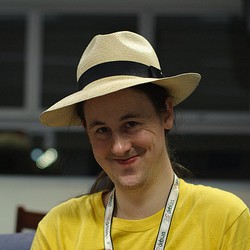
Ben Hutchings, photo by Andrew Mc Millan, license CC-BY-2.0

Ben Hutchings is a rather unassuming guy but hiding behind his hat, there s a real kernel hacker who backports new drivers for the kernel in Debian stable so that our flagship release supports very recent hardware. Read on to learn more about Ben and the kernel team s projects for Debian Wheezy! Raphael: Who are you? Ben: I m a professional programmer, living in Cambridge, England with my long-suffering wife Nattie. In Debian, I mostly work on the Linux kernel and related packages. Raphael: How did you start contributing to Debian? Ben: I started using Debian in 1998 and at some point I subscribed to Debian Weekly News. So in 2003 I heard about the planned Debian 10th birthday party in Cambridge, and thought I would like to go to that. Somehow I persuaded Nattie that we should go, even though it was on the day of our wedding anniversary! We both enjoyed it; we made new friends and met some old ones (small world). From then on we have
both been socially involved in Debian UK. In 2004 there was a bug-squashing party in Cambridge, and we attended that as well. That s where I really started contributing fixing bugs and learning about Debian packaging. Then in 2005 I made my first package (sgt-puzzles), attended DebConf, and was persuaded to enter the New Maintainer process. NM involved a lot of waiting, but by the time I was given questions and tasks to do I had learned enough to get through quite quickly. In April 2006 I was approved as a Debian Developer. Meanwhile, I looked at the videos from DebConf 5 and thought that it would be useful to distribute them on a DVD. That led me to start writing video software and to get involved in the video team for the next year s DebConf. Raphael: You have been one the main driver behind the removal of non-free firmwares from the kernel. Explain us what you did and what s the status nowadays? Ben: That s giving me a bit more credit than I deserve. For a long time the easy way for drivers to load firmware programs was to include them as a blob in their static data, but more recently the kernel has included a simple method for drivers to request a named blob at run-time. These requests are normally handled by udev by reading from files on disk, although there is a build-time option to include blobs in the kernel. Several upstream and distribution developers worked to convert the older drivers to use this method. I converted the last few of these drivers that Debian included in its binary packages. In the upstream Linux source, those blobs have not actually been removed; they have been moved to a firmware subdirectory. The long-term plan is to remove this while still allowing the inclusion of blobs at build-time from the separate linux-firmware repository. For now, the Debian source package excludes this subdirectory from the upstream tarball, so it is all free software. There are still a few drivers that have not been converted, and in Debian we just exclude the firmware from them (so they cannot be built). And from time to time a driver will be added to the staging section of Linux that includes firmware in the old way. But it s understood in the kernel community that it s one of the bugs that will have to be fixed before the driver can move out of staging . Raphael: Do you believe that Debian has done enough to make it easy for users to install the non-free firmwares that they need? Ben: The installer, the Linux binary packages and initramfs-tools will warn about specific files that may be needed but are missing. Users who have enabled the non-free section should then be able to find the necessary package with apt-cache search, because each of the
binaries built from the firmware-nonfree source package includes driver and file names within its description. For the installer, there is a single tarball that provides everything. We could make this easier, but I think we have gone about as far as we can while following the Debian Social Contract and Debian policy. Raphael: At some point in the past, the Debian kernel team was not working very well. Did the situation improve? Ben: Back in 2008 when I started working on the Linux kernel package to sort out the firmware issues, I think there were some problems of communication and coordination, and quite possibly some members were burned-out. Since then, many of the most active kernel team members have been able to meet face-to-face to discuss future plans at LPC 2009 in Portland and the 2010 mini-DebConf in Paris. We generally seem to have productive discussions on the debian-kernel mailing list and elsewhere, and I think the team is working quite well. Several new contributors have joined after me. I would say our biggest problem today is that we just don t have enough time to do all we want to. Certainly, almost all my Debian time is now taken up with integrating upstream kernel releases and handling some fraction of the incoming bug reports. Occasionally I can take the time to work on actual features or the other packages I m neglecting!
Our biggest problem today is that we just don t have enough time to do all we want to.
Raphael: It is widely known that Linux is maintained in a git repository. But the Debian kernel team is using Subversion. I believe a switch is planned. Why was not git used from the start? Ben: The linux-2.6 source package dates from the time when Linus made his first release using git. I wasn t part of the team back then so I don t know for sure why it was imported to Subversion. However, at that time hardly anyone knew how to use git, no-one had experience hosting public git repositories, and Alioth certainly didn t offer that option. Today there are no real blockers: everyone on the kernel team is familiar with using git; Alioth is ready to host it; we don t have per-architecture patches that would require large numbers of branches. But it still takes time to plan such a conversion for what is a relatively complex source package (actually a small set of related source packages). Raphael: What are your plans for Debian Wheezy? Ben: Something I ve already done, in conjunction with the installer team, is to start generating udebs from the linux-2.6 source package. The kernel and modules have to be repacked into lots of little udebs to avoid using too much memory during installation. The configuration for this used to be in a bunch of separate source packages; these could get out of step with the kernel build configuration and this would only be noticed some time later. Now we can update them both at the same time, they are effectively cross-checked on every upload, and the installer can always be built from the latest kernel version in testing or unstable. I think that we should be encouraging PC users to install the 64-bit build (amd64), but many users will still use 32-bit (i386) for backward compatibility or out of habit. On i386, we ve slightly reduced the variety of kernel flavours by getting rid of 686 and making 686-pae the default (previously this was called 686-bigmem ). This means that the NX security feature will be used on all systems that support it. It should also mean that the first i386 CD can have suitable kernel packages for all systems. I have been trying to work on providing a full choice of Linux Security Modules (LSMs). Despite their name, they cannot be built as kernel modules, so every enabled LSM is a waste of memory on the systems that don t use it. This is a significant concern for smaller Debian systems. My intent is to allow all unused LSMs to be freed at boot time so that we can happily enable all of them. I recently proposed to drop support for older x86 systems, starting with 486-class processors in wheezy. In general, this would allow the use of more compiler optimisations throughout userland and the kernel. However it seems that there isn t that much to be gained unless we also drop 586-class processors, and there are still quite a few of those in use. So I think this will have to wait. Uwe Kleine-K nig has been working to include real-time support (also known as PREEMPT_RT). This can provide low and very predictable I/O latency, which is useful for live audio synthesis, for example. It still requires a number of patches and a build configuration change, resulting in a separate binary package. We re currently only building that for 64-bit PCs. (You may notice this is missing for Linux 3.1, because the real-time developers skipped this release.) Raphael: What s the biggest problem of Debian? Ben: I think we try too hard to accommodate every possible option, without regard for the cost to developers and users in general. As an example, we now have sysvinit, file-rc, upstart and systemd all in testing. Daemon maintainers can t rely on any advanced features of upstart or systemd because we refuse to choose between them. And the decision to support the FreeBSD kernel means that we cannot choose upstart or systemd as the only option. So all daemon maintainers will have to maintain those baroque init scripts for the indefinite future. We really should be able to decide as a distribution that when one option is technically good and popular then it can be made the only option. But no-one really has the authority to do that, so we muddle along with the pretence that all the options are equally valid and functional, while none of them is supported as well as they should be.
We try too hard to accommodate every possible option, without regard for the cost to developers and users in general.
We also try to build every package on every architecture, in general. I m quite sure there are many (package, architecture) combinations that have no users, ever. But if at some point that combination FTBFS, developers will waste time investigating and fixing that time that could have been spent working on bugs and features that users actually care about. Yes, sure, portability is good but you can t prove portability just by making a package compile on every architecture. This also applies to the selection of drivers for the kernel, by the way. Raphael: Is there someone in Debian that you admire for their contributions? Well, there are many people, but I will pick out just a few: Steve McIntyre, for his work as DPL to improve communication with the various Debian derivatives and to bring fresh blood into various core teams. Also for being a generous host for countless Debian social and bug-squashing events. Stefano Zacchiroli, for improving further on communications with both downstream and upstream projects, and for regularly exercising his power to lead discussions to the benefit of the project. Julien Cristau, for maintaining good humour while not only fighting against the tide of graphics driver regressions in X and the Linux kernel but also working on release management. Jonathan Nieder, for taking on the unglamorous and frustrating task of kernel bug triage as a non-maintainer and developing it to a fine art.
Thank you to Ben for the time spent answering my questions. I hope you enjoyed reading his answers as I did.

Subscribe to my newsletter to get my monthly summary of the Debian/Ubuntu news and to not miss further interviews. You can also follow along on Identi.ca, Google+, Twitter and Facebook .

4 comments Liked this article? Click here. My blog is Flattr-enabled.

3 December 2011

Joachim Breitner: Some late recognition of metainit

Four years ago, during DebConf 7 in Edinburgh, I had the idea of creating init scripts not by hand, but rather describe them in a declarative way that handles most common cases and generate the real init scripts from them. Back than, this was partly motivated by the varying quality of init scripts and the advent of an alternative init system, upstart, for which proper service files could be generated as well. I implemented the idea and uploaded it as metainit to Debian, but it did not take off. Only one package uses it, and this package is not used much either. The project basically fell dormant. Yesterday, I got this mail:
Hi Joachim, I'm not very familiar with Debian ecosystem, however our company has recently switched to exclusively using Debian based servers, please forgive me if there exists a better channel for sending patches. We need (in house) to create a lot of trivial services and the sysv init system seems an ideal way to manage them, and metainit an great way to keep the config simple. However all our scripts require a heartbeat, the way we normally do this is with a bunch of checkers launched from cron. Metainit was ideal, but lacked the simple 'status' task found in most init scripts. This small patch adds that task, I hope you and others find it usefull. Regards,
together with the mentioned patch. So it turned out that the idea was a useful one after all, although it found its use on our user s machines, and not within the Debian packages, as I originally anticipated. Nice! During the recent discussions about the latest init system, systemd, there were more thoughts about generating init scripts/upstart service descriptions/systemd units from a declarative description, and if metainit had taken off back then, things would be easier now. So if anyone feels like reviving the project: Please do.

Flattr this post

21 September 2011

Ian Wienand: Exploring $ORIGIN

Anyone who works with building something with a few libraries will quickly become familiar with rpath's; that is the ability to store a path inside a binary for finding dependencies at runtime. Slightly less well known is that the dynamic linker provides some options for this path specification; one in particular is a path with the special variable $ORIGIN. ld.so man page has the following to say about the an $ORIGIN appearing in the rpath:
  ld.so understands the string $ORIGIN (or equivalently $ ORIGIN )
  in  an  rpath specification to mean the directory containing the
  application  executable.  Thus,  an   application   located   in
  somedir/app   could   be  compiled  with  gcc  -Wl,-rpath,'$ORI 
  GIN/../lib' so that it finds an  associated  shared  library  in
  somedir/lib  no matter where somedir is located in the directory
  hierarchy.
  
As a way of a small example, consider the following:
$ cat Makefile
main: main.c lib/libfoo.so
	gcc -g -Wall -o main -Wl,-rpath='$$ORIGIN/lib' -L ./lib -lfoo main.c
lib/libfoo.so: lib/foo.c
	gcc -g -Wall -fPIC -shared -o lib/libfoo.so lib/foo.c
$ cat main.c
void function(void);
int main(void)
 
   function();
   return 0;
 
$ cat lib/foo.c
#include <stdio.h>
void function(void)
 
   printf("called!\n");
 
$ make
gcc -g -Wall -fPIC -shared -o lib/libfoo.so lib/foo.c
gcc -g -Wall -o main -Wl,-rpath='$ORIGIN/lib' -L ./lib -lfoo main.c
$ ./main
called!
Now, wherever you should choose to locate main, as long as the library is in the right relative location it will be found correctly. If you are wondering how this works, examining the back-trace from the linker function that expands it is helpful:
$ gdb ./main
(gdb) break _dl_get_origin
Function "_dl_get_origin" not defined.
Make breakpoint pending on future shared library load? (y or [n]) y
Breakpoint 1 (_dl_get_origin) pending.
(gdb) r
Starting program: /tmp/test-origin/main 
Breakpoint 1, _dl_get_origin () at ../sysdeps/unix/sysv/linux/dl-origin.c:37
37	../sysdeps/unix/sysv/linux/dl-origin.c: No such file or directory.
	in ../sysdeps/unix/sysv/linux/dl-origin.c
(gdb) bt
#0  _dl_get_origin () at ../sysdeps/unix/sysv/linux/dl-origin.c:37
#1  0x00007ffff7de61f4 in expand_dynamic_string_token (l=0x7ffff7ffe128, 
    s=<value optimized out>) at dl-load.c:331
#2  0x00007ffff7de62ea in decompose_rpath (sps=0x7ffff7ffe440, 
    rpath=0xffffffc0 <Address 0xffffffc0 out of bounds>, l=0x0, 
    what=0x7ffff7df780a "RPATH") at dl-load.c:554
#3  0x00007ffff7de7051 in _dl_init_paths (llp=0x0) at dl-load.c:722
#4  0x00007ffff7de2124 in dl_main (phdr=0x7ffff7ffe6b8, 
    phnum=<value optimized out>, user_entry=0x7ffff7ffeb28) at rtld.c:1391
#5  0x00007ffff7df3647 in _dl_sysdep_start (
    start_argptr=<value optimized out>, dl_main=0x7ffff7de14e0 <dl_main>)
    at ../elf/dl-sysdep.c:243
#6  0x00007ffff7de0423 in _dl_start_final (arg=0x7fffffffe7c0) at rtld.c:338
#7  _dl_start (arg=0x7fffffffe7c0) at rtld.c:564
#8  0x00007ffff7ddfaf8 in _start () from /lib64/ld-linux-x86-64.so.2
Just from a first look we can divine that this has found the RPATH header in the dynamic section and has decided to expand the string $ORIGIN.
$ readelf --dynamic ./main
Dynamic section at offset 0x7d8 contains 23 entries:
  Tag        Type                         Name/Value
 0x0000000000000001 (NEEDED)             Shared library: [libfoo.so]
 0x0000000000000001 (NEEDED)             Shared library: [libc.so.6]
 0x000000000000000f (RPATH)              Library rpath: [$ORIGIN/lib]
 0x000000000000000c (INIT)               0x4004d8
 0x000000000000000d (FINI)               0x4006f8
At this point it proceeds to do a readlink on /proc/self/exe to get the path to the currently running binary, effectively does a basename on it and replaces the value of $ORIGIN. Interestingly, if this should fail, it will fall back on the environment variable LD_ORIGIN_PATH for unknown reasons. This might be useful if you were in a bad situation where /proc was not mounted and you still had to run your binary, although you could probably achieve the same thing via the use of LD_LIBRARY_PATH just as well. This feature should be used with some caution to avoid turning your application in a mess that can't be packaged in any standard manner. One common example of use is probably your java virtual machine to find its implementation libraries.
$ readelf --dynamic /usr/lib/jvm/java-6-sun/bin/java
Dynamic section at offset 0x9a28 contains 25 entries:
  Tag        Type                         Name/Value
 0x0000000000000001 (NEEDED)             Shared library: [libpthread.so.0]
 0x0000000000000001 (NEEDED)             Shared library: [libjli.so]
 0x0000000000000001 (NEEDED)             Shared library: [libdl.so.2]
 0x0000000000000001 (NEEDED)             Shared library: [libc.so.6]
 0x000000000000000e (SONAME)             Library soname: [lib.so]
 0x000000000000000f (RPATH)              Library rpath: [$ORIGIN/../lib/amd64/jli:$ORIGIN/../jre/lib/amd64/jli]
 ...
There is a small but interesting security issue. If an attacker can hardlink to your binary that is using $ORIGIN then any path expansion is now relative to the attackers directory. Hence it is possible to make the linker read in arbitrary libraries and hence run arbitrary code. Clearly if your program is running setuid as someone else, such as root, you've just given up the keys to the house! Luckily, the dynamic linker will not let you shoot yourself in the foot like this, and prevents expansion of the $ORIGIN field if the program is running setuid.
$ sudo chown root ./main
$ sudo chmod +s ./main
$ ./main
./main: error while loading shared libraries: libfoo.so: cannot open shared object file: No such file or directory
However, this is a good example of why you might want to keep users home and temp directories on separate file systems away from where binaries live. There is also a similar variable $PLATFORM, which describes the current running system. This is gained via the auxiliary vector, which I have written about here and here. Setting LD_SHOW_AUXV=1 will allow you to examine this value.
$ LD_SHOW_AUXV=1 ls
...
AT_PLATFORM:     x86_64
...

19 August 2011

Vincent Bernat: jchroot: chroot with more isolation

Linux 2.6.24, released more than three years ago, introduced two very interesting features: PID and network namespaces. They allow to create a process that does not share the same PID namespace or the same network namespace than other processes. Those namespaces are then inherited by the children (unless they are assigned new namespaces).

PID & mount namespaces A PID namespace is a view of the processes running on the system. Each PID namespace will have its own numbering of the processes contained in its namespace (including the namespace of the children). Other processes are hidden and therefore, it is not possible to issue any operation requiring a PID on them, like kill(2). Moreover, the process that was created first in a namespace will get PID 1. If it gets killed, the namespace is destroyed and all other processes contained in this namespace are killed as well. systemd, a system and service manager for Linux, targeted as a replacement for the old SysV init, uses could use this feature to launch daemons in their own PID namespace and keep track of them without relying on their cooperation. When it needs to kill a daemon, it just kills the process with PID 1 (which has another PID in the global namespace) and the kernel will do the hard work of killing all processes that were started in this namespace. You can get more details about this namespace in the manual page of clone(2) (search for CLONE_NEWPID). UPDATED: In fact, systemd does not use PID namespaces but cgroups to group processes together. There is no PID numbering here but spawned processes are all enclosed into one cgroup and therefore can be killed easily. For example, here is the result of pstree -p inside a PID namespace:
root@guybrush:/# pstree -p
bash(1) pstree(8)
         sleep(7)
The PID of sleep is 7. In the global namespace, it is 31762 instead. But it is the same processus!
root@guybrush:/# ps -eo pid,command   grep sleep
31762 sleep 1000
Linux have also supported mount namespaces since a long time. Each process can have its own mount points that will be visible only by processes in the same namespace or in children namespaces. When the namespace is destroyed (when no process left), the kernel will do the cleanup itself.

chroot A common way to test experimental software or do packaging work is to build a chroot: debootstrap is used to build a new complete system inside a directory and chroot allows to enter into this new system. Tools like schroot can become handy if you need to do that often. Unfortunately, you only get an isolated filesystem. When you start launching daemons and mounting partitions, you need to keep track of all your actions to undo them. Quitting the chroot will not kill any daemon nor unmount any partition. Extending an existing tool, like schroot to use PID and mount namespaces seems the best way to prevent such problems. I have filed bug #637870 for this purpose. However, this is not as simple as it seems since schroot allows to run a process into an existing session. When the session is a chroot, this is quite easy: just chroot into the same root filesystem and launch the process here. With other kind of namespaces, you need to use a new system call, setns(), to change the current namespace of the running process. However, some bits are still missing. First, the GNU C Library does not implement the appropriate wrapper. Second, Linux (as of 3.0) does not contain the support to change the PID namespace of a running process yet. Other tools exist, like lxc (aka Linux Containers). However, it is more targeted at providing a complete container. I have reported that lxc-execute is not able to spawn a standalone shell but got no luck. UPDATED: systemd ships with systemd-nspawn which was exactly what I needed. However, it requires systemd. Otherwise, it seems less basic than the alternative that I describe below (some sensible mount points are setup, the console is correctly configured, signals are correctly transmitted, ). If you use systemd, look at it!

jchroot Building a chroot clone using namespaces is quite easy. The only difficulty is the use of clone(2). Here is a sketch:
int main()  
  pid_t pid;
  int ret;
  long stack_size = sysconf(_SC_PAGESIZE);
  void *stack = alloca(stack_size) + stack_size;
  /* New process with its own PID/IPC/NS namespace */
  pid = clone(step2,
              stack,
              SIGCHLD   CLONE_NEWPID   CLONE_NEWIPC  
              CLONE_NEWNS   CLONE_FILES,
              NULL);
  /* Wait for the child to terminate */
  while (waitpid(pid, &ret, 0) < 0 && errno == EINTR)
    continue;
  return WIFEXITED(ret)?WEXITSTATUS(ret):EXIT_FAILURE;
 
static int step2(void *a)  
  /* Mount /proc as an example */
  mount("proc", "/proc", "proc", 0, "");
  /* Chroot */
  chroot("/srv/debian");
  chdir("/");
  /* Drop privileges */
  setgid(1000);
  setgroups(0, NULL);
  setuid(1000);
  /* Exec shell */
  execl("/bin/bash", "/bin/bash", NULL);
 
Add command flags, error handling and fstab parsing for the definition of mount points and you get jchroot. Here is an example of use:
$ cat fstab
proc     /proc  proc    defaults                  0  0
sys      /sys   sysfs   defaults                  0  0
/home    /home  none    bind,rw                   0  0
/dev/pts /dev/pts none  bind,rw                   0  0
/var/run /var/run tmpfs rw,nosuid,noexec,mode=755 0  0
/etc/resolv.conf /etc/resolv.conf none bind,ro    0  0
$ sudo jchroot -f fstab -n test /srv/debian/squeeze /bin/bash
# hostname
test
# ps auxww
USER       PID %CPU %MEM    VSZ   RSS TTY      STAT START   TIME COMMAND
root         1  0.0  0.0  19480  1888 pts/1    S    15:18   0:00 /bin/bash
root         3  0.0  0.0  16536  1184 pts/1    R+   15:18   0:00 ps auxww
# /etc/init.d/postgresql start
Starting PostgreSQL 9.0 database server: main.
# exit
$ ps auxwwc   grep postgres
$
I hope that jchroot won t live for too long and that its features will be integrated into regular chroot tools. I was thinking at proposing a patch for chroot(8). Anyone knows if this would have a chance to be accepted?

18 August 2011

Thorsten Glaser: How not to create DEB files

Once upon a time, there was Deb and Ian. That was about exactly 18 years ago. We don t talk about the 0.939000 format any more, but they eventually settled on:

	$ ar rc pkg_1.0_all.deb debian-binary control.tar.gz data.tar.gz
	$ hexdump -C pkg_1.0_all.deb   head
	00000000  21 3c 61 72 63 68 3e 0a  64 65 62 69 61 6e 2d 62   !<arch>.debian-b 
	00000010  69 6e 61 72 79 20 20 20  31 33 31 33 36 38 33 35   inary   13136835 
	00000020  32 39 20 20 31 30 30 36  20 20 32 30 30 20 20 20   29  1006  200    
	00000030  31 30 30 36 34 34 20 20  34 20 20 20 20 20 20 20   100644  4        
	00000040  20 20 60 0a 32 2e 30 0a  63 6f 6e 74 72 6f 6c 2e      .2.0.control. 
	00000050  74 61 72 2e 67 7a 20 20  31 33 31 33 36 38 33 35   tar.gz  13136835 
	00000060  32 39 20 20 31 30 30 36  20 20 32 30 30 20 20 20   29  1006  200    
	00000070  31 30 30 36 34 34 20 20  31 33 39 31 20 20 20 20   100644  1391     
	00000080  20 20 60 0a 1f 8b 08 00  00 00 00 00 00 03 ed 59      ............Y 
	00000090  eb 6f db 36 10 f7 d7 f0  af b8 3a 5e 9b 74 b1 f5   .o.6......:^.t.. 
 

By then, systems were a.out(5), and everything was good. (Of course, if you look at the mtimes, you ll notice I faked this. But it s really equivalent to the real thing.

But oh horror! GNU binutils, not always everyone s friend, switched from using BSD style Unix Archiver libraries in ar(1) to SYSV style libraries on elf(5) systems:

	$ ar rc on-elf debian-binary control.tar.gz data.tar.gz
	$ hexdump -C on-elf   head
	00000000  21 3c 61 72 63 68 3e 0a  64 65 62 69 61 6e 2d 62   !<arch>.debian-b 
	00000010  69 6e 61 72 79 2f 20 20  31 33 31 33 36 38 33 35   inary/  13136835 
	00000020  32 39 20 20 31 30 30 36  20 20 32 30 30 20 20 20   29  1006  200    
	00000030  31 30 30 36 34 34 20 20  34 20 20 20 20 20 20 20   100644  4        
	00000040  20 20 60 0a 32 2e 30 0a  63 6f 6e 74 72 6f 6c 2e      .2.0.control. 
	00000050  74 61 72 2e 67 7a 2f 20  31 33 31 33 36 38 33 35   tar.gz/ 13136835 
	00000060  32 39 20 20 31 30 30 36  20 20 32 30 30 20 20 20   29  1006  200    
	00000070  31 30 30 36 34 34 20 20  31 33 39 31 20 20 20 20   100644  1391     
	00000080  20 20 60 0a 1f 8b 08 00  00 00 00 00 00 03 ed 59      ............Y 
	00000090  eb 6f db 36 10 f7 d7 f0  af b8 3a 5e 9b 74 b1 f5   .o.6......:^.t.. 
 

Can you spot the difference?

Of course, ELF is what you want , so there is little choice. Unix Archiver libraries are system dependent, and no format has ever been normed, but DEB files use it as format so what is one to do?

	$ GNUTARGET=a.out-i386-linux ar rc with-aout \
	> debian-binary control.tar.gz data.tar.gz
	$ md5sum pkg_1.0_all.deb with-aout on-elf
	248f78d42f8ca8f2a3560f9800b2bf01  pkg_1.0_all.deb
	248f78d42f8ca8f2a3560f9800b2bf01  with-aout
	09eca70c9b11b6b55bbadcab5c3201fb  on-elf
 

OK, and what do I do on my Debian/m68k system?

ar(1) uses bfd, and GNU binutils can not only forcibly set the target emulation but also show them:

debian_m68k$ ar -h 2>&1 grep '^ar: supported targets'
ar: supported targets: elf32-m68k a.out-m68k-linux elf32-little elf32-big plugin srec symbolsrec verilog tekhex binary ihex trad-core
debian_i386$ ar -h 2>&1 grep '^ar: supported targets'
ar: supported targets: elf32-i386 a.out-i386-linux pei-i386 elf32-little elf32-big elf64-x86-64 elf32-x86-64 pei-x86-64 elf64-l1om elf64-k1om elf64-little elf64-big plugin srec symbolsrec verilog tekhex binary ihex trad-core
debian_i386$ ar -h 2>&1 grep '^ar: supported targets' # binutils-multiarch
ar: supported targets: elf32-i386 a.out-i386-linux pei-i386 elf32-little elf32-big elf64-alpha ecoff-littlealpha elf64-little elf64-big elf32-littlearm elf32-bigarm elf32-hppa-linux elf32-hppa elf64-x86-64 elf32-x86-64 elf64-l1om elf64-k1om elf64-ia64-little elf64-ia64-big pei-ia64 elf32-m68k a.out-m68k-linux coff-m68k versados ieee a.out-zero-big elf32-tradbigmips elf32-tradlittlemips ecoff-bigmips ecoff-littlemips elf32-ntradbigmips elf64-tradbigmips elf32-ntradlittlemips elf64-tradlittlemips elf32-powerpc aixcoff-rs6000 elf32-powerpcle ppcboot elf64-powerpc elf64-powerpcle aixcoff64-rs6000 aix5coff64-rs6000 elf32-s390 elf64-s390 elf32-shbig-linux elf32-sh-linux elf32-sh64-linux elf32-sh64big-linux elf64-sh64-linux elf64-sh64big-linux elf32-sparc a.out-sparc-linux elf64-sparc a.out-sunos-big pei-x86-64 elf32-m32r-linux elf32-m32rle-linux elf32-spu plugin srec symbolsrec verilog tekhex binary ihex trad-core
mirbsd_i386$ ar -h 2>&1 grep '^ar: supported targets'
ar: supported targets: elf32-i386 coff-a29k-big a.out.adobe aix5coff64-rs6000 a.out-zero-big a.out-mips-little epoc-pe-arm-big epoc-pe-arm-little epoc-pei-arm-big epoc-pei-arm-little coff-arm-big coff-arm-little a.out-arm-netbsd pe-arm-big pe-arm-little pei-arm-big pei-arm-little b.out.big b.out.little efi-app-ia32 efi-app-ia64 elf32-avr elf32-big elf32-bigarc elf32-bigarm elf32-bigarm-symbian elf32-bigarm-vxworks elf32-bigmips elf32-cr16c elf32-cris elf32-crx elf32-d10v elf32-d30v elf32-dlx elf32-fr30 elf32-frv elf32-frvfdpic elf32-h8300 elf32-hppa-linux elf32-hppa-netbsd elf32-hppa elf32-i370 elf32-i386-freebsd elf32-i386-vxworks elf32-i860-little elf32-i860 elf32-i960 elf32-ia64-hpux-big elf32-ip2k elf32-iq2000 elf32-little elf32-littlearc elf32-littlearm elf32-littlearm-symbian elf32-littlearm-vxworks elf32-littlemips elf32-m32r elf32-m32rle elf32-m32r-linux elf32-m32rle-linux elf32-m68hc11 elf32-m68hc12 elf32-m68k elf32-m88k elf32-mcore-big elf32-mcore-little elf32-mn10200 elf32-mn10300 elf32-msp430 elf32-nbigmips elf32-nlittlemips elf32-ntradbigmips elf32-ntradlittlemips elf32-openrisc elf32-or32 elf32-pj elf32-pjl elf32-powerpc elf32-powerpc-vxworks elf32-powerpcle elf32-s390 elf32-sh elf32-shbig-linux elf32-shl elf32-shl-symbian elf32-sh-linux elf32-shl-nbsd elf32-sh-nbsd elf32-sh64 elf32-sh64l elf32-sh64l-nbsd elf32-sh64-nbsd elf32-sh64-linux elf32-sh64big-linux elf32-sparc elf32-tradbigmips elf32-tradlittlemips elf32-us-cris elf32-v850 elf32-vax elf32-xstormy16 elf32-xtensa-be elf32-xtensa-le elf64-alpha-freebsd elf64-alpha elf64-big elf64-bigmips elf64-hppa-linux elf64-hppa elf64-ia64-big elf64-ia64-hpux-big elf64-ia64-little elf64-little elf64-littlemips elf64-mmix elf64-powerpc elf64-powerpcle elf64-s390 elf64-sh64 elf64-sh64l elf64-sh64l-nbsd elf64-sh64-nbsd elf64-sh64-linux elf64-sh64big-linux elf64-sparc elf64-tradbigmips elf64-tradlittlemips elf64-x86-64 mmo pe-powerpc pei-powerpc pe-powerpcle pei-powerpcle a.out-cris demo64 ecoff-bigmips ecoff-biglittlemips ecoff-littlemips ecoff-littlealpha coff-go32 coff-go32-exe coff-h8300 coff-h8500 a.out-hp300hpux a.out-i386 a.out-i386-bsd coff-i386 a.out-i386-freebsd a.out-i386-lynx coff-i386-lynx msdos a.out-i386-netbsd i386os9k pe-i386 pei-i386 coff-i860 coff-Intel-big coff-Intel-little ieee coff-m68k coff-m68k-un a.out-m68k-lynx coff-m68k-lynx a.out-m68k-netbsd coff-m68k-sysv coff-m88kbcs a.out-m88k-mach3 a.out-m88k-openbsd mach-o-be mach-o-le mach-o-fat coff-maxq pe-mcore-big pe-mcore-little pei-mcore-big pei-mcore-little pe-mips pei-mips a.out-newsos3 nlm32-alpha nlm32-i386 nlm32-powerpc nlm32-sparc coff-or32-big a.out-pc532-mach a.out-ns32k-netbsd a.out-pdp11 pef pef-xlib ppcboot aixcoff64-rs6000 aixcoff-rs6000 coff-sh-small coff-sh coff-shl-small coff-shl pe-shl pei-shl coff-sparc a.out-sparc-little a.out-sparc-linux a.out-sparc-lynx coff-sparc-lynx a.out-sparc-netbsd a.out-sunos-big sym a.out-tic30 coff-tic30 coff0-beh-c54x coff0-c54x coff1-beh-c54x coff1-c54x coff2-beh-c54x coff2-c54x coff-tic80 a.out-vax-bsd a.out-vax-netbsd a.out-vax1k-netbsd versados vms-alpha vms-vax coff-w65 coff-we32k coff-z8k elf32-am33lin elf32-ms1 srec symbolsrec tekhex binary ihex netbsd-core

Wow. While binutils share no single supported working target, they can be built multiarch, or (on MirBSD) with --enable-targets=all --enable-64-bit-bfd. Doesn t help if you want to stay portable: GNUTARGET=srec is common on all Debian (sid) binutils versions (single or multiarch), but errors out on older binutils. The a.out-* targets are not common. Sure, you could hack around things, but this is tedious. If you follow things or know me a little, you might already have guessed that I wouldn t let that stand.

pax(1) to the rescue. On MirBSD, we use paxtar, which has cpio(1) and tar(1) front-ends and supports multiple formats (4 cpio and 2 tar variants) and has already been extended a lot and is lovingly called paxmirabilis (mirabilos peace in Latin) it has options to anonymise archives: set uid and gid to zero, set mtime to zero, (for ustar) only write the numeric uid and gid to the archive, (for cpio formats) serialise inodes and device information, write content of hardlinked files only once (breaks partial extraction but saves a lot of space, e.g. 2 MiB off the Grml initrd.gz). And, recently, the ability to append a trailing slash to pathnames of ustar members which are directories (GNU tar does it and I thought some Debian utilities check for it). So why not (the -M dist and fakeroot set the uid/gid to 0)

	$ find debian-binary control.tar.gz data.tar.gz   \
	> mircpio -oHar -Mdist >with-mircpio
	$ mirpax -w -M dist -f with-mirpax -x ar \
	> debian-binary control.tar.gz data.tar.gz
	$ mirtar -M dist -A -cf with-mirtar \
	> debian-binary control.tar.gz data.tar.gz
	$ GNUTARGET=a.out-i386-linux fakeroot ar rc with-aout-ar \
	> debian-binary control.tar.gz data.tar.gz
	$ md5sum with-*
	a466e2fd57cdee141fe585a43245548f  with-aout-ar
	a466e2fd57cdee141fe585a43245548f  with-mircpio
	a466e2fd57cdee141fe585a43245548f  with-mirpax
	a466e2fd57cdee141fe585a43245548f  with-mirtar
 

Voil . I got it, and even appending is possible. It supports the BSD format with special focus on DEB files, and deals with long filenames, but not symbol or filename tables (used by ranlib(1) or strange formats, respectively, but since we don t create *.a files to use with some native linker/binder/loader, we don t need that anyway).

On extraction (oh, and listing!) it deals with SYSV style filenames as well.

	$ mirtar tvf on-elf
	-rw-r--r--  1 tg       tg          4 Aug 18 16:05 debian-binary
	-rw-r--r--  1 tg       tg       1391 Aug 18 16:05 control.tar.gz
	-rw-r--r--  1 tg       tg      18135 Aug 18 16:05 data.tar.gz
	$ mirtar tvf with-aout
	-rw-r--r--  1 tg       tg          4 Aug 18 16:05 debian-binary
	-rw-r--r--  1 tg       tg       1391 Aug 18 16:05 control.tar.gz
	-rw-r--r--  1 tg       tg      18135 Aug 18 16:05 data.tar.gz
 

One of the real benefits is that you can use the front-ends interchangably for example, mirtar tzf foo.cpio.gz would work (which GNU tar can t do), and mircpio s ustar implementation, unlike GNU cpio s, is not horribly broken. Of course, there are some drawbacks: it s not GNU tar or GNU cpio, so there are absolutely zero --long-options. Some of their features are missing (but tar s -O is implemented now), so it s no replacement (but very well usable alongside it). The format called pax, committee-designed to replace ustar, isn t yet supported ironically, but that s on the TODO.

So, what do you think?

	tg@frozenfish:~/Debs/dists/sid/wtf/Pkgs/mircpio $ ll *.deb
	-rw-r--r-- 2 tg freewrt 78140 Aug 17 11:04 mircpio_20110817-0wtf2_amd64.deb
	-rw-r--r-- 3 tg freewrt 72262 Aug 17 11:00 mircpio_20110817-0wtf2_i386.deb
	-rw-r--r-- 1 tg freewrt 67446 Aug 17 18:21 mircpio_20110817-0wtf2_m68k.deb
 

Should I upload this to Debian proper? As for the licence: 3-clause UCB (and 2-clause BSD, which is a subset of it), so no problem. I m asking because the other package which I had been using for a long time and not uploaded, jupp, got uploaded recently (during DebConf) on user input (people wondered why it did not yet exist in Debian proper). I guess the old saying if it s not in Debian, it doesn t exist holds true in many parts of the OSS world. It s up to date wrt. standards btw, and lintian-clean save for two pedantic-class warnings (no upstream changelog file, no homepage link) which aren t fulfillable (could link this wlog entry as homepage). If you know Alioth you re familiar with the software formerly known as SourceForge, formerly known as GForge, currently known as FusionForge. My employer both uses it and contributes to it, we run an adapted (mostly themed, prototyping new functions that often end up in FusionForge itself, and backporting functions from FF to our production codebase ) version.

I ve backported the extratabs plugin to appease project managers and other non-technical people while we move our codebase to FF 5.1, and I did so on an installed version of the plugin rather than the source because the latter was tightly integrated with rather heavy packaging style changes.

	[ ]
	dh_builddeb
	# create fusionforge-plugin-extratabs binary package
	toplev=$$(pwd); cd plugins/fusionforge-plugin-extratabs; \
	p=$$(print -r -- $$(sed -n '/^Package: /s///p' C/control   head -1)); \
	v=$$(print -r -- $$(sed -n '/^Version: /s///p' C/control   head -1)); \
	a=$$(print -r -- $$(sed -n '/^Architecture: /s///p' C/control   head -1)); \
	d=$$ p _$$ v _$$ a .deb; \
	rm -f $$toplev/../$$d control.tar.gz data.tar.gz; \
	(cd control; find .   fgrep -v /.svn   sort   \
	    mircpio -oC512 -Hustar -M0x0B -Mgslash)   gzip -n9 >control.tar.gz; \
	(cd data; find .   fgrep -v /.svn   sort   \
	    mircpio -oC512 -Hustar -M0x0B -Mgslash)   gzip -n9 >data.tar.gz; \
	mirtar -M dist -Acf $$toplev/../$$d debian-binary cont*gz dat*gz; \
	rm -f control.tar.gz data.tar.gz; \
	cd $$toplev; dpkg-distaddfile $$d non-free/devel optional
 

The hardest part of extending debian/rules with that was to get the autobuild and dpkg-distaddfile call right. This works, even though I d call it a temporary kludge. (No need to tell me I should have used && I know. And I only shell out to mksh(1) because the inner part was already there from before, when I still used ar(1). This was slightly edited for the wlog.) In the meanwhile, apt-extracttemplates can deal with SYSV style filenames in DEB files on Debian sid, but not on Kubuntu hardy, which some people are using as Desktop OS still

4 August 2011

Petter Reinholdtsen: How is booting into runlevel 1 different from single user boots?

Wouter Verhelst have some interesting comments and opinions on my blog post on the need to clean up /etc/rcS.d/ in Debian and my blog post about the default KDE desktop in Debian. I only have time to address one small piece of his comment now, and though it best to address the misunderstanding he bring forward:
Currently, a system admin has four options: [...] boot to a single-user system (by adding 'single' to the kernel command line; this runs rcS and rc1 scripts)
This make me believe Wouter believe booting into single user mode and booting into runlevel 1 is the same. I am not surprised he believe this, because it would make sense and is a quite sensible thing to believe. But because the boot in Debian is slightly broken, runlevel 1 do not work properly and it isn't the same as single user mode. I'll try to explain what is actually happing, but it is a bit hard to explain. Single user mode is defined like this in /etc/inittab: "~~:S:wait:/sbin/sulogin". This means the only thing that is executed in single user mode is sulogin. Single user mode is a boot state "between" the runlevels, and when booting into single user mode, only the scripts in /etc/rcS.d/ are executed before the init process enters the single user state. When switching to runlevel 1, the state is in fact not ending in runlevel 1, but it passes through runlevel 1 and end up in the single user mode (see /etc/rc1.d/S03single, which runs "init -t1 S" to switch to single user mode at the end of runlevel 1. It is confusing that the 'S' (single user) init mode is not the mode enabled by /etc/rcS.d/ (which is more like the initial boot mode). This summary might make it clearer. When booting for the first time into single user mode, the following commands are executed: "/etc/init.d/rc S; /sbin/sulogin". When booting into runlevel 1, the following commands are executed: "/etc/init.d/rc S; /etc/init.d/rc 1; /sbin/sulogin". A problem show up when trying to continue after visiting single user mode. Not all services are started again as they should, causing the machine to end up in an unpredicatble state. This is why Debian admins recommend rebooting after visiting single user mode. A similar problem with runlevel 1 is caused by the amount of scripts executed from /etc/rcS.d/. When switching from say runlevel 2 to runlevel 1, the services started from /etc/rcS.d/ are not properly stopped when passing through the scripts in /etc/rc1.d/, and not started again when switching away from runlevel 1 to the runlevels 2-5. I believe the problem is best fixed by moving all the scripts out of /etc/rcS.d/ that are not required to get a functioning single user mode during boot. I have spent several years investigating the Debian boot system, and discovered this problem a few years ago. I suspect it originates from when sysvinit was introduced into Debian, a long time ago.

30 July 2011

Wouter Verhelst: Re: Pere

Fellow Debian Developer Petter Reinholdsen, who is also on Planet Debian, recently blogged about two things that I just have to respond to. I'd post a comment on his blog, but unfortunately his blog does not support comments (booh!). In his first blog post, titled "What is missing in the Debian desktop, or why my parents use Kubuntu", he complains about the lack of a "simple GUI based upgrade of packages". That already exists and is in Debian; if you install the default GNOME desktop, you'll get an icon in the (freedesktop.org) system tray (so it's not a gnome applet) that will tell you when there're updates available. It uses a system tray thingy, so it's not gnome-specific, and you can still use it if you use KDE instead of gnome though I should add that it's something my parents keep ignoring, even after I've told them. Oh well. The same blog post contains two more items that I don't disagree with, and is then followed with a complain about "Better browser handling of some MIME types". This is actually a bug in Firefox upstream, not Debian; ubuntu may have patched their Firefox, but feature requests to fix this issue have been posted in the Firefox Bugzilla. Meanwhile, a workaround exists. His second blog post is about the boot process. Petter is involved with the sysvinit system, and has some valid points in that some scripts in rcS.d really don't belong there. Petter wants to move many scripts, including those setting up the network, out of rcS.d. I don't think that's a very good idea. Currently, a system admin has four options: boot to a 'normal' login prompt (just boot, don't modify the kernel command line); boot to a single-user system (by adding 'single' to the kernel command line; this runs rcS and rc1 scripts); boot to a very minimally set up system (by adding 'emergency'; this just mounts the root filesystem, does some very minor setup (like doing the keyboard mapping) and allows the user to get a root shell); or just boot to a shell, period (by adding 'init=/bin/bash'). While it makes obvious sense that rcS.d shouldn't contain too much stuff (otherwise you might as well not bother with having it at all), I'm not sure that moving the mounting of 'network-based filesystems mounted by default at bootup time' away from rcS.d is a good idea. Sometimes things go horribly wrong after the networked filesystems are mounted, because some things are misconfigured on those networked file systems. We currently have two states that bring the system up to 'networked filesystems mounted, system not fully booted', and two that bring the system up to 'root filesystem mounted, you figure it out from there'. That seems well divided, and I don't think changing that is a good idea.

6 May 2011

Rapha&#235;l Hertzog: People behind Debian: Steve Langasek, release wizard

Steve Langasek has been contributing to Debian for more than a decade. He was a release manager for sarge and etch, and like many former release managers, he s still involved in the Debian release team although as a release wizard (i.e. more of an advisory role than a day-to-day contributor). Oh, and he did the same with Ubuntu: on the picture on the left, he just announced the release of Ubuntu 10.04 from his Debian-branded laptop. ;-) He has also been maintaining PAM in Debian for as long as can I remember and does a great job at that. He s very knowledgeable and fully deserves his place within the Debian Technical Committee. I m glad he still has the time to participate on several important Debian mailing lists because his contributions are always very useful. I m sure you ll notice this just by reading his answers below. My questions are in bold, the rest is by Steve. Who are you? I m 32 years old, have been running Linux since my first year in college back in 96, and have been a Debian developer now for ten years. Along the way I ve been involved in maintaining a variety of server packages, worked on the Alpha port for a while, did a stint as a release manager for a couple of years, and serve on the technical committee. This year I m also celebrating my ten year anniversary with my lovely wife Patty, who many know as an erstwhile front-desk volunteer at DebConf. God only knows why she puts up with my late-night hacking! These days in my day job I m a manager on the Ubuntu Platform team at Canonical, working to help make Ubuntu a daughter distribution that the Debian community can be proud of. What s your biggest achievement within Debian or Ubuntu? There s no doubt that my biggest achievement in Debian has been overseeing the release of two Debian releases as release manager. On the other hand, the scope of a release is so huge, and it represents the output of so many developers working together, that it would be arrogant to claim the release itself as an achievement of my own. Also, sarge and etch have long since been rotated off of the mirrors so no one cares about them anymore. ;) For a more personal and lasting contribution in the distro itself, I m very proud of writing pam-auth-update. It s a small piece of code, but one that Debian was missing for a long time it s made a big difference to PAM module integration in packages! What are your plans for Debian Wheezy? My top priority for this cycle is to see multiarch through. We re still not far enough along in Debian for most developers to see any difference and once we are, the first thing people are going to see is a fair bit of breakage when we start breaking a lot of assumptions about paths that have been hard-coded upstream. But I m still excited by the progress that is being made here. We should be able to ship wheezy without any ia32-libs package. We might even be able to get rid of all the biarch library packages, including those used by the toolchain itself. 54 packages in testing build-depend on gcc-multilib right now, in order to build 32-bit code to ship in the amd64 package; a bunch of those should go away with absolutely no reduction in functionality, saving us a bit of space in the archive and saving the maintainers a lot of complexity in their packages, while at the same time giving us much better support for cross-compilation than we ve ever had before. It s a tall order, certainly, but the pieces are falling into place one by one. My second priority is to get a policy in Debian around packages integrating upstart jobs. It would of course benefit Ubuntu to have many packages back in sync with Debian, but if all we wanted was to sync with Debian, we could mostly just make debhelper ignore upstart jobs in Debian, prefer them in Ubuntu, and call it good. I m interested in making sure Debian also gets the benefits of being able to use upstart, because as Linux has become increasingly asynchronous (doing more in parallel at start up), the traditional sysvinit has not been able to keep up. There are all kinds of bugs now related to network startup, for instance, that we don t have a good answer for in a sysvinit model but that we can fix with an event-based system. Upstart has been around for a while now, but we ve been slow to integrate it into Debian because it only works on Linux. It would be a shame if right after the first Debian GNU/kFreeBSD technology preview, packages all stopped working on kFreeBSD because they started to assume the availability of upstart! Unfortunately, having been so cautious we now have systemd on the scene, which not only doesn t support non-Linux but seems to be in the process of trying to gobble up other, non-Linux-specific components of the desktop stack. So I have to wonder what the future holds for the free desktop on non-Linux kernels. If you could spend all your time on Debian, what would you work on? Well, based on my previous experiences when I did spend all my time on Debian, I think the answer here is QA / release work. :) Otherwise, I don t know. My hands are full enough now with multiarch that it s hard for me to see what the Next Thing would be. You re a member of the technical committee. In the interview of Bdale Garbee, I have argued that it s not working well. What s your point of view on this topic? Well, I feel a constant low level guilt about my own poor level of activity in the TC; but that doesn t translate into a belief that the system is broken. This is, after all, the decision making body of last resort for technical disputes in Debian, and as such it should really be used sparingly. And if a reputation for glacial deliberation means more developers work out their disputes on their own rather than asking the TC to step in, I think that s actually a healthy thing! I do still wish we were more effective at resolving those issues that do come our way, but there s no silver bullet for this. Though the funny thing is, I ve noticed that the majority of issues that get referred to the TC nowadays never even need us to make a decision; a short conversation with the disputants is often enough to get them to come to an agreement. What s the biggest problem of Debian? By and large, I think Debian is still doing a great job at what it s best at delivering a rock-solid distribution that users can rely on. If I would highlight one problem in Debian, though, it would be that I think we re becoming less innovative as time goes on. Part of that comes from being such a large project that we re bound to be more conservative as an institution; but even though the three pet Debian projects of mine that I mentioned above are fairly innovative (multiarch, pam-auth-update, upstart), each of these has landed first in Ubuntu rather than in Debian. Always with a clear intent of pushing back up into Debian, of course, but it just wasn t possible to do this work within Debian for the first cut without much longer delays. I worry that if Debian is no longer the place to try new things, that we re going to miss out on attracting contributions from the folks who are inspired to make Free Software better and not simply to make it stable. I m not sure how to address this, though. Maybe improved conversations with derivatives such as (but not limited to) Ubuntu, about what crack of the day is being tried where and how that can be integrated into Debian once it s proven to work? I don t think that team-based maintenance or low-threshold NMUs do anything to address this, though, as the kinds of innovation that matter most are ones that require discussion and consensus-finding not just routing around inactive maintainers. Do you have wishes for Debian Wheezy? Well, I d like to see the armhf port get on its feet and become an official port. Over the lifetime of the arm and armel ports, the state of the art on ARM has changed quite a bit; it would be great to see Debian taking advantage of this richer platform, to let people make better use of their hardware via Debian. As a former release manager, you re now a release wizard . I guess you have seen it on debian-devel, there are proposals to not freeze testing and to use another distribution starting as a snapshot of testing to finalize the new stable release. According to your experience, what needs to happen to make this possible? Frankly, I ve stayed out of that discussion because I don t think what s being asked for is possible. I think proponents of a freezeless release have seriously underestimated the amount of work required on the part of the release team to wrangle testing into a releasable product, and that anything that makes propagation of fixes into the pending release more time consuming will make Debian worse on the whole, not better. If people really want to avoid long freezes for the Debian release, the best way they can help this happen is by making Debian more releasable on an ongoing basis, by helping to hold our packages to our shared standards for quality (i.e., by fixing RC bugs!). The biggest factor in long freezes for Debian is the slow rate at which we bring the RC bug count down during the freeze. Back in the sarge, etch days we used to have really great bug squashing parties that would get people together on weekends to hack through RC bugs by the dozens. I don t see that happening as much anymore. I d really like us to get back to that, but my few attempts at this so far since retiring as release manager have led me to think I m really terrible at organizing parties of any kind. :) On the other side, as seen at http://bugs.debian.org/release-critical/, the RC bug count for testing at the beginning of the release cycle keeps getting higher and higher. I d love to know why that is so we can address it. I know we ve gotten better at detecting some classes of RC bugs; that s part of it, but I don t think it explains the whole trend. Is there someone in Debian that you admire for their contributions? Wow, what kind of arrogant jerk would I be if I didn t admire anyone in Debian for their contributions? Debian is and always has been an amazing community of top-notch developers; there are certainly too many I admire to list them all here. Joey Hess certainly makes the list, for his longstanding example of code speaking louder than words and for his ability to get to the heart of common problems and come up with elegant solutions. So does Russ Allbery, who by all accounts had his ability to feel anger in response to email burned out of him at a young age in a flame-related accident on Usenet. ;-) The list goes on, but here I think I have to follow Joey s example and cut the words short.
Thank you to Steve for the time spent answering my questions. I hope you enjoyed reading his answers as I did. Subscribe to my newsletter to get my monthly summary of the Debian/Ubuntu news and to not miss further interviews. You can also follow along on Identi.ca, Twitter and Facebook.

3 comments Liked this article? Click here. My blog is Flattr-enabled.

27 April 2011

Daniel Kahn Gillmor: The bleeding edge: systemd

Curious about these shiny new things i keep hearing about, i set up a test desktop system using using systemd as the init system (yes, that means using systemd-sysv in place of sysvinit -- so i had to remove an essential package for this to work). A system-crippling bug was naturally the result of living on the bleeding edge, but fortunately it was resolved with a trivial patch. In all, i'm pretty happy with some of the things that systemd seems to get right. For example, native supervision of daemon processes, clean process states, elimination of initscript copy-paste-isms, and socket-based service initiation are all obvious, marked improvements over the existing sysvinit legacy cruft. But i'm a bit concerned about other parts. For example, all the above-mentioned features fit really well within a tightly-tuned, well-managed server. But systemd also appears to rely heavily on complex userland systems like dbus and policykit that would be much more at home on a typical desktop machine. I've never seen a well-managed server installation that warranted either policykit or dbus. Also, given the bug i ran into -- when PID 1 aborts due to a silly assertion, your system is well-and-truly horked. Shouldn't a lot more attention to detail be happening? I'd think that a "recover gracefully from failed assertions" approach would be the first thing to target for a would-be PID 1. I'm also concerned about the Linux-centricism of systemd. I understand that features like cgroups and reliance on the spiffiness of inotify are part of the appeal, but i also really don't want to see us stuck with only One Single Kernel as an option. The kFreeBSD folks (and the HURD folks) have done a lot of work to get us close to having some level of choice at this critical layer of infrastructure. It'd be good to see that possibility realized, to help us avoid the creeping monoculture. I worry that systemd's over-reliance on Linux-specific features is heading in the wrong direction. So my question is: why is this all being presented as a package deal? I'd be pretty happy if i could get just the "server-side" features without incurring the dbus/policykit/etc bloat. I already run servers with runit as pid 1 -- they're lean and quite nice, but runit doesn't have systemd's socket-based initiation (or the level of heavyweight backing that systemd seems to have picked up, for that matter). I understand that Lennart is resistant to UNIX's traditional "do one thing; do it well" philosophy. I can understand some of his reasoning, but i think he might be doing his work and his tools a disservice by taking it this far. Wouldn't systemd be better if it was clearer how to take advantage of parts of it without having to subscribe to the entire thing? Of course, i might be missing some nice ways that systemd can be effectively tuned and pared down. But i've read his blog posts about systemd and i haven't seen how to get some of the nice features without the parts i don't want. I'd love to be pointed to some explanations that show me how i'm wrong :)Tags: systemd

16 February 2011

Steve Kemp: Upgrading from Lenny to Squeeze

Rather than waiting for a few months, as I typically do, I decided to be brave and upgrade my main virtual machine from Lenny to Squeeze. That host runs QPSMTPD, Apache, thttpd, and my blogspam server; nothing too complex or atypical. The upgrade was mostly painless; I was interrupted several times by debconf asking me if I wished to replace configuration files I'd modified, but otherwise there were only two significant messages in the process:
crm114
crm114 warned me that its spam database and/or configuration files had changed and would most likely result in brokenness, post-upgrade, and I should do something to stop avoiding lost mail. Happily this was expected.
sysv-rc
It transpired I had a couple of local init scripts which didn't have dependency information succesfully encoded into them; so I couldn't migrate to dependency-based bootup. Given that this server gets a reboot maybe once every six months that wasn't really worth telling me about; but nevermind. No harm done.
That aside there were no major surprises; all services seemed to start normally and my use of locally-compiled backports meant that custom services largely upgraded in a clean fashion. The only exception was my patched copy of mutt which was replaced unexpectedly. That meant my lovely mutt-sidebar was horribly full of mailboxes, rather than showing only new messages. I created a hasty backported mutt package for Squeeze and made it available. (This patch a) enables the side-bar, and b) allows you to toggle between the display of all mailboxes and those with only new mail in them. It is buggy if you're using IMAP; but works for me. I would not choose to live without it.) Now that I've had a quick scan over the machine the only other significant change was an upgrade of the mercurial revision control system, the updated templates broke my custom look & feel and also required some Apache mod_rewrite updates to allow simple clones via HTTP. (e.g. "hg clone http://asql.repository.steve.org.uk/"). So in conclusion: ObQuote - "Hmm, upgrades " - The Matrix Reloaded (shudder).

7 December 2010

Matt Brown: Under the cover of the Kindle 3

For my birthday back in October, my wonderful wife gave me a Kindle 3 from Amazon. I d been considering other e-book readers for quite some time, but I had mostly ignored the Kindle due to the lack of EPUB support and a general dislike of Amazon s DRM enforcement. In the end, the superior hardware and ecosystem of the Kindle overpowered those concerns and overall I m very pleased with the purchase. The screen is amazing, literally just like reading off a piece of paper and the selection of books is OK. I ve been buying almost all my books from Amazon to date since it s so easy (the Whispernet is amazingly quick!) but it s not terribly difficult to get EPUBs from elsewhere onto the device after a quick run through Calibre to turn them into a MOBI file, so I keep telling myself I ve still got some flexibility. Almost as much fun as reading on the device has been learning about how it works. The Mobile Read forums have lots of step by step posts on how to do specific tasks like replacing the screensaver image, but they don t give much background detail on how the Kindle is actually operating which is what really interests me. Luckily among all the step by step posts I also found a usbnetwork package which also adds an SSH server to the Kindle, so after installing that and then SSHing in to my Kindle I ve been poking around. Under the cover the Kindle reveals a fairly standard Linux installation. While the hardware and IO devices are obviously unique, compared to something like an Android phone, the Kindle is refreshingly normal . Hardware Software The application/framework code is heavily obfuscated apparently using the Allatori Java Obfuscator. The jrename and jd-gui utilities have proven very handy in helping to untangle the puzzle, although they still only leave you with a pile of Java source code with mostly single letter alphabetic variable and class names! I ve been using IntelliJ s support for refactoring/renaming Java code to slowly work through it (thanks in large part to error/log messages and string constants found through the code which can t be obfuscated easily and help to explain what is going on), and I m slowly beginning to piece together how the book reading functionality works. I ll maybe write more on this in a future post. In one of my initial tweets about the Kindle I mentioned that it seemed to be regularly uploading syslog data to Amazon based on some sendlogs scripts I d noticed and a few syslog lines containing GPS co-ordinates that had been pasted on the Mobile Read forums. I can t find any trace of GPS co-ordinates in any syslog messages I ve seen on my device, but there is definitely information about the cell sites that my Kindle can see, the books that I m opening and where I m up to in them:

101206:235431 wand[2515]: I dtp:diag: t=4cfd77b7,MCC MNC=272 01,Channel=10762,Band=WCDMA I IMT 2000,Cell ID=1362209,LAC=3021,RAC=1
,Network Time=0000/00/00 00.00.00,Local Time Offset=Not provided,Selection Mode=Automatic,Test Mode=0,Bars=4,Roaming=1,RSSI=-88,Tx
Power=6,System Mode=WCDMA,Data Service Mode=HSDPA,Service Status=Service,Reg Status=Success,Call Status=Conversation,MM Attach St
ate=Attach accept,MM LU State=LU update,GMM Attach State=Attach accept,GMM State=Registered,GMM RAU State=Not available,PDP State=
Active,Network Mode=CS PS separate attach mode,PMM Mode=Connected,SIM Status=Valid; PIN okay; R3,MM Attach Error=No error,MM LU Er
ror=No error,GMM Attach Error=No error,GMM RAU Error=Not available,PDP Rej Reason=No error,Active/Monitored Sets=0;39;-11 1;180;-1
5,RSCP=-111,DRX=64,HSDPA Status=Active,HSDPA Indication=HSDPA HSUPA unsupp,Neighbor Cells=,Best 6 Cells=,Pathloss=,MFRM=,EGPRS Ind
ication=,HPLMN=,RPLMN=272;01 ,FPLMN=234;33 234;30 234;20 272;05 ,n=1:
101206:235758 cvm[3426]: I Reader:BOOK INFO:book asin=B003IWZZ3Y,file size=233168,file last mod date=2010-11-27 19.18.22 +0000,con
tent type=ebook,length=MobiPosition_ 465747,access=2010-12-06 09.44.32 +0000,last read position=MobiPosition_ 464387,isEncrypted=f
alse,isSample=false,isNew=false,isTTSMetdataPresent=false,isTTSMetadataAllowed=true,fileExtn=azw:
101206:233416 udhcpc[5639]: Offer from server xxx.xxx.2.254 received
101206:233416 udhcpc[5639]: Sending select for xxx.xxx.2.10...
Interestingly you can see from the last two lines, that Amazon has taken some care to preserve privacy by not including the full IP address given to the device by my local Wifi network, so in light of that I find it interesting that they decided not to obfuscate the Cell and Book IDs in those respective log messages too. Seems rather inconsistent. As to how and when these logs are sent to Amazon, the picture is a little bit murky. Every 15 minutes tinyrot runs out of cron and rotates /var/log/messages if it is greater than 256k in size. Rotated logs are stored into /var/local/log under filenames like messages_00000044_20101207000006.gz and alongside the log files are a set of state files named nexttosendfile, messages_oldest, messages_youngest. Something regularly sweeps through this directory to update the state and remove the old logs (after sending them up to Amazon I assume). I suspect that something is buried in the Java application code mentioned above. On the whole the Kindle is a fascinating piece of technology. It delivers a wonderful reading experience on top of a familiar Linux system and is going to provide me with many more hours of entertainment as I unpack all the tricks and techniques that have gone into this device. I would recommended it as a present for geeks everywhere.

20 November 2010

Petter Reinholdtsen: Lenny->Squeeze upgrades, apt vs aptitude with the Gnome and KDE desktop

I'm still running upgrade testing of the Lenny Gnome and KDE Desktop, but have not had time to spend on reporting the status. Here is a short update based on a test I ran 20101118. I still do not know what a correct migration should look like, so I report any differences between apt and aptitude and hope someone else can see if anything should be changed. This is for Gnome: Installed using apt-get, missing with aptitude
apache2.2-bin aptdaemon at-spi baobab binfmt-support browser-plugin-gnash cheese-common cli-common cpp-4.3 cups-pk-helper dmz-cursor-theme empathy empathy-common finger freedesktop-sound-theme freeglut3 gconf-defaults-service gdm-themes gedit-plugins geoclue geoclue-hostip geoclue-localnet geoclue-manual geoclue-yahoo gnash gnash-common gnome gnome-backgrounds gnome-cards-data gnome-codec-install gnome-core gnome-desktop-environment gnome-disk-utility gnome-screenshot gnome-search-tool gnome-session-canberra gnome-spell gnome-system-log gnome-themes-extras gnome-themes-more gnome-user-share gs-common gstreamer0.10-fluendo-mp3 gstreamer0.10-tools gtk2-engines gtk2-engines-pixbuf gtk2-engines-smooth hal-info hamster-applet libapache2-mod-dnssd libapr1 libaprutil1 libaprutil1-dbd-sqlite3 libaprutil1-ldap libart2.0-cil libatspi1.0-0 libboost-date-time1.42.0 libboost-python1.42.0 libboost-thread1.42.0 libchamplain-0.4-0 libchamplain-gtk-0.4-0 libcheese-gtk18 libclutter-gtk-0.10-0 libcryptui0 libcupsys2 libdiscid0 libeel2-data libelf1 libepc-1.0-2 libepc-common libepc-ui-1.0-2 libfreerdp-plugins-standard libfreerdp0 libgail-common libgconf2.0-cil libgdata-common libgdata7 libgdl-1-common libgdu-gtk0 libgee2 libgeoclue0 libgexiv2-0 libgif4 libglade2.0-cil libglib2.0-cil libgmime2.4-cil libgnome-vfs2.0-cil libgnome2.24-cil libgnomepanel2.24-cil libgnomeprint2.2-data libgnomeprintui2.2-common libgnomevfs2-bin libgpod-common libgpod4 libgtk2.0-cil libgtkglext1 libgtksourceview-common libgtksourceview2.0-common libmono-addins-gui0.2-cil libmono-addins0.2-cil libmono-cairo2.0-cil libmono-corlib2.0-cil libmono-i18n-west2.0-cil libmono-posix2.0-cil libmono-security2.0-cil libmono-sharpzip2.84-cil libmono-system2.0-cil libmtp8 libmusicbrainz3-6 libndesk-dbus-glib1.0-cil libndesk-dbus1.0-cil libopal3.6.8 libpolkit-gtk-1-0 libpt-1.10.10-plugins-alsa libpt-1.10.10-plugins-v4l libpt2.6.7 libpython2.6 librpm1 librpmio1 libsdl1.2debian libservlet2.4-java libsrtp0 libssh-4 libtelepathy-farsight0 libtelepathy-glib0 libtidy-0.99-0 libxalan2-java libxerces2-java media-player-info mesa-utils mono-2.0-gac mono-gac mono-runtime nautilus-sendto nautilus-sendto-empathy openoffice.org-writer2latex openssl-blacklist p7zip p7zip-full pkg-config python-4suite-xml python-aptdaemon python-aptdaemon-gtk python-axiom python-beautifulsoup python-bugbuddy python-clientform python-coherence python-configobj python-crypto python-cupshelpers python-cupsutils python-eggtrayicon python-elementtree python-epsilon python-evolution python-feedparser python-gdata python-gdbm python-gst0.10 python-gtkglext1 python-gtkmozembed python-gtksourceview2 python-httplib2 python-louie python-mako python-markupsafe python-mechanize python-nevow python-notify python-opengl python-openssl python-pam python-pkg-resources python-pyasn1 python-pysqlite2 python-rdflib python-serial python-tagpy python-twisted-bin python-twisted-conch python-twisted-core python-twisted-web python-utidylib python-webkit python-xdg python-zope.interface remmina remmina-plugin-data remmina-plugin-rdp remmina-plugin-vnc rhythmbox-plugin-cdrecorder rhythmbox-plugins rpm-common rpm2cpio seahorse-plugins shotwell software-center svgalibg1 system-config-printer-udev telepathy-gabble telepathy-mission-control-5 telepathy-salut tomboy totem totem-coherence totem-mozilla totem-plugins transmission-common xdg-user-dirs xdg-user-dirs-gtk xserver-xephyr zip
Installed using apt-get, removed with aptitude
arj bluez-utils cheese dhcdbd djvulibre-desktop ekiga eog epiphany-extensions epiphany-gecko evolution-exchange fast-user-switch-applet file-roller gcalctool gconf-editor gdm gedit gedit-common gnome-app-install gnome-games gnome-games-data gnome-nettool gnome-system-tools gnome-themes gnome-utils gnome-vfs-obexftp gnome-volume-manager gnuchess gucharmap guile-1.8-libs hal libavahi-compat-libdnssd1 libavahi-core5 libavahi-ui0 libbind9-50 libbluetooth2 libcamel1.2-11 libcdio7 libcucul0 libcurl3 libdirectfb-1.0-0 libdmx1 libdvdread3 libedata-cal1.2-6 libedataserver1.2-9 libeel2-2.20 libepc-1.0-1 libepc-ui-1.0-1 libexchange-storage1.2-3 libfaad0 libgadu3 libgalago3 libgd2-noxpm libgda3-3 libgda3-common libggz2 libggzcore9 libggzmod4 libgksu1.2-0 libgksuui1.0-1 libgmyth0 libgnome-desktop-2 libgnome-pilot2 libgnomecups1.0-1 libgnomeprint2.2-0 libgnomeprintui2.2-0 libgpod3 libgraphviz4 libgtk-vnc-1.0-0 libgtkhtml2-0 libgtksourceview1.0-0 libgtksourceview2.0-0 libgucharmap6 libhesiod0 libicu38 libisccc50 libisccfg50 libiw29 libjaxp1.3-java-gcj libkpathsea4 liblircclient0 libltdl3 liblwres50 libmagick++10 libmagick10 libmalaga7 libmozjs1d libmpfr1ldbl libmtp7 libmysqlclient15off libnautilus-burn4 libneon27 libnm-glib0 libnm-util0 libopal-2.2 libosp5 libparted1.8-10 libpisock9 libpisync1 libpoppler-glib3 libpoppler3 libpt-1.10.10 libraw1394-8 libsdl1.2debian-alsa libsensors3 libsexy2 libsmbios2 libsoup2.2-8 libspeexdsp1 libssh2-1 libsuitesparse-3.1.0 libsvga1 libswfdec-0.6-90 libtalloc1 libtotem-plparser10 libtrackerclient0 libvoikko1 libxalan2-java-gcj libxerces2-java-gcj libxklavier12 libxtrap6 libxxf86misc1 libzephyr3 mysql-common rhythmbox seahorse sound-juicer swfdec-gnome system-config-printer totem-common totem-gstreamer transmission-gtk vinagre vino w3c-dtd-xhtml wodim
Installed using aptitude, missing with apt-get
gstreamer0.10-gnomevfs
Installed using aptitude, removed with apt-get
[nothing]
This is for KDE: Installed using apt-get, missing with aptitude
autopoint bomber bovo cantor cantor-backend-kalgebra cpp-4.3 dcoprss edict espeak espeak-data eyesapplet fifteenapplet finger gettext ghostscript-x git gnome-audio gnugo granatier gs-common gstreamer0.10-pulseaudio indi kaddressbook-plugins kalgebra kalzium-data kanjidic kapman kate-plugins kblocks kbreakout kbstate kde-icons-mono kdeaccessibility kdeaddons-kfile-plugins kdeadmin-kfile-plugins kdeartwork-misc kdeartwork-theme-window kdeedu kdeedu-data kdeedu-kvtml-data kdegames kdegames-card-data kdegames-mahjongg-data kdegraphics-kfile-plugins kdelirc kdemultimedia-kfile-plugins kdenetwork-kfile-plugins kdepim-kfile-plugins kdepim-kio-plugins kdessh kdetoys kdewebdev kdiamond kdnssd kfilereplace kfourinline kgeography-data kigo killbots kiriki klettres-data kmoon kmrml knewsticker-scripts kollision kpf krosspython ksirk ksmserver ksquares kstars-data ksudoku kubrick kweather libasound2-plugins libboost-python1.42.0 libcfitsio3 libconvert-binhex-perl libcrypt-ssleay-perl libdb4.6++ libdjvulibre-text libdotconf1.0 liberror-perl libespeak1 libfinance-quote-perl libgail-common libgsl0ldbl libhtml-parser-perl libhtml-tableextract-perl libhtml-tagset-perl libhtml-tree-perl libio-stringy-perl libkdeedu4 libkdegames5 libkiten4 libkpathsea5 libkrossui4 libmailtools-perl libmime-tools-perl libnews-nntpclient-perl libopenbabel3 libportaudio2 libpulse-browse0 libservlet2.4-java libspeechd2 libtiff-tools libtimedate-perl libunistring0 liburi-perl libwww-perl libxalan2-java libxerces2-java lirc luatex marble networkstatus noatun-plugins openoffice.org-writer2latex palapeli palapeli-data parley parley-data poster psutils pulseaudio pulseaudio-esound-compat pulseaudio-module-x11 pulseaudio-utils quanta-data rocs rsync speech-dispatcher step svgalibg1 texlive-binaries texlive-luatex ttf-sazanami-gothic
Installed using apt-get, removed with aptitude
amor artsbuilder atlantik atlantikdesigner blinken bluez-utils cvs dhcdbd djvulibre-desktop imlib-base imlib11 kalzium kanagram kandy kasteroids katomic kbackgammon kbattleship kblackbox kbounce kbruch kcron kdat kdemultimedia-kappfinder-data kdeprint kdict kdvi kedit keduca kenolaba kfax kfaxview kfouleggs kgeography kghostview kgoldrunner khangman khexedit kiconedit kig kimagemapeditor kitchensync kiten kjumpingcube klatin klettres klickety klines klinkstatus kmag kmahjongg kmailcvt kmenuedit kmid kmilo kmines kmousetool kmouth kmplot knetwalk kodo kolf kommander konquest kooka kpager kpat kpdf kpercentage kpilot kpoker kpovmodeler krec kregexpeditor kreversi ksame ksayit kshisen ksig ksim ksirc ksirtet ksmiletris ksnake ksokoban kspaceduel kstars ksvg ksysv kteatime ktip ktnef ktouch ktron kttsd ktuberling kturtle ktux kuickshow kverbos kview kviewshell kvoctrain kwifimanager kwin kwin4 kwordquiz kworldclock kxsldbg libakode2 libarts1-akode libarts1-audiofile libarts1-mpeglib libarts1-xine libavahi-compat-libdnssd1 libavahi-core5 libavc1394-0 libbind9-50 libbluetooth2 libboost-python1.34.1 libcucul0 libcurl3 libcvsservice0 libdirectfb-1.0-0 libdjvulibre21 libdvdread3 libfaad0 libfreebob0 libgd2-noxpm libgraphviz4 libgsmme1c2a libgtkhtml2-0 libicu38 libiec61883-0 libindex0 libisccc50 libisccfg50 libiw29 libjaxp1.3-java-gcj libk3b3 libkcal2b libkcddb1 libkdeedu3 libkdegames1 libkdepim1a libkgantt0 libkleopatra1 libkmime2 libkpathsea4 libkpimexchange1 libkpimidentities1 libkscan1 libksieve0 libktnef1 liblockdev1 libltdl3 liblwres50 libmagick10 libmimelib1c2a libmodplug0c2 libmozjs1d libmpcdec3 libmpfr1ldbl libneon27 libnm-util0 libopensync0 libpisock9 libpoppler-glib3 libpoppler-qt2 libpoppler3 libraw1394-8 librss1 libsensors3 libsmbios2 libssh2-1 libsuitesparse-3.1.0 libswfdec-0.6-90 libtalloc1 libxalan2-java-gcj libxerces2-java-gcj libxtrap6 lskat mpeglib network-manager-kde noatun pmount tex-common texlive-base texlive-common texlive-doc-base texlive-fonts-recommended tidy ttf-dustin ttf-kochi-gothic ttf-sjfonts
Installed using aptitude, missing with apt-get
dolphin kde-core kde-plasma-desktop kde-standard kde-window-manager kdeartwork kdebase kdebase-apps kdebase-workspace kdebase-workspace-bin kdebase-workspace-data kdeutils kscreensaver kscreensaver-xsavers libgle3 libkonq5 libkonq5-templates libnetpbm10 netpbm plasma-widget-folderview plasma-widget-networkmanagement xscreensaver-data-extra xscreensaver-gl xscreensaver-gl-extra xscreensaver-screensaver-bsod
Installed using aptitude, removed with apt-get
kdebase-bin konq-plugins konqueror

16 October 2010

Thorsten Glaser: Debian/m68k re-bootstrapping

I m currently working on something which will eventually amount to a re-bootstrapping of sorts of the Debian/m68k (Linux) port patches to the Linux kernel, gcc, etc. are prepared (some have been accepted into upstream or the packages already). I will probably have more, once the compile processes finish, anyway (even emulated, it s slow). I think that, once I get past that TLS (thread-local storage, needed by eglibc) migration, I will try to find out a list of packages needed for debootstrap (AFAICT: all packages marked Essential, or of priority important, and all marked Build-Essential (for the *-builder variant), and their dependencies (although I ll substitute sysv-rc with file-rc, which is better and needs less deps)) and pull arch:all from sid, then build the rest myself using a consistent snapshot of sid possibly with patches going to unreleased. Then I can use cowbuilder to make cleaner packages, which can eventually be uploaded (once I get enough to get a buildd running kernel, bootloader, etc) binNMUs are way to go here I suppose. I will only upload once it s self-hosted, installable (seen by edos-debcheck), clean, etc. (i.e. I ll rebuild all binaries) and probably keep a bootstrap repo around (until m68k caught up) so that unstable (possibly amended by unreleased for a while) will not again become uninstallable, e.g. if arch:all packages change their dependencies (Python, gcc-defaults are some I ve seen). That bootstrap repository is needed anyway because debootstrap can t install from two separate repositories (unstable+unreleased for example). Progress is slow because I try to keep as close to official packages as possible, refuse to cross-compile, and try to produce uploadable if possible packages all the time. Getting patches into packages, so that I can build from unstable, instead of debian-ports.org unreleased, has proven time-consuming and occasionally frustrating as well. Although I would like to thank the people who helped me on the way already. (I am not naming any in fear of forgetting some, but you know who you are ) They are among the Debian (gcc, kernel, m68k) and Linux-68k crowd. (Why does genattrtab in gcc-4.4 take 3 hours when it took less than half an hour in gcc-4.3 anyway?) I m also still working on mksh and some Python ISO hacks for mika and some minor stuff, and further cleaning up MirBSD.

Next.

Previous.