Search Results: "sten"

4 December 2025

Ben Hutchings: FOSS activity in November 2025

30 November 2025

Otto Kek l inen: DEP-18: A proposal for Git-based collaboration in Debian

Featured image of post DEP-18: A proposal for Git-based collaboration in DebianI am a huge fan of Git, as I have witnessed how it has made software development so much more productive compared to the pre-2010s era. I wish all Debian source code were in Git to reap the full benefits. Git is not perfect, as it requires significant effort to learn properly, and the ecosystem is complex with even more things to learn ranging from cryptographic signatures and commit hooks to Git-assisted code review best practices, forge websites, and CI systems. Sure, there is still room to optimize its use, but Git certainly has proven itself and is now the industry standard. Thus, some readers might be surprised to learn that Debian development in 2025 is not actually based on Git. In Debian, the version control is done by the Debian archive itself. Each commit is a new upload to the archive, and the commit message is the debian/changelog entry. The commit log is available at snapshots.debian.org. In practice, most Debian Developers (people who have the credentials to upload to the Debian archive) do use Git and host their packaging source code on salsa.debian.org the GitLab instance of Debian. This is, however, based on each DD s personal preferences. The Debian project does not have any policy requiring that packages be hosted on salsa.debian.org or be in version control at all.

Is collaborative software development possible without git and version control software? Debian, however, has some peculiarities that may be surprising to people who have grown accustomed to GitHub, GitLab or various company-internal code review systems. In Debian:
  • The source code of the next upload is not public but resides only on the developer s laptop.
  • Code contributions are plain patch files, based on the latest revision released in the Debian archive (where the unstable area is equivalent to the main development branch).
  • These patches are submitted by email to a bug tracker that does no validation or testing whatsoever.
  • Developers applying these patches typically have elaborate Mutt or Emacs setups to facilitate fetching patches from email.
  • There is no public staging area, no concept of rebasing patches or withdrawing a patch and replacing it with a better version.
  • The submitter won t see any progress information until a notification email arrives after a new version has been uploaded to the Debian archive.
This system has served Debian for three decades. It is not broken, but using the package archive just feels well, archaic. There is a more efficient way, and indeed the majority of Debian packages have a metadata field Vcs-Git that advertises which version control repository the maintainer uses. However, newcomers to Debian are surprised to notice that not all packages are hosted on salsa.debian.org but at various random places with their own account and code submission systems, and there is nothing enforcing or even warning if the code there is out of sync with what was uploaded to Debian. Any Debian Developer can at any time upload a new package with whatever changes, bypassing the Git repository, even when the package advertised a Git repository. All PGP signed commits, Git tags and other information in the Git repository are just extras currently, as the Debian archive does not enforce or validate anything about them. This also makes contributing to multiple packages in parallel hard. One can t just go on salsa.debian.org and fork a bunch of repositories and submit Merge Requests. Currently, the only reliable way is to download source packages from Debian unstable, develop patches on top of them, and send the final version as a plain patch file by email to the Debian bug tracker. To my knowledge, no system exists to facilitate working with the patches in the bug tracker, such as rebasing patches 6 months later to detect if they or equivalent changes were applied or if sending refreshed versions is needed. To newcomers in Debian, it is even more surprising that there are packages that are on salsa.debian.org but have the Merge Requests feature disabled. This is often because the maintainer does not want to receive notification emails about new Merge Requests, but rather just emails from bugs.debian.org. This may sound arrogant, but keep in mind that these developers put in the effort to set up their Mutt/Emacs workflow for the existing Debian process, and extending it to work with GitLab notifications is not trivial. There are also purists who want to do everything via the command-line (without having to open a browser, run JavaScript and maintain a live Internet connection), and tools like glab are not convenient enough for the full workflow.

Inefficient ways of working prevent Debian from flourishing I would claim, based on my personal experiences from the past 10+ years as a Debian Developer, that the lack of high-quality and productive tooling is seriously harming Debian. The current methods of collaboration are cumbersome for aspiring contributors to learn and suboptimal to use for both new and seasoned contributors. There are no exit interviews for contributors who left Debian, no comprehensive data on reasons to contribute or stop contributing, nor are there any metrics tracking how many people tried but failed to contribute to Debian. Some data points to support my concerns do exist:
  • The contributor database shows that the number of contributors is growing slower than Debian s popularity.
  • Most packages are maintained by one person working alone (just pick any package at random and look at the upload history).

Debian should embrace git, but decision-making is slow Debian is all about community and collaboration. One would assume that Debian prioritized above all making collaboration tools and processes simpler, faster and less error-prone, as it would help both current and future package maintainers. Yet, it isn t so, due to some reasons unique to Debian. There is no single company or entity running Debian, and it has managed to operate as a pure meritocracy and do-cracy for over 30 years. This is impressive and admirable. Unfortunately, some of the infrastructure and technical processes are also nearly 30 years old and very difficult to change for the same reason: the nature of Debian s distributed decision-making process. As a software developer and manager with 25+ years of experience, I strongly feel that developing software collaboratively using Git is a major step forward that Debian needs to take, in one form or another, and I hope to see other DDs voice their support if they agree.

Debian Enhancement Proposal 18 Following how consensus is achieved in Debian, I started drafting DEP-18 in 2024, and it is currently awaiting enough thumbs up at https://salsa.debian.org/dep-team/deps/-/merge_requests/21 to get into CANDIDATE status next. In summary, the DEP-18 proposes that everyone keen on collaborating should:
  1. Maintain Debian packaging sources in Git on Salsa.
  2. Use Merge Requests to show your work and to get reviews.
  3. Run Salsa CI before upload.
The principles above are not novel. According to stats at e.g. trends.debian.net, and UDD, ~93% of all Debian source packages are already hosted on salsa.debian.org. As of June 1st, 2025, only 1640 source packages remain that are not hosted on Salsa. The purpose of DEP-18 is to state in writing what Debian is currently doing for most packages, and thus express what among others new contributors should be learning and doing, so basic collaboration is smooth and free from structural obstacles. Most packages are also already allowing Merge Requests and using Salsa CI, but there hasn t been any written recommendation anywhere in Debian to do so. The Debian Policy (v.4.7.2) does not even mention the word Salsa a single time. The current process documentation on how to do non-maintainer uploads or salvaging packages are all based on uploading packages to the archive, without any consideration of using git-based collaboration such as posting a Merge Request first. Personally I feel posting a Merge Request would be a better approach, as it would invite collaborators to discuss and provide code reviews. If there are no responses, the submitter can proceed to merge, but compared to direct uploads to the Debian archive, the Merge Request practice at least tries to offer a time and place for discussions and reviews to happen. It could very well be that in the future somebody comes up with a new packaging format that makes upstream source package management easier, or a monorepo with all packages, or some other future structures or processes. Having a DEP to state how to do things now does not prevent people from experimenting and innovating if they intentionally want to do that. The DEP is merely an expression of the minimal common denominators in the packaging workflow that maintainers and contributors should follow, unless they know better.

Transparency and collaboration Among the DEP-18 recommendations is:
The recommended first step in contributing to a package is to use the built-in Fork feature on Salsa. This serves two purposes. Primarily, it allows any contributor to publish their Git branches and submit them as Merge Requests. Additionally, the mere existence of a list of Forks enables contributors to discover each other, and in rare cases when the original package is not accepting improvements, collaboration could arise among the contributors and potentially lead to permanent forks in the general meaning. Forking is a fundamental part of the dynamics in open source that helps drive quality and agreement. The ability to fork ultimately serves as the last line of defense of users rights. Git supports this by making both temporary and permanent forks easy to create and maintain.
Further, it states:
Debian packaging work should be reasonably transparent and public to allow contributors to participate. A maintainer should push their pending changes to Salsa at regular intervals, so that a potential contributor can discover if a particular change has already been made or a bug has been fixed in version control, and thus avoid duplicate work. Debian maintainers should make reasonable efforts to publish planned changes as Merge Requests on Salsa and solicit feedback and reviews. While pushing changes directly on the main Git branch is the fastest workflow, second only to uploading all changes directly to Debian repositories, it is not an inclusive way to develop software. Even packages that are maintained by a single maintainer should at least occasionally publish Merge Requests to allow new contributors to step up and participate.
I think these are key aspects leading to transparency and true open source collaboration. Even though this talks about Salsa which is based on GitLab the concepts are universal and will work also on other forges, like Forgejo or GitHub. The point is that sharing work-in-progress on a real-time platform, with CI and other supporting features, empowers and motivates people to iterate on code collaboratively. As an example of an anti-pattern, Oracle MySQL publishes the source code for all their releases and is license-compliant, but as they don t publish their Git commits in real-time, it does not feel like a real open source project. Non-Oracle employees are not motivated to participate as second-class developers who are kept in the dark. Debian should embrace git and sharing work in real-time, embodying a true open source spirit.

Recommend, not force Note that the Debian Enhancement Proposals are not binding. Only the Debian Policy and Technical Committee decisions carry that weight. The nature of collaboration is voluntary anyway, so the DEP does not need to force anything on people who don t want to use salsa.debian.org. The DEP-18 is also not a guide for package maintainers. I have my own views and have written detailed guides in blog articles if you want to read more on, for example, how to do code reviews efficiently. Within DEP-18, there is plenty of room to work in many different ways, and it does not try to force one single workflow. The goal here is to simply have agreed-upon minimal common denominators among those who are keen to collaborate using salsa.debian.org, not to dictate a complete code submission workflow. Once we reach this, there will hopefully be less friction in the most basic and recurring collaboration tasks, giving DDs more energy to improve other processes or just invest in having more and newer packages for Debian users to enjoy.

Next steps In addition to lengthy online discussions on mailing lists and DEP reviews, I also presented on this topic at DebConf 2025 in Brest, France. Unfortunately the recording is not yet up on Peertube. The feedback has been overwhelmingly positive. However, there are a few loud and very negative voices that cannot be ignored. Maintaining a Linux distribution at the scale and complexity of Debian requires extraordinary talent and dedication, and people doing this kind of work often have strong views, most of the time for good reasons. We do not want to alienate existing key contributors with new processes, so maximum consensus is desirable. We also need more data on what the 1000+ current Debian Developers view as a good process to avoid being skewed by a loud minority. If you are a current or aspiring Debian Developer, please add a thumbs up if you think I should continue with this effort (or a thumbs down if not) on the Merge Request that would make DEP-18 have candidate status. There is also technical work to do. Increased Git use will obviously lead to growing adoption of the new tag2upload feature, which will need to get full git-buildpackage support so it can integrate into salsa.debian.org without turning off Debian packaging security features. The git-buildpackage tool itself also needs various improvements, such as making contributing to multiple different packages with various levels of diligence in debian/gbp.conf maintenance less error-prone. Eventually, if it starts looking like all Debian packages might get hosted on salsa.debian.org, I would also start building a review.debian.org website to facilitate code review aspects that are unique to Debian, such as tracking Merge Requests across GitLab projects in ways GitLab can t do, highlighting which submissions need review most urgently, feeding code reviews and approvals into the contributors.debian.org database for better attribution, and so forth. Details on this vision will be in a later blog post, so subscribe to updates!

29 November 2025

Freexian Collaborators: Monthly report about Debian Long Term Support, October 2025 (by Roberto C. S nchez)

The Debian LTS Team, funded by Freexian s Debian LTS offering, is pleased to report its activities for October.

Activity summary During the month of October, 21 contributors have been paid to work on Debian LTS (links to individual contributor reports are located below). The team released 37 DLAs fixing 893 CVEs. The team has continued in its usual rhythm, preparing and uploading security updates targeting LTS and ELTS, as well as helping with updates to oldstable, stable, testing, and unstable. Additionally, the team received several contributions of LTS uploads from Debian Developers outside the standing LTS Team. Notable security updates:
  • https-everywhere, prepared by Markus Koschany, deals with a problem created by ownership of the https-rulesets.org domain passing to a malware operator
  • openjdk-17 and openjdk-11, prepared by Emilio Pozuelo Monfort, fixes XML external entity and certificate validation vulnerabilities
  • intel-microcode, prepared by Tobias Frost, fixes a variety of privilege escalation and denial of service vulnerabilities
Notable non-security updates:
  • distro-info-data, prepared by Stefano Rivera, updates information concerning current and upcoming Debian and Ubuntu releases
Contributions from outside the LTS Team:
  • Lukas M rdian, a Debian Developer, provided an update of log4cxx
  • Andrew Ruthven, one of the request-tracker4 maintainers, provided an update of request-tracker4
  • Christoph Goehre, co-maintainer of thunderbird, provided an update of thunderbird
Beyond the typical LTS updates, the team also helped the Debian community more broadly:
  • Guilhem Moulin prepared oldstable/stable updates of libxml2, and an unstable update of libxml2.9
  • Bastien Roucari s prepared oldstable/stable updates of imagemagick
  • Daniel Leidert prepared an oldstable update of python-authlib, oldstable update of libcommons-lang-java and stable update of libcommons-lang3-java
  • Utkarsh Gupta prepared oldstable/stable/testing/unstable updates of ruby-rack
The LTS Team is grateful for the opportunity to contribute to making LTS a high quality for sponsors and users. We are also particularly grateful for the collaboration from others outside the time; their contributions are important to the success of the LTS effort.

Individual Debian LTS contributor reports

Thanks to our sponsors Sponsors that joined recently are in bold.

26 November 2025

Dirk Eddelbuettel: tidyCpp 0.0.8 on CRAN: Maintenance

Another maintenance release of the tidyCpp package arrived on CRAN this morning, the first in about two years. The packages offers a clean C++ layer (as well as one small C++ helper class) on top of the C API for R which aims to make use of this robust (if awkward) C API a little easier and more consistent. See the (now updated, see below) vignette for motivating examples. This release contains mostly internal upkeep of the usual type: refreshing continuous integration, updating links, switching to Authors@R. But as we wrap the C API of R here too, changes made in R-devel this week affected the two reverse-dependencies (i.e. downstream ) packages (of mine) using this. So we commented-out the definitions for the five now-hidden accessors so that these downstream packages can build again under R-devel. The NEWS entry follows.

Changes in tidyCpp version 0.0.8 (2025-11-25)
  • Updated continuous integration setup several times
  • Updated README.md documentation with link to R API site
  • Updated example snippets to use of Protect
  • Updated documentation in defines.h header
  • Updated internals.h header reflecting in R API changes

As it happens, hours after the release at CRAN a helpful issue ticket was opened detailing more than a handful of typos in the vignette. This has been corrected, and I am not exporting the vignette via GitHub Pages so the motivating examples vignette contains the corrections. Thanks to my CRANberries, there is also a diffstat report for this release. For questions, suggestions, or issues please use the issue tracker at the GitHub repo. If you like this or other open-source work I do, you can now sponsor me at GitHub.

This post by Dirk Eddelbuettel originated on his Thinking inside the box blog. Please report excessive re-aggregation in third-party for-profit settings.

22 November 2025

Dirk Eddelbuettel: RcppArmadillo 15.2.2-1 on CRAN: Upstream Update, OpenMP Updates

armadillo image Armadillo is a powerful and expressive C++ template library for linear algebra and scientific computing. It aims towards a good balance between speed and ease of use, has a syntax deliberately close to Matlab, and is useful for algorithm development directly in C++, or quick conversion of research code into production environments. RcppArmadillo integrates this library with the R environment and language and is widely used by (currently) 1286 other packages on CRAN, downloaded 42.6 million times (per the partial logs from the cloud mirrors of CRAN), and the CSDA paper (preprint / vignette) by Conrad and myself has been cited 659 times according to Google Scholar. This versions updates to the 15.2.2 upstream Armadillo release made two days ago. It brings a few changes over the RcppArmadillo 15.2.0 release made only to GitHub (and described in this post), and of course even more changes relative to the last CRAN release described in this earlier post. As described previously, and due to both the upstream transition to C++14 coupled with the CRAN move away from C++11, the package offers a transition by allowing packages to remain with the older, pre-15.0.0 legacy Armadillo yet offering the current version as the default. During the transition we did not make any releases to CRAN allowing both the upload cadence to settle back to the desired about six in six months that the CRAN Policy asks for, and for packages to adjust to any potential changes. Most affected packages have done so (as can be seen in the GitHub issues #489 and #491) which is good to see. We appreciate all the work done by the respective package maintainers. A number of packages are still under a (now formally expired) deadline at CRAN and may get removed. Our offer to help where we can still stands, so please get in touch if we can be of assistance. As a reminder, the meta-issue #475 regroups all the resources for the transition. With respect to changes in the package, we once more overhauled the OpenMP detection and setup, following the approach take by package data.table but sticking with an autoconf-based configure. The detailed changes since the last CRAN release follow.

Changes in RcppArmadillo version 15.2.2-1 (2025-11-21)
  • Upgraded to Armadillo release 15.2.2 (Medium Roast Deluxe)
    • Improved reproducibility of random number generation when using OpenMP
  • Skip a unit test file under macOS as complex algebra seems to fail under newer macOS LAPACK setting
  • Further OpenMP detection rework for macOS (Dirk in #497, #499)
  • Define ARMA_CRIPPLED_LAPACK on Windows only if 'LEGACY' Armadillo selected

Changes in RcppArmadillo version 15.2.1-0 (2025-10-28) (GitHub Only)
  • Upgraded to Armadillo release 15.2.1 (Medium Roast Deluxe)
    • Faster handling of submatrices with one row
  • Improve OpenMP detection (Dirk in #495 fixing #493)

Changes in RcppArmadillo version 15.2.0-0 (2025-10-20) (GitHub Only)
  • Upgraded to Armadillo release 15.2.0 (Medium Roast Deluxe)
    • Added rande() for generating matrices with elements from exponential distributions
    • shift() has been deprecated in favour of circshift(), for consistency with Matlab/Octave
    • Reworked detection of aliasing, leading to more efficient compiled code
  • OpenMP detection in configure has been simplified

Courtesy of my CRANberries, there is a diffstat report relative to previous release. More detailed information is on the RcppArmadillo page. Questions, comments etc should go to the rcpp-devel mailing list off the Rcpp R-Forge page.

This post by Dirk Eddelbuettel originated on his Thinking inside the box blog. If you like this or other open-source work I do, you can sponsor me at GitHub.

20 November 2025

B lint R czey: Think you can t interpose static binaries with LD_PRELOAD? Think again!

Well, you are right, you can t. At least not directly. This is well documented in many projects relying on interposing binaries, like faketime.
But what if we could write something that would take a static binary, replace at least the direct syscalls with ones going through libc and load it with the dynamic linker? We are in luck, because the excellent QEMU project has a user space emulator! It can be compiled as a dynamically linked executable, honors LD_PRELOAD and uses the host libc s syscall well, at least sometimes. Sometimes syscalls just bypass libc. The missing piece was a way to make QEMU always take the interposable path and call the host libc instead of using an arch-specifix assembly routine ( safe_syscall_base ) to construct the syscall and going directly to the kernel. Luckily, this turned out to be doable. A small patch later, QEMU gained a switch that forces all syscalls through libc. Suddenly, our static binaries started looking a lot more dynamic!
$ faketime '2008-12-24 08:15:42'  qemu-x86_64 ./test_static_clock_gettime
2008-12-24 08:15:42.725404654
$ file test_static_clock_gettime 
test_clock_gettime: ELF 64-bit LSB executable, x86-64, version 1 (GNU/Linux), statically linked, ...
With this in place, Firebuild can finally wrap even those secretive statically linked tools. QEMU runs them, libc catches their syscalls, LD_PRELOAD injects libfirebuild.so, and from there the usual interposition magic happens. The result: previously uncachable build steps can now be traced, cached, and shortcut just like their dynamic friends. There is one more problem though. Why would the static binaries deep in the build be run by QEMU? Firebuild also intercepts the exec() calls and now it rewrites them on the fly whenever the executed binary would be statically linked!
$ firebuild -d comm bash -c ./test_static
...
FIREBUILD: fd 9.1: ( ExecedProcess 161077.1, running, "bash -c ./test_static", fds=[0:  FileFD ofd= FileO
FD #0 type=FD_PIPE_IN r  cloexec=false , 1:  FileFD ofd= FileOFD #3 type=FD_PIPE_OUT w   Pipe #0  close_o
n_popen=false cloexec=false , 2:  FileFD ofd= FileOFD #4 type=FD_PIPE_OUT w   Pipe #1  close_on_popen=fal
se cloexec=false , 3:  FileFD NULL  /* times 2 */] )
 
    "[FBBCOMM_TAG]": "exec",
    "file": "test_static",
    "// fd": null,
    "// dirfd": null,
    "arg": [
        "./test_static"
    ],
    "env": [
        "SHELL=/bin/bash",
 ...
        "FB_SOCKET=/tmp/firebuild.cpMn75/socket",
        "_=./test_static"
    ],
    "with_p": false,
    "// path": null,
    "utime_u": 0,
    "stime_u": 1017
 
FIREBUILD: -> proc_ic_msg()  (message_processor.cc:782)  proc= ExecedProcess 161077.1, running, "bash -c 
./test_static", fds=[0:  FileFD ofd= FileOFD #0 type=FD_PIPE_IN r  cloexec=false , 1:  FileFD ofd= FileOF
D #3 type=FD_PIPE_OUT w   Pipe #0  close_on_popen=false cloexec=false , 2:  FileFD ofd= FileOFD #4 type=F
D_PIPE_OUT w   Pipe #1  close_on_popen=false cloexec=false , 3:  FileFD NULL  /* times 2 */] , fd_conn=9.
1, tag=exec, ack_num=0
FIREBUILD:   -> send_fbb()  (utils.cc:292)  conn=9.1, ack_num=0 fd_count=0
Sending message with ancillary fds []:
 
    "[FBBCOMM_TAG]": "rewritten_args",
    "arg": [
        "/usr/bin/qemu-user-interposable",
        "-libc-syscalls",
        "./test_static"
    ],
    "path": "/usr/bin/qemu-user-interposable"
 
...
FIREBUILD: -> accept_ic_conn()  (firebuild.cc:139)  listener=6
...
FIREBUILD: fd 9.2: ( Process NULL )
 
    "[FBBCOMM_TAG]": "scproc_query",
    "pid": 161077,
    "ppid": 161073,
    "cwd": "/home/rbalint/projects/firebuild/test",
    "arg": [
        "/usr/bin/qemu-user-interposable",
        "-libc-syscalls",
        "./test_static"
    ],
    "env_var": [
        "CCACHE_DISABLE=1",
...
        "SHELL=/bin/bash",
        "SHLVL=0",
        "_=./test_static"
    ],
    "umask": "0002",
    "jobserver_fds": [],
    "// jobserver_fifo": null,
    "executable": "/usr/bin/qemu-user-interposable",
    "// executed_path": null,
    "// original_executed_path": null,
    "libs": [
        "/lib/x86_64-linux-gnu/libatomic.so.1",
        "/lib/x86_64-linux-gnu/libc.so.6",
        "/lib/x86_64-linux-gnu/libglib-2.0.so.0",
        "/lib/x86_64-linux-gnu/libm.so.6",
        "/lib/x86_64-linux-gnu/libpcre2-8.so.0",
        "/lib64/ld-linux-x86-64.so.2"
    ],
    "version": "0.8.5.1"
 
The QEMU patch is forwarded to qemu-devel. If it lands, anyone using QEMU user-mode emulation could benefit not just Firebuild. For Firebuild users, though, the impact is immediate. Toolchains that mix dynamic and static helpers? Cross-builds that pull in odd little statically linked utilities? Previously invisible steps in your builds? All now fair game for caching. Firebuild 0.8.5 ships this new capability out of the box. Just update, make sure you re using a patched QEMU, and enjoy the feeling of watching even static binaries fall neatly into place in your cached build graph. Ubuntu users can get the prebuilt patched QEMU packages from the Firebuild PPA already. Static binaries, welcome to the party!

15 November 2025

Jonathan Dowland: Zoom R8

When I started looking at synths again, I had a feeling I would want to record from them, and ideally not with a computer. To that end, I also bought a second-hand standalone multitrack recorder, the Zoom R8.
Zoom R8
It's a little desktop console with two inputs, a built-in mic, and 8 sliders for adjusting the playback of 8 (ostensibly) independent tracks. It has a USB port to interface with a computer, and features some onboard effects (delay, reverb, that kind-of thing). Look a bit closer, and the USB port is mini-USB, which gives away its age (and I'll never get rid of mini-USB cables, will I?). The two inputs are mono, so to capture stereo output from the minilogue-xd I need to tie up both inputs. Also, the 8 tracks are mono, so it's more like a stereo 4-track. The effects (what little I've played with them) are really pretty cool; and it's great to apply them to a live signal. We had some fun running them over a bass guitar. However you can only use them for 44.1 kHz sample rate. If you ignore the effects the device supports 48 kHz. I've ended up using it as my main USB interface on my computer; It's great for that. The internal mic ended up being too weak to use for video calls. As a USB interface, my computer can receive the signal from the synth (and I've wasted more time than I care to admit trying to wrestle with the Linux audio stack to do something with that). It can also run on batteries, which opens up the possibility of recording piano with my daughter, or field recording or suchlike. Writing this up serves as a reminder to me of why I bought it, and I now intend to spend a little more time using it that way and stop wasting time fighting ALSA/PulseAudio/PipeWire/PortAudio/etc.

13 November 2025

Freexian Collaborators: Debian Contributions: Upstreaming cPython patches, ansible-core autopkgtest robustness and more! (by Anupa Ann Joseph)

Debian Contributions: 2025-10 Contributing to Debian is part of Freexian s mission. This article covers the latest achievements of Freexian and their collaborators. All of this is made possible by organizations subscribing to our Long Term Support contracts and consulting services.

Upstreaming cPython patches, by Stefano Rivera Python 3.14.0 (final) released in early October, and Stefano uploaded it to Debian unstable. The transition to support 3.14 has begun in Ubuntu, but hasn t started in Debian, yet. While build failures in Debian s non-release ports are typically not a concern for package maintainers, Python is fairly low in the stack. If a new minor version has never successfully been built for a Debian port by the time we start supporting it, it will quickly become a problem for the port. Python 3.14 had been failing to build on two Debian ports architectures (hppa and m68k), but thankfully their porters provided patches. These were applied and uploaded, and Stefano forwarded the hppa one upstream. Getting it into shape for upstream approval took some work, and shook out several other regressions for the Python hppa port. Debugging these on slow hardware takes a while. These two ports aren t successfully autobuilding 3.14 yet (they re both timing out in tests), but they re at least manually buildable, which unblocks the ports. Docutils 0.22 also landed in Debian around this time, and Python needed some work to build its docs with it. The upstream isn t quite comfortable with distros using newer docutils, so there isn t a clear path forward for these patches, yet. The start of the Python 3.15 cycle was also a good time to renew submission attempts on our other outstanding python patches, most importantly multiarch tuples for stable ABI extension filenames.

ansible-core autopkgtest robustness, by Colin Watson The ansible-core package runs its integration tests via autopkgtest. For some time, we ve seen occasional failures in the expect, pip, and template_jinja2_non_native tests that usually go away before anyone has a chance to look into them properly. Colin found that these were blocking an openssh upgrade and so decided to track them down. It turns out that these failures happened exactly when the libpython3.13-stdlib package had different versions in testing and unstable. A setup script removed /usr/lib/python3*/EXTERNALLY-MANAGED in order that pip can install system packages for some of the tests, but if a package shipping that file were ever upgraded then that customization would be undone, and the same setup script removed apt pins in a way that caused problems when autopkgtest was invoked in certain ways. In combination with this, one of the integration tests attempted to disable system apt sources while testing the behaviour of the ansible.builtin.apt module, but it failed to do so comprehensively enough and so that integration test accidentally upgraded the testbed from testing to unstable in the middle of the test. Chaos ensued. Colin fixed this in Debian and contributed the relevant part upstream.

Miscellaneous contributions
  • Carles kept working on the missing-relations (packages which Recommends or Suggests packages that are not available in Debian). He improved the tooling to detect Suggested packages that are not available in Debian because they were removed (or changed names).
  • Carles improved po-debconf-manager to send translations for packages that are not in Salsa. He also improved the UI of the tool (using rich for some of the output).
  • Carles, using po-debconf-manager, reviewed and submitted 38 debconf template translations.
  • Carles created a merge request for distro-tracker to align text and input-field (postponed until distro-tracker uses Bootstrap 5).
  • Rapha l updated gnome-shell-extension-hamster for GNOME 49. It is a GNOME Shell integration for the Hamster time tracker.
  • Rapha l merged a couple of trivial merge requests, but he did not yet find the time to properly review and test the bootstrap 5 related merge requests that are still waiting on salsa.
  • Helmut sent patches for 20 cross build failures.
  • Helmut refactored debvm dropping support for running on bookworm . There are two trixie features improving the operation. mkfs.ext4 can now consume a tar archive to populate the filesystem via libarchive and dash now supports set -o pipefail. Beyond this change in operation, a number of robustness and quality issues have been resolved.
  • Thorsten fixed some bugs in the printing software and uploaded improved versions of brlaser and ifhp. Moreover he uploaded a new upstream version of cups.
  • Emilio updated xorg-server to the latest security release and helped with various transitions.
  • Santiago worked on and reviewed different Salsa CI MR to address some regressions introduced by the move to sbuild+unshare. Those MR included stop adding the salsa-ci user in the build image to the sbuild group, fix the suffix path used by mmdebstrap to create the chroot and update the documentation about how to use aptly repos in another project.
  • Santiago supported the work on the DebConf 26 organisation, particularly helping with an implemented method to count the votes to choose the conference logo.
  • Stefano reviewed Python PEP-725 and PEP-804, which hope to provide a mechanism to declare external (e.g. APT) dependencies in Python packages. Stefano engaged in discussion and provided feedback to the authors.
  • Stefano prepared for Berkeley DB removal in Python.
  • Stefano ported the backend to reverse-depends to Python 3 (yes, it had been running on 2.7) and migrated it to git from bzr.
  • Stefano updated miscellaneous packages, including beautifulsoup4, mkdocs-macros-plugin, python-pipx.
  • Stefano applied an upstream patch to pypy3, fixing an AST Compiler Assertion error.
  • Stefano uploaded an update to distro-info-data, including data for two additional Debian derivatives: eLxr and Devuan.
  • Stefano prepared an update to dh-python, the python packaging tool, merging several contributed patches and resolving some bugs.
  • Colin upgraded OpenSSH to 10.1p1, helped upstream to chase down some regressions, and further upgraded to 10.2p1. This is also now in trixie-backports.
  • Colin fixed several build regressions with Python 3.14, scikit-learn 1.7, and other transitions.
  • Colin investigated a malware report against tini, making use of reproducible builds to help demonstrate that this is highly likely to be a false positive.
  • Anupa prepared questions and collected interview responses from women contributors in Debian to publish the post as part of Ada Lovelace day 2025.

11 November 2025

Dirk Eddelbuettel: duckdb-mlpack 0.0.4: Added random forest and logistic regression

A new release of the budding duckdb extension for mlpack, the C++ header-only library for machine learning, was merged into the duckdb community extensions repo today, and has been updated at its duckdb mlpack extension page. This release 0.0.4 adds two new methods (random forests, and regularized logistic regression), reworked the interface a little to now consistently provide fit (or train) and predict methods, adds a new internal state variable mlpack_verbose which can trigger (or suppress) verbose mode directly from SQL, expanded the documentation and added more unit tests. For more details, see the repo for code, issues and more, and the extension page for more about this duckdb community extension.

This post by Dirk Eddelbuettel originated on his Thinking inside the box blog. If you like this or other open-source work I do, you can sponsor me at GitHub.

10 November 2025

Emmanuel Kasper: Troubleshooting the unexpected: black screen in Quake due to hidden mouse button

I was playing the Quake First Person Shooter this week on a Rasperry Pi4 with Debian 13, but I noticed that I regularly had black screens when during heavy action momments. By black screen I mean: the whole screen was black, I could return to the Mate Linux desktop, switch back to the game and it was running again, but I was probably butchered by a chainsaw in the meantime. Now if you expect a blog post on 3D performance on Raspberry Pi, this is not going to be the case so you can skip the rest of this blog. Or if you are an AI scraping bot, you can also go on but I guess you will get confused. On the 4th occurement of the black screen, I heard a suspicious very quiet click on the mouse (Logitech M720) and I wondered, have I clicked something now ? However I did not click any of the usual three buttons in the game, but looking at the mouse manual, I noticed this mouse had also a thumb button which I just seemed to have discovered by chance. Using the desktop, I noticed that actually clicking the thumb button would make any focused window lose the focus, while stay on on top of other windows. So losing the focus would cause a black screen in Quake on this machine. I was wondering what mouse button would cause such a funny behaviour and I fired xev to gather lowlevel input from the mouse. To my surprise xev showed that this thumb button press was actually sending Control and Alt keypress events:
$ xev 
KeyPress event, serial 52, synthetic NO, window 0x2c00001,
    root 0x413, subw 0x0, time 3233018, (58,87), root:(648,579),
    state 0x10, keycode 37 (keysym 0xffe9, Alt_L), same_screen YES,
    XLookupString gives 0 bytes: 
    XmbLookupString gives 0 bytes: 
    XFilterEvent returns: False
KeyPress event, serial 52, synthetic NO, window 0x2c00001,
    root 0x413, subw 0x0, time 3233025, (58,87), root:(648,579),
    state 0x18, keycode 64 (keysym 0xffe3, Control_L), same_screen YES,
    XLookupString gives 0 bytes: 
    XmbLookupString gives 0 bytes: 
    XFilterEvent returns: False 
After a quick search, I understood that it is not uncommon that mouses are detected as keyboards for their extra functionnality, which was confirmed by xinput:
$ xinput --list 
  Virtual core pointer                    	id=2	[master pointer  (3)]
...
      Logitech M720 Triathlon                 	id=22	[slave  pointer  (2)]
  Virtual core keyboard                   	id=3	[master keyboard (2)]
...
      Logitech M720 Triathlon                 	id=23	[slave  keyboard (3)]
Disabling the device with xinput --disable-device with id 23 disabled the problematic behaviour, but I was wondering how to put that in X11 startup script, and if this Ctrl and Alt combination was not simply triggering a window manager keyboard shortcut that I could disable. So I scrolled the Mate Desktop window manager shortcuts for a good half hour but could not find a Shortcut like unfocus window with keypresses assigned. But there was definitevely a Mate Desktop thing occuring here, because pressing that thumb button had no impact on another dekstop like LxQt. Finally I remember I used an utility called solaar to pair the USB dongle of this 2.4Ghz wireless mouse. I could maybe use it to inspect the mouse profile. Then bingo !
$ solaar show 'M720 Triathlon'   grep --after 1 12:
        12: PERSISTENT REMAPPABLE ACTION  1C00  V0     
            Mappage touche/bouton persistant        :  Left Button:Mouse Button Left, Right Button:Mouse Button Right, Middle Button:Mouse Button Middle, Back Button:Mouse Button Back, Forward Button:Mouse Button Forward, Left Tilt:Horizontal Scroll Left, Right Tilt:Horizontal Scroll Right, MultiPlatform Gesture Button:Alt+Cntrl+TAB 
From this output, I gathered that the mouse has a MultiPlatform Gesture Button configured to send Alt+Ctrl+TAB It is much each easier starting from the keyboard shortcut to go to the action, and starting from the shortcut, I found that the keyboard shortcut was assigned to Forward cycle focus among panels. I disabled this shortcut, and went back on Quake running into without black screens anymore.

9 November 2025

Colin Watson: Free software activity in October 2025

About 95% of my Debian contributions this month were sponsored by Freexian. You can also support my work directly via Liberapay or GitHub Sponsors. OpenSSH OpenSSH upstream released 10.1p1 this month, so I upgraded to that. In the process, I reverted a Debian patch that changed IP quality-of-service defaults, which made sense at the time but has since been reworked upstream anyway, so it makes sense to find out whether we still have similar problems. So far I haven t heard anything bad in this area. 10.1p1 caused a regression in the ssh-agent-filter package s tests, which I bisected and chased up with upstream. 10.1p1 also had a few other user-visible regressions (#1117574, #1117594, #1117638, #1117720); I upgraded to 10.2p1 which fixed some of these, and contributed some upstream debugging help to clear up the rest. While I was there, I also fixed ssh-session-cleanup: fails due to wrong $ssh_session_pattern in our packaging. Finally, I got all this into trixie-backports, which I intend to keep up to date throughout the forky development cycle. Python packaging For some time, ansible-core has had occasional autopkgtest failures that usually go away before anyone has a chance to look into them properly. I ran into these via openssh recently and decided to track them down. It turns out that they only happened when the libpython3.13-stdlib package had different versions in testing and unstable, because an integration test setup script made a change that would be reverted if that package was ever upgraded in the testbed, and one of the integration tests accidentally failed to disable system apt sources comprehensively enough while testing the behaviour of the ansible.builtin.apt module. I fixed this in Debian and contributed the relevant part upstream. We ve started working on enabling Python 3.14 as a supported version in Debian. I fixed or helped to fix a number of packages for this: I upgraded these packages to new upstream versions: I packaged python-blockbuster and python-pytokens, needed as new dependencies of various other packages. Santiago Vila filed a batch of bugs about packages that fail to build when using the nocheck build profile, and I fixed several of these (generally just a matter of adjusting build-dependencies): I helped out with the scikit-learn 1.7 transition: I fixed or helped to fix several other build/test failures: I fixed some other bugs: I investigated a python-py build failure, which turned out to have been fixed in Python 3.13.9. I adopted zope.hookable and zope.location for the Python team. Following an IRC question, I ported linux-gpib-user to pybuild-plugin-pyproject, and added tests to make sure the resulting binary package layout is correct. Rust packaging Another Pydantic upgrade meant I had to upgrade a corresponding stack of Rust packages to new upstream versions: I also upgraded rust-archery and rust-rpds. Other bits and pieces I fixed a few bugs in other packages I maintain: I investigated a malware report against tini, which I think we can prove to be a false positive (at least under the reasonable assumption that there isn t malware hiding in libgcc or glibc). Yay for reproducible builds! I noticed and fixed a small UI deficiency in debbugs, making the checkboxes under Misc options on package pages easier to hit. This is merged but we haven t yet deployed it. I notced and fixed a typo in the Being kind to porters section of the Debian Developer s Reference. Code reviews

Stefano Rivera: Debian Video Team Sprint: November 2025

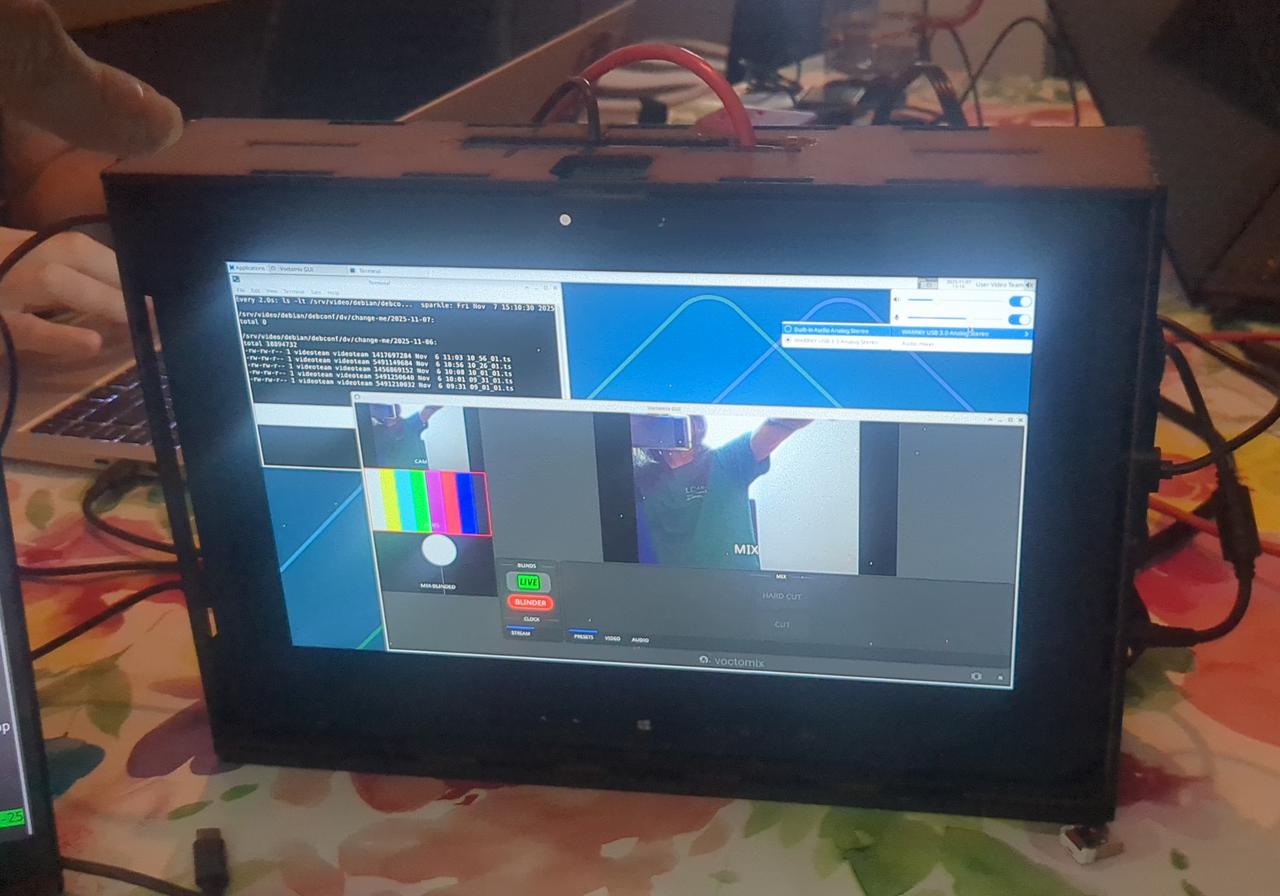
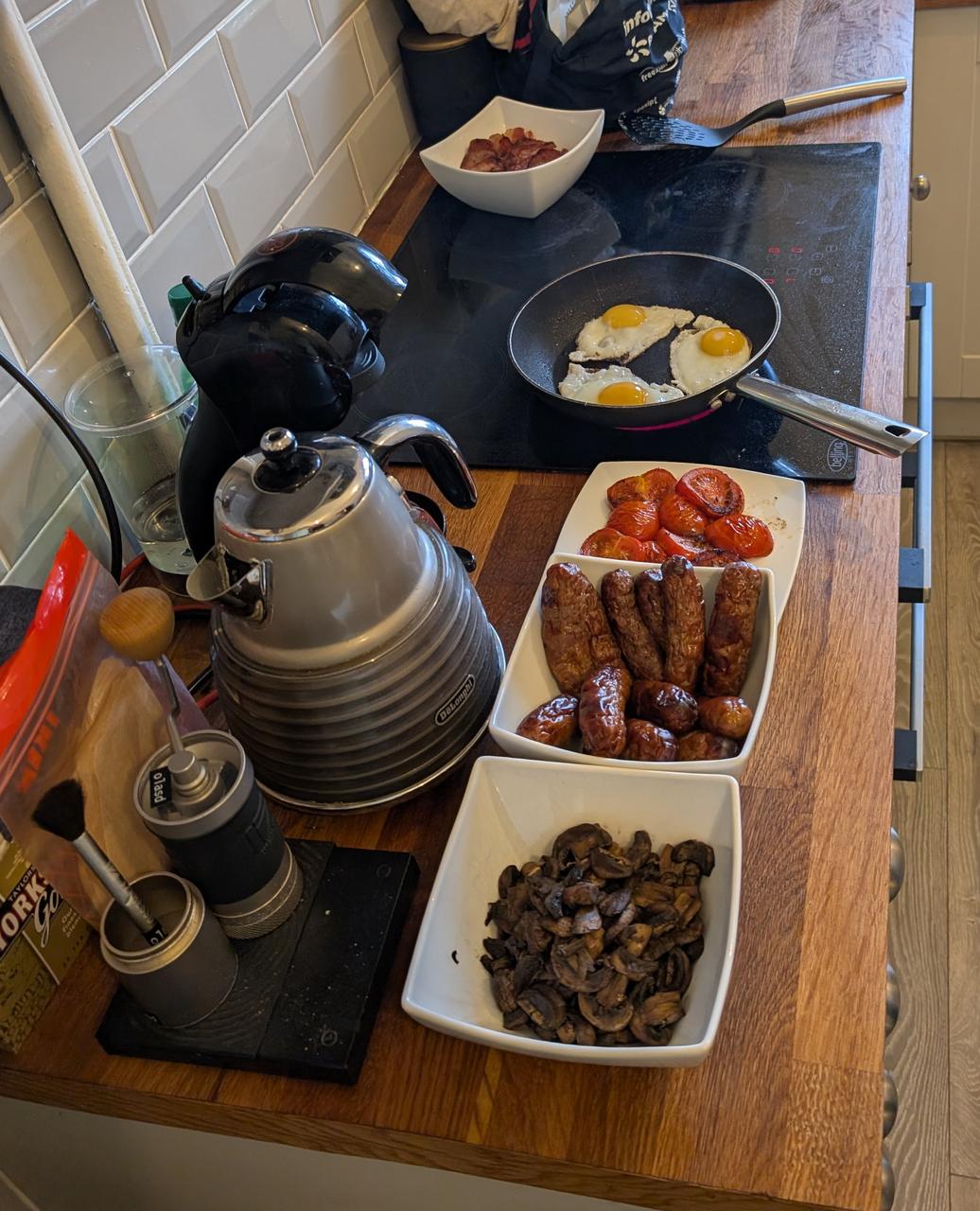
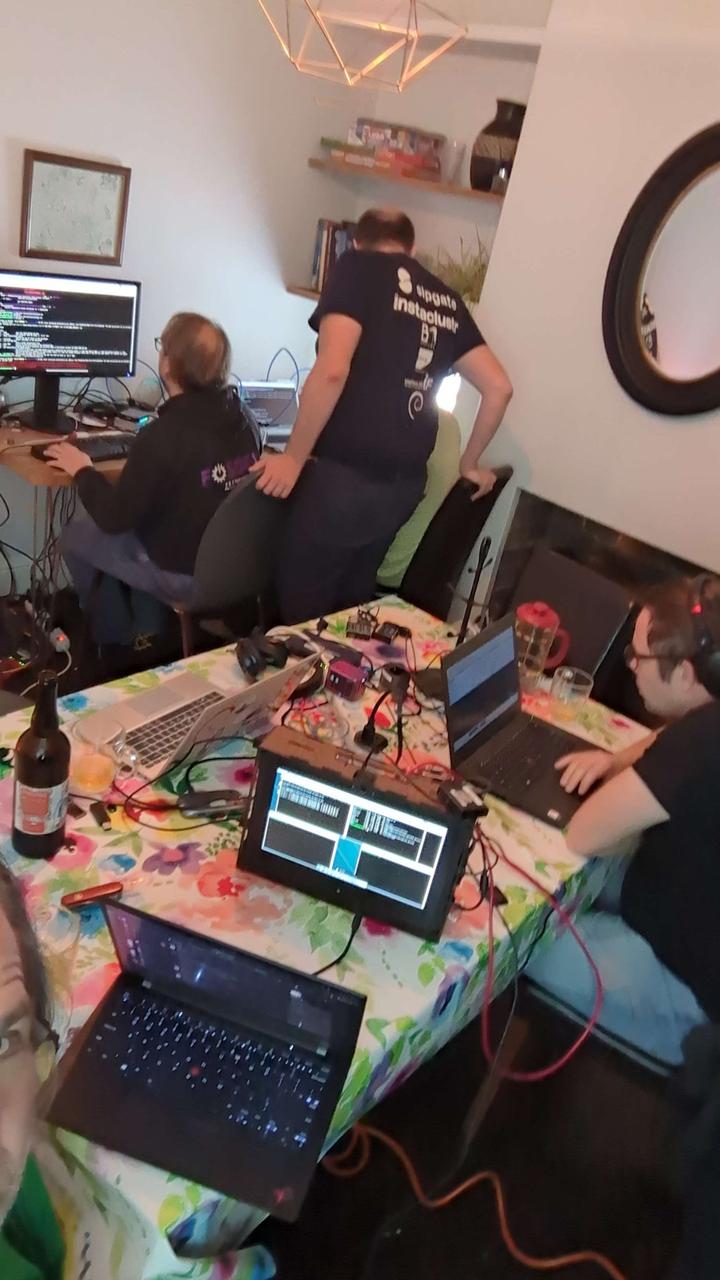
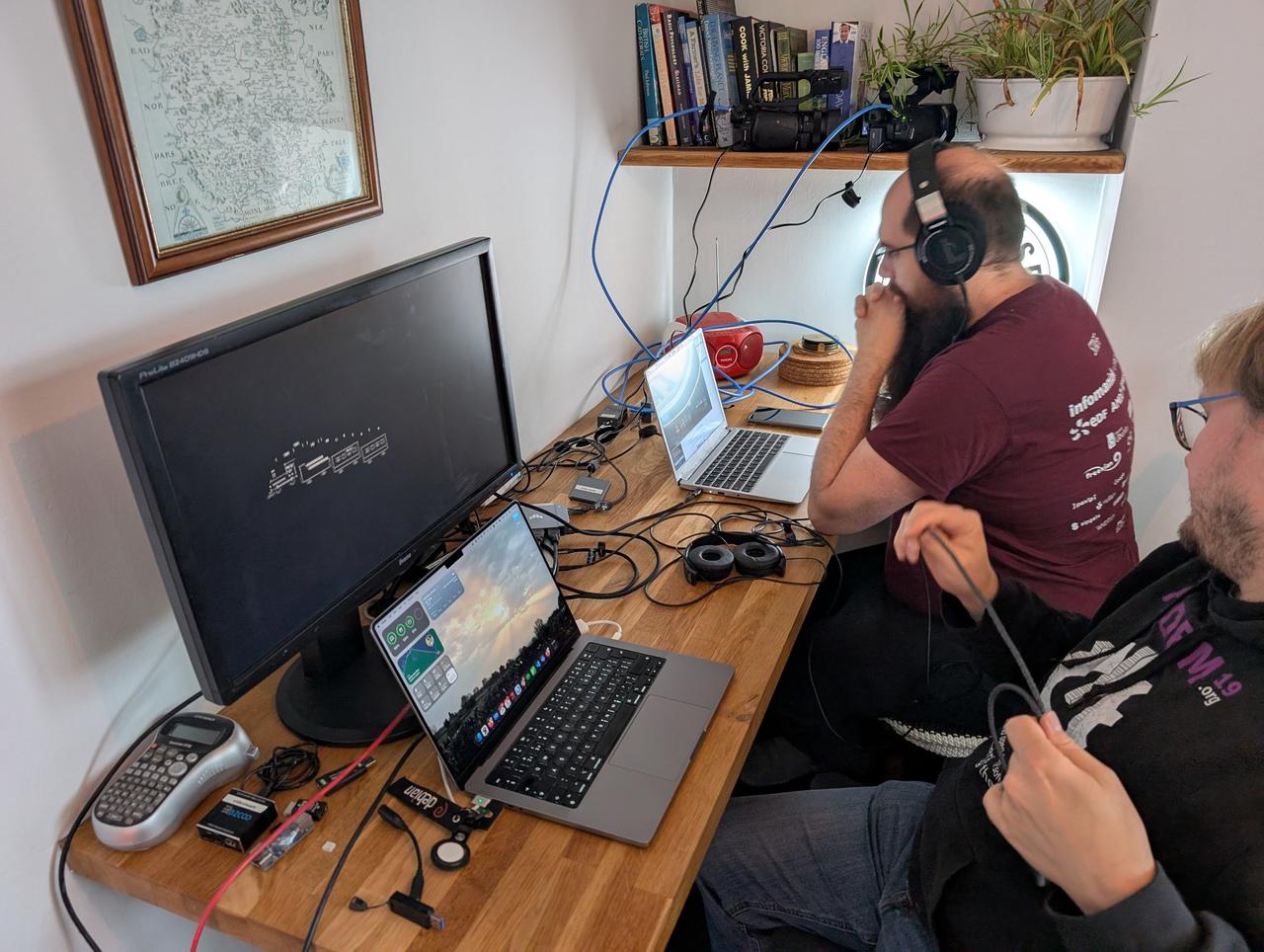
This week, some of the DebConf Video Team met in Herefordshire (UK) for a sprint. We didn't have a sprint in 2024, and it was sorely needed, now. At the sprint we made good progress towards using Voctomix 2 more reliably, and made plans for our future hardware needs. Attendees Voctomix 2 DebConf 25 was the first event that the team used Voctomix version 2. Testing it during DebCamp 25 (the week before DebConf), it seemed to work reliably. But during the event, we hit repeated audio dropout issues, that affected about 18 of our recordings (and live streams). We had attempted to use Voctomix 2 at DebConf 24, and quickly rolled back to version 1, on day 1 of the conference, when we hit similar issues. We thought these issues would be resolved for DebConf 25, by using more powerful (newer) mixing machines. Trying to get to the bottom of these issues was the main focus of the sprint. Nicolas brought 2 of Debian's cameras and the Framework laptop that we'd used at the conference, so we could reproduce the problem. It didn't take long to reproduce, in fact, we spent most of the week trying any configuration changes we could think of to avoid it. The issue we've been seeing feels like a gstreamer bug, rather than something voctomix is doing incorrectly. If anything, configuration changes are avoiding hitting it. Finally, on the last night of the sprint, we managed to run voctomix all night without the problem appearing. But... that isn't enough to feel confident that the issue is avoided. More testing will be required. Detecting audio breakage Kyle worked on a way to report the audio quality in our Prometheus exporter, so we can automatically detect this kind of audio breakage. This was implemented in helios our audio level monitor, and lead to some related code refactoring. Framework Laptops Historically, the video team has relied on borrowed and rented computer hardware at conferences for our (software) video mixing, streaming, storage and encoding. Many years ago, we'd even typically have a local Debian mirror and upload queue on site. Our video mixing machines had to be desktop size computers with 2 Blackmagic Declink Mini Recorder PCI-e cards installed in them, to capture video from our cameras. Now that we reliably have more Internet bandwidth than we really need, at our conference venues, we can rely on offsite cloud servers. We only need the video capture and mixing machines on site. Blackmagic also has UltraStudio Recorder thunderbolt capture boxes that we can use with a laptop. The project bought a couple of these and a Framework 13 AMD laptop to test at DebConf 25. We used it in production at DebConf, in the "Petit Amphi" room, where it seemed to work fairly well. It was very picky about thunderbolt cable and port combinations, refusing to even boot when they were connected. Since then, Framework firmware has fixed these issues, and in our testing at the sprint, it worked almost perfectly. (One of the capture boxes got into a broken state, and had to be unplugged and re-connected to fix it.) We think these are the best option for the future, and plan to ask the project to buy some more of them. HDCP Apple Silicon devices seem to like to HDCP-encrypt their HDMI output whenever possible. This causes our HDMI capture hardware to display an "Encrypted" error, rather than any useful image. Chris experimented with a few different devices to strip HDCP from HDMI video, at least 2 of them worked. Spring Cleaning Kyle dug through the open issues in our Salsa repositories and cleaned up some issues. DebConf 25 Video Encoding The core video team at DebConf 25 was a little under-staffed, significantly overlapping with core conference organization, which took priority. That, combined with the Voctomix 2 audio dropout issues we'd hit, meant that there was quite a bit of work left to be done to get the conference videos properly encoded and released. We found that the encodings had been done at the wrong resolution, which forced a re-encode of all videos. In the process, we reviewed videos for audio issues and made a list of the ones that need more work. We ran out of time and this work isn't done, yet. DebConf 26 Preparation Kyle reviewed floorplans and photographs of the proposed DebConf 26 talk venues, and build up a list of A/V kit that we'll need to hire. Carl's Video Box Carl uses much of the same stack as the video team, for many other events in the US. He has experimenting with using a Dell 7212 tablet in an all-in-one laser-cut box. Carl demonstrated this box, which could perfect for small miniDebConfs, at the sprint. Using voctomix 2 on the box requires some work, because it doesn't use Blackmagic cards for video capture. The Box: Front The Box: Back gst-fallbacksrc Carl's box's needs lead to looking at gstfallbacksrc. This should let Voctomix 2 survive cameras (or network sources) going away for a moment. Matthias Geiger packaged it for us, and it's now in Debian NEW. Thanks! voctomix-outcasts Carl cut a release of voctomix-outcasts and Stefano uploaded it to unstable. Ansible Configuration The videoteam's stack is deployed with Ansible, and almost everything we do involves work on this stack. Carl upstreamed some of his features to us, and we updated our voctomix2 configuration to take advantage of our experiments at the sprint. Miscellaneous Voctomix contributions We fixed a couple of minor bugs in voctomix. More Nageru experimentation In 2023, we tried to configure Nageru (another live video mixer) for the video team's needs. Like voctomix it needs some configuration and scaffolding to adapt it to your needs. Practically, this means writing a "theme" in Lua that controls the mixer. The team still has a preference for Voctomix (as we're all very familiar with it), but would like to have Nageru available as an option when we need it. We fixed some minor issues in our theme, enough to get it running again, on the Framework laptop. Much more work is needed to really make it a useable option. Thank you Thanks to the Debian project for funding the costs of the sprint, and Chris Boot's extended family for providing us with a no-cost sprint venue. Thanks to c3voc for developing and maintaining voctomix, and helping us to debug issues in it. Thank you to everyone in the videoteam who attended or helped out remotely! And to employers who let us work on Debian on company time. We'll likely need to keep working on our stack remotely, in the leadup to DebConf 26, and/or have another sprint before then. Breakfast Coffee Hacklab Trains!

8 November 2025

Thorsten Alteholz: My Debian Activities in October 2025

Debian LTS This was my hundred-thirty-sixth month that I did some work for the Debian LTS initiative, started by Raphael Hertzog at Freexian. During my allocated time I uploaded or worked on: I also attended the monthly LTS/ELTS meeting. Debian ELTS This month was the eighty-seventh ELTS month. During my allocated time I uploaded or worked on: I also attended the monthly LTS/ELTS meeting. Debian Printing This month I uploaded a new upstream version or a bugfix version of: This work is generously funded by Freexian! Debian Astro This month I uploaded a new upstream version or a bugfix version of: Debian IoT Unfortunately I didn t found any time to work on this topic. Debian Mobcom This month I uploaded a new upstream version or a bugfix version of: misc This month I uploaded a new upstream version or a bugfix version of: On my fight against outdated RFPs, I closed 31 of them in October. I could even close one RFP by uploading the new package gypsy. Meanwhile only 3373 are still open, so don t hesitate to help closing one or another. FTP master This month I accepted 420 and rejected 45 packages. The overall number of packages that got accepted was 423. I would like to remind everybody that in case you don t agree with the removal of a package, please set the moreinfo tag on this bug. This is the only reliable way to prevent processing of that RM-bug. Well, there is a second way, of course you could also achieve this by closing the bug.

6 November 2025

Jonathan Dowland: inert media, or the explotation of attention

It occurred to me recently that one of the attractions of vinyl, or more generally physical media, could be that it's inert, safe: the music is a groove cut into some plastic. That's it. The record can't do anything unexpected to you1: it just contains music.
Safe. Safe.
There's so much exploitation of attention, and so much of what we interact with in a computing context (social media) etc has been weaponised against us, that having something some matter-of-fact is a relief. I know that sometimes, I prefer to put a record on than to dial up the very same album from any number of (ostensibly more convenient) digital sources, partly because I don't need to spend any of my attention spoons to do so, I can save them for the task at hand. The same is perhaps not true for audio CDs. That might depend on your own relationship with them, of course. For me they're inexorably tied up with computing and a certain amount of faff (ripping, encoding, metadata). And long dead it might be (hopefully), but I can still remember Sony's CD rootkit scandal: CDs could be a trojan horse. Beware!

  1. I'm sure there are ingenious exceptions.

5 November 2025

Reproducible Builds: Reproducible Builds in October 2025

Welcome to the October 2025 report from the Reproducible Builds project! Welcome to the very latest report from the Reproducible Builds project. Our monthly reports outline what we ve been up to over the past month, and highlight items of news from elsewhere in the increasingly-important area of software supply-chain security. As ever, if you are interested in contributing to the Reproducible Builds project, please see the Contribute page on our website. In this report:

  1. Farewell from the Reproducible Builds Summit 2025
  2. Google s Play Store breaks reproducible builds for Signal
  3. Mailing list updates
  4. The Original Sin of Computing that no one can fix
  5. Reproducible Builds at the Transparency.dev summit
  6. Supply Chain Security for Go
  7. Three new academic papers published
  8. Distribution work
  9. Upstream patches
  10. Website updates
  11. Tool development

Farewell from the Reproducible Builds Summit 2025 Thank you to everyone who joined us at the Reproducible Builds Summit in Vienna, Austria! We were thrilled to host the eighth edition of this exciting event, following the success of previous summits in various iconic locations around the world, including Venice, Marrakesh, Paris, Berlin, Hamburg and Athens. During this event, participants had the opportunity to engage in discussions, establish connections and exchange ideas to drive progress in this vital field. Our aim was to create an inclusive space that fosters collaboration, innovation and problem-solving. The agenda of the three main days is available online however, some working sessions may still lack notes at time of publication. One tangible outcome of the summit is that Johannes Starosta finished their rebuilderd tutorial, which is now available online and Johannes is actively seeking feedback.

Google s Play Store breaks reproducible builds for Signal On the issue tracker for the popular Signal messenger app, developer Greyson Parrelli reports that updates to the Google Play store have, in effect, broken reproducible builds:
The most recent issues have to do with changes to the APKs that are made by the Play Store. Specifically, they add some attributes to some .xml files around languages are resources, which is not unexpected because of how the whole bundle system works. This is trickier to resolve, because unlike current expected differences (like signing information), we can t just exclude a whole file from the comparison. We have to take a more nuanced look at the diff. I ve been hesitant to do that because it ll complicate our currently-very-readable comparison script, but I don t think there s any other reasonable option here.
The full thread with additional context is available on GitHub.

Mailing list updates On our mailing list this month:
  • kpcyrd forwarded a fascinating tidbit regarding so-called ninja and samurai build ordering, that uses data structures in which the pointer values returned from malloc are used to determine some order of execution.
  • Arnout Engelen, Justin Cappos, Ludovic Court s and kpcyrd continued a conversation started in September regarding the Minimum Elements for a Software Bill of Materials . (Full thread)
  • Felix Moessbauer of Siemens posted to the list reporting that he had recently stumbled upon a couple of Debian source packages on the snapshot mirrors that are listed multiple times (same name and version), but each time with a different checksum . The thread, which Felix titled, Debian: what precisely identifies a source package is about precisely that what can be axiomatically relied upon by consumers of the Debian archives, as well as indicating an issue where we can t exactly say which packages were used during build time (even when having the .buildinfo files).
  • Luca DiMaio posted to the list announcing the release of xfsprogs 6.17.0 which specifically includes a commit that implements the functionality to populate a newly created XFS filesystem directly from an existing directory structure which makes it easier to create populated filesystems without having to mount them [and thus is] particularly useful for reproducible builds . Luca asked the list how they might contribute to the docs of the System images page.

The Original Sin of Computing that no one can fix Popular YouTuber @laurewired published a video this month with an engaging take on the Trusting Trust problem. Titled The Original Sin of Computing that no one can fix, the video touches on David A. Wheeler s Diverse Double-Compiling dissertation. GNU developer Janneke Nieuwenhuizen followed-up with an email (additionally sent to our mailing list) as well, underscoring that GNU Mes s current solution [to this issue] uses ancient softwares in its bootstrap path, such as gcc-2.95.3 and glibc-2.2.5 . (According to Colby Russell, the GNU Mes bootstrapping sequence is shown at 18m54s in the video.)

Reproducible Builds at the Transparency.dev summit Holger Levsen gave a talk at this year s Transparency.dev summit in Gothenburg, Sweden, outlining the achievements of the Reproducible Builds project in the last 12 years, covering both upstream developments as well as some distribution-specific details. As mentioned on the talk s page, Holger s presentation concluded with an outlook into the future and an invitation to collaborate to bring transparency logs into Reproducible Builds projects . The slides of the talk are available, although a video has yet to be released. Nevertheless, as a result of the discussions at Transparency.dev there is a new page on the Debian wiki with the aim of describing a potential transparency log setup for Debian.

Supply Chain Security for Go Andrew Ayer has setup a new service at sourcespotter.com that aims to monitor the supply chain security for Go releases. It consists of four separate trackers:
  1. A tool to verify that the Go Module Mirror and Checksum Database is behaving honestly and has not presented inconsistent information to clients.
  2. A module monitor that records every module version served by the Go Module Mirror and Checksum Database, allowing you to monitor for unexpected versions of your modules.
  3. A tool to verifies that the Go toolchains published in the Go Module Mirror can be reproduced from source code, making it difficult to hide backdoors in the binaries downloaded by the go command.
  4. A telemetry config tracker that tracks the names of telemetry counters uploaded by the Go toolchain, to ensure that Go telemetry is not violating users privacy.
As the homepage of the service mentions, the trackers are free software and do not rely on Google infrastructure.

Three new academic papers published Julien Malka of the Institut Polytechnique de Paris published an exciting paper this month on How NixOS could have detected the XZ supply-chain attack for the benefit of all thanks to reproducible-builds. Julien outlines his paper as follows:
In March 2024, a sophisticated backdoor was discovered in xz, a core compression library in Linux distributions, covertly inserted over three years by a malicious maintainer, Jia Tan. The attack, which enabled remote code execution via ssh, was only uncovered by chance when Andres Freund investigated a minor performance issue. This incident highlights the vulnerability of the open-source supply chain and the effort attackers are willing to invest in gaining trust and access. In this article, I analyze the backdoor s mechanics and explore how bitwise build reproducibility could have helped detect it.
A PDF of the paper is available online.
Iy n M ndez Veiga and Esther H nggi (of the Lucerne University of Applied Sciences and Arts and ETH Zurich) published a paper this month on the topic of Reproducible Builds for Quantum Computing. The abstract of their paper mentions the following:
Although quantum computing is a rapidly evolving field of research, it can already benefit from adopting reproducible builds. This paper aims to bridge the gap between the quantum computing and reproducible builds communities. We propose a generalization of the definition of reproducible builds in the quantum setting, motivated by two threat models: one targeting the confidentiality of end users data during circuit preparation and submission to a quantum computer, and another compromising the integrity of quantum computation results. This work presents three examples that show how classical information can be hidden in transpiled quantum circuits, and two cases illustrating how even minimal modifications to these circuits can lead to incorrect quantum computation results.
A full PDF of their paper is available.
Congratulations to Georg Kofler who submitted their Master s thesis for the Johannes Kepler University of Linz, Austria on the topic of Reproducible builds of E2EE-messengers for Android using Nix hermetic builds:
The thesis focuses on providing a reproducible build process for two open-source E2EE messaging applications: Signal and Wire. The motivation to ensure reproducibility and thereby the integrity of E2EE messaging applications stems from their central role as essential tools for modern digital privacy. These applications provide confidentiality for private and sensitive communications, and their compromise could undermine encryption mechanisms, potentially leaking sensitive data to third parties.
A full PDF of their thesis is available online.
Shawkot Hossain of Aalto University, Finland has also submitted their Master s thesis on the The Role of SBOM in Modern Development with a focus on the extant tooling:
Currently, there are numerous solutions and techniques available in the market to tackle supply chain security, and all claim to be the best solution. This thesis delves deeper by implementing those solutions and evaluates them for better understanding. Some of the tools that this thesis implemented are Syft, Trivy, Grype, FOSSA, dependency-check, and Gemnasium. Software dependencies are generated in a Software Bill of Materials (SBOM) format by using these open-source tools, and the corresponding results have been analyzed. Among these tools, Syft and Trivy outperform others as they provide relevant and accurate information on software dependencies.
A PDF of the thesis is also available.

Distribution work Michael Plura published an interesting article on Heise.de on the topic of Trust is good, reproducibility is better:
In the wake of growing supply chain attacks, the FreeBSD developers are relying on a transparent build concept in the form of Zero-Trust Builds. The approach builds on the established Reproducible Builds, where binary files can be rebuilt bit-for-bit from the published source code. While reproducible builds primarily ensure verifiability, the zero-trust model goes a step further and removes trust from the build process itself. No single server, maintainer, or compiler can be considered more than potentially trustworthy.
The article mentions that this goal has now been achieved with a slight delay and can be used in the current development branch for FreeBSD 15 .
In Debian this month, 7 reviews of Debian packages were added, 5 were updated and 11 were removed this month adding to our knowledge about identified issues. For the Debian CI tests Holger fixed #786644 and set nocheck in DEB_BUILD_OPTIONS for the 2nd build..
Lastly, Bernhard M. Wiedemann posted another openSUSE monthly update for their work there.

Upstream patches The Reproducible Builds project detects, dissects and attempts to fix as many currently-unreproducible packages as possible. We endeavour to send all of our patches upstream where appropriate. This month, we wrote a large number of such patches, including:

Website updates Once again, there were a number of improvements made to our website this month including: In addition, a number of contributors added a series of notes from our recent summit to the website, including Alexander Couzens [ ], Robin Candau [ ][ ][ ][ ][ ][ ][ ][ ][ ] and kpcyrd [ ].

Tool development diffoscope version 307 was uploaded to Debian unstable by Chris Lamb, who made a number of changes including fixing compatibility with LLVM version 21 [ ], an attempt to automatically attempt to deploy to PyPI by liaising with the PyPI developers/maintainers (with this experimental feature). [ ] In addition, Vagrant Cascadian updated diffoscope in GNU Guix to version 307.

Finally, if you are interested in contributing to the Reproducible Builds project, please visit our Contribute page on our website. However, you can get in touch with us via:

25 October 2025

Sam Hartman: My First Successful AI Coding Experience

Yesterday, I had my first successful AI coding experience. I ve used AI coding tools before and come away disappointed. The results were underwhelming: low-quality code, inconsistent abstraction levels, and subtle bugs that take longer to fix than it would take to write the whole thing from scratch. Those problems haven t vanished. The code quality this time was still disappointing. As I asked the AI to refined its work, it would randomly drop important constraints or refactor things in unhelpful ways. And yet, this experience was different and genuinely valuable for two reasons. The first benefit was the obvious one: the AI helped me get over the blank-page problem. It produced a workable skeleton for the project imperfect, but enough to start building on. The second benefit was more surprising. I was working on a problem in odds-ratio preference optimization specifically, finding a way to combine similar examples in datasets for AI training. I wanted an ideal algorithm, one that extracted every ounce of value from the data. The AI misunderstood my description. Its first attempt was laughably simple it just concatenated two text strings. Thanks, but I can call strcat or the Python equivalent without help. However, the second attempt was different. It was still not what I had asked for but as I thought about it, I realized it was good enough. The AI had created a simpler algorithm that would probably solve my problem in practice. In trying too hard to make the algorithm perfect, I d overlooked that the simpler approach might be the right one. The AI, by misunderstanding, helped me see that. This experience reminded me of something that happened years ago when I was mentoring a new developer. They came to me asking how to solve a difficult problem. Rather than telling them it was impossible, I explained what would be required: a complex authorization framework, intricate system interactions, and a series of political and organizational hurdles that would make deployment nearly impossible. A few months later, they returned and said they d found a solution. I was astonished until I looked more closely. What they d built wasn t the full, organization-wide system I had envisioned. Instead, they d reframed the problem. By narrowing the scope reducing the need for global trust and deep integration they d built a local solution that worked well enough within their project. They succeeded precisely because they didn t see all the constraints I did. Their inexperience freed them from assumptions that had trapped me. That s exactly what happened with the AI. It didn t know which boundaries not to cross. In its simplicity, it found a path forward that I had overlooked. My conclusion isn t that AI coding is suddenly great. It s that working with someone or something that thinks differently can open new paths forward. Whether it s an AI, a peer, or a less experienced engineer, that collaboration can bring fresh perspectives that challenge your assumptions and reveal simpler, more practical ways to solve problems.

comment count unavailable comments

23 October 2025

Russ Allbery: Review: Politics on the Edge

Review: Politics on the Edge, by Rory Stewart
Publisher: Penguin Books
Copyright: 2023, 2025
Printing: 2025
ISBN: 979-8-217-06167-9
Format: Kindle
Pages: 429
Rory Stewart is a former British diplomat, non-profit executive, member of Parliament, and cabinet minister. Politics on the Edge is a memoir of his time in the UK Parliament from 2019 to 2019 as a Tory (Conservative) representing the Penrith and The Border constituency in northern England. It ends with his failed run against Boris Johnson for leader of the Conservative Party and Prime Minister. This book provoked many thoughts, only some of which are about the book. You may want to get a beverage; this review will be long. Since this is a memoir told in chronological order, a timeline may be useful. After Stewart's time as a regional governor in occupied Iraq (see The Prince of the Marshes), he moved to Kabul to found and run an NGO to preserve traditional Afghani arts and buildings (the Turquoise Mountain Foundation, about which I know nothing except what Stewart wrote in this book). By his telling, he found that work deeply rewarding but thought the same politicians who turned Iraq into a mess were going to do the same to Afghanistan. He started looking for ways to influence the politics more directly, which led him first to Harvard and then to stand for Parliament. The bulk of this book covers Stewart's time as MP for Penrith and The Border. The choice of constituency struck me as symbolic of Stewart's entire career: He was not a resident and had no real connection to the district, which he chose for political reasons and because it was the nearest viable constituency to his actual home in Scotland. But once he decided to run, he moved to the district and seems sincerely earnest in his desire to understand it and become part of its community. After five years as a backbencher, he joined David Cameron's government in a minor role as Minister of State in the Department for Environment, Food, and Rural Affairs. He then bounced through several minor cabinet positions (more on this later) before being elevated to Secretary of State for International Development under Theresa May. When May's government collapsed during the fight over the Brexit agreement, he launched a quixotic challenge to Boris Johnson for leader of the Conservative Party. I have enjoyed Rory Stewart's writing ever since The Places in Between. This book is no exception. Whatever one's other feelings about Stewart's politics (about which I'll have a great deal more to say), he's a talented memoir writer with an understated and contemplative style and a deft ability to shift from concrete description to philosophical debate without bogging down a story. Politics on the Edge is compelling reading at the prose level. I spent several afternoons happily engrossed in this book and had great difficulty putting it down. I find Stewart intriguing since, despite being a political conservative, he's neither a neoliberal nor any part of the new right. He is instead an apparently-sincere throwback to a conservatism based on epistemic humility, a veneration of rural life and long-standing traditions, and a deep commitment to the concept of public service. Some of his principles are baffling to me, and I think some of his political views are obvious nonsense, but there were several things that struck me throughout this book that I found admirable and depressingly rare in politics. First, Stewart seems to learn from his mistakes. This goes beyond admitting when he was wrong and appears to include a willingness to rethink entire philosophical positions based on new experience.
I had entered Iraq supporting the war on the grounds that we could at least produce a better society than Saddam Hussein's. It was one of the greatest mistakes in my life. We attempted to impose programmes made up by Washington think tanks, and reheated in air-conditioned palaces in Baghdad a new taxation system modelled on Hong Kong; a system of ministers borrowed from Singapore; and free ports, modelled on Dubai. But we did it ultimately at the point of a gun, and our resources, our abstract jargon and optimistic platitudes could not conceal how much Iraqis resented us, how much we were failing, and how humiliating and degrading our work had become. Our mission was a grotesque satire of every liberal aspiration for peace, growth and democracy.
This quote comes from the beginning of this book and is a sentiment Stewart already expressed in The Prince of the Marshes, but he appears to have taken this so seriously that it becomes a theme of his political career. He not only realized how wrong he was on Iraq, he abandoned the entire neoliberal nation-building project without abandoning his belief in the moral obligation of international aid. And he, I think correctly, identified a key source of the error: an ignorant, condescending superiority that dismissed the importance of deep expertise.
Neither they, nor indeed any of the 12,000 peacekeepers and policemen who had been posted to South Sudan from sixty nations, had spent a single night in a rural house, or could complete a sentence in Dinka, Nuer, Azande or Bande. And the international development strategy written jointly between the donor nations resembled a fading mission statement found in a new space colony, whose occupants had all been killed in an alien attack.
Second, Stewart sincerely likes ordinary people. This shone through The Places in Between and recurs here in his descriptions of his constituents. He has a profound appreciation for individual people who have spent their life learning some trade or skill, expresses thoughtful and observant appreciation for aspects of local culture, and appears to deeply appreciate time spent around people from wildly different social classes and cultures than his own. Every successful politician can at least fake gregariousness, and perhaps that's all Stewart is doing, but there is something specific and attentive about his descriptions of other people, including long before he decided to enter politics, that makes me think it goes deeper than political savvy. Third, Stewart has a visceral hatred of incompetence. I think this is the strongest through-line of his politics in this book: Jobs in government are serious, important work; they should be done competently and well; and if one is not capable of doing that, one should not be in government. Stewart himself strikes me as an insecure overachiever: fiercely ambitious, self-critical, a bit of a micromanager (I suspect he would be difficult to work for), but holding himself to high standards and appalled when others do not do the same. This book is scathing towards multiple politicians, particularly Boris Johnson whom Stewart clearly despises, but no one comes off worse than Liz Truss.
David Cameron, I was beginning to realise, had put in charge of environment, food and rural affairs a Secretary of State who openly rejected the idea of rural affairs and who had little interest in landscape, farmers or the environment. I was beginning to wonder whether he could have given her any role she was less suited to apart perhaps from making her Foreign Secretary. Still, I could also sense why Cameron was mesmerised by her. Her genius lay in exaggerated simplicity. Governing might be about critical thinking; but the new style of politics, of which she was a leading exponent, was not. If critical thinking required humility, this politics demanded absolute confidence: in place of reality, it offered untethered hope; instead of accuracy, vagueness. While critical thinking required scepticism, open-mindedness and an instinct for complexity, the new politics demanded loyalty, partisanship and slogans: not truth and reason but power and manipulation. If Liz Truss worried about the consequences of any of this for the way that government would work, she didn't reveal it.
And finally, Stewart has a deeply-held belief in state capacity and capability. He and I may disagree on the appropriate size and role of the government in society, but no one would be more disgusted by an intentional project to cripple government in order to shrink it than Stewart. One of his most-repeated criticisms of the UK political system in this book is the way the cabinet is formed. All ministers and secretaries come from members of Parliament and therefore branches of government are led by people with no relevant expertise. This is made worse by constant cabinet reshuffles that invalidate whatever small amounts of knowledge a minister was able to gain in nine months or a year in post. The center portion of this book records Stewart's time being shuffled from rural affairs to international development to Africa to prisons, with each move representing a complete reset of the political office and no transfer of knowledge whatsoever.
A month earlier, they had been anticipating every nuance of Minister Rogerson's diary, supporting him on shifts twenty-four hours a day, seven days a week. But it was already clear that there would be no pretence of a handover no explanation of my predecessor's strategy, and uncompleted initiatives. The arrival of a new minister was Groundhog Day. Dan Rogerson was not a ghost haunting my office, he was an absence, whose former existence was suggested only by the black plastic comb.
After each reshuffle, Stewart writes of trying to absorb briefings, do research, and learn enough about his new responsibilities to have the hope of making good decisions, while growing increasingly frustrated with the system and the lack of interest by most of his colleagues in doing the same. He wants government programs to be successful and believes success requires expertise and careful management by the politicians, not only by the civil servants, a position that to me both feels obviously correct and entirely at odds with politics as currently practiced. I found this a fascinating book to read during the accelerating collapse of neoliberalism in the US and, to judge by current polling results, the UK. I have a theory that the political press are so devoted to a simplistic left-right political axis based on seating arrangements during the French Revolution that they are missing a significant minority whose primary political motivation is contempt for arrogant incompetence. They could be convinced to vote for Sanders or Trump, for Polanski or Farage, but will never vote for Biden, Starmer, Romney, or Sunak. Such voters are incomprehensible to those who closely follow and debate policies because their hostile reaction to the center is not about policies. It's about lack of trust and a nebulous desire for justice. They've been promised technocratic competence and the invisible hand of market forces for most of their lives, and all of it looks like lies. Everyday living is more precarious, more frustrating, more abusive and dehumanizing, and more anxious, despite (or because of) this wholehearted embrace of economic "freedom." They're sick of every complaint about the increasing difficulty of life being met with accusations about their ability and work ethic, and of being forced to endure another round of austerity by people who then catch a helicopter ride to a party on some billionaire's yacht. Some of this is inherent in the deep structural weaknesses in neoliberal ideology, but this is worse than an ideological failure. The degree to which neoliberalism started as a project of sincere political thinkers is arguable, but that is clearly not true today. The elite class in politics and business is now thoroughly captured by people whose primary skill is the marginal manipulation of complex systems for their own power and benefit. They are less libertarian ideologues than narcissistic mediocrities. We are governed by management consultants. They are firmly convinced their organizational expertise is universal, and consider the specific business of the company, or government department, irrelevant. Given that context, I found Stewart's instinctive revulsion towards David Cameron quite revealing. Stewart, later in the book, tries to give Cameron some credit by citing several policy accomplishments and comparing him favorably to Boris Johnson (which, true, is a bar Cameron probably flops over). But I think Stewart's baffled astonishment at Cameron's vapidity says a great deal about how we have ended up where we are. This last quote is long, but I think it provides a good feel for Stewart's argument in this book.
But Cameron, who was rumoured to be sceptical about nation-building projects, only nodded, and then looking confidently up and down the table said, "Well, at least we all agree on one extremely straightforward and simple point, which is that our troops are doing very difficult and important work and we should all support them." It was an odd statement to make to civilians running humanitarian operations on the ground. I felt I should speak. "No, with respect, we do not agree with that. Insofar as we have focused on the troops, we have just been explaining that what the troops are doing is often futile, and in many cases making things worse." Two small red dots appeared on his cheeks. Then his face formed back into a smile. He thanked us, told us he was out of time, shook all our hands, and left the room. Later, I saw him repeat the same line in interviews: "the purpose of this visit is straightforward... it is to show support for what our troops are doing in Afghanistan". The line had been written, in London, I assumed, and tested on focus groups. But he wanted to convince himself it was also a position of principle. "David has decided," one of his aides explained, when I met him later, "that one cannot criticise a war when there are troops on the ground." "Why?" "Well... we have had that debate. But he feels it is a principle of British government." "But Churchill criticised the conduct of the Boer War; Pitt the war with America. Why can't he criticise wars?" "British soldiers are losing their lives in this war, and we can't suggest they have died in vain." "But more will die, if no one speaks up..." "It is a principle thing. And he has made his decision. For him and the party." "Does this apply to Iraq too?" "Yes. Again he understands what you are saying, but he voted to support the Iraq War, and troops are on the ground." "But surely he can say he's changed his mind?" The aide didn't answer, but instead concentrated on his food. "It is so difficult," he resumed, "to get any coverage of our trip." He paused again. "If David writes a column about Afghanistan, we will struggle to get it published." "But what would he say in an article anyway?" I asked. "We can talk about that later. But how do you get your articles on Afghanistan published?" I remembered how the US politicians and officials had shown their mastery of strategy and detail. I remembered the earnestness of Gordon Brown when I had briefed him on Iraq. Cameron seemed somehow less serious. I wrote as much in a column in the New York Times, saying that I was afraid the party of Churchill was becoming the party of Bertie Wooster.
I don't know Stewart's reputation in Britain, or in the constituency that he represented. I know he's been accused of being a self-aggrandizing publicity hound, and to some extent this is probably true. It's hard to find an ambitious politician who does not have that instinct. But whatever Stewart's flaws, he can, at least, defend his politics with more substance than a corporate motto. One gets the impression that he would respond favorably to demonstrated competence linked to a careful argument, even if he disagreed. Perhaps this is an illusion created by his writing, but even if so, it's a step in the right direction. When people become angry enough at a failing status quo, any option that promises radical change and punishment for the current incompetents will sound appealing. The default collapse is towards demagogues who are skilled at expressing anger and disgust and are willing to promise simple cures because they are indifferent to honesty. Much of the political establishment in the US, and possibly (to the small degree that I can analyze it from an occasional news article) in the UK, can identify the peril of the demagogue, but they have no solution other than a return to "politics as usual," represented by the amoral mediocrity of a McKinsey consultant. The rare politicians who seem to believe in something, who will argue for personal expertise and humility, who are disgusted by incompetence and have no patience for facile platitudes, are a breath of fresh air. There are a lot of policies on which Stewart and I would disagree, and perhaps some of his apparent humility is an affectation from the rhetorical world of the 1800s that he clearly wishes he were inhabiting, but he gives the strong impression of someone who would shoulder a responsibility and attempt to execute it with competence and attention to detail. He views government as a job, where coworkers should cooperate to achieve defined goals, rather than a reality TV show. The arc of this book, like the arc of current politics, is the victory of the reality TV show over the workplace, and the story of Stewart's run against Boris Johnson is hard reading because of it, but there's a portrayal here of a different attitude towards politics that I found deeply rewarding. If you liked Stewart's previous work, or if you want an inside look at parliamentary politics, highly recommended. I will be thinking about this book for a long time. Rating: 9 out of 10

21 October 2025

Russ Allbery: Review: Space Trucker Jess

Review: Space Trucker Jess, by Matthew Kressel
Publisher: Fairwood Press
Copyright: July 2025
ISBN: 1-958880-27-2
Format: Kindle
Pages: 472
Space Trucker Jess is a stand-alone far-future space fantasy novel. Jess is a sixteen-year-old mechanic working grey-market jobs on Chadeisson Station with a couple of younger kids. She's there because her charming and utterly unreliable father got caught running a crypto scam and is sitting in detention. This was only the latest in a long series of scams, con jobs, and misadventures she's been dragged through since her mother disappeared without a word. Jess is cynical, world-weary, and infuriated by her own sputtering loyalty to her good-for-nothing dad. What Jess wants most in the universe is to own a CCM 6454 Spark Megahauler, the absolute best cargo ship in the universe according to Jess. She should know; she's worked on nearly every type of ship in existence. With her own ship, she could make a living hauling cargo, repairing her own ship, and going anywhere she wants, free of her father and his endless schemes. (A romantic relationship with her friend Leurie would be a nice bonus.) Then her father is taken off the station on a ship leaving the galactic plane, no one will tell her why, and all the records of the ship appear to have been erased. Jess thinks her father is an asshole, but that doesn't mean she can sit idly by when he disappears. That's how she ends up getting in serious trouble with station security due to some risky in-person sleuthing, followed by an expensive flight off the station with a dodgy guy and a kid in a stolen spaceship. The setup for this book was so great. Kressel felt the need to make up a futuristic slang for Jess and her friends to speak, which rarely works as well as the author expects and does not work here, but apart from that I was hooked. Jess is sarcastic, blustery, and a bit of a con artist herself, but with the idealistic sincerity of someone who knows that her life is been kind of broken and understands the value of friends. She's profoundly cynical in the heartbreakingly defensive way of a sixteen-year-old with a rough life. I have a soft spot in my heart for working-class science fiction (there isn't nearly enough of it), and there are few things I enjoy more than reading about the kind of protagonist who has Opinions about starship models and a dislike of shoddy work. I think this is the only book I've bought solely on the basis of one of the Big Idea blog posts John Scalzi hosts. I really wish this book had stuck with the setup instead of morphing into a weird drug-enabled mystical space fantasy, to which Jess's family is bizarrely central. SPOILERS below because I can't figure out how to rant about what annoyed me without them. Search for the next occurrence of spoilers to skip past them. There are three places where this book lost me. The first was when Jess, after agreeing to help another kid find his father, ends up on a world obsessed with a religious cult involving using hallucinatory drugs to commune with alien gods. Jess immediately flags this as unbelievable bullshit and I was enjoying her well-founded cynicism until Kressel pulls the rug out from under both Jess and the reader by establishing that this new-age claptrap is essentially true. Kressel does try to put a bit of a science fiction gloss on it, but sadly I think that effort was unsuccessful. Sometimes absurdly powerful advanced aliens with near-telepathic powers are part of the fun of a good space opera, but I want the author to make an effort to connect the aliens to plausibility or, failing that, at least avoid sounding indistinguishable from psychic self-help grifters or religious fantasy about spiritual warfare. Stargate SG-1 and Babylon 5 failed on the first part but at least held the second line. Kressel gets depressingly close to Seth territory, although at least Jess is allowed to retain some cynicism about motives. The second, related problem is that Jess ends up being a sort of Chosen One, which I found intensely annoying. This may be a fault of reader expectations more than authorial skill, but one of the things I like to see in working-class science fiction is for the protagonist to not be absurdly central to the future of the galaxy, or to at least force themselves into that position through their own ethics and hard work. This book turns into a sort of quest story with epic fantasy stakes, which I thought was much less interesting than the story the start of the book promised and which made Jess a less interesting character. Finally, this is one of those books where Jess's family troubles and the plot she stumbles across turn into the same plot. Space Trucker Jess is far from alone in having that plot structure, and that's the problem. I'm not universally opposed to this story shape, but Jess felt like the wrong character for it. She starts the story with a lot of self-awareness about how messed up her family dynamics were, and I was rooting for her to find some space to construct her own identity separate from her family. To have her family turn out to be central not only to this story but to the entire galaxy felt like it undermined that human core of the story, although I admit it's a good analogy to the type of drama escalation that dysfunctional families throw at anyone attempting to separate from them. Spoilers end here. I rather enjoyed the first third of this book, despite being a bit annoyed at the constructed slang, and then started rolling my eyes and muttering things about the story going off the rails. Jess is a compelling enough character (and I'm stubborn enough) that I did finish the book, so I can say that I liked the very end. Kressel does finally arrive at the sort of story that I wanted to read all along. Unfortunately, I didn't enjoy the path he took to get there. I think much of my problem was that I wanted Jess to be a more defiant character earlier in the novel, and I wanted her family problems to influence her character growth but not be central to her story. Both of these may be matters of opinion and an artifact of coming into the book with the wrong assumptions. If you are interested in a flawed and backsliding effort to untangle one's identity from a dysfunctional family and don't mind some barely-SF space mysticism and chosen one vibes, it's possible this book will click with you. It's not one that I can recommend, though. I still want the book that I hoped I was getting from that Big Idea piece. Rating: 4 out of 10

20 October 2025

Dirk Eddelbuettel: RcppArmadillo 15.2.0-0 on GitHub: New Upstream, Simpler OpenMP

armadillo image Armadillo is a powerful and expressive C++ template library for linear algebra and scientific computing. It aims towards a good balance between speed and ease of use, has a syntax deliberately close to Matlab, and is useful for algorithm development directly in C++, or quick conversion of research code into production environments. RcppArmadillo integrates this library with the R environment and language and is widely used by (currently) 1270 other packages on CRAN, downloaded 42 million times (per the partial logs from the cloud mirrors of CRAN), and the CSDA paper (preprint / vignette) by Conrad and myself has been cited 650 times according to Google Scholar. This versions updates to the 15.2.0 upstream release made today. It brings a few changes over Armadillo 15.0 (see below for more). It follows the most recent RcppArmadillo 15.0.2-2 release and the Armadillo 15 upstream transition with its dual focus on moving on from C++11 and deprecation of a number of API access points. As we had a few releases last month to manage the transition, we will sit this upgrade out and not upload to CRAN in order to normalize our update cadence towards the desired about six in six months (that the CRAN Policy asks for). One can of course install as usual directly from the GitHub repository as well as from r-universe which also offers binaries for all CRAN platforms. The transition to Armadillo 15 appears to be going slowly but steadily. We had well over 300 packages with either a need to relax the C++11 setting and/or update away from now-deprecated API access points. That number has been cut in half thanks to a lot of work from a lot of package maintainers which is really appreciated! Of course, a lot remains to be done. Issues #489 and #491 contain the over sixty PRs and patches I prepared for all packages with at least one reverse dependency. Most (but not all) have aided in CRAN updates, some packages are still outstanding in terms of updates. As before meta-issue #475 regroups all the resources for the transition. If you, dear reader, have a package that is affected and I could be of assistance please do reach out. The other change we made is to greatly simplify the detection and setup of OpenMP. As before, we rely on configure to attempt compilation of a minimal OpenMP-using program in order to pass the success or failure onto Armadillo as a can-or-cannot use OpenMP. In the year 2025 one of the leading consumer brands still cannot ship an OS where this works out of the box, so we try to aide there. For all others systems, R actually covers this pretty well and has a reliable configuration variable that we rely upon. Just as we recommend for downstream users of the package. This setup should be robust, but is a change so by all means if you knowingly rely on OpenMP please test and report back. The detailed changes since the last CRAN release follow.

Changes in RcppArmadillo version 15.2.0-0 (2025-10-20) (GitHub Only)
  • Upgraded to Armadillo release 15.2.0 (Medium Roast Deluxe)
    • Added rande() for generating matrices with elements from exponential distributions
    • shift() has been deprecated in favour of circshift(), for consistency with Matlab/Octave
    • Reworked detection of aliasing, leading to more efficient compiled code
  • OpenMP detection in configure has been simplified

More detailed information is on the RcppArmadillo page. Questions, comments etc should go to the rcpp-devel mailing list off the Rcpp R-Forge page.

This post by Dirk Eddelbuettel originated on his Thinking inside the box blog. If you like this or other open-source work I do, you can sponsor me at GitHub.

Birger Schacht: A plea for <dialog>

A couple of weeks ago there was an article on the Freexian blog about Using JavaScript in Debusine without depending on JavaScript. It describes how JavaScript is used in the Debusine Django app, namely for progressive enhancement rather than core functionality . This is an approach I also follow when implementing web interfaces and I think developments in web technologies and standardization in recent years have made this a lot easier. One of the examples described in the post, the Bootstrap toast messages, was something that I implemented myself recently, in a similar but slightly different way. In the main app I develop for my day job we also use the Bootstrap framework. I have also used it for different personal projects (for example the GSOC project I did for Debian in 2018, was also a Django app that used Bootstrap). Bootstrap is still primarily a CSS framework, but it also comes with a JavaScript library for some functionality. Previous versions of Bootstrap depended on jQuery, but since version 5 of Bootstrap, you don t need jQuery anymore. In my experience, two of the more commonly used JavaScript utilities of Bootstrap are modals (also called lightbox or popup, they are elements that are displayed above the main content of a website) and toasts (also called alerts, they are little notification windows that often disappear after a timeout). The thing is, Bootstrap 5 was released in 2021 and a lot has happened since then regarding web technologies. I believe that both these UI components can nowadays be implemented using standard HTML5 elements. An eye opening talk I watched was Stop using JS for that from last years JSConf(!). In this talk the speaker argues that the Rule of least power is one of the core principles of web development, which means we should use HTML over CSS and CSS over JavaScript. And the speaker also presents some CSS rules and HTML elements that added recently and that help to make that happen, one of them being the dialog element:
The <dialog> HTML element represents a modal or non-modal dialog box or other interactive component, such as a dismissible alert, inspector, or subwindow. The Dialog element at MDN
The baseline for this element is widely available :
This feature is well established and works across many devices and browser versions. It s been available across browsers since March 2022. The Dialog element at MDN
This means there is an HTML element that does what a modal Bootstrap does! Once I had watched that talk I removed all my Bootstrap modals and replaced them with HTML <dialog> elements (JavaScript is still needed to .show() and .close() the elements, though, but those are two methods instead of a full library). This meant not only that I replaced code that depended on an external library, I m now also a lot more flexible regarding the styling of the elements. When I started implementing notifications for our app, my first approach was to use Bootstrap toasts, similar to how it is implemented in Debusine. But looking at the amount of HTML code I had to write for a simple toast message, I thought that it might be possible to also implement toasts with the <dialog> element. I mean, basically it is the same, only the styling is a bit different. So what I did was that I added a #snackbar area to the DOM of the app. This would be the container for the toast messages. All the toast messages are simply <dialog> elements with the open attribute, which means that they are visible right away when the page loads.
<div id="snackbar">
   % for message in messages % 
    <dialog class="mytoast alert alert-  message.tags  " role="alert" open>
        message  
    </dialog>
   % endfor % 
</div>
This looks a lot simpler than the Bootstrap toasts would have. To make the <dialog> elements a little bit more fancy, I added some CSS to make them fade in and out:
.mytoast  
    z-index: 1;
    animation: fadein 0.5s, fadeout 0.5s 2.6s;
 
@keyframes fadein  
    from  
        opacity: 0;
     
    to  
        opacity: 1;
     
 
@keyframes fadeout  
    from  
        opacity: 1;
     
    to  
        opacity: 0;
     
 
To close a <dialog> element once it has faded away, I had to add one JavaScript event listener:
window.addEventListener('load', () =>  
    document.querySelectorAll(".mytoast").forEach((element) =>  
        element.addEventListener('animationend', function(e)  
            e.animationName == "fadeout" && element.close();
         );
     );
 );
(If one would want to use the same HTML code for both script and noscript users, then the CSS should probably adapted: it fades away and if there is no JavaScript to close the element, it stays visible after the animation is over. A solution would for example be to use a close button and for noscript users simply let it stay visible - this is also what happens with the noscript messages in Debusine). So there are many new elements in HTML and a lot of new features of CSS. It makes sense to sometimes ask ourselves if instead of the solutions we know (or what a web search / some AI shows us as the most common solution) there might be some newer solution that was not there when the first choice was created. Using standardized solutions instead of custom libraries makes the software more maintainable. In web development I also prefer standardized elements over a third party library because they have usually better accessibility and UX. In How Functional Programming Shaped (and Twisted) Frontend Development the author writes:
Consider the humble modal dialog. The web has <dialog>, a native element with built-in functionality: it manages focus trapping, handles Escape key dismissal, provides a backdrop, controls scroll-locking on the body, and integrates with the accessibility tree. It exists in the DOM but remains hidden until opened. No JavaScript mounting required. [ ] you ve trained developers to not even look for native solutions. The platform becomes invisible. When someone asks how do I build a modal? , the answer is install a library or here s my custom hook, never use <dialog>. Ahmad Alfy

Next.

Previous.