Search Results: "sf"

4 February 2026

Ben Hutchings: FOSS activity in January 2026

3 February 2026

Valhalla's Things: A Day Off

Posted on February 3, 2026
Tags: madeof:atoms, madeof:bits
Today I had a day off. Some of it went great. Some less so. I woke up, went out to pay our tribute to NotOurCat, and it was snowing! yay! And I had a day off, so if it had snowed enough that shovelling was needed, I had time to do it (it didn t, it started to rain soon afterwards, but still, YAY snow!). Then I had breakfast, with the fruit rye bread I had baked yesterday, and I treated myself to some of the strong Irish tea I have left, instead of the milder ones I want to finish before buying more of the Irish. And then, I bought myself a fancy new expensive fountain pen. One that costs 16 ! more than three times as much as my usual ones! I hope it will work as well, but I m quite confident it should. I ll find out when it arrives from Germany (together with a few ink samples that will result in a future blog post with some SCIENCE). I decided to try and use bank transfers instead of my visa debit card when buying from online shops that give the option to do so: it s a tiny bit more effort, but it means I m paying 0.25 to my bank1 rather than the seller having to pay some unknown amount to an US based payment provider. Unluckily, the fountain pen website offered a huge number of payment methods, but not bank transfers. sigh. And then, I could start working a bit on the connecting wires for the LED strips for our living room: I soldered two pieces, six wires each (it s one RGB strip, 4 pins, and a warm white one requiring two more), then did a bit of tests, including writing some micropython code to add a test mode that lights up each colour in sequence, and the morning was almost gone. For some reason this project, as simple as it is, is taking forever. But it is showing progress. There was a break, when the postman delivered a package of chemicals 2 for a future project or two. There will be blog posts! After lunch I spent some time finishing eyelets on the outfit I wanted to wear this evening, as I had not been able to finish it during fosdem. This one will result in two blog posts! Meanwhile, in the morning I didn t remember the name of the program I used to load software on micropython boards such as the one that will control the LED strips (that s thonny), and while searching for it in the documentation, I found that there is also a command line program I can use, mpremote, and that s a much better fit for my preferences! I mentioned it in an xmpp room full of nerds, and one of them mentioned that he could try it on his Inkplate, when he had time, and I was nerd-sniped into trying it on mine, which had been sitting unused showing the temperatures in our old house on the last day it spent there and needs to be updated for the sensors in the new house. And that lead to the writing of some notes on how to set it up from the command line (good), and to the opening on one upstream issue (bad), because I have an old model, and the board-specific library isn t working. at all. And that s when I realized that it was 17:00, I still had to cook the bread I had been working on since yesterday evening (ciabatta, one of my favourites, but it needs almost one hour in the oven), the outfit I wanted to wear in the evening was still not wearable, the table needed cleaning and some panicking was due. Thankfully, my mother was cooking dinner, so I didn t have to do that too. I turned the oven on, sewed the shoulder seams of the bodice while spraying water on the bread every 5 minutes, and then while it was cooking on its own, started to attach a closure to the skirt, decided that a safety pin was a perfectly reasonable closure for the first day an outfit is worn, took care of the table, took care of the bread, used some twine to close the bodice, because I still haven t worked out what to use for laces, realized my bodkin is still misplaced, used a long and sharp and big needle meant for sewing mattresses instead of a bodkin, managed not to stab myself, and less than half an hour late we could have dinner. There was bread, there was Swedish crispbread, there were spreads (tuna, and beans), and vegetables, and then there was the cake that caused my mother to panic when she added her last honey to the milk and it curdled (my SO and I tried it, it had no odd taste, we decided it could be used) and it was good, although I had to get a second slice just to be 100% sure of it. And now I m exhausted, and I ve only done half of the things I had planned to do, but I d still say I ve had quite a good day.

  1. Banca Etica, so one that avoids any investment in weapons and a number of other problematic things.
  2. not food grade, except for one, but kitchen-safe.

2 February 2026

Isoken Ibizugbe: How Open Source Contributions Define Your Career Path

Hi there, I m more than halfway through (8 weeks) my Outreachy internship with Debian, working on the openQA project to test Live Images.

My journey into tech began as a software engineering trainee, during which I built a foundation in Bash scripting, C programming, and Python. Later, I worked for a startup as a Product Manager. As is common in startups, I wore many hats, but I found myself drawn most to the Quality Assurance team. Testing user flows and edge-case scenarios sparked my curiosity, and that curiosity is exactly what led me to the Debian Live Image testing project.

From Manual to Automated

In my previous roles, I was accustomed to manual testing, simulating user actions one by one. While effective, I quickly realized it could be a bottleneck in fast-paced environments. This internship has been a masterclass in removing that bottleneck. I ve learned that automating repetitive actions makes life (and engineering) much easier. Life s too short for manual testing  .

One of my proudest technical wins so far has been creating Synergy across desktop environments. I proposed a solution to group common applications so we could use a single Perl script to handle tests for multiple desktop environments. With my mentor s guidance, we implemented this using symbolic links, which significantly reduced code redundancy.

Expanding My Technical Toolkit

Over the last 8 weeks, my technical toolkit has expanded significantly:

  • Perl & openQA: I ve learnt writing with Perl for automation within the openQA framework and I ve successfully automated apps_startstop tests for Cinnamon and LXQt
  • Technical Documentation: I authored a contributor guide. This required paying close attention to detail, ensuring that new contributors can have faster reviews and merged contributions
  • Ansible: I am learning that testing doesn t happen in a vacuum. To ensure new tests are truly automated, they must be integrated into the system s configuration.

Working on this project has shaped my perspective on where I fit in the tech ecosystem. In Open Source, my resume isn t just a PDF, it s a public trail of merged code, technical proposals, and collaborative discussions.

As my mentor recently pointed out, this is my proof-of-work. It s a transparent record of what I am capable of and where my interests lie.

Finally, I ve grown as a team player. Working with a global team across different time zones has taught me the importance of asynchronous communication and respecting everyone s time. Whether I am proposing a new logic or documenting a process, I am learning that open communication is just as vital as clean code.

1 February 2026

Benjamin Mako Hill: What do people do when they edit Wikipedia through Tor?

Note: I have not published blog posts about my academic papers over the past few years. To ensure that my blog contains a more comprehensive record of my published papers and to surface these for folks who missed them, I will be periodically (re)publishing blog posts about some older published projects. This post is closely based on a previously published post by Kaylea Champion on the Community Data Science Blog.

Many individuals use Tor to reduce their visibility to widespread internet surveillance.
One popular approach to protecting our privacy online is to use the Tor network. Tor protects users from being identified by their IP address, which can be tied to a physical location. However, if you d like to contribute to Wikipedia using Tor, you ll run into a problem. Although most IP addresses can edit without an account, Tor users are blocked from editing.
Tor users attempting to contribute to Wikipedia are shown a screen that informs them that they are not allowed to edit Wikipedia.
Other research by my team has shown that Wikipedia s attempt to block Tor is imperfect and that some people have been able to edit despite the ban. As part of this work, we built a dataset of more than 11,000 contributions to Wikipedia via Tor and used quantitative analysis to show that contributions from Tor were of about the same quality as contributions from other new editors and other contributors without accounts. Of course, given the unusual circumstances Tor-based contributors face, we wondered whether a deeper look at the content of their edits might reveal more about their motives and the kinds of contributions they seek to make. Kaylea Champion (then a student, now faculty at UW Bothell) led a qualitative investigation to explore these questions. Given the challenges of studying anonymity seekers, we designed a novel forensic qualitative approach inspired by techniques common in computer security and criminal investigation. We applied this new technique to a sample of 500 editing sessions and categorized each session based on what the editor seemed to be intending to do. Most of the contributions we found fell into one of the two following categories: Although these were most of what we observed, we also found evidence of several types of contributor intent:
An exploratory mapping of our themes in terms of the value a type of contribution represents to the Wikipedia community and the importance of anonymity in facilitating it. Anonymity-protecting tools play a critical role in facilitating contributions on the right side of the figure, while edits on the left are more likely to occur even when anonymity is impossible. Contributions toward the top reflect valuable forms of participation in Wikipedia, while edits at the bottom reflect damage.
In all, these themes led us to reflect on how the risks individuals face when contributing to online communities sometimes diverge from the risks the communities face in accepting their work. Expressing minoritized perspectives, maintaining community standards even when you may be targeted by the rulebreaker, highlighting injustice, or acting as a whistleblower can be very risky for an individual, and may not be possible without privacy protections. Of course, in platforms seeking to support the public good, such knowledge and accountability may be crucial.

This work was published as a paper at CSCW: Kaylea Champion, Nora McDonald, Stephanie Bankes, Joseph Zhang, Rachel Greenstadt, Andrea Forte, and Benjamin Mako Hill. 2019. A Forensic Qualitative Analysis of Contributions to Wikipedia from Anonymity Seeking Users. Proceedings of the ACM on Human-Computer Interaction. 3, CSCW, Article 53 (November 2019), 26 pages. https://doi.org/10.1145/3359155

This project was conducted by Kaylea Champion, Nora McDonald, Stephanie Bankes, Joseph Zhang, Rachel Greenstadt, Andrea Forte, and Benjamin Mako Hill. This work was supported by the National Science Foundation (awards CNS-1703736 and CNS-1703049) and included the work of two undergraduates supported through an NSF REU supplement.

Russ Allbery: Review: Paladin's Faith

Review: Paladin's Faith, by T. Kingfisher
Series: The Saint of Steel #4
Publisher: Red Wombat Studio
Copyright: 2023
ISBN: 1-61450-614-0
Format: Kindle
Pages: 515
Paladin's Faith is the fourth book in T. Kingfisher's loosely connected series of fantasy novels about the berserker former paladins of the Saint of Steel. You could read this as a standalone, but there are numerous (spoilery) references to the previous books in the series. Marguerite, who was central to the plot of the first book in the series, Paladin's Grace, is a spy with a problem. An internal power struggle in the Red Sail, the organization that she's been working for, has left her a target. She has a plan for how to break their power sufficiently that they will hopefully leave her alone, but to pull it off she's going to need help. As the story opens, she is working to acquire that help in a very Marguerite sort of way: breaking into the office of Bishop Beartongue of the Temple of the White Rat. The Red Sail, the powerful merchant organization Marguerite worked for, makes their money in the salt trade. Marguerite has learned that someone invented a cheap and reproducible way to extract salt from sea water, thus making the salt trade irrelevant. The Red Sail wants to ensure that invention never sees the light of day, and has forced the artificer into hiding. Marguerite doesn't know where they are, but she knows where she can find out: the Court of Smoke, where the artificer has a patron.
Having grown up in Anuket City, Marguerite was familiar with many clockwork creations, not to mention all the ways that they could go horribly wrong. (Ninety-nine times out of a hundred, it was an explosion. The hundredth time, it ran amok and stabbed innocent bystanders, and the artificer would be left standing there saying, "But I had to put blades on it, or how would it rake the leaves?" while the gutters filled up with blood.)
All Marguerite needs to put her plan into motion is some bodyguards so that she's not constantly distracted and anxious about being assassinated. Readers of this series will be unsurprised to learn that the bodyguards she asks Beartongue for are paladins, including a large broody male one with serious self-esteem problems. This is, like the other books in this series, a slow-burn romance with infuriating communication problems and a male protagonist who would do well to seek out a sack of hammers as a mentor. However, it has two things going for it that most books in this series do not: a long and complex plot to which the romance takes a back seat, and Marguerite, who is not particularly interested in playing along with the expected romance developments. There are also two main paladins in this story, not just one, and the other is one of the two female paladins of the Saint of Steel and rather more entertaining than Shane. I generally like court intrigue stories, which is what fills most of this book. Marguerite is an experienced operative, so the reader gets some solid competence porn, and the paladins are fish out of water but are also unexpectedly dangerous, which adds both comedy and satisfying table-turning. I thoroughly enjoyed the maneuvering and the culture clashes. Marguerite is very good at what she does, knows it, and is entirely uninterested in other people's opinions about that, which short-circuits a lot of Shane's most annoying behavior and keeps the story from devolving into mopey angst like some of the books in this series have done. The end of this book takes the plot in a different direction that adds significantly to the world-building, but also has a (thankfully short) depths of despair segment that I endured rather than enjoyed. I am not really in the mood for bleak hopelessness in my fiction at the moment, even if the reader is fairly sure it will be temporary. But apart from that, I thoroughly enjoyed this book from beginning to end. When we finally meet the artificer, they are an absolute delight in that way that Kingfisher is so good at. The whole story is infused with the sense of determined and competent people refusing to stop trying to fix problems. As usual, the romance was not for me and I think the book would have been better without it, but it's less central to the plot and therefore annoyed me less than any of the books in this series so far. My one major complaint is the lack of gnoles, but we get some new and intriguing world-building to make up for it, along with a setup for a fifth book that I am now extremely curious about. By this point in the series, you probably know if you like the general formula. Compared to the previous book, Paladin's Hope, I thought Paladin's Faith was much stronger and more interesting, but it's clearly of the same type. If, like me, you like the plots but not the romance, the plot here is more substantial. You will have to decide if that makes up for a romance in the typical T. Kingfisher configuration. Personally, I enjoyed this quite a bit, except for the short bleak part, and I'm back to eagerly awaiting the next book in the series. Rating: 8 out of 10

31 January 2026

Russ Allbery: Review: Dragon Pearl

Review: Dragon Pearl, by Yoon Ha Lee
Series: Thousand Worlds #1
Publisher: Rick Riordan Presents
Copyright: 2019
ISBN: 1-368-01519-0
Format: Kindle
Pages: 315
Dragon Pearl is a middle-grade space fantasy based on Korean mythology and the first book of a series. Min is a fourteen-year-old girl living on the barely-terraformed world of Jinju with her extended family. Her older brother Jun passed the entrance exams for the Academy and left to join the Thousand Worlds Space Forces, and Min is counting the years until she can do the same. Those plans are thrown into turmoil when an official investigator appears at their door claiming that Jun deserted to search for the Dragon Pearl. A series of impulsive fourteen-year-old decisions lead to Min heading for a spaceport alone, determined to find her brother and prove his innocence. This would be a rather improbable quest for a young girl, but Min is a gumiho, one of the supernaturals who live in the Thousand Worlds alongside non-magical humans. Unlike the more respectable dragons, tigers, goblins, and shamans, gumiho are viewed with suspicion and distrust because their powers are useful for deception. They are natural shapeshifters who can copy the shapes of others, and their Charm ability lets them influence people's thoughts and create temporary illusions of objects such as ID cards. It will take all of Min's powers, and some rather lucky coincidences, to infiltrate the Space Forces and determine what happened to her brother. It's common for reviews of this book to open with a caution that this is a middle-grade adventure novel and you should not expect a story like Ninefox Gambit. I will be boring and repeat that caution. Dragon Pearl has a single first-person viewpoint and a very linear and straightforward plot. Adult readers are unlikely to be surprised by plot twists; the fun is the world-building and seeing how Min manages to work around plot obstacles. The world-building is enjoyable but not very rigorous. Min uses and abuses Charm with the creative intensity of a Dungeons & Dragons min-maxer. Each individual event makes sense given the implication that Min is unusually powerful, but I'm dubious about the surrounding society and lack of protections against Charm given what Min is able to do. Min does say that gumiho are rare and many people think they're extinct, which is a bit of a fig leaf, but you'll need to bring your urban fantasy suspension of disbelief skills to this one. I did like that the world-building conceit went more than skin deep and influenced every part of the world. There are ghosts who are critical to the plot. Terraforming is done through magic, hence the quest for the Dragon Pearl and the miserable state of Min's home planet due to its loss. Medical treatment involves the body's meridians, as does engineering: The starships have meridians similar to those of humans, and engineers partly merge with those meridians to adjust them. This is not the sort of book that tries to build rigorous scientific theories or explain them to the reader, and I'm not sure everything would hang together if you poked at it too hard, but Min isn't interested in doing that poking and the story doesn't try to justify itself. It's mostly a vibe, but it's a vibe that I enjoyed and that is rather different than other space fantasy I've read. The characters were okay but never quite clicked for me, in part because proper character exploration would have required Min take a detour from her quest to find her brother and that was not going to happen. The reader gets occasional glimpses of a military SF cadet story and a friendship on false premises story, but neither have time to breathe because Min drops any entanglement that gets in the way of her quest. She's almost amoral in a way that I found believable but not quite aligned with my reading mood. I also felt a bit wrong-footed by how her friendships developed; saying too much more would be a spoiler, but I was expecting more human connection than I got. I think my primary disappointment with this book was something I knew going in, not in any way its fault, and part of the reason why I'd put off reading it: This is pitched at young teenagers and didn't have quite enough plot and characterization complexity to satisfy me. It's a linear, somewhat episodic adventure story with some neat world-building, and it therefore glides over the spots where an adult novel would have added political and factional complexity. That is exactly as advertised, so it's up to you whether that's the book you're in the mood for. One warning: The text of this book opens with an introduction by Rick Riordan that is just fluff marketing and that spoils the first few chapters of the book. It is unmarked as such at the beginning and tricked me into thinking it was the start of the book proper, and then deeply annoyed me. If you do read this book, I recommend skipping the utterly pointless introduction and going straight to chapter one. Followed by Tiger Honor. Rating: 6 out of 10

30 January 2026

Utkarsh Gupta: FOSS Activites in January 2026

Here s my monthly but brief update about the activities I ve done in the FOSS world.

Debian
Whilst I didn t get a chance to do much, here are still a few things that I worked on:
  • A few discussions with the new DFSG team, et al.
  • Assited a few folks in getting their patches submitted via Salsa.
  • Reviewing pyenv MR for Ujjwal.
  • Mentoring for newcomers.
  • Moderation of -project mailing list.

Ubuntu
I joined Canonical to work on Ubuntu full-time back in February 2021. Whilst I can t give a full, detailed list of things I did, here s a quick TL;DR of what I did:
  • Successfully released Resolute Snapshot 3!
    • This one was also done without the ISO tracker and cdimage access.
    • We also worked very hard to build and promote all the image in due time.
  • Worked further on the whole artifact signing story for cdimage.
  • Assisted a bunch of folks with my Archive Admin and Release team hats to:
    • Helped in EOL ing Plucky.
    • Starting to help with the upcoming 24.04.4 release.
  • With that, the mid-cycle sprints are around the corner, so quite busy preparing for that.

Debian (E)LTS
This month I have worked 59 hours on Debian Long Term Support (LTS) and on its sister Extended LTS project and did the following things:

Released Security Updates

Work in Progress
  • knot-resolver: Affected by CVE-2023-26249, CVE-2023-46317, and CVE-2022-40188, leading to Denial of Service.
  • ruby-rack: There were multiple vulnerabilities reported in Rack, leading to DoS (memory exhaustion) and proxy bypass.
    • [ELTS]: After completing the work for LTS myself, Bastien picked it up for ELTS and reached out about an upstream regression and we ve been doing some exchanges. Bastien has done most of the work backporting the patches but needs a review and help backporting CVE-2025-61771. Haven t made much progress since last month and will carry it over.
  • node-lodash: Affected by CVE-2025-13465, lrototype pollution in baseUnset function.
    • [stable]: The patch for trixie and bookworm are ready but haven t been uploaded yet as I d like for the unstable upload to settle a bit before I proceed with stable uploads.
    • [LTS]: The bullseye upload will follow once the stable uploads are in and ACK d by the SRMs.
  • xrdp: Affected by CVE-2025-68670, leading to a stack-based buffer overflow.

Other Activities
  • [ELTS] Helped Bastien Roucaries debug a tomcat9 regression for buster.
    • I spent quite a lot of time trying to help Bastien (with Markus and Santiago involved via mail thread) by reproducing the regression that the user(s) reported.
    • I also helped suggest a path forward by vendoring everything, which I was then requested to also help perform.
    • Whilst doing that, I noticed circular dependency hellhole and suggested another path forward by backporting bnd and its dependencies as separate NEW packages.
    • Bastien liked the idea and is going to work on that but preferred to revert the update to remedy the immediate regressions reported. I further helped him in reviewing his update. This conversation happened on #debian-elts IRC channel.
  • [LTS] Assisted Ben Hutchings with his question about the next possible steps with a plausible libvirt regression caused by the Linux kernel update. This was a thread on debian-lts@ mailing list.
  • [LTS] Attended the monthly LTS meeting on IRC. Summary here.
  • [E/LTS] Monitored discussions on mailing lists, IRC, and all the documentation updates.

Until next time.
:wq for today.

28 January 2026

C.J. Collier: Dataproc GPUs, Secure Boot, & Proxies

Part
1: Building a Secure Network Foundation for Dataproc with GPUs &
SWP Welcome to the first post in our series on running GPU-accelerated
Dataproc workloads in secure, enterprise-grade environments. Many
organizations need to operate within VPCs that have no direct internet
egress, instead routing all traffic through a Secure Web Proxy (SWP).
Additionally, security mandates often require the use of Shielded VMs
with Secure Boot enabled. This series will show you how to meet these
requirements for your Dataproc GPU clusters. In this post, we ll focus on laying the network foundation using
tools from the LLC-Technologies-Collier/cloud-dataproc
repository (branch proxy-sync-2026-01).

The Challenge: Network
Isolation & Control Before we can even think about custom images or GPU drivers, we need
a network environment that:
  1. Prevents direct internet access from Dataproc cluster nodes.
  2. Forces all egress traffic through a manageable and auditable
    SWP.
  3. Provides the necessary connectivity for Dataproc to function and for
    us to build images later.
  4. Supports Secure Boot for all VMs.

The Toolkit:
LLC-Technologies-Collier/cloud-dataproc To make setting up and tearing down these complex network
environments repeatable and consistent, we ve developed a set of bash
scripts within the gcloud directory of the
cloud-dataproc repository. These scripts handle the
creation of VPCs, subnets, firewall rules, service accounts, and the
Secure Web Proxy itself. Key Script:
gcloud/bin/create-dpgce-private This script is the cornerstone for creating the private, proxied
environment. It automates:
  • VPC and Subnet creation (for the cluster, SWP, and management).
  • Setup of Certificate Authority Service and Certificate Manager for
    SWP TLS interception.
  • Deployment of the SWP Gateway instance.
  • Configuration of a Gateway Security Policy to control egress.
  • Creation of necessary firewall rules.
  • Result: Cluster nodes in this VPC have NO default
    internet route and MUST use the SWP.
Configuration via env.json We use a single env.json file to drive the
configuration. This file will also be used by the
custom-images scripts in Part 3. This env.json
should reside in your custom-images repository clone, and
you ll symlink it into the cloud-dataproc/gcloud
directory. Running the Setup:
# Assuming you have cloud-dataproc and custom-images cloned side-by-side
# And your env.json is in the custom-images root
cd cloud-dataproc/gcloud
# Symlink to the env.json in custom-images
ln -sf ../../custom-images/env.json env.json
# Run the creation script, but don't create a cluster yet
bash bin/create-dpgce-private --no-create-cluster
cd ../../custom-images

Node
Configuration: The Metadata Startup Script for Runtime For the Dataproc cluster nodes to function correctly in this proxied
environment, they need to be configured to use the SWP on boot. We
achieve this using a GCE metadata startup script. The script startup_script/gce-proxy-setup.sh (from the
custom-images repository) is designed to be run on each
cluster node at boot. It reads metadata like http-proxy and
http-proxy-pem-uri (which our cluster creation scripts in
Part 4 will pass) to configure the OS environment, package managers, and
other tools to use the SWP. Upload this script to your GCS bucket:
# Run from the custom-images repository root
gsutil cp startup_script/gce-proxy-setup.sh gs://$(jq -r .BUCKET env.json)/custom-image-deps/
This script is essential for the runtime behavior of the
cluster nodes.

Conclusion of Part 1 With the cloud-dataproc scripts, we ve laid the
groundwork by provisioning a secure VPC with controlled egress through
an SWP. We ve also prepared the essential node-level proxy configuration
script (gce-proxy-setup.sh) in GCS, ready to be used by our
clusters. Stay tuned for Part 2, where we ll dive into the
install_gpu_driver.sh initialization action from the
LLC-Technologies-Collier/initialization-actions repository
(branch gpu-202601) and how it s been adapted to install
all GPU-related software through the proxy during the image build
process.

26 January 2026

Otto Kek l inen: Ubuntu Pro subscription - should you pay to use Linux?

Featured image of post Ubuntu Pro subscription - should you pay to use Linux?Ubuntu Pro is a subscription offering for Ubuntu users who want to pay for the assurance of getting quick and high-quality security updates for Ubuntu. I tested it out to see how it works in practice, and to evaluate how well it works as a commercial open source service model for Linux. Anyone running Ubuntu can subscribe to it at ubuntu.com/pro/subscribe by selecting the setup type Desktops for the price of $25 per year (+applicable taxes) for Enterprise users. There is also a free version for personal use. Once you have an account, you can find your activation token at ubuntu.com/pro/dashboard, and use it to activate Ubuntu Pro on your desktop or laptop Ubuntu machine by running sudo pro attach <token>:
$ sudo pro attach aabbcc112233aabbcc112233
Enabling default service esm-apps
Updating package lists
Ubuntu Pro: ESM Apps enabled
Enabling default service esm-infra
Updating package lists
Ubuntu Pro: ESM Infra enabled
Enabling default service livepatch
Installing canonical-livepatch snap
Canonical livepatch enabled.
Unable to determine current instance-id
This machine is now attached to 'Ubuntu Pro Desktop'
You can at any time confirm the Ubuntu Pro status by running:
$ sudo pro status --all
SERVICE ENTITLED STATUS DESCRIPTION
anbox-cloud yes disabled Scalable Android in the cloud
cc-eal yes n/a Common Criteria EAL2 Provisioning Packages
esm-apps yes enabled Expanded Security Maintenance for Applications
esm-infra yes enabled Expanded Security Maintenance for Infrastructure
fips yes n/a NIST-certified FIPS crypto packages
fips-preview yes n/a Preview of FIPS crypto packages undergoing certification with NIST
fips-updates yes disabled FIPS compliant crypto packages with stable security updates
landscape yes enabled Management and administration tool for Ubuntu
livepatch yes disabled Canonical Livepatch service
realtime-kernel yes disabled Ubuntu kernel with PREEMPT_RT patches integrated
  generic yes disabled Generic version of the RT kernel (default)
  intel-iotg yes n/a RT kernel optimized for Intel IOTG platform
  raspi yes n/a 24.04 Real-time kernel optimised for Raspberry Pi
ros yes n/a Security Updates for the Robot Operating System
ros-updates yes n/a All Updates for the Robot Operating System
usg yes disabled Security compliance and audit tools
Enable services with: pro enable <service>
Account: Otto Kekalainen
Subscription: Ubuntu Pro Desktop
Valid until: Thu Mar 3 08:08:38 2026 PDT
Technical support level: essential
For a regular desktop/laptop user the most relevant service is the esm-apps, which delivers extended security updates to many applications typically used on desktop systems. Another relevant command to confirm the current subscription status is:
$ sudo pro security-status
2828 packages installed:
2143 packages from Ubuntu Main/Restricted repository
660 packages from Ubuntu Universe/Multiverse repository
13 packages from third parties
12 packages no longer available for download
To get more information about the packages, run
pro security-status --help
for a list of available options.
This machine is receiving security patching for Ubuntu Main/Restricted
repository until 2029.
This machine is attached to an Ubuntu Pro subscription.
Ubuntu Pro with 'esm-infra' enabled provides security updates for
Main/Restricted packages until 2034.
Ubuntu Pro with 'esm-apps' enabled provides security updates for
Universe/Multiverse packages until 2034. You have received 26 security
updates.
This confirms the scope of the security support. You can even run sudo pro security-status --esm-apps to get a detailed breakdown of the installed software packages in scope for Expanded Security Maintenance (ESM).

Experiences from using Ubuntu Pro for over a year Personally I have been using it on two laptop systems for well over a year now and everything seems to have worked well. I see apt is downloading software updates from https://esm.ubuntu.com/apps/ubuntu, but other than that there aren t any notable signs of Ubuntu Pro being in use. That is a good thing after all one is paying for assurance that everything works with minimum disruptions, so the system that enables smooth sailing should stay in the background and not make too much noise of itself.

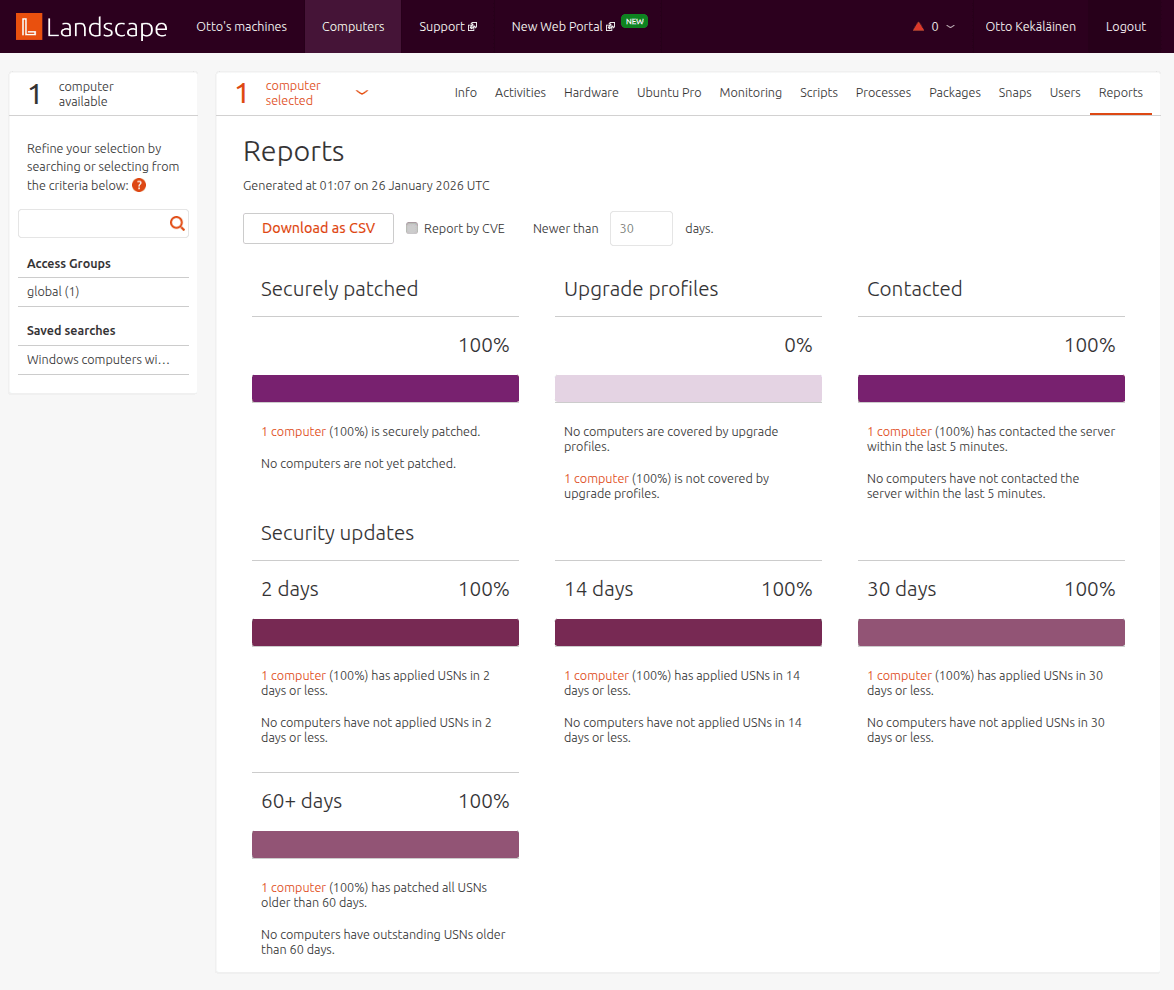
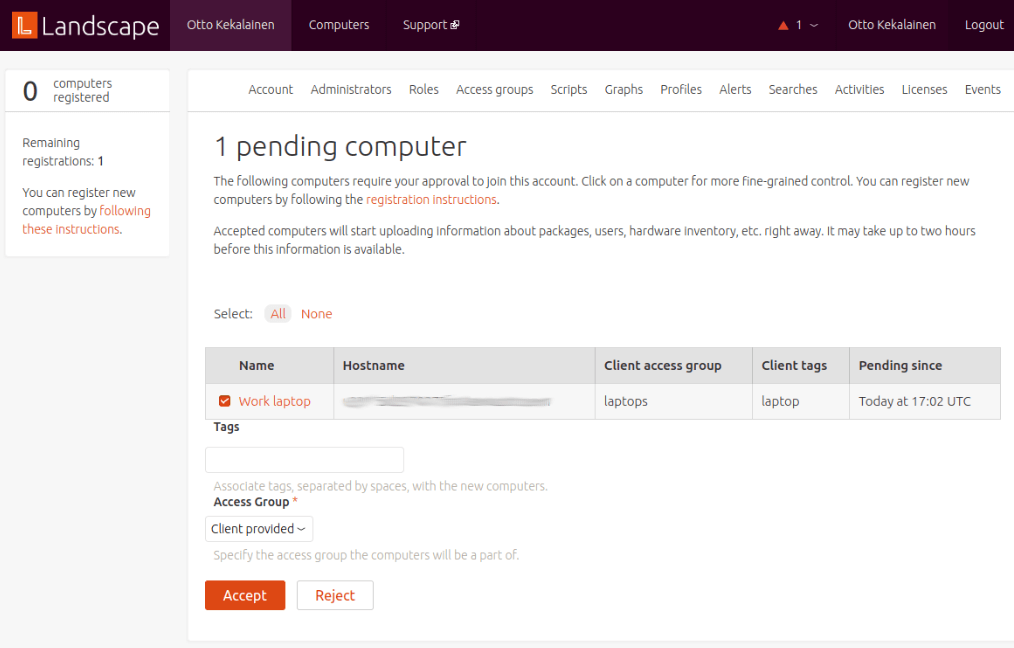
Using Landscape to manage multiple Ubuntu laptops Landscape portal reports showing security update status and resource utilization Landscape.canonical.com is a fleet management system that shows information like security update status and resource utilization for the computers you administer. Ubuntu Pro attached systems under one s account are not automatically visible in Landscape, but have to be enrolled in it. To enroll an Ubuntu Pro attached desktop/laptop to Landscape, first install the required package with sudo apt install landscape-client and then run sudo landscape-config --account-name <account name> to start the configuration wizard. You can find your account name in the Landscape portal. On the last wizard question Request a new registration for this computer now? [y/N] hit y to accept. If successful, the new computer will be visible on the Landscape portal page Pending computers , from where you can click to accept it. Landscape portal page showing pending computer registration If I had a large fleet of computers, Landscape might come in useful. Also it is obvious Landscape is intended primarily for managing server systems. For example, the default alarm trigger on systems being offline, which is common for laptops and desktop computers, is an alert-worthy thing only on server systems. It is good to know that Landscape exists, but on desktop systems I would probably skip it, and only stick to the security updates offered by Ubuntu Pro without using Landscape.

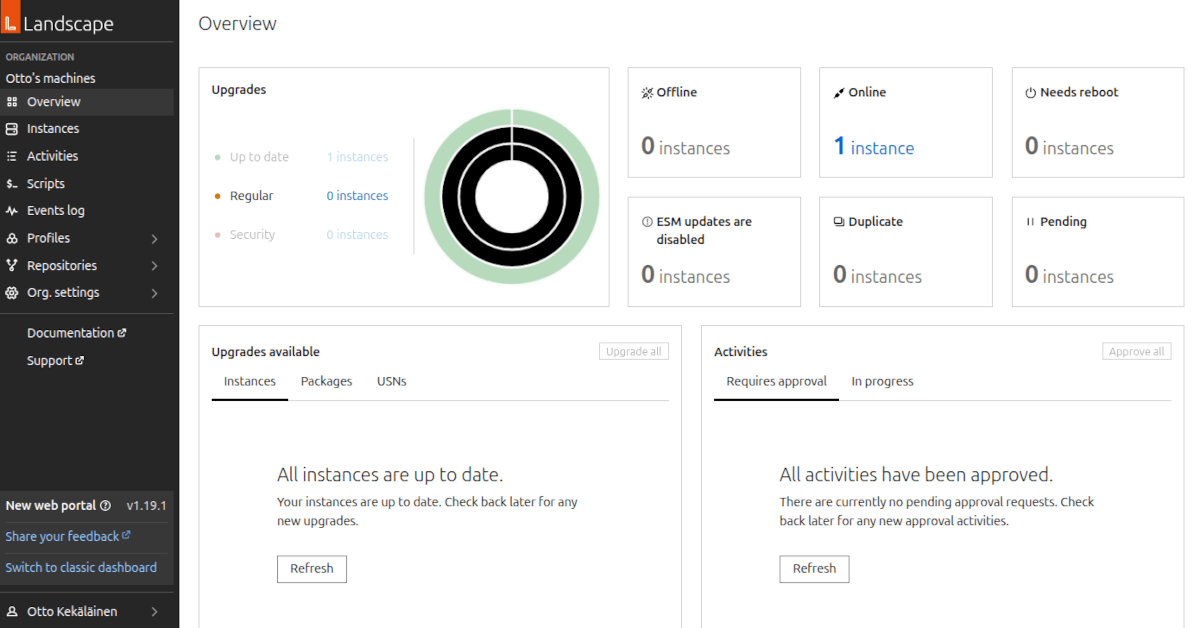
Landscape is evolving The screenshots above are from the current Landscape portal which I have been using so far. Recently Canonical has also launched a new web portal, with a fresh look: New Landscape dashboard with fresh look This shows Canonical is actively investing in the service and it is likely going to sit at the center of their business model for years to come.

Other offerings by Canonical for individual users Canonical, the company behind the world s most popular desktop Linux distribution Ubuntu, has been offering various commercial support services for corporate customers since the company launched back in 2005, but there haven t been any offerings available to individual users since Ubuntu One, with file syncing, a music store and more, was wound down back in 2014. Canonical and the other major Linux companies, Red Hat and SUSE, have always been very enterprise-oriented, presumably because achieving economies of scale is much easier when maintaining standardized corporate environments compared to dealing with a wide range of custom configurations that individual consumer customers might have. I remember some years ago Canonical offered desktop support under the Ubuntu Advantage product name, but the minimum subscription was for 5 desktop systems, which typically isn t an option for a regular home consumer. I am glad to see Ubuntu Pro is now available and I honestly hope people using Ubuntu will opt into it. The more customers it has, the more it incentivizes Canonical to develop and maintain features that are important for desktop and home users.

Pay for Linux because you can, not because you have to Open source is a great software development model for rapid innovation and adoption, but I don t think the business models in the space are yet quite mature. Users who get long-term value should participate more in funding open source maintenance work. While some donation platforms like GitHub Sponsors, OpenCollective and the like have gained popularity in recent years, none of them seem to generate recurring revenue comparable to the scale of how popular open source software is now in 2026. I welcome more paid schemes, such as Ubuntu Pro, as I believe it is beneficial for the whole ecosystem. I also expect more service providers to enter this space and experiment with different open source business models and various forms of decentralized funding. Linux and open source are primarily free as in speech, but as a side effect license fees are hard to enforce and many use Linux without paying for it. The more people, corporations and even countries rely on it to stay sovereign in the information society, the more users should think about how they want to use Linux and who they want to pay to maintain it and other critical parts of the open source ecosystem.

19 January 2026

Isoken Ibizugbe: Mid-Point Project Progress

Halfway There

Hurray!  I have officially reached the 6-week mark, the halfway point of my Outreachy internship. The time has flown by incredibly fast, yet it feels short because there is still so much exciting work to do.

I remember starting this journey feeling overwhelmed, trying to gain momentum. Today, I feel much more confident. I began with the apps_startstop task during the contribution period, writing manual test steps and creating preparation Perl scripts for the desktop environments. Since then, I ve transitioned into full automation and taken a liking to reading openQA upstream documentation when I have issues or for reference.

In all of this, I ve committed over 30 hours a week to the project. This dedicated time has allowed me to look in-depth into the Debian ecosystem and automated quality assurance.

The Original Roadmap vs. Reality

Reviewing my 12-week goal, which included extending automated tests for live image testing, installer testing, and documentation, I am happy to report that I am right on track. My work on desktop apps tests has directly improved the quality of both the Live Images and the netinst (network installer) ISOs.

Accomplishments

I have successfully extended the apps_startstop tests for two Desktop Environments (DEs): Cinnamon and LXQt. These tests ensure that common and DE specific apps launch and close correctly across different environments.

  • Merged Milestone: My Cinnamon tests have been officially merged into the upstream repository! [MR !84]
  • LXQt & Adaptability: I am in the final stages of the LXQt tests. Interestingly, I had to update these tests mid-way through because of a version update in the DE. This required me to update the needles (image references) to match the new UI, a great lesson in software maintenance.

Solving for Synergy

One of my favorite challenges was suggested by my mentor, Roland: synergizing the tests to reduce redundancy. I observed that some applications (like Firefox and LibreOffice) behave identically across different desktops. Instead of duplicating Perl scripts/code for every single DE, I used symbolic links. This allows the use of the same Perl script and possibly the same needles, making the test suite lighter and much easier to maintain.

The Contributor Guide

During the contribution phase, I noticed how rigid the documentation and coding style requirements are. While this ensures high standards and uniformity, it can be intimidating for newcomers and time-consuming for reviewers.

To help, I created a contributor guide [MR !97]. This guide addresses the project s writing style. My goal is to reduce the back-and-forth during reviews, making the process more efficient for everyone and helping new contributors.

Looking Forward

For the second half of the internship, I plan to:

  1. Assist others: Help new contributors extend apps start-stop tests to even more desktop environments.
  2. Explore new coverage: Move beyond start-stop tests into deeper functional testing.

This journey has been an amazing experience of learning and connecting with the wider open-source community, especially Debian Women and the Linux QA team.

I am deeply grateful to my mentors, Tassia Camoes Araujo, Roland Clobus, and Philip Hands, for their constant guidance and for believing in my ability to take on this project.

Here s to the next 6 weeks

Hellen Chemtai: Internship Highlights at Outreachy: My Journey with Debian OpenQA

Highlights

Hello world  . I am an intern here at Outreachy working with Debian OpenQA Image testing team. The work consists of testing Images with OpenQA. The internship has reached midpoint and here are some of the highlights that I have had so far.

  1. The mentors : Roland Clobus, Tassia Camoes and Philip Hands are very good mentors. I like the constant communication and the help I get while working on the project. I enjoy working with this team.
  2. The community : The contributors, mentors and the greater SUSE OpenQA community are constantly in communication. I learn a lot from these meetings.
  3. The women network : The women of Debian meet and network . The meetings are interactive and we are encouraged to interact.
  4. The project : We are making progress one step at a time. Isoken Ibizugbe is my fellow intern working on start-stop tests. I am working on live installers tests.

Communication

I have learned a lot during my internship. I have always been on the silent path of life with little communication. I once told myself being a developer would hide me behind a computer to avoid socializing. Being in open source especially this internship has helped me out with communication and networking. The team work in the project has helped me a lot

  1. My mentors encourage communication. Giving project updates and stating when we get stuck.
  2. My mentors have scheduled weekly meetings to communicate about the project
  3. We are constantly invited to the SUSE meetings by mentors or by Sam Thursfield who is part of the team.
  4. Female contributors are encouraged to join Debian women monthly meetings for networking

Lessons so far

I have had challenges , solved problems and learned new skills all this while

  1. I have learned Perl, OpenQA configuration, needle editing and improved my Linux and Git skills
  2. I have known how various Images are installed , booted and run through live viewing of tests
  3. I have solved many test errors and learned to work with applications that are needed in the OS installations. e.g. rufus
  4. I have learned how virtual machines work and how to solve errors in regards to them

So far so good. I am grateful to be a contributor towards the project and hope to continue learning.

Jonathan Dowland: FOSDEM 2026

I'm going to FOSDEM 2026! I'm presenting in the Containers dev room. My talk is Java Memory Management in Containers and it's scheduled as the first talk on the first day. I'm the warm-up act! The Java devroom has been a stalwart at FOSDEM since 2004 (sometimes in other forms), but sadly there's no Java devroom this year. There's a story about that, but it's not mine to tell. Please recommend to me any interesting talks! Here's a few that caught my eye: Debian/related: Containers: Research: Other:

Vincent Bernat: RAID 5 with mixed-capacity disks on Linux

Standard RAID solutions waste space when disks have different sizes. Linux software RAID with LVM uses the full capacity of each disk and lets you grow storage by replacing one or two disks at a time.1 We start with four disks of equal size:
$ lsblk -Mo NAME,TYPE,SIZE
NAME TYPE  SIZE
vda  disk  101M
vdb  disk  101M
vdc  disk  101M
vdd  disk  101M
We create one partition on each of them:
$ sgdisk --zap-all --new=0:0:0 -t 0:fd00 /dev/vda
$ sgdisk --zap-all --new=0:0:0 -t 0:fd00 /dev/vdb
$ sgdisk --zap-all --new=0:0:0 -t 0:fd00 /dev/vdc
$ sgdisk --zap-all --new=0:0:0 -t 0:fd00 /dev/vdd
$ lsblk -Mo NAME,TYPE,SIZE
NAME   TYPE  SIZE
vda    disk  101M
 vda1 part  100M
vdb    disk  101M
 vdb1 part  100M
vdc    disk  101M
 vdc1 part  100M
vdd    disk  101M
 vdd1 part  100M
We set up a RAID 5 device by assembling the four partitions:2
$ mdadm --create /dev/md0 --level=raid5 --bitmap=internal --raid-devices=4 \
>   /dev/vda1 /dev/vdb1 /dev/vdc1 /dev/vdd1
$ lsblk -Mo NAME,TYPE,SIZE
    NAME          TYPE    SIZE
    vda           disk    101M
   vda1        part    100M
    vdb           disk    101M
   vdb1        part    100M
    vdc           disk    101M
   vdc1        part    100M
    vdd           disk    101M
   vdd1        part    100M
  md0           raid5 292.5M
$ cat /proc/mdstat
md0 : active raid5 vdd1[4] vdc1[2] vdb1[1] vda1[0]
      299520 blocks super 1.2 level 5, 512k chunk, algorithm 2 [4/4] [UUUU]
      bitmap: 0/1 pages [0KB], 65536KB chunk
We use LVM to create logical volumes on top of the RAID 5 device.
$ pvcreate /dev/md0
  Physical volume "/dev/md0" successfully created.
$ vgcreate data /dev/md0
  Volume group "data" successfully created
$ lvcreate -L 100m -n bits data
  Logical volume "bits" created.
$ lvcreate -L 100m -n pieces data
  Logical volume "pieces" created.
$ mkfs.ext4 -q /dev/data/bits
$ mkfs.ext4 -q /dev/data/pieces
$ lsblk -Mo NAME,TYPE,SIZE
    NAME          TYPE    SIZE
    vda           disk    101M
   vda1        part    100M
    vdb           disk    101M
   vdb1        part    100M
    vdc           disk    101M
   vdc1        part    100M
    vdd           disk    101M
   vdd1        part    100M
  md0           raid5 292.5M
     data-bits   lvm     100M
     data-pieces lvm     100M
$ vgs
  VG   #PV #LV #SN Attr   VSize   VFree
  data   1   2   0 wz--n- 288.00m 88.00m
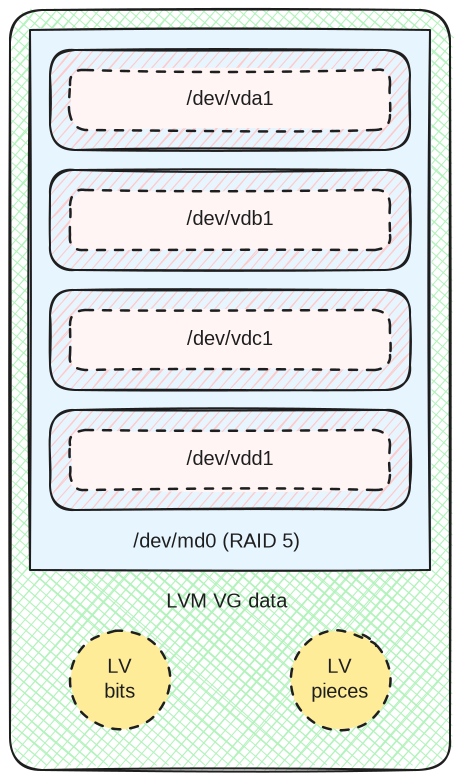
This gives us the following setup:
One RAID 5 device built from four partitions from four disks of equal capacity. The RAID device is part of an LVM volume group with two logical volumes.
RAID 5 setup with disks of equal capacity
We replace /dev/vda with a bigger disk. We add it back to the RAID 5 array after copying the partitions from /dev/vdb:
$ cat /proc/mdstat
md0 : active (auto-read-only) raid5 vdb1[1] vdd1[4] vdc1[2]
      299520 blocks super 1.2 level 5, 512k chunk, algorithm 2 [4/3] [_UUU]
      bitmap: 0/1 pages [0KB], 65536KB chunk
$ sgdisk --replicate=/dev/vda /dev/vdb
$ sgdisk --randomize-guids /dev/vda
$ mdadm --manage /dev/md0 --add /dev/vda1
$ cat /proc/mdstat
md0 : active raid5 vda1[5] vdb1[1] vdd1[4] vdc1[2]
      299520 blocks super 1.2 level 5, 512k chunk, algorithm 2 [4/4] [UUUU]
      bitmap: 0/1 pages [0KB], 65536KB chunk
We do not use the additional capacity: this setup would not survive the loss of /dev/vda because we have no spare capacity. We need a second disk replacement, like /dev/vdb:
$ cat /proc/mdstat
md0 : active (auto-read-only) raid5 vda1[5] vdd1[4] vdc1[2]
      299520 blocks super 1.2 level 5, 512k chunk, algorithm 2 [4/3] [U_UU]
      bitmap: 0/1 pages [0KB], 65536KB chunk
$ sgdisk --replicate=/dev/vdb /dev/vdc
$ sgdisk --randomize-guids /dev/vdb
$ mdadm --manage /dev/md0 --add /dev/vdb1
$ cat /proc/mdstat
md0 : active raid5 vdb1[6] vda1[5] vdd1[4] vdc1[2]
      299520 blocks super 1.2 level 5, 512k chunk, algorithm 2 [4/4] [UUUU]
      bitmap: 0/1 pages [0KB], 65536KB chunk
We create a new RAID 1 array by using the free space on /dev/vda and /dev/vdb:
$ sgdisk --new=0:0:0 -t 0:fd00 /dev/vda
$ sgdisk --new=0:0:0 -t 0:fd00 /dev/vdb
$ mdadm --create /dev/md1 --level=raid1 --bitmap=internal --raid-devices=2 \
>   /dev/vda2 /dev/vdb2
$ cat /proc/mdstat
md1 : active raid1 vdb2[1] vda2[0]
      101312 blocks super 1.2 [2/2] [UU]
      bitmap: 0/1 pages [0KB], 65536KB chunk
md0 : active raid5 vdb1[6] vda1[5] vdd1[4] vdc1[2]
      299520 blocks super 1.2 level 5, 512k chunk, algorithm 2 [4/4] [UUUU]
      bitmap: 0/1 pages [0KB], 65536KB chunk
We add /dev/md1 to the volume group:
$ pvcreate /dev/md1
  Physical volume "/dev/md1" successfully created.
$ vgextend data /dev/md1
  Volume group "data" successfully extended
$ vgs
  VG   #PV #LV #SN Attr   VSize   VFree
  data   2   2   0 wz--n- 384.00m 184.00m
$  lsblk -Mo NAME,TYPE,SIZE
       NAME          TYPE    SIZE
       vda           disk    201M
      vda1        part    100M
     vda2        part    100M
       vdb           disk    201M
      vdb1        part    100M
     vdb2        part    100M
  md1           raid1  98.9M
       vdc           disk    101M
      vdc1        part    100M
       vdd           disk    101M
      vdd1        part    100M
     md0           raid5 292.5M
        data-bits   lvm     100M
        data-pieces lvm     100M
This gives us the following setup:3
One RAID 5 device built from four partitions and one RAID 1 device built from two partitions. The two last disks are smaller. The two RAID devices are part of a single LVM volume group.
Setup mixing both RAID 1 and RAID 5
We extend our capacity further by replacing /dev/vdc:
$ cat /proc/mdstat
md1 : active (auto-read-only) raid1 vda2[0] vdb2[1]
      101312 blocks super 1.2 [2/2] [UU]
      bitmap: 0/1 pages [0KB], 65536KB chunk
md0 : active (auto-read-only) raid5 vda1[5] vdd1[4] vdb1[6]
      299520 blocks super 1.2 level 5, 512k chunk, algorithm 2 [4/3] [UU_U]
      bitmap: 0/1 pages [0KB], 65536KB chunk
$ sgdisk --replicate=/dev/vdc /dev/vdb
$ sgdisk --randomize-guids /dev/vdc
$ mdadm --manage /dev/md0 --add /dev/vdc1
$ cat /proc/mdstat
md1 : active (auto-read-only) raid1 vda2[0] vdb2[1]
      101312 blocks super 1.2 [2/2] [UU]
      bitmap: 0/1 pages [0KB], 65536KB chunk
md0 : active raid5 vdc1[7] vda1[5] vdd1[4] vdb1[6]
      299520 blocks super 1.2 level 5, 512k chunk, algorithm 2 [4/4] [UUUU]
      bitmap: 0/1 pages [0KB], 65536KB chunk
Then, we convert /dev/md1 from RAID 1 to RAID 5:
$ mdadm --grow /dev/md1 --level=5 --raid-devices=3 --add /dev/vdc2
mdadm: level of /dev/md1 changed to raid5
mdadm: added /dev/vdc2
$ cat /proc/mdstat
md1 : active raid5 vdc2[2] vda2[0] vdb2[1]
      202624 blocks super 1.2 level 5, 64k chunk, algorithm 2 [3/3] [UUU]
      bitmap: 0/1 pages [0KB], 65536KB chunk
md0 : active raid5 vdc1[7] vda1[5] vdd1[4] vdb1[6]
      299520 blocks super 1.2 level 5, 512k chunk, algorithm 2 [4/4] [UUUU]
      bitmap: 0/1 pages [0KB], 65536KB chunk
$ pvresize /dev/md1
$ vgs
  VG   #PV #LV #SN Attr   VSize   VFree
  data   2   2   0 wz--n- 482.00m 282.00m
This gives us the following layout:
Two RAID 5 devices built from four disks of different sizes. The last disk is smaller and contains only one partition, while the others have two partitions: one for /dev/md0 and one for /dev/md1. The two RAID devices are part of a single LVM volume group.
RAID 5 setup with mixed-capacity disks using partitions and LVM
We further extend our capacity by replacing /dev/vdd:
$ cat /proc/mdstat
md0 : active (auto-read-only) raid5 vda1[5] vdc1[7] vdb1[6]
      299520 blocks super 1.2 level 5, 512k chunk, algorithm 2 [4/3] [UUU_]
      bitmap: 0/1 pages [0KB], 65536KB chunk
md1 : active (auto-read-only) raid5 vda2[0] vdc2[2] vdb2[1]
      202624 blocks super 1.2 level 5, 64k chunk, algorithm 2 [3/3] [UUU]
      bitmap: 0/1 pages [0KB], 65536KB chunk
$ sgdisk --replicate=/dev/vdd /dev/vdc
$ sgdisk --randomize-guids /dev/vdd
$ mdadm --manage /dev/md0 --add /dev/vdd1
$ cat /proc/mdstat
md0 : active raid5 vdd1[4] vda1[5] vdc1[7] vdb1[6]
      299520 blocks super 1.2 level 5, 512k chunk, algorithm 2 [4/4] [UUUU]
      bitmap: 0/1 pages [0KB], 65536KB chunk
md1 : active (auto-read-only) raid5 vda2[0] vdc2[2] vdb2[1]
      202624 blocks super 1.2 level 5, 64k chunk, algorithm 2 [3/3] [UUU]
      bitmap: 0/1 pages [0KB], 65536KB chunk
We grow the second RAID 5 array:
$ mdadm --grow /dev/md1 --raid-devices=4 --add /dev/vdd2
mdadm: added /dev/vdd2
$ cat /proc/mdstat
md0 : active raid5 vdd1[4] vda1[5] vdc1[7] vdb1[6]
      299520 blocks super 1.2 level 5, 512k chunk, algorithm 2 [4/4] [UUUU]
      bitmap: 0/1 pages [0KB], 65536KB chunk
md1 : active raid5 vdd2[3] vda2[0] vdc2[2] vdb2[1]
      303936 blocks super 1.2 level 5, 64k chunk, algorithm 2 [4/4] [UUUU]
      bitmap: 0/1 pages [0KB], 65536KB chunk
$ pvresize /dev/md1
$ vgs
  VG   #PV #LV #SN Attr   VSize   VFree
  data   2   2   0 wz--n- 580.00m 380.00m
$ lsblk -Mo NAME,TYPE,SIZE
       NAME          TYPE    SIZE
       vda           disk    201M
      vda1        part    100M
     vda2        part    100M
       vdb           disk    201M
      vdb1        part    100M
     vdb2        part    100M
       vdc           disk    201M
      vdc1        part    100M
     vdc2        part    100M
       vdd           disk    301M
      vdd1        part    100M
      vdd2        part    100M
     md0           raid5 292.5M
        data-bits   lvm     100M
        data-pieces lvm     100M
  md1           raid5 296.8M
You can continue by replacing each disk one by one using the same steps.

  1. This is the same approach Synology uses for its Hybrid RAID and what the OpenMediaVault community calls a Sliced Hybrid RAID.
  2. Write-intent bitmaps speed up recovery of the RAID array after a power failure by marking unsynchronized regions as dirty. They have an impact on performance, but I did not measure it myself. An alternative is to use a partial parity log with --consistency-policy=ppl.
  3. In the lsblk output, /dev/md1 appears unused because the logical volumes do not use any space from it yet. Once you create more logical volumes or extend them, lsblk will reflect the usage.

Dima Kogan: mrcal 2.5 released!

mrcal 2.5 is out: the release notes. Once again, this is mostly a bug-fix release en route to the big new features coming in 3.0. One cool thing is that these tools have now matured enough to no longer be considered experimental. They have been used with great success in lots of contexts across many different projects and organizations. Some highlights: Some of the above is new, and not yet fully polished and documented and tested, but it works. In mrcal 2.5, most of the implementation of some new big features is written and committed, but it's still incomplete. The new stuff is there, but is lightly tested and documented. This will be completed eventually in mrcal 3.0: mrcal is quite good already, and will be even better in the future. Try it today!

17 January 2026

Simon Josefsson: Backup of S3 Objects Using rsnapshot

I ve been using rsnapshot to take backups of around 10 servers and laptops for well over 15 years, and it is a remarkably reliable tool that has proven itself many times. Rsnapshot uses rsync over SSH and maintains a temporal hard-link file pool. Once rsnapshot is configured and running, on the backup server, you get a hardlink farm with directories like this for the remote server:
/backup/serverA.domain/.sync/foo
/backup/serverA.domain/daily.0/foo
/backup/serverA.domain/daily.1/foo
/backup/serverA.domain/daily.2/foo
...
/backup/serverA.domain/daily.6/foo
/backup/serverA.domain/weekly.0/foo
/backup/serverA.domain/weekly.1/foo
...
/backup/serverA.domain/monthly.0/foo
/backup/serverA.domain/monthly.1/foo
...
/backup/serverA.domain/yearly.0/foo
I can browse and rescue files easily, going back in time when needed. The rsnapshot project README explains more, there is a long rsnapshot HOWTO although I usually find the rsnapshot man page the easiest to digest. I have stored multi-TB Git-LFS data on GitLab.com for some time. The yearly renewal is coming up, and the price for Git-LFS storage on GitLab.com is now excessive (~$10.000/year). I have reworked my work-flow and finally migrated debdistget to only store Git-LFS stubs on GitLab.com and push the real files to S3 object storage. The cost for this is barely measurable, I have yet to run into the 25/month warning threshold. But how do you backup stuff stored in S3? For some time, my S3 backup solution has been to run the minio-client mirror command to download all S3 objects to my laptop, and rely on rsnapshot to keep backups of this. While 4TB NVME s are relatively cheap, I ve felt that this disk and network churn on my laptop is unsatisfactory for quite some time. What is a better approach? I find S3 hosting sites fairly unreliable by design. Only a couple of clicks in your web browser and you have dropped 100TB of data. Or by someone else who steal your plaintext-equivalent cookie. Thus, I haven t really felt comfortable using any S3-based backup option. I prefer to self-host, although continously running a mirror job is not sufficient: if I accidentally drop the entire S3 object store, my mirror run will remove all files locally too. The rsnapshot approach that allows going back in time and having data on self-managed servers feels superior to me. What if we could use rsnapshot with a S3 client instead of rsync? Someone else asked about this several years ago, and the suggestion was to use the fuse-based s3fs which sounded unreliable to me. After some experimentation, working around some hard-coded assumption in the rsnapshot implementation, I came up with a small configuration pattern and a wrapper tool to implement what I desired. Here is my configuration snippet:
cmd_rsync    /backup/s3/s3rsync
rsync_short_args    -Q
rsync_long_args    --json --remove
lockfile    /backup/s3/rsnapshot.pid
snapshot_root    /backup/s3
backup    s3:://hetzner/debdistget-gnuinos    ./debdistget-gnuinos
backup    s3:://hetzner/debdistget-tacos  ./debdistget-tacos
backup    s3:://hetzner/debdistget-diffos ./debdistget-diffos
backup    s3:://hetzner/debdistget-pureos ./debdistget-pureos
backup    s3:://hetzner/debdistget-kali   ./debdistget-kali
backup    s3:://hetzner/debdistget-devuan ./debdistget-devuan
backup    s3:://hetzner/debdistget-trisquel   ./debdistget-trisquel
backup    s3:://hetzner/debdistget-debian ./debdistget-debian
The idea is to save a backup of a couple of S3 buckets under /backup/s3/. I have some scripts that take a complete rsnapshot.conf file and append my per-directory configuration so that this becomes a complete configuration. If you are curious how I roll this, backup-all invokes backup-one appending my rsnapshot.conf template with the snippet above. The s3rsync wrapper script is the essential hack to convert rsnapshot s rsync parameters into something that talks S3 and the script is as follows:
#!/bin/sh
set -eu
S3ARG=
for ARG in "$@"; do
    case $ARG in
    s3:://*) S3ARG="$S3ARG "$(echo $ARG   sed -e 's,s3:://,,');;
    -Q*) ;;
    *) S3ARG="$S3ARG $ARG";;
    esac
done
echo /backup/s3/mc mirror $S3ARG
exec /backup/s3/mc mirror $S3ARG
It uses the minio-client tool. I first tried s3cmd but its sync command read all files to compute MD5 checksums every time you invoke it, which is very slow. The mc mirror command is blazingly fast since it only compare mtime s, just like rsync or git. First you need to store credentials for your S3 bucket. These are stored in plaintext in ~/.mc/config.json which I find to be sloppy security practices, but I don t know of any better way to do this. Replace AKEY and SKEY with your access token and secret token from your S3 provider:
/backup/s3/mc alias set hetzner AKEY SKEY
If I invoke a sync job for a fully synced up directory the output looks like this:
root@hamster /backup# /run/current-system/profile/bin/rsnapshot -c /backup/s3/rsnapshot.conf -V sync
Setting locale to POSIX "C"
echo 1443 > /backup/s3/rsnapshot.pid 
/backup/s3/s3rsync -Qv --json --remove s3:://hetzner/debdistget-gnuinos \
    /backup/s3/.sync//debdistget-gnuinos 
/backup/s3/mc mirror --json --remove hetzner/debdistget-gnuinos /backup/s3/.sync//debdistget-gnuinos
 "status":"success","total":0,"transferred":0,"duration":0,"speed":0 
/backup/s3/s3rsync -Qv --json --remove s3:://hetzner/debdistget-tacos \
    /backup/s3/.sync//debdistget-tacos 
/backup/s3/mc mirror --json --remove hetzner/debdistget-tacos /backup/s3/.sync//debdistget-tacos
 "status":"success","total":0,"transferred":0,"duration":0,"speed":0 
/backup/s3/s3rsync -Qv --json --remove s3:://hetzner/debdistget-diffos \
    /backup/s3/.sync//debdistget-diffos 
/backup/s3/mc mirror --json --remove hetzner/debdistget-diffos /backup/s3/.sync//debdistget-diffos
 "status":"success","total":0,"transferred":0,"duration":0,"speed":0 
/backup/s3/s3rsync -Qv --json --remove s3:://hetzner/debdistget-pureos \
    /backup/s3/.sync//debdistget-pureos 
/backup/s3/mc mirror --json --remove hetzner/debdistget-pureos /backup/s3/.sync//debdistget-pureos
 "status":"success","total":0,"transferred":0,"duration":0,"speed":0 
/backup/s3/s3rsync -Qv --json --remove s3:://hetzner/debdistget-kali \
    /backup/s3/.sync//debdistget-kali 
/backup/s3/mc mirror --json --remove hetzner/debdistget-kali /backup/s3/.sync//debdistget-kali
 "status":"success","total":0,"transferred":0,"duration":0,"speed":0 
/backup/s3/s3rsync -Qv --json --remove s3:://hetzner/debdistget-devuan \
    /backup/s3/.sync//debdistget-devuan 
/backup/s3/mc mirror --json --remove hetzner/debdistget-devuan /backup/s3/.sync//debdistget-devuan
 "status":"success","total":0,"transferred":0,"duration":0,"speed":0 
/backup/s3/s3rsync -Qv --json --remove s3:://hetzner/debdistget-trisquel \
    /backup/s3/.sync//debdistget-trisquel 
/backup/s3/mc mirror --json --remove hetzner/debdistget-trisquel /backup/s3/.sync//debdistget-trisquel
 "status":"success","total":0,"transferred":0,"duration":0,"speed":0 
/backup/s3/s3rsync -Qv --json --remove s3:://hetzner/debdistget-debian \
    /backup/s3/.sync//debdistget-debian 
/backup/s3/mc mirror --json --remove hetzner/debdistget-debian /backup/s3/.sync//debdistget-debian
 "status":"success","total":0,"transferred":0,"duration":0,"speed":0 
touch /backup/s3/.sync/ 
rm -f /backup/s3/rsnapshot.pid 
/run/current-system/profile/bin/logger -p user.info -t rsnapshot[1443] \
    /run/current-system/profile/bin/rsnapshot -c /backup/s3/rsnapshot.conf \
    -V sync: completed successfully 
root@hamster /backup# 
You can tell from the paths that this machine runs Guix. This was the first production use of the Guix System for me, and the machine has been running since 2015 (with the occasional new hard drive). Before, I used rsnapshot on Debian, but some stable release of Debian dropped the rsnapshot package, paving the way for me to test Guix in production on a non-Internet exposed machine. Unfortunately, mc is not packaged in Guix, so you will have to install it from the MinIO Client GitHub page manually. Running the daily rotation looks like this:
root@hamster /backup# /run/current-system/profile/bin/rsnapshot -c /backup/s3/rsnapshot.conf -V daily
Setting locale to POSIX "C"
echo 1549 > /backup/s3/rsnapshot.pid 
mv /backup/s3/daily.5/ /backup/s3/daily.6/ 
mv /backup/s3/daily.4/ /backup/s3/daily.5/ 
mv /backup/s3/daily.3/ /backup/s3/daily.4/ 
mv /backup/s3/daily.2/ /backup/s3/daily.3/ 
mv /backup/s3/daily.1/ /backup/s3/daily.2/ 
mv /backup/s3/daily.0/ /backup/s3/daily.1/ 
/run/current-system/profile/bin/cp -al /backup/s3/.sync /backup/s3/daily.0 
rm -f /backup/s3/rsnapshot.pid 
/run/current-system/profile/bin/logger -p user.info -t rsnapshot[1549] \
    /run/current-system/profile/bin/rsnapshot -c /backup/s3/rsnapshot.conf \
    -V daily: completed successfully 
root@hamster /backup# 
Hopefully you will feel inspired to take backups of your S3 buckets now!

16 January 2026

Freexian Collaborators: Monthly report about Debian Long Term Support, December 2025 (by Santiago Ruano Rinc n)

The Debian LTS Team, funded by [Freexian s Debian LTS offering] (https://www.freexian.com/lts/debian/), is pleased to report its activities for December.

Activity summary During the month of December, 18 contributors have been paid to work on Debian LTS (links to individual contributor reports are located below). The team released 41 DLAs fixing 252 CVEs. The team currently focuses on preparing security updates for Debian 11 bullseye , but also looks for contributing with updates for Debian 12 bookworm , Debian 13 trixie and even Debian unstable. Notable security updates:
  • libsoup2.4 (DLA-4398-1), prepared by Andreas Henrikson, fixing several vulnerabilities.
  • glib2.0 (DLA-4412-1), published by Emilio Pozuelo Monfort, addressing multiple issues.
  • lasso (DLA-4397-1), prepared by Sylvain Beucler, addressing multiple issues, including a critical remote code execution (RCE) vulnerability (CVE-2025-47151)
  • roundcube (DLA 4415-1), prepared by Guilhem Moulin, fixing a cross-site-scripting (XSS) (CVE-2025-68461) and an information disclosure (CVE-2025-68460) vulnerabilities
  • mediawiki (DLA 4428-1), published by Guilhem, fixing multiple vulnerabilities could lead to information disclosure, denial of service or privilege escalation.
  • While the DLA has not been published yet, Charles Henrique Melara proposed upstream fixes for seven CVEs in ffmpeg: https://code.ffmpeg.org/FFmpeg/FFmpeg/pulls/21275.
  • python-apt (DLA 4408-1), prepared by Utkarsh Gupta, in coordination with the Debian Security Team and Julian Andres Klode, the apt s maintainer.
  • libpng1.6 (DLA-4396-1), published by Tobias Frost, completing the work started the previous month.
Notable non-security updates:
  • tzdata (DLA-4403-1), prepared by Emilio, including the latest changes to the leap second list and its expiry date, which was set for the end of December.
Contributions from outside the LTS Team:
  • Christoph Berg, co-maintainer of PostgreSQL in Debian, prepared a postgresql-13 update, released as DLA-4420-1
The LTS Team has also contributed with updates to the latest Debian releases:

Individual Debian LTS contributor reports

Thanks to our sponsors Sponsors that joined recently are in bold.

14 January 2026

Gunnar Wolf: The Innovation Engine Government-funded Academic Research

This post is an unpublished review for The Innovation Engine Government-funded Academic Research
David Patterson does not need an introduction. Being the brain behind many of the inventions that shaped the computing industry (repeatedly) over the past 40 years, when he put forward an opinion article in Communications of the ACM targeting the current day political waves in the USA, I could not avoid choosing it to write this review. Patterson worked for a a public university (University of California at Berkeley) between 1976 and 2016, and in this article he argues how government-funded academic research (GoFAR) allows for faster, more effective and freer development than private sector-funded research would, putting his own career milestones as an example of how public money that went to his research has easily been amplified by a factor of 10,000:1 for the country s economy, and 1,000:1 particularly for the government. Patterson illustrates this quoting five of the home-run research projects he started and pursued with government funding, eventually spinning them off as successful startups: Patterson identifies principles for the projects he has led, that are specially compatible with the ways research works at universitary systems: Multidisciplinary teams, demonstrative usable artifacts, seven- to ten-year impact horizons, five-year sunset clauses (to create urgency and to lower opportunity costs), physical proximity of collaborators, and leadership followed on team success rather than individual recognition. While it could be argued that it s easy to point at Patterson s work as a success example while he is by far not the average academic, the points he makes on how GoFAR research has been fundamental for the advance of science and technology, but also of biology, medicine, and several other fields are very clear.

13 January 2026

Simon Josefsson: Debian Libre Live 13.3.0 is released!

Following up on my initial announcement about Debian Libre Live I am happy to report on continued progress and the release of Debian Libre Live version 13.3.0. Since both this and the previous 13.2.0 release are based on the stable Debian trixie release, there really isn t a lot of major changes but instead incremental minor progress for the installation process. Repeated installations has a tendency to reveal bugs, and we have resolved the apt sources list confusion for Calamares-based installations and a couple of other nits. This release is more polished and we are not aware of any known remaining issues with them (unlike for earlier versions which were released with known problems), although we conservatively regard the project as still in beta. A Debian Libre Live logo is needed before marking this as stable, any graphically talented takers? (Please base it on the Debian SVG upstream logo image.) We provide GNOME, KDE, and XFCE desktop images, as well as text-only standard image, which match the regular Debian Live images with non-free software on them, but also provide a slim variant which is merely 750MB compared to the 1.9GB standard image. The slim image can still start a debian installer, and can still boot into a minimal live text-based system. The GNOME, KDE and XFCE desktop images feature the Calamares installer, and we have performed testing on a variety of machines. The standard and slim images does not have a installer from the running live system, but all images support a boot menu entry to start the installer. With this release we also extend our arm64 support to two tested platforms. The current list of successfully installed and supported systems now include the following hardware: This is a very limited set of machines, but the diversity in CPUs and architecture should hopefully reflect well on a wide variety of commonly available machines. Several of these machines are crippled (usually GPU or WiFI) without adding non-free software, complain at your hardware vendor and adapt your use-cases and future purchases. The images are as follows, with SHA256SUM checksums and GnuPG signature on the 13.3.0 release page. Curious how the images were made? Fear not, for the Debian Libre Live project README has documentation, the run.sh script is short and the .gitlab-ci.yml CI/CD Pipeline definition file brief. Happy Libre OS hacking!

Freexian Collaborators: Debian Contributions: dh-python development, Python 3.14 and Ruby 3.4 transitions, Surviving scraper traffic in Debian CI and more! (by Anupa Ann Joseph)

Debian Contributions: 2025-12 Contributing to Debian is part of Freexian s mission. This article covers the latest achievements of Freexian and their collaborators. All of this is made possible by organizations subscribing to our Long Term Support contracts and consulting services.

dh-python development, by Stefano Rivera In Debian we build our Python packages with the help of a debhelper-compatible tool, dh-python. Before starting the 3.14 transition (that would rebuild many packages) we landed some updates to dh-python to fix bugs and add features. This started a month of attention on dh-python, iterating through several bug fixes, and a couple of unfortunate regressions. dh-python is used by almost all packages containing Python (over 5000). Most of these are very simple, but some are complex and use dh-python in unexpected ways. It s hard to avoid almost any change (including obvious bug fixes) from causing some unexpected knock-on behaviour. There is a fair amount of complexity in dh-python, and some rather clever code, which can make it tricky to work on. All of this means that good QA is important. Stefano spent some time adding type annotations and specialized types to make it easier to see what the code is doing and catch mistakes. This has already made work on dh-python easier. Now that Debusine has built-in repositories and debdiff support, Stefano could quickly test the effects of changes on many other packages. After each big change, he could upload dh-python to a repository, rebuild e.g. 50 Python packages with it, and see what differences appeared in the output. Reviewing the diffs is still a manual process, but can be improved. Stefano did a small test on what it would take to replace direct setuptools setup.py calls with PEP-517 (pyproject-style) builds. There is more work to do here.

Python 3.14 transition, by Stefano Rivera (et al.) In December the transition to add Python 3.14 as a supported version started in Debian unstable. To do this, we update the list of supported versions in python3-defaults, and then start rebuilding modules with C extensions from the leaves inwards. This had already been tested in a PPA and Ubuntu, so many of the biggest blocking compatibility issues with 3.14 had already been found and fixed. But there are always new issues to discover. Thanks to a number of people in the Debian Python team, we got through the first bit of the transition fairly quickly. There are still a number of open bugs that need attention and many failed tests blocking migration to testing. Python 3.14.1 released just after we started the transition, and very soon after, a follow-up 3.14.2 release came out to address a regression. We ran into another regression in Python 3.14.2.

Ruby 3.4 transition, by Lucas Kanashiro (et al.) The Debian Ruby team just started the preparation to move the default Ruby interpreter version to 3.4. At the moment, ruby3.4 source package is already available in experimental, also ruby-defaults added support to Ruby 3.4. Lucas rebuilt all reverse dependencies against this new version of the interpreter and published the results here. Lucas also reached out to some stakeholders to coordinate the work. Next steps are: 1) announcing the results to the whole team and asking for help to fix packages failing to build against the new interpreter; 2) file bugs against packages FTBFSing against Ruby 3.4 which are not fixed yet; 3) once we have a low number of build failures against Ruby 3.4, ask the Debian Release team to start the transition in unstable.

Surviving scraper traffic in Debian CI, by Antonio Terceiro Like most of the open web, Debian Continuous Integration has been struggling for a while to keep up with the insatiable hunger from data scrapers everywhere. Solving this involved a lot of trial and error; the final result seems to be stable, and consists of two parts. First, all Debian CI data pages, except the direct links to test log files (such as those provided by the Release Team s testing migration excuses), now require users to be authenticated before being accessed. This means that the Debian CI data is no longer publicly browseable, which is a bit sad. However, this is where we are now. Additionally, there is now a fail2ban powered firewall-level access limitation for clients that display an abusive access pattern. This went through several iterations, with some of them unfortunately blocking legitimate Debian contributors, but the current state seems to strike a good balance between blocking scrapers and not blocking real users. Please get in touch with the team on the #debci OFTC channel if you are affected by this.

A hybrid dependency solver for crossqa.debian.net, by Helmut Grohne crossqa.debian.net continuously cross builds packages from the Debian archive. Like Debian s native build infrastructure, it uses dose-builddebcheck to determine whether a package s dependencies can be satisfied before attempting a build. About one third of Debian s packages fail this check, so understanding the reasons is key to improving cross building. Unfortunately, dose-builddebcheck stops after reporting the first problem and does not display additional ones. To address this, a greedy solver implemented in Python now examines each build-dependency individually and can report multiple causes. dose-builddebcheck is still used as a fall-back when the greedy solver does not identify any problems. The report for bazel-bootstrap is a lengthy example.

rebootstrap, by Helmut Grohne Due to the changes suggested by Loongson earlier, rebootstrap now adds debhelper to its final installability test and builds a few more packages required for installing it. It also now uses a variant of build-essential that has been marked Multi-Arch: same (see foundational work from last year). This in turn made the use of a non-default GCC version more difficult and required more work to make it work for gcc-16 from experimental. Ongoing archive changes temporarily regressed building fribidi and dash. libselinux and groff have received patches for architecture specific changes and libverto has been NMUed to remove the glib2.0 dependency.

Miscellaneous contributions
  • Stefano did some administrative work on debian.social and debian.net instances and Debian reimbursements.
  • Stefano did routine updates of python-authlib, python-mitogen, xdot.
  • Stefano spent several hours discussing Debian s Python package layout with the PyPA upstream community. Debian has ended up with a very different on-disk installed Python layout than other distributions, and this continues to cause some frustration in many communities that have to have special workarounds to handle it. This ended up impacting cross builds as Helmut discovered.
  • Rapha l set up Debusine workflows for the various backports repositories on debusine.debian.net.
  • Zulip is not yet in Debian (RFP in #800052), but Rapha l helped on the French translation as he is experimenting with that discussion platform.
  • Antonio performed several routine Salsa maintenance tasks, including fixing salsa-nm-sync, the service that synchronizes project members data from LDAP to Salsa, which had been broken since salsa.debian.org was upgraded to trixie .
  • Antonio deployed a new amd64 worker host for Debian CI.
  • Antonio did several DebConf technical and administrative bits, including but adding support for custom check-in/check-out dates in the MiniDebConf registration module, publishing a call for bids for DebConf27.
  • Carles reviewed and submitted 14 Catalan translations using po-debconf-manager.
  • Carles improved po-debconf-manager: added delete-package command, show-information now uses properly formatted output (YAML), it now attaches the translation on the bug reports for which a merge request has been opened too long.
  • Carles investigated why some packages appeared in po-debconf-manager but not in the Debian l10n list. Turns out that some packages had debian/po/templates.pot (appearing in po-debconf-manager) but not the POTFILES.in file as expected. Created a script to find out which packages were in this or similar situation and reported bugs.
  • Carles tested and documented how to set up voices (mbrola and festival) if using Orca speech synthesizer. Commented a few issues and possible improvements in the debian-accessibility list.
  • Helmut sent patches for 48 cross build failures and initiated discussions on how to deal with two non-trivial matters. Besides Python mentioned above, CMake introduced a cmake_pkg_config builtin which is not aware of the host architecture. He also forwarded a Meson patch upstream.
  • Thorsten uploaded a new upstream version of cups to fix a nasty bug that was introduced by the latest security update.
  • Along with many other Python 3.14 fixes, Colin fixed a tricky segfault in python-confluent-kafka after a helpful debugging hint from upstream.
  • Colin upstreamed an improved version of an OpenSSH patch we ve been carrying since 2008 to fix misleading verbose output from scp.
  • Colin used Debusine to coordinate transitions for astroid and pygments, and wrote up the astroid case on his blog.
  • Emilio helped with various transitions, and provided a build fix for opencv for the ffmpeg 8 transition.
  • Emilio tested the GNOME updates for trixie proposed updates (gnome-shell, mutter, glib2.0).
  • Santiago helped to review the status of how to test different build profiles in parallel on the same pipeline, using the test-build-profiles job. This means, for example, to simultaneously test build profiles such as nocheck and nodoc for the same git tree. Finally, Santiago provided MR !685 to fix the documentation.
  • Anupa prepared a bits post for Outreachy interns announcement along with T ssia Cam es Ara jo and worked on publicity team tasks.

9 January 2026

Simon Josefsson: Debian Taco Towards a GitSecDevOps Debian

One of my holiday projects was to understand and gain more trust in how Debian binaries are built, and as the holidays are coming to an end, I d like to introduce a new research project called Debian Taco. I apparently need more holidays, because there are still more work to be done here, so at the end I ll summarize some pending work. Debian Taco, or TacOS, is a GitSecDevOps rebuild of Debian GNU/Linux. The Debian Taco project publish rebuilt binary packages, package repository metadata (InRelease, Packages, etc), container images, cloud images and live images. All packages are built from pristine source packages in the Debian archive. Debian Taco does not modify any Debian source code nor add or remove any packages found in Debian. No servers are involved! Everything is built in GitLab pipelines and results are published through modern GitDevOps mechanism like GitLab Pages and S3 object storage. You can fork the individual projects below on GitLab.com and you will have your own Debian-derived OS available for tweaking. (Of course, at some level, servers are always involved, so this claim is a bit of hyperbole.)

Goals The goal of TacOS is to be bit-by-bit identical with official Debian GNU/Linux, and until that has been completed, publish diffoscope output with differences. The idea is to further categorize all artifact differences into one of the following categories: 1) An obvious bug in Debian. For example, if a package does not build reproducible. 2) An obvious bug in TacOS. For example, if our build environment does not manage to build a package. 3) Something else. This would be input for further research and consideration. This category also include things where it isn t obvious if it is a bug in Debian or in TacOS. Known examples: 3A) Packages in TacOS are rebuilt the latest available source code, not the (potentially) older package that were used to build the Debian packages. This could lead to differences in the packages. These differences may be useful to analyze to identify supply-chain attacks. See some discussion about idempotent rebuilds. Our packages are all built from source code, unless we have not yet managed to build something. In the latter situation, Debian Taco falls back and uses the official Debian artifact. This allows an incremental publication of Debian Taco that still is 100% complete without requiring that everything is rebuilt instantly. The goal is that everything should be rebuilt, and until that has been completed, publish a list of artifacts that we use verbatim from Debian.

Debian Taco Archive The Debian Taco Archive project generate and publish the package archive (dists/tacos-trixie/InRelease, dists/tacos-trixie/main/binary-amd64/Packages.gz, pool/* etc), similar to what is published at https://deb.debian.org/debian/. The output of the Debian Taco Archive is available from https://debdistutils.gitlab.io/tacos/archive/.

Debian Taco Container Images The Debian Taco Container Images project provide container images of Debian Taco for trixie, forky and sid on the amd64, arm64, ppc64el and riscv64 architectures. These images allow quick and simple use of Debian Taco interactively, but makes it easy to deploy for container orchestration frameworks.

Debian Taco Cloud Images The Debian Taco Cloud Images project provide cloud images of Debian Taco for trixie, forky and sid on the amd64, arm64, ppc64el and riscv64 architectures. Launch and install Debian Taco for your cloud environment!

Debian Taco Live Images The Debian Taco Live Images project provide live images of Debian Taco for trixie, forky and sid on the amd64 and arm64 architectures. These images allows running Debian Taco on physical hardware (or virtual machines), and even installation for permanent use.

Debian Taco Build Images and Packages Packages are built using debdistbuild, which was introduced in a blog about Build Debian in a GitLab Pipeline. The first step is to prepare build images, which is done by the Debian Taco Build Images project. They are similar to the Debian Taco containers but have build-essential and debdistbuild installed on them. Debdistbuild is launched in a per-architecture per-suite CI/CD project. Currently only trixie-amd64 is available. That project has built some essential early packages like base-files, debian-archive-keyring and hostname. They are stored in Git LFS backed by a S3 object storage. These packages were all built reproducibly. So this means Debian Taco is still 100% bit-by-bit identical to Debian, except for the renaming. I ve yet to launch a more massive wide-scale package rebuild until some outstanding issues have been resolved. I earlier rebuilt around 7000 packages from Trixie on amd64, so I know that the method easily scales.

Remaining work Where is the diffoscope package outputs and list of package differences? For another holiday! Clearly this is an important remaining work item. Another important outstanding issue is how to orchestrate launching the build of all packages. Clearly a list of packages is needed, and some trigger mechanism to understand when new packages are added to Debian. One goal was to build packages from the tag2upload browse.dgit.debian.org archive, before checking the Debian Archive. This ought to be really simple to implement, but other matters came first.

GitLab or Codeberg? Everything is written using basic POSIX /bin/sh shell scripts. Debian Taco uses the GitLab CI/CD Pipeline mechanism together with a Hetzner S3 object storage to serve packages. The scripts have only weak reliance on GitLab-specific principles, and were designed with the intention to support other platforms. I believe reliance on a particular CI/CD platform is a limitation, so I d like to explore shipping Debian Taco through a Forgejo-based architecture, possibly via Codeberg as soon as I manage to deploy reliable Forgejo runners. The important aspects that are required are: 1) Pipelines that can build and publish web sites similar to GitLab Pages. Codeberg has a pipeline mechanism. I ve successfully used Codeberg Pages to publish the OATH Toolkit homepage homepage. Glueing this together seems feasible. 2) Container Registry. It seems Forgejo supports a Container Registry but I ve not worked with it at Codeberg to understand if there are any limitations. 3) Package Registry. The Deban Taco live images are uploaded into a package registry, because they are too big for being served through GitLab Pages. It may be converted to using a Pages mechanism, or possibly through Release Artifacts if multi-GB artifacts are supported on other platforms. I hope to continue this work and explaining more details in a series of posts, stay tuned!

Next.

Previous.