Search Results: "seb"

21 January 2011

Raphaël Hertzog: People behind Debian: Michael Vogt, synaptic and APT developer

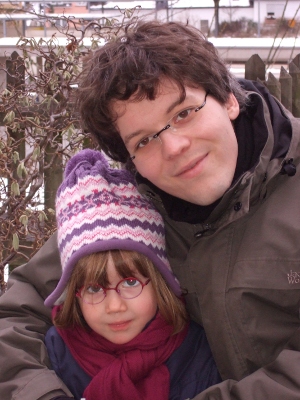
Michael and his daughter Marie

Michael has been around for more than 10 years and has always contributed to the APT software family. He s the author of the first real graphical interface to APT synaptic. Since then he created software-center as part of his work for Ubuntu. Being the most experienced APT developer, he s naturally the coordinator of the APT team. Check out what he has to say about APT s possible evolutions. My questions are in bold, the rest is by Michael. Who are you? My name is Michael Vogt, I m married and have two little daughters. We live in Germany (near to Trier) and I work for Canonical as a software developer. I joined Debian as a developer in early 2000 and started to contribute to Ubuntu in 2004. What s your biggest achievement within Debian or Ubuntu? I can not decide on a single one so I will just be a bit verbose. From the very beginning I was interested in improving the package manager experience and the UI on top for our users. I m proud of the work I did with synaptic. It was one of the earliest UIs on top of apt. Because of my work on synaptic I got into apt development as well and fixed bugs there and added new features. I still do most of the uploads here, but nowadays David Kalnischkies is the most active developer. I also wrote a bunch of tools like gdebi, update-notifier, update-manager, unattended-upgrade and software-properties to make the update/install situation for the user easier to deal with. Most of the tools are written in python so I added a lot of improvements to python-apt along the way, including the initial high level apt interface and a bunch of missing low-level apt_pkg features. Julian Andres Klode made a big push in this area recently and thanks to his effort the bindings are fully complete now and have good documentation. My most recent project is software-center. Its aim is to provide a UI strongly targeted for end-users. The goal of this project is to make finding and installing software easy and beautiful. We have a fantastic collection of software to offer and software-center tries to present it well (including screenshots, instant search results and soon ratings&reviews). This builds on great foundations like aptdaemon by Sebastian Heinlein, screenshots.debian.net by Christoph Haas, ddtp.debian.org by Michael Bramer, apt-xapian-index by Enrico Zini and many others (this is what I love about free software, it usually adds , rarely takes away ). What are your plans for Debian Wheezy? For apt I would love to see a more plugable architecture for the acquire system. It would be nice to be able to make apt-get update (and the frontends that use this from libapt) be able to download additional data (like debtags or additional index file that contains more end-user targeted information). I also want to add some scripts so that apt (optionally) creates btrfs snapshots on upgrade and provide some easy way to rollback in case of problems. There is also some interesting work going on around making the apt problem resolver a more plugable part. This way we should be able to do much faster development. software-center will get ratings&reviews in the upstream branch, I really hope we can get that into Wheezy. If you could spend all your time on Debian, what would you work on? In that case I would start with a refactor of apt to make it more robust about ABI breaks. It would be possible to move much faster once this problem is solved (its not even hard, it just need to be done). Then I would add a more complete testsuite. Another important problem to tackle is to make maintainer scripts more declarative. I triaged a lot of upgrade bug reports (mostly in ubuntu though) and a lot of them are caused by maintainer script failures. Worse is that depending on the error its really hard for the user to solve the problem. There is also a lot of code duplication. Having a central place that contains well tested code to do these jobs would be more robust. Triggers help us a lot here already, but I think there is still more room for improvement. What s the biggest problem of Debian? That s a hard question :) I mostly like Debian the way it is. What frustrated me in the past were flamewars that could have been avoided. To me being respectful to each other is important, I don t like flames and insults because I like solving problems and fighting like this rarely helps that. The other attitude I don t like is to blame people and complain instead of trying to help and be positive (the difference between it sucks because it does not support $foo instead of it would be so helpful if we had $foo because it enables me to let me do $bar ). For a long time, I had the feeling you were mostly alone working on APT and were just ensuring that it keeps working. Did you also had this feeling and are things better nowadays ? I felt a bit alone sometimes :) That being said, there were great people like Eugene V. Lyubimkin and Otavio Salvador during my time who did do a lot of good work (especially at release crunch times) and helped me with the maintenance (but got interested in other area than apt later). And now we have the unstoppable David Kalnischkies and Julian Andres Klode. Apt is too big for a single person, so I m very happy that especially David is doing superb work on the day-to-day tasks and fixes (plus big project like multiarch and the important but not very thankful testsuite work). We talk about apt stuff almost daily, doing code reviews and discuss bugs. This makes the development process much more fun and healthy. Julian Andres Klode is doing interesting work around making the resolver more plugable and Christian Perrier is as tireless as always when it comes to the translations merging. I did a quick grep over the bzr log output (including all branch merges) and count around ~4300 total commits (including all revisions of branches merged). Of that there ~950 commits from me plus an additional ~500 merges. It was more than just ensuring that it keeps working but I can see where this feeling comes from as I was never very verbose. Apt also was never my only project, I am involved in other upstream work like synaptic or update-manager or python-apt etc). This naturally reduced the time available to hack on apt and spend time doing the important day-to-day bug triage, response to mailing list messages etc. One the python-apt side Julian Andres Klode did great work to improve the code and the documentation. It s a really nice interface and if you need to do anything related to packages and love python I encourage you to try it. Its as simple as:
import apt
cache = apt.Cache()
cache["update-manager"].mark_install()
cache.commit()
Of course you can do much more with it (update-manager, software-center and lots of more tools use it). With pydoc apt you can get a good overview. The apt team always welcomes contributors. We have a mailing list and a irc channel and it s a great opportunity to solve real world problems. It does not matter if you want to help triage bugs or write documentation or write code, we welcome all contributors. You re also an Ubuntu developer employed by Canonical. Are you satisfied with the level of cooperation between both projects? What can we do to get Ubuntu to package new applications developed by Canonical directly in Debian? Again a tricky question :) When it comes to cooperation there is always room for improvement. I think (with my Canonical hat on) we do a lot better than we did in the past. And it s great to see the current DPL coming to Ubuntu events and talking about ways to improve the collaboration. One area that I feel that Debian would benefit is to be more positive about NMUs and shared source repositories (collab-maint and LowThresholdNmu are good steps here). The lower the cost is to push a patch/fix (e.g. via direct commit or upload) the more there will be. When it comes to getting packages into Debian I think the best solution is to have a person in Debian as a point of contact to help with that. Usually the amount of work is pretty small as the software will have a debian/* dir already with useful stuff in it. But it helps me a lot to have someone doing the Debian uploads, responding to the bugmail etc (even if the bugmail is just forwarded as upstream bugreports :) IMO it is a great opportunity especially for new packagers as they will not have to do a lot of packaging work to get those apps into Debian. This model works very well for me for e.g. gdebi (where Luca Falavigna is really helpful on the Debian side). Is there someone in Debian that you admire for his contributions? There are many people I admire. Probably too many to mention them all. I always find it hard to single out individual people because the project as a whole can be so proud of their achievements. The first name that comes to my mind is Jason Gunthorpe (the original apt author) who I ve never met. The next is Daniel Burrows who I met and was inspired by. David Kalnischkies is doing great work on apt. From contributing his first (small) patch to being able to virtually fix any problem and adding big features like multiarch support in about a year. Sebastian Heinlein for aptdaemon. Christian Perrier has always be one of my heroes because he cares so much about i18n. Christoph Haas for screenshots.debian.net, Michael Bramer for his work on debian translated package descriptions.
Thank you to Michael for the time spent answering my questions. I hope you enjoyed reading his answers as I did. Subscribe to my newsletter to get my monthly summary of the Debian/Ubuntu news and to not miss further interviews. You can also follow along on Identi.ca, Twitter and Facebook.

4 comments Liked this article? Click here. My blog is Flattr-enabled.

31 December 2010

Debian News: New Debian Developers (December 2010)

The following developers got their Debian accounts in the last month: Congratulations!

The following developers have returned as Debian Developers after having retired at some time in the past:

Welcome back!

14 December 2010

Gunnar Wolf: Copyright: Protecting who from whom?

As I'm not currently working on any suitable paper, I'll just post this to my blog so it does not completely slip off my radar ;-) Also, it might be interesting to my reader. Readers? Oh, there are two of you now? Good! Yesterday, I learnt thanks to Beatriz Busaniche that a group of South American Free Culture activists launched number zero of a magazine that promises to be very interesting: Cultura RWX, cultura en modo lectura, escritura y acci n (culture in reading, writing and action mode). Guys, best luck with this new project! Anyway, reading it, I found this asseveration I want to keep at hand:

( )cuando surge la industria musical aparecen los derechos de autor como forma de defensa de los productores musicales, espec ficamente los m sicos. No tanto frente a los usuarios, porque hasta el cassette no existi posibilidad de copiar una obra musical. Era una defensa frente a las discogr ficas, que buscaban cerrar contratos muchas veces abusivos con los artistas. M sica en Libertad: La industria musical frente al cambio de paradigma; Mat as Lennie, adaptaci n: Sebasti n Vazquez
Yes, yes, translating to English:
( )when the musical industry was born, copyright appeared as a means of defense of the musical producers, specifically of the musicians. Not so much against the users, because up until the invention of the cassette there was no possibility to copy a musical creation. It was a defense against the discographic companies, which tried to close often abusive contracts with the artists. Music in Freedom: Musical industry and the paradigm shift; Mat as Lennie, adaptation: Sebasti n V zquez
I have argued (i.e. in here) in this same line regarding the birth of copyright itself It was an arrangement that had to be made between writers and printers, back in the XVI/XVII centuries. Simple individuals were just unable to get anything of value out of the copying technology they had at hand. Copyright was born in a time where reproduction required specialized equipment. Today, massive reproduction technology is a given for a good portion of the planet's population. Copyright now only defends big corporations And will inevitably fade away as anachronic. Of course, it refuses to go without a fight... But it cannot win long-term. We cannot afford to allow it!

1 October 2010

Raphaël Hertzog: Flattr FOSS suggestions for october

Flattr FOSS LogoA new month has just begun, it s again time for a few suggestions of free software projects to flattr. This is Flattr FOSS in action. Enough said, let s start with my suggestions:
  1. The battle for Wesnoth is a great turn-based tactical strategy game (I spent countless hours on it a few years ago). It s been a long time I have not played on my computer, but opensource games should be encouraged. Lack of good games is one of the few recurring complaints that come back from people trying out Linux for the first time. And The battle for Wesnoth is a very active project, so there s no reason to not support them.
  2. Shutter is the next-generation tool to take screenshots, it s quite popular at least in Ubuntu and it can easily replace the default gnome-screenshot application. You can apply various effects on the fly, and upload the resulting pictures directly on image hosting sites (Flickr, Picasa, etc.).
  3. Awesome is a highly configurable window-manager for X. I use it as a tiling window manager (windows are arranged to always fill the entire screen). Its configuration file consists of LUA code so it s for power-users mainly Julien Danjou started Awesome but he has also written many other small nifty tools, discover them in his Flattr profile.
  4. Sparkleshare is a new collaboration tool that will transparently synchronize a folder between several computers/persons and inform you in real-time of changes. Under the hood, it uses public Git hosting sites (like Github or Gitorious) to store and exchange the data. In some aspects, it s like Dropbox s shared folders. You can also read Linux Weekly News review of it.
  5. My last suggestion is to support Harald Welte and his projects. Click here to see his Flattr profile. He is someone in the free software world. First of all he s a famous kernel hacker, he wrote much of the firewalling code (known as netfilter). He also initiated gpl-violations.org and ensured that the GNU General Public License was respected when he found out companies that failed to meet the terms of the license. Lately he has been reverse-engineering the whole GSM stack pointing out security problems as he discovers them with the goal to provide a free implementation of everything (first results are in projects OsmocomBB and OpenBSC). Isn t that impressive?
That s it for this month. By the way, did you tell your friends how easy it is to support free software with Flattr? Share this article with them and let them join Flattr FOSS too.
Flattr this Share/Bookmark No comment Support my work

19 September 2010

Obey Arthur Liu: Google Summer of Code 2010 Debian Report

Hello fellow developers, The summer is over :( but I m happy to announce that this year s Summer of Code at Debian has been better than ever! :) This is indeed the 4th time we had the privilege of participating in the Google Summer of Code and each year has been a little different. This year, 8 of our 10 students succeeded in our (very strict!) final evaluations, but we have reasons to believe that they will translate into more long-term developers than ever, all thank to you. The highlight this year has been getting almost all of our students at DebConf10. Thanks again this year to generous Travel Grants from the Google Open Source Team, we managed to fly in 7 of our students (up from 3!). You certainly saw them, presenting during DebianDay, hacking on the grass of Columbia, hacking^Wcheering our Debian Project Leader throwing the inaugural pitch of a professional baseball game or hacking^Wsun-tanning on the tr s kitsch Coney Island beach. Before I give the keyboard to our Students, I d like to tell you that it will be the pleasure and honor of Obey Arthur Liu (yours truly, as Administrator) and Bastian Venthur (as Mentor) to represent Debian at the Summer of Code 2010 Mentors Summit on 23-24 October 2010, at the Google Headquarters in Mountain View. Like last year, we expect many other DDs to be present under other hats. We will be having 2 days of unconference on GSoC and free software related topics. We all look forward to reporting from California on Planet and soc-coordination@l.a.d.o! All of our students had a wonderful experience, even if they couldn t come to DebConf, that is best shared in their own voice, so without further ado, our successful projects: Multi-Arch support in APT by David Kalnischkies, mentored by Michael Vogt apt-get install MultiArch does mostly work now as most code is already merged in squeeze, but if not complain about us at deity@l.d.o! Still, a lot left on the todo list not only in APT so let us all add MultiArch again to the Release Goals and work hard on squeezing it into wheezy. :) Debbugs Bug Reporting and Manipulation API by David Wendt Jr., mentored by Bastian Venthur Hello, I m David Wendt, and I went to Debconf10 to learn more about the development side of Debian. Having used it since the 9th grade, I ve been intimately familiar with many of Debian s internals. However, I wanted to see the developers and other Debian users. At DebConf, I was able to see a variety of talks from Debian and Ubuntu developers. I also got to meet with my mentor as well as the maintainer of Debbugs. Content-aware Config Files Upgrading by Krzysztof Tyszecki, mentored by Dominique Dumont Config::Model is now capable of manipulating files using shorter and easier to write models. Thanks to that, packagers may start experiment with creating upgrade models. Further work is needed to support more complicated config files Dominique Dumont is working on DEP-5 parser, I ll shortly start working on a cupsd config file parser.
The best thing about DebConf10 is that every person I talked with knew what I was doing. I had a mission to get some feedback on my project. Everybody liked the idea of making upgrades less cumbersome. On the other side, it was my first visit to United States, so I decided to go on a daytrip on my own (instead of staying inside the building, despite heat warnings). I had a chance to visit many interesting places like Ground Zero, the UN headquarters, Grand Central Terminal, Times square and Rockefeller Center that was a great experience. Hurd port and de-Linux-ization of Debian-Installer by J r mie Koenig, mentored by Samuel Thibault Debconf10 was great! Among other people working on the installer, I met Aur lien Jarno from the Debian/kFreeBSD team and we worked together on a cross-platform busybox package. Besides, the talks were very interesting and I ve filled my TODO-list for the year.
For instance I learned about the Jigsaw project of OpenJDK, and how Debian would be the ideal platform to experiment with it. More generally, some people think Debian could push Java 7 forward and I d like to see this happen. Smart Upload Server for FTP Master by Petr Jasek, mentored by Joerg Jaspert I must say that it was great time for me in NY, I ve met and talked and coded with people from ftp-master team like Torsten Werner who helped me to push the project a bit further and with some other people who were looking forward to release of the tool which I hope they will use quite soon. Everybody interested, everybody excited, really cool place and time. And I can t forget the Coney Island beach and stuff, lot of fun, lot of sun;) Aptitude Qt by Piotr Galiszewski, mentored by Sune Vuorela Currently, development branches support full features searching, viewing extended package s informations, performing cache and packages operations. Code and GUI still require a lot of work which will be continued. Informations about further progress could be found on aptitude mailing list and repository rss channel. Debian-Installer on Neo FreeRunner and Handheld Devices by Thibaut Girka, mentored by Gaudenz Steinlin For me, DebConf 10 started at the airport, where Sylvestre Ledru (whom I didn t know of before) was wearing a GSoC 2007 t-shirt, that is, given the circumstances, almost equivalent to say I m a hacker, I m going to DebConf 10 .
I ve spent my time at the conference attending various talks, hacking, meeting DDs and other hackers (amongst others, my co-mentor Per Andersson, Paul Wise, Julien Cristau, Christian Perrier, Cyril Brulebois, Martin Michlmayr, Colin Watson and Otavio Salvadores who I have to thank for his patience while dealing with my questions), chatting, cross-signing keys, rushing to finish eating before 7pm, getting sunburnt, sightseeing (thanks, Arthur, for the lightning-fast tour of Manhattan!), and so on. Debian Developers and community, we count on you. See you next year! (cross-posted to debian-devel-announce@l.d.o and soc-coordination@l.a.d.o)

12 September 2010

Alastair McKinstry: Exoclimes: the diversity of planetary scientists

I'm just back from ExoClimes 2010: Exploring the Diversity of Planetary Atmospheres. An excellent conference: the PDFs of the talks and posters are now online, and they are putting the videos of the talks up soon. But in particular the organizers deserves thanks for bringing exoplanetary scientists and observers together with climate modelers doing Earth (and Mars, Titan, Venus, ...) models.
Model complexity graph Peter Cox on model complexity
The last talk on Friday was by Peter Cox on Climate change and exoplanet sciences that was far better than expected for the "graveyard shift". One theme of the conference was the need for a 'heirarchy' of models, from simple energy-balance models to full circulation (GCM) models: using progressively more complex models to understand more bits of whats going on. Exoplanet workers mostly use simpler models, progressing now to GCMs, while Earth modellers are moving beyond GCMs to "Earth system" models including biology, etc. Peter pointed out the two styles of work: the exoplanet modelers are short of data, and risk being too speculative. We know little of what the planets are like, and concentrate on implementing physics in the models to see what they might be like. Earth modelers on the other hand are if anything swamped with data: the tendency here is to make the model fit the data, by adjusting parameters until it does so. The danger of this approach is that the model will then not work away from current present-Earth conditions. Tim Lenton pointed out some work that was done with the Met Office model, where they took the radiative transfer part of the model and tested it for other planets, and paleo-Earth conditions. The model blew up : it wasn't capable of x2 or x4 current CO2 levels. (This has since been corrected). Over dinner there were interesting discussions on the different styles within the communities. While the underlying GCMs used come from the Earth sciences, its quite common within the exoplanetary community for a researcher to work on all parts of the model: dynamics one day, radiative transfer the next. In Earth climate work people have become more specialized and someone is a 'radiative transfer' person, and won't touch other parts of the code (even if they can follow them in the huge codes we have today!). On the other hand, there is a greater tradition of model inter-comparison in Earth sciences, where we compare the model outputs to each other for some known test cases ( Held & Suarez, the CMIP5 project, etc.) Apart from some initial work by Emily Rauscher, little has been done on this in exoplanetary models; it was agreed more of this would be a good idea. Radiative transfer (the interaction of 'sunlight' with the atmosphere, where it gets absorbed, scattered and re-radiated) in particular seems to be an area that could benefit from this. In this middle ground Francois Forget showed the work on the LMDZ model and applying GCMs to terrestrial planets. They've successfully applied this model to Mars, Titan, and partially to Venus (a much tougher problem, due to its heavy clouds giving a long radiative timescale). There are problems with correctly explaining super-rotation though. This is where the atmosphere rotates faster than the planet: on Venus for example the planet rotates every 243 days, while the clouds rotate around the planet every 4 days. Sebastian Lebonnois described the possible mechanisms for Venus and Titan; Johnathan Mitchell so did some interesting work on this recently. Different regimes are involved for different rotation rates of the planet. Ralph Lorenz pointed out the lack of "real paleo-Earth" climate work at the moment. While geology has inspired a lot of work on the atmospheric composition, what with the different gas mixtures (meaning earth-model radiative transfer codes don't work) and the faster dynamics meaning super-rotation could apply (Earth's day was about 8 hours long in the Archean era), we don't have a model of the climate yet. It looks like we should treat Earth as an exoplanet. Tags , , ,

7 September 2010

C.J. Adams-Collier: Debian on Sheeva Plug internal NAND flash

After a bit of work, I got the sheeva plug working the way I wanted it to. First of all, I grabbed a spare 1G USB flash disk I had laying around and installed Debian squeeze to it by following tbm s instructions here: http://www.cyrius.com/debian/kirkwood/sheevaplug/install.html After debian was installed to the USB disk, I removed it from the plug and used dd on my laptop to create an image of the filesystem. I mounted the filesystem as a loopback device and created a jffs2 partition image from it after doing a bit of minor tweaking. I placed the USB disk back in the plug and booted to it. Using this intermediate filesystem and the mtd-tools package, I wrote the new jffs2 image to the NAND mtd device. I then modified the uboot environment to suit, saved, and now have a working setup. Detailed instructions are below. pre-requisites Connect the plug to your network with the rj-45/cat5 cable. Connect a USB flash drive to the plug. I used a 1G drive, but 512M should be sufficient. Install the tftpd package on a machine on your network. You ll also need screen on the machine that you use to connect to the plug s serial terminal. I ll assume these are the same host. You need the IP address of the tftp server. In this example, we will assume that the IP is 192.168.1.2 and that you will assign 192.168.1.200 to the plug. $ sudo apt-get install tftpd screen Place uImage, uInitrd, and uBoot in the /srv/tftp directory: $ sudo wget -O /srv/tftp/uImage http://www.cyrius.com/tmp/beta1/marvell/sheevaplug/uImage

$ sudo wget -O /srv/tftp/uInitrd http://www.cyrius.com/tmp/beta1/marvell/sheevaplug/uInitrd
$ sudo wget -O /srv/tftp/uBoot http://wp.colliertech.org/cj/wp-content/uploads/2010/09/07/uboot.bin Connecting to the serial console We are now ready to boot the plug. Note that you have to be quick with the screen command. I recommend you type it out and get ready to press the enter key. You have to interrupt the bootloader in order to enter the u-boot console. Attach the power and immediately enter the following command: $ screen -S sheeva /dev/ttyUSB0 cs8,ixoff,115200 If you did this right, you should see a prompt like this: Marvell>> update uboot As per tbm s instructions, you can now update the uboot if needed. Instructions for that are here: http://www.cyrius.com/debian/kirkwood/sheevaplug/uboot-upgrade.html I ll put them inline here for completeness.
Marvell>> setenv serverip 192.168.1.2 # IP of your TFTP server
Marvell>> setenv ipaddr 192.168.1.200 # IP of the plug
Marvell>> bubt uboot.bin
be sure to answer n to the question about env parameters. Now reset the device. Don t forget to interrupt the bootloader so we can get back to the prompt:
Marvell>> reset
Let the device know that you will be running a mainline kernel and set the arcNumber:
Marvell>> setenv mainlineLinux yes
Marvell>> setenv arcNumber 2097
Marvell>> saveenv
Marvell>> reset
Install Debian to the USB disk Interrupt the boot process once more. We are now ready to run the debian installer. I ll leave the details as an exercise for the reader. The following should put you into the installer, which you are probably quite familiar with by now. NB: I will assume that you will use a single ext3 partition for the entire system. This will make it easier to build a jffs2 image out of the resultant partition on the USB disk.
Marvell>> setenv serverip 192.168.1.2
Marvell>> setenv ipaddr 192.168.1.147
Marvell>> tftpboot 0x01100000 uInitrd
Marvell>> tftpboot 0x00800000 uImage
Marvell>> setenv bootargs console=ttyS0,115200n8 base-installer/initramfs-tools/driver-policy=most
Marvell>> bootm 0x00800000 0x01100000
build a jffs2 image Once the installation has completed, power down the plug and remove the USB disk. Put the USB disk in the machine you used to get the console on the plug and note what device the kernel assigns to it. In my case, it was given sdc, so debian is installed to /dev/sdc1. I will use these values for this example. If the filesystem was automatically mounted, unmount it. Create a disk image of the partition and mount it as a loopback device.
$ sudo umount /dev/sdc1
$ dd if=/dev/sdc1 of=/tmp/debian.img
$ mkdir /tmp/mnt
$ sudo mount -o loop /tmp/debian.img /tmp/mnt
You can now remove the USB disk and return it to the plug. Modify the /etc/fstab file. The root filesystem will be /dev/mtdblock2 and of fs type jffs2. My fstab file looks like the following:
proc            /proc           proc    defaults        0       0
/dev/mtdblock2 /               jffs2    errors=remount-ro 0       1
We can now create a jffs2 image from the mounted and altered fresh install:
$ sudo mkfs.jffs2 -l \
  -e 0x20000 \
  -X zlib \
  --eraseblock=128KiB \
  --pad \
  --output=/tmp/rootfs.jffs2 \
  --compression-mode=priority \
  -n \
  --squash \
  -r /tmp/mnt
write jffs2 to nand Now that we have an image to flash to the NAND, let s boot off of the USB disk. It should now be attached to the plug. Power on the plug and use screen to get a console. Interrupt the bootloader and enter the following commands:
Marvell>> setenv bootargs_console console=ttyS0,115200
Marvell>> setenv bootcmd_usb 'usb start; ext2load usb 0:1 0x01100000 /boot/uInitrd; ext2load usb 0:1 0x00800000 /boot/uImage'
Marvell>> setenv bootcmd 'setenv bootargs $(bootargs_console); run bootcmd_usb; bootm 0x00800000 0x01100000'
Marvell>> run bootcmd
Log in as root with the credentials you configured during the install. You will need to install a few packages in order to complete the nand flash. You can then ssh to the host on which you created the jffs2 image and cat it to stdout, piping this to nandwrite:
$ sudo apt-get install mtd-utils
$ ssh user@192.168.1.2 cat /tmp/rootfs.jffs2   sudo nandwrite /dev/mtd2 -p -
You now have a jffs2 image on the nand. Configure u-boot One more reboot to set u-boot s environment, and you will be done. Power down and remove the USB disk. Power on and get the serial console using screen. Break into the bootloader and enter the following commands:
Marvell>> setenv bootargs_console console=ttyS0,115200
Marvell>> setenv mtdpartitions mtdparts=orion_mtd:0x400000@0x100000(uImage),0x1fb00000@0x500000(rootfs)
Marvell>> setenv bootargs_root root=/dev/mtdblock2 rw rootfstype=jffs2
Marvell>> setenv bootcmd 'setenv bootargs $(bootargs_console) $(mtdpartitions) $(bootargs_root); nand read.e 0x00800000 0x00100000 0x00400000; bootm 0x00800000'
Marvell>> saveenv
Marvell>> reset
You should now be good to go.

22 August 2010

Christine Spang: DebConf 10 postmortem and SD talk followup

DebConf launched with a bang the day I arrived by bike I was up until 3am meeting and greeting in the basement lounge of the Carmen Columbia dormitory, where I was staying. No idea how I managed to be so awake for that. The rest of the week alternated between hacking like crazy on code for my talk and spending a lot of time socializing with Debian folks new and old. For the day trip to Coney Island, I joined the dkg-led bike expedition which ended up running to nearly 30 miles, which was a bit more than expected. The fact that this was all in actual dense city really drove home the scale difference between Boston and New York (I'd never been to NYC before this). We took several breaks to lounge around and eat and drink, so it took quite a long time even given the distance. I hadn't planned on seeing the baseball game that was a part of the trip, but I ended up going anyway and it turns out that a bunch of geeks at a minor league game is actually quite a lot of fun! I hope someone else will put some pictures from the bike ride and game online soon, since I didn't really take any myself. This was the first DebConf where I gave a talk, which resulted in me skipping almost all of the other talks, because my talk was on the last day and I reaaally wasn't ready at the start of the conference due to the rest of life being pretty crazy this summer. I missed some things I would have liked to see because of this, but ultimately I think it was worth it. The good news is: it went well! I was nervous until I actually started talking (never given a talk at a conference before), and then it was fine. If you missed it, the talk video is on the web in low and high quality; slides are here. The audience was great there were excellent questions and people were excited and interested in the project. I couldn't have asked for a better reception. After the talk finished I spent some time aisle-chatting with some folks, and totally failed to recognize Joey despite having met him before, because he'd shaved off his hair. DebConf was, like usual, both inspiring and exhausting. I haven't managed to follow up on much that happened during the conference yet. I definitely plan to do so, though, now that real life is calming down again. I'd hate to waste the post-conference buzz about SD. My todo list includes:

18 August 2010

Jonathan Wiltshire: Home, James

Since I didn t actually come home from Debconf, but instead took a further week s holiday and lazed around by the beach, I haven t sat down to write anything about it yet. Most importantly, I should say thank you to Joey Hess, Steve McIntyre and Stefano Zacchiroli for arranging the Debconf Newbies programme, without which I would have been stuck at work watching the videos again (though this does have the advantage of seeing three talks at once). Every year I am astounded at the generosity of certain companies who sponsor the conference, since I ve experienced for myself the difficulty of trying to put a corporate price on free software even more so to specifically sponsor newbies, who by definition probably aren t as active in ways that interest sponsors than more established developers. Right up to the day I flew I was nervous (as in any social situation) at meeting so many new people in one go, on my own, and long way from home after all, it s not really easy to back out and go home after that But in fact, everybody I met was warm and friendly, and very supportive in all sorts of ways. I got to see and hear many talks; in the first two days alone: And of course social events, like Cheese and Wine, Keysigning (handy for putting faces to names), many nights in the third hacklab, a day trip to Coney Island, a privileged viewing of the most nerdy organ in the world, and a trip up the Empire State building: The campus was ideally suited to such a conference, and apart from the mugginess we had excellent weather. I discovered that I rather enjoy watching baseball and that one should repeat the application of sunblock after paddling. But what I enjoyed most of all was being in the same area as so many eminent Debian people, and being so inspired by them to be even more involved technically and socially. I hope to see you all again soon!
Comments<script type="text/javascript"> var flattr_wp_ver = '0.9.11'; var flattr_uid = '32970'; var flattr_url = 'http://www.jwiltshire.org.uk/content'; var flattr_lng = 'en_GB'; var flattr_cat = 'text'; var flattr_tag = 'blog,wordpress,rss,feed'; var flattr_btn = 'large'; var flattr_tle = 'jwiltshire.org.uk'; var flattr_dsc = 'The public face of jwiltshire'; </script> <script src="http://api.flattr.com/button/load.js?v=0.2" type="text/javascript"></script> flattr this!

6 August 2010

Steve McIntyre: DebConf in New York

Nearly at the end of the week already - time flies! As always, it's been a great event. The orga folks have done a wonderful job, and New York is a cool place. Well, rather more of a hot place at the moment with the weather... :-) The highlight for me, as always, has been meeting up with people during the conference. Old friends like Lars, Joey, Marga, Bdale (and many more than I can mention here!). And finally getting to say hi to people whom I feel I know well from their blogs via Planet, and their Debian work that I benefit from every day. It was great to see John Goerzen at the baseball on Wednesday night and thank him in person for his offlineimap development. Even if I didn't recognise him directly, but via the photos of his two sons that he's been posting over the last few years *grin*

4 August 2010

Martin-&#201;ric Racine: A small death, a big birth.

I dunno why, but hearing bagpipes always gives me the creeps, probably because their melodies sound like a whole country was just brutally slaughtered and is being mourned. Sure enough, this morning, on my way to pick up my new national ID card matching my new citizenship, I ran into a Scottish regiment warming their bagpipes in preparation for the Police marching band festival of Helsinki and instantly had goosebumps, to the point of running a mental list of everyone among my relatives who might have crossed the Styx during the last few hours. While my mother's recent ailments have indeed been a source of concern, I simply couldn't think of any reason for them to degenerate to a fatal extent, so I mentally crossed that possibility out. Still, even after marching a few blocks further downtown towards the central police station, I simply couldn't shake the deep sadness that got onto me upon hearing the bagpipes rehearsal. By the time I reached my destination, an answer came: before I could get my new ID card, I'd have to surrender my old Foreigner's ID card. As odd as it might sound, I felt sad to let go of that pink-tinted little bugger. See, as much as I've hated being a foreigner all these years, that pinkish ID card was my only legal tie to this country and the photo of me it bears represented an important phase of struggles in my life, a phase that I would have loved to document in any possible way. Alas, it was not possible, so I gave one last look at my old card, handed it over and took my new blue-tinted citizen's ID card in exchange. Walking back across downtown towards my home, all I could do was stare at my new ID card in disbelief: the Citizenship line indeed said FIN. I suppose that was the real message: C' tait la fin d'une citoyennet et le d but d'une autre. Une petite mort, une grande (re)naissance. Seh n on hyv vaihtokauppa, miun puolesta.

30 July 2010

Biella Coleman: Holy Debconf10 is awesome


nycsubway-heart, originally uploaded by the biella.
So an email went out to Debconf-announce with all this and MORE information but it is worth highlighting the talks/events as they are great. We look forward to having you in New York City! ********************************************************************************************************** exciting schedule highlights
- Have a look at the DebConf10 schedule,
there are a lot of really interesting things planned, both during Debian Day and DebConf
itself. We have a great line-up of speakers, and other events that are
sure to make this DebConf one to remember! A couple notable events that we wanted to highlight: Be sure to come to the DebConf Welcoming Plenary in the evening of Debian Day. This opening plenary will be the first thing that kicks
off DebConf and will be brief, important, and fun. General information
about DebConf, important logistical bits, and prizes(!) will be
had. Also, this gives you a chance to ask some questions before we get
started. Be there at 7:30pm in Davis Auditorium on August 1st! The much anticipated Cheese and Wine party will be happening in the
evening on the 2nd. This will be your chance to see what mixture of
fermented, cultured and alcoholic things your stomach can handle! Also exciting to mention is Eben Moglen who will be speaking on the
3rd during DebConf at 9:30am about Freedom and Privacy in the Cloud
and how we (yes us!) here at DebConf, can be the silver lining. If you
don t already know Eben Moglen
he is Professor of Law at Columbia Law School and founding Director of the Software Freedom Law
Center. Since 1993 he has served pro bono publico as General
Counsel of the Free Software Foundation. Moglen was part of Philip
Zimmermann s defense team when Zimmermann was being investigated over
the export of PGP. As counsel to the FSF, Moglen was charged with
enforcing the GNU General Public License (GPL) and later became
heavily involved with drafting version 3 of the GPL. Also in the evening of the 3rd at 7:30pm we will be treated to not
only a screening of the brilliant and beautiful and (award winning!)
film Sita Sings the Blues in
Pupin 301, but also a Q&A afterwards with the acclaimed animator Nina
Paley! She will describe how the process of making this film caused
her to question the wisdom of copyright monopolies in the arts. The
film is under a Creative Commons ShareAlike license, and her
distribution mechanism is unique as Paley consciously adopted the
methods of the free software movement to distribute the film. The
discussion with the artist after the screening will explain in depth
how and why, and discuss what Paley and QuestionCopyright.org are
doing next to encourage more artists to try the Free route. After the film, at 9:00PM the Columbia University Astronomy
Department will host a guided stargazing event, which includes use
of several different optical telescopes on their roof. There will be
astronomers on hand to answer any questions about the stars,
telescopes, or any other topics of scientific interest. There are many talks that are going to be exciting at Debian Day, even
for Debian Developers! One track will be showcasing general Free
Software themes and issues, and many of these talks will be really
interesting to Debian Developers, so be sure to check out the schedule and come On Debian Day we are excited to have the Honorable Gale Brewer speak at 4pm. She is part of the New York City Council and was the
former Chair of the Committee on Technology in Government, current
Chair on Committee on Governmental Operations and will discuss the
ways that government can foster freedom in technology. Its both
exciting and a privilege to have her speak at DebConf! day trip
This year, the day trip is going to be a blast, a crazy adventure at
the bizarre and fun Coney Island! Explore the historic RussianBrighton Beach! Ride the Cyclone rollercoaster, 82-years old this
year! Swim in the ocean! See the circus sideshow! Eat delicious food
or if unlucky, not so good food. Or do none of the above and just hang
out with your friends outside and have a good time. At the end of the day we are going to go to a unique cultural event:
the Brooklyn Cyclones baseball game where we will have the chance to
watch our beloved DPL humiliate himself as he throws out the first
pitch, in his Debian kilt! Don t like baseball, or sports? Don t worry, neither do we, but the point really isn t the baseball game,
the point is hanging out with all your closest Debian friends and
having a good laugh as Zack tries really hard not to trip, also a good
chance to experience some local culture and to relax after a hard day at the beach. free things in the city
There are an amazing number of free events happening in New York City during the summer! If you are looking for something to do, we ve
compiled a list of various events from a number of different locations
for you to easily view in one spot.

Biella Coleman: Holy Debconf10 is awesome


nycsubway-heart, originally uploaded by the biella.
So an email went out to Debconf-announce with all this and MORE information but it is worth highlighting the talks/events as they are great. We look forward to having you in New York City! ********************************************************************************************************** exciting schedule highlights
- Have a look at the DebConf10 schedule,
there are a lot of really interesting things planned, both during Debian Day and DebConf
itself. We have a great line-up of speakers, and other events that are
sure to make this DebConf one to remember! A couple notable events that we wanted to highlight: Be sure to come to the DebConf Welcoming Plenary in the evening of Debian Day. This opening plenary will be the first thing that kicks
off DebConf and will be brief, important, and fun. General information
about DebConf, important logistical bits, and prizes(!) will be
had. Also, this gives you a chance to ask some questions before we get
started. Be there at 7:30pm in Davis Auditorium on August 1st! The much anticipated Cheese and Wine party will be happening in the
evening on the 2nd. This will be your chance to see what mixture of
fermented, cultured and alcoholic things your stomach can handle! Also exciting to mention is Eben Moglen who will be speaking on the
3rd during DebConf at 9:30am about Freedom and Privacy in the Cloud
and how we (yes us!) here at DebConf, can be the silver lining. If you
don t already know Eben Moglen
he is Professor of Law at Columbia Law School and founding Director of the Software Freedom Law
Center. Since 1993 he has served pro bono publico as General
Counsel of the Free Software Foundation. Moglen was part of Philip
Zimmermann s defense team when Zimmermann was being investigated over
the export of PGP. As counsel to the FSF, Moglen was charged with
enforcing the GNU General Public License (GPL) and later became
heavily involved with drafting version 3 of the GPL. Also in the evening of the 3rd at 7:30pm we will be treated to not
only a screening of the brilliant and beautiful and (award winning!)
film Sita Sings the Blues in
Pupin 301, but also a Q&A afterwards with the acclaimed animator Nina
Paley! She will describe how the process of making this film caused
her to question the wisdom of copyright monopolies in the arts. The
film is under a Creative Commons ShareAlike license, and her
distribution mechanism is unique as Paley consciously adopted the
methods of the free software movement to distribute the film. The
discussion with the artist after the screening will explain in depth
how and why, and discuss what Paley and QuestionCopyright.org are
doing next to encourage more artists to try the Free route. After the film, at 9:00PM the Columbia University Astronomy
Department will host a guided stargazing event, which includes use
of several different optical telescopes on their roof. There will be
astronomers on hand to answer any questions about the stars,
telescopes, or any other topics of scientific interest. There are many talks that are going to be exciting at Debian Day, even
for Debian Developers! One track will be showcasing general Free
Software themes and issues, and many of these talks will be really
interesting to Debian Developers, so be sure to check out the schedule and come On Debian Day we are excited to have the Honorable Gale Brewer speak at 4pm. She is part of the New York City Council and was the
former Chair of the Committee on Technology in Government, current
Chair on Committee on Governmental Operations and will discuss the
ways that government can foster freedom in technology. Its both
exciting and a privilege to have her speak at DebConf! day trip
This year, the day trip is going to be a blast, a crazy adventure at
the bizarre and fun Coney Island! Explore the historic RussianBrighton Beach! Ride the Cyclone rollercoaster, 82-years old this
year! Swim in the ocean! See the circus sideshow! Eat delicious food
or if unlucky, not so good food. Or do none of the above and just hang
out with your friends outside and have a good time. At the end of the day we are going to go to a unique cultural event:
the Brooklyn Cyclones baseball game where we will have the chance to
watch our beloved DPL humiliate himself as he throws out the first
pitch, in his Debian kilt! Don t like baseball, or sports? Don t worry, neither do we, but the point really isn t the baseball game,
the point is hanging out with all your closest Debian friends and
having a good laugh as Zack tries really hard not to trip, also a good
chance to experience some local culture and to relax after a hard day at the beach. free things in the city
There are an amazing number of free events happening in New York City during the summer! If you are looking for something to do, we ve
compiled a list of various events from a number of different locations
for you to easily view in one spot.

8 July 2010

Michael Prokop: Report from FAI developer workshop 07/2010

Last weekend (2010-07-02 2010-07-04) nine people met at the FAI developer workshop at Linuxhotel in Essen/Germany. If you can t remember: FAI is a non-interactive system to install, customize and manage Linux systems and software configurations on computers as well as virtual machines and chroot environments, from small networks to large-scale infrastructures and clusters. The participants of the FAI meeting: picture of participants of the FAI developer workshop 2010 second row from left to right: Michael Goetze, Michael Prokop, Andreas Schuldei
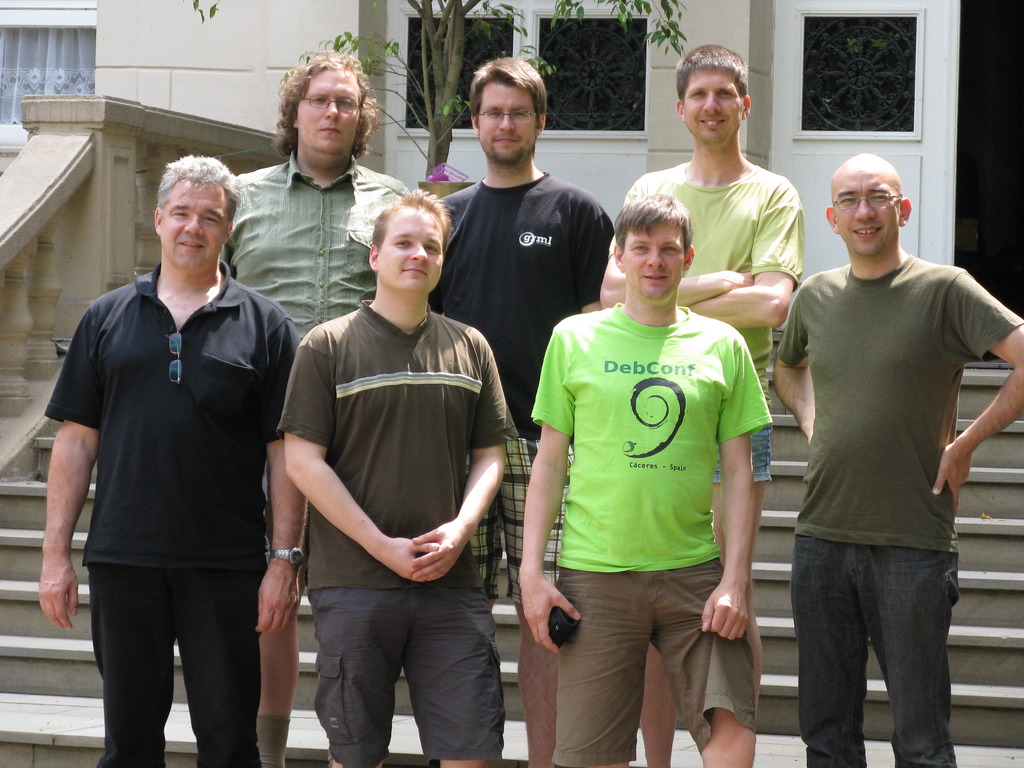
first row from left to right: Sebastian Hetze, Manuel Hachtkemper, Thomas Lange, Mattias Jansson
missing on the picture: Thomas Neumann (left on sunday midday) and Stephan Hermann (only part-time) Friday afternoon started with getting to know each other, continuing with discussions all around FAI. On saturday we started to hack on FAI. * Between the hack sessions and discussions the attending people presented their FAI usage and approaches. Some notes from the presentations:
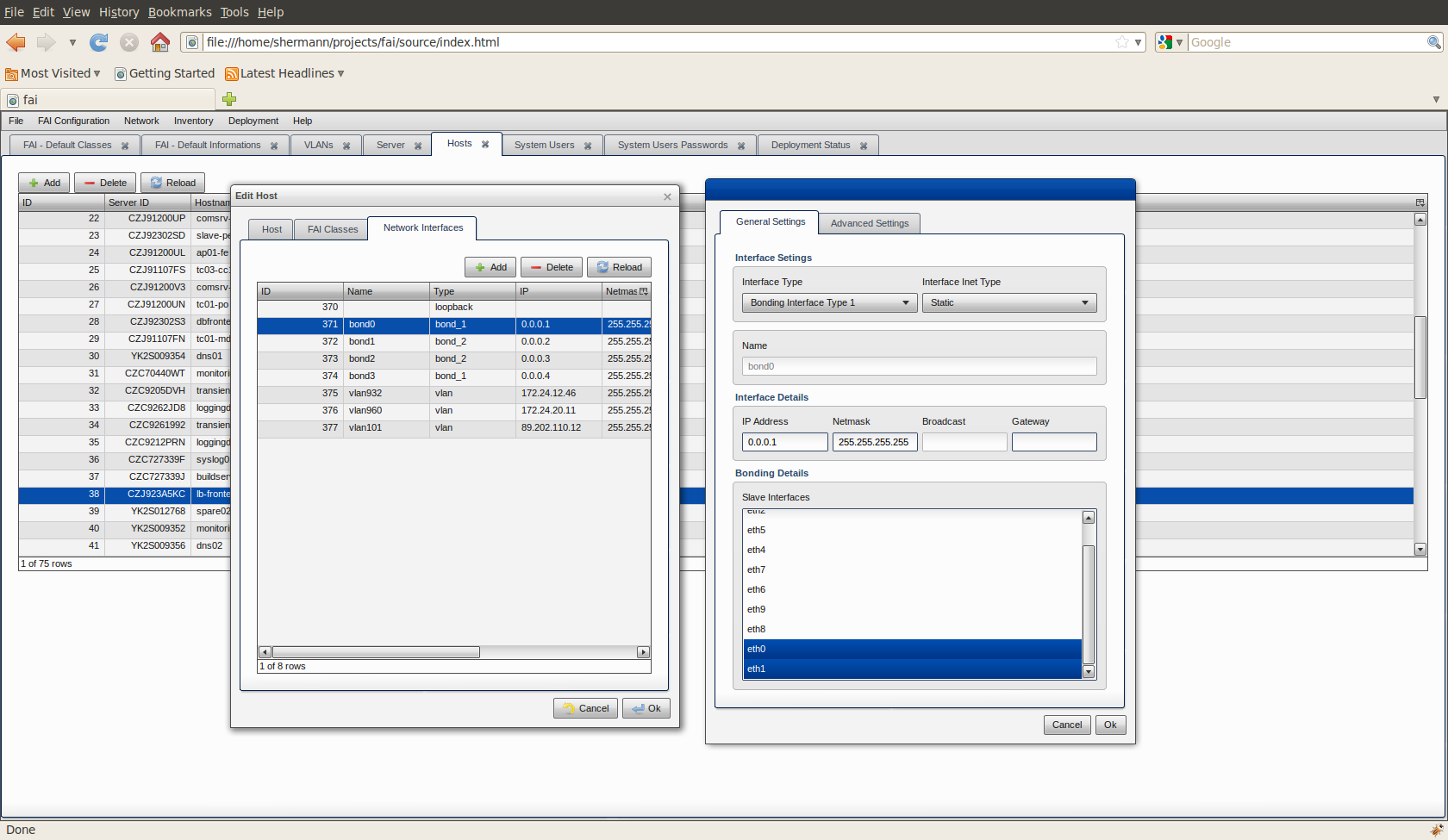
FAI Manager webfrontend / Stephan Hermann Stephan \sh Hermann presented his FAI web frontend which should be released under the GPL license in those days. The frontend uses qooxdoo whereas the backend is based on django, rpc4django and python-tftpy. Screenshot of FAI manager webfrontend A demo video is available at blip.tv. Currently Stephan is searching for a nice name for his FAI management tool please send suggestions either to him or to the linux-fai-devel mailinglist. Grml / Michael Prokop Grml is a Debian based Linux live system specially made for system administrators. Grml uses grml-live for building the ISOs, whereas grml-live itself uses FAI s dirinstall feature to build the live system. This provides the Grml team with a nice way to autobuild 18 ISOs per day, known as daily.grml.org. Mika also presented Grml s netscript bootoption and the ethdevice bootoption of live-initramfs which is useful for booting Grml/FAI via PXE. Host Europe / Michael Goetze Host Europe uses FAI for installing Debian and Ubuntu (32+64 bit) in the support center. They have ~20 FAI classes and use a Debian lenny NFSROOT as base for all deployed systems. Their main problems with FAI aren t related to FAI itself, but instead e.g. broadcom NICs with lack of support for it in Lenny s kernel. They are not using softupdate (yet) and currently use Kickstart for deploying CentOS but are working on deploying CentOS with FAI as well. LIS AG / Sebastian Hetze Linux Information Systems AG (LIS AG) are using FAI 3.2.17 and provide a luma and PyQt based GUI to their customers. They use DHCP, LDAP and DDNS for inventory, configuration and deployment. Mathematical Institute of the University of Bonn / Manuel Hachtkemper The Mathematical Institute of the University of Bonn uses FAI 3.1.8 and 3.3.5 for managing ~150 systems. They are automatically running softupdates every day, reporting how many hosts actually did run the softupdate and how many didn t run. The involved failogwatch tool supports two regex files, one for excluding specific hosts and the other one for grepping for known problems in the logs. Spotify / Andreas Schuldei + Mattias Jansson Spotify is a peer-to-peer music streaming service and the operating people at Spotify use FAI for deploying the systems. Currently they are using FAI 3.3.3 to deploy ~400 bare metal machines and ~150 virtualised machines. They have their class names in DNS using the txt/Text record entry. They are using a self written prepend_class script to manage dependencies between classes. University K ln / Thomas Lange Thomas uses FAI s trunk version (of course :) ), managing ~25 machines with less than 20 FAI classes. He s not using softupdates as Lenny s aptitude ignores the hold status of packages (this bug should be fixed for Squeeze). $COMPANY One of the big telecommunication providers in Germany uses FAI 3.3.3 for installing their bare-metal and virtual servers, providing Debian, Ubuntu and SLES. They are using Debian NFSROOT as a base for all systems as well and their main problems with FAI wasn t FAI itself but how to manage installation of virtual machines.
On Saturday evening we had a nice barbecue which included beer and K lsch *d&r*. ;) On Sunday we continued with discussions and development. Our work-log of the weekend: Important decisions made: We noticed that many FAI users implement their own way how to handle dependency management between classes, we will re-consider how we could provide such a mechanism through FAI s core. We also noted that it s important that any self-written scripts used within FAI are fully idempotent and users should be aware of this. Last but not least many thanks to the sponsors of the FAI developer workshop 07/2010! The workshop wouldn t have been possible without our generous sponsors, namely being:

22 June 2010

Gerfried Fuchs: Smashing Pumpkins

"Today is the greatest day I've ever known," this is the line that is spinning around today in my head because of many little things that happened. And it's this time of the month anyway for putting up another band feature into this little blog of mine. So here they are, one of the great bands of the nineties, and like many of them, back after a break again: The Smashing Pumpkins, and these are their featured songs: Hope you enjoy this small distraction once a month. I hope I can keep up with it, it's not a question of material, there are too many great bands out there that I'd like to share with others. :)

3 June 2010

Jan Hauke Rahm: Berlin, next week

It seems I ve missed quite a few weeks in my countdown to our Mini DebConf. Fortunately, it s not too late for you to join even if, right now, you don t know why you should! So what s the status? Well, we ve had out problems in the beginning to start the whole thing but we managed. There are a few minor issues left, I admit. If you happen to have a bit time on 10th or 11th to hold the camera for an hour or so, contact us! Or if there is *anything* you would wanna do to help us out a bit, don t be shy. You don t need to be a known Debian contributor, you don t need to know us. Arguably, you should know Debian but then, if you re able to spell the name correctly, you re probably in. :-) Apart from that, we really think it s gonna be awesome. Not only will there be a few Debian Developers from outside Germany, like our project leader zack who we have the honor of listening to for he has the first talk on Thursday. There will also be quite a few German faces that some of us haven t met yet have you met Sebastian, the chief of our beloved debianforum.de, yet? We are going to have a great time and you re a fool not to join. Thus, a last time for all of you who still don t know what I m talking about: Next week there ll be the famous LinuxTag in Berlin from Wednesday to Saturday. Right in the middle, on Thursday and Friday, we, the Debian community, will have a Mini DebConf right there. There will be talks about different Debian related things. And many active developers will be there happy to talk to you about whatever you always wanted to know or say about Debian. And then, not to forget, we ll have a hacklab where you can easily plug in your notebook and start hacking with us. Have an idea to improve Debian? Always wanted to know how to fix a bug? You want to make Debian Squeeze the best Debian release ever? Join us it seems we re fighting on the same side. See you there, guys! PS: The latest and hottest news about it.

30 May 2010

Julian Andres Klode: 0 14

So, yesterday was my 0 14 (20th) birthday and Germany won the Eurovision Song Contest 2010. Next up is Formula One in Turkey and Sebastian Vettel starting from position 3, hopefully he manages to overtake Hamilton and Webber and win this race. Let s see
Filed under: General

29 May 2010

Rog rio Brito: Preliminary support for webm in youtube-dl

I just added some very, very preliminary support for web in youtube-dl which I uploaded to unstable some minutes ago. This way, at least people will have some material (in, fact, a chance) to play with this format. I implemented this because, so far, I was only hoping here that a player for this would emerge. I guess that Debian s ffmpeg/mplayer will take some time, but I was pleased to see that Sebastian Dr ge to upload a version of something that could use the new libvpx codec. I hope that, now, as a side effect of webm being widely available, more people become interested in Vorbis. More support (no, not alternative , like Rockbox, but straight from the manufacturers) for it in hardware devices will be sweet. Well, I can dream. :-) Well, it seems to be time to shape up that local build of mine of the aotuv tuned version of Vorbis with Aoyumi s patches for libvorbis. Exciting times in the multimedia world.

25 May 2010

Russell Coker: Links May 2010

AdRevenge is an interesting concept to pay for Google Adsense adverts about how companies suck [1]. If a suitably large group of people pay to warn you about a company then it s a good signal that the company is actually doing the wrong thing. A guest post by Mili on Charles Stross blog has an interesting analysis of the economcs of Intellectual Property and concludes that content is a public good [2]. New Age Terrorists Develop Homeopathic Bomb [3], an amusing satire of medical fraud and security theatre. The sit has a lot of other good satire too. Mark Shuttleworth wrote an interesting post about new window management changes that will soon go into Ubuntu [4]. He points out that the bottom status bar in applications is a throw-back to Windows 3.1 and notes that a large part of the incentive for removing it (and using the title-bar for the status) is the work on the Netbook version of Ubuntu. This is really ironic given that the resolution of current Netbooks is quite similar to that of desktop systems that were current when Windows 3.1 came out. Omar Ahmad gave an insightful TED talk about the benefit of using a pen and paper to send a letter to a politician [5]. Sebastian Wernicke gave an amusing and informative TED talk about how to give a good TED talk [6]. His talk gives some useful ideas for public speaking that are worth considering. Catherine Mohr gave a brief and interesting TED talk about how to build an energy efficient house with low embodied energy [7]. Her blog at www.301monroe.com has the details. Stephen Wolfram (of Mathematica fame) gave an interesting TED talk [8]. He covers a lot of interesting things that can be done with computers, primarily based on the Wolfram Alpha [9] platform which allows natural language queries of a large data set. He also talks about the search for a Theory of Everything. Esther Duflo gave an interesting TED talk about using social experiments to fight poverty [10]. She describes how scientific tests have been used to determine the effectiveness of various ways of preventing disease and encouraging education in developing countries. One example of the effectiveness of such research is the DeWormTheWorld.org project which was founded after it was discovered that treating intestinal worms was the most cost effective way of getting African children to spend longer at school. David L. Rosenhan wrote an interesting research paper On Being Sane In Insane Places about pseudo-patients admitted to psychiatric hospitals [11]. It seems that psychiatric staff were totally unable to recognise a sane person who was admitted even though other patients could do so. It also documents how psychiatric patients were treated as sub-human. One would hope that things had improved since 1973, but it seems likely that many modern psychiatric hospitals are as bad as was typical in 1973. It s also worth considering the issue of the treatment in society of people who have been diagnosed with a mental illness, it seems likely that the way people are treated in the community would have similar bad results to that which was documented for treatment in psychiatric hospitals even the sanest people will act strangely if treated in an insane manner! Also it seems to me that there could be potential for using a panel of patients assembled via the Delphi Method as part of the psychiatric assessment process as it has been demonstrated that patients can sometimes assess other patients more accurately than psychiatrists! Simon Sinek gave an inspiring TED talk about how great leaders inspire action [12]. Of course the ideas he describes don t just apply to great leaders, they should apply to ordinary people who just want to convince others to adopt their ideas. Stephen Collins write a good article summarising the main reasons why the proposed great firewall of Australia is a bad idea [13]. Lenore Skenazy who is famous for letting her 9yo son catch the metro alone during broad daylight on a pre-planned route home has created a web site about Free Range Kids [14]. She seems to be starting a movement to oppose Helicopter Parenting and has already written a book about her ideas for parenting. The incidence of crime has been steadily increasing, as has the ability of the police to apprehend criminals and recover abducted children. There s no reason for children to be prevented from doing most of the things that children did when I was young!

17 May 2010

Julien Danjou: Entering the Emacs world

In February 2009, my friend dim tried to force me using Emacs. I know a couple of people using it and Gnus for reading their mail, and it always made me curious. At that time, more than a year ago, Emacs 22 and Gnus did not seem usable from my point of view. But around mid February, with the help of dim, I tried again to start using Emacs. Actually, this was not something new for me. I (very basically) used Emacs between 2000 and 2006. In 2006, when I finished the university and started working at Easter-eggs, I met a couple of vim enthusiasts. They taught me how to use it in various ways, and I started to know more about vim than Emacs, so I switched. This time, I started by configuring it, but reading the manual and also learning a bit of Lisp. It took me several weeks, but step by step I learned many, many things. And I must admit, I liked it. I've configured and starting to use some very important mode, like Gnus, Muse, the famous Org mode or even ERC. I'll probably talk about various Emacs related things in the near future, since I already wrote more than a thousand lines of Lisp in the last 2 months. Anyhow, I'd just conclude by asserting that my new Emacs/Gnus/Org/ERC setup beats my old vim/mutt/nothing/irssi to the death with a baseball bat. :-)

Next.

Previous.