Search Results: "rul"

26 July 2025

Bits from Debian: DebConf25 closes in Brest and DebConf26 announced

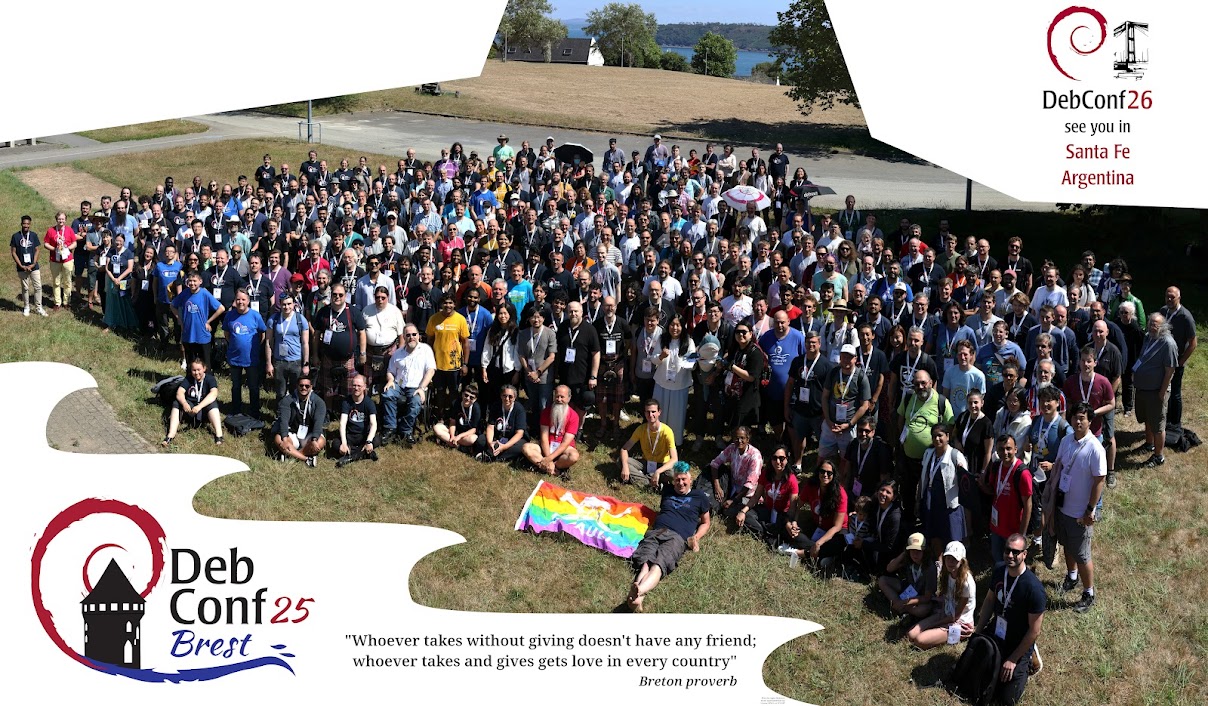
DebConf25 group photo - click to enlarge On Saturday 19 July 2025, the annual Debian Developers and Contributors Conference came to a close. Over 443 attendees representing 50 countries from around the world came together for a combined 169 events (including some which took place during the DebCamp) including more than 50 Talks, 39 Short Talks, 5 Discussions, 59 Birds of a Feather sessions ("BoF" informal meeting between developers and users), 10 workshops, and activities in support of furthering our distribution and free software, learning from our mentors and peers, building our community, and having a bit of fun. The conference was preceded by the annual DebCamp hacking session held 7 through 13 July where Debian Developers and Contributors convened to focus on their individual Debian-related projects or work in team sprints geared toward in-person collaboration in developing Debian. This year, a session was dedicated to prepare the BoF "Dealing with Dormant Packages: Ensuring Debian's High Standards"; another, at the initiative of our DPL, to prepare suggestions for the BoF Package Acceptance in Debian: Challenges and Opportunities"; and an afternoon around Salsa-CI. As has been the case for several years, a special effort has been made to welcome newcomers and help them become familiar with Debian and DebConf by organizing a sprint "New Contributors Onboarding" every day of Debcamp, followed more informally by mentorship during DebConf. The actual Debian Developers Conference started on Monday 14 July 2025. In addition to the traditional "Bits from the DPL" talk, the continuous key-signing party, lightning talks, and the announcement of next year's DebConf26, there were several update sessions shared by internal projects and teams. Many of the hosted discussion sessions were presented by our technical core teams with the usual and useful "Meet the Technical Committee", the "What's New in the Linux Kernel" session, and a set of BoFs about Debian packaging policy and Debian infrastructure. Thus, more than a quarter of the discussions dealt with this theme, including talks about our tools and Debian's archive processes. Internationalization and Localization have been the subject of several talks. The Python, Perl, Ruby, Go, and Rust programming language teams also shared updates on their work and efforts. Several talks have covered Debian Blends and Debian-derived distributions and other talks addressed the issue of Debian and AI. More than 17 BoFs and talks about community, diversity, and local outreach highlighted the work of various teams involved in not just the technical but also the social aspect of our community; four women who have made contributions to Debian through their artwork in recent years presented their work. The one-day session "DebConf 2025 Academic Track!", organized in collaboration with the IRISA laboratory was the first session welcoming fellow academics at DebConf, bringing together around ten presentations. The schedule was updated each day with planned and ad hoc activities introduced by attendees over the course of the conference. Several traditional activities took place: a job fair, a poetry performance, the traditional Cheese and Wine party (this year with cider as well), the Group Photos, and the Day Trips. For those who were not able to attend, most of the talks and sessions were broadcasted live and recorded; currently the videos are made available through this link. Almost all of the sessions facilitated remote participation via IRC and Matrix messaging apps or online collaborative text documents which allowed remote attendees to "be in the room" to ask questions or share comments with the speaker or assembled audience. DebConf25 saw over 441 T-shirts, 3 day trips, and up to 315 meals planned per day. All of these events, activities, conversations, and streams coupled with our love, interest, and participation in Debian and F/OSS certainly made this conference an overall success both here in Brest, France and online around the world. The DebConf25 website will remain active for archival purposes and will continue to offer links to the presentations and videos of talks and events. Next year, DebConf26 will be held in Santa Fe, Argentina, likely in July. As tradition follows before the next DebConf the local organizers in Argentina will start the conference activities with DebCamp with a particular focus on individual and team work towards improving the distribution. DebConf is committed to a safe and welcome environment for all participants. See the web page about the Code of Conduct on the DebConf25 website for more details on this. Debian thanks the commitment of numerous sponsors to support DebConf25, particularly our Platinum Sponsors: AMD, EDF, Infomaniak, Proxmox, and Viridien. We also wish to thank our Video and Infrastructure teams, the DebConf25 and DebConf committees, our host nation of France, and each and every person who helped contribute to this event and to Debian overall. Thank you all for your work in helping Debian continue to be "The Universal Operating System". See you next year! About Debian The Debian Project was founded in 1993 by Ian Murdock to be a truly free community project. Since then the project has grown to be one of the largest and most influential Open Source projects. Thousands of volunteers from all over the world work together to create and maintain Debian software. Available in 70 languages, and supporting a huge range of computer types, Debian calls itself the universal operating system. About DebConf DebConf is the Debian Project's developer conference. In addition to a full schedule of technical, social and policy talks, DebConf provides an opportunity for developers, contributors and other interested people to meet in person and work together more closely. It has taken place annually since 2000 in locations as varied as Scotland, Bosnia and Herzegovina, India, Korea. More information about DebConf is available from https://debconf.org/. About AMD The AMD ROCm platform includes programming models, tools, compilers, libraries, and runtimes for AI and HPC solution development on AMD GPUs. Debian is an officially supported platform for AMD ROCm and a growing number of components are now included directly in the Debian distribution. For more than 55 years AMD has driven innovation in high-performance computing, graphics and visualization technologies. AMD is deeply committed to supporting and contributing to open-source projects, foundations, and open-standards organizations, taking pride in fostering innovation and collaboration within the open-source community. About EDF EDF is a leading global utility company focused on low-carbon power generation. The group uses advanced engineering and scientific computing tools to drive innovation and efficiency in its operations, especially in nuclear power plant design and safety assessment. Since 2003, the EDF Group has been using Debian as its main scientific computing environment. Debian's focus on stability and reproducibility ensures that EDF's calculations and simulations produce consistent and accurate results. About Infomaniak Infomaniak is Switzerland's leading developer of Web technologies. With operations all over Europe and based exclusively in Switzerland, the company designs and manages its own data centers powered by 100% renewable energy, and develops all its solutions locally, without outsourcing. With millions of users and the trust of public and private organizations across Europe - such as RTBF, the United Nations, central banks, over 3,000 radio and TV stations, as well as numerous cities and security bodies - Infomaniak stands for sovereign, sustainable and independent digital technology. The company offers a complete suite of collaborative tools, cloud hosting, streaming, marketing and events solutions, while being owned by its employees and self-financed exclusively by its customers. About Proxmox Proxmox develops powerful, yet easy-to-use Open Source server software. The product portfolio from Proxmox, including server virtualization, backup, and email security, helps companies of any size, sector, or industry to simplify their IT infrastructures. The Proxmox solutions are built on Debian, we are happy that they give back to the community by sponsoring DebConf25. About Viridien Viridien is an advanced technology, digital and Earth data company that pushes the boundaries of science for a more prosperous and sustainable future. Viridien has been using Debian-based systems to power most of its HPC infrastructure and its cloud platform since 2009 and currently employs two active Debian Project Members. Contact Information For further information, please visit the DebConf25 web page at https://debconf25.debconf.org/ or send mail to press@debian.org.

21 July 2025

Jonathan Dowland: Nine Inch Nails, Paris, 2025-07-07

On July 7th I did a quick one-day trip to Paris to watch Nine Inch Nails, who were performing one of their last shows for the European leg of the tour. I'd missed all the UK dates, which were announced after I was committed to a family holiday. The setup for these shows differs a lot from the norm. First, the support act was German-Iraqi techno DJ Boys Noize, who TR&AR had collaborated with on their soundtrack for the recent movie Challengers. BN did a 75-minute opening set:
Stripped down Set 1 Stripped down Set 1
The main gig was divided into four acts. Act 1 took place on a square "B Stage", situated in the middle of the main floor. Trent and 2-3 band members performed three stripped-down songs, with interpolations to other songs, alternative lyrics, and the like. I enjoyed this section more than I expected to.
Main stage lighting Main stage lighting
They then transition to the main stage for a six-song full-band set. The main stage was draped in layers of transparent curtains. One of the team was on-stage, walking around with a video camera, and the live camera footage was processed and projected onto the curtains in realtime. The visuals were truly fantastic. For the third act, Trent and Atticus returned to the B stage, to be joined by Boys Noize, who then performed four songs in a reworked, remixed, electronic dance format. This ended up being the highlight of the gig for me. I felt the reworkings breathed new life into some old songs.
remix Set 3 remix Set 3
Finally, back to the main stage to close out with a final seven songs. The traditional triad of closers was adjusted, substituting "The Hand That Feeds" for "The Perfect Drug"; a song that wasn't played at all from 1997 to 2018, and has now become a regular fixture. Several tapers recorded the show, and their recordings are up at nin.live. Overall it was great fun: I ended up flying via London and the airport time was a bit of a pain, but I did get a good start on my corrections. I was home the next afternoon. I'm trying not to think of the cost.

20 July 2025

Michael Prokop: What to expect from Debian/trixie #newintrixie

Trixie Banner, Copyright 2024 Elise Couper Update on 2025-07-28: added note about Debian 13/trixie support for OpenVox (thanks, Ben Ford!) Debian v13 with codename trixie is scheduled to be published as new stable release on 9th of August 2025. I was the driving force at several of my customers to be well prepared for the upcoming stable release (my efforts for trixie started in August 2024). On the one hand, to make sure packages we care about are available and actually make it into the release. On the other hand, to ensure there are no severe issues that make it into the release and to get proper and working upgrades. So far everything is looking pretty well and working fine, the efforts seemed to have payed off. :) As usual with major upgrades, there are some things to be aware of, and hereby I m starting my public notes on trixie that might be worth for other folks. My focus is primarily on server systems and looking at things from a sysadmin perspective. Further readings As usual start at the official Debian release notes, make sure to especially go through What s new in Debian 13 + issues to be aware of for trixie (strongly recommended read!). Package versions As a starting point, let s look at some selected packages and their versions in bookworm vs. trixie as of 2025-07-20 (mainly having amd64 in mind):
Package bookworm/v12 trixie/v13
ansible 2.14.3 2.19.0
apache 2.4.62 2.4.64
apt 2.6.1 3.0.3
bash 5.2.15 5.2.37
ceph 16.2.11 18.2.7
docker 20.10.24 26.1.5
dovecot 2.3.19 2.4.1
dpkg 1.21.22 1.22.21
emacs 28.2 30.1
gcc 12.2.0 14.2.0
git 2.39.5 2.47.2
golang 1.19 1.24
libc 2.36 2.41
linux kernel 6.1 6.12
llvm 14.0 19.0
lxc 5.0.2 6.0.4
mariadb 10.11 11.8
nginx 1.22.1 1.26.3
nodejs 18.13 20.19
openjdk 17.0 21.0
openssh 9.2p1 10.0p1
openssl 3.0 3.5
perl 5.36.0 5.40.1
php 8.2+93 8.4+96
podman 4.3.1 5.4.2
postfix 3.7.11 3.10.3
postgres 15 17
puppet 7.23.0 8.10.0
python3 3.11.2 3.13.5
qemu/kvm 7.2 10.0
rsync 3.2.7 3.4.1
ruby 3.1 3.3
rust 1.63.0 1.85.0
samba 4.17.12 4.22.3
systemd 252.36 257.7-1
unattended-upgrades 2.9.1 2.12
util-linux 2.38.1 2.41
vagrant 2.3.4 2.3.7
vim 9.0.1378 9.1.1230
zsh 5.9 5.9
Misc unsorted apt The new apt version 3.0 brings several new features, including: systemd systemd got upgraded from v252.36-1~deb12u1 to 257.7-1 and there are lots of changes. Be aware that systemd v257 has a new net.naming_scheme, v257 being PCI slot number is now read from firmware_node/sun sysfs file. The naming scheme based on devicetree aliases was extended to support aliases for individual interfaces of controllers with multiple ports. This might affect you, see e.g. #1092176 and #1107187, the Debian Wiki provides further useful information. There are new systemd tools available: The tools provided by systemd gained several new options: Debian s systemd ships new binary packages: Linux Kernel The trixie release ships a Linux kernel based on latest longterm version 6.12. As usual there are lots of changes in the kernel area, including better hardware support, and this might warrant a separate blog entry. To highlight some changes with Debian trixie: See Kernelnewbies.org for further changes between kernel versions. Configuration management For puppet users, Debian provides the puppet-agent (v8.10.0), puppetserver (v8.7.0) and puppetdb (v8.4.1) packages. Puppet s upstream does not provide packages for trixie, yet. Given how long it took them for Debian bookworm, and with their recent Plans for Open Source Puppet in 2025, it s unclear when (and whether at all) we might get something. As a result of upstream behavior, also the OpenVox project evolved, and they already provide Debian 13/trixie support (https://apt.voxpupuli.org/openvox8-release-debian13.deb). FYI: the AIO puppet-agent package for bookworm (v7.34.0-1bookworm) so far works fine for me on Debian/trixie. Be aware that due to the apt-key removal you need a recent version of the puppetlabs-apt for usage with trixie. The puppetlabs-ntp module isn t yet ready for trixie (regarding ntp/ntpsec), if you should depend on that. ansible is available and made it with version 2.19 into trixie. Prometheus stack Prometheus server was updated from v2.42.0 to v2.53, and all the exporters that got shipped with bookworm are still around (in more recent versions of course). Trixie gained some new exporters: Virtualization docker (v26.1.5), ganeti (v3.1.0), libvirt (v11.3.0, be aware of significant changes to libvirt packaging), lxc (v6.0.4), podman (v5.4.2), openstack (see openstack-team on Salsa), qemu/kvm (v10.0.2), xen (v4.20.0) are all still around. Proxmox already announced their PVE 9.0 BETA, being based on trixie and providing 6.14.8-1 kernel, QEMU 10.0.2, LXC 6.0.4, OpenZFS 2.3.3. Vagrant is available in version 2.3.7, but Vagrant upstream does not provide packages for trixie yet. Given that HashiCorp adopted the BSL, the future of vagrant in Debian is unclear. If you re relying on VirtualBox, be aware that upstream doesn t provide packages for trixie, yet. VirtualBox is available from Debian/unstable (version 7.1.12-dfsg-1 as of 2025-07-20), but not shipped with stable release since quite some time (due to lack of cooperation from upstream on security support for older releases, see #794466). Be aware that starting with Linux kernel 6.12, KVM initializes virtualization on module loading by default. This prevents VirtualBox VMs from starting. In order to avoid this, either add kvm.enable_virt_at_load=0 parameter into kernel command line or unload the corresponding kvm_intel / kvm_amd module. If you want to use Vagrant with VirtualBox on trixie, be aware that Debian s vagrant package as present in trixie doesn t support the VirtualBox package version 7.1 as present in Debian/unstable (manually patching vagrant s meta.rb and rebuilding the package without Breaks: virtualbox (>= 7.1) is known to be working). util-linux The are plenty of new options available in the tools provided by util-linux: Now no longer present in util-linux as of trixie: The following binaries got moved from util-linux to the util-linux-extra package: And the util-linux-extra package also provides new tools: OpenSSH OpenSSH was updated from v9.2p1 to 10.0p1-5, so if you re interested in all the changes, check out the release notes between those versions (9.3, 9.4, 9.5, 9.6, 9.7, 9.8, 9.9 + 10.0). Let s highlight some notable behavior changes in Debian: There are some notable new features: Thanks to everyone involved in the release, looking forward to trixie + and happy upgrading!
Let s continue with working towards Debian/forky. :)

17 July 2025

Otto Kek l inen: Debcraft Easiest way to modify and build Debian packages

Featured image of post Debcraft   Easiest way to modify and build Debian packagesDebian packaging is notoriously hard. Far too many new contributors give up while trying, and many long-time contributors leave due to burnout from having to do too many thankless maintenance tasks. Some just skip testing their changes properly because it feels like too much toil. Debcraft is my attempt to solve this by automating all the boring stuff, and making it easier to learn the correct practices and helping new and old packagers better track changes in both source code and build artifacts.

The challenge of declarative packaging code Unlike how rpm or apk packages are done, the deb package sources by design avoid having one massive procedural packaging recipe. Instead, the packaging is defined in multiple declarative files in the debian/ subdirectory. For example, instead of a script running install -m 755 bin/btop /usr/bin/btop there is a file debian/btop.install containing the line usr/bin/btop. This makes the overall system more robust and reliable, and allows, for example, extensive static analysis to find problems without having to build the package. The notable exception is the debian/rules file, which contains procedural code that can modify any aspect of the package build. Almost all other files are declarative. Benefits include, among others, that the effect of a Debian-wide policy change can be relatively easily predicted by scanning what attributes and configurations all packages have declared. The drawback is that to understand the syntax and meaning of each file, one must understand which build tools read which files and traverse potentially multiple layers of abstraction. In my view, this is the root cause for most of the perceived complexity.

Common complaints about .deb packaging Related to the above, people learning Debian packaging frequently voice the following complaints:
  • Debian has too many tools to learn, often with overlapping or duplicate functionality.
  • Too much outdated and inconsistent documentation that makes learning the numerous tools needlessly hard.
  • Lack of documentation of the generally agreed best practices, mainly due to Debian s reluctance as a project to pick one tool and deprecate the alternatives.
  • Multiple layers of abstraction and lack of clarity on what any single change in the debian/ subdirectory leads to in the final package.
  • Requirement of Debian packages to be developed on a Debian system.

How Debcraft solves (some of) this Debcraft is intentionally opinionated for the sake of simplicity, and makes heavy use of git, git-buildpackage, and most importantly Linux containers, supporting both Docker and Podman. By using containers, Debcraft frees the user from the requirement of having to run Debian. This makes .deb packaging more accessible to developers running some other Linux distro or even Mac or Windows (with WSL). Of course we want developers to run Debian (or a derivative like Ubuntu) but we want them even more to build, test and ship their software as .deb. Even for Debian/Ubuntu users having everything done inside clean hermetic containers of the latest target distribution version will yield more robust, secure and reproducible builds and tests. All containers are built automatically on-the-fly using best practices for layer caching, making everything easy and fast. Debcraft has simple commands to make it easy to build, rebuild, test and update packages. The most fundamental command is debcraft build, which will not only build the package but also fetch the sources if not already present, and with flags such as --distribution or --source-only build for any requested Debian or Ubuntu release, or generate source packages only for Debian or PPA upload purposes. For ease of use, the output is colored and includes helpful explanations on what is being done, and suggests relevant Debian documentation for more information. Most importantly, the build artifacts, along with various logs, are stored in separate directories, making it easy to compare before and after to see what changed as a result of the code or dependency updates (utilizing diffoscope among others). While the above helps to debug successful builds, there is also the debcraft shell command to make debugging failed builds significantly easier by dropping into a shell where one can run various dh commands one-by-one. Once the build works, testing autopkgtests is as easy as running debcraft test. As with all other commands, Debcraft is smart enough to read information like the target distribution from the debian/changelog entry. When the package is ready to be released, there is the debcraft release command that will create the Debian source package in the correct format and facilitate uploading it either to your Personal Package Archive (PPA) or if you are a Debian Developer to the official Debian archive.

Automatically improve and update packages Additionally, the command debcraft improve will try to fix all issues that are possible to address automatically. It utilizes, among others, lintian-brush, codespell and debputy. This makes repetitive Debian maintenance tasks easier, such as updating the package to follow the latest Debian policies. To update the package to the latest upstream version there is also debcraft update. It will read the package configuration files such as debian/gbp.conf and debian/watch and attempts to import the latest upstream version, refresh patches, build and run autopkgtests. If everything passes, the new version is committed. This helps automate the process of updating to new upstream versions.

Try out Debcraft now! On a recent version of Debian and Ubuntu, Debcraft can be installed simply by running apt install debcraft. To use Debcraft on some other distribution or to get the latest features available in the development version install it using:
git clone https://salsa.debian.org/debian/debcraft.git
cd debcraft
make install-local
To see exact usage instructions run debcraft --help.

Contributions welcome Current Debcraft version 0.5 still has some rough edges and missing features, but I have personally been using it for over a year to maintain all my packages in Debian. If you come across some issue, feel free to file a report at https://salsa.debian.org/debian/debcraft/-/issues or submit an improvement at https://salsa.debian.org/debian/debcraft/-/merge_requests. The code is intentionally written entirely in shell script to keep the barrier to code contribution as low as possible.
By the way, if you aspire to become a Debian Developer, and want to follow my examples in using state-of-the-art tooling and collaborate using salsa.debian.org, feel free to reach out for mentorship. I am glad to see more people contribute to Debian!

16 July 2025

Sven Hoexter: Google Cloud Oddities Summer 2025 Edition

Latest oddities I ran into with Google Cloud products before I start to forget about them again. e2 Compute Instances vs CloudNAT Years ago I already had a surprising encounter with the Google Cloud e2 instances. Back then we observed CPU steal time from 20-60%, which made the instances unusable for anything remotely latency sensitive. Now someone started to run a workload which creates many outbound connections to the same destination IP:Port. To connect to the internet we utilize the Google Cloud product "CloudNAT" which implements a NAT solution somewhere in the network layer. Starting the workload let after a few seconds to all sort of connection issues, and of course logs from CloudNAT that it dropped connections. The simplest reproducer I could find was while true; do curl http://sven.stormbind.net; done which already let to connection drops on CloudNAT. We starred a bit at output of gcloud compute routers get-nat-mapping-info our-default-natgw, but allocating additional ports still worked fine in general. Further investigation let to two differences between a project which was fine and those that failed:
  1. c2d or n2d machine types instead of e2 and
  2. usage of gVNIC.
Moving away from the e2 instances instantly fixed our issue. Only some connection drops could be observed on CloudNAT if we set the min_ports_per_vm value too low and it could not allocate new ports in time. Thus we did some additional optimizations: See also upstream documentation regarding timeouts. To complete the setup alignment we also enabled gVNIC on all GKE pools. Noteworthy detail a colleague figured out: If you use terraform to provision GKE pools make sure to use at least google provider v6.33.0 to avoid a re-creation of your node pool. GKE LoadBalancer Force allPorts: true on Forwarding Rule Technically it's possible to configure a forwarding rule to listen on some or all ports. That gets more complicated if you do not configure the forwarding rule via terraform or gcloud cli, but use a GKE resource kind: Service with spec.type: LoadBalancer. The logic documented by Google Cloud is that the forwarding rule will have per port configuration if it's five or less, and above that it will open for all ports. Sadly that does not work e.g. in cases where you've an internal load balancer and a serviceAttachment attached to the forwarding rule. In my experience reconfiguring was also unreliable in cases without a serviceAttachment and required a manual deletion of the service load balancer to have the operator reconcile it and create it correctly. Given that we wanted to have all ports open to allow us to dynamically add more ports on a specific load balancer, but there is no annotation for that, I worked around with this beauty:
      ports:
        - name: dummy-0
          port: 2342
          protocol: TCP
          targetPort: 2342
        - name: dummy-1
          port: 2343
          protocol: TCP
          targetPort: 2343
        - name: dummy-2
          port: 2344
          protocol: TCP
          targetPort: 2344
        - name: dummy-3
          port: 2345
          protocol: TCP
          targetPort: 2345
        - name: service-1
          port: 4242
          protocol: TCP
          targetPort: 4242
        - name: service-2
          port: 4343
          protocol: TCP
          targetPort: 4343
If something in that area did not work out there's basically two things to check:
  1. Is the port open on the forwarding rule / is the forwarding rule configured with allPorts: true?
  2. Got the VPC firewall rule created by the service operator in GKE updated to open all required ports?
Rate Limiting with Cloud Armor on Global TCP Proxy Load Balancer According to the Google Cloud support rate limiting on a TCP proxy is a preview feature. That seems to be the excuse why it's all very inconsistent right now, but it works. Terraform Sample Snippet
  rule  
    description = "L3-L4 Rate Limit"
    action      = "rate_based_ban"
    priority    = "2342"
    match  
      versioned_expr = "SRC_IPS_V1"
      config  
        src_ip_ranges = ["*"]
       
     
    rate_limit_options  
      enforce_on_key = "IP"
      # exceed_action only supports deny() with a response code
      exceed_action = "deny(429)"
      rate_limit_threshold  
        count        = 320
        interval_sec = 60
       
      ban_duration_sec = 240
      ban_threshold  
        count        = 320
        interval_sec = 60
       
      conform_action = "allow"
     
   
Config-Connector Sample Snippet
  - action: rate_based_ban
    description: L3-L4 Rate Limit
    match:
      config:
        srcIpRanges:
          - "*"
      versionedExpr: SRC_IPS_V1
    preview: false
    priority: 2342
    rateLimitOptions:
      banDurationSec: 240
      banThreshold:
        count: 320
        intervalSec: 60
      conformAction: allow
      enforceOnKey: IP
      exceedAction: deny
      rateLimitThreshold:
         count: 320
         intervalSec: 60

12 July 2025

Freexian Collaborators: Monthly report about Debian Long Term Support, June 2025 (by Roberto C. S nchez)

Like each month, have a look at the work funded by Freexian s Debian LTS offering.

Debian LTS contributors In June, 20 contributors have been paid to work on Debian LTS, their reports are available:
  • Abhijith PA did 14.0h (out of 14.0h assigned).
  • Adrian Bunk did 23.5h (out of 23.5h assigned).
  • Andreas Henriksson did 3.0h (out of 3.0h assigned and 17.0h from previous period), thus carrying over 17.0h to the next month.
  • Andrej Shadura did 2.0h (out of 3.0h assigned and 7.0h from previous period), thus carrying over 8.0h to the next month.
  • Bastien Roucari s did 20.0h (out of 20.0h assigned).
  • Ben Hutchings did 8.0h (out of 7.5h assigned and 16.0h from previous period), thus carrying over 15.5h to the next month.
  • Carlos Henrique Lima Melara did 12.0h (out of 12.0h assigned).
  • Chris Lamb did 18.0h (out of 18.0h assigned).
  • Daniel Leidert did 22.0h (out of 22.5h assigned and 1.0h from previous period), thus carrying over 1.5h to the next month.
  • Emilio Pozuelo Monfort did 23.5h (out of 16.75h assigned and 6.75h from previous period).
  • Guilhem Moulin did 14.0h (out of 11.5h assigned and 3.5h from previous period), thus carrying over 1.0h to the next month.
  • Jochen Sprickerhof did 21.0h (out of 0.5h assigned and 22.75h from previous period), thus carrying over 2.25h to the next month.
  • Lucas Kanashiro did 20.0h (out of 20.0h assigned).
  • Markus Koschany did 23.25h (out of 17.0h assigned and 6.25h from previous period).
  • Roberto C. S nchez did 21.25h (out of 20.75h assigned and 3.25h from previous period), thus carrying over 2.75h to the next month.
  • Santiago Ruano Rinc n did 12.75h (out of 15.0h assigned), thus carrying over 2.25h to the next month.
  • Sean Whitton did 1.0h (out of 4.25h assigned and 1.75h from previous period), thus carrying over 5.0h to the next month.
  • Sylvain Beucler did 23.5h (out of 23.5h assigned).
  • Thorsten Alteholz did 15.0h (out of 15.0h assigned).
  • Tobias Frost did 2.5h (out of 12.0h assigned), thus carrying over 9.5h to the next month.

Evolution of the situation In June, we released 35 DLAs.
  • Notable security updates:
    • mariadb-10.5, prepared by Otto Kek l inen, fixes vulnerabilities which could result in denial of service, information disclosure, or unauthorized data modification
    • python-django, prepared by Chris Lamb, fixes vulnerabilities which would result in log injection or denial of service
    • webkit2gtk, prepared by Emilio Pozuelo Monfort, fixes many vulnerabilities which could results in a wide range of issues
    • xorg-server, prepared by Emilio Pozuelo Monfort, fixes multiple vulnerabilities which may result in privilege escalation
    • sudo, prepared by Thorsten Alteholz, fixes a vulnerability which could result in privilege escalation
  • Notable non-security updates:
    • debian-security-support, prepared by Santiago Ruano Rinc n, updates status of packages which receive limited security support or which have reached the end of security support
    • dns-root-data, prepared by Sylvain Beucler, updates the DNSSEC trust anchors
This month s contributions from outside the regular team include the mariadb-10.5 update mentioned above, prepared by Otto Kek l inen (the package maintainer); an update to libfile-find-rule-perl, prepared by Salvatore Bonaccorso (a member of the Debian Security Team); an update to activemq, prepared by Emmanuel Arias (a maintainer of the package). Additionally, LTS Team members contributed stable updates of the following packages:
  • curl, prepared by Carlos Henrique Lima Melara
  • python-tornado, prepared by Daniel Leidert
  • python-flask-cors, prepared by Daniel Leidert
  • common-vfs, prepared by Daniel Leidert
  • cjson, prepared by Adrian Bunk
  • icu, prepared by Adrian Bunk
  • node-tar-fs, prepared by Adrian Bunk
  • rar, prepared by Adrian Bunk
Something of particular noteworthiness is that LTS contributor Carlos Henrique Lima Melara discovered a regression in the upstream fix for CVE-2023-2753 in curl. The corrective action which he took included providing a patch to upstream, uploading a stable update of curl, and further updating the version of curl in LTS. DebConf, the annual Debian Conference, is coming up in July and, as is customary each year, the week preceding the conference will feature an event called DebCamp. The DebCamp week provides an opportunity for teams and other interested groups/individuals to meet together in person in the same venue as the conference itself, with the purpose of doing focused work, often called sprints . LTS coordinator Roberto C. S nchez has announced that the LTS Team is planning to hold a sprint primarily focused on the Debian security tracker and the associated tooling used by the LTS Team and the Debian Security Team.

Thanks to our sponsors Sponsors that joined recently are in bold.

3 July 2025

Russell Coker: The Fuss About AI

There are many negative articles about AI (which is not about actual Artificial Intelligence also known as AGI ). Which I think are mostly overblown and often ridiculous. Resource Usage Complaints about resource usage are common, training Llama 3.1 could apparently produce as much pollution as 10,000 round trips by car between Los Angeles and New York City . That s not great but when you compare to the actual number of people doing such drives in the US and the number of people taking commercial flights on that route it doesn t seem like such a big deal. Apparently commercial passenger jets cause CO2 emissions per passenger about equal to a car with 2 people. Why is it relevant whether pollution comes from running servers, driving cars, or steel mills? Why not just tax polluters for the damage they do and let the market sort it out? People in the US make a big deal about not being communist, so why not have a capitalist solution, make it more expensive to do undesirable things and let the market sort it out? ML systems are a less bad use of compute resources than Bitcoin, at least ML systems give some useful results while Bitcoin has nothing good going for it. The Dot-Com Comparison People often complain about the apparent impossibility of AI companies doing what investors think they will do. But this isn t anything new, that all happened before with the dot com boom . I m not the first person to make this comparison, The Daily WTF (a high quality site about IT mistakes) has an interesting article making this comparison [1]. But my conclusions are quite different. The result of that was a lot of Internet companies going bankrupt, the investors in those companies losing money, and other companies then bought up their assets and made profitable companies. The cheap Internet we now have was built on the hardware from bankrupt companies which was sold for far less than the manufacture price. That allowed it to scale up from modem speeds to ADSL without the users paying enough to cover the purchase of the infrastructure. In the early 2000s I worked for two major Dutch ISPs that went bankrupt (not my fault) and one of them continued operations in the identical manner after having the stock price go to zero (I didn t get to witness what happened with the other one). As far as I m aware random Dutch citizens and residents didn t suffer from this and employees just got jobs elsewhere. There are good things being done with ML systems and when companies like OpenAI go bankrupt other companies will buy the hardware and do good things. NVidia isn t ever going to have the future sales that would justify a market capitalisation of almost 4 Trillion US dollars. This market cap can support paying for new research and purchasing rights to patented technology in a similar way to the high stock price of Google supported buying YouTube, DoubleClick, and Motorola Mobility which are the keys to Google s profits now. The Real Upsides of ML Until recently I worked for a company that used ML systems to analyse drivers for signs of fatigue, distraction, or other inappropriate things (smoking which is illegal in China, using a mobile phone, etc). That work was directly aimed at saving human lives with a significant secondary aim of saving wear on vehicles (in the mining industry drowsy drivers damage truck tires and that s a huge business expense). There are many applications of ML in medical research such as recognising cancer cells in tissue samples. There are many less important uses for ML systems, such as recognising different types of pastries to correctly bill bakery customers technology that was apparently repurposed for recognising cancer cells. The ability to recognise objects in photos is useful. It can be used for people who want to learn about random objects they see and could be used for helping young children learn about their environment. It also has some potential for assistance for visually impaired people, it wouldn t be good for safety critical systems (don t cross a road because a ML system says there are no cars coming) but could be useful for identifying objects (is this a lemon or a lime). The Humane AI pin had some real potential to do good things but there wasn t a suitable business model [2], I think that someone will develop similar technology in a useful way eventually. Even without trying to do what the Humane AI Pin attempted, there are many ways for ML based systems to assist phone and PC use. ML systems allow analysing large quantities of data and giving information that may be correct. When used by a human who knows how to recognise good answers this can be an efficient way of solving problems. I personally have solved many computer problems with the help of LLM systems while skipping over many results that were obviously wrong to me. I believe that any expert in any field that is covered in the LLM input data could find some benefits from getting suggestions from an LLM. It won t necessarily allow them to solve problems that they couldn t solve without it but it can provide them with a set of obviously wrong answers mixed in with some useful tips about where to look for the right answers. Jobs and Politics Noema Magazine has an insightful article about how AI can allow different models of work which can enlarge the middle class [3]. I don t think it s reasonable to expect ML systems to make as much impact on society as the industrial revolution, and the agricultural revolutions which took society from more than 90% farm workers to less than 5%. That doesn t mean everything will be fine but it is something that can seem OK after the changes have happened. I m not saying apart from the death and destruction everything will be good , the death and destruction are optional. Improvements in manufacturing and farming didn t have to involve poverty and death for many people, improvements to agriculture didn t have to involve overcrowding and death from disease. This was an issue of political decisions that were made. The Real Problems of ML Political decisions that are being made now have the aim of making the rich even richer and leaving more people in poverty and in many cases dying due to being unable to afford healthcare. The ML systems that aim to facilitate such things haven t been as successful as evil people have hoped but it will happen and we need appropriate legislation if we aren t going to have revolutions. There are documented cases of suicide being inspired by Chat GPT systems [4]. There have been people inspired towards murder by ChatGPT systems but AFAIK no-one has actually succeeded in such a crime yet. There are serious issues that need to be addressed with the technology and with legal constraints about how people may use it. It s interesting to consider the possible uses of ChatGPT systems for providing suggestions to a psychologist, maybe ChatGPT systems could be used to alleviate mental health problems. The cases of LLM systems being used for cheating on assignments etc isn t a real issue. People have been cheating on assignments since organised education was invented. There is a real problem of ML systems based on biased input data that issue decisions that are the average of the bigotry of the people who provided input. That isn t going to be worse than the current situation of bigoted humans making decisions based on hate and preconceptions but it will be more insidious. It is possible to search for that so for example a bank could test it s mortgage approval ML system by changing one factor at a time (name, gender, age, address, etc) and see if it changes the answer. If it turns out that the ML system is biased on names then the input data could have names removed. If it turns out to be biased about address then there could be weights put in to oppose that. For a long time there has been excessive trust in computers. Computers aren t magic they just do maths really fast and implement choices based on the work of programmers who have all the failings of other humans. Excessive trust in a rule based system is less risky than excessive trust in a ML system where no-one really knows why it makes the decisions it makes. Self driving cars kill people, this is the truth that Tesla stock holders don t want people to know. Companies that try to automate everything with AI are going to be in for some nasty surprises. Getting computers to do everything that humans do in any job is going to be a large portion of an actual intelligent computer which if it is achieved will raise an entirely different set of problems. I ve previously blogged about ML Security [5]. I don t think this will be any worse than all the other computer security problems in the long term, although it will be more insidious. How Will It Go? Companies spending billions of dollars without firm plans for how to make money are going to go bankrupt no matter what business they are in. Companies like Google and Microsoft can waste some billions of dollars on AI Chat systems and still keep going as successful businesses. Companies like OpenAI that do nothing other than such chat systems won t go well. But their assets can be used by new companies when sold at less than 10% the purchase price. Companies like NVidia that have high stock prices based on the supposed ongoing growth in use of their hardware will have their stock prices crash. But the new technology they develop will be used by other people for other purposes. If hospitals can get cheap diagnostic ML systems because of unreasonable investment into AI then that could be a win for humanity. Companies that bet their entire business on AI even when it s not necessarily their core business (as Tesla has done with self driving) will have their stock price crash dramatically at a minimum and have the possibility of bankruptcy. Having Tesla go bankrupt is definitely better than having people try to use them as self driving cars.

1 July 2025

Guido G nther: Free Software Activities June 2025

Another short status update of what happened on my side last month. Phosh 0.48.0 is out with nice improvements, phosh.mobi e.V. is alive, helped a bit to get cellbroadcastd out, osk bugfixes and some more: See below for details on the above and more: phosh phoc phosh-mobile-settings stevia (formerly phosh-osk-stub) phosh-osk-data phosh-vala-plugins pfs xdg-desktop-portal-phosh xdg-desktop-portal phosh-debs meta-phosh feedbackd feedbackd-device-themes gmobile GNOME clocks Debian Mobian ModemManager libmbim libqmi mobile-broadband-provider-info Cellbroadcastd iio-sensor-proxy twenty-twenty-hugo gotosocial Reviews This is not code by me but reviews on other peoples code. The list is (as usual) slightly incomplete. Thanks for the contributions! Help Development If you want to support my work see donations. Comments? Join the Fediverse thread

30 June 2025

Otto Kek l inen: Corporate best practices for upstream open source contributions

Featured image of post Corporate best practices for upstream open source contributions
This post is based on presentation given at the Validos annual members meeting on June 25th, 2025.
When I started getting into Linux and open source over 25 years ago, the majority of the software development in this area was done by academics and hobbyists. The number of companies participating in open source has since exploded in parallel with the growth of mobile and cloud software, the majority of which is built on top of open source. For example, Android powers most mobile phones today and is based on Linux. Almost all software used to operate large cloud provider data centers, such as AWS or Google, is either open source or made in-house by the cloud provider. Pretty much all companies, regardless of the industry, have been using open source software at least to some extent for years. However, the degree to which they collaborate with the upstream origins of the software varies. I encourage all companies in a technical industry to start contributing upstream. There are many benefits to having a good relationship with your upstream open source software vendors, both for the short term and especially for the long term. Moreover, with the rollout of CRA in EU in 2025-2027, the law will require software companies to contribute security fixes upstream to the open source projects their products use. To ensure the process is well managed, business-aligned and legally compliant, there are a few do s and don t do s that are important to be aware of.

Maintain your SBOMs For every piece of software, regardless of whether the code was done in-house, from an open source project, or a combination of these, every company needs to produce a Software Bill of Materials (SBOM). The SBOMs provide a standardized and interoperable way to track what software and which versions are used where, what software licenses apply, who holds the copyright of which component, which security fixes have been applied and so forth. A catalog of SBOMs, or equivalent, forms the backbone of software supply-chain management in corporations.

Identify your strategic upstream vendors The SBOMs are likely to reveal that for any piece of non-trivial software, there are hundreds or thousands of upstream open source projects in use. Few organizations have resources to contribute to all of their upstreams. If your organization is just starting to organize upstream contribution activities, identify the key projects that have the largest impact on your business and prioritize forming a relationship with them first. Organizations with a mature contribution process will be collaborating with tens or hundreds of upstreams.

Appoint an internal coordinator and champions Having a written policy on how to contribute upstream will help ensure a consistent process and avoid common pitfalls. However, a written policy alone does not automatically translate into a well-running process. It is highly recommended to appoint at least one internal coordinator who is knowledgeable about how open source communities work, how software licensing and patents work, and is senior enough to have a good sense of what business priorities to optimize for. In small organizations it can be a single person, while larger organizations typically have a full Open Source Programs Office. This coordinator should oversee the contribution process, track all contributions made across the organization, and further optimize the process by working with stakeholders across the business, including legal experts, business owners and CTOs. The marketing and recruiting folks should also be involved, as upstream contributions will have a reputation-building aspect as well, which can be enhanced with systematic tracking and publishing of activities. Additionally, at least in the beginning, the organization should also appoint key staff members as open source champions. Implementing a new process always includes some obstacles and occasional setbacks, which may discourage employees from putting in the extra effort to reap the full long-term benefits for the company. Having named champions will empower them to make the first few contributions themselves, setting a good example and encouraging and mentoring others to contribute upstream as well.

Avoid excessive approvals To maintain a high quality bar, it is always good to have all outgoing submissions reviewed by at least one or two people. Two or three pairs of eyeballs are significantly more likely to catch issues that might slip by someone working alone. The review also slows down the process by a day or two, which gives the author time to sleep on it , which usually helps to ensure the final submission is well-thought-out by the author. Do not require more than one or two reviewers. The marginal utility goes quickly to zero beyond a few reviewers, and at around four or five people the effect becomes negative, as the weight of each approval decreases and the reviewers begin to take less personal responsibility. Having too many people in the loop also makes each feedback round slow and expensive, to the extent that the author will hesitate to make updates and ask for re-reviews due to the costs involved. If the organization experiences setbacks due to mistakes slipping through the review process, do not respond by adding more reviewers, as it will just grind the contribution process to a halt. If there are quality concerns, invest in training for engineers, CI systems and perhaps an internal certification program for those making public upstream code submissions. A typical software engineer is more likely to seriously try to become proficient at their job and put effort into a one-off certification exam and then make multiple high-quality contributions, than it is for a low-skilled engineer to improve and even want to continue doing more upstream contributions if they are burdened by heavy review processes every time they try to submit an upstream contribution.

Don t expect upstream to accept all code contributions Sure, identifying the root cause of and fixing a tricky bug or writing a new feature requires significant effort. While an open source project will certainly appreciate the effort invested, it doesn t mean it will always welcome all contributions with open arms. Occasionally, the project won t agree that the code is correct or the feature is useful, and some contributions are bound to be rejected. You can minimize the chance of experiencing rejections by having a solid internal review process that includes assessing how the upstream community is likely to understand the proposal. Sometimes how things are communicated is more important than how they are coded. Polishing inline comments and git commit messages help ensure high-quality communication, along with a commitment to respond quickly to review feedback and conducting regular follow-ups until a contribution is finalized and accepted.

Start small to grow expertise and reputation In addition to keeping the open source contribution policy lean and nimble, it is also good to start practical contributions with small issues. Don t aim to contribute massive features until you have a track record of being able to make multiple small contributions. Keep in mind that not all open source projects are equal. Each has its own culture, written and unwritten rules, development process, documented requirements (which may be outdated) and more. Starting with a tiny contribution, even just a typo fix, is a good way to validate how code submissions, reviews and approvals work in a particular project. Once you have staff who have successfully landed smaller contributions, you can start planning larger proposals. The exact same proposal might be unsuccessful when proposed by a new person, and successful when proposed by a person who already has a reputation for prior high-quality work.

Embrace all and any publicity you get Some companies have concerns about their employees working in the open. Indeed, every email and code patch an employee submits, and all related discussions become public. This may initially sound scary, but is actually a potential source of good publicity. Employees need to be trained on how to conduct themselves publicly, and the discussions about code should contain only information strictly related to the code, without any references to actual production environments or other sensitive information. In the long run most employees contributing have a positive impact and the company should reap the benefits of positive publicity. If there are quality issues or employee judgment issues, hiding the activity or forcing employees to contribute with pseudonyms is not a proper solution. Instead, the problems should be addressed at the root, and bad behavior addressed rather than tolerated. When people are working publicly, there tends to also be some degree of additional pride involved, which motivates people to try their best. Contributions need to be public for the sponsoring corporation to later be able to claim copyright or licenses. Considering that thousands of companies participate in open source every day, the prevalence of bad publicity is quite low, and the benefits far exceed the risks.

Scratch your own itch When choosing what to contribute, select things that benefit your own company. This is not purely about being selfish - often people working on resolving a problem they suffer from are the same people with the best expertise of what the problem is and what kind of solution is optimal. Also, the issues that are most pressing to your company are more likely to be universally useful to solve than any random bug or feature request in the upstream project s issue tracker.

Remember there are many ways to help upstream While submitting code is often considered the primary way to contribute, please keep in mind there are also other highly impactful ways to contribute. Submitting high-quality bug reports will help developers quickly identify and prioritize issues to fix. Providing good research, benchmarks, statistics or feedback helps guide development and the project make better design decisions. Documentation, translations, organizing events and providing marketing support can help increase adoption and strengthen long-term viability for the project. In some of the largest open source projects there are already far more pending contributions than the core maintainers can process. Therefore, developers who contribute code should also get into the habit of contributing reviews. As Linus law states, given enough eyeballs, all bugs are shallow. Reviewing other contributors submissions will help improve quality, and also alleviate the pressure on core maintainers who are the only ones providing feedback. Reviewing code submitted by others is also a great learning opportunity for the reviewer. The reviewer does not need to be better than the submitter - any feedback is useful; merely posting review feedback is not the same thing as making an approval decision. Many projects are also happy to accept monetary support and sponsorships. Some offer specific perks in return. By human nature, the largest sponsors always get their voice heard in important decisions, as no open source project wants to take actions that scare away major financial contributors.

Starting is the hardest part Long-term success in open source comes from a positive feedback loop of an ever-increasing number of users and collaborators. As seen in the examples of countless corporations contributing open source, the benefits are concrete, and the process usually runs well after the initial ramp-up and organizational learning phase has passed. In open source ecosystems, contributing upstream should be as natural as paying vendors in any business. If you are using open source and not contributing at all, you likely have latent business risks without realizing it. You don t want to wake up one morning to learn that your top talent left because they were forbidden from participating in open source for the company s benefit, or that you were fined due to CRA violations and mismanagement in sharing security fixes with the correct parties. The faster you start with the process, the less likely those risks will materialize.

19 June 2025

Debian Outreach Team: GSoC 2025 Introduction: Make Debian for Raspberry Pi Build Again

Hello everyone! I am Kurva Prashanth, Interested in the lower level working of system software, CPUs/SoCs and Hardware design. I was introduced to Open Hardware and Embedded Linux while studying electronics and embedded systems as part of robotics coursework. Initially, I did not pay much attention to it and quickly moved on. However, a short talk on Liberating SBCs using Debian by Yuvraj at MiniDebConf India, 2021 caught my interest. The talk focused on Open Hardware platforms such as Olimex and BeagleBone Black, as well as the Debian distributions tailored for these ARM-based single-board computers has intrigued me to delve deeper into the realm of Open Hardware and Embedded Linux. These days I m trying to improve my abilities to contribute to Debian and Linux Kernel development. Before finding out about the Google Summer of Code project, I had already started my journey with Debian. I extensively used Debian system build tools(debootstrap, sbuild, deb-build-pkg, qemu-debootstrap) for Building Debian Image for Bela Cape a real-time OS for music making to achieve extremely fast audio and sensor processing times. In 2023, I had the opportunity to attend DebConf23 in Kochi, India - thanks to Nilesh Patra (@nilesh) and I met Hector Oron (@zumbi) over dinner at DebConf23 and It was nice talking about his contributions/work at Debian on armhf port and Debian System Administration that conversation got me interested in knowing more about Debian ARM, Installer and I found it fascinating that EmDebian was once a external project bringing Debian to embedded systems and now, Debian itself can be run on many embedded systems. And, also during DebCamp I got Introduced to PGP/GPG keys and the web of trust by Carlos Henrique Lima Melara (@charles) I learned how to use and generate GPG keys. After DebConf23 I tried debian packaging and I miserably failed to get sponsorship for a python library I packaged. I came across the Debian project for this year s Google Summer of Code and found the project titled Make Debian for Raspberry Pi Build Again quite interesting to me and applied. Gladly, on May 8th, I received an acceptance e-mail from GSoC. I got excited that I ll spend the summer working on something that I like doing. I am thrilled to be part of this project and I am super excited for the summer of 25. I m looking forward to work on what I most like, new connections and learning opportunities. So, let me talk a bit more about my project. I will be working on to Make Debian for Raspberry Pi SBC s under the guidance of Gunnar Wolf (@gwolf). In this post, I will describe the project I will be working on.

Why make Debian for Raspberry Pi build again? There is an available set of images for running Debian in Raspberry Pi computers (all models below the 5 series)! However, the maintainer severely lacking time to take care for them; called for help for somebody to adopt them, but have not been successful. The image generation scripts might have bitrotted a bit, but it is mostly all done. And there is a lot of interest and use still in having the images freshly generated and decently tested! This GSoC project is about getting the [https://raspi.debian.net/ Raspberry Pi Debian images] site working reliably, daily-built images become automatic again and ideally making it easily deployable to be run in project machines and migrating exsisting hosting infrastructure to Debian.

How much it differ from Debian build process? While the goal is to stay as close as possible to the Debian build process, Raspberry Pi boards require some necessary platform-specific changes primarily in the early boot sequence and firmware handling. Unlike typical Debian systems, Raspberry Pi boards depend on a non-standard bootloader and use non-free firmware (raspi-firmware), Introducing some hardware-specific differences in the initialization process. These differences are largely confined to the early boot and hardware initialization stages. Once the system boots, the userspace remains closely aligned with a typical Debian install, using Debian packages. The current modifications are required due to non-free firmware. However, several areas merit review: but there are a few parts that might be worth changing.
  1. Boot flow: Transitioning to a U-Boot based boot process (as used in Debian installer images for many other SBCs) would reduce divergence and better align with Debian Installer.
  2. Current scripts/workarounds: Some existing hacks may now be redundant with recent upstream support and could be removed.
  3. Board-specific images: Shift to architecture-specific base images with runtime detection could simplify builds and reduce duplication.
Debian already already building SD card images for a wide range of SBCs (e.g., BeagleBone, BananaPi, OLinuXino, Cubieboard, etc.) installer-arm64/images/u-boot and installer-armhf/images/u-boot, a similar approach for Raspberry Pi could improve maintainability and consistency with Debian s broader SBC support.

Quoted from Mail Discussion Thread with Mentor (Gunnar Wolf)
"One direction we wanted to explore was whether we should still be building one image per family, or whether we could instead switch to one image per architecture (armel, armhf, arm64). There were some details to iron out as RPi3 and RPi4 were quite different, but I think it will be similar to the differences between the RPi 0 and 1, which are handled at first-boot time. To understand what differs between families, take a look at Cyril Brulebois generate-recipe (in the repo), which is a great improvement over the ugly mess I had before he contributed it"
In this project, I intend to to build one image per architecture (armel, armhf, arm64) rather than continuing with the current model of building one image per board. This change simplifies image management, reduces redundancy, and leverages dynamic configuration at boot time to support all supported boards within each architecture. By using U-Boot and flash-kernel, we can detect the board type and configure kernel parameters, DTBs, and firmware during the first boot, reducing duplication across images and simplifying the maintenance burden and we can also generalize image creation while still supporting board-specific behavior at runtime. This method aligns with existing practices in the DebianInstaller team and aligns with Debian s long-term maintainability goals and better leverages upstream capabilities, ensuring a consistent and scalable boot experience. To streamline and standardize the process of building bootable Debian images for Raspberry Pi devices, I proposed a new workflow that leverages U-Boot and flash-kernel Debian packages. This provides a clean, maintainable, and reproducible way to generate images for armel, armhf and arm64 boards. The workflow is vmdb2, a lightweight, declarative tool designed to automate the creation of disk images. A typical vmdb2 recipe defines the disk layout, base system installation (via debootstrap), architecture-specific packages, and any custom post-install hooks and the image should includes U-Boot (the u-boot-rpi package), flash-kernel, and a suitable Debian kernel package like linux-image-arm64 or linux-image-armmp. U-Boot serves as the platform s bootloader and is responsible for loading the kernel and initramfs. Unlike Raspberry Pi s non-free firmware/proprietary bootloader, U-Boot provides an open and scriptable interface, allowing us to follow a more standard Debian boot process. It can be configured to boot using either an extlinux.conf or a boot.scr script generated automatically by flash-kernel. The role of flash-kernel is to bridge Debian s kernel installation system with the specifics of embedded bootloaders like U-Boot. When installed, it automatically copies the kernel image, initrd, and device tree blobs (DTBs) to the /boot partition. It also generates the necessary boot.scr script if the board configuration demands it. To work correctly, flash-kernel requires that the target machine be identified via /etc/flash-kernel/machine, which must correspond to an entry in its internal machine database.\ Once the vmdb2 build is complete, the resulting image will contain a fully configured bootable system with all necessary boot components correctly installed. The image can be flashed to an SD card and used to boot on the intended device without additional manual configuration. Because all key packages (U-Boot, kernel, flash-kernel) are managed through Debian s package system, kernel updates and boot script regeneration are handled automatically during system upgrades.

Current Workflow: Builds one Image per family The current vmdb2 recipe uses the Raspberry Pi GPU bootloader provided via the raspi-firmware package. This is the traditional boot process followed by Raspberry Pi OS, and it s tightly coupled with firmware files like bootcode.bin, start.elf, and fixup.dat. These files are installed to /boot/firmware, which is mounted from a FAT32 partition labeled RASPIFIRM. The device tree files (*.dtb) are manually copied from /usr/lib/linux-image-*-arm64/broadcom/ into this partition. The kernel is installed via the linux-image-arm64 package, and the boot arguments are injected by modifying /boot/firmware/cmdline.txt using sed commands. Booting depends on the root partition being labeled RASPIROOT, referenced through that file. There is no bootloader like UEFI-based or U-Boot involved the Raspberry Pi firmware directly loads the kernel, which is standard for Raspberry Pi boards.
- apt: install
  packages:
    ...
    - raspi-firmware  
The boot partition contents and kernel boot setup are tightly controlled via scripting in the recipe. Limitations of Current Workflow: While this setup works, it is
  1. Proprietary and Raspberry Pi specific It relies on the closed-source GPU bootloader the raspi-firmware package, which is tightly coupled to specific Raspberry Pi models.
  2. Manual DTB handling Device tree files are manually copied and hardcoded, making upgrades or board-specific changes error-prone.
  3. Not easily extendable to future Raspberry Pi boards Any change in bootloader behavior (as seen in the Raspberry Pi 5, which introduces a more flexible firmware boot process) would require significant rework.
  4. No UEFI-based/U-Boot The current method bypasses the standard bootloader layers, making it inconsistent with other Debian ARM platforms and harder to maintain long-term.
As Raspberry Pi firmware and boot processes evolve, especially with the introduction of Pi 5 and potentially Pi 6, maintaining compatibility will require more flexibility - something best delivered by adopting U-Boot and flash-kernel.

New Workflow: Building Architecture-Specific Images with vmdb2, U-Boot, flash-kernel, and Debian Kernel This workflow outlines an improved approach to generating bootable Debian images architecture specific, using vmdb2, U-Boot, flash-kernel, and Debian kernels and also to move away from Raspberry Pi s proprietary bootloader to a fully open-source boot process which improves maintainability, consistency, and cross-board support.

New Method: Shift to U-Boot + flash-kernel U-Boot (via Debian su-boot-rpi package) and flash-kernel bring the image building process closer to how Debian officially boots ARM devices. flash-kernel integrates with the system s initramfs and kernel packages to install bootloaders, prepare boot.scr or extlinux.conf, and copy kernel/initrd/DTBs to /boot in a format that U-Boot expects. U-Boot will be used as a second-stage bootloader, loaded by the Raspberry Pi s built-in firmware. Once U-Boot is in place, it will read standard boot scripts ( boot.scr) generated by flash-kernel, providing a Debian-compatible and board-flexible solution. Extending YAML spec for vmdb2 build with U-Boot and flash-kernel To improve an existing vmdb2 YAML spec(https://salsa.debian.org/raspi-team/image-specs/raspi_master.yaml), to integrate U-Boot, flash-kernel, and the architecture-specific Debian kernel into the image build process. By incorporating u-boot-rpi and flash-kernel from Debian packages, alongside the standard initramfs-tools, we align the image closer to Debian best practices while supporting both armhf and arm64 architectures. Below are key additions and adjustments needed in a vmdb2 YAML spec to support the workflow: Install U-Boot, flash-kernel, initramfs-tools and the architecture-specific Debian kernel.
- apt: install
  packages:
    - u-boot-rpi
    - flash-kernel
    - initramfs-tools
    - linux-image-arm64 # or linux-image-armmp for armhf 
  tag: tag-root
Replace linux-image-arm64 with the correct kernel package for specific target architecture. These packages should be added under the tag-root section in YAML spec for vmdb2 build recipe. This ensures that the necessary bootloader, kernel, and initramfs tools are included and properly configured in the image. Configure Raspberry Pi firmware to Load U-Boot Install the U-Boot binary as kernel.img in /boot/firmware we can also download and build U-Boot from source, but Debian provides tested binaries.
- shell:  
    cp /usr/lib/u-boot/rpi_4/u-boot.bin $ ROOT? /boot/firmware/kernel.img
    echo "enable_uart=1" >> $ ROOT? /boot/firmware/config.txt
  root-fs: tag-root
This makes the RPi firmware load u-boot.bin instead of the Linux kernel directly. Set Up flash-kernel for Debian-style Boot flash-kernel integrates with initramfs-tools and writes boot config suitable for U-Boot. We need to make sure /etc/flash-kernel/db contains an entry for board (most Raspberry Pi boards already supported in Bookworm). Set up /etc/flash-kernel.conf with:
- create-file: /etc/flash-kernel.conf
  contents:  
    MACHINE="Raspberry Pi 4"
    BOOTPART="/dev/disk/by-label/RASPIFIRM"
    ROOTPART="/dev/disk/by-label/RASPIROOT"
  unless: rootfs_unpacked
This allows flash-kernel to write an extlinux.conf or boot.scr into /boot/firmware. Clean up Proprietary/Non-Free Firmware Bootflow Remove the direct kernel loading flow:
- shell:  
    rm -f $ ROOT? /boot/firmware/vmlinuz*
    rm -f $ ROOT? /boot/firmware/initrd.img*
    rm -f $ ROOT? /boot/firmware/cmdline.txt
  root-fs: tag-root
Let U-Boot and flash-kernel manage kernel/initrd and boot parameters instead. Boot Flow After This Change
[SoC ROM] -> [start.elf] -> [U-Boot] -> [boot.scr] -> [Linux Kernel]
  1. This still depends on the Raspberry Pi firmware to start, but it only loads U-Boot, not Linux kernel.
  2. U-Boot gives you more flexibility (e.g., networking, boot menus, signed boot).
  3. Using flash-kernel ensures kernel updates are handled the Debian Installer way.
  4. Test with a serial console (enable_uart=1) in case HDMI doesn t show early boot logs.
Advantage of New Workflow
  1. Replaces the proprietary Raspberry Pi bootloader with upstream U-Boot.
  2. Debian-native tooling Uses flash-kernel and initramfs-tools to manage boot configuration.
  3. Consistent across boards Works for both armhf and arm64, unifying the image build process.
  4. Easier to support new boards Like the Raspberry Pi 5 and future models.
This transition will standardize a bit image-building process, making it aligned with upstream Debian Installer workflows.

vmdb2 configuration for arm64 using u-boot and flash-kernel NOTE: This is a baseline example and may require tuning.
# Raspberry Pi arm64 image using U-Boot and flash-kernel
steps:
  # ... (existing mkimg, partitions, mount, debootstrap, etc.) ...
  # Install U-Boot, flash-kernel, initramfs-tools and architecture specific kernel
  - apt: install
    packages:
      - u-boot-rpi
      - flash-kernel
      - initramfs-tools
      - linux - image - arm64 # or linux - image - armmp for armhf
    tag: tag-root
  # Install U-Boot binary as kernel.img in firmware partition
  - shell:  
      cp /usr/lib/u-boot/rpi_arm64 /u-boot.bin $ ROOT? /boot/firmware/kernel.img
      echo "enable_uart=1" >> $ ROOT? /boot/firmware/config.txt
    root-fs: tag-root
  # Configure flash-kernel for Raspberry Pi
  - create-file: /etc/flash-kernel.conf
    contents:  
      MACHINE="Generic Raspberry Pi ARM64"
      BOOTPART="/dev/disk/by-label/RASPIFIRM"
      ROOTPART="/dev/disk/by-label/RASPIROOT"
    unless: rootfs_unpacked
  # Remove direct kernel boot files from Raspberry Pi firmware
  - shell:  
      rm -f $ ROOT? /boot/firmware/vmlinuz*
      rm -f $ ROOT? /boot/firmware/initrd.img*
      rm -f $ ROOT? /boot/firmware/cmdline.txt
    root-fs: tag-root
  # flash-kernel will manage boot scripts and extlinux.conf
  # Rest of image build continues...

Required Changes to Support Raspberry Pi Boards in Debian (flash-kernel + U-Boot)

Overview of Required Changes
Component Required Task
Debian U-Boot Package Add build target for rpi_arm64 in u-boot-rpi. Optionally deprecate legacy 32-bit targets.
Debian flash-kernel Package Add or verify entries in db/all.db for Pi 4, Pi 5, Zero 2W, CM4. Ensure boot script generation works via bootscr.uboot-generic.
Debian Kernel Ensure DTBs are installed at /usr/lib/linux-image-<version>/ and available for flash-kernel to reference.

flash-kernel

Already Supported Boards in flash-kernel Debian Package https://sources.debian.org/src/flash-kernel/3.109/db/all.db/#L1700
Model Arch DTB-Id
Raspberry Pi 1 A/B/B+, Rev2 armel bcm2835-*
Raspberry Pi CM1 armel bcm2835-rpi-cm1-io1.dtb
Raspberry Pi Zero/Zero W armel bcm2835-rpi-zero*.dtb
Raspberry Pi 2B armhf bcm2836-rpi-2-b.dtb
Raspberry Pi 3B/3B+ arm64 bcm2837-*
Raspberry Pi CM3 arm64 bcm2837-rpi-cm3-io3.dtb
Raspberry Pi 400 arm64 bcm2711-rpi-400.dtb

uboot

Already Supported Boards in Debian U-Boot Package https://salsa.debian.org/installer-team/flash-kernel/-/blob/master/db/all.db

arm64 Model Arch Upstream Defconfig Debian Target - - - Raspberry Pi 3B arm64 rpi_3_defconfig rpi_3 Raspberry Pi 4B arm64 rpi_4_defconfig rpi_4 Raspberry Pi 3B/3B+/CM3/CM3+/4B/CM4/400/5B/Zero 2W arm64 rpi_arm64_defconfig rpi_arm64
armhf Model Arch Upstream Defconfig Debian Target - - - Raspberry Pi 2 armhf rpi_2_defconfig rpi_2 Raspberry Pi 3B (32-bit) armhf rpi_3_32b_defconfig rpi_3_32b Raspberry Pi 4B (32-bit) armhf rpi_4_32b_defconfig rpi_4_32b
armel Model Arch Upstream Defconfig Debian Target - - - Raspberry Pi armel rpi_defconfig rpi Raspberry Pi 1/Zero armel rpi_0_w rpi_0_w These boards are already defined in debian/rules under the u-boot-rpi source package and generates usable U-Boot binaries for corresponding Raspberry Pi models.

To-Do: Add Missing Board Support to U-Boot and flash-kernel in Debian Several Raspberry Pi models are missing from the Debian U-Boot and flash-kernel packages, even though upstream support and DTBs exist in the Debian kernel but are missing entries in the flash-kernel database to enable support for bootloader installation and initrd handling.

Boards Not Yet Supported in flash-kernel Debian Package
Model Arch DTB-Id
Raspberry Pi 3A+ (32 & 64 bit) armhf, arm64 bcm2837-rpi-3-a-plus.dtb
Raspberry Pi 4B (32 & 64 bit) armhf, arm64 bcm2711-rpi-4-b.dtb
Raspberry Pi CM4 arm64 bcm2711-rpi-cm4-io.dtb
Raspberry Pi CM 4S arm64 -
Raspberry Zero 2 W arm64 bcm2710-rpi-zero-2-w.dtb
Raspberry Pi 5 arm64 bcm2712-rpi-5-b.dtb
Raspberry Pi CM5 arm64 -
Raspberry Pi 500 arm64 -

Boards Not Yet Supported in Debian U-Boot Package
Model Arch Upstream defconfig(s)
Raspberry Pi 3A+/3B+ arm64 -, rpi_3_b_plus_defconfig
Raspberry Pi CM 4S arm64 -
Raspberry Pi 5 arm64 -
Raspberry Pi CM5 arm64 -
Raspberry Pi 500 arm64 -

So, what next? During the Community Bonding Period, I got hands-on with workflow improvements, set up test environments, and began reviewing Raspberry Pi support in Debian s U-Boot and flash-kernel and these are the logs of the project, where I provide weekly reports on the work done. You can check here: Community Bonding Period logs. My next steps include submitting patches to the u-boot and flash-kernel packages to ensure all missing Raspberry Pi entries are built and shipped. And, also to confirm the kernel DTB installation paths and make sure the necessary files are included for all Raspberry Pi variants. Finally, plan to validate changes with test builds on Raspberry Pi hardware. In parallel, I m organizing my tasks and setting up my environment to contribute more effectively. It s been exciting to explore how things work under the hood and to prepare for a summer of learning and contributing to this great community.

17 June 2025

Matthew Garrett: Locally hosting an internet-connected server

I'm lucky enough to have a weird niche ISP available to me, so I'm paying $35 a month for around 600MBit symmetric data. Unfortunately they don't offer static IP addresses to residential customers, and nor do they allow multiple IP addresses per connection, and I'm the sort of person who'd like to run a bunch of stuff myself, so I've been looking for ways to manage this.

What I've ended up doing is renting a cheap VPS from a vendor that lets me add multiple IP addresses for minimal extra cost. The precise nature of the VPS isn't relevant - you just want a machine (it doesn't need much CPU, RAM, or storage) that has multiple world routeable IPv4 addresses associated with it and has no port blocks on incoming traffic. Ideally it's geographically local and peers with your ISP in order to reduce additional latency, but that's a nice to have rather than a requirement.

By setting that up you now have multiple real-world IP addresses that people can get to. How do we get them to the machine in your house you want to be accessible? First we need a connection between that machine and your VPS, and the easiest approach here is Wireguard. We only need a point-to-point link, nothing routable, and none of the IP addresses involved need to have anything to do with any of the rest of your network. So, on your local machine you want something like:

[Interface]
PrivateKey = privkeyhere
ListenPort = 51820
Address = localaddr/32

[Peer]
Endpoint = VPS:51820
PublicKey = pubkeyhere
AllowedIPs = VPS/0


And on your VPS, something like:

[Interface]
Address = vpswgaddr/32
SaveConfig = true
ListenPort = 51820
PrivateKey = privkeyhere

[Peer]
PublicKey = pubkeyhere
AllowedIPs = localaddr/32


The addresses here are (other than the VPS address) arbitrary - but they do need to be consistent, otherwise Wireguard is going to be unhappy and your packets will not have a fun time. Bring that interface up with wg-quick and make sure the devices can ping each other. Hurrah! That's the easy bit.

Now you want packets from the outside world to get to your internal machine. Let's say the external IP address you're going to use for that machine is 321.985.520.309 and the wireguard address of your local system is 867.420.696.005. On the VPS, you're going to want to do:

iptables -t nat -A PREROUTING -p tcp -d 321.985.520.309 -j DNAT --to-destination 867.420.696.005

Now, all incoming packets for 321.985.520.309 will be rewritten to head towards 867.420.696.005 instead (make sure you've set net.ipv4.ip_forward to 1 via sysctl!). Victory! Or is it? Well, no.

What we're doing here is rewriting the destination address of the packets so instead of heading to an address associated with the VPS, they're now going to head to your internal system over the Wireguard link. Which is then going to ignore them, because the AllowedIPs statement in the config only allows packets coming from your VPS, and these packets still have their original source IP. We could rewrite the source IP to match the VPS IP, but then you'd have no idea where any of these packets were coming from, and that sucks. Let's do something better. On the local machine, in the peer, let's update AllowedIps to 0.0.0.0/0 to permit packets form any source to appear over our Wireguard link. But if we bring the interface up now, it'll try to route all traffic over the Wireguard link, which isn't what we want. So we'll add table = off to the interface stanza of the config to disable that, and now we can bring the interface up without breaking everything but still allowing packets to reach us. However, we do still need to tell the kernel how to reach the remote VPN endpoint, which we can do with ip route add vpswgaddr dev wg0. Add this to the interface stanza as:

PostUp = ip route add vpswgaddr dev wg0
PreDown = ip route del vpswgaddr dev wg0


That's half the battle. The problem is that they're going to show up there with the source address still set to the original source IP, and your internal system is (because Linux) going to notice it has the ability to just send replies to the outside world via your ISP rather than via Wireguard and nothing is going to work. Thanks, Linux. Thinux.

But there's a way to solve this - policy routing. Linux allows you to have multiple separate routing tables, and define policy that controls which routing table will be used for a given packet. First, let's define a new table reference. On the local machine, edit /etc/iproute2/rt_tables and add a new entry that's something like:

1 wireguard


where "1" is just a standin for a number not otherwise used there. Now edit your wireguard config and replace table=off with table=wireguard - Wireguard will now update the wireguard routing table rather than the global one. Now all we need to do is to tell the kernel to push packets into the appropriate routing table - we can do that with ip rule add from localaddr lookup wireguard, which tells the kernel to take any packet coming from our Wireguard address and push it via the Wireguard routing table. Add that to your Wireguard interface config as:

PostUp = ip rule add from localaddr lookup wireguard
PreDown = ip rule del from localaddr lookup wireguard

and now your local system is effectively on the internet.

You can do this for multiple systems - just configure additional Wireguard interfaces on the VPS and make sure they're all listening on different ports. If your local IP changes then your local machines will end up reconnecting to the VPS, but to the outside world their accessible IP address will remain the same. It's like having a real IP without the pain of convincing your ISP to give it to you.

comment count unavailable comments

16 June 2025

Paul Tagliamonte: The Promised LAN

The Internet has changed a lot in the last 40+ years. Fads have come and gone. Network protocols have been designed, deployed, adopted, and abandoned. Industries have come and gone. The types of people on the internet have changed a lot. The number of people on the internet has changed a lot, creating an information medium unlike anything ever seen before in human history. There s a lot of good things about the Internet as of 2025, but there s also an inescapable hole in what it used to be, for me. I miss being able to throw a site up to send around to friends to play with without worrying about hordes of AI-feeding HTML combine harvesters DoS-ing my website, costing me thousands in network transfer for the privilege. I miss being able to put a lightly authenticated game server up and not worry too much at night wondering if that process is now mining bitcoin. I miss being able to run a server in my home closet. Decades of cat and mouse games have rendered running a mail server nearly impossible. Those who are brave enough to try are met with weekslong stretches of delivery failures and countless hours yelling ineffectually into a pipe that leads from the cheerful lobby of some disinterested corporation directly into a void somewhere 4 layers below ground level. I miss the spirit of curiosity, exploration, and trying new things. I miss building things for fun without having to worry about being too successful, after which security offices start demanding my supplier paperwork in triplicate as heartfelt thanks from their engineering teams. I miss communities that are run because it is important to them, not for ad revenue. I miss community operated spaces and having more than four websites that are all full of nothing except screenshots of each other. Every other page I find myself on now has an AI generated click-bait title, shared for rage-clicks all brought-to-you-by-our-sponsors completely covered wall-to-wall with popup modals, telling me how much they respect my privacy, with the real content hidden at the bottom bracketed by deceptive ads served by companies that definitely know which new coffee shop I went to last month. This is wrong, and those who have seen what was know it. I can t keep doing it. I m not doing it any more. I reject the notion that this is as it needs to be. It is wrong. The hole left in what the Internet used to be must be filled. I will fill it.

What comes before part b? Throughout the 2000s, some of my favorite memories were from LAN parties at my friends places. Dragging your setup somewhere, long nights playing games, goofing off, even building software all night to get something working being able to do something fiercely technical in the context of a uniquely social activity. It wasn t really much about the games or the projects it was an excuse to spend time together, just hanging out. A huge reason I learned so much in college was that campus was a non-stop LAN party we could freely stand up servers, talk between dorms on the LAN, and hit my dorm room computer from the lab. Things could go from individual to social in the matter of seconds. The Internet used to work this way my dorm had public IPs handed out by DHCP, and my workstation could serve traffic from anywhere on the internet. I haven t been back to campus in a few years, but I d be surprised if this were still the case. In December of 2021, three of us got together and connected our houses together in what we now call The Promised LAN. The idea is simple fill the hole we feel is gone from our lives. Build our own always-on 24/7 nonstop LAN party. Build a space that is intrinsically social, even though we re doing technical things. We can freely host insecure game servers or one-off side projects without worrying about what someone will do with it. Over the years, it s evolved very slowly we haven t pulled any all-nighters. Our mantra has become old growth , building each layer carefully. As of May 2025, the LAN is now 19 friends running around 25 network segments. Those 25 networks are connected to 3 backbone nodes, exchanging routes and IP traffic for the LAN. We refer to the set of backbone operators as The Bureau of LAN Management . Combined decades of operating critical infrastructure has driven The Bureau to make a set of well-understood, boring, predictable, interoperable and easily debuggable decisions to make this all happen. Nothing here is exotic or even technically interesting.

Applications of trusting trust The hardest part, however, is rejecting the idea that anything outside our own LAN is untrustworthy nearly irreversible damage inflicted on us by the Internet. We have solved this by not solving it. We strictly control membership the absolute hard minimum for joining the LAN requires 10 years of friendship with at least one member of the Bureau, with another 10 years of friendship planned. Members of the LAN can veto new members even if all other criteria is met. Even with those strict rules, there s no shortage of friends that meet the qualifications but we are not equipped to take that many folks on. It s hard to join -both socially and technically. Doing something malicious on the LAN requires a lot of highly technical effort upfront, and it would endanger a decade of friendship. We have relied on those human, social, interpersonal bonds to bring us all together. It s worked for the last 4 years, and it should continue working until we think of something better. We assume roommates, partners, kids, and visitors all have access to The Promised LAN. If they re let into our friends' network, there is a level of trust that works transitively for us I trust them to be on mine. This LAN is not for security , rather, the network border is a social one. Benign hacking in the original sense of misusing systems to do fun and interesting things is encouraged. Robust ACLs and firewalls on the LAN are, by definition, an interpersonal not technical failure. We all trust every other network operator to run their segment in a way that aligns with our collective values and norms. Over the last 4 years, we ve grown our own culture and fads around half of the people on the LAN have thermal receipt printers with open access, for printing out quips or jokes on each other s counters. It s incredible how much network transport and a trusting culture gets you there s a 3-node IRC network, exotic hardware to gawk at, radios galore, a NAS storage swap, LAN only email, and even a SIP phone network of redphones .

DIY We do not wish to, nor will we, rebuild the internet. We do not wish to, nor will we, scale this. We will never be friends with enough people, as hard as we may try. Participation hinges on us all having fun. As a result, membership will never be open, and we will never have enough connected LANs to deal with the technical and social problems that start to happen with scale. This is a feature, not a bug. This is a call for you to do the same. Build your own LAN. Connect it with friends homes. Remember what is missing from your life, and fill it in. Use software you know how to operate and get it running. Build slowly. Build your community. Do it with joy. Remember how we got here. Rebuild a community space that doesn t need to be mediated by faceless corporations and ad revenue. Build something sustainable that brings you joy. Rebuild something you use daily. Bring back what we re missing.

Kentaro Hayashi: Fixing long standing font issue about Debian Graphical Installer

Introduction This is just a note-taking about how fixed the long standing font issue about Debian Graphical Installer for up-coming trixie ready. Recently, this issue had been resolved by Cyril Brulebois. Thanks!

What is the problem? Because of Han unification, wrong font typefaces are rendered by default when you choose Japanese language using Graphical Debian installer.
"Wrong" glyph for Japanese
Most of typefaces seems correct, but there are wrong typefaces (Simplified Chinese) which is used for widget rendering. This issue will not be solved during using DroidSansFallback.ttf continuously for Japanese. Thus, it means that we need to switch font itself which contains Japanese typeface to fix this issue. If you wan to know about how Han Unification is harmful in this context, See

What causes this problem? In short, fonts-android (DroidSansFallback.ttf) had been used for CJK, especially for Japanese. Since Debian 9 (stretch), fonts-android was adopted for CJK fonts by default. Thus this issue was not resolved in Debian 9, Debian 10, Debian 11 and Debian 12 release cycle!

What is the impact about this issue? For sadly, Japanese native speakers can recognize such a unexpectedly rendered "Wrong" glyph, so it is not hard to continue Debian installation process. Even if there is no problem with the installer's functionality, it gives a terrible user experience for newbie. For example, how can you trust an installer which contains full of typos? It is similar situation for Japanese users.

How Debian Graphical Installer was fixed? In short, newly fonts-motoya-l-cedar-udeb was bundled for Japanese, and changed to switch that font via gtk-set-font command. It was difficult that what is the best font to deal font file size and visibility. Typically Japanese font file occupies extra a few MB. Luckily, some space was back for Installer, it was not seen as a problem (I guess). As a bonus, we tried to investigate a possibility of font compression mechanism for Installer, but it was regarded as too complicated and not suitable for trixie release cycle.

Conclution
  • The font issue was fixed in Debian Graphical Installer for Japanese
  • As recently fixed, not officially shipped yet (NOTE Debian Installer Trixie RC1 does not contain this fix) Try daily build installer if you want.
This article was written with Ultimate Hacking Keyboard 60 v2 with Rizer 60 (New my gear!).

11 June 2025

John Goerzen: I Learned We All Have Linux Seats, and I m Not Entirely Pleased

I recently wrote about How to Use SSH with FIDO2/U2F Security Keys, which I now use on almost all of my machines. The last one that needed this was my Raspberry Pi hooked up to my DEC vt510 terminal and IBM mechanical keyboard. Yes I do still use that setup! To my surprise, generating a key on it failed. I very quickly saw that /dev/hidraw0 had incorrect permissions, accessible only to root. On other machines, it looks like this:
crw-rw----+ 1 root root 243, 16 May 24 16:47 /dev/hidraw16
And, if I run getfacl on it, I see:
# file: dev/hidraw16
# owner: root
# group: root
user::rw-
user:jgoerzen:rw-
group::---
mask::rw-
other::---
Yes, something was setting an ACL on it. Thus began to saga to figure out what was doing that. Firing up inotifywatch, I saw it was systemd-udevd or its udev-worker. But cranking up logging on that to maximum only showed me that uaccess was somehow doing this. I started digging. uaccess turned out to be almost entirely undocumented. People say to use it, but there s no description of what it does or how. Its purpose appears to be to grant access to devices to those logged in to a machine by dynamically adding them to ACLs for devices. OK, that s a nice goal, but why was machine A doing this and not machine B? I dug some more. I came across a hint that uaccess may only do that for a seat . A seat? I ve not heard of that in Linux before. Turns out there s some information (older and newer) about this out there. Sure enough, on the machine with KDE, loginctl list-sessions shows me on seat0, but on the machine where I log in from ttyUSB0, it shows an empty seat. But how to make myself part of the seat? I tried various udev rules to add the seat or master-of-seat tags, but nothing made any difference. I finally gave up and did the old-fashioned rule to just make it work already:
TAG=="security-device",SUBSYSTEM=="hidraw",GROUP="mygroup"
I still don t know how to teach logind to add a seat for ttyUSB0, but oh well. At least I learned something. An annoying something, but hey. This all had a laudable goal, but when there are so many layers of indirection, poorly documented, with poor logging, it gets pretty annoying.

8 June 2025

Debian Outreach Team: GSoC 2024 Final Report: Project DebMobCom

GSoC 2024: Project DebMobCom

Introduction Hi, my name is Nathan Doris and this is my report on contributing to the Debian Mobile Communication project for GSoC 2024 under the guidance of my mentor, Thorsten Alteholz.

Project MobCom Debian s Mobile Communication team takes care of updating and creating packages for the open-source mobile communication software suite known as Osmocom. The ongoing development of this software stack requires constant updating and creation of packages to support this progress. The goal of GSoC 2024 DebMobCom is to update, recreate and add these Osmocom packages.

My Work Over the few months that I contributed to Debian I successfully updated/recreated more than a dozen packages for DebMobCom. A list of my accomplishments can be found here as well as on the Debian QA page.

What I Learned Before I began this journey I had very little experience with Debian packaging. By the end of GSoC not only had I learned about building packages but I also gained more knowledge regarding Linux, Debian, shell scripting, automake, C, GNU and gitlab/Salsa. As I reflect back on the past few months I am amazed at the amount and depth of information I have learned. Listed below are examples of items that I found especially important.
  • Debian Packaging Workflow
    • Every package to be built relies upon the information inside the /debian folder. This is where I learned the importance of every templated file such as the control, changelog, rules, watch, *.symbols, *.install and many others. As I worked on these files I witnessed the relationship between them and the finished .deb package. From this workflow I can appreciate the amount of imagination and work that was put into this process.
  • Debian Tooling
    • I learned many tools while building packages but sbuild accompanied by lintian is what I spent the most time with. Sbuild is an autobuilder that produces the final .deb packages. It also integrates with another tool, lintian, which checks each package and informs you of any errors such as policy violations, common mistakes and best practices. Thorsten s words, keep lintian happy still resonate with me after each package build.
    • Another tool I frequently require use of is quilt. Quilt is a wonderful tool that manages patches for packages. I became quite well versed in updating patches, removing and also creating my own.
  • Copyright
    • I hadn t realised how important licensing was until I started contributing to Debian. I predominantly used licensecheck to extract copyright information from source code. This was a tedious task but obviously extremely important in keeping Debian packages free.

Challenges What I found particularly challenging (and enjoyable) was the amount of troubleshooting required to complete tasks. Although I spent countless hours reading documentation such as the New Maintainers Guide, Policy Manual, Wiki and manual pages it was still extremely difficult. Complex packages are not quite covered in the docs so out-of-the-box thinking is required.

Conclusion First of all I d like to say a big thank you to my mentor Thorsten. His support was critical for my success. Contributing to Debian and the overall GSoC experience was such a positive event in my life. I enjoyed all aspects of the experience. The skills I have acquired will propel me forward into further open-source activities and communities. As I continue to contribute to this project my goal of becoming a Debian Maintainer is becoming a reality.

6 June 2025

Dirk Eddelbuettel: #49: The Two Cultures of Deploying Statistical Software

Welcome to post 49 in the R4 series. The Two Cultures is a term first used by C.P. Snow in a 1959 speech and monograph focused on the split between humanities and the sciences. Decades later, the term was (quite famously) re-used by Leo Breiman in a (somewhat prophetic) 2001 article about the split between data models and algorithmic models . In this note, we argue that statistical computing practice and deployment can also be described via this Two Cultures moniker. Referring to the term linking these foundational pieces is of course headline bait. Yet when preparing for the discussion of r2u in the invited talk in Mons (video, slides), it occurred to me that there is in fact a wide gulf between two alternative approaches of using R and, specifically, deploying packages. On the one hand we have the approach described by my friend Jeff as you go to the Apple store, buy the nicest machine you can afford, install what you need and then never ever touch it . A computer / workstation / laptop is seen as an immutable object where every attempt at change may lead to breakage, instability, and general chaos and is hence best avoided. If you know Jeff, you know he exaggerates. Maybe only slightly though. Similarly, an entire sub-culture of users striving for reproducibility (and sometimes also replicability ) does the same. This is for example evidenced by the popularity of package renv by Rcpp collaborator and pal Kevin. The expressed hope is that by nailing down a (sub)set of packages, outcomes are constrained to be unchanged. Hope springs eternal, clearly. (Personally, if need be, I do the same with Docker containers and their respective Dockerfile.) On the other hand, rolling is fundamentally different approach. One (well known) example is Google building everything at @HEAD . The entire (ginormous) code base is considered as a mono-repo which at any point in time is expected to be buildable as is. All changes made are pre-tested to be free of side effects to other parts. This sounds hard, and likely is more involved than an alternative of a whatever works approach of independent changes and just hoping for the best. Another example is a rolling (Linux) distribution as for example Debian. Changes are first committed to a staging place (Debian calls this the unstable distribution) and, if no side effects are seen, propagated after a fixed number of days to the rolling distribution (called testing ). With this mechanism, testing should always be installable too. And based on the rolling distribution, at certain times (for Debian roughly every two years) a release is made from testing into stable (following more elaborate testing). The released stable version is then immutable (apart from fixes for seriously grave bugs and of course security updates). So this provides the connection between frequent and rolling updates, and produces immutable fixed set: a release. This Debian approach has been influential for any other projects including CRAN as can be seen in aspects of its system providing a rolling set of curated packages. Instead of a staging area for all packages, extensive tests are made for candidate packages before adding an update. This aims to ensure quality and consistence and has worked remarkably well. We argue that it has clearly contributed to the success and renown of CRAN. Now, when accessing CRAN from R, we fundamentally have two accessor functions. But seemingly only one is widely known and used. In what we may call the Jeff model , everybody is happy to deploy install.packages() for initial installations. That sentiment is clearly expressed by this bsky post:
One of my #rstats coding rituals is that every time I load a @vincentab.bsky.social package I go check for a new version because invariably it s been updated with 18 new major features
And that is why we have two cultures. Because some of us, yours truly included, also use update.packages() at recurring (frequent !!) intervals: daily or near-daily for me. The goodness and, dare I say, gift of packages is not limited to those by my pal Vincent. CRAN updates all the time, and updates are (generally) full of (usually excellent) changes, fixes, or new features. So update frequently! Doing (many but small) updates (frequently) is less invasive than (large, infrequent) waterfall -style changes! But the fear of change, or disruption, is clearly pervasive. One can only speculate why. Is the experience of updating so painful on other operating systems? Is it maybe a lack of exposure / tutorials on best practices? These Two Cultures coexist. When I delivered the talk in Mons, I briefly asked for a show of hands among all the R users in the audience to see who in fact does use update.packages() regularly. And maybe a handful of hands went up: surprisingly few! Now back to the context of installing packages: Clearly only installing has its uses. For continuous integration checks we generally install into ephemeral temporary setups. Some debugging work may be with one-off container or virtual machine setups. But all other uses may well be under maintained setups. So consider calling update.packages() once in while. Or even weekly or daily. The rolling feature of CRAN is a real benefit, and it is there for the taking and enrichment of your statistical computing experience. So to sum up, the real power is to use For both tasks, relying on binary installations accelerates and eases the process. And where available, using binary installation with system-dependency support as r2u does makes it easier still, following the r2u slogan of Fast. Easy. Reliable. Pick All Three. Give it a try!

This post by Dirk Eddelbuettel originated on his Thinking inside the box blog. If you like this or other open-source work I do, you can now sponsor me at GitHub.

31 May 2025

Antoine Beaupr : Traffic meter per ASN without logs

Have you ever found yourself in the situation where you had no or anonymized logs and still wanted to figure out where your traffic was coming from? Or you have multiple upstreams and are looking to see if you can save fees by getting into peering agreements with some other party? Or your site is getting heavy load but you can't pinpoint it on a single IP and you suspect some amoral corporation is training their degenerate AI on your content with a bot army? (You might be getting onto something there.) If that rings a bell, read on.

TL;DR: ... or just skip the cruft and install asncounter:
pip install asncounter
Also available in Debian 14 or later, or possibly in Debian 13 backports (soon to be released) if people are interested:
apt install asncounter
Then count whoever is hitting your network with:
awk ' print $2 ' /var/log/apache2/*access*.log   asncounter
or:
tail -F /var/log/apache2/*access*.log   awk ' print $2 '   asncounter
or:
tcpdump -q -n   asncounter --input-format=tcpdump --repl
or:
tcpdump -q -i eth0 -n -Q in "tcp and tcp[tcpflags] & tcp-syn != 0 and (port 80 or port 443)"   asncounter --input-format=tcpdump --repl
Read on for why this matters, and why I wrote yet another weird tool (almost) from scratch.

Background and manual work This is a tool I've been dreaming of for a long, long time. Back in 2006, at Koumbit a colleague had setup TAS ("Traffic Accounting System", " " in Russian, apparently), a collection of Perl script that would do per-IP accounting. It was pretty cool: it would count bytes per IP addresses and, from that, you could do analysis. But the project died, and it was kind of bespoke. Fast forward twenty years, and I find myself fighting off bots at the Tor Project (the irony...), with our GitLab suffering pretty bad slowdowns (see issue tpo/tpa/team#41677 for the latest public issue, the juicier one is confidential, unfortunately). (We did have some issues caused by overloads in CI, as we host, after all, a fork of Firefox, which is a massive repository, but the applications team did sustained, awesome work to fix issues on that side, again and again (see tpo/applications/tor-browser#43121 for the latest, and tpo/applications/tor-browser#43121 for some pretty impressive correlation work, I work with really skilled people). But those issues, I believe were fixed.) So I had the feeling it was our turn to get hammered by the AI bots. But how do we tell? I could tell something was hammering at the costly /commit/ and (especially costly) /blame/ endpoint. So at first, I pulled out the trusted awk, sort uniq -c sort -n tail pipeline I am sure others have worked out before:
awk ' print $1 ' /var/log/nginx/*.log   sort   uniq -c   sort -n   tail -10
For people new to this, that pulls the first field out of web server log files, sort the list, counts the number of unique entries, and sorts that so that the most common entries (or IPs) show up first, then show the top 10. That, other words, answers the question of "which IP address visits this web server the most?" Based on this, I found a couple of IP addresses that looked like Alibaba. I had already addressed an abuse complaint to them (tpo/tpa/team#42152) but never got a response, so I just blocked their entire network blocks, rather violently:
for cidr in 47.240.0.0/14 47.246.0.0/16 47.244.0.0/15 47.235.0.0/16 47.236.0.0/14; do 
  iptables-legacy -I INPUT -s $cidr -j REJECT
done
That made Ali Baba and his forty thieves (specifically their AL-3 network go away, but our load was still high, and I was still seeing various IPs crawling the costly endpoints. And this time, it was hard to tell who they were: you'll notice all the Alibaba IPs are inside the same 47.0.0.0/8 prefix. Although it's not a /8 itself, it's all inside the same prefix, so it's visually easy to pick it apart, especially for a brain like mine who's stared too long at logs flowing by too fast for their own mental health. What I had then was different, and I was tired of doing the stupid thing I had been doing for decades at this point. I had recently stumbled upon pyasn recently (in January, according to my notes) and somehow found it again, and thought "I bet I could write a quick script that loops over IPs and counts IPs per ASN". (Obviously, there are lots of other tools out there for that kind of monitoring. Argos, for example, presumably does this, but it's a kind of a huge stack. You can also get into netflows, but there's serious privacy implications with those. There are also lots of per-IP counters like promacct, but that doesn't scale. Or maybe someone already had solved this problem and I just wasted a week of my life, who knows. Someone will let me know, I hope, either way.)

ASNs and networks A quick aside, for people not familiar with how the internet works. People that know about ASNs, BGP announcements and so on can skip. The internet is the network of networks. It's made of multiple networks that talk to each other. The way this works is there is a Border Gateway Protocol (BGP), a relatively simple TCP-based protocol, that the edge routers of those networks used to announce each other what network they manage. Each of those network is called an Autonomous System (AS) and has an AS number (ASN) to uniquely identify it. Just like IP addresses, ASNs are allocated by IANA and local registries, they're pretty cheap and useful if you like running your own routers, get one. When you have an ASN, you'll use it to, say, announce to your BGP neighbors "I have 198.51.100.0/24" over here and the others might say "okay, and I have 216.90.108.31/19 over here, and I know of this other ASN over there that has 192.0.2.1/24 too! And gradually, those announcements flood the entire network, and you end up with each BGP having a routing table of the global internet, with a map of which network block, or "prefix" is announced by which ASN. It's how the internet works, and it's a useful thing to know, because it's what, ultimately, makes an organisation responsible for an IP address. There are "looking glass" tools like the one provided by routeviews.org which allow you to effectively run "trace routes" (but not the same as traceroute, which actively sends probes from your location), type an IP address in that form to fiddle with it. You will end up with an "AS path", the way to get from the looking glass to the announced network. But I digress, and that's kind of out of scope. Point is, internet is made of networks, networks are autonomous systems (AS) and they have numbers (ASNs), and they announced IP prefixes (or "network blocks") that ultimately tells you who is responsible for traffic on the internet.

Introducing asncounter So my goal was to get from "lots of IP addresses" to "list of ASNs", possibly also the list of prefixes (because why not). Turns out pyasn makes that really easy. I managed to build a prototype in probably less than an hour, just look at the first version, it's 44 lines (sloccount) of Python, and it works, provided you have already downloaded the required datafiles from routeviews.org. (Obviously, the latest version is longer at close to 1000 lines, but it downloads the data files automatically, and has many more features). The way the first prototype (and later versions too, mostly) worked is that you feed it a list of IP addresses on standard input, it looks up the ASN and prefix associated with the IP, and increments a counter for those, then print the result. That showed me something like this:
root@gitlab-02:~/anarcat-scripts# tcpdump -q -i eth0 -n -Q in "(udp or tcp)"   ./asncounter.py --tcpdump                                                                                                                                                                          
tcpdump: verbose output suppressed, use -v[v]... for full protocol decode                                                                
listening on eth0, link-type EN10MB (Ethernet), snapshot length 262144 bytes                                                             
INFO: collecting IPs from stdin, using datfile ipasn_20250523.1600.dat.gz                                                                
INFO: loading datfile /root/.cache/pyasn/ipasn_20250523.1600.dat.gz...                                                                   
INFO: loading /root/.cache/pyasn/asnames.json                       
ASN     count   AS               
136907  7811    HWCLOUDS-AS-AP HUAWEI CLOUDS, HK                                                                                         
[----]  359     [REDACTED]
[----]  313     [REDACTED]
8075    254     MICROSOFT-CORP-MSN-AS-BLOCK, US
[---]   164     [REDACTED]
[----]  136     [REDACTED]
24940   114     HETZNER-AS, DE  
[----]  98      [REDACTED]
14618   82      AMAZON-AES, US                                                                                                           
[----]  79      [REDACTED]
prefix  count                                         
166.108.192.0/20        1294                                                                                                             
188.239.32.0/20 1056                                          
166.108.224.0/20        970                    
111.119.192.0/20        951              
124.243.128.0/18        667                                         
94.74.80.0/20   651                                                 
111.119.224.0/20        622                                         
111.119.240.0/20        566           
111.119.208.0/20        538                                         
[REDACTED]  313           
Even without ratios and a total count (which will come later), it was quite clear that Huawei was doing something big on the server. At that point, it was responsible for a quarter to half of the traffic on our GitLab server or about 5-10 queries per second. But just looking at the logs, or per IP hit counts, it was really hard to tell. That traffic is really well distributed. If you look more closely at the output above, you'll notice I redacted a couple of entries except major providers, for privacy reasons. But you'll also notice almost nothing is redacted in the prefix list, why? Because all of those networks are Huawei! Their announcements are kind of bonkers: they have hundreds of such prefixes. Now, clever people in the know will say "of course they do, it's an hyperscaler; just ASN14618 (AMAZON-AES) there is way more announcements, they have 1416 prefixes!" Yes, of course, but they are not generating half of my traffic (at least, not yet). But even then: this also applies to Amazon! This way of counting traffic is way more useful for large scale operations like this, because you group by organisation instead of by server or individual endpoint. And, ultimately, this is why asncounter matters: it allows you to group your traffic by organisation, the place you can actually negotiate with. Now, of course, that assumes those are entities you can talk with. I have written to both Alibaba and Huawei, and have yet to receive a response. I assume I never will. In their defence, I wrote in English, perhaps I should have made the effort of translating my message in Chinese, but then again English is the Lingua Franca of the Internet, and I doubt that's actually the issue.

The Huawei and Facebook blocks Another aside, because this is my blog and I am not looking for a Pullitzer here. So I blocked Huawei from our GitLab server (and before you tear your shirt open: only our GitLab server, everything else is still accessible to them, including our email server to respond to my complaint). I did so 24h after emailing them, and after examining their user agent (UA) headers. Boy that was fun. In a sample of 268 requests I analyzed, they churned out 246 different UAs. At first glance, they looked legit, like:
Mozilla/5.0 (Macintosh; Intel Mac OS X 10_15_7) AppleWebKit/537.36 (KHTML, like Gecko) Chrome/131.0.0.0 Safari/537.36
Safari on a Mac, so far so good. But when you start digging, you notice some strange things, like here's Safari running on Linux:
Mozilla/5.0 (X11; U; Linux i686; en-US) AppleWebKit/534.3 (KHTML, like Gecko) Chrome/6.0.457.0 Safari/534.3
Was Safari ported to Linux? I guess that's.. possible? But here is Safari running on a 15 year old Ubuntu release (10.10):
Mozilla/5.0 (X11; Linux i686) AppleWebKit/534.24 (KHTML, like Gecko) Ubuntu/10.10 Chromium/12.0.702.0 Chrome/12.0.702.0 Safari/534.24
Speaking of old, here's Safari again, but this time running on Windows NT 5.1, AKA Windows XP, released 2001, EOL since 2019:
Mozilla/5.0 (Windows; U; Windows NT 5.1; en-CA) AppleWebKit/534.13 (KHTML like Gecko) Chrome/9.0.597.98 Safari/534.13
Really? Here's Firefox 3.6, released 14 years ago, there were quite a lot of those:
Mozilla/5.0 (Windows; U; Windows NT 6.1; lt; rv:1.9.2) Gecko/20100115 Firefox/3.6
I remember running those old Firefox releases, those were the days. But to me, those look like entirely fake UAs, deliberately rotated to make it look like legitimate traffic. In comparison, Facebook seemed a bit more legit, in the sense that they don't fake it. most hits are from:
meta-externalagent/1.1 (+https://developers.facebook.com/docs/sharing/webmasters/crawler)
which, according their documentation:
crawls the web for use cases such as training AI models or improving products by indexing content directly
From what I could tell, it was even respecting our rather liberal robots.txt rules, in that it wasn't crawling the sprawling /blame/ or /commit/ endpoints, explicitly forbidden by robots.txt. So I've blocked the Facebook bot in robots.txt and, amazingly, it just went away. Good job Facebook, as much as I think you've given the empire to neo-nazis, cause depression and genocide, you know how to run a crawler, thanks. Huawei was blocked at the web server level, with a friendly 429 status code telling people to contact us (over email) if they need help. And they don't care: they're still hammering the server, from what I can tell, but then again, I didn't block the entire ASN just yet, just the blocks I found crawling the server over a couple hours.

A full asncounter run So what does a day in asncounter look like? Well, you start with a problem, say you're getting too much traffic and want to see where it's from. First you need to sample it. Typically, you'd do that with tcpdump or tailing a log file:
tail -F /var/log/apache2/*access*.log   awk ' print $2 '   asncounter
If you have lots of traffic or care about your users' privacy, you're not going to log IP addresses, so tcpdump is likely a good option instead:
tcpdump -q -n   asncounter --input-format=tcpdump --repl
If you really get a lot of traffic, you might want to get a subset of that to avoid overwhelming asncounter, it's not fast enough to do multiple gigabit/second, I bet, so here's only incoming SYN IPv4 packets:
tcpdump -q -n -Q in "tcp and tcp[tcpflags] & tcp-syn != 0 and (port 80 or port 443)"   asncounter --input-format=tcpdump --repl
In any case, at this point you're staring at a process, just sitting there. If you passed the --repl or --manhole arguments, you're lucky: you have a Python shell inside the program. Otherwise, send SIGHUP to the thing to have it dump the nice tables out:
pkill -HUP asncounter
Here's an example run:
> awk ' print $2 ' /var/log/apache2/*access*.log   asncounter
INFO: using datfile ipasn_20250527.1600.dat.gz
INFO: collecting addresses from <stdin>
INFO: loading datfile /home/anarcat/.cache/pyasn/ipasn_20250527.1600.dat.gz...
INFO: finished reading data
INFO: loading /home/anarcat/.cache/pyasn/asnames.json
count   percent ASN AS
12779   69.33   66496   SAMPLE, CA
3361    18.23   None    None
366 1.99    66497   EXAMPLE, FR
337 1.83    16276   OVH, FR
321 1.74    8075    MICROSOFT-CORP-MSN-AS-BLOCK, US
309 1.68    14061   DIGITALOCEAN-ASN, US
128 0.69    16509   AMAZON-02, US
77  0.42    48090   DMZHOST, GB
56  0.3 136907  HWCLOUDS-AS-AP HUAWEI CLOUDS, HK
53  0.29    17621   CNCGROUP-SH China Unicom Shanghai network, CN
total: 18433
count   percent prefix  ASN AS
12779   69.33   192.0.2.0/24    66496   SAMPLE, CA
3361    18.23   None        
298 1.62    178.128.208.0/20    14061   DIGITALOCEAN-ASN, US
289 1.57    51.222.0.0/16   16276   OVH, FR
272 1.48    2001:DB8::/48   66497   EXAMPLE, FR
235 1.27    172.160.0.0/11  8075    MICROSOFT-CORP-MSN-AS-BLOCK, US
94  0.51    2001:DB8:1::/48 66497   EXAMPLE, FR
72  0.39    47.128.0.0/14   16509   AMAZON-02, US
69  0.37    93.123.109.0/24 48090   DMZHOST, GB
53  0.29    27.115.124.0/24 17621   CNCGROUP-SH China Unicom Shanghai network, CN
Those numbers are actually from my home network, not GitLab. Over there, the battle still rages on, but at least the vampire bots are banging their heads against the solid Nginx wall instead of eating the fragile heart of GitLab. We had a significant improvement in latency thanks to the Facebook and Huawei blocks... Here are the "workhorse request duration stats" for various time ranges, 20h after the block:
range mean max stdev
20h 449ms 958ms 39ms
7d 1.78s 5m 14.9s
30d 2.08s 3.86m 8.86s
6m 901ms 27.3s 2.43s
We went from two seconds mean to 500ms! And look at that standard deviation! 39ms! It was ten seconds before! I doubt we'll keep it that way very long but for now, it feels like I won a battle, and I didn't even have to setup anubis or go-away, although I suspect that will unfortunately come. Note that asncounter also supports exporting Prometheus metrics, but you should be careful with this, as it can lead to cardinal explosion, especially if you track by prefix (which can be disabled with --no-prefixes . Folks interested in more details should read the fine manual for more examples, usage, and discussion. It shows, among other things, how to effectively block lots of networks from Nginx, aggregate multiple prefixes, block entire ASNs, and more! So there you have it: I now have the tool I wish I had 20 years ago. Hopefully it will stay useful for another 20 years, although I'm not sure we'll have still have internet in 20 years. I welcome constructive feedback, "oh no you rewrote X", Grafana dashboards, bug reports, pull requests, and "hell yeah" comments. Hacker News, let it rip, I know you can give me another juicy quote for my blog. This work was done as part of my paid work for the Tor Project, currently in a fundraising drive, give us money if you like what you read.

29 May 2025

Arthur Diniz: Bringing Kubernetes Back to Debian

I ve been part of the Debian Project since 2019, when I attended DebConf held in Curitiba, Brazil. That event sparked my interest in the community, packaging, and how Debian works as a distribution. In the early years of my involvement, I contributed to various teams such as the Python, Golang and Cloud teams, packaging dependencies and maintaining various tools. However, I soon felt the need to focus on packaging software I truly enjoyed, tools I was passionate about using and maintaining. That s when I turned my attention to Kubernetes within Debian.

A Broken Ecosystem The Kubernetes packaging situation in Debian had been problematic for some time. Given its large codebase and complex dependency tree, the initial packaging approach involved vendorizing all dependencies. While this allowed a somewhat functional package to be published, it introduced several long-term issues, especially security concerns. Vendorized packages bundle third-party dependencies directly into the source tarball. When vulnerabilities arise in those dependencies, it becomes difficult for Debian s security team to patch and rebuild affected packages system-wide. This approach broke Debian s best practices, and it eventually led to the abandonment of the Kubernetes source package, which had stalled at version 1.20.5. Due to this abandonment, critical bugs emerged and the package was removed from Debian s testing channel, as we can see in the package tracker.

New Debian Kubernetes Team Around this time, I became a Debian Maintainer (DM), with permissions to upload certain packages. I saw an opportunity to both contribute more deeply to Debian and to fix Kubernetes packaging. In early 2024, just before DebConf Busan in South Korea, I founded the Debian Kubernetes Team. The mission of the team was to repackage Kubernetes in a maintainable, security-conscious, and Debian-compliant way. At DebConf, I shared our progress with the broader community and received great feedback and more visibility, along with people interested in contributing to the team. Our first tasks was to migrate existing Kubernetes-related tools such as kubectx, kubernetes-split-yaml and kubetail into a dedicated namespace on Salsa, Debian s GitLab instance. Many of these tools were stored across different teams (like the Go team), and consolidating them helped us organize development and focus our efforts.

De-vendorizing Kubernetes Our main goal was to un-vendorize Kubernetes and bring it up-to-date with upstream releases. This meant:
  • Removing the vendor directory and all embedded third-party code.
  • Trimming the build scope to focus solely on building kubectl, Kubernetes CLI.
  • Using Files-Excluded in debian/copyright to cleanly drop unneeded files during source imports.
  • Rebuilding the dependency tree, ensuring all Go modules were separately packaged in Debian.
We used uscan, a standard Debian packaging tool that fetches upstream tarballs and prepares them accordingly. The Files-Excluded directive in our debian/copyright file instructed uscan to automatically remove unnecessary files during the repackaging process:
$ uscan
Newest version of kubernetes on remote site is 1.32.3, specified download version is 1.32.3
Successfully repacked ../v1.32.3 as ../kubernetes_1.32.3+ds.orig.tar.gz, deleting 30616 files from it.
The results were dramatic. By comparing the original upstream tarball with our repackaged version, we can see that our approach reduced the tarball size by over 75%:
$ du -h upstream-v1.32.3.tar.gz kubernetes_1.32.3+ds.orig.tar.gz
14M	upstream-v1.32.3.tar.gz
3.2M	kubernetes_1.32.3+ds.orig.tar.gz
This significant reduction wasn t just about saving space. By removing over 30,000 files, we simplified the package, making it more maintainable. Each dependency could now be properly tracked, updated, and patched independently, resolving the security concerns that had plagued the previous packaging approach.

Dependency Graph To give you an idea of the complexity involved in packaging Kubernetes for Debian, the image below is a dependency graph generated with debtree, visualizing all the Go modules and other dependencies required to build the kubectl binary. kubectl-depgraph This web of nodes and edges represents every module and its relationship during the compilation process of kubectl. Each box is a Debian package, and the lines connecting them show how deeply intertwined the ecosystem is. What might look like a mess of blue spaghetti is actually a clear demonstration of the vast and interconnected upstream world that tools like kubectl rely on. But more importantly, this graph is a testament to the effort that went into making kubectl build entirely using Debian-packaged dependencies only, no vendoring, no downloading from the internet, no proprietary blobs.
Upstream Version 1.32.3 and Beyond After nearly two years of work, we successfully uploaded version 1.32.3+ds of kubectl to Debian unstable. kubernetes/-/merge_requests/1 The new package also includes:
  • Zsh, Fish, and Bash completions installed automatically
  • Man pages and metadata for improved discoverability
  • Full integration with kind and docker for testing purposes

Integration Testing with Autopkgtest To ensure the reliability of kubectl in real-world scenarios, we developed a new autopkgtest suite that runs integration tests using real Kubernetes clusters created via Kind. Autopkgtest is a Debian tool used to run automated tests on binary packages. These tests are executed after the package is built but before it s accepted into the Debian archive, helping catch regressions and integration issues early in the packaging pipeline. Our test workflow validates kubectl by performing the following steps:
  • Installing Kind and Docker as test dependencies.
  • Spinning up two local Kubernetes clusters.
  • Switching between cluster contexts to ensure multi-cluster support.
  • Deploying and scaling a sample nginx application using kubectl.
  • Cleaning up the entire test environment to avoid side effects.
  • debian/tests/kubectl.sh

Popcon: Measuring Adoption To measure real-world usage, we rely on data from Debian s popularity contest (popcon), which gives insight into how many users have each binary installed. popcon-graph popcon-table Here s what the data tells us:
  • kubectl (new binary): Already installed on 2,124 systems.
  • golang-k8s-kubectl-dev: This is the Go development package (a library), useful for other packages and developers who want to interact with Kubernetes programmatically.
  • kubernetes-client: The legacy package that kubectl is replacing. We expect this number to decrease in future releases as more systems transition to the new package.
Although the popcon data shows activity for kubectl before the official Debian upload date, it s important to note that those numbers represent users who had it installed from upstream source-lists, not from the Debian repositories. This distinction underscores a demand that existed even before the package was available in Debian proper, and it validates the importance of bringing it into the archive.
Also worth mentioning: this number is not the real total number of installations, since users can choose not to participate in the popularity contest. So the actual adoption is likely higher than what popcon reflects.

Community and Documentation The team also maintains a dedicated wiki page which documents:
  • Maintained tools and packages
  • Contribution guidelines
  • Our roadmap for the upcoming Debian releases
https://debian-kubernetes.org

Looking Ahead to Debian 13 (Trixie) The next stable release of Debian will ship with kubectl version 1.32.3, built from a clean, de-vendorized source. This version includes nearly all the latest upstream features, and will be the first time in years that Debian users can rely on an up-to-date, policy-compliant kubectl directly from the archive. By comparing with upstream, our Debian package even delivers more out of the box, including shell completions, which the upstream still requires users to generate manually. In 2025, the Debian Kubernetes team will continue expanding our packaging efforts for the Kubernetes ecosystem. Our roadmap includes:
  • kubelet: The primary node agent that runs on each node. This will enable Debian users to create fully functional Kubernetes nodes without relying on external packages.
  • kubeadm: A tool for creating Kubernetes clusters. With kubeadm in Debian, users will then be able to bootstrap minimum viable clusters directly from the official repositories.
  • helm: The package manager for Kubernetes that helps manage applications through Kubernetes YAML files defined as charts.
  • kompose: A conversion tool that helps users familiar with docker-compose move to Kubernetes by translating Docker Compose files into Kubernetes resources.

Final Thoughts This journey was only possible thanks to the amazing support of the debian-devel-br community and the collective effort of contributors who stepped up to package missing dependencies, fix bugs, and test new versions. Special thanks to:
  • Carlos Henrique Melara (@charles)
  • Guilherme Puida (@puida)
  • Jo o Pedro Nobrega (@jnpf)
  • Lucas Kanashiro (@kanashiro)
  • Matheus Polkorny (@polkorny)
  • Samuel Henrique (@samueloph)
  • Sergio Cipriano (@cipriano)
  • Sergio Durigan Junior (@sergiodj)
I look forward to continuing this work, bringing more Kubernetes tools into Debian and improving the developer experience for everyone.

Arthur Diniz: Bringing Kubernetes Back to Debian

I ve been part of the Debian Project since 2019, when I attended DebConf held in Curitiba, Brazil. That event sparked my interest in the community, packaging, and how Debian works as a distribution. In the early years of my involvement, I contributed to various teams such as the Python, Golang and Cloud teams, packaging dependencies and maintaining various tools. However, I soon felt the need to focus on packaging software I truly enjoyed, tools I was passionate about using and maintaining. That s when I turned my attention to Kubernetes within Debian.

A Broken Ecosystem The Kubernetes packaging situation in Debian had been problematic for some time. Given its large codebase and complex dependency tree, the initial packaging approach involved vendorizing all dependencies. While this allowed a somewhat functional package to be published, it introduced several long-term issues, especially security concerns. Vendorized packages bundle third-party dependencies directly into the source tarball. When vulnerabilities arise in those dependencies, it becomes difficult for Debian s security team to patch and rebuild affected packages system-wide. This approach broke Debian s best practices, and it eventually led to the abandonment of the Kubernetes source package, which had stalled at version 1.20.5. Due to this abandonment, critical bugs emerged and the package was removed from Debian s testing channel, as we can see in the package tracker.

New Debian Kubernetes Team Around this time, I became a Debian Maintainer (DM), with permissions to upload certain packages. I saw an opportunity to both contribute more deeply to Debian and to fix Kubernetes packaging. In early 2024, just before DebConf Busan in South Korea, I founded the Debian Kubernetes Team. The mission of the team was to repackage Kubernetes in a maintainable, security-conscious, and Debian-compliant way. At DebConf, I shared our progress with the broader community and received great feedback and more visibility, along with people interested in contributing to the team. Our first tasks was to migrate existing Kubernetes-related tools such as kubectx, kubernetes-split-yaml and kubetail into a dedicated namespace on Salsa, Debian s GitLab instance. Many of these tools were stored across different teams (like the Go team), and consolidating them helped us organize development and focus our efforts.

De-vendorizing Kubernetes Our main goal was to un-vendorize Kubernetes and bring it up-to-date with upstream releases. This meant:
  • Removing the vendor directory and all embedded third-party code.
  • Trimming the build scope to focus solely on building kubectl, Kubernetes CLI.
  • Using Files-Excluded in debian/copyright to cleanly drop unneeded files during source imports.
  • Rebuilding the dependency tree, ensuring all Go modules were separately packaged in Debian.
We used uscan, a standard Debian packaging tool that fetches upstream tarballs and prepares them accordingly. The Files-Excluded directive in our debian/copyright file instructed uscan to automatically remove unnecessary files during the repackaging process:
$ uscan
Newest version of kubernetes on remote site is 1.32.3, specified download version is 1.32.3
Successfully repacked ../v1.32.3 as ../kubernetes_1.32.3+ds.orig.tar.gz, deleting 30616 files from it.
The results were dramatic. By comparing the original upstream tarball with our repackaged version, we can see that our approach reduced the tarball size by over 75%:
$ du -h upstream-v1.32.3.tar.gz kubernetes_1.32.3+ds.orig.tar.gz
14M	upstream-v1.32.3.tar.gz
3.2M	kubernetes_1.32.3+ds.orig.tar.gz
This significant reduction wasn t just about saving space. By removing over 30,000 files, we simplified the package, making it more maintainable. Each dependency could now be properly tracked, updated, and patched independently, resolving the security concerns that had plagued the previous packaging approach.

Dependency Graph To give you an idea of the complexity involved in packaging Kubernetes for Debian, the image below is a dependency graph generated with debtree, visualizing all the Go modules and other dependencies required to build the kubectl binary. kubectl-depgraph This web of nodes and edges represents every module and its relationship during the compilation process of kubectl. Each box is a Debian package, and the lines connecting them show how deeply intertwined the ecosystem is. What might look like a mess of blue spaghetti is actually a clear demonstration of the vast and interconnected upstream world that tools like kubectl rely on. But more importantly, this graph is a testament to the effort that went into making kubectl build entirely using Debian-packaged dependencies only, no vendoring, no downloading from the internet, no proprietary blobs.
Upstream Version 1.32.3 and Beyond After nearly two years of work, we successfully uploaded version 1.32.3+ds of kubectl to Debian unstable. kubernetes/-/merge_requests/1 The new package also includes:
  • Zsh, Fish, and Bash completions installed automatically
  • Man pages and metadata for improved discoverability
  • Full integration with kind and docker for testing purposes

Integration Testing with Autopkgtest To ensure the reliability of kubectl in real-world scenarios, we developed a new autopkgtest suite that runs integration tests using real Kubernetes clusters created via Kind. Autopkgtest is a Debian tool used to run automated tests on binary packages. These tests are executed after the package is built but before it s accepted into the Debian archive, helping catch regressions and integration issues early in the packaging pipeline. Our test workflow validates kubectl by performing the following steps:
  • Installing Kind and Docker as test dependencies.
  • Spinning up two local Kubernetes clusters.
  • Switching between cluster contexts to ensure multi-cluster support.
  • Deploying and scaling a sample nginx application using kubectl.
  • Cleaning up the entire test environment to avoid side effects.
  • debian/tests/kubectl.sh

Popcon: Measuring Adoption To measure real-world usage, we rely on data from Debian s popularity contest (popcon), which gives insight into how many users have each binary installed. popcon-graph popcon-table Here s what the data tells us:
  • kubectl (new binary): Already installed on 2,124 systems.
  • golang-k8s-kubectl-dev: This is the Go development package (a library), useful for other packages and developers who want to interact with Kubernetes programmatically.
  • kubernetes-client: The legacy package that kubectl is replacing. We expect this number to decrease in future releases as more systems transition to the new package.
Although the popcon data shows activity for kubectl before the official Debian upload date, it s important to note that those numbers represent users who had it installed from upstream source-lists, not from the Debian repositories. This distinction underscores a demand that existed even before the package was available in Debian proper, and it validates the importance of bringing it into the archive.
Also worth mentioning: this number is not the real total number of installations, since users can choose not to participate in the popularity contest. So the actual adoption is likely higher than what popcon reflects.

Community and Documentation The team also maintains a dedicated wiki page which documents:
  • Maintained tools and packages
  • Contribution guidelines
  • Our roadmap for the upcoming Debian releases
https://debian-kubernetes.org

Looking Ahead to Debian 13 (Trixie) The next stable release of Debian will ship with kubectl version 1.32.3, built from a clean, de-vendorized source. This version includes nearly all the latest upstream features, and will be the first time in years that Debian users can rely on an up-to-date, policy-compliant kubectl directly from the archive. By comparing with upstream, our Debian package even delivers more out of the box, including shell completions, which the upstream still requires users to generate manually. In 2025, the Debian Kubernetes team will continue expanding our packaging efforts for the Kubernetes ecosystem. Our roadmap includes:
  • kubelet: The primary node agent that runs on each node. This will enable Debian users to create fully functional Kubernetes nodes without relying on external packages.
  • kubeadm: A tool for creating Kubernetes clusters. With kubeadm in Debian, users will then be able to bootstrap minimum viable clusters directly from the official repositories.
  • helm: The package manager for Kubernetes that helps manage applications through Kubernetes YAML files defined as charts.
  • kompose: A conversion tool that helps users familiar with docker-compose move to Kubernetes by translating Docker Compose files into Kubernetes resources.

Final Thoughts This journey was only possible thanks to the amazing support of the debian-devel-br community and the collective effort of contributors who stepped up to package missing dependencies, fix bugs, and test new versions. Special thanks to:
  • Carlos Henrique Melara (@charles)
  • Guilherme Puida (@puida)
  • Jo o Pedro Nobrega (@jnpf)
  • Lucas Kanashiro (@kanashiro)
  • Matheus Polkorny (@polkorny)
  • Samuel Henrique (@samueloph)
  • Sergio Cipriano (@cipriano)
  • Sergio Durigan Junior (@sergiodj)
I look forward to continuing this work, bringing more Kubernetes tools into Debian and improving the developer experience for everyone.

Debian XMPP Team: XMPP/Jabber Debian 13 Trixie News

Debian 13 "Trixie" full freeze has started 2025-05-17, so this is a good time to take a look at some of the features, that this release will bring. Here we will focus on packages related to XMPP, a.k.a. Jabber. XMPP is a universal communication protocol for instant messaging, push notifications, IoT, WebRTC, and social applications. It has existed since 1999, originally called "Jabber", it has a diverse and active developers community. Clients Servers Libraries Gateways/Transports Not in Trixie

Next.

Previous.