Search Results: "rra"

31 March 2025

Russ Allbery: Review: Ghostdrift

Review: Ghostdrift, by Suzanne Palmer
Series: Finder Chronicles #4
Publisher: DAW
Copyright: May 2024
ISBN: 0-7564-1888-7
Format: Kindle
Pages: 378
Ghostdrift is a science fiction adventure and the fourth (and possibly final) book of the Finder Chronicles. You should definitely read this series in order and not start here, even though the plot of this book would stand alone. Following The Scavenger Door, in which he made enemies even more dramatically than he had in the previous books, Fergus Ferguson has retired to the beach on Coralla to become a tea master and take care of his cat. It's a relaxing, idyllic life and a much-needed total reset. Also, he's bored. The arrival of his alien friend Qai, in some kind of trouble and searching for him, is a complex balance between relief and disappointment. Bas Belos is one of the most notorious pirates of the Barrens. He has someone he wants Fergus to find: his twin sister, who disappeared ten years ago. Fergus has an unmatched reputation for finding things, so Belos kidnapped Qai's partner to coerce her into finding Fergus. It's not an auspicious beginning to a relationship, and Qai was ready to fight once they got her partner back, but Belos makes Fergus an offer of payment that, startlingly, is enough for him to take the job mostly voluntarily. Ghostdrift feels a bit like a return to Finder. Fergus is once again alone among strangers, on an assignment that he's mostly not discussing with others, piecing together clues and navigating tricky social dynamics. I missed his friends, particularly Ignatio, and while there are a few moments with AI ships, they play less of a role. But Fergus is so very good at what he does, and Palmer is so very good at writing it. This continues to be competence porn at its best. Belos's crew thinks Fergus is a pirate recruited from a prison colony, and he quietly sets out to win their trust with a careful balance of self-deprecation and unflappable skill, helped considerably by the hidden gift he acquired in Finder. The character development is subtle, but this feels like a Fergus who understands friendship and other people at a deeper and more satisfying level than the Fergus we first met three books ago. Palmer has a real talent for supporting characters and Ghostdrift is no exception. Belos's crew are criminals and murderers, and Palmer does remind the reader of that occasionally, but they're also humans with complex goals and relationships. Belos has earned their loyalty by being loyal and competent in a rough world where those attributes are rare. The morality of this story reminds me of infiltrating a gang: the existence of the gang is not a good thing, and the things they do are often indefensible, but they are an understandable reaction to a corrupt social system. The cops (in this case, the Alliance) are nearly as bad, as we've learned over the past couple of books, and considerably more insufferable. Fergus balances the ethical complexity in a way that I found satisfyingly nuanced, while quietly insisting on his own moral lines. There is a deep science fiction plot here, possibly the most complex of the series so far. The disappearance of Belos's sister is the tip of an iceberg that leads to novel astrophysics, dangerous aliens, mysterious ruins, and an extended period on a remote and wreck-strewn planet. I groaned a bit when the characters ended up on the planet, since treks across primitive alien terrain with jury-rigged technology are one of my least favorite science fiction tropes, but I need not have worried. Palmer knows what she's doing; the pace of the plot does slow a bit at first, but it quickly picks up again, adding enough new setting and plot complications that I never had a chance to be bored by alien plants. It helps that we get another batch of excellent supporting characters for Fergus to observe and win over. This series is such great science fiction. Each book becomes my new favorite, and Ghostdrift is no exception. The skeleton of its plot is a satisfying science fiction mystery with multiple competing factions, hints of fascinating galactic politics, complicated technological puzzles, and a sense of wonder that reminds me of reading Larry Niven's Known Space series. But the characters are so much better and more memorable than classic SF; compared to Fergus, Niven's Louis Wu barely exists and is readily forgotten as soon as the story is over. Fergus starts as a quiet problem-solver, but so much character depth unfolds over the course of this series. The ending of this book was delightfully consistent with everything we've learned about Fergus, but also the sort of ending that it's hard to imagine the Fergus from Finder knowing how to want. Ghostdrift, like each of the books in this series, reaches a satisfying stand-alone conclusion, but there is no reason within the story for this to be the last of the series. The author's acknowledgments, however, says that this the end. I admit to being disappointed, since I want to read more about Fergus and there are numerous loose ends that could be explored. More importantly, though, I hope Palmer will write more novels in any universe of her choosing so that I can buy and read them. This is fantastic stuff. This review comes too late for the Hugo nominating deadline, but I hope Palmer gets a Best Series nomination for the Finder Chronicles as a whole. She deserves it. Rating: 9 out of 10

30 March 2025

Russ Allbery: Review: Cascade Failure

Review: Cascade Failure, by L.M. Sagas
Series: Ambit's Run #1
Publisher: Tor
Copyright: 2024
ISBN: 1-250-87126-3
Format: Kindle
Pages: 407
Cascade Failure is a far-future science fiction adventure with a small helping of cyberpunk vibes. It is the first of a (so far) two-book series, and was the author's first novel. The Ambit is an old and small Guild ship, not much to look at, but it holds a couple of surprises. One is its captain, Eoan, who is an AI with a deep and insatiable curiosity that has driven them and their ship farther and farther out into the Spiral. The other is its surprisingly competent crew: a battle-scarred veteran named Saint who handles the fighting, and a talented engineer named Nash who does literally everything else. The novel opens with them taking on supplies at Aron Outpost. A supposed Guild deserter named Jalsen wanders into the ship looking for work. An AI ship with a found-family crew is normally my catnip, so I wanted to love this book. Alas, I did not. There were parts I liked. Nash is great: snarky, competent, and direct. Eoan is a bit distant and slightly more simplistic of a character than I was expecting, but I appreciated the way Sagas put them firmly in charge of the ship and departed from the conventional AI character presentation. Once the plot starts in earnest (more on that in a moment), we meet Anke, the computer hacker, whose charming anxiety reaction is a complete inability to stop talking and who adds some needed depth to the character interactions. There's plenty of action, a plot that makes at least some sense, and a few moments that almost achieved the emotional payoff the author was attempting. Unfortunately, most of the story focuses on Saint and Jal, and both of them are irritatingly dense cliches. The moment Jal wanders onto the Ambit in the first chapter, the reader is informed that Jal, Saint, and Eoan have a history. The crew of the Ambit spent a year looking for Jal and aren't letting go of him now that they've found him. Jal, on the other hand, clearly blames Saint for something and is not inclined to trust him. Okay, fine, a bit generic of a setup but the writing moved right along and I was curious enough. It then takes a full 180 pages before the reader finds out what the hell is going on with Saint and Jal. Predictably, it's a stupid misunderstanding that could have been cleared up with one conversation in the second chapter. Cascade Failure does not contain a romance (and to the extent that it hints at one, it's a sapphic romance), but I swear Saint and Jal are both the male protagonist from a certain type of stereotypical heterosexual romance novel. They're both the brooding man with the past, who is too hurt to trust anyone and assumes the worst because he's unable to use his words or ask an open question and then listen to the answer. The first half of this book is them being sullen at each other at great length while both of them feel miserable. Jal keeps doing weird and suspicious things to resolve a problem that would have been far more easily resolved by the rest of the crew if he would offer any explanation at all. It's not even suspenseful; we've read about this character enough times to know that he'll turn out to have a heart of gold and everything will be a misunderstanding. I found it tedious. Maybe people who like slow burn romances with this character type will have a less negative reaction. The real plot starts at about the time Saint and Jal finally get their shit sorted out. It turns out to have almost nothing to do with either of them. The environmental control systems of worlds are suddenly failing (hence the book title), and Anke, the late-arriving computer programmer and terraforming specialist, has a rather wild theory about what's happening. This leads to a lot of action, some decent twists, and a plot that felt very cyberpunk to me, although unfortunately it culminates in an absurdly-cliched action climax. This book is an action movie that desperately wants to make you feel all the feels, and it worked about as well as that typically works in action movies for me. Jaded cynicism and an inability to communicate are not the ways to get me to have an emotional reaction to a book, and Jal (once he finally starts talking) is so ridiculously earnest that it's like reading the adventures of a Labrador puppy. There was enough going on that it kept me reading, but not enough for the story to feel satisfying. I needed a twist, some depth, way more Nash and Anke and way less of the men, something. Everyone is going to compare this book to Firefly, but Firefly had better banter, created more complex character interactions due to the larger and more varied crew, and played the cynical mercenary for laughs instead of straight, all of which suited me better. This is not a bad book, particularly once it gets past the halfway point, but it's not that memorable either, at least for me. If you're looking for a space adventure with heavy action hero and military SF vibes that wants to be about Big Feelings but gets there in mostly obvious ways, you could do worse. If you're looking for a found-family starship crew story more like Becky Chambers, I think you'll find this one a bit too shallow and obvious. Not really recommended, although there's nothing that wrong with it and I'm sure other people's experience will differ. Followed by Gravity Lost, which I'm unlikely to read. Rating: 6 out of 10

28 March 2025

John Goerzen: Why You Should (Still) Use Signal As Much As Possible

As I write this in March 2025, there is a lot of confusion about Signal messenger due to the recent news of people using Signal in government, and subsequent leaks. The short version is: there was no problem with Signal here. People were using it because they understood it to be secure, not the other way around. Both the government and the Electronic Frontier Foundation recommend people use Signal. This is an unusual alliance, and in the case of the government, was prompted because it understood other countries had a persistent attack against American telephone companies and SMS traffic. So let s dive in. I ll cover some basics of what security is, what happened in this situation, and why Signal is a good idea. This post isn t for programmers that work with cryptography every day. Rather, I hope it can make some of these concepts accessible to everyone else.

What makes communications secure? When most people are talking about secure communications, they mean some combination of these properties:
  1. Privacy - nobody except the intended recipient can decode a message.
  2. Authentication - guarantees that the person you are chatting with really is the intended recipient.
  3. Ephemerality - preventing a record of the communication from being stored. That is, making it more like a conversation around the table than a written email.
  4. Anonymity - keeping your set of contacts to yourself and even obfuscating the fact that communications are occurring.
If you think about it, most people care the most about the first two. In fact, authentication is a key part of privacy. There is an attack known as man in the middle in which somebody pretends to be the intended recipient. The interceptor reads the messages, and then passes them on to the real intended recipient. So we can t really have privacy without authentication. I ll have more to say about these later. For now, let s discuss attack scenarios.

What compromises security? There are a number of ways that security can be compromised. Let s think through some of them:

Communications infrastructure snooping Let s say you used no encryption at all, and connected to public WiFi in a coffee shop to send your message. Who all could potentially see it?
  • The owner of the coffee shop s WiFi
  • The coffee shop s Internet provider
  • The recipient s Internet provider
  • Any Internet providers along the network between the sender and the recipient
  • Any government or institution that can compel any of the above to hand over copies of the traffic
  • Any hackers that compromise any of the above systems
Back in the early days of the Internet, most traffic had no encryption. People were careful about putting their credit cards into webpages and emails because they knew it was easy to intercept them. We have been on a decades-long evolution towards more pervasive encryption, which is a good thing. Text messages (SMS) follow a similar path to the above scenario, and are unencrypted. We know that all of the above are ways people s texts can be compromised; for instance, governments can issue search warrants to obtain copies of texts, and China is believed to have a persistent hack into western telcos. SMS fails all four of our attributes of secure communication above (privacy, authentication, ephemerality, and anonymity). Also, think about what information is collected from SMS and by who. Texts you send could be retained in your phone, the recipient s phone, your phone company, their phone company, and so forth. They might also live in cloud backups of your devices. You only have control over your own phone s retention. So defenses against this involve things like:
  • Strong end-to-end encryption, so no intermediate party even the people that make the app can snoop on it.
  • Using strong authentication of your peers
  • Taking steps to prevent even app developers from being able to see your contact list or communication history
You may see some other apps saying they use strong encryption or use the Signal protocol. But while they may do that for some or all of your message content, they may still upload your contact list, history, location, etc. to a central location where it is still vulnerable to these kinds of attacks. When you think about anonymity, think about it like this: if you send a letter to a friend every week, every postal carrier that transports it even if they never open it or attempt to peak inside will be able to read the envelope and know that you communicate on a certain schedule with that friend. The same can be said of SMS, email, or most encrypted chat operators. Signal s design prevents it from retaining even this information, though nation-states or ISPs might still be able to notice patterns (every time you send something via Signal, your contact receives something from Signal a few milliseconds later). It is very difficult to provide perfect anonymity from well-funded adversaries, even if you can provide very good privacy.

Device compromise Let s say you use an app with strong end-to-end encryption. This takes away some of the easiest ways someone could get to your messages. But it doesn t take away all of them. What if somebody stole your phone? Perhaps the phone has a password, but if an attacker pulled out the storage unit, could they access your messages without a password? Or maybe they somehow trick or compel you into revealing your password. Now what? An even simpler attack doesn t require them to steal your device at all. All they need is a few minutes with it to steal your SIM card. Now they can receive any texts sent to your number - whether from your bank or your friend. Yikes, right? Signal stores your data in an encrypted form on your device. It can protect it in various ways. One of the most important protections is ephemerality - it can automatically delete your old texts. A text that is securely erased can never fall into the wrong hands if the device is compromised later. An actively-compromised phone, though, could still give up secrets. For instance, what if a malicious keyboard app sent every keypress to an adversary? Signal is only as secure as the phone it runs on but still, it protects against a wide variety of attacks.

Untrustworthy communication partner Perhaps you are sending sensitive information to a contact, but that person doesn t want to keep it in confidence. There is very little you can do about that technologically; with pretty much any tool out there, nothing stops them from taking a picture of your messages and handing the picture off.

Environmental compromise Perhaps your device is secure, but a hidden camera still captures what s on your screen. You can take some steps against things like this, of course.

Human error Sometimes humans make mistakes. For instance, the reason a reporter got copies of messages recently was because a participant in a group chat accidentally added him (presumably that participant meant to add someone else and just selected the wrong name). Phishing attacks can trick people into revealing passwords or other sensitive data. Humans are, quite often, the weakest link in the chain.

Protecting yourself So how can you protect yourself against these attacks? Let s consider:
  • Use a secure app like Signal that uses strong end-to-end encryption where even the provider can t access your messages
  • Keep your software and phone up-to-date
  • Be careful about phishing attacks and who you add to chat rooms
  • Be aware of your surroundings; don t send sensitive messages where people might be looking over your shoulder with their eyes or cameras
There are other methods besides Signal. For instance, you could install GnuPG (GPG) on a laptop that has no WiFi card or any other way to connect it to the Internet. You could always type your messages on that laptop, encrypt them, copy the encrypted text to a floppy disk (or USB device), take that USB drive to your Internet computer, and send the encrypted message by email or something. It would be exceptionally difficult to break the privacy of messages in that case (though anonymity would be mostly lost). Even if someone got the password to your secure laptop, it wouldn t do them any good unless they physically broke into your house or something. In some ways, it is probably safer than Signal. (For more on this, see my article How gapped is your air?) But, that approach is hard to use. Many people aren t familiar with GnuPG. You don t have the convenience of sending a quick text message from anywhere. Security that is hard to use most often simply isn t used. That is, you and your friends will probably just revert back to using insecure SMS instead of this GnuPG approach because SMS is so much easier. Signal strikes a unique balance of providing very good security while also being practical, easy, and useful. For most people, it is the most secure option available. Signal is also open source; you don t have to trust that it is as secure as it says, because you can inspect it for yourself. Also, while it s not federated, I previously addressed that.

Government use If you are a government, particularly one that is highly consequential to the world, you can imagine that you are a huge target. Other nations are likely spending billions of dollars to compromise your communications. Signal itself might be secure, but if some other government can add spyware to your phones, or conduct a successful phishing attack, you can still have your communications compromised. I have no direct knowledge, but I think it is generally understood that the US government maintains communications networks that are entirely separate from the Internet and can only be accessed from secure physical locations and secure rooms. These can be even more secure than the average person using Signal because they can protect against things like environmental compromise, human error, and so forth. The scandal in March of 2025 happened because government employees were using Signal rather than official government tools for sensitive information, had taken advantage of Signal s ephemerality (laws require records to be kept), and through apparent human error had directly shared this information with a reporter. Presumably a reporter would have lacked access to the restricted communications networks in the first place, so that wouldn t have been possible. This doesn t mean that Signal is bad. It just means that somebody that can spend billions of dollars on security can be more secure than you. Signal is still a great tool for people, and in many cases defeats even those that can spend lots of dollars trying to defeat it. And remember - to use those restricted networks, you have to go to specific rooms in specific buildings. They are still not as convenient as what you carry around in your pocket.

Conclusion Signal is practical security. Do you want phone companies reading your messages? How about Facebook or X? Have those companies demonstrated that they are completely trustworthy throughout their entire history? I say no. So, go install Signal. It s the best, most practical tool we have.
This post is also available on my website, where it may be periodically updated.

25 March 2025

Dirk Eddelbuettel: littler 0.3.21 on CRAN: Lots Moar Features!

max-heap image The twentysecond release of littler as a CRAN package landed on CRAN just now, following in the now nineteen year history (!!) as a (initially non-CRAN) package started by Jeff in 2006, and joined by me a few weeks later. littler is the first command-line interface for R as it predates Rscript. It allows for piping as well for shebang scripting via #!, uses command-line arguments more consistently and still starts faster. It also always loaded the methods package which Rscript only began to do in recent years. littler lives on Linux and Unix, has its difficulties on macOS due to some-braindeadedness there (who ever thought case-insensitive filesystems as a default were a good idea?) and simply does not exist on Windows (yet the build system could be extended see RInside for an existence proof, and volunteers are welcome!). See the FAQ vignette on how to add it to your PATH. A few examples are highlighted at the Github repo:, as well as in the examples vignette. This release, the first is almost exactly one year, brings enhancements to six scripts as well as three new ones. The new ones crup.r offers CRan UPloads from the command-line, deadliners.r lists CRAN package by CRAN deadline, and wb.r uploads to win-builder (replacing an older shell script of mine). Among the updated ones, kitten.r now creates more complete DESCRIPTION files in the packages it makes, and several scripts support additional options. A number of changes were made to packaging as well, some of which were contributed by Jon and Michael which is of course always greatly appreciated. The trigger for the release was, just like for RQuantLib earlier today, a CRAN nag on bashisms half of which actually false here it was in a comment only. Oh well. The full change description follows.

Changes in littler version 0.3.21 (2025-03-24)
  • Changes in examples scripts
    • Usage text for ciw.r is improved, new options were added (Dirk)
    • The noble release is supported by r2u.r (Dirk)
    • The installRub.r script has additional options (Dirk)
    • The ttlt.r script has a new load_package argument (Dirk)
    • A new script deadliners.r showing CRAN packages 'under deadline' has been added, and then refined (Dirk)
    • The kitten.r script can now use whoami and argument githubuser on the different *kitten helpers it calls (Dirk)
    • A new script wb.r can upload to win-builder (Dirk)
    • A new script crup.r can upload a CRAN submission (Dirk)
    • In rcc.r, the return from rcmdcheck is now explicitly printed (Dirk)
    • In r2u.r the dry-run option is passed to the build command (Dirk)
  • Changes in package
    • Regular updates to badges, continuous integration, DESCRIPTION and configure.ac (Dirk)
    • Errant osVersion return value are handled more robustly (Michael Chirico in #121)
    • The current run-time path is available via variable LITTLER_SCRIPT_PATH (Jon Clayden in #122)
    • The cleanup script remove macOS debug symbols (Jon Clayden in #123)

My CRANberries service provides a comparison to the previous release. Full details for the littler release are provided as usual at the ChangeLog page, and also on the package docs website. The code is available via the GitHub repo, from tarballs and now of course also from its CRAN page and via install.packages("littler"). Binary packages are available directly in Debian as well as (in a day or two) Ubuntu binaries at CRAN thanks to the tireless Michael Rutter. Comments and suggestions are welcome at the GitHub repo.

This post by Dirk Eddelbuettel originated on his Thinking inside the box blog. If you like this or other open-source work I do, you can sponsor me at GitHub.

20 March 2025

C.J. Collier: Installing a desktop environment on the HP Omen

dmidecode grep -A8 ^System Information tells me that the Manufacturer is HP and Product Name is OMEN Transcend Gaming Laptop 14-fb0xxx I m provisioning a new piece of hardware for my eng consultant and it s proving more difficult than I expected. I must admit guilt for some of this difficulty. Instead of installing using the debian installer on my keychain, I dd d the pv block device of the 16 inch 2023 version onto the partition set aside from it. I then rebooted into rescue mode and cleaned up the grub config, corrected the EFI boot partition s path in /etc/fstab, ran the grub installer from the rescue menu, and rebooted. On the initial boot of the system, X or Wayland or whatever is supposed to be talking to this vast array of GPU hardware in this device, it s unable to do more than create a black screen on vt1. It s easy enough to switch to vt2 and get a shell on the installed system. So I m doing that and investigating what s changed in Trixie. It seems like it s pretty significant. Did they just throw out Keith Packard s and Behdad Esfahbod s work on font rendering? I don t understand what s happening in this effort to abstract to a simpler interface. I ll probably end up reading more about it. In an effort to have Debian re-configure the system for Desktop use, I have uninstalled as many packages as I could find that were in the display and human interface category, or were firmware/drivers for devices not present in this Laptop s SoC. Some commands I used to clear these packages and re-install connamon follow:
 
dpkg -S /etc/X11
dpkg -S /usr/lib/firmware
apt-get purge $(dpkg -l   grep -i \
  -e gnome -e gtk -e x11-common -e xfonts- -e libvdpau -e dbus-user-session -e gpg-agent \
  -e bluez -e colord -e cups -e fonts -e drm -e xf86 -e mesa -e nouveau -e cinnamon \
  -e avahi -e gdk -e pixel -e desktop -e libreoffice -e x11 -e wayland -e xorg \
  -e firmware-nvidia-graphics -e firmware-amd-graphics -e firmware-mediatek -e firmware-realtek \
    awk ' print $2 ')
apt-get autoremove
apt-get purge $(dpkg -l   grep '^r'   awk ' print $2 ')
tasksel install cinnamon-desktop
 
And then I rebooted. When it came back up, I was greeted with a login prompt, and Trixie looks to be fully functional on this device, including the attached wifi radio, tethering to my android, and the thunderbolt-attached Marvell SFP+ enclosure. I m also installing libvirt and fetched the DVD iso material for Debian, Ubuntu and Rocky in case we have a need of building VMs during the development process. These are the platforms that I target at work with gcp Dataproc, so I m pretty good at performing maintenance operation on them at this point.

19 March 2025

Mark Brown: Seoul Trail revamp

I regularly visit Seoul, and for the last couple of years I&aposve been doing segments from the Seoul Trail, a series of walks that add up to a 150km circuit around the outskirts of Seoul. If you like hiking I recommend it, it&aposs mostly through the hills and wooded areas surrounding the city or parks within the city and the bits I&aposve done thus far have mostly been very enjoyable. Everything is generally well signposted and easy to follow, with varying degrees of difficulty from completely flat paved roads to very hilly trails.The trail had been divided into eight segments but just after I last visited the trail was reorganised into 21 smaller ones. This was very sensible, the original segments mostly being about 10-20km and taking 3-6 hours (with the notable exception of section 8, which was 36km) which can be a bit much (especially that section 8, or section 1 which had about 1km of ascent in it overall). It does complicate matters if you&aposre trying to keep track of what you&aposve done already though so I&aposve put together a quick table:
OriginalRevised
11-3
24-5
36-8
49-10
511-12
613-14
715-16
817-21
This is all straightforward, the original segments had all been arranged to start and stop at metro stations (which I think explains the length of 8, the metro network is thin around Bukhansan what with it being an actual mountain) and the new segments are all straight subdivisions, but it&aposs handy to have it written down and I figured other people might find it useful.

5 March 2025

Dima Kogan: Shop scheduling with PuLP

I recently used the PuLP modeler to solve a work scheduling problem to assign workers to shifts. Here are notes about doing that. This is a common use case, but isn't explicitly covered in the case studies in the PuLP documentation. Here's the problem: The tool is supposed to allocate workers to the shifts to try to cover all the shifts, give everybody work, and try to match their preferences. I implemented the tool:
#!/usr/bin/python3
import sys
import os
import re
def report_solution_to_console(vars):
    for w in days_of_week:
        annotation = ''
        if human_annotate is not None:
            for s in shifts.keys():
                m = re.match(rf' w  - ', s)
                if not m: continue
                if vars[human_annotate][s].value():
                    annotation = f" ( human_annotate  SCHEDULED)"
                    break
            if not len(annotation):
                annotation = f" ( human_annotate  OFF)"
        print(f" w annotation ")
        for s in shifts.keys():
            m = re.match(rf' w  - ', s)
            if not m: continue
            annotation = ''
            if human_annotate is not None:
                annotation = f" ( human_annotate   shifts[s][human_annotate] )"
            print(f"    ----  s[m.end():] annotation ")
            for h in humans:
                if vars[h][s].value():
                    print(f"          h  ( shifts[s][h] )")
def report_solution_summary_to_console(vars):
    print("\nSUMMARY")
    for h in humans:
        print(f"--  h ")
        print(f"   benefit:  benefits[h].value():.3f ")
        counts = dict()
        for a in availabilities:
            counts[a] = 0
        for s in shifts.keys():
            if vars[h][s].value():
                counts[shifts[s][h]] += 1
        for a in availabilities:
            print(f"    counts[a]   a ")
human_annotate = None
days_of_week = ('SUNDAY',
                'MONDAY',
                'TUESDAY',
                'WEDNESDAY',
                'THURSDAY',
                'FRIDAY',
                'SATURDAY')
humans = ['ALICE', 'BOB',
          'CAROL', 'DAVID', 'EVE', 'FRANK', 'GRACE', 'HEIDI', 'IVAN', 'JUDY']
shifts =  'SUNDAY - SANDING 9:00 AM - 4:00 PM':
           'ALICE': 'NEUTRAL',
           'BOB':   'NEUTRAL',
           'CAROL': 'PREFERRED',
           'DAVID': 'PREFERRED',
           'EVE':   'PREFERRED',
           'FRANK': 'PREFERRED',
           'GRACE': 'DISFAVORED',
           'HEIDI': 'DISFAVORED',
           'IVAN':  'PREFERRED',
           'JUDY':  'NEUTRAL' ,
          'WEDNESDAY - SAWING 7:30 AM - 2:30 PM':
           'ALICE': 'NEUTRAL',
           'BOB':   'NEUTRAL',
           'CAROL': 'PREFERRED',
           'DAVID': 'PREFERRED',
           'FRANK': 'PREFERRED',
           'GRACE': 'NEUTRAL',
           'HEIDI': 'DISFAVORED',
           'IVAN':  'PREFERRED',
           'EVE':   'REFUSED',
           'JUDY':  'REFUSED' ,
          'THURSDAY - SANDING 9:00 AM - 4:00 PM':
           'ALICE': 'NEUTRAL',
           'BOB':   'NEUTRAL',
           'CAROL': 'PREFERRED',
           'DAVID': 'PREFERRED',
           'EVE':   'PREFERRED',
           'FRANK': 'PREFERRED',
           'GRACE': 'PREFERRED',
           'HEIDI': 'DISFAVORED',
           'IVAN':  'PREFERRED',
           'JUDY':  'PREFERRED' ,
          'SATURDAY - SAWING 7:30 AM - 2:30 PM':
           'ALICE': 'NEUTRAL',
           'BOB':   'NEUTRAL',
           'CAROL': 'PREFERRED',
           'DAVID': 'PREFERRED',
           'FRANK': 'PREFERRED',
           'HEIDI': 'DISFAVORED',
           'IVAN':  'PREFERRED',
           'EVE':   'REFUSED',
           'JUDY':  'REFUSED',
           'GRACE': 'REFUSED' ,
          'SUNDAY - SAWING 9:00 AM - 4:00 PM':
           'ALICE': 'NEUTRAL',
           'BOB':   'NEUTRAL',
           'CAROL': 'PREFERRED',
           'DAVID': 'PREFERRED',
           'EVE':   'PREFERRED',
           'FRANK': 'PREFERRED',
           'GRACE': 'DISFAVORED',
           'IVAN':  'PREFERRED',
           'JUDY':  'PREFERRED',
           'HEIDI': 'REFUSED' ,
          'MONDAY - SAWING 9:00 AM - 4:00 PM':
           'ALICE': 'NEUTRAL',
           'BOB':   'NEUTRAL',
           'CAROL': 'PREFERRED',
           'DAVID': 'PREFERRED',
           'EVE':   'PREFERRED',
           'FRANK': 'PREFERRED',
           'GRACE': 'PREFERRED',
           'IVAN':  'PREFERRED',
           'JUDY':  'PREFERRED',
           'HEIDI': 'REFUSED' ,
          'TUESDAY - SAWING 9:00 AM - 4:00 PM':
           'ALICE': 'NEUTRAL',
           'BOB':   'NEUTRAL',
           'CAROL': 'PREFERRED',
           'DAVID': 'PREFERRED',
           'EVE':   'PREFERRED',
           'FRANK': 'PREFERRED',
           'GRACE': 'NEUTRAL',
           'IVAN':  'PREFERRED',
           'JUDY':  'PREFERRED',
           'HEIDI': 'REFUSED' ,
          'WEDNESDAY - PAINTING 7:30 AM - 2:30 PM':
           'ALICE': 'NEUTRAL',
           'BOB':   'NEUTRAL',
           'CAROL': 'PREFERRED',
           'FRANK': 'PREFERRED',
           'GRACE': 'NEUTRAL',
           'HEIDI': 'DISFAVORED',
           'IVAN':  'PREFERRED',
           'EVE':   'REFUSED',
           'JUDY':  'REFUSED',
           'DAVID': 'REFUSED' ,
          'THURSDAY - SAWING 9:00 AM - 4:00 PM':
           'ALICE': 'NEUTRAL',
           'BOB':   'NEUTRAL',
           'CAROL': 'PREFERRED',
           'DAVID': 'PREFERRED',
           'EVE':   'PREFERRED',
           'FRANK': 'PREFERRED',
           'GRACE': 'PREFERRED',
           'IVAN':  'PREFERRED',
           'JUDY':  'PREFERRED',
           'HEIDI': 'REFUSED' ,
          'FRIDAY - SAWING 9:00 AM - 4:00 PM':
           'ALICE': 'NEUTRAL',
           'BOB':   'NEUTRAL',
           'CAROL': 'PREFERRED',
           'DAVID': 'PREFERRED',
           'EVE':   'PREFERRED',
           'FRANK': 'PREFERRED',
           'GRACE': 'PREFERRED',
           'IVAN':  'PREFERRED',
           'JUDY':  'DISFAVORED',
           'HEIDI': 'REFUSED' ,
          'SATURDAY - PAINTING 7:30 AM - 2:30 PM':
           'ALICE': 'NEUTRAL',
           'BOB':   'NEUTRAL',
           'CAROL': 'PREFERRED',
           'FRANK': 'PREFERRED',
           'HEIDI': 'DISFAVORED',
           'IVAN':  'PREFERRED',
           'EVE':   'REFUSED',
           'JUDY':  'REFUSED',
           'GRACE': 'REFUSED',
           'DAVID': 'REFUSED' ,
          'SUNDAY - PAINTING 9:45 AM - 4:45 PM':
           'ALICE': 'NEUTRAL',
           'BOB':   'NEUTRAL',
           'CAROL': 'NEUTRAL',
           'EVE':   'PREFERRED',
           'FRANK': 'PREFERRED',
           'GRACE': 'DISFAVORED',
           'IVAN':  'PREFERRED',
           'JUDY':  'PREFERRED',
           'HEIDI': 'REFUSED',
           'DAVID': 'REFUSED' ,
          'MONDAY - PAINTING 9:45 AM - 4:45 PM':
           'ALICE': 'NEUTRAL',
           'BOB':   'NEUTRAL',
           'CAROL': 'NEUTRAL',
           'EVE':   'PREFERRED',
           'FRANK': 'PREFERRED',
           'GRACE': 'PREFERRED',
           'IVAN':  'PREFERRED',
           'JUDY':  'NEUTRAL',
           'HEIDI': 'REFUSED',
           'DAVID': 'REFUSED' ,
          'TUESDAY - PAINTING 9:45 AM - 4:45 PM':
           'ALICE': 'NEUTRAL',
           'BOB':   'NEUTRAL',
           'CAROL': 'NEUTRAL',
           'EVE':   'PREFERRED',
           'FRANK': 'PREFERRED',
           'GRACE': 'NEUTRAL',
           'IVAN':  'PREFERRED',
           'JUDY':  'PREFERRED',
           'HEIDI': 'REFUSED',
           'DAVID': 'REFUSED' ,
          'WEDNESDAY - SANDING 9:45 AM - 4:45 PM':
           'ALICE': 'NEUTRAL',
           'BOB':   'NEUTRAL',
           'CAROL': 'NEUTRAL',
           'DAVID': 'PREFERRED',
           'FRANK': 'PREFERRED',
           'GRACE': 'NEUTRAL',
           'HEIDI': 'DISFAVORED',
           'IVAN':  'PREFERRED',
           'JUDY':  'NEUTRAL',
           'EVE':   'REFUSED' ,
          'THURSDAY - PAINTING 9:45 AM - 4:45 PM':
           'ALICE': 'NEUTRAL',
           'BOB':   'NEUTRAL',
           'CAROL': 'NEUTRAL',
           'EVE':   'PREFERRED',
           'FRANK': 'PREFERRED',
           'GRACE': 'NEUTRAL',
           'IVAN':  'PREFERRED',
           'JUDY':  'PREFERRED',
           'HEIDI': 'REFUSED',
           'DAVID': 'REFUSED' ,
          'FRIDAY - PAINTING 9:45 AM - 4:45 PM':
           'ALICE': 'NEUTRAL',
           'BOB':   'NEUTRAL',
           'CAROL': 'NEUTRAL',
           'EVE':   'PREFERRED',
           'FRANK': 'PREFERRED',
           'GRACE': 'PREFERRED',
           'IVAN':  'PREFERRED',
           'JUDY':  'DISFAVORED',
           'HEIDI': 'REFUSED',
           'DAVID': 'REFUSED' ,
          'SATURDAY - SANDING 9:45 AM - 4:45 PM':
           'ALICE': 'NEUTRAL',
           'BOB':   'NEUTRAL',
           'CAROL': 'NEUTRAL',
           'DAVID': 'PREFERRED',
           'FRANK': 'PREFERRED',
           'HEIDI': 'DISFAVORED',
           'IVAN':  'PREFERRED',
           'EVE':   'REFUSED',
           'JUDY':  'REFUSED',
           'GRACE': 'REFUSED' ,
          'SUNDAY - PAINTING 11:00 AM - 6:00 PM':
           'ALICE': 'NEUTRAL',
           'BOB':   'NEUTRAL',
           'CAROL': 'NEUTRAL',
           'EVE':   'DISFAVORED',
           'FRANK': 'NEUTRAL',
           'GRACE': 'NEUTRAL',
           'HEIDI': 'PREFERRED',
           'IVAN':  'NEUTRAL',
           'JUDY':  'NEUTRAL',
           'DAVID': 'REFUSED' ,
          'MONDAY - PAINTING 12:00 PM - 7:00 PM':
           'ALICE': 'NEUTRAL',
           'BOB':   'NEUTRAL',
           'CAROL': 'NEUTRAL',
           'EVE':   'DISFAVORED',
           'FRANK': 'NEUTRAL',
           'GRACE': 'PREFERRED',
           'IVAN':  'NEUTRAL',
           'JUDY':  'NEUTRAL',
           'HEIDI': 'REFUSED',
           'DAVID': 'REFUSED' ,
          'TUESDAY - PAINTING 12:00 PM - 7:00 PM':
           'ALICE': 'NEUTRAL',
           'BOB':   'NEUTRAL',
           'CAROL': 'NEUTRAL',
           'EVE':   'DISFAVORED',
           'FRANK': 'NEUTRAL',
           'GRACE': 'NEUTRAL',
           'IVAN':  'NEUTRAL',
           'HEIDI': 'REFUSED',
           'JUDY':  'REFUSED',
           'DAVID': 'REFUSED' ,
          'WEDNESDAY - PAINTING 12:00 PM - 7:00 PM':
           'ALICE': 'NEUTRAL',
           'BOB':   'NEUTRAL',
           'CAROL': 'NEUTRAL',
           'FRANK': 'NEUTRAL',
           'GRACE': 'NEUTRAL',
           'IVAN':  'NEUTRAL',
           'JUDY':  'PREFERRED',
           'EVE':   'REFUSED',
           'HEIDI': 'REFUSED',
           'DAVID': 'REFUSED' ,
          'THURSDAY - PAINTING 12:00 PM - 7:00 PM':
           'ALICE': 'NEUTRAL',
           'BOB':   'NEUTRAL',
           'CAROL': 'NEUTRAL',
           'EVE':   'DISFAVORED',
           'FRANK': 'NEUTRAL',
           'GRACE': 'NEUTRAL',
           'IVAN':  'NEUTRAL',
           'JUDY':  'PREFERRED',
           'HEIDI': 'REFUSED',
           'DAVID': 'REFUSED' ,
          'FRIDAY - PAINTING 12:00 PM - 7:00 PM':
           'ALICE': 'NEUTRAL',
           'BOB':   'NEUTRAL',
           'CAROL': 'NEUTRAL',
           'EVE':   'DISFAVORED',
           'FRANK': 'NEUTRAL',
           'GRACE': 'NEUTRAL',
           'IVAN':  'NEUTRAL',
           'JUDY':  'DISFAVORED',
           'HEIDI': 'REFUSED',
           'DAVID': 'REFUSED' ,
          'SATURDAY - PAINTING 12:00 PM - 7:00 PM':
           'ALICE': 'NEUTRAL',
           'BOB':   'NEUTRAL',
           'CAROL': 'NEUTRAL',
           'FRANK': 'NEUTRAL',
           'IVAN':  'NEUTRAL',
           'JUDY':  'DISFAVORED',
           'EVE':   'REFUSED',
           'HEIDI': 'REFUSED',
           'GRACE': 'REFUSED',
           'DAVID': 'REFUSED' ,
          'SUNDAY - SAWING 12:00 PM - 7:00 PM':
           'ALICE': 'PREFERRED',
           'BOB':   'PREFERRED',
           'CAROL': 'NEUTRAL',
           'EVE':   'DISFAVORED',
           'FRANK': 'NEUTRAL',
           'GRACE': 'NEUTRAL',
           'IVAN':  'NEUTRAL',
           'JUDY':  'PREFERRED',
           'HEIDI': 'REFUSED',
           'DAVID': 'REFUSED' ,
          'MONDAY - SAWING 2:00 PM - 9:00 PM':
           'ALICE': 'PREFERRED',
           'BOB':   'PREFERRED',
           'CAROL': 'DISFAVORED',
           'EVE':   'DISFAVORED',
           'FRANK': 'NEUTRAL',
           'GRACE': 'NEUTRAL',
           'IVAN':  'DISFAVORED',
           'JUDY':  'DISFAVORED',
           'HEIDI': 'REFUSED',
           'DAVID': 'REFUSED' ,
          'TUESDAY - SAWING 2:00 PM - 9:00 PM':
           'ALICE': 'PREFERRED',
           'BOB':   'PREFERRED',
           'CAROL': 'DISFAVORED',
           'EVE':   'DISFAVORED',
           'FRANK': 'NEUTRAL',
           'GRACE': 'NEUTRAL',
           'IVAN':  'DISFAVORED',
           'HEIDI': 'REFUSED',
           'JUDY':  'REFUSED',
           'DAVID': 'REFUSED' ,
          'WEDNESDAY - SAWING 2:00 PM - 9:00 PM':
           'ALICE': 'PREFERRED',
           'BOB':   'PREFERRED',
           'CAROL': 'DISFAVORED',
           'FRANK': 'NEUTRAL',
           'GRACE': 'NEUTRAL',
           'IVAN':  'DISFAVORED',
           'JUDY':  'DISFAVORED',
           'EVE':   'REFUSED',
           'HEIDI': 'REFUSED',
           'DAVID': 'REFUSED' ,
          'THURSDAY - SAWING 2:00 PM - 9:00 PM':
           'ALICE': 'PREFERRED',
           'BOB':   'PREFERRED',
           'CAROL': 'DISFAVORED',
           'EVE':   'DISFAVORED',
           'FRANK': 'NEUTRAL',
           'GRACE': 'NEUTRAL',
           'IVAN':  'DISFAVORED',
           'JUDY':  'DISFAVORED',
           'HEIDI': 'REFUSED',
           'DAVID': 'REFUSED' ,
          'FRIDAY - SAWING 2:00 PM - 9:00 PM':
           'ALICE': 'PREFERRED',
           'BOB':   'PREFERRED',
           'CAROL': 'DISFAVORED',
           'EVE':   'DISFAVORED',
           'FRANK': 'NEUTRAL',
           'GRACE': 'NEUTRAL',
           'IVAN':  'DISFAVORED',
           'HEIDI': 'REFUSED',
           'JUDY':  'REFUSED',
           'DAVID': 'REFUSED' ,
          'SATURDAY - SAWING 2:00 PM - 9:00 PM':
           'ALICE': 'PREFERRED',
           'BOB':   'PREFERRED',
           'CAROL': 'DISFAVORED',
           'FRANK': 'NEUTRAL',
           'IVAN':  'DISFAVORED',
           'JUDY':  'DISFAVORED',
           'EVE':   'REFUSED',
           'HEIDI': 'REFUSED',
           'GRACE': 'REFUSED',
           'DAVID': 'REFUSED' ,
          'SUNDAY - PAINTING 12:15 PM - 7:15 PM':
           'ALICE': 'NEUTRAL',
           'BOB':   'NEUTRAL',
           'CAROL': 'PREFERRED',
           'EVE':   'DISFAVORED',
           'FRANK': 'NEUTRAL',
           'GRACE': 'NEUTRAL',
           'HEIDI': 'NEUTRAL',
           'IVAN':  'DISFAVORED',
           'JUDY':  'NEUTRAL',
           'DAVID': 'REFUSED' ,
          'MONDAY - PAINTING 2:00 PM - 9:00 PM':
           'ALICE': 'NEUTRAL',
           'BOB':   'NEUTRAL',
           'CAROL': 'DISFAVORED',
           'EVE':   'DISFAVORED',
           'FRANK': 'NEUTRAL',
           'GRACE': 'NEUTRAL',
           'HEIDI': 'NEUTRAL',
           'IVAN':  'DISFAVORED',
           'JUDY':  'DISFAVORED',
           'DAVID': 'REFUSED' ,
          'TUESDAY - PAINTING 2:00 PM - 9:00 PM':
           'ALICE': 'NEUTRAL',
           'BOB':   'NEUTRAL',
           'CAROL': 'DISFAVORED',
           'EVE':   'DISFAVORED',
           'FRANK': 'NEUTRAL',
           'GRACE': 'NEUTRAL',
           'HEIDI': 'NEUTRAL',
           'IVAN':  'DISFAVORED',
           'JUDY':  'REFUSED',
           'DAVID': 'REFUSED' ,
          'WEDNESDAY - PAINTING 2:00 PM - 9:00 PM':
           'ALICE': 'NEUTRAL',
           'BOB':   'NEUTRAL',
           'CAROL': 'DISFAVORED',
           'FRANK': 'NEUTRAL',
           'GRACE': 'NEUTRAL',
           'HEIDI': 'NEUTRAL',
           'IVAN':  'DISFAVORED',
           'JUDY':  'DISFAVORED',
           'EVE':   'REFUSED',
           'DAVID': 'REFUSED' ,
          'THURSDAY - PAINTING 2:00 PM - 9:00 PM':
           'ALICE': 'NEUTRAL',
           'BOB':   'NEUTRAL',
           'CAROL': 'DISFAVORED',
           'EVE':   'DISFAVORED',
           'FRANK': 'NEUTRAL',
           'GRACE': 'NEUTRAL',
           'HEIDI': 'NEUTRAL',
           'IVAN':  'DISFAVORED',
           'JUDY':  'DISFAVORED',
           'DAVID': 'REFUSED' ,
          'FRIDAY - PAINTING 2:00 PM - 9:00 PM':
           'ALICE': 'NEUTRAL',
           'BOB':   'NEUTRAL',
           'CAROL': 'DISFAVORED',
           'EVE':   'DISFAVORED',
           'FRANK': 'NEUTRAL',
           'GRACE': 'NEUTRAL',
           'HEIDI': 'NEUTRAL',
           'IVAN':  'DISFAVORED',
           'JUDY':  'REFUSED',
           'DAVID': 'REFUSED' ,
          'SATURDAY - PAINTING 2:00 PM - 9:00 PM':
           'ALICE': 'NEUTRAL',
           'BOB':   'NEUTRAL',
           'CAROL': 'DISFAVORED',
           'FRANK': 'NEUTRAL',
           'HEIDI': 'NEUTRAL',
           'IVAN':  'DISFAVORED',
           'JUDY':  'DISFAVORED',
           'EVE':   'REFUSED',
           'GRACE': 'REFUSED',
           'DAVID': 'REFUSED' 
availabilities = ['PREFERRED', 'NEUTRAL', 'DISFAVORED']
import pulp
prob = pulp.LpProblem("Scheduling", pulp.LpMaximize)
vars = pulp.LpVariable.dicts("Assignments",
                             (humans, shifts.keys()),
                             None,None, # bounds; unused, since these are binary variables
                             pulp.LpBinary)
# Everyone works at least 2 shifts
Nshifts_min = 2
for h in humans:
    prob += (
        pulp.lpSum([vars[h][s] for s in shifts.keys()]) >= Nshifts_min,
        f" h  works at least  Nshifts_min  shifts",
    )
# each shift is ~ 8 hours, so I limit everyone to 40/8 = 5 shifts
Nshifts_max = 5
for h in humans:
    prob += (
        pulp.lpSum([vars[h][s] for s in shifts.keys()]) <= Nshifts_max,
        f" h  works at most  Nshifts_max  shifts",
    )
# all shifts staffed and not double-staffed
for s in shifts.keys():
    prob += (
        pulp.lpSum([vars[h][s] for h in humans]) == 1,
        f" s  is staffed",
    )
# each human can work at most one shift on any given day
for w in days_of_week:
    for h in humans:
        prob += (
            pulp.lpSum([vars[h][s] for s in shifts.keys() if re.match(rf' w  ',s)]) <= 1,
            f" h  cannot be double-booked on  w "
        )
#### Some explicit constraints; as an example
# DAVID can't work any PAINTING shift and is off on Thu and Sun
h = 'DAVID'
prob += (
    pulp.lpSum([vars[h][s] for s in shifts.keys() if re.search(r'- PAINTING',s)]) == 0,
    f" h  can't work any PAINTING shift"
)
prob += (
    pulp.lpSum([vars[h][s] for s in shifts.keys() if re.match(r'THURSDAY SUNDAY',s)]) == 0,
    f" h  is off on Thursday and Sunday"
)
# Do not assign any "REFUSED" shifts
for s in shifts.keys():
    for h in humans:
        if shifts[s][h] == 'REFUSED':
            prob += (
                vars[h][s] == 0,
                f" h  is not available for  s "
            )
# Objective. I try to maximize the "happiness". Each human sees each shift as
# one of:
#
#   PREFERRED
#   NEUTRAL
#   DISFAVORED
#   REFUSED
#
# I set a hard constraint to handle "REFUSED", and arbitrarily, I set these
# benefit values for the others
benefit_availability = dict()
benefit_availability['PREFERRED']  = 3
benefit_availability['NEUTRAL']    = 2
benefit_availability['DISFAVORED'] = 1
# Not used, since this is a hard constraint. But the code needs this to be a
# part of the benefit. I can ignore these in the code, but let's keep this
# simple
benefit_availability['REFUSED' ] = -1000
benefits = dict()
for h in humans:
    benefits[h] = \
        pulp.lpSum([vars[h][s] * benefit_availability[shifts[s][h]] \
                    for s in shifts.keys()])
benefit_total = \
    pulp.lpSum([benefits[h] \
                for h in humans])
prob += (
    benefit_total,
    "happiness",
)
prob.solve()
if pulp.LpStatus[prob.status] == "Optimal":
    report_solution_to_console(vars)
    report_solution_summary_to_console(vars)
The set of workers is in the humans variable, and the shift schedule and the workers' preferences are encoded in the shifts dict. The problem is defined by a vars dict of dicts, each a boolean variable indicating whether a particular worker is scheduled for a particular shift. We define a set of constraints to these worker allocations to restrict ourselves to valid solutions. And among these valid solutions, we try to find the one that maximizes some benefit function, defined here as:
benefit_availability = dict()
benefit_availability['PREFERRED']  = 3
benefit_availability['NEUTRAL']    = 2
benefit_availability['DISFAVORED'] = 1
benefits = dict()
for h in humans:
    benefits[h] = \
        pulp.lpSum([vars[h][s] * benefit_availability[shifts[s][h]] \
                    for s in shifts.keys()])
benefit_total = \
    pulp.lpSum([benefits[h] \
                for h in humans])
So for instance each shift that was scheduled as somebody's PREFERRED shift gives us 3 benefit points. And if all the shifts ended up being PREFERRED, we'd have a total benefit value of 3*Nshifts. This is impossible, however, because that would violate some constraints in the problem. The exact trade-off between the different preferences is set in the benefit_availability dict. With the above numbers, it's equally good for somebody to have a NEUTRAL shift and a day off as it is for them to have DISFAVORED shifts. If we really want to encourage the program to work people as much as possible (days off discouraged), we'd want to raise the DISFAVORED threshold. I run this program and I get:
....
Result - Optimal solution found
Objective value:                108.00000000
Enumerated nodes:               0
Total iterations:               0
Time (CPU seconds):             0.01
Time (Wallclock seconds):       0.01
Option for printingOptions changed from normal to all
Total time (CPU seconds):       0.02   (Wallclock seconds):       0.02
SUNDAY
    ---- SANDING 9:00 AM - 4:00 PM
         EVE (PREFERRED)
    ---- SAWING 9:00 AM - 4:00 PM
         IVAN (PREFERRED)
    ---- PAINTING 9:45 AM - 4:45 PM
         FRANK (PREFERRED)
    ---- PAINTING 11:00 AM - 6:00 PM
         HEIDI (PREFERRED)
    ---- SAWING 12:00 PM - 7:00 PM
         ALICE (PREFERRED)
    ---- PAINTING 12:15 PM - 7:15 PM
         CAROL (PREFERRED)
MONDAY
    ---- SAWING 9:00 AM - 4:00 PM
         DAVID (PREFERRED)
    ---- PAINTING 9:45 AM - 4:45 PM
         IVAN (PREFERRED)
    ---- PAINTING 12:00 PM - 7:00 PM
         GRACE (PREFERRED)
    ---- SAWING 2:00 PM - 9:00 PM
         ALICE (PREFERRED)
    ---- PAINTING 2:00 PM - 9:00 PM
         HEIDI (NEUTRAL)
TUESDAY
    ---- SAWING 9:00 AM - 4:00 PM
         DAVID (PREFERRED)
    ---- PAINTING 9:45 AM - 4:45 PM
         EVE (PREFERRED)
    ---- PAINTING 12:00 PM - 7:00 PM
         FRANK (NEUTRAL)
    ---- SAWING 2:00 PM - 9:00 PM
         BOB (PREFERRED)
    ---- PAINTING 2:00 PM - 9:00 PM
         HEIDI (NEUTRAL)
WEDNESDAY
    ---- SAWING 7:30 AM - 2:30 PM
         DAVID (PREFERRED)
    ---- PAINTING 7:30 AM - 2:30 PM
         IVAN (PREFERRED)
    ---- SANDING 9:45 AM - 4:45 PM
         FRANK (PREFERRED)
    ---- PAINTING 12:00 PM - 7:00 PM
         JUDY (PREFERRED)
    ---- SAWING 2:00 PM - 9:00 PM
         BOB (PREFERRED)
    ---- PAINTING 2:00 PM - 9:00 PM
         ALICE (NEUTRAL)
THURSDAY
    ---- SANDING 9:00 AM - 4:00 PM
         GRACE (PREFERRED)
    ---- SAWING 9:00 AM - 4:00 PM
         CAROL (PREFERRED)
    ---- PAINTING 9:45 AM - 4:45 PM
         EVE (PREFERRED)
    ---- PAINTING 12:00 PM - 7:00 PM
         JUDY (PREFERRED)
    ---- SAWING 2:00 PM - 9:00 PM
         BOB (PREFERRED)
    ---- PAINTING 2:00 PM - 9:00 PM
         ALICE (NEUTRAL)
FRIDAY
    ---- SAWING 9:00 AM - 4:00 PM
         DAVID (PREFERRED)
    ---- PAINTING 9:45 AM - 4:45 PM
         FRANK (PREFERRED)
    ---- PAINTING 12:00 PM - 7:00 PM
         GRACE (NEUTRAL)
    ---- SAWING 2:00 PM - 9:00 PM
         BOB (PREFERRED)
    ---- PAINTING 2:00 PM - 9:00 PM
         HEIDI (NEUTRAL)
SATURDAY
    ---- SAWING 7:30 AM - 2:30 PM
         CAROL (PREFERRED)
    ---- PAINTING 7:30 AM - 2:30 PM
         IVAN (PREFERRED)
    ---- SANDING 9:45 AM - 4:45 PM
         DAVID (PREFERRED)
    ---- PAINTING 12:00 PM - 7:00 PM
         FRANK (NEUTRAL)
    ---- SAWING 2:00 PM - 9:00 PM
         ALICE (PREFERRED)
    ---- PAINTING 2:00 PM - 9:00 PM
         BOB (NEUTRAL)
SUMMARY
-- ALICE
   benefit: 13.000
   3 PREFERRED
   2 NEUTRAL
   0 DISFAVORED
-- BOB
   benefit: 14.000
   4 PREFERRED
   1 NEUTRAL
   0 DISFAVORED
-- CAROL
   benefit: 9.000
   3 PREFERRED
   0 NEUTRAL
   0 DISFAVORED
-- DAVID
   benefit: 15.000
   5 PREFERRED
   0 NEUTRAL
   0 DISFAVORED
-- EVE
   benefit: 9.000
   3 PREFERRED
   0 NEUTRAL
   0 DISFAVORED
-- FRANK
   benefit: 13.000
   3 PREFERRED
   2 NEUTRAL
   0 DISFAVORED
-- GRACE
   benefit: 8.000
   2 PREFERRED
   1 NEUTRAL
   0 DISFAVORED
-- HEIDI
   benefit: 9.000
   1 PREFERRED
   3 NEUTRAL
   0 DISFAVORED
-- IVAN
   benefit: 12.000
   4 PREFERRED
   0 NEUTRAL
   0 DISFAVORED
-- JUDY
   benefit: 6.000
   2 PREFERRED
   0 NEUTRAL
   0 DISFAVORED
So we have a solution! We have 108 total benefit points. But it looks a bit uneven: Judy only works 2 days, while some people work many more: David works 5 for instance. Why is that? I update the program with =human_annotate = 'JUDY'=, run it again, and it tells me more about Judy's preferences:
Objective value:                108.00000000
Enumerated nodes:               0
Total iterations:               0
Time (CPU seconds):             0.01
Time (Wallclock seconds):       0.01
Option for printingOptions changed from normal to all
Total time (CPU seconds):       0.01   (Wallclock seconds):       0.02
SUNDAY (JUDY OFF)
    ---- SANDING 9:00 AM - 4:00 PM (JUDY NEUTRAL)
         EVE (PREFERRED)
    ---- SAWING 9:00 AM - 4:00 PM (JUDY PREFERRED)
         IVAN (PREFERRED)
    ---- PAINTING 9:45 AM - 4:45 PM (JUDY PREFERRED)
         FRANK (PREFERRED)
    ---- PAINTING 11:00 AM - 6:00 PM (JUDY NEUTRAL)
         HEIDI (PREFERRED)
    ---- SAWING 12:00 PM - 7:00 PM (JUDY PREFERRED)
         ALICE (PREFERRED)
    ---- PAINTING 12:15 PM - 7:15 PM (JUDY NEUTRAL)
         CAROL (PREFERRED)
MONDAY (JUDY OFF)
    ---- SAWING 9:00 AM - 4:00 PM (JUDY PREFERRED)
         DAVID (PREFERRED)
    ---- PAINTING 9:45 AM - 4:45 PM (JUDY NEUTRAL)
         IVAN (PREFERRED)
    ---- PAINTING 12:00 PM - 7:00 PM (JUDY NEUTRAL)
         GRACE (PREFERRED)
    ---- SAWING 2:00 PM - 9:00 PM (JUDY DISFAVORED)
         ALICE (PREFERRED)
    ---- PAINTING 2:00 PM - 9:00 PM (JUDY DISFAVORED)
         HEIDI (NEUTRAL)
TUESDAY (JUDY OFF)
    ---- SAWING 9:00 AM - 4:00 PM (JUDY PREFERRED)
         DAVID (PREFERRED)
    ---- PAINTING 9:45 AM - 4:45 PM (JUDY PREFERRED)
         EVE (PREFERRED)
    ---- PAINTING 12:00 PM - 7:00 PM (JUDY REFUSED)
         FRANK (NEUTRAL)
    ---- SAWING 2:00 PM - 9:00 PM (JUDY REFUSED)
         BOB (PREFERRED)
    ---- PAINTING 2:00 PM - 9:00 PM (JUDY REFUSED)
         HEIDI (NEUTRAL)
WEDNESDAY (JUDY SCHEDULED)
    ---- SAWING 7:30 AM - 2:30 PM (JUDY REFUSED)
         DAVID (PREFERRED)
    ---- PAINTING 7:30 AM - 2:30 PM (JUDY REFUSED)
         IVAN (PREFERRED)
    ---- SANDING 9:45 AM - 4:45 PM (JUDY NEUTRAL)
         FRANK (PREFERRED)
    ---- PAINTING 12:00 PM - 7:00 PM (JUDY PREFERRED)
         JUDY (PREFERRED)
    ---- SAWING 2:00 PM - 9:00 PM (JUDY DISFAVORED)
         BOB (PREFERRED)
    ---- PAINTING 2:00 PM - 9:00 PM (JUDY DISFAVORED)
         ALICE (NEUTRAL)
THURSDAY (JUDY SCHEDULED)
    ---- SANDING 9:00 AM - 4:00 PM (JUDY PREFERRED)
         GRACE (PREFERRED)
    ---- SAWING 9:00 AM - 4:00 PM (JUDY PREFERRED)
         CAROL (PREFERRED)
    ---- PAINTING 9:45 AM - 4:45 PM (JUDY PREFERRED)
         EVE (PREFERRED)
    ---- PAINTING 12:00 PM - 7:00 PM (JUDY PREFERRED)
         JUDY (PREFERRED)
    ---- SAWING 2:00 PM - 9:00 PM (JUDY DISFAVORED)
         BOB (PREFERRED)
    ---- PAINTING 2:00 PM - 9:00 PM (JUDY DISFAVORED)
         ALICE (NEUTRAL)
FRIDAY (JUDY OFF)
    ---- SAWING 9:00 AM - 4:00 PM (JUDY DISFAVORED)
         DAVID (PREFERRED)
    ---- PAINTING 9:45 AM - 4:45 PM (JUDY DISFAVORED)
         FRANK (PREFERRED)
    ---- PAINTING 12:00 PM - 7:00 PM (JUDY DISFAVORED)
         GRACE (NEUTRAL)
    ---- SAWING 2:00 PM - 9:00 PM (JUDY REFUSED)
         BOB (PREFERRED)
    ---- PAINTING 2:00 PM - 9:00 PM (JUDY REFUSED)
         HEIDI (NEUTRAL)
SATURDAY (JUDY OFF)
    ---- SAWING 7:30 AM - 2:30 PM (JUDY REFUSED)
         CAROL (PREFERRED)
    ---- PAINTING 7:30 AM - 2:30 PM (JUDY REFUSED)
         IVAN (PREFERRED)
    ---- SANDING 9:45 AM - 4:45 PM (JUDY REFUSED)
         DAVID (PREFERRED)
    ---- PAINTING 12:00 PM - 7:00 PM (JUDY DISFAVORED)
         FRANK (NEUTRAL)
    ---- SAWING 2:00 PM - 9:00 PM (JUDY DISFAVORED)
         ALICE (PREFERRED)
    ---- PAINTING 2:00 PM - 9:00 PM (JUDY DISFAVORED)
         BOB (NEUTRAL)
SUMMARY
-- ALICE
   benefit: 13.000
   3 PREFERRED
   2 NEUTRAL
   0 DISFAVORED
-- BOB
   benefit: 14.000
   4 PREFERRED
   1 NEUTRAL
   0 DISFAVORED
-- CAROL
   benefit: 9.000
   3 PREFERRED
   0 NEUTRAL
   0 DISFAVORED
-- DAVID
   benefit: 15.000
   5 PREFERRED
   0 NEUTRAL
   0 DISFAVORED
-- EVE
   benefit: 9.000
   3 PREFERRED
   0 NEUTRAL
   0 DISFAVORED
-- FRANK
   benefit: 13.000
   3 PREFERRED
   2 NEUTRAL
   0 DISFAVORED
-- GRACE
   benefit: 8.000
   2 PREFERRED
   1 NEUTRAL
   0 DISFAVORED
-- HEIDI
   benefit: 9.000
   1 PREFERRED
   3 NEUTRAL
   0 DISFAVORED
-- IVAN
   benefit: 12.000
   4 PREFERRED
   0 NEUTRAL
   0 DISFAVORED
-- JUDY
   benefit: 6.000
   2 PREFERRED
   0 NEUTRAL
   0 DISFAVORED
This tells us that on Monday Judy does not work, although she marked the SAWING shift as PREFERRED. Instead David got that shift. What would happen if David gave that shift to Judy? He would lose 3 points, she would gain 3 points, and the total would remain exactly the same at 108. How would we favor a more even distribution? We need some sort of tie-break. I want to add a nonlinearity to strongly disfavor people getting a low number of shifts. But PuLP is very explicitly a linear programming solver, and cannot solve nonlinear problems. Here we can get around this by enumerating each specific case, and assigning it a nonlinear benefit function. The most obvious approach is to define another set of boolean variables: vars_Nshifts[human][N]. And then using them to add extra benefit terms, with values nonlinearly related to Nshifts. Something like this:
benefit_boost_Nshifts = \
     2: -0.8,
     3: -0.5,
     4: -0.3,
     5: -0.2 
for h in humans:
    benefits[h] = \
        ... + \
        pulp.lpSum([vars_Nshifts[h][n] * benefit_boost_Nshifts[n] \
                    for n in benefit_boost_Nshifts.keys()])
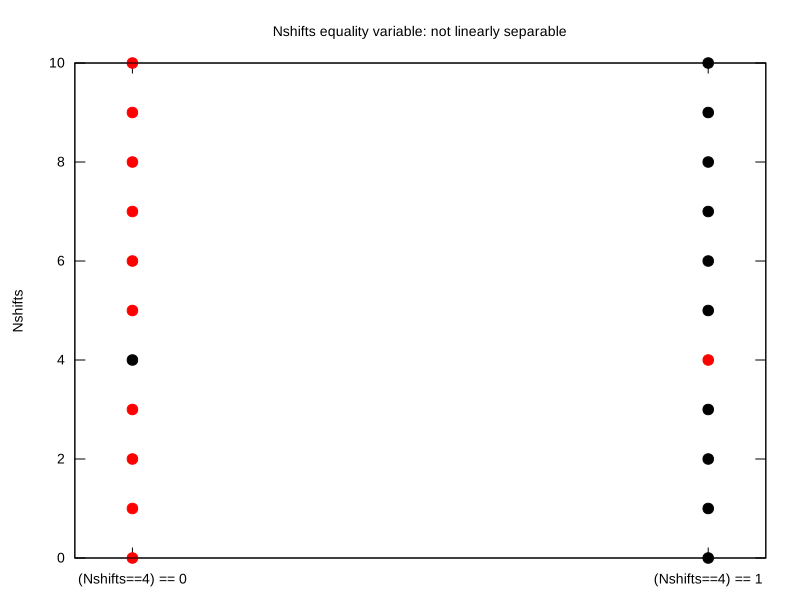
So in the previous example we considered giving David's 5th shift to Judy, for her 3rd shift. In that scenario, David's extra benefit would change from -0.2 to -0.3 (a shift of -0.1), while Judy's would change from -0.8 to -0.5 (a shift of +0.3). So the balancing out the shifts in this way would work: the solver would favor the solution with the higher benefit function. Great. In order for this to work, we need the vars_Nshifts[human][N] variables to function as intended: they need to be binary indicators of whether a specific person has that many shifts or not. That would need to be implemented with constraints. Let's plot it like this:
#!/usr/bin/python3
import numpy as np
import gnuplotlib as gp
Nshifts_eq  = 4
Nshifts_max = 10
Nshifts = np.arange(Nshifts_max+1)
i0 = np.nonzero(Nshifts != Nshifts_eq)[0]
i1 = np.nonzero(Nshifts == Nshifts_eq)[0]
gp.plot( # True value: var_Nshifts4==0, Nshifts!=4
         ( np.zeros(i0.shape),
           Nshifts[i0],
           dict(_with     = 'points pt 7 ps 1 lc "red"') ),
         # True value: var_Nshifts4==1, Nshifts==4
         ( np.ones(i1.shape),
           Nshifts[i1],
           dict(_with     = 'points pt 7 ps 1 lc "red"') ),
         # False value: var_Nshifts4==1, Nshifts!=4
         ( np.ones(i0.shape),
           Nshifts[i0],
           dict(_with     = 'points pt 7 ps 1 lc "black"') ),
         # False value: var_Nshifts4==0, Nshifts==4
         ( np.zeros(i1.shape),
           Nshifts[i1],
           dict(_with     = 'points pt 7 ps 1 lc "black"') ),
        unset=('grid'),
        _set = (f'xtics ("(Nshifts== Nshifts_eq ) == 0" 0, "(Nshifts== Nshifts_eq ) == 1" 1)'),
        _xrange = (-0.1, 1.1),
        ylabel = "Nshifts",
        title = "Nshifts equality variable: not linearly separable",
        hardcopy = "/tmp/scheduling-Nshifts-eq.svg")
scheduling-Nshifts-eq.svg
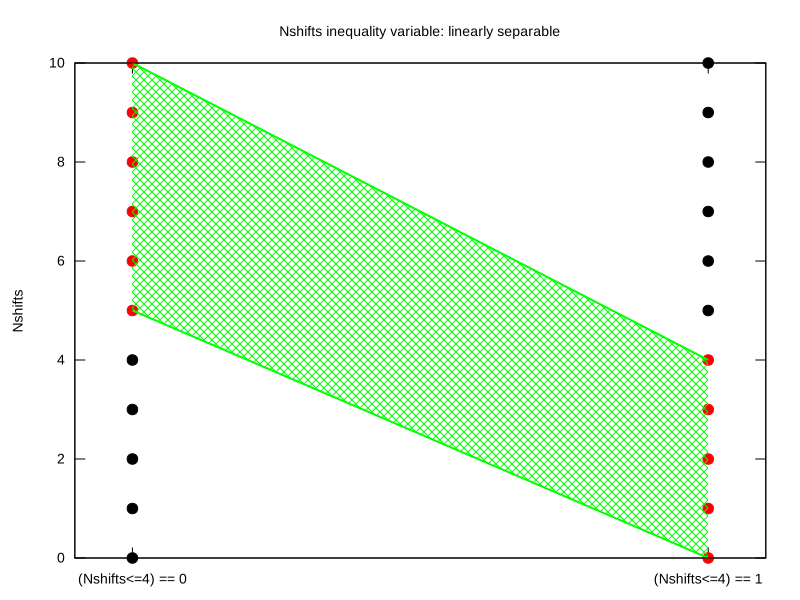
So a hypothetical vars_Nshifts[h][4] variable (plotted on the x axis of this plot) would need to be defined by a set of linear AND constraints to linearly separate the true (red) values of this variable from the false (black) values. As can be seen in this plot, this isn't possible. So this representation does not work. How do we fix it? We can use inequality variables instead. I define a different set of variables vars_Nshifts_leq[human][N] that are 1 iff Nshifts <= N. The equality variable from before can be expressed as a difference of these inequality variables: vars_Nshifts[human][N] = vars_Nshifts_leq[human][N]-vars_Nshifts_leq[human][N-1] Can these vars_Nshifts_leq variables be defined by a set of linear AND constraints? Yes:
#!/usr/bin/python3
import numpy as np
import numpysane as nps
import gnuplotlib as gp
Nshifts_leq = 4
Nshifts_max = 10
Nshifts = np.arange(Nshifts_max+1)
i0 = np.nonzero(Nshifts >  Nshifts_leq)[0]
i1 = np.nonzero(Nshifts <= Nshifts_leq)[0]
def linear_slope_yintercept(xy0,xy1):
    m = (xy1[1] - xy0[1])/(xy1[0] - xy0[0])
    b = xy1[1] - m * xy1[0]
    return np.array(( m, b ))
x01     = np.arange(2)
x01_one = nps.glue( nps.transpose(x01), np.ones((2,1)), axis=-1)
y_lowerbound = nps.inner(x01_one,
                         linear_slope_yintercept( np.array((0, Nshifts_leq+1)),
                                                  np.array((1, 0)) ))
y_upperbound = nps.inner(x01_one,
                         linear_slope_yintercept( np.array((0, Nshifts_max)),
                                                  np.array((1, Nshifts_leq)) ))
y_lowerbound_check = (1-x01) * (Nshifts_leq+1)
y_upperbound_check = Nshifts_max - x01*(Nshifts_max-Nshifts_leq)
gp.plot( # True value: var_Nshifts_leq4==0, Nshifts>4
         ( np.zeros(i0.shape),
           Nshifts[i0],
           dict(_with     = 'points pt 7 ps 1 lc "red"') ),
         # True value: var_Nshifts_leq4==1, Nshifts<=4
         ( np.ones(i1.shape),
           Nshifts[i1],
           dict(_with     = 'points pt 7 ps 1 lc "red"') ),
         # False value: var_Nshifts_leq4==1, Nshifts>4
         ( np.ones(i0.shape),
           Nshifts[i0],
           dict(_with     = 'points pt 7 ps 1 lc "black"') ),
         # False value: var_Nshifts_leq4==0, Nshifts<=4
         ( np.zeros(i1.shape),
           Nshifts[i1],
           dict(_with     = 'points pt 7 ps 1 lc "black"') ),
         ( x01, y_lowerbound, y_upperbound,
           dict( _with     = 'filledcurves lc "green"',
                 tuplesize = 3) ),
         ( x01, nps.cat(y_lowerbound_check, y_upperbound_check),
           dict( _with     = 'lines lc "green" lw 2',
                 tuplesize = 2) ),
        unset=('grid'),
        _set = (f'xtics ("(Nshifts<= Nshifts_leq ) == 0" 0, "(Nshifts<= Nshifts_leq ) == 1" 1)',
                'style fill transparent pattern 1'),
        _xrange = (-0.1, 1.1),
        ylabel = "Nshifts",
        title = "Nshifts inequality variable: linearly separable",
        hardcopy = "/tmp/scheduling-Nshifts-leq.svg")
scheduling-Nshifts-leq.svg
So we can use two linear constraints to make each of these variables work properly. To use these in the benefit function we can use the equality constraint expression from above, or we can use these directly:
# I want to favor people getting more extra shifts at the start to balance
# things out: somebody getting one more shift on their pile shouldn't take
# shifts away from under-utilized people
benefit_boost_leq_bound = \
     2: .2,
     3: .3,
     4: .4,
     5: .5 
# Constrain vars_Nshifts_leq variables to do the right thing
for h in humans:
    for b in benefit_boost_leq_bound.keys():
        prob += (pulp.lpSum([vars[h][s] for s in shifts.keys()])
                 >= (1 - vars_Nshifts_leq[h][b])*(b+1),
                 f" h  at least  b  shifts: lower bound")
        prob += (pulp.lpSum([vars[h][s] for s in shifts.keys()])
                 <= Nshifts_max - vars_Nshifts_leq[h][b]*(Nshifts_max-b),
                 f" h  at least  b  shifts: upper bound")
benefits = dict()
for h in humans:
    benefits[h] = \
        ... + \
        pulp.lpSum([vars_Nshifts_leq[h][b] * benefit_boost_leq_bound[b] \
                    for b in benefit_boost_leq_bound.keys()])
In this scenario, David would get a boost of 0.4 from giving up his 5th shift, while Judy would lose a boost of 0.2 from getting her 3rd, for a net gain of 0.2 benefit points. The exact numbers will need to be adjusted on a case by case basis, but this works. The full program, with this and other extra features is available here.

Dirk Eddelbuettel: #46: Adding arm64 to r2u

Welcome to post 46 in the $R^4 series! r2u, introduced less than three years ago in post #37, has become a runaway success. When I last tabulated downloads in early January, we were already at 33 million downloads of binary CRAN packages across the three Ubuntu LTS releases we support. These were exclusively for the amd64 platform of standard (Intel or AMD made) x64_64 cpus. Now we are happy to announce that arm64 support has been added and is available!

Why arm64? The arm64 platform is already popular on (cloud) servers and is being pushed quite actively by the cloud vendors. AWS calls their cpu graviton , GCS calls it axion . General servers call the cpu ampere ; on laptop / desktops it is branded snapdragon or cortex or something else. Apple calls their variant M1, M2, up to M4 by now (and Linux support exists for the brave, it is less straightforward). What these have in common is a generally more favourable power consumed to ops provided ratio. That makes these cheaper to run or rent on cloud providers. And in laptops they tend to last longer on a single charge too. Distributions such as Debian, Ubuntu, Fedora had arm64 for many years. In fact, the CRAN binaries of R, being made as builds at launchpad.net long provided arm64 in Michael s repo, we now also mirror these to CRAN. Similarly, Docker has long supported containers. And last but not least two issue tickets (#40, #55) had asked a while back.

So Why Now? Good question. I still do not own any hardware with it, and I have not (yet?) bothered with the qemu-based emulation layer. The real difference maker was the recent availability of GitHub Actions instances of ubuntu-24.04-arm (and now apparently also for 22.04). So I started some simple experiments which made it clear this was viable.

What Does It Mean for a CRAN Repo? Great question. As is commonly known, of the (currently) 22.1k CRAN packages, a little under 5k are compiled . Why does this matter? Because the Linux distributions know what they are doing. The 17k (give or take) packages that do not contain compiled code can be used as is (!!) on another platform. Debian and Ubuntu call these builds binary: all as they work all platforms as is . The others go by binary: any and will work on any platform for which they have been built. So we are looking at roughly 5k new binaries.

So How Many Are There? As I write this in early March, roughly 4.5k of the 5k. Plus the 17.1k binary: all and we are looking at near complete coverage!

So What Is The Current State? Pretty complete. Compare to the amd64 side of things, we do not (yet ?) have BioConductor support; this may be added. A handful of packages do not compile because their builds seem to assume Linux so must be amd64 and fail over cpu instructions. Similarly, a few packages want to download binary build blobs (my own Rblpapi among them) but none exist for arm64. Such is life. We will try to fix builds as time permits and report build issues to the respective upstream repos. Help in that endeavour would be most welcome. But all the big and slow compiles one may care about (hello duckdb, hello arrow, ) are there. Which is pretty exciting!

How Does One Get Started? In GitHub Actions, just pick ubuntu-24.04-arm as the platform, and use the r-ci or r2u-setup actiions. A first test yaml exists worked (though this last version had the arm64 runner commented out again). (And no, arm64 was not faster than amd64. More tests needed.) For simple tests, Docker. The rocker/r-ubuntu:24.04 container exists for arm64 (see here), and one can add r2u support as is done in this Dockerfile which is used by the builds and available as eddelbuettel/r2u_build:noble. I will add the standard rocker/r2u:24.04 container (or equally rocker/r2u:noble) in a day or two, I had not realised I wasn t making them for arm64. One a real machine such as a cloud instance or a proper instance, just use the standard r2u script for noble aka 24.04 available here. The key lines are the two lines
echo "deb [arch=amd64,arm64] https://r2u.stat.illinois.edu/ubuntu noble main" \
    > /etc/apt/sources.list.d/cranapt.list

# ...

echo "deb [arch=amd64,arm64] https://cloud.r-project.org/bin/linux/ubuntu noble-cran40/" \
     > /etc/apt/sources.list.d/cran_r.list
creating the apt entry and which are now arm64-aware. After that, apt works as usual, and of course r2u works as usual thanks also to bspm so you can just do, say
install.packages(c("tidyverse", "brms", "rstan", "sf", "terra"))
and enjoy the binaries rolling in. So give it a whirl if you have access to such hardware. We look forward to feedback, suggestes, feature requests or bug reports. Let us know how it goes!

This post by Dirk Eddelbuettel originated on his Thinking inside the box blog. If you like this or other open-source work I do, you can now sponsor me at GitHub.

2 March 2025

Lisandro Dami n Nicanor P rez Meyer: PGP/GPG transition from 0x6286A7D0 to 0xB48C1072

I am currently transitioning my GPG/GPG key from D/4096 0x12DDFA84AC23B2BBF04B313CAB645F406286A7D0 to D/4096 0xA94C9FBFA49AA7CD4F40BB9F5E9030CCB48C1072. Let's put this in plain text, signed with both keys:
-----BEGIN PGP SIGNED MESSAGE-----
Hash: SHA512
- -----BEGIN PGP SIGNED MESSAGE-----
Hash: SHA512
I am currently transitioning my GPG/GPG key from D/4096 0x12DDFA84AC23B2BBF04B313CAB645F406286A7D0 to D/4096 0xA94C9FBFA49AA7CD4F40BB9F5E9030CCB48C1072.
This file is first signed with the new key and then with the old one.
- -----BEGIN PGP SIGNATURE-----
iQIzBAEBCgAdFiEEqUyfv6Sap81PQLufXpAwzLSMEHIFAmfE6RwACgkQXpAwzLSM
EHJpUBAAwMAbOwGcRiuX/aBjqDMA9HerRgimNWE9xA35Asg3F+A5/AFrBo+BDng3
jviCGxR6YdicSLZptaScLuRnqG1i/OcochGDxvHYVQ9I/G9SuHB7ylqD7zDnO5pw
Lldwx9jovkszgXMC+vs1E9tQ4vpuWNQ1I7q90rdikywhvNdNs8XUSCUNCLol5fzm
u64hcKex3pwt7wYs6TxtgO5DLpp//5Z6NoZ5f/esC0837zqy5Py6+7scN3tgRmXj
SyALlhfOCsy4+v22K5xk0VNelEWUg+VKqgMjPYbEfGQ3e4LXId6gGlKF+OuXCJX5
Eqi2leO/O3c+1MZ8LMh3YQft1/TmYktASMTdwV7Y87qMgVkXsJqIvw8d9VNlZvET
B3MMsuPK9VNKCokbSiHwB2ZQR235Hq6LPrBfMPnoVb5QzUgIk8Kz92wM3NWVAjzE
oj/660SZ7SfbBi6qmQyMjYKSKN+kSZazQfoUZo0fK1Y1mywN/XkeeV+gq/ZiYPhI
QLbjEfoeHEVcufgQCU0PvUuKr/+ud8BAwdH/9YWxYnObAzXFxgOJ9AvDqKxbD+rw
MVXCU4xMtNHHDqgZ+pSdB0br/bYtIqh1YsFfHw16lUgj9lcmfnujhl+h700pob6d
oArO0Bjb0bM9PTRRAn3CMiz2UeerBzY6gvaSnO3oBQc/UAx3RgA=
=r9Sr
- -----END PGP SIGNATURE-----
-----BEGIN PGP SIGNATURE-----
iQIzBAEBCgAdFiEEEt36hKwjsrvwSzE8q2RfQGKGp9AFAmfE6U8ACgkQq2RfQGKG
p9DEWA/+N1AtaPwVGRi3OTcC+mzjjVd3oB4H4E80559FCbWQLvbnlazCTgdVHxp5
Pjlm4I/hKYSaWNirUvE7Dq7LNWYYhZRBunXc/VrrX2fkxj99D+F9co5fXYO3fsQn
vlz1UZzq8OrvWJo5Cv65CkblQReB31SNY//gBk5SjaeL4bnH3qOLCn6gGrqIgkyj
qb8vQzk9ssb0b2P2hNJlkYQA20LUshyShyfnaAJuEtmDYp3F3fWfuyTPEznJZ0AJ
efxfkYqQIznY36Om8dW0ec5LI3Xb+Obj4ccfNhWBfVG4RKruKHEhQCDtZbMSGPDn
ns4yOl5cqbN/2Gqa/Ww+LafWPsa73NYQNDOIM2XhVFLf2wikGMnb2bew3iZrEBo5
BORucyd1sBFsdD2tXAZEaXBpuCU+7mI9bJz9Co2+NWf1+IDaKyvJSgl7cQxuUtd4
tp7mDB7Czf4yDK+QHqeWY46DtU0dlDpyOt2IijkJzhH6nL9cfo+W4JUFJrhd42Tr
fRqjt7WeGrauX+d8wfvVV/KFrCkuw51ojLAtztvH7iwDP85wAOu95AlT1kT4ZwlE
uEmdgtYE3GGwQKP2osndJZwic/tZuKrm7p5xFYJr8N95nsRNlk1ia4EkyvQbe49m
2+JHO8Q0EjUGfV2+bSw4Eupi6qEgWp2s4sIGpHEGzWYfNqmozWE=
=A5kI
-----END PGP SIGNATURE-----
The above can be found as a file here.

24 February 2025

Russ Allbery: Review: A Little Vice

Review: A Little Vice, by Erin E. Elkin
Publisher: Erin Elkin
Copyright: June 2024
ASIN: B0CTHRK61X
Format: Kindle
Pages: 398
A Little Vice is a stand-alone self-published magical girl novel. It is the author's first novel. C is a high school student and frequent near-victim of monster attacks. Due to the nefarious work of Avaritia Wolf and her allies, his high school is constantly attacked by Beasts, who are magical corruptions of some internal desire taken to absurd extremes. Standing in their way are the Angelic Saints: magical girls who transform into Saint Castitas, Saint Diligentia, and Saint Temperantia and fight the monsters. The monsters for some reason seem disposed to pick C as their victim for hostage-taking, mind control, use as a human shield, and other rather traumatic activities. He's always rescued by the Saints before any great harm is done, but in some ways this makes the situation worse. It is obvious to C that the Saints are his three friends Inessa, Ida, and Temperance, even though no one else seems able to figure this out despite the blatant clues. Inessa has been his best friend since childhood when she was awkward and needed his support. Now, she and his other friends have become literal heroes, beautiful and powerful and capable, constantly protecting the school and innocent people, and C is little more than a helpless burden to be rescued. More than anything else, he wishes he could be an Angelic Saint like them, but of course the whole idea is impossible. Boys don't get to be magical girls. (I'm using he/him pronouns for C in this review because C uses them for himself for most of the book.) This is a difficult book to review because it is deeply focused on portraying a specific internal emotional battle in all of its sometimes-ugly complexity, and to some extent it prioritizes that portrayal over conventional story-telling. You have probably already guessed that this is a transgender coming-out story Elkin's choice of the magical girl genre was done with deep understanding of its role in transgender narratives but more than that, it is a transgender coming-out story of a very specific and closely-observed type. C knows who he wishes he was, but he is certain that this transformation is absolutely impossible. He is very deep in a cycle of self-loathing for wanting something so manifestly absurd and insulting to people who have the virtues that C does not. A Little Vice is told in the first person from C's perspective, and most of this book is a relentless observation of C's anxiety and shame spiral and reflexive deflection of any possibility of a way out. This is very well-written: Elkin knows the reader is going to disagree with C's internalized disgust and hopelessness, knows the reader desperately wants C to break out of that mindset, and clearly signals in a myriad of adroit ways that Elkin is on the reader's side and does not agree with C's analysis. C's friends are sympathetic, good-hearted people, and while sometimes oblivious, it is obvious to the reader that they're also on the reader's side and would help C in a heartbeat if they saw an opening. But much of the point of the book is that it's not that easy, that breaking out of the internal anxiety spiral is nearly impossible, and that C is very good at rejecting help, both because he cannot imagine what form it could take but also because he is certain that he does not deserve it. In other words, much of the reading experience of this book involves watching C torture and insult himself. It's all the more effective because it isn't gratuitous. C's internal monologue sounds exactly like how an anxiety spiral feels, complete with the sort of half-effective coping mechanisms, deflections, and emotional suppression one develops to blunt that type of emotional turmoil. I normally hate this kind of book. I am a happy ending and competence porn reader by default. The world is full of enough pain that I don't turn to fiction to read about more pain. It says a lot about how well-constructed this book is that I stuck with it. Elkin is going somewhere with the story, C gets moments of joy and delight along the way to keep the reader from bogging down completely, and the best parts of the book feel like a prolonged musical crescendo with suspended chords. There is a climax coming, but Elkin is going to make you wait for it for far longer than you want to. The main element that protects A Little Vice from being too grim is that it is a genre novel that is very playful about both magical girls and superhero tropes in general. I've already alluded to one of those elements: Elkin plays with the Mask Principle (the inability of people to see through entirely obvious secret identities) in knowing and entertaining ways. But there are also villains, and that leads me to the absolutely delightful Avaritia Wolf, who for me was the best character in this book. The Angelic Saints are not the only possible approach to magical girl powers in this universe. There are villains who can perform a similar transformation, except they embrace a vice rather than a virtue. Avaritia Wolf embraces the vice of greed. They (Avaritia's pronouns change over the course of the book) also have a secret identity, which I suspect will be blindingly obvious to most readers but which I'll avoid mentioning since it's still arguably a spoiler. The primary plot arc of this book is an attempt to recruit C to the side of the villains. The Beasts are drawn to him because he has magical potential, and the villains are less picky about gender. This initially involves some creepy and disturbing mind control, but it also brings C into contact with Avaritia and Avaritia's very specific understanding of greed. As far as Avaritia is concerned, greed means wanting whatever they want, for whatever reason they feel like wanting it, and there is absolutely no reason why that shouldn't include being greedy for their friends to be happy. Or doing whatever they can to make their friends happy, whether or not that looks like villainy. Elkin does two things with this plot that I thought were remarkably skillful. The first is that she directly examines and then undermines the "easy" transgender magical girl ending. In a world of transformation magic, someone who wants to be a girl could simply turn into a girl and thus apparently resolve the conflict in a way that makes everyone happy. I think there is an important place for that story (I am a vigorous defender of escapist fantasy and happy endings), but that is not the story that Elkin is telling. I won't go into the details of why and how the story complicates and undermines this easy ending, but it's a lot of why this book feels both painful and honest to a specific, and very not easy, transgender experience, even though it takes place in an utterly unrealistic world. But the second, which is more happy and joyful, is that Avaritia gleefully uses a wholehearted embrace of every implication of the vice of greed to bulldoze the binary morality of the story and question the classification of human emotions into virtues and vices. They are not a hero, or even all that good; they have some serious flaws and a very anarchic attitude towards society. But Avaritia provides the compelling, infectious thrill of the character who looks at the social construction of morality that is constraining the story and decides that it's all bullshit and refuses to comply. This is almost the exact opposite of C's default emotional position at the start of the book, and watching the two characters play off of each other in a complex friendship is an absolute delight. The ending of this book is complicated, messy, and incomplete. It is the sort of ending that I think could be incredibly powerful if it hits precisely the right chords with the reader, but if you're not that reader, it can also be a little heartbreaking because Elkin refuses to provide an easy resolution. The ending also drops some threads that I wish Elkin hadn't dropped; there are some characters who I thought deserved a resolution that they don't get. But this is one of those books where the author knows exactly what story they're trying to tell and tells it whether or not that fits what the reader wants. Those books are often not easy reading, but I think there's something special about them. This is not the novel for people who want detailed world-building that puts a solid explanation under events. I thought Elkin did a great job playing with the conventions of an episodic anime, including starting the book on Episode 12 to imply C's backstory with monster attacks and hinting at a parallel light anime story by providing TV-trailer-style plot summaries and teasers at the start and end of each chapter. There is a fascinating interplay between the story in which the Angelic Saints are the protagonists, which the reader can partly extrapolate, and the novel about C that one is actually reading. But the details of the world-building are kept at the anime plot level: There's an arch-villain, a World Tree, and a bit of backstory, but none of it makes that much sense or turns into a coherent set of rules. This is a psychological novel; the background and rules exist to support C's story. If you do want that psychological novel... well, I'm not sure whether to recommend this book or not. I admire the construction of this book a great deal, but I don't think appealing to the broadest possible audience was the goal. C's anxiety spiral is very repetitive, because anxiety spirals are very repetitive, and you have to be willing to read for the grace notes on the doom loop if you're going to enjoy this book. The sentence-by-sentence writing quality is fine but nothing remarkable, and is a bit shy of the average traditionally-published novel. The main appeal of A Little Vice is in the deep and unflinching portrayal of a specific emotional journey. I think this book is going to work if you're sufficiently invested in that journey that you are willing to read the brutal and repetitive parts. If you're not, there's a chance you will bounce off this hard. I was invested, and I'm glad I read this, but caveat emptor. You may want to try a sample first. One final note: If you're deep in the book world, you may wonder, like I did, if the title is a reference to Hanya Yanagihara's (in)famous A Little Life. I do not know for certain I have not read that book because I am not interested in being emotionally brutalized but if it is, I don't think there is much similarity. Both books are to some extent about four friends, but I couldn't find any other obvious connections from some Wikipedia reading, and A Little Vice, despite C's emotional turmoil, seems to be considerably more upbeat. Content notes: Emotionally abusive parent, some thoughts of self-harm, mind control, body dysmorphia, and a lot (a lot) of shame and self-loathing. Rating: 7 out of 10

23 February 2025

Iustin Pop: Still alive, but this blog not really

Sigh, sometimes I really don t understand time. And I don t mean, in the physics sense. It s just, the days have way fewer hours than 10 years ago, or there s way more stuff to do. Probably the latter No time for real open-source work, but I managed to do some minor coding, released a couple of minor version (as upstream), and packaged some refreshes in Debian. The later only because I got involved, against better judgement, into some too heated discussions, but they ended well, somehow. But the whole episode motivated me to actually do some work, even if minor, than just rant on mailing lists . My sports life is still pretty erratic, but despite some repeated sickness (my fault, for not sleeping well enough) and tendon issues, there are months in which I can put down 100km. And the skiing season was really awesome. So life goes on, but I definitely am not keeping up with entropy, even in simple things such as my inbox. One day I ll make real blog post, not just an update, but in the meantime, it is what it is. And yes, running 10km while still sick just because you re bored is not the best idea. According to a friend, of course, not to my Strava account.

20 February 2025

Paul Tagliamonte: boot2kier

I can t remember exactly the joke I was making at the time in my work s slack instance (I m sure it wasn t particularly funny, though; and not even worth re-reading the thread to work out), but it wound up with me writing a UEFI binary for the punchline. Not to spoil the ending but it worked - no pesky kernel, no messing around with userland . I guess the only part of this you really need to know for the setup here is that it was a Severance joke, which is some fantastic TV. If you haven t seen it, this post will seem perhaps weirder than it actually is. I promise I haven t joined any new cults. For those who have seen it, the payoff to my joke is that I wanted my machine to boot directly to an image of Kier Eagan. As for how to do it I figured I d give the uefi crate a shot, and see how it is to use, since this is a low stakes way of trying it out. In general, this isn t the sort of thing I d usually post about except this wound up being easier and way cleaner than I thought it would be. That alone is worth sharing, in the hopes someome comes across this in the future and feels like they, too, can write something fun targeting the UEFI. First thing s first gotta create a rust project (I ll leave that part to you depending on your life choices), and to add the uefi crate to your Cargo.toml. You can either use cargo add or add a line like this by hand:
uefi =   version = "0.33", features = ["panic_handler", "alloc", "global_allocator"]  
We also need to teach cargo about how to go about building for the UEFI target, so we need to create a rust-toolchain.toml with one (or both) of the UEFI targets we re interested in:
[toolchain]
targets = ["aarch64-unknown-uefi", "x86_64-unknown-uefi"]
Unfortunately, I wasn t able to use the image crate, since it won t build against the uefi target. This looks like it s because rustc had no way to compile the required floating point operations within the image crate without hardware floating point instructions specifically. Rust tends to punt a lot of that to libm usually, so this isnt entirely shocking given we re nostd for a non-hardfloat target. So-called softening requires a software floating point implementation that the compiler can use to polyfill (feels weird to use the term polyfill here, but I guess it s spiritually right?) the lack of hardware floating point operations, which rust hasn t implemented for this target yet. As a result, I changed tactics, and figured I d use ImageMagick to pre-compute the pixels from a jpg, rather than doing it at runtime. A bit of a bummer, since I need to do more out of band pre-processing and hardcoding, and updating the image kinda sucks as a result but it s entirely manageable.
$ convert -resize 1280x900 kier.jpg kier.full.jpg
$ convert -depth 8 kier.full.jpg rgba:kier.bin
This will take our input file (kier.jpg), resize it to get as close to the desired resolution as possible while maintaining aspect ration, then convert it from a jpg to a flat array of 4 byte RGBA pixels. Critically, it s also important to remember that the size of the kier.full.jpg file may not actually be the requested size it will not change the aspect ratio, so be sure to make a careful note of the resulting size of the kier.full.jpg file. Last step with the image is to compile it into our Rust bianary, since we don t want to struggle with trying to read this off disk, which is thankfully real easy to do.
const KIER: &[u8] = include_bytes!("../kier.bin");
const KIER_WIDTH: usize = 1280;
const KIER_HEIGHT: usize = 641;
const KIER_PIXEL_SIZE: usize = 4;
Remember to use the width and height from the final kier.full.jpg file as the values for KIER_WIDTH and KIER_HEIGHT. KIER_PIXEL_SIZE is 4, since we have 4 byte wide values for each pixel as a result of our conversion step into RGBA. We ll only use RGB, and if we ever drop the alpha channel, we can drop that down to 3. I don t entirely know why I kept alpha around, but I figured it was fine. My kier.full.jpg image winds up shorter than the requested height (which is also qemu s default resolution for me) which means we ll get a semi-annoying black band under the image when we go to run it but it ll work. Anyway, now that we have our image as bytes, we can get down to work, and write the rest of the code to handle moving bytes around from in-memory as a flat block if pixels, and request that they be displayed using the UEFI GOP. We ll just need to hack up a container for the image pixels and teach it how to blit to the display.
/// RGB Image to move around. This isn't the same as an
///  image::RgbImage , but we can associate the size of
/// the image along with the flat buffer of pixels.
struct RgbImage  
/// Size of the image as a tuple, as the
 /// (width, height)
 size: (usize, usize),
/// raw pixels we'll send to the display.
 inner: Vec<BltPixel>,
 
impl RgbImage  
/// Create a new  RgbImage .
 fn new(width: usize, height: usize) -> Self  
RgbImage  
size: (width, height),
inner: vec![BltPixel::new(0, 0, 0); width * height],
 
 
/// Take our pixels and request that the UEFI GOP
 /// display them for us.
 fn write(&self, gop: &mut GraphicsOutput) -> Result  
gop.blt(BltOp::BufferToVideo  
buffer: &self.inner,
src: BltRegion::Full,
dest: (0, 0),
dims: self.size,
 )
 
 
impl Index<(usize, usize)> for RgbImage  
type Output = BltPixel;
fn index(&self, idx: (usize, usize)) -> &BltPixel  
let (x, y) = idx;
&self.inner[y * self.size.0 + x]
 
 
impl IndexMut<(usize, usize)> for RgbImage  
fn index_mut(&mut self, idx: (usize, usize)) -> &mut BltPixel  
let (x, y) = idx;
&mut self.inner[y * self.size.0 + x]
 
 
We also need to do some basic setup to get a handle to the UEFI GOP via the UEFI crate (using uefi::boot::get_handle_for_protocol and uefi::boot::open_protocol_exclusive for the GraphicsOutput protocol), so that we have the object we need to pass to RgbImage in order for it to write the pixels to the display. The only trick here is that the display on the booted system can really be any resolution so we need to do some capping to ensure that we don t write more pixels than the display can handle. Writing fewer than the display s maximum seems fine, though.
fn praise() -> Result  
let gop_handle = boot::get_handle_for_protocol::<GraphicsOutput>()?;
let mut gop = boot::open_protocol_exclusive::<GraphicsOutput>(gop_handle)?;
// Get the (width, height) that is the minimum of
 // our image and the display we're using.
 let (width, height) = gop.current_mode_info().resolution();
let (width, height) = (width.min(KIER_WIDTH), height.min(KIER_HEIGHT));
let mut buffer = RgbImage::new(width, height);
for y in 0..height  
for x in 0..width  
let idx_r = ((y * KIER_WIDTH) + x) * KIER_PIXEL_SIZE;
let pixel = &mut buffer[(x, y)];
pixel.red = KIER[idx_r];
pixel.green = KIER[idx_r + 1];
pixel.blue = KIER[idx_r + 2];
 
 
buffer.write(&mut gop)?;
Ok(())
 
Not so bad! A bit tedious we could solve some of this by turning KIER into an RgbImage at compile-time using some clever Cow and const tricks and implement blitting a sub-image of the image but this will do for now. This is a joke, after all, let s not go nuts. All that s left with our code is for us to write our main function and try and boot the thing!
#[entry]
fn main() -> Status  
uefi::helpers::init().unwrap();
praise().unwrap();
boot::stall(100_000_000);
Status::SUCCESS
 
If you re following along at home and so interested, the final source is over at gist.github.com. We can go ahead and build it using cargo (as is our tradition) by targeting the UEFI platform.
$ cargo build --release --target x86_64-unknown-uefi

Testing the UEFI Blob While I can definitely get my machine to boot these blobs to test, I figured I d save myself some time by using QEMU to test without a full boot. If you ve not done this sort of thing before, we ll need two packages, qemu and ovmf. It s a bit different than most invocations of qemu you may see out there so I figured it d be worth writing this down, too.
$ doas apt install qemu-system-x86 ovmf
qemu has a nice feature where it ll create us an EFI partition as a drive and attach it to the VM off a local directory so let s construct an EFI partition file structure, and drop our binary into the conventional location. If you haven t done this before, and are only interested in running this in a VM, don t worry too much about it, a lot of it is convention and this layout should work for you.
$ mkdir -p esp/efi/boot
$ cp target/x86_64-unknown-uefi/release/*.efi \
 esp/efi/boot/bootx64.efi
With all this in place, we can kick off qemu, booting it in UEFI mode using the ovmf firmware, attaching our EFI partition directory as a drive to our VM to boot off of.
$ qemu-system-x86_64 \
 -enable-kvm \
 -m 2048 \
 -smbios type=0,uefi=on \
 -bios /usr/share/ovmf/OVMF.fd \
 -drive format=raw,file=fat:rw:esp
If all goes well, soon you ll be met with the all knowing gaze of Chosen One, Kier Eagan. The thing that really impressed me about all this is this program worked first try it all went so boringly normal. Truly, kudos to the uefi crate maintainers, it s incredibly well done.

Booting a live system Sure, we could stop here, but anyone can open up an app window and see a picture of Kier Eagan, so I knew I needed to finish the job and boot a real machine up with this. In order to do that, we need to format a USB stick. BE SURE /dev/sda IS CORRECT IF YOU RE COPY AND PASTING. All my drives are NVMe, so BE CAREFUL if you use SATA, it may very well be your hard drive! Please do not destroy your computer over this.
$ doas fdisk /dev/sda
Welcome to fdisk (util-linux 2.40.4).
Changes will remain in memory only, until you decide to write them.
Be careful before using the write command.
Command (m for help): n
Partition type
p primary (0 primary, 0 extended, 4 free)
e extended (container for logical partitions)
Select (default p): p
Partition number (1-4, default 1):
First sector (2048-4014079, default 2048):
Last sector, +/-sectors or +/-size K,M,G,T,P  (2048-4014079, default 4014079):
Created a new partition 1 of type 'Linux' and of size 1.9 GiB.
Command (m for help): t
Selected partition 1
Hex code or alias (type L to list all): ef
Changed type of partition 'Linux' to 'EFI (FAT-12/16/32)'.
Command (m for help): w
The partition table has been altered.
Calling ioctl() to re-read partition table.
Syncing disks.
Once that looks good (depending on your flavor of udev you may or may not need to unplug and replug your USB stick), we can go ahead and format our new EFI partition (BE CAREFUL THAT /dev/sda IS YOUR USB STICK) and write our EFI directory to it.
$ doas mkfs.fat /dev/sda1
$ doas mount /dev/sda1 /mnt
$ cp -r esp/efi /mnt
$ find /mnt
/mnt
/mnt/efi
/mnt/efi/boot
/mnt/efi/boot/bootx64.efi
Of course, naturally, devotion to Kier shouldn t mean backdooring your system. Disabling Secure Boot runs counter to the Core Principals, such as Probity, and not doing this would surely run counter to Verve, Wit and Vision. This bit does require that you ve taken the step to enroll a MOK and know how to use it, right about now is when we can use sbsign to sign our UEFI binary we want to boot from to continue enforcing Secure Boot. The details for how this command should be run specifically is likely something you ll need to work out depending on how you ve decided to manage your MOK.
$ doas sbsign \
 --cert /path/to/mok.crt \
 --key /path/to/mok.key \
 target/x86_64-unknown-uefi/release/*.efi \
 --output esp/efi/boot/bootx64.efi
I figured I d leave a signed copy of boot2kier at /boot/efi/EFI/BOOT/KIER.efi on my Dell XPS 13, with Secure Boot enabled and enforcing, just took a matter of going into my BIOS to add the right boot option, which was no sweat. I m sure there is a way to do it using efibootmgr, but I wasn t smart enough to do that quickly. I let er rip, and it booted up and worked great! It was a bit hard to get a video of my laptop, though but lucky for me, I have a Minisforum Z83-F sitting around (which, until a few weeks ago was running the annual http server to control my christmas tree ) so I grabbed it out of the christmas bin, wired it up to a video capture card I have sitting around, and figured I d grab a video of me booting a physical device off the boot2kier USB stick.
Attentive readers will notice the image of Kier is smaller then the qemu booted system which just means our real machine has a larger GOP display resolution than qemu, which makes sense! We could write some fancy resize code (sounds annoying), center the image (can t be assed but should be the easy way out here) or resize the original image (pretty hardware specific workaround). Additionally, you can make out the image being written to the display before us (the Minisforum logo) behind Kier, which is really cool stuff. If we were real fancy we could write blank pixels to the display before blitting Kier, but, again, I don t think I care to do that much work.

But now I must away If I wanted to keep this joke going, I d likely try and find a copy of the original video when Helly 100%s her file and boot into that or maybe play a terrible midi PC speaker rendition of Kier, Chosen One, Kier after rendering the image. I, unfortunately, don t have any friends involved with production (yet?), so I reckon all that s out for now. I ll likely stop playing with this the joke was done and I m only writing this post because of how great everything was along the way. All in all, this reminds me so much of building a homebrew kernel to boot a system into but like, good, though, and it s a nice reminder of both how fun this stuff can be, and how far we ve come. UEFI protocols are light-years better than how we did it in the dark ages, and the tooling for this is SO much more mature. Booting a custom UEFI binary is miles ahead of trying to boot your own kernel, and I can t believe how good the uefi crate is specifically. Praise Kier! Kudos, to everyone involved in making this so delightful .

11 February 2025

Ian Jackson: derive-deftly 1.0.0 - Rust derive macros, the easy way

derive-deftly 1.0 is released. derive-deftly is a template-based derive-macro facility for Rust. It has been a great success. Your codebase may benefit from it too! Rust programmers will appreciate its power, flexibility, and consistency, compared to macro_rules; and its convenience and simplicity, compared to proc macros. Programmers coming to Rust from scripting languages will appreciate derive-deftly s convenient automatic code generation, which works as a kind of compile-time introspection. Rust s two main macro systems I m often a fan of metaprogramming, including macros. They can help remove duplication and flab, which are often the enemy of correctness. Rust has two macro systems. derive-deftly offers much of the power of the more advanced (proc_macros), while beating the simpler one (macro_rules) at its own game for ease of use. (Side note: Rust has at least three other ways to do metaprogramming: generics; build.rs; and, multiple module inclusion via #[path=]. These are beyond the scope of this blog post.) macro_rules! macro_rules! aka pattern macros , declarative macros , or sometimes macros by example are the simpler kind of Rust macro. They involve writing a sort-of-BNF pattern-matcher, and a template which is then expanded with substitutions from the actual input. If your macro wants to accept comma-separated lists, or other simple kinds of input, this is OK. But often we want to emulate a #[derive(...)] macro: e.g., to define code based on a struct, handling each field. Doing that with macro_rules is very awkward: macro_rules! s pattern language doesn t have a cooked way to match a data structure, so you have to hand-write a matcher for Rust syntax, in each macro. Writing such a matcher is very hard in the general case, because macro_rules lacks features for matching important parts of Rust syntax (notably, generics). (If you really need to, there s a horrible technique as a workaround.) And, the invocation syntax for the macro is awkward: you must enclose the whole of the struct in my_macro! . This makes it hard to apply more than one macro to the same struct, and produces rightward drift. Enclosing the struct this way means the macro must reproduce its input - so it can have bugs where it mangles the input, perhaps subtly. This also means the reader cannot be sure precisely whether the macro modifies the struct itself. In Rust, the types and data structures are often the key places to go to understand a program, so this is a significant downside. macro_rules also has various other weird deficiencies too specific to list here. Overall, compared to (say) the C preprocessor, it s great, but programmers used to the power of Lisp macros, or (say) metaprogramming in Tcl, will quickly become frustrated. proc macros Rust s second macro system is much more advanced. It is a fully general system for processing and rewriting code. The macro s implementation is Rust code, which takes the macro s input as arguments, in the form of Rust tokens, and returns Rust tokens to be inserted into the actual program. This approach is more similar to Common Lisp s macros than to most other programming languages macros systems. It is extremely powerful, and is used to implement many very widely used and powerful facilities. In particular, proc macros can be applied to data structures with #[derive(...)]. The macro receives the data structure, in the form of Rust tokens, and returns the code for the new implementations, functions etc. This is used very heavily in the standard library for basic features like #[derive(Debug)] and Clone, and for important libraries like serde and strum. But, it is a complete pain in the backside to write and maintain a proc_macro. The Rust types and functions you deal with in your macro are very low level. You must manually handle every possible case, with runtime conditions and pattern-matching. Error handling and recovery is so nontrivial there are macro-writing libraries and even more macros to help. Unlike a Lisp codewalker, a Rust proc macro must deal with Rust s highly complex syntax. You will probably end up dealing with syn, which is a complete Rust parsing library, separate from the compiler; syn is capable and comprehensive, but a proc macro must still contain a lot of often-intricate code. There are build/execution environment problems. The proc_macro code can t live with your application; you have to put the proc macros in a separate cargo package, complicating your build arrangements. The proc macro package environment is weird: you can t test it separately, without jumping through hoops. Debugging can be awkward. Proper tests can only realistically be done with the help of complex additional tools, and will involve a pinned version of Nightly Rust. derive-deftly to the rescue derive-deftly lets you use a write a #[derive(...)] macro, driven by a data structure, without wading into any of that stuff. Your macro definition is a template in a simple syntax, with predefined $-substitutions for the various parts of the input data structure. Example Here s a real-world example from a personal project:
define_derive_deftly!  
    export UpdateWorkerReport:
    impl $ttype  
        pub fn update_worker_report(&self, wr: &mut WorkerReport)  
            $(
                $ when fmeta(worker_report) 
                wr.$fname = Some(self.$fname.clone()).into();
            )


#[derive(Debug, Deftly, Clone)]
...
#[derive_deftly(UiMap, UpdateWorkerReport)]
pub struct JobRow  
    ...
    #[deftly(worker_report)]
    pub status: JobStatus,
    pub processing: NoneIsEmpty<ProcessingInfo>,
    #[deftly(worker_report)]
    pub info: String,
    pub duplicate_of: Option<JobId>,
 
This is a nice example, also, of how using a macro can avoid bugs. Implementing this update by hand without a macro would involve a lot of cut-and-paste. When doing that cut-and-paste it can be very easy to accidentally write bugs where you forget to update some parts of each of the copies:
    pub fn update_worker_report(&self, wr: &mut WorkerReport)  
        wr.status = Some(self.status.clone()).into();
        wr.info = Some(self.status.clone()).into();
     
Spot the mistake? We copy status to info. Bugs like this are extremely common, and not always found by the type system. derive-deftly can make it much easier to make them impossible. Special-purpose derive macros are now worthwhile! Because of the difficult and cumbersome nature of proc macros, very few projects have site-specific, special-purpose #[derive(...)] macros. The Arti codebase has no bespoke proc macros, across its 240kloc and 86 crates. (We did fork one upstream proc macro package to add a feature we needed.) I have only one bespoke, case-specific, proc macro amongst all of my personal Rust projects; it predates derive-deftly. Since we have started using derive-deftly in Arti, it has become an important tool in our toolbox. We have 37 bespoke derive macros, done with derive-deftly. Of these, 9 are exported for use by downstream crates. (For comparison there are 176 macro_rules macros.) In my most recent personal Rust project, I have 22 bespoke derive macros, done with with derive-deftly, and 19 macro_rules macros. derive-deftly macros are easy and straightforward enough that they can be used as readily as macro_rules macros. Indeed, they are often clearer than a macro_rules macro. Stability without stagnation derive-deftly is already highly capable, and can solve many advanced problems. It is mature software, well tested, with excellent documentation, comprising both comprehensive reference material and the walkthrough-structured user guide. But declaring it 1.0 doesn t mean that it won t improve further. Our ticket tracker has a laundry list of possible features. We ll sometimes be cautious about committing to these, so we ve added a beta feature flag, for opting in to less-stable features, so that we can prototype things without painting ourselves into a corner. And, we intend to further develop the Guide.

comment count unavailable comments

9 February 2025

Philipp Kern: 20 years

20 years ago, I got my Debian Developer account. I was 18 at the time, it was Shrove Tuesday and - as is customary - I was drunk when I got the email. There was so much that I did not know - which is also why the process took 1.5 years from the time I applied. I mostly only maintained a package or two. I'm still amazed that Christian Perrier and Joerg Jaspert put sufficient trust in me at that time. Nevertheless now feels like a good time for a personal reflection of my involvement in Debian.
During my studies I took on more things. In January 2008 I joined the Release Team as an assistant, which taught me a lot of code review. I have been an Application Manager on the side.
Going to my first Debconf was really a turning point. My first one was Mar del Plata in Argentina in August 2008, when I was 21. That was quite an excitement, traveling that far from Germany for the first time. The personal connections I made there made quite the difference. It was also a big boost for motivation. I attended 8 (Argentina), 9 (Spain), 10 (New York), 11 (Bosnia and Herzegovina), 12 (Nicaragua), 13 (Switzerland), 14 (Portland), 15 (Germany), 16 (South Africa), and hopefully I'll make it to this year's in Brest. At all of them I did not see much of the countries as I prioritized all of my time focused on Debian, even skipping some of the day trips in favor of team meetings. Yet I am very grateful to the project (and to my employer) for shipping me there.I ended up as Stable Release Manager for a while, from August 2008 - when Martin Zobel-Helas moved into DSA - until I got dropped in March 2020. I think my biggest achievements were pushing for the creation of -updates in favor of a separate volatile archive and a change of the update policy to allow for more common sense updates in the main archive vs. the very strict "breakage or security" policy we had previously. I definitely need to call out Adam D. Barratt for being the partner in crime, holding up the fort for even longer.In 2009 I got too annoyed at the existing wanna-build team not being responsive anymore and pushed for the system to be given to a new team. I did not build it and significant contributions were done by other people (like Andreas Barth and Joachim Breitner, and later Aurelien Jarno). I mostly reworked the way the system was triggered, investigated when it broke and was around when people wanted things merged.
In the meantime I worked sys/netadmin jobs while at university, both paid and as a volunteer with the students' council. For a year or two I was the administrator of a System z mainframe IBM donated to my university. We had a mainframe course and I attended two related conferences. That's where my s390(x) interest came from, although credit for the port needs to go to Aurelien Jarno.
Since completing university in 2013 I have been working for a company for almost 12 years. Debian experience was very relevant to the job and I went on maintaining a Linux distro or two at work - before venturing off into security hardening. People in megacorps - in my humble opinion - disappear from the volunteer projects because a) they might previously have been studying and thus had a lot more time on their hands and b) the job is too similar to the volunteer work and thus the same brain cells used for work are exhausted and can't be easily reused for volunteer work. I kept maintaining a couple of things (buildds, some packages) - mostly because of a sense of commitment and responsibility, but otherwise kind of scaled down my involvement. I also felt less connected as I dropped off IRC.Last year I finally made it to Debian events again: MiniDebconf in Berlin, where we discussed the aftermath of the xz incident, and the Debian BSP in Salzburg. I rejoined IRC using the Matrix bridge. That also rekindled my involvement, with me guiding a new DD through NM and ending up in DSA. To be honest, only in the last two or three years I felt like a (more) mature old-timer.
I have a new gig at work lined up to start soon and next to that I have sysadmining for Debian. It is pretty motivating to me that I can just get things done - something that is much harder to achieve at work due to organizational complexities. It balances out some frustration I'd otherwise have. The work is different enough to be enjoyable and the people I work with are great.

The future
I still think the work we do in Debian is important, as much as I see a lack of appreciation in a world full of containers. We are reaping most of the benefits of standing on the shoulders of giants and of great decisions made in the past (e.g. the excellent Debian policy, but also the organizational model) that made Debian what it is today.Given the increase in size and complexity of what Debian ships - and the somewhat dwindling resource of developer time, it would benefit us to have better processes for large-scale changes across all packages. I greatly respect the horizontal effects that are currently being driven and that suck up a lot of energy.A lot of our infrastructure is also aging and not super well maintained. Many take it for granted that the services we have keep existing, but most are only maintained by a person or two, if even. Software stacks are aging and it is even a struggle to have all necessary packages in the next release.Hopefully I can contribute a bit or two to these efforts in the future.

6 February 2025

Dominique Dumont: Drawbacks of using Cookiecutter with Cruft

Hi Cookiecutter is a tool for building coding project templates. It s often used to provide a scaffolding to build lots of similar project. I ve seen it used to create Symfony projects and several cloud infrastructures deployed with Terraform. This tool was useful to accelerate the creation of new projects.  Since these templates were bound to evolve, the teams providing these template relied on cruft to update the code provided by the template in their user s code. In other words, they wanted their users to apply a diff of the template modification to their code. At the beginning, all was fine. But problems began to appear during the lifetime of these projects. What went wrong ? In both cases, we had the following scenario: User team giving up on updates is a major problem because these update may bring security or compliance fixes.  Note that code conflicts seen with cruft are similar to git merge conflicts, but harder to resolve because, unlike with a git merge, there s no common ancestor, so 3-way merges are not possible. From an organisation point of view, the main problem is the ambiguous ownership of the functionalities brought by template code: who own this code ? The provider team who writes the template or the user team who owns the repository of the code generated from the template ? Conflicts are bound to happen. Possible solutions to get out of this tar pit: Of course your users won t be happy to be faced with a manual migration from the old big template to the new one with external dependencies. On the other hand, this may be easier to sell than updates based on cruft since the painful work will happen once. Further updates will be done by incrementing dependency versions (which can be automated with renovate). If many projects are to be created with this template, it may be more practical to provide use a CLI that will create a skeleton project. See for instance terragrunt scaffold command. My name is Dominique Dumont, I m a devops freelance. You can find the devops and audit services I propose on my website or reach out to me on LinkedIn. All the best

2 February 2025

Colin Watson: Free software activity in January 2025

Most of my Debian contributions this month were sponsored by Freexian. If you appreciate this sort of work and are at a company that uses Debian, have a look to see whether you can pay for any of Freexian s services; as well as the direct benefits, that revenue stream helps to keep Debian development sustainable for me and several other lovely people. You can also support my work directly via Liberapay. Python team We finally made Python 3.13 the default version in testing! I fixed various bugs that got in the way of this: As with last month, I fixed a few more build regressions due to the removal of a deprecated intersphinx_mapping syntax in Sphinx 8.0: I ported a few packages to Django 5.1: I ported python-pypump to IPython 8.0. I fixed python-datamodel-code-generator to handle isort 6, and contributed that upstream. I fixed some packages to tolerate future versions of dh-python that will drop their dependency on python3-setuptools: I removed the old python-celery-common transitional package from celery, since nothing in Debian needs it any more. I fixed or helped to fix various other build/test failures: I upgraded these packages to new upstream versions: Rust team I fixed rust-pyo3-ffi to avoid explicit Python version dependencies that were getting in the way of making Python 3.13 the default version. Security tools packaging team I uploaded libevt to fix a build failure on i386 and to tolerate future versions of dh-python that will drop their dependency on python3-setuptools. Installer team I helped with some testing of a debian-installer-utils patch as part of the /usr move. I need to get around to uploading this, since it looks OK now. Other small things Helmut Grohne reached out for help debugging a multi-arch coinstallability problem (you know it s going to be complicated when even Helmut can t figure it out on his own ) in binutils, and we had a call about that. I reviewed and applied a new Romanian translation of debconf s manual pages. I did my twice-yearly refresh of debmirror s mirror_size documentation, and applied a contribution to improve the example debmirror.conf. I fixed an arguable preprocessor string handling bug in man-db, and applied a fix for out-of-tree builds.

1 February 2025

Guido G nther: Free Software Activities January 2025

Another short status update of what happened on my side last month. Mostly focused on quality of life improvements in phosh and cleaning up and improving phoc this time around (including catching up with wlroots git) but some improvements for other things like phosh-osk-stub happened on the side line too. phosh phoc phosh-osk-stub xdg-desktop-portal-phosh phosh-recipes libcmatrix phrog Debian git-buildpackage livi feedbackd Wayland protocols Wlroots Bug reports Reviews This is not code by me but reviews on other peoples code. The list is incomplete, but I hope to improve on this in the upcoming months. Thanks for the contributions! Help Development If you want to support my work see donations. Comments? Join the Fediverse thread

29 January 2025

Keith Packard: picolibc-i18n

Internationalization support in Picolibc There are two major internationalization APIs in the C library: locales and iconv. Iconv is an isolated component which only performs charset conversion in ways that don't interact with anything else in the library. Locales affect pretty much every API that deals with strings and covers charset conversion along with a huge range of localized information from character classification to formatting of time, money, people's names, addresses and even standard paper sizes. Picolibc inherits it's implementation of both of these from newlib. Given that embedded applications rarely need advanced functionality from either these APIs, I hadn't spent much time exploring this space. Newlib locale code When run on Cygwin, Newlib's locale support is quite complete as it leverages the underlying Windows locale support. Without Windows support, everything aside from charset conversion and character classification data is stubbed out at the bottom of the stack. Because the implementation can support full locale functionality, the implementation is designed for that, with large data structures and lots of code. Charset conversion and character classification data for locales is all built-in; none of that can be loaded at runtime. There is support for all of the ISO-8859 charsets, three JIS variants, a bunch of Windows code pages and a few other single-byte encodings. One oddity in this code is that when using a JIS locale, wide characters are stored in EUC-JP rather than Unicode. Every other locale uses Unicode. This means APIs like wctype are implemented by mapping the JIS-encoded character to Unicode and then using the underlying Unicode character classification tables. One consequence of this is that there isn't any Unicode to JIS mapping provided as it isn't necessary. When testing the charset conversion and Unicode character classification data, I found numerous minor errors and a couple of pretty significant ones. The JIS conversion code had the most serious issue I found; most of the conversions are in a 2d array which is manually indexed with the wrong value for the length of each row. This led to nearly every translated value being incorrect. The charset conversion tables and Unicode classification data are now generated using python charset support and the standard Unicode data files. In addition, tests have been added which compare Picolibc to the system C library for every supported charset. Newlib iconv code The iconv charset support is completely separate from the locale charset support with a much wider range of supported targets. It also supports loading charset data from files at runtime, which reduces the size of application images. Because the iconv and locale implementations are completely separate, the charset support isn't the same. Iconv supports a lot more charsets, but it doesn't support all of those available to locales. For example, Iconv has Big5 support which locale lacks. Conversely, locale has Shift-JIS support which iconv does not. There's also a difference in how charset names are mapped in the two APIs. The locale code has a small fixed set of aliases, which doesn't include things like US-ASCII or ANSI X3.4. In contrast, the iconv code has an extensive database of charset aliases which are compiled into the library. Picolibc has a few tests for the iconv API which verify charset names and perform some translations. Without an external reference, it's hard to know if the results are correct. POSIX vs C internationalization In addition to including the iconv API, POSIX extends locale support in a couple of ways:

  1. Exposing locale objects via the newlocale, uselocale, duplocale and freelocale APIs.
  2. uselocale sets a per-thread locale, rather than the process-wide locale.
Goals for Picolibc internationalization support For charsets, supporting UTF-8 should cover the bulk of embedded application needs, and even that is probably more than what most applications require. Most (all?) compilers use Unicode for wide character and string constants. That means wchar_t needs to be Unicode in every locale. Aside from charset support, the rest of the locale infrastructure is heavily focused on creating human-consumable strings. I don't think it's a stretch to say that none of this is very useful these days, even for systems with sophisticated user interactions. For picolibc, the cost to provide any of this would be high. Having two completely separate charset conversion datasets makes for a confusing and error-prone experience for developers. Replacing iconv with code that leverages the existing locale support for translating between multi-byte and wide-character representations will save a bunch of source code and improve consistency. Embedded systems can be very sensitive to memory usage, both read-only and read-write. Applications not using internationalization capabilities shouldn't pay a heavy premium even when the library binary is built with support. For the most sensitive targets, the library should be configurable to remove unnecessary functionality. Picolibc needs to be conforming with at least the C language standard, and as much of POSIX as makes sense. Fortunately, the requirements for C are modest as it only includes a few locale-related APIs and doesn't include iconv. Finally, picolibc should test these APIs to make sure they conform with relevant standards, especially character set translation and character classification. The easiest way to do this is to reference another implementation of the same API and compare results. Switching to Unicode for JIS wchar_t This involved ripping the JIS to Unicode translations out of all of the wide character APIs and inserting them into the translations between multi-byte and wide-char representations. The missing Unicode to JIS translation was kludged by iterating over all JIS code points until a matching Unicode value was found. That's an obvious place for a performance improvement, but at least it works. Tiny locale This is a minimal implementation of locales which conforms with the C language standard while providing only charset translation and character classification data. It handles all of the existing charsets, but splits things into three levels
  1. ASCII
  2. UTF-8
  3. Extended, including any or all of: a. ISO 8859 b. Windows code pages and other 8-bit encodings c. JIS (JIS, EUC-JP and Shift-JIS)
When built for ASCII-only, all of the locale support is short-circuited, except for error checking. In addition, support in printf and scanf for wide characters is removed by default (it can be re-enabled with the -Dio-wchar=true meson option). This offers the smallest code size. Because the wctype APIs (e.g. iswupper) are all locale-specific, this mode restricts them to ASCII-only, which means they become wrappers on top of the ctype APIs with added range checking. When built for UTF-8, character classification for wide characters uses tables that provide the full Unicode range. Setlocale now selects between two locales, "C" and "C.UTF-8". Any locale name other than "C" selects the UTF-8 version. If the locale name contains "." or "-", then the rest of the locale name is taken to be a charset name and matched against the list of supported charsets. In this mode, only "us_ascii", "ascii" and "utf-8" are recognized. Because a single byte of a utf-8 string with the high-bit set is not a complete character, all of the ctype APIs in this mode can use the same implementation as the ASCII-only mode. This means the small ctype implementation is available. Calling setlocale(LC_ALL, "C.UTF-8") will allow the application to use the APIs which translate between multi-byte and wide-characters to deal with UTF-8 encoded strings. In addition, scanf and printf can read and write UTF-8 strings into wchar_t strings. Locale names are converted into locale IDs, an enumeration which lists the available locales. Each ID implies a specific charset as that's the only thing which differs between them. This means a locale can be encoded in a few bytes rather than an array of strings. In terms of memory usage, applications not using locales and not using the wctype APIs should see only a small increase in code space. That's due to the wchar_t support added to printf and scanf which need to translate between multi-byte and wide-character representations. There aren't any tables required as ASCII and UTF-8 are directly convertible to Unicode. On ARM-v7m, The added code in printf and scanf add up to about 1kB and another 32 bytes of RAM is used. The big difference when enabling extended charset support is that all of the charset conversion and character classification operations become table driven and dependent on the locale. Depending on the extended charsets supported, these can be quite large. With all of the extended charsets included, this adds an additional 30kB of code and static data and uses another 56 bytes of RAM. There are two known gaps in functionality compared with the newlib code:
  1. Locale strings that encode different locales for different categories. That's nominally required by POSIX as LC_ALL is supposed to return a string sufficient to restore the locale, but the only category which actually matters is LC_CTYPE.
  2. No nl_langinfo support. This would be fairly easy to add, returning appropriate constant values for each parameter.
Tiny locale was merged to picolibc main in this PR Tiny iconv Replacing the bulky newlib iconv code was far easier than swapping locale implementations. Essentially all that iconv does is compute two functions, one which maps from multi-byte to wide-char in one locale and another which maps from wide-char to multi-byte in another locale. Once the JIS locales were fixed to use Unicode, the new iconv implementation was straightforward. POSIX doesn't provide any _l version of mbrtowc or wcrtomb, so using standard C APIs would have been clunky. Instead, the implementation uses the internal APIs to compute the correct charset conversion functions. The entire implementation fits in under 200 lines of code. Tiny iconv is in process in this PR Future directions Right now, both of these new bits of code sit in the source tree parallel to the old versions. I'm not seeing any particular reason to keep the old versions around; they have provided a useful point of comparison in developing the new code, but I don't think they offer any compelling benefits going forward.

22 January 2025

Jonathan McDowell: Christmas Movies

I watch a lot of films. Since completing the IMDB Top 250 back in 2016 I ve kept an eye on it, and while I don t go out of my way to watch the films that newly appear in it I generally sit at over 240 watched. I should note I don t consider myself a film buff/critic, however. I watch things for enjoyment, and a lot of the time that s kicking back and relaxing and disengaging my brain. So I don t get into writing reviews, just high level lists of things I ve watched, sometimes with a few comments. With that in mind, let s talk about Christmas movies. Yes, I appreciate it s the end of January, but generally during December we watch things that have some sort of Christmas theme. New ones if we can find them, but also some of what we consider classics . This almost always starts with Scrooged after we ve put up the tree. I don t always like Bill Murray (I couldn t watch The Life Aquatic with Steve Zissou and I think Lost in Translation is overrated), but he s in a bunch of things I really like, and Scrooged is one of those. I don t care where you sit on whether Die Hard is a Christmas movie or not, it s a good movie and therefore regularly gets a December watch. Die Hard 2 also fits into that category of sequel at least as good as the original , though Helen doesn t agree. We watched it anyway, and I finally made the connection between the William Sadler hotel scene and Michael Rooker s in Mallrats. It turns out I m a Richard Curtis fan. Love Actually has not aged well; most times I watch it I find something new questionable about it, and I always end up hating Alan Rickman for cheating on Emma Thompson, but I do like watching it. He had a new one, That Christmas, out this year, so we watched it as well. Another new-to-us film this year was Spirited. I generally like Ryan Reynolds, and Will Ferrell is good as long as he s not too overboard, so I had high hopes. I enjoyed it, but for some reason not as much as I d expected, and I doubt it s getting added to the regular watch list. Larry doesn t generally like watching full length films, but he (and we), enjoyed The Grinch, which I actually hadn t seen before. He s not as fussed on The Muppet Christmas Carol, but we watched it every year, generally on Christmas or Boxing Day. Favourite thing I saw on the Fediverse in December was Do you know there s a book of The Muppet Christmas Carol, and they don t mention that there s muppets in it once? There are a various other light hearted Christmas films we regularly watch. This year included The Holiday (I have so many issues with even just the practicalities of a short notice house swap), and Last Christmas (lots of George Michael music, what s not to love? Also it was only on this watch through that we realised the lead character is the Mother of Dragons). We started, but could not finish, Carry On. I saw it described somewhere as copaganda, and that feels accurate. It does not accurately reflect any of my interactions with TSA at airports, especially during busy periods. Things we didn t watch this year, but are regularly in the mix, include Fatman, Violent Night (looking forward to the sequel, hopefully this year), and Lethal Weapon. Klaus is kinda at the other end of the spectrum, but very touching, and we ve watched it a couple of years now. Given what we seem to like, any suggestions for other films to add? It s nice to have enough in the mix that we get some variety every year.

21 January 2025

Ravi Dwivedi: The Arduous Luxembourg Visa Process

In 2024, I was sponsored by The Document Foundation (TDF) to attend the LibreOffice annual conference in Luxembourg from the 10th to the 12th of October. Being an Indian passport holder, I needed a visa to visit Luxembourg. However, due to my Kenya trip coming up in September, I ran into a dilemma: whether to apply before or after the Kenya trip. To obtain a visa, I needed to submit my application with VFS Global (and not with the Luxembourg embassy directly). Therefore, I checked the VFS website for information on processing time, which says:
As a rule, the processing time of an admissible Schengen visa application should not exceed 15 calendar days (from the date the application is received at the Embassy).
It also mentions:
If the application is received less than 15 calendar days before the intended travel date, the Embassy can deem your application inadmissible. If so, your visa application will not be processed by the Embassy and the application will be sent back to VFS along with the passport.
If I applied for the Luxembourg visa before my trip, I would run the risk of not getting my passport back in time, and therefore missing my Kenya flight. On the other hand, if I waited until after returning from Kenya, I would run afoul of the aforementioned 15 working days needed by the embassy to process my application. I had previously applied for a Schengen visa for Austria, which was completed in 7 working days. My friends who had been to France told me they got their visa decision within a week. So, I compared Luxembourg s application numbers with those of other Schengen countries. In 2023, Luxembourg received 3,090 applications from India, while Austria received 39,558, Italy received 52,332 and France received 176,237. Since Luxembourg receives a far fewer number of applications, I expected the process to be quick. Therefore, I submitted my visa application with VFS Global in Delhi on the 5th of August, giving the embassy a month with 18 working days before my Kenya trip. However, I didn t mention my Kenya trip in the Luxembourg visa application. For reference, here is a list of documents I submitted: I submitted flight reservations instead of flight tickets . It is because, in case of visa rejection, I would have lost a significant amount of money if I booked confirmed flight tickets. The embassy also recommends the same. After the submission of documents, my fingerprints were taken. The expenses for the visa application were as follows:
Service Description Amount (INR)
Visa Fee 8,114
VFS Global Fee 1,763
Courier 800
Total 10,677
Going by the emails sent by VFS, my application reached the Luxembourg embassy the next day. Fast-forward to the 27th of August 14th day of my visa application. I had already booked my flight ticket to Nairobi for the 4th of September, but my passport was still with the Luxembourg embassy, and I hadn t heard back. In addition, I also obtained Kenya s eTA and got vaccinated for Yellow Fever, a requirement to travel to Kenya. In order to check on my application status, I gave the embassy a phone call, but missed their calling window, which was easy to miss since it was only 1 hour - 12:00 to 1:00 PM. So, I dropped them an email explaining my situation. At this point, I was already wondering whether to cancel the Kenya trip or the Luxembourg one, if I had to choose. After not getting a response to my email, I called them again the next day. The embassy told me they would look into it and asked me to send my flight tickets over email. One week to go before my flight now. I followed up with the embassy on the 30th by a phone call, and the person who picked up the call told me that my request had already been forwarded to the concerned department and is under process. They asked me to follow up on Monday, 2nd September. During the visa process, I was in touch with three other Indian attendees.1 In the meantime, I got to know that all of them had applied for a Luxembourg visa by the end of the month of August. Back to our story, over the next two days, the embassy closed for the weekend. I began weighing my options. On one hand, I could cancel the Kenya trip and hope that Luxembourg goes through. Even then, Luxembourg wasn t guaranteed as the visa could get rejected, so I might have ended up missing both the trips. On the other hand, I could cancel the Luxembourg visa application and at least be sure of going to Kenya. However, I thought it would make Luxembourg very unlikely because it didn t leave 15 working days for the embassy to process my visa after returning from Kenya. I also badly wanted to attend the LibreOffice conference because I couldn t make it two years ago. Therefore, I chose not to cancel my Luxembourg visa application. I checked with my travel agent and learned that I could cancel my Nairobi flight before September 4th for a cancelation fee of approximately 7,000 INR. On the 2nd of September, I was a bit frustrated because I hadn t heard anything from the embassy regarding my request. Therefore, I called the embassy again. They assured me that they would arrange a call for me from the concerned department that day, which I did receive later that evening. During the call, they offered to return my passport via VFS the next day and asked me to resubmit it after returning from Kenya. I immediately accepted the offer and was overjoyed, as it would enable me to take my flight to Nairobi without canceling my Luxembourg visa application. However, I didn t have the offer in writing, so it wasn t clear to me how I would collect my passport from VFS. The next day, I would receive it when I would be on my way to VFS in the form of an email from the embassy which read:
Dear Mr. Dwivedi, We acknowledge the receipt of your email. As you requested, we are returning your passport exceptionally through VFS, you can collect it directly from VFS Delhi Center between 14:00-17:00 hrs, 03 Sep 2024. Kindly bring the printout of this email along with your VFS deposit receipt and Original ID proof. Once you are back from your trip, you can redeposit the passport with VFS Luxembourg for our processing. With best regards,
Consular Section GRAND DUCHY OF LUXEMBOURG
Embassy in New Delhi
I took a printout of the email and submitted it to VFS to get my passport. This seemed like a miracle - just when I lost all hope of making it to my Kenya flight and was mentally preparing myself to miss it, I got my passport back exceptionally and now I had to mentally prepare again for Kenya. I had never heard of an embassy returning passport before completing the visa process before. The next day, I took my flight to Nairobi as planned. In case you are interested, I have written two blog posts on my Kenya trip - one on the OpenStreetMap conference in Nairobi and the other on my travel experience in Kenya. After returning from Kenya, I resubmitted my passport on the 17th of September. Fast-forward to the 25th of September; I didn t hear anything from the embassy about my application process. So, I checked with TDF to see whether the embassy reached out to them. They told me they confirmed my participation and my hotel booking to the visa authorities on the 19th of September (6 days ago). I was wondering what was taking so long after the verification. On the 1st of October, I received a phone call from the Luxembourg embassy, which turned out to be a surprise interview. They asked me about my work, my income, how I came to know about the conference, whether I had been to Europe before, etc. The call lasted around 10 minutes. At this point, my travel date - 8th of October - was just two working days away as the 2nd of October was off due to Gandhi Jayanti and 5th and 6th October were weekends, leaving only the 3rd and the 4th. I am not sure why the embassy saved this for the last moment, even though I submitted my application 2 months ago. I also got to know that one of the other Indian attendees missed the call due to being in their college lab, where he was not allowed to take phone calls. Therefore, I recommend that the embassy agree on a time slot for the interview call beforehand. Visa decisions for all the above-mentioned Indian attendees were sent by the embassy on the 4th of October, and I received mine on the 5th. For my travel date of 8th October, this was literally the last moment the embassy could send my visa. The parcel contained my passport and a letter. The visa was attached to a page in the passport. I was happy that my visa had been approved. However, the timing made my task challenging. The enclosed letter stated:
Subject: Your Visa Application for Luxembourg
Dear Applicant, We would like to inform you that a Schengen visa has been granted for the 8-day duration from 08/10/2024 to 30/10/2024 for conference purposes in Luxembourg. You are requested to report back to the Embassy of Luxembourg in New Delhi through an email (email address redacted) after your return with the following documents:
  • Immigration Stamps (Entry and Exit of Schengen Area)
  • Restaurant Bills
  • Shopping/Hotel/Accommodation bills
Failure to report to the Embassy after your return will be taken into consideration for any further visa applications.
I understand the embassy wanting to ensure my entry and exit from the Schengen area during the visa validity period, but found the demand for sending shopping bills excessive. Further, not everyone was as lucky as I was as it took a couple of days for one of the Indian attendees to receive their visa, delaying their plan. Another attendee had to send their father to the VFS center to collect their visa in time, rather than wait for the courier to arrive at their home. Foreign travel is complicated, especially for the citizens of countries whose passports and currencies are weak. Embassies issuing visas a day before the travel date doesn t help. For starters, a last-minute visa does not give enough time for obtaining a forex card as banks ask for the visa. Further, getting foreign currency (Euros in our case) in cash with a good exchange rate becomes difficult. As an example, for the Kenya trip, I had to get US Dollars at the airport due to the plan being finalized at the last moment, worsening the exchange rate. Back to the current case, the flight prices went up significantly compared to September, almost doubling. The choice of airlines also got narrowed, as most of the flights got booked by the time I received my visa. With all that said, I think it was still better than an arbitrary rejection. Credits: Contrapunctus, Badri, Fletcher, Benson, and Anirudh for helping with the draft of this post.

  1. Thanks to Sophie, our point of contact for the conference, for putting me in touch with them.

Next.

Previous.