Search Results: "rover"

30 September 2014

Russell Coker: Links September 2014

Matt Palmer wrote a short but informative post about enabling DNS in a zone [1]. I really should setup DNSSEC on my own zones. Paul Wayper has some insightful comments about the Liberal party s nasty policies towards the unemployed [2]. We really need a Basic Income in Australia. Joseph Heath wrote an interesting and insightful article about the decline of the democratic process [3]. While most of his points are really good I m dubious of his claims about twitter. When used skillfully twitter can provide short insights into topics and teasers for linked articles. Sarah O wrote an insightful article about NotAllMen/YesAllWomen [4]. I can t summarise it well in a paragraph, I recommend reading it all. Betsy Haibel wrote an informative article about harassment by proxy on the Internet [5]. Everyone should learn about this before getting involved in discussions about controversial issues. George Monbiot wrote an insightful and interesting article about the referendum for Scottish independence and the failures of the media [6]. Mychal Denzel Smith wrote an insightful article How to know that you hate women [7]. Sam Byford wrote an informative article about Google s plans to develop and promote cheap Android phones for developing countries [8]. That s a good investment in future market share by Google and good for the spread of knowledge among people all around the world. I hope that this research also leads to cheap and reliable Android devices for poor people in first-world countries. Deb Chachra wrote an insightful and disturbing article about the culture of non-consent in the IT industry [9]. This is something we need to fix. David Hill wrote an interesting and informative article about the way that computer game journalism works and how it relates to GamerGate [10]. Anita Sarkeesian shares the most radical thing that you can do to support women online [11]. Wow, the world sucks more badly than I realised. Michael Daly wrote an article about the latest evil from the NRA [12]. The NRA continues to demonstrate that claims about good people with guns are lies, the NRA are evil people with guns.

5 August 2014

Francesca Ciceri: Just Rockin' and Rollin'!

[Warning: quite a bit of pics in this post] [Edit: changed the post title, while I love the music, the actual lyrics of "Shake Rattle and Roll" made me facepalm. Ronnie Dawson's song is better :)] Last weekend I've been in Senigallia for the 15th edition of Summer Jamboree.
It was my first time there, and it was epic. Really.
If you are into roots music and early rock'n'roll and/or into vintage 40s and 50s clothes, go there.
You won't regret it! (You have time until August 10th, hurry up!) If you follow my identi.ca account (whooo! shameless plug!), you may know that I love music in general and Blues, Jazz and Rockabilly in particular.
If you read my blog, you may know that I make clothes - particularly reproductions of 50s and retro clothes.
So, it's not much of a surprise that going to the Summer Jamboree has been a mindblowing experience to me.
What surprised me it's that I've felt the very same wonder of my first Debconf: the amazing feeling that you are not alone, there are other people like you out there, who love the same things you love, who are silly about the same little details (yes, I equally despise historically innacurate pin up shoes and non free software), who dance - metaphorically and not - at your same beat.
Same wonder I felt when I first read some authors - Orwell and David Foster Wallace, just to mention a couple - or when I first delved in anarchist thinkers.
By nature I'm not much of a social person, and I tend to live and love alone. But that sense of being part of something, to find like-minded people always blows me away. I'm not much of a blog writer, so I won't probably be able to give you a good impression of the awesomness of it.
But hey, watch me trying. The Vintage Market I spent most of the morning travelling by train to reach Senigallia (and met the most beautiful French girl ever in the process, who sketched me in her notebook because, hey!, I was already in full Rockabilly gear).
The hotel was pretty close to the station, and to the part of the city where the festival was taking place, so I spent a couple of hours sleeping, then started the adventure.
The festival takes place mostly near the Rocca Roveresca, a beautiful fifteenth century castle, and on its gardens, but the all the other venues are in walking distance.
All around the Rocca there is a market with vintage clothes, records, shoes, retro jewelry. A special mention for two fantastic dressmakers: Laura of Bloody Edith Atelier from Rome and Debora of The Black Pinafore from Sarzana. I bought just a piece from each of them, but I was able to do that only with a huge amount of self restraint. Guitars! Tattoos! Yes, I may have spent a bit drooling on the Gibson Cherry Red, and I tried (without amp, though) that beautiful orange Gretsch Electromatic. guitars! And Greg Gregory of the Travel Ink Tattoo Studio from UK was there, with his shiny Airstream. The airstream of Travel Ink Tattoo I also spent a while among the records in the Bear Family Records booth. They are a Germany based independent record label specialised in reissues of country and 50s rock'n'roll. Couldn't resist, and I bought a beautiful Sun Records' tshirt. Just Rockin' and Rollin'. Aka: dance time After that, it was time to dance. I missed the dance camp of the afternoon, but the DJ sets were fantastic, all 40s and 50s stuff, and I fell in love with Lindy Hop and Boogie Woogie, and well, obviously, Jive. I could have spent hours watching the people dancing, and clumsily trying the most basic moves myself. people dancing more dancers People And the people, did I mention the people?
They were cosplaying the 40s and 50s so wonderfully I couldn't help but take some photos (and find a new fetish of mine: men in 40s clothes. Sexy as hell). For instance, Angelo Di Liberto, artistic director of the festival with the beautiful burlesque artist Grace Hall. Angelo Di Liberto and Grace Hall Or the amazingly dressed German couple I met in via Carducci. A beautifully dressed couple And this couple too, was pretty cool. And another very in-character couple The Prettiest Smile award goes to these lovely ladies! Smiling lovely ladies Cars Who knows me, can tell that I don't love cars.
They stink, they are noisy, they are big.
But these ones where shiny and looked beautiful. Oldtimer cars Also, the black Cadillac had the terrible effect on me of putting "Santa Claus is Back in Town" in my head (or, more precisely, Elvis tomcatting his way through the song, singing "Got no sleigh with reindeer / No sack on my back / You're gonna see me comin' in a big black Cadillac"). the big black cadillac cadillac detail Music! Sadly, I missed Stray Cat's Slim Jim Phantom but I was just in time for Ben E. King.
It was lovely: backed by the house band (The Good Fellas), he sang a lot of old Drifters hits, from On Broadway to Save the Last Dance for Me to - obviously - the great Stand By Me. Then a bit of hillbilly country, with Shorty Tom and the Longshots, a French combo consisting of a double bass, a rhythm guitar and a steel guitar. Shorty Tom and the Longshots And, well, more dancing: the dj sets on the three stages went on until 3 am. Day 2 The next morning I took advantage of the early opening of Rocca Roveresca to visit it. The Rocca itself is beautiful and very well maintained, and hosts various exhibitions.
"Marilyn In White" shows the incredible photos taken by George Barris on the set of "The Seven Year Itch" as well as some taken in 1962. Beautiful, really, especially the series on the beach. photos from the exhibition But the ones moving me were the pics from "Buddy Holly, The Day The Music Dies": a collection of photos taken by Bill Francis during the (sadly brief) career of Buddy Holly from the very beginnings to his death. After that, it was time to come back to year 2014, but really I felt like I've walked for a while in another decade and planet. And the cool thing is that I could enjoy the great 40s and 50s music and dances (and clothes!) without the horrible stereotypes and cultural norms of the time period. A total win. :) So, ehm, that's it. I'm a bit sad to be back, and to cheer myself up I'm already planning to attend Wanda Jackson gig in Aarburg (CH) next month.
And take Lindy Hop and Boogie lessons, obviously.

26 June 2014

Russ Allbery: Review: A People's History of the Supreme Court

Review: A People's History of the Supreme Court, by Peter Irons
Publisher: Penguin
Copyright: 1999, 2006
Printing: 2006
ISBN: 0-14-303738-2
Format: Trade paperback
Pages: 553
I first encountered Peter Irons via his Teaching Company course, The History of the Supreme Court. I listened to that and enjoyed it, and would recommend it as an excellent overview. When I later ran across this book, I was excited: I usually prefer books to lectures on topics that can benefit from greater depth, and A People's History of the United States is one of my favorite history books. A book that talked about the Supreme Court from a similar bottom-up approach was appealing. Unfortunately, I think the title oversells this book. It is a history of the Supreme Court, and, as with Zinn's book, it carries its bias openly (if not as forcefully or compellingly as Zinn). It is a legal history concerned with individual rights, and Irons openly expresses his opinions of the merits of certain decisions. But it's not the full-throated cry for justice and for the voice of the general population that Zinn's book was, nor did I think it entirely delivered on the introductory promise to look at the people and situations underlying the case. It does provide more background and biographical sketch of the litigants in famous cases than some other histories, but those sketches are generally brief and focused on the background and relevant facts for the case. This is, in short, a history of the Supreme Court, with some attention paid to the people involved and open comfort with an authorial viewpoint, but without the eye-opening and convention-defying freshness of Zinn's refusal to point the camera at the usual suspects. It also largely duplicates Irons's course for the Teaching Company. That's only really a problem for those, like me, who listened to that course already and came to this book looking for additional material. If you haven't listened to the course, this is a reasonable medium in which to provide the same content, although you do miss the audio recordings of actual Supreme Court argument in some of the most famous cases. But after having listened or read both, I think I prefer the course. It felt a bit more focused; the book is not padded, but the additional material is also not horribly memorable. That said, as a history, I found this a solid book. Irons opens with a surprisingly detailed look at the constitutional convention and the debates over the wording of the US Constitution, focusing on those sections that will become the heart of later controversy. Some of them were known to be controversial at the time and were discussed and argued at great length, such as anything related to slavery and the role of a bill of rights. But others, including many sections at the heart of modern controversies, were barely considered. Despite being a bit off-topic for the book, I found this section very interesting and am now wanting to seek out a good, full history of the convention. Irons's history from there is primarily chronological, although he does shift the order slightly to group some major cases into themes. He doesn't quite provide the biographies of each Supreme Court justice that he discussed in the introduction, but he comes close, along with discussion of the surrounding politics of the nomination and the political climate in which they were sitting. There's a bit of an overview of the types of cases each court saw, although not as much as I would have liked. Most of the history is, as one might expect, focused on more detailed histories of the major cases. Here, I was sometimes left satisfied and sometimes left a bit annoyed. The discussion of the Japanese internment cases is excellent, as you might expect given Irons's personal role in getting them overturned. The discussion of the segregation cases is also excellent; in general, I found Section V the strongest part of this book. Irons also does a good job throughout in showing how clearly political the court was and has always been, and the degree to which many major decisions were pre-decided by politics rather than reasoned legal judgment. Where I think he fails, however, is that much of this book has little sense of narrative arc. This is admittedly difficult in a history of a body that takes on widely varying and almost random cases, but there are some clear narratives that run through judicial thinking, and I don't think Irons does a good enough job telling those stories for the readers. For example, I remembered the evolution of interpretation of the 14th Amendment from freedom of contract to the keystone of application of the Bill of Rights to the states as a compelling and coherent story from his course, and here it felt scattered and less clear. In general, I liked the earlier sections of this book better than the later, with Section V on the Warren court as the best and last strong section. Beyond that point in the history, it felt like Irons was running out of steam, and it was harder and harder to see an underlying structure to the book. He would describe a few cases, in a factual but somewhat dry manner, make a few comments on the merits of the decision that felt more superficial than earlier sections of the book, and then move on to another case that might be largely unrelated. Recent judicial history is fascinating, but I don't think this is the book for that. Irons is much stronger in the 19th and first half of the 20th centuries; beyond that, I prefer Jeffrey Toobin's The Nine, which also has far deeper and more interesting biographies of recent justices. This is not a bad history of the Supreme Court. If you're looking for one, I can recommend it. But if you're flexible about format, I recommend Irons's course more. I think it's less dry, better presented, and flows better, and I don't feel like you'll miss much in the transformation of this book into an 18 hour course. It's also remarkable to hear the actual voices of the lawyers and justices in some of the landmark cases of the middle of the 20th century. But if you specifically want a book, this does the job. Do also read The Nine, though. It's a good complement to Irons's straight history, showing much more of the inner workings, political maneuverings, and day-to-day struggles of the justices. Rating: 7 out of 10

2 June 2014

Russ Allbery: Review: Debt

Review: Debt, by David Graeber
Publisher: Melville House
Copyright: 2011, 2012
Printing: October 2012
ISBN: 1-61219-129-0
Format: Trade paperback
Pages: 453
You probably remember this story from introductory economics. Originally, people exchanged things through barter. I needed grain but had a cow. You had a farm but needed milk. I gave you milk for your grain. But this was tedious and awkward, and required finding the right combination of people who needed something the other person had on hand. Then, people invented money: small objects with an agreed-upon value that you could keep and use later when you needed something else. In other words, both a medium of exchange and a store of value. And that improved matters for a long time, although war-torn societies or societies that collapsed (the supposed "Dark Ages" often raises its head) would sometimes "revert to barter" for some period of time until things were stable enough for currency to reappear. Following that story was usually some story about the emergence of money based on credit: goldsmith shops that started a side business in storing other people's coins and giving them receipts, leading to the receipts trading like the coins since the shops were trustworthy, and from there into the Bank of England and eventually the fractional reserve banking system, fiat money, and all the modern machinery of finance. All of this was dated from the early Enlightenment and the development of modern finance in Europe. It's a very neat story, and it makes a great deal of intuitive sense. That barter system does feel like what you'd have to do without money, but one can immediately see how obnoxious and limiting it would be. These stories play into our intuitive sense of history: people started with emergent properties of the physical world (different people have different goods and different skills and want to exchange them) and then develop layers of abstraction on top of them, eventually leading to the sophistication of modern societies. However, David Graeber is not an economist. He's an anthropologist: the profession devoted to understanding how people actually do things rather than how we've reconstructed our history based on our modern perspective. And, as he points out, engagingly and comprehensively, in chapter two of Debt, there is no evidence that this story about economic history has anything whatsoever to do with reality. And quite a bit of evidence that it does not. As best as we've been able to determine, not only is there no society in the world that deals with routine, day-to-day needs like grain and milk through barter, there never has been such a society in human history. Instead, history and anthropology shows that credit is, in a sense, older than currency: the earliest recorded economic transactions were built on a rich system of credit, but in the form of purchases from shopkeepers on credit, or credit clearinghouses through the local government or temple. Those credit records were often denominated in some standardized commodity so many cattle or bushels of grain that could create the impression that the economy worked on barter. But the anthropological evidence indicates that this was more an accounting technique than a practical currency. People rarely brought the named commodity to the temple to pay off some debt. Rather, there was an agreed conversion from various other goods to that standardized commodity, and its primary purpose was consistent bookkeeping. Specie minted coins appear to come later, and wax and wane throughout history depending on local circumstance. For example, Europe did not "revert to barter" after the collapse of the Roman Empire, but the inhabitants did stop using specie and returned to a system of credit and record-keeping... records that continued to be denominated in Roman currency, even though few people still used the actual coins. That's one fascinating observation with which Graeber begins this book. The other is the question of why we have such a strong social and moral belief that people must pay their debts. This moral belief is ever-present in discussions about the 2008 financial collapse, and more broadly in discussions about the modern economy, but it's not as obvious of a belief as it might appear on the surface. After all, the banking and investment system is founded on the principle that not everyone will repay their debts, and therefore lenders receive a risk premium based on the likelihood that the debt won't be repaid. But, despite building the possibility of non-repayment into the system, debt forgiveness or intentional default is almost unthinkable and considered a huge moral problem. To this, Graeber brings the perspective of historical anthropology: human societies have struggled with the problems of debt and repayment from the beginning of recorded history, and have attempted a wide variety of solutions to those problems, including massive debt forgiveness. The jubilee described in the Bible was not novel; rather, it reflected a common practice to keep abuses of debt under control in ancient Sumer. The subtitle of Debt is The First 5,000 Years, and this book is a historical survey. But Graeber puts off the history to first lay an intellectual groundwork for our understanding of debt, and I found that preliminary discussion extremely valuable. Most memorable was the way Graeber divides human economic relationships into communism (in the old sense, not the political sense), exchange, and hierarchy. Capitalism has consumed our economic analysis to such a degree that exchange is the only economic basis that gets much discussion, but the other two are both obvious and pervasive once Graeber points them out. Human civilization could not exist without all three. And Graeber also points out one aspect of exchange-based economics that had not previously occurred to me: it's the economic relationship that one creates with strangers. Debt has the unique characteristic that it can be discharged, at which point the relationship ceases. This has far more complex and far-reaching moral and social implications than one might initially realize, and Graeber did a wonderful job opening my eyes to some of the subtleties. Debt is clearly a scholarly work, but Graeber's writing is clear and engaging. I found most of this book to be surprisingly easy reading. The hardest going was Graeber's discussion of societies that use a form of currency to arrange relationships between people (marriages, births, and deaths, primarily), but not day-to-day economic transactions. I suspect this area is closer to Graeber's areas of personal research and field work, which resulted in more technical detail. I'm still not sure I completely grasp the principles that Graeber was trying to communicate. But I was struck by the observation of alienation's role in turning a human being into a commodity, and how that links with debt's role as the economic transaction one has with strangers. Graeber covers slavery only glancingly, but makes some memorable points about the use of violence to rip someone out of their social context, and how that is necessary in human cultures before humans can be reduced to a commodity. There's a lot here, and I've only scratched the surface. I haven't mentioned, for example, the fascinatingly elegant theory that coining money and then requiring taxes be paid in the same money is a simple and highly effective way of funding armies, an explanation for specie that is largely unproven but that I find more compelling than the ones I've previously heard. Approaching debt from an anthropological instead of economic perspective is surprisingly enlightening. Debt is primarily a historical and cultural discussion rather than a set of proposed solutions, but Graeber does effectively show that debt as a moral obligation is not an unquestionable moral stance, but rather has a long history as one side of a two-sided political debate. I also came away from this book more conscious of the social implications and costs of debt-structured interactions, and wanting to push more of the language of debt out of my day-to-day dealings. Graeber is well known as one of the supporters of Occupy Wall Street, and Debt, while a well-defended academic work, certainly does advocate a position. But the academic analysis is more prominent than the advocacy, and I found his positions well-defended and well-argued. I do need to give the caveat that I don't have the anthropological background to distinguish the statements from Graeber that are well-established common knowledge in anthropology from the ones that are more controversial, and I would be a bit leery of taking this book as the final word on the topic. But it fully deserves its popularity and reputation as a thought-provoking and valuable contribution to the conversation. It's another book that I want to re-read someday to digest further, and the sort of book whose observations keep occurring to me in subsequent discussions or news stories. If you're at all interested in the way in which we construct the morality around economics and debt, I think this is a book that you should read. It's thoughtful, challenging, and surprising, and it passes my acid test for books of this sort with flying colors: after reading it, you realize that many things are more complicated, more historical, and less novel than you had originally thought. Highly recommended. Rating: 9 out of 10

1 June 2014

Antonio Terceiro: An introduction to the Debian Continuous Integration project

Debian is a big system. At the time of writing, looking at my local package list caches tells me that the unstable suite contains 21306 source packages, and 42867 binary packages on amd64. Between these 42867 binary packages, there is an unthinkable number of inter-package dependencies. For example the dependency graph of the ruby packages contains other 20-something packages. A new version of any of these packages can potentially break some functionality in the ruby package. And that dependency graph is very small. Looking at the dependency graph for, say, the rails package will make your eyes bleed. I tried it here, and GraphViz needed a PNG image with 7653 10003 pixels to draw it. It ain t pretty. Installing rails on a clean Debian system will pull in another 109 packages as part of the dependency chain. Again, as new versions of those packages are uploaded the archive, there is a probability that a backwards-incompatible change, or even a bug fix which was being worked around, might make some funcionality in rails stop working. Even if that probability is low for each package in the dependency chain, with enough packages the probability of any of them causing problems for rails is quite high. And still the rails dependency chain is not that big. libreoffice will pull in another 264 packages. gnome will pull in 1311 dependencies, and kde-full 1320 (!). With a system this big, problems will arrive, and that s a fact of life. As developers, what we can do is try to spot these problems as early as possible, and fixing them in time to make a solid release with the high quality Debian is known for. While automated testing is not the proverbial Silver Bullet of Software Engineering, it is an effective way of finding regressions. Back in 2006, Ian Jackson started the development of autopkgtest as a tool to test Debian packages in their installed form (as opposed to testing packages using their source tree). In 2011, the autopkgtest test suite format was proposed as a standard for the Debian project, in what we now know as the DEP-8 specification. Since then, some maintainers such as myself started experimenting with DEP-8 tests in their packages. There was an expectation in the air that someday, someone would run those tests for the entire archive, and that would be a precious source of QA information. Durign the holiday break last year, I decided to give it a shot. I initially called the codebase dep8. Later I renamed it to debci, since it could potentially also run other other types of test suites in the future. Since early January, ci.debian.net run an instance of debci for the Debian Project. The Debian continuous Integration will trigger tests at most 4 times a day, 3 hours after each dinstall run. It will update a local APT cache and look for packages that declare a DEP-8 test suite. Each package with a test suite will then have its test suite executed if there was any change in its dependency chain since the last test run. Existing test results are published at ci.debian.net every hour, and at the end of each batch a global status is updated. Maintainers can subscribe to a per package Atom feed to keep up with their package test results. People interested in the overall status can subscribe to a global Atom feed of events. Since the introduction of Debian CI in mid-January 2014, we have seen an amazing increase in the number of packages with test suites. We had little less than 200 packages with test suites back then, against around 350 now (early June 2014). The ratio of packages passing passing their test suite has also improved a lot, going from less than 50% to more than 75%. There is documentation available, including a FAQ for package maintainers with further information about how the system works, how to declare test suites in their packages and how to reproduce test runs locally. Also available is development information about debci itself, to those inclined to help improve the system. This is just the beginning. debci is under a good rate of development, and you can expect to see a constant flux of improvements. In special, I would like to mention a few people who are giving amazing contributions to the project:

30 May 2014

Julien Danjou: OpenStack Design Summit Juno, from a Ceilometer point of view

Last week was the OpenStack Design Summit in Atlanta, GA where we, developers, discussed and designed the new OpenStack release (Juno) coming up. I've been there mainly to discuss Ceilometer upcoming developments. The summit has been great. It was my third OpenStack design summit, and the first one not being a PTL, meaning it was a largely more relaxed summit for me! On Monday, we started by a 2.5 hours meeting with Ceilometer core developers and contributors about the Gnocchi experimental project that I've started a few weeks ago. It was a great and productive afternoon, and allowed me to introduce and cover this topic extensively, something that would not have been possible in the allocated session we had later in the week. Ceilometer had his design sessions running mainly during Wednesday. We noted a lot of things and commented during the sessions in our Etherpads instances. Here is a short summary of the sessions I've attended. Scaling the central agent I was in charge of the first session, and introduced the work that was done so far in the scaling of the central agent. Six months ago, during the Havana summit, I proposed to scale the central agent by distributing the tasks among several node, using a library to handle the group membership aspect of it. That led to the creation of the tooz library that we worked on at eNovance during the last 6 months. Now that we have this foundation available, Cyril Roelandt started to replace the Ceilometer alarming job repartition code by Taskflow and Tooz. Starting with the central agent is simpler and will be a first proof of concept to be used by the central agent then. We plan to get this merged for Juno. For the central agent, the same work needs to be done, but since it's a bit more complicated, it will be done after the alarming evaluators are converted. Test strategy The next session discussed the test strategy and how we could improve Ceilometer unit and functional testing. There is a lot in this area to be done, and this is going to be one of the main focus of the team in the upcoming weeks. Having Tempest tests run was a goal for Havana, and even if we made a lot of progress, we're still no there yet. Complex queries and per-user/project data collection This session, led by Ildik V ncsa, was about adding finer-grained configuration into the pipeline configuration to allow per-user and per-project data retrieval. This was not really controversial, though how to implement this exactly is still to be discussed, but the idea was well received. The other part of the session was about adding more in the complex queries feature provided by the v2 API. Rethinking Ceilometer as a Time-Series-as-a-Service This was my main session, the reason we met on Monday for a few hours, and one of the most promising session I hope of the week. It appears that the way Ceilometer designed its API and storage backends a long time ago is now a problem to scale the data storage. Also, the events API we introduced in the last release partially overlaps some of the functionality provided by the samples API that causes us scaling troubles. Therefore, I've started to rethink the Ceilometer API by building it as a time series read/write service, letting the audit part of our previous sample API to the event subsystem. After a few researches and experiments, I've designed a new project called Gnocchi, which provides exactly that functionality in a hopefully scalable way. Gnocchi is split in two parts: a time series API and its driver, and a resource indexing API with its own driver. Having two distinct driver sets allows it to use different technologies to store each data type in the best storage engine possible. The canonical driver for time series handling is based on Pandas and Swift. The canonical resource indexer driver is based on SQLAlchemy. The idea and project was well received and looked pretty exciting to most people. Our hope is to design a version 3 of the Ceilometer API around Gnocchi at some point during the Juno cycle, and have it ready as some sort of preview for the final release. Revisiting the Ceilometer data model This session led by Alexei Kornienko, kind of echoed the previous session, as it clearly also tried to address the Ceilometer scalability issue, but in a different way. Anyway, the SQL driver limitations have been discussed and Mehdi Abaakouk implemented some of the suggestions during the week, so we should very soon see more performances in Ceilometer with the current default storage driver. Ceilometer devops session We organized this session to get feedbacks from the devops community about deploying Ceilometer. It was very interesting, and the list of things we could improve is long, and I think will help us to drive our future efforts. SNMP inspectors This session, led by Lianhao Lu, discussed various details of the future of SNMP support in Ceilometer. Alarm and logs improvements This mixed session, led by Nejc Saje and Gordon Chung, was about possible improvements on the alarm evaluation system provided by Ceilometer, and making logging in Ceilometer more effective. Both half-sessions were interesting and led to several ideas on how to improve both systems. Conclusion Considering the current QA problems with Ceilometer, Eoghan Glynn, the new Project Technical Leader for Ceilometer, clearly indicated that this will be the main focus of the release cycle. Personally, I will be focused on working on Gnocchi, and will likely be joined by others in the next weeks. Our idea is to develop a complete solution with a high velocity in the next weeks, and then works on its integration with Ceilometer itself.

14 April 2014

Christine Spang: PyCon 2014 retrospective

PyCon 2014 happened. (Sprints are still happening.) This was my 3rd PyCon, but my first year as a serious contributor to the event, which led to an incredibly different feel. I also came as a person running a company building a complex system in Python, and I loved having the overarching mission of what I'm building driving my approach to what I chose to do. PyCon is one of the few conferences I go to where the feeling of acceptance and at-homeness mitigates the introvert overwhelm at nonstop social interaction. It's truly a special event and community. Here are some highlights: I didn't get to go to a lot of talks in person this year since my personal schedule was so full, but the PyCon video team is amazing as usual, so I'm looking forward to checking out the archive. It really is a gift to get the videos up while energy from the conference is still so high and people want to check out things they missed and share the talks they loved. Thanks to everyone, hugs, peace out, et cetera!

3 April 2014

Matthew Garrett: Mozilla and leadership

A post I wrote back in 2012 got linked from a couple of the discussions relating to Brendan Eich being appointed Mozilla CEO. The tldr version is "If members of your community doesn't trust their leader socially, the leader's technical competence is irrelevant". That seems to have played out here.

In terms of background[1]: in 2008, Brendan donated money to the campaign for Proposition 8, a Californian constitutional amendment that expressly defined marriage as being between one man and one woman[2]. Both before and after that he had donated money to a variety of politicians who shared many political positions, including the definition of marriage as being between one man and one woman[3].

Mozilla is an interesting organisation. It consists of the for-profit Mozilla Corporation, which is wholly owned by the non-profit Mozilla Foundation. The Corporation's bylaws require it to work to further the Foundation's goals, and any profit is reinvested in Mozilla. Mozilla developers are employed by the Corporation rather than the Foundation, and as such the CEO is responsible for ensuring that those developers are able to achieve those goals.

The Mozilla Manifesto discusses individual liberty in the context of use of the internet, not in a wider social context. Brendan's appointment was very much in line with the explicit aims of both the Foundation and the Corporation - whatever his views on marriage equality, nobody has seriously argued about his commitment to improving internet freedom. So, from that perspective, he should have been a fine choice.

But that ignores the effect on the wider community. People don't attach themselves to communities merely because of explicitly stated goals - they do so because they feel that the community is aligned with their overall aims. The Mozilla community is one of the most diverse in free software, at least in part because Mozilla's stated goals and behaviour are fairly inspirational. People who identify themselves with other movements backing individual liberties are likely to identify with Mozilla. So, unsurprisingly, there's a large number of socially progressive individuals (LGBT or otherwise) in the Mozilla community, both inside and outside the Corporation.

A CEO who's donated money to strip rights[4] from a set of humans will not be trusted by many who believe that all humans should have those rights. It's not just limited to individuals directly affected by his actions - if someone's shown that they're willing to strip rights from another minority for political or religious reasons, what's to stop them attempting to do the same to you? Even if you personally feel safe, do you trust someone who's willing to do that to your friends? In a community that's made up of many who are either LGBT or identify themselves as allies, that loss of trust is inevitably going to cause community discomfort.

The first role of a leader should be to manage that. Instead, in the first few days of Brendan's leadership, we heard nothing of substance - at best, an apology for pain being caused rather than an apology for the act that caused the pain. And then there was an interview which demonstrated remarkable tone deafness. He made no attempt to alleviate the concerns of the community. There were repeated non-sequiturs about Indonesia. It sounded like he had no idea at all why the community that he was now leading was unhappy.

And, today, he resigned. It's easy to get into hypotheticals - could he have compromised his principles for the sake of Mozilla? Would an initial discussion of the distinction between the goals of members of the Mozilla community and the goals of Mozilla itself have made this more palatable? If the board had known this would happen, would they have made the same choice - and if they didn't know, why not?

But that's not the real point. The point is that the community didn't trust Brendan, and Brendan chose to leave rather than do further harm to the community. Trustworthy leadership is important. Communities should reflect on whether their leadership reflects not only their beliefs, but the beliefs of those that they would like to join the community. Fail to do so and you'll drive them away instead.

[1] For people who've been living under a rock
[2] Proposition 8 itself was a response to an ongoing court case that, at the point of Proposition 8 being proposed, appeared likely to support the overturning of Proposition 22, an earlier Californian ballot measure that legally (rather than constitutionally) defined marriage as being between one man and one woman. Proposition 22 was overturned, and for a few months before Proposition 8 passed, gay marriage was legal in California.
[3] http://www.theguardian.com/technology/2014/apr/02/controversial-mozilla-ceo-made-donations-right-wing-candidates-brendan-eich
[4] Brendan made a donation on October 25th, 2008. This postdates the overturning of Proposition 22, and as such gay marriage was legal in California at the time of this donation. Donating to Proposition 8 at that point was not about supporting the status quo, it was about changing the constitution to forbid something that courts had found was protected by the state constitution.

comment count unavailable comments

31 March 2014

Andrew Pollock: [life] My girlfriend's name is Anshu

I've been referring to Anshu as "my girlfriend" in all my blog posts because I haven't gotten around to writing this post yet. I've finally gotten around to it. Anshu and I met at a speed dating event 8 months ago. I quite enjoyed the speed dating experience, and having done it, would prefer it over Internet dating. I think it helped that at the time I was working from home, getting above and beyond the amount of alone time that my introversion required for me to recharge, so I was in the right frame of mind for it. I did pretty well, I got 6 matches from the night, one of which was Anshu. Anshu is an Indian-Australian dual national. She emigrated about 12 years ago to do her Masters degree here, and decided to stay. This is my first inter-ethnic relationship, and it's been a very interesting expansion of my cultural horizons. Anshu is vegetarian, so I've expanded my vegetarian cooking repertoire significantly since we've been seeing each other. I already do "Meatless Monday" with Zoe, so it wasn't that difficult a transition for me.

18 March 2014

Enrico Zini: on-responsibilities

On responsibilities I feel like in my Debian projects I have two roles: the person with the responsibility of making the project happen, and the person who does the work to make it happen. As the person responsible for the project, I need to keep track of vision, goals, milestones, status. To make announcements, find contributors, motivate them, deal with users and bug reports, maintain documentation, digest feedback. As the person who does the work to make it happen, I need quiet time, I need to study technology, design code, write unit tests, merge patches, code, code, code, ask around about deployment information, more code. I have a hard time doing both things at the same time: the first engages my social skills and extroversion, requires low-latency interaction, and acting when outside things happen. The second engages my technical skills and introversion, requires quiet uninterrupted periods of flow, and acting when inspiration strikes. I never managed to make good use of "gift bugs" or "minions": I often found the phrase "it's easier for me to do than to explain it" sadly relevant. Now I understand that it's not because of the objective difficulty of explaining or doing things, nor about the value of doing or of involving people. It's about switching from one kind of workflow to another. If I rephrase that as "it's easier for me to stay in flux and fix it, than to switch my entire attitude to ask for help". Of course this does not scale: we've all been saying it since I can remember. Looking at the situation from the point of view of those two roles, however, I now wonder if those two roles shouldn't really require two people. In other worlds they are: the project managers, taking responsibility for making the project happen, and the software designers, artists, and all other kind of artisans doing the work to make it happen. Of course I don't want the kind of project manager that shifts responsibilities to artisans, does nothing and takes the credit for the project: not in paid work, not in Debian. Project management is something else. I would be interested instead in having the kind of project manager that takes responsibility for the project, checks how the artisans are doing and communicates what is happening to the rest of the world, deals with the community, motivates more people to help, test, try, use, give feedback on things as they happen. A project manager / community manager. So that while I'm flux there is someone who tags bugs as "gift", mentors people to find code and documentation, and remembers to write an announcement if I implemented three cool things in a row and I'm already busy working on the fourth. So that I don't write cool ideas in my todo list where nobody can read them, but I can share them to a mailing list where someone picks up a relevant one and finds someone to make it happen while I'm busy refactoring old code that only I can understand. So that if I say "sorry, paid work calls, I won't be able to work on this project for a month", I'll be able to completely forget about that project for a whole month, without leaving the community out there to die. That's an interesting job for non-uploading DDs: please take over my projects. Let's share a vision, and team up to make it happen. Give me the freedom of being the craftsman I enjoy being, and take away from me those responsibilities that I've never asked for. The worst project managers are those that never asked to be one, but were promoted to it. Let's not repeat that mistake in Debian. A good part of the credits for this post go to Francesca Ciceri, for the discussions we had on our way back from MiniDebConf Barcelona 2014. P.S. I'm seeing how a non-uploading DD could be in the Maintainer field for one or more packages, with uploading DDs being, well, uploaders. Food for thought.

1 March 2014

Russ Allbery: Review: Air Apparent

Review: Air Apparent, by Mark Monmonier
Publisher: University of Chicago
Copyright: 1999
Printing: 2000
ISBN: 0-226-53423-5
Format: Trade paperback
Pages: 232
Subtitled "how meteorologists learned to map, predict, and dramatize the weather," Air Apparent is a history of weather maps. Mapping the weather is a surprisingly new field, dating only from the early 19th century when a combination of scientific understanding and the ability to combine scattered observations made it practical. They're also a particularly tricky problem since weather is inherently three-dimensional, and even to the present day nearly all of our maps are two-dimensional. Monmonier starts with the earliest observational maps and the attempts to use them for prediction and tracks developments up to the late 1990s, with TV weathermen and (simple) interactive web data viewers. I got a copy of this book after Paul Krugman mentioned it. I don't know a lot about weather forecasting or weather maps, but I remembered finding the science of weather fronts and maps of them fascinating in high school, and I hoped I'd get the same feeling from this. Unfortunately, I probably need to stop reading Monmonier's books; they always sound interesting, but I don't enjoy reading them. One thing that's important to know is that this is not a history of meteorology. One can't hold that against the book, of course, because it never claimed to be. But it has just enough of a history of meteorology mixed into its history of map-making to make at least this reader wish he were reading that other book. I like maps, I really do, but I was hoping for either a book that melded a history of the science of weather forecasting with the maps that were used in that science, or a book that dove deep into the effective and ineffective ways to make weather maps (ideally, Edward R. Tufte for maps). This is neither; it's little more or less than a detailed history of the making of weather maps. Each time it gets close to a clear explanation of the underlying meteorology, it finds a map to examine and skips the rest of the explanation. I kept almost understanding the underlying science, but not enough to really understand the goals of the map makers, or why one presentation was better than another, or how those presentations were used to make forecasts or track weather data. I think I would have found this book more interesting in conjunction with a full history of meteorology, but I suspect that a history of meteorology would include enough about the maps to render this book largely redundant for the casual reader. The other problem I had with this book is that it's very dry. Monmonier is clearly trying, and clearly cares a lot about his topic, but the book has no flow. I kept getting lost in the barrage of names, arguments over technique, and struggles for government funding. It's hard to put a finger on why the book didn't grab me; the closest I can come is that it's a book stuffed full of facts. Monmonier did exhaustive historical research on weather map making, saved numerous quotes from original documents, and laid it all out chronologically. That's fine if you just want the information, but I was looking to be entertained in the process, and that didn't happen. I think the problems get worse in the second half of the book, when weather satellites and computers enter the picture and the laborious, manual map-making fall out, although maybe I was just exhausted with the book by then. The early history of weather maps at least has the benefit of showing the logistical struggles behind creating an effective weather service: insufficient observation points, slow communication methods, and the need for skilled map-makers to turn measurements into visual representations. Once computers and satellite photography enter the picture, the science matters even more, and I think the reader needs a better understanding of the underlying science to make sense of the results. Air Apparent has a tendency to provide a brief introduction to the type of data, a detailed chronological history, and then a discussion of the ways of presenting and representing that data, without ever getting the reader to care about the data itself or see how it ties into forecasting. Part of the problem, I suspect, is that the history of meteorology seems to be full of sensible, careful people who largely did sensible, careful things with the data they had available at the time. This is great for the advancement of science, and not so helpful at making a history engrossing. I wish I could say that I was glad I read this book for the information, if not the presentation, but unfortunately I didn't retain much. I needed some sort of structure or frame on which to hang all of the specifics, some sense of story or controversy or at least scientific understanding, and I didn't get it. It took me a couple of months to finish this book because I kept setting it down to read other things, and I only finished it out of a combination of stubbornness and knowledge that other people liked it. If the topic sounds interesting, well, this book exists, and it's gotten several good reviews. But I'm afraid I can't recommend it. Rating: 4 out of 10

19 February 2014

Mario Lang: Enhancing Hub to support GitHub social features

In my article Contributing on GitHub I recently explained that I can not use certain social features of GitHub on their website directly. I also explained that I make great use of Hub to circumvent some accessibility issues I have with GitHub. Well, it turns out that adding star, unstar, follow and unfollow to Hub was actually a lot easier then I thought. It is long ago (probably 10 years) that I touched Ruby code the last time. However, since I do learn a lot from examples, I was actually able to add what I needed just by looking at surrounding code. Well, I had to lookup how you add an element to the end of an array (push) but that was basically it. You can have a look at the final outcome in Hub pull request #490. The code resides in the social branch of my hub fork. If you already have an OAuth token for hub, you need to login to GitHub and edit your token to add the user:follow scope if you want to use the follow and unfollow commands. Interestingly, this type of operation is accessible enough to still work with Lynx! I hope this gets merged, I don't particularily like to maintain my own forks of quite obvious functionality. Anyway, problem solved, mostly. All I am missing now is the ability to delete a repository. A dangerous feature, so probably controversial. Anyway, something for another day.

16 February 2014

Siri Reiter: Conference Communication Design Building Blocks

As an introvert I like - well, I need to - spend time alone. I get my best ideas on my own. But when I truly thrive is when I am connected with others, cocreating. For the last couple of weeks it's been difficult for me to work on the visual design for the MiniDebConf in Barcelona next month. There have been practical reasons, but the real reason was that I was feeling stuck and overwhelmed. Sharing my uncomfortable feelings with my boyfriend finally made me able to see that I have been feeling alone, and feeling that I had to prove myself with my work. I felt disconnected from the people in Debian I want to cooperate with. I'd really benefit from sharing my thoughts and ideas more with others. The unpleasant feeling of "stuckness" dissolved when I said out loud what they were about, and ideas for changing my state appeared. Now I've started hanging out on the irc-channel more, I've asked for help in finding stuff in the huge pile of info, rules and previous examples and experiences at debian.org and my decision to blog and share more is strengthened. Finally the work has begun. Conferences are about meeting up and getting connected. Listening to somebody trying to enlighten you on a subject. Getting inspired. And so my idea of using speech bubbles as a visual identity koncept for the conference has everything to do with my own experience of connection and disconnection. Release, early, release often, I cannot say that I have done that. We really need the peoposals to be ready now. Thankfully I'll have time in the following days to get feedback and finish. I really hope people will accept the idea, but I'm expecting a debate.

20 January 2014

Matthew Garrett: Not all CLAs are equal

Contributor License Agreements ("CLAs") are a mechanism for an upstream software developer to insist that contributors grant the upstream developer some additional set of rights. These range in extent - some CLAs require that the contributor reassign their copyright over the contribution to the upstream developer, some merely provide the upstream developer with a grant of rights that aren't explicit in the software license (such as an explicit patent grant for a contribution licensed under a BSD-style license).

CLAs aren't new. FSF-copyrighted projects have been using copyright assignment since at least 1985 - in return, the FSF promise that the software will always be distributed under a copyleft-style license. For over a decade, Apache Software Foundation projects have required that contributors sign a CLA that allows them to retain copyright, but grants the ASF the right to relicense the work as it wishes. For the most part, this hasn't been terribly controversial.

So why do people object so much when Canonical do it? I've written about this in the context of Mir before, but it's worth expanding on the general case. The FSF's copyright assignment ensures that contributions to GPLed software will only be distributed under GPL-style licenses. The Apache CLA permits the ASF to relicense a contribution under a proprietary license, but the Apache license allows anyone to do that anyway. Going through Wikipedia's list of CLA users, the majority cover projects that are under BSD- or Apache-style licenses, with a couple of cases covering GPLed projects with a promise that any contributions will only be distributed under GPL-like licenses[1]. Either everyone can produce proprietary derivative works, or nobody can.

In contrast, Canonical ship software under the GPLv3 family of licenses (GPL, AGPL and LGPL) but require that contributors sign an agreement that permits Canonical to relicense their contributions under a proprietary license. This is a fundamentally different situation to almost all widely accepted CLAs, and it's disingenuous for Canonical to defend their CLA by pointing out the broad community uptake of, for instance, the Apache CLA.

Canonical could easily replace their CLA with one that removed this asymmetry - Project Harmony, the basis of Canonical's CLA, permits you to specify an "inbound equals outbound" agreement that prevents upstream from relicensing under a proprietary license[2]. Canonical's deliberate choice not to do so just strengthens the argument that the CLA is primarily about wanting to produce proprietary versions of software rather than wanting to strengthen their case in any copyright or patent disputes. It's unsurprising that people feel disinclined to contribute to projects under those circumstances, and it's difficult to understand why Canonical simultaneously insist on this hostile behaviour and bemoan the lack of community contribution to Canonical projects.

[1] The one major exception is the Digia/Qt project CLA, which covers an LGPLed work but makes it entirely clear that Digia will ship your contributions under proprietary licenses as well. At least they're honest.

[2] See the various options in section 2.1(d) here. Canonical chose option five. If they'd chosen option one instead, this wouldn't be a problem.

comment count unavailable comments

24 October 2013

Daniel Pocock: Final report on GSoC 2013 projects

Google Summer of Code finished recently. This is the first year that I have participated as a mentor for the Debian Project. Its a big responsibility to be part of the Debian team and to be one of the Debian team members representing Debian at the GSoC Mentor Summit. Birthdays all round This has been a particularly important year for the Debian Project, as the project celebrated our 20th birthday recently, on 16 August 2013, one of the final days of DebConf13 in Switzerland. GSoC celebrates its 10th year in 2014, with a generous 10% boost in the student stipend to mark the occasion. Google: don't be evil Google's "Don't be evil" approach to business has always been an interesting point for discussion. In my view, there are few cases of absolute good or absolute evil that we can universally classify and agree on. At a more pragmatic level, various people have commented that GSoC is a recruiting program for Google: some have even cited this as a reason not to participate. This is a more interesting point for discussion. The results of the program are not exclusive to the headhunters at Google. Anybody can browse through the Debian GSoC weekly student reports from each student to find out exactly what the students were up to and try to recruit them. Mentors and the projects they belong to have not been forced to sign any wide-ranging non-disclosure agreements or non-compete agreements with Google. In one recent example, the xWiki open source project even went as far as setting up a new office in Romania and employing some former GSoC students on a permanent basis.
Assorted images from Iasi, Romania, where xWiki set up an office employing former GSoC students How does Google benefit then? Well, there appear to be several possibilities:
  • Generating a huge amount of goodwill and recognition for the value that they place on the development of the next generation of software engineers
  • Stimulating the expansion of high quality free software projects, many of which they use directly or indirectly for their internal projects
  • Access to private evaluations prepared by the mentors. These evaluations don't take more than an hour for the mentors to complete but they do serve to give Google's headhunters a slight headstart over anybody else who is scouring the web for the names of graduates who completed GSoC
Overall, it appears to fit the definition of a "win-win" scenario: yes, Google gets stuff out of it, but the benefit is not exclusive to Google and projects like Debian are winners too. My initial approach I started by reviewing some of these materials: One particular concept that I took note of was the need to give students some opportunity to be innovative and original in their project proposals. In other words, it has been suggested that students should not be given a precise specification: rather, they should be given some very general concepts or goals and asked to suggest some funky, innovative new idea. The wisdom of this approach varies. If your free software project has some very specific gap that you need to fill, you may only be interested in taking a student who can fill that gap and you may not want to waste the time of other applicants. On the other hand, if you do precisely document this gap you want filled, you may get a bunch of very similar proposals from students and it may be more difficult to distinguish which of them is the most desirable candidate. Furthermore, if your expectations are too rigid, you may not benefit from a top-gun coming in and contributing some really exciting piece of work that you hadn't even thought of. In the end, I opted for providing more generic project briefs and looking at how students responded. The briefs that I published are available here. Coding tasks during the selection process There is no doubt about it, coding tasks are an important part of ensuring students are capable of development work before they are selected. They are also very important for us as mentors. It is not uncommon for some of us to be completely out of touch with the capabilities of other developers. The coding tasks completed by the students during the selection phase allow us to get a feel for their capabilities and set reasonable expectations for how much they can achieve during the course of the project. To simplify the management of coding tasks and engage the students in the Debian community at large, I decided to create tasks as wishlist items in the Debian bug tracking system, such as this dynalogin bug report. The prospective GSoC students were asked to put their name in the bug tracker to take ownership of the task they would complete. Student project proposals For the real-time communications project, I felt all the students slightly underestimated the complexity of this field and would have to be extremely lucky to complete everything they hoped to. After all, this is a field that the free software movement has been wrestling with for years without gaining the upper hand. For somebody with good knowledge of the projects in this space, it is possible to guide the students towards meaningful and achievable subprojects. Nonetheless, the proposals were useful for me in understanding which part of the topics were most attractive to the students. For the other project areas, the student proposals were slightly more specific. Fabian's appeared to be the most specific and well considered proposal for the one-time-password project, in fact, it appeared very much like a project that he could work through from start to finish. Debian teamwork Anybody looking at the GSoC web site will notice that there is a certain amount of overhead in joining the program, promotion, payment administration and optional participation in the GSoC Mentor Summit. As a large organisation, Debian established a dedicated SoC administration team who looked after the GSoC and Outreach Program for Women administrivia. As a developer and mentor, I found this arrangement was highly effective and allowed me to focus over 99% of my efforts on the front-line work, selecting students and supporting them through their projects. Project results One of the more controversial issues during the Debian 7 (wheezy) release cycle was the inclusion of the Mumble voice conferencing software. Although the software has some serious issues, it was eventually escalated to the technical committee and allowed to remain in Debian, partly due to lack of any alternative. One of the first results from Catalin's project was the creation of an alternative, the new reConServer project, based on the librecon conversation manager API from the reSIProcate SIP stack. reConServer is a significantly more generic solution than Mumble, as it allows any SIP peer to participate in an audio conference. It supports TURN for NAT traversal too. Catalin then went on to make the first working implementation of a scheme for passing context information from a web site to SIP WebRTC call as described in the IETF draft. All work has been integrated into release tarballs and packaging. Fabian worked through the latest standards for one-time passwords, extending the oath-toolkit and dynalogin projects to implement mutual two-factor authentication with just about any arbitrary crypto suite using one-time passwords. This work is yet to be merged into an official release of dynalogin as it requires co-ordination with the oath-toolkit release and package updates. However, there is a compelling demonstration in his video from DebConf13 and the source is available under Fabian's github account. In the post-Snowden world, the work from both of these student projects will be hugely valuable to people wanting to tighten up their computer security and communication security practices. The development process Deciding to mentor more than one project turned out to be a worthwhile decision. At first, this might seem like a big risk but it is manageable with support from co-mentors. The upside is that different students work at different speeds, they have different code styles, they even work at different times of the day or week and mentoring more than one student/project allows the mentor to gain a better appreciation of how the students differ than if mentoring only a single project. For Catalin's project, it became obvious at an early stage that he would benefit from having a dedicated server to run the VoIP applications on public IP addresses and low-latency networks while testing them. I spun up a virtual machine with IPv4 and IPv6 in my Xen Cloud Platform and this was extremely helpful for both of us. Throughout the project, I took a hands-off approach and often left the students to their own devices. I gave some suggestions to Catalin about the object-oriented design and this was enough for him to fill in the gaps and write all the code by himself. Fabian's project had fewer ambiguities and he was able to use existing code as a model more frequently than Catalin. It is possible that the students may have produced more code if I had thought through the designs myself and given them definite blue-prints. However, I feel that this would have made it harder for me to appreciate their own abilities and test the limits of their design skills. DebConf13 participation One of the highlights for the students was their participation in DebConf13. Both students presented a session at the conference showcasing some of their work. The DebConf video team produces high quality videos of all sessions at the conference and this in turn provides some great evidence of the students' capabilities and what GSoC adds to Debian and the wider free software universe. I would encourage other mentors to actively contemplate ways to involve their students in conferences during or shortly after the completion of their project work. Looking ahead Google has recently confirmed that Google Summer of Code will be repeated in 2014. It is the 10th anniversary of the program and to celebrate, students will get 10% extra pay. Thank you There are many people to thank for the success of these projects and the wider success of the Debian GSoC team:
  • The Debian GSoC and OPW organisation admin team
  • Google and the Google Open Source Programs Office
  • All the co-mentors who assisted on these projects with me: Simon Josefsson, Luke Faraone, Sylvain Berfini, Eloy Coto and Jes s P rez Rubio
  • The students themselves, C t lin Constantin U urelu and Fabian Gr nbichler
  • All the other very capable and motivated students who applied, submitted code samples but were not selected to participate: many of these students could have also completed a successful project and turning them away is one of the most difficult tasks for mentors in a volunteer organisation like Debian

15 October 2013

Matthew Garrett: Hacker News is a social echo chamber

Hacker News is a fairly influential link aggregation site, with stories submitted and voted on by users. As explained in the FAQ, the ranking of stories is roughly determined by the number of votes divided by a function of the time since submission. It's not a huge traffic driver (my personal experience of stories on the front page is on the order of 30,000 hits), but it's notable because the demographic tends to include a more technically literate and influential set of readers than most other sites. The discussion that ensues from technical posts often includes meaningful feedback from domain experts. Stories that appear there are likely to be noted by technology workers, especially in the Silicon Valley startup field[1].

That rather specific demographic appears to correlate with other traits. There's a rather more techno-libertarian bias on Hacker News than on most general discussion forums, which is consistent with the startup-oriented culture that it springs from - the desire to provide disruptive solutions to real world problems tends to collide with existing regulatory frameworks, so it's unsurprising that a belief in individual rights and small government would overlap with US startup culture. There's a leaning towards the use of web technologies rather than traditional client applications, which matches what people are doing in the rest of the world. And there's more enthusiasm for liberal open-source licenses over Copyleft licenses, which makes sense in a web-focused environment (as I wrote about here).

Now, personally I'm a big-government, client-app, Copyleft kind of person, but for the most part I don't think the above is actively dangerous. It's inevitable that political views will vary, we'll probably continue to cycle between thick and thin clients for generations and nobody's ever going to demonstrably prove that one licensing model deserves to win over another. But what is important is that the ongoing debates between these opinions be driven by facts, and that it remain obvious that these disagreements exist. As far as technical (and even political) discussion goes, Hacker News doesn't seem to
have a problem with that. Disagreeing with the orthodoxy is tolerated.


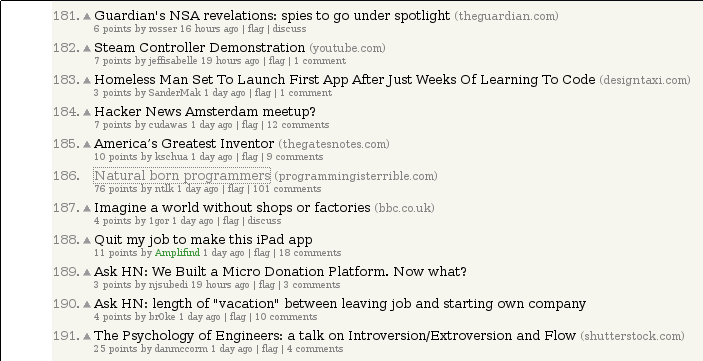
This seems less true when it comes to social issues. When a posting discussing the myth of the natural born programmer[2] hit the front page, the top rated comment is Paul Graham[3] off-handedly discounting the conclusions drawn. The original story linked to a review of peer-reviewed scientific research. Graham simply discounts it on the basis of his preconceptions. Shortly afterwards, the story plummeted off the front page, now surrounded by stories posted around the same time but with much lower scores.

How does this happen? There's two publicised methods which can result in stories dropping down the order. Users with high karma scores (either via submitting popular stories or writing popular comments) are able to flag submissions, and if enough do so then a negative weighting is applied to the story. There's also a flamewar detector, a heuristic that attempts to detect contentious subjects and pushes them off the front page.

The effect of both is to enforce the status quo of social beliefs. Stories that appear to challenge the narrative that good programmers are just naturally talented tend to vanish. Stories that discuss the difficulties faced by minorities in our field are summarily disappeared. There are no social problems in the technology industry. We have always been at war with Eastasia.

This isn't healthy. We don't improve the state of the software industry by hiding stories that expose conflicts. Flamewars don't solve problems, but without them we'd be entirely unaware of how much of a victim blaming mentality exists amongst our peers. It's true that conflict may reinforce preconceptions, causing people to dig in as they defend their beliefs. However, the absence of conflict does nothing to counteract that. If you're never exposed to opinions you disagree with, you'll never question your existing beliefs.

Hacker News is a privately run site and nobody's under any obligation to change how they choose to run it. But the focus on avoiding conflict to such an extent that controversial stories receive less exposure than ones that fit people's existing beliefs doesn't enhance our community. If we want to be able to use technology as an instrument of beneficial change to society as a whole, we benefit from building a diverse and welcoming community and questioning our preconceptions. Building a social echo chamber risks marginalising us from the rest of society, gradually becoming ignored and irrelevant as our self-reinforcing opinions drift ever further away from the mainstream. It doesn't help anybody.

[1] During the batch of interviews I did last year, two separate interviewers both mentioned a story they'd read on Hacker News that turned out to have been written by me. I'm not saying that that's what determined a hire/don't hire decision, but it seems likely that it helped.
[2] The article in question discusses the pervasive idea that some people are inherently good programmers. It turns out that perpetuating the idea that some people are just born good at a particular skill actually discourages others from even trying to learn it, even those who are just as capable.
[3] One of the co-founders of Y-Combinator and creator of Hacker News.

(Edited to fix a footnote reference)

comment count unavailable comments

29 September 2013

Joachim Breitner: Heidelberg Laureates Forum 2013

During the last week I was attending the first Heidelberg Laureates Forum as one of the lucky 200 accepted young scientists. The HFL is a (from now on hopefully yearly) event that brings together Fields Medalists, Abel Prize laureates and Turing Award winners with young scientists (undergraduates, Ph.D. students and postdocs) from both fields in the city of Heidelberg. The extremely well organized week consisted of lectures from the laureates, some workshops held by postdocs, excursions and plenty of good food. Videos of the lectures are available (but don t work on Linux, at least not for me ), and I have shot a few pictures of the event as well. I believe that my favourite lectures where Michael Atiyah s Advice to a Young Mathematician , Vladimir Voevodsky s Univalent Foundations of Mathematics , William Morton Kahan s Desperately Needed Remedies for the Undebuggability of Large-Scale Floating-Point Computations in Science and Engineering and Alan Kay s Putting Turing to Work . Where are all the functional programmers? During that event, one gets to talk to many other math and computer scientists researchers; sometimes just Where are you from? and What do you do? , sometimes long discussions. Unfortunately, I hardly found one who is into functional programming language research is that only because the event was parallel to ICFP (which I really would have liked to attend as well), or is functional programming really just about 1% of all computer science? What is a proof? My other research interest lies in interactive theorem proving, especially using Isabelle. Of course that is a topic that one can discuss with almost everyone at that event, including the mathematicians. The reactions were rather mixed: On the one end of the spectrum, some mathematicians seriously doubt that they would ever trust a computer to check proofs and that it would ever be efficient enough to use. Others would not mind having a button that tells whether their paper written in LaTeX is correct , but were not keen to invest time or thought into making the proof readable by the computer. And then there were some (but very few!) who had not heard of theorem proving before and were very excited by the prospect of being able to obtain certainty about their proofs immediately and without having to bother other scientists with it. During the mathematician s panel discussions, where I posed the question Do you see value in or even a need for machine-checked proofs in mathematics. , Efim Zelmanov (Fields Medal 1994) said a proof is what other mathematicians see as a proof . I found this attitude a bit surprising for me, a proof has always been a rigorous derivation within a formal system (say, ZFC set theory), and what we write in papers is a (less formal) description of the actual proof, whose existence we believe in. Therefore I was very happy to see Vladimir Voevodsky give a very committed talk about Univalent Foundations and how using that as the language for mathematics will allow more of mathematics to be cast in a formal, machine-checked form. I got the chance to discuss this with him in person, as I wanted to hear his option on Isabelle, and especially on the usefulness of the style of structured proof that Isar provides, and which is closer to the style of proofs that mathematicians use in papers. He said that he enjoyed writing his proof in the style required in Type Theory and in Coq, and that maybe mathematicians should and will adjust to the language of the system, while I believe that a structured proof languages like Isar, independent of the underlying logic (HOL in this case; which is insufficient to form a base for all of abstract mathematics), is a very useful feature and that proof assistants should adjust to the mathematicians.
We also briefly discussed the idea of mine to work with theorem provers already with motivated students in high schools, e.g. in math clubs, and found that simple proofs about arithmetic of natural numbers could be feasible here, without being too trivial. All in all a very rewarding and special week, and I can only recommend to try to attend one of the next forums, if possible.

30 August 2013

Joey Hess: best DebConf ever

For me, DebConf13 in Switzerland was a perfect DebConf, and generally an great developer meeting and conference. I've attended several past DebConfs in Canada, Norway, Brazil, Finland, Mexico, Scotland, Spain, NYC, Bosnia, and Nicaragua. I have special memories of each. DebConf13 was ideal in every way. Let's start with the camping. Only a minority of us did it, and my campsite was located in a small field behind a bar that was often noisy late into the night, when I was trying to rest and preserve my European jetlag remedy of inverted sleeping schedule. Still, I love sleeping cocooned in a tent, and going through the routines of camping and spending time alone there was a good counterpoint to DebConf. I generally find myself retreating for a day or two in the middle of a week-long conference, burnt out with social interactions. That didn't happen this time. I need to find way to camp at future DebConfs. (Also special shout out to wonderful people who lent me a warmer sleeping bag, and bought me a pillow while on a trip to town! Upgraded my first backpacking in Europe experience's comfort level a lot!) The next perfect thing for me were the talks I gave at DebConf. I always enjoy presenting at DebConf, and barely remember when I'd get nervous doing it. But I really felt comfortable giving these talks in a way I've not before. I'm pleased with how the Debian Cosmology talk turned out; I'd worried it would be a downer talk, or too light, or not well received, and none of those problems surfaced. I was especially happy with my dh_busfactor session, which I prepared for all of 10 minutes and was structured entirely to benefit me by talking over my thoughts and getting feedback, and in which I probably drove the camerapeople crazy running my own mic into the audience. Despite all that, I think it succeeded being interesting for the participants as well as for me. Hope to follow up on it soon.. But beyond the two talks I submitted, there were a series of ad-hoc scheduled talks. It seemed that every day I spent at least an hour discussing something I'm deeply involved in. This started with the Ikiwiki bof, and then there was an epic series of (unrecorded) BoFs about git stuff, which basically turned into an unofficial git track at DebConf. Much, much discussion of git-annex and other things I'm involved in. BTW, I really like that DebConf, as well as being a formal conference on top, is really an un-conference underneath, with new BoFs and things popping up on the schedule all week long. You can even have completely unscheduled meetings that somehow get just the right mix of people to make something awesome happen.
But it wasn't all about talks. Indeed, I only attended 2 or 3 sessions a day. The DebConf13 venue was controversial, but I found it excellent for getting things done. Rather than one or two massive rooms that get too noisy to think in, this venue had many little nooks and crannies suited for different types of work. There were so many I only discovered some while walking down the hill as I was leaving the venue! Anchoring it all was the excellent view, and I particularly enjoyed the "scenic hacklab". I was particularly impressed with the flexability of the venue's management. Someone asked if we could have cheese for breakfast, and every breakfast thereafter had not one but often three excellent cheeses. One day we'd be complaining that there were not enough vegetables in the food, and the next we'd be eating an excellent vegetarian Swiss lunch. They even apparently relaxed stringent Swiss rules on not allowing tents in sightlines visible from people further up the hill. They were clearly happy to welcome our crazy gathering to Le Camp. They let a DD borrow and use a chain saw and build a bonfire! The venue also encouraged getting out and exploring the surrounding countryside. Too often I end up spending the whole DebConf without seeing much of the area around. This time I at least got down the hill to see the castle in Vaumarcus a few times, and enjoyed many evening walks amoung the grape fields. The conference dinner (on a boat!) tied into this well too. And the daytrip to CERN was a great addition. We got to poke around the control center for a massive particle accellerator! My only regret is we didn't get a chance to actually go inside the LHC tunnels. Back to DebConf, another thing I really liked about this one was that its location allowed several upstream authors of software in Debian (other than the usual suspects who are both upstreams and Debian Developers) to attend. I don't know if Lennart Poettering changed any minds about systemd with his talk, but I was happy for the opportunity to buy him a beer. I didn't get to Monty's talk, but it was excellent to see him attend as well. Finally, I got to meet old friends I'd not seen in years, and new ones I've not met in real life before. We're still not sure where this whole DebConf thing is going -- will it be all about the cheese and wine party and greybeards in 20 years time? But one thing we know is we enjoy our little slice of the year where kilts and coding are equally unremarkable, where problems that seem intractable online somehow solve themselves in person, where we come away with ideas for an entire year and memories for a lifetime.

23 August 2013

Thorsten Glaser: FrOSCon 2013, or, why is there no MirBSD exhibit?

FrOSCon is approaching, and all MirBSD developers will attend but why s there no MirBSD exhibit? The answer to that is a bit complex. First let s state that of course we will participate in the event as well as the Open Source world. We ll also be geocaching around the campus with other interested (mostly OSS) people (including those we won for this sport) and helping out other OSS projects we ve become attached to. MirOS BSD, the operating system, is a niche system. The conference on the other hand got younger and more mainstream. This means that almost all conference visitors do not belong to the target group of MirOS BSD which somewhat is an ancient solution : the most classical BSD around (NetBSD loses because they have rc.d and PAM and lack sendmail(8), sorry guys, your attempt at being not reformable doesn t count) and running on restricted hardware (such as my 486SLC with 12 MiB RAM) and exots (SPARCstation). It s viable even as developer workstation (if your hardware is supported otherwise just virtualise it) but its strength lies with SPARC support and embedded x86 . And being run as virtual machine: we re reportedly more stable and more performant than OpenBSD. MirBSD is not cut off from modern development and occasionally takes a questionable but justified choice (such as using 16-bit Unicode internally) or a weird-looking but beneficial one (such as OPTU encoding saving us locale(1) hassles) or even acts as technological pioneer (64-bit time_t on ILP32 platforms) or, at least, is faster than OpenBSD (newer GNU toolchain, things like that), but usually more conservatively, and yes, this is by design, not by lack of manpower, most of the time. The MirPorts Framework, while technically superiour in enough places, is something that just cannot happen without manpower. I (tg@) am still using it exclusively, continuing to update ports I use and occasionally creating new ones (mupdf is in the works!), but it s not something I d recommend someone (other than an Mac OSX user) to use on a n n-MirBSD system (Interix is not exactly thriving either, and the Interix support was only begun; other OSes are not widely tested). The MirBSD Korn Shell is probably the one thing I will be remembered for. But I have absolutely no idea how one would present it on a booth at such an exhibition. A talk is much more likely. So no on that front too. jupp, the editor which sucks less, is probably something that does deserve mainstream interest (especially considering Natureshadow is using it while teaching computing to kids) but probably more in a workshop setting. And booth space is precious enough in the FH so I think that d be unfair. All the other subprojects and side projects Benny and I have, such as mir c , josef stalin, FreeWRT, Lunix Ewe, Shellsnippets, the fonts, etc. are interesting but share few, if any, common ground. Again, this does not match the vast majority of visitors. While we probably should push a number of these more, but a booth isn t it here, either. MirOS Linux ( MirLinux ) and MirOS Windows are, despite otherwise-saying rumours called W*k*p*d*a, only premature ideas that will not really be worked on (though MirLinux concepts are found in mir c and stalin). As you can see, despite all developers having full-time dayjobs, The MirOS Project is far from being obsolete. We hope that our website visitors understand our reasons to not have an exhibition booth of our own (even if the SPARCstation makes for a way cool one, it s too heavy to lift all the time), and would like to point out that there are several other booths (commercial ones, as well as OSS ones such as AllBSD, Debian and (talking to) others) and other itineries we participate in. This year both Benny and I have been roped into helping out the conference itself, too (not exactly unvoluntarily though). The best way to talk to us is IRC during regular European geek hours (i.e. until way too late into the night which Americans should benefit from), semi-synchronously, or mailing lists. We sort of expect you to not be afraid to RTFM and look up acronyms you don t understand; The MirOS Project is not unfriendly but definitely not suited for your proverbial Aunt Tilly, newbies, desktop users, and people who aren t at least somewhat capable of using written English (this is by design).

12 August 2013

Joachim Breitner: A song about Isabelle (the theorem prover)

For the final dinner of the Marktoberdorf Summer School 2013 I created the song This is a theorem about working with the theorem prover Isabelle, to the lyrics of Boomtown Rat s I don t like mondays . Nice-to-print PDF version available as well. Enjoy, and if you like it, have a look at other song texts that I wrote.

Next.

Previous.