Search Results: "rkd"

8 December 2021

Dirk Eddelbuettel: #34: Less Is More

Less Is More. Ludwig Mies van der Rohe
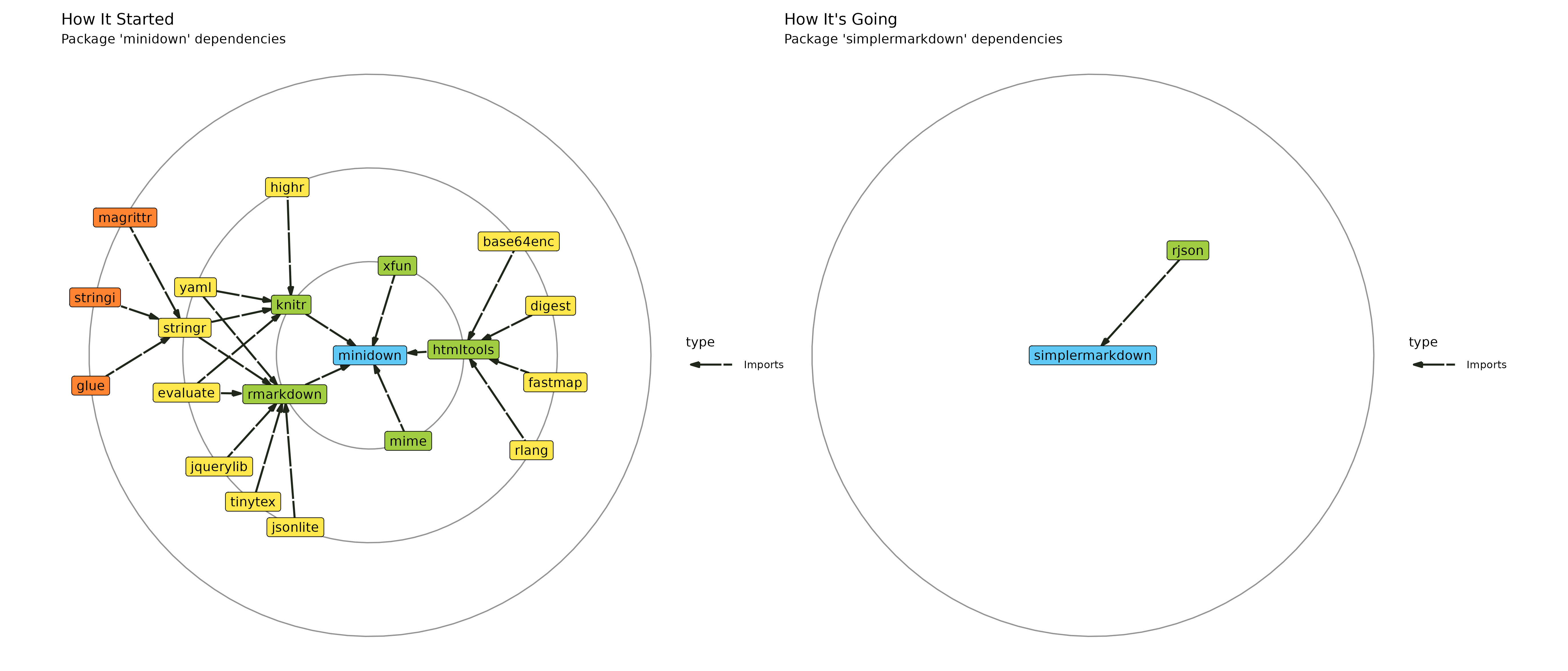
Welcome to the 34th post in the rambunctiously refreshing R recitations, or R4. Today s post is about architecture. Mies defined modernism. When still in Europe, I had been to the Neue Nationalgalerie in Berlin which provides a gorgeous space for the arts. Twenty-five years ago, I worked next to his Toronto-Dominion Center in Toronto. Here in Chicago we have numerous buildings: the Federal Center (the Dirksen, the Kluczynski and the US Post Office rounding out the square in the Loop), multiple buildings on the Illinois Tech (aka IIT) Campus where he taught in the architecture department he created and lead, the (formerly called) IBM Plaza building at the river and more. Structure and minimalism, often based on the same core elements of black steel beams and glass, are a landmark of these buildings. One immediately senses that there is nothing left to take away. Code and programming can be similar. We too compose based on parts we assemble and combine to create something hopefully larger than the parts. The difficulty arising from too many dependencies is something we discussed before both here in this 2018 post but also via the tinyverse site. Over the last seven days, and via uploads to new versions to CRAN, I have switched the vignettes of seven packages from using minidown (which in turn requires rmarkdown and knitr, plus their aggregate dependencies) to using simplermarkdown with its sole dependency. That is, of course, a personal choice. I tend to not even knit much in my vignettes (and simplermarkdown supports what I do) but to rely mostly on pandoc for code rendering. So I only need a small subset of the functionality provided, but I can not access just that as the default comes with numerous bells, whistles as well as enough other instruments to form a small marching band. A picture may express this better: (courtesy of the deepdep package for the figures). Which of these two setups is less likely to surprise you with random breaks, say in continuous integration? Which takes less time to install, and burns fewer cpu cycles just to be set up, each time we run a new test? Which is taxing your students, colleagues, collaborators, users, less on setup for use or replication? The first, comprises a total of 29 dependencies, or the second with just one? My money is on the second choice. Less is more.

7 December 2021

Dirk Eddelbuettel: Rblpapi 0.3.12: Fixes and Updates

The Rblp team is happy to announce a new version 0.3.12 of Rblpapi which just arrived at CRAN. Rblpapi provides a direct interface between R and the Bloomberg Terminal via the C++ API provided by Bloomberg (but note that a valid Bloomberg license and installation is required). This is the twelveth release since the package first appeared on CRAN in 2016. Changes are detailed below and include both extensions to functionality, actual bug fixes and changes to the package setup. Special thanks goes to Michael Kerber, Yihui Xie and Kai Lin for contributing pull requests!

Changes in Rblpapi version 0.3.12 (2021-12-07)
  • bdh() supports new option returnAs (Michael Kerber and Dirk in #335 fixing #206)
  • Remove extra backtick in vignette (Yihui Xie in #343)
  • Fix a segfault from bulk access with bds (Kai Lin in #347 fixing #253)
  • Support REQUEST_STATUS in bdh (Kai Lin and John in #349 fixing #348)
  • Vignette now uses simplermarkdown (Dirk in #350)

Courtesy of my CRANberries, there is also a diffstat report for the this release. As always, more detailed information is on the Rblpapi page. Questions, comments etc should go to the issue tickets system at the GitHub repo. If you like this or other open-source work I do, you can now sponsor me at GitHub.

This post by Dirk Eddelbuettel originated on his Thinking inside the box blog. Please report excessive re-aggregation in third-party for-profit settings.

6 December 2021

Dirk Eddelbuettel: tidyCpp 0.0.6 on CRAN: Package Maintenance

Another small release of the tidyCpp package arrived on CRAN this morning. The packages offers a clean C++ layer (as well as one small C++ helper class) on top of the C API for R which aims to make use of this robust (if awkward) C API a little easier and more consistent. See the vignette for motivating examples. This release makes a tiny code change, remove a YAML file for the disgraced former continuous integration service we shall not name (yet that we all used to use). And just like digest five days ago, drat four days ago, littler three days ago, RcppAPT two days ago, and RcppSpdlog yesterday, we converted the vignettes from using the minidown package to the (fairly new) simplermarkdown package which is so much more appropriate for our use of the minimal water.css style. The NEWS entry follows.

Changes in tidyCpp version 0.0.6 (2021-12-06)
  • Assign nullptr in dtor for Protect class
  • Switch vignette engine to simplermarkdown

Thanks to my CRANberries, there is also a diffstat report for this release. For questions, suggestions, or issues please use the issue tracker at the GitHub repo. If you like this or other open-source work I do, you can now sponsor me at GitHub.

This post by Dirk Eddelbuettel originated on his Thinking inside the box blog. Please report excessive re-aggregation in third-party for-profit settings.

5 December 2021

Dirk Eddelbuettel: RcppSpdlog 0.0.7 on CRAN: Package Maintenance

A new version 0.0.7 of RcppSpdlog is now on CRAN. RcppSpdlog bundles spdlog, a wonderful header-only C++ logging library with all the bells and whistles you would want that was written by Gabi Melman, and also includes fmt by Victor Zverovich. This release brings upstream bugfix releases 1.9.1 and 1.9.2 of spdlog. We also removed the YAML file (and badge) for the disgraced former continuous integration service we shall not name (yet that we all used to use). And just like digest four days ago, drat three days ago, littler two days ago, and RcppAPT yesterday, we converted the vignettes from using the minidown package to the (fairly new) simplermarkdown package which is so much more appropriate for our use of the minimal water.css style. The (minimal) NEWS entry for this release follows.

Changes in RcppSpdlog version 0.0.7 (2021-12-05)
  • Upgraded to upstream bug fix releases spdlog 1.9.1 and 1.9.2
  • Travis artifacts and badges have been pruned
  • Vignette now uses simplermarkdown

Courtesy of my CRANberries, there is also a diffstat report. More detailed information is on the RcppSpdlog page, or the package documention site. If you like this or other open-source work I do, you can sponsor me at GitHub.

This post by Dirk Eddelbuettel originated on his Thinking inside the box blog. Please report excessive re-aggregation in third-party for-profit settings.

4 December 2021

Dirk Eddelbuettel: RcppAPT 0.0.8: Package Maintenance

A new version of the RcppAPT package interfacing from R to the C++ library behind the awesome apt, apt-get, apt-cache, commands and their cache powering Debian, Ubuntu and the like arrived on CRAN earlier today. RcppAPT allows you to query the (Debian or Ubuntu) package dependency graph at will, with build-dependencies (if you have deb-src entries), reverse dependencies, and all other goodies. See the vignette and examples for illustrations. This release updates some package metadata, adds a new package testing helper, and, just like digest three days ago, drat two days ago, and littler yesterday, we converted the vignettes from using the minidown package to the (fairly new) simplermarkdown package which is so much more appropriate for our use of the minimal water.css style.

Changes in version 0.0.8 (2021-12-04)
  • New test file version.R ensures NEWS file documents current package version
  • Travis artifacts and badges have been pruned
  • Vignettes now use simplermarkdown

Courtesy of my CRANberries, there is also a diffstat report for this release. A bit more information about the package is available here as well as as the GitHub repo. If you like this or other open-source work I do, you can now sponsor me at GitHub.

This post by Dirk Eddelbuettel originated on his Thinking inside the box blog. Please report excessive re-aggregation in third-party for-profit settings.

3 December 2021

Dirk Eddelbuettel: littler 0.3.15 on CRAN: Package Updates

max-heap image The sixteenth release of littler as a CRAN package just landed, following in the now fifteen year history (!!) as a package started by Jeff in 2006, and joined by me a few weeks later. littler is the first command-line interface for R as it predates Rscript. It allows for piping as well for shebang scripting via #!, uses command-line arguments more consistently and still starts faster. It also always loaded the methods package which Rscript only started to do in recent years. littler lives on Linux and Unix, has its difficulties on macOS due to yet-another-braindeadedness there (who ever thought case-insensitive filesystems as a default were a good idea?) and simply does not exist on Windows (yet the build system could be extended see RInside for an existence proof, and volunteers are welcome!). See the FAQ vignette on how to add it to your PATH. A few examples are highlighted at the Github repo, as well as in the examples vignette. This release brings a more robust and featureful install2.r script (thanks to Gergely Dar czi), corrects some documentation typos (thanks to John Kerl), and now compacts pdf vignette better when using the build.r helper. It also one more updates the URLs for the two RStudio downloaders, and adds a simplermarkdown wrapper. Next, we removed the YAML file (and badge) for the disgraced former continuous integration service we shall not name (yet that we all used to use). And, following digest two days ago and drat yesterday, we converted the vignettes from using the minidown package to the (fairly new) simplermarkdown package which is so much more appropriate for our use of the minimal water.css style. The full change description follows.

Changes in littler version 0.3.15 (2021-12-03)
  • Changes in examples
    • The install2 script can select download methods, and cope with errors from parallel download (thanks to Gergely Daroczi)
    • The build.r now uses both as argument to --compact-vignettes
    • The RStudio download helper were once again updated for changed URLs
    • New caller for simplermarkdown::mdweave_to_html
  • Changes in package
    • Several typos were correct (thanks to John Kerl)
    • Travis artifacts and badges have been pruned
    • Vignettes now use simplermarkdown

My CRANberries service provides a comparison to the previous release. Full details for the littler release are provided as usual at the ChangeLog page, and also on the package docs website. The code is available via the GitHub repo, from tarballs and now of course also from its CRAN page and via install.packages("littler"). Binary packages are available directly in Debian as well as soon via Ubuntu binaries at CRAN thanks to the tireless Michael Rutter. Comments and suggestions are welcome at the GitHub repo. If you like this or other open-source work I do, you can now sponsor me at GitHub.

This post by Dirk Eddelbuettel originated on his Thinking inside the box blog. Please report excessive re-aggregation in third-party for-profit settings.

2 December 2021

Dirk Eddelbuettel: drat 0.2.2 on CRAN: Package Maintenance

drat user A fresh and new minor release of drat arrived on CRAN overnight. This is another small update relative to the 0.2.0 release in April followed by a 0.2.1 update in July. This release follows the changes made in digest yesterday. We removed the YAML file (and badge) for the disgraced former continuous integration service we shall not name (yet that we all used to use). And we converted the vignette from using the minidown package to the (fairly new) simplermarkdown package which is so much more appropriate for our use of the minimal water.css style. drat stands for drat R Archive Template, and helps with easy-to-create and easy-to-use repositories for R packages. Since its inception in early 2015 it has found reasonably widespread adoption among R users because repositories with marked releases is the better way to distribute code. See below for a few custom reference examples. Because for once it really is as your mother told you: Friends don t let friends install random git commit snapshots. Properly rolled-up releases it is. Just how CRAN shows us: a model that has demonstrated for two-plus decades how to do this. And you can too: drat is easy to use, documented by six vignettes and just works. Detailed information about drat is at its documentation site. The NEWS file summarises the release as follows:

Changes in drat version 0.2.2 (2021-12-01)
  • Travis artifacts and badges have been pruned
  • Vignettes now use simplermarkdown

Courtesy of my CRANberries, there is a comparison to the previous release. More detailed information is on the drat page as well as at the documentation site. If you like this or other open-source work I do, you can now sponsor me at GitHub.

This post by Dirk Eddelbuettel originated on his Thinking inside the box blog. Please report excessive re-aggregation in third-party for-profit settings.

1 December 2021

Dirk Eddelbuettel: digest 0.6.29 on CRAN: Package Maintenance

Release 0.6.29 of the digest package arrived at CRAN earlier today, and will be uploaded Debian shortly. digest creates hash digests of arbitrary R objects (using the md5, sha-1, sha-256, sha-512, crc32, xxhash32, xxhash64, murmur32, spookyhash, and blake3 algorithms) permitting easy comparison of R language objects. It is a mature and widely-used as many tasks may involve caching of objects for which it provides convenient general-purpose hash key generation. This release only contains two smaller internal changes. We removed the YAML file (and badge) for the disgraced former continuous integration service we shall not name (yet that we all used to use). And we converted the vignette from using the minidown package to the (fairly new) simplermarkdown package which is so much more appropriate for our use of the minimal water.css style. My CRANberries provides the usual summary of changes to the previous version. For questions or comments use the issue tracker off the GitHub repo. If you like this or other open-source work I do, you can now sponsor me at GitHub.

This post by Dirk Eddelbuettel originated on his Thinking inside the box blog. Please report excessive re-aggregation in third-party for-profit settings.

13 July 2021

Debian XMPP Team: XMPP Novelties in Debian 11 Bullseye

This is not only the Year of the Ox, but also the year of Debian 11, code-named bullseye. The release lies ahead, full freeze starts this week. A good opportunity to take a look at what is new in bullseye. In this post new programs and new software versions related to XMPP, also known as Jabber are presented. XMPP exists since 1999, and has a diverse and active developers community. It is a universal communication protocol, used for instant messaging, IoT, WebRTC, and social applications. You probably will encounter some oxen in this post. That's all for now. Enjoy Debian 11 bullseye and Happy Chatting!

12 July 2021

Daniel Silverstone: Subplot - First public alpha release

This weekend we (Lars and I) finished our first public alpha release of Subplot. Subplot is a tool for helping you to document your acceptance criteria for a project in such a way that you can also produce a programmatic test suite for the verification criteria. We centre this around the concept of writing a Markdown document about your project, with the option to write Gherkin-like given/when/then scenarios inside which detail the automated verification of the acceptance criteria. This may sound very similar to Yarn, a similar concept which Lars, Richard, and I came up with in 2013. Critically back then we were very 'software engineer' focussed and so Yarn was a testing tool which happened to also produce reasonable documentation outputs if you squinted sideways and tried not to think too critically about them. Subplot on the other hand considers the documentation output to be just as important, if not more important, than the test suite output. Yarn was a tool which ran tests embedded in Markdown files, where Subplot is a documentation tool capable of extracting tests from an acceptance document for use in testing your project. The release we made is the first time we're actively asking other people to try Subplot and see whether the concept is useful to them. Obviously we expect there to be plenty of sharp corners and there's a good amount of functionality yet to implement to make Subplot as useful as we want it to be, but if you find yourself looking at a project and thinking "How do I make sure this is acceptable to the stakeholders without first teaching them how to read my unit tests?" then Subplot may be the tool for you. While Subplot can be used to produce test suites with functions written in Bash, Python, or Rust, the only language we're supporting as first-class in this release is Python. However I am personally most interested in the Rust opportunity as I see a lot of Rust programs very badly tested from the perspective of 'acceptance' as there is a tendency in Rust projects to focus on unit-type tests. If you are writing something in Rust and want to look at producing some high level acceptance criteria and yet still test in Rust, then please take a look at Subplot, particularly how we test subplotlib itself. Issues, feature requests, and perhaps most relevantly, code patches, gratefully received. A desire to be actively involved in shaping the second goal of Subplot even more so.

30 June 2021

Aigars Mahinovs: Keeping it as simple as possible

You know that you've had the same server too long when they discontinue the entire class of servers you were using and you need to migrate to a new instance. And you know you've not done anything with that server (and the blog running on it) for too long when you have no idea how that thing is actually working. Its a good opportunity to start over from scratch, and a good motivation to the new thing as simply as humanly possible, or even simpler. So I am switching to a statically generated blog as well. Not sure what took me so long, but thank good the tooling has really improved since the last time I looked. It was as simple as picking Nikola, finding its import_feed plugin, changing the BLOG_RSS_LIMIT in my Django Mezzanine blog to a thousand (to export all posts via RSS/ATOM feed), fixing some bugs in the import_feed plugin, waiting a few minutes for the full feed to generate and to be imported, adjusting the config of the resulting site, posting that to git and writing a simple shell script to pull that repo periodically and call nikola build on it, as well as config to serve ther result via ngnix. Done. After that creating a new blog post is just nikola new_post and editing it in vim and pushing to git. I prefer Markdown, but it supports all kinds of formats. And the old posts are just stored as HTML. Really simple. I think I will spend more time fighting with Google to allow me to forward email from my domain to my GMail postbox without it refusing all of it as spam.

29 June 2021

Enrico Zini: Building a Transilience playbook in a zipapp

This is part of a series of posts on ideas for an ansible-like provisioning system, implemented in Transilience. Mitogen is a great library, but scarily complicated, and I've been wondering how hard it would be to make alternative connection methods for Transilience. Here's a wild idea: can I package a whole Transilience playbook, plus dependencies, in a zipapp, then send the zipapp to the machine to be provisioned, and run it locally? It turns out I can. Creating the zipapp This is somewhat hackish, but until I can rely on Python 3.9's improved importlib.resources module, I cannot think of a better way:
    def zipapp(self, target: str, interpreter=None):
        """
        Bundle this playbook into a self-contained zipapp
        """
        import zipapp
        import jinja2
        import transilience
        if interpreter is None:
            interpreter = sys.executable
        if getattr(transilience.__loader__, "archive", None):
            # Recursively iterating module directories requires Python 3.9+
            raise NotImplementedError("Cannot currently create a zipapp from a zipapp")
        with tempfile.TemporaryDirectory() as workdir:
            # Copy transilience
            shutil.copytree(os.path.dirname(__file__), os.path.join(workdir, "transilience"))
            # Copy jinja2
            shutil.copytree(os.path.dirname(jinja2.__file__), os.path.join(workdir, "jinja2"))
            # Copy argv[0] as __main__.py
            shutil.copy(sys.argv[0], os.path.join(workdir, "__main__.py"))
            # Copy argv[0]/roles
            role_dir = os.path.join(os.path.dirname(sys.argv[0]), "roles")
            if os.path.isdir(role_dir):
                shutil.copytree(role_dir, os.path.join(workdir, "roles"))
            # Turn everything into a zipapp
            zipapp.create_archive(workdir, target, interpreter=interpreter, compressed=True)
Since the zipapp contains not just the playbook, the roles, and the roles' assets, but also Transilience and Jinja2, it can run on any system that has a Python 3.7+ interpreter, and nothing else! I added it to the standard set of playbook command line options, so any Transilience playbook can turn itself into a self-contained zipapp:
$ ./provision --help
usage: provision [-h] [-v] [--debug] [-C] [--local LOCAL]
                 [--ansible-to-python role   --ansible-to-ast role   --zipapp file.pyz]
[...]
  --zipapp file.pyz     bundle this playbook in a self-contained executable
                        python zipapp
Loading assets from the zipapp I had to create ZipFile varieties of some bits of infrastructure in Transilience, to load templates, files, and Ansible yaml files from zip files. You can see above a way to detect if a module is loaded from a zipfile: check if the module's __loader__ attribute has an archive attribute. Here's a Jinja2 template loader that looks into a zip:
class ZipLoader(jinja2.BaseLoader):
    def __init__(self, archive: zipfile.ZipFile, root: str):
        self.zipfile = archive
        self.root = root
    def get_source(self, environment: jinja2.Environment, template: str):
        path = os.path.join(self.root, template)
        with self.zipfile.open(path, "r") as fd:
            source = fd.read().decode()
        return source, None, lambda: True
I also created a FileAsset abstract interface to represent a local file, and had Role.lookup_file return an appropriate instance:
    def lookup_file(self, path: str) -> str:
        """
        Resolve a pathname inside the place where the role assets are stored.
        Returns a pathname to the file
        """
        if self.role_assets_zipfile is not None:
            return ZipFileAsset(self.role_assets_zipfile, os.path.join(self.role_assets_root, path))
        else:
            return LocalFileAsset(os.path.join(self.role_assets_root, path))
An interesting side effect of having smarter local file accessors is that I can cache the contents of small files and transmit them to the remote host together with the other action parameters, saving a potential network round trip for each builtin.copy action that has a small source. The result The result is kind of fun:
$ time ./provision --zipapp test.pyz
real    0m0.203s
user    0m0.174s
sys 0m0.029s
$ time scp test.pyz root@test:
test.pyz                                                                                                         100%  528KB 388.9KB/s   00:01
real    0m1.576s
user    0m0.010s
sys 0m0.007s
And on the remote:
# time ./test.pyz --local=test
2021-06-29 18:05:41,546 test: [connected 0.000s]
[...]
2021-06-29 18:12:31,555 test: 88 total actions in 0.00ms: 87 unchanged, 0 changed, 1 skipped, 0 failed, 0 not executed.
real    0m0.979s
user    0m0.783s
sys 0m0.172s
Compare with a Mitogen run:
$ time PYTHONPATH=../transilience/ ./provision
2021-06-29 18:13:44 test: [connected 0.427s]
[...]
2021-06-29 18:13:46 test: 88 total actions in 2.50s: 87 unchanged, 0 changed, 1 skipped, 0 failed, 0 not executed.
real    0m2.697s
user    0m0.856s
sys 0m0.042s
From a single test run, not a good benchmark, it's 0.203 + 1.576 + 0.979 = 2.758s with the zipapp and 2.697s with Mitogen. Even if I've been lucky, it's a similar order of magnitude. What can I use this for? This was mostly a fun hack. It could however be the basis for a Fabric-based connector, or a clusterssh-based connector, or for bundling a Transilience playbook into an installation image, or to add a provisioning script to the boot partition of a Raspberry Pi. It looks like an interesting trick to have up one's sleeve. One could even build an Ansible-based connector(!) in which a simple Ansible playbook, with no facts gathering, is used to build the zipapp, push it to remote systems and run it. That would be the wackiest way of speeding up Ansible, ever! Next: using Systemd containers with unittest, for Transilience's test suite.

14 May 2021

Junichi Uekawa: pomodoro timer in elisp.

pomodoro timer in elisp. I put up my current configuration here if you're interested. Not that I recommend this to anybody but this is tightly integrated with my daily notes taken in markdown format, so that I have a new entry for my notes every pomodoro. I don't time my break time because my water heater takes 5 minutes to boil and that's a good enough timer for me. I tried using notifications-notify to make sound but it turned out some environments I use don't forward this correctly, maybe someone already could have done the integration with OSC9/OSC777 to make sound work but not quite sure, so I make sound via sshing to my local raspberry pi and making it trigger chrome cast commands in my room to play sound.

28 April 2021

Antoine Beaupr : Building a status page service with Hugo

The Tor Project now has a status page which shows the state of our major services. You can check status.torprojet.org for news about major outages in Tor services, including v3 and v2 onion services, directory authorities, our website (torproject.org), and the check.torproject.org tool. The status page also displays outages related to Tor internal services, like our GitLab instance. This post documents why we launched status.torproject.org, how the service was built, and how it works.

Why a status page The first step in setting up a service page was to realize we needed one in the first place. I surveyed internal users at the end of 2020 to see what could be improved, and one of the suggestions that came up was to "document downtimes of one hour or longer" and generally improve communications around monitoring. The latter is still on the sysadmin roadmap, but a status page seemed like a good solution for the former. We already have two monitoring tools in the sysadmin team: Icinga (a fork of Nagios) and Prometheus, with Grafana dashboards. But those are hard to understand for users. Worse, they also tend to generate false positives, and don't clearly show users which issues are critical. In the end, a manually curated dashboard provides important usability benefits over an automated system, and all major organisations have one.

Picking the right tool It wasn't my first foray in status page design. In another life, I had setup a status page using a tool called Cachet. That was already a great improvement over the previous solutions, which were to use first a wiki and then a blog to post updates. But Cachet is a complex Laravel app, which also requires a web browser to update. It generally requires more maintenance than what we'd like, needing silly things like a SQL database and PHP web server. So when I found cstate, I was pretty excited. It's basically a theme for the Hugo static site generator, which means that it's a set of HTML, CSS, and a sprinkle of Javascript. And being based on Hugo means that the site is generated from a set of Markdown files and the result is just plain HTML that can be hosted on any web server on the planet.

Deployment At first, I wanted to deploy the site through GitLab CI, but at that time we didn't have GitLab pages set up. Even though we do have GitLab pages set up now, it's not (yet) integrated with our mirroring infrastructure. So, for now, the source is hosted and built in our legacy git and Jenkins services. It is nice to have the content hosted in a git repository: sysadmins can just edit Markdown in the git repository and push to deploy changes, no web browser required. And it's trivial to setup a local environment to preview changes:
hugo serve --baseUrl=http://localhost/
firefox https://localhost:1313/
Only the sysadmin team and gitolite administrators have access to the repository, at this stage, but that could be improved if necessary. Merge requests can also be issued on the GitLab repository and then pushed by authorized personnel later on, naturally.

Availability One of the concerns I have is that the site is hosted inside our normal mirror infrastructure. Naturally, if an outage occurs there, the site goes down. But I figured it's a bridge we'll cross when we get there. Because it's so easy to build the site from scratch, it's actually trivial to host a copy of the site on any GitLab server, thanks to the .gitlab-ci.yml file shipped (but not currently used) in the repository. If push comes to shove, we can just publish the site elsewhere and point DNS there. And, of course, if DNS fails us, then we're in trouble, but that's the situation anyway: we can always register a new domain name for the status page when we need to. It doesn't seem like a priority at the moment. Comments and feedback are welcome!
This article was first published on the Tor Project Blog.

17 April 2021

Dirk Eddelbuettel: RcppAPT 0.0.7: Micro Update

A new version of the RcppAPT package interfacing from R to the C++ library behind the awesome apt, apt-get, apt-cache, commands and their cache powering Debian, Ubuntu and the like arrived on CRAN yesterday. This comes a good year after the previous maintenance update for release 0.0.6. RcppAPT allows you to query the (Debian or Ubuntu) package dependency graph at will, with build-dependencies (if you have deb-src entries), reverse dependencies, and all other goodies. See the vignette and examples for illustrations. The maintenance release responds to call for updates from CRAN desiring that make all implicit dependencies on packages markdown and rmarkdown explicit via a Suggests: entry. Two of the many packages I maintain were part of the (large !!) list in the CRAN email, and this is one of them. While making the update, we refreshed two other packaging details.

Changes in version 0.0.7 (2021-04-16)
  • Add rmarkdown to Suggests: as an implicit conditional dependency
  • Switch vignette to minidown and its water framework, add minidown to Suggests as well
  • Update two URLs in the README.md file

Courtesy of my CRANberries, there is also a diffstat report for this release. A bit more information about the package is available here as well as as the GitHub repo. If you like this or other open-source work I do, you can now sponsor me at GitHub.

This post by Dirk Eddelbuettel originated on his Thinking inside the box blog. Please report excessive re-aggregation in third-party for-profit settings.

11 April 2021

Jelmer Vernooij: The upstream ontologist

The Debian Janitor is an automated system that commits fixes for (minor) issues in Debian packages that can be fixed by software. It gradually started proposing merges in early December. The first set of changes sent out ran lintian-brush on sid packages maintained in Git. This post is part of a series about the progress of the Janitor. The upstream ontologist is a project that extracts metadata about upstream projects in a consistent format. It does this with a combination of heuristics and reading ecosystem-specific metadata files, such as Python s setup.py, rust s Cargo.toml as well as e.g. scanning README files.

Supported Data Sources It will extract information from a wide variety of sources, including:
Supported Fields Fields that it currently provides include:
  • Homepage: homepage URL
  • Name: name of the upstream project
  • Contact: contact address of some sort of the upstream (e-mail, mailing list URL)
  • Repository: VCS URL
  • Repository-Browse: Web URL for viewing the VCS
  • Bug-Database: Bug database URL (for web viewing, generally)
  • Bug-Submit: URL to use to submit new bugs (either on the web or an e-mail address)
  • Screenshots: List of URLs with screenshots
  • Archive: Archive used - e.g. SourceForge
  • Security-Contact: e-mail or URL with instructions for reporting security issues
  • Documentation: Link to documentation on the web:
  • Wiki: Wiki URL
  • Summary: one-line description of the project
  • Description: longer description of the project
  • License: Single line license description (e.g. GPL 2.0 ) as declared in the metadata[1]
  • Copyright: List of copyright holders
  • Version: Current upstream version
  • Security-MD: URL to markdown file with security policy
All data fields have a certainty associated with them ( certain , confident , likely or possible ), which gets set depending on how the data was derived or where it was found. If multiple possible values were found for a specific field, then the value with the highest certainty is taken.
Interface The ontologist provides a high-level Python API as well as two command-line tools that can write output in two different formats: For example, running guess-upstream-metadata on dulwich:
 % guess-upstream-metadata
 <string>:2: (INFO/1) Duplicate implicit target name: "contributing".
 Name: dulwich
 Repository: https://www.dulwich.io/code/
 X-Security-MD: https://github.com/dulwich/dulwich/tree/HEAD/SECURITY.md
 X-Version: 0.20.21
 Bug-Database: https://github.com/dulwich/dulwich/issues
 X-Summary: Python Git Library
 X-Description:  
   This is the Dulwich project.
   It aims to provide an interface to git repos (both local and remote) that
   doesn't call out to git directly but instead uses pure Python.
 X-License: Apache License, version 2 or GNU General Public License, version 2 or later.
 Bug-Submit: https://github.com/dulwich/dulwich/issues/new
Lintian-Brush lintian-brush can update DEP-12-style debian/upstream/metadata files that hold information about the upstream project that is packaged as well as the Homepage in the debian/control file based on information provided by the upstream ontologist. By default, it only imports data with the highest certainty - you can override this by specifying the uncertain command-line flag.
[1]Obviously this won t be able to describe the full licensing situation for many projects. Projects like scancode-toolkit are more appropriate for that.

24 March 2021

Bastian Venthur: Perfection is Achieved When There is Nothing Left to Take Away

In 14 years since starting this blog, I changed the software several times, with each iteration simplifying requirements and setup. Wordpress In 2007, I started blogging. Back then I used a self-hosted Wordpress instance, running on my server. I was never really comfortable with the technology stack involved: a programming language I didn't speak, a DB I had little experience with, a relatively heavy setup and of course, the occasional security issues related to that setup. All that just to have a somewhat dynamic website with pingbacks and comments generated by your visitors... totally worth it and exciting times! You wrote something to the "lazyweb" department and people would actually comment with useful advice! Then came the spammers. First, it was just a little, and you could easily fight it off with the askimet plugin. Over the years, however the spam-to-useful-comments-ratio shifted to ridiculous levels and the comment section itself became a burden. Hosting the comments on a separate platform like disqus was not an option for me, so I finally turned the comments off. Without the need for a comment section, the whole idea of storing mostly textual content in a DB just to have it served as a website, suddenly seemed like overkill and an unnecessary security risk. So I started looking for alternatives. I wanted to maintain my content as plain text files. Text files are cool because they are future proof, portable and can be managed in git. Consequently, I was searching for a static site generator. Pelican Around 2016 I finally migrated away from Wordpress to Pelican. Pelican met all my requirements. I could store my content as plain Markdown files in a git repository. Pelican is written in Python, a language with which I'm very comfortable with. Pelican deals with blog posts and "pages" (i.e. non blog articles) and most importantly: Pelican just generates static HTML. So all that's required on the server side is a simple web server. Conveniently, it also comes with an importer that allowed me to export the content of my old Wordpress instance straight into Markdown files. Migrating to Pelican was a huge relieve: I finally had a all my content as plain text in a git repository, my server was a lot more secure without the Wordpress instance running and removing MySQL freed up a lot of resources on that machine. blag Fast forward to 2021. While I was quite happy with Pelican, it still had too many features I don't need. My blogging experience can be stripped down to a bunch of Markdown files that serve either as articles or pages, some static files, some templating for a decent design and an Atom feed. Particularly, I do not need pages/articles in multiple languages, a plugin system, support for multiple authors and tons of settings. So I did what every self-respecting nerd would do: I wrote my own site generator. Not to write something better than Pelican, but rather something lesser. Something that does less while still being functionally adequate. I called the result "blag", named after the blag of the webcomic xkcd. blag is a blog-aware, static site generator written in Python. It supports the basic features you'd expect from a blog, like an archive, tags and an Atom feed. It converts Markdown (with fenced code blocks) and supports Jinja2 templating. With this setup I'm quite happy for now. Maybe sometime there will be a simpler RSS/Atom-successor that does not require site-specific metadata (i.e. only stuff that can be generated from the articles themselves), so I could get rid of blag's only required configuration.

12 March 2021

Ryan Kavanagh: Static Comments in Hugo

I switched from Jekyll to Hugo last week for a variety of reasons. One thing that was missing was a port of the jekyll-static-comments plugin that I used to use. I liked it because it saved readers from being tracked by Disqus or other comments solutions, and it required no javascript. To comment, users would email me their comment following a template attached to the bottom of each post. I then piped their email through a script to add it to the right post. As an added benefit, I could delegate comment spam detection to my mail server. I ve managed to reimplement this setup using Hugo. For those who are interested in a similar setup, here is what you need to do.

Pages with comments Instead of being single files, pages need to be leaf bundles. For example, this means that your blog post must be located at /content/blog/2021-03-12-static-comments-in-hugo/index.md instead of /content/blog/2021-03-12-static-comments-in-hugo.md. This lets you store the comments as page resources in the subdirectory /content/blog/2021-03-12-static-comments-in-hugo/comments/.

Partials You should create a comments.html partial and include it in the layout for the pages which should get comments:
<div class="post-comments">
  <p class="comment-notice"><b>Comments</b>: To comment on this post,
	send me an email following the template below. Your email address
	will not be posted, unless you choose to include it in
	the <span style="font-family: monospace;">link:</span> field.</p>
  <pre class="comment-notice">
To: Your Name &lt;your.email<span>@</span>example.org&gt;
Subject: [blog-comment]   .Page.RelPermalink  
post_id:   .Page.RelPermalink  
author: [How should you be identified? Usually your name or "Anonymous"]
link: [optional link to your website]
Your comments here. Markdown syntax accepted.</pre>
    $scratch := newScratch  
    $scratch.Set "comments" (.Resources.Match "comments/*yml")  
    if eq 1 (len ($scratch.Get "comments"))  
  <h2>1 Comment</h2>
    else  
  <h2>  len ($scratch.Get "comments")   Comments</h2>
    end  
    range ($scratch.Get "comments")  
  <div class="post-comment  % cycle 'odd', 'even' % ">
	  $comment := (.Content   transform.Unmarshal)  
	<span class="post-meta">
		 - $comment.date   dateFormat "Jan 2, 2006 at 15:04" - 
	</span>
	<h3 class="comment-header">
	    if $comment.link  
	  <a href="  $comment.link  ">  $comment.author  </a>
	    else  
	    $comment.author  
	    end  
	  <br />
	</h3>
	  $comment.comment   markdownify  
  </div>
    end  
</div>

Comments To associate comments received by email to posts, I pipe them from mutt (using the keybinding) to the following (admittedly janky) shell script. It takes the comment, reformats it appropriately, and puts it in the post s comments subdirectory. Note that it determines which filename to use based on the email s contents, so make sure to check that the email doesn t contain anything nefarious before you pipe it into the script!
#!/bin/sh
# Copyright (C) 2016-2021 Ryan Kavanagh <rak@rak.ac>
# Distributed under the ISC license
BLOG_BASE="/media/t/work/blog"
MESSAGE=$(cat)
EMAIL=$(echo "$ MESSAGE "   grep "From:"   sed -e 's/From[^<]*<\?\([^>]*\)>\?.*/\1/g;s/@/-at-/g')
DATE=$(echo "$ MESSAGE "   grep "Date:"   sed -e 's/Date:\s*//g'   xargs -0 date -Iseconds -u -d)
POST_ID=$(echo "$ MESSAGE "   grep "post_id:"   sed -e 's/post_id: //g')
COMMENTS_DIR="$ BLOG_BASE /content/$ POST_ID /comments/"
COMMENT_FILE="$ COMMENTS_DIR /$ DATE _$ EMAIL .yml"
# Strip out the email headers and whitespace until the start of the comment
COMMENT_WHOLE=$(echo "$ MESSAGE "   sed -e '/^\s*$/,$!d;/^[^\s]/,$!d')
# Indent everything after the comment header
COMMENT_INDENTED=$(echo "$ COMMENT_WHOLE "   sed -e '/^\s*$/,$ s/.*/  &/g ')
# And add the comment header
COMMENT_PREFIXED=$(echo "$ COMMENT_INDENTED "   sed -e '0,/^\s*$/ s/^\s*$/comment:  / ')
[ -d "$ COMMENTS_DIR " ]   mkdir -p "$ COMMENTS_DIR "
echo "Saving the comment to $ COMMENT_FILE "
echo "date: $ DATE "   tee "$ COMMENT_FILE "
echo "$ COMMENT_PREFIXED "   tee -a "$ COMMENT_FILE "
For example, the following comment in an email body:
post_id: /blog/2021-03-12-static-comments-in-hugo/
author: Ryan Kavanagh
link: https://rak.ac/
Dear self,
Here is a test comment for your blog post.
It supports *markdown* **syntax** and  stuff .
Best,
Yourself
results in a file content/blog/2021-03-12-static-comments-in-hugo/comments/2021-03-12T18:47:25+00:00_rak-at-example.org.yml containing:
date: 2021-03-12T18:47:25+00:00
post_id: /blog/2021-03-12-static-comments-in-hugo/
author: Ryan Kavanagh
link: https://rak.ac/
comment:  
  Dear self,

  Here is a test comment for your blog post.
  It supports *markdown* **syntax** and  stuff .

  Best,
  Yourself  
You can see the rendered output at the bottom of this page.

1 March 2021

Utkarsh Gupta: FOSS Activites in February 2021

Here s my (seventeenth) monthly update about the activities I ve done in the F/L/OSS world.

Debian
This was my 26th month of active contributing to Debian. I became a DM in late March 2019 and a DD on Christmas 19! \o/ This month was a nice mix of amusement, excitement, nervousness, and craziness. More on it below.
Anyway, whilst I was super-insanely busy this month, I still did some Debian stuff here and there. Here are the following things I worked on:

Uploads and bug fixes:

Other $things:
  • Attended the Debian LTS team meeting.
  • Mentoring for newcomers.
  • Moderation of -project mailing list.
  • Sponsored ruby-rspec-stubbed-env for C dric Boutillier, heh :P

Interesting Bits!
  • Last month, I wrote:
    Besides, there s something more that is in the pipelines. Can t talk about it now, shh. But hopefully very sooooooon!
    And now I can talk about it! So here it is..
    I ve joined Canonical as a SDE to work on Ubuntu, full time!!! \o/
    Fully remote + dream job/work + most of the work is in the open-source domain + the beessstttt co-workers one could ever ask for! It s been an amazing time so far and I ll talk more about it later this month.
    But for now, here s our team monitor selfie (with Rick missing because of his secret plan ! )

    We ll soon e-meet them in a more detailed manner in the next blog post, that is, later this month!
  • In another exciting news, I got 2 more CVEs assigned!!! \o/
    No, it is not something that I found, it was discovered by Tavis Ormandy. I just assigned them a CVE ID, CVE-2021-26937 for screen and CVE-2021-27135 for xterm.
    This is my 2nd and 3rd, so I am (still) very excited about this! ^_^

Debian (E)LTS
Debian Long Term Support (LTS) is a project to extend the lifetime of all Debian stable releases to (at least) 5 years. Debian LTS is not handled by the Debian security team, but by a separate group of volunteers and companies interested in making it a success. And Debian Extended LTS (ELTS) is its sister project, extending support to the Jessie release (+2 years after LTS support). This was my sixteenth month as a Debian LTS and seventh month as a Debian ELTS paid contributor.
I was assigned 60.00 hours for LTS and 60.00 hours for ELTS and worked on the following things:
(however, I had overworked for 9 hours for both, LTS and ELTS, last month so I had to work for 51 hours for both this month!)

LTS CVE Fixes and Announcements:

ELTS CVE Fixes and Announcements:

Other (E)LTS Work:
  • Front-desk duty from 22-02 until 28-02 for both LTS and ELTS.
  • Triaged privoxy, dnsmasq, openldap, libzstd, ruby-mechanize, firefox-esr, thunderbird, screen, xterm, glibc, isync, rails, openscad, imagemagick, avahi, gdk-pixbuf, python-reportlab, python-aiohttp, spip, gdisk, and jasper.
  • Marked CVE-2021-20214/privoxy as not-affected for stretch.
  • Marked CVE-2021-27645/glibc as no-dsa for stretch.
  • Marked CVE-2021-20247/isync as no-dsa for stretch.
  • Marked CVE-2020-28599/openscad as no-dsa for stretch.
  • Markec CVE-2021-2024 1,4-6 /imagemagick as ignored for stretch.
  • Marked CVE-2021-26720/avahi as postponed for jessie.
  • Marked CVE-2021-20240/gdk-pixbuf as not-affected for jessie.
  • Marked CVE-2021-27645/glibc as no-dsa for jessie.
  • Marked CVE-2020-28463/python-reportlab as postponed for jessie.
  • Document extra CVEs as notes for imagemagick in jessie.
  • Auto EOL ed libupnp, webkit2gtk, libraw, jackson-dataformat-cbor, node-lodash, linux, asterisk, yara, python-django, botan1.10, smarty3, xen, u-boot, steghide, mumble, gsoap, ruby-twitter-stream, isync, nodejs, openscad, mupdf, mongo-java-driver, firefox-esr, thunderbird, and salt for jessie.
  • Sponsored upload for php-horde-text-filter for Sylvain and published its DLA announcement.
  • Got CVE-2021-26937 for screen. Yay, this is the 2nd one I got assigned! \o/
  • Got CVE-2021-27135 for xterm. Woah, this is the 3rd one, am I on a roll or what? \o/
  • Co-ordinated with package maintainer (and upstream) of ca-certificates for backporting patch to stretch.
  • Co-ordinated with package maintainer of ca-certificates for backporting patch to stretch.
  • Co-ordinated with package maintainer of screen for fixing vulnerabilites in stretch.
  • Attended monthly meeting for Debian LTS.
  • Answered questions (& discussions) on IRC (#debian-lts and #debian-elts).
  • Cross-checked LTS survey results, emailed Ola about the problems found.
  • General and other discussions on LTS private and public mailing list.

Until next time.
:wq for today.

24 February 2021

Rog rio Brito: Alternatives to ikiwiki?

It's been quite a long time since I last posted anything on this blog and I can say that one of the reasons for that I don't feel comfortable using ikiwiki anymore. I am actively looking for alternatives to ikiwiki that allow me, mainly, to write blog posts with the following characteristics (not necessarily in order of importance): Connected to the fact that I only can have static sites (no CGI, no forms, nothing else), I am, at this time, using Disqus to host the comments of my blog. I am also thinking of alternatives to this, like sending people to Twitter (or mastodon or email) or some site similar to Disqus, but with more of a Free Software inclination. Anyway, I am almost ready for any kind of transition, since I have already converted most posts (of course, not yet this one ) with some Python scripts to a format that I feel is a bit more format-agnostic than what ikiwiki uses.

  1. That's not to mention the myriad of hugo themes and theme authors that try to bribe you into using their hosted solutions (despite branding everything as "open source! OMG!"), like "wowchemy" you will have a hard time untangling the instructions of their so bloated themes to be usable on your local computer; so much so to the point that you give up with their convoluted configuration (which, potentially, doesn't "transfer" to other themes, if you are worried about possibly changing themes in the future).
  2. I like the style of fenced blocks that GitHub used, where you prefix the code with the name of the language to give a hint of how to highlight the code snipped.

Next.

Previous.