Search Results: "rak"

22 December 2015

John Goerzen: Amtrak Airlines

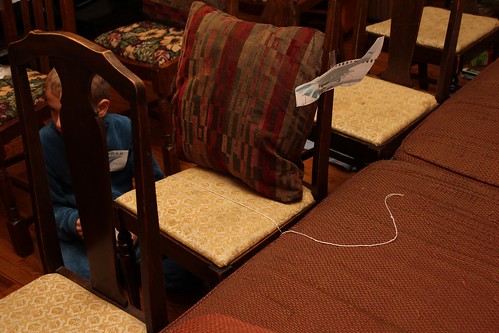
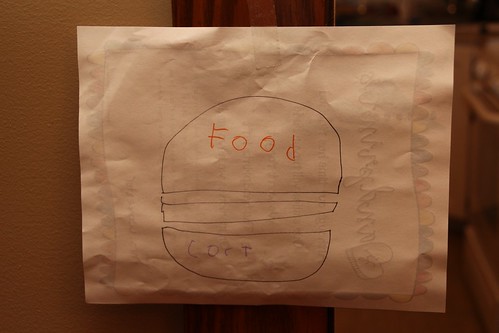
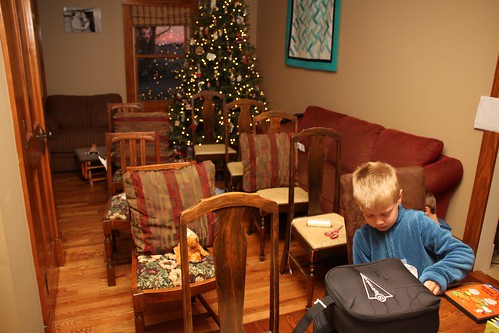
I came downstairs this morning and found a surprise waiting for me. Chairs from all over had been gathered up and arranged in rows, airline style. Taped to the wall was a food court sign. At the front was a picture of an airplane, decked out with the Amtrak logo of all things, and a timetable taped to our dining room table. IMG_6123 Jacob soon got out string to be seatbelts, too. And, using his copy machine, printed out a picture of a wing to tape to the side of the airplane . IMG_6128 And here is the food court sign Oliver made: IMG_6126 This plane was, according to the boys, scheduled to leave at 9:30. It left a fashionable 2 hours late or so. They told me I would be the pilot, and had me find headphones to be my headset . (I didn t wear my real headset on the grounds that then I wouldn t be able to hear them.) Jacob decided he would be a flight attendant, his grandma would be the co-pilot, and Oliver would be the food court worker. The food court somehow seemed to travel with the plane. Oliver made up a menu for the food court. It consisted of, and I quote: trail mix, banana, trail mix, half banana, trail mix, trail mix, trail mix . He s already got the limited selection of airport food down pat, I can see. Jacob said the flight would be from Chicago to Los Angeles, and so it was. Since it was Amtrak Airlines, we were supposed to pretend to fly over the train tracks the whole way. If it s not Christmas yet, we just invent some fun, eh? Pretty clever.

8 December 2015

Vincent Sanders: I said it was wired like a Christmas tree

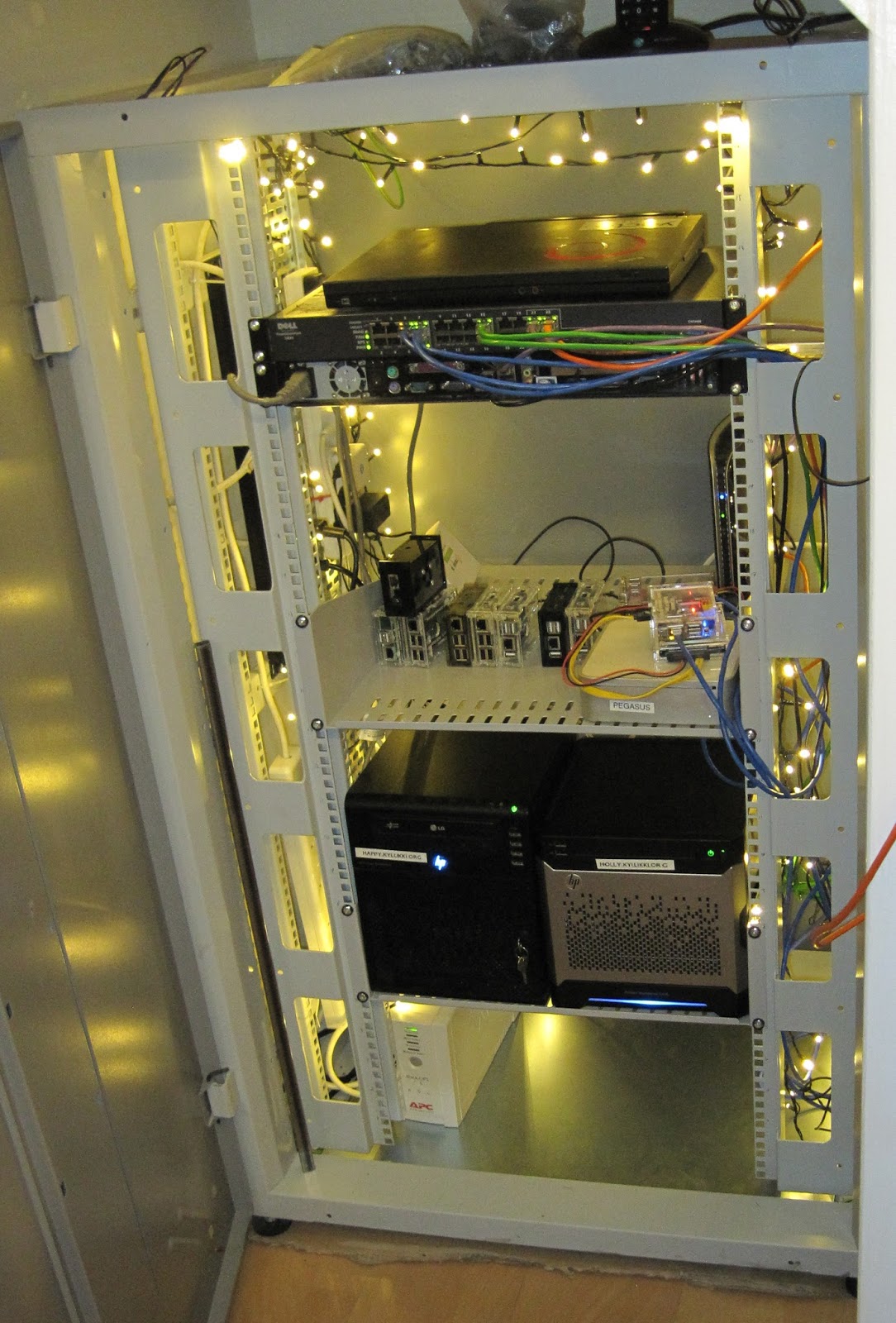
I have recently acquired a 27U high 19 inch rack in which I hope to consolidate all the computing systems in my home that do not interact well with humans.

My main issue is that modern systems are just plain noisy, often with multiple small fans whining away. I have worked to reduce this noise by using quieter components as replacements but in the end it is simply better to be able to put these systems in a box out of the way.

The rack was generously given to me by Andy Simpkins and aside from being a little dirty having been stored for some time was in excellent condition. While the proverbs "never look a gift horse in the mouth" and "beggars cannot be choosers" are very firmly at the front of my mind there were a few minor obstacles to overcome to make it fit in its new role with a very small budget.

The new home for the rack was to be a space under the stairs where, after careful measurement, I determined it would just fit. After an hour or two attempting to manoeuvre a very heavy chunk of steel into place I determined it was simply not possible while it was assembled. So I ended up disassembling and rebuilding the whole rack in a confined space.

The rack is 800mm wide IMRAK 1400 rather than the more common 600mm width which means it employs "cable reducing channels" to allow the mounting of standard width rack units. Most racks these days come with four posts in the corners to allow for longer kit to be supported front and back. This particular rack was not fitted with the rear posts and a brief call to the supplier indicated that any spares from them would be eyewateringly expensive (almost twice the cost of purchasing a new rack from a different supplier) so I had to get creative.

Shelves that did not require the rear rails were relatively straightforward and I bought two 500mm deep cantilever type from Orion (I have no affiliation with them beyond being a satisfied customer).

I took a trip to the local hardware store and purchased some angle brackets and 16mm steel square tube. From this I made support rails which means the racked kit has support to its rear rather than relying solely on being supported by its rack ears.

The next problem was the huge hole in the bottom of the rack where I was hoping to put the UPS and power switching. This hole is intended for use with raised flooring where cables enter from below, when not required it is filled in with a "bottom gland plate". Once again the correct spares for the unit were not within my budget.

Around a year ago I built several systems for open source projects from parts generously donated by Mythic Beasts (yes I did recycle servers used to build a fort). I still had some leftover casework from one of those servers so ten minutes with an angle grinder and a drill and I made myself a suitable plate.

The final problem I faced is that it is pretty dark under the stairs and while putting kit in the rack I could not see what I was doing. After some brief Googling I decided that all real rack lighting solutions were pretty expensive and not terribly effective.

At this point I was interrupted by my youngest son trying to assemble the Christmas tree and the traditional "none of the lights work" so we went off to the local supermarket to buy some bulbs. Instead we bought a 240 LED string for 10 (15usd) in the vague hope that next year they will not be broken.

I immediately had a light bulb moment and thought how a large number of efficient LED bulbs at a low price would be ideal for lighting a rack. So my rack is indeed both wired like and as a Christmas tree!

Now I just have to finish putting all the systems in there and I will be able to call the project a success.

23 November 2015

Gergely Nagy: Keyboard updates

Last Friday, I compiled a list of keyboards I'm interested in, and received a lot of incredible feedback, thank you all! This allowed me to shorten the list considerably, two basically two pieces. I'm reasonably sure by now which one I want to buy (both), but will spend this week calming down to avoid impulse-buying. My attention was also brought to a few keyboards originally not on my list, and I'll take this opportunity to present my thoughts on those too.The FinalistsErgoDoxErgoDoxPros Cons SummaryThe keyboard looks interesting, primarily due to the thumb keys. From the ErgoDox EZ campaign, I'm looking at $270. That's friendly, and makes ErgoDox a viable option! (Thanks @miffe!)There's also another option, FalbaTech, which ships sooner, I can customize the keyboard to some extent, and Poland is much closer to Hungary than the US. With this option, I'm looking at $205 + shipping, a very low price for what the keyboard has to offer. (Thanks @pkkolos for the suggestion!)Keyboardio M01Keyboardio Model 01Pros Cons SummaryWith shipping cost and whatnot, I'm looking at something in the $370 ballpark, which is on the more expensive side. On the other hand, I get a whole lot of bang for my buck: LEDs, two center bars (tripod mounting sounds really awesome!), hardwood body, and a key layout that is very similar to what I came to love on the TypeMatrix.I also have a thing for wooden stuff. I like the look of it, the feel of it.The VerdictRight now, I'm seriously considering the Model 01, because even if it is about twice the price of the ErgoDox, it also offers a lot more: hardwood body (I love wood), LEDs, palm key. I also prefer the layout of the thumb keys on the Model 01.The Model 01 also comes pre-assembled, looks stunning, while the ErgoDox pales a little in comparsion. I know I could make it look stunning too, but I do not want to build things. I'm not good at it, I don't want to be good at it, I don't want to learn it. I hate putting things together. I'm the kind of guy who needs three tries to put together a set of IKEA shelves, and I'm not exaggerating. I also like the shape of the keys better on the Model 01.Nevertheless, the ErgoDox is still an option, due to the price. I'd love to buy both, if I could. Which means that once I'm ready to replace my keyboard at work, I will likely buy an ErgoDox. But for home, Model 01 it is, unless something even better comes along before my next pay.The Kinesis Advantage was also a strong contender, but I ended up removing it from my preferred options, because it doesn't come with blank keys, and is not a split keyboard. And similar to the ErgoDox, I prefer the Model 01's thumb-key layout. Despite all this, I'm very curious about the key wells, and want to try it someday.Suggested optionsYogitypeYogitypeSuggested by Andred Carter, a very interesting keyboard with a unique design.Pros Cons SummaryI like the idea of the keyboard, and if it wouldn't need a special inlay, but used a small screen or something to show the keys, I'd like it even more. Nevertheless, I'm looking for a mechanical keyboard right now, which I can also use for coding.But I will definitely keep the Yogitype in mind for later!Matias Ergo ProMatias Ergo ProPros Cons SummaryThis keyboard hardly meets any of my desired properties, and doesn't have anything standing out in comparison with the others. I had a quick look at this when compiling my original list, but was quickly discarded. Nevertheless, people asked me why, so I'm including my reasoning here:While it is a split keyboard, with a fairly simple design, it doesn't come in the layout I'd prefer, nor with blank keys. It lacks the thumb key area that ErgoDox and the Model 01 have, and which I developed an affection for.Microsoft Sculpt Ergonomic KeyboardMicrosoft SculptPros Cons SummaryThis keyboard does not buy me much over my current TypeMatrix 2030. If I'd be looking for the cheapest possible among ergonomic keyboards, this would be my choice. But only because of the price.Truly Ergonomic KeyboardTruly Ergonomic KeyboardPros Cons SummaryTwo important factors for me are physical layout and splittability. This keyboard fails both. While it is a portable device, that's not a priority for me at this time.

20 November 2015

Gergely Nagy: Looking for a keyboard

Even though I spend more time staring at the screen than typing, there are times when I - after lots and lots of prior brain work - sit down and start typing, a lot. A couple of years ago, I started to feel pain in my wrists, and there were multiple occasions when I had to completely stop writing for longer periods of time. These were situations I obviously did not want repeated, so I started to look for remedies. First, I bought a new keyboard, a TypeMatrix 2300, which while not ergonomic, was a huge relief for my hands and wrists. I also started to learn Dvorak, but that's still something that is kind-of in progress: my left hand can write Dvorak reasonably fast, but my right one seems to be Qwerty-wired, even after a month of typing Dvorak almost exclusively.This keyboard served me well for the past five year or so. But recently, I started to look for a replacement, partly triggered by a Clojure/conj talk I watched. I got as far as assembling a list of keyboards I'm interested in, but I have a hard time choosing. This blog post here serves two purposes then: first to make a clear pros/cons list for myself, second, to solicit feedback from others who may have more experience with any of the options below.Update: There is a [follow up post], with a few more keyboards explored, and a semi-final verdict. Thanks everyone for the feedback and help, much appreciated!Lets start with the current keyboard!TypeMatrix 2030TypeMatrix 2030Pros Cons SummaryAll in all, this is a keyboard I absolutely love, and am very happy with. Yet, I feel I'm ready to try something different. With my skins aging, and the aforementioned Clojure/conj talk, the desire to switch has been growing for a while now.Desired propertiesThere are a few desired properties of the keyboard I want next. The perfect keyboard need not have all of these, but the more the merrier. I plan to buy one keyboard for a start, but may end up buying another to bring to work (like I did with the TypeMatrix, except my employer at the time bought the second one for me). At work, I will continue using the TypeMatrix, most likely, but I'm not sure yet.Anyhow, there are a number of things I do with my computer that require a keyboard: I am looking for a keyboard that helps me do these things. A keyboard that will stay with me not for five years or a decade, but pretty much forever.The optionsUltimate Hacking KeyboardUltimate Hacking KeyboardPros Cons SummaryThe keyboard looks nice, has a lot of appealing features. It is programmable, so much so that by the looks of it, I could emulate the hardware dvorak switch my TypeMatrix has. However, I'm very unhappy with the addons, so there's that too.All in all, this would cost me about $304 (base keyboard, modules, palm rest and shipping). Not too bad, certainly a strong contender, despite the shortcomings.ErgoDoxErgoDoxPros Cons SummaryThe keyboard looks interesting, primarily due to the thumb keys. From the ErgoDox EZ campaign, I'm looking at $270. That's friendly, and makes ErgoDox a viable option! (Thanks @miffe!)Kinesis AdvantageKinesis AdvantagePros Cons SummaryThe key wells look interesting, but it's not a split keyboard, nor is it open source. The cost come out about $325 plus shipping and VAT and so on, so I'm probably looking at something closer to $400. Nah. I'm pretty sure I can rule this out.Kinesis FreeStyle2Kinesis FreeStyle2Pros Cons SummaryWhile a split keyboard, at a reasonably low cost ($149 + shipping + VAT), it lacks too many things to be considered a worthy contender.MaltronMaltronPros Cons SummaryWithout shipping, I'm looking at 450. That's a very steep price. I love the wells, and the thumb keys, but it's not split, and customisability is a big question here.AtreusAtreusPros Cons SummaryWhile not a split keyboard, it does look very interesting, and the price is much lower than the rest: $149 + shipping ($50 or so). It is similar - in spirit - to my existing TypeMatrix. It wouldn't take much to get used to, and is half the price of the alternatives. A strong option, for sure.Keyboardio M01Keyboardio Model 01Pros Cons SummaryWith shipping cost and whatnot, I'm looking at something in the $370 ballpark, which is on the more expensive side. On the other hand, I get a whole lot of bang for my buck: LEDs, two center bars (tripod mounting sounds really awesome!), hardwood body, and a key layout that is very similar to what I came to love on the TypeMatrix.I also have a thing for wooden stuff. I like the look of it, the feel of it.The Preference ListAfter writing this all up, I think I prefer the Model 01, but the UHK and ErgoDox come close too!The UHK is cheaper, but not by a large margin. It lacks the thumb keys and the palm key the M01 has. It also looks rather dull (sorry). They'd both ship about the same time, but, the M01 is already funded, while the UHK is not (mind you, there's a pretty darn high chance it will be).The ErgoDox has thumb keys, split keyboard, and is open source. Compared to the UHK, we have the thumb keys, and less distraction, for a better price. But the case is not so nice. Compared to the Model 01: no leds, or center bar, and an inferior case. But, much better price, which is an important factor too.Then, there's the Atreus. While it's a DIY kit, it is much more affordable than the rest, and I could have it far sooner. Yet... it doesn't feel like a big enough switch from my current keyboard. I might as well continue using the TypeMatrix then, right?The rest, I ruled out earlier, while I was reviewing them anyway.So, the big question is: should I invest close to $400 into a keyboard that looks stunning, and will likely grow old with me? Or should I give up some of the features, and settle for one of the $300 ones, that'll also grow old with me. Or is there an option I did not consider, that may match my needs and preferences better?If you, my dear reader, got this far, and have a suggestion, please either tweet at me, or write an email, or reach me over any other medium I am reachable at (including IRC, hanging out as algernon on FreeNode and OFTC).Thank you in advance, to all of you who contact me, and help me choose a keyboard!
10 November 2015

Jaldhar Vyas: Happy Diwali and Sal Mubarak 2072

Wishing you all a happy Diwali and Gujarati New Year (V.S. 2072 called Plavanga.)Instead of being something sane like a flat disk supported by four elephants standing on a tortoise, the Earth is an oblate spheroid in heliocentric orbit. The Moon too offends by maintaining an unreasonably non-epicyclic orbit. Combined this means that the Americas (plus Iceland if there any Hindus there) observe Diwali today whereas in India and the rest of the world it is tomorrow. Technically in these longitudes the Ashvayuja amavasya tithi pervades both Tuesday and Wednesday but as Lakshmi Puja takes place at the pradosha kala it means it should be celebrated today though no doubt most of the non-astronomically minded people will just follow India any way. The New Year is on Thursday all over the world.Regardless of when you celebrate, may your year be full of happiness, good fortune and prosperity.

4 November 2015

Vincent Sanders: I am not a number I am a free man

Once more the NetSurf developers tried to escape from a mysterious village by writing web browser code.

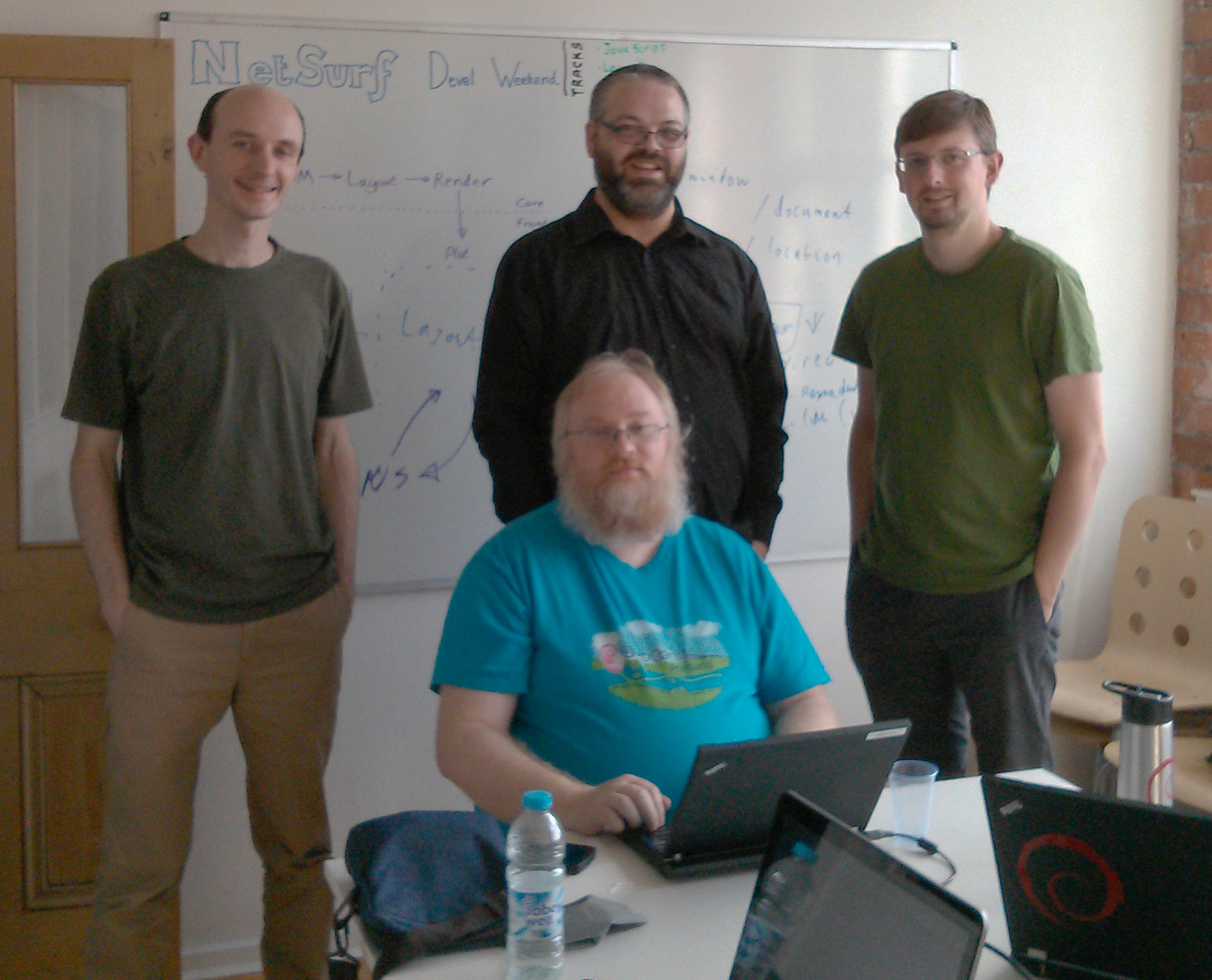
Michael Drake, Daniel Silverstone, Dave Higton and Vincent Sanders at NetSurf Developer workshop
The sixth developer workshop was an opportunity for us to gather together in person to contribute to NetSurf.

We were hosted by Codethink in their Manchester offices which provided a comfortable and pleasant space to work in.

Four developers managed to attend in person from around the UK: Michael Drake, Daniel Silverstone, Dave Higton and Vincent Sanders.

The main focus of the weekends activities was to work on improving our JavaScript implementation. At the previous workshop we had laid the groundwork for a shift to the Duktape JavaScript engine and since then put several hundred hours of time into completing this transition.

During this weekend Daniel built upon this previous work and managed to get DOM events working. This was a major missing piece of implementation which will mean NetSurf will be capable of interpreting JavaScript based web content in a more complete fashion. This work revealed several issues with our DOM library which were also resolved.

We were also able to merge several improvements provided by the Duktape upstream maintainer Sami Vaarala which addressed performance problems with regular expressions which were causing reports of "hangs" on slow processors.

The responsiveness of Sami and the Ducktape project has been a pleasant surprise making our switch to the library look like an increasingly worthwhile effort.

Overall some good solid progress was made on JavaScript support. Around half of the DOM interfaces in the specifications have now been implemented leaving around fifteen hundred methods and properties remaining. There is an aim to have this under the thousand mark before the new year which should result in a generally useful implementation of the basic interfaces.

Once the DOM interfaces have been addressed our focus will move onto the dynamic layout engine necessary to allow rendering of the changing content.

The 3.4 release is proposed to occur sometime early in the new year and depends on getting the JavaScript work to a suitable stable state.

Dave joined us for the first time, he was principally concerned with dealing with bugs and the bug tracker. It was agreeable to have a new face at the meeting and some enthusiasm for the RISC OS port which has been lacking an active maintainer for some time.

The turnout for this workshop was the same as the previous one and the issues raised then are still true. We still have a very small active core team who can commit only limited time which is making progress very slow and are lacking significant maintenance for several frontends.

Overall we managed to pack 16 hours of work into the weekend and addressed several significant problems.

28 October 2015

John Goerzen: The Train to Galesburg

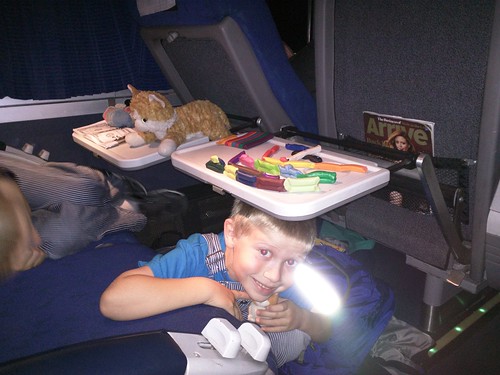
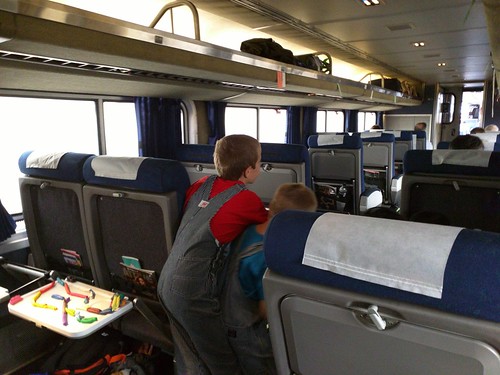
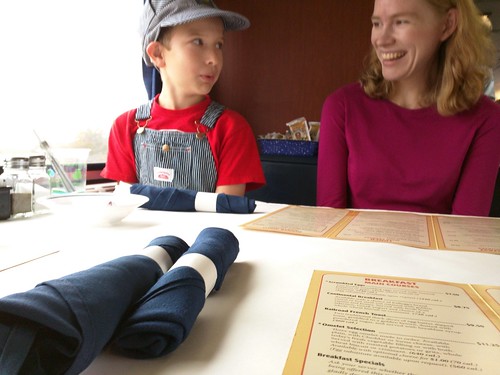
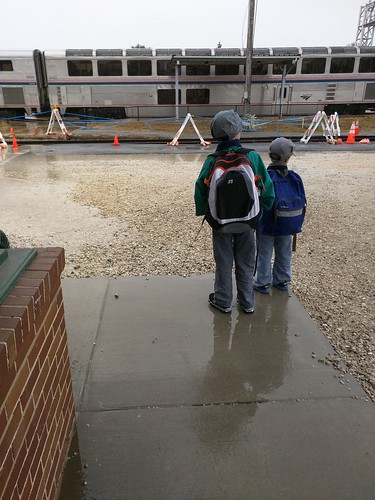
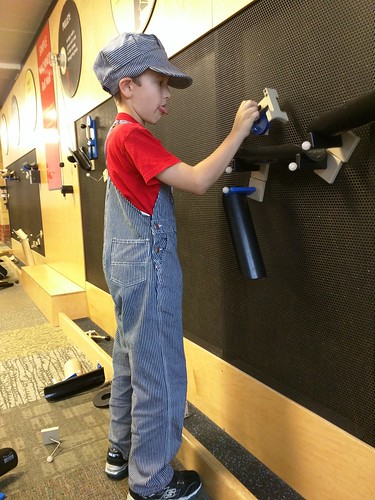
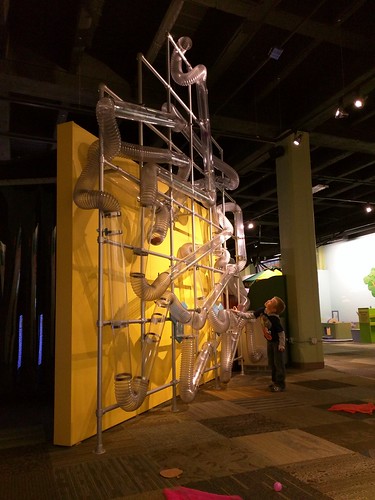
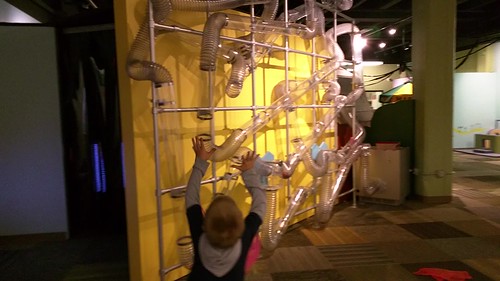
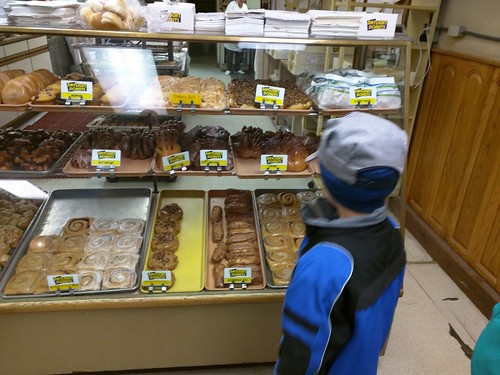
Sometimes, children are so excited you just can t resist. Jacob and Oliver have been begging for a train trip for awhile now, so Laura and I took advantage of a day off school to take them to the little town of Galesburg, IL for a couple days. Galesburg is a special memory for me; nearly 5 years ago, it was the first time Jacob and I took an Amtrak trip somewhere, just the two of us. And, separately, Laura s first-ever train trip had been to Galesburg to visit friends. There was excitement in the air. I was asked to supply a bedtime story about trains I did. On the way to the train station in the middle of the night there was excited jabbering about trains. Even when I woke them up, they lept out of bed and raced downstairs, saying, Dad, why aren t you ready yet? As the train was passing through here at around 4:45AM, and we left home with some time to spare, we did our usual train trip thing of stopping at the one place open at such a time: Druber s Donuts. IMG_20151023_040731 Much as Laura and I might have enjoyed some sleep once we got on the train, Jacob and Oliver weren t having it. Way too much excitement was in the air. Jacob had his face pressed against the window much of the time, while Oliver was busy making snake trains from colored clay complete with eyes. IMG_20151023_062304 The boys were dressed up in their train hats and engineer overalls, and Jacob kept musing about what would happen if somebody got confused and thought that he was the real engineer. When an Amtrak employee played along with that later, he was quite thrilled! We were late enough into Galesburg that we ate lunch in the dining car. A second meal there what fun! Here they are anxiously awaiting the announcement that the noon reservations could make their way to the dining car. Oh, and jockeying for position to see who would be first and get to do the all-important job of pushing the button to open the doors between train cars. IMG_20151023_120143 Even waiting for your food can be fun. IMG_20151023_120728 Upon arriving, we certainly couldn t leave the train station until our train did, even though it was raining. IMG_20151023_145755 Right next to the train station is the Discovery Depot Children s Museum. It was a perfect way to spend a few hours. Jacob really enjoyed the building wall, where you can assemble systems that use gravity (really a kinetic/potential energy experiment wall) to funnel rubber balls all over the place. He sticks out his tongue when he s really thinking. Fun to watch. IMG_20151023_153113 Meanwhile, Oliver had a great time with the air-powered tube system, complete with several valves that can launch things through a complicated maze of transparent tubes. IMG_20151024_150309 VID_20151024_150159 They both enjoyed pretending I was injured and giving me rides in the ambulance. I was diagnosed with all sorts of maladies a broken leg, broken nose. One time Jacob held up the pretend stethoscope to me, and I said ribbit. He said, Dad, you ve got a bad case of frog! You will be in the hospital 190 days! Later I would make up things like I think my gezotnix is all froibled and I was ordered to never leave the ambulance again. He told the story of this several times. After the museum closed, we ate supper. Keep in mind the boys had been up since the middle of the night without sleeping and were still doing quite well! They did start to look a bit drowsy I thought Oliver was about to fall asleep, but then their food came. And at the hotel, they were perfectly happy to invent games involving jumping off the bed. Saturday, we rode over to Peck Park. We had heard about this park from members of our church in Kansas, but oddly even the taxi drivers hadn t ever heard of it. It s well known as a good place to watch trains, as it has two active lines that cross each other at a rail bridge. And sure enough, in only a little while, we took in several trains. IMG_20151024_110035 VID_20151024_110229 The rest of that morning, we explored Galesburg. We visited an antique mall and museum, saw the square downtown, and checked out a few of the shops my favorite was the Stray Cat, featuring sort of a storefront version of Etsy with people selling art from recycled objects. But that wasn t really the boys thing, so we drifted out of there on our way to lunch at Baked, where we had some delicious deep-dish pizza. After that, we still had some time to kill before getting back on the train. We discussed our options. And what do you know we ended up back at the children s museum. We stopped at a bakery to get the fixins for a light supper on the train, and ate a nice meal in the dining car once we got on. Then, this time, they actually slept. Before long, it was 3AM again and time to get back off the train. Oliver was zonked out sleepy. Somehow I managed to get his coat and backpack on him despite him being totally limp, and carried him downstairs to get off the train. Pretty soon we walked to our car and drove home. We tucked them in, and then finally tucked ourselves in. Sometimes being really tired is well worth it.

10 October 2015

Dominique Dumont: Perl6 is now up to date on Debian sid

Hello Thanks to the help of Daniel Dehennin and Paul Cochrane, The rakudo implementation of Perl 6 is now up to date on Debian/sid. Unlike previous version, Perl 6 on Debian uses moarvm backend. No other backend is provided. Please use the following command to install Perl6 on Debian:
sudo apt-get install rakudo
All the best
Tagged: debian, package, Perl6

6 October 2015

Norbert Preining: Craft Beer Kanazawa 2015

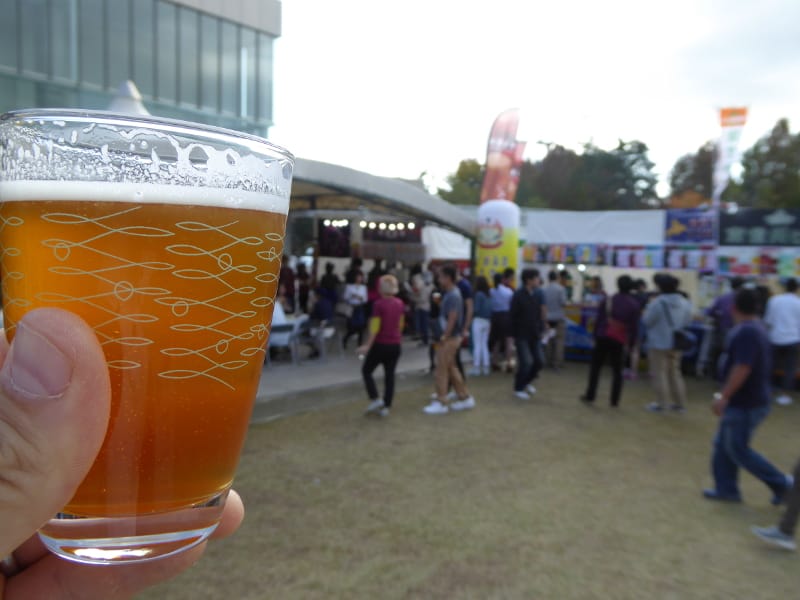
Last weekend the yearly Craft Beer Kanazawa Festival took place in central Kanazawa. This year 14 different producers brought about 80 different kind of beers for us to taste. Compared with 6 years ago when I came to Japan and Japan was still more or less Kirin-Asahi-Sapporo country without any distinguishable taste, the situation as improved vastly, and we can now enjoy lots of excellent local beers!

beer-festival-1 Returning from a trip to Swansea and a conference in Fukuoka, I arrived at Kanazawa train station and went directly to the beer festival. A great welcome back in Kanazawa, but due to excessive sleep deprivation and the feeling of finally I want to come home , I only enjoyed 6 beers from 6 different producers. In the gardens behind the Shinoki Cultural Center lots of small tents with beer and food were set up. Lots of tables and chairs were also available, but most people enjoyed flocking around in the grass around the tents. What a difference to last year s rainy and cold beer festival!
beer-festival-5 This year s producers were (in order from left to right, page links according to language): beer-festival-3 With only 6 beers to my avail (due to ticket system), I choose the ones I don t have nearby. Mind that the following comments are purely personal and do not define a quality standards  I just say what I like from worst to best: beer-festival-2 A great beer festival and I am looking for next years festival to try a few more. In the mean time I will stock up beers at home, so that I have always a good Yoho Brewery beer at hand! Enjoy

27 September 2015

Lunar: Reproducible builds: week 22 in Stretch cycle

What happened in the reproducible builds effort this week: Toolchain fixes Packages fixed The following 22 packages became reproducible due to changes in their build dependencies: breathe, cdi-api, geronimo-jpa-2.0-spec, geronimo-validation-1.0-spec, gradle-propdeps-plugin, jansi, javaparser, libjsr311-api-java, mac-widgets, mockito, mojarra, pastescript, plexus-utils2, powerline, python-psutil, python-sfml, python-tldap, pythondialog, tox, trident, truffle, zookeeper. The following packages became reproducible after getting fixed: Some uploads fixed some reproducibility issues but not all of them: Patches submitted which have not made their way to the archive yet: diffoscope development The changes to make diffoscope run under Python 3, along with many small fixes, entered the archive with version 35 on September 21th. Another release was made the very next day fixed two encoding-related issues discovered when running diffoscope on more Debian packages. strip-nondeterminism development Version 0.12.0 now preserves file permissions on modified zip files and dh_strip_nondeterminism has been made compatible with older debhelper. disorderfs development Version 0.3.0 implemented a multi-user mode that was required to build Debian packages using disorderfs. It also added command line options to control the ordering of files in directory (either shuffled or reversed) and another to do arbitrary changes to the reported space used by files on disk. A couple days later, version 0.4.0 was released to support locks, flush, fsync, fsyncdir, read_buf, and write_buf. Almost all known issues have now been fixed. reproducible.debian.net disorderfs is now used during the second build. This makes file ordering issue very easy to identify as such. (h01ger) Work has been done on making the distributed build setup more reliable. (h01ger) Documentation update Matt Kraii fixed the example on how to fix issues related to dates in Sphinx. Recent Sphinx versions should also be compatible with SOURCE_DATE_EPOCH. Package reviews 53 reviews have been removed, 85 added and 13 updated this week. 46 packages failing to build from source has been identified by Chris Lamb, Chris West, and Niko Tyni. Chris Lamb was the lucky reporter of bug #800000 on vdr-plugin-prefermenu. Issues related to disorderfs are being tracked with a new issue.

24 July 2015

Vincent Sanders: NetSurf developers and the Order of the Phoenix

Once more the NetSurf developers gathered to battle the forces of darkness, or as they are more commonly known web specifications.

Michael Drake, Vincent Sanders, John-Mark Bell and Daniel Silverstone at the Codethink manchester officesThe fifth developer weekend was an opportunity for us to gather in a pleasant setting and work together in person. We were graciously hosted, once again, by Codethink in their Manchester offices.

Four developers managed to attend in person from around the UK: Michael Drake, John-Mark Bell, Daniel Silverstone and Vincent Sanders.

The main focus of the weekends activities was to address two areas that have become overwhelmingly important: JavaScript and Layout.

Although the browser obviously already has both these features they are somewhat incomplete and incapable of supporting the features of the modern web.
JavaScriptThe discussion started with JavaScript and its implementation. We had previously looked at the feasibility of changing our JavaScript engine from Spidermonkey to DukTape. We had decided this was a change we wanted to make when DukTape was mature enough to support the necessary features.

The main reasons for the change are that Spidermonkey is a poor fit to NetSurf as it is relatively large and does not provide a stable API guarantee. The lack of a stable API requires extensive engineering to update to new releases. Additionally support for compiling on minority platforms is very challenging meaning that most platforms are stuck using version 1.7 or 1.85 (current release is version 31 with 38 due).

We started the move to Duktape by creating a development branch, integrating the Duktape library and open coding a minimal implementation of the core classes as a proof of concept. This work was mostly undertaken by Daniel with input from myself and John-Mark. This resulted in a build that was substantially smaller than using Spidermonkey with all the existing functionality our tests cover.

The next phase of this work is to take the prototype implementation and turn it into something that can be reliably used and covers the entire JavaScript DOM interface. This is no small job as there are at least 200 classes and 1500 methods and properties to implement.
LayoutThe layout library design discussion was an extensive and very involved. The layout engine is a browsers most important component. It takes all the information processed by the CSS and DOM libraries, applies a vast number of involved rules and produces a list of operations that can be rendered.

This reimplementation of our rendering engine has been in planning for many years. The existing engine stems from the browsers earliest days more than a decade ago and has many shortcomings in architecture and implementation we hope to address.

The work has finally started on libnslayout with Michael taking the lead and defining the initial API and starting the laborious work of building the test harness, a feature the previous implementation lacked!
The second war beginsFor a war you need people and it is a little unfortunate that this was our lowest ever turnout for the event. This is true of the project overall with declining numbers of commits and interest outside our core group. If anyone is interested we are always happy to have new contributors and there are opportunities to contribute in many areas from image assets, through translations, to C programming.

We discussed some ways to encourage new developers and try and get committed developers especially for the minority platform frontends. The RISC OS frontend for example has needed a maintainer since the previous one stepped down. There was some initial response from its community, culminating in a total of two patches, when we announced the port was under threat of not being releasable in future. Unfortunately nothing further came from this and it appears our oldest frontend may soon become part of our history.

We also covered some issues from the bug tracker mostly to see if there were any patterns that we needed to address before the forthcoming 3.4 release.

There was discussion about recent improvements to the CI system which generate distribution packages from the development branch and how this could be extended to benefit more users. This also included authorisation to acquire storage and other miscellaneous items necessary to keep the project infrastructure running.

We managed over 20 hours of work in the two days and addressed our current major shortcomings. Now it just requires a great deal of programming to complete the projects started here.

12 July 2015

Lunar: Reproducible builds: week 11 in Stretch cycle

Debian is undertaking a huge effort to develop a reproducible builds system. I'd like to thank you for that. This could be Debian's most important project, with how badly computer security has been going.

PerniciousPunk in Reddit's Ask me anything! to Neil McGovern, DPL. What happened in the reproducible builds effort this week: Toolchain fixes More tools are getting patched to use the value of the SOURCE_DATE_EPOCH environment variable as the current time:

In the reproducible experimental toolchain which have been uploaded: Johannes Schauer followed up on making sbuild build path deterministic with several ideas. Packages fixed The following 311 packages became reproducible due to changes in their build dependencies : 4ti2, alot, angband, appstream-glib, argvalidate, armada-backlight, ascii, ask, astroquery, atheist, aubio, autorevision, awesome-extra, bibtool, boot-info-script, bpython, brian, btrfs-tools, bugs-everywhere, capnproto, cbm, ccfits, cddlib, cflow, cfourcc, cgit, chaussette, checkbox-ng, cinnamon-settings-daemon, clfswm, clipper, compton, cppcheck, crmsh, cupt, cutechess, d-itg, dahdi-tools, dapl, darnwdl, dbusada, debian-security-support, debomatic, dime, dipy, dnsruby, doctrine, drmips, dsc-statistics, dune-common, dune-istl, dune-localfunctions, easytag, ent, epr-api, esajpip, eyed3, fastjet, fatresize, fflas-ffpack, flann, flex, flint, fltk1.3, fonts-dustin, fonts-play, fonts-uralic, freecontact, freedoom, gap-guava, gap-scscp, genometools, geogebra, git-reintegrate, git-remote-bzr, git-remote-hg, gitmagic, givaro, gnash, gocr, gorm.app, gprbuild, grapefruit, greed, gtkspellmm, gummiboot, gyp, heat-cfntools, herold, htp, httpfs2, i3status, imagetooth, imapcopy, imaprowl, irker, jansson, jmapviewer, jsdoc-toolkit, jwm, katarakt, khronos-opencl-man, khronos-opengl-man4, lastpass-cli, lava-coordinator, lava-tool, lavapdu, letterize, lhapdf, libam7xxx, libburn, libccrtp, libclaw, libcommoncpp2, libdaemon, libdbusmenu-qt, libdc0, libevhtp, libexosip2, libfreenect, libgwenhywfar, libhmsbeagle, libitpp, libldm, libmodbus, libmtp, libmwaw, libnfo, libpam-abl, libphysfs, libplayer, libqb, libsecret, libserial, libsidplayfp, libtime-y2038-perl, libxr, lift, linbox, linthesia, livestreamer, lizardfs, lmdb, log4c, logbook, lrslib, lvtk, m-tx, mailman-api, matroxset, miniupnpd, mknbi, monkeysign, mpi4py, mpmath, mpqc, mpris-remote, musicbrainzngs, network-manager, nifticlib, obfsproxy, ogre-1.9, opal, openchange, opensc, packaging-tutorial, padevchooser, pajeng, paprefs, pavumeter, pcl, pdmenu, pepper, perroquet, pgrouting, pixz, pngcheck, po4a, powerline, probabel, profitbricks-client, prosody, pstreams, pyacidobasic, pyepr, pymilter, pytest, python-amqp, python-apt, python-carrot, python-django, python-ethtool, python-mock, python-odf, python-pathtools, python-pskc, python-psutil, python-pypump, python-repoze.tm2, python-repoze.what, qdjango, qpid-proton, qsapecng, radare2, reclass, repsnapper, resource-agents, rgain, rttool, ruby-aggregate, ruby-albino, ruby-archive-tar-minitar, ruby-bcat, ruby-blankslate, ruby-coffee-script, ruby-colored, ruby-dbd-mysql, ruby-dbd-odbc, ruby-dbd-pg, ruby-dbd-sqlite3, ruby-dbi, ruby-dirty-memoize, ruby-encryptor, ruby-erubis, ruby-fast-xs, ruby-fusefs, ruby-gd, ruby-git, ruby-globalhotkeys, ruby-god, ruby-hike, ruby-hmac, ruby-integration, ruby-jnunemaker-matchy, ruby-memoize, ruby-merb-core, ruby-merb-haml, ruby-merb-helpers, ruby-metaid, ruby-mina, ruby-net-irc, ruby-net-netrc, ruby-odbc, ruby-ole, ruby-packet, ruby-parseconfig, ruby-platform, ruby-plist, ruby-popen4, ruby-rchardet, ruby-romkan, ruby-ronn, ruby-rubyforge, ruby-rubytorrent, ruby-samuel, ruby-shoulda-matchers, ruby-sourcify, ruby-test-spec, ruby-validatable, ruby-wirble, ruby-xml-simple, ruby-zoom, rumor, rurple-ng, ryu, sam2p, scikit-learn, serd, shellex, shorewall-doc, shunit2, simbody, simplejson, smcroute, soqt, sord, spacezero, spamassassin-heatu, spamprobe, sphinxcontrib-youtube, splitpatch, sratom, stompserver, syncevolution, tgt, ticgit, tinyproxy, tor, tox, transmissionrpc, tweeper, udpcast, units-filter, viennacl, visp, vite, vmfs-tools, waffle, waitress, wavtool-pl, webkit2pdf, wfmath, wit, wreport, x11proto-input, xbae, xdg-utils, xdotool, xsystem35, yapsy, yaz. Please note that some packages in the above list are falsely reproducible. In the experimental toolchain, debhelper exported TZ=UTC and this made packages capturing the current date (without the time) reproducible in the current test environment. The following packages became reproducible after getting fixed: Ben Hutchings upstreamed several patches to fix Linux reproducibility issues which were quickly merged. Some uploads fixed some reproducibility issues but not all of them: Uploads that should fix packages not in main: Patches submitted which have not made their way to the archive yet: reproducible.debian.net A new package set has been added for lua maintainers. (h01ger) tracker.debian.org now only shows reproducibility issues for unstable. Holger and Mattia worked on several bugfixes and enhancements: finished initial test setup for NetBSD, rewriting more shell scripts in Python, saving UDD requests, and more debbindiff development Reiner Herrmann fixed text comparison of files with different encoding. Documentation update Juan Picca added to the commands needed for a local test chroot installation of the locales-all package. Package reviews 286 obsolete reviews have been removed, 278 added and 243 updated this week. 43 new bugs for packages failing to build from sources have been filled by Chris West (Faux), Mattia Rizzolo, and h01ger. The following new issues have been added: timestamps_in_manpages_generated_by_ronn, timestamps_in_documentation_generated_by_org_mode, and timestamps_in_pdf_generated_by_matplotlib. Misc. Reiner Herrmann has submitted patches for OpenWrt. Chris Lamb cleaned up some code and removed cruft in the misc.git repository. Mattia Rizzolo updated the prebuilder script to match what is currently done on reproducible.debian.net.

7 July 2015

Lunar: Reproducible builds: week 10 in Stretch cycle

What happened about the reproducible builds effort this week: Media coverage Daniel Stender published an English translation of the article which originally appeared in Linux Magazin in Admin Magazine. Toolchain fixes Fixes landed in the Debian archive: Lunar submitted to Debian the patch already sent upstream adding a --clamp-mtime option to tar. Patches have been submitted to add support for SOURCE_DATE_EPOCH to txt2man (Reiner Herrmann), epydoc (Reiner Herrmann), GCC (Dhole), and Doxygen (akira). Dhole uploaded a new experimental debhelper to the reproducible repository which exports SOURCE_DATE_EPOCH. As part of the experiment, the patch also sets TZ to UTC which should help with most timezone issues. It might still be problematic for some packages which would change their settings based on this. Mattia Rizzolo sent upstream a patch originally written by Lunar to make the generate-id() function be deterministic in libxslt. While that patch was quickly rejected by upstream, Andrew Ayer came up with a much better one which sadly could have some performance impact. Daniel Veillard replied with another patch that should be deterministic in most cases without needing extra data structures. It's impact is currently being investigated by retesting packages on reproducible.debian.net. akira added a new option to sbuild for configuring the path in which packages are built. This will be needed for the srebuild script. Niko Tyni asked Perl upstream about it using the __DATE__ and __TIME__ C processor macros. Packages fixed The following 143 packages became reproducible due to changes in their build dependencies: alot, argvalidate, astroquery, blender, bpython, brian, calibre, cfourcc, chaussette, checkbox-ng, cloc, configshell, daisy-player, dipy, dnsruby, dput-ng, dsc-statistics, eliom, emacspeak, freeipmi, geant321, gpick, grapefruit, heat-cfntools, imagetooth, jansson, jmapviewer, lava-tool, libhtml-lint-perl, libtime-y2038-perl, lift, lua-ldoc, luarocks, mailman-api, matroxset, maven-hpi-plugin, mknbi, mpi4py, mpmath, msnlib, munkres, musicbrainzngs, nova, pecomato, pgrouting, pngcheck, powerline, profitbricks-client, pyepr, pylibssh2, pylogsparser, pystemmer, pytest, python-amqp, python-apt, python-carrot, python-crypto, python-darts.lib.utils.lru, python-demgengeo, python-graph, python-mock, python-musicbrainz2, python-pathtools, python-pskc, python-psutil, python-pypump, python-repoze.sphinx.autointerface, python-repoze.tm2, python-repoze.what-plugins, python-repoze.what, python-repoze.who-plugins, python-xstatic-term.js, reclass, resource-agents, rgain, rttool, ruby-aggregate, ruby-archive-tar-minitar, ruby-bcat, ruby-blankslate, ruby-coffee-script, ruby-colored, ruby-dbd-mysql, ruby-dbd-odbc, ruby-dbd-pg, ruby-dbd-sqlite3, ruby-dbi, ruby-dirty-memoize, ruby-encryptor, ruby-erubis, ruby-fast-xs, ruby-fusefs, ruby-gd, ruby-git, ruby-globalhotkeys, ruby-god, ruby-hike, ruby-hmac, ruby-integration, ruby-ipaddress, ruby-jnunemaker-matchy, ruby-memoize, ruby-merb-core, ruby-merb-haml, ruby-merb-helpers, ruby-metaid, ruby-mina, ruby-net-irc, ruby-net-netrc, ruby-odbc, ruby-packet, ruby-parseconfig, ruby-platform, ruby-plist, ruby-popen4, ruby-rchardet, ruby-romkan, ruby-rubyforge, ruby-rubytorrent, ruby-samuel, ruby-shoulda-matchers, ruby-sourcify, ruby-test-spec, ruby-validatable, ruby-wirble, ruby-xml-simple, ruby-zoom, ryu, simplejson, spamassassin-heatu, speaklater, stompserver, syncevolution, syncmaildir, thin, ticgit, tox, transmissionrpc, vdr-plugin-xine, waitress, whereami, xlsx2csv, zathura. The following packages became reproducible after getting fixed: Some uploads fixed some reproducibility issues but not all of them: Patches submitted which have not made their way to the archive yet: reproducible.debian.net A new package set for the X Strike Force has been added. (h01ger) Bugs tagged with locale are now visible in the statistics. (h01ger) Some work has been done add tests for NetBSD. (h01ger) Many changes by Mattia Rizzolo have been merged on the whole infrastructure: debbindiff development Version 26 has been released on June 28th fixing the comparison of files of unknown format. (Lunar) A missing dependency identified in python-rpm affecting debbindiff installation without recommended packages was promptly fixed by Michal iha . Lunar also started a massive code rearchitecture to enhance code reuse and enable new features. Nothing visible yet, though. Documentation update josch and Mattia Rizzolo documented how to reschedule packages from Alioth. Package reviews 142 obsolete reviews have been removed, 344 added and 107 updated this week. Chris West (Faux) filled 13 new bugs for packages failing to build from sources. The following new issues have been added: snapshot_placeholder_replaced_with_timestamp_in_pom_properties, different_encoding, timestamps_in_documentation_generated_by_org_mode and timestamps_in_pdf_generated_by_matplotlib.

20 June 2015

Joachim Breitner: Running circle-packing in the Browser, now using GHCJS

Quite a while ago, I wrote a small Haskell library called circle-packing to pack circles in a tight arrangement. Back then, I used the Haskell to JavaScript compiler fay to create a pretty online demo of that library, and shortly after, I create the identical demo using haste (another Haskell to JavaScript compiler). The main competitor of these two compilers, and the most promising one, is GHCJS. Back then, it was too annoying to install. But after two years, things have changed, and it only takes a few simple commands to get GHCJS running, so I finally created the circle packing demo in a GHCJS variant. Quick summary: Cabal integration is very good (like haste, but unline fay), interfacing JavaScript is nice and easy (like fay, but unlike haste), and a quick check seems to indicate that it is faster than either of these two. I should note that I did not update the other two demos, so they represent the state of fay and haste back then, respectively. With GHCJS now available at my fingertips, maybe I will produce some more Haskell to be run in your browser. For example, I could port FrakView, a GUI program to render, expore and explain iterated function systems, from GTK to HTML.

17 May 2015

Lunar: Reproducible builds: week 2 in Stretch cycle

What happened about the reproducible builds effort for this week: Media coverage Debian's effort on reproducible builds has been covered in the June 2015 issue of Linux Magazin in Germany. Cover of Linux Magazin June 2015 Article about reproducible builds in Linux Magazin June 2015 Toolchain fixes josch rebased the experimental version of debhelper on 9.20150507. Packages fixed The following 515 packages became reproducible due to changes of their build dependencies: airport-utils, airspy-host, all-in-one-sidebar, ampache, aptfs, arpack, asciio, aspell-kk, asused, balance, batmand, binutils-avr, bioperl, bpm-tools, c2050, cakephp-instaweb, carton, cbp2make, checkbot, checksecurity, chemeq, chronicle, cube2-data, cucumber, darkstat, debci, desktop-file-utils, dh-linktree, django-pagination, dosbox, eekboek, emboss-explorer, encfs, exabgp, fbasics, fife, fonts-lexi-saebom, gdnsd, glances, gnome-clocks, gunicorn, haproxy, haskell-aws, haskell-base-unicode-symbols, haskell-base64-bytestring, haskell-basic-prelude, haskell-binary-shared, haskell-binary, haskell-bitarray, haskell-bool-extras, haskell-boolean, haskell-boomerang, haskell-bytestring-lexing, haskell-bytestring-mmap, haskell-config-value, haskell-mueval, haskell-tasty-kat, itk3, jnr-constants, jshon, kalternatives, kdepim-runtime, kdevplatform, kwalletcli, lemonldap-ng, libalgorithm-combinatorics-perl, libalgorithm-diff-xs-perl, libany-uri-escape-perl, libanyevent-http-scopedclient-perl, libanyevent-perl, libanyevent-processor-perl, libapache-session-wrapper-perl, libapache-sessionx-perl, libapp-options-perl, libarch-perl, libarchive-peek-perl, libaudio-flac-header-perl, libaudio-wav-perl, libaudio-wma-perl, libauth-yubikey-decrypter-perl, libauthen-krb5-simple-perl, libauthen-simple-perl, libautobox-dump-perl, libb-keywords-perl, libbarcode-code128-perl, libbio-das-lite-perl, libbio-mage-perl, libbrowser-open-perl, libbusiness-creditcard-perl, libbusiness-edifact-interchange-perl, libbusiness-isbn-data-perl, libbusiness-tax-vat-validation-perl, libcache-historical-perl, libcache-memcached-perl, libcairo-gobject-perl, libcarp-always-perl, libcarp-fix-1-25-perl, libcatalyst-action-serialize-data-serializer-perl, libcatalyst-controller-formbuilder-perl, libcatalyst-dispatchtype-regex-perl, libcatalyst-plugin-authentication-perl, libcatalyst-plugin-authorization-acl-perl, libcatalyst-plugin-session-store-cache-perl, libcatalyst-plugin-session-store-fastmmap-perl, libcatalyst-plugin-static-simple-perl, libcatalyst-view-gd-perl, libcgi-application-dispatch-perl, libcgi-application-plugin-authentication-perl, libcgi-application-plugin-logdispatch-perl, libcgi-application-plugin-session-perl, libcgi-application-server-perl, libcgi-compile-perl, libcgi-xmlform-perl, libclass-accessor-classy-perl, libclass-accessor-lvalue-perl, libclass-accessor-perl, libclass-c3-adopt-next-perl, libclass-dbi-plugin-type-perl, libclass-field-perl, libclass-handle-perl, libclass-load-perl, libclass-ooorno-perl, libclass-prototyped-perl, libclass-returnvalue-perl, libclass-singleton-perl, libclass-std-fast-perl, libclone-perl, libconfig-auto-perl, libconfig-jfdi-perl, libconfig-simple-perl, libconvert-basen-perl, libconvert-ber-perl, libcpan-checksums-perl, libcpanplus-dist-build-perl, libcriticism-perl, libcrypt-cracklib-perl, libcrypt-dh-gmp-perl, libcrypt-mysql-perl, libcrypt-passwdmd5-perl, libcrypt-simple-perl, libcss-packer-perl, libcss-tiny-perl, libcurses-widgets-perl, libdaemon-control-perl, libdancer-plugin-database-perl, libdancer-session-cookie-perl, libdancer2-plugin-database-perl, libdata-format-html-perl, libdata-uuid-libuuid-perl, libdata-validate-domain-perl, libdate-jd-perl, libdate-simple-perl, libdatetime-astro-sunrise-perl, libdatetime-event-cron-perl, libdatetime-format-dbi-perl, libdatetime-format-epoch-perl, libdatetime-format-mail-perl, libdatetime-tiny-perl, libdatrie, libdb-file-lock-perl, libdbd-firebird-perl, libdbix-abstract-perl, libdbix-class-datetime-epoch-perl, libdbix-class-dynamicdefault-perl, libdbix-class-introspectablem2m-perl, libdbix-class-timestamp-perl, libdbix-connector-perl, libdbix-oo-perl, libdbix-searchbuilder-perl, libdbix-xml-rdb-perl, libdevel-stacktrace-ashtml-perl, libdigest-hmac-perl, libdist-zilla-plugin-emailnotify-perl, libemail-date-format-perl, libemail-mime-perl, libemail-received-perl, libemail-sender-perl, libemail-simple-perl, libencode-detect-perl, libexporter-tidy-perl, libextutils-cchecker-perl, libextutils-installpaths-perl, libextutils-libbuilder-perl, libextutils-makemaker-cpanfile-perl, libextutils-typemap-perl, libfile-counterfile-perl, libfile-pushd-perl, libfile-read-perl, libfile-touch-perl, libfile-type-perl, libfinance-bank-ie-permanenttsb-perl, libfont-freetype-perl, libfrontier-rpc-perl, libgd-securityimage-perl, libgeo-coordinates-utm-perl, libgit-pureperl-perl, libgnome2-canvas-perl, libgnome2-wnck-perl, libgraph-readwrite-perl, libgraphics-colornames-www-perl, libgssapi-perl, libgtk2-appindicator-perl, libgtk2-gladexml-simple-perl, libgtk2-notify-perl, libhash-asobject-perl, libhash-moreutils-perl, libhtml-calendarmonthsimple-perl, libhtml-display-perl, libhtml-fillinform-perl, libhtml-form-perl, libhtml-formhandler-model-dbic-perl, libhtml-html5-entities-perl, libhtml-linkextractor-perl, libhtml-tableextract-perl, libhtml-widget-perl, libhtml-widgets-selectlayers-perl, libhtml-wikiconverter-mediawiki-perl, libhttp-async-perl, libhttp-body-perl, libhttp-date-perl, libimage-imlib2-perl, libimdb-film-perl, libimport-into-perl, libindirect-perl, libio-bufferedselect-perl, libio-compress-lzma-perl, libio-compress-perl, libio-handle-util-perl, libio-interface-perl, libio-multiplex-perl, libio-socket-inet6-perl, libipc-system-simple-perl, libiptables-chainmgr-perl, libjoda-time-java, libjsr305-java, libkiokudb-perl, liblemonldap-ng-cli-perl, liblexical-var-perl, liblingua-en-fathom-perl, liblinux-dvb-perl, liblocales-perl, liblog-dispatch-configurator-any-perl, liblog-log4perl-perl, liblog-report-lexicon-perl, liblwp-mediatypes-perl, liblwp-protocol-https-perl, liblwpx-paranoidagent-perl, libmail-sendeasy-perl, libmarc-xml-perl, libmason-plugin-routersimple-perl, libmasonx-processdir-perl, libmath-base85-perl, libmath-basecalc-perl, libmath-basecnv-perl, libmath-bigint-perl, libmath-convexhull-perl, libmath-gmp-perl, libmath-gradient-perl, libmath-random-isaac-perl, libmath-random-oo-perl, libmath-random-tt800-perl, libmath-tamuanova-perl, libmemoize-expirelru-perl, libmemoize-memcached-perl, libmime-base32-perl, libmime-lite-tt-perl, libmixin-extrafields-param-perl, libmock-quick-perl, libmodule-cpanfile-perl, libmodule-load-conditional-perl, libmodule-starter-pbp-perl, libmodule-util-perl, libmodule-versions-report-perl, libmongodbx-class-perl, libmoo-perl, libmoosex-app-cmd-perl, libmoosex-attributehelpers-perl, libmoosex-blessed-reconstruct-perl, libmoosex-insideout-perl, libmoosex-relatedclassroles-perl, libmoosex-role-timer-perl, libmoosex-role-withoverloading-perl, libmoosex-storage-perl, libmoosex-types-common-perl, libmoosex-types-uri-perl, libmoox-singleton-perl, libmoox-types-mooselike-numeric-perl, libmousex-foreign-perl, libmp3-tag-perl, libmysql-diff-perl, libnamespace-clean-perl, libnet-bonjour-perl, libnet-cli-interact-perl, libnet-daap-dmap-perl, libnet-dbus-glib-perl, libnet-dns-perl, libnet-frame-perl, libnet-google-authsub-perl, libnet-https-any-perl, libnet-https-nb-perl, libnet-idn-encode-perl, libnet-idn-nameprep-perl, libnet-imap-client-perl, libnet-irc-perl, libnet-mac-vendor-perl, libnet-openid-server-perl, libnet-smtp-ssl-perl, libnet-smtp-tls-perl, libnet-smtpauth-perl, libnet-snpp-perl, libnet-sslglue-perl, libnet-telnet-perl, libnhgri-blastall-perl, libnumber-range-perl, libobject-signature-perl, libogg-vorbis-header-pureperl-perl, libopenoffice-oodoc-perl, libparse-cpan-packages-perl, libparse-debian-packages-perl, libparse-fixedlength-perl, libparse-syslog-perl, libparse-win32registry-perl, libpdf-create-perl, libpdf-report-perl, libperl-destruct-level-perl, libperl-metrics-simple-perl, libperl-minimumversion-perl, libperl6-slurp-perl, libpgobject-simple-perl, libplack-middleware-fixmissingbodyinredirect-perl, libplack-test-externalserver-perl, libplucene-perl, libpod-tests-perl, libpoe-component-client-ping-perl, libpoe-component-jabber-perl, libpoe-component-resolver-perl, libpoe-component-server-soap-perl, libpoe-component-syndicator-perl, libposix-strftime-compiler-perl, libposix-strptime-perl, libpostscript-simple-perl, libproc-processtable-perl, libprotocol-osc-perl, librcs-perl, libreadonly-xs-perl, libreturn-multilevel-perl, librivescript-perl, librouter-simple-perl, librrd-simple-perl, libsafe-isa-perl, libscope-guard-perl, libsemver-perl, libset-tiny-perl, libsharyanto-file-util-perl, libshell-command-perl, libsnmp-info-perl, libsoap-lite-perl, libstat-lsmode-perl, libstatistics-online-perl, libstring-compare-constanttime-perl, libstring-format-perl, libstring-toidentifier-en-perl, libstring-tt-perl, libsub-recursive-perl, libsvg-tt-graph-perl, libsvn-notify-perl, libswish-api-common-perl, libtap-formatter-junit-perl, libtap-harness-archive-perl, libtemplate-plugin-number-format-perl, libtemplate-plugin-yaml-perl, libtemplate-tiny-perl, libtenjin-perl, libterm-visual-perl, libtest-block-perl, libtest-carp-perl, libtest-classapi-perl, libtest-cmd-perl, libtest-consistentversion-perl, libtest-data-perl, libtest-databaserow-perl, libtest-differences-perl, libtest-file-sharedir-perl, libtest-hasversion-perl, libtest-kwalitee-perl, libtest-lectrotest-perl, libtest-module-used-perl, libtest-object-perl, libtest-perl-critic-perl, libtest-pod-coverage-perl, libtest-script-perl, libtest-script-run-perl, libtest-spelling-perl, libtest-strict-perl, libtest-synopsis-perl, libtest-trap-perl, libtest-unit-perl, libtest-utf8-perl, libtest-without-module-perl, libtest-www-selenium-perl, libtest-xml-simple-perl, libtest-yaml-perl, libtex-encode-perl, libtext-bibtex-perl, libtext-csv-encoded-perl, libtext-csv-perl, libtext-dhcpleases-perl, libtext-diff-perl, libtext-quoted-perl, libtext-trac-perl, libtext-vfile-asdata-perl, libthai, libthread-conveyor-perl, libthread-sigmask-perl, libtie-cphash-perl, libtie-ical-perl, libtime-stopwatch-perl, libtk-dirselect-perl, libtk-pod-perl, libtorrent, libturpial, libunicode-japanese-perl, libunicode-maputf8-perl, libunicode-stringprep-perl, libuniversal-isa-perl, libuniversal-moniker-perl, liburi-encode-perl, libvi-quickfix-perl, libvideo-capture-v4l-perl, libvideo-fourcc-info-perl, libwiki-toolkit-plugin-rss-reader-perl, libwww-mechanize-formfiller-perl, libwww-mechanize-gzip-perl, libwww-mechanize-perl, libwww-opensearch-perl, libx11-freedesktop-desktopentry-perl, libxc, libxml-dtdparser-perl, libxml-easy-perl, libxml-handler-trees-perl, libxml-libxml-iterator-perl, libxml-libxslt-perl, libxml-rss-perl, libxml-validator-schema-perl, libxml-xpathengine-perl, libxml-xql-perl, llvm-py, madbomber, makefs, mdpress, media-player-info, meta-kde-telepathy, metamonger, mmm-mode, mupen64plus-audio-sdl, mupen64plus-rsp-hle, mupen64plus-ui-console, mupen64plus-video-z64, mussort, newpid, node-formidable, node-github-url-from-git, node-transformers, nsnake, odin, otcl, parsley, pax, pcsc-perl, pd-purepd, pen, prank, proj, proot, puppet-module-puppetlabs-postgresql, python-async, python-pysnmp4, qrencode, r-bioc-graph, r-bioc-hypergraph, r-bioc-iranges, r-bioc-xvector, r-cran-pscl, rbenv, rlinetd, rs, ruby-ascii85, ruby-cutest, ruby-ejs, ruby-factory-girl, ruby-hdfeos5, ruby-kpeg, ruby-libxml, ruby-password, ruby-zip-zip, sdl-sound1.2, stterm, systemd, taktuk, tcc, tryton-modules-account-invoice, ttf-summersby, tupi, tuxpuck, unknown-horizons, unsafe-mock, vcheck, versiontools, vim-addon-manager, vlfeat, vsearch, xacobeo, xen-tools, yubikey-personalization-gui, yubikey-personalization. The following packages became reproducible after getting fixed: Some uploads fixed some reproducibility issues but not all of them: Patches submitted which did not make their way to the archive yet: reproducible.debian.net Alioth now hosts a script that can be used to redo builds and test for a package. This was preliminary done manually through requests over the IRC channel. This should reduce the number of interruptions for jenkins' maintainers The graph of the oldest build per day has been fixed. Maintainance scripts will not error out when they are no files to remove. Holger Levsen started work on being able to test variations of CPU features and build date (as in build in another month of 1984) by using virtual machines. debbindiff development Version 18 has been released. It will uses proper comparators for pk3 and info files. Tar member names are now assumed to be UTF-8 encoded. The limit for the maximum number of different lines has been removed. Let's see on reproducible.debian.net how it goes for pathological cases. It's now possible to specify both --html and --text output. When neither of them is specified, the default will be to print a text report on the standard output (thanks to Paul Wise for the suggestion). Documentation update Nicolas Boulenguez investigated Ada libraries. Package reviews 451 obsolete reviews have been removed and 156 added this week. New identified issues: running kernel version getting captured, random filenames in GHC debug symbols, and timestamps in headers generated by qdbusxml2cpp. Misc. Holger Levsen went to re:publica and talked about reproducible builds to developers and users there. Holger also had a chance to meet FreeBSD developers and discuss the status of FreeBSD. Investigations have started on how it could be made part of our current test system. Laurent Guerby gave Lunar access to systems in the GCC Compile Farm. Hopefully access to these powerful machines will help to fix packages for GCC, Iceweasel, and similar packages requiring long build times.

2 May 2015

Dimitri Fontaine: Quicklisp and debian

Common Lisp users are very happy to use Quicklisp when it comes to downloading and maintaining dependencies between their own code and the librairies it is using. Sometimes I am pointed that when compared to other programming languages Common Lisp is lacking a lot in the batteries included area. After having had to package about 50 common lisp librairies for debian I can tell you that I politely disagree with that. And this post is about the tool and process I use to maintain all those librairies. Quicklisp is good at ensuring a proper distribution of all those libs it supports and actually tests that they all compile and load together, so I've been using it as my upstream for debian packaging purposes. Using Quicklisp here makes my life much simpler as I can grovel through its metadata and automate most of the maintenance of my cl related packages. It's all automated in the ql-to-deb software which, unsurprisingly, has been written in Common Lisp itself. It's a kind of a Quicklisp client that will fetch Quicklisp current list of releases with version numbers and compare to the list of managed packages for debian in order to then build new version automatically. The current workflow I'm using begins with using ql-to-deb is to check for the work to be done today:
$ /vagrant/build/bin/ql-to-deb check
Fetching "http://beta.quicklisp.org/dist/quicklisp.txt"
Fetching "http://beta.quicklisp.org/dist/quicklisp/2015-04-07/releases.txt"
update: cl+ssl cl-csv cl-db3 drakma esrap graph hunchentoot local-time lparallel nibbles qmynd trivial-backtrace
upload: hunchentoot
After careful manual review of the automatic decision, let's just update all what check decided would have to be:
$ /vagrant/build/bin/ql-to-deb update
Fetching "http://beta.quicklisp.org/dist/quicklisp.txt"
Fetching "http://beta.quicklisp.org/dist/quicklisp/2015-04-07/releases.txt"
Updating package cl-plus-ssl from 20140826 to 20150302.
     see logs in "//tmp/ql-to-deb/logs//cl-plus-ssl.log"
Fetching "http://beta.quicklisp.org/archive/cl+ssl/2015-03-02/cl+ssl-20150302-git.tgz"
Checksum test passed.
     File: "/tmp/ql-to-deb/archives/cl+ssl-20150302-git.tgz"
      md5: 61d9d164d37ab5c91048827dfccd6835
Building package cl-plus-ssl
Updating package cl-csv from 20140826 to 20150302.
     see logs in "//tmp/ql-to-deb/logs//cl-csv.log"
Fetching "http://beta.quicklisp.org/archive/cl-csv/2015-03-02/cl-csv-20150302-git.tgz"
Checksum test passed.
     File: "/tmp/ql-to-deb/archives/cl-csv-20150302-git.tgz"
      md5: 32f6484a899fdc5b690f01c244cd9f55
Building package cl-csv
Updating package cl-db3 from 20131111 to 20150302.
     see logs in "//tmp/ql-to-deb/logs//cl-db3.log"
Fetching "http://beta.quicklisp.org/archive/cl-db3/2015-03-02/cl-db3-20150302-git.tgz"
Checksum test passed.
     File: "/tmp/ql-to-deb/archives/cl-db3-20150302-git.tgz"
      md5: 578896a3f60f474742f240b703f8c5f5
Building package cl-db3
Updating package cl-drakma from 1.3.11 to 1.3.13.
     see logs in "//tmp/ql-to-deb/logs//cl-drakma.log"
Fetching "http://beta.quicklisp.org/archive/drakma/2015-04-07/drakma-1.3.13.tgz"
Checksum test passed.
     File: "/tmp/ql-to-deb/archives/drakma-1.3.13.tgz"
      md5: 3b548bce10728c7a058f19444c8477c3
Building package cl-drakma
Updating package cl-esrap from 20150113 to 20150302.
     see logs in "//tmp/ql-to-deb/logs//cl-esrap.log"
Fetching "http://beta.quicklisp.org/archive/esrap/2015-03-02/esrap-20150302-git.tgz"
Checksum test passed.
     File: "/tmp/ql-to-deb/archives/esrap-20150302-git.tgz"
      md5: 8b198d26c27afcd1e9ce320820b0e569
Building package cl-esrap
Updating package cl-graph from 20141106 to 20150407.
     see logs in "//tmp/ql-to-deb/logs//cl-graph.log"
Fetching "http://beta.quicklisp.org/archive/graph/2015-04-07/graph-20150407-git.tgz"
Checksum test passed.
     File: "/tmp/ql-to-deb/archives/graph-20150407-git.tgz"
      md5: 3894ef9262c0912378aa3b6e8861de79
Building package cl-graph
Updating package hunchentoot from 1.2.29 to 1.2.31.
     see logs in "//tmp/ql-to-deb/logs//hunchentoot.log"
Fetching "http://beta.quicklisp.org/archive/hunchentoot/2015-04-07/hunchentoot-1.2.31.tgz"
Checksum test passed.
     File: "/tmp/ql-to-deb/archives/hunchentoot-1.2.31.tgz"
      md5: 973eccfef87e81f1922424cb19884d63
Building package hunchentoot
Updating package cl-local-time from 20150113 to 20150407.
     see logs in "//tmp/ql-to-deb/logs//cl-local-time.log"
Fetching "http://beta.quicklisp.org/archive/local-time/2015-04-07/local-time-20150407-git.tgz"
Checksum test passed.
     File: "/tmp/ql-to-deb/archives/local-time-20150407-git.tgz"
      md5: 7be4a31d692f5862014426a53eb1e48e
Building package cl-local-time
Updating package cl-lparallel from 20141106 to 20150302.
     see logs in "//tmp/ql-to-deb/logs//cl-lparallel.log"
Fetching "http://beta.quicklisp.org/archive/lparallel/2015-03-02/lparallel-20150302-git.tgz"
Checksum test passed.
     File: "/tmp/ql-to-deb/archives/lparallel-20150302-git.tgz"
      md5: dbda879d0e3abb02a09b326e14fa665d
Building package cl-lparallel
Updating package cl-nibbles from 20141106 to 20150407.
     see logs in "//tmp/ql-to-deb/logs//cl-nibbles.log"
Fetching "http://beta.quicklisp.org/archive/nibbles/2015-04-07/nibbles-20150407-git.tgz"
Checksum test passed.
     File: "/tmp/ql-to-deb/archives/nibbles-20150407-git.tgz"
      md5: 2ffb26241a1b3f49d48d28e7a61b1ab1
Building package cl-nibbles
Updating package cl-qmynd from 20141217 to 20150302.
     see logs in "//tmp/ql-to-deb/logs//cl-qmynd.log"
Fetching "http://beta.quicklisp.org/archive/qmynd/2015-03-02/qmynd-20150302-git.tgz"
Checksum test passed.
     File: "/tmp/ql-to-deb/archives/qmynd-20150302-git.tgz"
      md5: b1cc35f90b0daeb9ba507fd4e1518882
Building package cl-qmynd
Updating package cl-trivial-backtrace from 20120909 to 20150407.
     see logs in "//tmp/ql-to-deb/logs//cl-trivial-backtrace.log"
Fetching "http://beta.quicklisp.org/archive/trivial-backtrace/2015-04-07/trivial-backtrace-20150407-git.tgz"
Checksum test passed.
     File: "/tmp/ql-to-deb/archives/trivial-backtrace-20150407-git.tgz"
      md5: 762b0acf757dc8a2a6812d2f0f2614d9
Building package cl-trivial-backtrace
Quite simple. To be totally honnest, I first had a problem with the parser generator library esrap wherein the README documentation changed to be a README.org file, and I had to tell my debian packaging about that. See the 0ef669579cf7c07280eae7fe6f61f1bd664d337e commit to ql-to-deb for details. What about trying to install those packages locally? That's usually a very good test. Sometimes some dependencies are missing at the dpkg command line, so another apt-get install -f is needed:
$ /vagrant/build/bin/ql-to-deb install
sudo dpkg -i /tmp/ql-to-deb/cl-plus-ssl_20150302-1_all.deb /tmp/ql-to-deb/cl-csv_20150302-1_all.deb /tmp/ql-to-deb/cl-csv-clsql_20150302-1_all.deb /tmp/ql-to-deb/cl-csv-data-table_20150302-1_all.deb /tmp/ql-to-deb/cl-db3_20150302-1_all.deb /tmp/ql-to-deb/cl-drakma_1.3.13-1_all.deb /tmp/ql-to-deb/cl-esrap_20150302-1_all.deb /tmp/ql-to-deb/cl-graph_20150407-1_all.deb /tmp/ql-to-deb/cl-hunchentoot_1.2.31-1_all.deb /tmp/ql-to-deb/cl-local-time_20150407-1_all.deb /tmp/ql-to-deb/cl-lparallel_20150302-1_all.deb /tmp/ql-to-deb/cl-nibbles_20150407-1_all.deb /tmp/ql-to-deb/cl-qmynd_20150302-1_all.deb /tmp/ql-to-deb/cl-trivial-backtrace_20150407-1_all.deb
(Reading database ... 79689 files and directories currently installed.)
Preparing to unpack .../cl-plus-ssl_20150302-1_all.deb ...
Unpacking cl-plus-ssl (20150302-1) over (20140826-1) ...
Selecting previously unselected package cl-csv.
Preparing to unpack .../cl-csv_20150302-1_all.deb ...
Unpacking cl-csv (20150302-1) ...
Selecting previously unselected package cl-csv-clsql.
Preparing to unpack .../cl-csv-clsql_20150302-1_all.deb ...
Unpacking cl-csv-clsql (20150302-1) ...
Selecting previously unselected package cl-csv-data-table.
Preparing to unpack .../cl-csv-data-table_20150302-1_all.deb ...
Unpacking cl-csv-data-table (20150302-1) ...
Selecting previously unselected package cl-db3.
Preparing to unpack .../cl-db3_20150302-1_all.deb ...
Unpacking cl-db3 (20150302-1) ...
Preparing to unpack .../cl-drakma_1.3.13-1_all.deb ...
Unpacking cl-drakma (1.3.13-1) over (1.3.11-1) ...
Preparing to unpack .../cl-esrap_20150302-1_all.deb ...
Unpacking cl-esrap (20150302-1) over (20150113-1) ...
Preparing to unpack .../cl-graph_20150407-1_all.deb ...
Unpacking cl-graph (20150407-1) over (20141106-1) ...
Preparing to unpack .../cl-hunchentoot_1.2.31-1_all.deb ...
Unpacking cl-hunchentoot (1.2.31-1) over (1.2.29-1) ...
Preparing to unpack .../cl-local-time_20150407-1_all.deb ...
Unpacking cl-local-time (20150407-1) over (20150113-1) ...
Preparing to unpack .../cl-lparallel_20150302-1_all.deb ...
Unpacking cl-lparallel (20150302-1) over (20141106-1) ...
Preparing to unpack .../cl-nibbles_20150407-1_all.deb ...
Unpacking cl-nibbles (20150407-1) over (20141106-1) ...
Preparing to unpack .../cl-qmynd_20150302-1_all.deb ...
Unpacking cl-qmynd (20150302-1) over (20141217-1) ...
Preparing to unpack .../cl-trivial-backtrace_20150407-1_all.deb ...
Unpacking cl-trivial-backtrace (20150407-1) over (20120909-2) ...
Setting up cl-plus-ssl (20150302-1) ...
dpkg: dependency problems prevent configuration of cl-csv:
 cl-csv depends on cl-interpol; however:
  Package cl-interpol is not installed.
dpkg: error processing package cl-csv (--install):
 dependency problems - leaving unconfigured
dpkg: dependency problems prevent configuration of cl-csv-clsql:
 cl-csv-clsql depends on cl-csv; however:
  Package cl-csv is not configured yet.
dpkg: error processing package cl-csv-clsql (--install):
 dependency problems - leaving unconfigured
dpkg: dependency problems prevent configuration of cl-csv-data-table:
 cl-csv-data-table depends on cl-csv; however:
  Package cl-csv is not configured yet.
dpkg: error processing package cl-csv-data-table (--install):
 dependency problems - leaving unconfigured
Setting up cl-db3 (20150302-1) ...
Setting up cl-drakma (1.3.13-1) ...
Setting up cl-esrap (20150302-1) ...
Setting up cl-graph (20150407-1) ...
Setting up cl-local-time (20150407-1) ...
Setting up cl-lparallel (20150302-1) ...
Setting up cl-nibbles (20150407-1) ...
Setting up cl-qmynd (20150302-1) ...
Setting up cl-trivial-backtrace (20150407-1) ...
Setting up cl-hunchentoot (1.2.31-1) ...
Errors were encountered while processing:
 cl-csv
 cl-csv-clsql
 cl-csv-data-table
Let's make sure that our sid users will be happy with the update here:
$ sudo apt-get install -f
Reading package lists... Done
Building dependency tree       
Reading state information... Done
Correcting dependencies... Done
The following packages were automatically installed and are no longer required:
  g++-4.7 git git-man html2text libaugeas-ruby1.8 libbind9-80
  libclass-isa-perl libcurl3-gnutls libdns88 libdrm-nouveau1a
  libegl1-mesa-drivers libffi5 libgraphite3 libgssglue1 libisc84 libisccc80
  libisccfg82 liblcms1 liblwres80 libmpc2 libopenjpeg2 libopenvg1-mesa
  libpoppler19 librtmp0 libswitch-perl libtiff4 libwayland-egl1-mesa luatex
  openssh-blacklist openssh-blacklist-extra python-chardet python-debian
  python-magic python-pkg-resources python-six ttf-dejavu-core ttf-marvosym
Use 'apt-get autoremove' to remove them.
The following extra packages will be installed:
  cl-interpol
The following NEW packages will be installed:
  cl-interpol
0 upgraded, 1 newly installed, 0 to remove and 51 not upgraded.
3 not fully installed or removed.
Need to get 20.7 kB of archives.
After this operation, 135 kB of additional disk space will be used.
Do you want to continue? [Y/n] 
Get:1 http://ftp.fr.debian.org/debian/ sid/main cl-interpol all 0.2.1-2 [20.7 kB]
Fetched 20.7 kB in 0s (84.5 kB/s)
debconf: unable to initialize frontend: Dialog
debconf: (Dialog frontend will not work on a dumb terminal, an emacs shell buffer, or without a controlling terminal.)
debconf: falling back to frontend: Readline
Selecting previously unselected package cl-interpol.
(Reading database ... 79725 files and directories currently installed.)
Preparing to unpack .../cl-interpol_0.2.1-2_all.deb ...
Unpacking cl-interpol (0.2.1-2) ...
Setting up cl-interpol (0.2.1-2) ...
Setting up cl-csv (20150302-1) ...
Setting up cl-csv-clsql (20150302-1) ...
Setting up cl-csv-data-table (20150302-1) ...
All looks fine, time to sign those packages. There's a trick here, where you want to be sure you're using a GnuPG setup that allows you to enter your passphrase only once, see ql-to-deb vm setup for details, and the usual documentations about all that if you're interested into the details.
$ /vagrant/build/bin/ql-to-deb sign
 signfile /tmp/ql-to-deb/cl-plus-ssl_20150302-1.dsc 60B1CB4E
 signfile /tmp/ql-to-deb/cl-plus-ssl_20150302-1_amd64.changes 60B1CB4E
Successfully signed dsc and changes files
 signfile /tmp/ql-to-deb/cl-csv_20150302-1.dsc 60B1CB4E
 signfile /tmp/ql-to-deb/cl-csv_20150302-1_amd64.changes 60B1CB4E
Successfully signed dsc and changes files
 signfile /tmp/ql-to-deb/cl-db3_20150302-1.dsc 60B1CB4E
 signfile /tmp/ql-to-deb/cl-db3_20150302-1_amd64.changes 60B1CB4E
Successfully signed dsc and changes files
 signfile /tmp/ql-to-deb/cl-drakma_1.3.13-1.dsc 60B1CB4E
 signfile /tmp/ql-to-deb/cl-drakma_1.3.13-1_amd64.changes 60B1CB4E
Successfully signed dsc and changes files
 signfile /tmp/ql-to-deb/cl-esrap_20150302-1.dsc 60B1CB4E
 signfile /tmp/ql-to-deb/cl-esrap_20150302-1_amd64.changes 60B1CB4E
Successfully signed dsc and changes files
 signfile /tmp/ql-to-deb/cl-graph_20150407-1.dsc 60B1CB4E
 signfile /tmp/ql-to-deb/cl-graph_20150407-1_amd64.changes 60B1CB4E
Successfully signed dsc and changes files
 signfile /tmp/ql-to-deb/hunchentoot_1.2.31-1.dsc 60B1CB4E
 signfile /tmp/ql-to-deb/hunchentoot_1.2.31-1_amd64.changes 60B1CB4E
Successfully signed dsc and changes files
 signfile /tmp/ql-to-deb/cl-local-time_20150407-1.dsc 60B1CB4E
 signfile /tmp/ql-to-deb/cl-local-time_20150407-1_amd64.changes 60B1CB4E
Successfully signed dsc and changes files
 signfile /tmp/ql-to-deb/cl-lparallel_20150302-1.dsc 60B1CB4E
 signfile /tmp/ql-to-deb/cl-lparallel_20150302-1_amd64.changes 60B1CB4E
Successfully signed dsc and changes files
 signfile /tmp/ql-to-deb/cl-nibbles_20150407-1.dsc 60B1CB4E
 signfile /tmp/ql-to-deb/cl-nibbles_20150407-1_amd64.changes 60B1CB4E
Successfully signed dsc and changes files
 signfile /tmp/ql-to-deb/cl-qmynd_20150302-1.dsc 60B1CB4E
 signfile /tmp/ql-to-deb/cl-qmynd_20150302-1_amd64.changes 60B1CB4E
Successfully signed dsc and changes files
 signfile /tmp/ql-to-deb/cl-trivial-backtrace_20150407-1.dsc 60B1CB4E
 signfile /tmp/ql-to-deb/cl-trivial-backtrace_20150407-1_amd64.changes 60B1CB4E
Successfully signed dsc and changes files
Ok, with all tested and signed, it's time we upload our packages on debian servers for our dear debian users to be able to use newer and better versions of their beloved Common Lisp librairies:
$ /vagrant/build/bin/ql-to-deb upload
Trying to upload package to ftp-master (ftp.upload.debian.org)
Checking signature on .changes
gpg: Signature made Sat 02 May 2015 05:06:48 PM MSK using RSA key ID 60B1CB4E
gpg: Good signature from "Dimitri Fontaine <dim@tapoueh.org>"
Good signature on /tmp/ql-to-deb/cl-plus-ssl_20150302-1_amd64.changes.
Checking signature on .dsc
gpg: Signature made Sat 02 May 2015 05:06:46 PM MSK using RSA key ID 60B1CB4E
gpg: Good signature from "Dimitri Fontaine <dim@tapoueh.org>"
Good signature on /tmp/ql-to-deb/cl-plus-ssl_20150302-1.dsc.
Uploading to ftp-master (via ftp to ftp.upload.debian.org):
  Uploading cl-plus-ssl_20150302-1.dsc: done.
  Uploading cl-plus-ssl_20150302.orig.tar.gz: done.
  Uploading cl-plus-ssl_20150302-1.debian.tar.xz: done.
  Uploading cl-plus-ssl_20150302-1_all.deb: done.
  Uploading cl-plus-ssl_20150302-1_amd64.changes: done.
Successfully uploaded packages.
Of course the same text or abouts is then repeated for all the other packages. Enjoy using Common Lisp in debian! Oh and remember, the only reason I've written ql-to-deb and signed myself up to maintain those upteens Common Lisp librairies as debian package is to be able to properly package pgloader in debian, as you can see at https://packages.debian.org/sid/pgloader and in particular in the Other Packages Related to pgloader section of the debian source package for pgloader at https://packages.debian.org/source/sid/pgloader. That level of effort is done to ensure that we respect the Debian Social Contract wherein debian ensures its users that it's possible to rebuild anything from sources as found in the debian repositories.

30 March 2015

Dimitri John Ledkov: Boiling frog, or when did we loose it with /etc ?

$ sudo find /etc -type f wc -l
2794

StatelessWhen was the last time you looked at /etc and thought - "I honestly know what every single file in here is". Or for example had a thought "Each file in here is configuration changes that I made". Or for example do you have confidence that your system will continue to function correctly if any of those files and directories are removed?

Traditionally most *NIX utilities are simple enough utilities, that do not require any configuration files what's so ever. However most have command line arguments, and environment variables to manipulate their behavior. Some of the more complex utilities have configuration files under /etc, sometimes with "layer" configuration from user's home directory (~/). Most of them are generally widely accepted. However, these do not segregate upstream / distribution / site administrator / local administrator / user configuration changes. Most update mechanisms created various ways to deal with merging and maintaining the correct state of those. For example both dpkg & RPM (%config) have elaborate strategies and policies and ways to deal with them. However, even today, still, they cause problems: prompting user for whitespace changes in config files, not preserving user changes, or failing to migrate them.

I can't find exact date, but it has now been something like 12 years since XDG Base directory specification was drafted. It came from Desktop Environment requirements, but one thing it achieves is segregation between upstream / distro / admin / user induced changes. When applications started to implement Base directory specification, I started to feel empowered. Upstream ships sensible configs in /usr, distribution integrators ship their overlay tweaks packaged in /usr, my site admin applies further requirements in /etc, and as I user I am free to improve or brake everything with configs in ~/. One of the best things from this setup - no upgrade prompts, and ease of reverting each layer of those configs (or at least auditing where the settings are coming from).

However, the uptake of XDG Base directory spec is slow / non-existing among the core components of any OS today. And at the same time /etc has grown to be a dumping ground for pretty much everything under the sun:
  • Symlink farms - E.g. /etc/rc*.d/*, /etc/systemd/system/*.wants/*, /etc/ssl/certs/*
  • Cache files - E.g. /etc/ld.so.cache
  • Empty (and mandatory) directories
  • Empty (and mandatory) "configuration" files. - E.g. whitespace & comments only
Let's be brutally honest and say that none of the above belongs in /etc. /etc must be for end-user configuration only, made by the end user alone and nobody else (or e.g. an automation tool driven by the end-user, like puppet).

Documentation of available configuration options and syntax to specify those in the config files should be shipped... in the documentation. E.g. man pages, /usr/share/doc, and so on. And not as the system-wide "example" config files. Absence of the files in /etc must not be treated as fatal, but a norm, since most users use default settings (especially for the most obscure options). Lastly compiled-in defaults should be used where possible, or e.g. layer configuration from multiple locations (e.g. /usr, /etc, ~/ where appropriate).

Above observations are not novel, and shared by most developers and users in the wider open source ecosystem. There are many projects and concepts to deal with this problem by using automation (e.g. puppet, chef), by migrating to new layouts (e.g. implementing / supporting XDG base dir spec), using "app bundles" (e.g. mobile apps, docker), or fully enumerating/abstracting everything in a generic manner (e.g. NixOS). Whilst fixing the issue at hand, these solutions do increase the dependency on files in /etc to be available. In other words we grew a de-facto user-space API we must not break, because modifications to the well known files in /etc are expected to take effect by both users and many administrator tools.

Since August last year, I have joined Open Source Technology Center at Intel, and have been working on Clear Linux* Project for Intel Architecture. One of the goals we have set out is to achieve stateless operation - that is to have empty /etc by default, reserved for user modification alone, yet continuing to support all legacy / well-known configuration paths. The premise is that all software can be patched with auto-detection, built-in defaults or support for layered configuration to achieve this. I hope that this work would interest everyone and will be widely adopted.

Whilst the effort to convert everything is still on going, I want to discuss a few examples of any core system.

ShadowThe login(1) command, whilst having built-in default for every single option exits with status 1, if it cannot stat(2) login.defs(5) file.

The passwd(1) command will write out the salted/hashed password in the passwd(5) file, rather than in shadow(5), if it cannot stat the shadow(5) file. There is similar behavior with gshadow. I found it very ironic, that upstream project "shadow" does not use shadow(5) by default.

Similarly, stock files manipulated by passwd/useradd/groupadd utilities are not created, if missing.

Some settings in login.defs(5) are not applicable, when compiled with PAM support, yet present in the default shipped login.defs(5) file.

Patches to resolve above issues are undergoing review on the upstream mailing list.
DBusIn xml based configuration, includedir' elements are mandatory to exist on disk, that is empty directory must be present, if referenced. If these directories are non-existant, the configuration fails to load and the system or session bus are not started.

Similarly, upstream have general agreement with the stateless concept and patches to move all of dbus default configurations from /etc to /usr are being reviewed for inclusion at the bug tracker. I hope this change will make into the 1.10 stable release.

GNU Lib CToday, we live in a dual-stack IPv4 and IPv6 world, where even the localhost has multiple IP addresses. As a slightly ageist time reference, the first VCS I ever used was git. Thus when I read below, I get very confused:
$ cat /etc/host.conf
# The "order" line is only used by old versions of the C library.
order hosts,bind
multi on
Why not simply do this:
--- a/resolv/res_hconf.c
+++ b/resolv/res_hconf.c
@@ -309,6 +309,8 @@ do_init (void)
if (hconf_name == NULL)
hconf_name = _PATH_HOSTCONF;

+ arg_bool (ENV_MULTI, 1, "on", HCONF_FLAG_MULTI);
+
fp = fopen (hconf_name, "rce");
if (fp)

There are still many other packages that needed fixes similar to above. Stay tuned for further stateless observations about Glibc, OpenSSH, systemd and other well known packages.

In the mean time, you can try out https://clearlinux.org/ images that implement above and more already. If you want to chat about it more, comment on G+, find myself on irc - xnox @ irc.freenode.net #clearlinux and join our mailing list to kick the conversation off, if you are interested in making the world more stateless.

ps.
I am a professional Linux Distribution developer, currently employed by Intel, however the postings on this site are my own and don't necessarily represent Intel's or any other past/present/future employer positions, strategies, or opinions.

* Other names and brands may be claimed as the property of others


20 March 2015

Zlatan Todori : My journey into Debian

Notice: There were several requests for me to more elaborate on my path to Debian and impact on life so here it is. It's going to be a bit long so anyone who isn't interested in my personal Debian journey should skip it. :) In 2007. I enrolled into Faculty of Mechanical Engineering (at first at Department of Industrial Management and later transfered to Department of Mechatronics - this was possible because first 3 semesters are same for both departments). By the end of same year I was finishing my tasks (consisting primarily of calculations, some small graphical designs and write-ups) when famous virus, called by users "RECYCLER", sent my Windows XP machine into oblivion. Not only it took control over machine and just spawned so many processes that system would crash itself, it actually deleted all from hard-disk before it killed the system entirely. I raged - my month old work, full of precise calculations and a lot of design details, was just gone. I started cursing which was always continued with weeping: "Why isn't there an OS that can whithstand all of viruses, even if it looks like old DOS!". At that time, my roommate was my cousin who had used Kubuntu in past and currently was having SUSE dual-booted on his laptop. He called me over, started talking about this thing called Linux and how it's different but de facto has no viruses. Well, show me this Linux and my thought was, it's probably so ancient and not used that it probably looks like from pre Windows 3.1 era, but when SUSE booted up it had so much more beautiful UI look (it was KDE, and compared to XP it looked like the most professional OS ever). So I was thrilled, installed openSUSE, found some rough edges (I knew immediately that my work with professional CAD systems will not be possible on Linux machines) but overall I was bought. After that he even talked to me about distros. Wait, WTF distros?! So, he showed me distrowatch.com. I was amazed. There is not only a better OS then Windows - there where dozens, hundreds of them. After some poking around I installed Debian KDE - and it felt great, working better then openSUSE but now I was as most newbies, on fire to try more distros. So I was going around with Fedora, Mandriva, CentOS, Ubuntu, Mint, PCLinuxOS and in beginning of 2008 I stumbled upon Debian docs which where talking about GNU and GNU Manifesto. To be clear, I was always as a high-school kid very much attached to idea of freedom but started loosing faith by faculty time (Internet was still not taking too much of time here, youth still spent most of the day outside). So the GNU Manifesto was really a big thing for me and Debian is a social bastion of freedom. Debian (now with GNOME2) was being installed on my machine. As all that hackerdom in Debian was around I started trying to dig up some code. I never ever read a book on coding (until this day I still didn't start and finish one) so after a few days I decided to code tetris in C++ with thought that I will finish it in two days at most (the feeling that you are powerful and very bright person) - I ended it after one month in much pain. So instead I learned about keeping Debian system going on, and exploring some new packages. I got thrilled over radiotray, slimvolley (even held a tournament in my dorm room), started helping on #debian, was very active in conversation with others about Debian and even installed it on few laptops (I became de facto technical support for users of those laptops :D ). Then came 2010 which with negative flow that came in second half of 2009, started to crush me badly. I was promised to go to Norway, getting my studies on robotics and professor lied (that same professor is still on faculty even after he was caught in big corruption scandal over buying robots - he bought 15 years old robots from UK, although he got money from Norway to buy new ones). My relationship came to hard end and had big emotional impact on me. I fell a year on faculty. My father stopped financing me and stopped talking to me. My depression came back. Alcohol took over me. I was drunk every day just not to feel anything. Then came the end of 2010, I somehow got to the information that DebConf will be in Banja Luka. WHAT?! DebConf in city where I live. I got into #debconf and in December 2010/January 2011 I became part of the famous "local local organizers". I was still getting hammered by alcohol but at least I was getting out of depression. IIRC I met Holger and Moray in May, had a great day (a drop of rakia that was too much for all of us) and by their way of behaving there was something strange. Beatiful but strange. Both were sending unique energy of liberty although I am not sure they were aware of it. Later, during DebConf I felt that energy from almost all Debian people, which I can't explain. I don't feel it today - not because it's not there, it's because I think I integrated so much into Debian community that it's now a natural feeling which people here, that are close to me are saying that they feel it when I talk about Debian. DebConf time in Banja Luka was awesome - firstly I met Phil Hands and Andrew McMillan which were a crazy team, local local team was working hard (I even threw up during the work in Banski Dvor because of all heat and probably not much of sleep due to excitement), met also crazy Mexican Gunnar (aren't all Mexicans crazy?), played Mao (never again, thank you), was hanging around smart but crazy people (love all) from which I must notice Nattie (a bastion of positive energy), Christian Perrier (which had coordinated our Serbian translation effort), Steve Langasek (which asked me to find physiotherapist for his co-worker Mathias Klose, IIRC), Zach (not at all important guy at that time), Luca Capello (who gifted me a swirl on my birthday) and so many others that this would be a post for itself just naming them. During DebConf it was also a bit of hard time - my grandfather died on 6th July and I couldn't attend the funeral so I was still having that sadness in my heart, and Darjan Prtic, a local team member that came from Vienna, committed suicide on my birthday (23 July). But DebConf as conference was great, but more importantly the Debian community felt like a family and Meike Reichle told me that it was. The night it finished, me and Vedran Novakovic cried. A lot. Even days after, I was getting up in the morning having the feeling I need something to do for DebConf. After a long time I felt alive. By the end of year, I adopted package from Clint Adams and Moray became my sponsor. In last quarter of 2011 and beginning of 2012, I (as part of LUG) held talks about Linux, had Linux installation in Computer Center for the first time ever, and installed Debian on more machines. Now fast forwarding with some details - I was also on DebConf13 in Switzerland, met some great new friends such as Tincho and Santiago (and many many more), Santiago was also my roommate in Portland on the previous DebConf. In Switzerland I had really great and awesome time. Year 2014 - I was also at DebConf14, maintain a bit more packages and have applied for DD, met some new friends among which I must put out Apollon Oikonomopoulos and Costas Drogos which friendship is already deep for such a short time and I already know that they are life-long friends. Also thanks to Steve Langasek, because without his help I wouldn't be in Portland with my family and he also gave me Arduino. :) 2015. - I am currently at my village residence, have a 5 years of working experince as developer due to Debian and still a lot to go, learn and do but my love towards Debian community is by magnitude bigger then when I thought I love it at most. I am also going through my personal evolution and people from Debian showed me to fight for what you care, so I plan to do so. I can't write all and name all the people that I met, and believe me when I say that I remember most and all of you impacted my life for which I am eternally grateful. Debian, and it's community effect literally saved my life, spring new energy into me and changed me for better. Debian social impact is far bigger then technical, and when you know that Debian is a bastion of technical excellence - you can maybe picture the greatness of Debian. Some of greatest minds are in Debian but most important isn't the sheer amount of knowledge but the enormous empathy. I just hope I can in future show to more people what Debian is and to find all lost souls as me to give them the hope, to show them that we can make world a better place and that everyone is capable to live and do what they love. P.S. I am still hoping and waiting to see Bdale writing a book about Debian's history to this day - in which I think many of us would admire the work done by project members, laugh about many situations and have fun reading a book about project that was having nothing to do but fail and yet it stands stronger then ever with roots deep into our minds.

15 February 2015

Antonio Terceiro: rmail: reviving upstream maintaince

It is always fun to write new stuff, and be able to show off that shiny new piece of code that just come out of your brilliance and/or restless effort. But the world does not spin based just on shiny things; for free software to continue making the world work, we also need the dusty, and maybe and little rusty, things that keep our systems together. Someone needs to make sure the rust does not take over, and that these venerable but useful pieces of code keep it together as the ecosystem around them evolves. As you know, Someone is probably the busiest person there is, so often you will have to take Someone s job for yourself. rmail is a Ruby library able to parse, modify, and generate MIME mail messages. While handling transitions of Ruby interpreters in Debian, it was one of the packages we always had to fix for new Ruby versions, to the point where the Debian package has accumulated quite a few patches. The situation became ridiculous. It was considered to maybe drop it from the Debian archive, but dropping it would mean either also dropping feed2imap and sup or porting both to other mail library. Since doing this type of port is always painful, I decided instead to do something about the sorry state in which rmail was on the upstream side. The reasons why it was not properly maintained upstream does not matter: people lose interest, move on to other projects, are not active users anymore; that is normal in free software projects, and instead of blaming upstream maintainers in any way we need to thank them for writing us free software in the first place, and step up to fix the stuff we use. I got in touch with the people listed as owner for the package on rubygems.org, and got owner permission, which means I can now publish new versions myself. With that, I cloned the repository where the original author had imported the latest code uploaded to rubygems and had started to receive contributions, but that repository was inactive for more than one year. It had already got some contributions from the sup developers which never made it in a new rmail release, so the sup people started using their own fork called rmail-sup . Already in my repository, I have imported all the patches that still made sense from the Debian repository, did a bunch of updates, mainly to modernize the build system, and did a 1.1.0 release to rubygems.org. This release is pretty much compatible with 1.0.0, but since I did not test it with Ruby versions older than than one in my work laptop (2.1.5), I bumped the minor version number as warning to prospective users still on older Ruby versions. In this release, the test suite passes 100% clean, what always gives my mind a lot of comfort:

$ rake
/usr/bin/ruby2.1 -I"lib:." -I"/usr/lib/ruby/vendor_ruby" "/usr/lib/ruby/vendor_ruby/rake/rake_test_loader.rb" "test/test*.rb"
Loaded suite /usr/lib/ruby/vendor_ruby/rake/rake_test_loader
Started
...............................................................................
...............................................................................
........
Finished in 2.096916712 seconds.
166 tests, 24213 assertions, 0 failures, 0 errors, 0 pendings, 0 omissions, 0 notifications
100% passed
79.16 tests/s, 11546.95 assertions/s

And in the new release I have just uploaded to the Debian experimental suite (1.1.0-1), I was able to drop all of the patches and just use the upstream source as is. So that s it: if you use rmail for anything, consider testing version 1.1.0-1 from Debian experimental, or 1.1.0 from rubygems.org if you into that, and report any bugs to the [github repository](https://github.com/terceiro/rmail). My only commitment for now is keep it working, but if you want to add new features I will definitively review and merge them.

9 January 2015

Diego Escalante Urrelo: Link Pack #02

First sequel to my Link Pack series (I ll remove the quotes when it s LP#05): Link Pack #01. This time I m going for fewer articles, to try to keep things less overwhelming. There s no special theme, and I m actually leaving out some nice things I read recently. On the plus side, that means I have good material for a Link Pack #03. Also, I m gonna stick with Link Pack as a name, because it s good enough :-).
A Teenager s View on Social Media: Written by an actual teen
A well thought and realistic take on how social media is being used nowadays by teenagers. I have seen the patterns the author describes, and actually follow many of them. Does that mean I m still a teenager? It s interesting that the messaging and group-messaging part of the article is very US centric, or at least very US centric from my point of view. WhatsApp is the default messenger application south of the states, and fills the role of somewhere you can chat with people without having to give them your full personal information , that is, a place where you can chat with someone without running out of SMS and without adding them on Facebook (which would open them to stalk your whole profile and other friends). Some carriers in South Am rica offer unlimited plans for specific applications like WhatsApp. What Would Jesus Buy? (2007) Full movie
Reverend Billy Talen from the Church of Stop Shopping Gospel is trying to prevent the Shopocalypse from happening. It s an entertaining story of a group of funny guys and girls trying to share a message with comedy (that means A+ on my list). Simple and independent, a nice film. 13 Nutrition Lies That Made The World Sick And Fat
A pet peeve of mine. Nutrition is not really that complicated, but unfortunately there are a lot of myths that make people take really bad decisions. If you only read one thing in 2014 2015, read this.
Bottom Line: The low-fat, high-carb diet recommended by the mainstream nutrition organizations is a miserable failure and has been repeatedly proven to be ineffective. ( ) Bottom Line: Low-carb diets are the easiest, healthiest and most effective way to lose weight and reverse metabolic disease. It is pretty much a scientific fact at this point.
GM s hit and run: How a lawyer, mechanic, and engineer blew open the worst auto scandal in history
Cars are so complex nowadays, and dependent on electronics, that I m honestly afraid of them. I have made software for many years and I know how hard, impossible, it is to get things perfect . I can t imagine how hard it is for something so critical as brakes, steering wheels, etc. Even cameras can t get focus right some times, and it s been many many years.
Countless articles have been written about General Motors and its massive recalls earlier this year. What hasn t been fully told is how GM might have gotten away with multiple counts of consumercide were it not for the efforts of three men: a Georgia lawyer, a Mississippi mechanic, and a Florida engineer. ( ) Brooke Melton needn t have died that night. She was killed by a corporation s callous disregard for the safety of its customers, made worse by a regulatory agency reluctant to regulate.
The Long Game: Part 1 and The Long Game: Part 2
Two very short (less than 5 minutes) video essays about how notable people in the story of creativity are always celebrated without mentioning the boring years when they were nothing but losers. It s a fun little video, worth a watch for the idea and the interesting editing. It feels like someone really wanted to create these.

Next.

Previous.