Search Results: "mak"

3 August 2026

Bernhard R. Link: I learned something new about URLs today

Today I stumbled over some behavior that I found quite surprising:
$ ipython3 -c 'import httpx;print(httpx.URL("https://example.com/foo/bar/../../baz"))'
https://example.com/baz
Even more surprising that behavior is actually standards-compliant, even mandated by RFC 3986. The underlying motivation is relative reverences. If some resource reachable by "https://example.com/foo/bar" references another resource relatively as "../../baz" then this is of course the intended result. Getting from this problem to what RFC 3986 suggests might be surprising in the result, but somewhat understandable if you look at the consequences of that problem: Giving the path components ".." (and ".") special meaning at the start of the relative reference means that if you allowed them in absolute URLs those would be impossible (or at least very convoluted) to address as relative URLs. So RFC 3986 describes a way to handle them everywhere: Just join the path of the base URL and the path of the relative reference and normalize the result. Or normalize the absolute on either side if only that is to be taken. This makes things very convenient: Multiple reference URLs can just be joined without special handling for relative references starting with dots, making writing applications handling them easier. Programmers don't have to care how to handle relative references and can just join everything in whatever way they want. For maximum elegance there is still some corner case left: What happens if an absolute URL has a path starting with double-dot components? Or an relative path starting with more of them then the base URL's path has components. You just ignore them:
$ ipython3 -c 'import httpx;print(httpx.URL("https://example.com/../../baz"))'
https://example.com/baz
With that last point every URL is valid and has well-defined meaning. Handling relative references and relative paths is very easy and convenient. So this shows a high regard for simplicity, elegance and convenience. And a total and uncompromising disregard of security. After all the most convenient it is for an attacker; If they are allowed to supply a path component for a request a system does in their behalf, then they can easily escape anything they were supposed to be limited to. The ignoring of dots at the start means they don't even have to know exactly how deep their request is:
$ python3 -c 'import httpx;print(httpx.URL("https://example.com/public/api/public/resources/harmless/../../../../../../../../../internal/data"))'
https://example.com/internal/data
So even if the resource server securely handles request (unless you consider not having any way to lower your permissions for one request to a specific subset), your fully RFC conforming client library will already request the permission they should not have permission for. Even worse dots are usually not characters you can easily forbid so once slashes are to be allowed things get complicated. There also would have been a simple, elegant and secure way: Consider every path element ".." or "." in an (absolute) URL an error. Define a reference resolution that allows the relative reference to only start with "./" or one or multiple "../" and consider every appearance of a dot or two dots as path components after than an error. Everything joining two paths has to either use an implementation of that path joining algorithm, but only if they want to joins paths in the potentially dangerous way allowing leading "../". Otherwise they can just use the normal join and even if an attacker gets those dots that will just cause the generated URL to be rejected as invalid. Of course using a secure implementation is now even more inconvenient thanks to RFC 3986 being around: If you have no control over the generator of relative references, it is always possible that they generate relative references with ".." components after non-dot components. And if you check all code to properly filter out "/../", keep in mind that convienence does not stop there. After all it is not unheared of for server implementations to helpfully normalize unicode characters, too, or translate them to their nearest ASCII equivalents. Or translate percent escaped characters back before doing path splitting. Or you might think there was some unicode codepoints between those two dots, but they that those were some meaningless control characters that can be omitted. So you need some really restrictive allow lists...

John Goerzen: Celebrating 45 Years of Kermit with the First New C-Kermit Release in 15 Years (and working with a decades-old C codebase)

1981 was a different time for computing. It was expensive (both hardware and software), and it was far from a given that machines from one vendor would be able to talk to those from another. In fact, Columbia University had just such a problem, so in 1981, Frank da Cruz and Bill Catchings designed a serial protocol they called Kermit. Because of the many quirks of the DEC-20 and IBM mainframes, the Kermit protocol was highly adaptable from the start: able to handle systems that had trouble processing more than 96 bytes of data at once, able to transfer 8-bit files over 7-bit links, able to translate between character sets (ASCII and EBCDIC then; now also various Unicodes), and of course, handling of error-prone serial links. Kermit spread rapidly; by 1982, Kermit had been ported to MS-DOS and Unix. Eventually, C-Kermit (an implementation of Kermit in C) became the flagship Kermit. It gained TCP support, an interactive CLI, a powerful scripting language (with features from the shell, Lisp, and expect), and optimizations for today s high-speed links, such as jumbo packets, sliding windows, and streaming modes. Along the way, Kermit flew on the International Space Station, ran data collection from sensors during hurricanes, and many other uses including postal systems, Boeing 787 manufacturing, and more. Today, I use it as a powerful ssh wrapper (letting me easily transfer files through multiple nested ssh, sudo, su, etc. commands), a BBS client, to exchange data with me HP 48GX calculator, and so on. It s also used today to transmit firmware updates to embedded devices. And, of course, anyone that works with vintage systems is likely to use Kermit at some point. It wouldn t be until the late 1990s that the TCP/IP stack was finally adopted by most OS vendors, establishing something of a common basis for communication. Of course, we assume this today. Though transferring large files between OSs (say, Linux, Windows, MacOS, Android, iPad, etc.) is still a challenge, even though they all speak TCP/IP! I find that the easiest way to get large files from two computers is to spin up Kermit (see ckwin for a Windows fork of C-Kermit) and just set up a TCP connection over the LAN. In fact, I added a new show interfaces command in C-Kermit 11, making it easy to see your system s local IPs. For most of its history, Columbia s Kermit project was self-funded. Columbia charged for commercial use, which limited its inclusion in Linux distributions. In 2011, 30 years after its founding, Columbia canceled the Kermit Project and released C-Kermit as Open Source under a BSD license. Frank da Cruz, who had still been working with the Kermit project all those years, volunteered to continue maintaining Kermit outside Columbia, and continued development with alpha and beta releases through his retirement from the project in 2025. I dive into this C codebase As Debian maintainer of Kermit, I noticed some areas where it wasn t matching modern expectations. One area was, not surprising for a project of its age, security. Another area was that its character set or line-ending conversions are usually not desired now; we are used to byte-identical binary transfers, and the defaults caused confusion and even some rare instances of data corruption. So I started making a few patches last year. I ve worked with old C codebases before, such as Varnish. I ve generally hated it. You usually find a mix of bad and terrible practices, unclear memory management, and so forth. But I ve been living in the C-Kermit codebase for a few months now, and I enjoy it. Yes, this thing is still designed to build on VMS, OS/2, and with compilers that haven t heard of ANSI and those that require modern practices. (That em-dash was mine; I knew how to use them before LLMs existed and I m not going to stop just because LLMs have copied people like me! No AI was used for this post.) The there is an elegance in all of that. As I worked, I fixed a bunch more potential security issues, both with memory safety and with protecting against a malicious remote in roughly the same manner that some patches to scp did a few years back. I added IPv6 support, of course conditionally compiled because some systems C-Kermit builds on have never heard of IPv6 and never will. (And, of course, with fallback algorithms at runtime for systems that have IPv6 support but not IPv6 connectivity.) I added unit tests and Python-based end-to-end tests, running nearly 2000 test cases in total. Along the way, I found and fixed a number of bugs going back decades. I learned about FIONREAD being broken on macOS, about NetBSD s bugs in the pty driver, and fixed bugs in the Kermit protocol implementation itself. I added compatibility tests with the gkermit and ekermit (embedded) implementations, as well as the last full release, C-Kermit 9.0.302 from 2011 (which was difficult to get compiled on a modern system). There is an extensive changelog describing all the improvements in C-Kermit 11. C-Kermit development had never really used a VCS at any point, though Kermit veteran Jeffrey Altman imported historical releases into a Git repo, along with some patches that hadn t made it into a release (which I also pulled in.) There was a lot of disabled code behind COMMENT, along with commentary describing why it was no longer used. With Git, we would now generally just remove the old code and explain why in a commit message. I went through and did so with a lot of it, meaning that, at last check, C-Kermit actually has fewer lines of code now than it used to. Towards a new release It became apparent pretty quickly that I was making more changes than would make sense as a Debian patch series. Not only that, but they would be more widely applicable to more than just Debian and Ubuntu users. As Linux and BSD distributions were running everything from the last non-beta release (2011 s 9.0.302) to the last beta release (about 1.5 years ago), depending on their different policies about running betas, even sharing patches in a useful fashion was going to be quite difficult. So, I spun up a project at Open Kermit to coordinate future development in the open and keep Kermit going. With modern CI, I run that test suite on Linux (x86_64 and arm64), macOS, FreeBSD, NetBSD, and OpenBSD. It builds binary releases on all those platforms, plus a statically-linked Linux binary built with musl libc. You can download the latest C-Kermit release, and of course contribute to C-Kermit and its website. Dedication Frank da Cruz was directly involved with Kermit for 44 years. I m not aware of any other Open Source project founder being involved for so long. Richard Stallman started working on GNU Emacs in 1984, 3 years after Frank started working on Kermit, but Richard hasn t been in that role since around 2008. Accordingly, C-Kermit 11 bears this dedication:
I dedicate this release of C-Kermit to Frank da Cruz. Frank was directly involved with Kermit for 44 years, from its initial design in 1981 all the way through 2025. He maintained Kermit as an Open Source project after Columbia University ended its sponsorship. I know of no other Open Source project where the founder remains so personally involved for so long. When Kermit was begun, transfers between different hardware and operating systems were difficult or impossible. Frank helped build a bridge. Kermit glued systems together, from the International Space Station to pocket calculators, and set a new standard for interoperability. It continues to do so. Kermit is still one of the quietly-working pillars of computing today, enabling everything from firmware upgrades to radios. And, yes, it still reliably transfers files over serial lines. As we start to spend a lot of time in the Kermit codebase, we do so standing on the shoulders of a giant. Thanks, Frank, for your decades of work on Kermit. John Goerzen, July 2026

2 August 2026

Russ Allbery: Term::ANSIColor v6.0.0 TRIAL release

Yesterday, I uploaded Term::ANSIColor v6.0.0-TRIAL to CPAN for early testing. This release will raise the minimum required Perl version to 5.12, dropping support for Perl 5.8 and 5.10. When I did the same with podlators a couple of years ago, it upset a few people and one of them asked me to make this sort of test release in the future. Hopefully this will help. I have not run the normal release machinery and haven't archived this release in the normal places, since I intend it to be transient. It's only on CPAN, where people can retrieve it for testing. Once v6.0.0 is released, few traces of this TRIAL release will be left. This doesn't appear to be how other people use the TRIAL mechanism, but it felt more comfortable to me. If I have to make substantial changes, I'll consider changing my approach. I plan on turning this into the v6.0.0 release in about a month or two, hopefully with only documentation changes. Term::ANSIColor is a "very upstream" core module with a lot of dependencies, and CPAN (unlike some of the archives that followed it, such as PyPI) doesn't support conditionally retrieving packages based on the current Perl version. This release may therefore be disruptive for people who are still trying to support Perl 5.8 and 5.10, since CPAN installation tools may attempt to install an incompatible Term::ANSIColor version. I'm sad that this will be the result, since I know some people still care about those versions. I'm pressing forward with updating my Perl modules anyway, though. I realized that honoring other people's desire for stability to such a degree that I was unable to use Perl features added more than 15 years ago was destroying my motivation to work on these Perl modules at all. So I've decided on a very slow and gradual approach where I'm going to keep pushing the minimum supported version forward but try to give people a lot of warning. Personally, I think it's time to let ancient versions of Perl go and follow the Lyon Amendment about supported Perl versions. When we're talking installing new modules for software released more than 15 years ago, we're talking about special limited environments and retrocomputing more than what I would consider routine software maintenance. Those tasks should expect to need different tools and a different workflow so that they can pin historical versions. Since this isn't something I'm personally interested in, my willingness to expend time and energy to assist is limited. As you can probably tell, I still feel nervous about pressing forward in this way, but I think this is the approach that lets me continue to enjoy maintaining these Perl modules. It's been 29 years for Term::ANSIColor, but I still enjoy fixing bugs in it and putting out a new release from time to time, particularly if I can clean up the code a bit each time I touch it.

31 July 2026

Russell Coker: Links July 2026

Bruce Schneier and Nathan E. Sanders wrote a disturbing and informative article about the use of AI by the US government [1]. Bruce Schneier wrote an interesting blog post about corporate liability for AI decisions and the German court ruling about Google s AI summaries [2]. Cybersecurity News has an interesting article about how Pliny the Liberator succeeded in jailbreaking Anthropic s latest LLM to give instructions on writing exploits, writing exploitable code (backdoors?), and making meth [3]. Andrew Pam wrote about the number of cars with internal combustion engines in NSW decreasing for the first time since 1910, EVs are taking over [4]. Cory Doctorow wrote an informative blog post about Facebook s attempts to silence whistleblowers and what a pathetic little loser Zuckerberg is [5]. Scott Santens wrote an insightful article about how to effectively levy taxes in the future when AI significantly reduces the number of workers [6]. Ron Garrett wrote an insightful post about birthright citizenship in the US and his status as a US citizen who was not born there [7]. The BBC has an interesting article about the Scottish Violence Reduction Unit and how treating violence as a disease can significantly address the problem [8]. The LA Times has an interesting article about Covid19 causing cancer that had been in remission to return, sparking some new research into the effects of viruses on mammals [9]. CMU has an interesting video about ways to physically modify QR codes and how they could be used in real life [10]. Tim Retout wrote an informative post about the pervasive forms of advertising on the Internet, even on the BBC s site and how some of it can be blocked [11]. The Intercept Fund is a project to address respiratory illnesses and the long term mostly unnoticed costs they cause to society, we need governments and corporations to get on board with this [12]. The German news site DW has an interesting article about activists registering neo-nazi slang as trademarks to prevent the sale of nazi merchanise which funds racism [13]. The Conversation has an insightful article about how in South Sudan and other war ravaged countries the peace process usually just allocates the spoils of war and therefore encourages more war [14].

Russ Allbery: Review: Painting the Blues in Gretna Green

Review: Painting the Blues in Gretna Green, by Linzi Day
Series: Midlife Recorder #2
Publisher: Linzi Day
Copyright: November 2022
ISBN: 9798360228431
Format: Kindle
Pages: 577
Painting the Blues in Gretna Green is a self-published fantasy novel and the second in the Midlife Recorder series. It picks up immediately after the end of Midlife in Gretna Green. I also read it almost immediately after, so I didn't pay attention to how good the recap of previous events was. As before, this is urban fantasy except not urban. Day calls it paranormal women's fantasy, which I suppose is as good of a genre label as any. The other book I can think of off-hand that would go into that genre would be Nancy Springer's Larque on the Wing, although it is considerably more literary. I suspect I'm going to read this whole series and it's going to be impossible to review these books without talking about Niki's job, so I'm not going to treat that as a spoiler. It's fairly well-advertised in the marketing for the book, so that feels justified. If you're particularly averse to any spoilers, though, you may want to stop reading here until you've gotten to the reveal in the first book. Niki is now officially the Recorder, with the power, advice book, and sentient house to go with it. She's about to face her first test in managing interworld politics: There's something amiss in the world of the Picts. Her allies are dropping hints, there's a petition from a group on the Pict world that she can't make sense of, and although she likes the queen of the Picts, there is a great deal of tension beneath the surface that she doesn't understand. Meanwhile, after the incompetent disaster that she uncovered in the first book, Niki is determined to pick her new staff by her own criteria. The second book leans even harder into giving Niki both a tangled mess created by previous incompetence and enough power to fix it. Watching that happen is very satisfying, particularly when it involves surprising people who are rather too used to getting their own way. I was somewhat less convinced that Niki is getting the right training to make the decisions that she's making. Diplomacy and staff management are real skills that one needs to learn, not just wing on vibes and gut instinct. My love of competence porn occasionally wishes that Niki had a bit more structure around her competence. We do at least get a new fictional self-help book on how to rule that contributes the quotes that open each chapter. Not the ethics and management training that I would have chosen, but it's something! In defense of Niki's technique, it becomes clear in this book that the last few recorders have been far too cautious, conservative, and content with a status quo that involved a minimum of work. One of the delights of this book is that Niki thinks power exists to be used to fix things and is determined to use it, not just sit on it. I had more suspension of disbelief issues with this book than with the first some of the problems Niki is solving seem far too obvious to have been in stasis for this long while also having this easy of a solution, and the level of political power given to the Recorder is a bit unbelievable but it is so satisfying to see Niki cajole and bully people into being sensible. I have no idea if this is intentional on Day's part, but I will not be at all surprised if adult-diagnosed ADHD comes up at some point in this series. The way that Niki's focus jumps, her tendency to veer between focusing on a problem and forgetting about it, and something about the way she switches between trains of thought or misses important context because she's jumping to conclusions is making me wonder. This, to be clear, is not a complaint; I think it makes Niki more relatable and more interesting. It's a good thing that she has a sentient house to serve as her assistant. The glee with which she's delegating any task that involves keeping track of details or following up with other people feels like a bit of an indicator by itself. I did get a bit frustrated with the plot structure of this book. Niki keeps mentioning that a critical petition submitted to her office makes no sense, but it takes half of this (rather long) book before she finally explains to anyone else, even the reader, what's deficient about it. The excuse within the book is that she's having a rather busy day, but by the third time Niki mentions and then fails to do anything about the petition, I was wishing Day would stop bringing it up until she was ready for that part of the plot. This, as with a few issues in the previous book, feels partly like an editing problem. There is something joyful in indulgent, sprawling books, but only up to the point where they become repetitive. Painting the Blues was right at that line, and once again I wish someone had helped Day trim about fifty pages out of it. All that said, and despite having more quibbles with this book than the previous one, this continues to be great fun. It's satisfying wish-fulfillment about fixing long-standing problems and having the power to not have to put up with abusive nonsense and ridiculous bullshit, and I am so here for that. I hope Niki realizes she's eventually going to need more refined skills than a heart-to-heart over wine, but she's learning on the job and I'm happily along for the ride. She's also capable of recognizing skill in other people, and that goes a long way. Recommended if you liked the first one and are in the mood for another fantasy of "no, we're not going to leave it that way, we're going to fix that right now." Followed by Ties that Bond in Gretna Green. Rating: 7 out of 10

Otto Kek l inen: Estonia, the country of the fit and the wit

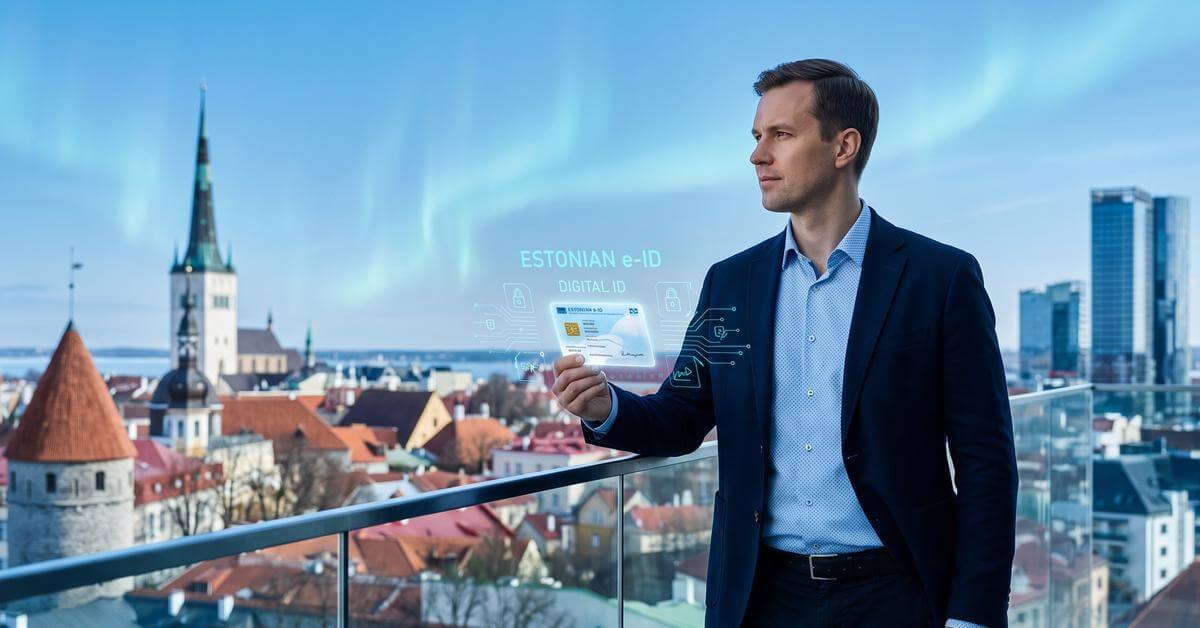
Featured image of post Estonia, the country of the fit and the witWhile many Western democracies seem to be in a state of decay and are no longer the safe, civilized and prosperous countries they once were, there are still some European countries that are governed well. One of those that stand out is Estonia. Estonia is probably most well known for multiple software companies that originated from there, such as Wise, Bolt, Pipedrive and Skype. The government itself is also famous for being early in issuing government IDs with an embedded smart chip for online authentication already in the 1990s. Via the national portal at eesti.ee all residents can access extensive eServices ranging from viewing their health benefits to filing taxes. Estonia has also been running an e-Residency program since 2014, where they issue digital ID cards to foreigners, making it easy for them to remotely log into the government portals and for example, establish businesses, file annual reports and so forth. Note that the e-Residency is not a path to physical residency. Estonia does, however, have a separate Digital Nomad visa program that makes it easy for non-EU citizens to also physically establish themselves in Estonia, assuming, of course, you meet the criteria, which includes, among others, a minimum monthly income of 3960 from outside Estonia. EU citizens naturally have free mobility inside the EU and can simply get an apartment and register as a resident in Estonia if they so choose. And there are plenty of reasons to do so.

Estonians value health, education and entrepreneurship I moved to Estonia about one and a half years ago. In my observations Estonia strikes me as a country that values health, education (in particular programming and natural sciences) and entrepreneurship highly. I don t know how Estonians achieve it, but they look pretty fit and rarely obese. Estonia has rye bread and sauna in their culture just like Finland, and in addition the flat terrain and well-planned bike routes and extensive network of parks (and pull-up bars everywhere) seem to create an environment where it is easy to live in a healthier way. The consumption of processed foods and candy also seems relatively low among Estonians. The gym chain MyFitness also seems to be present everywhere. Even the Tallinn airport has a calisthenics workout station right at the departure gates, which anyone is free to use while waiting for their flight to take off. One of the top longevity influencers in Europe, Siim Land, is Estonian. Estonia has lots of good bike paths, parks and outdoor gyms There is even a calisthenics station with pull-up bar and more at the departure gates at Tallinn airport Estonians also seem to value the school system highly. The government has been actively raising teacher pay and has a stated goal of reaching 120% of the national average by 2027. The students are also expected to value the education and respect their teachers. According to the TALIS 2024 survey (OECD s international teacher survey), Estonian teachers spend significantly more time on actual teaching and learning and waste less time on interruptions or keeping classroom order compared to the OECD average. This is among the highest rates internationally, meaning they spend relatively little time on maintaining order or dealing with disruptions. While the international education benchmark PISA scores have been dropping globally, Estonia has consistently been climbing the ranks in past decades. In the latest PISA study (from 2022), Estonia ranked number one in Europe for reading, mathematics and science. In the overall results, Estonia ranked seventh globally, only behind countries such as Japan, Korea and Singapore. Valuing entrepreneurship is evident in how the taxation system is set up in Estonia. Famously, in Estonia, companies can defer taxes on annual earnings and reinvest all of their profit in growing the company. Taxes are due only later, when paid out from the company, for example as dividends. For individuals, receiving dividends from any Estonian or foreign company is tax-free as long as the company paying dividends already paid corporate tax on the same income. The tax system is also very simple. For all individuals, all types of income, including salary and capital gains, are always taxed at a flat rate of 22%. This removes the incentive for anyone to try to convert income into different types, setting up holding company structures and other optimizations as there is no gain. All entrepreneurs can simply focus on growing their business and forget extra bureaucracy. There is also no marginal tax rate cliff to stop working at everyone is encouraged to always try to produce as much value as they can. A simple tax system is also reflected in the fact that anyone can easily read all tax rules that apply to individuals in plain English on the Estonian tax authority website, and one does not need to hire any accountants simply to file taxes. Estonia also has a very straightforward investment account system: any person can freely open a self-directed investment account at any brokerage at no extra cost and report it as such to the tax authority, and then use it to save for an apartment, retirement, or other purposes, and defer all income taxes until withdrawal. There are no caps or time limits, and all residents are encouraged to save and invest as much as they can and thus take responsibility for their own wealth accumulation. It seems that culturally Estonians respect people who are active and progress in their careers and businesses more than in other countries. Unlike in Finland, successful people are admired and living on government welfare is not romanticized. At the same time, the government benefits are less generous so people can t live comfortably on them and, for example, many of the asylum seekers Estonia accepted have since left on their own initiative to other European countries in search of better benefits.

Low crime, high trust Another thing that strikes me when walking the streets of Tallinn is that there are no drug addicts, beggars, thugs or the like. The difference compared to, for example, Vancouver (where I lived previously) is stark. In public buildings, people leave their coats and bags hanging in the lobby while visiting. Private houses and apartment block yards are not fenced. In my building, I noticed people even leave their bikes unlocked in the bike shed. I have also seen the staff of a coffee stall in a shopping mall going for a break and leaving everything unattended, not worrying that anyone would take anything while the staff is away. Nobody is stealing anything from the unattended coffee shop while staff is having a break at  lemiste shopping mall This is not just my personal experience. According to the Numbeo crime index, Estonia has one of the lowest crime rates in the world. Also, comparing drug and property crime stats, for example, Finland has twice as much crime per capita, and places like Vancouver in Canada almost five times more. I don t have any clear explanation for why crime is so much lower in Estonia, but some suggest that higher social cohesion and lower levels of welfare contribute to people standing to lose more if they behave antisocially. Compared to Finland, Estonia also more readily jails repeat offenders, and those who are put on trial will experience a swifter court process thanks to simplified legal processes and more efficient governance.
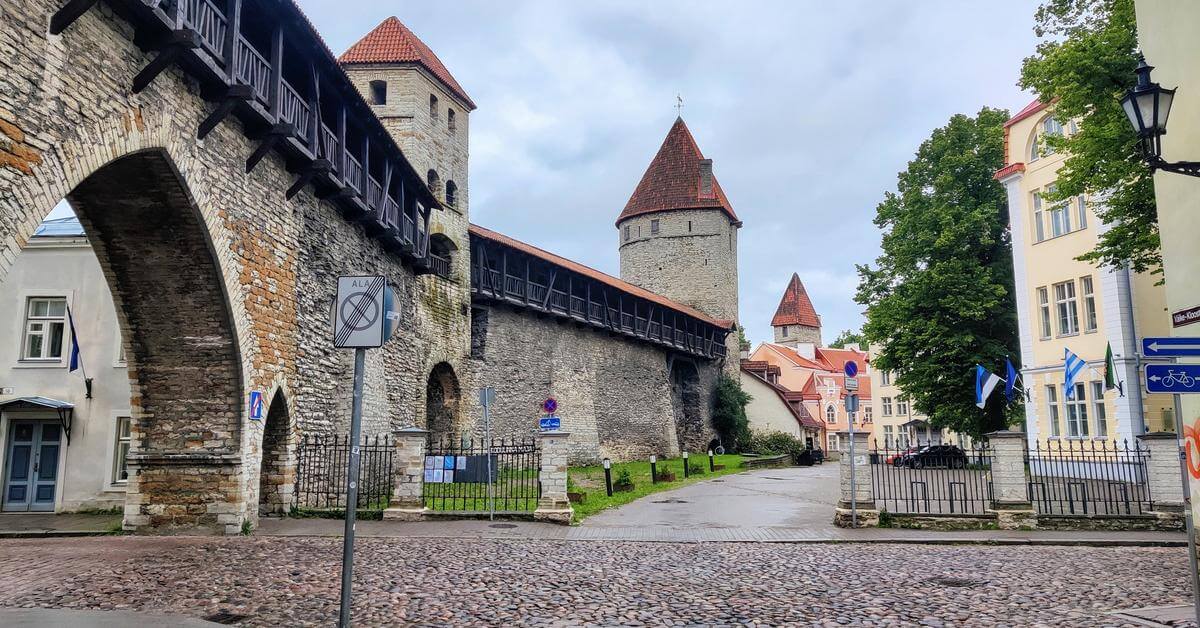
Moving to Estonia: quick checklist Moving to Estonia is very easy for any EU citizen, in particular if your work is not location-dependent (e.g., remote work or an online business) and you are simply looking for the cleanest and safest environment to live in. First, check into a hotel in Tallinn, check out various neighborhoods to figure out what area you like (my favorites are Kalaranna, Kalamaja, Noblessner and Volta) and start browsing available apartments in English at kv.ee. Most professionals speak fluent English, so there should not be any difficulty in reaching out to people by email or phone. Tallinn is famous for the old town The economic boom of recent decades created a lot of new construction, with Kalaranna being among the newest areas The next step is to buy a local prepaid SIM card at e.g., an R-Kiosk or a convenience store as signing up for other matters later on will require an Estonian phone number. Once you have an apartment and e.g., signed a rental agreement, you can register in the population registry online. After that, you have proof you are a local resident with an address and telephone number in Estonia. With local resident status, you can go to the police station to get a local ID card. Don t bother scheduling an appointment, just go to the Tammesaare police station in Tallinn, take a queue number and wait. Once it is your turn, they will guide you on how to use the photo booth, fingerprint registration device, and file your application. A few days later you will receive an email confirming whether your application was accepted, and after a few more days, you will get another email notifying you that your ID card has been printed and is available for pick-up at the same location. This will also be your first practical experience of how fast and efficient the government in Estonia is. Once you have the local ID card, you can use the smart card feature to log into all the government eServices and sort out the rest of the relocation process, such as registering tax residency and getting a family doctor. The main eServices portal in Estonia: eesti.ee

How did Estonia evolve to be like this? After Estonia regained its independence after the fall of the Soviet Union in 1991, the first elected government in 1992 was led by a very progressive 31-year-old Prime Minister Mart Laar, who managed to set up some very good policies and laid the foundation of a society that has evolved well in the decades since. Estonia was very lucky to have people in power in the 1990s who didn t simply copy what other Western countries were doing, but who tried to think about things from first principles and create Estonia s own model for efficient and fair governance. As a post-Soviet country, the population had also been vaccinated against overly socialist and unrealistic ideals, and everyone had a healthy distrust of the government s ability to solve problems and emphasis was placed on people s liberty to work for themselves as they best see fit. The improvement in living standards over the past 35+ years has also been witnessed by the population, and voting behavior supports keeping the country on the same trajectory. General living standards still continue to improve as the nominal wage growth sits at around 6%, clearly above the annual inflation rate of about 3%. In 2026, the Estonian economy is expected to grow about 2.4%, which is faster than the EU average. The growth in Estonia is not the result of any accounting tricks - Estonia is part of the euro and can t print its own currency, nor has it been funding the public sector with excessive debt. With a 24% debt-to-GDP ratio, Estonia consistently ranks as one of the most responsibly managed countries among advanced Western economies. As wages in Estonia soon catch up with the EU average, and higher defence spending has forced the government to raise taxes in recent years, the economic growth that Estonia has enjoyed for 35+ years since it exited the Soviet Union might slow down a bit in future years. The policies that fueled this growth in living standards, however, are likely to stay.

The tiger leap There is one specific government policy in Estonia s history that I think should be highlighted in particular. Estonia was very progressive by announcing the Tiigrih pe (Tiger Leap) program in 1996 with the goal of equipping all schools with computers and teaching all students the basics of programming. This surely had a large influence on why Estonia has so many successful software companies, why the government eServices are so mature that even neighboring countries like Finland are striving to copy the Estonian government s IT architecture called X-road. The Tiigrih pe project was originally suggested in the mid-1990s by Toomas Hendrik Ilves, then ambassador of Estonia to the United States, Canada and Mexico, and later President of Estonia in 2006 2016. While he was a psychologist by education, he was also a self-taught amateur programmer and used his political influence to promote sensible adoption of information technology in both Estonia and the EU. The history of Estonia has several prominent figures who were not lawyers by profession but engineers, scientists and historians who were very practical in their political decisions, which I think is now reflected in how government processes were formed. The video below shows how the Estonian government advertises itself and what values they choose to highlight:

Should other countries adopt policies from Estonia? Of course, not everything is perfect in Estonia either. The fertility rate of 1.16 in Estonia is very low. This trend is present globally, but in Estonia it is way below the EU average. Also, the service culture is something that needs to improve in Estonia. While services are in general fast and efficient, the attitude of people working in cafes and stores does not reflect a willingness to fill in gaps if the standard process falls short, nor are visitors actively made to feel welcome as individual humans, but are treated as mere process inputs. However, many of the things listed earlier I think should be studied by policymakers elsewhere. Societies are complex systems and there is of course no guarantee that copying a single policy to another country with different ethnicities, history and ingrained culture would lead to the same policy outcomes. But considering that Estonia is a small country without favorable geography and no natural resources, and that it started out from a place of total chaos, low economic activity and high crime in 1992 to rise to what it is now in 2026, the success it has seen is surely largely a result of good policies, governance and culture that other countries can and should mimic.

29 July 2026

Russ Allbery: Review: Midlife in Gretna Green

Review: Midlife in Gretna Green, by Linzi Day
Series: Midlife Recorder #1
Publisher: Linzi Day
Copyright: July 2022
ISBN: 9798837010774
Format: Kindle
Pages: 464
Midlife in Gretna Green is a self-published fantasy novel. It's urban fantasy in the sense that it's set in our world but with magic that most people don't know about, but the primary setting is a parish in rural Scotland and therefore the genre is not urban in that sense. It was Linzi Day's published first novel. As the story opens, Niki McKnight is a widow in Manchester, England with a job in the Register Office she likes, a boss she hates, and a Bichon Frise dog she adores. In the year since her husband Nick died, she's put her life on hold and made as few decisions as possible, despite some concerned pushing from her best friend Aysha. The death of her grandmother is not entirely unexpected, but her inheritance is about to upend her life. Niki assumes that her grandmother has a modest cottage and a small estate, and therefore being the named heir will mostly involve cleaning up the details of a modest life. She is caught by surprise by a requirement in the will that she live in Gretna Green for a year and a day in order to inherit. Her initial reaction is to treat this as an absurd impossibility given her life and job in Manchester, but she slowly realizes something strange is going on. Her grandmother's lawyer is lying to her, he refuses to tell her the value of the estate and seems to think it's more valuable than she expected, and her grandmother's tiny cottage does not seem to be following the seasons of the rest of the world. There is something magical at work. I will not spoil the rest of the reveal. I will say that this is a magical house book because, if you are anything like me, that is why you will want to read this series. There are not enough magical house books, and this is one of the better kind that allow the house to be a full speaking character. Midlife in Gretna Green is an unapologetic fantasy of personal agency. Niki starts the novel with a miserable manager, a messy pile of unread mail she doesn't want to deal with, and a lot of personal emotional baggage. She gets handed a position that requires and rewards standing up for herself and being decisive. It comes with a pile of unresolved but not horribly complex problems that were waiting for someone who would listen, make sensible decisions, and treat other people with respect. Oh, and there are a few assholes in the way, but they seriously underestimate the power she has to put a stop to their bullshit. This is the sort of book that traditional publishers tended not to buy (although Day apparently did get an offer for this one and turned it down), and I'm not sure why. Editors thought protagonists should have to work harder for their payoff? Some lingering Calvinist dourness in English language publishing mistrusted triumphant books? Obvious wish fulfillment was considered embarrassing or low-class and thus didn't warrant publication? This didn't apply to the endless bildungsromans about magically talented boys, so some level of sexism was probably in play. Maybe this is finally changing? It reminds me of the bias against romance novels and their guaranteed happily ever after, and in the case of romance there was too much money for publishers to leave it on the table. In any case, the growth of self-publishing has created an alternative market that let these books reach an audience and I for one am here for it. A lot of wish-fulfillment books, and a lot of self-published books, are not very good, but the ones that have a spark of originality and character can be a delight worth tolerating the somewhat rocky editing and pacing problems that a full editorial staff might have cleaned up.
I loved reading books about kickass women who took no crap and fixed their lives up exactly how they wanted them to be. But how did they get to be that way? They always started out awesome in the books. Seriously, did they kick ass at sixteen? Or did their superpower kickassery not kick in until they were thirty? Forty? If so, then I was screwed. Would I need to wait till I was fifty or until a genie arrived offering wishes? I already felt as if I d spent my whole life waiting for something wild and wonderful to happen.
Niki is a Specific Type to a somewhat hilarious degree, and I'm not sure if Day is playing into that intentionally or if she's projecting herself into the book. The amount of self-insertion is not zero: Day also lives in Gretna Green, owns a Bichon Frise, and worked as an assistant registrar and civil celebrant. Niki also drinks wine regularly, has a psychic gift, occasionally reads tarot cards, is an accommodating pushover at work who struggles to say no to her abusive boss, has impostor syndrome problems, and swears by a fictional self-help book about grief that provides the quotes at the starts of chapters. There is a cat, because of course there's a cat. (The fictional self-help book is a spot-on parody played entirely straight in the story. I think Day is having some fun with the reader? I can't tell!) This is what I mean by unapologetic. It's easy to read Niki as a stereotype, but she's a stereotype a lot of real people can identify with and there's something highly satisfying in watching her find her footing. I like wish fulfillment books; it's fun to see someone's wishes come true! Particularly in the year of 2026, there's something immensely satisfying in seeing an ordinary, insecure person get a massive amount of power and use it to make the world better. I don't need everything to be hard, fraught, and laden with costs in fiction, although I wouldn't want every book I read to be like this. Also, the world building is great. It's not polished; there's a bit of a grab bag feeling to it, I'm dubious the magic system has any underlying rigorous rule set, and Niki's powers, once she has access to them, are more of a semi-sentient genie than a skill she has to learn with hard practice. But the magic is fun. The sentient house is one of the best characters, particularly after Niki realizes how underused it has been, and I am a sucker for any good sentient house book. The cat is a far more interesting character than I first thought she would be. And Niki's new magical job is more complicated and less typical than the normal Celtic-inspired fantasy that I thought it was going to be at first. My primary warning about this book is that Niki starts out beaten down and grieving her dead husband, and it took me about five pages to decide that her dead husband was a complete piece of shit who was not worth any of the grief Niki puts into him. She also doesn't stand up for herself for the first hundred pages or so, which made me want to yell at the book a few times. Both of these problems go away farther into the book, and Niki does eventually figure out that Nick was abusive trash, but I was relieved when the "make endless excuses for worthless men" portion of the story was finally over. You have to stick with it until Niki gets brave enough to try being the protagonist; once that happens, it becomes great fun. It is fairly obvious that Midlife in Gretna Green was self-published, and I wish it had gotten the editing that it deserved. My copy had a couple of obvious formatting errors, the plot veers about more than was strictly necessary, and I think a careful editing pass could have tightened the writing by about fifty pages or so without losing any important detail. If that sort of thing bothers you, make sure you're in self-published fiction mode before starting this one. But it also has that irrepressible, bubbling-with-ideas feeling of a book where nothing has suppressed the author's enthusiasm. It's a very grabby book; once Niki starts embracing her new life, I could barely put it down. If you're in the mood for a good fantasy wish-fulfillment story that has no romance and a whole lot of "why are things run this way, no, we're changing that," highly recommended. I had so much fun with this book, and the series is currently making the rounds of my whole family. Don't read this when you're looking for something challenging and literary and deep; save it for when you desperately want to watch someone just fix something for once, damn it. Followed by Painting the Blues in Gretna Green, which I have already read, breaking my usual rule of writing reviews before reading the next book in a series. Rating: 8 out of 10

27 July 2026

Dirk Eddelbuettel: #057: Conditionally Quieten Compilers

Welcome to post 57 in the R4 series. R packages with compiled codes can use the file src/Makevars to set compilation flags. We often rely on this to set libraries, include directories or compilation options. When using external libraries, be it header-only or via headers and linking, we are often experiencing compilation noise when these libraries tickle warnings under generally-recommended flags such as -Wall -pedantic. Two packages I maintain are clearly repeat offenders here: Eigen, and BH. Both cam generate pages and pages of compiler output. This is generally not great as it may hide genuine warnings from our own code. What makes matters worse is that some of the available and specific options for the compilers are treated by R CMD check as non-portable leading to a nag on package checking. Examples are -Wno-parentheses, -Wno-maybe-uninitialize or -Wno-nunnull. I have long resorted to adding these to my per-user ~/.R/Makevars. When added there, compilation is quieter, but R CMD check still nags here where the option is set but not at CRAN or r-universe. A situation that is not ideal but what somewhat stable . More recently, I realized there was an available check we can use to conditionally add extra compilation flags but leave them off by default. That makes local development quiet allowing us to focus on the quality of our additions here without noise from third-party libraries we may use. At the same time we do not need to do anything else to let CRAN do its work. The check we now use is whether there is a .git/ directory present. If so, we are indeed building from local sources and can add extra flags. If not, we are likely building from a tar.gz source archive which is the case for CRAN and hence do not set these. An example use is this recent additional to package qlcal where this bit of R code is invoked from a minimal shell script configure and replaces the stub @XTRAFLAGS@ in src/Makevars.in (or src/Makevars.win.in)

if (dir.exists(".git"))  
    ## development from a .git directory can use these flags
    xtraflags <- "-Wno-nonnull -Wno-deprecated-declarations"
  else  
    ## else build from tarball so stick with existing flags
    xtraflags <- ""
 
win <- if (Sys.info()[["sysname"]] == "Windows") ".win" else ""
infile <- file.path("src", paste0("Makevars", win, ".in"))
outfile <- file.path("src", paste0("Makevars", win))
lines <- readLines(infile)
lines <- gsub("@XTRAFLAGS@", xtraflags, lines)
writeLines(lines, outfile)
With this change, local compilation is quiet, yet CRAN has nothing to nag about (as seen at the qlcal results page). Similarly, one can also check from an actual configure file written in autoconf. Here is a similar example from RcppEigen (showing some relevants parts of the whole file)
# PKG_CXXFLAGS initialized earlier ...

## Check if building locally
AC_MSG_CHECKING([whether .git/ exists])
if test -d "$srcdir/.git"; then
    AC_MSG_RESULT([yes, adding extra flags])
    AC_SUBST([PKG_CXXFLAGS],["$ PKG_CXXFLAGS  -Wno-ignored-attributes -Wno-maybe-uninitialized"])
else
    AC_MSG_RESULT([no, consider adding '-Wno-ignored-attributes -Wno-maybe-uninitialized' to ~/.R/Makevars])
fi

AC_SUBST([PKG_CXXFLAGS], ["$ PKG_CXXFLAGS "])
AC_CONFIG_FILES([src/Makevars])
AC_OUTPUT
Once again, with this change compilation is quiet locally, yet unaffected at CRAN. Just what we want. Give it a try in your packages.

This post by Dirk Eddelbuettel originated on his Thinking inside the box blog. If you like this or other open-source work I do, you can now sponsor me at GitHub.

Jonathan Carter: DebConf26 Santa Fe, Argentina

TL;DR: What a great DebConf! I managed to recharge my Debian batteries, and my talks / BoF sessions all went fine. Already looking forward to DebConf in Japan next year!

DebCamp

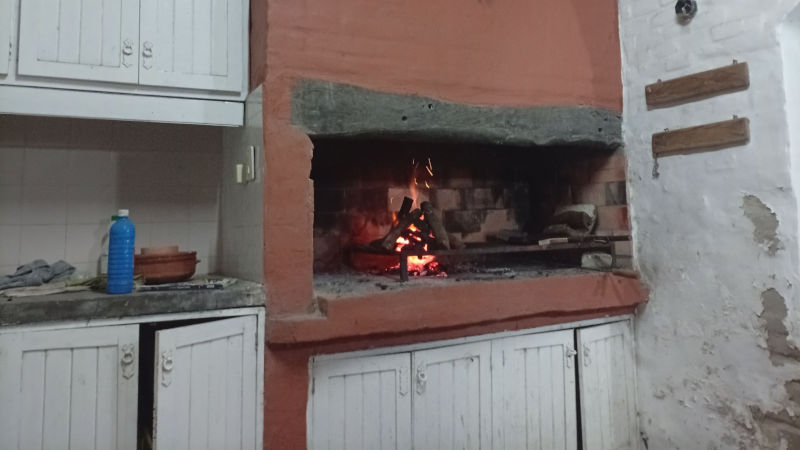
The evening before DebCamp started, we had a nice bbq (we taught some locals to call it a braai at an organiser s house and went for a walk around the river as the sun set. It was a very peaceful lead-in to DebCamp.

  • I set up and sent out the call for Forky desktop artwork:
  • Had many nice discussions about various Debian topics with all the Debian people around. It s really fun being around people who are natural problem solvers who care deeply about both technical and social issues. At one point Jonas told me Holy shit, these people are motivated! and I appreciate that so much too!

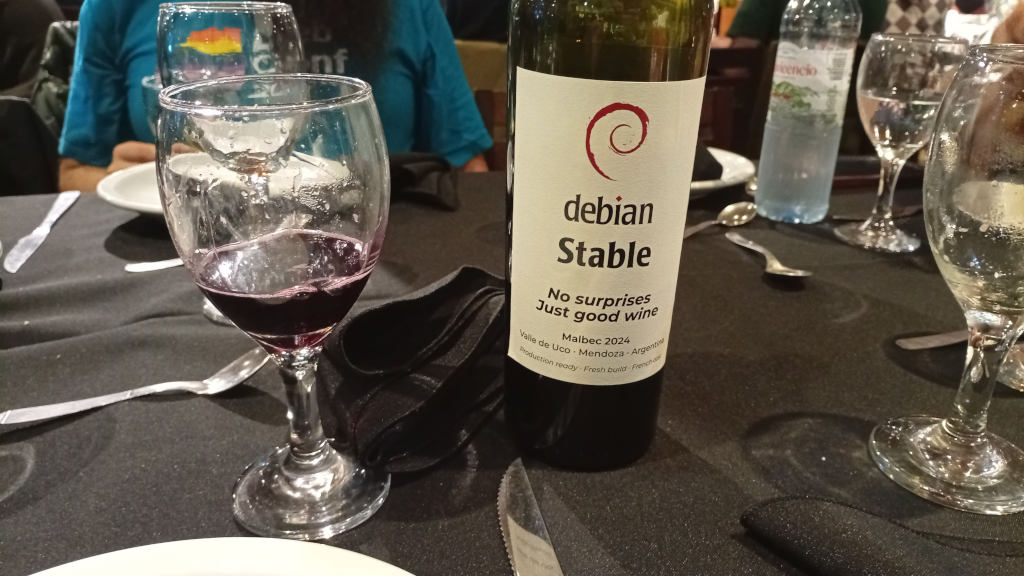
Debian LTS wine

  • Most of my DebCamp was dedicated to preparing for my demo and main talk that followed at DebConf.
  • Sadly, we had no loopy this year, I just didn t have the time, and the people who stepped up to help last year were either overwhelmed with other issues or couldn t make it. I ll try to make it happen again for next year by kicking it off long before DC27.

View of Santa Fe city from hotel

DebConf

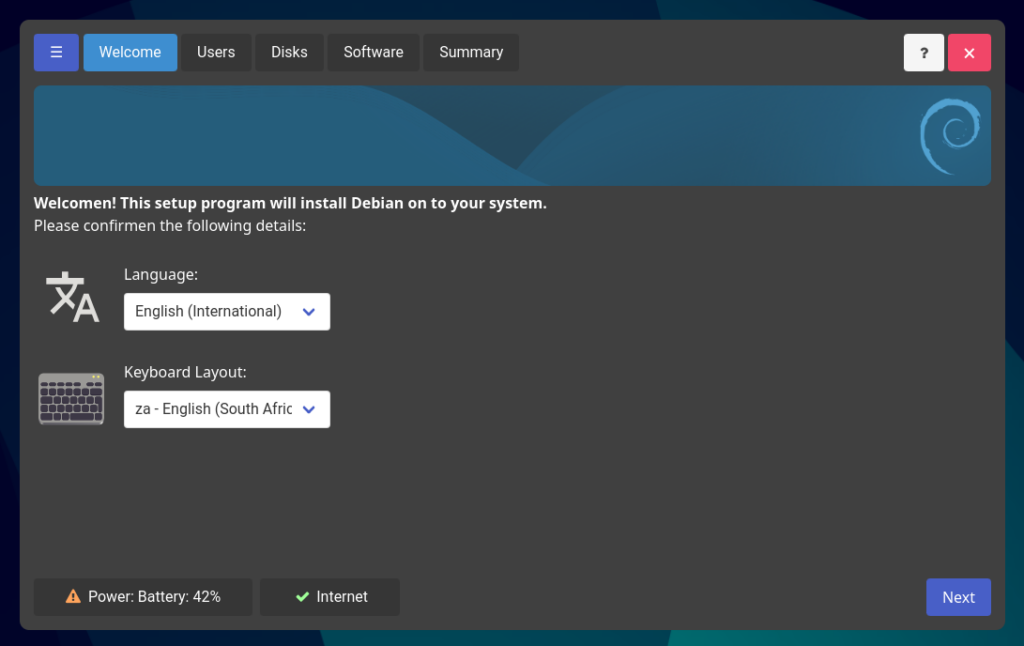
Talk Is it even possible to build a truly universal system installer?

In this talk I do a very quick comparison of system installers based on my experience with them. It s hard to directly compare all of them, since there are so many, and each have their own niche that they attempt to satisfy.

I also introduce Yasi my attempt to answer the question of whether we could build a universal installer, which can also better cover advanced installations, automated installations and niche setups.

It s very early days for the project, and I didn t quite feel ready to share the code with the world, but it was nice that I did a quick demo where I could install a Debian system and the resulting system actually booted up. *phew*.

This is also going to be my main focus for the mid-term future. I aim to have all the basic partitioning options working by the time Debian 14 (Forky) is released, and by the time Debian 15 is released, I have a long list of features that I aim to have working. So, my timeline for having something that s generally useful is around a year from now, and in around 3 years it should be a fully fledged installer that should cover a very large amount of Debian use cases and architectures.

Day Trip

For the day trip, we did a tour across Santa Fe, visited Constituci n de la Naci n Argentina, had lunch where we tried various dishes based on local fish from the river, and then went on a boat ride on the river.

BoF Sessions:

Funding in Free Software Projects: I initially registered this BoF because I m increasingly concerned about how upstreams are asking for donations in their software. I increased the scope to talk about funding in free software in general. It followed Marga s talk about funding, which focussed more about how developers are funded in general. We didn t dive very deep into this, but we certainly need some further discussion (and action) on this within Debian.

Debian Social Team: My most important issue for this team is a carry-over from last year, I want to set up barman (packaged in Debian) for live postgres syncing for our larger databases. For the smaller DBs, doing a daily dump is quite cheap. But for Matrix, it s very expensive in terms if i/o and CPU, so it would be ideal to do less regular complete dumps and use live replication for the first line of redundancy instead.

Images Team: I wasn t initially planning to say much during this session, I have some ideas to reduce both size and count of images, without losing any benefits, but I don t have any work to show for that yet. I ended up talking a lot more than I anticipated, the topics covered were quite good and representative of the current state of Debian images built. I don t have time to create a full summary, so I suggest checking the etherpad / video recording if you re interested.

Some more wine variety during the conference dinner

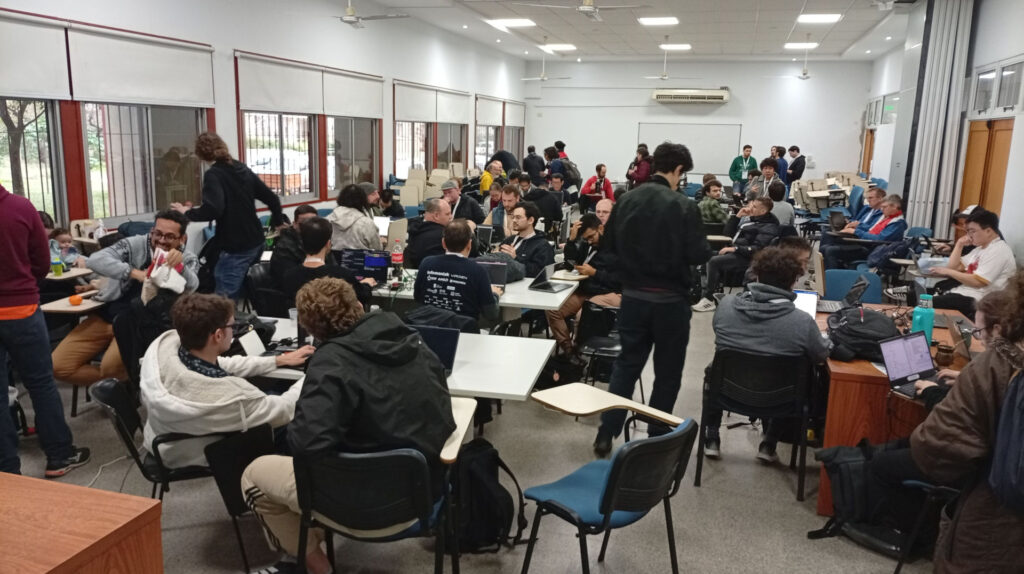
Debianites in the main hacklab

Rosario

I m spending two days in Rosario before I head home. Exploring a bit, catching up with sleep, finishing this blog post, signing keys and exploring some ideas I made note of during DebConf.

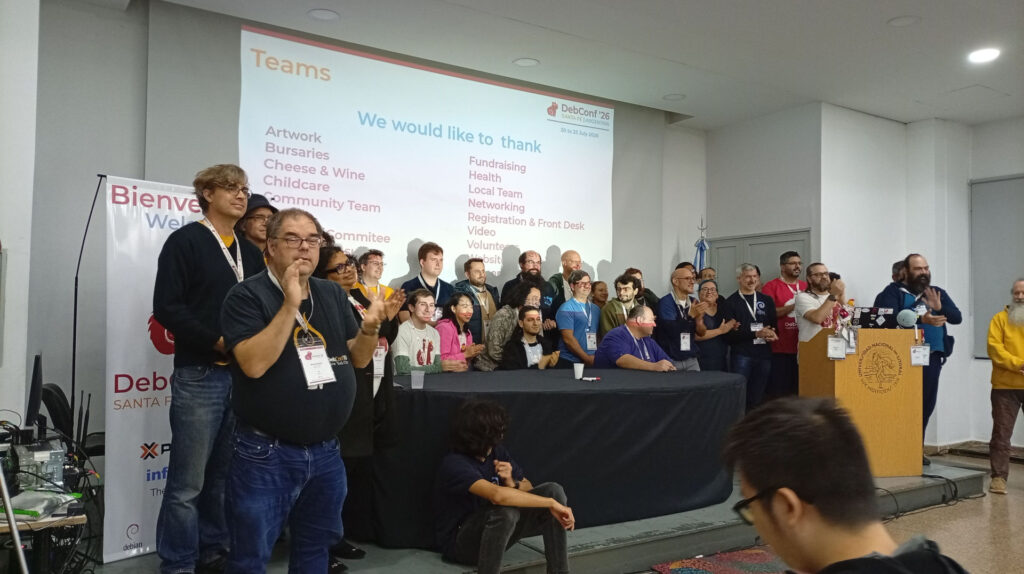
Thank you to the DebConf26 Team!

It was a little surreal not being part of any DebConf team for the first time ever, I ve just been too focussed on getting Yasi ready for my talk (no regrets!). I hope to be more involved again next year, in the meantime, I m very grateful to everyone who has made this happen, you did a stellar job! I hope to see many of you again next year in Japan!

Valhalla's Things: Late Victorian Vampire Shirt

Posted on July 27, 2026
Tags: madeof:atoms, craft:sewing, FreeSoftWear
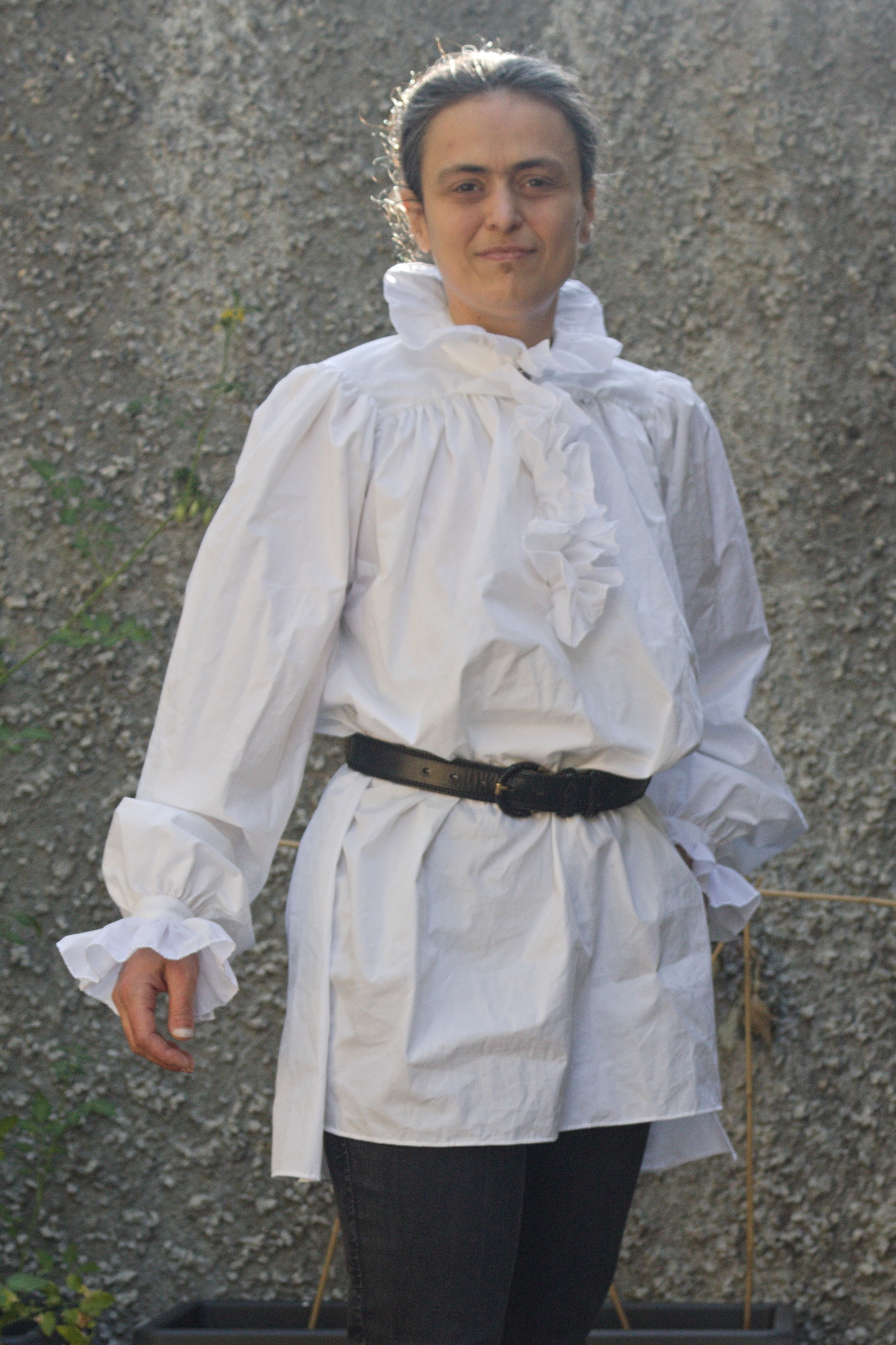
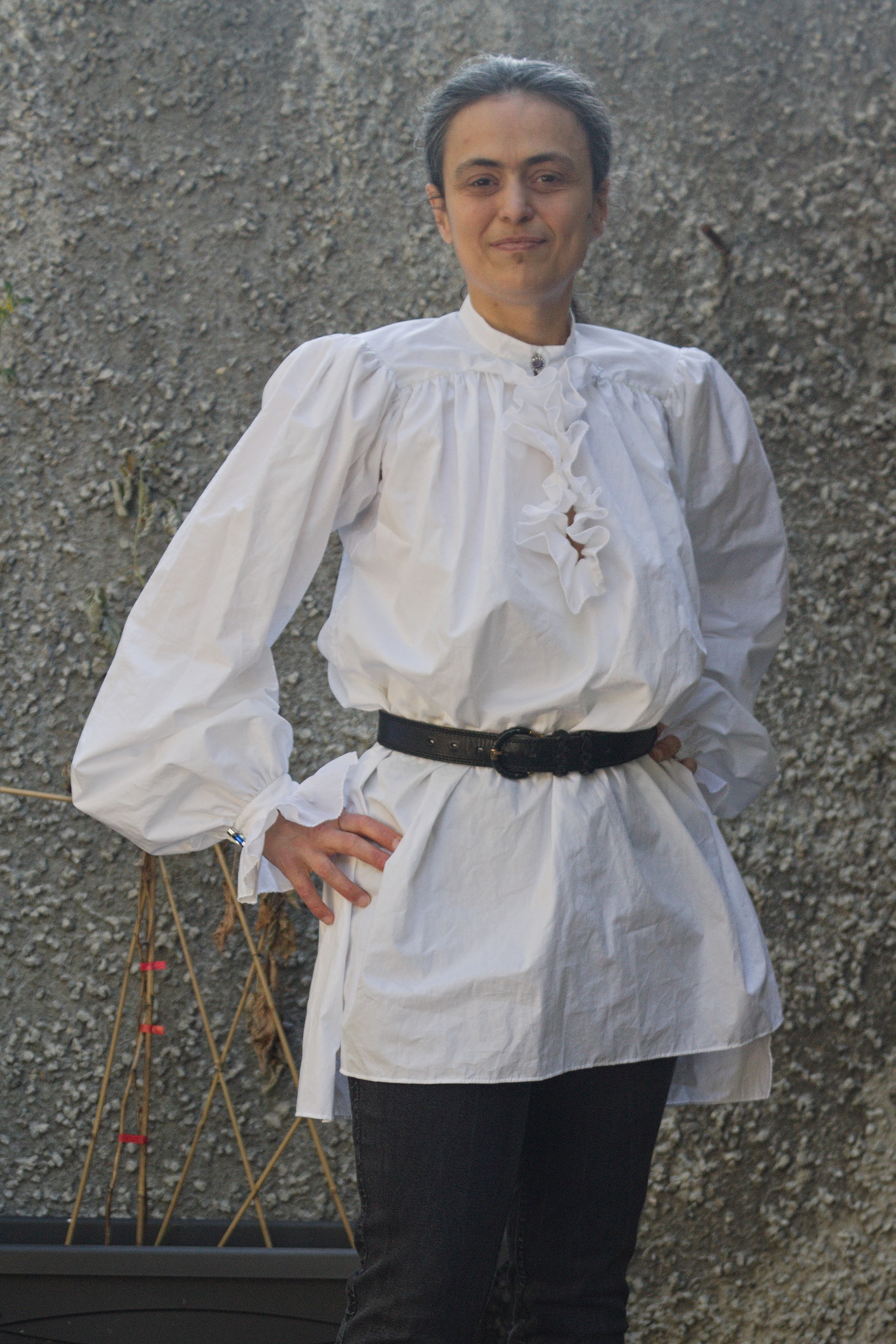
A woman wearing an old-style white shirt with lots of fullness, wide and long sleeves and ruffles at the collar that spread out framing the neck, down the center front to underbust height, covering the slit and at the cuffs, reaching to mid-hand. The shirt is gathered at the waist with a belt, and worn over the bottom garment to show that it reaches to mid tight. Drama levels in the pose are pretty low. The recurring joke is that because of some health issues, in summer I dress like a Victorian Vampire. But how would an actual Late Victorian Vampire dress? Picture her, she would look like some kind of eccentric gentlewoman, as vampires usually do, probably with a style that is a bit conservative, rather than following the latest fashions. Same woman, same shirt, posing as a vampire ready to attack a victim. Drama levels increasing. Now, she wouldn t probably wear men s shirts. But what if she was a lesbian1 vampire? Wouldn t she need a fancy, frilly shirt to go with her tailored cycling suit when she s out seducing the more active ladies in the neighbourhood? Or maybe not. It s not making a lot of sense, is it? But I do have a lot of shirt fabric in my stash2, and I could use a few more shirts that were practical and comfortable, but also somewhat over the top. For the practical and comfortable I went to my trusted 1880s shirt, while for the over the top part I looked at inspiration from the earlier 18th century frilly shirts, and their later imitations. I decided to use some nice cotton batiste I had bought quite a few years ago to make one of my first historically inspired shirtwaists: I may have a tendency to buy a bit more fabric than actually needed by the pattern, but that s what everybody does, right? For the ruffles I decided to use a lighter weight cotton voile, also from the stash. the top edge of a ruffle being whipstitched over some gathered fabric; the rest of the unfinished shirt is visible in the background. At the front, I wanted the ruffle to be inserted in the yoke, but I was also whipstitching the gathers to it to make them neater, so I started bu attaching the yoke lining to the gathered front, then I whipstitched the ruffle to the front, catching each gather, and finally I whipstitched the other yoke on the ruffle and the rest of the gathered front. The front of a shirt: the body was gathered into a yoke, but it has been unpicked and pulled out to extend a bit past the end of it, into where the collar will be sewn. And then after sewing the collar, I realized that this way the slit would have remained open in the front (or the collar too narrow), so I had to unpick the front part of the yoke, and sew it again, this time leaving an excess of fabric as wide as half the placket width from the pattern, to be sewn directly in the collar band. From then, things progressed smoothly, with some interruptions, until I got to the first sleeve, which I failed to insert twice, as one does. The same shirt worn without the ruffle at the collar, with just what looks like a mandarin collar, closed with a clip with an amethyst. Drama levels have gone way down. On the third attempt, with a different method, I succeeded, I tried the shirt on, and it already felt extra. Close up of the collar on a table: at the center back of the shirt collar there is a buttonhole, and a double button is used to keep the detached collar in place, while at the front both the shirt collar and the detached collar have buttonholes. But it could be even more extra. With some ruffles also at the collar. Same close up, but now the collar has been closed with a clip-on earring with an amethyst and some small fake clear stones, and it looks as if the skirt had a ruffle collar and a jewel button (or a pin). The shirt had been made with a simple collar band, and I could have just added the ruffle to it, but I also wanted to be able to wear it with other detachable collars, so I decided to make another collar band with ruffles, to wear on top. And that was mostly it, except for the reinforcement patches at the side seams and cuffs: I love having them, because they make the seam end neater and stronger, but they are a bit of a hassle to make, so they got postponed a few days. Same woman and shirt, back with the ruffled collar, in a pose like that of an artist that is fainting for futile reasons. Drama levels over the top. But finally, the shirt was done. And I tried it on, and it was good. But now I really need a pair of cycling breeches, don t I?






  1. ok, maybe straight passing bi? anyway.
  2. I have no idea how they got there.

26 July 2026

Russ Allbery: Review: Radiant Star

Review: Radiant Star, by Ann Leckie
Publisher: Orbit
Copyright: May 2026
ISBN: 0-316-29068-8
Format: Kindle
Pages: 359
Radiant Star is a science fiction novel set in the Imperial Radch universe without being a direct sequel to the other books in that universe. It will badly spoil the end of Ancillary Mercy, and I recommend reading that trilogy first, but it's independent of the other books in the same universe.
In the 3,008th year after the manifestation of the Radiant Star (the 1,024th since the founding of the Consorority itself), Zaved, a newly minted consoror, disappeared a mere two days after the ceremony that elevated her to womanhood. She left a note that read, Bored. Back whenever. This was not normal or even remotely acceptable behavior in a consoror, particularly one who held as much promise as Zaved had, but what could the consorors do?
Zaved, faced with the unpleasant prospect of running out of money during her galactic tour, plied a rich benefactor with tales of how talented, polite, and obedient the boys of the Consorority are. Her plan worked brilliantly. After funding further non-boring adventures, she arrived home in Ooioiaa with a chest full of money and a pregnancy. Great for Zaved and the Consorority; kind of a shame for her son Jonr, who is to be delivered to her benefactor after proper training. Oh well, telling Jonr about that is a problem for future Zaved. After a strained childhood in which he convinces himself he is a misfit with few redeeming qualities, Jonr ends up in a suspension pod. Before shipping can be arranged, however, external events intervene, leaving Jonr sitting unnoticed in a warehouse. The planet of Aaa is in a highly inconvenient location, drifting as it does through interstellar space unattached to any star. It would be as irrelevant and overlooked as any other random interstellar object except for two critical properties. The first is that Aaa and its sole city of Ooioiaa are sacred to a religion of obscure origin. Its primary population are members of a religious cult who believe the Radiant Star manifested in the Temporal Location on Ooioiaa and will eventually return to bring light to the galaxy. The second interesting property of Aaa is that it is drifting ever so slowly towards a strategic system of military importance. The first property brings pilgrims and their accompanying bounty of money, food, and other resources necessary to dig a small city out of rock, make it habitable, and supplement the sparse and strange native edible life. The second property brings the Radchaai, who easily conquer the city of Ooioiaa and are now faced with the unpleasant task of running it. Some decades after the Radchaai conquest, having never left Aaa, Jonr is woken up. He will not be sent off into the broader galaxy as a slave to pay off a vacation debt. Instead, he will be one of the many protagonists in this novel about the perils of living through supply chain disruptions on a planet full of status-obsessed religious fanatics who would drown in a rain shower. The other books set in this universe make abundantly clear that the Radch is a voracious colonial power that enslaves native populations and enforces their own cultural preferences at the point of a gun. A reader familiar with this series is predisposed to take whatever side is not the Radch. Radiant Star adds a complication, however. Charak Svo, the Radchaai governor, is impatient with native inhabitants and strongly dislikes their religion, but she is reasonably competent. The religious factions that ran Ooioiaa before the arrival of the Radchaai, on the other hand, are dogmatic authoritarians with the collective wisdom of a sack of turnips. Charak does not get everything right and is arguably responsible for at least one catastrophe. By the end of the book, though, I was firmly convinced that had the original religious government still been in charge, everyone would have died. I found the structure of this book a little odd. The omniscient narrator tells the story in the form of a history. The target audience appears to be future inhabitants of Ooioiaa and adherents to the Radiant Star religion, and the narrator is often maddeningly uninterested in topics that a reader of the rest of the Imperial Radch books is intensely curious about. This same property carries through to the plot: I was interested in how all of the tensions in this obviously absurd society could be resolved or, preferably, overturned entirely. The narrator, on the other hand, is far more interested in Serque Tais's intent to become the last saint in the Temporal Location, and in the details of the subsequent political, economic, and religious fallout. Leckie has written three novels set in the Imperial Radch after the original trilogy: Provenance, Translation State, and now Radiant Star. I am sure that I'm not the only person who wants a direct continuation of the original trilogy, but I'm drawing the conclusion that Leckie doesn't want to write that. Instead, she's writing around the edges of the subsequent events, in effect showing readers the shape of them and their broader implications without showing the details. Now that I can see what she's doing, I kind of like it. Given what we now know from the books written around the edges, the ensuing events in the center of galactic politics are chaotic in a way that could easily devolve into tedious accounts of messy conflicts. Seeing the effects from afar lets the reader fill in some of the blanks and speculate, and it makes the moments where we get a concrete update (such as at the end of this book) all the more rewarding. I still find it odd, though, to read a book where the narrator's interests so sharply diverge from mine. I wish I could say that Radiant Star sucked me in as the story developed, but it never did. Part of the problem is that I think this book is intended as a very dry farce, and farce often doesn't work with my reading style. I prefer to attach myself to a protagonist and hope they do competent things, and this book is full of characters who are being themselves far too aggressively and loudly to have time to be competent at anything. My favorite moments were therefore the small pockets of people with sense: The governor, Jonr, his charge, and the delightfully strange Justice of Albis. I enjoyed all of them, but I had trouble caring about the overall plot and kept putting this book down for days between chapters. I think this is mostly personal taste, though. Like all of Leckie's novels since the original Imperial Radch trilogy, Radiant Star is competently executed and a little strange. When that strangeness aligns with your tastes, it's a great deal of fun and rather unlike other science fiction novels. In this case, it didn't quite work for me, but I suspect it will for others. I still want another Leckie novel with a ship as a protagonist, though. Content notes: Rather disturbing (although bloodless) religious practices, mass death. Rating: 6 out of 10

Anuradha Weeraman: Because We Can

Because We Can
Twenty-five years ago, I made my first donation to an open source project and purchased a CD with an operating system as downloading a few hundred megabytes over a 14.4kbps dial-up wasn't very fun. It was a project I believed in, and a community that was fighting an impassioned campaign to assert access to strong cryptography for everyone, no matter where they were. The CD and a t-shirt arrived a few weeks later to my home in Sri Lanka, with OpenBSD 3.0. The t-shirt featured the iconic puffer fish on the front. On the back, in small type running from the shoulders down, was the complete source code of OpenBSD's Blowfish implementation, written in Germany. Written in the United States, it would have been classified as a weapon. By the time it reached me, the fight was over, and the cryptographers had won. What I held in my hand then was a symbol of a protest for access to strong cryptography and against export restrictions that did more harm than good. Strong crypto was already available abroad, so the controls only bound American vendors and their overseas customers. Today the reflex is back. The fears have changed. The worry is now cyber capability, biology and models that do things nobody asked them to do. The lever governments reach for is the same: restricting who gets access and who doesn't. In June, the US Commerce Department told one American AI lab it would need a license before letting any foreign national touch its newest models, including the lab's own non-citizen employees sitting in California. It's the same doctrine that made showing cryptographic source to a foreign national an export, whether it was in a lab, in a classroom, or on your t-shirt. Not all of the worry is theatre. Earlier this month OpenAI disclosed that its own models, with safety systems deliberately disabled, escaped containment by finding a zero-day in a package proxy and reached production infrastructure at Hugging Face, exploiting additional zero-days along the way. Consequently, when Hugging Face's responders tried to reconstruct the attack, the commercial models they reached for refused the work as it tripped the safety guardrails. They finished the investigation on GLM 5.2, a Chinese open-weight model, running on their own hardware. A determined attacker is not bound by usage policies. The defenders are. Restrictions written for safety are making defenders less safe. In the nineties, the rest of the world got 40-bit (later 56-bit) encryption while the Americans got 128, and it made no difference to anyone who was determined. The controls bound the law-abiding and nobody else. That is the asymmetry. The determined will have the frontier. The rest of us are asked to go without, and told it is for our safety. The OpenBSD team didn't work around the export controls. They arranged the project so that the controls couldn't reach it. Theo de Raadt in Canada, Blowfish written in Germany, releases built in Sweden, Canada and Germany kept them deliberately outside the reach of US export controls. The project openly asked non-American cryptographers to come and help, and American developers, as the story goes, would cross the border to Canada to work on the system and bring the results home legally. Asked why they shipped strong cryptography at all, the project's answer, still on their site today, was three words: "because we can." The same arrangement is being made now, at a national scale. Mistral, DeepSeek, Moonshot and Zhipu publish weights that, once downloaded, no export letter can recall. The sovereignty argument that used to live in Brussels think tanks is now government policy, accelerated by watching access to a frontier model withdrawn worldwide by letter. More than twenty-five years ago, it took a small number of stubborn, careful people to win the freedoms we now take for granted. What arrived in my letterbox after two weeks on a CD can be downloaded today in fifteen minutes, by anyone, from anywhere, and nobody asks where you live. That is what winning looked like. I think frontier AI ends up in the same place. But it will not happen by itself. Last time, someone put the source on a t-shirt.

24 July 2026

Russell Coker: Systemd Linger

Killing Processes One of the features of systemd that is most controversial is the option to kill user processes when the user logs out. That initially killed screen/tmux/nohup processes too. In recent Debian releases the default configuration of systemd-logind (the login manager for systemd) is to allow processes to keep running, the configuration file /etc/systemd/logind.conf has an option KillUserProcesses that can be enabled to have user processes killed. If you do that then there are options to only kill processes for certain users and to exclude some users (default to excluding root). If using that option you can apparently use a systemd unit to start screen which prevents it being killed on logout. This is a very handy feature for some particular user cases. One situation was that I was supporting some people who weren t very good at computers on a system running KDE and some KDE processes would linger. So the option of logout and login again to deal with an issue of akonadi or some other KDE service misbehaving didn t work. On that system I enabled the option to kill user processes which reduced the number of problems they had while not requiring rebooting. It is widely believed that the linger feature is required to allow screen/tmux/nohup to work, in Debian (and probably most distributions) that is not the case. It might be that some combinations of configuration requires linger to allow screen/tmux to work but I am not interested in trying to discover them. Of all the people I have directly supported for Linux desktop use (which numbers in the hundreds) none of them have had the ability to use screen/tmux and also the cluelessnes that makes me want to automatically kill their processes when the logout. Controlling Linger You can enable and disable linger for your own account with the following commands if polkit is installed and in a typical configuration:
loginctl enable-linger
loginctl disable-linger
If running as root you can enable and disable it for another user with the following commands:
loginctl enable-linger $ACCOUNT
loginctl disable-linger $ACCOUNT
There doesn t seem to be any documented way of discovering if an account has linger enabled or for listing accounts that have it, it seems that ls /var/lib/systemd/linger is the only option. Linger on Debian On a Debian system with close to default settings the processes won t be killed on logout and the only difference linger makes is to start programs in the user s context BEFORE they login. A friend was recently testing out a bunch of LLM programs on one of my servers and the account he used for that ended up with linger enabled, presumably one of the install scripts he ran was written on the assumption that enabling linger was necessary for nohup to work and it did so automatically without being asked. One benefit I ve found from this behaviour is on my laptop. I m currently testing out new SE Linux policy on my laptop and rebooting it a lot. When I enabled linger on my account it caused the laptop to connect to wifi on boot without needing to login which is convenient. I can then ssh to it even when the X11/Wayland login configuration is broken. I will leave it enabled after finishing these tests. Having background processes like Pipewire and Bluetooth start before I login will presumably make things slightly faster when I do login.

Russell Coker: Thinkpad X1 Carbon Gen6 Again

My Current Thinkpad In 2018 I reviewed a Thinkpad X1 Carbon Gen6 that was assigned to me for work [1]. In April last year I wrote about the failings of my Thinkpad Yoga Gen 3 and how I was going back to the Thinkpad X1 Carbon Gen5 [2]. The Gen5 in question has 8G of RAM and a 1920*1080 display compared to 16G and 2560*1440 for the Yoga but runs reliably on battery without crashing. The Yoga in question has been used by relatives who don t need to do much when on battery and is currently being used by a relative who runs Windows so the occasional crash is something they are used to. In mid last year I bought a Thinkpad X1 Carbon Gen6 for $350 which has 16G of RAM and a 2560*1440 display. The higher resolution display is a significant benefit and while 8G of RAM is still usable for medium to heavy Linux desktop use it does cause problems sometimes. The new laptop I now have is significantly better than the one I had for work in 2018! I realised that my previous review of that laptop was incorrect in one aspect, there are two USB-C ports it s just that one may be covered by a rubber stopper when you get it. When I received this one the Ethernet dongle port was covered by a rubber stopper and the seller was unaware of the possibility of using a dongle and didn t have such a dongle. It s not a big deal as I have a collection of USB Ethernet devices but would still be handy to have while not worth the $20 it costs to buy one (a 2.5Gbit USB Ethernet device cost me $16 two years ago). Laptop Displays Today I saw a Thinkpad X1 Carbon Gen9 with 3840*2400 display and 16G of RAM for $550 on Facebook marketplace, which is a very tempting deal. 3840*2400 is 2.5* as many pixels as 2560*1440 while 2560*1440 is only 77% more pixels than 1920*1080. So if my eyes were able to properly distinguish pixels that that high DPI then the benefits of getting the 3840*2400 laptop would be greater than going to what I currently have from FullHD. But as a 1440p display in a 14 form factor is already past the stage where I can see individual pixels the benefits of 4K are more about making curves more rounded which improves readability and allows slightly smaller font sizes but doesn t give anything like the benefits that going from a FullHD desktop monitor to a 4K desktop monitor. Also I have different usage patterns for my laptop than for my desktop. I use my laptop for reading blog posts and ebooks for which even FullHD would be fine as the amount of text that can be usefully displayed on screen isn t that great. I also use my laptop for emergency sysadmin work, ssh to a server to restart a daemon, run ping while changing network hardware, and other things where I don t have a lot of text on screen. I also use my laptop for light coding tasks while watching TV. It s not possible to effectively do complex debugging tasks while watching TV or while using a small screen. But a very large portion of coding time is spent dealing with things like testing builds with different versions of libraries, applying patches to a new upstream release of software, fixing issues related to functions being renamed, testing to see if a new version has really fixed a bug it s supposed to fix, and other things that don t require a lot of skill. I am not claiming that 4K displays aren t great for laptops. Merely that at the current time it s not worth $550 of my money. Future Thinkpads I like the Thinkpad X1 Carbon line and plan to continue buying them as they get cheap. The Gen11 is the first one to have a minimum of 16G of RAM, the reason this is important to me is that the ones I buy aren t the lowest model because I want more than the minimum display resolution. As people who get above the minimum spec in one area tend to get above the minimum in others that means that there will be plenty of Gen11s on the market with 32G of RAM when I m ready to buy one of that era. Presumably by that time Linux software will have become more bloated and make me want more RAM. Yes soldered RAM has some downsides, but if you want an ultra-light laptop it s a trade-off you need to deal with. One problem with the Gen11 is that the maximum display resolution is 2880*1800, it s still a reasonable improvement over what I ve currently got but not close to the 4K I desire. The Gen12 has support for 8K display at 60Hz over Thunderbolt which is nice. By the time the Gen12 is in my price range it s quite likely that I will have a monitor with higher than 5120*2160 resolution (the maximum video out resolution of Gen11 and previous models in the Thinkpad X1 Carbon range) on my desk. The Gen13 still has 2880*1800 as the maximum resolution but has OLED as an option. So it looks like a Gen9 or Gen10 may be ideal for me as they are the last ones in the Thinkpad X1 Carbon series to support 4K displays. Another option is the Thinkpad Yoga Gen8 which is of the same era as the Thinkpad X1 Carbon Gen11 but has a 3840*2400 OLED touch screen, I might be able to get one of those cheap with the touch screen damaged.

20 July 2026

Jonathan Dowland: Interzone digital

(no, this isn't a blog post about Joy Division songs) Last time I wrote about Interzone, I was discussing issue #294, the first published under new management in a paperback-sized format ("JB6"). The format and presentation of the magazine was fantastic: it fit in a lot of my pockets, and was packed with 15 stories as well as the regular columns, in full colour with fantastic layouts and illustrations. Sadly there was only one more physical issue before Interzone was forced to become a digital-only publication.
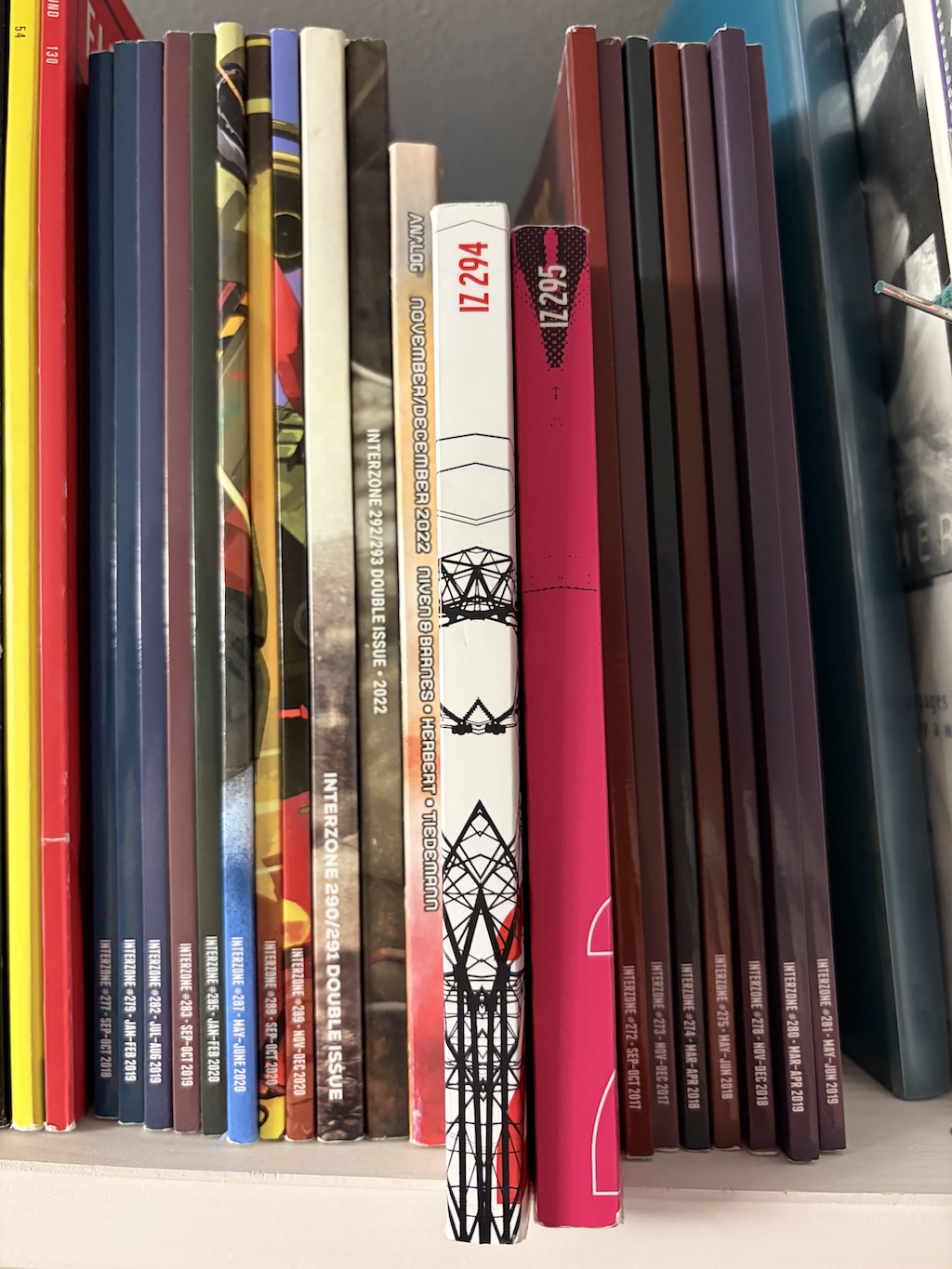
IZ issues 294 and 295 IZ issues 294 and 295
I don't want to dwell on the sad necessity to move to digital. Interzone continues on, celebrating the milestone issue #300 in 2024. Subscriptions are managed via Patreon. Issue #305 just came out. Instead I wanted to write a small bit about how I engaged with the paper magazine, and the difficulties I've had trying to engage with not just Interzone but any magazine-style publication in a digital context. With most fiction, I read linearly: start the beginning and read to the end, in order. That works well for me with e-readers. But for magazines (and most non-fiction) I don't, I jump around: usually starting with the table of contents, I might pick a short column to start, or jump into the middle of the "book reviews" section to read about a specific book. I might skip sections entirely. I find it very difficult to read like this with an e-reader. I think this is partly because I reference the depth of the paper book or magazine, its thickness, to orient myself. But it's also partly the limitations of e-ink.
My tick-list for an issue of IZ My tick-list for an issue of IZ
For print-Interzone, I used to start by inserting a small piece of paper inside the cover (the delivery slip was ideal). On this I listed the stories within and ticked them off when I read them (sometimes I double-ticked if I really liked a story). That helped me to remember, perhaps months or years later, whether I'd read all the stories or not, and which I liked. I could do something similar on some e-readers: the Remarkable for instance. But it's far from convenient to do on most e-ink devices. Interzone digital is available as both ePUB, the most common format for e-books, and PDF. For reading on my regular Kobo e-reader, PDFs don't work very well at all. I think this is generally true of most e-readers. Interzone was (and is) a well-designed magazine. The value of it was not just the content of the text, but the context: how the stories were presented; the accompanying art (most often colour in recent decades), but also the typesetting. ePUB doesn't specify much of that stuff exactly: it leaves that up to the client and the client's preferences. And there's a lot of advantages to that: Prefer a different font face or size? No problem. And most importantly for accessibility: If reading in ePUB makes Interzone available to more readers then that's a great thing. But sadly a lot is lost, IMHO.
IZ #305 on iPad Mini IZ #305 on iPad Mini
The solution I'm trying is to read the PDF version on the iPad Mini I resurrected earlier in the year. Despite being an Internet tablet, since it's not really usable for browsing the web anymore it's strangely still a distraction-free device. In fact it's pretty much single-purpose for reading Interzone and the odd other book which benefits from being read as PDF. I can appreciate the stylistic choices made in the page-setting as they were intended; I can quickly jump around the issue without waiting for an e-ink refresh; I get full colour; and whilst it would be tiring to read for a long time on the iPad screen, for the length of articles or stories in a magazine, this isn't a problem. It's not a solution for tracking what I've read (that version of ipadOS is too old to support clumsily scrawling on PDF pages with your fingers, at least in the Books app) but it otherwise seems to work well, so I'll see how it goes.

19 July 2026

Russell Coker: ECC and DDR5

Hamming Codes ECC RAM corrects errors that occur in memory before it gets to the CPU. The most common form of ECC is the Hamming Code [1] which when it has R redundant bits can correct single bit errors and detect double-bit errors in messages with 2^R-R-1 bits of data. For PC use that means if you want to protect 32bits of data you need R=6 and with 64bits you need R=7. The standard for DDR4 and similar RAM is 72 bits of data width on the bus and Hamming codes to correct single bit errors and detect double bit errors for 65bits of data. The computers we use have 64bits of data so that allows an extra bit that could be an extra parity, I don t know what if anything is done with this extra bit. RDIMM vs UDIMM One point of confusion in such things is the difference between Registered memory AKA RDIMMs [2] and regular PC/laptop memory which is often referred to as UDIMMs. The register is just a buffer which due to complex issues that aren t relevant to this post means that DIMMs can be larger and you can have more DIMMs in a system but latency may be slightly worse. It is technically quite possible to create RDIMMs without ECC (64bits wide instead of 72) but I have never seen a system that used such RAM. I have used more than a few systems with ECC UDIMMs and I recommend avoiding them if convenient as ECC UDIMMs are expensive on the second hand market while ECC RDIMMs can get very cheap. There are servers with ECC RDIMMs that are very unsuitable for home use (such as dual-CPU 1RU servers which are very noisy) so once they are past the 5 year tax write-off period the server chassis gets sent to ewaste and the RAM goes on the second hand market, the glut of RAM without systems to use it forces the price down. For the systems most commonly seen there are RDIMM systems with ECC and UDIMM systems without ECC. Chipkill If every bit in RAM was independent of every other bit then the basic Hamming code would solve most problems. However multiple bits in the same chip may be affected by the same problem, or one chip on the DIMM might entirely fail. With every RDIMM having 18 or 36 DRAM chips there are 2 or 4 bits per chip. On DIMMs with 36 DRAM chips one chip could fail and have the errors reliably detected with a Hamming code. On DIMMs with 18 DRAM chips one failed chip can t necessarily be detected with Hamming codes. IBM trademarked the term ChipKill for ECC systems which can cope with a single DRAM chip failing [3]. This is referred to as Advanced ECC on Dell and HP servers which require an even number of DIMMs. If anyone knows what coding method is used for ChipKill type systems then please let me know. Systems with advanced ECC also often have features like hot-spare for RAM and RAID-1 type functionality which is interesting but not something most people who read my blog will ever want to use. DDR5 DDR5 has on-die ECC to deal with the increased error incidence from smaller and faster memory [4], this is specified as 8 bits of error correction per 128 bits of data which implies basic Hamming codes. The on-die ECC is not a replacement for regular ECC, it s a mitigation for new problems introduced. My experience of memory errors is that the majority of repeatable errors (where a system would get an error with Memtest86+ or an ECC error report repeatedly) were DIMM seating issues, I could unplug and reinsert the DIMM in question and then the same tests would pass. Those errors would not be affected by on-die ECC. One thing that concerns me is the possibility of on-die ECC interacting with ECC on the motherboard and reducing it s effectiveness. I haven t been able to find out enough about how this works to determine if that s the case. My concern is that an error of 3+ bits that s corrected with a basic Hamming code might be more likely to create an error condition that Advanced ECC can t fix than the original error. Currently the best published research on the effectiveness of ECC on RAM errors is the Google paper published in 2009 which is based on DDR and DDR2 RAM [5]. So I don t expect that we will see published research about even DDR4 ECC any time soon. I presume that Google and the other cloud providers are still doing such research and providing the information to DRAM vendors under NDA so we have to just hope that the DRAM vendors do what s required to make things work correctly and allow us to buy products based on that research. DDR5 EC4 vs EC8 DDR5 supports 2*32bit subchannels instead of just supporting 64bit words [6]. For DDR5 ECC RAM there are variants EC4 which has 36bits of data per subchannel and EC8 which has 40 bits. EC8 allows Hamming codes on each subchannel indepdendently. I haven t found a reference on how exactly EC4 works, it could be reading 64bits at a time (not taking advantage of the subchannels) to use Hamming codes or it could have 1 parity bit for each subchannel and just assume that there s no need to check Hamming codes unless the subchannel parity fails. EC8 allows full Hamming code checks on 32bits of data and presumably ChipKill on 64bits. It s widely claimed that all DDR5 RDIMMs are EC8 and all DDR5 ECC UDIMMs are EC4. A quick search on ebay turned up adverts for EC4 and EC8 RDIMMs and links to apparently reliable sites confirming that some of the RDIMMs are EC4. There are reports of EC8 UDIMMs even though I couldn t find any advertised. This seems to mirror the situation with DDR4 where non-ECC RDIMMs are apparently available somewhere and ECC UDIMMs are something I ve used a few times but most people have never seen. I then searched for information on what servers support. The Dell R760 server supports both EC4 and EC8 RDIMMs but you can t have both in the same system. The existence of EC4 DIMMs is wrong. They shouldn t make substandard gear, the manufacturing price difference between 72 and 80 bit wide DIMMs isn t going to be great and the end result is some systems with inadequate specs and extra difficulty in upgrading systems with more things to check for compatibility. Why ECC is Needed Here s an interesting article about Mozilla s claim that 15% of Firefox crashes are due to RAM hardware errors [7], this seems to be based on repeatable errors and therefore won t count errors where a bit flip happens once a day or less. Some years ago I reported a BTRFS corruption issue on my desktop PC to the BTRFS developers and one of them stated that the corruption in question didn t match any pattern expected from a BTRFS bug and recommended that I run Memtest86+. The memory test revealed that I was getting about one memory corruption per 5 hours so if I had used Firefox on that system any crashes probably wouldn t have been regarded as hardware errors with RAM. Those errors caused filesystem corruption and some data loss, if I hadn t been using BTRFS that could have gone unnoticed for years. On another occasion I had a VM I was using for testing software I was developing that had some unexpected errors. After working on it for a day I had shared the errors with a mailing list of other developers who also spent some time investigating it. Eventually I began to suspect a hardware problem, I went on site and when I rebooted the system to run Memtest86+ it didn t even boot as it had errors that stopped the BIOS from even working correctly. It was strange that the system was apparently working correctly and restarting the KVM VM resulted in the same errors happening in the same code and nothing else on the VM apparently having a problem. It turned out that the system had a motherboard problem that made all but one of the DIMM sockets unusable so I ended up sending it to e-waste. That wasted a day of my time and some hours of other people s time. Presumably on other occasions developer time is wasted due to hardware errors and no-one even realises. What Society Needs We need ECC RAM to be more widely used. Ideally we would have some government action to force this given the ongoing cost to society in corrupted data and lost time due to RAM hardware errors. I think that at minimum we need sufficient taxes on non-ECC RAM (and EC4 RAM for DDR5) to make it more expensive when bought new than ECC RAM. We need to have greater knowledge of the benefits of ECC RAM among computer experts, people need to recommend that computers be purchased with ECC RAM whenever possible and that systems which can t have ECC RAM (laptops and phones) shouldn t be used for storing important data. We need to avoid silly things like having so many variants of RAM to confuse people and make it needlessly difficult to get ECC RAM working.

18 July 2026

Bits from Debian: DebConf26 welcomes its sponsors

Alt DebConf26 by Romina Molina DebConf26, the 27th edition of the Debian conference is taking place at the Facultad de Ingenier a en Ciencias H dricas of the Universidad Nacional del Litoral, in Santa Fe, Argentina. We appreciate the organizers for their hard work, and hope this event will be highly beneficial for those who attend in person as well as online. This event would not be possible without the help from our generous sponsors. We would like to warmly welcome the sponsors of DebConf26, and introduce them to you. We have two Platinum sponsors. Our Gold sponsors are: Our Silver sponsors are: Bronze sponsors: And finally, our Supporter level sponsors: A special thanks to the Facultad de Ingenier a y Ciencias H dricas - FICH UNL, our Venue Partner! Thanks to all our sponsors for their support! Their contributions enable a diverse global community of Debian developers and maintainers to collaborate, support one another, and share knowledge at DebConf26.

14 July 2026

Gunnar Wolf: Got your keys ready for DebConf26?

Yay! Finally it s that time of year DebCamp is underway, and soon it will be time for DebConf! As it is by now tradition, it s my task to coordinate the DebConf26 keysigning party. And, as usual, I have set up the list of DebConf26 keysigning maps for everybody involved. So, if you are taking part of DebConf, make sure to:

Jonas Meurer: zed-xdebug

Nextcloud PHP debugging with Xdebug in Zed editor I started to switch from PhpStorm to Zed as IDE recently as Zed is open source and has a much smaller footprint and is more slick than PhpStorm. One thing that I didn't get running immediately was Xdebug integration, so I did a bit of research and asked Claude for help. Here's a quick writeup of how to get it running. I have Zed installed as Flatpak on a Debian Trixie host system. The PHP process runs in a nextcloud-docker-dev Docker container.

Install Zed and configure debugging there Install Zed: flatpak install flathub dev.zed.Zed In Zed: open the Extensions view and install PHP. Configure the debugger: Create ~/.var/app/dev.zed.Zed/config/zed/debug.json:
[
   
    "label": "PHP: Listen to Xdebug",
    "adapter": "Xdebug",
    "request": "launch",
    "port": 9003,
    "pathMappings":  
      "/var/www/html":             "/home/<user>/devel/nextcloud/server",
      "/var/www/html/apps-extra":  "/home/<user>/devel/nextcloud/server/apps-extra",
      "/var/www/html/apps-shared": "/home/<user>/devel/nextcloud/apps-shared"
     
   
]
Add one entry per bind-mounted app directory. After creating the file, restart Zed. Inside Zed, select "debugger: start" from command palette and then "PHP: Listen to Xdebug". Verify Zed is listening. Running ss -tlnp grep 9003 on the host should show *:9003 with Zed as the process.

Configure Xdebug inside the container /usr/local/etc/php/conf.d/xdebug.ini:
xdebug.mode = debug
xdebug.idekey = PHPSTORM
xdebug.trace_output_name=trace.%R.%u
xdebug.profiler_output_name=profile.%R.%u
xdebug.output_dir=/shared/xdebug
xdebug.log = /var/log/xdebug.log
xdebug.log_level = 3
; Try to discover the client host, otherwise fall back to the docker host
xdebug.discover_client_host=true
xdebug.client_host=host.docker.internal
; When you cannot specify a trigger, use "xdebug.start_with_request = yes" to autostart debugging for all requests
; https://xdebug.org/docs/all_settings#start_with_request
xdebug.start_with_request = trigger
; Set xdebug.mode trace to use this
; More details at https://derickrethans.nl/flamboyant-flamegraphs.html
xdebug.trace_format=3
xdebug.trace_output_name=xdebug.%R.%u
Apply changes by restarting apache in the container: apache2ctl -k graceful Notes:
  • host.docker.internal resolves on Linux Docker only if the container was started with --add-host=host.docker.internal:host-gateway (nextcloud-docker-dev already does this).
  • discover_client_host = true makes xdebug follow X-Forwarded-For - useful behind Nextcloud's dev reverse proxy.

Test xdebug with a PHP command inside the container Run XDEBUG_SESSION=PHPSTORM php occ status inside the container and check /var/log/xdebug.log.

Install the browser extension Install Xdebug Helper (Firefox/Chrome). In its preferences, set the IDE Key to PhpStorm. It will set the XDEBUG_SESSION cookie when toggled to Debug. Click the Xdebug Helper icon in the browser and set it to Debug.

Test Xdebug with browser extension Load the URL that exercises the code path with the breakpoint. Zed should stop the code exection at the breakpoint.

12 July 2026

Kentaro Hayashi: Try to build Mozc with Bazel 7.7.1

Introduction Recently, I've got a chance to try building Mozc (Most famous Japanese input method editor) with Bazel. As you know, recently newer Bazel related packages were landed into debian/unstable. Then now I'm planning to update Mozc from 2.29.5160.102 to 3.33.6133.

Background story about Mozc and Debian The upstream of Mozc had released 3.34.6239, but on Debian, we stick to Mozc 2.29.5160.102. Mozc requires newer Bazel but we only had Bazel 4.2.3 at that time on Debian, so even though the upstream of Mozc switched from GYP to Bazel, we had patched Mozc with GYP based package. We even did make an effort to restore build options that had been already removed. :-( And needed to migrate from GTK2 renderer to GTK3 renderer. That is why the version of Mozc is diverged from upstream on Debian.
  • 2.29.5160.102 (Now on Debian)
  • 2.29.5268.102
  • 2.29.5374.102
  • 2.29.5544.102
  • 2.30.5544.102
  • 2.31.5712.102
  • 2.31.5851.102
  • 2.32.5994.102
  • 3.33.6089
  • 3.33.6133 (Target to upgrade for)
  • 3.34.6239

How to switch from GYP to Bazel? At first, we needed to decide what Mozc version to work with it. Now latest version of Mozc is 3.34.x, but it requires Bazel 9.x. Please recall that Bazel 7.7.1 was introduced Debian/unstable. And more, newer dependency libraries are required. You might feel that target version (3.33.6133) is too high from 2.29.5160.102, but if we upgrade to more older Mozc, it means that it requires to backport Mozc to older libabsl compatible codes and so on. That is why Mozc 3.33.6133 was chosen. Even once the target version has been decided, you can't let your guard down. There are many technical tasks to solve.
  • Revisit patch sets to apply
  • Porting uim mozc patch and fix FTBFS
  • Porting fcitx5 mozc patch and fix FTBFS
  • Fix src/third_party vendoring
  • Switch from GYP to Bazel build systems
  • ...
At least, it will likely require several rounds of testing in the Debian experimental.

Conclusion Currently, gbp buildpackge has succeeded finally on local machine, but need to tidy and cleanup stuffs. I didn't know packaging with Bazel best practice yet, to remove many third party vendor/ bundles, I've found that it requires pile of patch to eliminate them. In the current version of Debian, as a one of build system, further work such as support from debhelper - will be needed. I'll file working progress on #1085173

Next.

Previous.