Search Results: "luk"

5 October 2014

Vasudev Kamath: Note to Self: LVM Shrink Resize HowTo

Recently I had to reinstall a system at office with Debian Wheezy and I thought I should use this opportunity to experiment with LVM. Yeah I've not used LVM till date, even though I'm using Linux for more than 5 years now. I know many DD friends who use LVM with LUKS encryption and I always wanted to experiment, but since my laptop is only thing I've and its currently perfectly in shape I didn't dare to experiment it there. This reinstall was golden opportunity for me to experiment and learn something new. I used Wheezy CD ISO downloaded using jigdo for installation. Now I will just go bit off topic and want to share the USB stick preparation. I have to say this because I had not done installation for quite a while now. Last I did was during Squeeze time so like usual I blindly executed following command.
cat debian-wheezy.iso > /dev/sdb
Surprisingly USB stick didn't boot! I was getting Corrupt or missing ISO.bin. So next I tried using dd for preparing.
dd if=debian-wheezy.iso of=/dev/sdb
Surprisingly this also didn't work and I get same error message as above. This is when I went back to debian manual and looked for installation step and there I found new way!
cp debian-wheezy.iso /dev/sdb
Look at destination, its a device and voil this worked! This is something new I learnt and I'm surprised how easy it is now to prepare USB stick. But I still didn't get why first 2 methods failed!. If you guys know please do share. Now coming back to LVM. I used default LVM when disk partitioning was asked, and I used guided partitioning method provided by debian-installer and ended up with following layout
$ lvs
  LV     VG        Attr     LSize  Pool Origin Data%  Move Log Copy%  Convert
home   system-disk -wi-ao-- 62.34g
root   system-disk -wi-ao--  9.31g
swap_1 system-disk -wi-ao--  2.64g
So guided partitioning of debian-installer allocates 10G for root and rest to home and swap. This is not a problem but when I started installing required software, I could see root running out of space quickly so I wanted to resize root and give it 10G more, for this I need to reduce the home by 10G for which I need to first unmount the home partition. Unmounting home from running system isn't possible so I booted into recovery assuming I can unmount home there but I couldn't. lsof didn't show any one using /home after searching a bit I found fuser command and it looks like kernel is using /home which is mounted by it.
$ fuser -vm /home
                     USER        PID ACCESS COMMAND
/home:               root     kernel mount /home
So it isn't possible to unmount /home in recovery mode also. Online materials told me to use live-cd for doing this but I didn't have patience to do that so I just went ahead commented /home mounting in /etc/fstab and rebooted!. This time it worked and /home is not mounted on recovery mode. Now comes the hard part resizing home, thanks to TLDP doc on reducing I coud do this with following step
# e2fsck -f /dev/volume-name/home
# resize2fs /dev/volume-name/home 52G
# lvreduce -L-10G /dev/volume-name/home
And now the next part live extending the root partition again thanks to TLDP doc on extending following command did it.
# lvextend -L+10G /dev/volume-name/root
# resize2fs /dev/volumne-name/root
And now important part! Uncomment /home line in /etc/fstab so it will be mounted normally in next boot and reboot! On login I can see my partitions updated.
# lvs
  LV     VG        Attr     LSize  Pool Origin Data%  Move Log Copy%  Convert
home   system-disk -wi-ao-- 52.34g
root   system-disk -wi-ao-- 19.31g
swap_1 system-disk -wi-ao--  2.64g
I've started liking LVM more now! :)

25 August 2014

Erich Schubert: Analyzing Twitter - beware of spam

This year I started to widen up my research; and one data source of interest was text because of the lack of structure in it, that makes it often challenging. One of the data sources that everybody seems to use is Twitter: it has a nice API, and few restrictions on using it (except on resharing data). By default, you can get a 1% random sample from all tweets, which is more than enough for many use cases.
We've had some exciting results which a colleague of mine will be presenting tomorrow (Tuesday, Research 22: Topic Modeling) at the KDD 2014 conference:
SigniTrend: Scalable Detection of Emerging Topics in Textual Streams by Hashed Significance Thresholds
Erich Schubert, Michael Weiler, Hans-Peter Kriegel
20th ACM SIGKDD Conference on Knowledge Discovery and Data Mining
You can also explore some (static!) results online at signi-trend.appspot.com

In our experiments, the "news" data set was more interesting. But after some work, we were able to get reasonable results out of Twitter as well. As you can see from the online demo, most of these fall into pop culture: celebrity deaths, sports, hip-hop. Not much that would change our live; and even less that wasn't before captured by traditional media.
The focus of this post is on the preprocessing needed for getting good results from Twitter. Because it is much easier to get bad results!
The first thing you need to realize about Twitter is that due to the media attention/hype it gets, it is full of spam. I'm pretty sure the engineers at Twitter already try to reduce spam; block hosts and fraud apps. But a lot of the trending topics we discovered were nothing but spam.
Retweets - the "like" of Twitter - are an easy source to see what is popular, but are not very interesting if you want to analyze text. They just reiterate the exact same text (except for a "RT " prefix) than earlier tweets. We found results to be more interesting if we removed retweets. Our theory is that retweeting requires much less effort than writing a real tweet; and things that are trending "with effort" are more interesting than those that were just liked.
Teenie spam. If you ever searched for a teenie idol on Twitter, say this guy I hadn't heard of before, but who has 3.88 million followers on Twitter, and search for Tweets addressed to him, you will get millions over millions of results. Many of these tweets look like this: Now if you look at this tweet, there is this odd "x804" at the end. This is to defeat a simple spam filter by Twitter. Because this user did not tweet this just once: instead it is common amongst teenie to spam their idols with follow requests by the dozen. Probably using some JavaScript hack, or third party Twitter client. Occassionally, you see hundreds of such tweets, each sent within a few seconds of the previous one. If you get a 1% sample of these, you still get a few then...
Even worse (for data analysis) than teenie spammers are commercial spammers and wannabe "hackers" that exercise their "sk1llz" by spamming Twitter. To get a sample of such spam, just search for weight loss on Twitter. There is plenty of fresh spam there, usually consisting of some text pretending to be news, and an anonymized link (there is no need to use an URL shortener such as bit.ly on Twitter, since Twitter has its own URL shortener t.co; and you'll end up with double-shortened URLs). And the hacker spam is even worse (e.g. #alvianbencifa) as he seems to have trojaned hundreds of users, and his advertisement seems to be a nonexistant hash tag, which he tries to get into Twitters "trending topics".
And then there are the bots. Plenty of bots spam Twitter with their analysis of trending topics, reinforcing the trending topics. In my opinion, bots such as trending topics indonesia are useless. No wonder there are only 280 followers. And of the trending topics reported, most of them seem to be spam topics...

Bottom line: if you plan on analyzing Twitter data, spend considerable time on preprocessing to filter out spam of various kind. For example, we remove singletons and digits, then feed the data through a duplicate detector. We end up discarding 20%-25% of Tweets. But we still get some of the spam, such as that hackers spam.
All in all, real data is just messy. People posting there have an agenda that might be opposite to yours. And if someone (or some company) promises you wonders from "Big data" and "Twitter", you better have them demonstrate their use first, before buying their services. Don't trust visions of what could be possible, because the first rule of data analysis is: Garbage in, garbage out.

16 July 2014

Dirk Eddelbuettel: Introducing RcppParallel: Getting R and C++ to work (some more) in parallel

A common theme over the last few decades was that we could afford to simply sit back and let computer (hardware) engineers take care of increases in computing speed thanks to Moore's law. That same line of thought now frequently points out that we are getting closer and closer to the physical limits of what Moore's law can do for us. So the new best hope is (and has been) parallel processing. Even our smartphones have multiple cores, and most if not all retail PCs now possess two, four or more cores. Real computers, aka somewhat decent servers, can be had with 24, 32 or more cores as well, and all that is before we even consider GPU coprocessors or other upcoming changes. And sometimes our tasks are embarassingly simple as is the case with many data-parallel jobs: we can use higher-level operations such as those offered by the base R package parallel to spawn multiple processing tasks and gather the results. I covered all this in some detail in previous talks on High Performance Computing with R (and you can also consult the Task View on High Performance Computing with R which I edit). But sometimes we can't use data-parallel approaches. Hence we have to redo our algorithms. Which is really hard. R itself has been relying on the (fairly mature) OpenMP standard for some of its operations. Luke Tierney's (awesome) keynote in May at our (sixth) R/Finance conference mentioned some of the issues related to OpenMP. One which matters is that OpenMP works really well on Linux, and either not so well (Windows) or not at all (OS X, due the usual issue with the gcc/clang switch enforced by Applem but the good news is that the OpenMP toolchain is expected to make it to OS X is some more performant form "soon"). R is still expected to make wider use of OpenMP in future versions. Another tool which has been around for a few years, and which can be considered to be equally mature is the Intel Threaded Building Blocks library, or TBB. JJ recently started to wrap this up for use by R. The first approach resulted in a (now superseded, see below) package TBB. But hardware and OS issues bite once again, as the Intel TBB is not really building that well for the Windows toolchain used by R (and based on MinGW). (And yes, there are two more options. But Boost Threads requires linking which precludes easy use as e.g. via our BH package. And C++11 with its threads library (based on Boost Threads) is not yet as widely available as R and Rcpp which means that it is not a real deployment option yet.) Now, JJ, being as awesome as he is, went back to the drawing board and integrated a second threading toolkit: TinyThread++, a small header-only library without further dependencies. Not as feature-rich as Intel Threaded Building Blocks, but at least available everywhere. So a new package RcppParallel, so far only on GitHub, wraps around both TinyThread++ and Intel Threaded Building Blocks and offers a consistent interface available on all platforms used by R. Better still, JJ also authored several pieces demonstrating this new package for the Rcpp Gallery: All four are interesting and demonstrate different aspects of parallel computing via RcppParallel. But the last article is key. Based on a question by Jim Bullard, and then written with Jim, it shows how a particular matrix distance metric (which is missing from R) can be implemented in a serial manner in both R, and also via Rcpp. The key implementation, however, uses both Rcpp and RcppParallel and thereby achieves a truly impressive speed gain as the gains from using compiled code (via Rcpp) and from using a parallel algorithm (via RcppParallel) are multiplicative! Between JJ's and my four-core machines the gain was between 200 and 300 fold---which is rather considerable. For kicks, I also used a much bigger machine at work which came in at an even larger speed gain (but gains become clearly sublinear as the number of cores increases; there are however some tuning parameters). So these are exciting times. I am sure there will be lots more to come. For now, head over to the RcppParallel package and start playing. Further contributions to the Rcpp Gallery are not only welcome but strongly encouraged.

12 July 2014

Matt Brown: GPG Key Management Rant

2014 and it s still annoyingly hard to find a reasonable GPG key management system for personal use All I want is to keep the key material isolated from any Internet connected host, without requiring me to jump through major inconvenience every time I want to use the key. An HSM/Smartcard of some sort is an obvious choice, but they all suck in their own ways:
* FSFE smartcard it s a smartcard, requires a reader, which are generally not particular portable compared to a USB stick.
* Yubikey Neo restricted to 2048 bits, doesn t allow imports of primary keys (only subkeys), so you either generate on device and have no backup, or maintain some off-device primary key with only subkeys on the Neo, negating the main benefits of it in the first place.
* Smartcard HSM similar problems to the Neo, plus not really supported by GPG well (needs 2.0 with specific supporting module version requirements).
* Cryptostick made by some Germans, sounds potentially great, but perpetually out of stock. Which leaves basically only the roll your own dm-crypt+LUKS usb stick approach. It obviously works well, and is what I currently use, but it s a bunch of effort to maintain, particularly if you decide, as I have, that the master key material can never touch a machine with a network connection. The implication is that you now need to keep an airgapped machine around, and maintain a set of subkeys that are OK for use on network connected machines to avoid going mad playing sneakernet for every package upload. The ideal device would be a USB form factor, supporting import of 4096 bit keys, across all GPG capabilities, but with all crypto ops happening on-device, so the key material never leaves the stick once imported. Ideally also cheap enough (e.g. ~100ish currency units) that I can acquire two for redundancy. As far as I can tell, such a device does not exist on this planet. It s almost enough to make a man give up on Debian and go live a life of peace and solitude with the remaining 99.9% of the world who don t know or care about this overly complicated mess of encryption we ve wrought for ourselves. end rant.

29 May 2014

Russell Coker: Links May 2014

Charmian Gooch gave an interesting TED talk about her efforts to fight organised crime and corruption by prohibiting anonymous companies [1]. The idea of a company is to protect the owner from unlimited liability not to protect them from law enforcement. Dr Nerdlove has an insightful article about sexual harassment in geek culture [2]. Rebecca Rose wrote an insightful article for Jezebel about the worse bullying advice ever, her summary is that it should be called Ways We Can Get You Goddamn Kids to Act So We Never Have to Deal With Your Problems Ever [3]. In the wake of the Heardbleed bug Imperial Violet wrote an informative article explaining why revocation checks isn t the solution [4]. Martin Lukacs and Shiri Pasternak wrote an insightful article about the Canadian government s attempts to stop Canadian aboriginies from exercising their legal rights [5]. I bet that the Australian government is doing the same things. Nelson Groom wrote an interesting interview with Norrie May Welby, the first recognised agender person in Australia [6]. Marriage equality is bound to happen soon in Australia, now that the government officially recognises non-binary gender people it can t refuse them the right to get married and therefore the straight/gay marriage distinction isn t relevant. BDA Technology has an interesting article on choosing fonts to make text more readable for dyslexic people [7]. Eamon Waterford wrote an informative article for the ABC about how early-intervention social policies save significant amounts of tax money [8]. Conservatives claim to want to save money and try to cut such programs which costs everyone in the long term. Greta Christina wrote an insightful article for Salon about why religious people want atheists to lie and pretend to believe [9]. Chris Mooney wrote an informative URL about a machine to test whether someone is liberal or conservative [10]. Paul Rosenberg wrote an informative article on the link between conservatism, evil, and psychopathy [11]. The next logical step is to treat conservatism as a mental health problem. Sociological Images has an interesting article by Jay Livingston about the hypocrisy of conservative tax policies [12]. Scientific American reprinted an article from The Conversation by Elaine McKewon about the climate deniers who intimidated a journal into retracting an article about their belief in conspiracy theories [13]. It seems obvious that the climate deniers are the ones who conspire. Ben Caldecott wrote an interesting article for the ABC about the fossil fuel divestment campaign [14]. It seems that this is getting some success already, as renewable energy will soon be cheaper than coal power this could kill off coal. Mark Taylor wrote an interesting blog post titled Observations of an Internet Middleman about the operations of Level3 and Internet peering [15]. He explains how monopoly Telcos throttle their customers Internet access. Matt Savoy wrote an informative and disturbing article about the fact that US cops are twice as likely to beat their wives as the general population [16]. Apparently the police hierarchy aren t interested in prosecuting such crimes. Paul Rosenberg wrote an insightful article about mythos vs logos and the conservative approach to relity [17]. One interesting point he makes is that white men (and members of privileged groups generally) fear a loss of status more than more realistic concerns (such as global warming). Nick wrote an interesting blog post about using GPG encrypted email on an Android phone [18]. I should get this going on my phone.

29 March 2014

Dirk Eddelbuettel: R / Finance 2014 Open for Registration

The annoucement below just went to the R-SIG-Finance list. More information is as usual at the R / Finance page:
Now open for registrations: R / Finance 2014: Applied Finance with R
May 16 and 17, 2014
Chicago, IL, USA
The registration for R/Finance 2014 -- which will take place May 16 and 17 in Chicago -- is now open! Building on the success of the previous conferences in 2009, 2010, 2011, 2012 and 2013, we expect around 300 attendees from around the world. R users from industry, academia, and government will joining 30+ presenters covering all areas of finance with R. We are very excited about the four keynotes by Bill Cleveland, Alexios Ghalanos, Bob McDonald and Luke Tierney. The main agenda (currently) includes sixteen full presentations and twenty-one shorter "lightning talks". We are also excited to offer four optional pre-conference seminars on Friday morning. To celebrate the sixth year of the conference in style, the dinner will be returning to The Terrace of the Trump Hotel. Overlooking the Chicago River and skyline, it is a perfect venue to continue conversations while dining and drinking. More details of the agenda are available at:
http://www.RinFinance.com/agenda/
Registration information is available at
http://www.RinFinance.com/register/
and can also be directly accessed by going to
http://www.regonline.com/RFinance2014
We would to thank our 2014 Sponsors for the continued support enabling us to host such an exciting conference:
International Center for Futures and Derivatives at UIC Revolution Analytics
MS-Computational Finance at University of Washington OneMarketData
RStudio
On behalf of the committee and sponsors, we look forward to seeing you in Chicago!
Gib Bassett, Peter Carl, Dirk Eddelbuettel, Brian Peterson,
Dale Rosenthal, Jeffrey Ryan, Joshua Ulrich
See you in Chicago in May!

This post by Dirk Eddelbuettel originated on his Thinking inside the box blog. Please report excessive re-aggregation in third-party for-profit settings.

3 March 2014

DebConf team: DebConf11 Sponsored registration date has been extended (Posted by nattie)

The deadline for sponsored registration for DebConf11 in Banja Luka, originally May 8th, has officially been extended to May 19th. The reasons for the extension are as follows: Thanks to a significant increase in sponsorship from one of our main sponsors, we have been permitted and encouraged to welcome more people to the conference. The extension is a one-off occurrence in response to this new development, and to allow any potential attendees time to access more information before registering. Registration is required for everybody who plans to attend any part of Debconf. Access to the conference venue, food and accommodation is controlled through the registration badge. The only exception to the registration requirement is for those who plan to only attend Debian Day. It is possible to request sponsorship for food, accommodation, and travel. Those who have been involved or contributed to Debian or to other open source projects are eligible to apply for sponsorship, which will be decided on a case-by-case basis. The professional and corporate categories are for those who are sent and sponsored by their companies. Professional registration covers the actual costs of conference attendance, while corporate registration is just over double that price, and is aimed at those who, besides paying the actual costs, also want to contribute money and help Debian. the DebConf team

1 March 2014

Michael Prokop: Jenkins on-demand slave selection through labels

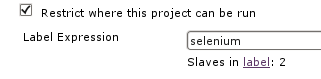
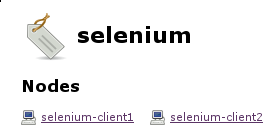
Problem description: One of my customers had a problem with their Selenium tests in the Jenkins continuous integration system. While Perl s Test::WebDriver still worked just fine the Selenium tests using Ruby s selenium-webdriver suddenly reported failures. The problem was caused by Debian wheezy s upgrade of the Iceweasel web browser. Debian originally shipped Iceweasel version 17.0.10esr-1~deb7u1 in wheezy, but during a security-update version 24.3.0esr-1~deb7u1 was brought in through the wheezy-security channel. Because the selenium tests are used in an automated fashion in a quite large and long-running build pipeline we immediately rolled back to Iceweasel version 17.0.10esr-1~deb7u1 so everything can continue as expected. Of course we wanted to get the new Iceweasel version up and running, but we didn t want to break the existing workflow while working on it. This is where on-demand slave selection through labels comes in. Basics: As soon as you re using Jenkins slaves you can instruct Jenkins to run a specific project on a particular (slave) node. By attaching labels to your slaves you can also use a label instead of a specific node name, providing more flexibility and scalability (to e.g. avoid problems if a specific node is down or you want to scale to more systems). Then Jenkins decides which of the nodes providing the according label should be considered for job execution. In the following screenshot a job uses the selenium label to restrict its execution to the slaves providing selenium and currently there are two nodes available providing this label: TIP 1: Visiting $JENKINS_SERVER/label/$label/ provides a list of slaves that provide that given $label (as well as list of projects that use $label in their configuration), like:

TIP 2: Execute the following script on $JENKINS_SERVER/script to get a list of available labels of your Jenkins system:
import hudson.model.*
labels = Hudson.instance.getLabels()
labels.each  label -> println label.name  
Solution: In the according customer setup we re using the swarm plugin (with automated Debian deployment through Grml s netscript boot option, grml-debootstrap + Puppet) to automatically connect our Jenkins slaves to Jenkins master without any manual intervention. The swarm plugin allows you to define the labels through the -labels command line option. By using the NodeLabel Parameter plugin we can configure additional parameters in Jenkins jobs: node and label . The label parameter allows us to execute the jobs on the nodes providing the requested label: This is what we can use to gradually upgrade from the old Iceweasel version to the new one by keeping a given set of slaves at the old Iceweasel version while we re upgrading other nodes to the new Iceweasel version (same for the selenium-server version which we want to also control). We can include the version number of the Iceweasel and selenium-server packages inside the labels we announce through the swarm slaves, with something like:
if [ -r /etc/init.d/selenium-server ] ; then
  FLAGS="selenium"
  ICEWEASEL_VERSION="$(dpkg-query --show --showformat='$ Version ' iceweasel)"
  if [ -n "$ICEWEASEL_VERSION" ] ; then
    ICEWEASEL_FLAG="iceweasel-$ ICEWEASEL_VERSION%%.* "
    EXTRA_FLAGS="$EXTRA_FLAGS $ICEWEASEL_FLAG"
  fi
  SELENIUM_VERSION="$(dpkg-query --show --showformat='$ Version ' selenium-server)"
  if [ -n "$SELENIUM_VERSION" ] ; then
    SELENIUM_FLAG="selenium-$ SELENIUM_VERSION%-* "
    EXTRA_FLAGS="$EXTRA_FLAGS $SELENIUM_FLAG"
  fi
fi
Then by using -labels $FLAGS EXTRA_FLAGS in the swarm invocation script we end up with labels like selenium iceweasel-24 selenium-2.40.0 for the slaves providing the Iceweasel v24 and selenium v2.40.0 Debian packages and selenium iceweasel-17 selenium-2.40.0 for the slaves providing Iceweasel v17 and selenium v2.40.0. This is perfect for our needs, because instead of using the selenium label (which is still there) we can configure the selenium jobs that should continue to work as usual to default to the slaves with the iceweasel-17 label now. The development related jobs though can use label iceweasel-24 and fail as often as needed without interrupting the build pipeline used for production. To illustrate this here we have slave selenium-client2 providing Iceweasel v17 with selenium-server v2.40. When triggering the production selenium job it will get executed on selenium-client2, because that s the slave providing the requested labels: Whereas the development selenium job can point to the slaves providing Iceweasel v24, so it will be executed on slave selenium-client1 here: This setup allowed us to work on the selenium Ruby tests while not conflicting with any production build pipeline. By the time I m writing about this setup we ve already finished the migration to support Iceweasel v24 and the infrastructure is ready for further Iceweasel and selenium-server upgrades.

28 February 2014

Michael Prokop: State of the art Debian/wheezy deployments with GRUB and LVM/SW-RAID/Crypto

Moving from Lilo to GRUB, using LVM as default, etc throughout the last years it was time to evaluate how well LVM works without a separate boot partition, possibly also on top of Software RAID. Big disks are asking for partitioning with GPT, just UEFI isn t my default yet, so I m still defaulting to Legacy BIOS for Debian/wheezy (I expect this to change for Debian/jessie and according hardware approaching at my customers). So what we have and want in this demonstration setup: System used for installation:
root@grml ~ # grml-version
grml64-full 2013.09 Release Codename Hefeknuddler [2013-09-27]
Partition setup:
root@grml ~ # parted /dev/sda
GNU Parted 2.3
Using /dev/sda
Welcome to GNU Parted! Type 'help' to view a list of commands.
(parted) mklabel gpt
(parted) mkpart primary 2048s 4095s
(parted) set 1 bios_grub on
(parted) name 1 "BIOS Boot Partition"
(parted) mkpart primary 4096s 100%
(parted) set 2 raid on
(parted) name 2 "SW-RAID / Linux"
(parted) quit
Information: You may need to update /etc/fstab.
Clone partition layout from sda to all the other disks:
root@grml ~ # for f in  b,c,d  ; sgdisk -R=/dev/sd$f /dev/sda
The operation has completed successfully.
Make sure each disk has its unique UUID:
root@grml ~ # for f in  b,c,d  ; sgdisk -G /dev/sd$f
The operation has completed successfully.
SW-RAID setup:
root@grml ~ # mdadm --create /dev/md0 --verbose --level=raid5 --raid-devices=4 /dev/sd a,b,c,d 2
mdadm: layout defaults to left-symmetric
mdadm: chunk size defaults to 512K
mdadm: size set to 1465004544K
mdadm: Defaulting to version 1.2 metadata
mdadm: array /dev/md0 started.
root@grml ~ #
SW-RAID speedup (system dependent, YMMV):
root@grml ~ # cat /sys/block/md0/md/stripe_cache_size
256
root@grml ~ # echo 16384 > /sys/block/md0/md/stripe_cache_size # 16MB
root@grml ~ # blockdev --getra /dev/md0
6144
root@grml ~ # blockdev --setra 65536 /dev/md0 # 32 MB
root@grml ~ # sysctl dev.raid.speed_limit_max
dev.raid.speed_limit_max = 200000
root@grml ~ # sysctl -w dev.raid.speed_limit_max=9999999999
dev.raid.speed_limit_max = 9999999999
root@grml ~ # sysctl dev.raid.speed_limit_min
dev.raid.speed_limit_min = 1000
root@grml ~ # sysctl -w dev.raid.speed_limit_min=100000
dev.raid.speed_limit_min = 100000
LVM setup:
root@grml ~ # pvcreate /dev/md0
  Physical volume "/dev/md0" successfully created
root@grml ~ # vgcreate homesrv /dev/md0
  Volume group "homesrv" successfully created
root@grml ~ # lvcreate -n rootfs -L4G homesrv
  Logical volume "rootfs" created
root@grml ~ # lvcreate -n bootfs -L1G homesrv
  Logical volume "bootfs" created
Check partition setup + alignment:
root@grml ~ # parted -s /dev/sda print
Model: ATA WDC WD15EADS-00P (scsi)
Disk /dev/sda: 1500GB
Sector size (logical/physical): 512B/512B
Partition Table: gpt
Number  Start   End     Size    File system  Name                 Flags
 1      1049kB  2097kB  1049kB               BIOS Boot Partition  bios_grub
 2      2097kB  1500GB  1500GB               SW-RAID / Linux      raid
root@grml ~ # parted -s /dev/sda unit s print
Model: ATA WDC WD15EADS-00P (scsi)
Disk /dev/sda: 2930277168s
Sector size (logical/physical): 512B/512B
Partition Table: gpt
Number  Start  End          Size         File system  Name                 Flags
 1      2048s  4095s        2048s                     BIOS Boot Partition  bios_grub
 2      4096s  2930276351s  2930272256s               SW-RAID / Linux      raid
root@grml ~ # gdisk -l /dev/sda
GPT fdisk (gdisk) version 0.8.5
Partition table scan:
  MBR: protective
  BSD: not present
  APM: not present
  GPT: present
Found valid GPT with protective MBR; using GPT.
Disk /dev/sda: 2930277168 sectors, 1.4 TiB
Logical sector size: 512 bytes
Disk identifier (GUID): 212E463A-A4E3-428B-B7E5-8D5785141564
Partition table holds up to 128 entries
First usable sector is 34, last usable sector is 2930277134
Partitions will be aligned on 2048-sector boundaries
Total free space is 2797 sectors (1.4 MiB)
Number  Start (sector)    End (sector)  Size       Code  Name
   1            2048            4095   1024.0 KiB  EF02  BIOS Boot Partition
   2            4096      2930276351   1.4 TiB     FD00  SW-RAID / Linux
root@grml ~ # mdadm -E /dev/sda2
/dev/sda3:
          Magic : a92b4efc
        Version : 1.2
    Feature Map : 0x0
     Array UUID : 7ed3b741:0774d529:d5a71c1f:cf942f0a
           Name : grml:0  (local to host grml)
  Creation Time : Fri Jan 31 15:26:12 2014
     Raid Level : raid5
   Raid Devices : 4
 Avail Dev Size : 2928060416 (1396.21 GiB 1499.17 GB)
     Array Size : 4392089088 (4188.62 GiB 4497.50 GB)
  Used Dev Size : 2928059392 (1396.21 GiB 1499.17 GB)
    Data Offset : 262144 sectors
   Super Offset : 8 sectors
          State : clean
    Device UUID : c1e4213b:81822fd1:260df456:2c9926fb
    Update Time : Mon Feb  3 09:41:48 2014
       Checksum : b8af8f6 - correct
         Events : 72
         Layout : left-symmetric
     chunk size : 512k
   Device Role : Active device 0
   Array State : AAAA ('A' == active, '.' == missing)
root@grml ~ # pvs -o +pe_start
  PV         VG      Fmt  Attr PSize PFree 1st PE
  /dev/md0   homesrv lvm2 a--  4.09t 4.09t   1.50m
root@grml ~ # pvs --units s -o +pe_start
  PV         VG      Fmt  Attr PSize       PFree       1st PE
  /dev/md0   homesrv lvm2 a--  8784175104S 8773689344S   3072S
root@grml ~ # pvs -o +pe_start
  PV         VG      Fmt  Attr PSize PFree 1st PE
  /dev/md0   homesrv lvm2 a--  4.09t 4.09t   1.50m
root@grml ~ # pvs --units s -o +pe_start
  PV         VG      Fmt  Attr PSize       PFree       1st PE
  /dev/md0   homesrv lvm2 a--  8784175104S 8773689344S   3072S
root@grml ~ # vgs -o +pe_start
  VG      #PV #LV #SN Attr   VSize VFree 1st PE
  homesrv   1   2   0 wz--n- 4.09t 4.09t   1.50m
root@grml ~ # vgs --units s -o +pe_start
  VG      #PV #LV #SN Attr   VSize       VFree       1st PE
  homesrv   1   2   0 wz--n- 8784175104S 8773689344S   3072S
Cryptsetup:
root@grml ~ # echo cryptsetup >> /etc/debootstrap/packages
root@grml ~ # cryptsetup luksFormat -c aes-xts-plain64 -s 256 /dev/mapper/homesrv-rootfs
WARNING!
========
This will overwrite data on /dev/mapper/homesrv-rootfs irrevocably.
Are you sure? (Type uppercase yes): YES
Enter passphrase:
Verify passphrase:
root@grml ~ # cryptsetup luksOpen /dev/mapper/homesrv-rootfs cryptorootfs
Enter passphrase for /dev/mapper/homesrv-rootfs:
Filesystems:
root@grml ~ # mkfs.ext4 /dev/mapper/cryptorootfs
mke2fs 1.42.8 (20-Jun-2013)
Filesystem label=
OS type: Linux
Block size=4096 (log=2)
Fragment size=4096 (log=2)
Stride=128 blocks, Stripe width=384 blocks
262144 inodes, 1048192 blocks
52409 blocks (5.00%) reserved for the super user
First data block=0
Maximum filesystem blocks=1073741824
32 block groups
32768 blocks per group, 32768 fragments per group
8192 inodes per group
Superblock backups stored on blocks:
        32768, 98304, 163840, 229376, 294912, 819200, 884736
Allocating group tables: done
Writing inode tables: done
Creating journal (16384 blocks): done
Writing superblocks and filesystem accounting information: done
root@grml ~ # mkfs.ext4 /dev/mapper/homesrv-bootfs
mke2fs 1.42.8 (20-Jun-2013)
Filesystem label=
OS type: Linux
Block size=4096 (log=2)
Fragment size=4096 (log=2)
Stride=128 blocks, Stripe width=384 blocks
65536 inodes, 262144 blocks
13107 blocks (5.00%) reserved for the super user
First data block=0
Maximum filesystem blocks=268435456
8 block groups
32768 blocks per group, 32768 fragments per group
8192 inodes per group
Superblock backups stored on blocks:
        32768, 98304, 163840, 229376
Allocating group tables: done
Writing inode tables: done
Creating journal (8192 blocks): done
Writing superblocks and filesystem accounting information: done
Install Debian/wheezy:
root@grml ~ # mount /dev/mapper/cryptorootfs /media
root@grml ~ # mkdir /media/boot
root@grml ~ # mount /dev/mapper/homesrv-bootfs /media/boot
root@grml ~ # grml-debootstrap --target /media --password YOUR_PASSWORD --hostname YOUR_HOSTNAME
 * grml-debootstrap [0.57] - Please recheck configuration before execution:
   Target:          /media
   Install grub:    no
   Using release:   wheezy
   Using hostname:  YOUR_HOSTNAME
   Using mirror:    http://http.debian.net/debian
   Using arch:      amd64
   Important! Continuing will delete all data from /media!
 * Is this ok for you? [y/N] y
[...]
Enable grml-rescueboot (to have easy access to rescue ISO via GRUB):
root@grml ~ # mkdir /media/boot/grml
root@grml ~ # wget -O /media/boot/grml/grml64-full_$(date +%Y.%m.%d).iso http://daily.grml.org/grml64-full_testing/latest/grml64-full_testing_latest.iso
root@grml ~ # grml-chroot /media apt-get -y install grml-rescueboot
[NOTE: We're installing a daily ISO for grml-rescueboot here because the 2013.09 Grml release doesn't work for this LVM/SW-RAID setup while newer ISOs are working fine already. The upcoming Grml stable release is supposed to work just fine, so you will be able to choose http://download.grml.org/grml64-full_2014.XX.iso by then. :)] Install GRUB on all disks and adjust crypttab, fstab + initramfs:
root@grml ~ # grml-chroot /media /bin/bash
(grml)root@grml:/# for f in  a,b,c,d  ; do grub-install /dev/sd$f ; done
(grml)root@grml:/# update-grub
(grml)root@grml:/# echo "cryptorootfs /dev/mapper/homesrv-rootfs none luks" > /etc/crypttab
(grml)root@grml:/# echo "/dev/mapper/cryptorootfs / auto defaults,errors=remount-ro 0   1" > /etc/fstab
(grml)root@grml:/# echo "/dev/mapper/homesrv-bootfs /boot auto defaults 0 0" >> /etc/fstab
(grml)root@grml:/# update-initramfs -k all -u
(grml)root@grml:/# exit
Clean unmounted/removal for reboot:
root@grml ~ # umount /media/boot
root@grml ~ # umount /media/
root@grml ~ # cryptsetup luksClose cryptorootfs
root@grml ~ # dmsetup remove homesrv-bootfs
root@grml ~ # dmsetup remove homesrv-rootfs
NOTE: On a previous hardware installation I had to install GRUB 2.00-22 from Debian/unstable to get GRUB working.
Some metadata from different mdadm and LVM experiments seems to have been left and confused GRUB 1.99-27+deb7u2 from Debian/wheezy (I wasn t able to reproduce this issue in my VM demo/test setup).
Just in cause you might experience the following error message, try GRUB >=2.00-22:
  # grub-install --recheck /dev/sda
  error: unknown LVM metadata header.
  error: unknown LVM metadata header.
  /usr/sbin/grub-probe: error: cannot find a GRUB drive for /dev/mapper/cryptorootfs.  Check your device.map.
  Auto-detection of a filesystem of /dev/mapper/cryptorootfs failed.
  Try with --recheck.
  If the problem persists please report this together with the output of "/usr/sbin/grub-probe --device-map="/boot/grub/device.map"
  --target=fs -v /boot/grub" to <bug-grub@gnu.org>

11 February 2014

Sylvestre Ledru: Hello Planet Mozilla

Hello Planet Mozilla I started as a new employee a few weeks ago. I am working as Release Manager for the next releases of Firefox (both on desktop + android).
As a start, Lukas and I will be working on Firefox 29 (no pressure at all to start with Australis + Firefox account).
I grew up with the first versions of Netscape, followed the Phoenix/Firebird adventures and I have been a supporter of Firefox since then.
I am glad to join such an important project, especially in the perspective of the recent privacy scandals. I think that Mozilla is in the best position to communicate to the public, to denounce certain activities and provides technologies to bypass them. Besides that, let me introduce myself. I have been in free software for almost a decade.
My previous work as working on Scilab (from Inria to Scilab Enterprises) where I stayed for almost 8 years. Over the years, I worked on various development (C, C++, Java, Python, Scilab, etc), user experience, roadmap definition, release management, R and D / customer project management, management, board member, etc. During this period, I learnt tons of things from coding, release and product management, QA, etc. In parallel, I worked part time at IRILL, a free software research center (hosted by Inria). I was involved as community management ie organizing event like GNU Hacker meeting, FOSDEM, Euro LLVM, etc and recording them. I had the chance to meet plenty of people from the FLOSS world (including folks from Mozilla who suggested me to join the adventure). I am also involved in two communities: Debian and LLVM. The first one is Debian. I started to contribute in Debian to get Scilab properly packaged. 7 years
after, I am now maintaining
important packages
like LLVM, Clang, libedit, emscripten (!) or BLAS/LAPACK, treasurer of the French representative association and organizing the French mini Debian Conference (Debconf) / Meetup. For the last couple of years, I contributed to LLVM, Clang and LLDB. I participated to the release 3.3 and 3.4. My technical contributions were mainly driven by the packaging, the nightly Debian/Ubuntu packages and also by the rebuild of the Debian archive using Clang (instead of gcc). And when I am not behind my laptop, I am teaching scuba diving with my girlfriend or hiking, mountaineering, ski touring, climbing, etc. Yeh, I am a bit hyperactive.

20 January 2014

Wouter Verhelst: On the init system debate

The decision on which init system to use has plagued Debian for a fairly long time now. We've had people talking about it as early as debconf11 in Banja Luka, and we still haven't got a decision. Instead, the decision has been going round in circles, in a typical bikeshed fashion. Originally, my opinion on the subject was "sysv-rc is good enough for everyone, and it's portable, which other alternatives aren't". By now, however, I've become convinced that the first part of that statement isn't true, and that as a result a switch of a default init system is indeed appropriate; that we should indeed switch to "something else", at least for our Linux ports. Once I came to that conclusion, my opinion on what, exactly, we should use turned out to be nonexistent. That is, I don't care. Anything will be fine. What is bothering me, though, is that things keep dragging on and on and on and on and on and on and on, ad infinitum. We should just pick one and be done with it, dammit. The fact that sysv-rc is replaced by "something else" does not mean people must stop using sysv init scripts. Even if the maintainer of some random package "foo" refuses to accept patches to support sysv-rc for his package, there's nothing stopping anyone from providing a package "sysv-support" containing init scripts (and nothing else) for sysv-rc. The same goes for a hypothetical upstart-support or systemd-support package, of course: if you want to continue living in the stone age and keep using sysv-rc forever, then there is nothing stopping you. Even if we decide to use something else for our Linux ports. Ideally the non-Linux ports would move to something more modern too; but there really really really isn't any reason why it would be a problem if they didn't. Can we stop painting the bikeshed now? If we don't, soon we'll have to call it "hunk of paint with some bikes inside" rather than "bikeshed". Thanks.

18 January 2014

James Bromberger: Linux.conf.au 2014: LCA TV

The radio silence here on my blog has been not from lack of activity, but the inverse. Linux.conf.au chewed up the few remaining spare cycles I have had recently (after family and work), but not from organising the conference (been there, got the T-Shirt and the bag). So, let s do a run through of what has happened LCA2014 Perth has come and gone in pretty smooth fashion. A remarkable effort from the likes of the Perth crew of Luke, Paul, Euan, Leon, Jason, Michael, and a slew of volunteers who stepped up not to mention our interstate firends of Steve and Erin, Matthew, James I, Tim the Streaming guy and others, and our pro organisers at Manhattan Events. It was a reasonably smooth ride: the UWA campus was beautiful, the leacture theatres were workable, and the Octogon Theatre was at its best when filled with just shy of 500 like minded people and an accomplished person gracing the stage. What was impressive (to me, at least) was the effort of the AV team (which I was on the extreme edges of); videos of keynotes hit the Linux Australia mirror within hours of the event. Recording and live streaming of all keynotes and sessions happend almost flawlessly. Leon had built a reasonably robust video capture management system (eventstreamer on github) to ensure that people fresh to DVswitch had nothing break so bad it didn t automatically fix itself and all of this was monitored from the Operations Room (called the TAVNOC, which would have been the AV NOC, but somehow a loose reference to the UWA Tavern the Tav crept in there). Some 167 videos were made and uploaded most of this was also mirrored on campus before th end of the conference so attendees could load up their laptops with plenty of content for the return trip home. Euan s quick Blender work meant there was a nice intro and outro graphic, and Leon s scripting ensured that Zookeepr, the LCA conference manegment software, was the source of truth in getting all videos processed and tagged correctly. I was scheduled (and did give) a presentation at LCA 2014 about Debian on Amazon Web Services (on Thursday), and attended as many of the sessions as possible, but my good friend Michael Davies (LCA 2004 chair, and chair of the LCA Papers Committee for a good many years) had another role for this year. We wanted to capture some of the hallway track of Linux.conf.au that is missed in all the videos of presentations. And thus was born LCA TV. LCA TV consisted of the video equipment for an additional stream mixer host, cameras, cables and switches, hooking into the same streaming framework as the rest of the sessions. We took over a corner of the registration room (UWA Undercroft), brought in a few stage lights, a couch, coffee table, seat, some extra mics, and aimed to fill the session gaps with informal chats with some of the people at Linux.conf.au speakers, attendees, volunteers alike. And come they did. One or two interviews didn t succeed (this was an experiment), but in the end, we ve got over 20 interviews with some interesting people. These streamed out live to the people watching LCA from afar; those unable to make it to Perth in early January; but they were recorded too and we can start to watch them (see below) I was also lucky enough to mix the video for the three keynotes as well as the opening and closing, with very capable crew around the Octogon Theatre. As the curtain came down, and the 2014 crew took to the stage to be congratulated by the attendees, I couldn t help but feel a little bit proud and a touch nostalgic memories from 11 years earlier when LCA 2003 came to a close in the very same venue. So, before we head into the viewing season for LCA TV, let me thank all the volunteers who organised, the AV volunteers, the Registration volunteers, the UWA team who helped with Octogon, Networking, awesome CB Radios hooked up to the UWA repeated that worked all the way to the airport. Thanks to the Speakers who submitted proposals. The Speakers who were accepted, made the journey and took to the stage. The people who attended. The sponsors who help make this happen. All of the above helps share the knowledge, and ultimately, move the community forward. But my thanks to Luke and Paul for agreeing to stand there in the middle of all this madness and hive of semi structured activity that just worked. Please remember this was experimental; the noise was the buzz of the conference going on around us. There was pretty much only one person on the AV kit my thanks to Andrew Cooks who I ll dub as our sound editor, vision director, floor manager, and anything else. So who did we interview? One or two talks did not work, so appologies to those that are missing. Here s the playlist to start you off! Enjoy.

2 January 2014

Luke Faraone: Unstandardized standards are the worst: sendmail

Implementing software to replace legacy systems is always a challenge, especially when you're dealing with a system with as much legacy as sendmail, which was first introduced as delivermail in 1979.ref

Each UNIX vendor, it seems, rewrote or heavily customized sendmail. This has lead to sometimes conflicting implementations.
Case in point: -tNormally, you invoke sendmail(8) with a series of arguments indicating the subject of a message, the recipients, etc. When invoked this way, the command expects a message on standard input, waits for EOF, and then sends your message along.

However, sometimes you don't want to have to fiddle with command-line parameters; you've already written a perfectly fine message with headers.

-t is generally passed to sendmail when you want to build a message envelope from an already-formatted message, with headers, etc. For example, if you had a file foo.txt with a body like this:
From: Luke Faraone 
To: John Smith
Subject: Hello, world!

Hi there.

you could send the message with a simple invocation of cat foo.txt sendmail -t. The system would take care of ensuring a Message-id was appended if appropriate, and queue the message to be sent. However, it is when you do slightly more complex invocations of sendmail that things get ambiguous.

It turns out that implementations differ on what exactly it means when you use -t in combination with naming destination addresses after the arguments to sendmail. exim4's documentation describes the situation in greater detail:
extract_addresses_remove_ argumentsUse: mainType: booleanDefault: true
According to some Sendmail documentation (Sun, IRIX, HP-UX), if any addresses are present on the command line when the -t option is used to build an envelope from a message s To:, Cc: and Bcc: headers, the command line addresses are removed from the recipients list. This is also how Smail behaves. However, other Sendmail documentation (the O Reilly book) states that command line addresses are added to those obtained from the header lines. When extract_addresses_remove_arguments is true (the default), Exim subtracts argument headers. If it is set false, Exim adds rather than removes argument addresses.

Thus, there's basically no mechanism for a program to know which behaviour to expect. God forbid two programs are installed on a system that expect different behaviours!

It appears that the default behaviour of Ruby is the opposite of what exim4 (Debian's default mail client) expects. This has resulted in numerous bug reports. Some replies suggest changing exim4's defaults, while others advocate overriding ActionMailer and friends to use sendmail -i instead, without -t.

That said, its not really clear who's wrong here; at no point does there appear to have been a definitive specification for sendmail, and as such we can hope for defined behaviour by common custom at best, and a sea of incompatibility bugs at worst. Amusingly, POSIX standards have nothing to say on this subject of sendmail at all; it defines that a mailx command must exist, but says that its sending mode may be implementation-specific.

As Matthew Garrett writes, there's not enough gin in the world.

10 November 2013

Luke Faraone: Why I use my bank's mobile site on my desktop

(or, cutting out bloat by using a platform where bloat won't fly)

Let me start off by saying I'm generally a huge fan of my bank, USAA. Their offerings are free of hidden fees, their phone support excellent, and the perks they provide are competitive. They don't have the best savings interest rates, but you can always find a better deal online to park money not actively in your checking account.

However, USAA's website is a behemoth. My account page took about 8 seconds to fully load, downloading 1.4MiB of content.

The "My Accounts" page you're redirected to after logging in.
It is frequently buggy; whenever I log in via Google Chrome on Ubuntu 12.04 I land on a page with a URL beginning with "https://www.usaa.com/inet/gas_bank/AccountBannerAjax" and a bunch of GET parameters like "currentaccountkey" and "accnumber" with values like "encrypted12a1f4dd1[ ]". The server returns a 200 OK, promises a Content-Length of 20, but then actually returns zero bytes. After navigating to the homepage and clicking a button, I end up getting logged in, but I wonder what percentage of their userbase are experiencing this problem?

For some strange reason, I get a lot of checks. It appears that nobody else informed the banking system that it's 2013, and the easiest mechanism for people to send money without paying fees is still on paper. To its credit, USAA made remote deposit of checks available to all customers in 2006, when it was mostly an offering limited to businesses. However, it seems like they haven't updated their web workflow since then.


Using it on the web still requires using a signed Java applet (itself discouraged by CMU's CERT) that does the incredibly complex task of letting you select a file from your computer and upload it to their servers. At least, that's what I think it does, because any time I chose "Run", my browser complained a few minutes later that the tab had stopped responding. Regardless of functionality, you can accomplish almost anything their site could currently be doing with HTML5 and a third party service if they want to crop images locally.

Spinning after logging
in on Android
USAA's mobile app for Android has another host of problems; I haven't been able to log into it for 2 weeks, and when I chatted with someone today I was told they were "doing some maintenance this weekend", so I should try again in a few hours once that's finished.

I googled around a bit for some way to perhaps make the applet work in Ubuntu (which admittedly is not a supported platform), and came upon a Facebook thread where a rep suggested using the mobile web site.

A breath of fresh air
I loaded it in my browser, and was amazed at how well it functioned. Obviously designed for higher-end devices (It didn't even load in one WAP emulator I tried), the mobile web interface was a refreshing breath of fresh air. It scaled well to a full-screen device (see below), loaded quickly, and gave me all the information I would have wanted out of the normal web interface.

Most notably: remember the whole "upload a check" workflow that required a buggy Java applet on the main website? We get bog-standard HTML form fields, no additional magic. There goes any theories about the Java client doing some magic validation or prep of the image; here, all they're getting is the images and my session cookie.


I'm still shocked at whoever thought a My Yahoo!-style homepage was the best layout for a bank, but props to the web developers who managed to make a mobile interface that was both pretty and allowed me to work around broken functionality in their implementations on every other platform I had access to.

But why was the mobile web interface the least bloated? Easy. On the desktop, you generally have a nice pipe, or if not, the user knows it and won't be too upset if your site is just as slow as other sites similarly situated. On mobile, the user downloaded all the code already, so the only latency should be the API requests against the server, right?

On the mobile web users have come to expect relatively speedy mobile-optimised sites and there's less screen real estate to do fancy things that get in the way of content. For many sites, that's a huge improvement. Of course, it would be really nice if more banks supported open protocols for interactions (USAA has a read-only, limited-duration OFX feed), but I would settle for a better web interface.

So tl;dr: USAA, please make www.usaa.com redirect to m.usaa.com, kthxbai.

24 October 2013

Daniel Pocock: Final report on GSoC 2013 projects

Google Summer of Code finished recently. This is the first year that I have participated as a mentor for the Debian Project. Its a big responsibility to be part of the Debian team and to be one of the Debian team members representing Debian at the GSoC Mentor Summit. Birthdays all round This has been a particularly important year for the Debian Project, as the project celebrated our 20th birthday recently, on 16 August 2013, one of the final days of DebConf13 in Switzerland. GSoC celebrates its 10th year in 2014, with a generous 10% boost in the student stipend to mark the occasion. Google: don't be evil Google's "Don't be evil" approach to business has always been an interesting point for discussion. In my view, there are few cases of absolute good or absolute evil that we can universally classify and agree on. At a more pragmatic level, various people have commented that GSoC is a recruiting program for Google: some have even cited this as a reason not to participate. This is a more interesting point for discussion. The results of the program are not exclusive to the headhunters at Google. Anybody can browse through the Debian GSoC weekly student reports from each student to find out exactly what the students were up to and try to recruit them. Mentors and the projects they belong to have not been forced to sign any wide-ranging non-disclosure agreements or non-compete agreements with Google. In one recent example, the xWiki open source project even went as far as setting up a new office in Romania and employing some former GSoC students on a permanent basis.
Assorted images from Iasi, Romania, where xWiki set up an office employing former GSoC students How does Google benefit then? Well, there appear to be several possibilities:
  • Generating a huge amount of goodwill and recognition for the value that they place on the development of the next generation of software engineers
  • Stimulating the expansion of high quality free software projects, many of which they use directly or indirectly for their internal projects
  • Access to private evaluations prepared by the mentors. These evaluations don't take more than an hour for the mentors to complete but they do serve to give Google's headhunters a slight headstart over anybody else who is scouring the web for the names of graduates who completed GSoC
Overall, it appears to fit the definition of a "win-win" scenario: yes, Google gets stuff out of it, but the benefit is not exclusive to Google and projects like Debian are winners too. My initial approach I started by reviewing some of these materials: One particular concept that I took note of was the need to give students some opportunity to be innovative and original in their project proposals. In other words, it has been suggested that students should not be given a precise specification: rather, they should be given some very general concepts or goals and asked to suggest some funky, innovative new idea. The wisdom of this approach varies. If your free software project has some very specific gap that you need to fill, you may only be interested in taking a student who can fill that gap and you may not want to waste the time of other applicants. On the other hand, if you do precisely document this gap you want filled, you may get a bunch of very similar proposals from students and it may be more difficult to distinguish which of them is the most desirable candidate. Furthermore, if your expectations are too rigid, you may not benefit from a top-gun coming in and contributing some really exciting piece of work that you hadn't even thought of. In the end, I opted for providing more generic project briefs and looking at how students responded. The briefs that I published are available here. Coding tasks during the selection process There is no doubt about it, coding tasks are an important part of ensuring students are capable of development work before they are selected. They are also very important for us as mentors. It is not uncommon for some of us to be completely out of touch with the capabilities of other developers. The coding tasks completed by the students during the selection phase allow us to get a feel for their capabilities and set reasonable expectations for how much they can achieve during the course of the project. To simplify the management of coding tasks and engage the students in the Debian community at large, I decided to create tasks as wishlist items in the Debian bug tracking system, such as this dynalogin bug report. The prospective GSoC students were asked to put their name in the bug tracker to take ownership of the task they would complete. Student project proposals For the real-time communications project, I felt all the students slightly underestimated the complexity of this field and would have to be extremely lucky to complete everything they hoped to. After all, this is a field that the free software movement has been wrestling with for years without gaining the upper hand. For somebody with good knowledge of the projects in this space, it is possible to guide the students towards meaningful and achievable subprojects. Nonetheless, the proposals were useful for me in understanding which part of the topics were most attractive to the students. For the other project areas, the student proposals were slightly more specific. Fabian's appeared to be the most specific and well considered proposal for the one-time-password project, in fact, it appeared very much like a project that he could work through from start to finish. Debian teamwork Anybody looking at the GSoC web site will notice that there is a certain amount of overhead in joining the program, promotion, payment administration and optional participation in the GSoC Mentor Summit. As a large organisation, Debian established a dedicated SoC administration team who looked after the GSoC and Outreach Program for Women administrivia. As a developer and mentor, I found this arrangement was highly effective and allowed me to focus over 99% of my efforts on the front-line work, selecting students and supporting them through their projects. Project results One of the more controversial issues during the Debian 7 (wheezy) release cycle was the inclusion of the Mumble voice conferencing software. Although the software has some serious issues, it was eventually escalated to the technical committee and allowed to remain in Debian, partly due to lack of any alternative. One of the first results from Catalin's project was the creation of an alternative, the new reConServer project, based on the librecon conversation manager API from the reSIProcate SIP stack. reConServer is a significantly more generic solution than Mumble, as it allows any SIP peer to participate in an audio conference. It supports TURN for NAT traversal too. Catalin then went on to make the first working implementation of a scheme for passing context information from a web site to SIP WebRTC call as described in the IETF draft. All work has been integrated into release tarballs and packaging. Fabian worked through the latest standards for one-time passwords, extending the oath-toolkit and dynalogin projects to implement mutual two-factor authentication with just about any arbitrary crypto suite using one-time passwords. This work is yet to be merged into an official release of dynalogin as it requires co-ordination with the oath-toolkit release and package updates. However, there is a compelling demonstration in his video from DebConf13 and the source is available under Fabian's github account. In the post-Snowden world, the work from both of these student projects will be hugely valuable to people wanting to tighten up their computer security and communication security practices. The development process Deciding to mentor more than one project turned out to be a worthwhile decision. At first, this might seem like a big risk but it is manageable with support from co-mentors. The upside is that different students work at different speeds, they have different code styles, they even work at different times of the day or week and mentoring more than one student/project allows the mentor to gain a better appreciation of how the students differ than if mentoring only a single project. For Catalin's project, it became obvious at an early stage that he would benefit from having a dedicated server to run the VoIP applications on public IP addresses and low-latency networks while testing them. I spun up a virtual machine with IPv4 and IPv6 in my Xen Cloud Platform and this was extremely helpful for both of us. Throughout the project, I took a hands-off approach and often left the students to their own devices. I gave some suggestions to Catalin about the object-oriented design and this was enough for him to fill in the gaps and write all the code by himself. Fabian's project had fewer ambiguities and he was able to use existing code as a model more frequently than Catalin. It is possible that the students may have produced more code if I had thought through the designs myself and given them definite blue-prints. However, I feel that this would have made it harder for me to appreciate their own abilities and test the limits of their design skills. DebConf13 participation One of the highlights for the students was their participation in DebConf13. Both students presented a session at the conference showcasing some of their work. The DebConf video team produces high quality videos of all sessions at the conference and this in turn provides some great evidence of the students' capabilities and what GSoC adds to Debian and the wider free software universe. I would encourage other mentors to actively contemplate ways to involve their students in conferences during or shortly after the completion of their project work. Looking ahead Google has recently confirmed that Google Summer of Code will be repeated in 2014. It is the 10th anniversary of the program and to celebrate, students will get 10% extra pay. Thank you There are many people to thank for the success of these projects and the wider success of the Debian GSoC team:
  • The Debian GSoC and OPW organisation admin team
  • Google and the Google Open Source Programs Office
  • All the co-mentors who assisted on these projects with me: Simon Josefsson, Luke Faraone, Sylvain Berfini, Eloy Coto and Jes s P rez Rubio
  • The students themselves, C t lin Constantin U urelu and Fabian Gr nbichler
  • All the other very capable and motivated students who applied, submitted code samples but were not selected to participate: many of these students could have also completed a successful project and turning them away is one of the most difficult tasks for mentors in a volunteer organisation like Debian

15 October 2013

Francois Marier: The Perils of RAID and Full Disk Encryption on Ubuntu 12.04

I've been using disk encryption (via LUKS and cryptsetup) on Debian and Ubuntu for quite some time and it has worked well for me. However, while setting up full disk encryption for a new computer on a RAID1 partition, I discovered that there are a few major problems with RAID on Ubuntu.

My Setup: RAID and LUKS Since I was setting up a new machine on Ubuntu 12.04 LTS (Precise Pangolin), I used the alternate CD (I burned ubuntu-12.04.3-alternate-amd64+mac.iso to a blank DVD) to get access to the full disk encryption options. First, I created a RAID1 array to mirror the data on the two hard disks. Then, I used the partition manager built into the installer to setup an unencrypted boot partition (/dev/md0 mounted as /boot) and an encrypted root partition (/dev/md1 mounted as /) on the RAID1 array. While I had done full disk encryption and mirrored drives before, I had never done them at the same time on Ubuntu or Debian.

The problem: cannot boot an encrypted degraded RAID After setting up the RAID, I decided to test it by booting from each drive with the other one unplugged. The first step was to ensure that the system is configured (via dpkg-reconfigure mdadm) to boot in "degraded mode". When I rebooted with a single disk though, I received a evms_activate is not available error message instead of the usual cryptsetup password prompt. The exact problem I ran into is best described in this comment (see this bug for context). It turns out that booting degraded RAID arrays has been plagued with several problems.

My solution: an extra initramfs boot script to start the RAID array The underlying problem is that the RAID1 array is not started automatically when it's missing a disk and so cryptsetup cannot find the UUID of the drive to decrypt (as configured in /etc/crypttab). My fix, based on a script I was lucky enough to stumble on, lives in /etc/initramfs-tools/scripts/local-top/cryptraid:
#!/bin/sh
PREREQ="mdadm"
prereqs()
 
     echo "$PREREQ"
 
case $1 in
prereqs)
     prereqs
     exit 0
     ;;
esac
cat /proc/mdstat
mdadm --run /dev/md1
cat /proc/mdstat
After creating that file, remember to:
  1. make the script executable (using chmod a+x) and
  2. regenerate the initramfs (using dpkg-reconfigure linux-image-KERNELVERSION).
To make sure that the script is doing the right thing:
  1. press "Shift" while booting to bring up the Grub menu
  2. then press "e" to edit the default boot line
  3. remove the "quiet" and "splash" options from the kernel arguments
  4. press F10 to boot with maximum console output
You should see the RAID array stopped (look for the output of the first cat /proc/mdstat call) and then you should see output from a running degraded RAID array.

Backing up the old initramfs If you want to be extra safe while testing this new initramfs, make sure you only reconfigure one kernel at a time (no update-initramfs -u -k all) and make a copy of the initramfs before you reconfigure the kernel:
cp /boot/initrd.img-KERNELVERSION-generic /boot/initrd.img-KERNELVERSION-generic.original
Then if you run into problems, you can go into the Grub menu, edit the default boot option and make it load the .original initramfs.

4 October 2013

Rapha&#235;l Hertzog: My Free Software Activities in September 2013

This is my monthly summary of my free software related activities. If you re among the people who made a donation to support my work (86.18 , thanks everybody!), then you can learn how I spent your money. Otherwise it s just an interesting status update on my various projects. Package Tracking System^U Distro Tracker Marko Lalic implemented quite a few interesting features in the last weeks of the Google Summer of Code (support of teams most notably). Unfortunately he didn t deploy (yet) the latest changes on pts.debian.net. Given the good work he made over the summer, I marked him as successful in his GSOC. Hopefully he will stick around and continue to contribute, he promised to try to handle some mass renaming that we agreed upon. Effectively, after much bike-shedding, I decided that the software would be called Distro Tracker . Once those last-minute cleanups are done, I plan to request tracker.debian.org to Debian System Administrators. This means that it will be deployed in parallel to the current PTS at least until we re at feature parity in the new codebase. The new codebase should be much more easy to get started with, so I should do some promotion and invite people to contribute to it possibly by writing some short how to get started documentation. I started by creating a dedicated wiki page: http://wiki.debian.org/qa.debian.org/distro-tracker
Misc packaging I got two REJECTs from ftpmasters this month (one for galette, one for dolibarr). I took care of fixing the various issues in galette and the package has been promptly accepted afterwards. For dolibarr, I mentored the upstream maintainer about the various problems and got him to fix it. It took a bit more time and the package is thus still in NEW. I packaged wordpress 3.6, and then wordpress 3.6.1 (security update). python-django also had multiple security updates this month, I took care of one or two uploads but Luke Faraone dealt with most of them (including backports to Squeeze!). I packaged Publican 3.6.1 and uploaded dh-linktree 0.4 to fix a FTBFS issue introduced with Perl 5.18. Of anecdotal importance, but I also filed bug #721849 after seeing how much energy was spent to ensure debian/rules didn t contain an improper copyright statement. Thanks See you next month for a new summary of my activities.

No comment Liked this article? Click here. My blog is Flattr-enabled.

22 September 2013

Russ Allbery: Review: Throne of the Crescent Moon

Review: Throne of the Crescent Moon, by Saladin Ahmed
Series: Crescent Moon Kingdoms #1
Publisher: DAW
Copyright: January 2013
ISBN: 0-7564-0778-8
Format: Mass market
Pages: 367
Doctor Adoulla Makhslood is the last ghul hunter in Dhamsawaat. He's an old man, and tired, and increasingly uncertain whether he wants to continue putting his life in danger to fight one more fight. But there are no replacements; his young and idealistic dervish apprentice, despite obvious skill, is too inexperienced and uninterested in the knowledge and investigation that makes Adoulla so good at what he does. So, when a young boy shows up on his doorstep, a survivor of a vicious ghul attack, he goes hunting once again. And both finds something much darker and stronger than he expected and meets an unexpected ally: a shape-shifting girl who is herself a survivor of something far worse than ghuls. Throne of the Crescent Moon is a first-novel fantasy that has made quite a splash, including a Hugo nomination (although I thought a win was unlikely, and I was right). One of the more interesting comments I've read about it was the observation by Jo Walton that if it had come out in 1980, it would have been an amazing, unusually wonderful, non-normative book. That it isn't is evidence of the changes in fantasy since then. The field has grown. As you might guess from the publisher's insistence on comparing it with The Arabian Nights, and from the names mentioned above, this book is set in an unspecified Middle Eastern culture and draws heavily from its mythology. It does not contain any western characters; the entire story is native to its region. The same is true of the mythology, which gave it a refreshing originality for me. And while I'm not the best one to judge, the presentation of that setting seemed free of the tint of the exotic. People live here, there are factions and multiple cultures, and the supernatural is a backdrop to most of the city. This would be very unusual decades ago. It's a bit less unusual now, and the story itself is a familiar ensemble fantasy, if refreshingly free of extended map exploration journeys. Ahmed brings together five characters with very different backgrounds and throws their varying talents at a problem. A few of those elements are a bit too familiar: female sexuality as a threat to male power is a world-building element that I could do without, for example. I also found the villain completely inadequate in its unidimensional evil (reinforced with a few more torture scenes than I needed to read), and even the attempted complication felt too predictable to me. Except for one touch of perspective, I'd call Throne of the Crescent Moon a competent, enjoyable, but somewhat forgettable fantasy novel, albeit one that's refreshingly concerned with a city instead of countrysides and travel. That touch is in the age of several of the protagonists. We get sections following several of the main characters in tight third person, but Adoulla is the first protagonist and the focus of much of the book. And Adoulla is neither young nor inexperienced, and is not going through the typical fantasy bildungsroman. He's old, experienced, a bit set in his ways, cranky, cantankerous, and deeply in love with his city. In tone, this shifts the story towards Star Wars as seen through the eyes of Obi-Wan Kenobi instead of Luke Skywalker. And that change I really liked, and would be happy to see become more common in fantasy. There was a bit of a downside for me in three of the five main characters being older. At times, Throne of the Crescent Moon has an elegiac tone, a feeling of life, power, and time slipping away and cultures and ways of life being lost. That's not my favorite thematic element. I tend to find it more depressing than I really want in my reading. But, here, the mature perspective more than makes up for some occasional negativity. I particularly liked how the older characters treated the likely budding young romance, which would have been the center of many books in this genre, with bemused detachment and playful encouragement without giving it more significance than it deserves. There's another romance that ends up being more significant, and which needs the weight of time and well-lived lives to become so. I don't think this book deserves a Hugo, but it is an enjoyable fantasy with some interesting characters and a refreshing perspective and setting. The villain really isn't adequate to the story, there's a bit too much torture for my liking, and I could have done without a few of the tropes, but it's a solid entry in its genre and a pleasant few hours of reading. And despite being advertised as the first of a series, it comes to a satisfying conclusion. Rating: 7 out of 10

16 September 2013

Debian Med

DebConf 13 report (by Andreas Tille) General impression unofficial  Scenic Hacklab I'm beginning my DebConf report in an unofficial "Scenic Hacklab" right at the edge of the lake in Yverdon. This is the right place to memorise the last days. When I started from this place cycling to Le Camp 12 days ago I was full of great expectations and what should I say - the reality has even beaten these. Once it comes about comparing DebConfs even if it is an unfair comparison due all the differences my secret long term favourite was Helsinki very closely followed by Argentina and also very closely followed by all the other great DebConfs I joined (and I joined all in Europe). Would Le Camp be able to beat it? The short answer is: Yes, it is now my favourite DebConf while I think I do not suffer from the last-Debconf-was-the-best-DebConf-syndrome (and I realised there are others thinking the same). As you might probably know I'm a bit addicted to swimming. While Helsinki had admittedly the better conditions I was at least able to fix the distance issue using my bicycle. (Hey, those Le Camp photographers did a great job in hiding the fact that you can not actually touch the lake right from the meadow of Le Camp.) Being able to have my bicycle at DebConf scored some extra points. However, the really great view of the lake, the inspiring "Scenic Hacklab" which was my favourite place has bumped DebConf13 at first place in my personal ranking. So it comes quite natural to say: "Kudos to the great organisation team!" They did a Swiss-like precise work and perfectly succeeded in hiding any problems (I assume there were some as always) from the attendees so everything went smooth, nice and shiny for the attendees. The local team was even precise in setting up great weather conditions for DebConf. sunrise over  the lake While saying thanks to the local team I would like to also explicitly thank Luca Capello who has quite some share that this DebConf was possible at all (while I have to decrease my DebConf score one point because he was not really there - Luca to bad that you were not able to come full time!) Also thanks to Gunnar and Gannef who helped remotely (another score down because I were missing them this year as well). Even if it was my favourite DebConf I was not able to work down my todo list fully (which was not only uploading one package per day which I at least statistically fullfilled). But that's probably a general feature of todo lists anyway. One item was definitely done: Doing my daily swimming BoF. I actually was able to do the other parts of the triathlon which was skipped by Christian and have done in summary about 150km cycling with 3500m elevation and estimated 7-8km swimming (0m elevation ;-)). Considering the great view at sunrise over the lake I was not hating my "Senile bed escape" disease too much (I was every day waking up at sunset) - it was simply a great experience. I will never forget seeing water drips glimmering like gold inside the morning sun while seeing the Alps panorama in the distant. I hope I was able to help all interested swimmers with the DebConf Beach Map which was just a by-product of my activities in DebCamp. Speaking about OSM: I was astonished that the area was way less covered than I expected. Thanks to several DebConf attendees the situation became better and the map does not only show random trees in the wild but also the tracks leading to these. (Remark: It was no DebConf attendee who is responsible for plastering the map with single trees.) While I had my mapping focus basically close to the edge of the lake I was also able to even map my very own street. :-) I clearly remember one specific mapping tour when I was invited by the DPL: He convinced me to join him on a bicycle tour and since I was afraid to get fired I joined him instead to keep on hacking. Also Sorina was brave enough to join us on the tour and she did quite well. (Sorina, do you remember the agreement about your work on the installer? ;-)) Lucas described the tour as: going uphill on only asphalted roads. Sorina and me were witnessing the mighty DPL powers when we left the wood around Le Camp to reach the described road: The asphalt was just put onto the road - no doubt that it was done on the immediate demand of mighty DPL. :-) DebCamp time was flying like nose dive and a lot of known (and unknown) faces arrived at Le Camp. What I really liked a lot this year was that several really young children has pulled down the average age of DebConf attendees. I clearly remember all the discussion one year ago what to do about children. As always the issue was solved in a typical Debian way: Just do it and bring your children - they had obviously a great time as well. I think the youngest child was 2 months and the oldest "child" above 20. ;-) Actually Baptiste Perrier did great in making the C&W party a success and had obviously a nice time. (I wished my son would have been able to come as well but he needs to write his bachelor s thesis in physics. :-() It was nice to see the kids using all playing facilities and communicating with geeks. Also I would like to point out that even the very young attendees had their share at the success of DebConf: Just think of the three "bell ringing assistants" who helped me ringing the bells for lunch and dinner. I've got this cool job from Didier in the beginning of DebCamp. I must say having some real bells ringing is by far nicer than just the "lunch / dinner starts in 10 minutes" from IRC bot. The only thing I did not understand was that people did not considered ringing the bells at 8:00 for breakfast as a good idea. Regarding the food in general I would also like to send kudos to the kitchen: It was tasty, freshly prepared, regional food with a good change rate. I really liked this. Extra points for having the chance to sit outside when eating. Talks But lets have a look into the conference programme. I'd really recommend watching the videos of the talks Bits from the DPL (video) and Debian Cosmology (video). I considered both talks as entertaining and interesting. I also really hope that the effort Enrico Zini started in Debian Contributors (video) will be successful. I had some talks and BoFs myself starting with Why running a Blend (video) and I admit that (as usual) the number of attendees was quite low even if I think there is some proof (see below) that it is interesting for way more people who should consider working more "blendish" in their team. Do you know how to recruit one developer per year and relax the man power problem in your team? Feel free to watch the video. We have confirmation that ten DDs of our team have considered to join Debian only because Debian Med exists. Admittedly biology and medicine are really leaf topics inside the Debian universe. So if even this topic that has a very tiny share of the Debian users is able to attract this level of attention - how many more people could we win for multimedia, games, GIS and others? So if you feel you are quite overworked with your packaging and you have no time this is most probably wrong. The amount of time is basically a matter of priorities you set for your tasks. Try to put some higher priority onto using the just existing Blends tools I explained in my talk to attract more users and developers to your team and by doing so spread the workload over more people. It works, the prove was given in my main talk. So before you start working on a specific package you should wonder who else could have an even stronger interest to get this work done and provide him with some additional motivation and help to get the common goal done. The interesting thing is that my BoF about How to attract new developers for your team (video) - which was a simple report about some by-product of the Blends work - made it into the main talk room and got way more attention. For me this is the proof that the Blends concept itself is probably badly perceived as something like "a few outsiders are doing damn specific stuff which is not really interesting for anybody else" instead of what is really is: Smoothing the way from specific upstream applications to the end user via Debian. Once you see the video of this BoF you can observe how my friend Asheesh Laroia became more and more excited about the Blends concept and admitted what I said above: We should have more Blends for different fields. Funnily enough Asheesh asked me in his excitement to talk more about Blends. This would have been a really good suggestion ten years ago. At DebConf 3 in Oslo I had my very first talk about Blends (at this time under the name "Debian Internal Projects"). I continuously kept on talking about this (MiniDebConf Peking 2005, DebConf 5, Helsinki (video), DebConf 7, Edinburgh (video), DebConf 8, Mar del Plata (video), DebConf 9, C ceres (video), MiniDebConf Berlin 2010 (video in German), MiniDebConf Paris 2010 (not video recorded), DebConf 11, Banja Luka (video) ... and these are only (Mini)DebConfs my talks page is full of this topic) and every new year I try different ways to communicate the idea to my fellow Debianistas. I'm wondering how I could invent a title + abstract avoiding the term Blends, put "Git", "release" and "systemd versus upstart" in and being able to inform about Blends reasonably by not becoming to off topic with the abstract. I also registered the Debian Science round table. I admit we were lacking some input from remote via IRC which used to be quite helpful in the past. The attendees agreed upon the handling of citations in debian/upstream files which was invented by Debian Med team to create even stronger bounds to our upstream developers by giving their work extra reward and providing users with even better documentation (see my summary in Wiki). As usual I suggested to create some Debian Science offsprings like "Debian Astronomy", "Debian Electronics", "Debian Mathematics", "Debian Physics" etc. who could perfectly leave the Debian Science umbrella to get a more fine grained structure and a more focused team to enhance the contact to our users. Unfortunately there is nobody who volunteers to take over the lead for such Blends. I have given a short summary about this BoF on the Debian Science mailing list. In the Debian Med meeting I have given some status report. No other long term team members were attending DebConf and so I gave some kind of introduction for newcomers and interested people. I touched also the DebiChem topic which maintains some packages that are used by biologists frequently and so we have a good connection to this team. Finally I had registered three BoFs in Blends I'm actually not (or not yet) active part of. My motivation was to turn the ideas I have explained in my main talk into specific application inside these teams and helping them to implement the Blends framework. In the first BoF about Debian GIS I have shown the usual team metrics graphs to demonstrate, that the one packaging team Pkg-OSM is in danger to become MIA. There are only three persons doing actual uploads. Two of them were at DebConf but did not joined the BoF because they do not consider their contribution to Pkg-OSM as a major part of their general Debian work. I will contact the main contributor David Paleino about his opinion to move the packages step by step into maintenance of Debian GIS packaging team to try to overcome the split of two teams that are sharing a good amount of interest. At least if I might become an Uploader for one of the packages currently maintained by Pkg-OSM I will move this to pkg-grass-devel (which is the name of the packaging team of Debian GIS for historical reasons). The attendees of the BoF have considered this plan as sensible. Moreover I talked about my experiences with OSGeo Live - an Ubuntu derivative that tries to provide a full tool chain to work on GIS and OSM problems ... basically the same goal as Debian GIS has just provided by the OSGeo project. I'm lurking on OSGeo mailing list when I asked explicitly I've got the answer that they are working together with Debian GIS and are using common repository (which is IMHO the optimal way of cooperation). However, it seems that several protagonists of OSGeo Live are underestimating the resources provided by Debian. For instance there was a question about Java packaging issues but people were not aware about the existence of the debian-java mailing list. I was able to give an example how the Debian Med team managed to strengthen its ties to BioLinux that is also an Ubuntu derivative for biologists. At our first Debian Med sprint in 2011 we invited developers from BioLinux and reached a state where they are using the very same VCS on Alioth where we are maintaining our packages. At DebConf I was able to upload two packages where BioLinux developers did certain changes for enhancing the user experience. My "work" was just bumping the version number in changelog and so we did profit from the work of the BioLinux developers as well as they are profiting from our work. I plan to dive a bit more into Debian GIS and try to strengthen the connection to OSGeo Live a bit. The next BoF was the Debian Multimedia meeting. It was nice that the current leader of Ubuntu Studio Kaj Ailomaa joined the meeting. When I was explaining my ideas about cooperation with derivatives I repeated my detailed explanation about the relation with BioLinux. It seems every topic you could cover inside Debian has its related derivative. So to me it seems to be quite natural to work together with the developers of the derivative to join forces. I actually consider a Blend a derivative done the right way = inside Debian. The final work for the derivers that might be left for them is doing some shiny customising of backgrounds or something like this - but all the hard work could and should be done in common with the relevant Debian team. My dream is to raise such relevant teams inside Debian ... the Blends. Finally the last BoF of this series was the Debian Games meeting. As always I presented the team metrics graphs and the Debian Games team members who attended the BoF were quite interested. So it seems to be some unknown fact that team metrics are done for several teams in side Debian and so I repeat the link to it for those who are not yet aware of it. As a result of the BoF Debian Games team members agreed to put some more effort into maintaining their Blends tasks. Moreover Miriam Ruiz wants to put some effort into reviving Debian Jr. Regarding Debian Jr. there was an interesting talk about DouDouLinux - in case you might want to watch the video I'd recommend skipping the first 30min and rather watch the nice live demo. There was also an ad hoc BoF about Debian Jr scheduled to bring together all people interested into this cute project and Per Anderson volunteered to take over the lead. I have given a summary about this specific BoF at the Debian Jr list. For some other talks that I'd regard as remarkable for some reasons: I'd regard the talk "Debian-LAN" by Andreas Mundt as some hidden pearl because it did not got a lot of attention but after having seen the video I was quite impressed - specifically because it is also relevant for the Blends topic. Memories I also liked "Paths into Debian" by Moray Allan (and I was only able to enjoy the latter talks thanks to the great work of the video team!) because it also scratched the same topic I was concerned about in my mentoring talk. Related to this was in my opinion also "Women in Debian 2013" were we tried to find out reasons for the lack of woman compared to other projects and how to overcome this issue. Geert hovering  over the grass Besides the talks I will probably never forget two specific moments that make DebConf so special. One of these moments is recorded on an image that clearly needs no words - just see Geert hovering over the grass. Another strong moment in my personal record was in the DebConf Newbies BoF "First time at DebConf" that unfortunately was not recorded but at least for this statement it would have been very great if we would have some reference better than personal memory. Aarsh Shah a GSoC student from India suddenly raised up and said: "Four months ago I was not even aware that Free Software exists. Now I'm here with so many people who are totally equal. If I will tell my mother at home that I was standing in the same queue where the Debian Project Leader was queuing up for food she will never believe me." He was totally excited about things we are regarding as normal. IMHO we should memorise moments like this that might be part of the key to success in cultures, where Debian is widely unknown and very rarely in use. Amongst these not scheduled great moments the scheduled day trip was also a great thing. I had a really hard time to decide what tour I might join but ended up in the "long distance walking (or should I say running) group". Inspired by the "running Bubulle" who was flashing between the walking groups we went uphill with 5.4km/h which was a nice exercise. Our destination the large cliff was an exciting landscape and I guess we all enjoyed the dinner organised by the "Trout cabal". ;-) say goodby to  friends So I had a hard time to leave Le Camp and tried hard to make sure my memories will remain as long as possible. Keeping some signs attached to my bicycle, conserving the "Scenic Hacklab" sign for my private "scenic hacklab @ home" was one part. I also have cut some branches of the Buxus sempervirens in Le Camp and have put them in my garden at home (where I create some hedgerow from places where I spent some great time). These will probably build a great part of the hedgerow ... Thanks for reading this longish report. Looking forward to see you all in Germany 2015 (or earlier) Andreas. Scenic Hacklab  @ home

30 August 2013

Steve Kemp: A shaved head is a sign of a tidy mind?

This week I have mostly:
Knocked up a forum ("gathering")
It is a simple clone of hacker news, storing things in Redis.None of the aging though, entries are first->last and my tagging support is basic. I'm in two minds about releasing it. I'm in three minds about deploying it at the location I'd written it for - forums.lumail.org - since there's nothing worse than a forum with no posts, unless it is a forum that used to be popular and is now a wasteland, or circlejerk. (c.f. slashdot. ahem.)
Updated Slaugther
I found a hidden dependency when installing a new slaughter controlled host.A new release is imminent.
Setup a remote host for backups
Using BigV I configured a system with LUKS-encrypted disks to act as a "remote dropbox" via git-annex, and rsync.An encrypted volume is manually mounted post-boot. It stays mounted (oops that's bad) but provides security when the guest is offline, or has been retired.
Wrestled with Graphite
Because damn that software is hard to install.
Turned down two weddings
Because I will never shoot a wedding again. And if I did I'd not do it for free for "exposure".
Merged my (digital) music archive with that belonging to my partner
Which took more discussion than a) moving in together, or b) opening a shared bank account.
Secretly decided I do like my kindle
Even though I bought two books from a charity shop tonight I'm almost certainly going to file them away and look for the epub online instead.
He fought with the goblins! He battled the trolls! He riddled with Gollum! The magic ring he stole! This weekend I'll be mostly offline. Saturating my home broadband while I sync backups.

Next.

Previous.