Search Results: "js"

2 March 2025

Lisandro Dami n Nicanor P rez Meyer: PGP/GPG transition from 0x6286A7D0 to 0xB48C1072

I am currently transitioning my GPG/GPG key from D/4096 0x12DDFA84AC23B2BBF04B313CAB645F406286A7D0 to D/4096 0xA94C9FBFA49AA7CD4F40BB9F5E9030CCB48C1072. Let's put this in plain text, signed with both keys:
-----BEGIN PGP SIGNED MESSAGE-----
Hash: SHA512
- -----BEGIN PGP SIGNED MESSAGE-----
Hash: SHA512
I am currently transitioning my GPG/GPG key from D/4096 0x12DDFA84AC23B2BBF04B313CAB645F406286A7D0 to D/4096 0xA94C9FBFA49AA7CD4F40BB9F5E9030CCB48C1072.
This file is first signed with the new key and then with the old one.
- -----BEGIN PGP SIGNATURE-----
iQIzBAEBCgAdFiEEqUyfv6Sap81PQLufXpAwzLSMEHIFAmfE6RwACgkQXpAwzLSM
EHJpUBAAwMAbOwGcRiuX/aBjqDMA9HerRgimNWE9xA35Asg3F+A5/AFrBo+BDng3
jviCGxR6YdicSLZptaScLuRnqG1i/OcochGDxvHYVQ9I/G9SuHB7ylqD7zDnO5pw
Lldwx9jovkszgXMC+vs1E9tQ4vpuWNQ1I7q90rdikywhvNdNs8XUSCUNCLol5fzm
u64hcKex3pwt7wYs6TxtgO5DLpp//5Z6NoZ5f/esC0837zqy5Py6+7scN3tgRmXj
SyALlhfOCsy4+v22K5xk0VNelEWUg+VKqgMjPYbEfGQ3e4LXId6gGlKF+OuXCJX5
Eqi2leO/O3c+1MZ8LMh3YQft1/TmYktASMTdwV7Y87qMgVkXsJqIvw8d9VNlZvET
B3MMsuPK9VNKCokbSiHwB2ZQR235Hq6LPrBfMPnoVb5QzUgIk8Kz92wM3NWVAjzE
oj/660SZ7SfbBi6qmQyMjYKSKN+kSZazQfoUZo0fK1Y1mywN/XkeeV+gq/ZiYPhI
QLbjEfoeHEVcufgQCU0PvUuKr/+ud8BAwdH/9YWxYnObAzXFxgOJ9AvDqKxbD+rw
MVXCU4xMtNHHDqgZ+pSdB0br/bYtIqh1YsFfHw16lUgj9lcmfnujhl+h700pob6d
oArO0Bjb0bM9PTRRAn3CMiz2UeerBzY6gvaSnO3oBQc/UAx3RgA=
=r9Sr
- -----END PGP SIGNATURE-----
-----BEGIN PGP SIGNATURE-----
iQIzBAEBCgAdFiEEEt36hKwjsrvwSzE8q2RfQGKGp9AFAmfE6U8ACgkQq2RfQGKG
p9DEWA/+N1AtaPwVGRi3OTcC+mzjjVd3oB4H4E80559FCbWQLvbnlazCTgdVHxp5
Pjlm4I/hKYSaWNirUvE7Dq7LNWYYhZRBunXc/VrrX2fkxj99D+F9co5fXYO3fsQn
vlz1UZzq8OrvWJo5Cv65CkblQReB31SNY//gBk5SjaeL4bnH3qOLCn6gGrqIgkyj
qb8vQzk9ssb0b2P2hNJlkYQA20LUshyShyfnaAJuEtmDYp3F3fWfuyTPEznJZ0AJ
efxfkYqQIznY36Om8dW0ec5LI3Xb+Obj4ccfNhWBfVG4RKruKHEhQCDtZbMSGPDn
ns4yOl5cqbN/2Gqa/Ww+LafWPsa73NYQNDOIM2XhVFLf2wikGMnb2bew3iZrEBo5
BORucyd1sBFsdD2tXAZEaXBpuCU+7mI9bJz9Co2+NWf1+IDaKyvJSgl7cQxuUtd4
tp7mDB7Czf4yDK+QHqeWY46DtU0dlDpyOt2IijkJzhH6nL9cfo+W4JUFJrhd42Tr
fRqjt7WeGrauX+d8wfvVV/KFrCkuw51ojLAtztvH7iwDP85wAOu95AlT1kT4ZwlE
uEmdgtYE3GGwQKP2osndJZwic/tZuKrm7p5xFYJr8N95nsRNlk1ia4EkyvQbe49m
2+JHO8Q0EjUGfV2+bSw4Eupi6qEgWp2s4sIGpHEGzWYfNqmozWE=
=A5kI
-----END PGP SIGNATURE-----
The above can be found as a file here.

Colin Watson: Free software activity in February 2025

Most of my Debian contributions this month were sponsored by Freexian. You can also support my work directly via Liberapay. OpenSSH OpenSSH upstream released 9.9p2 with fixes for CVE-2025-26465 and CVE-2025-26466. I got a heads-up on this in advance from the Debian security team, and prepared updates for all of testing/unstable, bookworm (Debian 12), bullseye (Debian 11), buster (Debian 10, LTS), and stretch (Debian 9, ELTS). jessie (Debian 8) is also still in ELTS for a few more months, but wasn t affected by either vulnerability. Although I m not particularly active in the Perl team, I fixed a libnet-ssleay-perl build failure because it was blocking openssl from migrating to testing, which in turn was blocking the above openssh fixes. I also sent a minor sshd -T fix upstream, simplified a number of autopkgtests using the newish Restrictions: needs-sudo facility, and prepared for removing the obsolete slogin symlink. PuTTY I upgraded to the new upstream version 0.83. GCC 15 build failures I fixed build failures with GCC 15 in a few packages: Python team A lot of my Python team work is driven by its maintainer dashboard. Now that we ve finished the transition to Python 3.13 as the default version, and inspired by a recent debian-devel thread started by Santiago, I thought it might be worth spending a bit of time on the uscan error section. uscan is typically scraping upstream web sites to figure out whether new versions are available, and so it s easy for its configuration to become outdated or broken. Most of this work is pretty boring, but it can often reveal situations where we didn t even realize that a Debian package was out of date. I fixed these packages: I upgraded these packages to new upstream versions: In bookworm-backports, I updated python-django to 3:4.2.18-1 (issuing BSA-121) and added new backports of python-django-dynamic-fixture and python-django-pgtrigger, all of which are dependencies of debusine. I went through all the build failures related to python-click 8.2.0 (which was confusingly tagged but not fully released upstream and posted an analysis. I fixed or helped to fix various other build/test failures: I dropped support for the old setup.py ftest command from zope.testrunner upstream. I fixed various odds and ends of bugs: Installer team Following up on last month, I merged and uploaded Helmut s /usr-move fix.

28 February 2025

Petter Reinholdtsen: Brushing up on old packages in Xiph and Debian

Since my motivation boost in the beginning of the month caused me to wrap up a new release of liboggz, I have used the same boost to wrap up new editions of libfishsound, liboggplay and libkate too. These have been tagged in upstream git, but not yet published on the Xiph download location. I am waiting for someone with access to have time to move the tarballs there, I hope it will happen in a few days. The same is the case for a minor update of liboggz too. As I was looking at Xiph packages lacking updates, it occurred to me that there are packages in Debian that have not received a new upload in a long time. Looking for a way to identify them, I came across the ltnu script from the devscripts package. It can sort by last update, packages maintained by a single user/group, and is useful to figure out which packages a single maintainer should have a look at. But I wanted a archive wide summary. Based on the UDD SQL query used by ltnu, I ended up with the following command:
#!/bin/sh
env PGPASSWORD=udd-mirror psql --host=udd-mirror.debian.net --user=udd-mirror udd --command="
select source,
       max(version) as ver,
       max(date) as uploaded
from upload_history
where distribution='unstable' and
      source in (select source
                 from sources
                 where release='sid')
group by source
order by max(date) asc
limit 50;"
This will sort all source packages in Debian by upload date, and list the 50 oldest ones. The end result is a list of packages I suspect could use some attention:
           source                        ver                    uploaded        
-----------------------------+-------------------------+------------------------
 xserver-xorg-video-ivtvdev    1.1.2-1                   2011-02-09 22:26:27+00
 dynamite                      0.1.1-2                   2011-04-30 16:47:20+00
 xkbind                        2010.05.20-1              2011-05-02 22:48:05+00
 libspctag                     0.2-1                     2011-09-22 18:47:07+00
 gromit                        20041213-9                2011-11-13 21:02:56+00
 s3switch                      0.1-1                     2011-11-22 15:47:40+00
 cd5                           0.1-3                     2011-12-07 21:19:05+00
 xserver-xorg-video-glide      1.2.0-1                   2011-12-30 16:50:48+00
 blahtexml                     0.9-1.1                   2012-04-25 11:32:11+00
 aggregate                     1.6-7                     2012-05-01 00:47:11+00
 rtfilter                      1.1-4                     2012-05-11 12:50:00+00
 sic                           1.1-5                     2012-05-11 19:10:31+00
 kbdd                          0.6-4                     2012-05-12 07:33:32+00
 logtop                        0.4.3-1                   2012-06-05 23:04:20+00
 gbemol                        0.3.2-2                   2012-06-26 17:03:11+00
 pidgin-mra                    20100304-1                2012-06-29 23:07:41+00
 mumudvb                       1.7.1-1                   2012-06-30 09:12:14+00
 libdr-sundown-perl            0.02-1                    2012-08-18 10:00:07+00
 ztex-bmp                      20120314-2                2012-08-18 19:47:55+00
 display-dhammapada            1.0-0.1                   2012-12-19 12:02:32+00
 eot-utils                     1.1-1                     2013-02-19 17:02:28+00
 multiwatch                    1.0.0-rc1+really1.0.0-1   2013-02-19 17:02:35+00
 pidgin-latex                  1.5.0-1                   2013-04-04 15:03:43+00
 libkeepalive                  0.2-1                     2013-04-08 22:00:07+00
 dfu-programmer                0.6.1-1                   2013-04-23 13:32:32+00
 libb64                        1.2-3                     2013-05-05 21:04:51+00
 i810switch                    0.6.5-7.1                 2013-05-10 13:03:18+00
 premake4                      4.3+repack1-2             2013-05-31 12:48:51+00
 unagi                         0.3.4-1                   2013-06-05 11:19:32+00
 mod-vhost-ldap                2.4.0-1                   2013-07-12 07:19:00+00
 libapache2-mod-ldap-userdir   1.1.19-2.1                2013-07-12 21:22:48+00
 w9wm                          0.4.2-8                   2013-07-18 11:49:10+00
 vish                          0.0.20130812-1            2013-08-12 21:10:37+00
 xfishtank                     2.5-1                     2013-08-20 17:34:06+00
 wap-wml-tools                 0.0.4-7                   2013-08-21 16:19:10+00
 ttysnoop                      0.12d-6                   2013-08-24 17:33:09+00
 libkaz                        1.21-2                    2013-09-02 16:00:10+00
 rarpd                         0.981107-9                2013-09-02 19:48:24+00
 libimager-qrcode-perl         0.033-1.2                 2013-09-04 21:06:31+00
 dov4l                         0.9+repack-1              2013-09-22 19:33:25+00
 textdraw                      0.2+ds-0+nmu1             2013-10-07 21:25:03+00
 gzrt                          0.8-1                     2013-10-08 06:33:13+00
 away                          0.9.5+ds-0+nmu2           2013-10-25 01:18:18+00
 jshon                         20131010-1                2013-11-30 00:00:11+00
 libstar-parser-perl           0.59-4                    2013-12-23 21:50:43+00
 gcal                          3.6.3-3                   2013-12-29 18:33:29+00
 fonts-larabie                 1:20011216-5              2014-01-02 21:20:49+00
 ccd2iso                       0.3-4                     2014-01-28 06:33:35+00
 kerneltop                     0.91-1                    2014-02-04 12:03:30+00
 vera++                        1.2.1-2                   2014-02-04 21:21:37+00
(50 rows)
So there are 8 packages last uploaded to unstable in 2011, 12 packages in 2012 and 26 packages in 2013. I suspect their maintainers need help and we should all offer our assistance. I already contacted two of them and hope the rest of the Debian community will chip in to help too. We should ensure any Debian specific patches are passed upstream if they still exist, that the package is brought up to speed with the latest Debian policy, as well as ensure the source can built with the current compiler set in Debian. As usual, if you use Bitcoin and want to show your support of my activities, please send Bitcoin donations to my address 15oWEoG9dUPovwmUL9KWAnYRtNJEkP1u1b.

Jonathan Dowland: printables.com feed

I wanted to follow new content posted to Printables.com with a feed reader, but Printables.com doesn't provide one. Neither do the other obvious 3d model catalogues. So, I started building one. I have something that spits out an Atom feed and a couple of beta testers gave me some valuable feedback. I had planned to make it public, with the ultimate goal being to convince Printables.com to implement feeds themselves. Meanwhile, I stumbled across someone else who has done basically the same thing. Here are 3rd party feeds for The format of their feeds is JSON-Feed, which is new to me. FreshRSS and NetNewsWire seems happy with it. (I went with Atom.) I may still release my take, if I find time to make one improvmment that my beta-testers suggested.

23 February 2025

Colin Watson: Qalculate time hacks

Anarcat recently wrote about Qalculate, and I think I m a convert, even though I ve only barely scratched the surface. The thing I almost immediately started using it for is time calculations. When I started tracking my time, I quickly found that Timewarrior was good at keeping all the data I needed, but I often found myself extracting bits of it and reprocessing it in variously clumsy ways. For example, I often don t finish a task in one sitting; maybe I take breaks, or I switch back and forth between a couple of different tasks. The raw output of timew summary is a bit clumsy for this, as it shows each chunk of time spent as a separate row:
$ timew summary 2025-02-18 Debian
Wk Date       Day Tags                            Start      End    Time   Total
W8 2025-02-18 Tue CVE-2025-26465, Debian,       9:41:44 10:24:17 0:42:33
                  next, openssh
                  Debian, FTBFS with GCC-15,   10:24:17 10:27:12 0:02:55
                  icoutils
                  Debian, FTBFS with GCC-15,   11:50:05 11:57:25 0:07:20
                  kali
                  Debian, Upgrade to 0.67,     11:58:21 12:12:41 0:14:20
                  python_holidays
                  Debian, FTBFS with GCC-15,   12:14:15 12:33:19 0:19:04
                  vigor
                  Debian, FTBFS with GCC-15,   12:39:02 12:39:38 0:00:36
                  python_setproctitle
                  Debian, Upgrade to 1.3.4,    12:39:39 12:46:05 0:06:26
                  python_setproctitle
                  Debian, FTBFS with GCC-15,   12:48:28 12:49:42 0:01:14
                  python_setproctitle
                  Debian, Upgrade to 3.4.1,    12:52:07 13:02:27 0:10:20 1:44:48
                  python_charset_normalizer
                                                                         1:44:48
So I wrote this Python program to help me:
#! /usr/bin/python3
"""
Summarize timewarrior data, grouped and sorted by time spent.
"""
import json
import subprocess
from argparse import ArgumentParser, RawDescriptionHelpFormatter
from collections import defaultdict
from datetime import datetime, timedelta, timezone
from operator import itemgetter
from rich import box, print
from rich.table import Table
parser = ArgumentParser(
    description=__doc__, formatter_class=RawDescriptionHelpFormatter
)
parser.add_argument("-t", "--only-total", default=False, action="store_true")
parser.add_argument(
    "range",
    nargs="?",
    default=":today",
    help="Time range (usually a hint, e.g. :lastweek)",
)
parser.add_argument("tag", nargs="*", help="Tags to filter by")
args = parser.parse_args()
entries: defaultdict[str, timedelta] = defaultdict(timedelta)
now = datetime.now(timezone.utc)
for entry in json.loads(
    subprocess.run(
        ["timew", "export", args.range, *args.tag],
        check=True,
        capture_output=True,
        text=True,
    ).stdout
):
    start = datetime.fromisoformat(entry["start"])
    if "end" in entry:
        end = datetime.fromisoformat(entry["end"])
    else:
        end = now
    entries[", ".join(entry["tags"])] += end - start
if not args.only_total:
    table = Table(box=box.SIMPLE, highlight=True)
    table.add_column("Tags")
    table.add_column("Time", justify="right")
    for tags, time in sorted(entries.items(), key=itemgetter(1), reverse=True):
        table.add_row(tags, str(time))
    print(table)
total = sum(entries.values(), start=timedelta())
hours, rest = divmod(total, timedelta(hours=1))
minutes, rest = divmod(rest, timedelta(minutes=1))
seconds = rest.seconds
print(f"Total time:  hours:02 : minutes:02 : seconds:02 ")
$ summarize-time 2025-02-18 Debian
  Tags                                                     Time
  
  CVE-2025-26465, Debian, next, openssh                 0:42:33
  Debian, FTBFS with GCC-15, vigor                      0:19:04
  Debian, Upgrade to 0.67, python_holidays              0:14:20
  Debian, Upgrade to 3.4.1, python_charset_normalizer   0:10:20
  Debian, FTBFS with GCC-15, kali                       0:07:20
  Debian, Upgrade to 1.3.4, python_setproctitle         0:06:26
  Debian, FTBFS with GCC-15, icoutils                   0:02:55
  Debian, FTBFS with GCC-15, python_setproctitle        0:01:50
Total time: 01:44:48
Much nicer. But that only helps with some of my reporting. At the end of a month, I have to work out how much time to bill Freexian for and fill out a timesheet, and for various reasons those queries don t correspond to single timew tags: they sometimes correspond to the sum of all time spent on multiple tags, or to the time spent on one tag minus the time spent on another tag, or similar. As a result I quite often have to do basic arithmetic on time intervals; but that s surprisingly annoying! I didn t previously have good tools for that, and was reduced to doing things like str(timedelta(hours=..., minutes=..., seconds=...) + ...) in Python, which gets old fast. Instead:
$ qalc '62:46:30 - 51:02:42 to time'
(225990 / 3600)   (183762 / 3600) = 11:43:48
I also often want to work out how much of my time I ve spent on Debian work this month so far, since Freexian pays me for up to 20% of my work time on Debian; if I m under that then I might want to prioritize more Debian projects, and if I m over then I should be prioritizing more Freexian projects as otherwise I m not going to get paid for that time.
$ summarize-time -t :month Freexian
Total time: 69:19:42
$ summarize-time -t :month Debian
Total time: 24:05:30
$ qalc '24:05:30 / (24:05:30 + 69:19:42) to %'
(86730 / 3600) / ((86730 / 3600) + (249582 / 3600))   25.78855349%
I love it.

14 February 2025

Freexian Collaborators: Monthly report about Debian Long Term Support, January 2025 (by Roberto C. S nchez)

Like each month, have a look at the work funded by Freexian s Debian LTS offering.

Debian LTS contributors In January, 20 contributors have been paid to work on Debian LTS, their reports are available:
  • Abhijith PA did 8.0h (out of 14.0h assigned), thus carrying over 6.0h to the next month.
  • Adrian Bunk did 36.5h (out of 47.75h assigned and 52.25h from previous period), thus carrying over 63.5h to the next month.
  • Andrej Shadura did 11.0h (out of 11.0h assigned and 4.0h from previous period), thus carrying over 4.0h to the next month.
  • Arturo Borrero Gonzalez did 9.0h (out of 10.0h assigned), thus carrying over 1.0h to the next month.
  • Bastien Roucari s did 22.0h (out of 22.0h assigned).
  • Ben Hutchings did 8.0h (out of 21.0h assigned and 3.0h from previous period), thus carrying over 16.0h to the next month.
  • Chris Lamb did 18.0h (out of 18.0h assigned).
  • Daniel Leidert did 20.0h (out of 23.0h assigned and 3.0h from previous period), thus carrying over 6.0h to the next month.
  • Emilio Pozuelo Monfort did 34.0h (out of 7.0h assigned and 27.75h from previous period), thus carrying over 0.75h to the next month.
  • Guilhem Moulin did 3.25h (out of 20.0h assigned), thus carrying over 16.75h to the next month.
  • Jochen Sprickerhof did 23.0h (out of 15.0h assigned and 8.0h from previous period).
  • Lee Garrett did 15.75h (out of 8.5h assigned and 51.5h from previous period), thus carrying over 44.25h to the next month.
  • Lucas Kanashiro did 8.0h (out of 32.0h assigned and 32.0h from previous period), thus carrying over 56.0h to the next month.
  • Markus Koschany did 40.0h (out of 40.0h assigned).
  • Roberto C. S nchez did 14.75h (out of 13.5h assigned and 10.5h from previous period), thus carrying over 9.25h to the next month.
  • Santiago Ruano Rinc n did 21.75h (out of 18.75h assigned and 6.25h from previous period), thus carrying over 3.25h to the next month.
  • Sean Whitton did 8.5h (out of 8.5h assigned).
  • Sylvain Beucler did 10.5h (out of 0.0h assigned and 49.5h from previous period), thus carrying over 39.0h to the next month.
  • Thorsten Alteholz did 11.0h (out of 11.0h assigned).
  • Tobias Frost did 12.0h (out of 12.0h assigned).

Evolution of the situation In January, we have released 33 DLAs. There were numerous security and non-security updates to Debian 11 (codename bullseye ) during January.
  • Notable security updates:
    • rsync, prepared by Thorsten Alteholz, fixed several CVEs (including information leak and path traversal vulnerabilities)
    • tomcat9, prepared by Markus Koschany, fixed several CVEs (including denial of service and information disclosure vulnerabilities)
    • ruby2.7, prepared by Bastien Roucari s, fixed several CVEs (including denial of service vulnerabilities)
    • tiff, prepared by Adrian Bunk, fixed several CVEs (including NULL ptr, buffer overflow, use-after-free, and segfault vulnerabilities)
  • Notable non-security updates:
    • linux-6.1, prepared by Ben Hutchings, has been packaged for bullseye (this was done specifically to provide a supported upgrade path for systems that currently use kernel packages from the bullseye-backports suite)
    • debian-security-support, prepared by Santiago Ruano Rinc n, which formalized the EOL of intel-mediasdk and node-matrix-js-sdk
In addition to the security and non-security updates targeting bullseye , various LTS contributors have prepared uploads targeting Debian 12 (codename bookworm ) with fixes for a variety of vulnerabilities. Abhijith PA prepared an upload of puma; Bastien Roucari s prepared an upload of node-postcss with fixes for data processing and denial of service vulnerabilities; Daniel Leidert prepared updates for setuptools, python-asyncssh, and python-tornado; Lee Garrett prepared an upload of ansible-core; and Guilhem Moulin prepared updates for python-urllib3, sqlparse, and opensc. Santiago Ruano Rinc n also worked on tracking and filing some issues about packages that need an update in recent releases to avoid regressions on upgrade. This relates to CVEs that were fixed in buster or bullseye, but remain open in bookworm. These updates, along with Santiago s work on identifying and tracking similar issues, underscore the LTS Team s commitment to ensuring that the work we do as part of LTS also benefits the current Debian stable release. LTS contributor Sean Whitton also prepared an upload of jinja2 and Santiago Ruano Rinc n prepared an upload of openjpeg2 for Debian unstable (codename sid ), as part of the LTS Team effort to assist with package uploads to unstable.

Thanks to our sponsors Sponsors that joined recently are in bold.

7 February 2025

Dirk Eddelbuettel: zigg 0.0.2 on CRAN: Micromaintenance

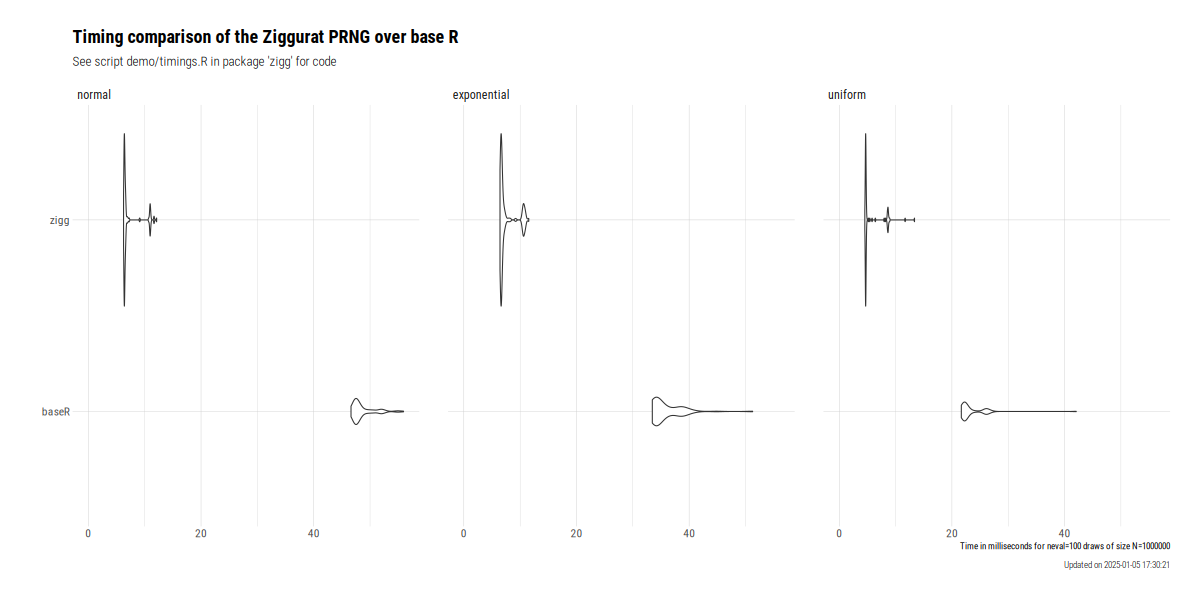
benchmark chart The still very new package zigg which arrived on CRAN a week ago just received a micro-update at CRAN. zigg provides the Ziggurat pseudo-random number generator (PRNG) for Normal, Exponential and Uniform draws proposed by Marsaglia and Tsang (JSS, 2000), and extended by Leong et al. (JSS, 2005). This PRNG is lightweight and very fast: on my machine speedups for the Normal, Exponential, and Uniform are on the order of 7.4, 5.2 and 4.7 times faster than the default generators in R as illustrated in the benchmark chart borrowed from the git repo. As wrote last week in the initial announcement, I had picked up their work in package RcppZiggurat and updated its code for the 64-buit world we now live in. That package alredy provided the Normal generator along with several competing implementations which it compared rigorously and timed them. As one of the generators was based on the GNU GSL via the implementation of Voss, we always ended up with a run-time dependency on the GSL too. No more: this new package is zero-depedency, zero-suggsts and hence very easy to deploy. Moreover, we also include a demonstration of four distinct ways of accessing the compiled code from another R package: pure and straight-up C, similarly pure C++, inclusion of the header in C++ as well as via Rcpp. The other advance is the resurrection of the second generator for the Exponential distribution. And following Burkardt we expose the Uniform too. The main upside of these generators is their excellent speed as can be seen in the comparison the default R generators generated by the example script timings.R: Needless to say, speed is not everything. This PRNG comes the time of 32-bit computing so the generator period is likely to be shorter than that of newer high-quality generators. If in doubt, forgo speed and stick with the high-quality default generators. This release essentially just completes the DESCRIPTION file and README.md now that this is a CRAN package. The short NEWS entry follows.

Changes in version 0.0.2 (2025-02-07)
  • Complete DESCRIPTION and README.md following initial CRAN upload

Courtesy of my CRANberries, there is a diffstat report relative to previous release. For more information, see the package page or the git repo.

This post by Dirk Eddelbuettel originated on his Thinking inside the box blog. If you like this or other open-source work I do, you can sponsor me at GitHub.

31 January 2025

Dirk Eddelbuettel: zigg 0.0.1 on CRAN: New Package!

Thrilled to announce a new package: zigg. It arrived on CRAN today after a few days of review in the newbies queue. zigg provides the Ziggurat pseudo-random number generator for Normal, Exponential and Uniform draws proposed by Marsaglia and Tsang (JSS, 2000), and extended by Leong et al. (JSS, 2005). I had picked up their work in package RcppZiggurat and updated its code for the 64-buit world we now live in. That package alredy provided the Normal generator along with several competing implementations which it compared rigorously and timed them. As one of the generators was based on the GNU GSL via the implementation of Voss, we always ended up with a run-time dependency on the GSL too. No more: this new package is zero-depedency, zero-suggsts and hence very easy to deploy. Moreover, we also include a demonstration of four distinct ways of accessing the compiled code from another R package: pure and straight-up C, similarly pure C++, inclusion of the header in C++ as well as via Rcpp. The other advance is the resurrection of the second generator for the Exponential distribution. And following Burkardt we expose the Uniform too. The main upside of these generators is their excellent speed as can be seen in the comparison the default R generators generated by the example script timings.R: Needless to say, speed is not everything. This PRNG comes the time of 32-bit computing so the generator period is likely to be shorter than that of newer high-quality generators. If in doubt, forgo speed and stick with the high-quality default generators. The short NEWS entry follows.

Changes in version 0.0.1 (2021-01-30)
  • Initial version and CRAN upload

For more, see the package page or the git repo.

This post by Dirk Eddelbuettel originated on his Thinking inside the box blog. If you like this or other open-source work I do, you can sponsor me at GitHub.

20 January 2025

Divine Attah-Ohiemi: Progress Report: First Half of My Outreachy Internship

Hello everyone!, I m excited to share a progress report on my Outreachy internship with the Debian community. As I reach the halfway point of this journey, I want to reflect on what I ve accomplished so far and outline my modified goals for the second half of the internship. In truth, there wasn t a strict timeline for my project migrating Debian webpage content to Hugo because the original repository contained thousands of pages. The initial goal was to develop a proof of concept for: Thanks to our daily standups, where we brainstorm and revise contributions, we ve made significant progress. The wiki documentation discussing the technical decisions taken to meet these goals is currently in progress here. During the first half of my internship, I have improved and refined my skills in several areas. I learned new Markdown syntaxes, studied and utilized Apache's mod_rewrite, and halfway studied GNU Make to use Perl scripts for processing data for dynamic content. I recommend Managing Projects with GNU Make by Robert Mecklenburg it's a great book for beginners! While I didn t get stuck on any particular goal, the most challenging aspect was adding Hugo aliases to help with Apache's multilingual content negotiation. The way the webwml repository generates multilingual content differs from debianhugo. For instance, in webwml, the structure looks like this: english/index.wml -> /index.en.html (with a symlink from index.html to index.en.html) and french/index.wml -> /index.fr.html. In contrast, debianhugo uses en/_index.md -> /index.html and fr/_index.md -> /fr/index.html. Apache's multilingual content negotiation checks for index.<user preferred lang code>.html in the current directory, which works well with webwml since all related translations are generated in the same directory. However, with debianhugo using subdirectories for languages other than English, we had to set up aliases for every other language page to be generated in the frontmatter. For example, in fr/_index.md, we added this to the front matter:
...
aliases:
  - /index.fr.html
...
This setup allows Hugo to generate multilingual HTML files in the initial home directory solely for the purpose of setting up a 301 redirect to the same page in the language subdirectory. However, if the client sets their preferred language to English, Apache content negotiation tries to find /index.en.html. If it doesn t find it, it defaults to any other language-suffixed file, which can lead to unexpected behavior. For example, if English is set as the preferred language, accessing the site may serve /index.fr.html, which then redirects to /fr/index.html. This was a significant challenge, and you can see a demo of this hosted here. If I were to start the project over, I would document every decision as I make them in the wiki, no matter how rough the documentation turns out. Waiting until the midpoint of the project to document was not a good idea. As I move into the second half of my internship, the goals we ve set include improving our project wiki documentation and continuing the migration process while enhancing the user experience of complicated sections. I m looking forward to making even more progress and sharing my journey with you all. Happy coding!

Dirk Eddelbuettel: RcppMsgPack 0.2.4 on CRAN: Maintenance

Another maintenance release of RcppMsgPack got onto CRAN today. MessagePack itself is an efficient binary serialization format. It lets you exchange data among multiple languages like JSON. But it is faster and smaller. Small integers are encoded into a single byte, and typical short strings require only one extra byte in addition to the strings themselves. RcppMsgPack brings both the C++ headers of MessagePack as well as clever code (in both R and C++) Travers wrote to access MsgPack-encoded objects directly from R. This is the first release in over six years, and contains mostly maintenance. One somewhat embarassing aspect is that Travers and I forgot about a PR that had been ready all this since the last release, it has now been integrated. Details follow from the NEWS file.

Changes in version 0.2.4 (2025-01-19)
  • Use Rcpp::RawVector instead of std::vector<unsigned char> saving extra copy (Travers in #16)
  • Several updates to README.md with R Journal paper, add badges, add Authors@R, add CITATION file, add repo info to DESCRIPTION
  • Update continuous integration via r-ci
  • Update to no longer require compilation standard

Courtesy of my CRANberries, there is also a diffstat report for this release. For questions, suggestions, or issues please use the [issue tracker][issue tickets] at the GitHub repo.

This post by Dirk Eddelbuettel originated on his Thinking inside the box blog. If you like this or other open-source work I do, you can now sponsor me at GitHub.

18 January 2025

Dominique Dumont: How we solved storage API throttling on our Azure Kubernetes clusters

Hi This issue was quite puzzling, so I m sharing how we investigated this issue. I hope it can be useful for you. My client informed me that he was no longer able to install new instances of his application. k9s showed that only some pods could not be created, only the ones that created physical volume (PV). The description of these pods showed a HTTP error 429 when creating pods: New PVC could not be created because we were throttled by Azure storage API. This issue was confirmed by Azure diagnostic console on Kubernetes ( menu Diagnose and solve problems Cluster and Control Plane Availability and Performance Azure Resource Request Throttling ). We had a lot of throttling:
2025-01-18_11-01-k8s-throttles.png
Which were explained by the high call rate:
2025-01-18_11-01-k8s-calls.png
The first clue was found at the bottom of Azure diagnostic page:
2025-01-18_11-27-throttles-by-user-agent.png
According, to this page, throttling is done by services whose user agent is:
Go/go1.23.1 (amd64-linux) go-autorest/v14.2.1 Azure-SDK-For-Go/v68.0.0
storage/2021-09-01microsoft.com/aks-operat azsdk-go-armcompute/v1.0.0 (go1.22.3; linux)
The main information is Azure-SDK-For-Go, which means the program making all these calls to storage API is written in Go. All our services are written in Typescript or Rust, so they are not suspect. That leaves controllers running in kube-systems namespace. I could not find anything suspects in the logs of these services. At that point I was convinced that a component in Kubernetes control plane was making all those calls. Unfortunately, AKS is managed by Microsoft and I don t have access to the control plane logs. However, we re realized that we had quite a lot of volumesnapshots that are created in our clusters using k8s-scheduled-volume-snapshotter: We suspected that kubernetes reconciliation loop is throttled when checking the status of all these snapshots. May be so, but we also had the same issues and throttle rates on preprod and prod were the number of snapshots were quite different. We tried to get more information using Azure console on our snapshot account, but it was also broken by the throttling issue. We were so puzzled that we decided to try L odagan s advice (tout cr mer pour repartir sur des bases saines, loosely translated as burn everything down to start from scratch ) and we destroyed piece by piece our dev cluster while checking if the throttling stopped. First, we removed all our applications, no change. Then, all ancillary components like rabbitmq, cert-manager were removed, no change. Then, we tried remove the namespace containing our applications. But, we faced another issue: Kubernetes was unable to remove the namespace because it could not destroy some PVC and volumesnapshots. That was actually good news, because it meant that we were close to the actual issue. We managed to destroy the PVC and volumesnapshots by removing their finalizers. Finalizers are some kind of markers that tell kubernetes that something needs to be done before actually deleting a resource. The finalizers were removed with a command like:
kubectl patch volumesnapshots $ volumesnapshot  \
  -p ' \"metadata\": \"finalizers\":null '  --type merge
Then, we got the first progress : the throttling and high call rate stopped on our dev cluster. To make sure that the snapshots were the issue, we re-installed the ancillary components and our applications. Everything was copacetic. So, the problem was indeed with PVC and snapshots. Even though we have backups outside of Azure, we weren t really thrilled at trying L odagan s method on our prod cluster So we looked for a better fix to try on our preprod cluster. Poking around in PVC and volumesnapshots, I finally found this error message in the description on a volumesnapshotcontents:
Code="ShareSnapshotCountExceeded" Message="The total number of snapshots
for the share is over the limit."
The number of snapshots found in our cluster was not that high. So I wanted to check the snapshots present in our storage account using Azure console, which was still broken. Fortunately, Azure CLI is able to retry HTTP calls when getting 429 errors. I managed to get a list of snapshots with
az storage share list --account-name [redacted] --include-snapshots \
      tee preprod-list.json
There, I found a lot of snapshots dating back from 2024. These were no longer managed by Kubernetes and should have been cleaned up. That was our smoking gun. I guess that we had a chain of events like: To make things worse, k8s-scheduled-volume-snapshotter creates new snapshots when it cannot list the old ones. So we had 4 new snapshots per day instead of one. Since we had the chain of events, fixing the issue was not too difficult (but quite long ):
  1. stop k8s-scheduled-volume-snapshotter by disabling its cron job
  2. delete all volumesnapshots and volume snapshots contents from k8s.
  3. since Azure API was throttled, we also had to remove their finalizers
  4. delete all snapshots from azure using az command and a Perl script (this step took several hours)
  5. re-enable k8s-scheduled-volume-snapshotter
After these steps, preprod was back to normal. I m now applying the same recipe on prod. We still don t know why we had all these stale snapshots. It may have been a human error or a bug in k8s-scheduled-volume-snapshotter. Anyway, to avoid this problem is the future, we will: My name is Dominique Dumont, I m a devops freelance. You can find the devops and audit services I propose on my website or reach out to me on LinkedIn. All the best

16 January 2025

Sergio Talens-Oliag: Command line tools to process templates

I ve always been a fan of template engines that work with text files, mainly to work with static site generators, but also to generate code, configuration files, and other text-based files. For my own web projects I used to go with Jinja2, as all my projects were written in Python, while for static web sites I used the template engines included with the tools I was using, i.e. Liquid with Jekyll and Go Templates (based on the text/template and the html/template go packages) for Hugo. When I needed to generate code snippets or configuration files from shell scripts I used to go with sed and/or envsubst, but lately things got complicated and I started to use a command line application called tmpl that uses the Go Template Language with functions from the Sprig library.

tmplI ve been using my fork of the tmpl program to process templates on CI/CD pipelines (gitlab-ci) to generate configuration files and code snippets because it uses the same syntax used by helm (easier to use by other DevOps already familiar with the format) and the binary is small and can be easily included into the docker images used by the pipeline jobs. One interesting feature of the tmpl tool is that it can read values from command line arguments and from multiple files in different formats (YAML, JSON, TOML, etc) and merge them into a single object that can be used to render the templates. There are alternatives to the tmpl tool and I ve looked at them (i.e. simple ones like go-template-cli or complex ones like gomplate), but I haven t found one that fits my needs. For my next project I plan to evaluate a move to a different tool or template format, as tmpl is not being actively maintained (as I said, I m using my own fork) and it is not included on existing GNU/Linux distributions (I packaged it for Debian and Alpine, but I don t want to maintain something like that without an active community and I m not interested in being the upstream myself, as I m trying to move to Rust instead of Go as the compiled programming language for my projects).

Mini JinjaLooking for alternate tools to process templates on the command line I found the minijinja rust crate, a minimal implementation of the Jinja2 template engine that also includes a small command line utility (minijinja-cli) and I believe I ll give it a try on the future for various reasons:
  • I m already familiar with the Jinja2 syntax and it is widely used on the industry.
  • On my code I can use the original Jinja2 module for Python projects and MiniJinja for Rust programs.
  • The included command line utility is small and easy to use, and the binaries distributed by the project are good enough to add them to the docker container images used by CI/CD pipelines.
  • As I want to move to Rust I can try to add functionalities to the existing command line client or create my own version of it if they are needed (don t think so, but who knows).

14 January 2025

Dirk Eddelbuettel: RProtoBuf 0.4.23 on CRAN: Mulitple Updates

A new maintenance release 0.4.23 of RProtoBuf arrived on CRAN earlier today, about one year after the previous update. RProtoBuf provides R with bindings for the Google Protocol Buffers ( ProtoBuf ) data encoding and serialization library used and released by Google, and deployed very widely in numerous projects as a language and operating-system agnostic protocol. This release brings a number of contributed PRs which are truly appreciate. As the package dates back fifteen+ years, some code corners can be crufty which was addressed in several PRs, as were two updates for ongoing changes / new releases of ProtoBuf itself. I also made the usual changes one does to continuous integrations, README badges and URL as well as correcting one issue the checkbashism script complained about. The following section from the NEWS.Rd file has full details.

Changes in RProtoBuf version 0.4.23 (2022-12-13)
  • More robust tests using toTextFormat() (Xufei Tan in #99 addressing #98)
  • Various standard packaging updates to CI and badges (Dirk)
  • Improvements to string construction in error messages (Michael Chirico in #102 and #103)
  • Accommodate ProtoBuf 26.x and later (Matteo Gianella in #104)
  • Accommodate ProtoBuf 6.30.9 and later (Lev Kandel in #106)
  • Correct bashism issues in configure.ac (Dirk)

Thanks to my CRANberries, there is a diff to the previous release. The RProtoBuf page has copies of the (older) package vignette, the quick overview vignette, and the pre-print of our JSS paper. Questions, comments etc should go to the GitHub issue tracker off the GitHub repo.

This post by Dirk Eddelbuettel originated on his Thinking inside the box blog. If you like this or other open-source work I do, you can sponsor me at GitHub.

12 January 2025

Dirk Eddelbuettel: Rcpp 1.0.14 on CRAN: Regular Semi-Annual Update

rcpp logo The Rcpp Core Team is once again thrilled, pleased, and chuffed (am I doing this right for LinkedIn?) to announce a new release (now at 1.0.14) of the Rcpp package. It arrived on CRAN earlier today, and has since been uploaded to Debian. Windows and macOS builds should appear at CRAN in the next few days, as will builds in different Linux distribution and of course r2u should catch up tomorrow too. The release was only uploaded yesterday, and as always get flagged because of the grandfathered .Call(symbol) as well as for the url to the Rcpp book (which has remained unchanged for years) failing . My email reply was promptly dealt with under European morning hours and by the time I got up the submission was in state waiting over a single reverse-dependency failure which is also spurious, appears on some systems and not others, and also not new. Imagine that: nearly 3000 reverse dependencies and only one (spurious) change to worse. Solid testing seems to help. My thanks as always to the CRAN for responding promptly. This release continues with the six-months January-July cycle started with release 1.0.5 in July 2020. This time we also need a one-off hotfix release 1.0.13-1: we had (accidentally) conditioned an upcoming R change on 4.5.0, but it already came with 4.4.2 so we needed to adjust our code. As a reminder, we do of course make interim snapshot dev or rc releases available via the Rcpp drat repo as well as the r-universe page and repo and strongly encourage their use and testing I run my systems with these versions which tend to work just as well, and are also fully tested against all reverse-dependencies. Rcpp has long established itself as the most popular way of enhancing R with C or C++ code. Right now, 2977 packages on CRAN depend on Rcpp for making analytical code go faster and further. On CRAN, 13.6% of all packages depend (directly) on Rcpp, and 60.8% of all compiled packages do. From the cloud mirror of CRAN (which is but a subset of all CRAN downloads), Rcpp has been downloaded 93.7 million times. The two published papers (also included in the package as preprint vignettes) have, respectively, 1947 (JSS, 2011) and 354 (TAS, 2018) citations, while the the book (Springer useR!, 2013) has another 676. This release is primarily incremental as usual, generally preserving existing capabilities faithfully while smoothing our corners and / or extending slightly, sometimes in response to changing and tightened demands from CRAN or R standards. The move towards a more standardized approach for the C API of R once again to a few changes; Kevin did once again did most of these PRs. Other contributed PRs include G bor permitting builds on yet another BSD variant, Simon Guest correcting sourceCpp() to work on read-only files, Marco Colombo correcting a (surprisingly large) number of vignette typos, I aki rebuilding some documentation files that tickled (false) alerts, and I took care of a number of other maintenance items along the way. The full list below details all changes, their respective PRs and, if applicable, issue tickets. Big thanks from all of us to all contributors!

Changes in Rcpp release version 1.0.14 (2025-01-11)
  • Changes in Rcpp API:
    • Support for user-defined databases has been removed (Kevin in #1314 fixing #1313)
    • The SET_TYPEOF function and macro is no longer used (Kevin in #1315 fixing #1312)
    • An errorneous cast to int affecting large return object has been removed (Dirk in #1335 fixing #1334)
    • Compilation on DragonFlyBSD is now supported (G bor Cs rdi in #1338)
    • Use read-only VECTOR_PTR and STRING_PTR only with with R 4.5.0 or later (Kevin in #1342 fixing #1341)
  • Changes in Rcpp Attributes:
    • The sourceCpp() function can now handle input files with read-only modes (Simon Guest in #1346 fixing #1345)
  • Changes in Rcpp Deployment:
    • One unit tests for arm64 macOS has been adjusted; a macOS continuous integration runner was added (Dirk in #1324)
    • Authors@R is now used in DESCRIPTION as mandated by CRAN, the Rcpp.package.skeleton() function also creates it (Dirk in #1325 and #1327)
    • A single datetime format test has been adjusted to match a change in R-devel (Dirk in #1348 fixing #1347)
  • Changes in Rcpp Documentation:
    • The Rcpp Modules vignette was extended slightly following #1322 (Dirk)
    • Pdf vignettes have been regenerated under Ghostscript 10.03.1 to avoid a false positive by a Windows virus scanner (I aki in #1331)
    • A (large) number of (old) typos have been corrected in the vignettes (Marco Colombo in #1344)

Thanks to my CRANberries, you can also look at a diff to the previous release Questions, comments etc should go to the rcpp-devel mailing list off the R-Forge page. Bugs reports are welcome at the GitHub issue tracker as well (where one can also search among open or closed issues).

This post by Dirk Eddelbuettel originated on his Thinking inside the box blog. If you like this or other open-source work I do, you can sponsor me at GitHub.

10 January 2025

Sergio Talens-Oliag: Testing New User Tools

On recent weeks I ve had some time to scratch my own itch on matters related to tools I use daily on my computer, namely the desktop / window manager and my text editor of choice. This post is a summary of what I tried, how it worked out and my short and medium-term plans related to them.

Desktop / WMOn the desktop / window manager front I ve been using Cinnamon on Debian and Ubuntu systems since Gnome 3 was published (I never liked version 3, so I decided to move to something similar to Gnome 2, including the keyboard shortcuts). In fact I ve never been a fan of Desktop environments, before Gnome I used OpenBox and IceWM because they where a lot faster than desktop systems on my hardware at the time and I was using them only to place one or two windows on multiple workspaces using mainly the keyboard for my interactions (well, except for the web browsers and the image manipulation programs). Although I was comfortable using Cinnamon, some years ago I tried to move to i3, a tilling window manager for X11 that looked like a good choice for me, but I didn t have much time to play with it and never used it enough to make me productive with it (I didn t prepare a complete configuration nor had enough time to learn the new shortcuts, so I went back to Cinnamon and never tried again). Anyway, some weeks ago I updated my work machine OS (it was using Ubuntu 22.04 LTS and I updated it to the 24.04 LTS version) and the Cinnamon systray applet stopped working as it used to do (in fact I still have to restart Cinnamon after starting a session to make it work) and, as I had some time, I decided to try a tilling window manager again, but now I decided to go for SwayWM, as it uses Wayland instead of X11.

Sway configurationOn my ~/.config/sway/config I tuned some things:
  • Set fuzzel as the application launcher.
  • Installed manually the shikane application and created a configuration to be executed always when sway is started / reloaded (I adjusted my configuration with wdisplays and used shikanectl to save it).
  • Added support for running the xdg-desktop-portal-wlr service.
  • Enabled the swayidle command to lock the screen after some time of inactivity.
  • Adjusted the keyboard to use the es key map
  • Added some keybindings to make my life easier, including the use of grimm and swappy to take screenshots
  • Configured waybar as the environment bar.
  • Added a shell script to start applications when sway is started (it uses swaymsg to execute background commands and the i3toolwait script to wait for the
    #!/bin/sh
    # VARIABLES
    CHROMIUM_LOCAL_STATE="$HOME/.config/google-chrome/Local State"
    I3_TOOLWAIT="$HOME/.config/sway/scripts/i3-toolwait"
    # Functions
    chromium_profile_dir()  
      jq -r ".profile.info_cache to_entries map( (.value.name): .key ) add .\"$1\" // \"\"" "$CHROMIUM_LOCAL_STATE"
     
    # MAIN
    IGZ_PROFILE_DIR="$(chromium_profile_dir "sergio.talens@intelygenz.com")"
    OURO_PROFILE_DIR="$(chromium_profile_dir "sergio.talens@nxr.global")"
    PERSONAL_PROFILE_DIR="$(chromium_profile_dir "stalens@gmail.com")"
    # Common programs
    swaymsg "exec nextcloud --background"
    swaymsg "exec nm-applet"
    # Run spotify on the first workspace (it is mapped to the laptop screen)
    swaymsg -q "workspace 1"
    $ I3_TOOLWAIT  "spotify"
    # Run tmux on the
    swaymsg -q "workspace 2"
    $ I3_TOOLWAIT  -- foot tmux a -dt sto
    wp_num="3"
    if [ "$OURO_PROFILE_DIR" ]; then
      swaymsg -q "workspace $wp_num"
      $ I3_TOOLWAIT  -m ouro-browser -- google-chrome --profile-directory="$OURO_PROFILE_DIR"
      wp_num="$((wp_num+1))"
    fi
    if [ "$IGZ_PROFILE_DIR" ]; then
      swaymsg -q "workspace $wp_num"
      $ I3_TOOLWAIT  -m igz-browser -- google-chrome --profile-directory="$IGZ_PROFILE_DIR"
      wp_num="$((wp_num+1))"
    fi
    if [ "$PERSONAL_PROFILE_DIR" ]; then
      swaymsg -q "workspace $wp_num"
      $ I3_TOOLWAIT  -m personal-browser -- google-chrome --profile-directory="$PERSONAL_PROFILE_DIR"
      wp_num="$((wp_num+1))"
    fi
    # Open the browser without setting the profile directory if none was found
    if [ "$wp_num" = "3" ]; then
      swaymsg -q "workspace $wp_num"
      $ I3_TOOLWAIT  google-chrome
      wp_num="$((wp_num+1))"
    fi
    swaymsg -q "workspace $wp_num"
    $ I3_TOOLWAIT  evolution
    wp_num="$((wp_num+1))"
    swaymsg -q "workspace $wp_num"
    $ I3_TOOLWAIT  slack
    wp_num="$((wp_num+1))"
    # Open a private browser and a console in the last workspace
    swaymsg -q "workspace $wp_num"
    $ I3_TOOLWAIT  -- google-chrome --incognito
    $ I3_TOOLWAIT  foot
    # Go back to the second workspace for keepassxc
    swaymsg "workspace 2"
    $ I3_TOOLWAIT  keepassxc

ConclusionAfter using Sway for some days I can confirm that it is a good choice for me, but some of the components needed to make it work as I want are too new and not available on the Ubuntu 24.04 LTS repositories, so I decided to go back to Cinnamon and try Sway again in the future, although I added more workspaces to my setup (now they are only available on the main monitor, the laptop screen is fixed while there is a big monitor connected), added some additional keyboard shortcuts and installed or updated some applets.

Text editorWhen I started using Linux many years ago I used vi/vim and emacs as my text editors (vi for plain text and emacs for programming and editing HTML/XML), but eventually I moved to vim as my main text editor and I ve been using it since (well, I moved to neovim some time ago, although I kept my old vim configuration). To be fair I m not as expert as I could be with vim, but I m productive with it and it has many plugins that make my life easier on my machines, while keeping my ability to edit text and configurations on any system that has a vi compatible editor installed. For work reasons I tried to use Visual Studio Code last year, but I ve never really liked it and almost everything I do with it I can do with neovim (i. e. I even use copilot with it). Besides, I m a heavy terminal user (I use tmux locally and via ssh) and I like to be able to use my text editor on my shell sessions, and code does not work like that. The only annoying thing about vim/neovim is its configuration (well, the problem is that I have a very old one and probably should spend some time fixing and updating it), but, as I said, it s been working well for me for a long time, so I never really had the motivation to do it. Anyway, after finishing my desktop tests I saw that I had the Helix editor installed for some time but I never tried it, so I decided to give it a try and see if it could be a good replacement for neovim on my environments (the only drawback is that as it is not vi compatible, I would need to switch back to vi mode when working on remote systems, but I guess I could live with that). I ran the helix tutorial and I liked it, so I decided to configure and install the Language Servers I can probably take advantage of on my daily work on my personal and work machines and see how it works.

Language server installationsA lot of manual installations are needed to get the language servers working what I did on my machines is more or less the following:
# AWK
sudo npm i -g 'awk-language-server@>=0.5.2'
# BASH
sudo apt-get install shellcheck shfmt
sudo npm i -g bash-language-server
# C/C++
sudo apt-get install clangd
# CSS, HTML, ESLint, JSON, SCS
sudo npm i -g vscode-langservers-extracted
# Docker
sudo npm install -g dockerfile-language-server-nodejs
# Docker compose
sudo npm install -g @microsoft/compose-language-service
# Helm
app="helm_ls_linux_amd64"
url="$(
  curl -s https://api.github.com/repos/mrjosh/helm-ls/releases/latest  
    jq -r ".assets[]   select(.name == \"$app\")   .browser_download_url"
)"
curl -L "$url" --output /tmp/helm_ls
sudo install /tmp/helm_ls /usr/local/bin
rm /tmp/helm_ls
# Markdown
app="marksman-linux-x64"
url="$(
  curl -s https://api.github.com/repos/artempyanykh/marksman/releases/latest  
    jq -r ".assets[]   select(.name == \"$app\")   .browser_download_url"
)"
curl -L "$url" --output /tmp/marksman
sudo install /tmp/marksman /usr/local/bin
rm /tmp/marksman
# Python
sudo npm i -g pyright
# Rust
rustup component add rust-analyzer
# SQL
sudo npm i -g sql-language-server
# Terraform
sudo apt-get install terraform-ls
# TOML
cargo install taplo-cli --locked --features lsp
# YAML
sudo npm install --global yaml-language-server
# JavaScript, TypeScript
sudo npm install -g typescript-language-server typescript
sudo npm install -g --save-dev --save-exact @biomejs/biome

Helix configurationThe helix configuration is done on a couple of toml files that are placed on the ~/.config/helix directory, the config.toml file I used is this one:
theme = "solarized_light"
[editor]
line-number = "relative"
mouse = false
[editor.statusline]
left = ["mode", "spinner"]
center = ["file-name"]
right = ["diagnostics", "selections", "position", "file-encoding", "file-line-ending", "file-type"]
separator = " "
mode.normal = "NORMAL"
mode.insert = "INSERT"
mode.select = "SELECT"
[editor.cursor-shape]
insert = "bar"
normal = "block"
select = "underline"
[editor.file-picker]
hidden = false
[editor.whitespace]
render = "all"
[editor.indent-guides]
render = true
character = " " # Some characters that work well: " ", " ", " ", " "
skip-levels = 1
And to configure the language servers I used the following language-servers.toml file:
[[language]]
name = "go"
auto-format = true
formatter =   command = "goimports"  
[[language]]
name = "javascript"
language-servers = [
  "typescript-language-server", # optional
  "vscode-eslint-language-server",
]
[language-server.rust-analyzer.config.check]
command = "clippy"
[language-server.sql-language-server]
command = "sql-language-server"
args = ["up", "--method", "stdio"]
[[language]]
name = "sql"
language-servers = [ "sql-language-server" ]
[[language]]
name = "hcl"
language-servers = [ "terraform-ls" ]
language-id = "terraform"
[[language]]
name = "tfvars"
language-servers = [ "terraform-ls" ]
language-id = "terraform-vars"
[language-server.terraform-ls]
command = "terraform-ls"
args = ["serve"]
[[language]]
name = "toml"
formatter =   command = "taplo", args = ["fmt", "-"]  
[[language]]
name = "typescript"
language-servers = [
  "typescript-language-server",
  "vscode-eslint-language-server",
]

Neovim configurationAfter a little while I noticed that I was going to need some time to get used to helix and the most interesting thing for me was the easy configuration and the language server integrations, but as I am already comfortable with neovim and just had installed the language server support tools on my machines I just need to configure them for neovim and I can keep using it for a while. As I said my configuration is old, to configure neovim I have the following init.vim file on my ~/.config/nvim folder:
set runtimepath^=~/.vim runtimepath+=~/.vim/after
let &packpath=&runtimepath
source ~/.vim/vimrc
" load lua configuration
lua require('config')
With that configuration I keep my old vimrc (it is a little bit messy, but it works) and I use a lua configuration file for the language servers and some additional neovim plugins on the ~/.config/nvim/lua/config.lua file:
-- -----------------------
-- BEG: LSP Configurations
-- -----------------------
-- AWS (awk_ls)
require'lspconfig'.awk_ls.setup 
-- Bash (bashls)
require'lspconfig'.bashls.setup 
-- C/C++ (clangd)
require'lspconfig'.clangd.setup 
-- CSS (cssls)
require'lspconfig'.cssls.setup 
-- Docker (dockerls)
require'lspconfig'.dockerls.setup 
-- Docker Compose
require'lspconfig'.docker_compose_language_service.setup 
-- Golang (gopls)
require'lspconfig'.gopls.setup 
-- Helm (helm_ls)
require'lspconfig'.helm_ls.setup 
-- Markdown
require'lspconfig'.marksman.setup 
-- Python (pyright)
require'lspconfig'.pyright.setup 
-- Rust (rust-analyzer)
require'lspconfig'.rust_analyzer.setup 
-- SQL (sqlls)
require'lspconfig'.sqlls.setup 
-- Terraform (terraformls)
require'lspconfig'.terraformls.setup 
-- TOML (taplo)
require'lspconfig'.taplo.setup 
-- Typescript (ts_ls)
require'lspconfig'.ts_ls.setup 
-- YAML (yamlls)
require'lspconfig'.yamlls.setup 
  settings =  
    yaml =  
      customTags =   "!reference sequence"  


-- -----------------------
-- END: LSP Configurations
-- -----------------------
-- ---------------------------------
-- BEG: Autocompletion configuration
-- ---------------------------------
-- Ref: https://github.com/neovim/nvim-lspconfig/wiki/Autocompletion
--
-- Pre requisites:
--
--   # Packer
--   git clone --depth 1 https://github.com/wbthomason/packer.nvim \
--      ~/.local/share/nvim/site/pack/packer/start/packer.nvim
--
--   # Start nvim and run :PackerSync or :PackerUpdate
-- ---------------------------------
local use = require('packer').use
require('packer').startup(function()
  use 'wbthomason/packer.nvim' -- Packer, useful to avoid removing it with PackerSync / PackerUpdate
  use 'neovim/nvim-lspconfig' -- Collection of configurations for built-in LSP client
  use 'hrsh7th/nvim-cmp' -- Autocompletion plugin
  use 'hrsh7th/cmp-nvim-lsp' -- LSP source for nvim-cmp
  use 'saadparwaiz1/cmp_luasnip' -- Snippets source for nvim-cmp
  use 'L3MON4D3/LuaSnip' -- Snippets plugin
end)
-- Add additional capabilities supported by nvim-cmp
local capabilities = require("cmp_nvim_lsp").default_capabilities()
local lspconfig = require('lspconfig')
-- Enable some language servers with the additional completion capabilities offered by nvim-cmp
local servers =   'clangd', 'rust_analyzer', 'pyright', 'ts_ls'  
for _, lsp in ipairs(servers) do
  lspconfig[lsp].setup  
    -- on_attach = my_custom_on_attach,
    capabilities = capabilities,
   
end
-- luasnip setup
local luasnip = require 'luasnip'
-- nvim-cmp setup
local cmp = require 'cmp'
cmp.setup  
  snippet =  
    expand = function(args)
      luasnip.lsp_expand(args.body)
    end,
   ,
  mapping = cmp.mapping.preset.insert( 
    ['<C-u>'] = cmp.mapping.scroll_docs(-4), -- Up
    ['<C-d>'] = cmp.mapping.scroll_docs(4), -- Down
    -- C-b (back) C-f (forward) for snippet placeholder navigation.
    ['<C-Space>'] = cmp.mapping.complete(),
    ['<CR>'] = cmp.mapping.confirm  
      behavior = cmp.ConfirmBehavior.Replace,
      select = true,
     ,
    ['<Tab>'] = cmp.mapping(function(fallback)
      if cmp.visible() then
        cmp.select_next_item()
      elseif luasnip.expand_or_jumpable() then
        luasnip.expand_or_jump()
      else
        fallback()
      end
    end,   'i', 's'  ),
    ['<S-Tab>'] = cmp.mapping(function(fallback)
      if cmp.visible() then
        cmp.select_prev_item()
      elseif luasnip.jumpable(-1) then
        luasnip.jump(-1)
      else
        fallback()
      end
    end,   'i', 's'  ),
   ),
  sources =  
      name = 'nvim_lsp'  ,
      name = 'luasnip'  ,
   ,
 
-- ---------------------------------
-- END: Autocompletion configuration
-- ---------------------------------

ConclusionI guess I ll keep helix installed and try it again on some of my personal projects to see if I can get used to it, but for now I ll stay with neovim as my main text editor and learn the shortcuts to use it with the language servers.

9 January 2025

Reproducible Builds: Reproducible Builds in December 2024

Welcome to the December 2024 report from the Reproducible Builds project! Our monthly reports outline what we ve been up to over the past month and highlight items of news from elsewhere in the world of software supply-chain security when relevant. As ever, however, if you are interested in contributing to the Reproducible Builds project, please visit our Contribute page on our website. Table of contents:
  1. reproduce.debian.net
  2. debian-repro-status
  3. On our mailing list
  4. Enhancing the Security of Software Supply Chains
  5. diffoscope
  6. Supply-chain attack in the Solana ecosystem
  7. Website updates
  8. Debian changes
  9. Other development news
  10. Upstream patches
  11. Reproducibility testing framework

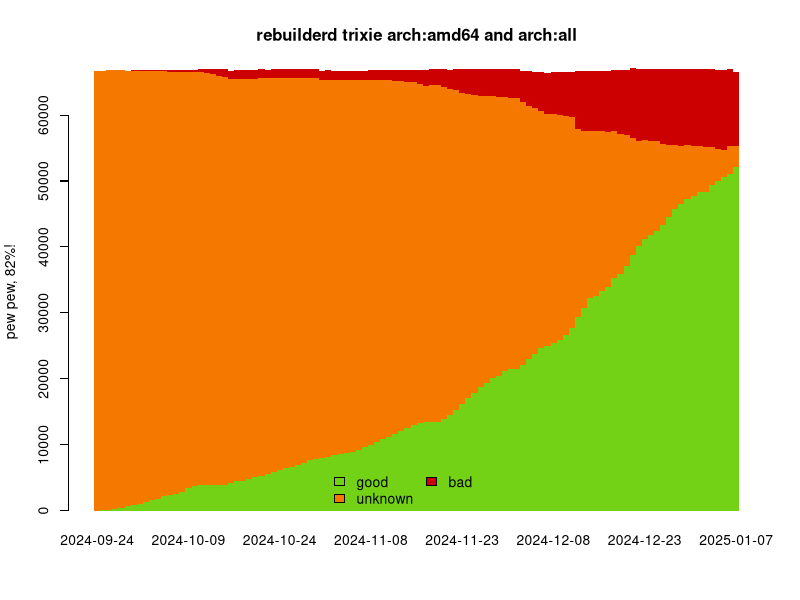
reproduce.debian.net Last month saw the introduction of reproduce.debian.net. Announced at the recent Debian MiniDebConf in Toulouse, reproduce.debian.net is an instance of rebuilderd operated by the Reproducible Builds project. rebuilderd is our server designed monitor the official package repositories of Linux distributions and attempts to reproduce the observed results there. This month, however, we are pleased to announce that not only does the service now produce graphs, the reproduce.debian.net homepage itself has become a start page of sorts, and the amd64.reproduce.debian.net and i386.reproduce.debian.net pages have emerged. The first of these rebuilds the amd64 architecture, naturally, but it also is building Debian packages that are marked with the no architecture label, all. The second builder is, however, only rebuilding the i386 architecture. Both of these services were also switched to reproduce the Debian trixie distribution instead of unstable, which started with 43% of the archive rebuild with 79.3% reproduced successfully. This is very much a work in progress, and we ll start reproducing Debian unstable soon. Our i386 hosts are very kindly sponsored by Infomaniak whilst the amd64 node is sponsored by OSUOSL thank you! Indeed, we are looking for more workers for more Debian architectures; please contact us if you are able to help.

debian-repro-status Reproducible builds developer kpcyrd has published a client program for reproduce.debian.net (see above) that queries the status of the locally installed packages and rates the system with a percentage score. This tool works analogously to arch-repro-status for the Arch Linux Reproducible Builds setup. The tool was packaged for Debian and is currently available in Debian trixie: it can be installed with apt install debian-repro-status.

On our mailing list On our mailing list this month:
  • Bernhard M. Wiedemann wrote a detailed post on his long journey towards a bit-reproducible Emacs package. In his interesting message, Bernhard goes into depth about the tools that they used and the lower-level technical details of, for instance, compatibility with the version for glibc within openSUSE.
  • Shivanand Kunijadar posed a question pertaining to the reproducibility issues with encrypted images. Shivanand explains that they must use a random IV for encryption with AES CBC. The resulting artifact is not reproducible due to the random IV used. The message resulted in a handful of replies, hopefully helpful!
  • User Danilo posted an in interesting question related to their attempts in trying to achieve reproducible builds for Threema Desktop 2.0. The question resulted in a number of replies attempting to find the right combination of compiler and linker flags (for example).
  • Longstanding contributor David A. Wheeler wrote to our list announcing the release of the Census III of Free and Open Source Software: Application Libraries report written by Frank Nagle, Kate Powell, Richie Zitomer and David himself. As David writes in his message, the report attempts to answer the question what is the most popular Free and Open Source Software (FOSS)? .
  • Lastly, kpcyrd followed-up to a post from September 2024 which mentioned their desire for someone to implement a hashset of allowed module hashes that is generated during the kernel build and then embedded in the kernel image , thus enabling a deterministic and reproducible build. However, they are now reporting that somebody implemented the hash-based allow list feature and submitted it to the Linux kernel mailing list . Like kpcyrd, we hope it gets merged.

Enhancing the Security of Software Supply Chains: Methods and Practices Mehdi Keshani of the Delft University of Technology in the Netherlands has published their thesis on Enhancing the Security of Software Supply Chains: Methods and Practices . Their introductory summary first begins with an outline of software supply chains and the importance of the Maven ecosystem before outlining the issues that it faces that threaten its security and effectiveness . To address these:
First, we propose an automated approach for library reproducibility to enhance library security during the deployment phase. We then develop a scalable call graph generation technique to support various use cases, such as method-level vulnerability analysis and change impact analysis, which help mitigate security challenges within the ecosystem. Utilizing the generated call graphs, we explore the impact of libraries on their users. Finally, through empirical research and mining techniques, we investigate the current state of the Maven ecosystem, identify harmful practices, and propose recommendations to address them.
A PDF of Mehdi s entire thesis is available to download.

diffoscope diffoscope is our in-depth and content-aware diff utility that can locate and diagnose reproducibility issues. This month, Chris Lamb made the following changes, including preparing and uploading versions 283 and 284 to Debian:
  • Update copyright years. [ ]
  • Update tests to support file 5.46. [ ][ ]
  • Simplify tests_quines.py::test_ differences,differences_deb to simply use assert_diff and not mangle the test fixture. [ ]

Supply-chain attack in the Solana ecosystem A significant supply-chain attack impacted Solana, an ecosystem for decentralised applications running on a blockchain. Hackers targeted the @solana/web3.js JavaScript library and embedded malicious code that extracted private keys and drained funds from cryptocurrency wallets. According to some reports, about $160,000 worth of assets were stolen, not including SOL tokens and other crypto assets.

Website updates Similar to last month, there was a large number of changes made to our website this month, including:
  • Chris Lamb:
    • Make the landing page hero look nicer when the vertical height component of the viewport is restricted, not just the horizontal width.
    • Rename the Buy-in page to Why Reproducible Builds? [ ]
    • Removing the top black border. [ ][ ]
  • Holger Levsen:
  • hulkoba:
    • Remove the sidebar-type layout and move to a static navigation element. [ ][ ][ ][ ]
    • Create and merge a new Success stories page, which highlights the success stories of Reproducible Builds, showcasing real-world examples of projects shipping with verifiable, reproducible builds. These stories aim to enhance the technical resilience of the initiative by encouraging community involvement and inspiring new contributions. . [ ]
    • Further changes to the homepage. [ ]
    • Remove the translation icon from the navigation bar. [ ]
    • Remove unused CSS styles pertaining to the sidebar. [ ]
    • Add sponsors to the global footer. [ ]
    • Add extra space on large screens on the Who page. [ ]
    • Hide the side navigation on small screens on the Documentation pages. [ ]

Debian changes There were a significant number of reproducibility-related changes within Debian this month, including:
  • Santiago Vila uploaded version 0.11+nmu4 of the dh-buildinfo package. In this release, the dh_buildinfo becomes a no-op ie. it no longer does anything beyond warning the developer that the dh-buildinfo package is now obsolete. In his upload, Santiago wrote that We still want packages to drop their [dependency] on dh-buildinfo, but now they will immediately benefit from this change after a simple rebuild.
  • Holger Levsen filed Debian bug #1091550 requesting a rebuild of a number of packages that were built with a very old version of dpkg.
  • Fay Stegerman contributed to an extensive thread on the debian-devel development mailing list on the topic of Supporting alternative zlib implementations . In particular, Fay wrote about her results experimenting whether zlib-ng produces identical results or not.
  • kpcyrd uploaded a new rust-rebuilderd-worker, rust-derp, rust-in-toto and debian-repro-status to Debian, which passed successfully through the so-called NEW queue.
  • Gioele Barabucci filed a number of bugs against the debrebuild component/script of the devscripts package, including:
    • #1089087: Address a spurious extra subdirectory in the build path.
    • #1089201: Extra zero bytes added to .dynstr when rebuilding CMake projects.
    • #1089088: Some binNMUs have a 1-second offset in some timestamps.
  • Gioele Barabucci also filed a bug against the dh-r package to report that the Recommends and Suggests fields are missing from rebuilt R packages. At the time of writing, this bug has no patch and needs some help to make over 350 binary packages reproducible.
  • Lastly, 8 reviews of Debian packages were added, 11 were updated and 11 were removed this month adding to our knowledge about identified issues.

Other development news In other ecosystem and distribution news:
  • Lastly, in openSUSE, Bernhard M. Wiedemann published another report for the distribution. There, Bernhard reports about the success of building R-B-OS , a partial fork of openSUSE with only 100% bit-reproducible packages. This effort was sponsored by the NLNet NGI0 initiative.

Upstream patches The Reproducible Builds project detects, dissects and attempts to fix as many currently-unreproducible packages as possible. We endeavour to send all of our patches upstream where appropriate. This month, we wrote a large number of such patches, including:

Reproducibility testing framework The Reproducible Builds project operates a comprehensive testing framework running primarily at tests.reproducible-builds.org in order to check packages and other artifacts for reproducibility. In November, a number of changes were made by Holger Levsen, including:
  • reproduce.debian.net-related:
    • Add a new i386.reproduce.debian.net rebuilder. [ ][ ][ ][ ][ ][ ]
    • Make a number of updates to the documentation. [ ][ ][ ][ ][ ]
    • Run i386.reproduce.debian.net run on a public port to allow external workers. [ ]
    • Add a link to the /api/v0/pkgs/list endpoint. [ ]
    • Add support for a statistics page. [ ][ ][ ][ ][ ][ ]
    • Limit build logs to 20 MiB and diffoscope output to 10 MiB. [ ]
    • Improve the frontpage. [ ][ ]
    • Explain that we re testing arch:any and arch:all on the amd64 architecture, but only arch:any on i386. [ ]
  • Misc:
    • Remove code for testing Arch Linux, which has moved to reproduce.archlinux.org. [ ][ ]
    • Don t install dstat on Jenkins nodes anymore as its been removed from Debian trixie. [ ]
    • Prepare the infom08-i386 node to become another rebuilder. [ ]
    • Add debug date output for benchmarking the reproducible_pool_buildinfos.sh script. [ ]
    • Install installation-birthday everywhere. [ ]
    • Temporarily disable automatic updates of pool links on buildinfos.debian.net. [ ]
    • Install Recommends by default on Jenkins nodes. [ ]
    • Rename rebuilder_stats.py to rebuilderd_stats.py. [ ]
    • r.d.n/stats: minor formatting changes. [ ]
    • Install files under /etc/cron.d/ with the correct permissions. [ ]
and Jochen Sprickerhof made the following changes: Lastly, Gioele Barabucci also classified packages affected by 1-second offset issue filed as Debian bug #1089088 [ ][ ][ ][ ], Chris Hofstaedtler updated the URL for Grml s dpkg.selections file [ ], Roland Clobus updated the Jenkins log parser to parse warnings from diffoscope [ ] and Mattia Rizzolo banned a number of bots and crawlers from the service [ ][ ].
If you are interested in contributing to the Reproducible Builds project, please visit our Contribute page on our website. However, you can get in touch with us via:

Freexian Collaborators: Debian Contributions: Tracker.debian.org updates, Salsa CI improvements, Coinstallable build-essential, Python 3.13 transition, Ruby 3.3 transition and more! (by Anupa Ann Joseph, Stefano Rivera)

Debian Contributions: 2024-12 Contributing to Debian is part of Freexian s mission. This article covers the latest achievements of Freexian and their collaborators. All of this is made possible by organizations subscribing to our Long Term Support contracts and consulting services.

Tracker.debian.org updates, by Rapha l Hertzog Profiting from end-of-year vacations, Rapha l prepared for tracker.debian.org to be upgraded to Debian 12 bookworm by getting rid of the remnants of python3-django-jsonfield in the code (it was superseded by a Django-native field). Thanks to Philipp Kern from the Debian System Administrators team, the upgrade happened on December 23rd. Rapha l also improved distro-tracker to better deal with invalid Maintainer fields which recently caused multiples issues in the regular data updates (#1089985, MR 105). While working on this, he filed #1089648 asking dpkg tools to error out early when maintainers make such mistakes. Finally he provided feedback to multiple issues and merge requests (MR 106, issues #21, #76, #77), there seems to be a surge of interest in distro-tracker lately. It would be nice if those new contributors could stick around and help out with the significant backlog of issues (in the Debian BTS, in Salsa).

Salsa CI improvements, by Santiago Ruano Rinc n Given that the Debian buildd network now relies on sbuild using the unshare backend, and that Salsa CI s reproducibility testing needs to be reworked (#399), Santiago resumed the work for moving the build job to use sbuild. There was some related work a few months ago that was focused on sbuild with the schroot and the sudo backends, but those attempts were stalled for different reasons, including discussions around the convenience of the move (#296). However, using sbuild and unshare avoids all of the drawbacks that have been identified so far. Santiago is preparing two merge requests: !568 to introduce a new build image, and !569 that moves all the extract-source related tasks to the build job. As mentioned in the previous reports, this change will make it possible for more projects to use the pipeline to build the packages (See #195). Additional advantages of this change include a more optimal way to test if a package builds twice in a row: instead of actually building it twice, the Salsa CI pipeline will configure sbuild to check if the clean target of debian/rules correctly restores the source tree, saving some CPU cycles by avoiding one build. Also, the images related to Ubuntu won t be needed anymore, since the build job will create chroots for different distributions and vendors from a single common build image. This will save space in the container registry. More changes are to come, especially those related to handling projects that customize the pipeline and make use of the extract-source job.

Coinstallable build-essential, by Helmut Grohne Building on the gcc-for-host work of last December, a notable patch turning build-essential Multi-Arch: same became feasible. Whilst the change is small, its implications and foundations are not. We still install crossbuild-essential-$ARCH for cross building and due to a britney2 limitation, we cannot have it depend on the host s C library. As a result, there are workarounds in place for sbuild and pbuilder. In turning build-essential Multi-Arch: same, we may actually express these dependencies directly as we install build-essential:$ARCH instead. The crossbuild-essential-$ARCH packages will continue to be available as transitional dummy packages.

Python 3.13 transition, by Colin Watson and Stefano Rivera Building on last month s work, Colin, Stefano, and other members of the Debian Python team fixed 3.13 compatibility bugs in many more packages, allowing 3.13 to now be a supported but non-default version in testing. The next stage will be to switch to it as the default version, which will start soon. Stefano did some test-rebuilds of packages that only build for the default Python 3 version, to find issues that will block the transition. The default version transition typically shakes out some more issues in applications that (unlike libraries) only test with the default Python version. Colin also fixed Sphinx 8.0 compatibility issues in many packages, which otherwise threatened to get in the way of this transition.

Ruby 3.3 transition, by Lucas Kanashiro The Debian Ruby team decided to ship Ruby 3.3 in the next Debian release, and Lucas took the lead of the interpreter transition with the assistance of the rest of the team. In order to understand the impact of the new interpreter in the ruby ecosystem, ruby-defaults was uploaded to experimental adding ruby3.3 as an alternative interpreter, and a mass rebuild of reverse dependencies was done here. Initially, a couple of hundred packages were failing to build, after many rounds of rebuilds, adjustments, and many uploads we are down to 30 package build failures, of those, 21 packages were asked to be removed from testing and for the other 9, bugs were filled. All the information to track this transition can be found here. Now, we are waiting for PHP 8.4 to finish to avoid any collision. Once it is done the Ruby 3.3 transition will start in unstable.

Miscellaneous contributions
  • Enrico Zini redesigned the way nm.debian.org stores historical audit logs and personal data backups.
  • Carles Pina submitted a new package (python-firebase-messaging) and prepared updates for python3-ring-doorbell.
  • Carles Pina developed further po-debconf-manager: better state transition, fixed bugs, automated assigning translators and reviewers on edit, updating po header files automatically, fixed bugs, etc.
  • Carles Pina reviewed, submitted and followed up the debconf templates translation (more than 20 packages) and translated some packages (about 5).
  • Santiago continued to work on DebConf 25 organization related tasks, including handling the logo survey and results. Stefano spent time on DebConf 25 too.
  • Santiago continued the exploratory work about linux livepatching with Emmanuel Arias. Santiago and Emmanuel found a challenge since kpatch won t fully support linux in trixie and newer, so they are exploring alternatives such as klp-build.
  • Helmut maintained the /usr-move transition filing bugs in e.g. bubblewrap, e2fsprogs, libvpd-2.2-3, and pam-tmpdir and corresponding on related issues such as kexec-tools and live-build. The removal of the usrmerge package unfortunately broke debootstrap and was quickly reverted. Continued fallout is expected and will continue until trixie is released.
  • Helmut sent patches for 10 cross build failures and worked with Sandro Knau on stuck Qt/KDE patches related to cross building.
  • Helmut continued to maintain rebootstrap removing the need to build gnu-efi in the process.
  • Helmut collaborated with Emanuele Rocca and Jochen Sprickerhof on an interesting adventure in diagnosing why gcc would FTBFS in recent sbuild.
  • Helmut proposed supporting build concurrency limits in coreutils s nproc. As it turns out nproc is not a good place for this functionality.
  • Colin worked with Sandro Tosi and Andrej Shadura to finish resolving the multipart vs. python-multipart name conflict, as mentioned last month.
  • Colin upgraded 48 Python packages to new upstream versions, fixing four CVEs and a number of compatibility bugs with recent Python versions.
  • Colin issued an openssh bookworm update with a number of fixes that had accumulated over the last year, especially fixing GSS-API key exchange which had been quite broken in bookworm.
  • Stefano fixed a minor bug in debian-reimbursements that was disallowing combination PDFs containing JAL tickets, encoded in UTF-16.
  • Stefano uploaded a stable update to PyPy3 in bookworm, catching up with security issues resolved in cPython.
  • Stefano fixed a regression in the eventlet from his Python 3.13 porting patch.
  • Stefano continued discussing a forwarded patch (renaming the sysconfigdata module) with cPython upstream, ending in a decision to drop the patch from Debian. This will need some continued work.
  • Anupa participated in the Debian Publicity team meeting in December, which discussed the team activities done in 2024 and projects for 2025.

8 January 2025

Sandro Tosi: HOWTO remove Reddit (web) "Recent" list of communities

If you go on reddit.com via browser, on the left column you can see a section called "RECENT" with the list of the last 5 communities recently visited.If you want to remove them, say for privacy reasons (shared device, etc.), there's no simple way to do so: there's not "X" button next to it, your profile page doesn't offer a way to clear that out. you could clear all the data from the website, but that seems too extreme, no?Enter Chrome's "Developer Tools"While on reddit.com open Menu > More Tools > Developers tool, go on the Application tab, Storage > Local storage and select reddit.com; on the center panel you see a list of key-value pairs, look for the key "recent-subreddits-store"; you can see the list of the 5 communities in the JSON below.If you wanna get rid of the recently viewed communities list, simply delete that key, refresh reddit.com and voila, empty list.Note: I'm fairly sure i read about this method somewhere, i simply cant remember where, but it's definitely not me who came up with it. I just needed to use it recently and had to back track memories to figure it out again, so it's time to write it down.

7 January 2025

Thorsten Alteholz: My Debian Activities in December 2024

Debian LTS This was my hundred-twenty-sixth month that I did some work for the Debian LTS initiative, started by Raphael Hertzog at Freexian. I worked on updates for ffmpeg and haproxy in all releases. Along the way I marked more CVEs as not-affected than I had to fix. So finally there was no upload needed for haproxy anymore. Unfortunately testing ffmpeg was not as easy, as the recommended just look whether mpv can play random videos is not really satisfying. So the upload will happen only in January. I also wonder whether fixing glewlwyd is really worth the effort, as the software is already EOL upstream. Debian ELTS This month was the seventy-seventhth ELTS month. During my allocated time I worked on ffmpeg, haproxy, amanda and kmail-account-wizzard. Like LTS, all CVEs of haproxy and some of ffmpeg could be marked as not-affected and testing of the other packages was/is not really straight forward. So the final upload will only happen in January as well. Debian Printing Unfortunately I didn t found any time to work on this topic. Debian Matomo Thanks a lot to William Desportes for all fixes of my bad PHP packaging. Debian Astro This month I uploaded new packages or new upstream or bugfix versions of: I again sponsored an upload of calceph. Debian IoT This month I uploaded new upstream or bugfix versions of: Debian Mobcom This month I uploaded new packages or new upstream or bugfix versions of: misc This month I uploaded new upstream or bugfix versions of: I also sponsored uploads of emacs-lsp-docker, emacs-dape, emacs-oauth2, gpgmngr, libjs-jush. FTP master This month I accepted 330 and rejected 13 packages. The overall number of packages that got accepted was 335.

5 January 2025

Enrico Zini: ncdu on files to back up

I use borg and restic to backup files in my system. Sometimes I run a huge download or clone a large git repo and forget to mark it with CACHEDIR.TAG, and it gets picked up slowing the backup process and wasting backup space uselessly. I would like to occasionally audit the system to have an idea of what is a candidate for backup. ncdu would be great for this, but it doesn't know about backup exclusion filters. Let's teach it then. Here's a script that simulates a backup and feeds the results to ncdu:
#!/usr/bin/python3
import argparse
import os
import sys
import time
import stat
import json
import subprocess
import tempfile
from pathlib import Path
from typing import Any
FILTER_ARGS = [
    "--one-file-system",
    "--exclude-caches",
    "--exclude",
    "*/.cache",
]
BACKUP_PATHS = [
    "/home",
]
class Dir:
    """
    Dispatch borg output into a hierarchical directory structure.
    borg prints a flat file list, ncdu needs a hierarchical JSON.
    """
    def __init__(self, path: Path, name: str):
        self.path = path
        self.name = name
        self.subdirs: dict[str, "Dir"] =  
        self.files: list[str] = []
    def print(self, indent: str = "") -> None:
        for name, subdir in self.subdirs.items():
            print(f" indent name: /")
            subdir.print(indent + " ")
        for name in self.files:
            print(f" indent name ")
    def add(self, parts: tuple[str, ...]) -> None:
        if len(parts) == 1:
            self.files.append(parts[0])
            return
        subdir = self.subdirs.get(parts[0])
        if subdir is None:
            subdir = Dir(self.path / parts[0], parts[0])
            self.subdirs[parts[0]] = subdir
        subdir.add(parts[1:])
    def to_data(self) -> list[Any]:
        res: list[Any] = []
        st = self.path.stat()
        res.append(self.collect_stat(self.name, st))
        for name, subdir in self.subdirs.items():
            res.append(subdir.to_data())
        dir_fd = os.open(self.path, os.O_DIRECTORY)
        try:
            for name in self.files:
                try:
                    st = os.lstat(name, dir_fd=dir_fd)
                except FileNotFoundError:
                    print(
                        "Possibly broken encoding:",
                        self.path,
                        repr(name),
                        file=sys.stderr,
                    )
                    continue
                if stat.S_ISDIR(st.st_mode):
                    continue
                res.append(self.collect_stat(name, st))
        finally:
            os.close(dir_fd)
        return res
    def collect_stat(self, fname: str, st) -> dict[str, Any]:
        res =  
            "name": fname,
            "ino": st.st_ino,
            "asize": st.st_size,
            "dsize": st.st_blocks * 512,
         
        if stat.S_ISDIR(st.st_mode):
            res["dev"] = st.st_dev
        return res
class Scanner:
    def __init__(self) -> None:
        self.root = Dir(Path("/"), "/")
        self.data = None
    def scan(self) -> None:
        with tempfile.TemporaryDirectory() as tmpdir_name:
            mock_backup_dir = Path(tmpdir_name) / "backup"
            subprocess.run(
                ["borg", "init", mock_backup_dir.as_posix(), "--encryption", "none"],
                cwd=Path.home(),
                check=True,
            )
            proc = subprocess.Popen(
                [
                    "borg",
                    "create",
                    "--list",
                    "--dry-run",
                ]
                + FILTER_ARGS
                + [
                    f" mock_backup_dir ::test",
                ]
                + BACKUP_PATHS,
                cwd=Path.home(),
                stderr=subprocess.PIPE,
            )
            assert proc.stderr is not None
            for line in proc.stderr:
                match line[0:2]:
                    case b"- ":
                        path = Path(line[2:].strip().decode())
                    case b"x ":
                        continue
                    case _:
                        raise RuntimeError(f"Unparsable borg output:  line!r ")
                if path.parts[0] != "/":
                    raise RuntimeError(f"Unsupported path:  path.parts!r ")
                self.root.add(path.parts[1:])
    def to_json(self) -> list[Any]:
        return [
            1,
            0,
             
                "progname": "backup-ncdu",
                "progver": "0.1",
                "timestamp": int(time.time()),
             ,
            self.root.to_data(),
        ]
    def export(self):
        return json.dumps(self.to_json()).encode()
def main():
    parser = argparse.ArgumentParser(
        description="Run ncdu to estimate sizes of files to backup."
    )
    parser.parse_args()
    scanner = Scanner()
    scanner.scan()
    # scanner.root.print()
    res = subprocess.run(["ncdu", "-f-"], input=scanner.export())
    sys.exit(res.returncode)
if __name__ == "__main__":
    main()

Next.

Previous.