Search Results: "jordi"

8 October 2006

Jordi Mallach: We made it

I just came back home. I feel like I've been beaten up, my backbone is about to crack in two pieces, and I've been sodomized by a few people. But we made it. We've learned a few things in the process:
  1. Teruel-Val ncia arent 150 kilometres if you cycle through the V a Verde Ojos Negros and the Via Augusta. It is exactly 200.
  2. Full moon light is good enough to spots rocks and other obstacles on the patch ahead, but mixed with extreme sleepiness, its usefulness decreates significantly
  3. At some point, it doesn't matter if you cycle 150 or 200 kilometres. You just don't feel your legs that much. Also, you stop being sleepy, and could go on for more and more hours. I don't want to test the hard limits though. :)
Good night!

7 October 2006

Jordi Mallach: From Teruel to Val ncia under the full moon

For a few years, the probably most intrepid group of triathletes in my club have been doing cycling tours during the long weekend of the 9 d'Octubre in Val ncia. We once did a good chunk of the Ruta del Cid, covering around 550 kilometres in 3 days and a half, carrying aproximately 25 kilograms of sleeping bag, food and clothes on our bikes, and going from Teruel to Albarrac n, back to Teruel, then to Morella and back to Alboc sser and through the Serra d'Espad . The next year, we started the trip in La S nia, and crossed the Valencian Country all the way to Requena, through Linares and Rubielos de Mora. This year, we intended to cycle across the Pyrinees, from the Basque Country to Catalonia, but in the end my travelmates have to work on Monday, so we had to quickly settle on a one day alternative. As this is the 9 d'Octubre, the trip had to be a bit crazy, so we've decided to get the last train up to Teruel, arriving there at 21:30 or so, have a very good dinner around El Torico and soon after, start our way down to Val ncia, under the full moon.


Our itinerary for tonight We'll be carrying a few forehead lights and a bicycle light, and will really hope that the sky isn't cloudy at all. We're really going to need the moonlight. The route follows the national road from Sagunt to Teruel, through an old train track which was turned into a cycling path. Most of the trip will be descending, so covering the 150 kilometres shouldn't be too hard, except that neither of us are specially trained now, unlike 3 years ago. If we end up having to stop and sleep, that's going to be a problem as we are carrying no sleepingbags or anything, just our winter cycling clothes. We pretend to take our time, aka most of the night, to get to our destination, as we obviously won't be able to cycle fast in the dark. But we'll manage. This is just crazy, not impossible. :)

6 October 2006

Jordi Mallach: Debian etch will ship with GNOME 2.14

This is already old news, but I haven't commented here yet. We already hinted this possibility in my previous blog entry on this topic, but sometime last week, we made it official. After speaking to some people upstream, we got the impression that the GTK situation was way too risky to do a GTK 2.10 migration, with no hints on when the file selector problems would be solved. As of today, and two GTK 2.10 releases later, not all of the issues appear to have been resolved in this branch, so we may have chosen the right path. So, with this information in our hands, we described the whole situation to the release managers, explaining what the options were, and they, of course, had no doubt on what was better for etch. The last two months before the release, we'll try to polish the last few bits that we'd like to improve in the current 2.14 packages. For example, Joss just made a change to the session manager, to make it possible to save the user's session easily, a feature which was present until GNOME 2.12, then removed in 2.14 with apparently no sane replacement of saving sessions available for the user. I must admit I'm a bit disappointed about not being to ship all the work we've been doing with GNOME 2.16 in experimental, although I believe it was the right choice. If the etch release is delayed for some major reason, and let's hope it's not, that might open a window to see a transition going on, if the fixes are finally in and we consider our packages release quality. If not, we're sorry, but we won't be able to sell the latest GNOME version argument in our release PR. ;) The Debian GNOME team has already been talking about doing a semi-official 2.16 backport for etch though, so people can use stable with the current GNOME, at least for a few months. We'll see how it goes...

2 October 2006

Gunnar Wolf: Race condition found!

Less than one year ago, I had had enough. At over 135 Kg, not having done any kind of excercise or diet for too many years, I was on a very sorry shape - and although thankfully I have never had any important illness, I don't want to bet my life on luck alone. So, by November (to be exact, on the same week Nadezhda and I had our wedding), I joined my University's obesity, overweight and sedentarism program - Of course, ready to admit defeat.
Over the last year, however, my life has changed completely - Many of you have congratulated me in person or electronically. Thank you very much. It has surely been a tough job - And I intend to follow on it!
As of my last measurement, I was weighing 100.2 Kg, finally under the obesity treshold for -probably- the first time since high school. I am having my excercise hour every morning - and, unbelievably, I enjoy it. And yes, many among you have witnessed me and Nadezhda jogging, talking about our training, or whatnot.
I remember probably in May or June 2005, chatting with Jordi, I was trying to talk him into travelling for Debconf5 to Finland. He was unsure, as he wanted to train for a triathlon - And, half-joking but half-serious, I questioned whether he would rank sports even close to Debian work. Surprise, surprise: He did. Of course, he later decided to go to Debconf, but anyway :)
...Ok, this post is all in the past. What now about me? Why am I writing what you all already know? Simple: I found myself in a race condition. Yesterday, September 30, Nadezhda and I took part of the annual UNAM nocturnal race. How was it? Delicious. 8Km, starting next to UNAM's 1968 Olympics Stadium, going up towards the San Jer nimo exit, then back down across Insurgentes, past the swimming pool, the Architecture faculty and IIMAS, then up by Engineering, Accounting and Social Work. Under Insurgentes again, up past the Biomedical, Ecology and Biology institutes, next to the Botanical garden, then by the sports fields where we work out every day, and down to the stadium - To finish with a very emotive, really inspiring, really great last run inside the 1968 Olympics Stadium. I made a 53 minutes time, averaging 156 heartbeats per minute (quite high but not completely off for me). Of course, we got our souvenir T-shirts, and... Man, sign me up for the next one! :D

25 September 2006

Jordi Mallach: Visited the opthalmologist

Today I went to the hospital to visit the opthalmologist. The good news: as expected, what happened the other day was just a case of optical migraine, which needs no treatment and I shouldn't worry about. Thanks to everyone who mailed me or commented in the blog giving advice or wishing me luck! The doctor examined my retina, and found nothing wrong with them that would cause lights or total blindness. He did find what he described as the start of retinal folding , which might be congenite, but I should keep an eye on in case it becomes a real problem. Apparently I should be vigilant to objects appearing with deformed shapes, etc. So I came back earlier that expected to office, but I really can't do anything here due to the pupil dilation. Everything is blurry, light is extremely annoying, and I'm writing this using a ridiculously big terminal font. The get decent sleep plan continues, and I've been sleeping the expected amount of hours since last Tuesday.

23 September 2006

Jordi Mallach: What about GNOME 2.16 and Debian?

I haven't heard too many people asking if GNOME 2.16 will make etch. Maybe everyone just assumes it will, because the latest transitions have been pretty good, or maybe everyone just assumes it won't because nobody would expect Debian to ship with a current GNOME release, right? Or maybe Debian is immerse in what looks like the beginnings of a civil war, and that is more interesting. The Debian GNOME team has been preemtively working on GNOME 2.16, though, as the release clock is ticking. Lo c has spent a big amount of time revamping the packaging of GTK+ and Pango, finally resulting in sane source packages people can look at. Joss, Guilherme, Lo c and others have worked on the rest of the Developer Platform packages, which is now ready for testing in experimental. The evolution team has also been rocking and all the associated packages are ready to go in experimental as well. The GNOME 2.16 status page still shows quite some red for Desktop packages, which are now being worked on, with GTK+ 2.10 in place. But we still haven't decided if we can go ahead and attempt a 2.14 -> 2.16 transition in time for etch. Our biggest concern are the known problems of GTK 2.10's file chooser regarding cancelling of operations. Apparently, other distributions are getting bad bug reports due to these, so we need to be very careful about it. We know there are people working on an upstream fix as I write, but we don't know when there'll be a patch for GTK+ and libgnomeui available. If we learn it's due soon, we might start speaking to our release managers about the possibility of starting a transition. If we have no news, it'll probably be too late.

21 September 2006

Jordi Mallach: Temporarily blind

The other day I had an incident involving my vision. It has nothing to do with the vision problems many people had the other day, when someone posted some pr0n on various Planets. For some time already, maybe two or three years, I've had this weird vision problem at times, when I'd start seeing some black stains with some flashing lights , even with my eyes closed. These symptoms would go away after a few minutes, and washing my eyes with a good amount of water also helped. It happened a lot during mornings, and I somehow connected it to showering with too hot water, using a certain brand of shampoo (Say no to Revlon!) and shower vapour. When I described the symptoms to my mother, the reaction was the expected in a house of doctors and nurses: indiference. En casa del herrero, cuchillo de palo, for those who understand it. On Sunday I stayed up helping Bel n with her DEA paper until 5AM. I woke up at 7:30AM, and stayed at work like a zombie, until I had a chance to have a needed nap at 6PM. The problem was my nap was a bit longer than I wanted, and woke up at 9:15PM, still tired but no longer sleepy. I wasn't sleepy until 4AM, and next morning I accidentally overslept, and rushed out of the bed to get to work as soon as possible. While preparing, I suddenly noticed my vision went a bit blurry and strange. I thought it just was one of those stains , until I closed my right eye to rub it and all I saw was darkness. I totally freaked out. OMFG, I'm fucking BLIND . I wanted to phone someone, but wireless had broken down and I didn't have my mobile phone with me, so I tried looking at a text file I have in the laptop with some numbers on, when it ran out of battery. I grabbed my old mobile and failed to introduce the correct PIN three times. I went to the bathroom, covered my right eye, and yeah, there was darkness. If I waved my hand over my blind eye, I would barely notice some movement on the left side, but that was all. Still very frightened, I washed my eye thoroughly and to my relief, I was able to see the upper part of my field of vision. After some more, I had recovered all my sight. Whew. I managed to speak to Ra l on the phone, who told me this probably wasn't too bad, just the optic nerve being tired due to stress and so on. My mother also asked an opthalmologist at her hospital the day after, who confirmed this. It's probably caused by my recent whacky sleeping habits (basically non-existing), general stress, and long exposures to computer monitors. The doctor asked her if I had a headache, which I didn't the day before, but I had one the day after, when she asked. How do you know? , I replied. Last night I went to bed at 00:05 and managed to sleep eight hours for the first time in many months. I'm really going to make an effort to fix my sleeping habits, because they were quite fucked up lately, not catching up sleep even during weekends. On Monday I'll visit the doctor anyway, just to confirm all of this. Coincidentally, Russel Coker also had similar symptoms this week, and also blogged about it.

19 September 2006

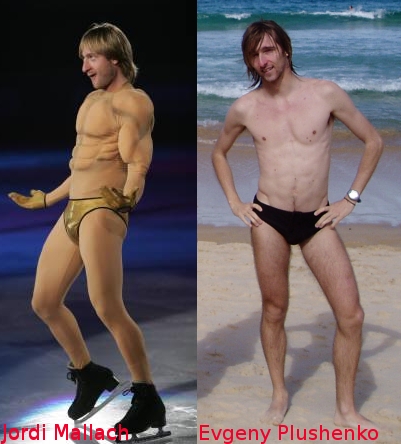
Benjamin Mako Hill: Jordi's Secret Life Uncovered

Could Debian developer and Catalan free software translator Jordi Mallach be living a secret life as champion Russian figure-skater Evgeny Plushenko? Recent photographic evidence uncovered by Mika seems to support such a theory. Decide for yourself:
/copyrighteous/images/jordi_evgeny-lookalike.jpg

8 September 2006

Jordi Mallach: GNOME 2.16

GNOME 2.16 was released this week, delivering, once again to the day, the usual catalogue of improvements and polishing. Congratulations, everyone! Catalan is, once again, very well covered in this release (99.87% completed as of this writing) thanks to the fantastic GNOME group at Softcatal . I have only been able to contribute an update to Sound Juicer and little more, due to lack of time and, admittedly, motivation, so I'm very glad to see the group continues to be healthy and active thanks to Xavi, Jordi, Maria (from WSOP fame!), Gil (awesome GUADEC organiser) and others, under the leadership of Josep. Moltes gr cies, equip!

2 September 2006

Jordi Mallach: GTetrinet 0.7.10 released

GTetrinet 0.7.10 is out. This release fixes a security hole (CVE-2006-3125), so you're advised to update ASAP. The last release was assembled during UbuntuDownUnder, back in April 2005, which is a good indication about GTetrinet's development health. If you're interested in writing new features or fixing the many bugs in GTetrinet, please consider joining the mailing list. GTetrinet really needs your help! Debian binaries are on the way to unstable; Ubuntu will hopefully suck them up soonish. Get the hot tarball from the GNOME FTP mirrors.

31 August 2006

Martin F. Krafft: Memes AGAIN?

The metro meme some of us subscribed to is all cute and well. But what's the point of having it on the Planet? I agree with Jordi that the Planet should not be a purely technical forum, but instead give insight into our colleagues' lives. I don't think the (incomplete) list of metros any one has used is really relevant or interesting. That's my opinion (and not impression), and if you think it's worth anything, please consider to discontinue.

Jordi Mallach: Just because I love trains

Metro lines I have used:

Got at b3co.com!

28 August 2006

Jordi Mallach: Thank you for the problem report you have sent regarding Debian.

Our user manuals encourage all newcomers to the Free Software community to file bugs when they find incorrections and bugs in a package. Of course, there's always some people who take it too far (!). Get prepared, DeFuBu challengers!

26 August 2006

Jordi Mallach: My battery visits the West Coast

Apple has announced a new battery recall program. Last time there was one affecting powerbooks, mine wasn't on the list, although I thought my battery was clearly overheating. This time, things are quite different.
This computer is eligible for the Battery Exchange Program.
This battery qualifies for the Battery Exchange Program.
The good news is I get a brand new battery. The bad news is that I don't know how much time it'll take.

22 August 2006

Jordi Mallach: XFS nightmares

Following up to madduck's and gwolf's recent horror stories on XFS, last Thursday, my desktop greeted me after the fantastic week around Asturies with a series of I/O errors whenever I tried to execute something. I rebooted, and then the kernel wasn't happy.
I/O error in filesystem ("hda1") meta-data dev hda1 block 0x4a9778  ("xlog_iodone") error 5 buf count 1024
/dev/hda1 is my / partition, and the machine would not boot at all. To make things more interesting, the box refused to boot from any of my old CD and DVD drives. Yesterday, with my mail piling up already at Sindominio's mailserver, I managed to find a spare CD writer, which would not open its tray, and a DVD reader which managed to boot a Breezy Live CD I had around. The good guys at #xfs were helpful as always and helped me in the process of not fucking up my valuable root filesystem while trying to fix it. The filesystem ended up having quite some corruption here and there, but after xfs_repair, nubol was able to boot again. Only it was missing libldap.so.2, libX11.so.6, debconf programs and other minor details like those. Some reinstall rounds later, GNOME was able to startup without errors and now the box is up and running. Does anyone know of some script that compares dpkg's contents database with that the filesystem has, so I can easily find the rest of damaged packages to reinstall them?

2 August 2006

Jordi Mallach: Asturies

Tomorrow I'll be going with Bel n to Asturies, one of the northern regions of the Spanish state. The plan is to spend the weekend in Ribadesella during the celebration of the Descenso Internacional del Sella and then move around the area and walk all over the beautiful Asturian mountains, during four days, until Friday. The plan for those four days is pretty loose right now, so if anyone has suggestions about must see places, I'm very interested in hearing them in comments. My idea is to do daytrips of several hours (6 or 7), coming back to our base camp to sleep, but if there's something we really should visit and it involves a two day stage, we'll probably bear with carrying the heavy tent around too.

1 August 2006

Gunnar Wolf: Israeli mistakes

Reading Jordi's blog, I cannot but agree with him (in most points): I plainly cannot understand Israel's actions in the last weeks. I can sadly understand how some people defend them, specially people not living in Israel - I was talking with a friend today, a friend who does not share a single political viewpoint with me, but still... The world seems to be completely polarized. Some have the impression that Israelis live under constant shelling, that life is unsustainable in that poor country, the last corner of civilization in that mess called the Middle East, and that the Arab countries (which are huge and petroleum-rich) just want to throw Jews to the sea or worse. The rest of the world think that Israelis are mass-murderers who decided to take a heavily populated bit of land and martyrize its originary population by any possible means, establishing an Apartheid.
Both views are false. But of course, both views hold their bits of truth.
I cannot claim to be neutral on this: Although I lived there in total for ~18 months, I am an Israeli by choice (I adopted the Israeli nationality in 1996 and wanted to live my life there - I came back to Mexico for personal reasons, and I later decided to stay here). I have not been to Israel since then - But I try to keep myself informed. And, living in a Jewish family, it's hard not to be somewhat informed - and of course, shocked at your relatives' opinions. Jews outside Israel tend to be right-wingers. I lived in a kibbutz, and I still sympathyze with Meretz, the most leftwing Zionist party.
I won't restate what Jordi eloquently said. I know not everybody who reads my blog reads Jordi's as well - Please do. If you missed it some lines above, here is the link. I insist: I agree with most of what he wrote. What could Israel do to protect itself from its enemies? The answer is simple: Don't give them a reason to hate you.
One year ago, I was optimistic because Israel was heading the right way. Of all people, Ariel Sharon (one of Israel's most hawkish, right-wing strongmen of all times) decided to withdraw from Gaza, and hinted that areas in the West Bank would follow. No, not the best way possible, not as his predecessor Menahem Begin did with Egypt leading to a strong and long lasting peace, and certainly not in the very notable way Itzhak Rabin did with Jordan, getting peace and even friendship. But at least, Sharon accepted the reality, and seemed he meant to let Palestinians build their state. When he organized a new party which reduced Likud to a shadow of its past, one of Israel's most prominent figures for the peace camp, Shimon Peres, joined. Amazing.
But still, there is too much hatred. Of course, life in Gaza is plainly not sustainable. You can walk the Gaza strip side to side in less than one hour, and North to South it's less than 50 Km long. Still, over 400,000 people live in there. The area is simply unsustainable.
Gaza depends for everything from Israel. Of course, according to the never-stable security status, the border between Gaza and Israel opens or closes every day. When I lived in Zikim, mostly every day there were five or six Arabs working with us... Except for the days when they weren't there. And, of course, Israel also depends on the Arabs for much of its hard labor jobs (as it's always the case when two economically disparate populations live together).
Anyway, back on track: Besides giving the Arabs their slice of land (which in a squeezed area as Israel is always hard; people have fought for such small spaces it's hard to believe), the only thing Israel can do is help them. It has worked before: Israeli Arabs (the Arabs living inside the internationally recognized borders of Israel) are full citizens. Yes, there is racism in the country towards them, and yes, they are not really equal with Jewish Israelis - But they have voting rights, they have the right to be elected, they can optionally join the army (it's not compulsory as it is with the Jewish population), and they get government aid. Arab towns are poorer than Jewish towns, yes, but they have their dignity.
The problem in Gaza and South Lebanon (somewhat less so in the West Bank, but also) is that it's plainly all made up of refugee camps. Refugees that were born there, and whose parents were born there as well. And, let me emphasize this, they are not Israel's fault. The refugees fled the newborn Israel because the Arab states said (in May 1948) they would enter Palestine and butcher everybody, inviting Arab civilians to flee and then get back home - of course, 700,000 (out of 1,300,000 who lived in Palestine by then) Arabs did so. And when the Arabs lost the war, the Palestinians were denied citizenship by all the Arab countries except for Jordan (not surprisingly, the most stable of them all, and with which Israel has the closest relation). They were given refugee camps to live, one over the other. When Egypt signed the peace with Israel, it demanded back every inch of the Sinai - But not an inch of Gaza. And not a single Palestinian refugee.
I agree here with Jordi as well: There is a huge military operation in Gaza, but it's more spectacular in Lebanon today. The media talks about Lebanon, but not about Gaza. And the crisis in Gaza is not easier. But how can it be solved in a permanent way? Israel does neither have land to spare to give to the Palestinians - and even if it did, most of Gaza is surrounded by the Negev, a desert where it would not be easy for them to get anything better than what they have inside Gaza. As desirable as it would be to have a completely independent Palestinian state, Gaza would just remain a concentration camp. There is too much hatred, and neither Arabs nor Israelis want to keep working together, not trusting each other. The only solution I can find to this is to have an agreement with Egypt, where Egypt opens its border with Gaza, gives either nationality or work permits to Gazan Palestinians, and Israel injects capital to develop Northern Sinai, to give some hope of survival to the almost half million people.
The same in Lebanon: Israel was widely applauded to withdraw from South Lebanon in 2000. The area is mostly peaceful - For $ DEITY 's sake, what is the kidnapping of two soldiers in a six year period compared to soldiers being killed in the occupation army every week or two? Israel did well to leave Lebanon. Lebanon was starting an incredible national rebuilding process, as Robert Fisk tells us (Spanish only. I could find only the first paragraphs of the original English version, which appears to require subscription) of the wonders of the rebuilding process, reduced to rubble again. Of course, Israeli and Syrian armies left Lebanon. The Lebanese government and army are plainly too weak to care for the country. Hezbollah (which, indoubtely, is a terrorist entity, no matter how many benefical aspects it does have) have poured tremendous amounts of money to rebuild its area of influence, South Lebanon. Of course, they rebuilt, healed and educated with a strong ideological inclination, and that's not good for Israel. What can Israel do to leasen the Islamist influence? Simple: Send aid. Don't just leave. Don't leave a void, don't invite bad people to loot, don't invite extremist people to recruite future bombers. Turn occupation into aid. Build hospitals. Build houses. Give money, give infrastructure. Do it behind your back, as you gave money to the South Lebanon Army for almost 20 years. But make the people see you don't want to kill and rob them - Make the Lebanese Arabs feel their neighbour as a friend, although different. Bring back the good border. What's that? That's the nickname for the Lebanese border between +- 1950 and 1970 - The only border that was stable, that was not filled with hatred, where Israeli doctors treated Lebanese patients across the fence. And still today, the border is just a simple fence.
How can you convince a people of not killing themselves to kill the invasor? Don't act as an invasor. Act in all your best self-interest - Save them from poverty and from indignity.

31 July 2006

Jordi Mallach: Qana, Lebanon

I've been watching the Lebanese bloodshed since it started. It really makes me sick. I have discussed this with many friends. There was little discussion though: we all thought this is a plain war against civilian targets. I tried discussing with people who could maybe be more supportive of the Israeli points of view. I tried talking to some of my right-winger relatives... and I haven't been able to find anyone that can say a word of support of what Israel is doing in Lebanon. In three weeks, I have seen how Hizbullah killed some Israeli soldiers in some area around the border between Lebanon and Israel. As far as my (as an international online paper reader) judgement can tell, the location where this happened is disputed. Some say it was inside Lebanese territory, the others say it was an Hizbullah incursion into Israeli soldiers. I really don't care. The immediate result of this action was a campaign of air strikes against Beirut and other Lebanese cities aiming to give a measured response (cache, and beware this is explicit) to Hizbulla's aggression. This, apparently, included destroying any vital infrastructure in heavily populated areas of Beirut, including bridges, power plants, hospitals and apparently random buildings. While the Israeli army said the military operations were aimed to get rid of the Hizbullah camps and infrastructures around the border where they fire their rockets against Haifa and other Israeli cities, and their headquarters in Beirut and other southern cities, what the world espectated during the first three or four days of air strikes was pure horror. Hizbullah-controlled areas were like ghost quarters, so any bombing of those were very unlikely to take any Hizbullah victims. On the other hand, the rising number of civilian victims was the first bits of news that I could hear in my radio as I woke up every morning. All of this, with a great amount of cinism and unlimitted cruelty. The Israeli army declared that the civilian population in the South should be leaving their homes (measured response), while they knew they were doing exactly what was needed to prevent this, by locking them up around destroyed bridges, harbours, airport and roads. The first columns of the lucky refugees who could afford fleeing to the North were greeted by Israeli bombs, leaving a good number of scattered bodies. In Spain, the news shocked the public opinion and Zapatero, along with Chirac (IIRC), declared those actions were untolerable and unproportionate, and should be stopped immediately. This brought some local politics fun, when on one side the Israel ambassador in Spain accussed Zapatero of being antisemitic, and the right-wing leader Rajoy called the thousands of people who spontaneously demonstrated against the war in a few cities "clowns" and "ignorant". Watching what the UN has done to stop these warcrimes, I really think it's a great moment to shut down that useless organisation and let some big corporation buy their nice building in New York City to build their offices in it. Once again, when some countries tried to come up with some resolution that forced Israel to stop, the United States waived their vetto flag. Once again, the Security Council has done nothing to put an end to another chapter of violence in the Middle East. The vettoing powers of some of the members is so ridiculous that it makes it totally inoperative. So, as the UK and US governments were not going to do anything to stop the air strikes, Israel had carte blanche to do whatever they wanted for a week. And then, Israel's measured response destroyed one of the UN's buildings in Lebanon, killing four annoying observers, despite their calls warning that the bombs were falling too near their location. Only then, the United States decided to send Condie to have a look around the area, surprise visit to Beirut included. I wonder, what phone number must the innocent women and children who cannot escape their cities and towns dial in order to warn the Israeli army about the proximity of their bombed targets? After two visits of Condie to the region, nothing has changed, as the fourth week of operations starts. This is getting on my nerves. I don't, and won't, justify any of the Hizbullah attacks on civilian targets using Katyushas, or the kidnapping of soldiers, or whatever. What I see is that unless Israel takes a radically different approach to their problem, nothing will change either. Violence isn't at least. Apparently, their military operation isn't going well at all, and is not damaging much of Hizbullah's military capacity. What are they going to do? Will they occupy southern Lebanon for 20 more years? The social movements this kind of actions are generating is also very, very worrying. On one hand, I read that around 85% of the Israeli population approve this war and think this is what their government needs to do to make them safe. This is pretty shocking. On the other hand, everyone still in Lebanon, even the Christian community, are united against the attack, helping each other in their survival quest, while the popular support to Hizbullah is rising, with big concentrations of people cheering them in the streets. This is just two years after similar demonstrations in Beirut forced the Syrian military out of the country. While the Israeli war against Lebanon (I won't buy the "It's against Hizbullah" bullshit), sadly all the media, cameras and journalists have given their back on Gaza, which is under similar, but probably more brutal and savage military operations by Israel, as another soldier was kidnapped just one week before all of the Lebanon stuff started. The press doesn't have any news of how things are going in Gaza. The last thing I remember is that the UN was warning about the threat of a humanitarian disaster due to the lack of any kind of supplies in Palestine. If Palestinian kids are starving, the media are not letting us know. Yesterday, 54 civilians were killed in an improvised underground bomb shelter in Qana, most of them being children. The Lebanese civilian death toll must be well over 500 as of this writing, with a ratio of at least 1:10 compared to Israeli military victims. When will Olmert have enough? The only way I see this will end up for good is when the Israeli public realises being at war in three fronts is quite expensive and damages their home economies. Maybe, at that point, people start hearing what the Meretz party minority in the country have been saying for years. Israel has the right to defend itself. This is the official motto of Israeli and American leaders. When this right is extended and abused to the point the main targets and victims are civilians, Israel walks quickly away from a perdurable solution. Today, hostility against the state of Israel is even greater than last month. Hizbullah in Lebanon, Hamas in Palestine, will probably be the winners of the conflict when the bombings end. Not the best recipe for a peaceful future.

18 July 2006

Jordi Mallach: Seventy years of the Spanish Civil War and the Spanish Revolution

A few months ago I wrote about the 75th anniversary of the proclamation of the Second Spanish Republic which was celebrated throughout the state. That weekend I visited a fantastic exposition of Republican and Revolutionary war propaganda posters, in Segorbe.

Today, Spain remembers the beginning of the end. During the evening of the 17th of July and morning of the 18th, a group of generals of the Spanish regular army raised against the democratically elected left-wing government of the Republic. History says that the murdering of Calvo-Sotelo, a right-wing leader, was what finally provoked the conflict. It was no secret that the same right-wing and some elements in the army had been conspiring for weeks about an uprise. The only question was when, but the government was fooled by general Mola and didn't take really effective measures to prevent it.


Warning from sanitary authorities against venereal diseases Mola and Sanjurjo planned to start taking over official buildings and army quarters and quickly seize control of the major cities. During the first hours of their rebelion, they managed to take over most of the southern regions in Andalusia, Extremadura and parts of the Northwest, plus most of the islands and the Moroccan protectorate area. Meanwhile, the Republic did not manage to react quickly due to the weakness of the government, and in the first days of the crisis, the government changed a few times. Finally, the Republican parties decided that to defend the state they should give arms to the unions, and soon after many militia groups were getting organised in the cities, and columns sent off to liberate other towns.


Solidarity of Catalunya to the Basque front The insurrection was suffocated in Barcelona after some heavy fighting against the military in the Montju c castle; the Anarchists of the CNT grew strong in Catalunya and Arag n, and offered good resistance in those fronts. After the first days of the coupe d'etat, it was clear neither the legitimate government or the rebels calculated how things would go after the first days. The government was confident in being able to end the rebelion as they did four years before; the fascists thought they would have quickly brought down the government with a successful coup. But after the first week, the country was divided in two halves, and both sides of the conflict were keen on fighting, due to the big social fracture during the last months of the government. The Republic asked for help to the League of Nations, but the United Kingdom and France decided not to intervene, scared about the conflict trespassing the Spanish borders and becoming another bloody war in European fields. The only official external aid came from the USSR and the International Brigades, formed by volunteers of more than 50 nations. Some well-known personalities like Ernest Hemingway or George Orwell came to aid as well. Orwell wrote about his life-changing experience in a Barcelona immerse in the social revolution, where he joined the anti-stalinist socialist party POUM. Badly wounded in the neck, he left the front and went back to Barcelona, and witnessed the assault of the Telef nica by the communists against the anarchists, during the fets de maig, after which the POUM was declared illegal. Orwell captured his experiences in the frontline and Barcelona in his book Homage to Catalonia.


To defend Madrid is to defend Catalunya Franco and Mola, aided by the Northafrican troops and soon after by their fascist allies of Italy and Germany, didn't have big problems seizing the Basque Country and Asturies in the North, but not before making the town of Gernika disappear below the nazi Condor Legion bombing, in what would be a test for the massive aereal bombings of Word War II. The battle for Madrid was fierce, and the city wasn't occupied until the very last days of the war. The long defence of the capital made was immortalised in the famous phrase No pasar n.


Madrid's No pasar n During the war, anarchist groups controlling fields and towns in Arag n and Catalunya managed to bring a Social Revolution to the area. The people collectivised the land and industries, administered by local assemblies. This experience is regarded as the time when Libertarian Communism has been successful. The experience ended dramatically when the anarchists were treasoned and blocked by the communists, and eventually defeated by Franco at the front.


Each bullet for a target After the first and a half years, the fronts had stabilised in Madrid and the East of Andalusia, until early in 1939, Barcelona fell in Franco's hands, after the bloody Batalla de l'Ebre, being followed by Girona and the rest of Catalunya. The fate of the democratic state was clear. Two months later, Madrid fell and Val ncia and the small area still under Republican control surrended.


Robert Capa's Muerte de un miliciano Franco declared a totalitarian regime to, according to the fascists, reconcile the two Spains. In the first five years of the regime, up to 100.000 were executed in the franquist repression, including the Catalan president, Llu s Companys and many intellectuals. The dictatorship continued executing people until two months before Franco's death, 36 years later. Hundreds of thousands also had to exile in M xico, France and other destinations, leaving Spain in ashes, road gutters full of scattered bodies and the population facing famine. The cultural elite left the country, making the state's clock go back at least a decade. Their reconciliation really meant humiliation and repression. Many people were also murdered during the war behind republican and rebel lines, but the genocide of the aftermath had was unmatchable.


The Republic promoted education among the troups It is a bit late to restore the dignity of the victims, but not too late. Some associations have been fighting since the end of Franco's regime to get some kind of public recognition for their suffering, for their priceless fight for the legal and democratically elected Republic, for the people who didn't make it.


Excellent anarchist poster rejecting the politisation
of children by any of the three loyal groups Other people reject these efforts banning them of "revisionism". Not too surprisingly, these are the sons or grandsons of the people who won the war. The current government is about to pass a Historic Memory law which aims to give recognition to all these people who gave their lives for an ideal and freedom. Unfortunately, due to pressures from the right, it is probable that the text will be ammended to make it more acceptable by them. I fear it will end up not pleasing the victims at all. I have a passion for Spanish Civil War related matters, and in the last years I tried to use any opportunity to listen to my Catalan grandmother talk about war affairs in Barcelona, and my grandfather, from a town in the middle of the Republican side of the Teruel front, but born in a very catholic family, about how the war went on in Vall and the nearby mountains.


From the defensive No pasar n to the encouraging Pasaremos! I know my grandfather only told me the less compromising stories, like how he was sent to dig refuges until he was 16 and apt to fight in the Front, or how he was put in charge of hiding the church's valuable relics in a few barns. He never told me about how life was after the war in the small town. It is dramatic to see that all the people who were old enough to have a sense of what was going on at the time are so old that these unvaluable memories and stories will be mostly gone in ten years. (Most of the pictures are taken from the Sociedad Ben fica de Historiadores Aficionados y Creadores' website, which has a huge documented catalog)

16 July 2006

Jordi Mallach: New SMS received

Message 1
I am in Spain!
What a fine country.
+1310XXXXXXX
2006/07/16 18:10:18
Dear sender,
I'm happy about you being so enthusiastic about your visit to Spain. I would probably be able to share the moment with you if I had the slightest clue about your identity.
Have a great night at nearly 30 C,
Jordi

Next.

Previous.