Search Results: "joey"

3 November 2015

Joey Hess: STM Region contents

concurrent-output released yesterday got a lot of fun features. It now does full curses-style minimization of the output, to redraw updated lines with optimal efficiency. And supports multiline regions/wrapping too long lines. And allows the user to embed ANSI colors in a region. 3 features that are in some tension and were fun to implement all together. But I have a more interesting feature to blog about... I've added the ability for the content of a Region to be determined by a (STM transaction). Here, for example, is a region that's a clock:
timeDisplay :: TVar UTCTime -> STM Text
timeDisplay tv = T.pack . show <$> readTVar tv
clockRegion :: IO ConsoleRegionHandle
clockRegion = do
    tv <- atomically . newTVar =<< getCurrentTime
    r <- openConsoleRegion Linear
    setConsoleRegion r (timeDisplay tv)
    async $ forever $ do
        threadDelay 1000000 -- 1 sec
        atomically . (writeTVar tv) =<< getCurrentTime
    return r
There's something magical about this. Whenever a new value is written into the TVar, concurrent-output automatically knows that this region needs to be updated. How does it know how to do that? Magic of STM. Basically, concurrent-output composes all the STM transactions of Regions, and asks STM to wait until there's something new to display. STM keeps track of whatever TVars might be looked at, and so can put the display thread to sleep until there's a change to display. Using STM I've gotten extensability for free, due to the nice ways that STM transactions compose. A few other obvious things to do with this: Compose 2 regions with padding so they display on the same line, left and right aligned. Trim a region's content to the display width. (Handily exported by concurrent-output in a TVar for this kind of thing.)
I'm tempted to write a console spreadsheet using this. Each visible cell of the spreadsheet would have its own region, that uses a STM transaction to display. Plain data Cells would just display their current value. Cells that contain a function would read the current values of other Cells, and use that to calculate what to display. Which means that a Cell containing a function would automatically update whenever any of the Cells that it depends on were updated! Do you think that a simple interactive spreadsheet built this way would be more than 100 lines of code?

31 October 2015

Joey Hess: a tiling region manager for the console

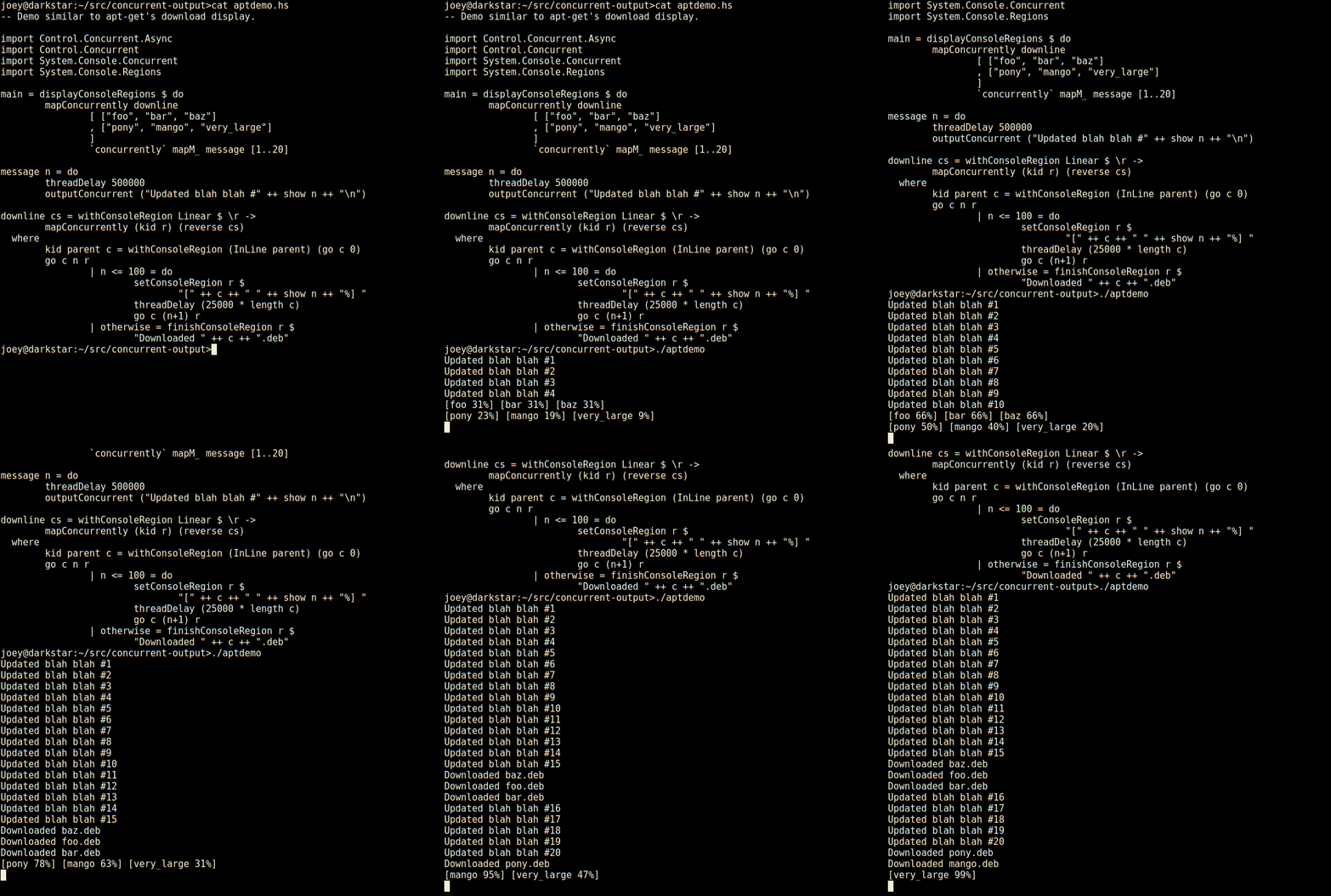
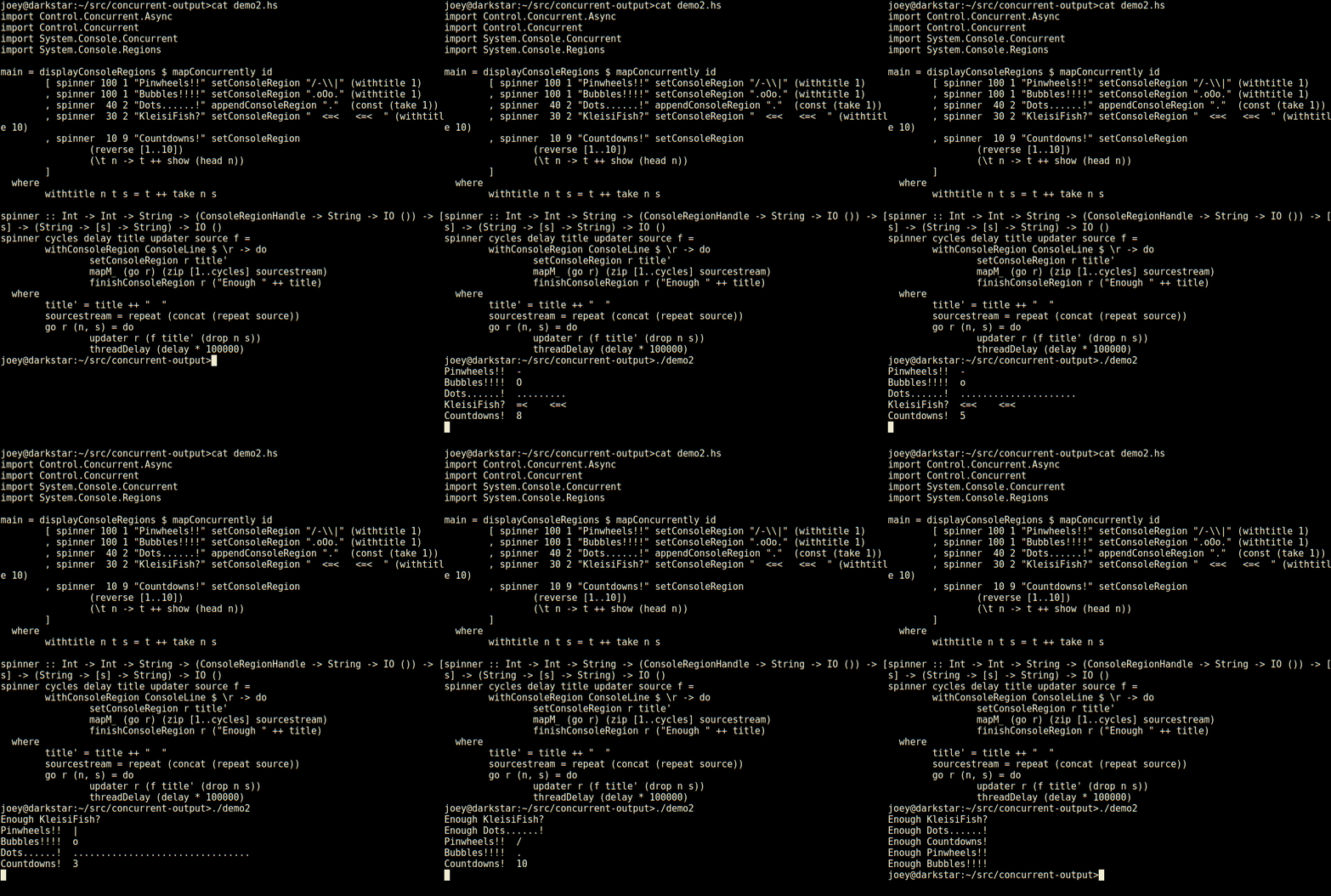
Building on top of concurrent-output, and some related work Joachim Breitner did earlier, I now have a kind of equivilant to a tiling window manager, except it's managing regions of the console for different parts of a single program. Here's a really silly demo, in an animated gif: demo2.gif Not bad for 23 lines of code, is that? Seems much less tedious to do things this way than using ncurses. Even with its panels, ncurses requires you to think about layout of various things on the screen, and many low-level details. This, by contrast, is compositional, just add another region and a thread to update it, and away it goes. So, here's an apt-like download progress display, in 30 lines of code. aptdemo.gif Not only does it have regions which are individual lines of the screen, but those can have sub-regions within them as seen here (and so on). And, log-type messages automatically scroll up above the regions. External programs run by createProcessConcurrent will automatically get their output/errors displayed there, too. What I'm working on now is support for multiline regions, which automatically grow/shrink to fit what's placed in them. The hard part, which I'm putting the finishing touches on, is to accurately work out how large a region is before displaying it, in order to lay it out. Requires parsing ANSI codes amoung other things. STM rules There's so much concurrency, with complicated interrelated data being updated by different threads, that I couldn't have possibly built this without Software Transactional Memory. Rather than a nightmare of locks behind locks behind locks, the result is so well behaved that I'm confident that anyone who needs more control over the region layout, or wants to do funky things can dive into to the STM interface and update the data structures, and nothing will ever deadlock or be inconsistent, and as soon as an update completes, it'll display on-screen. An example of how powerful and beuatiful STM is, here's how the main display thread determines when it needs to refresh the display:
data DisplayChange
        = BufferChange [(StdHandle, OutputBuffer)]
          RegionChange RegionSnapshot
          TerminalResize (Maybe Width)
          EndSignal ()
    ...
                change <- atomically $
                        (RegionChange <$> regionWaiter origsnapshot)
                                 orElse 
                        (RegionChange <$> regionListWaiter origsnapshot)
                                 orElse 
                        (BufferChange <$> outputBufferWaiterSTM waitCompleteLines)
                                 orElse 
                        (TerminalResize <$> waitwidthchange)
                                 orElse 
                        (EndSignal <$> waitTSem endsignal)
                case change of
                        RegionChange snapshot -> do
                ...
                        BufferChange buffers -> do
                ...
                        TerminalResize width -> do
                ...
So, it composes all these STM actions that can wait on various kinds of changes, to get one big action, that waits for all of the above, and builds up a nice sum type to represent what's changed. Another example is that the whole support for sub-regions only involved adding 30 lines of code, all of it using STM, and it worked 100% the first time.
Available in concurrent-output 1.1.0.

29 October 2015

Joey Hess: concurrent output library

concurrent-output is a Haskell library I've developed this week, to make it easier to write console programs that do a lot of different things concurrently, and want to serialize concurrent outputs sanely. It's increasingly easy to write concurrent programs, but all their status reporting has to feed back through the good old console, which is still obstinately serial. Haskell illustrates problem this well with this "Linus's first kernel" equivilant interleaving the output of 2 threads:
> import System.IO
> import Control.Concurrent.Async
> putStrLn (repeat 'A')  concurrently  putStrLn (repeat 'B')
BABABABABABABABABABABABABABABABABABABABABABABABABABABABABABABABABABABABABABABA
...
That's fun, but also horrible if you wanted to display some messages to the user:
> putStrLn "washed the car"  concurrently  putStrLn "walked the dog"
walwkaesdh etdh et hdeo gc
ar
To add to the problem, we often want to run separate programs concurrently, which have output of their own to display. And, just to keep things interesting, sometimes a unix program will behave differently when stdout is not connected to a terminal (eg, ls cat). To tame simple concurrent programs like these so they generate readable output involves a lot of plumbing. Something like, run the actions concurrently, taking care to capture the output of any commands, and then feed the output that the user should see though some sort of serializing channel to the display. Dealing with that when you just wanted a simple concurrent program risks ending up with a not-so-simple program. So, I wanted an library with basically 2 functions:
outputConcurrent :: String -> IO ()
    
createProcessConcurrent :: CreateProcess -> IO whatever
The idea is, you make your program use outputConcurrent to display all its output, and each String you pass to that will be displayed serially, without getting mixed up with any other concurrent output. And, you make your program use createProcessConcurrent everywhere it starts a process that might output to stdout or stderr, and it'll likewise make sure its output is displayed serially. Oh, and createProcessConcurrent should avoid redirecting stdout and stderr away from the console, when no other concurrent output is happening. So, if programs are mostly run sequentially, they behave as they normally would at the console; any behavior changes should only occur when there is concurrency. (It might also be nice for it to allocate ttys and run programs there to avoid any behavior changes at all, although I have not tried to do that.) And that should be pretty much the whole API, although it's ok if it needs some function called by main to set it up:
import Control.Concurrent.Async
import System.Console.Concurrent
import System.Process
main = withConcurrentOutput $
    outputConcurrent "washed the car\n"
         concurrently 
    createProcessConcurrent (proc "ls" [])
         concurrently 
    outputConcurrent "walked the dog\n"
$ ./demo
washed the car
walked the dog
Maildir/  bin/  doc/  html/  lib/  mail/  mnt/  src/  tmp/
I think that's a pretty good API to deal with this concurrent output problem. Anyone know of any other attempts at this I could learn from? I implemented this over the past 3 days and 320 lines of code. It got rather hairy: It seems to work pretty great though. I got Propellor using it, and Propellor can now run actions concurrently!

23 October 2015

Joey Hess: propelling disk images

Following up on Then and Now ... In quiet moments at ICFP last August, I finished teaching Propellor to generate disk images. With an emphasis on doing a whole lot with very little new code and extreme amount of code reuse. For example, let's make a disk image with nethack on it. First, we need to define a chroot. Disk image creation reuses propellor's chroot support, described back in propelling containers. Any propellor properties can be assigned to the chroot, so it's easy to describe the system we want.
 nethackChroot :: FilePath -> Chroot
    nethackChroot d = Chroot.debootstrapped (System (Debian Stable) "amd64") mempty d
        & Apt.installed ["linux-image-amd64"]
        & Apt.installed ["nethack-console"]
        & accountFor gamer
        & gamer  hasInsecurePassword  "hello"
        & gamer  hasLoginShell  "/usr/games/nethack"
      where gamer = User "gamer"
Now to make an image from that chroot, we just have to tell propellor where to put the image file, some partitioning information, and to make it boot using grub.
 nethackImage :: RevertableProperty
    nethackImage = imageBuilt "/srv/images/nethack.img" nethackChroot
        MSDOS (grubBooted PC)
        [ partition EXT2  mountedAt  "/boot"
             setFlag  BootFlag
        , partition EXT4  mountedAt  "/"
             addFreeSpace  MegaBytes 100
        , swapPartition (MegaBytes 256)
        ]
The disk image partitions default to being sized to fit exactly the files from the chroot that go into each partition, so, the disk image is as small as possible by default. There's a little DSL to configure the partitions. To give control over the partition size, it has some functions, like addFreeSpace and setSize. Other functions like setFlag and extended can further adjust the partitions. I think that worked out rather well; the partition specification is compact and avoids unecessary hardcoded sizes, while providing plenty of control. By the end of ICFP, I had Propellor building complete disk images, but no boot loader installed on them.
Fast forward to today. After stuggling with some strange grub behavior, I found a working method to install grub onto a disk image. The whole disk image feature weighs in at: 203 lines to interface with parted
88 lines to format and mount partitions
90 lines for the partition table specification DSL and partition sizing
196 lines to generate disk images
75 lines to install grub on a disk image
652 lines of code total Which is about half the size of vmdebootstrap 1/4th the size of partman-base (probably 1/100th the size of total partman), and 1/13th the size of live-build. All of which do similar things, in ways that seem to me to be much less flexible than Propellor.
One thing I'm considering doing is extending this so Propellor can use qemu-user-static to create disk images for eg, arm. Add some u-boot setup, and this could create bootable images for arm boards. A library of configs for various arm boards could then be included in Propellor. This would be a lot easier than running the Debian Installer on an arm board. Oh! I only just now realized that if you have a propellor host configured, like this example for my dialup gateway, leech --
 leech = host "leech.kitenet.net"
        & os (System (Debian (Stable "jessie")) "armel")
        & Apt.installed ["linux-image-kirkwood", "ppp", "screen", "iftop"]
        & privContent "/etc/ppp/peers/provider"
        & privContent "/etc/ppp/pap-secrets"
        & Ppp.onBoot
        & hasPassword (User "root")
        & Ssh.installed
-- The host's properties can be extracted from it, using eg hostProperties leech and reused to create a disk image with the same properties as the host! So, when my dialup gateway gets struck by lightning again, I could use this to build a disk image for its replacement:
 import qualified Propellor.Property.Hardware.SheevaPlug as SheevaPlug
    laptop = host "darkstar.kitenet.net"
        & SheevaPlug.diskImage "/srv/images/leech.img" (MegaBytes 2000)
            (& propertyList "has all of leech's properties"
                (hostProperties leech))
This also means you can start with a manually built system, write down the properties it has, and iteratively run Propellor against it until you think you have a full specification of it, and then use that to generate a new, clean disk image. Nice way to transition from sysadmin days of yore to a clean declaratively specified system.

22 October 2015

Joey Hess: propellor orchestration

With the disclamer that I don't really know much about orchestration, I have added support for something resembling it to Propellor. Until now, when using propellor to manage a bunch of hosts, you updated them one at a time by running propellor --spin $somehost, or maybe you set up a central git repository, and a cron job to run propellor on each host, pulling changes from git. I like both of these ways to use propellor, but they only go so far... All those scenarios are supported by propellor now! Well, I haven't actually implemented concurrently yet, but the point is that the conducts property can be used with any of propellor's property combinators, like before etc, to express all kinds of scenarios. The conducts property works in combination with an orchestrate function to set up all the necessary stuff to let one host ssh into another and run propellor there.
main = defaultMain (orchestrate hosts)
hosts = 
    [ master
    , webservers 
    , ...
    ]
The orchestrate function does a bunch of stuff: I've very pleased that I was able to add the Propellor.Property.Conductor module implementing this with only a tiny change to the rest of propellor. Almost everything needed to implement it was there in propellor's infrastructure already. Also kind of cool that it only needed 13 lines of imperative code, the other several hundred lines of the implementation being all pure code.

17 October 2015

Joey Hess: it's a bird, it's a plane, it's a super monoid for propellor

I've been doing a little bit of dynamically typed programming in Haskell, to improve Propellor's Info type. The result is kind of interesting in a scary way. Info started out as a big record type, containing all the different sorts of metadata that Propellor needed to keep track of. Host IP addresses, DNS entries, ssh public keys, docker image configuration parameters... This got quite out of hand. Info needed to have its hands in everything, even types that should have been private to their module. To fix that, recent versions of Propellor let a single Info contain many different types of values. Look at it one way and it contains DNS entries; look at it another way and it contains ssh public keys, etc. As an migr from lands where you can never know what type of value is in a $foo until you look, this was a scary prospect at first, but I found it's possible to have the benefits of dynamic types and the safety of static types too. The key to doing it is Data.Dynamic. Thanks to Joachim Breitner for suggesting I could use it here. What I arrived at is this type (slightly simplified):
newtype Info = Info [Dynamic]
    deriving (Monoid)
So Info is a monoid, and it holds of a bunch of dynamic values, which could each be of any type at all. Eep! So far, this is utterly scary to me. To tame it, the Info constructor is not exported, and so the only way to create an Info is to start with mempty and use this function:
addInfo :: (IsInfo v, Monoid v) => Info -> v -> Info
addInfo (Info l) v = Info (toDyn v : l)
The important part of that is that only allows adding values that are in the IsInfo type class. That prevents the foot shooting associated with dynamic types, by only allowing use of types that make sense as Info. Otherwise arbitrary Strings etc could be passed to addInfo by accident, and all get concated together, and that would be a total dynamic programming mess. Anything you can add into an Info, you can get back out:
getInfo :: (IsInfo v, Monoid v) => Info -> v
getInfo (Info l) = mconcat (mapMaybe fromDynamic (reverse l))
Only monoids can be stored in Info, so if you ask for a type that an Info doesn't contain, you'll get back mempty. Crucially, IsInfo is an open type class. Any module in Propellor can make a new data type and make it an instance of IsInfo, and then that new data type can be stored in the Info of a Property, and any Host that uses the Property will have that added to its Info, available for later introspection.
For example, this weekend I'm extending Propellor to have controllers: Hosts that are responsible for running Propellor on some other hosts. Useful if you want to run propellor once and have it update the configuration of an entire network of hosts. There can be whole chains of controllers controlling other controllers etc. The problem is, what if host foo has the property controllerFor bar and host bar has the property controllerFor foo? I want to avoid a loop of foo running Propellor on bar, running Propellor on foo, ... To detect such loops, each Host's Info should contain a list of the Hosts it's controlling. Which is not hard to accomplish:
newtype Controlling = Controlled [Host]
    deriving (Typeable, Monoid)
isControlledBy :: Host -> Controlling -> Bool
h  isControlledBy  (Controlled hs) = any (== hostName h) (map hostName hs)
instance IsInfo Controlling where
    propigateInfo _ = True
mkControllingInfo :: Host -> Info
mkControllingInfo controlled = addInfo mempty (Controlled [controlled])
getControlledBy :: Host -> Controlling
getControlledBy = getInfo . hostInfo
isControllerLoop :: Host -> Host -> Bool
isControllerLoop controller controlled = go S.empty controlled
  where
    go checked h
          controller  isControlledBy  c = True
        -- avoid checking loops that have been checked before
          hostName h  S.member  checked = False
          otherwise = any (go (S.insert (hostName h) checked)) l
      where
        c@(Controlled l) = getControlledBy h
This is all internal to the module that needs it; the rest of propellor doesn't need to know that the Info is using used for this. And yet, the necessary information about Hosts is gathered as propellor runs.
So, that's a useful technique. I do wonder if I could somehow make addInfo combine together values in the list that have the same type; as it is the list can get long. And, to show Info, the best I could do was this:
 instance Show Info where
            show (Info l) = "Info " ++ show (map dynTypeRep l)
The resulting long list of the types of vales stored in a host's info is not a useful as it could be. Of course, getInfo can be used to get any particular type of value:
*Main> hostInfo kite
Info [InfoVal System,PrivInfo,PrivInfo,Controlling,DnsInfo,DnsInfo,DnsInfo,AliasesInfo, ...
*Main> getInfo (hostInfo kite) :: AliasesInfo
AliasesInfo (fromList ["downloads.kitenet.net","git.joeyh.name","imap.kitenet.net","nntp.olduse.net" ...
And finally, I keep trying to think of a better name than "Info".
23 September 2015

Simon Josefsson: Cosmos A Simple Configuration Management System

Back in early 2012 I had been helping with system administration of a number of Debian/Ubuntu-based machines, and the odd Solaris machine, for a couple of years at $DAYJOB. We had a combination of hand-written scripts, documentation notes that we cut n paste d from during installation, and some locally maintained Debian packages for pulling in dependencies and providing some configuration files. As the number of people and machines involved grew, I realized that I wasn t happy with how these machines were being administrated. If one of these machines would disappear in flames, it would take time (and more importantly, non-trivial manual labor) to get its services up and running again. I wanted a system that could automate the complete configuration of any Unix-like machine. It should require minimal human interaction. I wanted the configuration files to be version controlled. I wanted good security properties. I did not want to rely on a centralized server that would be a single point of failure. It had to be portable and be easy to get to work on new (and very old) platforms. It should be easy to modify a configuration file and get it deployed. I wanted it to be easy to start to use on an existing server. I wanted it to allow for incremental adoption. Surely this must exist, I thought. During January 2012 I evaluated the existing configuration management systems around, like CFEngine, Chef, and Puppet. I don t recall my reasons for rejecting each individual project, but needless to say I did not find what I was looking for. The reasons for rejecting the projects I looked at ranged from centralization concerns (single-point-of-failure central servers), bad security (no OpenPGP signing integration), to the feeling that the projects were too complex and hence fragile. I m sure there were other reasons too. In February I started going back to my original needs and tried to see if I could abstract something from the knowledge that was in all these notes, script snippets and local dpkg packages. I realized that the essence of what I wanted was one shell script per machine, OpenPGP signed, in a Git repository. I could check out that Git repository on every new machine that I wanted to configure, verify the OpenPGP signature of the shell script, and invoke the script. The script would do everything needed to get the machine up into an operational stage again, including package installation and configuration file changes. Since I would usually want to modify configuration files on a system even after its initial installation (hey not everyone is perfect), it was natural to extend this idea to a cron job that did git pull , verified the OpenPGP signature, and ran the script. The script would then have to be a bit more clever and not redo everything every time. Since we had many machines, it was obvious that there would be huge code duplication between scripts. It felt natural to think of splitting up the shell script into a directory with many smaller shell scripts, and invoke each shell script in turn. Think of the /etc/init.d/ hierarchy and how it worked with System V initd. This would allow re-use of useful snippets across several machines. The next realization was that large parts of the shell script would be to create configuration files, such as /etc/network/interfaces. It would be easier to modify the content of those files if they were stored as files in a separate directory, an overlay stored in a sub-directory overlay/, and copied into the file system s hierarchy with rsync. The final realization was that it made some sense to run one set of scripts before rsync ing in the configuration files (to be able to install packages or set things up for the configuration files to make sense), and one set of scripts after the rsync (to perform tasks that require some package to be installed and configured). These set of scripts were called the pre-tasks and post-tasks respectively, and stored in sub-directories called pre-tasks.d/ and post-tasks.d/. I started putting what would become Cosmos together during February 2012. Incidentally, I had been using etckeeper on our machines, and I had been reading its source code, and it greatly inspired the internal design of Cosmos. The git history shows well how the ideas evolved even that Cosmos was initially called Eve but in retrospect I didn t like the religious connotations and there were a couple of rewrites on the way, but on the 28th of February I pushed out version 1.0. It was in total 778 lines of code, with at least 200 of those lines being the license boiler plate at the top of each file. Version 1.0 had a debian/ directory and I built the dpkg file and started to deploy on it some machines. There were a couple of small fixes in the next few days, but development stopped on March 5th 2012. We started to use Cosmos, and converted more and more machines to it, and I quickly also converted all of my home servers to use it. And even my laptops. It took until September 2014 to discover the first bug (the fix is a one-liner). Since then there haven t been any real changes to the source code. It is in daily use today. The README that comes with Cosmos gives a more hands-on approach on using it, which I hope will serve as a starting point if the above introduction sparked some interest. I hope to cover more about how to use Cosmos in a later blog post. Since Cosmos does so little on its own, to make sense of how to use it, you want to see a Git repository with machine models. If you want to see how the Git repository for my own machines looks you can see the sjd-cosmos repository. Don t miss its README at the bottom. In particular, its global/ sub-directory contains some of the foundation, such as OpenPGP key trust handling.

8 September 2015

Daniel Silverstone: Orchestration, a cry for help

Over the past few years, a plethora of orchestration frameworks have been exploding onto the scene. Many have been around for quite a while but not all have the same sort of community behind them. For example there's a very interesting option in Joey Hess' Propellor but that is hurt by needing to be able to build Propellor on all the hosts you manage. On the other hand, Ansible is able to operate without installing extra software on your target hosts, but instead it ends up very latency-bound which can cause problems when your managed hosts are "far away". I have considered CFEngine, Chef, Puppet and Salt in addition to the above mentioned options, but none of them feel quite right to me. I am looking for a way to manage a small number of hosts, at least one of which is not always online (my laptop) and all of which are essentially snowflakes whose sparkleybits I want some reasonable control over. I have a few basic requirements which I worry would be hard to meet -- I want to be able to make changes to my hosts by editing a file and committing/pushing it to a git server. I want to be able to manage a host entirely over SSH from one or more systems, ideally without having to install the orchestration software on the target host, but where if the software is present it will get used to accelerate matters. I don't want to have to install Ruby or PHP on any system in order to have orchestration, and some of the systems I wish to manage simply can't compile Haskell stuff sanely. I'm not desperately interested in learning yet more DSLs, but I appreciate that it will be necessary, but I really don't want to have to learn more than one DSL simply to run one frameworks. I don't want to have to learn strange and confusing combinations of file formats. For example, Ansible quite sensibly uses YAML for its structured data except for its host/group lists. It uses Jinja2 for its templating and looping, except for some things which it generates its own looping constructs inside its YAML. I also personally find Ansible's sportsball oriented terminology to be confusing, but that might just be me. So what I'm hoping is that someone will be able to point me at a project which combines all the wonderful features of the above, with a need to learn only one DSL and which doesn't require to be installed on the managed host but which can benefit from being so installed, is driven from git, and won't hurt my already overly burdened brain. Dear Lazyweb, pls. kthxbye.

6 September 2015

Lunar: Reproducible builds: week 19 in Stretch cycle

What happened in the reproducible builds effort this week: Toolchain fixes Dmitry Shachnev uploaded sphinx/1.3.1-6 with improved patches from Val Lorentz. Chris Lamb submitted a patch for ibus-table which makes the output of ibus-table-createdb deterministic. Niko Tyni wrote a patch to make libmodule-build-perl linking order deterministic. Santiago Vila has been leading discussions on the best way to fix timestamps coming from Gettext POT files. Packages fixed The following 35 packages became reproducible due to changes in their build dependencies: apache-log4j2, dctrl-tools, dms, gitit, gnubik, isrcsubmit, mailutils, normaliz, oaklisp, octave-fpl, octave-specfun, octave-vrml, opencolorio, openvdb, pescetti, php-guzzlehttp, proofgeneral, pyblosxom, pyopencl, pyqi, python-expyriment, python-flask-httpauth, python-mzml, python-simpy, python-tidylib, reactive-streams, scmxx, shared-mime-info, sikuli, siproxd, srtp, tachyon, tcltk-defaults, urjtag, velvet. The following packages became reproducible after getting fixed: The package is not in yet in unstable, but linux/4.2-1~exp1 is now reproducible! Kudos to Ben Hutchings, and most fixes are already merged upstream. Some uploads fixed some reproducibility issues but not all of them: Patches submitted which have not made their way to the archive yet: reproducible.debian.net Some bugs that prevented packages to build successfully in the remote builders have been fixed. (h01ger) Two more amd64 build jobs have been removed from the Jenkins host in favor of six more on the new remote nodes. (h01ger) The munin graphs currently looks fine, so more amd64 jobs will probably be added in the next week. diffoscope development Version 32 of diffoscope has been released on September 3rd with the following new features: It also fixes many bugs. Head over to the changelog for the full list. Version 33 was released the day after to fix a bug introduced in the packaging. Documentation update Chris Lamb blessed the SOURCE_DATE_EPOCH specification with the version number 1.0 . Lunar documented how the .file assembler directive can help with random filenames in debug symbols. Package reviews 235 reviews have been removed, 84 added and 277 updated this week. 29 new FTBFS bugs were filled by Chris Lamb, Chris West (Faux), Daniel Stender, and Niko Tyni. New issues identified this week: random_order_in_ibus_table_createdb_output, random_order_in_antlr_output, nondetermistic_link_order_in_module_build, and timestamps_in_tex_documents. Misc. Thanks to Dhole and Thomas Vincent, the talk held at DebConf15 now has subtitles! Void Linux started to merge changes to make packages produced by xbps reproducible.

27 August 2015

Joey Hess: then and now

It's 2004 and I'm in Oldenburg DE, working on the Debian Installer. Colin and I pair program on partman, its new partitioner, to get it into shape. We've somewhat reluctantly decided to use it. Partman is in some ways a beautful piece of work, a mass of semi-object-oriented, super extensible shell code that sprang fully formed from the brow of Anton. And in many ways, it's mad, full of sector alignment twiddling math implemented in tens of thousands of lines of shell script scattered amoung hundreds of tiny files that are impossible to keep straight. In the tiny Oldenburg Developers Meeting, full of obscure hardware and crazy intensity of ideas like porting Debian to VAXen, we hack late into the night, night after night, and crash on the floor. sepia toned hackers round a table It's 2015 and I'm at a Chinese bakery, then at the Berkeley pier, then in a SF food truck lot, catching half an hour here and there in my vacation to add some features to Propellor. Mostly writing down data types for things like filesystem formats, partition layouts, and then some small amount of haskell code to use them in generic ways. Putting these peices together and reusing stuff already in Propellor (like chroot creation). Before long I have this, which is only 2 undefined functions away from (probably) working:
let chroot d = Chroot.debootstrapped (System (Debian Unstable) "amd64") mempty d
        & Apt.installed ["openssh-server"]
        & ...
    partitions = fitChrootSize MSDOS
        [ (Just "/boot", mkPartiton EXT2)
        , (Just "/", mkPartition EXT4)
        , (Nothing, const (mkPartition LinuxSwap (MegaBytes 256)))
        ]
 in Diskimage.built chroot partitions (grubBooted PC)
This is at least a replication of vmdebootstrap, generating a bootable disk image from that config and 400 lines of code, with enormous customizability of the disk image contents, using all the abilities of Propellor. But is also, effectively, a replication of everything partman is used for (aside from UI and RAID/LVM). sailboat on the SF bay What a difference a decade and better choices of architecture make! In many ways, this is the loosely coupled, extensible, highly configurable system partman aspired to be. Plus elegance. And I'm writing it on a lark, because I have some spare half hours in my vacation. Past Debian Installer team lead Tollef stops by for lunch, I show him the code, and we have the conversation old d-i developers always have about partman. I can't say that partman was a failure, because it's been used by millions to install Debian and Ubuntu and etc for a decade. Anything that deletes that many Windows partitions is a success. But it's been an unhappy success. Nobody has ever had a good time writing partman recipes; the code has grown duplication and unmaintainability. I can't say that these extensions to Propellor will be a success; there's no plan here to replace Debian Installer (although with a few hundred more lines of code, propellor is d-i 2.0); indeed I'm just adding generic useful stuff and building further stuff out of it without any particular end goal. Perhaps that's the real difference.

26 July 2015

Lunar: Reproducible builds: week 13 in Stretch cycle

What happened in the reproducible builds effort this week: Toolchain fixes akira uploaded a new version of doxygen in the experimental reproducible repository incorporating upstream patch for SOURCE_DATE_EPOCH, and now producing timezone independent timestamps. Dhole updated Peter De Wachter's patch on ghostscript to use SOURCE_DATE_EPOCH and use UTC as a timezone. A modified package is now being experimented. Packages fixed The following 14 packages became reproducible due to changes in their build dependencies: bino, cfengine2, fwknop, gnome-software, jnr-constants, libextractor, libgtop2, maven-compiler-plugin, mk-configure, nanoc, octave-splines, octave-symbolic, riece, vdr-plugin-infosatepg. The following packages became reproducible after getting fixed: Some uploads fixed some reproducibility issues but not all of them: Patches submitted which have not made their way to the archive yet: reproducible.debian.net Packages identified as failing to build from source with no bugs filed and older than 10 days are scheduled more often now (except in experimental). (h01ger) Package reviews 178 obsolete reviews have been removed, 59 added and 122 updated this week. New issue identified this week: random_order_in_ruby_rdoc_indices. 18 new bugs for packages failing to build from sources have been reported by Chris West (Faux), and h01ger.

11 July 2015

Joey Hess: sweet summer

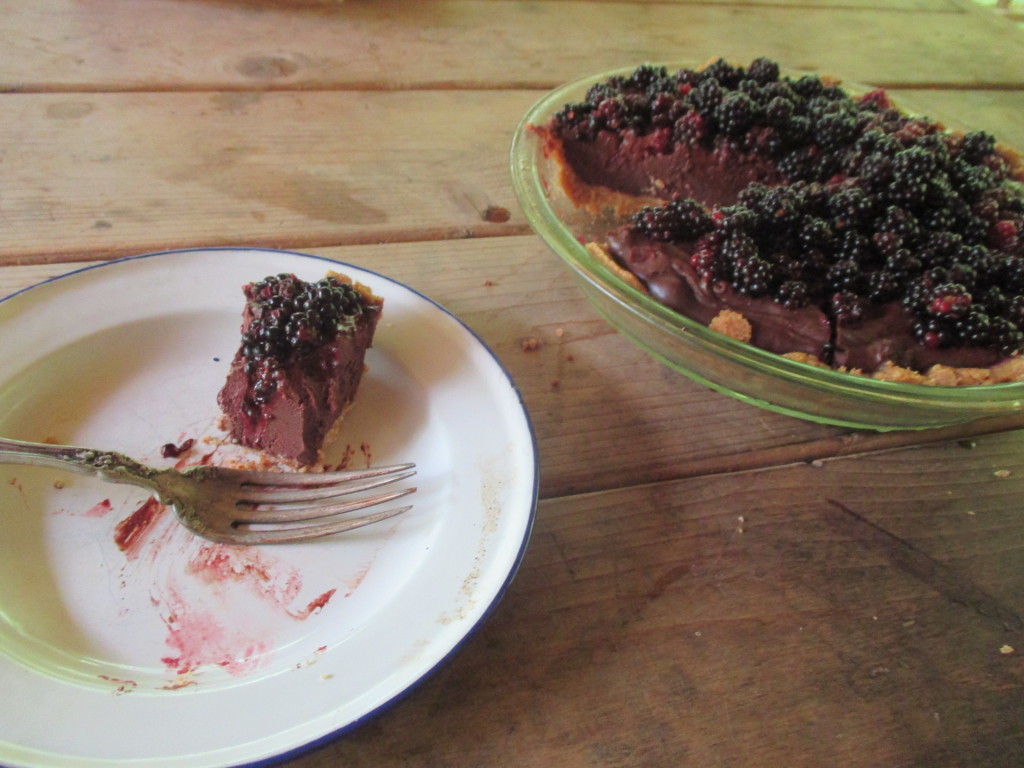
blackberrytart.jpg Having a wonderful summer, full of simple sweet pleasures. Mom visited today, and I made her this blackberry chocolate tart. Picking berries, swimming in the river, perfect summer day. dunetent.jpg Earlier this summer, camped at in the dunes on Ocracoke island with many family and friends. Thunderstorms away across the sound flashed and grumbled long in the night, but mostly missed us. Jupiter and Venus in conjunction overhead, and the arch of the milky way completed the show. beachselfie.jpg


10 July 2015

Joey Hess: our beautiful fake histories

Here's an odd thing about the git bisect command: It has only 1 option (--no-checkout). Compare with eg git commit, which has 36 options by my count. The difference is largely down to git having a pervasive culture of carefully edited history. We need lots of git commit options to carefully produce commits that look Just Right. Staging only some of the files we've edited, perhaps even staging only some of the changes within a file. Amend that commit if we notice we made a mistake. Create a whole series of beautiful commits, and use rebase later to remix them into a more beautiful whole. Beautiful fake histories. Because coding is actually messy; our actual edit history contains blind alleys and doublings back on itself; contains periods of many days the code isn't building properly. We want to sweep that complexity away, hide it under the rug. This works well except when it doesn't, when some detail airbrushed out of the only remaining history turns out to be important. Once we have these beautiful fake histories of changes, we can easily bisect them and find the commit that introduced a bug. So bisect doesn't need a lot of options to control how it works. I'd like to suggest a new option though. At least as a thought experiment. --merges-only would make bisect only check the merge commits in the range of commits being bisected. The bisection would result in not a single commit, but in the set of commits between two merges. I suspect this would be useful for faster bisecting some histories of the beautiful fake kind. But I know it would be useful when the history is messy and organic and full of false starts and points where the code doesn't build. Merges, in such histories, are often the points where things reach a certian level of beauty, where that messy feature branch got to the point it all built again (please let this happen today) and was merged into master. Bisecting such points in a messy organic history should work about as well as bisecting carefully gardened histories. I think I'll save the full rant about beautiful fake history vs messy real history for some other day. Or maybe I've already ranted that rant here before, I can't remember. Let's just say that I personally come down on the side of liking my git history to reflect the actual code I was working on, even if it was broken and even if I threw it away later. I've indeed taken this to extreme lengths with propellor; in its git history you can see every time I've ever run it, and the version of my config file and code at that point. Apologies to anyone who's been put off by that... But oddly, propellor gets by far more contributions from others than any of my other haskell programs. All in the form of beaufiully constructed commits, naturally.

15 June 2015

Lunar: Reproducible builds: week 7 in Stretch cycle

What happened about the reproducible builds effort for this week: Presentations On June 7th, Reiner Herrmann presented the project at the Gulaschprogrammiernacht 15 in Karlsruhe, Germany. Video and audio recordings in German are available, and so are the slides in English. Toolchain fixes Daniel Kahn Gillmor's report on help2man started a discussion with Brendan O'Dea and Ximin Luo about standardizing a common environment variable that would provide a replacement for an embedded build date. After various proposals and research by Ximin about date handling in several programming languages, the best solution seems to define SOURCE_DATE_EPOCH with a value suitable for gmtime(3).
  1. Martin Borgert wondered if Sphinx could be changed in a way that would avoid having to tweak debian/rules in packages using it to produce HTML documentation.
Daniel Kahn Gillmor opened a new report about icont producing unreproducible binaries. Packages fixed The following 32 packages became reproducible due to changes in their build dependencies: agda, alex, c2hs, clutter-1.0, colorediffs-extension, cpphs, darcs-monitor, dispmua, haskell-curl, haskell-glfw, haskell-glib, haskell-gluraw, haskell-glut, haskell-gnutls, haskell-gsasl, haskell-hfuse, haskell-hledger-interest, haskell-hslua, haskell-hsqml, haskell-hssyck, haskell-libxml-sax, haskell-openglraw, haskell-readline, haskell-terminfo, haskell-x11, jarjar-maven-plugin, kxml2, libcgi-struct-xs-perl, libobject-id-perl, maven-docck-plugin, parboiled, pegdown. The following packages became reproducible after getting fixed: Some uploads fixed some reproducibility issues but not all of them: Patches submitted which did not make their way to the archive yet: reproducible.debian.net A new variation to better notice when a package captures the environment has been introduced. (h01ger) The test on Debian packages works by building the package twice in a short time frame. But sometimes, a mirror push can happen between the first and the second build, resulting in a package built in a different build environment. This situation is now properly detected and will run a third build automatically. (h01ger) OpenWrt, the distribution specialized in embedded devices like small routers, is now being tested for reproducibility. The situation looks very good for their packages which seems mostly affected by timestamps in the tarball. System images will require more work on debbindiff to be better understood. (h01ger) debbindiff development Reiner Herrmann added support for decompling Java .class file and .ipk package files (used by OpenWrt). This is now available in version 22 released on 2015-06-14. Documentation update Stephen Kitt documented the new --insert-timestamp available since binutils-mingw-w64 version 6.2 available to insert a ready-made date in PE binaries built with mingw-w64. Package reviews 195 obsolete reviews have been removed, 65 added and 126 updated this week. New identified issues: Misc. Holger Levsen reported an issue with the locales-all package that Provides: locales but is actually missing some of the files provided by locales. Coreboot upstream has been quick to react after the announcement of the tests set up the week before. Patrick Georgi has fixed all issues in a couple of days and all Coreboot images are now reproducible (without a payload). SeaBIOS is one of the most frequently used payload on PC hardware and can now be made reproducible too. Paul Kocialkowski wrote to the mailing list asking for help on getting U-Boot tested for reproducibility. Lunar had a chat with maintainers of Open Build Service to better understand the difference between their system and what we are doing for Debian.

28 May 2015

Sven Hoexter: RMS, free software and where I fail the goal

You might have already read this comment by RMS in the Guardian. That comment and a recent discussion about the relevance of GPL changes post GPLv2 made me think again about the battle RMS started to fight. While some think RMS should "retire", at least I still fail on my personal goal to not depend on non-free software and services. So for me this battle is far from over, and here is my personal list of "non-free debt" I've to pay off. general purpose systems aka your computer Looking at the increasing list of firmware blobs required to use a GPU, wireless chipsets and more and more wired NICs, the situation seems to be worse then in the late 90s. Back then the primary issue was finding supported hardware, but the driver was free. Nowadays even the open sourced firmware often requires obscure patched compilers to build. If I look at this stuff I think the OpenBSD project got that right with the more radical position. Oh and then there is CPU microcode. I'm not yet sure what to think about it, but in the end it's software and it's not open source. So it's non-free software running on my system. Maybe my memory is blurred due to the fact, that the seperation of firmware from the Linux kernel, and proper firmware loading got implemented only years later. I remember the discussion about the pwc driver and its removal from Linux. Maybe the situation wasn't better at that time but the firmware was just hidden inside the Linux driver code? On my system at work I've to add the Flash plugin to the list due to my latest test with Prezi which I'll touch later. I also own a few Humble Indie bundles. I played parts of Osmos after a recommendation by Joey Hess, I later finished to play through Limbo and I got pretty far with Machinarium on a Windows system I still had at that time. I also tried a few others but never got far or soon lost interest. Another thing I can not really get rid of is unrar because of stuff I need to pull from xda-developer links just to keep a cell phone running. Update: Josh Triplett pointed out that there is unar available in the Debian archive. And indeed that one works on the rar file I just extracted. Android ecosystem I will soon get rid of a stock S3 mini and try to replace it with a moto g loaded with CyanogenMod. That leaves me with a working phone with a OS that just works because of a shitload of non-free blobs. The time and work required to get there is another story. Among others you need a new bootloader that requires a newer fastboot compared to what we have in Jessie, and later you also need the newer adb to be able to sideload the CM image. There I gave in and just downloaded the pre build SDK from Google. And there you've another binary I did not even try to build from source. Same for the CM image itself, though that's not that much different from using a GNU/Linux distribution if you ignore the trust issues. It's hard to trust the phone I've build that way, but it's the best I can get at the moment with at least some bigger chunks of free software inside. So let's move to the applications on the phone. I do not use GooglePlay, so I rely on f-droid and freeware I can download directly from the vendor. "Cloud" services This category mixes a lot with the stuff listed above, most of them are not only an application, in fact Threema and Wunderlist are useless without the backend service. And Opera is just degraded to a browser - and to be replaced with Firefox - if you discount the compression proxy. The other big addition in this category is Prezi. We tried it out at work after it got into my focus due to a post by Dave Aitel. It's kind of the poster child of non-freeness. It requires a non-free, unstable, insecure and half way deprecated browser plugin to work, you can not download your result in a useful format, you've to buy storage for your presentation at this one vendor, you've to pay if you want to keep your presentation private. It's the perfect lockin situation. But still it's very convenient, prevents a lot of common mistakes you can make when you create a presentation and they invented a new concept of presenting. I know about impress.js(hosted on a non-free platform by the way, but at least you can export it from there) and I also know about hovercraft. I'm impressed by them, but it's still not close to the ease of use of Prezi. So here you can also very prominently see the cost of free and non-free software. Invest the time and write something cool with CSS3 and impress.js or pay Prezi to just klick yourself through. To add something about the instability - I had to use a windows laptop for presenting with Prezi because the Flash plugin on Jessie crashed in the presentation mode, I did not yet check the latest Flash update. I guess that did not make the situation worse, it already is horrible. Update: Daniel Kahn Gillmore pointed out that you can combine inkscape with sozi, though the Debian package is in desperate need for an active maintainer, see also #692989. I also use kind of database services like duden.de and dict.cc. When I was younger you bought such things printed on dead trees but they did not update very well. Thinking a bit further, a Certification Authority is not only questionable due to the whole trust issue, they also provide OCSP responder as kind of a web service. And I've already had the experience what the internet looks like when the OCSP systems of GlobalSign failed. So there is still a lot to fight for and a lot of "personal non-free debt" to pay off.

1 May 2015

Daniel Kahn Gillmor: Preferred Packaging Practices

I just took a few minutes to write up my preferred Debian packaging practices. The basic gist is that i like to use git-buildpackage (gbp) with the upstream source included in the repo, both as tarballs (with pristine-tar branches) and including upstream's native VCS history (Joey's arguments about syncing with upstream git are worth reading if you're not already convinced this is a good idea). I also started using gbp-pq recently -- the patch-queue feature is really useful for at least three things: My preferred packaging practices document is a work in progress. I'd love to improve it. If you have suggestions, please let me know. Also, if you've written up your own preferred packaging practices, send me a link! I'm hoping to share and learn tips and tricks around this kind of workflow at debconf 15 this year. Tags: git, git-buildpackage, packaging

7 April 2015

Zlatan Todori : Atlassian honors 10 years of Git

and even mentions Debian.Here under info for Git installations skyrocket (January 2010) and Git installations surpass all other version control systems (January 2011). There is also part with git-annex written by our old pal Joey Hess. :)

1 April 2015

Joey Hess: I am ArchiveTeam

This seems as good a day as any to mention that I am a founding member of ArchiveTeam. ArchiveTeam logo Way back, when Geocities was closing down, I was one of a small rag-tag group who saved a copy of most of it. That snapshot has since generated more publicity than most other projects I've worked on. I've heard many heartwarning stories of it being the only remaining copy of baby pictures and writings of deceased friends, and so on. It's even been the subject of serious academic study as outlined in this talk, which is pretty awesome. Jason Scott in full stage regalia I'm happy to let this guy be the public face of ArchiveTeam in internet meme-land. It's a 0.1% project for me, and has grown into a well-oiled machine, albeit one that shouldn't need to exist. I only get involved these days when there's another crazy internet silo fire drill and/or I'm bored. (Rumors of me being the hand model for ArchiveTeam are, however, unsubstantiated.) Relevant XKCD
13 March 2015

Joey Hess: 7drl 2015 day 7 scroll success

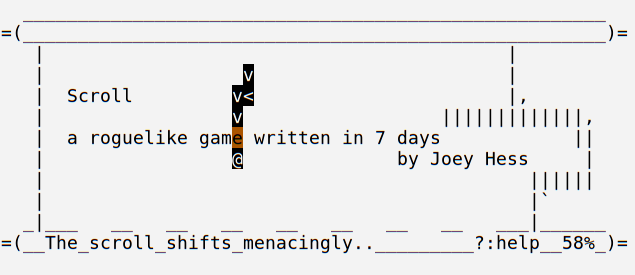
A frantic last day of work on Scroll. Until 3 am last night, I was working on adding a new procedurally generated level. This morning, fixed two major bugs reported by playesters overnight. Also fixed crashes on small screens and got the viewport to scroll. Added a victory animation in time for lunch. After lunch, more level generation work. Wasted an entire hour tracking down a bug in level gen I introduced last night, when I was bad and didn't create a data type to express an idea. Added a third type of generated level, with its own feel. Finished up with a level selection screen, which needed just 47 lines of code and features a playable character. I have six hours until my 7drl is officially over, but I'm done! Success! You can download the code, play, etc, at Scroll's homepage

12 March 2015

Joey Hess: 7drl 2015 day 6 must add more

Last night I put up a telnet server and web interface to play a demo of scroll and send me playtester feedback, and I've gotten that almost solid today. Try it! Today was a scramble to add more features to Scroll and fix bugs. The game still needs some balancing, and generally seems a little too hard, so added a couple more spells, and a powerup feature to make it easier. Added a way to learn new spells. Added a display of spell inventory on 'i'. For that, I had to write a quick windowing system (20 lines of code). Added a system for ill effects from eating particular letters. Interestingly, since such a letter is immediately digested, it doesn't prevent the worm from moving forwards. So, the ill effects can be worth it in some situations. Up to the player to decide. I'm spending a lot of time now looking at letter frequency historgrams to decide which letter to use for a new feature. Since I've several times accidentially used the same letter for two different things (most amusingly, I assigned 'k' to a spell, forgetting it was movement), I refactored all the code to have a single charSet which defines every letter and what it's used for, be that movement, control, spell casting, or ill effects. I'd like to use that to further randomize which letters are used for spell components, out of a set that have around the same frequency. However, I doubt that I'll have time to do that. In the final push tonight/tomorrow, I hope to add an additional kind of level or two, make the curses viewport scroll when necessary instead of crashing, and hopefully work on game balance/playtester feedback. I've written ~2800 lines of code so far this week!

Next.

Previous.