Search Results: "jmtd"

13 April 2022

Jonathan Dowland: Another Green World

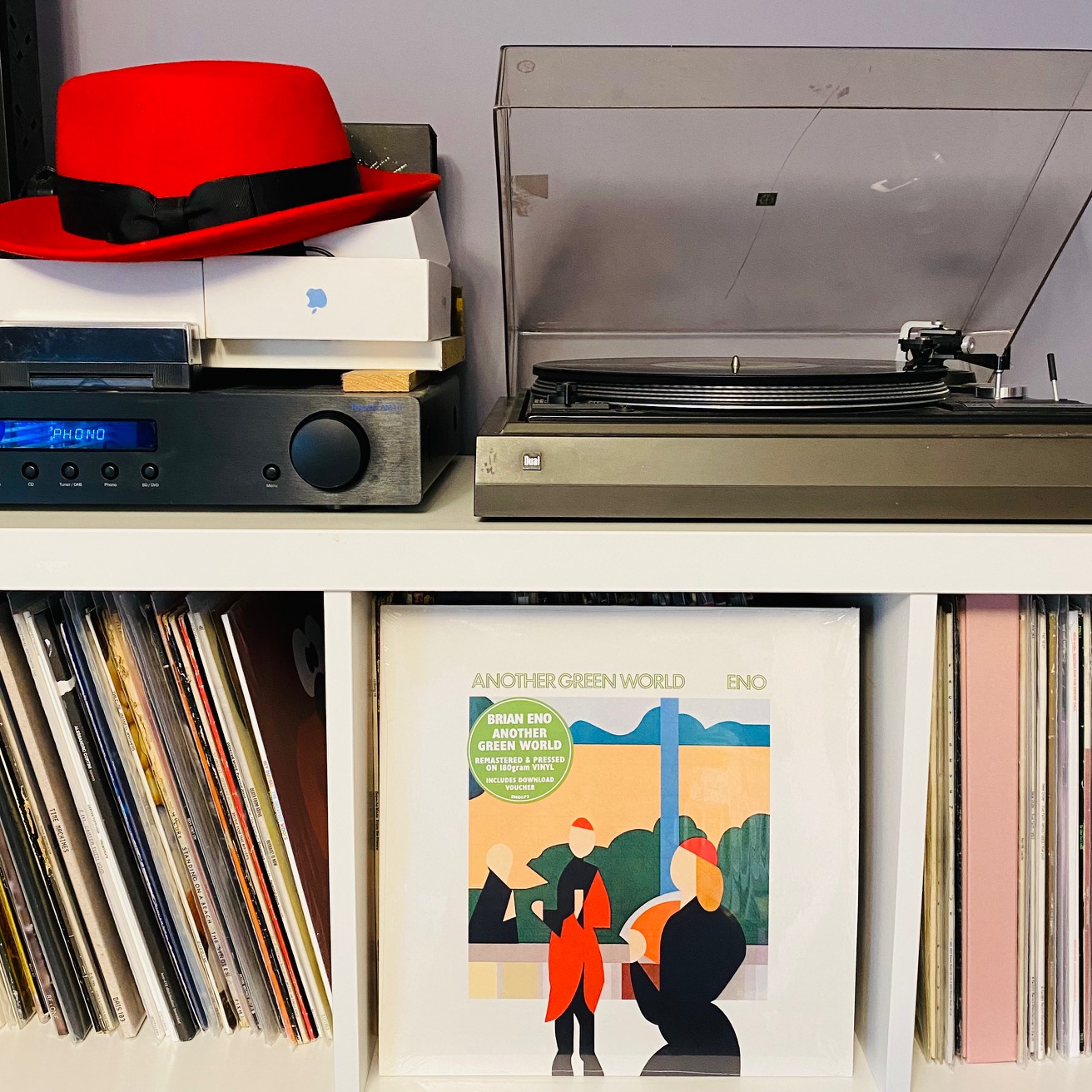
Brian Eno's classic 1975 album Another Green World, with the iconic cover crop from Tom Philip's After Raphael. This is a recent pressing. I try to avoid buying new vinyl, and I think I got this as part of a trade-in swap two years ago when I went to get one of my first Covid vaccinations in Newcastle. It was the first time I'd been anywhere near a record shop (which was adjacent to the temporary vaccine centre) in a year or more, and I took the opportunity to bring in some records to sell. I definitely left with fewer records than I went in with, at least
Another Green World on the turntable
What to say about this album? It's a classic, it's weirdly compelling, it dances over the line between engaging your attention and something you can have on in the background. Many of the tracks are quite short relative to the ideas they express: I imagine some remixer could have a lot of fun with it. The Big Ship is perhaps the standout, but I really like the title track, and opener Sky Saw too. It's probably the first album written using using the oblique strategies card system.
Card reading 'You are an Engineer'

11 April 2022

Jonathan Dowland: With Teeth

Sometimes people ask me which is the best entry point for Nine Inch Nails, and I have trouble answering. I've eventually decided that it's 2005's With Teeth.
Picture of 'With Teeth' playing on my turntable
I've pulled this from my pile of records to sell. Most Nine Inch Nails stuff seems to increase in value over time, and it's got to the stage that some of the ones in my collection are now valuable enough that I'm nervous to play them, which makes them a little pointless. A couple of years ago, a handful of the albums were re-issued (including With Teeth, here, and The Fragile, which hadn't been repressed since 1999). I had a vague plan to sell off my original pressings to someone who would appreciate them more and use the takings to buy the re-issues, but I didn't move fast enough, and now the re-issues are (for the most part) also sought-after.

6 April 2022

Jonathan Dowland: Hope in a Darkened Heart

I first heard Virginia Astley via Lauren Laverne, who played (I think) "With my eyes wide open" from her first album, "From Gardens Where We Feel Secure". Mostly ambient, a conceptual piece about a garden in an English Summer, spanning dawn to dusk. Bucolic ambient, dream pop. It was a little outside my wheel-house, but I loved it, and wanted to find out more. I soon learned that official, physical copies of it were rare and expensive.
'Hope in a Darkened Heart' spinning on my turntable
Some time later I stumbled across her second album "Hope in a Darkened Heart" (which is possibly the most commonly available of her albums) and bought it blind. It's quite different, with a lot more singing, but whatever drew me to Gardens is present. I love this. It was produced by Ryuichi Sakamoto. Only this week I was enormously pleased to discover a chunk of her discography on Bandcamp, including the two aformentioned albums. Highlights from Darkened:

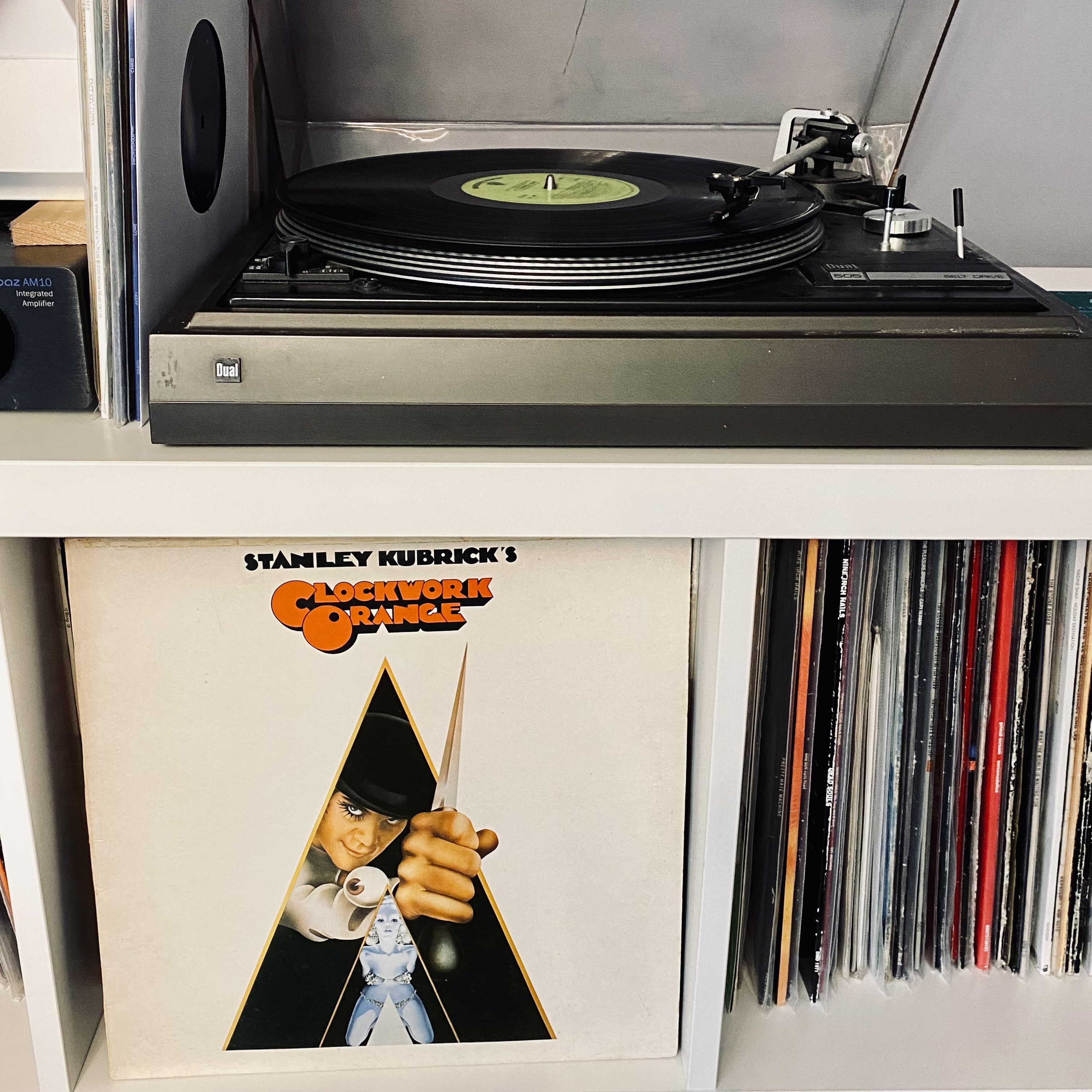
Jonathan Dowland: Stanley Kubrick's A Clockwork Orange (Music From The Soundtrack)

I was reminded of this record over the weekend, as Radio 4's Front Row was discussing the 50th anniversary of Kubrick's movie. To me, the soundtrack has a strange, whimsical, almost cynical element to it (especially with the selection of things like Pomp and Circumstance), but I was familiar with the movie before the soundtrack and it might just be the association that triggers those feelings.
Picture of 'A Clockwork Orange' vinyl record playing on my turntable
I think I picked this up at Tynemouth Market when I lived close by, but I'm not sure. I am sure I didn't pay much for it. Mine is a UK re-pressing from 1971. The abridged (and sped-up) version of William Tell Overture is great for getting the kids to complete a task. Burgess's novel (now 60 years old) has been on my to-read pile for years. in 2018 Electronic Sound magazine featured a cover-mount CD "New Clockwork Music" of music inspired by this soundtrack: It's very good. I must dig that out

Jonathan Dowland: Death from Above

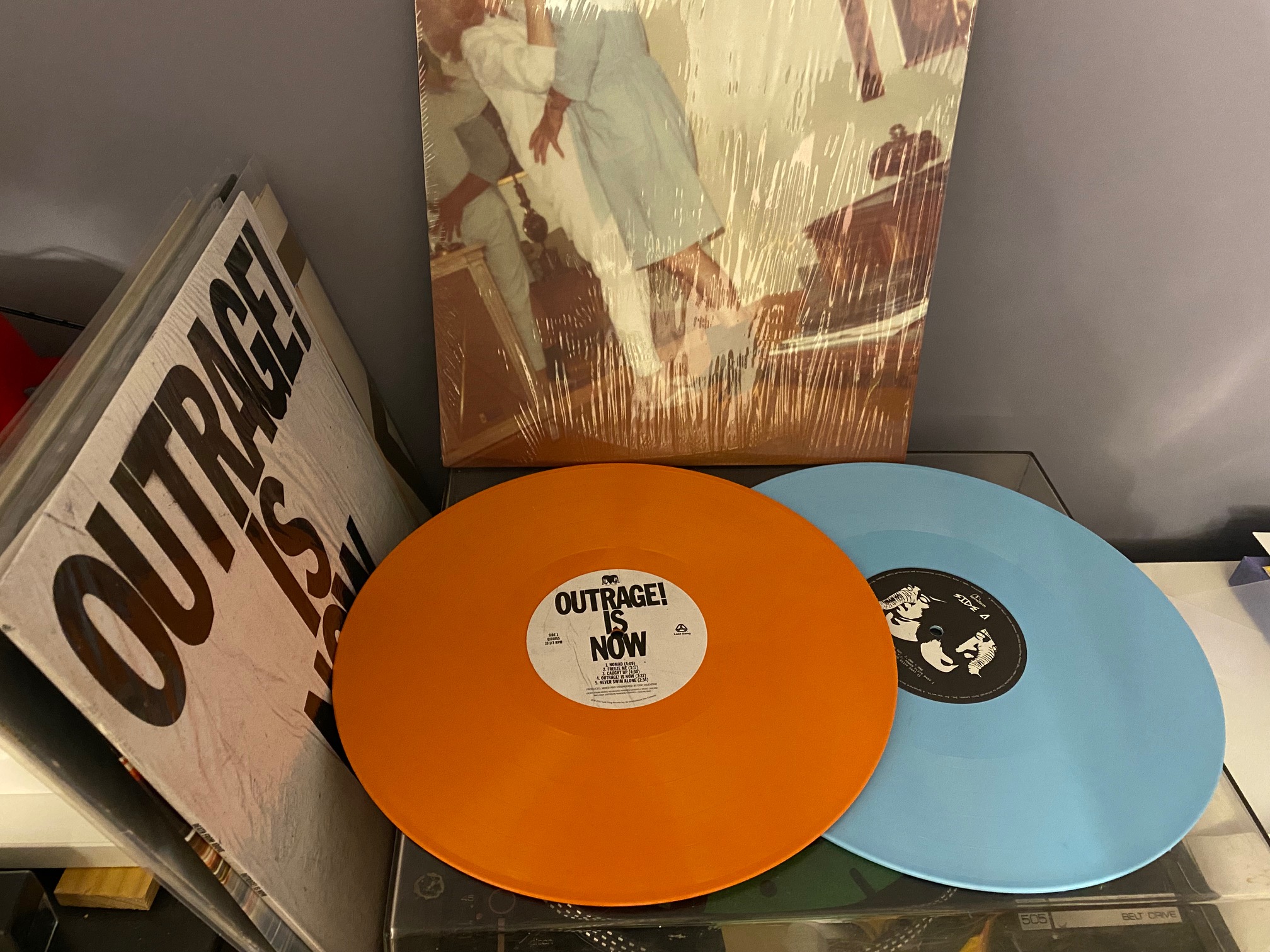
picture of two vinyl records
I received the last two Death From Above albums at Christmas and this weekend managed to give the first (Outrage Is Now) a spin. Pretty colours! They remain one of the best bands to see live. Last time I saw them in a support slot in Newcastle. My friend Rob, a man of few words said I wouldn t want to have to follow them on stage!

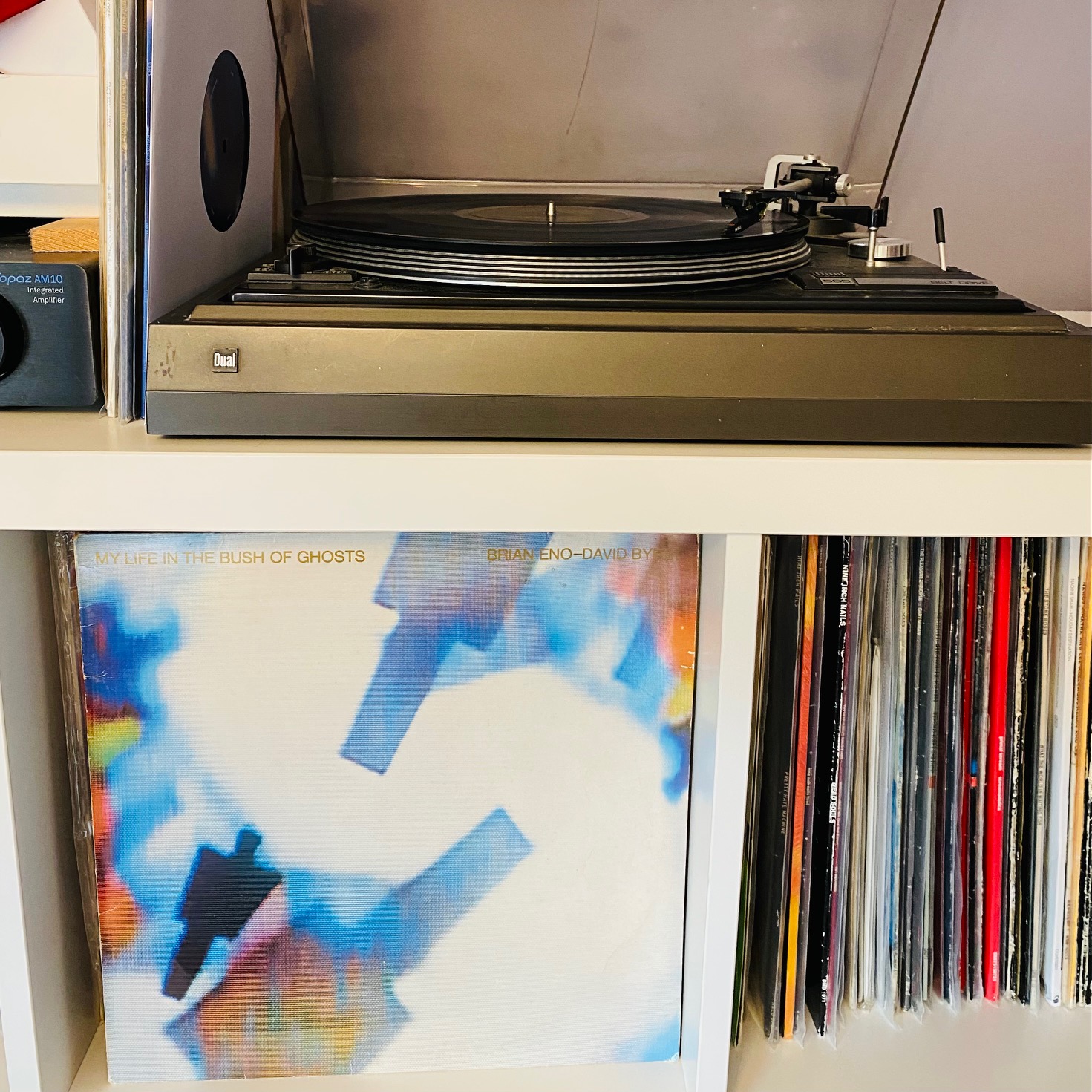
Jonathan Dowland: My Life In The Bush Of Ghosts

Photo of the record playing next to its cover.
My Life In The Bush Of Ghosts is a weird sound-collage-style album by Brian Eno and David Byrne, released in 1981. It has African-inspired rhythms layered with lots of samples from American radio and TV. It sounds almost like a field recording of the United States was made by wildlife surveyors. My copy is the UK first pressing which includes the track "Qu'ran" which was removed from later editions (and re-instated again later on). I previously wrote about uploading multitracks for two tracks from this album to archive.org.

Jonathan Dowland: One, by Be

picture of a vinyl record
The sublime One, by Be is a pastoral, English summer time instrumental improvisation around field recordings and the theme of the honey bee. A lovely piece to accompany deep thinking. I m reminded of Virginia Astley. Be are associated with Caught by the River, a collective who explore ways of setpping out of daily digital live and embrace, nature, walks, calm, etc.

9 March 2022

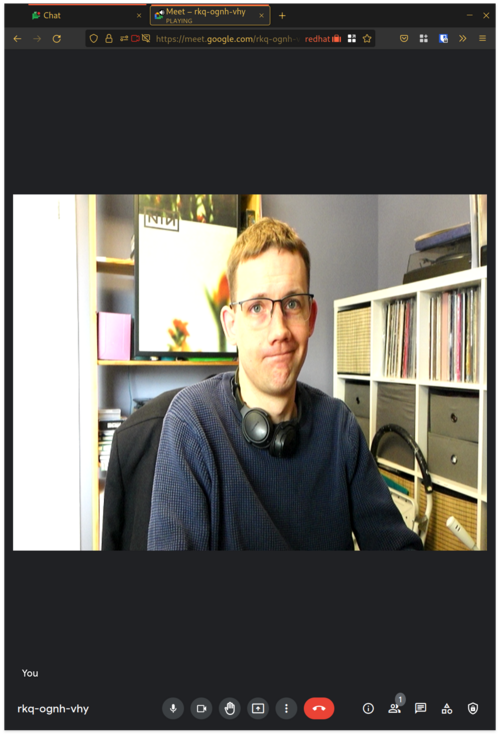
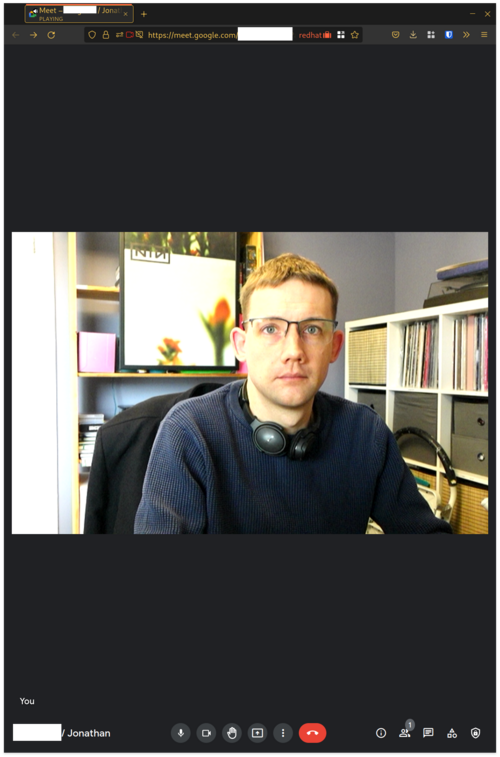
Jonathan Dowland: Broken webcam aspect ratio

picture of my Sony RX100-III camera Sony RX100-III, relegated to a webcam
Sometimes I have remote meetings with Google Meet. Unlike the other video-conferencing services that I use (Bluejeans, Zoom), my video was stretched out of proportion under Google Meet with Firefox. I haven't found out why this was happening, but I did figure out a work-around. Thanks to Daniel Silverstone, Rob Kendrick, Gregor Herrmann and Ben Allen for pointing me in the right direction! Hardware The lovely Sony RX-100 mk3 that I bought in 2015 has spent most of its life languishing unused. During the Pandemic, once I was working from home all the time, I decided to press-gang it into service as a better-quality webcam. Newer models of this camera the mark 4 onwards have support for a USB mode called "PC Remote", which effectively makes them into webcams. Unfortunately my mark 3 does not support this, but it does have HDMI out, so I picked up a cheap "HDMI to USB Video Capture Card" from eBay. Video modes
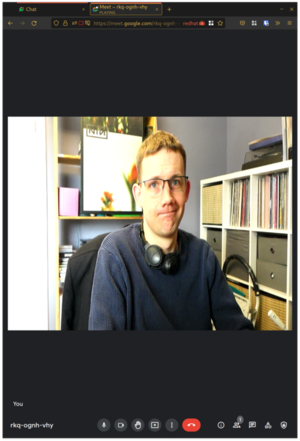
Before: wrong aspect ratio Before: wrong aspect ratio
This device offers a selection of different video modes over a webcam interface. I used qv4l2 to explore the different modes. It became clear that the camera was outputting a signal at 16:9, but the modes on offer from the dongle were for a range of different aspect ratios. The picture for these other ratios was not letter or pillar-boxed, but stretched to fit. I also noticed that the modes which had the correct aspect ratio were at very low framerates: 1920x1080@5fps, 1360x768@8fps, 1280x720@10fps. It felt to me that I would look unnatural at such a low framerate. The most promising mode was close to the right ratio, 720x480 and 30 fps. Software
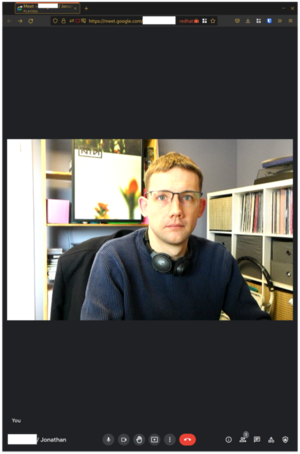
After: corrected aspect ratio After: corrected aspect ratio
My initial solution is to use the v4l2loopback kernel module, which provides a virtual loop-back webcam interface. I can write video data to it from one process, and read it back from another. Loading it as follows:
modprobe v4l2loopback exclusive_caps=1
The option exclusive_caps configures the module into a mode where it initially presents a write-only interface, but once a process has opened a file handle, it then switches to read-only for subsequent processes. Assuming there are no other camera devices connected at the time of loading the module, it will create /dev/video0.1 I experimented briefly with OBS Studio, the very versatile and feature-full streaming tool, which confirmed that I could use filters on the source video to fix the aspect ratio, and emit the result to the virtual device. I don't otherwise use OBS, though, so I achieve the same result using ffmpeg:
fmpeg -s 720x480 -i /dev/video1 -r 30 -f v4l2 -vcodec rawvideo \
    -pix_fmt yuyv422 -s 720x405 /dev/video0
The source options are to select the source video mode I want. The codec and pixel formats are to match what is being emitted (I determined that using ffprobe on the camera device). The resizing is triggered by supplying a different size to the -s parameter. I think that is equivalent to explicitly selecting a "scale" filter, and there might be other filters that could be used instead (to add pillar boxes for example). This worked just as well. In Google Meet, I select the Virtual Camera, and Google Meet is presented with only one video mode, in the correct aspect ratio, and no configurable options for it, so it can't misbehave. Future I'm planning to automate the loading (and unloading) of the module and starting the ffmpeg process in response to the real camera device being plugged or unplugged, using systemd events and services. (I don't leave the camera plugged in all the time due to some bad USB behaviour I've experienced if I do so.) If I get that working, I will write a follow-up.
  1. you can request a specific device name/number with another module option.

1 February 2022

Jonathan Dowland: Amateur archiving activities, January 2022

I have a backlog of digital stuff to upload to archive.org that I'm finally starting to flush. I'd had some difficulties in getting uploads to work until I tried using the excellent ia CLI tool, which is packaged in Debian. In January 2022 I uploaded: two sets of multitracks from the 1981 album My Life in the Bush of Ghosts by Brian Eno and David Byrne, "A Secret Life" and "Help Me Somebody"; 28 cover disks from late 80s/early 90s issues of PC Plus, Pc Today, PC Zone and Personal Computing; and a LEGO Land Billund brochure from 1993. I try to keep a record of my amateur archiving work (and related TODO items) at archiving. In January I also discovered that, late last year, the nine inch nails live archive project have had their download links forcibly removed by their ISP. I've been watching this project for a while because I thought it was "at risk". Years ago the project's creator, Ryan, created a series of torrents covering all the material at the time, although there had been a number of changes since the last one. However, this issue with his ISP spurred him on to create up-to-date torrents. It seems to me that archive.org would be a good place for this material, but there are two problems: the most natural collection would be the Live Music Archive, but it has a rule that musicians must have given explicit permission for live recordings to be deposited there (inherited from the earlier etree.org days) and in this case no such permission exists. The second problem is that ninlive's owner/creator, Ryan, has always resisted the idea. For now the best I can think to do is simply to continue to seed the torrent.

27 January 2022

Jonathan Dowland: Using an iPad for note-taking in talks

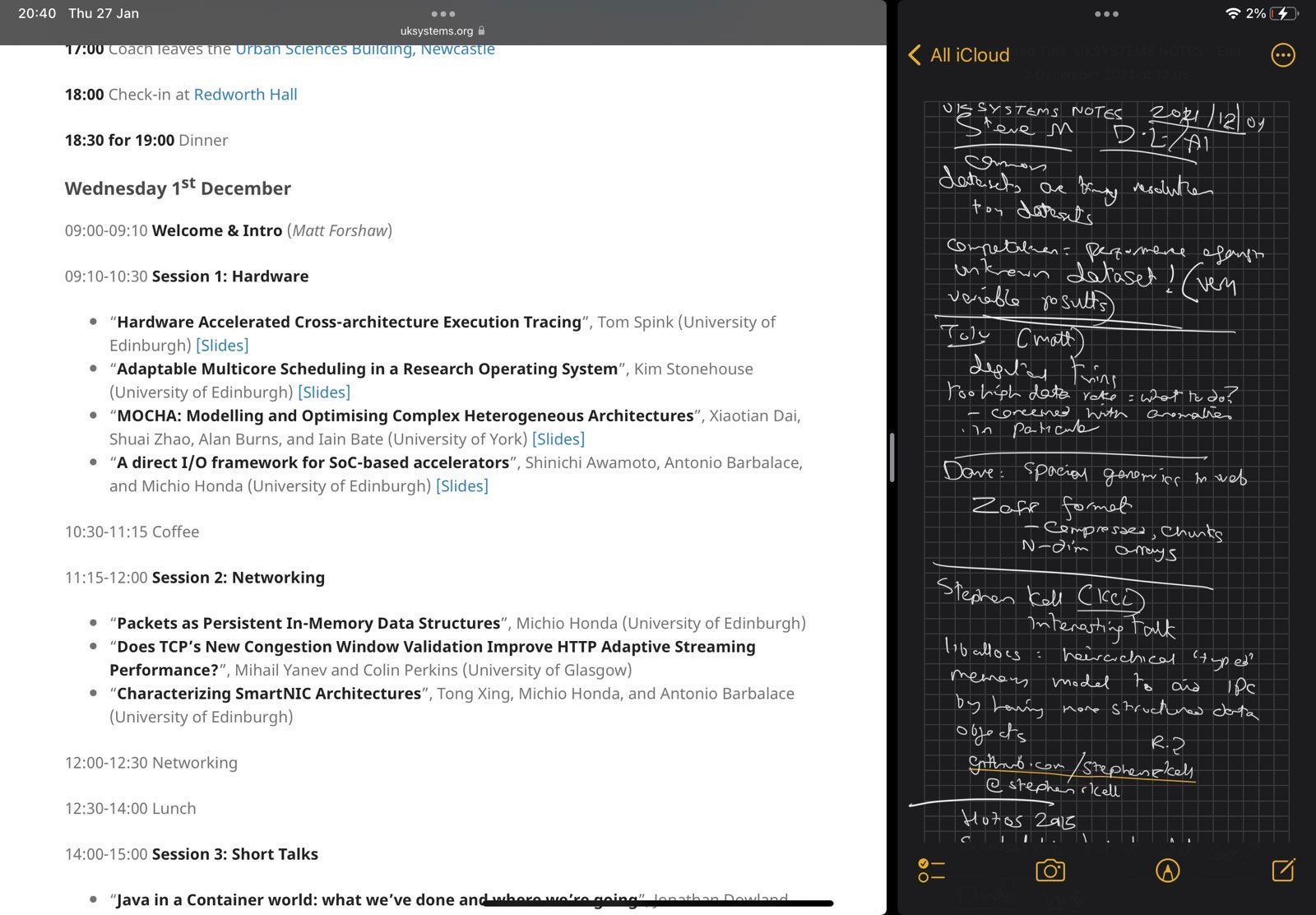
I've found that using a laptop during conference talks means you either end up doing something else and missing important bits of the talk, or at least look like you're doing something else. But it's extremely helpful to be able to look up the person who is talking, or their project, or expand an acronym that's mentioned or read around the subject. At December's uksystems21 conference, I experimented with using an iPad as a kind of compromise. Modern iOS versions let you split the display between two apps1, so I put the built-in Notes app on one side and a web browser on the other. I took notes using the Apple Pencil. I've got a "paper-like" rough surface display protector on the front which vastly improves the experience of using the Apple Pencil for writing2.
An example of note-taking and researching talks on an iPad. An example of note-taking and researching talks on an iPad.
I mostly took notes on the active talk, but I also tweaked my own slides3, looked up supplementary information about the topic and the talker, and things like that. It worked really well: much better than I expected. Apple's split-screen implementation is clunky but essential to make this work. The textured surface protector is a serious improvement over the normal surface for writing. But most importantly I didn't lose focus over the talks, and I don't think I looked like I did either.

  1. Yes, this is something that some Android vendors have supported for years. I remember playing around with Samsung Galaxy Notes when I was still in IT and being pretty impressed. On the other hand, I'd bet not 1% of those tablets are still running Today. My iPad Mini from that time still is, albeit vastly diminished.
  2. It's still not as good as the Remarkable, but that's a topic for another blog post.
  3. A tiny bit. Not serious reworking. Just nervous last minute tweaks that I could probably have not bothered with at all. I'm one of those people who does that right up to the wire.

8 January 2022

Jonathan Dowland: 2021 in Fiction

Cover for *This is How You Lose the Time War*
Cover for *Robot*
Cover for *The Glass Hotel*
Following on from last year's round-up of my reading, here's a look at the fiction I enjoyed in 2021. I managed to read 42 books in 2021, up from 31 last year. That's partly to do with buying an ereader: 33/36% of my reading (by pages/by books) was ebooks. I think this demonstrates that ebooks have mostly complemented paper books for me, rather than replacing them. My book of the year (although it was published in 2019) was This is How You Lose the Time War by Amal El-Mohtar and Max Gladstone: A short epistolary love story between warring time travellers and quite unlike anything else I've read for a long time. Other notables were The Glass Hotel by Emily St John Mandel and Robot by Adam Wi niewski-Snerg. The biggest disappointment for me was The Ministry for the Future by Kim Stanley Robinson (KSR), which I haven't even finished. I love KSRs writing: I've written about him many times on this blog, at least in 2002, 2006 and 2009, I think I've read every other novel he's published and most of his short stories. But this one was too much of something for me. He's described this novel a the end-point of a particular journey and approach to writing he's taken, which I felt relieved to learn, assuming he writes any more novels (and I really hope that he does) they will likely be in a different "mode". My "new author discovery" for 2021 was Chris Beckett: I tore through Two Tribes and America City before promptly buying all his other work. He fits roughly into the same bracket as Adam Roberts and Christopher Priest, two of my other favourite authors. 5 of the books I read (12%) were from my "backlog" of already-purchased physical books. I'd like to try and reduce my Backlog further so I hope to push this figure up next year. I made a small effort to read more diverse authors this year. 24% of the books I read (by book count and page count) were by women. 15% by page count were (loosely) BAME (19% by book count). Again I'd like to increase these numbers modestly in 2022. Unlike 2020, I didn't complete any short story collections in 2021! This is partly because there was only one issue of Interzone published in all of 2021, a double-issue which I haven't yet finished. This is probably a sad date point in terms of Interzone's continued existence, but it's not dead yet.

21 December 2021

Jonathan Dowland: Vim plugins by Tim Pope

I've been using Vim as my main text editor for 18 years, but for most of that time I've been using something very close to the default configuration: my vimrc contained not much more than preferences for indentation and how to visually indicate white space characters like tabs. Last but not least, I've used a single colour scheme for most of that time: Zenburn. In 20151 I started exploring a few Vim plugins2. To manage them, I started by choosing a plugin manager, Pathogen3. Recently I noticed that the plugin's author, Tim Pope, now recommends new users just use Vim's built in package management instead. I got curious about Tim Pope's other plugins: He has written a great deal of them. Given I've spent most of two decades with a barely-configured Vim, you can imagine that I don't want to radically alter the way it works, and so I did not expect to want to use a lot of plugins. The utility of a plugin would have to outweight the disadvantages of coming to rely on one. But when browsing Tim's plugins, time and time again, I found myself reacting to description with How did I manage without this?. And so, I've ended up installing all of the following, all by Tim Pope:

  1. I had to look this up, probably because I started at redhat
  2. I have opinions about Plugins, what supporting them means architecturally for your application, the interaction with Open Source, and stuff like that, perhaps for another post.
  3. To try out Vim plugins the first thing you need to figure out is how to manage them (install, activate, configure). Vim grew a Plugin manager in version 8 (2016). Prior to that, people wrote third-party ones. For this reason there is a frankly absurd number of Plugin managers, including: Vim's own; Vim Plug; Vundle; Dein; Volt and Pathogen.

17 December 2021

Jonathan Dowland: ereader

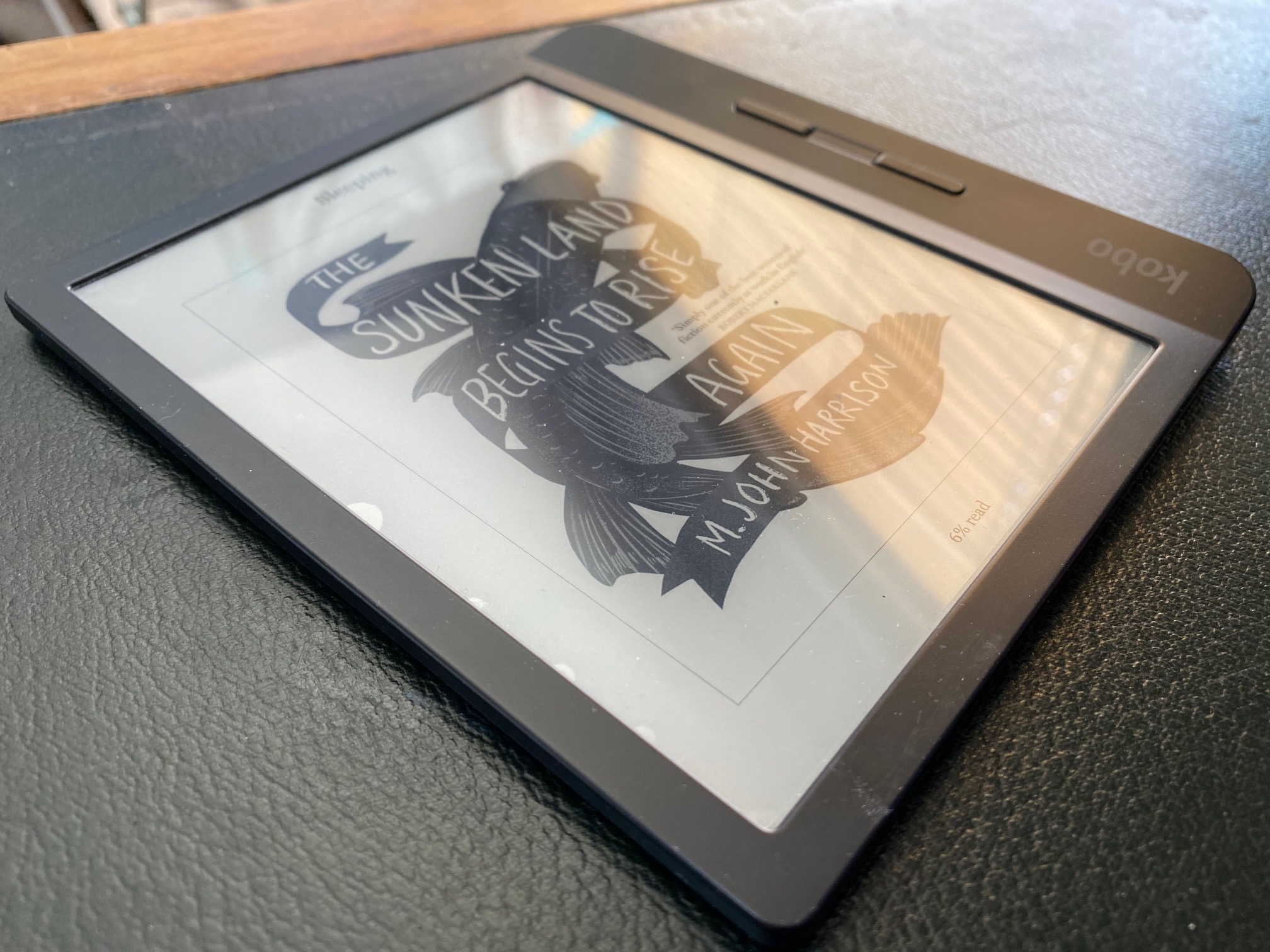
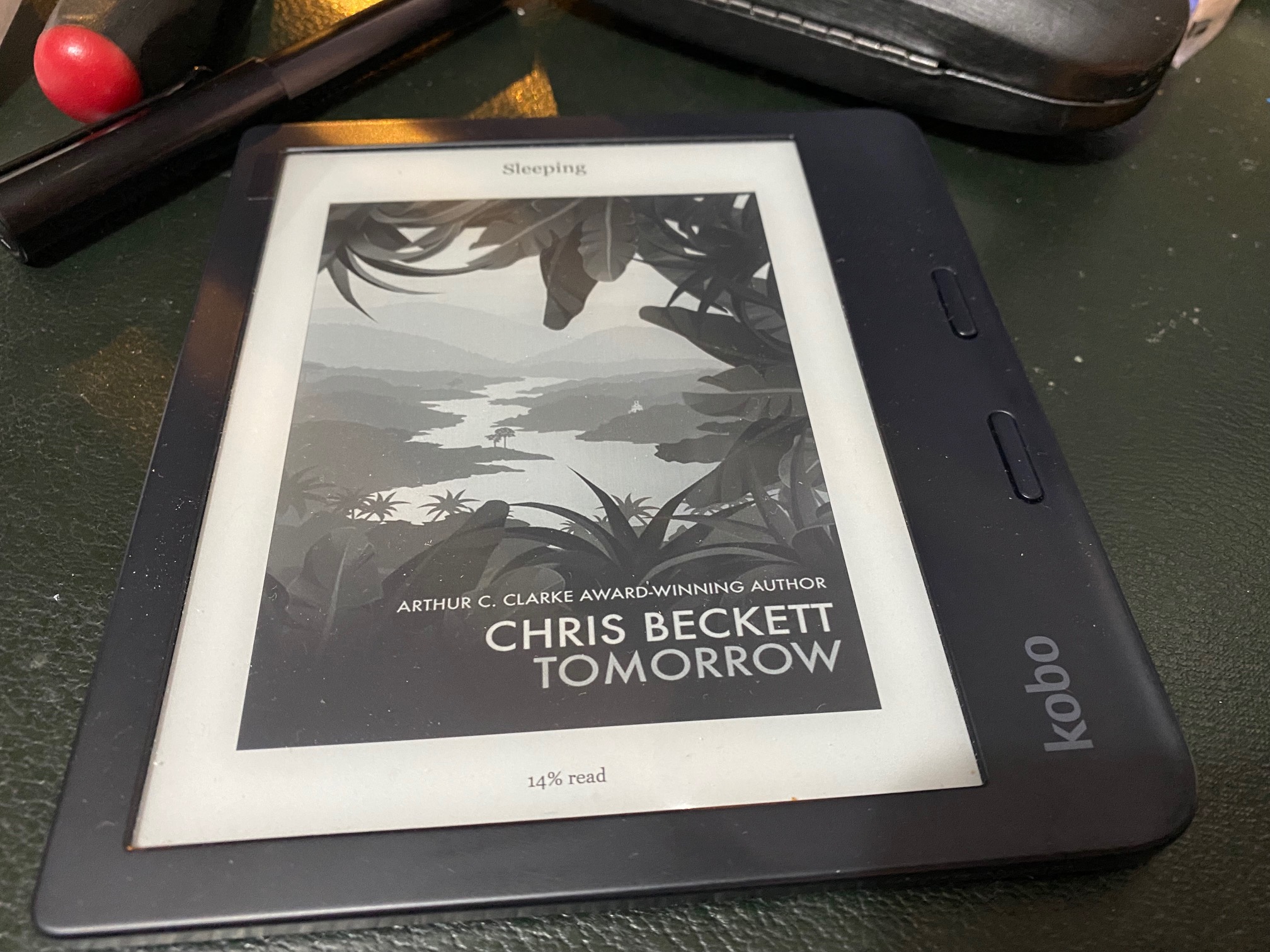
Kobo Libra H2O e-reader Kobo Libra H2O e-reader
This year I finally bought an e-reader: a "Kobo Libra H2O": a 7" 300ppi screen with an adjustable colour temperature front light, waterproof, physical buttons on a "margin"/spine which pushes the case dimensions up to 8", which is sadly a little too big for most jeans pockets. In fact this is the second time I've bought one. Sarah and I bought a pair of Amazon Kindle Paperwhite (2nd generation) readers as Honeymoon gifts for each other in 2013. Sarah took to hers, but after giving mine a try and reading a couple of books on it I ended up giving it to my Father-in-law. The main problem I had with it was the colour temperature of the backlight: it was too blue and "clinical". It's interesting to me to realise how the environment that I read in can become indelibly linked to the memory of that book. One book in particular that I read on the Kindle was James Smythe's "The Machine", a modern twist on a classic horror story. This was perfectly complemented by the somewhat pallid, sick colour of the backlight, especially on its lowest brightness settings. It didn't go so well with other stories.
Broken Libra H2O e-reader Broken Libra H2O e-reader
I got on much better with the Libra H2O. For me, e-books and e-reading has not replaced traditional paper books, but complemented them, giving me an opportunity to read in contexts and situations where I couldn't manage with a real book (such as in the pitch black, lying on my back with a toddler on my chest). I feel that being able to read more often thanks to the e-reader has spurred me on to read even paper books more frequently as well. Unfortunately the screen broke, about 10 months after I bought it! After a bit of soul-searching on what to do about replacing it, and briefly considering the latest Amazon Paperwhite (which now has a 300ppi display and adjustable-colour temperature front-light). This looks like a very nice e-reader: no physical buttons which is a bit of a shame but narrower without the margin/spine of the Kobo, so possibly more pocket-friendly. On the other hand, I really felt that I wanted to avoid giving Amazon the money, for a whole variety of reasons.
Libra 2 e-reader. Spot the difference? Libra 2 e-reader. Spot the difference?
So I instead settled on the "Kobo Libra 2", which is a slight refresh of the Libra H2O, but almost identical. I'm going to pair it with a nice cover for when its not in use and hopefully it will last longer than its predecessor. My current favourite feature on the Libra 2, that I don't remember on the H2O and I'm fairly sure doesn't exist on Kindles is it supports a "night mode", which is effectively a reverse video, white-on-black mode. This is fantastic for keeping the light levels down at night. I was already using the backlight at about 2% brightness and occasionally found even that too bright.

8 December 2021

Jonathan Dowland: Java in a Container World

me, delivering the talk me, delivering the talk
The redhat talk I gave at UK Systems '21 was entitled "Java in a Container World: What we've done and where we're going". The slides (with notes) for it are available:

7 December 2021

Jonathan Dowland: Cost models for evaluating stream-processing programs

title slide
As I wrote, last week I attended the UK Systems Research 2021 and gave two (or 2 , or 3) talks. my PhD talk is entitled "Picking a winner: cost models for evaluating stream-processing programs". The slides (with notes) are here:

6 December 2021

Jonathan Dowland: Sixth Annual UK System Research Challenges Workshop lightning talk

me looking awkward, thanks [Mark Little](https://twitter.com/nmcl/status/1466148768043126791/photo/1) me looking awkward, thanks Mark Little
Last week I attended the UK Systems Research 2021 conference in County Durham, my first conference in nearly two years (since FOSDEM 2020, right on the cusp of the Pandemic). The Systems conference community is very pleasant and welcoming and so when I heard it was going to take place "physically" again this year I was so keen to attend I decided to hedge my bets and submit two talk proposals. I wasn't expecting them both to be accepted As well as the regular talks (more on those in another post) there is a tradition for people to give short, impromptu lightning talks after dinner on the second night. I've given two of these before, and I'd been considering whether to offer to one this time or not, but with two talks to deliver (and finish writing) I wasn't sure. Usually people talk about something interesting that they have been doing besides their research or day-jobs, but the last two years have been somewhat difficult and I didn't really think I had a topic to talk about. Then I wondered if that was a topic in itself During the first day of the conference (and especially one I'd got past one of my talks) I started to outline a lightning talk idea and it seemed to come out well enough that I thought I'd give it a go. Unusually I therefore had something written down and I was surprised how well it was received, so I thought I'd share it. Here it is:
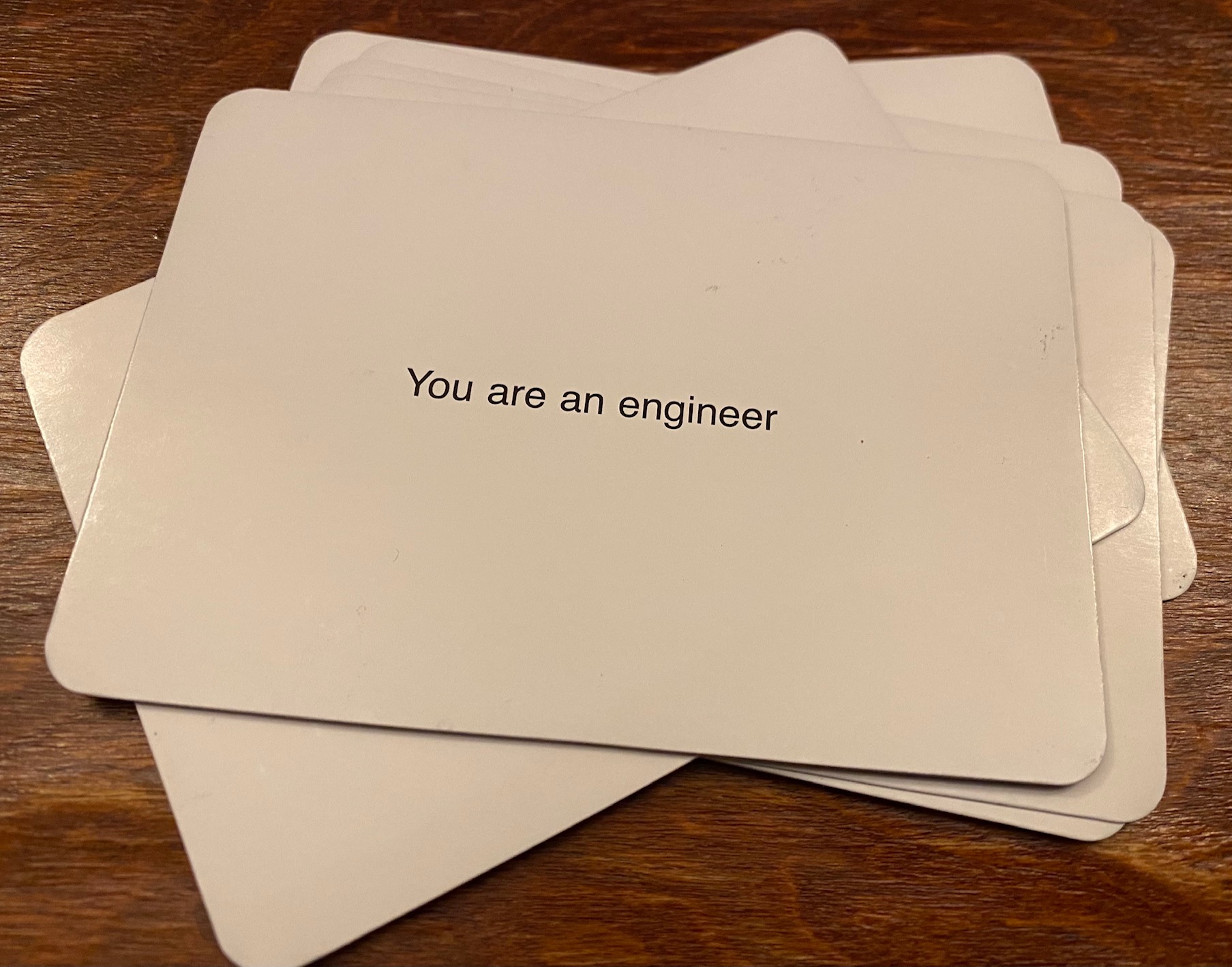
I was anticipating the lightning talks and being cajoled into talking about something. I've done it twice before. So I've been racking my brains to figure out if I've done anything interesting enough to talk about. in 2018 I talked about some hack I'd made to the classic computer game Doom from 1993. I've done several hacks to Doom that I could probably talk about except I've become a bit uncomfortable about increasingly being thought of as "that doom guy". I'd been reflecting on why it was that I continued to mess about with that game in the first place and I realised it was a form of expression: I was treating Doom like a canvas. I've spent most of my career thinking about what I do in the frame of either science or engineering. I suffer from the creative urge and I've often expressed (and sated) that through my work. And that's possible because there's a craft in what we do. In 2019 I talked about a project I'd embarked on to resurrect my childhood computer, a Commodore Amiga 500, in order to rescue my childhood drawings and digital paintings. (There's the artistic thing again). I'd achieved that and I have ambitions to do some more Amiga stuff but again that's a work in progress and there's nothing much to talk about. In recent years I've been thinking more and more about art and became interested in the works and writings of people like Grayson Perry, Laurie Anderson and Brian Eno. I first learned about Eno through his music but he's also a visual artist. and a music producer. As a producer in the 70s he co-invented a system to try and break out of writer's block called "oblique strategies": A deck of cards with oblique suggestions written on them. When you're stuck, you pull a card and it might help you to reframe what you are working on and think about it in a completely different way. I love this idea and I think we should use more things like that in software engineering at least. So back to casting about for something to talk about. What have I been doing in the last couple of years? Frankly, surviving - I've just about managed to keep doing my day job, and keep working on the PhD, at home with two young kids and home schooling and the rest of it. Which is an achievement but makes for a boring lightning talk. But I'd like to say that for anyone here who might have been worrying similarly: I think surviving is more than enough. I'll close on the subject of thinking like an artist and not an engineer. I brought some of the Oblique Strategies deck with me and I thought I'd draw a card to perhaps help you out of a creative dilemma if you're in one. And I kid you not, the first card I drew was this one:
Card reading 'You are an Engineer'

4 December 2021

Jonathan Dowland: Haskell mortgage calculator

A few months ago I was trying to compare two mortgage offers, and ended up writing a small mortgage calculator to help me. Both mortgages were fixed-term for the same time period (5 years). One of the mortgages had a lower rate than the other, but much higher arrangement fees. A broker recommended the mortgage with the higher rate but lower fee, on an affordability basis for the fixed term: over all, we would spend less money within the fixed term on that deal than the other. (I thought) this left one bit of information missing: what remaining balance would there be at the end of the term? The mortgages I want to model are defined in terms of a monthly repayment figure and an annual interest rate for the fixed period. I think interest is usually recalculated on a daily basis, so I convert the annual rate down to a daily rate. Repayments only happen once a month. Months are not all the same size. Using mod 30 on the 'day' approximates a monthly payment. Over 5 years, there would be 60 months, meaning 60 repayments. (I'm ignoring leap years)
 > length . filter id .take (5*365) $ [ x mod 30==0   x <- [1..]]
60
Here's what I came up with. I was a little concerned the repayment approximation was too far out so I compared the output with a more precise (but boring) spreadsheet and they agreed to within an acceptable tolerance. The numbers that follow are all made up to illustrate the function and don't reflect my actual mortgage. :)
borrowed = 1000000 -- day 0 amount outstanding
aer   = 0.89
repay = 1000
der   = aer / 36
owed n   n == 0          = borrowed
         n  mod  30 == 0 = last + interest - repay
         otherwise       = last + interest
    where
        last     = owed (n - 1)
        interest = last * der

20 November 2021

Jonathan Dowland: hledger footguns

I wrote in budgeting tools that I was taking a look at Plain Text Accounting and in particular, hledger. My Jury's still out on the tools, but in the time I've been looking at them I've come across a couple of foot-guns I thought it was worth writing down. hledger's ledger format is derived from that of its predecessor ledger, and so some of the problems might be inherited. 1. significant white space delimiters The basic syntax for a transaction looks like this
2020-03-15 client payment
    assets:checking         $ 2000
    income:consulting       $-2000
There's some significant white space delimiters in play. The most subtle is what separates the account names from the values: it is two or more spaces. A single space, and the value is treated as part of the account name. For some reason I hit this frequently with trying to encode opening balances: the account name used as the source of the initial balances is something not otherwise generally referred to again (something like equity:opening balances) and the transaction amount is inferred where possible, so I ended up with a bunch of accounts named equity:opening balances 100 and similar. 2. flexible decimal delimiter The value of transactions can be interspersed with commas and periods to make it more readable: e.g. $2000 could be written as $2,000. Different locales have different conventions here: It seems some(/most/all?) of Europe use periods to separate out the units and a comma to delimit the fractional part, whereas the US and the UK do the opposite. There is no built-in association between the currency symbol you are using and the period/comma convention: it's quite possible to accidentally write a number which is interpreted differently to how you intended, and it doesn't matter if you are using $ or etc. 3. new syntax has unexpected results in old versions Finally, my favourite. hledger has a notion of rules that can be used to match transactions when importing from CSV. The format looks like this:
if (match rule)
& (another rule)
account1 some:account:from
account2 some:account:to
By default, multiple rules in sequence like above are OR'd: any of them can match. The & prefix switches the behaviour to AND. But, & is a relatively new addition: it's not supported in 1.18.1, the version in Debian stable, which upstream released in June 2020. In prior versions the & prefix is not a syntax error, or at least, not one that's reported: it's silently ignored; meaning, the line with the & does nothing, and any of the other rules in the set will match. This is easy to miss, and means imports could be incorrectly posted.

12 November 2021

Jonathan Dowland: Frictionless external backups with systemd

Here's a description of how my monthly external backups are managed at a technical level. I didn't realise I hadn't written this all down anywhere yet. What
blinkenlights! blinkenlights!
I plug in one of two (prepared) external hard drives into my headless NAS. The NAS contains my primary data backup. A job automatically decrypts the encrypted filesystem on the drive, mounts it and synchronises the copy of my backup data on the drive from that on the NAS. Whilst this is going on, the blinkstick LED on the NAS switches to a colour to signal "in progress". When it's done, the light changes to green to signal "done" and I can remove it. If something goes wrong, it turns red and I get mail. Why I want a third-strand, off-site backup of my and my family's data in case of a disaster in our house. For it to be useful it has to be regular, so I needed to remove as much of the friction of performing the backup as possible. I use two drives alternately so that I don't have all my eggs in one basket in the window when I bring one of them home and perform the backup. How As much as possible I lean on systemd and its ability to trigger actions based on events.
  1. External drive is plugged in. systemd instantiates a corresponding device unit, named dev-disk-by\x2duuid-aaaaaaaa\x2daaaa\x2daaaa\x2daaaa\x2daaaaaaaaaaaa.device, where aaaa is the UUID of a partition on the device
  2. The backup job is a systemd service which has a WantedBy relationship on the device unit, so when the device appears, systemd starts the backup service.
  3. The backup service has Requires and After relationships on systemd-cryptsetup@extbackup.service, a service created by systemd's cryptsetup generator on start-up (but slightly customised, see below). The encrypted device is therefore unlocked.
  4. The backup service defines multiple start and stop commands with ExecStart and ExecStop. These are used to:
    1. set the blinkstick to the working colour (blue-ish)
    2. mount the now-decrypted filesystem
    3. get a lock on the backup repository (so nothing else writes to it) and synchronise the files
    4. unmount the filesystem
    5. set the blinkstick to the success colour (green)
  5. Finally, the systemd-cryptsetup@extbackup.service unit realises it is not required any more. It has been customised with StopWhenUnneeded=true1, so the encrypted filesystem is closed, ready for the drive to be removed.
  6. I notice the LED colour is green, remove the drive, and take it to its off-site home.
If anything goes wrong, all my custom systemd units have, as a matter of course,
OnFailure=status-email-user@%n.service blinkstick-fail.service
Preparing a new backup disk This is mostly just a standard dm-crypt/cryptsetup/LUKS encrypted device, on top of a standard partition on the underlying disk, with a normal filesystem sitting on top: Basically, the most common way to encrypt a drive in Linux. See places like the cryptsetup docs for how to set something like that up. The key things here are The backup service Here's the backup service unit definition in its entirety:
 [Unit]
 OnFailure=status-email-user@%n.service blinkstick-fail.service
 Requires=systemd-cryptsetup@extbackup.service backup.mount
 After=systemd-cryptsetup@extbackup.service backup.mount
 [Service]
 Type=oneshot
 ExecStart=/usr/local/bin/blinkstick --index 1 --limit 10 --set-color 33c280
 ExecStart=/bin/mount /extbackup
 ExecStart=/home/jon/bin/phobos-backup-monthly
 ExecStop=/bin/umount /extbackup
 ExecStop=/usr/local/bin/blinkstick --index 1 --limit 10 --set-color green
 [Install]
 WantedBy=dev-disk-by\x2duuid-aaaaaaaa\x2daaaa\x2daaaa\x2daaaa\x2daaaaaaaaaaaa.device
The dashes in the UUID in WantedBy= need to be encoded as \x2d and then the slashes from the path bit as dashes. Using dashes to encode slashes is possibly the single most frustrating systemd design decision. Issues Sadly (as detailed in Blinkenlights, part 2) there are 2 some frustrating limitations with trying to handle the mount (and unmount) of the filesystem in systemd-land, so instead, it's done using the traditional mount, umount and fstab. If you can point out any improvements to this approach, please let me know!

  1. I customized mine a while ago by copying the generated service file to a static file, but nowadays I think you could do systemd edit systemd-cryptsetup@extbackup.service to add the StopWhenUnneeded to an override file and not need the rest.
  2. or at least were. It's been a while since I revisited this part.

10 November 2021

Jonathan Dowland: LEGO Princess Castle-books

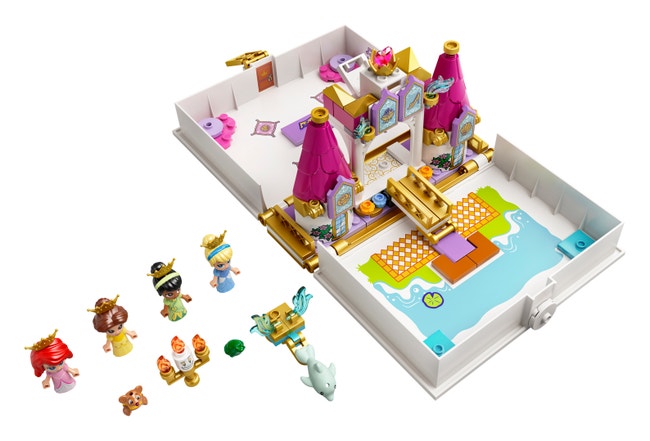
The set The set
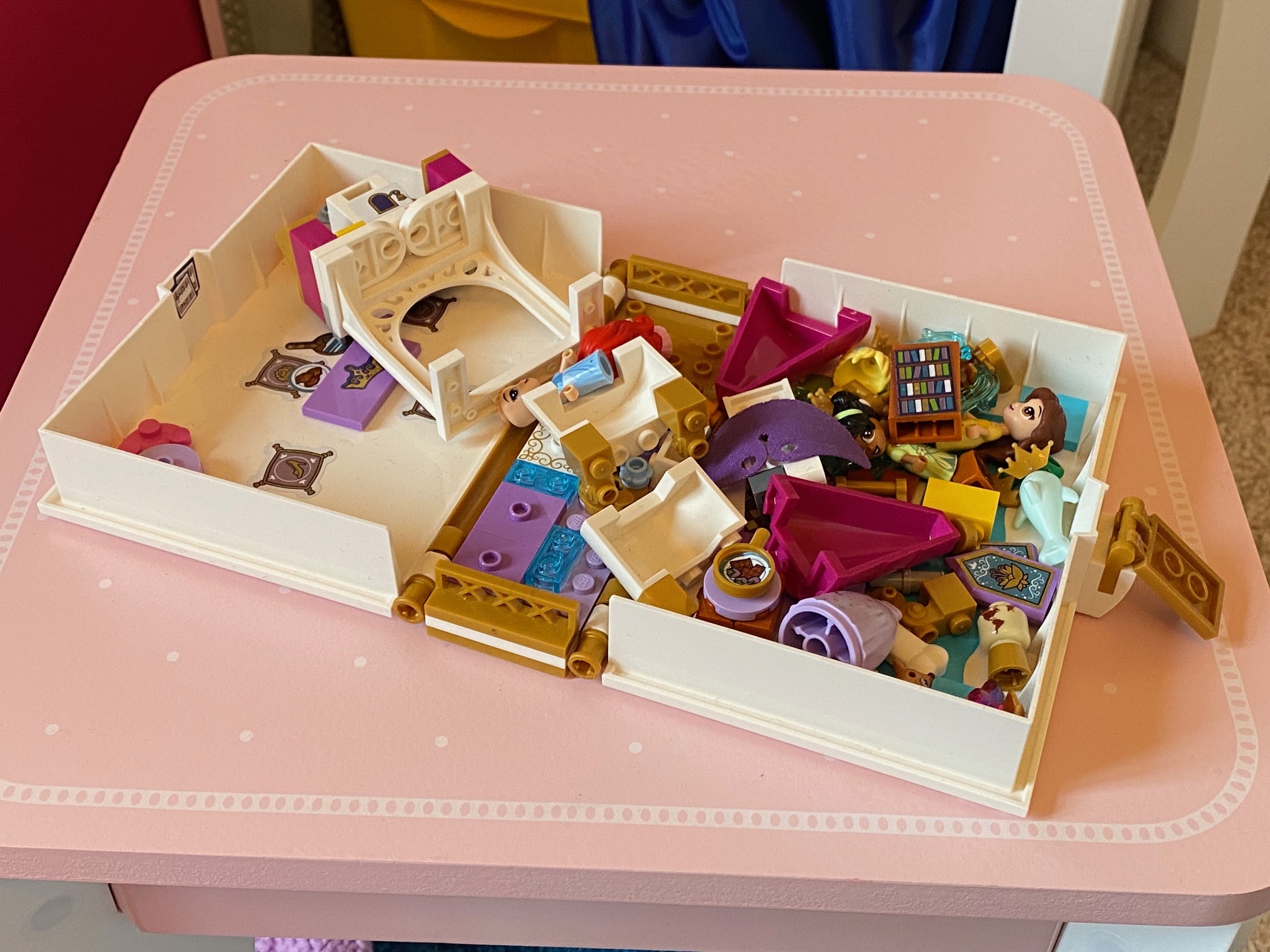
My eldest daughter and I visited a LEGO shop recently and I wanted to buy her a gift. The catch was that we were going to be flying on an airplane the next day, so I wanted to find something with the lowest risk of losing parts on the plane. We settled on Ariel, Belle, Cinderella and Tiana's Storybook Adventures which had a number of things going for it: It was reasonably priced at under 20, for the size of the set; it included four human minifigs (albeit in a sub-minifig size, some kind of munchkin size, but that did not seem to matter) and an assortment of animal accompaniments; but mostly, it folded up into a self-contained mock fairytail "book", and opened up into an enclosed "tray" play area, minimising the risk of losses on the flight.
The set in its resting state The set in its resting state
Lego have done a few of these styles of sets, all Disney princess themed, and it looks like they have a few more on their product roadmap. The newer ones incorporate a locking mechanism with a cute Lego key. I love the concept and think it should be extended to other themes/properties. I can imagine a Lego Star Wars-themed version with a little Death Star trench in the middle, or even an original IP like Classic Space, or Medieval.
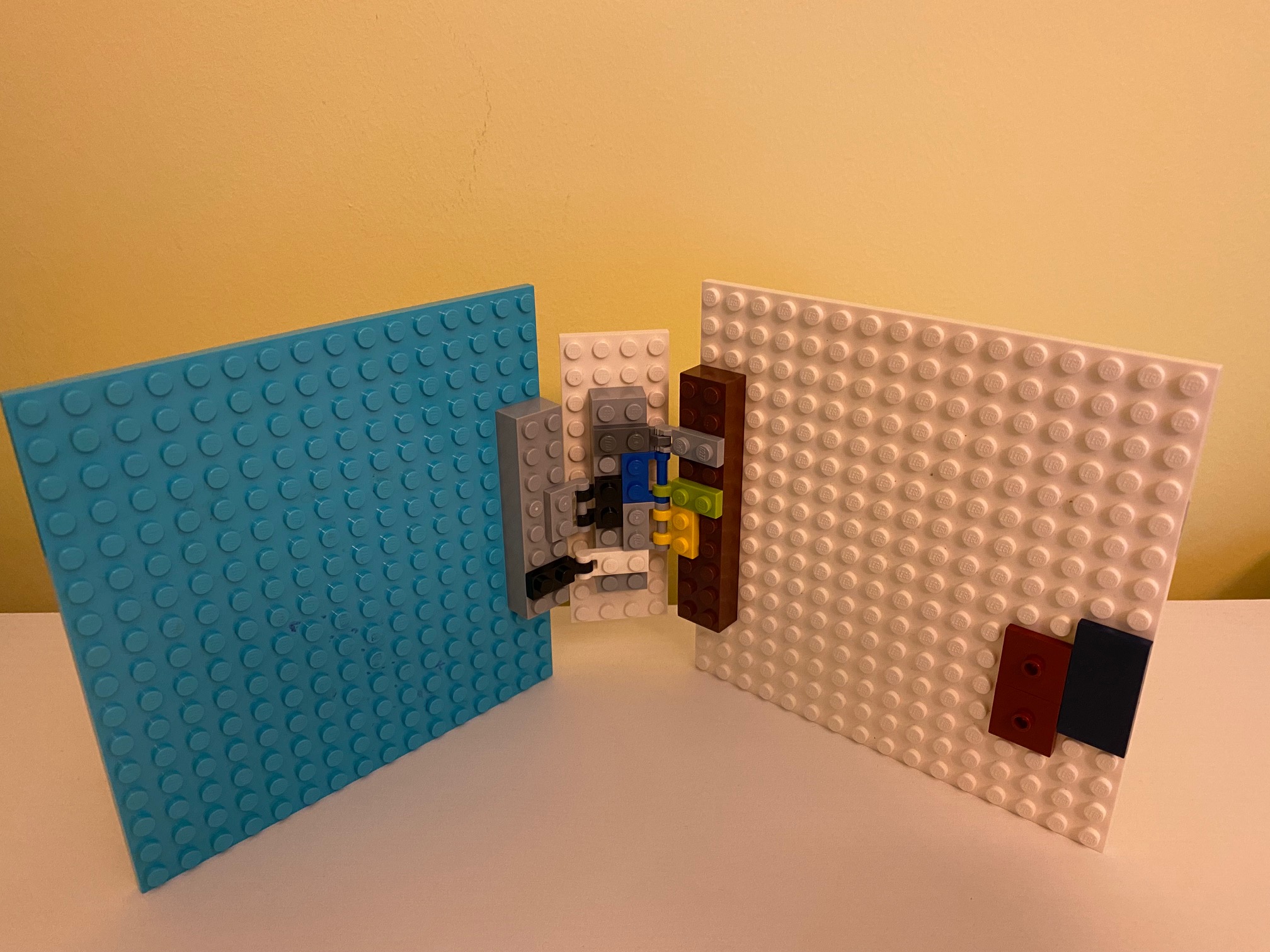
Exploring a DIY Lego book frame Exploring a DIY Lego book frame
I really liked the Book device which reminded me of hollow books as a child. The cover and spine pieces are bespoke Lego bricks made for purpose, but I thought you could create something similar with generic parts. Holly and I had a go at the concept with what bricks we had to hand. It's definitely viable (and you could do a lot better with a wider selection of bricks / more skilled builders) and it will be fun to pick something to try and build on the spine.

Next.

Previous.