Search Results: "jh"

23 January 2013

Joey Hess: in Sydney

After arriving yesterday, and doing the obligatory jetlagged wander around Circular Quay to the Opera House, I crashed for 15 hours sleep and seem reasonably well over the jetlag now. I'm staying near Central Station, which is great because it's very convenient to transport and there's lots of cheap ethnic food.
view down my street
Today I took the ferry over to Manly Beach. I had to get in some in swimming of course, although today was cloudy and only in the 80's (F). That was ok, but the really nice bit was walking over to Shelly Beach and up along the sandstone cliffs near North Head. Highlight was finding a small gotto high on the cliff, with some beautiful sandstone filigree overhead, that seemed carved by water (but probably really by wind), and contained a shady bench overlooking the Pacific. Great place to enjoy a lunch of crusty bread and salami if you're ever in the area. Topped off a great day with a random trip to Neutral Bay (the D&Der in me liked the name, and why not, ferries are free) and a wander through the Royal Botanic Gardens. I'm hoping to spend either Thursday or Friday at a co-working or hackerspace in Sydney, but I don't know where yet. Any locals have ideas?

30 December 2012

Eddy Petrișor: Looking for a backup application for a small home network

I have been looking at backup solution for the last few days and I am stuck, so I am asking for pointers or suggestions.

Since all backup solutions are appropriate to various needs, here are my requirements for my home network (two laptops backup on a very low powered server with a 3TiB HDD):
These are the basic requirements, and bonus-points requirements include:
According to the info I found, candidates for these criteria are Amanda and BackupPC. I like the rsnapshot idea of deduplication and incremental backups, but it's not available for Windows. BackupPC seems to be OK-ish, but it sounds too much like a bunch of Perl scripts and Windows support sounds like an after-thought and I dislike the idea of installing Cygwin just to provide some *nix tools.

I discarded Bacula, because the general impression I got from what I read is that it is hard to set up, has its own storage and has heavy needs for both clients and server. It sounds like overkill.

So what do other people recommend for my setup? Is Amanda OK? Did I get the wrong impression regarding BackupPC?

20 December 2012

Francois Marier: Keeping GMail in a separate browser profile

I wanted to be able to use the GMail web interface on my work machine, but for privacy reasons, I prefer not to be logged into my Google Account on my main browser. Here's how I make use of a somewhat hidden Firefox feature to move GMail to a separate browser profile. Creating a separate profile The idea behing browser profiles is simple: each profile has separate history, settings, bookmarks, cookies, etc. To create a new one, simply start Firefox with this option:
firefox -ProfileManager
to display a dialog which allows you to create new profiles:
Once you've created a new "GMail" profile, you can start it up from the profile manager or directly from the command-line:
firefox -no-remote -P GMail
(The -no-remote option ensures that a new browser process is created for it.) To make this easier, I put the command above in a tiny gmail shell script that lives in my ~/bin/ directory. I can use it to start my "GMail browser" by simply typing gmail. Tuning privacy settings for 2-step authentication While I initially kept that browser profile in private browsing mode, this was forcing me to enter my 2-factor authentication credentials every time I started the browser. So to avoid having to use Google Authenticator (or its Firefox OS cousin) every day, I ended up switching to custom privacy settings and enabling all cookies:
It turns out however that there is a Firefox extension which can selectively delete unwanted cookies while keeping useful ones. Once that add-on is installed and the browser restarted, simply add accounts.google.com to the whitelist and set it to clear cookies when the browser is closed:
Then log into GMail and tick the "Trust this computer" checkbox at the 2-factor prompt:
With these settings, your browsing history will be cleared and you will be logged out of GMail every time you close your browser but will still be able to skip the 2-factor step on that device.

19 October 2012

Ritesh Raj Sarraf: Reporting bugs with Apport - III

Hello World. This is the follow-up to the last 2 updates on the state of apport in Debian.
A lot has changed since the last update on Apport. Currently, in Experimental, we have version 2.6.1-2. With this version, and going forward, there will be no hacks to make it work for Debian. Thanks to Martin Pitt, with his assistance, Apport now has a very basic crashdb in place for Debian. The Debian crashdb provides Apport the interface to interact with the Debian BTS.
This change is already upstream as part of the 2.6.1 release. So for Debian, the packaging is a mere change of the crashdb from 'default' to 'debian'. Being Just Another CrashDB inside Apport, it leverage full support of future Apport releases, fixes and enhancements.
I would like to highlight some points, and some concerns, I have heard in my previous blog posts.
  • Direct email reports to the developer: This was a concern from the last blog post. There will be no such pop-up anymore. It has been knocked off.
  • Useless/Incomplete bug reports: With no proper backtrace, it is worried that the bug report will be useless. Apport has intellignece to check if the backtrace is complete. If it is not, it will not report the bug.

Pop-up for Incomplete backtrace

  • Opt-Out: What if the maintainer is not interested in apport reports? The maintainer can ship a blacklist hook into /etc/apport/blacklist.d/. See /etc/apport/blacklist.d/README.blacklist for details.
Keywords:

17 October 2012

Martin Pitt: Running a Samba server as normal user for testing

For writing tests for GVFS (current tests, proposed improvements) I want to run Samba as normal user, so that we can test gvfs smb backend without root privileges and thus can run them safely and conveniently in a make check environment for developers and in JHBuild for continuous integration testing. Before these tests could only run under gvfs-testbed, which needs root. Unlike other servers such as ssh or ftp, this turned out surprisingly non-obvious and hard, so I want to document it in this blog post for posterity s benefit. Running the server Running smbd itself is mainly an exercise of figuring out all the options that you need to set; Alex Larsson and I had some fun figuring out all the quirks and hiccups that happen between Ubuntu s and Fedora s packaging and 3.6 vs. 4.0, but finally arrived at something working. First, you need to create an empty directory where smbd can put all its databases and state files in. For tests you would use mkdtemp(), but for easier reading I just assume mkdir /tmp/samba here. The main knowledge is in the Samba configuration file, let s call it /tmp/smb.conf:
[global]
workgroup = TESTGROUP
interfaces = lo 127.0.0.0/8
smb ports = 1445
log level = 2
map to guest = Bad User
passdb backend = smbpasswd
smb passwd file = /tmp/smbpasswd
lock directory = /tmp/samba
state directory = /tmp/samba
cache directory = /tmp/samba
pid directory = /tmp/samba
private dir = /tmp/samba
ncalrpc dir = /tmp/samba
[public]
path = /tmp/public
guest ok = yes
[private]
path = /tmp/private
read only = no
For running this as a normal user you need to set a port > 1024, so this uses 1445 to resemble the original (privileged) port 445. The map to guest line makes anonymous logins work on Fedora/Samba 4.0 (I m not sure whether it s a distribution or a version issue). Don t ask about dir vs. directory , that s an inconsistency in Samba; with above names it works on both 3.6 and 4.0. We use the old smbpasswd backend as shipping large tdb files is usually too inconvenient and brittle for test suites. I created an smbpasswd file by running smbpasswd on a real Samba installation, and then using pdbedit to convert it to a smbpasswd file:
sudo smbpasswd -a martin
sudo pdbedit -i tdbsam:/var/lib/samba/passdb.tdb -e smbpasswd:/tmp/smbpasswd
The result for password foo is
myuser:0:XXXXXXXXXXXXXXXXXXXXXXXXXXXXXXXX:AC8E657F83DF82BEEA5D43BDAF7800CC:[U          ]:LCT-507C14C7:
which you are welcome to copy&paste (you can replace myuser with any valid user name, of course). This also defines two shares, one public, one authenticated. You need to create the directories and populate them a bit:
mkdir /tmp/public /tmp/private
echo hello > /tmp/public/hello.txt
echo secret > /tmp/private/myfile.txt
Now you can run the server with
smbd -iFS -s /tmp/smb.conf
The main problem with this approach is that smbd exits ( Server exit (failed to receive smb request) ) after a client terminates, so you need to write your tests in a way to only run one connection/request per test, or to start smbd in a loop. Running the client If you merely use the smbclient command line tool, this is rather simple: It has a -p option for specifying the port:
$ smbclient -p 1445 //localhost/private
Enter martin's password: [enter "foo" here]
Domain=[TESTGROUP] OS=[Unix] Server=[Samba 3.6.6]
smb: \> dir
  .                                   D        0  Wed Oct 17 08:28:23 2012
  ..                                  D        0  Wed Oct 17 08:31:24 2012
  myfile.txt                                   7  Wed Oct 17 08:28:23 2012
In the case of gvfs it wasn t so simple, however. Surprisingly, libsmbclient does not have an API to set the port, it always assumes 445. smbclient itself uses some internal libcli API which does have a way to change the port, but it s not exposed through libsmbclient. However, Alex and I found some mailing list posts ([1], [2]) that mention $LIBSMB_PROG, and it s also mentioned in smbclient s manpage. It doesn t quite work as advertised in the second ML post (you can t set it to smbd, smbd apparently doesn t speak the socket protocol over stdin/stdout), and it s not being used anywhere in the current Samba sources, but what does work is to use good old netcat:
export LIBSMB_PROG="nc localhost 1445"
with that, you can use smbclient or any program using libsmbclient to talk to our test smb server running as user.

1 October 2012

Martin Pitt: Announcing D-Bus mocker library

I was working on writing tests for gnome-settings-daemon a week or so ago, and finally got blocked on being unable to set up upower/ConsoleKit/etc. the way I need them. Also, doing so needs root privileges, I don t want my test suite to actually suspend my machine, and using the real service is generally not suitable for test suites that are supposed to run during make check , in jhbuild, and the like these do not have the polkit privileges to do all that, and may not even have a system D-Bus running in the first place. So I wrote a little test_upower.py helper, then realized that I need another one for systemd/ConsoleKit (for the system idle property), also looked at the mock polkit in udisks and finally sat down for two days to generalize this and do this properly. The result is python-dbusmock, I just released the first tarball. With this you can easily create mock objects on D-Bus from any programming language with a D-Bus binding, or even from the shell. The mock objects look like the real API (or at least the parts that you actually need), but they do not actually do anything (or only some action that you specify yourself). You can configure their state, behaviour and responses as you like in your test, without making any assumptions about the real system status. When using a local system/session bus, you can do unit or integration testing without needing root privileges or disturbing a running system. The Python API offers some convenience functions like start_session_bus() and start_system_bus() for this, in a DBusTestCase class (subclass of the standard unittest.TestCase ). Surprisingly I found very little precedence here. There is a Perl module, but that s not particuarly helpful for test suites in C/Vala/Python. And there is Phil s excellent Bendy Bus, but this has a different goal: If you want to thoroughly test a particular D-BUS service, such as ensuring that it does the right thing, doesn t crash on bad input, etc., then Bendy Bus is for you (and python-dbusmock isn t). However, it is too much overhead and rather inconvenient if you want to test a client-side program and just need a few system services around it which you want to set up in different states for each test. You can use python-dbusmock with any programming language, as you can run the mocker as a normal program. The actual setup of the mock (adding objects, methods, properties, etc.) all happen via D-Bus methods on the org.freedesktop.DBus.Mock interface. You just don t have the convenience D-Bus launch API. The simplest possible example is to create a mock upower with a single Suspend() method, which you can set up like this from Python:
import dbus
import dbusmock
class TestMyProgram(dbusmock.DBusTestCase):
[...]
    def setUp(self):
        self.p_mock = self.spawn_server('org.freedesktop.UPower',
                                        '/org/freedesktop/UPower',
                                        'org.freedesktop.UPower',
                                        system_bus=True,
                                        stdout=subprocess.PIPE)
        # Get a proxy for the UPower object's Mock interface
        self.dbus_upower_mock = dbus.Interface(self.dbus_con.get_object(
            'org.freedesktop.UPower', '/org/freedesktop/UPower'),
            'org.freedesktop.DBus.Mock')
        self.dbus_upower_mock.AddMethod('', 'Suspend', '', '', '')
[...]
    def test_suspend_on_idle(self):
        # run your program in a way that should trigger one suspend call
        # now check the log that we got one Suspend() call
        self.assertRegex(self.p_mock.stdout.readline(), b'^[0-9.]+ Suspend$')
This doesn t depend on Python, you can just as well run the mocker like this:
python3 -m dbusmock org.freedesktop.UPower /org/freedesktop/UPower org.freedesktop.UPower
and then set up the mocks through D-Bus like
gdbus call --system -d org.freedesktop.UPower -o /org/freedesktop/UPower \
      -m org.freedesktop.DBus.Mock.AddMethod '' Suspend '' '' ''
If you use it with Python, you get access to the dbusmock.DBusTestCase class which provides some convenience functions to set up and tear down local private session and system buses. If you use it from another language, you have to call dbus-launch yourself. Please see the README for some more details, pointers to documentation and examples. Update: You can now install this via pip from PyPI or from the daily builds PPA. Update 2: Adjusted blog entry for version 0.0.3 API, to avoid spreading now false information too far.

24 September 2012

Diego Escalante Urrelo: WebKitGTK+ failing to build, argument list too long

The last few days I have been unable to build WebKitGTK+ from git. The problem is that make chokes the command line with an insanely long list of file names. You need a patched version of make.

Pictured: myself debugging WebKit build issues. Gustavo told me that WebKit has some handy jhbuild scripts that include a patched make. Being WebKit-scale I knew the scripts did a lot more than what I wanted, so I just reused its moduleset for a quick buildone command: $ cd WebKit/Tools/gtk/
$ jhbuild -m file:// pwd /jhbuild.modules buildone make
And yes, it works! Thanks Gustavo.

13 September 2012

Gunnar Wolf: Great online course available: Securing Digital Democracy , by J. Alex Halderman

I was pointed at a great online course If you are into e-voting analysis (or, more broadly, into democratic processes' history, evolution and future), I strongly suggest you to take a look at Securing Digital Democracy . Just the name of the teacher should be enough to make it interesting: University of Michigan professor J. Alex Halderman, the guy who has analized/hacked several electronic booths, and one of the clearest, smartest voices to explain what should we require of a voting system and how electronic booths are the worst fit for any purpose. The course is delivered through Coursera; I have found Coursera to be an effective, usable, unobtrusive platform So much I even signed up for another course. I am not so happy with online courses requiring to wait so much between lessons, but after all, it tries to mimic what we see at "regular" (i.e. classroom) teaching settings. And, after all, we autodidacts are still a minority. The course in question started ten days ago, but you can still perfectly join. Each week has two lessons, worth of approximately 40 minutes of video each, and are "graded" through a quiz. Lets see how this evolves.

6 August 2012

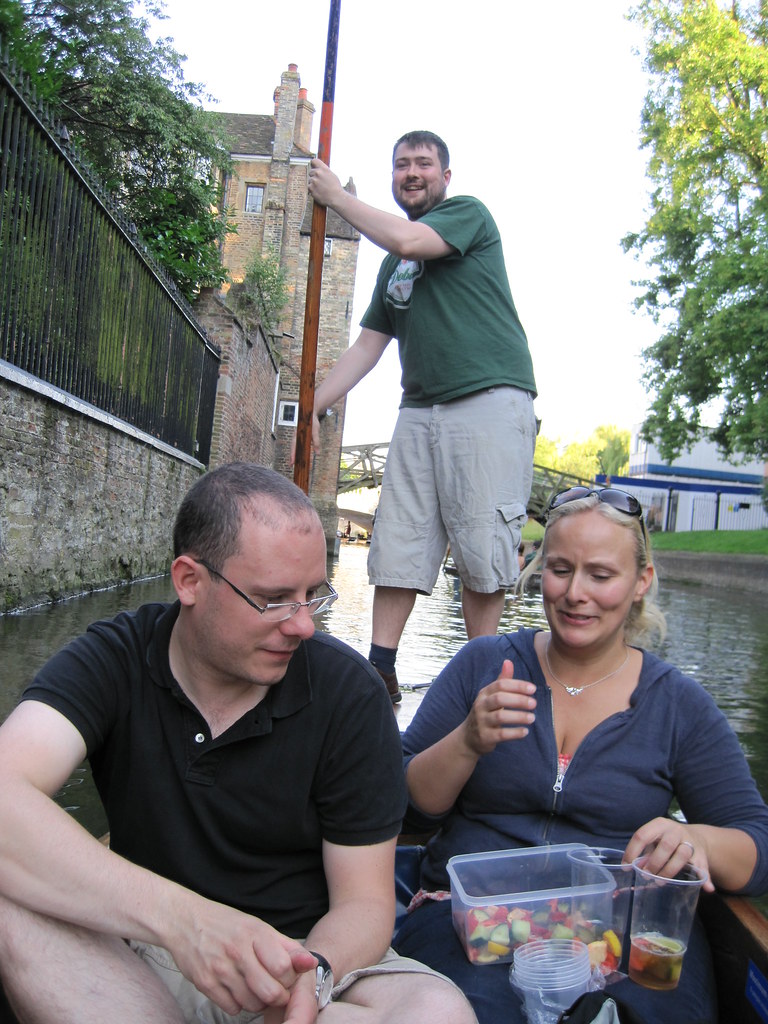
Vincent Sanders: Pimm's and Punting

The Sun came out in Cambridge the other week (yes I know, a rare occurrence) and because Robert is a generous soul he decided the office should go punting on the cam.

I had not previously been out on the river but Robert proved to be the consummate punter.

We even got fruit based drinks and some serenading, although perhaps that was not a benefit.


I took many photos of the event including the rather nice meal afterwards, some were even in focus and not blurry.

31 July 2012

Martin Pitt: My impressions from GUADEC

I have had the pleasure of attending GUADEC in full this year. TL;DR: A lot of great presentations + lots of hall conversations about QA stuff + the obligatory be er,ach = . Last year I just went to the hackfest, and I never made it to any previous one, so GUADEC 2012 was a kind of first-time experience for me. It was great to put some faces and personal impressions to a lot of the people I have worked with for many years, as well as catching up with others that I did meet before. I discussed various hardware/software testing stuff with Colin Walters, Matthias Clasen, Lennart Poettering, Bertrand Lorentz, and others, so I have a better idea how to proceed with automated testing in plumbing and GNOME now. It was also really nice to meet my fellow PyGObject co-maintainer Paolo Borelli, as well as seeing Simon Schampier and Ignacio Casal Quinteiro again. No need to replicate the whole schedule here (see for yourself on the interwebs), so I just want to point out some personal highlights in the presentations: There were a lot of other good ones, some of them technical and some amusing and enlightening, such as Frederico s review of the history of GNOME. On Monday I prepared and participated in a PyGObject hackfest, but I ll blog about this separately. I want to thank all presenters for the excellent program, as well as the tireless GUADEC organizer team for making everything so smooth and working flawlessly! Great Job, and see you again in Strasbourg or Brno!

Russell Coker: ZFS on Debian/Wheezy

As storage capacities increase the probability of data corruption increases as does the amount of time required for a fsck on a traditional filesystem. Also the capacity of disks is increasing a lot faster than the contiguous IO speed which means that the RAID rebuild time is increasing, for example my first hard disk was 70M and had a transfer rate of 500K/s which meant that the entire contents could be read in a mere 140 seconds! The last time I did a test on a more recent disk a 1TB SATA disk gave contiguous transfer rates ranging from 112MB/s to 52MB/s which meant that reading the entire contents took 3 hours and 10 minutes, and that problem is worse with newer bigger disks. The long rebuild times make greater redundancy more desirable. BTRFS vs ZFS Both BTRFS and ZFS checksum all data to cover the case where a disk returns corrupt data, they don t need a fsck program, and the combination of checksums and built-in RAID means that they should have less risk of data loss due to a second failure during rebuild. ZFS supports RAID-Z which is essentially a RAID-5 with checksums on all blocks to handle the case of corrupt data as well as RAID-Z2 which is a similar equivalent to RAID-6. RAID-Z is quite important if you don t want to have half your disk space taken up by redundancy or if you want to have your data survive the loss or more than one disk, so until BTRFS has an equivalent feature ZFS offers significant benefits. Also BTRFS is still rather new which is a concern for software that is critical to data integrity. I am about to install a system to be a file server and Xen server which probably isn t going to be upgraded a lot over the next few years. It will have 4 disks so ZFS with RAID-Z offers a significant benefit over BTRFS for capacity and RAID-Z2 offers a significant benefit for redundancy. As it won t be upgraded a lot I ll start with Debian/Wheezy even though it isn t released yet because the system will be in use without much change well after Squeeze security updates end. ZFS on Wheezy Getting ZFS to basically work isn t particularly hard, the ZFSonLinux.org site has the code and reasonable instructions for doing it [1]. The zfsonlinux code doesn t compile out of the box on Wheezy although it works well on Squeeze. I found it easier to get a the latest Ubuntu working with ZFS and then I rebuilt the Ubuntu packages for Debian/Wheezy and they worked. This wasn t particularly difficult but it s a pity that the zfsonlinux site didn t support recent kernels. Root on ZFS The complication with root on ZFS is that the ZFS FAQ recommends using whole disks for best performance so you can avoid alignment problems on 4K sector disks (which is an issue for any disk large enough that you want to use it with ZFS) [2]. This means you have to either use /boot on ZFS (which seems a little too experimental for me) or have a separate boot device. Currently I have one server running with 4*3TB disks in a RAID-Z array and a single smaller disk for the root filesystem. Having a fifth disk attached by duct-tape to a system that is only designed for four disks isn t ideal, but when you have an OS image that is backed up (and not so important) and a data store that s business critical (but not needed every day) then a failure on the root device can be fixed the next day without serious problems. But I want to fix this and avoid creating more systems like it. There is some good documentation on using Ubuntu with root on ZFS [3]. I considered using Ubuntu LTS for the server in question, but as I prefer Debian and I can recompile Ubuntu packages for Debian it seems that Debian is the best choice for me. I compiled those packages for Wheezy, did the install and DKMS build, and got ZFS basically working without much effort. The problem then became getting ZFS to work for the root filesystem. The Ubuntu packages didn t work with the Debian initramfs for some reason and modules failed to load. This wasn t necessarily a show-stopper as I can modify such things myself, but it s another painful thing to manage and another way that the system can potentially break on upgrade. The next issue is the unusual way that ZFS mounts filesystems. Instead of having block devices to mount and entries in /etc/fstab the ZFS system does things for you. So if you want a ZFS volume to be mounted as root you configure the mountpoint via the zfs set mountpoint command. This of course means that it doesn t get mounted if you boot with a different root filesystem and adds some needless pain to the process. When I encountered this I decided that root on ZFS isn t a good option. So for this new server I ll install it with an Ext4 filesystem on a RAID-1 device for root and /boot and use ZFS for everything else. Correct Alignment After setting up the system with a 4 disk RAID-1 (or mirror for the pedants who insist that true RAID-1 has only two disks) for root and boot I then created partitions for ZFS. According to fdisk output the partitions /dev/sda2, /dev/sdb2 etc had their first sector address as a multiple of 2048 which I presume addresses the alignment requirement for a disk that has 4K sectors. Installing ZFS deb http://www.coker.com.au wheezy zfs I created the above APT repository (only AMD64) for ZFS packages based on Darik Horn s Ubuntu packages (thanks for the good work Darik). Installing zfs-dkms, spl-dkms, and zfsutils gave a working ZFS system. I could probably have used Darik s binary packages but I think it s best to rebuild Ubuntu packages to use on Debian. The server in question hasn t gone live in production yet (it turns out that we don t have agreement on what the server will do). But so far it seems to be working OK. Related posts:
  1. Discovering OS Bugs and Using Snapshots I m running Debian/Unstable on an EeePC 701, I ve got an...
  2. Starting with BTRFS Based on my investigation of RAID reliability [1] I have...
  3. ZFS vs BTRFS on Cheap Dell Servers I previously wrote about my first experiences with BTRFS [1]....

17 July 2012

Ritesh Raj Sarraf: Reporting bugs with Apport - II

This is a follow up to the previous post regarding Reporting bugs with ApportApport, version 2.2.3-2, has been pushed to experimental. There were some nice feedback that led to some more changes that I will talk here.Opt out: As a developer, if you see the volume of reports to be annoying, you have the option to opt out of apport reports. To do this, you should specify the XBS-Apport: No field in your package's control file. When your application crashes, apport first checks for that field in your package's description and acts based on what you chose.Following image is that the user sees for packages where the developer has opted out.opt outRepetition: Repetition of the same crash could lead to multiple reports on the same buggy behavior. For this, apport, if senses that you have already filed a bug, it provides you with the option to further ignore all crashes for that particular type.Following image should explain it better.ignore report My initial thought regarding defaults was to make apport a default opt out tool for the entire archive and only file reports for packages where the developer has manually enabled to opt-in for apport reports. But that'd have been very slow in terms of adoption, hence, for now, instead, the version in experimental does it the other way around. It will file bug reports for all packages. If you need to opt out, you will have to add the above expalined control field. That's it for this post. Please provide feedback once you spend some time with apport.PS: Please take conscious steps when filing bug reports with apport. I think it is a great tool. It just needs great users. :-)
Categories:
Keywords:

12 July 2012

Ritesh Raj Sarraf: Reporting bugs with Apport

So yet another bug reporting tool. :-)When I prepared Apport for Debian, I wasn't sure how it will look going forward. If you look at the current one lying in experimental, it just detects your crashes and pops up in your systray. It doesn't have the mechanism to interact with BTS.So, like the title of this post says, this is the first worthy feature for Apport in the context of Debian.Apport Detail ReportNothing special here. You would have seen a similar window before if you have installed apport. What changes with this release is, that now, when you check the Send an error report to help fix this problem, it will really file a bug report on the BTS.Here's what the emailed bug report will look like:
Package: leafnode
Version: 2.0.0.alpha20090406a-1
=============================
ProblemType: Crash
Architecture: amd64
Date: Tue Jul  3 00:08:02 2012
Dependencies:
 adduser 3.113+nmu3
 base-passwd 3.5.24
 cron 3.0pl1-123
 debconf 1.5.44
 debianutils 4.3.1
 dpkg 1.16.4.3
 gcc-4.7-base 4.7.1-2
 libbz2-1.0 1.0.6-3
 libc-bin 2.13-33
 libc6 2.13-33
 libclass-isa-perl 0.36-3
 libdb5.1 5.1.29-4
 libfile-copy-recursive-perl 0.38-1
 libgcc1 1:4.7.1-2
 libgdbm3 1.8.3-11
 liblzma5 5.1.1alpha+20120614-1
 libpam-modules 1.1.3-7.1
 libpam-modules-bin 1.1.3-7.1
 libpam-runtime 1.1.3-7.1
 libpam0g 1.1.3-7.1
 libpcre3 1:8.30-5
 libpopt0 1.16-7
 libselinux1 2.1.9-5
 libsemanage-common 2.1.6-6
 libsemanage1 2.1.6-6
 libsepol1 2.1.4-3
 libswitch-perl 2.16-2
 libustr-1.0-1 1.0.4-3
 libwrap0 7.6.q-23
 logrotate 3.8.1-4
 lsb-base 4.1+Debian7 [modified: lib/lsb/init-functions]
 multiarch-support 2.13-33
 netbase 5.0
 openbsd-inetd 0.20091229-2
 passwd 1:4.1.5.1-1
 perl 5.14.2-12
 perl-base 5.14.2-12
 perl-modules 5.14.2-12
 sensible-utils 0.0.7
 tar 1.26-4
 tcpd 7.6.q-23
 update-inetd 4.43
 zlib1g 1:1.2.7.dfsg-13
Disassembly:
 => 0x7f8e69738475 <*__GI_raise+53>:	cmp    $0xfffffffffffff000,%rax
    0x7f8e6973847b <*__GI_raise+59>:	ja     0x7f8e69738492 <*__GI_raise+82>
    0x7f8e6973847d <*__GI_raise+61>:	repz retq 
    0x7f8e6973847f <*__GI_raise+63>:	nop
    0x7f8e69738480 <*__GI_raise+64>:	test   %eax,%eax
    0x7f8e69738482 <*__GI_raise+66>:	jg     0x7f8e69738465 <*__GI_raise+37>
    0x7f8e69738484 <*__GI_raise+68>:	test   $0x7fffffff,%eax
    0x7f8e69738489 <*__GI_raise+73>:	jne    0x7f8e697384a2 <*__GI_raise+98>
    0x7f8e6973848b <*__GI_raise+75>:	mov    %esi,%eax
    0x7f8e6973848d <*__GI_raise+77>:	nopl   (%rax)
    0x7f8e69738490 <*__GI_raise+80>:	jmp    0x7f8e69738465 <*__GI_raise+37>
    0x7f8e69738492 <*__GI_raise+82>:	mov    0x34e97f(%rip),%rdx        # 0x7f8e69a86e18
    0x7f8e69738499 <*__GI_raise+89>:	neg    %eax
    0x7f8e6973849b <*__GI_raise+91>:	mov    %eax,%fs:(%rdx)
    0x7f8e6973849e <*__GI_raise+94>:	or     $0xffffffff,%eax
    0x7f8e697384a1 <*__GI_raise+97>:	retq
DistroRelease: Debian 7.0
ExecutablePath: /usr/sbin/fetchnews
ExecutableTimestamp: 1265584779
Package: leafnode 2.0.0.alpha20090406a-1
PackageArchitecture: amd64
ProcCmdline: /usr/sbin/fetchnews
ProcCwd: /
ProcEnviron:
 LANGUAGE=en_US:en
 LC_TIME=en_IN.UTF-8
 LC_MONETARY=en_IN.UTF-8
 PATH=(custom, no user)
 LC_ADDRESS=en_IN.UTF-8
 LANG=en_US.UTF-8
 LC_TELEPHONE=en_IN.UTF-8
 LC_NAME=en_IN.UTF-8
 SHELL=/bin/sh
 LC_MEASUREMENT=en_IN.UTF-8
 LC_NUMERIC=en_IN.UTF-8
 LC_PAPER=en_IN.UTF-8
ProcMaps:
 00400000-00421000 r-xp 00000000 08:06 4464934                            /usr/sbin/fetchnews
 00621000-00622000 rw-p 00021000 08:06 4464934                            /usr/sbin/fetchnews
 00622000-00623000 rw-p 00000000 00:00 0 
 00be4000-00c05000 rw-p 00000000 00:00 0                                  [heap]
 7f8e68edc000-7f8e68eef000 r-xp 00000000 08:06 1179776                    /lib/x86_64-linux-gnu/libresolv-2.13.so
 7f8e68eef000-7f8e690ee000 ---p 00013000 08:06 1179776                    /lib/x86_64-linux-gnu/libresolv-2.13.so
 7f8e690ee000-7f8e690ef000 r--p 00012000 08:06 1179776                    /lib/x86_64-linux-gnu/libresolv-2.13.so
 7f8e690ef000-7f8e690f0000 rw-p 00013000 08:06 1179776                    /lib/x86_64-linux-gnu/libresolv-2.13.so
 7f8e690f0000-7f8e690f2000 rw-p 00000000 00:00 0 
 7f8e690f2000-7f8e690f7000 r-xp 00000000 08:06 1180036                    /lib/x86_64-linux-gnu/libnss_dns-2.13.so
 7f8e690f7000-7f8e692f6000 ---p 00005000 08:06 1180036                    /lib/x86_64-linux-gnu/libnss_dns-2.13.so
 7f8e692f6000-7f8e692f7000 r--p 00004000 08:06 1180036                    /lib/x86_64-linux-gnu/libnss_dns-2.13.so
 7f8e692f7000-7f8e692f8000 rw-p 00005000 08:06 1180036                    /lib/x86_64-linux-gnu/libnss_dns-2.13.so
 7f8e692f8000-7f8e692fa000 r-xp 00000000 08:06 1183392                    /lib/libnss_mdns4_minimal.so.2
 7f8e692fa000-7f8e694f9000 ---p 00002000 08:06 1183392                    /lib/libnss_mdns4_minimal.so.2
 7f8e694f9000-7f8e694fa000 rw-p 00001000 08:06 1183392                    /lib/libnss_mdns4_minimal.so.2
 7f8e694fa000-7f8e69505000 r-xp 00000000 08:06 1180055                    /lib/x86_64-linux-gnu/libnss_files-2.13.so
 7f8e69505000-7f8e69704000 ---p 0000b000 08:06 1180055                    /lib/x86_64-linux-gnu/libnss_files-2.13.so
 7f8e69704000-7f8e69705000 r--p 0000a000 08:06 1180055                    /lib/x86_64-linux-gnu/libnss_files-2.13.so
 7f8e69705000-7f8e69706000 rw-p 0000b000 08:06 1180055                    /lib/x86_64-linux-gnu/libnss_files-2.13.so
 7f8e69706000-7f8e69883000 r-xp 00000000 08:06 1179700                    /lib/x86_64-linux-gnu/libc-2.13.so
 7f8e69883000-7f8e69a83000 ---p 0017d000 08:06 1179700                    /lib/x86_64-linux-gnu/libc-2.13.so
 7f8e69a83000-7f8e69a87000 r--p 0017d000 08:06 1179700                    /lib/x86_64-linux-gnu/libc-2.13.so
 7f8e69a87000-7f8e69a88000 rw-p 00181000 08:06 1179700                    /lib/x86_64-linux-gnu/libc-2.13.so
 7f8e69a88000-7f8e69a8d000 rw-p 00000000 00:00 0 
 7f8e69a8d000-7f8e69a95000 r-xp 00000000 08:06 1180031                    /lib/x86_64-linux-gnu/libcrypt-2.13.so
 7f8e69a95000-7f8e69c94000 ---p 00008000 08:06 1180031                    /lib/x86_64-linux-gnu/libcrypt-2.13.so
 7f8e69c94000-7f8e69c95000 r--p 00007000 08:06 1180031                    /lib/x86_64-linux-gnu/libcrypt-2.13.so
 7f8e69c95000-7f8e69c96000 rw-p 00008000 08:06 1180031                    /lib/x86_64-linux-gnu/libcrypt-2.13.so
 7f8e69c96000-7f8e69cc4000 rw-p 00000000 00:00 0 
 7f8e69cc4000-7f8e69cc6000 r-xp 00000000 08:06 1180047                    /lib/x86_64-linux-gnu/libdl-2.13.so
 7f8e69cc6000-7f8e69ec6000 ---p 00002000 08:06 1180047                    /lib/x86_64-linux-gnu/libdl-2.13.so
 7f8e69ec6000-7f8e69ec7000 r--p 00002000 08:06 1180047                    /lib/x86_64-linux-gnu/libdl-2.13.so
 7f8e69ec7000-7f8e69ec8000 rw-p 00003000 08:06 1180047                    /lib/x86_64-linux-gnu/libdl-2.13.so
 7f8e69ec8000-7f8e69ed5000 r-xp 00000000 08:06 1179893                    /lib/x86_64-linux-gnu/libpam.so.0.83.0
 7f8e69ed5000-7f8e6a0d4000 ---p 0000d000 08:06 1179893                    /lib/x86_64-linux-gnu/libpam.so.0.83.0
 7f8e6a0d4000-7f8e6a0d5000 r--p 0000c000 08:06 1179893                    /lib/x86_64-linux-gnu/libpam.so.0.83.0
 7f8e6a0d5000-7f8e6a0d6000 rw-p 0000d000 08:06 1179893                    /lib/x86_64-linux-gnu/libpam.so.0.83.0
 7f8e6a0d6000-7f8e6a112000 r-xp 00000000 08:06 1182916                    /lib/x86_64-linux-gnu/libpcre.so.3.13.1
 7f8e6a112000-7f8e6a312000 ---p 0003c000 08:06 1182916                    /lib/x86_64-linux-gnu/libpcre.so.3.13.1
 7f8e6a312000-7f8e6a313000 rw-p 0003c000 08:06 1182916                    /lib/x86_64-linux-gnu/libpcre.so.3.13.1
 7f8e6a313000-7f8e6a333000 r-xp 00000000 08:06 1180134                    /lib/x86_64-linux-gnu/ld-2.13.so
 7f8e6a503000-7f8e6a507000 rw-p 00000000 00:00 0 
 7f8e6a530000-7f8e6a532000 rw-p 00000000 00:00 0 
 7f8e6a532000-7f8e6a533000 r--p 0001f000 08:06 1180134                    /lib/x86_64-linux-gnu/ld-2.13.so
 7f8e6a533000-7f8e6a534000 rw-p 00020000 08:06 1180134                    /lib/x86_64-linux-gnu/ld-2.13.so
 7f8e6a534000-7f8e6a535000 rw-p 00000000 00:00 0 
 7fffbc06e000-7fffbc08f000 rw-p 00000000 00:00 0                          [stack]
 7fffbc1ff000-7fffbc200000 r-xp 00000000 00:00 0                          [vdso]
 ffffffffff600000-ffffffffff601000 r-xp 00000000 00:00 0                  [vsyscall]
ProcStatus:
 Name:	fetchnews
 State:	S (sleeping)
 Tgid:	6872
 Pid:	6872
 PPid:	6871
 TracerPid:	0
 Uid:	9	9	9	9
 Gid:	9	9	9	9
 FDSize:	64
 Groups:	9 
 VmPeak:	   21440 kB
 VmSize:	   21276 kB
 VmLck:	       0 kB
 VmPin:	       0 kB
 VmHWM:	     984 kB
 VmRSS:	     984 kB
 VmData:	     380 kB
 VmStk:	     136 kB
 VmExe:	     132 kB
 VmLib:	    2132 kB
 VmPTE:	      64 kB
 VmSwap:	       0 kB
 Threads:	1
 SigQ:	0/23227
 SigPnd:	0000000000000000
 ShdPnd:	0000000000000000
 SigBlk:	0000000000000000
 SigIgn:	0000000000000000
 SigCgt:	0000000000000000
 CapInh:	0000000000000000
 CapPrm:	0000000000000000
 CapEff:	0000000000000000
 CapBnd:	ffffffffffffffff
 Cpus_allowed:	f
 Cpus_allowed_list:	0-3
 Mems_allowed:	00000000,00000001
 Mems_allowed_list:	0
 voluntary_ctxt_switches:	6
 nonvoluntary_ctxt_switches:	1
Registers:
 rax            0x0	0
 rbx            0x0	0
 rcx            0xffffffffffffffff	-1
 rdx            0x6	6
 rsi            0x1ad8	6872
 rdi            0x1ad8	6872
 rbp            0x0	0x0
 rsp            0x7fffbc08d4f8	0x7fffbc08d4f8
 r8             0x7f8e6a504700	140249645729536
 r9             0x6d6f642064656966	7885631562835126630
 r10            0x8	8
 r11            0x246	582
 r12            0x0	0
 r13            0x7fffbc08d920	140736348084512
 r14            0x0	0
 r15            0x0	0
 rip            0x7f8e69738475	0x7f8e69738475 <*__GI_raise+53>
 eflags         0x246	[ PF ZF IF ]
 cs             0x33	51
 ss             0x2b	43
 ds             0x0	0
 es             0x0	0
 fs             0x0	0
 gs             0x0	0
Signal: 6
SourcePackage: leafnode
Stacktrace:
 #0  0x00007f8e69738475 in *__GI_raise (sig=<optimized out>) at ../nptl/sysdeps/unix/sysv/linux/raise.c:64
         pid = <optimized out>
         selftid = <optimized out>
 #1  0x00007f8e6973b6f0 in *__GI_abort () at abort.c:92
         act =  __sigaction_handler =  sa_handler = 0x7f8e69850d3d, sa_sigaction = 0x7f8e69850d3d , sa_mask =  __val =  140736348083740, 140249634747968, 0, 0, 140736348084512, 140249631083424, 140249645738440, 0, 4294967295, 206158430232, 1, 6427272, 0, 0, 0, 0 , sa_flags = 1781664242, sa_restorer = 0x1 
         sigs =  __val =  32, 0 <repeats 15 times> 
 #2  0x0000000000416292 in ?? ()
 No symbol table info available.
 #3  0x0000000000411c80 in ?? ()
 No symbol table info available.
 #4  0x0000000000406952 in ?? ()
 No symbol table info available.
 #5  0x00007f8e69724ead in __libc_start_main (main=<optimized out>, argc=<optimized out>, ubp_av=<optimized out>, init=<optimized out>, fini=<optimized out>, rtld_fini=<optimized out>, stack_end=0x7fffbc08d918) at libc-start.c:228
         result = <optimized out>
         unwind_buf =  cancel_jmp_buf =  jmp_buf =  0, 498162418289285118, 4206480, 140736348084512, 0, 0, -498021567843461122, -435434157313288194 , mask_was_saved = 0 , priv =  pad =  0x0, 0x0, 0x418360, 0x7fffbc08d928 , data =  prev = 0x0, cleanup = 0x0, canceltype = 4293472 
         not_first_call = <optimized out>
 #6  0x0000000000402fb9 in ?? ()
 No symbol table info available.
 #7  0x00007fffbc08d918 in ?? ()
 No symbol table info available.
 #8  0x000000000000001c in ?? ()
 No symbol table info available.
 #9  0x0000000000000001 in ?? ()
 No symbol table info available.
 #10 0x00007fffbc08ee96 in ?? ()
 No symbol table info available.
 #11 0x0000000000000000 in ?? ()
 No symbol table info available.
StacktraceTop:
 ?? ()
 ?? ()
 ?? ()
 __libc_start_main (main=<optimized out>, argc=<optimized out>, ubp_av=<optimized out>, init=<optimized out>, fini=<optimized out>, rtld_fini=<optimized out>, stack_end=0x7fffbc08d918) at libc-start.c:228
 ?? ()
ThreadStacktrace:
 .
 Thread 1 (LWP 6872):
 #0  0x00007f8e69738475 in *__GI_raise (sig=<optimized out>) at ../nptl/sysdeps/unix/sysv/linux/raise.c:64
         pid = <optimized out>
         selftid = <optimized out>
 #1  0x00007f8e6973b6f0 in *__GI_abort () at abort.c:92
         act =  __sigaction_handler =  sa_handler = 0x7f8e69850d3d, sa_sigaction = 0x7f8e69850d3d , sa_mask =  __val =  140736348083740, 140249634747968, 0, 0, 140736348084512, 140249631083424, 140249645738440, 0, 4294967295, 206158430232, 1, 6427272, 0, 0, 0, 0 , sa_flags = 1781664242, sa_restorer = 0x1 
         sigs =  __val =  32, 0 <repeats 15 times> 
 #2  0x0000000000416292 in ?? ()
 No symbol table info available.
 #3  0x0000000000411c80 in ?? ()
 No symbol table info available.
 #4  0x0000000000406952 in ?? ()
 No symbol table info available.
 #5  0x00007f8e69724ead in __libc_start_main (main=<optimized out>, argc=<optimized out>, ubp_av=<optimized out>, init=<optimized out>, fini=<optimized out>, rtld_fini=<optimized out>, stack_end=0x7fffbc08d918) at libc-start.c:228
         result = <optimized out>
         unwind_buf =  cancel_jmp_buf =  jmp_buf =  0, 498162418289285118, 4206480, 140736348084512, 0, 0, -498021567843461122, -435434157313288194 , mask_was_saved = 0 , priv =  pad =  0x0, 0x0, 0x418360, 0x7fffbc08d928 , data =  prev = 0x0, cleanup = 0x0, canceltype = 4293472 
         not_first_call = <optimized out>
 #6  0x0000000000402fb9 in ?? ()
 No symbol table info available.
 #7  0x00007fffbc08d918 in ?? ()
 No symbol table info available.
 #8  0x000000000000001c in ?? ()
 No symbol table info available.
 #9  0x0000000000000001 in ?? ()
 No symbol table info available.
 #10 0x00007fffbc08ee96 in ?? ()
 No symbol table info available.
 #11 0x0000000000000000 in ?? ()
 No symbol table info available.
Title: fetchnews crashed with SIGABRT in __libc_start_main()
Uname: Linux 3.4-trunk-amd64 x86_64
UserGroups: 
The first 2 lines should be enough for the BTS server to file the bug report to the correct package and against the correct version.If you paid attention in the screen shot and the email report, you will notice that the email report does not include the CoreDump section. This was knocked off intentionally as we currently might not need it. If there is a need, the data is always available on the user's apport database, and the dev/user and seek it on a need basis. But in case, if a day comes when we really want it, that too is possible. The same email report will have the CoreDump seciton with a section like the following:
CoreDump: base64 
H4sICAAAAAAC/0NvcmVEdW1wAOx9C0AU1f7/7LLAggirouF7VDQ0xcVXWGqLoq4Kur6KMmV5CoqwwqJYVquggYqhlVm3B3mt7OWlbnXtZeubHtfobc9Lb6xUemiU5f7PmfkcmBl3VMzbvff3Px89fPb7nfOeM2fOOfOdMzeNT5pgNBgEBpMwRmiRBMEmnA6bEC8MbfYvI6eN4BePBfvX0zQC6Q9RJyULY6NKpuGC6A8rO56uE07wH44lI7YynINlc6cmnFE3n1L5nNB7j+Ssv8lPelbDaeEkuBCu8ag6HENjz9PCmZTh6sNz/aanVz4PS6+V4aoQTohQhxM1rK2XGoQTI/yn5xD814sX4VyacGerFxbOObh15atj6Z17OKl89Qjn0Qkn6pSvEeGqB59z+YKU4aqmtS6fQgDS0wlXo5NPC8I5HK07DyyczdW68yCy9FytK58V4Zw64eou8l8+G8JZy/2Xj51Abfmaw21Th7Np+LTrD+Fc21p5/SGcRxPOoX8dye0T4ep00vPotU92Hh5u3Xln4Wwvt6587A7jaGU4C8I5X/afz3qd/pqFs73WuutWZOm91rr20hzuu9aVz4pwru9adz3YEM6jE65Op3wOdh6OtO68s3C2tgtaVT4nS+/cw0nlc7H61AnnDfBfPg/Cie0WnOv5C1KFi2tdPqsQzqoTTtAZ91SzcI4Frepf6tlIbeaCc71PyyECcXxm686fBeGsrQwnIpytleGsCFcX9IJPVT6jmrXnwRHM2q863NnOn5MNbJ0+irOFo2EcBjn8uGkzxgvN/ZuMID8t7lAXQXiPuHfhLjTE983qMmswAVVmhpydm5UpZhYsEiaq254PCFLkW8nfQF9cViT1HUM18Te9LefjEhahJv6zgV3DtI7LMaJhdSzMwMFo+cIIgdPWbXaWOyMnP2tpEbwPLi4qHFyUnps/uPmI+EfqOhBD/SBF3nq19J1S+VmT8Z389iVVm8CBdhAzwQHNl 7xNNReLV6SpPH/NUzH0OWZNHkPAVYPl+Npo9GEaua1GDtfIF2ni7wz+5QP5fOOOIXxxTJYjWPgP/bfLQHSLRkUd3hTgv749PWm7FP7r0FcDP15U/cmO9fL4jLFNgzkaiBr4zwWL//QaYtey3vH/NtBrxEbbBHFJk6bOTuFt4v9cmwj4N/vn4ODg4ODg4ODg4OD4/wE3aZ7/G/H8n60B2aDfFmVs9kOf/5vJ325CV2n+HSgol59tKvYiasZmxRzNJCeIhG0q7gY1Y4OCA1UlsKl4b5hRxWxhu2Vdmq0Dp6vYi8UxS5SgCmdEuBiEi4F

Now, Is this going to be useful? Will we get flooded with bug reports?
 
Usefulness: I think this will uncover many bugs that might be getting unnoticed today. Take this example itself. This bug was detect against the leafnode package's fetchnews binary. That binary does a quiet job in the background, fetching news. I never was aware that it had been crashing. As a system-wide monitoring tool, apport was able to detect, trap and inform the user of the crash. So I think this will be useful and improve the overall quality.
Abuse/Flood: This is something I can't predict. Perhaps it will bring in challenges if people just blindly click on the Send Report button. One option can be to have the "Send Report" checkbox unchecked by default. That'll hopefully lower down the possibilities.
 
What do you think? Let me know your comments.
This change will soon be pushed to apport in experimental. Hopefully this weekend.
 
I want to wrap up this post with a Thank You note to Martin Pitt and his team who created Apport, and with such simplicity. It took me 30 lines of code to adapt it to Debian. My intent with Apport is to keep the changes to the minimum so that we can always leverage new features and fixes that Apport brings in. So, as far as I'll try, there will be no drift from its original shape.
Categories:
Keywords:

16 June 2012

Vincent Bernat: GPG Key Transition Statement 2012

I am transitioning my GPG key from an old 1024-bit DSA key to a new 4096-bit RSA key. The old key will continue to be valid for some time but I prefer all new correspondance to be encrypted with the new key. I will be making all signatures going forward with the new key. I have followed the excellent tutorial from Daniel Kahn Gillmor which also explains why this migration is needed. The only step that I did not execute is issuing a new certification for keys I have signed in the past. I did not find any search engine to tell me which key I have signed. Here is the signed transition statement (I have stolen it from Zack):
-----BEGIN PGP SIGNED MESSAGE-----
Hash: SHA256,SHA1
I am transitioning GPG keys from an old 1024-bit DSA key to a new
4096-bit RSA key.  The old key will continue to be valid for some
time, but I prefer all new correspondance to be encrypted in the new
key, and will be making all signatures going forward with the new key.
This transition document is signed with both keys to validate the
transition.
If you have signed my old key, I would appreciate signatures on my new
key as well, provided that your signing policy permits that without
reauthenticating me.
The old key, which I am transitional away from, is:
  pub   1024D/F22A794E 2001-03-23
      Key fingerprint = 5854 AF2B 65B2 0E96 2161  E32B 285B D7A1 F22A 794E
The new key, to which I am transitioning, is:
  pub   4096R/353525F9 2012-06-16 [expires: 2014-06-16]
      Key fingerprint = AEF2 3487 66F3 71C6 89A7  3600 95A4 2FE8 3535 25F9
To fetch the full new key from a public key server using GnuPG, run:
  gpg --keyserver keys.gnupg.net --recv-key 95A42FE8353525F9
If you have already validated my old key, you can then validate that
the new key is signed by my old key:
  gpg --check-sigs 95A42FE8353525F9
If you then want to sign my new key, a simple and safe way to do that
is by using caff (shipped in Debian as part of the "signing-party"
package) as follows:
  caff 95A42FE8353525F9
Please contact me via e-mail at <vincent@bernat.im> if you have any
questions about this document or this transition.
  Vincent Bernat
  vincent@bernat.im
  16-06-2012
-----BEGIN PGP SIGNATURE-----
Version: GnuPG v1.4.12 (GNU/Linux)
iQIcBAEBCAAGBQJP3LchAAoJEJWkL+g1NSX5fV0P/iEjcLp7EOky/AVkbsHxiV30
KId7aYmcZRLJpvLZPz0xxThZq2MTVhX+SdiPcrSTa8avY8Kay6gWjEK0FtB+72du
3RxhVYDqEQtrhUmIY2jOVyw9c0vMJh4189J+8iJ5HGQo9SjFEuRrP9xxNTv3OQD5
fRTMUBMC3q1/KcuhPA8ULp4L1OS0xTksRfvs6852XDfSJIZhsYxYODWpWqLsGEcu
DhQ7KHtbOUwjwsoiURGnjwdiFpbb6/9cwXeD3/GAY9uNHxac6Ufi4J64bealuPXi
O4GgG9cEreBTkPrUsyrHtCYzg43X0q4B7TSDg27j0xm+xd+jW/d/0AlBHPXcXemc
b+pw09qLOwQWbsd6d4bx22VXI75btSFs8HwR9hKHBeOAagMHz+AVl5pLXo2rYoiH
34fR1HWqyRdT3bCt19Ys1N+d0fznsZNFOMC+l23QyptOoMz7t7vZ6GbB20ExafrW
+gi7r1sV/6tb9sYMcVV2S3XT003Uwg8PXajyOnFHxPsMoX9zsk1ejo3lxkkTZs0H
yLZtUj3iZ3yX9e2yfv3eOxitR4+bIntEbMecnTI9xJn+33QTz/pWBqg9uDosqzUo
UoQtc6WVn9x3Zsi7aneDYcp06ZdphgsyWhgiLIhQG9MAK9wKthKiZv8DqGYDOsKt
WwpQFvns33e5x4SM4KxXiEYEARECAAYFAk/ctyEACgkQKFvXofIqeU5YLwCdFhEL
P7vpUJA2zv9+dpPN5GLfBlcAn0mDGJcjJpYZl/+aXEnP/8cE0day
=0QnC
-----END PGP SIGNATURE-----
For easier access, I have also published it in text format. You can check it with:
$ gpg --keyserver keys.gnupg.net --recv-key 95A42FE8353525F9
gpg: requesting key 353525F9 from hkp server keys.gnupg.net
gpg: key 353525F9: "Vincent Bernat <bernat@luffy.cx>" not changed
gpg: Total number processed: 1
gpg:              unchanged: 1
$ curl http://vincent.bernat.im/media/files/key-transition-2012.txt   \
>       gpg --verify
To avoid signing/encrypting with the old key who share the same email addresses than the new one, I have saved it, removed it from the keyring and added it again. The new key is now first in both the secret and the public keyrings and will be used whenever the appropriate email address is requested.
$ gpg --export-secret-keys F22A794E > ~/tmp/secret
$ gpg --export F22A794E > ~/tmp/public
$ gpg --delete-secret-key F22A794
sec  1024D/F22A794E 2001-03-23 Vincent Bernat <bernat@luffy.cx>
Delete this key from the keyring? (y/N) y
This is a secret key! - really delete? (y/N) y
$ gpg --delete-key F22A794E
pub  1024D/F22A794E 2001-03-23 Vincent Bernat <bernat@luffy.cx>
Delete this key from the keyring? (y/N) y
$ gpg --import ~/tmp/public
gpg: key F22A794E: public key "Vincent Bernat <bernat@luffy.cx>" imported
gpg: Total number processed: 1
gpg:               imported: 1
gpg: 3 marginal(s) needed, 1 complete(s) needed, classic trust model
gpg: depth: 0  valid:   2  signed:   0  trust: 0-, 0q, 0n, 0m, 0f, 2u
gpg: next trustdb check due at 2014-06-16
$ gpg --import ~/tmp/secret
gpg: key F22A794E: secret key imported
gpg: key F22A794E: "Vincent Bernat <bernat@luffy.cx>" not changed
gpg: Total number processed: 1
gpg:              unchanged: 1
gpg:       secret keys read: 1
gpg:   secret keys imported: 1
$ rm ~/tmp/public ~/tmp/secret
$ gpg --edit-key F22A794E
[...]
gpg> trust
[...]
Please decide how far you trust this user to correctly verify other users' keys
(by looking at passports, checking fingerprints from different sources, etc.)
  1 = I don't know or won't say
  2 = I do NOT trust
  3 = I trust marginally
  4 = I trust fully
  5 = I trust ultimately
  m = back to the main menu
Your decision? 5
Do you really want to set this key to ultimate trust? (y/N) y
I now need to gather some signatures for the new key. If this is appropriate for you, please sign the new key if you signed the old one.

16 March 2012

Daniel Kahn Gillmor: Compromising webapps: a case study

This paper should be required reading for anyone developing, deploying, or administering web applications. It's also interesting to read the perspective of the folks operating the compromised webapp (details are in the section titled "Digital Vote-By-Mail" on pages 34 to 38).

18 February 2012

Asheesh Laroia: Help a BSD developer bike across the US, and give hope to cancer communities

<style type="text/css"> @import "/pub/special-css/venk.css"; </style>
'Cancer' is a cluster of diseases, a betrayal by the majesty and power of the development program that constructed and heals us.
Support Venkatesh's bike ride, and alleviate the toll of cancer.
My friend Venkatesh, pictured above, is going to bike four thousand miles, all the way across the continental US, from Baltimore to Portland. He's doing it to raise money for the Ulman Cancer Fund for Young Adults. I'm writing this because I want you to donate money to his cause. He's a DragonFly BSD developer, loves bikes, and your donation could make a big difference. I first met Venkatesh through the Johns Hopkins computer club, an ACM chapter. I was the head of the club, and he had just started his career at Hopkins. He was looking for advice on running Brickwiki, the LEGO encyclopedia. Quickly, I became his friend; in that time, I've learned the following things about him. In the years since I graduated from Hopkins, I've been impressed by Venkatesh's ongoing curiosity and contributions to open source projects like DragonFly. I'm honored to have this chance to help him bike across the country for a good cause. Here is a quick word about the 4K for cancer effort:
Since 2002, groups of college students have undertaken a 70 day, 4000+ mile summer bike ride across the United States with the goal of offering hope, inspiration and support to cancer communities along the way. This past summer was our 10th year of cycling across the country as 76 volunteers rode along three different routes: Baltimore to San Francisco, Baltimore to Portland, and Baltimore to Seattle. Our riders raised a combined $476,000 to support organizations and individuals in the fight against cancer.
His fundraising goal is $5,000. Anything from $5 to $500 is a donation to an organization that helps young adult cancer surviers and their families get access to information and support resources. Can you help?

16 February 2012

Jan Hauke Rahm: Debugging getopt weirdness

I ve been working on enum again recently and got completely stuck in getopt_long() return values. I don t want to bore you with details, so let me cut to the chase: I needed a way to look into what getopt_long() is actually doing. Now, there are a few ways to figure out the doings of a function. If it s your own code, you could just go ahead and add a few printf()s to see if your variables fill up as intended. Then you could use gdb to walk through your running code. But what if you want to do so in functions outside the scope of your own code? In my case: getopt, i.e. libc? Obviously, you can download the library, add your printf() stuff, compile and install it, and see it all happening. But libc isn t exactly small, fast-compiling, and you really don t want to mess it up and have it installed on your system. So how about just taking what you actually care for and push it in? This is nothing experimental or particularly hacky . I just don t want to forget about it and maybe someone can make use of it. So here we go Download your libc sources to a new directory and copy the files you need. Try something like
mkdir -p /tmp/getopt/mygetopt
cd /tmp/getopt
apt-get source eglibc
cp eglibc-*/posix/getopt* mygetopt/
cd mygetopt
Now write up a primitive Makefile:
all: libmygetopt.so
libmygetopt.so: getopt.c getopt1.c getopt_int.h getopt.h
	gcc -shared -Wl,-soname,libmygetopt.so.1 -fPIC -o libmygetopt.so.1.0.0 getopt1.c getopt.c
	ln -s libmygetopt.so.1.0.0 libmygetopt.so.1
	ln -s libmygetopt.so.1 libmygetopt.so
clean:
	$(RM) libmygetopt*
In order for this to actually work, I fiddled around with a few #ifdef s in getopt.c. But that s something you ll probably find out yourselves. You should at least be able to compile it ( make it). Now put a printf statement somewhere in the function you want to inspect. Recompile the lib and then go back to your actual program. Running the program ist easy.
src/enum -p1 1 3
1.0
2.0
3.0
Surprisingly, running it using your own getopt version is just as easy. Just push your library in:
LD_PRELOAD=libmygetopt.so LD_LIBRARY_PATH=/tmp/getopt/mygetopt:$LD_LIBRARY_PATH src/enum -p1 1 3
Yo, Ulrich, my getopt version is waaaay cooler than yours!
1.0
2.0
3.0
If you re disappointed now, that s your own fault. I said it in the beginning, this is nothing special. It s not my idea. It s something that developers all use all the time or something like that. In case you didn t know about it, good for you. Otherwise, sorry for reading my memory dump.

27 January 2012

Rapha&#235;l Hertzog: People Behind Debian: Josselin Mouette, founder of the Debian GNOME team

Josselin Mouette is one the leaders of the pkg-gnome team, he takes sound technical decisions and doesn t fear writing code to work-around upstream issues. He deserves kudos for the work he has put into packaging GNOME over the years. He can also be very sarcastic (sometimes he even enjoys participating to flamewars on debian lists), and there are quite a few topics where we have long agreed to disagree. But this kind of diversity is also what makes Debian a so interesting place Read on to learn more about the pkg-gnome team, its plans for Wheezy, Josselin s opinion on the GNOME 3 switch, and much more. Raphael: Who are you? Josselin: I am a 31 years old Linux systems engineer. I started in life with physics, which I studied at the ENS Lyon. I started a thesis on experimental and numerical models for optoelectronics, but when it became clear that research was not for me, I abandoned it and accepted a job at the CEA, which holds the largest computing center in Europe. Working on these machines has been the most awesome job ever (except for it being near Paris). After that I worked a bit on system monitoring technologies. I am married, currently living in Lyon, and working for EDF (the French historical electricity company) on scientific workstations using Debian. EDF is using Debian on more than a thousand workstations and holds the fastest Debian supercomputer in the world (200 Tflops), which makes it another obvious place for Debian developers. Raphael: How did you start contributing to Debian? Josselin: I discovered Debian in 1999 while studying at the ENS, which is one of the biggest nests of Debian developers while being a small place, it is producing almost one Debian developer per year on average. After wondering for a while what it could be useful for, hacking on a slink snapshot made me think that it was for, well, everything except for gaming. Later, in 2002, when I was working on optoelectronics computing codes, I started to package them for Debian in order to make them easier to install, for us as well as other labs over the world. I started the NM process, and it was going smoothly but also going to take time. However, at that moment, the frozen-bubble game went out and made quite some buzz. Since I knew a guy who knew the game s developer, he asked me to package it. The package found 3 sponsors in a very short time and was fast-tracked into the archive at a speed that was unseen before. After which the NM process was completed very quickly. At that time, I was a heavy WindowMaker user, but I didn t like the direction the project was taking (actually, I wonder if there was one). GNOME was starting to become attractive, but its packaging in Debian was very ineffective, with many inconsistent packages maintained by people who didn t ever talk to each other some of them didn t speak English, and some of them didn t talk at all. Together with awesome people, among which Jordi Mallach, Gustavo Noronha Silva, JHM Dassen, Ross Burton and S bastien Bacher, we started the GNOME team in 2003, introducing consistent packaging practices, and initiating synchronized uploads. Releasing a completely integrated GNOME 2.8 in sarge was a considerable achievement; proving (together with the Perl team) that a team was the best way to maintain large package sets changed the way people work on Debian.
Proving [ ] that a team was the best way to maintain large package sets changed the way people work on Debian.
Raphael: You re one of the most active contributors of the team which is packaging GNOME for Debian. What would you suggest to a new contributor who would like to help the team? Josselin: There are several ways to contact the team, but the recommended one has always been IRC. We hang on #debian-gnome on the OFTC network, so just come around and ask for us. The real question is what you want to do in the team. Of course, most new volunteers want to help packaging the latest and greatest version of GNOME into unstable as soon as possible, but unless they already have Debian background, this is not the easiest task. Since there are already people working on this, the big packages are usually waiting on dependencies. I used to direct newcomers towards bug triage, but it is a tedious task and I m now convinced that our huge bug backlog will never be dealt with. The most useful thing to do for newcomers now is probably to find a GNOME or GNOME-related package that needs improvement or is lagging behind, and simply try to work on it. You can also come and fix the bugs you find annoying. Find a patch on the GNOME bugzilla, or cook it yourself, propose it, and if it s worthy enough you ll soon get commit access.
Our huge bug backlog will never be dealt with.
At this point I feel worth mentioning that if no one answers in 10 minutes, it doesn t mean that no one will answer in 2 hours, so please stay on the channel after asking. Raphael: There s been some controversy about GNOME 3 and the direction that the project is taking. What s your personal stance on GNOME 3? And what s the position of the pkg-gnome team? Josselin: The controversy is not new to GNOME 3, but the large-scale changes made with it have put it more prominently. The criticism usually boils down to a few categories:
  1. General lack of configurability
  2. Strange design decisions
  3. Red Hat centric development
  4. Hardware requirements
  5. Change resistance
The lack of configuration options has been an ongoing criticism since GNOME 2.0 has decided to rip off most of them. Of course, when the control center was redesigned again for 3.0, there was a surge of horrified exclamations from people who missed their favorite buttons. On this topic, I fully concur with GNOME developers. The configuration option that is useful for you is not necessarily useful for someone else. Of course, sometimes developers go a bit too far, but the general direction is right. At work, we found that only a minority of users actually configure anything on their desktops: they just want something that works to launch their applications. Apple and Google have sold millions of devices by making them the simplest possible and without any configuration. Design decisions are, on the contrary, individual decisions, and each of them, while having reasons behind it, can be questioned. I remember seeing a lot of complaints when the OK and Cancel buttons were reversed in dialog boxes, something that nobody questions anymore. GNOME Shell is full of such changes; some are easy to get accustomed with, some others just make eyebrows raise. The most obvious example is the user menu in GNOME 3.2, which contains an entry to configure your Google account, but no entry to shutdown the computer. Both decisions were taken independently, each of them with (good or bad) reasons, but the result is simply ridiculous. The default configuration in Debian will contain an extension to make it a bit better, but on the whole we don t intend to diverge from the upstream design, on which a lot of good work has been done.
On the whole we don t intend to diverge from the upstream design, on which a lot of good work has been done.
Point 3 is more complex. Red Hat being the company spending the most on GNOME, it is obvious that their employees work on making things work for their distribution. An example is the recurring discussions about relying on system services that are currently only implemented by systemd. Since there is a lot of (mostly unjustified) resistance against systemd in Debian, and since it won t work on kFreeBSD anyway, someone needs to develop an alternative implementation of these services for upstart and sysvinit. Everything is in place for someone else to do the job but it has to be done, and this can be frustrating. Especially since it can also be hard to integrate changes needed for other distributions . Hardware requirements are mostly a consequence of the previous criticism: there s hardware that most distributions just don t want to bother supporting. We ve seen it in squeeze with the introduction of a hard dependency on PulseAudio. The Debian GNOME team (together with the Gentoo maintainers) made this dependency optional, carrying heavy patches, in order to cover the cases where it does not work. Now that it has gained more maturity, making this effort obsolete, the new tendency is to require 3D acceleration. For various reasons, it is not available to everyone . On this matter, the position of the Debian GNOME team has always been to support as much different configurations as possible with reasonable effort. Thanks to efforts from the incredible Vincent Untz, upstream supports a so-called fallback mode , which is the GNOME panel from 2.x with a lot of its bugs fixed. We intend to support this mode for as long as reasonably possible in Debian, possibly even after upstream ends up dropping it. However, other applications are going to require 3D because GStreamer is moving to clutter too, affecting video playback performance on non-accelerated systems . For epiphany this is not a problem; only embedded video will be affected. But for totem, this is a major issue; because of that we will probably keep totem 3.0 in wheezy. Finally, there is a natural human tendency to dislike change (I have it too), and it applies a lot to desktop users habits. Needless to say a change of such a scale as introducing GNOME Shell can trigger reactions. However, I don t think it is reasonable, because of this resistance, to keep gnome-panel 2.x in Debian. This would be a lot of work on obsolete technology, and would prevent the upcoming removal of a lot of deprecated libraries. This time is much better spent improving gnome-panel 3.x in Debian and keeping the fallback mode great. One of the change that was made in Debian was to make it easier to find, being available as GNOME Classic directly from the login manager, instead of having to find it in an obscure configuration panel. In all cases, I would recommend to actually try GNOME Shell for a few hours before ditching it. I had never been accustomed to a new environment as quickly ever before.
In all cases, I would recommend to actually try GNOME Shell for a few hours before ditching it.
Having seen several of my GDM patches reverted without a warning, I know we are not finished with carrying patches in Debian packages.
Scientific workstations are a non-trivial example, since there is a measurable effect of using 3D in the window manager on heavy 3D applications.
On the other hand, on accelerated systems, this feature should end up improving performance a lot. Raphael: What are your plans for Debian Wheezy? Josselin: The first goal of the GNOME team is, of course, to provide again a great desktop environment to work on. For wheezy it will probably be based on GNOME 3.4. There also needs to be some work on package management interfaces. Upstream bases everything on PackageKit, but it is not as featureful as the aptdaemon Ubuntu technology. If I have time, I would also like to improve HTTP proxy support, since currently it is based on a stack of terrible hacks. Raphael: If you could spend all your time on Debian, what would you work on? Josselin: Obviously I would like to make GNOME in Debian even better. That would imply working on underneath dependencies (what we now like to call plumbing) to make sure everything is working great. This would also imply working more as GNOME upstream to make it more suitable for our needs. I would also work on large-scale improvements on the distribution, like conditional recommends which I d love to see implemented , or automatic build-dependency generation. I would also work on the installer to make it better for desktops machines. The idea is to automatically install language packs, or glues between two packages when both packages are installed. Raphael: What s the biggest problem of Debian? Josselin: The obvious answer is the same as the one most people you interviewed before gave: not enough members in core teams. A lot of developers join Debian to work on a small number of pet packages, and don t necessarily want to be involved with existing teams. It is probably still not obvious enough that the primary way to start contributing to Debian is to join an existing team. But if there is one thing that is preventing Debian from gaining more momentum now, it is a completely different one: the too short support timeframe. 3 years is really not enough for corporate users. One year to migrate from one version to another is too short, and it is not possible to skip a release. It is definitely possible to change that with reasonable effort: the long-term support after 3 years doesn t have to cover the same perimeter as the short-term one. For example, we could upgrade the kernel to the version in the current stable release, and stop fixing all non-remote security holes. The important thing is to cover the most basic needs: companies are ready to take the risk of having less support if it allows skipping a version, but not the risk of having no support at all. And even more important is to say that you do something. Red Hat says they support a release for 10 years, but of course after 5 years the supported perimeter is extremely small.
3 years [of support] is really not enough for corporate users.
Long-term support will not magically fix all problems in Debian, but it will bring more corporate users into the picture. And with corporate users come paid Debian developers, who can work on critical pieces of the system. Debian was built on the synergy between individuals and companies, and in recent years perhaps as a reaction against what happened with Ubuntu we ve kind of forgot the latter. A lot of individuals have joined the project, and they are actively working, for example, on shortening the release cycle, which goes against the interest of professionals. We should embrace again such users and developers, and that means adapting to the current needs of larger entities. Raphael: You re the maintainer of python-support, a packaging helper that was competing with python-central. Both helpers are now deprecated in favor of dh_python2. Does this mean that the situation of Python in Debian is now sane? Or are there remaining problems? Josselin: dh_python2 (and the Python3 version, dh_python3) has a sane enough design. It fixes a lot of issues in python-central and also python-support, at the expense of somehow reduced functionality for developers. However, just like the previous tools, it merely works around design mistakes in the Python interpreter. For example it is not possible to split binary modules, pure-Python modules and byte-compiled modules in different directory trees, like Perl does although PEP 3147 introduces a way to do so. There is still no sane and standardized way to deal with module versions. There is no difference made between the module (which is a part of language semantics) and the file containing it (an information which depends on the implementation). Developers heavily rely on introspection features and make assumptions based on the implementation, that make it impossible to work around problems with module files. Such problems are not restricted to Python. Those who fought against Ruby gems could tell even worse stories. While introducing GObject introspection packages in Debian (they can be used in JavaScript and Python to provide modules based on GObject libraries), I was pleased to see a clear distinction between file and module, but I was again struck by the fact you are not forced to declare API versions in your Python/JS code. In all cases, there is no reliable way to detect runtime dependencies in a given Python or JavaScript file, which leaves the maintainer to declare them by hand, and of course, often be wrong about them. Add to that the fact that most errors cannot be detected before runtime. For all these reasons, and while still being fond of Python for scripts and prototyping, I ve become really skeptical of using purely interpreted languages to write real applications. Some GNOME developers are moving away from Python and JavaScript, mostly towards Vala; I can only approve of that move and hope the same happens to other projects. Raphael: Is there someone in Debian that you admire for their contributions? Of course there is the never-sleeping, never-stopping, Michael Biebl who can upload a whole GNOME release in a single week-end. But there are a lot of awesome people who make Debian something that simply works. I could talk about Cyril Brulebois from the X strike force, Julien Cristau from the release team, Sjoerd Simons for his sound advice and work on plumbing, Luca Falavigna who is so fast at processing NEW, to quote only a few of those I work with frequently. And of course, Jordi and Sam for their humor.
Thank you to Josselin for the time spent answering my questions. I hope you enjoyed reading his answers as I did. Note that you can find older interviews on http://wiki.debian.org/PeopleBehindDebian.

Subscribe to my newsletter to get my monthly summary of the Debian/Ubuntu news and to not miss further interviews. You can also follow along on Identi.ca, Google+, Twitter and Facebook .

8 comments Liked this article? Click here. My blog is Flattr-enabled.

24 January 2012

Gunnar Wolf: BugCon friends, are you trying to scare away 50%+ of the target audience?

You are scaring away much more than that. I just came across an invitation for BugCon 2012. BugCon is a Mexican conference devoted to computer security I cannot comment on its level or value because, although it's a topic that has long interested me, I must recognize each day I feel less of an expert, nowadays finding myself at the level of a "sysadmin who tries not to be too dumb for his own job security". Oh, and also because it would be completely off-topic for this post. If you look at Vendetta's (the main organizer) blog post, it will probably give you the impression that the conference is just an excuse for the afterparty: Lets go see some b00bs! Do you think your fellow female hackers will have any interest in joining a bunch of sex-starved, hormone-infested teenagers who only want to pwn a website and grab more pr0n? Do you think females will feel welcome (or even mildly safe) between you? I would not think so. And I also think you are alienating any professional who might have any interest in joining your community, be it as a member, as a mentor, or whatnot. I cannot right now do a coherent post on this topic, but I can reference you to what I have seen (and read) over the last almost 10 years, when the issue was first brought up to our attention. I am very glad to see that, at least in the Free Software area, there has been a real change of mindset. I hope you are in time to think about it and rectify. Oh, and not the description of an incident, but a very interesting and thoughtful take on this: [pdf] Interesting analysis by Hannah Wallach on the numbers and motivations of women in Free Software groups. I don't know if Hannah has published this in article form, but many interesting points can be understood by looking at the presentation. My good friend Vendetta: I don't mean this post (longer than what I originally intended) as a way to say you and the conference you are organizing for the third year (IIRC) already is unprofessional or targetted to pimply teenagers. I know the work you have put in it. I hope you see the points I'm trying to drive You are of course free to have whatever afterparty you have. But, if as the main organizer, you are giving the images of nice chicks at Hooters more weight and relevance than to the conference itself... you are doing yourself a disservice. I hope you can rectify it, and make BugCon attractive to hacker women as well.

23 January 2012

Matthew Garrett: UEFI and bugs

I gave a presentation on UEFI at LCA 2012 - you can watch it here, with the bonus repeat (and different jokes) here. It's a gentle introduction to UEFI, followed by some discussion of the problems we've faced in dealing with implementation bugs.

The fundamental problem is that UEFI is a lot of code. And I really do mean a lot of code. Ignoring drivers, the x86 Linux kernel is around 30MB of code. A comparable subset of the UEFI tree is around 35MB. UEFI is of a comparable degree of complexity to the Linux kernel. There's no reason to assume that the people who've actually written this code are significantly more or less competent than an average Linux developer, so all else being equal we'd probably expect somewhere around the same number of bugs per line. Of course, not all else is equal.

Even today, basically all hardware is shipping with BIOS by default. The only people to enable UEFI are enthusiasts. Various machines will pop up all kinds of dire warnings if you try to turn it on. UEFI has had very little real world testing. And it really does show. In the few months I've been working on UEFI I've discovered machines where SetVirtualAddressMap() calls code that has already been (per spec) discarded. I've seen cases where it was possible to create variables, but not to delete them. I've seen a machine that would irreparably corrupt its firmware when you tried to set a variable. I've tripped over code that fails to parse invalid boot variables, bricking the hardware. Many vendors independently fail to report the correct framebuffer stride. And those are just the ones that have ended up on hardware which crosses my desk, which means I haven't even tested the majority of consumer-grade hardware with UEFI.

The problems with UEFI have very little to do with its design or the ability of the people implementing it. After a few years of iterative improvements it stands a good chance of being more reliable and useful than BIOS. Increased commonality of code between vendors is a blessing and a curse - in the long term it means that these bugs can be shaken out, but in the short term it means that at least one hardware-destroying bug has ended up carried by multiple vendors. Right now we're still in the short term and it's likely that we'll find yet more UEFI bugs that cause all sorts of problems. The next few years will probably be a bumpy ride.

comment count unavailable comments

Next.

Previous.