Search Results: "jak"

11 January 2012

Jon Dowland: The Silent Land

I've just finished reading Graham Joyce's haunting The Silent Land: an atmospheric and moving love story set in an Alpine ski resort. Husband and Wife Jake and Zoe head out to the slopes early one morning and are caught in an avalanche. They survive, narrowly, but upon returning to the resort, everything has changed Anyone who has read any quantity of SF or fantasy will probably make an early guess at what's going on, and you'd most likely get it wrong. Even if you know where you're going, the journey is often the point, rather than the destination, and this journey is pretty gripping. I do most of my reading on the train to and from work. I often listen to music when I'm reading and I try to choose things which aren't going to distract my attention from the book too much. Film soundtracks are good; so is classical; so is a lot of Eno's work. For this book I mostly listened to the score from the latest film version of The Girl with the Dragon Tattoo, by Trent Reznor and Atticus Ross. Clocking in at only seven minutes shy of three hours, this is a haunting score that evokes a cold, isolated Swedish winter, and thematically matched the book perfectly. The score is a little less accessible than their previous work, but is rewarding on repeat listen. You can get a free 6-track sampler at the website linked above.

9 December 2011

Julian Andres Klode: Combining ikiwiki and Twitter s bootstrap

Just because Julien did it, I moved my website to almost the same design now. Still using ikiwiki, of course. I m still missing a few things, such as marking the currently active page in the menu, but I hope to get that done as well soon. Go to http://jak-linux.org/ to see it.
Filed under: General

11 November 2011

Niels Thykier: build-arch for everyone

The other day, I was asked if it was really possible to get build-arch support in Wheezy (as in, buildds using build-arch) by adding these optional targets. Lets have a look at the data that is available to us: To simplify my calculation I will assume we can fix packages over a course of 150 days (which is 5 months of ~30 days or every day in Dec to April). So 500/150 = 10/3 =~ 3.3 packages from the reduced set should be fixed every day. Erring on the side of caution, we should make that 4 packages every day. So if we fix 4 packages from the reduced set every day, we will definitely fix all of them before Wheezy. But the reduced set are only the source packages that could possibly benefit from having a build-arch target (it builds both arch:all and non-arch:all packages). There could (and probably will) still be sources building non-arch:all packages without a build-arch target. Furthermore, with the rate of 4 a day we will only have a month to get dpkg and buildd support In short, no. I do not expect us to get archive-wide build-arch support on buildds for Wheezy. But I will do my best to ensure that option #4 flip the switch becomes very attractive early in the Wheezy + 1 development schedule. I hope you will join us in this endeavour. Most of the time it is a trivial 3-4 line fix and often you can even throw in some hardening flags to spice it up a bit. The easiest way to help is to fix your (team s) packages listed in the reduced set . Once you are done with that you can look at the rest of your (team s) packages (see the full dd-list). The most important thing to remember is that Build-Depends-Indep is still broken! That is, you cannot rely on Build-Depends-Indep being installed on a buildd in the build target. So any existing workarounds have to stay for now (i.e. check for certain commands or deferring indep till binary-indep is called). If you are in doubt about how to fix a certain package feel free to ask for help. Note: I pull the data directly from lintian.d.o (full set) and UDD (reduced set). I try to remember to refresh it daily. The full set is basically (z)grep cut uniq on the lintian log, the reduced set is found using the UDD query from this script (based on a query done by Jakub Wilk). Since all data is (in)directly based on lintian.d.o only packages that are in sid are considered.

1 November 2011

Raphaël Hertzog: My Debian activities in October 2011

This is my monthly summary of my Debian related activities. If you re among the people who made a donation to support my work (130.30 , thanks everybody!), then you can learn how I spent your money. Otherwise it s just an interesting status update on my various projects. Dpkg work The month started with fixing newly reported bugs to prepare the 1.16.1.1 release: With the help of Guillem, we decided on a proper fix for a race condition sometimes triggered by parallel builds when 2 concurrent dpkg-gencontrol try to update debian/files (see #642608). This ended up requiring a new package (libfile-fcntllock-perl) that the Debian perl team kindly packaged for us. With all this sorted, it was a rather easy fix. Multiarch progress I also spent lots of time on multiarch. I fixed an old bug that requested to support the multi-arch paths in case of cross-building (see #595144), the discussion was not really conclusive on which of the two proposed patches was better so I ended up picking my own patch because it was closer to how we currently deal with cross-building. Then I fixed 2 issues that have been reported on Ubuntu s dpkg. The first one (LP #863675) was rather severe since an installed package ended being disappeared in favor of its foreign counterpart that was removed (but that had some config files left). The second one (LP #853679) only affected dselect users (apparently there are still some!) who had a self-conflicting library (Provides: foo, Conflicts: foo) installed for multiple architectures. But the bulk of the time spent on multiarch has been spent discussing with various parties on how to go forward with multiarch. The release team commented on the schedule of the merge to ensure it makes it into Wheezy, and the Debian project leader also commented on the problems encountered so far. While not the best course of action I could have hoped for, it certainly helped since Guillem started pushing some reviewed commits. Out of the 66 commits that were in my pu/multiarch/full branch one week ago, 20 have been merged in the master branch already. Python-django security update and RC bug Since python-django s maintainer did not manage to prepare the required security updates, I stepped in and prepared version 1.2.3-3+squeeze2 for Squeeze and 1.0.2-1+lenny3 for Lenny. Unfortunately this security update is an example of how an inactive maintainer is likely to result in a severe delay for the release of security updates. Furthermore in this specific case, the security team did not want to release the Squeeze security update until the Lenny one had been investigated (which required some time since upstream no longer supports the version in Lenny) but they did not make this very clear. Later another release critical bug had been filed against the package (#646634) but after investigation, it turned out to be a local configuration problem so I downgraded it. I still forwarded the test suite failure to upstream authors since the test could be enhanced. In any case, co-maintainers for python-django are welcome. I really preferred the situation where I can quietly sit down as backup maintainer :-) WordPress packaging WordPress sounds similar to python-django. I m also only a backup maintainer but Giuseppe has been inactive for many months and I had to step in August because I wanted the new upstream version. I discovered a bit late that I was not subscribed to wordpress bugs and thus the release critical bug #639733 (that I introduced with my new upstream version) went unattended for a rather long time. Once aware, though, I quickly fixed it. I also took the opportunity to start a discussion on debian-devel about how to deal with embedded javascript libraries and proposed a mechanism of opportunistic replacement with symlinks . WordPress is my testbed package for this mechanism, you can check out its debian/dh_linktree that implements the replacement logic. The discussion has not been very interesting but at least I learned that Debian now requires that each source package shipping minified javascript files includes the original files too. It s somewhat of a pain since it s not a license requirement in many cases (many of those libraries are not under the GPL), but just a Debian requirement that many upstreams are not complying with. WordPress is affected and Jakub Wilk thus opened #646729 which is going to be a long-standing RC bug. To give good measures, I spent several hours investigating the case of each javascript file in the WordPress source package and I filed a new ticket on the upstream bugtracker. Dropbox packaging work A few months after the introduction of nautilus-dropbox to Debian and Ubuntu, I can say that the decision to only support the download of dropbox in the postinst has been a mistake. Because of this decision I had to make the postinst fail if the download failed. Even if the error message is relatively clear, this lead to many (mostly automated) bug reports on the Ubuntu side. Various other problems cropped up on top of this (trying to start dropbox while the package was not configured would result in an error because the user did not have the required rights to install the software, reinstalling the package while dropbox was running would result in a failure too, etc.). I have fixed all those issues in the version 0.7.0-2 of the package. Now if the user has to install dropbox, it will use PolicyKit to request the root rights. The postinst will no longer fail if the dropbox download fails since it can be run later by the user. And I fixed the download code to remove the replaced file before unpacking a new file (insead of overwriting the existing file). All this work has been forwarded upstream. The Debian Administrator s Handbook Update I m glad to tell you that the translation will happen because we reached the minimal funding goal on October 22th with the help of 380 supporters. Now the fundraising continues, but this time the goal is the liberation of the resulting book. For this to happen, we need to reach 25000 EUR in the liberation fund. So far we re at 37% of this goal with 9400 EUR in the liberation fund (which means that 59% of the money raised has been put in the liberation fund).

Click here if you want to contribute towards the liberation of this book. With (less than) 27 days left, it s going to be a challenge to meet the goal, but we do like challenges, don t we? Misc work

Thanks See you next month for a new summary of my activities.

2 comments Liked this article? Click here. My blog is Flattr-enabled.

1 September 2011

Niels Thykier: DEP-5, JW, dev docs and other goodies

Are you using DEP-5 in copyright file? Are you doing it right? Thanks to the work of Jakub Wilk, Lintian 2.5.3 will spot some of the regular mistakes (including syntax errors) and check if you are using the newest revision. This is far from the only thing Jakub Wilk has added to Lintian in this development cycle. Most of his contributions in 2.5.3 are listed next to a little [JW] in the changelog and I hope to see a lot more of those. :) Together with Jeremiah Foster, we have created a small POD document that hopefully will help aspiring developers. The file currently explains how the source code is divided, some core concepts and how to run specific tests in the test suite. The plan is to make it available on lintian.d.o along with a link to the git source code (#639974). Last time, I mentioned we have gotten rid of collection/fields by a simple improvement to our Lintian::Collect API. Turns out the same improvement could also be used on collection/source-control-file. This means we no longer create a file per field in the d/control of the source package. To avoid (any more) confusion, Lintian will now inform you if the package carries an override for a non-overridable tag (except if you use --quiet). On a related note, Lintian will now error out if it sees an unknown field in a vendor profile. Previously it would just silently ignore the field. There is one more change I would like to highlight and this one is probably best served with an example:
$ lintian --show-overrides ../lintian_2.5.2.dsc
N: We build-depend on cdbs for the test suite
O: lintian source: unused-build-dependency-on-cdbs
N: We build-depend on quilt for the test suite
O: lintian source: quilt-build-dep-but-no-series-file
N: We don't have a patch system for lintian itself
O: lintian source: patch-system-but-no-source-readme
Lintian will now attempt to extract and print the comment related to the override from the overrides file. The comment will be printed above each tag the override applies to (so you may see some repeated comments). The full documentation for how Lintian finds the comments (or why it does not find the comment) is available in the Lintian User Manual. The exact format of the comments being outputted may change in the near future. Particularly, we may add a marker to assist the tools generating lintian.d.o to find the comments. Hopefully we will be able to close #512901 soon. Beyond the changes above, I am very happy to see the bug count drop below 180 unfixed bugs[1]. We have not been this low there since the 2.5.0~rc1 upload (in February) and I hope we can keep it this time. :) Finally if you ever wanted to run your own little lintian.d.o , then you may find the Lintian harness proposal interesting. The basic idea the is to clean up the current tools and make a proper frontend out of them. Should you be interested, feel free to come with suggestions or requests. [1] Lintain bug page I use the number next to Outstanding under Status near the bottom. So pending bugs are considered fixed in my numbering.

28 August 2011

Cyril Brulebois: Everybody be cool

this is not a robbery, only a regular X server branch switch, from 1.10 to 1.11. That means X drivers (for input and video) need to be rebuilt against the new server, which is happening through binNMUs. That also means the X stack from sid might be uninstallable for a few hours, but impatient people can still use the stack from wheezy in the meanwhile. Please refrain from reporting uninstallability bugs. That s expected, can t be avoided, and only for a few hours (assuming no driver starts to Fail To Build From Source). Many thanks to the following people, who joined the let s do a pre-upload crash test effort:

11 July 2011

Joachim Breitner: A post card on detours

During my stay in India, I sent weekly post cards to my girlfriend. Not all of them arrived, but even now, seven weeks after my return, occasionally a card arrives. Yesterday, a card arrived that I have sent on April 30th from Leh, by giving it to the hotel reception. According to the stamp, it has reached the post office in Leh already by June 17th! But even that does not explain the delay completely but another stamp on the card does: Missent to MPC Jakarta 10900 . I have no idea why anyone would think this card was destined for Indonesia, but it s nice to be able to send cards from places where I haven t even been close to.
Flattr this post

11 May 2011

Julian Andres Klode: Project APT2: new cache format and small things

I did not write much code or merge much of my prototype code, but some things happened since the last blog post about APT2 specific things in August and I forgot to write about them. First of all, I dropped the GVariant-based cache. The format strings were simply getting ugly long and were not very understandable, performance was just much too slow (needing more than a few nanoseconds for a package lookup is obviously too slow for solving dependency problems); furthermore, building the cache was also slow and complicated because we needed all attributes of an object at once to pass them to GVariant, leading to ugly API. I replaced the GVariant cache with one that can be easily mmap()ed and is described completely in C. It s derived from APT s cache design (but more robust, as it includes the size of the cache and we can thus detect to small files, although that s scheduled for the next ABI break in APT as well), but has fewer duplicate data, and uses arrays where APT uses linked lists. The reason for arrays is simple: They take up less space and can be represented naturally in Python and other languages using array-based lists. The cache also contains a coalesced hash table which does use a linked list, but that one is a bit different, as it is for searching only and not exposed. Everything non-stringy is 64-bit aligned in order to keep things as simple as possible. All integers are fixed size, thus the format is architecture-independent if you fix byte orders. The format is described at http://people.debian.org/~jak/apt2-doc/apt-Cache-Format.html. I stole one more idea from cupt and changed the configuration system to verify types of variables. APT2 s configuration system knows more types than cupt s, though, including regular expressions, directory and filenames (i.e. it does not let you store a value /d/ in a file variable), strings (which store everything), unsigned and signed integers, and boolean options; all of which are checked when parsing files (producing warnings) or command-line options (producing errors). I have also simplified the type world by removing all iterator types except for one, replacing them with get_thing() and n_things() functions in the objects holding the arrays. Makes cool bindings slightly harder, but makes the C API much easier to use from C. Most things expected from a package manager are still missing, but what is there looks good in most cases (especially AptConfiguration has a nice API, and no complaints from valgrind anywhere). Currently I am working on Python bindings so I can interact with the functions easily and check things in an interactive fashion; and I am also writing a document explaining the concepts behind APT2, drafts at http://people.debian.org/~jak/midlevel.pdf. I also have some more code pending further thoughts (including complete index parsing), but it might still take some time before I have something usable in the wild. On other package managers: From time to time I also use Cupt, look at Cupt code, hack Cupt code, and report bugs against Cupt. I still do not really understand the (extreme) nesting of directory structures in the source code, why there are so (extremely) many source files split all over them, or the general concepts of Cupt, but I can hack together what I need for my personal testing. I also play with yum whenever I end up on a Fedora system (which happens from time to time).
Filed under: APT2

23 April 2011

Russell Coker: Links April 2011

Sebastian Thrun gave an interesting TED talk about the Google driverless car project and explains how his main aim is to avoid all the needless road deaths that are due to human error [1]. Finally a good use for the Google street-view type data! AnnMarie Thomas gave an interesting short TED talk about using play-dough to make circuits [2]. There are two recipies for play-dough, the one made with salt conducts well and the one made with sugar conducts poorly. That allows making wires with salty dough and insulators with the sugar dough. John Robb has published an interesting article about a Chinese fake revolutionary group that is triggering a backlash from Chinese security forces [3]. Even if this isn t accurate it seems like a good way to make people hate their local security forces and thus demand political change. Chris Rock made an interesting observation, we aren t making progress on racial issues, white people are getting less crazy [4]. Red Hill has an interesting article about 486 motherboards with fake cache chips that were sold in the 90 s [5]. One thing I disagree with is that they blame the customers for seeking low prices. When a white-box PC cost $2000 (which is $3000 in today s money) it made sense to try and get the cheapest option possible. Now that major department stores sell name-brand laptops for $400 it really makes sense to buy name-brand quality rather than white-box rubbish. IHollaBack.org is an interesting project to combat street harassment of women [6]. Psychology Today has an interesting article by Joe Navarro (former FBI counter-intelligence agent and author) about the serious implications of attempting to detect lies [7]. His main point is that most people over-estimate their ability to detect lies and because the legal system believes such claims from law enforcement officers many innocent people get found guilty and criminals get away free! Cory Doctorow wrote an informative article about the ways of persuading people to pay for content that can be obtained for free [8]. The main message seems to be that the big media companies are doing things the wrong way in everything that they do. The news satire site CBS Breaking News has an interesting about page explaining their mission [9]. They stopped their automated disaster generator after the Japanese Tsunami, while I can understand them wanting to keep some good taste and be sympathetic to the plight of the Japanese people it seems that they have forgotten that there is always a disaster somewhere. The typical bus plunge is just as bad as the Tsunami to the people on the bus and their relatives! Psychology Today has an interesting blog post by Satoshi Kanazawa explaining how criminals don t specialise, the psychological factors that make someone likely to commit one crime will make them likely to commit others, this makes it logical to collect DNA samples from all criminals [10]. Psychology Today has an interesting blog post by Dave Niose about a landmark US legal case in 1948 where Vashti McCollum had to escalate to the Supreme Court to allow her children to receive secular education [11]. We need something like this in Australia now as the religious extremists are going too far in indoctrinating children. Sam Richards gave a TED talk titled A Radical Experiment in Empathy which aims to teach Americans how to understand the way that people in the middle-east feel [12]. The comments suggest that his talk wasn t successful. Of course the fact that empathy doesn t have a clear definition in the English language doesn t help, and the fact that most people don t seem to interpret it in any way that corresponds to any dictionary and that most people seem unable to define what they mean by it makes things worse. At the moment I can t think of any examples of successfully teaching empathy to unwilling people. The people who want to learn will do so eventually, you can have some good success in helping them to learn faster. Kathryn Schulz gave an interesting TED talk about Being Wrong [13]. One interesting point that she makes concerns the way that people assume that people who disagree are ignorant, stupid, or evil instead of just having a different set of data or a different understanding of the same data. Of course it is possible for someone to be ignorant/stupid/evil AND have a different understanding. Marcin Jakubowski gave an inspiring TED talk about his project to develop free blueprints that allow anyone to create all machines needed to sustain civilisation with minimal cost [14]. His Open Source Ecology project has a blog and a wiki with blueprints and files for CAD/CAM [15]. Dave Meslin gave an insightful TED talk about apathy in the political process [16]. Among other things he compares council notices that supposedly request citizen input with adverts for running shoes which encourage people to buy them. One thing he didn t mention is the difference that technology can make, a short council advert with a QR code is probably a lot more useful than the current dense text-based adverts for today s audience.

28 October 2010

John Goerzen: Rudy Schmidt & Time Capsules

This evening, I arrived at church for mens chorus practice. I was surprised to see this sign on the door:
Rudy Schmidt died rather unexpectedly, but peacefully on Wednesday morning at his home .
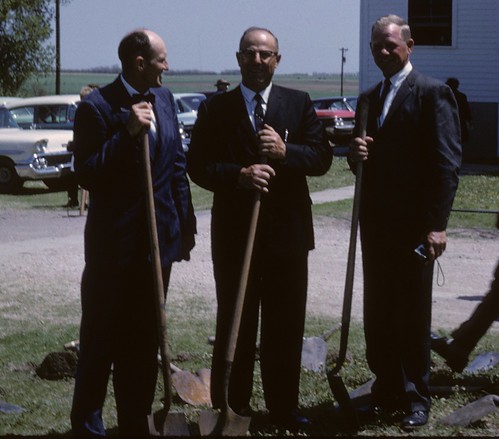
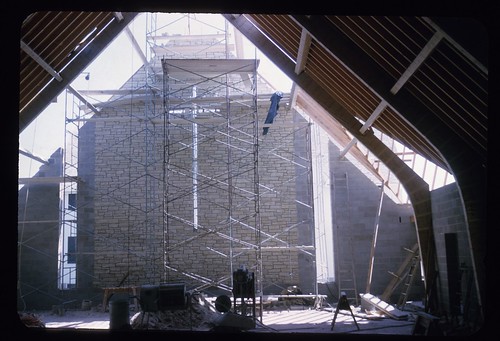
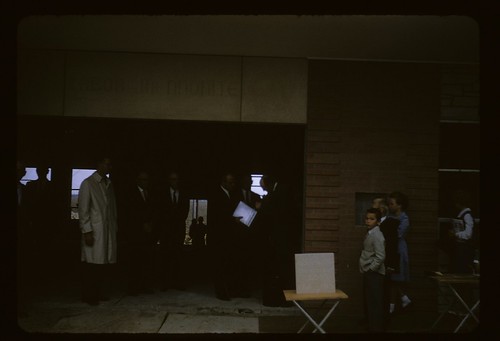
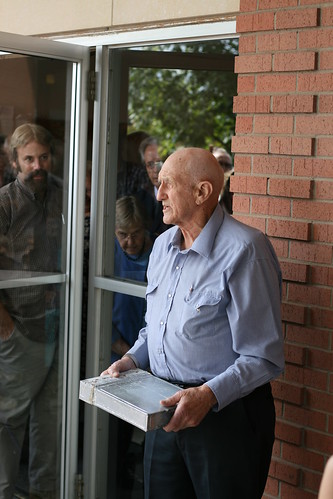
One of the benefits of living in a small community is that I get to know people of all ages around here. Not just people my own age, or coworkers. A few years ago, I worked on a history project for our church s centennial. Back in the 1960s, Rudy was one of the people in charge of building our current church. So he was a person I was interested in visiting with. Here he is, on the left, during the 1964 groundbreaking ceremony for the new building (the old one is visible in the background). 022 stamped may 1964cropped.jpg I and a few others went to his home one time a few years ago and we had a wonderful evening. Rudy shared all sorts of stories with us which I am happy to say I recorded. But moreover, Rudy was an avid photographer. There were some rare and brilliant color slides of the church being built in his collection. He let me borrow and scan some of them. Here are my two favorites: 015 stamped july 1964.jpg 016 stamped oct 1964.jpg Back in 1965, there was a ceremony at the setting of the cornerstone of Tabor Church. The people at the time assembled some papers and memorabilia and put them in a time capsule. Rudy Schmidt sealed the capsule and it was placed in the spot for it behind the cornerstone. Here is a photo of that ceremony. 013 stamped nov 1964.jpg 44 years later, on the occasion of Tabor s centennial, it was time to open the time capsule. The other building committee people, such as Jake Koehn, had passed away, so Rudy was the one to open it. He gave a few words in front of the large crowd, and mentioned that when he sealed it away, he smelled some smoke when he soldered it shut. Jake Koehn told him, Don t worry, nobody will ever see it again anyway and they had a little laugh about it. Now he was going to open it up and see if anything survived. img_6173.jpg It all did just a few minor burn marks. We enjoyed looking at all the items. Then the church placed some new items into the capsule. It was closed up again, to be opened in maybe 50 years. With luck, I ll still be around to see it opened again. Even if I m not, maybe Jacob and Oliver will be able to. And so it seems very fitting that the last hands to touch that box for the next 50 years were Rudy Schmidt s, when he placed it back in its spot on Oct. 12, 2008. img_6243.jpg

19 October 2010

Evgeni Golov: RC bugs 2010/41

Another week has passed, where is Squeeze? Sadly, I did even less than the week before, but here is the log anyways:That s all. Sorry, I had a busy week.

5 July 2010

Julian Andres Klode: Review: Lenovo ThinkPad Edge 15

Wednesday, after some weeks with a flickering screen (or more precisely, something is causing GTK+ to redraw and the kernel to print ^@ in the terminal when you touch the screen, see http://jak-linux.org/tmp/20100628_002.mp4) in my 3 years old HP Compaq 6720s (which seems to be a software-hardware combination problem, at least it works in Ubuntu); I decided to buy a new laptop. It took me a few minutes to find the Lenovo ThinkPad Edge 15 NVL7VGE; which I ordered at notebooksbilliger.de at around 14:30 CEST using Express. On Thursday morning at 6:40 CEST, the device arrived. The laptop features an Intel Core i5 430 M processor with integrated graphics, 4 GiB of RAM, 320 GB hard disk storage, matte screen, and of course a TrackPoint. The machine comes pre-installed with Windows 7 Professional which is not very nice (and Lenovo does not take Windows licenses back). I booted Ubuntu 10.04 from an USB disk which worked a few times, but not always, so I upgraded the BIOS to make USB booting reliable (as Lenovo published multiple BIOS updates already, one fixing this USB booting issue). The first step was booting Ubuntu 10.04 from an USB hard disk to check the Linux support. Using Ubuntu, everything worked out of the box, including stuff like HDMI audio support or output switching. An exception may be the DVD drive, which only works if you set the SATA mode to compatibility. Non-DVD media also works in AHCI mode, but only if you start with a disc inserted in the drive. Playing DVDs requires setting a region code using setregion(8) [otherwise they do not work at all] and SATA compatibility mode [otherwise they only work partially]. Another issue is the HDMI output, as the TV is not correctly detected and some parts at the top and the bottom of the image are missing (that is, the GNOME panels) (but that happens with different screens and ATI cards as well). Oh, and closing the lid with a screen attached and the internal screen disabled works only as long as you do not open it again, because that causes the GPU to stop. On the input side, we have one keyboard, one TrackPoint, and a touch pad. All of them work out of the box, but they have a few problems on the hardware side: The cursor keys on the keyboard are incredibly small and the touchpad is very large. The keyboard is different from the one in the HP Compaq: First of all, there is space between the keys (like Apple keyboards); and secondly, you need to apply more pressure in order to use the keys. The device feels more solid than the HP Compaq 6720s, especially touching the screen does not change the colors on the screen. I don t know how long the keyboard will last, but I hope that I will still have symbols on them in 5 months (which was not the case for the HP Compaq 6720s keyboard). Power consumption is another interesting point. When the device is idle and the screen is disabled, the device seems to consume about 10W. With screen enabled, consumption varies between 13W (idle) 35W (building source code); if the values received via ACPI are correct. The device ships with a 48 Wh battery which after some time was displayed as 53 Wh in gnome-power-statistics (only the when loaded state, capacity is displayed as 47.5Wh). According to Lenovo, the laptop lasts 4.5 hours on battery, meaning consumption of 47.5 Wh / 4.5 h = 10.5 Wh which is a bit overly optimistic if you want to work on the device. After checking everything, I took over my Debian sid installation from my old laptop (which I installed in 2008). It runs happely now, although I still need to get accustomed to the new keyboard and the large touch pad. All in all, the price of 765 I paid for the device seems to be OK. Now I only need to remove the Windows 7 sticker and hope that the device lasts long enough until I want to buy a new one (probably 2013, if the aliens don t invade us 2012).
Filed under: General

18 May 2010

Bernd Zeimetz: gimp-plugin-registry package updated

Yesterday I finally found the time to update gimp-plugin-registry, the (hopefully!) largest and best collection of plugins for The GIMP. As usual here comes a short summary of the changes: Hope you like my work, suggestions and bug reports are welcome as usual!

15 April 2010

Bernd Zeimetz: gimp-plugin-registry package updated

Yesterday I finally found the time to update gimp-plugin-registry, the (hopefully!) largest and best collection of plugins for The GIMP. As usual here comes a short summary of the changes: Hope you like my work, suggestions and bug reports are welcome as usual!

31 January 2010

Debian News: New Debian Developers (January 2010)

The following developers got their Debian accounts in the last month: Congratulations!

26 December 2009

Stefano Zacchiroli: RC bugs of the week - week 16

RCBW - week #16 ... and here are christmas (for those who care) RC squashes, by yours truly (for those who care too): and here are the usual notes: Hint/request of the week: please add +pending when you do DELAYED/ NMUs, that way filtering out already taken care of bugs gets easier and refreshing a bug log page in the browser will immediately show the new tag at the top.
(Yes, I agree that nmudiff should offer that when passed --delay, I intend to propose a patch for that, but feel free to beat me at it :-P) In other news, christmas vacations are awesome to catch up with books you planned to finish reading months ago ... Update: the patch for nmudiff I've mentioned has been kindly provided by gregor hermann, thanks!

13 December 2009

Julian Andres Klode: APT2 progress report for the 1st half of December


This week was successful. I have pushed some changes from November to the repository which change the license to LGPL-2.1+ (which makes bi-directional sharing of code with other projects easier, since most Vala code is under the same license) and implement HTTP using libsoup2.4 directly, instead of using GIO and GVFS for this. I also added a parser for the sources.list format which uses regular expressions to parse the file and is relatively fast. The code needs a current checkout of Vala s git master to work correctly; as released versions had a bug which I noticed today and J rg Billeter fixed in Vala 25 minutes later; thank you J rg. While nothing else happened in the public repository, the internal branch has seen a lot of new code; including SQLite 3 caches; Acquire text progress handling; and capt; the command-line advanced package tool. Most of the code will need to be reworked before it will be published, but I hope to have this completed until Christmas. It will also depend on Vala 0.7.9 or newer, which is yet to be released. The decision to use SQLite 3 as a backend means that we won t see the size limitations APT has and that development can be simplified by using SQL queries for filtering requests. It also means that APT2 will be very fast in most actions, like searching; which currently happens in 0.140 seconds (unstable,experimental and more repositories enabled), whereas aptitude takes 1.101 seconds, cupt (which has no on-disk cache) 1.292 seconds, and apt-cache 0.475 seconds. Searching is performed by one SQL query. I also want to thank Jens Georg <mail@jensge.org>, who wrote Rygel s Database class which is also used with minor modifications (like defaulting to in-memory journals) in APT2 as well. Rygel.Database is a small wrapper around sqlite3 which makes it easier to program for Vala programmers. The command-line application capt provides a shell based on readline with history (and later on command completion) as well as direct usage like capt config dump or capt search python-apt . Just as with Eugene s cupt, capt will be the only program in the core APT2 distribution and provide the same functionality currently provided by apt-get, apt-config and friends. The name is not perfect and can be easily confused with cupt , but it was the closest option for now; considering that the name apt is already used by Java (for its Annotation Processing Tool ). That s all for now, I ll tell you once all those features have passed my QA, and there is really something usable in the repository. In the meanwhile, you can discuss external dependency solvers, database layouts and other stuff in their threads on deity@lists.debian.org. And a screenshot from capt:
jak@hp:~/Desktop/APT2:temp$ capt
apt$ help
APT2 0.0.20091213 command-line frontend
Commands:
  config dump               Dump the configuration
  config get OPTION         Get the given option
  config set OPTION VALUE   Set the given option
  search EXPRESSION         Search for the given expression
  show PACKAGE              Show all versions of the given package
  sources list              Print a list of all sources
  version                   Print the version of APT2
apt$ search python-apt
build-depends-python-apt - Dummy package to fulfill package dependencies
python-apt - Python interface to libapt-pkg
python-apt-dbg - Python interface to libapt-pkg (debug extension)
python-apt-dev - Python interface to libapt-pkg (development files)
python-aptdaemon - Python module for the server and client of aptdaemon
python-aptdaemon-gtk - Python GTK+ widgets to run an aptdaemon client
apt$
Posted in APT2

25 September 2009

Julian Andres Klode: cupt and how to write package managers


cupt is a new package manager written in Perl by Eugene V. Lyubimkin, who previously contributed to APT. And more than all, the project makes no sense at all. First of all, there is a language issue. Implementing a package manager in Perl has some major drawbacks. One of the features of APT was it being written in a lower-level language (i.e. C++ which really is below Perl), making it possible to write applications like synaptic and python bindings which in turn lead to applications like gnome-app-install or Ubuntu s new Software Store. Furthermore, writing a package manager in Perl means that Distributions such as Emdebian might not be able to use it since they have excluded Perl due to its space requirements. This becomes even more important considering that cupt depends on even more perl libraries. This means that cupt will never be able to replace APT. Secondly, a package manager should not be designed specifically for one distribution. This is another major drawback of cupt and other package managers such as yum or zypper. The smart package manager, written in Python and funded by Canonical Ltd. is an example for a distribution-neutral package manager. Now let s take a look at package management in modern distributions. Usually we have two levels of package managers, the first being tools like dpkg and rpm which take care of installing and removing the packages and level-2 package managers implementing dependency resolvers and package retrieval from remote locations. Recently, distributions started to add a third layer named PackageKit, which shall provide distribution-independent package management user interfaces. The project was well-received by RPM-based distributions, but failed in Debian-based distributions due to not supporting debconf. Furthermore, adding a third layer just increases the possibility of problems. The right way to do package management is a distribution-independent level-2 package manager written in C. The smart project shows us that this is possible although itself fails to meet the lower-level language (C) requirement. That s why I decided to write a package manager in Vala, a GObject-based language which gets converted to C and then compiled. If successful, this project will be able to replace most of the current level-2 package managers and will also provide the same distribution-independence as provided by a level-3 package manager such as PackageKit. It is also easy to create binding for other programming language such as Python or Perl thus enabling application developers to choose the language they like most. The core of this project is a vendor-neutral library, temporarily called libapt (as the project is called APT2 for now). This library contains all the code which is not specific to a vendor i.e. file retrieval, dependency resolver, caches, etc and is then enhanced by several vendor-specific plugins, each implementing a PackageManager (interface to the distribution s level-1 package manager) and a Repository (well, repositories from which you can download packages) interface. We could even enhance the vendor-independent interface to include more details of a repository. Most repositories nowadays consist of 4 components: A meta index (Release files for Debian, repomd.xml for Fedora/openSUSE/etc.), a package index (e.g. Packages files for Debian, *primary.xml.gz on Fedora, etc. ), a source index (e.g Sources files in Debian) and a files index (e.g. Contents-*.gz for Debian). I took a look at the repository formats of Slackware, openSUSE and Fedora and it seems that this concept can be applied to all of them. So maybe all we need are distribution dependent parsers for those files. One of the most important issues with APT is its use of mmap() for the cache. Using mmap() makes it hard to grow the cache, which is sometimes needed. We see a lot of bug reports from people with too small cache sizes. We can circumvent this problem by utilizing an embedded database like SQLite for this, but we would probably loose some speed and it may be harder to maintain a flexible API. We should see what the best option is here, both ways are possible since Vala 0.7.6 includes my patches for adding mmap(), ftruncate(), mremap() and some other functions. An idea to circumvent the mmap() issue is gathering statistics about the relation between the number of repositories and the size of the cache and then using a value which is slightly above the average statistical value. The project is not very mature yet, it only includes basic library functions for downloading files and parsing configuration files, etc. You can find the (MIT licensed) code at http://git.debian.org/?p=users/jak/apt2.git. I also have some local code for repository management and multi-threaded file fetching, but it s just not ready to be merged yet. Posted in APT2, Debian

Julian Andres Klode: The APT2 project


I just started working on a replacement for APT written in Vala and called APT2 (I know, the name could be better). The main idea behind the project is to create a library for working with Debian repositories and packages, and on top of this library a few applications. This is different from APT because the project focuses on the library part, whereas APT is primarily focused on the application part. I chose Vala for this task because it has an easy syntax and allows me to use the features provided by GLib and Co. really easily. GLib provides many functions needed for APT like file access, unicode handling, hashsums creation. It also provides us with signals which are useful for implementing progress reporting. Another project, called cupt tries to provide an APT replacement in Perl. Apart from the fact that I don t like Perl, it also has the disadvantage of being too big to ship on embedded devices and is not useable from other languages such as Python or C/C++. Yet another project, smart provides a different package manager written in Python. While I like Python, it can t be used from languages such as Perl or C/C++ and is too large. APT2 will only require GLib, Gee and libarchive, which require about 2MB of space; about 1/10 of Perl s size. The core of APT2 is a library called libapt . At the moment, this library provides classes for reading tag files (TagFile&TagSection) and an incomplete configuration class based on libgee s HashMap (to ease coding, it will probably be changed to a special data structure like those in apt-pkg). The next step will be implementing a parser for configuration files (currently we only support in-memory objects) and writing the Acquire system. The planned Acquire system uses GModule to modularize the support for different URI schemes. Each module provides a worker class which implements one or more URI schemes. The first of these modules will provide a worker using GIO, which deals with local file access, samba shares, FTP, SFTP, WebDAV and various other protocols, including HTTP until a replacement has been written (since we don t want to force gvfs-backends). The workers communicate with the parent Acquire object using signals and can cause the whole acquisition to be aborted by emiting an abort signal (or similar). The whole project has just been started and may take some months until it becomes useful (if it becomes useful at all). The code can be found at http://git.debian.org/?p=users/jak/apt2.git and is licensed under the MIT license (see http://www.opensource.org/licenses/mit-license.php). It is a secondary project and will not affect my work on apt (not much yet) and python-apt (0.8 series). Posted in APT2, Debian

Julian Andres Klode: APT2: config parser testing


If you have an amd64 system, install the apt2 package from deb http://people.debian.org/~jak/debian/ unstable/ and run the apt2-config command. Make sure that the parser reports no errors, otherwise send me an email or leave a comment here. One known exception is that all values must be quoted in the configuration file, I have no plans to fix this (probably just deprecate unquoted strings in APT instead). The parser is not as strict as cupt s parser, but it gives you more help if something wents wrong. We also ignore most semicolons for now (they will be turned into warnings or errors later on). It is using GScanner from GLib for parsing the files. apt2-config replicates the functionality of apt-config. It currently do not read the configuration files in the correct order, so don t expect apt2-config dump to produce exactly the same output as apt-config dump . To build APT2 yourself, you need a patch for waf from http://bugs.debian.org/cgi-bin/bugreport.cgi?bug=548329. Posted in APT2

Next.

Previous.