Search Results: "hug"

2 July 2024

Mike Gabriel: Polis - a FLOSS Tool for Civic Participation -- Introduction (episode 1/5)

This is the first article of a 5-episode blog post series written by Guido Berh rster, member of staff at my company Fre(i)e Software GmbH. Thanks, Guido for being on the Polis project. Enjoy the read on the work Guido has been doing over the past months,
Mike
A team lead by Raoul Kramer/BetaBreak is currently adapting Polis for evaluation and testing by several Dutch provincial governments and central government ministries. Guido Berh rster (author of this article) who is an employee at Fre(i)e Software GmbH has been involved in this project as the main software developer. This series of blog posts describes how and why Polis was initially modified and adapted, what issues the team ran into and how this ultimately lead them to start a new Open Source project called Particiapp for accelerating the development of alternative Polis frontends compatible to but independent from the upstream project. Table of Contents of the Blog Post Series
  1. Introduction (this article)
  2. Initial evaluation and adaptation
  3. Issues extending Polis and adjusting our goals
  4. Creating (a) new frontend(s) for Polis
  5. Current status and roadmap
Polis - The Introduction What is Polis? Polis is a platform for participation which helps to gather, analyze and understand viewpoints of large groups of participants on complex issues. In practical terms participants take part in conversations on a predefined topic by voting on statements or submitting their own statements (referred to as comments in Polis) for others to vote on1. Through statistical analysis including machine learning participants are sorted into groups based on similarities in voting behavior. In addition, group-informed and overall consensus statements are identified and presented to participants in real-time. This allows for participants to react to and refine statements and either individually or through a predefined process to come to an overall consensus. Furthermore, the order in which statements are presented to participants is influenced by a complex weighting system based on a number of factors such as variance, recency, and frequency of skipping. This so called comment routing is intended to facilitate a meaningful contribution of participants without requiring them to vote on each of a potentially huge number of statements 2. Polis open-ended nature sets it apart from online surveys using pre-defined questions and allows its users to gather a more accurate picture of the public opinion. In contrast to a discussion forum or comment section where participants directly reply to each other, it discourages unproductive behavior such as provocations or personal attacks by not presenting statements in chronological order in combination with voting. Finally, its comment routing is intended to provide scalability towards a large number of participants which generate a potentially large number of statements. The project was developed and is maintained by The Computational Democracy Project, a USA-based non-profit organization which provides a hosted version and offers related services. It is also released as Open Source software under the AGPL 3.0 license. Polis has been used in a variety of different contexts as part of broader political processes facilitating broader political participation and opinion-forming, and gathering feedback and creative input. Use of Polis in Taiwan One prominent use case of Polis is its adoption as part of the vTaiwan participatory governance project. Established by the g0v civic tech community in the wake of the 2014 mass protests by the Sunflower movement, the vTaiwan project enables consultations on proposed legislation among a broad range of stakeholders including government ministries, lawmakers, experts, interest groups, civil society as well as the broader public. Although the resulting recommendations are non-binding, they exert pressure on the government to take action and recommendations have been adopted into legislation.345 vTaiwan uses Polis for large-scale online deliberations as part of a structured participation process. These deliberations take place after identifying and involving stakeholders and experts and providing through information about the topic at hand to the public. Citizens are then given the opportunity to vote on statements or provide alternative proposals which allows for the refinement of ideas and ideally leads to a consensus at the end. The results of these online deliberations are then curated, discussed in publicly broadcast face-to-face meetings which ultimately produce concrete policy recommendations. vTaiwan has in numerous cases given impulses resulting in government action and provided significant input e.g. on legislation regulating Uber or technological experiments by Fintech startups.35 See also
  1. https://compdemocracy.org/Polis/
  2. https://compdemocracy.org/comment-routing/
  3. https://info.vtaiwan.tw/
  4. https://www.theguardian.com/world/2020/sep/27/taiwan-civic-hackers-polis-consensus-social-media-platform
  5. https://www.technologyreview.com/2018/08/21/240284/the-simple-but-ingenious-system-taiwan-uses-to-crowdsource-its-laws/

23 June 2024

Sahil Dhiman: How I Write Blogs - June 2024 Edition

I wrote about my blog writing methodology back April 2021. My writing method has undergone a significant shift now, so thought about writing this update. New blog topics are added to my note-taking app quite frequently now. Occasionally going through the list, I merge topics, change order to prioritize certain topics or purely drop ideas which seems not worth a write-up. Due to this, I have the liberty to work on blogs according to mood. Writing the last one was tiring, so I chose to work on an easy one, i.e. this blog now. Topic decided, everything starts on etherpad now. Etherpad has this nice font and sync feature, which helps me write from any device of choice. Actual writing usually happens in the morning, right after I wake up. For most topics, I quickly jot down pointers and keep on expanding them over the course of multiple days at a leisurely pace. Though, sometime it adds too many pieces in the puzzle and takes additional time to put everything in flow. New pointer addition keeps on happening along with writing. Nowadays, pictures too dot my blog, which I rarely use to do earlier. I have come to believe on less usage of external links. These breaks the flow of readers. If someone is sufficiently motivated to learn more about something, finding useful sources isn t. As the first draft comes into being, I run it through LanguageTool for spelling corrections (which typically are many) and fixing grammatical issues. Post that, for the first time I read the complete write-up in one go for formation of coherent storyline, moving paragraphs around for form a structure , adding explainers wherever something new or unexplained is introduced, removing elaborate sentences, making amends wherever required and moving paragraphs around for forming structure. Another round of LanguageTool follows. All set now, I try to space out my final read before publishing, which helps find additional mistakes or loopholes. When everything is set, I do hugo to generate the site and rsync everything to the web server. A final git sync closes the publication part. After a day or two, I come back to read the blog on the website. This entails another round finding and fixing trivial mistakes. After this, it s set for good. Nowadays, in addition to being on my blog, everything is syndicated on Planet FSCI and Planet Debian, which has given it more visibility. As someone who s into infrastructure and Internet as a lot, I do pay attention to logs on my server, but as a disconnected exercise to if the blog is being read or not. More hits on the blog doesn t translate to any gratification for me, at least for writers point of view. Occasionally, people do mention my blog, which does flatter me. Four years and nearly a hundred posts later, I still wonder how I kept on writing for this long.

14 June 2024

Matthew Palmer: Information Security: "We Can Do It, We Just Choose Not To"

Whenever a large corporation disgorges the personal information of millions of people onto the Internet, there is a standard playbook that is followed. Security is our top priority . Passwords were hashed . No credit card numbers were disclosed . record scratch Let s talk about that last one a bit.

A Case Study This post could have been written any time in the past well, decade or so, really. But the trigger for my sitting down and writing this post is the recent breach of wallet-finding and criminal-harassment-enablement platform Tile. As reported by Engadget, a statement attributed to Life360 CEO Chris Hulls says
The potentially impacted data consists of information such as names, addresses, email addresses, phone numbers, and Tile device identification numbers.
But don t worry though; even though your home address is now public information
It does not include more sensitive information, such as credit card numbers
Aaaaaand here is where I get salty.

Why Credit Card Numbers Don t Matter Describing credit card numbers as more sensitive information is somewhere between disingenuous and a flat-out lie. It was probably included in the statement because it s part of the standard playbook. Why is it part of the playbook, though? Not being a disaster comms specialist, I can t say for sure, but my hunch is that the post-breach playbook includes this line because (a) credit cards are less commonly breached these days (more on that later), and (b) it s a way to insinuate that all your financial data is safe, no need to worry without having to say that (because that statement would absolutely be a lie). The thing that not nearly enough people realise about credit card numbers is:
  1. The credit card holder is not usually liable for most fraud done via credit card numbers; and
  2. In terms of actual, long-term damage to individuals, credit card fraud barely rates a mention. Identity fraud, Business Email Compromise, extortion, and all manner of other unpleasantness is far more damaging to individuals.

Why Credit Card Numbers Do Matter Losing credit card numbers in a data breach is a huge deal but not for the users of the breached platform. Instead, it s a problem for the company that got breached. See, going back some years now, there was a wave of huge credit card data breaches. If you ve been around a while, names like Target and Heartland will bring back some memories. Because these breaches cost issuing banks and card brands a lot of money, the Payment Card Industry Security Standards Council (PCI-SSC) and the rest of the ecosystem went full goblin mode. Now, if you lose credit card numbers in bulk, it will cost you big. Massive fines for breaches (typically levied by the card brands via the acquiring bank), increased transaction fees, and even the Credit Card Death Penalty (being banned from charging credit cards), are all very big sticks.

Now Comes the Finding Out In news that should not be surprising, when there are actual consequences for failing to do something, companies take the problem seriously. Which is why no credit card numbers were disclosed is such an interesting statement. Consider why no credit card numbers were disclosed. It s not that credit card numbers aren t valuable to criminals because they are. Instead, it s because the company took steps to properly secure the credit card data. Next, you ll start to consider why, if the credit card numbers were secured, why wasn t the personal information that did get disclosed similarly secured? Information that is far more damaging to the individuals to whom that information relates than credit card numbers. The only logical answer is that it wasn t deemed financially beneficial to the company to secure that data. The consequences of disclosure for that information isn t felt by the company which was breached. Instead, it s felt by the individuals who have to spend weeks of their life cleaning up from identity fraud committed against them. It s felt by the victim of intimate partner violence whose new address is found in a data dump, letting their ex find them again. Until there are real, actual consequences for the companies which hemorrhage our personal data (preferably ones that have percentage of global revenue at the end), data breaches will continue to happen. Not because they re inevitable because as credit card numbers show, data can be secured but because there s no incentive for companies to prevent our personal data from being handed over to whoever comes along.

Support my Salt My salty takes are powered by refreshing beverages. If you d like to see more of the same, buy me one.

5 June 2024

Scarlett Gately Moore: Kubuntu, KDE, Debian: I am still here, in loving memory of my brother.

I am still here, busy as ever, I just haven t found the inspiration to blog. So soon after the loss of my son, I have lost my only brother a couple weeks ago. It has been a tough year for our family. Thank you everyone for you love and support during this difficult time. I will do my best in re-capping my work, there has been quite a bit as I am keeping busy with work so I don t dwell to much on the sadness. KDE Snaps: Trying to debug the unable to save files breakage in the latest Krita builds without luck. KisOpenGLCanvas
Renderer::reportFailedShaderCompilation\[0m: Shad
er Compilation Failure: "Failed to add vertex sh
ader source from file: matrix_transform.vert - Ca
use: "
I have implemented everything from https://snapcraft.io/docs/gpu-support , it has worked for years and now suddenly it just stopped. I have had to put it on hold for now, it is unpaid work and I simply don t have time. With the help of my GSOC student we are improving the Qt6 snap MR: https://invent.kde.org/neon/snap-packaging/kde-qt6-core-sdk/-/merge_requests/3 and many improvements on top of that. This exposed many issues with the kf6 snap and the linking to static libs. Those are being worked on now. Updated qt to 6.7.1 Qt6 apps in the works: okular, ark, gwenview, kwrited, elisa Kubuntu: So many SRu s for the Noble release, I will probably miss a few. https://bugs.launchpad.net/ubuntu/+source/ark/+bug/2068491 Ark cannot open 7-zip files. Sadly the patches were for qt6, waiting for a qt5 port upstream. https://bugs.launchpad.net/ubuntu/noble/+source/merkuro/+bug/2065063 Crash due to missing qml. Fix is in git, no upload rights. Requested sponsor. https://bugs.launchpad.net/ubuntu/+source/tellico/+bug/2065915 Several applications no longer work on architectures that are not amd64 due to hard coded paths. All fixed in git. Several uploaded to oracular, several sponsorship has been requested. Noble updates rejected despite SRU, going to retry. https://bugs.launchpad.net/ubuntu/+source/sddm/+bug/2066275 The dreaded black screen on second boot bug is fixed in git and oracular. Noble was rejected despite the SRU. Will retry. https://bugs.launchpad.net/ubuntu/+source/kubuntu-meta/+bug/2066028 Broken systray submenus. Fixed in git and oracular. Noble rejected despite SRU. Will retry. https://bugs.launchpad.net/ubuntu/+source/plasma-workspace/+bug/2067747 Long standing bug with plasma not loading with lightdm. Fixed in git and oracular. Noble rejected will retry. https://bugs.launchpad.net/ubuntu/+source/plasma-workspace/+bug/2067742 CVE-2024-36041Fixed in git and oracular, noble rejected, will retry. And many more I am applying for MOTU in hopes it will reduce all of my uploading issues. https://wiki.ubuntu.com/scarlettmoore/MOTUApplication Debian: kf6-knotifications and kapidox. Will jump into Plasma 6 next week ! Misc: Went to LinuxFest Northwest with Valorie! We had a great time and it was a huge success, we had many people stop by our booth.
As usual, if you like my work and want to see Plasma 6 in Kubuntu it all depends on you! Kubuntu will be out of funds soon and needs donations! Thank you for your consideration. https://kubuntu.org/donate/ Personal: Support for my grandson: https://www.gofundme.com/f/in-loving-memory-of-william-billy-dean-scalf

20 May 2024

Russell Coker: Respect and Children

I attended the school Yarra Valley Grammer (then Yarra Valley Anglican School which I will refer to as YV ) and completed year 12 in 1990. The school is currently in the news for a spreadsheet some boys made rating girls where unrapeable was one of the ratings. The school s PR team are now making claims like Respect for each other is in the DNA of this school . I d like to know when this DNA change allegedly occurred because respect definitely wasn t in the school DNA in 1990! Before I go any further I have to note that if the school threatens legal action against me for this post it will be clear evidence that they don t believe in respect. The actions of that school have wronged me, several of my friends, many people who aren t friends but who I wish they hadn t had to suffer and I hadn t had to witness it, and presumably countless others that I didn t witness. If they have any decency they would not consider legal action but I have learned that as an institution they have no decency so I have to note that they should read the Wikipedia page about the Streisand Effect [1] and keep it in mind before deciding on a course of action. I think it is possible to create a school where most kids enjoy being there and enjoy learning, where hardly any students find it a negative experience and almost no-one finds it traumatic. But it is not possible to do that with the way schools tend to be run. When I was at high school there was a general culture that minor sex crimes committed by boys against boys weren t a problem, this probably applied to all high schools. Things like ripping a boy s pants off (known as dakking ) were considered a big joke. If you accept that ripping the pants off an unwilling boy is a good thing (as was the case when I was at school) then that leads to thinking that describing girls as unrapeable is acceptable. The Wikipedia page for Pantsing [2] has a reference for this issue being raised as a serious problem by the British Secretary of State for Education and Skills Alan Johnson in 2007. So this has continued to be a widespread problem around the world. Has YV become better than other schools in dealing with it or is Dakking and Wedgies as well accepted now as it was when I attended? There is talk about schools preparing kids for the workforce, but grabbing someone s underpants without consent will result in instant dismissal from almost all employment. There should be more tolerance for making mistakes at school than at work, but they shouldn t tolerate what would be serious crimes in other contexts. For work environments there have been significant changes to what is accepted, so it doesn t seem unreasonable to expect that schools can have a similar change in culture. One would hope that spending 6 years wondering who s going to grab your underpants next would teach boys the importance of consent and some sympathy for victims of other forms of sexual assault. But that doesn t seem to happen, apparently it s often the opposite. When I was young Autism wasn t diagnosed for anyone who was capable of having a normal life. Teachers noticed that I wasn t like other kids, some were nice, but some encouraged other boys to attack me as a form of corporal punishment by proxy not a punishment for doing anything wrong (detentions were adequate for that) but for being different. The lesson kids will take from that sort of thing is that if you are in a position of power you can mistreat other people and get away with it. There was a girl in my year level at YV who would probably be diagnosed as Autistic by today s standards, the way I witnessed her being treated was considerably worse than what was described in the recent news reports but it is quite likely that worse things have been done recently which haven t made the news yet. If this issue is declared to be over after 4 boys were expelled then I ll count that as evidence of a cover-up. These things don t happen in a vacuum, there s a culture that permits and encourages it. The word respect has different meanings, it can mean treat a superior as the master or treat someone as a human being . The phrase if you treat me with respect I ll treat you with respect usually means if you treat me as the boss then I ll treat you as a human being . The distinction is very important when discussing respect in schools. If teachers are considered the ultimate bosses whose behaviour can never be questioned then many boys won t need much help from Andrew Tate in developing the belief that they should be the boss of girls in the same way. Do any schools have a process for having students review teachers? Does YV have an ombudsman to take reports of misbehaving teachers in the way that corporations typically have an ombudsman to take reports about bad managers? Any time you have people whose behaviour is beyond scrutiny or oversight you will inevitably have bad people apply for jobs, then bad things will happen and it will create a culture of bad behaviour. If teachers can treat kids badly then kids will treat other kids badly, and this generally ends with girls being treated badly by boys. My experience at YV was that kids barely had the status of people. It seemed that the school operated more as a caretaker of the property of parents than as an organisation that cares for people. The current YV website has a Whistleblower policy [3] that has only one occurrence of the word student and that is about issues that endanger the health or safety of students. Students are the people most vulnerable to reprisal for complaining and not being listed as an eligible whistleblower shows their status. The web site also has a flowchart for complaints and grievances [4] which doesn t describe any policy for a complaint to be initiated by a student. One would hope that parents would advocate for their children but that often isn t the case. When discussing the possibility of boys being bullied at school with parents I ve had them say things like my son wouldn t be so weak that he would be bullied , no boy will tell his parents about being bullied if that s their attitude! I imagine that there are similar but different issues of parents victim-blaming when their daughter is bullied (presumably substituting immoral for weak) but don t have direct knowledge of the topic. The experience of many kids is being disrespected by their parents, the school system, and often siblings too. A school can t solve all the world s problems but can ideally be a refuge for kids who have problems at home. When I was at school the culture in the country and the school was homophobic. One teacher when discussing issues such as how students could tell him if they had psychological problems and no-one else to talk to said some things like the Village People make really good music which was the only time any teacher said anything like It s OK to be gay (the Village People were the gayest pop group at the time). A lot of the bullying at school had a sexual component to it. In addition to the wedgies and dakking (which while not happening often was something you had to constantly be aware of) I routinely avoided PE classes where a shower was necessary because of a thug who hung around by the showers and looked hungrily at my penis, I don t know if he had a particular liking to mine or if he stared at everyone that way. Flashing and perving was quite common in change rooms. Presumably as such boy-boy sexual misbehaviour was so accepted that led to boys mistreating girls. I currently work for a company that is active in telling it s employees about the possibility of free psychological assistance. Any employee can phone a psychologist to discuss problems (whether or not they are work related) free of charge and without their manager or colleagues knowing. The company is billed and is only given a breakdown of the number of people who used the service and roughly what the issue was (work stress, family, friends, grief, etc). When something noteworthy happens employees are given reminders about this such as if you need help after seeing a homeless man try to steal a laptop from the office then feel free to call the assistance program . Do schools offer something similar? With the school fees paid to a school like YV they should be able to afford plenty of psychologist time. Every day I was at YV I saw something considerably worse than laptop theft, most days something was done to me. The problems with schools are part of larger problems with society. About half of the adults in Australia still support the Liberal party in spite of their support of Christian Porter, Cardinal Pell, and Bruce Lehrmann. It s not logical to expect such parents to discourage their sons from mistreating girls or to encourage their daughters to complain when they are mistreated. The Anglican church has recently changed it s policy to suggesting that victims of sexual abuse can contact the police instead of or in addition to the church, previously they had encouraged victims to only contact the church which facilitated cover-ups. One would hope that schools associated with the Anglican church have also changed their practices towards such things. I approve of the respect is in our DNA concept, it s like Google s former slogan of Don t be evil which is something that they can be bound to. Here s a list of questions that could be asked of schools (not just YV but all schools) by journalists when reporting on such things:
  1. Do you have a policy of not trying to silence past students who have been treated badly?
  2. Do you take all sexual assaults seriously including wedgies and dakking?
  3. Do you take all violence at school seriously? Even if there s no blood? Even if the victim says they don t want to make an issue of it?
  4. What are your procedures to deal with misbehaviour from teachers? Do the students all know how to file complaints? Do they know that they can file a complaint if they aren t the victim?
  5. Does the school have policies against homophobia and transphobia and are they enforced?
  6. Does the school offer free psychological assistance to students and staff who need it? NB This only applies to private schools like YV that have huge amounts of money, public schools can t afford that.
  7. Are serious incidents investigated by people who are independent of the school and who don t have a vested interest in keeping things quiet?
  8. Do you encourage students to seek external help from organisations like the ones on the resources list of the Grace Tame Foundation [5]? Having your own list of recommended external organisations would be good too.
Counter Arguments I ve had practice debating such things, here s some responses to common counter arguments. Conclusion I don t think that YV is necessarily worse than other schools, although I m sure that representatives of other private schools are now working to assure parents of students and prospective students that they are. I don t think that all the people who were employed as teachers there when I attended were bad people, some of them were nice people who were competent teachers. But a few good people can t turn around a bad system. I will note that when I attended all the sports teachers were decent people, it was the only department I could say such things about. But sports involves situations that can lead to a bad result, issues started at other times and places can lead to violence or harassment in PE classes regardless of how good the teachers are. Teachers who know that there are problems need to be able to raise issues with the administration. When a teacher quits teaching to join the clergy and another teacher describes it as a loss for the clergy but a gain for YV it raises the question of why the bad teacher in question couldn t have been encouraged to leave earlier. A significant portion of the population will do whatever is permitted. If you say no teacher would ever bully a student so we don t need to look out for that then some teacher will do exactly that. I hope that this will lead to changes both in YV and in other schools. But if they declare this issue as resolved after expelling 4 students then something similar or worse will happen again. At least now students know that when this sort of thing happens they can send evidence to journalists to get some action.

14 May 2024

Evgeni Golov: Using Packit to build RPMs for projects that depend on or vendor your code

I am a huge fan of Packit as it allows us to provide RPMs to our users and testers directly from a pull-request, thus massively tightening the feedback loop and involving people who otherwise might not be able to apply the changes (for whatever reason) and "quickly test" something out. It's also a great way to validate that a change actually builds in a production environment, where no unnecessary development and test dependencies are installed. You can also run tests of the built packages on Testing Farm and automate pushing releases into Fedora/CentOS Stream, but this is neither a (plain) Packit advertisement post, nor is that functionality that I can talk about with a certain level of experience. Adam recently asked why we don't have Packit builds for our our Puppet modules and my first answer was: "well, puppet-* doesn't produce a thing we ship directly, so nobody dared to do it". My second answer was that I had blogged how to test a Puppet module PR with Packit, but I totally agree that the process was a tad cumbersome and could be improved. Now some madman did it and we all get to hear his story! ;-) What is the problem anyway? The Foreman Installer is a bit of Ruby code1 that provides a CLI to puppet apply based on a set of Puppet modules. As the Puppet modules can also be used outside the installer and have their own lifecycle, they live in separate git repositories and their releases get uploaded to the Puppet Forge. Users however do not want to (and should not have to) install the modules themselves. So we have to ship the modules inside the foreman-installer package. Packaging 25 modules for two packaging systems (we support Enterprise Linux and Debian/Ubuntu) seems like a lot of work. Especially if you consider that the main foreman-installer package would need to be rebuilt after each module change as it contains generated files based on the modules which are too expensive to generate at runtime. So we can ship the modules inside the foreman-installer source release, thus vendoring those modules into the installer release. To do so we use librarian-puppet with a Puppetfile and either a Puppetfile.lock for stable releases or by letting librarian-puppet fetch latest for nightly snapshots. This works beautifully for changes that land in the development and release branches of our repositories - regardless if it's foreman-installer.git or any of the puppet-*.git ones. It also works nicely for pull-requests against foreman-installer.git. But because the puppet-* repositories do not map to packages, we assumed it wouldn't work well for pull-requests against those. How can we solve this? Well, the "obvious" solution is to build the foreman-installer package via Packit also for pull-requests against the puppet-* repositories. However, as usual, the devil is in the details. Packit by default clones the repository of the pull-request and tries to create a source tarball from that using git archive. As this might be too simple for many projects, one can define a custom create-archive action that runs after the pull-request has been cloned and produces the tarball instead. We already use that in the Packit configuration for foreman-installer to run the pkg:generate_source rake target which executes librarian-puppet for us. But now the pull-request is against one of the Puppet modules, so Packit will clone that, not the installer. We gotta clone foreman-installer on our own. And then point librarian-puppet at the pull-request. Fun. Cloning is relatively simple, call git clone -- sorry Packit/Copr infrastructure. But the Puppet module pull-request? One can use :git => 'https://git.example.com/repo.git' in the Puppetfile to fetch a git repository. In fact, that's what we already do for our nightly snapshots. It also supports :ref => 'some_branch_or_tag_name', if the remote HEAD is not what you want. My brain first went "I know this! GitHub has this magic refs/pull/1/head and refs/pull/1/merge refs you can checkout to get the contents of the pull-request without bothering to add a remote for the source of the pull-request". Well, this requires to know the ID of the pull-request and Packit does not expose that in the environment variables available during create-archive. Wait, but we already have a checkout. Can we just say :git => '../.git'? Cloning a .git folder is totally possible after all.
[Librarian]     --> fatal: repository '../.git' does not exist
Could not checkout ../.git: fatal: repository '../.git' does not exist
Seems librarian disagrees. Damn. (Yes, I checked, the path exists.) does it maybe just not like relative paths?! Yepp, using an absolute path absolutely works! For some reason it ends up checking out the default HEAD of the "real" (GitHub) remote, not of ../. Luckily this can be fixed by explicitly passing :ref => 'origin/HEAD', which resolves to the branch Packit created for the pull-request. Now we just need to put all of that together and remember to execute all commands from inside the foreman-installer checkout as that is where all our vendoring recipes etc live. Putting it all together Let's look at the diff between the packit.yaml for foreman-installer and the one I've proposed for puppet-pulpcore:
--- a/foreman-installer/.packit.yaml    2024-05-14 21:45:26.545260798 +0200
+++ b/puppet-pulpcore/.packit.yaml  2024-05-14 21:44:47.834162418 +0200
@@ -18,13 +18,15 @@
 actions:
   post-upstream-clone:
     - "wget https://raw.githubusercontent.com/theforeman/foreman-packaging/rpm/develop/packages/foreman/foreman-installer/foreman-installer.spec -O foreman-installer.spec"
+    - "git clone https://github.com/theforeman/foreman-installer"
+    - "sed -i '/theforeman.pulpcore/ s@:git.*@:git => \"# __dir__ /../.git\", :ref => \"origin/HEAD\"@' foreman-installer/Puppetfile"
   get-current-version:
-    - "sed 's/-develop//' VERSION"
+    - "sed 's/-develop//' foreman-installer/VERSION"
   create-archive:
-    - bundle config set --local path vendor/bundle
-    - bundle config set --local without development:test
-    - bundle install
-    - bundle exec rake pkg:generate_source
+    - bash -c "cd foreman-installer && bundle config set --local path vendor/bundle"
+    - bash -c "cd foreman-installer && bundle config set --local without development:test"
+    - bash -c "cd foreman-installer && bundle install"
+    - bash -c "cd foreman-installer && bundle exec rake pkg:generate_source"
  1. It clones foreman-installer (in post-upstream-clone, as that felt more natural after some thinking)
  2. It adjusts the Puppetfile to use # __dir__ /../.git as the Git repository, abusing the fact that a Puppetfile is really just a Ruby script (sorry Ben!) and knows the __dir__ it lives in
  3. It fetches the version from the foreman-installer checkout, so it's sort-of reasonable
  4. It performs all building inside the foreman-installer checkout
Can this be used in other scenarios? I hope so! Vendoring is not unheard of. And testing your "consumers" (dependents? naming is hard) is good style anyway!

  1. three Ruby modules in a trench coat, so to say

Matthew Palmer: "Is This Project Still Maintained?"

If you wander around a lot of open source repositories on the likes of GitHub, you ll invariably stumble over repos that have an issue (or more than one!) with a title like the above. Sometimes sitting open and unloved, often with a comment or two from the maintainer and a bunch of I ll help out! followups that never seemed to pan out. Very rarely, you ll find one that has been closed, with a happy ending. These issues always fascinate me, because they say a lot about what it means to maintain an open source project, the nature of succession (particularly in a post-Jia Tan world), and the expectations of users and the impedence mismatch between maintainers, contributors, and users. I ve also recently been thinking about pre-empting this sort of issue, and opening my own issue that answers the question before it s even asked.

Why These Issues Are Created As both a producer and consumer of open source software, I completely understand the reasons someone might want to know whether a project is abandoned. It s comforting to be able to believe that there s someone on the other end of the line , and that if you have a problem, you can ask for help with a non-zero chance of someone answering you. There s also a better chance that, if the maintainer is still interested in the software, that compatibility issues and at least show-stopper bugs might get fixed for you. But often there s more at play. There is a delusion that maintained open source software comes with entitlements an expectation that your questions, bug reports, and feature requests will be attended to in some fashion. This comes about, I think, in part because there are a lot of open source projects that are energetically supported, where generous volunteers do answer questions, fix reported bugs, and implement things that they don t personally need, but which random Internet strangers ask for. If you ve had that kind of user experience, it s not surprising that you might start to expect it from all open source projects. Of course, these wonders of cooperative collaboration are the exception, rather than the rule. In many (most?) cases, there is little practical difference between most projects that are maintained and those that are formally declared unmaintained . The contributors (or, most often, contributor singular) are unlikely to have the time or inclination to respond to your questions in a timely and effective manner. If you find a problem with the software, you re going to be paddling your own canoe, even if the maintainer swears that they re still maintaining it.

A Thought Appears With this in mind, I ve been considering how to get ahead of the problem and answer the question for the software projects I ve put out in the world. Nothing I ve built has anything like what you d call a community ; most have never seen an external PR, or even an issue. The last commit date on them might be years ago. By most measures, almost all of my repos look unmaintained . Yet, they don t feel unmaintained to me. I m still using the code, sometimes as often as every day, and if something broke for me, I d fix it. Anyone who needs the functionality I ve developed can use the code, and be pretty confident that it ll do what it says in the README. I m considering creating an issue in all my repos, titled Is This Project Still Maintained? , pinning it to the issues list, and pasting in something I m starting to think of as The Open Source Maintainer s Manifesto . It goes something like this:

Is This Project Still Maintained? Yes. Maybe. Actually, perhaps no. Well, really, it depends on what you mean by maintained . I wrote the software in this repo for my own benefit to solve the problems I had, when I had them. While I could have kept the software to myself, I instead released it publicly, under the terms of an open licence, with the hope that it might be useful to others, but with no guarantees of any kind. Thanks to the generosity of others, it costs me literally nothing for you to use, modify, and redistribute this project, so have at it!

OK, Whatever. What About Maintenance? In one sense, this software is maintained , and always will be. I fix the bugs that annoy me, I upgrade dependencies when not doing so causes me problems, and I add features that I need. To the degree that any on-going development is happening, it s because I want that development to happen. However, if maintained to you means responses to questions, bug fixes, upgrades, or new features, you may be somewhat disappointed. That s not maintenance , that s support , and if you expect support, you ll probably want to have a support contract , where we come to an agreement where you pay me money, and I help you with the things you need help with.

That Doesn t Sound Fair! If it makes you feel better, there are several things you are entitled to:
  1. The ability to use, study, modify, and redistribute the contents of this repository, under the terms stated in the applicable licence(s).
  2. That any interactions you may have with myself, other contributors, and anyone else in this project s spaces will be in line with the published Code of Conduct, and any transgressions of the Code of Conduct will be dealt with appropriately.
  3. actually, that s it.
Things that you are not entitled to include an answer to your question, a fix for your bug, an implementation of your feature request, or a merge (or even review) of your pull request. Sometimes I may respond, either immediately or at some time long afterwards. You may luck out, and I ll think hmm, yeah, that s an interesting thing and I ll work on it, but if I do that in any particular instance, it does not create an entitlement that I will continue to do so, or that I will ever do so again in the future.

But I ve Found a Huge and Terrible Bug! You have my full and complete sympathy. It s reasonable to assume that I haven t come across the same bug, or at least that it doesn t bother me, otherwise I d have fixed it for myself. Feel free to report it, if only to warn other people that there is a huge bug they might need to avoid (possibly by not using the software at all). Well-written bug reports are great contributions, and I appreciate the effort you ve put in, but the work that you ve done on your bug report still doesn t create any entitlement on me to fix it. If you really want that bug fixed, the source is available, and the licence gives you the right to modify it as you see fit. I encourage you to dig in and fix the bug. If you don t have the necessary skills to do so yourself, you can get someone else to fix it everyone has the same entitlements to use, study, modify, and redistribute as you do. You may also decide to pay me for a support contract, and get the bug fixed that way. That gets the bug fixed for everyone, and gives you the bonus warm fuzzies of contributing to the digital commons, which is always nice.

But My PR is a Gift! If you take the time and effort to make a PR, you re doing good work and I commend you for it. However, that doesn t mean I ll necessarily merge it into this repository, or even work with you to get it into a state suitable for merging. A PR is what is often called a gift of work . I ll have to make sure that, at the very least, it doesn t make anything actively worse. That includes introducing bugs, or causing maintenance headaches in the future (which includes my getting irrationally angry at indenting, because I m like that). Properly reviewing a PR takes me at least as much time as it would take me to write it from scratch, in almost all cases. So, if your PR languishes, it might not be that it s bad, or that the project is (dum dum dummmm!) unmaintained , but just that I don t accept this particular gift of work at this particular time. Don t forget that the terms of licence include permission to redistribute modified versions of the code I ve released. If you think your PR is all that and a bag of potato chips, fork away! I won t be offended if you decide to release a permanent fork of this software, as long as you comply with the terms of the licence(s) involved. (Note that I do not undertake support contracts solely to review and merge PRs; that reeks a little too much of pay to play for my liking)

Gee, You Sound Like an Asshole I prefer to think of myself as forthright and plain-speaking , but that brings to mind that third thing you re entitled to: your opinion. I ve written this out because I feel like clarifying the reality we re living in, in the hope that it prevents misunderstandings. If what I ve written makes you not want to use the software I ve written, that s fine you ve probably avoided future disappointment.

Opinions Sought What do you think? Too harsh? Too wishy-washy? Comment away!

11 May 2024

Sven Hoexter: xdg and mime types - stuff I would've loved to know a week ago

Learned a few things about xdg and mimetype registration in the last week that could be helpful to have condensed in a single place. No Need to Ship a Mailcap Mime File If you already ship a .desktop file (that is what ends up in /usr/share/applications/) which has a MimeType declared, there is no need to also ship a mailcap file (that is what ends up in /usr/lib/mime/packages/). Some triggers will do the conversion work for you. See also Debian Policy 4.9. Reverse DNS Naming Convention for .desktop Files Seems to be a closely guarded secret, maybe mainly known inside the Gnome world, but it's in the spec. Also not very widely known inside Debian if I look at my local system as not very representative sample. Your hicolor Theme App Icon can be a Mime Type Icon as Well In case you didn't know the hicolor icon theme is the default fallback theme. Many of us already install application icons e.g. in /usr/share/icons/hicolor/48x48/apps/ which is used in conjunction with the Icon field in the .desktop file to locate the application icon. Now the next step, and there it seems quite of few us miss out, is to create a symlink to also provide a mime type icon, so it's displayed in graphical file managers for the application data files. The schema here is simple: Take the MimeType e.g. application/x-vymand replace the / with a - and use that as file name in e.g. /usr/share/icons/hicolor/48x48/mimetypes/. In the vym case that is /usr/share/icons/hicolor/48x48/mimetypes/application-x-vym.png. If you have one use a scalable .svg file instead of .png. This seems to be an area where Debian lacks a bit of tooling to automatically convert application icons to all the different sizes and install it in all the appropriate places. What is already there is a trigger to run gtk-update-icon-cache when you install new icons into one of the icon theme folder so they're picked up. No Priority or Order in .desktop Files Likely something that hapens on all my fresh installations: Libreoffice is installed and xdg-open starts to open pdf files with Libreoffice instead of evince. Now I've to figure out again to run xdg-mime default org.gnome.Evince.desktop application/pdf to change that (at least for my user). Background here is that the desktop file spec explicitly mandates "Priority for applications is handled external to the .desktop files.". That's why we got in addition to all of that mimeapps.list files. And now, after running the xdg-mime command from above, we've a ~/.config/mimeapps.list defining
[Default Applications]
application/pdf=org.gnome.Evince.desktop
Debian as whole seems to be not very keen on shipping something like a sensible default mimeapps.list outside of desktop environment specific ones. A quick search gave me just
$ apt-file search mimeapps.list
cinnamon-desktop-data: /usr/share/applications/x-cinnamon-mimeapps.list
gdm3: /usr/share/gdm/greeter/applications/mimeapps.list
gnome-session-common: /usr/share/applications/gnome-mimeapps.list
plasma-workspace: /usr/share/applications/kde-mimeapps.list
sxmo-utils: /usr/share/applications/mimeapps.list
sxmo-utils: /usr/share/sxmo/xdg/mimeapps.list
While it's a bit anoying to run into that pdf vs Libreoffice thing every now and then, it's maybe better to not have long controversial threads about default pdf viewer, like the ones we already had about the default MTA choices. ;) And while we're at it: everyone using Libreoffice should give a virtual hug to rene@ for taming that beast since 2010 and OpenOffice.org before.

9 May 2024

Vincent Sanders: Bee to the blossom, moth to the flame; Each to his passion; what's in a name?

I like the sentiment of Helen Hunt Jackson in that quote and it generally applies double for computer system names. However I like to think when I named the first NetSurf VM host server phoenix fourteen years ago I captured the nature of its continuous cycle of replacement.
Image of the fourth phoenix server
We have been very fortunate to receive a donated server to replace the previous every few years and the very generous folks at Collabora continue to provide hosting for it.Recently I replaced the server for the third time. We once again were given a replacement by Huw Jones in the form of a SuperServer 6017R-TDAF system with dual Intel Xeon Ivy Bridge E5-2680v2 processors. There were even rack rails!

The project bought some NVMe drives and an adaptor cards and I attempted to arrange to swap out the server in January.

The old phoenixiii server being replaced
Here we come to the slight disadvantage of an informal arrangement where access to the system depends upon a busy third party. Unfortunately it took until May to arrange access (I must thank Vivek again for coming in on a Saturday to do this)

In the intervening time, once I realised access was going to become increasingly difficult, I decided to obtain as good a system as I could manage to reduce requirements for future access.

I turned to eBay and acquired a slightly more modern SuperServer with dual Intel Xeon Haswell E5-2680v3 processors which required purchase of 64G of new memory (Haswell is a DDR4 platform).

I had wanted to use Broadwell processors but this exceeded my budget and would only be a 10% performance uplift (The chassis, motherboard and memory cost 180 and another 50 for processors was just too much, maybe next time)

graph of cpu mark improvements in the phoenix servers over time
While making the decision on the processor selection I made a quick chart of previous processing capabilities (based on a passmark comparison) of phoenix servers and was startled to discover I needed a logarithmic vertical axis. Multi core performance of processors has improved at a startling rate in the last decade.

When the original replacement was donated I checked where the performance was limited and noticed it was mainly in disc access which is what prompted the upgrade to NVMe (2 gigabytes a second peek read throughput) which moved the bottleneck to the processors where, even with the upgrades, it remains.

I do not really know if there is a conclusion here beyond noting NetSurf is very fortunate as a project to have some generous benefactors both for donating hardware and hosting for which I know all the developers are grateful.

Now I just need to go and migrate a huge bunch of virtual machines and associated sysadmin to make use of these generous donations.

Gunnar Wolf: Hacks, leaks, and revelations The art of analyzing hacked and leaked data

This post is a review for Computing Reviews for Hacks, leaks and revelations The art of analyzing hacked and leaked data , a book published in No Starch Press
Imagine you ve come across a trove of files documenting a serious deed and you feel the need to blow the whistle. Or maybe you are an investigative journalist and this whistleblower trusts you and wants to give you said data. Or maybe you are a technical person, trusted by said journalist to help them do things right not only to help them avoid being exposed while leaking the information, but also to assist them in analyzing the contents of the dataset. This book will be a great aid for all of the above tasks. The author, Micah Lee, is both a journalist and a computer security engineer. The book is written entirely from his experience handling important datasets, and is organized in a very logical and sound way. Lee organized the 14 chapters in five parts. The first part the most vital to transmitting the book s message, in my opinion begins by talking about the care that must be taken when handling a sensitive dataset: how to store it, how to communicate it to others, sometimes even what to redact (exclude) so the information retains its strength but does not endanger others (or yourself). The first two chapters introduce several tools for encrypting information and keeping communication anonymous, not getting too deep into details and keeping it aimed at a mostly nontechnical audience. Something that really sets this book apart from others like it is that Lee s aim is not only to tell stories about the hacks and leaks he has worked with, or to present the technical details on how he analyzed them, but to teach readers how to do the work. From Part 2 onward the book adopts a tutorial style, teaching the reader numerous tools for obtaining and digging information out of huge and very timely datasets. Lee guides the reader through various data breaches, all of them leaked within the last five years: BlueLeaks, Oath Keepers email dumps, Heritage Foundation, Parler, Epik, and Cadence Health. He guides us through a tutorial on using the command line (mostly targeted at Linux, but considering MacOS and Windows as well), running Docker containers, learning the basics of Python, parsing and filtering structured data, writing small web applications for getting at the right bits of data, and working with structured query language (SQL) databases. The book does an excellent job of fulfilling its very ambitious aims, and this is even more impressive given the wide range of professional profiles it is written for; that being said, I do have a couple critiques. First, the book is ideologically loaded: the datasets all exhibit the alt-right movement that has gained strength in the last decade. Lee takes the reader through many instances of COVID deniers, rioters for Donald Trump during the January 2021 attempted coup, attacks against Black Lives Matter activists, and other extremism research; thus this book could alienate right-wing researchers, who might also be involved in handling important whistleblowing cases. Second, given the breadth of the topic and my 30-plus years of programming experience, I was very interested in the first part of each chapter but less so in the tutorial part. I suppose a journalist reading through the same text might find the sections about the importance of data handling and source protection to be similarly introductory. This is unavoidable, of course, given the nature of this work. However, while Micah Lee is an excellent example of a journalist with the appropriate technical know-how to process the types of material he presents as examples, expecting any one person to become a professional in both fields is asking too much. All in all, this book is excellent. The writing style is informal and easy to read, the examples are engaging, and the analysis is very good. It will certainly teach you something, no matter your background, and it might very well complement your professional skills.

7 May 2024

John Goerzen: Photographic comparison: Is the Kobo Libra Colour display worse than the Kobo Libra 2?

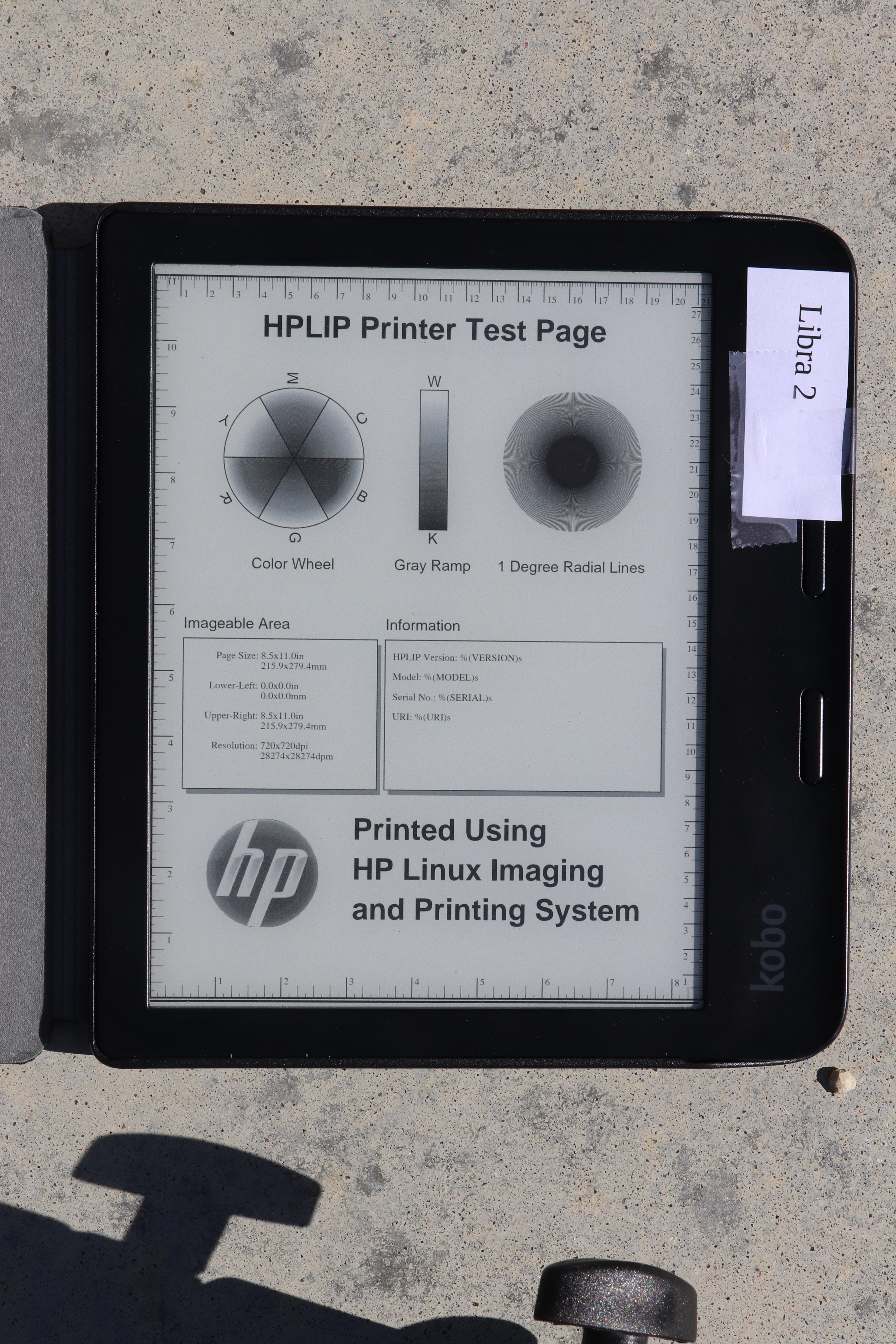
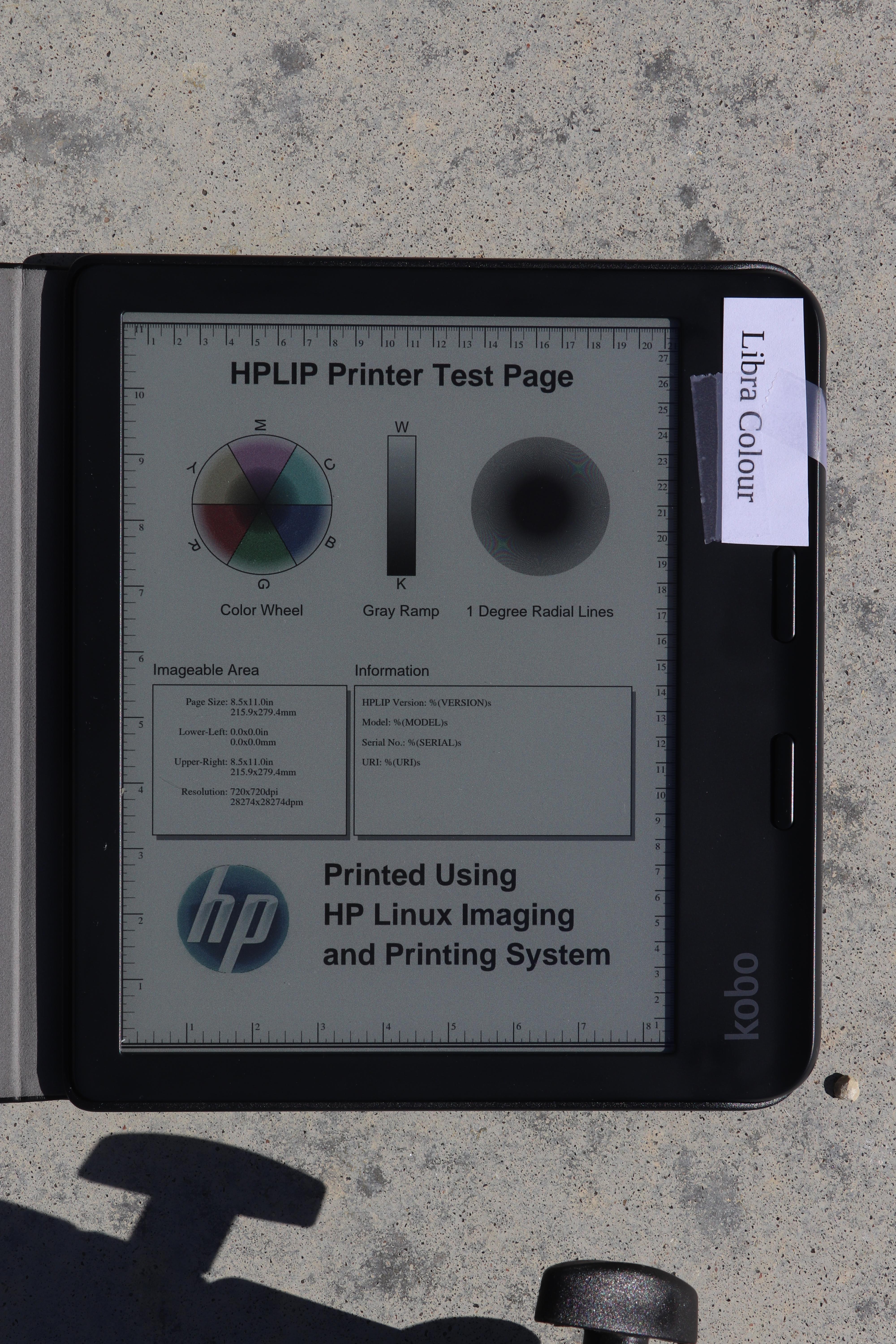
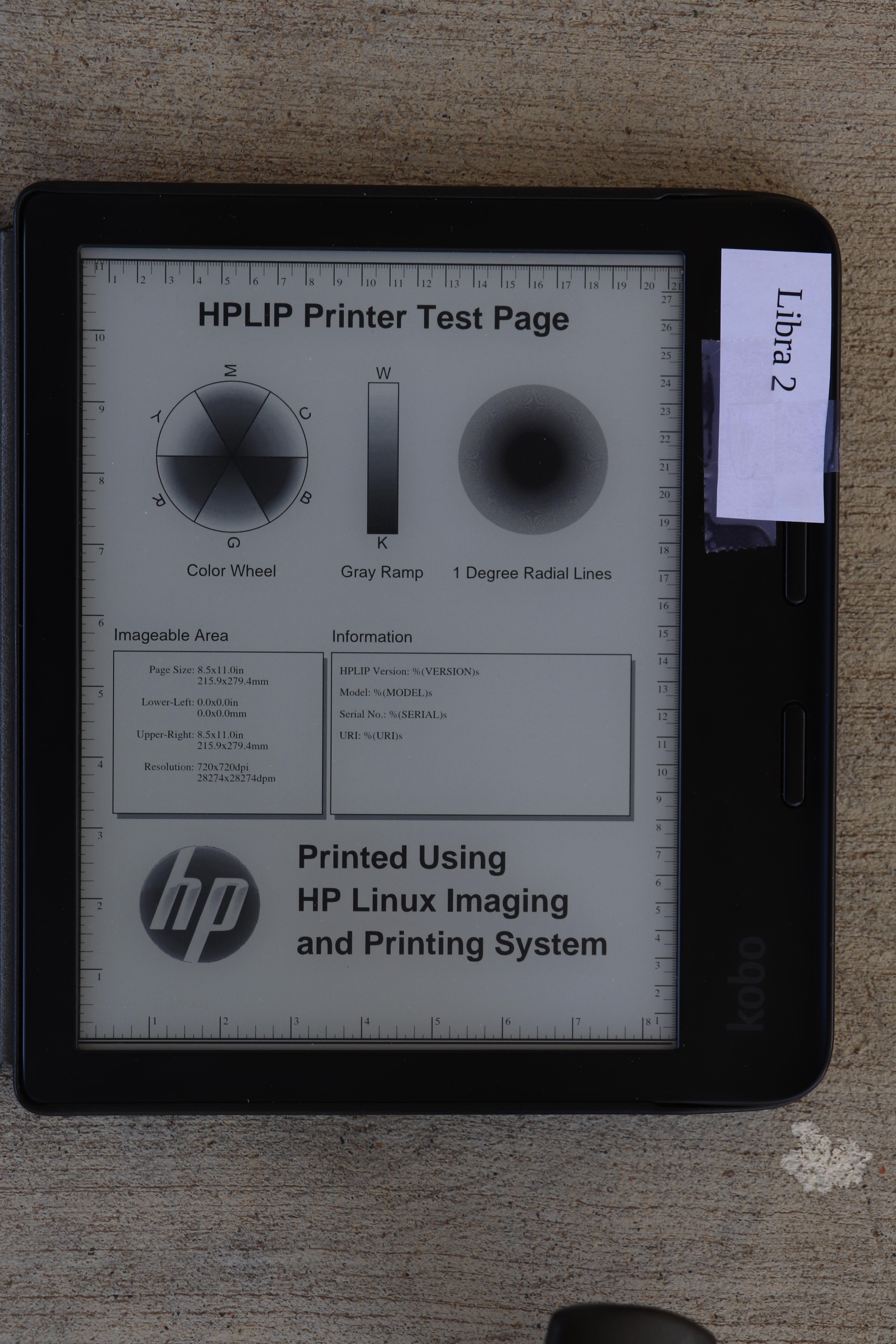
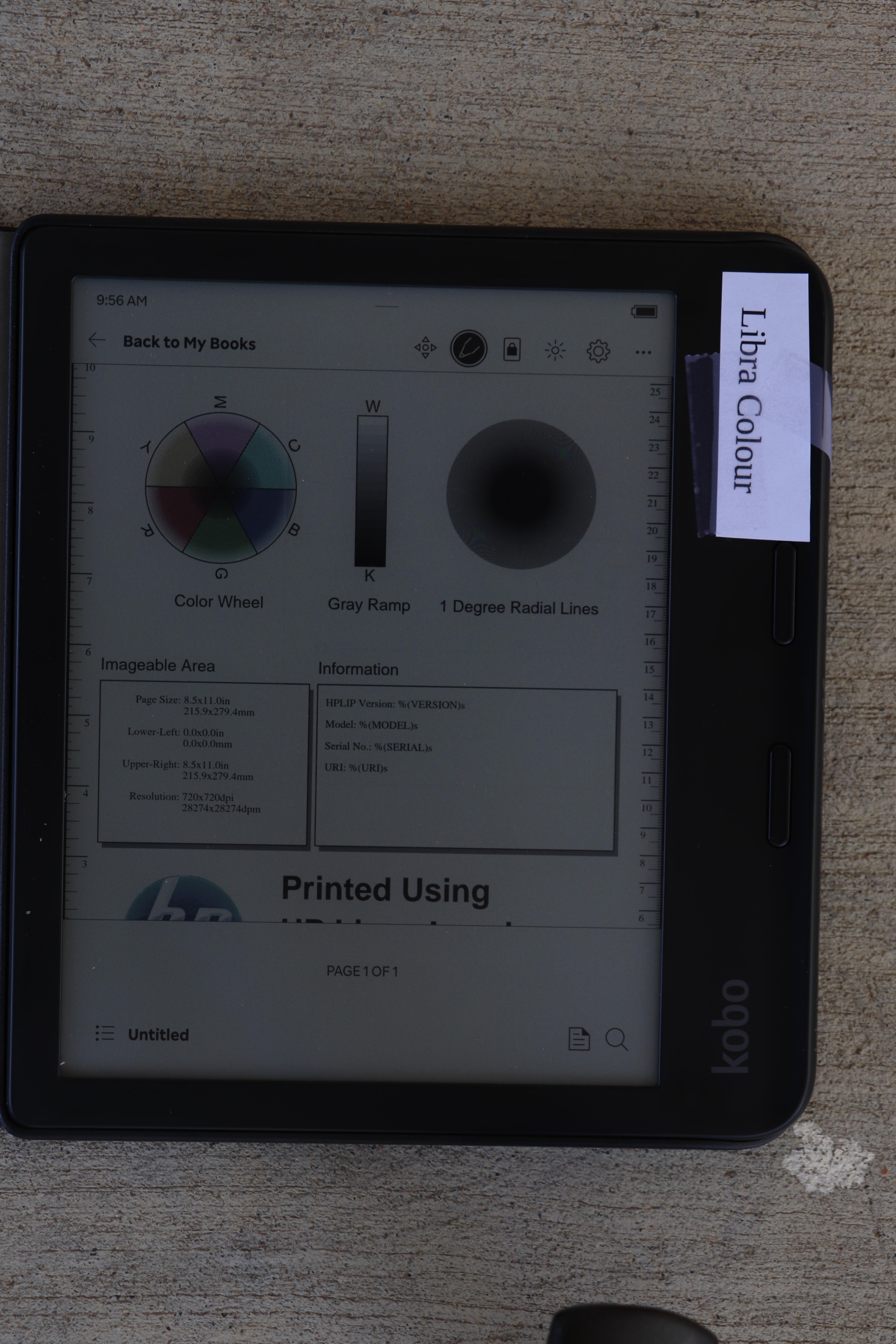
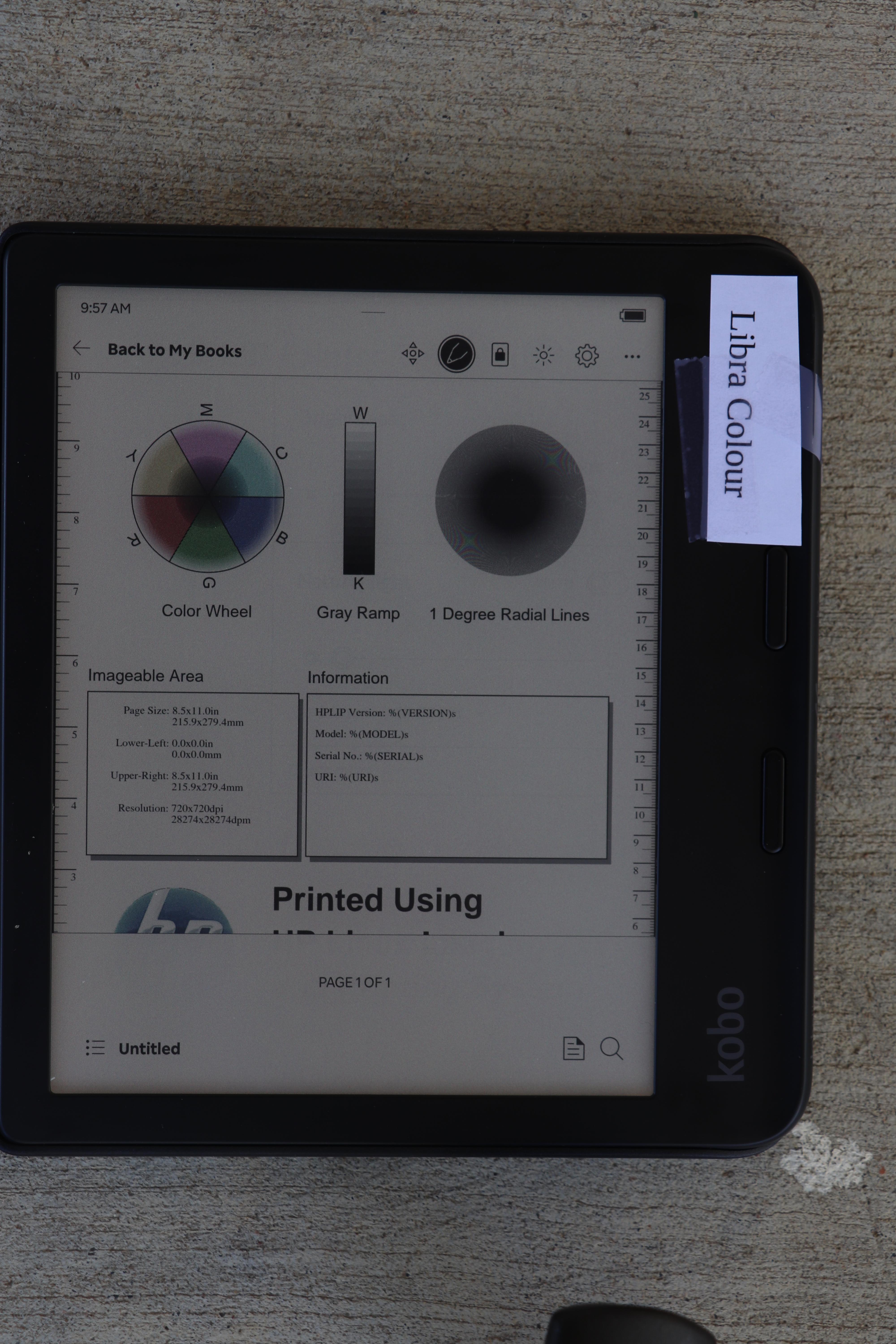
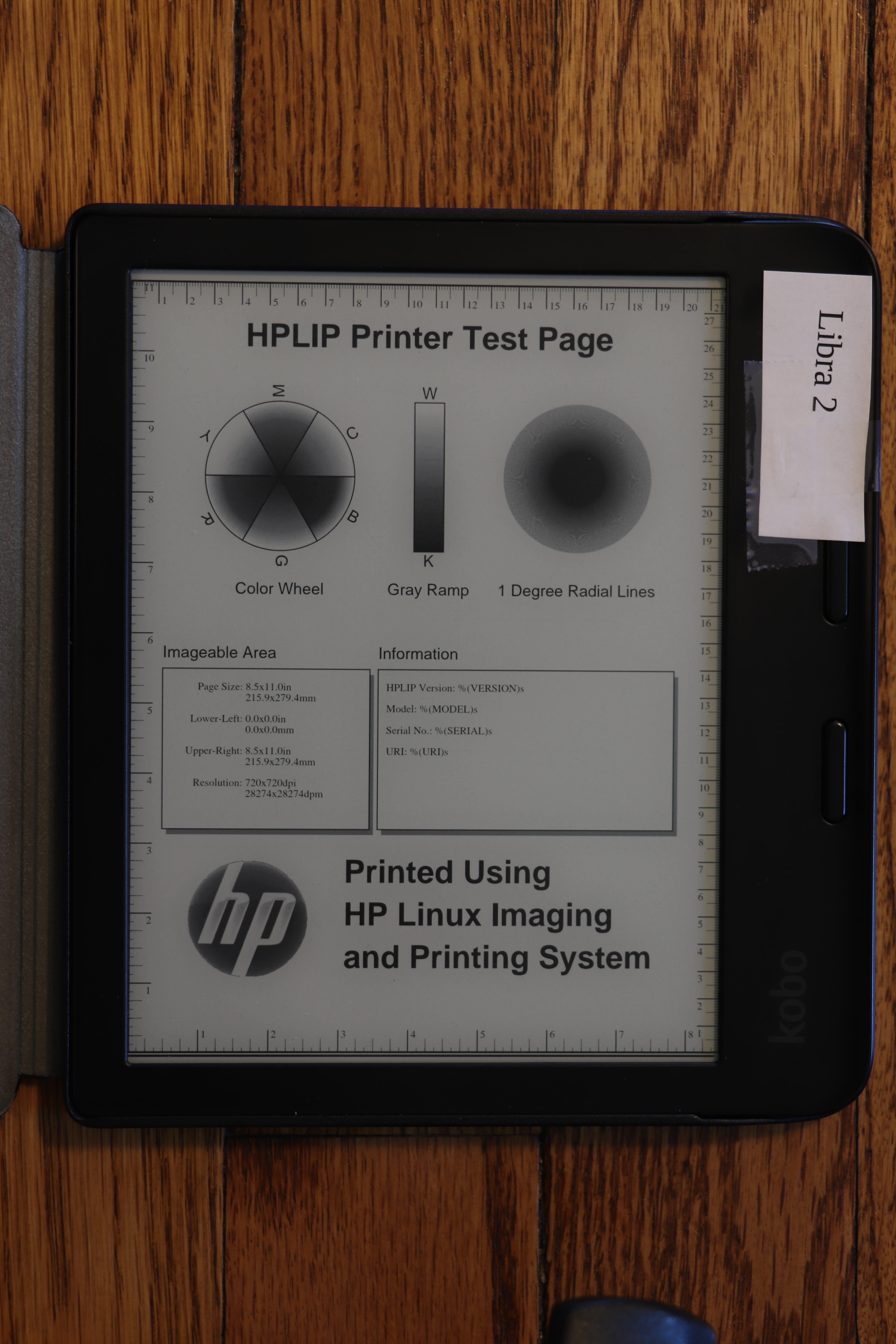
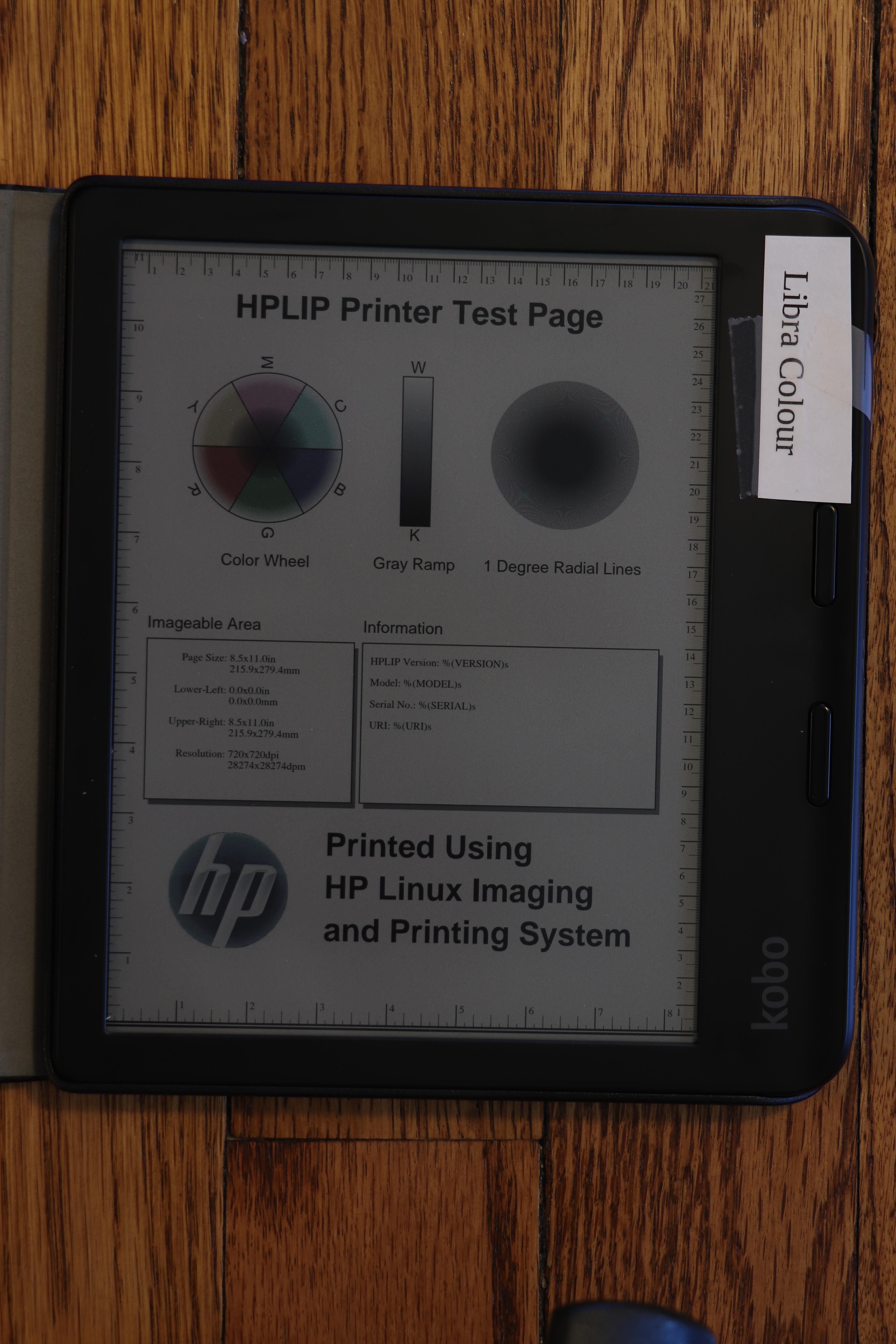
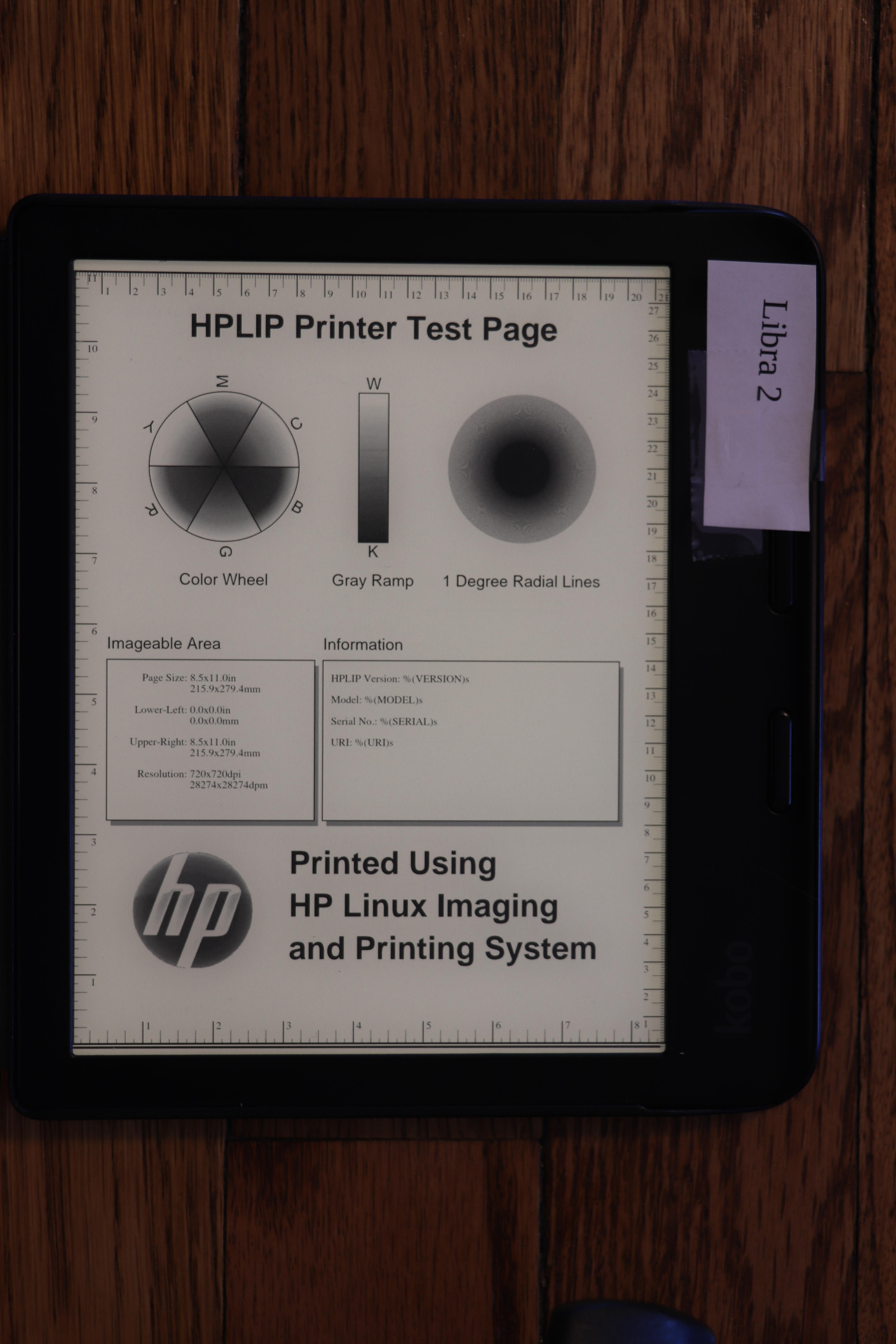
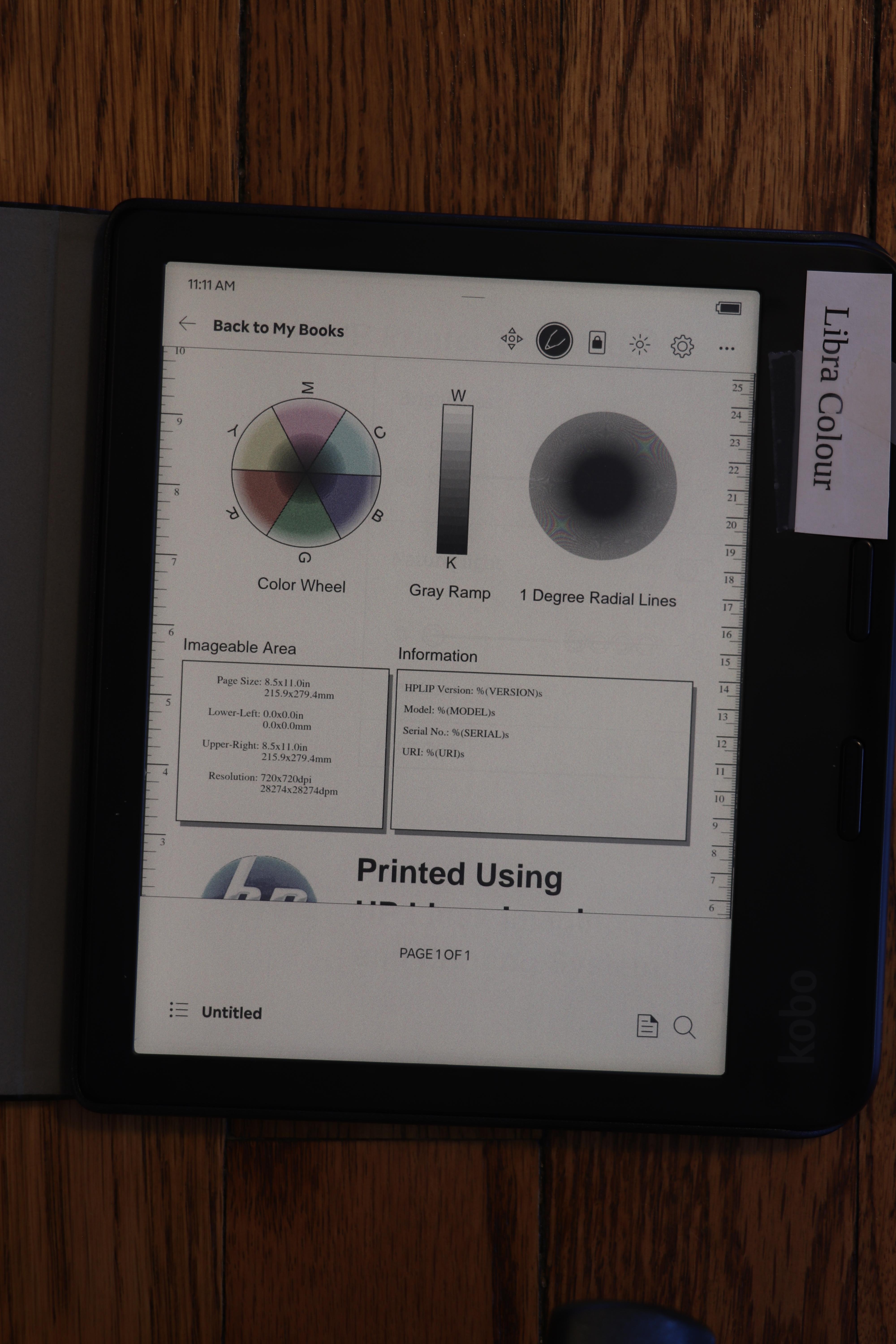
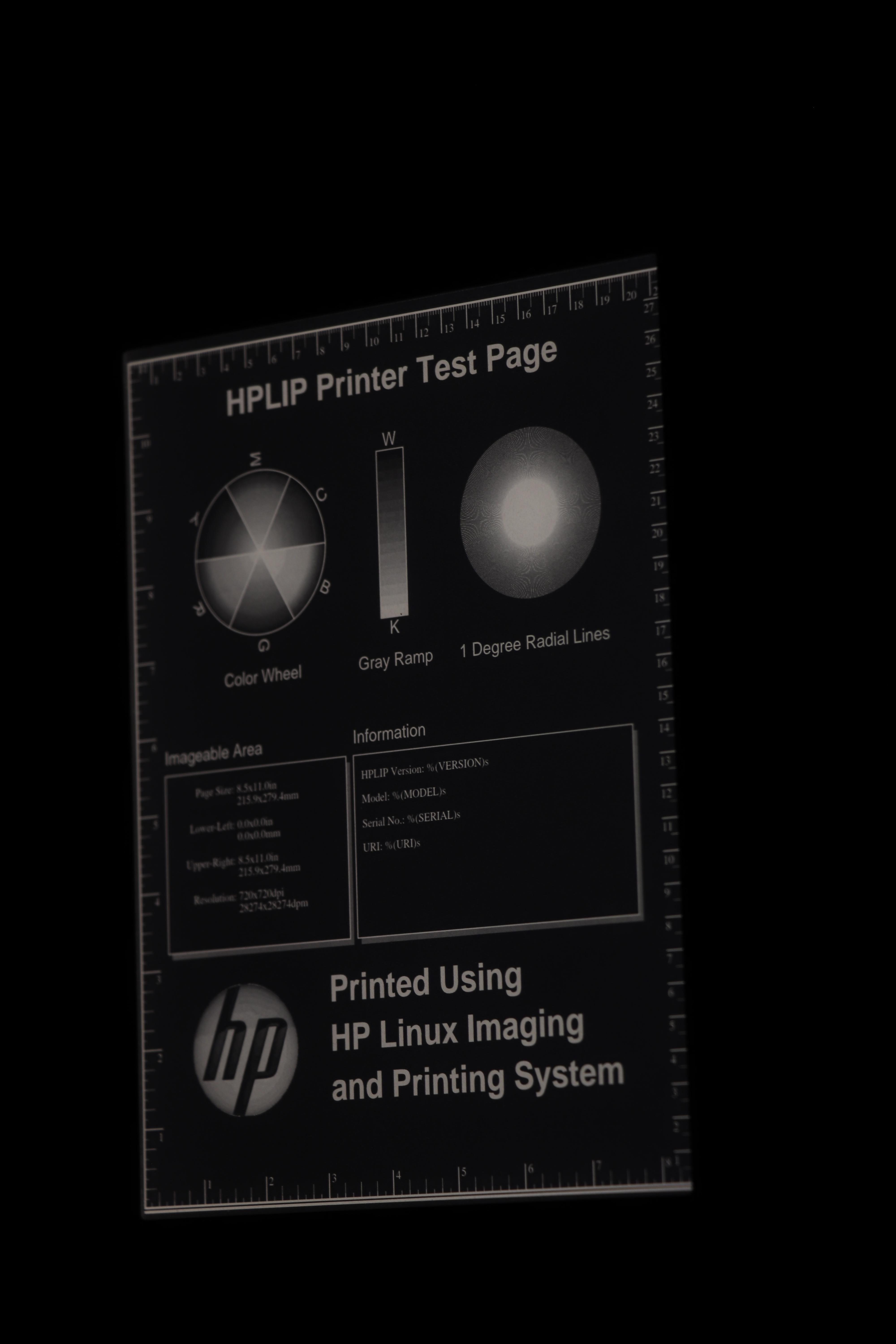
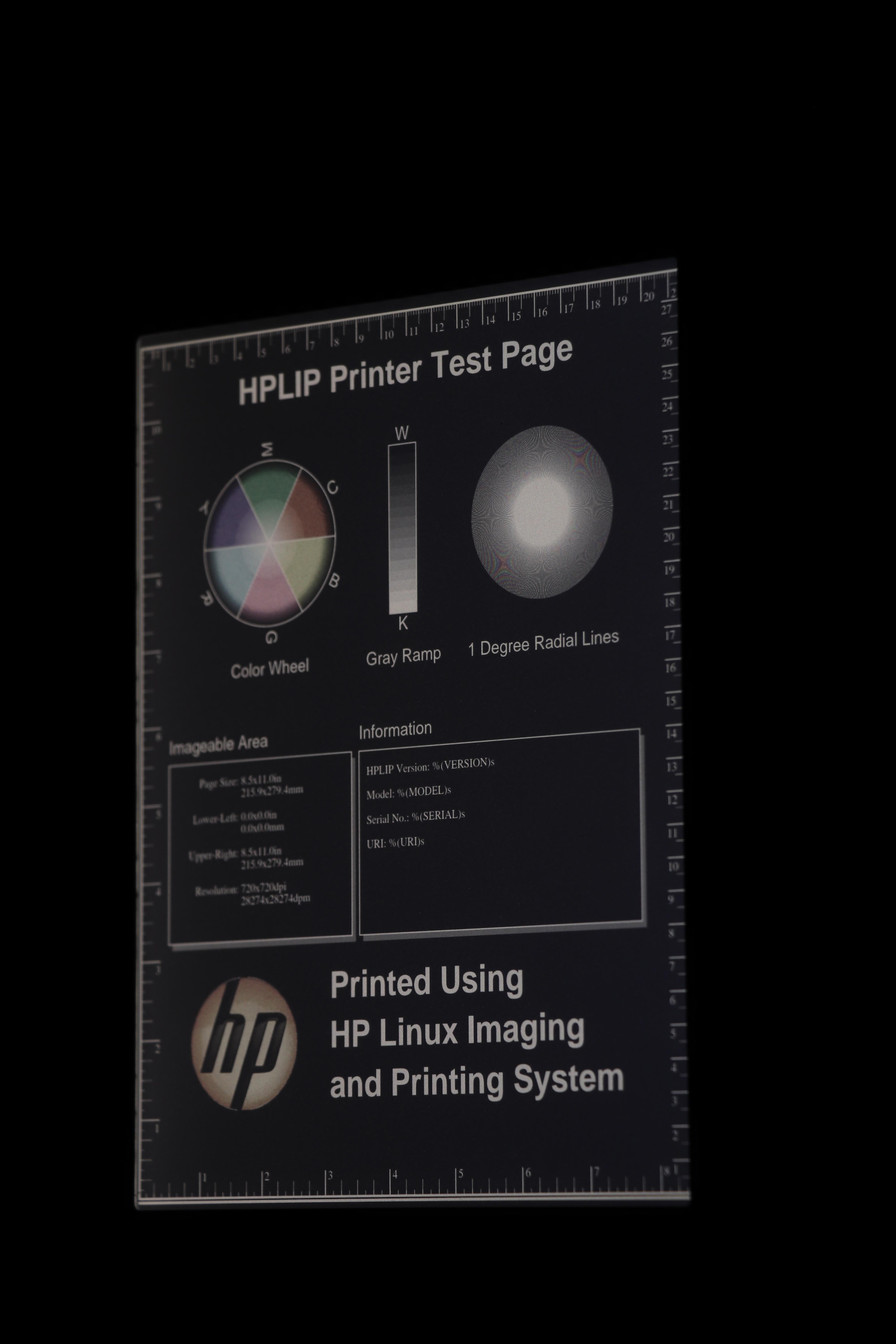
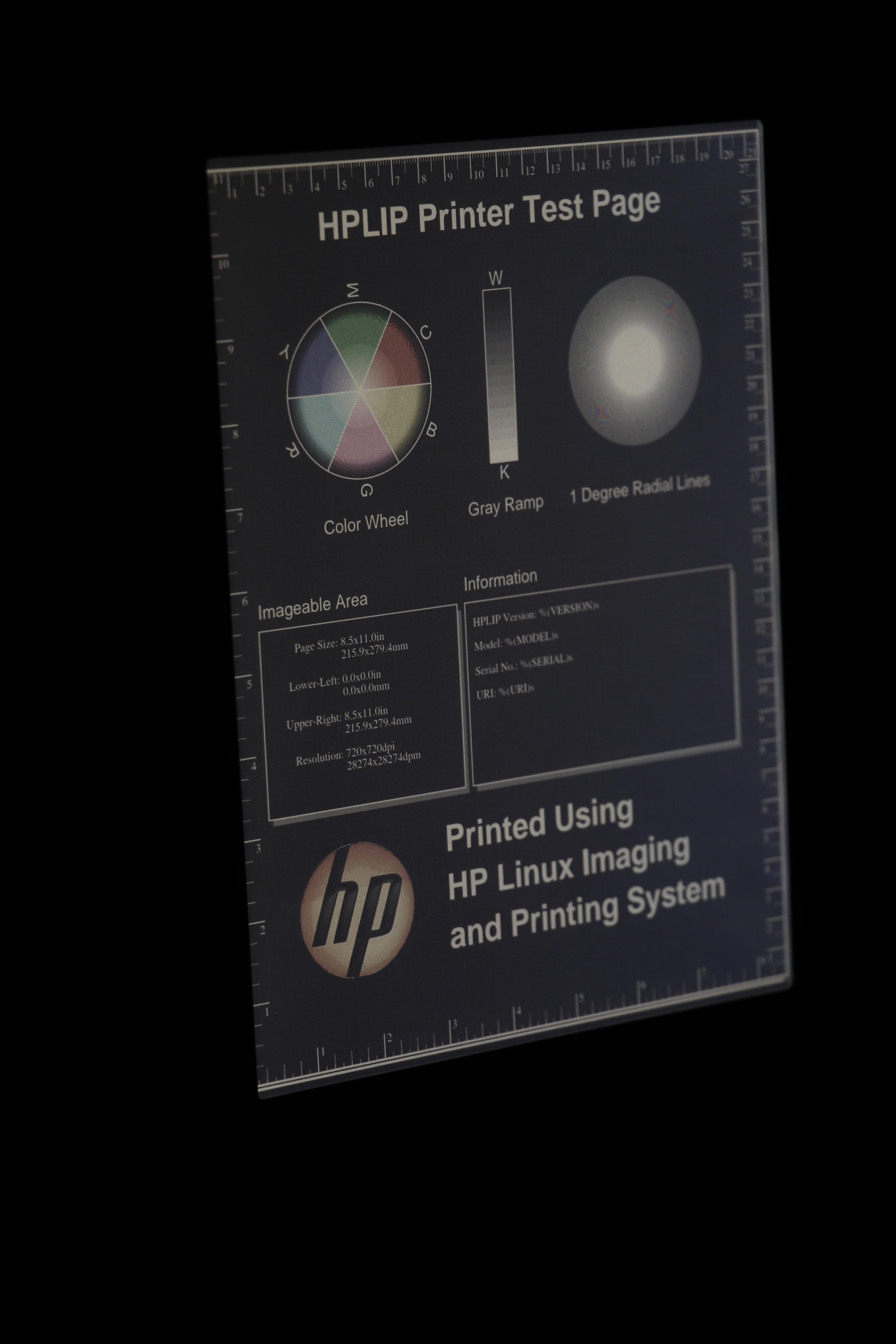
I ve been using E Ink-based ereaders for quite a number of years now. I ve had my Kobo Libra 2 for a few years, and was looking forward to the Kobo Libra Colour the first color E Ink display in a mainstream ereader line. I found the display to be a mixed bag; contrast seemed a lot worse on B&W images, and the device backlight (it s not technically a back light) seemed to cause a particular contrast reduction in dark mode. I went searching for information on this. I found a lot of videos on Kobo Libra 2 vs Libra Colour and so forth, but they were all pretty much useless. These were the mistakes they made: So I dug out my Canon DSLR, tripod, and set up shots. Every shot here is set at ISO 100. Every shot in the same setting has the same exposure settings, which I document. The one thing I forgot to shut off was automatic white balance; you can notice it is active if you look closely at the backgrounds, but WB isn t really relevant to this comparison anyhow. Because there has also been a lot of concern about how well fine B&W details will show up on the Kobo Libra Colour screen, I shot all photos using a PDF test image from the open source hplip package (testpage.ps.gz converted to PDF). This also rules out font differences between the devices. I ensured a full screen refresh before each shot. This is all because color E Ink is effectively a filter called Kaleido over the B&W layer. This causes dimming and some other visual effects. You can click on any image here to see a full-resolution view. The full-size images are the exact JPEG coming from the camera, with only two modifications: 1) metadata has been redacted for privacy reasons, and 2) some images were losslessly rotated after the shoot. OK, onwards! Outdoors, bright sun, shot from directly overhead Bright sun is ideal lighting for an E Ink display. They need no lighting at all in this scenario, and in fact, if you turn on their internal display light, it will probably not be very noticeable. Of course, this is in contrast to phone LCD screens, for which bright sunlight is the worst. Scene: Morning sunlight reaching the ereaders at an angle. The angle was sufficient so that no shadows were cast by the camera or tripod. Device light: Off on both Exposure: 1/160, f16, ISO 100 You can see how much darker the Libra Colour is here. Though in these bright conditions, it is still plenty bright. There may actually be situations in which the Libra 2 is too bright in direct sunlight, requiring a person to squint or whatnot. Looking at the radial lines, it is a bit difficult to tell because the difference in brightness, but I don t see a hugely obvious reduction in quality in the Libra 2. Later I have a shot where I try to match brightness, and we ll check it out again there. Outdoors, shade, shot from directly overhead For the next shot, I set the ereaders in shade, but still well-lit with the diffuse sunlight from all around. The first two have both device lights off. For the third, I set the device light on the Kobo Colour to 100%, full cool shade, to try to see how close I could get it to the Libra 2 brightness. (Sorry it looks like I forgot to close the toolbar on the Colour for this set, but it doesn t modify the important bits of the underlying image.) Device light: Initially off on both Exposure: 1/60, f6.4, ISO 100 Here you can see the light on the Libra Colour was nearly able to match the brightness on the Libra 2. Indoors, room lit with overhead and window light, device light off We continue to move into dimmer light with this next shot. Device light: Off on both Exposure: 1/4, f5, ISO 100 Indoors, room lit with overhead and window light, device light on Now we have the first head-to-head with the device light on. I set the Libra 2 to my favorite warmth setting, found a brightness that looked good, and then tried my best to match those settings on the Libra Colour. My camera s light meter aided in matching brightness. Device light: On (Libra 2 at 40%, Libra Colour at 59%) Exposure: 1/8, f5, ISO 100 (Apparently I am terrible at remembering to dismiss menus, sigh.) Indoors, dark room, dark mode, at an angle The Kobo Libra Colour surprised me with its dark mode. When viewed at an oblique angle, the screen gets pretty washed out. I maintained the same brightness settings here as I did above. It is much more noticeable when the brightness is set down to my preferred nighttime level (4%), or with a more significant angle. Since you can t see my tags, the order of the photos here will be: Libra 2 (standard orientation), Colour (standard orientation), Colour (turned around. Device light: On (as above) Exposure: 1/4, f5.6, ISO 100 Notice how I said I maintained the same brightness settings as before, and yet the Libra Colour looks brighter than the Libra 2 here, whereas it looked the same in the prior non-dark mode photos. Here s why. I set the exposure of each set of shots based on camera metering. As we have seen from the light-off photos, the brightness of a white pixel is a lot less on a Libra Colour than on the Libra 2. However, it is likely that the brightness of a black pixel is about that same. Therefore, contrast on the Libra Colour is lower than on the Libra 2. The traditional shot is majority white pixels, so to make the Libra Colour brightness match that of the Libra 2, I had to crank up the brightness on the Libra Colour to compensate for the darker white background. With me so far? Now with the inverted image, you can see what that does. It doesn t just raise the brightness of the white pixels, but it also raises the brightness of the black pixels. This is expected because we didn t raise contrast, only brightness. Also, in the last image, you can see it is brighter to the right. Again, other conditions that are more difficult to photograph make that much more pronounced. Viewing the Libra Colour from one side (but not the other), in dark mode, with the light on, produces noticeably worse contrast on one side. Conclusions This isn t a slam dunk. Let s walk through this: I don t think there is any noticeable loss of detail on the Libra Colour. The radial lines appeared as well defined on it as on the Libra 2. Oddly, with the backlight, some striations were apparent in the gray gradient test, but I wouldn t be using an E Ink device for clear photographic reproduction anyhow. If you read mostly black and white: If you had been using a Kobo Libra Colour and were handed a Libra 2, you would go, Wow! What an upgrade! The screen is so much brighter! There s little reason to get a Libra Colour. The Libra 2 might be hard to find these days, but the new Clara BW (with a 6 instead of the 7 screen on the Libra series) might be just the thing for you. The Libra 2 is at home in any lighting, from direct sun to pitch black, and has all the usual E Ink benefits (eg, battery life measured in weeks) and drawbacks (slower refresh rate) that we re all used to. If you are interested in photographic color reproduction mostly indoors: Consider a small tablet. The Libra Colour s 4096 colors are going to appear washed out compared to what you re used to on a LCD screen. If you are interested in color content indoors and out: The Libra Colour might be a good fit. It could work well for things where superb color rendition isn t essential for instance, news stories (the Pocket integration or Calibre s news feature could be nice there), comics, etc. In a moderately-lit indoor room, it looks like the Libra Colour s light can lead it to results that approach Libra 2 quality. So if most of your reading is in those conditions, perhaps the Libra Colour is right for you. As a final aside, I wrote in this article about the Kobo devices. I switched from Kindles to Kobos a couple of years ago due to the greater openness of the Kobo devices (you can add things like Nickel Menu and KOReader to them, and they have built-in support for more useful formats), their featureset, and their cost. The top-of-the-line Kindle devices will have a screen very similar if not identical to the Libra 2, so you can very easily consider this to be a comparison between the Oasis and the Libra Colour as well.

6 May 2024

Thomas Lange: Removing tens of thousands of web pages

In January I've removed tens of thousands of web pages on www.debian.org. Have you noticed it? In the past From 1997 onwards, we had web pages for security announcements. We had to manually prepare a .data and a .wml file which then generated a web page for each security announcement (DSA or DLA). We have listed the 6 most recent messages in a short list that was created from these files. Most of the work that went into the Debian web pages was creating these files. Our search engine often listed the pages with security announcements instead of a more relevant web page for a particular topic. Preparation At DebConf Kosovo (2022) I started with a proof of concept and wrote a script, that generates this list without using the .data/.wml files in the Git repository, but instead reading the primary sources of security information[1]. This new list now includes links to the security tracker and the email of the announcement. Following web pages and scripts were also using these .data and .wml files: Before I could remove all the security web pages, I had to adjust the scripts, that create the above information. When I looked at the OVAL files and the apache logs of our web server, I saw that more than 99% of the web traffic was generated by these XML files (134TB of 135TB total in two weeks). They were not compressed and were around 50MB in size. With the help of Carsten Sch nert we managed to modify the python scripts that generate this OVAL file without using the .data/.wml files and now we only provide bzip2 compressed XML files[2]. The RSS feeds are created by the new Perl script which reads the DSA/DLA list the security tracker and determines the URL of the email of all entries. This script also generates the list of the most recent DSA/DLA entries. Currently we show the last 350 entries which covers more than the last year and includes links to the announcement email and the security tracker. The huge list of crossreferences is not needed any more, since the mapping of CVE to DSA is already included in the DSA list[3] of the security tracker. The amount of translations of the DSA/DLA was very different. French translations were almost all done, but all other languages did translations for a couple of months or years only. E.g. in 2022, Italian had 2 translations, Russian 15, Danish 212, French and English each 279. But from 2023 on only French translations were made. By generating the list of DSA/DLA we lost the ability to translate these web pages, but since these announcements are made of simple, identical sentences it is easy to use an automatic translation service if needed. Now the translation statistics of all web pages are more accurate. Instead of 12200 pages that need to be translated (including all these old DSA/DLA) there are now only 2500 pages to translate[4]. Languages that had a lot of old translations of DSA/DLA lost some percentage but languages that are doing translations of newer web pages won in the statistics of how many pages are translated. Examples: Before
German (de)   3501  28.5%
Italian (it)  1005   8.2%
Danish (da)   6336  51.7%
After
German (de)   1486  59.0%
Italian (it)   909  36.1%
Danish (da)    982  39.0%
Cleanup of all the security web pages Finally in January, I could remove all web pages of the security announcements in one git commit[5]. Using several git rm -rf commands this commit removed 54335 files, including around 9650 DSA/DLA data files, 44189 wml files, nearly 500 Makefiles. Outcome No more manual work is needed for the security team and we now have direct links from a DSA-NNN/DLA-NNN to the email in our mailing list archive. This was not possible before. The search results became more accurate. But we still host a lot of other old content on the Debian web pages which may be removed in the future. [1] https://www.debian.org/security/#infos [2] https://www.debian.org/security/oval/ [3] https://salsa.debian.org/security-tracker-team/security-tracker/-/raw/master/data/DSA/list [4] https://www.debian.org/devel/website/stats [5] https://salsa.debian.org/webmaster-team/webwml/-/commit/2aa73ff15bfc4eb2afd85c

13 April 2024

Paul Tagliamonte: Domo Arigato, Mr. debugfs

Years ago, at what I think I remember was DebConf 15, I hacked for a while on debhelper to write build-ids to debian binary control files, so that the build-id (more specifically, the ELF note .note.gnu.build-id) wound up in the Debian apt archive metadata. I ve always thought this was super cool, and seeing as how Michael Stapelberg blogged some great pointers around the ecosystem, including the fancy new debuginfod service, and the find-dbgsym-packages helper, which uses these same headers, I don t think I m the only one. At work I ve been using a lot of rust, specifically, async rust using tokio. To try and work on my style, and to dig deeper into the how and why of the decisions made in these frameworks, I ve decided to hack up a project that I ve wanted to do ever since 2015 write a debug filesystem. Let s get to it.

Back to the Future Time to admit something. I really love Plan 9. It s just so good. So many ideas from Plan 9 are just so prescient, and everything just feels right. Not just right like, feels good like, correct. The bit that I ve always liked the most is 9p, the network protocol for serving a filesystem over a network. This leads to all sorts of fun programs, like the Plan 9 ftp client being a 9p server you mount the ftp server and access files like any other files. It s kinda like if fuse were more fully a part of how the operating system worked, but fuse is all running client-side. With 9p there s a single client, and different servers that you can connect to, which may be backed by a hard drive, remote resources over something like SFTP, FTP, HTTP or even purely synthetic. The interesting (maybe sad?) part here is that 9p wound up outliving Plan 9 in terms of adoption 9p is in all sorts of places folks don t usually expect. For instance, the Windows Subsystem for Linux uses the 9p protocol to share files between Windows and Linux. ChromeOS uses it to share files with Crostini, and qemu uses 9p (virtio-p9) to share files between guest and host. If you re noticing a pattern here, you d be right; for some reason 9p is the go-to protocol to exchange files between hypervisor and guest. Why? I have no idea, except maybe due to being designed well, simple to implement, and it s a lot easier to validate the data being shared and validate security boundaries. Simplicity has its value. As a result, there s a lot of lingering 9p support kicking around. Turns out Linux can even handle mounting 9p filesystems out of the box. This means that I can deploy a filesystem to my LAN or my localhost by running a process on top of a computer that needs nothing special, and mount it over the network on an unmodified machine unlike fuse, where you d need client-specific software to run in order to mount the directory. For instance, let s mount a 9p filesystem running on my localhost machine, serving requests on 127.0.0.1:564 (tcp) that goes by the name mountpointname to /mnt.
$ mount -t 9p \
-o trans=tcp,port=564,version=9p2000.u,aname=mountpointname \
127.0.0.1 \
/mnt
Linux will mount away, and attach to the filesystem as the root user, and by default, attach to that mountpoint again for each local user that attempts to use it. Nifty, right? I think so. The server is able to keep track of per-user access and authorization along with the host OS.

WHEREIN I STYX WITH IT Since I wanted to push myself a bit more with rust and tokio specifically, I opted to implement the whole stack myself, without third party libraries on the critical path where I could avoid it. The 9p protocol (sometimes called Styx, the original name for it) is incredibly simple. It s a series of client to server requests, which receive a server to client response. These are, respectively, T messages, which transmit a request to the server, which trigger an R message in response (Reply messages). These messages are TLV payload with a very straight forward structure so straight forward, in fact, that I was able to implement a working server off nothing more than a handful of man pages. Later on after the basics worked, I found a more complete spec page that contains more information about the unix specific variant that I opted to use (9P2000.u rather than 9P2000) due to the level of Linux specific support for the 9P2000.u variant over the 9P2000 protocol.

MR ROBOTO The backend stack over at zoo is rust and tokio running i/o for an HTTP and WebRTC server. I figured I d pick something fairly similar to write my filesystem with, since 9P can be implemented on basically anything with I/O. That means tokio tcp server bits, which construct and use a 9p server, which has an idiomatic Rusty API that partially abstracts the raw R and T messages, but not so much as to cause issues with hiding implementation possibilities. At each abstraction level, there s an escape hatch allowing someone to implement any of the layers if required. I called this framework arigato which can be found over on docs.rs and crates.io.
/// Simplified version of the arigato File trait; this isn't actually
/// the same trait; there's some small cosmetic differences. The
/// actual trait can be found at:
///
/// https://docs.rs/arigato/latest/arigato/server/trait.File.html
trait File  
/// OpenFile is the type returned by this File via an Open call.
 type OpenFile: OpenFile;
/// Return the 9p Qid for this file. A file is the same if the Qid is
 /// the same. A Qid contains information about the mode of the file,
 /// version of the file, and a unique 64 bit identifier.
 fn qid(&self) -> Qid;
/// Construct the 9p Stat struct with metadata about a file.
 async fn stat(&self) -> FileResult<Stat>;
/// Attempt to update the file metadata.
 async fn wstat(&mut self, s: &Stat) -> FileResult<()>;
/// Traverse the filesystem tree.
 async fn walk(&self, path: &[&str]) -> FileResult<(Option<Self>, Vec<Self>)>;
/// Request that a file's reference be removed from the file tree.
 async fn unlink(&mut self) -> FileResult<()>;
/// Create a file at a specific location in the file tree.
 async fn create(
&mut self,
name: &str,
perm: u16,
ty: FileType,
mode: OpenMode,
extension: &str,
) -> FileResult<Self>;
/// Open the File, returning a handle to the open file, which handles
 /// file i/o. This is split into a second type since it is genuinely
 /// unrelated -- and the fact that a file is Open or Closed can be
 /// handled by the  arigato  server for us.
 async fn open(&mut self, mode: OpenMode) -> FileResult<Self::OpenFile>;
 
/// Simplified version of the arigato OpenFile trait; this isn't actually
/// the same trait; there's some small cosmetic differences. The
/// actual trait can be found at:
///
/// https://docs.rs/arigato/latest/arigato/server/trait.OpenFile.html
trait OpenFile  
/// iounit to report for this file. The iounit reported is used for Read
 /// or Write operations to signal, if non-zero, the maximum size that is
 /// guaranteed to be transferred atomically.
 fn iounit(&self) -> u32;
/// Read some number of bytes up to  buf.len()  from the provided
 ///  offset  of the underlying file. The number of bytes read is
 /// returned.
 async fn read_at(
&mut self,
buf: &mut [u8],
offset: u64,
) -> FileResult<u32>;
/// Write some number of bytes up to  buf.len()  from the provided
 ///  offset  of the underlying file. The number of bytes written
 /// is returned.
 fn write_at(
&mut self,
buf: &mut [u8],
offset: u64,
) -> FileResult<u32>;
 

Thanks, decade ago paultag! Let s do it! Let s use arigato to implement a 9p filesystem we ll call debugfs that will serve all the debug files shipped according to the Packages metadata from the apt archive. We ll fetch the Packages file and construct a filesystem based on the reported Build-Id entries. For those who don t know much about how an apt repo works, here s the 2-second crash course on what we re doing. The first is to fetch the Packages file, which is specific to a binary architecture (such as amd64, arm64 or riscv64). That architecture is specific to a component (such as main, contrib or non-free). That component is specific to a suite, such as stable, unstable or any of its aliases (bullseye, bookworm, etc). Let s take a look at the Packages.xz file for the unstable-debug suite, main component, for all amd64 binaries.
$ curl \
https://deb.debian.org/debian-debug/dists/unstable-debug/main/binary-amd64/Packages.xz \
  unxz
This will return the Debian-style rfc2822-like headers, which is an export of the metadata contained inside each .deb file which apt (or other tools that can use the apt repo format) use to fetch information about debs. Let s take a look at the debug headers for the netlabel-tools package in unstable which is a package named netlabel-tools-dbgsym in unstable-debug.
Package: netlabel-tools-dbgsym
Source: netlabel-tools (0.30.0-1)
Version: 0.30.0-1+b1
Installed-Size: 79
Maintainer: Paul Tagliamonte <paultag@debian.org>
Architecture: amd64
Depends: netlabel-tools (= 0.30.0-1+b1)
Description: debug symbols for netlabel-tools
Auto-Built-Package: debug-symbols
Build-Ids: e59f81f6573dadd5d95a6e4474d9388ab2777e2a
Description-md5: a0e587a0cf730c88a4010f78562e6db7
Section: debug
Priority: optional
Filename: pool/main/n/netlabel-tools/netlabel-tools-dbgsym_0.30.0-1+b1_amd64.deb
Size: 62776
SHA256: 0e9bdb087617f0350995a84fb9aa84541bc4df45c6cd717f2157aa83711d0c60
So here, we can parse the package headers in the Packages.xz file, and store, for each Build-Id, the Filename where we can fetch the .deb at. Each .deb contains a number of files but we re only really interested in the files inside the .deb located at or under /usr/lib/debug/.build-id/, which you can find in debugfs under rfc822.rs. It s crude, and very single-purpose, but I m feeling a bit lazy.

Who needs dpkg?! For folks who haven t seen it yet, a .deb file is a special type of .ar file, that contains (usually) three files inside debian-binary, control.tar.xz and data.tar.xz. The core of an .ar file is a fixed size (60 byte) entry header, followed by the specified size number of bytes.
[8 byte .ar file magic]
[60 byte entry header]
[N bytes of data]
[60 byte entry header]
[N bytes of data]
[60 byte entry header]
[N bytes of data]
...
First up was to implement a basic ar parser in ar.rs. Before we get into using it to parse a deb, as a quick diversion, let s break apart a .deb file by hand something that is a bit of a rite of passage (or at least it used to be? I m getting old) during the Debian nm (new member) process, to take a look at where exactly the .debug file lives inside the .deb file.
$ ar x netlabel-tools-dbgsym_0.30.0-1+b1_amd64.deb
$ ls
control.tar.xz debian-binary
data.tar.xz netlabel-tools-dbgsym_0.30.0-1+b1_amd64.deb
$ tar --list -f data.tar.xz   grep '.debug$'
./usr/lib/debug/.build-id/e5/9f81f6573dadd5d95a6e4474d9388ab2777e2a.debug
Since we know quite a bit about the structure of a .deb file, and I had to implement support from scratch anyway, I opted to implement a (very!) basic debfile parser using HTTP Range requests. HTTP Range requests, if supported by the server (denoted by a accept-ranges: bytes HTTP header in response to an HTTP HEAD request to that file) means that we can add a header such as range: bytes=8-68 to specifically request that the returned GET body be the byte range provided (in the above case, the bytes starting from byte offset 8 until byte offset 68). This means we can fetch just the ar file entry from the .deb file until we get to the file inside the .deb we are interested in (in our case, the data.tar.xz file) at which point we can request the body of that file with a final range request. I wound up writing a struct to handle a read_at-style API surface in hrange.rs, which we can pair with ar.rs above and start to find our data in the .deb remotely without downloading and unpacking the .deb at all. After we have the body of the data.tar.xz coming back through the HTTP response, we get to pipe it through an xz decompressor (this kinda sucked in Rust, since a tokio AsyncRead is not the same as an http Body response is not the same as std::io::Read, is not the same as an async (or sync) Iterator is not the same as what the xz2 crate expects; leading me to read blocks of data to a buffer and stuff them through the decoder by looping over the buffer for each lzma2 packet in a loop), and tarfile parser (similarly troublesome). From there we get to iterate over all entries in the tarfile, stopping when we reach our file of interest. Since we can t seek, but gdb needs to, we ll pull it out of the stream into a Cursor<Vec<u8>> in-memory and pass a handle to it back to the user. From here on out its a matter of gluing together a File traited struct in debugfs, and serving the filesystem over TCP using arigato. Done deal!

A quick diversion about compression I was originally hoping to avoid transferring the whole tar file over the network (and therefore also reading the whole debug file into ram, which objectively sucks), but quickly hit issues with figuring out a way around seeking around an xz file. What s interesting is xz has a great primitive to solve this specific problem (specifically, use a block size that allows you to seek to the block as close to your desired seek position just before it, only discarding at most block size - 1 bytes), but data.tar.xz files generated by dpkg appear to have a single mega-huge block for the whole file. I don t know why I would have expected any different, in retrospect. That means that this now devolves into the base case of How do I seek around an lzma2 compressed data stream ; which is a lot more complex of a question. Thankfully, notoriously brilliant tianon was nice enough to introduce me to Jon Johnson who did something super similar adapted a technique to seek inside a compressed gzip file, which lets his service oci.dag.dev seek through Docker container images super fast based on some prior work such as soci-snapshotter, gztool, and zran.c. He also pulled this party trick off for apk based distros over at apk.dag.dev, which seems apropos. Jon was nice enough to publish a lot of his work on this specifically in a central place under the name targz on his GitHub, which has been a ton of fun to read through. The gist is that, by dumping the decompressor s state (window of previous bytes, in-memory data derived from the last N-1 bytes) at specific checkpoints along with the compressed data stream offset in bytes and decompressed offset in bytes, one can seek to that checkpoint in the compressed stream and pick up where you left off creating a similar block mechanism against the wishes of gzip. It means you d need to do an O(n) run over the file, but every request after that will be sped up according to the number of checkpoints you ve taken. Given the complexity of xz and lzma2, I don t think this is possible for me at the moment especially given most of the files I ll be requesting will not be loaded from again especially when I can just cache the debug header by Build-Id. I want to implement this (because I m generally curious and Jon has a way of getting someone excited about compression schemes, which is not a sentence I thought I d ever say out loud), but for now I m going to move on without this optimization. Such a shame, since it kills a lot of the work that went into seeking around the .deb file in the first place, given the debian-binary and control.tar.gz members are so small.

The Good First, the good news right? It works! That s pretty cool. I m positive my younger self would be amused and happy to see this working; as is current day paultag. Let s take debugfs out for a spin! First, we need to mount the filesystem. It even works on an entirely unmodified, stock Debian box on my LAN, which is huge. Let s take it for a spin:
$ mount \
-t 9p \
-o trans=tcp,version=9p2000.u,aname=unstable-debug \
192.168.0.2 \
/usr/lib/debug/.build-id/
And, let s prove to ourselves that this actually mounted before we go trying to use it:
$ mount   grep build-id
192.168.0.2 on /usr/lib/debug/.build-id type 9p (rw,relatime,aname=unstable-debug,access=user,trans=tcp,version=9p2000.u,port=564)
Slick. We ve got an open connection to the server, where our host will keep a connection alive as root, attached to the filesystem provided in aname. Let s take a look at it.
$ ls /usr/lib/debug/.build-id/
00 0d 1a 27 34 41 4e 5b 68 75 82 8E 9b a8 b5 c2 CE db e7 f3
01 0e 1b 28 35 42 4f 5c 69 76 83 8f 9c a9 b6 c3 cf dc E7 f4
02 0f 1c 29 36 43 50 5d 6a 77 84 90 9d aa b7 c4 d0 dd e8 f5
03 10 1d 2a 37 44 51 5e 6b 78 85 91 9e ab b8 c5 d1 de e9 f6
04 11 1e 2b 38 45 52 5f 6c 79 86 92 9f ac b9 c6 d2 df ea f7
05 12 1f 2c 39 46 53 60 6d 7a 87 93 a0 ad ba c7 d3 e0 eb f8
06 13 20 2d 3a 47 54 61 6e 7b 88 94 a1 ae bb c8 d4 e1 ec f9
07 14 21 2e 3b 48 55 62 6f 7c 89 95 a2 af bc c9 d5 e2 ed fa
08 15 22 2f 3c 49 56 63 70 7d 8a 96 a3 b0 bd ca d6 e3 ee fb
09 16 23 30 3d 4a 57 64 71 7e 8b 97 a4 b1 be cb d7 e4 ef fc
0a 17 24 31 3e 4b 58 65 72 7f 8c 98 a5 b2 bf cc d8 E4 f0 fd
0b 18 25 32 3f 4c 59 66 73 80 8d 99 a6 b3 c0 cd d9 e5 f1 fe
0c 19 26 33 40 4d 5a 67 74 81 8e 9a a7 b4 c1 ce da e6 f2 ff
Outstanding. Let s try using gdb to debug a binary that was provided by the Debian archive, and see if it ll load the ELF by build-id from the right .deb in the unstable-debug suite:
$ gdb -q /usr/sbin/netlabelctl
Reading symbols from /usr/sbin/netlabelctl...
Reading symbols from /usr/lib/debug/.build-id/e5/9f81f6573dadd5d95a6e4474d9388ab2777e2a.debug...
(gdb)
Yes! Yes it will!
$ file /usr/lib/debug/.build-id/e5/9f81f6573dadd5d95a6e4474d9388ab2777e2a.debug
/usr/lib/debug/.build-id/e5/9f81f6573dadd5d95a6e4474d9388ab2777e2a.debug: ELF 64-bit LSB shared object, x86-64, version 1 (SYSV), dynamically linked, interpreter *empty*, BuildID[sha1]=e59f81f6573dadd5d95a6e4474d9388ab2777e2a, for GNU/Linux 3.2.0, with debug_info, not stripped

The Bad Linux s support for 9p is mainline, which is great, but it s not robust. Network issues or server restarts will wedge the mountpoint (Linux can t reconnect when the tcp connection breaks), and things that work fine on local filesystems get translated in a way that causes a lot of network chatter for instance, just due to the way the syscalls are translated, doing an ls, will result in a stat call for each file in the directory, even though linux had just got a stat entry for every file while it was resolving directory names. On top of that, Linux will serialize all I/O with the server, so there s no concurrent requests for file information, writes, or reads pending at the same time to the server; and read and write throughput will degrade as latency increases due to increasing round-trip time, even though there are offsets included in the read and write calls. It works well enough, but is frustrating to run up against, since there s not a lot you can do server-side to help with this beyond implementing the 9P2000.L variant (which, maybe is worth it).

The Ugly Unfortunately, we don t know the file size(s) until we ve actually opened the underlying tar file and found the correct member, so for most files, we don t know the real size to report when getting a stat. We can t parse the tarfiles for every stat call, since that d make ls even slower (bummer). Only hiccup is that when I report a filesize of zero, gdb throws a bit of a fit; let s try with a size of 0 to start:
$ ls -lah /usr/lib/debug/.build-id/e5/9f81f6573dadd5d95a6e4474d9388ab2777e2a.debug
-r--r--r-- 1 root root 0 Dec 31 1969 /usr/lib/debug/.build-id/e5/9f81f6573dadd5d95a6e4474d9388ab2777e2a.debug
$ gdb -q /usr/sbin/netlabelctl
Reading symbols from /usr/sbin/netlabelctl...
Reading symbols from /usr/lib/debug/.build-id/e5/9f81f6573dadd5d95a6e4474d9388ab2777e2a.debug...
warning: Discarding section .note.gnu.build-id which has a section size (24) larger than the file size [in module /usr/lib/debug/.build-id/e5/9f81f6573dadd5d95a6e4474d9388ab2777e2a.debug]
[...]
This obviously won t work since gdb will throw away all our hard work because of stat s output, and neither will loading the real size of the underlying file. That only leaves us with hardcoding a file size and hope nothing else breaks significantly as a result. Let s try it again:
$ ls -lah /usr/lib/debug/.build-id/e5/9f81f6573dadd5d95a6e4474d9388ab2777e2a.debug
-r--r--r-- 1 root root 954M Dec 31 1969 /usr/lib/debug/.build-id/e5/9f81f6573dadd5d95a6e4474d9388ab2777e2a.debug
$ gdb -q /usr/sbin/netlabelctl
Reading symbols from /usr/sbin/netlabelctl...
Reading symbols from /usr/lib/debug/.build-id/e5/9f81f6573dadd5d95a6e4474d9388ab2777e2a.debug...
(gdb)
Much better. I mean, terrible but better. Better for now, anyway.

Kilroy was here Do I think this is a particularly good idea? I mean; kinda. I m probably going to make some fun 9p arigato-based filesystems for use around my LAN, but I don t think I ll be moving to use debugfs until I can figure out how to ensure the connection is more resilient to changing networks, server restarts and fixes on i/o performance. I think it was a useful exercise and is a pretty great hack, but I don t think this ll be shipping anywhere anytime soon. Along with me publishing this post, I ve pushed up all my repos; so you should be able to play along at home! There s a lot more work to be done on arigato; but it does handshake and successfully export a working 9P2000.u filesystem. Check it out on on my github at arigato, debugfs and also on crates.io and docs.rs. At least I can say I was here and I got it working after all these years.

12 April 2024

Freexian Collaborators: Debian Contributions: SSO Authentication for jitsi.debian.social, /usr-move updates, and more! (by Utkarsh Gupta)

Contributing to Debian is part of Freexian s mission. This article covers the latest achievements of Freexian and their collaborators. All of this is made possible by organizations subscribing to our Long Term Support contracts and consulting services. P.S. We ve completed over a year of writing these blogs. If you have any suggestions on how to make them better or what you d like us to cover, or any other opinions/reviews you might have, et al, please let us know by dropping an email to us. We d be happy to hear your thoughts. :)

SSO Authentication for jitsi.debian.social, by Stefano Rivera Debian.social s jitsi instance has been getting some abuse by (non-Debian) people sharing sexually explicit content on the service. After playing whack-a-mole with this for a month, and shutting the instance off for another month, we opened it up again and the abuse immediately re-started. Stefano sat down and wrote an SSO Implementation that hooks into Jitsi s existing JWT SSO support. This requires everyone using jitsi.debian.social to have a Salsa account. With only a little bit of effort, we could change this in future, to only require an account to open a room, and allow guests to join the call.

/usr-move, by Helmut Grohne The biggest task this month was sending mitigation patches for all of the /usr-move issues arising from package renames due to the 2038 transition. As a result, we can now say that every affected package in unstable can either be converted with dh-sequence-movetousr or has an open bug report. The package set relevant to debootstrap except for the set that has to be uploaded concurrently has been moved to /usr and is awaiting migration. The move of coreutils happened to affect piuparts which hard codes the location of /bin/sync and received multiple updates as a result.

Miscellaneous contributions
  • Stefano Rivera uploaded a stable release update to python3.11 for bookworm, fixing a use-after-free crash.
  • Stefano uploaded a new version of python-html2text, and updated python3-defaults to build with it.
  • In support of Python 3.12, Stefano dropped distutils as a Build-Dependency from a few packages, and uploaded a complex set of patches to python-mitogen.
  • Stefano landed some merge requests to clean up dead code in dh-python, removed the flit plugin, and uploaded it.
  • Stefano uploaded new upstream versions of twisted, hatchling, python-flexmock, python-authlib, python mitogen, python-pipx, and xonsh.
  • Stefano requested removal of a few packages supporting the Opsis HDMI2USB hardware that DebConf Video team used to use for HDMI capture, as they are not being maintained upstream. They started to FTBFS, with recent sdcc changes.
  • DebConf 24 is getting ready to open registration, Stefano spent some time fixing bugs in the website, caused by infrastructure updates.
  • Stefano reviewed all the DebConf 23 travel reimbursements, filing requests for more information from SPI where our records mismatched.
  • Stefano spun up a Wafer website for the Berlin 2024 mini DebConf.
  • Roberto C. S nchez worked on facilitating the transfer of upstream maintenance responsibility for the dormant Shorewall project to a new team led by the current maintainer of the Shorewall packages in Debian.
  • Colin Watson fixed build failures in celery-haystack-ng, db1-compat, jsonpickle, libsdl-perl, kali, knews, openssh-ssh1, python-json-log-formatter, python-typing-extensions, trn4, vigor, and wcwidth. Some of these were related to the 64-bit time_t transition, since that involved enabling -Werror=implicit-function-declaration.
  • Colin fixed an off-by-one error in neovim, which was already causing a build failure in Ubuntu and would eventually have caused a build failure in Debian with stricter toolchain settings.
  • Colin added an sshd@.service template to openssh to help newer systemd versions make containers and VMs SSH-accessible over AF_VSOCK sockets.
  • Following the xz-utils backdoor, Colin spent some time testing and discussing OpenSSH upstream s proposed inline systemd notification patch, since the current implementation via libsystemd was part of the attack vector used by that backdoor.
  • Utkarsh reviewed and sponsored some Go packages for Lena Voytek and Rajudev.
  • Utkarsh also helped Mitchell Dzurick with the adoption of pyparted package.
  • Helmut sent 10 patches for cross build failures.
  • Helmut partially fixed architecture cross bootstrap tooling to deal with changes in linux-libc-dev and the recent gcc-for-host changes and also fixed a 64bit-time_t FTBFS in libtextwrap.
  • Thorsten Alteholz uploaded several packages from debian-printing: cjet, lprng, rlpr and epson-inkjet-printer-escpr were affected by the newly enabled compiler switch -Werror=implicit-function-declaration. Besides fixing these serious bugs, Thorsten also worked on other bugs and could fix one or the other.
  • Carles updated simplemonitor and python-ring-doorbell packages with new upstream versions.
  • Santiago is still working on the Salsa CI MRs to adapt the build jobs so they can rely on sbuild. Current work includes adapting the images used by the build job, implementing the basic sbuild support the related jobs, and adjusting the support for experimental and *-backports releases..
    Additionally, Santiago reviewed some MR such as Make timeout action explicit in the logs and the subsequent Implement conditional timeout verbosity, and the batch of MRs included in https://salsa.debian.org/salsa-ci-team/pipeline/-/merge_requests/482.
  • Santiago also reviewed applications for the improving Salsa CI in Debian GSoC 2024 project. We received applications from four very talented candidates. The selection process is currently ongoing. A huge thanks to all of them!
  • As part of the DebConf 24 organization, Santiago has taken part in the Content team discussions.

9 April 2024

Matthew Palmer: How I Tripped Over the Debian Weak Keys Vulnerability

Those of you who haven t been in IT for far, far too long might not know that next month will be the 16th(!) anniversary of the disclosure of what was, at the time, a fairly earth-shattering revelation: that for about 18 months, the Debian OpenSSL package was generating entirely predictable private keys. The recent xz-stential threat (thanks to @nixCraft for making me aware of that one), has got me thinking about my own serendipitous interaction with a major vulnerability. Given that the statute of limitations has (probably) run out, I thought I d share it as a tale of how huh, that s weird can be a powerful threat-hunting tool but only if you ve got the time to keep pulling at the thread.

Prelude to an Adventure Our story begins back in March 2008. I was working at Engine Yard (EY), a now largely-forgotten Rails-focused hosting company, which pioneered several advances in Rails application deployment. Probably EY s greatest claim to lasting fame is that they helped launch a little code hosting platform you might have heard of, by providing them free infrastructure when they were little more than a glimmer in the Internet s eye. I am, of course, talking about everyone s favourite Microsoft product: GitHub. Since GitHub was in the right place, at the right time, with a compelling product offering, they quickly started to gain traction, and grow their userbase. With growth comes challenges, amongst them the one we re focusing on today: SSH login times. Then, as now, GitHub provided SSH access to the git repos they hosted, by SSHing to git@github.com with publickey authentication. They were using the standard way that everyone manages SSH keys: the ~/.ssh/authorized_keys file, and that became a problem as the number of keys started to grow. The way that SSH uses this file is that, when a user connects and asks for publickey authentication, SSH opens the ~/.ssh/authorized_keys file and scans all of the keys listed in it, looking for a key which matches the key that the user presented. This linear search is normally not a huge problem, because nobody in their right mind puts more than a few keys in their ~/.ssh/authorized_keys, right?
2008-era GitHub giving monkey puppet side-eye to the idea that nobody stores many keys in an authorized_keys file
Of course, as a popular, rapidly-growing service, GitHub was gaining users at a fair clip, to the point that the one big file that stored all the SSH keys was starting to visibly impact SSH login times. This problem was also not going to get any better by itself. Something Had To Be Done. EY management was keen on making sure GitHub ran well, and so despite it not really being a hosting problem, they were willing to help fix this problem. For some reason, the late, great, Ezra Zygmuntowitz pointed GitHub in my direction, and let me take the time to really get into the problem with the GitHub team. After examining a variety of different possible solutions, we came to the conclusion that the least-worst option was to patch OpenSSH to lookup keys in a MySQL database, indexed on the key fingerprint. We didn t take this decision on a whim it wasn t a case of yeah, sure, let s just hack around with OpenSSH, what could possibly go wrong? . We knew it was potentially catastrophic if things went sideways, so you can imagine how much worse the other options available were. Ensuring that this wouldn t compromise security was a lot of the effort that went into the change. In the end, though, we rolled it out in early April, and lo! SSH logins were fast, and we were pretty sure we wouldn t have to worry about this problem for a long time to come. Normally, you d think patching OpenSSH to make mass SSH logins super fast would be a good story on its own. But no, this is just the opening scene.

Chekov s Gun Makes its Appearance Fast forward a little under a month, to the first few days of May 2008. I get a message from one of the GitHub team, saying that somehow users were able to access other users repos over SSH. Naturally, as we d recently rolled out the OpenSSH patch, which touched this very thing, the code I d written was suspect number one, so I was called in to help.
The lineup scene from the movie The Usual Suspects They're called The Usual Suspects for a reason, but sometimes, it really is Keyser S ze
Eventually, after more than a little debugging, we discovered that, somehow, there were two users with keys that had the same key fingerprint. This absolutely shouldn t happen it s a bit like winning the lottery twice in a row1 unless the users had somehow shared their keys with each other, of course. Still, it was worth investigating, just in case it was a web application bug, so the GitHub team reached out to the users impacted, to try and figure out what was going on. The users professed no knowledge of each other, neither admitted to publicising their key, and couldn t offer any explanation as to how the other person could possibly have gotten their key. Then things went from weird to what the ? . Because another pair of users showed up, sharing a key fingerprint but it was a different shared key fingerprint. The odds now have gone from winning the lottery multiple times in a row to as close to this literally cannot happen as makes no difference.
Milhouse from The Simpsons says that We're Through The Looking Glass Here, People
Once we were really, really confident that the OpenSSH patch wasn t the cause of the problem, my involvement in the problem basically ended. I wasn t a GitHub employee, and EY had plenty of other customers who needed my help, so I wasn t able to stay deeply involved in the on-going investigation of The Mystery of the Duplicate Keys. However, the GitHub team did keep talking to the users involved, and managed to determine the only apparent common factor was that all the users claimed to be using Debian or Ubuntu systems, which was where their SSH keys would have been generated. That was as far as the investigation had really gotten, when along came May 13, 2008.

Chekov s Gun Goes Off With the publication of DSA-1571-1, everything suddenly became clear. Through a well-meaning but ultimately disasterous cleanup of OpenSSL s randomness generation code, the Debian maintainer had inadvertently reduced the number of possible keys that could be generated by a given user from bazillions to a little over 32,000. With so many people signing up to GitHub some of them no doubt following best practice and freshly generating a separate key it s unsurprising that some collisions occurred. You can imagine the sense of oooooooh, so that s what s going on! that rippled out once the issue was understood. I was mostly glad that we had conclusive evidence that my OpenSSH patch wasn t at fault, little knowing how much more contact I was to have with Debian weak keys in the future, running a huge store of known-compromised keys and using them to find misbehaving Certificate Authorities, amongst other things.

Lessons Learned While I ve not found a description of exactly when and how Luciano Bello discovered the vulnerability that became CVE-2008-0166, I presume he first came across it some time before it was disclosed likely before GitHub tripped over it. The stable Debian release that included the vulnerable code had been released a year earlier, so there was plenty of time for Luciano to have discovered key collisions and go hmm, I wonder what s going on here? , then keep digging until the solution presented itself. The thought hmm, that s odd , followed by intense investigation, leading to the discovery of a major flaw is also what ultimately brought down the recent XZ backdoor. The critical part of that sequence is the ability to do that intense investigation, though. When I reflect on my brush with the Debian weak keys vulnerability, what sticks out to me is the fact that I didn t do the deep investigation. I wonder if Luciano hadn t found it, how long it might have been before it was found. The GitHub team would have continued investigating, presumably, and perhaps they (or I) would have eventually dug deep enough to find it. But we were all super busy myself, working support tickets at EY, and GitHub feverishly building features and fighting the fires in their rapidly-growing service. As it was, Luciano was able to take the time to dig in and find out what was happening, but just like the XZ backdoor, I feel like we, as an industry, got a bit lucky that someone with the skills, time, and energy was on hand at the right time to make a huge difference. It s a luxury to be able to take the time to really dig into a problem, and it s a luxury that most of us rarely have. Perhaps an understated takeaway is that somehow we all need to wrestle back some time to follow our hunches and really dig into the things that make us go hmm .

Support My Hunches If you d like to help me be able to do intense investigations of mysterious software phenomena, you can shout me a refreshing beverage on ko-fi.
  1. the odds are actually probably more like winning the lottery about twenty times in a row. The numbers involved are staggeringly huge, so it s easiest to just approximate it as really, really unlikely .

2 April 2024

Bits from Debian: Bits from the DPL

Dear Debianites This morning I decided to just start writing Bits from DPL and send whatever I have by 18:00 local time. Here it is, barely proof read, along with all it's warts and grammar mistakes! It's slightly long and doesn't contain any critical information, so if you're not in the mood, don't feel compelled to read it! Get ready for a new DPL! Soon, the voting period will start to elect our next DPL, and my time as DPL will come to an end. Reading the questions posted to the new candidates on debian-vote, it takes quite a bit of restraint to not answer all of them myself, I think I can see how that aspect contributed to me being reeled in to running for DPL! In total I've done so 5 times (the first time I ran, Sam was elected!). Good luck to both Andreas and Sruthi, our current DPL candidates! I've already started working on preparing handover, and there's multiple request from teams that have came in recently that will have to wait for the new term, so I hope they're both ready to hit the ground running! Things that I wish could have gone better Communication Recently, I saw a t-shirt that read:
Adulthood is saying, 'But after this week things will slow down a bit' over and over until you die.
I can relate! With every task, crisis or deadline that appears, I think that once this is over, I'll have some more breathing space to get back to non-urgent, but important tasks. "Bits from the DPL" was something I really wanted to get right this last term, and clearly failed spectacularly. I have two long Bits from the DPL drafts that I never finished, I tend to have prioritised problems of the day over communication. With all the hindsight I have, I'm not sure which is better to prioritise, I do rate communication and transparency very highly and this is really the top thing that I wish I could've done better over the last four years. On that note, thanks to people who provided me with some kind words when I've mentioned this to them before. They pointed out that there are many other ways to communicate and be in touch with the community, and they mentioned that they thought that I did a good job with that. Since I'm still on communication, I think we can all learn to be more effective at it, since it's really so important for the project. Every time I publicly spoke about us spending more money, we got more donations. People out there really like to see how we invest funds in to Debian, instead of just making it heap up. DSA just spent a nice chunk on money on hardware, but we don't have very good visibility on it. It's one thing having it on a public line item in SPI's reporting, but it would be much more exciting if DSA could provide a write-up on all the cool hardware they're buying and what impact it would have on developers, and post it somewhere prominent like debian-devel-announce, Planet Debian or Bits from Debian (from the publicity team). I don't want to single out DSA there, it's difficult and affects many other teams. The Salsa CI team also spent a lot of resources (time and money wise) to extend testing on AMD GPUs and other AMD hardware. It's fantastic and interesting work, and really more people within the project and in the outside world should know about it! I'm not going to push my agendas to the next DPL, but I hope that they continue to encourage people to write about their work, and hopefully at some point we'll build enough excitement in doing so that it becomes a more normal part of our daily work. Founding Debian as a standalone entity This was my number one goal for the project this last term, which was a carried over item from my previous terms. I'm tempted to write everything out here, including the problem statement and our current predicaments, what kind of ground work needs to happen, likely constitutional changes that need to happen, and the nature of the GR that would be needed to make such a thing happen, but if I start with that, I might not finish this mail. In short, I 100% believe that this is still a very high ranking issue for Debian, and perhaps after my term I'd be in a better position to spend more time on this (hmm, is this an instance of "The grass is always better on the other side", or "Next week will go better until I die?"). Anyway, I'm willing to work with any future DPL on this, and perhaps it can in itself be a delegation tasked to properly explore all the options, and write up a report for the project that can lead to a GR. Overall, I'd rather have us take another few years and do this properly, rather than rush into something that is again difficult to change afterwards. So while I very much wish this could've been achieved in the last term, I can't say that I have any regrets here either. My terms in a nutshell COVID-19 and Debian 11 era My first term in 2020 started just as the COVID-19 pandemic became known to spread globally. It was a tough year for everyone, and Debian wasn't immune against its effects either. Many of our contributors got sick, some have lost loved ones (my father passed away in March 2020 just after I became DPL), some have lost their jobs (or other earners in their household have) and the effects of social distancing took a mental and even physical health toll on many. In Debian, we tend to do really well when we get together in person to solve problems, and when DebConf20 got cancelled in person, we understood that that was necessary, but it was still more bad news in a year we had too much of it already. I can't remember if there was ever any kind of formal choice or discussion about this at any time, but the DebConf video team just kind of organically and spontaneously became the orga team for an online DebConf, and that lead to our first ever completely online DebConf. This was great on so many levels. We got to see each other's faces again, even though it was on screen. We had some teams talk to each other face to face for the first time in years, even though it was just on a Jitsi call. It had a lasting cultural change in Debian, some teams still have video meetings now, where they didn't do that before, and I think it's a good supplement to our other methods of communication. We also had a few online Mini-DebConfs that was fun, but DebConf21 was also online, and by then we all developed an online conference fatigue, and while it was another good online event overall, it did start to feel a bit like a zombieconf and after that, we had some really nice events from the Brazillians, but no big global online community events again. In my opinion online MiniDebConfs can be a great way to develop our community and we should spend some further energy into this, but hey! This isn't a platform so let me back out of talking about the future as I see it... Despite all the adversity that we faced together, the Debian 11 release ended up being quite good. It happened about a month or so later than what we ideally would've liked, but it was a solid release nonetheless. It turns out that for quite a few people, staying inside for a few months to focus on Debian bugs was quite productive, and Debian 11 ended up being a very polished release. During this time period we also had to deal with a previous Debian Developer that was expelled for his poor behaviour in Debian, who continued to harass members of the Debian project and in other free software communities after his expulsion. This ended up being quite a lot of work since we had to take legal action to protect our community, and eventually also get the police involved. I'm not going to give him the satisfaction by spending too much time talking about him, but you can read our official statement regarding Daniel Pocock here: https://www.debian.org/News/2021/20211117 In late 2021 and early 2022 we also discussed our general resolution process, and had two consequent votes to address some issues that have affected past votes: In my first term I addressed our delegations that were a bit behind, by the end of my last term all delegation requests are up to date. There's still some work to do, but I'm feeling good that I get to hand this over to the next DPL in a very decent state. Delegation updates can be very deceiving, sometimes a delegation is completely re-written and it was just 1 or 2 hours of work. Other times, a delegation updated can contain one line that has changed or a change in one team member that was the result of days worth of discussion and hashing out differences. I also received quite a few requests either to host a service, or to pay a third-party directly for hosting. This was quite an admin nightmare, it either meant we had to manually do monthly reimbursements to someone, or have our TOs create accounts/agreements at the multiple providers that people use. So, after talking to a few people about this, we founded the DebianNet team (we could've admittedly chosen a better name, but that can happen later on) for providing hosting at two different hosting providers that we have agreement with so that people who host things under debian.net have an easy way to host it, and then at the same time Debian also has more control if a site maintainer goes MIA. More info: https://wiki.debian.org/Teams/DebianNet You might notice some Openstack mentioned there, we had some intention to set up a Debian cloud for hosting these things, that could also be used for other additional Debiany things like archive rebuilds, but these have so far fallen through. We still consider it a good idea and hopefully it will work out some other time (if you're a large company who can sponsor few racks and servers, please get in touch!) DebConf22 and Debian 12 era DebConf22 was the first time we returned to an in-person DebConf. It was a bit smaller than our usual DebConf - understandably so, considering that there were still COVID risks and people who were at high risk or who had family with high risk factors did the sensible thing and stayed home. After watching many MiniDebConfs online, I also attended my first ever MiniDebConf in Hamburg. It still feels odd typing that, it feels like I should've been at one before, but my location makes attending them difficult (on a side-note, a few of us are working on bootstrapping a South African Debian community and hopefully we can pull off MiniDebConf in South Africa later this year). While I was at the MiniDebConf, I gave a talk where I covered the evolution of firmware, from the simple e-proms that you'd find in old printers to the complicated firmware in modern GPUs that basically contain complete operating systems- complete with drivers for the device their running on. I also showed my shiny new laptop, and explained that it's impossible to install that laptop without non-free firmware (you'd get a black display on d-i or Debian live). Also that you couldn't even use an accessibility mode with audio since even that depends on non-free firmware these days. Steve, from the image building team, has said for a while that we need to do a GR to vote for this, and after more discussion at DebConf, I kept nudging him to propose the GR, and we ended up voting in favour of it. I do believe that someone out there should be campaigning for more free firmware (unfortunately in Debian we just don't have the resources for this), but, I'm glad that we have the firmware included. In the end, the choice comes down to whether we still want Debian to be installable on mainstream bare-metal hardware. At this point, I'd like to give a special thanks to the ftpmasters, image building team and the installer team who worked really hard to get the changes done that were needed in order to make this happen for Debian 12, and for being really proactive for remaining niggles that was solved by the time Debian 12.1 was released. The included firmware contributed to Debian 12 being a huge success, but it wasn't the only factor. I had a list of personal peeves, and as the hard freeze hit, I lost hope that these would be fixed and made peace with the fact that Debian 12 would release with those bugs. I'm glad that lots of people proved me wrong and also proved that it's never to late to fix bugs, everything on my list got eliminated by the time final freeze hit, which was great! We usually aim to have a release ready about 2 years after the previous release, sometimes there are complications during a freeze and it can take a bit longer. But due to the excellent co-ordination of the release team and heavy lifting from many DDs, the Debian 12 release happened 21 months and 3 weeks after the Debian 11 release. I hope the work from the release team continues to pay off so that we can achieve their goals of having shorter and less painful freezes in the future! Even though many things were going well, the ongoing usr-merge effort highlighted some social problems within our processes. I started typing out the whole history of usrmerge here, but it's going to be too long for the purpose of this mail. Important questions that did come out of this is, should core Debian packages be team maintained? And also about how far the CTTE should really be able to override a maintainer. We had lots of discussion about this at DebConf22, but didn't make much concrete progress. I think that at some point we'll probably have a GR about package maintenance. Also, thank you to Guillem who very patiently explained a few things to me (after probably having have to done so many times to others before already) and to Helmut who have done the same during the MiniDebConf in Hamburg. I think all the technical and social issues here are fixable, it will just take some time and patience and I have lots of confidence in everyone involved. UsrMerge wiki page: https://wiki.debian.org/UsrMerge DebConf 23 and Debian 13 era DebConf23 took place in Kochi, India. At the end of my Bits from the DPL talk there, someone asked me what the most difficult thing I had to do was during my terms as DPL. I answered that nothing particular stood out, and even the most difficult tasks ended up being rewarding to work on. Little did I know that my most difficult period of being DPL was just about to follow. During the day trip, one of our contributors, Abraham Raji, passed away in a tragic accident. There's really not anything anyone could've done to predict or stop it, but it was devastating to many of us, especially the people closest to him. Quite a number of DebConf attendees went to his funeral, wearing the DebConf t-shirts he designed as a tribute. It still haunts me when I saw his mother scream "He was my everything! He was my everything!", this was by a large margin the hardest day I've ever had in Debian, and I really wasn't ok for even a few weeks after that and I think the hurt will be with many of us for some time to come. So, a plea again to everyone, please take care of yourself! There's probably more people that love you than you realise. A special thanks to the DebConf23 team, who did a really good job despite all the uphills they faced (and there were many!). As DPL, I think that planning for a DebConf is near to impossible, all you can do is show up and just jump into things. I planned to work with Enrico to finish up something that will hopefully save future DPLs some time, and that is a web-based DD certificate creator instead of having the DPL do so manually using LaTeX. It already mostly works, you can see the work so far by visiting https://nm.debian.org/person/ACCOUNTNAME/certificate/ and replacing ACCOUNTNAME with your Debian account name, and if you're a DD, you should see your certificate. It still needs a few minor changes and a DPL signature, but at this point I think that will be finished up when the new DPL start. Thanks to Enrico for working on this! Since my first term, I've been trying to find ways to improve all our accounting/finance issues. Tracking what we spend on things, and getting an annual overview is hard, especially over 3 trusted organisations. The reimbursement process can also be really tedious, especially when you have to provide files in a certain order and combine them into a PDF. So, at DebConf22 we had a meeting along with the treasurer team and Stefano Rivera who said that it might be possible for him to work on a new system as part of his Freexian work. It worked out, and Freexian funded the development of the system since then, and after DebConf23 we handled the reimbursements for the conference via the new reimbursements site: https://reimbursements.debian.net/ It's still early days, but over time it should be linked to all our TOs and we'll use the same category codes across the board. So, overall, our reimbursement process becomes a lot simpler, and also we'll be able to get information like how much money we've spent on any category in any period. It will also help us to track how much money we have available or how much we spend on recurring costs. Right now that needs manual polling from our TOs. So I'm really glad that this is a big long-standing problem in the project that is being fixed. For Debian 13, we're waving goodbye to the KFreeBSD and mipsel ports. But we're also gaining riscv64 and loongarch64 as release architectures! I have 3 different RISC-V based machines on my desk here that I haven't had much time to work with yet, you can expect some blog posts about them soon after my DPL term ends! As Debian is a unix-like system, we're affected by the Year 2038 problem, where systems that uses 32 bit time in seconds since 1970 run out of available time and will wrap back to 1970 or have other undefined behaviour. A detailed wiki page explains how this works in Debian, and currently we're going through a rather large transition to make this possible. I believe this is the right time for Debian to be addressing this, we're still a bit more than a year away for the Debian 13 release, and this provides enough time to test the implementation before 2038 rolls along. Of course, big complicated transitions with dependency loops that causes chaos for everyone would still be too easy, so this past weekend (which is a holiday period in most of the west due to Easter weekend) has been filled with dealing with an upstream bug in xz-utils, where a backdoor was placed in this key piece of software. An Ars Technica covers it quite well, so I won't go into all the details here. I mention it because I want to give yet another special thanks to everyone involved in dealing with this on the Debian side. Everyone involved, from the ftpmasters to security team and others involved were super calm and professional and made quick, high quality decisions. This also lead to the archive being frozen on Saturday, this is the first time I've seen this happen since I've been a DD, but I'm sure next week will go better! Looking forward It's really been an honour for me to serve as DPL. It might well be my biggest achievement in my life. Previous DPLs range from prominent software engineers to game developers, or people who have done things like complete Iron Man, run other huge open source projects and are part of big consortiums. Ian Jackson even authored dpkg and is now working on the very interesting tag2upload service! I'm a relative nobody, just someone who grew up as a poor kid in South Africa, who just really cares about Debian a lot. And, above all, I'm really thankful that I didn't do anything major to screw up Debian for good. Not unlike learning how to use Debian, and also becoming a Debian Developer, I've learned a lot from this and it's been a really valuable growth experience for me. I know I can't possible give all the thanks to everyone who deserves it, so here's a big big thanks to everyone who have worked so hard and who have put in many, many hours to making Debian better, I consider you all heroes! -Jonathan

25 March 2024

Jonathan Dowland: a bug a day

I recently became a maintainer of/committer to IkiWiki, the software that powers my site. I also took over maintenance of the Debian package. Last week I cut a new upstream point release, 3.20200202.4, and a corresponding Debian package upload, consisting only of a handful of low-hanging-fruit patches from other people, largely to exercise both processes. I've been discussing IkiWiki's maintenance situation with some other users for a couple of years now. I've also weighed up the pros and cons of moving to a different static-site-generator (a term that describes what IkiWiki is, but was actually coined more recently). It turns out IkiWiki is exceptionally flexible and powerful: I estimate the cost of moving to something modern(er) and fashionable such as Jekyll, Hugo or Hakyll as unreasonably high, in part because they are surprisingly rigid and inflexible in some key places. Like most mature software, IkiWiki has a bug backlog. Over the past couple of weeks, as a sort-of "palate cleanser" around work pieces, I've tried to triage one IkiWiki bug per day: either upstream or in the Debian Bug Tracker. This is a really lightweight task: it can be as simple as "find a bug reported in Debian, copy it upstream, tag it upstream, mark it forwarded; perhaps taking 5-10 minutes. Often I'll stumble across something that has already been fixed but not recorded as such as I go. Despite this minimal level of work, I'm quite satisfied with the cumulative progress. It's notable to me how much my perspective has shifted by becoming a maintainer: I'm considering everything through a different lens to that of being just one user. Eventually I will put some time aside to scratch some of my own itches (html5 by default; support dark mode; duckduckgo plugin; use the details tag...) but for now this minimal exercise is of broader use.

24 March 2024

Marco d'Itri: CISPE's call for new regulations on VMware

A few days ago CISPE, a trade association of European cloud providers, published a press release complaining about the new VMware licensing scheme and asking for regulators and legislators to intervene. But VMware does not have a monopoly on virtualization software: I think that asking regulators to interfere is unnecessary and unwise, unless, of course, they wish to question the entire foundations of copyright. Which, on the other hand, could be an intriguing position that I would support... I believe that over-reliance on a single supplier is a typical enterprise risk: in the past decade some companies have invested in developing their own virtualization infrastructure using free software, while others have decided to rely entirely on a single proprietary software vendor. My only big concern is that many public sector organizations will continue to use VMware and pay the huge fees designed by Broadcom to extract the maximum amount of money from their customers. However, it is ultimately the citizens who pay these bills, and blaming the evil US corporation is a great way to avoid taking responsibility for these choices.
"Several CISPE members have stated that without the ability to license and use VMware products they will quickly go bankrupt and out of business."
Insert here the Jeremy Clarkson "Oh no! Anyway..." meme.

19 March 2024

Colin Watson: apt install everything?

On Mastodon, the question came up of how Ubuntu would deal with something like the npm install everything situation. I replied:
Ubuntu is curated, so it probably wouldn t get this far. If it did, then the worst case is that it would get in the way of CI allowing other packages to be removed (again from a curated system, so people are used to removal not being self-service); but the release team would have no hesitation in removing a package like this to fix that, and it certainly wouldn t cause this amount of angst. If you did this in a PPA, then I can t think of any particular negative effects.
OK, if you added lots of build-dependencies (as well as run-time dependencies) then you might be able to take out a builder. But Launchpad builders already run arbitrary user-submitted code by design and are therefore very carefully sandboxed and treated as ephemeral, so this is hardly novel. There s a lot to be said for the arrangement of having a curated system for the stuff people actually care about plus an ecosystem of add-on repositories. PPAs cover a wide range of levels of developer activity, from throwaway experiments to quasi-official distribution methods; there are certainly problems that arise from it being difficult to tell the difference between those extremes and from there being no systematic confinement, but for this particular kind of problem they re very nearly ideal. (Canonical has tried various other approaches to software distribution, and while they address some of the problems, they aren t obviously better at helping people make reliable social judgements about code they don t know.) For a hypothetical package with a huge number of dependencies, to even try to upload it directly to Ubuntu you d need to be an Ubuntu developer with upload rights (or to go via Debian, where you d have to clear a similar hurdle). If you have those, then the first upload has to pass manual review by an archive administrator. If your package passes that, then it still has to build and get through proposed-migration CI before it reaches anything that humans typically care about. On the other hand, if you were inclined to try this sort of experiment, you d almost certainly try it in a PPA, and that would trouble nobody but yourself.

13 March 2024

Freexian Collaborators: Debian Contributions: Upcoming Improvements to Salsa CI, /usr-move, packaging simplemonitor, and more! (by Utkarsh Gupta)

Contributing to Debian is part of Freexian s mission. This article covers the latest achievements of Freexian and their collaborators. All of this is made possible by organizations subscribing to our Long Term Support contracts and consulting services.

/usr-move, by Helmut Grohne Much of the work was spent on handling interaction with time time64 transition and sending patches for mitigating fallout. The set of packages relevant to debootstrap is mostly converted and the patches for glibc and base-files have been refined due to feedback from the upload to Ubuntu noble. Beyond this, he sent patches for all remaining packages that cannot move their files with dh-sequence-movetousr and packages using dpkg-divert in ways that dumat would not recognize.

Upcoming improvements to Salsa CI, by Santiago Ruano Rinc n Last month, Santiago Ruano Rinc n started the work on integrating sbuild into the Salsa CI pipeline. Initially, Santiago used sbuild with the unshare chroot mode. However, after discussion with josch, jochensp and helmut (thanks to them!), it turns out that the unshare mode is not the most suitable for the pipeline, since the level of isolation it provides is not needed, and some test suites would fail (eg: krb5). Additionally, one of the requirements of the build job is the use of ccache, since it is needed by some C/C++ large projects to reduce the compilation time. In the preliminary work with unshare last month, it was not possible to make ccache to work. Finally, Santiago changed the chroot mode, and now has a couple of POC (cf: 1 and 2) that rely on the schroot and sudo, respectively. And the good news is that ccache is successfully used by sbuild with schroot! The image here comes from an example of building grep. At the end of the build, ccache -s shows the statistics of the cache that it used, and so a little more than half of the calls of that job were cacheable. The most important pieces are in place to finish the integration of sbuild into the pipeline. Other than that, Santiago also reviewed the very useful merge request !346, made by IOhannes zm lnig to autodetect the release from debian/changelog. As agreed with IOhannes, Santiago is preparing a merge request to include the release autodetection use case in the very own Salsa CI s CI.

Packaging simplemonitor, by Carles Pina i Estany Carles started using simplemonitor in 2017, opened a WNPP bug in 2022 and started packaging simplemonitor dependencies in October 2023. After packaging five direct and indirect dependencies, Carles finally uploaded simplemonitor to unstable in February. During the packaging of simplemonitor, Carles reported a few issues to upstream. Some of these were to make the simplemonitor package build and run tests reproducibly. A reproducibility issue was reprotest overriding the timezone, which broke simplemonitor s tests. There have been discussions on resolving this upstream in simplemonitor and in reprotest, too. Carles also started upgrading or improving some of simplemonitor s dependencies.

Miscellaneous contributions
  • Stefano Rivera spent some time doing admin on debian.social infrastructure. Including dealing with a spike of abuse on the Jitsi server.
  • Stefano started to prepare a new release of dh-python, including cleaning out a lot of old Python 2.x related code. Thanks to Niels Thykier (outside Freexian) for spear-heading this work.
  • DebConf 24 planning is beginning. Stefano discussed venues and finances with the local team and remotely supported a site-visit by Nattie (outside Freexian).
  • Also in the DebConf 24 context, Santiago took part in discussions and preparations related to the Content Team.
  • A JIT bug was reported against pypy3 in Debian Bookworm. Stefano bisected the upstream history to find the patch (it was already resolved upstream) and released an update to pypy3 in bookworm.
  • Enrico participated in /usr-merge discussions with Helmut.
  • Colin Watson backported a python-channels-redis fix to bookworm, rediscovered while working on debusine.
  • Colin dug into a cluster of celery build failures and tracked the hardest bit down to a Python 3.12 regression, now fixed in unstable. celery should be back in testing once the 64-bit time_t migration is out of the way.
  • Thorsten Alteholz uploaded a new upstream version of cpdb-libs. Unfortunately upstream changed the naming of their release tags, so updating the watch file was a bit demanding. Anyway this version 2.0 is a huge step towards introduction of the new Common Print Dialog Backends.
  • Helmut send patches for 48 cross build failures.
  • Helmut changed debvm to use mkfs.ext4 instead of genext2fs.
  • Helmut sent a debci MR for improving collector robustness.
  • In preparation for DebConf 25, Santiago worked on the Brest Bid.

Next.

Previous.