Search Results: "hle"

27 August 2015

Ben Hutchings: Truncating a string in C

This version uses the proper APIs to work with the locale's multibyte encoding (with single-byte encodings being a trivial case of multibyte). It will fail if it encounters an invalid byte sequence (e.g. byte > 127 in the "C" locale), though it could be changed to treat each rejected byte as a single character.
#include <locale.h>
#include <stdio.h>
#include <stdlib.h>
#include <string.h>
#include <wchar.h>
int main(int argc, char **argv)
 
    size_t n = 12, totlen = 0, maxlen, chlen;
    setlocale(LC_ALL, "");
    if (argc != 2)
	return EXIT_FAILURE;
    maxlen = strlen(argv[1]);
    while (n--)  
	chlen = mbrlen(argv[1] + totlen, maxlen - totlen, NULL);
	if (chlen > MB_CUR_MAX)
	    return EXIT_FAILURE;
	totlen += chlen;
     
    printf("%.*s\n", (int)totlen, argv[1]);
    return 0;
 

19 August 2015

Russell Coker: The Purpose of a Code of Conduct

On a private mailing list there have been some recent discussions about a Code of Conduct which demonstrate some great misunderstandings. The misunderstandings don t seem particular to that list so it s worthy of a blog post. Also people tend to think more about what they do when their actions will be exposed to a wider audience so hopefully people who read this post will think before they respond. Jokes The first discussion concerned the issue of making jokes . When dealing with the treatment of other people (particularly minority groups) the issue of jokes is a common one. It s fairly common for people in positions of power to make jokes about people with less power and then complain if someone disapproves. The more extreme examples of this concern hate words which are strongly associated with violence, one of the most common is a word used to describe gay men which has often been associated with significant violence and murder. Men who are straight and who conform to the stereotypes of straight men don t have much to fear from that word while men who aren t straight will associate it with a death threat and tend not to find any amusement in it. Most minority groups have words that are known to be associated with hate crimes. When such words are used they usually send a signal that the minority groups in question aren t welcome. The exception is when the words are used by other members of the group in question. For example if I was walking past a biker bar and heard someone call out geek or nerd I would be a little nervous (even though geeks/nerds have faced much less violence than most minority groups). But at a Linux conference my reaction would be very different. As a general rule you shouldn t use any word that has a history of being used to attack any minority group other than one that you are a member of, so black rappers get to use a word that was historically used by white slave-owners but because I m white I don t get to sing along to their music. As an aside we had a discussion about such rap lyrics on the Linux Users of Victoria mailing list some time ago, hopefully most people think I m stating the obvious here but some people need a clear explanation. One thing that people should consider jokes is the issue of punching-down vs punching-up [1] (there are many posts about this topic, I linked to the first Google hit which seems quite good). The basic concept is that making jokes about more powerful people or organisations is brave while making jokes about less powerful people is cowardly and serves to continue the exclusion of marginalised people. When I raised this issue in the mailing list discussion a group of men immediately complained that they might be bullied by lots of less powerful people making jokes about them. One problem here is that powerful people tend to be very thin skinned due to the fact that people are usually nice to them. While the imaginary scenario of less powerful people making jokes about rich white men might be unpleasant if it happened in person, it wouldn t compare to the experience of less powerful people who are the target of repeated jokes in addition to all manner of other bad treatment. Another problem is that the impact of a joke depends on the power of the person who makes it, EG if your boss makes a joke about you then you have to work on your CV, if a colleague or subordinate makes a joke then you can often ignore it. Who does a Code of Conduct Protect One member of the mailing list wrote a long and very earnest message about his belief that the CoC was designed to protect him from off-topic discussions. He analysed the results of a CoC on that basis and determined that it had failed due to the number of off-topic messages on the mailing lists he subscribes to. Being so self-centered is strongly correlated with being in a position of power, he seems to sincerely believe that everything should be about him, that he is entitled to all manner of protection and that any rule which doesn t protect him is worthless. I believe that the purpose of all laws and regulations should be to protect those who are less powerful, the more powerful people can usually protect themselves. The benefit that powerful people receive from being part of a system that is based on rules is that organisations (clubs, societies, companies, governments, etc) can become larger and achieve greater things if people can trust in the system. When minority groups are discouraged from contributing and when people need to be concerned about protecting themselves from attack the scope of an organisation is reduced. When there is a certain minimum standard of treatment that people can expect then they will be more willing to contribute and more able to concentrate on their contributions when they don t expect to be attacked. The Public Interest When an organisation declares itself to be acting in the public interest (EG by including Public Interest in the name of the organisation) I think that we should expect even better treatment of minority groups. One might argue that a corporation should protect members of minority groups for the sole purpose of making more money (it has been proven that more diverse groups produce better quality work). But an organisation that s in the Public Interest should be expected to go way beyond that and protect members of minority groups as a matter of principle. When an organisation is declared to be operating in the Public Interest I believe that anyone who s so unable to control their bigotry that they can t refrain from being bigoted on the mailing lists should not be a member.

12 August 2015

Daniel Pocock: Recording live events like a pro (part 2: video)

In the first blog in this series, we looked at how to capture audio effectively for a range of different events. While recording audio appears less complicated than video, it remains fundamental to a good recording. For some types of event, like a speech or a debate, you can have quite a bad video with poor lighting and other defects but people will still be able to watch it if the audio is good. Therefore, if you haven't already looked at the previous blog, please do so now. As mentioned in the earlier blog, many people now have high quality equipment for recording both audio and video and a wide range of opportunities to use it, whether it is a talk at a conference, a wedding or making a Kickstarter video. The right camera for video recording The fundamental piece of equipment is the camera itself. You may have a DSLR camera that can record video or maybe you have a proper handheld video camera. The leading DSLR cameras, combined with a good lens, make higher quality recordings than many handheld video cameras. Unfortunately, although you pay good money to buy a very well engineered DSLR that could easily record many hours of video, most DSLRs are crippled to record a maximum of 30 minutes in one recording. This issue and some workarounds are discussed later in this blog. If you don't have any camera at all you need to think carefully about which type to buy. If you are only going to use it once you may want to consider renting or borrowing or asking for other people attending the event to bring whatever cameras they have to help make multiple recordings (the crowdsourcing solution). If you are a very keen photographer then you will probably have a preference for a DSLR. Accessories Don't just look at the cost of your camera and conclude that is all the budget you need. For professional quality video recording, you will almost certainly need some accessories. You may find they are overpriced at the retail store where you bought your camera, but you still need some of them, so have a look online.
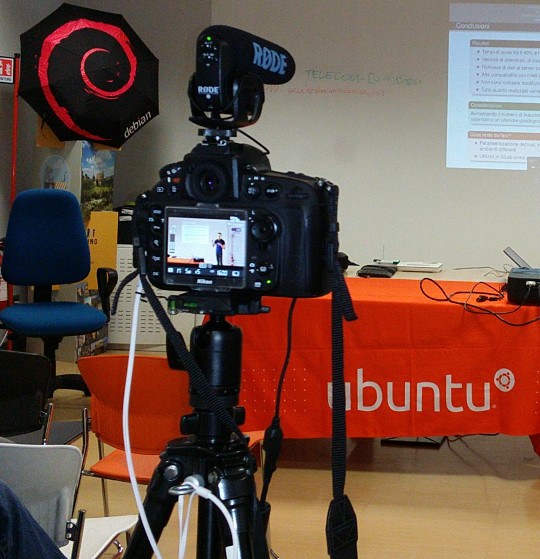
Recording a talk at a free software event with a Nikon D800 on a very basic tripod with Rode VideoMic Pro, headphones (white cable) and external power (black cable) If you want to capture audio with the camera and record it in the video file (discussed in more detail below), you will need to purchase a microphone that mounts on the camera. The built-in microphones on cameras are often quite bad, even on the most expensive cameras. If you are just using the built-in microphone for reference audio (to help with time synchronization when you combine different audio files with the video later) then the built-in microphone may be acceptable. Camera audio is discussed in more detail below. If your camera has a headphone socket, get some headphones for listening to the audio. Make sure you have multiple memory cards. Look carefully at the speed of the memory cards, slow ones are cheaper but they can't keep up with the speed of writing 1080p video. At a minimum, you should aim to buy memory cards that can handle one or two days worth of data for whatever it is you do. A tripod is essential for most types of video. If you use a particularly heavy camera or lens or if you are outdoors and it may be windy you will need a heavier tripod for stability. For video, it is very useful to have a tripod with a handle for panning left and right but if the camera will be stationary for the whole recording then the handle is not essential. Carrying at least one spare battery is another smart move. On one visit to the Inca Trail in Peru, we observed another member of our group hiking up and down the Andes with a brand new DSLR that they couldn't use because the battery was flat. For extended periods of recording, batteries will not be sufficient and you will need to purchase a mains power supply (PSU). These are available for most types of DSLR and video camera. The camera vendors typically design cameras with unusual power sockets so that you can only use a very specific and heavily overpriced PSU from the same company. Don't forget a surge protector too. There are various smartphone apps that allow you to remotely control the camera from the screen of your phone, such as the qDslrDashboard app. These often give a better preview than the screen built-in to the camera and may even allow you to use the touch screen to focus more quickly on a specific part of the picture. A regular USB cable is not suitable for this type of app, you need to buy a USB On-The-Go (OTG) cable.
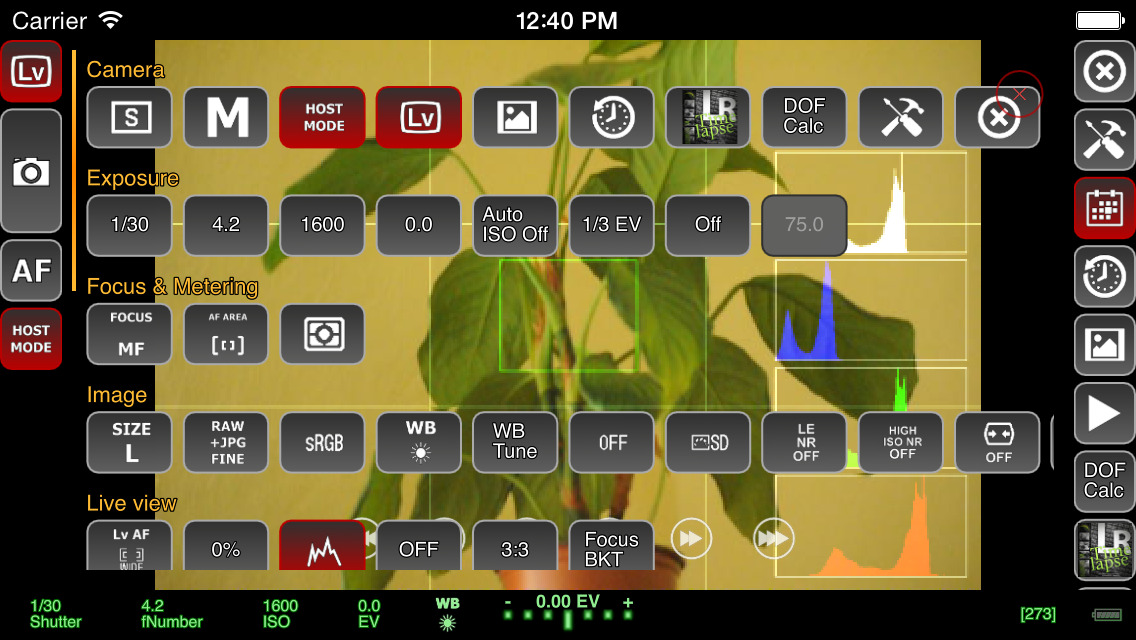
Screenshot of qDslrDashboard app on a smartphone, controlling a DSLR camera If you plan to copy the video from the camera to a computer at the event, you will need to make sure you have a fast memory card reader. The memory card readers in some laptops are quite slow and others can be quite fast so you may not need to buy an extra card reader. Camera audio Most cameras, including DSLRs, have a built-in microphone and a socket for connecting an external microphone. The built-in microphones obtain very poor quality sound. For many events, it is much better to have independent microphones, such as a lapel microphone attached to a smartphone or wireless transmitter. Those solutions are described in part one of this blog series. Nonetheless, there are still some benefits of capturing audio in the camera. The biggest benefit is the time synchronization: if you have audio recordings in other devices, you will need to align them with the video using post-production software. If the camera recorded an audio stream too, even if the quality is not very good, you can visualize the waveform on screen and use it to align the other audio recordings much more easily and precisely. If the camera will be very close to the people speaking then it may be acceptable to use a microphone mounted on the camera. This will be convenient for post-production because the audio will be synchronized with the video. It may still not be as good as a lapel microphone though, but the quality of these camera-mounted microphones is still far higher than the built-in microphones. I've been trying the Rode VideoMic Pro, it is definitely better than recording with the built-in microphone on the camera and also better than the built-in microphone on my phone. One problem that most people encounter is the sound of the lens autofocus mechanism being detected by the microphone. This occurs with both the built-in microphone and any other microphone you mount on the camera. A microphone mounted on top of the camera doesn't detect this noise with the same intensity as the built-in microphone but it is still present in the recordings. If using a camera-mounted microphone to detect the audio from an audience, you may need to have an omnidirectional microphone. Many camera-mounted microphones are directional and will not detect very much sound from the sides or behind the camera. When using any type of external microphone with the camera, it is recommend to disable automatic gain control (AGC) in the camera settings and then manually adjust the microphone sensitivity/volume level. Use headphones A final word on audio - most good cameras have an audio output socket. Connect headphones and wear them, to make sure you are always capturing audio. Otherwise, if the microphone's battery goes flat or if a wireless microphone goes out of range you may not notice. Choosing a lens The more light you get, the better. Bigger and more expensive lenses allow more light into the camera. Many of the normal lenses sold with a DSLR camera are acceptable but if it is a special occasion you may want to rent a more expensive lens for the day. If you already have a lens, it is a very good idea to test it in conditions similar to those you expect for the event you want to record. Recording duration limits Most DSLR cameras with video capability impose a 30 minute maximum recording duration This is basically the result of a friendly arrangement between movie studios and politicians to charge an extra tax on video recording technology and potentially make the movie studio bosses richer, supposedly justified by the fact that a tiny but exaggerated number of people use their cameras to record movies at the cinema. As a consequence, most DSLR manufacturers limit the duration of video recording so their product won't be subject to the tax, ensuring the retail price is lower and more attractive. On top of this, many DSLR cameras also have a 4GB file size limit if they use the FAT filesystem. Recording 1080p video at a high frame rate may hit the file size limit in 10 minutes, well before you encounter the 30 minute maximum recording duration. To deal with the file size issue, you can record at 720p instead of 1080p and use the frame rate 24fps. For events longer than 30 minutes or where you really want 1080p or a higher frame rate, there are some other options you can consider:
  • Buy or rent a proper video camera instead of using a DSLR camera
  • Using multiple cameras that can stop and be restarted at different times.
  • Manually stopping and restarting the camera if there are breaks in the event where it is safe to do so.
  • Use an app to control the camera and program it to immediately restart the recording each time it stops
  • Extract the raw output from the camera's HDMI socket and record into some other device or computer. There are several purpose-built devices
    that can be used this way with an embedded SSD for storage.
  • There are also some people distributing unofficial/alternative firmware images that remove the artificial 30 minute recording limit.
Camera settings There are many online tutorials and demonstration videos on YouTube that will help you optimize the camera settings for video. You may have already made recordings using the automatic mode. Adjusting some or all of the settings manually may help you create a more optimal recording. You will need to spend some time familiarizing yourself with the settings first. The first thing to check is white balance. This tells the camera the type of lighting in the location. If you set this incorrectly then the colours will be distorted. Many cameras have the ability to automatically set the white balance. For video, you may be able to change one or more settings that control the recording quality. These settings control the file compression ratio and image size. Typical image size settings are 720p and 1080p. Compression ratio may be controlled by a high/medium/low quality setting. Choosing the highest quality and biggest picture requires more space on the memory card and also means you reach the 4GB file size limit more quickly. A higher quality setting also implies a faster memory card is required, because the rate of megabytes per second written to the memory card is higher. Next you need to think about the frame rate. Events that involve fast moving subjects, such as sports, typically benefit from a higher frame rate. For other events it is quite acceptable to use 24 frames per second (fps). Higher frame rates also imply bigger file size and a requirement for a faster memory card. Once you have decided on the frame rate, the next thing to do is set the shutter speed. Use a shutter speed that is double the frame rate. For example, if using 24fps or 25fps, use a 1/50 shutter speed. The final two settings you need to adjust are the ISO and aperture. Set these based on the lighting conditions and extent to which the subjects are moving. For example, if the setting is dark or if you are trying to record fast moving subjects like athletes, vehicles or animals, use an ISO value of 800 or higher. Once you have chosen ISO, adjust the aperture to ensure the picture is sufficiently illuminated. Aperture also has a significant impact on the depth of field. Operating the camera: zoom and focus Many people use zoom lenses. It is not always necessary to change the zoom while recording a video, you can use software to zoom in and out on individual parts of the picture when editing it in post-production. If you do change the zoom while recording, it may be more difficult to maintain focus. Almost all lenses support manual focus (turning the focus ring by hand) and many support automatic focus. When shooting photographs with a DSLR, the mirror is down and the camera can use dedicated sensors for focus and light sensing. When shooting video, the mirror is up and the camera can not use the same focus sensors that are used in photography. Video recording uses a digital focussing algorithm based on contrast in the picture. If you take a lot of photos you are probably quite accustomed to the fast and precise autofocus for photography and you will notice that keeping a video in focus is more challenging. As mentioned already, one of the first things you can do to keep focus simple is to avoid zooming while recording. Record in a higher resolution than you require and then zoom with software later. Some people record using 4k resolution even when they only want to produce a 720p video, as they can digitally zoom in to different parts of the 4k recording without losing detail. If the subject is very stationary (people sitting at a desk for an interview is a typical example), you may be able to set the camera to manual focus and not change it at all while recording. If you choose to enable autofocus while recording, any built-in camera microphone or microphone mounted on the camera is likely to detect sounds from the motorized focus system. Ultimately, the autofocus mechanism is not accurate for all subjects and you may be unable to stop them moving around so you will need to change the focus manually while recording. It requires some practice to be able to do this quickly without overshooting the right focus. To make life more tricky, Nikon and Canon focus rings rotate in the opposite direction, so if you are proficient using one brand you may feel awkward if you ever have to use the other. A good way to practice this skill is to practice while in the car or on the train, pointing at different subjects outside the window and trying to stay in focus as you move from one subject to the next. Make a trial run Many events, from weddings right up to the Olympic Games opening ceremony, have a trial run the day before. One reason for that is to test the locations and settings of all the recording and broadcasting equipment. If a trial run isn't possible for your event, you may find some similar event to practice recording and test your equipment. For example, if you are planning to record a wedding, you could try and record a Sunday mass in the same church. Backup and duplicate the recordings before leaving the event If you only have one copy of the recordings and the equipment is stolen or damaged you may be very disappointed. Before your event, make a plan to duplicate the raw audio and video recordings so that several people can take copies away with them. Decide in advance who will be responsible for this, ensure there will be several portable hard disks and estimate how much time it will take to prepare the copies and factor this into the schedule. Conclusion All the products described can be easily purchased from online retailers. You may not need every accessory that is mentioned as it depends on the type of event you record. The total cost of buying or renting the necessary accessories may be as much as the cost of the camera itself so if you are new to this you may need to think carefully about making a budget with a spreadsheet to do it correctly. Becoming familiar with the camera controls and practicing the techniques for manual focus and zoom can take weeks or months. If you enjoy photography this can be time well spent but if you don't enjoy it then you may not want to commit the time necessary to make good quality video. Don't rule out options like renting equipment instead of buying it or crowdsourcing, asking several participants or friends to help make recordings with their own equipment. For many events, audio is far more indispensable than video and as emphasizing at the beginning of this article, it is recommended that you should be one hundred percent confident in your strategy for recording audio before you start planning to record video.

5 August 2015

Antonio Terceiro: Elixir in Debian, MiniDebconf at FISL, and Debian CI updates

In June I started keeping track of my Debian activities, and this is my July update. Elixir in Debian Elixir is a functional language built on top of the Erlang virtual machine. If features imutable data structures, interesting concurrency primitives, and everything else that Erlang does, but with a syntax inspired by Ruby what makes it much more aproachable in my opinion. Those interested in Elixir for Debian are encouraged to hang around in #debian-elixir on the OFTC IRC servers. There are still a lot of things to figure out, for example how packaging Elixir libraries and applications is going to work. MiniDebconf at FISL, and beyond I helped organize a MiniDebconf at this year s FISL, in Porto Alegre on the 10th of July. The whole program was targetted at getting more people to participate in Debian, so there were talks about translation, packaging, and a few other more specific topics. I myself gave two talks: one about Debian basics, What is Debian, and how it works , and second one on packaging the free software web , which I will also give at Debconf15 later this month. The recordings are available (all talks in Portuguese) at the Debian video archive thanks to Holger Levsen. We are also organizing a new MiniDebconf in October as part of the Latinoware schedule. Ruby We are in the middle of a transition to switch to Ruby 2.2 as default in Debian unstable, and we are almost there. The Ruby transition is now on hold while GCC 5 one is going on, but will be picked up as soon as were are done with GCC 5. ruby-defaults has been uploaded to experimental for those that want to try having Ruby 2.2 as default before that change hits unstable. I myself have been using Ruby 2.2 as default for several weeks without any problem so far, including using vagrant on a daily basis and doing all my development on sid with it. I started taking notes about Ruby interpreter transitions work to make sure that knowledge is registered. I have uploaded minor security updates of both ruby2.1 and ruby2.2 to unstable. They both reached testing earlier today. I have also fixed another bug in redmine, which I hope to get into stable as well as soon as possible. gem2deb has seen several improvements through versions 0.19, 0.20, 0.20.1 and 0.20.2. I have updated a few packages: Two NEW packages, ruby-rack-contrib and ruby-grape-logging ,were ACCEPTED into the Debian archive. Kudos to the ftp-master team who are doing an awesome job reviewing new packages really fast. Debian Continuous Integration This month I have made good progress with the changes needed to make debci work as a distributed system with one master/scheduler node and as many worker nodes (running tests) as possible. While doing my tests, I have submitted a patch to lxc and updated autodep8 in unstable. At some point I plan to upload both autodep8 and autopkgtest to jessie-backports. Sponsoring I have sponsored a few packages:

30 July 2015

Daniel Pocock: Free Real-time Communications (RTC) at DebConf15, Heidelberg

The DebConf team have just published the first list of events scheduled for DebConf15 in Heidelberg, Germany, from 15 - 22 August 2015. There are two specific events related to free real-time communications and a wide range of other events related to more general topics of encryption and privacy. 15 August, 17:00, Free Communications with Free Software (as part of the DebConf open weekend) The first weekend of DebConf15 is an open weekend, it is aimed at a wider audience than the traditional DebConf agenda. The open weekend includes some keynote speakers, a job fair and various other events on the first Saturday and Sunday. The RTC talk will look at what solutions exist for free and autonomous voice and video communications using free software and open standards such as SIP, XMPP and WebRTC as well as some of the alternative peer-to-peer communications technologies that are emerging. The talk will also look at the pervasive nature of communications software and why success in free RTC is so vital to the health of the free software ecosystem at large. 17 August, 17:00, Challenges and Opportunities for free real-time communications This will be a more interactive session people are invited to come and talk about their experiences and the problems they have faced deploying RTC solutions for professional or personal use. We will try to look at some RTC/VoIP troubleshooting techniques as well as more high-level strategies for improving the situation. Try the Debian and Fedora RTC portals Have you registered for rtc.debian.org? It can successfully make federated SIP calls with users of other domains, including Fedora community members trying FedRTC.org. You can use rtc.debian.org for regular SIP (with clients like Empathy, Jitsi or Lumicall) or WebRTC. Can't get to DebConf15? If you can't get to Heidelberg, you can watch the events on the live streaming service and ask questions over IRC. To find out more about deploying RTC, please see the RTC Quick Start Guide. Did you know? Don't confuse Heidelberg, Germany with Heidelberg in Melbourne, Australia. Heidelberg down under was the site of the athlete's village for the 1956 Olympic Games.

15 June 2015

Lunar: Reproducible builds: week 7 in Stretch cycle

What happened about the reproducible builds effort for this week: Presentations On June 7th, Reiner Herrmann presented the project at the Gulaschprogrammiernacht 15 in Karlsruhe, Germany. Video and audio recordings in German are available, and so are the slides in English. Toolchain fixes Daniel Kahn Gillmor's report on help2man started a discussion with Brendan O'Dea and Ximin Luo about standardizing a common environment variable that would provide a replacement for an embedded build date. After various proposals and research by Ximin about date handling in several programming languages, the best solution seems to define SOURCE_DATE_EPOCH with a value suitable for gmtime(3).
  1. Martin Borgert wondered if Sphinx could be changed in a way that would avoid having to tweak debian/rules in packages using it to produce HTML documentation.
Daniel Kahn Gillmor opened a new report about icont producing unreproducible binaries. Packages fixed The following 32 packages became reproducible due to changes in their build dependencies: agda, alex, c2hs, clutter-1.0, colorediffs-extension, cpphs, darcs-monitor, dispmua, haskell-curl, haskell-glfw, haskell-glib, haskell-gluraw, haskell-glut, haskell-gnutls, haskell-gsasl, haskell-hfuse, haskell-hledger-interest, haskell-hslua, haskell-hsqml, haskell-hssyck, haskell-libxml-sax, haskell-openglraw, haskell-readline, haskell-terminfo, haskell-x11, jarjar-maven-plugin, kxml2, libcgi-struct-xs-perl, libobject-id-perl, maven-docck-plugin, parboiled, pegdown. The following packages became reproducible after getting fixed: Some uploads fixed some reproducibility issues but not all of them: Patches submitted which did not make their way to the archive yet: reproducible.debian.net A new variation to better notice when a package captures the environment has been introduced. (h01ger) The test on Debian packages works by building the package twice in a short time frame. But sometimes, a mirror push can happen between the first and the second build, resulting in a package built in a different build environment. This situation is now properly detected and will run a third build automatically. (h01ger) OpenWrt, the distribution specialized in embedded devices like small routers, is now being tested for reproducibility. The situation looks very good for their packages which seems mostly affected by timestamps in the tarball. System images will require more work on debbindiff to be better understood. (h01ger) debbindiff development Reiner Herrmann added support for decompling Java .class file and .ipk package files (used by OpenWrt). This is now available in version 22 released on 2015-06-14. Documentation update Stephen Kitt documented the new --insert-timestamp available since binutils-mingw-w64 version 6.2 available to insert a ready-made date in PE binaries built with mingw-w64. Package reviews 195 obsolete reviews have been removed, 65 added and 126 updated this week. New identified issues: Misc. Holger Levsen reported an issue with the locales-all package that Provides: locales but is actually missing some of the files provided by locales. Coreboot upstream has been quick to react after the announcement of the tests set up the week before. Patrick Georgi has fixed all issues in a couple of days and all Coreboot images are now reproducible (without a payload). SeaBIOS is one of the most frequently used payload on PC hardware and can now be made reproducible too. Paul Kocialkowski wrote to the mailing list asking for help on getting U-Boot tested for reproducibility. Lunar had a chat with maintainers of Open Build Service to better understand the difference between their system and what we are doing for Debian.

13 June 2015

Gunnar Wolf: Almost free Some experiences with the Raspberry Pi, CI20, BananaPi, CuBox-i... And whatever will follow

I know very little about hardware. I think I have a good understanding on many aspects of what happens inside a computer, but my knowledge is clearly firmer on what happens once an operating system is already running. And even then, my understanding of the lower parts of reality is shaky at most At least according to my self-evaluation, of course, comparing to people I'm honored to call "my peers". During the last ~18 months, my knowledge of this part of reality, while still far from complete, has increased quite a bit Maybe mostly showing that I'm basically very cheap: As I have come across very cheap (or even free for me!) hardware, I have tried to understand and shape what happens in levels below those where I dwell. I have been meaning to do a writeup on the MIPS Creator CI20, which was shipped to me for free (thanks++!) by Imagination Technologies; I still want to get more familiar with the board and have better knowledge before reporting on it. Just as a small advance, as this has been keeping me somewhat busy: I got this board after their offer to Debian Developers, and prompted because I'll be teaching some modules on the Embedded Linux diploma course dictated by Facultad de Ingenier a, UNAM Again, I'll blog about that later. My post today follows Riku's, titled Dystopia of things, where he very clearly finds holes in the Internet of Things offering of one specific product and one specific company, but allows for generalizations on what we will surely see as the model. Riku says:
Today, the GPL sources for hub are available - at least the kernel and a patch for busybox. The proper GPL release is still only through written offer. The sources appeared online April this year while Hub has been sold for two years already. Even if I ordered the GPL CD, it's unlikely I could build a modified system with it - too many proprietary bits. The whole GPL was invented by someone who couldn't make a printer do what he wanted. The dystopian today where I have to rewrite the whole stack running on a Linux-based system if I'm not happy what's running there as provided by OEM.
This is not exactly the situation on the boards/products (it's a disservice to call the cute CuBox-i just a board!) I mention I'm using, but it's neither too far. Being used to the easy x86 world, I am used to bitching on specific hardware that does not get promptly recognized by the Linux kernel But even with the extra work UEFI+SecureBoot introduces, getting the kernel to boot is something we just take for granted. In the MIPS and ARM worlds, this is not so much of a given; I'm still treating the whole SPL and DeviceTree world as a black box, but that's where a lot of the work happens. The boards I am working on try to make a point they are Open Hardware. The CI20 is quite impressive in this regard, as not only it has a much more complete set of on-board peripherials than any other, but a wealth of schematics, datasheets and specifications for the different parts of its components. And, of course, the mere availability of the MIPSfpga program to universities worldwide is noteworthy Completely outside of my skillset, but looks most interesting. However... Despite being so much almost-Free-with-a-capital-F, all those boards fail our definitions of freedom in several ways. And yes, they lead us to a situation similar to what Riku describes, to what Stallman feared... To a situation not really better to where we stand on openly closed-source, commodity x86 hardware: Relying on binary blobs and on non-free portions of code to just use our hardware, or at least to use many of the features that would be available to us otherwise. As an example, both the CI20 and the CuBox-i vendors provide system images able to boot what they describe as a Debian 7 system, based on a 3.0 Linux kernel (which Debian never used; IIRC the CuBox-i site said it was derived from a known-good Android kernel)... Only that it's an image resulting of somebody else installing and configuring it. Why should we trust their image to be sane? Yes, the resulting installation is quite impressive (i.e. the CI20's 3D demos are quite impressive for a system that feels otherwise sluggish, and out of my ARM experience, I'd wager it feels sluggish mostly because of a slow SSD)... I have managed to do clean Debian installs on most of my ARM machines (the CuBox-i as described in my previous blog post; this post from Elena of Valhalla'' prompted me into trying the already well documented way of running the official Debian Installer, which worked like a charm and gave me a very nice and responsive Debian 8 install Modulo yes, the Banana's non-free video interface, which AFAICT uses the non-free Mail binary driver... And which I haven't had the time to play with yet. Of course, my CuBox is in a similar situation, where it works like a charm as a personal server, but is completely worthless as a set-top box. So, with those beautiful, small, cheap SoC systems, we are close to where we stood twenty years ago with x86 Linux: Good support for a small set of peripherials, but a far cry from having a functional system with exclusively free software. ,
Despite claims of being open source, this is not open source hardware. If you are thinking of getting this device, you should also try looking into the hardware from our Community instead.
Still... Playing with these boards has taught me a lot, and has clearly taught me I'm still standing on the first steps of the n00b level. I have a lot to learn to be able to responsibly teach my part of the diploma course, and I'm very thankful for the differences in hardware (and, of course, for the hardware manufacturers, specially for the MIPS Creator CI20 and the Lemaker Banana Pi for giving me boards to work on!) I shall keep posting on this topic.

10 June 2015

Norbert Preining: Tribute to Hermann Zapf

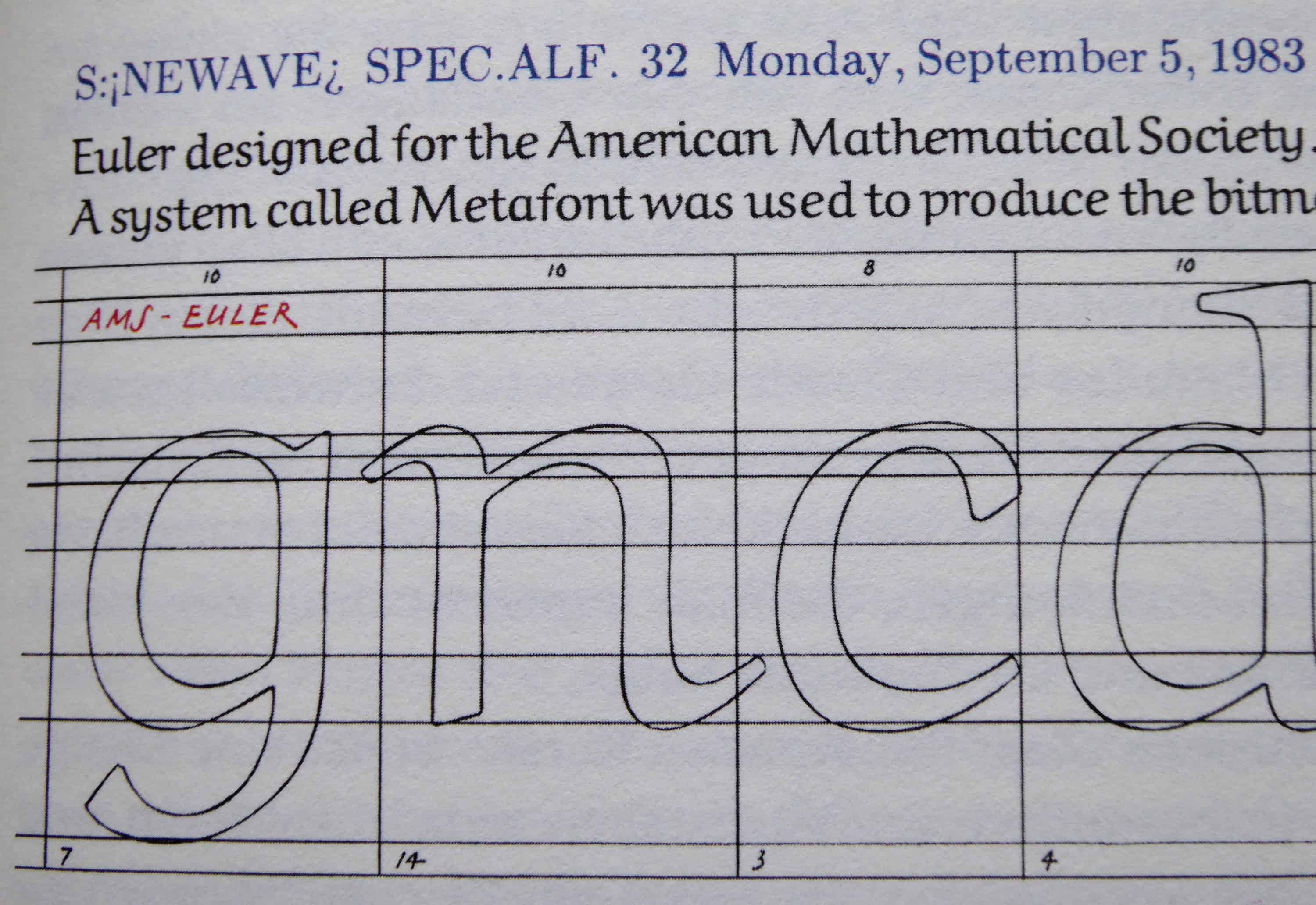
Last weekend Hermann Zapf, one of the greatest font designers and typographers of our times, has passed away at the age of 96. Much has been written about his life, his immense sphere of influence, his excellent typefaces, and some of the links to other obituaries can be found here at the end. There is nothing of value I can contribute, but let Hermann Zapf speak for himself with a few images from two books by or dedicated to him. zapf-heart-blood-ink The books I have taken these photos from are: zapf-books In his long life, Hermann Zapf has created a wide range of typefaces, some if which have become the main staple in the printing business, most notably Palatino, Janson, Optima, and Zapf Dingbats. But there are many more: zapf-alphabets While probably not as popular anymore as some years (decades?) ago, Palatino still is one of my favorite typefaces. I often wished to have the freedom to choose my own fonts for publications, but normally that doesn t happen. Palatino has found many offspring (or imitations?), and there are excellent renderings for use with (La)TeX, too. zapf-palatino Hermann Zapf also had connections with Don Knuth and the AMS (American Mathematical Society), and he designed for the AMS the Euler typeface, using Knuth s MetaFont program. zapf-euler Last weekend, when I heard of Hermann Zapf s death, I was at a conference at Tsukuba University. What a coincidence that all the signs in the building (floor numbers, indications, etc) were set optimain another of his great typefaces, the Optima. I had a strange feeling, and reset my presentation in Optima/Euler in honor of Hermann Zapf s great life. Although I never met Hermann Zapf personally I missed the TeX conferences where he participated it was to a great extent his influence that years ago I got started in typography. Living a life like he did, dedicating himself to the beauty and expressiveness of letters, design, calligraphy, seems like a dream for me. But beauty can be found even in the strangest equation in mathematics, the queerest theorem in logic. While not all of us are as gifted as Hermann Zapf in creating beauty, we should strive to increase our ability to appreciate the beauty. The beauty of letters is subtle, evasive, and needs training, that is practice, to be appreciated. Hermann Zapf taught us how even self-training can lead to excellence. His letters, which I meet every day, are a permanent reminder to strive for beauty and clarity, and never relent in our exercise. Thanks Hermann Zapf. zapf-letters Links to tributes around the world English Linotype (Type foundry where Zapf started working)
Bigelow and Holmes (Type designers)
New York Times (Newspaper)
Type Drawers
Quarz (News magazine)
Kaveh Bazargan (next president of TUG)
TeX Overflow (Q&A website concerning TeX) German FontShop (Type foundry and internet shop)
Deutschland Funk (News station)
S ddeutsche (Newspaper)
Echo (Newspaper)
Heise (Techology News page)

17 May 2015

Lunar: Reproducible builds: week 2 in Stretch cycle

What happened about the reproducible builds effort for this week: Media coverage Debian's effort on reproducible builds has been covered in the June 2015 issue of Linux Magazin in Germany. Cover of Linux Magazin June 2015 Article about reproducible builds in Linux Magazin June 2015 Toolchain fixes josch rebased the experimental version of debhelper on 9.20150507. Packages fixed The following 515 packages became reproducible due to changes of their build dependencies: airport-utils, airspy-host, all-in-one-sidebar, ampache, aptfs, arpack, asciio, aspell-kk, asused, balance, batmand, binutils-avr, bioperl, bpm-tools, c2050, cakephp-instaweb, carton, cbp2make, checkbot, checksecurity, chemeq, chronicle, cube2-data, cucumber, darkstat, debci, desktop-file-utils, dh-linktree, django-pagination, dosbox, eekboek, emboss-explorer, encfs, exabgp, fbasics, fife, fonts-lexi-saebom, gdnsd, glances, gnome-clocks, gunicorn, haproxy, haskell-aws, haskell-base-unicode-symbols, haskell-base64-bytestring, haskell-basic-prelude, haskell-binary-shared, haskell-binary, haskell-bitarray, haskell-bool-extras, haskell-boolean, haskell-boomerang, haskell-bytestring-lexing, haskell-bytestring-mmap, haskell-config-value, haskell-mueval, haskell-tasty-kat, itk3, jnr-constants, jshon, kalternatives, kdepim-runtime, kdevplatform, kwalletcli, lemonldap-ng, libalgorithm-combinatorics-perl, libalgorithm-diff-xs-perl, libany-uri-escape-perl, libanyevent-http-scopedclient-perl, libanyevent-perl, libanyevent-processor-perl, libapache-session-wrapper-perl, libapache-sessionx-perl, libapp-options-perl, libarch-perl, libarchive-peek-perl, libaudio-flac-header-perl, libaudio-wav-perl, libaudio-wma-perl, libauth-yubikey-decrypter-perl, libauthen-krb5-simple-perl, libauthen-simple-perl, libautobox-dump-perl, libb-keywords-perl, libbarcode-code128-perl, libbio-das-lite-perl, libbio-mage-perl, libbrowser-open-perl, libbusiness-creditcard-perl, libbusiness-edifact-interchange-perl, libbusiness-isbn-data-perl, libbusiness-tax-vat-validation-perl, libcache-historical-perl, libcache-memcached-perl, libcairo-gobject-perl, libcarp-always-perl, libcarp-fix-1-25-perl, libcatalyst-action-serialize-data-serializer-perl, libcatalyst-controller-formbuilder-perl, libcatalyst-dispatchtype-regex-perl, libcatalyst-plugin-authentication-perl, libcatalyst-plugin-authorization-acl-perl, libcatalyst-plugin-session-store-cache-perl, libcatalyst-plugin-session-store-fastmmap-perl, libcatalyst-plugin-static-simple-perl, libcatalyst-view-gd-perl, libcgi-application-dispatch-perl, libcgi-application-plugin-authentication-perl, libcgi-application-plugin-logdispatch-perl, libcgi-application-plugin-session-perl, libcgi-application-server-perl, libcgi-compile-perl, libcgi-xmlform-perl, libclass-accessor-classy-perl, libclass-accessor-lvalue-perl, libclass-accessor-perl, libclass-c3-adopt-next-perl, libclass-dbi-plugin-type-perl, libclass-field-perl, libclass-handle-perl, libclass-load-perl, libclass-ooorno-perl, libclass-prototyped-perl, libclass-returnvalue-perl, libclass-singleton-perl, libclass-std-fast-perl, libclone-perl, libconfig-auto-perl, libconfig-jfdi-perl, libconfig-simple-perl, libconvert-basen-perl, libconvert-ber-perl, libcpan-checksums-perl, libcpanplus-dist-build-perl, libcriticism-perl, libcrypt-cracklib-perl, libcrypt-dh-gmp-perl, libcrypt-mysql-perl, libcrypt-passwdmd5-perl, libcrypt-simple-perl, libcss-packer-perl, libcss-tiny-perl, libcurses-widgets-perl, libdaemon-control-perl, libdancer-plugin-database-perl, libdancer-session-cookie-perl, libdancer2-plugin-database-perl, libdata-format-html-perl, libdata-uuid-libuuid-perl, libdata-validate-domain-perl, libdate-jd-perl, libdate-simple-perl, libdatetime-astro-sunrise-perl, libdatetime-event-cron-perl, libdatetime-format-dbi-perl, libdatetime-format-epoch-perl, libdatetime-format-mail-perl, libdatetime-tiny-perl, libdatrie, libdb-file-lock-perl, libdbd-firebird-perl, libdbix-abstract-perl, libdbix-class-datetime-epoch-perl, libdbix-class-dynamicdefault-perl, libdbix-class-introspectablem2m-perl, libdbix-class-timestamp-perl, libdbix-connector-perl, libdbix-oo-perl, libdbix-searchbuilder-perl, libdbix-xml-rdb-perl, libdevel-stacktrace-ashtml-perl, libdigest-hmac-perl, libdist-zilla-plugin-emailnotify-perl, libemail-date-format-perl, libemail-mime-perl, libemail-received-perl, libemail-sender-perl, libemail-simple-perl, libencode-detect-perl, libexporter-tidy-perl, libextutils-cchecker-perl, libextutils-installpaths-perl, libextutils-libbuilder-perl, libextutils-makemaker-cpanfile-perl, libextutils-typemap-perl, libfile-counterfile-perl, libfile-pushd-perl, libfile-read-perl, libfile-touch-perl, libfile-type-perl, libfinance-bank-ie-permanenttsb-perl, libfont-freetype-perl, libfrontier-rpc-perl, libgd-securityimage-perl, libgeo-coordinates-utm-perl, libgit-pureperl-perl, libgnome2-canvas-perl, libgnome2-wnck-perl, libgraph-readwrite-perl, libgraphics-colornames-www-perl, libgssapi-perl, libgtk2-appindicator-perl, libgtk2-gladexml-simple-perl, libgtk2-notify-perl, libhash-asobject-perl, libhash-moreutils-perl, libhtml-calendarmonthsimple-perl, libhtml-display-perl, libhtml-fillinform-perl, libhtml-form-perl, libhtml-formhandler-model-dbic-perl, libhtml-html5-entities-perl, libhtml-linkextractor-perl, libhtml-tableextract-perl, libhtml-widget-perl, libhtml-widgets-selectlayers-perl, libhtml-wikiconverter-mediawiki-perl, libhttp-async-perl, libhttp-body-perl, libhttp-date-perl, libimage-imlib2-perl, libimdb-film-perl, libimport-into-perl, libindirect-perl, libio-bufferedselect-perl, libio-compress-lzma-perl, libio-compress-perl, libio-handle-util-perl, libio-interface-perl, libio-multiplex-perl, libio-socket-inet6-perl, libipc-system-simple-perl, libiptables-chainmgr-perl, libjoda-time-java, libjsr305-java, libkiokudb-perl, liblemonldap-ng-cli-perl, liblexical-var-perl, liblingua-en-fathom-perl, liblinux-dvb-perl, liblocales-perl, liblog-dispatch-configurator-any-perl, liblog-log4perl-perl, liblog-report-lexicon-perl, liblwp-mediatypes-perl, liblwp-protocol-https-perl, liblwpx-paranoidagent-perl, libmail-sendeasy-perl, libmarc-xml-perl, libmason-plugin-routersimple-perl, libmasonx-processdir-perl, libmath-base85-perl, libmath-basecalc-perl, libmath-basecnv-perl, libmath-bigint-perl, libmath-convexhull-perl, libmath-gmp-perl, libmath-gradient-perl, libmath-random-isaac-perl, libmath-random-oo-perl, libmath-random-tt800-perl, libmath-tamuanova-perl, libmemoize-expirelru-perl, libmemoize-memcached-perl, libmime-base32-perl, libmime-lite-tt-perl, libmixin-extrafields-param-perl, libmock-quick-perl, libmodule-cpanfile-perl, libmodule-load-conditional-perl, libmodule-starter-pbp-perl, libmodule-util-perl, libmodule-versions-report-perl, libmongodbx-class-perl, libmoo-perl, libmoosex-app-cmd-perl, libmoosex-attributehelpers-perl, libmoosex-blessed-reconstruct-perl, libmoosex-insideout-perl, libmoosex-relatedclassroles-perl, libmoosex-role-timer-perl, libmoosex-role-withoverloading-perl, libmoosex-storage-perl, libmoosex-types-common-perl, libmoosex-types-uri-perl, libmoox-singleton-perl, libmoox-types-mooselike-numeric-perl, libmousex-foreign-perl, libmp3-tag-perl, libmysql-diff-perl, libnamespace-clean-perl, libnet-bonjour-perl, libnet-cli-interact-perl, libnet-daap-dmap-perl, libnet-dbus-glib-perl, libnet-dns-perl, libnet-frame-perl, libnet-google-authsub-perl, libnet-https-any-perl, libnet-https-nb-perl, libnet-idn-encode-perl, libnet-idn-nameprep-perl, libnet-imap-client-perl, libnet-irc-perl, libnet-mac-vendor-perl, libnet-openid-server-perl, libnet-smtp-ssl-perl, libnet-smtp-tls-perl, libnet-smtpauth-perl, libnet-snpp-perl, libnet-sslglue-perl, libnet-telnet-perl, libnhgri-blastall-perl, libnumber-range-perl, libobject-signature-perl, libogg-vorbis-header-pureperl-perl, libopenoffice-oodoc-perl, libparse-cpan-packages-perl, libparse-debian-packages-perl, libparse-fixedlength-perl, libparse-syslog-perl, libparse-win32registry-perl, libpdf-create-perl, libpdf-report-perl, libperl-destruct-level-perl, libperl-metrics-simple-perl, libperl-minimumversion-perl, libperl6-slurp-perl, libpgobject-simple-perl, libplack-middleware-fixmissingbodyinredirect-perl, libplack-test-externalserver-perl, libplucene-perl, libpod-tests-perl, libpoe-component-client-ping-perl, libpoe-component-jabber-perl, libpoe-component-resolver-perl, libpoe-component-server-soap-perl, libpoe-component-syndicator-perl, libposix-strftime-compiler-perl, libposix-strptime-perl, libpostscript-simple-perl, libproc-processtable-perl, libprotocol-osc-perl, librcs-perl, libreadonly-xs-perl, libreturn-multilevel-perl, librivescript-perl, librouter-simple-perl, librrd-simple-perl, libsafe-isa-perl, libscope-guard-perl, libsemver-perl, libset-tiny-perl, libsharyanto-file-util-perl, libshell-command-perl, libsnmp-info-perl, libsoap-lite-perl, libstat-lsmode-perl, libstatistics-online-perl, libstring-compare-constanttime-perl, libstring-format-perl, libstring-toidentifier-en-perl, libstring-tt-perl, libsub-recursive-perl, libsvg-tt-graph-perl, libsvn-notify-perl, libswish-api-common-perl, libtap-formatter-junit-perl, libtap-harness-archive-perl, libtemplate-plugin-number-format-perl, libtemplate-plugin-yaml-perl, libtemplate-tiny-perl, libtenjin-perl, libterm-visual-perl, libtest-block-perl, libtest-carp-perl, libtest-classapi-perl, libtest-cmd-perl, libtest-consistentversion-perl, libtest-data-perl, libtest-databaserow-perl, libtest-differences-perl, libtest-file-sharedir-perl, libtest-hasversion-perl, libtest-kwalitee-perl, libtest-lectrotest-perl, libtest-module-used-perl, libtest-object-perl, libtest-perl-critic-perl, libtest-pod-coverage-perl, libtest-script-perl, libtest-script-run-perl, libtest-spelling-perl, libtest-strict-perl, libtest-synopsis-perl, libtest-trap-perl, libtest-unit-perl, libtest-utf8-perl, libtest-without-module-perl, libtest-www-selenium-perl, libtest-xml-simple-perl, libtest-yaml-perl, libtex-encode-perl, libtext-bibtex-perl, libtext-csv-encoded-perl, libtext-csv-perl, libtext-dhcpleases-perl, libtext-diff-perl, libtext-quoted-perl, libtext-trac-perl, libtext-vfile-asdata-perl, libthai, libthread-conveyor-perl, libthread-sigmask-perl, libtie-cphash-perl, libtie-ical-perl, libtime-stopwatch-perl, libtk-dirselect-perl, libtk-pod-perl, libtorrent, libturpial, libunicode-japanese-perl, libunicode-maputf8-perl, libunicode-stringprep-perl, libuniversal-isa-perl, libuniversal-moniker-perl, liburi-encode-perl, libvi-quickfix-perl, libvideo-capture-v4l-perl, libvideo-fourcc-info-perl, libwiki-toolkit-plugin-rss-reader-perl, libwww-mechanize-formfiller-perl, libwww-mechanize-gzip-perl, libwww-mechanize-perl, libwww-opensearch-perl, libx11-freedesktop-desktopentry-perl, libxc, libxml-dtdparser-perl, libxml-easy-perl, libxml-handler-trees-perl, libxml-libxml-iterator-perl, libxml-libxslt-perl, libxml-rss-perl, libxml-validator-schema-perl, libxml-xpathengine-perl, libxml-xql-perl, llvm-py, madbomber, makefs, mdpress, media-player-info, meta-kde-telepathy, metamonger, mmm-mode, mupen64plus-audio-sdl, mupen64plus-rsp-hle, mupen64plus-ui-console, mupen64plus-video-z64, mussort, newpid, node-formidable, node-github-url-from-git, node-transformers, nsnake, odin, otcl, parsley, pax, pcsc-perl, pd-purepd, pen, prank, proj, proot, puppet-module-puppetlabs-postgresql, python-async, python-pysnmp4, qrencode, r-bioc-graph, r-bioc-hypergraph, r-bioc-iranges, r-bioc-xvector, r-cran-pscl, rbenv, rlinetd, rs, ruby-ascii85, ruby-cutest, ruby-ejs, ruby-factory-girl, ruby-hdfeos5, ruby-kpeg, ruby-libxml, ruby-password, ruby-zip-zip, sdl-sound1.2, stterm, systemd, taktuk, tcc, tryton-modules-account-invoice, ttf-summersby, tupi, tuxpuck, unknown-horizons, unsafe-mock, vcheck, versiontools, vim-addon-manager, vlfeat, vsearch, xacobeo, xen-tools, yubikey-personalization-gui, yubikey-personalization. The following packages became reproducible after getting fixed: Some uploads fixed some reproducibility issues but not all of them: Patches submitted which did not make their way to the archive yet: reproducible.debian.net Alioth now hosts a script that can be used to redo builds and test for a package. This was preliminary done manually through requests over the IRC channel. This should reduce the number of interruptions for jenkins' maintainers The graph of the oldest build per day has been fixed. Maintainance scripts will not error out when they are no files to remove. Holger Levsen started work on being able to test variations of CPU features and build date (as in build in another month of 1984) by using virtual machines. debbindiff development Version 18 has been released. It will uses proper comparators for pk3 and info files. Tar member names are now assumed to be UTF-8 encoded. The limit for the maximum number of different lines has been removed. Let's see on reproducible.debian.net how it goes for pathological cases. It's now possible to specify both --html and --text output. When neither of them is specified, the default will be to print a text report on the standard output (thanks to Paul Wise for the suggestion). Documentation update Nicolas Boulenguez investigated Ada libraries. Package reviews 451 obsolete reviews have been removed and 156 added this week. New identified issues: running kernel version getting captured, random filenames in GHC debug symbols, and timestamps in headers generated by qdbusxml2cpp. Misc. Holger Levsen went to re:publica and talked about reproducible builds to developers and users there. Holger also had a chance to meet FreeBSD developers and discuss the status of FreeBSD. Investigations have started on how it could be made part of our current test system. Laurent Guerby gave Lunar access to systems in the GCC Compile Farm. Hopefully access to these powerful machines will help to fix packages for GCC, Iceweasel, and similar packages requiring long build times.

15 April 2015

Rapha&#235;l Hertzog: Looking back at the Debian Long Term Support project

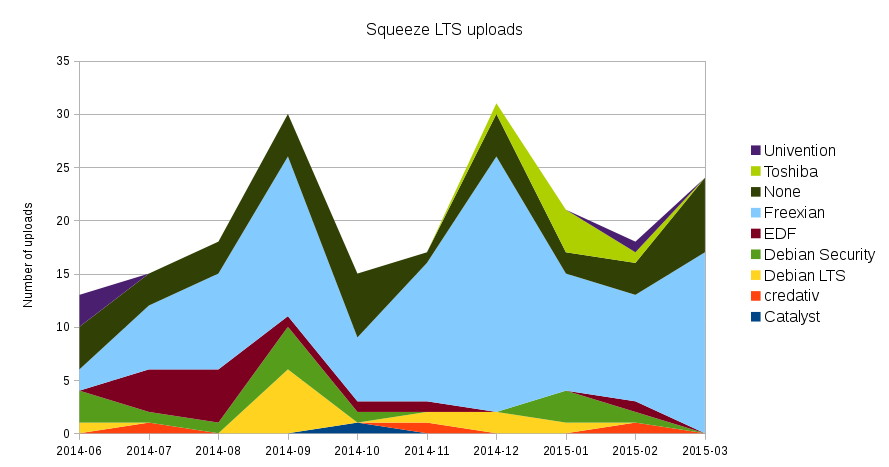
On Sunday I gave a talk about Debian LTS during the Mini-DebConf in Lyon. Obviously I presented the project and the way it s organized, but I also took the opportunity to compute some statistics. You can watch the presentation (thanks to the video team!) or have a look at the slides to learn more. Here are some extracts of the statistics I collected: The number of the uploads per affiliation (known affiliations are recorded in the LTS/Team wiki page) is displayed on the graph below. None corresponds to packages maintainers taking care of their own packages, Debian Security corresponds to members of the security team who also contributed to LTS, Debian LTS corresponds to individual members of the LTS team without any explicit affiliation. Freexian represents in fact 29 financial sponsors (see detail here). Debian LTS uploads over time Top 12 contributors (in number of uploads): The talk also contains explanations about the current funding setup. Hopefully this clears things up for people who were still wondering how the LTS project is working.
One comment Liked this article? Click here. My blog is Flattr-enabled.

29 March 2015

Zlatan Todori : Its all about fun

The percentage that women in Debian occupy as DDs is ~2%. Yes, just ~2% ladies that are DDs! So that means ~98% of DDs are gentelmen. some picture with rage meme I know there are more of ladies in Debian, so I firstly urge you, for love of Debian, to apply if you are contributing to this project, love its community and want to see Debian taking over the universe (okay, it seems that we conquered outer space so we need a help on Earth). So why is the number this low? Well maybe it's too precious to us currently inside that we want to prevent it being spoiled from outside. Also there seems to be not that much of younger DDs. Why is that important - well, young people like to do it and not to think about it. Many time they just break it, but many time they also do a breakthrough. Why is difference important and why should we embrace it? It's very important because it breaks a monopoly on view and behavior. It brings views not just from a larger number of people, but also from people from different backgrounds, and in constructive conversation it can put even more pluses on current workflow or it can counter it with good arguments. In a project of its size and worldwide geolocation of its developers, this is true for Debian more then any other projects I know. We need more women so we can balance our inner workings and have a better understanding of humanity and how is it moving, what and why does it need and where is it steering. That way we can produce a community which will improve quality of OS that we produce - because of sheer number of different people working on the same thing bringing to it its own personal touch. So, ladies and youth all over the world, unite and join in Debian because without diversity Debian can't grow beyond its current size. Also, no, Debian is not about code only, it needs painters, musicians, people that want to talk about Debian, people that share love and happiness, people that want to build better communities, UI/UX designers, makers, people who know how to repair a bike, athletes, homebrew beer producers, lawyers (just while world gets rid of laws, then we don't need you), actors, writters... Why, well because world and communities are made up from all that diversity and that's what makes it a better and not a monotone place. But I just use Debian. Well, do you feel love towards Debian and its work? Would you like to feel more as integral part of community? If the answer is big fat YES, then you should be a DD too. Every person that feels it's part of Debians philosophy about freedom and behaving in good manner should join Debian. Every person that feels touched and enhanced by Debian's work should become part of community and share its experience how Debian touched their soul, impacted their life. If you love Debian, you should be free to contribute to it in whatever manner and you should be free to express your love towards it. If you think lintian is sexy, or shebang is a good friends of yours, or you enjoy talking to MadameZou about Debian and zombies (yeah, we do have all kinds of here), or you like Krita, or you hate the look of default XFCE theme, or you can prove that you a more crazy developer then paultag - just hop into community and try to integrate in it. You will meet great folks, have a lot of conversation about wine and cheese, play some dangerous card games and even learn about things like bokononism (yeah I am looking at you dkg!). Now for the current Debian community - what the hell is packaging and non-packaging Debian Developer? Are one better then others? Do others stink? They don't know to hug? WHAT? Yes I know that inexperienced person shouldn't have a permission to access Debian packaging infrastructure, but I have the feeling that even that person knows that. Every person should have a place in Debian and acknowledge other fields. So yes, software developers need access to Debian packaging infrastructure, painters don't. I think we can agree on this. So lets abolish the stupid term and remove the difference in our community. Lets embrace the difference, because if someone writes a good poem about Debian heroism I could like it more then flashplugin-nonfree! Yep, I made that comparison on purpose so you can give a thought about it. Debian has excellent community regarding operating system that it's producing. And it's not going away, not at least anytime soon. But it will not go forward if we don't give additional push as human beings, as people who care about their fellow Debianites. And we do care, I know that, we just need to push it more public. We don't hide bugs, we for sure shouldn't hide features. It will probably bring bad seeds too, but we have mechanisms and will to counter that. If we, on average 10 bad seeds, get some crazy good hacker or crazy lovely positive person like this lady, we will be on right path. Debian is a better place, it should lead in effort to bring more people into FLOSS world and it should allow people to bring more of diversity into Debian. draw a picture where it says next year 3 dpl candidates should be only women and at least one of them not involved in packaging

20 March 2015

Zlatan Todori : My journey into Debian

Notice: There were several requests for me to more elaborate on my path to Debian and impact on life so here it is. It's going to be a bit long so anyone who isn't interested in my personal Debian journey should skip it. :) In 2007. I enrolled into Faculty of Mechanical Engineering (at first at Department of Industrial Management and later transfered to Department of Mechatronics - this was possible because first 3 semesters are same for both departments). By the end of same year I was finishing my tasks (consisting primarily of calculations, some small graphical designs and write-ups) when famous virus, called by users "RECYCLER", sent my Windows XP machine into oblivion. Not only it took control over machine and just spawned so many processes that system would crash itself, it actually deleted all from hard-disk before it killed the system entirely. I raged - my month old work, full of precise calculations and a lot of design details, was just gone. I started cursing which was always continued with weeping: "Why isn't there an OS that can whithstand all of viruses, even if it looks like old DOS!". At that time, my roommate was my cousin who had used Kubuntu in past and currently was having SUSE dual-booted on his laptop. He called me over, started talking about this thing called Linux and how it's different but de facto has no viruses. Well, show me this Linux and my thought was, it's probably so ancient and not used that it probably looks like from pre Windows 3.1 era, but when SUSE booted up it had so much more beautiful UI look (it was KDE, and compared to XP it looked like the most professional OS ever). So I was thrilled, installed openSUSE, found some rough edges (I knew immediately that my work with professional CAD systems will not be possible on Linux machines) but overall I was bought. After that he even talked to me about distros. Wait, WTF distros?! So, he showed me distrowatch.com. I was amazed. There is not only a better OS then Windows - there where dozens, hundreds of them. After some poking around I installed Debian KDE - and it felt great, working better then openSUSE but now I was as most newbies, on fire to try more distros. So I was going around with Fedora, Mandriva, CentOS, Ubuntu, Mint, PCLinuxOS and in beginning of 2008 I stumbled upon Debian docs which where talking about GNU and GNU Manifesto. To be clear, I was always as a high-school kid very much attached to idea of freedom but started loosing faith by faculty time (Internet was still not taking too much of time here, youth still spent most of the day outside). So the GNU Manifesto was really a big thing for me and Debian is a social bastion of freedom. Debian (now with GNOME2) was being installed on my machine. As all that hackerdom in Debian was around I started trying to dig up some code. I never ever read a book on coding (until this day I still didn't start and finish one) so after a few days I decided to code tetris in C++ with thought that I will finish it in two days at most (the feeling that you are powerful and very bright person) - I ended it after one month in much pain. So instead I learned about keeping Debian system going on, and exploring some new packages. I got thrilled over radiotray, slimvolley (even held a tournament in my dorm room), started helping on #debian, was very active in conversation with others about Debian and even installed it on few laptops (I became de facto technical support for users of those laptops :D ). Then came 2010 which with negative flow that came in second half of 2009, started to crush me badly. I was promised to go to Norway, getting my studies on robotics and professor lied (that same professor is still on faculty even after he was caught in big corruption scandal over buying robots - he bought 15 years old robots from UK, although he got money from Norway to buy new ones). My relationship came to hard end and had big emotional impact on me. I fell a year on faculty. My father stopped financing me and stopped talking to me. My depression came back. Alcohol took over me. I was drunk every day just not to feel anything. Then came the end of 2010, I somehow got to the information that DebConf will be in Banja Luka. WHAT?! DebConf in city where I live. I got into #debconf and in December 2010/January 2011 I became part of the famous "local local organizers". I was still getting hammered by alcohol but at least I was getting out of depression. IIRC I met Holger and Moray in May, had a great day (a drop of rakia that was too much for all of us) and by their way of behaving there was something strange. Beatiful but strange. Both were sending unique energy of liberty although I am not sure they were aware of it. Later, during DebConf I felt that energy from almost all Debian people, which I can't explain. I don't feel it today - not because it's not there, it's because I think I integrated so much into Debian community that it's now a natural feeling which people here, that are close to me are saying that they feel it when I talk about Debian. DebConf time in Banja Luka was awesome - firstly I met Phil Hands and Andrew McMillan which were a crazy team, local local team was working hard (I even threw up during the work in Banski Dvor because of all heat and probably not much of sleep due to excitement), met also crazy Mexican Gunnar (aren't all Mexicans crazy?), played Mao (never again, thank you), was hanging around smart but crazy people (love all) from which I must notice Nattie (a bastion of positive energy), Christian Perrier (which had coordinated our Serbian translation effort), Steve Langasek (which asked me to find physiotherapist for his co-worker Mathias Klose, IIRC), Zach (not at all important guy at that time), Luca Capello (who gifted me a swirl on my birthday) and so many others that this would be a post for itself just naming them. During DebConf it was also a bit of hard time - my grandfather died on 6th July and I couldn't attend the funeral so I was still having that sadness in my heart, and Darjan Prtic, a local team member that came from Vienna, committed suicide on my birthday (23 July). But DebConf as conference was great, but more importantly the Debian community felt like a family and Meike Reichle told me that it was. The night it finished, me and Vedran Novakovic cried. A lot. Even days after, I was getting up in the morning having the feeling I need something to do for DebConf. After a long time I felt alive. By the end of year, I adopted package from Clint Adams and Moray became my sponsor. In last quarter of 2011 and beginning of 2012, I (as part of LUG) held talks about Linux, had Linux installation in Computer Center for the first time ever, and installed Debian on more machines. Now fast forwarding with some details - I was also on DebConf13 in Switzerland, met some great new friends such as Tincho and Santiago (and many many more), Santiago was also my roommate in Portland on the previous DebConf. In Switzerland I had really great and awesome time. Year 2014 - I was also at DebConf14, maintain a bit more packages and have applied for DD, met some new friends among which I must put out Apollon Oikonomopoulos and Costas Drogos which friendship is already deep for such a short time and I already know that they are life-long friends. Also thanks to Steve Langasek, because without his help I wouldn't be in Portland with my family and he also gave me Arduino. :) 2015. - I am currently at my village residence, have a 5 years of working experince as developer due to Debian and still a lot to go, learn and do but my love towards Debian community is by magnitude bigger then when I thought I love it at most. I am also going through my personal evolution and people from Debian showed me to fight for what you care, so I plan to do so. I can't write all and name all the people that I met, and believe me when I say that I remember most and all of you impacted my life for which I am eternally grateful. Debian, and it's community effect literally saved my life, spring new energy into me and changed me for better. Debian social impact is far bigger then technical, and when you know that Debian is a bastion of technical excellence - you can maybe picture the greatness of Debian. Some of greatest minds are in Debian but most important isn't the sheer amount of knowledge but the enormous empathy. I just hope I can in future show to more people what Debian is and to find all lost souls as me to give them the hope, to show them that we can make world a better place and that everyone is capable to live and do what they love. P.S. I am still hoping and waiting to see Bdale writing a book about Debian's history to this day - in which I think many of us would admire the work done by project members, laugh about many situations and have fun reading a book about project that was having nothing to do but fail and yet it stands stronger then ever with roots deep into our minds.

27 February 2015

Enrico Zini: python-api-stability

Another day in the life of a poor developer
try:
    # After Python 3.3
    from collections.abc import Iterable
except ImportError:
    # This has changed in Python 3.3 (why, oh why?), reinforcing the idea that
    # the best Python version ever is still 2.7, simply because upstream has
    # promised that they won't touch it (and break it) for at least 5 more
    # years.
    from collections import Iterable
import shlex
if hasattr(shlex, "quote"):
    # New in version 3.3.
    shell_quote = shlex.quote
else:
    # Available since python 1.6 but deprecated since version 2.7: Prior to Python
    # 2.7, this function was not publicly documented. It is finally exposed
    # publicly in Python 3.3 as the quote function in the shlex module.
    #
    # Except everyone was using it, because it was the only way provided by the
    # python standard library to make a string safe for shell use
    #
    # See http://stackoverflow.com/questions/35817/how-to-escape-os-system-calls-in-python
    import pipes
    shell_quote = pipes.quote
import shutil
if hasattr(shutil, "which"):
    # New in version 3.3.
    shell_which = shutil.which
else:
    # Available since python 1.6:
    # http://stackoverflow.com/questions/377017/test-if-executable-exists-in-python
    from distutils.spawn import find_executable
    shell_which = find_executable

21 January 2015

Enrico Zini: miniscreen

Playing with python, terminfo and command output I am experimenting with showing progress on the terminal for a subcommand that is being run, showing what is happening without scrolling away the output of the main program, and I came out with this little toy. It shows the last X lines of a subcommand output, then gets rid of everything after the command has ended. Usability-wise, it feels like a tease to me: it looks like I'm being shown all sorts of information then they are taken away from me before I managed to make sense of them. However, I find it cute enough to share:
#!/usr/bin/env python3
#coding: utf-8
# Copyright 2015 Enrico Zini <enrico@enricozini.org>.  Licensed under the terms
# of the GNU General Public License, version 2 or any later version.
import argparse
import fcntl
import select
import curses
import contextlib
import subprocess
import os
import sys
import collections
import shlex
import shutil
import logging
def stream_output(proc):
    """
    Take a subprocess.Popen object and generate its output, line by line,
    annotated with "stdout" or "stderr". At process termination it generates
    one last element: ("result", return_code) with the return code of the
    process.
    """
    fds = [proc.stdout, proc.stderr]
    bufs = [b"", b""]
    types = ["stdout", "stderr"]
    # Set both pipes as non-blocking
    for fd in fds:
        fcntl.fcntl(fd, fcntl.F_SETFL, os.O_NONBLOCK)
    # Multiplex stdout and stderr with different prefixes
    while len(fds) > 0:
        s = select.select(fds, (), ())
        for fd in s[0]:
            idx = fds.index(fd)
            buf = fd.read()
            if len(buf) == 0:
                fds.pop(idx)
                if len(bufs[idx]) != 0:
                    yield types[idx], bufs.pop(idx)
                types.pop(idx)
            else:
                bufs[idx] += buf
                lines = bufs[idx].split(b"\n")
                bufs[idx] = lines.pop()
                for l in lines:
                    yield types[idx], l
    res = proc.wait()
    yield "result", res
@contextlib.contextmanager
def miniscreen(has_fancyterm, name, maxlines=3, silent=False):
    """
    Show the output of a process scrolling in a portion of the screen.

    has_fancyterm: true if the terminal supports fancy features; if false, just
    write lines to standard output

    name: name of the process being run, to use as a header

    maxlines: maximum height of the miniscreen

    silent: do nothing whatsoever, used to disable this without needing to
            change the code structure

    Usage:
        with miniscreen(True, "my process", 5) as print_line:
            for i in range(10):
                print_line(("stdout", "stderr")[i % 2], "Line # ".format(i))
    """
    if not silent and has_fancyterm:
        # Discover all the terminal control sequences that we need
        output_normal = str(curses.tigetstr("sgr0"), "ascii")
        output_up = str(curses.tigetstr("cuu1"), "ascii")
        output_clreol = str(curses.tigetstr("el"), "ascii")
        cols, lines = shutil.get_terminal_size()
        output_width = cols
        fg_color = (curses.tigetstr("setaf") or
                    curses.tigetstr("setf") or "")
        sys.stdout.write(str(curses.tparm(fg_color, 6), "ascii"))
        output_lines = collections.deque(maxlen=maxlines)
        def print_lines():
            """
            Print the lines in our buffer, then move back to the beginning
            """
            sys.stdout.write("  progress:".format(name))
            sys.stdout.write(output_clreol)
            for msg in output_lines:
                sys.stdout.write("\n")
                sys.stdout.write(msg)
                sys.stdout.write(output_clreol)
            sys.stdout.write(output_up * len(output_lines))
            sys.stdout.write("\r")
        try:
            print_lines()
            def _progress_line(type, line):
                """
                Print a new line to the miniscreen
                """
                # Add the new line to our output buffer
                msg = "   ".format("." if type == "stdout" else "!", line)
                if len(msg) > output_width - 4:
                    msg = msg[:output_width - 4] + "..."
                output_lines.append(msg)
                # Update the miniscreen
                print_lines()
            yield _progress_line
            # Clear the miniscreen by filling our ring buffer with empty lines
            # then printing them out
            for i in range(maxlines):
                output_lines.append("")
            print_lines()
        finally:
            sys.stdout.write(output_normal)
    elif not silent:
        def _progress_line(type, line):
            print(" :  ".format(type, line))
        yield _progress_line
    else:
        def _progress_line(type, line):
            pass
        yield _progress_line
def run_command_fancy(name, cmd, env=None, logfd=None, fancy=True, debug=False):
    quoted_cmd = " ".join(shlex.quote(x) for x in cmd)
    log.info("%s running command %s", name, quoted_cmd)
    if logfd: print("runcmd:", quoted_cmd, file=logfd)
    # Run the script itself on an empty environment, so that what was
    # documented is exactly what was run
    proc = subprocess.Popen(cmd, stdout=subprocess.PIPE, stderr=subprocess.PIPE, env=env)
    with miniscreen(fancy, name, silent=debug) as progress:
        stderr = []
        for type, val in stream_output(proc):
            if type == "stdout":
                val = val.decode("utf-8")
                if logfd: print("stdout:", val, file=logfd)
                log.debug("%s stdout: %s", name, val)
                progress(type, val)
            elif type == "stderr":
                val = val.decode("utf-8")
                if logfd: print("stderr:", val, file=logfd)
                stderr.append(val)
                log.debug("%s stderr: %s", name, val)
                progress(type, val)
            elif type == "result":
                if logfd: print("retval:", val, file=logfd)
                log.debug("%s retval: %d", name, val)
                retval = val
    if retval != 0:
        lastlines = min(len(stderr), 5)
        log.error("%s exited with code %s", name, retval)
        log.error("Last %d lines of standard error:", lastlines)
        for line in stderr[-lastlines:]:
            log.error("%s: %s", name, line)
    return retval
parser = argparse.ArgumentParser(description="run a command showing only a portion of its output")
parser.add_argument("--logfile", action="store", help="specify a file where the full execution log will be written")
parser.add_argument("--debug", action="store_true", help="debugging output on the terminal")
parser.add_argument("--verbose", action="store_true", help="verbose output on the terminal")
parser.add_argument("command", nargs="*", help="command to run")
args = parser.parse_args()
if args.debug:
    loglevel = logging.DEBUG
elif args.verbose:
    loglevel = logging.INFO
else:
    loglevel = logging.WARN
logging.basicConfig(level=loglevel, stream=sys.stderr)
log = logging.getLogger()
fancy = False
if not args.debug and sys.stdout.isatty():
    curses.setupterm()
    if curses.tigetnum("colors") > 0:
        fancy = True
if args.logfile:
    logfd = open("output.log", "wt")
else:
    logfd = None
retval = run_command_fancy("miniscreen example", args.command, logfd=logfd)
sys.exit(retval)

20 January 2015

Raphael Geissert: Edit Debian, with iceweasel

Soon after publishing the chromium/chrome extension that allows you to edit Debian online, Moez Bouhlel sent a pull request to the extension's git repository: all the changes needed to make a firefox extension!

After another session of browser extensions discovery, I merged the commits and generated the xpi. So now you can go download the Debian online editing firefox extension and hack the world, the Debian world.

Install it and start contributing to Debian from your browser. There's no excuse now.

3 December 2014

Holger Levsen: 20141201-lts-november-2014

My LTS November In November I resumed work on Debian LTS and worked on the following packages: Thanks to everyone who is supporting Squeeze LTS in whatever form, according to the wide feedback there are quite many people appreciating the work! (As this was asked on IRC: if you are a maintainer preparing something for squeeze-lts, that's totally great, thanks!, just please tell us about it as this is the assumption we are working under: if noone tells the LTS team, we think we need to prepare upgrades for squeeze-lts.)

26 October 2014

Russ Allbery: California general election

Probably only of interest to California residents. Time again for the general election voting. This is probably too late to be helpful for a lot of people voting permanent absentee, but may as well write this down anyway. (Hm, I apparently didn't do this in 2012.) Propositions: Proposition 1: YES. Now is one of the best times in history to borrow money for infrastructure improvements, and our water infrastructure in the state can certainly use it. Proposition 2: YES. I have somewhat mixed feelings about this, since I hate passing complex legislation like this via proposition, but this already went through the legislature. It would be dumb for the federal government, which can more easily borrow money, but given how the finances of state governments work in the US, this sort of rainy day fund is probably prudent. This one seems reasonably well-designed, and the opposition is panic about a secondary effect on how school reserves are managed that can be changed with later legislative action and which is rather unconvincing. Proposition 45: YES. I can't get very enthused about yet more bandaids on top of our completely broken health care system, but forcing insurance companies to justify rate increases results in some public pressure against profit-taking by insurance companies. Single payer is what we actually need, but this might be mildly helpful. Plus, the argument against is more incoherent nonsense. So, I'm voting yes, but I don't think it's important and I won't mind if it loses. Proposition 46: NO. There are a lot of things that we should do about preventable medical errors, starting with funding our health care system properly, testing drugs properly, and investing in proper inspections and medical licensing investigations. Drug testing doctors is not among those things. This is a well-meaning but horrible idea pushed by a victim's advocacy group that won't do anything to improve our health care system. The fear-mongering of the opponents about malpractice lawsuits is a bit much, but there are essentially no positive benefits here. Proposition 47: YES. Requires that misdemeanor crimes actually be misdemeanors, rather than giving prosecutors discretion to charge them as felonies if the person charged happens to be black-- er, I mean, if the prosecutor doesn't like them for some reason. Obviously a good idea on all fronts: stop over-charging crimes, stop giving prosecutors discretion to choose the impact of laws on particular people (since they rarely use it appropriately), and further try to decriminalize our completely worthless "war on drugs." Proposition 48: YES. I'm opposed to the Indian gaming system in general, but this proposition appears to be a rather cynical attempt to block new casino development by tribes that already have casinos. My general feeling is that if we're going to have casinos, they should generally be legal; the bizarre system where each casino is subject to public approval seems designed to create political cronyism. State offices: I'm not going to comment on the partisan offices, since no one interesting survived the primaries. Across the board, it's basically the Democratic incumbants against various Republicans. The state Republican party in California is dominated by science denialists, Randian objectivists, and people who think the solution to all problems is ensuring rich people don't pay taxes, so it takes rather a lot to get me to vote for any of them. At the moment, the Democrats are doing a reasonably good job running the state, so while I'd vote for challengers from the left against several of them, given the boring candidate slate, I'm just voting Democrat down the line. California has a system that requires voter approval for various state judicial offices. In general, I don't agree with voter approval for judges, since voters are rarely in a position to make reasonable choices about justices. Since there's a Democratic administration in power at the moment, these are probably the best judges that we're going to get (the few I've heard of are good choices), and I don't think the yes/no approval voting is useful anyway. So I'm voting to approve across the board. Superintendent of Public Instruction: Tom Torlakson. I'm not a huge fan of Torlakson, but Tuck is a Harvard MBA who ran charter schools and then a school privatization initiative. Everyone always claims that they want to reduce bureaucracy and empower teachers, but Tuck has a past track record of trying to do so by taking public education private, something that I am passionately opposed to. So Torlakson it is. Local measures: Measure B: YES. Increases the local hotel tax and uses it for local infrastructure. I'm generally in favor of raising taxes, and the amount certainly won't be significant in the ridiculous Palo Alto hotel market. The arguments against feature one of my favorite stupid right-wing talking points: the tax is unfair because it isn't earmarked to benefit the people paying it. Measure C: YES. Reasonable, small reform of the local utility tax, opposed by the Libertarian Party and "taxpayer associations" using an "all taxation is theft" argument. What's not to like? Measure D: NO. Reduces the size of the city council for no clear reason. The stated reasons are saving money (not credible given how little money is involved) and making city meetings not take as long. I'm going to need something better than that to vote for this. Local offices: Judge of the Superior Court, Office #24: Matthew S. Harris. I'm making one exception for my normal rule against voting for former prosecutors for judges because the incumbant, Diane Ritchie, is apparently a train wreck. All it takes is a quick Google search to reveal multiple news stories about strange behavior, clear conflicts of interest, and other serious problems, including a rebuke by the local bar association. Even if not all of that information is true, judges should be above reproach, or at least farther above reproach than this. Palo Alto City Council: I have an agenda here: I think housing density is about the best thing that the local community could support. Housing density enables better mass transit options, makes housing more affordable and brings more housing under possible rent control, and simply makes more sense given the cost of housing in the area. A lot of the city council members run on low-density or anti-growth platforms; I vote against those and for people who support development. And, of course, I'll filter out candidates who believe stupid things, like claiming a minimum wage is un-American (Seelam-Sea Reddy). The best seem to be Greg Scharff, A.C. Johnston, Nancy Shepherd, Cory Wolbach, and Wayne Douglass. Palo Alto Unified School District: The Democratic party has endorsed four out of the five candidates, so it probably doesn't matter too much. Gina Dalma and Ken Dauber sound like the best of the candidates to me, so I will probably vote for them. Santa Clara Valley Water District #7: I voted for Brian Schmidt last time, and I don't see a reason to change my mind. His opponent is a Silicon Valley millionaire who is spending a surprisingly large amount of money on this race and is involved with a business that sells software to water boards, which raises some eyebrows.

15 October 2014

Rapha&#235;l Hertzog: Freexian s second report about Debian Long Term Support

Like last month, here comes a report about the work of paid contributors to Debian LTS. Individual reports In September 2014, 3 contributors have been paid for 11h each. Here are their individual reports: Evolution of the situation Compared to last month, we have gained 5 new sponsors, that s great. We re now at almost 25% of a full-time position. But we re not done yet. We believe that we would need at least twice as many sponsored hours to do a reasonable work with at least the most used packages, and possibly four times as much to be able to cover the full archive. We re now at 39 packages that need an update in Squeeze (+9 compared to last month), and the contributors paid by Freexian did handle 11 during last month (this gives an approximate rate of 3 hours per update, CVE triage included). Open questions Dear readers, what can we do to convince more companies to join the effort? The list of sponsors contains almost exclusively companies from Europe. It s true that Freexian s offer is in Euro but the economy is world-wide and it s common to have international invoices. When Ivan Kohler asked if having an offer in dollar would help convince other companies, we got zero feedback. What are the main obstacles that you face when you try to convince your managers to get the company to contribute? By the way, we prefer that companies take small sponsorship commitments that they can afford over multiple years over granting lots of money now and then not being able to afford it for another year. Thanks to our sponsors Let me thank our main sponsors:

Next.

Previous.