Search Results: "fh"

3 September 2016

Iustin Pop: Nationalpark Bike Marathon 2016

Nationalpark Bike Marathon 2016 report: gravity rules! "Marathon" is a bit of a misnomer, since I did the short route, not the medium nor the long one. But hey, it's the official name! Setup This race has four possible lengths: "Valader" which is full round-trip Scuol-Scuol (137km/4'026m), "Jauer" (Fuldera-Scuol, 103km/2'934m), "Livignasco" (Livigno-Scuol, 66km/1'871m) and "Put r" (S-chanf to Scuol, 47Km/1'051m). After many debates, I settled on the Livignasco route, as that was what I was reasonably confident to be able to do. The only problem was that this route (and all the longer ones, of course) were going over Pass Chaschauna, which is a quite hard climb. My bike shop person, who did the full length a number of times, just said when hearing the route I was planning: "Chaschauna is a bitch " Bad language, proper characterisation. The route choice also impacts the logistics: except for the full route, the question is where to sleep the night before? One can sleep either at the start place, or sleep in Scuol itself and take the official shuttle to the start place, but this means waking up much earlier. I decided to sleep in Livigno, as with a 7:45 start this would allow me to sleep until ~6:30, have a quick breakfast and be in time for the race. Problem #1 So on Friday (26th) I drove to Scuol, picked up my start number, and then drove over to Livigno and checked in to the hotel. Speaking of picking up the start number, I saw this at the start area: While picking up my start number: the race is so fast that an STI is needed as pacer?? An STI needed as pacer? How fast are these people, I wondered? Day of the race My plan to have a relaxing sleep until relatively late failed. I went to sleep with difficulties: late dinner due to my late arrival in Livigno, and then I was stressed enough about not missing the race that at 05:05 I already woke up, and was checking the clock every five minutes. Finally at 05:30 I gave up and got out of bed, with only about 6 hours of sleep. Problem #2. The other problem was that I na vely thought the hotel will have breakfast from 07:00 or even 07:30. Hah, as if this was Switzerland. The hotel had breakfast from 08:00, no reason to hurry, right? So I had a poor man's breakfast in the room, some energy bars and an ice tea. Problem #3. At least I had time to grab this picture from the hotel room: Good morning Livigno! Not bad. On to the race! But before that, remember to fill my hydration pack with 3L of water, and put it in my not-so-light backpack. Of course I had tools and some spare parts with me, what if something happens? Problem #4, over-planning. The race The setup at the start was pretty easy. Wait near the start until 07:45, then go. For me, not too in front, of course: Ready for the start! Pass Chaschauna About 3 kilometres of easy/flat road, and then it starts. Pass Chaschauna, killing your legs softly Already climbing  on foot! But not everybody. But at least the pictures were nice! The climb is hard, but the view is worth it! Still climbing So high already! Good legs :) Looking back: it's been a loong way up I can see the top!  and the remaining steep meters to climb :( The climb is difficult. It was around 22% for most of the time, and very few people were able to bike up. Not only the absolute meters were the problem, but also the fact that the ground was quite loose, and pushing the bike, or rather climbing up while pushing the bike, was difficult to do in bike shoes with cleats. Proper hiking shoes would have been much more adequate. Maybe this is why despite the effort, some people biked as much as possible? I was careful not to over-exert myself and walked almost all the way up. Hence the pictures But at last, reached the top of the pass, and was very happy to be done with it. The GPX file from my Garmin says it took only 4 minutes (1.2km) after the race start to actually start climbing (it was not obvious we were climbing so early), and then 1h:20m/8Km to get from 1'817m altitude to the highest point at 2'658m. 8Km in 1h:20m, faster than walking pace but quite slower than running pace (on flat terrain, of course). At the top of the pass I was quite happy: Finally at the top! Clipping in and Go! Smilling and happy! And then the descent started: I wonder how steep it will be going down This was an easy section :/ All the way leading to the race I kept thinking only about climbing Chaschauna, and not about going down on it. It was quite an experience, which I won't forget soon. The trail was already well travelled, which means that besides the loose ground in form of large clumps of dried earth, there was a layer of fine, somewhat moist earth, about 3-5 centimetres deep, which made the downhill "interesting". Coupled with what was a much steeper trail than going up I saw most of the time ~33% it's no surprise that many, or even most, of the people were walking their bikes down. The GPX track says that the trail goes 319m down in 1Km (so a 31.9% over one entire kilometre), then another 130m over the next 1.4Km (9.28%), and then (not sure if this is the pass per se or after) another longer segment of ~260m over 3Km (8.56%). The first steep segment needs lots of skill and concentration, the others are normal gradients. But at least things go fast. What took uphill took ~40 minutes for the last 450m up, downhill it took only 15 minutes! Falling I was able, thanks to recent training, to bike down the trail, or at least I thought so. So on the steep segment I was struggling to bike down and keep control of my bike, putting one leg down on some sections but in general being "on the bike", being hit by the dirt I was throwing in the air despite the mud-guards, being careful but at the same time enjoying this difficult section. That is, right up to the point where I got, I think, too comfortable. After the second-to-last curve, the rear wheel slides, I lose balance and fall in the (thankfully soft) dirt a bit more forcefully than I should have, the bike also sliding along in the dirt. No damage to myself, just some trivial scratches; the bike seems a bit shaken (fork was turned 180 , full of dirt, etc.). I get again on the bike and I continue down; however, something seems off: the rear brake level doesn't have a return anymore, I have to push it to go back. Still usable, but strange. So I continue the other two segment of this descent, and over these ~4-5Km I feel the brake issue going worse and worse: it's actually hard to push the brake lever back, and even pressing it doesn't seem to have much effect. And then the realisation dawns on my: I have hydraulic brakes, and the worsening thing leads me to think my brake hose has been punctured (by what? I fell in loose dirt) and I'm losing the brake fluid with every press. Now, on flat road, biking with only the front brake is tricky but doable. On an MTB course, having only one brake is not a smart thing . Not easy, not smart, and definitely dangerous. It also felt very strange to not have both brakes, and then I realised how much I work with the brakes in unison. I knew that there are repair posts in the race, but I didn't know if they can fix such things (and doing a brake fluid refill how complicated is it, how much time does it take?). Anyway, I resolved to try and continue if the terrain allows until I reach the first repair post, and stop if it gets too steep. It would be pretty sad to have to abort the race after only 10Km, right? The terrain did cooperate: up and down, so I was able to bleed speed easily, and even though through forest, the visibility was good enough that I could plan ahead. It was strangely lonely at this time: I was going slowly and thus not reaching from behind anyone, but also not being reached by riders from behind. I did enjoy it a bit, the quietness of the forest, just interrupted by the squeaking of my front brake And then I finally see the sign for "Repair: 1Km". Yaaay! maybe I don't have to quit the race. And then, about 100m further on, another sign: "Danger! Steep descent". Uh-oh tantalisingly close Let's go slow. And yes, here I was overtaken by 3-4 other cyclists. This was the single moment in the race where I did have a moment of real fear: at one point, I was going down with the remaining brake as pressed as I could without compromising stability, and I was still gaining speed. Not smart, and as I was debating how to fall to stop my descent, the terrain started to get less steep, and I finally reached the repair station, at kilometre 21. Difficult repairs There was another person being serviced for a flat rear tire, so I wait in line and discuss with him my problem. Upon hearing I only had the front brake, he said: "Wow, how did you manage to descend this last segment?" "Well, slowly ". My turn came up, I explain my problem and my theory, and the repair guy gives me one look, the bike one look, but doesn't look at the brake hose. Instead, he looks once at the brake lever, sees that another cable guide on my handle bar was bent during the fall and actually was mechanically interfering with the brake lever, unbends that thing, and says "here you go". I was stunned. 15 seconds of looking at the problem without stress, and the problem was solved. I could have done this myself if I took the time to look and think, and not hurry. And I could have enjoyed all the downhill on the pass, with two functioning brakes. Some lessons have to be learned the hard way, and this was one. I got off easy though, as I didn't have a real accident while biking with only one brake. And they say you get wiser as you get older Anyway, brake repaired, I stopped at the Sanit r tent to have my scratches disinfected, and onwards. The following few kilometres until S-chanf I enjoyed very much. S-chanf And then, 2 hours 10 minutes into the race, I exit the forest trail, reach S-chanf, and start climbing and descending and climbing and descending. In the sun, which now (after 10 AM) is not that light anymore. The initial climb at S-chanf, while not much, took away my remaining short-term reserves. The route is 50m ascent, then down and then another 50m ascent, and after a bit of flat another 75m ascent I was getting tired, despite eating energy bars and drinking water (and juice at stops). This goes one for an entire hour, during which I cover about 23Km, so not a bad speed everything considered. But getting more and more tired. There were also some very nice segments, along the river, in the shade of the forest. Some fast downhill, some fast flat. I got overtaken by quite a few real racers, that were going so fast I couldn't keep up with them as in I didn't dare ride that fast even when I had the energy. Clearly they were from the longer segments, and boy were they fast! A number of couples (or pairs?) one woman one man, a number of bigger groups, all going as if they had E-bikes or super-powers, not just biking along tired like me Last climb And then, the last big climb: half an hour of going about 300m up (absolute values, so cumulative number would probably be higher), in the sun, over about 6Km, so only 5% average gradient. But I was tired and even resorted to walking on some portions At least I could take some pictures again: Much later, climbing again. Or have pictures taken: A bit of a smile left. Yes, that's a smile, not a grimace! Nice views: Look, nice castle! Stopping for a picture, and not because I was *dead tired* :) At one point, in a bit of a shade, I stop to catch my breath. Somebody else stopped as well and, seeing as I was checking my GPS, asks: I got overtaken by a lot of cyclists here, although many of them were from S-chanf route (based on the number colour). Sad The thing is, besides the climbing and the sun, this and the previous part was a very nice route: through small towns, high above the valley, beautiful landscapes, etc. Just enjoying it was hard, since I wasn't a) trained well enough and b) prepared well enough. Last segment, last downhill In any case, after that hard half hour, it's flat (or rather said, average gradient zero): Flat route, good pavement. Can catch my breath, and take a another picture. Good road, good views, but I'm on the last virtual bar of my battery, so the remaining 15Km I do in 40 minutes, also "eating" the last ascent meters still about 300 left, I think, but up/down/up/down, so you could reuse kinetic energy to gain potential one. The only question I had now was, the route was at this moment about 400m higher (in absolute altitude) than the finish point, so when do we lose that altitude? The answer was a very very nice answer: in the last 5Km, for an average gradient of 8%, just perfect. I was tired however, so I couldn't really enjoy or go fast here, but it was a good feeling. Finish! And then, entering Scuol, not really believing I'm near the finish, that I will be able to actually stop and relax. My finish picture doesn't do justice to how happy I was at that moment: At the finish, happy happy happy! However, after passing the finish line, it was a bit weird. I just stop now? What next? So weird to just walk, not push pedals, and not go up. Or down. The funny thing here was that I thought I didn't use much of my water (hydration pack) during the race. But soon after finishing, I drank the equivalent of about two glasses (let's say 0.5L) and it was over. So I did manage to drink 2.5L during the race, plus the sport drinks at the stops. Time for stats: my Garmin says 67.07Km, 4h:29m, average speed 15.0kph (hah), 1'615m elevation gain. Official numbers say 66Km, 1'871m elevation, and thus 14.22kph. Ranking-wise: Sigh, could have done better. I was aiming for somewhere around last 33%, not last 25% :-P First classed was ~66% faster than me Going to the train station was hard as in difficult to move my legs. Took one nice picture of Scuol though, so was able to think a bit: After the race: Scuol is not so bad And then the long way back to Livigno. Took me 4 h to bike to Scuol, and about 3 hours to go back via public transport. At least I ate a sandwich in the meantime. Then reached Livigno, which was also looking nice: Took me almost as long by public transport as by bike, but finally back in Livigno. Also nice! Then got on my bike, which at this point was magically light and easy to ride (it seems I was at least partially recovered), rode to the hotel, packed my stuff, and drove home. On the highway I had my first real meal for that day, but I was quite tired so didn't feel like the achievement it should have been Lessons The biggest takeaway from this race was the huge learning experience I got. The race was itself awesome, but the learning even more so. First, for this particular race, it's much better to sleep in Scuol and (if not doing the whole route) take the shuttle to the actual start. Yes, one has to wake up earlier, but you have assured breakfast via the organisers (++++!), and after the race you don't have to get even more tired by taking the train and the bus and Second, I need better logistics: I don't need to carry that heavy load (spare tube, pump, tools, jacket in case it's cold) when the race is well organised. The water in the hydration pack was useful, but carrying it up Chaschauna was a pain. Not sure what I'll do next; it's possible to survive only on water/drinks from the food posts (basically 2.5-2.8L is equivalent to only 4 750ml bottles, and there were I think about 6 stops?), but the hydration pack is so easy to use Keeping one's head cool and not stress about things also would help: had I looked at my brake lever in peace, I could have solved it myself, and not ride ~10Km with only one brake. Also, losing some weight (as in losing fat, not having a lighter bike) would definitely help. I could stand to lose 5Kg easily, probably 10Kg, and that would bring me more in line with other people in the race (at least looking at the pictures). And hey, my Watts/Kg would improve magically! And last but most important, I need better training. Training on how to use my energy, training longer rides so that my body gets used to it and doesn't bonk after 3 hours, training training training. Which I like, but the problem is time to do it Also, in case anybody wonders: yes, I do recommend this race! It was definitely fun, and the route itself is very nice, nicer than the pictures here show. Closing words: gravity rules. Up or down, it's hard and punishing. Still: Ride on!

30 August 2016

Daniel Stender: My work for Debian in August

Here's again a little list of my humble off-time contributions I'm happy to add to the large amount of work we're completing all together each month. Then there is one more "new in Debian" (meaning: "new in unstable") announcement. First, the uploads (a few of them are from July): New packages: Sponsored uploads: Requested resp. suggested for packaging: New in Debian: Lasagne (deep learning framework) Now that the mathematical expression compiler Theano is available in Debian, deep learning frameworks resp. toolkits which have been build on top of it can become available within Debian, too (like Blocks, mentioned before). Theano is an own general computing engine which has been developed with a focus on machine learning resp. neural networks, which features an own declarative tensor language. The toolkits which have build upon it vary in the way how much they abstract the bare features of Theano, if they are "thick" or "thin" so to say. When the abstraction gets higher you gain more end user convenience up to the level that you have the architectural components of neural networks available for combination like in a lego box, while the more complicated things which are going on "under the hood" (like how the networks are actually implemented) are hidden. The downside is, thick abstraction layers usually makes it difficult to implement novel features like custom layers or loss functions. So more experienced users and specialists might to seek out for the lower abstraction toolkits, where you have to think more in terms of Theano. I've got an initial package of Keras in experimental (1.0.7-1), it runs (only a Python 3 package is available so far) but needs some more work (e.g. building the documentation with mkdocs). Keras is a minimalistic, high modular DNN library inspired by Torch1. It has a clean, rather easy API for experimenting and fast prototyping. It can also run on top of Google's TensorFlow, and we're going to have it ready for that, too. Lasagne follows a different approach. It's, like Keras and Blocks, a Python library to create and train multi-layered artificial neural networks in/on Theano for applications like image recognition resp. classification, speech recognition, image caption generation or other purposes like style transfers from paintings to pictures2. It abstracts Theano as little as possible, and could be seen rather like an extension or an add-on than an abstraction3. Therefore, knowledge on how things are working in Theano would be needed to make full use out of this piece of software. With the new Debian package (0.1+git20160728.8b66737-1)4, the whole required software stack (the corresponding Theano package, NumPy, SciPy, a BLAS implementation, and the nividia-cuda-toolkit and NVIDIA kernel driver to carry out computations on the GPU5) could be installed most conveniently just by a single apt-get install python ,3 -lasagne command6. If wanted with the documentation package lasagne-doc for offline use (no running around on remote airports seeking for a WIFI spot), either in the Python 2 or the Python 3 branch, or both flavours altogether7. While others have to spend a whole weekend gathering, compiling and installing the needed libraries you can grab yourself a fresh cup of coffee. These are the advantages of a fully integrated system (sublime message, as always: desktop users switch to Linux!). When the installation of packages has completed, the MNIST example of Lasagne could be used for a quick check if the whole library stack works properly8:
$ THEANO_FLAGS=device=gpu,floatX=float32 python /usr/share/doc/python-lasagne/examples/mnist.py mlp 5
Using gpu device 0: GeForce 940M (CNMeM is disabled, cuDNN 5005)
Loading data...
Downloading train-images-idx3-ubyte.gz
Downloading train-labels-idx1-ubyte.gz
Downloading t10k-images-idx3-ubyte.gz
Downloading t10k-labels-idx1-ubyte.gz
Building model and compiling functions...
Starting training...
Epoch 1 of 5 took 2.488s
  training loss:        1.217167
  validation loss:      0.407390
  validation accuracy:      88.79 %
Epoch 2 of 5 took 2.460s
  training loss:        0.568058
  validation loss:      0.306875
  validation accuracy:      91.31 %
The example on how to train a neural network on the MNIST database of handwritten digits is refined (it also provides --help) and explained in detail in the Tutorial section of the documentation in /usr/share/doc/lasagne-doc/html/. Very good starting points are also the IPython notebooks that are available from the tutorials by Eben Olson9 and Geoffrey French on the PyData London 201610. There you have Theano basics, examples for employing convolutional neural networks (CNN) and recurrent neural networks (RNN) for a range of different purposes, how to use pre-trained networks for image recognition, etc.

  1. For a quick comparison of Keras and Lasagne with other toolkits, see Alex Rubinsteyn's PyData NYC 2015 presentation on using LSTM (long short term memory) networks on varying length sequence data like Grimm's fairy tales (https://www.youtube.com/watch?v=E92jDCmJNek 27:30 sq.)
  2. https://github.com/Lasagne/Recipes/tree/master/examples/styletransfer
  3. Great introduction to Theano and Lasagne by Eben Olson on the PyData NYC 2015: https://www.youtube.com/watch?v=dtGhSE1PFh0
  4. The package is "freelancing" currently being in collab-maint, to set up a deep learning packaging team within Debian is in the stage of discussion.
  5. Only available for amd64 and ppc64el.
  6. You would need "testing" as package source in /etc/apt/sources.list to install it from the archive at the present time (I have that for years, but if Debian Testing could be advised as productive system is going to be discussed elsewhere), but it's coming up for Debian 9. The cuda-toolkit and pycuda are in the non-free section of the archive, thus non-free (mostly used in combination with contrib) must be added to main. Plus, it's a mere suggestion of the Theano packages to keep Theano in main, so --install-suggests is needed to pull it automatically with the same command, or this must be given explicitly.
  7. For dealing with Theano in Debian, see this previous blog posting
  8. Like suggested in the guideline From Zero to Lasagne on Ubuntu 14.04. cuDNN isn't available as official Debian package yet, but could be downloaded as a .deb package after registration at https://developer.nvidia.com/cudnn. It integrates well out of the box.
  9. https://github.com/ebenolson/pydata2015
  10. https://github.com/Britefury/deep-learning-tutorial-pydata2016, video: https://www.youtube.com/watch?v=DlNR1MrK4qE

26 July 2016

Rhonda D'Vine: Debian LGBTIQA+

I have a long overdue blog entry about what happened in recent times. People that follow my tweets did catch some things. Most noteworthy there was the Trans*Inter*Congress in Munich at the start of May. It was an absolute blast. I met so many nice and great people, talked and experienced so many great things there that I'm still having a great motivational push from it every time I think back. It was also the time when I realized that I in fact do have body dysphoria even though I thought I'm fine with my body in general: Being tall is a huge issue for me. Realizing that I have a huge issue (yes, pun intended) with my length was quite relieving, even though it doesn't make it go away. It's something that makes passing and transitioning for me harder. I'm well aware that there are tall women, and that there are dedicated shops for lengthy women, but that's not the only thing that I have trouble with. What bothers me most is what people read into tall people: that they are always someone they can lean on for comfort, that tall people are always considered to be self confident and standing up for themselves (another pun, I know ... my bad). And while I'm fine with people coming to me for leaning on to, I rarely get the chance to do so myself. And people don't even consider it. When I was there in Munich, talking with another great (... pun?) trans woman who was as tall as me I finally had the possibility to just rest my head on her shoulder and finally feel the comfort I need just as much as everyone else out there, too. Probably that's also the reason why I'm so touchy and do go Free Hugging as often as possible. But being tall also means that you are usually only the big spoon when cuddling up. Having a small mental breakdown because of realizing that didn't change the feeling directly but definitely helped with looking for what I could change to fix that for myself. Then, at the end of may, the movie FtWTF - female to what the fuck came to cinema. It's a documentary about six people who got assigned female at birth. And it's absolutely charming, and has great food for thoughts in it. If you ever get the chance to watch it you definitely should. And then came debconf16 in Capetown. The flight to there was canceled and we had to get rebooked. The first offer was to go through Dubai, and gladly a colleague did point out to the person behind the desk that that wouldn't be safe for myself and thus out of scope. In the end we managed to get to Capetown quite nice, and even though it was winter when the sun was shining it was quite nice. Besides the cold nights that is. Or being stuck on the way up to table mountain because a colleague had cramps in his lags and we had to call mountain rescue. Gladly the night was clear, and when the mountain rescue finally got us to top and it was night already we had one of the nicest views from up there most people probably never will experience. And then ... I got invited to a trans meetup in Capetown. I was both excited and nervous about it, what to expect there. But it was simply great. The group there was simply outstandingly great. The host gave update information on progress on clinical support within south Africa, from what I took with me is that there is only one clinic there for SRS which manages only two people a year which is simply ... yuck. Guess you can guess how many years (yes, decades) the waiting line is ... I was blown away though by the diversity of the group, on so many levels, most notably on the age spectrum. It was a charm to meet you all there! If you ever stop by in Capetown and you are part of the LGBTIQ community, make sure you get in contact with the Triangle Project. But, about the real reason to write this entry: I was approached at Debconf by at least two people who asked me what I thought about creating an LGBTIQA+ group within Debian, and if I'd like to push for that. Actually I think it would be a good idea to have some sort of exchange between people on the queer spectrum (and I hope I don't offend anyone with just saying queer for LGBTIQA+ people). Given that I'm quite outspoken people approach me every now and then so I'm aware that there is a fair amount of people that would fall into that category. On the other hand some of them wouldn't want to have it publicly known because it shouldn't matter and isn't really the business of others. So I'm uncertain. If we follow that path I guess something that is closed or at least offers the possibility to have a closed communication would be needed to not out someone by just joining in the discussion. It's was easier with Debian Women where it was (somewhat) clear that male participants are allies supporting the cause and not considered being women themselves, but often enough (mostly cis hetero male) people are afraid to join a dedicated LGBTIQA+ group because they have the fear of having their identity judged. These things should be considered before creating such a place so that people can feel comfortable when joining and know what to expect beforehand. For the time being I created #debian-diversity on irc.debian.org to discuss how to move forward. Please bear in mind that even the channel name is up for discussion. Acronyms might not be the way to go in my opinion, just read back up the discussion that lead to the Diversity Statement of Debian where the original approach was to start listing groups for inclusiveness but it was quickly clear that it can get outdated too easily. I am willing to be part of that effort, but right now I have some personal things to deal which eat up a fair amount of my time. My kid starts school in September (yes, it's that long already, time flies ...). And it looks like I'll have to move a second time in the near future: I'll have to leave my current flat by the end of the year and the Que[e]rbau I'm moving into won't be ready by that time to host me yet ... F*ck. :(

/personal permanent link Comments: 1 Flattr this

20 July 2016

Daniel Stender: Theano in Debian: maintenance, BLAS and CUDA

I'm glad to announce that we have the current release of Theano (0.8.2) in Debian unstable now, it's on its way into the testing branch and the Debian derivatives, heading for Debian 9. The Debian package is maintained in behalf of the Debian Science Team. We have a binary package with the modules in the Python 2.7 import path (python-theano), if you want or need to stick to that branch a little longer (as a matter of fact, in the current popcon stats it's the most installed package), and a package running on the default Python 3 version (python3-theano). The comprehensive documentation is available for offline usage in another binary package (theano-doc). Although Theano builds its extensions on run time and therefore all binary packages contain the same code, the source package generates arch specific packages1 for the reason that the exhaustive test suite could run over all the architectures to detect if there are problems somewhere (#824116). what's this? In a nutshell, Theano is a computer algebra system (CAS) and expression compiler, which is implemented in Python as a library. It is named after a Classical Greek female mathematician and it's developed at the LISA lab (located at MILA, the Montreal Institute for Learning Algorithms) at the Universit de Montr al. Theano tightly integrates multi-dimensional arrays (N-dimensional, ND-array) from NumPy (numpy.ndarray), which are broadly used in Scientific Python for the representation of numeric data. It features a declarative Python based language with symbolic operations for the functional definition of mathematical expressions, which allows to create functions that compute values for them. Internally the expressions are represented as directed graphs with nodes for variables and operations. The internal compiler then optimizes those graphs for stability and speed and then generates high-performance native machine code to evaluate resp. compute these mathematical expressions2. One of the main features of Theano is that it's capable to compute also on GPU processors (graphical processor unit), like on custom graphic cards (e.g. the developers are using a GeForce GTX Titan X for benchmarks). Today's GPUs became very powerful parallel floating point devices which can be employed also for scientific computations instead of 3D video games3. The acronym "GPGPU" (general purpose graphical processor unit) refers to special cards like NVIDIA's Tesla4, which could be used alike (more on that below). Thus, Theano is a high-performance number cruncher with an own computing engine which could be used for large-scale scientific computations. If you haven't came across Theano as a Pythonistic professional mathematician, it's also one of the most prevalent frameworks for implementing deep learning applications (training multi-layered, "deep" artificial neural networks, DNN) around5, and has been developed with a focus on machine learning from the ground up. There are several higher level user interfaces build in the top of Theano (for DNN, Keras, Lasagne, Blocks, and others, or for Python probalistic programming, PyMC3). I'll seek for some of them also becoming available in Debian, too. helper scripts Both binary packages ship three convenience scripts, theano-cache, theano-test, and theano-nose. Instead of them being copied into /usr/bin, which would result into a binaries-have-conflict violation, the scripts are to be found in /usr/share/python-theano (python3-theano respectively), so that both module packages of Theano can be installed at the same time. The scripts could be run directly from these folders, e.g. do $ python /usr/share/python-theano/theano-nose to achieve that. If you're going to heavy use them, you could add the directory of the flavour you prefer (Python 2 or Python 3) to the $PATH environment variable manually by either typing e.g. $ export PATH=/usr/share/python-theano:$PATH on the prompt, or save that line into ~/.bashrc. Manpages aren't available for these little helper scripts6, but you could always get info on what they do and which arguments they accept by invoking them with the -h (for theano-nose) resp. help flag (for theano-cache). running the tests On some occasions you might want to run the testsuite of the installed library, like to check over if everything runs fine on your GPU hardware. There are two different ways to run the tests (anyway you need to have python ,3 -nose installed). One is, you could launch the test suite by doing $ python -c 'import theano; theano.test() (or the same with python3 to test the other flavour), that's the same what the helper script theano-test does. However, by doing it that way some particular tests might fail by raising errors also for the group of known failures. Known failures are excluded from being errors if you run the tests by theano-nose, which is a wrapper around nosetests, so this might be always the better choice. You can run this convenience script with the option --theano on the installed library, or from the source package root, which you could pull by $ sudo apt-get source theano (there you have also the option to use bin/theano-nose). The script accept options for nosetests, so you might run it with -v to increase verbosity. For the tests the configuration switch config.device must be set to cpu. This will also include the GPU tests when a proper accessible device is detected, so that's a little misleading in the sense of it doesn't mean "run everything on the CPU". You're on the safe side if you run it always like this: $ THEANO_FLAGS=device=cpu theano-nose, if you've set config.device to gpu in your ~/.theanorc. Depending on the available hardware and the used BLAS implementation (see below) it could take quite a long time to run the whole test suite through, on the Core-i5 in my laptop that takes around an hour even excluded the GPU related tests (which perform pretty fast, though). Theano features a couple of switches to manipulate the default configuration for optimization and compilation. There is a rivalry between optimization and compilation costs against performance of the test suite, and it turned out the test suite performs a quicker with lesser graph optimization. There are two different switches available to control config.optimizer, the fast_run toggles maximal optimization, while fast_compile runs only a minimal set of graph optimization features. These settings are used by the general mode switches for config.mode, which is either FAST_RUN by default, or FAST_COMPILE. The default mode FAST_RUN (optimizer=fast_run, linker=cvm) needs around 72 minutes on my lower mid-level machine (on un-optimized BLAS). To set mode=FAST_COMPILE (optimizer=fast_compile, linker=py) brings some boost for the performance of the test suite because it runs the whole suite in 46 minutes. The downside of that is that C code compilation is disabled in this mode by using the linker py, and also the GPU related tests are not included. I've played around with using the optimizer fast_compile with some of the other linkers (c py and cvm, and their versions without garbage collection) as alternative to FAST_COMPILE with minimal optimization but also machine code compilation incl. GPU testing. But to my experience, fast_compile without another than the linker py results in some new errors and failures of some tests on amd64, and this might the case also on other architectures, too. By the way, another useful feature is DebugMode for config.mode, which verifies the correctness of all optimizations and compares the C to Python results. If you want to have detailed info on the configuration settings of Theano, do $ python -c 'import theano; print theano.config' less, and check out the chapter config in the library documentation in the documentation. cache maintenance Theano isn't a JIT (just-in-time) compiler like Numba, which generates native machine code in the memory and executes it immediately, but it saves the generated native machine code into compiledirs. The reason for doing it that way is quite practical like the docs explain, the persistent cache on disk makes it possible to avoid generating code for the same operation, and to avoid compiling again when different operations generate the same code. The compiledirs by default are located within $(HOME)/.theano/. After some time the folder becomes quite large, and might look something like this:
$ ls ~/.theano
compiledir_Linux-4.5--amd64-x86_64-with-debian-stretch-sid--2.7.11+-64
compiledir_Linux-4.5--amd64-x86_64-with-debian-stretch-sid--2.7.12-64
compiledir_Linux-4.5--amd64-x86_64-with-debian-stretch-sid--2.7.12rc1-64
compiledir_Linux-4.5--amd64-x86_64-with-debian-stretch-sid--3.5.1+-64
compiledir_Linux-4.5--amd64-x86_64-with-debian-stretch-sid--3.5.2-64
compiledir_Linux-4.5--amd64-x86_64-with-debian-stretch-sid--3.5.2rc1-64
If the used Python version changed like in this example you might to want to purge obsolete cache. For working with the cache resp. the compiledirs, the helper theano-cache comes in handy. If you invoke it without any arguments the current cache location is put out like ~/.theano/compiledir_Linux-4.5--amd64-x86_64-with-debian-stretch-sid--2.7.12-64 (the script is run from /usr/share/python-theano). So, the compiledirs for the old Python versions in this example (11+ and 12rc1) can be removed to free the space they occupy. All compiledirs resp. cache directories meaning the whole cache could be erased by $ theano-cache basecompiledir purge, the effect is the same as by performing $ rm -rf ~/.theano. You might want to do that e.g. if you're using different hardware, like when you got yourself another graphics card. Or habitual from time to time when the compiledirs fill up so much that it slows down processing with the harddisk being very busy all the time, if you don't have an SSD drive available. For example, the disk space of build chroots carrying (mainly) the tests completely compiled through on default Python 2 and Python 3 consumes around 1.3 GB (see here). BLAS implementations Theano needs a level 3 implementation of BLAS (Basic Linear Algebra Subprograms) for operations between vectors (one-dimensional mathematical objects) and matrices (two-dimensional objects) carried out on the CPU. NumPy is already build on BLAS and pulls the standard implementation (libblas3, soure package: lapack), but Theano links directly to it instead of using NumPy as intermediate layer to reduce the computational overhead. For this, Theano needs development headers and the binary packages pull libblas-dev by default, if any other development package of another BLAS implementation (like OpenBLAS or ATLAS) isn't already installed, or pulled with them (providing the virtual package libblas.so). The linker flags could be manipulated directly through the configuration switch config.blas.ldflags, which is by default set to -L/usr/lib -lblas -lblas. By the way, if you set it to an empty value, Theano falls back to using BLAS through NumPy, if you want to have that for some reason. On Debian, there is a very convenient way to switch between BLAS implementations by the alternatives mechanism. If you have several alternative implementations installed at the same time, you can switch from one to another easily by just doing:
$ sudo update-alternatives --config libblas.so
There are 3 choices for the alternative libblas.so (providing /usr/lib/libblas.so).
  Selection    Path                                  Priority   Status
------------------------------------------------------------
* 0            /usr/lib/openblas-base/libblas.so      40        auto mode
  1            /usr/lib/atlas-base/atlas/libblas.so   35        manual mode
  2            /usr/lib/libblas/libblas.so            10        manual mode
  3            /usr/lib/openblas-base/libblas.so      40        manual mode
Press <enter> to keep the current choice[*], or type selection number:
The implementations are performing differently on different hardware, so you might want to take the time to compare which one does it best on your processor (the other packages are libatlas-base-dev and libopenblas-dev), and choose that to optimize your system. If you want to squeeze out all which is in there for carrying out Theano's computations on the CPU, another option is to compile an optimized version of a BLAS library especially for your processor. I'm going to write another blog posting on this issue. The binary packages of Theano ship the script check_blas.py to check over how well a BLAS implementation performs with it, and if everything works right. That script is located in the misc subfolder of the library, you could locate it by doing $ dpkg -L python-theano grep check_blas (or for the package python3-theano accordingly), and run it with the Python interpreter. By default the scripts puts out a lot of info like a huge perfomance comparison reference table, the current setting of blas.ldflags, the compiledir, the setting of floatX, OS information, the GCC version, the current NumPy config towards BLAS, NumPy location and version, if Theano linked directly or has used the NumPy binding, and finally and most important, the execution time. If just the execution time for quick perfomance comparisons is needed this script could be invoked with -q. Theano on CUDA The function compiler of Theano works with alternative backends to carry out the computations, like the ones for graphics cards. Currently, there are two different backends for GPU processing available, one docks onto NVIDIA's CUDA (Compute Unified Device Architecture) technology7, and another one for libgpuarray, which is also developed by the Theano developers in parallel. The libgpuarray library is an interesting alternative for Theano, it's a GPU tensor (multi-dimensional mathematical object) array written in C with Python bindings based on Cython, which has the advantage of running also on OpenCL8. OpenCL, unlike CUDA9, is full free software, vendor neutral and overcomes the limitation of the CUDA toolkit being only available for amd64 and the ppc64el port (see here). I've opened an ITP on libgpuarray and we'll see if and how this works out. Another reason for it would be great to have it available is that it looks like CUDA currently runs into problems with GCC 610. More on that, soon. Here's a litle checklist for setting up your CUDA device so that you don't have to experience something like this:
$ THEANO_FLAGS=device=gpu,floatX=float32 python ./cat_dog_classifier.py 
WARNING (theano.sandbox.cuda): CUDA is installed, but device gpu is not available (error: Unable to get the number of gpus available: no CUDA-capable device is detected)
hardware check For running Theano on CUDA you need an NVIDIA graphics card which is capable of doing that. You can recheck if your device is supported by CUDA here. When the hardware isn't too old (CUDA support started with GeForce 8 and Quadro X series) or too strange I think it isn't working only in exceptional cases. You can check your model and if the device is present in the system on the bare hardware level by doing this:
$ lspci   grep -i nvidia
04:00.0 3D controller: NVIDIA Corporation GM108M [GeForce 940M] (rev a2)
If a line like this doesn't get returned, your device most probably is broken, or not properly connected (ouch). If rev ff appears at the end of the line that means the device is off meaning powered down. This might be happening if you have a laptop with Optimus graphics hardware, and the related drivers have switched off the unoccupied device to safe energy11. kernel module Running CUDA applications requires the proprietary NVIDIA driver kernel module to be loaded into the kernel and working. If you haven't already installed it for another purpose, the NVIDIA driver and the CUDA toolkit are both in the non-free section of the Debian archive, which is not enabled by default. To get non-free packages you have to add non-free (and it's better to do so, also contrib) to your package source in /etc/apt/sources.list, which might then look like this:
deb http://httpredir.debian.org/debian/ testing main contrib non-free
After doing that, perform $ apt-cache update to update the package lists, and there you go with the non-free packages. The headers of the running kernel are needed to compile modules, you can get them together with the NVIDIA kernel module package by running:
$ sudo apt-get install linux-headers-$(uname -r) nvidia-kernel-dkms build-essential
DKMS will then build the NVIDIA module for the kernel and does some other things on the system. When the installation has finished, it's generally advised to reboot the system completely. troubleshooting If you have problems with the CUDA device, it's advised to verify if the following things concerning the NVIDIA driver resp. kernel module are in order: blacklist nouveau Check if the default Nouveau kernel module driver (which blocks the NVIDIA module) for some reason still gets loaded by doing $ lsmod grep nouveau. If nothing gets returned, that's right. If it's still in the kernel, just add blacklist nouveau to /etc/modprobe.d/blacklist.conf, and update the booting ramdisk with sudo update-initramfs -u afterwards. Then reboot once more, this shouldn't be the case then anymore. rebuild kernel module To fix it when the module haven't been properly compiled for some reason you could trigger a rebuild of the NVIDIA kernel module with $ sudo dpkg-reconfigure nvidia-kernel-dkms. When you're about to send your hardware in to repair because everything looks all right but the device just isn't working, that really could help (own experience). After the rebuild of the module or modules (if you have a few kernel packages installed) has completed, you could recheck if the module really is available by running:
$ sudo modinfo nvidia-current
filename:       /lib/modules/4.4.0-1-amd64/updates/dkms/nvidia-current.ko
alias:          char-major-195-*
version:        352.79
supported:      external
license:        NVIDIA
alias:          pci:v000010DEd00000E00sv*sd*bc04sc80i00*
alias:          pci:v000010DEd*sv*sd*bc03sc02i00*
alias:          pci:v000010DEd*sv*sd*bc03sc00i00*
depends:        drm
vermagic:       4.4.0-1-amd64 SMP mod_unload modversions 
parm:           NVreg_Mobile:int
It should be something similiar to this when everything is all right. reload kernel module When there are problems with the GPU, maybe the kernel module isn't properly loaded. You could recheck if the module has been properly loaded by doing
$ lsmod   grep nvidia
nvidia_uvm             73728  0
nvidia               8540160  1 nvidia_uvm
drm                   356352  7 i915,drm_kms_helper,nvidia
The kernel module could be loaded resp. reloaded with $ sudo nvidia-modprobe (that tool is from the package nvidia-modprobe). unsupported graphics card Be sure that you graphics cards is supported by the current driver kernel module. If you have bought new hardware, that's quite possible to come out being a problem. You can get the version of the current NVIDIA driver with:
$ cat /proc/driver/nvidia/version 
NVRM version: NVIDIA UNIX x86_64 Kernel Module 352.79  Wed Jan 13 16:17:53 PST 2016
GCC version:  gcc version 5.3.1 20160528 (Debian 5.3.1-21)
Then, google the version number like nvidia 352.79, this should get you onto an official driver download page like this. There, check for what's to be found under "Supported Products". I you're stuck with that there are two options, to wait until the driver in Debian got updated, or replace it with the latest driver package from NVIDIA. That's possible to do, but something more for experienced users. occupied graphics card The CUDA driver cannot work while the graphical interface is busy like by processing the graphical display of your X.Org server. Which kernel driver actually is used to process the desktop could be examined by this command:12
$ grep '(II).*([0-9]):' /var/log/Xorg.0.log
[    37.700] (II) intel(0): Using Kernel Mode Setting driver: i915, version 1.6.0 20150522
[    37.700] (II) intel(0): SNA compiled: xserver-xorg-video-intel 2:2.99.917-2 (Vincent Cheng <vcheng@debian.org>)
 ... 
[    39.808] (II) intel(0): switch to mode 1920x1080@60.0 on eDP1 using pipe 0, position (0, 0), rotation normal, reflection none
[    39.810] (II) intel(0): Setting screen physical size to 508 x 285
[    67.576] (II) intel(0): EDID vendor "CMN", prod id 5941
[    67.576] (II) intel(0): Printing DDC gathered Modelines:
[    67.576] (II) intel(0): Modeline "1920x1080"x0.0  152.84  1920 1968 2000 2250  1080 1083 1088 1132 -hsync -vsync (67.9 kHz eP)
This example shows that the rendering of the desktop is performed by the graphical device of the Intel CPU, which is just like it's needed for running CUDA applications on your NVIDIA graphics card, if you don't have another one. nvidia-cuda-toolkit With the Debian package of the CUDA toolkit everything pretty much runs out of the box for Theano. Just install it with apt-get, and you're ready to go, the CUDA backend is the default one. Pycuda is also a suggested dependency of the binary packages, it could be pulled together with the CUDA toolkit. The up-to-date CUDA release 7.5 is of course available, with that you have Maxwell architecture support so that you can run Theano on e.g. a GeForce GTX Titan X with 6,2 TFLOPS on single precision13 at an affordable price. CUDA 814 is around the corner with support for the new Pascal architecture15. Like the GeForce GTX 1080 high-end gaming graphics card already has 8,23 TFLOPS16. When it comes to professional GPGPU hardware like the Tesla P100 there is much more computational power available, scalable by multiplication of cores resp. cards up to genuine little supercomputers which fit on a desk, like the DGX-117. Theano can use multiple GPUs for calculations to work with highly scaled hardware, I'll write another blog post on this issue. Theano on the GPU It's not difficult to run Theano on the GPU. Only single precision floating point numbers (float32) are supported on the GPU, but that is sufficient for deep learning applications. Theano uses double precision floats (float64) by default, so you have to set the configuration variable config.floatX to float32, like written on above, either with the THEANO_FLAGS environment variable or better in your .theanorc file, if you're going to use the GPU a lot. Switching to the GPU actually happens with the config.device configuration variable, which must be set to either gpu or gpu0, gpu1 etc., to choose a particular one if multiple devices are available. Here's is a little test script check1.py, it's taken from the docs and slightly altered. You can run that script either with python or python3 (there was a single test failure on the Python 3 package, so the Python 2 library might be a little more stable currently). For comparison, here's an example on how it perfoms on my hardware, one time on the CPU, one more time on the GPU:
$ THEANO_FLAGS=floatX=float32 python ./check1.py 
[Elemwise exp,no_inplace (<TensorType(float32, vector)>)]
Looping 1000 times took 4.481719 seconds
Result is [ 1.23178029  1.61879337  1.52278066 ...,  2.20771813  2.29967761
  1.62323284]
Used the cpu
$ THEANO_FLAGS=floatX=float32,device=gpu python ./check1.py 
Using gpu device 0: GeForce 940M (CNMeM is disabled, cuDNN not available)
[GpuElemwise exp,no_inplace (<CudaNdarrayType(float32, vector)>), HostFromGpu(GpuElemwise exp,no_inplace .0)]
Looping 1000 times took 1.164906 seconds
Result is [ 1.23178029  1.61879349  1.52278066 ...,  2.20771813  2.29967761
  1.62323296]
Used the gpu
If you got a result like this you're ready to go with Theano on Debian, training computer vision classifiers or whatever you want to do with it. I'll write more on for what Theano could be used, soon.

  1. Some ports are disabled because they are currently not supported by Theano. There are NotImplementedErrors and other errors in the tests on the numpy.ndarray object being not aligned. The developers commented on that, see here. And on some ports the build flags -m32 resp. -m64 of Theano aren't supported by g++, the build flags can't be manipulated easily.
  2. Theano Development Team: "Theano: a Python framework for fast computation of mathematical expressions"
  3. Marc Couture: "Today's high-powered GPUs: strong for graphics and for maths". In: RTC magazine June 2015, pp. 22 25
  4. Ogier Maitre: "Understanding NVIDIA GPGPU hardware". In: Tsutsui/Collet (eds.): Massively parallel evolutionary computation on GPGPUs. Berlin, Heidelberg: Springer 2013, pp. 15-34
  5. Geoffrey French: "Deep learing tutorial: advanved techniques". PyData London 2016 presentation
  6. Like the description of the Lintian tag binary-without-manpage says, that's not needed for them being in /usr/share.
  7. Tom. R. Halfhill: "Parallel processing with CUDA: Nvidia's high-performance computing platform uses massive multithreading". In: Microprocessor Report January 28, 2008
  8. Faber et.al: "Parallelwelten: GPU-Programmierung mit OpenCL". In: C't 26/2014, pp. 160-165
  9. For comparison, see: Valentine Sinitsyn: "Feel the taste of GPU programming". In: Linux Voice February 2015, pp. 106-109
  10. https://lists.debian.org/debian-devel/2016/07/msg00004.html
  11. If Optimus (hybrid) graphics hardware is present (like commonly today on PC laptops), Debian launches the X-server on the graphics processing unit of the CPU, which is ideal for CUDA. The problem with Optimus actually is the graphics processing on the dedicated GPU. If you are using Bumblebee, the Python interpreter which you want to run Theano on has be to be started with the launcher primusrun, because Bumblebee powers the GPU down with the tool bbswitch every time it isn't used, and I think also the kernel module of the driver is dynamically loaded.
  12. Thorsten Leemhuis: "Treiberreviere. Probleme mit Grafiktreibern f r Linux l sen": In: C't Nr.2/2013, pp. 156-161
  13. Martin Fischer: "4K-Rakete: Die schnellste Single-GPU-Grafikkarte der Welt". In C't 13/2015, pp. 60-61
  14. http://www.heise.de/developer/meldung/Nvidia-CUDA-8-bringt-Optimierungen-fuer-die-Pascal-Architektur-3164254.html
  15. Martin Fischer: "All In: Nvidia enth llt die GPU-Architektur 'Pascal'". In: C't 9/2016, pp. 30-31
  16. Martin Fischer: "Turbo-Pascal: High-End-Grafikkarte f r Spieler: GeForce GTX 1080". In: C't 13/2016, pp. 100-103
  17. http://www.golem.de/news/dgx-1-nvidias-supercomputerchen-mit-8x-tesla-p100-1604-120155.html

29 April 2016

Iain R. Learmonth: MiniDebCamp Vienna 2016

I'm currently in Vienna for MiniDebCamp and MiniDebConf at FH Technikum Wien, hosted as a part of Linuxwochen Wien. Today and yesterday have been spent hacking on Debian, and I've produced a few package updates and closed a few bugs.

Scapy The last update to Scapy in Debian was in August 2011. Bug #773554 was filed in 2014 to request a new upstream version be packaged and in a few days this bug should be closed. As this package is maintained by someone else and I'm performing a non-maintainer upload, the upload will sit in the delayed queue for 3 days. There has also been a Python 3 port of Scapy developed, and I've also packaged this (bug #822096). You will be able to install this version as python3-scapy and run it as /usr/bin/scapy3, which means it can fully co-exist with an installation of the original Python 2 version on the same system.

Hamradio Blend
  • Carles Fernandez had produced an updated package for gnss-sdr and this has now been uploaded to unstable.
  • Ana Custura produced an updated package for chirp and this has now been uploaded to unstable.
  • I've made a couple of updates to the hamradio-maintguide and released version 0.2 of that documentation. This was simple changes for secure URIs for the Vcs-* fields and options for updating existing packages to new upstream versions using uscan, by tarball URL or by local tarball.

qtile qtile is a "full-featured, hackable tiling window manager written and configured in Python". I've been a big fan of tiling window managers for a few years now, starting with XMonad in 2013, moving to i3 and now I plan to move to qtile as I think its customisability and complete removal of window decorations will work well for me. I have now packaged qtile (bug #762637), and updated one of its dependencies (xcffib), and it will appear in unstable after passing ftp-master scrutiny.

30 March 2016

Bits from Debian: DebConf16 welcomes its first nine sponsors!

DebConf16 logo DebConf16 will take place in Cape Town, South Africa in July 2016. We strive to provide an intense working environment and enable good progress for Debian and for Free Software in general. We extend an invitation to everyone to join us and to support this event. As a volunteer-run non-profit conference, we depend on our sponsors. Nine companies have already committed to sponsor DebConf16! Let's introduce them: Our first Platinum sponsor is Hewlett Packard Enterprise (HPE). HPE is one of the largest computer companies in the world, providing a wide range of products and services, such as servers, storage, networking, consulting and support, software, and financial services. HPE is also a development partner of Debian, and provides hardware for port development, Debian mirrors, and other Debian services (hardware donations are listed in the Debian machines page). Our first Gold sponsor is Valve, a company developing games, social entertainment platform, and game engine technologies. Our second Gold sponsor is Google, the technology company specialized in Internet-related services as online advertising and search engine. Rusbitech (developers of the Astra Linux Debian derivative), credativ (a service-oriented company focusing on open-source software and also a Debian development partner), Catalyst (a company offering IT solutions using open source software), the Bern University of Applied Sciences (with over 7,000 students enrolled, located in the Swiss capital), and Texas Instruments (the global semiconductor company) are our four Silver sponsors. And last but not least, the open source company Univention has agreed to support us as Bronze-level. Become a sponsor too! Would you like to become a sponsor? Do you know of or work in a company or organization that may consider sponsorship? Please have a look at our sponsorship brochure (or a summarized flyer), in which we outline all the details and describe the sponsor benefits. For further details, feel free to contact us through sponsors@debconf.org, and visit the DebConf16 website at https://debconf16.debconf.org.

12 March 2016

Daniel Pocock: Google Summer of Code opportunities for ham radio and SDR

I've started preparing some ideas for Google Summer of Code projects I'd be willing to help mentor this year and one of them is for ham radio, with a focus on software defined radio (SDR). Can you help? If you can help as a co-mentor or simply help refer students for this project please get in touch with me. Ander the terms of the program students are paid a $US 5,500 stipend by Google and source code is fully published under a genuine free software license . Details about the project and how students can apply Students applying for this project are invited to submit two applications, one under the GNU Radio project and another under the Debian Project. The aim of this project is to make ready-to-run solutions for ham radio enthusiasts. The typical use case is a ham who has a spare computer in his shack, he should be able to boot the computer from DVD or USB stick using the Debian Ham Radio Live Blend or the GNU Radio Live SDR and have a functional transceiver within a few minutes. A student may not be able to do everything required for this project in one summer. We are looking for a student who can make any incremental improvement to bring us closer to this goal. Here are some of the tasks that may be involved:
  • survey the existing GNU Radio samples for ham radio, many are listed on the HamRadio page of the GNU Radio wiki.
  • design user interface improvements for the samples to make them more intuitive to new users and traditional radio operators. Consider how they can interact with Hardware such as a VFO tuning knob, PTT microphone switch and even a morse key.
  • look through the other packages in the Debian Ham Radio metapackage list and consider how they could interact with GNU Radio. In particular, we are interested in the use of message bus solutions, such as ZeroMQ or D-Bus - for example, GNU Radio could send alerts on the bus when incoming signals exceed the squelch threshold. GNU Radio could also receive events over a message bus, for example, patching GPredict to send Doppler shift information.
  • developing and packaging libraries needed to process digital voice transmissions
  • look at how one or more of the samples can be deployed as a Debian package so users can just install the package and have a working radio
Prerequisites The following experience is highly desirable:
  • ham radio license
  • GNU/Linux skills (Debian or Ubuntu or another distribution like Fedora)
  • use of version control systems (Git)
  • C++ or Python or both
Mentor(s)
  • Daniel Pocock (VK3TQR/M0GLR/HB9FZT)
Application process To apply
  • please introduce yourself on both the GNU Radio mailing list and the Debian Hams mailing list
  • Fill in the formal application for both GNU Radio and Debian
  • Pick some items from the list above or feel free to suggest another piece of work relevant to this theme. Give us a detailed, week-by-week plan for completing the task over the summer.
  • find at least one other member of the GNU Radio or Debian community who is willing to be a co-mentor on the project. Please try communicating with us over IRC or email and give us examples of your existing work on Github or elsewhere.

1 March 2016

Russ Allbery: Review: The Lost Steersman

Review: The Lost Steersman, by Rosemary Kirstein
Series: Steerswomen #3
Publisher: Rosemary Kirstein
Copyright: 2003, 2014
Printing: 2014
ISBN: 0-9913546-2-1
Format: Kindle
Pages: 432
This is the third book in the Steerswomen series and a direct follow-up to the events of The Outskirter's Secret. It does, marvel of marvels, feature an in-character summary of the events of the series to date! I do love when authors do this; it helps immensely if you come back to a series after a bit of a break between books. But this whole series is so good, and the emotional tone and development of Rowan as a character is so strong, that I recommend against starting here. After the events of the last book, Rowan has returned to the Inner Lands. She's sent her report back to the Archives, but stopped at the Annex in Alemeth. This is an auxiliary library that should have copies of the journals and other research that Rowan wants to search, and stopping there saves substantial travel time. However, she finds the steerswoman who was custodian of the Annex is deceased and the Annex is, from Rowan's perspective, a mess. Nothing is organized, the books aren't properly cared-for, and Mira's interactions with the townsfolk were far different than Rowan's natural attitude. The start of this book was a surprising shift. After the large-scale revelations at the end of The Outskirter's Secret, and the sense of escalating danger, Rowan's return to small-town life in the Inner Lands comes as a shock. That's true for both the reader and for Rowan, and the parallels make it a remarkably effective bit of writing. At the beginning of the story, the reader is already familiar with Rowan (at least if you've read the previous books) and how she thinks of being a steerswoman. Rowan is very much on edge and in a hurry given what's going on in the broader world. But the town is used to Mira: a gregarious socializer who cared far more about town gossip and her role as coordinator of it than she cared about most of her steerswoman duties. (At least as seen from Rowan's perspective. By the end of the book, we have a few hints that something else might be going on, but the damage to the books at least feels unforgivable.) Rowan is resented and even disliked at first, particularly by Steffie and Gwen who did most of the chores at the Annex and were closest to Mira. One of the reasons why I love this series so much is that Kirstein has a gift for characterization. Rowan (and Bel, who largely doesn't appear in this book) are brilliant characters, but it's not just them. At the start of this book, the reader tends to share Rowan's opinion of the town: a sort of half-bemused, half-exasperated indifference. Even as the characters start to grow on one, it seems like a backwater and a diversion from the larger story. But it becomes clear that Rowan is very on-edge from her experience in the Outskirts, that she's underestimated the relevance of Mira to at least the town's happiness, and she's greatly underestimated the ability of the townsfolk to help her. Steffie, in particular, is a wonderful character; by the end of the book, he had become one of my favorite people in the series so far. He doesn't think he's particularly smart, and his life before Rowan is very simple, but there are depths to him that no one, including him, expected. There is a plot here, apart from small town politics and Rowan's slow relaxation. (Although those were so compelling that I'm not sure I would have minded if that were the entire book.) The lost steersman of the title is an old student friend of Rowan that she unexpectedly meets in town, a former steersman who quit the order and refused to explain why. Rowan, of course, cannot resist trying to fix this situation. The second plot driver is a dangerous invasion of Outskirts monsters into the town. Those who have read the previous books will have some immediate guesses as to why this might be, and Rowan does as well. But there's more going on than it might first appear. This book is not entirely a diversion. It returns to the main plot of the series by the end of the book, and we learn much more about Rowan's world. But, somewhat surprisingly, that was my least favorite part of the book. It has some nice bits of exploration and puzzle-solving, and Rowan is always a delight to spend time with. But the last section of the book is similar to many other genre books I've read before well-written, to be sure, but not as unique. It also features a rather long section following a character who is severely physically ill, which is something I always find very hard to read (a personal quirk). But there's a lot of meat here for the broader plot, and I have no idea what will happen in the next book. The part of The Lost Steersman that I'm going to remember, though, are the town bits, up through the arrival of Zenna (another delightful character who adds even more variety to Kirstein's presentation of steerswomen). Kirstein is remarkably good at mixing small-town characters with the scientific investigation of the steerswomen and letting them bounce off of each other to reveal more about the character of both. If it weren't for the end of the book, which bothered me for partly idiosyncratic reasons, I think this would have been my favorite book of the series. Followed by The Language of Power, and be warned that this book ends on something close to a cliffhanger. Rating: 8 out of 10

14 January 2016

Vincent Sanders: Ampere was the Newton of Electricity.

I think Maxwell was probably right, certainly the unit of current Ampere gives his name to has been a concern of mine recently.

Regular readers may have possibly noticed my unhealthy obsession with single board computers. I have recently rehomed all the systems into my rack which threw up a small issue of powering them all. I had been using an ad-hoc selection of USB wall warts and adapters but this ended up needing nine mains sockets and short of purchasing a very expensive PDU for the rack would have needed a lot of space.

Additionally having nine separate convertors from mains AC to low voltage DC was consuming over 60Watts for 20W of load! The majority of these supplies were simply delivering 5V either via micro USB or DC barrel jack.

Initially I considered using a ten port powered USB hub but this seemed expensive as I was not going to use the data connections, it also had a limit of 5W per port and some of my systems could potentially use more power than that so I decided to build my own supply.

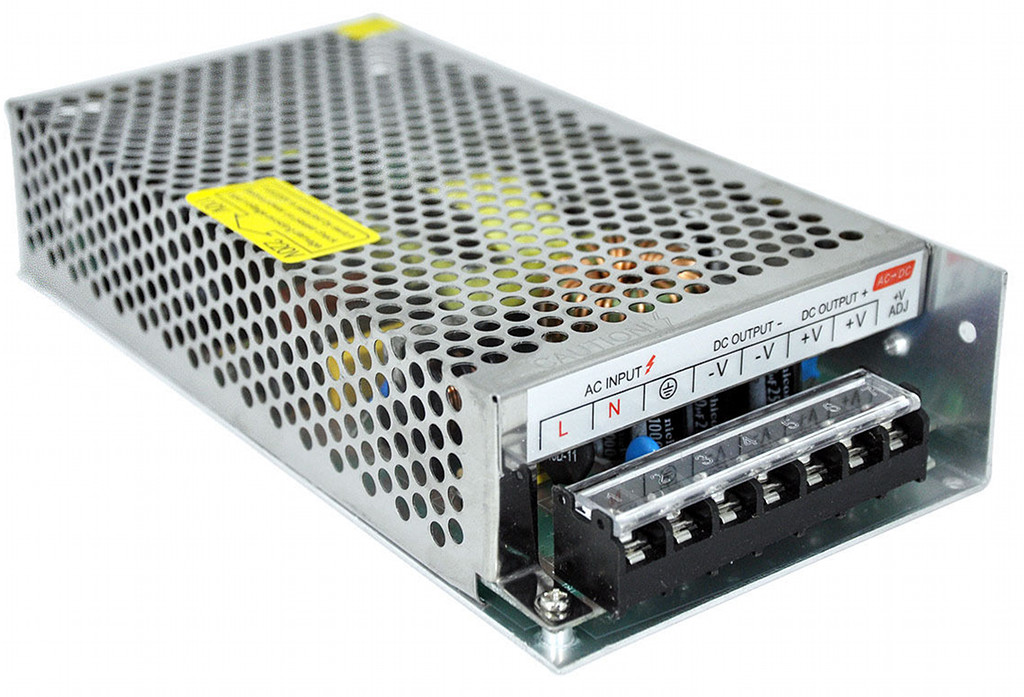
PSU module from ebay
A quick look on ebay revealed that a 150W (30A at 5V) switching supply could be had from a UK vendor for 9.99 which seemed about right. An enclosure, fused and switched IEC inlet, ammeter/voltmeter with shunt and suitable cables were acquired for another 15

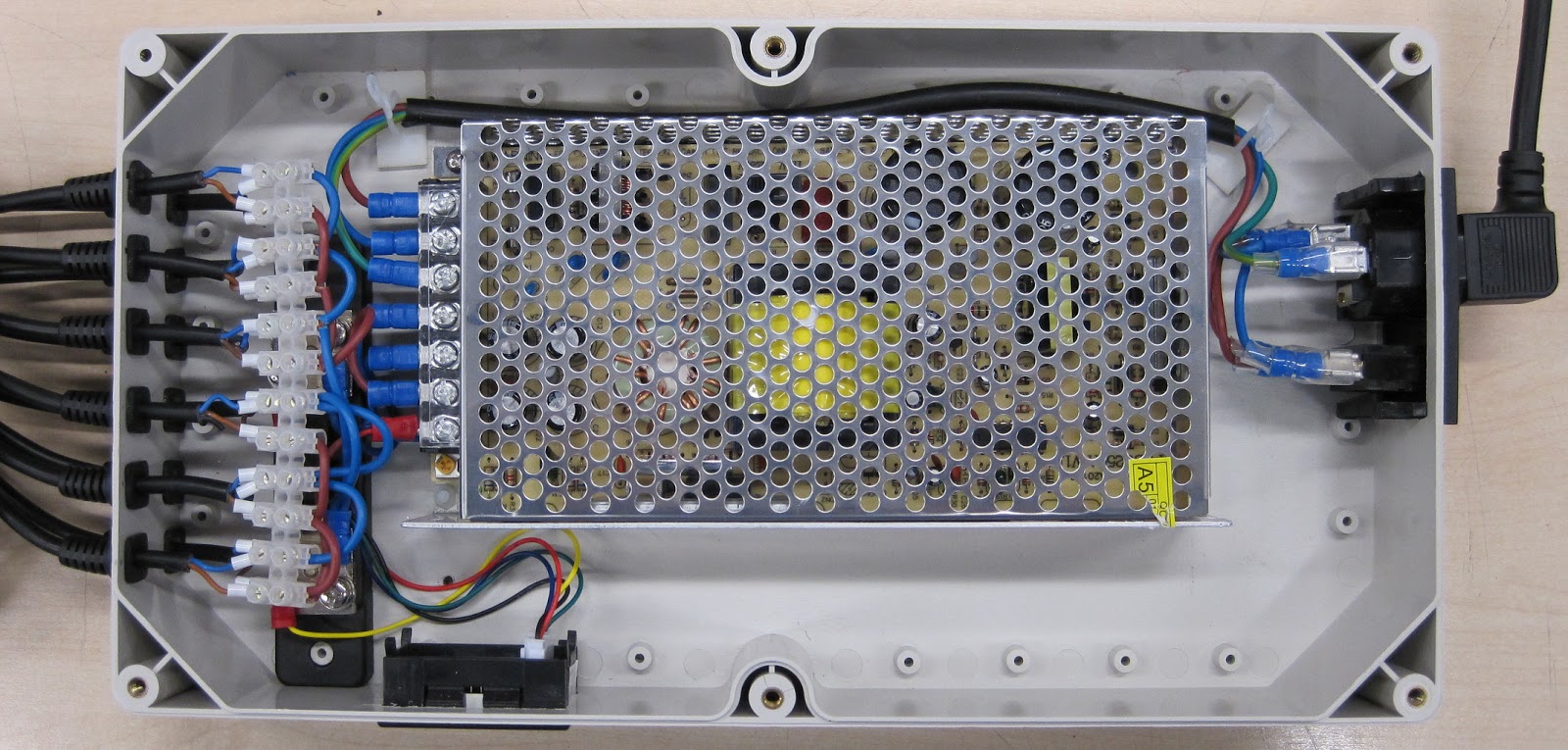
Top view of the supply all wired up
A little careful drilling and cutting of the enclosure made openings for the inlets, cables and display. These were then wired together with crimped and insulated spade and ring connectors. I wanted this build to be safe and reliable so care was taken to get the neatest layout I could manage with good separation between the low and high voltage cabling.

Completed supply with all twelve outputs wired up
The result is a neat supply with twelve outputs which i can easily extend to eighteen if needed. I was pleasantly surprised to discover that even with twelve SBC connected generating 20W load the power drawn by the supply was 25W or about 80% efficiency instead of the 33% previously achieved.

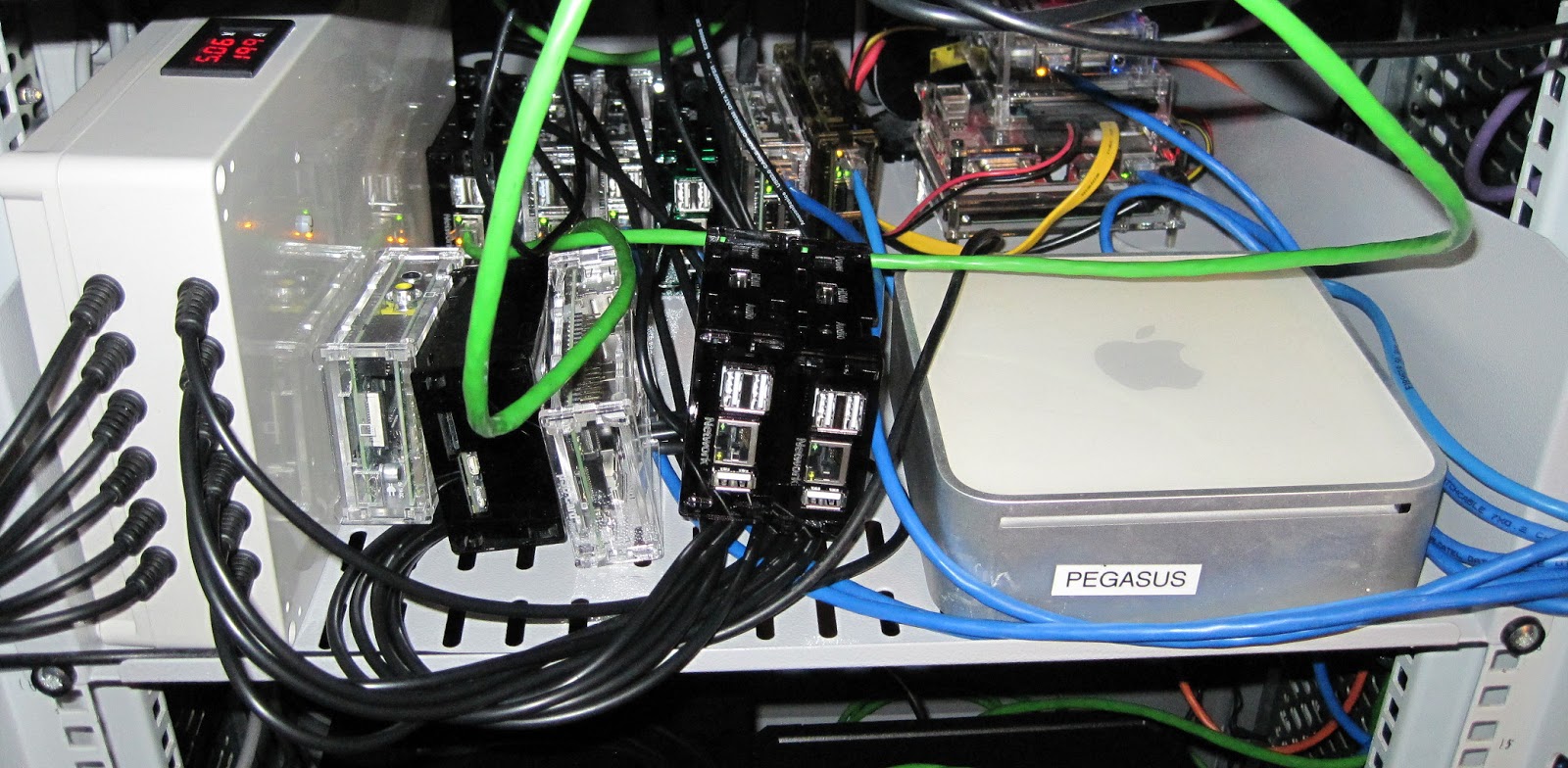
The inbuilt meter allows me to easily see the load on the supply which so far has not risen above 5A even at peak draw, despite the cubitruck and BananaPi having spinning rust hard drives attached, so there is plenty of room for my SBC addiction to grow (I already pledged for a Pine64).

Supply installed in the rack with some of the SBC connected
Overall I am pleased with how this turned out and while there are no detailed design files for this project it should be easy to follow if you want to repeat it. One note of caution though, this project has mains wiring and while I am confident in my own capabilities dealing with potentially lethal voltages I cannot be responsible for anyone else so caveat emptor!

23 November 2015

Riku Voipio: Using ser2net for serial access.

Is your table a mess of wires? Do you have multiple devices connected via serial and can't remember which is /dev/ttyUSBX is connected to what board? Unless you are a embedded developer, you are unlikely to deal with serial much anymore - In that case you can just jump to the next post in your news feed. Introducting ser2netUsually people start with minicom for serial access. There are better tools - picocom, screen, etc. But to easily map multiple serial ports, use ser2net. Ser2net makes serial ports available over telnet. Persistent usb device names and ser2netTo remember which usb-serial adapter is connected to what, we use the /dev/serial tree created by udev, in /etc/ser2net.conf:
# arndale
7004:telnet:0:'/dev/serial/by-path/pci-0000:00:1d.0-usb-0:1.8.1:1.0-port0':115200 8DATABITS NONE 1STOPBIT
# cubox
7005:telnet:0:/dev/serial/by-id/usb-Prolific_Technology_Inc._USB-Serial_Controller_D-if00-port0:115200 8DATABITS NONE 1STOPBIT
# sonic-screwdriver
7006:telnet:0:/dev/serial/by-id/usb-FTDI_FT230X_96Boards_Console_DAZ0KA02-if00-port0:115200 8DATABITS NONE 1STOPBIT
The by-path syntax is needed, if you have many identical usb-to-serial adapters. In that case a Patch from BTS is needed to support quoting in serial path. Ser2net doesn't seems very actively maintained upstream - a sure sign that project is stagnant is a homepage still at sourceforge.net... This patch among other interesting features can be also be found in various ser2net forks in github. Setting easy to remember names Finally, unless you want to memorize the port numbers, set TCP port to name mappings in /etc/services:

# Local services
arndale 7004/tcp
cubox 7005/tcp
sonic-screwdriver 7006/tcp
Now finally:
telnet localhost sonic-screwdriver
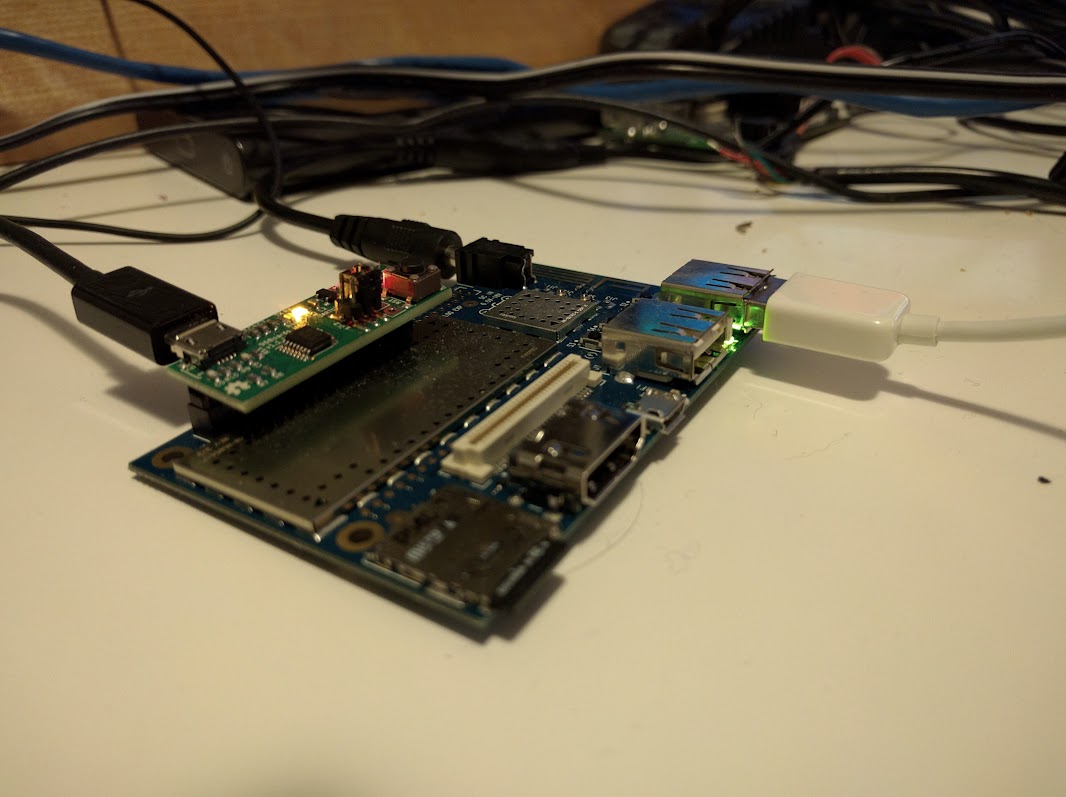
^Mandatory picture of serial port connection in action

15 November 2015

Lunar: Reproducible builds: week 29 in Stretch cycle

What happened in the reproducible builds effort this week: Toolchain fixes Emmanuel Bourg uploaded eigenbase-resgen/1.3.0.13768-2 which uses of the scm-safe comment style by default to make them deterministic. Mattia Rizzolo started a new thread on debian-devel to ask a wider audience for issues about the -Wdate-time compile time flag. When enabled, GCC and clang print warnings when __DATE__, __TIME__, or __TIMESTAMP__ are used. Having the flag set by default would prompt maintainers to remove these source of unreproducibility from the sources. Packages fixed The following packages have become reproducible due to changes in their build dependencies: bmake, cyrus-imapd-2.4, drobo-utils, eigenbase-farrago, fhist, fstrcmp, git-dpm, intercal, libexplain, libtemplates-parser, mcl, openimageio, pcal, powstatd, ruby-aggregate, ruby-archive-tar-minitar, ruby-bert, ruby-dbd-odbc, ruby-dbd-pg, ruby-extendmatrix, ruby-rack-mobile-detect, ruby-remcached, ruby-stomp, ruby-test-declarative, ruby-wirble, vtprint. The following packages became reproducible after getting fixed: Some uploads fixed some reproducibility issues, but not all of them: Patches submitted which have not made their way to the archive yet: reproducible.debian.net The fifth and sixth armhf build nodes have been set up, resulting in five more builder jobs for armhf. More than 10,000 packages have now been identified as reproducible with the reproducible toolchain on armhf. (Vagrant Cascadian, h01ger) Helmut Grohne and Mattia Rizzolo now have root access on all 12 build nodes used by reproducible.debian.net and jenkins.debian.net. (h01ger) reproducible-builds.org is now linked from all package pages and the reproducible.debian.net dashboard. (h01ger) profitbricks-build5-amd64 and profitbricks-build6-amd64, responsible for running amd64 tests now run 398.26 days in the future. This means that one of the two builds that are being compared will be run on a different minute, hour, day, month, and year. This is not yet the case for armhf. FreeBSD tests are also done with 398.26 days difference. (h01ger) The design of the Arch Linux test page has been greatly improved. (Levente Polyak) diffoscope development Three releases of diffoscope happened this week numbered 39 to 41. It includes support for EPUB files (Reiner Herrmann) and Free Pascal unit files, usually having .ppu as extension (Paul Gevers). The rest of the changes were mostly targetting at making it easier to run diffoscope on other systems. The tlsh, rpm, and debian modules are now all optional. The test suite will properly skip tests that need optional tools or modules when they are not available. As a result, diffosope is now available on PyPI and thanks to the work of Levente Polyak in Arch Linux. Getting these versions in Debian was a bit cumbersome. Version 39 was uploaded with an expired key (according to the keyring on ftp.debian.org which will hopefully be updated soon) which is currently handled by keeping the files in the queue without REJECTing them. This prevented any other Debian Developpers to upload the same version. Version 40 was uploaded as a source-only upload but failed to build from source which had the undesirable side effect of removing the previous version from unstable. The package faild to build from source because it was built passing -I to debbuild. This excluded the ELF object files and static archives used by the test suite from the archive, preventing the test suite to work correctly. Hopefully, in a nearby future it will be possible to implement a sanity check to prevent such mistakes in the future. It has also been identified that ppudump outputs time in the system timezone without considering the TZ environment variable. Zachary Vance and Paul Gevers raised the issue on the appropriate channels. strip-nondeterminism development Chris Lamb released strip-nondeterminism version 0.014-1 which disables stripping Mono binaries as it is too aggressive and the source of the problem is being worked on by Mono upstream. Package reviews 133 reviews have been removed, 115 added and 103 updated this week. Chris West and Chris Lamb reported 57 new FTBFS bugs. Misc. The video of h01ger and Chris Lamb's talk at MiniDebConf Cambridge is now available. h01ger gave a talk at CCC Hamburg on November 13th, which was well received and sparked some interest among Gentoo folks. Slides and video should be available shortly. Frederick Kautz has started to revive Dhiru Kholia's work on testing Fedora packages. Your editor wish to once again thank #debian-reproducible regulars for reviewing these reports weeks after weeks.

30 October 2015

Laura Arjona: Look at that nice looking FreedomBox!

This is a guest post by Alberto Fuentes, Debian contributor. Thanks!! I m rebuilding one my home server and decided to take a look at the FreedomBox project as the base for it. The 0.6 version was recently released and I wasn t aware of how advanced the project is already! They have a virtualbox image ready for some quick test. It took me longer to download it than to start using it. Here s is a pic of what it looks like to entice you to try it :) Selection_175
All this is already on debian right now and you can turn any debian sid installation into a FreedomBox just by installing a package. The setup generates everything private on the first run, so even the virtualbox image can be used as the final thing They use Plinth (Django) to integrate the applications into the web interface. More info on how to help integrate more Debian packages here. A live demo is going to be streamed this Friday 30 Oct 2015 and a hackaton is scheduled for this saturday 31 Oct 2015. Cheers!
Filed under: My experiences and opinion Tagged: Debian, English, Freedom, FreedomBox, selfhosting

27 October 2015

Marco d'Itri: Per-process netfilter rules

This article documents how the traffic of specific Linux processes can be subjected to a custom firewall or routing configuration, thanks to the magic of cgroups. We will use the Network classifier cgroup, which allows tagging the packets sent by specific processes. To create the cgroup which will be used to identify the processes I added something like this to /etc/rc.local:
mkdir /sys/fs/cgroup/net_cls/unlocator
/bin/echo 42 > /sys/fs/cgroup/net_cls/unlocator/net_cls.classid
chown md: /sys/fs/cgroup/net_cls/unlocator/tasks
The tasks file, which controls the membership of processes in a cgroup, is made writeable by my user: this way I can add new processes without becoming root. 42 is the arbitrary class identifier that the kernel will associate with the packets generated by the member processes. A command like systemd-cgls /sys/fs/cgroup/net_cls/ can be used to explore which processes are in which cgroup. I use a simple shell wrapper to start a shell or a new program as members of this cgroup:
#!/bin/sh -e
CGROUP_NAME=unlocator
if [ ! -d /sys/fs/cgroup/net_cls/$CGROUP_NAME/ ]; then
  echo "The $CGROUP_NAME net_cls cgroup does not exist!" >&2
  exit 1
fi
/bin/echo $$ > /sys/fs/cgroup/net_cls/$CGROUP_NAME/tasks
if [ $# = 0 ]; then
  exec $ SHELL:-/bin/sh 
fi
exec "$@"
My first goal is to use a special name server for the DNS queries of some processes, thanks to a second dnsmasq process which acts as a caching forwarder. /etc/dnsmasq2.conf:
port=5354
listen-address=127.0.0.1
bind-interfaces
no-dhcp-interface=*
no-hosts
no-resolv
server=185.37.37.37
server=185.37.37.185
/etc/systemd/system/dnsmasq2.service:
[Unit]
Description=dnsmasq - Second instance
Requires=network.target
[Service]
ExecStartPre=/usr/sbin/dnsmasq --test
ExecStart=/usr/sbin/dnsmasq --keep-in-foreground --conf-file=/etc/dnsmasq2.conf
ExecReload=/bin/kill -HUP $MAINPID
PIDFile=/run/dnsmasq/dnsmasq.pid
[Install]
WantedBy=multi-user.target
Do not forget to enable the new service:
systemctl enable dnsmasq2
systemctl start dnsmasq2
Since the cgroup match extension is not yet available in a released version of iptables, you will first need to build and install it manually:
git clone git://git.netfilter.org/iptables.git
cd iptables
./autogen.sh
./configure
make -k
sudo cp extensions/libxt_cgroup.so /lib/xtables/
sudo chmod -x /lib/xtables/libxt_cgroup.so
The netfilter configuration required is very simple: all DNS traffic from the marked processes is redirected to the port of the local dnsmasq2:
iptables -t nat -A OUTPUT -m cgroup --cgroup 42 -p udp --dport 53 -j REDIRECT --to-ports 5354
iptables -t nat -A OUTPUT -m cgroup --cgroup 42 -p tcp --dport 53 -j REDIRECT --to-ports 5354
For related reasons, I also need to disable IPv6 for these processes:
ip6tables -A OUTPUT -m cgroup --cgroup 42 -j REJECT
I use a different cgroup to force some programs to use my office VPN by first setting a netfilter packet mark on their traffic:
iptables -t mangle -A OUTPUT -m cgroup --cgroup 43 -j MARK --set-mark 43
The packet mark is then used to policy-route this traffic using a dedicate VRF, i.e. routing table 43:
ip rule add fwmark 43 table 43
This VPN VRF just contains a default route for the VPN interface:
ip route add default dev tun0 table 43
Depending on your local configuration it may be a good idea to also add to the VPN VRF the routes of your local interfaces:
ip route show scope link proto kernel \
    xargs -I ROUTE ip route add ROUTE table 43
Since the source address selection happens before the traffic is diverted to the VPN, we also need to source-NAT to the VPN address the marked packets:
iptables -t nat -A POSTROUTING -m mark --mark 43 --out-interface tun0 -j MASQUERADE

23 October 2015

Russ Allbery: Review: Watchtower

Review: Watchtower, by Elizabeth A. Lynn
Series: Chronicles of Tornor #1
Publisher: Berkley
Copyright: February 1979
Printing: November 1982
ISBN: 0-425-06195-7
Format: Mass market
Pages: 226
Ryke is a soldier in service to Athor, lord of Tornor Keep. Or, at least, he was. Shortly before the opening lines of this book, Tornor Keep was taken by a southerner named Col Istor, and Athor was killed. Ryke is about to change sides under duress: his service to Col as a watch commander is the price of keeping Errel, Athor's son, alive. Alive does not mean treated with dignity, however; Errel's new place is to become court jester for Col's small domain. At the start of this book, I had no idea who Col Istor was or why he'd want to take over one of the border keeps that guard the country of Arun against its northern neighbor Anhard. At the end of this book, I still had little idea. Watchtower's relationship with world-building is not what you'd normally expect from a fantasy novel. There are only a few locations in this novel, and they're described in close detail but without much historical or strategic context. The narrative, despite being third person, follows Ryke very closely, and Ryke is not interested in thinking much about the history of his world that he knows and the reader doesn't. Or he may not care. Ryke does not come across as a curious or thoughtful person. He's a soldier, he lives to serve his lord, and that service transfers from Athor to Errel and simply stays there, with little discussion or argument. The opening section of this novel shows Ryke trying to take care of Errel while serving Col and listening to his plans to take over the rest of the northern keeps. I found it slow, claustrophobic, and not very interesting. It reads a bit like a day in the life in some grim medieval military, with little world-building or context. Watchtower is technically fantasy, but mostly because the geography and politics are imaginary. Magic is limited to a very tiny bit of (essentially) Tarot card reading and has little impact on the plot. The story does get somewhat more interesting when two green clan messengers enter the story, and Ryke and Errel escape. Lynn introduces another community and another way of life into the story than the one Ryke is used to, one that seemed modeled after monastic orders (but with the religion toned down to nearly nonexistent). I think the intended conflict of the story is between those ways of life, their draws and implications, but even that conflict is never clearly stated. Ryke seems to move from one inevitability to another, and while he does question some of his previous views and seems to open his mind a bit, actual growth is limited in this story. I reached the end of the book feeling the world was largely unchanged from its start. This story won the World Fantasy award for best novel in 1980. I have to admit I'm baffled, although partly that's because this is not really my thing. I prefer my fantasy to have more epic sweep and a lot more world-building. But perhaps the award was for the writing, which is evocative and fills the moments of the story with closely-observed detail. It has a distinctive, choppy feel, full of short declarative sentences:
The wind blew. Like some night creature caught in a trap, Col Istor's banner flapped on its pole. Ryke wondered where his wolfhound was. Sheltering, he hoped, in some warm and windless corner. He thrust his hands beneath his armpits to warm them. He entered the kitchen, nodding at the guard who stood there, and went toward the scullery. The kitchenboys huddled together in sleep like dogs in front of the oven. He stepped over their legs. The iron pots on the walls vibrated softly.
That's a paragraph chosen at random from the start of the book and should give you a good feel for the style. I think I would have liked this novel better if it had followed anyone other than Ryke. Not only did I not care for him and his simplistic loyalties, he's the least interesting character in this story. Everyone else Col, Errel, Sorren, Van, and others is more complex and more thoughtful than he is, and I think many of them would have made a better protagonist. He spends much of the center part of the book being suspicious and closed and incurious, which means the reader can only guess at what's going on between the other characters. I can't really recommend this book, but the writing is solid and it has some interesting properties for late 1970s fantasy, including both a frank look at the role of women in this society and same-sex relationships. If your taste in fantasy leans towards the gritty and realistic, you might like it more than I did. I may try the later books of the series in the hope that they have more interesting protagonists. Followed by Dancers of Arun. Rating: 6 out of 10

22 October 2015

Joey Hess: propellor orchestration

With the disclamer that I don't really know much about orchestration, I have added support for something resembling it to Propellor. Until now, when using propellor to manage a bunch of hosts, you updated them one at a time by running propellor --spin $somehost, or maybe you set up a central git repository, and a cron job to run propellor on each host, pulling changes from git. I like both of these ways to use propellor, but they only go so far... All those scenarios are supported by propellor now! Well, I haven't actually implemented concurrently yet, but the point is that the conducts property can be used with any of propellor's property combinators, like before etc, to express all kinds of scenarios. The conducts property works in combination with an orchestrate function to set up all the necessary stuff to let one host ssh into another and run propellor there.
main = defaultMain (orchestrate hosts)
hosts = 
    [ master
    , webservers 
    , ...
    ]
The orchestrate function does a bunch of stuff: I've very pleased that I was able to add the Propellor.Property.Conductor module implementing this with only a tiny change to the rest of propellor. Almost everything needed to implement it was there in propellor's infrastructure already. Also kind of cool that it only needed 13 lines of imperative code, the other several hundred lines of the implementation being all pure code.

17 October 2015

Simon Richter: Key Transition

So, since several years I've had a second gpg key, 4096R/6AABE354. Several of you have already signed it, and I've been using it in Debian for some time already, but I've not announced it more widely yet, and I occasionally still get mail encrypted to the old key (which remains valid and usable, but it's 1024R). Of course, I've also made a formal transition statement:
-----BEGIN PGP SIGNED MESSAGE-----
Hash: SHA1
OpenPGP Key Transition Statement for Simon Richter
I have created a new OpenPGP key and will be transitioning away from
my old key.  The old key has not been compromised and will continue to
be valid for some time, but I prefer all future correspondence to be
encrypted to the new key, and will be making signatures with the new
key going forward.
I would like this new key to be re-integrated into the web of trust.
This message is signed by both keys to certify the transition.  My new
and old keys are signed by each other.  If you have signed my old key,
I would appreciate signatures on my new key as well, provided that
your signing policy permits that without re-authenticating me.
The old key, which I am transitioning away from, is:
pub   1024D/5706A4B4 2002-02-26
      Key fingerprint = 040E B5F7 84F1 4FBC CEAD  ADC6 18A0 CC8D 5706 A4B4
The new key, to which I am transitioning, is:
pub   4096R/6AABE354 2009-11-19
      Key fingerprint = 9C43 2534 95E4 DCA8 3794  5F5B EBF6 7A84 6AAB E354
The entire key may be downloaded from: http://www.simonrichter.eu/simon.asc
To fetch the full new key from a public key server using GnuPG, run:
  gpg --keyserver keys.gnupg.net --recv-key 6AABE354
If you already know my old key, you can now verify that the new key is
signed by the old one:
  gpg --check-sigs 6AABE354
If you are satisfied that you've got the right key, and the User IDs
match what you expect, I would appreciate it if you would sign my key:
  gpg --sign-key 6AABE354
You can upload your signatures to a public keyserver directly:
  gpg --keyserver keys.gnupg.net --send-key 6AABE354
Or email sr@simonrichter.eu (possibly encrypted) the output from:
  gpg --armor --export 6AABE354
If you'd like any further verification or have any questions about the
transition please contact me directly.
To verify the integrity of this statement:
  wget -q -O- http://www.simonrichter.eu/key-transition-2015-03-09.txt   gpg --verify
   Simon
-----BEGIN PGP SIGNATURE-----
Version: GnuPG v1
iQEcBAEBAgAGBQJU/bbEAAoJEH69OHuwmQgRWOIH/AogHxhhVO5Tp5FFGpBFwljf
NzKTPBExMhZ/8trAzYybOWFv3Bx4AGdWkYfDnxP6oxQJOXVq4KL6ZcPPuIZuZ6fZ
bu0XHdPMU89u0TymR/WJENRCOcydRBe/lZs+zdJbKQtEZ+on4uNXxHpUiZPi1xxM
ggSdVBKn2PlCBcYih40S9Oo/rM9uBmYcFavX7JMouBSzgX78cVoIcY6zPRmHoq4k
TkGKfvHeSu+wbzWRmDwu/PFHRA4TKNvR6oeO+Et1yk454zjrHMXineBILRvvMCIA
t54pV6n+XzOUmtXcKnkIGltK+ZaJSV6am0swtx84RaevVXrknIQE8NvlA4MNgguI
nAQBAQIABgUCVP23tAAKCRDSx966V9+/u3j4BACVHifAcO86jAc5dn+4OkFZFhV1
l3MKIolL+E7Q7Ox+vJunGJJuGnOnazUK+64yDGZ2JxNJ4QNWD1FOs/Ng2gm82Vin
ArBtyp1ZGWUa+349X+1qarUQF9qAaUXDZjFp5Hzh/o6KC4t3eECxcb41og3LUTQD
VuG2KWNXYBe5P5ak9Q==
=o61r
-----END PGP SIGNATURE-----

15 October 2015

Laura Arjona: Long summer story, Welcome team, and I am a Debian Developer now

Note: 2015/10/16: I need to add some links but I won t delay this more, posting now, will edit later. Summer ended long time ago, but believe me, I m still catching up with all the things that I began in June/July, all the things I left in August when I went holidays, and more things that appeared in August and September. This is a long overdue post, I hope you bear with me for waiting so long, and writing (now) so long too! June In June, I was 100% sure that I would not attend DebConf15 (well, I was 98% sure until then), and when the new Outreach Sponsorship grants were announced, I decided to write some mails to several Debian contributors, so they consider applying for the grant and attend DebConf (and maybe trigger some i18n/l10n meeting ). They kindly declined, and I understood their reasons, but also wondered what would have happened if the proposal would have come from somebody more official instead of a random contributor that they don t know. I also hoped that lots of other Debianites also write to newbies or not-yet-DD-contributors or non-packaging contributors to invite them to DebConf, and I hoped that they had better luck than me in convincing them :) July In July I usually work hard preparing the computer labs for next academic year at my workplace in the University, but I also have more free time in the long afternoons and evenings, since I don t sleep much, and there is not much to do outside with the summer hot. So I used that month to go on contributing to DebConf publicity and think a bit more about Debian and the other free software communities. I didn t put much time in advancing my selfhosting (no SSL yet in *.larjona.net! booooo!) but I decided to deep my toe in Sandstorm.io, and try to selfhost an instance ( http://lacaja.larjona.net ) and try Etherpad inside Sandstorm (since I failed in deploying Etherpad by myself in my jessie+nginx+postgres box). Sandstorm worked, and Etherpad was packaged in Sandstorm so it worked too; and I have my free-software-base pads now for writing and share. So I joined #sandstorm IRC channel since then, and there I learnt that Asheesh Laroia (who works in Sandstorm.io and is also a Debian Developer and was going to give a talk about Sandstorm.io in DebConf15) was offering mentorship for people wanting to learn Sandstorm packaging, and his proposal was to begin packaging Framadate. I also failed in selfhosting Dudle (prepared for Apache + FastCGI, couldn t make it work in my Nginx), so Asheesh s proposal looked suitable for me. We talked and decided to invest the rest of July and first days of August in learning to package Framadate. I learned a lot, but couldn t finish the task. I encountered many issues (setting my dev environment, and later trying to package), and we solved some of them but my time ran out. I posted my work in the list, and I hope that my feedback on the documentation and the issues I encountered helped Asheesh and the Sandstorm community. Framadate is packaged in Sandstorm.io now, Drew Fisher packaged it, not sure if my stuff was useful or not (it s been useful for me, for learning, at least). I ll talk more about Sandstorm.io in a future blog post updating on my selfhosting adventures. What I liked most was the kind of proposal of mentoring that Asheesh made. It was very detailed in every aspect: the task, the things you need to accomplish it, details about his availability for mentorship I try to be welcoming in the teams in which I participate, but the fact is that I fail in actually mentor, maybe because of not making specific proposals to people (until now, I was like Hi, newcomer! Go read this, this and this, and try for yourself any task you feel you like it, and come back if you have issues , la Debian ). This, plus the thoughts about my mails in June for diversity outreach in DebConf, made me feel the need of having a team where people willing to welcome newcomers share tricks and procedures, write together more specific proposals, and follow up the newcomers experiences in a regular way. I talked with Enrico Zini and we wrote down some notes for a Welcome Team in Debian; he said he would spread the word during DebCamp/DebConf and we would see what people thinks about it. August August came, and the day before going on holidays I was really tired: too much luggage to prepare, too many hours in front of the computer, and the usual stress of traveling; and I took the bad decision of signing some GPG keys of several Debianites that I met in July. I say bad decision because the lack of sleep showed its black magic and I accidentally deleted my secring.gpg file. I knew I had a backup but I didn t have too much time to invest and I didn t want to mess it with the backup too, and my laptop was going to stay at home, powered off, during the whole month, so I just went on holidays and left the GPG issue for later. The day after, meanwhile I was waiting in the airport for my boarding time, I received a mail accepting me as Debian Developer. Wow!! Really, I was not expecting that the process was already finished, I had interchanged several mails with my Application Manager (who happens to be the current DPL!) and I thought that his summer could be quite packed of Debian/DebConf work and my process could wait a bit. So it was a very happy news and very motivating after one month (July) full of free software work. On the other side, I was a bit scared: what type of Debian Developer are you, larjona, not capable to sign some GPG keys without breaking your setup?! but I answered myself well, I m the type of Debian Developer that has backups :) and then, with that mixed feelings of excitement and impostor syndrome, I took my plane and went on holidays, not expecting to touch any computer until the end of the month. August is probably the month in the year when I have more free time (holidays), but less time to dedicate to free software. I devote most of the month to visit family and stay with them, with no internet connection available or no free time to look at the mailbox or social networks or IRC But DebCamp and DebConf15 were happening during my holidays. And this DebConf15 was the first one in which I participated in the organization, and the first one in which I felt more than being a consumer of Debian videos . I could not follow the streamings, my only internet-capable device was my Android 2.x phone, but when I had wifi I fetched the mail, and during the nights, while everybody else was sleeping and I was laying on the terrace, below the sky full of stars, I could read batches of hundred of mails from debconf-discuss mailing list. And I could get some feeling from DebConf life, because I learned about the ad-hoc BoFs and discussions, the morning bike rides and swimming proposals, and the dancing classes, the i18m/l10n meeting, and many other things. I could answer some mail from time to time, and I also knew that a fellow Debianite from Madrid was going to bring me some stickers, maybe a t-shirt, and shake hands in my name to some persons. September and October September was about finishing reading all the mails and try to answer the pending ones, and preparing my computer to use my new Debian identity (and stop using larjona-guest). I still have some things to do, pending technical work, and some mails that I should have answered and I ve forgotten, for sure (if you sent me a mail that needs answer or would be fine that I answer (even if it was months ago!), please resend or ping me). I recovered my secring.gpg but and just now I added larjona@debian.org to the ID in my GPG key, but didn t signed the pending keys again (sorry dkg and holger! will catch up there soon). My subkeys expired and I m trying to find out how to proceed (they are in my FSFE SmartCard) :/ About the Debian teams, I ve resumed my work in publicity team (this year I ll try to be more involved, in Debian Project News in particular), partially in the website team, and recently I ve finished catching up with the Spanish translation of the website. I ve also joined the DebConf team again (for DebConf16, no matter I probably won t attend) and documented the Publicity task for DebConf, and I try to engage the mailing list and the IRC meetings. I finally could have time to watch some DebConf15 videos and Andreas Tille s talk ( Creating a more inviting environment for newcomers New experiences from MoM, SoB, Teammetrics ) helped me to step ahead in welcoming people with more useful stuff than Hi, newcomer! Go read this (general URLs), try for yourself whatever you like . I have made specific proposals for two people. In mid September I accepted an interview about Debian for a podcast with quite a lot audience (in Spanish), in which I explained the idea of the Welcome Team and offered myself as first-contact. Since then, two more people have contacted me and I have offered specific tasks I think are suitable for them. I also try to be more available in the IRC and offer some time spans for new contributors to DebConf to explain the git setup, the wiki, and all this stuff that looks more complicated than what it is. And I think that s all. My Debianite friend kindly brought me some stickers and a DebConf t-shirt, plus the organization t-shirt that the team gave me as present for my contributions in DebConf15. Neil McGovern kindly sent me a certificate of my new Debian Developer status (thanks!!), and it s posted in my wall at work. Here you are a photo! larjona_dd.JPG (Note: my wall is full of stickers and pieces of papers with things I need, things I like and things I use to explain my work (sometimes sarcastically/ironically ). Maybe some day I ll make a blog post about that!) I feel very proud and happy. Still, a lot of things to learn and work to do, but my intentions are: to keep on progressing (sometimes fast, sometimes slowly), never give up, and enjoy the multiple flowers I find in my way :) Thanks everybody! October and future Some other ideas/plans for the future (the ones I didn t say yet): Comments? If you want to comment you can use this pump.io thread.
Filed under: My experiences and opinion, News Tagged: Communities, Contributing to libre software, Debian, Developer motivations, encryption, English, Free Software, gpg, libre software

5 October 2015

B lint R czey: Debian success stories: Automated signature verification

Debian was not generally seen as a bleeding-edge distribution, but it offered a perfect combination of stability and up-to-date software in our field when we chose the platform for our signature verification project. Having an active Debian Developer in the team also helped ensuring that packages which we use were in good shape when the freeze, then the release came and we can still rely on Jessie images with only a few extra packages to run our software stack. Not having to worry about the platform, we could concentrate on the core project and I m proud to announce that our start-up s algorithm won this year s Signature Verification Competition for Online Skilled Forgeries (SigWIComp2015) . The more detailed story can be read already in the English business news and is also on index.hu, a leading Hungarian news site. We are also working on a solution for categorizing users based on cursor/finger movements for targeting content, offers and ads better. This is also covered in the articles.

L szl a signature comparable in quality to the reference signatures

The verification task was not easy. The reference signatures were recorded at very low resolution and frequency and the forgers did a very good job in forging them creating a true challenge for everyone competing. At first glance it is hard to imagine that there is usable information in such small amount of recorded data, but our software is already better than me, for example in telling the difference between genuine and forged signatures. It feels like when the chess program beats the programmer again and again. :-) I would like to thank you all, who helped making Debian an awesome universal operating system and hope we can keep making every release better and better!

30 September 2015

Ben Armstrong: Halifax Mainland Common: Early Fall, 2015

A friend and I regularly meet to chat over coffee and then usually finish up by walking the maintained trail in the Halifax Mainland Common Park, but today we decided to take a brief excursion onto the unmaintained trails criss-crossing the park. The last gasp of a faint summer and early signs of fall are evident everywhere. Some mushrooms are dried and cracked in a mosaic pattern: image image Ferns and other brush are browning amongst the various greens of late summer: image A few late blueberries still cling to isolated bushes here and there: image The riot of fall colours in this small clearing, dotted with cotton-grass, burst into view as we round a corner, set behind by a backdrop of nearby buildings: image image The ferns here are vivid, like a slow burning fire that will take the rest of fall to burn out: image We appreciate one last splash of colour before we head back under the cover of woods to rejoin the maintained trail: image So many times we ve travelled our usual route on automatic . I m happy today we left the more travelled trail to share in these glimpses of the changing of seasons in a wilderness preserved for our enjoyment immediately at hand to a densely populated part of the city. facebooktwittergoogle_plusredditpinterestlinkedinmail

7 September 2015

Ben Armstrong: Hike at Blomidon Park: Late Summer, 2015

I had the wonderful privilege to go camping and hiking with my kids scouting group, the Pathfinders of Tantallon SDA church. The day started with a quick trip to Pugwash with one of the leaders to bring back some chairs to their school, and then we headed back out to Blomidon to meet up with the group. Click the photo below to start the slideshow.
The road trip started early to fetch some chairsThe road trip started early to fetch some chairs click to start
The smudgy truck windows make an interesting filter Still an hour or more away from our first stop More funky filtering, this time with trees participating Wentworth valley taken over the cluttered dash We disturbed a great blue heron s breakfast at Wallace The beach at Pugwash SDA Camp where we loaded the chairs Trucking along past Truro After dropping off chairs, finally approaching Blomidon Getting very close to Blomidon Some bikers out to enjoy the views Interesting white berries Interesting red berries My first up close look at the point with my hiking buddy, Dave, on the first day An experimental panorama. Not sure I have the knack for keeping the horizon straight. We must bring the group out here tomorrow! Fast ringneck snake! Hard to get a clear shot Pre-dawn over the campground The first blush of coming dawn The Moon and Venus just before dawn Evergreens surrounding our camp site, pre-dawn Seems I m still the only one up Half of the tents on the spacious group site Half of the tents on the spacious group site My daughter, the artist My two youngest and their best friend Some relaxing down time after breakfast Not sure who said what, but apparently they were hilarious. :) The smoke was a bit much for my eldest Geoff entertaining the troops Dave making breakfast Dave making breakfast Breakfast just wrapping up Relaxing while we finish breakfast Looks like that needs some tweaking A bit too smoky The whole group The whole group Just goofing around Who s winning? Enjoying the last embers of the breakfast fire before heading to Jodrey Trail I admire this young lady s great eye for photography She has some sweet gear A lot of old hardwoods out here Dave did this hike with me yesterday Excellent hiking buddy! Words can t describe how much more stunning these views are in person All the cameras came out Got to get that perfect shot! A tree clinging to the eroding ground above the sheer cliff A lookoff on Jodrey Trail A lookoff on Jodrey Trail Lining up her shot /a> A lookoff on Jodrey Trail A lookoff on Jodrey Trail A lookoff on Jodrey Trail A fern with sharply serrated sturdy leaves I m not familiar with Breaking camp at group site 404 One final chance to enjoy the view from the park entrance before heading home
facebooktwittergoogle_plusredditpinterestlinkedinmail

Next.

Previous.