Search Results: "dom"

1 January 2026

Russ Allbery: Review: This Brutal Moon

Review: This Brutal Moon, by Bethany Jacobs
Series: Kindom Trilogy #3
Publisher: Orbit
Copyright: December 2025
ISBN: 0-316-46373-6
Format: Kindle
Pages: 497
This Brutal Moon is a science fiction thriller with bits of cyberpunk and space opera. It concludes the trilogy begun with These Burning Stars. The three books tell one story in three volumes, and ideally you would read all three in close succession. There is a massive twist in the first book that I am still not trying to spoil, so please forgive some vague description. At the conclusion of These Burning Stars, Jacobs had moved a lot of pieces into position, but it was not yet clear to me where the plot was going, or even if it would come to a solid ending in three volumes as promised by the series title. It does. This Brutal Moon opens with some of the political maneuvering that characterized These Burning Stars, but once things start happening, the reader gets all of the action they could wish for and then some. I am pleased to report that, at least as far as I'm concerned, Jacobs nails the ending. Not only is it deeply satisfying, the characterization in this book is so good, and adds so smoothly to the characterization of the previous books, that I saw the whole series in a new light. I thought this was one of the best science fiction series finales I've ever read. Take that with a grain of salt, since some of those reasons are specific to me and the mood I was in when I read it, but this is fantastic stuff. There is a lot of action at the climax of this book, split across at least four vantage points and linked in a grand strategy with chaotic surprises. I kept all of the pieces straight and understood how they were linked thanks to Jacobs's clear narration, which is impressive given the number of pieces in motion. That's not the heart of this book, though. The action climax is payoff for the readers who want to see some ass-kicking, and it does contain some moving and memorable moments, but it relies on some questionable villain behavior and a convenient plot device introduced only in this volume. The action-thriller payoff is competent but not, I think, outstanding. What put this book into a category of its own were the characters, and specifically how Jacobs assembles sweeping political consequences from characters who, each alone, would never have brought about such a thing, and in some cases had little desire for it. Looking back on the trilogy, I think Jacobs has captured, among all of the violence and action-movie combat and space-opera politics, the understanding that political upheaval is a relay race. The people who have the personalities to start it don't have the personality required to nurture it or supply it, and those who can end it are yet again different. This series is a fascinating catalog of political actors the instigator, the idealist, the pragmatist, the soldier, the one who supports her friends, and several varieties and intensities of leaders and it respects all of them without anointing any of them as the One True Revolutionary. The characters are larger than life, yes, and this series isn't going to win awards for gritty realism, but it's saying something satisfyingly complex about where we find courage and how a cause is pushed forward by different people with different skills and emotions at different points in time. Sometimes accidentally, and often in entirely unexpected ways. As before, the main story is interwoven with flashbacks. This time, we finally see the full story of the destruction of the moon of Jeve. The reader has known about this since the first volume, but Jacobs has a few more secrets to show (including, I will admit, setting up a plot device) and some pointed commentary on resource extraction economies. I think this part of the book was a bit obviously constructed, although the characterization was great and the visible junction points of the plot didn't stop me from enjoying the thrill when the pieces came together. But the best part of this book was the fact there was 10% of it left after the climax. Jacobs wrote an actual denouement, and it was everything I wanted and then some. We get proper story conclusions for each of the characters, several powerful emotional gut punches, some remarkably subtle and thoughtful discussion of political construction for a series that tended more towards space-opera action, and a conclusion for the primary series relationship that may not be to every reader's taste but was utterly, perfectly, beautifully correct for mine. I spent a whole lot of the last fifty pages of this book trying not to cry, in the best way. The character evolution over the course of this series is simply superb. Each character ages like fine wine, developing more depth, more nuance, but without merging. They become more themselves, which is an impressive feat across at least four very different major characters. You can see the vulnerabilities and know what put them there, you can see the strengths they developed to compensate, and you can see why they need the support the other characters provide. And each of them is so delightfully different. This was so good. This was so precisely the type of story that I was in the mood for, with just the type of tenderness for its characters that I wanted, that I am certain I am not objective about it. It will be one of those books where other people will complain about flaws that I didn't see or didn't care about because it was doing the things I wanted from it so perfectly. It's so good that it elevated the entire trilogy; the journey was so worth the ending. I'm afraid this review will be less than helpful because it's mostly nonspecific raving. This series is such a spoiler minefield that I'd need a full spoiler review to be specific, but my reaction is so driven by emotion that I'm not sure that would help if the characters didn't strike you the way that they struck me. I think the best advice I can offer is to say that if you liked the emotional tone of the end of These Burning Stars (not the big plot twist, the character reaction to the political goal that you learn drove the plot), stick with the series, because that's a sign of the questions Jacobs is asking. If you didn't like the characters at the end (not the middle) of the first novel, bail out, because you're going to get a lot more of that. Highly, highly recommended, and the best thing I've read all year, with the caveats that you should read the content notes, and that some people are going to bounce off this series because it's too intense and melodramatic. That intensity will not let up, so if that's not what you're in the mood for, wait on this trilogy until you are. Content notes: Graphic violence, torture, mentions of off-screen child sexual assault, a graphic corpse, and a whole lot of trauma. One somewhat grumbly postscript: This is the sort of book where I need to not read other people's reviews because I'll get too defensive of it (it's just a book I liked!). But there is one bit of review commentary I've seen about the trilogy that annoys me enough I have to mention it. Other reviewers seem to be latching on to the Jeveni (an ethnic group in the trilogy) as Space Jews and then having various feelings about that. I can see some parallels, I'm not going to say that it's completely wrong, but I also beg people to read about a fictional oppressed ethnic and religious minority and not immediately think "oh, they must be stand-ins for Jews." That's kind of weird? And people from the US, in particular, perhaps should not read a story about an ethnic group enslaved due to their productive skill and economic value and think "they must be analogous to Jews, there are no other possible parallels here." There are a lot of other comparisons that can be made, including to the commonalities between the methods many different oppressed minorities have used to survive and preserve their culture. Rating: 10 out of 10

Daniel Baumann: P r ch storage (in Western Europe)

The majority of P r ch ( ) is stored in Asia (predominantly China, some in Malaysia and Taiwan) because of its climatic conditions:
  • warm (~30 C)
  • humid (~75% RH)
  • stable (comparatively small day to day, day to night, and seasonal differences)
These are ideal for ageing and allow efficient storage in simple storehouses, usually without the need for any air conditioning. The climate in Western European countries is significantly colder, drier, and more variable. However, residential houses offers throughout the year a warm (~20 C), humid (~50% RH), and stable baseline to start with. High quality, long term storage and ageing is possible too with some of the Asian procedures slightly adjusted for the local conditions. Nevertheless, fast accelerated ageing still doesn t work here (even with massive climate control). Personally I prefer the balanced, natural storage over the classical wet or dry , or the mixed traditional storage (of course all storage types are not that meaningful as they are all relative terms anyway). Also I don t like strong fermentation either (P r is not my favourite tea, I only drink it in the 3 months of winter). Therefore, my intention is primarily to preserve the tea while it continues to age normally, keep it in optimal drinking condition and don t rush its fermentation. The value of correct storage is of great importance and has a big effect on P r, and is often overlooked and underrated. Here s a short summary on how to store P r ch (in Western Europe).
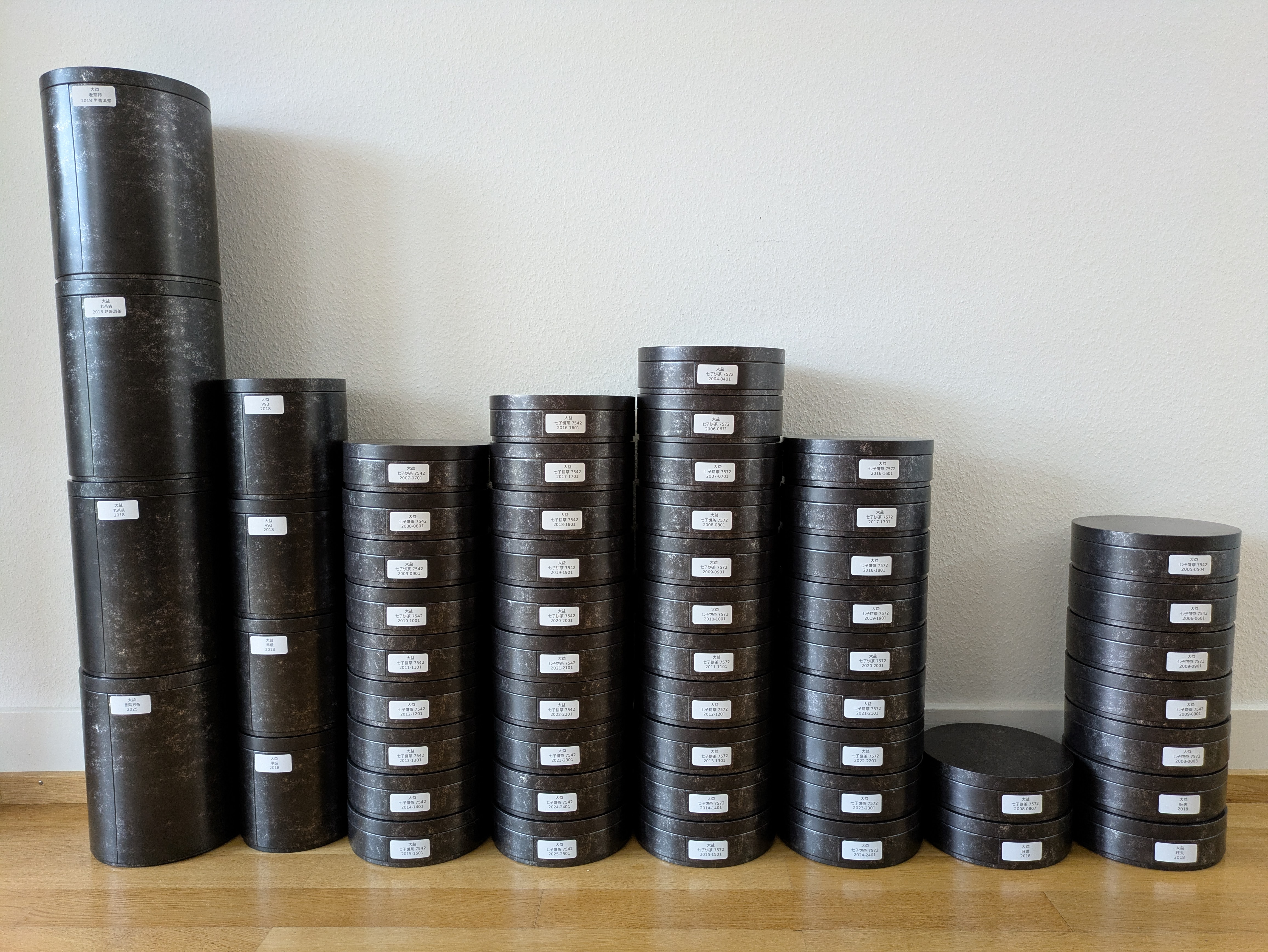
P ' r ch  storage (in Western Europe) Image: some D y P r ch stored at home
1. Location
1.1 No light Choose a location with neither direct nor indirect sunlight (= ultraviolet radiation) exposure:
  • direct sunlight damages organic material ( bleeching )
  • indirect sunlight by heating up the containers inbalances the microclimate ( suppression )
1.2 No odors Choose a location with neither direct nor indirect odor exposure:
  • direct odor immissions (like incense, food, air polution, etc.) makes the tea undrinkable
  • indirect odor immissions (especially other teas stored next to it) taint the taste and dilute the flavours
Always use individual containers for each tea, store only identical tea of the same year and batch in the same container. Idealy never store one cake, brick or tuo on its own, buy multiples and store them together for better ageing.
2. Climate
2.1 Consistent temperature Use a location with no interference from any devices or structures next to it:
  • use an regular indoor location for mild temperature curves (i.e. no attics with large day/night temperature differences)
  • aim for >= 20 C average temperature for natural storage (i.e. no cold basements)
  • don t use a place next to any heat dissipating devices (like radiators, computers, etc.)
  • don t use a place next to an outside facing wall
  • always leave 5 to 10cm distance to a wall for air to circulate (generally prevents mold on the wall but also isolates the containers further from possible immissions)
As consistent temperature as possible allows even and steady fermentation. However, neither air conditioning or filtering is needed. Regular day to day, day to night, and season to season fluctuations are balanced out fine with otherwise correct indoor storage. Also humidity control is much more important for storage and ageing, and much less forgiving than temperature control.
2.2 Consistent humidity Use humidity control packs to ensure a stable humidity level:
  • aim for ~65% RH
Lower than 60% RH will (completely) dry out the tea, higher than 70% RH increases chances for mold.
3. Equipment
3.1 Proper containers Use containers that are long term available and that are easily stackable, both in form and dimensions as well as load-bearing capacity. They should be inexpensive, otherwise it s most likely scam (there are people selling snake-oil containers specifically for tea storage). For long term storage and ageing:
  • never use plastic: they leak chemicals over time (no tupperdors , mylar and zip lock bags, etc.)
  • never use cardboard or bamboo: they let to much air in, absorb too much humity and dry to slow
  • never use wood: they emit odors (no humidors)
  • never use clay: they absorb all humidity and dry out the tea (glazed or porcelain urns are acceptable for short term storage)
Always use sealed but not air tight, cleaned steal cans (i.e. with no oil residues from manufacturing; such as these).
3.2 Proper humidity control Use two-way humidity control packs to either absorb or add moisture depending on the needs:
  • use humidity control pack(s) in every container
  • use one 60g pack (such as these) per 500g of tea
3.3 Proper labels Put labels on the outside of the containers to not need to open them to know what is inside and disturbe the ageing:
  • write at least manufacturer and name, pressing year, and batch number on the label (such as these)
  • if desired and not otherwise kept track already elsewhere, add additional information such as the amount of items, weights, previous storage location/type, date of purchase, vendor, or price, etc.
3.4 Proper monitoring Measuring and checking temperature and humidity regularly prevents storage parameters turning bad going unnoticed:
  • put temperature and humidity measurement sensors (such as these) inside some of the containers (e.g. at least one in every different size/type of container)
  • keep at least one temperature and humidity measurement sensor next to the containers on the outside to monitor the storage location
4. Storage
4.1 Continued maintenance Before beginning to initially store a new tea, let it acclimatize for 2h after unpacking from transport (or longer if temperature differences between indoors and outdoors are high, i.e. in winter). Then continuesly:
  • once a month briefly air all containers for a minute or two
  • once a month check for mold, just to be safe
  • every 3 to 6 months check all humidity control packs for need of replacement
  • monitor battery life of temperature and humidity measurement sensors
Humidity control packs can be recharged (usually voiding any warranty) by submerging them for 2 days in distilled water and 4 hours drying on paper towl afterwards. Check with a weight scale after recharging, they should regain their original weight (e.g. 60g plus ~2 to 5g for the packaging).
Finally With a correct P r ch storage:
  • beginn to drink Sh ng P r ( ) roughly after about 10-15 years, or later
  • beginn to drink Sh u P r ( ) roughly after about 3-5 years, or later
Prepare the tea by breaking it into, or breaking off from it, ~5 to 10g pieces about 1 to 3 months ahead of drinking and consider increase humidity to 70% RH during that time. 2026

31 December 2025

Sergio Cipriano: Zero-Code Instrumentation of an Envoy TCP Proxy using eBPF

Zero-Code Instrumentation of an Envoy TCP Proxy using eBPF I recently had to debug an Envoy Network Load Balancer, and the options Envoy provides just weren't enough. We were seeing a small number of HTTP 499 errors caused by latency somewhere in our cloud, but it wasn't clear what the bottleneck was. As a result, each team had to set up additional instrumentation to catch latency spikes and figure out what was going on. My team is responsible for the LBaaS product (Load Balancer as a Service) and, of course, we are the first suspects when this kind of problem appear. Before going for the current solution, I read a lot of Envoy's documentation. It is possible to enable access logs for Envoy, but they don't provide the information required for this debug. This is an example of the output:
[2025-12-08T20:44:49.918Z] "- - -" 0 - 78 223 1 - "-" "-" "-" "-" "172.18.0.2:8080"
I won't go into detail about the line above, since it's not possible to trace the request using access logs alone. Envoy also has OpenTelemetry tracing, which is perfect for understanding sources of latency. Unfortunatly, it is only available for Application Load Balancers. Most of the HTTP 499 were happening every 10 minutes, so we managed to get some of the requests with tcpdump, Wireshark and using http headers to filter the requests. This approach helped us reproduce and track down the problem, but it wasn't a great solution. We clearly needed better tools to catch this kind of issue the next time it happened. Therefore, I decided to try out OpenTelemetry eBPF Instrumentation, also referred to as OBI. I saw the announcement of Grafana Beyla before it was renamed to OBI, but I didn't have the time or a strong reason to try it out until now. Even then, I really liked the idea, and the possibility of using eBPF to solve this instrumentation problem had been in the back of my mind. OBI promises zero-code automatic instrumentation for Linux services using eBPF, so I put together a minimal setup to see how well it works.

Reproducible setup I used the following tools: Setting up a TCP Proxy with Envoy was straightforward:
static_resources:
  listeners:
  - name: go_server_listener
    address:
      socket_address:
        address: 0.0.0.0
        port_value: 8000
    filter_chains:
    - filters:
      - name: envoy.filters.network.tcp_proxy
        typed_config:
          "@type": type.googleapis.com/envoy.extensions.filters.network.tcp_proxy.v3.TcpProxy
          stat_prefix: go_server_tcp
          cluster: go_server_cluster
  clusters:
  - name: go_server_cluster
    connect_timeout: 1s
    type: LOGICAL_DNS
    load_assignment:
      cluster_name: go_server_cluster
      endpoints:
      - lb_endpoints:
        - endpoint:
            address:
              socket_address:
                address: target-backend
                port_value: 8080
This is the simplest Envoy TCP proxy configuration: a listener on port 8000 forwarding traffic to a backend running on port 8080. For the backend, I used a basic Go HTTP server:
package main

import (
    "fmt"
    "net/http"
)

func main()  
    http.Handle("/", http.FileServer(http.Dir(".")))

    server := http.Server Addr: ":8080" 

    fmt.Println("Starting server on :8080")
    panic(server.ListenAndServe())
 
Finally, I wrapped everything together with Docker Compose:
services:
  autoinstrumenter:
    image: otel/ebpf-instrument:main
    pid: "service:envoy"
    privileged: true
    environment:
      OTEL_EBPF_TRACE_PRINTER: text
      OTEL_EBPF_OPEN_PORT: 8000

  envoy:
    image: envoyproxy/envoy:v1.33-latest
    ports:
      - 8000:8000
    volumes:
      - ./envoy.yaml:/etc/envoy/envoy.yaml 
    depends_on:
      - target-backend
  
  target-backend:
    image: golang:1.22-alpine
    command: go run /app/backend.go
    volumes:
      - ./backend.go:/app/backend.go:ro
    expose:
      - 8080
OBI should output traces to the standard output similar to this when a HTTP request is made to Envoy:
2025-12-08 20:44:49.12884449 (305.572 s[305.572 s]) HTTPClient 200 GET /(/) [172.18.0.3 as envoy:36832]->[172.18.0.2 as localhost:8080] contentLen:78B responseLen:0B svc=[envoy generic] traceparent=[00-529458a2be271956134872668dc5ee47-6dba451ec8935e3e[06c7f817e6a5dae2]-01]
2025-12-08 20:44:49.12884449 (1.260901ms[366.65 s]) HTTP 200 GET /(/) [172.18.0.1 as 172.18.0.1:36282]->[172.18.0.3 as envoy:8000] contentLen:78B responseLen:223B svc=[envoy generic] traceparent=[00-529458a2be271956134872668dc5ee47-06c7f817e6a5dae2[0000000000000000]-01]
This is exactly what we needed, with zero-code. The above trace shows:
  • 2025-12-08 20:44:49.12884449: time of the trace.
  • (1.260901ms[366.65 s]): total response time for the request, with the actual internal execution time of the request (not counting the request enqueuing time).
  • HTTP 200 GET /: protocol, response code, HTTP method, and URL path.
  • [172.18.0.1 as 172.18.0.1:36282]->[172.18.0.3 as envoy:8000]: source and destination host:port. The initial request originates from my machine through the gateway (172.18.0.1), hits the Envoy (172.23.0.3), the proxy then forwards it to the backend application (172.23.0.2).
  • contentLen:78B: HTTP Content-Length. I used curl and the default request size for it is 78B.
  • responseLen:223B: Size of the response body.
  • svc=[envoy generic]: traced service.
  • traceparent: ids to trace the parent request. We can see that the Envoy makes a request to the target and this request has the other one as parent.
Let's add one more Envoy to show that it's also possible to track multiple services.
  envoy1:
    image: envoyproxy/envoy:v1.33-latest
    ports:
      - 9000:9000
    volumes:
      - ./envoy1.yaml:/etc/envoy/envoy.yaml
    depends_on:
      - envoy
The new Envoy will listen on port 9000 and forward the request to the other Envoy listening on port 8000. Now we just need to change OBI open port variable to look at a range:
OTEL_EBPF_OPEN_PORT: 8000-9000
And change the pid field of the autoinstrumenter service to use the host's PID namespace inside the container:
pid: host
This is the output I got after one curl:
2025-12-09 12:28:05.12912285 (2.202041ms[1.524713ms]) HTTP 200 GET /(/) [172.19.0.1 as 172.19.0.1:59030]->[172.19.0.5 as envoy:9000] contentLen:78B responseLen:223B svc=[envoy generic] traceparent=[00-69977bee0c2964b8fe53cdd16f8a9d19-856c9f700e73bf0d[0000000000000000]-01]
2025-12-09 12:28:05.12912285 (1.389336ms[1.389336ms]) HTTPClient 200 GET /(/) [172.19.0.5 as envoy:59806]->[172.19.0.4 as localhost:8000] contentLen:78B responseLen:0B svc=[envoy generic] traceparent=[00-69977bee0c2964b8fe53cdd16f8a9d19-caa7f1ad1c68fa77[856c9f700e73bf0d]-01]
2025-12-09 12:28:05.12912285 (1.5431ms[848.574 s]) HTTP 200 GET /(/) [172.19.0.5 as 172.19.0.5:59806]->[172.19.0.4 as envoy:8000] contentLen:78B responseLen:223B svc=[envoy generic] traceparent=[00-69977bee0c2964b8fe53cdd16f8a9d19-cbca9d64d3d26b40[caa7f1ad1c68fa77]-01]
2025-12-09 12:28:05.12912285 (690.217 s[690.217 s]) HTTPClient 200 GET /(/) [172.19.0.4 as envoy:34256]->[172.19.0.3 as localhost:8080] contentLen:78B responseLen:0B svc=[envoy generic] traceparent=[00-69977bee0c2964b8fe53cdd16f8a9d19-5502f7760ed77b5b[cbca9d64d3d26b40]-01]
2025-12-09 12:28:05.12912285 (267.9 s[238.737 s]) HTTP 200 GET /(/) [172.19.0.4 as 172.19.0.4:34256]->[172.19.0.3 as backend:8080] contentLen:0B responseLen:0B svc=[backend go] traceparent=[00-69977bee0c2964b8fe53cdd16f8a9d19-ac05c7ebe26f2530[5502f7760ed77b5b]-01]
Each log line represents a span belonging to the same trace (69977bee0c2964b8fe53cdd16f8a9d19). For readability, I ordered the spans by their traceparent relationship, showing the request's path as it moves through the system: from the client-facing Envoy, through the internal Envoy hop, and finally to the Go backend. You can see both server-side (HTTP) and client-side (HTTPClient) spans at each hop, along with per-span latency, source and destination addresses, and response sizes, making it easy to pinpoint where time is spent along the request chain. The log lines are helpful, but we need better ways to visualize the traces and the metrics generated by OBI. I'll share another setup that more closely reflects what we actually use.

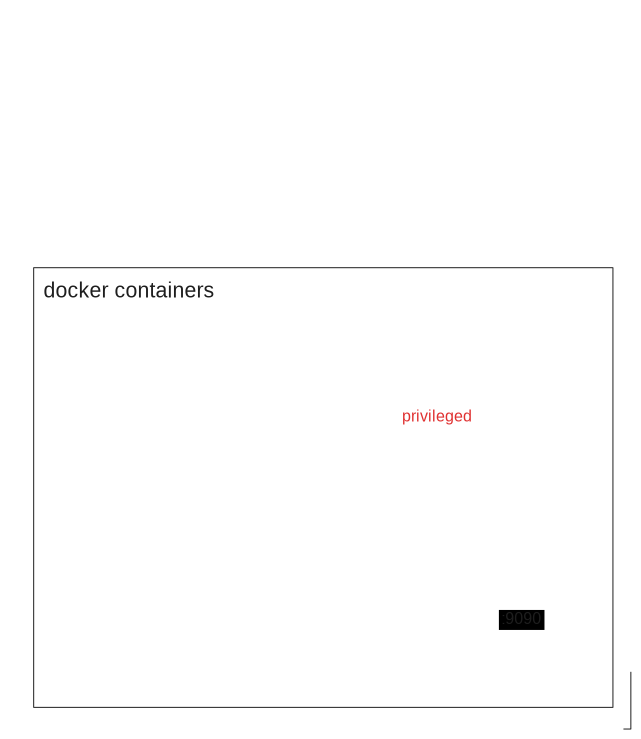
Production setup I'll be using the following tools this time: The goal of this setup is to mirror an environment similar to what I used in production. This time, I've omitted the load balancer and shifted the emphasis to observability instead. setup diagram I will run three HTTP servers on port 8080: two inside Incus containers and one on the host machine. The OBI process will export metrics and traces to an OpenTelemetry Collector, which will forward traces to Jaeger and expose a metrics endpoint for Prometheus to scrape. Grafana will also be added to visualize the collected metrics using dashboards. The aim of this approach is to instrument only one of the HTTP servers while ignoring the others. This simulates an environment with hundreds of Incus containers, where the objective is to debug a single container without being overwhelmed by excessive and irrelevant telemetry data from the rest of the system. OBI can filter metrics and traces based on attribute values, but I was not able to filter by process PID. This is where the OBI Collector comes into play, it allows me to use a processor to filter telemetry data by the PID of the process being instrumented. These are the steps to reproduce this setup:
  1. Create the incus containers.
$ incus launch images:debian/trixie server01
Launching server01
$ incus launch images:debian/trixie server02
Launching server02
  1. Start the HTTP server on each container.
$ apt install python3 --update -y
$ tee /etc/systemd/system/server.service > /dev/null <<'EOF'
[Unit]
Description=Python HTTP server
After=network.target
[Service]
User=root
Group=root
Type=simple
ExecStart=/usr/bin/python3 -m http.server 8080
Restart=always
StandardOutput=journal
StandardError=journal
[Install]
WantedBy=multi-user.target
EOF
$ systemctl start server.service
  1. Start the HTTP server on the host.
$ python3 -m http.server 8080
  1. Start the Docker compose.
services:
  autoinstrumenter:
    image: otel/ebpf-instrument:main
    pid: host
    privileged: true
    environment:
      OTEL_EBPF_CONFIG_PATH: /etc/obi/obi.yml 
    volumes:
      - ./obi.yml:/etc/obi/obi.yml

  otel-collector:
    image: otel/opentelemetry-collector-contrib:0.98.0
    command: ["--config=/etc/otel-collector-config.yml"]
    volumes:
      - ./otel-collector-config.yml:/etc/otel-collector-config.yml
    ports:
      - "4318:4318" # Otel Receiver
      - "8889:8889" # Prometheus Scrape
    depends_on:
      - autoinstrumenter
      - jaeger
      - prometheus

  prometheus:
    image: prom/prometheus
    volumes:
      - ./prometheus.yml:/etc/prometheus/prometheus.yml
    ports:
      - "9090:9090" # Prometheus UI

  grafana:
    image: grafana/grafana
    restart: always
    environment:
      - GF_SECURITY_ADMIN_USER=admin
      - GF_SECURITY_ADMIN_PASSWORD=RandomString123!
    volumes:
      - ./grafana-ds.yml:/etc/grafana/provisioning/datasources/datasource.yml
    ports:
      - "3000:3000" # Grafana UI

  jaeger:
    image: jaegertracing/all-in-one
    container_name: jaeger
    ports:
      - "16686:16686" # Jaeger UI
      - "4317:4317"  # Jaeger OTLP/gRPC Collector
Here's what the configuration files look like:
  • obi.yml:
log_level: INFO
trace_printer: text

discovery:
  instrument:
    - open_ports: 8080

otel_metrics_export:
  endpoint: http://otel-collector:4318
otel_traces_export:
  endpoint: http://otel-collector:4318
  • prometheus.yml:
global:
  scrape_interval: 5s

scrape_configs:
  - job_name: 'otel-collector'
    static_configs:
      - targets: ['otel-collector:8889']
  • grafana-ds.yml:
apiVersion: 1

datasources:
  - name: Prometheus
    type: prometheus
    access: proxy
    url: http://prometheus:9090
    isDefault: true
  • otel-collector-config.yml:
receivers:
  otlp:
    protocols:
      http:
        endpoint: otel-collector:4318

exporters:
  otlp/jaeger:
    endpoint: jaeger:4317
    tls:
      insecure: true

  prometheus:
    endpoint: 0.0.0.0:8889
    namespace: default

service:
  pipelines:
    traces:
      receivers: [otlp]
      exporters: [otlp/jaeger]

    metrics:
      receivers: [otlp] 
      exporters: [prometheus]
We're almost there, the OpenTelemetry Collector is just missing a processor. To create the processor filter, we can look at the OBI logs to find the PID of the HTTP server being instrumented:
autoinstrumenter-1    time=2025-12-30T19:57:17.593Z level=INFO msg="instrumenting process" component=discover.traceAttacher cmd=/usr/bin/python3.13 pid=297514 ino=460310 type=python service=""
autoinstrumenter-1    time=2025-12-30T19:57:18.320Z level=INFO msg="instrumenting process" component=discover.traceAttacher cmd=/usr/bin/python3.13 pid=310288 ino=722998 type=python service=""
autoinstrumenter-1    time=2025-12-30T19:57:18.512Z level=INFO msg="instrumenting process" component=discover.traceAttacher cmd=/usr/bin/python3.13 pid=315183 ino=2888480 type=python service=""
Which can also be obtained using standard GNU/Linux utilities:
$ cat /sys/fs/cgroup/lxc.payload.server01/system.slice/server.service/cgroup.procs 
297514
$ cat /sys/fs/cgroup/lxc.payload.server02/system.slice/server.service/cgroup.procs 
310288
$ ps -aux   grep http.server
USER         PID %CPU %MEM    VSZ   RSS TTY      STAT START   TIME COMMAND
1000000   297514  0.0  0.1  32120 14856 ?        Ss   16:03   0:00 /usr/bin/python3 -m http.server 8080
1000000   310288  0.0  0.1  32120 10616 ?        Ss   16:09   0:00 /usr/bin/python3 -m http.server 8080
cipriano  315183  0.0  0.1 103476 11480 pts/3    S+   16:17   0:00 python -m http.server 8080
If we search for the PID in the OpenTelemetry Collector endpoint where Prometheus metrics are exposed, we can find the attribute values to filter on.
$ curl http://localhost:8889/metrics   rg 297514
default_target_info host_id="148f400ad3ea",host_name="148f400ad3ea",instance="148f400ad3ea:297514",job="python3.13",os_type="linux",service_instance_id="148f400ad3ea:297514",service_name="python3.13",telemetry_sdk_language="python",telemetry_sdk_name="opentelemetry-ebpf-instrumentation",telemetry_sdk_version="main"  1
Now we just need to add the processor to the collector configuration:
processors: # <--- NEW BLOCK
  filter/host_id:
    traces:
      span:
        - 'resource.attributes["service.instance.id"] == "148f400ad3ea:297514"'

service:
  pipelines:
    traces:
      receivers: [otlp]
      processors: [filter/host_id] # <--- NEW LINE
      exporters: [otlp/jaeger]

    metrics:
      receivers: [otlp] 
      processors:  # <--- NEW BLOCK
        - filter/host_id
      exporters: [prometheus]
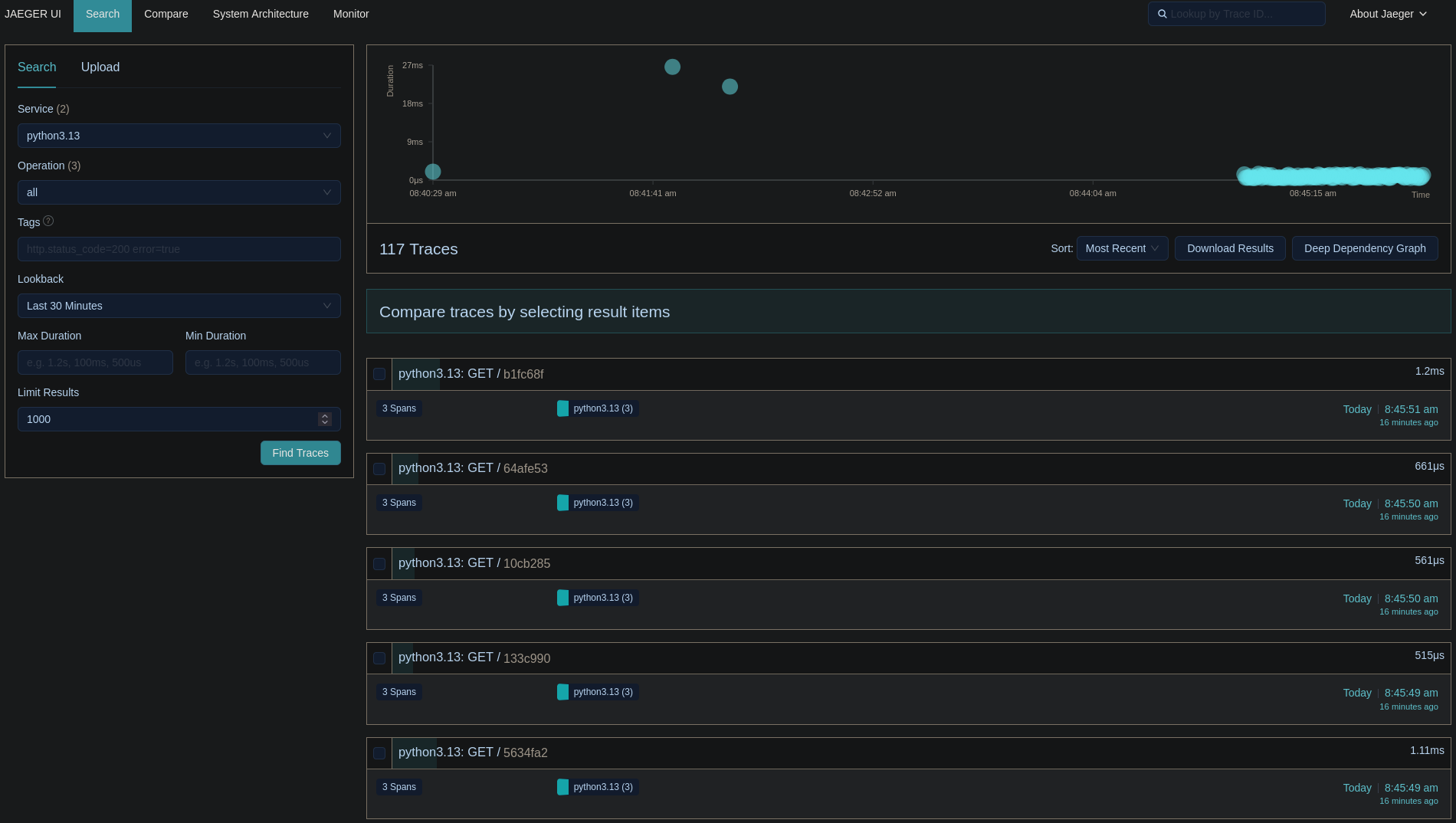
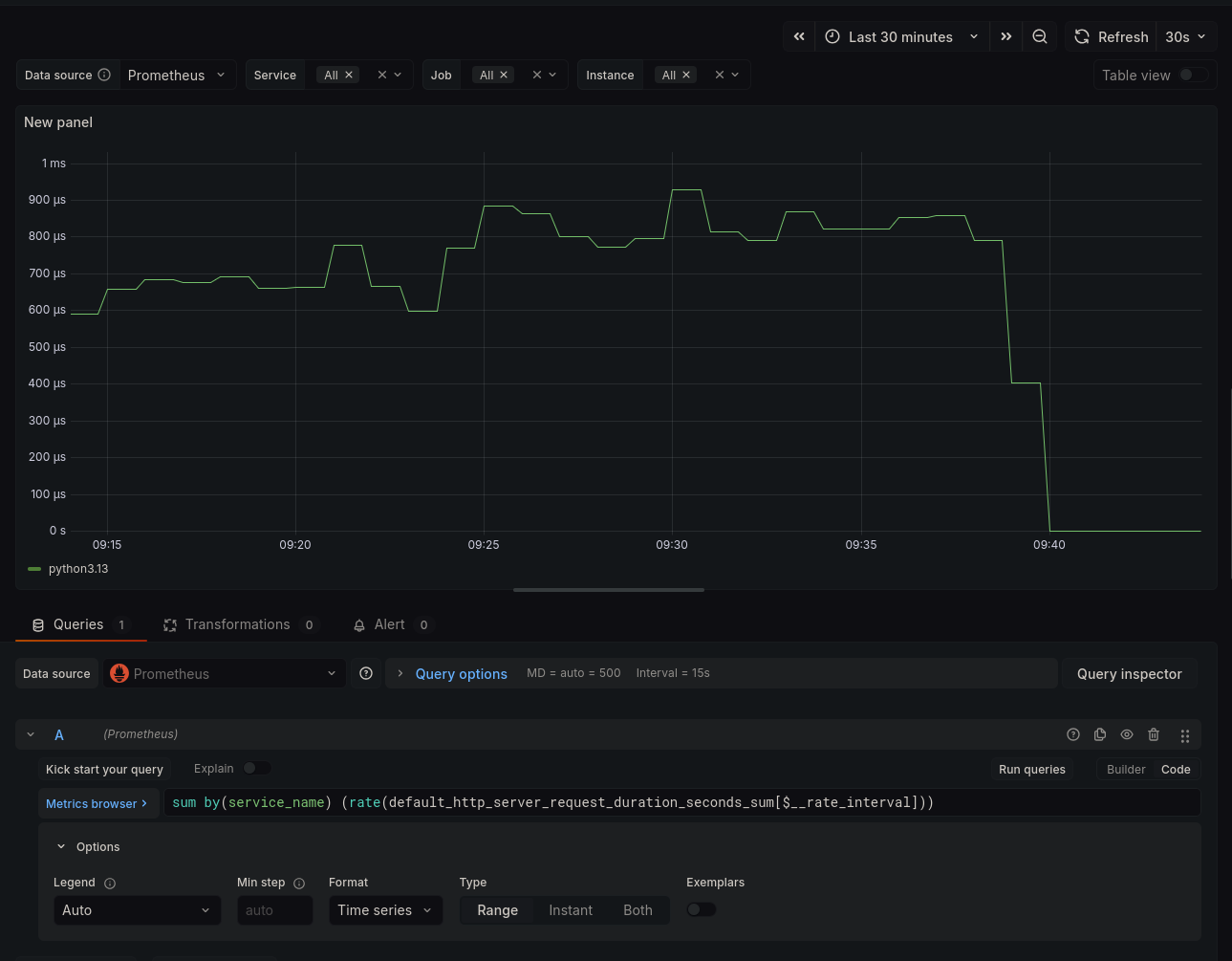
That's it! The processor will handle the filtering for us, and we'll only see traces and metrics from the HTTP server running in the server01 container. Below are some screenshots from Jaeger and Grafana: jaeger search will all traces one jaeger trace grafana request duration panel

Closing Notes I am still amazed at how powerful OBI can be. For those curious about the debug, we found out that a service responsible for the network orchestration of the Envoy containers was running netplan apply every 10 minutes because of a bug. Netplan apply causes interfaces to go down temporarily and this made the latency go above 500ms which caused the 499s.

23 December 2025

Jonathan Dowland: Remarkable

Remarkable tablet displaying my 2025 planner PDF. My Remarkable tablet, displaying my 2025 planner.
During my PhD, on a sunny summer s day, I copied some papers to read onto an iPad and cycled down to an outdoor cafe next to the beach. armed with a coffee and an ice cream, I sat and enjoyed the warmth. The only problem was that due to the bright sunlight, I couldn t see a damn thing. In 2021 I decided to take the plunge and buy the Remarkable 2 that has been heavily advertised at the time. Over the next four or so years, I made good use of it to read papers; read drafts of my own papers and chapters; read a small number of technical books; use as a daily planner; take meeting notes for work, PhD and later, personal matters. I didn t buy the remarkable stylus or folio cover instead opting for a (at the time, slightly cheaper) LAMY AL-star EMR. And a fantastic fabric sleeve cover from Emmerson Gray. I installed a hack which let me use the Lamy s button to activate an eraser and also added a bunch of other tweaks. I wouldn t recommend that specific hack anymore as there are safer alternatives (personally untested, but e.g. https://github.com/isaacwisdom/RemarkableLamyEraser) Pros: the writing experience is unparalleled. Excellent. I enjoy writing with fountain pens on good paper but that experience comes with inky fingers, dried up nibs, and a growing pile of paper notebooks. The remarkable is very nearly as good without those drawbacks. Cons: lower contrast than black on white paper and no built in illumination. It needs good light to read. Almost the opposite problem to the iPad! I ve tried a limited number of external clip on lights but nothing is frictionless to use. The traditional two-column, wide margin formatting for academic papers is a bad fit for the remarkable s size (just as it is for computer display sizes. Really is it good for anything people use anymore?). You can pinch to zoom which is OK, or pre-process papers (with e.g. Briss) to reframe them to be more suitable but that s laborious. The newer model, the Remarkable Paper Pro, might address both those issues: its bigger; has illumination and has also added colour which would be a nice to have. It s also a lot more expensive. I had considered selling on the tablet after I finished my PhD. My current plan, inspired to some extent by my former colleague Aleksey Shipil v, who makes great use of his, is to have a go at using it more often, to see if it continues to provide value for me: more noodling out thoughts for work tasks, more drawings (e.g. plans for 3D models) and more reading of tech books.

22 December 2025

Jonathan McDowell: NanoKVM: I like it

I bought a NanoKVM. I d heard some of the stories about how terrible it was beforehand, and some I didn t learn about until afterwards, but at 52, including VAT + P&P, that seemed like an excellent bargain for something I was planning to use in my home network environment. Let s cover the bad press first. apalrd did a video, entitled NanoKVM: The S stands for Security (Armen Barsegyan has a write up recommending a PiKVM instead that lists the objections raised in the video). Matej Kova i wrote an article about the hidden microphone on a Chinese NanoKVM. Various other places have picked up both of these and still seem to be running with them, 10 months later. Next, let me explain where I m coming from here. I have over 2 decades of experience with terrible out-of-band access devices. I still wince when I think of the Sun Opteron servers that shipped with an iLOM that needed a 32-bit Windows browser in order to access it (IIRC some 32 bit binary JNI blob). It was a 64 bit x86 server from a company who, at the time, still had a major non-Windows OS. Sheesh. I do not assume these devices are fit for exposure to the public internet, even if they come from reputable vendors. Add into that the fact the NanoKVM is very much based on a development board (the LicheeRV Nano), and I felt I knew what I was getting into here. And, as a TL;DR, I am perfectly happy with my purchase. Sipeed have actually dealt with a bunch of apalrd s concerns (GitHub ticket), which I consider to be an impressive level of support for this price point. Equally the microphone is explained by the fact this is a 52 device based on a development board. You re giving it USB + HDMI access to a host on your network, if you re worried about the microphone then you re concentrating on the wrong bit here. I started out by hooking the NanoKVM up to my Raspberry Pi classic, which I use as a serial console / network boot tool for working on random bits of hardware. That meant the NanoKVM had no access to the outside world (the Pi is not configured to route, or NAT, for the test network interface), and I could observe what went on. As it happens you can do an SSH port forward of port 80 with this sort of setup and it all works fine - no need for the NanoKVM to have any external access, and it copes happily with being accessed as http://localhost:8000/ (though you do need to choose MJPEG as the video mode, more forwarding or enabling HTTPS is needed for an H.264 WebRTC session). IPv6 is enabled in the kernel. My test setup doesn t have a router advertisements configured, but I could connect to the web application over the v6 link-local address that came up automatically. My device reports:
Image version:              v1.4.1
Application version:        2.2.9
That s recent, but the GitHub releases page has 2.3.0 listed as more recent. Out of the box it s listening on TCP port 80. SSH is not running, but there s a toggle to turn it on and the web interface offers a web based shell (with no extra authentication over the normal login). On first use I was asked to set a username + password. Default access, as you d expect from port 80, is HTTP, but there s a toggle to enable HTTPS. It generates a self signed certificate - for me it had the CN localhost but that might have been due to my use of port forwarding. Enabling HTTPS does not disable HTTP, but HTTP just redirects to the HTTPS URL. As others have discussed it does a bunch of DNS lookups, primarily for NTP servers but also for cdn.sipeed.com. The DNS servers are hard coded:
~ # cat /etc/resolv.conf
nameserver 192.168.0.1
nameserver 8.8.4.4
nameserver 8.8.8.8
nameserver 114.114.114.114
nameserver 119.29.29.29
nameserver 223.5.5.5
This is actually restored on boot from /boot/resolv.conf, so if you want changes to persist you can just edit that file. NTP is configured with a standard set of pool.ntp.org services in /etc/ntp.conf (this does not get restored on reboot, so can just be edited in place). I had dnsmasq on the Pi setup to hand out DNS + NTP servers, but both were ignored (though actually udhcpc does write the DNS details to /etc/resolv.conf.dhcp). My assumption is the lookup to cdn.sipeed.com is for firmware updates (as I bought the NanoKVM cube it came fully installed, so no need for a .so download to make things work); when working DNS was provided I witness attempts to connect to HTTPS. I ve not bothered digging further into this. I did go grab the latest.zip being served from the URL, which turned out to be v2.2.9, matching what I have installed, not the latest on GitHub. I note there s an iptables setup (with nftables underneath) that s not fully realised - it seems to be trying to allow inbound HTTP + WebRTC, as well as outbound SSH, but everything is default accept so none of it gets hit. Setting up a default deny outbound and tweaking a little should provide a bit more reassurance it s not going to try and connect out somewhere it shouldn t. It looks like updates focus solely on the KVM application, so I wanted to take a look at the underlying OS. This is buildroot based:
~ # cat /etc/os-release
NAME=Buildroot
VERSION=-g98d17d2c0-dirty
ID=buildroot
VERSION_ID=2023.11.2
PRETTY_NAME="Buildroot 2023.11.2"
The kernel reports itself as 5.10.4-tag-. Somewhat ancient, but actually an LTS kernel. Except we re now up to 5.10.247, so it obviously hasn t been updated in some time. TBH, this is what I expect (and fear) from embedded devices. They end up with some ancient base OS revision and a kernel with a bunch of hacks that mean it s not easily updated. I get that the margins on this stuff are tiny, but I do wish folk would spend more time upstreaming. Or at least updating to the latest LTS point release for their kernel. The SSH client/daemon is full-fat OpenSSH:
~ # sshd -V
OpenSSH_9.6p1, OpenSSL 3.1.4 24 Oct 2023
There are a number of CVEs fixed in later OpenSSL 3.1 versions, though at present nothing that looks too concerning from the server side. Yes, the image has tcpdump + aircrack installed. I m a little surprised at aircrack (the device has no WiFi and even though I know there s a variant that does, it s not a standard debug tool the way tcpdump is), but there s a copy of GNU Chess in there too, so it s obvious this is just a kitchen-sink image. FWIW it looks like the buildroot config is here. Sadly the UART that I believe the bootloader/kernel are talking to is not exposed externally - the UART pin headers are for UART1 + 2, and I d have to open up the device to get to UART0. I ve not yet done this (but doing so would also allow access to the SD card, which would make trying to compile + test my own kernel easier). In terms of actual functionality it did what I d expect. 1080p HDMI capture was fine. I d have gone for a lower resolution, but I think that would have required tweaking on the client side. It looks like the 2.3.0 release allows EDID tweaking, so I might have to investigate that. The keyboard defaults to a US layout, which caused some problems with the symbol until I reconfigured the target machine not to expect a GB layout. There s also the potential to share out images via USB. I copied a Debian trixie netinst image to /data on the NanoKVM and was able to select it in the web interface and have it appear on the target machine easily. There s also the option to fetch direct from a URL in the web interface, but I was still testing without routable network access, so didn t try that. There s plenty of room for images:
~ # df -h
Filesystem                Size      Used Available Use% Mounted on
/dev/mmcblk0p2            7.6G    823.3M      6.4G  11% /
devtmpfs                 77.7M         0     77.7M   0% /dev
tmpfs                    79.0M         0     79.0M   0% /dev/shm
tmpfs                    79.0M     30.2M     48.8M  38% /tmp
tmpfs                    79.0M    124.0K     78.9M   0% /run
/dev/mmcblk0p1           16.0M     11.5M      4.5M  72% /boot
/dev/mmcblk0p3           22.2G    160.0K     22.2G   0% /data
The NanoKVM also appears as an RNDIS USB network device, with udhcpd running on the interface. IP forwarding is not enabled, and there s no masquerading rules setup, so this doesn t give the target host access to the management LAN by default. I guess it could be useful for copying things over to the target host, as a more flexible approach than a virtual disk image. One thing to note is this makes for a bunch of devices over the composite USB interface. There are 3 HID devices (keyboard, absolute mouse, relative mouse), the RNDIS interface, and the USB mass storage. I had a few occasions where the keyboard input got stuck after I d been playing about with big data copies over the network and using the USB mass storage emulation. There is a HID-only mode (no network/mass storage) to try and help with this, and a restart of the NanoKVM generally brought things back, but something to watch out for. Again I see that the 2.3.0 application update mentions resetting the USB hardware on a HID reset, which might well help. As I stated at the start, I m happy with this purchase. Would I leave it exposed to the internet without suitable firewalling? No, but then I wouldn t do so for any KVM. I wanted a lightweight KVM suitable for use in my home network, something unlikely to see heavy use but that would save me hooking up an actual monitor + keyboard when things were misbehaving. So far everything I ve seen says I ve got my money s worth from it.
Emmanuel Kasper: Configuring a mail transfer agent to interact with the Debian bug tracker

Email interface of the Debian bug tracker The main interface of the Debian bug tracker, at http://bugs.debian.org, is e-mail, and modifications are made to existing bugs by sending an email to an address like 873518@bugs.Debian.org. The web interface allows to browse bugs, but any addition to the bug itself will require an email client. This sounds a bit weird in 2025, as http REST clients with Oauth access tokens for command line tools interacting with online resources are today the norm. However we should remember the Debian project goes back to 1993 and the bug tracker software debugs, was released in 1994. REST itself was first introduced in 2000, six years later. In any case, using an email client to create or modify bug reports is not a bad idea per se:
  • the internet mail protocol, SMTP, is a well known and standardized protocol defined in an IETF RFC.
  • no need for account creation and authentication, you just need an email address to interact. There is a risk of spam, but in my experience this has been very low. When authentication is needed, Debian Developpers sign their work with their private GPG key.
  • you can use the bug tracker using the interface of your choice: webmail, graphical mail clients like Thunderbird or Evolution, text clients like Mutt or Pine, or command line tools like bts.
A system wide minimal Mail Transfer Agent to send mail We can configure bts as a SMTP client, with username and password. In SMTP client mode, we would need to enter the SMTP settings from our mail service provider. The other option is to configure a Mail Transfer Agent (MTA) which provides a system wide sendmail interface, that all command line and automation tools can use send email. For instance reportbug and git send-email are able to use the sendmail interface. Why a sendmail interface ? Because sendmail used to be the default MTA of Unix back in the days, thus many programs sending mails expect something which looks like sendmail locally. A popular, maintained and packaged minimal MTA is msmtp, we are going to use it. msmtp installation and configuration Installation is just an apt away:
# apt install msmtp msmtp-mta
# msmtp --version
msmtp version 1.8.23
You can follow this blog post to configure msmtp, including saving your mail account credentials in the Gnome keyring. Once installed, you can verify that msmtp-mta created a sendmail symlink.
$ ls -l /usr/sbin/sendmail 
lrwxrwxrwx 1 root root 12 16 avril  2025 /usr/sbin/sendmail -&gt; ../bin/msmtp
bts, git-send-email and reportbug will pipe their output to /usr/sbin/sendmail and msmtp will send the email in the background. Testing with with a simple mail client Debian comes out of the box with a primitive mail client, bsd-mailx that you can use to test your MTA set up. If you have configured msmtp correctly you send an email to yourself using
$ echo "hello world"   mail -s "my mail subject" user@domain.org
Now you can open bugs for Debian with reportbug, tag them with bts and send git formated patches from the command line with git send-email.

19 December 2025

Otto Kek l inen: Backtesting trailing stop-loss strategies with Python and market data

Featured image of post Backtesting trailing stop-loss strategies with Python and market dataIn January 2024 I wrote about the insanity of the Magnificent Seven dominating the MSCI World Index, and I wondered how long the number can continue to go up? It has continued to surge upward at an accelerating pace, which makes me worry that a crash is likely closer. As a software professional, I decided to analyze whether using stop-loss orders could reliably automate avoiding deep drawdowns. As everyone with some savings in the stock market (hopefully) knows, the stock market eventually experiences crashes. It is just a matter of when and how deep the crash will be. Staying on the sidelines for years is not a good investment strategy, as inflation will erode the value of your savings. Assuming the current true inflation rate is around 7%, a restaurant dinner that costs 20 euros today will cost 24.50 euros in three years. Savings of 1000 euros today would drop in purchasing power from 50 dinners to only 40 dinners in three years. Hence, if you intend to retain the value of your hard-earned savings, they need to be invested in something that grows in value. Most people try to beat inflation by buying shares in stable companies, directly or via broad market ETFs. These historically grow faster than inflation during normal years, but likely drop in value during recessions.

What is a trailing stop-loss order? What if you could buy stocks to benefit from their value increasing without having to worry about a potential crash? All modern online stock brokers have a feature called stop-loss, where you can enter a price at which your stocks automatically get sold if they drop down to that price. A trailing stop-loss order is similar, but instead of a fixed price, you enter a margin (e.g. 10%). If the stock price rises, the stop-loss price will trail upwards by that margin. For example, if you buy a share at 100 euros and it has risen to 110 euros, you can set a 10% trailing stop-loss order which automatically sells it if the price drops 10% from the peak of 110 euros, at 99 euros. Thus, no matter what happens, you only lost 1 euro. And if the stock price continues to rise to 150 euros, the trailing stop-loss would automatically readjust to 150 euros minus 10%, which is 135 euros (150-15=135). If the price dropped to 135 euros, you would lock in a gain of 35 euros, which is not the peak price of 150 euros, but still better than whatever the price fell down to as a result of a large crash. In the simple case above, it obviously makes sense in theory, but it might not make sense in practice. Prices constantly oscillate, so you don t want a margin that is too small, otherwise you exit too early. Conversely, having a large margin may result in too large a drawdown before exiting. If markets crash rapidly, it might be that nobody buys your stocks at the stop-loss price, and shares have to be sold at an even lower price. Also, what will you do once the position is sold? The reason you invested in the stock market was to avoid holding cash, so would you buy the same stock back when the crash bottoms? But how will you know when the bottom has been reached?

Backtesting stock market strategies with Python, YFinance, Pandas and Lightweight Charts I am not a professional investor, and nobody should take investment advice from me. However, I know what backtesting is and how to leverage open source software. So, I wrote a Python script to test if the trading strategy of using trailing stop-loss orders with specific margin values would have worked for a particular stock. First you need to have data. YFinance is a handy Python library that can be used to download the historic price data for any stock ticker on Yahoo.com. Then you need to manipulate the data. Pandas is the Python data analysis library with advanced data structures for working with relational or labeled data. Finally, to visualize the results, I used Lightweight Charts, which is a fast, interactive library for rendering financial charts, allowing you to plot the stock price, the trailing stop-loss line, and the points where trades would have occurred. I really like how the zoom is implemented in Lightweight Charts, which makes drilling into the data points feel effortless. The full solution is not polished enough to be published for others to use, but you can piece together your own by reusing some of the key snippets. To avoid re-downloading the same data repeatedly, I implemented a small caching wrapper that saves the data locally (as Parquet files):
python
CACHE_DIR.mkdir(parents=True, exist_ok=True)
end_date = datetime.today().strftime("%Y-%m-%d")
cache_file = CACHE_DIR / f" TICKER - START_DATE -- end_date .parquet"

if cache_file.is_file():
 dataframe = pandas.read_parquet(cache_file)
 print(f"Loaded price data from cache:  cache_file ")
else:
 dataframe = yfinance.download(
 TICKER,
 start=START_DATE,
 end=end_date,
 progress=False,
 auto_adjust=False
 )

 dataframe.to_parquet(cache_file)
 print(f"Fetched new price data from Yahoo Finance and cached to:  cache_file ")
The dataframe is a Pandas object with a powerful API. For example, to print a snippet from the beginning and the end of the dataframe to see what the data looks like, you can use:
python
print("First 5 rows of the raw data:")
print(df.head())
print("Last 5 rows of the raw data:")
print(df.tail())
Example output:
First 5 rows of the raw data
Price Adj Close Close High Low Open Volume
Ticker BNP.PA BNP.PA BNP.PA BNP.PA BNP.PA BNP.PA
Date
2014-01-02 29.956285 55.540001 56.910000 55.349998 56.700001 316552
2014-01-03 30.031801 55.680000 55.990002 55.290001 55.580002 210044
2014-01-06 30.080338 55.770000 56.230000 55.529999 55.560001 185142
2014-01-07 30.943321 57.369999 57.619999 55.790001 55.880001 370397
2014-01-08 31.385597 58.189999 59.209999 57.750000 57.790001 489940
Last 5 rows of the raw data
Price Adj Close Close High Low Open Volume
Ticker BNP.PA BNP.PA BNP.PA BNP.PA BNP.PA BNP.PA
Date
2025-12-11 78.669998 78.669998 78.919998 76.900002 76.919998 357918
2025-12-12 78.089996 78.089996 80.269997 78.089996 79.470001 280477
2025-12-15 79.080002 79.080002 79.449997 78.559998 78.559998 233852
2025-12-16 78.860001 78.860001 79.980003 78.809998 79.430000 283057
2025-12-17 80.080002 80.080002 80.150002 79.080002 79.199997 262818
Adding new columns to the dataframe is easy. For example, I used a custom function to calculate the Relative Strength Index (RSI). To add a new column RSI with a value for every row based on the price from that row, only one line of code is needed, without custom loops:
python
df["RSI"] = compute_rsi(df["price"], period=14)
After manipulating the data, the series can be converted into an array structure and printed as JSON into a placeholder in an HTML template:
python
 baseline_series = [
  "time": ts, "value": val 
 for ts, val in df_plot[["timestamp", BASELINE_LABEL]].itertuples(index=False)
 ]

 baseline_json = json.dumps(baseline_series)
 template = jinja2.Template("template.html")
 rendered_html = template.render(
 title=title,
 heading=heading,
 description=description_html,
 ...
 baseline_json=baseline_json,
 ...
 )

 with open("report.html", "w", encoding="utf-8") as f:
 f.write(rendered_html)
 print("Report generated!")
In the HTML template, the marker variable in Jinja syntax gets replaced with the actual JSON:
html
<!DOCTYPE html>
<html lang="en">
<head>
 <meta charset="UTF-8">
 <title>  title  </title>
 ...
</head>
<body>
 <h1>  heading  </h1>
 <div id="chart"></div>
 <script>
 // Ensure the DOM is ready before we initialise the chart
 document.addEventListener('DOMContentLoaded', () =>  
 // Parse the JSON data passed from Python
 const baselineData =   baseline_json   safe  ;
 const strategyData =   strategy_json   safe  ;
 const markersData =   markers_json   safe  ;

 // Create the chart
 const chart = LightweightCharts.createChart(document.getElementById('chart'),  
 width: document.getElementById('chart').clientWidth,
 height: 500,
 layout:  
 background:   color: "#222"  ,
 textColor: "#ccc"
  ,
 grid:  
 vertLines:   color: "#555"  ,
 horzLines:   color: "#555"  
  
  );

 // Add baseline series
 const baselineSeries = chart.addLineSeries( 
 title: '  baseline_label  ',
 lastValueVisible: false,
 priceLineVisible: false,
 priceLineWidth: 1
  );
 baselineSeries.setData(baselineData);

 baselineSeries.priceScale().applyOptions( 
 entireTextOnly: true
  );

 // Add strategy series
 const strategySeries = chart.addLineSeries( 
 title: '  strategy_label  ',
 lastValueVisible: false,
 priceLineVisible: false,
 color: '#FF6D00'
  );
 strategySeries.setData(strategyData);

 // Add buy/sell markers to the strategy series
 strategySeries.setMarkers(markersData);

 // Fit the chart to show the full data range (full zoom)
 chart.timeScale().fitContent();
  )
 </script>
</body>
</html>
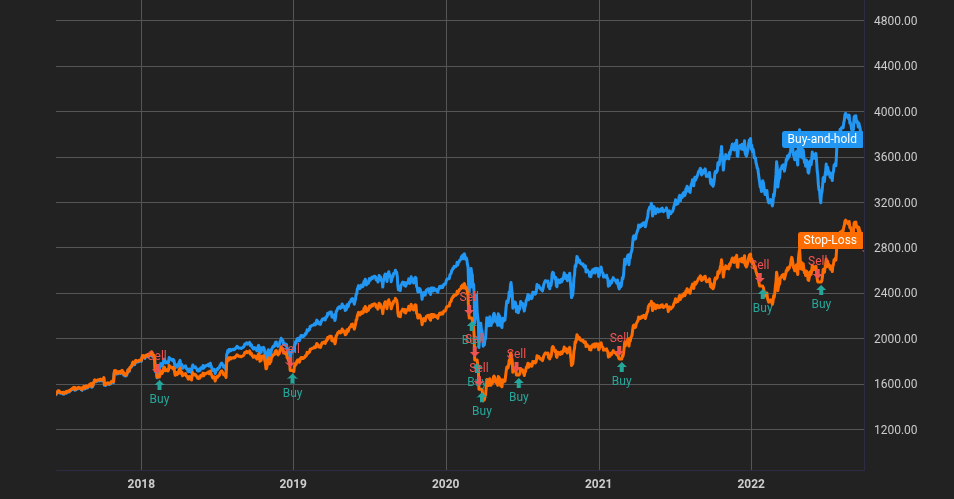
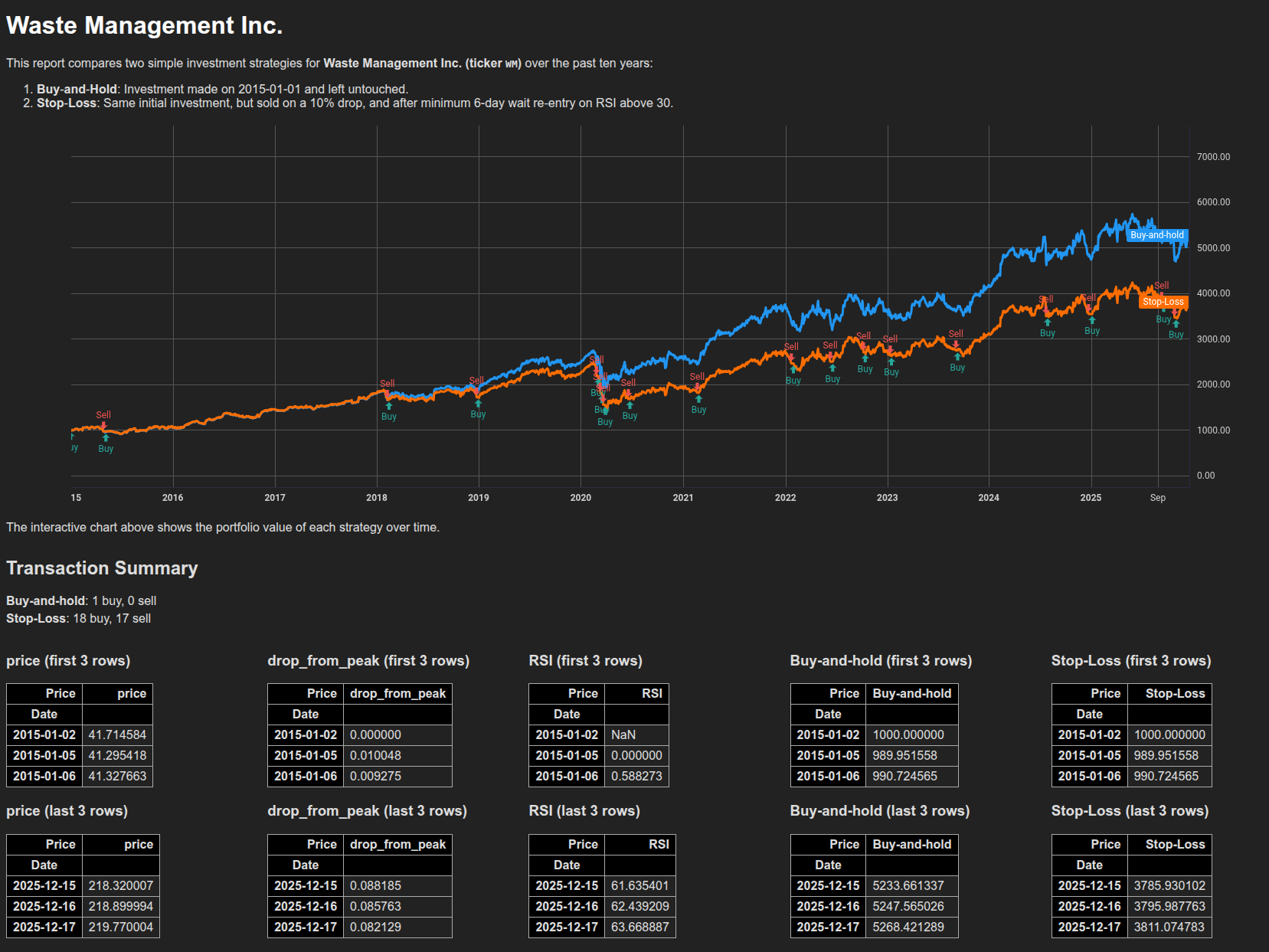
There are also Python libraries built specifically for backtesting investment strategies, such as Backtrader and Zipline, but they do not seem to be actively maintained, and probably have too many features and complexity compared to what I needed for doing this simple test. The screenshot below shows an example of backtesting a strategy on the Waste Management Inc stock from January 2015 to December 2025. The baseline Buy and hold scenario is shown as the blue line and it fully tracks the stock price, while the orange line shows how the strategy would have performed, with markers for the sells and buys along the way. Backtest run example

Results I experimented with multiple strategies and tested them with various parameters, but I don t think I found a strategy that was consistently and clearly better than just buy-and-hold. It basically boils down to the fact that I was not able to find any way to calculate when the crash has bottomed based on historical data. You can only know in hindsight that the price has stopped dropping and is on a steady path to recovery, but at that point it is already too late to buy in. In my testing, most strategies underperformed buy-and-hold because they sold when the crash started, but bought back after it recovered at a slightly higher price. In particular when using narrow margins and selling on a 3-6% drawdown the strategy performed very badly, as those small dips tend to recover in a few days. Essentially, the strategy was repeating the pattern of selling 100 stocks at a 6% discount, then being able to buy back only 94 shares the next day, then again selling 94 shares at a 6% discount, and only being able to buy back maybe 90 shares after recovery, and so forth, never catching up to the buy-and-hold. The strategy worked better in large market crashes as they tended to last longer, and there were higher chances of buying back the shares while the price was still low. For example, in the 2020 crash selling at a 20% drawdown was a good strategy, as the stock I tested dropped nearly 50% and remained low for several weeks; thus, the strategy bought back the stocks while the price was still low and had not yet started to climb significantly. But that was just a lucky incident, as the delta between the trailing stop-loss margin of 20% and total crash of 50% was large enough. If the crash had been only 25%, the strategy would have missed the rebound and ended up buying back the stocks at a slightly higher price. Also, note that the simulation assumes that the trade itself is too small to affect the price formation. We should keep in mind that in reality, if many people have stop-loss orders in place, a large price drop would trigger all of them, creating a flood of sell orders, which in turn would affect the price and drive it lower even faster and deeper. Luckily, it seems that stop-loss orders are generally not a good strategy, and we don t need to fear that too many people will be using them.

Conclusion Even though using a trailing stop-loss strategy does not seem to help in getting consistently higher returns based on my backtesting, I would still say it is useful in protecting from the downside of stock investing. It can act as a kind of insurance policy to considerably decrease the chances of losing big while increasing the chances of losing a little bit. If you are risk-averse, which I think I probably am, this tradeoff can make sense. I d rather miss out on an initial 50% loss and an overall 3% gain on recovery than have to sit through weeks or months with a 50% loss before the price recovers to prior levels. Most notably, the trailing stop-loss strategy works best if used only once. If it is repeated multiple times, the small losses in gains will compound into big losses overall. Thus, I think I might actually put this automation in place at least on the stocks in my portfolio that have had the highest gains. If they keep going up, I will ride along, but once the crash happens, I will be out of those particular stocks permanently. Do you have a favorite open source investment tool or are you aware of any strategy that actually works? Comment below!

16 December 2025

Freexian Collaborators: Monthly report about Debian Long Term Support, November 2025 (by Santiago Ruano Rinc n)

The Debian LTS Team, funded by [Freexian s Debian LTS offering] (https://www.freexian.com/lts/debian/), is pleased to report its activities for November.

Activity summary During the month of November, 18 contributors have been paid to work on Debian LTS (links to individual contributor reports are located below). The team released 33 DLAs fixing 219 CVEs. The LTS Team kept going with the usual cadence of preparing security updates for Debian 11 bullseye , but also for Debian 12 bookworm , Debian 13 trixie and even Debian unstable. As in previous months, we are pleased to say that there have been multiple contributions of LTS uploads by Debian Fellows outside the regular LTS Team. Notable security updates:
  • Guilhem Moulin prepared DLA 4365-1 for unbound, a caching DNS resolver, fixing a cache poisoning vulnerability that could lead to domain hijacking.
  • Another update related to DNS software was made by Andreas Henriksson. Andreas completed the work on bind9, released as DLA 4364-1 to fix cache poisoning and Denial of Service (DoS) vulnerabilities.
  • Chris Lamb released DLA 4374-1 to fix a potential arbitrary code execution vulnerability in pdfminer, a tool for extracting information from PDF documents.
  • Ben Hutchings published a regular security update for the linux 6.1 bullseye backport, as DLA 4379-1.
  • A couple of other important recurrent updates were prepared by Emilio Pozuelo, who handled firefox-esr and thunderbird (in collaboration with Christoph Goehre), published as DLAs DLA 4370-1 and DLA 4372-1, respectively.
Contributions from fellows outside the LTS Team:
  • Thomas Goirand uploaded a bullseye update for keystone and swift
  • Jeremy B cha prepared the bullseye update for gst-plugins-base1.0
  • As mentioned above, Christoph Goehre prepared the bullseye update for thunderbird.
  • Mathias Behrle provided feedback about the tryton-server and tryton-sao vulnerabilities that were disclosed last month, and helped to review the bullseye patches for tryton-server.
Other than the regular LTS updates for bullseye, the LTS Team has also contributed updates to the latest Debian releases:
  • Bastien Roucari s prepared a bookworm update for squid, the web proxy cache server.
  • Carlos Henrique Lima Melara filed a bookworm point update request for gdk-pixbuf to fix CVE-2025-7345, a heap buffer overflow vulnerability that could lead to arbitrary code execution.
  • Daniel Leidert prepared bookworm and trixie updates for r-cran-gh to fix CVE-2025-54956, an issue that may expose user credentials in HTTP responses.
  • Along with the bullseye updates for unbound mentioned above, Guilhem helped to prepare the trixie update for unbound.
  • In collaboration with Lukas M rdian, Tobias Frost prepared trixie and bookworm updates for log4cxx, the C++ port of the logging framework for JAVA.
  • Jochen Sprickerhof prepared a bookworm update for syslog-ng.
  • Utkarsh completed the bookworm update for wordpress, addressing multiple security issues in the popular blogging tool.
Beyond security updates, there has been a significant effort in revamping our documentation, aiming to make the processes more clear and consistent for all the members of the team. This work was mainly carried out by Sylvain, Jochen and Roberto. We would like to express our gratitude to the sponsors for making the Debian LTS project possible. Also, special thanks to the fellows outside the LTS team for their valuable help.

Individual Debian LTS contributor reports

Thanks to our sponsors Sponsors that joined recently are in bold.

15 December 2025

Russ Allbery: Review: Brigands & Breadknives

Review: Brigands & Breadknives, by Travis Baldree
Series: Legends & Lattes #3
Publisher: Tor
Copyright: 2025
ISBN: 1-250-33489-6
Format: Kindle
Pages: 325
Brigands & Breadknives is a secondary-world sword-and-sorcery fantasy and a sequel to both Legends & Lattes and Bookshops & Bonedust. It takes place shortly after Legends & Lattes chronologically, but Fern, the protagonist, was introduced in the Bookshops & Bonedust prequel. You may have noticed I didn't describe this as cozy fantasy. That is intentional. When we left Fern at the end of Bookshops & Bonedust, the rattkin was running a bookshop in the town of Murk. As Brigands & Breadknives opens, Fern is moving, for complicated and hard-to-describe personal reasons, to Thune where Viv has her coffee shop. Her plan is to open a new bookstore next door to Legends and Lattes. This is exactly the sort of plot one might expect from this series, and the first few chapters feel like yet another version of the first two novels. Then Fern makes an impulsive and rather inexplicable (even to herself) decision and the plot goes delightfully sideways. Brigands & Breadknives is not, as Baldree puts it in the afterword, a book about fantasy small-business ownership as the answer to all of life's woes. It is, instead, a sword and sorcery story about a possibly immortal elven bounty hunter, her utterly baffling goblin prisoner, and a rattkin bookseller who becomes their unexpected travel companion for reasons she can't explain. It's a story about a mid-life crisis in a world and with supporting characters that I can only describe as inspired by a T. Kingfisher novel. Baldree is not Ursula Vernon, of course. This book does not contain paladins or a romance, possibly to the relief of some readers. It's slower, a bit more introspective, and doesn't have as sharp of edges or the casual eerie unsettlingness. But there is a religious order that worships a tentacled space horror for entirely unexpected reasons, pompous and oleaginous talking swords with verbose opinions about everything, a mischievously chaotic orange-haired goblin who quickly became one of my favorite fantasy characters and then kept getting better, and a whole lot of heart. You may see why Kingfisher was my first thought for a comparison point. Unlike Baldree's previous novels, there is a lot of combat and injury. I think some people will still describe this book as cozy, and I'm not going to argue too strongly because the conflicts are a bit lighter than the sort of rape and murder one would see in a Mercedes Lackey novel. But to me this felt like sword and sorcery in a Dungeons and Dragons universe made more interesting by letting the world-building go feral and a little bit sarcastic. Most of the book is spent traveling, there are a lot of random encounters that build into a connected plot, and some scenes (particularly the defense of the forest village) felt like they could have sold to the Swords and Sorceress anthology series. Also, this was really good! I liked both Legends & Lattes and Bookshops & Bonedust, maybe a bit more than the prevailing opinion among reviewers since the anachronisms never bothered me, but I wasn't sure whether to dive directly into this book because I was expecting more of the same. This is not more of the same. I think it's clearly better writing and world-building than either of the previous books. It helps that Fern is the protagonist; as much as I like Viv, I think Fern is a more interesting character, and I am glad she got a book of her own. Baldree takes a big risk on the emotional arc of this book. Fern starts the story in a bad state and makes some decisions to kick off the plot that are difficult to defend. She beats herself up for those decisions for most of the book, deservedly, and parts of that emotional turmoil are difficult to read. Baldree resists the urge to smooth everything over and instead provides a rather raw sense of depression, avoidance, and social anxiety that some readers are going to have to brace themselves for. I respect the decision to not write the easy series book people probably expected, but I'm not sure Fern's emotional arc quite worked. Baldree is hinting at something that's hard to describe logically, and I'm not sure he was able to draw a clear enough map of Fern's thought process for the reader to understand her catharsis. The "follow your passion" self-help mindset has formed a gravitational singularity in the vicinity of this book's theme, it takes some skillful piloting to avoid being sucked into its event horizon, and I don't think Baldree quite managed to escape it. He made a valiant attempt, though, and it created a far more interesting book than one about safer emotions. I wanted more of an emotional payoff than I got, but the journey, even with the moments of guilt and anxiety, was so worth it. The world-building is funnier and more interesting than the previous books of the series, and the supporting cast is fantastic. If you bailed on the series but you like sword and sorcery and T. Kingfisher novels, consider returning. You do probably need to read Bookshops & Bonedust first, if you haven't already, since it helps to know the start of Fern's story. Recommended, and shortcomings aside, much better than I had expected. Content notes: Bloody sword fights, major injury, some very raw emotions about letting down friends and destroying friendships. Rating: 8 out of 10

7 December 2025

Vincent Bernat: Compressing embedded files in Go

Go s embed feature lets you bundle static assets into an executable, but it stores them uncompressed. This wastes space: a web interface with documentation can bloat your binary by dozens of megabytes. A proposition to optionally enable compression was declined because it is difficult to handle all use cases. One solution? Put all the assets into a ZIP archive!

Code The Go standard library includes a module to read and write ZIP archives. It contains a function that turns a ZIP archive into an io/fs.FS structure that can replace embed.FS in most contexts.1
package embed
import (
  "archive/zip"
  "bytes"
  _ "embed"
  "fmt"
  "io/fs"
  "sync"
)
//go:embed data/embed.zip
var embeddedZip []byte
var dataOnce = sync.OnceValue(func() *zip.Reader  
  r, err := zip.NewReader(bytes.NewReader(embeddedZip), int64(len(embeddedZip)))
  if err != nil  
    panic(fmt.Sprintf("cannot read embedded archive: %s", err))
   
  return r
 )
func Data() fs.FS  
  return dataOnce()
 
We can build the embed.zip archive with a rule in a Makefile. We specify the files to embed as dependencies to ensure changes are detected.
common/embed/data/embed.zip: console/data/frontend console/data/docs
common/embed/data/embed.zip: orchestrator/clickhouse/data/protocols.csv 
common/embed/data/embed.zip: orchestrator/clickhouse/data/icmp.csv
common/embed/data/embed.zip: orchestrator/clickhouse/data/asns.csv
common/embed/data/embed.zip:
    mkdir -p common/embed/data && zip --quiet --recurse-paths --filesync $@ $^
The automatic variable $@ is the rule target, while $^ expands to all the dependencies, modified or not.

Space gain Akvorado, a flow collector written in Go, embeds several static assets:
  • CSV files to translate port numbers, protocols or AS numbers, and
  • HTML, CSS, JS, and image files for the web interface, and
  • the documentation.
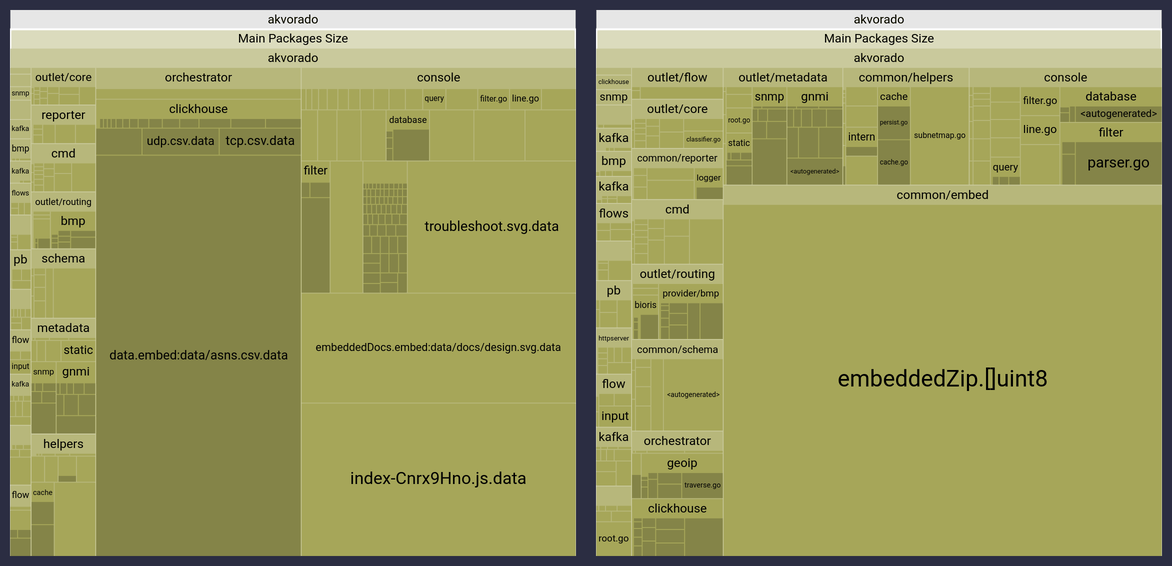
Breakdown of space used by each package before and after introducing embed.zip. It is displayed as a treemap and we can see many embedded files replaced by a bigger one.
Breakdown of the space used by each component before (left) and after (right) the introduction of embed.zip.
Embedding these assets into a ZIP archive reduced the size of the Akvorado executable by more than 4 MiB:
$ unzip -p common/embed/data/embed.zip   wc -c   numfmt --to=iec
7.3M
$ ll common/embed/data/embed.zip
-rw-r--r-- 1 bernat users 2.9M Dec  7 17:17 common/embed/data/embed.zip

Performance loss Reading from a compressed archive is not as fast as reading a flat file. A simple benchmark shows it is more than 4 slower. It also allocates some memory.2
goos: linux
goarch: amd64
pkg: akvorado/common/embed
cpu: AMD Ryzen 5 5600X 6-Core Processor
BenchmarkData/compressed-12     2262   526553 ns/op   610 B/op   10 allocs/op
BenchmarkData/uncompressed-12   9482   123175 ns/op     0 B/op    0 allocs/op
Each access to an asset requires a decompression step, as seen in this flame graph:
&#128444; Flame graph when reading data from embed.zip compared to reading data directly
CPU flame graph comparing the time spent on CPU when reading data from embed.zip (left) versus reading data directly (right). Because the Go testing framework executes the benchmark for uncompressed data 4 times more often, it uses the same horizontal space as the benchmark for compressed data. The graph is interactive.
While a ZIP archive has an index to quickly find the requested file, seeking inside a compressed file is currently not possible.3 Therefore, the files from a compressed archive do not implement the io.ReaderAt or io.Seeker interfaces, unlike directly embedded files. This prevents some features, like serving partial files or detecting MIME types when serving files over HTTP.
For Akvorado, this is an acceptable compromise to save a few mebibytes from an executable of almost 100 MiB. Next week, I will continue this futile adventure by explaining how I prevented Go from disabling dead code elimination!

  1. You can safely read multiple files concurrently. However, it does not implement ReadDir() and ReadFile() methods.
  2. You could keep frequently accessed assets in memory. This reduces CPU usage and trades cached memory for resident memory.
  3. SOZip is a profile that enables fast random access in a compressed file. However, Go s archive/zip module does not support it.

Iustin Pop: Yes, still alive!

Yeah, again three months have passed since my last (trivial) post, and I really don t know where the time has flown. I suppose the biggest problem was the long summer vacation, which threw me off-track, and then craziness started. Work work work, no time for anything, which kept me fully busy in August, and then you should travel . So mid-September I went on my first business trip since Covid, again to Kirkland, which in itself was awesome. Flew out Sunday, and as I was concerned I was going to lose too much fitness had a half-marathon planned on the weekend after the return I ran every morning of the four days I was there. And of course, on the last day, I woke up even earlier (05:30 AM), went out to run before sunrise, intending to do a very simple run along the road that borders the lake for 2.5K, then back . And right at the farthest point, a hundred metres before my goal of turning around, I tripped, started falling, and as I was falling, I hit sideways a metal pole. I was in a bus station, it was the pole that has the schedule at the top, and I hit it at relatively full speed, right across my left-side ribs. The crash took the entire air out of my lungs, and I don t remember if I ever felt pain/sensation like that I was seriously not able to breathe for 20 seconds or so, and I was wondering if I m going to pass out at this rate. Only 20 seconds, because my Garmin started howling like a police siren, and the screen was saying something along the lines of: Incident detected; contacting emergency services in 40 35 and I was fumbling to cancel that, since a) I wasn t that bad, b) notifying my wife that I had a crash would have not been a smart idea. My left leg was scraped in a few places, my left hand pretty badly, or more than just scraped, so my focus was on limping back, and finding a fountain to wash my injuries, which I did, so I kept running with blood dripping down my hand. Fun fun, everything was hurting, I took an Uber for the ~1Km to the office, had many meetings, took another Uber and flew back to Zurich. Seattle San Francisco Z rich, I think 14 hours, with my ribs hurting pretty badly. But I got home (Friday afternoon), and was wondering if I can run or not on Saturday. Saturday comes, I feel pretty OK, so I said let s try, will stop if the pain is too great. I pick up my number, I go to the start, of course in the last block and not my normal block, and I start running. After 50 metres, I knew this won t be good enough, but I said, let s make it to the first kilometre. Then to the first fuelling point, then to the first aid point, at which moment I felt good enough to go to the second one. Long story short, I ran the whole half marathon, with pain. Every stop for fuelling was mentally hard, as the pain stopped, and I knew I had to start running again, and the pain would resume. In the end, managed to finish: two and a half hours, instead of just two hours, but alive and very happy. Of course, I didn t know what was waiting for me Sunday I wake up in heavy pain, and despite painkillers, I was not feeling much better. The following night was terrible, Monday morning I went to the doctor, had X-rays, discussion with a radiologist. Not really broken, but more than just bruised. See this angle here? Bones don t have angles normally . Painkillers, chest/abdomen wrapping, no running! So my attempts to not lose fitness put me off running for a couple of weeks. Then October came, and I was getting better, but work was getting even more crazy. I don t know where November passed, honestly, and now we re already in December. I did manage to run, quite well, managed to bike a tiny bit and swim a little, but I m not in a place where I can keep a regular and consistent schedule. On the good side, I managed this year, for the first time since Covid, to not get sick. Hey, a sport injury is 100 better than a sickness, like I had in previous years, taking me out for two weeks. But life was crazy enough that I didn t read some of my email accounts for months, and I m just now starting to catch up to, well, baseline. Of course, the rib the lowest one on the left side is long-healed, or so I thought. After some strength training early this week, I was very sore the next day, and I wanted to test whether my rib is still sore. I touched it at the point , and it hurt so badly I couldn t believe. Two and a half months, and it s not done-done. And now it s just two weeks before Christmas and New Year s, and that time off will ruin my rhythm again. At least ski vacation is booked, ski service is done, and slowly, work is getting in good enough shape to actually enjoy thinking about vacation. So, in the end, a very adventurous last third of the year, and that wasn t even all. As I m writing this, my right wrist is bandaged and for the past 24 hours it hasn t hurt too much, but that s another, and not so interesting, story. I ll close with a yay for always being behind/backlogged, but alive and relatively well. My sport injuries are elective injuries so to speak, and I m very thankful for that. See you in the next post!

6 December 2025

Simon Josefsson: Reproducible Guix Container Images

Around a year ago I wrote about Guix Container Images for GitLab CI/CD and these images have served the community well. Besides continous use in CI/CD, these Guix container images are used to confirm reproducibility of the source tarball artifacts in the releases of Libtasn1 v4.20, InetUtils v2.6, Libidn2 v2.3.8, Libidn v1.43, SASL v2.2.2, Guile-GnuTLS v5.0.1, and OATH Toolkit v2.6.13. See how all those release announcements mention a Guix commit? That s the essential supply-chain information about the Guix build environment that allows the artifacts to be re-created. To make sure this is repeatable, the release tarball artifacts are re-created from source code every week in the verify-reproducible-artifacts project, that I wrote about earlier. Guix s time travelling feature make this sustainable to maintain, and hopefully will continue to be able to reproduce the exact same tarball artifacts for years to come. During the last year, unfortunately Guix was removed from Debian stable. My Guix container images were created from Debian with that Guix package. My setup continued to work since the old stage0 Debian+Guix containers were still available. Such a setup is not sustainable, as there will be bit-rot and we don t want to rely on old containers forever, which (after the removal of Guix in Debian) could not be re-produced any more. Let this be a reminder how user-empowering features such as Guix time-travelling is! I have reworked my Guix container image setup, and this post is an update on the current status of this effort. The first step was to re-engineer Debian container images with Guix, and I realized these were useful on their own, and warrant a separate project. A more narrowly scoped project makes will hopefully make it easier to keep them working. Now instead of apt-get install guix they use the official Guix guix-install.sh approach. Read more about that effort in the announcement of Debian with Guix. The second step was to reconsider my approach to generate the Guix images. The earlier design had several stages. First, Debian+Guix containers were created. Then from those containers, a pure Guix container was created. Finally, using the pure Guix container another pure Guix container was created. The idea behind that GCC-like approach was to get to reproducible images that were created from an image that had no Debian left on it. However, I never managed to finish this. Partially because I hadn t realized that every time you build a Guix container image from Guix, you effectively go back in time. When using Guix version X to build a container with Guix on it, it will not put Guix version X into the container but will put whatever version of Guix is available in its package archive, which will be an earlier version, such as version X-N. I had hope to overcome this somehow (running a guix pull in newly generated images may work), but never finished this before Guix was removed from Debian. So what could a better design look like? For efficiency, I had already started experimenting with generating the final images directly from the Debian+Guix images, and after reproducibility bugs were fixed I was able to get to reproducible images. However, I was still concerned that the Debian container could taint the process somehow, and was also concerned about the implied dependency on non-free software in Debian. I ve been using comparative rebuilds using similar distributions to confirm artifact reproducibility for my software projects, comparing builds on Trisquel 11 with Ubuntu 22.04, and AlmaLinux 9 with RockyLinux 9 for example. This works surprisingly well. Including one freedom-respecting distribution like Trisquel will detect if any non-free software has bearing on artifacts. Using different architectures, such as amd64 vs arm64 also help with deeper supply-chain concerns. My conclusion was that I wanted containers with the same Guix commit for both Trisquel and Ubuntu. Given the similarity with Debian, adapting and launching the Guix on Trisquel/Debian project was straight forward. So we now have Trisquel 11/12 and Ubuntu 22.04/24.04 images with the same Guix on them. Do you see where the debian-with-guix and guix-on-dpkg projects are leading to? We are now ready to look at the modernized Guix Container Images project. The tags are the same as before:
registry.gitlab.com/debdistutils/guix/container:latest
registry.gitlab.com/debdistutils/guix/container:slim
registry.gitlab.com/debdistutils/guix/container:extra
registry.gitlab.com/debdistutils/guix/container:gash
The method to create them is different. Now there is a build job that uses the earlier Guix+Trisquel container (for amd64) or Guix+Debian (for arm64, pending Trisquel arm64 containers). The build job create the final containers directly. Next a Ubuntu reproduce job is launched that runs the same commands, failing if it cannot generate the bit-by-bit identical container. Then single-arch images are tested (installing/building GNU hello and building libksba), and then pushed to the GitLab registry, adding multi-arch images in the process. Then the final multi-arch containers are tested by building Guile-GnuTLS and, on success, uploaded to the Docker Hub. How would you use them? A small way to start the container is like this:
jas@kaka:~$ podman run -it --privileged --entrypoint=/bin/sh registry.gitlab.com/debdistutils/guix/container:latest
sh-5.2# env HOME=/ guix describe # https://issues.guix.gnu.org/74949
  guix 21ce6b3
    repository URL: https://git.guix.gnu.org/guix.git
    branch: master
    commit: 21ce6b392ace4c4d22543abc41bd7c22596cd6d2
sh-5.2# 
The need for --entrypoint=/bin/sh is because Guix s pack command sets up the entry point differently than most other containers. This could probably be fixed if people want that, and there may be open bug reports about this. The need for --privileged is more problematic, but is discussed upstream. The above example works fine without it, but running anything more elaborate with guix-daemon installing packages will trigger a fatal error. Speaking of that, here is a snippet of commands that allow you to install Guix packages in the container.
cp -rL /gnu/store/*profile/etc/* /etc/
echo 'root:x:0:0:root:/:/bin/sh' > /etc/passwd
echo 'root:x:0:' > /etc/group
groupadd --system guixbuild
for i in $(seq -w 1 10); do useradd -g guixbuild -G guixbuild -d /var/empty -s $(command -v nologin) -c "Guix build user $i" --system guixbuilder$i; done
env LANG=C.UTF-8 guix-daemon --build-users-group=guixbuild &
guix archive --authorize < /share/guix/ci.guix.gnu.org.pub
guix archive --authorize < /share/guix/bordeaux.guix.gnu.org.pub
guix install hello
GUIX_PROFILE="/var/guix/profiles/per-user/root/guix-profile"
. "$GUIX_PROFILE/etc/profile"
hello
This could be simplified, but we chose to not hard-code in our containers because some of these are things that probably shouldn t be papered over but fixed properly somehow. In some execution environments, you may need to pass --disable-chroot to guix-daemon. To use the containers to build something in a GitLab pipeline, here is an example snippet:
test-amd64-latest-wget-configure-make-libksba:
  image: registry.gitlab.com/debdistutils/guix/container:latest
  before_script:
  - cp -rL /gnu/store/*profile/etc/* /etc/
  - echo 'root:x:0:0:root:/:/bin/sh' > /etc/passwd
  - echo 'root:x:0:' > /etc/group
  - groupadd --system guixbuild
  - for i in $(seq -w 1 10); do useradd -g guixbuild -G guixbuild -d /var/empty -s $(command -v nologin) -c "Guix build user $i" --system guixbuilder$i; done
  - export HOME=/
  - env LANG=C.UTF-8 guix-daemon --build-users-group=guixbuild &
  - guix archive --authorize < /share/guix/ci.guix.gnu.org.pub
  - guix archive --authorize < /share/guix/bordeaux.guix.gnu.org.pub
  - guix describe
  - guix install libgpg-error
  - GUIX_PROFILE="//.guix-profile"
  - . "$GUIX_PROFILE/etc/profile"
  script:
  - wget https://www.gnupg.org/ftp/gcrypt/libksba/libksba-1.6.7.tar.bz2
  - tar xfa libksba-1.6.7.tar.bz2
  - cd libksba-1.6.7
  - ./configure
  - make V=1
  - make check VERBOSE=t V=1
More help on the project page for the Guix Container Images. That s it for tonight folks, and remember, Happy Hacking!

Taavi V n nen: How to import a new Wikipedia language edition (in hard mode)

I created the latest Wikipedia language edition, the Toki Pona Wikipedia, last month. Unlike most other wikis which start their lives in the Wikimedia Incubator before the full wiki is created, in this case the community had been using a completely external MediaWiki site to build the wiki before it was approved as a "proper" Wikipedia wiki,1 and now that external wiki needed to be imported to the newly created Wikimedia-hosted wiki. (As far as I'm aware, the last and previously only time an external wiki has been imported to a Wikimedia project was in 2013 when Wikitravel was forked as Wikivoyage.) Creating a Wikimedia wiki these days is actually pretty straightforward, at least when compared to what it used to be like a couple of years ago. Today the process mostly involves using a script to generate two configuration changes, one to add the basic configuration for a wiki to operate and an another to add the wiki to the list of all wikis that exist, and then running a script to create the wiki database in between of deploying those two configuration changes. And then you wait half an hour while the script to tell all Wikidata client wikis about the new wiki runs on one wiki at a time. The primary technical challenge in importing a third-party wiki is that there's no SUL making sure that a single username maps to the same account on both wikis. This means that the usual strategy of using the functionality I wrote in CentralAuth to manually create local accounts can't be used as is, and so we needed to come up with a new way of matching everyone's contributions to their existing Wikimedia accounts. (Side note: While the user-facing interface tries to present a single "global" user account that can be used on all public Wikimedia wikis, in reality the account management layer in CentralAuth is mostly just a glue layer to link together individual "local" accounts on each wiki that the user has ever visited. These local accounts have independent user ID numbers for example I am user #35938993 on the English Wikipedia but #4 on the new Toki Pona Wikipedia and are what most of MediaWiki code interacts with except for a few features specifically designed with cross-wiki usage in mind. This distinction is also still very much present and visible in the various administrative and anti-abuse workflows.) The approach we ended up choosing was to re-write the dump file before importing, so that a hypothetical account called $Name would be turned $Name~wikipesija.org after the import.2 We also created empty user accounts that would take ownership of the edits to be imported so that we could use the standard account management tools on them later on. MediaWiki supports importing contributions without a local account to attribute them to, but it doesn't seem to be possible to convert an imported actor3 to a regular user later on which we wanted to keep as a possibility, even with the minor downside of creating a few hundred users that'll likely never get touched again later. We also made specific decisions to add the username suffix to everyone, not to just those names that'd conflicted with existing SUL accounts, and to deal with renaming users that wanted their contributions linked to an existing SUL account only after the import. This both reduced complexity and thus risk from the import phase, which already had much more unknowns compared to the rest of the process, but also were much better options ethically as well: suffixing all names meant we would not imply that those people chose to be Wikimedians with those specific usernames (when in reality it was us choosing to import those edits to the Wikimedia universe), and doing renames using the standard MediaWiki account management tooling meant that it produced the normal public log entries that all other MediaWiki administrative actions create. With all of the edits imported, the only major thing remaining was doing those merges I mentioned earlier to attribute imported edits to people's existing SUL accounts. Thankfully, the local account -based system makes it actually pretty simple. Usually CentralAuth prevents renaming individual local accounts that are attached to a global account, but that check can be bypassed with a maintenance script or a privileged enough account. Renaming the user automatically detached it from the previous global account, after which an another maintenance script could be used to attach the user to the correct global account.

  1. That external site was a fork of a fork of the original Toki Pona Wikipedia that was closed in 2005. And because cool URIs don't change, we made the the URLs that the old Wikipedia was using work again. Try it: https://art-tokipona.wikipedia.org.
  2. wikipesija.org was the domain where the old third-party wiki was hosted on, and ~ was used as a separator character in usernames during the SUL finalization in the early 2010s so using it here felt appropriate as well.
  3. An actor is a MediaWiki term and a database table referring to anything that can do edits or logged actions. Usually an actor is a user account or an IP address, but an imported user name in a specific format can also be represented as an actor.

3 December 2025

Michael Ablassmeier: libvirt 11.10 VIR_DOMAIN_BACKUP_BEGIN_PRESERVE_SHUTDOWN_DOMAIN

As with libvirt 11.10 a new flag for backup operation has been inroduced: VIR_DOMAIN_BACKUP_BEGIN_PRESERVE_SHUTDOWN_DOMAIN. According to the documentation It instructs libvirt to avoid termination of the VM if the guest OS shuts down while the backup is still running. The VM is in that scenario reset and paused instead of terminated allowing the backup to finish. Once the backup finishes the VM process is terminated. Added support for this in virtnbdbackup 2.40.

2 December 2025

Dirk Eddelbuettel: duckdb-mlpack 0.0.5: Added kmeans, version helpers, documentation

A new release of the still-recent duckdb extension for mlpack, the C++ header-only library for machine learning, was merged into the duckdb community extensions repo today, and has been updated at its duckdb mlpack extension page. This release 0.0.5 adds one new method: kmeans clustering. We also added two version accessors for both mlpack and armadillo. We found during the work on random forests (added in 0.0.4) that the multithreaded random number generation was not quite right in the respective upstream codes. This has by now been corrected in armadillo 15.2.2 as well as the trunk version of mlpack so if you build with those, and set a seed, then your forests and classification will be stable across reruns. We added a second state variable mlpack_silent that can be used to suppress even the minimal prediction quality summary some methods show, and expanded the documentation. For more details, see the repo for code, issues and more, and the extension page for more about this duckdb community extension.

This post by Dirk Eddelbuettel originated on his Thinking inside the box blog. If you like this or other open-source work I do, you can sponsor me at GitHub.

30 November 2025

Russ Allbery: Review: The Last Soul Among Wolves

Review: The Last Soul Among Wolves, by Melissa Caruso
Series: The Echo Archives #2
Publisher: Orbit
Copyright: August 2025
ISBN: 0-316-30404-2
Format: Kindle
Pages: 355
The Last Soul Among Wolves is urban high fantasy with strong mystery vibes. It is a direct sequel to The Last Hour Between Worlds. You need the previous book for some character setup (and this book would spoil it badly), but you don't have to remember the first book in detail. Only the main plot outcomes are directly relevant and the characters will remind you of those. Kembrel Thorne is a Hound, the equivalent of a police detective in the medieval-inspired city setting of this series, but this book does not open with an official assignment. Instead, she has been dragged by her childhood friend Jaycel Morningrey as company for a reading of the will of old lady Lovegrace, reclusive owner of a gothic mansion on an island connected to the city by an intermittent sandbar. A surprise reunion with her gang of childhood friends ensues, followed by the revelation that they are all in serious trouble. Shortly after Kem left the group to become a Hound, the remaining four, plus several other apparently random people, got entangled with a powerful Echo artifact. Now that Lovegrace has died, one of them will inherit the artifact and the ability to make a wish, but only one. The rest will be killed at decreasing intervals until only the winner is left alive. The Last Hour Between Worlds was fae fantasy built around a problem that was more of a puzzle than a mystery. The Last Soul Among Wolves is closer to a classic mystery: A cast of characters are brought together and semi-isolated in a rural house, they start dying, and it's up to the detective to solve the mystery of their death before it's too late. In this case, the initial mechanism of death is supernatural and not in doubt the challenge instead is how to stop it from happening again but Kem's problems quickly become more complicated. As mystery plots go, this is more thriller than classical despite the setting. There are a few scenes of analyzing clues, but Kem is more likely to use the time-honored protagonist technique of throwing herself into danger and learning what's going on via the villain monologues. As readers of the previous book would expect, Rika Nonesuch is here too, hired by another of Kem's old friends, and the two navigate their personal feelings and the rivalry between their guilds in much the way that they did in the Last Hour Between Worlds. As in the first book, there is a sapphic romance subplot, but it's a very slow burn asexual romance. The best part of this series continues to be the world-building. The previous book introduced the idea of the Echoes and sent the characters exploring into stranger and stranger depths. This book fleshes out the rules in more detail, creating something that feels partly like a fae realm and partly like high fantasy involving gods, but diverges from both into a logic of its own. The ending satisfyingly passes my test of fantasy mysteries: Resolving the mystery requires understanding and applying the rules of the setting, which are sufficiently strange to create interesting outcomes but coherent enough that the reader doesn't feel like the author is cheating. There are some hissable villains here, but my favorite part of this book was the way Caruso added a lot of nuance and poignancy to the Echoes rather than showing them only as an uncanny threat. That choice made the world feel deeper and richer. It's not yet clear whether that element is setup for a longer-term series plot, but I hope Caruso will develop the story in that direction. It felt to me like Caruso is aiming for an ongoing series rather than a multi-volume story with a definite ending. She avoids a full episodic reset Rika, in particular, gets considerable character development and new complications that bode well for future volumes but it doesn't feel like the series is building towards an imminent climax. This is not a complaint. I enjoy these characters and this world and will happily keep devouring each new series entry. If you liked The Last Hour Between Worlds, I think you will like this. It doesn't have the same delight of initial discovery of the great world-building, but the plot is satisfying and a bit more complex and the supporting characters are even better than those in the first book. Once again, Caruso kept me turning the pages, and I'm now looking forward to a third volume. Recommended. The third book in the series has not yet been announced, but there are indications on social media that it is coming. Rating: 7 out of 10

Otto Kek l inen: DEP-18: A proposal for Git-based collaboration in Debian

Featured image of post DEP-18: A proposal for Git-based collaboration in DebianI am a huge fan of Git, as I have witnessed how it has made software development so much more productive compared to the pre-2010s era. I wish all Debian source code were in Git to reap the full benefits. Git is not perfect, as it requires significant effort to learn properly, and the ecosystem is complex with even more things to learn ranging from cryptographic signatures and commit hooks to Git-assisted code review best practices, forge websites, and CI systems. Sure, there is still room to optimize its use, but Git certainly has proven itself and is now the industry standard. Thus, some readers might be surprised to learn that Debian development in 2025 is not actually based on Git. In Debian, the version control is done by the Debian archive itself. Each commit is a new upload to the archive, and the commit message is the debian/changelog entry. The commit log is available at snapshots.debian.org. In practice, most Debian Developers (people who have the credentials to upload to the Debian archive) do use Git and host their packaging source code on salsa.debian.org the GitLab instance of Debian. This is, however, based on each DD s personal preferences. The Debian project does not have any policy requiring that packages be hosted on salsa.debian.org or be in version control at all.

Is collaborative software development possible without git and version control software? Debian, however, has some peculiarities that may be surprising to people who have grown accustomed to GitHub, GitLab or various company-internal code review systems. In Debian:
  • The source code of the next upload is not public but resides only on the developer s laptop.
  • Code contributions are plain patch files, based on the latest revision released in the Debian archive (where the unstable area is equivalent to the main development branch).
  • These patches are submitted by email to a bug tracker that does no validation or testing whatsoever.
  • Developers applying these patches typically have elaborate Mutt or Emacs setups to facilitate fetching patches from email.
  • There is no public staging area, no concept of rebasing patches or withdrawing a patch and replacing it with a better version.
  • The submitter won t see any progress information until a notification email arrives after a new version has been uploaded to the Debian archive.
This system has served Debian for three decades. It is not broken, but using the package archive just feels well, archaic. There is a more efficient way, and indeed the majority of Debian packages have a metadata field Vcs-Git that advertises which version control repository the maintainer uses. However, newcomers to Debian are surprised to notice that not all packages are hosted on salsa.debian.org but at various random places with their own account and code submission systems, and there is nothing enforcing or even warning if the code there is out of sync with what was uploaded to Debian. Any Debian Developer can at any time upload a new package with whatever changes, bypassing the Git repository, even when the package advertised a Git repository. All PGP signed commits, Git tags and other information in the Git repository are just extras currently, as the Debian archive does not enforce or validate anything about them. This also makes contributing to multiple packages in parallel hard. One can t just go on salsa.debian.org and fork a bunch of repositories and submit Merge Requests. Currently, the only reliable way is to download source packages from Debian unstable, develop patches on top of them, and send the final version as a plain patch file by email to the Debian bug tracker. To my knowledge, no system exists to facilitate working with the patches in the bug tracker, such as rebasing patches 6 months later to detect if they or equivalent changes were applied or if sending refreshed versions is needed. To newcomers in Debian, it is even more surprising that there are packages that are on salsa.debian.org but have the Merge Requests feature disabled. This is often because the maintainer does not want to receive notification emails about new Merge Requests, but rather just emails from bugs.debian.org. This may sound arrogant, but keep in mind that these developers put in the effort to set up their Mutt/Emacs workflow for the existing Debian process, and extending it to work with GitLab notifications is not trivial. There are also purists who want to do everything via the command-line (without having to open a browser, run JavaScript and maintain a live Internet connection), and tools like glab are not convenient enough for the full workflow.

Inefficient ways of working prevent Debian from flourishing I would claim, based on my personal experiences from the past 10+ years as a Debian Developer, that the lack of high-quality and productive tooling is seriously harming Debian. The current methods of collaboration are cumbersome for aspiring contributors to learn and suboptimal to use for both new and seasoned contributors. There are no exit interviews for contributors who left Debian, no comprehensive data on reasons to contribute or stop contributing, nor are there any metrics tracking how many people tried but failed to contribute to Debian. Some data points to support my concerns do exist:
  • The contributor database shows that the number of contributors is growing slower than Debian s popularity.
  • Most packages are maintained by one person working alone (just pick any package at random and look at the upload history).

Debian should embrace git, but decision-making is slow Debian is all about community and collaboration. One would assume that Debian prioritized above all making collaboration tools and processes simpler, faster and less error-prone, as it would help both current and future package maintainers. Yet, it isn t so, due to some reasons unique to Debian. There is no single company or entity running Debian, and it has managed to operate as a pure meritocracy and do-cracy for over 30 years. This is impressive and admirable. Unfortunately, some of the infrastructure and technical processes are also nearly 30 years old and very difficult to change for the same reason: the nature of Debian s distributed decision-making process. As a software developer and manager with 25+ years of experience, I strongly feel that developing software collaboratively using Git is a major step forward that Debian needs to take, in one form or another, and I hope to see other DDs voice their support if they agree.

Debian Enhancement Proposal 18 Following how consensus is achieved in Debian, I started drafting DEP-18 in 2024, and it is currently awaiting enough thumbs up at https://salsa.debian.org/dep-team/deps/-/merge_requests/21 to get into CANDIDATE status next. In summary, the DEP-18 proposes that everyone keen on collaborating should:
  1. Maintain Debian packaging sources in Git on Salsa.
  2. Use Merge Requests to show your work and to get reviews.
  3. Run Salsa CI before upload.
The principles above are not novel. According to stats at e.g. trends.debian.net, and UDD, ~93% of all Debian source packages are already hosted on salsa.debian.org. As of June 1st, 2025, only 1640 source packages remain that are not hosted on Salsa. The purpose of DEP-18 is to state in writing what Debian is currently doing for most packages, and thus express what among others new contributors should be learning and doing, so basic collaboration is smooth and free from structural obstacles. Most packages are also already allowing Merge Requests and using Salsa CI, but there hasn t been any written recommendation anywhere in Debian to do so. The Debian Policy (v.4.7.2) does not even mention the word Salsa a single time. The current process documentation on how to do non-maintainer uploads or salvaging packages are all based on uploading packages to the archive, without any consideration of using git-based collaboration such as posting a Merge Request first. Personally I feel posting a Merge Request would be a better approach, as it would invite collaborators to discuss and provide code reviews. If there are no responses, the submitter can proceed to merge, but compared to direct uploads to the Debian archive, the Merge Request practice at least tries to offer a time and place for discussions and reviews to happen. It could very well be that in the future somebody comes up with a new packaging format that makes upstream source package management easier, or a monorepo with all packages, or some other future structures or processes. Having a DEP to state how to do things now does not prevent people from experimenting and innovating if they intentionally want to do that. The DEP is merely an expression of the minimal common denominators in the packaging workflow that maintainers and contributors should follow, unless they know better.

Transparency and collaboration Among the DEP-18 recommendations is:
The recommended first step in contributing to a package is to use the built-in Fork feature on Salsa. This serves two purposes. Primarily, it allows any contributor to publish their Git branches and submit them as Merge Requests. Additionally, the mere existence of a list of Forks enables contributors to discover each other, and in rare cases when the original package is not accepting improvements, collaboration could arise among the contributors and potentially lead to permanent forks in the general meaning. Forking is a fundamental part of the dynamics in open source that helps drive quality and agreement. The ability to fork ultimately serves as the last line of defense of users rights. Git supports this by making both temporary and permanent forks easy to create and maintain.
Further, it states:
Debian packaging work should be reasonably transparent and public to allow contributors to participate. A maintainer should push their pending changes to Salsa at regular intervals, so that a potential contributor can discover if a particular change has already been made or a bug has been fixed in version control, and thus avoid duplicate work. Debian maintainers should make reasonable efforts to publish planned changes as Merge Requests on Salsa and solicit feedback and reviews. While pushing changes directly on the main Git branch is the fastest workflow, second only to uploading all changes directly to Debian repositories, it is not an inclusive way to develop software. Even packages that are maintained by a single maintainer should at least occasionally publish Merge Requests to allow new contributors to step up and participate.
I think these are key aspects leading to transparency and true open source collaboration. Even though this talks about Salsa which is based on GitLab the concepts are universal and will work also on other forges, like Forgejo or GitHub. The point is that sharing work-in-progress on a real-time platform, with CI and other supporting features, empowers and motivates people to iterate on code collaboratively. As an example of an anti-pattern, Oracle MySQL publishes the source code for all their releases and is license-compliant, but as they don t publish their Git commits in real-time, it does not feel like a real open source project. Non-Oracle employees are not motivated to participate as second-class developers who are kept in the dark. Debian should embrace git and sharing work in real-time, embodying a true open source spirit.

Recommend, not force Note that the Debian Enhancement Proposals are not binding. Only the Debian Policy and Technical Committee decisions carry that weight. The nature of collaboration is voluntary anyway, so the DEP does not need to force anything on people who don t want to use salsa.debian.org. The DEP-18 is also not a guide for package maintainers. I have my own views and have written detailed guides in blog articles if you want to read more on, for example, how to do code reviews efficiently. Within DEP-18, there is plenty of room to work in many different ways, and it does not try to force one single workflow. The goal here is to simply have agreed-upon minimal common denominators among those who are keen to collaborate using salsa.debian.org, not to dictate a complete code submission workflow. Once we reach this, there will hopefully be less friction in the most basic and recurring collaboration tasks, giving DDs more energy to improve other processes or just invest in having more and newer packages for Debian users to enjoy.

Next steps In addition to lengthy online discussions on mailing lists and DEP reviews, I also presented on this topic at DebConf 2025 in Brest, France. Unfortunately the recording is not yet up on Peertube. The feedback has been overwhelmingly positive. However, there are a few loud and very negative voices that cannot be ignored. Maintaining a Linux distribution at the scale and complexity of Debian requires extraordinary talent and dedication, and people doing this kind of work often have strong views, most of the time for good reasons. We do not want to alienate existing key contributors with new processes, so maximum consensus is desirable. We also need more data on what the 1000+ current Debian Developers view as a good process to avoid being skewed by a loud minority. If you are a current or aspiring Debian Developer, please add a thumbs up if you think I should continue with this effort (or a thumbs down if not) on the Merge Request that would make DEP-18 have candidate status. There is also technical work to do. Increased Git use will obviously lead to growing adoption of the new tag2upload feature, which will need to get full git-buildpackage support so it can integrate into salsa.debian.org without turning off Debian packaging security features. The git-buildpackage tool itself also needs various improvements, such as making contributing to multiple different packages with various levels of diligence in debian/gbp.conf maintenance less error-prone. Eventually, if it starts looking like all Debian packages might get hosted on salsa.debian.org, I would also start building a review.debian.org website to facilitate code review aspects that are unique to Debian, such as tracking Merge Requests across GitLab projects in ways GitLab can t do, highlighting which submissions need review most urgently, feeding code reviews and approvals into the contributors.debian.org database for better attribution, and so forth. Details on this vision will be in a later blog post, so subscribe to updates!

29 November 2025

Freexian Collaborators: Monthly report about Debian Long Term Support, October 2025 (by Roberto C. S nchez)

The Debian LTS Team, funded by Freexian s Debian LTS offering, is pleased to report its activities for October.

Activity summary During the month of October, 21 contributors have been paid to work on Debian LTS (links to individual contributor reports are located below). The team released 37 DLAs fixing 893 CVEs. The team has continued in its usual rhythm, preparing and uploading security updates targeting LTS and ELTS, as well as helping with updates to oldstable, stable, testing, and unstable. Additionally, the team received several contributions of LTS uploads from Debian Developers outside the standing LTS Team. Notable security updates:
  • https-everywhere, prepared by Markus Koschany, deals with a problem created by ownership of the https-rulesets.org domain passing to a malware operator
  • openjdk-17 and openjdk-11, prepared by Emilio Pozuelo Monfort, fixes XML external entity and certificate validation vulnerabilities
  • intel-microcode, prepared by Tobias Frost, fixes a variety of privilege escalation and denial of service vulnerabilities
Notable non-security updates:
  • distro-info-data, prepared by Stefano Rivera, updates information concerning current and upcoming Debian and Ubuntu releases
Contributions from outside the LTS Team:
  • Lukas M rdian, a Debian Developer, provided an update of log4cxx
  • Andrew Ruthven, one of the request-tracker4 maintainers, provided an update of request-tracker4
  • Christoph Goehre, co-maintainer of thunderbird, provided an update of thunderbird
Beyond the typical LTS updates, the team also helped the Debian community more broadly:
  • Guilhem Moulin prepared oldstable/stable updates of libxml2, and an unstable update of libxml2.9
  • Bastien Roucari s prepared oldstable/stable updates of imagemagick
  • Daniel Leidert prepared an oldstable update of python-authlib, oldstable update of libcommons-lang-java and stable update of libcommons-lang3-java
  • Utkarsh Gupta prepared oldstable/stable/testing/unstable updates of ruby-rack
The LTS Team is grateful for the opportunity to contribute to making LTS a high quality for sponsors and users. We are also particularly grateful for the collaboration from others outside the time; their contributions are important to the success of the LTS effort.

Individual Debian LTS contributor reports

Thanks to our sponsors Sponsors that joined recently are in bold.

27 November 2025

Russell Coker: PineTime Band

I ve had a Pine Time for just over 2 years [1]. About a year ago I had a band break and replaced it from a spare PineTime and now I just had another break. Having the band only last one year isn t that great, but it s fortunate that the break only affects the inner layer of plastic so there is no risk of the watch suddenly falling off and being broken or lost. The Pine64 web site has a page about this with bad options, one broken link and a few Amazon items that are have ridiculous postage [2]. I started writing this post while using the band from a Colmi P80 [3]. I bought one for a relative who wanted the metal band and the way the Aliexpress seller does it is to sell the package with the plastic band and include the metal band in the package so I had a spare band. It fits quite well and none of the reported problems of the PineTime having insufficient space between the spring bar and the watch. The Colmi band in question is described as rose gold but is more like pinkish beige and doesn t match the style of the black PineTime. I ordered a couple of cheap bands from AliExpress which cost $9.77 and $13.55 including postage while the ones that Pine64 recommend have over $15 postage from Amazon! The 20mm Silicone Magnetic Buckle Watch Strap Band For Huawei GT2 Smart Watch Connected Bracelet Black Watchband Man [4] cost $13.55 including postage. It has a magnetic unfold mechanism which I find a bit annoying and it doesn t allow easily changing the length. I don t think I ll choose that again. But it basically works and is comfortable. The 20mm Metal Strap for Huawei Watch GT2 3 Quick Release Stainless Steel Watch Band for Samsung Galaxy Watch Bracelet [5] cost $9.77 including postage. I found this unreasonably difficult to put on and not particularly comfortable. But opinion will vary on that, it is cheap and will appeal to some people s style. Conclusion There are claims that getting a replacement band for a PineTime is difficult. My experience is that every band with a 20mm attachment works as long as it s designed for a square watch, some of the bands are designed to partly go around a round face and wouldn t fit. I expect that some bands won t fit, but I don t think that it s enough of a problem to be worried about buying a random band from AliExpress. The incidence of bands not fitting will probably be lower than the incidence of other AliExpress products not doing quite what you want (while meeting the legal criteria of doing what they are claimed to do) and not being used. I m now wearing the PineTime with the Magnetic Buckle Watch Strap Band and plan to wear it for the next year or so.

22 November 2025

Dirk Eddelbuettel: RcppArmadillo 15.2.2-1 on CRAN: Upstream Update, OpenMP Updates

armadillo image Armadillo is a powerful and expressive C++ template library for linear algebra and scientific computing. It aims towards a good balance between speed and ease of use, has a syntax deliberately close to Matlab, and is useful for algorithm development directly in C++, or quick conversion of research code into production environments. RcppArmadillo integrates this library with the R environment and language and is widely used by (currently) 1286 other packages on CRAN, downloaded 42.6 million times (per the partial logs from the cloud mirrors of CRAN), and the CSDA paper (preprint / vignette) by Conrad and myself has been cited 659 times according to Google Scholar. This versions updates to the 15.2.2 upstream Armadillo release made two days ago. It brings a few changes over the RcppArmadillo 15.2.0 release made only to GitHub (and described in this post), and of course even more changes relative to the last CRAN release described in this earlier post. As described previously, and due to both the upstream transition to C++14 coupled with the CRAN move away from C++11, the package offers a transition by allowing packages to remain with the older, pre-15.0.0 legacy Armadillo yet offering the current version as the default. During the transition we did not make any releases to CRAN allowing both the upload cadence to settle back to the desired about six in six months that the CRAN Policy asks for, and for packages to adjust to any potential changes. Most affected packages have done so (as can be seen in the GitHub issues #489 and #491) which is good to see. We appreciate all the work done by the respective package maintainers. A number of packages are still under a (now formally expired) deadline at CRAN and may get removed. Our offer to help where we can still stands, so please get in touch if we can be of assistance. As a reminder, the meta-issue #475 regroups all the resources for the transition. With respect to changes in the package, we once more overhauled the OpenMP detection and setup, following the approach take by package data.table but sticking with an autoconf-based configure. The detailed changes since the last CRAN release follow.

Changes in RcppArmadillo version 15.2.2-1 (2025-11-21)
  • Upgraded to Armadillo release 15.2.2 (Medium Roast Deluxe)
    • Improved reproducibility of random number generation when using OpenMP
  • Skip a unit test file under macOS as complex algebra seems to fail under newer macOS LAPACK setting
  • Further OpenMP detection rework for macOS (Dirk in #497, #499)
  • Define ARMA_CRIPPLED_LAPACK on Windows only if 'LEGACY' Armadillo selected

Changes in RcppArmadillo version 15.2.1-0 (2025-10-28) (GitHub Only)
  • Upgraded to Armadillo release 15.2.1 (Medium Roast Deluxe)
    • Faster handling of submatrices with one row
  • Improve OpenMP detection (Dirk in #495 fixing #493)

Changes in RcppArmadillo version 15.2.0-0 (2025-10-20) (GitHub Only)
  • Upgraded to Armadillo release 15.2.0 (Medium Roast Deluxe)
    • Added rande() for generating matrices with elements from exponential distributions
    • shift() has been deprecated in favour of circshift(), for consistency with Matlab/Octave
    • Reworked detection of aliasing, leading to more efficient compiled code
  • OpenMP detection in configure has been simplified

Courtesy of my CRANberries, there is a diffstat report relative to previous release. More detailed information is on the RcppArmadillo page. Questions, comments etc should go to the rcpp-devel mailing list off the Rcpp R-Forge page.

This post by Dirk Eddelbuettel originated on his Thinking inside the box blog. If you like this or other open-source work I do, you can sponsor me at GitHub.

Next.

Previous.