Search Results: "christoph"

9 August 2015

Simon Kainz: DUCK challenge: week 5

Slighthly delayed, but here are the stats for week 5 of the DUCK challenge: So we had 10 packages fixed and uploaded by 10 different uploaders. A big "Thank You" to you!! Since the start of this challenge, a total of 59 packages, were fixed. Here is a quick overview:
Week 1 Week 2 Week 3 Week 4 Week 5 Week 6 Week 7
# Packages 10 15 10 14 10 - -
Total 10 25 35 49 59 - -
The list of the fixed and updated packages is availabe here. I will try to update this ~daily. If I missed one of your uploads, please drop me a line. Only 2 more weeks to DebConf15 so please get involved: The DUCK Challenge is running until end of DebConf15! Pevious articles are here: Week 1, Week 2, Week 3, Week 4.

8 August 2015

Christoph Egger: What's wrong with the web? -- authentication

The problem One problem to solve when doing web authentication has always been one identity provider, so you don't have to remember which username (or email address) you used for that bugtracker you used three years ago or that website. And tie it to one login ideally. Five years ago this problem seemed to be basically solved. There was OpenID and while it may not have been great it worked. You could have your own provider, your institution (university, company, foss project, ..) could have one and you could use your university-provided ID for all university stuff. Today's state Looking at the problem again today and the situation seems to have changed. To the worse. A lot. People are actively removing OpenID support. There seemed to be a replacement with, at least, proper design goals: Mozilla's persona. However this seems to be a dead end, no-one (almost) actually supports it. Then there is what people call OAuth2. However there does not seem to be such a thing as OAuth2 at all, at least not for logging into websites. So for example phabricator supports 12 different OAuth2 systems. That includes Google, Facebook, Twitter, Amazon Github and a whole bunch of other services. Each with a different implementation in the webapp of course. And of course you can not just have your university/company/.. provide an OAuth2 service for you to use -- you would need to write yet another adapter on the (foreign) website to talk to your implementation and your provider. And the strange thing, people seem to still consider OAuth2 a replacement for OpenID while it does not even provide the core functionality of the older system. Plus there does not seem to be any awareness of that all together. Other features Now of course, OpenID is not (and never was) the ultimate answer to the web authentication problem. The most obvious problem being user tracking. Your identity provider will see every website you log into, will see when you log into it and even be able to log into that website with your credentials. Of course, this problem is fully inherited by OAuth2. And in contrast to OpenID you can no longer run your own provider whom you can fully trust and who already knows about your surfing habits (because it's actually you already). Mozilla's persona might have solved that, they at least intended to. But, again, persona seems quite dead.

7 August 2015

Christoph Egger: Systemd pitfalls

logind hangs If you just updated systemd and ssh to that host seems to hang, that's just a known Bug (Debian Bug). Don't panic. Wait for the logind timeout and restart logind. restart and stop;start One thing that confused me several times and still confuses people is systemctl restart doing more than systemctl stop ; systemctl start. You will notice the difference once you have a failed service. A restart will try to start the service again. Both stop and start however will just ignore it. Rumors have it this has changed post jessie however. sysvinit-wrapped services and stop While there are certainly bugs with sysvinit services in general (I found myself several times without a local resolver as unbound failed to be started, haven't managed to debug further), the stop behavior of wrapped services is just broken. systemctl stop will block until the sysv initscript finished. It will even note the result of the action in its state. However systemctl will return with exitcode 0 and not output anything on stdout/stderr. This has been reported as Debian Bug. zsh helper I found the following zshrc snipped quite helpful in dealing with non-reported systemctl failures. On root shells it will display a list of failed services as part of the prompt. This will give proper feedback whether your systemctl stop failed, it will give feedback if you still have type=simple services and if the sysv-init script or wrapper is broken.
precmd ()  
    if [[ $UID == 0 && $+commands[systemctl] != 0 ]]
    then
      use_systemd=true
      systemd_failed=" systemctl --state=failed   grep failed   cut -d \  -f 2   tr '\n' ' ' "
    fi
 
if [[ $UID == 0 && $+commands[systemctl] != 0 ]]
then
  PROMPT=$'% $fg[red]>>  $systemd_failed$reset_color% \n'
else
  PROMPT=""
fi
PROMPT+=whateveryourpromptis
zsh completion Speaking of zsh, there's one problem that bothers me a lot and I don't have any solution for. Tab-completing the service name for service is blazing fast. Tab-completing the service name for systemctl restart takes ages. People traced down to truckloads of dbus communication for the completion but no further fix is known (to me). type=simple services As described in length by Lucas Nussbaum type=simple services are actively harmful. Proper type=forking daemons are strictly superior (they provide feedback of finished initialization and success thereof) and type=notify services are so simple there's no excuse for not using them even for private one-off hacks. Even if you're language doesn't provide libsystemd-daemon bindings:
(defun sd-notify (event-string)
  (let ((socket (make-instance 'sb-bsd-sockets:local-socket :type :datagram))
        (name (posix-getenv "NOTIFY_SOCKET"))
        (bufferlen (length event-string)))
    (when name
      (sb-bsd-sockets:socket-connect socket name)
      (sb-bsd-sockets:socket-send socket event-string bufferlen))))
This is a stable API guaranteed to not break in the future and implemented in less than ten lines of code with just basic socket functions. And if your language has support it becomes actually trivial:
    try:
        import systemd
        systemd.daemon.notify("READY=1")
    except ImportError:
        pass
Note that in both cases there is no drawback at all on systemd-free setups. It has the overhead of checking the process' environment for NOTIFY_SOCKET or for the systemd package and behaves like a simple service otherwise. Actually the idea of separating the technical aspect (daemonizing) from the semantic aspect of signalizing "initialization finished, everything's fine" is a pretty good idea and hopefully has the potential to reduce the number of services signalizing the "everything's fine" too early. It could even be ported to non-systemd init systems easily given the API.

Christoph Egger: Systemd pitfalls

logind hangs If you just updated systemd and ssh to that host seems to hang, that's just a known Bug (Debian Bug #770135). Don't panic. Wait for the logind timeout and restart logind. restart and stop;start One thing that confused me several times and still confuses people is systemctl restart doing more than systemctl stop ; systemctl start. You will notice the difference once you have a failed service. A restart will try to start the service again. Both stop and start however will just ignore it. Rumors have it this has changed post jessie however. sysvinit-wrapped services and stop While there are certainly bugs with sysvinit services in general (I found myself several times without a local resolver as unbound failed to be started, haven't managed to debug further), the stop behavior of wrapped services is just broken. systemctl stop will block until the sysv initscript finished. It will even note the result of the action in its state. However systemctl will return with exitcode 0 and not output anything on stdout/stderr. This has been reported as Debian Bug #792045. zsh helper I found the following zshrc snipped quite helpful in dealing with non-reported systemctl failures. On root shells it will display a list of failed services as part of the prompt. This will give proper feedback whether your systemctl stop failed, it will give feedback if you still have type=simple services and if the sysv-init script or wrapper is broken.
precmd ()  
    if [[ $UID == 0 && $+commands[systemctl] != 0 ]]
    then
      use_systemd=true
      systemd_failed=" systemctl --state=failed   grep failed   cut -d \  -f 2   tr '\n' ' ' "
    fi
 
if [[ $UID == 0 && $+commands[systemctl] != 0 ]]
then
  PROMPT=$'% $fg[red]>>  $systemd_failed$reset_color% \n'
else
  PROMPT=""
fi
PROMPT+=whateveryourpromptis
zsh completion Speaking of zsh, there's one problem that bothers me a lot and I don't have any solution for. Tab-completing the service name for service is blazing fast. Tab-completing the service name for systemctl restart takes ages. People traced down to truckloads of dbus communication for the completion but no further fix is known (to me). type=simple services As described in length by Lucas Nussbaum type=simple services are actively harmful. Proper type=forking daemons are strictly superior (they provide feedback of finished initialization and success thereof) and type=notify services are so simple there's no excuse for not using them even for private one-off hacks. Even if you're language doesn't provide libsystemd-daemon bindings:
(defun sd-notify (event-string)
  (let ((socket (make-instance 'sb-bsd-sockets:local-socket :type :datagram))
        (name (posix-getenv "NOTIFY_SOCKET"))
        (bufferlen (length event-string)))
    (when name
      (sb-bsd-sockets:socket-connect socket name)
      (sb-bsd-sockets:socket-send socket event-string bufferlen))))
This is a stable API guaranteed to not break in the future and implemented in less than ten lines of code with just basic socket functions. And if your language has support it becomes actually trivial:
    try:
        import systemd
        systemd.daemon.notify("READY=1")
    except ImportError:
        pass
Note that in both cases there is no drawback at all on systemd-free setups. It has the overhead of checking the process' environment for NOTIFY_SOCKET or for the systemd package and behaves like a simple service otherwise. Actually the idea of separating the technical aspect (daemonizing) from the semantic aspect of signalizing "initialization finished, everything's fine" is a pretty good idea and hopefully has the potential to reduce the number of services signalizing the "everything's fine" too early. It could even be ported to non-systemd init systems easily given the API.

6 August 2015

Christoph Egger

TinyTiny-RSS has some nice failure modes. And upstream support forums aren't really helpfull so when you search for your current problem, chances are that there is one mention of it on the web, in the forum, and the only thing happening there is people making fun of the reporter. Anyway. This installation has seen lots of error messages from the updater in the last several months:
Warning: Fatal error, unknown preferences key: ALLOW_DUPLICATE_POSTS (owner: 3) in /srv/www/tt-rss.faui2k9.de/root/classes/db/prefs.php on line 108
  
And, more recently, the android app stopped working with ERROR:JSON Parse failed.. Turns out both things are related. First thing I noticed was changing preferences in the web panel stopped working until you use the reset to Defaults option and then changed settings. Plugging wireshark in between showed what was going on (Note: API was displayed as enabled in Preferences/Preferences):
HTTP/1.1 200 OK
Server: nginx/1.8.0
Date: Thu, 06 Aug 2015 11:00:31 GMT
Content-Type: text/json
Transfer-Encoding: chunked
Connection: keep-alive
X-Powered-By: PHP/5.4.43
Content-Language: auto
Set-Cookie: [...]
Expires: Thu, 19 Nov 1981 08:52:00 GMT
Cache-Control: no-store, no-cache, must-revalidate, post-check=0, pre-check=0
Pragma: no-cache
Api-Content-Length: 234
ea

Warning: Fatal error, unknown preferences key: ENABLE_API_ACCESS (owner: 2) in /srv/www/tt-rss.faui2k9.de/root/classes/db/prefs.php on line 108
"seq":0,"status":1,"content": "error":"API_DISABLED" 0
Solution for fixing the Android app (and the logspam on the way as well) seems to be to reset the preferences and then configure tt-rss again (In the webapp, not in the android thing!). Also silences tt-rss update_daemon as well, yay! One last thing: someone out there who wants to explain to me how to fix
Fatal error: Query INSERT INTO ttrss_enclosures
                                                        (content_url, content_type, title, duration, post_id, width, height) VALUES
                                                        ('https://2.gravatar.com/avatar/e6d6ceb7764252af8da058e30cd8cb5f?s=96&d=identicon&r=G', '', '', '', '0', 0, 0) failed: ERROR:  insert or update on table "ttrss_enclosures" violates foreign key constraint "ttrss_enclosures_post_id_fkey"
DETAIL:  Key (post_id)=(0) is not present in table "ttrss_entries". in /srv/www/tt-rss.faui2k9.de/root/classes/db/pgsql.php on line 46
  

Christoph Egger: unbreaking tt-rss

TinyTiny-RSS has some nice failure modes. And upstream support forums aren't really helpfull so when you search for your current problem, chances are that there is one mention of it on the web, in the forum, and the only thing happening there is people making fun of the reporter. Anyway. This installation has seen lots of error messages from the updater in the last several months:
Warning: Fatal error, unknown preferences key: ALLOW_DUPLICATE_POSTS (owner: 3) in /srv/www/tt-rss.faui2k9.de/root/classes/db/prefs.php on line 108
  
And, more recently, the android app stopped working with ERROR:JSON Parse failed.. Turns out both things are related. First thing I noticed was changing preferences in the web panel stopped working until you use the reset to Defaults option and then changed settings. Plugging wireshark in between showed what was going on (Note: API was displayed as enabled in Preferences/Preferences):
HTTP/1.1 200 OK
Server: nginx/1.8.0
Date: Thu, 06 Aug 2015 11:00:31 GMT
Content-Type: text/json
Transfer-Encoding: chunked
Connection: keep-alive
X-Powered-By: PHP/5.4.43
Content-Language: auto
Set-Cookie: [...]
Expires: Thu, 19 Nov 1981 08:52:00 GMT
Cache-Control: no-store, no-cache, must-revalidate, post-check=0, pre-check=0
Pragma: no-cache
Api-Content-Length: 234
ea

Warning: Fatal error, unknown preferences key: ENABLE_API_ACCESS (owner: 2) in /srv/www/tt-rss.faui2k9.de/root/classes/db/prefs.php on line 108
"seq":0,"status":1,"content": "error":"API_DISABLED" 0
Solution for fixing the Android app (and the logspam on the way as well) seems to be to reset the preferences and then configure tt-rss again (In the webapp, not in the android thing!). Also silences tt-rss update_daemon as well, yay! One last thing: someone out there who wants to explain to me how to fix
Fatal error: Query INSERT INTO ttrss_enclosures
                                                        (content_url, content_type, title, duration, post_id, width, height) VALUES
                                                        ('https://2.gravatar.com/avatar/e6d6ceb7764252af8da058e30cd8cb5f?s=96&d=identicon&r=G', '', '', '', '0', 0, 0) failed: ERROR:  insert or update on table "ttrss_enclosures" violates foreign key constraint "ttrss_enclosures_post_id_fkey"
DETAIL:  Key (post_id)=(0) is not present in table "ttrss_entries". in /srv/www/tt-rss.faui2k9.de/root/classes/db/pgsql.php on line 46
  

3 August 2015

Lunar: Reproducible builds: week 14 in Stretch cycle

What happened in the reproducible builds effort this week: Toolchain fixes akira submitted a patch to make cdbs export SOURCE_DATE_EPOCH. She uploded a package with the enhancement to the experimental reproducible repository. Packages fixed The following 15 packages became reproducible due to changes in their build dependencies: dracut, editorconfig-core, elasticsearch, fish, libftdi1, liblouisxml, mk-configure, nanoc, octave-bim, octave-data-smoothing, octave-financial, octave-ga, octave-missing-functions, octave-secs1d, octave-splines, valgrind. The following packages became reproducible after getting fixed: Some uploads fixed some reproducibility issues but not all of them: In contrib, Dmitry Smirnov improved libdvd-pkg with 1.3.99-1-1. Patches submitted which have not made their way to the archive yet: reproducible.debian.net Four armhf build hosts were provided by Vagrant Cascadian and have been configured to be used by jenkins.debian.net. Work on including armhf builds in the reproducible.debian.net webpages has begun. So far the repository comparison page just shows us which armhf binary packages are currently missing in our repo. (h01ger) The scheduler has been changed to re-schedule more packages from stretch than sid, as the gcc5 transition has started This mostly affects build log age. (h01ger) A new depwait status has been introduced for packages which can't be built because of missing build dependencies. (Mattia Rizzolo) debbindiff development Finally, on August 31st, Lunar released debbindiff 27 containing a complete overhaul of the code for the comparison stage. The new architecture is more versatile and extensible while minimizing code duplication. libarchive is now used to handle cpio archives and iso9660 images through the newly packaged python-libarchive-c. This should also help support a couple other archive formats in the future. Symlinks and devices are now properly compared. Text files are compared as Unicode after being decoded, and encoding differences are reported. Support for Sqlite3 and Mono/.NET executables has been added. Thanks to Valentin Lorentz, the test suite should now run on more systems. A small defiency in unquashfs has been identified in the process. A long standing optimization is now performed on Debian package: based on the content of the md5sums control file, we skip comparing files with matching hashes. This makes debbindiff usable on packages with many files. Fuzzy-matching is now performed for files in the same container (like a tarball) to handle renames. Also, for Debian .changes, listed files are now compared without looking the embedded version number. This makes debbindiff a lot more useful when comparing different versions of the same package. Based on the rearchitecturing work has been done to allow parallel processing. The branch now seems to work most of the time. More test needs to be done before it can be merged. The current fuzzy-matching algorithm, ssdeep, has showed disappointing results. One important use case is being able to properly compare debug symbols. Their path is made using the Build ID. As this identifier is made with a checksum of the binary content, finding things like CPP macros is much easier when a diff of the debug symbols is available. Good news is that TLSH, another fuzzy-matching algorithm, has been tested with much better results. A package is waiting in NEW and the code is ready for it to become available. A follow-up release 28 was made on August 2nd fixing content label used for gzip2, bzip2 and xz files and an error on text files only differing in their encoding. It also contains a small code improvement on how comments on Difference object are handled. This is the last release name debbindiff. A new name has been chosen to better reflect that it is not a Debian specific tool. Stay tuned! Documentation update Valentin Lorentz updated the patch submission template to suggest to write the kind of issue in the bug subject. Small progress have been made on the Reproducible Builds HOWTO while preparing the related CCCamp15 talk. Package reviews 235 obsolete reviews have been removed, 47 added and 113 updated this week. 42 reports for packages failing to build from source have been made by Chris West (Faux). New issue added this week: haskell_devscripts_locale_substvars. Misc. Valentin Lorentz wrote a script to report packages tested as unreproducible installed on a system. We encourage everyone to run it on their systems and give feedback!

31 July 2015

Raphaël Hertzog: My Free Software Activities in July 2015

My monthly report covers a large part of what I have been doing in the free software world. I write it for my donators (thanks to them!) but also for the wider Debian community because it can give ideas to newcomers and it s one of the best ways to find volunteers to work with me on projects that matter to me. Debian LTS This month I have been paid to work 15 hours on Debian LTS. In that time I did the following: Kali Linux / Debian Stretch work kaliKali Linux wants to experiment something close to Debian Constantly Usable Testing: we have a kali-rolling release that is based on Debian Testing and we want to take a new snapshot every 4 months (in order to have 3 releases per year). More specifically we have a kali-dev repository which is exactly Debian Stretch + our own Kali packages (the kali package take precedence) updated 4 times a day, just like testing is. And we have a britney2 setup that generates kali-rolling out of kali-dev (without any requirement in terms of delay/RC bugs, it just ensures that dependencies are not broken), also 4 times a day. We have jenkins job that ensures that our metapackages are installable in kali-dev (and kali-rolling) and that we can build our ISO images. When things break, I have to fix them and I try to fix them on the Debian side first. So here are some examples of stuff I did in response to various failures: If you analyze this list, you will see that a large part of the issues we had come down to package getting removed from testing due to RC bugs. We should be able to anticipate those issues and monitor the packages that have an impact on Kali. We will probably add new jenkins job that installs all the metapackages and then run how-can-i-help -s testing-autorm --old I just submitted #794238 as a wishlist against how-can-i-help. At the same time, there are bugs that make it into testing and that I fix / work around on the Kali side. But those fixes / work around might be more useful if they were pushed to testing via testing-proposed-updates. I tried to see whether other derivatives had similar needs to see if derivatives could join their efforts at this level but it does not look like so for now. Last but not least, bugs reported on the Kali side also resulted in Debian improvements: Other Debian work Sponsorship. I sponsored multiple packages for Daniel Stender who is packaging prospector, a software that I requested earlier (through RFP bug). So I reviewed and uploaded python-requirements-detector, python-setoptconf, pylint-celery and pylint-common. During a review I also discovered a nice bug in dh-python (#793609a comment in the middle of a Build-Depends could break a package). I also sponsored an upload of notmuch-addrlookup (new package requested by a Freexian customer). Packaging. I uploaded python-django 1.7.9 in unstable and 1.8.3 in experimental to fix security issues. I uploaded a new upstream release of ditaa through a non-maintainer uploaded (again at the request of a Freexian customer). Distro Tracker. Beside the work to integrate detailed security status, I fixed the code to be compatible with Django 1.8 and modified the tox configuration to ensure that the test suite is regularly run against Django 1.8. I also merged multiple patches of Christophe Siraut (cf #784151 and #754413). Thanks See you next month for a new summary of my activities.

2 comments Liked this article? Click here. My blog is Flattr-enabled.

16 July 2015

Christoph Egger

Mostly a mental note as I've reinvented this the second time now. If you just quickly want to share some org-mode notes with some non-Emacs-users the built-in HTML export comes handy. However it has one Problem: All source syntax highlighting is derived from your current theme. Which of course is a bad idea if your editor has a dark background (say Emacs.reverseVideo: on). The same if your terminal's background color is dark. Running Emacs in batch mode and still getting colorful code formatting seems to be an unsolved problem. All that can be found on the Internet suggests adding a dark background to your HTML export (at least to the code blocks). Or maybe use an external style-sheet. Both not exactly the thing if you just want to scp snippets of HTML somewhere to share. However there's a working hack:
#!/usr/bin/make -f
%.html: %.org
	xvfb-run urxvt +rv -e emacs -nw --visit $< --funcall org-html-export-to-html --kill >/dev/null
So use a terminal you can easily force into light-background-mode (like urxvt +rv) so the emacs -nw runs in light-background-mode and wrap the thing in xvfb-run so you can properly run this over ssh (and don't get annoying windows pop up and disappear again when typing make)

2 July 2015

Christoph Berg: PostgreSQL 9.5 in Debian

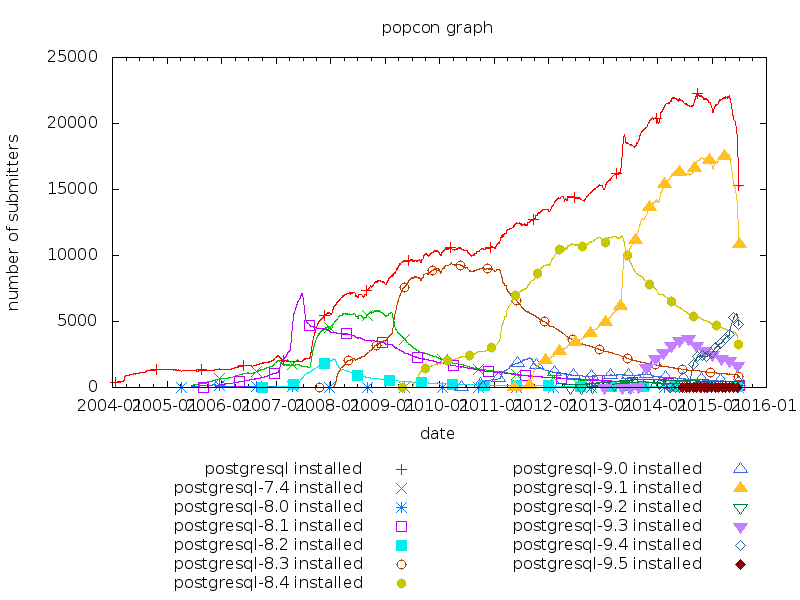
Today saw the release of PostgreSQL 9.5 Alpha 1. Packages for all supported Debian and Ubuntu releases are available on apt.postgresql.org: deb http://apt.postgresql.org/pub/repos/apt/ YOUR_RELEASE_HERE-pgdg main 9.5 The package is also waiting in NEW to be accepted for Debian experimental. Being curious which PostgreSQL releases have been in use over time, I pulled some graphics from Debian's popularity contest data: Before we included the PostgreSQL major version in the package name, "postgresql" contained the server, so that line represents the installation count of the pre-7.4 releases at the left end of the graph. Interestingly, 7.4 reached its installation peak well past 8.1's. Does anyone have an idea why that happened?
20 June 2015

Lunar: Reproducible builds: week 4 in Stretch cycle

What happened about the reproducible builds effort for this week: Toolchain fixes Lunar rebased our custom dpkg on the new release, removing a now unneeded patch identified by Guillem Jover. An extra sort in the buildinfo generator prevented a stable order and was quickly fixed once identified. Mattia Rizzolo also rebased our custom debhelper on the latest release. Packages fixed The following 30 packages became reproducible due to changes in their build dependencies: animal-sniffer, asciidoctor, autodock-vina, camping, cookie-monster, downthemall, flashblock, gamera, httpcomponents-core, https-finder, icedove-l10n, istack-commons, jdeb, libmodule-build-perl, libur-perl, livehttpheaders, maven-dependency-plugin, maven-ejb-plugin, mozilla-noscript, nosquint, requestpolicy, ruby-benchmark-ips, ruby-benchmark-suite, ruby-expression-parser, ruby-github-markup, ruby-http-connection, ruby-settingslogic, ruby-uuidtools, webkit2gtk, wot. The following packages became reproducible after getting fixed: Some uploads fixed some reproducibility issues but not all of them: Patches submitted which did not make their way to the archive yet: Also, the following bugs have been reported: reproducible.debian.net Holger Levsen made several small bug fixes and a few more visible changes: strip-nondeterminism Version 0.007-1 of strip-nondeterminism the tool to post-process various file formats to normalize them has been uploaded by Holger Levsen. Version 0.006-1 was already in the reproducible repository, the new version mainly improve the detection of Maven's pom.properties files. debbindiff development At the request of Emmanuel Bourg, Reiner Herrmann added a comparator for Java .class files. Documentation update Christoph Berg created a new page for the timestamps in manpages created by Doxygen. Package reviews 93 obsolete reviews have been removed, 76 added and 43 updated this week. New identified issues: timestamps in manpages generated by Doxygen, modification time differences in files extracted by unzip, tstamp task used in Ant build.xml, timestamps in documentation generated by ASDocGen. The description for build id related issues has been clarified. Meetings Holger Levsen announced a first meeting on Wednesday, June 3rd, 2015, 19:00 UTC. The agenda is amendable on the wiki. Misc. Lunar worked on a proof-of-concept script to import the build environment found in .buildinfo files to UDD. Lucas Nussbaum has positively reviewed the proposed schema. Holger Levsen cleaned up various experimental toolchain repositories, marking merged brances as such.

17 May 2015

Lunar: Reproducible builds: week 3 in Stretch cycle

What happened about the reproducible builds effort for this week: Toolchain fixes Tomasz Buchert submitted a patch to fix the currently overzealous package-contains-timestamped-gzip warning. Daniel Kahn Gillmor identified #588746 as a source of unreproducibility for packages using python-support. Packages fixed The following 57 packages became reproducible due to changes in their build dependencies: antlr-maven-plugin, aspectj-maven-plugin, build-helper-maven-plugin, clirr-maven-plugin, clojure-maven-plugin, cobertura-maven-plugin, coinor-ipopt, disruptor, doxia-maven-plugin, exec-maven-plugin, gcc-arm-none-eabi, greekocr4gamera, haskell-swish, jarjar-maven-plugin, javacc-maven-plugin, jetty8, latexml, libcgi-application-perl, libnet-ssleay-perl, libtest-yaml-valid-perl, libwiki-toolkit-perl, libwww-csrf-perl, mate-menu, maven-antrun-extended-plugin, maven-antrun-plugin, maven-archiver, maven-bundle-plugin, maven-clean-plugin, maven-compiler-plugin, maven-ear-plugin, maven-install-plugin, maven-invoker-plugin, maven-jar-plugin, maven-javadoc-plugin, maven-processor-plugin, maven-project-info-reports-plugin, maven-replacer-plugin, maven-resources-plugin, maven-shade-plugin, maven-site-plugin, maven-source-plugin, maven-stapler-plugin, modello-maven-plugin1.4, modello-maven-plugin, munge-maven-plugin, ocaml-bitstring, ocr4gamera, plexus-maven-plugin, properties-maven-plugin, ruby-magic, ruby-mocha, sisu-maven-plugin, syncache, vdk2, wvstreams, xml-maven-plugin, xmlbeans-maven-plugin. The following packages became reproducible after getting fixed: Some uploads fixed some reproducibility issues but not all of them: Ben Hutchings also improved and merged several changes submitted by Lunar to linux. Currently untested because in contrib: reproducible.debian.net
Thanks to the reproducible-build team for running a buildd from hell. gregor herrmann
Mattia Rizzolo modified the script added last week to reschedule a package from Alioth, a reason can now be optionally specified. Holger Levsen splitted the package sets page so each set now has its own page. He also added new sets for Java packages, Haskell packages, Ruby packages, debian-installer packages, Go packages, and OCaml packages. Reiner Herrmann added locales-all to the set of packages installed in the build environment as its needed to properly identify variations due to the current locale. Holger Levsen improved the scheduling so new uploads get tested sooner. He also changed the .json output that is used by tracker.debian.org to lists FTBFS issues again but only for issues unrelated to the toolchain or our test setup. Amongst many other small fixes and additions, the graph colors should now be more friendly to red-colorblind people. The fix for pbuilder given in #677666 by Tim Landscheidt is now used. This fixed several FTBFS for OCaml packages. Work on rebuilding with different CPU has continued, a kvm-on-kvm build host has been set been set up for this purpose. debbindiff development Version 19 of debbindiff included a fix for a regression when handling info files. Version 20 fixes a bug when diffing files with many differences toward a last line with no newlines. It also now uses the proper encoding when writing the text output to a pipe, and detects info files better. Documentation update Thanks to Santiago Vila, the unneeded -depth option used with find when fixing mtimes has been removed from the examples. Package reviews 113 obsolete reviews have been removed this week while 77 has been added.

15 April 2015

Rapha&#235;l Hertzog: Looking back at the Debian Long Term Support project

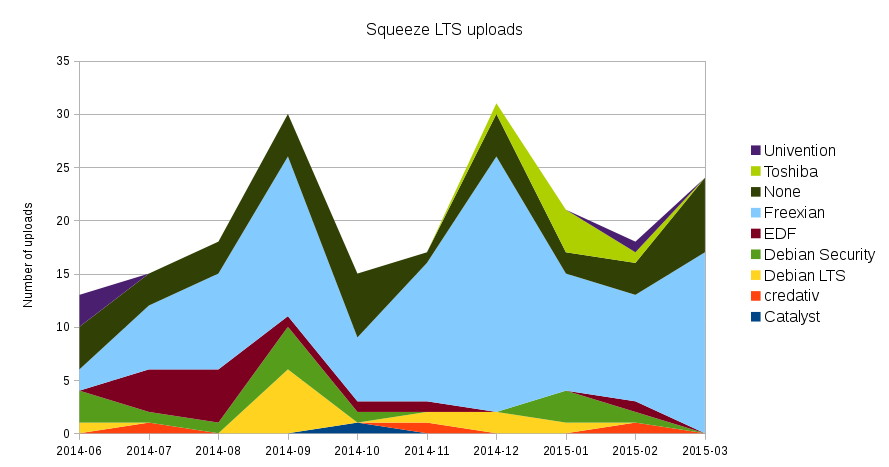
On Sunday I gave a talk about Debian LTS during the Mini-DebConf in Lyon. Obviously I presented the project and the way it s organized, but I also took the opportunity to compute some statistics. You can watch the presentation (thanks to the video team!) or have a look at the slides to learn more. Here are some extracts of the statistics I collected: The number of the uploads per affiliation (known affiliations are recorded in the LTS/Team wiki page) is displayed on the graph below. None corresponds to packages maintainers taking care of their own packages, Debian Security corresponds to members of the security team who also contributed to LTS, Debian LTS corresponds to individual members of the LTS team without any explicit affiliation. Freexian represents in fact 29 financial sponsors (see detail here). Debian LTS uploads over time Top 12 contributors (in number of uploads): The talk also contains explanations about the current funding setup. Hopefully this clears things up for people who were still wondering how the LTS project is working.

One comment Liked this article? Click here. My blog is Flattr-enabled.

20 March 2015

Lucas Nussbaum: Several improvements to UDD s Bug Search and Maintainer Dashboard

Several improvements have been made to UDD s Bug Search and Maintainer Dashboard recently. On the Maintainer Dashboard side, the main new feature is a QA checks table that provides an overview of results from lintian, reproducible builds, piuparts, and ci.debian.net. Check the dashboard for the Ruby team for an example. Also, thanks to Daniel Pocock, the TODO items can now be exported as iCalendar tasks. Bugs Search now has much better JSON and YAML outputs. It s probably a good start if you want to do some data-mining on bugs. Packages can now be selected using the same form as the Maintainer Dashboard s one, which makes it easy to build your own personal bug list, and will suppress the need for some of the team-specific listings. Many bugs have been fixed too. More generally, thanks to the work of Christophe Siraut, the code is much better now, with a clean separation of the data analysis logic and the rendering sides that will make future improvements easier. As the reminder, it s quite easy to hack on UDD (even if you are not a DD). Please report bugs, including about additional features you would like to see!

26 February 2015

Michael Banck: 26 Feb 2015

My recent Debian LTS activities

Over the past months, my employer credativ has sponsored some of my work time to keep PostgreSQL updated for squeeze-lts. Version 8.4 of PostgreSQL was declared end-of-life by the upstream PostgreSQL Global Development Group (PGDG) last summer, around the same time official squeeze support ended and squeeze-lts took over. Together with my colleagues Christoph Berg (who is on the PostgreSQL package maintainer team) and Bernd Helmle, we continued backpatching changes to 8.4. We tried our best to continue the PGDG backpatching policy and looked only at commits at the oldest still maintained branch, REL9_0_STABLE.

Our work is publicly available as a separate REL8_4_LTS branch on Github. The first release (called 8.4.22lts1) happened this month mostly coinciding with the official 9.0, 9.1, 9.2, 9.3 and 9.4 point releases. Christoph Berg has uploaded the postgresql-8.4 Debian package for squeeze-lts and release tarballs can be found on Github here (scroll down past the release notes for the tarballs).

We intend to keep the 8.4 branch updated on a best-effort community basis for the squeeze-lts lifetime. If you have not yet updated from 8.4 to a more recent version of PostgreSQL, you probably should. But if you are stuck on squeeze, you should use our LTS packages. If you have any questions or comments concerning PostgreSQL for squeeze-lts, contact me.

11 February 2015

John Goerzen: Reactions to Has modern Linux lost its way? and the value of simplicity

Apparently I touched a nerve with my recent post about the growing complexity of issues. There were quite a few good comments, which I ll mention here. It s provided me some clarity on the problem, in fact. I ll try to distill a few more thoughts here. The value of simplicity and predictability The best software, whether it s operating systems or anything else, is predictable. You read the documentation, or explore the interface, and you can make a logical prediction that when I do action X, the result will be Y. grep and cat are perfect examples of this. The more complex the rules in the software, the more hard it is for us to predict. It leads to bugs, and it leads to inadvertant security holes. Worse, it leads to people being unable to fix things themselves one of the key freedoms that Free Software is supposed to provide. The more complex software is, the fewer people will be able to fix it by themselves. Now, I want to clarify: I hear a lot of talk about ease of use. Gnome removes options in my print dialog box to make it easier to use. (This is why I do not use Gnome. It actually makes it harder to use, because now I have to go find some obscure way to just make the darn thing print.) A lot of people conflate ease of use with ease of learning, but in reality, I am talking about neither. I am talking about ease of analysis. The Linux command line may not have pointy-clicky icons, but at least at one time once you understood ls -l and how groups, users, and permission bits interacted, you could fairly easily conclude who had access to what on a system. Now we have a situation where the answer to this is quite unclear in terms of desktop environments (apparently some distros ship network-manager so that all users on the system share the wifi passwords they enter. A surprise, eh?) I don t mind reading a manpage to learn about something, so long as the manpage was written to inform. With this situation of dbus/cgmanager/polkit/etc, here s what it feels like. This, to me, is the crux of the problem: It feels like we are in a twisty maze, every passage looks alike, and our flashlight ran out of battieries in 2013. The manpages, to the extent they exist for things like cgmanager and polkit, describe the texture of the walls in our cavern, but don t give us a map to the cave. Therefore, we are each left to piece it together little bits at a time, but there are traps that keep moving around, so it s slow going. And it s a really big cave. Other user perceptions There are a lot of comments on the blog about this. It is clear that the problem is not specific to Debian. For instance: This stuff is really important, folks. People being able to maintain their own software, work with it themselves, etc. is one of the core reasons that Free Software exists in the first place. It is a fundamental value of our community. For decades, we have been struggling for survival, for relevance. When I started using Linux, it was both a question and an accomplishment to have a useable web browser on many platforms. (Netscape Navigator was closed source back then.) Now we have succeeded. We have GPL-licensed and BSD-licensed software running on everything from our smartphones to cars. But we are snatching defeat from the jaws of victory, because just as we are managing to remove the legal roadblocks that kept people from true mastery of their software, we are erecting technological ones that make the step into the Free Software world so much more difficult than it needs to be. We no longer have to craft Modelines for X, or compile a kernel with just the right drivers. This is progress. Our hardware is mostly auto-detected and our USB serial dongles work properly more often on Linux than on Windows. This is progress. Even our printers and scanners work pretty darn well. This is progress, too. But in the place of all these things, now we have userspace mucking it up. We have people with mysterious errors that can t be easily assisted by the elders in the community, because the elders are just as mystified. We have bugs crop up that would once have been shallow, but are now non-obvious. We are going to leave a sour taste in people s mouth, and stir repulsion instead of interest among those just checking it out. The ways out It s a nasty predicament, isn t it? What are your ways out of that cave without being eaten by a grue? Obviously the best bet is to get rid of the traps and the grues. Somehow the people that are working on this need to understand that elegance is a feature a darn important feature. Sadly I think this ship may have already sailed. Software diagnosis tools like Enrico Zini s seat-inspect idea can also help. If we have something like an ls for polkit that can reduce all the complexity to something more manageable, that s great. The next best thing is a good map good manpages, detailed logs, good error messages. If software would be more verbose about the permission errors, people could get a good clue about where to look. If manpages for software didn t just explain the cavern wall texture, but explain how this room relates to all the other nearby rooms, it would be tremendously helpful. At present, I am unsure if our problem is one of very poor documentation, or is so bad that good documentation like this is impossible because the underlying design is so complex it defies being documented in something smaller than a book (in which case, our ship has not just sailed but is taking on water). Counter-argument: progress One theme that came up often in the comments is that this is necessary for progress. To a certain extent, I buy that. I get why udev is important. I get why we want the DE software to interact well. But here s my thing: this already worked well in wheezy. Gnome, XFCE, and KDE software all could mount/unmount my drives. I am truly still unsure what problem all this solved. Yes, cloud companies have demanding requirements about security. I work for one. Making security more difficult to audit doesn t do me any favors, I can assure you. The systemd angle To my surprise, systemd came up quite often in the discussion, despite the fact that I mentioned I wasn t running systemd-sysv. It seems like the new desktop environemt ecosystem is the systemd ecosystem in a lot of people s minds. I m not certain this is justified; systemd was not my first choice, but as I said in an earlier blog post, jessie will still boot . A final note I still run Debian on all my personal boxes and I m not going to change. It does awesome things. For under $100, I built a music-playing system, with Raspberry Pis, fully synced throughout my house, using a little scripting and software. The same thing from Sonos would have cost thousands. I am passionate about this community and its values. Even when jessie releases with polkit and all the rest, I m still going to use it, because it is still a good distro from good people.

4 February 2015

Christoph Berg: apt.postgresql.org statistics

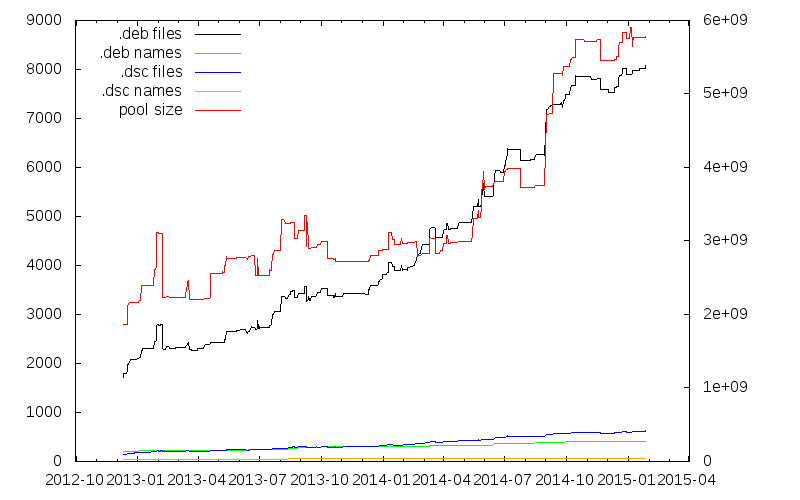
At this year's FOSDEM I gave a talk in the PostgreSQL devroom about Large Scale Quality Assurance in the PostgreSQL Ecosystem. The talk included a graph about the growth of the apt.postgresql.org repository that I want to share here as well: The yellow line at the very bottom is the number of different source package names, currently 71. From that, a somewhat larger number of actual source packages that include the "pgdgXX" version suffixes targeting the various distributions we have is built (blue). The number of different binary package names (green) is in about the same range. The dimension explosion then happens for the actual number of binary packages (black, almost 8000) targeting all distributions and architectures. The red line is the total size of the pool/ directory, currently a bit less than 6GB. (The graphs sometimes decrease when packages in the -testing distributions are promoted to the live distributions and the old live packages get removed.)

14 January 2015

Ritesh Raj Sarraf: apt-offline 1.6

I am pleased to announce the release of apt-offline - 1.6 This release is mostly a bug fix release, which every user should upgrade to. It also fixes a major bug in the way we limited the validation of GPG integrity, for the APT repository lists (Thank you Paul Wise). Also, In the last release, we migrated from custom magic library to the python shipped ctype python-magic library. That allowed some bugs to creep, and hopefully now, all those bugs should be fixed. A big thanks to Roland Summers for his bug reports and continuous feedback. What is apt-offline ?
Description-en: offline APT package manager
 apt-offline is an Offline APT Package Manager.
 .
 apt-offline can fully update and upgrade an APT based distribution without
 connecting to the network, all of it transparent to APT.
 .
 apt-offline can be used to generate a signature on a machine (with no network).
 This signature contains all download information required for the APT database
 system. This signature file can be used on another machine connected to the
 internet (which need not be a Debian box and can even be running windows) to
 download the updates.
 The downloaded data will contain all updates in a format understood by APT and
 this data can be used by apt-offline to update the non-networked machine.
 .
 apt-offline can also fetch bug reports and make them available offline.
Debian changelog for the 1.6 release.
apt-offline (1.6) experimental; urgency=medium
  * [2a4a7f1] Don't abuse exception handlers.
    Thanks to R-Sommer
  * [afc51b3] MIME type for a deb package.
    Thanks to R-Sommer
  * [ec2d539] Also include debian-archive-keyring.
    Thanks to Hans-Christoph Steiner (Closes: #748082)
  * [dc602ac] Update MIME type for .gpg
  * [c4f9b71] Cycle through possible apt keyrings.
    Thanks to Paul Wise (Closes: #747163)
  * [de0fe4d] Clarify manpage for install
  * [b5e1075] Update manpage with some doc about argparse positional
    values to arguments
  * [c22d64d] Port is data type integer.
    Thanks to Roland Sommer
  * [67edebe] autodetect release name
  * [5803141] Disable python-apt support
 -- Ritesh Raj Sarraf <rrs@debian.org>  Wed, 14 Jan 2015 15:34:45 +0530
[1] https://alioth.debian.org/projects/apt-offline/

Categories:

Keywords:

22 October 2014

Sylvain Le Gall: Release of OASIS 0.4.5

On behalf of Jacques-Pascal Deplaix I am happy to announce the release of OASIS v0.4.5. Logo OASIS small OASIS is a tool to help OCaml developers to integrate configure, build and install systems in their projects. It should help to create standard entry points in the source code build system, allowing external tools to analyse projects easily. This tool is freely inspired by Cabal which is the same kind of tool for Haskell. You can find the new release here and the changelog here. More information about OASIS in general on the OASIS website. Here is a quick summary of the important changes: Features: This new version is a small release to catch up with all the fixes/pull requests present in the VCS that have not yet been published. This should made the life of my dear contributors easier -- thanks again for being patient. I would like to thanks again the contributor for this release: Christopher Zimmermann, Jerome Vouillon, Tomohiro Matsuyama and Christoph H ger. Their help is greatly appreciated.

Next.

Previous.