Search Results: "charles"

21 August 2012

Charles Plessy: Social networks and chain of trust.

It is rare that I use social networks, but usually I do not decline invitations to connect when they come from people I know. This said, I had doubts when accepting invitations from other Debian Developers, most of whom I never met in person: how can I be sure that the account really belongs to the person ? Luckily, we have a tool to solve that problem, our GPG key ring. I have signed the URLs of my pages on some networks, and from now I decided to only accept invitations to connect that are certified by this way or another, when they originate from somebody having a key. Paradoxically, although most social networks do not redistribute the source code of their systems, the only time I really used one was for Free software, by contacting a former developer whose email address was not available anymore, in order to clarify the license of one piece of code he wrote long time ago, that way saving one of my packages from being exiled in the non-free area.

26 July 2012

Charles Plessy: Adopted mime-support.

With L szl B sz rm nyi we adopted mime-support, which was maintained since September 1996 by Brian White. It is the first package of standard priority that I take care of. It gives me the same feeling as when side wheels were removed from my bicycle, a long, long time ago. We transferred the source package on Alioth, and uploaded a first update allowing the extraction of information for the mailcap file directly from Desktop files. I think that the next two works will be to resolve the bug about the handling of PHP files, and to update the mime.types base, if possible in synergy with Fedora or other distributions.

17 July 2012

Luciano Bello: there is no cabal.. but, what s a cabal?

In my long trip to Nicaragua I made progress in my reading: Quicksilver, by Neal Stephenson. In the Spanish edition the title is Azogue. But I m assuming that you are not a Spanish speaker. Here is a small fragment (in English) I found there:
You must remember that the planters are short-sighted. They re all desperate to get out of Jamaica they wake up every day expecting to find themselves, or their children, in the grip of some tropical fever. To import female Neegers would cost nearly as much as to import males, but the females cannot produce as much sugar particularly when they are breeding. Daniel had finally recognized this voice as belonging to Sir Richard Apthorp the second A in the CABAL.
It s a bit embarrassing when I discovered myself realizing where the word cabal comes from. And I m posting this as a head-up for everyone who know there is no cabal in Debian; but they don t know which is the origin of the word cabal. Stephenson changed the name of the historic cabal, a group of high councillers of King Charles II of England, Scotland and Ireland, in 1668. In the novel, they are: John Comstock (Earl of Epsom), Louis Anglesey (Duke of Gunfleet), Knott Bolstrood (Count Penistone), Sir Richard Apthorp and Hugh Lewis (Duke of Tweed). In the real world they had been:
Thomas Clifford, 1st Baron Clifford of Chudleigh (1630-1673). Henry Bennet, 1st Earl of Arlington (1618-1685). George Villiers, 2nd Duke of Buckingham (1628-1687). Anthony Ashley Cooper, 1st Baron Ashley of Wimborne St Giles (1621-1683). John Maitland, 1st Duke of Lauderdale (1616-1682).
This group shared the effective power in a royal council rather than the King.

24 June 2012

Russell Coker: Targeted Advertising

Don Marti has written another blog post about targeted advertising [1]. His main point is that when a company uses the most targeted adverts (such as Google advertising) everyone knows that they are paying a small number of cents per click and nothing for the people who don t click. This compares to TV adverts which cost a lot of money and for which most viewers either leave the room or use fast-forward. Therefore using Google adverts doesn t send a signal about the amount of money invested in the products. Don also cited an example of a company sponsoring an OK Go film clip, that was a great idea, it shows that the company can do expensive things which are also a bit creative and fans will thank them (watch all the OK Go videos on Youtube, they are great). The next question is how else companies can advertise? One thing I d really like to see is sponsorship of authors. Pick an author and pay them a salary with paid editorial services for releasing a book a year for free in HTML and ebook formats. Having a fixed salary is a significant benefit when it comes time to apply for a mortgage or plan a holiday and being able to freely distribute books would be a significant benefit for an author who hasn t got a large fan base. In the computer industry it seems that there s a lot of potential for sponsoring people who produce free things. That ranges from free software and designs for free hardware to blog posts and documentation. Five years ago Sun had a blogging contest and my friend Dave Hall won a server that was worth $21K [2]. It would be nice if some other companies started doing similar things and if Sun did a repeat so some other people I like could get some free kit. Related posts:
  1. What is Appropriate Advertising? Colin Charles writes about a woman who is selling advertising...
  2. Advertising Free Software Projects Today I just noticed the following advert on one of...
  3. Friends and Adverts For some time I have been running Google Adsense adverts...

31 May 2012

Russell Coker: Links May 2012

Vijay Kumar gave an interesting TED talk about autonomous UAVs [1]. His research is based on helicopters with 4 sets of blades and his group has developed software to allow them to develop maps, fly in formation, and more. Hadiyah wrote an interesting post about networking at TED 2012 [2]. It seems that giving every delegate the opportunity to have their bio posted is a good conference feature that others could copy. Bruce Schneier wrote a good summary of the harm that post-911 airport security has caused [3]. Chris Neugebauer wrote an insightful post about the drinking culture in conferences, how it excludes people and distracts everyone from the educational purpose of the conference [4]. Matthew Wright wrote an informative article for Beyond Zero Emissions comparing current options for renewable power with the unproven plans for new nuclear and fossil fuel power plants [5]. The Free Universal Construction Kit is a set of design files to allow 3D printing of connectors between different types of construction kits (Lego, Fischer Technic, etc) [6]. Jay Bradner gave an interesting TED talk about the use of Open Source principles in cancer research [7]. He described his research into drugs which block cancer by converting certain types of cancer cell into normal cells and how he shared that research to allow the drugs to be developed for clinical use as fast as possible. Christopher Priest wrote an epic blog post roasting everyone currently associated with the Arthur C. Clarke awards, he took particular care to flame Charles Stross who celebrated The Prestige of such a great flaming by releasing a t-shirt [8]. For a while I ve been hoping that an author like Charles Stross would manage to make more money from t-shirt sales than from book sales, Charles is already publishing some of his work for free on the Internet and it would be good if he could publish it all for free. Erich Schubert wrote an interesting post about the utility and evolution of Favebook likes [9]. Richard Hartmann wrote an interesting summary of the problems with Google products that annoy him the most [10]. Sam Varghese wrote an insightful article about the political situation in China [11]. The part about the downside of allowing poorly educated people to vote seems to apply to the US as well. Sociological Images has an article about the increased rate of Autism diagnosis as social contagion [12]. People who get their children diagnosed encourage others with similar children to do the same. Vivek wrote a great little post about setting up WPA on Debian [13]. It was much easier than expected once I followed that post. Of course I probably could have read the documentation for ifupdown, but who reads docs when Google is available? Related posts:
  1. Links March 2012 Washington s Blog has an informative summary of recent articles about...
  2. Links April 2012 Karen Tse gave an interesting TED talk about how to...
  3. Links February 2012 Sociological Images has an interesting article about the attempts to...

26 May 2012

Charles Plessy: Cloud-init uploaded to Debian.

Each instance (virtual machine) started from the same image is configured identically. The same account and the same procedure will be used to connect to it. If the machine image is public and if the instance is open to the Internet, which is common when using commercial providers such as Amazon, an attacker could connect randomly to known IPs from the cloud, and eventually access to an instance before its owner. To individualise the connection to each instance, one can pass informations at startup, called instance metadata, which will be available to this instance only at a fixed HTTP URL. If the owner provides a public SSH key, this can be used to ensure that only the owner of the private key can connect. After the next update of network-console, this method of connection will be available for the Debian Installer. Likewise for the Debian images produced, by installing the cloud-init packages, that I uploaded to the experimental section of our archive. This package is far from ready. It lacks init scripts, it is not translated, and to be honest, I have not tested it. But to have it in Debian makes me benefit from the package and bugs tracking systems. Do not hesitate to report some, or better, to participate to the maintenance of this package. Cloud-init has many other interesting functionalities. I would like to thank Scott Moser, the upstream developer and maintainer of the Ubuntu package, for his cooperation during the creation of the Debian package, as I made large modifications, in particular the removal of the part managing the menu.lst for pv-grub, which will have its own package or will be transferred somewhere else.

28 March 2012

Andrew Pollock: [life/americania] Four days in New Orleans

Sarah's Mum had accrued too much annual leave and had to take some time off work, so Sarah did some (very mild) arm twisting and convinced her to come over for 3 weeks, and do a 5 day cruise to Mexico out of New Orleans. Unfortunately, my annual leave situation wasn't quite so abundant, and I had a lot going on at work, so regretfully I didn't join them on the cruise, and instead went to New Orleans for a four day weekend when they returned. From all reports, the cruise was very good. Zoe handled it well, although she did say "home" a lot. One of the two stops in Mexico was to check out some Mayan ruins, which looked awesome from the photos. The other stop involved a dolphin encounter. I was incredibly envious of all that they got to do, and would have loved to have gone with them, as I've never been on a cruise ship either. I can also report that no cats were lost during this bachelor stint. I had a night flight on the Wednesday evening to get there, which was scheduled to get in at around midnight, and I'd booked a motel room near the airport for that night, and we'd booked a vacation rental home for Thursday to Sunday nights. Unfortunately, my flight ended being delayed something like 2.5 hours, so I didn't get into New Orleans until around 2am. The house we rented did the trick nicely. It was a small "shotgun" duplex in what looked like a nice neighbourhood. It was advertised as being close to the street car line, but they were doing some work on the tracks, so the street car didn't seem to be running as far down the line as it usually did, so it ended up being a bit more of a trek to get to it. It was also extremely slow, and there was a marathon on the Sunday, which closed everything down for a long time, making it a generally pretty unreliable form the transport. We ended up renting a car for Saturday and Sunday, which was something of a saga in itself, as Enterprise didn't have any cars at the location we'd booked one, so after a couple of hours cooling our heels there (Zoe was incredibly well-behaved, all things considered), they shuttled us over to another location and we ended up with a minivan instead of a compact, which for the same price, allayed our concerns about being able to transport all of our luggage to the airport on Monday morning. We had a very early morning flight on Monday morning to come back, which got into SFO at around 9am, and I went directly to work from there. Thursday We all arrived at the house, separately. It ended up taking them 2 hours to disembark the ship when it came back into port, with Customs taking an eternity to process everyone. I think we went exploring the local area that afternoon, and took a street car into the city to check out Bourbon Street, having a Cajun dinner at Remoulade. Friday In the morning, we went to check out Lafayette Cemetery Number 2. Sarah took Zoe back to the house for a nap, and Sarah's Mum and I continued back to explore the French Quarter some more, walking down the length of Royal Street (which was vastly different from Bourbon Street, just one block over). We had lunch at the French Market. The cemetery was interesting, as pretty much all of the graves were these huge above ground tombs, that seemed to have multiple family members interred in them. Apparently the cemetery filled up quite quickly courtesy of a Yellow Fever outbreak. After lunch, Sarah's Mum and I continued wandering around the French Quarter. We went and took a look at the Mississippi River, and I had an encounter with a grifter who was so good at his job I couldn't bring myself to argue with him over the $20 he diddled me out of. We tried to get to the Civil War Museum, but it closed at 4pm. We looked at the Robert E. Lee Monument, which seemed to be draped in drunks, and then I think we rendezvoused with Sarah and Zoe back on Canal Street for dinner at The Court of Two Sisters (which apparently we were under-dressed for, as Sarah and her Mum said we were getting a lot of dirty looks from other patrons). Saturday On Saturday morning, we had the aforementioned car rental experience from hell, and by the time we had the car it was lunchtime, so Zoe napped in the car after lunch on the way out to Oak Alley Plantation, where we were introduced to the delightful beverage known as the mint julep, and took a tour of the house and wandered the grounds. Sunday On Sunday, Sarah and her Mum did a swamp tour, and Zoe and I went to the zoo. As I said earlier, there was a marathon that completely closed down Saint Charles Avenue, which is where the street cars run, so after walking down to where the street cars started operating (which ended up being most of the way down South Carrollton Avenue), the driver informed me that the street cars were queuing up at the corner of South Carrollton and Saint Charles, and I should get off her street car and get on the one at the front of the queue. I did this, but the driver of the front street car informed me that she wouldn't be leaving for an hour and half. At this point, I started considering a bus instead. Zoe and I went to check out the Mississippi River, which was quite close to where we were, and then I went back, and despite a street car having left (without any passengers) the driver of the current street car couldn't tell me when she'd be leaving, so I started walking down Saint Charles Avenue. Unfortunately, Zoe's going through a phase where she wants to be carried everywhere, so I was lugging her all over the place on my hip. Sarah didn't take a stroller with her, and instantly regretted it. Lesson learned. Eventually we managed to get onto a bus, which dropped us off at Audubon Park, which had Audubon Zoo at the other end of it. There was a playground near the Saint Charles Avenue end of the park, so Zoe had a bit of a play on that, and then we continued through the park to the zoo. Mercifully, the zoo had dodgy strollers for rent, and there was no way in the world I wasn't going to rent one of them, so that made getting around with Zoe a lot easier on my back. We had a really good time at the zoo. There was some sort of a music festival on in the parklands within the zoo grounds, and that included a jumping castle, which Zoe expressed a desire to have a go on. She had a fabulous time on it. I think she probably spent about 15 minutes in there, without any tears. I was very impressed. I took a brief video of some of her antics. It was getting close to Zoe's nap time, and she was getting tired, but fortunately Sarah and her Mum were able to pick us up from the zoo after their swamp tour and Zoe got to nap back at the house. Monday We had a very early start. Unfortunately, our flight (with United) was a couple of days after United and Continental officially merged, and despite having checked in online, we had to queue up with everyone else (for an extended period of time) to drop off our checked luggage. Then there was a 45 minute line for security screening. We pulled the "toddler going to melt down" card and jumped to the head of the line, but Sarah's Mum had to wait. The flight ended up being delayed because people were stuck in the security line. Overall impressions of New Orleans Fabulous architecture. There were so many gorgeous houses on Saint Charles Avenue and the surrounding area. I'd have loved to do an architecture tour. Crap (but cheap) public transport. $3 gets you a day pass. The street cars are cute, but slow and unpredictable. The drivers were remarkably unhelpful. The buses were okay. Great food. Zoe seemed to have a liking for the spicy stuff. I gave her some fresh alligator jerky, and after some initial coughing and spluttering at the spiciness of it, she came back for more. Post-Katrina recovery. We really only saw a very small part of the city, but there were still some houses with boarded up windows, and some vacant blocks where buildings had been demolished, but largely you'd not have been able to tell that large parts of the city had been underwater, from casual inspection. I really enjoyed the trip, even though it was brief, I feel like I got a good feel for the place. We were there just after Mardi Gras, and there were still beads everywhere. Draped all over fences. Over power lines. Trees on the parade route were absolutely covered in beads. I'd have loved to have been there for Mardi Gras. My friend Brandon, who is an excellent street photographer, took some great photos that capture some of it. Photos from Sarah's cruise and our time in New Orleans are here.

22 March 2012

Russell Coker: Links March 2012

Washington s Blog has an informative summary of recent articles about corporate psychopaths [1]. Including the fact that some banks deliberately hire psychopaths. Anu Partanen wrote an insightful article for The Atlantic about the difference between Finnish and American education systems [2]. It seems that Finland has achieved great educational success by aiming for equality with no private schools and giving the teachers and principals enough responsibility to do the job properly. Ramona Pierson gave an interesting TED talk about how she recovered from being run over by a drunk driver with the help of the residents of a senior citizens home [3]. Quyen Nguyen gave a very interesting TED talk about the use of fluorescent dyes in cancer surgery [4]. They can make cancer glow one color and nerves glow with a different color which makes it a much easier task to remove ALL the cancer without cutting the smaller nerves. James Fallows wrote an interesting article for The Atlantic about the experience of having his wife s Gmail account cracked [5]. She stored EVERYTHING in her Gmail account so this was a lot worse for her than for the typical Geek who doesn t use such accounts for storing much. James describes what the attacker did, how they did it, and what needed to be done to recover. When running a mail server it s worth considering what you would do to help a user who was attacked in that way. Charles Stross has written an interesting blog post trying to predict some future psychological and social changes [6]. Matthew Wright of Beyond Zero Emissions has written an informative article about how solar panels on home roofs save everyone money [7]. Mikko Hypponen gave an interesting TED talk about different types of online attack and how they can affect us [8]. Among other things he describes how online attacks can result in people dying. Scott Rickard gave an interesting TED talk about using maths to create SONAR pings without repitition and also the worst music ever created [9]. I found it entertaining to watch Michael Lindel (the director of chamber music for the New York Symphony) play the music, he obviously didn t enjoy that performance. Sheena Iyengar gave an interesting TED talk about the way people make choices [10]. It s useful for anyone who is going to prepare a set of options for someone else to choose from. ASD Aid is a project that uses Lego to encourage kids on the Autism Spectrum to socialise [11]. They have training manuals for using Lego in therapy. Unfortunately they have not been supported by the Lego corporation. Bilal Bomani gave an interesting and informative TED talk about NASA research into renewable aviation fuel [12]. The most interesting thing to me was the way that they were aiming for a sustainable lifecycle that didn t use resources that coule be used for food and which required minimal input once it was started. Alain de Botton gave an interesting TED talk about Atheism 2.0 [13]. He suggests that we adopt some ideas from religious organisations including lectures (sermons), celebrations, and rituals. It s interesting to think of a technology conference as a pilgrimage. Homaro Cantu and Ben Roche from Moto restaurant in Chicago gave an interesting talk about some of the unusual foods that they have produced [14]. If I visit the US again I will try and go to Chicago to eat there! Related posts:
  1. Links March 2009 Cory Doctorow has written a column for The Guardian titled...
  2. Links February 2012 Sociological Images has an interesting article about the attempts to...
  3. Links January 2012 Cops in Tennessee routinely steal cash from citizens [1]. They...

18 March 2012

Charles Plessy: Debian-installer in a cloud.

Debian Med prepares a metapackage for multi-purpose image machines, containing packages for bioinformatics that can be used in command line or via scripts, and that do not depend on too many other packages. I would like to prepare such an image for the Amazon cloud in the most secure manner, and the simplest way is to build it automatically in order to not have to clean anything at the end of the process. I tried for months so use the Debian installer, but banged my head against walls repeatedly, as it was impossible to re-partition the volume on which the installer was started. In the end, I figured out that this was not necessary. For instance, one can start an image containing the installer on a micro instance (-t t1.micro), with an additional volume of one gibibyte (-b /dev/sdb=:1:false) to install Debian on, and preseed the installer via instance metadata (-f preseed.txt) using a file prepared in advance. When the installation finishes, the instance terminates instead of stopping (--instance-initiated-shutdown-behavior terminate), and its volumes disappear, except the one where Debian was installed (/dev/sdb=:1:false). Debian-installer in Stable is not often updated, and its size is very small. One can therefore think of releasing one machine image per zone and architecture. I did so for T ky (ap-northeast-1) on amd64. It contains the kernel, its initrd, and a GRUB 1 menu for pvgrub, that passes the following options: console=hvc0 auto=true priority=critical url=http://169.254.169.254/latest/user-data DEBIAN_FRONTEND=text. Two key pieces are missing in the resulting system. When the kernel is installed or updated, the GRUB 1 configuration file for pvgrub must be refreshed. Also, the system must be able to retrieve a public SSH key provided through the instance metadata, to allow one to log in without using a predefined password. These two functions are provided by the cloud-init package, available in Ubuntu and Fedora. I am looking for volunteers to maintain or co-maintain cloud-init in Debian.

15 March 2012

Debian Med: Bits from Debian Med team (Posted by Andreas Tille)

Hi,

in this bits:
  1. Debian Med Bug Squashing Advent Calendar 2011
  2. Anniversary of Debian Med
  3. Second Debian Med sprint (Southport, 27th-29th January 2012)
  4. Mentoring of Month (MoM)
  5. DDs who came to Debian because of Debian Med
  6. Future plans
  7. General lessons learned

Debian Med Bug Squashing Advent Calendar 2011In December last year Thorsten Alteholz has started a nice QA initiative which might be interesting for other teams next Advent. The Debian Med team was able to fix about 70 bugs in this time. Thanks to Thorsten for this nice piece of motivation and thanks to everybody who took part in the bug squashing.

Anniversary of Debian MedOn Mon, 7 Jan 2002 the Debian Med project was first officially announced. I submitted a short blog posting about this and perhaps you might like to see a long sequence of talks about this topic.

Second Debian Med sprint (Southport, 27th-29th January 2012)In end of January 2012 the Debian Med team has met to the second sprint. As last year I would call this a very successfull event and I would recommend other teams to instanciate such meetings as well. Feel free to read my more verbose report.

Mentoring of Month (MoM)I have started this project for the following reasons:
I made a short summary how the first MoM project worked (see at bottom).

DDs who came to Debian because of Debian MedAfter realising that several members of the Debian Med team finally became DDs I made a little survey to find out about their reasons to become DD / DM. I came to the conclusion that a Blend could be a nice entry point for people to join Debian because newcomers can identify themselves with a known topic (the scope of the Blend - in this case medicine and bioinformatics) first and learn Debian rules in a team with common interest. This perfectly fits my expectation which I had from the beginning 10 years ago and I would be very happy if other Blends would follow this example to be nice, inviting and try to *actively* ask people for cooperation (see some simple rules which I learned in this process below). In the teammetrics GSOC project some graphs were created where you can see the level of contribution of these people (and other team members).

Future plansCurrently some heavy work regarding bringing bibliographic references about packages straight into package information is going on. This topic is specifically interesting in Biology because programs are frequently connected to some publication about the methods used inside the code. This topic is as well relevant to Debian Science and DebiChem. Thanks to the patient work done by Charles Plessy we now have about 70 packages featuring debian/upstream files featuring bibliographic references and there is ongoing work to move these data to UDD to enable further usage. We are in the process of final polishing the format and finishing scripts for the import. If people are interested to join this effort this would be the right moment to raise their hand.

General lessons learned
  1. Do not let wait anybody who wants to do work.
  2. Newcomers are frequently shy - try to invite them kindly and patiently.
  3. Tell people verbosely about your project - it is astonishing how less people know and what wrong assumptions they make about your project.

Kind regards
Andreas.

2 March 2012

Don Armstrong: Debian R Archive

For those of you were were in the various Debian infrastructure channels, you might have noticed that I was playing around with wanna-build, dak, sbuild, and buildd and friends. [Thanks to everyone who answered questions, btw.] Over the past week, I've been building most of CRAN, Bioconductor, and omegahat for unstable, amd64. I plan to build the same set of packages for i386, and will start a build shortly for stable as well. This effort builds on top of Charles Blundell and Dirk Eddelbuettel's cran2deb, which does most of the heavy lifting. If you're like me, and use lots of different R packages, or already use some of the R packages available on the previous build, you can simply point your sources.list to the [http://debian-r.debian.net] archive, load the appropriate GPG key, and away you go. I have a bit more information available here and I will try to keep that page updated as I build other architectures and build out for stable.

25 February 2012

Russ Allbery: Copyright format 1.0 published

Four and a half years after Sam Hocevar started a draft proposal on the Debian Wiki, we've published revision 1.0 of the machine-readable format for debian/copyright files. The format (as DEP-5) has been in widespread use for some time, but there have been multiple versions of the format and multiple transitional versioned URLs. Everyone can now update to the same version of the document and use a stable format URL. Below is the text of the annoucement that I just sent to debian-devel-announce. Version 1.0 of the machine-readable format for debian/copyright files (the culmination of the DEP-5 process) has now been published. The canonical URL (and also the URL to use in the Format field in such files) is:
http://www.debian.org/doc/packaging-manuals/copyright-format/1.0/
For those who have adopted various iterations of the DEP-5 format for your packages, please consider updating to this format the next time you revise your package. Use of this format in Debian packages is optional. Thanks to all of the people who have contributed to this work over its long evolution. Particular thanks go to Steve Langasek, Charles Plessy, and Lars Wirzenius, who kept this document moving through its extended DEP discussion process, and Sam Hocevar, who started this work in 2007. The copyright format specification is now being maintained as part of the debian-policy package and will follow the same update process that's used for other parts of Policy. See:
http://wiki.debian.org/PolicyChangesProcess
for that process. For this specification, we're trying something new for Debian technical policies. This document is versioned, and older versions of the specification will be maintained to not invalidate older references in copyright files that have not been moved to newer versions. This is similar to the way that specifications are handled by some other projects, particularly the freedesktop.org standards. The plan, going forward, is that informative changes (changes that do not change the requirements or the contents of compliant copyright files) will be made following the same relaxed procedure as other informative changes to Policy, and new versions will only informative changes will be published with the same version number. So the existing 1.0 document may receive further improvements in wording, examples, or similar changes that don't modify its meaning. Normative changes (changes that change requirements for compliant files, which includes addition of new standardized license short names) will follow the normative Policy change process, including formal seconds. Once normative changes are accepted, the next release of this specification will receive a new version number (1.1, for example). The previous version, prior to the normative changes, will be frozen, and from that point forward will not be changed except as required to continue to publish it. This includes further informative changes. We will continue publishing these frozen older versions of the standard on www.debian.org and in the debian-policy package for some time: possibly forever, and at least as long as they're still referred to by packages distributed by the project. The hope is that this will provide a good balance between specification stability, editing for clarity, and specification changes to meet changing requirements, while not invalidating the URLs in older files and while continuing to provide the information required to interpret older files.

24 January 2012

Charles Plessy: Strange Megumi

It is since two days that all my emails, @debian.org included, are in parked somewhere between the sender and my MX, as my server broke at a moment where I strictly had no time (dealine for a grant application). It is an OpenRD Ultimate with a second hand SSD. I was quite happy to have an ARM system available to test some packages like T-COFFEE, but it looks like I will have to do without. Apparently, the machine permanently reboots. I did not manage to access to the USB serial port; there are no 10 seconds where the USB port is not disconnected / reconnected. Both ethernet port LEDs blink together synchronously with the disconnections. Removing the drive did not solve the problem. The SSD itself is fine, and I did not find in the logs hints for software problems. Strange coincidence, the last log file that was modified is daemon.log, which indicates the connection of so-called megumi-PC to our unprotected, but to my knowledge never visited, wireless network. After this, nothing.

9 December 2011

Russell Coker: Some OWS Stuff

There is an interesting interview with Richard Wilkinson on ted.com about the damage to society that is caused by excessive inequality [1]. The conclusion is interesting, it seems that one part of the solution is to send the message that excessive greed is anti-social. The demonstrations against the greedy 1% seem likely to do some good in this regard. He also has a TED talk about this in which he shows that even the rich don t benefit from great inequality [2]. If nothing else the links between great inequality and high rates of mental illness and murder should convince people that they don t want to live in such a society. Buying Cameras Some of the radio news reports have claimed that some of the people in OWS camps in Australia are somehow unworthy because they have smart-phones and digital cameras. They seem to believe that people have to demonstrate great poverty to have standing to complain. The problem here is that owning a mobile phone is essential to getting employment in many industries, so the vast majority of people who are old enough to work but not near retirement age just have to own a mobile phone. Once you have decided to use a phone if you are going to use it a lot (which you probably will if living in a tent in a public place) then being on a contract usually makes economic sense. As the cheapest contracts include a free Android phone that means almost everyone who is old enough to be allowed out alone at night and young enough to be willing to sleep rough for a cause will have such a phone. A related complaint is about people owning good cameras. One reason for this is the fact that the huge number of cameras deters the police from using excessive force that s a good justification for spending money on a good camera. But then a good camera doesn t cost much nowadays, the specs on $100 cameras are quite impressive and a camera that costs $400 new will have features that are useful for professional photographers and cameras are even cheaper on ebay. In Australia social security payments for a single person who is out of work are as much as $486.80 per fortnight [3]. Therefore someone who is living on social security could buy a great camera if they saved up two weeks of social security payments or buy a similar camera on ebay for one week s worth of payments. When at a protest the widespread use of cameras is essential for protection against police brutality. It s worth saving up for a camera. But really they are missing the point, OWS is about representing ~99% of the population. Even people on the average income are suffering because of the greed of the rich. Is Australia such a Great Place? There have been claims that Australia is such a great place that OWS protests are not needed, supposedly we have a very egalitarian society. The ABS data shows that the level of inequality as expressed by numbers isn t that great when restricted to just income if you restrict the analysis to the top 20% [4]. The mean gross household income per week is $340 for the lowest quintile and $2,380 for the highest quintile giving a ratio of 1:7.0. But when you look at total household net worth it s $27,400 vs $1,720,700 a ratio of 1:62.8! The ratio for the richest 1% would surely be a lot greater but a quick search of abs.gov.au didn t turn up any statistics on them. Also Richard Wilkinson s analysis puts Australia quite close to the US. If the people who are in the top 1% earned their money, paid taxes, and didn t pervert the political process then there wouldn t be any OWS protests. The corruption in the political process and rent seeking by corporations isn t as bad here as it is in the US, but it s bad enough that we need some serious changes. Emily Manuel wrote an interesting article for Tiger Beatdown about the need for an Occupy movement in Australia [5]. Her description of the political problems in Australia is quite clear. But I wasn t convinced by her analysis which suggested that Australia is different from the US in any significant way. Really Comparing Income To properly compare income it doesn t make sense to compare a ratio of money earned, or disposable income which is often misleading due to disagreements about what is considered disposable. It s really about which of the things that you want to do can be achieved on your income. One possible way of comparing it is based on Maslow s hierarchy of human needs. The poorest 20% of households in Australia have a gross income of $340 per week. The ABS shows that the average of private rental prices in the 8 capital cities (where most of the population lives) is $218 per week [6]. Obviously the poorest households can t afford an average rent unless you have lots of people packed in one house. No matter how you look at the numbers it s going to be difficult for low income people to pay for rent and food. That puts them on the bottom level of Maslow s higherarchy. It seems to me that the benefits of increased income diminish and it becomes more of a contest to be richer than other people. Owning an old car is a significant benefit over having no car. Owning a new car has some real benefits over an old car. Luxury cars usually have safety features before they are introduced to cheaper cars, but apart from that the benefit of owning a luxury car is small. Owning multiple Rolls-Royces doesn t seem to provide any real benefit, someone who would want to do that would probably be better served by hiring a good psychologist. Update: In a comment Brendan Scott cited The Theory of the Leisure Class by Thorstein Veblen. That s a great point, and I ll have to read that book! I still maintain that owning two Rolls Royces is a symptom of psychological problems, people who can sort out such problems won t feel the need to try and prove that they have more money than others. Charles Stross has an interesting article about wealth disparity etc [7]. Being a sci-fi author he also explores what life might be like after Drexler boxes satisfy most of our current materiel needs. The Age has an informative article by Suzy Freeman-Greene contrasting the OWS protests in Melbourne which were broken up by police to the Catholic anti-abortion protests that have been going on for more than 20 years [8]. It seems that corporations aren t the only large organisations that are pwning democracy!

31 October 2011

Russell Coker: Links October 2011

Ron has written an interesting blog post about the US as a lottery economy [1]. Most people won t win the lottery (literally or metaphorically) so they remain destined for poverty. Tim Connors wrote an informative summary of the issues relating to traffic light timing and pedestrians/cyclists [2]. I have walked between Southgate and the Crown Casino area many times and have experienced the problem he describes many times. Scientific American has an interesting article about a new global marketplace for scientific research [3]. The concept is that instead of buying a wide range of research equipment (and hiring people to run it) you can outsource non-core research for a lower cost. Svante P bo gave an interesting TED talk about his work analysing human DNA to determine prehistoric human migration patterns [4]. Among other things he determined that 2.5% of the DNA from modern people outside Africa came from the Neandertals. Lisa wrote an informative article about Emotional Support Animals (as opposed to Service Animals such as guide dogs) for disabled people [5]. It seems that the US law is quite similar to Australian law in that reasonable accommodations have to be made for disabled people which includes allowing pets in rental properties even if such pets aren t officially ESAs. Beyond Zero Emissions has an interesting article about electricity prices which explains how wind power forces prices down [6]. This should offset the new carbon tax . Problogger has an article listing some of the ways that infographics can be used on the web [7]. This can be for blog posts or just for your personal understanding. Petter Reinholdtsen wrote a handy post about ripping DVDs which also explains how to do it when the DVD has errors [8], I haven t yet ripped a DVD but this one is worth noting for when I do. Miriam has written about the Fantastic Park ICT training for 8-12yo kids [9]. It s run in Spain (and all the links are in Spanish but Google Translation works well) and is a camp to teach children about computers and robotics using Lego Wedo among other things. We need to have more of these things in other countries. The Atlantic Cities has an interesting article comparing grid and cul-de-sac based urban designs [10]. Apparently the cul-de-sac design forces an increase in car use and therefore an increase in fatal accidents while also decreasing the health benefits of walking. Having lived in both grid and cul-de-sac based urban areas I have personally experienced the benefits of the grid based layout. Sarah Chayes wrote an interesting LA Times article about governments being taken over by corruption [11]. She argues that arbitrary criminal government leads to an increase in religious fundamentelism. Michael Lewis has an insightful article in Vanity Fair about the bankruptcy of US states and cities [12]. Ben Goldacre gave an interesting TED talk about bad medical science [13]. He starts with the quackery that is published in tabloid newspapers and then moves on to deliberate scientific fraud by medical companies. Geoff Mulgan gave an interesting TED talk about the Studio Schools in the UK which are based around group project work [14]. The main thing I took from this is that the best method of teaching varies by subject and by student. So instead of having a monolithic education department controlling everything we should have schools aimed at particular career paths and learning methods. Sophos has an interesting article about the motion sensors of smart phones being used to transcribe keyboard input based on vibration [15]. This attack could be launched by convincing a target to install a trojan application on their phone. It s probably best to regard your phone with suspicion nowadays. Simon Josefsson wrote a good article explaining how to use a GPG smart-card to authenticate ssh sessions with particular reference to running backups over ssh [16]. C ran wrote a good article explaining how to use all the screen space when playing DVDs on a wide screen display with mplayer [17]. Charles Stross has an informative blog post about Wall St Journal circulation fraud [18]. Apparently the WSJ was faking readership numbers to get more money from advertisers, this should lead to law suits and more problems for Rupert Murdoch. Is everything associated with Wall St corrupt?

29 October 2011

Charles Plessy: Everything in Git

Saturday started well, reading two stimulating articles on Planet_Debian. One about GitTogether2011, and the other about the use of Git in the Baserock company. I like a lot the idea of using Git beyond source code management. This article is itself distributed via a network of Git repositories. For the Debian package I develop and that are maintained with Git, I started some time ago to store their build logs in a branch that I called meta. Since sbuild can filter some variable chains in its logs, the command git diff --word-diff=color became a nice tool to inspect the difference between two package builds. Here is for instance the update I made this morning for bedtools: we can see that -D_FORTIFY_SOURCE=2 is not passed anymore, and that consequently the -Wunused-result warnings disappeared. Another advantages of storing build logs is simply to make available information that was not previously: buildd.debian.org contains the build logs for every architecture except the one used by the package maintainer, often one of the most popular architectures, because the uploads combine source and binary packages. This problem will be solved when our archive will automatically rebuild the binary packages uploaded with the source packages, but it will not be entirely solved as it is still possible to upload binary packages alone. In the meta branch of my Git repositories, the logs are kept side-to-side for every architecture. I am unsure if that the best layout, but for the moment I am uncomfortable with having too many parallel branches. I am starting to automate the work with the logs, for instance with that small script to gather them from buildd.debian.org.
#!/bin/bash
BASEURL=buildd.debian.org:/srv/buildd.debian.org/db
PACKAGE=$1
shift
for version in "$*"
do
  scp $BASEURL/$ PACKAGE:0:1 /$PACKAGE/$ version /* .
  for arch in $(ls *bz2   sed 's/_.*//g')
    do bzcat $ arch *bz2 > $ arch .log
    rm $ arch _*_log.bz2;
  done
done
exit

21 August 2011

Christian Perrier: 10 years being Debian Developer - part 1: before 1992

So, on July 31st 2011, it was exactly 10 years since I am a Debian developer. What happened in the meantime? What lead me to this? What turned this unskilled dude into a sometimes quite visible contributor of one of the major free software projects? If you're interested in that, please read on. Otherwise, well, this is just yet another "bubulle talks about self" post and you can skip it. Well, first of all, how did I end up being a DD? And first of firsts, how did I end up not being a random user of Windows, playing games on his desktop computer at work? I am not a computer scientist, an "informaticien" as we sometimes say in French (most often, what people who are not in computing stuff say...thinking that all folks working more or less closely to computers know everything about them). I graduated with a PhD in Materials science, in 1989 after conducting a research on "Influence of Yttrium Oxide dispersion on the strength of titanium alloys", at Onera, a French public research institution for aerospace and defence. I was then hired, still at Onera (where I'm still working, 25 years after starting my PhD work) to lead the Mechanical Testing Laboratory in the Materials Science department. So, my lab had many big machines designed to conduct creep and fatigue tests often at interestingly high temperatures such as 2000 C, on samples of various materials that are used in aircrafts structures, engines, etc. or in various space thingies (remember Herm s, the european shuttle?) or in various "things that fly but just one way and you shouldn't be there when they land". So, we had computers handling data acquisition for these tests. So I became involved with designing data acquisition setups, or even programming data acquisition programs (one of mine, written in Forth, ran all Onera creep tests until 2004 and successfully passed Y2K because I knew that 2000 was a leap year. It could even pass 2100 as I knew this is not a leap year..:-) One day, I had to buy a modem in order to communicate with out italian counterpart (CIRA) and exchange tests results. Then I had to learn how modems work in MS-Dos(yeah...). Then, I discovered "online" resources...indeed more that strange world that was then called "BBS" (Bulletin Board Systems), those mysterious things ran by some happy few who were using modems at their home place to communicate in "forums" and everything related to technology. PC-Board, Remote Access, Fidonet, etc. became familiar to me these days, back in 1988-1990. So familiar that I ended up running my own BBS at home, killing our phone bills and using very sophisticated techniques such as US Robotics "High Speed Transfer" modems that could be used at 19200bps asymetrical for very high speed transfers of kilobytes and kilobytes of useless MS-Dos "freeware" and "shareware". Indeed, my very first BBS didn't even have one of these: it was using a cheaper V.22bis modem operating at 2400bps. I was waiting for my order of a sophisticated HST modem to arrive from USA through obscure import channels meant to circumvent the French telephone company regulations that were forbidding the use of "unapproved" systems, in order to protect the famous French Telephone System from interferences brought by Bad American Material. Bubulle System was born. During those years, I discovered very interesting things: computers can run together once you draw a wire between them. That's called Local Area Network and you can even transfer data at 1Mbps between two computers, assuming you don't forget to put terminating resistors at the end of the line on these funny 10-baseT connectors at the back of your home-assembled PC that was using 2MB of RAM (bought for very cheap through the help of an American friend who was in touch with some Chinese folks who were selling 256kb RAM sticks for half the retail price....assuming you want to drive in a mysterious storing place close to Charles de Gaulle airport or Eurodisney). Hello Gordon. Yes, I know, we're still friends on Facebook and you're probably still using that weird programming language which you were, IIRC, the only person in the world to use. 2MB, that should be enough for barely anything, including running *multitasking* software where, miracle, I could run two tasks at the same time on my one and only PC at home. Miracle, I don't have to shutdown my BBS if I want to read forums on my friends BBS. Yay for Desqview/386! Multitasking for dummies Still, I have to build one of these "networks" at home. Elizabeth won't like that as it means one more box (home-made of course) in our living room and some more wires. And why the hell is it running 24/7? So that friends can visit the BBS, darling... And I can even communicate with them: I write a message, I get an answer the day after and so on. In one full week, we can have a great conversation that would have taken *minutes* to have in the real life. Isn't this the miracle of technlogy? And, yes, this is a good reason for having phone bills raising up to 500 Francs/month: people can "exchange" programs through my BBS, that horrible white box running in the living room. Often, these programs are written for free and some of them are even given with "source code", which allows people to *modify* them. And that even makes friends, you know? Imagine that some day we have to move from one house to another: then I can just call out "who wants to help bubulle moving?", and probably a dozen of (sometimes scary but always nice and polite...and sometimes even showered) geeks will pop up and happily carry boxes full of my vinyl LP collection all day long. An entire world of friends. "bubulle", you say, dear? What's that? That's my nickname. It was invented by one of these friends, a really strange guy named Ren Cougnenc who wrote this "free software" program anmed BBTH, which allows you to use modems to connect to BBS, and even to those many "Minitel" BBS we have in France, thanks to our wonderful world-leading technology using V.23 communication. Many people know me as "bubulle" because, you know, Perrier water has bubbles and Ren likes Gaston Lagaffe fish companion who he named "bubulle". Ren , I love you. You chose to leave this world back in 1998. We'll no longer have our "p'tits midis" in Antony where you were showing me the marvels of what's coming in next episode. All this was around 1988 and about 1992, doing all these mysterious things at home (between Jean-Baptiste and Sophie's diapers) while still working with data acquisition MS-Dos machines at work. How did this end up being a Debian Developer? You'll know in the next episode..:-)

8 August 2011

Charles Plessy: Installing Debian in a cloud

It has been a long time I want to prepare a pure Debian virtual image for the Amazon elastic computer cloud, that would contain the bioinformatics tools that we package in Debian Med. Most methods discussed in the ec2debian group use debootstrap, and finish the preparation with external scripts. Now that Amazon Machine Images can boot on their original kernel, I am exploring the use of the debian installer to setup a pristine system on a elastic block storage volume. The Debian installer can be booted with GRUB and preseeded through a file downloaded early after starting. In the Amazon cloud, this file can be put at http://169.254.169.254/latest/user-data with the other instance metadata. Since I am not much experienced in this field, I progress slowly on automating the procedure. For the moment, preseeding is not comprehensive, but at least the installer's SSH console is started. Ideally, one should connect using a key, but for the moment I go with a password. Currently, I am stuck with the partitioning of the hard drive: No root file system is defined . Here are a couple of technical details. I use the cheapest instances, t1.micro (32 bits) for the tests. I downloaded debian-installer on an elastic volume of 1 Gb, that I formatted in ext2. Not knowing if the device name will stay stable (/dev/sda1 or /dev/xvda1), I flagged the partition, as I have seen in Ubuntu virtual machines.
ARCH=i386
DIST=squeeze
DI_VERSION=20110106+squeeze3
MIRROR=jp
BASEURL=http://ftp.$MIRROR.debian.org/debian/dists/$DIST/main/installer-$ARCH/$DI_VERSION/images/netboot/xen
mke2fs -L debian-installer /dev/sdb -F
mount LABEL=debian-installer /mnt/ && cd /mnt/
wget $BASEURL/initrd.gz $BASEURL/vmlinuz
mkdir -p boot/grub
cat > boot/grub/menu.lst <<__END__
default 0
timeout 3
title  Debian Installer ($DI_VERSION $ARCH)
root   (hd0)
kernel /vmlinuz root=LABEL=debian-installer ro console=hvc0 auto=true priority=critical url=http://169.254.169.254/latest/user-data
initrd /initrd.gz
__END__
A snapshot of this volume can then be registered as an image machine. The kernel to use will depend on whether the system has been installed in the whole volume or a partition. Debian distributes tools for all these operations, such as euca2ools.

20 July 2011

Aigars Mahinovs: Paris preDebConf11

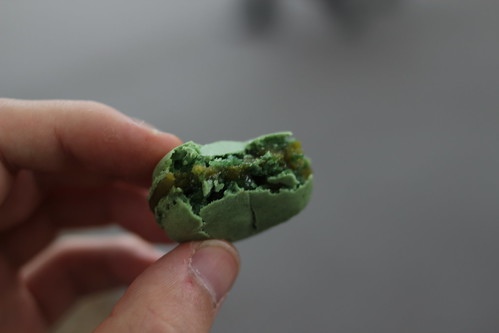
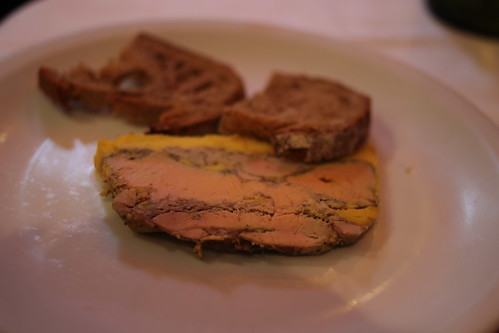
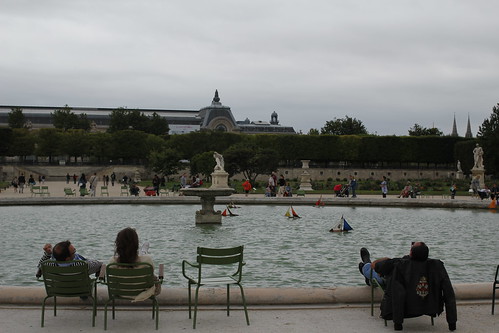
Before arriving to DebConf11, I arranged my flights so that I had a day and a night in Paris as I have not been there before. So after checking out of my work apartment in Tampere, going to work there with all the things from that apartment, then flying back to Riga, going to a midnight screening of the last Potter movie and finally getting back home around 2am, I quickly checked that I have everything needed for the conference and went off to sleep only to wake up at 8am again, pack everything (into a single carry-on bag, after a year of experience travelling by air weekly and watching Up in the Air twice) and be off to the plain to Paris. The CDG airport is quite huge, even compared to something like JFK it feels bigger and more concrete. And yet so dark and lacking interesting features that the only photo I got from it was this IMG_4710 I then used the B line train to get to my hotel(9.1 ), drop my stuff there and another metro ticket (1.7 ) to go to Arc de Triomphe (M tro Charles de Gaulle-Etoile), went up there and walked the length of the Champs-Elys es right up to the Louvre. Then I walked to the river, crossed it to a small island to see the Notre Dame and then went back following the other bank of the river Seine seing both some more normal non-touristy streets of central Paris and also some other magnificent buildings, like Les Invalides and ending up at the Eifel tower. It was a rather easy walk that was only spoiled by some rain in the end so I did not get to take some night photos of the Eiffel tower as I wanted. But the experience still was breathtaking. The scale of the buildings was impressive. The pervasive gold-gilded decorations do expand on the splendour and the same time the full access to all the previously-royal places brings them down to people. The city looks well built and the planning mostly makes sense, especially if you are on foot. Car drivers might have a different opinion about it considering the maze of roads and traffic circles and underpasses I saw in central Paris. It is often said that Riga is a mini-Paris. Mostly, that is said in Riga. But walking the back streets of Paris I can see where that comes from the architecture, the street design, the small cafes and some cobblestone roads and some historical buildings with a few modern building thrown into the mix, and a tower too. Visually Riga does look like Paris a lot, but for the feeling, I still think that Riga feels more like Berlin with its mix of eastern and western Europe. I had one incident when some girl in front of Louvre started to ask me to sign something, gesturing to show that she was mute, it looked like a donation racket, but I did not get to find it out in detail as a swift security guard appeared and started running for the girl, who immediately took off running along with several friends. I guess the guards know them very well. On a more positive note, in one of many confetterie shops I noticed the macaron sweets that my friend advertised loudly some time ago, so I decided to buy and try some. They cost 7 for a box of 6. The taste was very, very sweet. Basically it tastes like froffed up and then frozen sugar made into cookie form with a cream layer between two cookies. IMG_4806 So basically it is like an Oreo cookie, but much, much, much more tender, airy and sweet. The two of the 6 cookies were partly crushed while I tenderly carried them for 5 minutes in their box while searching for a place to sit down and eat them. IMG_4815 After that I also had a proper dinner in a restaurant that was not too near the touristy paths, but still it was a bit lacking. The starter was quite nice I mean it is hard to screw up cutting off a piece of foie gras (basically a piece of liver paste with a layer of extra geese fat), but the main dish was disappointing I ordered a medium rare steak. First of all it came with a side of fries, that in itself was an insult to Paris, baked potatoes would have fit much better with this dish. And despite the main part of the steak being very nicely done to medium rare, the cut was done badly and the edges of the steak had sinew that was too chewy to eat or even cut normally. Other interesting things I liked about Paris:
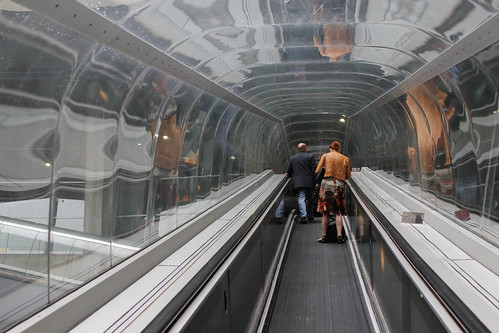
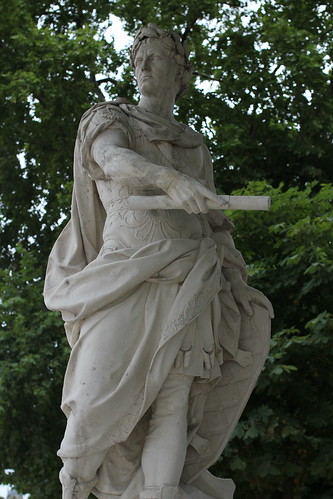
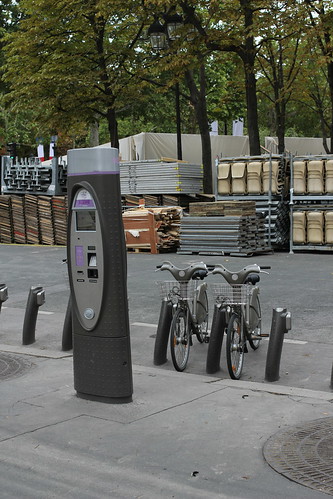
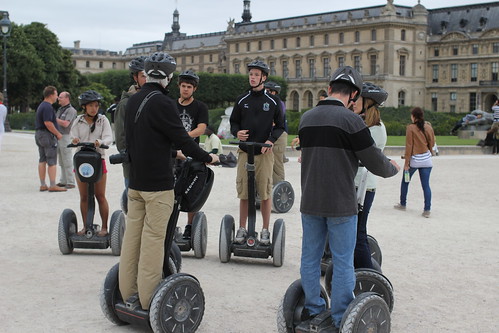
* high street shops of fashion labels and car manufacturers, that showed off the concept cars and also sold small branded accessories, such as Mercedes Benz key chains IMG_4723 * Statues some made of stone, some of iron, some covered in gold, everywhere and made with great quality IMG_4768 * Bicycle rentals, I mostly saw the locals using them IMG_4754 * Segway tourists IMG_4773 * And countless classic postcard shots of very recognizable architecture IMG_4738 The Eiffel tower was immensely impressive. It towers over everything around, especially because there simply is nothing high enough around it. It would not have been so impressive in the middle of New York, for example. The age and openness of the construction makes you really feel the massiveness of this marvel of functional architecture. But in the end Paris also looks like a great city to just kick back and relax in IMG_4770 P.S. I am amazed that when I put a link to a Flickr image (such as http://www.flickr.com/photos/aigarius/5950187165/in/set-72157627230456160 in a separate paragraph in my WordPress article text, something along the way translates them into proper linked images with a reasonable size. Progress is amazing.

29 June 2011

Charles Plessy: BioPerl and regression tests

Two weeks ago, I updated the packages containing the BioPerl modules bioperl and bioperl-run, which allowed to resume the work done on GBrowse, one of the genome browsers available in Debian. As many Perl modules, BioPerl has extensive regression tests. Some of them need access to external services, and are disabled by default as the Internet is not available in our build farm. Nevertheless, they can be triggered through the environment variable DEB_MAINTAINER_MODE when building the package locally. Bioperl successfully passes all off-line tests, and a part of the on-line tests is already corrected its development branch. In contrary, BioPerl-Run fail the tests for Bowtie, DBA, EMBOSS, Genewise, Hmmer, PAML, SABlastPlus, T-Coffee and gmap-run. In some cases, like EMBOSS, it is because a command has been renamed in Debian. In other cases, in particular DBA et Genewise, it is much more difficult to figure out on which side is the problem. Regression tests are essential to determine if a package works or not on ports others than the one used by the packager (amd64 in my case). Even simple ones can be useful. In the case of T-Coffee, that has a rudimentary test that I have activated recently, it showed that the packages distributed on armel are not working at all. Running regression tests when building packages have advantages, in particular to have the results published for each port automatically as part of the build logs. But is also cause problems. First, a package would need to build-depend on every software it can interact with, in order to test it comprehensively. In the example of bioperl-run, it makes it impossible to build on armel as long as t-coffee is broken there. Second, this approach does not help the user to test similarly a program installed on his computer. Maybe the Debian Enhancement Proposal 8, to test binary packages with material provided by their source packages, will solve these two problems.

Next.

Previous.