Search Results: "ardo"

14 March 2015

Tiago Bortoletto Vaz: MuseScore 2.0 is great, try it!

A bit of context: two years ago I joined an undergraduate program in electroacoustic music composition at the Universit de Montr al. Fortunately the faculty has decided to use mostly free software in the classes. They recently moved from Max/MSP to Pure Data to teach algorithmic composition. OpenMusic has been used for computer assisted composition classes. On acoustics classes, Sonic Visualiser is the recommended tool. For everything related to audio processing and sound synthesis we mainly use Python pyo library and Cecilia, both developed by the professor himself. Other many free softwares are used for building digital musical instruments in the courses: Arduino, SuperCollider, OpenCV, openFrameworks etc. So far I touched two proprietary softwares for my classes. First it was Reaper, a sequencer which has been recently adopted in replacement of Pro Tools in some grades. Reaper has a less unfair distribution model compared to Pro Tools and despite being a closed piece of software it somewhat looks like a community-oriented project, being developed by a small team of free software enthusiasts. Being an amazing, complete and still lightweight DAW I hope it goes free some day in the future (I've read about this possibility somewhere in a forum that I can't find now). Anyway, after some months playing with Reaper I went back to Ardour. Because it's free, not because it's better (Reapper still seems unbeatable here). The other was Finale, an alternative to MuseScore for music notation. I used it for three compositions mainly due to its playback capabilities. As a middle-aged music student I don't have the internal ear enough developed to listen orchestral textures, articulations and other details provided by expensive VST stuff. However, I found editing with Finale a pain in the ass. It's so bugged that I thought I were using a sort of alpha version. Basic editing is much more logical and elegant with MuseScore. After all, these first experiences with Finale didn't convince me that such realistic playbacks are adding any value to my music. I suspect that moving back to soundfonts or even composing with no playback at all will probably force me to exercice more critical/analytical listening whenever I need to understand the effects of a specific instrumental gesture and instrument combinations. So, I'm back to MuseScore. Not only because it's free, but also because it's better (at least for my current needs). MuseScore has allowed me to easily edit music scores in a free operating system, using a small and not so powerful laptop. Unable to donate money to this amazing project I've been happily giving some time to it, by testing new releases, reporting issues, translating to portuguese and making available unofficial Debian packages while the current maintainer prepares the official one, which seems to be coming very soon. If you're a Finale/Sibelius user and don't strictly need that universe of orchestral VSTs samples for your music work, please give MuseScore a try. Have a quick look at its online handbook and in a few minutes you will be able to experience the real pleasure of music scoring using a computer. You can try different soundfonts, including the so nice Sonatina Symphonic Orchestra. Below is a screenshot of MuseScore 2.0, which will be released very soon. You can download the RC version for your system in the MuseScore website.
/images/mscore2.png

MuseScore 2.0

10 November 2014

Gustavo Noronha Silva: Yay, the left won! Or did it?

Originally published on politi.kov I have been asked by a bunch of friends from outside of Brazil for my opinion regarding the recent elections we had in Brazil, and it is a bit complicated to explain it without some background, so I decided to write this piece providing a bit of history so that people can understand my opinion. The elections this year were a rematch of our traditional polarization between the workers party (PT) and the social democracy party (PSDB), which has been going on since 1994. PT and PSDB used to be allies. In the 80s, when the dictatorship dropped the law that forbade more than 2 parties, the opposition party, MDB, began breaking up in several smaller ones. PSDB was founded by politicians and intelectuals who were inspired by Europe s social democracy and political systems. Parliamentarism, for instance, is one of the historical causes of the party. The workers party had a more grassroots origin, with union leaders, marxist intelectuals and marxist-inspired catholic priests being the main founders. They drew their inspiration from the USSR and Cuba, and were very close to social movements.
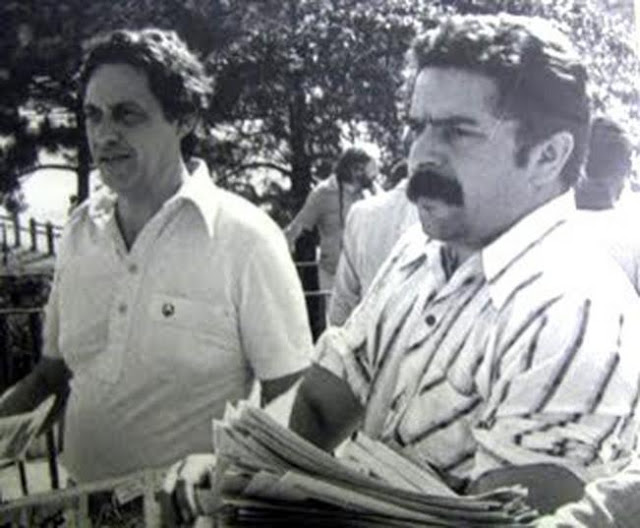
Lula and FHC campaigning together in 1981, by Cl vis Cranchi Sobrinho

Lula (PT) and FHC (PSDB) campaigning together in 1981, by Cl vis Cranchi Sobrinho

Some people have celebrated the reelection of Dilma Roussef as a victory of the left against the right. In my opinion that view is wrong for several reasons. First, because I disagree that PSDB and A cio Neves in particular are right-wing, both in terms of economics and social/moral issues. Second, because I believe Dilma s first government has taken a quite severe turn to the right in several topics that matter a lot to me. Since comparisons with PSDB s government during the 90s has been one of the main strategies of the campaign this year, I ll argue why I think it was actually a pretty good government with a lot of left in it. Unlike what happens in most other places, Brazil does not really have an actual right-wing party, economics-wise. Although we might see the birth of a couple in the near future, no current party is really against public health, education and social security being provided by the state as rights, or wants to decrease state size and lower taxes significantly. It should come as no surprise that even though it has undergone a lot of liberal reforms over the last 20 years, Brazil is still a very closed country, with very high import tariffs and a huge presence of the state in the economy. There is a certain consensus about all of that, with disagreements being essentially on implementation details, not goals. On the other hand, and contrary to popular belief, when it comes to social and moral issues we are a very conservative people. Ironically, the two parties which have been in power over the last 20 years are quite progressive, being historically proponents of diversity, minorities rights, reproductive rights. They have had to compromise on those causes to become viable alternatives, given the conservative nature of the majority of the voters. Despite their different origins and beliefs, both parties share socialist inclinations and were allies from the onset. That changed in 1992, when president Collor, who had been elected on a runoff against Lula (who PSDB supported), was impeached by Congress for corruption. With no formal political support and a chaotic situation in his hands, Itamar Franco, the vice president, called for a national union government to go through the last two years of his term. PSDB answered the call, but the workers party decided against being part of the government. Fernando Henrique Cardoso, a sociologist who was one of the leaders of PSDB was chosen to lead the Foreign Relations Ministry, but a few months later got nominated to the Economy. At the time, Brazil lived under hyperinflation of close to 1000% a year, and several stabilization plans had been attempted. Economy Ministers did not last very much in office at the time. FHC gathered a team of economists and sponsored their stabilization plan, which turned out to be highly successful: the Plano Real ( Real Plan ). In addition to introducing a new currency, something that was becoming pretty common to Brazilians by then, it also attacked the structural causes of inflation. Lula was counting on the failure of the Plano Real when he ran against FHC in 1994, but the plan succeeded, giving FHC two terms as president. During those two terms, FHC introduced several institutional changes that made Brazil a saner country. In addition to the hyperinflation, Brazil had lived a debt crises for decades and was still in default. FHC s team renegotiated the debts, reopened lines of credit, but most importantly, introduced reforms that made the Brazilian finances and financial system credible. The problem was not even that Brazil had a fiscal d ficit, it just did not have any control whatsoever of money supply and budget. Banks, regardless of whether they were private or public, had very little regulation and took advantage of the hyperinflation to hide monstrous holes in their balances. When inflation was gone and regulation became more strict, those became apparent, and it was pretty clear that the system would collapse if nothing was done. Some people like to say that FHC was a president who ruled for the rich and didn t care about the poor. I think the way the potential collapse of the banking system was handled is a great counter-example of that. The government passed laws that made the owners of the banks responsible for the financial problems, regardless of whether caused by mismanagement or fraud. If a bank went under, the central bank intervened and added enough money to protect the deposits, but that money was a loan that had to be repaid by the owners of the bank, and the owners properties were added as collateral to the loan. As a brazilian journalist once said, the people did not risk losing their deposits, the bankers did risk losing the banks, though. Today, we have a separate fund, filled with money from the banks, that does what the central bank did back then when required. Compare that to countries where the banking system was saved with tax payer money and executives kept getting huge bonuses regardless, while owners kept their profits. It is hard to find an initiative that is more focused on the public interest against the interest of the rich people who caused the problem. This legislation, called PROER, is still in place today, and it came along with solid regulation of the banking system. It should come as no surprise that Brazil went through the financial crisis of 2008 with not a single hiccup of the banking system and no fear of bank runs. Despite having been against PROER back in the day, Lula celebrated its existence in 2008, when it was clear it was one of the reasons we would not suffer much. He even advertised it as something that should be adopted by the US and Europe. It is also pretty common to hear that under FHC social questions were not a priority. I believe it is pretty simple to see that that was not the case both by inspecting the growth of social spending and the improvement of social indicators for the period, such as UN s human development index. One area in which people are particularly critical of the FHC government is the investment on higher education, and they are actually quite right. Brazil has free Federal universities and those did not get a lot of priority in the 90s. However, I would argue that while it is a matter of priorities, it is not one of education versus something else, but rather of what to invest on inside education. The reality is basic education was the priority. When FHC came to power, Brazil had a significant number of children who were not going to school at all. The goal was to make access to schools universal for young children, and that goal was reached. Every child has been going to school since the early 2000s, and that is a significant achievement which reaches the poorest. While the federal universities are attended essentially by the Brazilian elite, given the difficulty of passing the exams and the relative lack of quality of free public schools compared to private ones, which is still a reality to this day, investment on getting children to even go to school for the early years has a significant impact on the lives of the poorest. It is important to remember that getting every child to go to school is also what gave birth to one of the most celebrated programs from the Lula era: Bolsa Fam lia ( Family Allowance ) is a direct money transfer to poor families, particularly those who have children and has been an important contribution to lowering inequality and getting people out of extreme poverty. To get the money, the families need to ensure their children are 1) attending school and 2) getting vaccinated. That program comes from the FHC government, in which it was created with the name Bolsa Escola ( School Allowance ), in its turn inspired by a program of the same name by governor Cristovam Buarque, from PT. What Lula did, and he deserves a lot of credit for this, was to merge a series of smaller programs with Bolsa Escola, and then expand the program to ensure it got to more and more people. Interestingly, during the announcement of the program he credited the idea of doing that to a state governor from PSDB. You can see why I think these two should be allies again. When faced with all these arguments, people will eventually say that FHC was bad because he privatized companies and used orthodox economic policies. Well, if that is what it takes, then we ll have to take Lula down with him, because his first term was essentially a continuation of FHC s second term: orthodox economic policies to keep inflation down, along with privatization of several state-owned companies and banks. But Lula, whom I voted for and whose government I believe was a good one, is not my subject: Dilma is. On Lula s second term, Dilma gained a lot of power when other major leaders of PT went down for corruption. She became second in command and started leading several programs. A big believer in developmentalism, she started pushing for a bigger role of the state in the coordination of the productive sector, with a clear focus on growing the industrial base. One of the initiatives she sponsored was a sizable increase on the number and size of subsidized loans given out by the national development bank (BNDES). Brazil started an unnofficial national champions program, where the government elected a few big companies to get a huge amount of subsidized credit. The goal was for these selected firms to get big enough to be competitive on the global market. The criteria for the choices is completely opaque, if it even exists, and includes handing out milions in subsidized credit for Eike Batista, who became Brazil s richest enterpreneur for a while, and lost pretty much everything when it became clear the oil would not be pumping out of his camps after all, sinking with them a huge amount of public funds invested by BNDES. The way this policy was enacted, it is unclear how much it really costs in terms of public funds: the Brazilian treasury emits debt to capitalize, lends that money to BNDES with higher than market interest, and BNDES then lends it out to the big companies with a lower than market interest rate. Although it is obviously unsustainable, the problem does not yet show in the balance because the grace period for BNDES debt with the treasury is 2040. The fact that this has a cost and, perhaps more importantly, a huge opportunity cost is not clear because it is not part of the government budget. Why are we putting money in this rather than quadrupling Bolsa Fam lia, which studies show generates 1,78 reais in GDP for every 1 real invested? Worse, why are we not even updating Bolsa Fam lia enough to cover inflation? When Dilma got elected in 2010, the first signs were pretty bad. She was already seen as someone who did not care much for the environment, and on her first month in power she made good on that promise by pushing to get the Belo Monte Dam building started as soon as possible regardless of conditionalities being satisfied. To this day there are several issues with how the building of the dam is going: the handling of the indigenous people and the small city nearby are lacking, conditionalities are not met. Beyond Belo Monte, indigenous leaders are being assassinated, deforestation in the Amazon forest has increased by 122% in 2014 alone. Dilma s answer to people who question her on these kinds of issues is essentially: would you rather not have electric power? Her populist authoritarian nature and obsession with industry are also pretty evident when it comes to her policies in the energy area as a whole. She showed up in national tv on the eve of our independence day celebration to announce a reduction in electric tariffs, mainly for industry, but also for homes. Nobody really knew how. The following week she sent a fast-track project to Congress to automatically renew concessions of power grid operators, requiring those who accepted it to lower tariffs, instead of doing an auction, which was already necessary anyway because the concessions were up on 2015. There was no discussion with stakeholders, there was just a populist announcement and a great deal of rhethoric to paint anyone who opposed as being against the people. And now, everything went into the crapper because that represented a breach of contract that required indemnification, and we had a pretty bad drought that made power more expensive given the need to turn on the thermal generators. Combining the costs of the thermal generation, indemnity, and financial fallout that the grid operators suffered, we are already at 105 billion reais and counting, nobody knows how high the cost will reach. Any reduction in tariffs has long been invalidated. And the fact that industry has lowered production significantly ends up being good news, we would probably be under rationing already if that was not the case. You would expect someone who fought a dictatorship to be pretty good in terms of human and civil rights. What we see in reality is a lack of respect for those things. During the world cup, Dilma has put the army on the streets and has supported arbitrary behaviour from state polices throughout the country. They jailed a bunch of demonstrators preemptively. No shit. The would be demonstrators were kept in jail throghout the tournament under false accusations. Dilma s Minister of Justice said several times that the case against them was solid and that the arrests were legal, but it turned out the case simply did not exist. Just this week we had a number of executions orchestrated by policemen in the state of Par and there is zero reaction from the federal government. In the oil industry, Dilma has enacted a policy of subsidizing gas prices by using a fixed price that used to be lower than the international prices (it is no longer the case with the fall in international prices). That would not be a problem if Brazil was selfsufficient in oild and gas, which we are not: we had to import a significant amount of both. The implicit subsidy cost Petrobr s a huge amount of cash the more gas it sold, the bigger the losses. This lead not only to decreasing the company s market value (it is a state-controlled, but open company), but to reducing its capacity of investment as well. That is more problematic than it sounds because, with our current concession model, every single oil camp needs to have Petrobr s as a member of the consortium. Limiting the company s investment capacity limits the rate at which our pre-salt oil camps can be explored and thus the speed at which we can become selfsufficient. Chicken and egg anyone? To make things worse, Dilma has made policies that lowered taxes on car production, used to foster economic activity during the crisis in 2008-2010, essentially permanent. This lead to a significant increase in traffic and polution on Brazilian cities, while at the same time increasing the pressure on Petrobr s, which had to import more and more gas. Meanwhile, Brazilian cities suffer from a severe lack of mobility infrastructure. A recent study has shown that Brazil has spend almost twice as much subsidized money on pro-car policies than on pro-mass transit projects. Talk about good usage of public funds. One of the only remaining good news the government was still able to mention was the constant reduction in extreme poverty. Dilma was actually ellected promising to erradicate extreme poverty and changed the government s slogan to A rich country is a country with no poverty (Pa s rico pa s sem pobreza). Well, it turns out all of these policies caused inequality and extreme poverty both to stop falling as of 2013. And given the policies were actually deepened in 2014, I believe it is very likely we ll see an increase in both when we get the data for 2014, next year. Other than that, her policies ended up being a complete failure. Despite giving tax benefits to several sectors, investment has fallen, growth has fallen and inflation is quite high at 6,6% for the last 12 months. In terms of minorities, her government has been a severe set back, with the government going back on educational material against homophoby saying it would not do advertisement of sexual choice , and going back on a decree that allowed the public health system to perform abortions on the cases allowed by the law (essentially if the woman has been raped). Looking at Dilma s policies, I really can t see that much of the left, honestly. So why, you might ask, has this victory been deemed a victory of the left over the right? My explanation is the aura the workers party still manages to keep over itself. There s a notion that whatever PT does, it will still be more to the left than PSDB, which I think is just crazy. There is also a fair amount of idealizing Dilma just because she is Lula s proteg . People will forgive anything, provided it is the workers party doing it. Thankfully, the number of people aligned on the left that supported the candidate from PSDB this election tells me this is changing quite rapidly. Hopefully that leads to PT having to reinvent itself, and get in touch with the left again.


23 October 2014

Alessio Treglia: Bits from the Debian Multimedia Maintainers

This brief announcement was released yesterday to the debian-devel-announce mailing list. Ciao! The Debian Multimedia Maintainers have been quite active since the Wheezy release, and have some interesting news to share for the Jessie release. Here we give you a brief update on what work has been done and work that is still ongoing. Let s see what s cooking for Jessie then. Frameworks and libraries Support for many new media formats and codecs. The codec library libavcodec, which is used by popular media playback applications including vlc, mpv, totem (using gstreamer1.0-libav), xine, and many more, has been updated to the latest upstream release version 11 provided by Libav. This provides Debian users with HEVC playback, a native Opus decoder, Matroska 3D support, Apple ProRes, and much more. Please see libav s changelog for a full list of functionality additions and updates. libebur128 libebur128 is a free implementation of the European Broadcasting Union Loudness Recommendation (EBU R128), which is essentially an alternative to ReplayGain. The library can be used to analyze audio perceived loudness and subsequentially normalize the volume during playback. libltc libltc provides functionalities to encode and decode Linear (or Longitudinal) Timecode (LTC) from/to SMPTE data timecode. libva libva and the driver for Intel GPUs has been updated to the 1.4.0 release. Support for new GPUs has been added. libva now also supports Wayland. Pure Data A number of new additional libraries (externals) will appear in Jessie, including (among others) Eric Lyon s fftease and lyonpotpourrie, Thomas Musil s iemlib, the pdstring library for string manipulation and pd-lua that allows to write Pd-objects in the popular lua scripting language. JACK and LADI LASH Audio Session Handler was abandoned upstream a long time ago in favor of the new session management system, called ladish (LADI Session Handler). ladish allows users to run many JACK applications at once and save/restore their configuration with few mouse clicks. The current status of the integration between the session handler and JACK may be summarized as follows: Note that ladish uses the D-Bus interface to the jack daemon, therefore only Jessie s jackd2 provides support for and also cooperates fine with it. Plugins: LV2 and LADSPA Debian Jessie will bring the newest 1.10.0 version of the LV2 technology. Most changes affect the packaging of new plugins and extensions, a brief list of packaging guidelines is now available.
A number of new plugins and development tools too have been made available during the Jessie development cycle: LV2 Toolkit LVTK provides libraries that wrap the LV2 C API and extensions into easy to use C++ classes. The original work for this was mostly done by Lars Luthman in lv2-c++-tools. Vee One Suite The whole suite by Rui Nuno Capela is now available in Jessie, and consists of three components: All three are provided in both forms of LV2 plugins and stand-alone JACK client. JACK session, JACK MIDI, and ALSA MIDI are supported too. x42-plugins and zam-plugins LV2 bundles containing many audio plugins for high quality processing. Fomp Fomp is an LV2 port of the MCP, VCO, FIL, and WAH plugins by Fons Adriaensen. Some other components have been upgraded to more recent upstream versions: We ve packaged ste-plugins, Fons Adriaensen s new stereo LADSPA plugins bundle. A major upgrade of frei0r, namely the standard collection for the minimalistic plugin API for video effects, will be available in Jessie. New multimedia applications Advene Advene (Annotate Digital Video, Exchange on the NEt) is a flexible video
annotation application. Ardour3 The new generation of the popular digital audio workstation will make its very first appearance in Debian Jessie. Cantata Qt4 front-end for the MPD daemon. Csound Csound for jessie will feature the new major series 6, with the improved IDE CsoundQT. This new csound supports improved array data type handling, multi-core rendering and debugging features. din DIN Is Noise is a musical instrument and audio synthesizer that supports JACK audio output, MIDI, OSC, and IRC bot as input sources. It could be extended and customized with Tcl scripts too. dvd-slideshow dvd-slideshow consists of a suite of command line tools which come in handy to make slideshows from collections of pictures. Documentation is provided and available in /usr/share/doc/dvd-slideshow/ . dvdwizard DVDwizard can fully automate the creation of DVD-Video filesystem. It supports graphical menus, chapters, multiple titlesets and multi-language streams. It supports both PAL and NTSC video modes too. flowblade Flowblade is a video editor like the popular KDenlive based on the MLT engine, but more lightweight and with some difference in editing concepts. forked-daapd Forked-daapd switched to a new, active upstream again dropping Grand Central Dispatch in favor of libevent. The switch fixed several bugs and made forked-daapd available on all release architectures instead of shipping only on amd64 and i386. Now nothing prevents you from setting up a music streaming (DAAP/DACP) server on your favorite home server no matter if it is based on mips, arm or x86! harvid HTTP Ardour Video Daemon decodes still images from movie files and serves them via HTTP. It provides frame-accurate decoding and is main use-case is to act as backend and second level cache for rendering the
videotimeline in Ardour. Groove Basin Groove Basin is a music player server with a web-based user interface inspired by Amarok 1.4. It runs on a server optionally connected to speakers. Guests can control the music player by connecting with a laptop, tablet, or smart phone. Further, users can stream their music libraries remotely.
It comes with a fast, responsive web interface that supports keyboard shortcuts and drag drop. It also provides the ability to upload songs, download songs, and import songs by URL, including YouTube URLs. Groove Basin supports Dynamic Mode which automatically queues random songs, favoring songs that have not been queued recently.
It automatically performs ReplayGain scanning on every song using the EBU R128 loudness standard, and automatically switches between track and album mode. Groove Basin supports the MPD protocol, which means it is compatible with MPD clients. There is also a more powerful Groove Basin protocol which you can use if the MPD protocol does not meet your needs. HandBrake HandBrake, a versatile video transcoder, is now available for Jessie. It could convert video from nearly any format to a wide range of commonly supported codecs. jack-midi-clock New jackd midiclock utility made by Robin Gareus. laborejo Laborejo, Esperanto for Workshop , is used to craft music through notation. It is a LilyPond GUI frontend, a MIDI creator and a tool collection to inspire and help music composers. mpv mpv is a movie player based on MPlayer and mplayer2. It supports a wide variety of video file formats, audio and video codecs, and subtitle types. The project focuses mainly on modern systems and encourages developer activity. As such, large portions of outdated code originating from MPlayer have been removed, and many new features and improvements have been added. Note that, although there are still some similarities to its predecessors, mpv should be considered a completely different program (e.g. lacking compatibility with both mplayer and mplayer2 in terms of command-line arguments and configuration). smtube SMTube is a stand-alone graphical video browser and player, which makes YouTube s videos browsing, playing, and download such a piece of cake.
It has so many features that, we are sure, will make YouTube lovers very, very happy. sonic-visualiser Sonic Visualiser Application for viewing and analysing the contents of music audio files. SoundScapeRenderer SoundScapeRenderer (aka SSR) is a (rather) easy to use render engine for spatial audio, that provides a number of different rendering algorithms, ranging from binaural (headphone) playback via wave field synthesis to higher-order ambisonics. Videotrans videotrans is a set of scripts that allow its user to reformat existing movies into the VOB format that is used on DVDs. XBMC XBMC has been partially rebranded as XBMC from Debian to make it clear that it is changed to conform to Debian s Policy. The latest stable release, 13.2 Gotham will be part of Jessie making Debian a good choice for HTPC-s. zita-bls1 Binaural stereo signals converter made by Fons Adriaensen zita-mu1 Stereo monitoring organiser for jackd made by Fons Adriaensen zita-njbridge Jack clients to transmit multichannel audio over a local IP network made by Fons Adriaensen radium-compressor Radium Compressor is the system compressor of the Radium suite. It is provided in the form of stand-alone JACK application. Multimedia Tasks With Jessie we are shipping a set of multimedia related tasks.
They include package lists for doing several multimedia related tasks. If you are interested in defining new tasks, or tweaking the current, existing ones, we are very much interested in hearing from you. Upgraded applications and libraries What s not going to be in Jessie With the aim to improve the overall quality of the multimedia software available in Debian, we have dropped a number of packages which were abandoned upstream: We ve also dropped mplayer, presently nobody seems interested in maintaining it.
The suggested replacements for users are mplayer2 or mpv. Whilst the former is mostly compatible with mplayer in terms of command-line arguments and configuration (and adds a few new features too), the latter adds a lot of new features and improvements, and it is actively maintained upstream. Please note that although the mencoder package is no longer available anymore, avconv and mpv do provide encoding functionality. For more information see avconv s manual page and documentation, and mpv s encoding documentation. Broken functionalities rtkit under systemd is broken at the moment. Activity statistics More information about team s activity are available. Where to reach us The Debian Multimedia Maintainers can be reached at pkg-multimedia-maintainers AT lists.alioth.debian.org for packaging related topics, or at debian-multimedia AT lists.debian.org for user and more general discussion.
We would like to invite everyone interested in multimedia to join us there. Some of the team members are also in the #debian-multimedia channel on OFTC. Cheers! Alessio Treglia
on behalf of the Debian Multimedia Maintainers

29 July 2014

Ricardo Mones: Switching PGP keys

Finally I find the mood to do this, a process which started 5 years ago in DebConf 9 at C ceres by following Ana's post, of course with my preferred options and my name, not like some other ;-).

Said that, dear reader, if you have signed my old key:

1024D/C9B55DAC 2005-01-19 [expires: 2015-10-01]
Key fingerprint = CFB7 C779 6BAE E81C 3E05  7172 2C04 5542 C9B5 5DAC

And want to sign my "new" and stronger key:

4096R/DE5BCCA6 2009-07-29
Key fingerprint = 43BC 364B 16DF 0C20 5EBD  7592 1F0F 0A88 DE5B CCA6

You're welcome to do so :-)

The new key is signed with the old, and the old key is still valid, and will probably be until expiration date next year. Don't forget to gpg --recv-keys DE5BCCA6 to get the new key and gpg --refresh-keys C9B55DAC to refresh the old (otherwise it may look expired).

Debian's Keyring Team has already processed my request to add the new key, so all should keep working smoothly. Kudos to them!

22 April 2014

Steve McIntyre: Linaro welcomes GSOC 2014 students

After several weeks of review and discussion, the application and selection period for the 2014 Google Summer of Code is over. 4,420 students proposed a total of 6,313 projects for this summer. From those, 1,307 students have been accepted (more details), and Linaro is one of the 190 Open Source projects that will be working with students this year. In our first year as a GSOC mentoring organisation, we received 17 applications and Google allocated us 3 slots for student projects. It was quite a challenge to pick just 3 projects from the excellent field, and it's a shame that the limited number of slots meant we had no choice but to disappoint some people. Thanks to all those who applied! I'm delighted to announce our 3 chosen interns for 2014: Please join me in welcoming these three new engineers to the Linaro team! We have a GSOC wiki ready for our students to use at https://gsoc.linaro.org/ and hopefully they will start adding content there soon about themselves and their projects (hint!). In the meantime, we have more information about our original proposals and the GSOC program in the main Linaro wiki. Starting today, the next phase of the program is the so-called "bonding period". Students are encouraged to get to know people within Linaro (especially their mentors!) and prepare to start work on their projects, whatever is needed. The official start of the work period for GSOC is May 19th, and it runs through to August 18th. We will give updates on progress through the summer, and we're hoping to talk about our results at the next Linaro Connect in September. Good luck, folks!

3 March 2014

DebConf team: We re off to the daytrip! (Posted by Rodrigo Gallardo)

We are leaving in a couple hours for Xochicalco, one of the many archeological sites here in Mexico. All in all, we are very pleased with the trip we are offering, and really hope everyone likes it.We do have a long day ahead of us, since it will take almost two hours to get there, then we ll be touring the place for about three hours, go for lunch and then head for Cuernavaca, where we ll spend a few more hours before heading back here. I m pretty sure there will be plenty of pictures of the site for those of you following along at home, so check people s galleries afterwards. And, it s kind of late to say this, since everyone has seen Gunnar s feeling better, but still: Gunnar, you ve made some terrific work here! Us mexicans are very proud of you.

5 February 2014

Ricardo Mones: Fixing partridge eggs with industrial duct tape

Human nature is hard to change. Very hard. We can talk about it for ages, but mistakes repeat again and again. In the end it's mostly by mistakes how we learn, so I doubt this could ever be changed without losing our own nature. One of these is trying to fix some social issue with a technical measure. Unfortunately, given the technical orientation of most of the developers, this appears from time to time in our Debian private mailing list, and yesterday I realized it's our own version of Godwin's law:

As a social problem discussion grows longer in debian-private the probability of some developer proposing a technical solution aproaches one.

Not discussing about this problems in debian-private would be a good start, but of course that would only change the name of the list in the above sentence ;-).

30 January 2014

Russell Coker: The Movie Experience

Phandroid has one of many articles about a man being detained for wearing Google Glass in a cinema [1]. The article states as a fact that it s probably not smart to bring a recording device into a movie theater which is totally bogus. I ve visited a government office where recording devices were prohibited, they provided a locker for me to store everything that could be used for electronic storage outside their main security zone, that s what you do when you ban recording devices. Any place that doesn t have such facilities really isn t banning recording. The Gadgeteer has the original story with more detail with an update showing that the Department of Homeland Security were responsible for detaining the victim [2]. There are lots of issues here with DHS continuing to do nothing good and more bad things than most people suspect and with the music and film industry organisations attacking innocent people. But one thing that seems to be ignored is that movies are a recreational activity, so it s an experience that they are selling not just a movie. Any organisation that wants to make money out of movies really should be trying to make movies fun. The movie experience has always involved queuing, paying a lot of money for tickets ($20 per seat seems common), buying expensive drinks/snacks, and having to waste time on anti-piracy adverts. Now they are adding the risk of assault, false-arrest, and harassment under color of law to the down-sides of watching a movie. Downloading a movie via Bittorrent takes between 20 minutes and a few hours (depending on size and internet connectivity). Sometimes it can be quicker to download a movie than to drive to a cinema and if you are organising a group to watch a movie it will definitely be easier to download it. When you watch a movie at home you can pause it for a toilet break and consume alcoholic drinks while watching (I miss the Dutch cinemas where an intermission and a bar were standard features). It s just a better experience to download a movie via Bittorrent. I ve previously written about the way that downloading movies is better than buying a DVD [3], now they are making the cinema a worse experience too. I sometimes wonder if groups like the MPAA are actually trying to make money from movies or whether they just want to oppress their audiences for fun or psychological research. I could imagine someone like the young Phillip Zimbardo working for the MPAA and doing experiments to determine how badly movie industry employees can treat their customers before the customers revolt. Anyone who watches a Jack Ryan movie (or any movie with a Marty-Stu/Gary-Stu character) obviously doesn t even want to experience the stress of an unhappy ending to a movie. It seems obvious that such people won t want the stress of potentially being assaulted in the cinema. In terms of economics it seems a bad idea to do anything about recording in the cinema. When I was 11 I was offered the opportunity to watch a movie that had been recorded by a video camera in the US before it was released in Australia, I wasn t interested because watching a low quality recording wouldn t be fun. It seems to me that if The Pirate Bay (the main site for Bittorrent downloads of movies) [4] was filled with awful camera recordings of movies then it would discourage people from using it. A quick search shows some camera recordings on The Pirate Bay, it seems that if you want to download a movie of reasonable quality then you have to read the Wikipedia page about Pirated Movie Release Types [5] to make sure that you get a good quality download. But if you buy a DVD in a store or visit a cinema then you are assured of image and sound quality. If the movie industry were smarter they would start uploading camera recordings of movies described as Blue-Ray rips to mess with Bittorrent users and put newbies off downloading movies.

27 January 2014

Richard Hartmann: You at FOSDEM?

Behind the scenes, all the pieces are falling together to make this FOSDEM the best ever. As every year ;) Part of making things even more awesome is a great effort: To tape ALL the things. As in, literally, every single talk, discussion, and lightning talk; devrooms included. We have the extra equipment, we have the extra storage space, but we don't have all the extra manpower, yet. Why not sign up as a volunteer? There's a self-checkout system where you simply sign up for tasks. Heralding and video-taping are especially simple to do if you plan to attend the respective track/devroom, anyway. If you prefer talking over listening, cloak room and infodesk are available asa well; they are a lot more social and people always tell us it's great fun. Finally, if your schedule is full to the brim, you can help us with build-up and teardown. As an aside, there's a little experiment with IPv6 in the works.

8 January 2014

Gunnar Wolf: Meeting with Chilean sysadmins

Meeting with Chilean sysadmins
Ok, so I'm back in Mexico! This year, the best fare I found for travelling to spend the Winter^WSummer season with Regina's family had an oddity: I usually have a layover at either Santiago de Chile or Lima (Per ) of between 45 minutes and 2 hours, clearly less than enough to do anything. But this time, I had a massive 10 hours layover in Santiago. And spending 10 hours in an airport is far from fun. Specially when you have a good group of friends in town! I visited Chile in 2004 for Encuentro Linux (still before the time I had a digital camera: Those photos are all taken by Martin Michlmayr), and I have stayed in touch with a group of systems administrators since then. So, I mailed the list, and we managed to get eight people to have lunch together. In the order we appear in the photo: Some of them, even living in the same city, had never met in person before So, of course, we had a table reserved at the restaurant to the name of Dennis Ritchie. And having had nice, fun, sometimes-technical talks... Well, a tiny bit of his spirit was there. Of course, we can only trust he was there, as no Ouija boards were used and no null pointers were dereferenced (just to make sure not to disturb him). Victor Hugo and lvaro took me for a short Santiago city trip before lunch, we had a very nice time. Thanks! :-)

6 January 2014

Julien Danjou: Databases integration testing strategies with Python

The Ceilometer project supports various database backend that can be used as storage. Among them are MongoDB, SQLite MySQL, PostgreSQL, HBase, DB2 All Ceilometer's code is unit tested, but when dealing with external storage services, one cannot be sure that the code is really working. You could be inserting data with an incorrect SQL statement, or in the wrong table. Only having the real database storage running and being used can tell you that.
Over the months, we developed integration testing on top of our unit testing to validate that our storage drivers are able to deal with real world databases. That is not really different from generic integration testing. Integration testing is about plugging all the pieces of your software all together and running. In what I call "database integration testing", the pieces will be both your software and the database system that you are going to rely on. The only difference here is that one of the module is not coming from the application itself but is an external project. The type of database that you use (RDBMS, NoSQL ) does not matter. Taking a step back, what I will describe here could also apply to a lot of other different software modules, even something that would not be a database sytem at all. Writing tests for integration Presumably, your Python application has unit tests. In order to test against a database back-end, you need to write a few specific classes of tests that will use the database subsystem for real. For example:
import unittest
import os
import sqlalchemy

class TestDB(unittest.TestCase):
def setUp(self):
url = os.getenv("DB_TEST_URL")
if not url:
self.skipTest("No database URL set")
self.engine = sqlalchemy.create_engine(url)

This code will try to fetch the database URL to use from an environment variable, and then will rely on SQLAlchemy to create a database connection.
import unittest
import os
import sqlalchemy

import myapp

class TestDB(unittest.TestCase):
def setUp(self):
url = os.getenv("DB_TEST_URL")
if not url:
self.skipTest("No database URL set")
self.engine = sqlalchemy.create_engine(url)

def test_foobar(self):
self.assertTrue(myapp.store_integer(self.engine, 42))

You can then add as many tests as you want using the connection stored in self.engine. If no test database URL is, the tests will be skipped; however that decision is up to you. You may want to have these tests always run and fail if they can't be run. In the setUp() method, you may also need to do more work, like create a database and delete a database.
import unittest
import os
import sqlalchemy

class TestDB(unittest.TestCase):
def setUp(self):
url = os.getenv("DB_TEST_URL")
if not url:
self.skipTest("No database URL set")
self.engine = sqlalchemy.create_engine(url)
self.connection = self.engine.connect()
self.connection.execute("CREATE DATABASE testdb")

def tearDown(self):
self.connection.execute("DROP DATABASE testdb")

This will make sure that the database you need is clean and ready to be used to testing. Launching modules, a.k.a. databases
The main problem we encountered when building integration testing with databases, is to find a way to start them. Most users are used to start them system-wide with some sort of init script, but when running sandboxed tests, that is not really a good option. Browsing the documentation of each storage allowed us to find a way to start them in foreground and control them "interactively" via a shell script. The following is a script that you can use to run Python tests using nose and is heavily inspired by the one we wrote for Ceilometer.
#!/bin/bash
set -e

clean_exit()
local error_code="$?"
kill -9 $(jobs -p) >/dev/null 2>&1 true
rm -rf "PGSQL_DATA"
return $error_code


check_for_cmd ()
if ! which "$1" >/dev/null 2>&1
then
echo "Could not find $1 command" 1>&2
exit 1
fi


wait_for_line ()
while read line
do
echo "$line" grep -q "$1" && break
done < "$2"
# Read the fifo for ever otherwise process would block
cat "$2" >/dev/null &


check_for_cmd mongod

trap "clean_exit" EXIT

# Start PostgreSQL process for tests
PGSQL_DATA= mktemp -d /tmp/PGSQL-XXXXX
PGSQL_PATH= pg_config --bindir
PGSQL_PATH /initdb $ PGSQL_DATA
mkfifo $ PGSQL_DATA /out
$ PGSQL_PATH /postgres -F -k $ PGSQL_DATA -D $ PGSQL_DATA &> $ PGSQL_DATA /out &
# Wait for PostgreSQL to start listening to connections
wait_for_line "database system is ready to accept connections" $ PGSQL_DATA /out
export DB_TEST_URL="postgresql:///?host=$ PGSQL_DATA &dbname=template1"

# Run the tests
nosetests

If you use tox to automatize your test run, you can use this scripts (I call it run-test.sh) in your tox.ini file.
[testenv]
commands = toxinidir /run-tests.sh posargs

Most databases are able to be run in some sort of standalone mode where you can connect to them using a either a Unix domain socket, or a fixed port. Here are the snippet used in Ceilometer to run with MongoDB and MySQL:
# Start MongoDB process for tests
MONGO_DATA=$(mktemp -d /tmp/MONGODB-XXXXX)
MONGO_PORT=29000
mkfifo $ MONGO_DATA /out
mongod --maxConns 32 --nojournal --noprealloc --smallfiles --quiet --noauth --port $ MONGO_PORT --dbpath "$ MONGO_DATA " --bind_ip localhost &>$ MONGO_DATA /out &
# Wait for Mongo to start listening to connections
wait_for_line "waiting for connections on port $ MONGO_PORT " $ MONGO_DATA /out
export DB_TEST_URL="mongodb://localhost:$ MONGO_PORT /testdb"

# Start MySQL process for tests
MYSQL_DATA=$(mktemp -d /tmp/MYSQL-XXXXX)
mkfifo $ MYSQL_DATA /out
mysqld --datadir=$ MYSQL_DATA --pid-file=$ MYSQL_DATA /mysql.pid --socket=$ MYSQL_DATA /mysql.socket --skip-networking --skip-grant-tables &> $ MYSQL_DATA /out &
# Wait for MySQL to start listening to connections
wait_for_line "mysqld: ready for connections." $ MYSQL_DATA /out
export DB_TEST_URL="mysql://root@localhost/testdb?unix_socket=$ MYSQL_DATA /mysql.socket&charset=utf8"

The mechanism is always the same. We create a fifo with mkfifo, and then run the database daemon with the output redirected to that fifo. We then read from it until we find a line stating the the database is ready to be used. At that point, we can continue and start running the tests. You have to read continuously from the fifo, otherwise the process writing to it will block. We redirect the output to /dev/null, but you could also redirect it to a different log file, or not at all. One step further: using parallelism and scenarios The described approach is quite simple, as it only support one database type. When using an abstraction layer, such as SQLAlchemy, it would be a good idea to run all these tests against different RDBMS, such as MySQL and PostgreSQL for example. The snippet above allows to run both RDBMS in parallel, but the classic approach of unit tests does not allow that. Using one scenario for each database backend would be a great idea. To that end, you can use the testscenarios library.
import unittest
import os
import sqlalchemy
import testscenarios

load_tests = testscenarios.load_tests_apply_scenarios

class TestDB(unittest.TestCase):
scenarios = [
('mysql', dict(database_connection=os.getenv("MYSQL_TEST_URL")),
('postgresql', dict(database_connection=os.getenv("PGSQL_TEST_URL")),
]

def setUp(self):
if not self.database_connection:
self.skipTest("No database URL set")
self.engine = sqlalchemy.create_engine(self.database_connection)
self.connection = self.engine.connect()
self.connection.execute("CREATE DATABASE testdb")

def tearDown(self):
self.connection.execute("DROP DATABASE testdb")

$ python -m subunit.run test_scenario   subunit2pyunit
test_scenario.TestDB.test_foobar(mysql)
test_scenario.TestDB.test_foobar(mysql) ... ok
test_scenario.TestDB.test_foobar(postgresql)
test_scenario.TestDB.test_foobar(postgresql) ... ok

---------------------------------------------------------
Ran 2 tests in 0.061s

OK

To speed up tests run, you could also run the test in parallel. It can be intesting as you'll be able to spread the workload among a lot of different CPUs. However, note that it can require a different database for each test or a locking mechanism to be in place. It's likely that your tests won't be able to work altogether at the same time on only one database. (Both usage of scenarios and parallelism in testing will be covered in The Hacker's Guide to Python, in case you wonder.)
The Hacker's Guide to Python
A book I'm writing that will be launched soon, talking about designing Python applications, state of the art, and various Python tips. If you want to be the first to hear about the launch, subscribe now.

26 November 2013

Ricardo Mones: Shared memory crazyness

The output of some commands explains it all.

These are the default values in a Wheezy system:

$ ipcs -l
------ Shared Memory Limits --------
max number of segments = 4096
max seg size (kbytes) = 32768
max total shared memory (kbytes) = 8388608
min seg size (bytes) = 1


That's not enough for all the data I want to load in a single segment, so let's start with 1Gb of shared memory:

# sysctl kernel.shmmax=1073741824 kernel.shmall=1073741824
kernel.shmmax = 1073741824
kernel.shmall = 1073741824

So now, both should be equal, isn't it?

$ ipcs -l
------ Shared Memory Limits --------
max number of segments = 4096
max seg size (kbytes) = 1048576
max total shared memory (kbytes) = 4294967296
min seg size (bytes) = 1

Uh!?

A free $BEVERAGE when we met for the one which tells me what's happening here ;-)

9 November 2013

Ricardo Mones: The Debian Project...

...is reading my mind!

I didn't tell anybody, but a couple of months ago, when I finally had time at work to upgrade my work computer desktop from Squeeze to Wheezy I also switched from GNOME to XFCE. Now I read via LWN that Debian is doing the same, at least for a while :)

BTW, I knew newer GNOME was different (had seen it in Fedora 18 for example), anyway I installed it (because I was lazy enough just to apt-get dist-upgrade the box) and tried it.

Maybe it's me, becoming an old dog which doesn't want to learn new tricks, but in order to get my work done as fast as usually I had to install something usable, hence went back to XFCE. I had to manually convert GNOME panel launchers to XFCE launchers but, besides that and some missing applet I'm pretty happy with the switch.

20 October 2013

Ricardo Mones: Forced to 3.11

No, not to this 3.11, but to Linux kernel 3.11.

I was aware of the #718533 bug, which happens when you have a software RAID with anything higher than 3.2.0 (mine is RAID 1 with 2 disks). At least that has been my case since I tried to upgrade, hence I was delaying upgrades again and again.

Unfortunately today things went worse when I tried to plug my USB 3.0 device on the system:
Oct 20 17:52:51 busgosu kernel: [20799.672127] xhci_hcd 0000:02:00.0: Timeout while waiting for address device command
Oct 20 17:52:51 busgosu kernel: [20799.876136] xhci_hcd 0000:02:00.0: ERROR no room on ep ring
Oct 20 17:52:51 busgosu kernel: [20799.876148] xhci_hcd 0000:02:00.0: ERR: No room for command on command ring
Oct 20 17:52:51 busgosu kernel: [20800.080148] usb 2-2: device not accepting address 2, error -12
Oct 20 17:52:51 busgosu kernel: [20800.080202] xhci_hcd 0000:02:00.0: ERROR no room on ep ring
Oct 20 17:52:51 busgosu kernel: [20800.080209] xhci_hcd 0000:02:00.0: ERR: No room for command on command ring
Oct 20 17:52:51 busgosu kernel: [20800.080221] xhci_hcd 0000:02:00.0: ERROR no room on ep ring
Oct 20 17:52:51 busgosu kernel: [20800.080227] xhci_hcd 0000:02:00.0: ERR: No room for command on command ring
Oct 20 17:52:51 busgosu kernel: [20800.080235] hub 2-0:1.0: couldn't allocate port 2 usb_device
Oct 20 17:52:53 busgosu kernel: [20801.568169] xhci_hcd 0000:02:00.0: ERROR no room on ep ring
Oct 20 17:52:53 busgosu kernel: [20801.568181] xhci_hcd 0000:02:00.0: ERR: No room for command on command ring
Oct 20 17:52:53 busgosu kernel: [20801.568190] hub 2-0:1.0: couldn't allocate port 2 usb_device


And of course the device didn't show up. As there's not much relevant stuff about this issue on the googlesphere, thought it may have been solved. And turned out that I was right: upgrading fixes this, and now the device works again.

But, hit by the above bug now I have to add a rootdelay=1 to my kernel boot parameters (started testing with 5 but finally seems one second is enough). Fortunately the Ubuntu folks have detailed how to do it ;-)

14 October 2013

Clint Adams: The Windy City is full of meat

As you know, I am not big on reviews, so you should disregard the remainder of this entry. I recently found myself in what is called a theatre complex , watching an adaptation of Moli re's Les Femmes savantes by Freyda Thomas, who is apparently famous for playing Alenis Grem on Deep Space Nine. Called The Learned Ladies, this translation to English manages to approximate some of the rhyme of the original, thereby making it unquestionably better than DS9. Also noteworthy is the all-female cast, cobbled together from two all-female theater groups. Elizabeth Neptune plays Chrysale, occasionally channeling the spirit of Jackie Gleason or bringing adorable ardor to such epic lines as Tea! I won't say anything about her eyes, but I will say something about her slippers. Sara Montgomery, as B lise, is delightfully crazy in her singing, dancing, costume changes, and other antics, which serve to transform this otherwise-completely-serious play into a comedy. I definitely won't say anything about her shoes. Madeleine Maby begins playing Philaminte well before the show starts. Spoiler alert: she sits on the stage, pretending to look through a telescope and make notes from before the house opens until right before the start of the first scene. I still feel exhausted by the thought of having to do that myself. L' pine is portrayed by Alyssa Lott, who also plays three minor roles. Her mastery of physical comedy is not wasted on this production. Marta Kuersten plays Clitandre opposite Sarah Brill's Henriette. While Marta's performance was quite good, she looks much better as a woman. I will not be saying this about everyone. Katie Honaker delivers visceral smarm and sleaze as Trissotin. Even her hairstyle is somehow evocative of contempt. Susan Finch plays Vadius and Le notaire. Susan was definitely most convincing as a man. Despite mutterings to the contrary, some suspension of disbelief was necessary for the other male roles, but not for Vadius, oh no. Finishing out the list we have Janna Emig as Martine, Francesca Day as Armande, and Kathryn Alexander as Ariste, with good performances, particularly in the second half. Even though it didn't have Coppertop from Strangers With Candy and a boy-band song-and-dance cover of To Be with You by Mr. Big, I recommend this play.

5 October 2013

Vincent Sanders: If I have a style, I am not aware of it.

I wish I had known about that quote from Michael Graves before now. I would have perhaps had an answer to some recent visitors to makespace.

There are regular scheduled visits to makespace where people can come and view our facilities, and perhaps start the process of becoming a member if they decide they like what they see.

Varnishing a folding chair using a stool as a stand
However, we sometimes get people who just turn up at the door. If a member feels charitable they may choose to give a short tour rather than just turn the person away. I happened to be in one Friday afternoon recently varnishing a folding chair when two such people rang the doorbell. There were few other members about and because watching varnish dry was dull I decided to be helpful and do a quick tour.

I explained that they really ought to return for a scheduled event for a proper tour, gave the obligatory minimal safety briefing, and showed them the workshops and tools. During the tour it was mentioned they were attending a certain local higher education establishment and were interested in makespace as an inexpensive studio.

Before they left I was asked what I was working on. I explained that I had been creating stools and chairs from plywood. At this point the conversation took a somewhat surreal turn, one of them asked, well more demanded, who my principle influence had been in designing with plywood.

When I said that I had mainly worked from a couple of Google image searches they were aghast and became quite belligerent. They both insisted I must have done proper research and my work was obviously influenced by Charles and Ray Eames and Arne Jacobsen and surely I intended to cite my influences in my design documents.

My admission that I had never even heard the names before and had no design documents seemed to lead to a distinctly condescending tone as they explained that all modern plywood design stemmed from a small number of early 20th century designers and any competent designers research would have revealed that.

At this point in proceedings I was becoming a bit put out that my good deed of showing off the workshop had not gone unpunished. I politely explained that I designed simply by generating a requirement in my head, maybe an internet search to see what others had done, measuring real things to get dimensions and then a great deal of trial and error.

I was then abruptly informed that my "design process was completely invalid and there were well established ways to design furniture correctly and therefore my entire design was invalid" and that I was wasting time and material. I thanked them for their opinion and showed them out, safe and well before anyone gets any ideas.

I put the whole incident out of my mind until I finished writing up the final folding chair post the other day. It struck me that perhaps I had been unknowingly influenced by these designers. It was certainly true I had generated ideas from the hundreds of images my searches had revealed.

I did some research and it turns out that from the 1930s to the 1950s there were a string of designers using plywood in novel ways from the butterfly stool by Sori Yanagi through formed curvy chairs by Alvar Aalto and eero saarinen.

While these designers produced some wonderfully iconic and contemporary furniture I think that after reviewing my initial notes that two more modern designers Christian Desile and Leo Salom probably influenced me more directly. Though I did not reference their designs beyond seeing the images along with hundreds of others, certainly nothing was directly copied.

And there in lies an often repeated observation: no one creates anything without being influenced by their environment. The entire creative process of several billion ape descendants (or Golgafrincham telephone sanitisers if you prefer) is based on the simple process of copying, combining and transforming what is around us.

Isaac Newton by Sir Godfrey Kneller [Public domain], via Wikimedia Commons
I must accept that certain individuals at points in history have introduced radical improvements in their field, people like Socrates Galileo Leonardo Newton Einstein. However, even these outstanding examples were enlightened enough to acknowledge those that came before. Newtons quotation "If I have seen further it is by standing on the shoulders of giants" pretty much sums it up.

In my case I am privileged enough to live in a time where my environment has grown to the size of the world thanks to the internet. My influences, and therefore what I create, is that much richer but at the same time it means that my influence on others is similarly diminished.

I have joined the maker community because I want to create. The act of creation teaches me new skills in a physical, practical way and additionally I get to exercise my mind using new techniques or sometimes things I had forgotten I already knew. I view this as an extension of my previous Open Source software work, adding a physical component to a previously purely mental pursuit.

But importantly I like that my creations might provide inspiration for someone else. To improve those chances in the wider world I force myself to follow a few basic rules:
Release
Possibly one of the hardest things for any project. I carefully avoided the word finish here because my experience leads me to the conclusion that I always want to improve my designs.

But it is important to get to a point in a project where you can say "that is good enough to share", this is more common in software but it really applies to any project.

Share
If your aim here is to improve your society with your contribution sharing your designs and information is important. I think there is nothing better than someone else taking one of your designs and using it and perhaps improving on it, remember that is what you probably did in one way or another better to make it less hard for that to happen.

Ensure your design files are appropriately licensed and they are readily accessible. I personally lean towards the more generally accessible open source licences like MIT but the decision is ultimately yours.

Licencing is important, especially in the current copyright happy society. I know it sounds dull and no one takes that seriously, right? Sorry, but yes they do and it is better for you to be clear from the start, especially if there is a software component to your project. Oh one personal plea, use an existing well known licence, the world simply does not need another one!

Write about it
The blog posts about the things I have made sometimes take almost as much time as the creation. The clear recording on my thoughts in written and photographic form often gives me more inspiration for improvements or other projects.

If someone else gets pleasure from the telling then that can only be good. If you do not do this then your voice cannot be heard and you wasted an opportunity to motivate others.

Feedback
If you do manage to get feedback on your creation, read it. You may disagree or not be interested for the current project but the feedback process is important. In software this often manifests as bug reports, in more physical projects this often becomes forum or blog comments.

Just remember that you need a thick skin for this, the most vocal members of any society are the minority with inflammatory opinion, the silent majority are by definition absent but there is still useful feedback out there.

Create again
By this I simply mean that once you are satisfied yourself on a project move on to the next. This may sound a little obvious but once you have some creative momentum it is much easier to keep going project to project than in you leave time between.

Also do not have too many projects ongoing, by all means have a couple so you do not get stuck waiting for materials or workshop time but more than three and four and you will never be able to release any of them.
Those students were perhaps somewhat misguided in how they stated their opinions, but they are correct that in the world in which we find ourselves we are all influenced. Though contrary to received wisdom those influences are more likely to be from the internet and our peers in the global maker society than historical artists.

30 September 2013

Sylvain Le Gall: OUnit 2.0, official release

After 1.5 month of work, I am proud to officialy release OUnit 2.0.0. This is a major rewrite of OUnit to include various feature that I think was missing from OUnit1. The very good news is that the port of the OASIS test suite has proven that this new version of OUnit can drastically improve the running time of a test suite. OUnit is a unit test framework for OCaml. It allows one to easily create unit-tests for OCaml code. It is based on HUnit, a unit testing framework for Haskell. It is similar to JUnit, and other XUnit testing frameworks. Download OUnit v2.0.0 Documentation of v2.0.0 Website The basic features: Migration path OUnit 2.0.0 still provides the OUnit module which is exactly the same as the last OUnit 1.X version. This way, you are not forced to migrate. However, this means that you will gain no advantage of the new release and even some slowdown due to increase complexity of the code. Though, I strongly recommend to upgrade to OUnit2. Here is a checklist to do the migration: The OASIS test suite migration In order to check that everything was working correctly, I have migrated the OASIS test suite to OUnit2. This is a big test suite (210 test cases) and it includes quite big sequences of tests (end to end tests from calling oasis setup to compiling and installing the results). This was really time consuming and I wish to see a significant speedup for the tests with OUnit2. You can see the result in term of code of the full migration here. Here are the results on my Intel Core i7 920/SSD: OUnit v2 benchmark The migration was quite heavy because this test suite had a big design problem. It uses in-place modification of the test data. I think I pick this design because I thought this was a good idea to decrease the running time. As a matter of fact, this was a huge mistake, that keeps popping failed test cases because one of the previous tests was failing. I have refactored all this and now we start by copying the test data into a temporary directory, which ensure that everything is always starting from pristine test data. During the redesign, I have decided to reduce the number of tests by merging some of them. This should have no big impact on the running time, although this is not as pure 1:1 comparison with OUnit v1. Although it is still testing exactly the same thing. This explain the loss of ~50 tests, which in fact has been merged in other tests. The overall speedup is 4x compared to OUnit v1, when using processes. However there is a 12% increase compared to OUnit v1 for sequential and a 15% increase when using OUnit v1 compatibility layer. While this is not very good score, I hope this is small enough to compensate the huge win of being able to run tests in parallel with processes. And now the magic ! At this point, if you read carefully the numbers, you would have noticed that there is a 4.5x decrease in speed when you compare sequential and 4 processes for OUnit2. Since we are only actively testing in 4 shards, it looks strange. I don't expect a super-linear speedup due to the use of processes. I have checked that every tests was indeed running and found no solutions to this mystery. Right now, I think this is due to the fact that we are running less tests in more processes which should lighten the load of the GC (which may not trigger at all). I am not sure about this explanation and will welcome any bug report which shows a problem in the implementation of either sequential or processes runner. Although, this is great. Help still wanted If you find any bugs with OUnit v2, this is the time to submit a bug. OUnit BTS If you want to try to fix bugs by yourself, please checkout the latest version of OUnit:
 $> darcs get http://forge.ocamlcore.org/anonscm/darcs/ounit/ounit
Patches always welcome.

9 June 2013

Ingo Juergensmann: Edward Snowden whistleblowed PRISM

Sometimes there are true heros. Even today. Like Edward Snowden who made PRISM publically known. There's an interview by The Guardian with Edward Snowden:
In a note accompanying the first set of documents he provided, he wrote: "I understand that I will be made to suffer for my actions," but "I will be satisfied if the federation of secret law, unequal pardon and irresistible executive powers that rule the world that I love are revealed even for an instant." [...] He has had "a very comfortable life" that included a salary of roughly $200,000, a girlfriend with whom he shared a home in Hawaii, a stable career, and a family he loves. "I'm willing to sacrifice all of that because I can't in good conscience allow the US government to destroy privacy, internet freedom and basic liberties for people around the world with this massive surveillance machine they're secretly building."
Neither Bradley Manning nor Edward Snowden should be sentenced, but the Government that is responsible for such surveilance programs like PRISM should.
Kategorie:
Tags:

4 June 2013

Petter Reinholdtsen: Debian Edu interview: C dric Boutillier

It has been a while since my last English Debian Edu and Skolelinux interview last November. But the developers and translators are still pulling along to get the Wheezy based release out the door, and this time I managed to get an interview from one of the French translators in the project, C dric Boutillier. Who are you, and how do you spend your days? I am 34 year old. I live near Paris, France. I am an assistant professor in probability theory. I spend my daytime teaching mathematics at the university and doing fundamental research in probability in connexion with combinatorics and statistical physics. I have been involved in the Debian project for a couple of years and became Debian Developer a few months ago. I am working on Ruby packaging, publicity and translation. How did you get in contact with the Skolelinux / Debian Edu project? I came to the Debian Edu project after a call for translation of the Debian Edu manual for the release of Debian Edu Squeeze. Since then, I have been working on updating the French translation of the manual. I had the opportunity to make an installation of Debian Edu in a virtual machine when I was preparing localised version of some screen shots for the manual. I was amazed to see it worked out of the box and how comprehensive the list of software installed by default was. What amazed me was the complete network infrastructure directly ready to use, which can and the nice administration interface provided by GOsa . What pleased me also was the fact that among the software installed by default, there were many "traditional" educative software to learn languages, to count, to program... but also software to develop creativity and artistic skills with music (Ardour, Audacity) and movies/animation (I was especially thinking of Stopmotion). I am following the development of Debian Edu and am hanging out on #debian-edu. Unfortunately, I don't much time to get more involved in this beautiful project. What do you see as the advantages of Skolelinux / Debian Edu? For me, the main advantages of Skolelinux/Debian Edu are its community of experts and its precise documentation, as well as the fact that it provides a solution ready to use. I would add also the fact that it is based on the rock solid Debian distribution, which ensures stability and provides a huge collection of educational free software. What do you see as the disadvantages of Skolelinux / Debian Edu? Maybe the lack of manpower to do lobbying on the project. Sometimes, people who need to take decisions concerning IT do not have all the elements to evaluate properly free software solutions. The fact that support by a company may be difficult to find is probably a problem if the school does not have IT personnel. One can find support from a company by looking at the wiki dokumentation, where some countries already have a number of companies providing support for Debian Edu, like Germany or Norway. This list is easy to find readily from the manual. However, for other countries, like France, the list is empty. I guess that consultants proposing support for Debian would be able to provide some support for Debian Edu as well. Which free software do you use daily? I am using the KDE Plasma Desktop. But the pieces of software I use most runs in a terminal: Mutt and OfflineIMAP for emails, latex for scientific documents, mpd for music. VIM is my editor of choice. I am also using the mathematical software Scilab and Sage (built from source as not completely packaged for Debian, yet). Do you have any suggestions for teachers interested in using the free software in Debian to teach mathematics and statistics? I do not have any "nice" recommendations for statistics. At our university, we use both R and Scilab to teach statistics and probabilistic simulations. For geometry, there are nice programs: I like also cantor, which provides a uniform interface to SciLab, Sage, Octave, etc... Which strategy do you believe is the right one to use to get schools to use free software? My suggestions would be to

9 May 2013

Gunnar Wolf: Still more e-voting related rants

Some weeks ago, I contacted Rosa Mart nez, a tech journalist with some questions regarding what I regarded as a trick interview with an e-voting salesman. Well, not only she offered me to publish an answer to that interview, but she also offered me to write another article on a second site she also works with. So, I accepted. Being quite time-deprived, although I managed to send her the first answer quickly, by April 22, I only sent the second article yesterday night. Anyway, the links. The texts are published in Spanish:

Next.

Previous.